Blog

  • Kevin Patullo’s offense wastes two Quinyon Mitchell interceptions in crushing Eagles playoff loss

    Kevin Patullo’s offense wastes two Quinyon Mitchell interceptions in crushing Eagles playoff loss

    This time last year, few fans outside of the most rabid of the NFL knew who Kevin Patullo was. For the record, he was the Eagles’ passing game coordinator and coach Nick Sirianni’s favorite lieutenant.

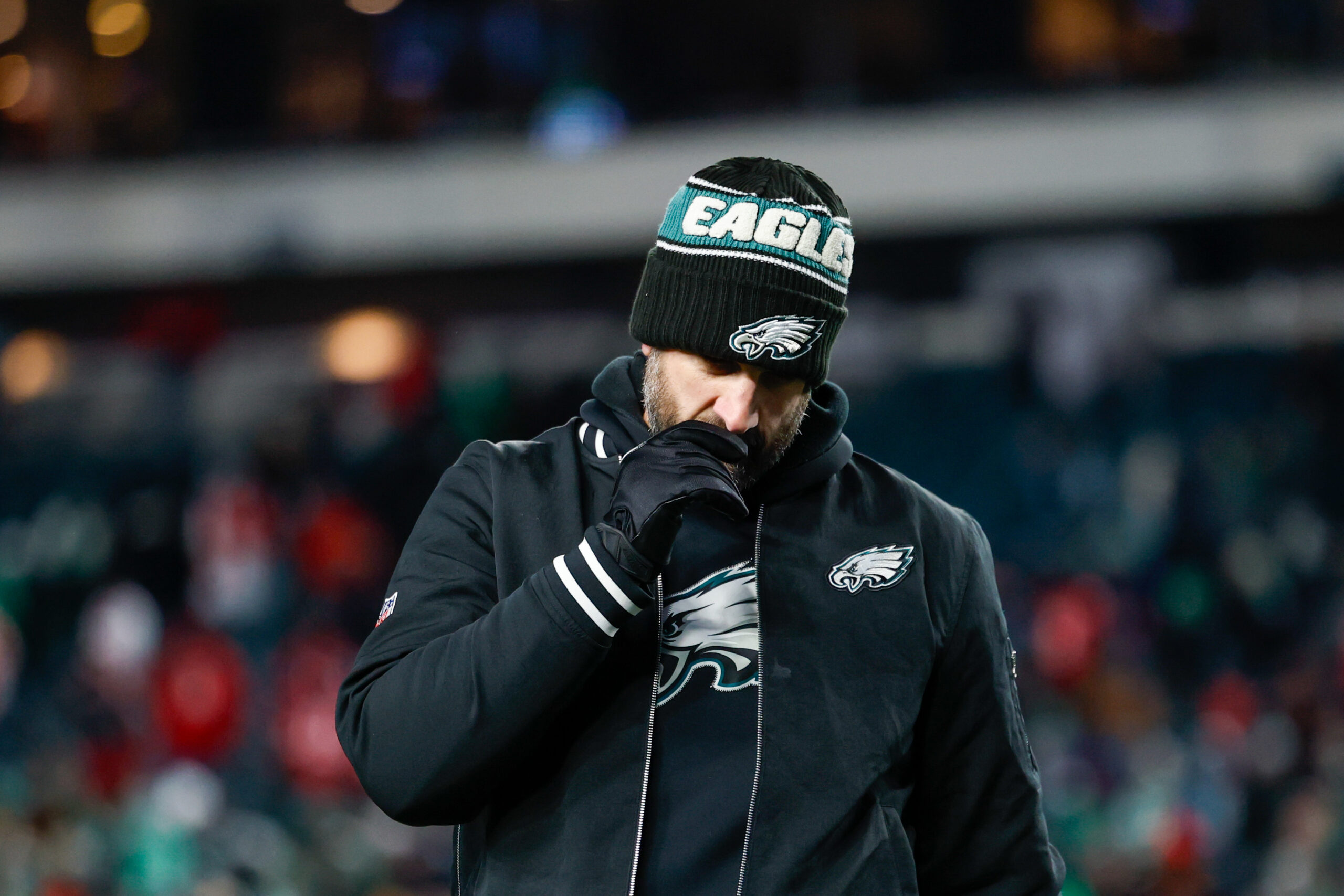
    Now, everybody knows his name. After 18 games of ineptitude as the Eagles’ offensive coordinator, Patullo will bear the blame for the lost season of 2025, no matter how much he looks like his buddy, Nick.

    Patullo cannot survive the week. The blame will fall to him.

    It might not be true. The defense needed two months to round into shape.

    It might not be fair. Sixty percent of the offensive line was injured to some degree all season, and neither wide receiver A.J. Brown nor running back Saquon Barkley played to his usual standards.

    Still, it’s hard to believe that owner Jeffrey Lurie, who spent $128 million on an offense that cost him more than twice what the defense cost, will give another chance to the least popular assistant coach since Juan Castillo moved from offensive line to defensive coordinator in 2011. Castillo was fired in October 2012, two months ahead of Andy Reid’s departure.

    An offense that featured Barkley, Brown, Jalen Hurts, DeVonta Smith, Dallas Goedert, and a well-paid, pedigreed offensive line scored two early touchdowns against the visiting 49ers on Sunday night. And then just six more points.

    It had been 22 years since the Eagles suffered such a gutting home playoff loss, a 14-3 collapse in the NFC championship game. Move over, Carolina.

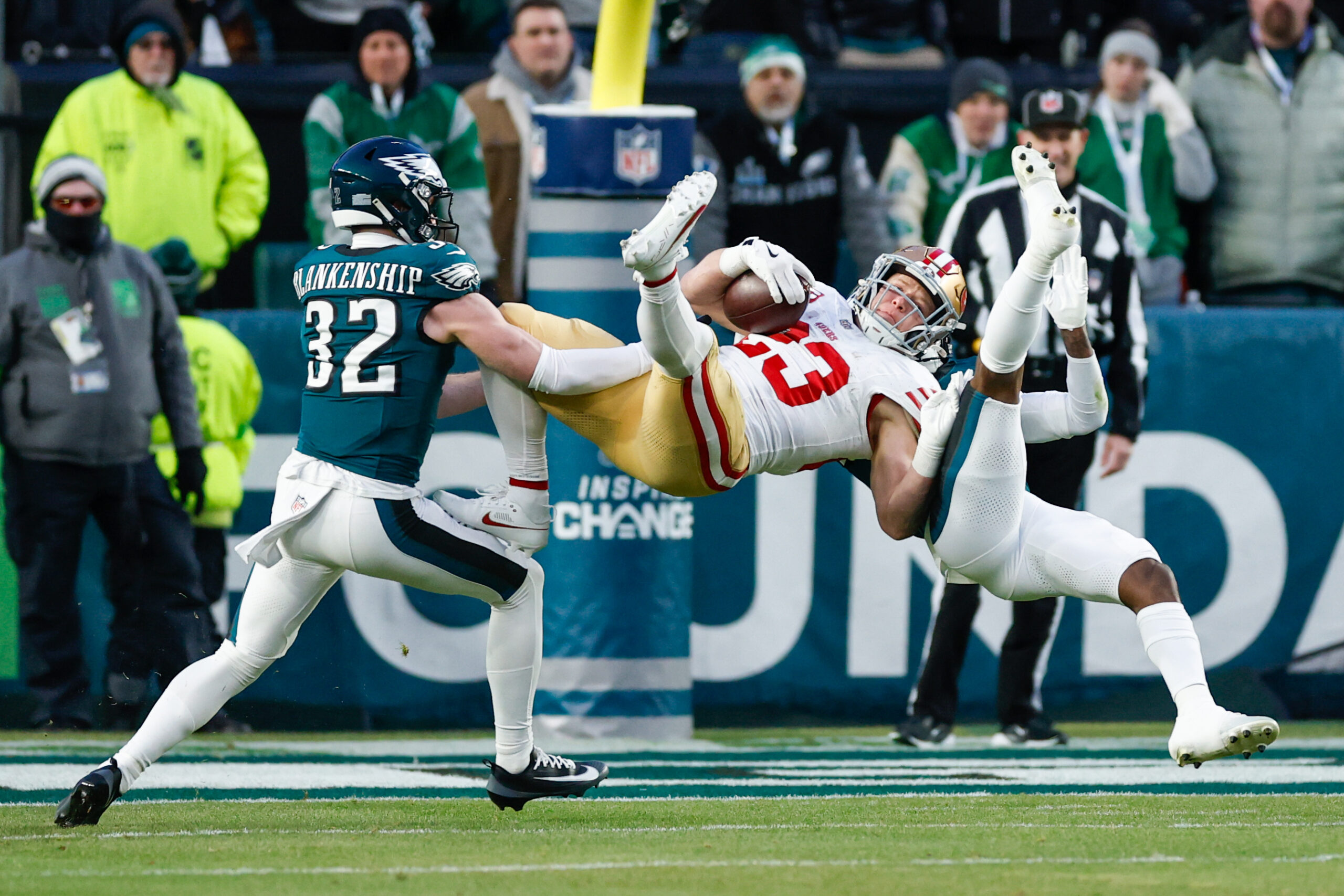
    The Eagles gave away a 23-19 wild-card playoff loss to a 49ers team that had crossed three time zones with a depleted roster, that, after the second quarter, also had lost one of its better players, tight end George Kittle. Hurts and Patullo’s offense had a chance to score the winning touchdown in the closing minutes, but the drive broke down and failed at the 21-yard line on the quarterback’s fourth-down incompletion intended for Goedert with 40 seconds left.

    Asked his evaluation of Patullo’s first season, Hurts replied: “We’ve all got to get better.”

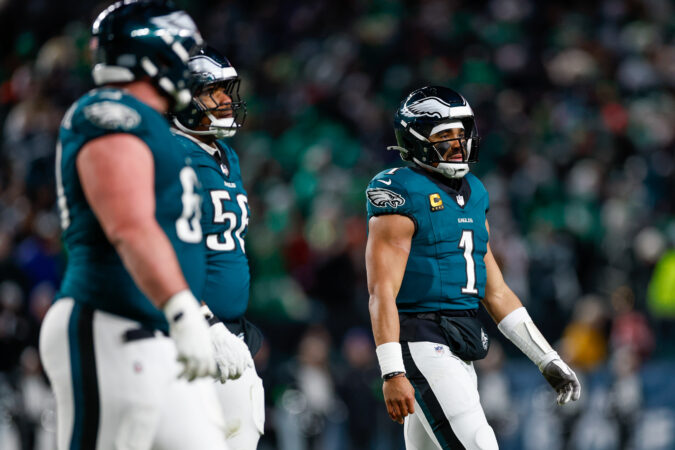
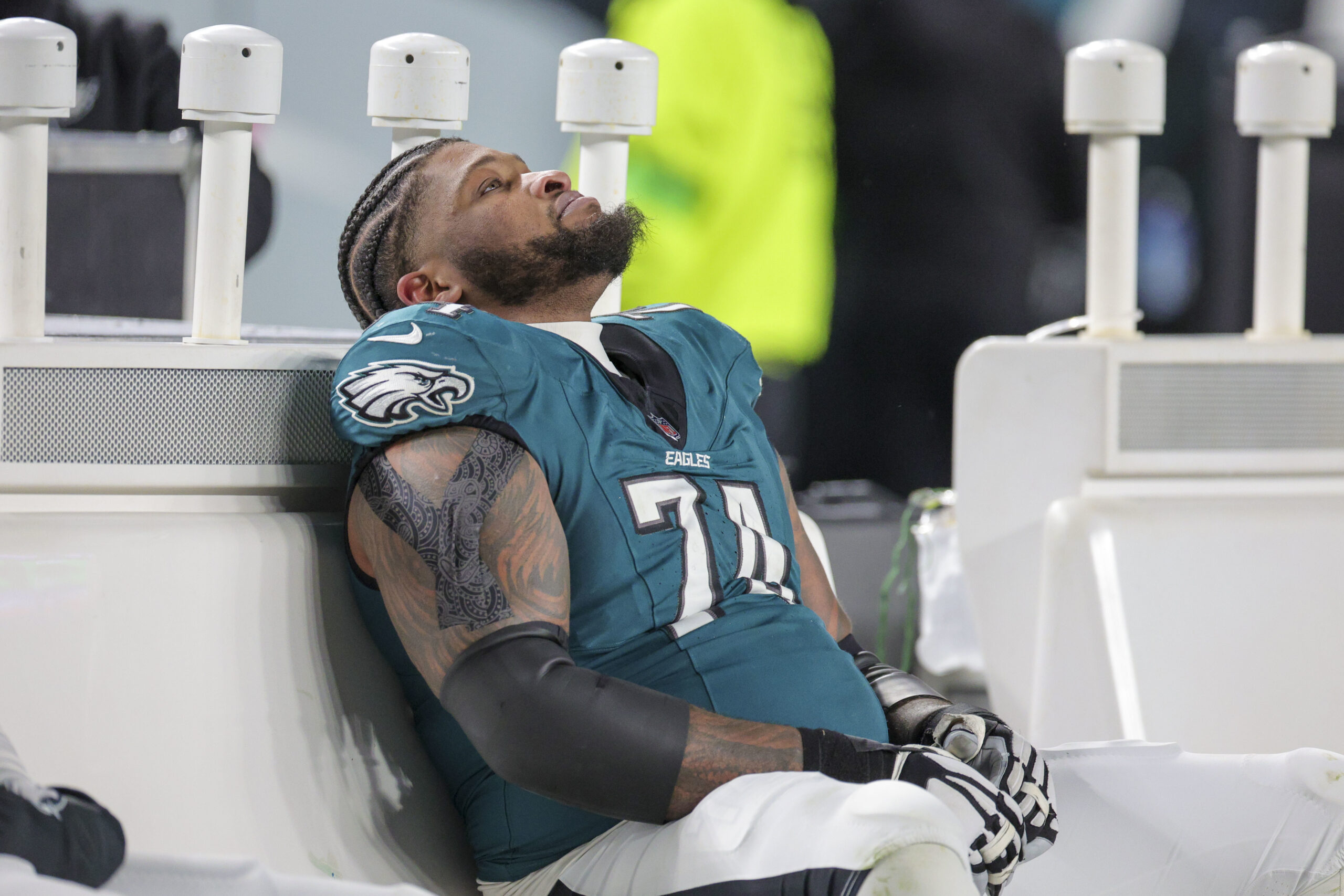
    Eagles tackle Fred Johnson sits on the bench after the loss to the San Francisco 49ers at Lincoln Financial Field.

    Left tackle Jordan Mailata said, effectively, let he who is without sin cast the first stone:

    “Nobody wants to blame the guy we paid $22 million, so let’s blame the offensive coordinator,” said Mailata, who averages $22 million per season.

    Niners coach Kyle Shanahan acts as his team’s play-caller, and, despite absences and injury, he gave Patullo a master class in scheme and preparation.

    The 49ers’ first possession, comprised mainly of passes for 61 and 11 yards, lent credence to the people who wanted the Eagles to play their starters instead of resting them in Game 17 the week before. The defense looked more than just rusty. It looked inept.

    The Eagles’ maligned offense somehow stayed sharper than their celebrated defense. On its first possession, six runs from Barkley helped move the Eagles to the 1, where tight end Goedert ran the ball for just the fourth time in his career and scored his first rushing touchdown.

    The Eagles’ next score happened because Barkley waited for Landon Dickerson to block a defender on a 20-yard screen pass. Later, Hurts waited for a defender to clear the path between himself and Goedert, whom Hurts found for a 9-yard touchdown pass.

    The game was punctuated by a sideline incident with 2 minutes, 2 seconds to play in the first half as the Eagles prepared to punt. Head coach Nick Sirianni ran 30 yards down the sideline toward the touchy wide receiver Brown, who, in Sirianni’s view, was taking too much time exiting the field. Brown stopped and appeared to heatedly argue the point. Security chief Dom DiSandro separated them.

    A few seconds later Brown left the bench and shouted in Sirianni’s direction, and was ushered away by sideline personnel and teammates.

    Some of the stars starred.

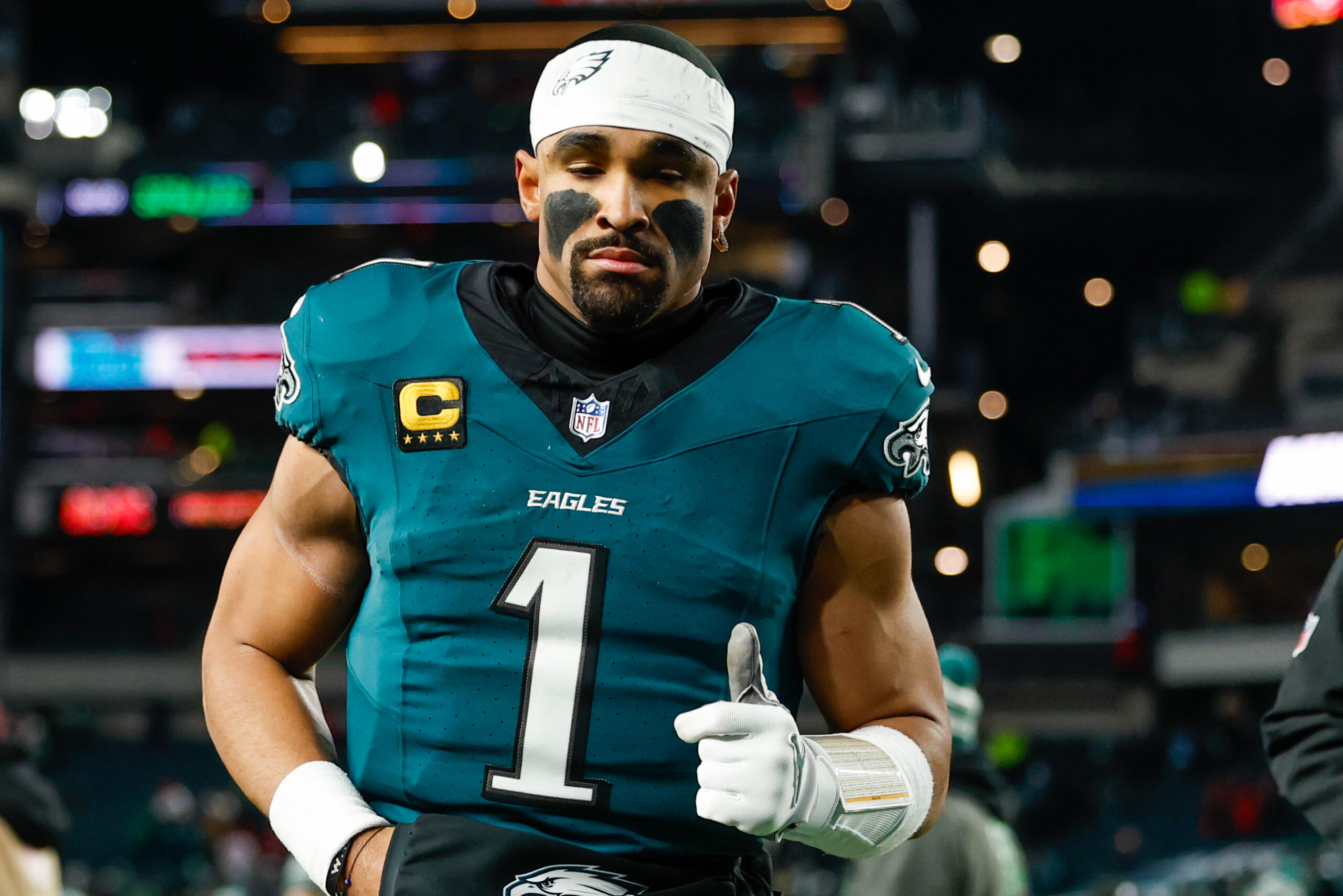
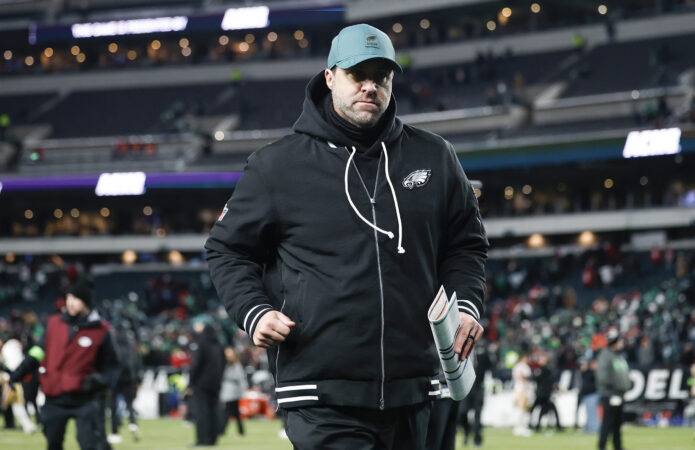
    Eagles quarterback Jalen Hurts runs off the field after the loss to the 49ers.

    Goedert, who this season set an Eagles record with 11 touchdown catches, tied for the league lead, ran for one touchdown — the first tight end to do so in NFL playoff history — and caught another.

    Quinyon Mitchell, the team’s best defensive back since Brian Dawkins, collected his third and fourth interceptions in his five career playoff games.

    Barkley ran 26 times for 106 yards and caught a 20-yard pass.

    Brown? He managed just three catches for 25 yards. He failed on two consecutive deep shots to connect with Hurts, disconnects that immediately preceded his latest sideline incident.

    Brown often has expressed frustration with the Eagles offense the past two seasons. Sunday, as he has done for more than a month, he left the locker room without fulfilling his league-mandated obligation to speak with reporters.

    It continued the season’s theme:

    Brown wearing a frown.

    Patullo’s offense breaking down.

    Philly might have seen the last of both of them.

  • Eagles go cold in second half as 49ers end their bid to repeat as Super Bowl champs

    Eagles go cold in second half as 49ers end their bid to repeat as Super Bowl champs

    In the end, the Eagles offense couldn’t rise to the occasion, a shortcoming it had all season long.

    With under a minute remaining in the wild-card round Sunday against the San Francisco 49ers, Jalen Hurts was tasked with driving down the field and leading a touchdown drive to erase the Eagles’ 23-19 deficit. Upon reaching the 49ers’ 20-yard line, Hurts was sacked and threw three straight incompletions, ending the Eagles’ aspirations of repeating as Super Bowl champions.

    There were three lead changes in the fourth quarter at Lincoln Financial Field. The 49ers managed to pull off the win without injured inside linebacker Fred Warner, defensive end Nick Bosa, and tight end George Kittle, who suffered a torn Achilles tendon in the second quarter.

    Here’s our instant analysis from the Eagles’ loss to the 49ers:

    Nick Sirianni’s first home playoff loss was a story of missed opportunities.

    Tale of two halves, again

    The Eagles offense followed an all-too-familiar script — it came out strong in the first half, only to disappear at times in the second.

    In the first half, Kevin Patullo and Nick Sirianni opted to run early and often to great success. On the second play of the Eagles’ opening drive, Saquon Barkley took a handoff from Hurts in the shotgun, bounced to his right, and scampered upfield for a gain of 29 yards. His run helped set up the Eagles’ first touchdown of the day, a 1-yard run by Dallas Goedert to make it 7-6, 49ers, after a missed Jake Elliott point-after.

    Barkley finished the first quarter with nine carries for 48 yards (5.3 yards per carry).

    Barkley had an up-and-down showing in the passing game. First, the good. In the second quarter, Hurts had an unblocked defender in his face on second-and-6 from midfield, and dumped the ball off to Barkley, who turned a routine checkdown into a 20-yard gain.

    His play eventually led to Goedert’s second touchdown of the game, a 9-yard catch that made it 13-7, Eagles.

    Then, the not-so-good. On third-and-3 from the Eagles’ 37-yard line early in the third quarter, Barkley dropped a pass in the open field, causing the Eagles to go three-and-out for a second straight possession.

    His woes continued in the second half. After averaging 4.7 yards per carry (71 yards on 15 carries) in the first, Barkley went for 0.8 yards per carry (six carries for 5 yards) in the third quarter.

    Patullo and Sirianni seemed to lean conservative in their play calls in the third quarter as they clung to their 13-10 lead. Three plays after Quinyon Mitchell’s first interception of the night in the third quarter, Barkley was stuffed for a loss of a yard by 49ers cornerback Deommodore Lenoir on a second-and-18 zone run.

    The Eagles lost nine yards on the four-play drive and punted. On the following possession, still up by three, the Eagles settled for a 41-yard field goal. They had seemingly waved the white flag on third-and-13 with a Hurts 4-yard keeper, appearing content to take the points. However, Sirianni pushed back on the notion that he had grown conservative in the second half.

    “I think that’s always the go-to [perception] if it [doesn’t] go the way you want,” Sirianni said. “If it goes the way you want it to go in the first half and then not the second half, I think that’s the go-to of people [thinking] you take your foot off the gas, but we were playing more balanced, got the run game going a little bit, trying to mix our play actions in, trying to get our passes in to create explosives. At the end of the day, we didn’t create enough explosives.”

    Barkley was slightly more effective in the fourth quarter, and was able to return after being hobbled by a leg injury after a hard hit that caused him to miss snaps. But at that point, the Eagles were often in catch-up mode due to the 49ers scoring a pair of touchdowns.

    Rare drops plagued A.J. Brown. The 28-year-old receiver had three receptions on seven targets for 25 yards. On the Eagles’ final possession, he dropped a third-down pass over the middle of the field, only to be bailed out by Goedert’s conversion on the ensuing fourth down. With the season on the line, Goedert was targeted later in the drive on fourth-and-11 from the 49ers’ 21, but linebacker Eric Kendricks broke up Hurts’ pass.

    As a passer, Hurts went 20-for-35 (57.1%) for 168 yards and one touchdown. While the Eagles won the turnover battle, they didn’t win the explosive play battle. Hurts’ longest pass went for 20 yards and Barkley’s longest run was 29, marking the Eagles’ only plays of 20-plus yards.

    “I take ownership for not being able to put points on the board,” Hurts said postgame. “It all starts with me and ends with me. And so there’s a sense of a lot there that you can learn from. I think as a team, as a collective group and personally for me as a quarterback, how you see the game, how you feel the game, and ultimately just, ‘OK, how can I find a way to win?’ We weren’t able to do that today.”

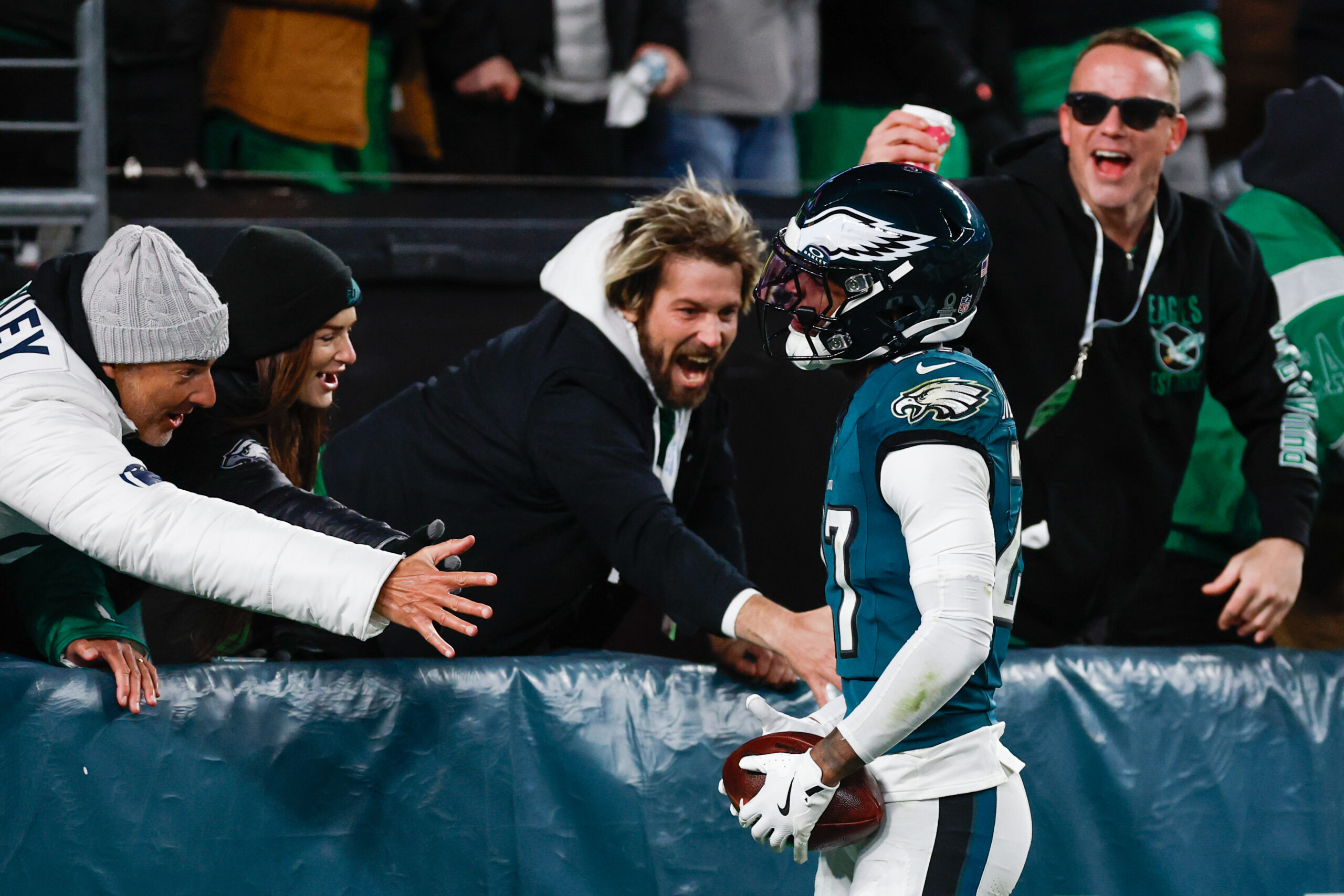
    Quinyon Mitchell logged two interceptions in a losing effort for the Eagles.

    Mitchell’s two picks for naught

    Quinyon Mitchell, named to his first All-Pro team on Saturday, stepped up in the second half in an attempt to reinvigorate the Eagles offense.

    The 24-year-old cornerback contributed a pair of interceptions, keeping the surging 49ers offense off the field and giving Hurts & Co. an opportunity to put points on the board.

    However, the Eagles only mustered a field goal off his picks. On his first interception in the third quarter, Mitchell undercut an erratic play-action pass intended for Skyy Moore, giving the Eagles offense prime field position at their own 48.

    They punted after four plays, one of which was a Cam Jurgens holding call on second-and-10.

    One series after the 49ers took a 17-16 lead on a fourth-quarter trick play — a 29-yard touchdown pass from wide receiver Jauan Jennings to Christian McCaffrey — Mitchell struck again. Again, he undercut Brock Purdy’s pass, this time intended for 49ers tight end Jake Tonges.

    The Eagles began the series at their own 38 and managed to move the ball 32 yards on eight plays. But the wind proved problematic in the passing game. Late in the drive, a deep pass intended for Jahan Dotson in the end zone died in the wind, eventually leading the Eagles to settle for a field goal. Elliott made the 33-yard attempt, putting the Eagles up, 19-17, with eight minutes remaining.

    Ultimately, Mitchell’s interceptions proved to be missed opportunities for the Eagles offense.

    The Eagles defense made some big plays but also had key miscues and allowed Christian McCaffery to get into the end zone twice.

    Mistakes haunt Eagles

    A litany of mistakes crippled the Eagles on both sides of the ball. The Eagles lacked detail, one of Sirianni’s core values, reflected by their seven penalties for 48 yards. The 49ers, conversely, were flagged once for 15 yards.

    The Eagles’ mistakes led to 49ers points. Late in the fourth quarter, the Eagles up 19-17, Reed Blankenship was flagged for holding Tonges on second-and-6 just outside the red zone. His transgression wiped away a Jalen Carter sack and gave the 49ers a fresh set of downs at the 20.

    The 49ers took advantage of his mistake, as Purdy connected with McCaffrey on a 4-yard touchdown pass to regain the lead, 23-19.

    “I should have never held him,” Blankenship said. “I thought I was pretty late. But at the end of the day, I’ve just got to be better doing that and be better doing my job.”

    The defense also had breakdowns in coverage. Wide receiver Demarcus Robinson’s 61-yard reception against Mitchell on the second play of the game brought the 49ers into the red zone. Robinson caught a 2-yard play-action pass for a touchdown, also against Mitchell, putting the 49ers up, 7-0.

    In the second quarter, Jennings had a 45-yard reception while aligned in the slot, slipping past Cooper DeJean to make the grab. His big play eventually led to points, too, in the form of a 36-yard field goal.

    Elliott’s missed extra point was also costly. Had he made it, the Eagles could have played to tie the game with a field goal on their final possession.

  • Not emu, not polar bear: Erin Andrews’ coat at Eagles-49ers game gets internet talking

    Not emu, not polar bear: Erin Andrews’ coat at Eagles-49ers game gets internet talking

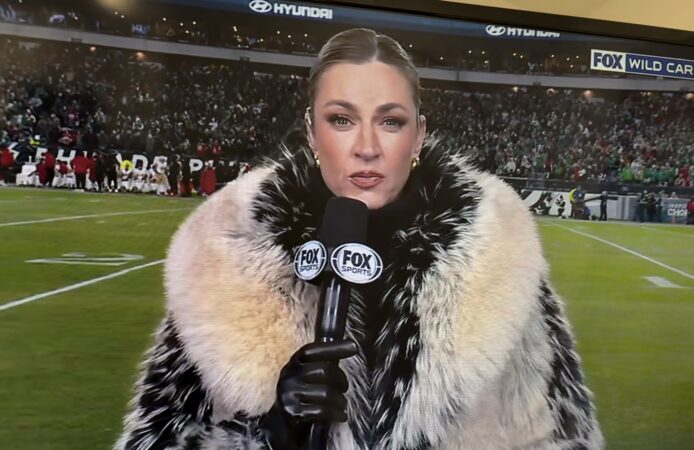
    No, FOX Sports reporter Erin Andrews’ jacket was not made of any Philadelphia Zoo animals.

    Andrews’ sideline look — an extravagantly fluffy, cream and black, fur-like jacket — was quickly meme-ified during Sunday’s matchup between the Eagles and San Francisco 49ers.

    “I also want to hear about that coat,” play-by-play announcer Kevin Burkhardt said early in the second half. “It’s terrific.”

    One X user suggested it was made from a flock of emus; another joked it was the zoo’s ​​”entire polar bear exhibit.” Others noted its resemblance to Cruella de Vil’s signature fur coat in One Hundred and One Dalmatians. Even Merriam-Webster posted about this coat, noting that a flock of emus is called a mob.

    But animal lovers fear not: The jacket appears to be faux.

    One internet sleuth identified the coat as a $950 Auter number, possibly the brand’s “The Fox” jacket. (Apt, considering Andrews is employed by the TV network of the same name.)

    Despite the internet haters, the jacket was seemingly functional and fashionable for a 30-degree and windy wild-card game at the Linc.

  • Flyers goalie Sam Ersson tries to shake off ‘embarrassing’ effort against Lightning

    Flyers goalie Sam Ersson tries to shake off ‘embarrassing’ effort against Lightning

    Sam Ersson has not had the best start to the season.

    In 16 games, he is 6-6-4 with a 3.33 goals-against average and an .858 save percentage. They are the highest and the lowest numbers, respectively, in an NHL career that spans 126 games across four seasons.

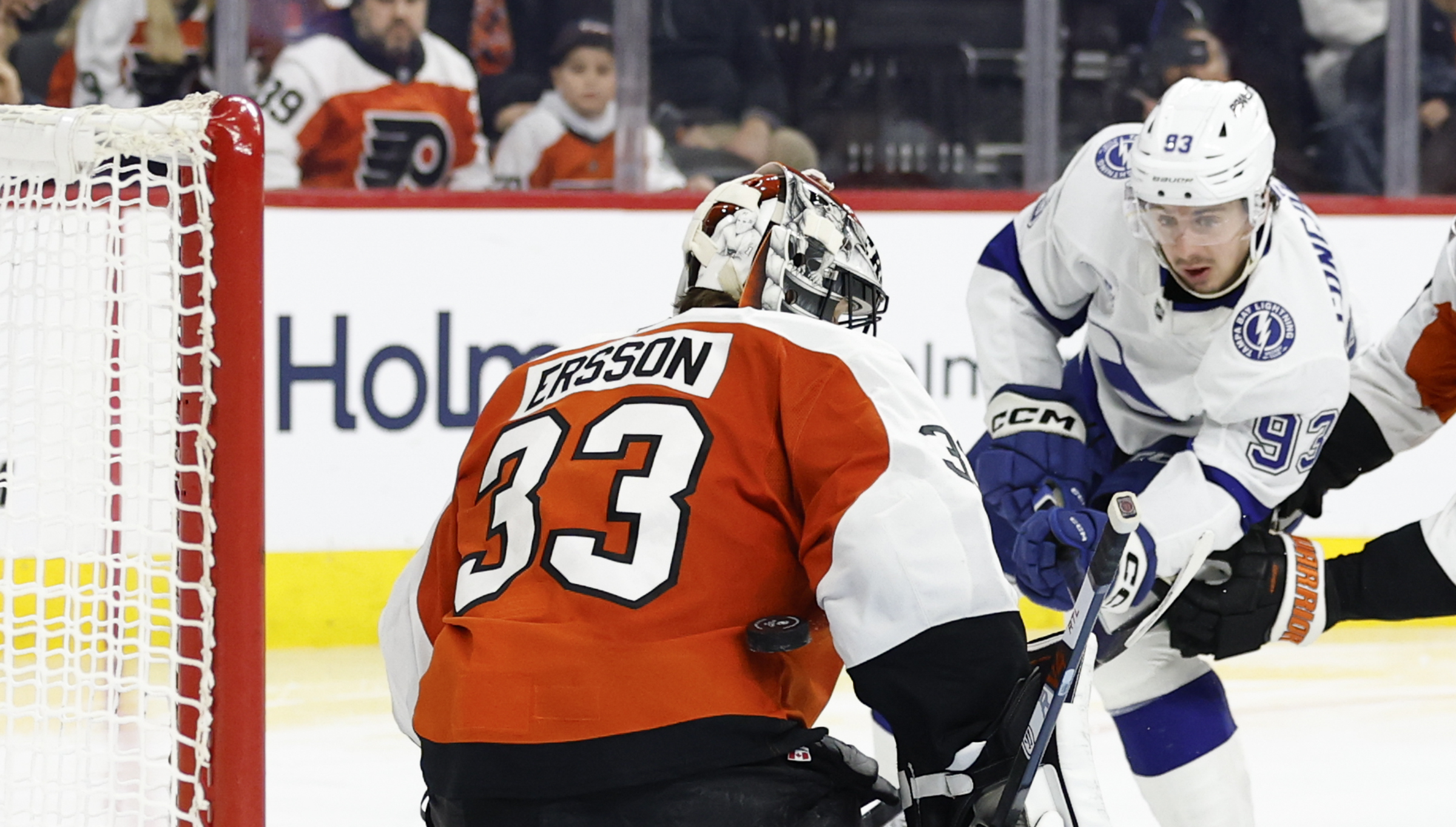
    Everything came to a head on Saturday in a 7-2 Flyers loss to the Tampa Bay Lightning at Xfinity Mobile Arena, matching his career high in goals allowed for the third time. He faced 23 shots.

    “Yeah, obviously, it’s been tough for me, personally,” he told The Inquirer Sunday about his season as a whole. “It’s weird. I would say, like the team is doing well, we’re winning, it’s a lot of fun in that sense, but at the same time, you want more out of yourself, and I’m disappointed in how I perform.

    “I think there’s been stretches of where it’s been good and got some big wins. And then there’s been stretches where, especially now, lately, I feel like it’s been lacking.

    “Obviously, especially last night, it’s very tough, embarrassing to let in seven goals on your home ice. You feel like you kind of let down the team and the fans. Obviously, that’s not acceptable. Just got to be better.”

    Ersson has one win in his last seven starts, a 3-1 victory against the Chicago Blackhawks before the NHL’s holiday break. He started nine of the first 26 games, going 5-2-2 with a 2.97 GAA and an .869 save percentage. Since Dec. 4, he has started seven of the Flyers’ last 17 games, going 1-4-2 in that stretch with a 3.80 GAA and an .844 save percentage.

    Tampa Bay center Gage Goncalves scores a third-period goal on Flyers goaltender Samuel Ersson on Saturday.

    The 26-year-old goaltender is not one to make excuses. And he has the chance to do just that with a new coaching staff, new systems in front of him, and fewer starts for a goalie who played in 47 games last year and 51 the year before.

    “I’m not blaming anything like that,” he said. “It comes down to me, how I perform, how I approach things, and I know if I do that in the correct way, my game, I will have success no matter what.”

    According to Money Puck, among goalies who have played at least 10 games, he is ranked fifth-worst in goals saved above average (-9.5), sixth in percentage of expected goals (-21.01), and tied for last in save percentage (.858). And he doesn’t have nearly as many minutes as the guys below him, like Jordan Binnington and fellow Swedes Jacob Markström and Linus Ullmark.

    Goals saved above average is a comparison tool to show how a goalie did compared to an average goalie seeing the same shots. Among goalies with at least 700 minutes played, Ersson ranks dead last at five-on-five in goals saved above average, too (-16.02). His high-danger goals saved above average is the 10th highest (-4.28), but he has also faced the fewest high-danger shots (70).

    It’s a bit surprising because, before the team made mistakes — not every goal on Saturday can be blamed on the goalie — and the Flyers allowed a touchdown and the extra point, they were ranked ninth in the NHL in goals allowed (2.79). It’s a wild drop from last season, when they finished at 3.45.

    “I think it’s better,” Ersson said when asked about structural changes in the defensive zone by Rick Tocchet and his staff. “I think we’re doing a really good job defensively with how we’re playing.

    “So, for me, it all comes down to kind of how I play and how I perform. And I know if I play to the level I can and want to be, I will have success. So, just got to find a way to flush these last few games and get back to where I want to be.”

    The Flyers play the Lightning again on Monday (7 p.m., NBCSP), and the expectation is that Dan Vladař will get the start. But there’s a good chance Ersson will get an opportunity to right the ship with the Flyers having a back-to-back in two of the next three weeks.

    “Just got to roll up the sleeves and grind away,” Tocchet said. And Ersson, who was the first one on the ice Sunday at practice, is up for the task.

    “It’s a combination of a lot of things,” the goalie said about what comes next. “I would say usually, like when you’re in a tough stretch, less is more. You’re obviously working, but if you start to try to change everything, then you’re just tearing down the foundation that you’ve built up for years, right? So it’s the combination of trusting your game, but just like pushing everything a little bit and getting back to where it needs to be.”

    Konecny’s brief practice

    Travis Konecny’s return practice Sunday lasted only a few minutes. During the first drill, he took a shot off his knee.

    “Kind of a nerve,” Tocchet said. “So hopefully it wakes up a little bit. So it just was like a dead leg kind of thing, so we’ll see about tomorrow.”

    The Flyers forward, who was injured during Thursday’s game and did not play the third period, also missed Saturday’s loss to Tampa Bay with an upper-body injury. After watching the game from the press box, he was a participant in a regular jersey in Voorhees.

    It became evident quickly that Konecny was in a lot of pain on the bench. He tried to walk it off under the watchful eye of assistant athletic trainers Alex Ambrose and Joe Mele, and even tested it on the ice, but did not return to practice.

    “It seems like injuries, even with other teams, they come in bunches, they don’t come every once in a while,” Tocchet said. “You get one, two, three, four in a row, so maybe it’s our turn now, we’re starting to get it. So, yeah, you’ve just got to push through that stuff.”

    At the start of last season, defenseman Nick Seeler missed the Flyers’ first five games after suffering a nerve injury to his leg in a preseason game, hitting an area without padding.

    “The numbness was the whole outside of my right leg and into my foot,” he said at the time, pointing toward the back of his leg, where it caused everything to “shut off for a while.”

    The Flyers hope to have Konecny, the team’s second-leading scorer, back in the lineup Monday against the Lightning. It starts a stretch of 11 games in the last 20 days of January, and they do not have two days between games until the start of February.

    Breakaways

    Forward Bobby Brink should be good to go on Monday. Brink has missed the last two games after being injured on a blindside hit during Tuesday’s win against the Anaheim Ducks. He participated in Saturday’s morning skate in a noncontact jersey but was in a regular black jersey on Sunday. … Defenseman Jamie Drysdale was still in a noncontact jersey. … Forward Carl Grundström missed practice due to illness. His status for Monday’s game is to be determined.

  • Darius Slay returns — so does George Kittle’s favorite giant middle finger — and more from Eagles tailgate lots

    Darius Slay returns — so does George Kittle’s favorite giant middle finger — and more from Eagles tailgate lots

    When it comes to tailgating, Philly is among the best to do it. Whether it’s grilling camel or belly dancing in the snow, Eagles fans know how to step it up for the playoffs — and this year’s pregame tailgate for the Birds’ wild-card matchup with the San Francisco 49ers didn’t disappoint.

    Here’s what you missed from the tailgating lots …

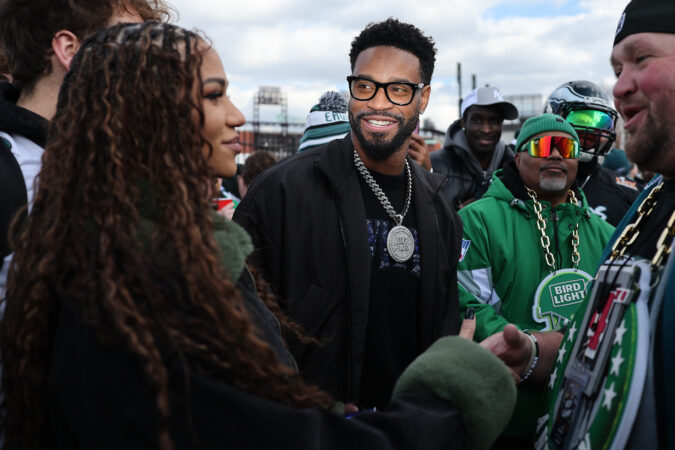
    Darius Slay back in Philly

    Darius Slay may no longer be part of the Eagles — but that’s not stopping him and his wife Jennifer Slay from supporting his former team, appearing on the sideline before the game and even in the parking lots.

    The former Birds cornerback posed for photos with fans at the 4th and Jawn tailgate ahead of Sunday’s game. Standing beside his wife, Slay looked at the crowd of Birds fans and smiled as they yelled out “Big Play Slay” and erupted in Eagles chants.

    Although Slay was released last offseason before signing with the Steelers, he still means a lot to Eagles fans after spending five seasons in Philly, capped off by a Super Bowl victory in February.

    “Darius Slay means everything,” said 30-year-old Chris Mallee. “He’s kind of a blue-collar guy like all the people coming to the games. He’s someone that keeps his head down and works really hard, family oriented, he’s a really solid guy.

    “We definitely miss him here but we’re glad he’s doing well.”

    Slay was released by the Steelers last month, and subsequently claimed by the Buffalo Bills. However, he informed the Bills he was considering retirement and did not report to the team.

    At the same time Slay was hanging with Birds fans Sunday, the Bills were in Jacksonville for their own playoff game. They came back in the final minutes to beat the Jaguars, 27-24, and advance to the divisional round.

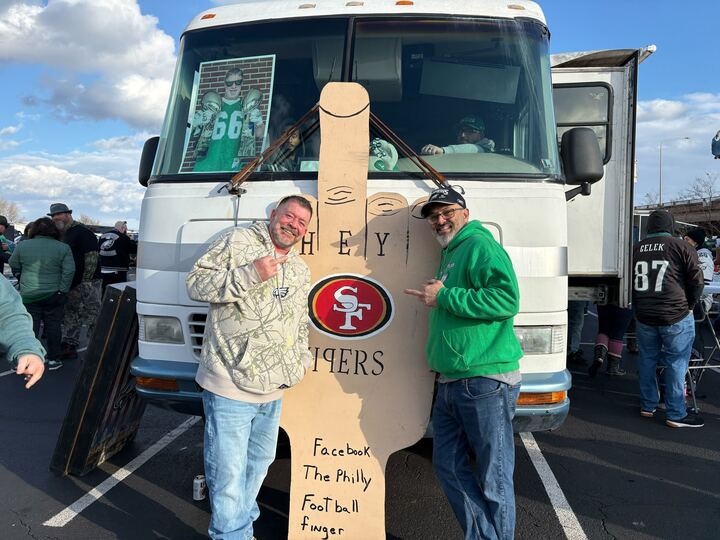
    John Hirschbuhl and Doug Steinbrecher’s Philly Football Finger caught the eye of George Kittle during his rookie year.

    Kittle’s favorite middle finger

    Most players who have played in Philly have had at least one memorable interaction with Eagles fans. And George Kittle is no different. The veteran tight end was one of several 49ers players to discuss his relationship with the fan base, and even shared his favorite story, which had to do with a giant middle finger he saw his rookie year.

    “There were like four 10-year-old kids holding a seven-foot-tall papier-mâché middle finger that had a rotating thing on it that made the middle finger come up,” Kittle told reporters. “That was the coolest thing, I’ll never forget it. That was my rookie year and I was like, this is excellent.”

    That middle finger was back on Sunday.

    John Hirschbuhl and Doug Steinbrecher have been building the Philly Football Finger for 25 years. The finger gets displayed for every home game and they bring it with them on the road twice a year.

    “George Kittle happened to see it, enjoyed it, sent a police officer over to tell us how he appreciated coming to Philadelphia and how the fans are a little bit nuts here,” said. “We all love football. That’s what it comes down to.”

    Kittle was carted off Sunday after suffering what was later reported to be an Achilles injury.

    ‘Walking the dog’

    Walking through C Lot, you’ll likely find fans playing cornhole, grilling, and throwing a football around as they prepare for the day’s game. You may also see a grown man wearing a beak on his head as he drags a 49ers helmet through the parking lot with a leash.

    That’s 64-year-old David Schofield, also known as “Beak.” He has been “walking the dog” for 21 years.

    “The rescues, we just like to bring them out here in the sun and get them some exercise,” Schofield said of his “helmet dog.”

    Schofield has made this into a pregame ritual, and owns a helmet for each NFL team.

    “It started with a road trip in Buffalo when we took a helmet home to smash,” he said. “But, it was a good helmet so it didn’t smash too easily. So, I ended up putting it on a dog leash. Hence the birth of the helmet dog.”

  • ‘A turning point’: Anti-ICE protests reach the Philadelphia suburbs

    ‘A turning point’: Anti-ICE protests reach the Philadelphia suburbs

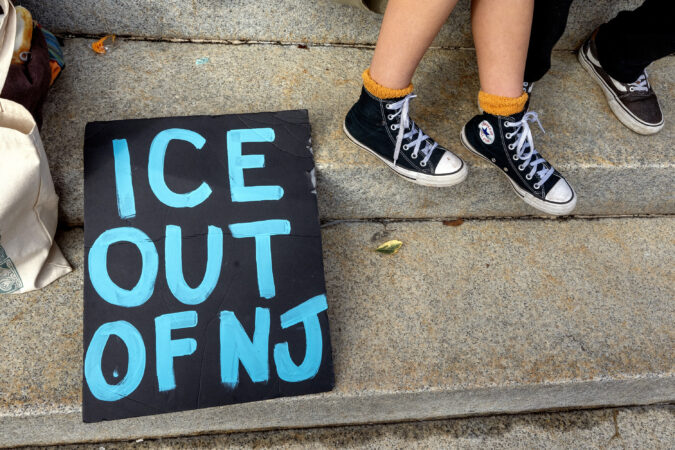
    Legions of suburbanites decried federal ICE actions on Sunday in a series of vigils and protests across the Philadelphia area, signaling the breadth of opposition to a central part of President Donald Trump’s agenda.

    Expressions of anger, sadness, and resistance poured out into the streets of major cities nationwide this weekend in response to the killing of 37-year-old Renee Good by an ICE officer in Minnesota. But that dysphoria also spilled into small towns — including in places like Gloucester County, New Jersey, where voters favored Trump in 2024.

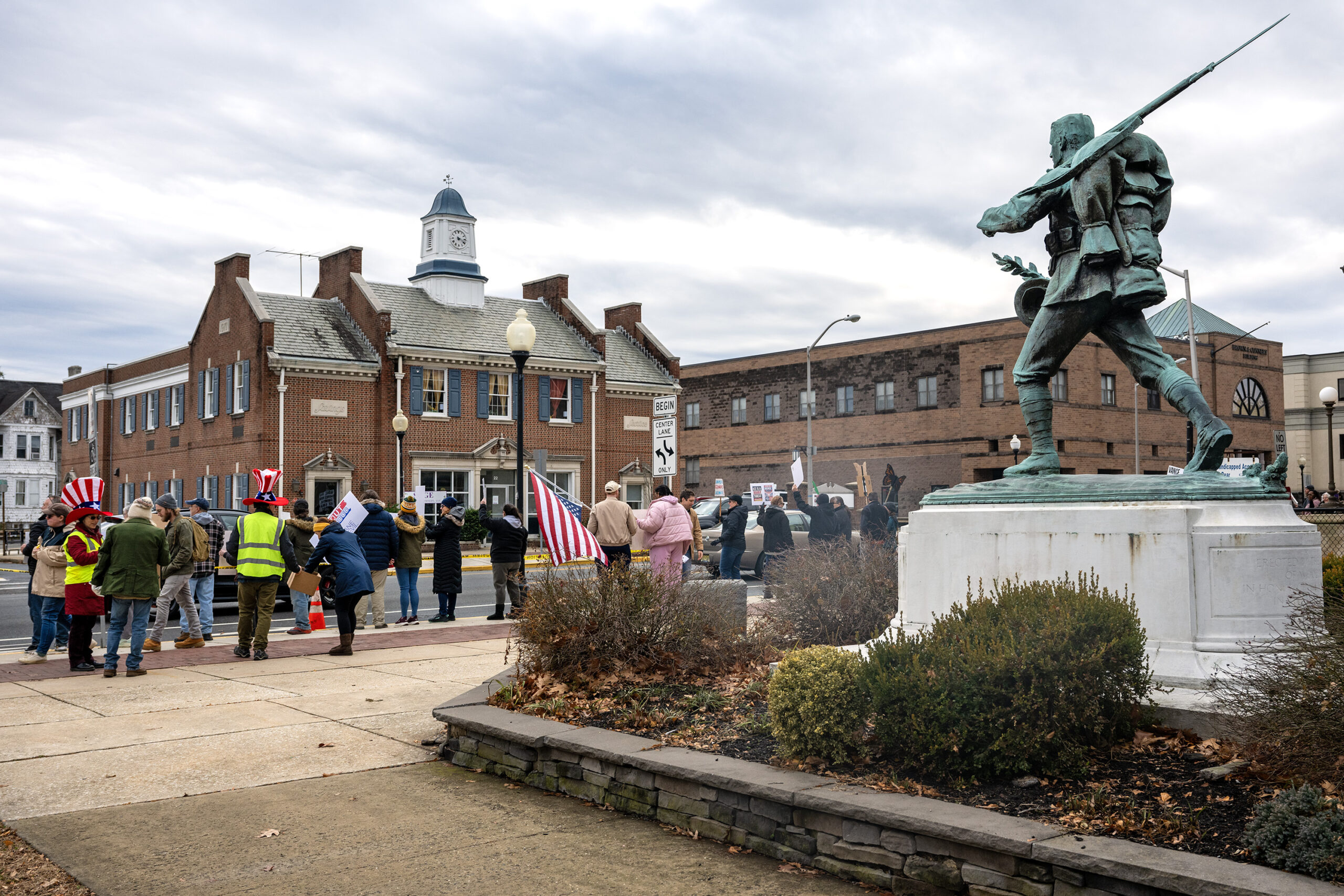
    “I’ve been quiet and timid my whole life, and now I’m just trying to speak up,” said Cristen Beukers, one of more than 100 people who attended a demonstration in Gloucester’s county seat, Woodbury, a city of about 10,000. Gathered along North Broad Street, near the Gloucester County Courthouse, participants’ signs, whistles, and bullhorn-led protest chants were met with beeping car horns and the supportive shouts of drivers.

    Beukers, 40, of nearby Paulsboro, called for a proper investigation into the shooting death of Good, a mother and poet, on Wednesday.

    Mi Casa Woodbury and Cooper River Indivisible hold a “roadside rally” in downtown Woodbury, N.J., in support of immigrants and to protest ICE on Sunday, Jan. 11, 2026, as protests against Trump administration actions spread in the suburbs.

    Thousands of ICE agents and federal troops have swarmed blue American cities as part of Trump’s unprecedented campaign to arrest and deport millions of immigrants. Good was shot three times in the driver’s seat of her SUV after a brief confrontation with ICE agents on a residential Minneapolis street. Trump administration officials insist ICE agent Jonathan Ross fired out of self-defense; video footage appears to show he was not in the vehicle’s path when he fired.

    “It’s an S.O.S.,” said Alex Baji, 31, of Woodbury, who said he’s a former IRS auditor laid off last year by the Department of Government Efficiency, overseen by billionaire Elon Musk. “Masked goons murdering U.S. citizens — and the vice president says it’s perfectly justified.”

    The turnout in Woodbury suggested a new level of urgency for the tight-knit suburban community, said Kaitlin Rattigan. Rattigan is a community organizer with Mi Casa Woodbury, a group that formed in response to ICE activity in their neighborhoods. Mi Casa has held a demonstration every Sunday since mid-November, even if just a few people attended.

    “I think it’s a turning point for many people — and frankly for white people,” Rattigan, who is white, said.

    According to a recent poll conducted by Pew Research Center, 50% of American adults surveyed in October disapproved of the Trump administration’s approach to immigration, while 39% approve. (Some participants responded “neither.”) While 53% of respondents said the country is doing “too much” when it comes to immigration enforcement, a large majority continue to say at least some people living in the United States should be deported.

    Trump has derided and propagandized protesters as “paid insurrectionists,” “domestic terrorists,” or radical leftists — people who are not representative of mainstream Americans, Steve McGovern, a political science professor at Haverford College, said in an interview. Anti-ICE rhetoric in the suburbs threatens Trump’s narrative, according to McGovern. Trump’s 2024 win was fueled by key gains in Philadelphia’s suburbs, an Inquirer analysis found.

    “The popular image of suburbia continues to be a place where lots of middle-class, mainstream people live and work,” he said. “If suburbanites take to the streets and in large numbers, that would send — I think — a powerful message that a strong majority of the country is increasingly fed up with the outrageous, lawless, and even murderous behavior of ICE agents.”

    At least one Republican observer was skeptical. Guy Ciarrocchi, a GOP analyst, said in a statement these protests no longer influence independent voters, nor intimidate Republicans.

    “Unfortunately, these ‘rallies’ are political theatre — plug [and] play crowds with professional signs for any ‘cause.’ Tools to rally extremist Democrat voters,” he said. “Ms. Good’s death was a tragedy. And, ICE’s work is important and necessary. No ‘rent a rally’ will change either of those truths.”

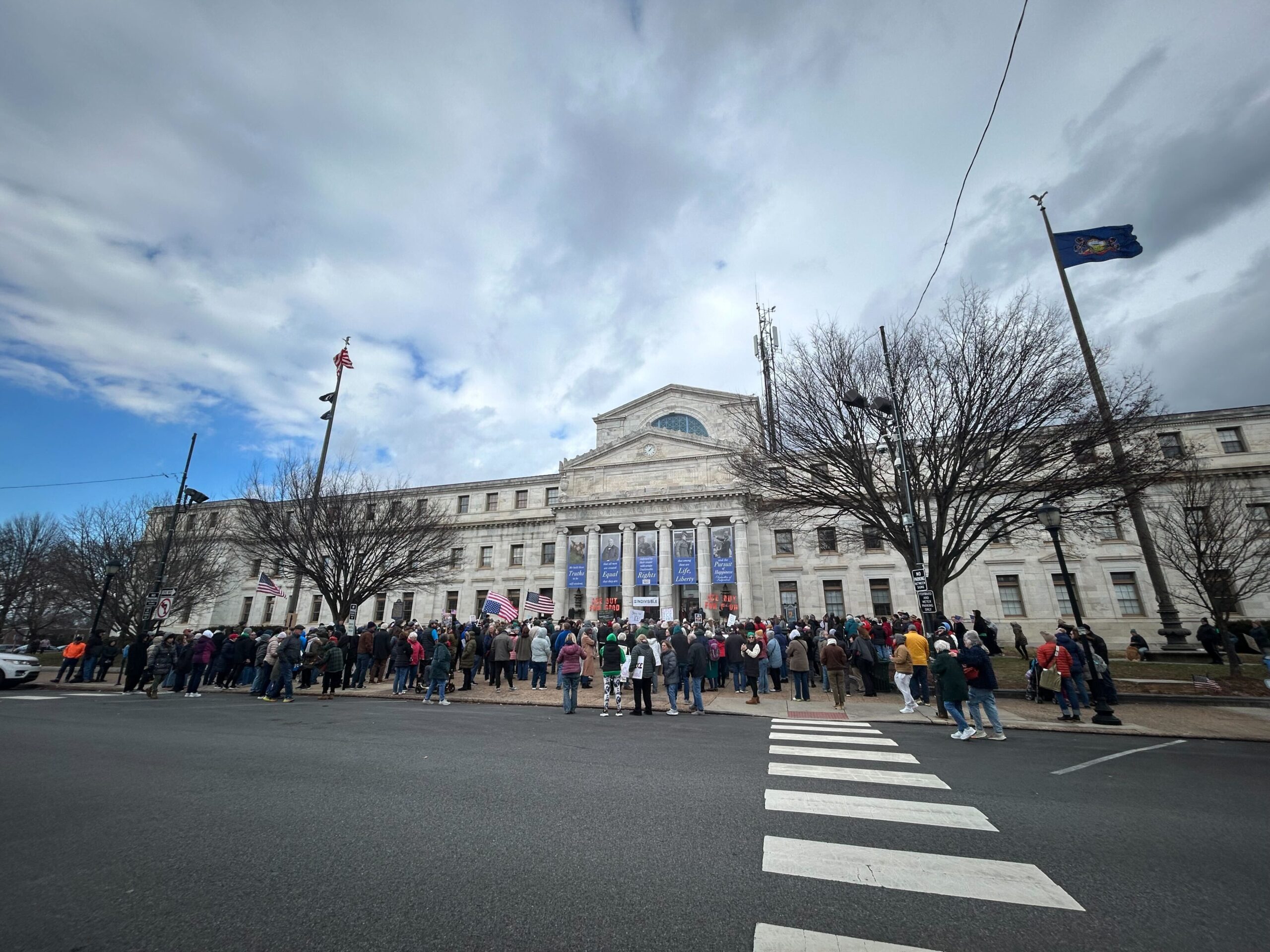
    Outside the Delaware County Courthouse in Media, hundreds shouted into the bitter wind: “United we stand, divided we fall.” The voices came from attendees of all ages — older people in wheelchairs, young parents pushing babies in strollers, and children holding crayon-drawn signs etched with messages like “ICE Cream, not ICE” and “NO ICE because it’s cruel.”

    “The entire nation is watching Pennsylvania,” said U.S. Rep. Mary Gay Scanlon, a Delaware County Democrat. “We can reject Trumpism at the state and federal levels this year. … We will not be bullied out of the future that we and all our children deserve.”

    Area residents hold what organizers called a “vigil for peace on our communities” on Jan. 11, 2026, in Media, Pa.

    In the increasingly blue suburban county — that not long ago was solidly red — the vocal opposition to Trump has grown louder in recent years, said Cathy Spahr, coleader of Delco Indivisible, which organized Sunday’s vigil for Good.

    “We didn’t have this during the first [Trump] administration,” she said of the event’s turnout. Spahr said she was especially heartened by the attendance given that the vigil was announced only days before — and ended an hour before the Eagles’ first playoff game of the year.

    But Spahr and several attendees said there’s something special about coming together closer to home. And logistically, it’s easier.

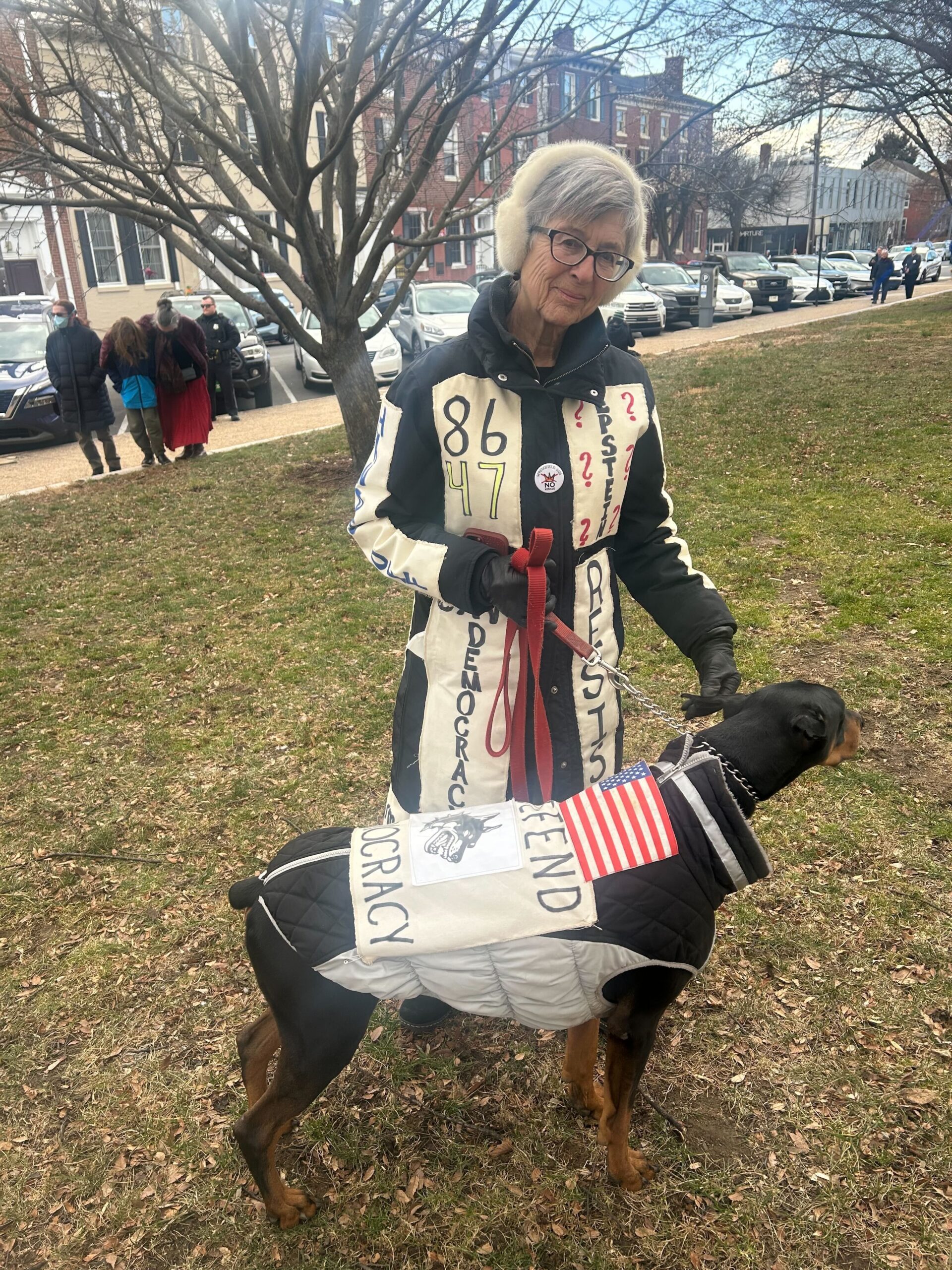
    Corinne Fiore, 75, of Media, and her 4-year-old Doberman, Laser, cherish the opportunity to be involved in the anti-Trump movement in Delaware County.

    Corinne Fiore, 75, of Media, poses with her 4-year-old Doberman, Laser, who wears a “Defend Democracy” vest to local rallies and events, on Jan. 11, 2026, outside of the Delaware County Courthouse in Media, Pa.

    “I just can’t get in a car and go for 10 hours somewhere,” she said. She’s thankful she doesn’t have to. “Delaware County has a lot of responsible people in it. They’re good and kind people. Patriotic people.”

    For families with young children, the Media vigil also presented a convenient opportunity to teach their children the importance of standing up for their neighbors.

    “I want to show them it’s important to stand up to a bully,” said Candice Carbone Bainbridge, 42, of Wallingford. Nearby, her 8-year-old daughter, Cora, held a sign with pink and purple lettering that read: “Be a good human. It’s not that hard!”

    Sixteen miles southeast, in Bellmawr, N.J., dozens gathered along Black Horse Pike, hoisting signs, cheering on supportive honks from passing commercial trucks, and dancing to the Rascals’ 1968 anthem, “People Got to Be Free.” One poster read, “American foundations are being destroyed, no one is safe, stand up now.”

    Karen Kelly, 72, who drove 40 minutes and DJed the demonstration, said she’s frustrated by apathy and disengagement.

    “All the people staying home — doing nothing — have to get the heck up,” Kelly said.

    Residents in the outskirts of Philadelphia expressed similar sentiments to their suburban counterparts.

    “This is not law enforcement, this is brutality,” said Susan MacBride, 84, at a protest in Roxborough, which was largely attended by residents of Cathedral Village, a retirement community in Northwest Philadelphia. Tired of what she described as the Trump administration’s cruelty and disrespect, MacBride felt compelled to put a pause on her retirement and join the 160-person rally at Ridge Avenue and Cathedral Road.

    “Kids need to know this isn’t normal; it’s a period of disruption, but we can’t let them get used to this,” she said.

    Nearby neighbor Lorraine Webb, 73, agreed with MacBride.

    “This isn’t what we are about, we need to do better,” Webb said. “We need to show up because this isn’t just a Center City issue; it’s a Philadelphia issue.”

  • Former N.J. acting governor Richard Codey, the state’s longest-serving legislator, has died at 79

    Former N.J. acting governor Richard Codey, the state’s longest-serving legislator, has died at 79

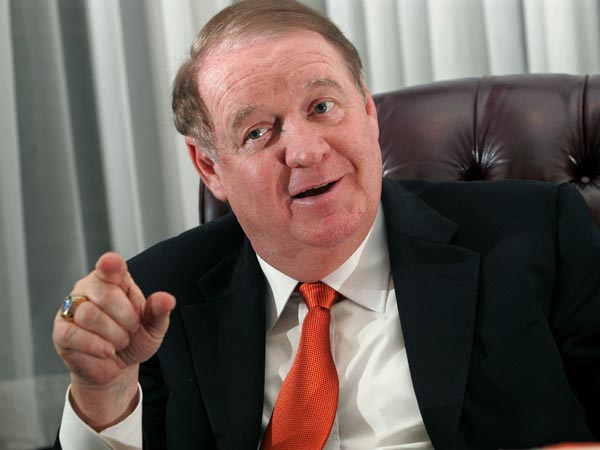
    Richard Codey, a former New Jersey acting governor and longtime state senator, has died at 79, his family announced Sunday.

    The Democrat represented an Essex County-based district in the Assembly from 1974 to 1982 and the Senate from 1982 to 2024, the longest combined service in state history. His family said he died peacefully at home Sunday after a brief illness.

    He was the New Jersey Senate president from 2002 to 2010.

    After Gov. Jim McGreevey resigned in 2004, Mr. Codey served as acting governor for the remaining 14 months of McGreevey’s term, until Jon Corzine was elected and succeeded him. Under a state constitutional provision in effect at the time, Mr. Codey concurrently served as governor and Senate president.

    In a statement on Facebook, Mr. Codey’s family said he served with humility and compassion. “He made friends as easily with Presidents as he did with strangers in all-night diners,” the family’s statement said.

    Legislators who served alongside Mr. Codey reacted to his death on social media.

    Current Senate President Nicholas Scutari said he had lost a trusted colleague and good friend.

    “New Jersey has lost a remarkable public servant who touched the lives in meaningful ways of everyone who knew him,” Scutari said in a statement on Facebook.

    State Sen. John McKeon served the same district as Mr. Codey in the Assembly for 22 years before succeeding him in the Senate.

    “Observing firsthand his empathy, humility, and advocacy for those who could not speak for themselves have had a profound and enduring influence on my professional life,” McKeon said on Facebook.

    Known for his feisty, regular-guy persona, Mr. Codey was a staunch advocate of mental health awareness and care issues. The Democrat also championed legislation to ban smoking from indoor areas and sought more money for stem cell research.

    As acting governor, Mr. Codey passed and signed a state law that limited public contracts for vendors who make campaign contributions.

    Mr. Codey operated his family’s funeral home before entering politics.

    Mr. Codey routinely drew strong praise from residents in polls, and he gave serious consideration to seeking the Democratic nomination for governor in 2005. But he ultimately chose not to run when party leaders opted to back wealthy Wall Street executive Jon Corzine, who went on to win the office.

    Mr. Codey would again become acting governor after Corzine was incapacitated in April 2007 due to serious injuries he suffered in a car accident. He held the post for nearly a month before Corzine resumed his duties.

    After leaving the governor’s office, Mr. Codey returned to the Senate and also published a memoir that detailed his decades of public service, along with stories about his personal and family life.

    His wife told the Associated Press that Mr. Codey was willing to support her speaking out about postpartum depression, even if it cost him elected office.

    “He was a really, really good guy,” Mary Jo Codey said. “He said, ‘If you want to do it, I don’t care if I get elected again.’”

    The Codey family said it would share information about his funeral in the coming days.

    This article contains information from the Associated Press.

  • Erich von Däniken, Swiss writer who spawned alien archaeology, has died at 90

    Erich von Däniken, Swiss writer who spawned alien archaeology, has died at 90

    BERLIN — Erich von Däniken, the Swiss author whose best-selling books about the extraterrestrial origins of ancient civilizations brought him fame among paranormal enthusiasts and scorn from the scientific community, has died. He was 90.

    Von Däniken’s representatives announced on his website on Sunday that he had died the previous day in a hospital in central Switzerland.

    Von Däniken rose to prominence in 1968 with the publication of his first book Chariots of the Gods, in which he claimed that the Mayans and ancient Egyptians were visited by alien astronauts and instructed in advanced technology that allowed them to build giant pyramids.

    The book fueled a growing interest in unexplained phenomena at a time when thanks to conventional science humankind was about to take its first steps on the Moon.

    Chariots of the Gods was followed by more than two dozen similar books, spawning a literary niche in which fact and fantasy were mixed together against all historical and scientific evidence.

    Public broadcaster SRF reported that altogether almost 70 million copies of his books were sold in more than 30 languages, making him one of the most widely read Swiss authors.

    While von Däniken managed to shrug off his many critics, the former hotel waiter had a troubled relationship with money throughout his life and frequently came close to financial ruin.

    Born in 1935, the son of a clothing manufacturer in the northern Swiss town of Schaffhausen, von Däniken is said to have rebelled against his father’s strict Catholicism and the priests who instructed him at boarding school by developing his own alternatives to the biblical account of the origins of life.

    After leaving school in 1954, von Däniken worked as a waiter and barkeeper for several years, during which he was repeatedly accused of fraud and served a couple of short stints in prison.

    In 1964, he was appointed manager of a hotel in the exclusive resort town of Davos and began writing his first book. Its publication and rapid commercial success were quickly followed by accusations of tax dodging and financial impropriety, for which he again spent time behind bars.

    By the time he left prison, Chariots of the Gods was earning von Däniken a fortune and a second book, Gods from Outer Space, was ready for publication, allowing him to commit himself to his paranormal passion and travel the world in search of new mysteries to uncover.

    Throughout the 1970s von Däniken undertook countless field trips to Egypt, India, and above all Latin America, whose ancient cultures held a particular fascination for the amateur archaeologist.

    He lectured widely and set up societies devoted to promoting his theories, later pioneering the use of video and multimedia to reach out to ever-larger audiences hungry for a different account of history.

    No amount of criticism dissuaded him and his fans from believing that Earth has been visited repeatedly by beings from outer space, and will be again in the future.

    In 1991 von Däniken gained the damning accolade of being the first recipient of the “Ig Nobel” prize for literature — for raising the public awareness of science through questionable experiments or claims.

    Even when confronted with fabricated evidence in a British television documentary — supposedly ancient pots were shown to be almost new — von Däniken insisted that, minor discrepancies aside, his theories were essentially sound.

    In 1985 von Däniken wrote Neue Erinnerungen an die ZukunftNew Memories of the Future — ostensibly to address his many critics: “I have admitted (my mistakes), but not one of the foundations of my theories has yet been brought down.”

    Although his popularity was waning in the English-speaking world by the 1980s, von Däniken’s books and films influenced a wave of semi-serious archaeological documentaries and numerous popular television shows, including The X-Files, which featured two FBI agents tasked with solving paranormal mysteries.

    His last major venture, a theme park based on his books, failed after just a few years due to lack of interest. The Mystery Park still stands, its human-made pyramids and otherworldly domes rotting as tourists prefer to explore the charms of the nearby town of Interlaken and the imposing Swiss Alps that surround it.

    Erich von Däniken is survived by his wife of 65 years, Elisabeth Skaja, daughter Cornelia, and two grandchildren.

  • Iraq War critic, Venezuela mission defender: Vance’s foreign policy journey

    Iraq War critic, Venezuela mission defender: Vance’s foreign policy journey

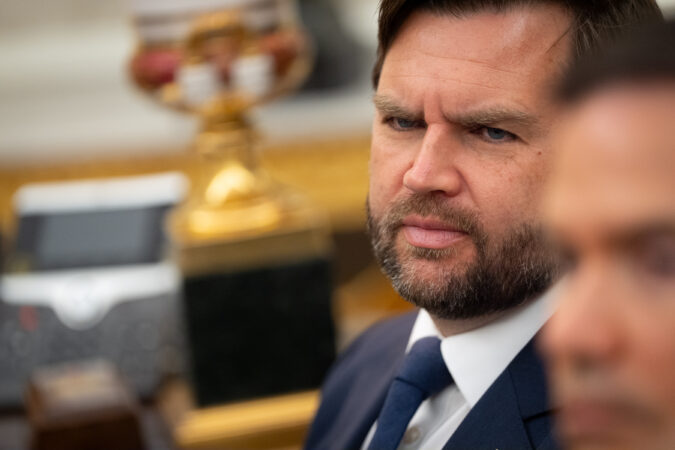
    Vice President JD Vance served in the Iraq War and came home a sharp critic of foreign military interventions, saying that too often Washington policymakers lose sight of American interests when they entangle themselves in faraway wars.

    Now he is defending President Donald Trump’s decision to conduct a daring raid this month in a country closer to home — to depose Venezuelan President Nicolás Maduro. The White House said that a more pro-U.S. government in Venezuela will stop drug and migrant flows, and open the country’s vast oil reserves to U.S. companies. But there are also major risks that armed conflict in the country could escalate, sucking in the United States and making the venture harder to defend as an “America First” endeavor.

    Vance’s defense of Maduro’s seizure appears discordant with his far more skeptical stance toward strikes on the Houthi militia in Yemen — a position revealed in a Signal group chat that was accidentally made public in March. Many prominent advocates of military restraint who have boosted Vance’s foreign policy views in the past now oppose the decision to oust Maduro.

    But as the vice president eyes his 2028 presidential prospects while also wanting to appear in lockstep with the president, Vance has claimed no contradiction at all.

    Going back to his time in the Senate, Vance has been an advocate for a robust U.S. presence in the Western Hemisphere, co-sponsoring a 2023 resolution reaffirming the Monroe Doctrine, which warns foreign powers against challenging U.S. predominance in the Americas.

    Now, he is defending the Venezuela operation as an America First decision.

    “As a Marine Corps veteran, for my entire lifetime, presidents — and let’s be honest, they were Democrats and Republicans — would send the American military to far-off places,” Vance said Friday at a Venezuela-focused White House event for oil executives. “They would get us involved in these endless quagmires. They would lose hundreds or thousands of American lives. And the American people would get nothing out of these misadventures.

    “And now you have an American president who’s empowered the American military to stop the flow of drugs into our country and to ensure that we, as opposed to our adversaries, control one of the great energy reserves that exist anywhere in the entire world. And he did it without losing a single American life in the process,” Vance said.

    Even some of Vance’s allies see the vice president struggling to thread the needle as he tries to stand by Trump while not alienating the GOP’s anti-interventionist wing.

    “If JD Vance himself were president, would Venezuela have happened? Would we have captured Maduro? To me, without a doubt, the answer is no. I cannot fathom a scenario,” said Ben Freeman, a senior fellow at the Quincy Institute, a Washington-based think tank that has hosted Vance in the past.

    Vance is “not interested in militarism,” Freeman said. “He is seeking out diplomacy-first solutions and keeping the U.S. out of foreign adventurism.”

    Vance says there is no daylight between himself, Trump, and Secretary of State Marco Rubio. But Rubio, a Cuban-American from Florida and another potential 2028 contender, has long advocated for aggressive action in Venezuela as a larger strategy to bolster U.S. ties to Latin America and weaken Cuba’s Communist leaders.

    In recent days, Vance has repeatedly felt the need to explain to his followers why the administration decided to go after Maduro.

    “I understand the anxiety over the use of military force, but are we just supposed to allow a communist to steal our stuff in our hemisphere and do nothing? Great powers don’t act like that,” Vance wrote on X on Jan. 4, a day after the president announced Maduro’s capture. Trump was at Mar-a-Lago during the raid, surrounded by his senior-most aides — but not the vice president.

    Two administration officials, who spoke on the condition of anonymity to discuss sensitive considerations, said political optics did not play a role in the decision for Vance to stay away from Mar-a-Lago.

    For safety reasons, Vance rarely joins Trump outside of Washington. Additionally, officials were worried that a vice-presidential motorcade to Mar-a-Lago the evening of the operation could have tipped off Venezuela. As a result, Vance and other White House officials determined it wasn’t necessary for him to attend the news conference, according to the officials.

    Vance and White House officials also said he played a key role in the lead-up to the operation.

    In mid-December, Vance and Rubio led a meeting of Trump’s top advisers and Cabinet officials to plan the operation, including the decision to move forward with an economic quarantine using U.S. military vessels to block sanctioned Venezuelan oil shipments, according to a person with knowledge of the meeting who spoke on the condition of anonymity to discuss sensitive details.

    At the end of the month, Vance also spoke with Qatari intermediaries about whether Maduro was willing to accept any of the United States’ exit offers, the person said. When it was clear Maduro wasn’t prepared to accept the negotiations, Vance and Rubio jointly concluded Maduro was “not a credible interlocutor” and that the U.S. couldn’t conduct business with Venezuela under his leadership, the person said.

    As the operation took place, Vance was “on the same systems as the president,” the person said, monitoring it in real time and “on a line watching the operation with the president.” A spokesperson has previously said that Vance was monitoring events from elsewhere in Palm Beach and departed Florida before Trump spoke to the media.

    Vance has not always been so enthusiastic about taking U.S. military action. He was a sharp voice of dissent in the Signal group chat about strikes on Houthi militants in Yemen threatening shipping traffic in the Red Sea. The Signal chat included Trump’s top national security officials — and the editor of the Atlantic.

    “There is a real risk that the public doesn’t understand this or why it’s necessary,” Vance wrote, noting that militants were threatening more European than American trade.

    “I am willing to support the consensus of the team and keep these concerns to myself,” he said. “I just hate bailing Europe out again.”

    Although Vance never intended for his comments to become public, his sharply independent voice — especially since another top Trump aide on the thread, deputy chief of staff Stephen Miller, said the president had already made a “clear” decision — jumped out to some.

    “The president had decided and Vance was still relitigating,” said Rebecca Lissner, who was former vice president Kamala Harris’ principal deputy national security adviser. “I thought it was really informative about how he operates as the vice president, and how different it is. The fact that instead of JD Vance being the one being like, ‘Guys, the president has decided. We’re moving out,’ he was the one questioning the decision.”

    Vice presidents are often faced with thorny questions about how to influence their administration’s policies. Without a clear portfolio, an agency to run, or a defined responsibility, the vice president has to own actions without always helping decide them.

    That became a struggle for Harris on Gaza policy during the 2024 campaign, when President Joe Biden’s decisions on Israel became unpopular with the Democratic base.

    With Trump and Vance, there may be more room for input, Lissner said.

    “Trump does like to be presented with options, and that means that there’s space for different people to advocate for different options,” she said.

    Vance has leaned into some of the administration’s domestic initiatives with gusto, as was clear last week when he came to the White House briefing room to deliver a sharp defense of the ICE agent who fatally shot a protester in Minneapolis and announce a new Justice Department initiative to uncover fraud in federal programs.

    Allies of Vance say his support for Trump’s foreign policy decisions over the last year should come as no surprise.

    “Vance is never going to break with Trump, and he authentically likes him, and he seems to authentically like Rubio,” said Curt Mills, the executive director of the American Conservative, a magazine that formed in opposition to the Iraq War. “He’s a nationalist and a realist, but he’s also the vice president and not the president, so he’s not ultimately the decision-maker.”

    Sen. Jim Banks (R., Ind.), a friend of Vance’s, said the two have talked about their time serving overseas — Banks in Afghanistan — and how it shaped their view of the U.S.’s role abroad. He too described Vance’s foreign policy as “rooted in realism,” and said that “JD believes that America has a strong role to play around the world.”

    “We served in wars that were poorly run and managed by the military leaders of the prior administrations, and we don’t want to see our country send troops to 20-year forever wars with little purpose and fail in the same way that the previous administrations did,” Banks said. “President Trump doesn’t want that either. He ran against that.”

    Advocates for Trump’s use of force over the past year said he has been careful about not getting pulled deeply into ongoing conflicts.

    The decision not to seek more dramatic change in Venezuela, and instead to work with Maduro’s deputy, Delcy Rodríguez, may be part of that pattern, analysts said — but it also may not work.

    “This isn’t about regime change. This definitely does have that harder-nosed realpolitik flavor, and I think that’s why folks like Vance or others find themselves able to at least try and defend this,” said Emma Ashford, a senior fellow at the foreign police think tank the Stimson Center, who has argued for a more restrained approach to the use of military force.

    Governmental collapse in Venezuela, a military coup, or other unrest could lead to greater migration and larger drug trafficking issues, Ashford said — the opposite of what Vance said he hopes will come.

    “If this spirals into something more, it’s going to be much harder to defend,” she said. “For folks like me, I would say that’s the reason you shouldn’t do it in the first place.”
  • South Jersey figure skater Isabeau Levito named to the U.S. Winter Olympic team going to Milan, Italy

    South Jersey figure skater Isabeau Levito named to the U.S. Winter Olympic team going to Milan, Italy

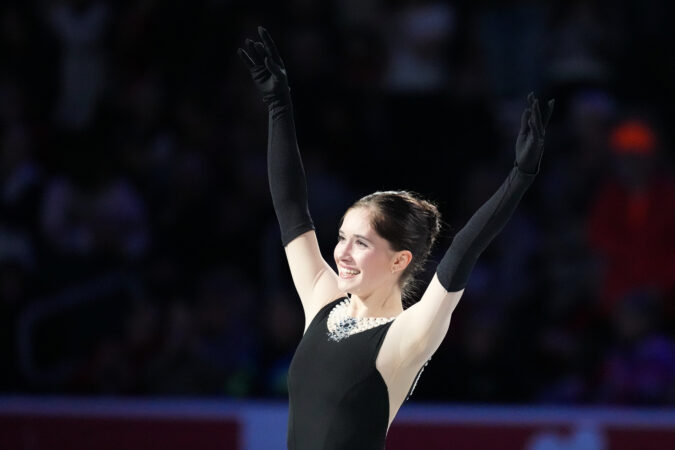
    On Sunday, South Jersey figure skater Isabeau Levito was named to the United States’ 2026 Winter Olympic Team headed to Italy.

    The U.S. contingent was announced during Making the Team: Presented by Xfinity live on NBC and Peacock. This was the first time the figure skating team was named live on television, in the same manner as gymnastics historically is.

    Levito, 18, who lives and trains in Mount Laurel, shored up her spot with two elegant programs to Italian music and a bronze medal at last week’s U.S. Figure Skating Championships in St. Louis. She was the U.S. champion in 2023 and the world silver medalist in 2024 in women’s singles.

    Levito was announced by 1960 Olympic champion Carol Heiss Jenkins before she skated last year’s beautiful Moon River short program.

    Joining Levito on the team are Amber Glenn, 26, of Plano, Texas, and Alysa Liu, 20, of Oakland, Calif.

    All three skated clean programs in the short and the free skate, or long program. Glenn won both segments, capturing her third straight national title.

    “It was an absolutely epic evening of skating,” two-time Olympian and commentator Johnny Weir said Saturday on NBC. “Last night all three women made me believe there could be a chance for each of them to stand on that [Olympic] podium.”

    Isabeau Levito performs during the women’s free skating competition at the U.S. Figure Skating Championships in St. Louis. She won the bronze medal.

    Liu, the silver medalist, is a 2022 Olympian who retired from skating shortly after those Games. She made a big splash by returning to the ice last year, winning the world championships in her first season back.

    The three are good friends, which is a change from the win-at-any-cost rivalries of the past. That era was punctuated by the 1994 Nancy Kerrigan-Tonya Harding matchup at the U.S. Championships in Detroit, when Harding’s ex-husband plotted to have Kerrigan hit in the knee.

    On Friday night, Levito and Liu watched and cheered on Glenn, the last to skate, and the three celebrated together in the kiss and cry, where skaters and their coaches wait to receive scores, after Glenn’s win was confirmed.

    Levito also won a bronze medal at the 2022 nationals, but she was 14 then and too young to qualify for the Olympics.

    But this time is extra special, because Milan is the hometown of her mother, Chiara Garberi, and where her grandmother and other relatives still live. They will be able to watch her compete next month, Levito said in the news conference Friday night.

    South Jersey figure skater Isabeau Levito was announced as an Olympian on Sunday. She skated during the “Making Team USA” performance following the announcement.

    Even before nationals began, the Olympic spots were Levito, Glenn, and Liu’s to lose. The three had been dominating the women’s event for the last two years, the time period U.S. Figure Skating takes into account when selecting a team.

    But none gave in to the pressure.

    All said they are more excited than nervous about the Olympics.

    “I am just so excited and stoked about the [Olympic] village,” Levito said at Friday night’s news conference, when their spots were inevitable but not official. “I just know it’ll be the time of my life. I don’t even think I’m going to be worried about the reason I’m there for. That’s when I thrive best, when I’m distracted.”

    The rest of the Olympic figure skating team includes: Ilia Malinin, Maxim Naumov, and Andrew Torgashev in the men’s event; Ellie Kam and Danny O’Shea and Emily Chan and Spencer Akira Howe in the pairs event; and Madison Chock and Evan Bates, Emilea Zingas and Vadym Kolesnik, and Christina Carreira and Anthony Ponomarenko in the ice dance event.

    Pairs was the biggest question mark because two of the U.S. medalists are not U.S. citizens. They are Alisa Efimova, who won nationals with Misha Mitrofanov, and Daniil Parkman, who, with Katie McBeath, won the bronze medal. Both of those pairs were named to the teams going to the Four Continents Championships and the World Championships, which don’t require skaters to be citizens of the countries they represent.