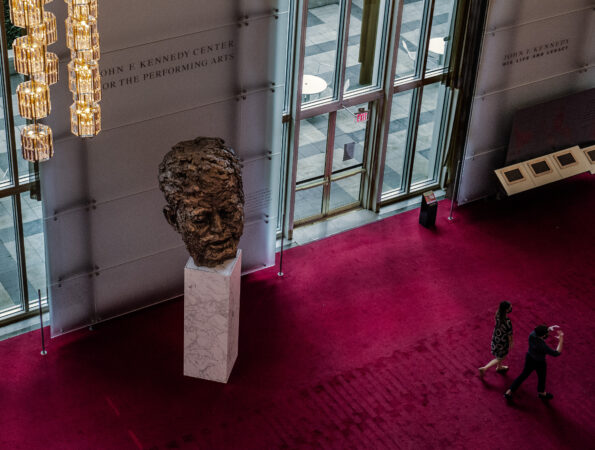
The Washington National Opera announced Friday that it plans to leave the John F. Kennedy Center for the Performing Arts, its longtime home, a stunning move that follows reports of declining ticket sales for the 70-year-old organization amid upheaval at the center since President Donald Trump’s takeover.
The opera said in a statement that it would “seek an amicable early termination of its affiliation agreement with the Kennedy Center” and “resume operations as a fully independent nonprofit entity.”
After the opera’s announcement, the Kennedy Center claimed it had ended the relationship.
“After careful consideration, we have made the difficult decision to part ways with the WNO due to a financially challenging relationship,” a spokesperson wrote in a statement. “We believe this represents the best path forward for both organizations and enables us to make responsible choices that support the financial stability and long-term future of the Trump Kennedy Center.”
But a person familiar with the situation, who spoke on the condition of anonymity because they were not authorized to represent either party, told the Washington Post that the choice was “definitely a WNO decision” and that there was consensus to leave, “but it’s with great regret.”
There had been concerns since Kennedy Center board chairperson David M. Rubenstein was removed in February and Trump became chairperson, the person said, but the board’s vote to change the name to the Trump Kennedy Center last month spurred the WNO’s decision to leave.
The opera said in its statement that the decision was driven by the elimination or reduction of support previously provided by the Kennedy Center, as well as changes to the center’s business model, which now require productions to be fully funded in advance — a shift the WNO called incompatible with how opera companies operate.
“Opera companies typically cover only 30-60% of costs through ticket sales, with the remainder from grants and donations that cannot be secured years ahead when productions must be planned,” the statement read.
It also added that the new model conflicts with the opera’s artistic mission of balancing popular titles with lesser-known works to serve diverse audiences.
Francesca Zambello, the opera’s artistic director for 14 seasons, told the Post she was “deeply saddened” to leave the Kennedy Center.
“I have been proud to be affiliated with a national monument to the human spirit, a place that has long served as an inviting home for our ever-growing family of artists and opera lovers,” she wrote in an email. “In the coming years, as we explore new venues and new ways of performing, WNO remains committed to its mission and artistic vision.”
To stay on solid financial footing, the opera said, it planned to cut back its spring season and relocate performances to new venues, which will be announced in the coming weeks.
News of the departure was first reported by the New York Times.
The person familiar with the situation stressed that the center is the “vision and dream of those who brought themselves out of the darkness of the assassination of a young president.”
“There are an awful lot of people that are offended that the official memorial to President John F. Kennedy is being manipulated,” they added. “It is not personal to any one president. You just can’t do that.”
They also said that the move came partly in response to criticism by the new Kennedy Center leadership of the previous management’s financial stewardship. “Frankly, to say that the Kennedy Center was in financial ruin under the predecessor to the current regime is fake,” the person said.
Describing the opera’s circumstances since Trump’s takeover, the person said the company has seen dropping attendance, a decline in donor contributions, and, especially after the name change, increasing numbers of opera singers and artists who are refusing to perform at the Kennedy Center. “A lot of it really is: You can’t get the artists, you can’t get the ticket sales, you’re not going to be able to get the support under this.”
Declines in ticket sales became apparent in the first few months after Trump’s takeover, the Post reported in June. Revenue generated from Washington National Opera subscriptions had fallen 15%, year over year, through the first 10 weeks of its campaign.
A Post analysis in October showed that ticket sales had declined across several genres at the Kennedy Center’s major theaters, a drop that current and former staffers attributed to audiences feeling repelled by Trump’s takeover.
Zambello had told the Guardian in November that the turmoil was leading the opera to consider moving out of the building. (At the time, the opera’s board chairperson denied plans to leave.) Budget constraints had delayed the opera’s 2026-2027 season planning, a person familiar with the organization told the Post last month.
Another round of artists and performers has canceled shows at the Kennedy Center since its board, installed by Trump early last year, voted in December to add his name to the center. It was on the building’s exterior signage the following day.
As the Trump administration increases the presence of federal agents in U.S. cities, a local group identifying as part of the Black Panther Party for Self-Defense has become more active in Philadelphia.
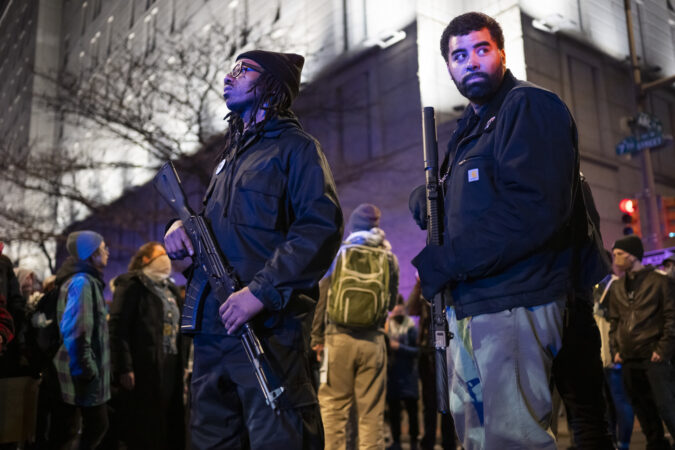
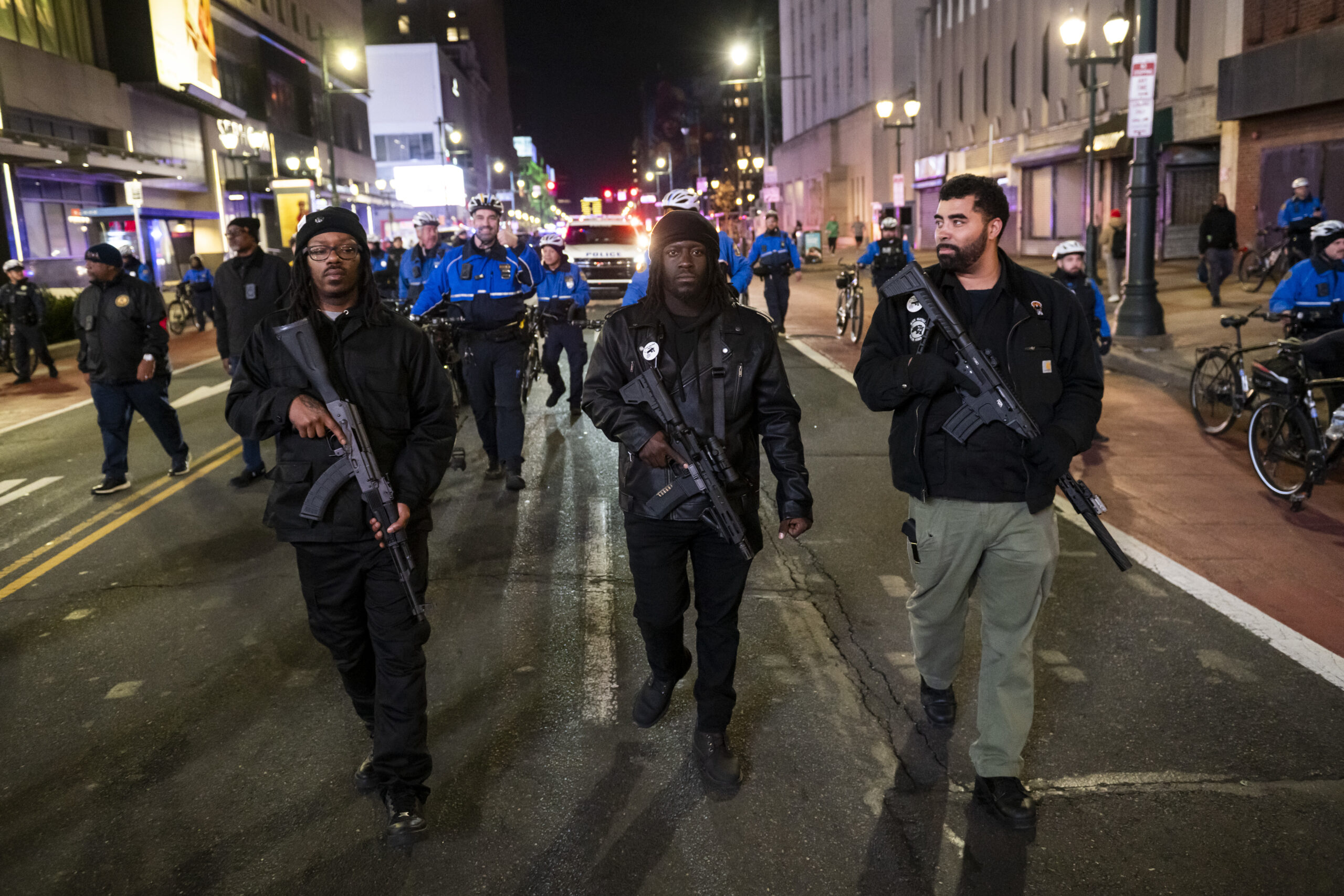
The group says it is a resurgence of the militant Black power group dating back to the 1960s, and has been trained by some of the original party’s surviving members. Several attended an anti-ICE protest Thursday at Philadelphia City Hall, carrying military-style weapons.
They say they’re legally permitted to carry firearms and are showing up as a response to violence from the Trump administration.
The group has been holding regular weekly free food programs in North Philadelphia for several years, according to 39-year-old Paul Birdsong of West Philadelphia, who identifies himself as the Black Panther Party’s national chairman.
Birdsong and others attended the Philly protest one day after Immigration and Customs Enforcement officer Jonathan Ross shot and killed 37-year-old Renee Nicole Good in Minneapolis.
“That wouldn’t have happened if we were there,” Birdsong said. “Not a single person would have gotten touched.”
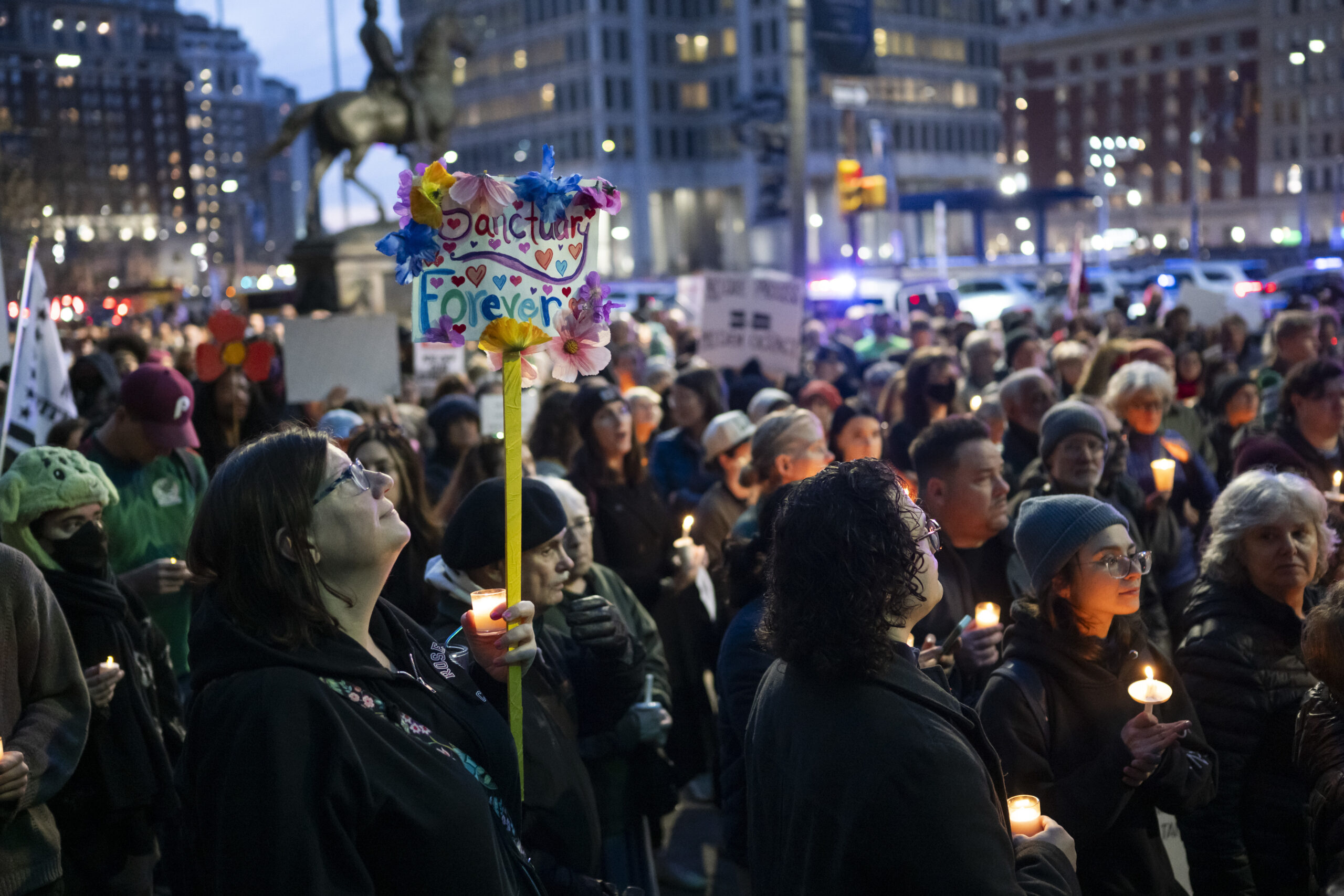
Jane Wiedman of Mount Airy holds up a sign among the crowd of protesters at City Hall on Thursday, Jan. 8, 2026, as they gather for a vigil to rally against the killing of Renee Nicole Good, who was shot by an ICE agent in Minneapolis.
Millions of people have watched videos of the shooting online, sparking national protests. The Trump administration quickly defended the shooter, with JD Vance asserting Ross has “absolute immunity” and “was doing his job.” Some have rejected Vance’s suggestion that Ross couldn’t be tried by the state, and Minnesota leaders Friday renewed their calls for state involvement in an investigation of the shooting.
Birdsong said the group wants to see ICE abolished and the Trump administration held accountable.
“You got people that are part of a cabal, that are self serving … and they prey on the common folks of the United States,” Birdsong said.
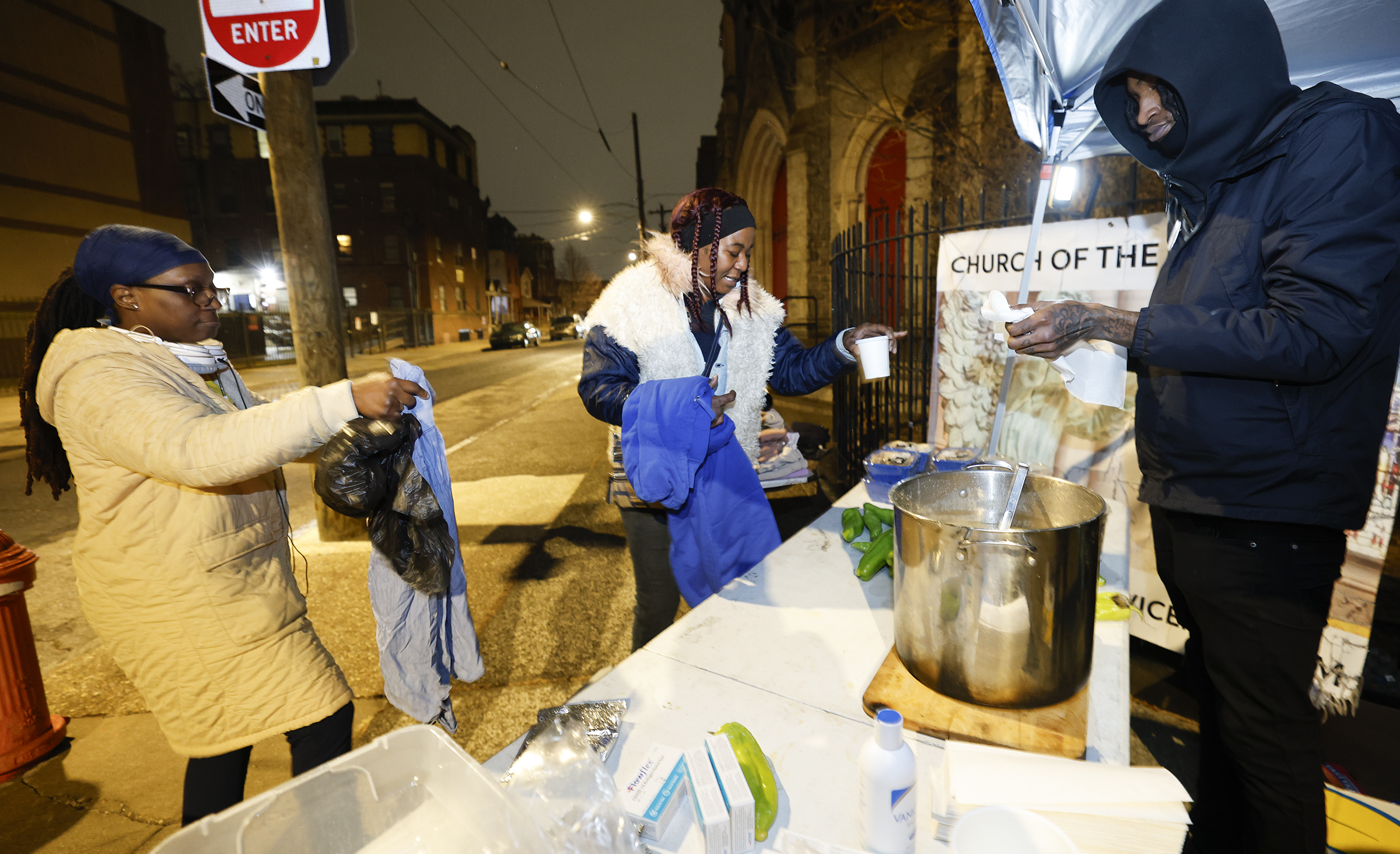
Philadelphia Black Panther Party for Self-Defense member Skiippy (right) hands soup to Yolanda Gray (center) and Roxanne Hart outside the Church of the Advocate in North Philadelphia on Friday, Jan. 9, 2026. The Philadelphia Black Panther Party for Self-Defense helps supply food and clothes for residents.
A free food program
Birdsong said he was recruited by members of the Black Panther Party in the wake of the 2020 police killing of George Floyd, and he listed several surviving elders of the group as mentors. The Philly chapter has “less than 100″ members, he said, though he declined to provide more detail.
On Friday evening, Birdsong and several other Black Panther Party members set upa pop-up food pantry outside Church of the Advocate at the corner of 18th and Diamond Streets in North Philadelphia.
The members laid out bananas, grapes, salad greens, romaine lettuce, cherry tomatoes, apples, pears, celery, peppers, and mushrooms on folding tables.
They added bread, Tastykakes — immediately popular with passing children — canned food, and hygiene items like shampoo, COVID-19 test kits, and adult undergarments. On another table were children’s clothes and a large pot of chicken soup, all near a banner with the Black Panthers logo.
Philadelphia Black Panther Party for Self-Defense member Sharon Fischer (left) hands a bag of food to Daren Robison in North Philadelphia on Friday, Jan. 9, 2026. The Philadelphia Black Panther Party for Self-Defense supplies food and clothes for residents.
Birdsong said the money to buy the food comes from members’ own paychecks, as well as donations from people in the community.
“It really helps out,” said Dawn Henkins, 60, who lives nearby. She said it’s especially helpful for older people who are living on a fixed income.
“The brothers can help people — they are here for the people,” Henkins said.
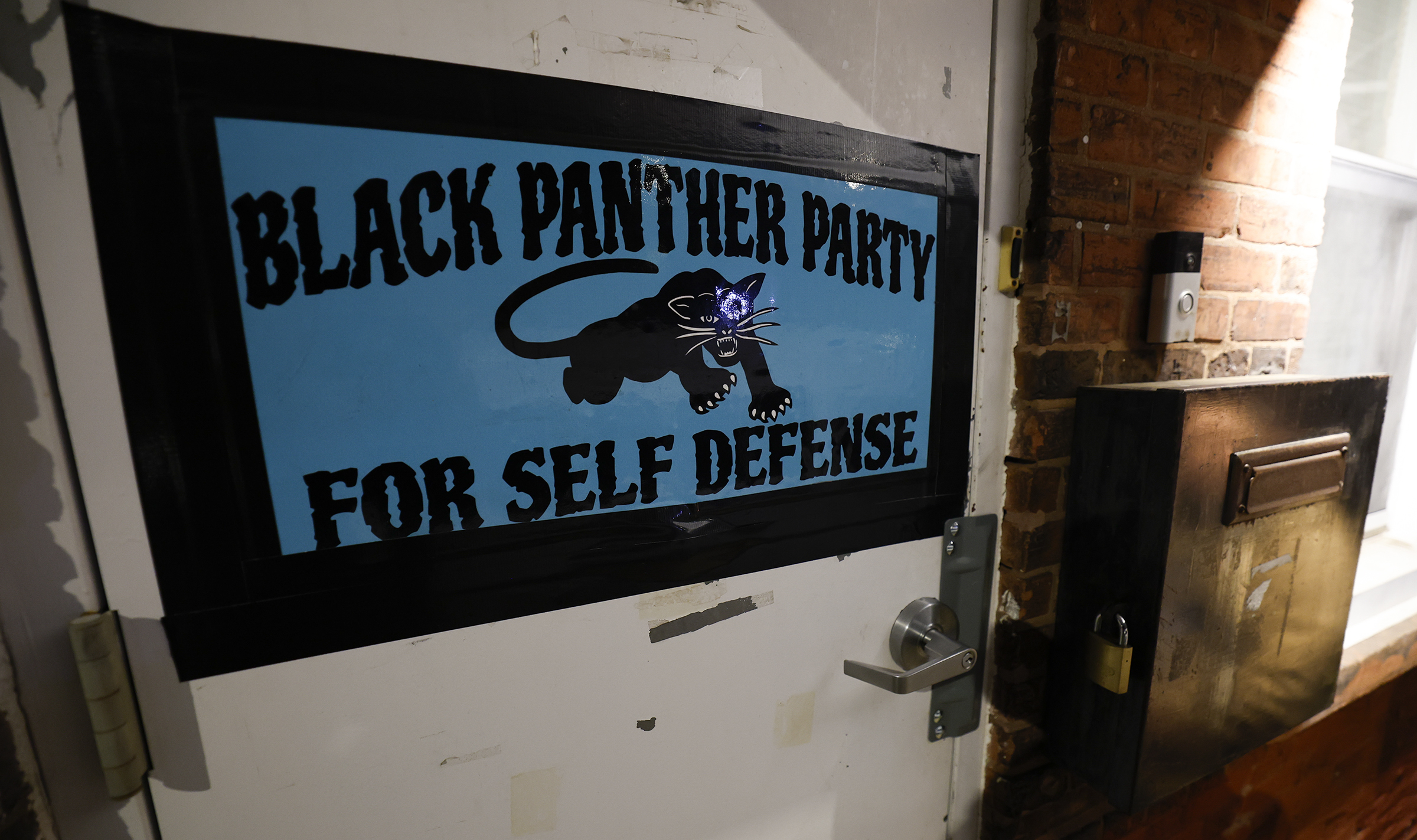
The Black Panthers previously held food programs at 33rd Street and Cecil B. Moore Avenue in Strawberry Mansion, and at Jefferson Square Park in Pennsport, Birdsong said. More recently, the group was able to move into 2123 N. Gratz St. — a North Philadelphia location that Birdsong says once was a headquarters for the original Black Panther Party Philadelphia chapter.
The original Black Panther Party was founded by Bobby Seale and Huey P. Newton in Oakland, Calif., in 1966 and was active nationally until the early 1980s. The group formed to fight against police brutality and quickly evolved to promote other social changes including prison reform and access to education, food, and healthcare, according to the National Museum of African American History and Culture.
The group was soon targeted by J. Edgar Hoover’s FBI, which sought to “discredit, disrupt, and destroy” the Black rights movement, according to UC Berkeley Library. Two Black Panthers in Chicago, Fred Hampton and Mark Clark, were killed in a Chicago police raid that was later revealed to have been coordinated by the FBI.
The Philadelphia chapter was active from 1968 until 1973, according to a University of Washington website that maps U.S. social movements. Prominent local figures from this era include Sultan Ahmad, who went on to hold roles in city government, and Paula Peebles, a social activist who stayed involved in the Black Panthers for much of her life.
The Black Panther Party for Self-Defense headquarters in North Philadelphia on Friday, Jan. 9, 2026.
One person who stopped by for soup on Friday, Jerome Hill, 63, said he can distantly remember the days when Episcopalian pastor and social activist the Rev. Paul Washington let the Black Panthers hold events at Church of the Advocate.
“They primarily were always community oriented,” Hill said. He said he’s glad to see the group handing out food, and added that they could serve as role models for younger people in the neighborhood.
While one member of the group served up chicken soup to several boys who stopped by the tables, another member stood at the corner holding an AK-47-style rifle.
“I feel like we’re welcome,” said one member, also carrying a firearm, who identified himself as Comrade Arch. He said he was a fan of the original group growing up, and he joined a few months ago. “I’ve always had a revolutionary spirit.”
Under a canopy behind the tables, Birdsong moved back his jacket to reveal a modern MP5, a weapon that has its origins in German submachine guns. He also carried two semiautomatic handguns.
It’s a controversial posture: Many pro-democracy advocates and experts on civil rights emphasize that nonviolence is essential to successful protest movements.
The law says you can carry a gun in Philadelphia — but only if you have a license to carry firearms, according to Dillon Harris, an attorney who focuses on gun rights.
“Open carry,” or carrying a firearm in a way that it can be plainly seen by others, is “generally lawful” in Pennsylvania, except for in prohibited locations such as federal buildings, said Harris.
But Philadelphia is an exception to this rule, Harris said. A state law prohibits carrying firearms in “a first class city” without a license to carry firearms. That statute applies to Philadelphia.
But while many civil rights advocates argue that firearms tend to escalate violent confrontations, rather than prevent them, it’s long been part of the Black Panthers’ tactics, and Birdsong pushed back against that idea.
“We feel safe,” Birdsong said. “No police, no drug dealers doing anything to us here.”
Armed members of the Black Panther Party for Self-Defense march down Market Street with a crowd of protesters on Thursday, Jan. 8, 2026, to rally against the killing of Renee Good, who was shot by an ICE agent in Minneapolis, Minn.
With the internet down in Iran and phone lines cut off, gauging the demonstrations from abroad has grown more difficult. But the death toll in the protests has grown to at least 72 people killed and over 2,300 others detained, according to the U.S.-based Human Rights Activists News Agency. Iranian state TV is reporting on security force casualties while portraying control over the nation.
Supreme Leader Ayatollah Ali Khamenei has signaled a coming clampdown, despite U.S. warnings. Tehran escalated its threats Saturday, with Iran’s attorney general, Mohammad Movahedi Azad, warning that anyone taking part in protests will be considered an “enemy of God,” a death-penalty charge. The statement carried by Iranian state television said even those who “helped rioters” would face the charge.
“Prosecutors must carefully and without delay, by issuing indictments, prepare the grounds for the trial and decisive confrontation with those who, by betraying the nation and creating insecurity, seek foreign domination over the country,” the statement read. “Proceedings must be conducted without leniency, compassion or indulgence.”
U.S. Secretary of State Marco Rubio offered support for the protesters.
“The United States supports the brave people of Iran,” Rubio wrote Saturday on the social platform X. The State Department separately warned: “Do not play games with President Trump. When he says he’ll do something, he means it.”
State TV split-screen highlights challenge
Saturday marks the start of the work week in Iran, but many schools and universities reportedly held online classes, Iranian state TV reported. Internal Iranian government websites are believed to be functioning.
State TV repeatedly played a driving, martial orchestral arrangement from the Epic of Khorramshahr by Iranian composer Majid Entezami, while showing pro-government demonstrations. The song, aired repeatedly during the 12-day war launched by Israel, honors Iran’s 1982 liberation of the city of Khorramshahr during the Iran-Iraq war. It has been used in videos of protesting women cutting away their hair to protest the 2022 death of Mahsa Amini as well.
It also repeatedly aired video of purported protesters shooting at security forces with firearms.
“Field reports indicate that peace prevailed in most cities of the country at night,” a state TV anchor reported Saturday morning. “After a number of armed terrorists attacked public places and set fire to people’s private property last night, there was no news of any gathering or chaos in Tehran and most provinces last night.”
That was directly contradicted by an online video verified by the Associated Press that showed demonstrations in northern Tehran’s Saadat Abad area, with what appeared to be thousands on the street.
“Death to Khamenei!” a man chanted.
The semiofficial Fars news agency, believed to be close to Iran’s paramilitary Revolutionary Guard and one of the few media outlets able to publish to the outside world, released surveillance camera footage that it said came from demonstrations in Isfahan. In it, a protester appeared to fire a long gun, while others set fires and threw gasoline bombs at what appeared to be a government compound.
The Young Journalists’ Club, associated with state TV, reported that protesters killed three members of the Guard’s all-volunteer Basij force in the city of Gachsaran. It also reported a security official was stabbed to death in Hamadan province, a police officer killed in the port city of Bandar Abbas, and another in Gilan, as well as one person slain in Mashhad.
The semiofficial Tasnim news agency, also close to the Guard, claimed authorities detained nearly 200 people belonging to what it described as “operational terrorist teams.” It alleged those arrested had weapons including firearms, grenades, and gasoline bombs.
State television also aired footage of a funeral service attended by hundreds in Qom, a Shiite seminary city just south of Tehran.
More weekend demonstrations planned
Iran’s theocracy cut off the nation from the internet and international telephone calls on Thursday, though it allowed some state-owned and semiofficial media to publish. Qatar’s state-funded Al Jazeera news network reported live from Iran, but they appeared to be the only major foreign outlet able to work.
Iran’s exiled Crown Prince Reza Pahlavi, who called for protests Thursday and Friday, asked in his latest message for demonstrators to take to the streets Saturday and Sunday. He urged protesters to carry Iran’s old lion-and-sun flag and other national symbols used during the time of the shah to “claim public spaces as your own.”
Pahlavi’s support of and from Israel has drawn criticism in the past — particularly after the 12-day war. Demonstrators have shouted in support of the shah in some protests, but it isn’t clear whether that’s support for Pahlavi himself or a desire to return to a time before the 1979 Islamic Revolution.
Online video purported to show protests ongoing Saturday night as well.
The demonstrations began Dec. 28 over the collapse of the Iranian rial currency, which trades at over 1.4 million to $1, as the country’s economy is squeezed by international sanctions in part levied over its nuclear program. The protests intensified and grew into calls directly challenging Iran’s theocracy.
Airlines have canceled some flights into Iran over the demonstrations. Austrian Airlines said Saturday it had decided to suspend its flights to Iran “as a precautionary measure” through Monday. Turkish Airlines earlier announced the cancellation of 17 flights to three cities in Iran.
Meanwhile, concern is growing that the internet shutdown will allow Iran’s security forces to go on a bloody crackdown, as they have in other rounds of demonstrations. Ali Rahmani, the son of Nobel Peace Prize laureate Narges Mohammadi, who is imprisoned in Iran, noted that security forces killed hundreds in a 2019 protest “so we can only fear the worst.”
“They are fighting, and losing their lives, against a dictatorial regime,” Rahmani said.
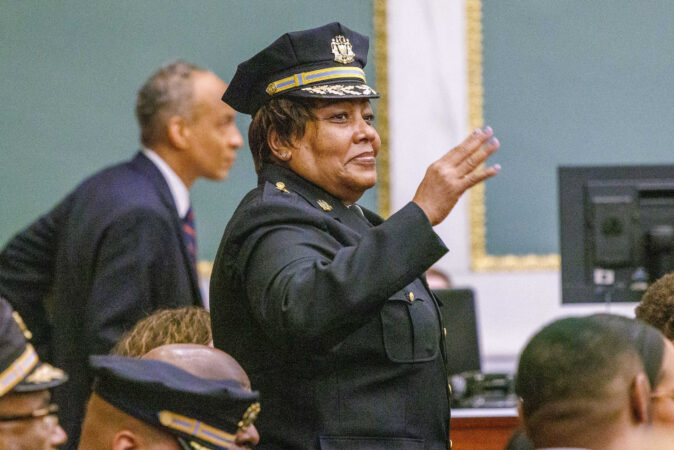
Sheriff Rochelle Bilal has garnered national headlines and condemnation for calling U.S. Immigration and Customs Enforcement “fake, wannabe law enforcement” and sending a blunt warning to immigration officers who commit crimes in Philadelphia.
“If any [ICE agents] want to come in this city and commit a crime, you will not be able to hide, nobody will whisk you off,” Bilal said. “You don’t want this smoke, cause we will bring it to you. … The criminal in the White House would not be able to keep you from going to jail.”
The sheriff’s office and a spokesperson for Bilal did not immediately respond to requests for comment Saturday. In an interview with CNN’s Erin Burnett, Bilal said “enough is enough.”
“People are tired of these people coming into the city, masked up — basically all masked up — and pulling people out and causing havoc,” Bilal told the network. “This was supposed to be helping cities out, this was supposed to be eliminating crime, but yet, you are committing them here, you are putting people in fear, you are breaking up families.”
Bilal spoke for less than four minutes at the Thursday news conference. She upbraided ICE agents for wearing masks that obscure their faces and said their actions violate “not only legal law but the moral law.”
“Law enforcement professionals around the country do their job, and we have been fighting for years to build that bridge between us and our communities,” Bilal said. “You had one negative nutcase that causes this problem and now we all have to fight again to let people know law enforcement works with communities.”
Some praised Bilal on social media. Ben Crump, a prominent civil rights attorney, wrote on Facebook, “Sheriff Rochelle Bilal didn’t hold back. … Tragedies like this happen when agents operate in our communities with little to no oversight.”
Meanwhile, the Pennsylvania GOP posted on X, “When local law enforcement stands with criminals rather than people keeping our communities safe, you know there’s a problem. … Rhetoric like this only makes this situation more dangerous for federal law enforcement and the city of Philadelphia.”
A video of Bilal’s statement was also posted by LibsofTikTok, a controversial far-right social media account. That post had more than 746,800 views and 8,500 likes as of Saturday afternoon.
U.S. Rep. Randy Fine, a Republican from Florida, responded to LibsofTikTok’s post, writing, “She should be arrested.”
The Philadelphia Sheriff’s Office does not police the city; instead, the office’s core functions are deploying deputies to the county’s courtrooms and transporting in-custody defendants to court.
In his statement, Police Commissioner Bethel distinguished the roles of the sheriff’s office and the police department, noting that the sheriff’s office does not “conduct criminal investigations, nor does it in any way direct municipal policing.” The sheriff is an elected official, while police commissioners are appointed by the mayor.
“The Philadelphia Police Department will continue to work professionally with all of our enforcement partners,” Bethel said. “But clear lines of authority — and accurate public representation of those roles — are essential to maintaining public trust and effective public safety operations.”
NEW YORK — Reviving a campaign pledge, President Donald Trump wants a one-year, 10% cap on credit card interest rates, a move that could save Americans tens of billions of dollars but drew immediate opposition from an industry that has been in his corner.
Trump was not clear in his social media post Friday night whether a cap might take effect through executive action or legislation, though one Republican senator said he had spoken with the president and would work on a bill with his “full support.” Trump said he hoped it would be in place by Jan. 20, one year after he took office.
Strong opposition is certain from Wall Street and the credit card companies, which donated heavily to his 2024 campaign and to support his second-term agenda.
“We will no longer let the American Public be ripped off by Credit Card Companies that are charging Interest Rates of 20 to 30%,” Trump wrote on his Truth Social platform.
Researchers who studied Trump’s campaign pledge after it was first announced found that Americans would save roughly $100 billion in interest a year if credit card rates were capped at 10%. The same researchers found that while the credit card industry would take a major hit, it would still be profitable, although credit card rewards and other perks might be scaled back.
Americans are paying, on average, between 19.65% and 21.5% in interest on credit cards according to the Federal Reserve and other industry tracking sources. That has come down in the past year as the central bank lowered benchmark rates, but is near the highs since federal regulators started tracking credit card rates in the mid-1990s.
The Republican administration has proved particularly friendly until now to the credit card industry.
Capital One got little resistance from the White House when it finalized its purchase and merger with Discover Financial in early 2025, a deal that created the nation’s largest credit card company. The Consumer Financial Protection Bureau, which is largely tasked with going after credit card companies for alleged wrongdoing, has been largely nonfunctional since Trump took office.
In a joint statement, the banking industry was opposed to Trump’s proposal.
“If enacted, this cap would only drive consumers toward less regulated, more costly alternatives,” the American Bankers Association and allied groups said.
The White House did not respond to questions about how the president seeks to cap the rate or whether he has spoken with credit card companies about the idea.
Sen. Roger Marshall (R., Kan.), who said he talked with Trump on Friday night, said the effort is meant to “lower costs for American families and to rein in greedy credit card companies who have been ripping off hardworking Americans for too long.”
Legislation in both the House and the Senate would do what Trump is seeking.
Sens. Bernie Sanders (I., Vt.) and Josh Hawley (R., Mo.) released a plan in February that would immediately cap interest rates at 10% for five years, hoping to use Trump’s campaign promise to build momentum for their measure.
Hours before Trump’s post, Sanders said that the president, rather than working to cap interest rates, had taken steps to deregulate big banks that allowed them to charge much higher credit card fees.
Reps. Alexandria Ocasio-Cortez (D., N.Y.) and Anna Paulina Luna (R., Fla.) have proposed similar legislation. Ocasio-Cortez is a frequent political target of Trump, while Luna is a close ally of the president.
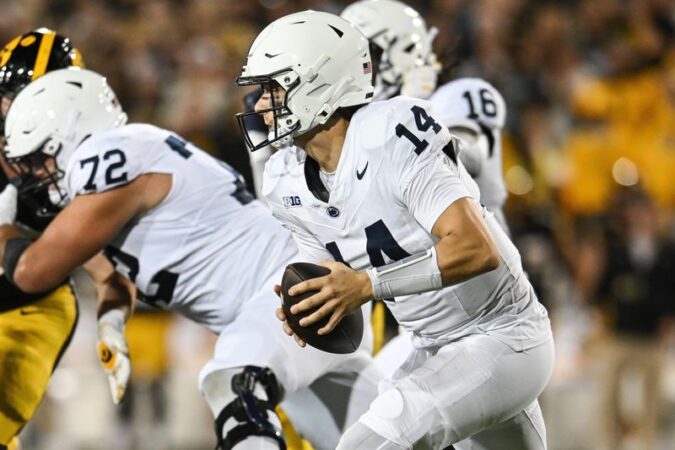
Former Penn State quarterback Jaxon Smolik announced his commitment to Temple on Saturday morning. He joins the program with a chance to earn the Owls’ starting quarterback job in 2026.
Smolik committed to the Nittany Lions in 2023 out of Iowa’s Dowling Catholic. He had originally committed to Tulane but decommitted from the Green Wave after earning an invite to the Elite 11 showcase, which boosted his recruiting profile.
He went 25-8 during his time as Dowling Catholic’s quarterback, leading the Maroon to multiple state semifinal appearances. As a high school senior, the 6-foot-1 signal-caller was all-state in Iowa after tallying 1,967 passing yards and 19 touchdown passes and leading Dowling to a 10-2 record. Smolik was ranked the No. 24 quarterback recruit in the 2023 class by Rivals and the No. 29 quarterback by ESPN.
The former three-star recruit redshirted as a freshman behind starter Drew Allar and then missed the entirety of the 2024 season due to an injury. He entered the 2025 season competing for the backup job with Ethan Grunkemeyer, who ultimately won the job.
Smolik eventually became the backup after Allar suffered a season-ending ankle injury against Northwestern on Oct. 11. He appeared in two games this season, but did not throw a pass and only carried the ball four times for three yards. Smolik entered the transfer portal at the end of the year.
Head coach K.C. Keeler said that Temple was going to open up its starting quarterback competition following the departure of five of its quarterbacks. Starter Evan Simon and backup Gevani McCoy both graduated, as well as Anthony Chiccitt. Third-stringer Tyler Douglas and fellow reserve Patrick Keller both entered the portal following the year.
“We’re probably thinking two out of the portal,” said Keeler on signing day. “We told all the high school recruits the same thing. Two of these guys will be here mid-year, so they will come here in January. We definitely want to have a quarterback competition once we get the kids here in January.”
The Owls will now have four quarterbacks with the team when spring camp opens, barring another addition. Temple currently has Cam Boykin, the only quarterback that was on the roster last year, and high school commits Brady Palmer, Brody Norman, and Lamar Best. Palmer and Norman will join the team for the spring semester, while Best won’t enroll until the summer.
Smolik joins the team with three years of eligibility remaining. If he wins the starting job, he will have a chance to play his former team when Temple plays Penn State at Lincoln Financial Field on Sept. 12.
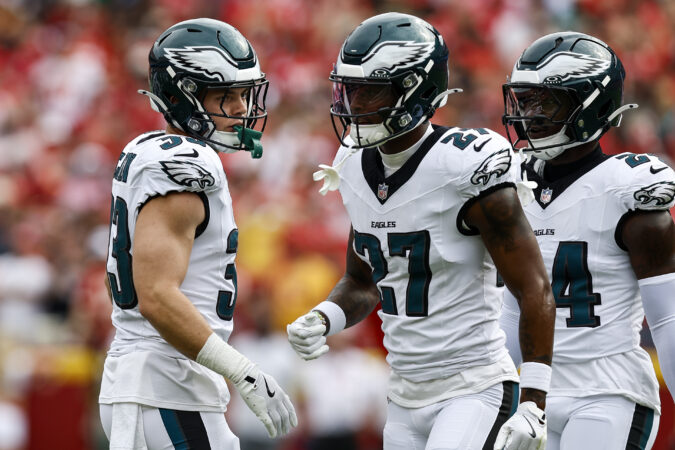
Eagles cornerbacks Cooper DeJean and Quinyon Mitchell entered the league together, and they’ve earned their first Associated Press first-team All-Pro nods together.
DeJean, the Eagles’ 2024 second-round pick out of Iowa, and Mitchell, the No. 22 overall pick in the same draft out of Toledo, were the only Eagles players to garner All-Pro designations on Saturday morning. Both players were named to their first Pro Bowl in December.
DeJean was named to this year’s team in the “slot cornerback” position introduced to All-Pro voting in 2023. Since the AP began to separate cornerbacks from the broader “defensive backs” category in 1962, this is the first time two corners from one team have been named first-team All-Pros. The Houston Texans’ Derek Stingley Jr. was the third cornerback named to the first team.
According to the Eagles’ communications department, this is the seventh time an NFL club has had its top two draft picks from the same class earn first-team All-Pro honors in their first two seasons. The Eagles had already been among those teams. In 1989, Eagles tight end Keith Jackson and cornerback Eric Allen, both members of the 1988 draft class, were voted first-team All-Pro.
The last Eagles cornerback to earn first-team All-Pro honors was Lito Sheppard in 2004.
DeJean, 22, has made an impact at multiple positions this season, playing 63.3% of his snaps at slot corner and 21.8% at outside cornerback. Last season, only eight of DeJean’s 881 defensive snaps came on the outside.
Still, his most impressive play has come in the slot. From that alignment this season, DeJean has allowed a 57.4% completion percentage and 5.9 yards per target, ranking below the league averages of 69.5% and 6.8, respectively, according to Next Gen Stats.
DeJean has allowed just one touchdown in coverage in his career, per Next Gen Stats, which occurred against the Dallas Cowboys in Week 12, when he was lined up on the outside in base defense.
The Odebolt, Iowa, native earned NFC defensive player of the week honors for his Week 16 performance in the Eagles’ win over the Washington Commanders. He notched a career-high four pass breakups and an interception.
DeJean is tied for 10th in the NFL with 16 pass breakups and is second on the Eagles behind Mitchell (17), who is tied for sixth.
Mitchell began the season moving around the formation and often shadowing opposing teams’ top receivers. But since the Week 9 bye, according to Next Gen Stats, Mitchell has aligned as the boundary cornerback on 74.1% of his snaps.
In that span, he has registered more passes defended (nine) than receptions allowed (six) on 26 targets and 233 coverage snaps from the boundary. He has a 20.7% completion rate allowed, which is three times lower than the season-long NFL average from the boundary (65.5%).
Mitchell, a Williston, Fla., native, earned NFC defensive player of the week honors in the Eagles’ Week 4 win over the Tampa Bay Buccaneers. In that performance, he had a career-best five pass breakups, making him one of two NFL players to record five pass breakups in a single game.
Since they were drafted in 2024, DeJean and Mitchell have helped drastically improve the Eagles defense. In the Eagles’ Super Bowl-winning season last year, Vic Fangio’s defense conceded the fewest passing yards in the NFL and the sixth-fewest touchdowns. This year, the Eagles’ secondary has allowed the fewest passing touchdowns and the eighth-fewest yards.
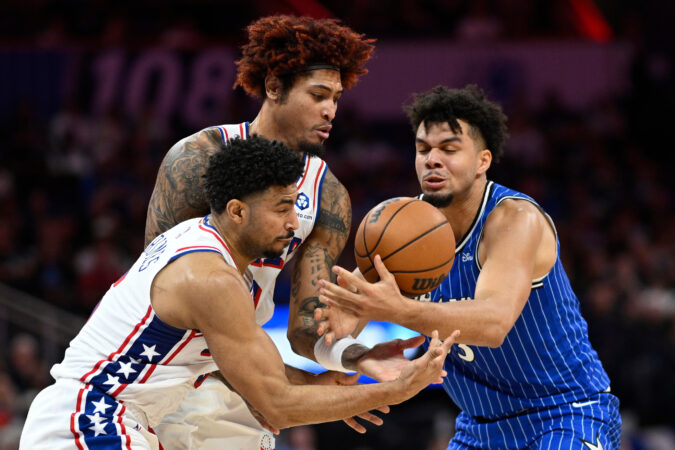
ORLANDO — Nick Nurse called a timeout about two minutes into Friday’s matchup at the Magic, frustrated that his 76ers were “standing up straight and not moving great” defensively.
The coach continued to cycle through personnel groupings, searching for a spark on that end of the floor. He found it at the top of the final period, with guards VJ Edgecombe and Quentin Grimes, wings Paul George and Kelly Oubre Jr., and center Andre Drummond.
Their suffocating, versatile defense turned a four-point Sixers lead into a 13-point advantage in an eventual 103-91 victory at Kia Arena. It helped the Sixers (21-15) overcome a night when they shot 4-for-28 from three-point range to secure the tiebreaker against a potential Eastern Conference playoff opponent. And the almost-five-minute surge happened with stars Tyrese Maxey and Joel Embiid getting their customary rest.
After the game, George said he believes the “scrappy” effort from that fourth-quarter lineup was only a flash of the Sixers’ potential on the defensive end of the floor.
“I think we can be special defensively,” said George, a four-time, all-defense selection during his standout career. “And that’s where the praise needs to be.”
The Sixers exited Friday ranked 12th in the NBA in defensive rating, with 113.3 points allowed per 100 possessions. Yet in their last five games, which have coincided with a return to a fully healthy roster for the first time since December of 2023, they are sixth (109.1 points per 100 possessions).
Nurse’s teams have regularly been lauded for an aggressive defensive style, anchored by playmakers who can deflect passes and generate takeaways. Yet this season’s Sixers also exited Friday ranked 12th in opponent turnovers (15.2 per game) and steals (8.7 per game).
Though the Sixers did not force a turnover during Friday’s decisive fourth-quarter stretch, Oubre and Grimes disrupted ballhandlers with their perimeter pressure. That allowed George and Drummond to “[patrol] in the back” near the basket. And it was a block party at the rim, with Drummond, George, and Oubre all rejecting one shot during the Magic’s 1-for-12 stint from the floor.
“We were just really keeping the ball in front,” Nurse said. “And when it did get past us, we always were sending a crowd to it.”
It was the second consecutive game that Nurse turned to the lineup that began the fourth quarter, after it blew open Wednesday’s home victory against the Washington Wizards. In 14 minutes across those two victories, that lineup has a stunning defensive rating of 48.1 points allowed per 100 possessions and a net rating of plus-74.9.
Even with that minuscule sample size, that group’s success perhaps represents a more under-the-radar benefit to the Sixers regaining health.
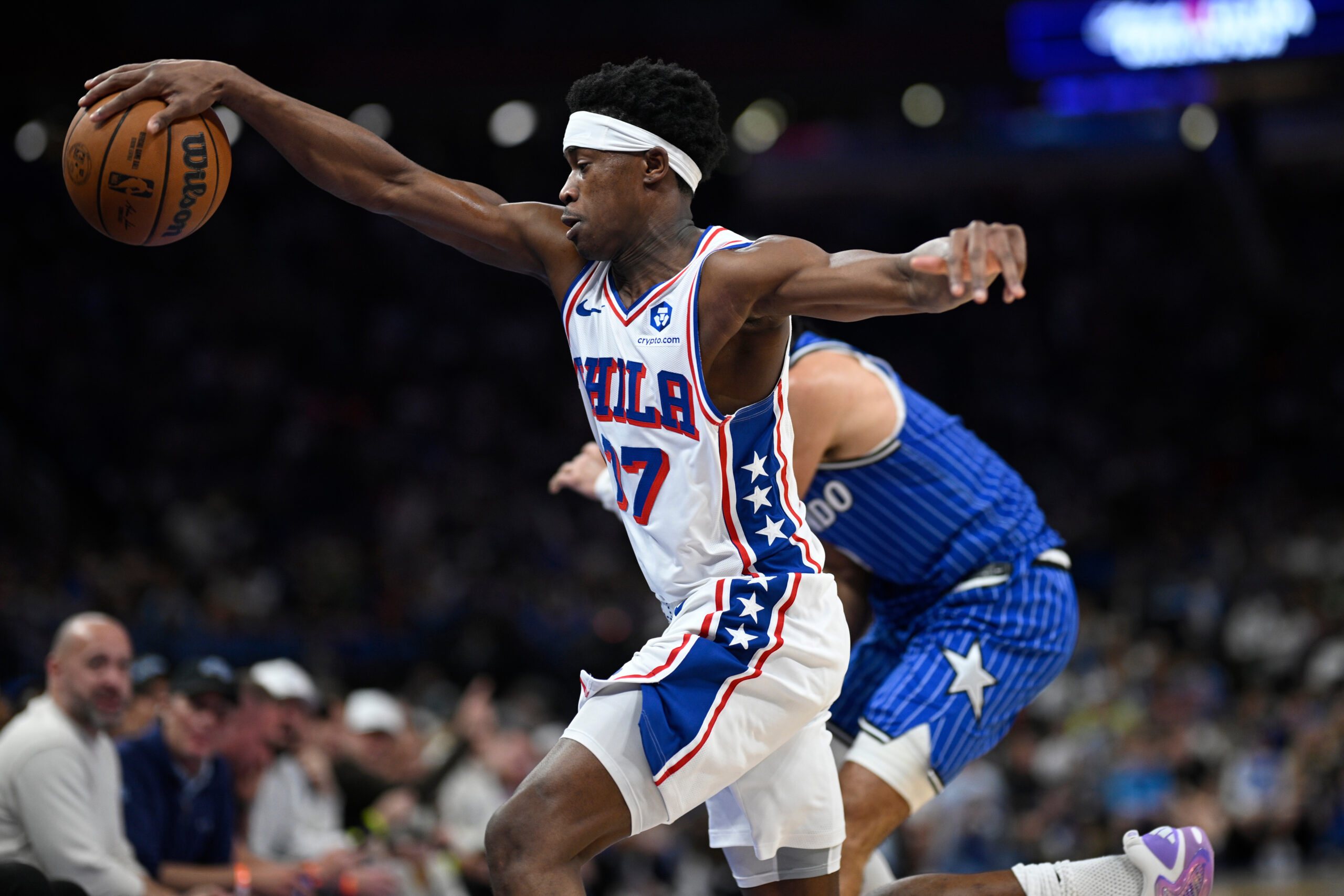
Sixers guard VJ Edgecombe was part of a game-altering defensive effort.
Outsiders may believe roster continuity is most helpful on the offensive end, where timing and chemistry between teammates are critical. But Nurse said last week that it also would allow the Sixers to add defensive schemes to complement the offensive firepower of Maxey, who dropped another 29 points Friday, the returning-to-form Embiid (22 points, nine rebounds) and George (18 points, nine rebounds), and the complementary scoring potential of Edgecombe, Oubre, and Grimes.
When George was sidelined to begin the season, for instance, Nurse said the wing would be especially valuable to this team as a defensive communicator. Oubre, who earlier this week returned from a month-plus-long absence with a knee injury, also welcomes guarding wings and switching onto multiple positions. Edgecombe is already an impact player on that end, a rarity for a rookie, while Maxey is a noticeably improved defender. And if Embiid continues to improve physically, he could become an impact rebounder and rim protector again.
Those options mean the Sixers can contest outside shots and “make it a tight paint” on drives, George said. At other points Friday, the Sixers shifted into a zone defense and used Drummond to “blitz” out on perimeter ballhandlers. The next step as a group, George said, is to become even more comfortable playing “on a string” and rotating sharply with teammates.
Nurse, though, may have discovered a lineup that can provide a defensive spark. And George believes Friday’s five-minute effort is only a glimpse at the Sixers’ capabilities on that end of the floor.
“I know it’s tough to do — especially more now than ever in this league,” he said. “But I think the versatility that we have, we should be able to do it.”
A fatty particle can clog arteries just as surely as cholesterol but often goes undetected, striking seemingly healthy people unaware of the danger. Though tests are widely available, they aren’t routinely ordered — in part because there are no approved treatments for the genetic disorder.
Now, cardiologists waging a campaign against lipoprotein(a) say they are reaching a turning point. Five experimental drugs are in late stages of development and aim to prove that lowering levels of Lp(a) — pronounced “L-P-little-A” — reduces heart attacks and strokes. Results from the most advanced clinical trial are expected in the first half of this year.
Cardiologists, drugmakers, and Wall Street analysts are optimistic that these new drugs can effectively treat a disorder that is estimated to affect about 20% of the world’s population. Even if they prove effective, the cost of a novel drug — as well as the scant public awareness of Lp(a) — could be a barrier to treating patients who might benefit.
“There are over a billion people on our planet that have elevated lipoprotein levels and that are at increased risk,” said Steve Nissen, a cardiologist at Cleveland Clinic whose team is leading trials on four drugs targeting Lp(a). “We will have a massive educational job to do.”
Discovered in the 1960s, Lp(a) is prone to getting stuck in the arterial wall like the particle that doctors call “bad” cholesterol, but it carries another protein that creates an even greater risk of heart attacks, strokes, and restricting blood flowing from the heart. Until 2019, there wasn’t even a diagnostic code for high Lp(a) levels.
The condition often flies under the radar because it is almost entirely genetic, isn’t part of typical cholesterol tests, and can afflict otherwise healthy people. Diet and exercise don’t bring down Lp(a). With no approved drugs to treat the condition, many cardiologists say they routinely hear that primary care physicians don’t see the point in testing. In a study of more than 48,000 patients globally with a history of heart disease, just 14% had been screened for Lp(a).
So the cardiology community is closely watching a clinical trial seen as a bellwether for Lp(a) treatments.
The trial is studying pelacarsen, an experimental drug that stops the liver from producing the extra protein carried by Lp(a) that makes it especially risky. In an earlier trial, researchers showed the drug could reduce Lp(a) levels by up to 80% when injected weekly. Now the drug’s sponsor, Novartis, will be the first to reveal whether lowering Lp(a) levels also reduces cardiovascular events from patients who have heart disease.
Asked about pricing strategy on a November call with financial analysts, Novartis executives said that pelacarsen would initially be tailored to patients who’ve had early heart problems and a family history of disease, according to a transcript compiled by S&P Global Market Intelligence. “The family history is an emotional motivator for people to take action,” said Dianne Auclair Rocha, a senior vice president.
Though pelacarsen is the furthest along, other experimental drugs have shown they can lower Lp(a) even more sharply and for longer. Olpasiran, developed by Amgen, cut Lp(a) levels by up to 100% when taken every 12 weeks. Eli Lilly is studying lepodisiran, which works by a similar mechanism, to see if it reduces risk for patients who have not yet had a cardiac event — and it is also developing a pill for lowering Lp(a).
“If these therapies show benefit, it would impact the lives of these individuals tremendously,” said Gissette Reyes-Soffer, an associate professor at Columbia University Irving Medical Center who advises companies targeting Lp(a). “You’re not going to have four stents put in,” she said, adding that preventing heart disease could save on health costs.
For now, there are few ways to lower Lp(a) levels. A class of cholesterol-lowering drugs has shown a modest effect, and an expensive blood-filtering procedure can also do so, though neither is approved by the Food and Drug Administration for that purpose. But some cardiologists bristle at physicians who decline to order tests for Lp(a) because there isn’t a drug that treats it.
“I think that’s crazy,” said Erin Michos, a professor of cardiology at the Johns Hopkins University School of Medicine. “I think Lp(a) is very actionable now,” she said, adding that physicians can take steps to lower all other treatable risks such as high cholesterol, blood pressure, and weight. Michos has consulted for companies developing Lp(a) therapies.
Labcorp and Quest Diagnostics offer Lp(a) in-person tests for about $50. The Family Heart Foundation, which promotes awareness of genetic risks for cardiovascular disease, offers free at-home kits to test for Lp(a). Guidelines from professional associations differ, with some calling for everyone to get tested once while others recommend screening only those deemed to be at high risk.
That may change with the results of the pending clinical trials on lowering Lp(a).
“If these trials are positive, I think they are going to be game changers,” said Salim Virani, a preventive cardiologist who is now vice provost at Aga Khan University in Pakistan. But that will also depend on how they are priced, he said, an issue that has limited access to other effective cardiovascular drugs. “Drugs only benefit when patients are able to take them,” he said.
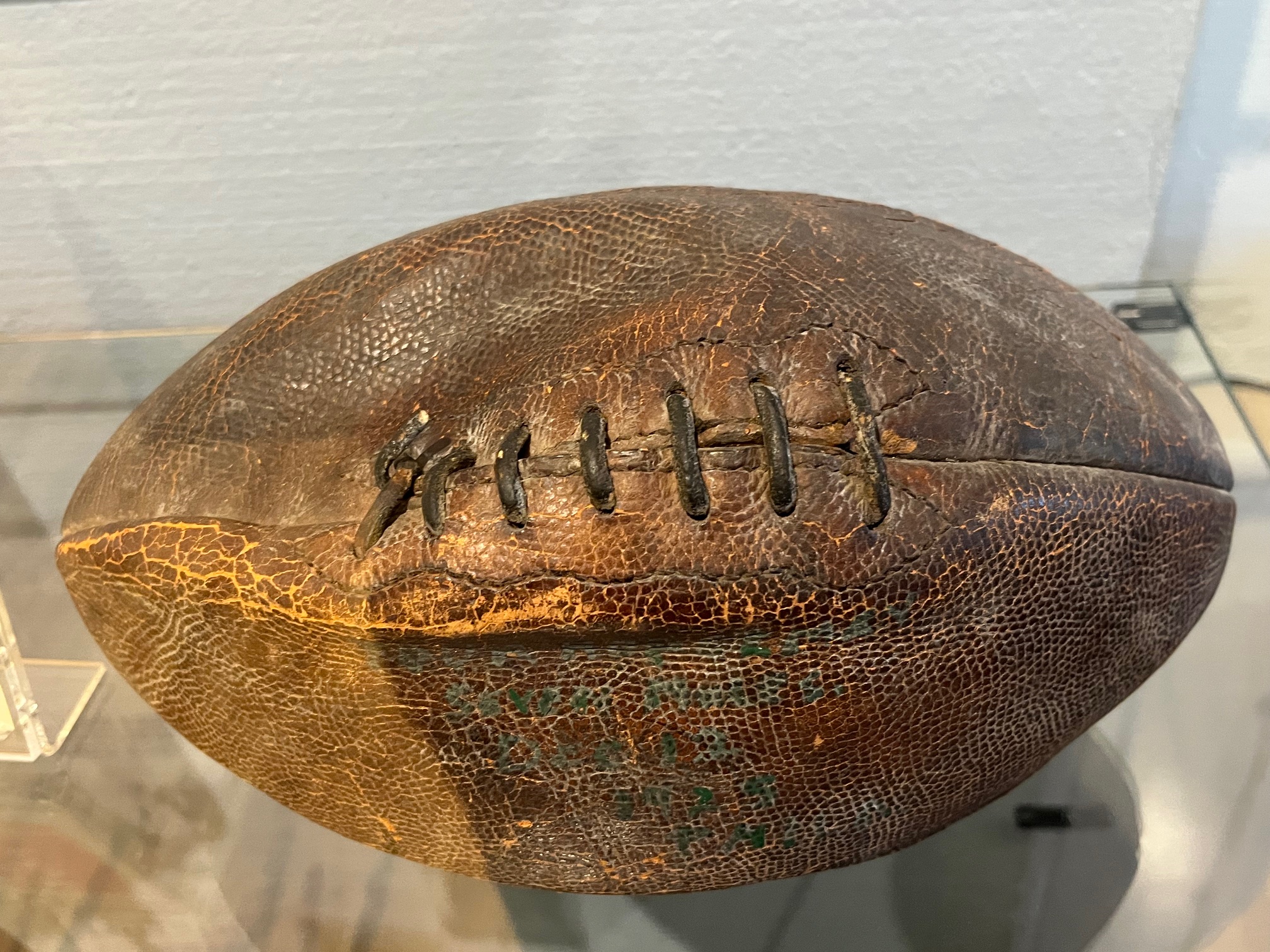
POTTSVILLE, Pa. — Because I love Pennsylvania and football (and not always in that order), I drove 90 miles recently to this coal-region city of 13,300 to take a peek at a bronzed football shoe, a trophy carved from coal, and a battered football, its laces askew.
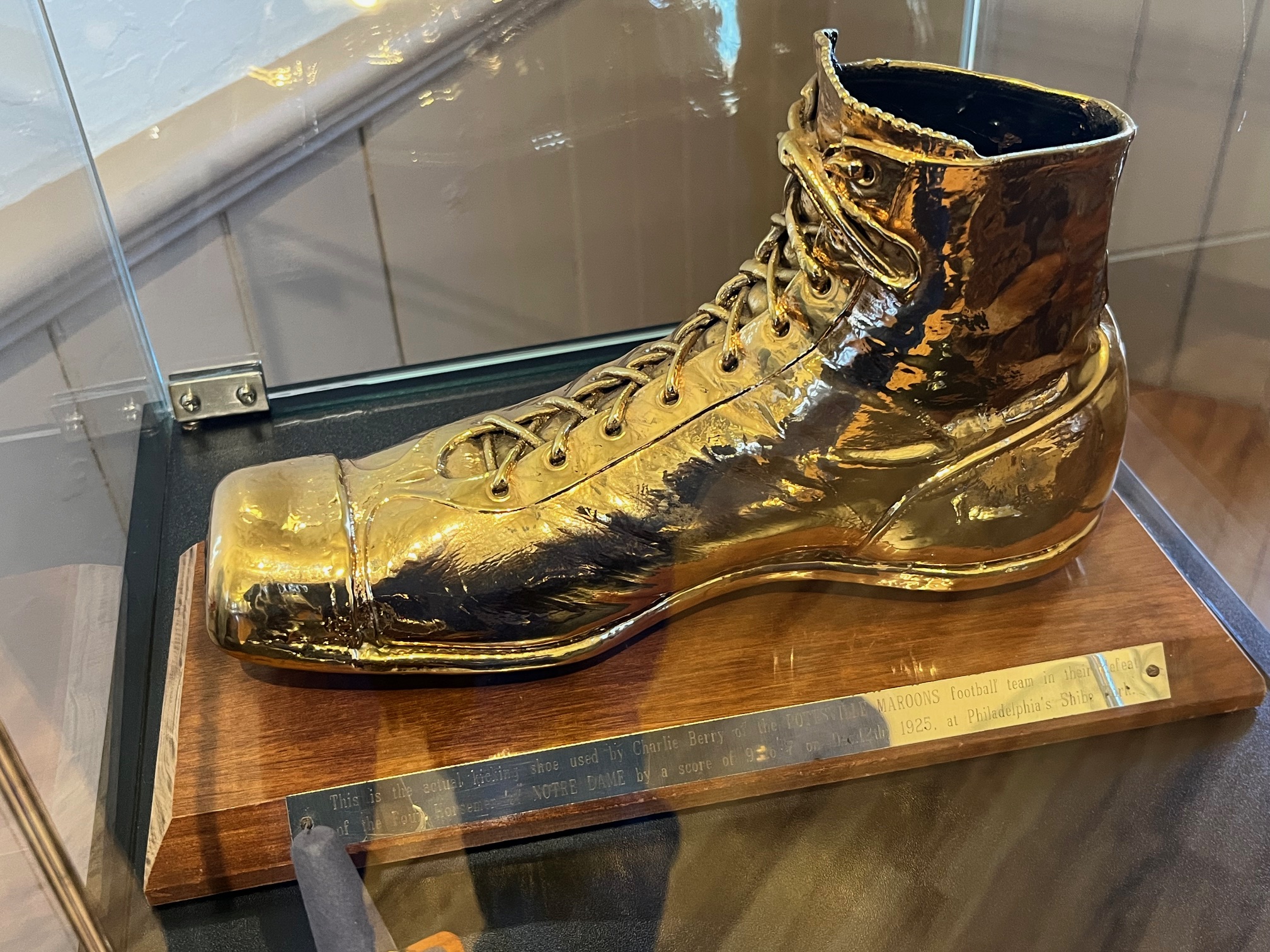
On Dec. 12, 1925, 100 years ago last month, a 23-year-old kid named Charlie Berry — who also played baseball for the Philadelphia Athletics and later became an American League umpire — used that high-top shoe to kick that ball to lift the Pottsville Maroons to a huge victory.
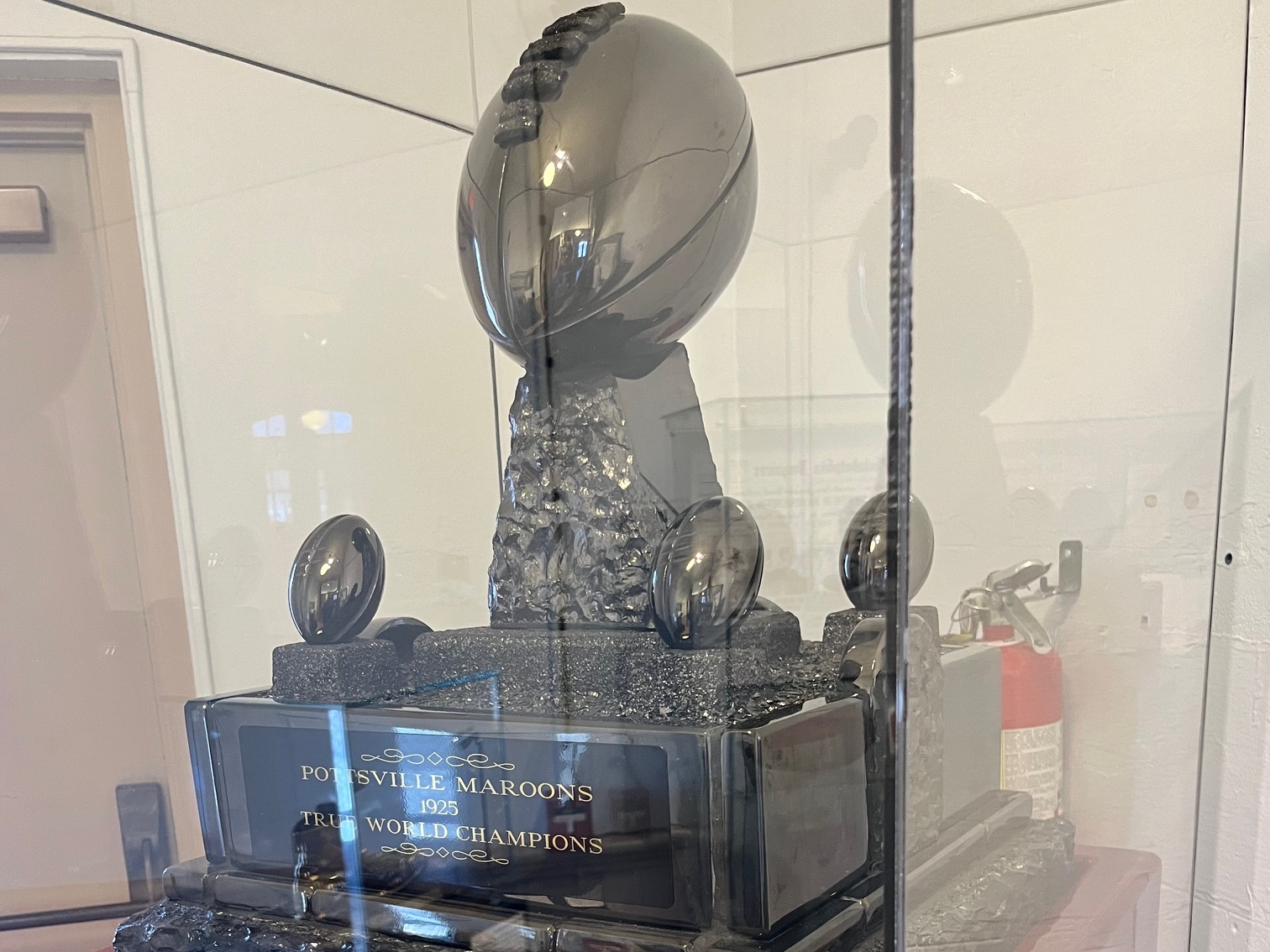
The Maroons got that trophy, emblazoned with the words “TRUE WORLD CHAMPIONS,” after beating a squad of former Notre Dame players, 9-7, in an exhibition game at Shibe Park in Philadelphia. But the Maroons were true world champions only in sentiment. They did not even win their own league.
That would be the National Football League — the same NFL that now includes the Eagles and opens its annual playoffs this weekend, ending with Super Bowl LX. The NFL would deny the Maroons the league championship despite clearly having the best team, having disposed of the Chicago Cardinals a week earlier in icy Chicago, 21-7.
The shoe that Pottsville Maroons kicker Charlie Berry used to kick the winning field goal in the 9-7 victory over the Notre Dame All-Stars on Dec. 12, 1925. The shoe was bronzed in 1961.
The exhibition game turned out to be a big problem. Long story short: Although the Maroons had requested (and, they said, been granted) permission to play the Notre Dame team, they were treading on the turf of the city’s NFL team, the Frankford Yellow Jackets. The Maroons were thrown out of the league.
You have probably heard of the Yellow Jackets, who folded in 1931 and whose remnants were purchased in 1933 by Bert Bell and Lud Wray for $2,500 and relaunched as the Eagles. The Maroons have faded, like a photograph in an album. That is a shame. The Maroons were a town team that climbed through a primitive organizational ladder to reign supreme over a sport.
Payne, who had not heard of the Maroons while growing up in Erie, acknowledged that the NFL is unlikely to declare the Maroons as 1925 champions, saying, “It would take a higher force for this to happen.” And it is old news: The last Maroons player died in 2003, at age 101.
The ball used in the Maroons’ win over the Notre Dame All-Stars.
Rendell wrote that he did not intend “to have any more communications with the cowardly barons that run the National Football League, including their extremely well paid leader, until they relent and grant the gallant Pottsville Maroons what is rightfully theirs.”
(He added that the vast majority of NFL owners lack “cojones.”)
But Rendell only had two NFL teams behind him: those from Pennsylvania, the Eagles and the Pittsburgh Steelers. So that Tush Push, of sorts, failed to reach the line to gain. The NFL still places the Cardinals atop its official 1925 standings, with the Maroons second.
Plus, the Cardinals padded their final winning percentage — used then to determine the champion — by beating teams with some high school kids. They refused to accept the trophy (the one not made of coal) until years later, after the team had been sold to Charley Bidwill.
The last name may ring a bell. The Cardinals, now in Arizona, are still owned by the Bidwill family. How interesting it is that the team has won only one NFL championship since — way back in 1946. They have played in just one Super Bowl, losing in 2009 to the Steelers.
Some “Skooks,” those from Pottsville and surrounding Schuylkill County, still enjoy claiming the Cardinals have been afflicted by the Curse of the Maroons. “And that 1925 championship was stolen. Never forget,” says a Skook friend of mine, still seeking retribution.
“It’s just so tragic and cruel. What should have been a watershed moment by winning such a big game ruined Pottsville and their football team,” David Fleming, who wrote an astonishing book in 2007 about the controversy, Breaker Boys: The NFL’s Greatest Team and the Stolen 1925 Championship, told me recently. “Pottsville put the NFL on the map.”
The NFL of 1925 was prehistoric compared with the NFL of 2025. Salaries were meager, from $100 to $300 a game, and players had to hold down second jobs to pay the bills. Moreover, college football was far more popular and considered to be a far better product.
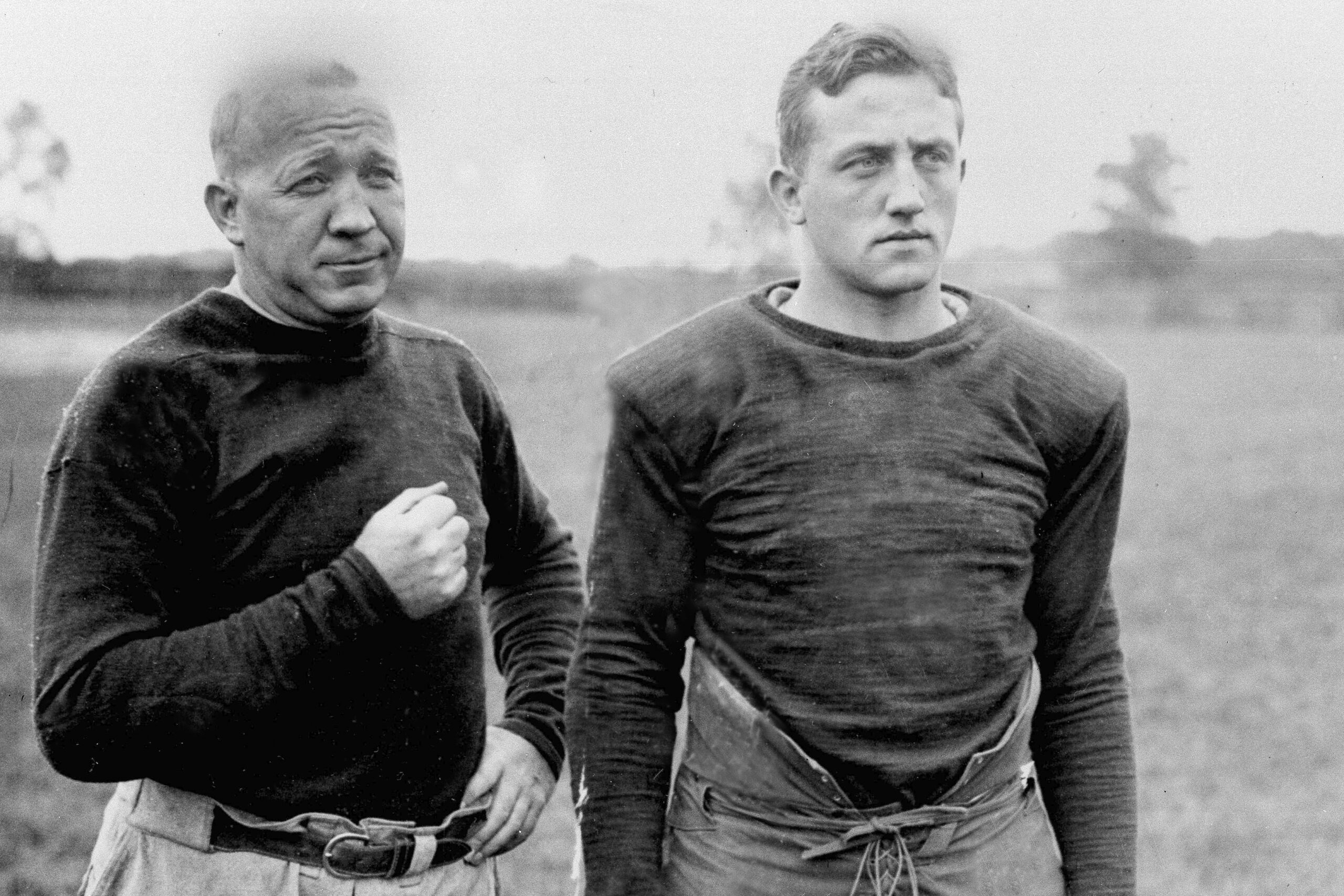
Notre Dame football coach Knute Rockne (left) and team captain Clem Crowe watch the team practice in 1925 — the same year a group of former Fighting Irish players fell to the Maroons, 9-7.
Pottsville sort of ignored the Pennsylvania “Blue Laws,” so the Maroons often played at home on Sundays against opponents that played in Philadelphia the day before. The Maroons set trends that last to this day: For example, the coach insisted his players live in town.
Pottsville was among the smallest cities with an NFL team, but the city more than made up for it by adoring the Maroons — even during a contentious miners’ strike that nearly broke the town. For the exhibition at Shibe Park, as Fleming wrote, several Maroons fans playfully wore coal-miner garb to distinguish themselves from the overwhelming majority of Notre Dame fans.
Even after both teams had arrived at Shibe Park, the exhibition game was nearly canceled because only about 8,000 had paid to see the game, some 10,000 fewer than expected, leading Notre Dame star Harry Stuhldreher, one of the legendary “Four Horsemen,” to push for $25,000 upfront — which is worth about $450,000 today — for his team to play in the game.
(The gate was surely smaller than expected because the Yellow Jackets suddenly scheduled a game at the same time in Frankford, beating Cleveland, 3-0, before 7,000.)
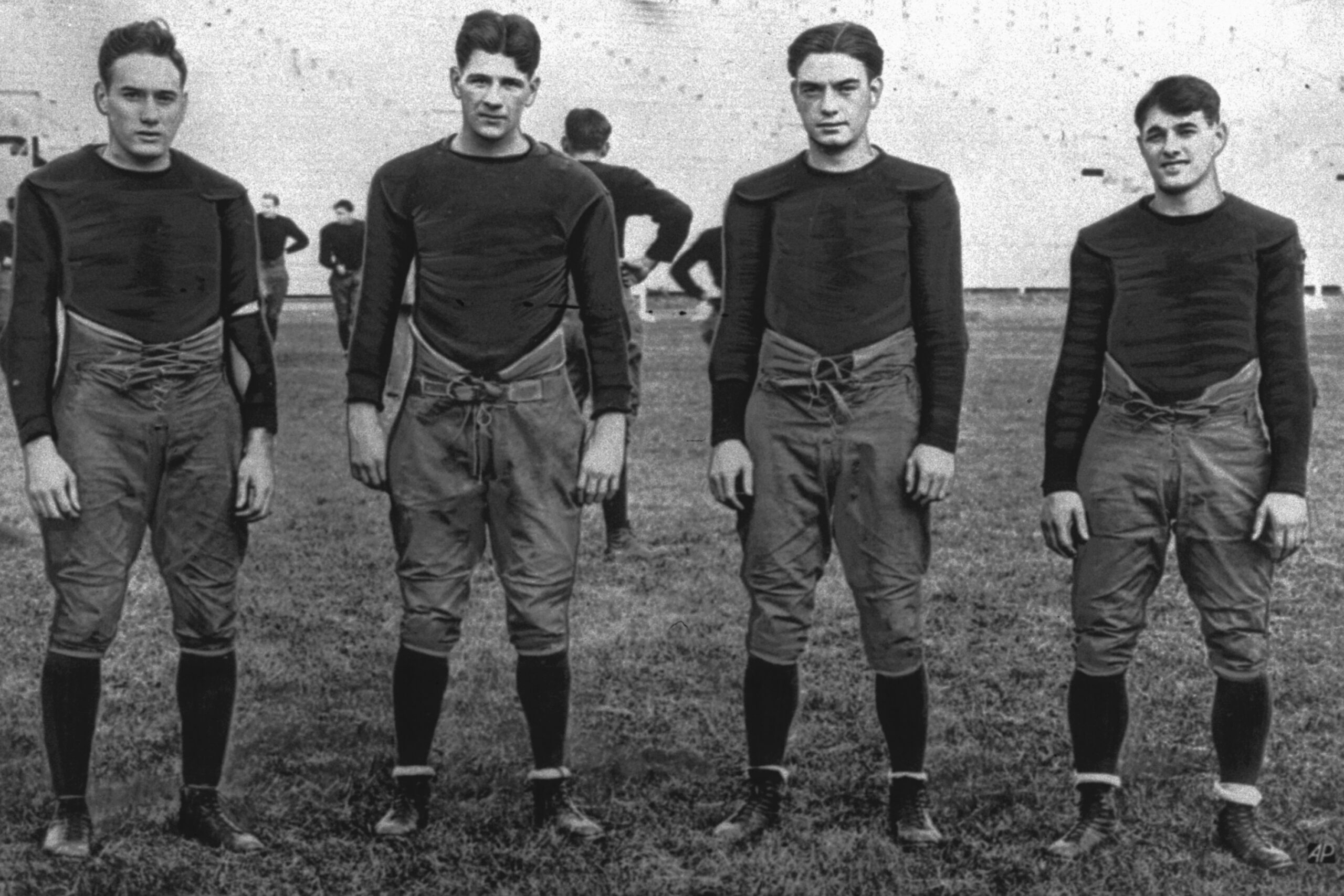
In this 1924 file photo, Notre Dame’s infamous backfield known as “The Four Horsemen,” from left, Don Miller, Elmer Layden, Jim Crowley, and Harry Stuhldreher, pose on the practice field in South Bend, Ind. Stuhldreher asked for $25,000 up front for his team to play against the Maroons.
At the same time, the Maroons were holding out for $10,000 upfront, or about $181,000 today (the pay disparity underscores the difference in perception then between the college and pro games), so the kickoff was delayed. Then Notre Dame took a 7-0 lead on an Elmer Layden touchdown. But the Maroons rallied — gallantly.
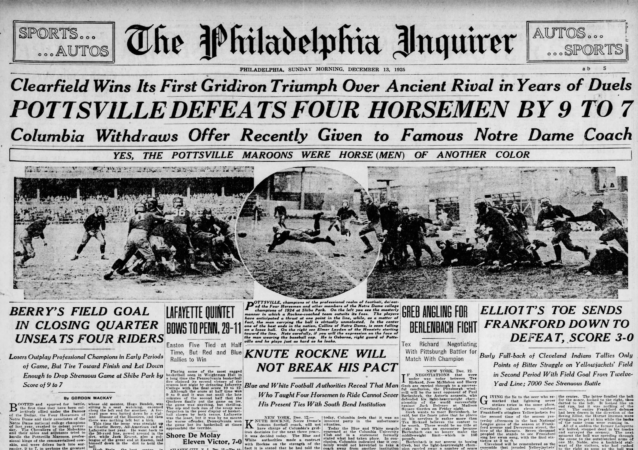
“YES, THE POTTSVILLE MAROONS WERE HORSE(MEN) OF A DIFFERENT COLOR,” The Inquirer gasped the next morning. Gordon Mackay, the reporter, labeled it “perhaps the greatest football battle that this Quaker City has known in years and years.”
The Maroons had put in 28-year-old Tony Latone, the “Human Howitzer,” after halftime. Latone’s story was mythic: He began working in nearby coal mines to support his family when he was 11, after his father died.
At first, he was a “breaker boy,” working 70-hour weeks picking slate and debris from the valuable anthracite coal. (After a week or two, the skin on the tops of a breaker boy’s fingers would peel off.) Later, he strengthened his legs by pushing loaded coal carts from the mines.
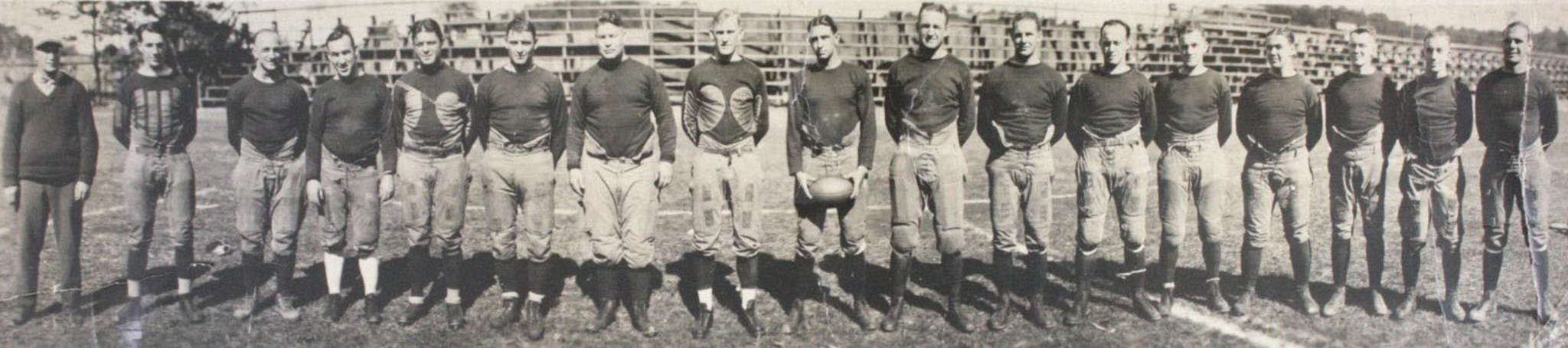
The Pottsville Maroons of 1925, a squad that was comprised of miners from Schuylkill and Luzerne Counties.
Berry, already a catcher for the A’s, hit the crossbar on an extra-point attempt after Latone scored a touchdown late in the third quarter, so Notre Dame still led, 7-6. But Latone, playing on a sore right heel, gained five first downs on another brutal, physical drive.
“He just ripped the Notre Dame team to shreds,” Payne told me of Latone, who ran for more yardage in the NFL in the 1920s than the legendary Harold “Red” Grange.
The drive stalled at the Notre Dame 18-yard line, so Berry tried a 30-yard field goal, which was hardly automatic back in those days. He’d made only three of nine attempts in the season to that point, none past 29 yards.
But, as Mackay so colorfully wrote in The Inquirer the next morning: “He swung that agile hoof. There was a crash of ball and foot, and the crowd, awed into silence, held their breaths as the sphere soared and soared and skipped straight through the crossbar.”
As Fleming wrote in 2007: “Most of the fans at Shibe Park, even the ones from Pottsville, had come out for a fun day of football and a glimpse at the famous Four Horsemen. Instead, they were witness to a watershed moment in the history of American sports: the very moment that professional football surpassed college ball.”
A replica of the trophy — which, like the original, is carved from coal — that the Maroons received for winning the “true” championship resides at the Schuylkill County Historical Society in Pottsville, Pa. The original is in the Pro Football Hall of Fame.
Books about the Maroons, including Fleming’s and the recent release by Payne and Hayes, are on sale at the museum’s gift shop (and online, as well), as are $18 maroon T-shirts with “The Real Champions.” A 100th anniversary celebration was held in August. Students at nearby Nativity BVM High School premiered a documentary, MaRooned.
Fleming, whose book, A Big Mess in Texas, about the antics of the ill-fated 1952 Dallas Texans, was published in October, had Breaker Boys reissued before the 100th anniversary, with a new cover: a photo of the trophy made of silver, not anthracite coal.
“I just wanted to give them the title that they were denied,” he said.
Well, more like, robbed of. Payne and Hayes make a six-premise thesis in their book for the NFL to award the 1925 NFL title to the Pottsville Maroons. They write, “Until the NFL corrects the situation, the Pottsville championship status remains, very simply, marooned.”
Until that day comes, and as a native Pennsylvanian and football fan, the matter should at least be considered; there is only memorabilia from a bygone age in a second-floor alcove at the Schuylkill County Historical Society, a cozy museum in a former school on Centre Street.
Joe Zacko, the late sporting goods store owner and die-hard fan who ordered the jerseys that gave the Maroons their name, had Berry’s shoe bronzed after a 1961 reunion. The goal was to present it to the Pro Football Hall of Fame, then under construction.
The shoe is still in Pottsville. I am not a Skook, but, as I said, I love Pennsylvania and football, and I say a real NFL trophy belongs right next to that shoe, coal trophy, and old ball.
Dave Caldwell, an Inquirer sports writer from 1986 to 1995, grew up in Lancaster County and lives in Manayunk.