BalletX and the Philadelphia Chamber Music Society opened the world premiere of Amy Hall Garner’s highly colorful, theatrical Petrushka Thursday night at the Kimmel Center’s Perelman Theater.
Petrushka takes the second half of a program that opens with ensemble 132 alone in the first act, playing Bartok, Wiancko, and Mozart. So when Peter Weil (as Pete, who becomes Petrushka) wanders on stage and settles in for a nap, it is amusing already.
It’s as if a Kimmel visitor walked through the wrong door.
Now the musicians, playing the Stravinsky score — rescored for, and played by, a piano quintet, are backstage while a surreal fever dream of a scene erupts. Pete is woken up by a chorus of dancers who steal his blanket and wrap him into the traveling show that is approaching.
It’s like we went to a classical concert and a circus broke out.
BalletX dancers Peter Weil as Petrushka and Lanie Jackson as Belle in Amy Hall Garner’s “Petrushka.”
Last summer, BalletX offered a preview of Petrushka, for which choreographer-in-residence Garner teamed up with theater director Nancy Meckler and set and costume designer Emma Kingsbury. Then, it was intriguing but hard to parse.
Garner’s story is still hard to parse without reading the program notes, but it’s a wild adventure.
BalletX dancers Ashley Simpson, Itzkan Barbosa, Minori Sakita, and Lanie Jackson (back) in Amy Hall Garner’s “Petrushka.”
This is the first time BalletX has remade an older story, artistic director Christine Cox said on stage before the show.
Garner’s traveling show is an amusing cast of circus characters who are sometimes puppets, other times human. A hilarious strongman (Mathias Joubert) and a magician/impresario (Jonathan Montepara) share the role as the bad guys. Montepara controls everyone with his wand. Both Pete and the magician are in love with Belle, the ballerina (Lanie Jackson).
Jackson convinces Pete to change into a costume, thus becoming Petrushka and distracting the audience.
There are also acrobats and dancers who perform with ribbons, clubs, and hoops.
BalletX dancers are used to a variety of types of dance and roles. The company specializes in new work, so they are all flexible and able to perform in many ways. More surprising was how good they are as actors. In particular, Weil and Jackson didn’t only impress with their dancing but their strong storytelling and range of emotions.
BalletX dancers Mathis Joubert lifts Jerard Palazo in Amy Hall Garner’s “Petrushka.”
Joubert was the strongest supporting character as the egotistical strongman, breaking the fourth wall to use it as a mirror, flexing his muscles and kissing himself.
The large number of bodies on stage made for a lively scene, but it also overwhelmed the Perelman stage at times. Ensemble 132, which owned the first half, almost faded into the background in the second.
It would be interesting to see this sometime at the Highmark Mann Center for the Performing Arts, BalletX’s second home.
The Trump administration is preparingan executive order focused on housing — with special attention to first-time buyers — as the White Houseattempts to address voter concerns about affordability.
An order could include policies that President Donald Trump has already floated, like a 50-year mortgage or a ban on institutional investors buying single-family homes, according to five people close to the deliberations, who spoke on the condition ofanonymity to discuss private conversations. Other proposals are newer, like helping home buyers withdraw from their 529 or 401(k) savings accounts to make down payments without incurring tax penalties.
Exact timing or language is not final, and plans have been in flux over the past few weeks, the people said. But it’s clear the White House increasingly sees housing policy as central to its broader affordability agenda. More details are expected when Trump speaks at the World Economic Forum in Davos, Switzerland, later this month, according to the president’s social media posts and housing officials.
Bill Pulte, head of the Federal Housing Finance Agency and a close Trump confidant, told the Washington Post on Thursday that an executive action was coming and would later need to be “codified by Congress.”
“We’ve got 30 to 50 different ideas that are in front of the president,” Pulte said. “He’ll be releasing a handful of them in Davos.”
Officials havebeen planning an executive order aimed at housing for months. But timing stalled as different factions within the administration clashed over an approach. Two of the people close to the talkssaid internal divisions sometimes boiled down to how much the federal government should tell states and cities what to do. Other disagreements centered on what role Congress should play.
White House spokesperson Davis Ingle said in a statement that Trump hadpledged to slash red tape, cut interest rates, and tackle unfair business practices that make it harder for Americans to buy homes.
“As the President indicated over Truth Social, he will be unveiling more details about his housing proposal in Davos — any discussion from unnamed sources until then is baseless speculation,” Ingle said.
For much of last year, the administration’s policyagenda has involvedblaming undocumented immigrants for housing shortages and clawing back fair housing regulations. Officialsalso want to take mortgage giants Fannie Mae and Freddie Mac public after years of government control — a tremendously complicated endeavor that could leadto a massive stockoffering but, if not done carefully, roil the mortgage market.
Yet fresh momentum appeared to pick up this week after a meeting of top housing and White House officials on Tuesday. Trump announced the ban on institutional investors on Truth Social on Wednesday, saying he would call on Congress to seal the deal, and drawing favorable reaction from GOP lawmakers. On Thursday, he said Fannie and Freddie would use some $200 billion in cash to buy mortgage bonds — whichhe said would drive mortgage rates and monthly payments down.
Administration officials are also looking at ways to implement so-called “portable mortgages,” where homeowners can take their old mortgages with them when they move to a new house, the people close to the discussions said. They are considering “assumable mortgages,” where home buyers take overthe sellers’mortgage. Both of those ideas could help offset the rise in mortgage rates over the past several years, and they could also entice homeowners with low rates to sell without fear of taking on a higher mortgage, opening up more supply in the process. Officials are discussingexpanding Opportunity Zones — an economic tool for investing in distressed areas — and other deregulatory policies as a means of boosting homeownership, as well.
Pulte also teed up more actions related to home builders this week, saying on X that they “need to start building out their lot supply, including optioned land which is ‘ready to go.’”
Builders have been in talks with the administration for the past year on ways to cut environmental regulations, energy codes, and permitting restrictions, including those that make it harder to turn land from raw to developable lots and pile on costs, said Jim Tobin, president and chief executive of the National Association of Home Builders.
“If there is an executive order, I don’t expect it to be narrow,” Tobin said. “I expect it to be broad.”
But Trump’s announcements have come with few details or clarity on Congress’s role. Some proposals could also work against affordability goals; many mainstream economists say a 50-year mortgage would likely increase overall costs for borrowers, because they’ll pay far more in interest over five decades than they would with the conventional 30-year loan.
Inside the administration, officials see a two-pronged approach to addressing home prices, according to a GOP pollster close to the White House, speaking on the condition of anonymity to discuss private conversations. One path is to increase housing supply through construction; another is decreasing the number of buyers by disincentivizing investors and making it easier to sell homes without paying capital gains taxes. Under current law, most married couples can exempt the first $500,000 in capital gains on the sale of their primary residence from taxes.
White House officials have reviewed polling that shows voters aged 18 to 24 see affordability through a housing lens, said the GOP pollster. That age group helped deliver the presidency to Trump in 2024, which makes the White House especially sensitive to its political standing with them. The pollster said administration officials are focused on first-time home buyers, which often are adults 40 or younger.
“This voting cohort who is deeply concerned about this and worried about housing prices delivered, in a lot of ways, the election to President Trump in 2024,” the pollster said. “Affordability means housing in every bit of data we’ve seen.”
The pollster expects the final plan to pave the way for Trump to take Fannie Mae and Freddie Mac public. He also said he expects the administration to “play around” with the step-up in cost basis, a U.S. tax rule that adjusts the value of inherited assets to their market price at the time of death, which can reduce capital gains taxes for heirs. That would include taxes on homes.
David Dworkin, president and chief executive officer of the National Housing Conference, said making it easier for younger buyers to withdraw from their 401(k)s penalty-free “will have a bigger impact than any down payment program ever proposed.” At the same time, the way to make homes more affordable is to build more of them.
“Everything the president does to help us build more units is going to have an impact,” Dworkin said. “Some of these ideas are going to be more impactful than others. Some may have unintended consequences we want to be careful about. But it’s too easy to say, ‘Oh this is risky, let’s not do anything.’ We’ve got to make progress here.”
Fannie and Freddie’s new bond purchases could be part of the strategy aroundtaking them public, because the move would addvalue to their balance sheets and help the companies make more money. But the broader effect on affordability could be more muted. Mortgage rates typically track Treasury yields, which fall in times of economic uncertainty. In a Thursday analyst note, Gennadiy Goldberg, head of U.S. Rates Strategy at TD Securities, said that based on the projections for Treasury yields, the 30-year mortgage rates could drift down toward 5.25% by the end of the year, compared to 6.16% this week.
But if Fannie and Freddie’s vast securities purchases happen quickly, mortgage rates could tick down a bit more,to 5% by year-end, Goldberg wrote.
Democrats this week criticized the Trump administration for promoting policies those on the left have tried before, likebanning institutional investors from the single-family market. Buthousing is one of the only policy areas with bipartisan support lately. A popular bill from Sens. Tim Scott (R., S.C.) and Elizabeth Warren (D., Mass.) would increase housing supply and pare back regulations that slow new construction. Its progress slowed late last year after House Republicans pressed to keep it out of the annual defense policy bill. But a similar bill is moving forward in the House, and there’s hope a breakthrough will come eventually.
“My focus is on advancing meaningful solutions that expand housing supply and lower costs — including building on our unanimously passed ROAD to Housing Act — because that’s how we make the American Dream more attainable,” Scott, who chairs the Senate Banking Committee, said in a statement.
If they made a movie about the Phillies as 2026 begins, the climactic scene would feature Bryce Harper at the plate, flipping his Victus bat, and shouting four words at a bloodthirsty crowd.
It’s a fair question. Because the Phillies have a $300-plus-million payroll and as many stars as a planetarium. They won more games in the last three seasons than all but two teams (Dodgers, Brewers). And only the Dodgers have a streak of playoff appearances longer than the Phillies’ four-year run.
Surely, the 3.3 million fans who surged through the gates of Citizens Bank Park last season enjoyed all that.
Except, well, you know what keeps happening to the Phillies in October: divisional-round ousters in 2024 and ’25 after the Game 6 and 7 soul-crushers at home in the 2023 National League Championship Series. That’s eight losses in 10 playoff games — and nothing to show for so much regular-season success.
So, when the Phillies re-signed Kyle Schwarber last month and made an offer to bring back franchise catcher J.T. Realmuto, it mostly was met with a shrug from fans who are more wary than they should be about keeping together the guts of a roster that chased 90 wins three years ago with 95 and then 96.
But before channeling our inner Gladiator and questioning the entertainment value of yet another winning summer spent with the cast that disappoints every autumn, the Phillies went and set up a meeting next week with star free-agent infielder Bo Bichette, a major league source said Thursday, confirming a report by The Athletic.
Entertaining? Maybe. Interesting? Definitely.
Free-agent infielder Bo Bichette is scheduled to meet with the Phillies over video next week, according to a major league source.
Bichette, who will be 28 next season and twice led the American League in hits, would bring a high contact rate and right-handed power to the Phillies’ lineup. Imagine a batting order that looked like this:
But the real explanation for the fans’ collective endorphin rush is that Bichette — son of former major leaguer Dante Bichette, godson of ex-Phillies manager Joe Girardi — would represent the biggest change of the mix since Turner’s arrival as a free agent in December 2022. And let’s be clear: Signing Bichette would be like taking a blender to the roster.
Not only would the Phillies need to teach Bichette a new position (third base), but to squeeze him into the budget — with the payroll pushing up against the highest luxury-tax threshold — they must move third baseman Alec Bohm’s $10.2 million salary and say goodbye to Realmuto.
Are the Phillies really better off with Bichette? Maybe. Realmuto is older (35 this season) and amid a three-year decline at the plate. But he still has more wins above replacement over the last three seasons (9.0, as calculated by Baseball-Reference) than Bichette (8.0). And he’s beloved by the pitchers for his leadership and game-calling.
The Phillies remain hopeful of retaining Realmuto, but the sides have been locked in a contractual staring contest for a month. There isn’t a Phillies story — and depending how things go Sunday at the Linc, maybe not a Philadelphia sports story — that will dominate the news more than the Bichette-Realmuto saga for as long as it lasts.
But 2026 will bring several entertaining Phillies storylines, such as:
Phillies ace Zack Wheeler is seeking to return from thoracic outlet decompression surgery.
Whither Wheeler?
When we last heard from Zack Wheeler, it was August, and he was where he normally is, smack dab in the conversation with Paul Skenes, Tarik Skubal, and maybe Garrett Crochet for the best pitcher in baseball.
Then, in the flash of his fastball, he was gone, diagnosed with a blood clot near his right shoulder.
The clot was brought on by venous thoracic outlet syndrome, a condition in which the subclavian vein gets compressed between the collarbone and rib cage. Wheeler had season-ending surgery to remove the clot, then another procedure in late September in which his top rib was removed to relieve the pressure on the vein.
(Aside: It’s difficult not to wonder if the divisional series against the Dodgers would’ve turned out differently if the Phillies had Wheeler and reliever José Alvarado. Then again, they scored only seven runs in the three losses — and lost by a total of four runs. Pitching wasn’t the problem.)
Wheeler is throwing again — from 75 feet, manager Rob Thomson said before seeing him in person this week. The Phillies are optimistic he won’t miss much of the season. As one major league source put it, his recovery is “going great.”
“The trainers seem to think he’s doing very well,” Thomson said, purposely not venturing a guess for Wheeler’s return.
But thoracic outlet syndrome isn’t as common as, say, Tommy John surgery, and the return isn’t always as smooth. Maybe Wheeler, 35 in May, will make a full recovery, à la Diamondbacks righty Merrill Kelly, who was in his 30s when he returned from TOS. Maybe he will need to reinvent himself on the mound.
Either way, it won’t be as automatic as winding up Wheeler and watching him dominate for 200 innings. And the rest of the starting rotation, still the Phillies’ backbone, must be adjusted accordingly.
Bryce Harper finished with an .844 OPS last season, 11th among qualified National League hitters.
But there are tangible things that Harper can improve.
Start here: Harper swung at 35.6% of pitches out of the strike zone last season, 129th among 144 qualified hitters, according to Statcast. Not only was it worse than the league average (28.4%) but also his career mark (29.3%).
Harper was hampered in the first half of the season by an inflamed right wrist, which eventually sidelined him for 23 games. And he did still finish with an .844 OPS, 11th among NL hitters who qualified for the batting title.
Not bad. Just not … elite.
There’s that word again.
“He expanded a little bit more than we’re accustomed to,” hitting coach Kevin Long said in November on Phillies Extra, The Inquirer’s baseball podcast. “I don’t know what his actual chase rate ended up being, but it was probably 35%. That’s high. If he gets that number down to 32, just drop it 3%, now he’s swinging at better pitches, [and] he’s going to do more damage.”
Justin Crawford (left), Andrew Painter, and Aidan Miller are among the Phillies’ top prospects.
Will the kids be all right?
The Phillies had 12 players make their major league debuts in the last three seasons — fewer than any team, based on FanGraphs research.
That’s about to change.
Barring a spring training from hell, Justin Crawford will be part of the Phillies’ opening-day outfield, likely in center, on March 26 against the Rangers. There’s a decent chance Andrew Painter will be in the season-opening rotation, especially if Wheeler misses the first few weeks.
And if infielder Aidan Miller plays well for a few months in triple A, he could accelerate the Phillies’ timetable to call him up.
The existing core is aging, though not yet old. Harper and Schwarber will play at 33 all season; Turner and Aaron Nola will turn 33 in June. And if this is the year that the Phillies finally scale the October mountain, their stars will have led the charge.
But it’s imperative that the Phillies’ trio of top prospects graduate to majors and provide at least as much impact, if not more, than the last wave of young players.
“I’ve said this all along, and I still believe this: We need to start working our young players into our [roster],” Dombrowski said last month. “We have good young players, and we’ll be better for it. I do think that good organizations can blend young players with veterans.”
Speaking of the Phillies’ previous youth brigade, Stott and Marsh finally got better results at the plate last season after making midyear changes. Stott hit .294 with an .855 OPS after the All-Star break; Marsh batted .303 with an .836 OPS after a hitless April. Can they build on that success?
And will reliever Orion Kerkering bounce back from his devastating season-ending throwing error?
File them away among the subplots in the Phillies’ 2026 soap opera.
DUBAI, United Arab Emirates — Iran signaled Friday that security forces would crack down on protesters, directly challenging U.S. President Donald Trump’s pledge to support those peacefully demonstrating as the death toll rose to at least 62.
Supreme Leader Ayatollah Ali Khamenei dismissed Trump as having hands “stained with the blood of Iranians” as supporters shouted “Death to America!” in footage aired by Iranian state television. State media later repeatedly referred to demonstrators as “terrorists,” setting the stage for a violent crackdown like those that followed other nationwide protests in recent years.
Protesters are “ruining their own streets … in order to please the president of the United States,” the 86-year-old Khamenei said to a crowd at his compound in Tehran. “Because he said that he would come to their aid. He should pay attention to the state of his own country instead.”
Iran’s judiciary chief Gholamhossein Mohseni-Ejei separately vowed that punishment for protesters “will be decisive, maximum, and without any legal leniency.”
There was no immediate response from Washington, though Trump has repeated his pledge to strike Iran if protesters are killed, a threat that’s taken on greater significance after the U.S. military raid that seized Venezuela’s Nicolás Maduro.
Internet cut off
Despite Iran’s theocracy cutting off the nation from the internet and international telephone calls, short online videos shared by activists purported to show protesters chanting against Iran’s government around bonfires as debris littered the streets in the capital, Tehran, and other areas into Friday morning.
Iranian state media alleged “terrorist agents” of the U.S. and Israel set fires and sparked violence. It also said there were “casualties,” without elaborating.
The full scope of the demonstrations couldn’t be immediately determined due to the communications blackout, though it represented yet another escalation in protests that began over Iran’s ailing economy and that has morphed into the most significant challenge to the government in several years. The protests have intensified steadily since beginning Dec. 28.
The protests also represented the first test of whether the Iranian public could be swayed by Crown Prince Reza Pahlavi, whose fatally ill father fled Iran just before the country’s 1979 Islamic Revolution. Pahlavi, who called for the protests Thursday night, similarly has called for demonstrations at 8 p.m. Friday.
Demonstrations have included cries in support of the shah, something that could bring a death sentence in the past but now underlines the anger fueling the protests that began over Iran’s ailing economy.
So far, violence around the demonstrations has killed at least 62 people while more than 2,300 others have been detained, said the U.S.-based Human Rights Activists News Agency.
“What turned the tide of the protests was former Crown Prince Reza Pahlavi’s calls for Iranians to take to the streets at 8 p.m. on Thursday and Friday,” said Holly Dagres, a senior fellow at the Washington Institute for Near East Policy. “Per social media posts, it became clear that Iranians had delivered and were taking the call seriously to protest in order to oust the Islamic Republic.”
“This is exactly why the internet was shut down: to prevent the world from seeing the protests. Unfortunately, it also likely provided cover for security forces to kill protesters.”
Thursday night protests preceded internet shutdown
When the clock struck 8 p.m. Thursday, neighborhoods across Tehran erupted in chanting, witnesses said. The chants included “Death to the dictator!” and “Death to the Islamic Republic!” Others praised the shah, shouting: “This is the last battle! Pahlavi will return!” Thousands could be seen on the streets before all communication to Iran cut out.
On Friday, Pahlavi called on Trump to help the protesters, saying Khamenei “wants to use this blackout to murder these young heroes.”
“You have proven and I know you are a man of peace and a man of your word,” he said in a statement. “Please be prepared to intervene to help the people of Iran.”
The White House did not immediately respond to a request for comment on Pahlavi’s appeal to Trump.
Pahlavi had said he would offer further plans depending on the response to his call. His support of and from Israel has drawn criticism in the past — particularly after the 12-day war Israel waged on Iran in June. Demonstrators have shouted in support of the shah in some demonstrations, but it isn’t clear whether that’s support for Pahlavi himself or a desire to return to a time before the 1979 Islamic Revolution.
The internet cut also appears to have taken Iran’s state-run and semiofficial news agencies offline. The state TV acknowledgment at 8 a.m. Friday represented the first official word about the demonstrations.
State TV claimed the protests were violent and caused casualties, but did not offer nationwide figures. It said the protests saw “people’s private cars, motorcycles, public places such as the metro, fire trucks, and buses set on fire.” State TV later reported that violence overnight killed six people in Hamedan, some 175 miles southwest of Tehran, and two security force members in Qom, 75 miles south of the capital.
The European Union and Germany condemned the violence targeting demonstrators as new protests were reported in Zahedan in Iran’s restive southwestern Sistan and Baluchestan province.
It remains unclear why Iranian officials have yet to crack down harder on the demonstrators. Trump warned last week that if Tehran “violently kills peaceful protesters,” America “will come to their rescue.”
In an interview with talk show host Hugh Hewitt aired Thursday, Trump reiterated his pledge.
Iran has “been told very strongly, even more strongly than I’m speaking to you right now, that if they do that, they’re going to have to pay hell,” Trump said.
He demurred when asked if he’d meet with Pahlavi.
“I’m not sure that it would be appropriate at this point to do that as president,” Trump said. “I think that we should let everybody go out there, and we see who emerges.”
Speaking in an interview with Sean Hannity aired Thursday night on Fox News, Trump went as far as to suggest Khamenei may want to leave Iran.
“He’s looking to go someplace,” Trump said. “It’s getting very bad.”
NEW ORLEANS — Federal immigration officers are pulling out of a Louisiana crackdown and heading to Minneapolis in an abrupt pivot from an operation that drew protests around New Orleans and aimed to make thousands of arrests, according to documents obtained by The Associated Press.
The shift appeared to signal a wind-down of the Louisiana deployment that was dubbed “Catahoula Crunch” and began in December with the arrival of more than 200 officers. The operation had been expected to last into February and swiftly raised fears in immigrant communities.
The Trump administration has been surging thousands of federal officers to Minnesota under a sweeping new crackdown tied in part to allegations of fraud involving Somali residents. More than 2,000 officers are taking part in what the Department of Homeland Security has called the biggest immigration enforcement operation ever.
The officers in Minneapolis have been met with demonstrations and anger after an ICE officer fatally shot a woman on Wednesday.
Documents obtained by the AP indicated that federal officers stationed in Louisiana were continuing to depart for Minneapolis late this week.
“For the safety of our law enforcement, we do not disclose operational details while they are underway,” DHS said Friday in response to questions about whether the Louisiana deployment was ending in order to send officers to Minnesota.
In December, DHS deployed more than 200 federal officers to New Orleans to carry out a monthslong sweep in and around the city under Border Patrol Cmdr. Gregory Bovino, who was also the face of aggressive operations in Chicago, Los Angeles, and Charlotte, North Carolina. Bovino has been seen in Minneapolis this past week.
“Catahoula Crunch” began with a target of 5,000 arrests, the AP first reported. The operation had resulted in about 370 arrests as of Dec. 18, according to DHS.
The operation heavily targeted the Hispanic enclave of Kenner just outside New Orleans, leading immigrant-run businesses to close down to protect customers and out of a fear of harassment.
Documents previously reviewed by AP showed the majority of people arrested in the Louisiana crackdown’s first days lacked criminal records and that authorities tracked online criticism and protests against the deployment.
Republican Louisiana Gov. Jeff Landry welcomed the crackdown. But New Orleans’ Democratic leaders called the 5,000-arrest target unrealistic and criticized videos that showed agents arresting or trying to detain residents, including a clip of a U.S. citizen being chased down the street by masked men near her house.
New Orleans’ Democratic leaders have been more welcoming of a National Guard deployment that President Donald Trump authorized after Landry asked for help fighting crime. The troops arrived just before the New Year’s Day anniversary of a truck attack on Bourbon Street that killed 14 people.
After finishing the regular season with an 11-6 record, the Eagles are preparing for the first round of the NFL playoffs, where they’ll will host Christian McCaffrey and the San Francisco 49ers in what is expected to be a windy wild-card matchup.
Here’s how those in the local and national media are predicting Sunday’s game …
Inquirer predictions
As always, we start with our own writers. Here’s an excerpt from Jeff Neiburg’s prediction:
To see what our other beat writers are expecting from this NFC playoff matchup, check out our full Eagles-49ers predictions here.
Eagles safety Sydney Brown (left) tackles 49ers running back Christian McCaffrey during the two teams’ last meeting at the Linc in 2023.
National media predictions
Here’s a look at who the national media is picking for Sunday’s game …
ESPN: Six of nine panelists are picking the Eagles to win and advance.
CBS Sports: CBS Sports is also leaning toward the home team, with four of seven experts choosing the Birds.
USA Today: In a clear sweep, all six panelists like the Eagles Sunday.
The Athletic: They turned their picks over to a panel of 11 NFL insiders — coaches and high-ranking executives — and the majority (six) think the 49ers will upset the Eagles.
Bleacher Report: Bleacher Report picks against the spread, and their crew is leaning toward the 49ers, with five of seven analysts taking the away team and the 4.5 points they’ll be getting from the Eagles.
Yahoo! Sports: Frank Schwab has the Birds beating the Niners, 20-14.
Sporting News: Vinnie Iyer is picking the Eagles to win, 23-20.
Sports Illustrated: Six of the 10 MMQB writers have the Eagles advancing past the 49ers, and two (Gilberto Manzano and Andrew Brandt) have the Birds advancing to the Super Bowl, with Brandt picking them to win.
But another recent announcement seemingly sent people over the edge. For the first time in the history of the tournament, FIFA will charge fans to attend its fan festivals across many of the 16 cities in North America selected to host games in the monthlong tournament.
And while that has been made public for at least one of the hosts, general admission to Philly’s fan festival, scheduled for June and July on the grounds of Lemon Hill Mansion in the Brewerytown section of the city, will remain free, according to Philadelphia Soccer 2026, the committee responsible for the planning and execution of Philly’s tournament footprint.
Meg Kane, host city executive for Philadelphia Soccer 2026, said Philly’s version of FIFA’s Fan Fest will remain free, as the event is “committed to making sure every fan can share in the excitement.”
“Since our selection as a host city in 2022, Philadelphia Soccer 2026 has remained committed to making sure every fan can share in the excitement, culture, and community of this generational sporting event,” Meg Kane, host city executive of Philadelphia Soccer 2026, said in a statement to The Inquirer on Wednesday.
“Essential to that commitment, we made the decision to offer free general admission to FIFA Fan Festival at Lemon Hill, ensuring an inclusive and welcoming environment where fans from all backgrounds can come together to celebrate the world’s game.”
While general admission will remain free for the scores of fans who are expected to descend upon Philly over the course of five group matches and a massive round of 16 game on July 4, there will be “optional VIP experiences,” including expedited entry into festival grounds, and are expected to be available for purchase at a later date.
Kane’s announcement mirrors that of other cities, such as Kansas City and Vancouver, which also have stated their intention to keep admission free for their events.
But when the news of potential fees at fan festivals initially landed, it certainly didn’t appear that would be the case.
Amid the news that FIFA plans to charge for its fan festivals, it was overlooked that only one delegation has formally announced its intent to charge an upfront entrance fee.
In fact, a spokesperson with knowledge of the proceedings told The Inquirer that any intention to add a fee to the festivals was not a blanket decision made by FIFA as soccer’s world governing body; instead, it is left to host city committees to decide.
A FIFA spokesperson confirmed this and added on Thursday that while some host city delegations have begun relaying their fan festival plans, “FIFA will communicate the full suite of details [for all 16 host cities] in the first quarter of 2026,” where, in addition to what’s to come at those sites, announcements of which ones might consider charging a fee will be made public.
Artists rendering of what Philadelphia’s 2026 World Cup fan fest site at Lemon Hill will look like.
“From the outset, FIFA has worked closely with host cities and local stakeholders to help shape meaningful fan experiences beyond the stadiums that are community-led, fan-oriented and aligned with the spirit of the FIFA World Cup,” a FIFA spokesperson said in a statement to The Inquirer. “It is important to recognize that there is no one-size-fits-all model for fan engagement across a tournament of this scale.”
FIFA’s spokesperson also noted that “fan experiences can take many forms — from large-scale gatherings to more decentralized, community-driven activations,” which dovetails into the preliminary plan of attack of the New York-New Jersey delegation, which isn’t viewing its overall fan engagement strategy as hosted at one large site, but several.
For soccer fans planning a trip for the World Cup final or New Yorkers who can’t afford it but want in, tickets are available for New York’s main fan festival at Liberty Park via Ticketmaster for $12.50.
But there’s a methodology at play here.
According to a host city committee official, the move isn’t as much a revenue driver as a crowd management strategy designed to regulate capacity and effectively coordinate staffing, security, and transportation.
Essentially, by putting a limit on the number of people expected to descend upon the area to watch a series of matches in June and July, the Liberty Park fan festival can be capped at a number, one anticipated to still be in the tens of thousands, daily.
To accommodate a global population, the delegation plans to bring in a scaled-down version of its festival, termed as “fan zones,” into all five New York boroughs. The first two have already been announced: Rockefeller Center in Manhattan will host a “fan village,” as will the Billie Jean King National Tennis Center, the home of the U.S. Open in Queens.
The grounds of the Billie Jean King National Tennis Center will also be utilized as one of five FIFA World Cup “fan zones” across New York’s five boroughs in addition to the Liberty Park Fan Festival on the banks of the Hudson.
More are expected to be announced later, and the fan village at Rockefeller Center will be free to attend. As of now, New York-New Jersey is the only host city committee planning fan experience that’s not situated in a single location.
“New York-New Jersey is building a regional fan experience unlike anything seen in World Cup history,” Alex Lasry, CEO of the New York-New Jersey host committee, told The Inquirer. “We’re proud to have announced three official NYNJ Host Committee fan experiences that will bring the World Cup far beyond the stadium.
“These spaces are essential to the World Cup experience, creating accessible and affordable places for people to come together and experience the biggest games in one of the world’s most iconic venues. And this is just the beginning — we look forward to announcing additional fan engagement opportunities so the entire region can feel the impact of the World Cup.”
Frosted vegan pop-tarts, swirls of dairy-free soft serve, and meatless bacon-egg-and-cheese croissants have officially arrived in East Falls.
Crust Vegan Bakery opened Thursday at the intersection of Ridge and Midvale Avenues, just off Kelly Drive. The move from its two-space operation in Manayunk to a larger location enabled the confectionery to consolidate its retail storefront and commercial kitchen, said owner Meagan Benz.
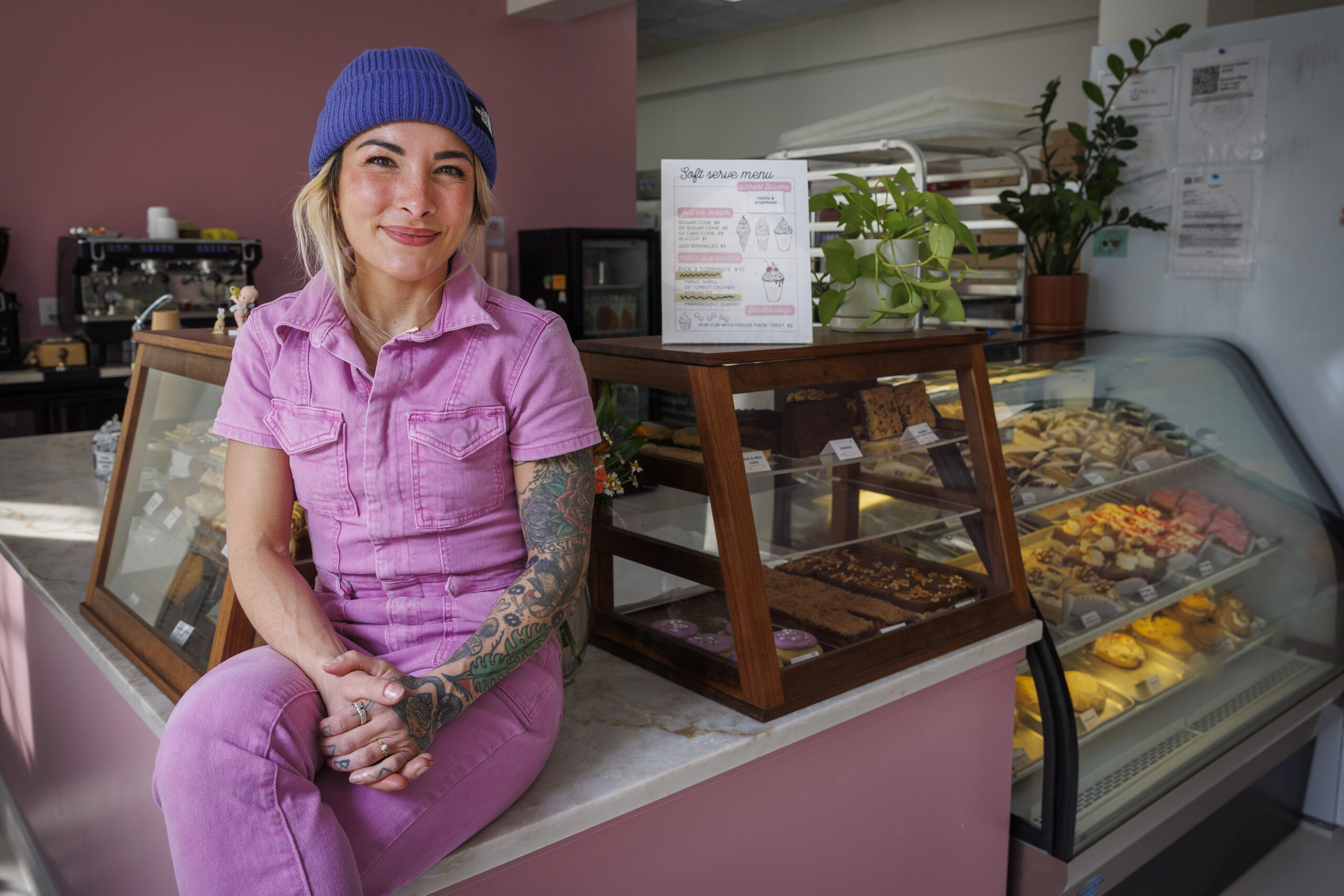
Benz spent more than nine months transforming a 3,000-square-foot office along the Schuylkill River into what she called a “cakelike retail space” with baby-pink walls piped with white paint and ceiling tiles modeled after Lambeth-style cake trims. Light from oversized front-facing windows dapple a trio of pastry cases filled with batches of all-vegan sweets, from cheesecake slices and cinnamon buns to black-and-white cookies and crumb-coated coffee cakes. Baristas-slash-bakers pull espresso shots and whisk matcha for lattes sweetened with house-made syrups.
“I wanted to create a place where people think, ‘Oh, I can get everything I need there,’” Benz said.
Crust Vegan Bakery owner Meagan Benz with a display case of treats on opening day Jan. 8 at the bakery’s new location at 4200 Ridge Ave. in East Falls. Crust moved there from Manayunk.
Benz, who went vegan in 2009 while a freshman at University of North Carolina Greensboro, launched Crust in 2015 as a wholesale vegan bakery out of a commissary kitchen at 220 Krams Ave. in Manayunk. When custom cake and wholesale orders dried up almost overnight in 2020, she and then-co-owner Shannon Rocheopenedtheir storefront at4409 Main St.as a way to keep on staff they would’ve otherwise had to lay off during the pandemic, a move Benz said ended up making Crust profitable enough to bring on more employees.
“Retail is where we make more money,” said Benz, 35.
Now, the business has outgrown the satellite storefront that saved it.
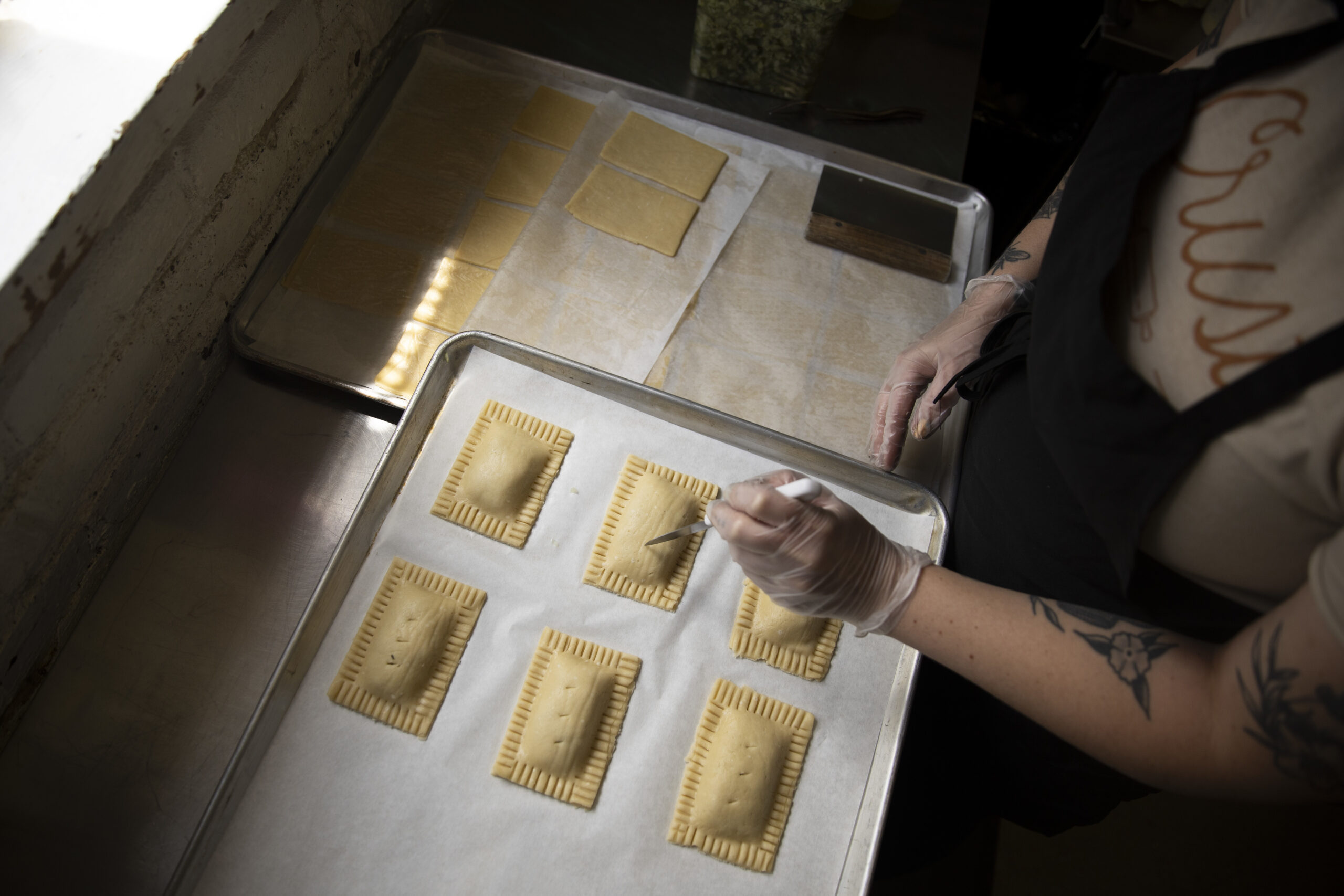
Jordan Fuchs prepares pop-tarts at Crust Vegan Bakery’s former commercial kitchen space on Krams Avenue.
Splitting time and staff between the retail space and commercial kitchen proved logistically challenging. Benz said Crust’s storefront manager wound up spending most of her time ferrying pastries between locations, a half-mile journey that led to lots of wasted product.
“It was a really short distance, but people drive crazy — someone slams on the brakes in front of us and we’re done for,” Benz said. “We had many times where things would tip over and we’d have to determine if it was still usable.”
At Crust’s new location, a sparse yet cozy cafe area with two tables and a large, lived-in green couch bleeds into the kitchen, where staff pivot from packaging cakes and swirling soft-serve cones to frosting pop-tarts. The streamlined setup has allowed Benz to dream big. Already on her wish list for the future: a separate convection oven for made-to-order breakfast sandwiches, a back room for cake-decorating classes, and more room for colorful displays.
A brown sugar pecan pie pop-tart, soft frosted cookie, and vanilla strawberry cake from Crust Vegan Bakery are plated next to a hot latte. Beverages are new to the bakery.
Benz spent two years looking for the right location, unwilling to compromise on a short list of non-negotiables. Most of the bakery’s 15-member team live in Northwest Philly, she said, so the new space needed to remain in the area while being more transit-accessible.
Crust’s new location sits at the convergence of five bus lines. It also will leave Manayunk without a pastry specialist when Crust’s former commercial-kitchen neighbor Flakely decamps for Bryn Mawr in February.
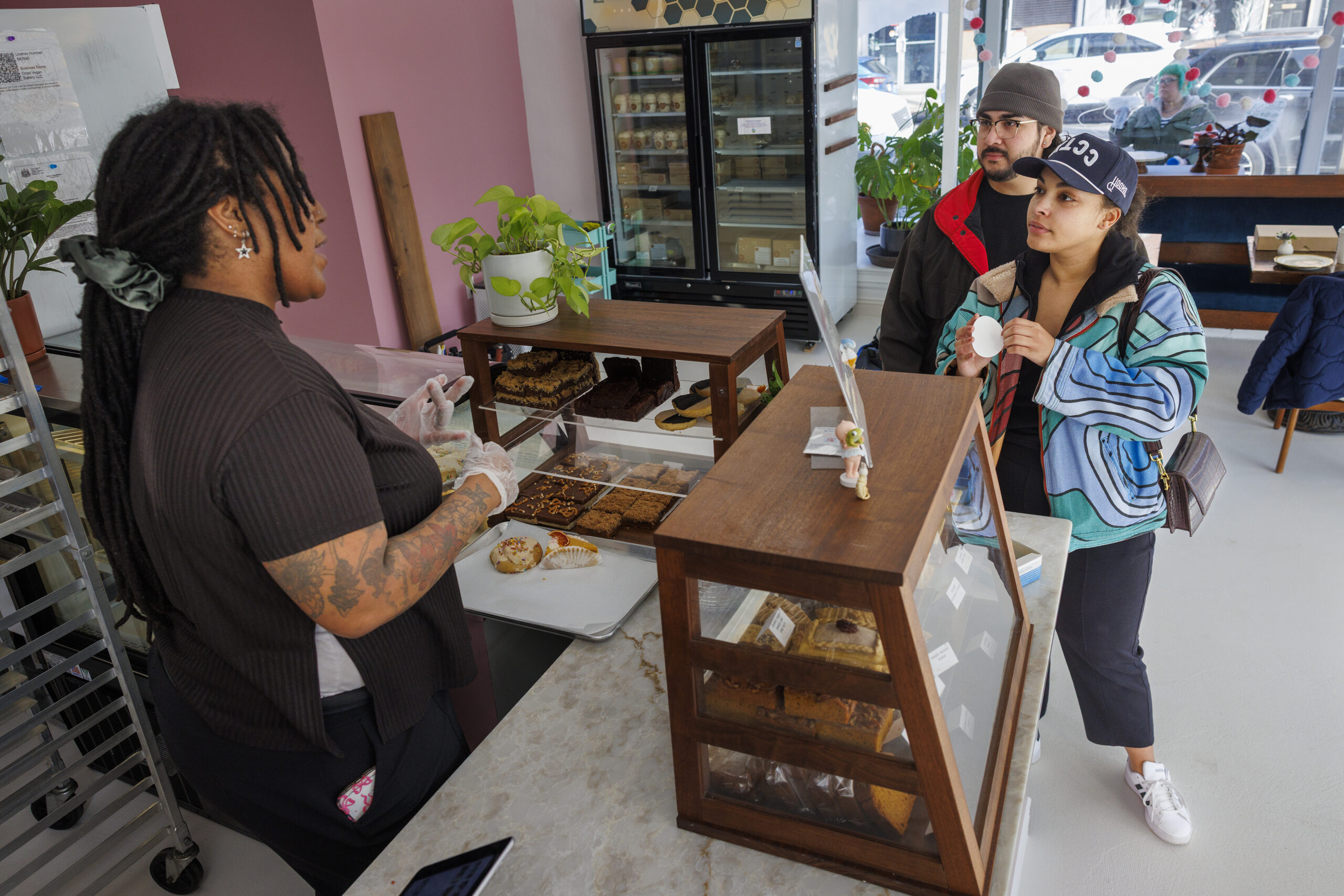
Taleema Ruffin takes an order from Chase Sanders and Ryan Martinez-Peña, of East Falls, at the counter of Crust Vegan Bakery’s new location at 4200 Ridge Ave. on opening day, Jan. 8, 2026.
Crust’s move also marks the launch of its first-ever coffee program, headed by cake decorator-turned-beverage coordinator Jordan Fuchs.
The bakery will serve a short but sweet menu of coffee and tea drinks, with beans and matcha sourced from Rise Up Coffee, a fair-trade roaster based in Maryland. Crust makes its own vanilla and mocha coffee syrups, and Fuchs has plans for a rotating menu of seasonal additions. The signature drink will be a black sesame latte, Fuchs said, and she’s currently perfecting a chocolate-covered strawberry latte in time for Valentine’s Day.
Jordan Fuchs pours a rosetta on top of a hot soy latte inside Crust Vegan Bakery. Its new retail space in East Falls has enabled the bakery to start a beverage program.
Crust will also continue selling two things Benz said many of her vegan customers desperately miss from their dairy-consuming days: soft-serve ice cream and hulking breakfast sandwiches.
Benz’s breakfast sandwiches are served on flaky vegan croissants or thick biscuits, both made in-house, with Just Egg patties and seitan bacon that crisps up like the real thing.
The bakery started offering nondairy soft serve year-round in 2023, Benz said, as a way to satiate her own craving. Crust uses a vanilla base made with pea protein and then adds mix-ins for flavors that rotate every two weeks. The ice cream is silky, and curls out of the machine with the flourish of a Dairy Queen swirl. It’s sweet, but doesn’t quite capture the essence of its full-dairy counterpart; Benz said that’s the point.
“If our ice cream doesn’t exactly taste like dairy ice cream, that’s OK,” she said. “I just want it to taste really good.”
Crust Vegan Bakery’s dairy-free soft serve menu, which is offered year round and includes toppings.
Pastries are still the main event at Crust’s new location. The bakery’s staff make roughly 22 dozen pop-tarts a week, with some bakers spending a full eight-hour shift solely on rolling out dough, preparing fillings, and sealing the edges for baking. To make the process smoother, Benz made a custom crimping tool that creates cartoonishly perfect hash marks. Her favorite flavor is the wild berry, a dead ringer for the purple-frosted Kellogg’s version.
Also on offer: slices of sweet potato, Oreo, blueberry lavender, and funfetti cheesecakes (gluten-free and vegan) that take up a pastry case’s entire top shelf. The secret to Benz’s recipe is Tofutti cream cheese, which is versatile enough to be customizable and easily whipped into a dairy-accurate texture.
“I make a lot of things because I want them, I miss them,” Benz said. “Then I hope other people do, too.”
A display case of vegan cheesecake, cake slices, and cinnamon buns inside Crust Vegan Bakery’s new location at 4200 Ridge Ave. in East Falls.
Crust Vegan Bakery, 4200 Ridge Ave., Philadelphia, 215-298-9969. Hours: 10 a.m. to 6 p.m. Wednesday and Thursday, 8 a.m. to 8 p.m. Friday and Saturday, 8 a.m. to 6 p.m. Sunday.
The University of Pennsylvania, German biotech firm BioNTech, and Osage University Partners, a Bala Cynwyd venture capital firm, have formed a $50 million fund to back early-stage life sciences startups at Penn, the partners announced Friday.
The announcement came on the eve of the much-hyped annual J.P. Morgan Healthcare Conference in San Francisco, which starts Monday. The conference has become a way to measure the mood of the biotech sector, which has slumped after investment peaked in 2021. It’s been particularly difficult for early-stage biotech companies to raise money in recent years, according to a recent J.P. Morgan report.
For Penn scientists and company founders, the so-called Penn-BioNTech Innovative Therapeutics Seed Fund, or PxB Fund for short, will step into that gap. It is designed to invest in companies that are developing new therapeutics, diagnostics, and research tools.
The announcement did not include a breakdown of how much money each of the three backers provided. Osage University Partners, which has $800 million under management and had previously invested in at least 10 Penn spinouts, will run the fund.
“Penn has a remarkable track record of creating cutting-edge startups,” Marc Singer, an Osage managing partner, said in a statement.
Penn was among the first six universities Osage partnered with 15 years ago when it started investing in spinouts from research universities, while allowing the institutions to share in some of the profits. This was at a time when few universities were investing in their own startups.
Penn’s evolution as an investor in its own startups
For Penn, that began changing about a decade ago. The university’s first investment in one of its own faculty-member spinouts came in 2016, when it invested $5 million in Carl June’s Tmunity Therapeutics. In 2018, Penn Medicine agreed to invest an additional $45 million in Penn biotech companies over three years in conjunction with outside funds.
In December, Penn announced a $10 million fund that will make seed investments of up to $250,000 in companies that have at least one founder affiliated with the University of Pennsylvania. That fund is for the entire university, not just life sciences.
PxB is another part of what John Swartley, Penn’s chief innovation officer, called in an interview Friday a “constellation of different support structures and funding sources that our companies can draw upon in order to advance their opportunities and agenda.”
Anna Turetsky, a biotech investor in New York who received her undergraduate degree at Penn and has a doctorate in biophysics from Harvard University, has joined Osage and will serve as PxB’s general partner.She said PxB is a 10-year fund and is expected to build a portfolio of around 15 companies in the early years.
“Part of why this is a fantastic time to start this fund is that there has been a gap in venture funding for early stage startups over the last few years. Everyone wants to see clinical data these days,“ Turetsky said. If that continues, ”then in a few years, there will be no early-stage clinical companies,” she said.
Germany’s BioNTech, which partnered with Pfizer on one of the COVID-19 vaccines that used mRNA technology developed at Penn, will use the fund to deepen its longstanding ties to Penn researchers.
Philadelphia’s place in biotech
Some observers of Philadelphia’s biotech sector have lamented the relative lack of local investors, which are abundant in places like Boston and San Francisco and have helped turn those metro areas into leading innovation centers.
Quaker BioVentures was a local investment fund that raised $700 million in the early 2000s to buy into biotech firms in Philadelphia and elsewhere, but was not successful for its investors, which included Pennsylvania state pension funds.
Others, when asked why the Philadelphia region trails Boston, San Francisco, and San Diego, as a biotech hub, point to the need for a deeper pool of management talent.
“Part of our hope with the fund is to create some companies, start from scratch, take technology, find management teams, start them in Philadelphia. Hopefully, that will create a new crop of managers,” he said.
Philadelphia-based Iron Stone Real Estate Partners transferred control of two of their former Hahnemann University Hospital properties in the last two weeks.
The investment group acquired a portfolio of Hahnemann properties in 2021 and began redeveloping them into laboratory and office space.
But in recent weeks Iron Stone disposed of two of these properties.
The company donated the New College Building at 245 N. 15th St. to Drexel University on Dec. 31.
“It’s a charitable donation,” said Jason Friedland, director of operations and investments at Iron Stone. “We felt that that building was best served with Drexel owning it and using it for a long time, long-term, for their research.”
When Iron Stone acquired the New College Building five years ago, Drexel occupied the property’s medical labs and was one of the few remaining tenants in the Hahnemann campus.
Back then the university was considering moving this Center City operation to the suburbs in the short term and to University City in the long term.
“The generous gift will provide the university with flexibility as it continues to consolidate operation of its College of Medicine on its University City campus,” Drexel spokesperson Britt Faulstick said in an email statement. “Plans for the New College Building will be determined in the future.”
On Jan. 6, Iron Stone sold the Broad and Vine Parking Garage at 1416 Wood St. to the Philadelphia Parking Authority for $21.3 million.
The 850-space garage had been exclusively for Hahnemann’s use. Iron Stone renovated the vacant garage after the bankruptcy and hired Metropolis Technologies — the largest parking operator in the United States — to run it.
The acquisition is the first time the Parking Authority has purchased a garage built by someone else, said Rich Lazer, executive director of the Parking Authority.
“Most of our garages, outside of the airport, are Center City-based, so its nice to push out onto North Broad,” Lazer said. “Our garages are lower cost than private garages, so it’ll help us maintain reasonable pricing.”
The authority plans to retain Metropolis Technologies as the operator, Lazer said.
Iron Stone still owns a couple former Hahnemann properties, including the 120,000-square-foot Race Street Laboratories at 1421 Race St. and the 15,000-square-foot building at 231 N. Broad St., which is fully leased by Bayada Home Health Care Inc. with a third of the space and Dynamed Clinical Research with the rest.
Race Street Laboratories was developed to tap into the life sciences and biomedical market, which boomed during the pandemic but has slowed substantially as interest rates spiked. Currently the building has only one tenant, Sbarro Health Research Organization, with 7,500 square feet of space.
Friedland said Iron Stone plans to move its headquarters from University City’s FMC Tower to one of Race Street Lab’s unused floors.
As for the rest of the space, Iron Stone is exploring alternative uses as the life sciences market continues to struggle.
“We’re seeing where the opportunities are in commercial real estate,” Friedland said. “We have a couple things we’re exploring, but we’re not really in a rush.”
Their plans for an apartment building were complicated by a bill introduced in December by Councilmember Jeffery Young to ban housing from the former hospital site.
But on Dec. 24, in advance of City Council action on the legislation, the developer received zoning permits for a 361-unit apartment complex at 222-248 N. Broad St. Dwight Group says they are nonetheless in negotiations with Young to secure his support.