Villanova maintained second place in the Big East women’s basketball standings with a 67-50 victory over Xavier on Thursday afternoon at the Finneran Pavilion.
On Sunday, Villanova (13-3, 6-1 Big East) was handed its first conference loss by Marquette, which snapped a 10-game winning streak. The loss also dropped Villanova from No. 28 to No. 34 in the NCAA’s NET rankings.
But the Wildcats bounced back against the Musketeers, thanks to junior guard Kelsey Joens. The Iowa State transfer scored a career-high 18 points on six three-pointers with four rebounds.
Villanova’s Kelsey Joens finished with a career-high 18 points against Xavier on Thursday.
The Wildcats’ three-point shooting propelled their win. Villanova made 15 of 32 three-pointers, while Xavier shot 4 of 13.
Sophomore guard Jasmine Bascoe added 15 points along with four rebounds and seven assists. Bascoe is the conference’s third-leading scorer, averaging 17.5 points.
Dropping threes
The Wildcats shot 5-for-9 from deep in the first quarter, which set the tone.
Villanova started to break away at the end of the first quarter, scoring eight consecutive points to take a 17-11 lead. To open the second, Villanova’s scoring run stretched to 11-0.
From there, the Wildcats maintained a double-digit lead and entered halftime with a 33-20 advantage.
Villanova held Xavier (9-7, 2-5) to 35% shooting from the field, including 2-for-9 from deep, and exploited its errors, as the Wildcats scored 18 points off turnovers in the first half.
Bascoe controls the court
The Musketeers picked up their shooting in the second half. Xavier went on an 8-0 run across 2 minutes, 35 seconds, shrinking Villanova’s lead to seven.
Bascoe took care of Villanova’s response. With two minutes left in the third quarter, she notched a steal and drove to the basket for an uncontested layup. Bascoe then assisted a Joens three-pointer to end the quarter.
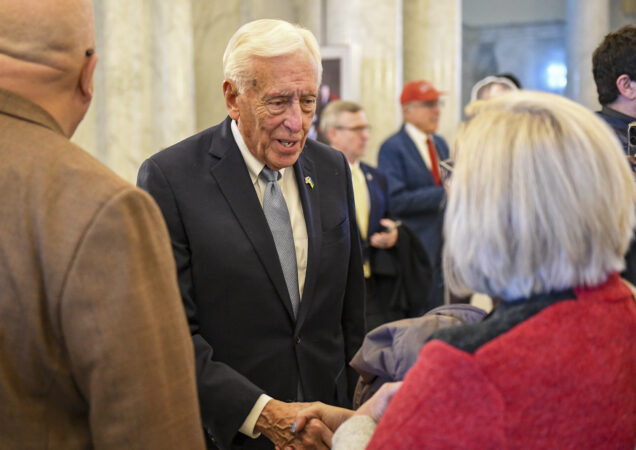
Rep. Steny H. Hoyer announced Thursday he will not run for reelection and will end a nearly six-decade career in elected office that spanned his rising-star days in Maryland government to a two-decade run as the No. 2 U.S. House Democrat.
Hoyer, the third-longest-serving member of the House, said he reached the decision over the holidays with his family, feeling content with a career that never brought the brass ring of the House speaker’s gavel but put him at the center of this century’s biggest debates.
“At this young age, it’s probably premature,” the 86-year-old quipped in a two-hour interview Tuesday at his sprawling home on the Patuxent River in St. Mary’s County.
Now three years out of leadership, Hoyer remains an active legislator but feared ending up like many other elderly lawmakers, becoming physically or mentally frail in their final days in office.
“I did not want to be one of those members who clearly stayed, outstayed his or her ability to do the job,” said Hoyer.
He delivered a formal announcement in a House floor speech Thursday morning, with dozens of colleagues from both sides of the aisle on hand to cheer.
In his remarks, Hoyer made clear he was not like the more than 40 other House members who, largely fed up with Congress, are running for other offices or retiring. Hoyer said he still loves the institution, while recognizing that his style of extending a courteous hand to the political opposition is outdated.
Hoyer spent decades on the Appropriations Committee, helping to pour billions of dollars into a congressional district that begins just a few miles east of the Capitol. But Hoyer’s final years on the panel have seen it snarled in partisan gridlock.
In the Tuesday interview,Hoyer saidhis constituents, more reliant on the federal government than most, ask when Congress will work in a more functional way, a question that Hoyer puts back on those voters.
“As long as the people of America elect angry, confrontational people, don’t be surprised that democracy works and you get an angry, confrontational Congress,” Hoyer said.
Hoyer said American politics are in a state of decades-long deterioration. But he blamed President Donald Trump for makingbipartisan comity harder than ever, pointing out the pardons of those convicted for the Jan. 6, 2021, Capitol attack during his interview with The Washington Post, which took place on the fifth anniversary of the insurrection.
“His greatest strength, he has no shame, does not,” Hoyer said of Trump. “And his people don’t care whatever he does, pardoning 1,600 people who committed treason. Just astounding, and then he gets away with it.”
Hoyer will go down in history behind only Leslie C. Arends (R., Ill.) for length of leadership service in the No. 2 post for a House caucus without ever getting promoted to the top spot. From the early 1940s until 1974, Arends totaled almost 30 years as the GOP’s first deputy.
Hoyer’s list of legislative accomplishments is long — including authoring the Americans With Disabilities Act and the election law responding to the disputed 2000 presidential race — but his biggest contribution may have been serving as a cooling agent when partisan temperatures ran hot in the raucous House.
Many Republicans viewed him as an honest broker and a lighter touch than Rep. Nancy Pelosi (D., Calif.), who led the caucus for the 20 years Hoyer served as her deputy.
In his Thursday speech, Hoyer lamented the decay of bipartisan relationships and a House that produces less legislation than in years past.
“I am deeply concerned that this House is not living up to the Founders’ goals,” Hoyer told his colleagues. “I urge my colleagues on both sides of the aisle to examine their conscience, renew their courage.”
Hoyer lost a 2001 race for minority whip to Pelosi, a contest that highlighted the party’s pivot away from the South and Midwest and toward the more professional class of voters along the coasts. When Pelosi took charge in January 2003, the caucus unanimously elected Hoyer as her top lieutenant.
Hoyer said he understands why “tough-as-nails” Pelosi remained leader so long, calling her the best of 10 speakers he served under in nearly 45 years in the House.
“Sure, I would have loved to have been speaker. Who wouldn’t love to be speaker? But they’re not deep regrets,” he said in the interview.
Hoyer and Pelosi, along with Rep. James E. Clyburn (D., S.C.), are together linked for their historically long runs as the top three lawmakers running the caucus. They notched victories such as the 2008 financial rescue, the 2010 Affordable Care Act and several trillion dollars worth of pandemic relief this decade.
When Republicans won the House majority in the 2022 midterms, all three decided to step down and let a younger generation take the reins of the caucus. Pelosi announced in November that she will not run for reelection, while Clyburn has so far signaled he will run again.
“Ironically, Nancy, Jim and I have not talked about any one of our actions or any one of our retirements. So I haven’t talked to Nancy. I haven’t talked to Jim,” Hoyer said.
Pelosi, 85, and Hoyer are retiring as their party is still in a heated debate over whether its elder statesmen have stayed too long in Washington, particularly after President Joe Biden’s late exit from the 2024 presidential campaign.
Hoyer’s wife, Elaine C. Kamarck, a Brookings Institution political scholar, dubbed the trio of Pelosi, Hoyer, and Clyburn as “super-agers” for their ability to effectively run the Democratic caucus while in their 80s, but Hoyer is conscious of passing the baton to the next generation.
Pelosi, Hoyer, and Clyburn carved out different responsibilities and represented a new, diverse 21st-century caucus: a liberal woman from California’s tech center; a White man with close ties to the shrinking ranks of Democrats from the South and Midwest; and the highest-ranking Black member of Congress.
Hoyer said he considers passage of the Affordable Care Act a prototype for when their leadership style worked. Pelosi — who has “a spine of steel,” he said — led the effort and had the bona fides to tell liberals what the best deal possible was. Hoyer served as sounding board for dozens of Democrats in competitive districts worried about their 2010 elections.
“A number of people would say I played an important part in bringing along people who had concerns about it from their district’s standpoint,” he said.
Democrats lost a stunning 63 seats in those midterms and spent eight subsequent years in the minority, leading some to question whether new, younger leadership was needed.
Pelosi and Hoyer have had a sometimes strained relationship — dating at least to the late 1990s when they began a several-year campaign against one another for a leadership post — but the caucus seemingly wanted that balance.
“We were put together by the caucus,” Hoyer said. “And what I mean by that, Nancy was elected, I was elected and Clyburn was elected. We weren’t elected as a team.”
The current House Democratic leadership team — Minority Leader Hakeem Jeffries (N.Y.), Minority Whip Katherine Clark (Mass.) and Rep. Pete Aguilar (Calif.) — effectively ran together three years ago trying to replicate the ideological and diverse balance of the old team.
Hoyer had not yet drawn a top primary challenge in his congressional district, but his exit will undoubtedly prompt many younger Maryland politicians to consider running in a race where Hoyer said he will not make an early endorsement.
His early endorsement of Wes Moore, helped elevate the then-long-shot candidate to victory in the 2022 Maryland governor’s race. Now running for reelection at 47, Moore is mentioned as a future presidential candidate — a campaign Hoyer said he hopes to play a role in.
“His true genius resides not simply in the grand American story he has helped to write, but in the many quiet moments of service and support he has given,” Moore said in a statement.
A vast majority of House members have no idea Hoyer’s first image in politics was as a young man in a hurry. Just 27when he took office in the Maryland state Senate in 1967, Hoyer became the chamber’s president at 35 and plotted a run for governor in 1978, with his ultimate ambition being the U.S. Senate.
“I was a little ahead of myself,” he recalled Tuesday. He eventually accepted a spot as lieutenant governor candidate on a ticket that lost the party nomination badly.
His start in politics was launched when, as an undergraduate at the University of Maryland, he attended a campus rally for Sen. John F. Kennedy’s presidential campaign in 1960.
Following a file clerk job at the Central Intelligence Agency, Hoyer began working for Rep. Daniel Brewster (D., Md.), would move with him to the Senate in 1963 and meet a young Pelosi as a co-worker.
In 1981, after the local congresswoman suffered a heart attack and fell into a coma, Hoyer narrowly won a crowded primary and was on his way up the ladder in the U.S. House.
The family of his first wife bought land in St. Mary’s County on the Patuxent in 1989, and the Hoyers built their getaway home well outside his district.
The 1992 redistricting brought this rural territory into Hoyer’s 5th Congressional District, and the couple turned it into a permanent home. An educator in Prince George’s County schools, Judith Hoyer died in 1997 and the congressman passed legislation creating “Judy Centers” for early-childhood programs.
The home, dubbed “Hoyer’s Point of View,” hosted his wedding to Kamarck in 2023. A proud Dane who’s looked out for Nordic interests on the Helsinki Commission, Hoyer flies the flag of Denmark alongside those of Maryland and the U.S.
Hoyer said he’s not sure how he will handle life outside elective politics, but he has a ready answer when people ask him about Congress.
“How do we make this better?” he said. “You do. You’re a voter. You send the right people there, it’ll get better.”
In many households, it’s a forbidden four-letter word. It can’t be uttered aloud, only spelled, so those within earshot don’t get too worked up.
“Can you take the dog for a W-A-L-K?”
Many dog owners know their pets excel at learning words such as “walk,” “sit,” “stay,” and even their own names. But researchers have discovered the word-acquisition ability of certain canines can rival that of toddlers.
A study published in the journal Science on Thursday found that some dogs can learn words simply by overhearing conversations, even when the pets are not directly addressed, an ability humans begin to acquire at about 18 months old.
“This can really give us more appreciation to how exceptional dogs can be,” said lead author Shany Dror, a comparative cognition researcher at the University of Veterinary Medicine in Vienna and Eötvös Loránd University in Budapest.
For their experiments, Dror and her team recruited 10 dogs and their owners from around the world. The breeds included a miniature Australian shepherd, a German shepherd, a Labrador retriever, and several border collies — all herding or sporting breeds known for their trainability.
Dogs tend to be better at learning words for actions — think “fetch” or “roll over” — than at retaining the names of objects. So Dror sought out what she called “gifted” dogs that had previously demonstrated an ability to learn the names of their toys.
Basket, a 7-year-old border collie in New York, was among them.
“I noticed she started to actually know the names of her toys without me giving her assistance when she was about 8 months old,” said one of her owners, Elle Baumgartel-Austin.
The researchers instructed the dog owners to discuss two toys that their dogs had never seen before. The dogs were present for those conversations. But the owners never directly addressed their pets.
“It was very funny watching the video after the fact, just to see what she was doing,” Baumgartel-Austin said. Basket had followed the toy with her eyes as they talked. “She got a little frustrated. It was not very fun to see two humans play with a toy that she wanted.”
To assess what the dogs learned by eavesdropping, a day or more later the owners were guided to place the toys in a different room among other plushies and then ask their dog to retrieve one of the two new toys by name. Seven of the 10 dogs, including Basket, regularly fetched the correct toy. Although the sample size was small, the results were statistically significant.
The discovery not only reveals a previously unknown cognitive ability of canines, but it could also offer clues to how human language may have evolved.
Overhearing the conversations of parents and other adults is part of how toddlers learn to talk. That some dogs are able to do so as well suggests that an ability to read social cues needed to follow a conversation predates language itself.
“This is something that came before language,” Dror said. “Because dogs don’t have language, and yet they do have these abilities.”
Gabriella Lakatos, a researcher at Britain’s University of Hertfordshire who also has studied human-dog interactions, said the findings “extend the list of behaviors and abilities previously described in dogs as analogous to those of young children.”
Among other animals, the ability to eavesdrop has also been documented in bonobos. Canine researchers have known since the early 2000s that some dogs can recognize more than 200 items by name and can even infer the names of new toys by excluding ones they already know.
But Juliane Kaminski, a comparative psychology associate professor at Britain’s University of Portsmouth who conducted that early research, cautioned against overinterpreting the results to say dogs can deeply learn language the same way people do. “The interpretation in terms of ‘word learning’ in the linguistic sense seems a little too strong for me,” she said. “What the study shows is that dogs can learn labels without being explicitly directed toward” an object.
She added it is still unclear why only a handful of dogs are able to learn the names of their toys. Her own work with label-learning dogs suggests they are more curious and focused than their less-gifted canine counterparts.
“However, what we do not know is what comes first,” Kaminski said. Are some dogs born better learners? Or do they simply get used to fetching objects when asked?
“It’s a chicken-and-egg problem, and we need further research to explore this,” she said.
Dror tried for years in vain to train other less gifted but still very good dogs — including her own German shepherd, Mitos — to associate names with toys. “Nothing worked. It was very frustrating.”
Still, Mitos nuzzled his way into the new paper. He died last year at 15, just as Dror was submitting the research for publication, and she dedicated the paper to him. “It’s definitely hard to lose someone that’s been such a huge part of your life for so long,” she said.
Now, Dror has a new puppy — a schipperke named Flea. She is introducing her to toys and hoping she can learn.
American Airlines, the largest carrier out of Philadelphia International Airport, is bringing free Wi-Fi to its fleet for members of its rewards program. The service is sponsored by AT&T and launches this month, the airline announced Tuesday.
“Free high-speed Wi-Fi isn’t just a perk; it’s essential for today’s travelers,” said Heather Garboden, American’s chief customer officer. “Once rollout is completed, every AAdvantage member can stay connected, stream, and share almost anywhere their journey takes them for free.”
American is not the first PHL airline to tout free onboard Wi-Fi for travelers with reward memberships. Southwest Airlines started doing so last year through a partnership with T-Mobile, and Delta announced a similar offering in 2023. United offersWi-Fi to rewards members on some planes, provided by Elon Musk’s Starlink, and announced in October that it plans to install the service on several more aircrafts.
American Airlines estimates that by early spring, free Wi-Fi will be available on “nearly every” one of its flights.
Travelers need an AAdvantage account, which is free to join, to access the free Wi-Fi. The membership also allows customers to earn points and miles toward flights. Onboard, travelers must log in at aainflight.com and select the “Free Wi-Fi” option.
Previously, all passengers using Wi-Fi had to pay for a pass or subscription. Non-AAdvantage members can still do so, said company spokesperson Bri Harper.
Philadelphia International Airport is a hub for American Airlines, PHL’s largest airline by passenger volume, which carried nearly 20 million passengers through the airport in 2024. That’s more than five times the second largest carrier, Frontier.
Alveus Therapeutics, a Philadelphia start-up specializing in obesity therapies with top staff from Novo Nordisk and Eli Lilly, made its public debut Thursday with $159.8 million in venture capital funding.
The announcement comes on the heels of a banner year for investment and acquisition activity in the weight loss arena, as venture capitalists and big pharmaceutical firms try to catch up to the enormous successes Eli Lilly and Novo Nordisk have had in recent years with their GLP-1 treatments.
New Rhein Healthcare Investors, based in Philadelphia and Belgium, founded Alveus in early 2024 to develop obesity treatments that are more tolerable and have greater durability. Andera Partners, based in Paris, and Omega Funds in Boston joined New Rhein in leading the Series A investment round.
“Obesity is one of the fastest-growing global healthcare challenges, and today’s therapies leave patients struggling to maintain weight loss over time,” Raj Kannan, CEO of Alveus, said. Kannan is based in Boston, according to LinkedIn.
Alveus is headquartered in Philadelphia, the company said. Most research and development is in Copenhagen, Denmark. The company has fewer than 50 employee, split about evenly between Philadelphia and Copenhagen.
The company’s chief scientific officer and head of R&D, Jacob Jeppesen, is a former vice president at Novo Nordisk in the areas of type 2 diabetes and cardiovascular disease.
Brian Bloomquist, a former Eli Lilly vice president with responsibility in the diabetes and obesity treatment area, is Alveus’ chief business and strategy officer. The company’s chief technical officer is Xiao-Ping Dai, who spent some time working at the former WuXi Advanced Therapies in Philadelphia.
WASHINGTON — A federal judge has temporarily blocked the Trump administration’s efforts to remake Head Start, ordering it to stop purging words it associates with diversity, equity and inclusion from grant applications and barring it from laying off any more federal employees in the Office of Head Start.
The order came this week in a lawsuit filed in April against Department of Health and Human Services Secretary Robert F. Kennedy Jr. and other officials. The lawsuit accuses the Trump administration of illegally dismantling Head Start by shutting down federal Head Start offices and laying off half the staff. It also challenges the administration’s attempts to bar children who are in the U.S. illegally from Head Start programs and to ban language they view as suggestive of DEI.
The plaintiff organizations representing Head Start providers and parents said in a court filing last month that officials told a Head Start director in Wisconsin to axe the terms “race,” “belonging” and “pregnant people” from her grant application. They later sent a list with nearly 200 words the department discouraged her from using in her application, including “Black,” “Native American,” “disability” and “women.”
A Health and Human Services spokesperson said he could not comment on the judge’s order.
Head Start, founded six decades ago as part of President Lyndon B. Johnson’s War on Poverty, is an early education and family support program that serves hundreds of thousands of children who come from low-income households, foster homes or homelessness. It is federally funded but operated by nonprofits, schools and local governments.
Joel Ryan, who heads the Washington State Head Start & Early Childhood Education and Assistance Program, said the order halts an attack on Head Start centers.
“When a Head Start program has their funding withheld because of their efforts to provide effective education to children with autism, serve tribal members on a reservation, or treat all families with respect, it is an attack on the fundamental promise of the Head Start program,” Ryan said.
The directive on the forbidden words raised confusion for Head Start directors, who must describe how they will use the money in grant applications and are required by law to provide demographic information about the families they serve. A director in Washington state said in a court filing the guidance led her to cancel staff training on how to support children with autism and children with trauma.
The order from U.S. District Judge Ricardo S. Martinez of Seattle, published Monday, bars Health and Human Services from cutting any more employees and from punishing Head Start providers if they use the prohibited language.
PROVIDENCE, R.I. — When a gunman began firing inside an academic building on the Brown University campus, students didn’t wait for official alerts warning of trouble. They got information almost instantly, in bits and bursts — through phones vibrating in pockets, messages from strangers, rumors that felt urgent because they might keep someone alive.
On Dec. 13 as the attack at the Ivy League institution played out during finals week, students took to Sidechat, an anonymous, campus-specific message board used widely at U.S. colleges, for fast-flowing information in real time.
An Associated Press analysis of nearly 8,000 posts from the 36 hours after the shooting shows how social media has become central to how students navigate campus emergencies.
Fifteen minutes before the university’s first alert of an active shooter, students were already documenting the chaos. Their posts — raw, fragmented, and sometimes panicked — formed a digital time capsule of how a college campus experienced a mass shooting.
As students sheltered in place, they posted while hiding under library tables, crouching in classrooms and hallways. Some comments even came from wounded students, like one posting a selfie from a hospital bed with the simple caption: #finalsweek.
Others asked urgent questions: Was there a lockdown? Where was the shooter? Was it safe to move?
Described by Harvard Magazine as “the College’s stream of collective consciousness,” Sidechat allows anyone with a verified university email to post to a campus feed. On most days, the Brown feed is filled with complaints about dining hall food, jokes about professors, and stress about exams — fleeting posts running the gamut of student life.
On the Saturday afternoon just before the shooting, a student posted about how they wished they could “play Minecraft for 60 hours straight.” Then, the posts abruptly shifted.
Crowds began pouring out of Brown’s Barus and Holley building, and someone posted at 4:06 p.m.: “Why are people running away from B&H?”
Others quickly followed. “EVERYONE TAKE COVER,” one wrote. “STAY AWAY FROM THAYER STREET NEAR MACMILLAN 2 PEOPLE JUST GOT SHOT IM BEING DEAD SERIOUS,” another user wrote at 4:10 p.m.
Dozens of frantic messages followed as students tried to fill the information gap themselves.
“so r we on lockdown or what,” one student asked.
By the time the university alert was sent at 4:21 p.m., the shooter was no longer on campus — a fact Brown officials did not yet know.
“Where would we be without Sidechat?” one student wrote.
A university spokesperson said Brown’s alert reached 20,000 people minutes after the school’s public safety officials were notified shots had been fired. Officials deliberately didn’t use sirens to avoid sending people rushing to seek shelter into harm’s way, said the spokesperson, Brian E. Clark, who added Brown commissioned two external reviews of the response with the aim of enhancing public safety and security.
Long hours of hiding
Long after the sun had set, students sheltered in dark dorm rooms and study halls. Blinds were closed. Doors were barricaded with dressers, beds, and mini fridges.
“Door is locked windows are locked I’ve balanced a metal pipe thing on the handle so if anyone even tries the handle from the outside it’ll make a loud noise,” one student wrote.
Students reacted to every sound — footsteps in hallways, distant sirens, helicopters overhead. When alerts came, the vibrations and ringtones were jarring. Some feared that names of the dead would be released — and that they would recognize someone they knew.
Law enforcement moved through campus buildings, clearing them floor by floor.
A student who fled Barus and Holley asked whether anyone could text his parents to let them know he had made it out safely. Others said they had left phones behind in classrooms when they fled, unable to reach frantic loved ones. Ironically, those closest to the shooting often had the least information.
Many American students expressed emotions hovering between numbness and heartbreak.
“Just got a text from a friend I haven’t spoken to in nearly three years,” one student wrote. “Our last messages? Me checking in on her after the shooting at Michigan State.” Multiple students replied, saying they’d had similar experiences.
International students posted about parents unable to sleep on the other side of the world.
“I just want a hug from my mom,” one student wrote.
Anxiety sets in
As the hours dragged on, students struggled with basic needs. Some described urinating in trash cans or empty laundry detergent bottles because they were too afraid to leave their rooms. Others spoke of drinking to cope.
“I was on the street when it happened & suddenly I felt so scared,” one student wrote. “I ran and didn’t calm down for a while. I feel numb, tired, & about to throw up.”
Another wrote: “I’m locked inside! Haven’t eaten anything today! I’m so scared i don’t even know if I get out of this alive or dead.”
Some students posted into the early morning, more than 10 hours into the lockdown, saying they couldn’t sleep. Sidechat also documented acts of kindness, including a student going door to door with macaroni and cheese cups in a dark dorm.
Information, and its limits
Students repeatedly asked the same questions — news? sources? — and challenged one another to verify what they saw before reposting it.
“Frankly I’d rather hear misinformation than people not report stuff they’ve heard,” one student wrote.
Others pushed back, sharing a Google Doc that would grow to 28 pages where students could find the most updated, verified information. Some posted police scanner transcriptions or warned against relying on artificial intelligence summaries of the developing situation. Professors — who rarely post on the app — joined the feed, urging caution and offering reassurance.
“If you’re talking about the active situation please add a source!!!” one student wrote.
But “reliable information,” students noted, often arrived with a delay.
Within about 30 minutes of the shooting, posts incorrectly claimed the shooter had been caught. Reports of more gunshots — later proven false — continued into the night and the next day, fueling fear and frustration. Asked one student, what are police doing “RIGHT NOW”?
Replies came quickly.
“They are trying their best,” one person responded. “Be grateful,” another added. “They are putting their lives in danger at this moment for us to be safe.”
A campus changed
Students awoke Sunday to a campus they no longer recognized. It had snowed overnight — the first snowfall of the academic year.
In post after post, students called the sight unsettling. What was usually a celebration felt instead like confirmation something had irrevocably shifted.
“It truly hurt seeing the flakes fall this morning, beautiful and tragic,” one student wrote.
Even as the lockdown lifted, many said they were unsure what to do — where they could go, whether dining halls were open, whether it was safe to move.
“What do I do rn?” one student posted. “I’m losing my mind.”
Students walked through fresh snow in a daze, heading to blood donation centers. Others noticed flowers being placed at the campus gates and outside Barus and Holley.
Many mourned not only the two students killed, but the innocence they felt had been stripped from their campus.
“Will never see the first snow of the season and not think about those two,” one student wrote.
With the lockdown ended, students returned to their dorms as Sidechat continued to fill with grief and reflection. Many said Brown no longer felt the same.
“Snow will always be bloody for me,” one person posted.
Actor Kate Winslet sounds like she’s ready for a second season of the 2021 hit series Mare of Easttown.
The Emmy-winning show about a depressed-but-determined detective investigating a string of murders in a fictional Delaware County town was produced as a seven-part limited series. But, following its massive success, many Philadelphia fans have long hoped for another season.
After years of back-and-forth conversations between Winslet, Berwyn-based creator Brad Ingelsby, director Craig Zobel, and HBO executives about whether and when to move forward with a new season, it seems a green light may have been lit.
Discussions in late 2024 were reportedly productive enough that Winslet believes they could film in 2027, the actor told Deadline.
“They were proper conversations around a time frame when it could be possible. And so I think we probably will do it, and that’s the first time I’ve felt that,” Winslet told said in the recent interview that revolved mostly around her directorial debut, Goodbye June, a holiday movie that landed on Netflix last month.
Shooting Mare “wouldn’t actually be this year, I reckon it would end up being 2027 to film it. There’s a strong likelihood it would film sometime in 2027,” she said.
In June 2024, HBO’s head of drama Francesca Orsi told Variety that initial talks for a second season felt “too soon” after the show wrapped, but now there’s a possibility for a story set years after the events of Season 1.
“While there’s nothing in the works, we are having early discussions about whether it might be time to start thinking of building something. We might be willing to figure out with Mare, years later, picking her up — not on the heels of where she ended, but there have been years for the character that have passed. Who is she now?” said Orsi.
The momentum to bring back Mare comes fresh off the heels of Ingelsby’s latest Delco-set crime series, Task, starring Mark Ruffalo (who’s up for a Golden Globe Award for best performance in a TV drama). Both shows filmed extensively in and around Philadelphia and greater Pennsylvania.
Brad Ingelsby in his office in Berwyn, Pa.. on July 17, 2025.
When Ingelsby spoke to The Inquirer in 2024, the writer also said he was open to a new season of Mare.
“I’m always open to Mare. The door is never closed. I think it’s a matter of when does Kate want to do it? Is there a window [in her schedule]?” Ingelsby said last summer.
“But I definitely think there are more stories to tell … I just think she’s a fascinating character. Kate’s an amazing actress, and we certainly kicked the tires over the years, and we stay in touch. Ultimately, if we could figure out the time and the story, Kate would, I think, be open to doing it too.”
Nothing is official just yet, but so far, all signs point to yes: We will hopefully get to see Winslet pick up the Delco accent (and vape) again in the future.
Though the U.S. men’s soccer team will command the lion’s share of the spotlight this year, the women’s team isn’t scaling anything back.
That starts Jan. 17, when Emma Hayes gathers 26 players for the program’s annual winter training camp in suburban Los Angeles. It will kick off the 41st year of the women’s team’s existence, and will include games against Paraguay on Jan. 24 in Carson, Calif., and Jan. 27 against Chile in Santa Barbara, Calif.
Because the camp takes place outside of official national team windows, all 26 players will come from the NWSL. And because Gotham FC is playing in FIFA’s inaugural Women’s Champions Cup in London at the end of the month, the club’s many national team stars — such as Rose Lavelle, Emily Sonnett, and Jaedyn Shaw — were not called up.
They’re in Europe already, training for a few weeks in Marbella, Spain, before heading north to England. (In fact, they’re at the same complex where the Union will be for part of their preseason camp later this month.)
Rose Lavelle (left) and Gotham’s other U.S. national team stars are preparing for FIFA’s Women’s Champions Cup tournament.
That said, Hayes’ squad has a few veterans and many newcomers, which is no surprise. January camps outside of World Cup years often are that way.
But one name stands out: Trinity Rodman. It’s her first national team call-up since April because of injuries, and she will arrive as a free agent — officially “unattached” on the U.S. roster — since her Washington Spirit contract expired at the end of December.
Rodman’s future is by far the biggest story in the women’s soccer world right now. All signs are she’d like to stay in Washington, but she’d also like to be paid what she’s worth — and she’s worth a lot.
NWSL commissioner Jessica Berman said at the league’s championship game in November, when Washington lost to Gotham, that “we want Trinity in our league, and we will fight for her.”
NWSL commissioner Jessica Berman
Spirit owner Michele Kang also has shown she wants to keep Rodman in town. Kang put together a back-loaded contract offer that would fit within NWSL salary rules by cashing in on the next cycle of broadcast rights. But Berman vetoed it, with Bloomberg reporting in early December that she said it “violated the spirit of the rules.”
This sparked an enormous outcry from fans, media, and the players’ union. The union filed a grievance claiming the decision violated “at least five different sections” of the collective bargaining agreement, according to The Athletic.
The league soon retreated some — but only some. It proposed a new “High Impact Player” status that would allow teams to pay stars up to $1 million beyond the salary cap, and in early December, the league’s board of governors approved the change.
It quickly emerged that the new rule was not so simple, and that blew up in the NWSL’s face. Unlike Major League Soccer’s Designated Player rule, the NWSL’s version put restrictions on what kinds of players can earn the status.
Michele Kang seems to be trying to keep Trinity Rodman in Washington, and Rodman seems to want to stay there.
They included being ranked in voting for honors bestowed by the media, including France Football’s Ballon d’Or top 30, the Guardian’s top 100, and ESPN’s top 40.
Many women’s soccer journalists have no interest in having influence over players’ salaries like that. It also matters that those rankings’ voting pools skew heavily toward Europe, including journalists, coaches, and former players.
This promptly was called out by one American soccer industry veteran for having “outsourced the valuation of players for an American soccer league to European media.”
The league also counts SportsPro Media’s “Top 150 Most Marketable Athletes.” That promptly was bashed by fans as being even more subjective than journalists’ opinions. (It also drew attention that in the league’s press release, this item was first on the list of criteria.)
Trinity Rodman has become one of the NWSL’s biggest stars.
Another metric on the list is being in the “top 11 minutes played for the USWNT” over the last two years for field players, or No. 1 in minutes for goalkeepers. This puts players’ eligibility for a big paycheck in Hayes’ hands, with her starting lineup and substitution choices.
Hayes was asked Thursday what she thinks of having that power.
“Nothing will change with me and the way that I’m doing things, regardless of any ruling that’s put in place,” she said. “To be honest with you, it’s probably going to be a little bit longer until they resolve what that criteria is — whether it ends up being that or something else, you’d have to ask them. But from my perspective, nothing changes with regards to how I will operate.”
Hayes also said she “didn’t know” the rule was coming before it was announced, and that she found out about it from the national team’s longtime PR chief, Aaron Heifetz.
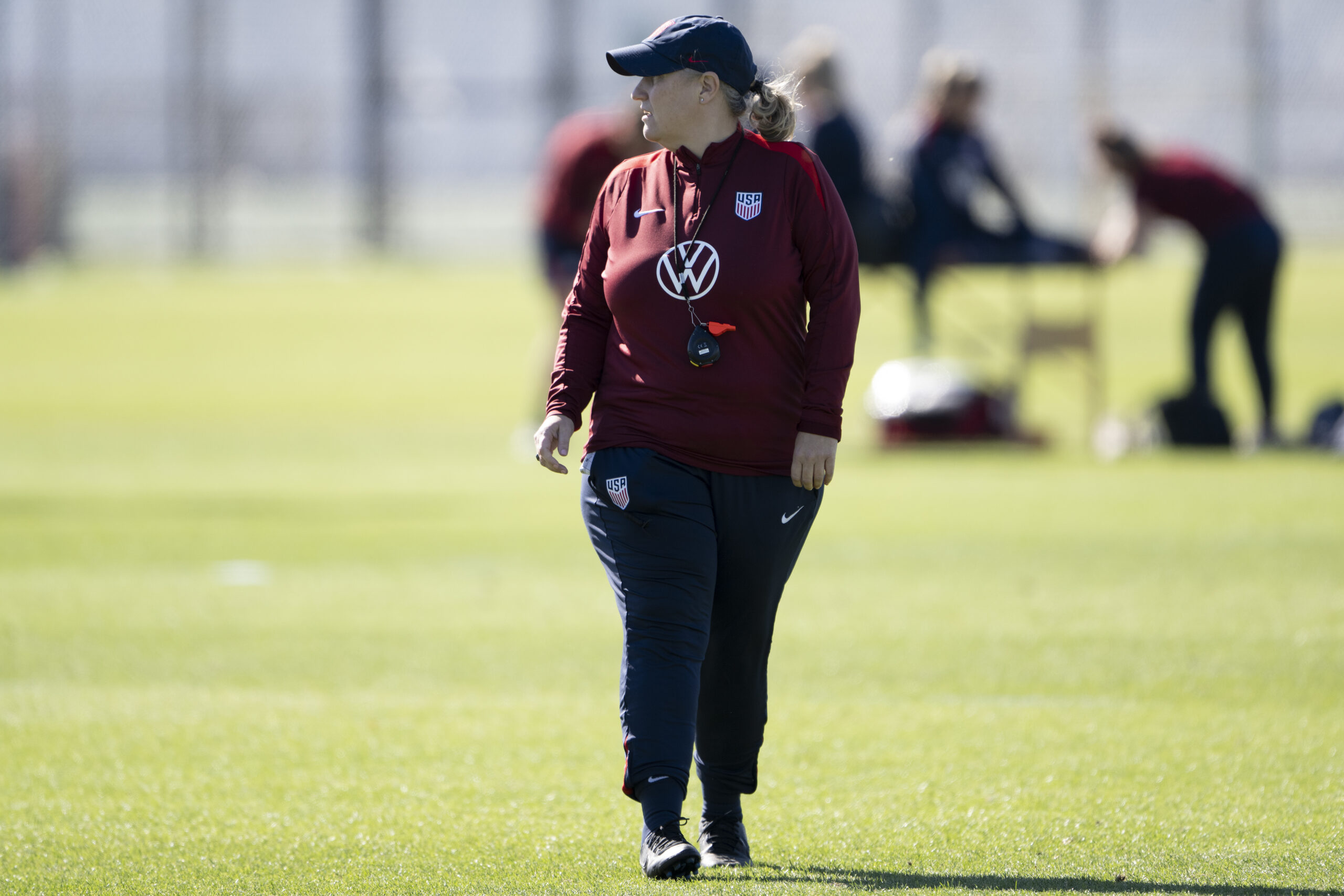
U.S. women’s soccer team manager Emma Hayes
The NWSL Players Association has continued to oppose the rule, and said Wednesday that it is preparing to take the league to arbitration. The league claimed it has the right to impose the rule without collective bargaining and said it consulted the union on the rule. The union disagrees on both counts.
“A league that truly believes in the value of its players would not be afraid to bargain over it,” the NWSLPA said in a statement when the rule was announced.
It would prefer that the league just raise the cap by $1 million for this year. ESPN reported that the league’s base salary cap for this year is $3.5 million “before additions for revenue sharing.”
How many of the league’s 16 teams would favor that isn’t known, nor is it known what the vote of clubs would have to be to make that happen.
Trinity Rodman at last year’s NWSL championship game, which the Washington Spirit lost to Gotham FC.
What is known is that Rodman will report to national team camp without a club affiliation, and it isn’t clear where she’ll end up. Many European clubs reportedly have expressed interest, although the list with the roster room and the quality Rodman deserves is pretty short.
The other big absence from this squad is midfielder Sam Coffey. The reason for that was revealed a few hours after the roster was announced: The Guardian reported that she is in “advanced talks” to join England’s Manchester City, and that the deal is “close to completion.”
Manchester City leads the Women’s Super League standings and is seeking its first title since 2016 after many runner-up finishes. Second-place Chelsea has Catarina Macario, Naomi Girma, and Alyssa Thompson, and third-place Arsenal has Emily Fox.
Defenders (8): Jordyn Bugg (Seattle Reign), Avery Patterson (Houston Dash), Izzy Rodriguez (Kansas City Current), Tara Rudd* (Washington Spirit), Emily Sams (Orlando Pride), Gisele Thompson (Angel City), Kennedy Wesley (San Diego Wave), Kate Wiesner (Washington Spirit)
Midfielders (8): Croix Bethune (Washington Spirit), Hal Hershfelt (Washington Spirit), Claire Hutton (Kansas City Current), Riley Jackson (North Carolina Courage), Lo’eau LaBonta (Kansas City Current), Sally Menti (Seattle Reign), Sam Meza (Seattle Reign), Olivia Moultrie (Portland Thorns)
Forwards (7): Maddie Dahlien (Seattle Reign), Jameese Joseph (Chicago Stars), Trinity Rodman (unattached), Yazmeen Ryan (Houston Dash), Emma Sears (Racing Louisville), Ally Sentnor (Kansas City Current), Reilyn Turner (Portland Thorns)
* — The former Tara McKeown got married a few weeks ago.
USWNT schedule
Jan. 24: Vs. Paraguay in Carson, Calif., 5:30 p.m. (TNT, truTV, Universo, HBO Max, Peacock)
Jan. 27: Vs. Chile in Santa Barbara, Calif., 10 p.m. (TBS, Universo, HBO Max, Peacock)
March 1: Vs. Argentina in Nashville, 5 p.m. (TNT, truTV, Universo, HBO Max, Peacock)
March 4: Vs. Canada in Columbus, Ohio, 6:45 p.m. (TNT, truTV, Universo, HBO Max, Peacock)
March 7: Vs. Colombia in Harrison, N.J., 12:30 p.m. (TBS, truTV, Telemundo 62, Universo, HBO Max, Peacock)
MORGANTOWN, Pa. — The Trump administration says it is focused on protecting unaccompanied migrant children. It imposed strict new background checks on those seeking custody of young migrants and cut ties with a chain of youth shelters accused of subjecting children in its care to pervasive sexual abuse.
“This administration is working fearlessly to end the tragedy of human trafficking and other abuses of unaccompanied alien children who enter the country illegally,” saidHealth Secretary Robert F. Kennedy Jr., who oversees the Office of Refugee Resettlement, or ORR, which cares for unaccompanied migrant children.
But for the last three months, that office has also locked some teenage migrant boys inside a secure juvenile prison about 50 miles west of Philadelphia with a long and publicly documented history of staff physically and sexually abusing juvenile offenders in its care, a Washington Post investigation has found.
“ORR is sending children to a juvenile detention center who should not be there,” said Becky Wolozin, a senior attorney at National Center for Youth Law.
ORR awarded $9 million to Abraxas Alliance in August to hold up to 30 young immigrants deemed a danger to themselves or others in its facility in Morgantown, Berks County. At various times since early October, between five and eight migrant teenage boys have been held inside a dedicated wing of the juvenile detention center, sleeping inside locked cells the size of walk-in closets, according to lawyers who met with them.
Pennsylvania state inspectors have documented at least 15 incidents since 2013 in which they said staff physically mistreated minors at the Morgantown facility, which holds principally juveniles facing or convicted of criminal offenses. In at least two incidents, officials documented allegations of staff sexually harassing or sexually abusing young residents. The most recent reported abuse occurred in November.
In a lawsuit filed in 2024, six former residents of the facility allege they were sexually abused by staff between 2007 and 2016, accusing management of enabling a “culture of abuse.”
A spokesperson for Abraxas Alliance, the Pittsburgh nonprofit that operates the facility,did not respond to a long list of questions about its treatment of children. After some of the incidents cited by inspectors, Abraxas suspended or fired staff members and submitted correction plans to state regulators, promising to retrain workers on proper restraining techniques and install more surveillance cameras.
ORR has wide latitude over the types of facilities it uses to house children, though federal rules require it to use “the least restrictive setting that is in the best interests of the child.” The rules say ORR may place minors in secure facilities if they have been charged with a crime, or if the agency determines they could harm themselves or others.
HHS spokesman Andrew Nixon said decisions on where to place migrant children “are based on each child’s specific circumstances, behavior-based risk assessments, and legal criteria.” All the teens at the Morgantown facilitywere provided a notice with “specific details as to why they are placed there,” he added.
Some of the migrant boys have no pending criminal charges, and several have parents or close relatives in the U.S. asking to be reunited with them, said Becky Wolozin, a senior attorney at National Center for Youth Law who visited the facility and spoke to some of the boys in November.
The Post was unable to identify any of the boys or verify Wolozin’s claims about their circumstances, because neither their immigration lawyers nor government officials would share details about their cases due to strict rules protecting the records of minors.
License revoked
In November, Pennsylvania revoked one ofthe three licenses held by different units within the Morgantown facility, Abraxas Academy. The state accused Abraxas of “gross incompetence, negligence, and misconduct” following a Nov. 4 incident of staff violence against a child, state records show. According to those documents, a staff member put his hand on a child’s neck andshoved his face into a table, an incident the facility’s operatordid not report to local authorities.
Ali Fogarty, a spokeswoman for Pennsylvania’s Department of Human Services, said state law prevented her from commenting on the incident, includingwhether the child was a migrant placed by ORR or another juvenile held in the facility. The state increased its monitoring of the Morgantown facility and reduced its maximum capacity under one license by 25 residents whilethe companyappeals the revocation. Its two other licenses were unaffected, and it is still permitted to hold more than 100 individuals, Fogarty said.
Nixon, the HHS spokesman, saidORR “will make any necessary adjustments to its use of the facility based on the outcome of the state’s licensing process” and its own review of the incident,adding that “ORR has zero tolerance for sexual abuse and harassment of children in our care.”
The problems at the nation’s only secure jail for migrant youths are unfolding as the Trump administration pushes measures it says are aimed at safeguarding the 2,300 unaccompanied migrant children in its custody, as well as those it releases to sponsors within the country.
In March, ORR ended its use of shelters operated by Southwest Keys — a Texas nonprofit which the Justice Department sued in 2024, alleging its workers repeatedly sexually abused children in the nonprofit’s shelters from 2015 to at least 2023. The company said in a 2024 statement that the lawsuit did not “present the accurate picture of the care and commitment our employees provide to the youth and children.” The department dropped the lawsuit last year.
Around the same time, ORRalso began requiring people to provide income documents and submit to DNA testing, fingerprinting and interviews before regaining custody of young migrants, including their own children, which agency officials say will help ensure they are not being claimed by traffickers.
The Trump administration said President Joe Biden had released tens of thousands migrant children to sponsors with little or no vetting, including to some adults with a history of violent crimes. U.S. Immigration and Customs Enforcementsays it’s enlisting the help of local law enforcement agencies to locate the children and verify their safety.
Jen Smyers, a former deputy director of ORR under Biden, said this population has faced abuse for decades, across several administrations. She said stricter vetting cannot always prevent mistreatment.
Partly as a result of the Trump administration’s new vetting procedures, the average child remains in ORR custody about six months —nearly three times longer than at the beginning of 2025, government data shows.
A history of abuse allegations
By jailing migrant children in a secure detention center, especially one with a recent history of abuse, the administration is exposing these young people to some of the same risks it says it wants to eliminate, said Jonathan White, a former career HHSofficial who managed the unaccompanied children program during part of Trump’s first term.
Under any previous administration, a track record of physical or sexual abuse would be “instantly disqualifying” for federal contracts involving the care of minors, White said. “This is the kind of thing under Republican and Democratic administrations you terminate existing grants for — you don’t give new grants to places like that.”
Abraxas Academy, part of a chain of 10 youth detention and treatment centers, holds dozens of teenage boys from surrounding areas, many of whom are serving sentences for violent crimes or awaiting court hearings. Rob Monzon, a former director of the Morgantown facility, calls it “the most extreme setting in juvenile detention.”Its young inmates, some who claim to be from gangs, frequently lash out at one another, vandalize the building and attack staff members, he said.
State inspection records show that staff members have at times responded with violence.
One staff member“picked up[a child] by the shirt and threw the child to the ground, holding the child down with a knee, and banging the child into the wall,” a 2013 report on the state’s website said. Another threw punches at a different minor and yet another bit an incarcerated child in the abdomen, other reports said.The reports noted that one staff member “frequently escalates situations” by applying restraint holds that are “known to cause pain to the child.”
Workers have been trained to defend themselves by placing inmates into restrictive holds, waiting for them to calm down and calling for help from other employees, according to Shamon Tooles, who worked as a supervisor at Abraxas Academy for eight months in 2023. But due to a lack of training, supervision, and frequent short-staffing, he said, some workers resorted to fighting back.
“A lot of the staff were just scared,” said Tooles, who said he does not condone any mistreatment of children.
In December 2016, Pennsylvania state inspectors said they found “a preponderance of evidence” that a staff member sexually harassed a child at the Morgantown facility. The staff member, who was not identified, was put on leave and subsequently resigned.
One of the former detainees who is suing AbraxasAllianceclaimed a staff membertook away his food or gym privileges or locked him in his room if he did not comply with sexual requests.
In court records, attorneys for Abraxas Alliance denied any wrongdoing and said they would need the names of all the abusers to confirm details of the alleged abuse. The lawsuit, which covers allegations lodged by 40 former residents from fiveAbraxas facilities, is still active and no trial date has been set.
Nixon,the HHS spokesman, saidAbraxas Academy was the only state-licensed facility that submitted a bid on the ORR contract that “operated a secure care facility for youth between the ages of 13 to 17.” He said the contract is part of an effort to “restore” the government’s capacity to hold “children whose needs cannot be safely supported” in less restrictive settings.
Fresh paint
Abraxas Academy sits at the end of a three-mile road, deep in the farmlands of Amish country. It’sso remote that when nine boys escaped through a hole in the barbed wire fence in 2023, they were quickly discovered a few miles away, lost and shivering in the rain, ready to go back,according to Paul Stolz, the police chief of nearby Caernarvon Township.
When Wolozin visited Nov. 5, she said the walls smelled like fresh paint and workers were still renovating the floors of the wing designated for immigrant boys, separate from the teens serving criminal sentences. At that time, there were eight migrant boys; at least two have since been transferred to less restrictive facilities, and another was moved to an adult detention center upon turning 18, according to their lawyers. At least two new detainees arrived in December.
Wolozin’s group advocates for children in the foster care, juvenile detention and immigration detention systems and has special permission to meet with them per the terms of a landmark 1997 legal agreement. She has personally supported Democratic politicians and causes.
According to Wolozin, the conditions for migrant boys at Abraxas Academy mirror those of children serving criminal sentences. The boys are woken from their cells and counted every morning. Their use of a “family room,” with TVs, board games and bean bag chairs, is restricted to certain times, as is their access to an outdoor recreation area with farm animals and an indoor gym. Some have told lawyers and advocates they have been limited to two 15-minute phone calls to family members per week. Federal rulesrequire at least three calls per week.
Wolozin, who interviewed five of the migrant boys but has not reviewed their files, said one appeared to have severe cognitive disabilities. Another had completed his sentence for a criminal charge and was set to be released to his familybut was instead transferred to ORR custody. Others had never been in jail before.
“What became very apparent to me is that ORR is sending children to a juvenile detention center who should not be there,” she said.
The vast majority of the migrant children in government custody live in shelters where they move freely around a campus. But the government can place children in more restrictive settings if they are deemed a risk — a broad authority that former child welfare officials say ORR has misused.
In 2018, ORR found it had “inappropriately placed” 18 of the 32 minors who were in secure facilities at the time, according to the court deposition of a former agency official. One child, the official said, had been placed in a jail because they were an “annoyance” and not an actual danger.
ORR had moved away from juvenile detention centers since 2023, after the government settled lawsuits that claimed children in these facilities were subjected to inhumane punishments or illegally locked up based on being mislabeled gang members. As part of the settlements, ORR agreed to implement new rules providingstronger legal protections for migrant children in custody.
Now, the administration is expanding the practice of secure detention once more. Along with the 30 beds for migrant teens at Abraxas Academy, ORR is exploring a second secure facility that would hold up to 30 additional migrant children in Texas, government procurement records show.
Advocates for migrant youths say these jails are unnecessary and harmful — and evident from the government’s tumultuous history with ORR detention centers before the Abraxas contract.
‘I just went on myself’
Young peopledetained at Virginia’s Shenandoah Valley Juvenile Center said in 2018 court declarations that they had been locked in small rooms for most of the day. Some said they were beaten by guards. If they acted out, some said, they were put in a restraint chair, with straps around their head, elbows, legs and feet, and wheeled into a room where they were left to sit alone for hours with their head covered in a white mesh hood so they couldn’t spit on the guards.
“This is embarrassing, but on one occasion, I had to pee, and they wouldn’t let me, so I just went on myself,” a child identified as “R.B.”said in a court filing. “I know one or two other kids this happened to as well; they peed on themselves while they were in the chair.”
Shenandoah’s operators said their use of the restraint chair was not abuse. ORR policies permit such restrains as a last resort. A federal judge ruled in 2018 that the government had improperly placed minors in secure facilities including Shenandoah but did not determine whether its use of restraints constituted abuse.
California’s Yolo County Juvenile Detention Center commonly used chemical agents and physical force to control children, the state’s attorney general found in 2019. A spokeswoman for Yolo County said in an emailed statement that the facility took measures to reduce its reliance on chemical agents, including staff training on nonviolent crisis intervention.
Community activists pressured city and state officials to stop jailing migrant children there, citing lawsuits and the growing costs of defending against them. One Salvadoran teen alleged in court papershe was shipped across the country to the facility simply because New York police claimed he was a member of MS13. A federal judge found no unequivocal evidence of the boy’s ties to any gang.
By 2023, Shenandoah, Yolo and another juvenile detention center in Alexandria, Va., had all opted not to renew their contracts with ORR.
“Nobody wants these contracts,” said Holly S. Cooper, co-director of the Immigration Law Clinic at UC Davis, who was involved in the effort to end the Yolo contract. “There was a massive public outcry.”
According to Smyers, ORR’s No. 2 official at the time, the agency in late 2023 solicited proposals for a new kind of facility where children could have restrictions increased or reduced depending on their behavior. ORR has not awarded this contract, but Nixon said it is still a priority.
Fights, an escape attempt
The Abraxas chain of youth detention and treatment centers has changed ownership at least twice. At the time of many of the abuse incidents in the inspection reports, it was owned by private prison firm Geo Group, which purchased the chain for $385 million in 2010. Geo has said in court records it is not aware of any sexual abuse.
The company sold parts of the Abraxas business to a nonprofit group run by Jon Swatsburg, the unit’s longtime executive, for $10 million in 2021.At the time, Geo was losing federal contracts and being shunned by major banks in response to community activism against its business. Geo still owns the building in Morgantown and leases it out to Abraxas Alliance, securities filings show.
A spokesman for Geo did not respond to requests for comment.
Swatsburg, who has overseen the properties for more than two decades, was paid $752,000 by Abraxas and related entities in 2022, according to the most recent tax filings available. Inperium, an investor in the nonprofit group, said Swatsburg was departing in 2023, but he continued to list himself as president and chairman of Abraxas in corporate filings in 2024 and 2025. As of last year, Swatsburg was also listed as a vice president of Geo Group.
Last year alone, police responded to at least 34 incidents at the facility, local records show, including inmate fights, at least one attempted escape,a suicidal detainee, an incident that left three police officers with minor injuries and another incident in which a staff member’s finger was partly amputated by a door.
Meanwhile, the migrant boys at Abraxis havetold advocates that they feel stuck.
“They had plans and family, and lives and school and girlfriends, and things going on that they planned to do,” Wolozin said. “Instead, they are in this place.”