2026 Genesis GV80 Coupe 3.5T E-supercharger vs. 2026 Land Rover Defender 130 V-8 vs. 2026 Mercedes-Benz GLE 450 4Matic SUV: Off-roading in high style.
This week: Mercedes-Benz GLE 450 SUV
Price: $79,100 as tested.
What others are saying: “Highs: A powertrain for every need, well-appointed and spacious interior, legitimately capable; Lows: Rivals offer smoother rides and better handling, Benz charges extra for ubiquitous features.” — Car and Driver
What Mercedes is saying: “It’s innovative. Intelligent. And just a bit indulgent.”
Reality: Cushy, yet satisfying.
What’s new: The GLE 450 SUV carries on fairly unchanged since the 2024 model year, when it received tech updates and available hybrid power.
Up to speed: The GLE 450 is powered by a 3-liter inline six-cylinder engine with a mild hybrid system. It creates 375 horsepower. It gets to 60 mph in 5.3 seconds, according to Car and Driver.
I never found the GLE lacked power, but it definitely seemed sedate. I used it in Sport mode, and nobody ever felt planted in their seats during test maneuvers. Strange how it was almost an exact match with the GV80’s 5.2-second time, but somehow the Genesis felt much more exuberant.
Shifty: Mercedes originated the latest incarnation of the column shifter, with a bump up for Reverse and down for Drive. Shifting of the 9-speed automatic transmission happens through steering wheel paddles.
On the road: The GLE handled about as I expected from a Mercedes — very smooth, almost to a fault. Pennsylvania’s ruttiest roads, including Route 202 around King of Prussia, could send the GLE into jumping fits, but the rest of the time the SUV felt serene, quiet, cushy.
Speaking of cushy, that’s where the GLE handling lives — don’t expect this SUV to perform feats of derring-do on country roads. But stay within its limits and life is pleasant.
At least when you’re in Sport mode. The vehicle defaults to Comfort mode, and that has a sway and bounce that takes cushy into nauseating.
The interior of the 2026 Mercedes-Benz GLE 450, on the other hand, could very well win several beauty contests.
Driver’s Seat: Ooo, aaah. Great leather coverings, not too firm, not too soft. The front seats are wide as well, perfect for large dinners at fancy restaurants.
Visibility up front could be a bit challenging. I raised the seat up quite high and still was unsatisfied with what I could see in the corners. But I did ace a couple head-first parking lot episodes, which normally I find can be rather difficult in SUVs, so maybe it’s better than I think.
The interior is fancy like a Mercedes should be, but the trim around the HVAC vents leaves something to be desired. They come in a contrasting color and look like I could pop them out with a small screwdriver, if I were so inclined. Why offer this?
Friends and stuff: The other couple you bring along to show off your Mercedes (practice saying it like Cary Grant in North by Northwest — “Laura’s Meh-seddies”) will definitely be impressed. The seat is awesome, and there’s so much room to spread out, you’ll feel like you’re being chauffeured.
A third row is optional.
Cargo space is 33.3 cubic feet in the back and 74.9 with the seat folded.
Towing capacity maxes out at 7,700 pounds, just 500 less than the Defender and more than 1,500 over the GV80.
In and out: The GLE 450 sits up a little high so entry and exit are not the easiest in the world, but it sure beats the Defender.
Play some tunes: Sound from the system is delightful, an A veering close to A+ territory.
My ratty old iPhone plugged in and just worked, a nice touch. I’m forever getting defaulted to Bluetooth in various vehicles and then I have to fight and do dances to get it to link. But this one worked every time.
The screen offers a simple CarPlay tab and another main tab. Console controls are also available, for those who are used to them.
Keeping warm and cool: A row of silver toggles underneath the infotainment system looks sharp and operates with ease. I could change the temperature and the fan speed without looking after a couple tries, as it should be.
Large vents provide plenty of airflow but never seemed to blast us.
Fuel economy: That mild hybrid is definitely mild, as the GLE averaged 18.5 mpg for me. Gulp, but still the winner among the three tested.
Where it’s built: Vance, Ala. Germany supplies 34% of the parts; Mexico 17%.
How it’s built:Consumer Reports predicts the GLE SUV reliability to be a 3 out of 5.
In the end: I felt a little bad about setting up this trio, as they do aim in different directions. But the Genesis fell short in so many areas that had nothing to do with its size — comfort and handling among them. The Land Rover really was quite nice, but their reliability reputation makes that a gamble.
Fortunately, the Mercedes was hands down the nicest among the three, slightly sippier, more comfortable, and nice to drive. And there’s enough money left over among the three to consider a hybrid model.
In Kensington, a program to mitigate street violence was hitting its stride.
After joining the New Kensington Community Development Corporation in 2023, outreach coordinators with Cure Violence began responding to shootings in the neighborhood, connecting folks with mental health services and other wellness resources.
They hosted men’s therapy groups, safe spaces to open up about the experience of poverty and trauma, and organized a recreational basketball league at residents’ request. Their team of violence interrupters even intervened in an argument that they said could have led to a shooting.
Cure Violence Kensington was funded by a $1.5 million federal grant from the Department of Justice, part of a Biden-era initiative to combat the nation’s gun violence epidemic by awarding funds to community-based anti-violence programs rather than law enforcement agencies.
One year after a political shift in Washington, however, federal grants that Philadelphia’s anti-violence nonprofits say allowed them to flourish are disappearing.
In the spring, New Kensington CDC received a letter from the Justice Department, saying that under the leadership of Attorney General Pam Bondi it had terminated the grant that would have funded Cure Violence for the next three years.
The work, the letter said, “no longer effectuates the program goals or agency priorities.” In the future, it said, the department would offer such grants exclusively to local law enforcement efforts.
“It was a heavy hit,” said Bill McKinney, the nonprofit’s executive director.
The cuts come amid a Trump administration crackdown on nonprofits and other organizations it views as either wasteful or focused on diversity and DEI.
It spent 2025 slashing funds for programs that supplied aid abroad, conducted scientific research, and monitored climate change. At the Justice Department, cuts came for groups like McKinney’s, which aim to target the root causes of violence by offeringmental health services, job programs, conflict mediation, and other alternatives to traditional policing.
In Philadelphia, organizations like the Antiviolence Partnership of Philadelphia and the E.M.I.R. Healing Center say they, too, lost federal funding last yearand expect to see further reductions in 2026 as they scramble to cover shortfalls.
A Justice Department spokesperson said changes to the grant program reflect the office’s commitment to law enforcement and victims of crime, and that they would ensure an “efficient use of taxpayer dollars.”
“The Department has full faith that local law enforcement can effectively utilize these resources to restore public safety in cities across America,” the spokesperson said in an email.
Nonprofits may appeal the decisions, the spokesperson said, and New Kensington CDC has done so.
Attorney General Pam Bondi takes part in an event at the White House on Oct. 23.
Philadelphia city officials, for their part, say they remain committed to anti-violence programs, in which they have invested tens of millions of dollars in recent years.
“There are always going to be things that happen externally that we have no control over as a city,” said Adam Geer, director of the Office of Public Safety.
The reversal in federal support comes at a time when officials like Geer say the efforts of anti-violence programs are beginning to show results.
Violent crime in Philadelphia fell to historic lows in 2025, a welcome relief after the sharp upturn in shootings and homicides that befell the city at the height of the pandemic.
In 2021, the city announced a large-scale campaign to combat gun violence that,in the past year, included nearly $24 million for anti-violence programs.
That was on top of the Biden administration’s Community Based Violence Intervention and Prevention Initiative. Since launching in 2022, the DOJ program awarded more than $300 million to more than 120 anti-violence organizations nationwide.
In April, many of those groups, including New Kensington CDC, lost funds. And in September, a larger swath learned they were now barred from applying for other Justice Department grants that would have arrived this spring.
“We’ve seen enormous dividends” from the work of such groups, said Adam Garber, executive director of CeaseFirePA, a leading gun violence prevention group in the state. “Pulling back now puts that progress at risk — and puts lives on the line.”
Philadelphia feels the squeeze
Federal grants helped Natasha McGlynn’s nonprofit thrive.
McGlynn, executive director of the Antiviolence Partnership of Philadelphia, said a DOJ grant called STOP School Violence allowed her organization to launch a counseling program for young people who had been victims of violence or otherwise exposed to it in some of the city’s most violent neighborhoods.
The nonprofit used the grant to hire therapists to help students develop healthier attitudes around conflict and trauma, she said.
The $997,000 grant was cut in April, and when McGlynn went to apply for another round of funding in the fall, she learned that nonprofits were no longer eligible. The lost funding means some services, like counseling, could now be eliminated, she said.
“I would say several positions are in question,” McGlynn said. “I would say the program is in question.”
Chantay Love, the director of Every Murder is Real, said her Germantown-based victim services nonprofit also lost Justice Department funding in 2025.
Federal grants are not the nonprofit’s only source of income, Love said, but she along with other nonprofit leaders in the city are considering whether they’ll need to cut back on programs this year.
Record-setting investment
The decade before the pandemic saw gun-related deaths in the state climb steadily, spiking during the lockdown as social isolation, school closures, shuttered community services, and higher levels of stress contributed to a spate of gun homicides and shootings that began to ease only in 2024.
Two years earlier, the state began dispersing more than $100 million to community-based anti-violence programs, much of the money coming from the American Rescue Plan, a sweeping Biden administration pandemic recovery package that also sought to reduce rising gun violence. And when those funds expired, state lawmakers continued to invest millions each year, as did Philadelphia city officials.
Garber, of CeaseFirePA, said those efforts “get a lot of heavy-lifting credit” for Philadelphia’s historic decrease in violence.
A report compiled by CeaseFirePA cites studies that found outreach programs like Cure Violence helped reduce shootings around Temple University, as well as in cities like New York and Baltimore, where homicides and shootings in some parts of the city fell by more than 20%.
While it’s too early for data to provide a full picture on how such funding has contributed to overall violence reduction, officials like Geer, the Philadelphia public safety director, agreed that programs like Cure Violence have helped crime reach record lows.
Philadelphia acting chief public safety director Adam Geer attends a news conference on Jan. 30, 2024, about a shooting that left an officer wounded and a suspect dead.
Outreach workers with the city-supported Group Violence Intervention program made more than 300 contacts with at-risk residents in 2025, according to data provided by Geer’s office, either offering support or intervening in conflicts.
And they offered support to members of more than 140 street groups — small, neighborhood-oriented collectives of young people that lack the larger organization of criminal gangs — while more than doubling the amount of service referrals made the previous year.
In practice, a program’s success looks like an incident in Kensington in which Cure Violence workers intervened in a likely shooting, according to members of New Kensington CDC.
In April, a business owner called on the nonprofit after seeing a group of men fighting outside his Frankford Avenue store and leaving to return with guns. Members of the outreach team spoke with both parties, de-escalating the conflict before it potentially turned deadly.
“Each dollar cut is ultimately a potential missed opportunity to stop a shooting,” Garber said.
Cutting off the ‘spigot’
Even as community-based anti-violence programs have risen in popularity, they are not without their critics.
While some officials champion them as innovative solutions to lowering crime, others say the programs can lack oversight and that success is difficult to measure.
In 2023, an Inquirer investigation found that nonprofits with ambitious plans to mitigate gun violence received millions in city funds, but in some cases had no paid staff, no boards of directors, and no offices.
A subsequent review by the Office of the Controller found some programs had not targeted violent areas or had little financial oversight. But by the next round of funding, the city had made improvements to the grant program, the controller’s office found, adding funding benchmarks and enhanced reporting requirements.
Meanwhile, as Philadelphia continued its support these programs, President Donald Trump’s Justice Department began a review of more than 5,800 grants awarded through its Office of Justice Programs. It ultimately made cuts of more than $800 million that spring.
Among programs that lost funding, 93% were “non-governmental agencies,” including nonprofits, according to a letter DOJ officials sent to the Senate explaining the decision.
The balance of remaining funds in the violence prevention grant program — an estimated $34 million — will be available for law enforcement efforts, according to a DOJ grant report. In addition to fighting crime, the money will help agencies improve “police-community relations,” hire officers, and purchase equipment, the document says.
Agencies conducting immigration enforcement are also eligible for grants, the report says, while groups that violate immigration law, provide legal services to people who entered the country illegally, or “unlawfully favor” people based on race are barred.
One group lauding the cuts is the National Rifle Association, which commended the Trump administration in November for cutting off the “spigot” to anti-violence nonprofits.
‘[T]he changes hopefully mean that nonprofits and community groups associated with advocating gun control will be less likely to do it at the expense of the American taxpayer and that real progress can occur on policing violent criminals,” the NRA’s legislative arm wrote in a blog post that month.
Nate Riley disagrees.
Riley, an outreach worker with Cure Violence Kensington, said the cuts threaten to reverse the progress New Kensington CDC has made since he joined the program early last year.
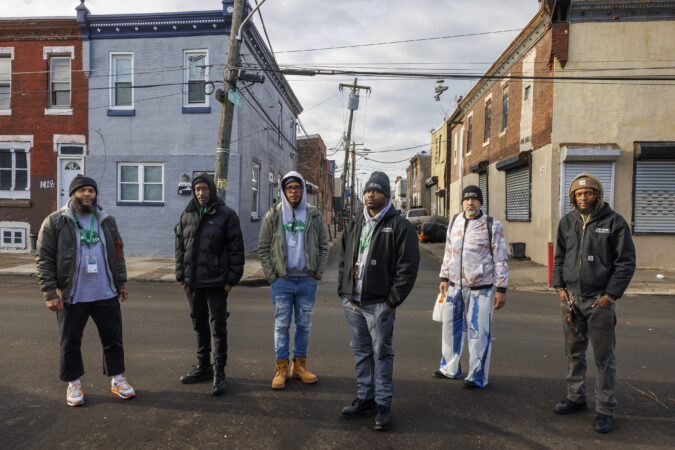
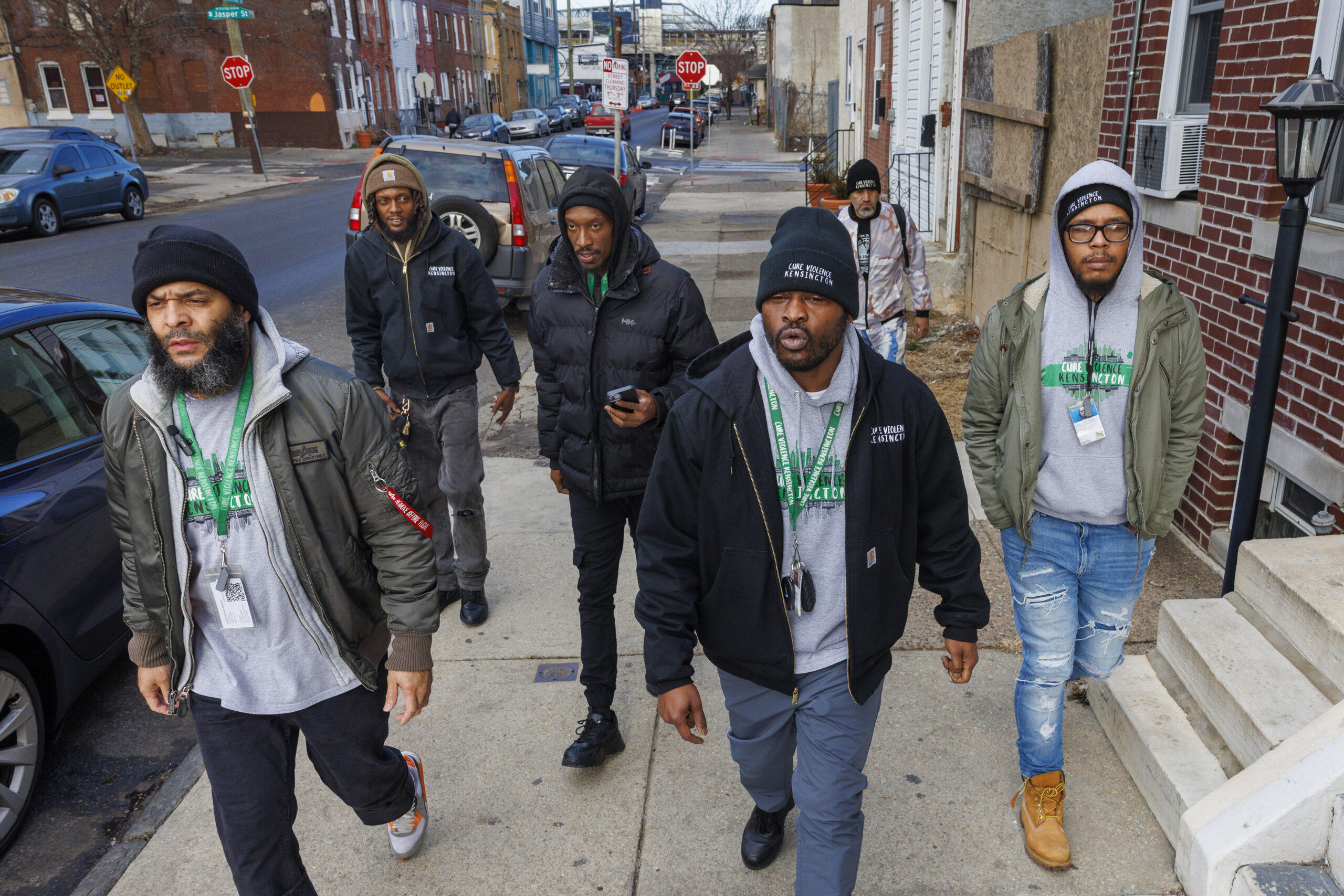
Nate Riley (from left), Tyree Batties, Dante Singleton, Tyreek Counts, Ivan Rodriguez, and Jamall Green-Holmes, outreach workers with New Kensington Community Development Corporation, making their rounds on Wednesday.
Cure Violence’s six-person outreach team is made up of people like Riley, who grew up in North Philadelphia and says he is well-versed in the relationship between poverty, trauma, and violence and brings that experience to Kensington.
“This is a community that’s been neglected for decades,” Riley said. “For lack of a better term, you’ve got to help them come in outside of the rain.”
In a recent month, Cure Violence outreach workers responded to 75% of shootings in the Kensington area within three days, a feat Riley is particularly proud of.
He said the program is not meant to supplant the role of police.
Instead, Riley sees street outreach as another outlet for those whose negative experiences with authorities have led them to distrust law enforcement.
Those people may alter their behavior if they know police are present, he added, giving outreach workers embedded in the community a better chance at picking up on cues that someone is struggling.
From Kensington to Washington
McKinney, with New Kensington CDC, said the group was still expecting about $600,000 from the Justice Department when the grant was cut short.
The nonprofit has since secured a patchwork of private donations and state grants that will keep Cure Violence running through much of 2026, he said.
After that, the program’s future is uncertain.
In the wake of the cuts, national organizations like the Community Justice Action Fund are advocating for federal officials to preserve funding for community-based anti-violence programs in future budgets. Adzi Vokhiwa, a federal policy advocate with the fund, said the group has formed a network of anti-violence nonprofits dubbed the “Invest in Us Coalition” to do so.
The group petitioned congressional leadership in December to appropriate $55 million for anti-violence organizations in the next budget — a figure that both Democrats and Republicans in the Senate have previously agreed on and that Vokhiwa views as a sign of bipartisan support for such programs.
McKinney, with New Kensington CDC, said it was impossible to ignore that the nonprofit and others like it provide services to neighborhoods where residents are overwhelmingly Black and brown. In his view, the cuts also reflect the administration’s “war on cities.”
He was bothered that the Justice Department did not seem to evaluate whether New Kensington CDC’s program had made an impact on the neighborhood before making cuts.
“We’re in a situation where the violence isn’t going away,” he said. “Even if there’s been decreases, the reality is that Kensington still leads the way. As those cuts get deeper, we are going to see increases in violence.”
He’s the first first-team, All-Pro linebacker from the Eagles since Jeremiah Trotter in 2000, and he might become the first multiple All-Pro linebacker since 1975 when voting results are announced soon.
He’s the first Pro Bowl linebacker from the Eagles since Trotter in 2005.
Yet most football fans in Philadelphia don’t appreciate how good Zack Baun is.
What’s worse, most football fans outside of Philadelphia don’t even know whoZack Baun is — at least, not beyond a painfully cute social media post and his involvement in one of the worst injuries of the 2025 season.
But here’s the reality.
For the entirety of two seasons Baun has been the best football player on the best roster in Eagles history. Better than future Hall of Famers Saquon Barkley and A.J. Brown. Better than young defenders Quinyon Mitchell and Jalen Carter.
Eagles linebacker Zack Baun tackles running back James Cook during the win against the Bills.
“Absolutely,” said veteran defensive lineman Brandon Graham. “And I’m thankful for him.”
Still, as I drove south on I-95 a couple of days ago, my passenger, a native fan who regularly watches the Eagles, saw a billboard outside Lincoln Financial Field promoting Sunday’s playoff game against the 49ers. The artwork was simply one player, bareheaded and in high definition, his mouth open in a celebratory scream.
My passenger said, “Who’s that?”
It was Zack Baun. The best linebacker in football over the last two seasons. The man tasked Sunday with covering and tackling Christian McCaffrey, the best offensive player in football, and George Kittle, the league’s best tight end.
In a city that still worships linebackers like Chuck Bednarik, Seth Joyner, and Bill Bergey, Baun somehow remains largely anonymous.
Maybe the reason is that Baun arrived in the NFL, and then in Philly, without fanfare.
The Saints drafted him in the third round in 2020 but never developed him. The Eagles signed him to a modest, $3.5 million prove-it deal in 2024. He proved so much so fast that the Eagles pursued him over Josh Sweat and Milton Williams, other top Eagles defenders who became free agents. They re-signed Baun to a three-year, $51 million extension and hoped he’d stay hungry.
He’s ravenous.
“He’s still working,” Graham said. “Got that chip on his shoulder.”
The result: Baun’s play and his production have been the most consistent element on a team that won the Super Bowl last season and repeated as NFC East champions this season.
He’s simply their best.
And it’s not particularly close.
Zack Baun (53) celebrates his interception against the Raiders with cornerback Adoree’ Jackson on Dec. 14.
On the map
In a world of shameless self-promoters, Baun is a mild-mannered, soft-spoken, shaven-headed Wisconsinite whose closely clipped goatee gives him the air of an affable extra on a pirate movie. He has 154,000 Instagram followers, 100,000 fewer than kicker Jake Elliott. Baun’s social media posts could have been drawn by Norman Rockwell.
For one of the league’s top-10 defenders, his modesty is as remarkable as his ascent.
After converting from quarterback to linebacker at Wisconsin, Baun was a part-time player in New Orleans, where he thrived on special teams as he was trying to make a mark as an outside linebacker and pass rusher.
In 2024, Vic Fangio’s first season as Eagles defensive coordinator, the coaches and GM Howie Roseman believed Baun would fit well into the Birds’ scheme. They were right. Baun excelled.
“He kind of burst onto the scene to the outside world,” coach Nick Sirianni said.
But at the same time Carter exploded as a defensive tackle, Mitchell and Cooper DeJean instantly became the best cornerback tandem in football, and Barkley set a rushing record (including playoffs). Even after the defense dominated the Chiefs in Super Bowl LIX, Baun was overshadowed. He intercepted Patrick Mahomes, but then, so did DeJean, who ran his back for a touchdown.
The two incidents that brought Baun’s existence to light for most folks who exist outside of sports Twitter had little to do with his play.
After the Eagles won the NFC championship in a rout of the Commanders, Baun gained worldwide fame when millions of people viewed a viral social media post of his toddler son Elian playing with confetti on the turf at Lincoln Financial Field.
Then, on Oct. 26, Baun tackled Giants rookie Cam Skattebo, who suffered a dislocated ankle and broken fibula. The combination of Skattebo’s rising stardom, his brutal running style, the fact that he plays for a marquee team in a marquee city, and the simmering controversy surrounding “hip-drop” tackles thrust Baun into an uneasy spotlight.
The play that injured Giants RB Cam Skattebo was an illegal hip drop tackle from Eagles LB Zack Baun
Baun was neither penalized on the play nor fined by the NFL afterward, but that isn’t the issue here. The issue is, we’re witnessing greatness, and we’d better start paying closer attention.
Top grades
Due to how they are used — Do they cover? Do they blitz? — and where they line up — Are they inside, outside, on the defensive line? — the performance of linebackers is difficult to quantify. Regardless, Baun has great numbers both objectively — raw stats — and subjectively, as graded by websites like Pro Football Focus.
He had 3½ sacks this season and last, and each season only five linebackers had more. He had one interception last season and added two more in the playoffs; his first against Green Bay in the wild-card game, then the pick in the Super Bowl. He had two more interceptions this season, which tied for fifth among linebackers.
His PFF grade last season of 90.1 ranked No. 1. His grade this season, 83.9, is No. 2 among linebackers who played at least 900 snaps.
It’s a solid showing, but the grade doesn’t really reflect Baun’s improvement.
“Last year was a lot of willy-nilly out there, honestly,” Baun said. “Of course, I did some amazing things, but I think I’m doing a better job overall this year.”
This is a sensitive issue, since the biggest question regarding Baun becoming an every-down ’backer involved his ability to cover.
PFF rated him the No. 1 coverage linebacker in both 2024 and 2025.
San Francisco running back Christian McCaffrey (left) and tight end George Kittle will challenge the Eagles defense on Sunday.
Question answered. Next test: McCaffrey, Kittle, and 49ers head coach Kyle Shanahan, whose pre-snap trickery is as befuddling as any coach’s in the last decade.
Baun is as ready as he’ll ever be.
Asked in which areas he’d improved most from last year to this, he replied, “Play recognition.”
And then?
“Definitely, in my cover stuff. I saw that as a strength of mine last year, and I wanted to make it even better. Footwork. Route identification.”
And, of course, practice.
Five hundred shots
Improvement has become something of an obsession for Baun. When the last whistle sounds for a regular practice, Sirianni, frustrated hooper, offers players the chance for extra work, Steph Curry style.
“It’s what we call 500 shots,” Baun said of the on-field routine after practice. “Coach describes it as a basketball player hitting 500 shots before he leaves.”
That’s where Baun drills his feet and hips and shoulders.
“It’s mostly footwork stuff, because I’m asked to do a lot of stuff in coverage — a lot of different coverage responsibilities,” Baun said. “I’m asked to cover a lot of ground and take away a lot of different zones. So my footwork really has to be on point.”
Reps matter, both during the week and on game day. He hasn’t missed a game since he became a starter in 2024. This is one of the reasons he should be considered the Eagles’ best defender, if not their best player. Carter’s the only defender who has made as many plays, but he has missed time this season.
“He’s played more than anybody these last two years,” Sirianni acknowledged, “but, like, he just keeps getting better and better and better.”
Another reason Baun should be considered the top Eagle:
Unlike Mitchell and DeJean, who also have not missed a game, Baun hasn’t had a steady sidekick. Fellow starter Nakobe Dean was lost to injury with two regular-season games to play in 2024 and did not play in the playoffs. Dean has missed seven games so far this season.
So there you have Baun. He’s an iron-man linebacker who stacks sacks and picks and grades out among the best in the business, but he seems to get so little credit.
In Pennsylvania, just over 2% of Gen Z students believe elected officials act in their best interests. Three-quarters say they don’t.
These findings come from more than 2,800 conversations across 16 colleges and universities in the state. Project 26 Pennsylvania collected them without a script, giving students space to speak freely.
Young Pennsylvanians believe the commonwealth’s institutions are slow to respond and are detached from daily realities. They pointed to artificial intelligence and its workforce implications, social polarization, and global issues that feel increasingly vital to confront on a local and regional level.
In my role withthe United Nations Association of the USA, I meet regularly with young Americans across the country. They’re not apathetic — far from it. They know what it looks like when institutions function — and when they drift.
A few weeks ago, I visited a campus in Bethlehem and heard from students who were deeply engaged and informed. They focused on conservation, economic growth, healthcare access, and local governance. But when the conversation turned to institutional performance, their confidence plummeted.
They described government bodies that move slowly, communicate inconsistently, and prioritize politics over problem-solving.
There is a clear contrast between what they see at home and what I see globally.
The U.N. has expanded youth engagement at a historic pace. It created a dedicated Youth Office and invited young people into negotiations. Leaders expect a direct report on the concerns and ideas of young Americans.
Pennsylvania’s institutions should view this as a model if they want to start restoring trust.
That’s because the risk of inaction is more than disengagement; it’s dislocation. Young adults are moving to places that do pay attention to and meet their needs.
A Pennsylvania State Data Center analysis found that almost half of Pennsylvanians moving out of state were between the ages of 18-34. Many of them are opting for faster-growing places like Florida, North Carolina, and Texas.
If a global system of 193 member states that agree on little else can coalesce around the need to build structured pathways for youth involvement, then Pennsylvania’s agencies and local governments can do the same.
This shift does not require a redesign of government — just consistency and intention. There are steps the Keystone State can take now.
Several Pennsylvania cities already show what youth engagement can look like.
Allentown created a Council of Youth by resolution, though all 16 seats appear vacant. Pittsburgh has a youth coordinator who runs its Youth Commission, and Philadelphia operates a Youth Commission of its own. These are promising starts, and all townships and boroughs should follow. But they are often tucked deep into municipal websites rather than positioned as visible civic priorities.
Gov. Josh Shapiro should create a statewide youth advisory cabinet with a direct line to major agencies. States like Iowa, North Carolina, and Massachusetts already run strong statewide youth councils.
In fact, Pennsylvania does have a strong model already in the NextGen Advisory Council, which brings young leaders into decision-making on conservation and public lands. That same approach should be extended across agencies.
These steps are practical. They also reflect respect for young people, who are not the “next” generation, but are active contributors shaping our commonwealth.
They organize events, testify at meetings, vote in local elections, and devote time to issues that affect their communities. They have shaped mental health advocacy, launched small businesses, and pushed for housing initiatives in cities across the state.
If institutions want to restore trust, they need to match that level of seriousness.
Trust does not return through campaign outreach or social media posts. It grows when young people see their work is taken seriously and leads to outcomes — and when institutions welcome their involvement with regularity and purpose.
Pennsylvania has a window to rebuild confidence. The Project 26 findings should not be dismissed as youth discontent, but read as a statement of expectations — and an opportunity.
Half of the students surveyed said they would be motivated to take political action “if they felt it would make a difference.” They are engaged, ready, and eager to help build a stronger Pennsylvania.
The question is whether the commonwealth’s leaders will invite them into the process.
Jarrett James Lash serves as the 14th UNA-USA youth observer to the United Nations and is a municipal planner in Montgomery County.
A protest at an event honoring Florida Gov. Ron DeSantis over his antigay policies. The right has targeted trans people, in particular.
Meanwhile, the abundance of research demonstrating that transgender people suffer disproportionate violent victimization, homelessness, and suicide has remained largely unaddressed.
Moderate politicians’ concern with appealing to wider audiences in thesedivisive times exacts a cost: to trans kids’ health, safety, and dignity in their schools and communities.
Ambivalent Democrats
Rather than forging alliances to protect the safety and constitutional rights of transgender citizens, some of the most influential members of the Democratic Party — from Kamala Harris to Pete Buttigieg to Rahm Emanuel to Gavin Newsom — have at least partially capitulated before the political tidal wave of anti-transgender disinformation, complete with all of the red herrings it washes ashore.
More importantly, by keeping to the intentionally distorted discourse about transgender people — rather than countering sensationalized falsehoods and vitriolic rhetoric with integrity and conviction — politicians end up appealing to and emboldening constituencies who lean into disinformation out of fear. This isn’t only cynical, it’s dangerous. FBI hate crime statistics tell a bleak story of the rise in vigilante violence against transgender Americans, coinciding with a steep rise in political antagonism and targeted scapegoating.
A recent effort led by U.S. Reps. Sarah McBride (D., Del.), Mark Takano (D., Calif.), and members of the Congressional Equality Caucus calls upon House Speaker Mike Johnson (R., La.) to enforce the rules of decorum in Congress by holding those who defame and denigrate the trans community to account. As of this writing, no response has been issued.
A path forward
The only ethical and effective path forward demands that we fundamentally reframe the political conversation about transgender people in factual terms that are grounded in foundational democratic principles, credible science, and a commitment to the protection of civil rights and civil liberties of all Americans.
There is some hope to be found in the lawsuit filed this week by 19 Democratic states to block the federal government’s efforts to ban gender-affirming care nationally.
Ideally, we would see more leadership on both sides of the aisle to protect the safety, freedom, and human dignity of all LGBTQ+ people, as demonstrated in the introduction of the bipartisan Global Respect Act by McBride and U.S. Rep. Brian Fitzpatrick (R., Pa.) to protect LGBTQ+ people around the world from identity-based violence, torture, and persecution.
Regressive political forces have always sought to isolate and villainize minoritized groups, to paint them as threats to the majority by virtue of whatever marks them as somehow “different” from those in power — and therefore less deserving of the same rights and protections.
Consider that during the civil rights movement in the 1960s, boycotts of segregated lunch counters and department stores were underway in Southern communities when New York U.S. Rep. Adam Clayton Powell famously corrected a reporter who queried if he was advocating for “Negroes” to stay out of segregated national chain stores in solidarity with the boycotts.
A genuine commitment to our democracy demands that we shift our discursive paradigm from one that impugns the existence of transgender people to one that impugns the de jure and de facto denial of transgender people’s humanity, dignity, civil rights, and personal safety.
It is long past time to reset the terms and reclaim the narrative on the equal protections and constitutional rights of transgender Americans. The political leadership we need in this moment requires the clarity, intentionality, and fortitude to do just that.
Ashley C. Rondini is an associate professor of sociology at Franklin and Marshall College.
It is now time for our representatives in Congress to discuss when, by whom, and how they will proceed with a motion to remove the president from his position. The 25th Amendment explains exactly how to do this. The vice president is supposed to initiate this process, but we know in this case that won’t be happening.
Donald Trump’s reckless and delusional words and actions are not only endangering the safety of millions of U.S. troops stationed around the globe, but they also threaten the sense of peace and security that the entire world has enjoyed since the end of World War II.
Let’s look at what Trump has done in the past seven days alone:
He took over Venezuela without any congressional approval — then said the U.S. will come in and send our companies to take over the oil drilling, which is worth billions in annual revenue.
He threatened Iran, Colombia, Mexico, and Cuba with similar actions in their countries when they criticized his invasion of Venezuela.
He stated that the U.S. needs to own Greenland for reasons of “national security.” What kind of “national security” threat does he think exists in Greenland? Polar bears?
When the emperor not only has no clothes but also seems unhinged, it’s time for our representatives to do what our Constitution has given them the power to do.
Write to your members of Congress today and ask them to insist on rational leadership for our wonderful country by starting this process.
Francine Mulligan, Philadelphia
Anything but Epstein
I will do anything to stop the release of the Jeffrey Epstein files. I have subverted the work of the FBI and compelled officials in the U.S. Department of Justice to perjure themselves on my behalf. But don’t worry — if Congress ever indicts them, I will pardon them.
I will blow up boats and kill civilians in international waters and claim they are smuggling drugs, but I won’t provide any proof. My word is enough.
I will seize oil tankers in international waters and claim they are running illegal oil.
I will start a war with a sovereign country, depose its leader, destabilize the government, and claim its oil riches for the United States.
I’ll do just about anything to prevent, slow down, or redact any information that may reference me in those Epstein files.
Where is Congress? Donald Trump has defied the deadline to release the Epstein files, committed war crimes in the Caribbean Sea and the Pacific against unknown suspects, seized ships at sea, and is now starting a war. All because of the Epstein files? What could be in those files?
Susan Thompson, Media
On this day
An interesting coincidence, perhaps. It’s curious that Manuel Noriega was taken into custody in Panama by U.S. forces in 1990 on the same date as Nicolás Maduro: Jan. 3. Any political symmetry intended?
Richard Wertime, Merion Station
Join the conversation: Send letters to letters@inquirer.com. Limit length to 150 words and include home address and day and evening phone number. Letters run in The Inquirer six days a week on the editorial pages and online.
ARIES (March 21-April 19). Like attracts like. When you walk into a room, you’ll gravitate toward people whose energy matches yours — and they’ll gravitate toward you. Expect quick connections, inside jokes with strangers and an easy sense of belonging.
TAURUS (April 20-May 20). There’s a paradox in creative energy. Self-expression doesn’t drain you; it feeds you — because the energy isn’t coming from you but through you. Even though it looks like you’re “giving out” energy, the act of self-expression actually replenishes you.
GEMINI (May 21-June 21). It feels unnatural to you to prioritize yourself, but do it anyway. Otherwise, you won’t have anything to give. There’s a lot of need around you, and you can help, but only if you put your own needs first so you’re full and strong.
CANCER (June 22-July 22). When life feels too ordinary, but you don’t have the means to upgrade your circumstances, you can still upgrade your attention. Ordinary things get interesting when you look at them from different angles. Curiosity is the cheapest form of reinvention.
LEO (July 23-Aug. 22). Self-discovery is the theme. There’s no sense worrying about saying, doing or dressing “wrong.” Wrong compared to what? You’re creating yourself as you go. And as actors and writers know, there are no mistakes in character creation, only choices.
VIRGO (Aug. 23-Sept. 22). A future that looks exactly like today is the easiest to imagine, but also the least likely to occur. Life is always moving. So use today to tilt things in the direction you want. Even a 1-degree shift now can land you somewhere entirely new.
LIBRA (Sept. 23-Oct. 23). Go where you’re attracted and something interesting occurs. You’ll discover new abilities in yourself. When there’s nothing attractive around, leave. Seek more interesting environments to avoid letting these unrealized talents remain dormant inside you.
SCORPIO (Oct. 24-Nov. 21). Your filters are thinner today. You might share what you didn’t intend to, but don’t worry too much. This is the truth that could set you free, or at least teach you who is safe to tell the truth to.
SAGITTARIUS (Nov. 22-Dec. 21). We need different mirrors to know ourselves. A mirror can show you your face and a diary can show you your mind, but what can show you how others experience you? A truthful insight from an outside observer will help.
CAPRICORN (Dec. 22-Jan. 19). You’ve leveled up your skills, and it’s evident in the way you make quick work of a task that once intimidated you. And your confidence is so understated that you’ll disarm people and bring them to your team.
AQUARIUS (Jan. 20-Feb. 18). There’s the way everyone does it, and the way that actually makes life easier. The second one takes a little figuring out, but once you’re past the learning curve, it’s smooth sailing: harder at first, easier ever-after.
PISCES (Feb. 19-March 20). Today you’ll witness an inconspicuous kind of morality hiding inside ordinary choices. Evil can be understood simply as any decision that pulls you away from your values, while good is whatever moves you closer.
TODAY’S BIRTHDAY (Jan. 8). You’re stepping into your Year of Gracious Acceptance when you’ll be crowned for something you’ve mastered. Your consistency turns into skill, and your skill draws respect. All the private practice will pay off in public ways. More highlights: financial progress makes a dream doable. Love and a supportive creative partner are in the mix, as are a change of style and routine. Scorpio and Gemini adore you. Your lucky numbers are: 5, 27, 3, 23 and 16.
ST. LOUIS — Two-time defending champion Amber Glenn set the record for a women’s short program at the U.S. Figure Skating Championships on Wednesday night, giving her a narrow lead over world champion Alysa Liu heading into the free skate.
South Jersey native Isabeau Levito was third with 75.72 points on the opening night of the national championships, which are the last opportunity for skaters to impress the U.S. Figure Skating officials who will decide the team for the Milan Cortina Olympics on Sunday.
Liu had broken the record mere minutes before Glenn’s skate with a score of 81.11 points, earning a standing ovation from a crowd packed into the home of the St. Louis Blues. But then Glenn took the ice and was flawless from an opening triple axel to a finishing combination spin, earning 83.05 points, a hug from coach Damon Allen and a standing ovation of her own.
“I knew that I came here to do my job,” Glenn said, “and I was happy to see that scores were up, scores were good, and I was able to keep them going up. I felt a responsibility to keep it going better and better and better.”
Glenn wound up being the best.
The dance competition gets started Thursday night alongside the men’s short program.
Levito, the 2023 champion and a former world silver medalist, had to withdraw from nationals last year because of injury. But she looked as if she had never missed a day, performing with style and grace to a medley of music honoring Sophia Loren.
“I felt really happy with myself that I did my job,” said the 18-year-old Levito, who lives and trains in Mount Laurel. “I feel like I’m in a really good place right now.”
Isabeau Levito, here competing at Skate Canada, performed a short program honoring Sophia Loren on Wednesday.
The 26-year-old Glenn, who four years ago missed nationals and a shot at the Beijing Games because of COVID-19, channeled her trademark power and emotion into a program set to “Like A Prayer” by Madonna. Glenn followed her axel with a triple flip-triple toe loop, and her triple loop merely catapulted her into a rollicking finish to an energetic program.
Allen was waiting for her rinkside, dressed in a maroon suit to match Glenn’s dazzling maroon dress.
“Of course I feel ecstatic. The score was huge,” Glenn said. “My grandma passed last year, and she was with me from Day 1, and I just felt it today, and I’m not usually one of those people that says it, but I felt like I had something help me today.”
Glenn’s showcase came on the heels of a similarly splendid performance from the 20-year-old Liu, who finished sixth at the Beijing Games, then stepped away from the sport entirely because of burnout, but is in the midst of a remarkable comeback.
Last year, she became the first American world champion since Kimmie Meissner in 2006.
Now, Liu is among a few U.S. hopefuls trying to deliver women’s Olympic gold for the first time since Sarah Hughes in 2002.
Liu performed the same short program from last year’s world championships, opening with a whirling triple flip, landing a solid double axel and finishing with what coach Phillip DiGuglielmo called her best triple lutz-triple loop of the season.
“I’m really happy with the lutz,” Liu said. “That was good. That was real good.”
Earlier in the night, Alisa Efimova and Misha Mitrofanov began defense of their U.S. pairs title with a near-perfect short program, leaving them nearly eight points clear of the field as they hold out hope of making the American team for the Winter Games.
While the 28-year-old Mitrofanov was born in the U.S., his 26-year-old partner was born in Finland. And despite the couple having wed in early 2024 and Efimova getting a green card approved that summer, she still is waiting for the U.S. to decide whether to waive a three-year waiting period to become a citizen — one of the requirements to represent a nation in the Olympics.
But time is running out before U.S. Figure Skating must announce its Olympic team on Sunday.
“We’re hoping maybe a last-minute miracle might happen,” Mitrofanov said.
Efimova and Mitrofanov seemed to glide inside Enterprise Center on Wednesday night. They opened their short program with a beautiful triple twist, landed their side-by-side triple toe loop in sync, their throw triple loop covered a long expanse of ice, and they finished by pumping their firsts as their music came to a close.
They wound up with a season-best 75.31 points, while Audrey Shin and Balazs Nagy were second with 67.67, Ellie Kam and Danny O’Shea right behind with 67.13, and Valentina Plazas and Maximiliano Fernandez were in fourth with 67.03.
“We’re definitely very proud with how we skated tonight. The crowd was amazing,” Mitrofanov said. “We really trusted each other. We trusted our training. I was a little more nervous than normal, to be honest, and I was proud of Alisa holding my hand throughout.”
DEAR ABBY: My husband is battling cancer. He has good days and bad days. He is not at the end, but he can no longer do a lot of things for himself. At this point, we are very busy with doctors and treatments. We have 14 medical treatments this month alone.
His children want to visit from out of town frequently. Of course they want to see their dad, and I understand. However, how can I moderate the visits graciously without discouraging them so the additional responsibilities don’t wear me out?
I have tried setting some limits, and some of them pay attention to what I say. However, one “child” (age 50) doesn’t listen. They come to town and want to spend all day with Dad. I have to provide meals, snacks, beverages and attempt to monitor my husband’s rest time as well as my own.
I have tried limiting the number of days, but I am ignored. The last time, my husband and I suggested four days instead of seven, but we were ignored. Now, this child wants to come for a month. Help, please.
— CARETAKER IN UTAH
DEAR CARETAKER: That this “child” would ignore not only your wishes but also their father’s is terrible. I’m sorry you didn’t mention where this person stays when they visit, but it should not be in your home. They should stay at a hotel or motel and they, not you, should be responsible for their meals.
Your husband can help with this to some degree. When he’s tired and needs to rest, he should be willing to tell his child it’s time to go. This child should also be willing to lend a hand wherever it’s needed, including shopping for groceries, doing laundry and taking Dad to medical appointments so you can rest.
Drawing the line isn’t easy, but once it’s done, you will both be glad you did.
** ** **
DEAR ABBY: My mother loves exchanging gifts and spends a lot of time and energy choosing and elaborately wrapping items for all the members of our family. She’s also retired and living on a limited, fixed income. She showers me and my kids with expensive things at holidays, but then almost immediately hits me up for cash because she’s broke.
I’ve gotten into the habit of returning as many of her gifts as I can and banking the money for when she needs it back. She found me out and gets really angry when I do this. At the same time, she’s unwilling to scale back her spending. She sees these as completely separate issues. I can’t refuse her the money because she wouldn’t be able to pay for rent or groceries.
How do I get her to understand that the most precious gift she could give would be to stay within her means, and I’d rather not have to pay her back for things she buys us?
— NO MORE GIFTS
DEAR NO MORE: If telling your mother to stop giving you gifts has been unsuccessful, you are not going to change her. This is who she IS. Accept that. My recommendation would be to continue dealing with this issue as you have, regardless of the inconvenience, and suggest to your mother that, if she is able, she should look for a part-time job so she will have more disposable income.
OCEAN CITY, N.J. — Once again, the football was yanked away from would-be Ocean City boardwalk hotel developer Eustace Mita just as he was about to kick it.
Ocean City’s planning board unexpectedly deadlocked Wednesday night on a request to declare the old Wonderland Pier site “in need of rehabilitation,” dealing a significant setback to Mita’s plan to build a luxury hotel on the boardwalk property.
The vote is the second time Ocean City has thwarted Mita’s attempts to move his project forward (though, in loop-the-loop fashion, an earlier no vote by City Council was later reversed.)
Mita, who has proposed turning the property into Icona in Wonderland, called Wednesday’s vote an “incredibly serious roadblock.” He said he indeed felt a bit like Charlie Brown to the city government’s Lucy, and revived thoughts of selling the property.
A rendering of the proposed new Icona in Wonderland Resort, to be built on the site of the old Wonderland Pier. The proposal for a 252-room resort includes saving the iconic Ferris wheel and carousel.
The board was split 4-4 with half the members agreeing that the property was significantly deteriorated and underutilized, two legal criteria needed for the designation.
But half the board, including chair John Loeper, said they did not believe the criteria had been met, and noted some businesses were open last summer at the front of the property.
The matter still will go back to City Council for a final vote on the designation, but Mita said if Council waits too long, he will unload the property.
The “in need of rehabilitation” designation has been long sought by Mita, who wants to build a $150 million luxury hotel at 600 Boardwalk.
The designation would allow site-specific zoning changes and possible tax breaks. The site is currently zoned for amusements.
After the meeting, Mita said he was shocked by the failure of the board to recommend the designation. “It’s been deteriorated for decades before I bought it,” he said. “I’m very very disappointed. This is the poster child for rehabilitation. ”
Gillian’s Wonderland Pier closed in October 2024, ending nearly a century of amusement ride ownership by the Gillian family in Ocean City. Mayor Jay Gillian had sold the property to Mita and leased it back from him, but said he could not make the enterprise profitable.
Gillian recently declared Chapter 11 personal bankruptcy, listing nearly $6 million in debt.
Wednesday’s vote brought about 150 people out to another iconic boardwalk structure, the Music Pier, on a pleasantly warm January evening.
About three dozen members of the public spoke, including Mita himself, who said the city would benefit “tenfold” from his development plans. The speakers were evenly divided in their views.
A visit from Will Morey
Will Morey came up from Wildwood to lay bare what many in Ocean City did not want to hear — reviving Wonderland Pier as an amusement park would be next to impossible.
“Starting from the ground up, it is not financially feasible,” Morey, the CEO of Morey’s Piers, told the city’s planning board. “It’s a very challenging lift.”
The board could not agree that the property met the legal criteria for the designation: that it was significantly deteriorated and showed a pattern of vacancy and underutilization.
“It’s an enormous piece of property that’s literally falling apart on the oceanfront,” said board member Dean Adams.
But Loeper, the chair, called the abandonment “self-inflicted” and said he would need more proof of the deterioration.
Engineering and other studies put the cost of repairing the carousel, Ferris wheel, and log flume at $6.5 million, and the cost of fixing the site’s concrete foundation and pilings at $3.9 million.
The matter will still go back to Ocean City’s City Council, which is also awaiting a report from a boardwalk subcommittee.
Eustace Mita arriving at the Ocean City Music Pier for a city planning board meeting on Wednesday. He was seeking a recommendation that the old Wonderland Pier site he owns be declared “in need of rehabilitation,” which he described as “Step 2” in his plan to build a luxury hotel.
‘The boardwalk is not thriving.’
Opponents asked board members to deny the “in need of rehabilitation” designation. They scoffed when Jody Arena, a construction expert who testified about the property’s deteriorated state, acknowledged that Mita was a partner in his firm, Caritas Construction.
They surmised that similar photos of deterioration could be taken of the Music Pier, where the meeting was held. One resident, Jim Tweed, said the designation would threaten “decades of restraint.”
Business owners, including the owners of Manco’s, George’s Candies, Cousin’s Restaurant, Barefoot Trading, and Ocean City Bikes, asked the board to approve the designation to avoid further closures of businesses. They described a devastating impact from the closure of Wonderland Pier.
Boardwalk property owner Mark Raab said three of his tenants had decided to close their shops. “People don’t know what’s been going on,” he told the board. “The boardwalk is not thriving. It’s going down piece by piece.”
“We are a city based on tourism,” said Cousin’s Restaurant owner Bill McGinnity. “We’d appreciate a vote of ‘yes’ tonight so that we can move forward quickly,”
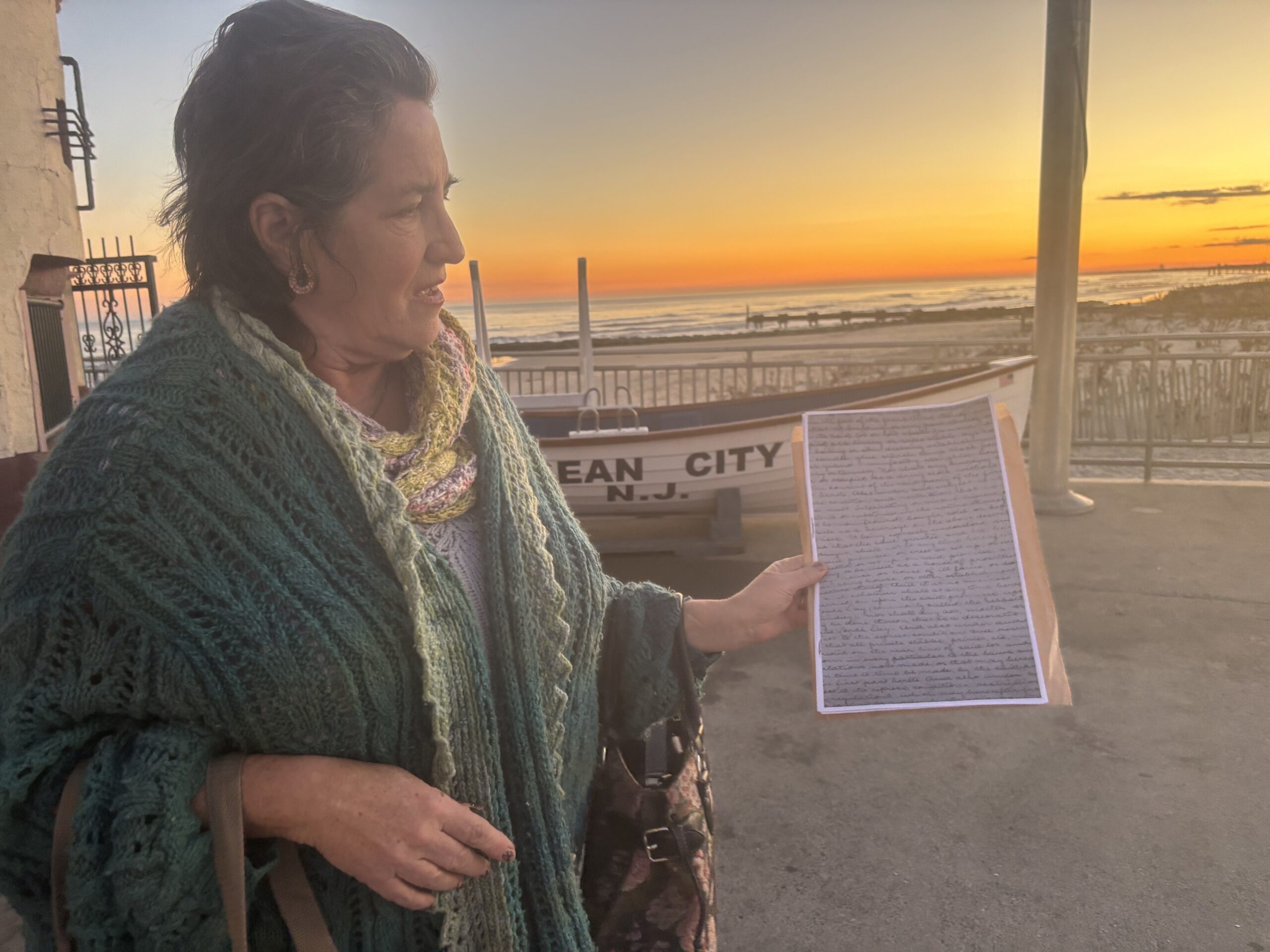
Others resisted any fast-tracking of development. Donna Saber, owner of Here Comes the Bride shop, brought along a copy of the original 1881 deed that she said sought to preserve its original intent as a place for child amusements.
“It was deeded as an amusement park,” she said.
Donna Saber, owner of Here Comes the Bride bridal shop in Ocean City, holds a copy of the original 1881 deed to the property that was the Wonderland Pier. She’s opposed to a plan to build a luxury hotel.
Marie Hayes, a full-time resident for 22 years, worried the designation would set a “dangerous precedent,” that would result in the town resembling Ocean City, Md., with high-rises along its oceanfront.
The planning board was given reports submitted by Mita back in August, when council stunned some, especially Mita, by voting not to ask the board to study the site’s future. Mita immediately said he would sell the property.
John Loeper, chair of Ocean City’s planning board, on stage at the Ocean City Music Pier. The planning board was set to vote on whether to recommend that the old Wonderland Pier site be declared in need of rehabilitation, a designation that could lead to a luxury hotel on the site.
Sean Barnes, the city councilman liaison to the planning board, questioned Wednesday whether the rides should even be considered part of the property.
“Amusement rides are not structures,” said Helen Struckmann, a resident who has opposed the hotel idea and vowed to save Wonderland Pier. She said the historic carousel was in better shape than the reports stated. “They don’t justify the need for rehabilitation designation for the property. Different amusement rides have been swapped out.”
She and others questioned why Mita had not addressed deterioration of the property since purchasing it in 2021. Mita is “now requesting a benefit from his purposeful underutilization of the property,” said resident Bob Duffy.
But Mita said he’d waived rent on the property so that Jay Gillian could try to make a go of the amusement pier. He said he’d put in $500,000 last summer to open the front portion of the property as an arcade, coffee and pizza shop, and bike shop.
Engineer Matt Mowrer told the planning board the property was “heavily deteriorated,” with “concrete spalling” — chunks of concrete breaking off from the foundation. He said corrosion from salt air would get only worse.
Board planner Randall Scheule told the board Wednesday he believed the structural deterioration of the property itself and the underutilization of the property met the standards. There was some debate as to whether the rides themselves should be included in any analysis.
The board looked at whether the site met the legal criteria needed for the designation, which will allow City Council to rezone the site for a hotel and grant tax abatements.
Will Morey, president and CEO of Wildwood’s Morey’s Piers, testifies in Ocean City at a planning board meeting to determine the future of the old Wonderland Pier.
The board did not discuss Mita’s specific hotel plans, which have included the carousel and Ferris wheel and some kiddie rides.
The old Wonderland Pier site on the boardwalk in Ocean City, N.J., as seen from Wayne Avenue on Jan. 6. The beloved amusement pier shut down in October 2024. A developer wants to build a luxury hotel. A report put the cost of repairing the Ferris wheel, carousel, and log flume at as much as $6.5 million.Five minutes before the 6 p.m. scheduled closing all but one of the gates are shut on the Boardwalk, on the final day for the beloved Wonderland Pier in Ocean City Sunday, Oct. 13, 2024.
Last summer, four businesses operated on the site: Ocean City Pizza Company, Dead End Bakehouse, Wonderland Pier Arcade, and OC Bikes and Rentals. Mita entertained several offers to sell, including one from the Norcross brothers, who envisioned residential development.
Planner Tiffany Morrissey told the planning board that showed the property was underutilized.
The property is assessed at $15.8 million, which translates to an estimated market value of about $29 million.
Saving the site as an amusement park has been the focus of much despair among community members and others with generations of memories at Wonderland Pier.
But the reports lay out the deterioration of the pier’s marquee attractions.
The report states that the carousel, which dates to the 1920s, would require as much as $1.5 million in repairs, including a new electrical system and repair or replacement of the telescopes, the poles that support the horses.
The Ferris wheel is also in need of substantial repair, costing as much as $2.5 million, including replacing or repairing the lights, and rebuilding the spokes and “spreader bars,” which connect the spokes and form the arc.
The Log Flume Ride, built in 1992, would need substantial repairs estimated at between $2.5 and $4 million, including rebuilding the upper troughs.
No company has stepped forward with a plan to keep the site solely an amusement park.