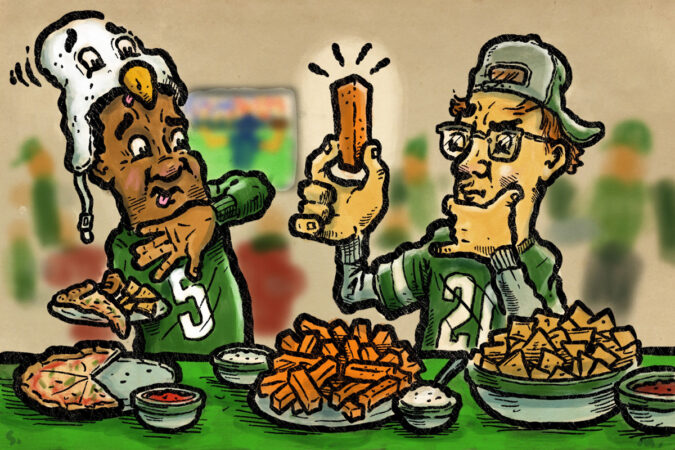
The Super Bowl is Sunday, so I’ve asked two reporters — one vegetarian, one not — to help solve this dilemma.
Evan Weiss, Deputy Features Editor
The question is…
My friend assigned me to bring wings for our Super Bowl potluck, but I’m a vegetarian. Can I bring tofu wings?
Zoe Greenberg, Life & Culture Reporter
I want to start by saying I’m also a vegetarian, and the idea of tofu wings disturbs me deeply.
Abigail Covington, Life & Culture Reporter
Who asked the vegetarian to make the wings? Vegetarians should make nachos or dips.
Evan Weiss
Yeah, I think this is on the friend who asked. Why would you ask your vegetarian friend to make wings???
Zoe Greenberg
The problem with tofu for this is that the texture and the flavor (nothing) is completely wrong.
But I do love buffalo cauliflower wings. Personally I would say that’s OK to bring.
Abigail Covington
However, if you regularly eat chicken wings, you will be disappointed by cauliflower wings. So, if you can stand to make a batch of both, maybe consider it. The meat-eaters will be very grateful. Not that you owe them anything.
Zoe Greenberg
Ah, true. You don’t have to make the chicken wings from scratch do you?!
That’s a horrifying prospect, too.
Abigail Covington
Just buy them! But is that still asking too much of a vegetarian?
Evan Weiss
Yes!
I’m not a vegetarian, but I can’t imagine asking a vegetarian friend to bring meat! I would never ask a nondrinking friend to bring wine.
Zoe Greenberg
Maybe they truly meant, “Wings, as interpreted by a vegetarian.”
Abigail Covington
I think the vegetarian has every right to assume that’s what they meant. But please, like Zoe said, not tofu.
Because of the Winter Olympics, the Flyers won’t play again for another two-and-a-half weeks, not that anyone is all that broken up about their impending absence. They’ve been a lousy hang for a while, losing 12 of their last 15 games, falling out of the playoff picture, and drawing attention primarily for the six degrees of debate around Matvei Michkov’s playing time.
The Michkov issue has been fascinating and revealing. Everyone acknowledges that, after his often-impressive rookie season, he came into training camp out of shape. That reality has precipitated a months-long discussion about how he has played, when he has played, how much he has played, and whether coach Rick Tocchet might be mishandling him and sabotaging Michkov’s career before the kid has a chance to become the star the Flyers and their fans hope he will be.
Tocchet, general manager Danny Brière, and team president Keith Jones have made it clear that they are taking, or trying to take, the long view about Michkov’s development. They have also made it clear that they consider it valuable to put him through a kind of rite of passage, to compel him to learn and practice good habits on and off the ice.
One can make a case that such an approach is too old school, won’t be effective, and risks angering and alienating Michkov. That’s possible, I suppose, but it’s just as reasonable to think the Flyers’ methods are correct and will work.
There are plenty of 76ers fans and former members of the franchise, for example, who wish their team had treated Joel Embiid and other since-departed players with a firmer hand earlier in their careers.
It’s safe to say, though, that within at least a portion of the Flyers’ fan base, a measure of paranoia has arisen when it comes to Michkov and the organization’s handling of him.
Earlier this season, anodyne comments about him, by team captain Sean Couturier, were taken out of context and treated as a major controversy. Tocchet then offered a frank assessment of Michkov’s conditioning and performance during a recent interview with PHLY Sports. And while it wasn’t the smartest media-relations strategy for the head coach to criticize such an important player so brusquely, the reaction to Tocchet’s comments suggested that people were afraid Michkov would be so offended that he would catch the first flight to Little Diomede and hike the Bering Strait back to Putinland.
That fear is irrational, of course, and it’s easy to chalk it up to the longtime overzealousness of the Benevolent Order of the Orange and Black. But in this case, it’s understandable that those fans who have stuck with the Flyers over the last 15½ years — that’s how long it has been since that 2010 run to the Stanley Cup Final — would be a little on edge about Michkov. Even more than a little.
Danny Briere addressed the noise about drama between Rick Tocchet and Matvei Michkov.
“(Tocchet) wants Matvei to succeed. He wants to develop him to be the best player he can be. Along the way, there’s tough lessons that comes with that. It’s like raising a child.”
All anyone has to do is look at the Flyers’ draft history over the last quarter century to understand why their fans want Michkov treated like a prince and shielded from any emotional boo-boos. Because that history is … ugh.
Let’s start with 2001. The Flyers’ first-round pick that year, defenseman Jeff Woywitka, played 278 NHL games in his career, none with the Flyers. Their third-round pick, Patrick Sharp, turned out to be a terrific player … after they traded him to the Chicago Blackhawks.
With the fourth-overall pick in 2002, the Flyers took defenseman Joni Pitkänen. Eh. Their subsequent six picks in that draft played a combined total of one game in the NHL.
The 2003 draft was a red-letter one: Jeff Carter and Mike Richards in the first round. After those two, the Flyers took nine other players. Alexandre Picard, a third-round defenseman, turned out to be the best of the bunch.
If, in 2004, the Flyers were actually trying to tank the draft, no one could tell. They picked 11 players who appeared in a total of 23 NHL games.
Over the ‘05 and ‘06 drafts, they selected 16 players, two of whom had lengthy NHL careers: Claude Giroux and … Steve Downie.
For three straight drafts, 2008 through 2010, the Flyers picked 17 players. Just nine made it to the NHL and two others played only one game. The player who played the most games for them was Zac Rinaldo.
The Flyers took Couturier with the No. 8 overall pick in 2011. Excellent. They found Nick Cousins in the third round. OK. None of their other four picks that year played for them.
Left wing Oskar Lindblom was drafted by the Flyers in 2014.
From 2012 to 2014, the Flyers drafted Travis Sanheim, Scott Laughton, Shayne Gostisbehere, Anthony Stolarz, Oskar Lindblom, and Robert Hägg. They did not draft anyone who could reasonably be called a star.
When the Flyers took Ivan Provorov and Travis Konecny in the first round, 2015 looked like a draft they could take pride in. But Provorov’s gone, and goalies Felix Sandström and Ivan Fedotov couldn’t cut it.
Two words about the 2016 draft: German Rubtsov. Two more words: Carter Hart.
With the No. 2 pick in the 2017 draft, the Flyers selected Nolan Patrick. There are no words for how that decision turned out. But hey, Noah Cates!
The Flyers’ crown jewels from the 2018 draft were Joel Farabee and Sam Ersson.
In 2019 and 2020, the Flyers got Cam York (cool), Tyson Foerster (promising but injured), Bobby Brink (we’ll see), and Emil Andrae (don’t you need more from a second-rounder by now?).
So far, the Flyers’ best pick in the 2021 draft has been Aleksei Kolosov. Which tells you all you need to know about the Flyers’ 2021 draft.
We’re up to 2022. The Cutter Gauthier draft. Best to move on quickly and quietly …
The Jones-Brière regime has overseen the 2023-25 drafts, and yes, it’s early yet to judge the results, and yes, the Flyers were bold in ’23 in taking Michkov. But it’s worth noting that, of the 26 players the Flyers picked over those three years, just three have suited up for them so far: Michkov, Denver Barkey, and Jett Luchanko.
It’s not just that the Flyers have had opportunities to mine the draft for elite talent and failed. It’s that they haven’t even stumbled into a late-round pick or two who ended up becoming cornerstones.
A team that does not draft well cannot win. The Flyers have been proving that maxim true for a long time. No wonder their fans are so protective of the one player who represents even a glimmer of possible greatness.
My assignment that day was pretty typical for a newspaper photographer: show the reader what the person a reporter is profiling looks like. And maybe what they do and where they do it.
Newly-inaugurated Mayor Joi Washington at Media Borough Hall.
Having accomplished that task, I headed out looking for something else to photograph in the snow, and ended up at a pedestrian passage way.
As I made a picture of a person silhouetted in the corrugated metal culvert, the first thing I thought of was an old friend and photo editor Joe Elbert who famously said there are four categories in the “hierarchy” of newspaper photographs, lowest to highest: informational, graphic, emotional, and intimate.
In just a few hours I had knocked out his “lower” two types.
I made a few pictures that report “just the facts” without much flavor or fanfare. Then I found a visually appealing scene and waited until I could turn it into a well composed, interesting image. Graphic, even.
Joe was the photo editor at the Post from 1988 through 2007. Under his direction the paper won four Pulitzer Prizes, and many other awards, all for work that epitomizes that highest category of intimate photographs.
It’s easy to feel nostalgic for those “glory days,” but I mourn that almost an entire section of the newspaper is now gone.
Post photographers were still creating those most intimate images of Joe’s hierarchy. They were still making the reader feel something that allows us to connect with lives beyond our own, to empathize, and to care.
Since 1998 a black-and-white photo has appeared every Monday in staff photographer Tom Gralish’s “Scene Through the Lens” photo column in the print editions of The Inquirer’s local news section. Here are the most recent, in color:
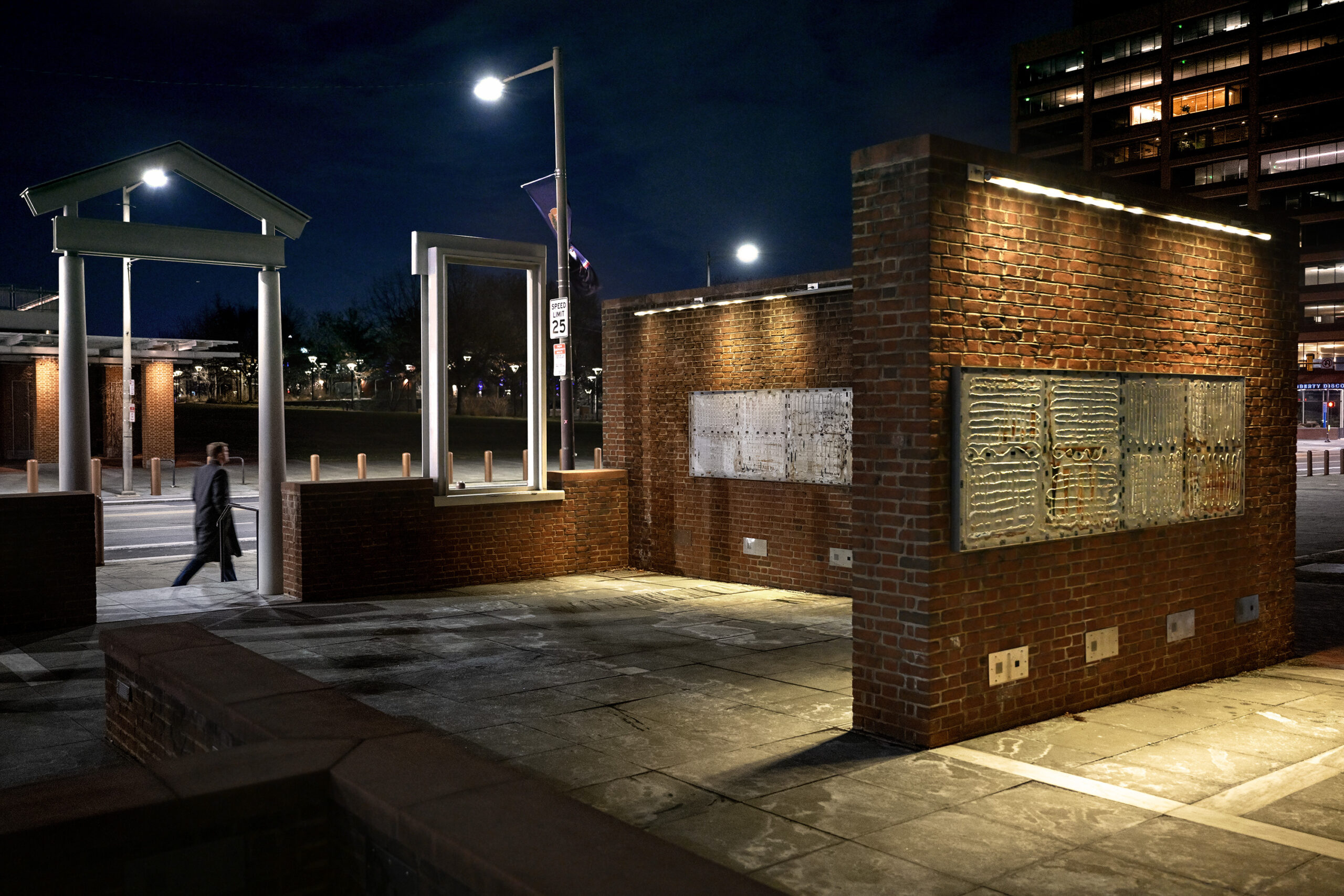
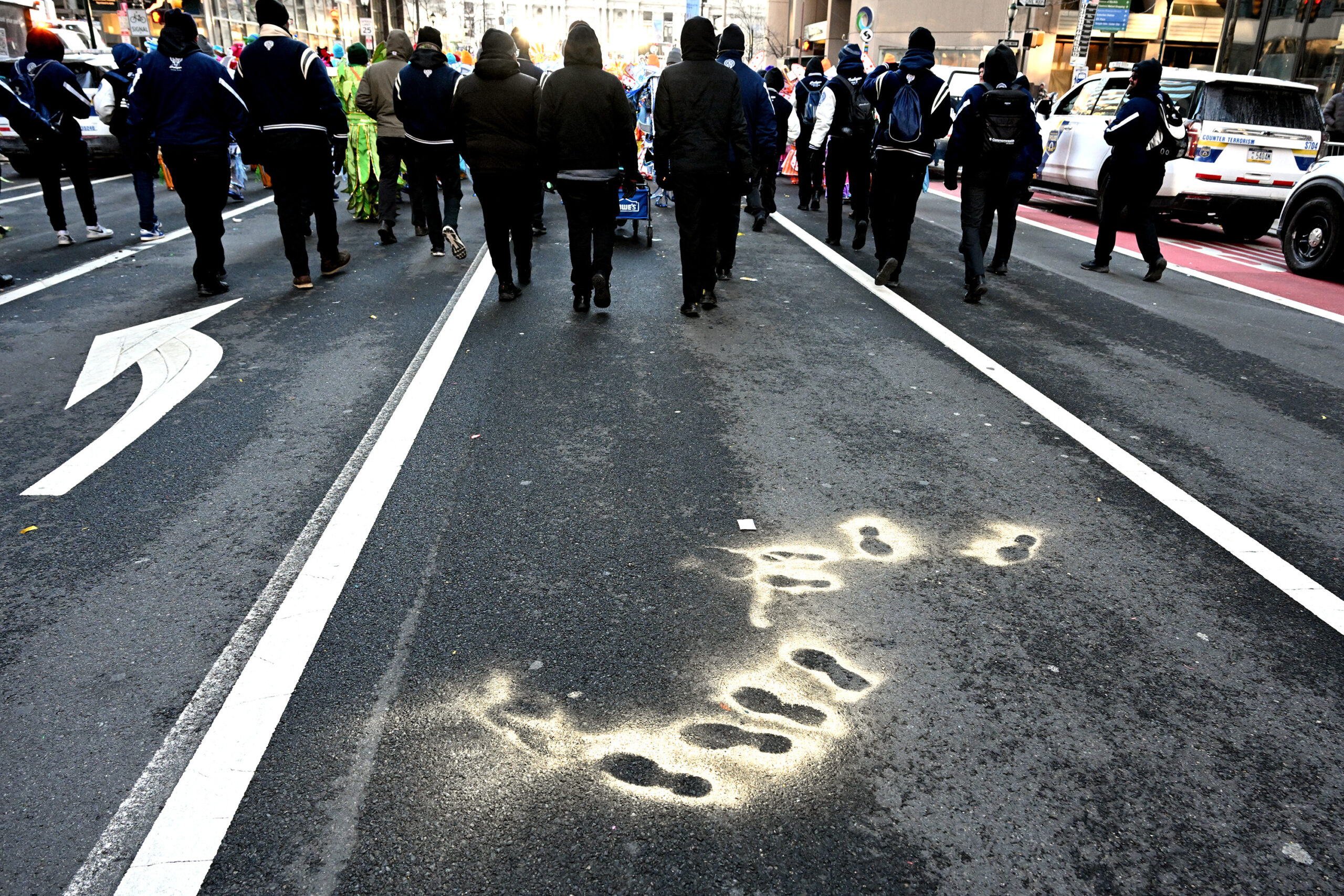
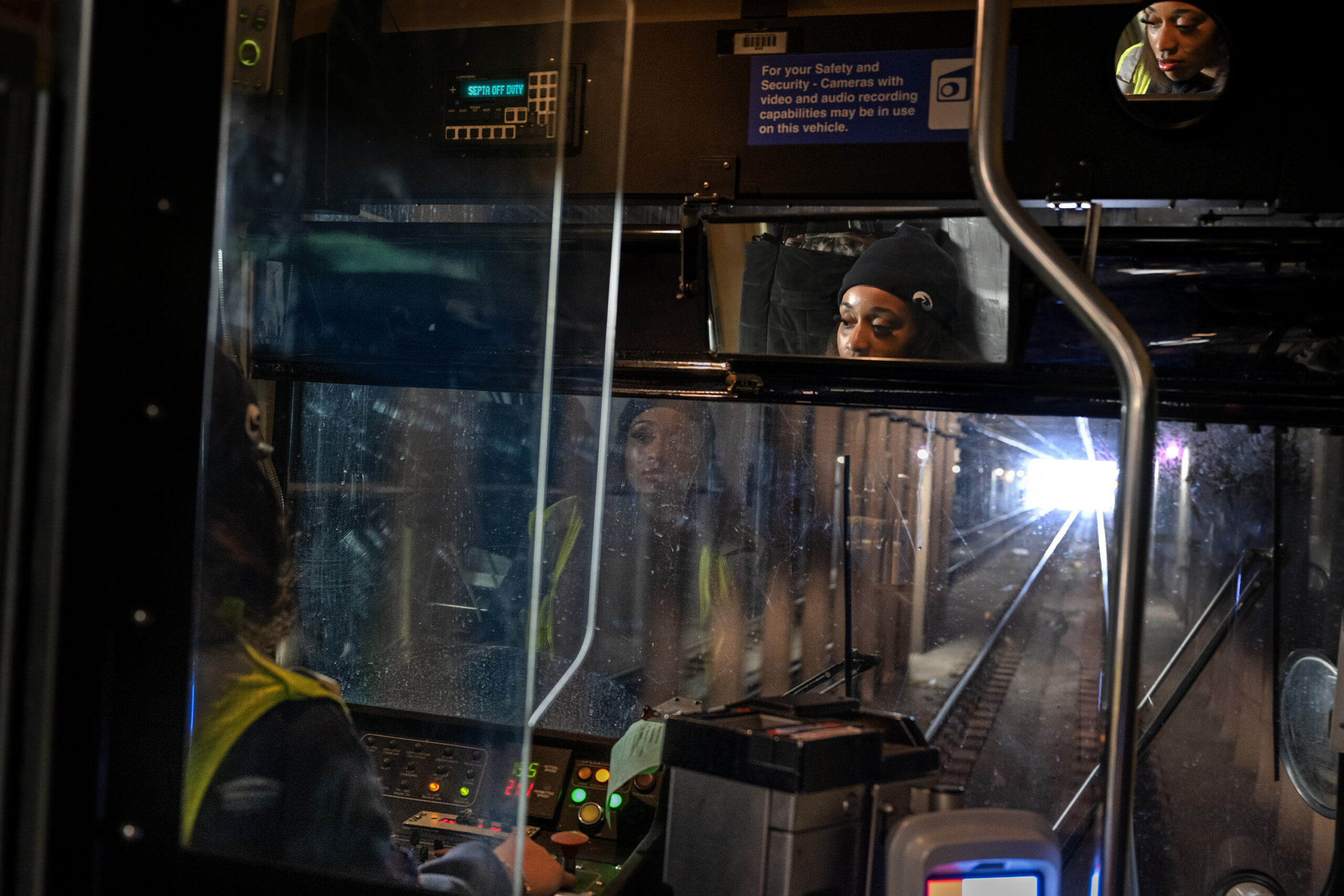
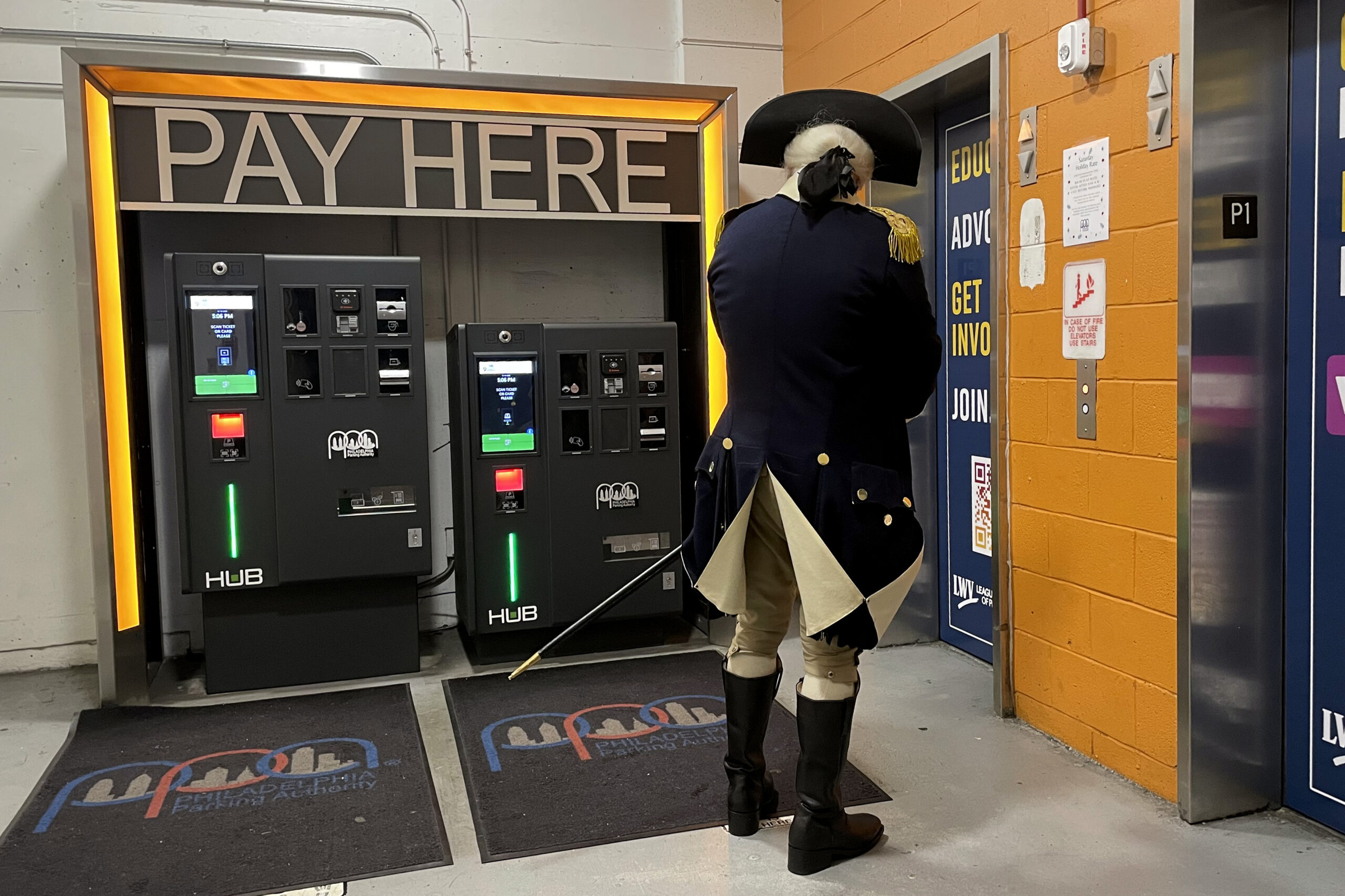
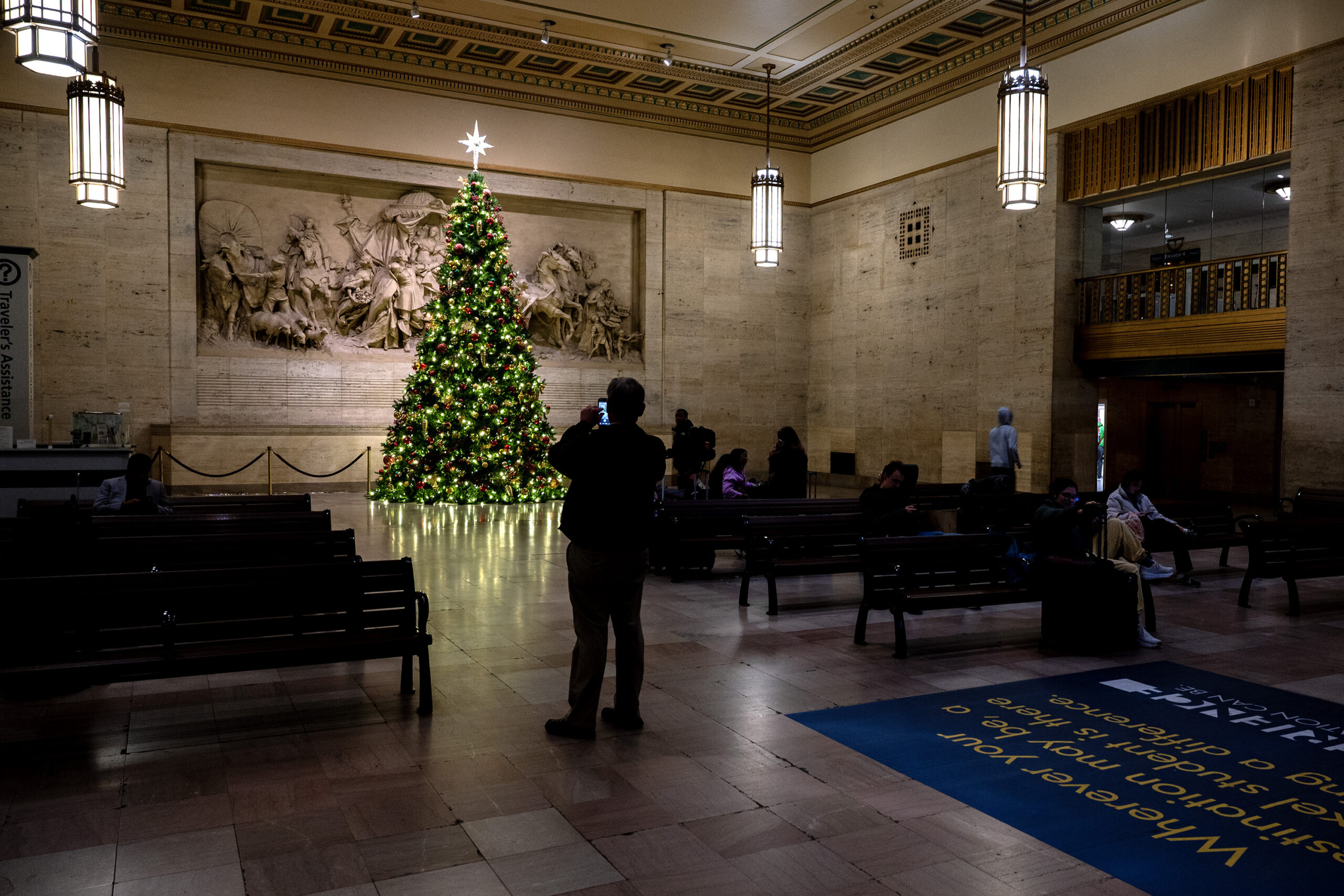
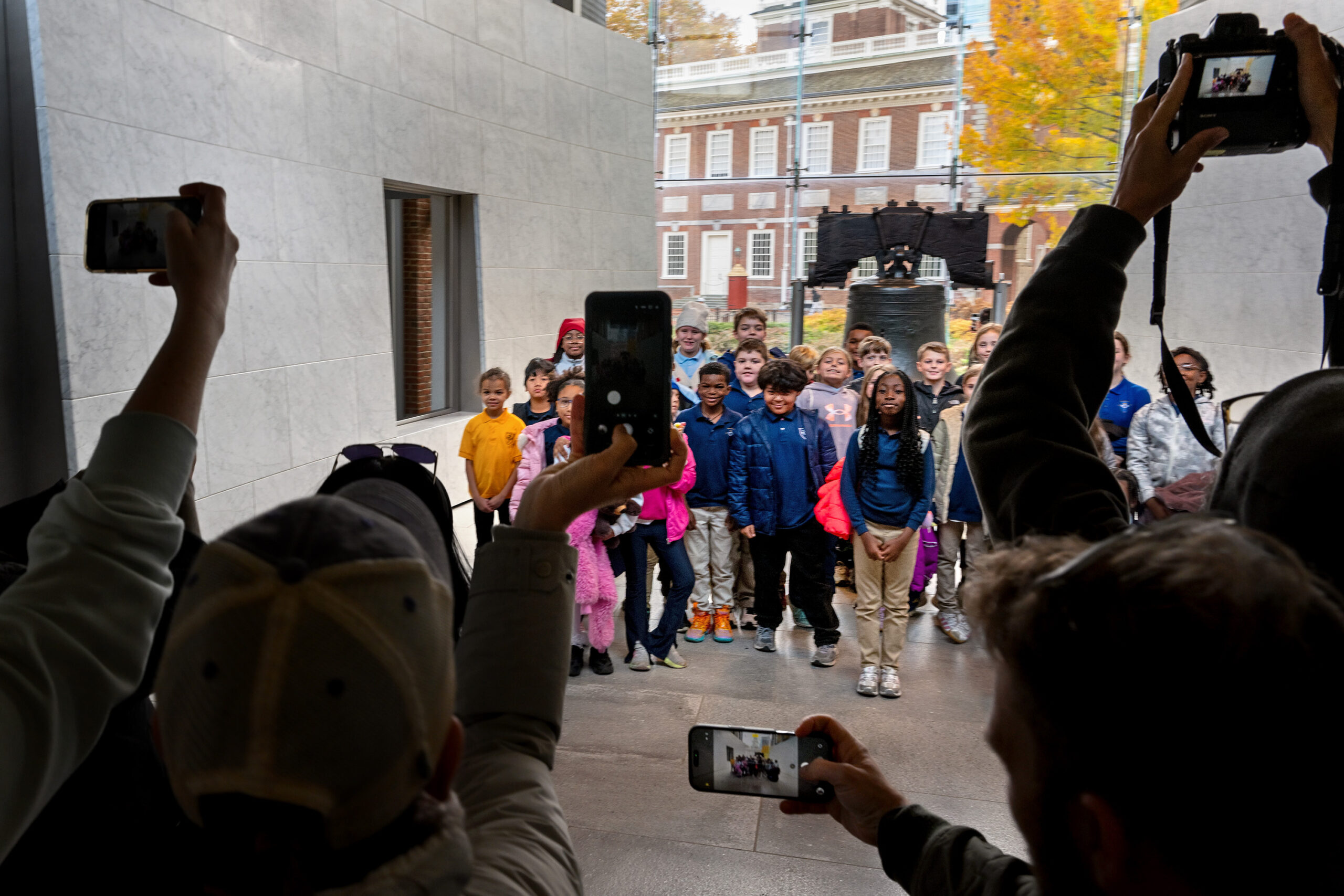
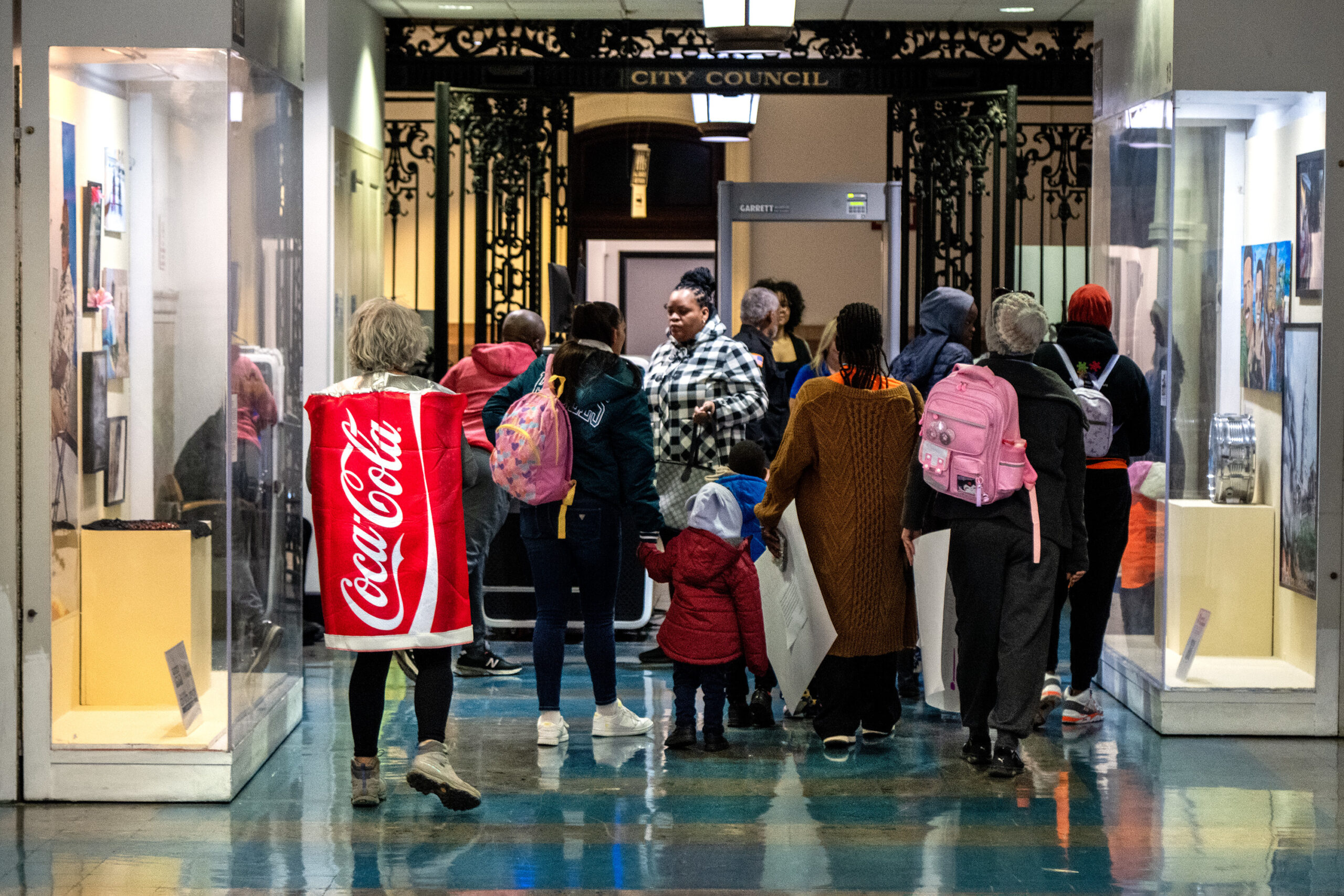
February 2, 2026: A light-as-air Elmo balloon rolls along a sidewalk in Haddonfield, propelled by the wind as Sunday’s heavy snow starts to turn to ice and sleet. January 26, 2026: The President’s House in Independence National Historical Park hours Jan, 22, after all historical exhibits were removed following President Trump’s Executive Order last March that the content at national parks that “inappropriately disparage” the U.S. be reviewed. The site, a reconstructed “ghost” structure titled “Freedom and Slavery in the Making of a New Nation” (2010), serves as a memorial to the nine people George Washington enslaved there during the founding of America.January 19, 2026: A low-in-the-sky winter sun is behind the triangular pediment of the “front door” of the open-air President’s House installation in Independence National Historical Park. The reconstructed “ghost” structure with partial walls and windows of the Georgian home known in the 18th century as 190 High St. is officially titled, “Freedom and Slavery in the Making of a New Nation” (2010). It is designed to give visitors a sense of the house where the first two presidents of the United States, George Washington and John Adams, served their terms of office. The commemorative site designed by Emanuel Kelly, with Kelly/Maiello Architects, pays homage to nine enslaved people of African descent who were part of the Washington household with videos scripted by Lorene Cary and directed by Louis Massiah. Deepika Iyer holds her niece Ira Samudra aloft in a Rockyesque pose, while her parents photograph their 8 month-old daughter, in front of the famous movie prop at the top of the steps at the Philadelphia Art Museum. Iyer lives in Philadelphia and is hosting a visit by her mother Vijayalakshmi Ramachandran (partially hidden); brother Gautham Ramachandran; and her sister-in-law Janani Gautham who all live in Bangalore, India.January 5, 2026: Parade marshals trail behind the musicians of the Greater Kensington String Band heading to their #9 position start in the Mummers Parade. Spray paint by comic wenches earlier in the day left “Oh, Dem Golden Slippers” shadows on the pavement of Market Street. This year marked the 125th anniversary of Philly’s iconic New Year’s Day celebration.Dec. 29, 2025: Canada geese at sunrise in Evans Pond in Haddonfield, during the week of the Winter Solstice for the Northern Hemisphere. December 22, 2025: SEPTA trolley operator Victoria Daniels approaches the end of the Center City Tunnel, heading toward the 40th Street trolley portal after a tour to update the news media on overhead wire repairs in the closed tunnel due to unexpected issues from new slider parts.December 15, 2025: A historical interpreter waits at the parking garage elevators headed not to a December crossing of the Delaware River, but an event at the National Constitution Center. General George Washington was on his way to an unveiling of the U.S. Mint’s new 2026 coins for the Semiquincentennial, December 8, 2025: The Benjamin Franklin Bridge and pedestrians on the Delaware River Trail are reflected in mirrored spheres of the “Weaver’s Knot: Sheet Bend” public artwork on Columbus Boulevard. The site-specific stainless steel piece located between the Cherry Street and Race Street Piers was commissioned by the City’s Public Art Office and the Delaware River Waterfront Corporation and created and installed in 2022 by the design and fabrication group Ball-Nogues Studio. The name recalls a history that dominated the region for hundreds of years. “Weaver’s knot” derives from use in textile mills and the “Sheet bend” or “sheet knot” was used on sailing vessels for bending ropes to sails. November 29, 2025: t’s ginkgo time in our region again when the distinctive fan-shaped leaves turn yellow and then, on one day, lose all their leaves at the same time laying a carpet on city streets and sidewalks. A squirrel leaps over leaves in the 18th Century Garden in Independence National Historical Park Nov. 25, 2025. The ginkgo (Ginkgo biloba) is considered a living fossil as it’s the only surviving species of a group of trees that existed before dinosaurs. Genetically, it has remained unchanged over the past 200 million years. William Hamilton, owner the Woodlands in SW Phila (no relation to Alexander Hamilton) brought the first ginkgo trees to North America in 1785.November 24, 2025: The old waiting room at 30th Street Station that most people only pass through on their way to the restrooms has been spiffed up with benches – and a Christmas tree. It was placed there this year in front of the 30-foot frieze, “The Spirit of Transportation” while the lobby of Amtrak’s $550 million station restoration is underway. The 1895 relief sculpture by Karl Bitter was originally hung in the Broad Street Station by City Hall, but was moved in 1933. It depicts travel from ancient to modern and even futuristic times. November 17, 2025: Students on a field trip from the Christian Academy in Brookhaven, Delaware County, pose for a group photo in front of the Liberty Bell in Independence National Historical Park on Thursday. The trip was planned weeks earlier, before they knew it would be on the day park buildings were reopening after the government shutdown ended. “We got so lucky,” a teacher said. Then corrected herself. “It’s because we prayed for it.” November 8, 2025: Multitasking during the Festival de Día de Muertos – Day of the Dead – in South Philadelphia.November 1, 2025: Marcy Boroff is at City Hall dressed as a Coke can, along with preschoolers and their caregivers, in support of former Mayor Jim Kenney’s 2017 tax on sweetened beverages. City Council is considering repealing the tax, which funds the city’s pre-K programs.
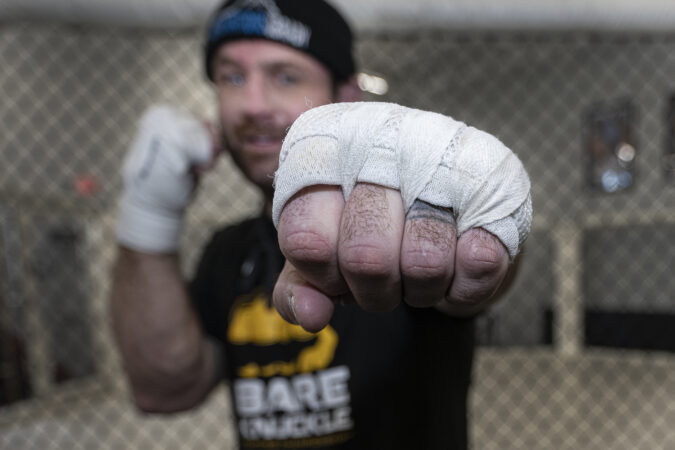
Bare Knuckle Fighting Championship is making its way back to Philly on Feb. 7 at the Xfinity Mobile Arena to host KnuckleMania VI. Over a year ago, the event took over the former Wells Fargo Center for KnuckleMania V — setting a local modern day combat sports record with 17,762 people in attendance.
Last year’s headliner was former UFC champion and Kensington native Eddie Alvarez. There was also plenty of love for local Philly talent, highlighting six hometown fighters. However, only two of those six walked out victorious.
In this year’s KnuckleMania card, they’re expecting a different outcome with five Pennsylvania fighters featured — including some who have already competed in South Philly.
Here are three from the Philly area that you should know ahead of Saturday night’s event …
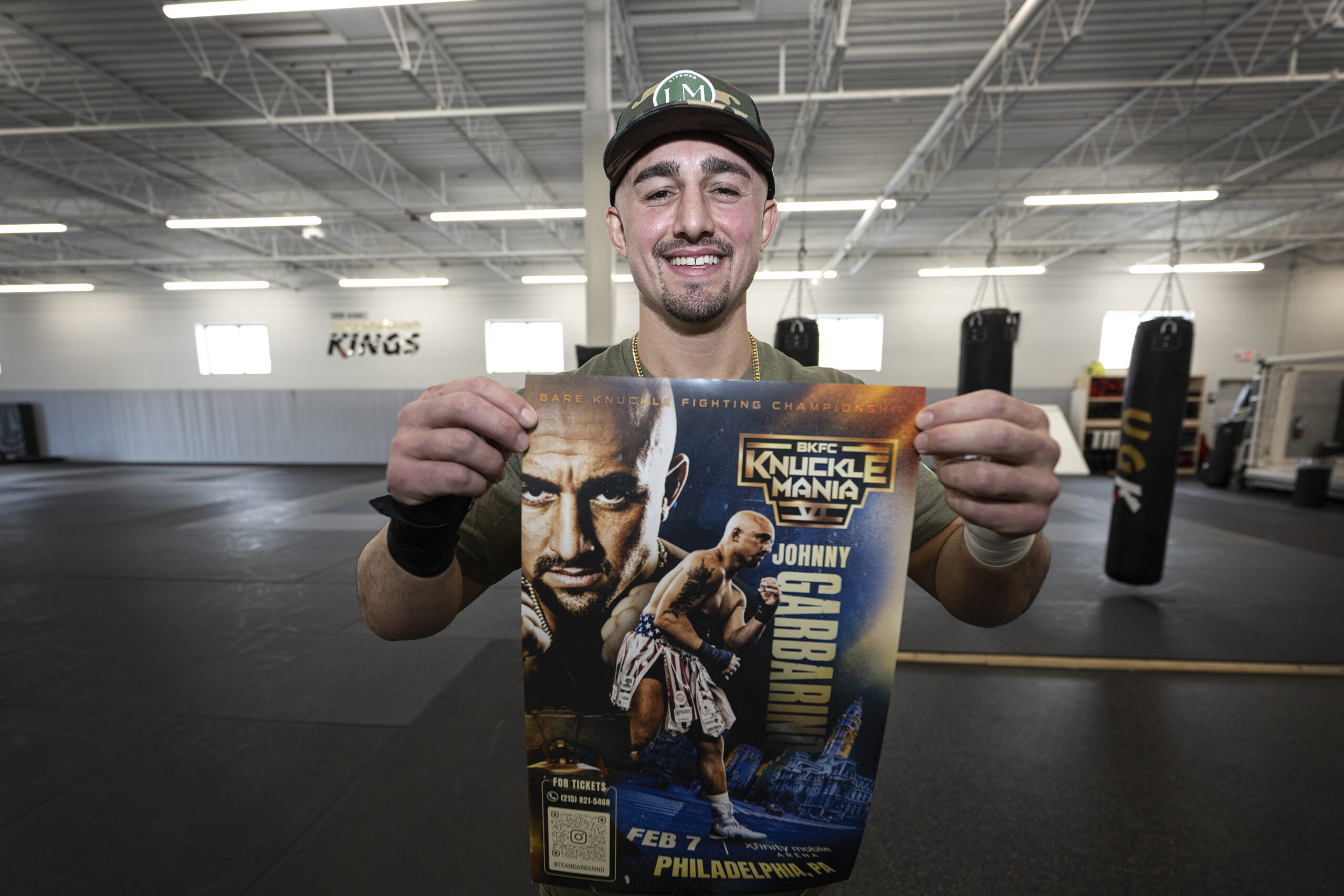
Johnny “Cannoli” Garbarino is one of the featured fights on Saturday’s main KnuckleMania VI card.
Johnny ‘Cannoli’ Garbarino
Johnny Garbarino, a former chef at a Michelin-star restaurant, quickly became a fan favorite after last year’s performance at KnuckleMania V at the then Wells Fargo Center. After the South Philly native knocked out his opponent, Apostle Spencer, in the first round, he proposed to his girlfriend Gianna Scavetti in front of the hometown crowd.
The Italian fighter earned his “Cannoli” nickname by throwing the dessert at Spencer during the weigh-in. Since then, he’s been riding high — picking up two more wins at the 2300 Arena. Now, he’ll have a chance to return to the big stage on Feb. 7.
“I’m looking forward to all of it,” Garbarino said. “Philadelphia brings it the hardest. And I’m only saying that because I see what the Eagles fans do nationwide and they travel everywhere. They’re built different, they have crazy energy. I think a lot of people from Philadelphia are violent and I feel like I’m actually allowed to go in here and catch a body and not go to jail. So, I’m excited.”
Garbarino (3-0) will compete against Kaine Tomlinson Jr. (2-2), who defeated another Philly native — and close friend of Garbarino’s — Pat Sullivan at last year’s KnuckleMania. Heading into this year’s matchup, Garbarino is looking to avenge that loss for the city.
“The question of the day is, ‘Is it personal to fight this guy?’ I definitely feel like it’s personal,” Garbarino said. “But I feel like every fight is personal. This one is just a little bit different because he knocked a dear friend of mine out.
“Anybody from Philadelphia that fights another guy from a different city, I have to step up for them, as long as it’s in my weight class. It’s going to be an honor to put this guy down. And I’m going to raise my hand up and hopefully when Pat’s done his fight, I’ll raise his hand up too and we’ll get the win back together.”
Sullivan (1-1) will also be featured on the card, competing against Charles Bennett (0-3).
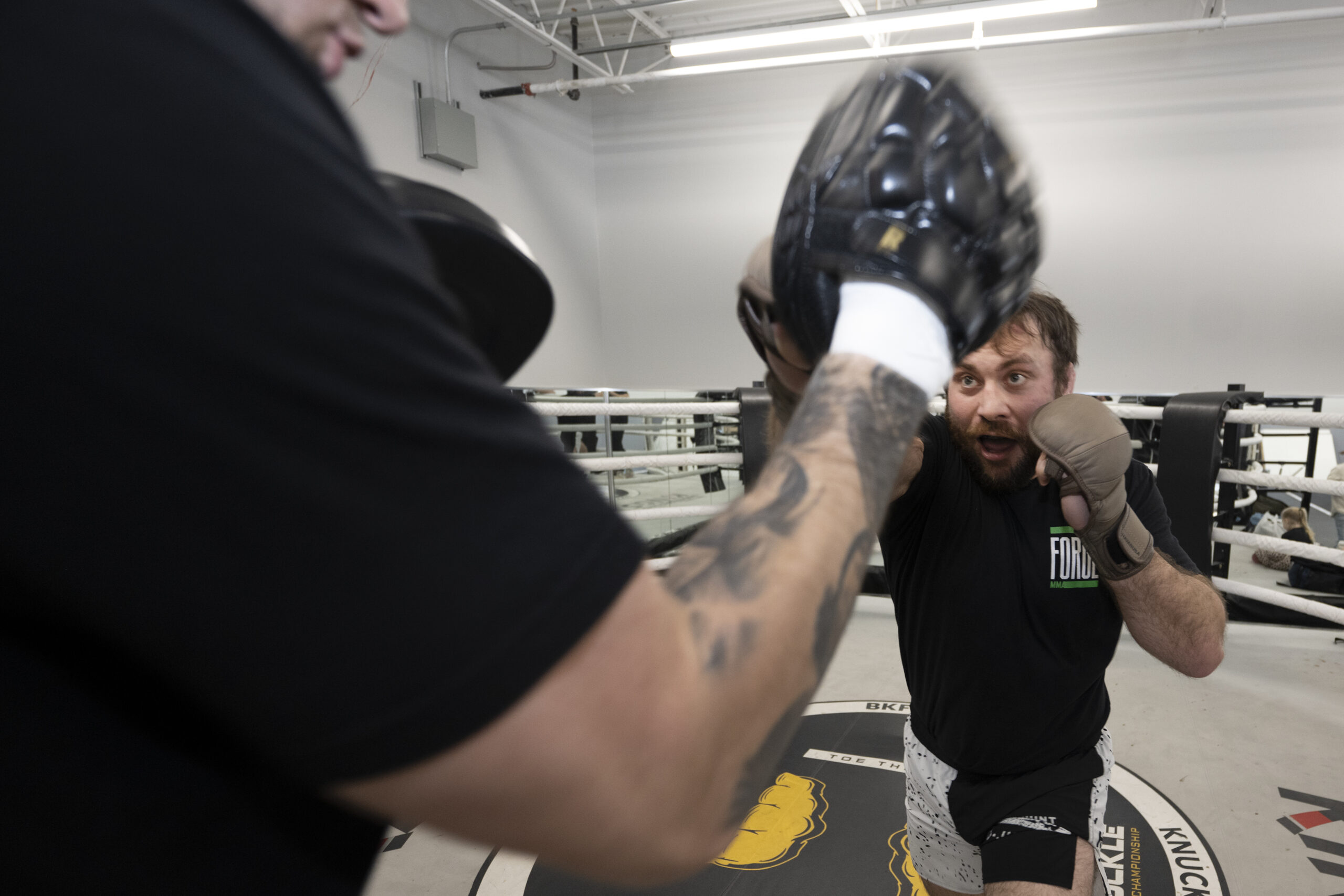
Heavyweight fighter Patrick Brady faces Bear Hill on the main card Saturday night.
Patrick ‘The Brick’ Brady
Although Patrick “The Brick” Brady currently resides in South Jersey, the 41-year-old grew up in Delaware County and claims Philly as home. He’s been training at The Forge, owned and operated by Philly UFC fighters Chris and Kyle Daukaus.
To Brady, bare knuckle fighting is just something he does in his spare time. His full-time job is managing his own renovations company called Renovations By Brady.
“This is my crazy, wild hobby, if you would say, that most people do full-time,” Brady said. “My wife hates it. She’s not a fan. Especially when I crossed over to bare knuckle.
“I come from [mixed martial arts], I was 5-1 in MMA and my only loss was when I hurt my knee, and that’s when I made the switch. It’s been a point of contention for my wife just because her position is [that] I don’t have to [do it]. But I love competing. I love elite level competition and this is what I’m doing.”
Brady (2-0) is coming off two straight knockouts — including a quick knockout over Zach Calmus at last year’s KnuckleMania. Heading into this year’s fight with Bear Hill (2-0), he doesn’t plan on playing it safe.
“I fought here last January,” Brady said. “I fought a worthy opponent who was on a four-fight win streak and got him out of there fast in under a minute, and it was a good night. Hopefully the night goes the same way. I’m looking for a knockout. There’s no decisions. I don’t plan on backing up. I plan on coming forward and putting on a show.”
Cruiserweight Lex Ludlow will face Calmus on Saturday, a year after Brady knocked him out.
Lex ‘The Grizzly Bear’ Ludlow
This will be Lex “The Grizzly Bear” Ludlow’s (2-0) first time competing at the Xfinity Mobile Arena. And as the Levittown native prepares for his fight with Zach Calmus (5-4), the cruiserweight is already focused on his post-fight speech.
“This is going to be the craziest post-fight speech ever,” Ludlow said. “I’m really known for it. I’m way better than [UFC fighter] Colby Covington in post-fight speeches. The only person, in my opinion, better in post-fight speeches than me is the guy that I grew up watching do it, Chael Sonnen. He’s somebody that I’ve been trying to get the eye from, to look at me and one day walk down to the ring with me. Just trying to impress Chael, that’s all it is.”
His passion for the promo comes from his love for pro wrestling, growing up studying the words of popular heels (or villains) like “The Nature Boy” Ric Flair, “Rowdy” Roddy Piper, and “Ravishing” Rick Rude.
“I was a pro wrestling fan since I was five years old,” Ludlow said. “Weirdly enough, I used to practice doing promos. I would stand up in a mirror and I would practice how I would talk, how I present myself, everything.”
Now, the 32 year old is ready to play both the heel and the face (or hero) when it comes to fighting in Philly.
“I’m definitely going to play to the crowd,” Ludlow said. “Because I’m the most hated man in combat sports — but everybody loves me. So, I guess I have to play the face a little bit.”
At Manong, chef Chance Anies’ bustling, casual Filipino steakhouse in Francisville, customers are feasting. They’re going all in and ordering 1-pound burgers on puffy, house-baked Hawaiian buns for themselves. (“I love that. Such a bold move,” Anies says.) The charcoal-grilled chicken — a half-chicken marinated in soy, calamansi, lemongrass, annatto, and butter — is selling well, too.
Everybody, it seems, orders a bloom shroom. As Manong is Anies’ homage to Outback Steakhouse, he chose to hold the onion for his crunchy, photo-worthy appetizer — one of Manong’s few vegan offerings.
The kitchen skewers a package of enoki mushrooms at the base to keep them uniform and flat, macerates them in a salt cure for about 20 minutes to get them to sweat, and then dredges them in a mix of cornstarch and ground dehydrated garlic. After a few minutes in the fryer, they get a hit of furikake — nori, brown sugar, chili powder, and dehydrated orange peel. You get a side of what Anies calls “salsa rosada,” a mix of banana ketchup and house-made vegan mayo.
You know what they say: “No rules, just right.” Manong, 1833 Fairmount Ave., 445-223-2141, manongphilly.com
— Michael Klein
The chicken liver mousse at Emmett comes with some awfully convincing mini Eggo waffle dupes.
Chicken liver mousse at Emmett
I giggled when the chicken liver mousse at Emmett was placed in front of me. Six doll-sized, rosewater-scented Eggo-like waffles — but most certainly not actual Eggo waffles — are arranged around a silken quenelle of chicken liver mousse. The dish is both adorable and delicious, the mousse simultaneously light and unctuous, covered in a generous rain of crumbled smoked peanuts. Spheres of concord grape jelly add balance and nasturtium leaves bring a tart freshness. It’s a great interpretation of chicken and waffles, and one I can’t wait to go back in for. Emmett, 161 W. Girard Ave., 215-207-0161, emmettphilly.com
— Kiki Aranita
The octopus at Apricot Stone.
Charred octopus from Apricot Stone
For my 25th birthday, I cracked open a celebratory bottle of Eagles Super Bowl LIX bubbly and tucked into a smorgasbord of Apricot Stone’s shareable plates: crisp pita chips with bowls of nutty muhammara and whipped red pepper-feta dip, flaky cheese boreks, and tabbouleh. The star of the spread, however, were three charred octopus tentacles plated on a bed of lentils with juicy beefsteak tomato slices. The octopus was succulent and meaty, with evenly spaced grill marks that gave it a smoky aftertaste. Combined with the lentils and tomatoes, the dish was bright and transporting: If I closed my eyes, I was feasting on a beach in the Mediterranean, not a table with a clear view of Girard Avenue’s dirty, hardly melted snowdrifts. Apricot Stone, 428 W. Girard Ave., 267-606-6596, apricotstonephilly.com
The ones that tie a skate or hold up hockey pants. And the ones that some jerseys have near the neck.
But then there are the invisible ones that matter all the same — maybe even more. For Flyers coach Rick Tocchet, there’s an invisible string pulling him across the ocean.
“My parents emigrated from Italy, and I’m really excited to go back there,” said Tocchet, who understands poco, or a little, Italian. “I love the food. … I’m excited to go over there and see a beautiful country.”
Tocchet’s late parents, Norma and Fortunato ‘Nato’ Tocchet, immigrated to Canada from outside Venice. They settled in Scarborough, Ontario, bringing a blue-collar work ethic — Norma was a seamstress, and Nato a mechanic — that Tocchet carried with him across his 621 games with the Flyers and 1,144 in the NHL.
A member of the Flyers Hall of Fame, he accumulated 232 goals,508 points, and a franchise-record 1,815 penalty minutes across two stints in Philly while being beloved and revered by the fans for his grit and in-your-face style.
It is the same work ethic he has carried with him as a coach, including the first 56 games of his tenure behind the Flyers’ bench. And the same one he will carry 173 miles west of Venice, as an assistant coach for Canada’s men’s team at the 2026 Milan Cortina Olympics.
“Yeah, an unbelievable moment. To be a part of that, to coach for your country, with the talent that we have, it’s going to be a lot of fun,” Tocchet told The Inquirer in Utah after a recent Flyers practice. “So it’s a great honor, and I’m really excited.”
‘Sense of pride’
Across his 61 years, Tocchet has always watched the Olympics. He remembers Sidney Crosby’s golden goal at the 2010 Vancouver Games and captain Mario Lemieux leading Canada to its first gold in 50 years at the 2002 Salt Lake City Olympics. And, for the dual citizen, he’ll pop on Miracle, about the 1980 U.S. Olympic team that stunned the Soviet Union before winning gold in Lake Placid, to get motivated.
But the most impactful Canadian hockey moment for the Scarborough kid wasn’t on the Olympic stage. In the 1972 Summit Series, as the Tragically Hip’s Gord Downie would sing in Fireworks, Paul Henderson scored “a goal that everyone remembers.”
In Game 8 of an eight-game series, pitting Canada’s best against the Soviets’ best, Henderson clinched the series. The Flyers’ Bobby Clarke — who infamously slashed Valeri Kharlamov during the series — was linemates with Henderson, but was not on the ice because Phil Esposito stayed on for an elongated shift.
“So I was 8 or 9 years old and in school, and they actually brought a TV into our classroom to watch that; that’s how the whole country’s eyes were on that series,” Tocchet recalled.
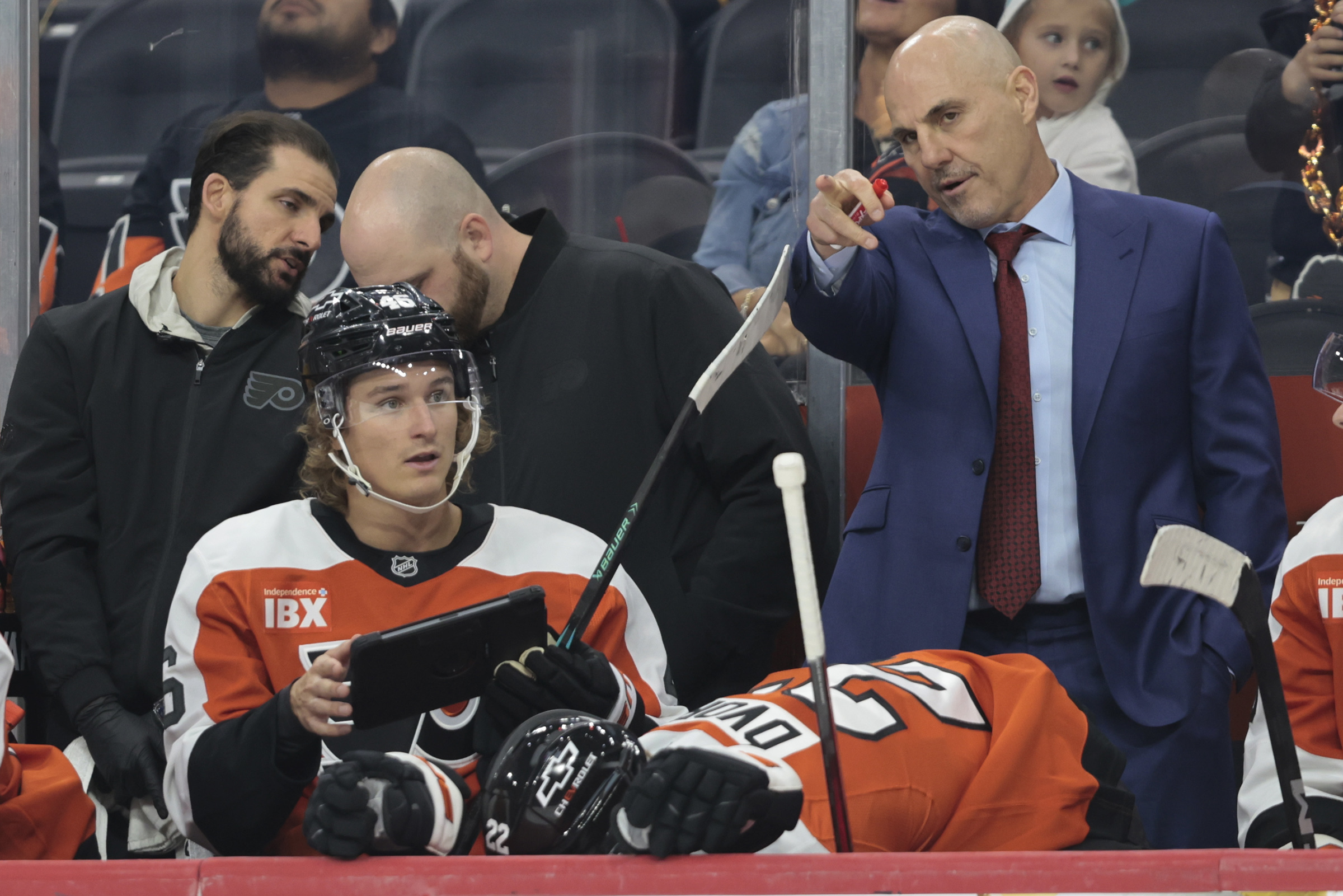
Rick Tocchet is renowned around the league for his one-on-one instruction with players.
“But when he scored the goal, the sense of pride — the whole country went crazy, obviously. But what a series. … You go down the list of great players and it impacted my life, because I loved hockey even more when I saw that, and I started to train and wanted to be an NHL player.”
Fast forward to the present, and on Thursday, like many of his players, including Flyers defenseman Travis Sanheim, Tocchet will make his Olympic debut when Canada plays Dan Vladař and Czechia (10:40 a.m. ET, USA Network). But like all of his players, he has worn the maple leaf before. The forward played in a World Championship and two Canada Cups, winning gold each time.
“It wasn’t about money. It wasn’t about status. It was about playing for your country,” he said. “To be part of that, I was very lucky as a young kid to play with Wayne Gretzky, Mario Lemieux, and Paul Coffey, guys that I idolized and learned a lot from.
“And then playing in front of the Canada crowd, how loud it was. Just the sense of pride, it was incredible. Had nothing to do with anything, it wasn’t about individual goals, it was about playing for your country.”
Tocc-eye
Tocchet is no stranger to coaching for his country, either. Last February, he was part of Tampa Bay Lightning coach Jon Cooper’s staff at the 4 Nations Face-Off. The Canadians, which included Sanheim and Flyers forward Travis Konecny, won gold by beating the U.S. in overtime.
Rick Tocchet hasn’t coached any of the current #Flyers in the NHL but he did coach Travis Konecny and Travis Sanheim at the 4 Nations Face-Off in February. Canada won the title. pic.twitter.com/BcYl3NbRI1
At that tournament, Tocchet was a jack-of-all-trades, focusing on the structure, faceoff planning, and in-game adjustments. But what impressed Cooper the most was how he would often meet with players one-on-one or in small groups to watch videos — over a garbage can.
As Tocchet explained, he would put his laptop on a garbage can and go over things, as he did when he was an assistant coach with the Pittsburgh Penguins and his Flyers’ assistant coaches do now.
“I couldn’t have surrounded myself with a better guy,” Cooper told The Inquirer in late November. “I will tell you this, because his eye for the game and what happens in real time, having that talent is a real thing. And Tocc has that. He sees it, he processes it, and then gives you the information.
“And there were countless times at the 4 Nations that he made me think of things, or I saw things in a different light, or I missed something, and he caught it. And so many little adjustments we made in between periods, because of what Tocc did.”
He’ll have the same role in Italy with Cooper rolling over the same staff in Tocchet, Vegas Golden Knights coach Bruce Cassidy, former NHL coach Pete DeBoer, and former NHL assistant coach Misha Donskov.
After winning last year’s 4 Nations Face-Off, Canada enters this year’s Olympics as the favorites.
Tocchet will assuredly have one eye on the Flyers, who get back to work on Feb. 17 at 2 p.m. in Voorhees, five days before the men’s gold medal game is scheduled. But he may not have his eyes on the Flyers, outside of Sanheim, in Milan. As Vladař said with a laugh, he’s blocking numbers right now.
He’ll also be taking in other events like speedskating, Canada’s women’s hockey team, and figure skating, which includes South Jersey’s Isabeau Levito, who is co-coached by Slava Kuznetsov, the Flyers’ Russian translator.
But, with it being 12 years since Canada last won gold in Sochi, Russia, Tocchet’s whole focus will be finishing with a string around his neck and a gold medal hanging from the end. After all, as the winningest country in men’s hockey at the Olympics with nine triumphs, it is the Canadian way: Gold or bust.
Apollo Global Management’s John Zito left the audience of investors stunned.
Addressing a gathering in Toronto last fall, he said that the real threat for private capital markets wasn’t tariffs, inflation, or a prolonged period of elevated interest rates. Rather, he said, “the real risk is — is software dead?”
Zito’s comments, being reported for the first time, marked a forthright challenge to one of private equity’s most entrenched assumptions. For years, investors have funneled hundreds of billions into software businesses, banking on steady growth and resilient, recurring revenues. But the artificial-intelligence revolution is now testing that foundation.
As worries mount, firms including Arcmont Asset Management and Hayfin Capital Management have hired consultants to check their portfolios for businesses that could be vulnerable, according to people with knowledge of the matter. Apollo cut its direct lending funds’ software exposure almost by half in 2025, from about 20% at the start of the year.
The uncertainty about the eventual winners and losers is roiling multiple markets. On Tuesday, stocks seen as vulnerable to AI dropped after Anthropic released a new tool, exacerbating worries about disruption to businesses. In recent days, Blue Owl Capital Inc. revealed huge outflows from a tech-focused fund, and two European software firms put loan deals on ice.
While various business models are threatened, software-as-a-service is particularly vulnerable. AI-native firms can often offer quicker and cheaper solutions, meaning companies that once operated in a defensible sector are now at risk of competition from new players.
Anthropic’s Claude Code and other “vibe-coding” start-ups are disrupting traditional SaaS by allowing users with no coding experience to build software. That’s dramatically lowering the programming skill barrier and undermining rigid, one-size-fits-all products.
“Technology private equity, in its current form, is dead,” Isaac Kim, a partner at venture capital firm Lightspeed who previously led Elliott Investment Management’s tech private equity business, said in a recent LinkedIn post.
The sector has been a hugely popular target for buyout firms and their private credit cousins. From 2015 to 2025, more than 1,900 software companies were taken over by private equity buyers in transactions valued at more than $440 billion, according to data compiled by Bloomberg.
Deals were easily waved through most investment committees because the model was simple. Revenues are “sticky” because the tech is embedded into businesses, helping with everything from payroll to HR, and the subscription fee model meant predictable cash flows.
But now, lenders are zeroing in on how prospective borrowers are dealing with the new technology challengers, according to people familiar with the matter. It’s the first question software bosses are being asked during meetings about borrowing, they said.
Buying a software business, improving margins, and adding leverage “assumes the underlying product remains relevant long enough for financial engineering to work,” Kim said in the post. “AI has changed that assumption.”
Last year, two outsourcing companies, KronosNet and Foundever, fell into difficulty amid increased investor scrutiny around AI. The debt of both is now trading at distressed levels. Bond prices on other software names, including McAfee and ION Platform Investment Group, have tumbled.
Also in 2025, CVC Capital Partners’ credit unit took the keys of a contact center support business called Sabio Group after its previous owner struggled to find a buyer.
“Everyone’s focused on these bubble risks, I think the biggest risk is actually the disruption risk,” Blackstone’s Jon Gray said on Bloomberg TV. “What happens when industries change overnight, like what we saw to the Yellow Pages back in the nineties when the internet came along.”
In private markets, debt-laden firms have sought forbearance on borrowings, and big-name lenders have slashed valuations on loans to software companies such as Edmentum and Foundever, some to distressed levels.
Credit exposure
Sentiment in the equity market has grown increasingly bearish. The S&P North American software index fell 15% in January, its biggest monthly decline since October 2008.
Private credit’s exposure to software may be much higher than some figures suggest. Barclays estimates so-called business development companies — investment funds that lend directly to firms — have around 20% of their portfolios tied up with the sector, but others say it’s substantially more.
“If your software business is in healthcare, the fund classifies it as a healthcare exposure,” said Robert Dodd, an analyst at Raymond James. “The software exposure is meaningfully higher than it looks.”
An additional worry is the software industry’s asset-light model. With less physical infrastructure to seize to try recoup money, that can mean bigger losses.
Zito’s recent comments represent a change in how the AI threat is being assessed.
Back in 2022, shortly before Hellman & Friedman and Permira paid just over $10 billion to buy Zendesk Inc., the software firm’s board of directors set out the risks the firm was facing.
They cited a potential recession, persistently high inflation, and economic headwinds. Not mentioned: AI.
Just over a week after the sale closed in November 2022, ChatGPT launched.
But firms under threat aren’t just sitting back. Many have harnessed the technology themselves, and for those that do it effectively, AI could be a boon. Annual recurring revenue from Zendesk’s in-house AI offering, for example, now exceeds $200 million, amounting to 10% of revenue, a person with knowledge of the matter said. Some firms expect AI will help them to reduce costs.
Brian Ruder, co-CEO of Permira, says there are risks, but the concern has been overdone.
“If you look back at previous platform shifts in technology, history tells us there will be winners and losers on both sides of the AI-native and incumbent SaaS equation,” he said.
In the boom times, star businesses such as Coupa Software and Cloudera traded at almost 60 times earnings, according to data from Pitchbook.
In 2025, software-as-a-service firms were bought by private equity at an average multiple of 18 times, down from 24 the previous year.
The software industry’s “halo of invulnerability” has been inappropriate for some time, said Robin Doumar, founder of private credit manager Park Square, adding that metrics like huge earnings multiples “defy financial logic.”
The house: A 1,590-square-foot rowhouse in West Philly with three bedrooms and two bathrooms, built in 1925.
The price: listed for $425,000; purchased for $410,000
The agent: Benjamin Camp, Elfant Wissahickon
Rhiannon and Malcolm Critcher bought their West Philly home after a very short search. They saw only two other homes.
The ask: After a few years in Tucson, Ariz., Malcolm and Rhiannon Critcher knew they wanted to return to the East Coast. They tested a few cities first. Washington felt “a little too nerdy,” Malcolm Critcher said. New York swung too far in the other direction: “a little too main character.” Philadelphia felt just right. “It was a Goldilocks situation,” Critcher said. “We both came here and instantly fell in love.”
They moved in 2023 and rented in Center City for a year to get their bearings and explore neighborhoods. They fell in love with South and West Philly, but the latter’s parks and tree-lined streets ultimately won them over. They wanted to start a family soon, and West Philly‘s “green, verdant life,” Critcher said, “just felt like a really cool place to be a kid.”
Their must-have list was short but specific: a kitchen meant for hosting, an open-concept floor plan, and a basement big enough for Critcher, who is 6-foot-4, to stand in.
The search: One morning in November 2024, after getting breakfast in West Philly, they decided to walk to nearby open houses. They saw three houses. The third was a recently renovated semi-detached twin with light pouring in from multiple sides.
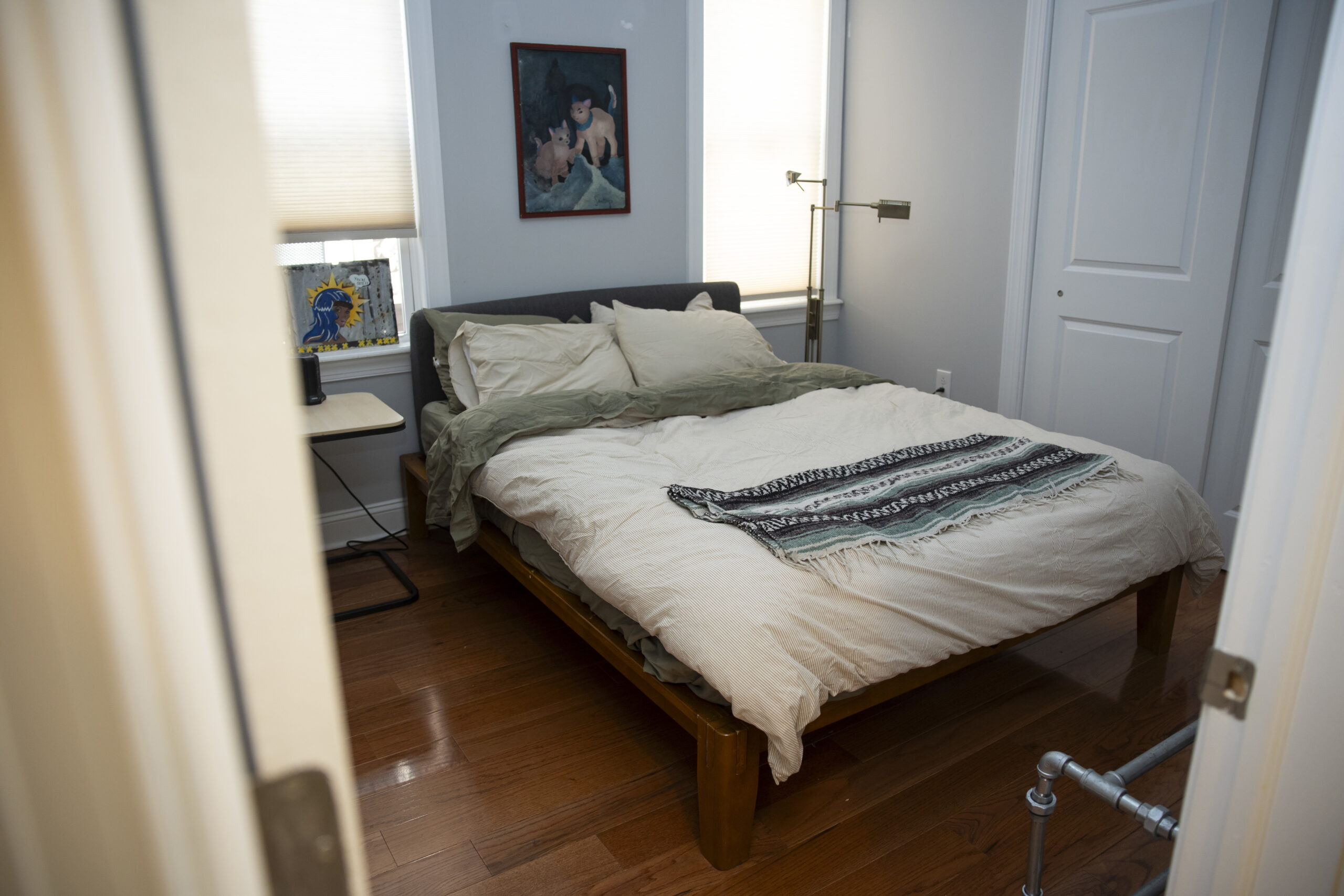
One of three bedrooms in Malcolm and Rhiannon Critcher’s home.
They both wanted to buy it right away, but worried they were being impulsive, so they decided to test the walk to the train. The couple doesn’t have a car and relies heavily on public transportation. It took less than five minutes. On the ride home, they realized they weren’t interested in delaying for the sake of process. “If you find the perfect thing early on, it’s still the perfect thing,” Critcher said.
Having previouslybought and sold three houses, Critcher had the confidence to move quickly. “I know what I’m looking for and what I want,” he said. They called their agent and made an offer that afternoon.
The appeal: The layout was the first draw. The open first floor flowed naturally from the living room to the kitchen, making it feel larger than its footprint. Then there was the renovation. Unlike the gray-floored, hastily flipped houses they had seen elsewhere, this one felt considered, as if the sellers had remodeled it for themselves, not for resale. They liked the finishes, the flow, and little design choices like the kitchen backsplash. “My wife walked into the kitchen and was just like, ‘Wow, this is my favorite kitchen I’ve ever been in,’” Critcher said.
The couple wanted a kitchen that would be great for hosting.
For him, the basement stole the show. It was finished, spacious, and didn’t require him to duck.
The deal: The house was listed at $425,000 — the very top of the couple’s budget. It had been on the market for justone day when they saw it. They decided to offer $25,000 below the asking price, but they promised to take it as-is, as long as the inspection didn’t reveal anything concerning. The sellers agreed to the terms but requested $410,000, which the couple agreed to.
Light pours in from multiple sides of the Cratchers’ semi-detached twin.
The inspection came back spotless. The appliances had all been replaced in 2018. The sewer line had recently been redone. There were no structural issues. “Literally the most perfect housing inspection possible,” Critcher said.
The money: All told, Critcher and his wife brought a little over $100,000 to closing. Most came from the sale of their previous home in Tucson. They bought that house in early 2020 for $179,000 and sold it in 2024 for $300,000. The proceeds went straight into a high-yield savings account and remained untouched until the couple was ready to buy again.
The couple’s dog, Pablo, likes to hang out in the second bedroom.
The down payment on their new house came in just under 20% — about $82,000 — and closing costs were $26,000.
For Critcher, the exact breakdown mattered less than the total. He approached the purchase with a fixed pot of money and trusted their lender and agent to structure the details responsibly.
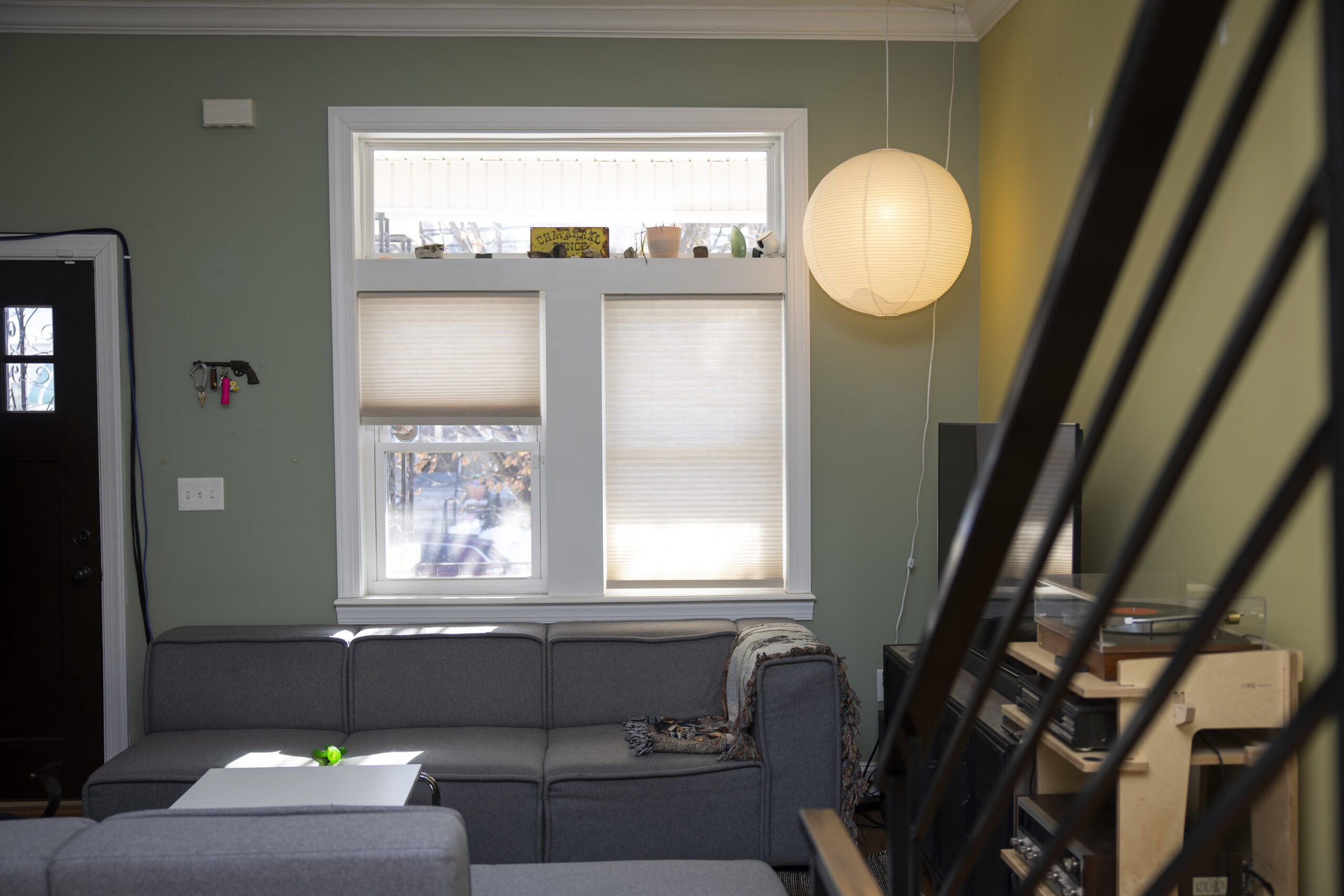
The couple loved the open floor plan on the first floor.
The move: The couple closed in mid-December 2024 while they were out of town. A notary in Arizona helped them file the necessary paperwork. The move itself happened in mid-January. Compared to moving across the country a year earlier, moving from Center City to West Philly wasn’t too bad. They hired movers to load a U-Haul from their sixth-floor apartment, then unloaded it themselves at the new house. Packing took about a week. The move took two days. Unpacking stretched on for a month.
Any reservations? Critcher wouldn’t recommend their approach to first-time homebuyers. “It was very impulsive,” he said. “But we both just fell deeply in love with it.”
Life after close: They’ve kept things simple since moving in. They haven’t undertaken any major renovations or upgrades. “We’re just kind of floating,” Critcher said.
OCEAN CITY, N.J. — Marie Crawford was immediately charmed in 2021 when she and her soon-to-be-surfer husband Rich moved into their historic house in the literal shadow of Gillian’s Wonderland Pier.
They’d come from Blue Bell, Pa., to live year-round by the ocean, and landed with an amusement park right up the street.
“The ball drop, that was what we heard from my house,” she said, referring to the 130-foot-high Drop Tower ride. “It was, ‘Ah, ah, ahhhhhhhh,‘” she said, imitating the screams she would sometimes hear.
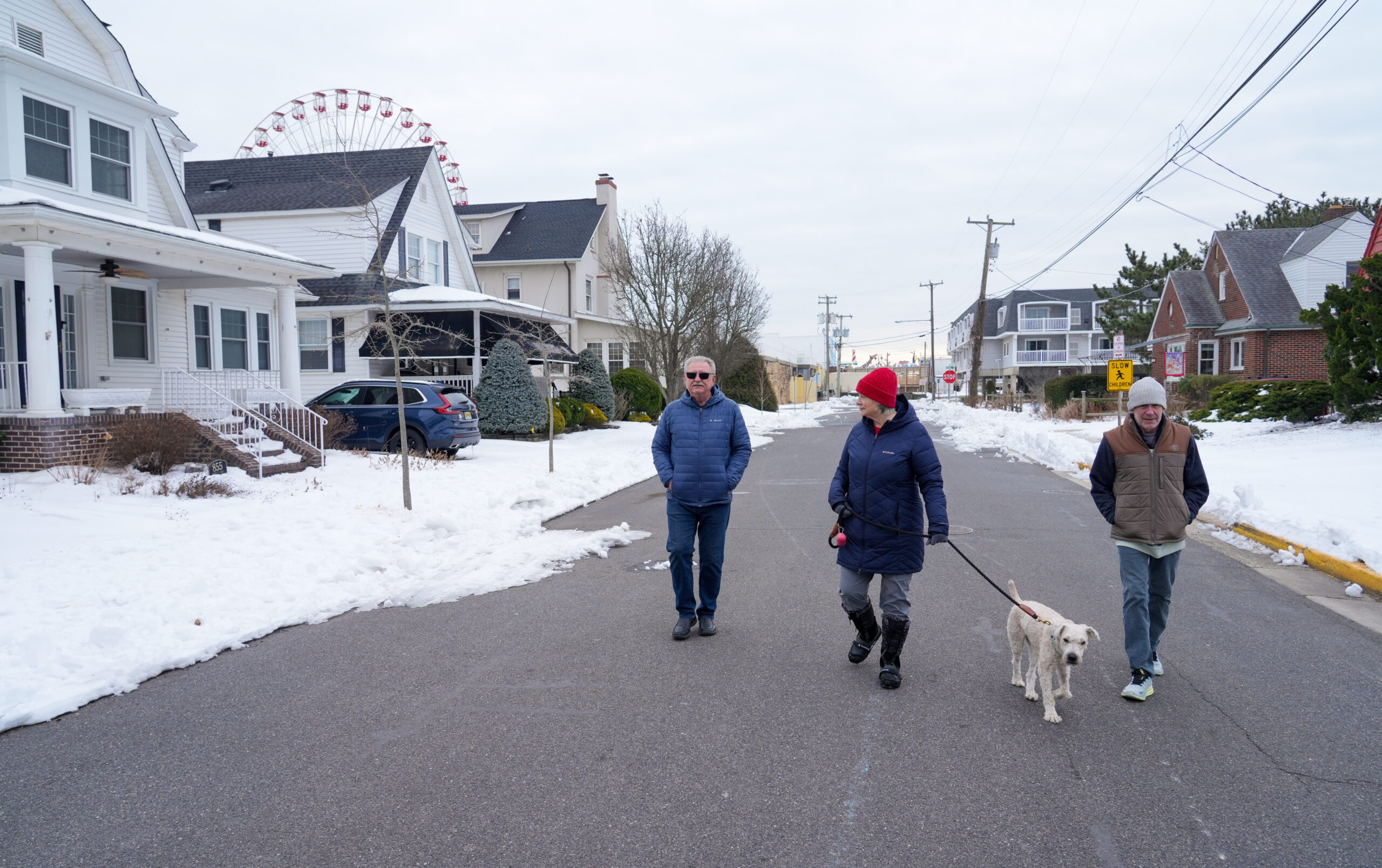
Jack Gutenkunst, left, Marie Crawford and her husband Richard with Shiloh, a 9-year-old soft coated wheaten terrier, walk along Plaza Place, in Ocean City, Tuesday, Feb. 3, 2026.
“It was so beautiful and romantic. On our porches, we would hear the ocean, not the amusement park. There were families, babies in strollers, coming up the street, flowing up to Wonderland. We were kind of ambassadors.”
Now, more than a year after the closing of Gillian’s, the residents are faced with the possibility of a seven-story hotel they fear will block their sun, bring traffic to their streets, and threaten the small-town charm they found in their little pocket of Ocean City.
“It’s just another example of maximizing, pushing,” said Rich Crawford, Marie’s husband, who programs music for his family’s Christian radio station, WDAC, located in Lancaster, Pa. In his 60s, Rich fell in with Ocean City’s surfing crowd and unexpectedly grew to love his little community.
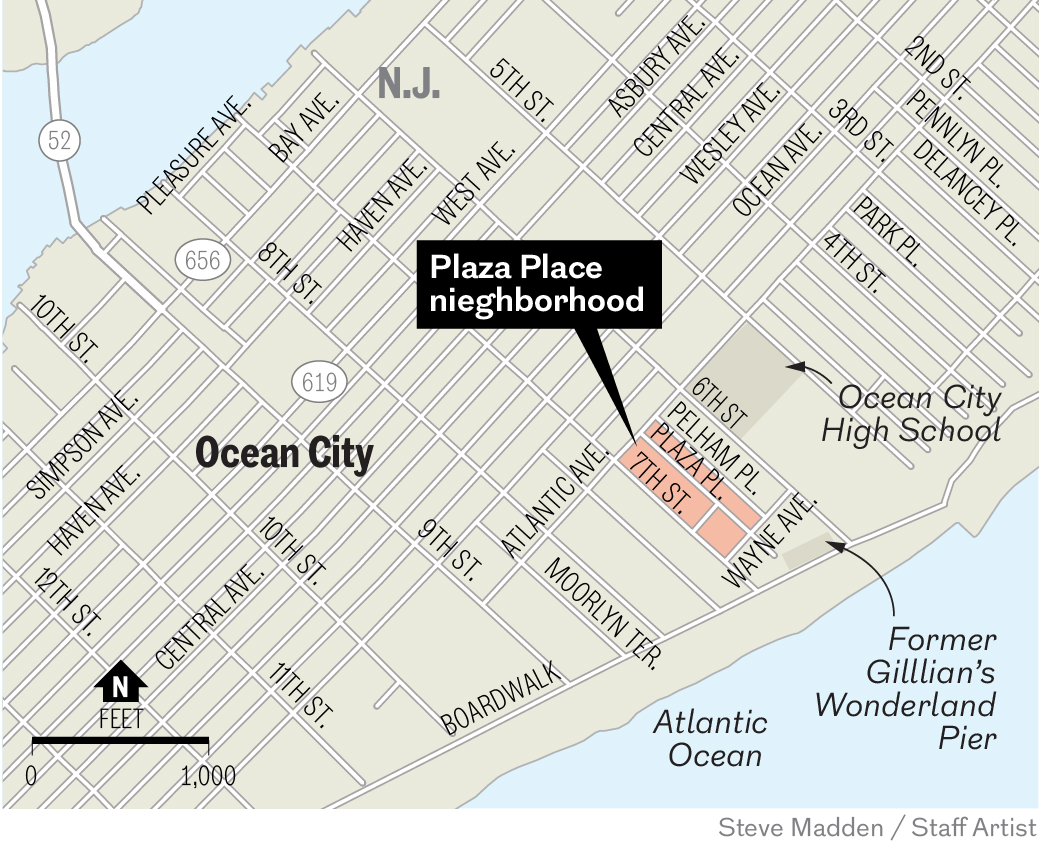
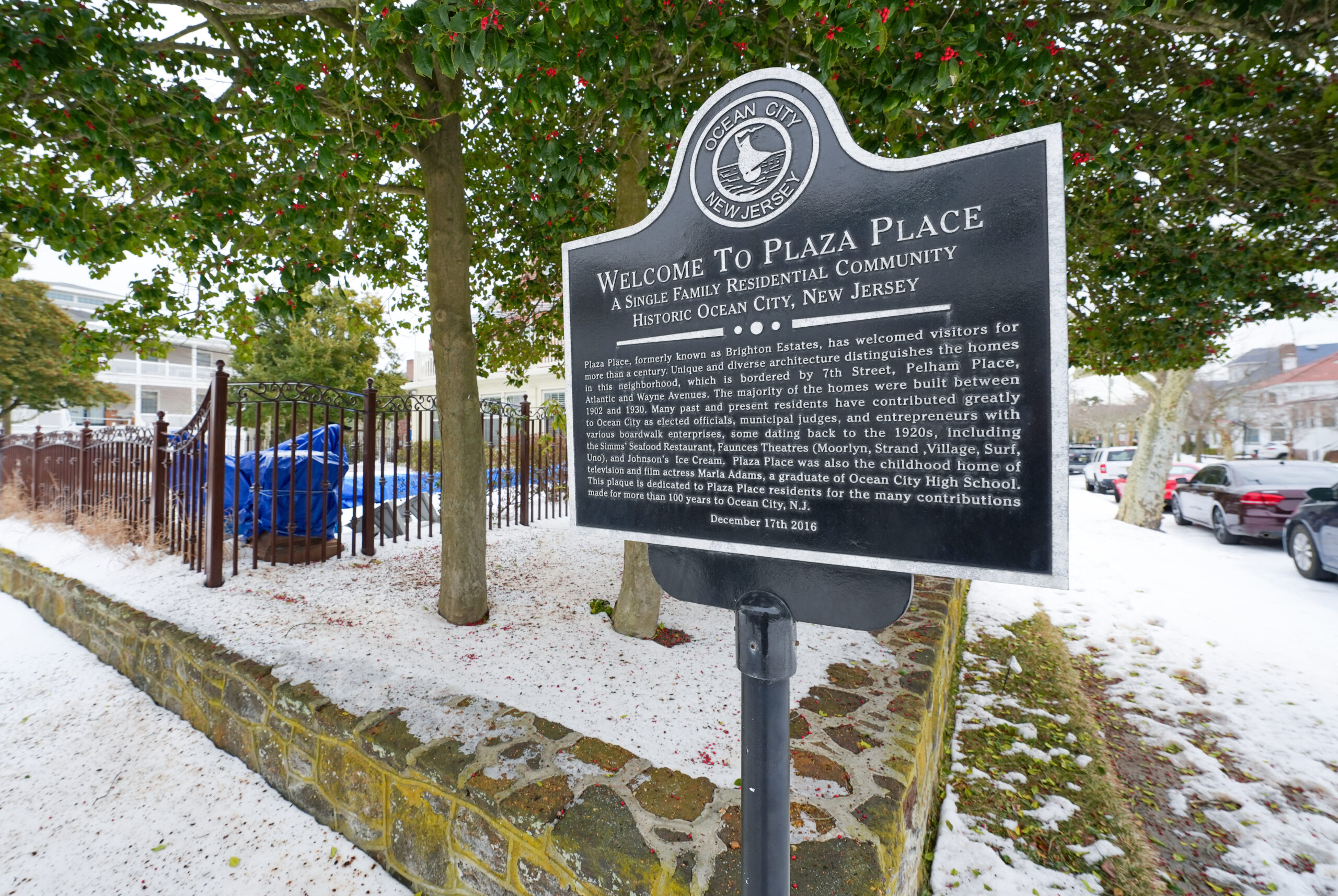
The Crawfords’ neighborhood of 100-year-old homes and 153 trees is called Plaza Place, which is one block each of Pelham Place, Plaza Place, and the north side of Seventh Street, between Wayne Avenue and Atlantic.
Across Wayne Avenue, toward the ocean, was Wonderland. On a clear day, a red ball of sun creeps up above the boardwalk and peeks into their little neighborhood.
On Pelham Place, residents each also own a two-foot- wide stretch of land across the street from their houses, a quirk of their deeds originally designed to prevent the rooming houses on Plaza Place that backed up against Pelham Place from using Pelham as an alleyway for their trash. There are dedicated gardeners on the streets who turn those strips into showpieces.
The sun sets behind the Ferris wheel on the final day for the beloved Wonderland Pier in Ocean City Sunday, Oct. 13, 2024.
Neighbor Barb Doctorman, whose family owns the Islander store on the boardwalk, said she used to take her children up on the Ferris wheel and peer down at their neighborhood. So lush, it looked like a forest, she said.
“I looked up the impact of a high-rise,” said Doctorman. “We’re going to lose some sun. The airflow is going to be totally changed from what it was. There’s a heat radiant that comes off it.”
Her husband, Doc, said: “We want something up there, but we know there could be more of a draw to that boardwalk than just the hotel.”
Marie Crawford (left) holds the leash of Shiloh, a 9-year-old soft-coated wheaten terrier, while standing with her husband Richard (center) and neighbor Jack Gutenkunst at the end of Pelham Place in Ocean City.
The land is owned by developer Eustace Mita, who has proposed Icona in Wonderland, a 252-room hotel that would preserve the Ferris wheel, carousel, and some kiddie rides.
So far, the city has not declared the site in need of rehabilitation, as Mita has requested, or otherwise moved to rezone the area to allow a hotel.
Merchants have begged the city to allow the hotel, and described how their businesses have suffered since the closure of Wonderland. Some residents have clung to the idea that an amusement park can return, though those numbers are dwindling.
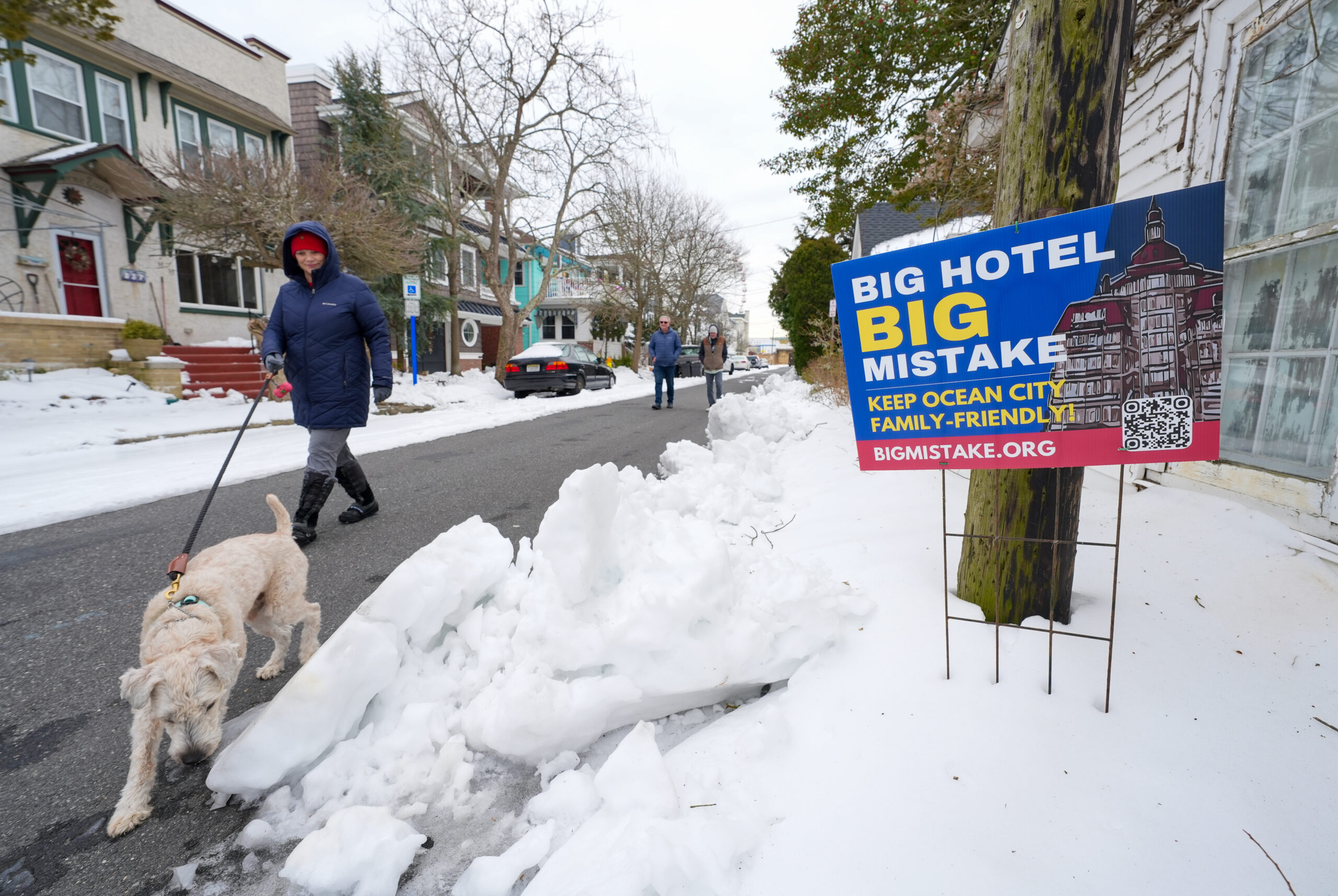
Marie Crawford, her husband Richard, right, along with Shiloh, a 9-year-old soft coated wheaten terrier, and their neighbor Jack Gutenkunst, walk past a sign against the development of a hotel at the site of the old Wonderland Pier on the boardwalk in Ocean City, Tuesday, Feb. 3, 2026.
In Plaza Place, the opposition is less sentimental, more practical. They fear traffic, and the shadow from a neighboring seven-story hotel. Like residents in other towns who fought dunes, they fear the loss of the ocean breeze, or a shift in wind patterns that will affect surfing at the popular Seventh Street Beach.
“It’s got that old feel to it, and everybody’s house is different,” said Marie Crawford, who bought her Craftsman Colonial on the north side of Pelham for $905,000 in 2021. She estimates it’s worth $2.5 million now. There are about 60 homes in the Plaza Place civic association.
The association is one of several groups that are prepared to go to court if the city tries to change the zoning to allow a hotel, without going through a thorough master plan process, said Jack Gutenkunst, the Plaza Place Association president.
While Wonderland brought thousands of people on a summer night, the pier itself had no parking. So people parked elsewhere and excitedly walked through their neighborhood on their way to the rides. People on their porches called out, “Have a blessed evening,” and chatted the night away, said Crawford. The hotel proposal calls for parking underneath the structure.
A sign stands near the historic neighborhood behind the old site of the Wonderland Pier in Ocean City, Tuesday, Feb. 3, 2026. Residents are against the development of a hotel at the boardwalk site.
Crawford stressed that it’s not a case of selfish NIMBY, Not In My Backyard. Despite Ocean City’s decades-old pattern of replacing single-family homes with duplexes, there are nearly 1,400 homes over 100 years old still left in Ocean City, said Bill Merritt, president of Friends of OCNJ History & Culture.
Being a block from the boardwalk, and living in a beach town, does not mean the neighborhood’s purpose is primarily hospitality, said Crawford. Its distinct, increasingly rare Jersey Shore character deserves to be valued, she said.
“It’s height. It’s chaos. It’s the change in culture,” she said, when asked what specifically worries her about the hotel. “It’s a transient population coming through here for three nights at a time. That’s in the hospitality district. We are not the hospitality district.”
The neighborhood behind the old Wonderland Pier site on the boardwalk in Ocean City, Tuesday, Feb. 3, 2026. Residents are against the development of a hotel at the boardwalk site.
The demolish-and-rebuild mania that took over a lot of the rest of the island has mostly left Plaza Place alone, though residents acknowledge that is also a threat to their way of life. They also fear a hotel will prompt Plaza Placeans to sell.
“It’s a Norman Rockwell painting, it just is,” Councilman Keith Hartzell says in the documentaryPlaza Place: The Enigmatic Street, a locally made short film about the neighborhood. “It’s right here in Ocean City, and you kind of don’t expect it, when there’s two streets away a bunch of duplexes.”
Hartzell, who is running for mayor against incumbent Jay Gillian, the former owner of Wonderland who sold to Mita, says he hopes to negotiate with Mita over height, parking, and other issues before considering any kind of zoning allowance or rehabilitation designation. A city council-appointed subcommittee tasked with assessing the boardwalk’s usage as a whole is holding a public meeting at 10 a.m. on Feb. 7 at the city’s library.
The residents of Plaza Place worry about the survival of the hidden little neighborhood by the beach they fell in love with. “The neighborhood is so beautiful and so old,” said Marie Crawford. “If the hotel goes in, the dramatic change that will be for all of us with the traffic, the tone of the neighborhood — you’re going to see people sell. That threatens the neighborhood. The people won’t want to stay.”
When you walk into Koselig Nook, Aracelis Mullin wants you to feel a wave of calm. She intentionally designed the teahouse that way: From its welcoming furniture to its lighting, its green paint, its scents, it is meant to be a relaxing third space, a stopping point between work and home, where people can gather, craft, focus on wellness, or anything between. Don’t forget to take off your shoes. (Really. It’s a rule.)
Koselig Nook, a late-night teahouse, plans to open in Exton, at 333 E. Lincoln Highway, later this month. The business is relocating from Coatesville, where it opened in 2024, to be more central for customers within the county and traveling from Philly.
“The whole idea and the purpose is to bring the people out of their houses and to enjoy another place where they can network or just spend some time or talk,” Mullin said.
Named for the Norwegian term encompassing contentment and coziness, Koselig Nook’s seating is meant to be secure and comfortable — with plush, downy pillow seating and blankets, oils, and low lighting, inviting people to lounge.
So much of today’s gathering culture revolves around bars and drinking, Mullin said. Though sober options are opening in metropolitan areas, like Philadelphia, people in the county have fewer places — especially places open later, she said.
That’s the gap Koselig Nook seeks to fill, she said.
“I think there’s a big need for third places that are more calm; for introverted people, they can come and network, too, little by little, but they don’t have the pressure of society saying, ‘Hey, do you want to drink?’” she said.
Instead, customers can sit and study or work from 11 a.m. to 3 p.m. for $25 on Tuesdays through Fridays. Students spent a lot of time holed up in the Nook’s Coatesville location during finals week in December, Mullin said.
In the evenings, from 7 to 11 p.m. for $35 on Friday and Saturday, people can go somewhere that is not about drinking.
During various events offered week to week, people can come to workshops where they junk journal, cutting up pictures and pasting them into notebooks, or take a meditative break surrounded by gongs and chimes and singing bowls in a sound bath session, or spend time with a medium. You can pick up letters from a pen pal in another country or pen your own, facilitated through Koselig Nook. You can silently read your own book and then, in a formal discussion, chat about it with other readers, trading recommendations.
Some make events out of it. For one 24-year-old’s birthday, she and her friends journaled together, sipping their tea, and had a sound bath.
Others come alone and leave with connections: During a full moon ceremony, only two of the 15 women who came knew each other. By the end, “they all shared their phone numbers. … It was amazing,” Mullin said.
The business traces its lineage to when Mullin’s daughter, Victoria, was living in California in 2020. She frequented a teahouse where customers could reserve time and sit and enjoy themselves during the evening hours. After Mullin visited herself, she felt compelled to bring something similar to the East Coast. She picked the brains of the owners.
With her background — she ran a traveling tea party business for young girls and a birthday party business in Thorndale — Mullin embraced their model; her teahouse is reservation-only. There is unlimited tea, and a selection of premade snacks. Everything is provided without extra charge once you are in the Nook. Socks only.
“I wanted to have that community place where the people come and gather, regardless of what your politics and your religion, so we did it. I was scared to death,” she said.
She expected to have to go a bit more slowly in Chester County, for people to understand the business. But she was met with a lot of enthusiasm.
“The people are so in need of this that they love it,” she said.