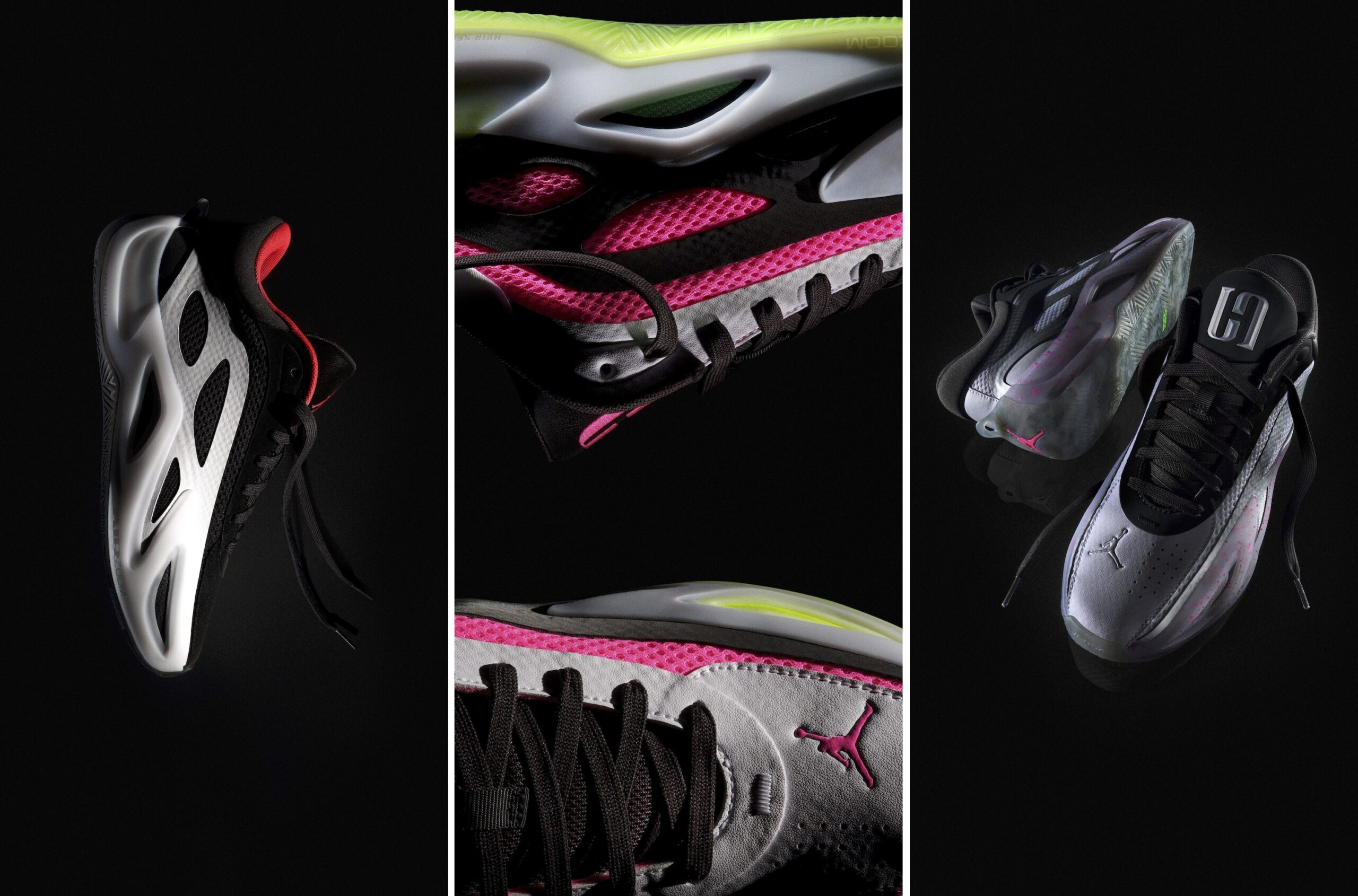
Philadelphia is ready to get its first taste of professional women’s basketball with Unrivaled hosting a doubleheader Friday at Xfinity Mobile Arena. In front of a sold-out crowd, the three-on-three tournament is set to have plenty of spectators for its first event outside the Miami area — making this the perfect time for Jordan Brand to debut its Heir Series 2 sneaker.
On Thursday, Jordan Brand unveiled the women’s basketball shoe with Minnesota Lynx forward Napheesa Collier as the face. The sneaker will make its on-court debut during Friday’s Unrivaled doubleheader in Philly with Jordan Brand athletes Dana Evans and Dominique Malonga.
The low silhouette is similar to the Heir Series 1, which is the lowest shoe in Jordan Brand’s basketball lineup. The sneaker was first introduced in 2024 and put emphasis on the running and cutting that’s central to women’s basketball.
Five-time WNBA All-Star Napheesa Collier wearing Jordan Brand’s Heir Series 2 sneaker.
While the Heir Series 2 continues to share the same focus as its predecessor, it adds key improvements to enable more quickness in every step.
“With my footwork being an important part of my game, the Heir Series 2 is a performance shoe that provides the flexibility and stability for me to be a force on both ends of the floor,” said five-time WNBA All-Star Collier in a press release. “Everyone who follows my game knows I was a fan of the Heir Series, but the innovation in the Heir Series 2 has exceeded my expectations.”
Some of its new features include a forefoot Air Zoom unit to provide standout responsiveness for speed, a thicker drop-in Cushlon 3.0 midsole that is wrapped in an additional layer of foam cushioning above the outsole for more comfort, a translucent TPU cage, and a rubber herringbone traction pattern for greater quickness and control.
The sneaker also includes a removable hair tie attached to the heel and features a series of bold colorways — including a pink, yellow, and green colorway, a white, black, and red colorway, and a gray and black colorway that includes speckled pink paint along the midsole.
The Jordan Heir Series 2 comes in three different colorways.
“Women’s basketball has a very important place in the sports landscape, and Jordan Brand is committed to helping the next generation of hoopers reach their greatness. We titled this series of footwear ‘Heir’ knowing that these amazing athletes are next up — here to claim the basketball throne as their own,” said Leo Chang, the senior creative director of Jordan Brand basketball and sport, in a press release.
“The Heir Series 2 is the next iteration of the basketball sneaker designed for her, by her. The new forefoot Air Zoom unit enables even more support and responsiveness, tailored to the beautiful playing style of the women’s game.”
The sneaker will be available globally on Feb. 20 at jordan.com and select retail locations.
The rollout of so-called virtual nurses in hospitals remains a mixed bag, University of Pennsylvania researchers have found in the largest survey to date on nursing care delivered remotely through a screen.
One hospital staffer said virtual nurses are a huge help getting patients checked in.
Another said they worry hospitals are trying to cut corners by keeping floors fully staffed by using virtual nurses.
And sometimes, patients think the virtual nurse is a television advertisement and try to press fast forward, researchers were told.
A new study out of University of Pennsylvania School of Nursing surveyed 880 registered nurses in 10 states, including Pennsylvania, about the virtual nursing programs that have sprung up at health systems across the country.
About half — 57% — of the nurses surveyed said virtual nurse programs did not reduce their workload, with some saying they felt virtual nurses created more work.
But similar numbers also said they thought virtual nurse programs improved the quality of care patients received.
Others said they didn’t think the technology had any impact — positive or negative — on quality of care, according to a study of results published online in December in JAMA Open Network.
“It can be beneficial or a headache,” one nurse interviewed by Penn researchers summed up.
Virtual nursing programs became more widespread during the COVID-19 pandemic, when health systems needed to limit physical interaction to protect patients and medical staff, and have continued to expand in Philadelphia and across the country. Administrators embracing technology and artificial intelligence say they can help streamline administrative responsibilities that can burden staff, provide extra patient oversight, and improve how quickly clinicians can respond to emergencies.
Local examples include Penn Medicine’s use of virtual nurses to monitor patients at risk of falling or pulling out tubes and wires. Jefferson Health assigns a virtual nurse to patients who doctors have decided need to be monitored around the clock.
And virtual nurses handle administrative work, like reviewing medications and giving discharge instructions at Virtua Health hospitals in New Jersey.
The new study from Penn is among the largest to date to evaluate how well the programs are meeting goals, and the mixed results should be a warning to hospital administrators to proceed cautiously, researchers say.
“Virtual nursing programs have been heralded as an innovative silver bullet to hospitals’ nurse staffing challenges, but our findings show that most bedside nurses are not experiencing major benefits,” said lead author K. Jane Muir, an assistant professor of nursing in the university’s Department of Family and Community Health.
Virtual nursing on the rise
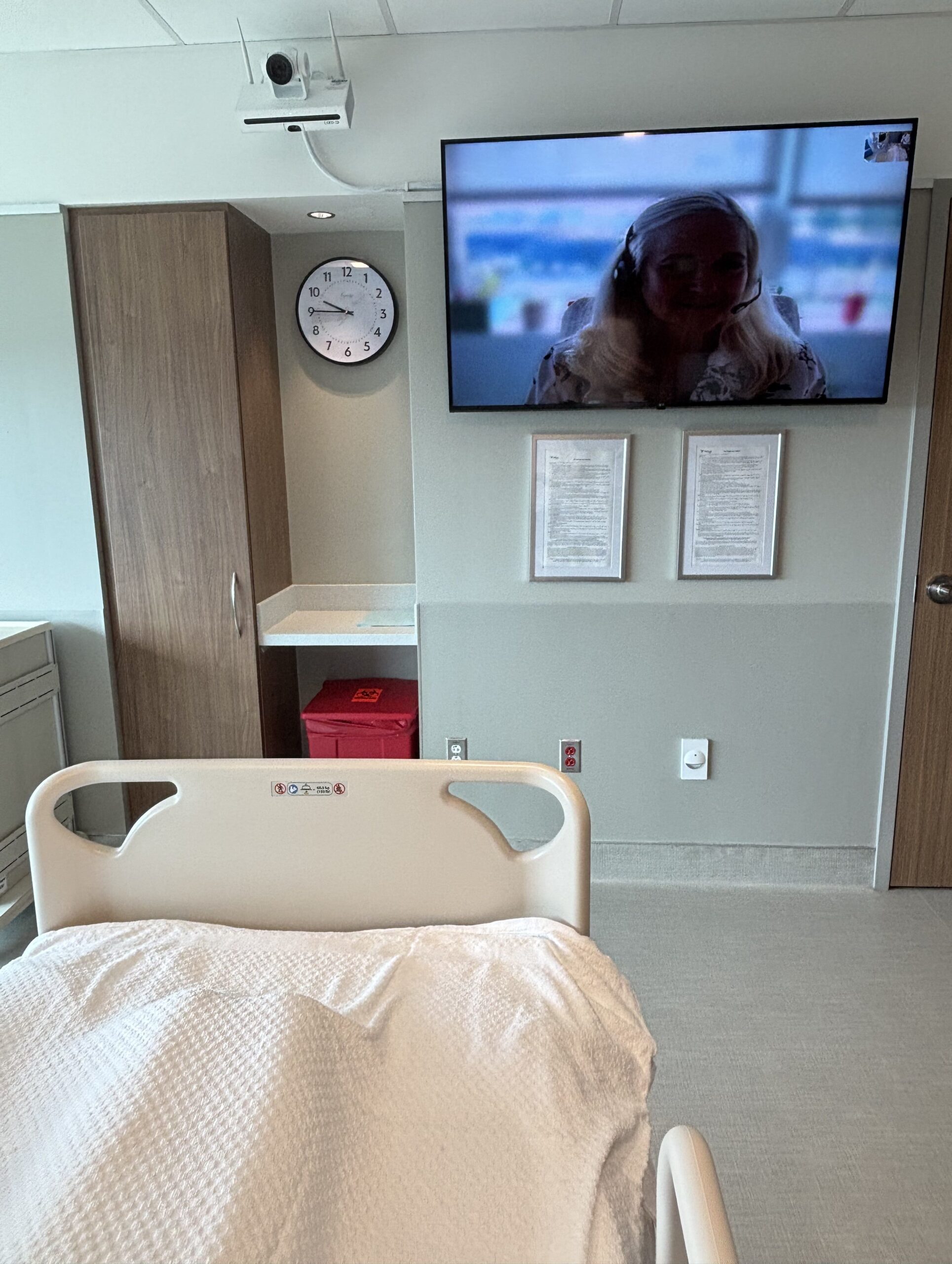
Virtual nurses at Virtua Health appear on the television in a patient’s room.
Virtual nursing refers to patient-care responsibilities managed by a team of nurses stationed at a remote hub, where they monitor screens and electronic information feeds.
They are not intended to replace bedside care, but rather to serve as an extra set of eyes to monitor patients.
If a patient who is known to be unsteady on their feet moves as if to get up from bed, a virtual nurse could speak through a screen or sound system asking if they need something and call a nurse on the floor to help them. If the patient falls, a virtual nurse can quickly alert medical staff.
Virtua Health officially launched its program last year.
Virtual nurses make sure patients have the appropriate medications before going home, know their discharge instructions, and have a follow-up appointment scheduled. They work in partnership with the bedside nurse, who focuses on the physical tasks in caring for a patient, while the virtual nurse handles the majority of the discussion.
“It’s something that our patients are requesting and they’ve come to expect,” said Kristin Bloom, a nurse by training who serves as assistant vice president of clinical operations for Virtua’s Hospital at Home program.
Virtua also uses virtual nurses in its intensive care units to help monitor and identify early signs of deterioration. These nurses have access to bedside cameras and can view the patient’s heart rhythms, lab results, and vital signs.
Participants in the Penn survey, conducted in late 2023 and early 2024, did not include nurses working in New Jersey, where Virtua’s hospitals are based.
Virtual nursing challenges
Nurses surveyed by Penn’s researchers said they appreciated the extra set of eyes on patients, but not all were convinced that the virtual monitor was any more effective than bed alerts that can sound when they sense a patient leaving, according to the study.
Karen Lasater, an associate professor of nursing and co-author of the study, urged health systems to include in-hospital nurses when shaping their virtual care programs.
She said including bedside nurses in the conversation about what’s working and not working is “imperative.”
“It’s important that nurses have a seat at the table,” Lasater said.
Nurses surveyed also expressed concern that health systems were using virtual workers to avoid hiring more on-site staff.
Bedside nurses questioned why they were being asked to take on more responsibility because administrators said they couldn’t afford to hire more staff, yet still found funding to build virtual programs.
“They felt like investments in virtual nursing was a workaround,” Lasater said. “Why did they have money to invest in virtual nurses who couldn’t do all the work of the bedside nurses, but couldn’t invest in more bedside nurses?”
At Virtua, administrators have turned to veteran bedside nurses to staff their virtual nursing program.
“It’s an avenue to retain our experienced nursing staff,” Bloom said.
Philadelphia-area hospitals have seen some virtual nursing challenges. In 2024, for instance, Jefferson Abington Hospital was cited by the Pennsylvania Department of Health after inspectors said the power cords attached to the monitors for virtual nursing created a strangulation risk for behavioral health patients.
The hospital treated the incident as a learning experience, adjusting how the mobile monitors are used.
The technology can also be confusing for some patients, who may not grasp the concept of a virtual nurse or may get conflicting instructions from their virtual and bedside nurses, Lasater said.
Penn initially planned to use virtual nurses to help monitor behavioral health patients, who often require one-on-one monitoring around the clock.
But staff found that patients who were experiencing behavioral or mental health challenges were too often confused or unsettled by virtual nurses, and unable to follow their instructions, Bill Hanson, Penn’s chief medical information officer, told The Inquirer in 2024.
“We’re all learning as we go,” he said at the time.
FRISCO, Texas — Four days after a heartbreaking College Football Playoff national championship game loss, Levittown native David Blay was back in football pads.
Last week, Blay, whose five-year career spanned three schools and two levels of college football, practiced against some of the other draft-eligible prospects at the East-West Shrine Bowl.
His college career began locally at Division II West Chester, where he spent two years, then spanned two years at Louisiana Tech before he finished this past season with national runner-up Miami. Blay, a defensive lineman, played 22 snaps against Indiana in the College Football Playoff title game and finished with one tackle in the 27-21 loss.
Blay, a graduate of Harry S. Truman High School, gained a unique perspective in all three stops along the way, which included two years (his first at West Chester and first at Louisiana Tech) when he didn’t see the field much.
“For West Chester, time management, the process of doing things at certain times [at] the correct time, and doing the correct things,” Blay said about what he learned.
“And then for [Louisiana] Tech, they taught me the brotherhood aspect, because when I transferred into Louisiana Tech, about six or seven defensive linemen alone transferred in there at the same time. So it was like everybody had the same vision, the same goal. So it was easy to play against somebody I can call my brother.
“[With Miami], having camaraderie with the team wasn’t that hard. They’re outgoing guys, so bringing me in wasn’t that hard. Me, I’m more of — I guess you could say a quiet guy.”
Miami and David Blay (11, at rear left) got past Jeremiah Smith (4) and Ohio State in the CFP quarterfinals on their way to an appearance in the title game.
At Miami, snaps weren’t easy to come by for Blay, with potential first-round NFL draft picks Rueben Bain and Akheem Mesidor manning the edge rusher positions and Ahmad Moten and Justin Scott starting in the interior.
Blay was on the field with Miami’s defense on 412 plays, according to Pro Football Focus. He played 443 defensive snaps in one fewer game in 2024 for Louisiana Tech.
But Blay, who amassed 95 tackles (23½ for losses) and 11½ sacks in four seasons at Louisiana Tech and West Chester, carved out a consistent rotational role on Miami’s D-line during a playoff run that Blay “will remember for the rest of my life.”
The 6-foot-2 and 302-pound lineman credits his discipline for refining his skills, which helped get him on the field at the Power Four level.
“In terms of getting on the field and playing, I just really had to be real technically sound,” said Blay, who had 28 tackles (2½ for losses) in 13 games with Miami. “Like I feel as if going to Miami, the big thing there was [to be] technical, technical, technical. That’s the difference between the levels in my head.”
Blay was joined by Indiana safety Louis Moore and Miami linebacker Wesley Bissainthe as players who appeared in the national championship game and also practiced at least one day at the Shrine Bowl. Indiana tight end Riley Nowakowski also traveled to Frisco to interview with NFL teams but did not practice.
Throughout his practice sessions at the Shrine Bowl, which wrapped up with the game on Tuesday night — the West won, 21-17, on a touchdown with 6 seconds left — Blay showed his strength capable of pushing the pocket as a pass rusher and standing his ground as a run defender against double-team blocks.
“I give those guys a lot of credit,” Shrine Bowl director Eric Galko said. “And Wesley [Bissainthe] and David [Blay] are coming in like everyone else, they’re banged up, but they just played 16 games, right? Not 12, like other guys have.
“And David’s done great, in the practice he had and in the interviews he has had, too. … I think David showed a lot of character — especially with the way the season ended, not on a victory, but on a loss — and he still said, ‘You know what? Now I’m on [to] the NFL.’ And to be focused here, I give the guy a lot of credit.”
Added Blay: “Just the aspect that we’re getting better every day [motivates me]. You’re never at your best; in a sense you can always get better. And I also say to my mom, I’m trying to get her to understand the aspects of the game and how it could change your life.”
Blay played his high school and the beginning of his college career about 30 miles from Lincoln Financial Field. An opportunity to play for his hometown Eagles would be “a dream scenario.”
“Being around the crib, I could go work out, go practice, go do my job, and then essentially come home to the people I’ve seen my whole entire life,” Blay said.
Another weekend snow chance and more cold are in the forecasts. But the big difference between last week and this one in the Philadelphia region is a matter of degrees — about 10 of them.
A coastal “bomb cyclone” could form during the weekend with significant impacts, at least at the Shore. Computers were still sorting out what effects, if any, it would have in Philly. On Thursday, however, they favored snow staying to the south and east, with only a 40% chance they got to I-95.
In the meantime the cold will be epical by Philly standards.
If the forecast holds, in addition to coming close to ending a 32-year zero-less streak, Philadelphia would have daily minimums of 5 degrees Fahrenheit or lower on the next two mornings.
And it appears the city will have its first nine-day stretch in which the temperature failed to reach 30 degrees since 1979, based on analysis of temperature data from the Pennsylvania state climatologist.
In issuing a cold weather advisory for wind chills as low as 10 below zero, the National Weather Service in Mount Holly noted that “it is exceedingly rare to get this combination of length and magnitude of an arctic airmass for this area.”
Heading into the weekend, that subtly laminated lunar landscape with the one-horse-open-sleigh look in the fields and parks is almost certain to persist while bedeviling road-clearing efforts.
Some snow is possible late Saturday or Sunday — and this is becoming a habit — in time for the rising of the full “Snow Moon,” which may be a problem for the Jersey Shore. The full moon will likely contribute to tidal flooding.
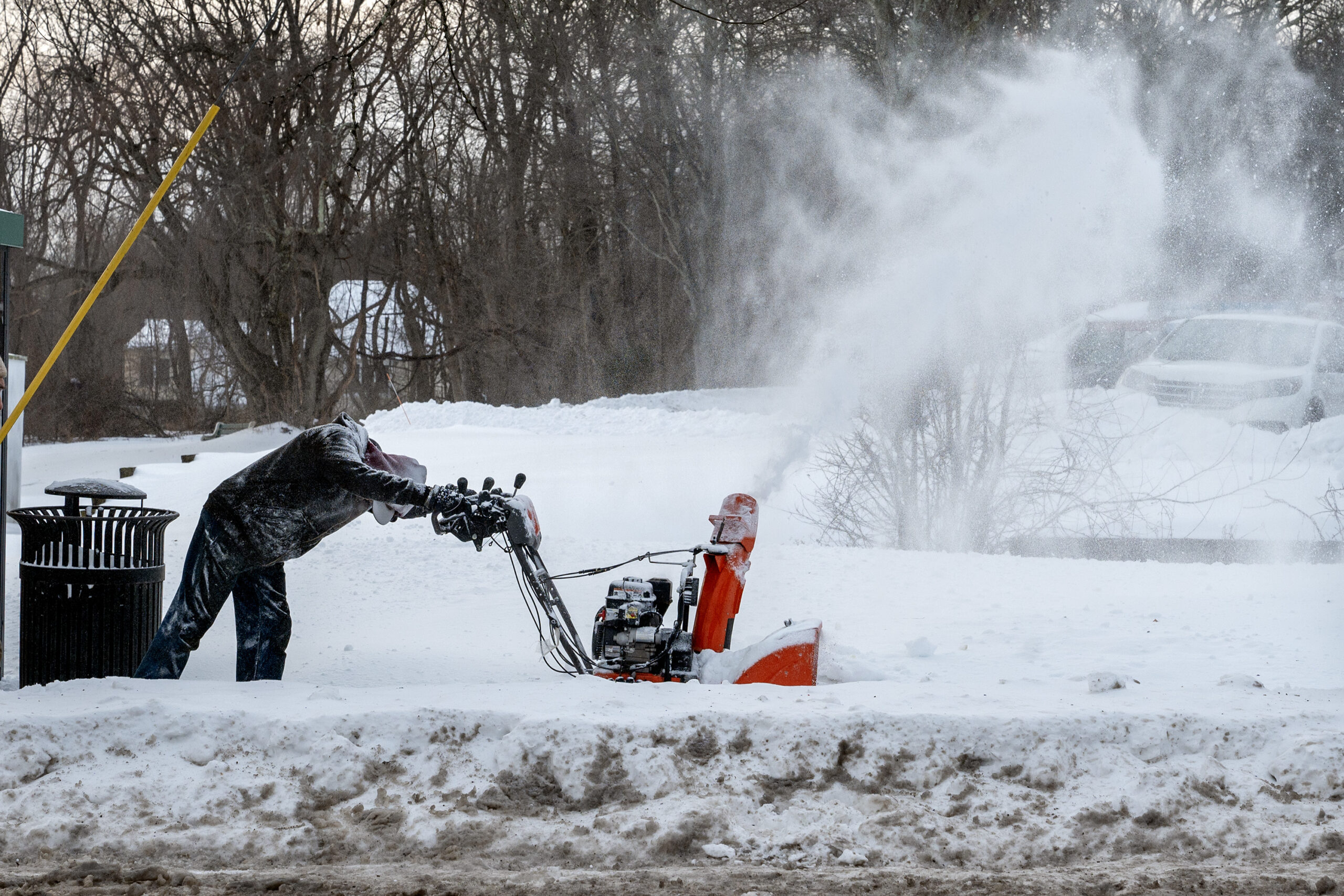
Snow removal contractor Jordan Harlow clears the sidewalk in front of an apartment building on Main Street in Doylestown Wednesday, Jan. 28, 2026, following Sunday’s snowstorm. He said the layer of ice made it twice as difficult to use the snow blower.
The snow outlook for the weekend
On Wednesday only two things were certain about the latest threat: A major coastal storm is going to blow up during the weekend, and it’s not going to rain.
“Everything looks like it’s going to come together,” said Paul Pastelok, the long-range forecaster for AccuWeather Inc.
AccuWeather said it may intensify enough to qualify as a “bomb cyclone.”
An early consensus among computer models was that the storm would stay too far offshore to generate a major snowfall in the immediate Philly area. Pastelok said it was looking for Philly to get “sideswiped” with a 1- to 3-inch event. However, that was very much subject to change.
The weather service would not be making a first guess at potential accumulations until Thursday afternoon, said Alex Staarmann, a National Weather Service meteorologist in Mount Holly. In its forecast discussion Wednesday, it said that based on a consensus of the models, the Shore had a 35% to 50% chance of 6 inches of snow or more, with a 20% chance along I-95.
More certain was the potential coastal flooding threat at the Shore with potent onshore winds coinciding with Sunday’s full moon.
And while it may seem the atmosphere enjoys ruining weekends, it’s not uncommon for weather systems to fall into 3½- and seven-day cycles. That has to do with the spacing between weather systems, meteorologists say.
Regardless of what happens during the weekend, the region is going to begin the workweek with snow on the ground.
The snow is going to have more staying power than the average computer-model snow forecast.
It’s not going to get a whole lot warmer anytime soon
Even though it’s ice cold, as if developing a slow leak, the depth of the snow pack is actually decreasing, but ever so ponderously.
That 9.3 inches of snow and sleet that accumulated Sunday was down to 6 inches at Philadelphia International Airport on Wednesday morning, Staarmann said.
Compaction and sublimation, which is similar to evaporation, are lowering the depth, despite the cold. But Wednesday’s depth report was the same as Tuesday’s.
And after what does or doesn’t happen Sunday, temperatures are forecast to remain below freezing at least until Feb. 4.
No significant warm-up is in sight, and the National Oceanic and Atmospheric Administration’s Climate Prediction Center has odds strongly favoring below-normal temperatures until Feb. 11.
The upper-air pattern continues to favor cold pouring into the Northeast.
And more cold air is possible later in the month with a visit from the polar vortex, Pastelok said.
Average temperatures in Philly finished 3.6 degrees below normal in December, and despite a 10-day warm spell earlier in the month, January is projected to finish at least 2 degrees below long-term averages.
Bradley Carnell can be pretty reserved in public. It’s not that he doesn’t like being on camera, but you aren’t always going to get too much from him in a news conference.
At the United Soccer Coaches convention a few weeks ago, the Union’s manager got a different opportunity. It was his first time at the longstanding event, and he spent an hour on stage talking about his coaching methods.
Carnell’s journey has taken him a lot of places. The Johannesburg, South Africa, native turned pro at age 16 in his home country, then at 21 moved to the first of four clubs he played for in Germany. He played 40 times for the Bafana Bafana, including at the World Cup in 2002.
After hanging up his cleats in 2011, Carnell started his coaching career at the University of Johannesburg. From there, he had two assistant jobs with South African pro clubs, then moved to the U.S. in 2017 to join the New York Red Bulls’ staff. He’s been in this country ever since, and the Union are his third coaching stop in MLS.
Bradley Carnell (left) playing for South Africa against Paraguay in the 2002 World Cup.
What has stayed constant over the years? One thing is how he sees the sport.
“Überzeugungstäter,” he said, a word learned while living in Germany. “A perpetrator. I’m a criminal of the game model that I’m presenting today.”
This produced some amused looks, and not just because of the multiple languages involved. Carnell was not surprised.
“I believe in it so much, and this is who I am,” he said. “Not because I’ve learned the game that way. It’s just because I live my life in a certain way.”
Bradley Carnell giving instructions to his players during a game last year.
You can get that sense at an average Union practice, where Carnell, 49, often is right in the middle of the fray.
“When setting up a game model, one, it’s based on previous experiences of your playing days: caching influences, but also DNA, how I live my life every single day,” he said. “Fast, energetic, proactive, on the front foot — these are all terms that are coming to life now because it’s just who I am. If I’m playing Monopoly with my family, I’m trying to win the game in the quickest way possible.”
The manager who had the most influence on Carnell was Ralf Rangnick, who coached the young left back at German club VfB Stuttgart from 1999 to 2001. Ragnick is known as one of the founding fathers of “gegenpressing,” the high-octane tactics that spread all over Germany and eventually worldwide.
Those ideas have stayed in Carnell’s mind for a quarter of a century.
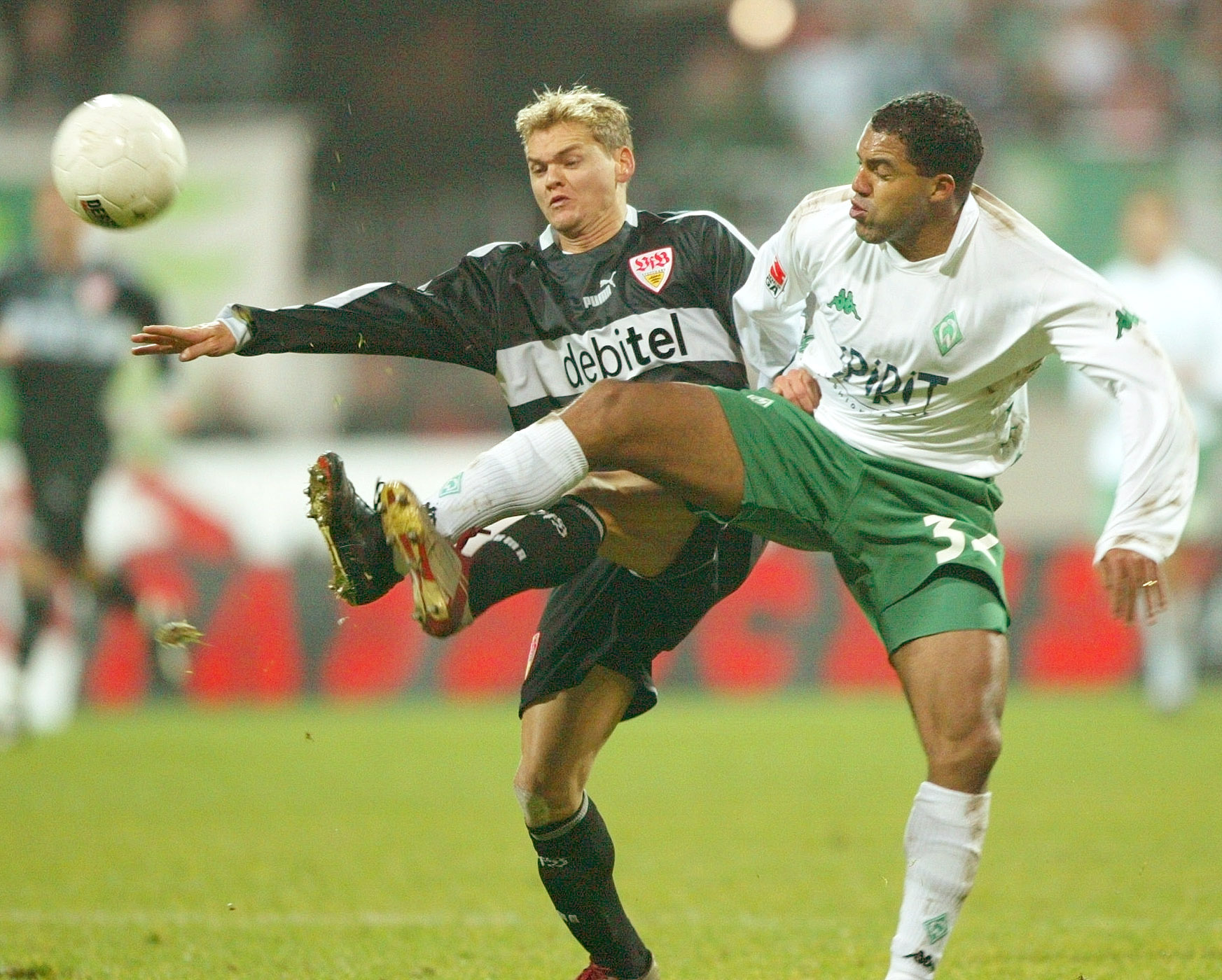
Bradley Carnell (left) during his playing days with German club VfB Stuttgart in 2002.
Inside the playbook
Carnell put up a slide that laid out four principles: “Hunting” to gain possession high up the field; “swarming” to regain the ball after losing it; “striking” to try to get to the opponent’s goal within 10 seconds; and “waves” of attacking moves.
He talked a lot over the course of his session about the defensive side of things, especially “rest defense”: how the centerbacks position themselves when their teammates have the ball up the field.
He also took an interesting question from the audience about man-to-man vs. zone defending.
“I don’t mind going one-for-one at the back,” Carnell said. “It’s not man-marking. So if they cross over the center back axis, I’m not going to say to you, ‘Go with him and track him all over the field.’”
If this brought the term “matchup zone” to anyone’s mind, it hasn’t been used much in soccer. But if it ever was going to be, the city that produced John Chaney would be an appropriate place to start.
The Union won the Supporters’ Shield and reached the second round of the playoffs in Bradley Carnell’s first year at the helm.
But the most interesting stuff, as it is for Union fans, was what he said about attacking.
Quality on the ball is valued over time on the ball, a point Union fans have certainly learned by now. And Carnell laid out his “baseline” for how he wants his team to score: 60% in transition, 30% on set pieces, and 10% in possession.
“We can go quick — I say [with] quality on the ball, you can always get quicker,” Carnell said. “But if you try to go too quick, then there’s going to be turnovers. So, progressive quality over speed. We can always learn to get quicker in this transitional phase of the game.”
Last year, the Union scored around 50% of their goals in transition, 30% from set pieces, and 20% in possession. That wasn’t quite what Carnell had aimed for. How did he react?
“We don’t see it as a failure,” he said. “We just see it as an adaptation. To every team you inherit, or every team you go to in terms of me joining here a year ago at the Philadelphia Union, we see certain trends, character traits in players, in how we can get this effectiveness.”
Bruno Damiani with the finish and @PhilaUnion takes the lead in a rainy D.C. ⚡️
The Union ranked well in some stats he likes. They were second leaguewide in shots taken within 10 seconds of gaining possession, at 2.84 per 90 minutes. They were also second in percentage of first passes of a possession that went forward in transition, at 45.5%. And they had the fewest passes per shot sequence, at 2.3 per 90 minutes.
“Reactions quicker than the opponent can get themselves organized against,” Carnell said.
He put up some tactical graphics on his slides to illustrate the plays he wants. He also showed some videos of notable plays that the Union made last year, and they really made the point.
Carnell said “one of my favorite moments of last year” was a goal the Union scored on May 30 at Montreal: a counterattacking dash that covered almost the entire field in 12 seconds in just the second minute of the game.
What a strike! Indiana Vassilev gives @PhilaUnion the early lead on the road!
Another goal Carnell liked came on April 19 at home against Atlanta. The visitors had the ball, but only briefly: Kai Wagner and Jovan Lukić teamed up to jam Brooks Lennon just short of the midfield line.
Danley Jean Jacques was nearby, and started dashing upfield. Three passes in eight seconds later, he had his first goal in a Union jersey.
“In our game model we’re saying, ‘Go put out the fire,’” Carnell said. “’Go win the ball as high as you can. Be brave. Be brave and hunt in numbers.”
St. Joseph’s built a 10-point lead with less than six minutes to play in an Atlantic 10 women’s game against La Salle on Wednesday night at John E. Glaser Arena.
Then the Hawks offense went silent and La Salle began to mount a comeback. An and-one layup plus a pair of free throws from Explorers guard Aryss Macktoon made it a four-point game with less than two minutes remaining.
But St. Joe’s (14-6, 5-4 A-10) warded off a La Salle comeback to earn a 69-65 victory. The Hawks outscored the Explorers by 26-3 in bench points and shot 44.8% from the field.
“I think what you saw was a game of runs,” St. Joe’s coach Cindy Griffin said. “There was a lot of great offense out there. Not a whole lot of defense at times. But I was really pleased with how we came out in the second half, especially in the third quarter. We got a little space and we were able to make plays down the stretch.”
Statistical leaders
St. Joe’s had a balanced scoring effort with seven players scoring at least seven points. Guard Gabby Casey led the way with 14 points, with 10 coming in the second half. Emily Knouse added 11 points on 3-for-5 shooting in three-pointers. Forward Cecilia Kay had a team-high seven rebounds.
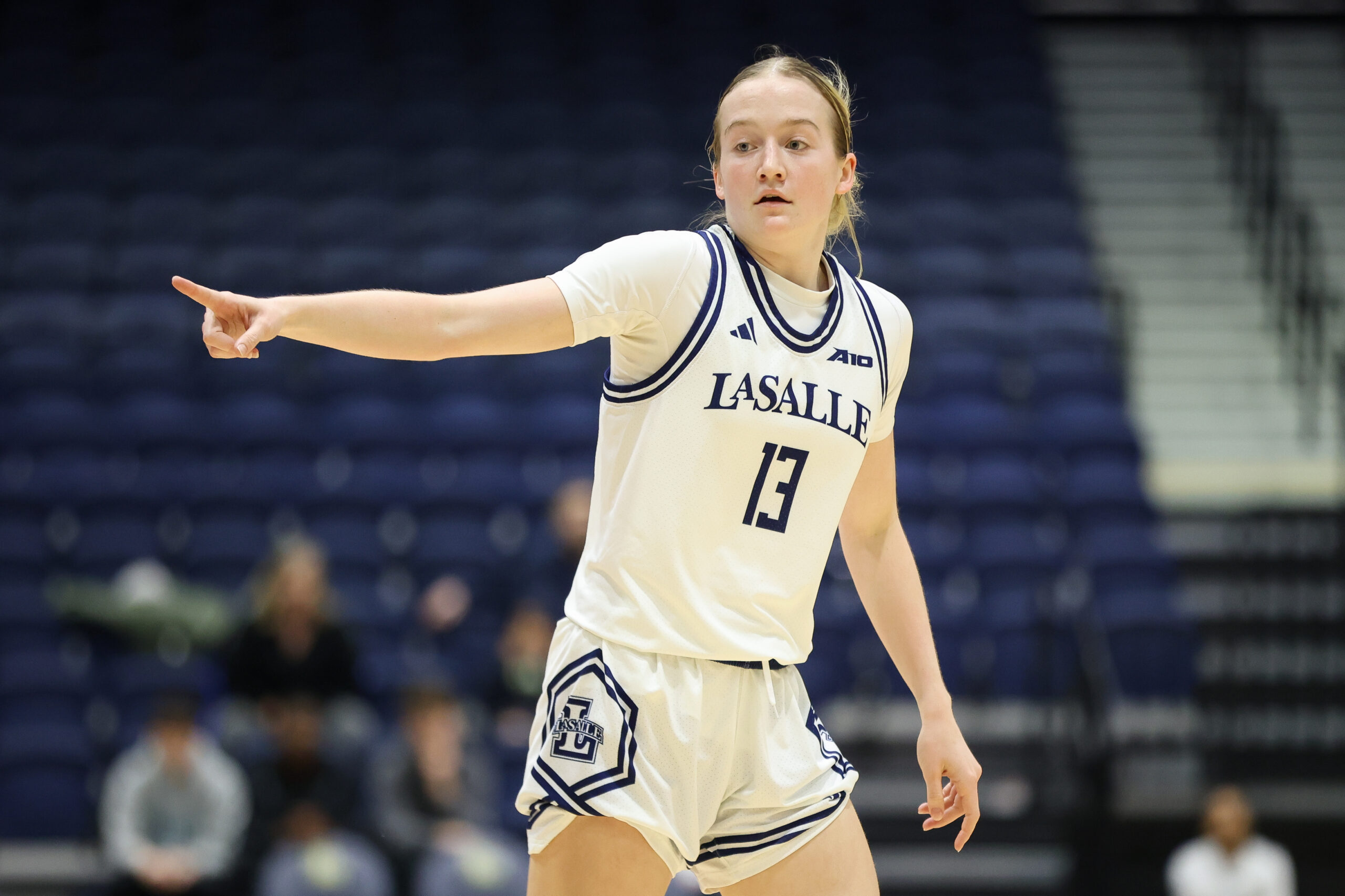
La Salle guard Joan Quinn finished with a game-high 18 points against St. Joe’s on Wednesday.
Guard Joan Quinn made 4 of 7 three-pointers and scored a game-high 18 points for La Salle (11-10, 4-6). Forward Kiara Williams contributed 17 points on 7-for-11 shooting and six rebounds. Macktoon, the Explorers’ leading scorer, was well guarded but managed 11 points and seven rebounds.
Stinson comes up clutch
After Macktoon’s and-one layup to cut St. Joe’s lead to four points, the Hawks were in desperate need of a basket to stunt the Explorers’ momentum. They turned to a player who was quiet offensively all game.
Forward Faith Stinson did not score for the first 38 minutes but scored her first points when it mattered most. She got free on a cut and guard Rhian Stokes (11 points) delivered a perfect pass that Stinson converted to halt La Salle’s run.
“You saw a senior post who had been there, done that,” Griffin said. “She came up big in the first game [against La Salle], and at the end of the day, we went to her, we found her. Rhian found her in the first game and I think that kind of sealed the game and it was just the same situation today.”
Big second half
The Hawks built a 24-17 lead with back-to-back three-pointers from Knouse, a freshman. However, the Explorers did not stay down long, thanks to Williams. She made two straight jumpers to cap an 11-2 run, which gave La Salle a two-point lead. The teams traded baskets to enter halftime tied at 32.
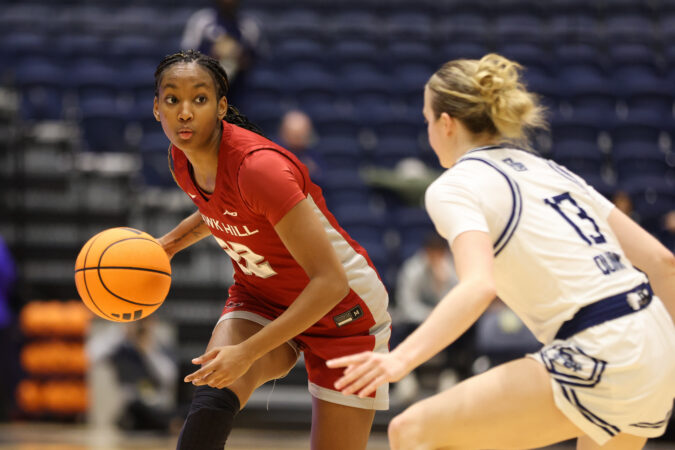
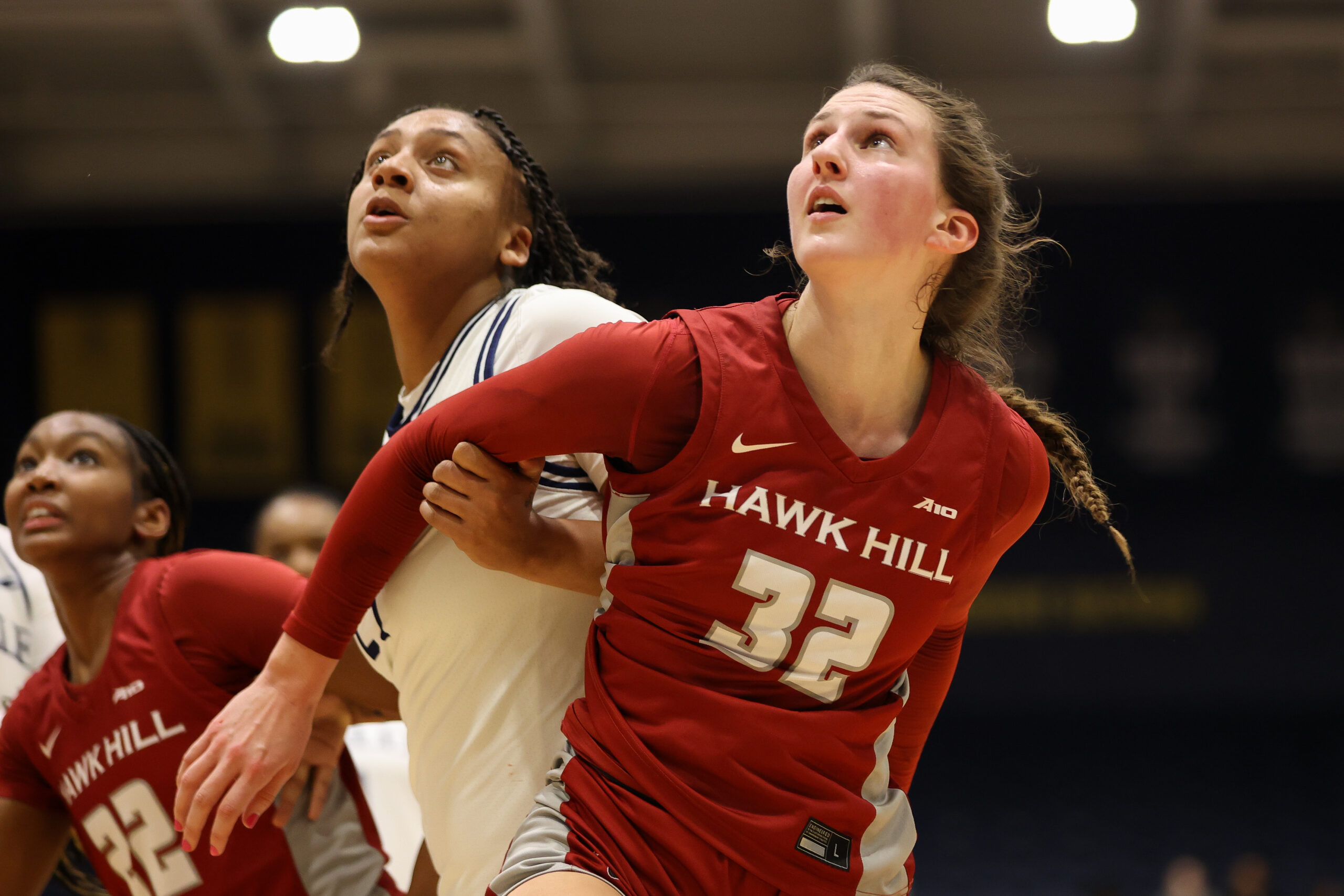
St. Joe’s forward Cecilia Kay (32) battles La Salle forward Kiara Williams for a rebound.
St. Joe’s jumped out to a 38-34 lead to open the third frame and never allowed La Salle to retake the lead. That lead ballooned to 10 halfway through the fourth quarter, and the Hawks’ strong second half helped them prevail.
“I think we came out and it didn’t really go our way, but then we showed up in the second half with our grit, our toughness and staying composed and staying together to really come out and take a force in the first three minutes of the second half,” Casey said. “I think that was just really great, and that gave us momentum throughout the game.”
Up next
St. Joe’s returns home to take on Davidson (15-7, 7-2) on Sunday (1 p.m., ESPN+), while La Salle will travel to face Duquesne (7-14, 0-10) on Saturday (2 p.m., ESPN+).
Spain is the world’s third largest wine producer, with a longer history of growing grapes and making wine than France. However, the region was slower to modernize due to its unique history, which included a teetotaling 20th century dictator who systematically forced the wine industry to churn out cheap wines rather than improve their quality during his 35-year rule. In a remarkably swift turnaround sparked by joining what is now the European Union, Spain is today making some of the most exciting world-class wines, many of which blend old-world traditions with new-world techniques to broaden their international appeal.
(Sadly, wines like this one — from one of Spain’s most respected appellations — have not been well represented in Pennsylvania wine stores, simply because the state-run system has also been slow to modernize.)
Most of Spain’s wines are red, and the vast majority are made with grapes native to their localities. The nation’s two most famous red wine appellations are Rioja and Ribera del Duero, which are both made using primarily tempranillo grapes and hail from neighboring regions. On the map, these zones appear to be separated only by a range of mountains, but their climates and cultures could not be more different, and these key factors shape the flavor of their wines.
Of the two, Rioja is better known and far better represented in our area. It is also the cooler of the two regions. Makers blend tempranillo with other grapes and have a tendency to age wines longer in barrels, often producing old-school wines that can be as delicate as French pinot noir. Ribera del Duero wines are usually denser, darker, and stronger and more often made with 100% tempranillo, as with this example. Since they are grown in warmer, drier conditions that amplify their ripeness, their winemaking is more likely to reflect modern sensibilities familiar to fans of California wines. This value-oriented example features tempranillo’s signature combination of red- and blue-fruit flavors like raspberry and blueberry. Being of the oaked “roble” style, it also features an overt gloss of new-oak aromas (think vanilla and coconut).
Cune’s Ribera del Duero ‘Roble’ (oaked tempranillo) from Spain.
Cune Ribera del Duero “Roble”
Castilla y León, Spain; 14% ABV
PLCB Item #100049322 — on sale for $14.99 through Feb. 1 (regularly $17.99)
No alternate retail locations within 50 miles of Philadelphia, per Wine-Searcher.com.
Temple had a chance to break its tie for second place in the American Conference on Wednesday night against Charlotte. The Owls trailed once in the second half and at one point held an eight-point lead.
It wasn’t enough, however, as the 49ers stormed back to hand Temple an 80-76 overtime loss at the Liacouras Center.
The Owls (13-8, 5-3) were within striking distance with 17 seconds remaining in overtime. Then Charlotte guard Dezayne Mingo drilled a three-pointer that pushed the 49ers (12-9, 6-2) lead to five and squandered the Owls’ comeback hopes as they missed their final four shots.
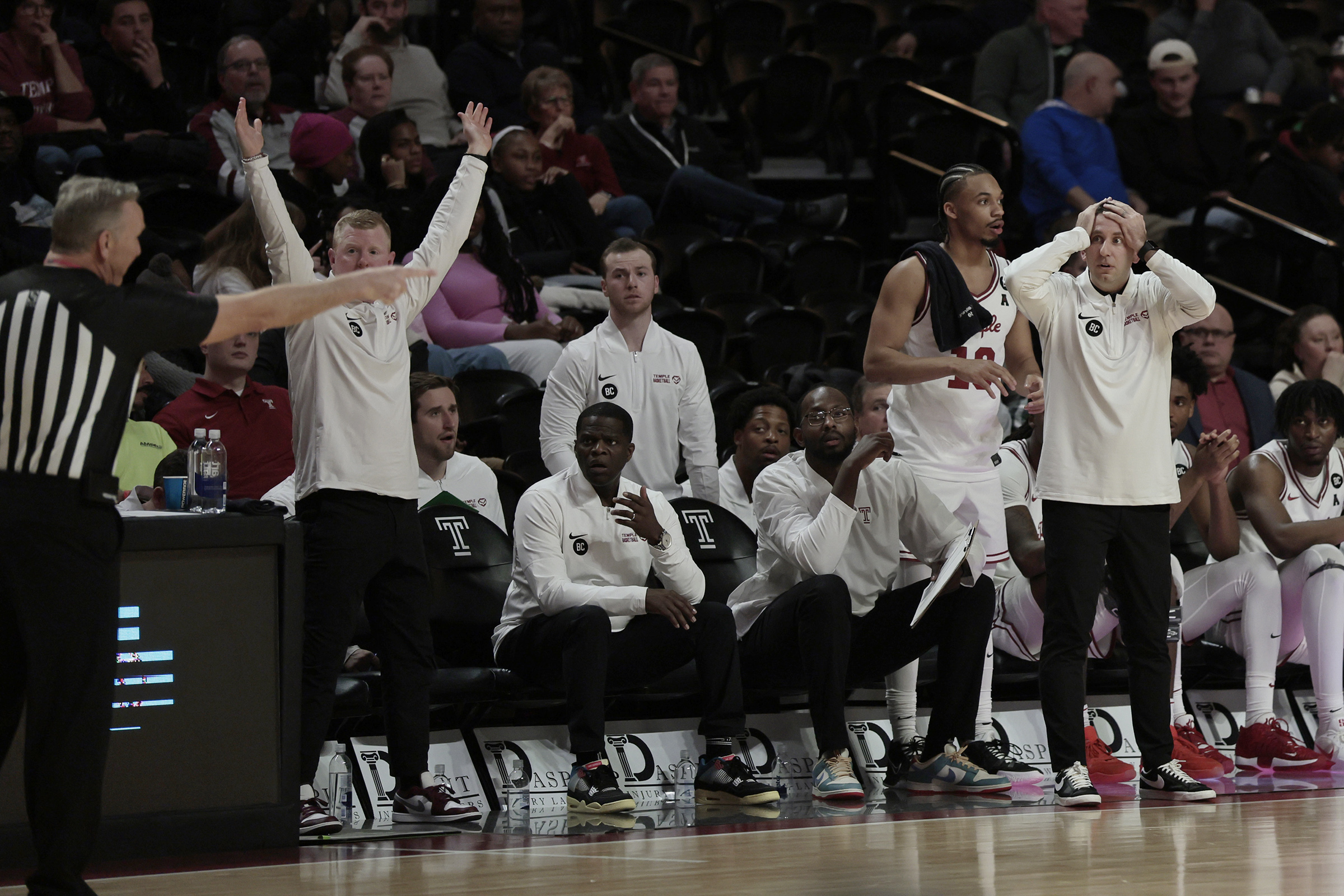
Temple coach Adam Fisher reacts to an official’s call against Charlotte on Wednesday.
“We won the first half, but the second half, we had a couple lapses,” said Temple coach Adam Fisher. “This is a team we knew [to] try to keep them in the 60s. Great credit to Charlotte. There’s a reason they’re 6-2 [and] towards the top of the league.”
Statistical leaders
Guard Derrian Ford led Temple with 21 points, while guard Jordan Mason added 20.
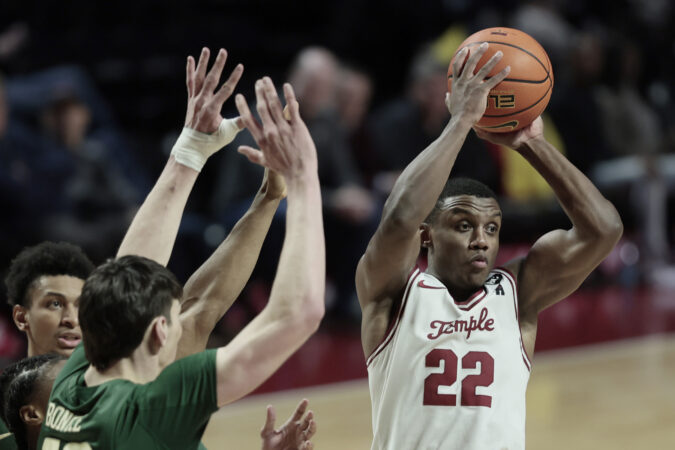
Charlotte center Anton Bonke stole the show with a career-high 25 points, breaking his previous high of 20, which he set against Temple on Dec. 30. Mingo also had 19 points off the bench while dishing out 10 assists.
Mason took charge of the Owls’ offense, and 14 of their first-half points were three-pointers.
Temple’s defense had to deal with the 49ers’ size and height advantage. When Bonke attacked the paint, the Owls found themselves in foul trouble. They finished with 20 personal fouls.
“Good job getting into some pick-and-roll spaces and they throw it up to him, and he’s huge,” Fisher said. “Great credit to him. He had 20 against us out there last time, when we won, we knew ‘Hey, they can’t make threes.’ When Harrison scores double figures, I think they’ve won every game. So they got a lot of weapons.”
However, Temple did limit the American’s third-best team in shooting to make 9 of 24 attempts in the first half, going 4 of 9 in three-pointers. Charlotte shot 53.8% in the second, but went 3-for-12 in three-pointers.
Temple kept up with Charlotte and trailed once in the second half and took an eight-point lead with under seven minutes remaining. But that advantage didn’t last.
Game-changing play
Temple had possession with 30 seconds remaining in regulation, leading 68-66, with a chance to put the game to rest. Guard Masiah Gilyard snagged a steal and it seemed like Temple would secure a victory.
Gilyard attempted a dagger three-pointer, but it went off the mark and after a scramble for the loose ball, it got into the hands of Mingo. He found guard Damoni Harrison, who converted a layup to send the game to overtime.
“It looked like almost a broken play,” Fisher said.
Temple never recovered, as it went 1-for-6 from the field in the extra period.
Up next
Temple will host South Florida (13-7, 5-2) on Saturday (8 p.m. ESPN+).
COLUMBUS, Ohio ― The Flyers traveled more than four hundred miles from where they’re known. Although they had a change in scenery, they carried many of their issues over from Monday.
Despite Dan Vladař’s spectacular saves in net, in his first game since getting injured against the Buffalo Sabres on Jan. 14, and the third career hat trick by Travis Konecny, the Flyers were handed a 5-3 loss by the Columbus Blue Jackets.
The Flyers have now lost nine of their last 11 games, including two straight in which they have been outscored a combined 9-3.
Sean Monahan scored with 3 minutes, 28 seconds left in regulation as he stood alone at the left post. The Flyers struggled to get the puck out, and Damon Severson sent the puck across from the right boards to the open winger. Mathieu Olivier scored an empty-netter to seal it for Columbus.
It was a delicate few opening seconds for the Flyers when, on the first shift, Charlie Coyle gave the Blue Jackets a 1-0 lead 38 seconds into the game. Trevor Zegras was on the boards and tried to pass to his centerman, Christian Dvorak, to start a breakout, but it went through, and Zach Werenski kept the puck in to Olivier.
The rugged forward then fed Coyle, who was honored before the game for reaching 1,000 games on Jan. 22, as he got behind the defense. Coyle scored over the glove of Vladař.
Later in the period, Konecny evened the game with his 18th goal of the season. It also tied him with Zegras for the points lead (46).
Zegras had the puck deep and tried to chip it to Konecny, but it popped all the way out to Noah Juulsen at the left point. The defenseman fed it across to Cam York, and he hit Konecny in the middle. He had room and skated down and snapped the puck past goalie Elvis Merzļikins.
The Flyers had a great chance to take a 2-1 lead with under 2 minutes left in the opening frame when, on a power play, Zegras skated through the Blue Jackets defense. He hit the puck off the heel of his blade, but the Flyers kept going, ultimately with Zegras getting another look at a wide-open net. His shot ended up hitting either the right post or the stick of Bobby Brink that was lying in the crease after he lost it during a commotion.
Columbus took the lead with 20 seconds to go in the period on a goal by Kirill Marchenko. Skating four-on-four, after the Flyers were called for too many men during the man advantage, the Blue Jackets skated down with Werenski and Owen Tippett chasing after the puck.
From one angle, it looked like Werenski interfered with Tippett. From another, it looked clean. Regardless, there was no call, and Werenski, who will represent the United States at the 2026 Milano Cortina Olympics, fed the puck from the right circle to Marchenko in the left for the one-timer.
Erik Gudbranson made it 3-1 less than two minutes into the second period when his point shot off a faceoff beat Vladař. It may have nicked Dvorak on the way in.
Despite allowing four goals, Vladař did not look rusty as he kept the Flyers in the game. He made a phenomenal standing pad save on Werenski as it looked like he batted the puck out of the air with 3:05 to go in the second.
And then in the third period, in between Konecny scoring again from the middle of the ice to make it 3-2, Vladař robbed Adam Fantilli sitting at the right post with his glove, and then did it again to Boone Jenner from the same spot. The first save on Fantilli was reviewed, but it confirmed Vladař’s magnificent save.
Konecny finished off the hat trick to tie the game at 3-3. He received a pass from Travis Sanheim from the left board as Konecny crashed down the right side.
This goal and his other in the final period came off a gutsy performance by the forward, who blocked a shot late in the second period and hobbled to the bench. He went down the tunnel right at the buzzer of the middle frame and didn’t get back to the bench until after the puck dropped for the third period.
Konecny now leads the Flyers in goals (20) and points (48).
“He’s hitting the holes, and he’s, we call it, race inside, and he races inside on them and beats people, and then obviously he’s got a good shot,” said Rick Tocchet.
“And he took one off the foot. He’s limping around. He might not play tomorrow. We don’t know. He [had] a lot of guts tonight.”
Breakaways
Defenseman Rasmus Ristolainen did not return following his second shift of the game, leaving with a lower-body injury. The Finn returned on Monday after missing six games. Tocchet did not have an update on him after the game. … Defenseman Emil Andrae was a healthy scratch, along with forwards Nic Deslauriers and Garnet Hathaway.
Up next
The Flyers will get right back to it in Boston on Thursday against the Bruins (7 p.m., NBCSP+).
New Jersey Gov. Mikie Sherrill said her administration will create an online database for people to upload videos they record of ICE.
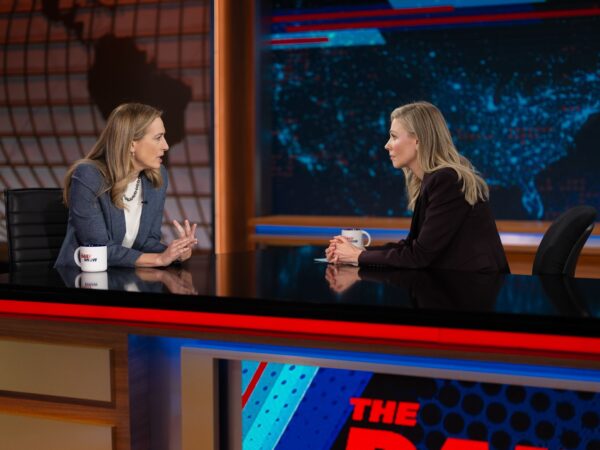
“If you see an ICE agent in the street, get your phone out,” she urged New Jerseyans in an appearance on The Daily Show on Wednesday night with host Desi Lydic in New York City.
Sherrill, a Democrat and former member of Congress, said her administration will set up an online portal “so people can upload all their cell phone videos and alert people.”
Cell phone video from onlookers has been used to rebut the narrative of President Donald Trump’s administration after federal agents fatally shot Renee Good and Alex Pretti in Minneapolis.
“They will pick people up, they will not tell us who they are … they’ll pick up American citizens. They picked up a 5-year-old child,” she said on the show. “We want documentation, and we are going to make sure we get it.”
The policy announcement was not featured in the television broadcast, but it was posted to YouTube shortly afterward by The Daily Show.
New Jersey residents routinely report ICE activity and arrests around the state, including recently in Bridgeton and Princeton. The Garden State is home to about the seventh-largest undocumented population in the country, an estimated 476,000 people, according to the Migration Policy Institute in Washington.
Amy Torres, executive director of the New Jersey Alliance for Immigrant Justice, said Sherrill needs to do more.
“We don’t need to see more evidence of what ICE is doing,” Torres said. “They’ve arrested a New Jersey mayor. They’ve gone after a sitting member of Congress. They’ve opened up a 1,000-bed facility in our state’s largest city and they’re ripping our families apart. New Jersey doesn’t need more evidence, we need leadership who is going to act.”
Sherrill, meanwhile, also said her administration plans to put out information to help New Jerseyans know their rights in the state. And she said she will not allow ICE raids “to be staged from state properties.”
Sherrill, a former Navy helicopter pilot, compared U.S. Immigration and Customs Enforcement to secret police forces she observed in foreign nations during her service.
“I knew where this was headed when we started to see DHS people taking loyalty oaths to the president, not the Constitution,” she said. “We saw people in the street with masks and no insignia, so not accountable at all, hiding from the population.”
New Jersey has become a key state in the Trump administration’s plan to arrest and deport millions of immigrants, and has been slated for an expansion of ICE detention.
A facility in Elizabeth was for a time the only detention center in the state. But the 1,000-bed Delaney Hall in Newark was reopened for detention in May, and the administration recently announced plans to hold 1,000 to 3,000 detainees at Joint Base McGuire-Dix-Lakehurst, which spans parts of Burlington and Ocean Counties.
In Wednesday night’s television appearance, Sherrill denounced the Minneapolis shootings, calling Good “a mother of three, who drops her 6-year-old off in her Honda Pilot and then gets shot and killed.”
And shenoted that Pretti worked at the Minneapolis VA as an ICU nurse.
“I saw his official photo, and I’ve seen a million of those … with the flag in the background, I know those guys,” Sherrill said.
Pretti was fatally shot by a Border Patrol agent, while Good was shot and killed by an ICE agent. Both agencies fall under the Department of Homeland Security.
The new governor also said on The Daily Show that she called Trump to discuss his decision to freeze funding for the planned Gateway Tunnel in North Jersey, a project championed by Sherrill that would connect New York and New Jersey under the Hudson River.
New Jersey Gov. Mikie Sherrill does her best New Jersey “Oh!” and “C’mon!” impressions on The Daily Show with host Desi Lydic.
“I haven’t heard back from him yet to flag for him that this is about 100,000 jobs in the region, and by the way, his numbers aren’t looking so good in that area,” she said.
Sherrill said the president “should listen to me because I just won back all his voters,” citing her victory in November of more than 14 percentage points, outperforming her Democratic predecessors and reversing rightward shifts in 2024.
But she also said it is time to “rethink” the federal government’s relationship with states because of attacks from Trump.
“We need to start looking at expanding,” she said. “This is a time when I think we’re going to see a large expansion of state power, because the states are the rational actors in this space.”
Sherrill also played a game with Lydic where she picked which things were most New Jersey, choosing Tony Soprano over Snookie; hating New Yorkers over hating Pennsylvanians; diners over Wawa; and “C’mon!” over “Oh!”