It’s hard to think about going outside right now with the subfreezing temperatures in town, but here’s another reason to hope things will be better in a few weeks.
The Union announced Tuesday that they will host a youth soccer tournament with teams from around the world, including some big-time European clubs, from Feb. 9-14 at their WSFS Bank Sportsplex in Chester. Fittingly for the time of year, it will be called “The Snow Bowl.”
There will be under-15, under-16, and under-18 age groups, with Union teams competing in all three. The under-15 group has the biggest visiting headliners: England’s Manchester United and Newcastle United, Germany’s Borussia Dortmund, and Mexico’s Monterrey.
The under-16 division is headlined by Germany’s Borussia Mönchengladbach, the Netherlands’ PSV Eindhoven, and Portugal’s Benfica.
PSV’s sporting director is former Union and U.S. Soccer sporting director Earnie Stewart. Its youth academy chief, Aloys Wijnker, worked for U.S. Soccer around the same time Stewart was in Chester.
The Union have hosted many visiting teams at their facilities in recent months, including England’s Chelsea and the U.S. men’s and women’s national teams.
Benfica is in the under-18 group too, as is Denmark’s Lyngby is in both of those age groups. That’s notable, since the Union have an ownership stake in Lyngby.
Another team in the under-18 group will bring a familiar face back to Chester. Former Union midfielder Roland Alberg now runs a youth soccer program in South Africa and has entered one of his squads.
“This event is about high-performance preparation and showcasing our Academy’s elite youth development environment,” Union director of academy and professional development Jon Scheer said in a statement. “It provides our Union Academy players with the opportunity to test themselves against the very best ahead of the upcoming Generation adidas Cup and MLS Next playoffs, while also highlighting the world-class facilities we have built here at the Sportsplex.”
The tournament will give the Union a chance not just to show off their facilities and youth teams, but the full scale of their development setup. One of the title sponsors is The SWAG, a no-cost, year-round soccer training program for players ages 4-11 from communities of color, which the Union helps promote.
The SWAG is a free program for underprivileged kids from 4-11 to play soccer and get to know the world’s game.
“With all eyes on soccer this summer, especially here in Philadelphia, the Snow Bowl is designed to inspire the next generation of youth soccer players and introduce them to the highest level of international youth competition,” said Richie Graham, Union part-owner and academy financier, whose brother, Steve, helped launch The SWAG in 2022.
All of the games will be played on the indoor turf field at the Union’s complex (one concession to the time of year), and they’ll all be livestreamed on the team’s website. The schedule, streaming links, and more details are available at philadelphiaunion.com/snowbowl.
U-15 division: Union, Manchester United (England), Borussia Dortmund (Germany), Newcastle United (England), C.F. Monterrey (Mexico), Chicago Fire (USA).
Amazon will be closing all its physical Amazon Fresh stores, including six in the Philadelphia region, as it expands its Whole Foods footprint and grocery delivery services.
“While we’ve seen encouraging signals in our Amazon-branded physical grocery stores, we haven’t yet created a truly distinctive customer experience with the right economic model needed for large-scale expansion,” the company said.
People shop inside the Amazon Fresh in Warrington in August 2021. The store and all other Amazon-branded grocers are closing.
The statement did not specify which Amazon Fresh stores would become Whole Foods, and company spokespeople did not answer questions about whether any Philadelphia-area locations would be converted.
Amazon Fresh has stores in Broomall, Bensalem, Langhorne, Northern Liberties, Warrington, and Willow Grove. The Northern Liberties location on Sixth and Spring Garden Streets opened this summer after years of construction.
Two more potential Amazon Fresh stores seemed to be in the works in Havertown and Northeast Philadelphia as of the summer, according to PhillyVoice.
Customers use the Amazon Dash Cart at the Amazon Fresh grocery store in Warrington in 2021.
As the company winds down its Amazon-branded physical stores, it says it will “double down” on online grocery delivery, including by expanding its same-day services to more communities.
Whole Foods has 550 locations nationwide, including more than a dozen in the Philadelphia area. Amazon spokespeople did not answer questions about whether more Whole Foods stores were in the works in the Philly region.
Amazon also expects to open at least five more smaller-format Whole Foods Market Daily Shop stores by the end of the year. The company said that decision was based on “strong performance” at the five existing shops in the New York City area and Arlington, Va.
The Center City Whole Foods Market as pictured in February 2025.
The online retailer said it plans to continue to experiment with new ways of shopping at its physical stores.
In its statement, Amazon gave a shout-out to one such test in the Philadelphia area: “The store within a store” experience at the Whole Foods in Plymouth Meeting.
Since November, customers at that store have been able to browse the physical aisles of Whole Foods, while digitally ordering unique products from Amazon and Whole Foods. The orders are then packaged in minutes in an automated micro-fulfillment center within the grocer’s back-of-house area.
The Flyers were riding high after a solid week out west. But they crashed back to reality, losing a four-point game against Metropolitan Division rivals, the New York Islanders, on Monday.
Here are three interesting things said postgame:
Rick Tocchet: ‘You’ve got to handle prosperity.’
Standing outside the coaches’ room in the bowels of Ball Arena on Friday in Denver, Rick Tocchet was asked if the win against the No. 1 team in the NHL, the Colorado Avalanche, could serve as a springboard for his team. The coach calmly responded that they could enjoy it for a moment but that everything needs to remain on an even keel.
It’s a smart mindset amid an 82-game grind, as there will be winning streaks, losing streaks, highs and lows, and everything in between. But while the Flyers won Friday to seal five of six points across a three-game gauntlet of games, Trevor Zegras said what everyone watching was thinking postgame Monday, “We just kind of came out and thought it would be easy, I guess.”
What does Tocchet mean when he says his club needs to handle prosperity better? Part of it is that the Flyers need to sustain wins; they need to know that just because you win Night 1, it doesn’t mean Night 2 will be easy. And it’s something they should know since they have only won two straight once in 2026, have lost eight of their past 10, and are 3-10-4 after a regulation win this season.
Noah Cates: ‘I think we were kind of perimeter.’
The Flyers have been focusing on getting to the middle and driving to the net. But they struggled with it on Monday.
According to Natural Stat Trick, at five-on-five, the Flyers had 13 shots, with just five from high-danger areas. It was a noticeable difference from their games the past week, where, against the Avalanche and Utah Mammoth, they had 12 and 13, respectively, at five-on-five.
Captain Sean Couturier said Monday that the team wasn’t “at our best on winning battles” and “going to the dirty areas,” as was evident from the eye test, too. Was it something the Islanders, who deploy a 1-1-3 system, were doing or that the Flyers weren’t driving to the net?
“Yeah, I think both,” forward Noah Cates said. “I think we were kind of perimeter, not getting guys to the front of the net and different things like that. But they’re so structured, and that’s just kind of their MO, has been for the last couple of years, kind of their hard and stingy defensively, and just kind of winning battles down low, and then getting pucks to the net and getting bodies there is tough against them.”
The Flyers struggled to get to the front of the net against the New York Islanders on Monday night.
Tocchet: ‘Some guys accepted it.’
The coach wore this one, saying it was on him. But he’s not the one on the ice making the plays. His players are the ones who need to step up.
“We just got our butts kicked on home ice in a game where it’s probably tough to get to, and a lot of fans in the building,” Jamie Drysdale said.
It seemed that as soon as the Islanders found the back of the net — while the Flyers were the ones on the power play — in the first period, it sucked the life out of the building and the team.
“There was no effort coming back,” said a frustrated Tocchet, who answered a follow-up question that it was Hockey 101. “We didn’t even have the puck, and then we had two guys go to the same guy, and then one guy doesn’t backcheck.
“We don’t have the puck, just come back in the slot hard. One guy stays in front, the other guy takes him, there’s no goal. And who knows, if we’re zeros after the first, maybe. But it seemed like when they scored it, some guys accepted.”
The 2025 Eagles season may be over, but the work to retool the roster and position the team for success in 2026 has already begun.
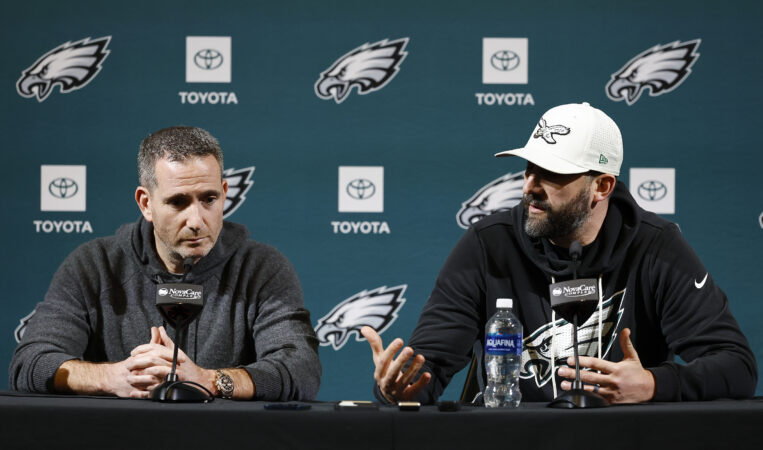
Jeffrey Lurie, Howie Roseman, and Nick Sirianni are tasked with making a variety of staffing and personnel decisions over the next several months in an attempt to return the Eagles to Super Bowl contention next season. The offensive coordinator vacancy is generating the most buzz, but it’s far from the only consequential move they will have to make ahead of training camp in late July.
With the coaching carousel spinning and free agency and the draft looming, here’s where the triumvirate could start with their decision-making:
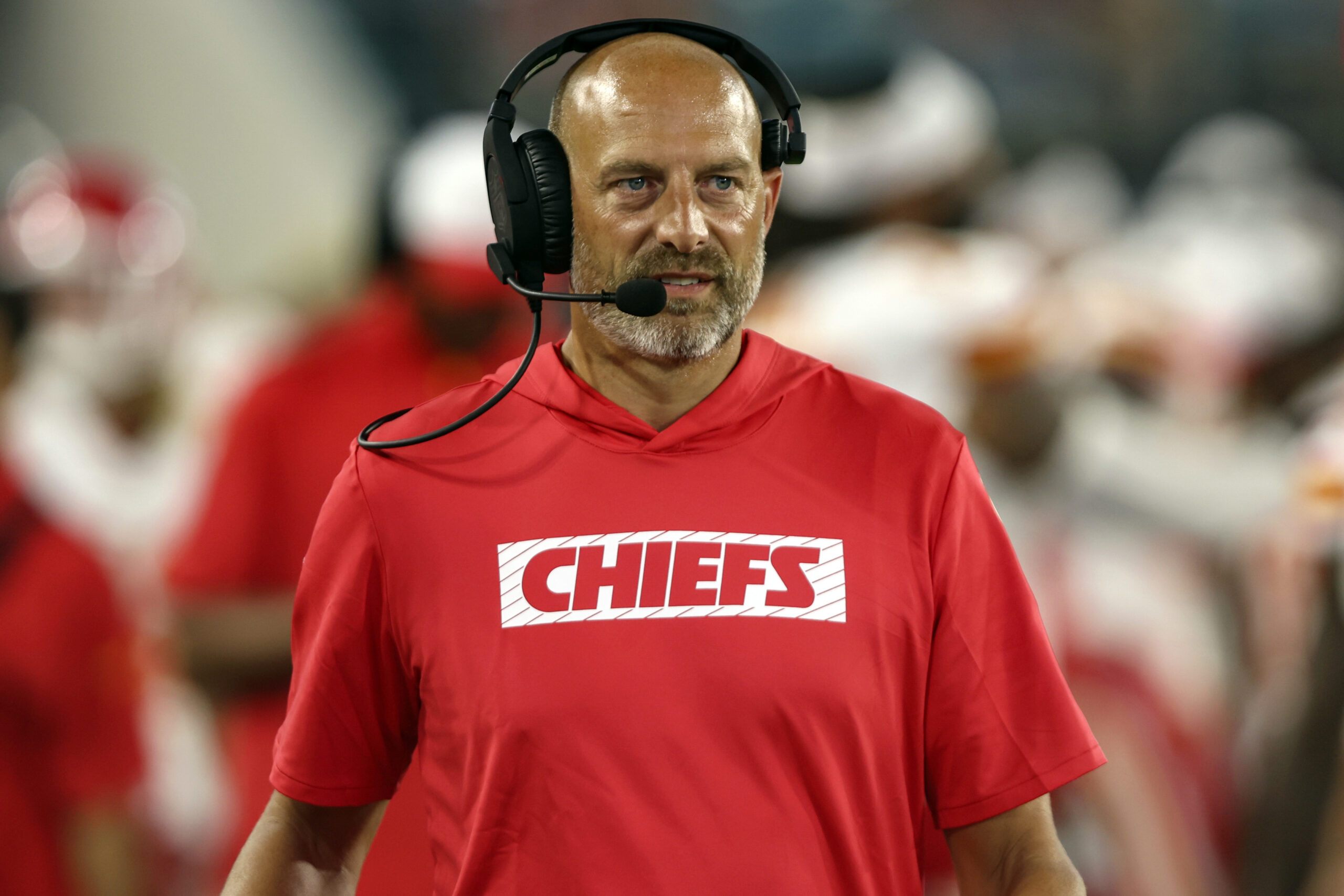
Would the Eagles let a candidate like Matt Nagy cook, and run his own side of the ball the way the team has with Vic Fangio?
Hire the best candidate as offensive coordinator — no matter their expected longevity
The Eagles are well into their interview process as they work to identify their next offensive coordinator. Like Kevin Patullo before he was promoted last offseason, some interviewees have never called plays (including Green Bay Packers quarterbacks coach Sean Mannion), while others have ample experience (such as former Kansas City Chiefs offensive coordinator Matt Nagy).
Play-calling experience shouldn’t be the sole determining factor. The Eagles ought to prioritize the candidate who, in Sirianni’s words, can help “evolve” the offense and make it a more explosive unit than the one that trotted out on the field last year. That candidate ought to put players in positions to work to their strengths while also implementing modern, fresh concepts. That candidate should also have the autonomy to run the offense he envisions.
No, the Eagles shouldn’t necessarily seek out a Vic Fangio-type — a veteran coach with no aspiration to move on to a head coaching job — to fill that role. Who would turn down a candidate who puts them in the best position to field a championship-caliber offense simply because of the threat that he would get poached at the end of the season? The Eagles lost Kellen Moore after the 2024 season but they also won a Super Bowl, an outcome they wouldn’t trade given a do-over. Such is life when the head coach doesn’t call plays.
“It’s a great compliment when guys get head coaching jobs from here because it means we’re having tremendous success,” Roseman said on Jan. 15. “As much as you’d like to have continuity and would like to have guys here for a long period of time, we want to win. We have an urgency to win right now. If that comes with the ramifications that we lose good people because they’ve earned head coaching jobs, we’ll live with that.”
The occasional headaches that come with the A.J. Brown experience don’t outweigh his elite playmaking ability.
Keep A.J. Brown
Will A.J. Brown remain an Eagle in 2026, let alone finish out his contract that runs through 2029?
No one can read Brown’s mind and determine whether he still wants to be in Philadelphia. He hasn’t spoken publicly since Dec. 8 following the Eagles’ overtime loss to the Los Angeles Chargers. Earlier in the season, though, he voiced frustration with the listless offense and his role within it, both online and in interviews with the media. His concerns, especially given the state of the offense, were understandable.
But his performance hit some rough patches this season, especially in the wild-card loss to the San Francisco 49ers. Brown had three receptions on seven targets for 25 yards, including a couple of drops and a spat on the sideline with Sirianni (the Eagles head coach later said he had been trying to get Brown off the field after the offense went three-and-out).
Roseman didn’t explicitly rule out a trade when asked about Brown’s future at the end of the season. There would be short-term financial ramifications that come with a trade, either before or after June 1, but the Eagles would experience some salary cap relief in future seasons.
Still, the Eagles are often at their best offensively when Brown is thriving. He remains one of the best receivers in the NFL, which ought to be a boost to a team fighting to keep its Super Bowl window open. It should be in the Eagles’ interest to keep him in the fold, especially given the difficulty of replacing WR1. Hire an innovative offensive coordinator, ensure that Brown is still on board with the new scheme, and move forward.
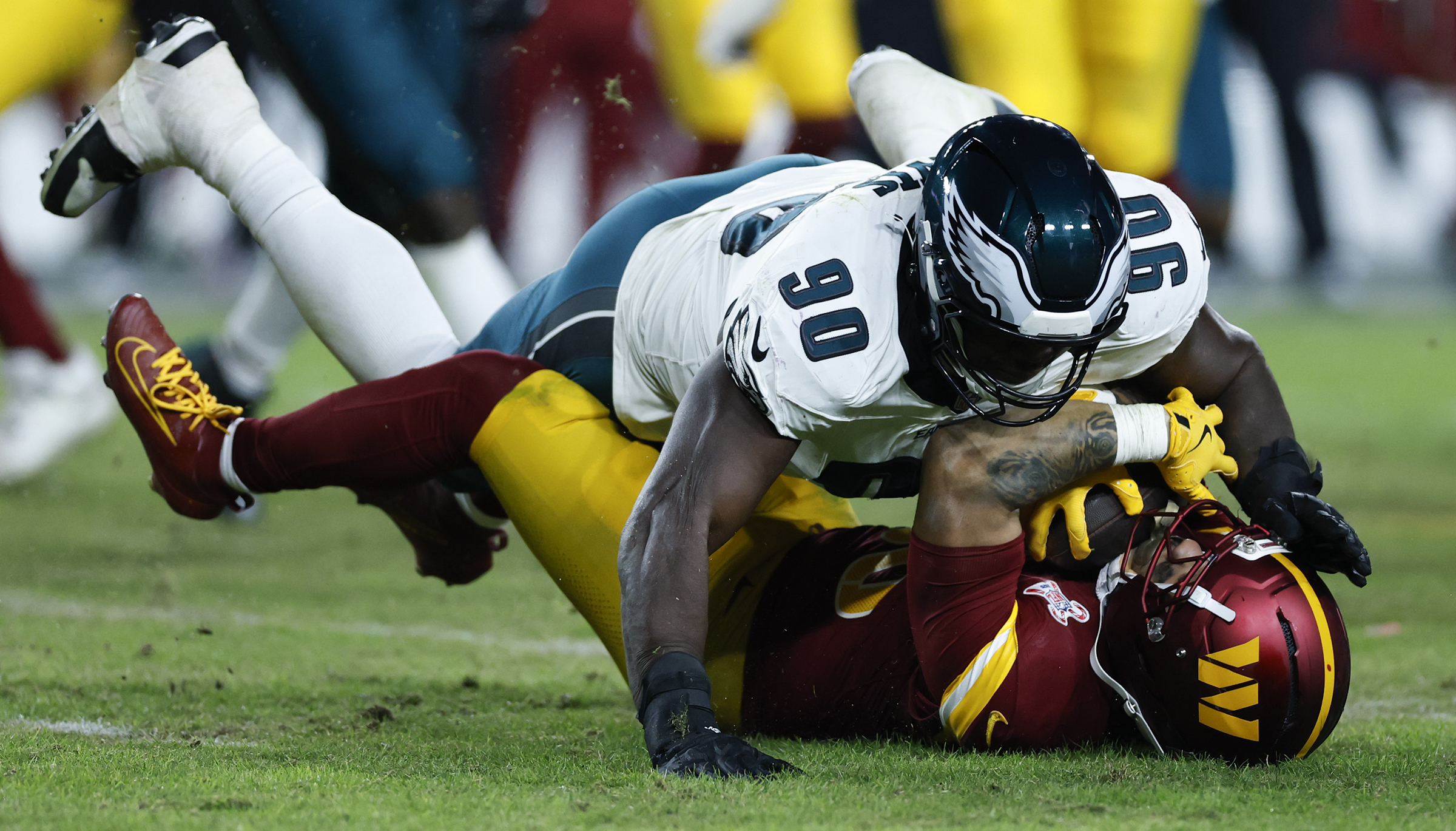
Eagles defensive tackle Jordan Davis (90) comes off a breakout year.
Extend Jordan Davis
In a span of approximately eight months, Jordan Davis showed why Roseman made the right decision by picking up his fifth-year option.
The 6-foot-6, 336-pound defensive tackle ascended into a nearly-every-down role in 2025, his fourth season with the Eagles. He played a career-high 61% of the defensive snaps, and perhaps most importantly, his strong performance was consistent from the outset of the season through its conclusion. Davis finished the year with career highs in run stops (50, according to Next Gen Stats) and sacks (4½).
His rare blend of size and athleticism is just one facet of his importance to the team. Davis stepped into a leadership role and helped set the culture in 2025, too.
“My leadership style … it’s just mainly keeping the guys together and being an example, being a positive influence and being a positive force in the locker room, on the field,” Davis said at locker clean-out on Jan. 12. “That’s not going to stop. That’s how I live life. That’s not going to stop. I’m excited to see where it can go and where it could go and the potential of it all.”
Players like Davis are hard to find. It would behoove Roseman to extend him early, just as he has with other key players in recent years, in an effort to prevent him from testing the open market.
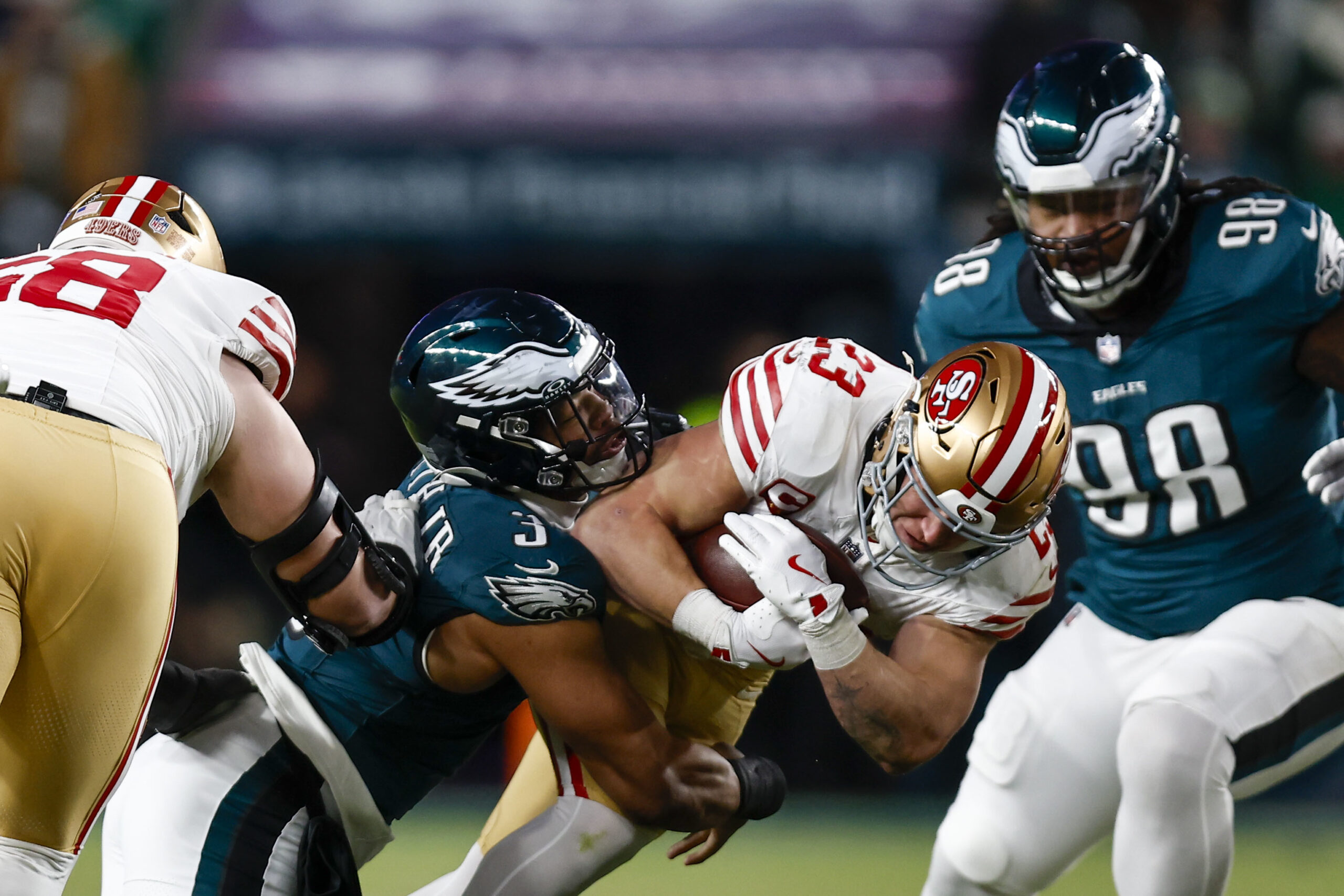
Nolan Smith Jr. (3) and Jalen Carter (98) are approaching option decisions.
Pick up Jalen Carter’s and Nolan Smith’s fifth-year options
Speaking of fifth-year options, Jalen Carter and Nolan Smith are eligible to have theirs exercised this offseason. Roseman will have until May 1 to make that decision on his 2023 first-round draft picks.
The Eagles ought to pick up both, even though Carter and Smith saw their 2025 seasons impacted by injury. Roseman may even consider extending Carter as early as this offseason, provided he’s convinced Carter’s shoulder issues won’t be long-term concerns.
Even though Carter finished the season with a career-low 7.7% pressure rate, according to Next Gen Stats, he played his way into a potential raise in Year 5. Carter was named to his second Pro Bowl on the original ballot this season, which places his fifth-year option in the highest salary tier possible at his position. His fifth-year base salary would be equivalent to the defensive tackle franchise tag value in 2026, which is projected to be $25.6 million, according to Over The Cap.
Smith’s fifth-year option is projected at approximately $15 million, the lowest salary tier among outside linebackers.
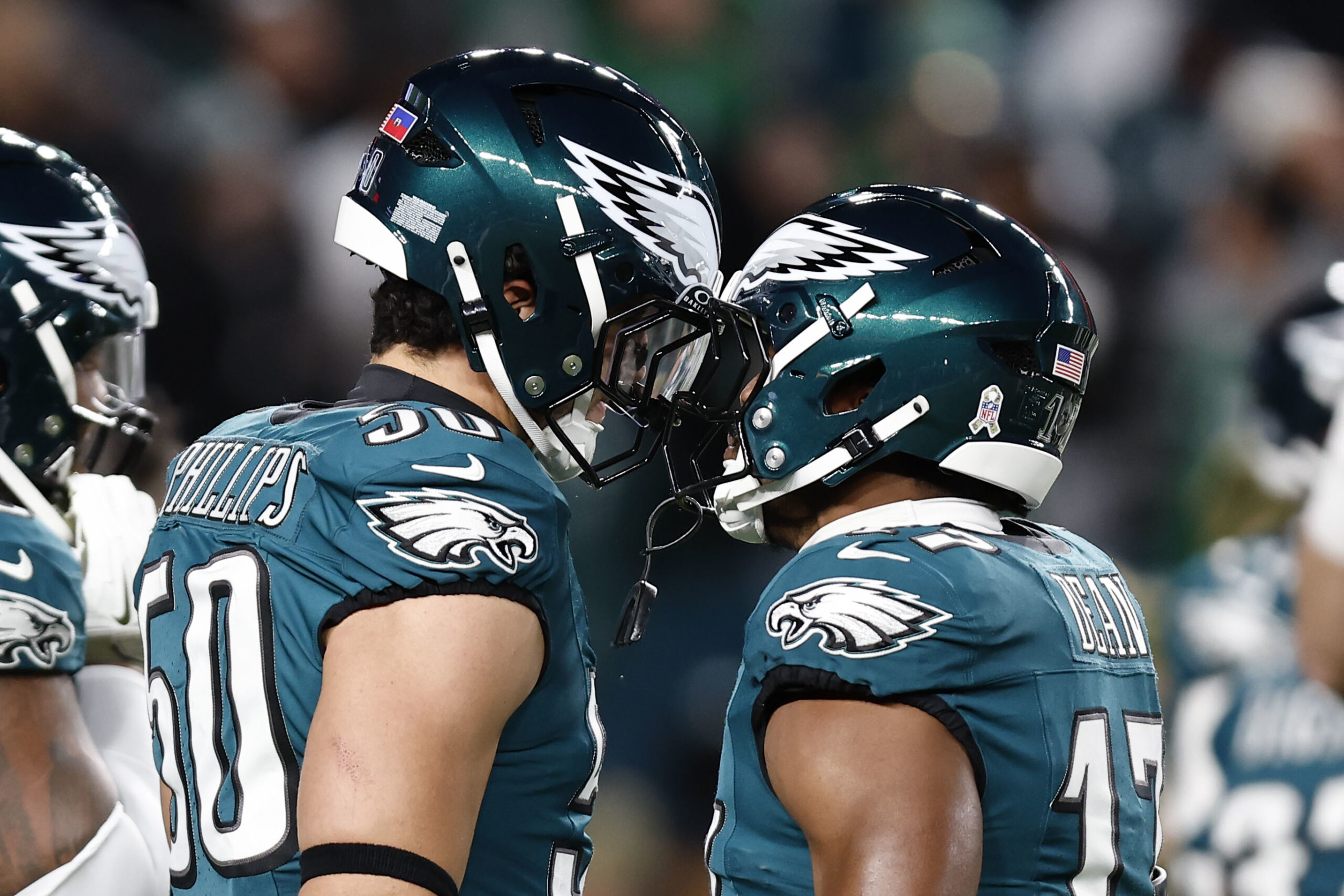
Jaelan Phillips (50) and Nakobe Dean (17) are popular in the Eagles locker room, but a tough business decision around both looms.
Let Nakobe Dean and Jaelan Phillips walk
In the creative writing business, this step would be referred to as “killing your darlings.”
The Eagles have 18 pending unrestricted free agents and Roseman can’t keep them all, nor would he want to bring them all back due to poor performance from certain members of that group. But even some of the team’s more talented, beloved players likely won’t stick around, especially Nakobe Dean.
Roseman has displayed a preference in the past to reward his homegrown talent with extensions. In a vacuum, Dean would be a worthy candidate, given he rebounded from a major injury and proved he’s still a starting-caliber talent in 2025. But with Jihaad Campbell waiting in the wings, Roseman may want to let his 2022 third-rounder out of Georgia walk. Campbell and Baun are a strong starting pair and Jeremiah Trotter Jr. is a capable backup.
What about Jaelan Phillips, the 26-year-old outside linebacker whom the Eagles acquired from the Miami Dolphins at the trade deadline? Phillips led the team with 34 pressures after he joined in Week 10, according to Next Gen Stats. But he turned just two of those pressures into sacks, good for a 5.9% pressure-to-sack conversion rate (10th lowest among 97 defenders with at least 15 pressures since the trade deadline).
Unless the Eagles can bring Phillips back on a team-friendly deal, they may have no choice but to allocate money elsewhere. Spotrac projects Phillips’ market value at $17.3 million annually.
Safety Reed Blankenship’s spot on the 2026 roster is far from assured.
Re-sign Reed Blankenship and Braden Mann, barring unreasonable asking prices
Among the pool of pending free agents, a couple of candidates for extensions stand out who might not break the bank — Reed Blankenship and Braden Mann.
Blankenship, the 2022 undrafted free agent out of Middle Tennessee State, was a captain and a key communicator in the Eagles secondary in 2025. He wasn’t flawless, as evidenced by his late holding penalty in the wild-card loss to the 49ers that eventually led to a touchdown.
Still, the 26-year-old safety has a solid body of work over the course of four seasons. His departure would leave a leadership hole in the secondary and a question mark alongside Drew Mukuba, who is still in the process of proving himself as he rebounds from a fractured fibula that ended his up-and-down rookie campaign.
Of course, whether Blankenship returns will depend on his asking price. The Eagles were eager to get C.J. Gardner-Johnson’s contract off the books this time last year, and he was making $9 million per year. Blankenship has a market value of $7.2 million per year, according to Spotrac’s projection.
Mann, the 28-year-old punter, is also set to become a free agent at the start of the new league year. He undoubtedly earned himself a new deal, potentially with the Eagles, as he averaged a franchise-best 49.9 yards per punt in 2025.
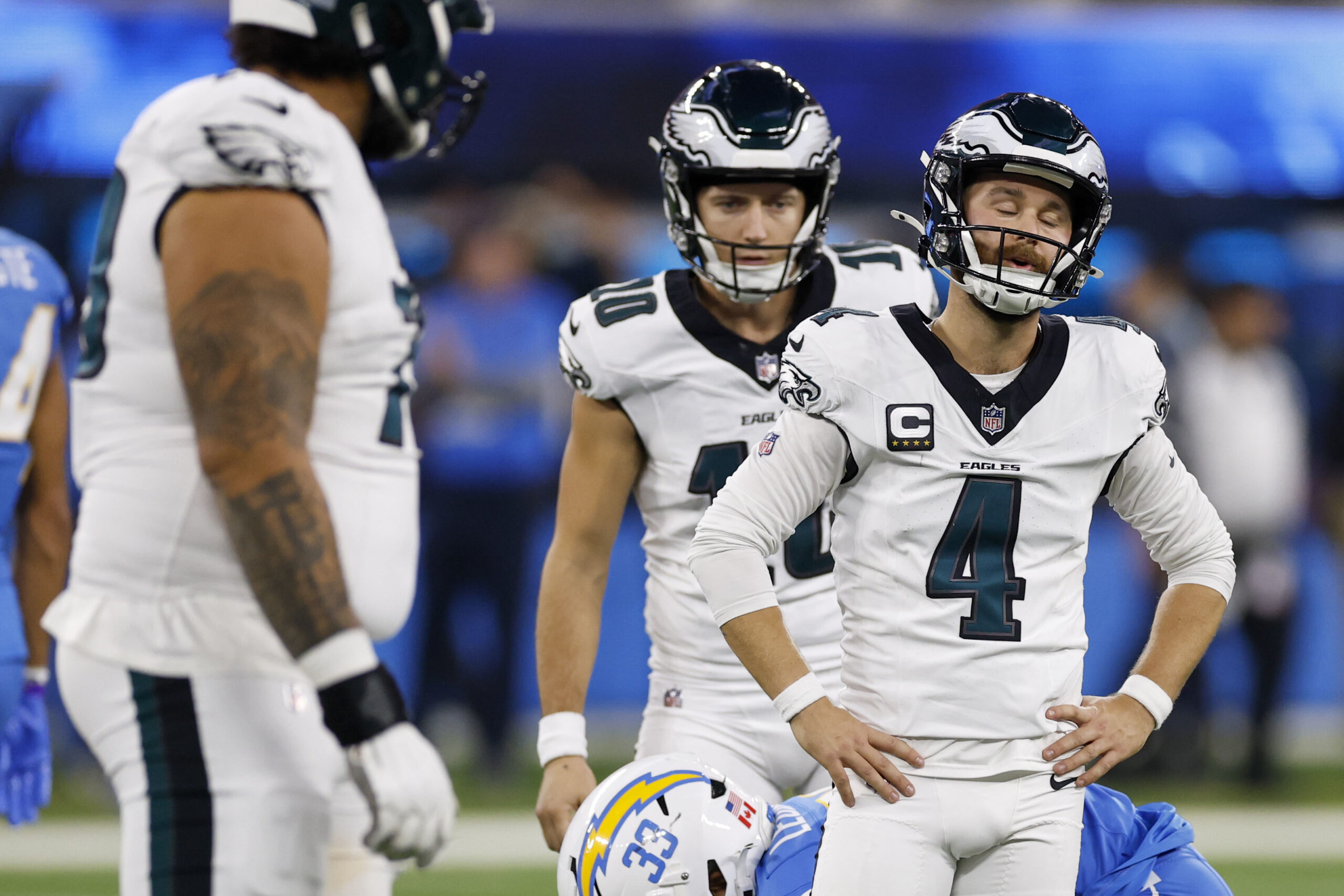
The Eagles can’t assume Jake Elliott’s shaky performance in 2025 was an anomaly.
Bring in competition for Jake Elliott
Even though Jake Elliott had a rough stretch of games in 2024, making 19 of 25 field goal attempts in the final 10 games of the season (76%), the Eagles stuck with him as their kicker in 2025.
This offseason could be different. Once again, Elliott had a shaky showing over a 10-week span during the regular season, going 13-for-20 (65%) on his field goal attempts. Elliott also missed a critical extra point while battling the wind in the wild-card loss to the 49ers. His 74.1% field goal percentage on the season was the second-worst rate of his career (73.7% in 2020, although he only attempted a career-low 19 field goals that year).
Elliott may have some equity given his otherwise robust nine-year Eagles career, but it’s fair to wonder if that equity has run out given his struggles in consecutive seasons. It might be time to evaluate other options at kicker in training camp if Elliott’s best days are behind him.
Given Lane Johnson’s age and recent injury history, the Eagles must do some serious scenario planning at right tackle.
Figure out (and potentially enact) the RT succession plan
After a Lisfranc injury in his right foot curtailed his 13th season with the Eagles, does right tackle Lane Johnson still intend to play in 2026?
Johnson, who turns 36 in May, is technically under contract through 2027. But is he healthy enough to continue playing or is he contemplating retirement this offseason?
Regardless of his decision, Roseman must figure out the succession plan at right tackle. He could have an opportunity to find Johnson’s heir apparent through the draft. The Inquirer’s Devin Jackson identified a handful of tackles (some with guard versatility) the Eagles could target with the No. 23 pick in the draft, including Alabama’s Kadyn Proctor, Utah’s Caleb Lomu, and Georgia’s Monroe Freeling.
Could Roseman look internally to eventually fill Johnson’s role? The Eagles drafted a pair of tackles last year in Myles Hinton (sixth round out of Michigan) and Cameron Williams (sixth round out of Texas). Both players spent a chunk of the season on injured reserve, and only Williams earned playing time, in the season finale against the Washington Commanders. They weren’t blue-chip prospects, but Jeff Stoutland has a history of developing lesser-known players into starting tackles (i.e. Jordan Mailata).
Dallas Goedert and Grant Calcaterra are both set to become free agents.
Figure out (and most likely enact) the TE succession plan
For a second straight year, Dallas Goedert enters the offseason uncertain about his future with the Eagles.
The 31-year-old tight end is set to become an unrestricted free agent at the start of the new league year, which could mark the end of his eight-year career in Philadelphia. Goedert was a revelation in the red zone in 2025, scoring 10 of his 11 touchdowns during the regular season inside the opponent’s 20-yard line. Given his scoring ways, though, he might have earned himself a raise on the open market.
With Goedert, Grant Calcaterra, and Kylen Granson all poised to become free agents, the Eagles will likely have to draft a tight end this year and sign one (or two) in free agency. Given the importance of the ground game in the Eagles offense, it is imperative that the TE1 of the future can run block in addition to his responsibilities as a receiver. Goedert appeared to take a step back in his run-blocking performance in 2025, as did most of the unit that paved the way for Saquon Barkley.
Could some offensive playmakers be in the cards on draft day 2026?
Lean offense in the draft (including a wide receiver and a quarterback) …
Over a span of five years from 2018-22, the Eagles invested loads of premium draft capital into the offensive side of the ball. Roseman hit on a number of early picks, including Goedert (2018), Jalen Hurts (2020), DeVonta Smith (2021), and Landon Dickerson (2021), plus he acquired Brown from the Tennessee Titans in exchange for the 2022 No. 18 overall pick.
Aside from Goedert, each of those players have since been rewarded with contracts that will account for at least 3.4% of the salary cap in 2026 and as much as 10.4% in Hurts’ case. Beginning in 2022, Roseman balanced out what would become his expensive players on offense by adding defensive players on rookie deals, drafting Davis (2022), Dean (2022), Carter (2023), Smith (2023), Quinyon Mitchell (2024), Cooper DeJean (2024), and Campbell (2025). Roseman called this the “natural arc” of the team on Jan. 15.
“I think that when you look at our team, we draft a lot of offensive players, we re-signed a lot of offensive players, [and] we drafted a lot of defensive players that were young on rookie contracts,” Roseman said. “There’s natural transition in what we do.”
It’s time for the draft pendulum to swing back in the direction of the offense. With many of those aforementioned defensive draftees becoming eligible for extensions, Roseman is going to replace costly offensive veterans with players on rookie deals over time.
The Eagles already have an immediate need for a WR3, with Jahan Dotson a pending unrestricted free agent. As previously discussed, the team could also be in the market for a tackle, and even upgrades on the interior offensive line. Plus, with Sam Howell set to become a free agent and Kyle McCord signing a futures deal with the Packers, Roseman may want to add to the quarterback factory through the draft, too, although this year’s class lacks depth.
Is there another Jalyx Hunt in this year’s draft who could help the Eagles off the edge?
… but keep drafting edge rushers
Still, the Eagles have needs to address on the defensive side of the ball. Roseman is seemingly always good for one edge defender in every draft class. Smith and Jalyx Hunt are the only 2025 active-roster edge rushers who are under contract next year, so Roseman will need to make additions through the draft and free agency.
The Eagles will also be on the market for a CB2, as Adoree’ Jackson is set to become a free agent. Kelee Ringo has one year remaining on his rookie deal, but given his inability to win the starting role in Year 3, it seems unlikely that he will earn the job in 2026. While the Eagles could attempt to identify their next starting outside cornerback opposite Mitchell through the draft …
The Eagles might look to an Adoree’ Jackson-type veteran to lock down the opposite corner to Quinyon Mitchell.
Sign a stopgap veteran CB2
… the free-agent route worked well enough for them in 2025, and they could go down that path again in 2026. Few NFL teams invest heavily in all three cornerback spots. Given the Eagles’ needs on offense, Roseman could make another Jackson-esque signing (or even re-sign Jackson) to hold them over for another season or two instead of investing premium draft capital at the position again.
The social video platform was one of three companies — along with Meta’s Instagram and Google’s YouTube — facing claims that their platforms deliberately addict and harm children. A fourth company named in the lawsuit, Snapchat parent company Snap Inc., settled the case last week for an undisclosed sum.
Details of the settlement with TikTok were not disclosed, and the company did not immediately respond to a request for comment.
At the core of the case is a 19-year-old identified only by the initials “KGM,” whose case could determine how thousands of other, similar lawsuits against social media companies will play out. She and two other plaintiffs have been selected for bellwether trials — essentially test cases for both sides to see how their arguments play out before a jury and what damages, if any, may be awarded, said Clay Calvert, a nonresident senior fellow of technology policy studies at the American Enterprise Institute.
A lawyer for the plaintiff said in a statement Tuesday that TikTok remains a defendant in the other personal injury cases, and that the trial will proceed as scheduled against Meta and YouTube.
Jury selection starts this week in the Los Angeles County Superior Court. It’s the first time the companies will argue their case before a jury, and the outcome could have profound effects on their businesses and how they will handle children using their platforms. The selection process is expected to take at least a few days, with 75 potential jurors questioned each day through at least Thursday. A fourth company named in the lawsuit, Snapchat parent company Snap Inc., settled the case last week for an undisclosed sum.
KGM claims that her use of social media from an early age addicted her to the technology and exacerbated depression and suicidal thoughts. Importantly, the lawsuit claims that this was done through deliberate design choices made by companies that sought to make their platforms more addictive to children to boost profits. This argument, if successful, could sidestep the companies’ First Amendment shield and Section 230, which protects tech companies from liability for material posted on their platforms.
“Borrowing heavily from the behavioral and neurobiological techniques used by slot machines and exploited by the cigarette industry, Defendants deliberately embedded in their products an array of design features aimed at maximizing youth engagement to drive advertising revenue,” the lawsuit says.
Executives, including Meta CEO Mark Zuckerberg, are expected to testify at the trial, which will last six to eight weeks. Experts have drawn similarities to the Big Tobacco trials that led to a 1998 settlement requiring cigarette companies to pay billions in healthcare costs and restrict marketing targeting minors.
“Plaintiffs are not merely the collateral damage of Defendants’ products,” the lawsuit says. “They are the direct victims of the intentional product design choices made by each Defendant. They are the intended targets of the harmful features that pushed them into self-destructive feedback loops.”
The tech companies dispute the claims that their products deliberately harm children, citing a bevy of safeguards they have added over the years and arguing that they are not liable for content posted on their sites by third parties.
“Recently, a number of lawsuits have attempted to place the blame for teen mental health struggles squarely on social media companies,” Meta said in a recent blog post. “But this oversimplifies a serious issue. Clinicians and researchers find that mental health is a deeply complex and multifaceted issue, and trends regarding teens’ well-being aren’t clear-cut or universal. Narrowing the challenges faced by teens to a single factor ignores the scientific research and the many stressors impacting young people today, like academic pressure, school safety, socio-economic challenges, and substance abuse.”
A Meta spokesperson said in a statement Monday the company strongly disagrees with the allegations outlined in the lawsuit and that it’s “confident the evidence will show our longstanding commitment to supporting young people.”
José Castañeda, a Google Spokesperson, said Monday that the allegations against YouTube are “simply not true.” In a statement, he said “Providing young people with a safer, healthier experience has always been core to our work.”
TikTok did not immediately respond to a request for comment Monday.
The case will be the first in a slew of cases beginning this year that seek to hold social media companies responsible for harming children’s mental well-being. A federal bellwether trial beginning in June in Oakland, Calif., will be the first to represent school districts that have sued social media platforms over harms to children.
In addition, more than 40 state attorneys general have filed lawsuits against Meta, claiming it is harming young people and contributing to the youth mental health crisis by deliberately designing features on Instagram and Facebook that addict children to its platforms. The majority of cases filed their lawsuits in federal court, but some sued in their respective states.
TikTok also faces similar lawsuits in more than a dozen states.
MILAN — News that a unit of U.S. Immigration and Customs Enforcement would be present during the upcoming Winter Games has set off concern and confusion in Italy, where people have expressed outrage at the inclusion of an agency that has dominated headlines for leading the Trump administration’s immigration crackdown.
Homeland Security Investigations, a unit within ICE that focuses on cross-border crimes, frequently sends its officers to overseas events like the Olympics to assist with security. HSI officers are separate from the ICE arm at the forefront of the immigration crackdown known as Enforcement and Removal Operations, and there was no indication ERO officers were being sent to Italy.
That distinction, however, wasn’t immediately clear to local media on Tuesday morning.
Italy reacts to U.S. security deployment
The reaction among some in Italy reflects not only a worsening perception abroad of the administration’s tactics on immigration but also underscores a broader rift between the U.S. under President Donald Trump and its international allies.
Vague reports that ICE would be deployed in some capacity surfaced over the weekend, resulting in a series of online petitions gathering support of people opposed to the presence of ICE at the Games. They followed a RAI news report that aired Sunday showing an Italian news crew being threatened in Minneapolis by ICE agents. Trump’s immigration crackdown has in recent weeks intensified in Minneapolis, leading to the fatal shootings of two U.S. citizens at the hands of federal immigration officers.
Milan Mayor Giuseppe Sala said that ICE would not be welcome in his city, which is hosting the Feb. 6 opening ceremony to be attended by U.S. Vice President JD Vance, as well as most ice sports.
“This is a militia that kills, a militia that enters into the homes of people, signing their own permission slips. It is clear they are not welcome in Milan, without a doubt,” Sala told RTL Radio 102.
ICE units breakdown
Immigration and Customs Enforcement is broken into various arms. Enforcement and Removal Operations is the part of the agency that is tasked with monitoring, arresting, and removing foreigners who no longer have the right to be in the U.S. They’re the officers most directly tasked with carrying out Trump’s mass deportation agenda.
Another arm of ICE is Homeland Security Investigations. Agents from HSI conduct investigations into anything that has a cross-border nexus from human smuggling to fentanyl trafficking to smuggling of cultural artifacts. Agents from HSI are stationed in embassies around the world to facilitate their investigations and build relations with local law enforcement in those countries.
The ICE agents deployed to Italy for the Games will have a different role from the one seen in immigration crackdowns in the U.S., officials have stressed.
“Obviously, ICE does not conduct immigration enforcement operations in foreign countries,″ the Department of Homeland Security said in a statement Tuesday.
“At the Olympics, ICE’s Homeland Security Investigations is supporting the U.S. Department of State’s Diplomatic Security Service and host nation to vet and mitigate risks from transnational criminal organizations. All security operations remain under Italian authority.”
A U.S official speaking on condition of anonymity to discuss security measures said the general public likely wouldn’t even see or be aware of the HSI agents on the ground during the Olympics. The official said HSI agents would be working behind the scenes, mainly in offices or the U.S. consulate in Milan, as they have done during previous international events.
For years HSI distanced itself from anything having to do with deportations or immigration enforcement. At one point they got new branding and email addresses to set themselves apart because agents working in parts of the country with strong political opposition to immigration enforcement wouldn’t get their emails answered because they had an ICE.gov address.
Under the Trump administration, however, HSI agents have been working closer with ICE’s other arm — the deportation officers — to focus more on immigration issues. They’ve been going out on operations with deportation officers and focusing more on immigration fraud cases.
Reaction underscores fraught ties
The International Olympic Committee said in a statement that security “is the responsibility of the authorities of the host country, who work closely with the participating delegations.”
The reaction in Italy highlights increasingly fraught relations between Trump and the U.S.’ traditional allies in Europe, which have been tested during the president’s second term over his threats to take over Greenland.
Foreign Minister Antonio Tajani told reporters Tuesday that the ICE agents deployed for the Games will not be “those with machine guns and faces covered. They will be functionaries who belong to the anti-terrorism department.″
Interior Minister Matteo Piantedosi met in his office with U.S. Ambassador Tilman Fertitta in the late morning for a conversation that was described as cordial. The Interior Minister is Italy’s top law enforcement officials, charged with security for the Games, which is coordinated with regional prefects.
Asked about the potential deployment over the weekend, he gave a diplomatic shrug: “I don’t see what the problem would be,″ the news agency ANSA quoted him as saying.
Cortina Mayor Gianluca Lorenzi told the Associated Press that the municipal administrations defers to the prefecture and Italian law enforcement on matters of delegation security — which he assumes are in line with Italian guidelines.
———
Barry reported from Milan. Associated Press writers Rebecca Santana and Matthew Lee contributed from Washington and Graham Dunbar from Crans-Montana, Switzerland.
For centuries, white people in America depicted slavery as a benign institution developed to uplift and civilize “savage” Africans. They preached that myth in churches, taught it in schools, and memorialized it in statues.
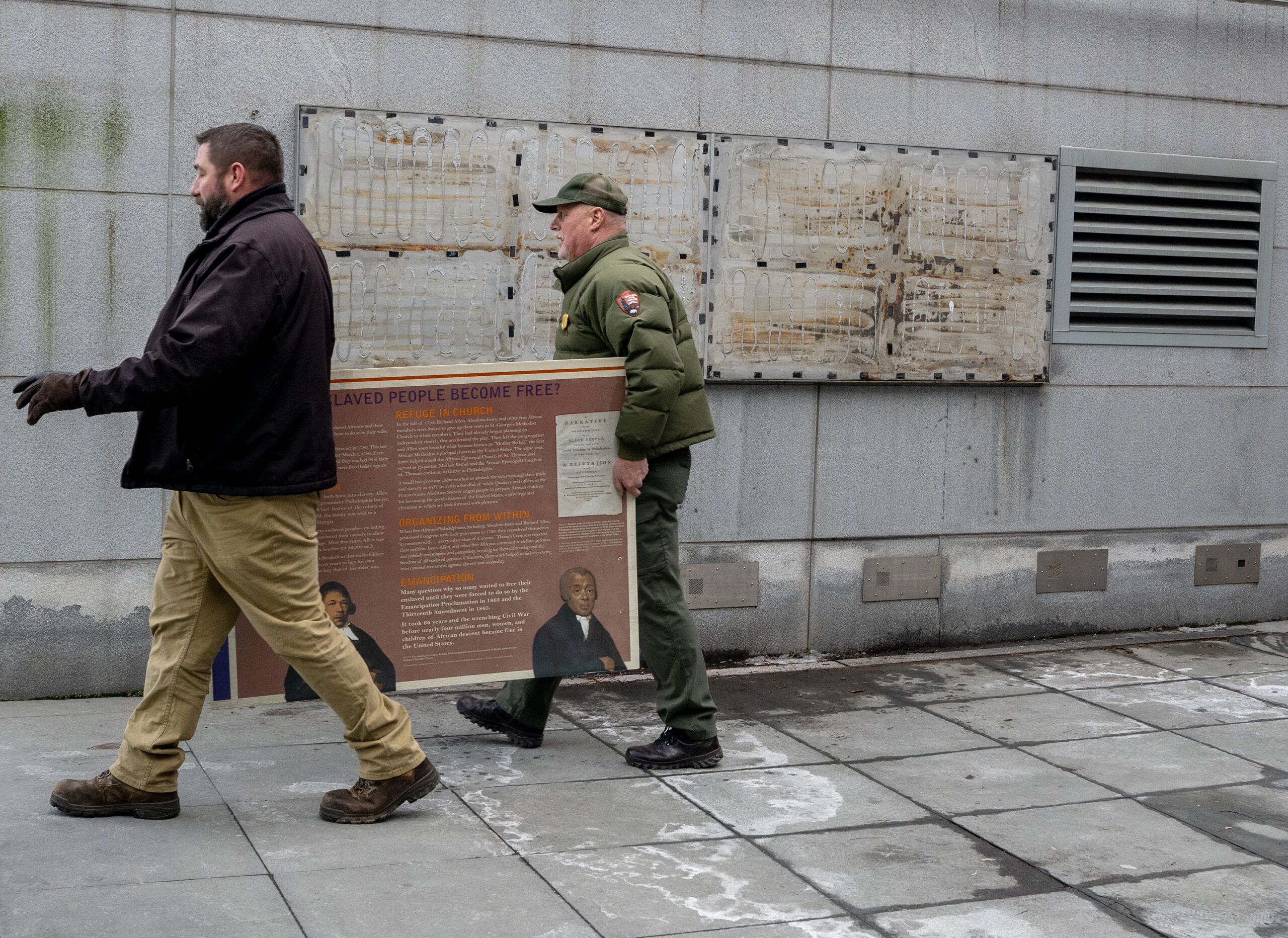
That’s not what the Trump administration was trying to do last week, in dismantling a display about nine Black people whom George Washington enslaved. The exhibit was removed from the President’s House in Independence National Historical Park in accordance with a White House directive to take down or cover up materials that “inappropriately disparage Americans.”
I suppose you could call that a small piece of progress, given that prior generations of Americans actively praised slavery. Federal officials know it was evil, which is why they are scrubbing displays about it from the President’s House and other historical sites around the country.
But I’ve got another word for their behavior: cowardice. They are afraid to admit the contradiction at the heart of our history: a nation that dedicated itself to human liberty also enslaved African Americans. And they do not trust the rest of us to grapple with it, either. It’s so much easier to just look away.
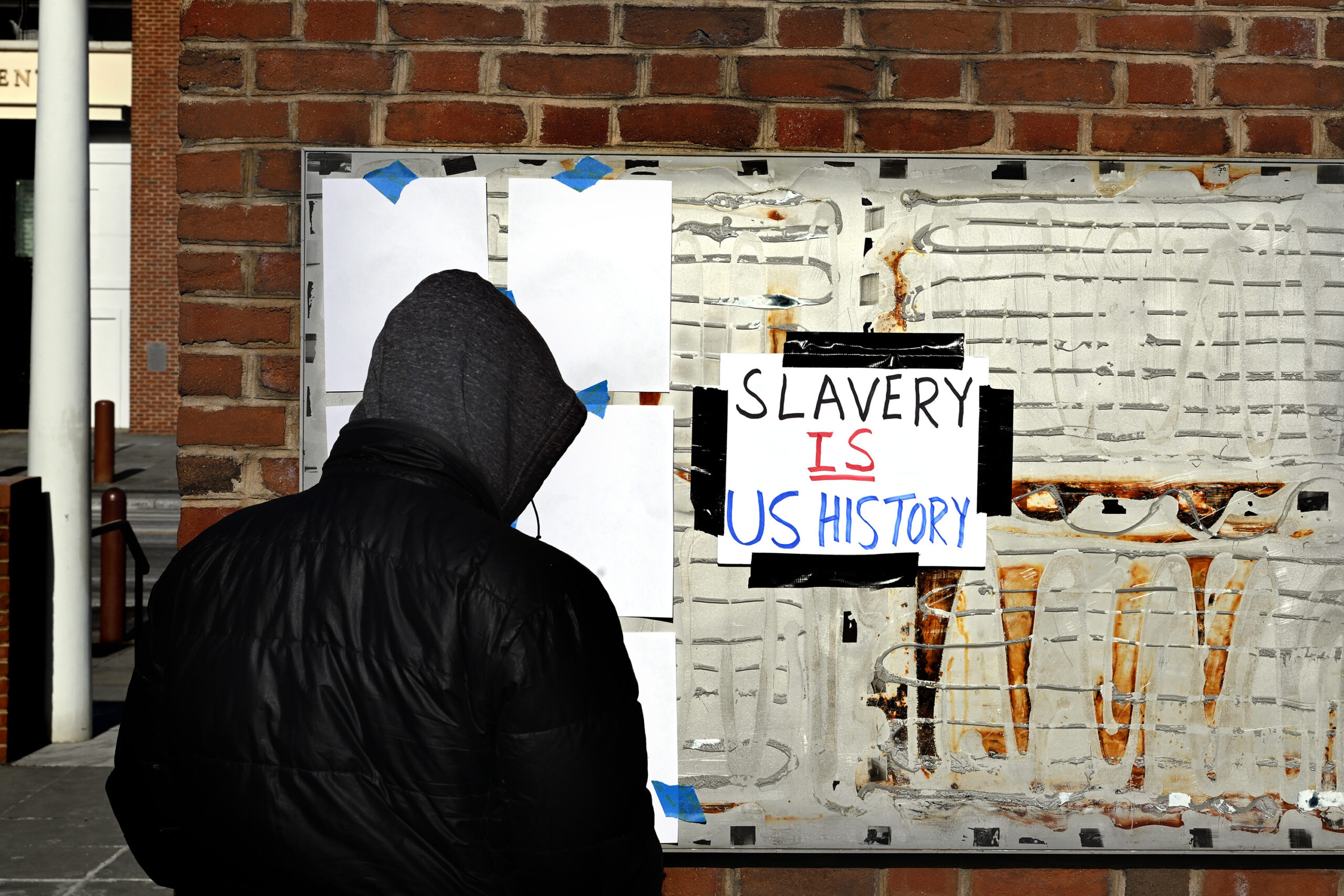
People leave notes Saturday on the spaces at the President’s House site where more than a dozen educational displays about slavery were removed.
That was harder to do in the late 19th and early 20th centuries, when slavery was within living memory for millions of people. Especially in the South, white educators made extended efforts to excuse it. The problem wasn’t slavery, they said.
The problem was “the War of Northern Aggression” — a.k.a. the Civil War — which granted freedom to African Americans, whom, according to this twisted retelling of history, neither wanted nor deserved it.
The key figure in this campaign was Mildred Lewis Rutherford, the “historian-general” of the United Daughters of the Confederacy, or UDC. Born into a wealthy slaveholding family in 1851, Rutherford led the effort to purge Southern schoolbooks of so-called Yankee perspectives.
In 1919, “Miss Millie” — as she was affectionately known across the white South — published A Measuring Rod to Test Textbooks, which provided a checklist that UDC women could use to assess what their schools were teaching. “Reject a book … that speaks of the slaveholder of the South as cruel and unjust to his slaves,” Rutherford urged.
Invoking the era’s rhetoric of progressive education — which stressed student activities rather than memorization from books — the UDC also sponsored essay contests for students who conducted research about slavery. Many of the essays drew on interviews from former slaveholders, who provided a predictably romantic view of the institution.
Slavery was “the happiest time of the negroes’ existence,” declared a winning essay in 1915 by a Virginia high school student. “The slave was a member of the family, often a privileged member. He was the playmate, brother, exemplar, friend and companion of the white man from cradle to grave.”
Despite Rutherford’s fears of encroaching Yankee doctrine, meanwhile, Northern schoolbooks often included similar falsehoods about slavery. In 1944, amid the World War II struggle against Nazism, Black activists in New York City complained that one history text used in their schools said those in bondage were “happy”; another congratulated the Ku Klux Klan for keeping “foolish Negroes” out of government after the Civil War. “Such passages … could well have come from the mouths of the fascist enemies of our nation,” the activists noted.
Bolts are removed from interpretive panels about slavery before they are removed from the walls of the President’s House site in Independence National Historical Park Thursday.
African American attacks on flawed textbooks came to a head during the civil rights movement of the 1960s, when the Urban League and the National Association for the Advancement of Colored People appointed committees to examine the books. Thanks to these efforts, most textbooks corrected their distortions of slavery. They also added new material about African Americans who fought against it, like Denmark Vesey and Frederick Douglass.
Today, outside the darkest corners of the internet, nobody celebrates the enslavement of African Americans. “It is disgusting and absurd to suggest that anyone inside this building would support slavery,” White House press secretary Sarah Huckabee Sanders said during President Donald Trump’s first term in office, when Chief of Staff John Kelly suggested Confederate Gen. Robert E. Lee was an “honorable man.”
In his second term, Trump has moved to restore the names of Confederates to military bases. Yet, I haven’t heard him — or anyone in his administration — say a good word about slavery. Again, that’s a very good thing.
Workers remove the displays at the President’s House site in Independence National Historical Park Thursday.
But it also underscores their fundamental lack of courage. They’re not defending slavery, as earlier generations did. Instead, as happened at the President’s House, they’re simply eliminating it from sight because it doesn’t suit their happy picture of our history. To paraphrase the Jack Nicholson character in A Few Good Men, they can’t handle the truth.
And if visitors ask why the exhibit about Washington and slavery disappeared, National Park Service employees have been instructed to say that they don’t know. Talk about cowardice! First, we deny history, and then we deny knowing why we did so.
It’s enough to make a citizen embarrassed for his country. Trump and his aides say they took down the exhibit because it disparaged America. But they are the ones disparaging America, because they don’t believe in our ability to make sense of it: its glory and its tragedy, its achievements and its abuses. Shame on them.
Jonathan Zimmerman teaches history and education at the University of Pennsylvania. He is the author of “Whose America?: Culture Wars in the Public Schools.”
WARSAW, Poland — Holocaust survivors, politicians, and regular people commemorated International Holocaust Remembrance Day on Tuesday, gathering at somber events across Europe and beyond to reflect on Nazi Germany’s killing of millions of people.
International Holocaust Remembrance Day is observed across each year on Jan. 27, the anniversary of the liberation of Auschwitz-Birkenau, the most notorious of the Nazi German death camps. The U.N. General Assembly adopted a resolution in 2005 establishing the day as an annual commemoration.
“The attempt, carried out by Nazi Germany, to erase the Jews from the face of Europe encapsulates, in an emblematic way, all the evil that human beings are capable of committing when they allow themselves to be infected — out of superficiality, indifference, cowardice, or self-interest — by the virus of hatred, racism, and oppression,” Italian President Sergio Mattarella said in a gathering with survivors in Rome.
At Auschwitz, located in an area of southern Poland which was under German occupation during World War II, Polish President Karol Nawrocki joined survivors for a remembrance ceremony that ended with Jewish and Christian clergy reciting prayers.
Bernard Offen, a 96-year-old survivor told participants that in today’s world he sees “signs I know too well.”
“I see hatred resurgent. I see violence beginning to be justified once again,” Offen said. “I see people who believe their anger is more valuable than another human life. I say this because I am an old man who has seen where indifference leads to. And I say this because I believe that — I truly believe — that we can choose differently.”
Nazi German forces killed some 1.1 million people at Auschwitz, most of them Jews, but also Poles, Roma, and others. The camp was liberated by the Soviet army on Jan. 27, 1945. In all, 6 million Jews were killed in the Holocaust — in ghettos, concentration camps, and shot at close range in the fields and forests of Eastern Europe.
In the heart of Berlin, candles burned at the Memorial to the Murdered Jews of Europe, a field of 2,700 gray concrete slabs which honors the 6 million victims and stands as a powerful symbol of Germany’s remorse.
Other countries are still struggling to come to terms with the complicity of their ancestors. Mattarella condemned the complicity of ordinary Italians in the fascist-era racial laws, which persecuted Italy’s Jewish community, and deportation of its Jews.
As in recent years, Russia representatives were not invited to the observances at Auschwitz due to the country’s invasion of Ukraine.
‘Become my witness’
Pavel Jelinek, a 90-year-old survivor from the city of Liberec — a Czech city with a prewar Jewish population of 1,350 — told those gathered in the upper house of the Czech Parliament that he was now the last living of the 37 Jews who returned to the city after the war.
There are an estimated 196,600 Jewish Holocaust survivors still alive globally, down from 220,000 a year ago, according to the New York-based Conference on Jewish Material Claims Against Germany. Their median age is 87, and nearly all — some 97% — are “child survivors” who were born 1928 and later, the group said.
Though the world’s community of survivors is shrinking, some are still telling their stories for the first time after all these years.
In Britain, King Charles and Queen Camilla held a reception for survivors. A Holocaust survivor also addressed the British Cabinet in what Prime Minister Keir Starmer described as a first. Government members wiped away tears as 95-year-old Mala Tribich described how Germany’s invasion of Poland in 1939 destroyed her childhood.
She recalled being forced into hard labor at the age of 12 as the first Nazi ghetto was established in her hometown of Piotrkow Trybunalski, and spoke of the hunger, disease and suffering there. The Nazis killed her mother, father, and sister. She was sent to Ravensbrück and then to Bergen-Belsen, where she was liberated by the British Army in April 1945.
She urged the Cabinet members to fight antisemitism — and to remember.
“Soon, there will be no eyewitnesses left,” she told them. “That is why I ask you today not just to listen, but to become my witness.”
‘Unity that saves lives is needed’
Many leaders also reflected on the upheaval in today’s world.
Kaja Kallas, the European Union’s foreign policy chief, warned about rising antisemitism and new threats. She noted that AI-generated content is now being used “to blur the line between fact and fiction, distort historical truth, and undermine our collective memory.”
Ukraine’s President Volodymyr Zelensky, whose country has been under attack from Russia for four years, said that just as the world united to defeat the Nazis in 1945, it “must act the same way now.”
“Whenever hatred and war threaten nations, unity that saves lives is needed,” Zelensky said.
Although the Eagles’ season came to an early end, Philadelphia fans can still see a hometown favorite on their television screens during Super Bowl LX.
The ad follows Lincoln’s friendship with the iconic horse playing under the appropriate sounds of Lynyrd Skynyrd’s “Free Bird.” The 60-second in-game spot will air during the Super Bowl.
“It was really like these two icons of America coming together,” said Jessica Hall, the chief executive officer of the American Eagle Foundation, a nonprofit focused on the protection and conservation of bald eagles and other birds of prey. “The Clydesdales have been icons for over 100 years and the bald eagle has been on the great seal for over 200 years. So, seeing those two elements come together and be represented in this really moving commercial was spectacular.”
The American Eagle Foundation got the call from Budweiser over the summer and started filming the project in October, making the trip from Kodak, Tenn., where the American Eagle Foundation is based, to California for Lincoln to star in his first-ever commercial. Lincoln, however, is no stranger to long trips and hotel rooms, thanks to his time serving as the Eagles’ pregame living mascot.
Lincoln doesn’t get his own hotel room on the road, but he does get his own space — and has a darkening crate if the room gets too bright.
“Seeing Lincoln soaring through the skies with his wings spread out, just doing what he does best, it never gets old,” Hall said. “Watching him fly, it sends chills down our backs every time. And meeting the Clydesdale was also incredible. The Clydesdale team were fascinated by the eagle, and the eagle team were fascinated by the Clydesdale.”
The ad, directed by Emmy Award-winning commercial director Henry-Alex Rubin, is the latest addition to Budweiser’s “Made of America” campaign.
“As we celebrate Budweiser’s 150th anniversary and America’s 250th birthday, we knew we had to rise to the occasion in a way only Budweiser can,” Todd Allen, senior vice president of marketing for Budweiser at Anheuser-Busch, said in a news release. ”‘American Icons’ brings our heritage to life through powerful storytelling with the Budweiser Clydesdales and an American Bald Eagle. This year’s spot will leave fans awe-struck and proud to enjoy a Budweiser as they celebrate our shared milestone moments.”
Lincoln first flew into Lincoln Financial Field during the 2024 season, taking over for his predecessor, Challenger.
Lincoln has been performing free-flight events since 2001, but his first NFL season, flying in bigger outdoor spaces, was in 2024. To prepare, he flew at Carson-Newman University and at Tucker Stadium, the home of the Tennessee Tech Golden Eagles.
Of course, training came with a few minor hiccups, including when it came to dealing with other animals. In December 2024, Katelyn Jennings, the operations manager of the American Eagle Foundation, told The Inquirer about a close call with an osprey, another type of bird of prey.
“We had a couple of situations that we encountered during training,” Jennings said. “We learned that Lincoln does not mind dogs or osprey … At our Carson-Newman game, they have an osprey nest near the field and the osprey would dive down to try and get him. And he says this is my territory and not yours and he just kind of looked at them like, ‘Hey, what are you doing here?’ and continued to fly onto the trainer.”
Now, a Clydesdale can be added onto Lincoln’s short list of animal interactions.
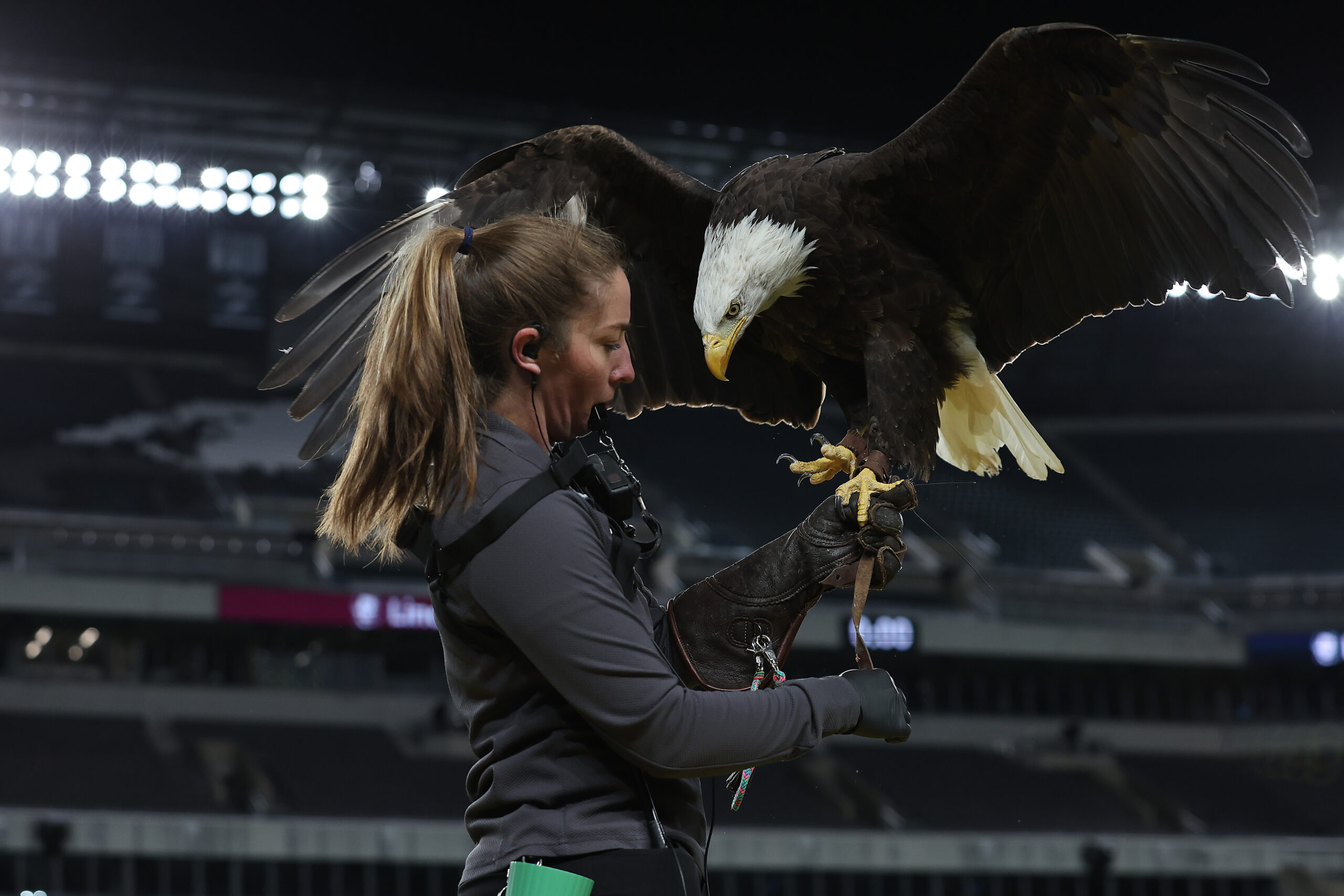
Ashley Frye, an avian care specialist with the American Eagles Foundation, catches Lincoln during a November 2024 test flight at the Linc.
New Jersey and Pennsylvania are poised to regain roughly $244 million in federal funding for electric‑vehicle charging stations after securing a legal victory over the Trump administration.
New Jersey announced this week that it expects $73 million to be reinstated.
Pennsylvania had planned on $171.5 million in EV‑charging funds last year, according to Alex Peterson, a spokesperson for Gov. Josh Shapiro.
“This ruling guarantees that these obligated funds cannot again be interrupted,” Peterson said.
On Friday, a U.S. District Court sided with 20 states that filed suit last year demanding restoration of the National Electric Vehicle Infrastructure Formula Program (NEVI). New Jersey and Pennsylvania were among the plaintiffs.
In her decision, Judge Tana Lin, who was appointed by former President Joe Biden, prohibited the Department of Transportation from withholding funding for approved state EV‑charger deployment plans.
Lin concluded from Seattle that the Federal Highway Administration (FHA) overstepped its authority by halting funding already authorized by Congress. She described the agency’s action as arbitrary and capricious.
“This win puts New Jersey back on track for $73 million in funding unlawfully stripped away through the Trump Administration’s illegal actions,” Jennifer Davenport, New Jersey’s acting attorney general, said this week in a statement. “New Jerseyans want sustainable transportation options.”
New Jersey, Pennsylvania, and Delaware were among plaintiffs in the suit against a Trump administration freeze on the $5 billion. It’s unclear whether Trump administration officials will appeal.
The states’ legal challenge stemmed from an executive order President Donald Trump signed on his Inauguration Day to eliminate EV mandates — which the suit states never existed.
Regardless, the suit stated, the administration used the order to “immediately pause the disbursement of funds” for EV infrastructure appropriated through the Inflation Reduction and Infrastructure Investment and Jobs acts signed by Biden.
Other states that joined the suit included Washington, Colorado, California, Arizona, Delaware, Hawaii, Illinois, Kentucky, Maryland, Minnesota, New Mexico, Michigan, New York, North Carolina, Oregon, Rhode Island, Vermont, and Wisconsin.
Davenport called the Trump administration’s refusal to spend funds approved by Congress “unlawful.”
This story has been updated to include newer figures on Pennsylvania’s plan to fund EV charging infrastructure.