Blog

  • Iran’s crown prince says survival of Tehran government ‘sends a clear signal to every bully’

    Iran’s crown prince says survival of Tehran government ‘sends a clear signal to every bully’

    MUNICH — Some 200,000 people demonstrated Saturday against Iran’s government on the sidelines of a gathering of world leaders in Germany, police said, answering a call from Iran‘s exiled Crown Prince Reza Pahlavi for cranked-up international pressure on Tehran.

    Banging drums and chanting for regime change, the giant and boisterous rally in Munich was part of what Pahlavi described as a “global day of action” to support Iranians in the wake of deadly nationwide protests. He also called for demonstrations in Los Angeles and Toronto. The police estimate of 200,000 protesters in Munich was reported by German news agency dpa and was higher than organizers had expected.

    “Change, change, regime change” the huge crowd chanted, waving green-white-and-red flags with lion and sun emblems. Iran used that flag before its 1979 Islamic Revolution that toppled the Pahlavi dynasty.

    At a news conference on the sidelines of a security conference in Munich, Pahlavi warned of more deaths in Iran if “democracies stand by and watch” following Iran’s deadly crackdown on protesters last month.

    “We gather at an hour of profound peril to ask: Will the world stand with the people of Iran?” he asked.

    He added that the survival of Iran’s government “sends a clear signal to every bully: Kill enough people and you stay in power.”

    At the Munich rally, demonstrators sported “Make Iran Great Again” red caps, mimicking the MAGA caps worn by U.S. President Donald Trump‘s supporters. Many waved placards showing Pahlavi, some that called him a king. The son of Iran’s deposed shah has been in exile for nearly 50 years but is trying to position himself as a player in Iran’s future.

    The crowd chanted “Pahlavi for Iran” and “democracy for Iran” as drums and cymbals sounded.

    “We have huge hopes and (are) looking forward that the regime is going to change hopefully,” said Daniyal Mohtashamian, a demonstrator who traveled from Zurich, Switzerland, to speak for protesters inside Iran who faced repression.

    “There is an internet blackout and their voices are not going outside of Iran,” he said.

    About 500 protesters also rallied outside the presidential palace in Nicosia, Cyprus, with many holding up banners with slogans against Iran’s government and in favor of Pahlavi.

    On Saturday night in Iran’s capital, Tehran, witnesses said they heard people chanting against the country’s theocracy. The cries included “death to the dictator” and “long live the shah.” The protest came after calls from Pahlavi for people to chant against the government from their homes over the weekend.

    Meanwhile, Iranian Foreign Minister Abbas Araghchi criticized the Munich conference, saying it was “sad to see the usually serious Munich Security Conference turned into the ‘Munich Circus’ when it comes to Iran.”

    The U.S.-based Human Rights Activists News Agency says at least 7,005 people were killed in last month’s protests, including 214 government forces. It has been accurate in counting deaths during previous rounds of unrest in Iran and relies on a network of activists inside Iran to verify deaths.

    Iran’s government offered its only death toll on Jan. 21, saying 3,117 people were killed. Iran’s theocracy in the past has undercounted or not reported fatalities from past unrest.

    The Associated Press has been unable to independently assess the death toll, given authorities have disrupted internet access and international calls in Iran.

    Iranian leaders are facing renewed pressure from Trump, who has threatened U.S. military action. Trump wants Iran to further scale back its nuclear program. He suggested Friday that regime change in Iran “would be the best thing that could happen.”

    Iran was also the focus of protests in Munich on Friday, the opening day of an annual security conference in the city gathering European leaders and global security figures. Supporters of the Iranian opposition group People’s Mujahedeen Organization of Iran, also known as the Mujahedeen-e-Khalq, demonstrated.

  • L.A. Olympics leader Wasserman will sell talent agency in wake of Epstein emails discovery

    L.A. Olympics leader Wasserman will sell talent agency in wake of Epstein emails discovery

    LOS ANGELES — Casey Wasserman, the chairperson of the 2028 Los Angeles Olympics organizing committee, is selling his eponymous talent agency in the wake of the release of emails between himself and Ghislaine Maxwell.

    Wasserman’s emails with Maxwell were revealed by his appearance in recently released government files on Jeffrey Epstein. Wasserman, whose agency represents some of the top pop music artists in the world, has not been accused of any wrongdoing.

    The recently released documents revealed that in 2003 he swapped flirtatious emails with Maxwell, who would years later be accused of helping Epstein recruit and sexually abuse his victims. Wasserman said in a Friday evening memo to his staff that he has begun the process of selling the company, according to a company spokesperson who provided the memo to the Associated Press.

    Wasserman’s memo to staff said that he felt he had become a distraction to the company’s work.

    “During this time, Mike Watts will assume day-to-day control of the business while I devote my full attention to delivering Los Angeles an Olympic Games in 2028 that is worthy of this outstanding city,” the memo stated.

    The memo arrived days after the LA28 board’s executive committee met to discuss Wasserman’s appearance in the Epstein files. The committee said it and an outside legal firm conducted a review of Wasserman’s interactions with Epstein and Maxwell with Wasserman’s full cooperation.

    The committee said in a statement: “We found Mr. Wasserman’s relationship with Epstein and Maxwell did not go beyond what has already been publicly documented.” The statement also said Wasserman “should continue to lead LA28 and deliver a safe and successful games.”

    Wasserman has said previously that he flew on a humanitarian mission to Africa on Epstein’s private plane at the invitation of the Clinton Foundation in 2002. Exchanges between Wasserman and Maxwell in the files include Wasserman telling Maxwell: “I think of you all the time. So, what do I have to do to see you in a tight leather outfit?”

    His agency, also called Wasserman, has lost clients over the Maxwell emails. Singer Chappell Roan and retired U.S. women’s soccer legend Abby Wambach are among them.

    Wasserman said in his memo to staff that his interactions with Maxwell and Epstein were limited and he regrets the emails.

    “It was years before their criminal conduct came to light, and, in its entirety, consisted of one humanitarian trip to Africa and a handful of emails that I deeply regret sending. And I’m heartbroken that my brief contact with them 23 years ago has caused you, this company, and its clients so much hardship over the past days and weeks,” the memo said.

  • Another partial government shutdown has started. Why is this one different? Here’s what we know.

    Another partial government shutdown has started. Why is this one different? Here’s what we know.

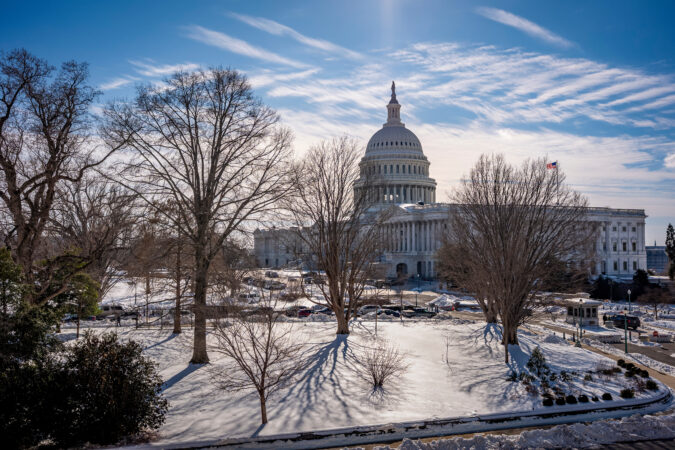
    Another partial government shutdown began Saturday, with lawmakers at an impasse. But this one is different.

    With congressional Democrats refusing to approve funding for the Department of Homeland Security, the last of that agency’s funding has run out.

    It all stems from party-line disagreements surrounding ICE and immigration enforcement.

    When a funding lapse triggered a partial government shutdown on Jan. 31, Congress made a compromise: It approved spending bills for all agencies, except for DHS.

    DHS received two weeks of funding to give Congress more time to negotiate Immigration and Customs Enforcement changes, a push Senate Democrats have repeatedly made after federal immigration and border agents fatally shot two U.S. citizens in Minneapolis last month.

    Now those two weeks are up and Congress is still in a standoff. Democrats want to see more guardrails regarding how ICE agents identify themselves, barring them from wearing masks, and requiring name badges. But Republicans say those practices would add too much risk to the job.

    Since all other government agencies have already been funded, DHS is the only one affected by the shutdown.

    Here’s what that means.

    What’s a partial government shutdown?

    A partial government shutdown happens when Congress has funded only certain federal agencies, leaving others in limbo. Some parts of the government close while others keep operating.

    In this case, it comes down to who has funding and who doesn’t. DHS is the only agency without approved funding. The agency’s fiscal year ends Sept. 30, meaning it currently stands without funding for seven months or until Congress reaches an agreement.

    When did government funding expire?

    Funding for DHS expired Friday at midnight. A shutdown began Saturday at 12:01 a.m. after Congress and President Donald Trump’s administration failed to reach an agreement.

    What changes with the partial shutdown?

    Not much in the eyes of the general public, according to CNN.

    Nearly all DHS workers remain on the job, but many won’t get paid until the shutdown ends.

    But DHS officials who testified before a House panel on Wednesday warned that a funding disruption could mean delays to states seeking reimbursements for disaster relief costs, delays in cybersecurity response, and missed paychecks for agents who screen bags at airports, which could lead to unplanned absences and longer wait times.

    DHS is home to agencies including the Transportation Security Aadministration, Coast Guard, and Federal Emergency Management Agency, which are all affected.

    What have Pennsylvania politicians said?

    Sen. John Fetterman (D., Pa.) said he “absolutely” expected a shutdown. He broke with most Senate Democrats, voting to approve funding and avoid a shutdown in a measure that failed, and arguing that delaying funding DHS won’t impact ICE since the agency has received separate funding.

    Earlier this month, some members of the Pennsylvania delegation to the U.S. House of Representatives, including Chris Deluzio, Chrissy Houlahan, Brendan Boyle, Madeleine Dean, Mary Gay Scanlon, Dwight Evans, and Summer Lee, penned a letter to Fetterman and Sen. Dave McCormick (R., Pa.) asking them to vote against passing the spending bill unless ICE reform is secured. (Both senators voted in favor, but it failed.)

    Houlahan, a Democrat from Chester County, criticized ICE last week and emphasized a need for immigration reform.

    “We are a nation of immigrants, but ICE is clearly not reform. ICE is undertrained. ICE is vastly, vastly overfunded,” she said. “They have a budget that is larger than many countries’ entire defense budgets.”

    Where does Congress stand right now?

    The House had already done its part and approved funding. The chamber is in recess until Feb. 17. But Senate Democrats are pushing back on its approval without immigration reforms. That leaves the Senate with few options if it cannot pass the current measures.

    The Senate adjourned Thursday for a Presidents’ Day recess after a motion to advance DHS funding failed 52-47, mostly along party lines. Democrats also blocked an attempt to extend funding for another two weeks.

    Lawmakers left town, some traveling to the Munich Security Conference in Germany, others to meetings nationwide and overseas.

    The chambers are not scheduled to return until Feb. 23, though that could change if a deal is reached in the meantime. But senators on each side say bipartisanship during an election year seems unlikely.

    So in short: We could be here for a while.

  • Rubio says U.S., Europe ‘belong together,’ despite rifts over Trump policies

    Rubio says U.S., Europe ‘belong together,’ despite rifts over Trump policies

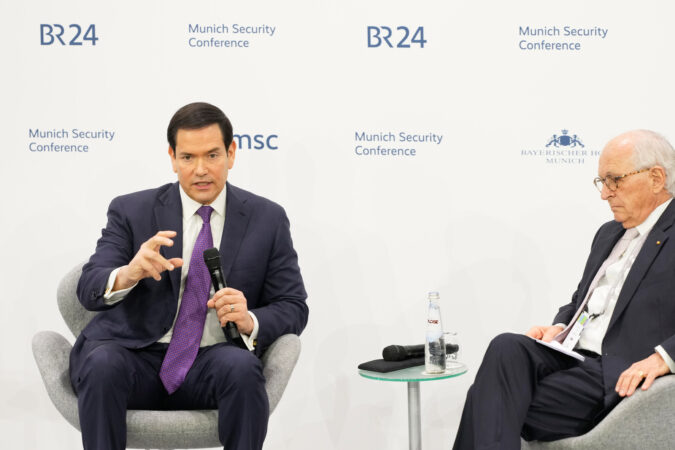
    MUNICH — Secretary of State Marco Rubio declared that the United States and Europe “belong together” in a speech Saturday aimed at unifying the Western alliance, while condemning hallmarks of globalization, open borders, unfettered free trade, “deindustrialization,” and mass migration.

    Rubio’s message, in a keynote address at the annual Munich Security Conference, received applause from a demoralized audience of European leaders who are deeply distressed about divisions with the United States stoked by President Donald Trump’s punitive tariffs, territorial ambitions for Greenland, and disagreements over how to end Russia’s war in Ukraine.

    “We are bound to one another by the deepest bonds that nations could share, forged by centuries of shared history, Christian faith, culture, heritage, language, ancestry, and the sacrifices our forefathers made together,” Rubio said.

    But even as he appealed to those ties, Rubio promoted several Trump administration positions that are deeply controversial among the United States’ closest traditional allies. He showed disdain for policies to reduce carbon emissions, staunchly criticized the United Nations — which many in Europe view as critical to protecting smaller states’ sovereignty — and lauded unilateral U.S. military action in Latin America and the Middle East.

    “On the most pressing matters before us, [the U.N.] has no answers and has played virtually no role,” Rubio said.

    Compared, however, to Vice President JD Vance’s blistering speech in Munich last year, which left the audience stunned by his seeming contempt for Europe, Rubio’s appeal to strengthen the alliance was received as more constructive.

    “Our home may be in the Western Hemisphere, but we will always be a child of Europe,” Rubio said.

    The moderator of the event, Wolfgang Ischinger, called the remarks a “sigh of relief” and a message of “reassurance” and “partnership.”

    Europe’s top leaders descended on the Bavarian capital this weekend, proclaiming the need to overhaul the relationship with the U.S. that has spurred economic prosperity and guaranteed security since World War II.

    European leaders promised to chart their own course and forge a version of the Western alliance in which they depend less on the United States.

    “In today’s fractured world, Europe must become more independent — there is no other choice,” European Commission President Ursula von der Leyen said in a speech early Saturday, to applause.

    As European and American politicians issue post-mortems for the world order in Munich, officials from each side of the Atlantic said it was high time for Europe to pay its own way for security. On that point, European and U.S. leaders appeared in sync.

    For the Europeans, the call to take charge of the continent’s defense is about more than addressing U.S. demands: It could also provide the ability to stand up to Washington and an administration with which they concede they do not share some interests.

    Rubio’s remarks about Europe were softer than Vance’s criticism of the suppression of far-right parties — and, in his characterization, free speech — or Trump’s threats to seize Greenland from NATO ally Denmark.

    But European leaders know well that a crisis with the administration could still erupt on an array of issues, including Greenland, negotiations with Russia over Ukraine, and regulation of hate speech and Big Tech.

    The leaders of Europe’s political and economic powerhouses, France and Germany, stressed that a more powerful Europe could shield itself from the whims of Washington and Moscow, and they delivered a stern rebuke of Trump’s foreign policy gyrations including on trade and climate.

    French President Emmanuel Macron, speaking at the conference Friday night, said Europe had been unjustly “vilified” as a continent of unfettered immigration and repression — an apparent reference to Vance’s speech and to a recent U.S. National Security Strategy that said Europe was facing “civilizational erasure.”

    “Everyone should take their cue from us, instead of criticizing us or trying to divide us,” Macron said. He called for “derisking vis-à-vis all the big powers,” not just in defense, but also in the economy and technology.

    “Europe is rearming, but we must now go beyond,” he added. “Europe has to learn to become a geopolitical power.”

    German Chancellor Friedrich Merz, in his welcoming remarks on Friday, said: “The culture wars of MAGA in the U.S. are not ours.”

    Merz also said that the U.S. claim to global leadership was being “challenged” in an era of great power rivalry, including rising Chinese influence, and he warned that Washington will need allies.

    “Even the United States will not be powerful enough to go it alone,” he said. “Dear friends, being a part of NATO is not only Europe’s competitive advantage. It is also the United States’ competitive advantage.”

    British Prime Minister Keir Starmer said that “we shouldn’t get in the warm bath of complacency. He said the U.K. must reforge closer ties with Europe to help the continent “stand on our own two feet” in its own defense, and said there needs to be investment that “moves us from overdependence to interdependence.”

    Hanno Pevkur, the defense minister of EU and NATO member Estonia, said it was “quite a bold statement to say that America is ‘a child of Europe’.”

    “It was a good speech, needed here today, but that doesn’t mean that we can rest on pillows now,” he told The Associated Press. “So still a lot of work has to be done.”

    A meeting on Greenland

    Rubio didn’t mention Greenland. After last month’s escalation over Trump’s designs on the Arctic island, the U.S., Denmark, and Greenland started technical talks on an Arctic security deal.

    The Secretary of State met briefly in Munich on Friday with the Danish and Greenlandic leaders, a meeting Danish Prime Minister Mette Frederiksen described as constructive.

    But Frederiksen suggested Saturday that although the dispute has cooled, she remains wary. Asked whether the crisis has passed, she replied: “No, unfortunately not. I think the desire from the U.S. president is exactly the same. He is very serious about this theme.”

    Asked whether she can put a price on Greenland, she responded “of course not,” adding that “we have to respect sovereign states … and we have to respect people’s right for self-determination. And the Greenlandic people have been very clear, they don’t want to become Americans.”

  • TSA agents are working without pay at U.S. airports due to another shutdown

    TSA agents are working without pay at U.S. airports due to another shutdown

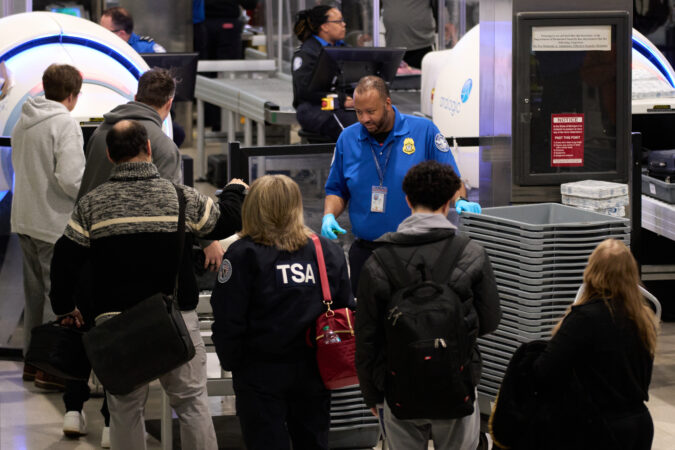
    A shutdown of the U.S. Department of Homeland Security that took effect early Saturday impacts the agency responsible for screening passengers and bags at airports across the country. Travelers with airline reservations may be nervously recalling a 43-day government shutdown that led to historic flight cancellations and long delays last year.

    Transportation Security Administration officers are expected to work without pay while lawmakers remain without an agreement on DHS’ annual funding. TSA officers also worked through the record shutdown that ended Nov. 12, but aviation experts say this one may play out differently.

    Trade groups for the U.S. travel industry and major airlines nonetheless warned that the longer DHS appropriations are lapsed, the longer security lines at the nation’s commercial airports could get.

    Here’s what to know about the latest shutdown and how to plan ahead.

    What’s different about this shutdown?

    Funding for Homeland Security expired at midnight Friday. But the rest of the federal government is funded through Sept. 30. That means air traffic controllers employed by the Federal Aviation Administration will receive paychecks as usual, reducing the risk of widespread flight cancellations.

    According to the department’s contingency plan, about 95% of TSA workers are deemed essential personnel and required to keep working. Democrats in the House and Senate say DHS won’t get funded until new restrictions are placed on federal immigration operations.

    During past shutdowns, disruptions to air travel tended to build over time, not overnight. About a month into last year’s shutdown, for example, TSA temporarily closed two checkpoints at Philadelphia International Airport. That same day, the government took the extraordinary step of ordering all commercial airlines to reduce their domestic flight schedules.

    On Saturday afternoon, the Philadelphia airport’s website showed all checkpoints open with normal brief wait times of 10 minutes or less.

    John Rose, chief risk officer for global travel management company Altour, said strains could surface at airports more quickly this time because the TSA workforce also will be remembering the last shutdown.

    “It’s still fresh in their minds and potentially their pocketbooks,” Rose said.

    What is the impact on travelers?

    It’s hard to predict whether, when, or where security screening snags might pop up. Even a handful of unscheduled TSA absences could quickly lead to longer wait times at smaller airports, for example, if there’s just a single security checkpoint.

    That’s why travelers should plan to arrive early and allow extra time to get through security.

    “I tell people to do this even in good times,” Rose said.

    Experts say flight delays also are a possibility even though air traffic controllers are not affected by the DHS shutdown.

    Airlines might decide to delay departures in some cases to wait for passengers to clear screening, said Rich Davis, senior security adviser at risk mitigation company International SOS. Shortages of TSA officers also could slow the screening of checked luggage behind the scenes.

    What travelers can do to prepare

    Most airports display security line wait times on their websites, but don’t wait until the day of a flight to check them, Rose advised.

    “You may look online and it says 2½ hours,” he said. ”Now it’s 2½ hours before your flight and you haven’t left for the airport yet.”

    Passengers should also pay close attention while packing since prohibited items are likely to prolong the screening process. For carry-on bags, avoid bringing full-size shampoo or other liquids, large gels or aerosols, and items like pocketknives in carry-on bags.

    TSA has a full list on its website of what is and isn’t allowed in carry-on and checked luggage.

    At the airport, Rose said, remember to “practice patience and empathy.”

    “Not only are they not getting paid,” he said of TSA agents, “they’re probably working with reduced staff and dealing with angry travelers.”

    Will the shutdown drag on?

    The White House has been negotiating with Democratic lawmakers, but the two sides failed to reach a deal by the end of the week before senators and members of Congress were set to leave Washington for a 10-day break.

    Lawmakers in both chambers were on notice, however, to return if a deal to end the shutdown is struck.

    Democrats have said they won’t help approve more DHS funding until new restrictions are placed on federal immigration operations after the fatal shootings of Alex Pretti and Renee Good in Minneapolis last month.

    In a joint statement, U.S. Travel, Airlines for America, and the American Hotel & Lodging Association warned that the shutdown threatens to disrupt air travel as the busy spring break travel season approaches.

    “Travelers and the U.S. economy cannot afford to have essential TSA personnel working without pay, which increases the risk of unscheduled absences and call outs, and ultimately can lead to higher wait times and missed or delayed flights,” the statement said.

  • CIA, Pentagon investigated secret ‘Havana syndrome’ device in Norway

    CIA, Pentagon investigated secret ‘Havana syndrome’ device in Norway

    Working in strict secrecy, a government scientist in Norway built a machine capable of emitting powerful pulses of microwave energy and, in an effort to prove such devices are harmless to humans, in 2024 tested it on himself. He suffered neurological symptoms similar to those of “Havana syndrome,” the unexplained malady that has struck hundreds of U.S. spies and diplomats around the world.

    The bizarre story, described by four people familiar with the events, is the latest wrinkle in the decadelong quest to find the causes of Havana syndrome, whose sufferers experience long-lasting effects including cognitive challenges, dizziness, and nausea. The U.S. government calls the events Anomalous Health Incidents.

    The secret test in Norway has not been previously reported. The Norwegian government told the CIA about the results, two of the people said, prompting at least two visits in 2024 to Norway by Pentagon and White House officials.

    Those aware of the test say it does not prove AHIs are the work of a foreign adversary wielding a secret weapon similar to the prototype tested in Norway. One of them noted that the effects suffered by the Norwegian researcher, whose identity was not disclosed by the people familiar, were not the same as in a “classic” AHI case. All spoke on the condition of anonymity because of the subject’s sensitivity.

    But the events bolstered the case of those who argue that “pulsed-energy devices” — machines that deliver powerful beams of electromagnetic energy such as microwaves in short bursts can affect human biology and are probably being developed by U.S. adversaries.

    “I think there’s compelling evidence that we should be concerned about the ability to build a directed-energy weapon that can cause a variety of risk to humans,” said Paul Friedrichs, a retired military surgeon and Air Force general who oversaw biological threats on the White House National Security Council under President Joe Biden. Friedrichs declined to comment on the Norway experiment.

    The Trump administration took office promising to pursue the AHI issue aggressively. But there has been little apparent movement. A review ordered by Director of National Intelligence Tulsi Gabbard is expected to focus mostly on the Biden administration’s handling of the issue, and its release has been delayed, people familiar with the issue said.

    In a separate development that has become public in recent weeks, the U.S. government covertly purchased at the end of the Biden administration a different foreign-made device that produces pulsed radio waves and which some experts suspect could be linked to AHI incidents, according to two people familiar with the matter.

    The device is being tested by the Defense Department. It has some Russian-origin components, but the U.S. government still has not determined conclusively who built it, said one of the people.

    The U.S. acquisition of the device was first reported last month by independent journalist Sasha Ingber and CNN, which said it had been purchased for millions of dollars by Homeland Security Investigations, part of the Department of Homeland Security.

    The device that the scientist constructed in Norway was not identical to the one that the U.S. government covertly acquired, one of the people familiar with the events said. The Norwegian device was built based on “classified information,” suggesting it was derived from blueprints or other materials stolen from a foreign government, this person said.

    At about the same time the U.S. became aware of the two pulsed-energy machines, two spy agencies altered their previous judgment and concluded that some of the incidents involving AHIs could be the work of a foreign adversary, delivering that verdict in an updated U.S. intelligence assessment issued in January 2025 during the Biden administration’s final weeks.

    “New reporting,” the assessment said, led the two agencies “to shift their assessments about whether a foreign actor has a capability that could cause biological effects consistent with some of the symptoms reported as possible AHIs.”

    One was the National Security Agency, which intercepts and decodes foreign electronic communications, several people familiar with the issue said. The other, said two of those people, was the National Ground Intelligence Center, a U.S. Army intelligence agency in Charlottesville that produces intelligence on foreign adversaries’ scientific, technical, and military capabilities.

    The majority of U.S. intelligence agencies, including the CIA and four others, said they continued to judge it “very unlikely” that the attacks were the result of a foreign adversary or that a foreign actor had developed a novel weapon. In conversations intercepted by U.S. spy agencies, American adversaries were heard expressing their own surprise at the AHI incidents and denying involvement, U.S. officials have said.

    The CIA declined to comment on the Norwegian test or how it impacted the agency’s analysis. Norway’s embassy in Washington did not respond to a request for comment.

    Some former officials and AHI victims have pointed to Russia as the prime suspect in the AHI incidents because of its decades of work in directed-energy devices. So far, no conclusive proof has publicly emerged, and Moscow has denied involvement.

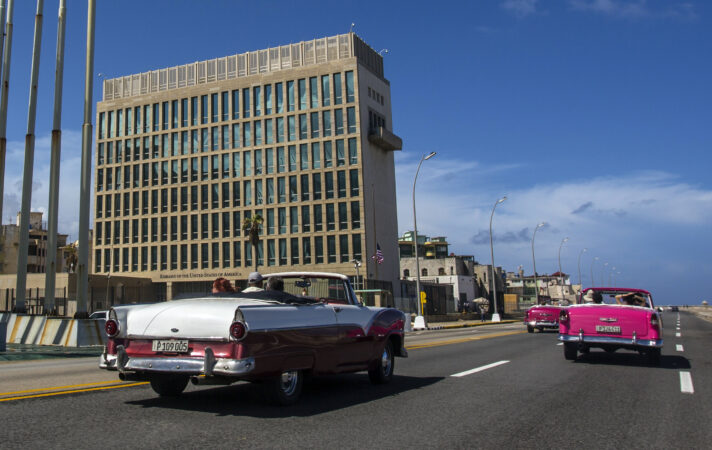
    Taken together, the two known directed-energy devices along with other research appear to have prompted a reconsideration by some of the causes of Havana syndrome, so named because of the mysterious 2016 outbreak of symptoms reported by personnel at the U.S. Embassy in Havana.

    In subsequent years, U.S. personnel reported hundreds of cases globally, in China, Eastern Europe, and elsewhere. A top aide to then-CIA Director William J. Burns reported symptoms while traveling in India in 2021.

    At a conference in Philadelphia earlier this month, retired Air Force Lt. Col. Chris Schlagheck, at times his voice breaking, said he was hit five times in 2020 in his home in Northern Virginia, where a Russian family lived across the street. It was not until last year that a doctor told him his symptoms were the same as those reported from Havana a decade earlier.

    Much about the Norway test remains obscured by its highly classified nature. People familiar with the events declined to identify the scientist or the Norwegian government agency he worked for.

    The results were all the more shocking because the Norwegian researcher had earned a reputation as a leading opponent of the theory that directed-energy weapons can cause the type of symptoms associated with AHIs, those familiar with the events said. Trying to dramatically prove his point, with himself as a human guinea pig, he achieved the opposite.

    “I don’t know what possessed him to go and do this,” one of the people said. “He was a bit of an eccentric.”

    A delegation of Pentagon officials traveled to Norway in 2024 to examine the device. In December of that year, a group of intelligence and White House officials also went to Norway to discuss the issue, those familiar with the events said.

    In January 2022, the CIA produced an interim assessment that concluded a foreign country was probably not behind Havana syndrome. It emerged weeks before a major panel of government and nongovernment experts produced a report commissioned by the director of national intelligence and deputy CIA director that came to a markedly different conclusion.

    That panel concluded in February 2022 that pulsed electromagnetic energy, particularly in the radio-frequency range, ‘’plausibly explains the core characteristics of reported AHIs,” although it acknowledged many unknowns. “Information gaps exist,” it reported.

    The conclusion marked the first time a report issued publicly by the U.S. government acknowledged that the symptoms could be caused by human-made, external events.

    The IC Experts Panel, as it was known, interviewed several people who had suffered accidental exposure to electromagnetic energy, said David Relman, a Stanford University microbiologist who chaired the panel.

    But the CIA interim assessment overshadowed the expert panel’s report. Then, in March 2023, the full intelligence community issued an assessment that unanimously concluded that it was unlikely that a foreign adversary was behind the incidents. “There is no credible evidence that a foreign adversary has a weapon or (intelligence) collection device that is causing AHIs,” the unclassified version of their report said, citing secret intelligence data and open-source information about foreign weapons and research programs.

    U.S. intelligence agencies “essentially ignored” the experts panel’s work, Relman told the conference in Philadelphia. The agencies, particularly the CIA, “had developed a very firm set of conclusions, world view that caused them I think to become dug in,” he said.

    By late 2024, senior White House officials in the Biden administration had come to question the absolutist position taken by U.S. intelligence agencies in their 2023 assessment.

    There were some officials, including within the intelligence community, who insisted that “there was nothing here” — that every reported case could be explained by some environmental or medical factor, said one person familiar with the administration’s views.

    The more “responsible” view, the person said, was to admit “we don’t know the answers” and that it was “plausible that pulsed electromagnetic energy could account for some subset of cases.”

    After the November 2024 election, White House officials who were working on an AHI brief for the incoming Trump administration invited several victims to a meeting to offer their input. The officials also wanted to reassure the victims that they realized the intelligence community assessment called into question the very real health issues they experienced and what caused them.

    At one point, an official turned to the victims who were gathered in the Situation Room and said, “We believe you.” The White House wasn’t yet certain it was a foreign actor but believed it was plausible that the symptoms had been caused by external factors, said the person familiar with the administration’s views.

    Marc Polymeropoulos, a former CIA officer and AHI victim who attended the unclassified meeting, said, “It was clear to the victims, but also unsaid, that new information had come into the NSC that had caused them to make such a statement.”


  • What to know about the investigation into Nancy Guthrie’s disappearance

    What to know about the investigation into Nancy Guthrie’s disappearance

    TUCSON, Ariz. — Law enforcement agents have been gathering more potential evidence as the search for Today show host Savannah Guthrie‘s mother heads into its third week.

    Nancy Guthrie, 84, was last seen at her Arizona home on Jan. 31 and was reported missing the following day. Authorities say her blood was found on the front porch. Purported ransom notes were sent to news outlets, but two deadlines for paying have passed.

    Authorities have expressed concern about Nancy Guthrie’s health because she needs vital daily medicine. She is said to have a pacemaker and have dealt with high blood pressure and heart issues, according to sheriff’s dispatcher audio on broadcastify.com.

    Here’s what to know about her disappearance and the intense search to find her:

    Video of masked man

    The Federal Bureau of Investigation released surveillance videos of a masked person wearing a handgun holster outside Guthrie’s front door in Tucson the night she vanished. A porch camera recorded video of a person with a backpack who was wearing a ski mask, long pants, jacket, and gloves.

    On Thursday, the FBI called the person a suspect. It described him as a man about 5 feet, 9 inches tall with a medium build. The agency said he was carrying a 25-liter “Ozark Trail Hiker Pack” backpack.

    Investigators initially said there was no surveillance video available since Guthrie didn’t have an active subscription to the doorbell camera company. But digital forensics experts kept working to find images in back-end software that might have been lost, corrupted, or inaccessible.

    Studying DNA

    Investigators collected DNA from Guthrie’s property which doesn’t belong to Guthrie or those in close contact with her, the Pima County Sheriff’s Department said. Investigators are working to identify who it belongs to.

    Evidence requiring forensic analysis is being sent to the same out-of-state lab that has been used since the beginning of the case, the department said.

    Investigators found several gloves, the nearest about 2 miles from Guthrie’s home, and submitted them for lab analysis, the sheriff’s department said. It did not specify what type of gloves.

    The sheriff stressed his department is working closely with the FBI.

    Sorting through tips

    The Pima County sheriff and the FBI announced phone numbers and a website to offer tips. Several hundred detectives and agents have been assigned to the case, the sheriff’s department said.

    The FBI said it has collected more than 13,000 tips since Feb. 1, the day Guthrie was reported missing. The sheriff’s department, meanwhile, said it has taken at least 18,000 calls.

    The sheriff’s department has not said whether any tips have advanced the investigation.

    Intensive searches

    Late Friday night, law enforcement sealed off a road about 2 miles from Guthrie’s home as part of their investigation. A parade of sheriff’s and FBI vehicles, including forensics vehicles, passed through the roadblock.

    The two agencies also tagged and towed a Range Rover SUV from a Culver’s restaurant parking lot. The restaurant is just over 2 miles from Nancy Guthrie’s home. This activity took place at the same time the sheriff’s office closed a road just north of the Guthrie home.

    The Pima County Sheriff’s Department confirmed Saturday that a federal court-ordered search warrant was executed at the home Friday in connection with the Guthrie case. The warrant was based on a lead the agency had received. No arrests were made.

    A traffic stop was also conducted, and while someone was questioned, no arrests were made, the sheriff’s office said.

    No additional information was released Saturday.

    On Tuesday, sheriff deputies detained a person for questioning during a traffic stop south of Tucson. Authorities didn’t say what led them to stop the man but confirmed he was released.

    The same day, deputies and FBI agents conducted a court-authorized search in Rio Rico, about an hour’s drive south of the city.

    Family pleas

    Savannah Guthrie, her sister, and her brother have shared on social media multiple video messages to their mother’s purported captor.

    The family’s Instagram videos have shifted in tone from impassioned pleas to whoever may have their mom, saying they want to talk and are even willing to pay a ransom, to bleaker and more desperate requests for the public’s help.

    The latest video on Thursday was simply a home video of their mother and a promise to “never give up on her.”

    A quiet neighborhood

    Nancy Guthrie lived alone in the upscale Catalina Foothills neighborhood, where houses are spaced far apart and set back from the street by long driveways, gates, and dense desert vegetation.

    Savannah Guthrie grew up in Tucson, graduated from the University of Arizona, and once worked at a television station in the city, where her parents settled in the 1970s. She joined Today in 2011.

    In a video, she described her mother as a “loving woman of goodness and light.”

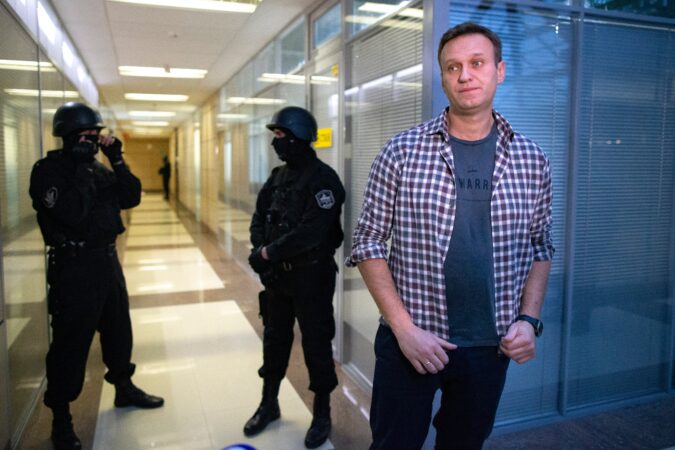
  • Russia poisoned Alexei Navalny with dart frog toxin, European nations say

    Russia poisoned Alexei Navalny with dart frog toxin, European nations say

    LONDON — Russian opposition leader Alexei Navalny was poisoned by the Kremlin with a rare and lethal toxin found in the skin of poison dart frogs, five European countries said Saturday.

    The foreign ministries of the U.K., France, Germany, Sweden, and the Netherlands said analysis in European labs of samples taken from Navalny’s body “conclusively confirmed the presence of epibatidine.” It is a neurotoxin secreted by dart frogs in South America that is not found naturally in Russia, they said.

    A joint statement said: “Russia had the means, motive and opportunity to administer this poison.”

    The five countries said they were reporting Russia to the Organization for the Prohibition of Chemical Weapons for a breach of the Chemical Weapons Convention. There was no immediate comment from the organization.

    Navalny, who crusaded against official corruption and staged massive anti-Kremlin protests as President Vladimir Putin’s fiercest foe, died in an Arctic penal colony on Feb. 16, 2024, while serving a 19-year sentence that he believed to be politically motivated.

    “Russia saw Navalny as a threat,” British Foreign Secretary Yvette Cooper said. ”By using this form of poison the Russian state demonstrated the despicable tools it has at its disposal and the overwhelming fear it has of political opposition.”

    French Foreign Minister Jean-Noël Barrot wrote on X that the poisoning of Navalny shows “that Vladimir Putin is prepared to use biological weapons against his own people in order to remain in power.”

    Navalny’s widow says results confirmed her accusations

    The European nations’ assessment came as Navalny’s widow, Yulia Navalnaya, attended the Munich Security Conference in Germany, and just before the second anniversary of Navalny’s death.

    She said last year that two independent labs had found that her husband was poisoned shortly before he died. She has repeatedly blamed Putin for her husband’s death. Russian officials have vehemently denied the accusation.

    Navalnaya said Saturday that she had been “certain from the first day” that her husband had been poisoned, “but now there is proof.”

    “Putin killed Alexei with chemical weapon,” she wrote. She said Putin was “a murderer” who “must be held accountable.”

    Russian authorities said that the politician became ill after a walk and died from natural causes.

    U.K. has accused Russia of previous attacks

    Epibatidine is found naturally in dart frogs in the wild, and can also be manufactured in a lab, which European scientists suspect was the case with the substance used on Navalny. It works on the body in a similar way to nerve agents, causing shortness of breath, convulsions, seizures, a slowed heart rate, and ultimately death.

    Navalny was the target of an earlier poisoning in 2020, with a nerve agent in an attack he blamed on the Kremlin, which always denied involvement. His family and allies fought to have him flown to Germany for treatment and recovery. Five months later, he returned to Russia, where he was immediately arrested and imprisoned for the last three years of his life.

    The U.K. has accused Russia of repeatedly flouting international bans on chemical and biological weapons. It accuses the Kremlin of carrying out a 2018 attack in the English city of Salisbury that targeted a former Russian intelligence officer, Sergei Skripal, with the nerve agent Novichok. Skripal and his daughter became seriously ill, and a British woman, Dawn Sturgess, died after she came across a discarded bottle with traces of the nerve agent.

    A British inquiry concluded that the attack “must have been authorized at the highest level, by President Putin.”

    The Kremlin has denied involvement. Russia also denied poisoning Alexander Litvinenko, a former Russian agent turned Kremlin critic who died in London in 2006, after ingesting the radioactive isotope polonium-210. A British inquiry concluded that two Russian agents killed Litvinenko, and Putin had “probably approved” the operation.

  • Westtown girls’ and boys’ basketball teams secure a Friends Schools League title

    Westtown girls’ and boys’ basketball teams secure a Friends Schools League title

    After the Westtown boys’ basketball team claimed its first Friends Schools League title since 2022 with a 64-54 win over Academy of the New Church on Friday night, the girls’ team joined the medal ceremony at the center court.

    The Westtown girls had their own hardware to show off for a championship photo op. The Moose hung on for a 53-46 win over Friends’ Central hours earlier in the FSL’s championship doubleheader at La Salle’s Glaser Arena.

    It was the sixth consecutive FSL title for the Westtown girls and the first time the teams had shared the court as champions since 2022.

    “I think the girls and the boys teams have a great bond at Westtown,” said guard Rowan Phillips. “It was good to see us win a championship because [the girls] have been doing this for a minute. So we’re just trying to catch up to them.”

    The Westtown boys and girls basketball teams pose with their championship medals. Westtown won both FSL titles in the same year for the first time since 2022.

    Westtown girls outlast Friends’ Central

    While the final score was closer than the Westtown coaching staff would have liked, the Moose scraped by No. 2 seed Friends’ Central behind Jordyn Palmer’s 19 points.

    “I don’t think there was a lot going well for us,” coach Fran Burbidge said. “But I thought we defended and made some really good things [happen] in the second half. … We kept battling.”

    The Phoenix held a 16-8 lead at the end of the first quarter, but the Moose outscored them, 19-6, in the second to take a five-point halftime lead.

    Friends’ Central whittled Westtown’s advantage to one in the fourth, but the Phoenix could not retake the lead.

    While Palmer’s performance did not match her 34-point output from last year’s title game, the 6-foot-2 forward took command in the final minutes.

    Palmer, a nationally ranked recruit in the class of 2027, scored four of the game’s final five points, including a layup to put the Moose up, 50-46, with less than a minute remaining.

    “I think it was at the three-minute mark, I talked with Jordan,” Burbidge said. “I said, ‘All right, things haven’t gone real well up to this point, but now’s your time. … You up for that?’ She said, ‘Yeah, I got it.’”

    Westtown’s Jordyn Palmer (right) lays up the basketball in the fourth quarter on Friday.

    Westtown’s Jada Lynch scored 12 and Atlee Vanesko, a senior guard who is the No. 74 prospect in ESPN’s rankings and is committed to Ohio State, added nine.

    Ryan Carter led Friends’ Central with 16 points, while Zya Small had 15. Like Palmer (No. 6), Carter (No. 12) and Small (No. 47) are in ESPN’s top 60 prospects for 2027.

    Westtown, which is ranked eighth nationally by Sports Illustrated, is the top seed in the PAISAA state tournament. The Moose will host the winner between Agnes Irwin and Episcopal Academy in the quarterfinals.

    Second-seeded Friends’ Central will play the winner of a first-round matchup between Germantown Academy and Penn Charter in the quarterfinals.

    Westtown boys beat Academy of the New Church

    Phillips’ 20-point performance led Westtown boys to be crowned FSL champions.

    The 6-6 sophomore guard transferred to Westtown after spending his freshman year at Archbishop Wood. The FSL title was the first high school championship of any kind for Phillips, who is a four-star prospect ranked 21st nationally in the class of 2028.

    “It feels great,” Phillips said. “It feels good to get one for the coaching staff and to see all the smiles on the guys’ faces for the first ’ship.”

    Marshall Bailey added 15 points for the Moose. Academy of the New Church’s Ryan Warren led all scorers with 22 points, but his outburst was not enough for the Lions to beat Westtown.

    Westtown School’s Rowan Phillips dunks in the fourth quarter past Academy of the New Church’s Antonio Lozada on Friday.

    Friday night’s title was far from the first for coach Seth Berger, who led Westtown to eight consecutive FSL titles from 2014 to 2022. But he noted that this season’s FSL championship was the first title for every player on his team and three of his assistant coaches.

    “I can’t tell you how ecstatic I am for them to experience what it is to be a Friends League champion,” Berger said. “This is such an incredibly tough league, and ANC is a fantastic, tough, and well-coached team. I’m super happy for everybody, and mostly for the first time champs.”

    Westtown is the top seed in the PAISAA state tournament and will host No. 16 seed Kiski School in the tournament’s opening round.

    Seventh-seeded Academy of the New Church will host No. 10 seed Penn Charter in the first round.

  • Source: Former Phillies OF Nick Castellanos agrees to deal with Padres

    Source: Former Phillies OF Nick Castellanos agrees to deal with Padres

    CLEARWATER, Fla. — Nick Castellanos has a new team.

    Two days after the Phillies released him with one year left on his contract, Castellanos agreed Saturday to join the Padres, a major league source confirmed.

    The Phillies will pay all but the major league minimum ($780,000) portion of his $20 million salary for 2026.

    The Phillies were intent on moving on from Castellanos after he clashed last season with manager Rob Thomson. In response to a report that was about to be published by The Athletic, Castellanos detailed a June 16 incident in which he brought a beer into the dugout in the eighth inning of a game in Miami after Thomson replaced him for defense. Castellanos was benched for the next game.

    Castellanos, who ranked among the worst defenders in the sport, also lost his everyday role in right field in August and publicly criticized Thomson in September for “questionable” communication.

    “It was just a difficult situation,” Thomson said recently on Phillies Extra, The Inquirer’s baseball podcast. “The thing with Nick, the bottom line is, he wants to play every day. He wants to play every inning, every day, and you can’t fault him for that. I think I respect him a great deal, just for being that guy.”

    Castellanos played literally every day for most of his time with the Phillies after signing a five-year, $100 million contract in 2022. He started 236 consecutive games, including all 162 in 2024. It was the longest streak by a Phillies player since Pete Rose started 350 consecutive games from 1980 to 1983.

    A two-time All-Star with 250 career homers, Castellanos batted .260 with 82 homers and a .732 OPS for the Phillies. His OPS+ of 100 indicated league-average production relative to all major league hitters.

    Castellanos reportedly will play first base for the first time in his career for the Padres, who also intend to use him as a designated hitter. He could see time in the outfield, although San Diego is well-stocked with Fernando Tatis Jr. and Ramón Laureano in right and left, respectively, with Jackson Merrill in center field.

    The Phillies play the Padres on May 25-27 in San Diego and June 2-4 at Citizens Bank Park.