The Democrats had a great election night earlier this month when the democratic socialist Zohran Mamdani scored a smashing triumph in New York’s mayoral race, and mainstream Democrats won gubernatorial contests in New Jersey and Virginia. Savoring the victories, left-wing standard-bearer Alexandria Ocasio-Cortez said her party had united against a common foe: fascism.
“It’s not about progressive, it’s not moderate, it’s not liberal,” Ocasio-Cortez declared. “This is about, do you understand the assignment of fighting fascism right now? And the assignment is you come together across difference no matter what.”
She’s right about the need for my fellow Democrats to join hands to challenge President Donald Trump and his MAGA loyalists. But she’s wrong to call them fascists. That doesn’t hamper Trump; it empowers him.
And you know who gets that? Zohran Mamdani.
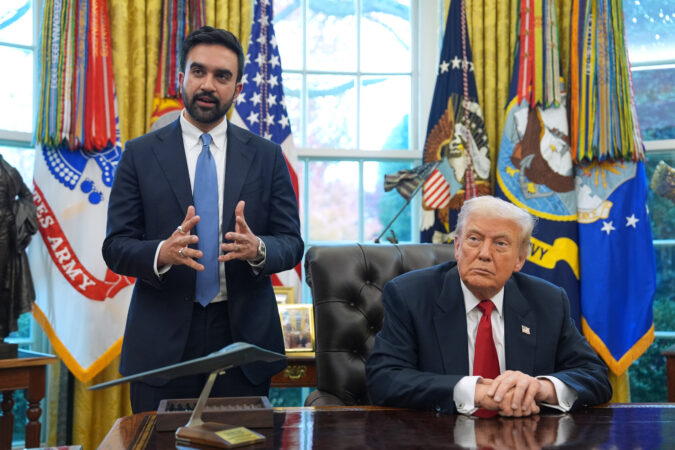
Witness his meeting with Trump at the White House on Friday, when a reporter asked Mamdani if the president was a fascist. Before the mayor-elect could answer, Trump threw him a lifeline.
“That’s OK, you can just say yes,” Trump said. “It’s easier than explaining.” Laughing, he gave Mamdani a light pat on the arm. “I don’t mind,” Trump added.
Mamdani played along, smiling widely. “OK, all right,” he replied.
But it was better than all right. It was brilliant.
Calling Trump a fascist does nothing — literally, nothing — to advance the Democrats’ cause. And Mamdani was wise to steer away from it.
To win elections, the Democrats need to claw back voters who tipped for Trump and the GOP in 2024. Do you think they’re going to be persuaded by someone telling them they supported a fascist?
If so, you just haven’t been listening. Last October, a mask-wearing protester accosted Tom Eddy — chairman of the Republican Party in Erie County, Pa. — and called him a fascist. “Do you even know what it means?” Eddy asked. “Don’t need to know,” the masked man replied. “I know who you are.”
A month later, Trump won Pennsylvania by the largest margin of victory for a Republican presidential candidate since 1988. Of course, Democratic accusations of fascism weren’t the only reason for that. But they certainly didn’t help.
Neither does calling Trump a white supremacist or racist, which is another turn-off for voters. In a 2023 Public Agenda survey, 77% of Americans said it was a “serious problem” that “people are too quick to accuse others of racism.”
And it’s not just white voters who think that. In the poll, 77% of Latino Americans and 76% of Asian Americans agreed with the statement. The percentage of African American voters who agreed was a bit lower — 68% — but still represented a significant majority.
Let me be clear: Donald Trump has said some horribly racist things: Haitians eat pets, Mexicans are rapists, Africa is full of shithole countries, and so on. But calling him a racist won’t sway anyone into the Democrats’ column; it’s more likely to bring people to his side because they’re sick and tired of hearing about how racist America is.
“Enough with the ‘He’s a Hitler,’” the comedian Jon Stewart said of Democratic candidates who attack Donald Trump. “Tell people what you would do with the power that Trump is wielding, and then convince us to give that power to you, as soon as possible.”
Ditto for labeling Trump a fascist. I’ve read my Timothy Snyder and Jason Stanley, and I do see elements of fascism in Trump’s MAGA movement: the relentless denunciation of internal enemies, the Big Lie about elections (see: 2020), and the celebration of a strongman who will save us. But I still think it’s an enormous mistake to imagine all of his supporters — or, even, his entire party — as fascist.
That’s what the American Association of University Professors — our nation’s most venerable academic organization — did earlier this fall.
Rebutting the idea that academia is biased against conservatives, the AAUP posted that “fascism generally doesn’t do great under peer review.”
Translated: The reason there aren’t more conservative professors is that they’re actually fascists. So is anyone who disagrees with the dominant liberal consensus on campus.
As comedian Jon Stewart warned back in January, none of this is going to enlist more voters for the Democrats. “Enough with the ‘He’s a Hitler,’” Stewart urged. “Tell people what you would do with the power that Trump is wielding, and then convince us to give that power to you, as soon as possible.”
That’s exactly right. And that’s also what Mamdani has been doing, with his persistent focus on housing and affordability.
Pressed by an interviewer on Sunday, Mamdani said he stood by his earlier comments that Trump was a “despot” as well as a fascist. But he quickly changed the subject, because he knows that’s a game Democrats can’t win.
“I’m not coming to the Oval Office to make a point or make a stand,” Mamdani declared. “I’m coming in there to deliver for New Yorkers.”
The way for Democrats to defeat Trump and the GOP is to show we can deliver for all Americans, in the ways that matter most to them.
So enough with the name-calling, OK? It makes us look churlish and small. Focus instead on the big things we can do. And we will be all right.
Late on a stormy September night, Katie and Anthony Young were watching a horror show. In this instance, it wasalso a reality show.
A surveillance camera showed 8-footfloodwaters drowning the generator in the rear of their restaurant, Hank’s Place. The water crashed into the dining and kitchen areas, tossing around furniture and emptying the contents of refrigerators.
The remnants of Hurricane Ida in 2021 had overwhelmed the Brandywine Creek at Chadds Ford, one of the region’s most picturesque locales, made famous by a frequent Hank’s customer, artist Andrew Wyeth.
“I don’t think either one of us was anticipating it being that catastrophic,” Katie Young said.
In a region where flooding is a perennial threat, an Inquirer analysis of the area’s most flood-prone waterways found the Brandywine ranks among the elite, based on available U.S. Geological Survey data.
(function() {
var l2 = function() {
new pym.Parent(‘area_floods’,
‘https://media.inquirer.com/storage/inquirer/projects/innovation/arcgis_iframe/area_floods.html’);
};
if (typeof(pym) === ‘undefined’) {
var h = document.getElementsByTagName(‘head’)[0],
s = document.createElement(‘script’);
s.type = ‘text/javascript’;
s.src = ‘https://pym.nprapps.org/pym.v1.min.js’;
s.onload = l2;
h.appendChild(s);
} else {
l2();
}
})();
A total of 61 major and moderate floods have occurred since 2005 at Chadds Ford and three other gages on the main stem of the Brandywine and its branches. The Brandywine East Branch near Downingtown has registered more major and moderatefloods, with 33 combined, than any gage point in the region.
No. 2 on the list was the Delaware River at Burlington, with seven major and 19 moderate floods, although that is not quite the same as stream flooding. Technically, flooding measured on the five Delaware River gages south of Trenton, including the one at Washington Avenue in South Philly, is “tidal,” since it is influenced by the behavior of the Atlantic Ocean and the Delaware Bay.
The chaotic behavior of the atmosphere may forever be elusive; however, more flooding along the Brandywine, the Delaware, and the rest of the region’s waterways is an absolute certainty.
Various studies have documented increases in extreme precipitation events with the warming of the planet. But humans are affecting the flood calculus immeasurably by hard-topping rain-absorbent vegetation.
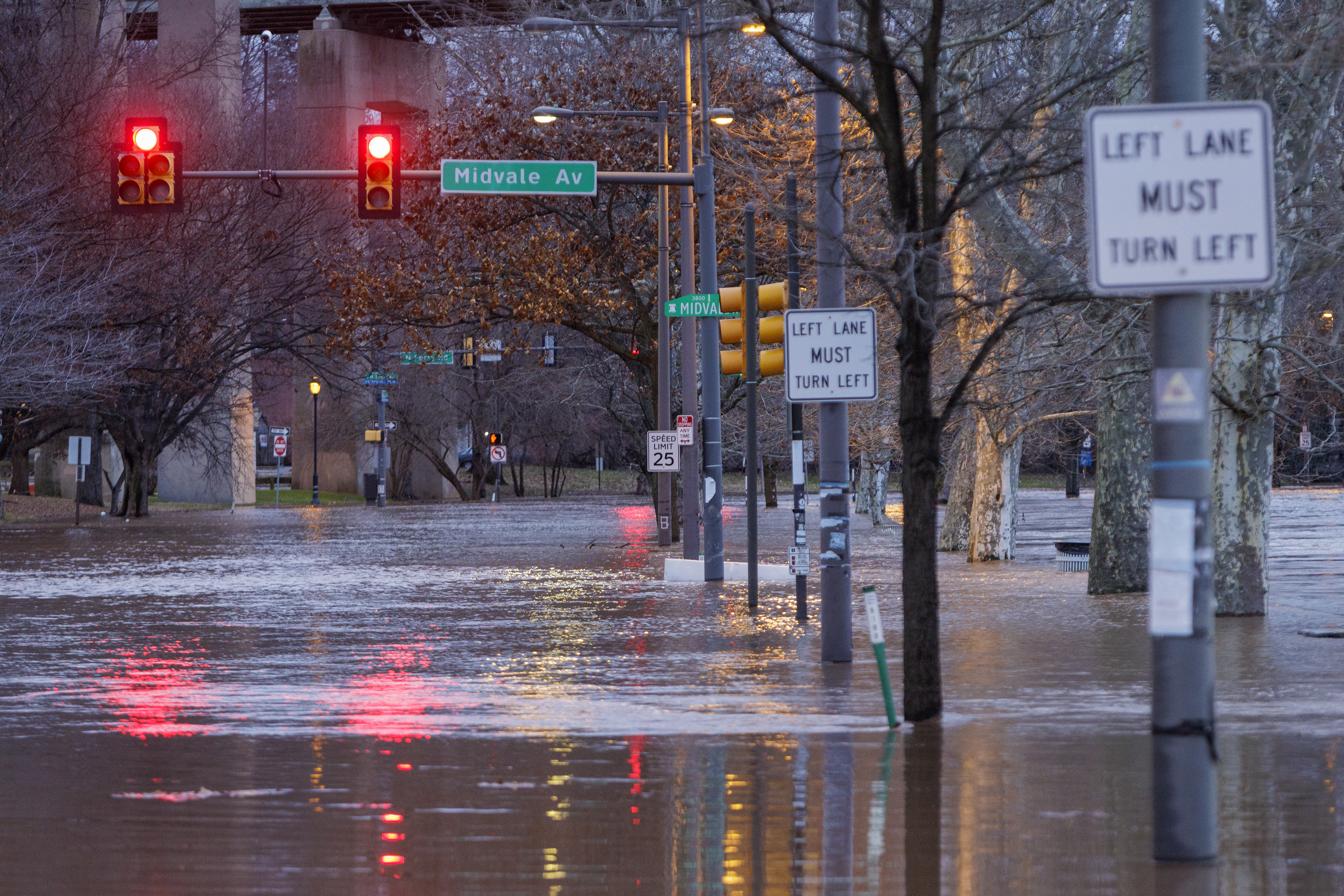
Schuylkill River floods onto Kelly Drive at Midvale in the East Falls section of Philadelphia on Wednesday, Jan. 10, 2024.
A comprehensive analysis of the Brandywine watershedpublished in April reported that impervious surfaces increased by 15% along the Great Valley’s Route 30 corridor from 2001 to 2020.
Those increases are “significant,” said Gerald Kauffman, director of the University of Delaware’s Water Resources Center, which coauthored the study along with the Brandywine Conservancy and the Chester County Water Resources Authority.
Municipalities welcome tax-generating development. Conversely, Kauffman said: “You get more value if you build next to a greenway. It’s the eternal debate.”
From 2001 to 2020, the population in the Brandywine watershed grew nearly 25%, to 265,000 people, with 150,000 more expected by the end of the century. That’s a lot of rooftops and driveways feeding water into the stream, which empties into the Delaware River.
Along the Delaware, the rising water levels of the Atlantic Ocean and the Delaware Bay are forecast to generate more flooding. The National Oceanic and Atmospheric Administration estimates that sea levels have been rising about an inch every five years.
While the oceanic salt line— the boundary between ocean and freshwater — usually stays well south of Philly, the tidal pulses contribute to flooding in the city and areas to the north, where the channel narrows, said Amy Shallcross, water resources operations manager at the Delaware River Basin Commission.
The five tidal gages along the Delaware from Newbold Island to Marcus Hook have registered more than 90 significant floods since 2005, according to the Inquirer analysis.
The study was limited to the 33 USGS gages that had a period of record of at least 20 yearsand list designated flood stages.
Along with the Delaware River sites, other stream gages that appeared in the top 10 list for major and moderate flooding were those on the Perkiomen, Chester, Neshaminy, and Frankford Creeks.
Motorists brave the heavy rain and deep puddles along Creek Road in Chadds Ford during a nasty flood event in January 2024.
The gage network cannot capture all the episodic flooding from the likes of thunderstorm downpours.
Flood frequency is not the only consideration for siting a gage, said Tyler Madsen, a hydrologist with NOAA’s Middle Atlantic River Forecast Center, in State College. For example, the gages have to be located in areas free of unnatural barriers, such as bridge abutments.
Plus, a major consideration is funding. They are costly to monitor and operate, serving multiple purposes such as measuring water quality and streamflow.
They rely on a variety of funding sources, including state and local governments, that are not available everywhere.
The Brandywine study’s suggested remedies included adding flood-control structures and beefing up warning systems all along the watershed, but warned: “Even with unlimited financial and technological resources, it would be impossible to eliminate all flood risks.”
Hank’s Place, on Routes 1 and 100 in Chadds Ford, was swamped by water from the rains of Tropical Storm Agnes in June 1972. The area has a long history of flooding, and the restaurant was reconstructed after it was flooded and damaged by Ida in 2021.
The Youngs are prepared to live with those risks, come storms or high water.
Faced with a forthcoming increase in elementary school enrollment, the Cherry Hill School District may redraw boundaries for its 12 neighborhood schools.
The South Jersey school district has been studying expected demographics for the coming years and came up short; there are not enough available seats to accommodate an anticipated burst in elementary student population.
To meet the demand, the district has undertaken an “Elementary Enrollment Balancing,” which means possibly adjusting where students go to school. Cherry Hill is the 12th-largest district in the state, with nearly 11,000 students.
“We want to make sure there is not a negative impact on children and families,” Superintendent Kwame Morton told parents at a recent community meeting.
Why is Cherry Hill rebalancing its elementary schools?
The demographic study conducted in 2024 showed that five of Cherry Hill’s 12elementary schools are expected to have a shortage of seats in the 2028-29 school year, said George Guy, director of elementary education.
Based on census data and housing construction projections, the district will be short about 337 seats, according to Guy. The demographic survey examined possible growth over a five-year period, from 2024-25 through 2028-29.
“Those kids are coming. We have to do something,” Guy said in a recent interview. “We can’t wait to do it.”
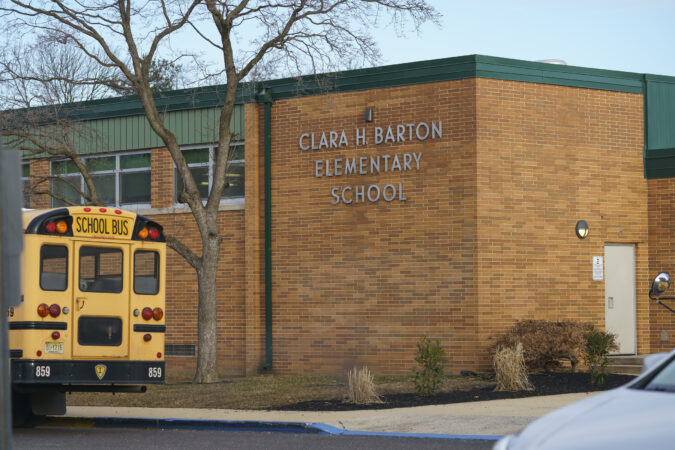
The five schools in question and the expected growth in their enrollment are: Clara Barton,126 students; Joyce Kilmer,81 students; Horace Mann, 50 students; Richard Stockton, 56 students; and Woodcrest Elementary, 50 students, Guy said.
What will the process involve?
It is not yet clear how many students could be affected by the rebalancing, district officials said. Some elementary schools are nearing capacity, and a few have surplus seats.
At a school board presentation this month about the enrollment balancing project, several parents expressed concerns about their children possibly being moved. Parents like the convenience and proximity of a neighborhood school.
“What’s the game plan here?” asked Nicole Marley, who hasthree sons. “I don’t want my kids to leave their school. It’s stressful.”
Guy said possible options include grouping schools by proximity, with nearby schools to share students and programs, and reassigning students to less-crowded schools. Also under consideration is converting the Arthur Lewis administration building to an elementary school, which could accommodate about 200 students, he said.
District officials currently are not considering a bond referendum to raise funds to build a new school, Guy said. In October 2022, Cherry Hill voters overwhelmingly approved a $363 million school bond referendum, one of the largest in New Jersey history.
“We want to be open to anything,” Guy said. “We don’t want to take anything off the table.”
A board committee has been charged with developing a plan to address the overcrowding. Parents peppered the committee with questions at an information session held at Cherry Hill East.
“We’re still very early in the process,” said board president Gina Winters.
Currently, the sprawling 24.5-mile community of nearly 75,000 is divided into elementary school zones. Most students are assigned to a neighborhood school within two miles of where they live.
Morton said the board has set parameters for the rebalancing committee. Besides minimizing potential disruptions, transportation must be taken into consideration, he said.
The district doesn’t want students riding a bus for long periods of time, especially special needs students, Guy said. Two of the affected schools— Barton and Kilmer — are located on the west side of Cherry Hill, while the other three— Mann, Stockton, and Woodcrest — are on the east side.
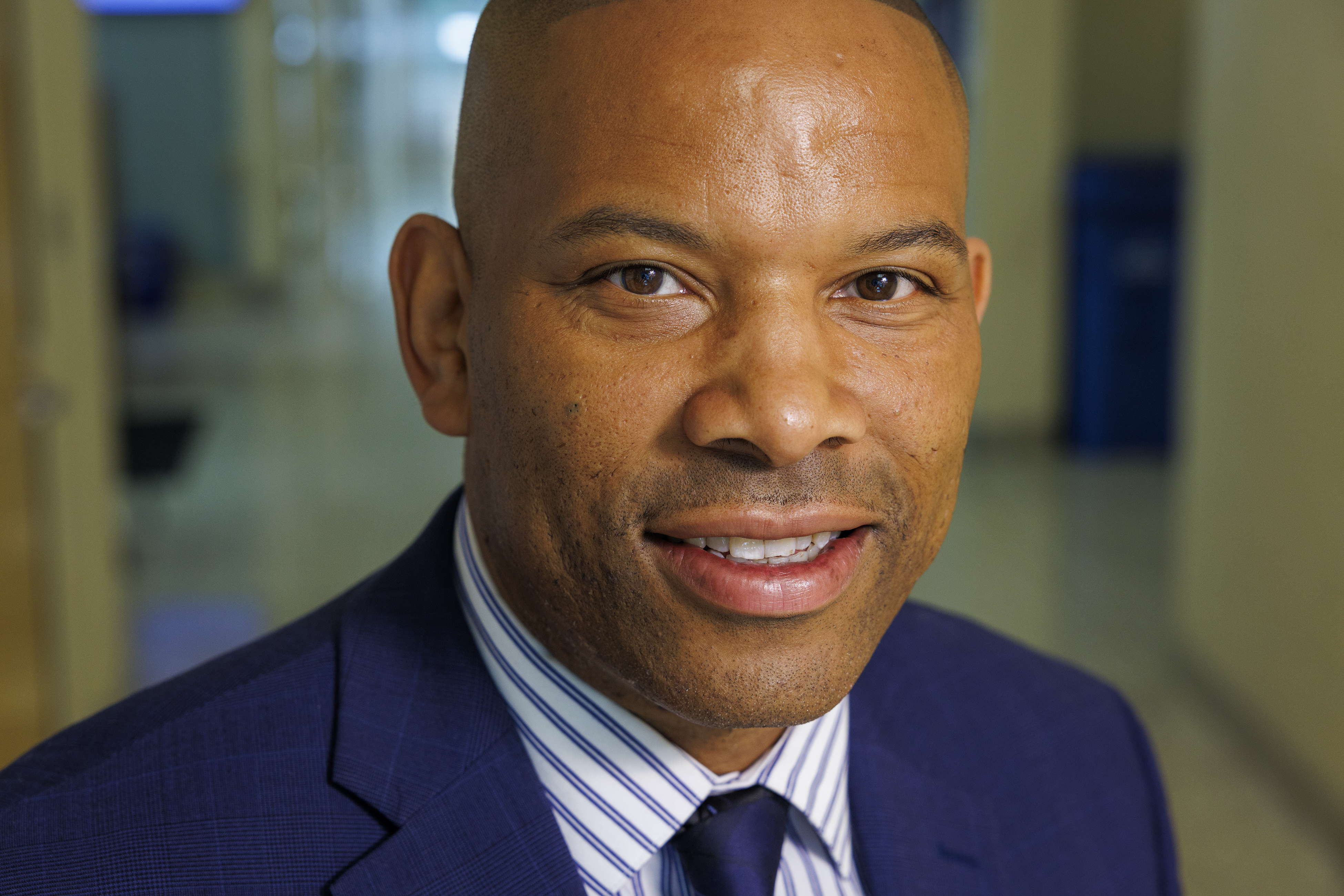
Kwame Morton, superintendent of Cherry Hill schools.
What is the timeline for the plan?
The committee plans to present a preliminary rebalancing plan to the school board in January or February. A final plan is expected by June or July.
The district held three community meetings in November to get feedback from residents and answer questions. More community meetings are planned for March.
Parent Dan Levin, an urban planner, questioned how the committee gathered its data. He suggested the committee consider more long-term planning for 15 years down the road.
“You’re shooting in the dark,” said Levin, whose son attends James Johnson Elementary. “You’re throwing good money after bad.”
Morton said the district wants to implement the rebalancing plan for the 2027-28 school year, beforeenrollment is expected to swell in the 2028-29 school year.
Will middle schools and high schools be impacted?
Guy said the district’s most pressing need for more seats is at the elementary schools. He said officials are not yet examining future enrollment needs at the middle and high schools.
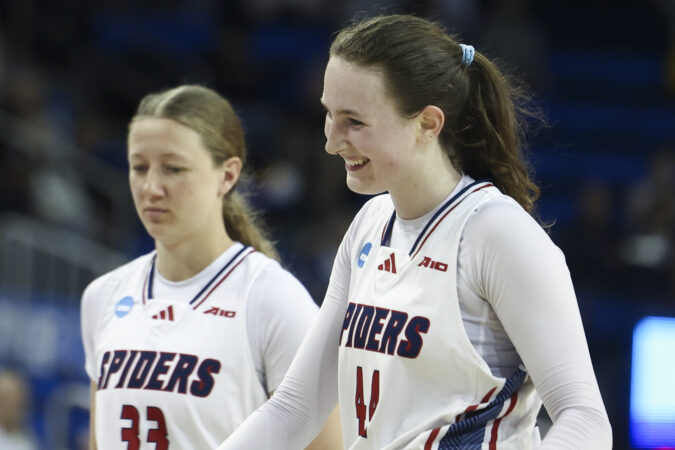
NEW YORK — Maggie Doogan turned and launched a three-pointer from the top of the key, then yelled, “What?” when the ball splashed through the net to give Richmond a 13-point lead at Columbia last week. The former Cardinal O’Hara star grinned when she sank another deep shot to continue her team’s fourth-quarter surge.
After a cold shooting start, Doogan was Richmond’s leading scorer (16 points) and added nine rebounds, four assists, and three blocks in a key early-season matchup between mid-major programs that won NCAA Tournament games in March. And when a reporter in the postgame news conference suggested she had struggled offensively in the 77-67 road victory, coach Aaron Roussell playfully responded with, “Tough ‘evals,’ man.”
“I think it’s a pretty good stat line, with all due respect,” Roussell said. “ … I’ll take those ‘off’ nights from her.”
That illustrates the heightened expectations for Doogan, the reigning Atlantic 10 Player of the Year and perhaps the best mid-major player in women’s college basketball. The 6-foot-2 do-everything forward is averaging 23.1 points, 10.9 rebounds, 5.3 assists, and 1.4 blocks through the Spiders’ first seven games. That includes a monster performance in last week’s 72-57 victory over Temple, when she racked up 31 points, 14 rebounds, and nine assists.
Her ascent has coincided with Richmond’s, which last season won a second consecutive A-10 regular-season title and its first March Madness game in program history. The 5-2 Spiders, whose only losses so far are to No. 4 Texas and No. 8 TCU, were ranked in the preseason Associated Press top 25 poll and are receiving votes now.
Doogan acknowledges building this legacy is “not at all” what she envisioned when she signed with Richmond. But Roussell calls her a “perfect model” for player development, with the versatility to anchor the Spiders’ read-and-react offensive system. In this new era of college athletics, Doogan also made an increasingly rare decision to not entertain NIL opportunities from power-conference programs and stay at Richmond for her final season.
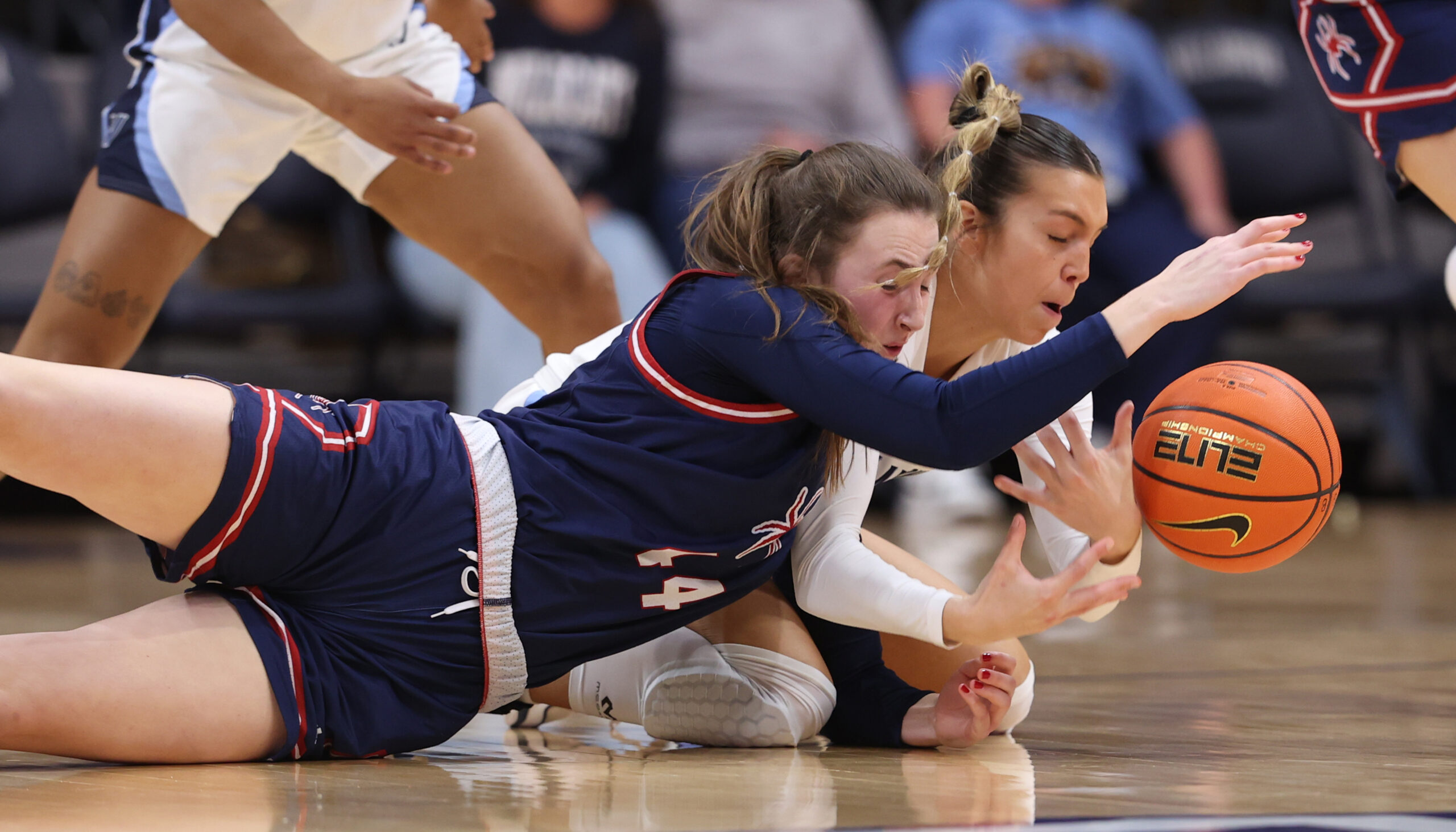
Richmond’s Maggie Doogan dives for a loose ball in a 2023 game against Villanova.
Also fueling Doogan’s rise? Her on-court diligence and quest for basketball intel. That sets the standard for everybody in the Spiders’ program — including its coach.
“You can’t fake anything with her,” Roussell said in a telephone interview last week. “You can’t be a teammate and not work hard around her. You can’t be her coach and not invest in her and not put the time in with the film. Because she’s going to have questions, and you need to be able to answer those.
“That’s probably been different for me coaching her than maybe any other kid that I’ve ever coached.”
Spiders?
When Doogan was a sophomore in high school, her mother, Chrissie, gave her a Richmond T-shirt as an Easter present.
“Mom, I’m not going to a school where Spiders are the mascot,” Maggie jokingly retorted.
But the Doogan family, based in Broomall, already had a connection to the Richmond coaching staff. Assistant Jeanine Radice, then at Marist, had recruited Chrissie (née Donahue) before she became La Salle’s second all-time leading scorer and member of the school’s athletics Hall of Fame. Then they stayed in touch as Chrissie entered coaching at La Salle, Cornell, and Cardinal O’Hara, where she currently is the school’s athletic director.
So Mom initially sent Maggie’s film, which highlighted her basketball IQ, to Radice. Maggie later demonstrated her outstanding shooting at one of Richmond’s camps, Roussell said. And the coach recognized untapped potential.
Maggie, meanwhile, was interested in branching out from the Philly area but remaining within a reasonable driving distance. She wanted strong academics and the opportunity to play right away. And while visiting Richmond’s campus, she fell in love with the “gorgeous” red-brick buildings.
“It was an easy choice once I really looked into it,” she said.
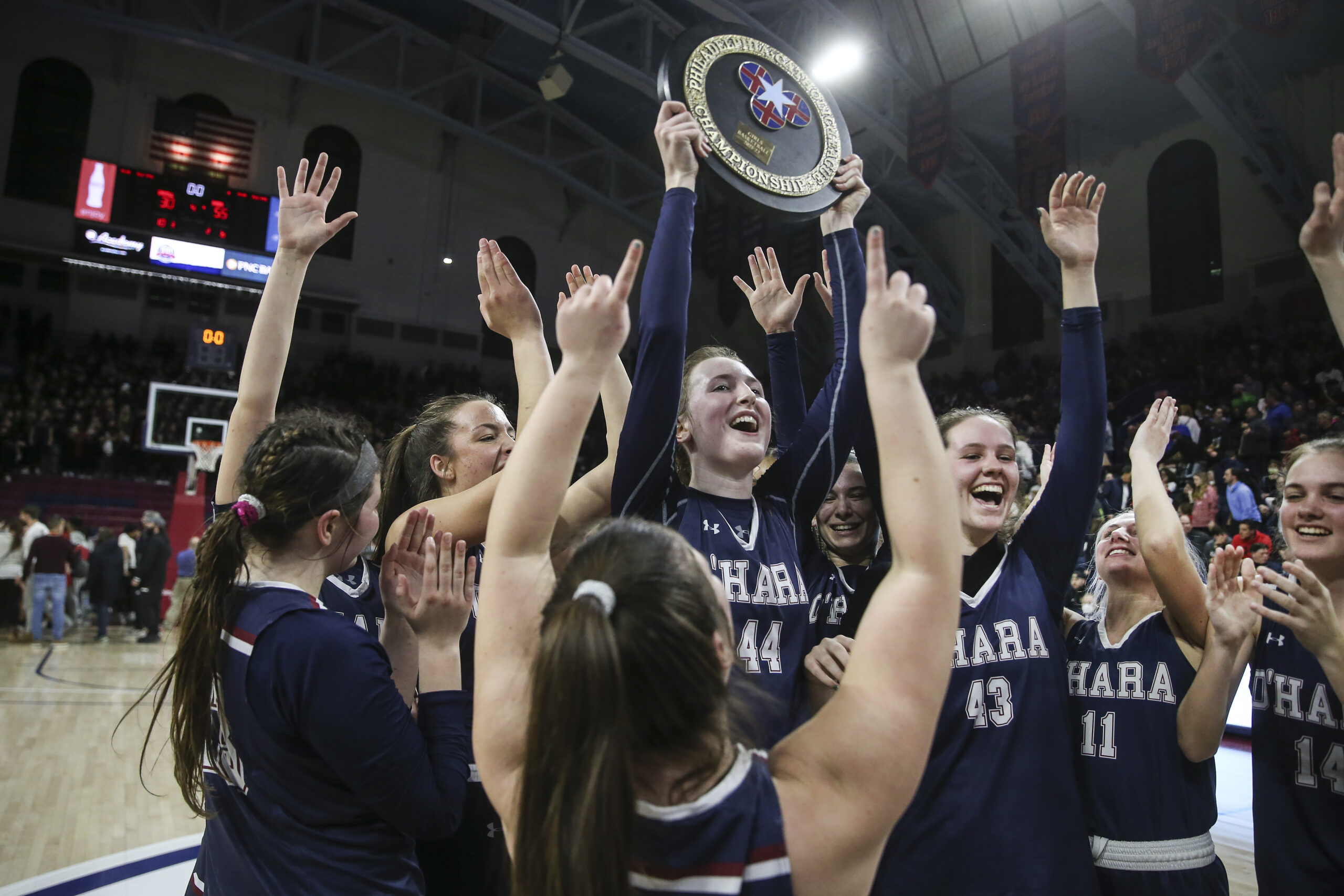
Cardinal O’Hara’s Maggie Doogan holds the the championship plaque as she celebrates with teammates after beating Archbishop Carroll for the Catholic League title in 2022.
Chrissie wondered whether Maggie’s lanky frame would be strong enough when she entered college. Roussell, though, deliberately took her early development slowly, because the coach “really wanted to make her earn” playing time. A broken hand kept Doogan sidelined for about five weeks, forcing her to step back and observe and pick coaches’ brains from the bench.
“I don’t know if they put something magic in my hand,” Doogan said, “but I was just kind of a different player and took that big leap. That kind of just gave me more confidence at the collegiate level.”
Her breakout game fittingly came in a nationally televised overtime victory over St. Joseph’s. Roussell called her “unguardable” as she totaled 28 points, six rebounds, five assists, three blocks, and two steals. By her sophomore season, she was the Spiders’ leading scorer for a team that won 29 games and the first A-10 championship in program history.
In Roussell’s positionless system, Doogan could be viewed as a post player with excellent perimeter shooting and playmaking skills — or a wing who can make an impact inside on both ends of the floor. She not only impressed with her commitment to the weight room and on-court work, but with her film study and tactical aptitude.
Roussell jokingly calls it “stressful” to coach Doogan because of the information she constantly demands. She is not afraid to approach her coach during a shootaround and respectfully ask why they have chosen a specific strategy against an opponent. And the Spiders have changed elements of game plans — before or during a matchup — because of something Doogan observed.
Roussell already says he hopes his “retirement job” is as an assistant coach on Doogan’s future staff.
“The level and the layers of which she thinks about the game is already like a coach,” Russell said. “ … I never want her to be bashful or not tell me what she’s feeling during a game or seeing during a game.”
Those qualities propelled Doogan’s numbers to jump again as a junior, to 17 points, 7.1 rebounds, 3.8 assists, and 1.2 steals per game. She shot 55.5% from the floor, including 40.6% from beyond the arc. She helped Richmond win a second consecutive regular-season A-10 title, and became the program’s first conference player of the year since 1990.
But after a St. Joe’s buzzer-beater upset Richmond in last season’s A-10 tournament — a game during which Doogan took just five shots and scored five points — she and Roussell had “frank conversations” about what the Spiders consistently needed from her. Doogan went home for spring break and “didn’t speak for three days. … She was miserable,” Chrissie said.
Roussell believes that gave Doogan an extra dose of motivation for a monster NCAA Tournament, after Richmond earned a No. 8 seed in an at-large berth.
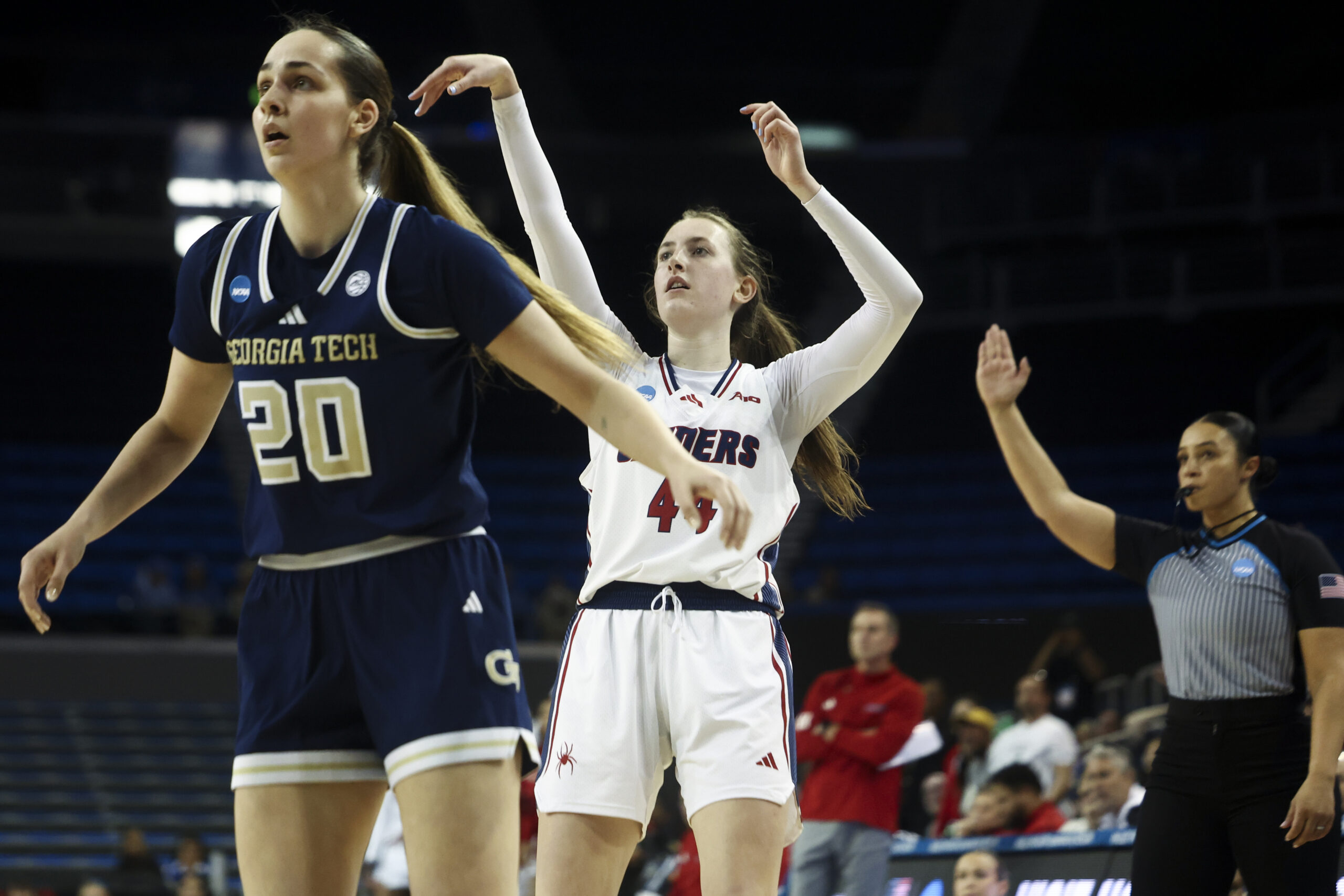
She racked up 30 points on 5-of-8 shooting from three-point range, along with 15 rebounds and six assists, in a dominant 74-49 victory over ninth-seeded Georgia Tech. She totaled another 27 points on 11-of-18 shooting, seven assists, and six rebounds in an 84-67 loss to top-seeded UCLA, which advanced to the Final Four.
“I had a lot of pride. A lot of pride,” Doogan said of her team’s March Madness run. “ … Once you kind of step back, and a couple weeks later, I was like, ‘Wow, we really did that.’”
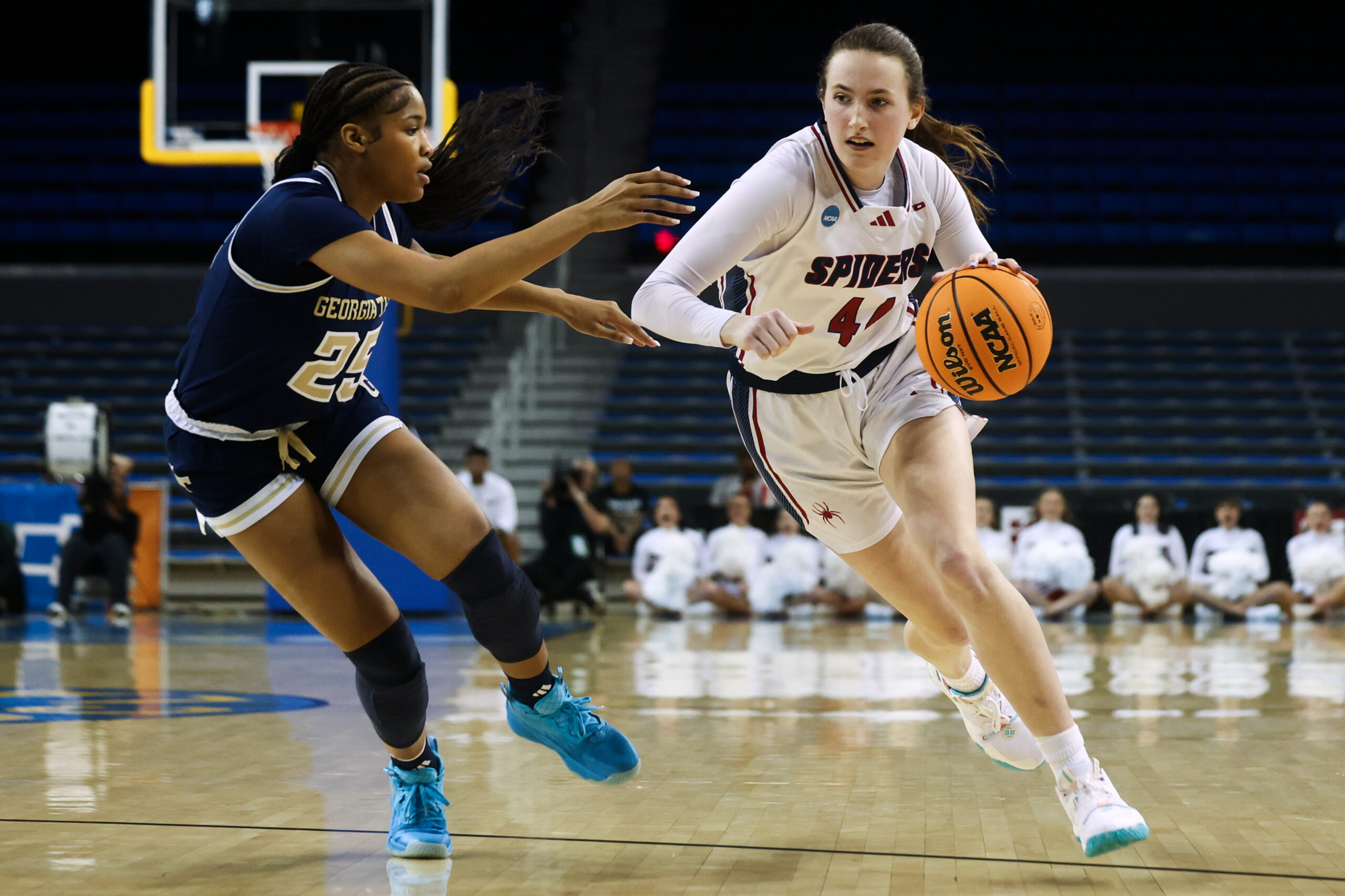
Richmond forward Maggie Doogan toward the basket as Georgia Tech guard Kara Dunn defends during last season’s NCAA Tournament.
Still, “literally the second we got back” from the NCAA Tournament, Roussell said, he and Doogan needed to have another honest discussion about her plans for the 2025-26 season. That is the reality in this transfer-portal era, because mid-major players regularly leave for power-conference programs that can offer more lucrative NIL deals.
Chrissie acknowledges she “got some calls on the side” to gauge Maggie’s interest in exploring options. She had to ask her daughter, “Would you leave for any certain amount?” Though Roussell received no indication from the family that he should be worried, he added, “I’m no dummy. I know the pursuers were out there.”
But Maggie and Roussell were aligned on how special this season could be for the Spiders — and that she wanted to finish her college career where it started.
“Not everybody would have made the decision that she did,” Roussell said. “There was a lot of loyalty involved. Now, do I think this was a great fit for her and this was the right answer? Yeah. But she left money on the table by coming back here, and that’s not something every 21-year-old is doing.”
Added Doogan: “Honestly, it’s home. And I wouldn’t want to spend my last year anywhere else.”
After Richmond’s win at Columbia, Chrissie sent Maggie a text about the two turnovers she committed during the game’s final minute.
“Wow, thanks for the love,” Maggie sarcastically responded.
Consider that evidence that the coach-player aspect of this close mother-daughter bond has never fully dissipated. Neither have other characteristics Maggie says she acquired while growing up as a Philly basketball kid. She immediately highlighted her toughness, that “I don’t really like to take a lot of B.S. from people, and I think I get that from back home.” She also credits her time at O’Hara with fostering her vocal leadership, which was on display while speaking up during timeouts throughout Richmond’s win at Columbia.
“I’m trying to calm everybody down, which hopefully works,” she said after that game. “I kind of know what [Roussell is] thinking, and I’m good at talking with everybody else. I think it’s kind of why I’m on the floor.”
She also is navigating life as a player who, before the season, was ranked among ESPN’s top 25 returners in the country.
She acknowledged after the Columbia game that she felt more defensive “crowding” while in the paint and a greater focus on wherever she was on the floor. Roussell is pleased that Doogan is executing on individual focuses, like better finishing, drawing fouls around the rim, and improving as a playmaker and rebounder. Being invited to last summer’s Team USA’s Women’s AmeriCup team trials, where she competed alongside some of college basketball’s best players, also boosted her confidence, Roussell said.
“She has not hit her apex yet,” Roussell said. “There is really good basketball in her future that will be better than what she is now.”
Yet the Doogan family is embracing Maggie’s final college season, which Chrissie compares to the ending of a book.
A group in Richmond gear swarmed Maggie for hugs following the Columbia win, then posed together for a photo op. Her grandparents make the four-hour drive to Richmond for nearly every home game. And whenever Chrissie visits, she notices children wearing No. 44 jerseys with “Doogan” on the back.
“As a parent, you’re like, ‘Wow, this kid,’” Chrissie said. “People all over Richmond know her.”
Richmond’s Maggie Doogan looks on after shooting as Georgia Tech center Ariadna Termis watches.
That’s the impact of Doogan becoming a perfect model of development and versatility.
And the player who stayed at her mid-major school through her entire career.
And the person who continues to set the standard for her program’s historic rise.
“It’s going to be awful whenever she takes off that jersey,” Chrissie said of Maggie. “I know there will be tears shed. But she’s got so much to be proud of, and so much to be excited for this season.
“We’re just trying to take it one game at a time, one practice at a time, and enjoy the ride.”
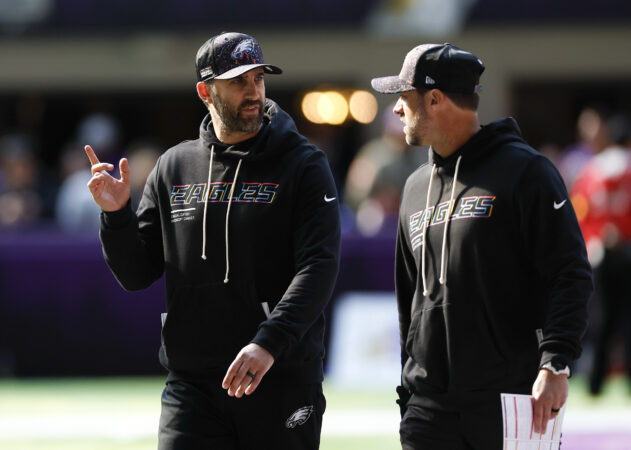
The worst thing the Eagles can do right now is the thing that everybody wants them to do. Nick Sirianni isn’t going to do it. He has said it all season and he said it again on Monday, even though he did not need to. You don’t make a change in play-calling duties after a late afternoon road game in the week of Thanksgiving when you are scheduled to play on Friday. Even if Sirianni was entertaining the idea of demoting offensive coordinator Kevin Patullo, doing it this week is almost a non-starter.
But let’s be clear. He shouldn’t be entertaining such a move, short week or not. It doesn’t make sense on a practical level. It doesn’t make sense on a logistical level. And it certainly doesn’t make sense on an existential level, as the Eagles have seen before.
“I feel like we’ve got the right people, as players, as coaches, that have had success, and we’re all searching for answers to make it more consistent,” Sirianni said Monday. “There’s some good things, there’s obviously some not so good things. We have to find the things that we can really hang our hat on and the complements that come off that.”
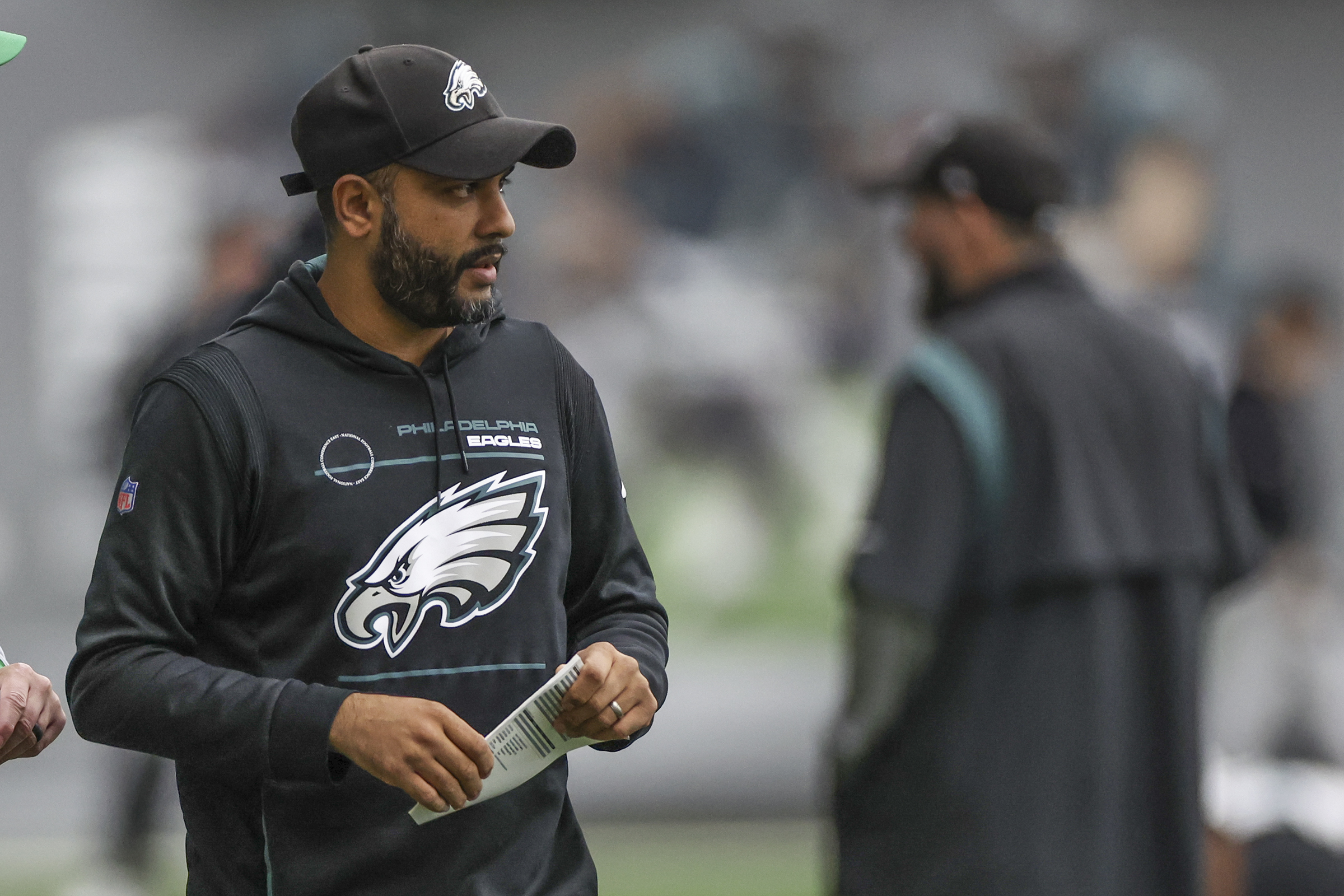
It matters not whether you believe him, or whether he believes himself. Whatever he or you or the players think of the job Patullo has done in his first 11 games calling plays, the important thing is that he is the one who has been doing it. It has been his voice over the headset. It has been his messaging in the meetings. From a command and control perspective alone, changing coordinators this late into a season would introduce a whole new list of things that could go wrong. But what really matters is the message such a move would send.
Offensive coordinator Kevin Patullo “did a good job” of calling plays against the Cowboys, Eagles coach Nick Sirianni said.
Sirianni and the Eagles say they learned a lot of lessons a couple of years ago when their 10-1 start to the 2023 season ended with six losses in their last seven games. The biggest of those lessons is the one that so many of us can’t seem to wrap our heads around. Firing a coordinator this late into a season can do more harm than good, however much he deserves the blame.
We all remember how the movie ended in 2023, right? When the Eagles stripped defensive coordinator Sean Desai of his play-calling duties on Dec. 17, the circumstances were remarkably similar to now. They were coming off two of their ugliest outings of the season, the second of them a 33-13 loss to the Cowboys at Dallas. But they were 10-3, still very much in the running for the top seed in the NFC playoffs, and only a few weeks removed from back-to-back statement wins over the Kansas City Chiefs and the Buffalo Bills. The ship was hardly sinking. Then Capt. Matt Patricia took charge.
There’s a strong argument to be made that the 2023 season ended the day they demoted Desai. Up until then, the Eagles still had the confidence and swagger of a defending conference champion. They were a good team going through a rough patch. There was no reason to think otherwise.
By demoting Desai and replacing him with Patricia, the Eagles made an unprompted announcement that things at One NovaCare Way were more dire than they seemed. From that point on, every week brought more dysfunction.
Sirianni barely survived the fallout. It took him until last February to finally shake off the last of the weakness.
The Eagles demoted defensive coordinator Sean Desai during the disastrous finish to their 2023 season.
The kicker, of course, is that the defense didn’t get better. In Patricia’s first week on the job, the Eagles allowed a touchdown pass with 28 seconds left to lose a game to the Seattle Seahawks that they’d led throughout. The next week, they allowed 25 points to Tommy DeVito, Tyrod Taylor, and the Giants, with New York’s potential game-tying touchdown drive ending at the Eagles’ 26-yard line. After that, they lost a 35-31 shootout to an Arizona Cardinals team that hadn’t cracked 30 points all season.
Demoting Patullo has even less potential upside. Anybody who would replace him is already in the building. That person would almost certainly try to do things the same way the Eagles have been doing them throughout Sirianni’s tenure as coach. Kellen Moore didn’t take the secret recipe box with him to New Orleans. He just happened to be calling plays with an offensive line that was averaging 6 yards per carry.
Sirianni will get some ridicule for his messaging during Monday’s news conference. The worst thing you can tell an emotionally unstable Eagles fan is that everything is well.
The head coach didn’t even go that far. He was asked if he’d considered making a change in play-calling duties. He answered definitively.
“No, I haven’t,” Sirianni said. “Again, I think that we’re always looking for answers, as coaches we’re always looking for answers and we’re never into assigning blame, it’s just looking for answers. … It’s every piece of the puzzle: coaching, playing, execution, scheme, everything … have to be better in all of those aspects. Yesterday, I thought Kevin did a good job of calling. Obviously, he’s going to want plays back just like every player and myself, we all want plays back. … It’s never in football one thing. So, no, I haven’t considered that.”
Anybody who calls plays for this offense is going to face the same challenges as Patullo. The Eagles have an offensive line that is missing its best player in Lane Johnson and looks incapable of the same dominance it showed on the road to a Super Bowl last season. They have a quarterback who isn’t confident enough in his arm to make the sorts of throws that Dak Prescott was making into traffic on Sunday, when the Cowboys overcame a 21-point deficit and the Eagles offense stalled for three quarters of a 24-21 Dallas win. They have a superstar wide receiver who looked like a distant third behind George Pickens and CeeDee Lamb as the best receivers on the field. They have a superstar running back who doesn’t have the same burst he did last season.
In order for Sirianni to make a change, he would need to be reasonably confident that things would get better. If not, things would get appreciably worse. Sirianni and the Eagles would be operating from a position of weakness for the duration of the season. The worst thing they can do right now is panic. We’ve seen how that sort of thing ends.
The news comes 5½ years after a federal court-appointed receiver seized the Philadelphia loan company amid investigations that have sent its top officers to federal prison.
“Sounds like Christmas to me!” said investor Joe Brock, a management consultant who invested $200,000 with Par.
Starting in 2011, Par raised $550 million, telling investors it was lending to merchants at high interest rates for big profits. But Par insiders diverted over $200 million to themselves, and many of its clients couldn’t repay the loans. In March 2020, Par stopped paying investors back.
In July 2020, the SEC filed a sweeping fraud lawsuit against the firm, its owners and pitchmen. Criminal charges followed in 2023. Eight people involved with the company have pleaded guilty and been sentenced to prison and fines.
How much will investors get?
The investors were repaid $111 million, just over half their missing $220 million, under an initial “distribution” of Par assets approved last December.
Another $97 million will be on the way, pending approval by Florida-based federal Judge Rodolfo Ruiz, who has overseen the case since FBI agents raided Par’s Old City offices and detained founder Joseph LaForte on gun charges in 2020. The judge has declared Par a Ponzi scheme, designed to defraud, by using old investors’ money to fool new investors into falsely believing Par was profitable.
A third, smaller payout may be arranged in the future, which could bring the recovery above the loss total, according to the new proposal.
The plan was filed Friday to the judge.
In July 2020, the FBI raided Par offices and founder LaForte’s Haverford home, and the SEC asked Ruiz to put the company into receivership to protect what was left of investors’ money and to investigate whether LaForte and his allies had stolen money from the company.
The SEC also filed civil charges against founder LaForte, his wife, Lisa McElhone, chief financial officer Joseph Barleta, and four investment salespeople, accusing them of selling unregistered securities and failing to disclose LaForte’s prior federal fraud convictions.
Federal criminal fraud charges followed against the three top Par officials, plus debt collectors James LaForte and Renato Gioe; an investment salesman, Perry Abbonizio, and two Colorado accountants who did Par’s taxes.
The investors are getting their investmentsback, but not the promised interest. And the paybacks will be uneven.
Under the terms of the proposal, investors in Par funds set up through Dean Vagnozzi, a former King of Prussia insurance agent who was Par’s most successful salesperson, are on track to receive as much as 98% of their total investment, or as little as 46%, depending on when they invested and how much was in Par.
Some of the funds set up for Vagnozzi’s A Better Financial Plan invested partly in Par and partly in life-settlement contracts, insurance policies purchased from their owners at a discount so investors collect the proceeds when they die. Investors in those funds still hope to collect additional funds as the policyholders die.
Where the recovered money is coming from
The $110 million in the first distribution from the receiver was funded largely by money seized from Par and from founder Joseph LaForte, McElhone, and other Par officials.
The $97 million in the second distribution included $36.5 million in Par funds that had been held in escrow while the receiver negotiated how much was owed to investors in the Chehebar family (some members spell it Shehebar), who own Rainbow Stores.
Lawyers for the Chehebars argued that they had negotiated senior payment rights and should have gotten repaid before other investors. But the receiver said the Chehebars were actually “insiders” who worked closely with the LaFortes and didn’t deserve special treatment.
The Chehebars agreed to settle for $3.1 million — or more if the receiver is able to pay all approved investor claims.
Another $31 million for the payback has been collected from a settlement of lawsuits against John Pauciulo, salesman Vagnozzi’s longtime lawyer, whom Vagnozzi and others blamed for failing to warn that the Par funds ought to be registered with the SEC and to warn investors about LaForte’s criminal past.
Insurers for Pauciulo’s former law firm, Eckert Seamans, agreed to pay $47 million, but part of that total was consumed in payments to lawyers and others with claims against Pauciulo.
In hearings this fall, investigators for the Pennsylvania Disciplinary Board, an arm of the state Supreme Court, have argued that Pauciulo failed to properly advise his clients about the danger from investing in Par. A ruling is pending.
Helping fund the planned second round of payments to Par investors was $10 million from the sale of LaForte’s former vacation home in Jupiter, Fla., one of the last of 25 properties seized by the receiver as proceeds of the Par founder’s fraud.
The rest is funded by millions taken from Par and its investors and not paid out earlier.
For a potential third distribution, the receiver and its consultants have identified several additional funding sources:
$11 million in still-uncommitted cash from the funds the receiver took from Par and its owners;
$10.5 million in a requested IRS refund of taxes Par paid on phony profits the company reported when it was trying to get more people to invest;
$1 million from the sale of three remaining properties at 20-22 N. Third St. in Philadelphia, the last of 20 city properties the receiver has used to raise cash for victims;
Up to $4 million that might still be collected from Par’s last borrowers, half of it from Kingdom Logistics, a Texas-based mining company.
Investors also should receive some proceeds from the liquidation of the former Par Funding corporate jet, worth an estimated $6 million when it was seized by the FBI in 2020, and a Charles Schwab investment account, worth more than $13 million at that time. The government has a separate process for deciding how to pay back that money to investors.
Expenses for the receiver’s lawyers and other professional services have cost around $100,000 a month, according to the receiver’s most recent quarterly reports.
All the Par officials charged with crimes were sentenced, most of them earlier this year, after pleading guilty to criminal fraud and, in some cases, other charges.
Besides fines, restitution and probationary periods, these are the prison terms for people involved:
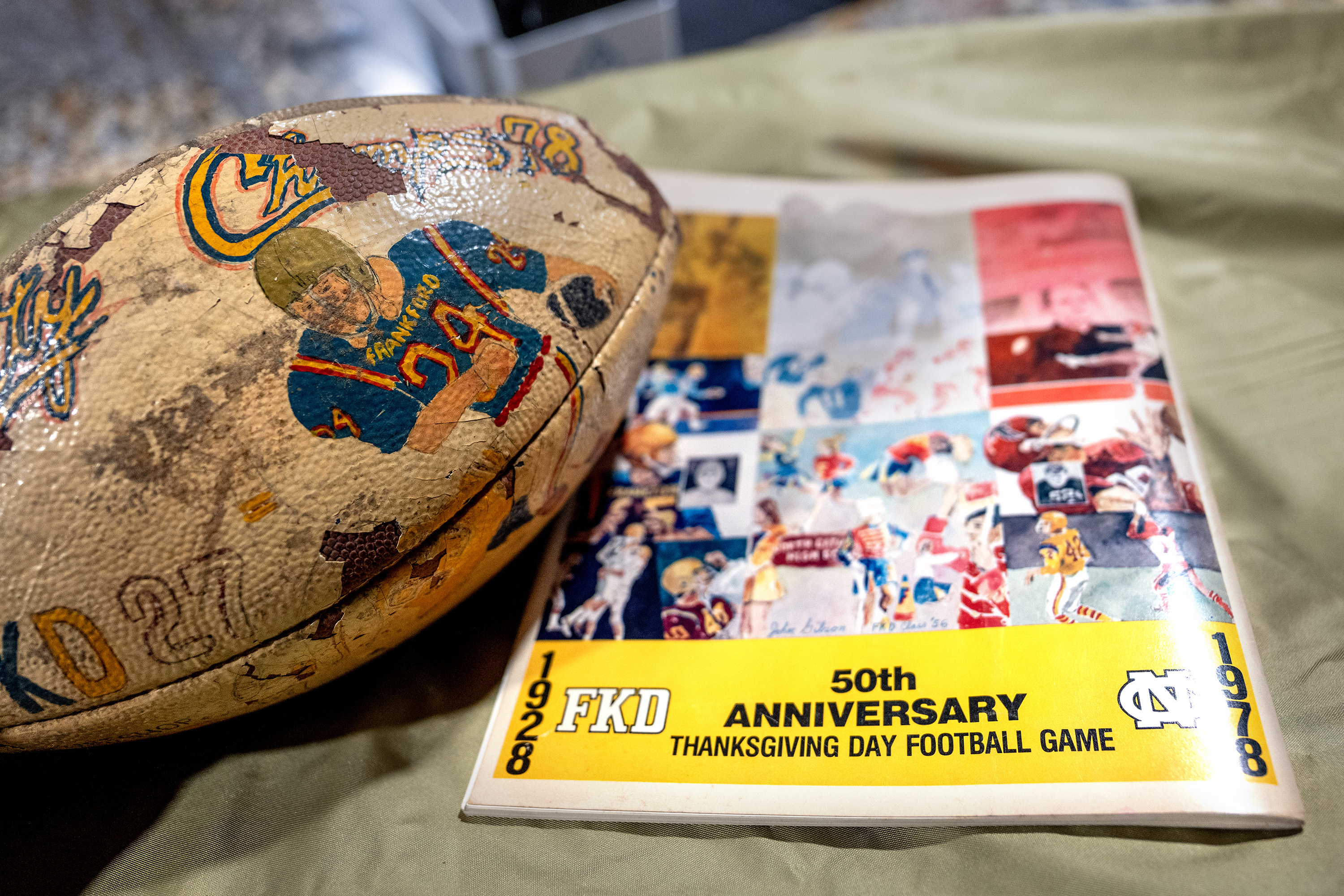
Not long after North Catholic’s building and campus were sold in 2011, an alumnus found pieces of sports equipment in a nearby dumpster. Ruby-red helmets, game-used footballs, and faded trophies were discarded carelessly, bound for a landfill, until this anonymous Samaritan fished them out.
To the seniors who were part of the school’s 1978 football team, these items were anything but garbage. They represented cherished memories, including the greatest of all: the 50th anniversary Thanksgiving Day game between the North Catholic Falcons and the Frankford Pioneers.
The “Norphans” — derived from “North Catholic” and “orphans” — are determined to keep the legacy of that game alive. For decades, it was a Northeast Philadelphia tradition. The neighboring high schools, one public and one Catholic, played from 1928 to 2009, not for a state championship or a league title, but for bragging rights.
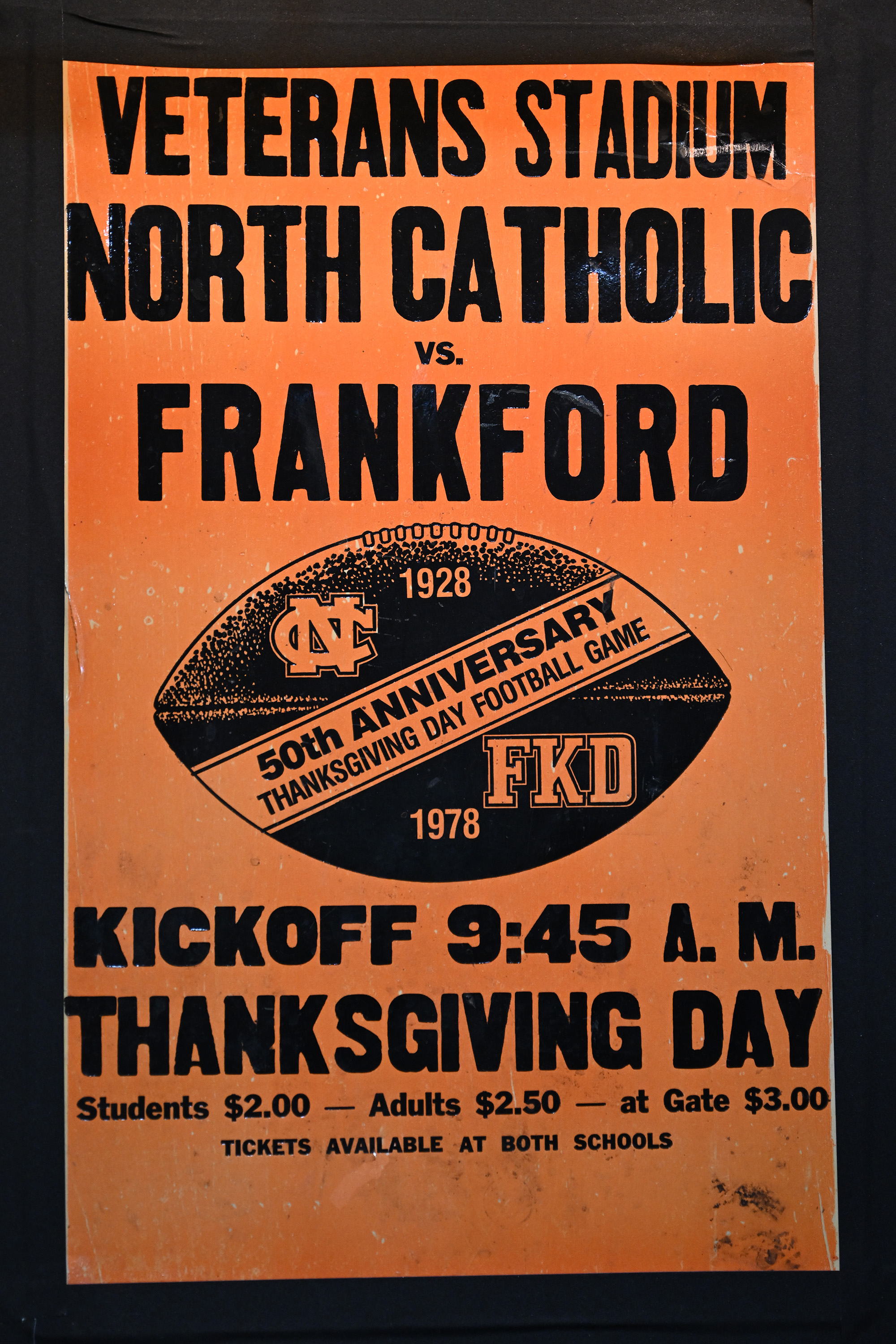
The 50th anniversary pushed an already-intense rivalry to new heights. Eagles coach Dick Vermeil relocated his team’s practice to Franklin Field so the high schoolers could play at Veterans Stadium. Twenty-five thousand people showed up, including politicians and scores of local reporters.
A souvenir from the Frankford-North Catholic 1978 football game. For decades, North Catholic and Frankford had a heated rivalry that played out in a Thanksgiving Day game.
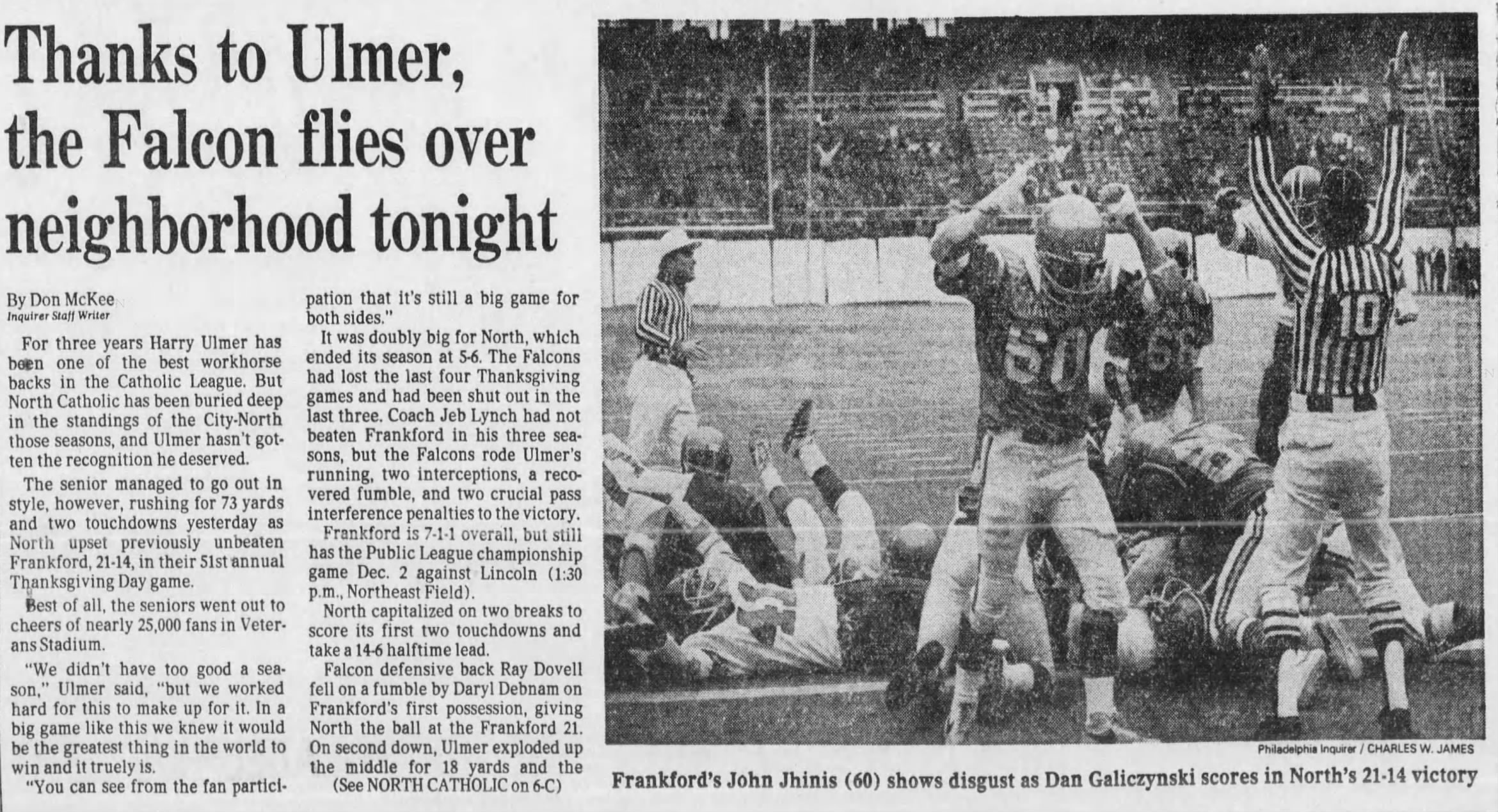
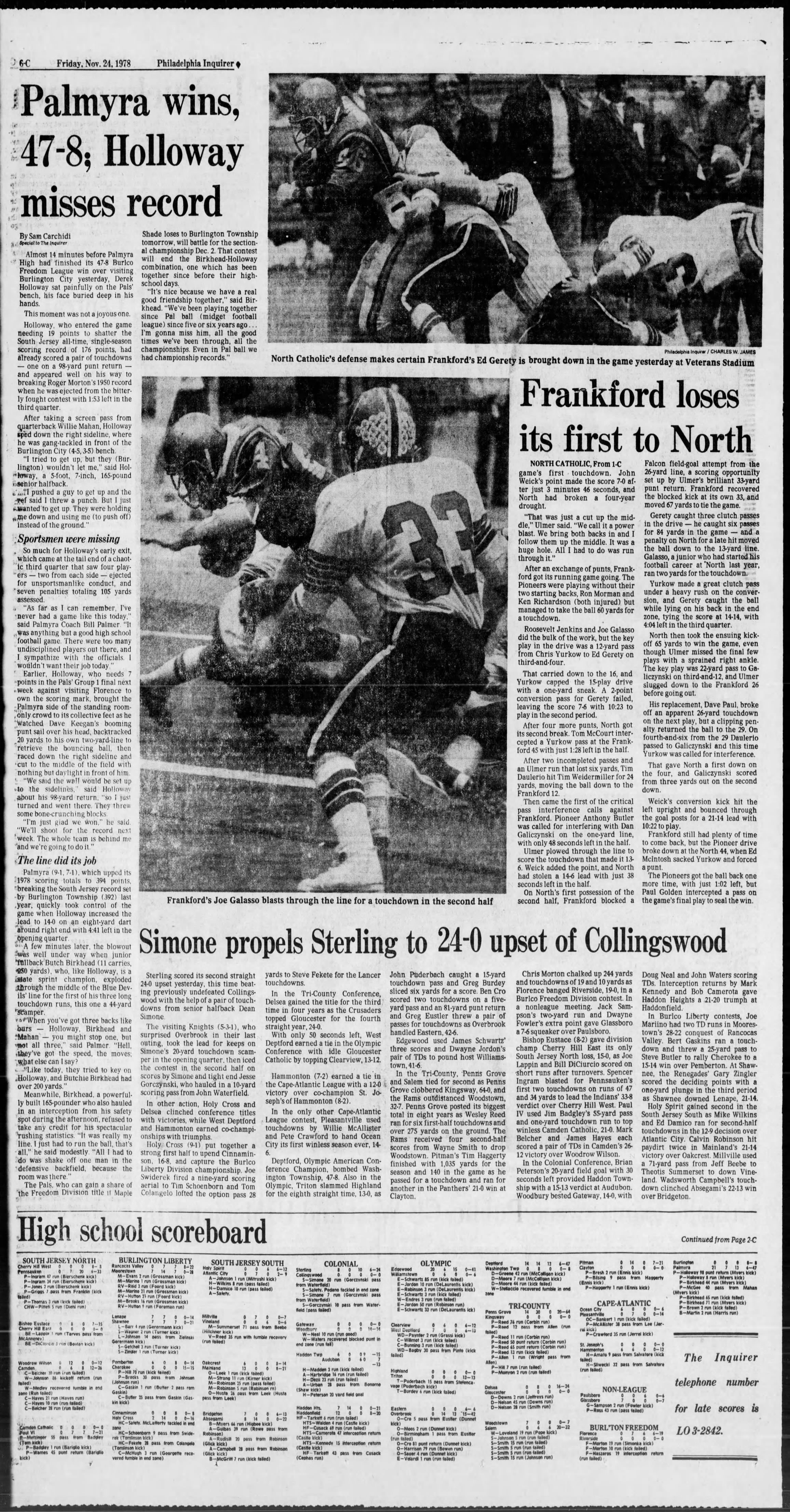
The Falcons were heavy underdogs. They’d gone 5-6 that year and had lost their previous four Thanksgiving games to Frankford. The Pioneers were a bigger team, with a renowned coach in Al Angelo, who led them to a 7-1-1 record en route to a city title in 1978.
But North Catholic was gritty. And on Nov. 23, it pulled off an improbable win, beating its rival, 21-14, in the seniors’ final game together.
As the Falcons walked off the field, nose tackle John Kane imagined returning for the 100th anniversary in 2028. That became impossible in 2010, when North Catholic closed because of dwindling enrollment, rendering the Thanksgiving tradition a thing of past.
But the 1978 North Catholic seniors still have remnants of that game, recovered from the dumpster. They still have the film. They still have the memories, and they still have one another. And for that, they are grateful.
“It was the last game we’d ever play together, and we went out as a winner,” said offensive lineman Chuck Cianci. “It was our championship.”
‘Our Super Bowl’
North Catholic and Frankford occupied the same swath of Northeast Philly, about a mile and a half apart. The high schools’ proximity made the Thanksgiving game a hotly contested neighborhood event.
Kane compared it to the “Catholics and the Protestants in Northern Ireland.” Cianci said it was like “hell week.” Stories of past Thanksgiving games were passed down from generation to generation. Local children dreamed of playing in it — and quickly learned to embrace the rivalry.
Fullback Tim Keller, then a freshman, recalled taking the bus home after the Falcons lost to the Pioneers, 12-7, in 1974. As the North Catholic bus turned off Adams Avenue and onto Roosevelt Boulevard, the Frankford bus pulled up alongside it.
“The next thing you know, the windows came out, and the [North Catholic fans] were throwing the [bus] seats at them,” Keller said. “We lost the game and tore the bus apart.”
North Catholic and Frankford played their Thanksgiving game at Veterans Stadium on Nov. 23, 1978.
A police officer pulled the vehicle over. He allowed women and children to exit, but raucous students and adults spent their Thanksgiving at the 15th Police District on Levick Street.
“The cop gets on [the bus] and says, ‘Sit down!’” Keller said. “And we’re like, ‘We can’t. There are no seats anymore.’”
The officer took the North Catholic fans’ IDs but did not search their pockets. They smuggled a bottle of wine in and passed it from cell to cell.
Even when the games weren’t competitive, the rivalry remained intense. North Catholic was shut out every Thanksgiving from 1975 to 1977. Frankford put up a combined 65 points over that span.
But the Falcons entered the 1978 season with a singular focus. North Catholic coach Jeb Lynch started harping on the Thanksgiving game during the team’s summer workouts at Allentown College of St. Francis de Sales (now DeSales University).
They practiced from morning until night, turning their car headlights onto the field when it became too dark to see.
It ended up being a lackluster season. By Thanksgiving week, North Catholic had lost four consecutive games, including a 49-11 drubbing by Archbishop Ryan.
Nevertheless, the excitement around the 50th anniversary was palpable. It was all anyone in the neighborhood talked about. Teachers and students expressed their support — some in unorthodox ways.
North Catholic slotback Dan Galiczynski took an electronics class his senior year. He was struggling. A few days before the game, his teacher, a religious brother, offered him a lifeline.
“The brother said, ‘Dan, all you’ve got to do is beat Frankford,’” Galiczynski said. “‘And I’ll give you a 72.’”
(He chose 72 because it would allow Galiczynski to “barely pass” without exaggerating his electronics savvy.)
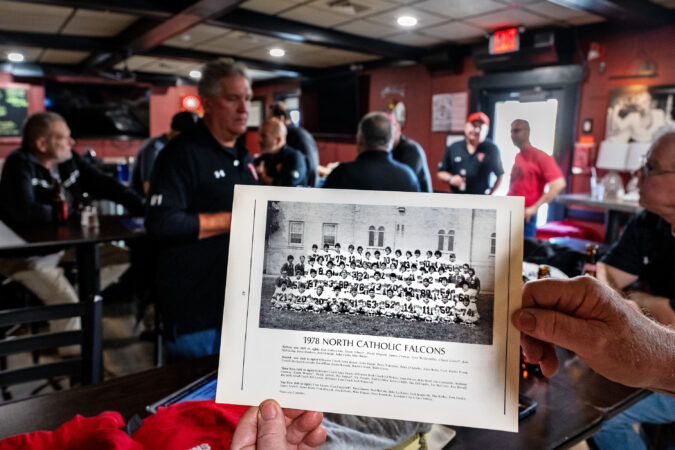
A poster from the 1978 game brought by former North Catholic football players gathering at Dagwood’s Pub in Torresdale on Nov. 16.
Before 1978, the Thanksgiving game had been played at Temple Stadium (which was demolished in 1997) or Franklin Field, but to commemorate the 50th, Angelo proposed that it be moved to Veterans Stadium. The city signed off on the idea and arranged for Frankford to use the Eagles’ locker room. North Catholic was to use the visitors’.
Just before 9:45 a.m. that Thursday, the Falcons walked out of the tunnel to thousands of screaming fans. They looked up and saw friends and family in the crowd.
Frank Correll, who played on special teams, got goose bumps.
“We all came from small neighborhoods,” he said. “So it was overwhelming. Now you understand why these guys all come out for big football games running around and jumping. There’s a lot of energy. And this was, for our school, our Super Bowl.”
High school heroics
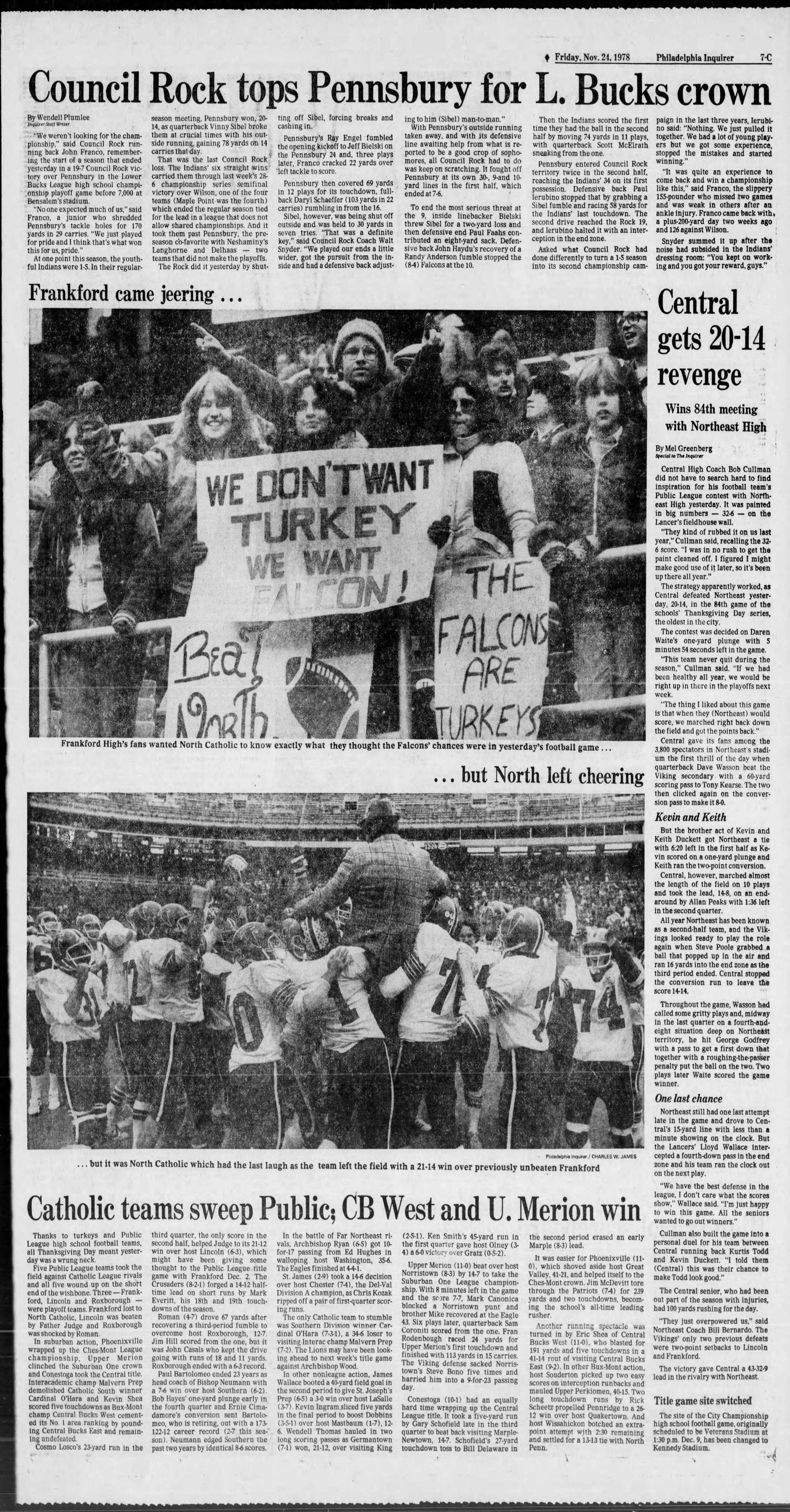
It didn’t take long for things to get contentious. Frankford fans began chanting “We don’t want turkey, we want Falcon!” Some threw whiskey bottles at North’s captains during the coin toss.
As handles of hard liquor careened through the autumn air, tailback Harry Ulmer turned to Cianci.
“He was like, ‘What’s going on?’” Cianci said. “That wasn’t good. That wasn’t good.”
Despite the hostility, North Catholic got off to a promising start. Defensive back Ray Dovell recovered a fumble on Frankford’s first possession, setting the Falcons up at the Pioneers’ 21-yard line. Moments later, Ulmer rushed for a touchdown to give North Catholic an early lead.
Frankford responded with a 60-yard touchdown drive. But a two-point conversion attempt failed, leaving North Catholic with a 7-6 lead with 10 minutes, 23 seconds left in the second quarter.
North Catholic vs. Frankford in a Thanksgiving game at Veterans Stadium on Nov. 23, 1978.
Then North Catholic got another break. Defensive back Joe McCourt intercepted a pass from Frankford quarterback Chris Yurkow, and ran 18 yards to reach the Pioneers’ 30-yard line.
With less than two minutes to go in the half, North Catholic was desperate to add to its lead. But on the next three plays, the team didn’t get any closer to the end zone; it went backward, losing 6 yards.
Now, there was only a minute remaining. North Catholic sat on the 35-yard line, too close to punt and too far for a field goal. Lynch settled on a conservative play. He wanted to run the ball.
But Cianci had other ideas. The offensive lineman jogged into the huddle.
“Coach just wants you to run the ball,” he said. “We’re not doing that. What do you want to do?”
Wide receiver Tim Weidenmiller looked at quarterback Tony Daulerio. The team had practiced a tight end out-and-up play but hadn’t used it in the game yet.
“I can beat this corner right now,” Weidenmiller told him.
“All right,” Daulerio responded. “Let’s do that.”
On fourth-and-16, Daulerio hit Weidenmiller for a 23-yard pass that put them at Frankford’s 12-yard line. Ulmer then ran it in for his second touchdown of the day, giving North a 14-6 lead at the half.
In the third quarter, Frankford blocked a North Catholic field goal and recovered the ball at its own 33-yard line. The Pioneers drove 67 yards to tie the game, 14-14, with 4:04 left in the quarter.
North Catholic vs. Frankford was a Thanksgiving game tradition. The Falcons beat the Pioneers on Nov. 23, 1978.
Ulmer exited with a sprained ankle. Running back Dave Paul replaced him and ran 26 yards for a touchdown, but the play was called back for a clipping penalty. The ball was returned to the 29-yard line.
Galiczynski walked over to his coach.
“Listen,” he told Lynch. “I’m a senior. Dave Paul is a sophomore. I ran tailback my whole junior year. Put me in.”
“Go ahead,” Lynch responded.
Galiczynski scored two plays later. The Falcons made the extra point, giving them a 21-14 lead with 10:22 left.
The Pioneers had ample time to score, but North held the line. Defensive back Paul Golden finished the game by intercepting Yurkow’s Hail Mary pass with just over a minute remaining. The clock ran out. The Falcons crowd roared.
A few players lifted Lynch on their shoulders as they triumphantly marched off the field.
“We got to this game, in this special place, and we won it,” Cianci said. “And to look around and see the fans, and how much joy they had … it was unbelievable. We were like folk heroes.”
A new tradition
After graduating, the seniors from the 1978 North Catholic team went their separate ways. Some moved out of the city, some moved out of the state. But the group stayed in touch while supporting each other from afar.
In the early 1980s, Cianci was accepted into the police academy. A few months later, he was told classes for that semester had been canceled. He had to find a new job until the academy opened up, and happened to run into Galiczynski at a local softball game in Philadelphia.
Cianci explained his predicament.
“Danny said, ‘You can work with me in construction,’” Cianci said. “And he put me to work until the academy called me back. That’s the kind of friendship we have.”
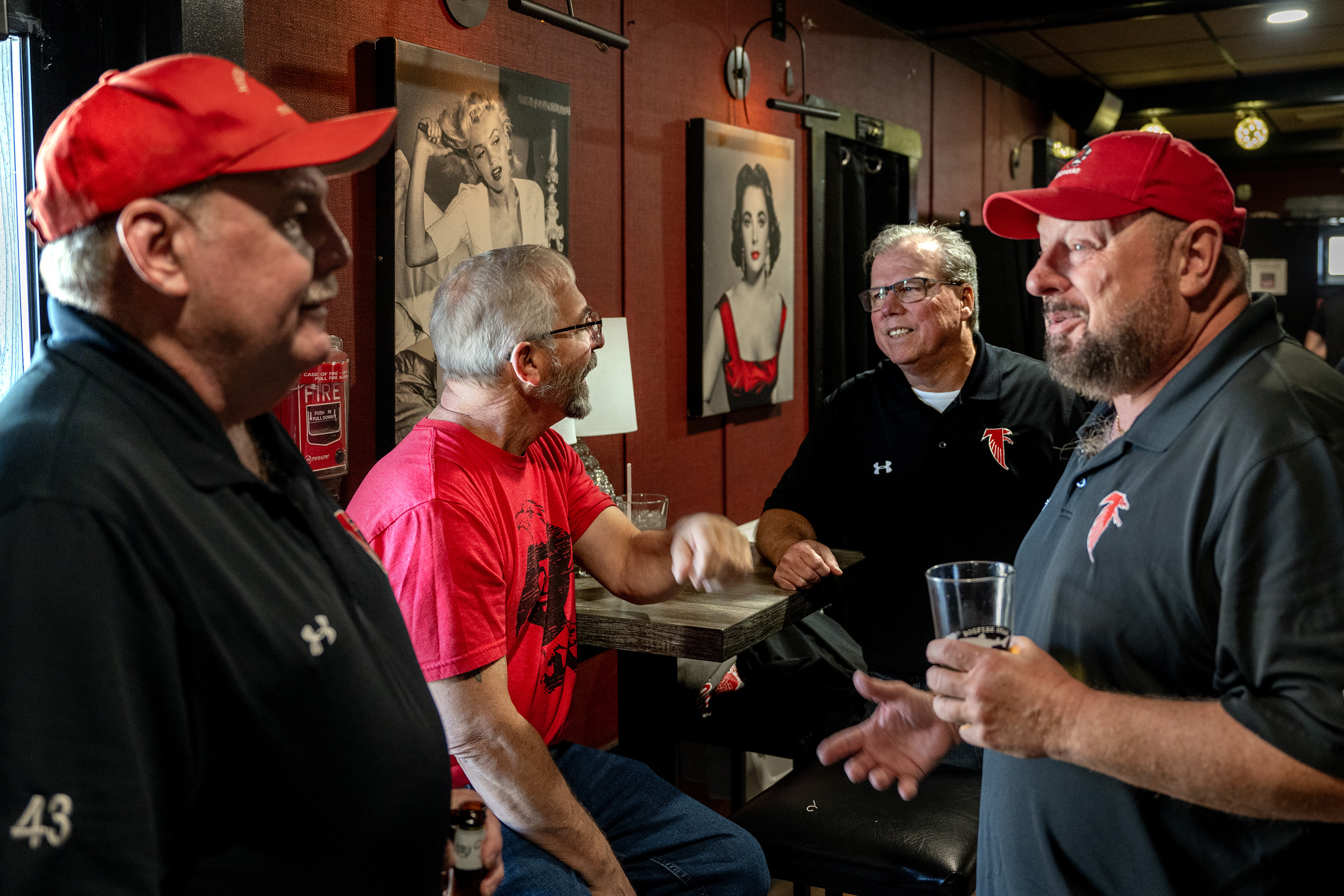
Former North Catholic football players Paul Golden (from left), Tim Keller, Joe McCourt, and Mike Butler catch up on Nov. 16 at Dagwood’s Pub in Torresdale.
In 2018, Tommy Campbell, a senior defensive tackle on the 1978 team, fell ill. He was diagnosed with amyloidosis and a rare blood disease. His heart and liver were failing him. The North Catholic graduate spent six months on life support in the intensive care unit.
Campbell worked as a mechanic for an airline at Dulles International Airport in suburban Washington. The airline’s insurance company told him it wasn’t going to cover a heart and liver transplant because of the blood disease.
His wife, Karen, began a letter-writing campaign to persuade the insurance company to pay for the operations. Multiple members of the 1978 North Catholic team joined in.
Linebacker Pat Jordan, a 1978 senior captain, took it a step further. He was a longtime plumber with Local 690. The union used the same insurance as Campbell, so Jordan decided to apply some pressure.
“He went to the international, and said, ‘Listen, we need to do something. This is one of my best friends,’” Cianci said. “‘We’re going to call the insurance company. We’re going to threaten to pull our insurance for all union members if they don’t get this approved.’”
The company reversed its decision and covered Campbell’s surgery. To this day, he believes his teammates saved his life.
“These were guys I hadn’t seen in 30-35 years, coming to the plate,” Campbell said. “Everybody should be lucky enough to feel that.”
Jordan died unexpectedly on Feb. 3. He was 63. The 1978 seniors toasted to him during a reunion last summer in North Wildwood.
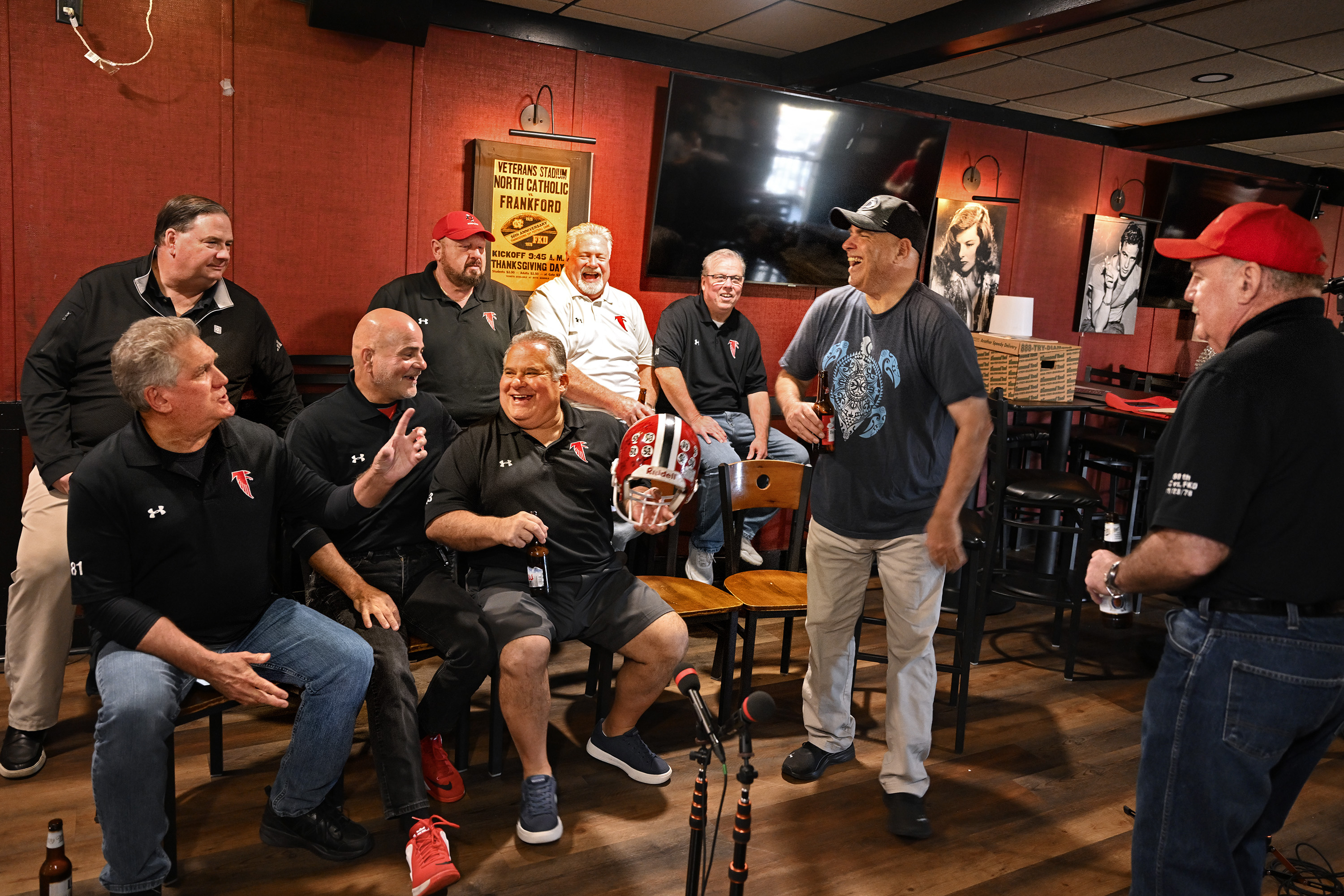
Former North Catholic football players gather together on Nov. 16.
This is their annual tradition now. There are no more North Catholic-Frankford games to go to. The local Thanksgiving games that remain just don’t feel the same.
So every July, the Norphans will meet at the beach before they head to Keenan’s Irish Pub. They’ll celebrate Jordan, linebacker Frank Wodjak, guard Ken McGuckin, and other fallen teammates.
They’ll wear black-and-red polo shirts with uniform numbers stitched into their sleeves and relive a day that still feels like dream.
“And we’ll toast,” Galiczynski said, “until the last of us is standing.”
The Phillies have been relatively quiet so far this offseason, which presents the opportunity for some hypothetical exercises.
Here are three trade ideas for the Phillies that could address their winter to-do list, and reasons that they may or may not work if they came across Dave Dombrowski’s desk:
Infielder Aidan Miller to the Red Sox for outfielder Jarren Duran
Why it could work
Boston already has a logjam in its outfield, and top outfield prospect Jhostynxon Garcia is near-MLB ready. That makes the Red Sox logical trade partners for the Phillies, who need outfield help.
Duran, who primarily plays left field but has seen time at all three outfield positions, has a controllable contract through 2028. Last season, the 29-year-old slashed .256/.332/.442 and hit 16 home runs. He also posted 11 defensive runs saved, which ranks second behind Steven Kwan among MLB left fielders. He’s speedy as well, ranking in the 91st percentile of sprint speed.
Miller, the Phillies’ No. 2 prospect, would bolster the Red Sox’s infield depth.
Boston Red Sox outfielder Jarren Duran hit 16 home runs in 2025.
Why it might not
Ideally, the Phillies need a right-handed bat, and Duran is a lefty. Their No. 2 prospect is a high price to pay for yet another left-handed outfield bat. But that’s likely the cost for a player of Duran’s caliber with three years of team control and several clubs needing outfield help. Even so, it would be a big blow to an already thin farm system.
Duran doesn’t counteract the Phillies’ main offensive weaknesses, either. He had a strikeout rate of 24.3% and a chase rate of 31.1% last season. His career OPS against lefties is .620, compared to .837 against righties.
The Red Sox might also prefer to use one of their biggest trade chips to prioritize their more immediate need of starting pitching.
The trade
Pitcher Gage Wood, pitcher Alex McFarlane, and infielder Aroon Escobar to the Orioles for catcher Adley Rutschman
Why it could work
If Plan A of re-signing J.T. Realmuto doesn’t work out for the Phillies, they will need to turn to Plan B. But the catching free-agent market this winter isn’t exactly robust, so trading for one might be the most logical avenue.
There has been trade buzz surrounding Rutschman since the Orioles signed their top catching prospect, Samuel Basallo, to an eight-year extension in August. Rutschman is under team control through 2027.
The 27-year-old switch-hitter was is coming off his least productive major league season, and was limited to 90 games with oblique strains. Even so, he had an above-average chase rate (21.7%) and whiff rate (14.5%) in 2025. Over his four-year career, Rutschman has a .254/.344/.412 slash line.
The Orioles need pitching. The Phillies’ top pitching prospect, Andrew Painter, was off the table at the trade deadline, and it’s unlikely that has changed. To avoid including their top three prospects — Painter, Miller, and Justin Crawford — it probably would require a bigger package to net Rutschman.
McFarlane, 24, is the closest of the three included prospects to being major league ready was recently was protected by the Phillies ahead of the Rule 5 draft. He finished the 2025 season, his first back from Tommy John surgery, as a reliever with double-A Reading and posted a 4.84 ERA across two levels.
Wood, whom the Phillies plan to develop as a starter, was the Phillies’ first-round draft pick out of Arkansas this year.
Rounding out the package is Escobar, the Phillies’ No. 5 prospect. He had a .270 batting average and .774 OPS across three levels, ending the season with a September promotion to double A.
Orioles catcher Adley Rutschman slashed .220/.307/.366 in 90 games in 2025.
Why it might not
Rutschman is coming off a down year, and the Orioles would be selling low on a player who was envisioned as the future face of their franchise when he was drafted first overall in 2019.
While the Orioles vastly underperformed preseason expectations in 2025, finishing last in the American League East, Baltimore president of baseball operations Mike Elias could be banking on a return to contention in 2026. There’s certainly precedent, after the Blue Jays went from last to first in the AL East in one year. If so, Baltimore might prefer to keep Rutschman around, as he’s more polished behind the plate than Basallo.
From the Phillies’ perspective, sending away three top-30 prospects would be a big setback for a farm system that already is lean. They also would be betting that Rutschman would bounce back from a career-low OPS+ of 90.
And if the Phillies re-sign Realmuto, this trade would be redundant.
The trade
Third baseman Alec Bohm and pitcher Jean Cabrera to the Mariners for catcher Harry Ford
Why it might work
Bohm, who is entering his final year before free agency, has been the subject of trade rumors for two straight offseasons. The Mariners need a third baseman, with Eugenio Suárez now a free agent.
Seattle’s top catching prospect, Ford, is blocked from a starting role by Cal Raleigh, the 2025 AL MVP runner-up. Ford, 22, made his major league debut in September and played eight games for the Mariners, but he currently doesn’t have a path to regular playing time. Ford played 97 games in triple A last season, where he hit .283 with an .868 OPS. Behind the plate, he had zero passed balls and caught runners stealing 23% of the time.
He could make sense for the Phillies whether they re-sign Realmuto or not. After sending Eduardo Tait to the Twins in the Jhoan Duran trade, the Phillies lack future catching depth. Bringing Ford into the fold also would help the Phillies get younger.
Garrett Stubbs and Rafael Marchán are under contract with the Phillies for 2026. If Realmuto signs with another team, Stubbs or Marchán could work in a tandem with Ford as he continues to develop.
Why it might not
If the Phillies are trading from their major league roster, they will have to make additional moves to fill the holes it creates. That means they suddenly would be in the market for a third baseman.
That is, unless the Phillies are confident that Otto Kemp and/or Edmundo Sosa will be a sufficient stopgap until Miller is ready for the majors. But third base is not the strongest defensive position for Kemp (minus-7 outs above average) or Sosa (0 OAA).
The Mariners could be looking for an even higher price for Ford, who is ranked as the No. 42 prospect in MLB.
It’s no secret that the use of both generative and agentic AI will proliferate over the next few years as the technology becomes more reliable and pervasive.
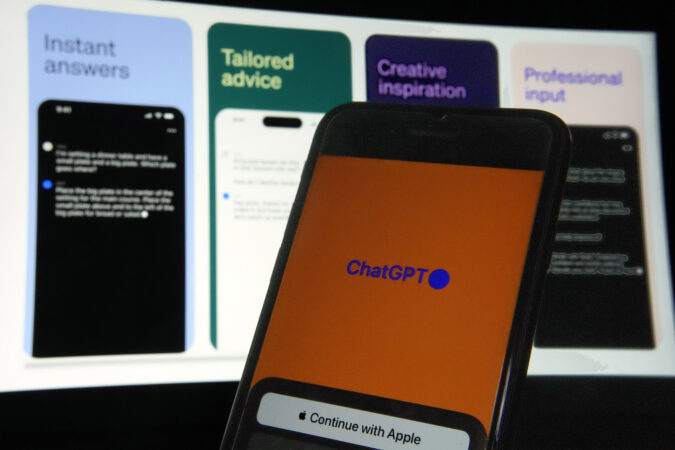
More than 58% of small businesses are already using AI in their companies, according to a recent study from the U.S. Chamber of Commerce, and that usage is expected to rise this year. For now, most of that can be attributed to chatbots like ChatGPT, Gemini, Copilot, and others.
Because of this, your business needs to create and maintain a strict AI policy. Why?
“An AI policy places guardrails around the usage of AI by your employees,” said Philadelphia attorney David Walton, who chairs the artificial intelligence team at Fisher & Phillips. “It allows your employees to use AI faster and better.”
Without an AI policy, a business would be exposed to reputational damage that’s caused by AI “hallucinations” or errors, Walton said. In addition, a company’s proprietary data — pricing, contracts, customers information, processes — could be exposed to the public, particularly when employees use free AI tools that offer less protection.
Lawyer Star Kashman, founding partner of Cyber Law Firm, warns her clients that without an AI policy, employers could be exposed to claims of bias and other lawsuits.
“For example, there might be some resumes from people of certain races, people of certain genders that maybe aren’t as accepted by the AI system, and you’re automatically rejecting great candidates,” she said. “You’re going to be the one that has a huge lawsuit on your hands, even for your employees’ actions, if you weren’t able to protect it.”
A good AI policy should include the following.
Include a statement of purpose for AI
The policy should be clear that AI is allowed only when used responsibly and with guardrails.
It should also be clearly stated that AI tools are used only when they can improve productivity, provided that they are safe and confidential.
Provide a list of approved applications
A company’s AI policy should specify which tools and software are approved by management, both lawyers said.
The tools should be used for business purposes only. Free tools should not be allowed because of their privacy concerns, and if a tool is not listed in the policy, permission is required from management to use it.
When employees use AI on a personal account, Walton said, “it’s hard for the business to control privacy settings, and confidential data may leak into free or public AI models.”
Consider a proprietary information ban
It’s still unclear how safe our data is when AI applications are being used. To that end, it’s a good practice to avoid or even ban the entry of private information into these platforms.
This would include customer data, financial statements, contracts, pricing information, personal identifying factors, trade secrets, or anything medical, legal, or human resources related.
State the ownership of AI work
When an employee makes a “prompt” into an AI chatbot, that query, as well as any resulting workflows and custom instructions, are all assets of the company and should be stated as so.
A company’s AI policy should state that employees must return all AI-created work at separation, cannot export data into their personal accounts, and cannot use their own agents or tools for company work.
Avoid AI in HR
AI applications shouldn’t be used in hiring or performance reviews, both Kashman and Walton said. Many platforms leverage AI to perform these functions, but these tools could create more headaches than benefits.
“HR is the front line for legal problems tied to AI,” Walton said. “Relying on AI to make hiring, firing, or performance review decisions could be very problematic.”
Ban certain outputs
An AI policy should ban the use of images, videos, or voice without management approval. NSFW (not-safe-for-work), pornographic, or defamatory content should be off limits. This can help protect against reputation damage, deepfakes, and offensive content.
Always use human oversight
We know today’s AI tools are far from perfect. Your policy should state that everything AI produces must be validated, checked, sourced, and edited by a human.
Explain why the AI policy exists
AI is new, and your employees are already concerned about this new technology. Kashman said it’s important to explain the “why” behind each rule in your policy.
“Instead of just ‘don’t,’ explain the risk to the employee and company such as hallucinations, data leaks, bias, etc.” she said. “Employees follow rules better when they understand them.”
The uncertain regulatory environment is another big reason for creating an AI policy. Regulation of AI use shouldn’t be expected anytime soon, Walton said.
“Businesses must prepare for state-level AI regulation, especially around risk assessment and bias, because the federal government is unlikely to pass comprehensive laws anytime soon,” he said.
However, some states — like New Jersey — have proposed bills that would require businesses to do formal risk assessments and acceptable-use policies. Meanwhile, President Donald Trump is considering an executive order limiting states from regulating AI.
Kashman said the lack of regulations will leave business owners vulnerable “because tech companies aren’t going to be as liable for harms.” So small businesses “must protect themselves with strong internal policies,” she said.
“An AI assistant or chatbot can help businesses draft a policy or template, especially for nonlawyers who need structure or a first draft,” Kashman said. It’s important to frequently update this policy because the technology, models, privacy terms, and data breaches change rapidly, she added.
“However, be careful,” she said. “AI can’t understand the nuances of a specific business or legal risk, so human review from legal counsel or an expert is necessary.”
Rebecca Procopio was attracted to the walkability of the two-bedroom, 1½-bathroom home to the eateries, “the vibrant energy,” and other attractions of Passyunk Square.
But after buying it in 2023, she took particular delight in the view from her front porch of the studio of renowned mosaic artist Isaiah Zagar.
“I’ve always felt drawn to the unique,” said Procopio, referring to both to the neighborhood and the house. The home “felt a lot more open than the other homes I looked at.”
Her fiancé, Tyler Griffiths, joined her there last year. But the couple is now headed for Chicago where she has a new job in her field of genetic counseling.
Primary bedroom
The house is 1,036 square feet and four stories, including the finished basement.
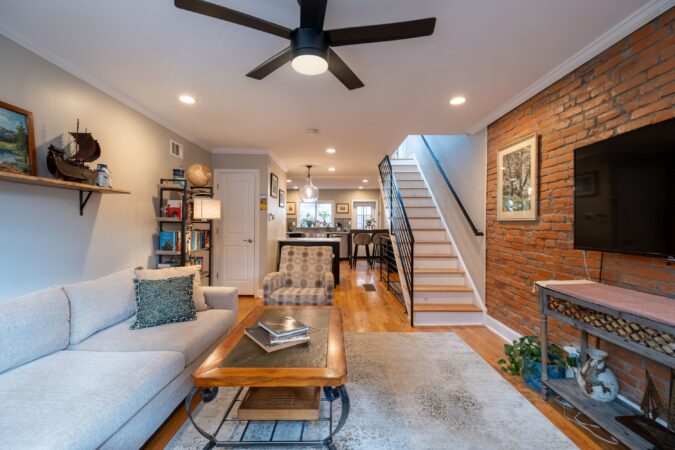
The main floor is open concept, with hardwood floors in the living room, dining area, kitchen, and half bathroom. The living room also features an exposed brick wall.
The kitchen has updated cabinetry, stainless steel appliances, and a marble countertop.
Kitchen
The two bedrooms have ample closet space and large windows, letting in plentiful natural light.
The second bedroom has been serving as a combination guest room and home office.
Guest bedroom/office
The primary bathroom has a contemporary design, with ceramic tile and a large shower.
The basement can be used as a family room, home office, or gym, in addition to storage space and a laundry area with a washer and dryer.
Basement
The property has a private outdoor space.
Public transportation is easily accessible.
The house is listed by Nancy Alperin of Maxwell Realty Co. for $455,000.