Blog

  • Penn Museum unveils a new gallery that examines the struggles and resilience of Indigenous nations

    Penn Museum unveils a new gallery that examines the struggles and resilience of Indigenous nations

    For more than a decade, the Penn Museum has offered visitors an encyclopedic history and perspective on Native American history, with artifacts spanning from Alaska tribes to communities in the southernmost part of the continental United States.

    On Saturday, the museum unveiled a new gallery showcasing the artistic, linguistic, spiritual, and revolutionary traditions of Native Americans across the country.

    The Penn Museum’s “Native North America Gallery: Rooted in Resilience. Resisting Erasure” exhibit features more than 250 cultural items and art pieces.

    A gallery of Native American art is displayed at the Penn Museum on Friday, Nov. 21, 2025, in Philadelphia. As celebrations of Native American culture and precolonial Philadelphia plants grow, museums across the city prepare for America’s 250th birthday.

    Christopher Woods, Williams director of Penn Museum, said the new gallery builds on the institution’s expansive Native American collection while offering insights into the lives of Indigenous Americans today. It builds on a former gallery, which similarly focused on first-person narratives and consulted with Indigenous curators.

    “We’re an archaeology museum, but this is really about Native American people today, and drawing on the connection between the past and the contemporary world. It’s important to show people that these are vibrant communities,” Woods said during a press preview. “Showing how strong they are, the nature of their resilience, the historical and cultural erasure, and having them speak in their own words is important.”

    These works, which build on the previous exhibition, “Native American Voices: The People – Here and Now,” that closed in July, offer a reframing of Native American history from four regions of the United States, including the Lenape Natives of the Delaware.

    A gallery of Native American art is displayed at the Penn Museum on Friday, Nov. 21, 2025, in Philadelphia. As celebrations of Native American culture and precolonial Philadelphia plants grow, museums across the city prepare for America’s 250th birthday.

    The immersive, multisensory exhibit includes a floral beadwork collar from the Northeast Lenape, a single-weave square basket from the Eastern Band Cherokee in the Southeast, a centuries-old clay ancestral mug from the Pueblo people of the Southwest, and a fringed ceremonial robe, known as a Chilkat blanket, from the Tlingit people of the Northwest.

    Among the oldest items on view are chipped stone tools historically used by Native Americans, which were pulled from the Penn Museum’s collections. The newest items include a woven piece that was commissioned from Cherokee mixed media sculptor Brenda Mallory.

    The gallery also includes images of regions the tribal nations have inhabited, interactive displays offering insight into the formation of their cultural items, tools, and regalia, and varying stories about their traditions, challenges, and resilience before and after European contact.

    A gallery of Native American art is displayed at the Penn Museum on Friday, Nov. 21, 2025, in Philadelphia. As celebrations of Native American culture and precolonial Philadelphia plants grow, museums across the city prepare for America’s 250th birthday.

    Alongside co-curators Lucy Fowler Williams and Megan Kassabaum, this comprehensive gallery was developed by cultural educators, archaeologists, and historians who are direct descendants and members of the tribal nations featured in the exhibit.

    Among the eight Indigenous consultant curators, who served as narrative guides, were Jeremy Johnson, cultural education director of the Delaware Tribe of Indians, RaeLynn Butler, secretary of culture and humanities of the Muscogee (Creek) Nation, and Christopher Lewis, cultural specialist of the Zuni Pueblo.

    The consulting curators assisted in creating the narrative flow of the gallery and worked with the Penn Museum to recover lost history and study their ancestors’ practices. They also contributed their own art and cultural items to the gallery.

    Upon seeing the exhibition for the first time on Thursday, Johnson said it was an “emotional moment.”

    “It was overwhelming,” he said. “It’s not just a room with a bunch of paintings or drawings. These are actual people I lived with, know, and are related to. I can tell you about every person here. Being able to give our tribal citizens, considering everyone is a relative, a voice was really emotional. We’ve always been seen as relics of the past.”
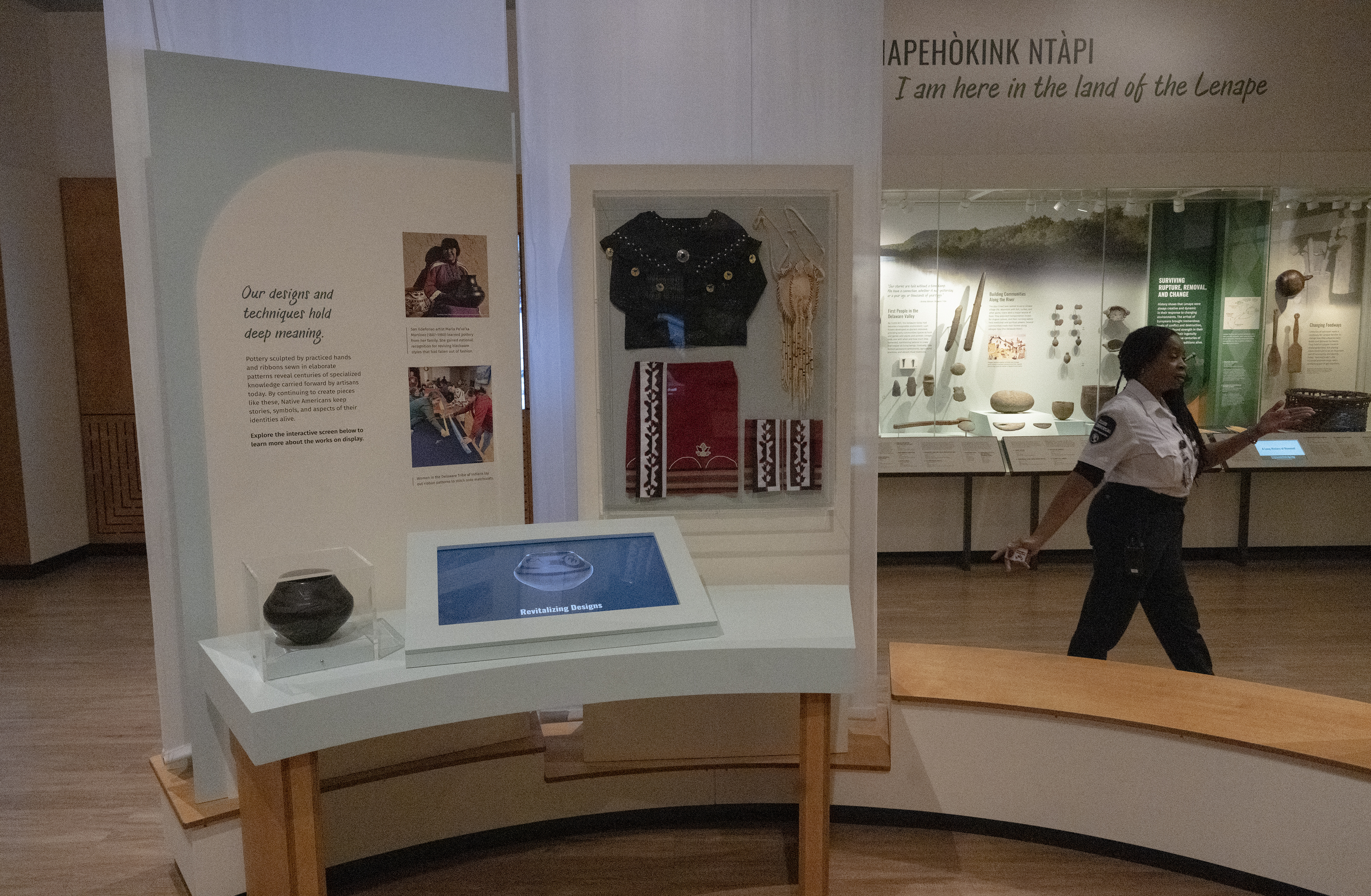
    A gallery of Native American art is displayed at the Penn Museum on Friday, Nov. 21, 2025, in Philadelphia. As celebrations of Native American culture and precolonial Philadelphia plants grow, museums across the city prepare for America’s 250th birthday.

    Kassabaum said the concept of the exhibit began four years ago, but many of the gallery’s elements were shaped by the consulting curators, who willingly shared their stories and welcomed Kassabaum and others into their communities.

    Kassabaum and other Penn Museum consultants traveled to Oklahoma to spend a week with members of the Delaware Tribe. They brought back four items, including the floral beaded collar, and let their protectors relay how they were made.

    Those kinds of connections can’t be made without the help of the consulting curators, Kassabaum said.

    “These aren’t my stories and they’re not my experiences,” he said. “I have not experienced any of the trauma of these communities. I have not experienced the joy of these communities, and everything people have been willing to share with us has been incredible. … No matter how giddy or passionate I am about anthropology and archaeology, I can’t bring the same thing to the gallery. It was totally essential.”

    Unlike other exhibitions sprawled throughout the country, Johnson said Penn’s inclusion of him and his Native “relatives” was based in good faith rather than historical or cultural exploitation.

    “We know certain art museums have been problematic in the past, and are still doing that work,” Johnson said. “But I feel this is the first time we were asked in the right way. It was in the spirit of an actual collaboration, instead of asking for items to display, and that’s it. This was a good process, and we hope it stands as a model for future exhibits.”

    A gallery of Native American art is displayed at the Penn Museum on Friday, Nov. 21, 2025, in Philadelphia. As celebrations of Native American culture and precolonial Philadelphia plants grow, museums across the city prepare for America’s 250th birthday.

    The opening ceremony of the Native North America Gallery kicked off with remarks from Johnson and the other Indigenous consulting curators.

    Their remarks were followed by traditional dance, songs, and storytelling by New Mexico’s Tewa Dancers. There was also an artist talk by Holly Wilson of the Delaware Nation, curatorial presentations led by Johnson and Joseph Aguilar of the San Ildefonso Pueblo, and a series of family workshops.

    The gallery, which is now on display, is available for online and in-person viewing.

    Visitors can reserve guided, in-person tours on select days. Tickets are priced at $26 for members and $30 for general admission. For more information, visit penn.museum.

    A gallery of Native American art is displayed at the Penn Museum on Friday, Nov. 21, 2025, in Philadelphia. As celebrations of Native American culture and precolonial Philadelphia plants grow, museums across the city prepare for America’s 250th birthday.
  • A Fishtown-based nonprofit works to address the roots of trauma in children before crisis hits | Philly Gives

    A Fishtown-based nonprofit works to address the roots of trauma in children before crisis hits | Philly Gives

    Mellisa Wilson had been working hard — so, so hard — to change the trajectory of violence that marked her life and the lives of her five children when she saw something that broke her heart.

    Her youngest daughter was putting her baby doll to bed, “and she was hitting it,” Wilson said, choking back tears. “That’s when I knew it was really bad. That’s when I knew that wasn’t what I wanted them to take from me,” as a parent.

    And so, Wilson did what she had done many times before.

    She turned to the Children’s Crisis Treatment Center (CCTC) for help.

    In schools, homes, and community centers in Philadelphia, Montgomery County, and Camden, CCTC provides trauma-informed care annually to over 3,500 children, up to age 18, suffering from behavioral issues, depression, and trauma, helping their families in the process.

    “I knew I had to do something different,” Wilson said.

    Wilson, a CCTC volunteer and a member of the center’s parent advisory council, had been bringing her children to CCTC, a nonprofit children’s mental health agency, for 20 years.

    With all the counseling she and her children have received, she could easily give the same talking points as CCTC’s chief executive officer, Antonio Valdés.

    And she did.

    It may take years, she said, but when a child experiences trauma, at some point, sooner or later, there will likely be a behavioral issue.

    Wilson said she grew up in a home where she was regularly beaten with a broom handle or an extension cord. “Those were my grandmother’s favorites.” The trauma repeated itself across the generations when she became a mother.

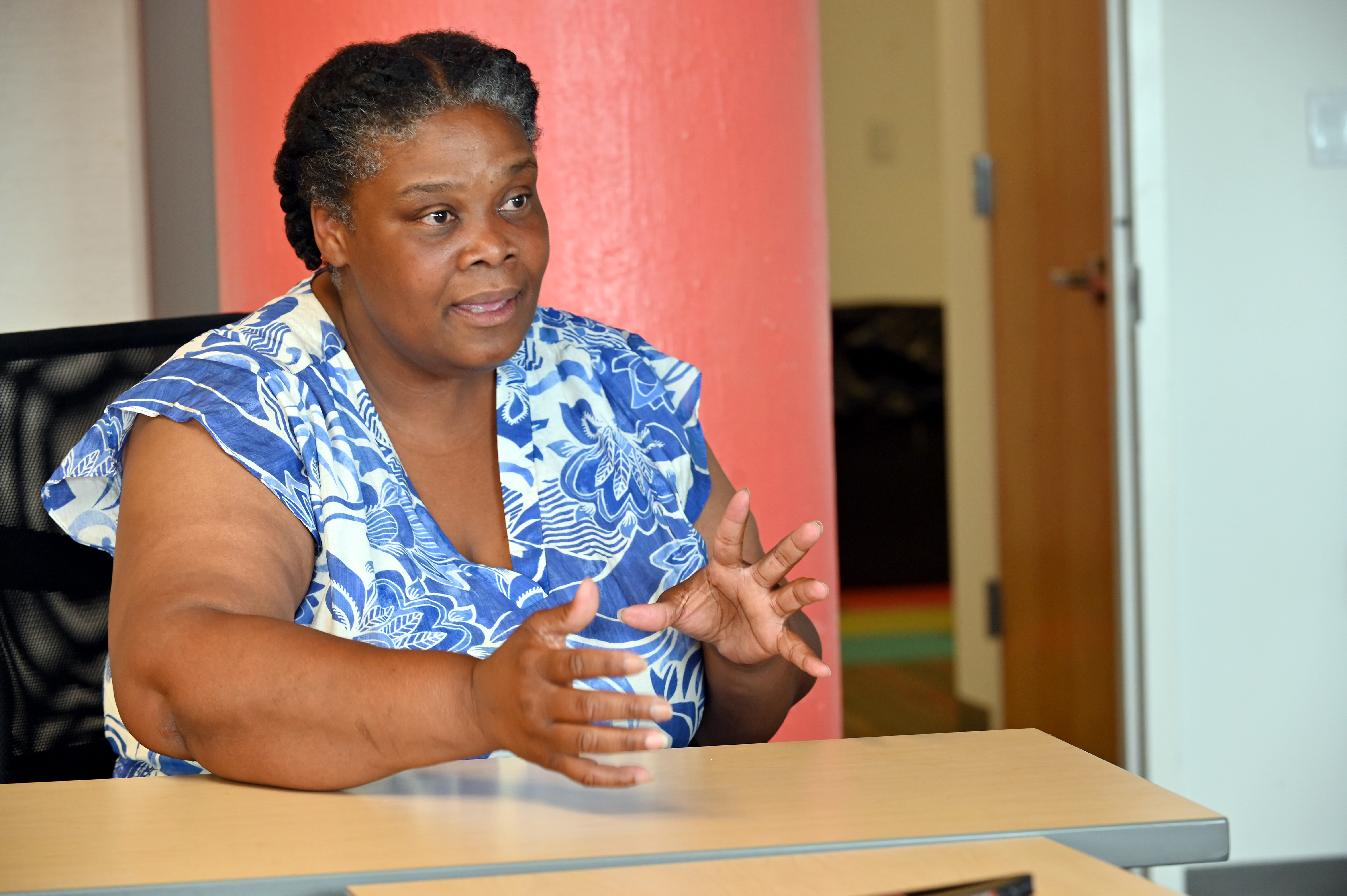
    Mellisa Wilson, who now volunteers at the Children’s Crisis Treatment Center, said the group helped her realize she needed to end a generational legacy of corporal punishment as a parent.

    Always angry, she yelled at her children and spanked them, but only with her hands — at least she could give them that safety.

    But all of it had to end — for her own good, and for theirs. So she turned to CCTC for help.

    It’s a typical pattern, said Valdés.

    CCTC treats children who have experienced every kind of trauma and adversity — death of a parent, witnessing a parent be killed or beaten, attacks from dogs, sexual abuse, neighborhood violence.

    “We treat kids no matter what trauma they have,” he said. “For the vast majority, we’re talking about domestic violence, toward them or a family member, or maybe shootings they have witnessed.”

    But what’s just as significant, he said, is how CCTC treats everyone in its care. “It’s the lens we use,” he said, describing trauma-informed care. “We don’t ask what’s wrong with a child. We asked what happened.”

    For example, Valdés said, a young boy, maybe 5, sees his mother regularly beaten by her drunken boyfriend. “The kid may even try to intervene, but he’s only 5. What can he do?”

    Eventually, the mother gets rid of the drunken boyfriend. All seems normal until months or even years later, when she gets calls from school. Her child is fighting, destroying school property.

    “He’s still reacting to what he witnessed, and the behavior he developed at that time,” when he understood, as only a little child can, that his mother, the person who was supposed to be protecting him, couldn’t keep him, or herself, safe, Valdés said.

    Says Antonio Valdés, chief executive officer of the Children’s Crisis Treatment Center: “We don’t ask what’s wrong with a child. We asked what happened.”

    “Any moment he might feel even a little threatened evokes that response,” he said.

    “There’s a mistaken belief that young children, when they experience trauma, they’ll get over it,” Valdés said. “When trauma and adversity happen, there are normal consequences. It’s not normal for the kid to be OK.”

    Some parents bring their children to CCTC for counseling, or they get referrals from schools. More help, including a summer camp, is available at satellite community centers.

    At its headquarters on Delaware Avenue in Fishtown, CCTC runs a day treatment program for preschool-age children who have been kicked out of their preschools. There are day programs for children who have been discharged from psychiatric hospitals to help them reacclimate before returning to their schools.

    CCTC also provides behavioral health help at over 40 middle and elementary schools, where CCTC staffers work with teachers and students.

    Valdés remembered one little boy, about 10 or 11, who had been an average student — no trouble in school. His mother worked two jobs to make ends meet, and his grandfather took care of him, fed him dinner, helped with homework, and even put him to bed when his mom worked late.

    One Monday, the boy didn’t come to school — and it was so unusual that counselors reached out. On Tuesday, he did show up and, within hours, was fighting with kids and teachers. “They had already written up detention slips,” and it was so bad that harsher punishments were on the table.

    But then a counselor who had been trained by CCTC recalled what she had learned and asked the boy what happened. His grandfather had passed away on Saturday, and his mother had to go to work so she could pay the rent, leaving him to fend for himself.

    “In five minutes, they tore up the detention slips and had a different kind of conversation. It could have turned into something really bad for that boy. It’s those little moments that are critical,” Valdés said.

    In Philadelphia, he said, children in Kensington are suffering from the opioid crisis. When children leave the house, they see people shooting up and have to step carefully to avoid human feces or used needles. It’s not safe to play on the sidewalks or in the parks.

    “All of these things add up to a stressful environment,” he said. “There’s an impact of trauma and adversity on the way people start treating each other. It’s a behavior that’s adaptive to the trauma, the crisis, the ugliness,” but may not show up until later.

    “It’s highly contagious. Certain kinds of maladaptive behaviors may find themselves in families, in communities, in workplaces, or the way you might treat your girlfriend or wife,” Valdés said. “These behaviors were critical in surviving the moment,” but aren’t useful or appropriate in other situations.

    Healing comes from reframing — acknowledging realities but assuring the children that what happened was not normal and not their fault, then giving them techniques to cope positively when disturbing feelings arise, he said.

    “We’re treating kids and families, and we’re helping them heal,” he said. “Then they start to support their siblings or neighbors who have been through trauma. We see this as the counter to adversity and trauma.”

    Parenting skills Wilson learned at CCTC helped her help her children and regain control of her family, even as she was struggling to manage five youngsters under 5, including a set of twins.

    One child was inappropriately touched. Another child pushed Wilson against a wall and accused her of driving their father away. Another child, always her father’s favorite, said her father hated her. Another child hit a kitten.

    Tears filled Wilson’s eyes. “That was the trauma I put on them by hitting them and yelling at them.”

    Chaos and fatigue were constant, as was anger, yelling, and spanking. At CCTC, her kids got help, and so did she, learning new parenting techniques that led to a peaceful home with five children, now in their 20s and heading into professions to help others.

    Valdés said people should support CCTC because that healing is contagious, mending families and neighborhoods.

    Wilson agrees. “What I’ve learned, I’ve put into practice,” she said.

    Her story is so compelling, she said, that people at her overnight warehouse packing job turn to her for help. And she’s always ready to give it.

    “My favorite place is on the bus,” she said, where she’ll say hello and ask her fellow passengers about their day. “People will start talking to me. People are very honest when they think they are never going to see you again.”

    When Wilson wears her CCTC T-shirt as she often does, she wants to serve as a walking billboard for a nonprofit that has made a real difference in herself and her family. She vows to support the organization and its mission for the rest of her life.

    “We shouldn’t keep good things to ourselves.”

    This article is part of a series about Philly Gives — a community fund to support nonprofits through end-of-year giving. To learn more about Philly Gives, including how to donate, visit phillygives.org.

    For more information about Philly Gives, including how to donate, visit phillygives.org.

    About Children’s Crisis Treatment Center

    Mission: To support children and families by helping them heal from abuse, violence, and trauma by bringing mental health services to them where they are — at home, in schools, and in their communities.

    Children served: 3,500

    Point of pride: Started as a demonstration project in the basement of the Franklin Institute and is now in over 40 schools, up from 14 last year.

    Annual spending: Over $31 million in fiscal year 2024.

    You can help: Volunteers are needed to help with special events, the Holiday Toy Drive, or group day-of-service activities.

    Support: phillygives.org

    What your Children’s Crisis Treatment Center donation can do

    • $25 provides art supplies for an activity in one Therapeutic Nursery classroom (preschool-age children).
    • $40 purchases a gift for one child through our annual Holiday Toy Drive.
    • $100 provides one child attending our Summer Therapeutic Enrichment Program with educational program supplies.
    • $250 provides music therapy to one child attending our Cornerstone program (acute partial hospitalization for children ages 5 to 13).
    • $500 supplies a therapeutic counseling room with toys for play therapy.
    • $1,000 provides program activities, including field trips, for one child attending our Summer Therapeutic Enrichment Program.
  • How did The Inquirer review Michelin’s top Philadelphia picks in the past?

    How did The Inquirer review Michelin’s top Philadelphia picks in the past?

    On Tuesday night, Philadelphia won big with three Michelin stars, 10 Bib Gourmands, and 21 Recommended winners.

    One of the world’s most prestigious restaurant awards, Michelin deploys anonymous inspectors to assess restaurants and designate the honorees. Not too much is known about these inspectors — decision-making is made by a globally diverse group, not an individual, and most have several years’ experience in the restaurant or hospitality industry, according to Gwendal Poullennec, international director of the Michelin Guide. They use changing names and phone numbers and visit a restaurant multiple times to evaluate its full merit.

    While the 34 Michelin-recognized restaurants were presumably all-new to the guide’s inspectors, The Inquirer has written about all of them before — in a few cases, not entirely favorably. Here’s how the food desk has covered Philly’s Michelin-starred and Bibbed restaurants in the past. (For a breakdown of Michelin Guide hierarchy, read more here.)

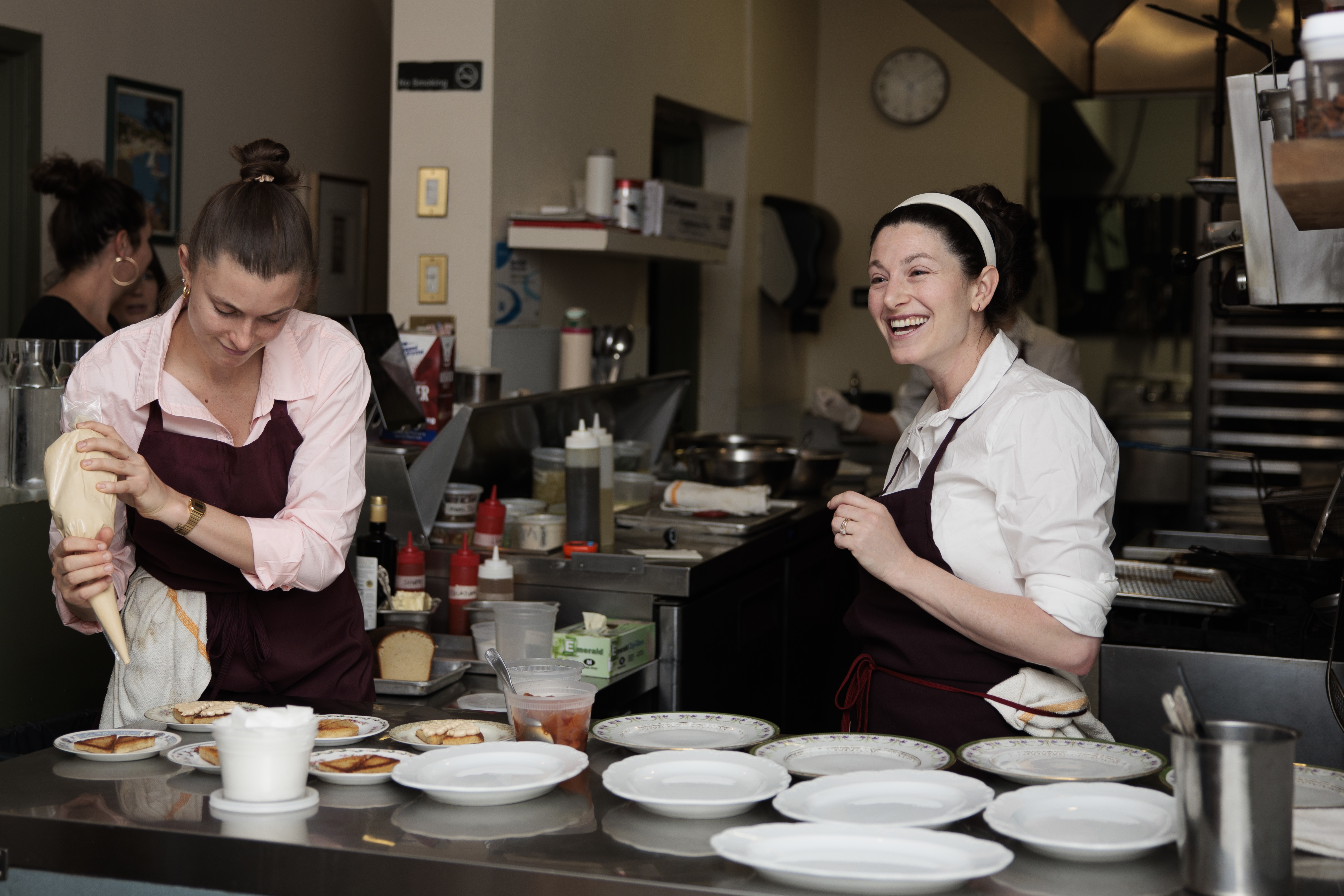
    Chef Amanda Shulman (right) greets attendees at Her Place Supper Club on May 12.

    Philly’s Michelin-starred restaurants

    • Her Place Supper Club: Amanda Shulman’s dinner party-as-a-restaurant was born out out of her cooking on Penn’s campus, transitioned to a residency in a former Slice pizza shop in Rittenhouse, and has bloomed into a full-on restaurant — now Michelin-starred — that still manages to be endearingly idiosyncratic. When Inquirer critic Craig LaBan first reviewed Her Place, the cooking was so good, “I needed to do yet another double-take to remind myself that Shulman was producing this feast for two dozen diners nearly single-handedly,” he wrote in 2021. These days, the kitchen is led by chef de cuisine Ana Caballero and sous-chef Santina Renzi, whose skill and energy landed Her Place in LaBan’s Top 10 last year and this year’s edition of The 76.
    • Friday Saturday Sunday: Another 76 pick, Chad and Hanna Williams’ “townhouse oasis off Rittenhouse Square, already the most exciting fine dining experience in Philly, has only gotten better,” LaBan wrote after its Outstanding Restaurant James Beard win in 2023. When the couple first opened the restaurant in 2016 — using the same name as the building’s 42-year predecessor — they created some ripples. “At last … the most normal thing on the menu!” LaBan overheard during one of his earliest review dinners there. His reaction was very different: The restaurant has routinely appeared in his annual Top 10 lists in the years since.
    Chef Nicholas Bazik of Provenance is making the golden ossetra with squash and tofu at Provenance on Nov. 7.
    • Provenance: While Michelin awarded chef Nicholas Bazik and his finely tuned team a coveted star, LaBan found flaw in Philly’s recent most ambitious French fine-dining project, which he reviewed last October: “When you’re paying $225 to sit down for a 2½-hour dinner (figure between $700 or $800 for two all-in with tip and tax, depending on what you drink), there isn’t much room for error. And there are still too many menu missteps at Provenance, where only about half of the 47 compositions I tasted over two meals were a complete success.” (Ed. note: I sense a followup review in the future…)

    Green star

    • Pietramala: Chef Ian Graye also scored a Green star for Pietramala, his sustainability-minded vegan restaurant. In his 2023 review — which the NoLibs restaurant shared with Primary Plant Based (now closed) and Miss Rachel’s Pantry — LaBan found lots of bright spots and a disappointment or two, concluding of Graye’s cooking: “I’d rather someone swung big than timidly struck out.“ The swings are connecting even more these days: Pietramala was in LaBan’s Top 10 last year.

    Bib Gourmand

  • Her path to ‘having it all?’ Be gay and move to Philly, a Wharton economist says.

    Her path to ‘having it all?’ Be gay and move to Philly, a Wharton economist says.

    Corinne Low, a Wharton economist, didn’t have to search far for an example of how women’s familial and professional choices are shaped by an uneven playing field.

    In 2017, Low gave birth to her son while building a tenure-track career. Her life soon began to feel unmanageable. She was commuting up to six hours a day from Manhattan to Wharton while also taking care of the household tasks that kept her family functioning: groceries, laundry, cooking, childcare.

    The situation reached a crisis point when Low found herself pumping in an Amtrak bathroom while crying; she had been in transit for hours and realized she wouldn’t make it home to see her son before bed.

    Low, 41, was not a single parent. But her husband had recently left his job to start his own business, a choice that did not reduce his working hours, but did reduce his salary — to zero.

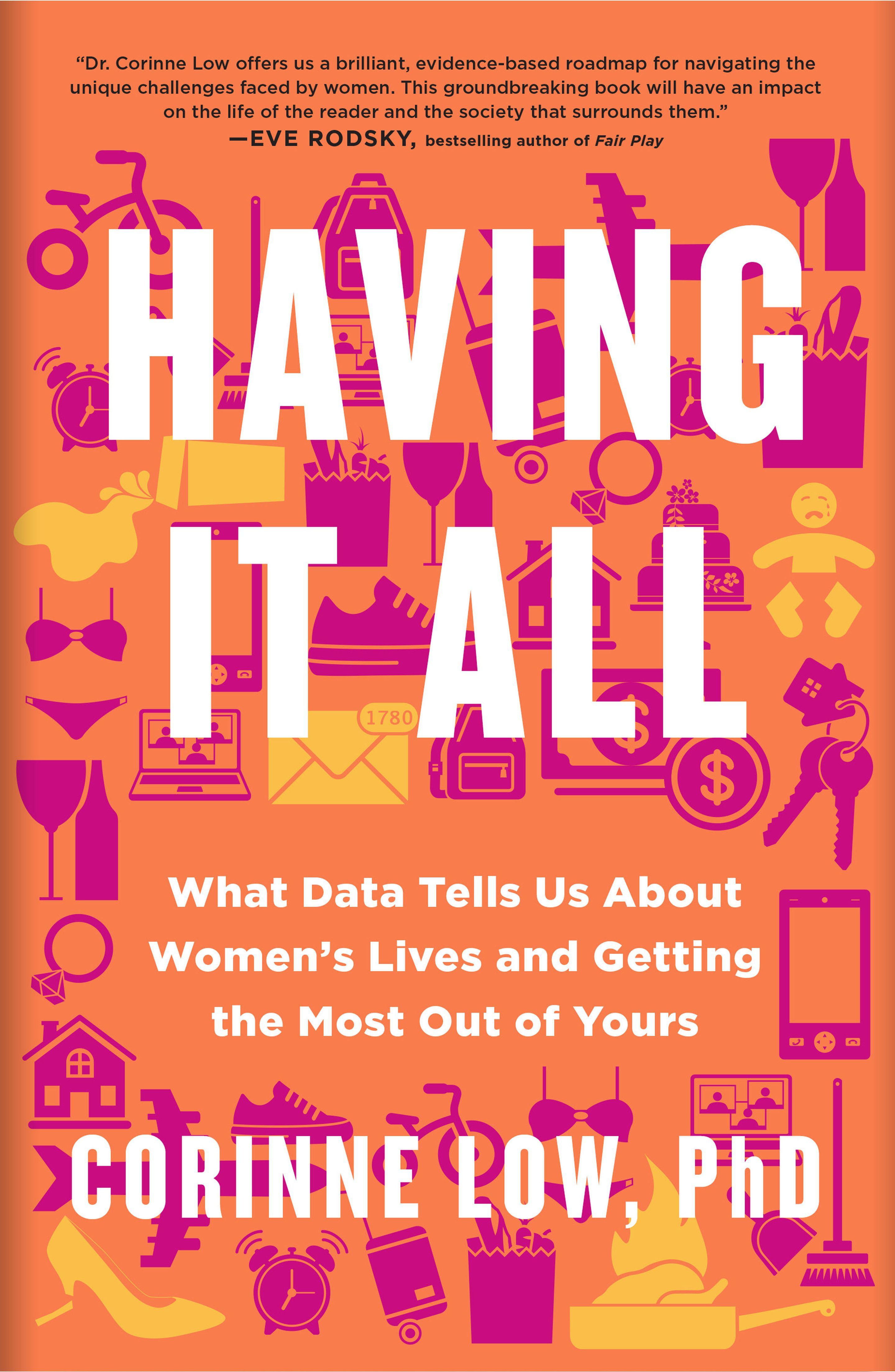
    Low’s personal story is the entry point to her new book, Having it All: What Data Tells Us About Women’s Lives and Getting The Most Out of Yours, part self-help manifesto and part economic tract.

    Wharton professor Corinne Low (right) and her, wife Sondra Woodruff, spend time after dinner playing and reading with their kids.

    When Low examined her own life, she made two major changes that freed her time and altered her circumstances. First, she divorced her husband and decided to exclusively date women. (A summer article in the Cut about Low, headlined “This Economist Crunched the Numbers and Stopped Dating Men,” went viral.) She is now married to a woman.

    The less viral but equally meaningful shift was that she left New York City — and embraced Philly.

    “The underplayed hero of my story, of the changes that I made, was moving to Philadelphia,” she said recently in an interview. “That was actually the more important upgrade.”

    When she was living in Manhattan and struggling to keep up, friends had recommended that she hire a live-in au pair, which they said was a more affordable, less transactional form of childcare. But of course, like most New Yorkers, Low had no spare room.

    In Philadelphia, she was able to afford a bigger house with more space, which meant she could have an au pair. And her commute went from over two hours to seven minutes by bike, freeing her to build a life “filled with friends, community, time outdoors.”

    It all added up. In Philadelphia, Low writes, “I rediscovered myself. I found who I had been before I became a stressed-out, angry, rapidly aging person. I was fun! I was creative! I could relax.“ (She adds the disclaimer that she is “not advocating that everyone who reads this book should leave their marriage and move to a new city,” although, perhaps they should, assuming they move to the right city.)

    The book analyzes economic data to show women how to get a “better deal” for themselves.

    She wanted to show that the feeling many working women experience — of being under siege from all sides, unable to figure out how to gloriously “have it all” — was not some symptom of being hysterical, but was instead rooted in data.

    “I want people to figure out how to claw back some of their time from these structural forces that are squeezing us,” Low said. “Knowing the data, it gives you permission to make some of those choices.”

    She found that even in families where women were the primary breadwinners, they still overwhelmingly had to put in a “second shift” at home. Some statistics in the book are startling: For example, men who earn only 20% of the household income in a heterosexual family do the same amount of housework as those who earn 80% of the family’s income, which Low found by analyzing the American Time Use Survey, a massive dataset of how individuals spend their time.

    That means even when a woman earns more than twice what her partner earns, she also does twice as much cooking and cleaning.

    “That bothers me, because it’s inefficient,” Low said. “Because you’re using the ‘more expensive’ person’s time on these home production tasks.”

    In the book, Low aims to advise women on how to get a “better deal” for themselves, by employing the stark logic of her field.

    She writes about how women might improve their “personal utility function,” which she describes as a “personal video game score at the end of your life,” grounded in one’s priorities and values. She urges women to think about dating as a job interview for a co-executive in a multipronged, multiyear enterprise, and to think of a job as a “technology for converting time into money.”

    She also encourages readers to throw away their houseplants if they are not increasing personal utility function.

    “You need to be ruthless in protecting your time from things that are not investments in your future and do not bring you joy,” she writes.

    Corinne Low and her wife, Sondra Woodruff pictured here with their kids at Clark Park. ,

    One of her most interesting arguments is that women today effectively “hire themselves” for too many jobs within the home. It has become normalized to outsource “male-coded” tasks, like changing a car’s oil or fixing an electrical outlet, by hiring a specialist to do it, Low said.

    But women have not updated their mindsets about the market value of their time, and so there remains stigma to outsourcing “female-coded” tasks, like laundry, cooking, or home childcare.

    Low sees Having It All as a rejoinder to Sheryl Sandberg’s Lean In: While “leaning in is doing more of what’s not working,” as Low put it, she wants readers of her book to “level up” by removing whatever constraints they’re able to.

    Of course, many of the problems facing working women remain systemic, and she writes in the book’s afterword about the necessity of societal changes, including parental leave underwritten by the federal government and creative thinking by employers about how to allow female employees to meet both their professional and domestic obligations during peak child-rearing eras.

    After a book tour, Low is now back in Philly with her two young children and her wife and still reveling in the charms of her city.

    “When I was busy and on book tour,” she said, “neighbors walked my son to school.”

    Readers told Low that they are making changes to their personal lives based on the book. No one has told her they’re moving to Philadelphia — yet.

  • Human reporters explain why AI data centers are so controversial in the Philly suburbs and beyond

    Human reporters explain why AI data centers are so controversial in the Philly suburbs and beyond

    Every day, millions of people across the U.S. turn to ChatGPT and other AI tools, searching for answers.

    Some of their questions are mundane: What should they make for dinner with these four ingredients? What other movies was this actor in? Where could they go on a weekend getaway for under $1,000?

    Others use AI in life-saving research and for society-changing innovations.

    How these tools work — and at what cost — is at the heart of the ongoing debate over the rapid construction of data centers.

    At some proposed sites in the Philadelphia region, neighbors are rallying in opposition, saying the community’s health, safety, and quality of life are at stake. Meanwhile, developers, elected officials, and other proponents tout economic benefits.

    If you’re trying to make sense of all the buzz about AI data centers, here’s what three human reporters think you should know.

    What is a data center?

    A data center is a building or campus that handles cloud-storage and computing needs of Amazon, Google, Microsoft, Meta, and the like. People, hospitals, banks, businesses, and governments rely on the cloud to store and retrieve vast troves of records, videos, and pictures.

    Generative artificial intelligence (AI) has exponentially increased demand for specialized data centers powerful enough to execute ever more complex requests in the form of text, code, images, audio, or video.

    A single AI query consumes multiple times the power of an ordinary search engine query, resulting in the need for additional servers to handle the load when multiplied across millions of queries.

    window.addEventListener(“message”,function(a){if(void 0!==a.data[“datawrapper-height”]){var e=document.querySelectorAll(“iframe”);for(var t in a.data[“datawrapper-height”])for(var r,i=0;r=e[i];i++)if(r.contentWindow===a.source){var d=a.data[“datawrapper-height”][t]+”px”;r.style.height=d}}});

    Newer hyperscale data centers can reach 1 million square feet or larger. For comparison, the Cherry Hall Mall is 1.3 million square feet.

    Where are data centers in Pennsylvania and New Jersey?

    More than 150 data centers already exist in Pennsylvania and New Jersey, according to Data Center Map, a private company that tracks the facilities nationwide. The Philadelphia area has dozens of data centers, operated by an array of companies from telecom giants like Comcast to digital-services companies like Lumen and DāSTOR.

    window.addEventListener(“message”,function(a){if(void 0!==a.data[“datawrapper-height”]){var e=document.querySelectorAll(“iframe”);for(var t in a.data[“datawrapper-height”])for(var r,i=0;r=e[i];i++)if(r.contentWindow===a.source){var d=a.data[“datawrapper-height”][t]+”px”;r.style.height=d}}});

    Not all of these properties are AI data centers: Comcast’s facilities, for example, connect thousands of local customers to internet, cable, and phone services, and have been doing so for decades.

    Where are new data centers being built in Pa. and N.J.?

    Hot spots for new AI data centers include North Jersey and the Scranton and Pittsburgh areas in Pennsylvania.

    Three recent proposals in the Philadelphia suburbs have made headlines:

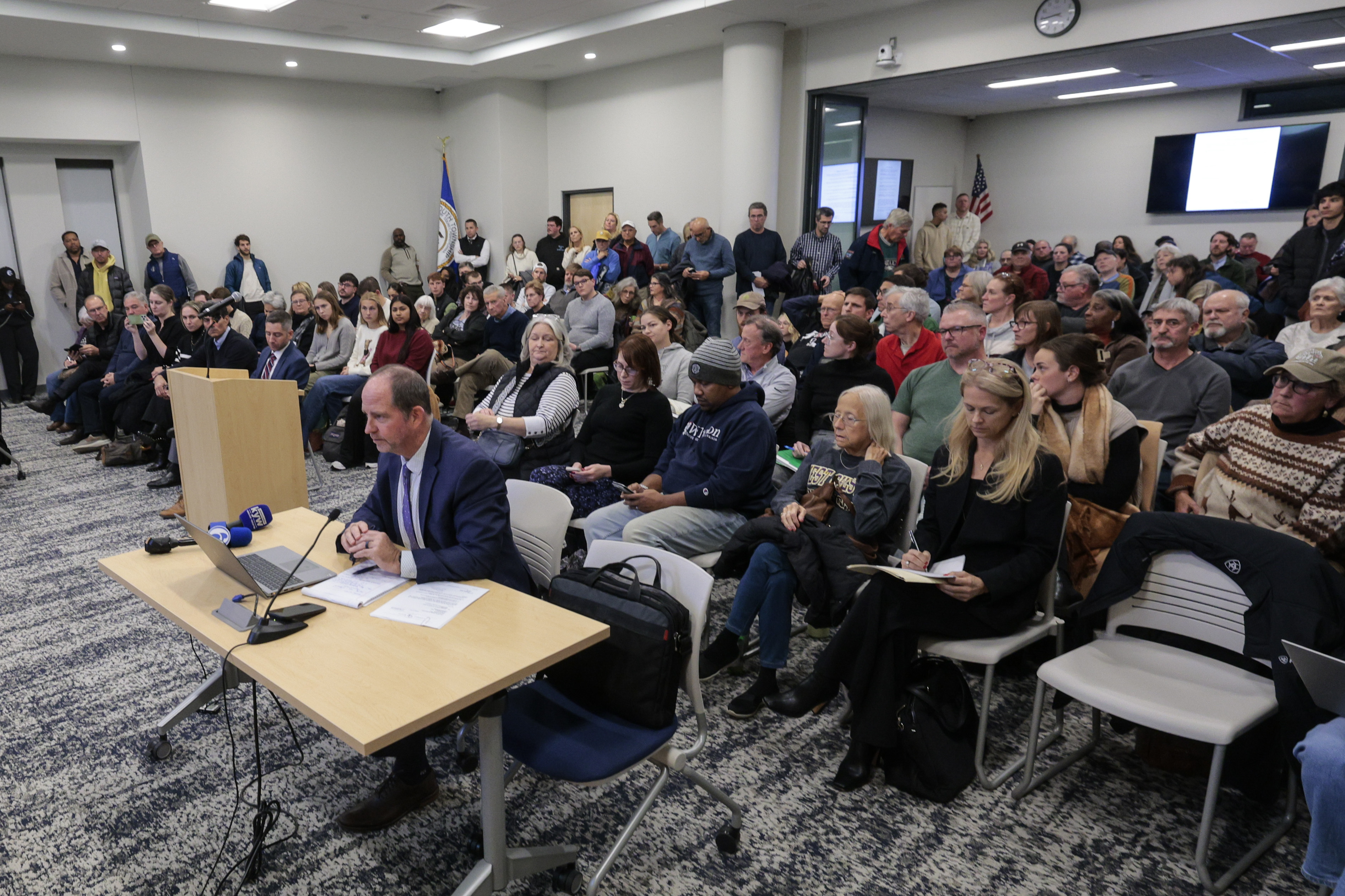
    Edmund J. Campbell, attorney for Main Line developer Brian O’Neill, speaks to the Plymouth Township zoning hearing board on Monday Nov. 17 before abruptly withdrawing his client’s application over legal issues.

    Why do some communities want a data center?

    A data center can bring in significant tax revenue, create jobs, attract other businesses to the region, and put the area on the cutting edge of a rapidly growing industry, proponents and developers say.

    In Loudoun County, Va., data centers accounted for nearly half of the property tax revenue in 2024, according to the county’s website, with the county getting $26 for every $1 spent on data center services. Nearby Prince William County reported that its 44 data centers generated more than $293 million in total tax revenue (though some industry stakeholders debate whether tax breaks offset these gains).

    Unlike residential redevelopment, data centers don’t increase demands on local schools or EMS services, data center proponents say. Nor do they bring in added traffic like fulfillment warehouses or other industrial uses.

    Data centers are seen by some as a good reuse of formerly industrial land, such as proposals in Bucks County on a former U.S. Steel site; in Chester County on a remediated Superfund site; and in Montgomery County on the former Cleveland-Cliffs steel mill.

    Why are some communities opposing data centers?

    Opponents of data centers worry about pollution, noise, power and water use, and the impact another data center could have on their electric bills. In some areas, they decry the loss of open space and express broader concerns about whether the AI boom is a bubble that could burst before all this data-center investment pays off.

    How are data centers impacting my electric bill?

    Generative AI tools like ChatGPT and DALL-E are major drivers behind the dramatic increase in energy demand. Every ChatGPT query, for example, is estimated to use five times more electricity than a simple web search.

    An average query uses about the power that an oven would use in a little over one second or a high-efficiency light bulb would use in a couple of minutes, according to Sam Altman, CEO of OpenAI, the company behind ChatGPT.

    In 2023, U.S. data centers consumed about 4.4% of total U.S. electricity, compared to 15% for all residential use. Data center demand is expected to rise, potentially consuming 6% to 12% of total U.S. electricity by 2028, according to a 2024 report by Lawrence Berkeley National Laboratory.

    window.addEventListener(“message”,function(a){if(void 0!==a.data[“datawrapper-height”]){var e=document.querySelectorAll(“iframe”);for(var t in a.data[“datawrapper-height”])for(var r,i=0;r=e[i];i++)if(r.contentWindow===a.source){var d=a.data[“datawrapper-height”][t]+”px”;r.style.height=d}}});

    When energy demand rises without a proportional increase in supply and capacity, experts say, consumers see higher bills. Although it’s possible prices would lower with increased demand as long as there is sufficient existing capacity in place, say some experts.

    “There’s a variety of factors, but it isn’t really transparent when you look at your electricity bill,” said John Quigley, senior fellow at the University of Pennsylvania’s Kleinman Center for Energy Policy.

    Several recent reports have tried to quantify the impact data centers are having on consumer bills. According to a recent Bloomberg News analysis, the monthly electric bills of customers who lived near significant data center activity have increased 267% in the past five years.

    What are some environmental concerns regarding data centers?

    Water: Data centers require significant amounts of water to cool servers and IT equipment. Some cooling systems are more efficient than others.

    A Virginia legislative audit report said 11 data center buildings each used over 50 million gallons, including one building that used 243 million gallons in 2023. While some data centers use substantial amounts of water, most use similar or less than other large commercial and industrial water users, Virginia found.

    Based on available data, most data centers use about 6.7 million gallons of water a year, about the same as an average large office building.

    Land use: Some proposals would require substantial clearing for forested or unused land, as in a 1,000-acre proposal in Covington and Clifton Townships in the Poconos. Residents in East Vincent Township in Chester County have mobilized to save the rolling hills, farms, and rural character near the proposed Pennhurst site.

    Air pollution: The electricity that powers data centers comes from a grid powered by plants that run on natural gas, a fossil fuel that emits pollutants such as nitrogen oxides, fine particulate matter, and a precursor to smog. The plants also release carbon dioxide, a greenhouse gas. Backup generators are often fired by diesel. Amazon and Microsoft have plans to tap nuclear power, which does not produce air pollutants, though it does produce toxic waste.

    Noise: Data centers sometimes emit hums and vibrations produced by servers, whirring fans, HVAC systems, and other sources.

    What kinds of jobs do data centers create?

    Construction of a data center requires hundreds of temporary tradespeople, such as masons, electricians, plumbers, and HVAC technicians.

    Once open, data centers typically need very few full-time employees. Even the largest usually employ fewer than 150 people, sometimes as few as 25. Permanent positions can include IT specialists, data analysts, electricians, maintenance workers, and security personnel. Sometimes certain employees can work remotely.

    Developers of some data centers currently proposed in Pennsylvania estimate hiring between 30 and 70 permanent workers. Data center technician jobs at Amazon’s Salem Township facility come with starting salaries between $50,000 and $152,000 a year, according to job listings on Indeed.com.

  • Penn is testing beanies for NICU babies that block harmful noise and play parents’ messages

    Penn is testing beanies for NICU babies that block harmful noise and play parents’ messages

    When Pamela Collins was pregnant, she would talk and sing to her son through her belly, telling him he was loved.

    He was the “miracle” that the 32-year-old mother had been waiting for, after four miscarriages and an ectopic pregnancy.

    She never expected that her son, John, would arrive early at 29 weeks in September and have to spend his first months in the intensive care nursery at the Hospital of the University of Pennsylvania.

    Her family has relocated from Mount Pocono to stay at the nearby Ronald McDonald House, a charity, so they can visit John every day. Even still, she wishes she could be with him all the time, to sing to him and tell him that he is strong and loved — just as she did when he was in her womb.

    A new medical device being tested at HUP could help her do just that.

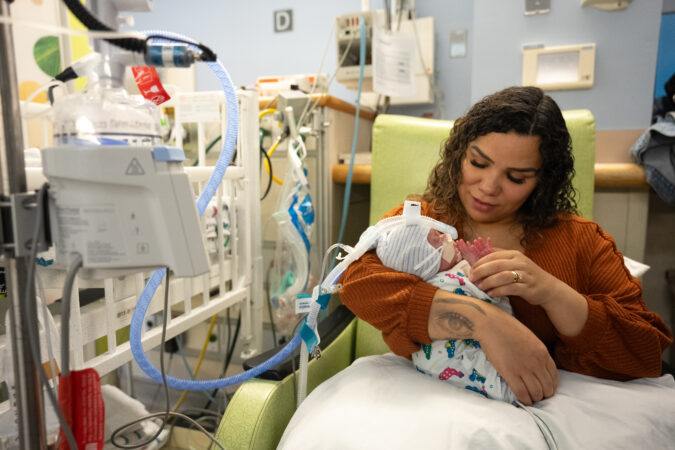
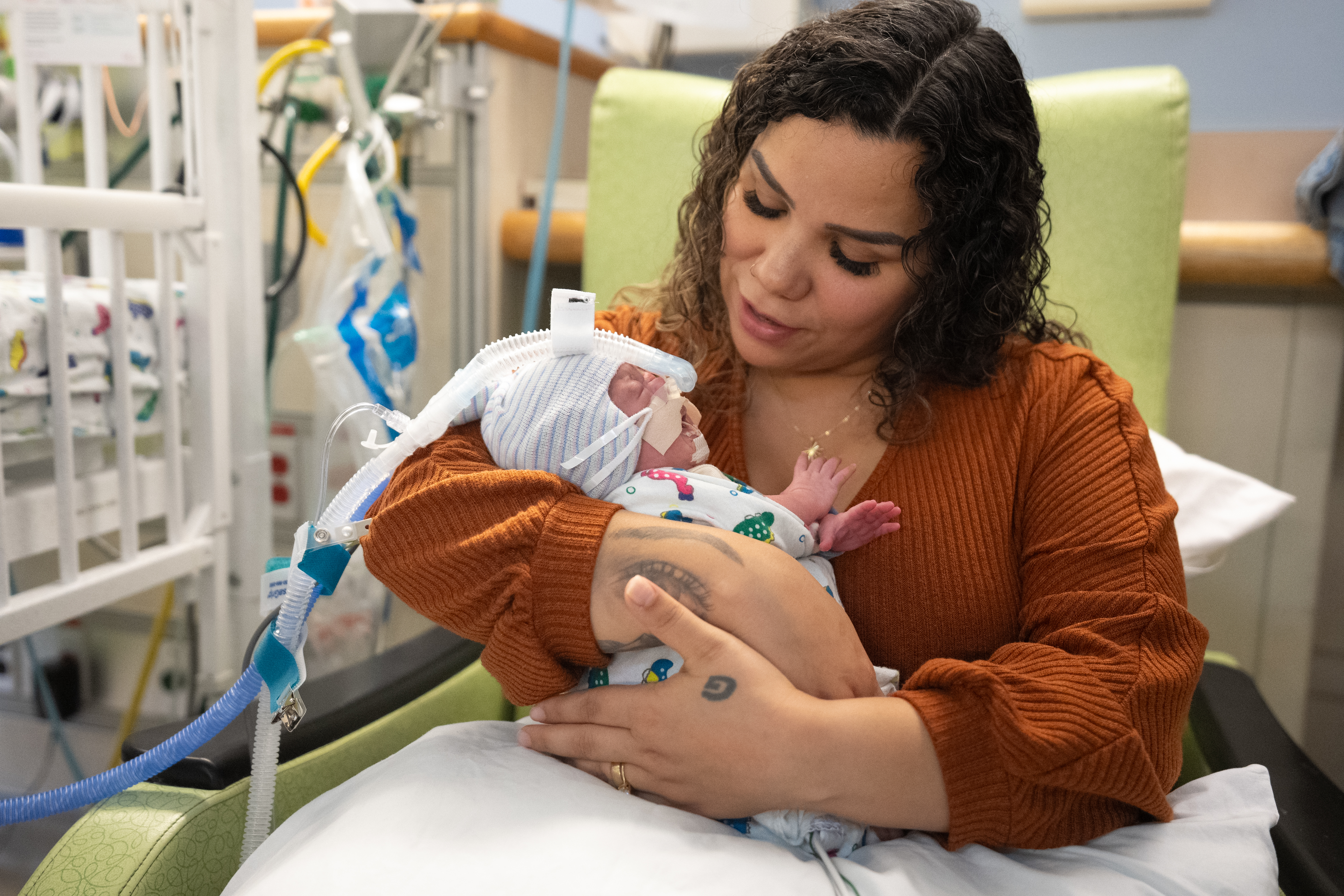
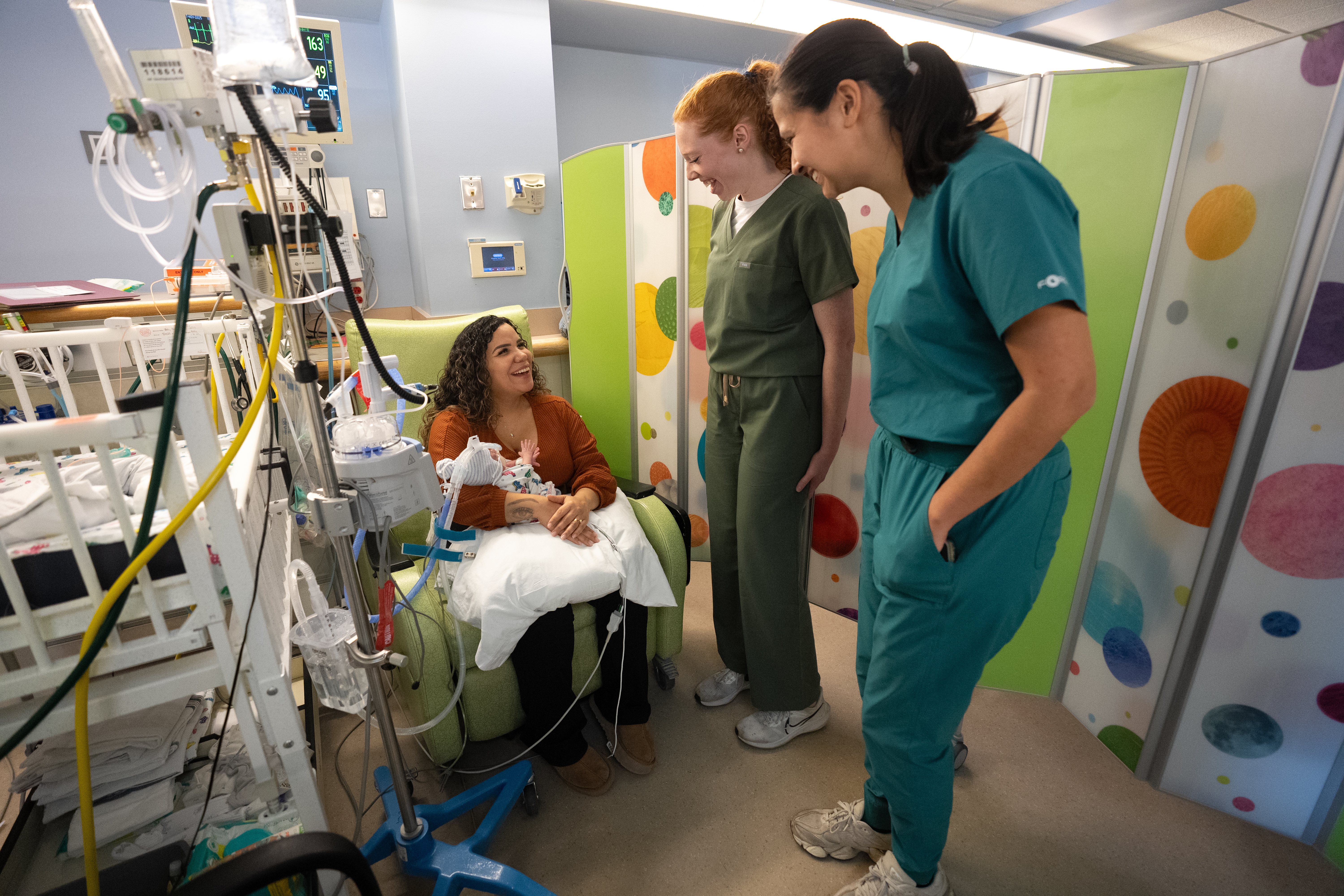
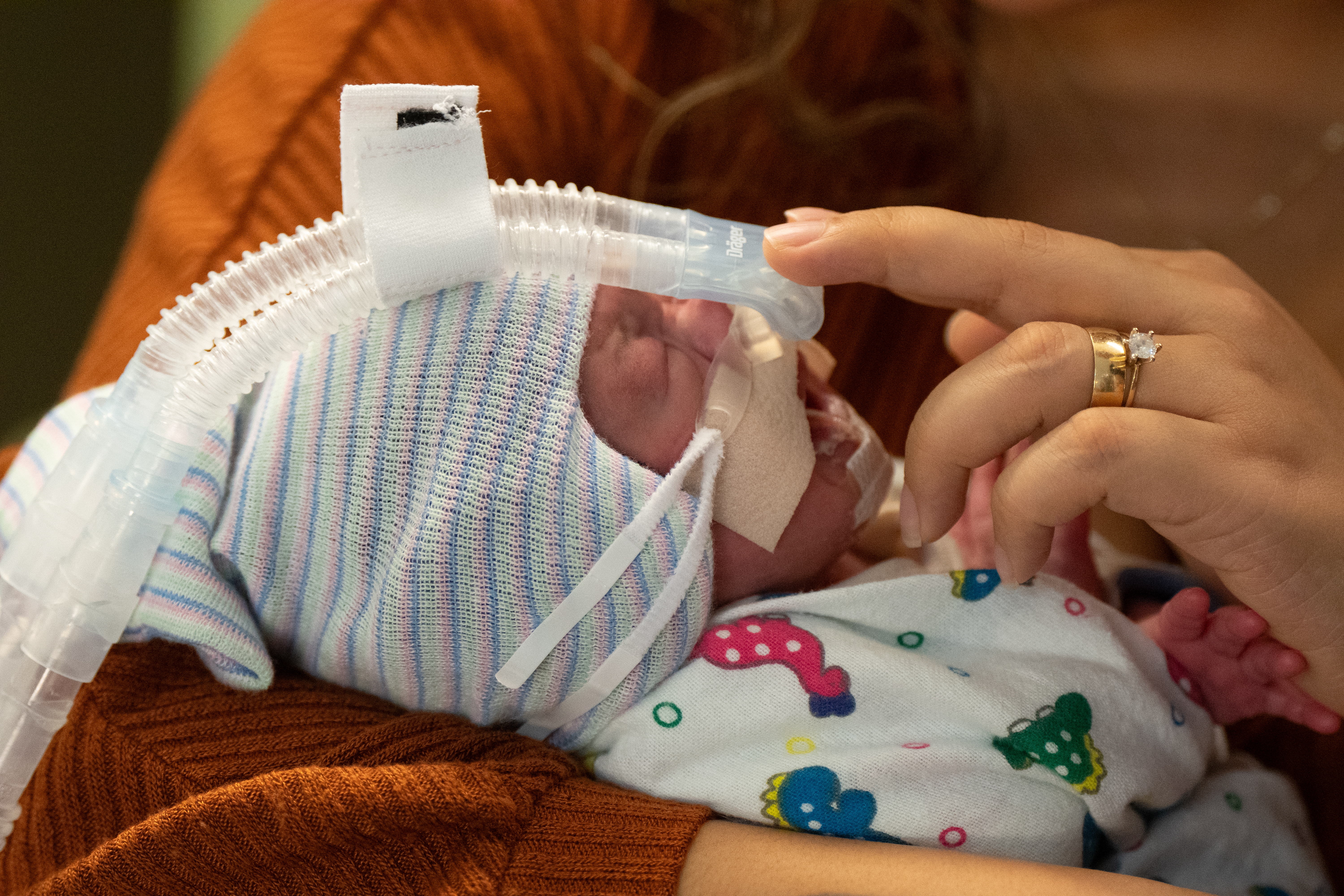
    Collins’ son is one of five babies so far to try out the Sonura Beanie, a device that aims to connect NICU babies with their parents and block out harmful noises in the hospital environment.

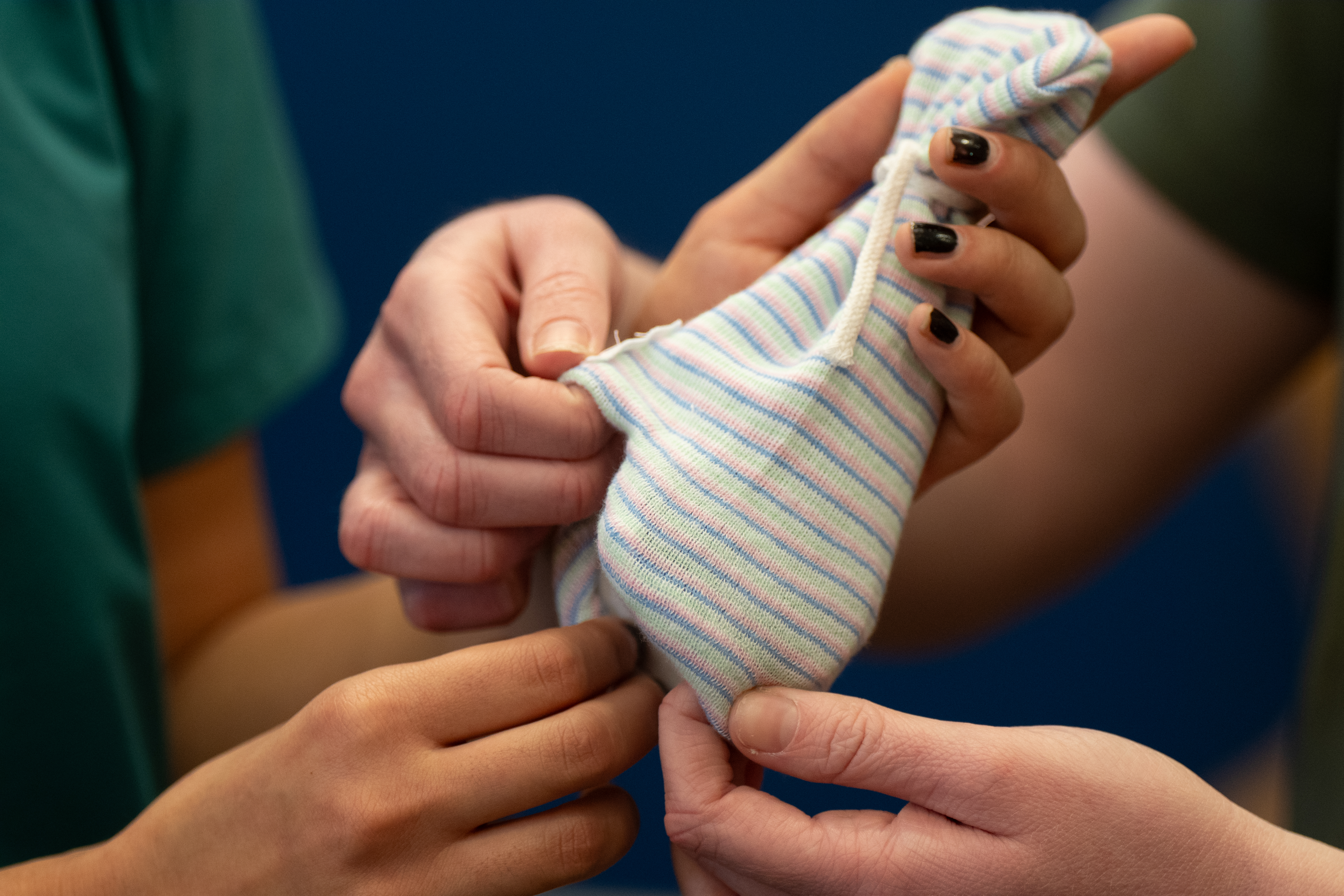
    Invented by five undergraduates at the University of Pennsylvania, the beanie is designed to mimic the womb, by filtering out high-frequency sounds like alarms — which frequently plague the NICU — while allowing human voices at low frequencies to be heard.

    The device can also deliver audio messages recorded by parents for their babies.

    “It’s as if they were laying on your chest [or] as if they were in the womb,” said Sophie Ishiwari, one of the founders.

    Their idea won Penn’s 2023 President’s Innovation Prize, which provided a $100,000 cash award and living stipends for the team to pursue their commercial project after graduation. Three of the original members went onto medical school, leaving two — Gabby Daltoso and Ishiwari — to continue working on the product full-time.

    In the two years since graduating, they’ve tested the device in the lab and pitched it to hospitals around the country, earning accolades along the way. Now, they’re putting the beanie on infants in the hospital for the first time.

    Over the next several months, Ishiwari and Daltoso will be testing the beanie on 30 infants in HUP’s intensive care nursery. They’ll be looking to see whether the beanie can reduce stress, based on changes in heart rate, respiratory rate, and oxygen saturation.

    They will also evaluate how easy it is for nurses to use, and how parents feel about the experience.

    Collins joined the study hoping the beanie could help her son feel calmer by hearing her voice, as well as that of his father and teenage sister.

    “I know my baby can listen more than he can see, and I’m excited to know he’s listening to our voices instead of this beeping,” she said, gesturing to the noisy NICU machines.

    Pamela Collins suffered four miscarriages and an ectopic pregnancy before giving birth to John.

    The origin

    The first thing Daltoso and Ishiwari noticed when shadowing in the NICU was how loud it was. Between beeping from machines to hospital alarms going off, it felt overwhelming even for adults.

    “They can’t turn the alarms off because it’s their job to keep patients alive,” Daltoso said.

    In the womb, a fetus would primarily be exposed to low frequency sounds under 500 Hertz. Alarms in the NICU can hit 2,000 Hertz and higher, Daltoso said. Imagine having to hear a fire alarm go off continuously throughout the day.

    A 2014 study found that babies in a NICU in Massachusetts were exposed to frequencies over 500 Hertz 57% of the time.

    Some medical equipment also emit high frequencies of sounds. Babies on a ventilator, for example, are exposed to sounds in the 8,000 Hertz range of frequencies, Daltoso said.

    “They’re in a room of 20, so if one baby’s on it, they’re all exposed,” she added.

    In the short term, this noise can stress babies out to the point of not being able to sleep or eat, Daltoso said. Babies may experience trouble gaining weight as a result and show unstable signs such as heart rates that are faster than normal.

    Babies in the NICU could also suffer long-term impacts from what is known as “language deprivation,” Ishiwari said.

    Normally, an infant would be exposed to language early in life, which is important for the infant’s neurodevelopment. But a baby in the NICU has less exposure to their parents’ speech.

    Studies have shown that preterm babies are generally at higher risk of language delays and deficits.

    Daltoso and Ishiwari, alongside those three other seniors majoring in bioengineering at Penn, were inspired to create the beanie for their senior capstone project in 2023.

    Through a sound-engineering class and interviews with hundreds of clinicians and parents, they devised the technology inside the beanie to cancel out high-frequency noises, particularly above the 2,000 Hertz range, while allowing lower frequencies through.

    A mobile app connects to the hat to enable parents to send songs, stories, audio messages, and recordings of their heartbeat to the baby remotely through a speaker in the hat.

    The babies wear the beanies during feeding so that it mimics a real-life interaction, where the baby would normally be lying against their mother’s chest.

    Ishiwari said she has teared up listening to some of the messages parents were leaving for their babies. They’ve so far included bedtime stories, songs, and shorter messages like “I love you” and “good night.”

    “A lot of them don’t know where to put that love and joy and excitement,” Daltoso said. “This is a place that they can.”

    Gabby Daltoso and Sophie Ishiwari are testing the beanie at the Hospital of the University of Pennsylvania.

    Sending love from afar

    When Collins and her husband, Franqlin, prepared to record messages for John, they turned off the lights in the room and prayed.

    Then they started recording.

    Collins, who is originally from Brazil, sang a Brazilian song to tell him that he is perfect the way he is. Her husband made up a story about John, and her 15-year-old daughter narrated another with the message that he is enough.

    A nurse told Collins that John was laughing when he wore the beanie.

    “I can tell he loved that,” Collins recalled the nurse telling her.

    Babies in the study wear the beanies for three 45-minute sessions a day, but Collins wishes her son could wear his the whole day.

    “I feel babies can be more calm now and [won’t] be crying all the time,” she said.

    The beanie designed by Gabby Daltoso and Sophie Ishiwari cancels out high-frequency sounds while allowing low-frequency sounds through.

    Michelle Ferrant, a clinical nurse specialist in HUP’s intensive care nursery, was excited that its NICU was chosen as a pilot site.

    Her team has done projects to try to reduce noise levels in the NICU, including putting signs up to remind people to use hushed voices, and closing doors and trash can lids as softly as possible.

    “There are a lot of things that might not seem very loud to us, but [if] you’re a small baby and it’s so close to [you], it sounds much louder,” Ferrant said.

    However, until the beanie study came along, they didn’t have a way of filtering which noises babies heard.

    The Sonura Beanie team is next looking to launch a multi-center trial that will evaluate whether wearing the beanie could help promote weight gain.

    Exposure to their mother’s voice and reduced noise levels can help preterm infants with weight gain and feeding, studies have shown.

    “We will be looking to prove that our hat is able to soothe the babies to the point where they are taking in more food, gaining more calories, growing faster, and hopefully going home faster,” Daltoso said.

    They also plan to launch in other hospitals, including Stanford Medicine Children’s Health, affiliated with Stanford Medicine and Stanford University in California, so that clinicians can test out the product and see how it fits into their workflow. These pilots would function like “a trial for a pre-purchase,” Daltoso said.

    They are currently working on submitting their medical device for clearance by the Food and Drug Administration so they can begin selling it.

    Because the product is deemed low-risk in terms of safety, they are eligible for fast-track approval, which they expect to get within the next year, Daltoso said.

    The team is still working on setting a price and declined to disclose details.

    They would eventually hope to get the product covered by insurance as a sensory-integrative technique. For that, they would need their larger clinical study to show that the beanie has functional outcomes.

    ‘Holding the miracle’

    John weighed only one pound and 14 ounces at birth.

    John doesn’t have a specific release date from the NICU. The timeline will depend on when he is able to breathe on his own and put on weight.

    At birth, he weighed only 1 pound, 14 ounces. Today, he weighs more than 4 pounds and no longer requires a feeding tube.

    Collins was 20 weeks pregnant when she found out that John had a heart defect that doctors said may one day require surgery. A few weeks after that, doctors found an issue with the placenta that ultimately led to his preterm birth.

    Now, when she holds her son in her arms, she feels like “I am holding the miracle,” she said.

  • Letters to the Editor | Nov. 23, 2025

    Letters to the Editor | Nov. 23, 2025

    Public option

    The recent government shutdown was initiated by a Democratic Party trying to protect the 22 million Affordable Care Act participants from the financial impact of ending government subsidies that would more than double insurance premiums. Conversely, Republicans are intent on sunsetting COVID-era ACA subsidies that cost $30 billion per year. What both parties will acknowledge is that the cost of healthcare coverage continues to accelerate at a rate that is unsustainable.

    When President Barack Obama crafted the ACA, he envisioned a public option. A public option is healthcare provided by the government. That means government hospitals, clinics, doctors, nurses, technicians, and administrators. During the incubation of the ACA, the Obama administration realized a public option was far too controversial to be passed by Congress. So it birthed an insurance-based ACA that would use the existing U.S. healthcare structure. The problem is that medical costs and insurance premiums have far outstripped inflation since the passage of the ACA. The ACA has little control over these costs, and therefore, government subsidies are the only option to mitigate the impact on those among us who are most vulnerable to price increases. We cannot depend on the private sector to control the costs of healthcare. ACA government subsidies are a short-term solution. Donald Trump’s direct payments will do nothing to mitigate healthcare’s accelerating costs. Like it or not, the United States will have to implement a public option to control costs and provide a healthcare safety net. The current course and speed are simply unaffordable and will contribute to bankrupting the country.

    Here’s the good news: We can use the U.S. Department of Veterans Affairs healthcare infrastructure as the base on which we can make the public option a reality. The VA currently provides service to over nine million vets at a cost of $68 billion a year. There are over 170 VA medical centers, 1,300 outpatient clinics, and other sites. This is a start. Compare that with ACA subsidies of $138 billion in 2025 before factoring in the average individual annual cost of $7,428 (in 2025). Yes, this is a national health system where the government can control healthcare costs. Yes, this will reduce one’s healthcare choices. Yes, this will be an affordable healthcare safety net alternative to the current unsustainable and unaffordable healthcare system.

    William F. Spang Jr., Philadelphia

    Art of deflection

    After the horrific attacks of Sept. 11, 2001, the Bush administration announced that Saddam Hussein, president of Iraq, had weapons of mass destruction and needed to be removed. Thus, the ensuing Iraq War, the removal of Hussein, the loss of over 100,000 civilian lives, and 4,400 American troops, only to discover there were no such weapons of mass destruction. Further investigation determined George W. Bush had plans to attack Iraq even before the terrorist attacks of 9/11. Why? Iraq contained massive reserves of oil.

    Fast-forward to 2025, and the Trump administration is beating the war drums against Nicolás Maduro and Venezuela. Claiming it is responsible for the flow of fentanyl, the president has launched dozens of airstrikes against supposed drug boat smugglers without evidence or with congressional input. New measures are being planned for possible attacks within Venezuela and perhaps boots on the ground. “I have not ruled out using troops,” Donald Trump recently asserted. Our largest aircraft carrier has been stationed just off the Venezuelan coast. Venezuela happens to have the largest oil reserves in South America. There is scant evidence that Venezuela is involved in drug smuggling, unlike neighboring Colombia and its infamous drug cartels. Why no military actions against it? As the Epstein files near release and flagging poll approval numbers, Trump desperately needs a diversion. Venezuela could be just the ticket. Fool me once, shame on you; fool me twice, shame on me. Let’s not be fooled again.

    Angus Love, Narberth

    Join the conversation: Send letters to letters@inquirer.com. Limit length to 150 words and include home address and day and evening phone number. Letters run in The Inquirer six days a week on the editorial pages and online.

  • Horoscopes: Sunday, Nov. 23, 2025

    ARIES (March 21-April 19). You’ll present answers. As informed and relevant as you are, it’s your humanity that shines through. That you care enough to not only think deeply into a problem but also bring your creativity and warmth to the solution — that’s what reads.

    TAURUS (April 20-May 20). Truth can be medicine. Truth can be ammunition. The difference today will be about timing. Gradual, graceful, patient and aware — that’s the timing of medicine. Shot from a cannon in a moment of defense — that’s the weaponized version.

    GEMINI (May 21-June 21). You’ll witness why context matters, especially in regard to relationships. You’ll choose people for how they jibe with a certain version of you. They may fit your need perfectly for this chapter, and later you can reassess.

    CANCER (June 22-July 22). All work and no play may make “Jack a dull boy,” but why is there this pressure on “Jack” to be exciting? What’s “dull” can also be the push that gives an advantage or a breakthrough. Follow your ambition.

    LEO (July 23-Aug. 22). Like your body, your heart is vulnerable to occasional bumps and bruises. When it hurts, it’s OK to say so. And if you don’t, you might hurt more. The attempt to conceal pain makes it more acute. So just let it out.

    VIRGO (Aug. 23-Sept. 22). You understand that your truth isn’t the only truth, and you respect the rights of others, including their right to disagree. Respecting another’s truth doesn’t shrink your own; it deepens it. You grow larger each time you make space for difference.

    LIBRA (Sept. 23-Oct. 23). There is art in a concept, but until the plan is executed, the concept is not the art. You can’t build it all in a day, but you can take a few steps. Tonight, you’ll notice what people need. You’ll handle an issue before it’s a problem.

    SCORPIO (Oct. 24-Nov. 21). Your heart is as full, generous and sensitive as the other more demonstrative people in your midst, but you don’t always show it. You have your reasons for this. Just be sure to express yourself when you feel safe to.

    SAGITTARIUS (Nov. 22-Dec. 21) Mothers do it. Spouses do it. Teachers, mentors and lovers do it. they deflate the moment not because they dislike you, but because your sparkle rearranges the power dynamic. You become the sun; they need sunglasses. Make the joke anyway. Do it for you.

    CAPRICORN (Dec. 22-Jan. 19). The tension between family members is just a normal part of being human. You will always share something with parents and siblings, for better or worse. They are a part of you. Accepting them for who they are is accepting yourself.

    AQUARIUS (Jan. 20-Feb. 18). You’re a kind commenter both in the digital and actual world, and that will be highlighted today. Not only are you an astute observer with a knack for relevant contributions, but you also make people think. They’ll be pondering what you’ve said.

    PISCES (Feb. 19-March 20). You will consciously invest in a relationship. It’s mostly about giving a certain quality of attention. You’ll communicate with the aim of understanding where a person is coming from and what they need, and in this you will succeed brilliantly.

    TODAY’S BIRTHDAY (Nov. 23). Welcome to your Double Dollar Year. You’re rewarded in many meaningful ways, yet it’s the financial piece that keeps everything else possible. Money funds the space, time and freedom where happiness lives and seamlessly weaves comfort into your experiences. More highlights: the end of a trial; winning at games; group fun that produces very special one-on-one relationships. Pisces and Aries adore you. Your lucky numbers are: 6, 13, 2, 10 and 40.

  • Dear Abby | Chided boyfriend has nursed a grudge for six years

    DEAR ABBY: My daughter is asking me to apologize to her boyfriend, “Harry,” for yelling at him when I was helping them move six years ago. (I had traveled 250 miles to help.) The day of the move, Harry didn’t take the day off work, so he wasn’t there to help. (They had a second-floor unit with no elevator.) When he finally did show up, he proceeded to slow-walk taking out the recycling stuff.

    At the new place, Harry helped somewhat, but when the food was delivered, rather than continue to help, he decided to sit down and eat while the other two helpers and I continued moving stuff in. (This was 10 hours into the move.) That’s when I lost it. I yelled at him for not helping more. All he had done in his relationship with my daughter was go to work, come home and play video games. He didn’t help around the house or show any interest in helping with their son.

    Over the last few years, Harry has changed somewhat in helping with his son, but my daughter now feels stuck in the middle and wants me to apologize to him for yelling. I have made no disparaging remarks about him since. I even liked some of his posts on Facebook.

    I have gotten over it, but it seems Harry hasn’t. I told my daughter he needs professional help. The last time I visited, he stayed in a hotel for the weekend. My son says it should be an apology going both ways and should come from Harry first. What do you think?

    — FAMILY DILEMMA IN CANADA

    DEAR FAMILY DILEMMA: Face it. Your daughter’s boyfriend is an overgrown child. Count your blessings that she isn’t married to him. Someone has to be an adult, and I am voting for you to fill that role by taking the first step. Hold your nose and apologize to Harry, if only for your daughter’s sake.

    ** ** **

    DEAR ABBY: Should parents be allowed to send birthday invitations to school if only select students are the recipients of the invitation? I’m the parent of a (very) special needs pre-K child. Daily, I feel the heartache of her challenges and her desire for connection with others. On the parent FB group, someone recently posted about their daughter’s birthday. It said those who received an invite should text the cell phone number listed for a change of plans. We never received an invite.

    Were we the only ones excluded? If I’m honest, my emotions may be particularly fragile when it comes to my daughter and inclusion. I do think people should be able to invite only their friends. However, it seems to me that discretion on the part of the parent who is hosting would be more polite and kind. Parents should make a point to know their child’s friends’ parents’ contact information. Do you have an opinion?

    — UNINVITED IN THE EAST

    DEAR UNINVITED: I’m with you 100%, speaking for myself as an adult who was once a child who was excluded. For many reasons, parents should make a point of having their child’s friends’ parents’ contact information. That information could be crucial in case of an emergency.

  • Kaytron Allen becomes Penn State’s career rushing leader as Nittany Lions pound Cornhuskers 37-10

    Kaytron Allen becomes Penn State’s career rushing leader as Nittany Lions pound Cornhuskers 37-10

    STATE COLLEGE — Kaytron Allen ran for 160 yards and two touchdowns, and Penn State’s defense played its best game of the season to keep the Nittany Lions’ bowl hopes alive with a 37-10 win over Nebraska on Saturday night.

    Allen, who racked up 181 yards rushing in last week’s win against Michigan State, became Penn State’s career rushing leader with 3,954 yards, passing Evan Royster’s 3,932 set in 2010.

    The senior back plowed through and zipped around the Huskers all night. Allen passed Saquon Barkley on the school’s career rushing list in the first half before eclipsing Royster with a 3-yard run in the fourth quarter.

    By then the Nittany Lions (5-6, 2-6 Big Ten) had put the game out of reach, scoring on five-straight possessions while their defense stymied the Cornhuskers.

    Allen ripped off a 50-yard run around Nebraska’s left flank on the Nittany Lion’s opening drive to help setup a short touchdown toss from Ethan Grunkemeyer to tight end Andrew Rappleyea.

    Ryan Barker booted a 26-yard field goal, then Nicholas Singleton capped Penn State’s next two drives with 4- and 10-yard rushing touchdowns to make it 23-3 at halftime.

    Emmett Johnson had 19 carries for 103 yards and eight catches for 48 for yards for the Cornhuskers (7-4, 4-4), who have lost three of their last five.

    They didn’t give themselves much of chance in head coach and State College native Matt Rhule’s return to Beaver Stadium.

    Nebraska mustered just 140 yards in the first half, turned the ball over on downs twice and punted twice more. Penn State forced three more turnovers on downs in the second half.

    Kyle Cunanan kicked a 31-yard field goal in the second quarter, but the Cornhuskers didn’t find the end zone until quarterback TJ Lateef scrambled 11 yards through a broken play to cut Penn State’s lead to 30-10 with 0:55 left in the third.

    Allen scored on a 3-yard run to open the second half. He added a 13-yard rushing touchdown early in the fourth, which prompted bundled-up Penn State fans to chant “Terry, Terry, Terry!” as interim coach Terry Smith wiped tears from his eyes on the sideline.

    The takeaway

    Nebraska: The Huskers struggled to move the line of scrimmage on both sides of the ball and as a result, may have cost themselves a shot at a top-tier bowl game.

    Penn State: The Nittany Lions won back-to-back games for the first time under Smith, but will need to win a third to extend their season and avoid their first losing full-season record since 2004.

    Up next

    Nebraska: Hosts Iowa on Friday.

    Penn State: Visits Rutgers on Saturday.