Blog

  • 2026 may be the year of the listening bar in Philly

    2026 may be the year of the listening bar in Philly

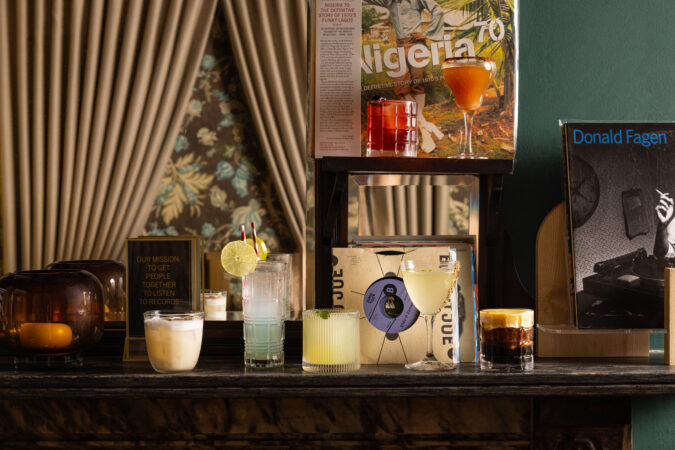
    A curious thing is happening behind bars: The bottles of liquors and liqueurs are disappearing, stored somewhere unseen. Instead, the backbar shelves are stacked with vinyl records. And the sound systems are also very, very good.

    In the last few years, as the speakeasy trend has waned, listening bars have popped up all over, including in Philly. The perpetually full 48 Record Bar, above Old City standby Sassafras, boasts an “ultra-high-fidelity audiophile vinyl sound system.” Solar Myth, on South Broad Street, might be one of the coolest places to grab a drink — whether you’re looking for coffee or wine — and discover music you might never have otherwise.

    Behind the bar at Solar Myth.

    Percy, which opened in May, has a listening lounge where you can sip on their house-made wines and spirits in what looks like the set of That ’70s Show. When a DJ isn’t spinning, the staff plays vintage reggae, punk, and calypso records — including ones that co-owner Seth Kligerman’s dad collected in the ’70s and ’80s, ranging from Jimmy Cliff to The Clash.

    “The first thing I did when we got our listening room speakers hooked up … I blasted the New York Dolls, my dad’s favorite band,” said Kligerman. (Percy’s speakers — four original Altec Lansing A7 Voice of the Theatre — are also from the ’70s.)

    The listening room at Percy on July 31, 2025, in Philadelphia.

    Stephen Starr’s LMNO has a listening lounge outfitted with a hi-fi sound system and record collection spanning soul, funk, disco, and Latin genres. “The focus is on immersive room sound rather than headphones — so the music feels shared, not isolated,” said Kayla Hagar, LMNO’s general manager. Programming ranges from DJ-led nights, vinyl-focused sessions, and ambient background listening. Once a week, at LMNO’s “Off the Walls” series, guests are encouraged to browse their vinyl wall and select records to be played. It draws Fishtown’s “younger creative crowd, an art and music-oriented demographic — audiophiles, record-collectors, and music lovers,” said Hagar. “Not necessarily a heavy mainstream dance-club crowd, but more niche, design-forward, scene-aware visitors.”

    The listening lounge at Stephen Starr’s LMNO.

    In 2024, after Milkcrate Cafe in West Philly and Fishtown called off vinyl nights, it seemed like the budding listening room boom may have been a scratch. But in the year and a half since, the concept has spread all over the country.

    Listening rooms are seemingly everywhere — in New York, Chicago, Portland, and beyond. They integrate music into drinking experiences, often weaving in Japanese influences across menus. In L.A., chef Sean Brock, famous for specializing in Southern foodways, opened Darling, a hi-fi bar inspired by Japanese jazz kissas, or cafes where listening to records is central to the experience. In Austin, the Equipment Room serves record-inspired cocktail omakases, blurring the line between DJ and bartender.

    At Press Club, a “record bar” in Washington, D.C., I snacked on chicken karaage and sipped an ume- and nori-infused shochu cocktail made by the same staffer who was spinning tracks. Press Club managing partner Will Patton listens to songs repeatedly to look for lyrical themes, and develops drink flavors according to rhythm and beat. (Think funky rum for a funky song, or melancholy music translating to cocktails with long, bitter finishes.) A rotating cocktail omakase menu, featuring multiple drinks paired with bites, is based on albums, most recently by Oasis and Bad Bunny.

    Listening bars are starting to proliferate the way speakeasy-style cocktail bars did in the 2010s — popularizing hidden entrances and an Art Deco aesthetic so successfully that the speakeasy concept has been adapted to Italian restaurants and cookie stores.

    At the listening bars, thoughtful, elevated beverages still reign, but bars are giving more and more physical space over to vinyl collections. They’re also hosting events throughout the day, often with visiting DJs.

    Solar Myth opened in November 2022 in the former Boot & Saddle. The bar features not liquor bottles but a collection of records organized by vibe.

    An Eater article recently heralded Philly’s listening lounges as the “antidote to the loneliness.” They’re community-oriented in the sense that you commune with others. (Just don’t talk too loud.)

    The community-mindedness is palpable at Solar Myth, which opened in November 2022 and serves many purposes. Housed in the former Boot & Saddle, it’s still a live music venue, but it’s also a bottle shop and cafe serving pastries, tomato pie from Cacia’s Bakery, and Rival Brothers’ coffee. They have a staggering amaro list, but you wouldn’t know it by looking at the bar, which features a collection of records — organized by vibe, from chill-out to Willie Nelson, with extensive collections of Ethio-jazz and electronic krautrock. They play the music of many small, avant-garde artists. (They also sometimes employ them: A member from the Philly-based band Knifeplay works at Solar Myth. “I feel so proud playing their record,” said barista Rachel Byrd.)

    Part of the record collection at 48 Record Bar.

    48 Record Bar’s bar shelves feature a collection of about 300 records. At 35 seats, it’s small, with a living room vibe. Up a winding staircase from Sassafras, the space is draped in dove-gray curtains; sound panels are upholstered in the same fabric. The bar’s host doubles as a DJ, who spun Sade and the Temptations on a recent evening. “We call that the record-butler shift,” said 48 Record Bar creative director Joey Sweeney.

    Japanese ingredients are sprinkled all over the cocktail menu: yuzu, kombu, genmaicha, matcha, and of course, Japanese whiskies.

    The bar at 48 Record Bar features both bottles and records.

    But drinks are only part of the experience, said Sweeney. “All the elements need to sing together.” The bar also hosts tiny-desk-style live music shows, author events, and deep listening events that start at 10 a.m. on some Sundays with coffee from Thank You Thank You.

    But mostly the bar’s soundtrack is whatever records are playing. Seven years ago, Sweeney went to London and visited Japanese listening bars there. He and Sassafras owner Donal McCoy opened 48 Record Bar in December 2023.

    “We want to honor the tradition of these Japanese listening bars without being mawkish about it, and not doing a cosplay.”

    That wouldn’t suit Philadelphia. The night I went in, I could still hold a conversation at the bar over a mock milk punch. Try that in Japan and “they will shush you,” Sweeney said. “We can’t shush you. This is Philly.”


  • DA Krasner condemns fatal ICE shooting in Minneapolis, says officers who commit crimes in Philly will ‘be convicted’

    DA Krasner condemns fatal ICE shooting in Minneapolis, says officers who commit crimes in Philly will ‘be convicted’

    District Attorney Larry Krasner, responding to the killing of a 37-year-old woman by an ICE agent in Minneapolis, vowed to prosecute law enforcement officers who commit crimes in the city of Philadelphia.

    “You will be arrested, you will stand trial, you will be convicted,” Krasner said during a news conference Thursday.

    His remarks came a day after a masked ICE agent shot Renee Nicole Good multiple times in her SUV.

    In widely circulated videos of the incident, Good appears to be driving away from a group of immigration agents as they order her to get out of her vehicle.

    President Donald Trump and top White House officials offered a starkly different view, saying Good tried to run over the officer with her car.

    Department of Homeland Security Secretary Kristi Noem said the officer, identified Thursday as Jonathan Ross, was justified in shooting the woman because he feared for his life. She said Good, a mother of three, had committed an act of domestic terrorism.

    Minnesota officials have called for an investigation into the conduct of the officer, who has not been charged with any crimes.

    But Krasner, flanked by a group of Philadelphia City Council members and the sheriff, called the actions criminal.

    The top prosecutor said that he has family ties to Minneapolis, and that he had reviewed the videos of the shooting, about a mile from where George Floyd was killed by police in 2020. He held a moment of silence for Good and displayed her photo before leading the group in a chant of her name.

    “We have to use our voices to call out people who commit terrible crimes,” Krasner said. “Or who justify them.”

    That last part was aimed at Trump, whom Krasner has sharply and repeatedly criticized.

    The progressive prosecutor often uses his platform to openly decry the president and his policies, most recently when he urged Philadelphians to film ICE agents who have ramped up immigration enforcement since Trump’s return to office.

    He said that tactic had been a success in Minneapolis because the video brought widespread attention to the incident.

    After Good’s killing, Krasner said, “The first thing out of Trump’s mouth was a lasagna of lies.”

    “She behaved horribly,” Trump told reporters. “And then she ran him over.”

    Krasner said he could not even be certain that Good was blocking officers from the roadway, as some officials have suggested. Had Good done so, Krasner said, she would have been engaging in an act that “protesters have done forever.”

    And that behavior, he said, does not justify a fatal shooting.

    Any law enforcement agent inclined to behave similarly in Philadelphia should “get the eff out of here,” Krasner said. And should such an incident happen in the city, the DA said, he would charge the offending officer in state court, where presidential pardons have no effect.

    “There are honest decent moral law enforcement officers by the bushel — this is not for you,” Krasner said of his warning. “This is for any one of your colleagues who thinks they are above the law.”

  • World Juniors: Grading Jack Berglund, Porter Martone, and the rest of the Flyers prospects

    World Juniors: Grading Jack Berglund, Porter Martone, and the rest of the Flyers prospects

    Every December and January, the World Junior Championship delivers exhilarating hockey, unrivaled drama, and a lot of debate surrounding the sport’s top under-20 prospects, some of whom have been drafted and others who are about to be.

    While the 10-day tournament in isolation is far from a perfect way to evaluate prospects, it does provide a snapshot to gauge players’ development and a chance to see how they perform in a best-on-best environment.

    “It’s not a be-all, end-all. Especially in Canada, it gets so blown up on the stage, people get crazed if guys don’t make it or make it,” Flyers assistant general manager Brent Flahr recently told The Inquirer of the tournament.

    “But the thing that fans don’t understand is that the coaches of those teams and management have different goals than what we have. … There’s been lots of great players who have been cut [or have lesser roles] that go on to have great careers,” Flahr said.

    That brings us to the Flyers, who were well represented in Minnesota’s Twin Cities. Amid the team’s ongoing rebuild and the high-end nature and sheer volume of the team’s draft picks in recent years, the Flyers sent six prospects — tied for third-most among NHL teams — to this year’s edition of the tournament.

    Here’s a look at how each of the six performed relative to expectations. (These grades are purely based on performance at the World Juniors and are not reflective of prospect rankings or the players’ seasons overall.)

    Jack Berglund, C, Sweden

    Jack Berglund’s skating has come on over the past year but the rest of his game is well-rounded.

    Captain Jack led Sweden to its first World Junior gold in 14 years and only its second in the past 45, and was dominant along the way. Berglund plays well-rounded and winning hockey and is almost impossible to get the puck off of.

    While Anton Frondell scored more goals, and 2026 draft eligibles Ivar Stenberg and Viggo Björck earned most of the headlines, Berglund was the unquestioned heartbeat of Team Sweden and led by example like a captain should from the opening puck drop.

    The 2024 second-round pick tallied three goals and a joint team-high 10 points in the tournament and delivered several clutch moments in the knockout rounds, including scoring a do-or-die penalty shot to keep Sweden in the tournament in the semis and delivering assists on Sweden’s first two goals in the gold medal game.

    Berglund’s skating and lack of speed will always come under scrutiny, but he plays at his own pace, and his strength and reach at 6-foot-4 and 210 pounds allowed him to get where he needed to go at this level.

    Berglund’s a horse when it comes to puck protection and wall work, and after some early skepticism, he has now aced his last three major test: Flyers development camp, the World Junior Summer Showcase, and the World Juniors.

    Grade: A

    Heikki Ruohonen, C, Finland

    Finland center Heikki Ruohonen always seems to save his best for international competition.

    Ruohonen, a player the Flyers’ brass has gone out of its way to namecheck the past few years when asked for under-the-radar prospects, backed up that praise in Minnesota with a strong tournament.

    For my money Finland’s top player at the event, the 2024 fourth-rounder led Suomi with nine points (three goals, six assists) across seven games and was a plus-six.

    Not the flashiest guy, Ruohonen has great hockey sense and always seems to make the right play. He’s also very calm with the puck under pressure and empties the tank shift to shift from a competitiveness perspective.

    The Harvard freshman impressed me here with his ability to transport the puck, and I think he has a little more skill and cleverness with the puck than he gets credit for. Though still a few years away, he’s definitely one to monitor.

    Grade: B+

    Porter Martone, RW, Canada

    Canada’s Porter Martone was good but not great at the recent World Junior Championship.

    Martone was good: He led the tournament with six goals and had nine points in seven games. But he wasn’t nearly as impressive or impactful as those numbers might suggest while captaining a Canada team that fell short of the expectation of winning gold.

    Three of Martone’s goals and five of his points came in 7-1 and 9-1 blowouts of overmatched Slovakia and Denmark, and another one of his goals was an empty-netter against Czechia.

    Speaking of that empty-netter, his controversial butt tap of a Czech player afterward earned him a silly unsportsmanlike conduct penalty and ultimately came back to bite him and Canada when Czechia got the last laugh and knocked them out in the semifinals.

    Martone did score a clutch tying goal late in that semifinal, which was a huge moment and should not be discounted, but big-time plays in the biggest games were few and far between across the tournament for a player whom many expected to dominate.

    This grade might seem a tad harsh, but I thought Martone, who has the potential to be a truly special player given his combination of size, skill, and snarl, disappeared at times and wasn’t the consistent driver Canada needed atop its lineup.

    Grade: B

    Max Westergård, LW, Finland

    Max Westergård has some intriguing offensive skills and already has a fan in former Flyers star and current team adviser John LeClair.

    It’s early, but the Flyers might have found something in Westergård, a 2025 fifth-round pick. One of the youngest players in his draft class, Westergård was noticeable on almost every shift and consistently made things happen offensively with his speed, vision, and skill.

    Westergård looked threatening in transition throughout and also worked hard below the goal line to retrieve and keep the puck. He had a goal and four points in six-plus games — he probably deserved a few more — before being knocked out of the bronze medal game early after taking a big hit from Canada’s Kashawn Aitcheson.

    Relative to expectations, Westergård improved his stock the most in my eyes and should be a leading contributor for Finland at next year’s tournament.

    Grade: B

    Jett Luchanko, RW, Canada

    Canada’s Jett Luchanko (17) underwhelmed for the second consecutive World Juniors.

    Flyers general manager Danny Brière was vocal about his disappointment in Luchanko’s use at last year’s tournament, but this year more of the blame has to fall on the 19-year-old’s shoulders. Playing out of position on the wing, Luchanko had an unspectacular tournament while filling a depth role.

    In seven games, Luchanko had just one assist — battling in front to dig out a puck in the lead up to Tij Iginla’s opener in the semis — and was a minus-four, including being tagged with a minus-three in that semifinal loss to the Czechs.

    Luchanko’s details and speed are real positives, but his play with the puck left a lot to be desired here, as he was largely a non-factor offensively despite being on one of star-studded Canada’s power-play units.

    It’s far too early to give up on Luchanko as a prospect, but more was expected in Minnesota. His second half with new OHL team, Brantford, will be intriguing to follow.

    Grade: C-

    Shane Vansaghi, RW, United States

    Flyers prospect Shane Vansaghi wasn’t the physical presence many expected him to be for the United States.

    It would be hard to say anything other than Vansaghi had a disappointing tournament. Deployed in a bottom-six role, the Michigan State sophomore averaged a team-low 5 minutes and 11 seconds of ice time and was a healthy scratch in two of Team USA’s five games.

    Vansaghi’s hallmarks of grit, physicality, and net-front activity were curiously absent in this tournament, as he was a minus-four despite his limited ice time. He was particularly exposed in a 6-3 loss to Sweden.

    Grade: D

  • China played big role in reducing opioid deaths, research suggests

    China played big role in reducing opioid deaths, research suggests

    Chinese crackdowns on chemicals used to make illicit fentanyl may have played a significant role in the sharp reduction of U.S. overdose deaths, according to research published Thursday.

    The paper suggests that the illicit fentanyl trade — which drove a historic surge in drug deaths during the past decade — experienced a large-scale decline in supply. Overdose deaths had surpassed 100,000 annually during the Biden administration, but began to decline in mid-2023 and plunged further in its final year. They have kept falling under President Donald Trump, who invokes drug trafficking as he imposes steep tariffs on other countries and unleashes missile strikes on suspected drug boats in the Caribbean.

    The research, published Thursday in the journal Science, adds to debates among government officials, public health researchers, and addiction experts over the complex reasons for the precipitous drop in deaths.

    They have also pointed to billions spent on addiction treatment, the overdose reversal drug naloxone and law-enforcement actions that disrupted traffickers domestically and abroad. Researchers in the Science paper stressed that those factors have been crucial in saving lives but emphasized the importance of efforts to prevent fentanyl from even being manufactured.

    In suggesting a major disruption in the fentanyl trade “possibly tied to Chinese government actions,” researchers also analyzed death trends in Canada, the purity of seized fentanyl and online posts about shortages of the drugs.

    “This demonstrates how influential China can be and how much they can help us — or hurt us,” said Keith Humphreys, a co-author of the paper and former White House drug policy adviser under President Barack Obama.

    U.S. government and law enforcement agencies have long scrutinized the role China’s chemical and pharmaceutical industries played in the international fentanyl trade.

    China agreed to internal restrictions on fentanyl-related substances during the first Trump administration. But that led to Mexican criminal groups synthesizing illicit fentanyl in secret labs in Mexico with precursor chemicals bought from companies in China. Since 2023, the Chinese government has shut down some of those companies as part of a broader crackdown.

    The Drug Enforcement Administration, in its latest annual drug intelligence report, noted that some China-based chemical suppliers are wary of supplying them to international customers, “demonstrating an awareness on their part that the government of China is controlling more fentanyl precursors.”

    According to state data compiled by the Centers for Disease Control and Prevention, estimated drug deaths plummeted in 2024 to about 81,711, of which 49,241 involved synthetic opioids such as fentanyl. Estimates for 2025 won’t be published for several months, but researchers believe the decline is continuing.

    The Science researchers caution that the precise scope of China’s crackdown is difficult to assess, given the opacity of enforcement in the country. China’s cooperation with U.S. drug authorities on fentanyl has long been fragile, often collapsing when broader tensions flare.

    That changed ahead of a November 2023 summit between President Joe Biden and Chinese leader Xi Jinping, when the two governments agreed to launch a multiagency crackdown on Chinese chemical suppliers tied to the fentanyl trade. Chinese authorities subsequently arrested about 300 people and moved to restrict roughly 55 additional synthetic substances — steps Beijing had previously resisted.

    The summit, however, happened months after overdose deaths had already begun to fall — a timing mismatch the researchers acknowledge. Humphreys theorizes China may have begun crackdowns months earlier before the agreements were announced.

    Other researchers are skeptical. Vanda Felbab-Brown, a senior fellow at the Brookings Institution specializing in security and counternarcotics, noted that when overdoses began to fall, tensions between Washington and Beijing remained high over issues of trade, technology and security. Beijing would want to trumpet its enforcement, she said.

    In a statement, the Chinese embassy said the country’s broad efforts to combat the spread of deadly synthetic drugs has achieved “remarkable results.”

    The embassy said that between October 2023 and August 2025, the Chinese government has shut down 286 companies and forced more than 500 to delete information on chemical sales. About 160,000 ads have been removed in that time, the statement said.

    “China has been helping the U.S. tackle the fentanyl issue and is willing to continue the cooperation on the basis of equality and mutual respect,” the embassy said.

    The Science paper does not account for how overdose death rates fell in parts of the U.S. first, or how fatalities in more populous states can skew national statistics, said Nabarun Dasgupta, an epidemiologist at the University of North Carolina at Chapel Hill. He said fentanyl habits have been changing as fewer people start using it, and many users are cutting back or no longer using alone.

    “It’s not a straight line between drug supply and overdose deaths because of protective behaviors that have been adopted in between,” Dasgupta said.

    In trying to determine reasons for the sharp decrease in deaths, researchers pointed out that purity of fentanyl seizures tested by the DEA dropped around the same time U.S. deaths were falling. Seizures fell too, an indication of reduced supply, they said.

    Researchers also analyzed posts on Reddit, the online forum where users often post about the illicit drug market. They noted a spike in mentions of fentanyl shortages in the middle of 2023, “roughly coinciding with the beginning of the decline in fatal overdoses,” researchers wrote.

    Researchers also analyzed fentanyl trends in Canada, where criminal groups also secure precursor chemicals from China.

    Canada has typically embraced a more public-health-centered approach to combating the opioid epidemic than the U.S. — for example, authorizing numerous centers where users can consume drugs under supervision. Still, deaths began falling around the same time, researchers said. Chinese crackdowns may explain the “parallel mortality declines,” the authors of the Science paper said.

    “What’s really striking is that parallel across the two countries, even though the two countries have very different domestic policies,” Jonathan Caulkins, a Carnegie Mellon University professor who researches the criminal drug trade and was a study co-author.

    Inside China, sellers of chemicals have offered mixed message on the impacts of the 2023 measures. They said there is heightened oversight of scheduled substances and online advertising but enforcement varies widely by locality.

    Some companies left the business after 2023, said one Hubei-based employee at a chemical manufacturer, whose products can be used to make fentanyl and who spoke on the condition of anonymity to talk candidly about the industry.

    Asked whether the company is still able to sell controlled chemicals to customers, including those in Mexico, the employee said those sales persist.

    “We don’t sell much anymore because the company focus has changed,” the person said, but “it’s not much trouble to do that.”

  • Villanova rides three-point shooting to dominant win over Xavier

    Villanova rides three-point shooting to dominant win over Xavier

    Villanova maintained second place in the Big East women’s basketball standings with a 67-50 victory over Xavier on Thursday afternoon at the Finneran Pavilion.

    On Sunday, Villanova (13-3, 6-1 Big East) was handed its first conference loss by Marquette, which snapped a 10-game winning streak. The loss also dropped Villanova from No. 28 to No. 34 in the NCAA’s NET rankings.

    But the Wildcats bounced back against the Musketeers, thanks to junior guard Kelsey Joens. The Iowa State transfer scored a career-high 18 points on six three-pointers with four rebounds.

    Villanova’s Kelsey Joens finished with a career-high 18 points against Xavier on Thursday.

    The Wildcats’ three-point shooting propelled their win. Villanova made 15 of 32 three-pointers, while Xavier shot 4 of 13.

    Sophomore guard Jasmine Bascoe added 15 points along with four rebounds and seven assists. Bascoe is the conference’s third-leading scorer, averaging 17.5 points.

    Dropping threes

    The Wildcats shot 5-for-9 from deep in the first quarter, which set the tone.

    Villanova started to break away at the end of the first quarter, scoring eight consecutive points to take a 17-11 lead. To open the second, Villanova’s scoring run stretched to 11-0.

    From there, the Wildcats maintained a double-digit lead and entered halftime with a 33-20 advantage.

    Villanova held Xavier (9-7, 2-5) to 35% shooting from the field, including 2-for-9 from deep, and exploited its errors, as the Wildcats scored 18 points off turnovers in the first half.

    Bascoe controls the court

    The Musketeers picked up their shooting in the second half. Xavier went on an 8-0 run across 2 minutes, 35 seconds, shrinking Villanova’s lead to seven.

    Bascoe took care of Villanova’s response. With two minutes left in the third quarter, she notched a steal and drove to the basket for an uncontested layup. Bascoe then assisted a Joens three-pointer to end the quarter.

    Joens knocked down two more three-pointers in the fourth. Villanova outscored Xavier, 10-3, in the final 3:31 to seal the win.

    Road challenges ahead

    The Wildcats will head on the road for two crucial matchups.

    Villanova faces Providence on Sunday (noon, TruTV), then will visit the nation’s top team, undefeated UConn, on Thursday (7 p.m., FS1).

  • Rep. Steny Hoyer to retire, ending storied career in elected office

    Rep. Steny Hoyer to retire, ending storied career in elected office

    Rep. Steny H. Hoyer announced Thursday he will not run for reelection and will end a nearly six-decade career in elected office that spanned his rising-star days in Maryland government to a two-decade run as the No. 2 U.S. House Democrat.

    Hoyer, the third-longest-serving member of the House, said he reached the decision over the holidays with his family, feeling content with a career that never brought the brass ring of the House speaker’s gavel but put him at the center of this century’s biggest debates.

    “At this young age, it’s probably premature,” the 86-year-old quipped in a two-hour interview Tuesday at his sprawling home on the Patuxent River in St. Mary’s County.

    Now three years out of leadership, Hoyer remains an active legislator but feared ending up like many other elderly lawmakers, becoming physically or mentally frail in their final days in office.

    “I did not want to be one of those members who clearly stayed, outstayed his or her ability to do the job,” said Hoyer.

    He delivered a formal announcement in a House floor speech Thursday morning, with dozens of colleagues from both sides of the aisle on hand to cheer.

    In his remarks, Hoyer made clear he was not like the more than 40 other House members who, largely fed up with Congress, are running for other offices or retiring. Hoyer said he still loves the institution, while recognizing that his style of extending a courteous hand to the political opposition is outdated.

    Hoyer spent decades on the Appropriations Committee, helping to pour billions of dollars into a congressional district that begins just a few miles east of the Capitol. But Hoyer’s final years on the panel have seen it snarled in partisan gridlock.

    In the Tuesday interview, Hoyer said his constituents, more reliant on the federal government than most, ask when Congress will work in a more functional way, a question that Hoyer puts back on those voters.

    “As long as the people of America elect angry, confrontational people, don’t be surprised that democracy works and you get an angry, confrontational Congress,” Hoyer said.

    Hoyer said American politics are in a state of decades-long deterioration. But he blamed President Donald Trump for making bipartisan comity harder than ever, pointing out the pardons of those convicted for the Jan. 6, 2021, Capitol attack during his interview with The Washington Post, which took place on the fifth anniversary of the insurrection.

    “His greatest strength, he has no shame, does not,” Hoyer said of Trump. “And his people don’t care whatever he does, pardoning 1,600 people who committed treason. Just astounding, and then he gets away with it.”

    Hoyer will go down in history behind only Leslie C. Arends (R., Ill.) for length of leadership service in the No. 2 post for a House caucus without ever getting promoted to the top spot. From the early 1940s until 1974, Arends totaled almost 30 years as the GOP’s first deputy.

    Hoyer’s list of legislative accomplishments is long — including authoring the Americans With Disabilities Act and the election law responding to the disputed 2000 presidential race — but his biggest contribution may have been serving as a cooling agent when partisan temperatures ran hot in the raucous House.

    Many Republicans viewed him as an honest broker and a lighter touch than Rep. Nancy Pelosi (D., Calif.), who led the caucus for the 20 years Hoyer served as her deputy.

    In his Thursday speech, Hoyer lamented the decay of bipartisan relationships and a House that produces less legislation than in years past.

    “I am deeply concerned that this House is not living up to the Founders’ goals,” Hoyer told his colleagues. “I urge my colleagues on both sides of the aisle to examine their conscience, renew their courage.”

    Hoyer lost a 2001 race for minority whip to Pelosi, a contest that highlighted the party’s pivot away from the South and Midwest and toward the more professional class of voters along the coasts. When Pelosi took charge in January 2003, the caucus unanimously elected Hoyer as her top lieutenant.

    Hoyer said he understands why “tough-as-nails” Pelosi remained leader so long, calling her the best of 10 speakers he served under in nearly 45 years in the House.

    “Sure, I would have loved to have been speaker. Who wouldn’t love to be speaker? But they’re not deep regrets,” he said in the interview.

    Hoyer and Pelosi, along with Rep. James E. Clyburn (D., S.C.), are together linked for their historically long runs as the top three lawmakers running the caucus. They notched victories such as the 2008 financial rescue, the 2010 Affordable Care Act and several trillion dollars worth of pandemic relief this decade.

    When Republicans won the House majority in the 2022 midterms, all three decided to step down and let a younger generation take the reins of the caucus. Pelosi announced in November that she will not run for reelection, while Clyburn has so far signaled he will run again.

    “Ironically, Nancy, Jim and I have not talked about any one of our actions or any one of our retirements. So I haven’t talked to Nancy. I haven’t talked to Jim,” Hoyer said.

    Pelosi, 85, and Hoyer are retiring as their party is still in a heated debate over whether its elder statesmen have stayed too long in Washington, particularly after President Joe Biden’s late exit from the 2024 presidential campaign.

    Hoyer’s wife, Elaine C. Kamarck, a Brookings Institution political scholar, dubbed the trio of Pelosi, Hoyer, and Clyburn as “super-agers” for their ability to effectively run the Democratic caucus while in their 80s, but Hoyer is conscious of passing the baton to the next generation.

    Pelosi, Hoyer, and Clyburn carved out different responsibilities and represented a new, diverse 21st-century caucus: a liberal woman from California’s tech center; a White man with close ties to the shrinking ranks of Democrats from the South and Midwest; and the highest-ranking Black member of Congress.

    Hoyer said he considers passage of the Affordable Care Act a prototype for when their leadership style worked. Pelosi — who has “a spine of steel,” he said — led the effort and had the bona fides to tell liberals what the best deal possible was. Hoyer served as sounding board for dozens of Democrats in competitive districts worried about their 2010 elections.

    “A number of people would say I played an important part in bringing along people who had concerns about it from their district’s standpoint,” he said.

    Democrats lost a stunning 63 seats in those midterms and spent eight subsequent years in the minority, leading some to question whether new, younger leadership was needed.

    Pelosi and Hoyer have had a sometimes strained relationship — dating at least to the late 1990s when they began a several-year campaign against one another for a leadership post — but the caucus seemingly wanted that balance.

    “We were put together by the caucus,” Hoyer said. “And what I mean by that, Nancy was elected, I was elected and Clyburn was elected. We weren’t elected as a team.”

    The current House Democratic leadership team — Minority Leader Hakeem Jeffries (N.Y.), Minority Whip Katherine Clark (Mass.) and Rep. Pete Aguilar (Calif.) — effectively ran together three years ago trying to replicate the ideological and diverse balance of the old team.

    Hoyer had not yet drawn a top primary challenge in his congressional district, but his exit will undoubtedly prompt many younger Maryland politicians to consider running in a race where Hoyer said he will not make an early endorsement.

    His early endorsement of Wes Moore, helped elevate the then-long-shot candidate to victory in the 2022 Maryland governor’s race. Now running for reelection at 47, Moore is mentioned as a future presidential candidate — a campaign Hoyer said he hopes to play a role in.

    “His true genius resides not simply in the grand American story he has helped to write, but in the many quiet moments of service and support he has given,” Moore said in a statement.

    A vast majority of House members have no idea Hoyer’s first image in politics was as a young man in a hurry. Just 27 when he took office in the Maryland state Senate in 1967, Hoyer became the chamber’s president at 35 and plotted a run for governor in 1978, with his ultimate ambition being the U.S. Senate.

    “I was a little ahead of myself,” he recalled Tuesday. He eventually accepted a spot as lieutenant governor candidate on a ticket that lost the party nomination badly.

    His start in politics was launched when, as an undergraduate at the University of Maryland, he attended a campus rally for Sen. John F. Kennedy’s presidential campaign in 1960.

    Following a file clerk job at the Central Intelligence Agency, Hoyer began working for Rep. Daniel Brewster (D., Md.), would move with him to the Senate in 1963 and meet a young Pelosi as a co-worker.

    In 1981, after the local congresswoman suffered a heart attack and fell into a coma, Hoyer narrowly won a crowded primary and was on his way up the ladder in the U.S. House.

    The family of his first wife bought land in St. Mary’s County on the Patuxent in 1989, and the Hoyers built their getaway home well outside his district.

    The 1992 redistricting brought this rural territory into Hoyer’s 5th Congressional District, and the couple turned it into a permanent home. An educator in Prince George’s County schools, Judith Hoyer died in 1997 and the congressman passed legislation creating “Judy Centers” for early-childhood programs.

    The home, dubbed “Hoyer’s Point of View,” hosted his wedding to Kamarck in 2023. A proud Dane who’s looked out for Nordic interests on the Helsinki Commission, Hoyer flies the flag of Denmark alongside those of Maryland and the U.S.

    Hoyer said he’s not sure how he will handle life outside elective politics, but he has a ready answer when people ask him about Congress.

    “How do we make this better?” he said. “You do. You’re a voter. You send the right people there, it’ll get better.”

  • These clever dogs rival toddlers when it comes to learning words

    These clever dogs rival toddlers when it comes to learning words

    In many households, it’s a forbidden four-letter word. It can’t be uttered aloud, only spelled, so those within earshot don’t get too worked up.

    “Can you take the dog for a W-A-L-K?”

    Many dog owners know their pets excel at learning words such as “walk,” “sit,” “stay,” and even their own names. But researchers have discovered the word-acquisition ability of certain canines can rival that of toddlers.

    A study published in the journal Science on Thursday found that some dogs can learn words simply by overhearing conversations, even when the pets are not directly addressed, an ability humans begin to acquire at about 18 months old.

    “This can really give us more appreciation to how exceptional dogs can be,” said lead author Shany Dror, a comparative cognition researcher at the University of Veterinary Medicine in Vienna and Eötvös Loránd University in Budapest.

    For their experiments, Dror and her team recruited 10 dogs and their owners from around the world. The breeds included a miniature Australian shepherd, a German shepherd, a Labrador retriever, and several border collies — all herding or sporting breeds known for their trainability.

    Dogs tend to be better at learning words for actions — think “fetch” or “roll over” — than at retaining the names of objects. So Dror sought out what she called “gifted” dogs that had previously demonstrated an ability to learn the names of their toys.

    Basket, a 7-year-old border collie in New York, was among them.

    “I noticed she started to actually know the names of her toys without me giving her assistance when she was about 8 months old,” said one of her owners, Elle Baumgartel-Austin.

    The researchers instructed the dog owners to discuss two toys that their dogs had never seen before. The dogs were present for those conversations. But the owners never directly addressed their pets.

    “It was very funny watching the video after the fact, just to see what she was doing,” Baumgartel-Austin said. Basket had followed the toy with her eyes as they talked. “She got a little frustrated. It was not very fun to see two humans play with a toy that she wanted.”

    To assess what the dogs learned by eavesdropping, a day or more later the owners were guided to place the toys in a different room among other plushies and then ask their dog to retrieve one of the two new toys by name. Seven of the 10 dogs, including Basket, regularly fetched the correct toy. Although the sample size was small, the results were statistically significant.

    The discovery not only reveals a previously unknown cognitive ability of canines, but it could also offer clues to how human language may have evolved.

    Overhearing the conversations of parents and other adults is part of how toddlers learn to talk. That some dogs are able to do so as well suggests that an ability to read social cues needed to follow a conversation predates language itself.

    “This is something that came before language,” Dror said. “Because dogs don’t have language, and yet they do have these abilities.”

    Gabriella Lakatos, a researcher at Britain’s University of Hertfordshire who also has studied human-dog interactions, said the findings “extend the list of behaviors and abilities previously described in dogs as analogous to those of young children.”

    Among other animals, the ability to eavesdrop has also been documented in bonobos. Canine researchers have known since the early 2000s that some dogs can recognize more than 200 items by name and can even infer the names of new toys by excluding ones they already know.

    But Juliane Kaminski, a comparative psychology associate professor at Britain’s University of Portsmouth who conducted that early research, cautioned against overinterpreting the results to say dogs can deeply learn language the same way people do. “The interpretation in terms of ‘word learning’ in the linguistic sense seems a little too strong for me,” she said. “What the study shows is that dogs can learn labels without being explicitly directed toward” an object.

    She added it is still unclear why only a handful of dogs are able to learn the names of their toys. Her own work with label-learning dogs suggests they are more curious and focused than their less-gifted canine counterparts.

    “However, what we do not know is what comes first,” Kaminski said. Are some dogs born better learners? Or do they simply get used to fetching objects when asked?

    “It’s a chicken-and-egg problem, and we need further research to explore this,” she said.

    Dror tried for years in vain to train other less gifted but still very good dogs — including her own German shepherd, Mitos — to associate names with toys. “Nothing worked. It was very frustrating.”

    Still, Mitos nuzzled his way into the new paper. He died last year at 15, just as Dror was submitting the research for publication, and she dedicated the paper to him. “It’s definitely hard to lose someone that’s been such a huge part of your life for so long,” she said.

    Now, Dror has a new puppy — a schipperke named Flea. She is introducing her to toys and hoping she can learn.

  • American Airlines is launching free Wi-Fi on flights. Here’s how to access it.

    American Airlines is launching free Wi-Fi on flights. Here’s how to access it.

    Wi-Fi is coming for the skies.

    American Airlines, the largest carrier out of Philadelphia International Airport, is bringing free Wi-Fi to its fleet for members of its rewards program. The service is sponsored by AT&T and launches this month, the airline announced Tuesday.

    “Free high-speed Wi-Fi isn’t just a perk; it’s essential for today’s travelers,” said Heather Garboden, American’s chief customer officer. “Once rollout is completed, every AAdvantage member can stay connected, stream, and share almost anywhere their journey takes them for free.”

    American is not the first PHL airline to tout free onboard Wi-Fi for travelers with reward memberships. Southwest Airlines started doing so last year through a partnership with T-Mobile, and Delta announced a similar offering in 2023. United offers Wi-Fi to rewards members on some planes, provided by Elon Musk’s Starlink, and announced in October that it plans to install the service on several more aircrafts.

    American Airlines estimates that by early spring, free Wi-Fi will be available on “nearly every” one of its flights.

    Travelers need an AAdvantage account, which is free to join, to access the free Wi-Fi. The membership also allows customers to earn points and miles toward flights. Onboard, travelers must log in at aainflight.com and select the “Free Wi-Fi” option.

    Previously, all passengers using Wi-Fi had to pay for a pass or subscription. Non-AAdvantage members can still do so, said company spokesperson Bri Harper.

    Philadelphia International Airport is a hub for American Airlines, PHL’s largest airline by passenger volume, which carried nearly 20 million passengers through the airport in 2024. That’s more than five times the second largest carrier, Frontier.

    The airline was among the top 10 largest employers in Philadelphia in 2025.

  • Alveus Therapeutics, a Philadelphia start-up treating obesity, debuted with $160M in funding

    Alveus Therapeutics, a Philadelphia start-up treating obesity, debuted with $160M in funding

    Alveus Therapeutics, a Philadelphia start-up specializing in obesity therapies with top staff from Novo Nordisk and Eli Lilly, made its public debut Thursday with $159.8 million in venture capital funding.

    The announcement comes on the heels of a banner year for investment and acquisition activity in the weight loss arena, as venture capitalists and big pharmaceutical firms try to catch up to the enormous successes Eli Lilly and Novo Nordisk have had in recent years with their GLP-1 treatments.

    New Rhein Healthcare Investors, based in Philadelphia and Belgium, founded Alveus in early 2024 to develop obesity treatments that are more tolerable and have greater durability. Andera Partners, based in Paris, and Omega Funds in Boston joined New Rhein in leading the Series A investment round.

    “Obesity is one of the fastest-growing global healthcare challenges, and today’s therapies leave patients struggling to maintain weight loss over time,” Raj Kannan, CEO of Alveus, said. Kannan is based in Boston, according to LinkedIn.

    Alveus is headquartered in Philadelphia, the company said. Most research and development is in Copenhagen, Denmark. The company has fewer than 50 employee, split about evenly between Philadelphia and Copenhagen.

    The company’s chief scientific officer and head of R&D, Jacob Jeppesen, is a former vice president at Novo Nordisk in the areas of type 2 diabetes and cardiovascular disease.

    Brian Bloomquist, a former Eli Lilly vice president with responsibility in the diabetes and obesity treatment area, is Alveus’ chief business and strategy officer. The company’s chief technical officer is Xiao-Ping Dai, who spent some time working at the former WuXi Advanced Therapies in Philadelphia.

    Alveus’ lead drug candidate was licensed from a Chinese company called Gmax Pharma, an Alveus spokesperson said. Alveus also has treatments in development that it developed internally.

  • Judge blocks Trump administration from purging DEI-related terms from Head Start grant applications

    Judge blocks Trump administration from purging DEI-related terms from Head Start grant applications

    WASHINGTON — A federal judge has temporarily blocked the Trump administration’s efforts to remake Head Start, ordering it to stop purging words it associates with diversity, equity and inclusion from grant applications and barring it from laying off any more federal employees in the Office of Head Start.

    The order came this week in a lawsuit filed in April against Department of Health and Human Services Secretary Robert F. Kennedy Jr. and other officials. The lawsuit accuses the Trump administration of illegally dismantling Head Start by shutting down federal Head Start offices and laying off half the staff. It also challenges the administration’s attempts to bar children who are in the U.S. illegally from Head Start programs and to ban language they view as suggestive of DEI.

    The plaintiff organizations representing Head Start providers and parents said in a court filing last month that officials told a Head Start director in Wisconsin to axe the terms “race,” “belonging” and “pregnant people” from her grant application. They later sent a list with nearly 200 words the department discouraged her from using in her application, including “Black,” “Native American,” “disability” and “women.”

    A Health and Human Services spokesperson said he could not comment on the judge’s order.

    Head Start, founded six decades ago as part of President Lyndon B. Johnson’s War on Poverty, is an early education and family support program that serves hundreds of thousands of children who come from low-income households, foster homes or homelessness. It is federally funded but operated by nonprofits, schools and local governments.

    Joel Ryan, who heads the Washington State Head Start & Early Childhood Education and Assistance Program, said the order halts an attack on Head Start centers.

    “When a Head Start program has their funding withheld because of their efforts to provide effective education to children with autism, serve tribal members on a reservation, or treat all families with respect, it is an attack on the fundamental promise of the Head Start program,” Ryan said.

    The directive on the forbidden words raised confusion for Head Start directors, who must describe how they will use the money in grant applications and are required by law to provide demographic information about the families they serve. A director in Washington state said in a court filing the guidance led her to cancel staff training on how to support children with autism and children with trauma.

    The order from U.S. District Judge Ricardo S. Martinez of Seattle, published Monday, bars Health and Human Services from cutting any more employees and from punishing Head Start providers if they use the prohibited language.