Blog

  • The trolley tunnel is still closed as SEPTA tests repairs. When will it reopen?

    The trolley tunnel is still closed as SEPTA tests repairs. When will it reopen?

    Philadelphia’s trolley tunnel has been closed for two months, but SEPTA now is saying that it has completed most necessary repairs and could reopen the connection between Center City and West Philadelphia soon.

    Crews currently are running trolleys through the tunnel to test fixes for damaged overhead wires and other equipment and to decide when it is safe for normal service to resume.

    “We’re pretty close,” SEPTA spokesperson Andrew Busch said Tuesday.

    About 60,000 riders traveled daily through the tunnel between 13th Street and its West Philadelphia portal at 40th Street before SEPTA closed it in early November.

    Since then, people have had to use slower shuttle bus service or the Market-Frankford El as alternatives.

    At issue is a U-shaped brass part called a slider that carries carbon, which acts as a lubricant on the copper wires above the tracks that carry the electricity that powers the trolleys.

    Earlier in the fall, SEPTA replaced its usual 3-inch sliders with 4-inch models in an effort to reduce maintenance costs, but the carbon in the longer units wore out sooner than thought, causing metal-on-metal contact that damaged the overhead wires.

    The slider switch was meant to prolong their lifespan, but failed to work. Inside the tunnel, where there are more curves on the tracks and more equipment holding the wire to the ceiling, the new sliders and carbon burned through faster than earlier tests indicated.

    There were two major incidents when trolleys were stranded in the tunnels. On Oct. 14, 150 passengers were evacuated from one vehicle and 300 were evacuated from a stalled trolley on Oct. 21.

    The Federal Transit Administration on Oct. 31 ordered SEPTA to inspect the overhead catenary system along all its trolley routes.

    The directive came in response to four failures of the catenary system in September and October, including the tunnel evacuations.

    SEPTA has had to replace about 5,000 feet of damaged wire and make other repairs. It also switched back to 3-inch sliders.

    On Nov. 7, SEPTA shut down the tunnel to deal with the issue, which had cropped up again, then reopened it on the morning of Nov. 13, thinking it was solved. But it discovered further damage to the catenary system and the tunnel was closed at the end of the day.

    Other potential reopening dates were announced but postponed.

    This story has been updated to correct the amount of wire replaced in the tunnel.

  • The Shops at Liberty Place are for sale

    The Shops at Liberty Place are for sale

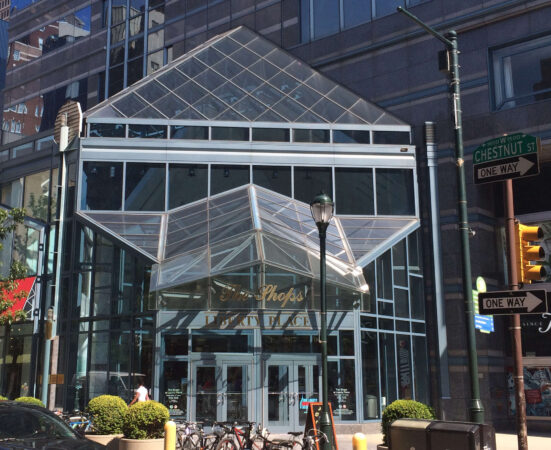
    The 147,201-square-foot mall between the Liberty Place towers, two of Philadelphia’s most iconic skyscrapers, is up for sale.

    Chicago-based Metropolis Investment Holdings sees a sale of the Shops at Liberty Place as a way to put the property in the hands of a company that specializes in retail.

    “With the property established as a leading retail destination in Center City, we believe it is at a natural point for a new owner to build on this foundation with additional investment and fresh ideas,” Tom Dempsey, head of asset management for Metropolis, said in an email.

    Metropolis is focused on office real estate and owns the 61-story One Liberty Place. The company purchased both properties in 1999.

    The sale of the Shops at Liberty Place is not an indication that Metropolis is planning to sell the skyscraper, too.

    “We are focused on our office portfolio, and One Liberty Place will continue to be a cornerstone asset for Metropolis,” Dempsey said. “It has demonstrated strong and consistent performance, benefits from a loyal tenant base, and remains one of Philadelphia’s most iconic and competitive office buildings.”

    There is no listed price, but a source familiar with Metropolis’ thinking says they are hoping to sell the Shops for $20 million.

    The shops at 1625 Chestnut St. are 77.7% occupied and include tenants like Jos. A. Bank, Victoria’s Secret, and Bloomingdale’s. The food court proved especially popular and has long been a draw for office workers.

    In 2024 indoor minigolf facility Puttshack opened as part of a wave of experiential retail in Center City.

    “The venue is particularly strong in group sales, hosting corporate events, social gatherings, and celebrations, which reinforces its role as a destination — its mix of entertainment, dining, and social interaction helps drive consistent foot traffic and contributes to the overall vibrancy of The Shops,” Dempsey said.

    Real estate brokerage Jones Lang LaSalle (JLL) is handling the sale of the Shops at Liberty Place.

    The company’s listing for the Shops at Liberty Place describes it as an “established in-fill urban location with significant population density and economic demand drivers” and boasts its “irreplaceable location along highly trafficked Chestnut Street within Philadelphia’s premier shopping district.”

    JLL says that it attracts 5.1 million visitors a year.

    An aerial view of One Liberty Place, the Shops at Liberty Place, and Two Liberty Place taken during 1990.

    The Shops at Liberty Place opened in 1990, three years after One Liberty, which famously broke the gentleman’s agreement that no building in Philadelphia be taller than William Penn’s hat atop City Hall. Two Liberty Place also opened in 1990.

    The Shops at Liberty Place proved a bright spot on Chestnut Street, which has long been overshadowed by Walnut Street as Center City’s premier shopping destination.

    The Inquirer’s architecture critic, Inga Saffron, praised the design of the building’s entrance, which seeks to echo its sister skyscrapers that soar above.

    “The glass structure sits a generous distance back from the hectic corner, providing plenty of elbow room for harried pedestrians,” she wrote in 2016. “The best detail is the batwing canopy over the doors. … The canopy’s angles recall the tiered chevrons that distinguish the crowns on Liberty Place’s towers.”

    The Shops at Liberty Place’s occupancy suffered a blow following the COVID-19 pandemic, but its general neighborhood is looking healthy. Both the Liberty Place skyscrapers have strong occupancy, and Center City’s residential population is climbing.

    “We’ve managed the asset carefully through challenging times,” Dempsey said. “Today, the property is well-positioned with a diverse mix of tenants, including strong experiential and destination offerings, and continues to attract interest from retailers and visitors alike. We see solid potential for continued growth and momentum under new ownership.”

  • Nakobe Dean’s expected return from injury could be critical against 49ers ground attack

    Nakobe Dean’s expected return from injury could be critical against 49ers ground attack

    The Eagles are likely to get back one of their key defensive players just in time for the playoffs.

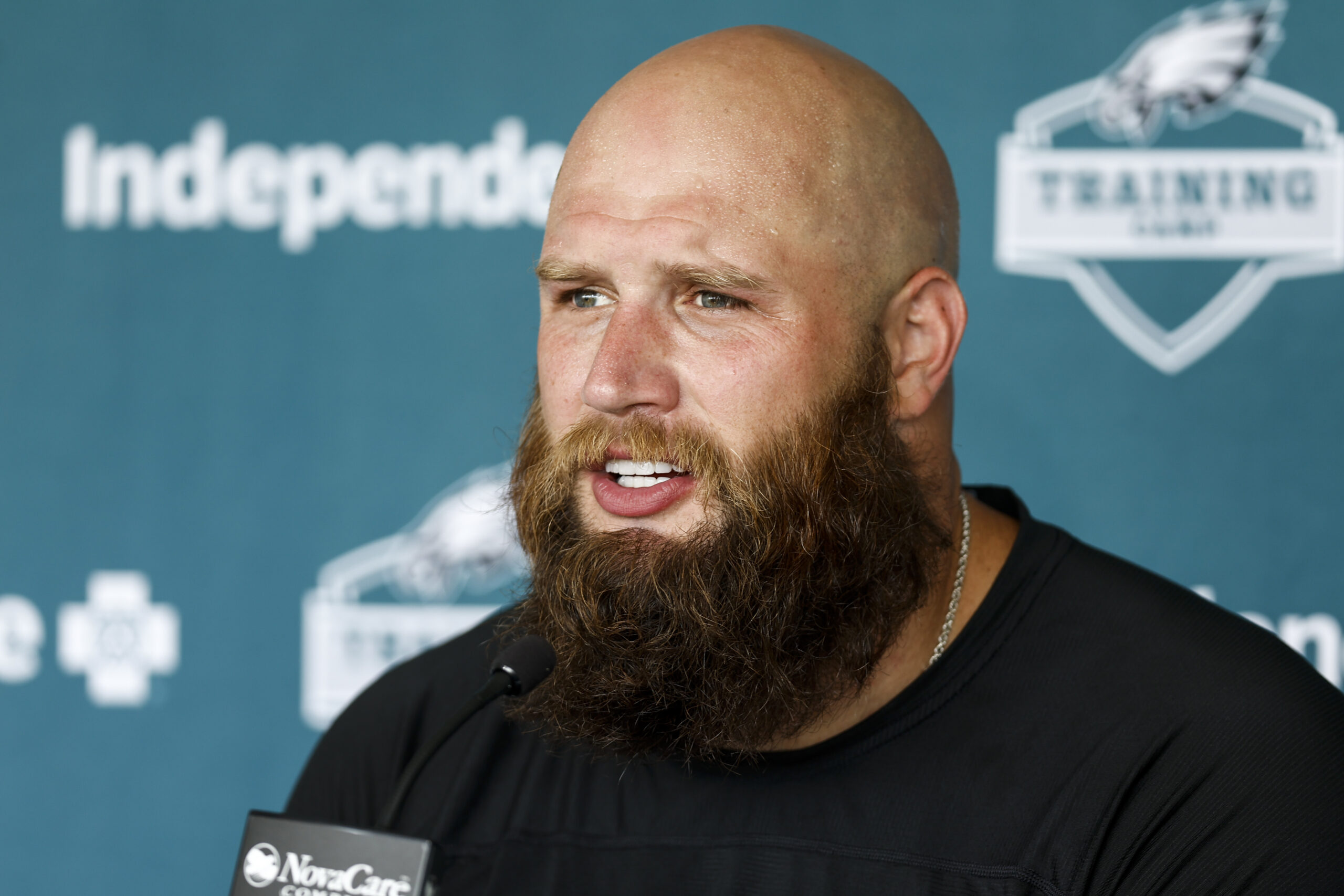
    Linebacker Nakobe Dean is expected to return to action on Sunday for the Eagles’ wild-card game against the San Francisco 49ers, Vic Fangio said on Tuesday. Dean, 25, has been inactive for the last two weeks while recovering from a hamstring injury sustained in the Week 16 win over the Washington Commanders.

    He is set to enter the lineup at a critical time, with the stakes higher entering the postseason and the competition ramping up against a strong 49ers offense.

    The group’s top weapons put the greatest stress on opposing inside linebackers. Christian McCaffrey, the two-time first-team All-Pro running back, is the most productive player in Kyle Shanahan’s offense. McCaffrey is second in the NFL with 2,126 scrimmage yards on a career-high 413 touches (1,202 rushing yards on 311 carries and 924 receiving yards on 102 catches).

    “He’s a very good runner when they hand it off to him,” Fangio said. “And obviously, he is a very good receiver … he’s got over 100 receptions this year. And he’s always a threat that way. They do like to scheme plays for him in the passing game.”

    George Kittle, the two-time first-team All-Pro tight end, missed six games this season due to hamstring and ankle injuries. Still, he’s the third-most targeted player in the 49ers offense behind McCaffrey and wide receiver Jauan Jennings, posting 628 yards and seven touchdowns on 57 receptions.

    Dean will be tasked with helping keep Kittle and McCaffrey in check. He ought to be up for the challenge, especially on the ground. Since coming off the physically unable to perform list and returning to Fangio’s defense in Week 7, Dean has mustered stops on 6.5% of his run defense snaps, the third-highest rate on the team among players with at least 100 such snaps, according to Pro Football Focus.

    “It’s a big game for everybody,” Fangio said. “You play an offense this good and this diverse, all 11 got to be cooking.”

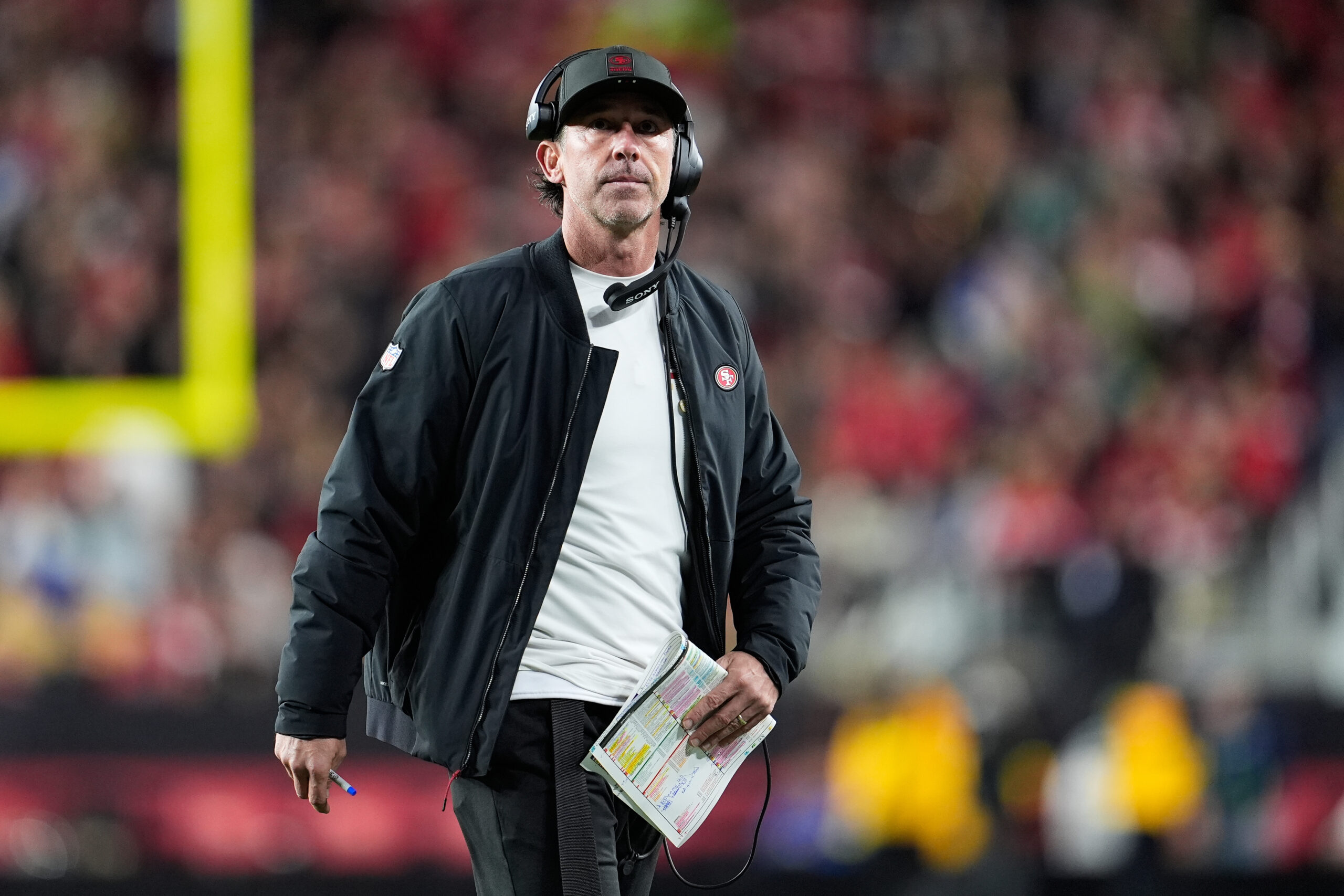
    49ers coach Kyle Shanahan and Eagles defensive coordinator Vic Fangio have a great deal of familiarity.

    Fangio’s Shana-history

    In an alternate universe, Fangio is preparing to face the Eagles as Shanahan’s defensive coordinator.

    That hire could have happened in 2017, when Shanahan left the Atlanta Falcons to become the head coach in San Francisco. At the time, Fangio was the Chicago Bears’ defensive coordinator. However, the Bears reportedly blocked the 49ers’ attempt to speak with Fangio, so he stayed in Chicago for two more seasons before he left for the Denver Broncos’ head coaching gig.

    Even though they never served on the same staff, Fangio said he maintains a relationship with Shanahan.

    “We don’t talk often, put it that way,” Fangio said. “But if there’s a reason to, we do talk or text with each other.”

    Vic Fangio last faced Kyle Shanahan in 2018 when he was defensive coordinator with the Bears.

    He hasn’t faced Shanahan often either, at least recently. The two coaches have gone head-to-head four times as coordinators or head coaches throughout their careers, twice while Fangio was the 49ers’ defensive coordinator under Jim Harbaugh and Shanahan was the offensive coordinator for Washington in 2011 and 2013. The other two occasions occurred when Fangio was with the Bears and Shanahan was with the 49ers in 2017 and 2018.

    Fangio has a 3-1 all-time lead, with his lone loss coming by one point in the 2017 matchup. In those four meetings, Shanahan’s offenses have never scored a meaningful touchdown against Fangio’s defenses.

    In 2011, Washington receiver Jabar Gaffney snagged a garbage-time touchdown pass in the 19-11 loss to the 49ers. Kickers on Shanahan’s teams have combined for 11 field goals in those games.

    Fangio downplayed his success in their head-to-head matchups, emphasizing that it’s been “almost 10 years” since they last faced each other. He said he holds Shanahan — who has led the 49ers to three NFC West division titles, four NFC championship games, and two Super Bowl showings — in high regard as an offensive play-caller.

    “Everything’s packaged well together,” Fangio said. “And he’s a good play-caller during the game. You always know that. Everything they do has a purpose and a reason.”

    Lane Johnson has appeared in 10 games this season, his fewest since 2020.

    Johnson set to jump back in

    The Eagles offensive line could be poised to welcome back Lane Johnson, who has missed the last seven games with a Lisfranc foot injury.

    Johnson, the 35-year-old right tackle, is expected to practice on Wednesday for the first time since getting hurt against the Detroit Lions in mid-November, league sources told The Inquirer. In the absence of the two-time first-team All-Pro right tackle, the Eagles have gone 3-4, bringing them to 18-28 in the games Johnson has missed throughout his 13-year career.

    Kevin Patullo stressed the impact Johnson would have on the offense if he is available to play against the 49ers.

    “Lane’s the best right tackle in the game,” the Eagles offensive coordinator said. “So if we get him back, it’s tremendous. He’ll add so much to everything. Even his leadership, his play-style ability, run-pass, doesn’t matter. It’ll be a tremendous lift for the whole entire offense and I think you’ll feel the energy if he’s out there.”

  • Margaret Dupree, longtime funeral director and teacher’s aide, has died at 104

    Margaret Dupree, longtime funeral director and teacher’s aide, has died at 104

    Margaret Dupree, 104, of Philadelphia, cofounder, director, and president of Dupree Funeral Home Inc. at 28th and Diamond Streets in North Philadelphia, former teacher’s aide for the School District of Philadelphia, beautician, and mentor, died Monday, Dec. 15, of age-associated decline at Thomas Jefferson University Hospital.

    Mrs. Dupree and her husband, Troy, established the Dupree Funeral Home in 1955, and she became sole owner and president when he died in 1987. Her son Kenneth joined her as supervisor, and together, for nearly 40 years, they conducted thousands of funerals and oversaw a building expansion in 2000 and renovation in 2003.

    Most often, Mrs. Dupree supervised the books and answered the office telephone. Her son handles the funeral arrangements. “She was very meticulous and organized,” her son said. “She continued our legacy and served with integrity.”

    In the 1960s and ‘70s, Mrs. Dupree told The Inquirer in 1999, funerals were held at night because most people worked during the day. So she and her husband had day jobs, too. She was a reading and math aide at William Dick and Richard R. Wright Elementary Schools. He worked for the telephone company.

    Mrs. Dupree earned a beautician’s license after graduating from Philadelphia High School for Girls in 1941.

    She earned a beautician’s license after graduating from Philadelphia High School for Girls in 1941 and worked at her mother’s beauty shop at 13th Street and Susquehanna Avenue for a while. She became licensed as a funeral director in 1949 and met her husband when they were interns at a funeral home in South Philadelphia.

    “Her lifelong commitment to funeral service stands as a rare and remarkable testament to dedication, professionalism, and service to families during their most sacred moments,” her family said in a tribute.

    Mrs. Dupree was among the oldest licensed funeral directors in the country, her family said, and she told The Inquirer she went into the business because morticians and barbers were so respected when she was a child. “They were the people who were looked up to,” she said.

    She used her makeup and beauty expertise to augment the cosmetic work on bodies in the mortuaries and said in 1995: “In the early stages, I liked doing reconstructive work. I relished doing the ‘invisible stitch.’”

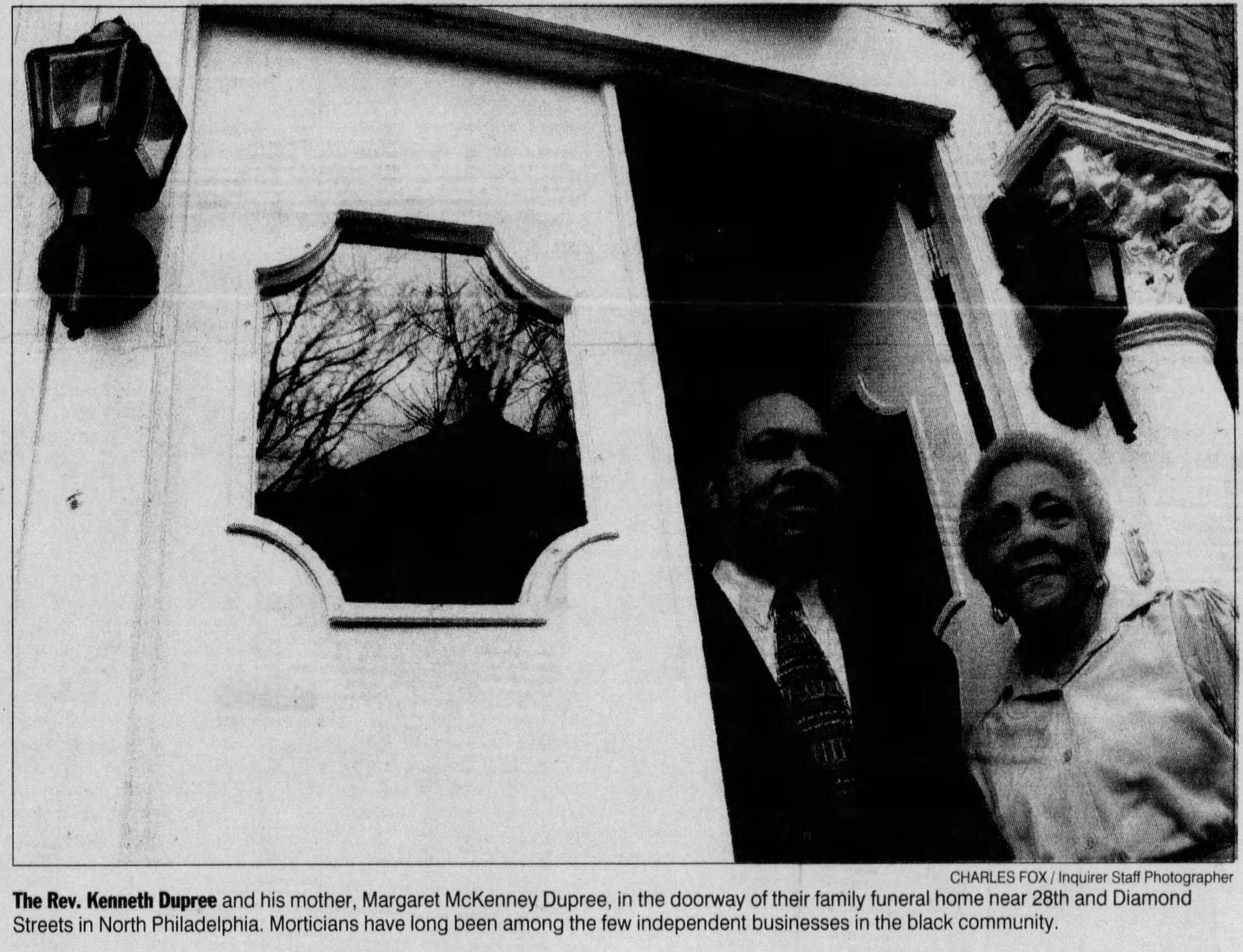
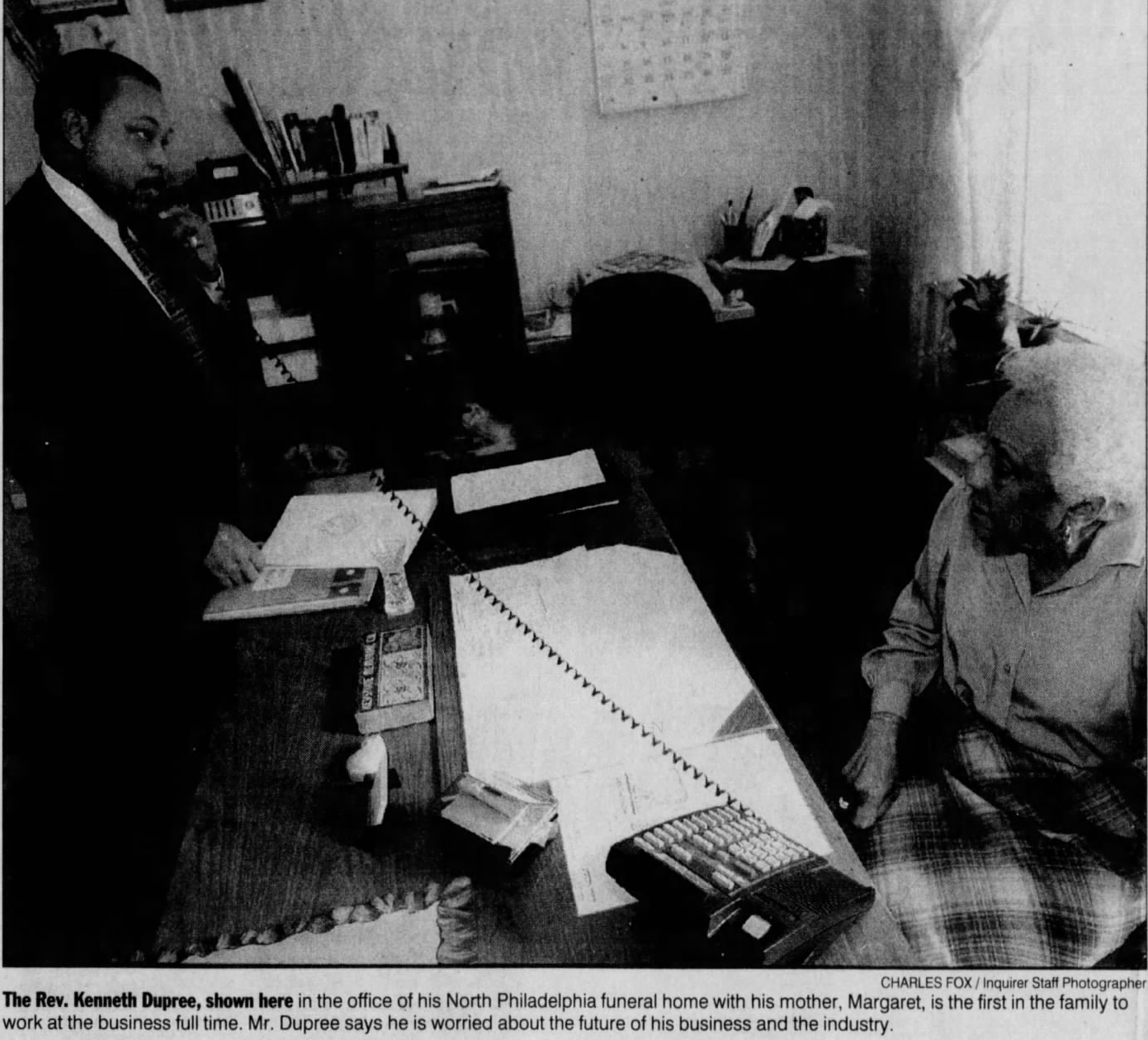
    This photo of Mrs. Dupree (right) and her son Kenneth appeared in The Inquirer in 1999.

    Her family called her career “a powerful symbol of her lifelong devotion to the calling of funeral service” and praised her “mentoring others, serving families with dignity, and remaining deeply connected to the profession she loved.”

    She was a charter member of Child’s Memorial Baptist Church, known now as Keeping It Real Christian Fellowship, and supported affordable housing initiatives in North Philadelphia. “I like for women to have a place to raise their children,” she told The Inquirer in 1998 regarding a proposed housing renewal project. “If you give people a place to work and take care of their children, then the whole neighborhood will be improved.”

    Friends and former colleagues called her “funny and sweet” and a “history maker” in online tributes. One friend said she was “a woman of grace, and her radiant smile always was contagious.” Another said: “She has had a positive impact on so many Philadelphians.”

    Margaret Alma McKenney was born July 8, 1921, in Belvedere, S.C. She relocated with her family to North Philadelphia when she was 5 and grew up at 13th and Diamond Streets.

    Mrs. Dupree doted on her grandchildren and great-grandchildren.

    During World War II, she worked for the Army Signal Corps and at the Frankford Arsenal. Afterward, she earned her funeral director’s license at the old Eckels College of Mortuary Science in Philadelphia.

    She married Troy Dupree in 1951, and they had daughters Melanie and Carrie, and sons Troy Jr. and Kenneth. For years, she reared the children, worked at the funeral home, and helped out at her mother’s shop.

    Later, she doted on her grandchildren and great-grandchildren, and a friend said online: “I am a better grandma having watched from one of the best to ever do it.”

    Mrs. Dupree enjoyed knitting sweaters for her children, solving cryptograms in the newspaper, and traveling with family and friends to Bermuda, Africa, and elsewhere. She always, even at restaurants, her son Kenneth said, ate her dessert first.

    Mrs. Dupree (right) sits at her office desk while her son Kenneth talks on the phone in a photo that was published in The Inquirer in 1999.

    “She had a multifaceted personality,” her son Kenneth said. “She was a comedian, an organizer, and a fan of the underdog.”

    Her family said: “Margaret lived a life rooted in service, compassion, and purpose. Funeral service and education were never just her profession. It was her calling.”

    In addition to her children, Mrs. Dupree is survived by six grandchildren, six great-grandchildren, and other relatives. Two sisters and five brothers died earlier.

    Services were held on Dec. 28 and 29.

    Donations in her name may be made to Project Home, Development Dept., 1515 Fairmount Ave., Philadelphia, Pa. 19130.

  • Carpenters union buys $52.5 million Navy Yard building and plans move

    Carpenters union buys $52.5 million Navy Yard building and plans move

    The Eastern Atlantic States Regional Council of Carpenters plans to relocate its headquarters and two local training centers to the Philadelphia Navy Yard.

    “We’re extremely excited about the prospects and what this facility is going to transform into over the next few years,” William Sproule, executive secretary-treasurer for the Carpenters, said on Tuesday. “It’s really only the beginning of the story, and we’re going to be doing a lot of neat things down there.”

    The council had outgrown its Spring Garden Street facility, Sproule said, and started seeking a new property 2½ years ago. Philadelphia buildings continue to have vacancies as a result of the pandemic, he said, and the current state of the real estate industry represented an opportunity.

    The council purchased the Navy Yard building for $52.5 million, said Sproule, and the deal closed on Dec. 19. The building at 5 Crescent Dr. previously sold for $130.5 million in 2018.

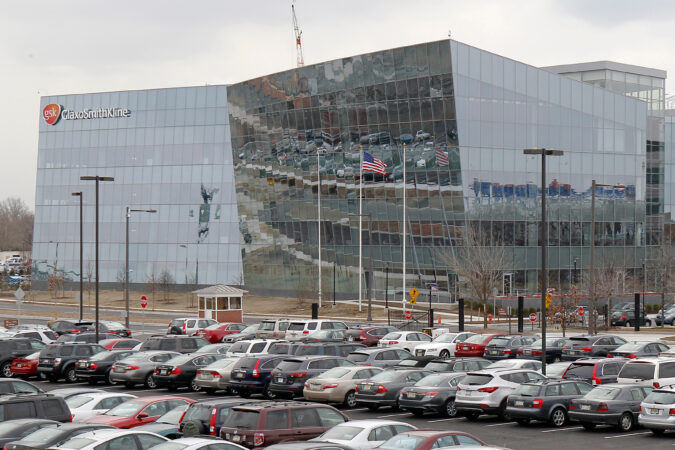
    The four-story, 208,000-square-foot building was designed for drugmaker GSK by the architectural firm of Robert A.M. Stern, which is also responsible for the first Comcast tower.

    The pharmaceutical company moved its operations to the Navy Yard from Center City in 2013.

    Although GSK was a remote-friendly company since before the COVID-19 pandemic, the building remained well used until 2020.

    Then, in 2022, GSK moved its operations out of the then-lightly used Navy Yard office to a 50,000-square-foot office in University City’s FMC Tower. In an unusual move the company continued to pay rent at the former location, and did not seek to sublease the space.

    That left the building at 5 Crescent Dr. in a tricky position: it is difficult to get new financing on a vacant building, even if rent is still being paid, because it is clear that when the lease is up the tenant will not renew. As a result, the building owner, Korea Investment Management Co., ran into financial problems on the property which went into foreclosure.

    Special servicer Rialto Capital Management has been handling the day-to-day care of the building in recent years. Neither Rialto nor GSK immediately replied to requests for comment.

    Office space in the Navy Yard is in high demand, with no official vacancy thanks to GSK’s continued rental of their former space. According to the official website, it hosts over 16,500 workers from 150 companies.

    Carpenters union’s plans for the Navy Yard

    Plans for the Navy Yard site include constructing a training facility adjacent to the purchased building that would eventually replace the council’s Northeast Philly and New Castle training centers, said Sproule. He estimated that it could cost $30 million to build out “on the low end,” and take at least 24 months to complete.

    The move to the Navy Yard will also improve accessibility for some, said Sproule. When apprentices who live in the city are first starting out, they might not have access to a car, he said, adding that the new site is conveniently located near the NRG SEPTA stop.

    “I think it’s going to be extremely convenient for members doing journeyman upgrade classes that live within the city limits as well as apprentices that live within the city limits that may not drive as much as folks that live out in the suburbs,” he said.

    Sproule said employees of the union could be working out of the Navy Yard site as soon as the end of April, with initially up to 125 people based out of the building’s fourth floor.

    The council has also already identified some potential tenants to lease out parts of the Navy Yard building.

    Sproule said the council is considering selling the Spring Garden facility, or getting it “zoned for a mid-rise, multifamily structure.”

    “We may try to build something similar to what’s across the street, or we may sell it to an interested party. We haven’t made those decisions yet,” he said. “I guess it’s just going to be a matter of what’s more practical and feasible.”

    Cyclists ride past 5 Crescent Dr. at the Navy Yard in Philadelphia, Pa., on Monday, April 29, 2024.

    Sproule said the purchase of the Navy Yard site seemed from the start like “a really good deal.” Then when he learned from an article in the Philadelphia Business Journal that the building at one time had sold for roughly $130 million, he said, “knowing that somebody actually invested that kind of capital for that building back then — which wasn’t that long ago, when you think about it — makes me really feel good about our endeavors that we’re about to embark on.”

    “Aside from our pension funds and all the investments that we do on that end to make sure that they are strong and secure for generations to come, we do have general fund assets that our Regional Council uses for operational purposes. We just hit a spot in time where we had an opportunity to possibly look at an investment of this size and magnitude, and it was just a matter of being at the right time, at the right place,” he said.

    Navy Yard neighbors

    The Carpenters are not the first building trades union to move to the Navy Yard from Spring Garden.

    In 2023, International Brotherhood of Electrical Workers Local 98 announced that it would be relocating its headquarters from 1719 Spring Garden St. The union purchased two properties for $18.5 million.

    “We’re excited to be their neighbors,” said Sproule.

    The Regional Council of Carpenters and Local 98 are among the most powerful building trades unions in Philadelphia, and they have strong membership bases in South Jersey and South Philadelphia, making the Navy Yard location at the edge of the city ideal for many members.

    The spacious property at the Navy Yard also allows room for training facilities, which could be difficult to co-locate with a headquarters office in other parts of the city.

    On the other side of Philadelphia is another concentration of building trades infrastructure in the Far Northeast. Near the Bucks County line, this hub provides similar advantages for union locals that include the Steamfitters, Ironworkers, and Bricklayers.

  • South Jersey’s Frank Cairone, a Brewers pitching prospect, hospitalized after serious car accident

    South Jersey’s Frank Cairone, a Brewers pitching prospect, hospitalized after serious car accident

    South Jersey’s Frank Cairone, an 18-year-old pitching prospect with the Milwaukee Brewers, remains hospitalized after a serious car accident Friday night in Gloucester County.

    According to the Franklin Township police, the Delsea Regional High graduate and a 20-year-old female passenger were injured following a vehicle crash at 10:15 p.m. Police said the crash happened when an 18-year-old female driver from Millville was traveling east at the intersection of Williamstown and Fries Mill Roads in Franklin and failed to stop at a stop sign. The car struck Cairone’s vehicle, which was traveling south.

    Cairone was flown to Atlantic City Medical Center and remained hospitalized as of Tuesday. No information has been given about his condition or when he would be released. The female passenger, who suffered injuries to her lower extremities, was driven to Cooper University Hospital in Camden.

    The driver of the other car was also taken to Cooper University Hospital with lower extremity injuries. According to police, she is expected to be charged with reckless driving and disregarding a stop sign. Alcohol and drugs did not play a role in the crash, police said.

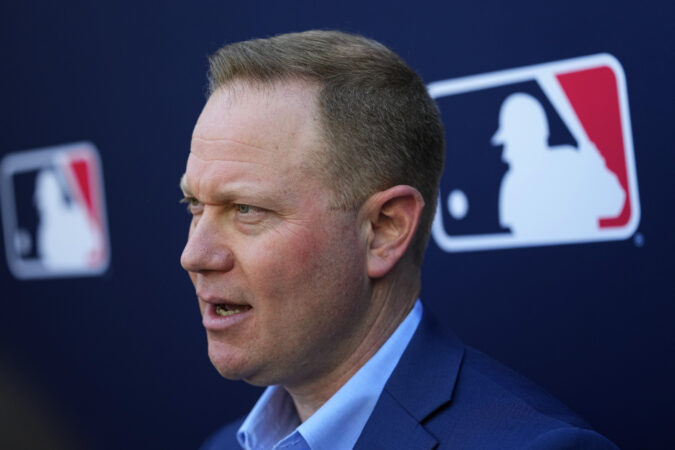
    Brewers president of baseball operations Matt Arnold said Monday that Cairone was “progressing positively. The reports we’ve gotten are good.”

    The 6-foot-3 pitcher was selected 68th overall in the MLB draft in July and was considered one of the top lefties available. He withdrew a commitment to Coastal Carolina to sign with Milwaukee and spent part of the summer and fall at the Brewers’ facility in Arizona in hopes of making his professional debut this year.

    With Delsea last season, Cairone was clocked throwing as high as 94 mph and kept an 88- to 90-mph pace in later innings. He struck out 94 batters in 44 innings and helped the Crusaders to an NJSIAA Group 3 quarterfinal appearance.

  • U.S. mandates more foreign travelers to pay $15,000 visa bond deposits

    U.S. mandates more foreign travelers to pay $15,000 visa bond deposits

    Foreign travelers from seven additional countries are now required to pay up to $15,000 for a reimbursable bond when applying for a U.S. visitor visa, as the Trump administration continues to tighten entry requirements to the country.

    As of Jan. 1, Bhutan, Botswana, the Central African Republic, Guinea, Guinea-Bissau, Namibia, and Turkmenistan are required to pay the assurances as part of a State Department pilot program launched in August. Thirteen countries are now affected by the program, most of them in Africa.

    The bond deposits — which the department has said are aimed at deterring visitors from staying in the United States longer than they are allowed for business or tourism — range between $5,000 and $15,000, and do not guarantee that a visa will be issued. The payment will be refunded if visitors depart the U.S. within the time specified on their visas, according to the policy.

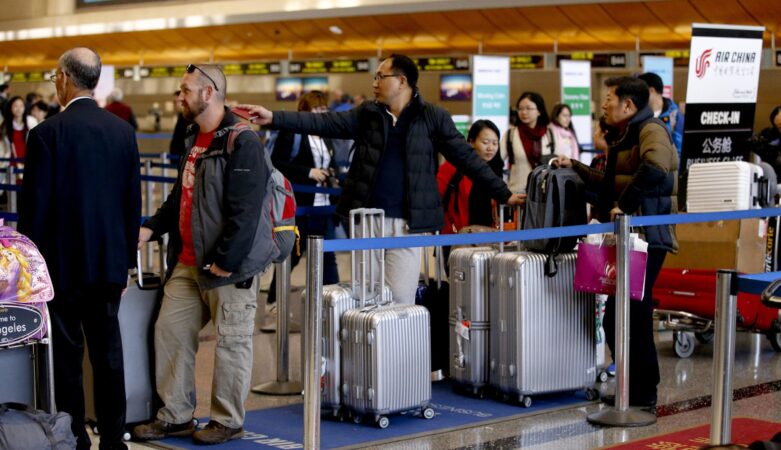
    Applicants whose visas are approved can only enter the U.S. from three designated airports: Boston Logan International Airport, New York’s John F. Kennedy International Airport, and Washington Dulles International Airport, the State Department notice said. The program is not applicable to those on student visas.

    Travelers from 42 countries that are part of the visa waiver program — who don’t need a visa to enter the U.S. — including much of Europe, Australia, Qatar, and Israel, are also exempt.

    The administration has said the program is aimed at countries with high visa overstay rates, citing a Department of Homeland Security report to Congress. However, some of the countries newly added to the list have low overstay numbers. The department suspects that two of the 137 visitors from the Central African Republic (or about 2%) overstayed their nonimmigrant business and tourist visas in fiscal year 2024, while about 4% from Namibia are suspected of overstaying.

    The pilot was launched in August with Malawi and Zambia. An estimated 234 visitors from Malawi (or 14%) overstayed their nonimmigrant visas in fiscal year 2023, as did 365 (11%) from Zambia. Four countries were added to the list in October.

    For couples or families, the potential up-front cost of $10,000 or $15,000 per person could be prohibitive. At the time of its launch, the State Department predicted the year-long pilot program would cost travelers around $20 million, based on 2,000 potential travelers paying an average bond of $10,000.

    The State Department had planned a six-month visa bond pilot in 2020, but did not implement it as global travel dwindled during the coronavirus pandemic.

  • Long under fire, Pemberton mayor resigns after being called uninsurable

    Long under fire, Pemberton mayor resigns after being called uninsurable

    Former Pemberton Township Mayor Jack Tompkins revealed in a rare interview this week that lawsuits stemming from allegations of misconduct against him made him uninsurable, compelling him to resign to avoid financial ruin.

    The township’s insurance carrier “decided to cancel my insurance,“ said Tompkins, 64, who resigned on Dec. 31. ”They notified me and the township in October. I weighed my options and the smartest thing to do was to resign. Withdrawal of insurance coverage would have financially devastated me.”

    Tompkins, a Republican, was long under fire for alleged sexual harassment and other behavior over the last two years.

    On Wednesday, the five-member township council of the Pine Barrens community in Burlington County — all Republicans — will choose one of three GOP candidates to replace Tompkins. The three candidates were selected by the Republican municipal county committee last week to serve the balance of the year. The committee didn’t release the candidates’ names.

    Tompkins was the subject of a highly critical independent investigation in April 2024 that was commissioned by township officials and conducted by a Hackensack law firm, Pashman Stein Walder Hayden.

    Some of the report’s more serious allegations included inappropriate interactions with female lifeguards under age 18; sexual harassment of the township’s recreation director, who sued Tompkins and the township, winning a $500,000 judgment.

    He was also accused of a pattern of misconduct — such as poking a woman in the head, or discussing rape in township offices — that was sometimes accompanied by obscene language and “retaliatory” outbursts, fostering what the investigators who wrote the report termed a “severe chilling effect” that silenced anyone who felt wronged and allowed Tompkins to continue his aberrant behavior.

    Tompkins said that while he was mayor, he worked in a “toxic environment created by [township] council, and I was walking on eggshells.

    “Things got really ugly and nasty.”

    He added that his time in office left “such a dirty taste in my mouth about politics, I want nothing to do with it anymore.”

    In office since January 2023, Tompkins, 64, a retired Air Force veteran, refused to quit during his tumultuous tenure despite calls from members of both political parties for him to do so, including Gov. Phil Murphy.

    Over time, the township council officially censured Tompkins, whose pay was cut from $13,000 annually to $4,000, to $1.

    Tompkins told The Inquirer on Monday he relented after the Burlington County Municipal Joint Insurance Fund, which covers the township, informed him of their decision to no longer insure him. The fund cited “numerous claims resulting from your interaction with Pemberton Township employees over the past several years.”

    Township officials said last summer that more lawsuits connected to Tompkins were expected.

    In the interview, he said that inappropriate behavior with lifeguards “never happened.” He also said that any alleged misconduct “toward [other] females never happened.” He declined to comment on additional allegations.

    Tompkins said there have been “zero criminal charges” leveled against him. He added, “Everything has been civil allegations, and nothing’s been proven.”

    Asked why these allegations were made in the first place, Tompkins said, “You’re looking for an answer to something I don’t know. I don’t know what they were trying to do.”

    Accused on several occasions of cursing and being harsh to staff, Tompkins explained, “Sometimes when you’re the boss and tell somebody they need to get something done, I guess they wanted me to ask ‘pretty please.’ With my military background, that wouldn’t always happen.”

    Tompkins said he’s survived the experience with the support of friends and family “who knew this was nonsense.”

    Sherry Scull, a former Democratic township council member, has publicly supported Tompkins, and continues to do so. “I’ve never seen signs of him doing what he was accused of,” she said. “I think his resigning is sad.”

    Others contacted this week didn’t agree.

    “This has been a total embarrassment for the town,” said Republican council member Dan Dewey.

    Abby Bargar, Republican municipal chair for Pemberton Township, said, “I always liked Jack, but I think he made some bad decisions. It was the best thing for the party that he stepped down.”

    Throughout town, the reaction to the end of Tompkins’s administration is “overwhelmingly positive,” said Marti Graf Wenger, president of the Browns Mills Improvement Association. Browns Mills is an unincorporated section of Pemberton Township; the association works to improve and promote the area, once a “Gatsby-esque” locale with chic hotels that drew well-off Philadelphians vacationing in the woods, Wenger said.

    She added, “Tompkins treated this town like his dictatorship. There’s just a sense of relief now, a feeling that we can start fresh and hope our leadership will be better.”

    Asked whether lingering resentments will make it difficult to remain in town, Tompkins said he’s not going anywhere.

    “I just want to go into retirement and put this chapter behind me,” he said. “I’ve traveled the world, and I’ve settled here. I once said I’m going to die in this house. So this is where I’ll be.”

  • Iran hospital raid fuels protest anger as crackdown kills 29

    Iran hospital raid fuels protest anger as crackdown kills 29

    Iran’s government ordered an investigation into clashes between protesters and riot police at a hospital in the country’s west as a video emerged online showing another hospital being hit with tear gas by security forces.

    Video posted to social media on Tuesday purportedly showed the courtyard of Sina Hospital submerged in tear gas smoke. The footage cannot be verified by Bloomberg but the hospital is near the capital’s Grand Bazaar, where a fresh bout of protests and clashes with police erupted on Tuesday, according to the Associated Press.

    Security forces fired tear gas at demonstrators in the sprawling market — where unrest began on Dec. 28 — who had shuttered their businesses and were staging a sit-in at the trading hub, the AP said, citing witnesses. Unverified social media footage also appeared to show police rushing crowds in the bazaar’s surrounding streets and in one of its main arteries.

    The U.S.-based Human Rights Activists News Agency said Monday that at least 29 people have been killed in provinces including Lorestan, Fars, and Kurdistan and more than 1,200 people arrested since a sharp currency decline triggered demonstrations in Tehran that later spread to other cities.

    On Sunday, videos emerged on social media appearing to show security forces storming the Imam Khomeini Hospital in the western city of Ilam and firing tear gas inside. The footage fueled even more public anger at the authorities, prompting President Masoud Pezeshkian to order the investigation. Officials haven’t yet responded to the incident at the hospital in Tehran.

    The protests have divided Iran’s leadership over how to respond. While Pezeshkian, a political moderate and a former heart surgeon, has described protesters’ demands as legitimate, judiciary chief Gholam-Hossein Mohseni Ejei has warned that “no leniency or tolerance” would be shown toward protesters and vowed swift trials, according to the official Mizan news agency.

    “Rioters can no longer claim to have been misled,” Ejei said, accusing the U.S. and Israel of openly backing the unrest. “There is now no room for any concessions toward rioters and instigators of unrest.”

    Supreme Leader Ayatollah Ali Khamenei, who has the final say on most state matters, said Saturday that “rioters must be put in their place.”

    The protests are the biggest to rock Iran since nationwide unrest in 2022 over the death of a young woman, Mahsa Amini, in police custody. But they don’t yet represent a threat to the Islamic Republic’s security, Eurasia Group analysts wrote in a report last week.

    The unrest comes amid deteriorating living conditions in Iran, where high inflation, rising costs and a weak currency have fueled growing public dissatisfaction.

    The government has announced measures to ease the frustration including a monthly cash subsidy of 10 million rials (roughly $7) for each member of every household. It also appointed a new central bank governor to stabilize the declining rial.

    The subsidy is part of a broader “livelihood plan” that’s aimed at offsetting the rising cost of basic goods like cooking oil, milk, sugar, and meat, government spokeswoman Fatemeh Mohajerani said on Monday.

    Iran’s currency has dropped by around 45% on the black market in the past year. It trades at roughly 1.5 million against the dollar, according to bombast, a website that tracks the currency.

  • Congress has four weeks to dodge another shutdown

    Congress has four weeks to dodge another shutdown

    Lawmakers are back in Washington this week for a four-week sprint to finish funding the government before the current spending law runs out on Jan. 30.

    If they fail, they will need to pass another short-term extension or spark another government shutdown just two and a half months after the last one, the longest funding lapse in U.S. history.

    Funding the government usually requires passing 12 individual bills. Lawmakers approved three as part of a deal to end last fall’s shutdown, and they also extended current funding levels for the rest of the government into January. Those levels were last set in March 2024.

    But it will be challenging to finalize the remaining bills, which have not yet been formally negotiated between the House and the Senate or approved by congressional leaders.

    The two Appropriations Committee chairs, Rep. Tom Cole (R., Okla.) and Sen. Susan Collins (R., Maine), announced in late December that they had finally reached an agreement on the total spending level they’ll shoot for in the remaining bills. They did not reveal the overall cost, but Cole said it is lower than the amount if Congress were to pass another funding extension, known as a continuing resolution.

    “This pathway forward aligns with President [Donald] Trump’s clear direction to rein in runaway, beltway-driven spending,” Cole said in a statement. “We will now begin expeditiously drafting the remaining nine full-year bills to ensure we are ready to complete our work in January.”

    From there, appropriators must navigate political pressures from their right and left: Fiscal hawks, including many in the conservative House Freedom Caucus, insist that funding levels for most agencies should not be higher than the last fiscal year.

    “I believe that we should begin to control our federal deficit and runaway federal debt by keeping this year’s discretionary spending level at or below last year’s level,” said House Freedom Caucus chairman and senior Appropriations Committee member Rep. Andy Harris (R., Md.) in a statement.

    But Democrats must approve any funding agreement, which has to receive at least 60 votes in the Senate to bypass the filibuster. Republicans control the upper chamber 53-47.

    Sen. Patty Murray of Washington, the top Democrat on the Senate Appropriations Committee, slammed the chamber’s newly released Homeland Security spending bill in December, calling it “partisan” and pledging to fight for accountability in Trump’s “out-of-control” DHS.

    The Senate has spent weeks attempting to pass a five-bill appropriations package that had only been negotiated in that chamber. The bill needed consent from all 100 senators to advance, and several conservative senators held up action for weeks over billions of dollars in earmarks tucked into the bills. (The House proposals also include billions in earmarks.)

    Those senators eventually relented, and the chamber was poised to vote on the package right before leaving town for the winter break, but two Democratic senators blocked it — demanding funding be reinstated for the National Center for Atmospheric Research, a Colorado-based research organization that Trump has moved to eliminate.

    The Senate package would tie together two major government funding bills — covering defense, labor, education, and health and human services agencies — with three other bills to fund the departments of Interior, Transportation, Housing and Urban Development, Commerce, Justice, and science-related agencies.

    It would appropriate $1.3 trillion, making up the vast majority of discretionary federal government spending.

    Cole has said that the Senate’s five-bill package would be too big to pass the lower chamber. He suggested passing the remaining nine appropriations bills in three separate three-bill packages in January when lawmakers return, beginning with bills covering the Commerce and Justice Departments, the Interior Department and agencies covering energy and water.

    The political minefield ahead may mean lawmakers once again turn to a funding extension rather than face another shutdown.

    “I don’t want another CR, I don’t think Mr. Cole wants another CR,” said Rep. Rosa DeLauro of Connecticut, the top Democrat on the House Appropriations Committee. “Let’s go. Let’s get the bills done.”

    Congress is supposed to pass all 12 appropriations bills before government funding runs out at the end of each fiscal year on Sept. 30.

    But lawmakers’ inability to adhere to that process is not new: Congress has only passed all its spending bills before the deadline four times in recent decades. Instead, most spending bills in modern history have been approved in one big package known as an “omnibus” right before the holiday break.

    House Speaker Mike Johnson (R., La.) pledged to stop that practice. The political complications of passing all 12 bills separately, however, has made that difficult to achieve. Instead, lawmakers have extended funding levels first approved under President Joe Biden multiple times, and Republicans have passed supplemental spending for their immigration and defense priorities through a party-line tax and spending bill.