Blog

  • NFL playoffs: Full wild-card schedule; Birds to face 49ers; last team punches postseason ticket

    NFL playoffs: Full wild-card schedule; Birds to face 49ers; last team punches postseason ticket

    The Eagles finally know which team they’ll face next weekend during the wild-card round of the playoffs.

    Following their 24-17 loss to the Washington Commanders Sunday, the Eagles will enter the playoffs as the No. 3 seed and host the San Francisco 49ers at the Linc during the first round of the playoffs.

    The game is scheduled for Sunday at 4:30 p.m. on Fox.

    The Eagles missed out on a chance to land the No. 2 seed, which they had an opportunity to snag after the Detroit Lions defeated the Chicago Bears Sunday.

    The final playoff spot was claimed in dramatic fashion Sunday night, with the Pittsburgh Steelers edging out the Baltimore Ravens in a wild fourth-quarter that saw three lead changes. As a result, the Steelers win the AFC North and will host the Houston Texans in the wild-card round.

    Despite losing Saturday night, the Carolina Panthers were crowned NFC South champions Sunday, thanks to the Atlanta Falcons’ win against the New Orleans Saints.

    The Jacksonville Jaguars won the AFC South by defeating the Tennessee Titans Sunday, but missed out on landing the No. 1 seed, which went to the Denver Broncos for the first time since 2015, when they won Super Bowl 50.

    The Seattle Seahawks claimed the NFC West title and the No. 1 seed with their 13-3 win against the San Francisco 49ers Saturday night.

    Which team will the Eagles play in the playoffs?
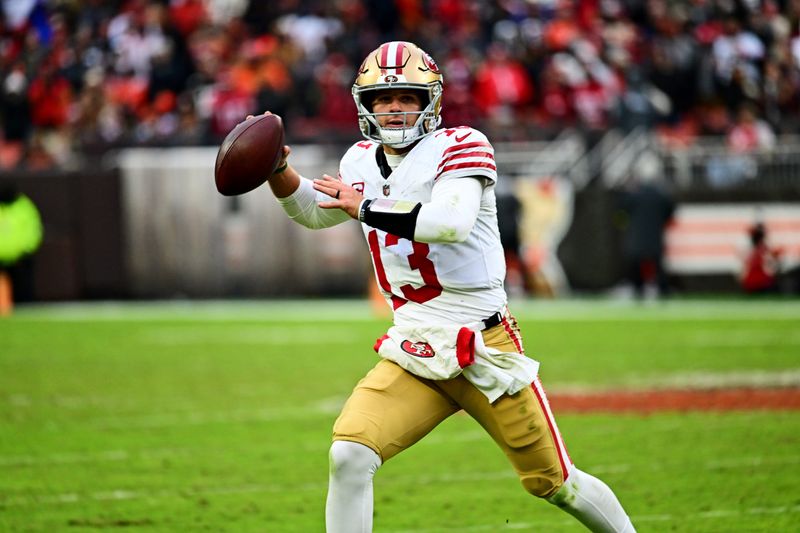
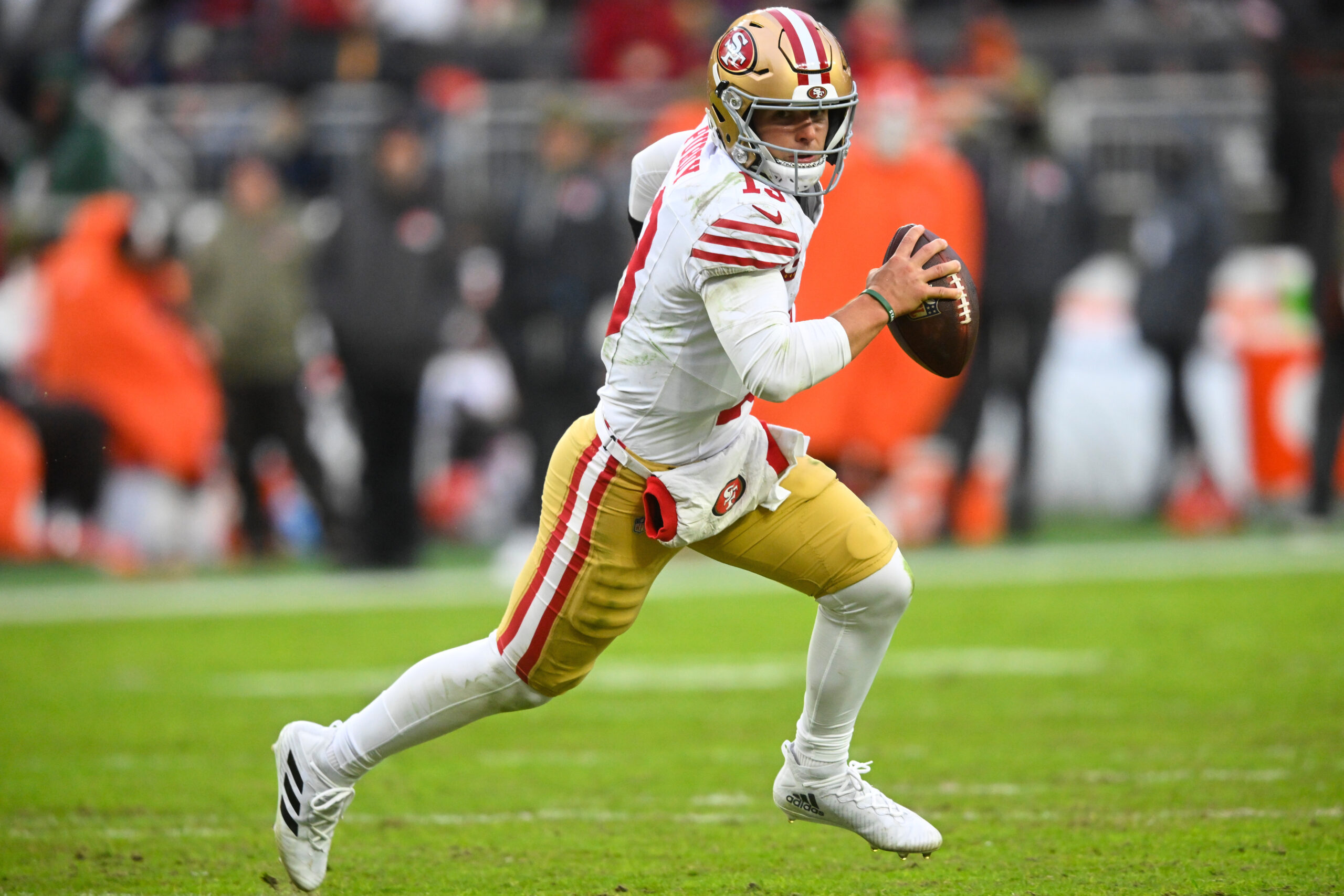
    Brock Purdy and the 49ers will face the Eagles at the Linc in the wild-card round.

    As the No. 3 seed, the Eagles will host the 49ers in the wild card round.

    The 49ers missed out on winning the NFC West Saturday night, losing to the Seahawks. They dropped down to the No. 6 seed after the Los Angeles Rams defeated the Arizona Cardinals Sunday.

    2026 wild-card playoff schedule

    Here is the full schedule for the wild-card round of the playoffs, which the NFL announced Sunday night:

    window.addEventListener(“message”,function(a){if(void 0!==a.data[“datawrapper-height”]){var e=document.querySelectorAll(“iframe”);for(var t in a.data[“datawrapper-height”])for(var r,i=0;r=e[i];i++)if(r.contentWindow===a.source){var d=a.data[“datawrapper-height”][t]+”px”;r.style.height=d}}});

    The No. 1 seed Seahawks and No. 1 seed Broncos get byes, and will host the lowest-remaining team during the divisional round of the playoffs.

    NFC playoff picture

    window.addEventListener(“message”,function(a){if(void 0!==a.data[“datawrapper-height”]){var e=document.querySelectorAll(“iframe”);for(var t in a.data[“datawrapper-height”])for(var r,i=0;r=e[i];i++)if(r.contentWindow===a.source){var d=a.data[“datawrapper-height”][t]+”px”;r.style.height=d}}});

    The Panthers clinched the NFC South Sunday, claiming the NFC’s final playoff spot.

    Despite the Panthers losing to the Tampa Bay Buccaneers Saturday night, the Falcons’ win against the Saints created a three-way tie at 8-7 atop the NFC South. The tiebreaker fell to their head-to-head record, with the Panthers (3-1) edging out the Buccaneers (2-2) and Falcons (1-3).

    Here how the NFC playoffs will look:

    • No. 1 seed: Seahawks
    • No. 2 seed: Bears
    • No. 3 seed: Eagles
    • No. 4 seed: Panthers
    • No. 5 seed: Rams
    • No. 6 seed: 49ers
    • No. 7 seed: Packers

    AFC playoff picture

    window.addEventListener(“message”,function(a){if(void 0!==a.data[“datawrapper-height”]){var e=document.querySelectorAll(“iframe”);for(var t in a.data[“datawrapper-height”])for(var r,i=0;r=e[i];i++)if(r.contentWindow===a.source){var d=a.data[“datawrapper-height”][t]+”px”;r.style.height=d}}});

    The Broncos claimed the AFC’s No. 1 seed by defeating the Los Angeles Chargers Sunday.

    The win drops the New England Patriots down to the No. 2 seed, with the Jaguars claiming the AFC South and the No. 3 seed.

    The Steelers won the AFC North for the first time since 2020 and enter the playoffs as the No. 4 seed.

    Here how the AFC playoffs will look:

    • No. 1 seed: Broncos
    • No. 2 seed: Patriots
    • No. 3 seed: Jaguars
    • No. 4 seed: Ravens
    • No. 5 seed: Texans
    • No. 6 seed: Bills
    • No. 7 seed: Chargers

    Full 2025 NFL playoff schedule

    • Wild-card round: Saturday, Jan. 10, to Monday, Jan. 12
    • Divisional round: Saturday, Jan. 17, to Sunday, Jan. 18
    • AFC and NFC championship games: Sunday, Jan. 25
    • Super Bowl LX: Sunday, Feb. 8

    Where is this year’s Super Bowl?

    Super Bowl LX (or 60, for those who don’t like Roman numerals) is being held at Levi’s Stadium in Santa Clara, Calif., home of the San Francisco 49ers. NBC will broadcast this year’s Super Bowl, with Mike Tirico and Cris Collinsworth on the call.

    Here are the sites announced for future Super Bowls:

    • Super Bowl LXI: Feb. 14., 2027, SoFi Stadium, Inglewood, Calif. (ESPN, ABC)
    • Super Bowl LXII: Feb. 2028, Mercedes-Benz Stadium, Atlanta (CBS)
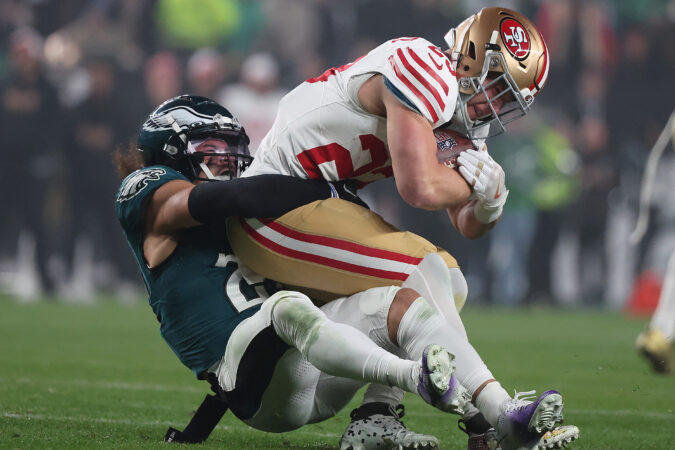
  • Eagles react to facing the San Francisco 49ers in the playoffs: ‘It’s going to be good on good’

    Eagles react to facing the San Francisco 49ers in the playoffs: ‘It’s going to be good on good’

    What’s the first thing that comes to mind when you think of the San Francisco 49ers, the Eagles’ first-round opponents in the playoffs?

    “Got to stop their run, Christian McCaffrey,” Brandon Graham said.

    It is where the game plan and film review starts for good reason. McCaffrey was second in the NFL during the regular season in yards from scrimmage with 2,126 (1,202 rushing yards, 924 receiving yards). On Sunday, the sixth-seeded 49ers will bring to Lincoln Financial Field a high-powered offense with McCaffrey as the focal point, and a defense that is nothing like the one that helped San Francisco reach four NFC title games — and two Super Bowls — during a five-season stretch from 2019 to 2023.

    Reactions from the Eagles inside their locker room after they fell, 24-17, to the Washington Commanders in their regular-season finale were pretty similar.

    Graham didn’t know which team the Eagles were playing until reporters told him. He had other things to worry about during the course of Sunday’s game since he dressed and played. But Reed Blankenship and Zack Baun, two defensive starters who had the night off, each expressed a similar mindset: “It doesn’t matter who we play,” Blankenship said. “We’re all excited. A lot of us had a week off and we’re ready to play. I feel like that was the best decision that Coach made and I feel fresh. We don’t know when we’re going to play them, but whatever day it is, [they’ve] got to come over here and come back to Philly.”

    The Eagles and 49ers have some recent history. A mini-rivalry of sorts formed after the Eagles blew out the banged-up 49ers in the NFC title game, 31-7, during their run to the Super Bowl at the end of the 2022 season. The 49ers exacted revenge just over 10 months later in a 42-19 victory that kick-started the Eagles’ miserable collapse to finish the 2023 season.

    During that latter game, McCaffrey rushed 17 times for 93 yards and a touchdown and added three catches for 40 yards.

    “Christian McCaffrey is a dog,” Blankenship said. “We played them in ’23 and then obviously in ’22, so I played them twice. They have a really good offensive core and obviously it’s going to be a challenge. It’s the playoffs. Everybody is good. It’s going to be good on good. It’s win or go home, but we’re ready. We’re prepared for that. We’ve been through that.”

    DeVonta Smith said the playoff opener is “just another game, but it’s the playoffs. We don’t want to go home, so everybody’s going to have a little more oomph.”

    The 49ers have been bringing the oomph. They were 6-4 through 10 weeks and then won six consecutive games before falling, 13-3, Saturday night at home to Seattle against one of the best defenses in the NFL. They are 7-2 in games quarterback Brock Purdy has started.

    Brock Purdy has helped lift the 49ers when healthy this season.

    The Eagles will likely be leaning on Saturday’s low-output offensive effort from the 49ers as they prepare for their first postseason matchup. Like top-seeded Seattle, the Eagles have one of the best defenses in the league, and while the Eagles offense has been inconsistent, San Francisco’s strength isn’t its defense. The 49ers gave up 38 points to Chicago on Dec. 28 and needed a red-zone stand to keep their hopes alive for the No. 1 seed. The Eagles, who opened as 3½-point favorites, probably feel their ability to take care of the ball and play good defense is the recipe for a win.

    “[We’ve] just got to be us and bring the energy,” Graham said. “Play fast on defense and put the offense in a great position. It’s going to be [about] field position in that game.

    “I know the 49ers are going to definitely come here and try to get one on our field and [we’ve] got to defend it.”

    Blankenship and Baun both said they felt rested and ready for the postseason run. It was the obvious topic of conversation after the Eagles lost and missed out on a chance to secure the No. 2 seed in the conference. The Eagles chose rest over the possibility of moving up a spot, and Blankenship said he wasn’t going to look back with any regrets.

    Nick Sirianni talked earlier in the week about his decision, and one of the things he pointed to was the Eagles resting their starters in Week 18 last season and entering the postseason healthy and rested.

    Last season’s playoff run ended with a Lombardi Trophy and a parade on Broad Street. Why, despite the ups and downs, might this team have another run in them?

    “I think we’re really ramping it up,” Baun said. “I feel like we’re in a good position as a team, as a collective. Especially as a defense, we’re playing really good football right now.”

    It all starts next weekend.

    “It’s a big game,” Baun said. “It’s the postseason. It’s the playoffs, and this team definitely turns it on in the playoffs.”

  • Eagles’ first playoff loss was to karma. Next up: the 49ers.

    Eagles’ first playoff loss was to karma. Next up: the 49ers.

    You can rationalize it all you want. No, really, you can. There are lots of reasons to believe the Eagles won’t live to regret the decisions they made in Week 18.

    To shrug their shoulders at the No. 2 seed.

    To go against everything that Nick Sirianni and his coaches have preached throughout their tenure with the Eagles: that the most important Sunday is the current one.

    To do what no other team chose to do this weekend and rest their starters when a potential home playoff game was on the line.

    Sure, there are reasons. If the Eagles can’t beat an injury-depleted 49ers team at home like the Seahawks did on Saturday and then beat an inexperienced Bears team on the road like the Lions did on Sunday, then they don’t deserve to be in the Super Bowl. Even with the No. 2 seed, they would have lost somewhere along the line … probably not to the Packers or Bears at Lincoln Financial Field, but certainly to the Seahawks in Seattle or the Rams at home.

    Right?

    The more you talk it out, the sillier it sounds, which is why all the rationalizations in the world can’t change the cold, hard truth. If the Eagles would have beaten the Commanders on Sunday, their odds of repeating as Super Bowl champions would have been better than they are now. Now, after an ugly 24-17 loss to Washington that should quell all that talk of Tanner McKee being traded for premium draft capital, the Eagles will enter the postseason as the third-seeded team in the NFC. They will play the depleted but pedigreed 49ers instead of the depleted and not pedigreed Packers. Then, they will likely either travel to Chicago or host the dangerous Rams, instead of hosting the Bears.

    Could everything break in their favor? Sure. If the Packers upset the Bears next weekend, and if the Panthers upset the Rams next weekend, the Eagles would essentially be where they would have been as the No. 2 seed. In that case, the top-seeded Seahawks would host the seventh-seeded Packers and the Eagles would host the Panthers for the right to advance to the NFC championship. But, then, if the Packers upset the Bears and the Rams beat the Panthers, the Eagles would be hosting the Rams in a rematch of their Week 3 game, which saw the Rams jump out to a 26-7 lead and eventually lose on a blocked field goal.

    Essentially, the result of the Eagles’ loss to the Commanders on Sunday was to bring into play the possibility of a second-round matchup with the Rams, in addition to the possibility of traveling to frigid Soldier Field rather than hosting the Bears.

    If chalk prevails elsewhere — the Rams opened as 10.5-point favorites against the Panthers, the Bears as 1.5-point favorites against the Packers — the Eagles have a manageable road to the NFC championship. There’s a decent chance they’ll be the betting favorite in any situation other than a road game in Seattle or a home game against the Rams. And they might also be favored against the Rams. The difference now is that, barring upsets, there is no easy road. They are a better team than the Bears on a neutral field, their Black Friday loss notwithstanding. But their offensive struggles have been exacerbated in suboptimal conditions — at Buffalo, at Green Bay, home against the Lions. The conditions at Soldier Field in January are rarely optimal. The Eagles will be better than they were, assuming they have a healthy Jalen Carter and a healthier Lane Johnson. But playing on the road creates far more uncertainty.

    The expected return of tackle Lane Johnson gives the Eagles plenty of optimism for a repeat.

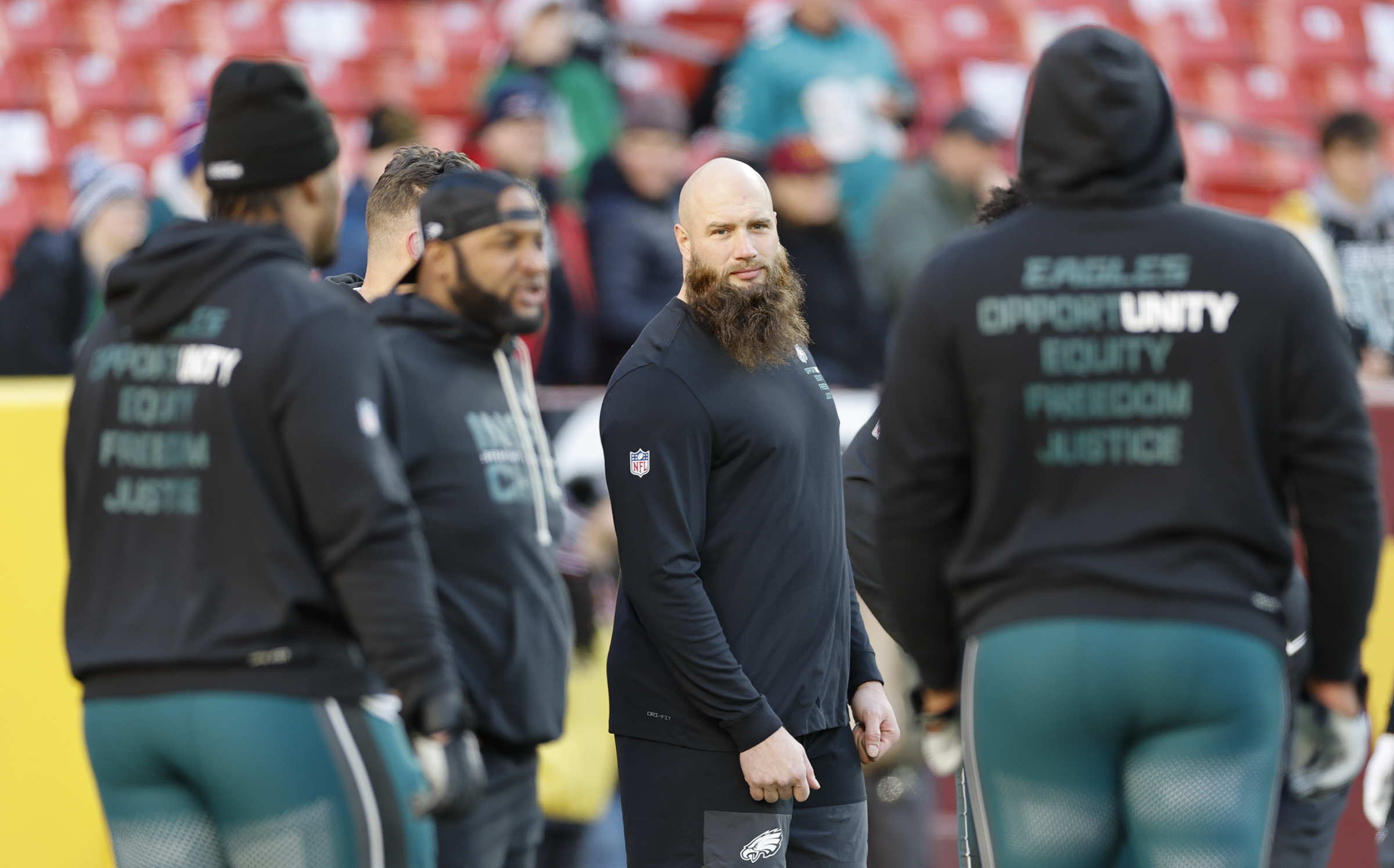
    As for the 49ers, well, they figure to be a tougher test than the Packers. Kyle Shanahan is one of the brightest offensive minds in recent NFL history. He, Brock Purdy and the rest of the 49ers will derive plenty of motivation from the memory of their quarterbackless playoff loss to the Eagles three years ago. That being said, this 49ers team is far different from the one that destroyed the Eagles — and catapulted Dom DiSandro to celebrity status — at Lincoln Financial Field late in 2023 en route to its own Super Bowl. The defense is in shambles, absent longtime stalwarts Fred Warner at linebacker and Nick Bosa on the edge. The Niners have little pass-catching talent outside of tight end George Kittle and running back Christian McCaffrey. As long as the Eagles can stop the run, they should be fine.

    At the end of the day, the Eagles are still a team that everybody must take seriously. Even as the No. 2 seed, they would have likely needed to beat Seattle on the road or the Rams at home in order to advance to the Super Bowl. They still have the third-best odds at winning the NFC, according to the online sportsbooks.

    You just have to wonder. If Sirianni knew that the Lions would beat the Bears on Sunday, and that his Eagles only needed to beat the Commanders to secure the No. 2 seed, would he have done anything differently?

  • DeVonta Smith’s milestone, Josh Johnson’s age, and more from the Eagles-Commanders broadcast

    DeVonta Smith’s milestone, Josh Johnson’s age, and more from the Eagles-Commanders broadcast

    The Eagles dropped the final game of the regular season, 24-17, to the Commanders, locking them into the No. 3 seed in the playoffs and a matchup with the 49ers.

    If you were at Lincoln Financial Field for the game, here’s everything you missed on the broadcast of the regular-season finale:

    Mr. Smith goes for 1,000 vs. Washington

    The Birds’ offensive starters sat out Sunday’s game — except for DeVonta Smith (well, also Tyler Steen).

    Since Smith went into Sunday’s game just 44 yards shy of a 1,000-yard receiving season, the team wanted to get him on the field to have a chance at hitting that milestone for the third year, play-by-play announcer Kevin Harlan said.

    Smith surpassed 1,000 yards on a 27-yard catch to end the first quarter and promptly left the game, and he was all smiles on the sideline with Nick Sirianni.

    Josh Johnson’s age is nothing but a number that is a major storyline

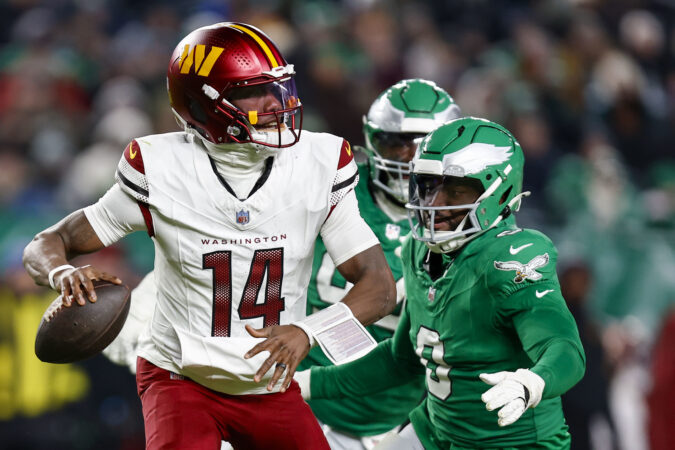
    Commanders third-string quarterback Josh Johnson, who started Sunday, has played for 14 NFL teams since he was first drafted in 2008 — plus stints in the Alliance of American Football and the XFL.

    Eagles fans are most familiar with him after he replaced an injured Brock Purdy in the 2023 NFC championship game in San Francisco, but the 39-year-old made just his 11th career start in Sunday’s season finale.

    CBS listed all of his NFL stops. Johnson has played for five teams at least twice, including Baltimore, San Francisco, Cincinnati, the Jets, and Washington.

    Permission denied

    Reed Blankenship, like most of the other defensive starters, spent the game on the sideline, resting for the playoffs.

    But these Birds love football too much to stay away. After rookie Brandon Johnson got shaken up in the second quarter and left the game, Blankenship, who was suited up, tried to get in the game to replace him.

    The coaches didn’t let him.

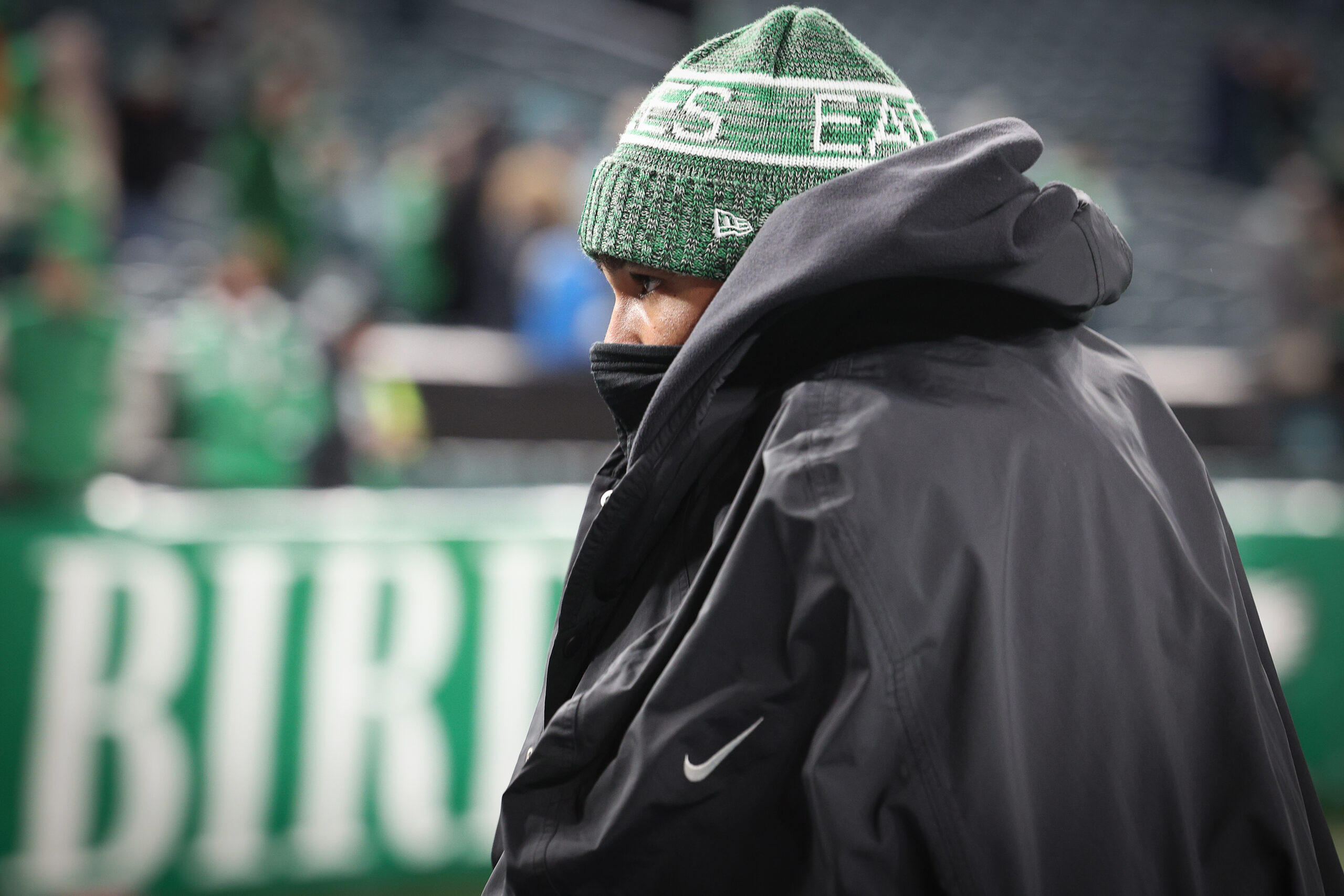
    Jalen Hurts was bundled up for some Week 18 rest.

    Cold-weather mode activated for Hurts

    Jalen Hurts, on the other hand, was nowhere close to getting into the game. He was bundled up in a balaclava and a winter hat on the sideline, with only his eyes visible.

    In these freezing temperatures, who could blame him? I bet more than one of you in the stands was sporting a similar look.

    Respect your elders?

    Eagles first-round linebacker Jihaad Campbell grew up a Birds fan in Gloucester Township, N.J., but he almost missed out on the opportunity to play with one of his childhood heroes, Brandon Graham, who famously retired a year ago and then unretired during this season.

    “How funny was it when we asked Jihaad Campbell who some of his favorite Eagles were growing up, and his answer was Brandon Graham?” Ross Tucker, the color analyst for Sunday’s game, said.

    “Who’s playing right now!” play-by-play announcer Kevin Harlan interrupted.

    “He said, in middle school everybody liked Brandon Graham,” Tucker said.

    Ross Tucker knows the two-deep

    Tucker, who is part of the broadcast team for Eagles preseason games and also hosts a Birds podcast, called Sunday’s game alongside Harlan.

    With most of the Birds starters sitting out the game, there may not have been a man with any network more qualified to share their insights.

    “I’m pretty much the foremost expert on the Eagles backups,” Tucker joked.

    Daily double falls short

    As the Lions-Bears game went down to the wire, Harlan found himself calling two games at once, providing updates on the game in Chicago while also calling the Eagles-Commanders game.

    The Lions hit the game-winning field goal, which could have propelled the Eagles into the second seed, just as Tanner McKee’s pass fell incomplete on fourth down, virtually ending their hopes to win the game.

  • Eagles grades: Backups don’t exactly inspire confidence in loss to Commanders

    Eagles grades: Backups don’t exactly inspire confidence in loss to Commanders

    Instant grades on the Eagles’ performance in their 24-17 loss to the Washington Commanders:

    Quarterback: C-

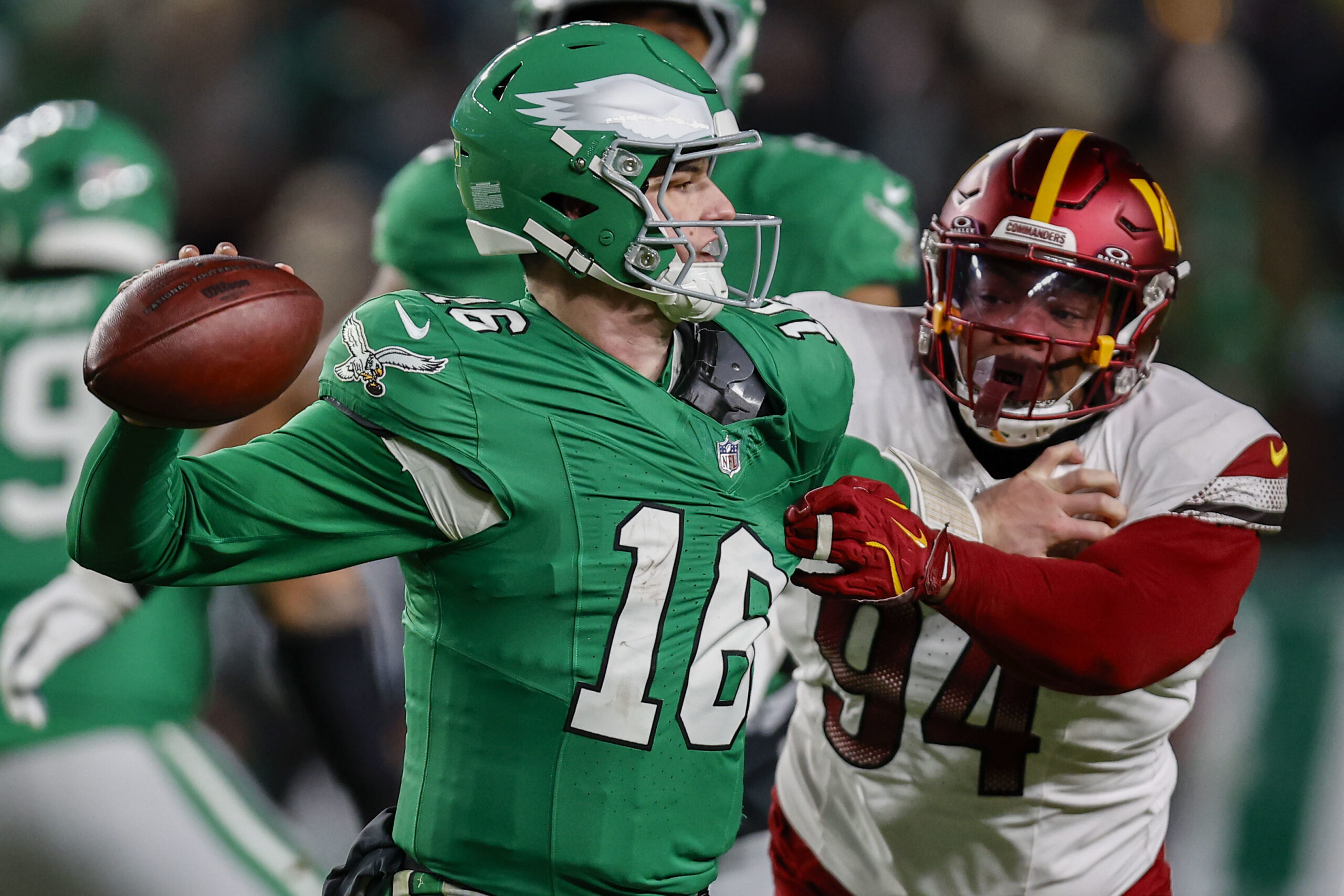
    Tanner McKee made his second career start with Jalen Hurts and most Eagles starters resting. He played solidly, if not as well as some had hoped. He was efficient in the drop-back passing game when he threw in rhythm. McKee had a few out-of-structure moments but struggled when pressured and often had to throw the ball away. He completed 21 of 40 throws for 241 yards and a touchdown.

    McKee threw a bad interception before the half. He might not have been on the same page as his intended target, Jahan Dotson, but it’s a throw he shouldn’t have attempted. Safety Jeremy Reaves made the easy pick at the Washington 1-yard line.

    McKee threw a 15-yard touchdown pass to tight end Grant Calcaterra to open the scoring. The seam route was the perfect call vs. a quarters zone. He might have flushed himself into pressure on the fourth-down attempt from the Washington 6 late in the second quarter. He missed an open receiver on fourth down late in the game.

    Running back: B-

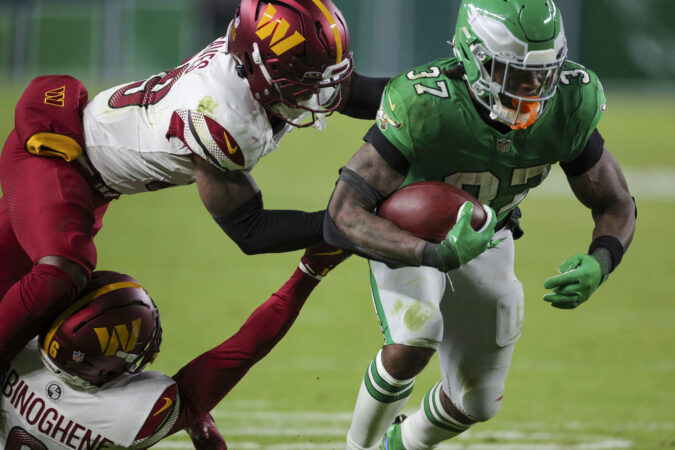
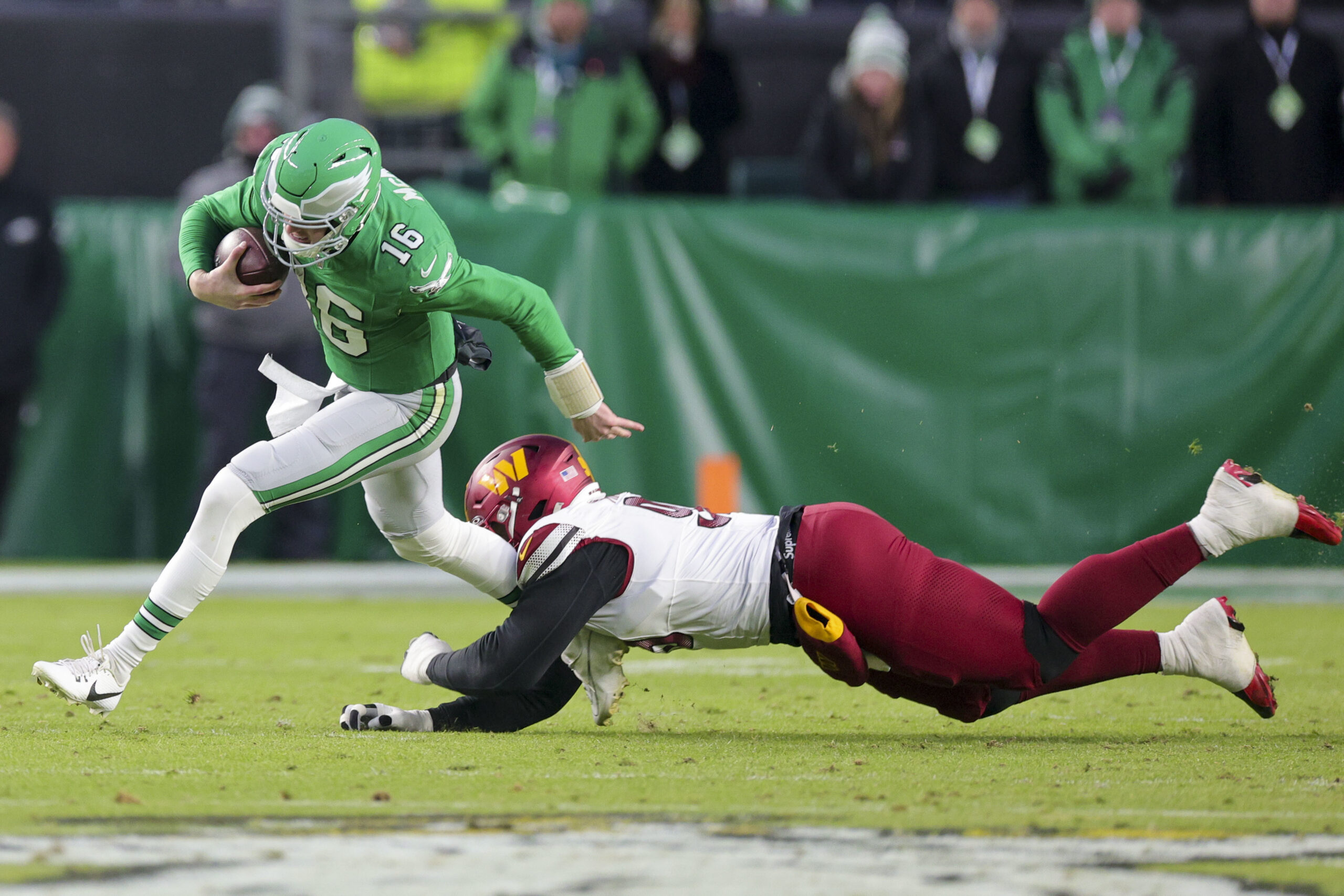
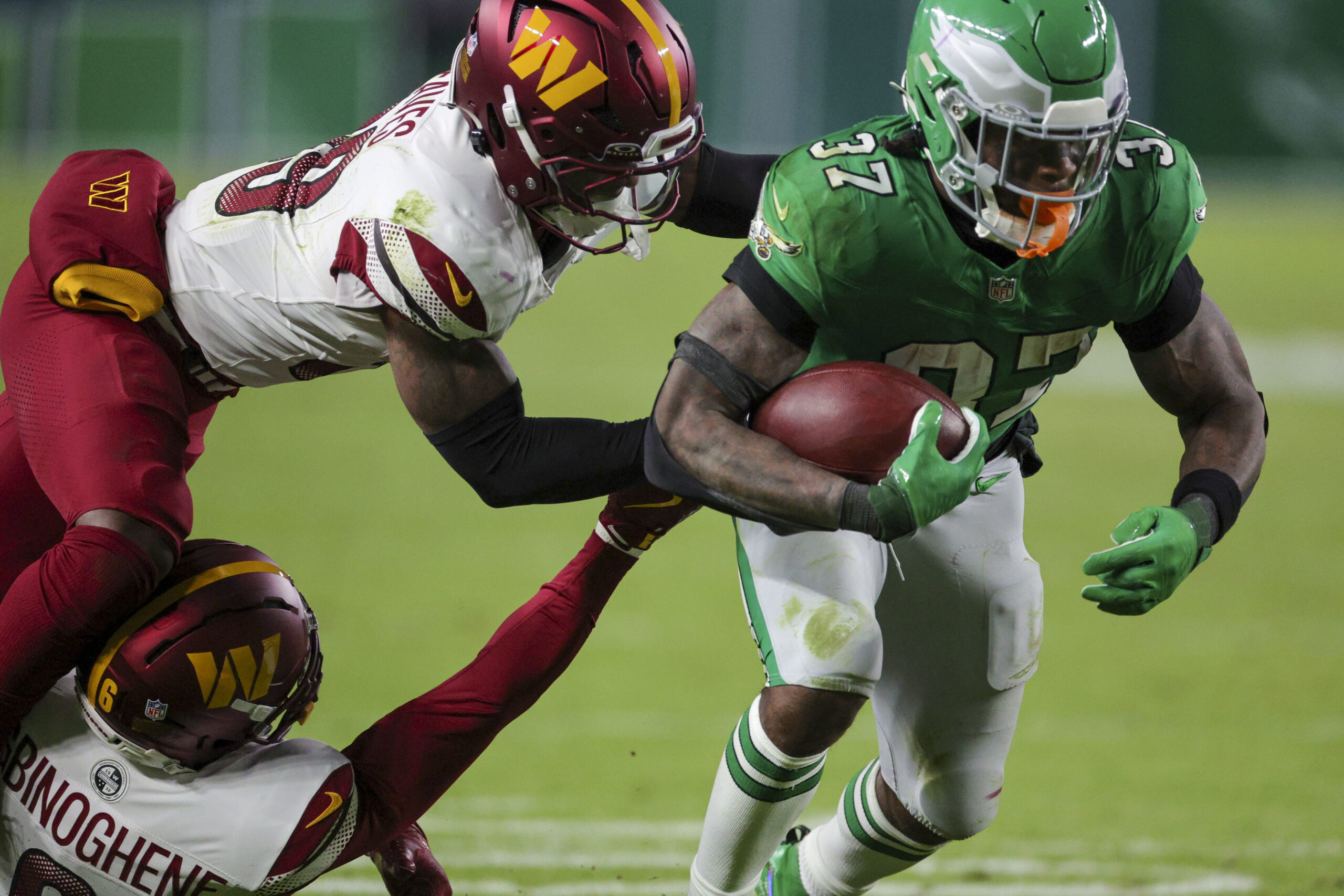
    Tank Bigsby got the start with Saquon Barkley resting. He popped off several decent gains, ran aggressively, and made defenders miss. Bigsby finished with 75 yards and a touchdown on 16 carries.

    His most explosive moment came as a receiver when he made a crazy move in the open field. Bigsby changed directions after a short pass and picked up 31 yards. As a runner, he made a defender miss on a 13-yard carry to open the game.

    Will Shipley had a pass sail through his hands in the second quarter, but he caught a 12-yard swing pass in the fourth. AJ Dillon played a little and caught a 3-yard pass.

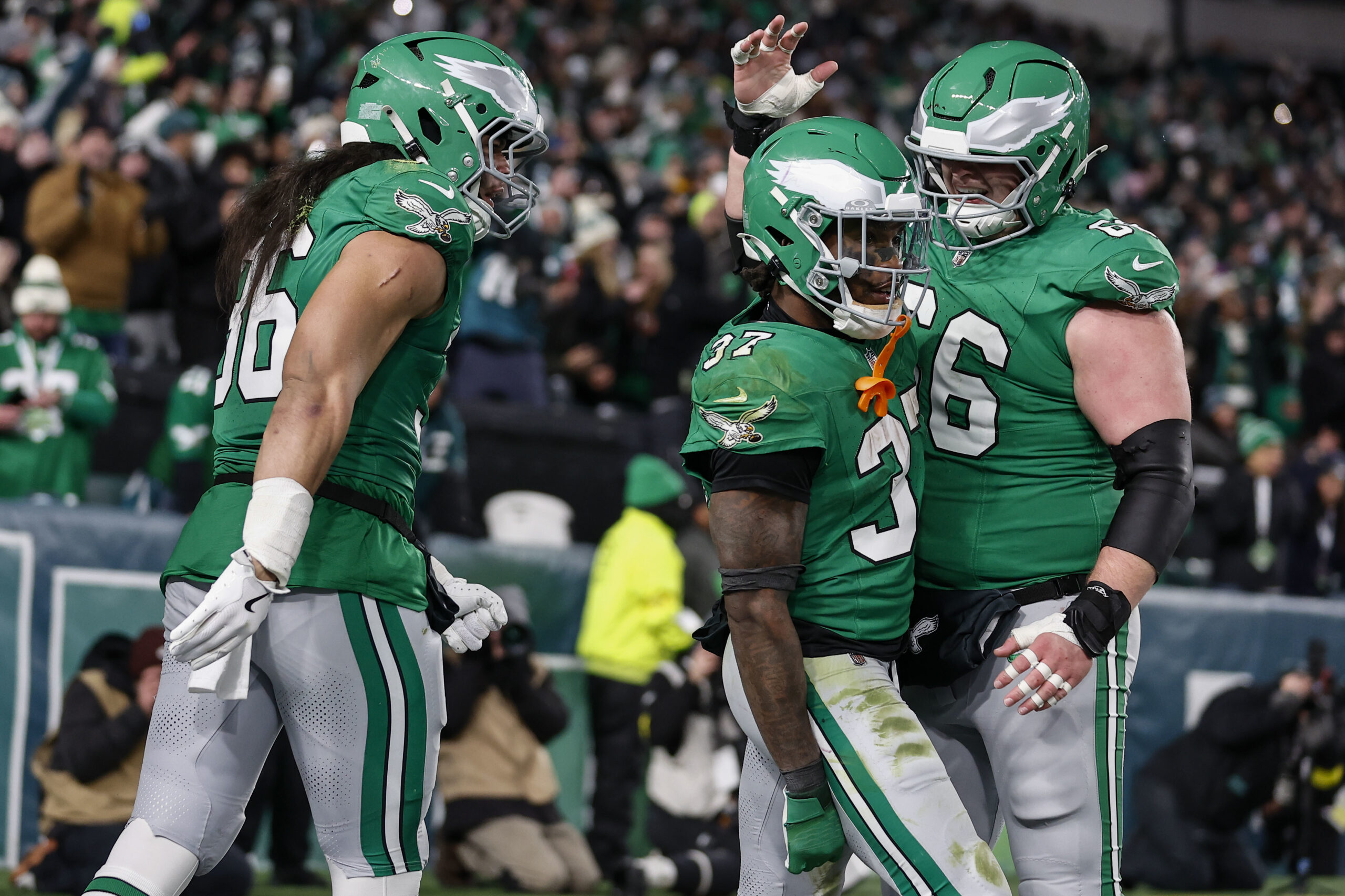
    Eagles running back Tank Bigsby (center) finished with 75 yards and a touchdown on 16 carries.

    Receiver/tight end: C+

    Wide receiver DeVonta Smith was the lone skill position starter to play in an attempt to get him to 1,000 yards receiving. He accomplished the feat when he pulled in a 27-yard pass late in the first quarter. Smith promptly was pulled from the game after catching 3 of 4 targets for 52 yards. He finished the season with 77 catches for 1,008 yards.

    Receiver A.J. Brown, who eclipsed 1,000 yards last week, and tight end Dallas Goedert (ankle) didn’t play. Jahan Dotson and Darius Cooper logged most of the time at receiver. Dotson finished with three receptions for 40 yards. He caught a 15-yard pass over the middle on McKee’s first attempt after Smith left. Cooper caught three passes for 33 yards. He won a contested pass for a 17-yard gain but was flagged for taunting after the catch.

    Tight end Grant Calcaterra scored the Eagles’ first touchdown when he snagged a 15-yard pass. He squared up Commanders linebacker Frankie Luvu on Bigsby’s 11-yard outside run in the third quarter. Calcaterra left in the third quarter with ankle and knee injuries when he was dragged down by Reaves.

    Kylen Granson became the lead tight end when Calcaterra vacated. He caught four passes for 30 yards. Tight end/fullback Cameron Latu had the lead block on Bigsby’s 2-yard touchdown in the third. He did poorly to lead the way on a Bigsby third-and-1 rush in the third quarter. Britain Covey was the third receiver and converted third-and-long with a 9-yard catch in the third quarter. He also had a 12-yard gain on a screen pass.

    Offensive line: D+

    The Eagles’ starting unit, from left to right, was Fred Johnson, Brett Toth, Drew Kendall, Tyler Steen, and Matt Pryor. Starters right tackle Lane Johnson (foot), left guard Landon Dickerson (calf), center Cam Jurgens and left tackle Jordan Mailata didn’t play. The latter two dressed.

    The O-line did fine against Washington’s starting defense. It opened some holes on the ground but didn’t hold up enough in pass protection. McKee had to escape the pocket a bunch of times.

    Steen played just the first two series but had to return when Toth left with a concussion. Rookie Cameron Williams came in at right tackle, and Pryor moved to right guard. He appeared to leave Daron Payne unblocked when he was at tackle on the Eagles’ first drive. The presnap call might have failed to slide protection to Pryor’s side, though, and McKee was sacked.

    Fred Johnson appeared to fare the best of the second-teamers and mostly kept McKee’s blind side clean. Toth also had a decent game. Kendall looks like the real deal, or at least someone the Eagles can further develop next season. Williams, who spent most of his first season on injured reserve, may have a future as well. He had a number of good blocks and displayed a nasty streak when he stood up to Payne after the whistle.

    Defensive line: B-

    With the Eagles lacking in numbers because of their rotation, regulars Jordan Davis, Moro Ojomo, Jalyx Hunt, and Nolan Smith started and played throughout. Starters Jalen Carter (hip) and Jaelan Phillips (ankle) were inactive. The D-line was stout vs. the run but struggled to pressure 39-year-old quarterback Josh Johnson.

    Davis read an early third-down screen and jumped in on a stop short of the sticks. Ojomo had a tackle for no gain on a goal-line run in the fourth quarter. Hunt picked up his third interception of the season when he dropped into coverage and dove for an errant pass. Outside linebacker Joshua Uche hurried Johnson on the throw. Hunt did well to string out Deebo Samuel on an end around that picked up just a yard. He recovered Johnson’s muffed snap in the third quarter.

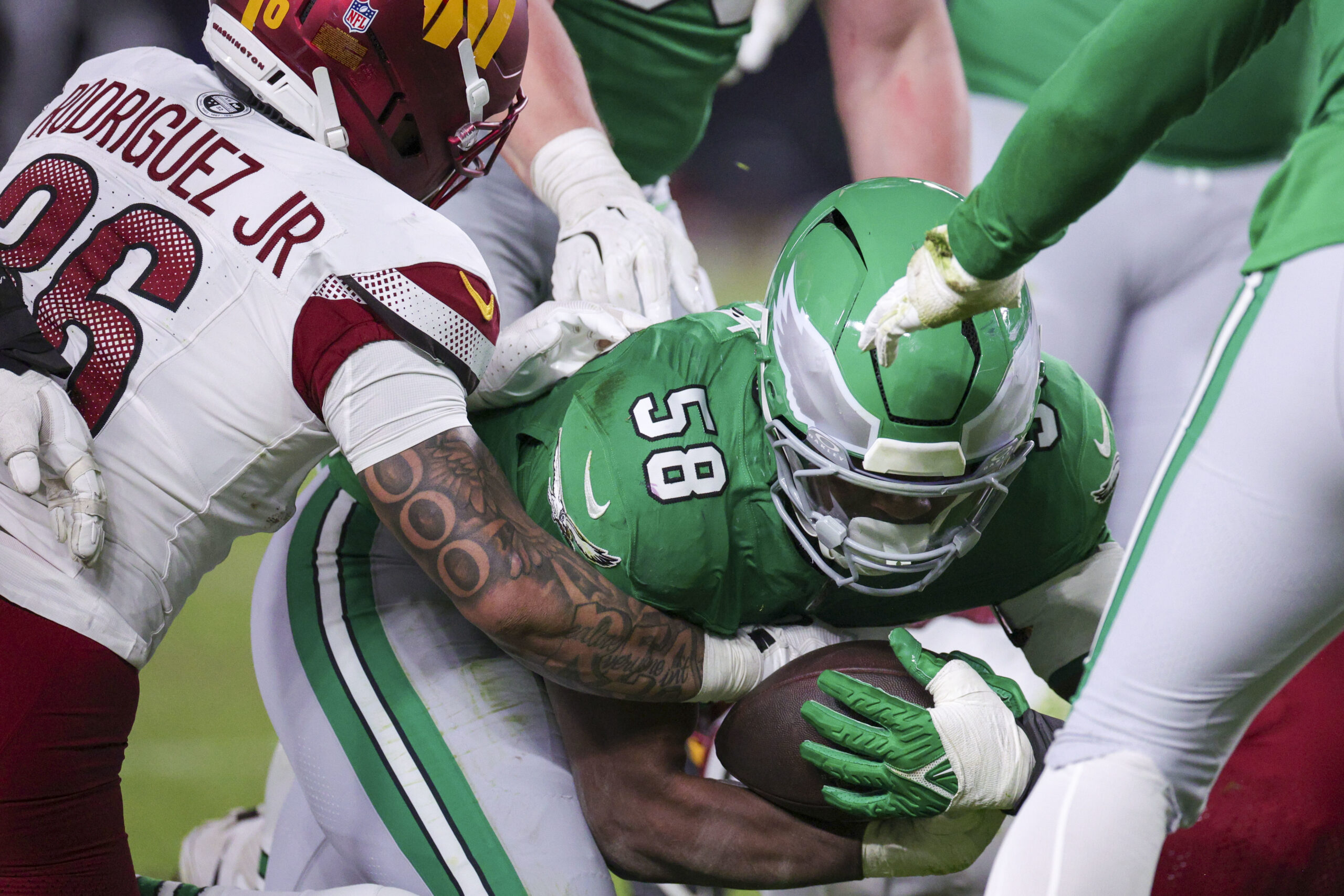
    Defensive tackle Byron Young registered a tackle for loss on a goal-line run attempt in the fourth quarter. He failed to bring down Chris Rodriguez on a third-down run just before the half. Ty Robinson took a poor angle on Rodriguez’s 9-yard carry in the third quarter and later failed to wrap up the running back near the line.

    Veteran Brandon Graham continued to play only a handful of snaps.

    Linebacker: B

    Zack Baun was a healthy scratch. Nakobe Dean (hamstring) was not and was inactive. Jihaad Campbell started alongside Jeremiah Trotter Jr. The former made several plays, but the latter was all over the field. Trotter led the Eagles with 12 tackles and Campbell had 10.

    Trotter notched a tackle of loss on a goal-line run in the first quarter. Trotter was first to arrive to keep a play-action bootleg pass to just a 1-yard gain. In the third quarter, he blitzed and forced Johnson to throw a dirt ball.

    Campbell blitzed on Washington’s first possession and whiffed on the side-stepping Johnson. He deflected a second-quarter pass over the middle that was nearly intercepted. He might have been the guilty party in coverage on tight end John Bates’ fourth-quarter touchdown catch.

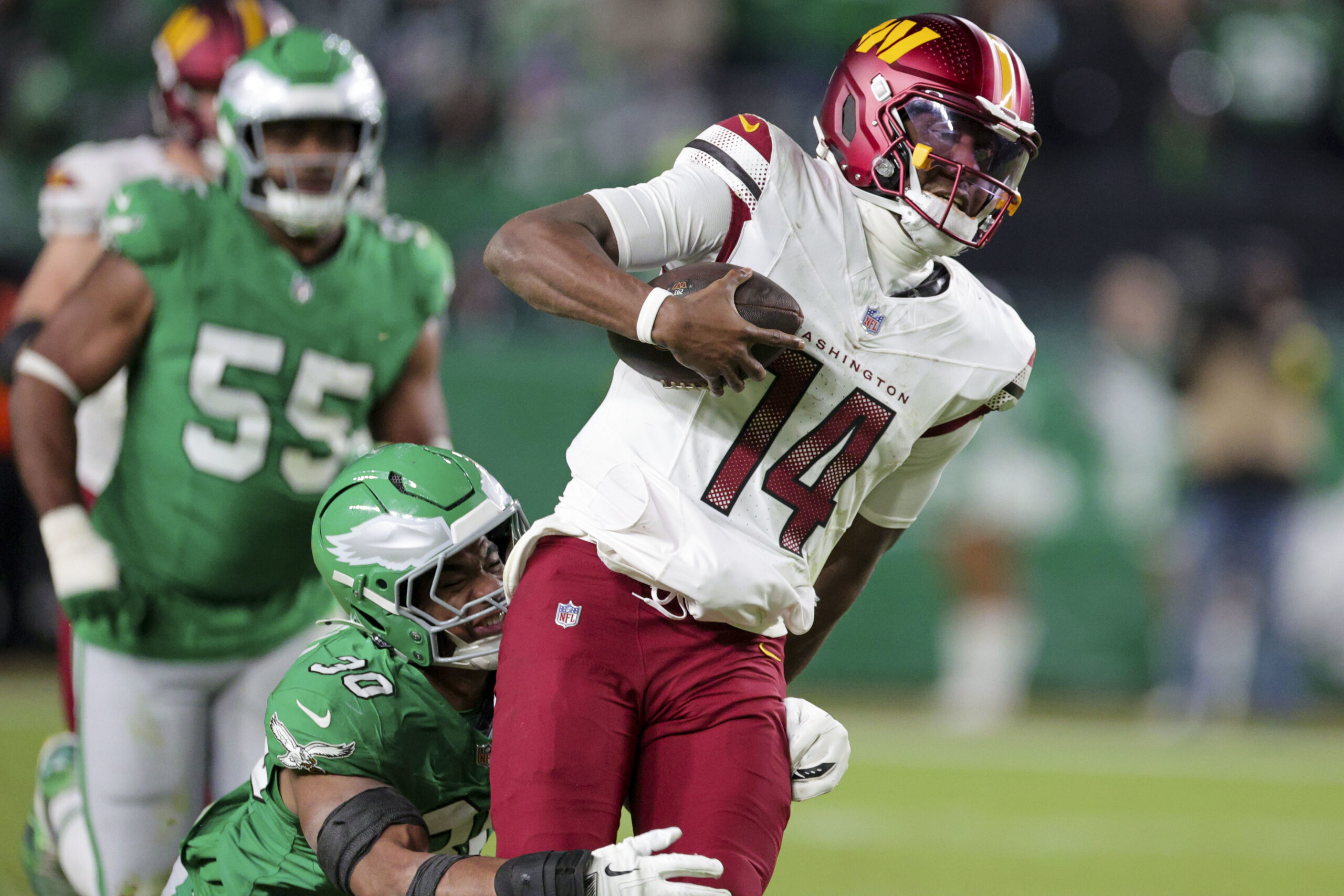
    Eagles linebacker Jihaad Campbell tackles Washington Commanders quarterback Josh Johnson short of a first down in the fourth quarter. The South Jersey native finished with 10 tackles.

    Cornerback: D+

    Kelee Ringo and Jakorian Bennett started on the outside with Quinyon Mitchell and Adoree’ Jackson getting a break. Ringo and Bennett committed multiple penalties in coverage.

    Ringo had tight coverage over the top on an overthrown pass into the end zone. Receiver Terry McLaurin caught a 14-yard pass over him on the drive that set up Washington’s 56-yard field goal before the half. Ringo was flagged for holding and pass interference in the second half. He inexplicably let Johnson waltz into the end zone for the game-winning score.

    Bennett committed two first-half penalties: an early hold on McLaurin and pass interference vs. receiver Treylon Burks on a third-down toss into the end zone. Washington scored a touchdown two plays after the second flag. Bennett had another pass interference against McLaurin on a fade into the end zone.

    Michael Carter started in the slot with Cooper DeJean getting the day off. He moved to safety when Brandon Johnson got hurt in the second quarter. Carter was solid in run support and logged nine stops.

    Mac McWilliams jumped into the slot when Carter was forced to move to safety. It was the rookie’s first extended action on defense. He committed pass interference on an underthrown pass to Samuel in the end zone in the fourth quarter.

    Safety: C+

    Sydney Brown and Brandon Johnson started in place of the resting Reed Blankenship and the injured Marcus Epps (concussion). Brown made a stop after a short pass into the flat in the second quarter. A play later, he appeared to get too deep on a 25-yard third-down completion to McLaurin.

    Johnson bit on a screen fake and a slanting McLaurin caught a 13-yard pass early on, and he failed to wrap up Josh Johnson on a 13-yard draw play later in the drive. He left with an ankle injury and was replaced by Carter.

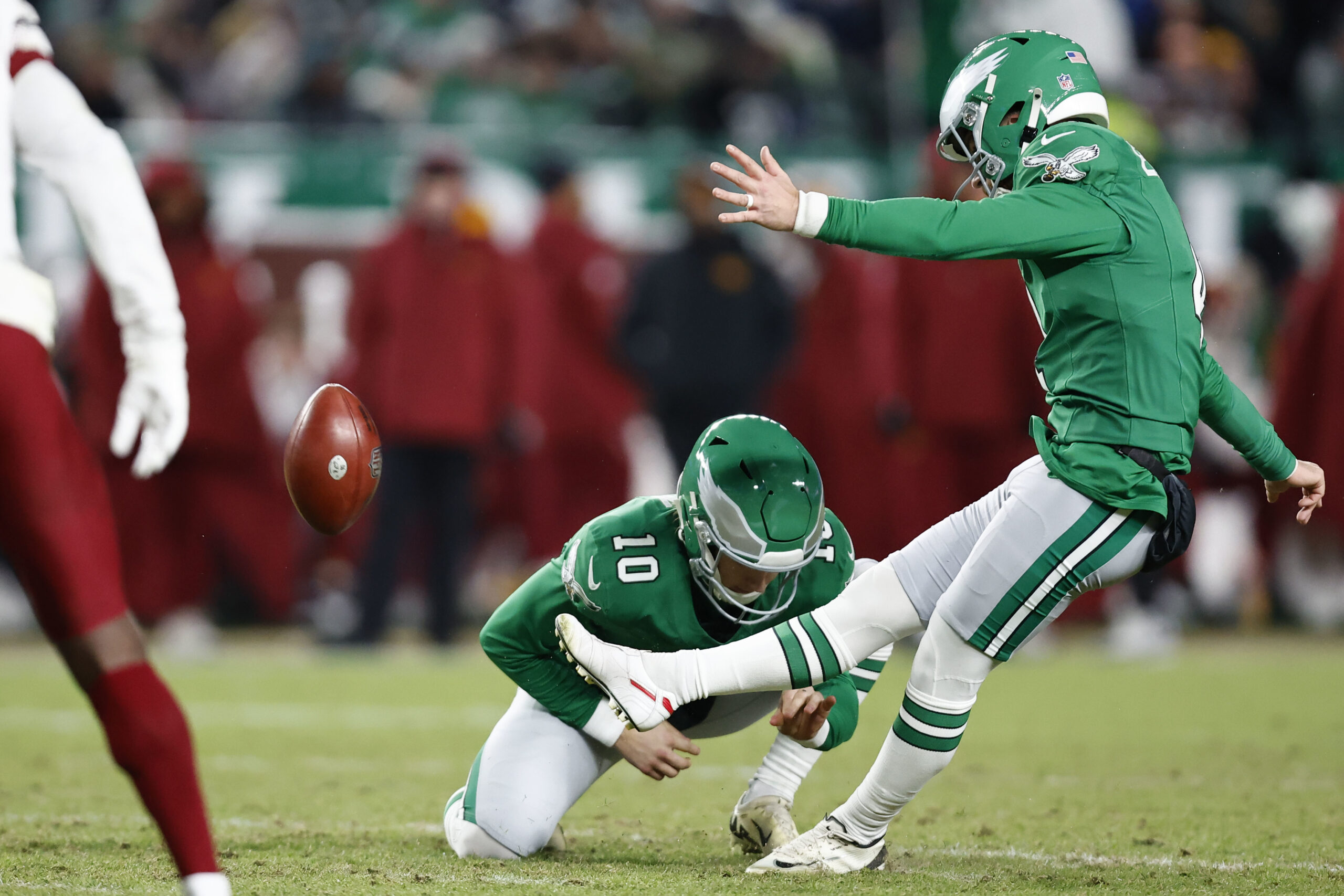
    Eagles kicker Jake Elliott connected on a 39-yard field goal on Sunday vs. the Washington Commanders.

    Special teams: B

    Kicker Jake Elliott made both extra points and a 39-yard field goal. Punter Braden Mann had an uncharacteristic meh day. He averaged 38 net yards on three boots. Ringo had a strong tackle that kept a return to just 2 yards after a low Mann punt in the third quarter.

    Shipley averaged 27.5 yards on two kick returns. Covey had two returns for a 10-yard average. He allowed a punt to sail over his head that was downed at the 9-yard line in the third quarter.

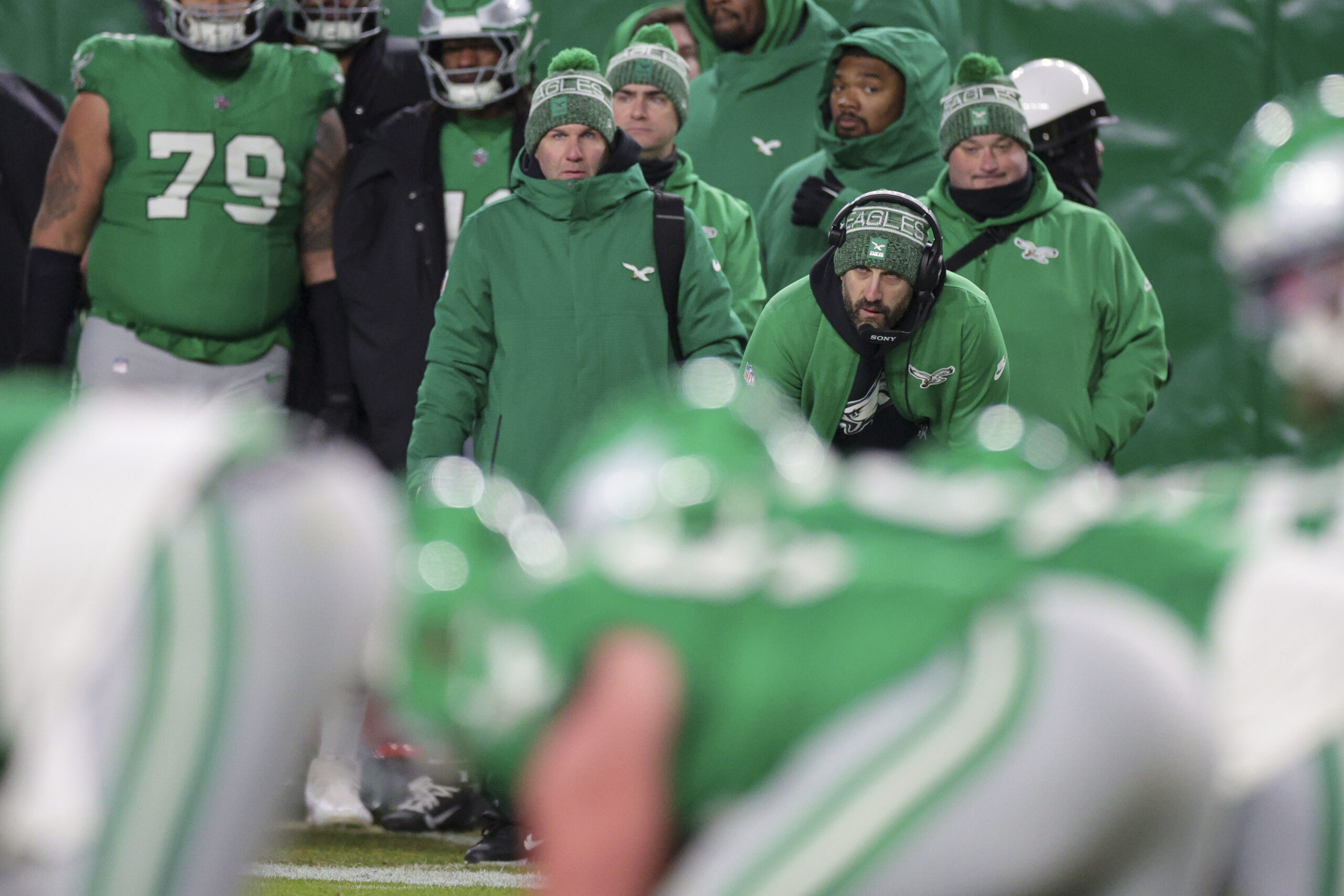
    Eagles coach Nick Sirianni watches the action Sunday vs. the Washington Commanders.

    Coaching: C

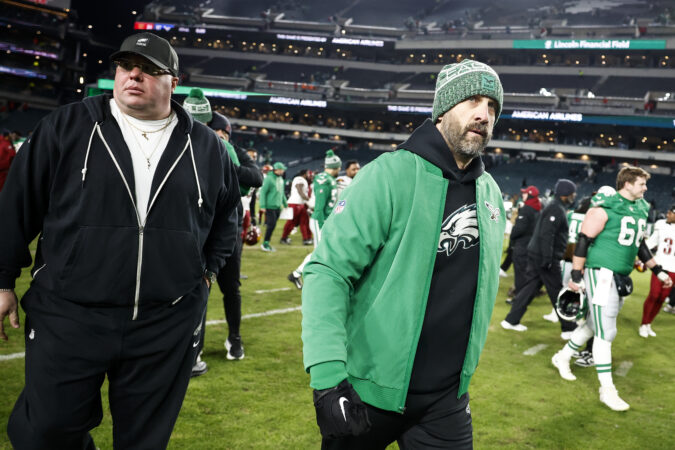
    Nick Sirianni will be criticized for his decision to rest his starters, especially after the Bears lost. But what the coach gained — giving his players physical and mental breaks — can’t yet be quantified. We’ll see how the playoffs pan out. For now, the No. 3-seed Eagles know their opponent: the No. 6-seed 49ers. The rest will play out accordingly.

    Offensive coordinator Kevin Patullo didn’t exactly open the playbook with McKee, but he unveiled some new concepts. The results were mixed. Some of his decisions were questionable. The pass on third-and-2 at the Washington 6 made less sense when the Eagles elected to go for it on fourth down before the half.

    Defensive coordinator Vic Fangio had more starters than Patullo. His guys up front mostly answered the bell. A secondary full of backups struggled.

  • Tanner McKee is exactly what the Eagles need … in a backup quarterback

    Tanner McKee is exactly what the Eagles need … in a backup quarterback

    There is a faction among Eagles fans and NFL cognoscenti that hoped Tanner McKee would on Sunday provide a quarterback controversy on which they could feed during the cold winter months. They hoped McKee, a sixth-round pick in 2023, might sufficiently shine in a meaningless game against a moribund team so that he might be considered a viable threat to Jalen Hurts, a two-time Pro Bowl player and the reigning Super Bowl MVP.

    That didn’t happen.

    That was never going to happen.

    McKee could have thrown for 350 yards with five touchdown passes and he still wouldn’t sniff the starting job in Philadelphia until Hurts gives it away.

    Hurts might throw three interceptions and he might fumble twice next weekend in the playoff opener against the 49ers and the starting job will still be his, both in September and in January.

    McKee started his second NFL game Sunday. It was an insignificant game against an insignificant team playing its least significant players.

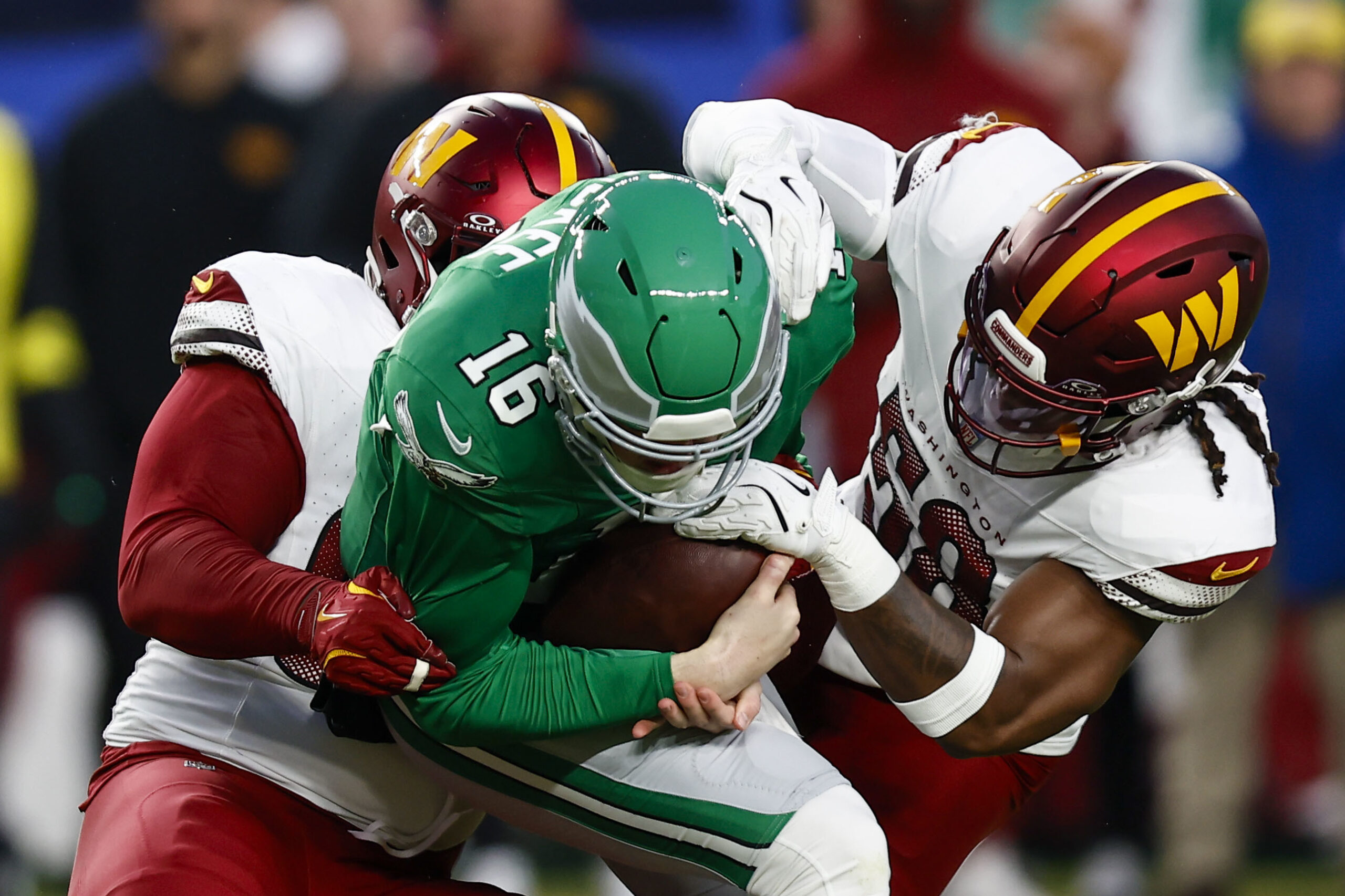
    Tanner McKee is tackled by the Commanders’ Daron Payne and Jordan Magee.

    In this context, McKee looked fine: 21-for-40, one touchdown, one interception, against the five-win Commanders, who won, 24-17. He threw crisp passes, usually on time. He recognized defenses. He moved well in the pocket. He ran a couple of times.

    “I thought he did a lot of good things,” coach Nick Sirianni said.

    He also threw two uncatchable passes late in the fourth quarter that ended the Eagles’ chances to win, in the very moments when the Bears were in the process of losing to the Lions. An Eagles win and a Bears loss would have given the Eagles the No. 2 seed instead of No. 3, which would have guaranteed at least two home games in the playoffs.

    Notably, McKee did this without the services of the team’s top running back, four of its top offensive linemen, its top tight end, one of its top two receivers, and, after two series, both of its top receivers: DeVonta Smith played until he hit the 1,000-yard mark, then left.

    McKee looked a lot like he looked in a similar context: Game 17 of the 2024 season, when he beat the three-win Giants: 269 yards, two touchdowns, no turnovers.

    He didn’t face the best of the Commanders. They didn’t blitz much. They didn’t play particularly hard. And, of course, they stink.

    Still, McKee looked good enough to win a game or two, maybe even in the playoffs. This, for the Eagles, is excellent news: They have a competent backup quarterback on whom they have expended almost no draft or salary-cap capital.

    McKee makes just over $1 million, and he seems capable. Benched Giants has-been Russell Wilson will take home $10.5 million this season. The Jets’ Tyrod Taylor and the Broncos’ Jarrett Stidham each have two-year, $12 million contracts. Marcus Mariota, the Commanders’ understudy, made $8 million. The Panthers’ Andy Dalton and Jameis Winston, one of the QBs who replaced Wilson, each made $4 million.

    The Eagles’ biggest question entering the 2025 season didn’t involve the third cornerback, or defensive line depth, or the departure of mediocre right guard Mekhi Becton. The biggest question was:

    If Hurts got injured, as he has done each of the first five seasons of his career, and with no veteran backup on the roster, would McKee be good enough to replace him? After all, Eagles owner Jeffrey Lurie subscribes to the notion that, if the most important player is the quarterback, then the second-most important player is the backup. That’s why he and Howie Roseman signed Nick Foles in 2017, and it’s why they drafted Hurts in 2020.

    Tanner McKee is tripped up by Washington Commanders defensive tackle Javon Kinlaw in the first quarter at Lincoln Financial Field.

    Sunday’s performance delivered another indication that, yes, if Hurts gets hurt, McKee can do the job.

    Until then, it’s Hurts’ job. He’s been too good, or at least good enough, too often for too long.

    Further, cutting or moving Hurts before the end of the 2027 season would incur more than $20 million in dead money. McKee is under contract through 2026 for just over $1 million.

    Hurts has had his haters since he hit Philly. Every time he slumps, and every time he misses a receiver over the middle, the haters surface, louder than ever. It doesn’t matter if it’s Gardner Minshew, Kenny Pickett, or McKee: Their preferred choice is Anybody But Jalen.

    When Hurts struggled from Games 10-13, beginning in mid-November, multiple reports asserted that several people in the Eagles organization were wondering if benching Hurts in favor of McKee might be necessary to mount a viable Super Bowl defense. Hurts’ passer rating in that span was just 68.7. The Eagles averaged 17.8 points in those games and went 1-3. He turned the ball over seven times in those four games, including five times in a road loss to the Chargers, the worst game of his career and the last of that span.

    Nevertheless, Sirianni declared that any consideration of benching Hurts was “ridiculous” — a declaration that was, itself, ridiculous, considering how badly Hurts was playing.

    In the end, it didn’t matter. As his job security was being debated, Hurts responded with the best game of his career, a 31-0 win over the visiting, hapless Raiders. He further secured his place with solid wins in Washington and Buffalo.

    The Chargers game was an aberration. Hurts has nearly mastered the art of not losing games. He’ll even win you one every now and then.

    For a team that possesses an elite defense, powerful weapons, and a sturdy offensive line, that’s all that matters.

    No matter what happens in the next few weeks, there will be no legitimate calls for McKee to start any meaningful games.

    Not until mid-November, anyway.

  • Eagles backups fall short against Commanders, squander chance to collect NFC’s No. 2 seed

    Eagles backups fall short against Commanders, squander chance to collect NFC’s No. 2 seed

    The No. 3 seed will have to do for the reigning Super Bowl champions.

    With Nick Sirianni opting to rest most of the starters, the Eagles fell, 24-17, to the Washington Commanders on Sunday night. After the Los Angeles Rams’ victory over the Arizona Cardinals, the Eagles will draw the No. 6-seeded San Francisco 49ers in the wild-card round of the playoffs.

    Meanwhile, the Detroit Lions defeated the Chicago Bears, 19-16, on Sunday. Because of the Eagles’ loss, the Bears clinched the NFC’s No. 2 seed.

    The Eagles backups couldn’t pull off the win. Tanner McKee and the offense got out to an early 7-0 lead over the Commanders, who came out on top after three lead changes throughout the game.

    The Eagles had multiple opportunities to even the score late in the fourth quarter but turned it over on downs twice. With 1 minute, 21 seconds remaining, McKee threw incomplete to Kylen Granson on fourth-and-3 from the Commanders’ 31.

    The Eagles got the ball back with 53 seconds left at their own 28, but McKee couldn’t make anything happen (three incompletions, one sack).

    Here’s our instant analysis from the Eagles’ regular-season finale:

    Commanders defensive tackle Daron Payne grabs Eagles quarterback Tanner McKee.

    Roller coaster for McKee

    In the most meaningful game of his NFL career to date, McKee made big plays and big mistakes.

    He was efficient in the passing game to start. Through his first two possessions, McKee went 5-for-7 for 82 yards, including a 15-yard touchdown pass to Grant Calcaterra that put the Eagles up, 7-0.

    He also had DeVonta Smith at his disposal for those first two possessions, as the 27-year-old receiver sought to eclipse 1,000 receiving yards for the season. He needed just 44 yards to hit the milestone and he quickly earned them. McKee opened the game with a 17-yard completion to Smith in the flat.

    Smith caught two more passes on the ensuing possession, an 8-yarder and a leaping 27-yard grab over Commanders cornerback Jonathan Jones. His three catches for 52 yards brought him to 1,008 on the season, prompting Sirianni to pull him from the game.

    McKee and the Eagles offense faltered in the red zone on the next two possessions. In the second quarter, they marched 54 yards down the field to the Commanders’ 6-yard line, but Washington stopped the Eagles on fourth-and-2. McKee had pressure in his face from defensive end Jacob Martin, fled the pocket to his right, and threw the ball away.

    Later in the second quarter following an interception from Jalyx Hunt, Darius Cooper caught a 17-yard, in-breaking pass to the Commanders’ 5. However, the rookie receiver spun the ball at Jones in celebration and was flagged for taunting.

    The Eagles couldn’t overcome the 15-yard penalty. On third-and-10 from the Commanders’ 20 with 59 seconds left in the first half, McKee threw an interception to safety Jeremy Reaves in the end zone on a pass intended for Jahan Dotson.

    “Just me trying to force it,” McKee said of his interception after the game. “Felt like I tried to get too much back in one play. I saw the coverage, I knew what it was, knew it was going to be a tight throw, tried to fit a really tight ball in. Just dumb, trying to force it. Obviously that was one of the big things that I can learn from.”

    The Commanders moved into field goal range on the brief possession that followed the pick, setting up Jake Moody for a 56-yard field goal to pull Washington ahead, 10-7.

    In the third quarter, McKee turned down an opportunity to scramble for a first down on second-and-1, instead throwing an incomplete pass intended for Cooper. Tank Bigsby couldn’t pick up the requisite yard on third down, forcing the Eagles to punt from their own 29.

    McKee’s performance continued to slide on the final drive of the game. He threw a pair of incomplete passes on first and second downs, took a sack on third down, then tossed another out of bounds on fourth.

    He finished the night going 21-for-40 for 241 yards with a touchdown, and an interception.

    Jalyx Hunt made an impact, but the defense faltered late.

    Hunt’s surge overshadowed

    A handful of key Eagles defensive players earned significant snaps against the Commanders, including Hunt, Jordan Davis, and Moro Ojomo.

    Hunt, the 2024 third-rounder out of Houston Christian, was clutch against the Commanders with his pair of takeaways. In the second quarter, as the Commanders sought to break a 7-7 tie, Hunt dove to undercut a pass intended for Deebo Samuel and picked off Josh Johnson deep in Eagles territory.

    He had an assist from Joshua Uche, who generated the initial pressure on Johnson that forced him to make an ill-advised throw.

    Hunt also scooped up a botched snap in the third quarter, giving McKee and the offense prime field position at the Commanders’ 28. The fumble recovery set up Bigsby’s 2-yard touchdown run.

    But the second-year edge rusher’s heroics were overshadowed by a shaky showing from the Eagles’ depth cornerbacks. Jakorian Bennett, Kelee Ringo, and Mac McWilliams combined for six defensive pass interference or holding penalties (three on Bennett, two on Ringo, one on McWilliams).

    In the fourth quarter, Bennett’s pass interference penalty in the end zone gave the Commanders a fresh set of downs. The Commanders capitalized with a 2-yard touchdown pass to tight end John Bates, tying the score at 17.

    “It is what it is, I guess,” Bennett said. “I’m going to try and clean up on film and whatnot. But I’m just out there trying to play my game.”

    Ringo’s pass interference call, which Terry McLaurin drew halfway through the fourth quarter, took the Commanders from their own 23 to the Eagles’ 45. The Commanders eventually took advantage of the field position when Johnson scrambled for the game-winning 1-yard touchdown run to put his team up, 24-17.

    Tank Bigsby got some time in the rushing spotlight in Week 18.

    Big Tank

    With Saquon Barkley resting, Bigsby earned his most extended look of the season since the Eagles acquired him from the Jacksonville Jaguars on Sept. 9.

    He rose to the occasion. The 5-foot-11, 215-pound running back collected a season-high 75 yards and a touchdown on 16 carries. He also snagged a catch for a career-long 31 yards in the second quarter, turning a dump-off into a long gain while breaking a tackle from Jordan Magee.

    In the third quarter, Bigsby scored his second career touchdown as an Eagle. After Hunt recovered a Johnson fumble in the red zone, Bigsby had five straight carries, starting at the Commanders’ 18-yard line. His 2-yard punch-in on third-and-goal allowed the Eagles to regain the lead, 14-10.

    “My confidence has been there,” Bigsby said. “When I get the opportunity, be the best player I can be for my teammates and be the best player I can be for this team.”

    Injury report

    Brandon Johnson, who started at safety alongside Sydney Brown, injured his ankle while attempting to pick off a deflected pass in the second quarter.

    With Johnson out, Michael Carter moved from nickel cornerback to safety. McWilliams, the fifth-round rookie out of Central Florida, slotted in at nickel corner.

    Calcaterra hurt his ankle and knee on a hip-drop tackle from Reaves in the third quarter.

    Brett Toth was evaluated for a concussion in the fourth quarter and did not return to action.

  • Venezuelans in Philadelphia have mixed feelings after the U.S. strike. Ukrainian Americans feel uneasy about what may be next.

    Venezuelans in Philadelphia have mixed feelings after the U.S. strike. Ukrainian Americans feel uneasy about what may be next.

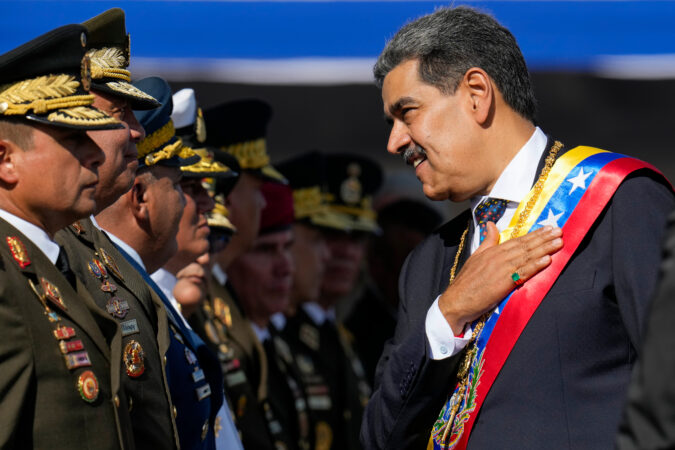
    Venezuelans in the Philadelphia region had mixed reactions to the U.S. strike against their home country over the weekend, which removed Nicolás Maduro from power and left the future of the South American country unclear.

    But some Ukrainian Americans in the region felt an uneasy sense of déjà vu as they watched events in Venezuela unfold — and are concerned about what it could mean for relatives and compatriots 6,000 miles away from Caracas, in Ukraine.

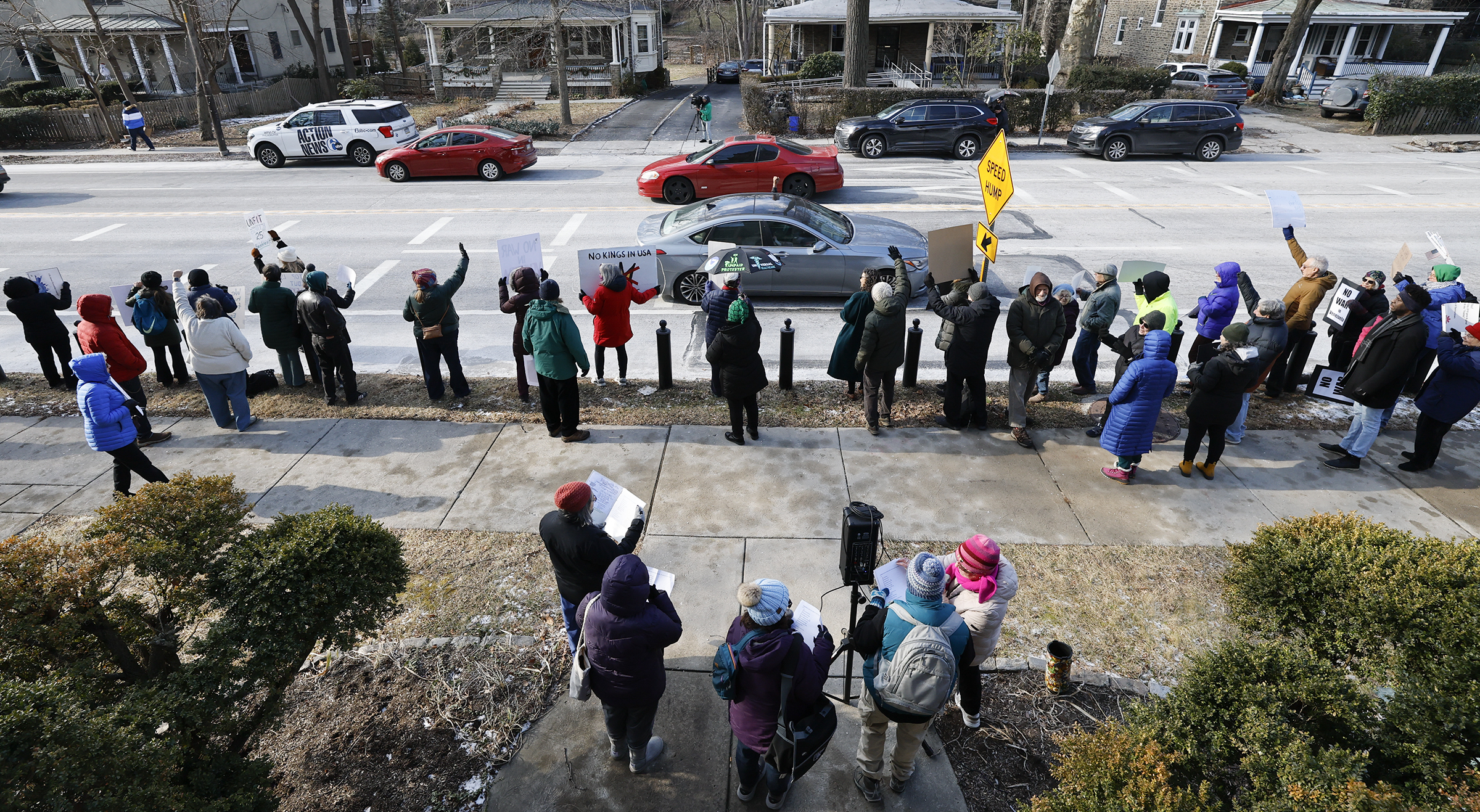
    “This action, which is an illegal action, gives the light to people like [Russian President Vladimir Putin] and other dictators to do whatever they like,” Ukrainian American activist Mary Kalyna said Sunday amid a 60-person anti-war rally outside the Unitarian Society of Germantown in West Mount Airy. “Why should he not invade Ukraine or Poland or Lithuania, when the U.S. is invading Venezuela?”

    The Trump administration’s unilateral action sends a message to other countries, like Russia, that the United States may no oppose a larger nation meddling in a smaller country’s political affairs, said Paula Holoviak, a political science professor at Kutztown University, in an interview.

    “It just doesn’t set a good precedent,” said Holoviak, who is a Ukrainian American.

    ‘We have been waiting for this for 26 years’

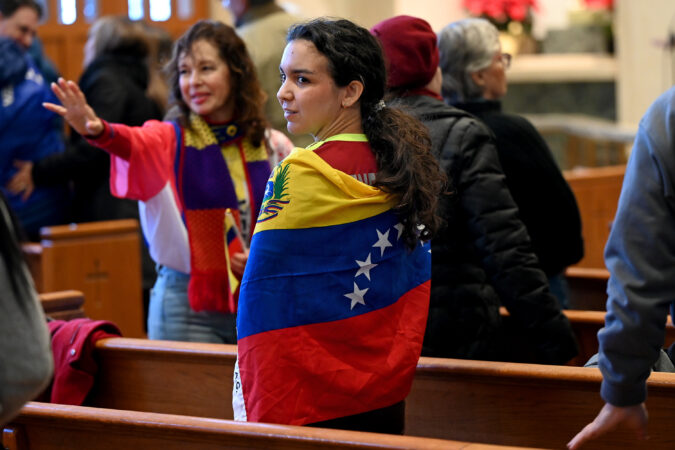
    Venezuelan flag in hand, Diana Corao Uribe, 53, and her family drove from Media to the Cathedral Basilica of SS. Peter and Paul to attend a Sunday vigil for the future of Venezuela, organized by local groups Casa de Venezuela Philadelphia, Casa de Venezuela Delaware, and Gente de Venezuela Philadelphia.

    Hundreds of people hugged, cried, and prayed as they waited inside with flags and apparel, brightening the basilica with yellow, red, and blue. Members of the crowd were largely critical of the rule of Maduro and his predecessor, Hugo Chávez.

    “We have been waiting for this for 26 years; you cannot imagine the feeling, the joy, the happiness, the hope that we feel right now,” Corao Uribe said.

    But Corao Uribe said that as the hours passed, her feelings have grown more complicated. Until President Donald Trump announced the U.S.’s intentions to “run” Venezuela until a “safe, proper and judicious transition” could be completed, Corao Uribe had hoped Edmundo González Urrutia, who faced Maduro at the polls in the 2024 Venezuelan presidential election, would become the next president.

    The announcement was unexpected and a bit concerning, she said, but it wasn’t enough to shake her sense of happiness.

    Philadelphia resident Astrid Da Silva, 32, said it felt bittersweet.

    “The amount of joy that seeing the dictator out of Venezuela brings — it’s immeasurable; it’s normal when there has been torture and pain for so long,” Da Silva said. “But without a democratic transition of power, fear starts slipping in.”

    Hearing Trump say that opposition leader Maria Corina Machado lacked support in Venezuela clouded her feelings.

    “People don’t want the U.S. there; we want the opposition or at least a free election,” Da Silva said, adding that the country’s political turmoil forced her to emigrate to the U.S. at age 7.

    Ongoing power struggles have at times made her feel like people view Venezuela as a pawn, forgetting there are real lives at stake, she said.

    ‘It could be very destabilizing’

    The U.S. has a long history of intervening in other countries, Holoviak noted, but that hasn’t always gone well. “We do have an extremely powerful military, but we might not want the aftermath of this,” Holoviak said. “It could be very destabilizing.”

    Residents of Northwest Philadelphia voice their opposition to the Trump administration’s strike against Venezuela in a vigil outside the Unitarian Society of Germantown on Sunday, Jan. 4, 2026.

    Ukrainian leaders have largely welcomed the liberation of Venezuelans from Russian-allied Maduro’s regime. Speaking with reporters in Kyiv, President Volodymyr Zelensky said, “Well, what can I say? If dictators can be dealt with in this way, then the United States of America knows what it should do next.”

    Eugene Luciw, a Ukrainian American who lives in Montgomery County, said in an interview that he interpreted Zelensky’s comments to mean that he believes the U.S. should arrest Putin — and Luciw agrees.

    Luciw said that he has no problem with Trump removing Maduro, whom he called “a dictator who slaughters people.”

    However, Luciw questioned Trump’s motives and said his actions were inconsistent.

    “If we want to do away with a real dictator, with absolute evidence that he’s a genocidal maniac,” then the U.S. should be tougher on Putin, he said.

    At the Cathedral Basilica, Fernando Torres, 45, said he has struggled with what the future may hold for Venezuela after Trump’s actions.

    “Even if we don’t like Trump, we have to separate things. It’s like if you were drowning and someone threw you a life buoy,” Torres said. “You don’t care who threw it or what their intentions were; you just care about saving your life. What people don’t understand is that Venezuelans needed their life buoy and now for the first time we have hope.”

    As political decision-making continues to unfold, Corao Uribe, Da Silva, and Torres agree on one thing: the importance of listening to what Venezuelans want for their future.

    “Venezuelans have suffered for so long, don’t try to understand our pain; this isn’t about politics, it’s about the suffering of the Venezuelan people,” Corao Uribe said.

    This article contains information from the Associated Press.

  • Maduro’s case will revive a legal debate over immunity for foreign leaders tested in Noriega trial

    Maduro’s case will revive a legal debate over immunity for foreign leaders tested in Noriega trial

    MIAMI — When deposed Venezuelan leader Nicolás Maduro makes his first appearance in a New York courtroom Monday to face U.S. drug charges, he will likely follow the path taken by another Latin American strongman toppled by U.S. forces: Panama’s Manuel Noriega.

    Maduro was captured Saturday, 36 years to the day after Noriega was removed by American forces. And as was the case with the Panamanian leader, lawyers for Maduro are expected to contest the legality of his arrest, arguing that he is immune from prosecution as a sovereign head of foreign state, which is a bedrock principle of international and U.S. law.

    It’s an argument that is unlikely to succeed and was largely settled as a matter of law in Noriega’s trial, legal experts said. Although Trump’s ordering of the operation in Venezuela raises constitutional concerns because it wasn’t authorized by Congress, now that Maduro is in the U.S., courts will likely bless his prosecution because, as was the case with Noriega, the U.S. doesn’t recognize him as Venezuela’s legitimate leader.

    “There’s no claim to sovereign immunity if we don’t recognize him as head of state,” said Dick Gregorie, a retired federal prosecutor who indicted Noriega and later went on to investigate corruption inside Maduro’s government. “Several U.S. administrations, both Republican and Democrat, have called his election fraudulent and withheld U.S. recognition. Sadly, for Maduro, it means he’s stuck with it.”

    Noriega died in 2017 after nearly three decades in prison, first in the U.S., then France, and finally Panama. In his first trial, his lawyers argued that his arrest as a result of a U.S. invasion was so “shocking to the conscience” that it rendered the government’s case an illegal violation of his due process rights.

    Justice Department opinion allows ‘forcible abductions’ abroad

    In ordering Noriega’s removal, the White House relied on a 1989 legal opinion by then-Assistant Attorney General Bill Barr, issued six months before the invasion. That opinion said the U.N. Charter’s prohibition on the use of force in international relations does not bar the U.S. from carrying out “forcible abductions” abroad to enforce domestic laws.

    Supreme Court decisions dating to the 1800s also have upheld America’s jurisdiction to prosecute foreigners regardless of whether their presence in the United States was lawfully secured.

    Barr’s opinion is likely to feature in Maduro’s prosecution as well, experts said.

    Drawing parallels to the Noriega case, Barr on Sunday pushed aside criticisms that the U.S. was pursuing a change of government in Venezuela instead of enforcing domestic laws. As attorney general during the first Trump administration, Barr oversaw Maduro’s indictment.

    “Going after them and dismantling them inherently involves regime change,” Barr said in a Fox News Sunday interview. “The object here is not just to get Maduro. We indicted a whole slew of his lieutenants. It’s to clean that place out of this criminal organization.”

    Key differences between Noriega and Maduro

    There are differences between the two cases.

    Noriega never held the title of president during his six-year de facto rule, leaving a string of puppets to fill that role. By contrast, Maduro claims to have won a popular mandate three times. Although the results of his 2024 reelection are disputed, a number of governments — China, Russia, and Egypt among them — recognized his victory.

    “Before you ever get to guilt or innocence, there are serious questions about whether a U.S. court can proceed at all,” said David Oscar Markus, a defense lawyer in Miami who has handled several high-profile criminal cases, including some involving Venezuela. ”Maduro has a much stronger sovereign immunity defense than did Noriega, who was not actually the sitting president of Panama at the time.”

    For U.S. courts, however, the only opinion that matters is that of the State Department, which considers Maduro a fugitive and has for months been offering a $50 million reward for his arrest.

    The first Trump administration closed the U.S. Embassy in Caracas, the capital of Venezuela, and broke diplomatic relations with Maduro’s government in 2019 after he cruised to reelection by outlawing most rival candidates. The administration then recognized the opposition head of the National Assembly as the country’s legitimate leader.

    The Biden administration mostly stuck to that policy, allowing an opposition-appointed board to run Citgo, a subsidiary of Venezuela’s state-owned oil company, even as the U.S. engaged in direct talks with Maduro’s government that were aimed at paving the way for free elections.

    “Courts are so deferential to the executive in matters of foreign policy that I find it difficult for the judiciary to engage in this sort of hairsplitting,” said Clark Neily, a senior vice president for criminal justice at the Cato Institute in Washington.

    U.S. sanctions are a hurdle for Maduro’s defense

    Another challenge that Maduro faces is hiring a lawyer. He and his wife, Cilia Flores, who also was captured, have been under U.S. sanctions for years, making it illegal for any American to take money from them without first securing a license from the Treasury Department.

    The government in Caracas now led by Maduro’s vice president, Delcy Rodríguez, may want to foot the bill, but it is similarly restricted from doing business in the United States.

    The U.S. has indicted other foreign leaders on corruption and drug trafficking charges while in office. Among the most noteworthy is Juan Orlando Hernández, former president of Honduras, who was convicted in 2024 for drug trafficking and weapons charges and sentenced to 45 years in prison.

    Trump pardoned Hernández in November, a move that drew criticism from even some Republicans who viewed it as undercutting the White House’s aggressive counternarcotics strategy centered against Maduro.

    The U.S. had requested Hernández’s extradition from Honduras a few weeks after he left office. After the arrest of Noriega, who had been a CIA asset before becoming a drug-running dictator, the Justice Department implemented a new policy requiring the attorney general to personally sign off on charging of any sitting foreign president, due to its implications for U.S. foreign policy.

    Maduro may have a slightly stronger argument that he is entitled to a more limited form of immunity for official acts he undertook as at least a de facto leader, since that question would not turn on whether he is a head of state recognized by the U.S.

    But even that defense faces significant challenges, said Curtis Bradley, a University of Chicago Law School professor who previously served as a counselor of international law at the State Department.

    The indictment accuses Maduro and five other co-defendants, including Flores and his lawmaker son, of facilitating the shipment of thousands of tons of cocaine into the U.S. by providing law enforcement cover, logistical support, and partnering with “some of the most violent and prolific drug traffickers and narco-terrorists in the world.”

    “The government will argue that running a big narcotrafficking operation … should not count as an official act,” Bradley said.

  • Secret Service plans unprecedented staff surge with anxious eye on 2028

    Secret Service plans unprecedented staff surge with anxious eye on 2028

    The Secret Service has launched one of the most ambitious hiring efforts in its history, seeking to bring on thousands of agents and officers to ease strain on its overstretched workforce and prepare for multiple major events in 2028, including the presidential election and the Olympics.

    Service leaders say they want to hire 4,000 new employees by 2028 — a surge that law enforcement experts say has no clear precedent and reflects mounting concerns about staff burnout, a loss of experienced agents, and a relentless operational tempo. The added staff would make up for expected retirements and increase the size of the agency by about 20%, to more than 10,000 for the first time.

    Under a plan led by Deputy Director Matthew Quinn, the service aims to expand its special agent ranks from about 3,500 to about 5,000. Officials also want to add hundreds of officers to the Uniformed Division, for a total of about 2,000, and hire additional support staff. The figures have not been previously reported.

    The agency faces serious obstacles, however, including a shortage of qualified candidates; competition with other law enforcement agencies, especially in immigration enforcement; and bottlenecks in hiring and training, according to former service officials.

    A previous attempt to reach 10,000 employees over a roughly 10-year period ending in 2025 failed as the agency struggled with leadership turnover and disruptions from the coronavirus pandemic, among other issues. The service fell far short of recruitment and retention goals despite offering some of the biggest financial incentives of any federal law enforcement agency.

    “Our mindset is, we aren’t going to pay our way out of this,” said Quinn, a longtime Secret Service official who returned to the agency in May after several years in the private sector. “We can’t create enough incentives to negate the fact that we’re working our people very, very hard.”

    Quinn said he and Secret Service Director Sean Curran, the former head of President Donald Trump’s protective detail, have set out to make hiring a top priority, second only to protection. Senior administration officials have backed them, he said.

    “The protective mission has expanded,” he said. “Our numbers are low to meet those needs. We have to achieve what we said we were going to do 10 years ago. We’ve got to achieve it now.”

    Agency officials want to improve the quality of life in the service by shortening hours and reducing time on the road for officers and agents, many of whom spend months each year traveling on protective assignments.

    A larger staff could also allow the Secret Service to lean less on other law enforcement agencies for help securing high-profile events, giving it tighter control over venues. Poor communication with other agencies played a major role in the service’s most publicized failure in recent years, the attempted assassination of Trump in 2024 at a campaign rally in Butler, Pa.

    Some former officials questioned whether the service can achieve its goal.

    “They are going to have to eliminate all the management and red-tape barriers,” said Janet Napolitano, a former secretary of the Department of Homeland Security, the service’s parent agency. “They have to be able to swiftly recruit, maintain quality, and train that number of new agents. They’re going to have to turn headquarters into a hiring machine.”

    In 2024, Napolitano helped lead a bipartisan investigation of the Secret Service failures that led up the Butler assassination attempt, the first time a president or former president had been fired upon since 1981.

    Others said even more modest hiring targets could be a stretch on such a short timeline. Getting hired and trained for a job in the Secret Service is a long, strenuous, and heavily bureaucratic process, even by federal government standards. It involves multiple rounds of interviews, an intensive background check, and a notoriously tough polygraph test that officials say screens out some otherwise strong candidates.

    All of those steps place heavy demands on already understaffed field offices, according to a former Secret Service executive familiar with the process, who like others spoke on the condition of anonymity due to concerns about retaliation. The former executive said it was difficult to see how the agency could clear those hurdles while significantly expanding the workforce.

    “I hope they have success in getting those numbers as much as anybody, but it’s not realistic,” said another former senior official, who retired recently. “There’s no part of law enforcement that’s not struggling to hire.”

    Service leaders are adamant that they are not lowering standards to meet their goals.

    Some service officials had floated the possibility of curtailing or suspending the investigative portion of agent training, focusing only on the protective portion of the service’s mission, according to people familiar with the discussions. But Quinn said that was out of the question. “Investigations are the lifeblood of this organization,” he said.

    Instead, officials say, they have found ways to speed the process.

    In November, the service held the first of what officials expect to be multiple accelerated hiring events in which candidates complete assessments over several days, including a physical fitness test, a security interview, and a full polygraph.

    Historically, those assessments have taken months, according to Delisa Hall, the Secret Service’s chief human capital officer. About 350 candidates out of nearly 800 who attended the first event advanced to the next phase, she said.

    “It’s becoming evident that this may be our new normal to push applicants through,” she said.

    Agency officials say they have compressed the timeline for a job offer down to less than a year from the previous 18 months or more and hope to cut the timeline by roughly another four months. The long wait in the past has led some candidates to withdraw or take positions with other agencies that moved more quickly.

    Hall said the agency is recruiting from the military, college athletes, and law enforcement, and it’s staying more engaged with applicants to keep from losing people along the way.

    Getting new hires trained and field-ready on time could also present challenges as the Secret Service races to staff up.

    Officials say the service has secured 42 classes at the federal government’s main training center for law enforcement agents in Glynco, Ga., for the 2026 fiscal year. All the service’s new agents and officers must undergo basic criminal investigator training at the facility, known as FLETC, for about three months alongside recruits from other agencies.

    The campus is expected to remain packed for the foreseeable future with recruits from Immigration and Customs Enforcement and other immigration agencies hired as part of the Trump administration’s crackdown. Secret Service leaders say they have not had to compete for space. But several former officials said they worry the service’s recruits could take a back seat to training for ICE or the Border Patrol, both of which are hiring aggressively.

    The pressure on the agency will only mount as 2028 approaches. Some in the Secret Service have privately referred to the year as “Armageddon” because of the extraordinary security demands posed by the election and other major gatherings, including the Los Angeles Olympics, the first Summer Games in the United States since Atlanta in 1996.

    The workforce carrying out the mission could look dramatically different from the last election cycle. Many experienced agents have departed for other agencies or jobs in the private sector in recent years. Others from a large cohort hired in the years surrounding the Sept. 11, 2001, terrorist attacks may not stay for another breakneck campaign.

    “About a third of the workforce will be retirement-eligible before the start of 2028,” said Derek Mayer, a former deputy special agent in charge of the Secret Service’s Chicago field office. “That’s definitely a cause for concern. There were periods during hiring freezes in the 2010s when we didn’t hire anyone. When that happens, it does hurt, but it hurts five or 10 years later.”

    With Trump term-limited, both major parties are expected to have competitive primaries, raising the number of people the service will have to protect. The eventual nominees, their running mates and their spouses will receive full-time Secret Service details.

    The agency is also tasked with coordinating protection around the 2028 Summer Olympics and Paralympics, scheduled during the last two weeks of July and the last two weeks of August, respectively.

    “No matter what, I don’t care how successful we are,” Quinn said, “it’s still going to be a rough summer.”