Last summer, after six years in their home, Danielle and Jonah Abrams decided to upgrade their 1,000-square-foot, two-story rowhouse in East Passyunk. The neighborhood was ideal, Danielle said, but they needed to accommodate their growing family.
“We love our location and have great relationships with our neighbors. We know at least half our block by first name,” she said.
Both are heavily involved in the neighborhood, both politically and civically.
“When we were expecting our daughter, everyone asked us if we were moving to the suburbs,” Danielle said. “Instead, we doubled down on our investment in our home by renovating.”
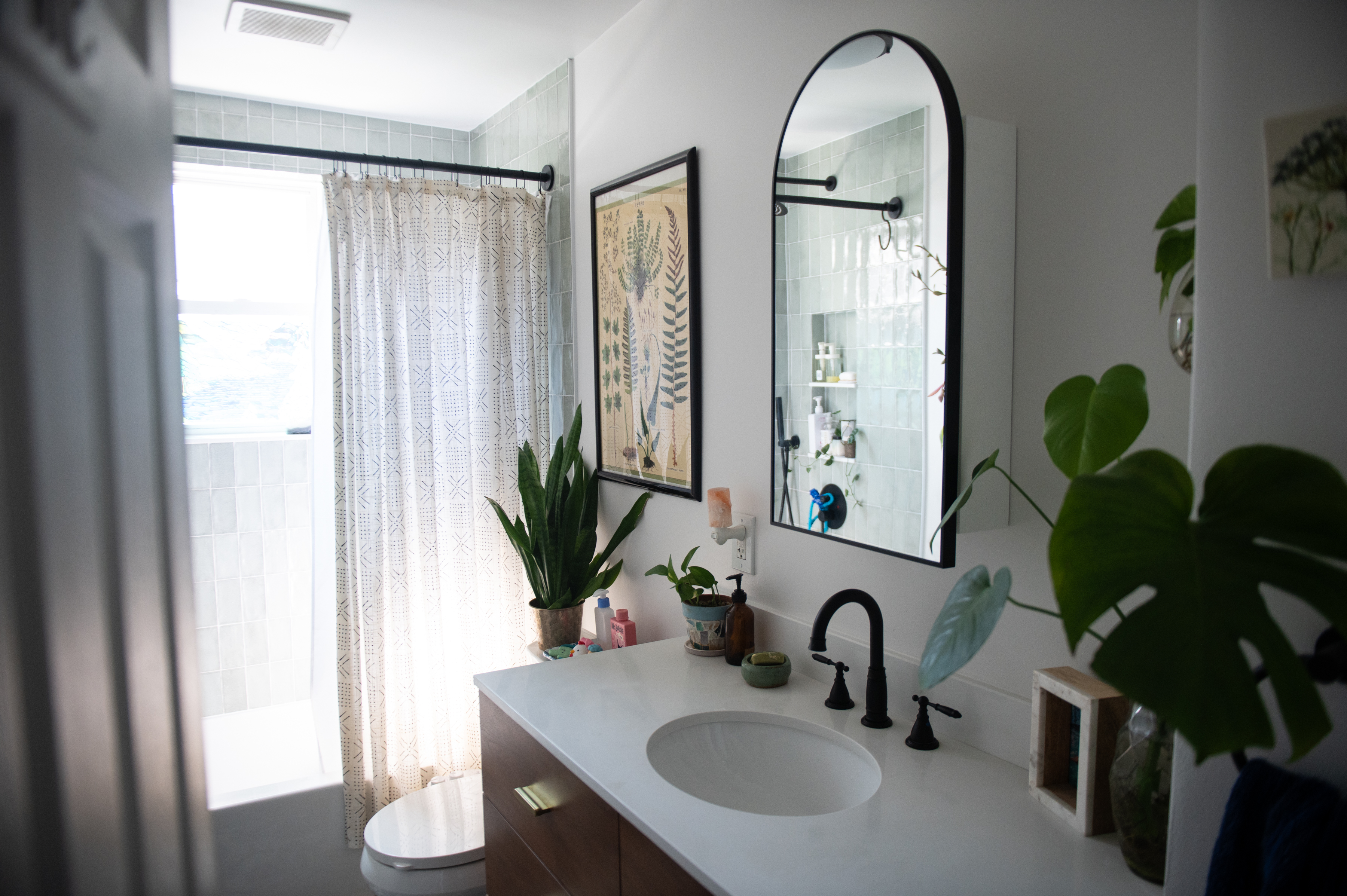
They contracted with City Living Construction to complete the renovations. The process required staying with Danielle’s parents for three weeks, when she was seven months pregnant, while contractor Christtian Mazza, “transformed our full bath into the respite of our dreams,” Danielle said.
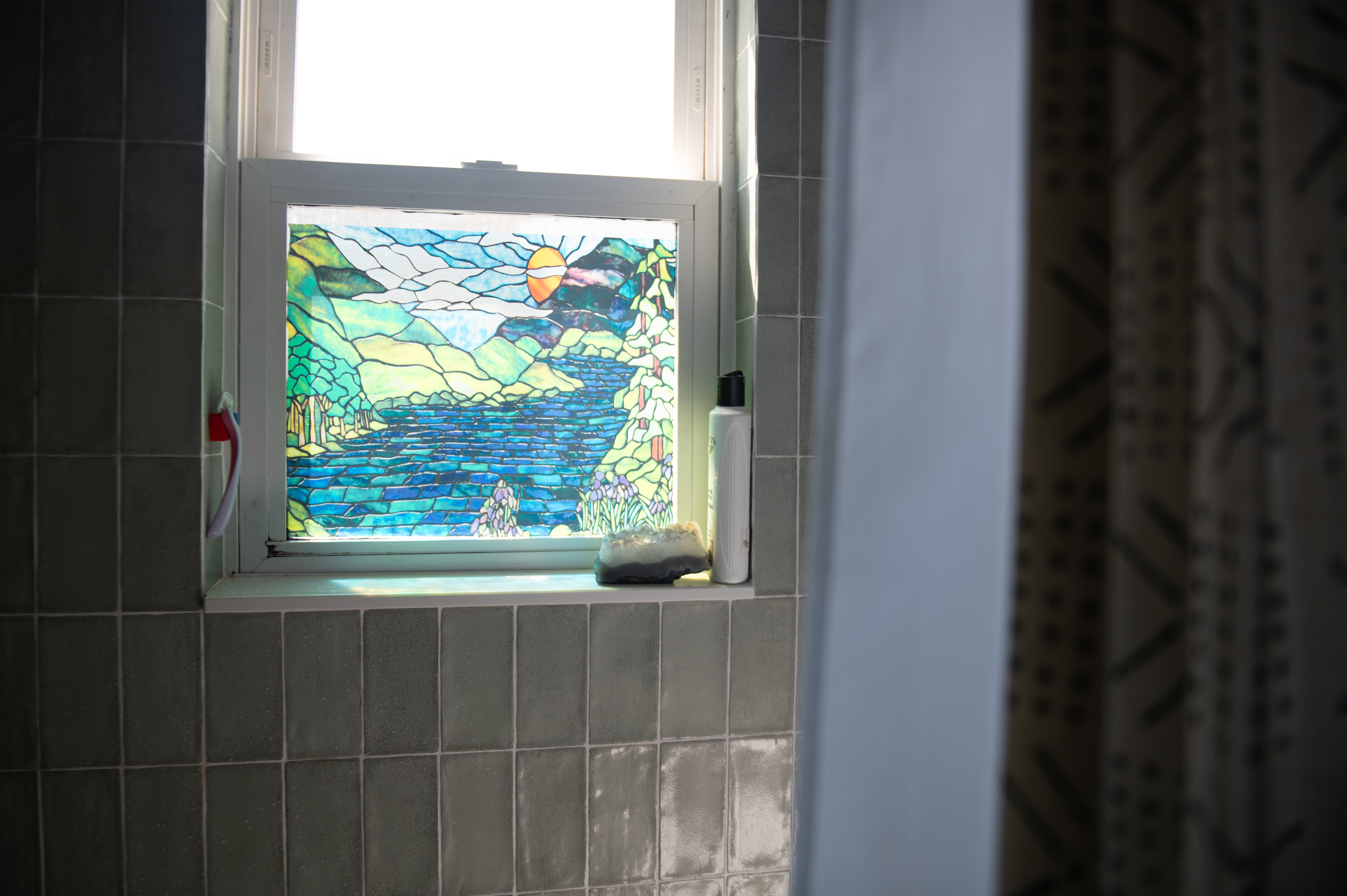
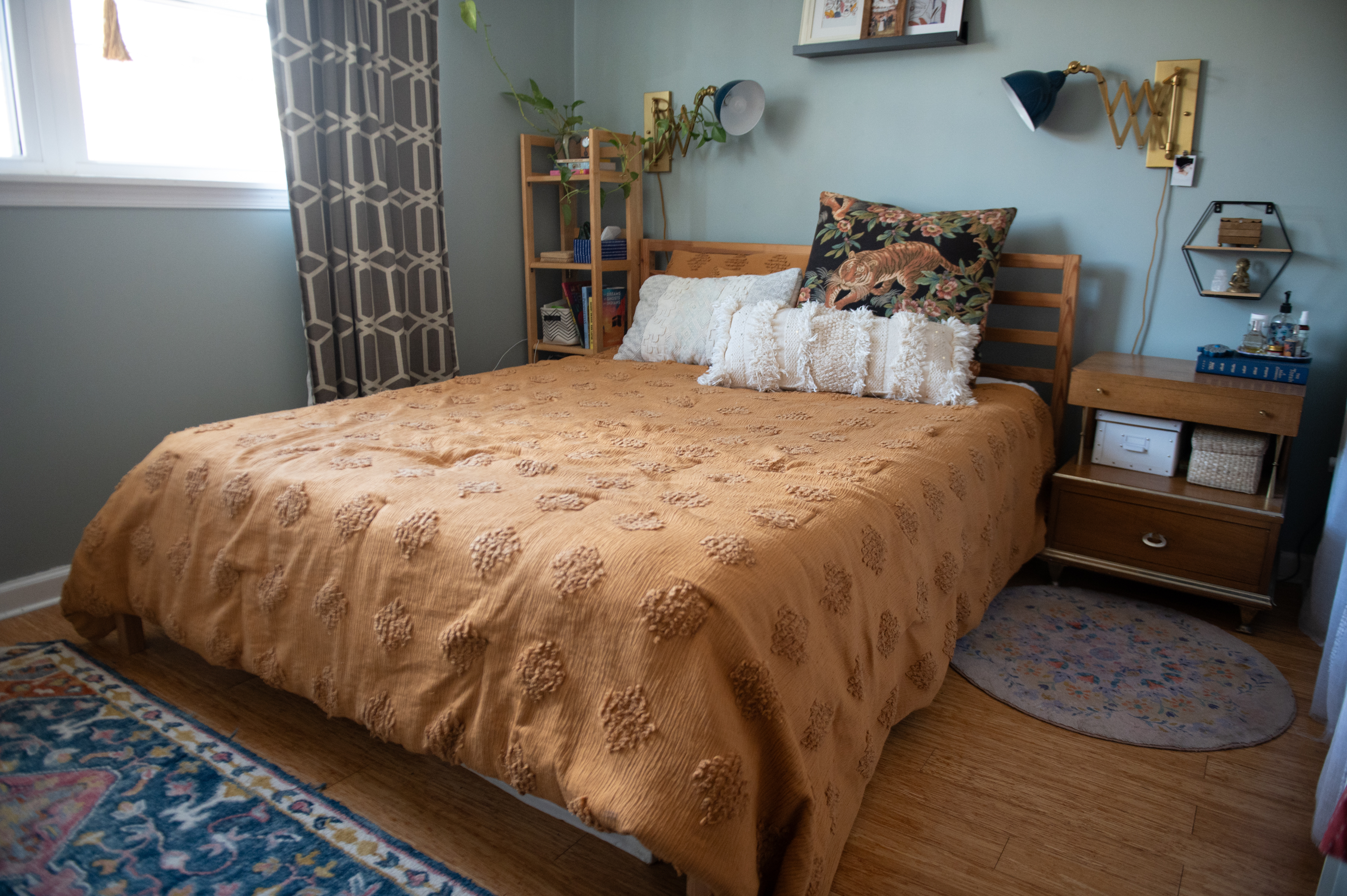
Danielle and Jonah Abrams’ second-floor bathroom, which they renovated before their child was born.A decorative window covering in the second-floor bathroom.Bathroom tiles, which the couple chose at a store in Fishtown.Danielle and Jonah Abrams’ primary bedroom.
“I designed the space by picking the fixtures and making multiple mood boards in PowerPoint showing the different tile, vanity, mirror, and fixture options,” Danielle said. ”We visited a tile store in Fishtown together and chose the flooring and shower tile, which took over an hour of laying different options on the floor of the showroom.”
Most of the home’s furniture was secondhand and sourced from local social media groups, Danielle said.
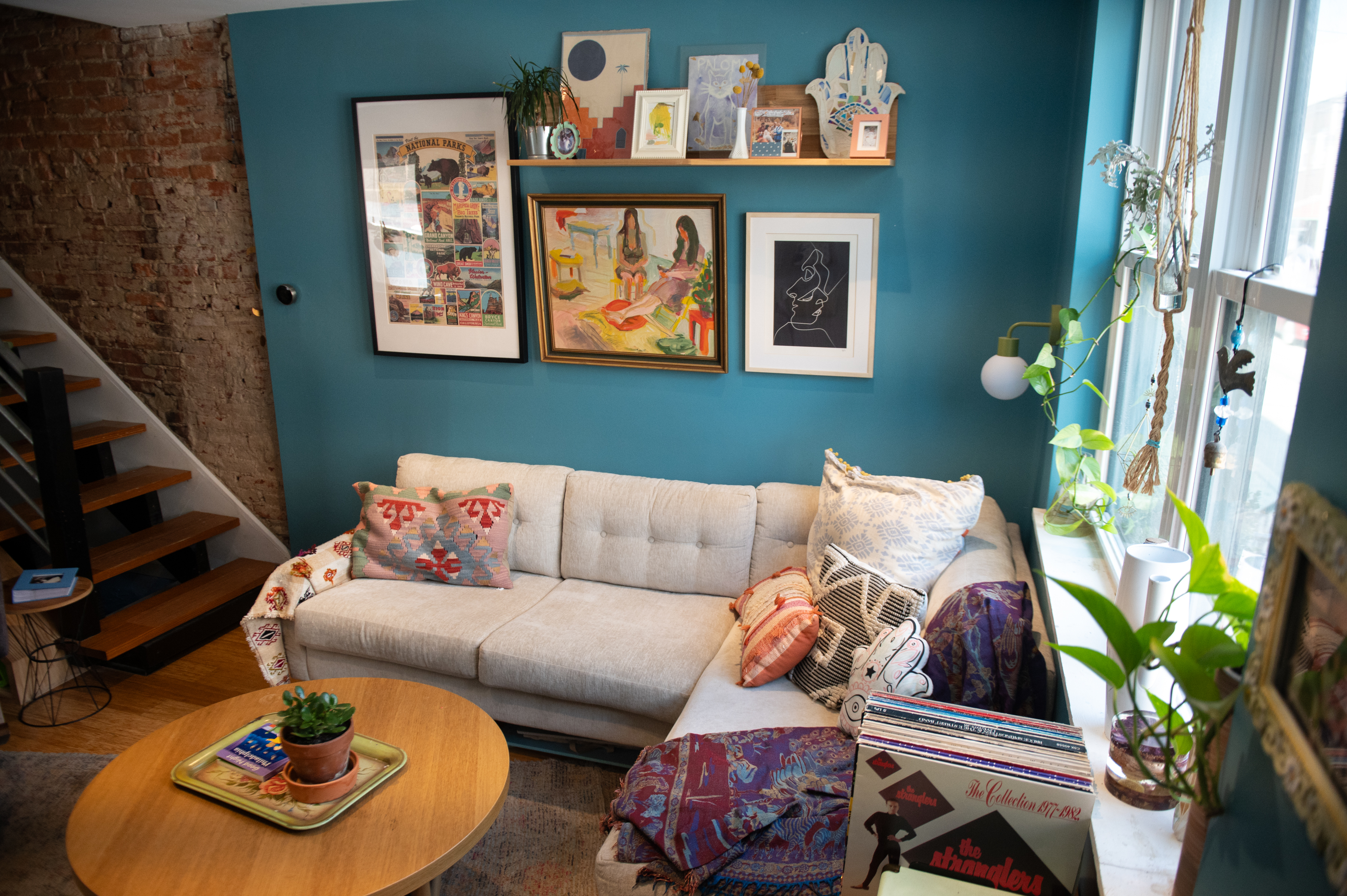
“The one piece we splurged on was our sofa, which is from Joybird,” she said. “We chose the ivory pet-proof fabric to brighten up the space and also to hide cat hair.”
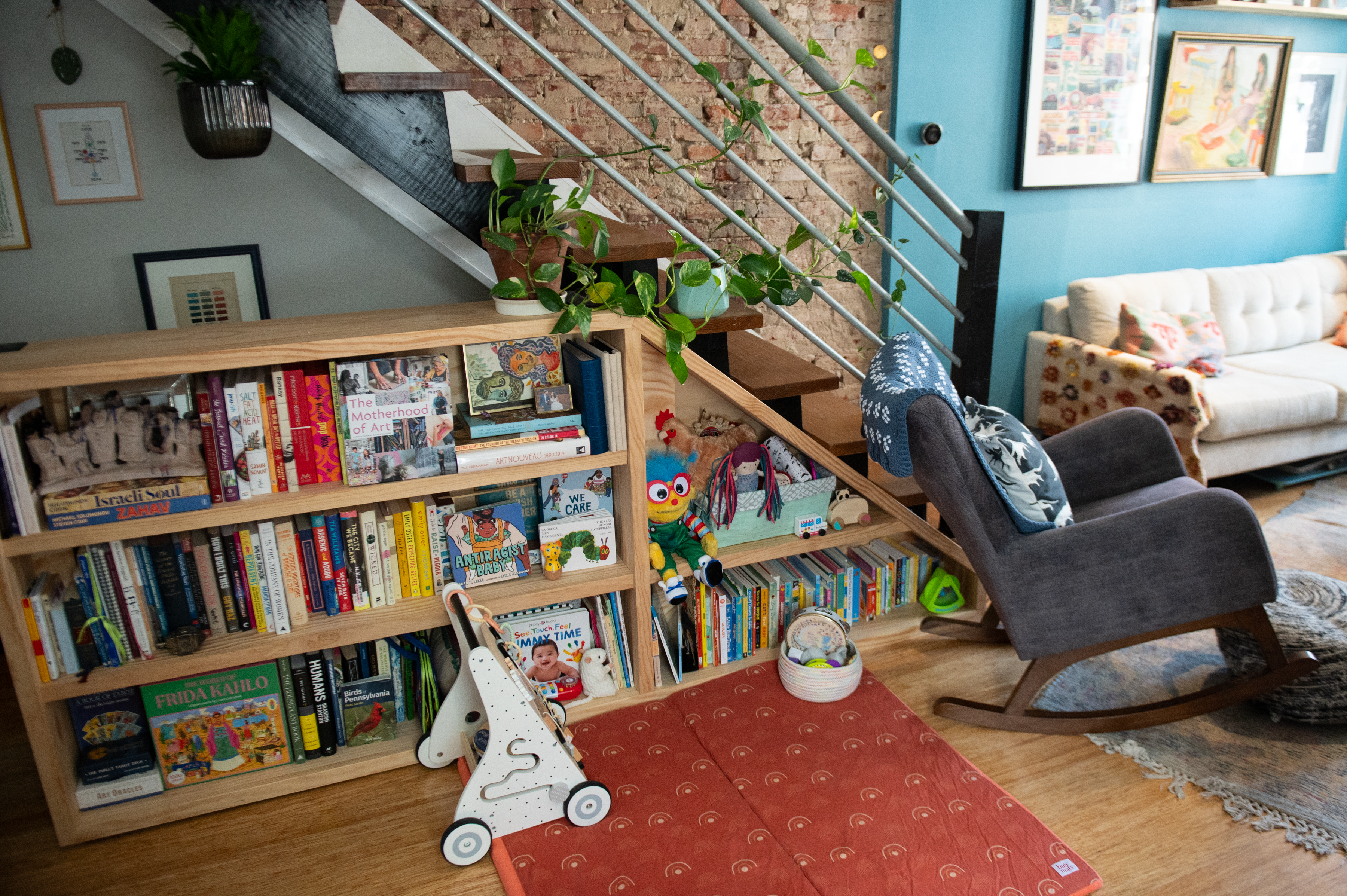
A play area between the living room and kitchen in the Abrams’ home. The bookshelf, which also serves as a railing to the basement, was added while the couple renovated the home.The couch was one splurge item for the couple in their renovations.
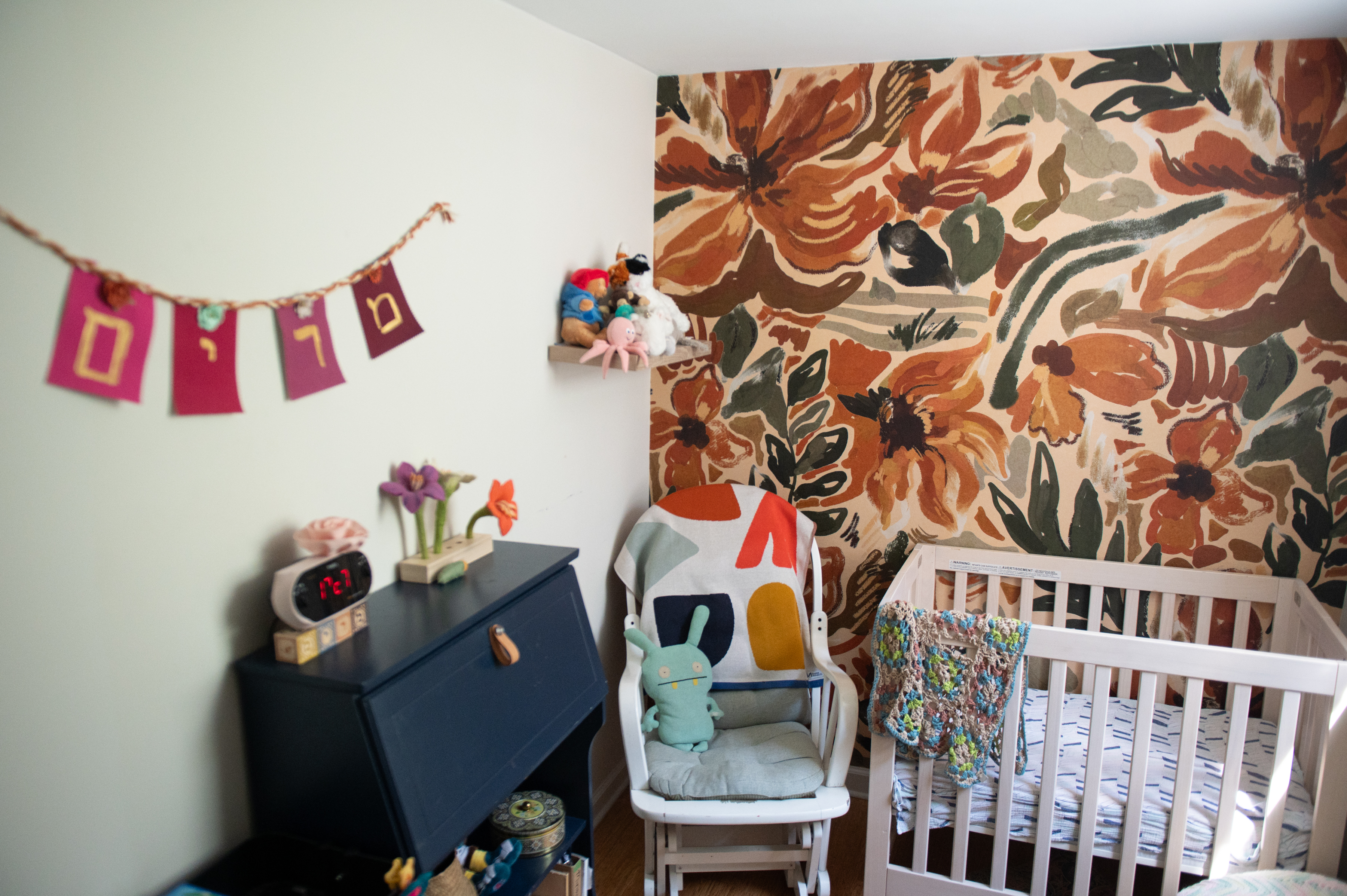
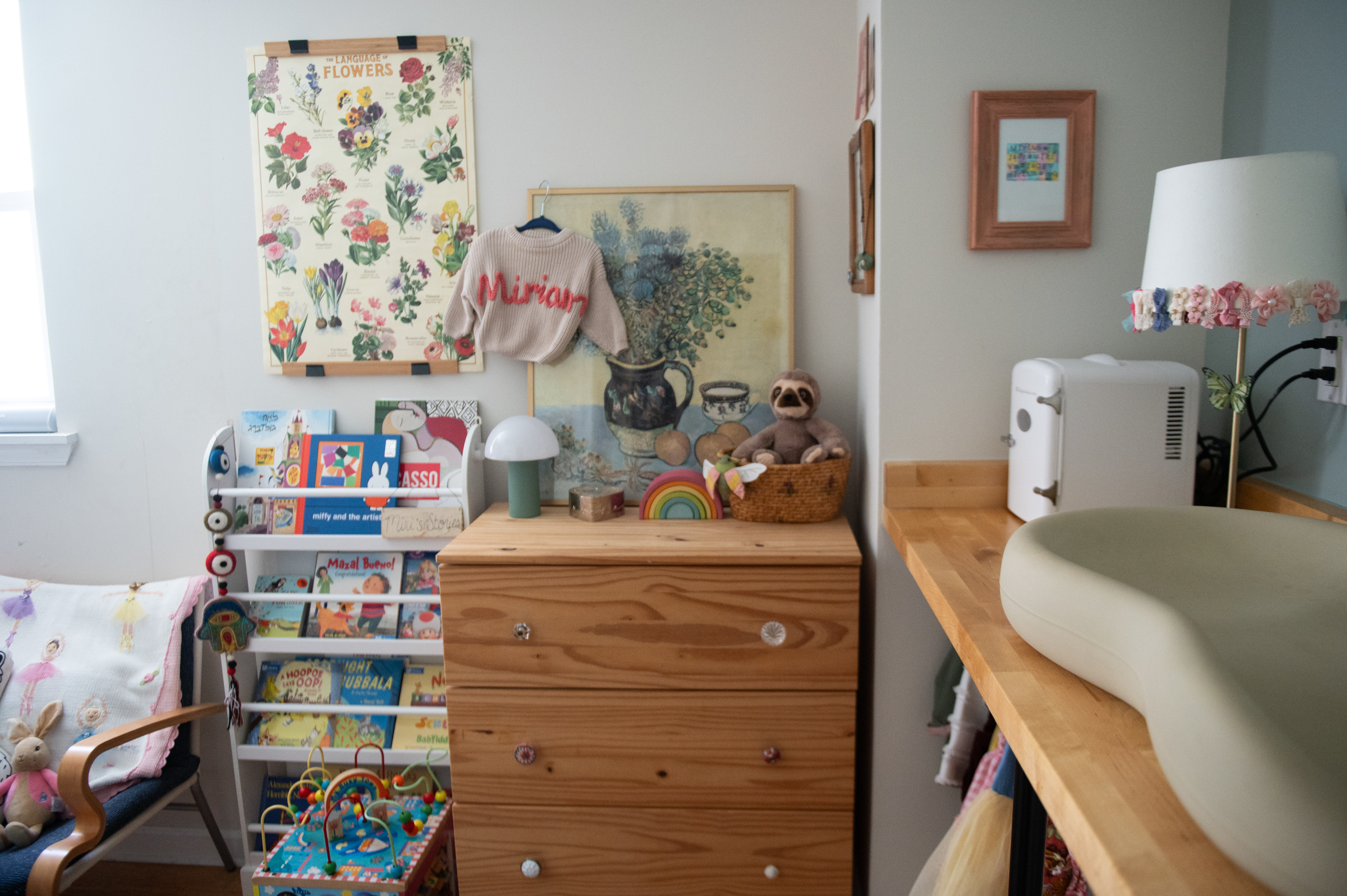
The nursery is the smallest room in the house. Again, the couple’s practical sense took a role.
“We worked with furniture we already had, including the rocking chair from my childhood bedroom,” Danielle said.
They added handmade touches throughout the space, including the felt mobile in the window and the name garland on the wall.
“The only new piece of furniture in the room is the crib,” Danielle said. “We opted to get a mini crib from Babyletto that would better fit the small space.”
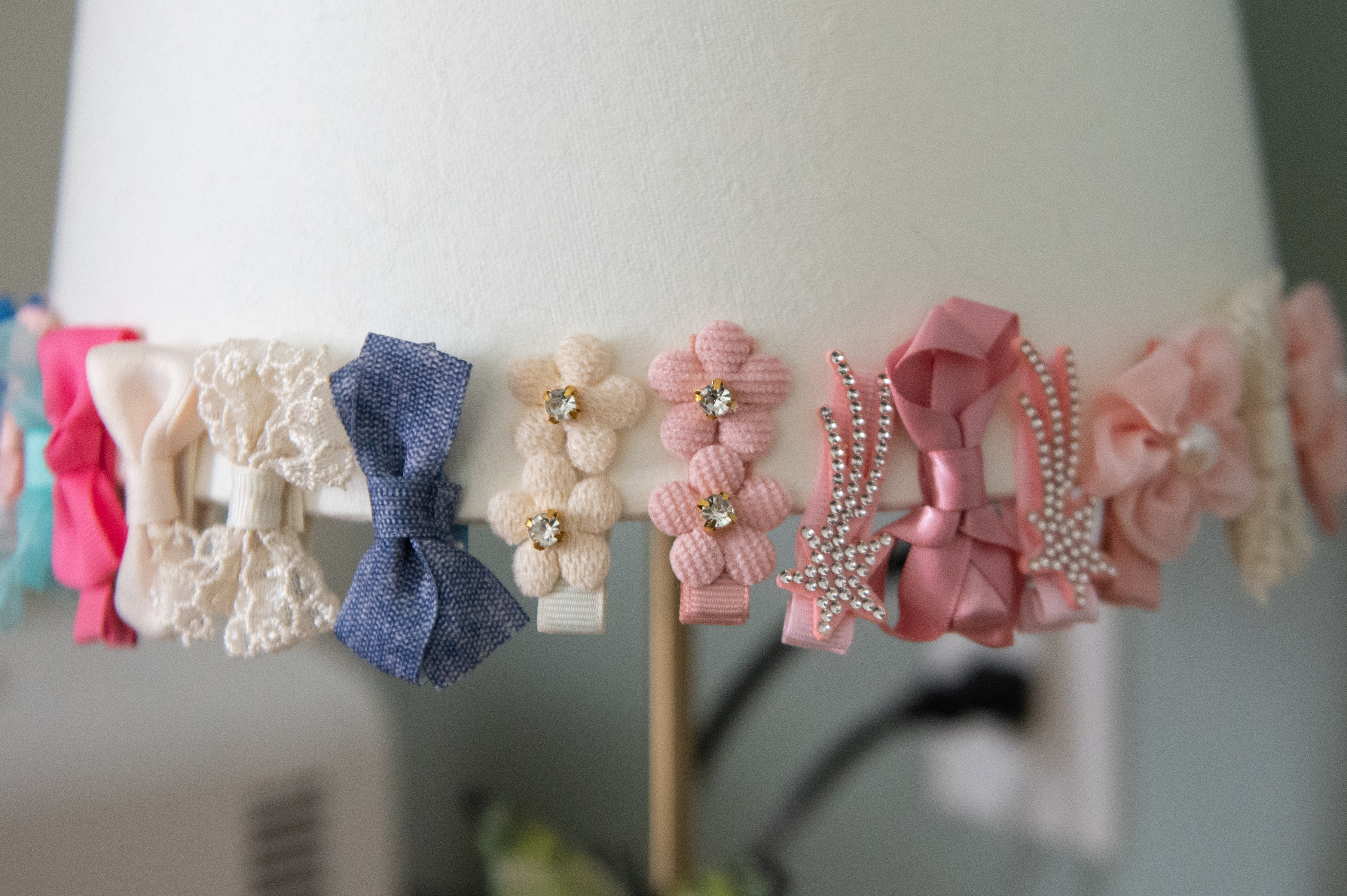
In Miriam’s nursery, the couple purchased a mini crib to better fit the small bedroom space.A homemade felt mobile hangs in the nursery window.Bows line a lampshade in the nursery.Children’s books and decorations in Miriam’s nursery.
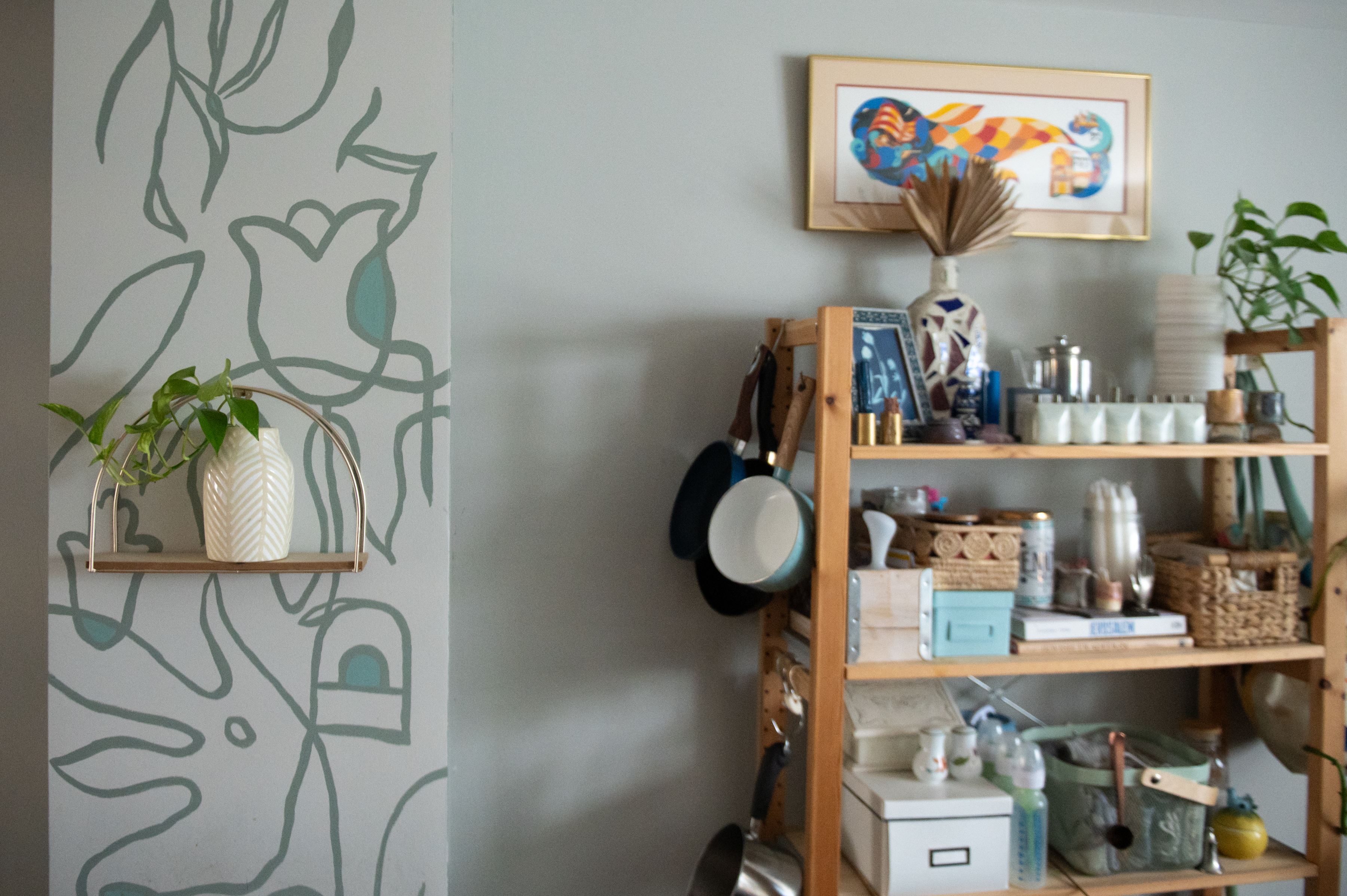
In terms of color, the home showcases blue and sage green throughout. Danielle also added her own personal artwork. She is especially proud of a mural that she painted in the kitchen, a continuous line design that incorporates botanical leaf shapes and the Hebrew letters that spell out Shalom.
The stairwell was the couple’s final project, with a goal to create a space for their daughter’s books and toys.
“Choosing to stay in the city after having a baby makes our home stand out from many of our neighbors’ homes,” Danielle said. It “demonstrates how to be resourceful and creative in your home design rather than moving out to a larger property in the suburbs.”
Decorations and storage for kitchen items on the first floor of the home.
A 15-year retail veteran who has worked at many retailers in the Philadelphia area, including Burlington, Five Below, Anthropologie, and Terrain, she is a graduate of Drexel’s Westphal College of Media Arts & Design. She currently runs her own business, a sustainable Judaica brand called HamsaMade, while also working for a local woman-owned company that sells safety accessories to essential workers.
Jonah is a project manager in the renewable energy field. He’s equally happy to be living in the city.
“Being right by Goldstar Park, Capitolo Park, and Paolone Park is one of our favorite things about where we live,” he said. “Before we moved in together, I was living in Queen Village and Danielle was in Bella Vista so we clearly love South Philly.”
Paintings and mosaics decorating Danielle and Jonah Abrams’ backyard.
Last year’s renovation, Jonah noted, was not the couple’s first home project since they bought the house in 2018, but it was the first “that was not to solve an immediate problem.” He appreciates the surrounding community, and serves as a ward committeeperson. He can sometimes be found traveling the neighborhood by foot, “wearing our baby as I knock the doors of my neighbors, hearing about their challenges and helping them to vote.”
“We love being able to walk to so many of our favorite places and favorite people, and we want our daughter to grow up being able to do the same,” Jonah said. “And we are dedicated to making our neighborhood even better.”
Is your house a Haven? Nominate your home by email (and send some digital photographs) at properties@inquirer.com.
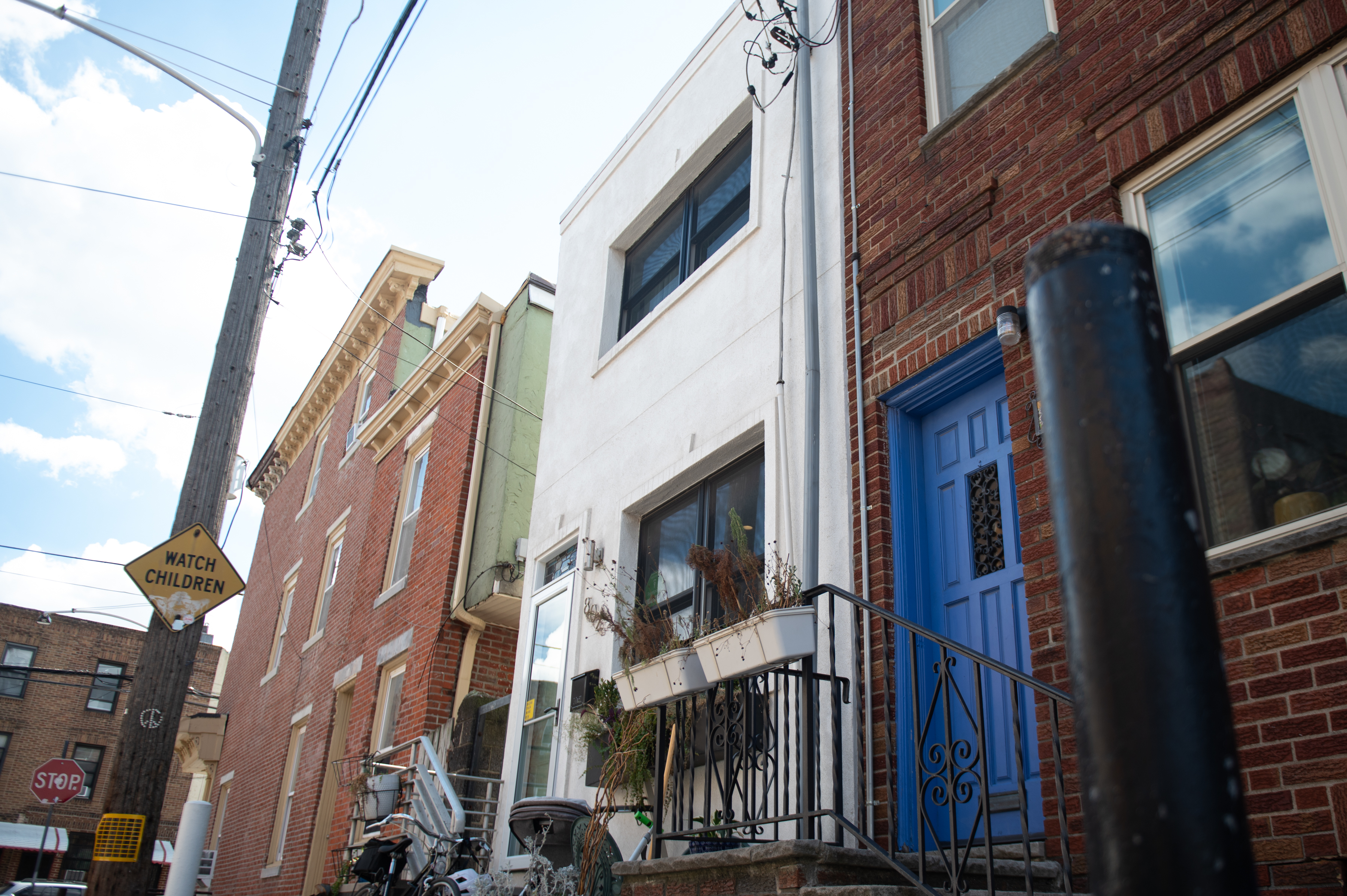
The outside of Jonah and Danielle Abrams’ South Philadelphia home.
Forty-five years ago this week, the Phillies won their first World Series.
At the center of it all, Michael Jack Schmidt.
Schmidt went 8-for-21 with two homers and seven RBIs against the Royals and was named World Series MVP, a crowning achievement in his Hall of Fame career. But he badly needed that performance to change the narrative after several years’ worth of playoff disappointment, individually and for the team.
Here’s an excerpt from our conversation, edited for brevity and clarity. Watch the full interview below and subscribe to the Phillies Extra podcaston Spotify or Apple Podcasts.
Q: Kyle Schwarber has 340 home runs through age 32. What’s the key to maintaining the production on the back nine of a career?
A: You’re getting into your middle 30s, moving a little bit into your late 30s, if you can stay healthy, continue a really, really strong workout program in the offseason. Your flexibility has to be there. Your bat speed obviously has to stay up. Your eyes have to stay — you’ve got to be able to see. I had 20/10 vision when I played. And it’s important to have good eyesight as you’re going forward, like you did when you were young.
There’s a lot of nonmechanical baseball swing issues that have got to stay right because you’ve got to be quick.
Schwarber is now quick to the ball, and you have to have confidence you could hit a 95 mph fastball as you get older. That’s what kind of sent me out of the game — that fastball just started to just get by me. My reactions weren’t as strong as they were when I was young. My bat speed wasn’t what it used to be.
It’s like golf. As you get older, you wonder, ‘Why did I lose my length? How come I can only hit at 240 now? I used to be able to hit it 290-300,’ and things just change when you get older. So you’ve got to fight that off as long as you can. You’ve got to push that off into your 40s or whatever. And so, that’s a big issue.
… We’re crazy to [only] use the number 500 [homers] with Kyle Schwarber. You’re only talking about what, five more years at 30 a year to get to 500? He’s probably got, let’s say, five more years at 50 a year. Five more years at 40-45, a year. So, his No. 500, I believe, is selling a little bit short.
Q: Why do you think Bryce Harper has been such a good fit for Philly and maybe vice versa?
A: I had my doubts in the beginning, from a distance, from what I knew about [him] playing at Washington. I had my doubts about that. Plus, you add in that crazy amount of money [$330 million] the Phillies gave him to come to Philadelphia and the number of years [13], and I just had my doubts. And he has taken to Philly like a duck to water. He’s got a fantastic team around him. He’s a great family man. He plays the Philly way — down and dirty, and that’s the way he is. And he brings the crowd into his game, and the game into the crowd. He’s a little bit the opposite of me. I kind of played with those blinders on, and he’s very emotional when he plays the game. The Philly fans love that. He’s gotten a lot of big hits. He loves that big moment. The fans love to be there when Bryce comes up in a big moment. So he’s a clutch player, there’s no question about that.
And he knows the history of the game. He gives me a lot of respect. And also other players to play before him. That’s good. Players of my era like to see that in current-day players as a rule. … We don’t think that this generation of players knows as much about us as they should, because I know that when we played, we knew about the guys that came before us. We had their baseball cards when we were young, and … if somebody walked in, if Stan Musial walked into our clubhouse, we’d all rush over to meet him. We all knew who he [was]. I don’t want to get too deep into this, but I think over time, the sense of the people that came before you — and in all sports — I truly believe that is diminished from what it was 20-30 years ago. Not with Bryce. Bryce is very informed about the alumni like myself.
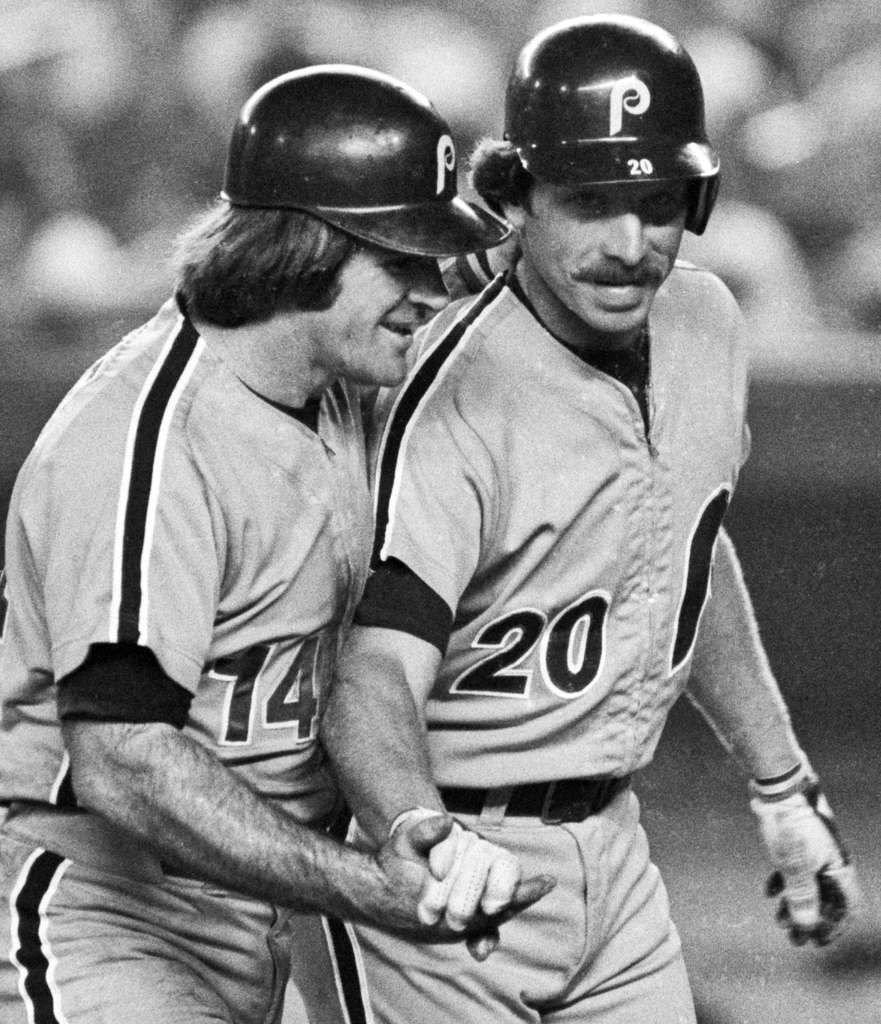
Pete Rose (left) was Phillies teammates with Mike Schmidt for five seasons.
Q: In May, the commissioner posthumously reinstated Pete Rose, whose name could be put before a Hall of Fame era committee for consideration for induction in December 2027. Within the Hall of Fame community, do you think there’s support to put Pete Rose in the Hall of Fame?
A: I do, but I don’t know that it’s any more than 50% … There are as many detractors as supporters in Pete’s case. However [Hall of Fame chairman of the board of directors] Jane Clark forms the committee, that will determine Pete’s fate. And even if they put 16 ex-players, members of the Hall of Fame on it, I still think it would be 50/50. And if they put four or five Hall of Fame members on it, and GMs and team presidents and media people and historians, and they put all those guys on it, I still think it runs 50/50. [Note: 75% support is required for election.]
… I can’t go one way strong or the other, based upon my experiences and talking about Pete, wherever I’ve been, be it around the members of the Hall of Fame or media types, Just general conversation at a restaurant or something with people.
What a tumultuous life that man led. I don’t think he handled the whole situation very well. I’m not a proponent of him gambling on the game, which was the big issue, of course. The people’s lives that he affected through that, through his life during that period, the way he handled when he admitted on that, and the way that Mr. [former commissioner Bud] Selig was hoping that he would change his life and do some good, change his habits in life to positive things for the game of baseball and for himself and his family, which didn’t happen.
So I think he created his own fate. And now we will find out, I guess in two or three years, when this committee votes whether he will have a plaque in the Hall of Fame. And I believe that if he doesn’t, I still think there should be a big corner in the museum somewhere that shows pictures and tells the story, maybe a video of some sort, of Pete Rose happening in the history of baseball. Because I think it’s important. Whether it was a negative stain on the sport or not, that’s part of it.
Democrats have dominated Delaware County government since the 2019 election.
As suburban communities across the nation flipped from red to blue, Democrats took control of the county council for the first time since the Civil War — the result of long-term shifts accelerated by President Donald Trump’s first administration. The party has held all five seats on the governing board ever since, easily retaining seats in 2021 and 2023.
Two seats on the five-member board are on the ballot in November. Democrats argue tax increases were necessary to make up for decades of underinvestment by Republicans.
But Republicans insist spending is out of control. While they cannot take control of the board this year, they are asking voters to give them a voice to push back against the Democrats.
“The money tree in the backyard does not exist,” said Brian Burke, one of two Republicans running for council.
Burke, a union steamfitter, was first elected to Upper Darby’s township council in 2019 as a Democrat. He became a Republican to unsuccessfully run for mayor of the township in 2023 following years of feuds with the Democratic administration. While on the township council, Burke worked in conjunction with Republicans on the board as well as two other Democrats to challenge Democratic leadership in Upper Darby. He said this experience would aid him as he worked to hold Democratic leadership in Delaware County accountable.
Piazza worked for decades in Delaware County Court’s domestic relations department, where she ran the warrant division and served as a liaison for judges and attorneys. Running for council, Piazza has been vocal about wanting to devote opioid settlement funds toward grandparents caring for the children of those struggling with addiction.
Womack was first elected to the council in 2021 after spending 10 years on the Darby Township Board of Commissioners. Womack spent years as an advocate in the labor movement, including serving as an adviser on community and religious affairs for the national AFL-CIO.
Burke and Piazza are urging voters to elect them to “stop the spend.”
After the council raised property taxes by 23% last year, the pair of Republicans argued the taxes were a result of out-of-control spending in the county. They say there needs to be a voice on the council acting as a check on spending.
“There’s a lot that needs to be cut. There’s a lot of spending,” Piazza said.
If elected, the two Republicans would not have control over county spending, but they would have votes on the five-member board to oppose new spending and work to sway their Democratic counterparts.
What is the Democratic platform?
Womack and Phillips are largely defending the actions of the Democratic council over the last five years. Republican leadership, they argue, did not raise taxes for 12 years and allowed county infrastructure to fall into disrepair. As a result, they say, Democrats had to increase taxes to fund county services and infrastructure improvements.
No one wanted to increase taxes, Womack said, but it was unavoidable.
“Our county has really been underserved for many decades,” Womack said. “In the long run, it costs you a lot more money to repair than if you had taken care of things gradually.”
If elected, Phillips says she would like to do more public vetting of contracts and work to increase development in Delaware County so that the local tax base can be increased without more tax hikes. Womack has said he wants to work on expanding affordable housing options in the county.
Why were taxes raised? Will there be another hike?
The county council voted last year to increase property taxes by 23%, which comes out to roughly $185 annually for the owner of a home assessed at the county average. The county had used pandemic relief funds to stave off significant tax increases in prior years, but those funds were running dry and additional dollars were needed to cover employee salaries amid inflation, council members said at the time.
Piazza and Burke insist that another double-digit tax increase is on the way. Too much of the current budget, they argue, still depends on short-term federal pandemic relief funds or transfers from other county funds.
“They’re going to come out after November 4th election and basically tell the residents of Delaware County, ‘You’ve got another 20% increase,’” Burke said.
Womack, the sole member of the county council who voted against the increase, said that he anticipated another tax hike but that he could not imagine it would reach 20%.
The incumbent spearheaded a citizens budget task force that has spent the year seeking areas to cut spending.
“It’s kind of hard to really project what we’re looking at right now,” Womack said. He noted that, amid a federal government shutdown, details on state and federal aid are unclear.
However, the county is not expecting to release its preliminary budget until mid-November, after the election. Last year, the county did not release its proposed budget until Dec. 3.
Where do Republicans want to cut?
Republicans have identified three primary areas they argue represent overspending: the county health department, the prison, and outside legal assistance.
Republicans in the county have long argued it was an unnecessary expense. Though the $18 million department is currently funded entirely by state and federal grant dollars, Burke argued it will eventually cost taxpayers.
“In my eyes, that [money] could have been used somewhere else,” Burke said.
In 2020, the council voted to explore options to retake control of the county prison from the private firm that had run it. Phillips, who was controller at the time, argued the decision was in the county’s best interest and has better served inmates and staff.
But Republicans argued that the county’s costs have gone up too much and that the county opened itself up to litigation that it would not have been vulnerable to if the prison had remained privately run. The union representing prison employees often clashed with the first warden the county chose to lead the prison.
In an interview, Burke argued the county could find significant savings if it put the prison back in private hands. In 2025, the prison cost the county over $59 million. The county’s last contract with GEO, which managed the prison privately, paid the company $259 million over five years.
Phillips said the health department and public prison, while significant expenses, will save the county and its residents in the long run. Even when the prison was run privately, she said, infrastructure repairs were on the county and the private operators sought to maximize the number of inmates in the building.
“Government should take care of its people,” Phillips said.
Finally, Republicans point to the ballooning cost of legal counsel to the county. Last year, the county paid more than $4.4 million to outside legal counsel, including a firm that once employed Phillips and County Councilwoman Christine Reuther. Republicans argue this represents misuse of funds and political cronyism.
Phillips and Womack instead point to the county’s small in-house legal team and the growing number of cases brought against the county, including defending against frivolous suits filed by election deniers, as well as managing complex legal issues, such as the Prospect Medical Holdings bankruptcy filing that closed two major hospitals in the county.
Even if they won both seats, Republicans would hold the minority on the council for at least the next two years. This means they would have to persuade Democrats to come along with them on any policy changes or budget cuts.
“I would love to win the seat and get in there and get into the nitty-gritty and kind of see what goes on behind closed doors and have a voice for the residents and be there for them,” Piazza said.
This suburban content is produced with support from the Leslie Miller and Richard Worley Foundation and The Lenfest Institute for Journalism. Editorial content is created independently of the project donors. Gifts to support The Inquirer’s high-impact journalism can be made at inquirer.com/donate. A list of Lenfest Institute donors can be found at lenfestinstitute.org/supporters.
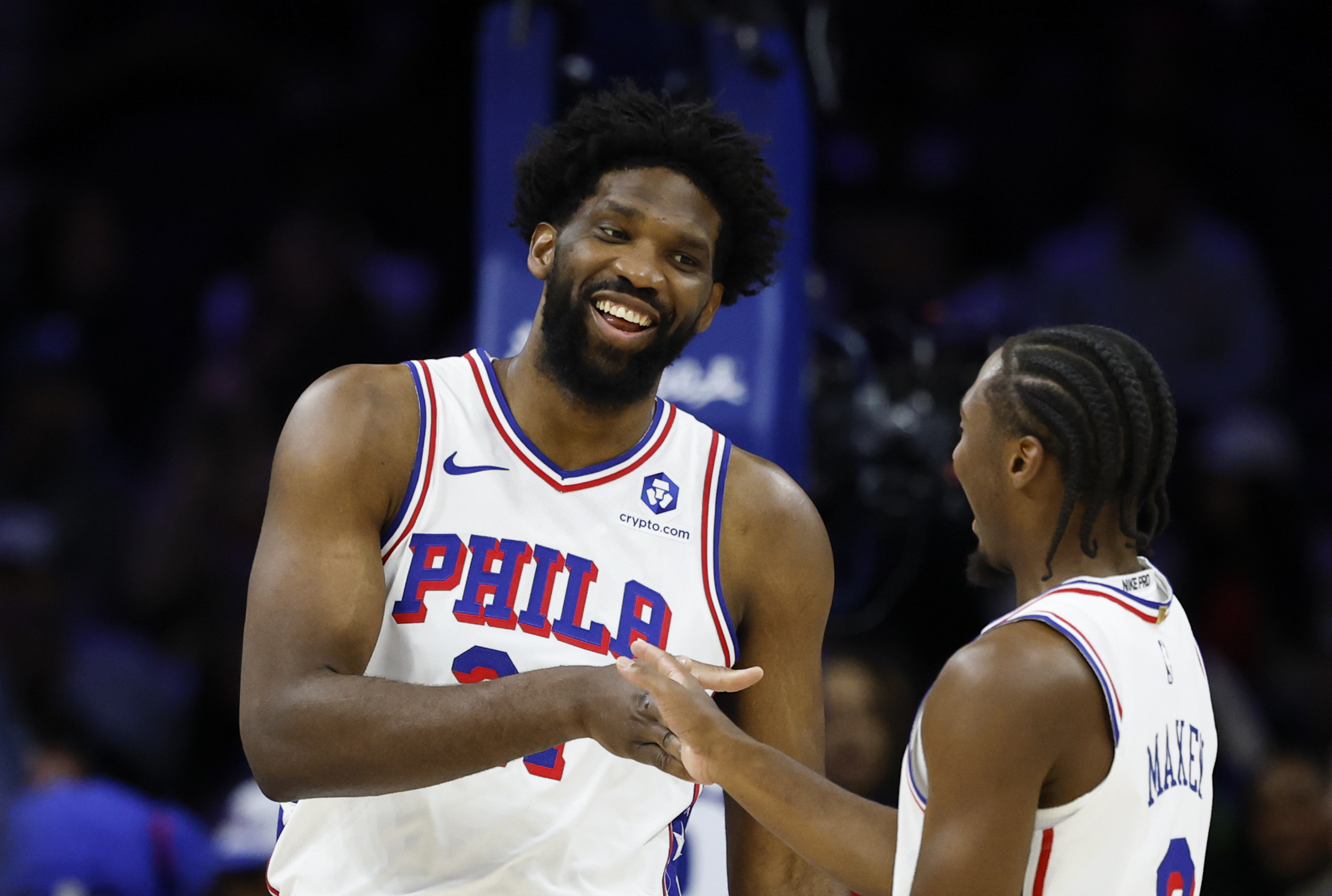
Tyrese Maxey poked his head around a makeshift curtain inside the 76ers’ practice facility, then dropped a smiling “Hey, buddy” to VJ Edgecombe.
Edgecombe, the prized rookie guard, had just revealed during his first media day news conference that, on a summer visit to Disneyland organized by Maxey, Edgecombe’s new teammate had made him “wear some, like, Goofy hat. I had no choice.”
“I’ll make him wear it again when we go to Orlando,” Maxey said before disappearing back behind the curtain.
That playful public exchange demonstrates another step in Maxey’s evolution into a Sixers cornerstone. Now entering his sixth NBA season, Maxey is a bridge between veterans such as former MVP Joel Embiid (who nicknamed Maxey “The Franchise” because of his diligent work ethic and endearing personality) and youngsters such as Edgecombe, who can learn plenty from Maxey’s impressive early career.
But the 2024-25 season was miserable for the Sixers and disappointing individually for Maxey, who missed the final 22 games with a finger injury after becoming an All-Star and being named Most Improved Player in 2023-24. Now, the 24-year-old point guard feels responsible for setting the standard with daily habits and a playing style that can fuel an immediate turnaround — and last into the future.
To do that, Maxey has continued to commit to connecting with teammates. And to playing freely. And, now, to speaking up.
“I have just been a lot more vocal on things that I see and things that I want to try to help fix,” Maxey said. “And that’s not just because I’m older. I think it’s more because I want to win.”
Once Maxey’s injured little finger healed, he invited Justin Edwards to his hometown, Dallas, to train. A few weeks later, right after the draft, Maxey called Edgecombe to arrange workouts together in Philly. They wound up in Los Angeles, where Sixers assistant coach Rico Hines stages his well-known summer pickup games.
Cue the detour to the Happiest Place on Earth.
Sixers guard Tyrese Maxey (right), with VJ Edgecombe, is taking on a more vocal leadership role this season.
Though it was silly to witness “a lot of 6-foot-7, 6-foot-8 guys trying to ride a roller coaster,” Maxey recently said, he does believe fostering off-court friendship can lead to on-court cohesion. It is why Maxey also has begun dabbling in video games, which he previously did not play much but is a common hobby among his younger teammates.
Yet the fun peppered what Edgecombe now realizes were “regular ’Rese workouts.” During those morning sessions, Maxey drilled shooting and finishing with the rookie, how to play with pace, and how to find different angles while handling and distributing the ball.
“It was a sign that he actually cared,” Edgecombe said. “He actually wants to also see me get better and build chemistry.”
This has been an emphasis from coach Nick Nurse since the James Harden trade in 2023, when the ball literally and metaphorically was handed to Maxey. Using one’s voice is simply part of organizing the team as a point guard, Nurse said. When asked for examples of Maxey’s vocal uptick during this preseason, Nurse repeated the word “many.”
“I don’t want to tell you what they are,” Nurse said. “But there have been many. Many that would have been surprising, that he wouldn’t have done a couple years ago. Many.”
That description already is different from last season. There was not as much opportunity for Maxey to arrange summer workouts with teammates because he uncharacteristically backed off his own training to limit injury risk before he could sign his max contract in July. He said he planned to immediately become more vocal with teammates once practices began, but “I didn’t really get going the way I needed to.”
Neither did the Sixers, to be fair. A team with championship aspirations face-planted during a 3-14 start, with Embiid and fellow perennial All-Star Paul George sidelined by injuries that lingered for the rest of the season. One time Maxey did hold a teammate accountable when he called Embiid out for tardiness during a postgame team meeting in a November loss at the Miami Heat, and it leaked to the media.
And although Maxey had morphed into an effective on-court partner for Embiid, he struggled as the team’s top offensive option.
Maxey acknowledged that he faced defensive coverages he had never seen before. He averaged a career-high 26.3 points and 6.1 assists, but his efficiency dipped and turnovers went up. The finger injury derailed his normally dangerous three-point shooting, including an 0-for-10 mark in a late-February loss on the same Madison Square Garden court where he had catapulted himself into national stardom in the previous spring’s playoffs.
As the season progressed, Maxey did gain confidence in “manipulating” the opposing defense. That became a focus in offseason film study, during which he critiqued possessions when he got sped up and deciphered how to lure specific defenders into an action. He also recruited high school friends to mimic “blitzing” and other swarming schemes, a callback to when he used those pals to help him identify passing reads during the 2023 offseason.
“My rookie year through my third year, I used to get so angry at Joel sometimes when [he’d] be getting double-teamed,” Maxey said, “and I’m like, ‘Bro, I’m wide-open.’ And he’s like, ‘Bro, I can’t see you.’
“Then people started double-teaming me, and people were like, ‘Bro, I’m open.’ And I said, ‘Trust me I really can’t see you.’”
Sixers center Joel Embiid formed an effective offensive duo with guard Tyrese Maxey.
Beyond Maxey further establishing that leadership, Nurse now wants him to resume firing a barrage of three-pointers in transition and from even farther beyond the arc. His offseason checklist also included increasing strength on his 6-foot-2 frame so he can play with more physicality when driving into the paint.
Those skills are weapons within the Sixers’ systemic offensive tweaks, with a goal to play faster, emphasize passing, and generate buckets even when Embiid and/or George miss time.
Edgecombe, Quentin Grimes, and, eventually, Jared McCain also are capable ballhandlers, allowing Maxey to play more shooting guard. Maxey’s experience — first in a three-guard lineup his one college season at Kentucky, then while sharing the floor with Ben Simmons and Harden as a young professional — has prepared him to toggle between both backcourt roles.
During early practices, Nurse said, Maxey would alternate between bringing the ball up on one possession, then deferring to Edgecombe on the next. By Day 3, the coach said, Maxey began to identify gaps in the defenses and opportunities to unleash his speed on cuts and when coming off screens.
And when Maxey told his coach that he did not feel he had the ball enough in the Sixers’ preseason opener against the New York Knicks in Abu Dhabi, United Arab Emirates, Nurse countered with, “That was about as free and easy as you’ve played offense that I can remember.”
“You had great shots,” Nurse told his point guard. “You had some cuts for backdoors. … You did that without dribbling in circles for 20 seconds and trying to find something, flying into brick walls. You just were really moving.”
That on-court rhythm is powered by a fresh mindset. Maxey candidly acknowledged the emotional weight of last season, while absorbing the mounting losses (and being tasked with attempting to explain them in interviews) for the first time in his basketball life. There were times his family and close friends remarked that he was not smiling as much.
So he began “really focusing” on his mental health, regularly journaling and putting goals in writing. His joy had noticeably returned during an appearance at summer league in Las Vegas, when he held a joint media availability with close friend and new Sixers signee Trendon Watford. At media day, he opened his press conference by asking onlookers if he should keep the white arm sleeve with his game day jersey.
“My spirits have to be high for this team and for this organization and for my game as well,” he said. “I think that’s what I’ll do this year, and we’ll be better.”
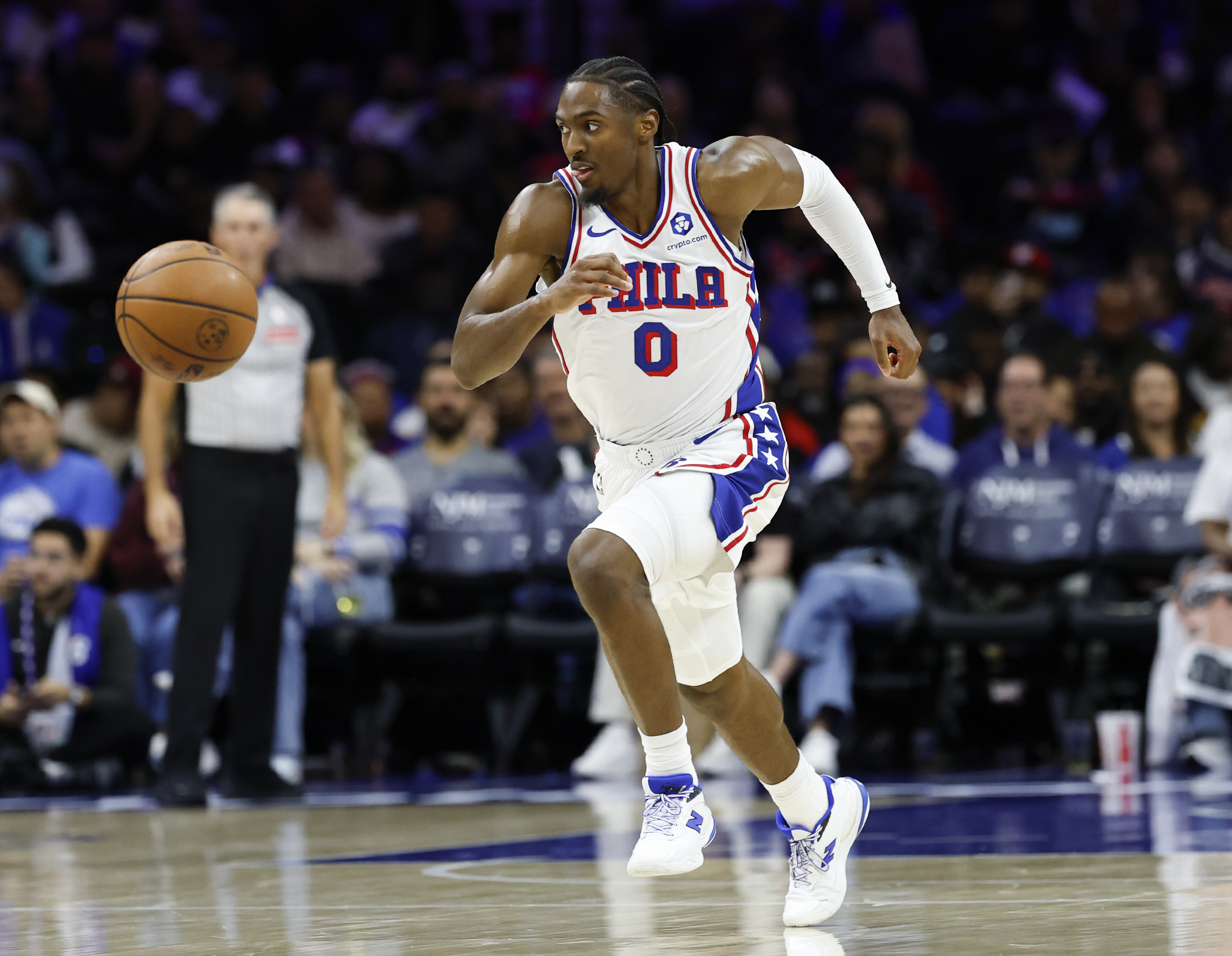
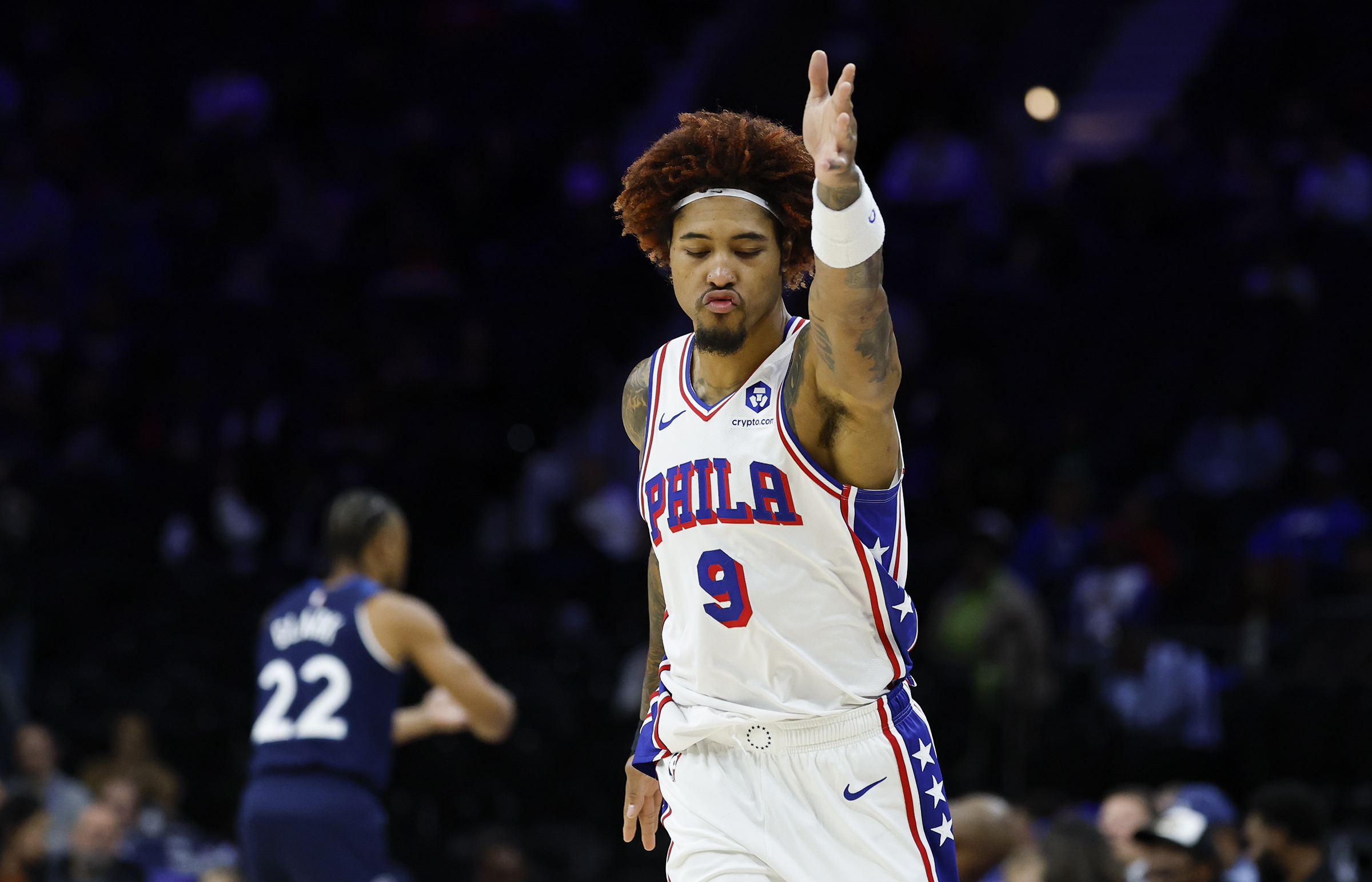
Tyrese Maxey chasing down the ball in a preseason game against the Timberwolves on Friday.
That spirit has appeared during one-on-one drills at the end of practices, when his opponents have ranged from George to Edgecombe to two-way forward Dominick Barlow. Kyle Lowry, a 20-year NBA veteran and long-respected leader, has “pushed” Maxey to speak up during the more intense segments of practice. Ditto for fellow veteran Eric Gordon, who recently said “it’s been time for [Maxey] to be a leader.” Embiid first approached Maxey about this at the end of the 2023-24 season and appreciates that the point guard balances Embiid’s quieter demeanor.
“That’s why it’s such a good match,” Embiid said. “… But it goes back to just him being a good kid. Willing to learn. Humble. Listens. I think that goes a long way.”
When a reporter began a media day question to Maxey with “Six years ago,” he jokingly responded with a whistle and “Why you got to do that?” He called himself “old” several times during the preseason, even though he turns 25 next month.
But after totaling an efficient 27 points and seven assists in the Sixers’ win over the Minnesota Timberwolves in Friday’s preseason finale, Maxey casually leaned back in his locker room chair. He spoke glowingly about Embiid’s return from knee problems and Edgecombe’s early development, bridging the veteran and young portions of the roster. When asked about his final preparations before Wednesday’s season opener at the Boston Celtics, he started with “just stay in a flow state,” a mantra he heard from his younger brother during the summer, and “I took it from him.”
Three days later, Maxey stood under a basket inside the Sixers’ practice facility, arm slung around McCain. He told McCain that he missed playing with him, that he will make the Sixers even better once he returns from thumb surgery.
Then, Maxey walked across the court for his final media session before the 2025-26 season begins. Six minutes later, he chugged right back to that basket on the opposite end, to put up more shots.
“He’s happy. He’s a worker,” Nurse said. “He’s in here early. He wants to practice. He wants to go over things. And that’s part of being a leader, too — that you’ve got that mental motor that’s capable to continue to work over and over every day.”
“Philadelphia has no good pizza” is one age-old chestnut that needs to be put to rest, as so many pizzerias, such as the expanding Angelo’s, Beddia in Fishtown, Pizzata in Rittenhouse and South Philadelphia, and Sally near Fitler Square, are raising the local game. The Pennsylvania and New Jersey suburbs have plenty of quality, too — for example Brooklyn Original in Haddon Heights, Verona in Maple Glen, Pizza West Chester, and Johnny’s on the Main Line.
Here are 11 prime pizzerias that have opened in the last several months, as well as intel on four others on the way.
Suburban Philadelphia pizzerias
Anomalia Pizza
Deena Fink and Frank Innusa traded careers in show biz to entertain on an entirely different stage: a slice shop across from the Fort Washington Regional Rail station. Their drunken grandma pie is a thing of beauty: a crispy, almost buttery-bottomed square topped with fresh mozzarella and ribboned with a thick, creamy vodka sauce amped with pancetta. Read on for their story.
Anomalia, 414 S. Bethlehem Pike, Fort Washington, 215-628-3845, anomaliapizza.com
Barclay Pies
Gluten-free arugula pizza from Barclay Pies.
TJ Hunton and Daniel Romero, whose immediate family members have celiac disease, are behind this cheery newcomer in Cherry Hill’s former Season’s Pizza offering gluten-free crusts (using Caputo’s GF flour) along with a line of conventional pies, plus other stuff (chicken tenders, wings, fries, cookies) that are gluten-free from inception. The lineup: five red pizzas (plain, pepperoni, sausage, pineapple, and a vegan margherita featuring cashew milk mozzarella cheese by Miyoko’s Creamery) and four whites (arugula, mushroom, broccoli, and buffalo chicken). Allergen info and protocols are up on their Instagram. Plain and pepperoni slices are available over lunch.
Pizza Margherita at La Pizza & La Pasta restaurant at Eataly in King of Prussia Mall.
The Italian marketplace opened earlier this month in King of Prussia Mall with two pizza options: a sit-down experience in the restaurant with well-crafted, puffy-crusted Neapolitans, as well as a counter with Roman-style pizza by the slice.
Grandma pie from Genova Pizza 2 Go, 748 Sicklerville Rd., Williamstown, N.J.
Pizza from a gas station? Since it’s Jersey, of course it’s full service at this new branch of Audubon’s Genova Pizza, tucked inside Marathon Gas. The grandma pies, with their crispy, olive-oil-slicked crusts, and the thicker-crusted Sicilians are the big draws. Bonus: Brothers Ali and Omar Doukali are planning yet another location, in Sicklerville, according to South Jersey Food Scene.
Chef Brad Daniels checks a Rocky pizza at Gloria Sports & Spirits, 1500 Main St., Warrington, on Oct. 20, 2025.
It would be far too easy and wildly inaccurate to brand the sprawling Gloria in Central Bucks’ Shops at Valley Square “a sports bar.” Yes, the bar is ringed with TVs and there are two golf simulators and a shuffleboard table. Happy hour is on from 3 to 6 p.m. weekdays. But Gloria’s pedigree explains why this is right up there with the best bar pizza in the northern burbs.
It’s led by Vetri alumnus Brad Daniels, who with his partners also owns the acclaimed, high-end Tresini in Spring House, turning out light but sturdy-crusted 13-inch rounds with quality toppings. And not the same old. Take the saganaki, a riff on the Greek fried cheese. Daniels slices and preserves lemons, and lays them alongside mozzarella, feta, garlic, and oregano for a sweet-tart flavor bomb. The “brock party” gets plenty of shaved broccoli, along with ricotta sauce, roasted garlic, and mozzarella. The red pies get just enough Bianco di Napoli sauce, and he uses fior di latte on them instead of generic mozz.
This week’s big Main Line pizza news is John Bisceglie’s soft-opening phase of a second Johnny’s Pizza, in a strip center near the farmers market in Wayne. It’s a companion to his Bryn Mawr original, which appears in The Inquirer’s 76 for his 20-inch cheesesteaks and “unforgettable pies both thick and thin(ish), rectangular and round, red and white.”
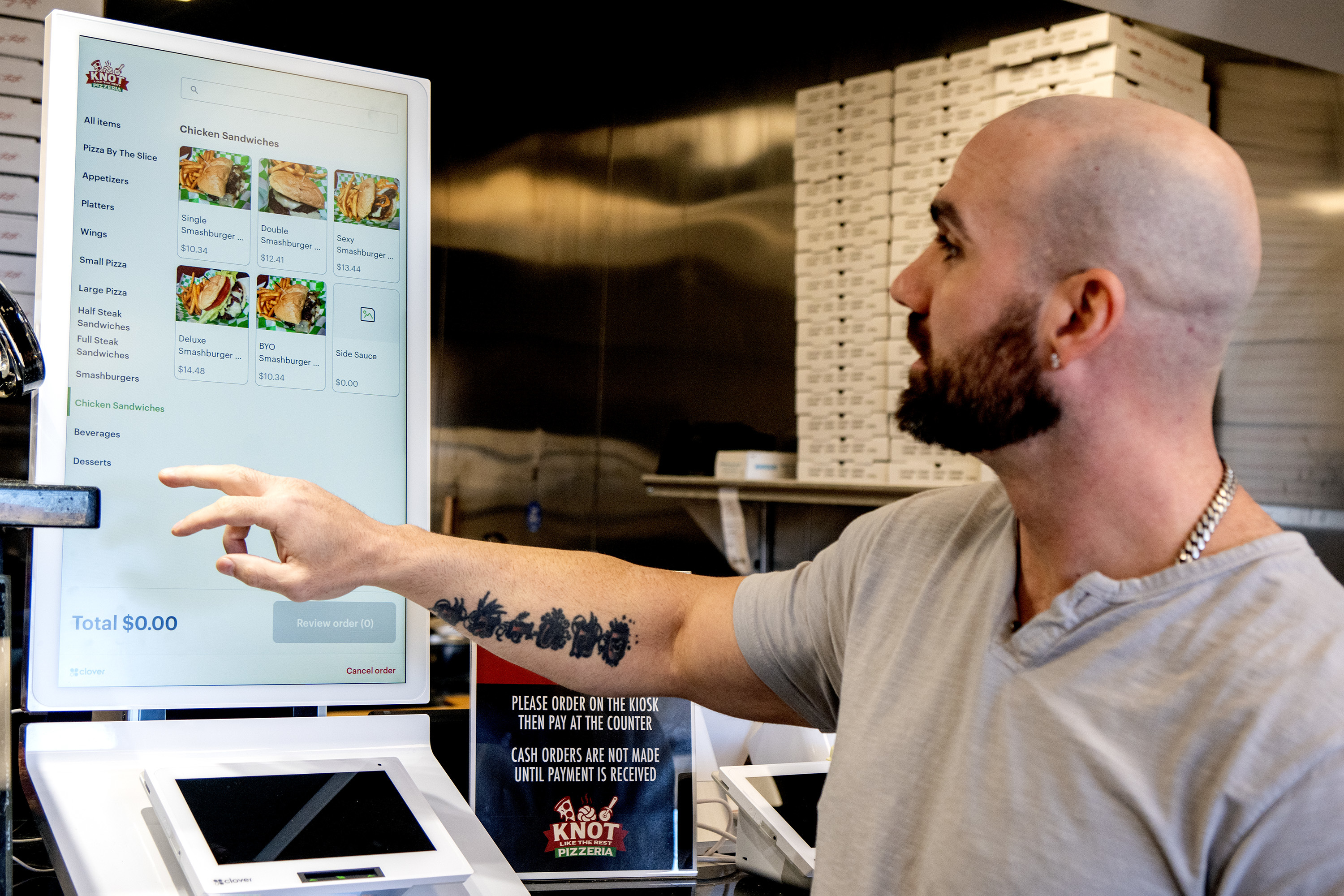
Owner Gary Lincoln demonstrates the kiosk ordering system at Knot Like the Rest Pizzeria in Pine Hill.
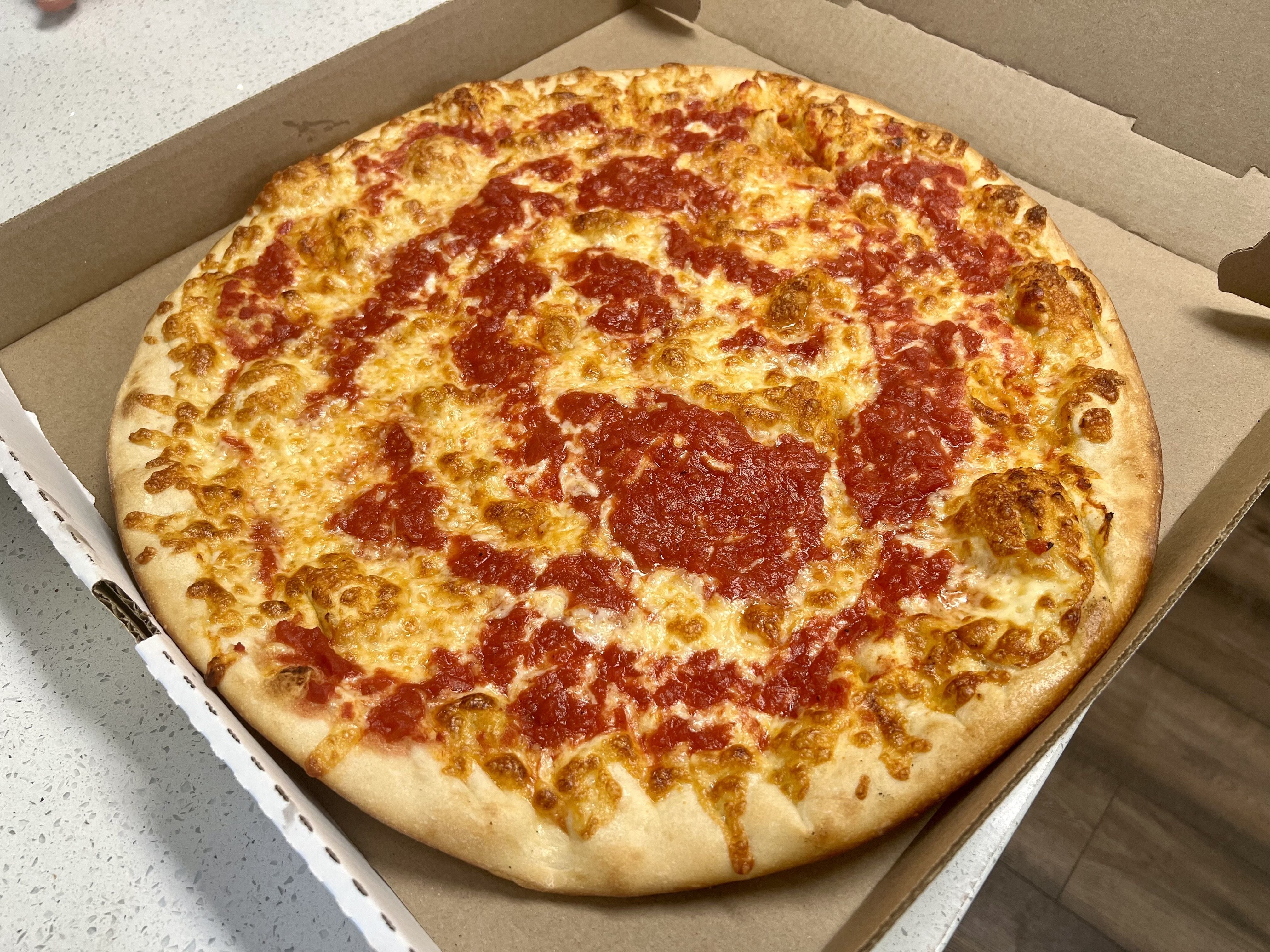
Gary Lincoln’s latest South Jersey pizzeria, which opened less than two months ago, is assuredly knot like the rest. It’s all online for delivery, and walk-in customers must head to two kiosks for their slices and pies — no ordering from a counterperson. Punch in your order, perhaps a Pickle pizza (pickles, bacon, cheddar, mozzarella, ranch dressing), a “Zinger” (secret sauce, steak, banana peppers, mozzarella, American cheese), or a Knotty Vodka, with its edges ringed with garlic knots. Eat at the counter or a few round tables. Lincoln also owns New Wave Pizza in Turnersville and All About the Crust in Woodbury.
Knot Like the Rest Pizzeria, 1193 Turnersville Rd., Pine Hill, 908-382-7960, knotliketherest.com
Philadelphia pizzerias
15th Street Pizza & Cheesesteak
Sauce is applied to a pizza from 15th Street Pizza & Cheesesteak.
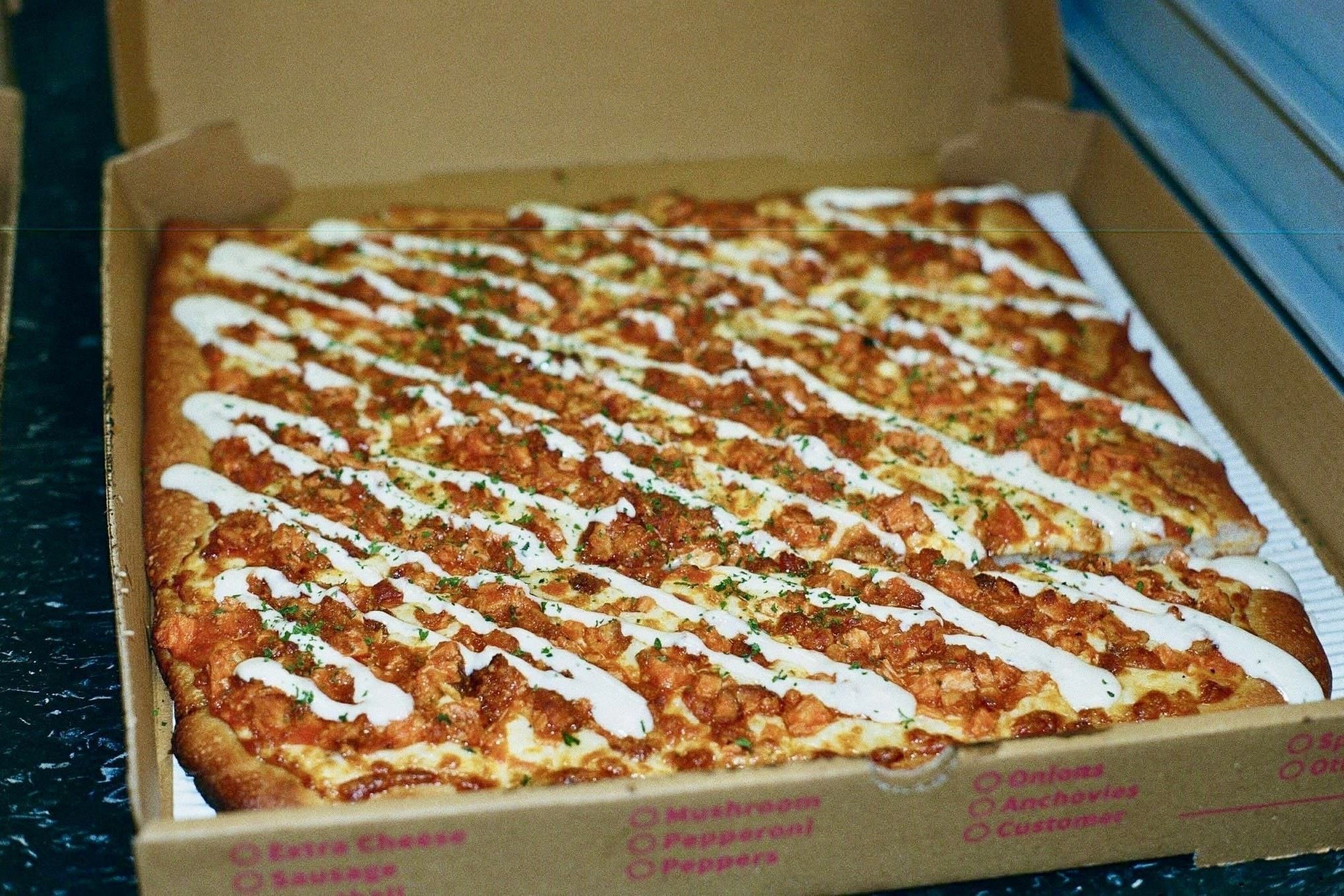
A decade ago, Andrew and Michael Cappelli took over the shuttered pizzeria next door to their cigar shop on 13th Street near Locust — popularly known as Gay Pizza — and reflagged it Pizzeria Cappelli. It still rocks till 4 a.m. Last summer, feeling that Rittenhouse needed a slice shop for the wee-small hours, they opened a companion in the former Starbucks at 15th and Latimer. At 15th Street Pizza & Cheesesteak, serving a variety of thin-crust slices till 3 a.m., the hits include the white garlic with ricotta and anything topped with Buffalo chicken. Do not skip the garlic-Parm wings.
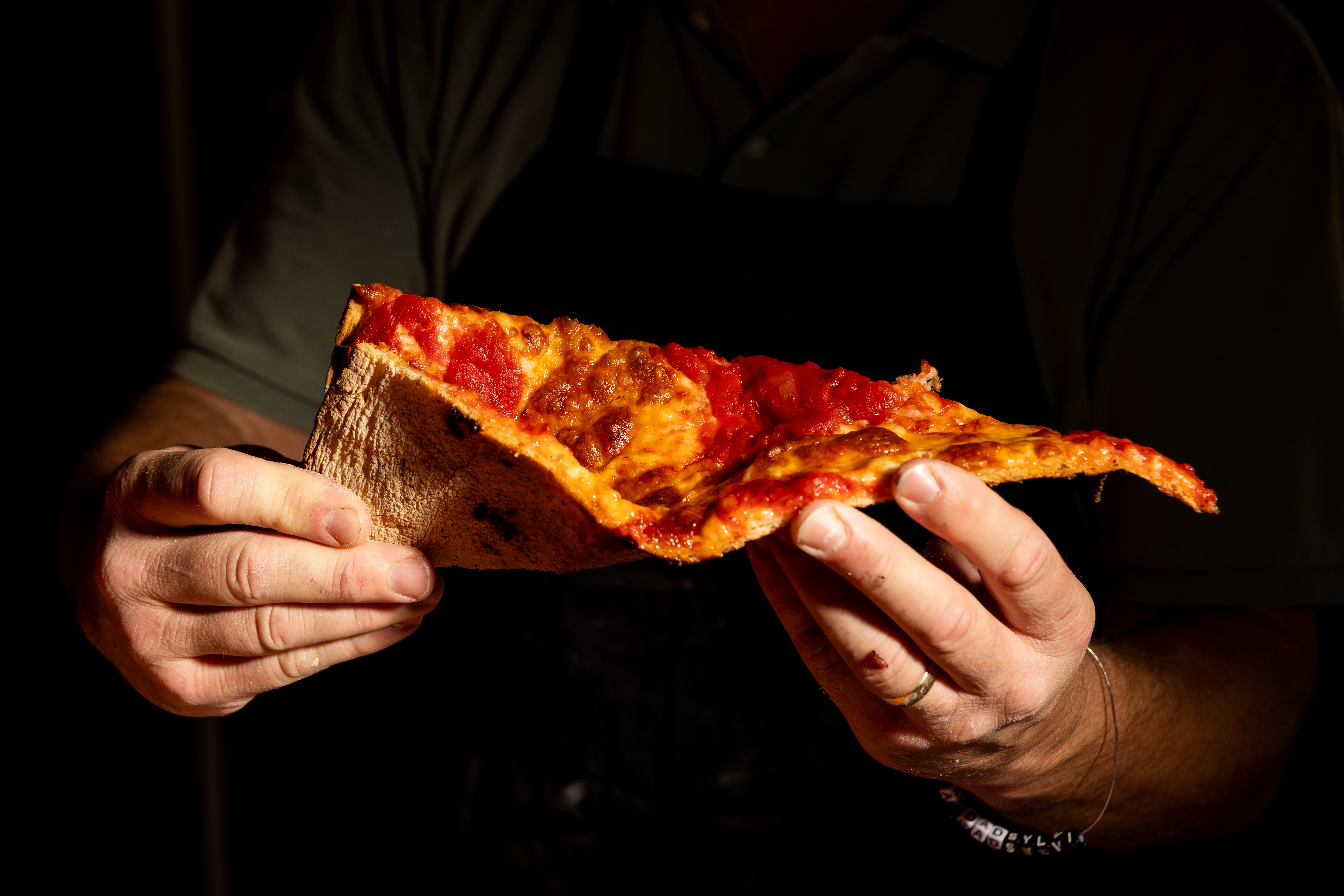
Owner Steve Calozzi holds a slice of a 24-nch tomato pie at Italian Family Pizza.
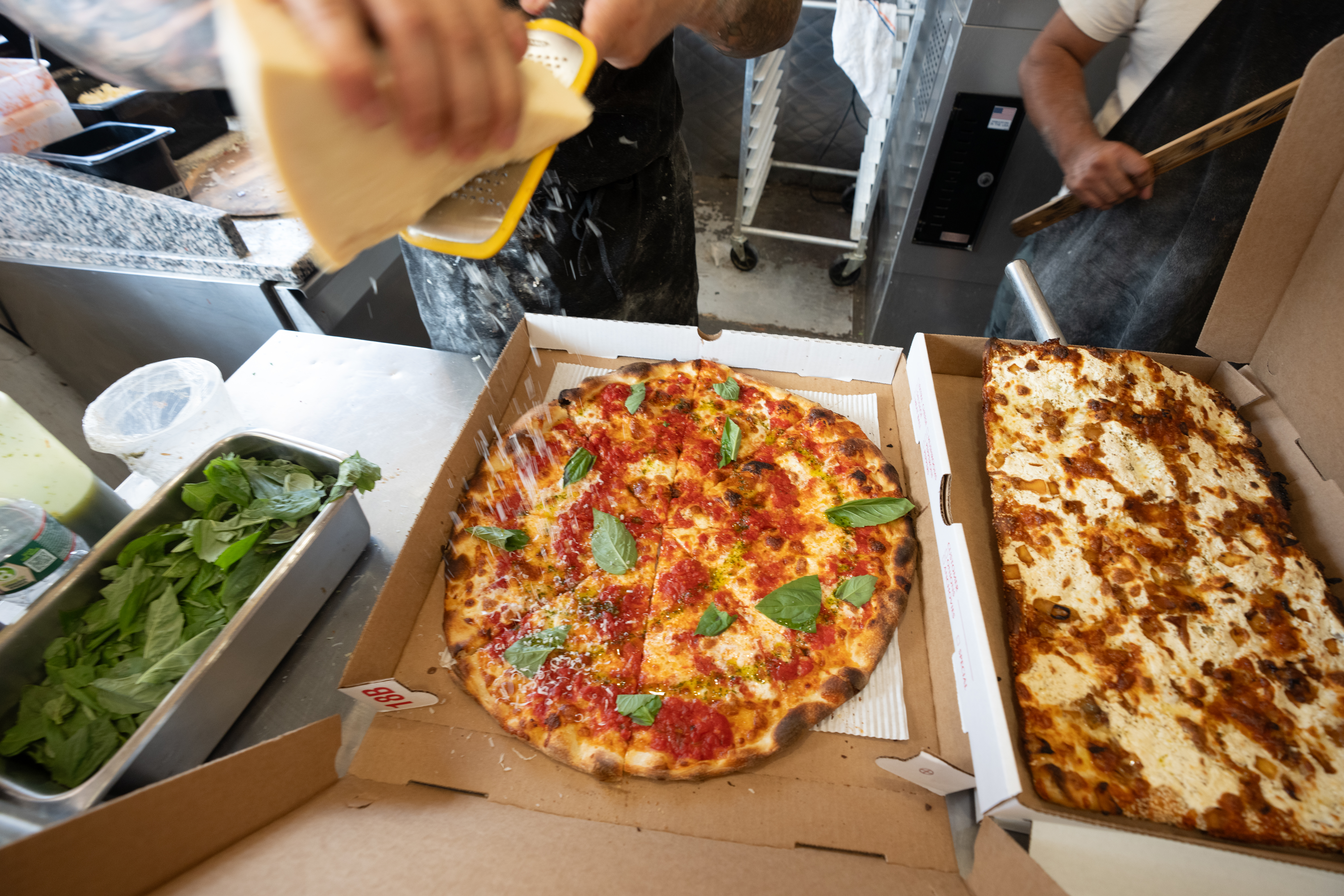
Bucks County-bred Steve Calozzi moved to Seattle for a while and ran pizzerias there before returning to Bucks. Now he’s working out of the former Subway shop at 17th and the Parkway, across from Friends Select School, and his specialty is the Trenton-style (cheese on the bottom) 24-inch pizza, available whole and by the slice. Order the meatballs and the cannoli, too.
Italian Family Pizza, 1701 Benjamin Franklin Pkwy., 215-801-5198
Puglia Pizza
Roman pizzas from Puglia Pizza, 901 South St.
Last time I checked in with Cosimo Tricarico, he was running the quaint Caffe Valentino in Pennsport. But after it closed in early 2021, even his phone number died. Recently, I heard that a Cosimo was running a fine new pizzeria at Ninth and South. One and the same. Although he still owns Valentino’s building, Tricarico and his girlfriend had decamped for his native Puglia, where they had kids. Now they’re back here, and Tricarico is mixing it up in pizza world — football-shaped Romans as well as traditional rounds. Don’t miss the sfilatini, which are thin, pressed baguette sandwiches with fillings like meatballs and vegetables.
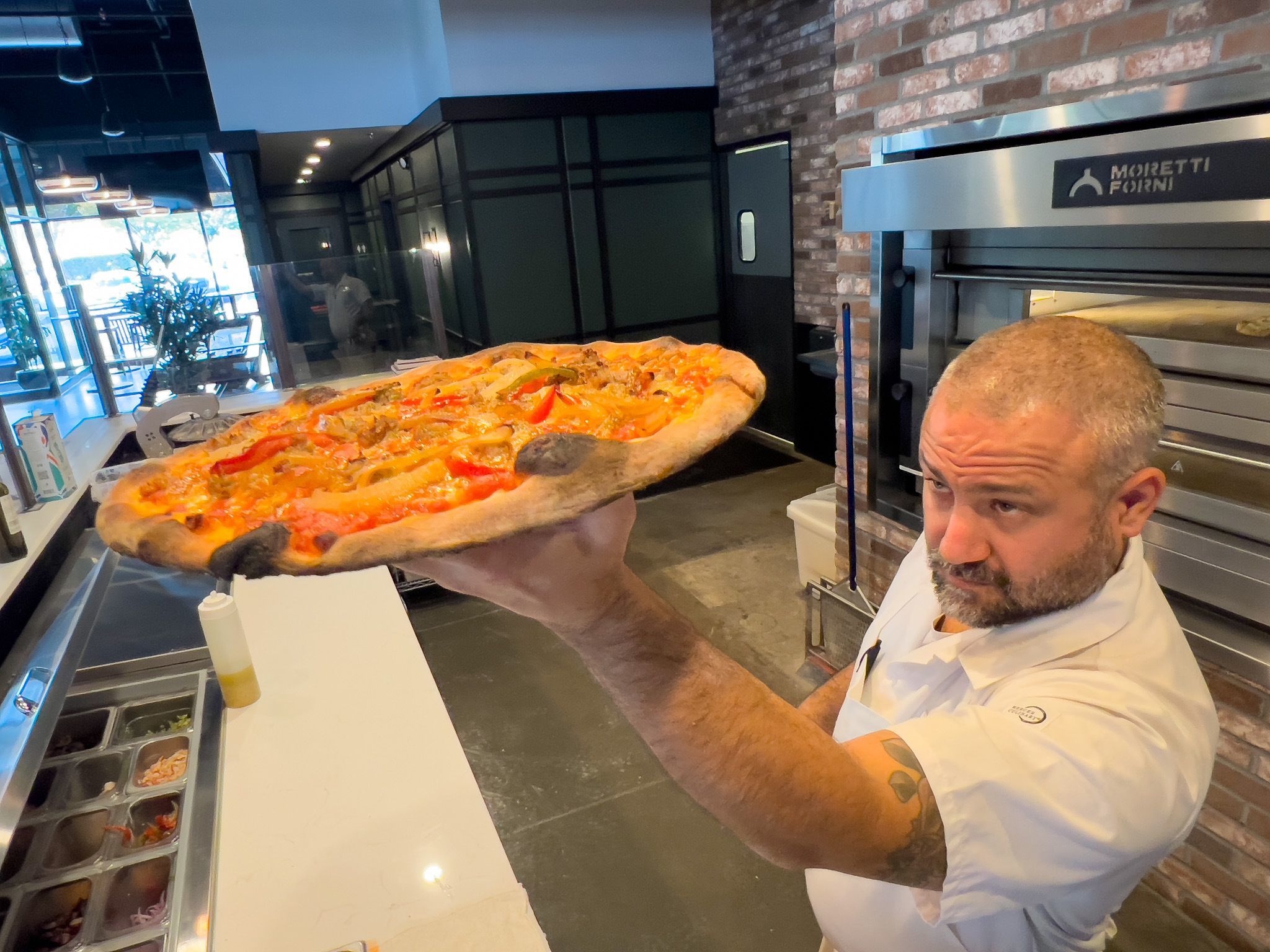
Though not a pizzeria by any stretch, this new bistro inside the Suburban Station building (aka One Penn Center) has five excellent pies — all 14-inch rounds. The reds get a sauce made of San Marzano D.O.P. tomatoes.
Of particular note is the Funghi, whose wild-mushroom mix gets a topping of Dijonnaise, fresh mozzarella, and rosemary gremolata.
Wild mushroom pizza with Dijonnaise at Rhythm & Spirits, 1617 JFK Blvd.
Cerveau, opening in the next few weeks at 990 Spring Garden St., will be a cicchetteria serving shareable pizzas, pastas, and small plates with Mediterranean flavors. Chef/co-creator Joe Hunter was among the partners at the former Pizza Brain, which closed last year.
Lillo’s Tomato Pies, the Trenton-style pizza purveyor from Hainesport, Burlington County, is supposedly close to opening in Gloucester City at the former Thomas Murphy’s Pub (157 S. Burlington St.) after a protracted liquor-license process.
Tomato pie from Lillo’s Tomato Pie, 2503 Marne Highway, Hainesport.
Marina’s Pizza, a slice shop expected next month at 1425 Frankford Ave. in Fishtown, will be the pro debut of Mason Lesser, whose maternal grandfather, Angelo Lancellotti, owned dozens of shops in the area over the years.
Pizzeria Cusumano, backed by Sal Cusumano of the Angelo’s Pizza shops in Berlin and Voorhees, is finally back on track for its opening at 872 Haddon Ave. in Collingswood. Cusumano, not willing to share a projected opening date, said work has just begun, more than four years after he signed an agreement to buy the building.
Some pizza gossip
Maybe this is non-pizza gossip, but Vince Tacconelli of the Tacconelli family’s New Jersey branch says he is looking at a December opening of Bar Tacconelli, a 50-seat Italian cocktail lounge on the former site of Versa Vino, 461 Route 38 in Maple Shade. He and partners Stacey Lyons (ex-Attico) and GregListino (the restaurant-equipment firm Rosani) plan to offer oysters, charcuterie, fried bites, and pastas — served late into the night, with a focus on craft cocktails. But no pizza, as it’s four minutes from Tacconelli’s Maple Shade location.
For a coach who’s had success at every level, Nick Nurse has had his share of celebratory offseasons.
But this offseason was a nightmare for the 76ers coach.
“You live your summer based on how your last season went,” Nurse said. “It’s reality. Or for coaches, I guess. … My main goal is that when two people get up from their seats and are walking out the door, they’re saying, ‘Man, those guys played their [butts] off tonight.’ We didn’t do that, either, and that’s what I’m striving for, and I think that’s what this fan base deserves, and that’s what we’re going to keep striving for.”
It’s hard to know whether these Sixers will continue to be the product they fielded a year ago, when Joel Embiid and Paul George spent more time in street clothes than jerseys and Tyrese Maxey struggled to score enough points to produce wins without a consistent costar.
Or, by getting younger, bigger, and more athletic, have the Sixers made a significant modification, with an emphasis on playing faster and being more balanced?
The Sixers open the season Wednesday night with a mandate for change. A second straight losing campaign for a team with three max-contract players — Embiid, George, and Maxey — will force that.
From left, Sixers Trendon Watford, Paul George and Kyle Lowry did not play in the preseason. Watford (hamstring) and George (knee) were sidelined with injuries, while Lowry, who is more of a player-coach, sat out the games to rest.
Yet the desired changes might be challenging to implement when the core players the Sixers depend on essentially are the same.
And that could become even more problematic, because with every sudden move or on-court collision, Embiid’s health odometer could max out.
Embiid looked good in his new role as a facilitator in Friday’s exhibition finale against a makeshift Minnesota Timberwolves squad. We’ll get a better idea of his level of play Wednesday against the Boston Celtics at TD Garden.
But the Sixers are taking a day-to-day approach to the availability of the 2023 MVP, who underwent two left knee surgeries in a span of 14 months and played in just 58 games over the last two seasons.
And what about George, who signed a four-year, $211.5 million contract two summers ago? He played in only 41 games last season because of various injuries. Knee surgery three months ago will sideline him at the start of the season for a second straight year. Additionally, Trendon Watford (left hamstring tightness) will miss Wednesday’s game.
George had been a full participant in this week’s practices. In fact, Jared McCain, who is recovering from right thumb surgery, was the only Sixer who did not practice on Monday and Tuesday.
Sixers forward Kelly Oubre Jr. said the players are locked in and have that chip on their shoulders.
The Sixers probably don’t know when they last had that much practice participation.
“We are all just locked in,” Kelly Oubre Jr. said. “And we all have that chip on our shoulder and those voices in the back of our head about the disappointment from last year.
“So it’s just going out there and winning one and playing the right way and creating that identity each and every night.”
The Sixers trust that their new identity will pay dividends. It’s about playing fast, playing hard, and playing differently while having fun.
“Like I said, with what we have and the versatility we can put out there on the court, it’ll be nice when we play in different ways,” Maxey said.
The Sixers want to get out and run to take advantage of the speed of Tyrese Maxey and the other perimeter players.
Defensively, the Sixers want to cause havoc when they pick up the ball. Their up-tempo offense will help them take advantage of a roster loaded with athletic perimeter players.
“But sometimes we’re going to have to slow the game down,” Maxey said. “We do have Joel; we do have Paul. Those guys are really good in the half court. And we also have VJ [Edgecombe], Jared, Quentin [Grimes], who are very good in the full court. So we’ll see.”
After facing the Celtics, the Sixers will head home to face the Charlotte Hornets on Saturday and the Orlando Magic on Monday. In a positive for them, they’ll play 14 of their first 23 games at Xfinity Mobile Arena.
They’re also slated for 16 sets of back-to-back games, beginning with Monday’s game against the Magic, then at the Washington Wizards on Tuesday.
A good test of their ability to compete in the Eastern Conference comes in their Nov. 5 road game against the Cleveland Cavaliers, who are the conference title favorites.
And we’ll get a pretty good idea of this team’s competitiveness during a crucial 12-game stretch starting in December. Nine of those games are against teams that reached last season’s playoffs, highlighted by a Dec. 28 road game against the defending NBA champion Oklahoma City Thunder.
But for now, the Sixers are beaming with confidence.
“Competitiveness. Extremely competitive. Extremely versatile,” Maxey said of what stands out about the team. “We can do a lot of different things. We’ve got a lot of guards that can do a lot of different things, some bigs that can play different positions. A lot of talent, and I think this team’s buying in early.
“As long as we can stay in that space, buying into what we’re trying to do … good team. Good opportunity.”
A massive internet outage stemming from errors in Amazon cloud services on Monday demonstrated just how many people rely on the corporate behemoth’s computational infrastructure every day — and laid bare the vulnerabilities of an increasingly concentrated system.
But despite its omnipresence, most users don’t know what — or where — the cloud is.
Here is what to know about the data centers in Northern Virginia where the outage originated, and what the malfunction reveals about a rapidly evolving industry.
Renting internet infrastructure
Cloud computing is a technology that allows companies to remotely access massive computing equipment and services without having to purchase and maintain physical infrastructure.
In other words, businesses ranging from Snapchat to McDonald’s essentially rent Amazon’s physical infrastructure located in places all around the world to operate their own websites. Instead of building expensive computing systems in-house, companies rely on Amazon to store data, develop and test software, and deliver applications.
Amazon is the leading provider of cloud infrastructure and platform services, constituting over 41% of the market, according to market research group Gartner. Google and Microsoft are the next biggest competitors.
Biggest and oldest hub
Although the cloud sounds like an abstract, formless entity, its physical location matters: Proximity to cloud data centers determines how quickly users can access internet platforms.
Amazon Web Services has just four cloud computing hubs in the United States, according to their website. Those are strategically spread out in California, Ohio, Virginia, and Oregon to deliver fast services to users across the country.
A user’s distance from the hub affects how quickly they can access platforms.
“If you’re waiting a minute to use an application, you’re not going to use it again,” said Amro Al-Said Ahmad, a lecturer in computer science at Keele University in England.
The region in Northern Virginia where Monday’s problems originated is the biggest and oldest cloud hub in the country.
In fact, the Virginia cluster known as US-East-1 region is responsible for “orders of magnitude” more data than its nearest cluster in Ohio, or even its big West Coast hubs, said Doug Madory, director of internet analysis at Kentik. The idea of a big cloud provider like Amazon is that organizations can split their workloads across multiple regions, so it doesn’t matter as much if one fails, but “the reality is it’s all very concentrated,” Madory said.
“For a lot of people, if you’re going to use AWS, you’re going to use US-East-1 regardless of where you are on Planet Earth,” Madory said. “We have this incredible concentration of IT services that are hosted out of one region by one cloud provider, for the world, and that presents a fragility for modern society and the modern economy.”
More than 100 warehouses
The servers aren’t located in just one building.
Amazon has “well over 100” of the sprawling computing warehouses in Virginia, mostly in the exurbs at the edge of the Washington metropolitan area, said Gartner analyst Lydia Leong.
Leong said one reason why it’s Amazon’s “single-most popular region” is that it is increasingly becoming a hub for handling artificial intelligence workloads. The growing usage of chatbots, image generators, and other generative AI tools has spiked demand for computing power and led to a construction boom of new data center complexes around the U.S. and world.
A report Monday from TD Cowen said that the leading cloud computing providers leased a “staggering” amount of U.S. data center capacity in the third fiscal quarter of this year, amounting to more than 7.4 gigawatts of energy, more than all of last year combined.
Cloud service perils
The outage, which some analysts are calling Amazon’s worst since 2021, reminded the world of the perils of depending on a handful of cloud companies to deliver crucial computing and internet services. Outages like Monday’s strike at a core premise of the cloud: that a centralized operation full of sharp engineers will keep servers running better and more efficiently than individual companies’ own staff.
The breakdown occurred at a challenging moment for the Amazon Web Services cloud unit, which has long touted reliability and accountability as a core piece of its pitch to customers. Sales growth has slowed, and AWS has struggled to keep up as its two biggest rivals, Microsoft Corp. and Alphabet Inc.’s Google, grab new business selling artificial intelligence tools.
AWS remains the world’s largest cloud provider and is hardly the first to suffer an outage. Moreover, it’s not easy for customers to jump ship, especially given the current capacity crunch at data centers. Still, in recent years, some companies have sought to reduce their reliance on a single cloud provider.
“The outage will likely fuel customers wanting to spread their infrastructure between multiple clouds, which could be a positive for smaller vendors like Google,” said Bloomberg Intelligence analyst Anurag Rana. Still, he said, it’s unlikely to result in any meaningful market share loss for Amazon due to the difficulty of shifting work between clouds and industrywide capacity constraints.
We’ve all been there. The game is finished, now it’s time for you to run your own play: Escape the Linc. So what’s the fastest way out of the sports complex? Naturally we decided to settle this age-old debate with a race.
On Sunday, Oct. 5, Inquirer staffers braved the post-Eagles game crowds to test five ways to beat the rush. They began on foot at Xfinity Gate and their destination was a neutral location far enough to test postgame traffic across the city – Dalessandro’s in Roxborough, where they would be rewarded with a bracket-winning cheesesteak.
story continues after advertisement
Meet our racers and their modes of transportation:
ARIEL SIMPSON
Ariel grabbed a rideshare.
HENRY SAVAGE
Henry parked in Lot Q.
JASEN LO
Jasen hopped on his bike.
JULIE ZEGLEN
Julie parked in FDR Park.
JOHN DUCHNESKIE
John rode SEPTA.
Loading…
TIME ELAPSED
ARIEL
HENRY
JASEN
JOHN
JULIE
ARIEL
HENRY
JASEN
JOHN
JULIE
Five minutes after the conclusion of the Eagles’ 21-17 loss to the Denver Broncos, fans rush out of Lincoln Financial Field and it’s time to Escape the Linc. The race is on and our competitors head their separate ways.
JASEN
Bicycle
I strategically locked my bike to a street sign just a few feet away from the starting point. I’m motivated by my stinging defeat two years ago in the Race to the Shore, when I finished last despite a two-hour head start. I’m feeling good about my chances today though.
ARIEL
Rideshare
Weaving my way through fans, I order an Uber at the corner of the rideshare lot and quickly receive a call from my Uber driver. “I’m across the street, can you just meet me here?” the driver asks.
Of course, I agree. First place is starting to feel more achievable. Skipping the rideshare lot entirely, I am in his car four minutes later. I have never been this lucky getting an Uber after a game.
JOHN
SEPTA
I scurry to NRG Station, along with some of the 15,000 to 17,000 fans who use the Broad Street Line to get home after Eagles games. I make it to the station in 10 minutes. The intercom is announcing that one of the 10 Sports Express trains is now boarding. The express train is packed. There’s a single standing-room spot by one of the train doors, and I snag it. The doors close, and a sweaty mass of disappointed Eagles fans is off.
HENRY
Car from Q Lot
I parked in Lot Q specifically due to its distance from the major traffic chaos, and if you can beat the rush, you can get out of the direct stadium traffic. But I’m taking a car on I-95, so getting out of stadium traffic is only the beginning.
story continues after advertisement
JULIE
Car from FDR Park
I’m a pretty fast walker, but it takes me 17 minutes to get back to FDR Park, where I’d paid $50 to park. Henry has probably already left Lot Q! Though I’m not-so-secretly rooting for John and public transportation to win it all, I’d like to beat the other driver, for the sake of my pride.
Also, something I hope other competitors aren’t contending with: angry drivers, like the guy behind me who appears to be screaming as he pounds on his steering wheel. But let’s be real, they probably are. That game sucked.
ARIEL
Rideshare
It’s never gone this smoothly leaving an event at the South Philadelphia Sports Complex. Because of the speed and location of my Uber pickup, at the end of the normal pickup area, I am able to avoid most of the Eagles traffic. We made it onto I-95 less than 15 minutes after the race started and now we’re quickly making our way north toward the Vine Street Expressway.
It’s been 20 minutes since our racers set off from Xfinity Gate and the contestants are spread across the city. Jasen is out ahead, but Ariel is close behind. John is already at City Hall and about to transfer to Regional Rail. But our drivers, Julie and Henry, are still making their way toward I-76 and I-95, respectively.
JOHN
SEPTA
Feeling good about my chances, I stroll into Jefferson Station, look up at the board for the train schedules, and see that the 5:10 p.m. Regional Rail train on the Manayunk-Norristown Line is canceled. My heart sinks. It’s all over. I’ll be the biggest loser.
The Route 32 bus could be my lifeline, but it’s scheduled to leave City Hall in two minutes. I rush outside onto Market Street, and then, to my surprise, I’m doing something I’ve tried to avoid my entire life. I’m running.
JASEN
Bicycle
I bypass the Schuylkill River Trail in favor of MLK Drive, which is closed to motorized traffic on the weekends during the warm-weather months. Instead of having to pass pedestrians and slower cyclists on the trail, I can safely speed as fast as I can in pursuit of cheesesteak victory. My plan is only made possible thanks to the timely opening of the MLK Bridge, which reopened to the public in September, after three years of refurbishment.
ARIEL
Rideshare
We hit some traffic as we get onto I-76, and I take in the scenes of the Philadelphia Art Museum as we slow to a crawl on the Schuylkill Expressway. The slowdown hardly matters though, and we are already approaching Manayunk.
JOHN
SEPTA
Why does it seem that the only time a SEPTA bus is on time is when you need it to be late?
I miss the 4:56 p.m. bus leaving City Hall, and my options are dwindling. My best bet is to stay where I am and wait for the next Route 32 bus to roll around in about a half hour. That would get me to Dalessandro’s after 6 p.m., when I presume my fellow contestants will be polishing off their cheesesteaks.
JULIE
Car from FDR Park
It takes about 15 minutes to get from Pattison Avenue to Penrose Avenue to 26th Street. From there, my co-pilot, Ben, and I make our way to I-76 fairly easily, albeit slowly. This is not fun! There’s definitely residual game traffic, even farther out. But at least we’re moving.
HENRY
Car from Q Lot
The ride – or wait – along Oregon Avenue takes nearly 20 solid minutes of standstill traffic. Drivers are constantly speeding past lines of cars only to try and nudge their way back into the lane farther down the road. It takes seven minutes just to traverse the exit from Front Street onto I-95.
JULIE
Car from FDR Park
We pass the University City exit and I briefly fantasize about ditching the competition and heading home to West Philly. The will to beat Henry wins out. I really should have eaten before embarking on this trek. I start to feel carsick.
Meanwhile, SEPTA is causing its own chaos for John. And farther north, Ariel and Jasen are leading the pack.
ARIEL
Rideshare
I arrive at Dalessandro’s in just 48 minutes. The ride cost $73.47, before tip. Despite an Eagles loss, the cheesesteak sure did taste sweet after the win.
JASEN
Bicycle
I can’t help but think that the race planners chose Dalessandro’s just because it sits on a steep hill range, the same one that cycling legends have climbed in the storied Philadelphia International Cycling Classic. I’m only less than a mile away, but climbing up Ridge Avenue is tough going given the roughly 250 feet of elevation gain.
JASEN
Bicycle
Coming down Walnut Lane, I wait to cross Henry Avenue at a stoplight — for what feels like an eternity, thanks to the ridiculous configuration of this four-lane highway. As soon as the light turns green, I zip across and catch my first glimpse of our photographer. Mistakenly thinking my legs had won the day, I hoot and holler — only to spot Ariel taking a video of me. Private equity takes the crown today. I’ll settle for second. My ride took 56 minutes.
JOHN
SEPTA
At 5:32 p.m. — and right on time, despite my low expectations — my chariot arrives.
story continues after advertisement
JULIE
Car from FDR Park
Henry and I are neck-and-neck, according to the Slack chat where we’re sharing updates, and Dalessandro’s is in view. Ben and I hit a red light at the intersection of Walnut Lane and Henry Avenue and have a quick decision to make: turn left onto Henry, or stay straight for another block. I’m seized by a sudden, urgent, competitive rush. I will roll out of this car to get third place! The light changes. Ben follows Google Maps and says it’ll be easier to find parking on Wendover Street. He’s right, but we waste precious seconds making two (!) left turns.
JULIE
Car from FDR Park
We park halfway down the block. I throw open the car door and sprint up Wendover. I round the corner and see Jasen, Ariel — and no Henry. Victory is mine! That’s bronze, baby.
HENRY
Car from Q Lot
It’s the final leg and the final boss of this race in a car — finding a parking spot near one of the top cheesesteak tourist traps. I pass the restaurant and am lucky to find a spot across the street. Little did I know that right as I passed the restaurant, Julie was making her final sprint up Wendover Street.
Henry arrives at Dalessandro’s 1 hour and 14 minutes after leaving the Linc.
While the other racers celebrate with cheesesteaks (in Henry’s case, a vegan cheesesteak he picked up from Triangle Tavern), John steadily brings up the rear on the bus.
JOHN
SEPTA
Finally. After a smooth and uneventful 36-minute ride, I hop off the bus, steps away from Dalessandro’s. My fellow contestants have been waiting for me, with a curious mix of relief and pity. I realize that if I had gone straight to the bus stop after getting off the subway, I would have come in third — behind Ariel with her expensive Uber trip and Jasen on his bicycle, but ahead of Julie and Henry with their cars.
In a shocking upset, at least in the mind of trending sports reporter ARIEL SIMPSON, the rideshare won. She was in her rideshare within 10 minutes of the start of the race. She finished in first place, making it to Dalessandro’s in just 48 minutes. All for the low price of $73.47, before tip … one way.
Riding his bike, JASEN LO was close behind, finishing in 56 minutes. If you’re able to bike to the game, you’ll avoid pedestrian and vehicle traffic. Although some hills in Philly can prove to be a serious workout.
JULIE ZEGLEN and HENRY SAVAGE both drove and paid $50 to park. Julie walked about a mile to her car and had to deal with less stop-and-go traffic than Henry. Henry was parked closer to the stadium, but spent half of his trip crawling through traffic. The difference was marginal, though. Julie’s trip took 1 hour and 12 minutes and Henry’s trip took 1 hour and 14 minutes.
John Duchneskie regales his competition with tales from his journey on SEPTA.Bastiaan Slabbers
After a strong start on the Broad Street Express, a canceled train stalled JOHN DUCHNESKIE and he had to wait 30 minutes for the next bus to take him north to Manayunk. His trip took 1 hour and 43 minutes.
After this completely scientific test, how should you Escape the Linc? You’re going to need some combination of luck, money, or physical exertion. For everyone else, there are traffic jams and the seemingly endless wait for the Route 32 bus.
Staff Contributors
Design and Development: Aileen Clarke
Reporting: Ariel Simpson, Henry Savage, Jasen Lo, John Duchneskie, Julie Zeglen
Editing: Sam Morris, Aileen Clarke, and Matt Mullin
Photography: Bastiaan Slabbers
Photo Editing: David Maialetti
Copy Editing: Jim Swan
Subscribe to The Philadelphia Inquirer
Our reporting is directly supported by reader subscriptions. If you want more journalism like this story, please subscribe today
“;if(e)return Promise.resolve(i);if(t){t(null,i);return}return i}if(e)return Promise.reject(n);if(t){t(n);return}throw n}}function yn(r,e){return(t,n,i)=>{typeof n==”function”&&(i=n,n=null);let s={…n};n={…m.defaults,…s};let o=pi(n.silent,n.async,i);if(typeof t>”u”||t===null)return o(new Error(“marked(): input parameter is undefined or null”));if(typeof t!=”string”)return o(new Error(“marked(): input parameter is of type “+Object.prototype.toString.call(t)+”, string expected”));if(ui(n),n.hooks&&(n.hooks.options=n),i){let a=n.highlight,l;try{n.hooks&&(t=n.hooks.preprocess(t)),l=r(t,n)}catch(c){return o(c)}let u=function(c){let f;if(!c)try{n.walkTokens&&m.walkTokens(l,n.walkTokens),f=e(l,n),n.hooks&&(f=n.hooks.postprocess(f))}catch(p){c=p}return n.highlight=a,c?o(c):i(null,f)};if(!a||a.length{a(c.text,c.lang,function(f,p){if(f)return u(f);p!=null&&p!==c.text&&(c.text=p,c.escaped=!0),h–,h===0&&u()})},0))}),h===0&&u();return}if(n.async)return Promise.resolve(n.hooks?n.hooks.preprocess(t):t).then(a=>r(a,n)).then(a=>n.walkTokens?Promise.all(m.walkTokens(a,n.walkTokens)).then(()=>a):a).then(a=>e(a,n)).then(a=>n.hooks?n.hooks.postprocess(a):a).catch(o);try{n.hooks&&(t=n.hooks.preprocess(t));let a=r(t,n);n.walkTokens&&m.walkTokens(a,n.walkTokens);let l=e(a,n);return n.hooks&&(l=n.hooks.postprocess(l)),l}catch(a){return o(a)}}}function m(r,e,t){return yn(Z.lex,N.parse)(r,e,t)}m.options=m.setOptions=function(r){return m.defaults={…m.defaults,…r},Vr(m.defaults),m};m.getDefaults=gn;m.defaults=ee;m.use=function(…r){let e=m.defaults.extensions||{renderers:{},childTokens:{}};r.forEach(t=>{let n={…t};if(n.async=m.defaults.async||n.async||!1,t.extensions&&(t.extensions.forEach(i=>{if(!i.name)throw new Error(“extension name required”);if(i.renderer){let s=e.renderers[i.name];s?e.renderers[i.name]=function(…o){let a=i.renderer.apply(this,o);return a===!1&&(a=s.apply(this,o)),a}:e.renderers[i.name]=i.renderer}if(i.tokenizer){if(!i.level||i.level!==”block”&&i.level!==”inline”)throw new Error(“extension level must be ‘block’ or ‘inline’”);e[i.level]?e[i.level].unshift(i.tokenizer):e[i.level]=[i.tokenizer],i.start&&(i.level===”block”?e.startBlock?e.startBlock.push(i.start):e.startBlock=[i.start]:i.level===”inline”&&(e.startInline?e.startInline.push(i.start):e.startInline=[i.start]))}i.childTokens&&(e.childTokens[i.name]=i.childTokens)}),n.extensions=e),t.renderer){let i=m.defaults.renderer||new ye;for(let s in t.renderer){let o=i[s];i[s]=(…a)=>{let l=t.renderer[s].apply(i,a);return l===!1&&(l=o.apply(i,a)),l}}n.renderer=i}if(t.tokenizer){let i=m.defaults.tokenizer||new ve;for(let s in t.tokenizer){let o=i[s];i[s]=(…a)=>{let l=t.tokenizer[s].apply(i,a);return l===!1&&(l=o.apply(i,a)),l}}n.tokenizer=i}if(t.hooks){let i=m.defaults.hooks||new le;for(let s in t.hooks){let o=i[s];le.passThroughHooks.has(s)?i[s]=a=>{if(m.defaults.async)return Promise.resolve(t.hooks[s].call(i,a)).then(u=>o.call(i,u));let l=t.hooks[s].call(i,a);return o.call(i,l)}:i[s]=(…a)=>{let l=t.hooks[s].apply(i,a);return l===!1&&(l=o.apply(i,a)),l}}n.hooks=i}if(t.walkTokens){let i=m.defaults.walkTokens;n.walkTokens=function(s){let o=[];return o.push(t.walkTokens.call(this,s)),i&&(o=o.concat(i.call(this,s))),o}}m.setOptions(n)})};m.walkTokens=function(r,e){let t=[];for(let n of r)switch(t=t.concat(e.call(m,n)),n.type){case”table”:{for(let i of n.header)t=t.concat(m.walkTokens(i.tokens,e));for(let i of n.rows)for(let s of i)t=t.concat(m.walkTokens(s.tokens,e));break}case”list”:{t=t.concat(m.walkTokens(n.items,e));break}default:m.defaults.extensions&&m.defaults.extensions.childTokens&&m.defaults.extensions.childTokens[n.type]?m.defaults.extensions.childTokens[n.type].forEach(function(i){t=t.concat(m.walkTokens(n[i],e))}):n.tokens&&(t=t.concat(m.walkTokens(n.tokens,e)))}return t};m.parseInline=yn(Z.lexInline,N.parseInline);m.Parser=N;m.parser=N.parse;m.Renderer=ye;m.TextRenderer=Pe;m.Lexer=Z;m.lexer=Z.lex;m.Tokenizer=ve;m.Slugger=Re;m.Hooks=le;m.parse=m;var vs=m.options,ys=m.setOptions,ws=m.use,xs=m.walkTokens,bs=m.parseInline;var ks=N.parse,Ss=Z.lex;var wn=1,Xe=class{constructor(e){this.el=e,this.contentPosition=”default”,this.possibleSteps=new Array,this.currentStep=null,this.offset=window.innerHeight*.9,this.focus={},this.zoom={},this.instanceOfSteps=wn,wn++,this.setPossibleSteps(),this.updateContent(),this.bindings()}setPossibleSteps(){this.el.querySelectorAll(“.js-steps-step”).forEach(e=>{e.dataset.step&&(this.possibleSteps.push(e.dataset.step),this.focus[“is-“+e.dataset.step]=e.dataset.focus.split(“,”).map(t=>t.trim()),this.zoom[“is-“+e.dataset.step]=e.dataset.zoom)})}bindings(){window.addEventListener(“scroll”,()=>{this.updateContent()}),window.addEventListener(“resize”,()=>{this.updateContent()})}updateContent(){this.updateCurrentStep(),this.findExactTime()}updateCurrentStep(){let e;if(this.el.querySelectorAll(“.js-steps-step”).forEach((n,i)=>{n.getBoundingClientRect().top{let o=”is-“+i,a=”is-“+s;this.possibleSteps.indexOf(i)s.dataset.step==this.currentStep.replace(“is-“,””)),n=e[t],i=e[t+1];if(i){let s=n.getBoundingClientRect().top,o=i.getBoundingClientRect().top,a=o-s,u=1-(o-this.offset)/a,h=parseInt(n.dataset.time),f=parseInt(i.dataset.time)-h,p=Math.round(f*u),b=h+p;Q.updateTime(b)}else{let s=parseInt(n.dataset.time);Q.updateTime(s)}}else{let e=this.el.querySelector(“.js-steps-step”),t=parseInt(e.dataset.time);Q.updateTime(t)}}},xn={init:()=>{document.querySelectorAll(“.js-steps”).forEach(r=>{new Xe(r)})}};var gi=(r,e,t)=>{document.querySelectorAll(“.js-subscribe”).forEach(n=>{n.classList.toggle(“is-unsubscribed”,!r),n.classList.toggle(“is-preview”,e),n.classList.toggle(“is-dev”,t)})},bn={init:()=>{gi(ke(),Se(),ue())}};var di=()=>{},kn={init:()=>{di()}};var Sn={init:()=>{ct.init?.(),ie.init?.(),yt.init?.(),bt.init?.(),Tt.init?.(),Q.init?.(),xn.init?.(),bn.init?.(),kn.init?.(),X.init?.()}};var mi=()=>{},Tn={init:()=>{mi()}};var vi=document.querySelector(“.js-inno”),zn=()=>{Sn.init(),Tn.init()};vi?zn():new MutationObserver((e,t)=>{if(document.querySelector(“.js-inno”)){t.disconnect(),zn();return}}).observe(document,{attributes:!0,childList:!0,subtree:!0});})();
An antiquated industrial building at 142-144 N. Broad St. is being converted to 99 apartments and over 4,000 square feet in restaurant space.
The seven-story building previously served as a car showroom with vehicle elevators and a factory. It has been empty for years.
“It’s gone through a couple of owners,” said Carolina Pena, principal at Parallel Architecture Studio, which is working on the project. “We’re doing an interior renovation. There are no additions proposed. We’re trying to retrofit the existing garage into apartments.”
The building’s previous owner, John Wei, has been selling off property across the Callowhill area in recent years in the face of mounting financial difficulties. He purchased 142-144 N. Broad in 2022 for $7 million.
The property sold in August for $6.2 million to a company called Penn Hall Investment LLC.
In zoning applications filed with the city earlier this month, the owners are listed as Qiaozhen Huang and Yizhou Li with their business address as 300 E. Allegheny Ave. in Kensington.
Philadelphia-based Parallel Architecture Studio, which is designing the project for the latest developers, also served as the architect for an earlier iteration of the property, when Wei sought to use it to house a 115-room hotel.
Pre-pandemic permits show a proposal for an even larger hotel from another developer and architect.
“It’s more stable financially this way,” said Pena, of Parallel Architecture. “It’s harder to get financing for hotels than to get financing for apartments.”
Pena projects a construction timeline of 18 to 24 months. The apartments will be designed for single-person households.
“We have some studios, some one-bedrooms,” Pena said. “They’ll be around 600 square feet.”
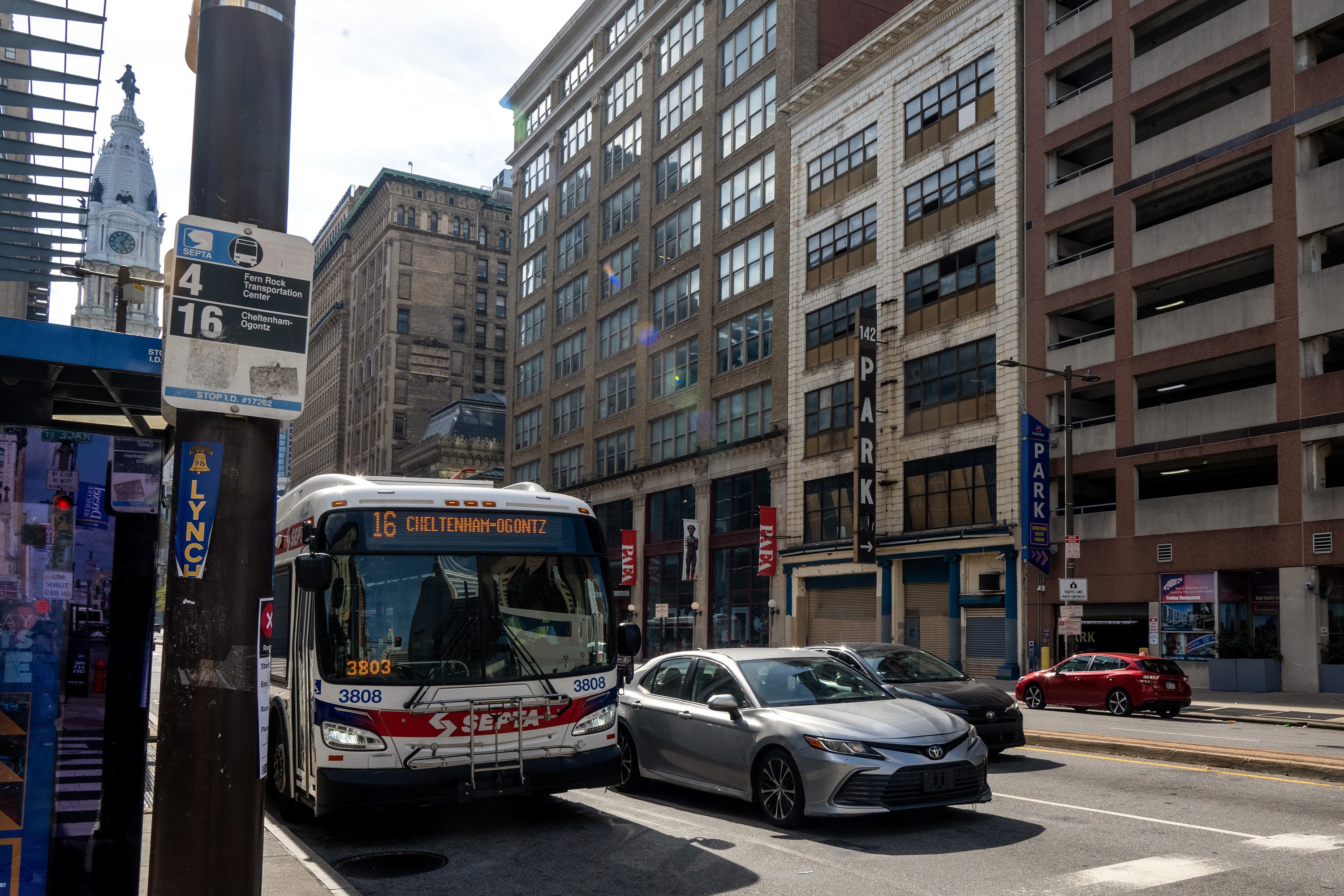
A view of 142-44 N. Broad St. (black PARK sign). Zoning permits have been pulled for a conversion of the long-vacant tower to residential and restaurant use.
The current Penn Hall project does not require any action from the zoning board because 142 N. Broad St. is in the most flexible zoning district in the city.
Bicycle parking and four automobile spaces will be available in the tower’s existing small underground parking facility.
In 2017, the city issued an “unsafe structure” violation for the building, but the owners at the time shored it up. No violation of that magnitude has been issued since.
The development along North Broad Street has been advancing at a slow but steady pace since the Great Recession.
Philadelphia developer Eric Blumenfeld’s string of popular projects along the thoroughfare, including The Met and the Divine Lorraine, started the redevelopment trend.
Other developers such as Alterra Property Group have added hundreds of new apartments to the area, and the Philadelphia Ballet’s new building is opening soon. Closer to City Hall at the shuttered Hahnemann University Hospital, Dwight City Group plans 288 apartments.
Amid persistently higher costs, three Philadelphia-area health systems have cut expenses over the last two years by changing how they account for investments in facilities and equipment. The change significantly boosted operating income in all three cases.
ChristianaCare and Main Line Health are now spreading the cost of buildings and building improvements over as many as 80 years, they said in their fiscal 2025 audited financial statements. That is double the maximum number of years they previously used to calculate what accountants call depreciation expense. Thomas Jefferson University made a similar change last year.
All three health systems use PricewaterhouseCoopers LLP as their auditor. The firm, which did not respond to a request for comment, also has Philadelphia health-system clients that have not extended their depreciation schedules.
The term depreciation expense refers to the way hospitals and other businesses allocate the cost of a building, a piece of equipment such as an MRI machine, or even software to manage patient records across the number of years the asset is likely to be used.
It’s a noncash expense because the money used to make the purchase is recorded elsewhere in the financial statements. Several financial and accounting experts said the change could be seen as cosmetic.
“It’s not affecting operations. It’s not increasing their revenues. It’s not decreasing their cash expenditures. It is purely a bookkeeping entry,” said Steven Balsam, a professor of accounting at Temple University’s Fox School of Business.
Main Line Health
At Main Line, the extended depreciation schedule reduced the expense by an estimated $37.5 million. That helped the system achieve a small, $4 million operating profit for the first time since fiscal 2021, when federal COVID-19 aid buoyed hospitals.
Without the depreciation savings, Main Line would have had an operating loss of $33.5 million in the year that ended June 30, compared to a $61 million operating loss in fiscal 2024.
Asked for comment, Main Line’s chief financial officer Leigh Ehrlich noted that the system’s financial performance had improved, thanks to “increased patient volumes and continued focus on expense management.”
Excluding noncash depreciation and amortization in each of the last two years, Main Line’s operating income improved to $127.8 million from $96.7 million.
ChristianaCare
ChristianaCare reviewed the depreciation schedules of fixed assets “as part of our ongoing commitment to maintain accurate and reliable financial reporting,” the nonprofit’s chief financial officer Rob McMurray said in an email. The result was a $24.4 million reduction in depreciation expense.
The review also resulted in a $9 million write-off of unspecified assets, which meant that in fiscal 2025 the benefit to operating income was $15 million, McMurray said.
ChristianaCare’s operating income in the year that ended June 30 was $35.5 million, or $20.5 million without the accounting change. The organization had $126.2 million in operating income in fiscal 2024.
Thomas Jefferson University
Last year, Thomas Jefferson University opened its $762 million Honickman Center in Philadelphia. Normally, taking a building like that into service would increase depreciation expense.
Instead, Jefferson’s depreciation expense fell by $68 million, according to its audited financial statement for the year that ended June 30, 2024. The decline happened after Jefferson opted to spread the cost of all buildings and building improvements over as many as 70 years, according to the depreciation schedule in its financial statement.
Even with the depreciation change, Jefferson’s operating income in fiscal 2024 was extremely narrow, at $1.34 million on nearly $10 billion in revenue that year.
The benefit of lower depreciation expense continued in fiscal 2025, as it will in future years for ChristianaCare and Main Line.
Depreciation expense at other local systems
Most Philadelphia-area health systems use a schedule for depreciating buildings and building improvements that maxes out at 40 years, an Inquirer review of financial statements found.
“You’re constantly modernizing your facilities to allow for the delivery of medicine based on current times,” Temple University Health System chief financial officer Jerry Oetzel said in an interview. “Who knows 15 years from now? We don’t have clear insight, but it’s probably going to be more home care.”
That’s why Temple hasn’t adopted a longer depreciation schedule. “It’s just a savings in operating expenses without the benefit of any cash behind it,” Oetzel said.
Editor’s note: This article has been updated to remove a reference to American Hospital Association guidelines.


















 Loading…