Eagles fans have plenty on their minds this week, and we’re not just talking about last-minute Christmas shopping. There is playoff seeding to consider, along with the question of whether the Eagles should rest their starters with two games left. There’s an Arctic matchup with the 11-4 Bills approaching on Sunday. And there is a kicker who keeps hooking his field goal attempts.
Here’s what we know: The Eagles have roughly a 10% chance of moving up to the No. 2 seed in the NFC, according to FTN Fantasy’s playoff projections. At some point, Nick Sirianni will choose to rest key players before the playoffs, but Lane Johnson (foot) and Jalen Carter (shoulders) reportedly could be available on Sunday. So Sirianni has some choices to make before the matchup in Orchard Park, N.Y.
Regarding the Bills, they’re still in a fight to win the AFC East with the 12-3 New England Patriots, although Buffalo quarterback Josh Allen is nursing a foot injury that might limit his ability to scramble. The Birds will be focused on shutting down James Cook, the league’s rushing leader with 1,532 yards.
And what about that kicker who has lost his way? Sirianni gave Jake Elliott another vote of confidence, but Sports Daily’s readers have plenty to say about Elliott later in this newsletter.
Former Cubs reliever Brad Keller signed a two-year, $22 million contract with the Phillies.
Dave Dombrowski spent time Monday praising the Phillies’ new bullpen acquisition, Brad Keller, which you would expect the team’s president of baseball operations to do. “We love Keller. We think he’s one of the best in the business, the way he stepped up last year as a reliever with the Cubs,” Dombrowski said. “So we really like the way the bullpen now shapes up.”
Beyond the hype there is this: After Keller transitioned to the bullpen, his fastball velocity increased from an average of 93.7 mph in 2024 to 97.1 mph last year. That heat should fit in nicely alongside Jhoan Duran.
Flyers center Trevor Zegras (46) skates after the puck as Vancouver’s David Kampf moves in.
The Flyers ended a two-game losing streak by beating the Vancouver Canucks 5-2 in their final home game of 2025. Four goals in the third period was the difference.
Before the game, Flyers coach Rick Tocchet sounded off about persistent questions regarding Matvei Michkov: “Enough is enough.”
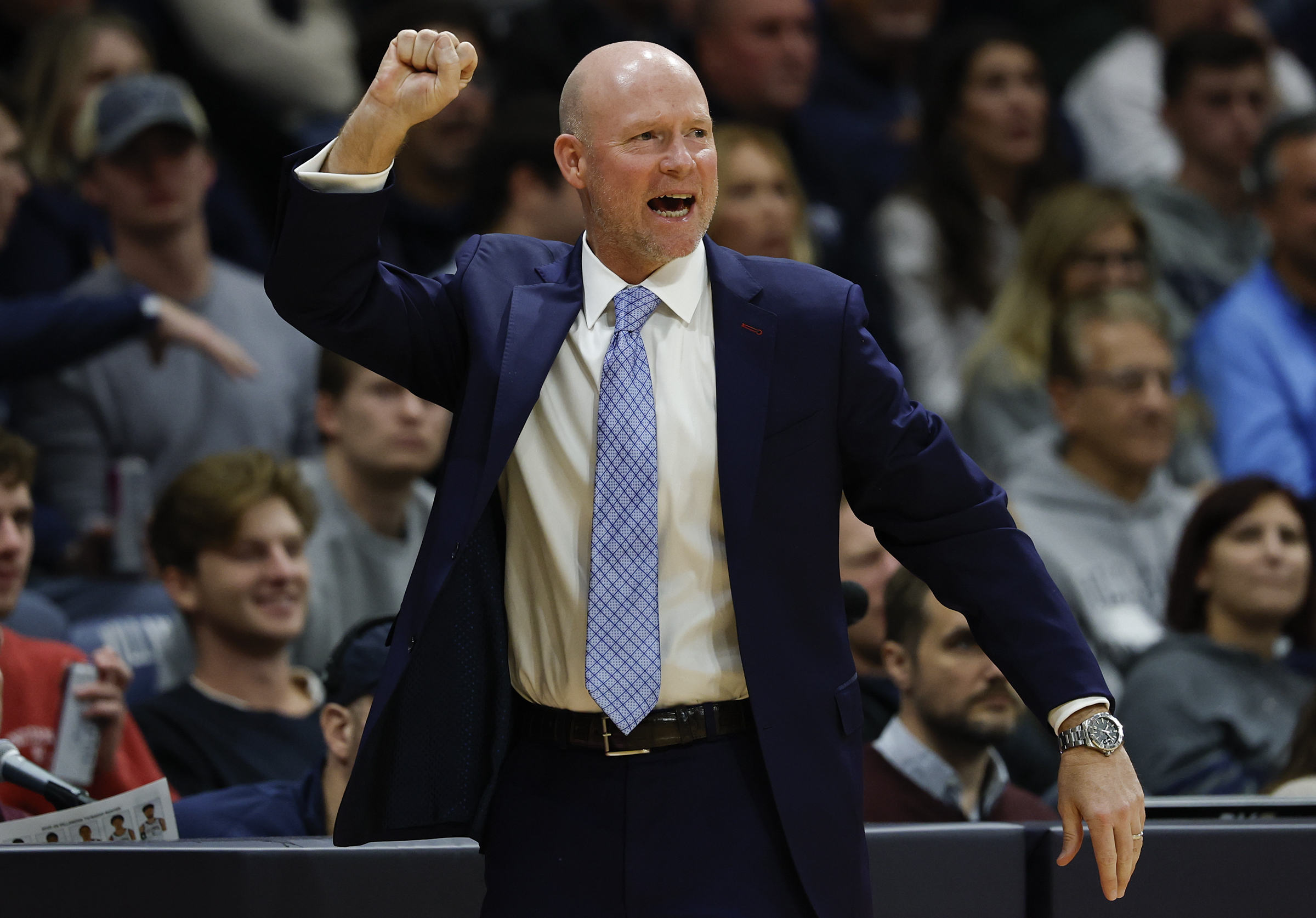
Villanova coach Kevin Willard had a 225-161 record in 12 seasons at Seton Hall.
It will be more than just a Big East opener for coach Kevin Willard tonight when Villanova (9-2) plays Seton Hall (11-1) in Newark, N.J. Willard spent 12 seasons coaching the Pirates, so this game will be a trip back home.
“It’s obviously a league game, so it’s not like I’m going to be crying at halfcourt,” Willard says. “But it’s definitely a place that I hold very dearly and will always be the love of my life to be honest with you.”
Bryce Lindsay will take an average of 16.7 points into the game as Villanova’s leading scorer. The guard lost his mother to cancer when he was a senior in high school and faced more adversity after that before he landed with the Wildcats.
Vancouver Canucks defenseman Tyler Myers skates with the puck in the first period against the Flyers on Monday. He is a 17-year NHL veteran.
The Sixers had the night off Monday, but guard Quentin Grimes was at Xfinity Mobile Arena anyway. He was watching his half brother, Tyler Myers, play for the Canucks against the Flyers. Grimes and Myers are the only pair of brothers to ever play in the NBA and NHL. Gabriela Carroll has the story of their Christmastime reunion.
Marcus Hayes: Plenty of people have had a hand in five seasons of Eagles success, including Big Dom.
🧠 Trivia time
Pittsburgh Steelers running back Franco Harris eludes a tackle by Oakland’s Jimmy Warren as he scores a touchdown on the Immaculate Reception to win a 1972 playoff game.
We asked: Should the Eagles be looking for a new kicker? Among your responses:
Not the first time Jake Elliot has had major issues. Stick with him the rest of the year, but bring in someone new next year. — Daniel B.
Jake seems puzzled over his most recent struggles. A lot of times these things don’t work them selves out. I suggest a new kicker to finish things out and he is Justin Tucker. Very reliable and a hard worker. Give him a chance and watch the good results. Thank you Jake for all your efforts over the years. — Kerry B.
I think that next spring they should bring in a second kicker option. Unlike Nick Sirianni, I am loyal not to the one who brought me to my first dance but to the one who is best able to dance next Sunday. — Milton T.
Eagles kicker Jake Elliott reacts after missing a 52-yard field-goal attempt on Saturday.
Kicking is so heavily emotional/mental that it takes very little to compromise confidence, but a great deal to restore it. Given that he’s missed six of his last 11 field goal attempts (plus one conversion), Elliott’s confidence probably has more cracks than the windshield of a car following a gravel truck. … Jake Elliott’s future with the Eagles is hanging by a very tenuous thread, as I see it. And it won’t take much to snap it.—John B.
Let’s see how Jake does in the postseason. He has had slumps before and always come through in the postseason. — Bill M.
Jake had these problems last year which were abnormal. He got back on track for the playoffs and the Super Bowl. He has been a great kicker for us and I do expect him to get it turned around and be accurate again. The only kickers out there are the ones who have been dumped by other teams for having the same problems. Stay the course! — Vince O.
No. — Jeffrey H.
Like most Eagle fans I have really been a fan of Jake’s for these past years, but his inability to score when needed is really hurting the team. I would hate to see him go, but it may be necessary. — Everett S.
We never should have let the greatest kicker of all time get away. The Chargers picked him up a few years ago for NOTHING! I knew “Dicker the Kicker” was something special when he was with the Eagles for a short time. Yes, we should be scouting the world for a replacement kicker because going into the playoffs with who we have is unacceptable. — Ronald R.
We compiled today’s newsletter using reporting from Jeff Neiburg, Olivia Reiner, Lochlahn March, Jackie Spiegel, Gabriela Carroll, Ariel Simpson, Marcus Hayes, Isabella DiAmore, Brooke Schultz, and Dylan Johnson.
By submitting your written, visual, and/or audio contributions, you agree to The Inquirer’s Terms of Use, including the grant of rights in Section 10.
Thank you for reading. On Wednesday, Bella will bring you the final Sports Daily of the week before a Christmas break. Happy holidays! — Jim
Christina Gallo and Daniel Zehnder came to McPherson Square in the Kensington neighborhood looking for a fix, as they did almost every day.
But on this day in late April, an SUV pulled up. A woman bounded out with an offer that sounded like a miracle: an all-expenses-paid trip for free treatment at a luxury rehab center in California.
Gallo and Zehnder, both then37, hoped their lives were finally about to turn around after two decades strugglingwith addiction.
“We wanted to get clean,” Gallo said.
Christina Gallo and Daniel Zehnder, pictured here in Kensington’s McPherson Square in June, were recruited to what they thought would be a luxury rehab in California.
Within days, they were in a Lyft from their Bucks County trailer to the Philadelphia airport. Everything — the Lyft, the flight, the rehab — had been paid for, by whom they did not know.
They landed at a treatment facility in Los Angeles with a gleaming swimming pool, but said they did not see doctors or nurses and were offered little medical treatment to ease their agonizing withdrawal symptoms.Within a few days,the couple had left the clinic, relapsed, and the life-changing trip they envisioned ended in an ambulance rushing to a nearby hospital, where Gallo was admitted to intensive care.
Their California dreams were dashed. But the trip notchedanotherrecruitmentfor The Rehab Specialist, a year-old operation that makes money by scouting the streets for people in addiction to send to independently run rehab centers across the country.
Rehab Specialist recruiters working in Philadelphia offered free plane tickets, housing, and medical care — and at times cash, cell phones, cigarettes, and clothes — to entice people into recovery homes, Inquirer reporters found in interviews with seven people who had firsthand knowledge of the recruiting tactics.
With a single conversation in Kensington, recruiters alsogot willingpatients enrolled in private health insurance that could pay higher rates, often without the patients understanding what they had signed up for — until bills started to arrive.
Businesses like The Rehab Specialist operate as middlemen inan industry where one person’s recovery can be cashed in for hundreds of thousands of dollars in insurance payments.
Some referral and marketing services in the addiction treatment industry are legal. But the business is also notoriously rife with insurance fraud and patient brokering — a term that describes referrals to specific clinics in exchange for illegal kickbacks or bribes.
Rehab Specialist brochure, advertising a Spanish-Colonial style mansion with a pool in the backyard.
Pennsylvania is seeing a resurgence of patient brokering, according to tracking in 2023 by Highmark Health, a Pittsburgh-based Blue Cross Blue Shield affiliate. Such schemes are especially a concern in Kensington, home to one of the nation’s largest open-air drug markets.
Federal laws and a patchwork of state laws are supposed to protect vulnerable people. Prosecutors have limited resources, however, and rarely investigate low-level players.
Pennsylvania considered stronger laws after a major scandal.In 2019, federal and state prosecutors uncovered a multimillion-dollar insurance fraud scheme at Liberation Way, a Bucks County recovery home. The abuses spurred Pennsylvania lawmakers to introducelegislation that would have made it a felony to use money or services to lure patients into addiction rehabs and other healthcare facilities. The measure died without advancing to a vote.
“People get pretty brazen when nobody’s looking,” said Alan Johnson,chief assistant state attorney in Palm Beach County and a national expert on fraud in the industry.
Johnson called a description of The Rehab Specialist’s practices “classic patient brokering.”
For months, Philadelphiaadvocates for people in addictioncirculated warnings about the business and posted photos of its recruiters on Facebook. They tried to alert police, but never heard back.
Screenshot of text messages between Christina Gallo and a Rehab Specialist recruiter, saying that Gallo and Zehnder got approved for private insurance that would pay for their treatment in California.
The Philadelphia Police Department did not respond to requests for comment, and the Philadelphia District Attorney’s Office said it has not opened an investigation and declined to comment on The Rehab Specialist’s practices.The Pennsylvania Attorney General’s Office also declined comment.
On social media, The Rehab Specialist’s director and founder, Gus Tarrant, strongly disputed critics who accused his business of patient brokering.
“I have never and would never give a client money to go to rehab or encourage them to cycle in and out of programs,” Tarrant wrote in a March post to a Facebook group that monitors addiction treatment.
Tarrant, in a June interview with The Inquirer, reiterated that he and his business havedone nothing wrong.
Tarrant said that his operation has a national focus and came to Philadelphia this spring because the city has “the worst drug epidemic in the country.”
Tarrant said his recruiters send patients out of their home state to avoid triggers for relapse, a practice he strongly believes in, having gone through his own recovery from addiction about five years ago. (Though popular in some recovery circles, some research suggests that it can be less effective than getting treatment closer to home, where people have established support networks.)
“Our goal is to help as many people as we can,” Tarrant said. Now based in Myrtle Beach, S.C., Tarrant has channeled his experience into starting at least two businesses in the past five years focused on people in addiction.
He said rehab centers payhis business a flat fee to arrange for people from Kensington to receive treatment in California, but declined to share details. Two Los Angeles treatment centers told The Inquirer they had paid Tarrant and his operation a flat fee for “marketing,” but both also declined to give specific details of the arrangement.
On business cards, Tarrant’s title is listed as The Rehab Specialist’s founding partner; his LinkedIn profile says he started working there in 2024.
The Inquirer was unable to find any documentation indicating the business was formally incorporated in a search of state corporate registries where its recruiters and Tarrant have operated. The Inquirer also did not identify any lawsuits filed against The Rehab Specialist.
The Inquirer interviewed Tarrant by phone this summer. He did not return multiple calls, texts, and emails this month requesting additional comment.
Reporters interviewed five people who were approached by The Rehab Specialist’s recruiters on the street, and another two whose relatives were recruited.
All shared similar stories about how the process worked. Two said they enjoyed eating chef-made meals and benefited from group therapy and daily outings in Los Angeles.
One mother said her son ultimately decided not to board the plane to California, though he continued to receive frequent calls from Rehab Specialist recruiters urging him to travel for treatment. In another case, a woman said her brother did not get the care he needed in California and ended up in the ICU.
Gallo and Zehnder were among the three people interviewed who said the medical care they received in California did not meet their expectations for a luxury rehab facility. The couple blames The Rehab Specialist for launching them on a journey that ended with them worse off than before.
“I don’t know if they have the intention of trying to help people,” Gallo said, “but they’re going about it totally the wrong way.”
Christina Gallo and Daniel Zehnder in June, sitting in the spot where they were first approached by The Rehab Specialist recruiters in McPherson Square Park.
Lofty promises and dire warnings
The fliers that The Rehab Specialist recruiters passed out in Kensington featured photos of a Spanish Colonial-style mansion surrounded by palm trees, with a pool in the backyard. They advertised “holistic treatment” including equine therapy, medical detox, and an intensive outpatient program.
All that, in sunny California.
The pitch has particular appeal in Philadelphia, where people have struggled through long waits to access medical detox programs that allow patients to withdraw under the supervision of a doctor or nurse. These programs typically offer medications to help ease intense withdrawal symptoms like nausea, vomiting, and agitation, all of which have become more dangerous as potent animal tranquilizers and industrial chemicals contaminate the local drug supply.
Despite often lofty promises, the addiction treatment industry has long seen high-profile prosecutions over exploitative practices.
In the Philadelphia area, the Liberation Way prosecution sent the company’s CEO and medical director to federal prison. Prosecutors said the center had signed patients up for private insurance plans and paid their premiums. It then charged insurers for shoddy or unnecessary treatment that resulted in excessive insurance payouts.
California and Florida in particularhave emerged as hot spots for addiction treatment fraud. In South Florida, a 2022 federal prosecution of a$112-million scheme led to prison sentences foreight people accused of using cash bribes and free rides, flights, drugs, and alcohol toattract patients to a rehab center.The payments were distributed via anetwork of lower-level street recruiters, purportedly hired for “marketing,” according to an affidavit from the case.
But addiction treatment scams are often ignored because they involve sprawling national investigations that require significant resources. State prosecutors can’t justify the expense and federal prosecutors won’t take on low-level fraudsters, according to Johnson. Palm Beach County prosecutors stepped up enforcement after the state passed stricter laws in 2017.
“You have to prioritize cases. This is not high on their hit list, unless it’s going to make a big splash,” said Deb Herzog, a former federal prosecutor turned fraud investigator at Anthem Blue Cross.
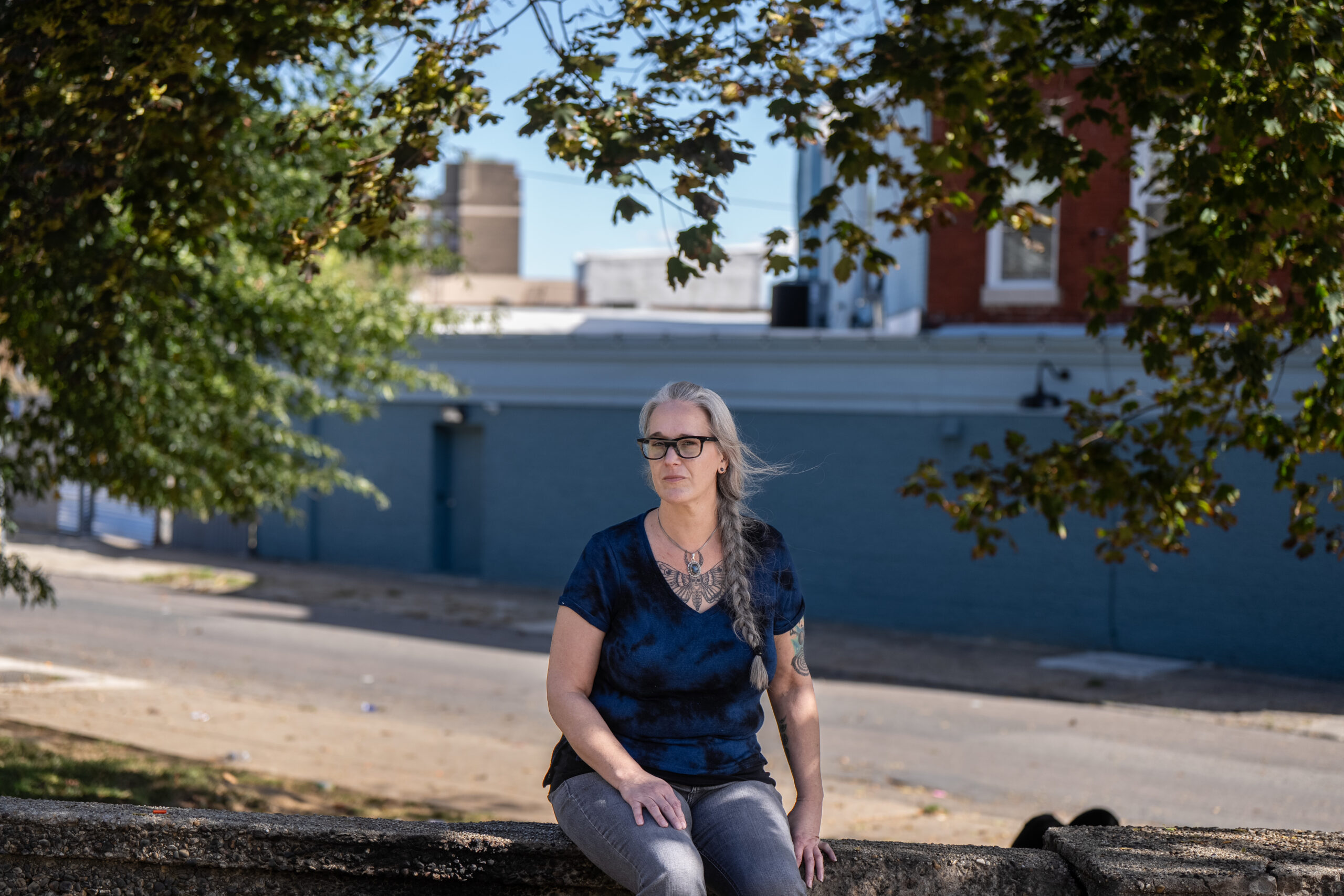
Melissa Ruby, an activist who runs a national Facebook group to monitor patient brokering, in Philadelphia in October.
Warnings about The Rehab Specialist instead came from Melissa Ruby, 46, and other local advocates. Ruby runs a Facebook group dedicated to monitoring patient brokering nationwide, and started sharing photos on social media as soon as the recruiters showed up in Kensington. She did the same when they were reportedly spotted in Pittsburgh.
She said she also alerted aPhiladelphia police officer who runs an independent nonprofitto help people in addiction, but never heard back.
For Ruby,the issue is personal: She has a relative who was a victim of patient brokering.
“BEWARE!!” she wrote in a March post about The Rehab Specialist, punctuated with red stop sign emojis. “No good will come from any of this!!”
Tarrant, the Rehab Specialist director, was a member of Ruby’s Facebook group at the time and wrote that the vast majority of the negative information Ruby had posted about him was “completely wrong.”
“I am not paid by the client or any ‘referral fees’ based on clients sent,” Tarrant wrote.
When asked in the Facebook group why The Rehab Specialist was sending patients out of state on free flights, he declined to answer, writing that he believed the questions were in bad faith. He encouraged people to reach out to him directly so he could explain.
After a few weeks, Ruby kicked him out of the group. “Adios, Gus!” she wrote.
A sunny pitch in Kensington
One day in April, two female Rehab Specialist recruiters introduced themselves to Samuel Rosato, 47 at the time, as he got off the El near Kensington. He was immediately intrigued.
“They were just real pretty and tan,” Rosato said.
They later said all they needed were a few identifying details, and they would be able to set him up with private insurance that would pay for everything at a luxury rehab out west.
Rosato scribbled down his Social Security number and handed over his ID card. Within 10 minutes, he said, the recruiters told him they had secured him Blue Cross Blue Shield insurance. Rosato, like others interviewed by The Inquirer, did not know who was paying for his insurance or lodging.
The Rehab Specialist recruiters, whose names he shared with The Inquirer, are not licensed insurance brokers or healthcare navigators in Pennsylvania.
Allison Hoffman, a health law professor at the University of Pennsylvania, said that without more information on how patients were signed up for insurance plans, it isdifficult to say definitively whether insurance laws were violated. But, she added, “it sounds potentially illegal.”
Tarrant said his employees “don’t deal with any of the insurance.” He said they do not directly enroll clients in insurance, but rather direct recruitsto independent, licensed insurance brokers.
Patients “sign up for the insurance themselves,” he said. Hedeclinedto say more, citing patient confidentiality.
A week later, Rosato said an Uber picked himup at his mother’s home in Northeast Philadelphia for his flight to California. He said he was joined by three other people from Kensington who told him they had also been recruited by The Rehab Specialist.
“I love it out here,” Rosato said in June, several months into his recovery in California. “I’m trying to rebuild my life now, starting at the bottom.” (Rosato stopped responding to calls and texts from The Inquirer in the fall; his mother said this month that he’s back in Philadelphia, but she is not sure where.)
Jerome Hayward, 48 at the time, and his girlfriend, Megan McDonald, 39 at the time, also didn’t ask too many questions when they were recruited in front of a Kensington soup kitchen and traveled separately to California in the spring.
Told only that she had been “approved” for treatment, McDonald said she didn’t realize she had been signed up for a Blue Cross Blue Shield plan until she received paperwork at a hospital.
“How would we pay for it?” McDonald asked. “Because we’re broke. We got no money.”
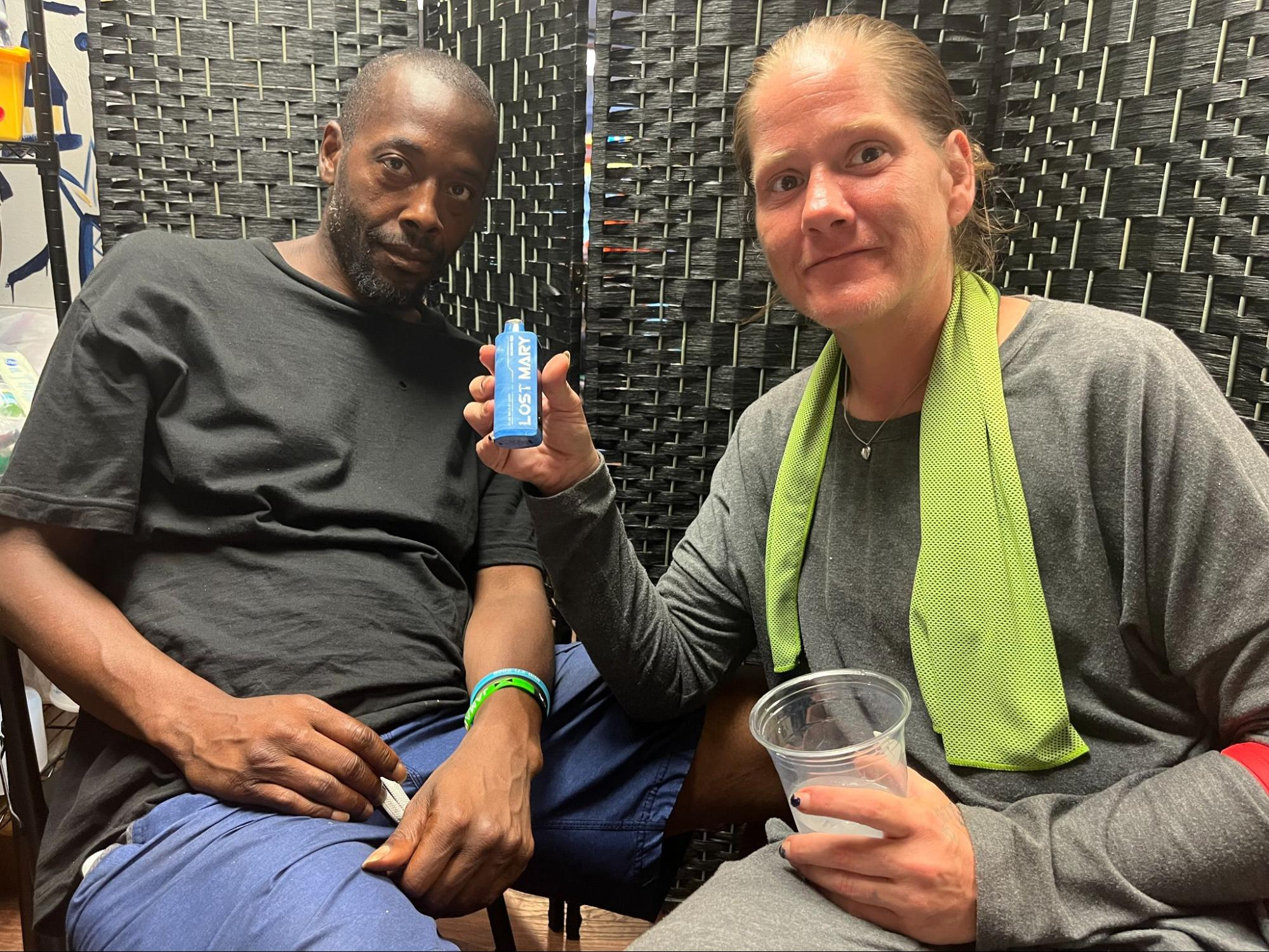
Megan McDonald and Jerome Hayward at a drop-in center in Philadelphia’s Kensington neighborhood.
A rising entrepreneur
Tarrant rose in the rehab industry after getting his start vacuuming floors at a rehab company run by LaMitchell Person, a mentor who Tarrant credited for giving him “the opportunity to get sober and clean,” in an interview with a local news station in California. The two later became business partners.
They were working together at a California rehab company in 2021 when a 22-year-old named Dean Rea died of a fentanyl overdose after leaving an associated sober home.
Rea’s mother later accused Tarrant, Person, and other employees ofcontributing to the death in a lawsuit filed against the facility,Ken Seeley Communities. Neither Tarrant nor Person, then the facility’s executive director, was named as a defendant in the case.
In court records, Rea’s mother claimed Tarrant falsely told Rea that his insurance wouldn’t cover more intensive treatment elsewhere.
“Gus is, essentially, a salesman whose goal is to admit as many patients to KSC as possible,” their legal complaint said. The rehab company denied the allegations, and Rea’s suit was settled in a confidential agreement in 2023 for an undisclosed amount.
In an interview this month, Person called the lawsuit’s claims inaccurate. “Fentanyl killed her son. Not Gus, not me, and not the organization,” Person said.
By the time the suit was settled, Tarrant and Person had both left the business.
In 2022, they filed paperwork to incorporate a company called Origin Addiction Services, based in Idaho, according to state corporate records. An official address on the website is a P.O. box in a Boise strip mall.
The company’s website said it offered addiction recovery services such as interventions, sober companionship, counseling, and transportation.
The company’s website featured an ‘about’ page with professional headshots of a nine-member executive team. All but three of those headshots appearedto be drawn from stock photo services,and The Inquirer was unable to trace the individualsto authentic social media or LinkedIn accounts.
After The Inquirer contacted Personabout the photos in September, all of them– except his own — were removed overnight. Person later said in a phone interview that the stock photos and some of the employee names were “placeholders,” but insisted that the staffers were real.
The company filed paperwork to dissolve a year later; Person said it had never done business, and he and Tarrant went on to pursue separate endeavors.
Person was in Philadelphiarecruiting people at the intersection of Kensington and Allegheny Avenues in March, according to acity employee there to help people in addiction. Person handed him a business card identifying himself as a “regional director” of The Rehab Specialist, said the employee,whom The Inquirer is not naming because he was not authorized to speak to the media and feared losing his job.
Person answered the phone this summer when The Inquirer called the Rehab Specialist’s general number, but he said he did not work there.
In a follow-up interview this month, he said that Tarrant had hired him to build a call center for a California rehab, saying that was his only involvement with The Rehab Specialist.
He said he hadnot come to Kensington and was not responsible for business cards that listed him as the regional director.
“Gus wanted me to work for him, because we are friends,” Person said.
Christina Gallo and Daniel Zehnder in McPherson Square Park in June.
A dream dashed in California
Desperate to get clean, Christina Gallo and Daniel Zehnder accepted the offer to fly to California after being recruited in Kensington earlier this year. A luxury van picked the couple up when they arrived at Los Angeles International Airport on May 3, they said.
The driver took the couple to Gevs Recovery, a large gated house in a residential neighborhood in Northridge. Gevs has been licensed as a drug abuse recovery home since 2024. State records show that as of early August, no complaints about its care have beenfiled with the California Department of Public Health.
Gallo and Zehnder said the Gevs house was dark and empty when they arrived, aside from a handful of employees. Gallo began to panic as drug withdrawal left her shaking and sweating, with a bloody nose and headache pangs that felt like she had stuck her finger in an electrical outlet.
“I said, ‘What’s going on here? Where’s any of the nurses or the doctors?’” she recalled. “‘Who’s going to be taking care of us, medically?’”
“We don’t do that here,” she remembers them saying. The Gevs employees told Gallo they could send her to a hospital, or give her some Tylenol, she said.
Alarmed, Gallo and Zehnder decided to leave. On their way out, they said a woman descending the stairs told them she had just left the hospital after a month there.
“Are you guys from Philadelphia, too?” Gallo recalled the woman asking.
She and Zehnder headed to a cheap motel, but they didn’t feel they could stand the withdrawal effects and decided to buy drugs nearby. By the morning, their symptoms had grown worse, and they returned to Gevs to demand plane tickets home.
Kristine Kesh, an operations manager at Gevs, told The Inquirer the center does have medical staff on site and does offer medication treatment for withdrawal.
“These clients have been addicts for most of their lives, and they come in expecting this glorious detox,” Kesh said. “Whatever they’re expecting is not realistic. I mean, you can’t help everybody.”
At the airport, Gallo vomited on herself before collapsing to the ground in pain. Zehnder defecated and vomited on himself. An ambulance took them to the emergency room, where Gallo was placed in intensive care.
After two days in the emergency room and the intensive care unit, Gallo and Zehnder were released.Zehnder’s mother paid for their flights home.
While Zehnder was away, bills from Highmark started arriving at his mother’s house — even though he had been promised free treatment.
The bill, which misspelled his last name, said he owed a $267 premium for the month of May. He said he also received a $700 bill for the ambulance ride from the LA airport to the emergency room, which he threw away.
Six months after their disastrous trip, recovery feels as far away as when their return flight from California landed. At the Philadelphia airport, they hailed a cab and went straight to Kensington. They wanted to inject heroin, right away.
Deanna Baker made reservations for A Longwood Christmas in late summer.
The 32-year-old Downingtown resident has been gifted a Longwood Gardens membership each of the past five years, but even the member reservations for the annual holiday light show book up well in advance. So she secures her family’s time slots while the weather is still warm.
“Yes, it’s ridiculous this time of year,” she said of the Longwood demand at Christmastime. But “yes, it’s worth it.”
Baker, who works in operations for Victory Brewing Co., said there is “a magical element” to the experience, whether she’s going with her toddler or her adult friends and relatives. She went once in early December and plans to return in the afternoon on Christmas Day.
Every holiday season, hundreds of thousands of people visit A Longwood Christmas, which serves as an “economic engine” for the business communities in Kennett Square and surrounding towns, as Cheryl B. Kuhn, CEO of the Southern Chester County Chamber of Commerce, recently described it.
Longwood Gardens’ holiday attendance has increased nearly 42% since pre-pandemic times. Last year, 650,000 people visited the gardens at Christmas, up from 609,000 the prior holiday season and from 458,000 during the 2019-2020 event (the show ends in the beginning of January).
Many of these guests book months in advance, leaving last-minute planners few options for afternoon and nighttime visits during the holiday week.
More than 500,000 lights shimmer at Longwood Gardens’ A Longwood Christmas through Jan. 11, 2026.
“We open ticketing in July, and there are always a few early planners that buy tickets and make reservations then,” Longwood Gardens spokesperson Patricia Evans said in a statement. “By late Octoberish, the most desirable evening time slots on the weekends and the week of and following Christmas tend to be sold out.”
But as of Monday, Evans noted, some tickets were available for time slots before noon and after 8:30 p.m. for the remaining days of December. Availability opens up in January, she added. The holiday lights stay on through Jan. 11.
If nonmembers snag tickets, the experience will cost $45 a person for adults and $25 a person for kids, which Evans said is a $2-$3 per person increase from last year. Children 4 and under are free.
window.addEventListener(“message”,function(a){if(void 0!==a.data[“datawrapper-height”]){var e=document.querySelectorAll(“iframe”);for(var t in a.data[“datawrapper-height”])for(var r,i=0;r=e[i];i++)if(r.contentWindow===a.source){var d=a.data[“datawrapper-height”][t]+”px”;r.style.height=d}}});
Philly-area holiday attractions that have availability
For Philly-area residents who want to enjoy a festive experience before 8 p.m., or at a slightly lower price point, other options have availability this week.
As of Monday afternoon, the ice skating rinks at City Hall and Penn’s Landing had online reservations available for any day this week, though spokespeople said some time slots can sell out around the holidays. Both cost about $20 per person for admission and a skate rental.
A family walked into the Philadelphia Zoo’s LumiNature holiday light display in this December 2021 file photo.
“While tickets are available, the most popular times that guests reserve their tickets for are from 5-6 p.m., and it is likely that that particular hour will sell out on our most popular nights,” zoo spokesperson Maria Bryant said.
Last year, LumiNature saw nearly 70,000 guests, according to Bryant, and it is on pace to exceed that number this season.
Depending on the day, tickets cost between $25 and $29 per nonmember 12 and over, and $20 and $24 per child between the ages of 2 and 11. Younger children are free.
Nighttime turned the Philadelphia Zoo into a wonderland of lights as LumiNature returned for its third year in December 2022.
In the suburbs, the Elmwood Park Zoo’s Wild Lights “will not sell out,” with “plenty of tickets for each day of the rest of the event,” marketing director Kyle Gurganious said. Guests can buy at the gate, he added, or book online to save $1 per person.
For nonmembers, online tickets are $27 per person 13 and older and $24 per child between the ages of 3 and 12. Children under 3 are free.
Last season, the Norristown attraction brought in about 50,000 visitors, a number Gurganious said the zoo is “on track to eclipse … significantly” this year.
A miniature Art Museum was on display in the Holiday Garden Railway at the Morris Arboretum & Gardens in 2023.
At least one other Philly-area holiday attraction is completely sold out this week: The Holiday Garden Railway Nighttime Express at the Morris Arboretum & Gardens.
Because it’s “so popular and because we only have a limited number of nights, the Nighttime Express sells out every year,” said Christopher Dorman, the director of visitor experience for the arboretum, which is part of the University of Pennsylvania.
Those looking to snag tickets for next year may want to mark their calendars: Holiday tickets go on sale at the beginning of November for arboretum members and a week later for the general public.
Added Dorman: “While the Nighttime Express is sold out, folks can still see the trains all lit up [and the rest of the garden] during normal daytime hours through Dec. 30.”
And for those turned off by the planning — and expense — required for these paid festivities, there’s always the low-cost, low-commitment option: touring your neighborhood’s home light displays.
More than a hundred years ago, the Lanzetta family seemed to be living the American dream in South Philly.
Immigrants from Italy, the family patriarch, Ignazio, worked hard at local restaurants, while his wife, Michelina, tended to their growing family, which included six boys by the early 1920s.
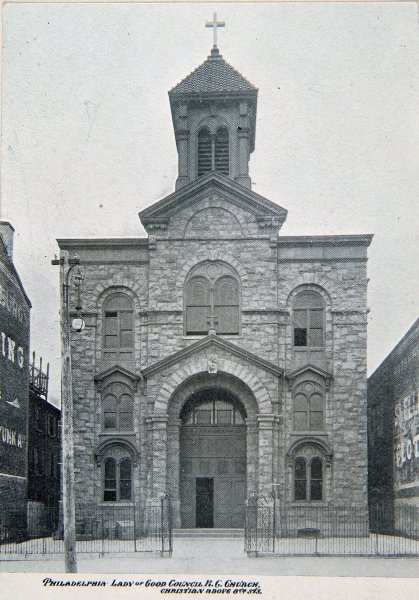
The former Our Lady of Good Counsel church on Christian Street.
But times were hard in 1920s Little Italy, and some native-born Americans scapegoated the recent arrivals for much of Philadelphia’s woes.
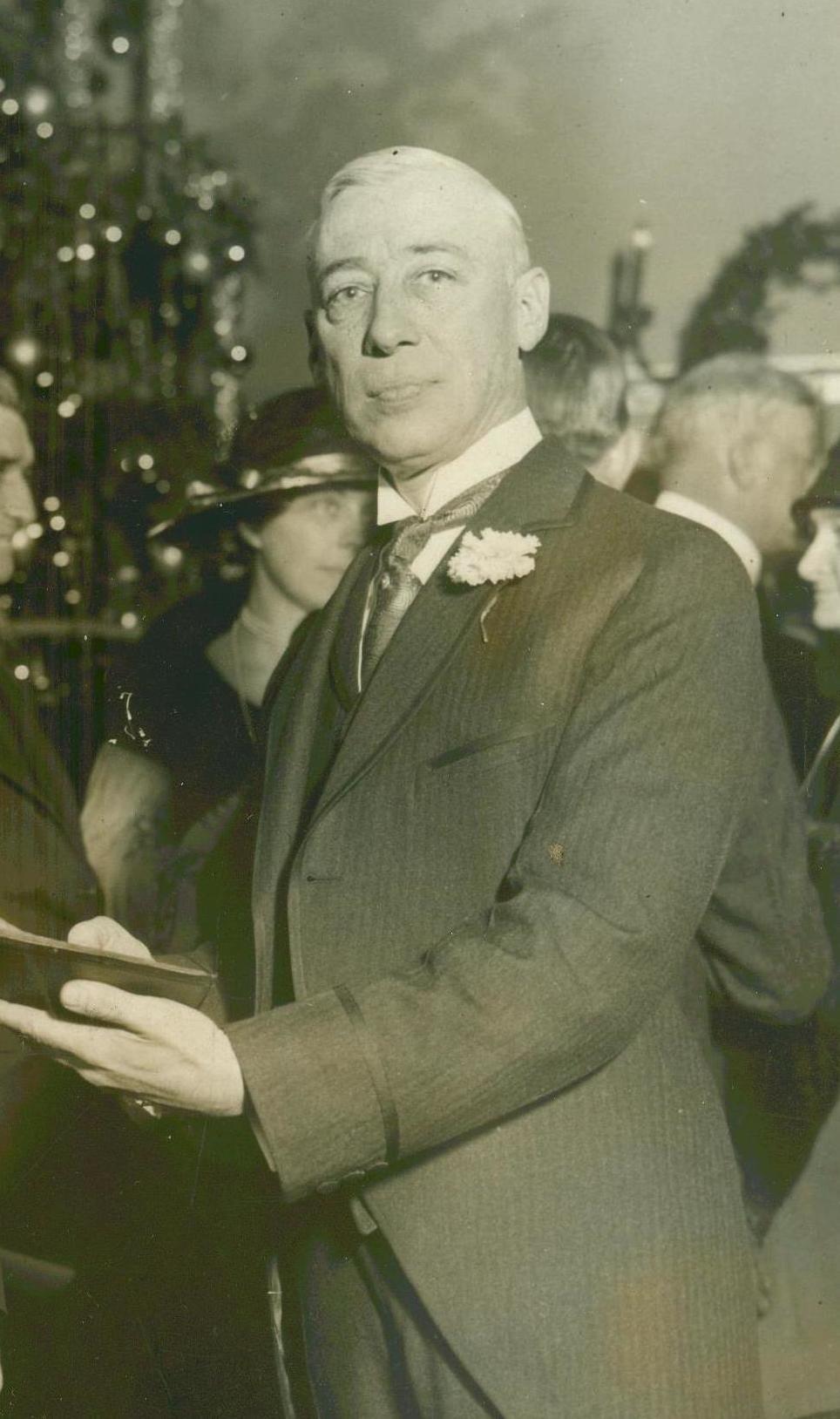
Mayor W. Freeland Kendrick, a Republican, decided to recruit a U.S. Marine general to “clean up” the whole city, where, he claimed, “vice and crime [were] rampant” and “disregard of law and order [was] almost unbelievable,” as the New York Times put it in July 1924.
This required White House approval, ultimately causing clashes between local and federal officials — not unlike the ones we are seeing today, with National Guard troops and U.S. Immigration and Customs Enforcement and Border Patrol agents on the streets of many U.S. cities over the objections of state and municipal authorities.
W. Freeland Kendrick, a Republican, served as the 84th mayor of Philadelphia from 1924 to 1928.
Democrats — including Gov. Josh Shapiro, who isoften mentioned as a 2028 presidential candidate — have denounced President Donald Trump’s use of federal man power.
“I think the way the President has chosen to deploy the [National Guard] … is extremely dangerous,” Shapiro said in October, as two dozen states tried to block what critics call Trump’s “militarization” of urban police work.
Long forgotten today are the travails of immigrants like the Lanzettas. They and other newcomers to the United States were branded as undesirable and accused of turning Philadelphia into a city where “banditry, promiscuous sale of poisonous liquor, the sale of dope, viciousness and lawlessness of all kinds are rampant,” as Mayor Kendrick put it, according to The Inquirer in 1923.
President Trump has used even harsher rhetoric to justify deploying federal agents and troops to Washington, D.C., Los Angeles, and Memphis, while threatening to do the same in Philadelphia.
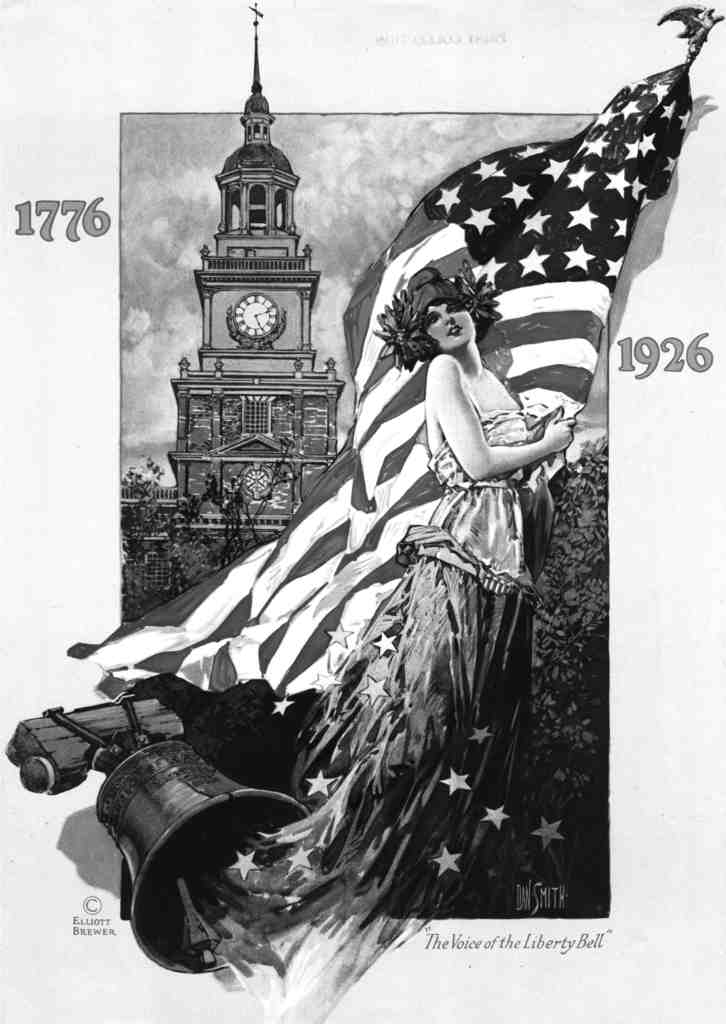
Back in the Roaring Twenties, city officials were particularly worried that organized crime, fueled in part by Prohibition, would mar the citywide Sesquicentennial celebrations marking America’s 150th birthday in July 1926.
A poster for the Sesquicentennial International Exposition in Philadelphia.
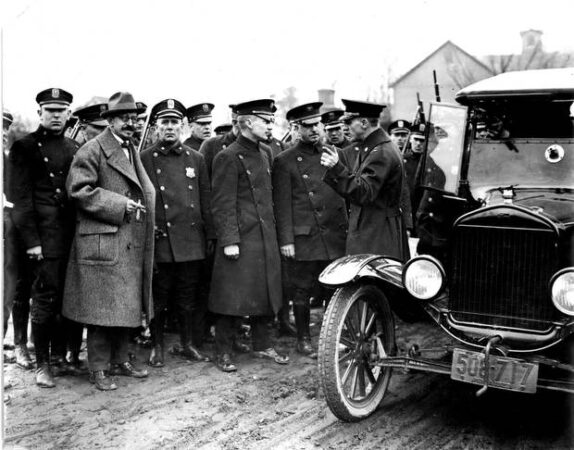
When President Calvin Coolidge finally gave the go-ahead for Brig. Gen. Smedley Darlington Butler to suspend his Marine duties in January 1924, the West Chester native and Haverford graduate swiftly established his authority as the city’s director of public safety.
“You have a cesspool in Philadelphia,” declared Butler. “If necessary you should pass laws taking [Philadelphia’s] government away if they don’t know how to run it.”
Butler had two decades of experience in Latin America, the Philippines, the Boxer Rebellion in China, as well as France during World War I, earning two Medals of Honor and eventually rising to the rank of major general. Only a tough, experienced Marine could tame Philly, Mayor Kendrick and local reformers believed.
And while Butler didn’t have soldiers to command, he was later quoted as saying that his ideal job title would be “martial law commander of Philadelphia with 5,000 Marines under me. Then I would not be hampered by writs and magistrates hearings.”
“Cleaning up Philadelphia,” he later lamented, “was worse than any battle I was ever in.”
By the end of 1925, even Kendrick had come to see some of Butler’s more authoritarian initiatives as “intolerable.” Criticisms of any federal role in combating local crime grew louder and louder.
J. Hampton Moore, who preceded and then succeeded Kendrick as mayor, called the Butler controversy a “spectacular misuse of the White House.”
According to an Associated Press article from Nov. 4, 1925, a congressman bluntly asked Kendrick: “Would you favor the president designating an Army or Navy or Marine to do police work in every one of the big cities of the country?”
“Mine is an exceptional case,” Kendrick responded.
To which the congressman snapped, “Some of us don’t see it that way.”
Butler ultimately agreed and returned to the Marines.
Though largely forgotten, this controversy has clear lessons — and warnings — for today.
Polls show Americans are highly skeptical of recent ICE raids and National Guard patrols — a problem Republicans could have avoided if they stuck to their long-standing preference for local rather than federal solutions.
But Gov. Shapiro should also remember that Trump won the 2024 election, in part, because voters didn’t trust Democrats on urban crime.
This is no mere philosophical discussion.
Consider Michelina and Ignacio Lanzetta, those striving South Philly immigrants. Their sons were pulled into “every vice and crime of the day,” historian Celeste A. Morello has written, and two of them were ultimately murdered.
With the nation’s 250th birthday almost upon us, Philadelphia might finally guide Americans toward a resolution to these long-standing conflicts over local crime and federal power.
Tom Deignan has written about history for the New York Times and the Washington Post. He is working on a book about violence in and around Philadelphia in the 1920s.
Even after selling more than $2 billion worth of sports and pop culture memorabilia, and adding celebrities like Drake, Kim Kardashian, and Shane Gillis to his client list, South Jersey’s Ken Goldin hasn’t lost the thrill of the chase.
During a visit to Japan last summer, Goldin made sure to post on social media that he wanted to meet nearby collectors and appraise their items.
Goldin’s years of collecting are evident in his office. The walls are lined with framed photos, encased music records, World Series trophies, and other prized collectibles, like signed baseball bats from Phillies legend Mike Schmidt and Reebok sneakers worn by Shaquille O’Neal.
The owner of Goldin Auctions in Runnemede said the things he has collected are invaluable heirlooms. Yes, they are rare, but they are also artifacts that carry the glory of pivotal moments in sports history, especially ones he witnessed himself.
Ken Goldin holds a 1976 Phillies bat used by Mike Schmidt, on Thursday, Dec. 11, 2025. Goldin, the star of Netflix’s “King of Collectibles,” the South Jersey-based collector and high-profile dealer has several new finds sure to excite Philadelphia sports fans.
Every time Goldin, 60, looks at the signed 1980s Phillies team poster in his office, he’s reminded of the World Series games he attended with his parents, sitting in the 500 level at Veterans Stadium.
The Phillies were playing the Kansas City Royals, and the teenage Goldin watched relief pitcher Tug McGraw tap his chest on the mound, a sign of his fiery competitiveness.
It’s those memories, not the money, that keep Goldin in the auction game, he said. They’re also the reason Netflix built a reality show around his collection and his business of selling high-value memorabilia.
“Every collectible I sell is a moment, it’s a piece of history,” he said. “And to me, if you love what you do, you will never work a day in your life. What drives me is that I really enjoy what I do.”
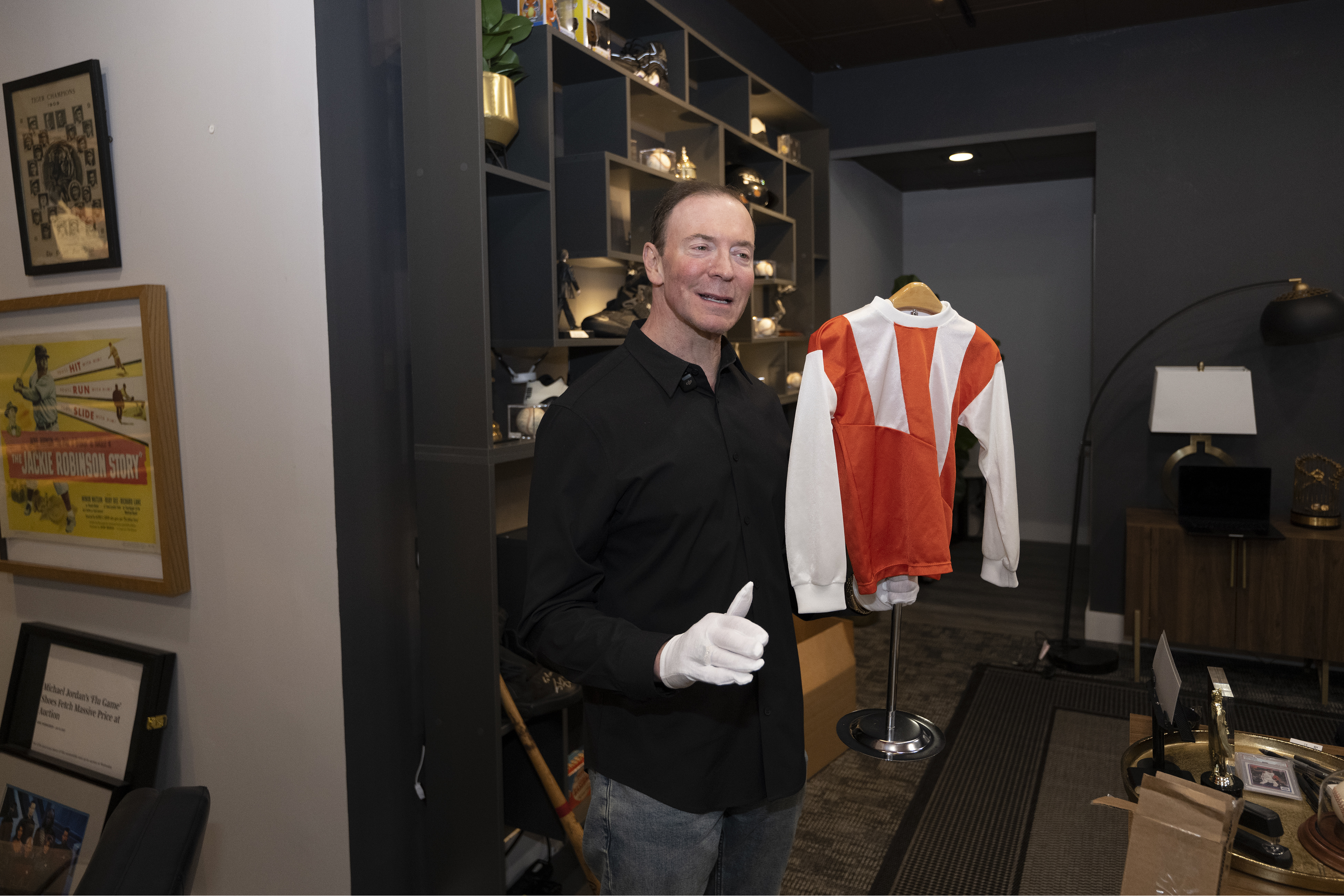
Ken Goldin shows a childhood soccer jersey that belonged to Lionel Messi, on Thursday, Dec. 11, 2025, at his office. Goldin, the star of Netflix’s “King of Collectibles,” the South Jersey based collector and high-profile dealer has several new finds sure to excite Philadelphia sports fans.
Among the season’s biggest surprises is a soccer jersey worn, or verifiably used, by Lionel Messi as a child. The story of how it landed in his hands, he said, is almost too good for TV.
“I’m not allowed to say any more than that, except that the provenance is unbelievable and the story behind it is remarkable,” he said in an interview prior to Tuesday’s premiere.
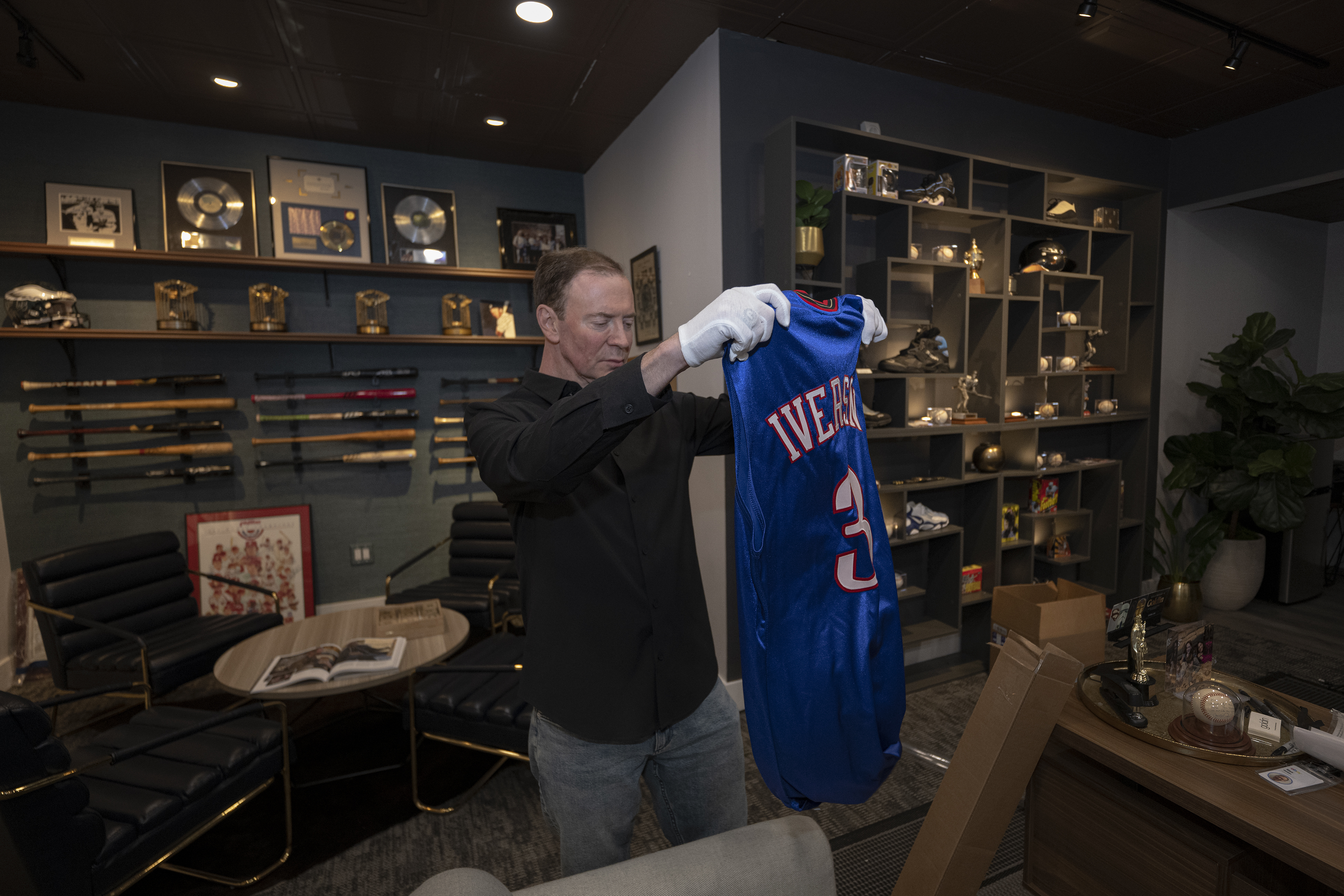
For Philly sports fans like himself, Goldin said there will be several Kobe Bryant and Allen Iverson items making an appearance on the six-episode season.
Ken Goldin unpacks a 2006 signed Allan Iverson jersey on Thursday, Dec. 11, 2025 at his office in Runnemede. Goldin, the star of Netflix’s “King of Collectibles,” the South Jersey based collector and high-profile dealer has several new finds sure to excite Philadelphia sports fans.
Some will be things Goldin acquired on his travels to Tokyo, where he met the “single-best Iverson collection in the world.”
Among the people who responded to his social media post was this Iverson fan who had a signed 2006 alternate blue jersey of the Hall of Fame player. It features a classic “Sixers” wordmark with white letters, and red and black trim. It was photo-matched and could be forensically linked to Iverson.
“When I saw it, I was like, ‘Whoa,’” Goldin said.
When it comes to Philly sports, certain athletes and figures transcend international lines, and Iverson is one of them, Goldin said.
“AI is one of those players who connects with everyone, whether they’re 14 years old or in their 50s,” he said. “I’ve lived and breathed Philly sports my whole life, so I know.”
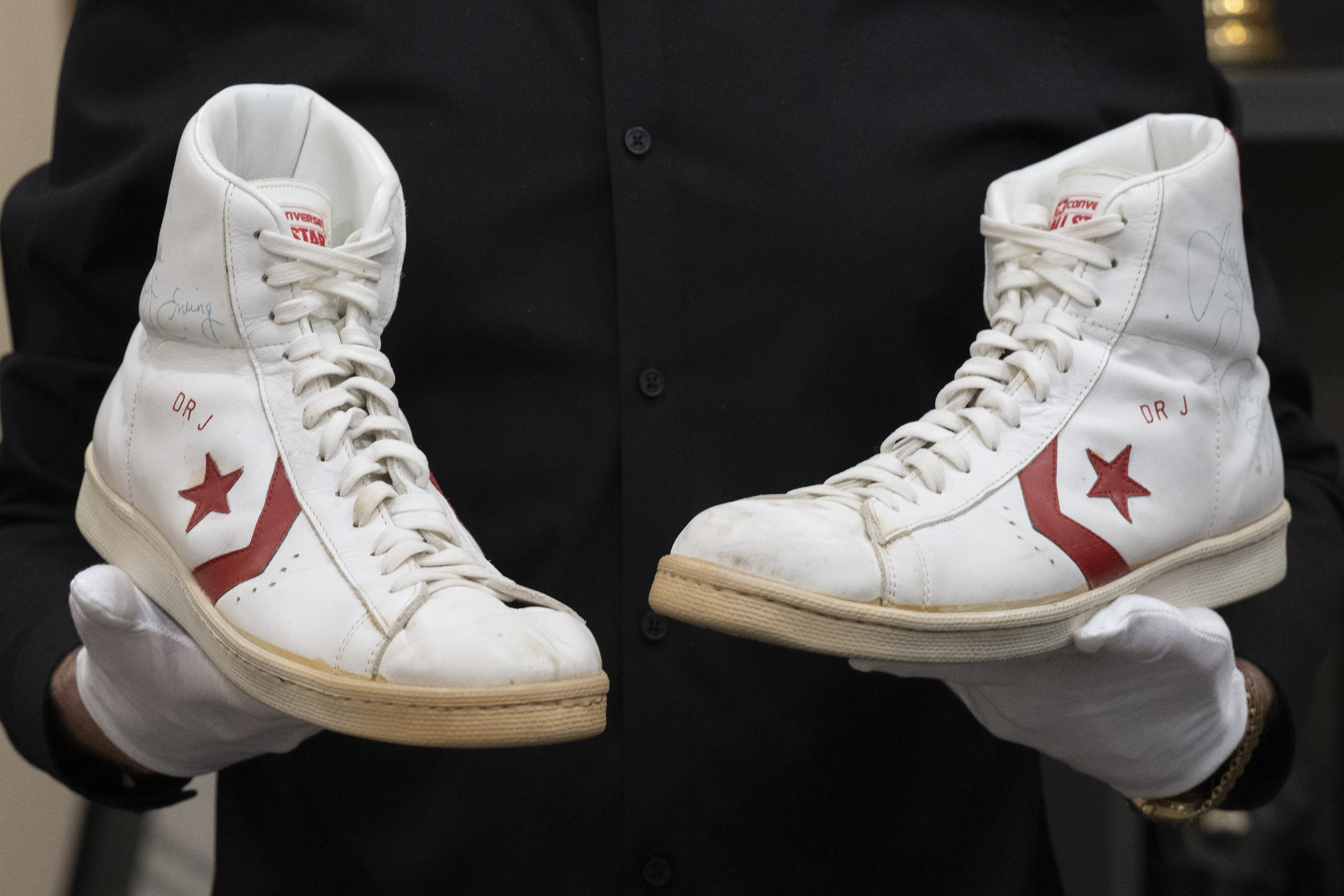
Ken Goldin holds a pair of Converse basketball sneakers on Thursday, Dec. 11, 2025, that belonged to 76ers star Julius “Dr. J” Erving and were worn during a game against the Boston Celtics in the 1980s. Goldin, the star of Netflix’s “King of Collectibles,” the South Jersey based collector and high-profile dealer has several new finds sure to excite Philadelphia sports fans.
On a recent Thursday afternoon, Goldin dug into his personal collection to reveal the sneakers of another legendary Philly sports icon: Julius “Dr. J” Erving.
The Converse All-Stars, worn by the revolutionary ABA and NBA star, feature his signature on both shoes. The sneakers are photo-matched to an early 1980s game that Erving’s Sixers played against Larry Bird’s Boston Celtics.
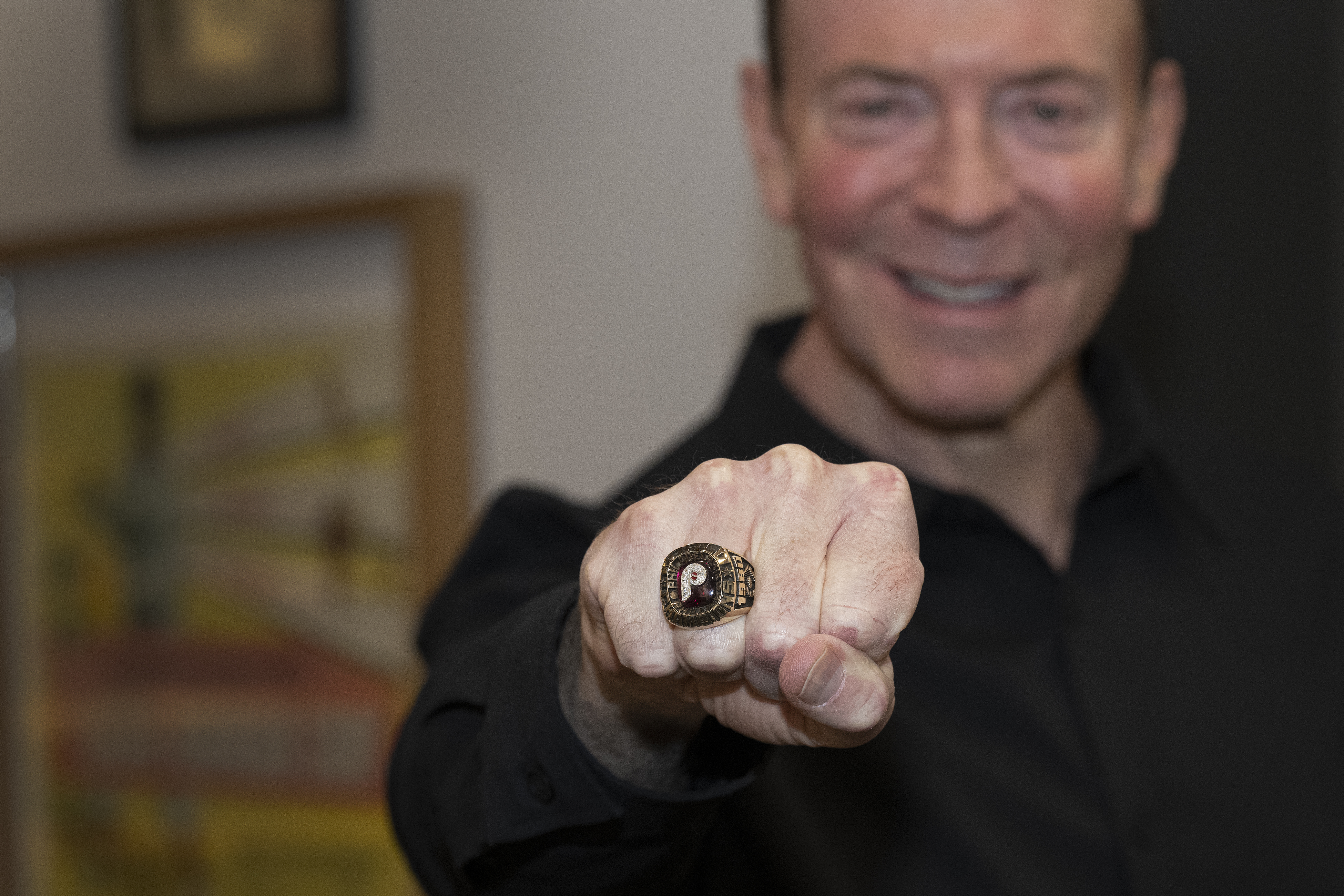
No stranger to TV-level theatrics, Goldin wore former Phillies center fielder and famed broadcaster Richie Ashburn’s 1980s World Championship ring that afternoon.
“I wear it almost never. It is set in a vault. But for this [interview], I said, ‘I’m going to put the ring on,’” Goldin said.
Ken Goldin shows his 1980 Richie Ashburn bicentennial ring on Thursday, Dec. 11, 2025. Goldin, the star of Netflix’s “King of Collectibles,” the South Jersey based collector and high-profile dealer has several new finds sure to excite Philadelphia sports fans.
But sports memorabilia won’t be the only thing Goldin is dealing with this season.
To further hone in on the Philly nature of the show’s new season, Goldin promised a Rocky-related find but wouldn’t share details. The show will also showcase high-priced items like Paul McCartney’s guitar, paintings by Bob Ross, and even the alleged mummified hand of Cleopatra.
Goldin said there will also be guest appearances from Logan Paul, Steve Aoki, and Giannis Antetokounmpo and his three brothers.
He knows Sixers fans aren’t the most welcoming to Eastern Conference contenders, but Goldin makes an exception for Antetokounmpo. “I know it’s Philly, but you have to love the guy,” he said of the Milwaukee player, before signing off with something of a prophecy.
“Who knows, maybe we can get him next year.”
The new season of “King of Collectibles” is streaming on Netflix.
A patient with no home to return to was pushed in a wheelchair to the curb outside Temple University Hospital. Staffers left him sitting on a bench, even though he was considered at a high risk of falling.
An hour later, a security officer found the man had fallen and was lying on the ground.
He was shaking when the guard brought him back into the hospital, but didn’t respond to a nurse’s questions. So hospital staff again sent him away — this time leaving him alone in a wheelchair outside the emergency department.
He was found there five hours later, slumped over, unresponsive, and without a pulse. He died the following week.
Temple’s treatment of the patient during the Oct. 3 incident prompted state and federal investigations. In a report released earlier this month, the Pennsylvania Department of Health cited Temple for violating state rules that require hospitals to provide emergency care.
Experts say the hospital’s actions amounted to “patient dumping,” a practice prohibited under a federal law that requires hospital emergency departments to medically screen and stabilize all patients.
The Centers for Medicare and Medicaid Services (CMS), which oversees hospital safety nationally, confirmed it is also investigating, but has not released details.
Hospitals that violate the Emergency Medical Treatment and Labor Act, known as EMTALA, risk hefty fines or losing their Medicare license, though such penalties are rare.
Temple acknowledged that its own protocols were not followed. Health system officials told state investigators the patient should not have been removed from the hospital without being evaluated and cleared by medical staff.
“The safety of our patients, visitors and staff is Temple’s highest priority,” the hospital said in a statement to The Inquirer. “We believe that everyone deserves high quality care.”
The hospital declined to say whether any of the staff members involved were disciplined or fired.
But such incidents are rarely the fault of one individual, legal experts and homelessness advocates said. Rather, they are a sign of systemic problems, such as understaffing that can leave staff overwhelmed, and bias among medical providers that can put vulnerable patients at risk of being dismissed.
“If you work in an environment where safety is prized and honored and enforced from the top down, everyone feels that’s their mission,” said Eric Weitz, a medical negligence lawyer in Philadelphia. “If that’s not a priority being set by leadership, then it’s no surprise the culture doesn’t reinforce it.”
Hospital administrators said the triage nurse who turned away the patient should have sought help, if the patient wasn’t responding to questions. The nurse said she was overwhelmed and working without sufficient support in one of the region’s busiest trauma hospitals.
“I was busy and alone,” she told state inspectors.
The incident violated Temple’s emergency department protocol, staff told Pennsylvania Department of Health inspectors.
Pa. Department of Health investigates Temple
To piece together what went wrong, Pennsylvania Department of Health inspectors watched security camera footage, interviewed staff members, and reviewed internal hospital reports. Their timeline shows a series of mistakes.
At about 3:15 p.m., an employee brought the patient in a wheelchair to a bench near the curb outside the hospital, and left him there on the mild October day with highs near 70 degrees.
He was being discharged to “the community” because he was experiencing homelessness, according to the inspection report. (The state report does not say whether staff attempted to place him at a skilled nursing facility, rehabilitation center or homeless shelter.)
The man sat alone on the bench for an hour before standing unsteadily, taking a few steps, and ultimately falling to the ground.
He managed to get back up, leaning against a tree for support, only to fall again. He was on the ground for 10 minutes before a security guard found him.
The guard brought the man back into the emergency department in a wheelchair about two hours after he had been released.
Back inside the hospital, the man followed orders to raise his arms for a security check at the door. Then he waited in line to be seen by the triage nurse responsible for checking in patients at the emergency department.
When he reached the front of the line, he did not respond to the nurse’s questions. “He was not answering any questions, just shaking,” according to a Temple incident report reviewed by inspectors. Staff said the patient was “not cooperating” and should be sent to the back of the line.
After two minutes with the nurse, a security guard moved his wheelchair to a corner of the emergency department near the entrance.
The man was once again wheeled outside the hospital a few minutes later and left alone.
He was found by medical staff around 9:30 p.m., slumped over in his wheelchair.
Staff began CPR, rushing him back inside for trauma care.
Pennsylvania Department of Health’s inspection report details how a patient in Temple’s emergency department was rolled away in a wheelchair without being evaluated.
The inspection report does not identify the patient’s name, age, or provide details on the medical condition for which he had been hospitalized. It also does not say what happened after he was found unresponsive. He died five days later, on Oct. 8.
Temple responds
Medical screening of every patient who comes to the emergency department is “explicitly required” under Temple’s EMTALA policies, according to the hospital’s response to the state findings.
“It doesn’t matter if they were just there an hour ago, every time they present, it is a new encounter and should be documented as such,” a Temple staffer said in an interview with inspectors.
The hospital told the state it would retrain staff on EMTALA rules, making clear that security officers cannot remove patients from the emergency department unless they have been evaluated and cleared for release by a medical professional.
A week after the incident, hospital staff were instructed to keep a log of patients who are removed from the emergency department and the name of the provider who approved their release. (Temple police may still remove patients from the emergency department if they are threatening the safety of other patients or staff.)
The hospital also said that it would order mobility evaluations for patients who are being discharged “to the community” if they had a high risk of falling, with a doctor’s sign-off required.
Temple treats some of Philadelphia’s most vulnerable patients in an emergency room that sees more than 150,000 visits a year, including high numbers of gunshot victims and people experiencing opioid withdrawal. It operates a Level I trauma center in a North Philadelphia community where 87% of patients are covered by publicly funded Medicare or Medicaid.
The emergency department is so busy that about 8% of patients choose to leave before being seen, according to CMS data, compared to about 2% of patients at hospitals nationally and across Pennsylvania.
The triage nurse on duty Oct. 3 is not identified in the inspection report.
Two healthcare lawyers who reviewed the state’s inspection report said the entire episode is troubling.
“It sounds like they violated every part of EMTALA,” said Sara Rosenbaum, professor emerita of health law policy at George Washington University.
The law does not require specific treatment, but mandates that hospitals evaluate everyone who walks in the door seeking care, and prohibits them from sending them away or transferring them until they are medically stable.
“They failed to screen him, threw an unstable person back on the street, and didn’t arrange a medically appropriate transfer,” she said.
What’s more, the hospital could be sued for malpractice over how it initially discharged the patient.
The incident appears to be “a classic EMTALA violation,” said Weitz, the Philadelphia lawyer who serves on Pennsylvania’s Patient Safety Authority, an independent state agency that monitors hospital errors.
The health department’s description of what happened is “almost eerily the exact fact pattern the law was passed to prevent,” he said.
Healthcare challenges for patients experiencing homelessness
People who are experiencing homelessness often receive subpar treatment when they seek medical care, research shows.
One study that analyzed thousands of California patient records found that those who were described in their medical records as “homeless” were more likely than patients who have a permanent legal address to be discharged from the emergency department, rather than being admitted for care.
In the Philadelphia region, caring for this population is increasingly challenging. The number of available shelter beds has declined in recent years, while the number of people who are considered unhoused has risen, according to Philadelphia’s Office of Homeless Services.
Stephanie Sena, CEO of Breaking Bread Community Shelter in Delaware County, said the colder months also see more people experiencing homelessness coming to hospitals to get off the street.
“If they say they’re sick, they might get a bed and be able to survive the night,” Sena said.
The pattern can make doctors and nurses less likely to believe patients when they report real medical needs. Especially when staff are overwhelmed in busy hospitals, patients experiencing homelessness may be at greater risk of getting denied or discharged when they need help, she said.
Sena said she was disappointed to hear about the Temple incident.
“It is tragic,” she said, “but also not at all surprising, unfortunately.”
Americans should “have a say” in the Trump administration’s unilateral decision to use military force against Venezuelan boats, according to H.R. McMaster, former national security adviser during the first Trump administration, and a retired lieutenant general who grew up in Roxborough.
Being honored Jan. 16 at the Museum of the American Revolution’s 320th birthday celebration of Benjamin Franklin, McMaster was interviewed by The Inquirer last week. He offered a brief but wide-ranging discussion on foreign policy and military matters. McMaster will be named the 2026 Franklin Founder honoree during the annual Philadelphia event that celebrates the life and legacy of Franklin. McMaster is scheduled to speak about the role of the military in a democracy.
“A comprehensive explanation for bombing boats is lacking,” McMaster said in the interview, referencing the attacks on vessels allegedly carrying drugs that find their way to the United States, which have resulted in around 100 deaths since early September. “The American people should have a say through Congress.” The Trump administration has said it has complete authority to conduct the attacks.
McMaster said certain questions must be answered, such as whether the strikes are a “just cause,” and whether the right to conduct the missions is within the purview of presidential power under Article II of the U.S. Constitution.
McMaster didn’t discuss the ongoing controversy about whether U.S. forces were justified in killing two survivors of a Sept. 2 attack on a Venezuelan boat. Defense Secretary Pete Hegseth is refusing to release video showing the killing of two men clinging to wreckage in the Caribbean Sea.
McMaster, 63, is a historian and senior fellow at the conservative Hoover Institution at Stanford University who served 457 days in the Trump administration, from February 2017 to April 2018. He left after disagreements with Trump over foreign policy and internal dynamics.
Trump considered using force against drug smuggling during his first term, McMaster said, when the president asked his staff, “Why don’t we just bomb the drugs?” coming out of Mexico.
Military intervention was avoided, McMaster said, after he “huddled a team” and won “unprecedented cooperation” with the Mexican government to fight the flow of drugs.
Addressing other military matters, McMaster discussed the widely reported meeting of military commanders called by Hegseth in September.
One of Hegseth’s main messages was there’s no place for “wokeness” in the military, saying too many uniform leaders were being promoted “for the wrong reasons — based on their race … gender quotas [and] based on historic so-called firsts.” He added he wants “no more … DEI programs or dudes in dresses. No more climate change worship.”
While he agrees with much of what Hegseth said, McMaster explained, the secretary was speaking to the wrong people: “There are no woke generals and admirals,” McMaster said. “They had been following unwise directives from senior civilian officials pushing an extreme social agenda in the Biden administration.” Under Biden, McMaster concluded, the military had come to “valorize victimhood.”
Civilian guidance on so-called woke matters isn’t needed in a self-policing entity such as the military, McMaster said: “Yes, there have been criminals and sexists in the military, but hell, we threw them out ourselves.”
McMaster also said he doesn’t have a problem with the Trump administration deploying National Guard troops to U.S. cities such as Los Angeles; Chicago; Memphis; Washington, D.C.; and Portland, Ore. “It’s the president’s right to do so, allowing local law enforcement to enforce the law,” he said. “Regrettably,” he said, local authorities have resisted guard placement, especially in Oregon and California, where Democratic governors are in charge. “This is an example of how partisan politics can undermine our ability to work together,” he said.
As a former insider in a Trump-led administration, McMaster has said in previous writing that he’d witnessed the machinations of the White House, including “exercises in competitive sycophancy” among officials in Oval Office meetings. McMaster didn’t comment on the atypically blunt revelations by Trump chief of staff Susie Wiles in Vanity Fair.
He’s written that Trump is a “flawed commander in chief: mercurial, inconsistent, and easily distracted.” But, he added, Trump’s erratic course reversals can be helpful, because they make him unpredictable to our adversaries.
This cover image released by Harper shows “At War with Ourselves: My Tour of Duty in the Trump White House” by H.R. McMaster.
Despite his time in the inner sanctum of the Trump administration, McMaster would write in his book, At War With Ourselves: My Tour of Duty in the Trump White House, that he’d been unable to foresee Trump’s “persistent false claims of widespread election fraud [in 2020] and his encouragement of a mob [on Jan. 6] to conduct the most significant attack on the U.S. Capitol since August 1814,” when British troops set fire to the White House.
The partisanship that helped spur the attack is a continued threat to the republic, McMaster said in the interview with The Inquirer, referencing Franklin, “who feared factionalism.”
Each year, the Franklin celebration highlights a theme that connects Franklin’s work to current social issues and concerns. In receiving the Franklin Founder Award, McMaster joins company with others from a wide variety of fields:
John Mather, an astrophysicist who won a Nobel Prize, was the 2025 winner. He helped develop the James Webb Space Telescope, connecting with Franklin who uncovered important principles in electricity, marine oceanography, magnetism, and aeronautics.
In 2020, the centennial anniversary of Congress’ act to grant women the right to vote, awards went to Linda Greenhouse for her coverage of the Supreme Court for the New York Times, as well as to Cokie Roberts, political commentator and author.
The 2016 award went to pediatrician Paul Offit from Children’s Hospital of Philadelphia as well as the Perelman School of Medicine. Offit is the co-inventor of the rotavirus vaccine, and an author and public speaker. This topic was closely aligned with Franklin, whose civic involvement included creation of the first public hospital. Offit has frequently sparred with Health Secretary Robert Kennedy Jr. over the issue of vaccines.
McMaster is a graduate of Norwood-Fontbonne Academy (formerly Norwood Academy for Boys, and Fontbonne for girls), a private Catholic school in Chestnut Hill. He also graduated from Valley Forge Military Academy, which will be closed in the spring (it doesn’t affect Valley Forge Military College, which shares a campus with the academy in Wayne).
McMaster went on to the U.S. Military Academy at West Point, and was a U.S Army Officer for 34 years. His career included combat service in the Gulf War. Afterward, he returned to teach history at West Point and earned a Ph.D. in history from the University of North Carolina-Chapel Hill.
Organizations providing homelessness services were thrown into crisis mode last month when the U.S. Department of Housing and Urban Development announced an extreme shift in funding priorities.
The department has since withdrawn the notice, but it offered a stark preview of an administration willing to gamble with the futures of our most vulnerable neighbors and the crippling changes that could still be coming — unless neighbors make their opposition known, and lawmakers work to stop it.
HUD’s fiscal year 2025 Continuum of Care Competition Notice of Funding Opportunity brought widespread changes and signaled a drastic shift away from proven permanent supportive housing solutions to combat homelessness in favor of transitional housing.
We at Project HOME immediately recognized the danger this posed to Philadelphia’s communities and the people we serve. The outcry from fellow organizations on the front lines and elected officials was swift and fierce. Gov. JoshShapiro even joined a multistate lawsuit challenging HUD’s move.
While HUD has temporarily paused the Notice of Funding Opportunity, the department remains intent on reshaping funding requirements to reflect new priorities. For now, organizations have been spared the chaotic rush to adjust grant applications based on the changes. But make no mistake: The administration’s intentions have been revealed, and if future funding notices are similar, the consequences could be devastating.
The changes would disregard proven solutions and could destabilize established programs, putting people’s homes — and their lives — in jeopardy.
The reality is, permanent supportive housing is a proven and effective approach to breaking the cycle of homelessness. Per the Urban Institute, “Rigorous studies consistently show that it is the most effective solution to increasing housing stability and reducing chronic homelessness.”
At Project HOME, we witness the transformative power of permanent supportive housing every single day. Our model has leveraged permanent supportive housing as the foundation of our H-O-M-E model in tandem with opportunities for employment, medical care, and education services. The most critical step in a person’s journey to break the cycle of homelessness is to have a safe and stable place to call home.
Consider David, who spent 25 years experiencing chronic homelessness before finding stability and hope in our community. With access to housing and supportive services through our H-O-M-E model, David rebuilt his life — moving into permanent supportive housing, pursuing adult education, and securing employment through our social enterprise program.
Today, David is a pillar of our community: He organizes an annual back-to-school barbecue for neighborhood children and continually looks for ways to help others still struggling on the streets. Whether he’s distributing coats, offering comfort at memorials, or lending a helping hand, David embodies the power of proven solutions to break the cycle of homelessness, restore dignity, and inspire lasting change.
Stories like David’s are not isolated — they are why we remain steadfast in our commitment to permanent supportive housing.
Critics point to a rise in homelessness nationwide as a failure of permanent supportive housing approaches, but the real culprit is a nationwide shortage of affordable housing.
According to the National Low Income Housing Coalition (NLIHC), there were only 35 rental homes that were affordable and available for every 100 extremely low-income households in 2024. That’s a shortfall of 7.1 million rental homes across the country. Without pathways to affordable, permanent supportive housing for people at risk of homelessness, the crisis would be so much worse, and more unsheltered people would be on the streets.
We recognize it is not the administration’s intention to increase rates of unsheltered homelessness in Philadelphia and countless other communities nationwide. No one wants to see more people living on the streets — not neighbors, not service providers, not civic and business leaders, and certainly not the administration. Yet, if these changes go forward, that could very well be the outcome.
The reduction in permanent supportive housing threatens to have a drastic effect on people like David. They’d risk falling back into the cycle of homelessness, and local businesses and neighborhoods would be forced to grapple with the effects.
Homelessness is the defining crisis of our time. Yes, we must always strive to improve our response and evolve best practices. But change must be rooted in evidence, not theory.
Philadelphia has made steady progress over three decades and has been on the front line of developing best practices that work.
We don’t want to go backward. We must hold our elected officials accountable and demand proven solutions that benefit communities and honor the dignity and progress of every person.
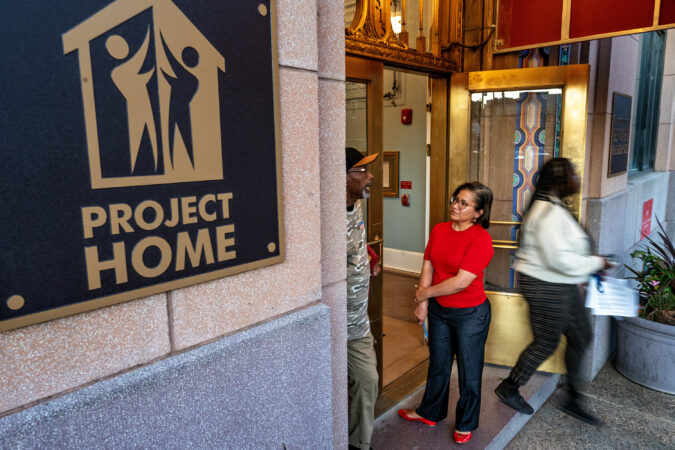
Donna Bullock is the president and CEO of Project HOME.
Having Pennsylvania politicians spend a weekend in New York City looking for money for their local elections adds a corrosive element to our elections. The $1,000-a-plate “money primary” that is the Pennsylvania Society dinner drowns out the voices of people who are running without the backing of corporate interests and party bosses. The entire point of the event is for the wealthy to influence things in the Keystone State. And it’s working. Both of the likely nominees in next year’s gubernatorial race appeared, along with several candidates for U.S. Rep. Dwight Evans’ 3rd Congressional District seat. And Sen. “Connecticut” Dave McCormick appeared. He won’t appear for an in-person town hall anywhere in his district, but he’ll go to New York, which shows how events like this reveal skewed priorities.
The focus is on fundraising, not generating the real political change people need. It’s really just moneyed people protecting their narrow self-interest, not building a movement that answers voters’ concerns, addresses crucial needs in the commonwealth, and creates a distinct branding in people’s minds. It’s insensitive and reeks of venality. Follow the money.
In the late 1950s and early ’60s, when Levittown development projects were being built in the New York, New Jersey, and Pennsylvania suburbs — exclusively for white people — Philadelphia Mayor James Tate, City Planning Commissioner Edmund Bacon (Kevin’s dad), and the Rev. William H. Gray Jr. (U.S. Rep. Bill Gray’s father) put their heads together and began planning an urban renewal project for future Black homeowners in North Philadelphia.
It was named Yorktown to celebrate the 1781 Franco-American victory in Yorktown, Va., where George Washington’s forces — with French naval support — trapped the British, forcing their surrender.
Historians tell us the Battle of Yorktown and Washington’s victory directly led to serious peace negotiations resulting in the Treaty of Paris in 1783 and American independence.
Designed by builder Norman Denny, the development featured suburban-style two- and three-story homes with front lawns and driveways. The sprawling area included cul-de-sacs named after significant historic figures, Betsy Ross, Patrick Henry, Marquis de Lafayette, etc.
An artificial intelligence program I consulted while writing this letter even agrees that my neighborhood is significant, calling it a “unique North Philly community inspired by the decisive Battle of Yorktown in the Revolutionary War that has created a lasting middle-class enclave known for its distinct style and strong identity despite early predictions it wouldn’t last.”
How much more history must Yorktown hold to get its own anniversary Liberty Bell?
Karen Warrington, Philadelphia
Join the conversation: Send letters to letters@inquirer.com. Limit length to 150 words and include home address and day and evening phone number. Letters run in The Inquirer six days a week on the editorial pages and online.
DEAR ABBY: My sister, “Blanche,” and I didn’t grow up together after she turned 13. I was 6 at that time, and our grandmother raised her. We talked on the phone a lot until I was 45 and my husband died. Blanche then convinced me to move to her state. When I received the insurance payout, she talked me into buying a property with two houses — one for her, and one for me. Then she had us go into business together.
I met someone a year later, and he moved in a year after that. Then my sister started driving a wedge. Blanche has always been manipulative and controlling. She refused to pay rent and wanted to clean my house in exchange for it. After many fights, silent treatment, etc. — not only me but also with our parents, brother, her daughter and her son-in-law — my now-fiance and I decided to sell the property and move out of state.
I’m concerned Blanche will give us trouble about moving out. She can barely pay her own bills, let alone pay rent somewhere else. My fiance says it’s not our problem, we need to live our lives and staying stuck in a hostile environment is unhealthy. My concern is that Blanche is my sister, and I hate to see her kicked out on the street. What should I do if she refuses to leave? She has received a legal eviction notice that gives her eight months to go. My fiance says we may have to call the sheriff to escort her out.
— DREADING IT IN ARIZONA
DEAR DREADING IT: Your sister has eight months to make other living arrangements, so she isn’t going to be “out on the street” overnight. Discuss this messy problem with an attorney and enlist their help. If you can manage it, document the condition of the house she’s occupying. Your fiance may be right about your sister, so when the time comes for her to leave, consider having law enforcement present to ensure she doesn’t damage your property.
** ** **
DEAR ABBY: I am a widow. Most of my friends are married. What do you think about them calling and touching base with me only when they are in their cars running errands? They never call from home while they’re with their husbands. Are they hiding the fact that they are calling their single friend? I think it’s rude to call someone while fighting traffic and making stops like the bank drive-up window.
I have thought about asking them to call me back when they get home, but they sound like they are just too busy to do that. I’m getting to the point where I just don’t answer their calls. I also have a married friend who only texts and never talks on the phone.
— AFTERTHOUGHT IN FLORIDA
DEAR AFTERTHOUGHT: Your friends may have busy schedules and little free time, which is why they call you from their cars. They may also prefer that what they discuss with you be just between the two of you, with no one else listening in. I do not think you should take this as personally as you seem to have taken it. For a definitive answer to your question, you must ask your friends why they do this.