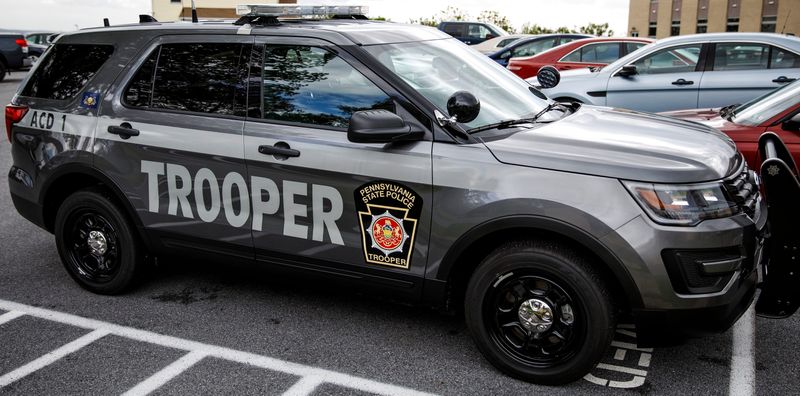
State police Cpl. Joshua Mack is suing the Pennsylvania State Police in federal court, arguing that he lost a lucrative position on the governor’s security detail because of racial discrimination.
Mack, who is white, claims that his superiors reassigned him earlier this year and that he had heard them talk about the “need” for “more minorities” on Gov. Josh Shapiro’s security team.
Mack had been the longest-serving member of the governor’s security detail, joining the elite squad in 2011 when Ed Rendell was in office.
“Mack’s removal and replacement on the Governor’s Detail were motivated by race considerations and intended to satisfy [Pennsylvania State Police’s] stated goal of increasing minority representation in the Governor’s Detail,” the lawsuit reads. “As a result, Mack suffered loss of pay, loss of overtime income, diminished professional opportunities, and emotional distress.”
Mack joined the state police in 2004 and went on to protect four governors. The lawsuit claims that he “consistently received strong performance evaluations” and that guarding the governor came with opportunities for specialized dignitary-protection training, state-owned vehicles, and far more overtime than other state troopers have.
Pennsylvania State Police declined to comment, saying that they don’t respond to queries about personnel matters or pending litigation. Shapiro’s office declined to comment as well.
According to the lawsuit, Mack lost the position on March 25 — although he retained his rank of corporal — and was told that it was only because of “administrative changes.” His supervisors repeatedly informed him their decision was not due to any deficiencies in his performance, the lawsuit states.
“As a result of his removal from the Governor’s Detail, Mack was reassigned to another unit farther from his home, lost access to a state vehicle, and lost substantial overtime opportunities,” reads the lawsuit, which was filed on Nov. 25.
“He was assigned back to patrol, which was a drastic change, as he was out of patrol work for so long and much has changed during that time,” wrote Anthony T. Bowser, who is representing Mack, in an email to The Inquirer.
Mack alleges he was then replaced by two non-white troopers “who were substantially less qualified and lacked any dignitary-protection experience.”
Mack is demanding a jury trial. He is alleging damages stemming from lost wages and benefits, damage to his professional reputation, and “emotional distress, humiliation, and embarrassment.”
Bowser says that while the damages would have to be determined during litigation, the lost overtime amounts to over $50,000 annually because it is capped in Mack’s new patrol position. The lost overtime would also affect his pension.
Mack is specifically suing the Pennsylvania State Police and his superiors Cpl. John Nicholson and Lt. Col. George Bivens. Shapiro is not mentioned by name in the suit.
Mack first filed an administrative charge of discrimination with the Equal Employment Opportunity Commission, a necessary first step before filing in federal court.
After the 76ers battled back from a 19-point second-half deficit to beat the Washington Wizards in the fourth game of the season, Tyrese Maxey was asked what the overtime win says about him and his teammates.
“It says that we are tough,” Maxey said. “But we don’t want it to become a habit. But it does say that we are tough. We’re resilient, and it says we are in shape, honestly, because to be able to play like that, come back, and do it multiple times, like go into overtime off a back-to-back and still pull out a win.”
At the time, the Sixers’ 139-134 overtime road victory on Oct. 28 came one day after they defeated the Orlando Magic, 136-124, at Xfinity Mobile Arena. Their other two games resulted in comeback victories over the Boston Celtics and the Charlotte Hornets. The Sixers were 4-0 for the first time since the 2019-20 season.
With grit, athleticism, and a refuse-to-lose mentality, the Sixers showed no resemblance to last season’s 2024-25 squad. Joel Embiid’s knee issues were believed to be manageable, and Paul George’s season debut was imminent.
So we thought.
Now, we must ask ourselves: Was the Sixers’ impressive start just a mirage?
Since winning its first four games, the squad has lost eight of 14 contests. The Sixers (10-8) are eighth in the Eastern Conference standings.
They avoided losing a third consecutive game by defeating the struggling Brooklyn Nets, 115-103, at the Barclays Center on Friday. Now, they’ll look to win consecutive games for the first time since the season-opening winning streak when they host the Atlanta Hawks on Sunday.
Like last season, injuries, primarily to Embiid and George, have been the biggest thing holding them back. Having the two maximum-salary players sidelined forces role players to perform well above their pay grade.
“Well, listen, I think that, a little bit like I said a year ago, I think that we need them to be the best version of ourselves,” coach Nick Nurse said before the Sixers snapped their two-game skid on Friday. “That’s for sure. The concern levels hit me, obviously, when they’re not playing. But now, when we’re missing three or four other guys out of the rotation, [it gets harder]. I think we’re probably thinking about a nine-man rotation, and that’s when it’s getting a little tough.”
Nurse has a point. Two other starters, Kelly Oubre Jr. (sprained left knee) and VJ Edgecombe (left calf strain), and reserve forward Trendon Watford (left adductor strain) have been sidelined. Center Andre Drummond, who started the past nine games in place of Embiid, suffered a game-ending sprained right knee on Friday. Edgecombe and Drummond are questionable to return against the Hawks (12-8).
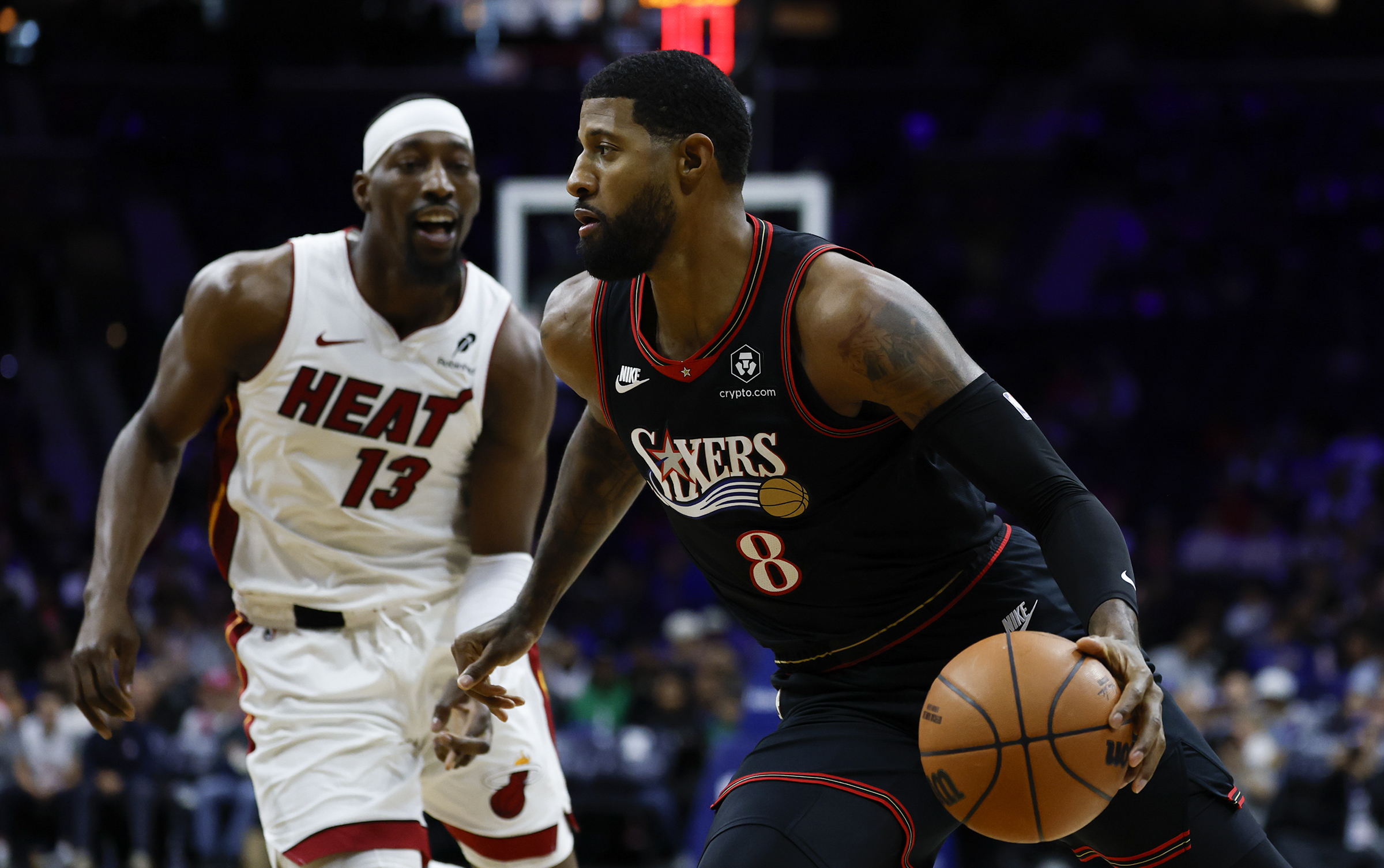
Sixers forward Paul George dribbles the basketball past Miami Heat center Bam Adebayo on last Sunday.
But the Sixers have more than $300 million owed to Embiid and George over the next three seasons, beginning next season. That’s a massive investment in two players, who, like last season, have been unable to stay on the court.
George played in just his fourth game on Friday, finishing with 14 points and two steals in 21 minutes, 21 seconds after missing Tuesday’s 144-103 setback to the Magic with a sprained right ankle.
The nine-time All-Star missed the first 12 games while recovering from left knee surgery. Then he sat out Nov. 19’s 121-112 loss to the Toronto Raptors because he isn’t cleared to compete on both nights of a back-to-back.
Meanwhile, Embiid will miss his 10th consecutive game on Sunday because of knee injuries. He’ll miss his ninth straight because of right knee injury management or soreness. Embiid also missed the Sixers’ 111-108 home loss to the Detroit Pistons on Nov. 9 because he doesn’t play on back-to-back nights to rest his left knee.
At this point, Embiid has been available for six of the Sixers’ first 18 games.
A season ago, Embiid played in only four of the first 18 contests en route to making just 19 total appearances. Meanwhile, George was further along, playing in nine contests. He ended up playing in 41.
When he does play, George has shown signs of being a solid piece for the Sixers.
He scored his team’s first 11 points before becoming more of a facilitator and defensive standout, as Maxey finished with a career-high 54 points in a 123-114 overtime road victory over the Milwaukee Bucks on Nov. 20.
Right now, however, he’s playing short stints while on a minutes restriction.
“It’s difficult,” George said. “I mean, it’s difficult knowing, to start the game off, how long you’ll be out there. But then, as the game goes on, you’re like, subconsciously counting how much time you’ve got left. So it’s tough. It’s a challenge, especially trying to find rhythm, try to stay in rhythm, and try to just be consistent with the time that you’re out for it.”
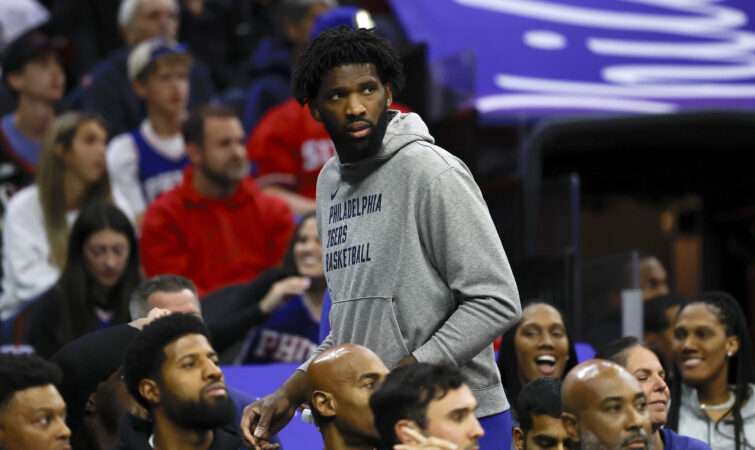
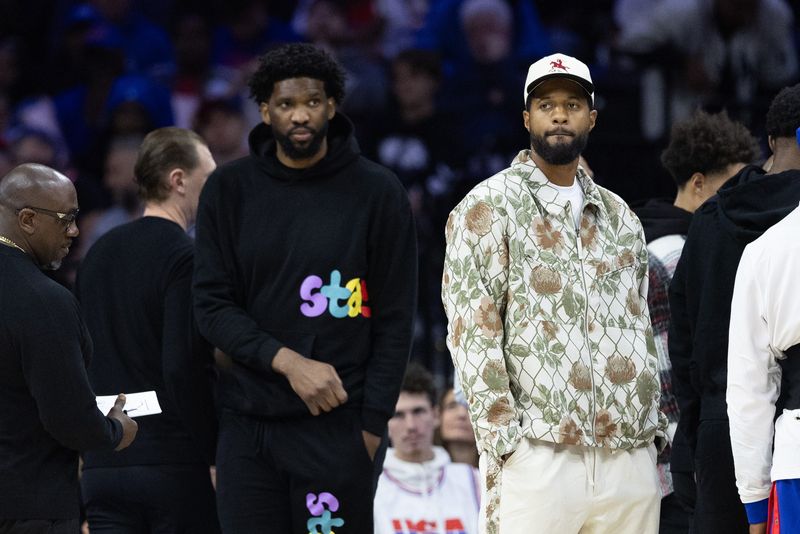
Paul George and Joel Embiid look on during the first quarter against the Memphis Grizzlies at Wells Fargo Center.
But for now, Maxey is carrying the bulk of the load while Embiid and George are dealing with injuries. That’s no different from last season until he, too, succumbed to injuries.
Maxey is averaging a league-leading 40 minutes per game. One has to wonder if the Sixers are relying too much on him because of his fellow maximum-salary teammates’ lack of availability.
One also has to wonder how much, under the circumstances, relying heavily on Edgecombe and Oubre may have contributed to their injuries.
Despite being a rookie, Edgecombe was third in the league in minutes played at 37.3. Meanwhile, Oubre averaged 36.7 minutes through his first 11 games. He played just 14:56 before exiting at halftime in his 12th and latest appearance.
Yes, the Sixers showed resilience at the beginning of the season that captivated the city.
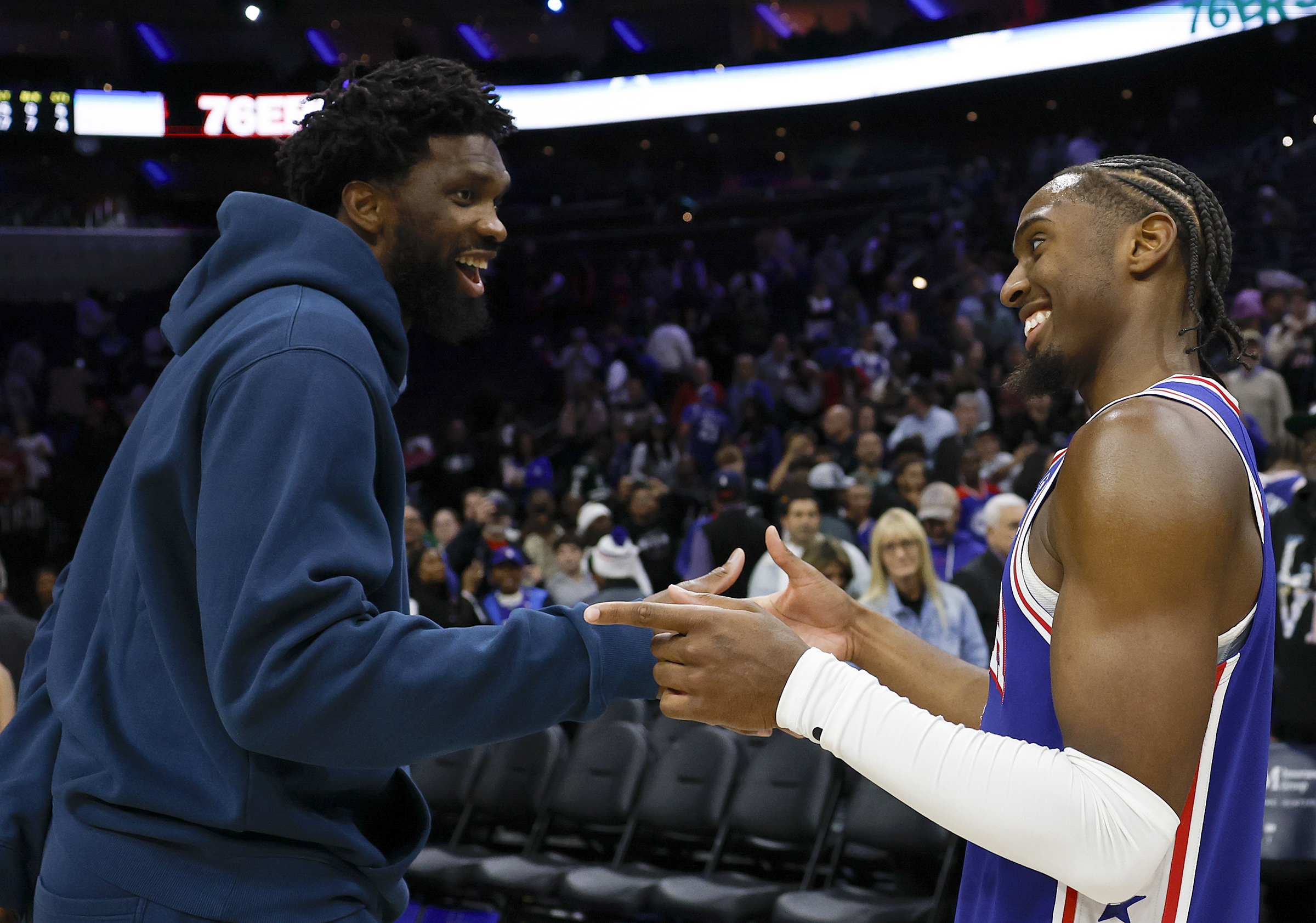
Sixers guard Tyrese Maxey meets with teammate center Joel Embiid after the Sixers beat the Orlando Magic, 136-124, on Oct. 27.
But, so far, after the hot start, Embiid and George’s lack of availability has made things reminiscent of last season’s teams. Back then, the Sixers spent most of the season battling for an NBA Play-In tourney spot before opting to tank.
Things could change for the Sixers, especially if the duo spends a substantial amount of time on the court moving forward.
But at this moment, this season has 2024-25 vibes.
Even at age 99, the Palestra still sees rare moments.
Saturday’s Penn-La Salle game marked the first time since the 2001-02 season that two teams formally in the Big 5 faced off in a regular-season nonconference game that didn’t count in the city standings.
When the tournament format started, five teams finally grew to six with Drexel’s inclusion. They agreed that they could schedule matchups outside the tournament pods, as long as they were willing to potentially meet again in the Big 5 Classic triple-header.
It didn’t happen in the tournament’s first two seasons, but it made sense that it would happen at some point. Scheduling nonconference games only ever gets harder for teams outside the elite, and Penn had room to fill in its Cathedral Classic four-team event on Thanksgiving weekend.
La Salle answered the call this season, while Fran Dunphy was still in charge on Olney Ave., and his close friend Steve Donahue was still in charge on 33rd Street. Their successors, Darris Nichols and Fran McCaffery, didn’t mind keeping the matchup when they took the jobs in the spring.
So there they were, staying in town for the holiday weekend, with Merrimack and Hofstra joining the field. The stands were far from filled, but there was some life in them — and there was lots of life on the court in Penn’s 73-71 win.
La Salle gave a great effort, earning a 44-38 halftime lead as much by outhustling Penn as by outscoring them. Though the Quakers shot 53.8% from the field in the frame, the Explorers outrebounded them at both ends of the floor to produce a 21-14 margin on the glass.
“We were just getting destroyed on the glass in the first half,” McCaffery said. “You can’t win basketball games like that. Give them credit for the energy level that they played with.”
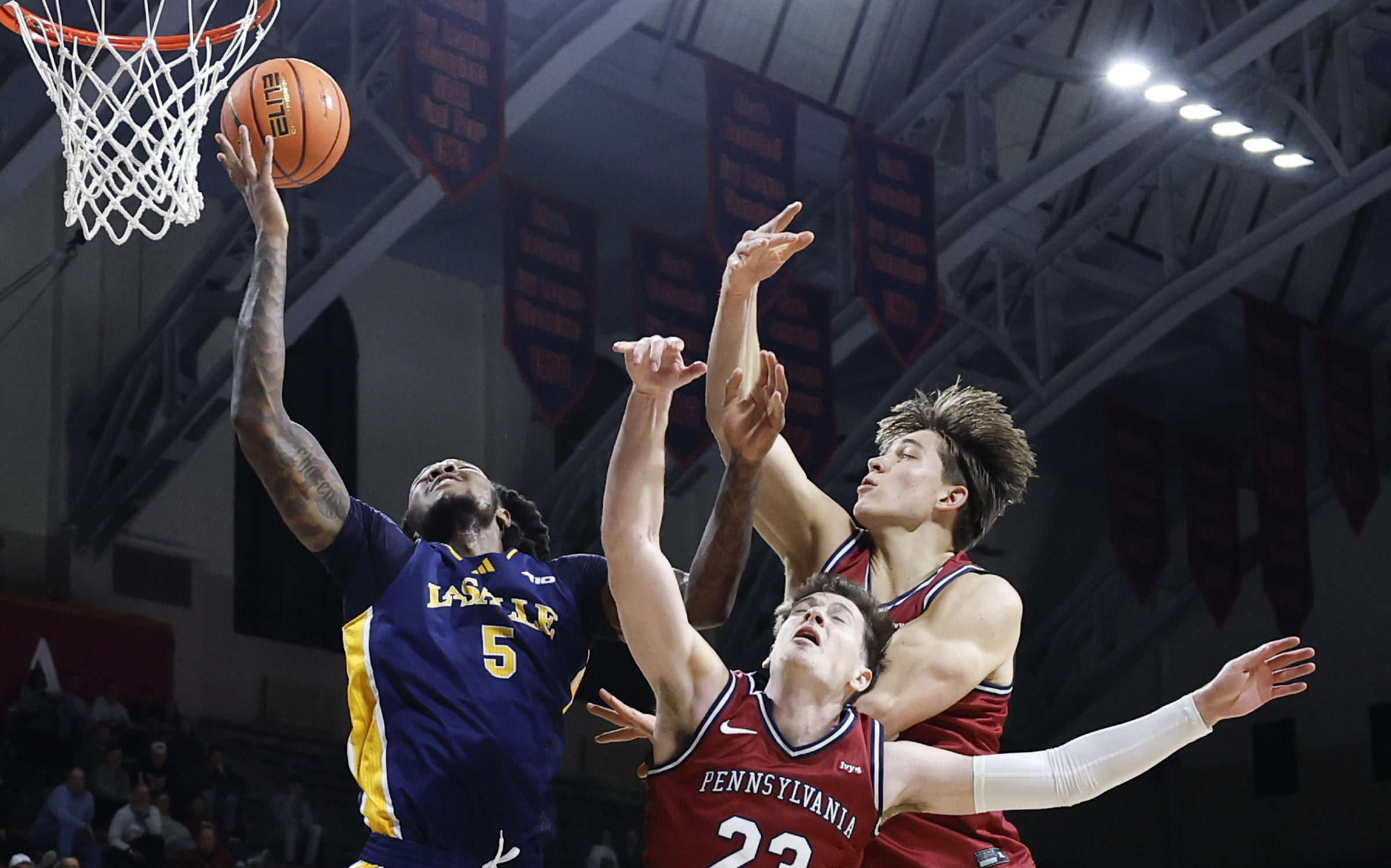
La Salle’s Josiah Harris beats Penn’s Ethan Roberts (center) and Augustus Gerhart to the rim during Saturday’s first half.
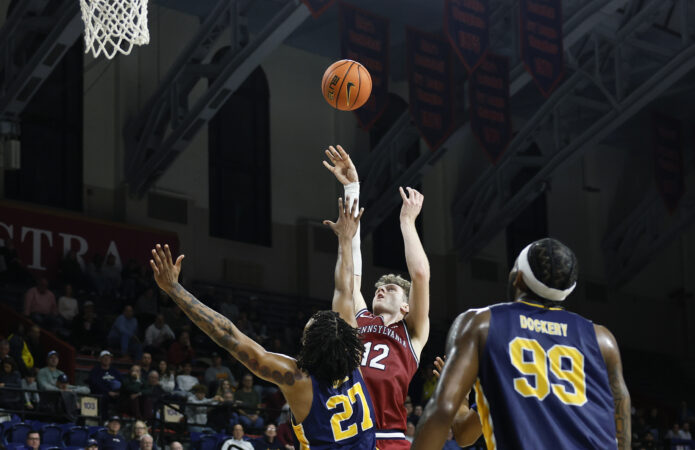
In the second half, the Explorers grew their lead to 55-41 with 15 minutes, 21 seconds remaining, and it was 60-47 with 12:26 to go. From there, star transfer TJ Power and freshman Jay Jones led the big comeback. The Quakers edged ahead 68-66 with 3:56 left, and held on despite missing enough free throws for the Explorers to stay within one possession through the final seconds.
At the buzzer, it felt every bit like a Big 5 game even though it wasn’t one.
“I think you could see the intensity level displayed by both teams and that’s a credit to the individuals but also the coaching staffs for both programs,” McCaffery said. “The crowd was into it and was really good, and I think from that standpoint it makes great sense to do it.”
Power made his latest big impression with a game-high 29 points, including five three-pointers in the second half. But he said he was “most proud of” the mental side of the comeback.
2H (10:49) | La Salle 60, Penn 53
Turnovers leading to triples. All five buckets this half are from distance and TJ has four of them. TIME OUT, EXPLORERS!!#FightOnPenn 🔴🔵🏀 pic.twitter.com/qJsk1Z22oQ
“We work really hard on building our identity to be a winning team,” he said. “When we went down 14, all we were saying in the huddle is, like, ‘We win basketball games — there’s no doubt about that.’ We just knew we had to get stops, we made some adjustments on defense and then we got some momentum on offense.”
Jones’ role came after he subbed in for starting point guard AJ Levine with 12:09 to go, with Levine out of gas. Jones did not leave the court for the rest of the night, tallying seven points, two rebounds, one assist, and two steals in that span.
McCaffery said Jones’ work in practices against the starters earned the opportunity, and praised him for seizing it.
“He’s just been really good,” McCaffery said. “His attitude is great. He’s just a freshman, so it takes time, but he was really special tonight and I’m not surprised.”
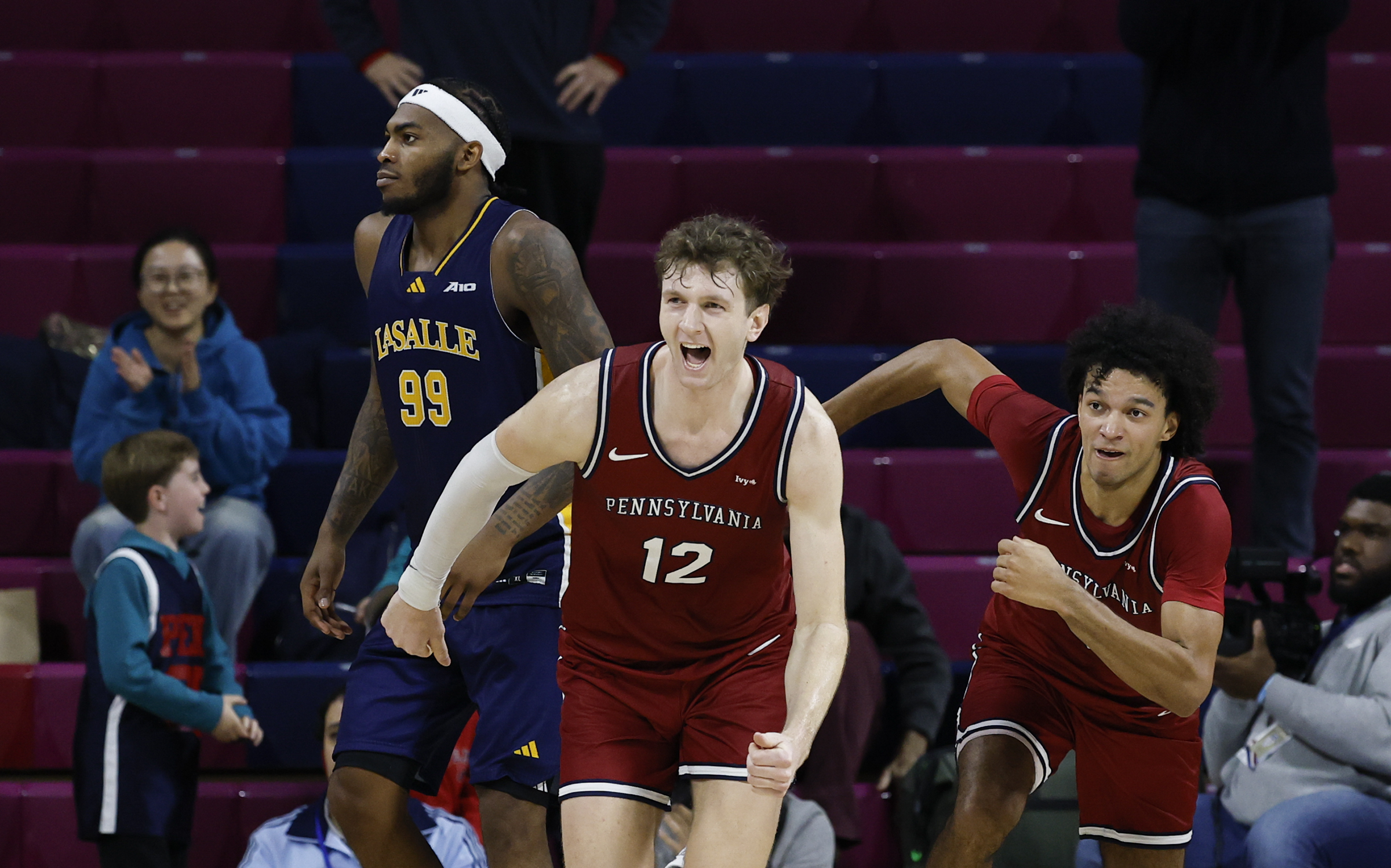
Jay Jones (right) celebrates with TJ Power (center) after the final buzzer.
Nichols was understandably in a less happy mood, having been on the receiving end of it all. But the Explorers are clearly making progress, no matter their record.
“I don’t know if things are on the up — I’m down right now,” he said. But he quickly added it was easy to be “a prisoner of the moment, especially after wins and losses, and I tell my guys all the time the season’s long.”
He will no doubt take his own advice as he teaches it to his players.
“You can be poisoned by accomplishment, you can be down in the valley of disappointment, and both of them are bad,” Nichols said. “Just trying to understand that we’ve got to continue to get better, we’ve got to get some guys healthy, we’ve got to get guys playing better, and we’re just going to continue to work.”
To this day, George Matysik, executive director of Share Food Program, can’t bite into a South Indian dosa without remembering a daily act of kindness that mattered to him when he was a young man, a paycheck away from poverty.
When he would arrive for his 6 a.m. shift as a housekeeper at the University of Pennsylvania’s engineering school building, the engineering school’s librarian would hand him a homemade dosa, a thin crepe redolent with the warm smells of curry and potatoes.
“My stomach was growling by then,” he said, sitting in a warehouse full of food ready to be packed for the nearly three million people who rely on the Philadelphia nonprofit for food.
“The moment of her handing me that dosa, I felt like I was going to be OK,” he said. Matysik, who graduated from Mercy Career and Technical High School across the street and down the block from Share’s main warehouses near Henry, Hunting Park, and Allegheny Avenues, went on to earn a degree in urban studies from Penn.
“I felt supported,” he said. Now, Matysik leads an organization that supports people who are missing meals and are worried about getting their next ones.
Look, Matysik said, society has many problems, and most are difficult to solve. Homelessness is complicated. Addiction grips its victims in its relentless stranglehold. “They don’t have simple solutions,” he said.
“But with hunger, it is simple. It’s getting food to the people who need it,” he said, like the dosa that began his day of washing floors and cleaning toilets at Penn.
“It’s frustrating to me that in the richest country in the world, a food program like Share has to exist at all,” Matysik said. “Food is a human right, and hunger is solvable. We have the resources in this country to eliminate food insecurity, and we can do it in Philadelphia if organizations like Share can get the resources.”
But it’s daunting.
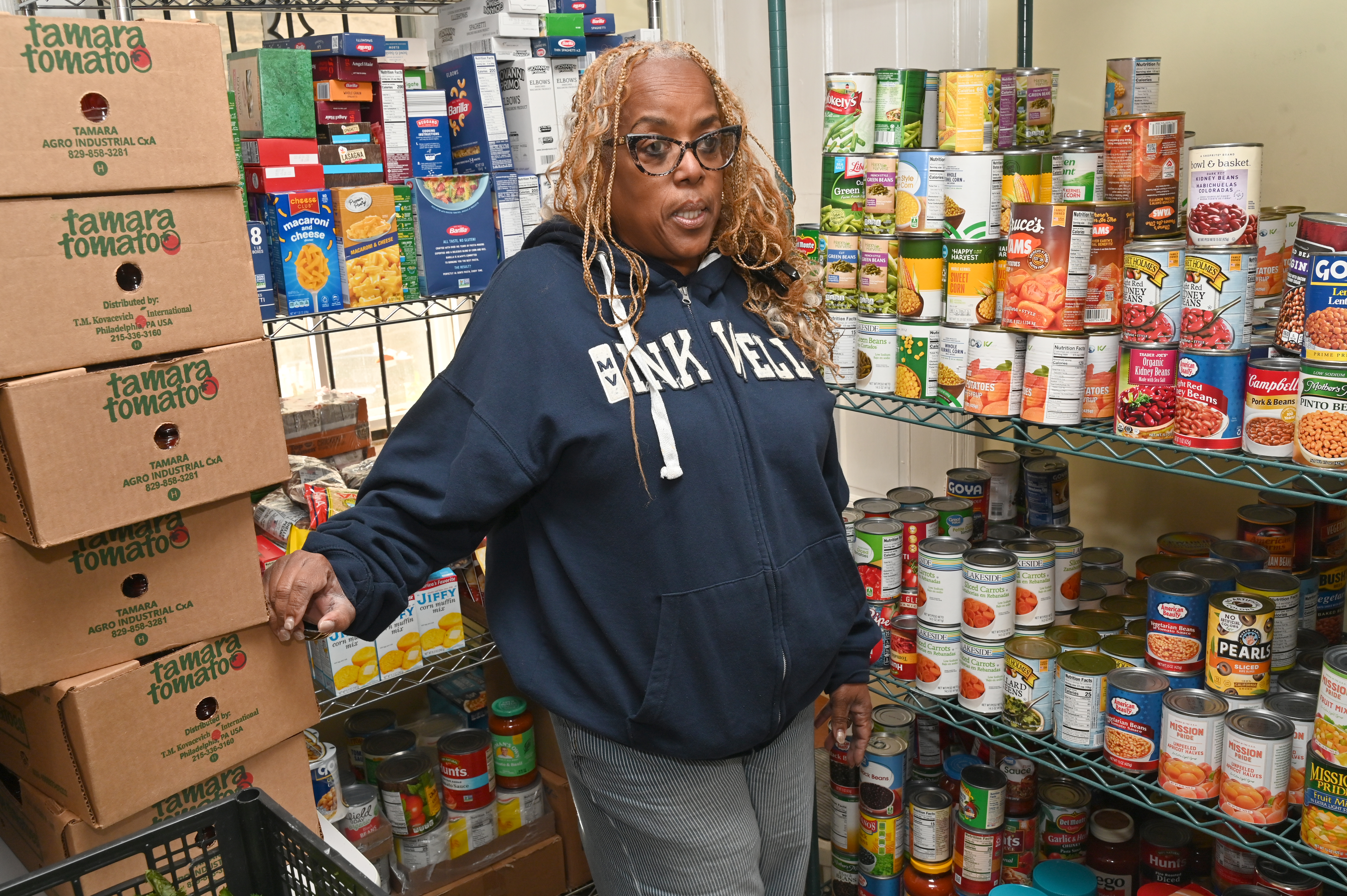
Jimmette Hughes, a volunteer at the Canaan Baptist Church’s Family Life Center, which distributes food contributed by Share.
Since the start of President Donald Trump’s second term in office in January, Share’s funding from the federal government has been cut by $8.5 million, or about 20% of the nonprofit’s annual expenses.
Also, the cost of the food Share buys wholesale by the pallet has risen. The increase in food costs will come as no surprise to grocery shoppers around the nation, Matysik said. “We can all see our receipts.”
Even as Share’s resources are being depleted, demand for the food it provides is increasing. Share distributes food to nearly 400 community partners — religious groups, food pantries, neighborhood organizations — and all of them are telling Share that more and more people are coming for food.
Community partners report that the number of new families or individuals registering to receive food has increased 12-fold. For example, in the past, a community partner might register five new families or individuals a week. But in late October and early November, with the government shutdown and the delay in government SNAP food benefits, that number might have risen to 60.
And more people than ever are coming to receive food. Organizations that served 100 people or families on their food distribution days were seeing 150 in line, Matysik explained.
“It’s making it more and more challenging for families to get the resources they need,” he said.
Patricia Edwards understands. When Edwards, a retired security guard, opened her refrigerator on Veterans Day in mid-November, she saw one box of powdered milk. That was it.
Supplemental Nutrition Assistance Program benefits had provided barely enough in the past, but with all the back-and-forth during the shutdown, her benefits weren’t available. “I’m looking at a bare cabinet and a bare refrigerator,” she said.
Patricia Edwards picks up food, including a Share box of food in her cart, at the Canaan Baptist Church’s Family Life Center.
The only reason Edwards had anything to eat leading up to Veterans Day was that a neighbor stopped by with some prepackaged meals.
“I didn’t know what to do. I didn’t know where to go,” she said, “but a neighbor told me about this.”
So, on that cold November day, Edwards walked a few blocks from her home in Germantown to the Canaan Baptist Church’s Family Life Center, hoping she could get some groceries at its weekly food pantry. “I need some food in the house,” she said.
She wound up with a box of food from Share and two bags of groceries filled with tuna, noodles, cereal, and vegetables.
“It’s a blessing,” she said.
Of course, those blessings cost money.
Share pays $12,000 to $14,000 a month for electricity to keep its warehouses running. Each tractor-trailer-sized truckload of food costs $40,000. Each industrial-sized freezer costs $800,000, and Share bought three of them in the last two years.
Three years ago, Share expanded into two warehouses, one in Ridley Park in Delaware County and the other near Lansdale in Montgomery County, the better to serve people in Philly’s surrounding communities.
Share needs money for forklifts, for payroll, for trucks. Funding pays for food, of course, but it’s also necessary to bankroll the infrastructure required to move not just boxes of food, but tons of it, to the people who need it. Share pays drivers to deliver food to homebound seniors. Even that’s a cost.
Share also has government contracts to provide school meals to 300,000 kids per day in public and charter schools in 70 districts, including Philadelphia’s public schools.
It’s a source of revenue, “but we lose money on it,” Matysik said.
Beyond that, Share runs gardens and greenhouses, which serve both as food sources and educational laboratories for young people.
Years ago, Matysik was one of those young people crossing the street from his high school to pack boxes as a Share volunteer.
These days, his work at Share involves budgeting and fundraising — balancing demand against resources.
“I’ve never been more disappointed in the American government,” he said, “And yet, I’m inspired every day by the American people stepping up to support organizations like ours.”
This article is part of a series about Philly Gives — a community fund to support nonprofits through end-of-year giving. To learn more about Philly Gives, including how to donate, visit phillygives.org.
For more information about Philly Gives, including how to donate, visit phillygives.org.
About Share Food Program
Mission: Share Food Program leads the fight against food insecurity in the Philadelphia region by serving an expansive, quality partner network of community-based organizations and school districts engaged in food distribution, education, and advocacy.
People served: 2,901,243 in 2024
Annual spending: $42 million, including $25 million distribution of in-kind donations and $6 million to purchase food.
Point of pride: In 2024, Share Food Program supported nearly 400 food pantry partners across the region, provided more than 6,500 30-pound senior food boxes each month, ensured over 300,000 children had access to nutritious food every day through its National School Lunch Program, and rescued and redistributed nearly six million pounds of surplus food. Altogether, Share distributed 32,214,873 pounds of food.
You can help: Volunteer your time packing boxes, rescuing food, or make calls from home to help coordinate senior deliveries.
While those of us concerned about the future of our nation’s scientific institutions and safety net feel distraught without a way to protect them, we doomscroll and spiral out further. Yet, it is in that doomscrolling that a solution may lie.
Why are we giving away our attention to plutocrats, for free, when we could be investing it in the direction of the common good?
Meta, the parent company of Facebook and Instagram, made over $160 billion in advertising revenue last year, largely generated by our clicks, our scrolling, and the algorithms that entrap us and, too often, damage our children’s mental health.
That $160 billion flowed into a corporate machine with a primary duty to its shareholders, not to the public.
Gutting research
Meanwhile, the federal government canceled $8 billion in research grants to more than 600 colleges and universities through the National Institutes of Health and the National Science Foundation. And that was just in the first six months of the second Trump administration. That’s a mere 5% of Meta’s profits.
And while an exact figure for Donald Trump’s contested cuts to nonprofits remains elusive, he did try to cut $400 million from AmeriCorps, and tried to claw back $49 million in aid to the lawyers representing abused and neglected children. The nonprofit sector stands to lose even more if the president’s budget reinforces changes to the tax code.
That’s the bad news.
But we believe these catastrophic losses to research and charity can be turned into wins. We believe it is time to rewrite the social contract of social media.
Cell phones are ubiquitous, and social media generates billions. A new platform could direct money to nobler purposes, the authors write.
Imagine a nonprofit social media platform run with input from universities, nonprofits, and research institutions — a competitor to Facebook, Instagram, TikTok, and X — where every dollar from advertising and sponsorship supports charitable missions and research.
The model is radical in its simplicity: users engage much as they do now, advertisers pay to reach them, sponsors chip in, and instead of profits accruing to billionaires, the revenue stream funds scientific research and humanitarian programs.
You like cat videos? Great — so do the researchers fighting pediatric cancer that your ad clicks just helped fund. Need a dopamine rush from someone liking a picture of your sandwich? So does the charity furnishing apartments for unhoused people. Why cede the attention economy entirely to the for-profit sector?
Imagine if even a fraction of Meta’s $160 billion in ad revenue were redirected into research into Alzheimer’s and other diseases. On a new social media platform, users could earmark the revenue they generate for particular causes or research institutions.
Critics will scoff: “You can’t compete with Facebook.” But Myspace once seemed unassailable. TikTok rose from nowhere to global dominance in under five years.
Attention is fickle. Platforms age. Generations shift. And when they do, new players emerge — players who can ride the next wave of interface design, AI integration, and community-driven features.
Or, starting small but growing with time, we can build an economic engine designed with community input and guardrails to serve the public good.
Ours is not a utopian dream.
The infrastructure exists. The advertising market is there, especially among small local businesses and nonprofits. We don’t know yet what innovative features the platform can offer, but the human desire to connect online isn’t going anywhere. The only missing piece is the will to claim a piece of that market for purposes nobler than quarterly earnings.
The call here is straightforward: Help us build our social media platform, CommonLoop. We are starting off as a lawyer and a journalist with an email account, seeking an anchor sponsor and early participants.
If you’re a university president, a nonprofit director, a philanthropist, or simply someone with the resources and skills to help launch such a platform — now is the time. The start-up costs are real, but so is the prize: a self-sustaining system that turns the most lucrative business model of the digital age into a public trust.
Click, scroll, like — but this time, make it count.
As parents enter this fall’s college application season, they’ve likely been warning their children incessantly that a degree in art history or philosophy won’t pay the bills.
“Study something practical,” they’re muttering, “so you can get a job.”
But a report from the Federal Reserve Bank of New York tells a different story. Census data from 2023 on recent college graduates reveal that the unemployment rate of students majoring in art history and philosophy, in fact, resembles that of some STEM majors.
This is welcome news. Studying the humanities — which includes art history and philosophy, but also history, literature, language, religion, and music — isn’t an impractical luxury. Rather, these subjects offer a competitive, if still hidden, advantage and return on investment in the job market.
The humanities prepare students not just to get a job, but to keep it, and excel while doing so. And Wall Street seems to be noticing.
“We have more and more conviction that we need people who majored in history, in English, and things that have nothing to do with finance or technology,” he said, adding, “It’s that diversity of thinking and diversity of people and diversity of looking at different ways to solve a problem that really fuels innovation.”
Death reports exaggerated
Yes, despite grim headlines about the “death” of the humanities and the end of the English major, the chief operating officer of BlackRock, arguably America’s largest multinational investment company, is now actively seeking college graduates in the humanities.
Why are the humanities, then, continuing to lose ground on college campuses? Partly because their most important financial benefits do not show up immediately upon graduation. But this myopic perspective, which has long devalued the humanities, is now affecting the perception of what has been the most popular major in recent years: computer science.
Only recently, professors Mary Shaw and Michael Hilton of Carnegie Mellon University wrote in the New York Times a persuasive defense of computer science, whose majors have seen such a rapid decline with the rise of generative artificial intelligence that graduates cannot even get a job at Chipotle.
Computer science majors should not panic, however.
“The rise of generative A.I.,” Shaw and Hilton said, “should sharpen, not distract us from, our focus on what truly matters in computer science education: helping students develop the habits of mind that let them question, reason and apply judgment in a rapidly evolving field.”
By the same token, as AI reshapes the world, the content of humanities education is more vital than ever for addressing the ethical and existential questions such change provokes.
The skills cultivated by majoring in the humanities are equally worthy of defense as those of computer science. The wide-ranging studies of the economics of education show that humanities degrees are being underestimated for the job skills they promise students in tomorrow’s workforce.
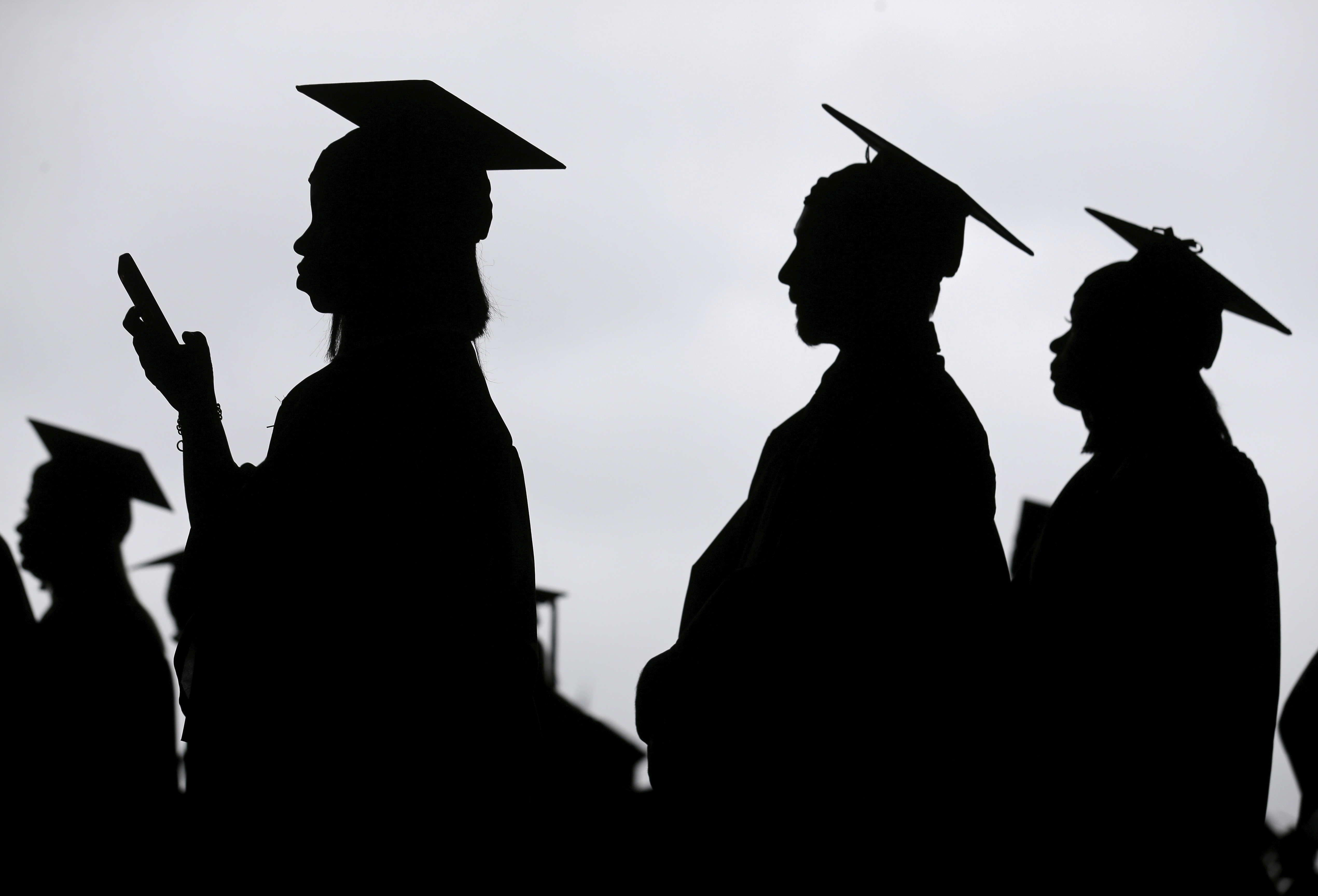
Graduates await diplomas. Derided in the age of technology, a humanities degree can bring untold rewards, writes Gene Andrew Jarrett.
Finally, the critical skills they develop can withstand the rapidly changing technologies that force workers to relearn demanding job tasks. Studying the humanities, then, is akin to investing in academic stock today for long-term professional gain.
One recent study tells us that the “wage-by-major statistics” parents and students review before declaring a major undervalue how “an education in history increases a student’s labor market value — perhaps through the development of critical reading and writing skills or because reading history texts cultivates a transferable attention to detail — that enables them to earn higher wages when they seek employment after graduation.”
Transferable skills
The “transferable” nature of skills is a significant educational benefit of the humanities. A 2020 study describes the labor market returns to the specific, or technically specialized, nature of a college major. That “specificity” determines how much the skills inculcated by this major are transferable across different jobs.
In short, the humanities consistently produce some of the most transferable skills across professions.
Another 2020 study looks at earnings dynamics, changing job skills, and careers in science, technology, engineering, and math (STEM). Studying the humanities can develop the skills that overcome the following conundrum: When a person acquires only “specific skills that are in high demand but also changing rapidly over time,” that person likely will need “to learn many new tasks each year.”
To make a long story short, a humanities education results in one of the slowest measurable rates of counterproductive “skill change.” This means the skills learned through a humanities degree endure resiliently, even in the face of massive technological changes.
The humanities, of course, have substantive educational benefits. Their themes enable students to learn several critical things about humanity, such as the impact of human intelligence and creativity, the evolution of ideas about humankind, and the vitality of language and culture in how to see and survive in the world.
But the true value of the humanities includes their ability to build the professional skills students need to thrive in the global workforce — especially at a time when colleges may be deciding whether to consolidate or eliminate humanities departments, majors, and courses.
The question, then, that parents and children should ask isn’t, “What can you do with a degree in art history or philosophy?” The better question is, “What can’t you do with it?”
Yes, contrary to what you might think, a degree in the humanities, alongside degrees in computer science and many in between, remains one of the smartest investments students can make.
Gene Andrew Jarrett is dean of the faculty and William S. Tod Professor of English at Princeton University.
One day, an English teacher at my gigantic public high school in Manhattan paused the lesson.
He placed his hands shoulder-width apart on his ancient desk. He hooked his toes on the rim of the chalkboard behind him, and there he was: suspended in the air, floating above the sullen earth toward the end of third period on a dismal November day.
“Have you ever seen anyone do this before?” he asked.
He looked around from his perch, mischievous joy sparkling in his eyes beneath his mop of white hair. He held the pose, and then the period bell rang.
That the teacher happened to be Frank McCourt, who would later win a Pulitzer Prize for his memoir Angela’s Ashes, is only partly relevant. Mr. McCourt was celebrating the weirdness and joy of being human, the possibility and story in every moment.
Messing with our heads
And, like all good artists, he was messing with our heads to pop us out of our usual selves, into the realms of creativity and new thought that have always moved civilizations forward.
For a teenager unhappy to be in school at all, he was a welcome light.
Federal law enforcement officers watch from atop the ICE facility in Portland, Ore., as a protester in a frog costume demonstrates.
The Portland Frog reminded me of that moment, now 40 years ago, the way it stood there with its belly out like a 3-year-old asking for cookies, and the unbelievable, cowboy-laconic toughness the suit’s occupant expressed after an ICE agent pepper-sprayed his vent hole: “I’ve definitely had spicier tamales.”
Contrast this great fun to today’s singularly humorless White House, as best exemplified by press secretary Karoline Leavitt. In a recent exchange, a reporter inquired about the significance of a Putin-Trump summit meeting proposed for Budapest, Hungary. Why there? In 1994, that’s where Russia promised not to invade Ukraine if that country gave up its nuclear weapons.
Leavitt responded with a string of insults. But the question was actually interesting and thoughtful: It would have been more fun to mull its implications than to be a jerk.
Used to be funny
Deranged as Donald Trump is, he has always been funny. But even that modestly redeeming trait seems gone in this bleakly self-serious White House. If I were an autocrat in training, I’d be worried about that, on durability grounds.
The late anthropologist David Graeber and the archeologist David Wengrow are known for rethinking early human history in a way that credits Neolithic peoples with intelligence and whimsy. In the spirit of the Portland Frog or Mr. McCourt, early humans may have initially avoided labor-intensive agriculture because they had other things to do, including storytelling, masquerades, or traveling. Maybe early signs of trade were not nascent capitalism, they argue, but the result of vision quests, or of women gambling.
Our best human projects survive because they are aspirational, offbeat, and fun. Early democracy in the U.S. was certainly colored by those qualities. When an exhausted John Adams arrived in Philadelphia for the first Continental Congress, he went straight to a bar — City Tavern. Pursuit of happiness, anyone? And yes, dark projects occur, but they rarely last long.
Visiting my mother recently in that same city of Philadelphia, close to her 88th birthday, I wondered what characteristics lead to a long life and other lasting human projects.
My mom marched in “No Kings” Day. She suggested we visit a unique beer shop with hundreds of ales to get some Thai beer to pair with our meal. And perhaps, she also offered, you would like to attend the euphonium concert I’m hosting tomorrow night?
Helping her declutter her storage closet, I held up a Chock full o’Nuts coffee can. “What are we doing with this?” I asked. “I was saving it because it had the twin towers on it … It might be valuable.”
Indeed, the can featured the skyline of my youth. “It’s art,” I said. “We’ll keep it,” placing it on a shelf for display, an Arabica-scented monument to a city as it once was, still a place of joy and loss and resilience.
Photos from within U.S. Immigration and Customs Enforcement detention centers show a contrasting vision of the city: pictures of humans in distress, put upon by violent, masked, monstrous agents. The victims’ faces were a panoply of the diversity of the American experience. Perhaps some were vicious criminals, but most seemed to be moms, children, or laborers.
If they were really Tren de Aragua, would they be crying?
In the contrast between that dungeon and my mom’s happiness project, I caught a glimpse of the reason our country has endured and thrived, even despite many imperfections.
How they’re communicated matters, according to a recent study by Sunil Wattal, associate dean of research and doctoral programs at Temple University’s Fox School of Business.
Wattal found that users of an online forum, Stack Overflow, were more likely to return after their submissions were rejected if they had received a detailed reason for their rejection.
Stack Overflow has been known for “treating its contributors harshly” because of its “rigorous quality control,” the study said, but in 2013, its rejection notice language changed to be more explanatory. Wattal compared the before and after and found that newusers were more likely to return when they knew more about why their submission was rejected.
Wattal’s findings were recently published in the study “Not Good Enough, but Try Again! The Impact of Improved Rejection Communications on Contributor Retention and Performance in Open Knowledge Collaboration.” The coauthor of the study is Aleksi Aaltonen of the Stevens Institute of Technology in Hoboken.
While Wattal’s study focused on rejection in one online platform, he says the findings could apply in many other settings. The Inquirer spoke with him about the implications for rejection in the workplace. The conversation has been edited for length and clarity.
What was your main finding?
We found overall that the platform was better off — that Stack Overflow is better off — because it increased the quantity of the postings but did not decrease the quality. So there was no significant impact on the quality of posting. The net effect is the platform gained more content without really losing any quality.
So you found that people returned more often if they were told why they were being rejected.
Yes, the likelihood of returning was much higher if they were told more clearly why they were being rejected.
Obviously nobody likes rejection, but sometimes, if they feel that they know the reason why it was rejected and they get a sense that they were being treated fairly, I think that kind of softens the blow in a way.
What can your findings tell us about communicating rejection in the workplace, such as not getting hired or getting laid off?
You see rejection in all kinds of different applications — in business, in society. Rejections are everywhere.
E-commerce sites like Amazon, Etsy, eBay, every now and then, they encounter a product which doesn’t comply with either the ethical standards or for some other reason, and they have to take down some of those listings. Or even in companies, somebody thinks they come with a great idea, and their boss just says, No, this is not great.
Even in those cases, I think it really helps if you give them an explanation of why their idea was rejected, and it encourages them to come back in the future and still be engaged with either the organization or the website.
In customer service, sometimes people have to hear a “no,” that their complaint isn’t legitimate, or they’re not getting that refund. In those cases, communicating well and giving a more informative explanation of why they’re being denied is always a good idea.
In your study with Stack Overflow, that platform wants users to keep coming back to the website to contribute to the online forum, so there’s a vested interest in sending a rejection notice that would get people to return. In business, what kind of incentive does an employer have to explain a rejection?
In the case of, say, for example, job postings, maybe that applicant was not a good fit with that particular posting, but they could still be valuable to the company in a different role.
It’s not a good idea, basically, to burn bridges, and it doesn’t cost a whole lot to be nice or to give a decent explanation. In terms of the cost-benefit analysis even, it’s always a good idea to give a more informative explanation just to maintain the relationship.
Does it matter whether it’s a human that’s delivering a rejection notice, versus a computer or automated response, in terms of the outcome?
There’s a lot of work going on right now about exactly these things, like: How do people feel about interacting with computers when computers make decisions that affect their lives in some way? I’m not sure exactly if anybody has studied rejections by computers, but I would expect that there would be some difference in the way people take rejection from humans versus computers.
Some companies use applicant tracking systems for hiring, which screen applicants and filter candidates out. And we know that some applicants never hear back about their application. Can your study tell us anything about the effect of ghosting?
Especially in some cases where companies receive tens of thousands of applications [for just a few open roles], probably, from a very myopic perspective, they don’t care about a lot of them. But again, from an overall brand perspective, it doesn’t take a whole lot to send out that rejection in a timely way, in a way that seems fair, to explain why it was rejected — maybe there were other better applicants, or it was not the right fit. People want to know so that they can maybe improve in the future.
But what will the celebrity couple wear? Will Swift choose a strapless sheath or a princess gown with a halter bodice? Will she opt for a simple sheath? Perhaps a sparkling fishtail.
Do we see Kelce in a classic tux or an easy linen suit sans tie?
We asked fashion students — and Tayvis fans — at Drexel University, Moore College of Art and Design, and Thomas Jefferson University to sketch America’s favorite couple’s wedding day looks and share their inspirations.
Swifties picture their girl in gowns ranging from fanciful to architectural. And they envision Kelce donning classic or casual suiting with funky NFL detailing.
We combed through the selection and picked our favorites. Swifties, it’s time to vote for yours.
Taylor Swift’s wedding dress
Abigayle Brubaker, 21, Senior, Jefferson University
Abigayle Brubaker’s asymmetrical gown design features three tiers of ruffles along the right side complemented with a deep slit. It’s to be fashioned from silk satin and illusion mesh with hand-beaded crystals along its petal-shaped tiers. “It is slightly understated, to reflect how Swift often separates her personal life from her stardom,” Brubaker said in her design notes. “But it does have a few elements inspired by her career.”
For instance, she says, the strapless silhouette is areference to the custom Schiaparelli Swift wore to the 2024 Grammys and the floral print on the trio of tiers is reminiscent of the floral appliqued Oscar de la Renta mini Swift rocked at the 2021 Grammys. “Overall the dress exudes luxury and encompasses Swift’s style,” Brubaker explained, “while remaining traditional and elegant.”
Courtesy
Caroline Wickramaratna, 20, Junior, Jefferson University
Inspired by a vintage wedding cake, junior Caroline Wickramaratna, said the layered designs in this super-constructed frock “represent the tiers” of the classic dessert. The asymmetrical one-shouldered neckline speaks to the Kansas City Chiefs red Vivienne Westwood number Swift wore to the 2025 Grammys. Structured and fluid, the gown, Wickramaratna said, is a “testament to Swift’s layered personality.”
Courtesy
Ensaam Farraj, 22, Senior, Moore College of Art and Design
An off-the-shoulder, corseted bodice over a full princess skirt gives Ensaam Farraj’s design a hefty dose of delicate whimsy, while the floral designs etched in layers of ivory tulle give it its sweetness.
“Taylor is known for weaving romance, nostalgia, and fairy-tale imagery into both her music and personal style,” Farraj wrote. “The soft, off-the-shoulder sleeves, delicate corset bodice, and flowing embroidered skirt capture the same ethereal poetic energy, like a gown straight from her love songs.”
Courtesy
Gabbi Feaster, 21, Senior, Drexel University
Swift’s dramatic capes, structured bodices, and removable skirts were among the most memorable parts of Swift’s wildly successful “Eras Tour.”
Feaster incorporates the quick change feature — and boy shorts — into her wedding gown. After all, a girl might want a new look when she transitions from the ceremony to the reception. The gauzy silks in the flowing cape and train hearken back to Swift’s softer early pop style, Feaster said.
Courtesy
Who designed your favorite Swift dress?
Thanks for voting
Travis Kelce’s wedding outfit
Isabella Borst, 20, Junior, Jefferson University
The sporty tuxedo — fashioned from dark linen — features a wide lapel jacket and roomy trousers. The look, inspired by the football field, Borst said, would feature aggressive seams running along the arms and the legs, mimicking field lines on NFL turf.
Courtesy
Carly Marquess, 21, Junior, Jefferson University
Gold chains would be a great touch to Kelce’s look, said Carly Marquess. Kelce’s classic black tuxedo’s golden chains were inspired by the lyrics in Swift’s 2020 hit “Invisible String”: “One silver thread of gold tied me to you.”
Courtesy
Kyle Bakonyi, 25, Class of 2025, Drexel University
Kyle Bakonyi’s broad-shouldered silhouette reimagines the classic tuxedo. “The wrapped lapel and draped silk cravat instead of a tie gives the look a bold modern twist,” he said. The piece, Bakonyi said, would be crafted from a silk and wool blend. Straight-legged trousers give the full-shouldered look balance.
Courtesy
Ensaam Farraj, 22, Senior, Moore College of Art and Design
Ensaam Farraj imagines Kelce in a slim cut midnight blue tux with white rose or gardenia boutonniere, plucked from Swift’s bridal bouquet. The suit’s silk lining, Farraj said, would include lyrics from Swift’s love songs and a map of the world featuring the couple’s favorite vacation spots. “His look would be luxe, but refined,” she added.
Courtesy
Who designed your favorite Kelce outfit?
Thanks for voting
Subscribe to The Philadelphia Inquirer
Our reporting is directly supported by reader subscriptions. If you want more journalism like this story, please subscribe today
The electric-vehicle business has been an unpredictable venture. Analysts and automakers have long been forecasting the downturn of the EV market.
The end of EV rebates in September seems to have finally made for a downward trend in U.S. EV sales. But on the other side of the equation, EV charging stations are forging ahead, and EV charging suppliers are not losing their motivation.
Public and private investment have helped take one of the EV’s two biggest snags — range anxiety — out of the equation. And that’s despite the Trump administration’s failed attempt to halt a federal charging station program. (The as-yet unresolved snag: price.)
The U.S. Department of Energy’s Alternative Fuels Data Center’s website shows 16,579 high-speed charging stations across the United States with a total of over 71,000 charging ports. Pennsylvania has 382 stations with nearly 1,700 high-speed charging ports. New Jersey has 389 stations with more than 1,800 ports. The New York Times reported last month that EV fast-charging stations in the U.S. soared from 1,000 in 2015 to 12,000 now.
“Every time I open this map, the number has gone up,” said Ingrid Malmgren, senior policy director for the EV advocacy nonprofit Plug in America.
Private investment
There’s plenty of private investment in charging for EVs, and convenience stores are at the forefront.
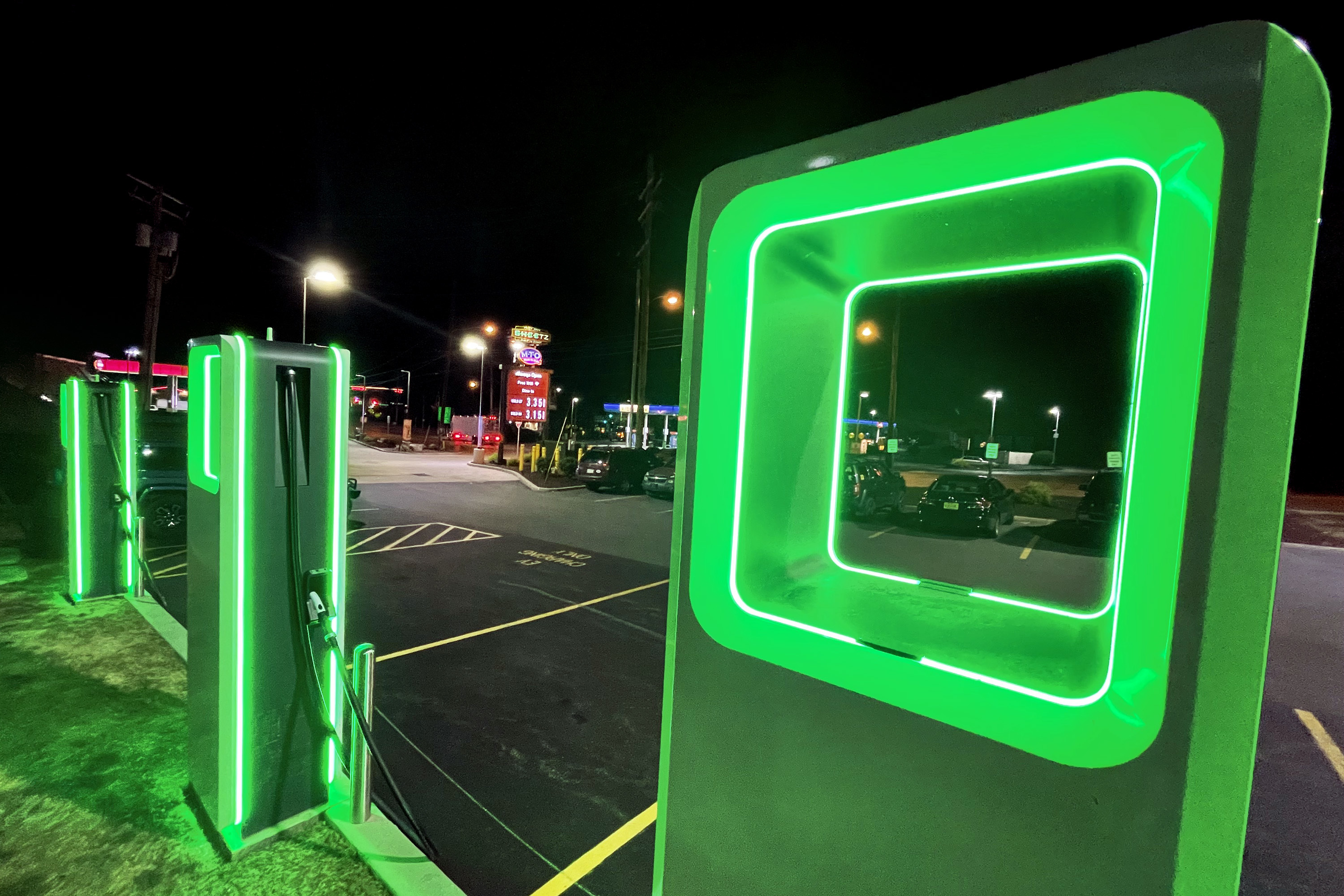
Wawa, Sheetz, and Pilot are deep into the EV charging game, and the Transportation Energy Institute — a research arm of the National Association of Convenience Stores — said this month that charging remains a focus of the industry.
“Despite recent news indicating a slowdown in vehicle electrification, the data is clear that electric vehicles will continue to gain ground, although at a slower than anticipated rate,” said a white paper released earlier this month. “This means that the demand for reliable charging infrastructure will also continue to grow.”
Wawa currently has 210 EV charging locations, Sheetz more than 125, and Pilot 218.
Tesla vehicles at charging stations in 2022 at a Wawa gas station in Clearwater, Fla.
“The convenience industry is an industry built on mobility, so, yeah, they will have to figure this out,” said Karl Doenges, executive director of the Transportation Energy Institute’s Charging Analytics Program and liaison to the EV industry for NACS. “They’re going to deal with refined products, and they’re going to deal with electrons.”
EV owners like Peter Doehring of Kennett Square are noticing the changes. He has owned four EVs in total since 2019 and currently has a Ford Lightning, Tesla Model Y, and a VW ID. Buzz.
“We’ve done a bunch of road trips for each of the vehicles,” Doehring said. “So for the Tesla, that network was not great when we started — like [when] we had a long-distance trip we really had to plan in advance.”
Now, though, “I feel pretty comfortable I can find a charger almost anywhere unless I’m really out of the major areas,” Doehring said.
Outside the Tesla network, though, it’s not so good.
Public investment
The Trump administration in February froze funding for the $7.5 billion National Electric Vehicle Infrastructure (NEVI) program and Charging and Fueling Infrastructure (CFI) grant program, part of the Bipartisan Infrastructure Law passed in 2021. The NEVI program planned a network of charging stations every 50 miles on major highway corridors, and CFI will fill in EV charging gaps.
The end of the NEVI program didn’t survive a court challenge after 14 states sued. A judge in the Western District of Washington ordered funds to be released in late June, according to NPR.
Pennsylvania was among states that forged ahead regardless because it already had its funds obligated for its 86 stations. In March, eight charging stations were in place and operational; 22 are online now, according to PennDot, which expects another dozen stations online shortly. (True to Malmgren’s word, this number rose twice in two days the week before Thanksgiving.)
Still, there’s a question of how effective federal dollars will be.
“Frankly, if you can’t make a charger work without government subsidies, then you need to take a hard look if it’s a good investment regardless, because at some point it has to stand on its own two feet,” Doenges, of the Transportation Energy Institute, said.
But chargers in remote areas become a lifeline for travelers. The more recent NEVI-funded stations arose in remote, highway-adjacent places like Chambersburg, Altoona, and Slippery Rock, and in Clearfield, Clinton, and Lebanon Counties.
The Department of Transportation did announce slightly adjusted rules in August, allowing states more control, specifically easing the rule that stations must be available every 50 miles.
Electric-vehicle charging stations at a Bedford gas station in 2021, just off the milepost 145.5 exit of the Pennsylvania Turnpike.
The new Trump administration guidance “has been helpful‚” said Andrew Wishnia, a senior vice president at Boundary Stone Partners, the former deputy assistant secretary for climate policy at the U.S. Department of Transportation, and a principal architect of the Bipartisan Infrastructure Law.
Wishnia said the more flexible rules make it easier for states to address their individual needs, pointing in particular to Wyoming’s approved NEVI plan as one example. That sparsely populated state popular with tourists was able to count privately funded charging stations already in place along some corridors in its plan and instead build more public chargers near national parks and other sites. “It’s totally consistent with the design and architecture of a national EV charging network,” he said.
A PennDot spokesperson said there has been no change in the map for Pennsylvania based on those new guidelines.
The end of rebates
Two months after EV rebates ended, EV futures can appear quite bleak. Malmgren said some reports show October sales were down 50% compared to September, and average prices in October hit an all-time high.
Car and Driver reported sales of the Hyundai Ioniq 5 dropped 63% and the Kia EV6 was down 71%.
Getting a clear picture before the end of 2025 is difficult because not all carmakers report monthly sales. Also, the drop-off in October followed a spike in September, as buyers rushed to grab rebates.
Still, consumer interest remains strong. A Nov. 7 J.D. Power report shows that 24.2% of active new-vehicle shoppers “very likely” will consider buying or leasing an EV in the next 12 months, up from 21.6% in September, the highest level since January.
“We’ll see the shakeout of supply and demand in the next year,” said Sam Fiorani, vice president of AutoForecast Solutions in Chester Springs.
Peter Doehring plugs the charger into his electric Volkswagen ID. Buzz van.
Federal funds slowdown
So despite the turmoil and changes of 2025, 2026 holds the promise of more EV charging money for Pennsylvania.
This second part of the NEVI program is designed to fill in the gaps around the original 86 NEVI stations along major highway corridors. PennDot will accept new proposals until Jan. 30, according to a PennDot spokesperson.
Public or private, adding charging stations remains important, even to those who have already purchased EVs.
John Fetters of Kennett Square bought his 2023 Hyundai Ioniq 5 new. He loves the smooth ride and being able to start from home with a full charge, thanks to a simple 220-volt outlet he had installed. And yet he relies on the family’s Subaru Outback for long trips.
“As much as we’re loving the EV, I’m just not always having full confidence on availability and accessibility of charging stations,” Fetters said.
Still, the selling points of EVs for consumers like Fetters and Doehring show there’s still room for growth.
“We definitely believe that EVs are the future,” Malmgren said. “The rest of the world is moving forward with EVs. We’d like to see policies that accelerate it.”