TAMPA BAY — The Flyers headed to the Sunshine State to begin a four-game road trip, but the nice weather dried out their offense.
After scoring a combined 15 goals in the past four games, the Flyers were shut out for the first time this season, losing 3-0 to the Tampa Bay Lightning. It snapped the Flyers’ two-game winning streak and is their fourth loss in the last seven games.
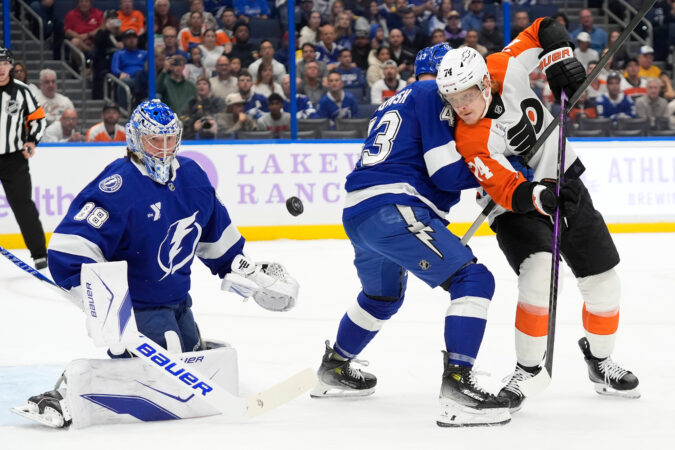
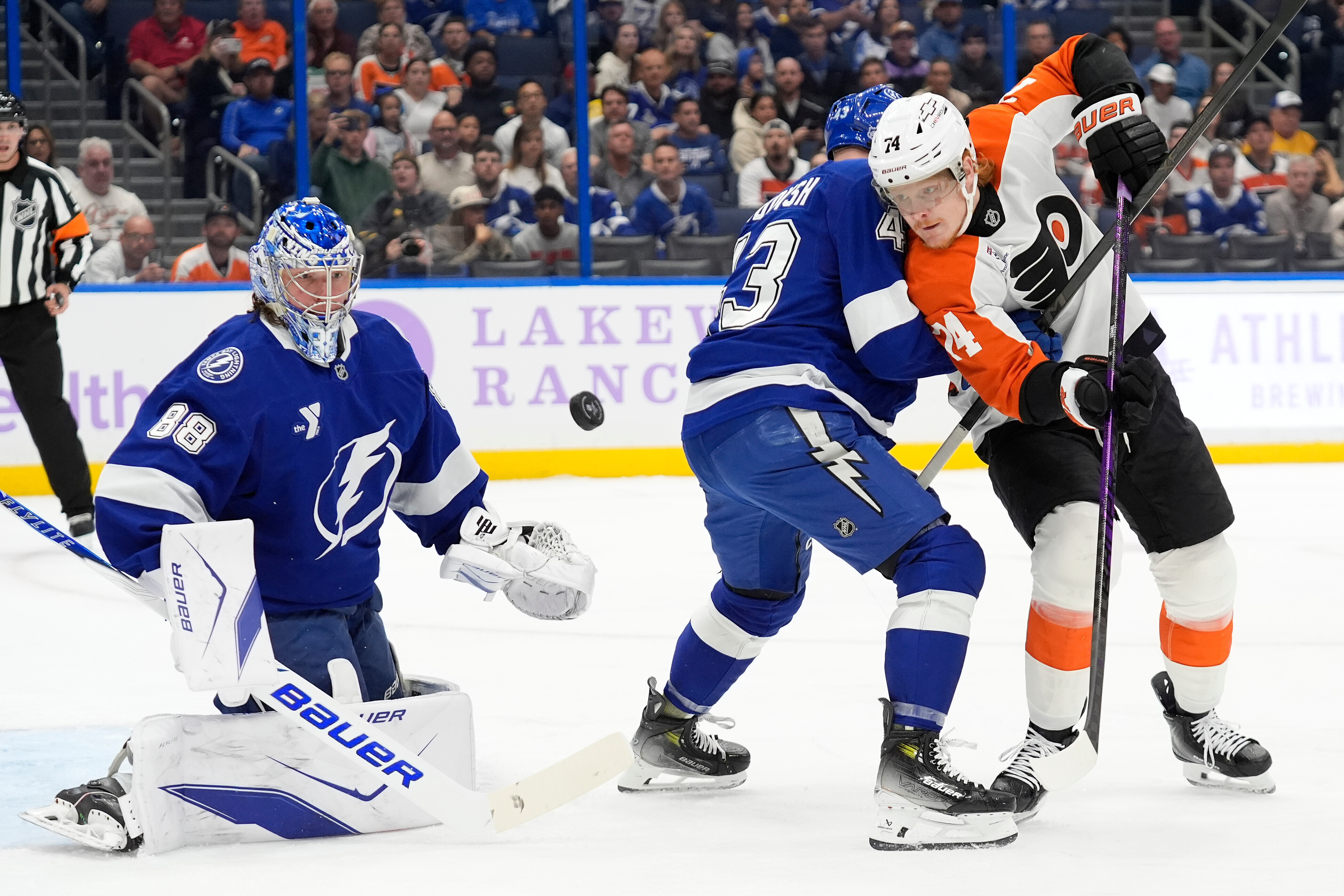
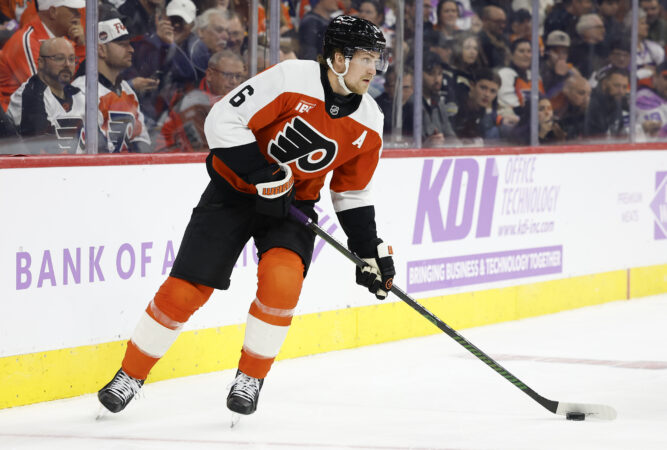
It wasn’t a barn burner as the teams combined for 38 shots on goal. The Flyers had their chances, like when Matvei Michkov was robbed in the slot and Travis Sanheim was stoned in the high slot in the third period by Andrei Vasilevskiy. But they were few and far between, and the Lightning had better chances and buried them.
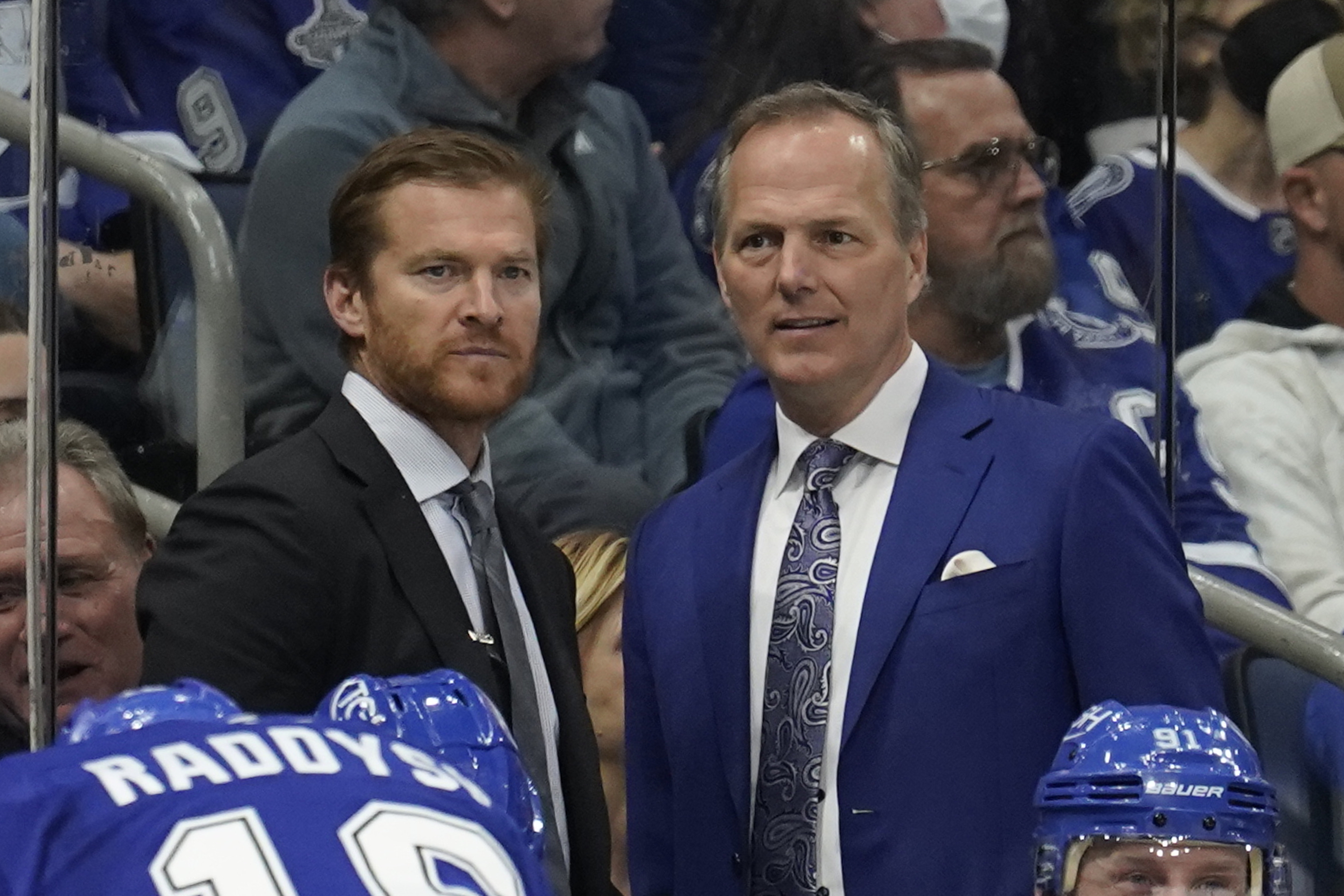
Flyers coach Rick Tocchet has spoken out about not wanting his players to back in and wanting them to stand up more at the blue line. Lightning coach Jon Cooper, who was Canada’s bench boss at the 4 Nations Face-Off alongside his assistant Tocchet, must have watched his pressers. The Lightning took a 1-0 lead with 4 minutes, 26 seconds left in the first period, thanks to Brandon Hagel using his speed to push the Flyers back.
Hagel got the puck at the Lightning’s blue line and carried it through the neutral zone. Despite three Flyers at the blue line waiting for him, he carried the puck in and dished a pass to Nikita Kucherov on the wall. As Hagel curled to the front of the net, Kucherov fed Emil Lilleberg at the point for a slap shot that Hagel ended up deflecting past goalie Sam Ersson.
Flyers right wing Owen Tippett (right) attempts a shot at Lightning goaltender Andrei Vasilevskiy on Monday.
On their 12th shot of the game, the Lightning made it 2-0. And it was the same line: Brink, Michkov, and Sean Couturier, and the same defensive pairing, Jamie Drysdale and Andrae, on the ice — at almost the same time in the second period.
With four minutes remaining, after some sustained pressure in the Lightning’s end, Hagel sent the puck cross-ice to Kucherov, trapping the three forwards deep. The Russian winger skated up and sent the puck back across the ice to Hagel as the defensemen collapsed around the net, and the backcheck was late. Andrae went down to the ice to take away the pass, but Hagel skated around him and fed Anthony Cirelli alone in front for the easy tip-in.
Hagel added an empty-netter in the final seconds. … The Flyers’ Nic Deslauriers, who is 6-foot-1, dropped the gloves with 6-9 Curtis Douglas in the first period. The elder statesman in the fight by nine years, Deslauriers won the battle against the 25-year-old and yelled at his bench and a fan banging the glass on his way to the penalty box. … Sanheim played in his 600th NHL game, all with the Flyers. He is the sixth defenseman to hit that mark in franchise history.
Up next
The Flyers head to Sunrise, Fla., for a matchup with the Florida Panthers on Thanksgiving Eve (7 p.m., NBCSP).
A former employee of the Campbell’s Co. has sued the Camden-based food giant, alleging he was fired for reporting that a company vice president had made racist comments about coworkers and disparaged Campbell’s products.
Robert Garza, who worked as a cybersecurity analyst for the company, alleged in the lawsuit filed last week in Michigan that Martin Bally, a vice president and chief information security officer, made the comments during a November 2024 meeting that the complaint said was intended for a discussion of Garza’s salary.
Bally “made several racist comments about Indian workers at the company,” the complaint said.
Bally also told Garza that Campbell’s products were highly processed food for “poor people,” according to the lawsuit.
In an interview Garza did last week with WDIV, an NBC affiliate in Detroit, he said that he secretly recorded audio of the meeting, which occurred at a restaurant. The TV broadcast played some portions of the recording.
The audio recording is not mentioned in the lawsuit. It is legal in Michigan for one party in a conversation to make a recording without the consent of the other party.
In a statement, the Campbell’s Co. said: “If the comments were in fact made, they are unacceptable. They do not reflect our values and the culture of our company. Mr. Bally is temporarily on leave while we conduct an investigation.”
The company, which changed its name from the Campbell Soup Co. last year, added: “We are proud of the food we make, the people who make it and the high-quality ingredients we use. The comments heard on the recording about our food are not only inaccurate — they are patently absurd.”
The company said it uses “100% real chicken” in our soups, and the meat comes from “long-trusted, USDA approved U.S. suppliers” and does not contain antibiotics.
“[We] also want to emphasize that the person alleged to be speaking on the recording works in IT and has nothing to do with how we make our food,” the company said.
James F. Regan, a spokesperson for the company, said Garza never told the company that he made a recording and the company learned about the recording after the TV report was aired last week.
Bally, the vice president, could not be reached for comment.
Zachary Runyon, Garza’s attorney, was unavailable for comment.
In recorded excerpts included in the TV report, the person in the recording, alleged to be Bally, says: “We have s— for f— poor people.” The speaker then acknowledges rarely buying Campbell’s products, saying they are unhealthy.
The voice says that Campbell’s uses “bioengineered meat. I don’t wanna eat a piece of chicken that came from a 3D printer.” The speaker then goes on to make racist comments about coworkers.
Garza, who started with the company in September 2024, told the TV station he decided to record the conversation, which reportedly lasted more than an hour, because he had an “instinct that something wasn’t right with Martin.”
The lawsuit says that “Bally also disclosed to Plaintiff that he often appeared at work high from marijuana edibles.”
The lawsuit says that Garza reported to his manager on Jan. 10, 2025, what Bally allegedly said during the November meeting. The complaint said the manager did not encourage Garza to report the incident to human resources and did not provide any direction on how to proceed.
On Jan. 30, according to the complaint, Garza was “abruptly terminated from employment.”
The complaint alleges that Garza was terminated “in retaliation for complaining about Defendant Bally’s racist behavior.”
Garza is seeking unspecified compensation for damages and related costs.
WASHINGTON — A federal judge on Monday dismissed criminal charges against two perceived adversaries of President Donald Trump, FBI Director James Comey and New York Attorney General Letitia James, ruling the U.S. attorney he hand picked to prosecute them was unlawfully appointed.
The ruling throws out two cases Trump had publicly called for as he pressured Justice Department leaders to move against high-profile figures who had criticized him and led investigations into his conduct.
Lindsey Halligan, a former personal lawyer to Trump, was named interim U.S. Attorney for the Eastern District of Virginia in September to take over both investigations despite having no previous prosecutorial experience. The findings by U.S. District Judge Cameron McGowan Currie came after both Comey and James accused the Trump Justice Department of violating the U.S. Constitution’s Appointments Clause and federal law by appointing Halligan in September.
New York Attorney General, Letitia James, speaks after pleading not guilty outside the United States District Court in October in Norfolk, Va.
‘No legal authority’
Currie found that Halligan “had no legal authority” to bring indictments against either Comey or James. But Currie dismissed the cases “without prejudice,” giving the Justice Department an opportunity to seek new indictments with a different prosecutor at the helm.
“All actions flowing from Ms. Halligan’s defective appointment,” Currie wrote, were “unlawful exercises of executive power and are hereby set aside.”
After the decision, Attorney General Pam Bondi told reporters the Justice Department would “be taking all available legal action, including an immediate appeal to hold Letitia James and James Comey accountable for their unlawful conduct.”
Bondi said that because Halligan was made a special U.S. attorney, she can continue to prosecute cases.
“She can fight in court just like she was and we believe we will be successful on appeal,” Bondi said.
James and Comey separately said they were grateful for the ruling. James’ attorney, Abbe Lowell, said she would “continue to challenge any further politically motivated charges through every lawful means available.”
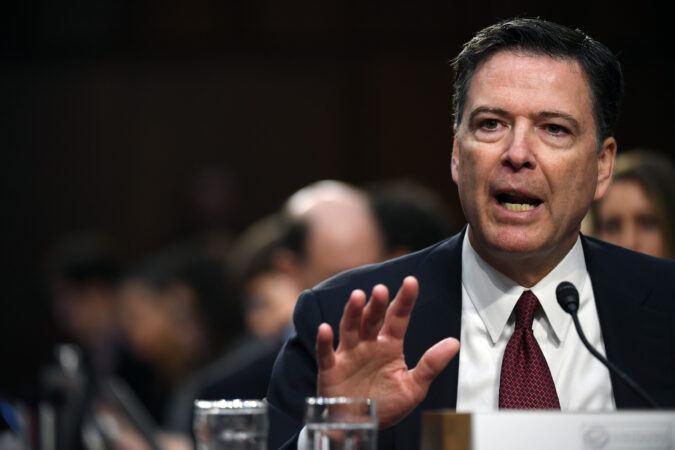
In an Instagram video, Comey said the case against him “was a prosecution based on malevolence and incompetence and a reflection of what the Department of Justice has become under Donald Trump.”
It is unclear if prosecutors could seek to bring a new case against Comey over the same conduct. The five-year statute of limitations on the charges expired on September 30, and Comey’s lawyers have already indicated in court filings that they do not believe prosecutors have more time to refile the charges.
Both Comey and James have been longtime targets of Trump’s ire. Comey as FBI director oversaw an investigation into alleged ties between Trump’s 2016 election campaign and the Russian government and later called Trump unfit for office.
James, an elected Democrat, successfully sued Trump and his family real estate company for fraud. Trump ordered Bondi to install Halligan to the post after her predecessor Erik Siebert declined to pursue charges against Comey or James, citing a lack of credible evidence in both cases.
Halligan moved swiftly
Shortly after her appointment, Halligan alone secured indictments against Comey and James after other career prosecutors in the office refused to participate. Comey pleaded not guilty to charges of making false statements and obstructing Congress after he was accused of lying about authorizing leaks to the news media. James pleaded not guilty to charges of bank fraud and lying to a financial institution for allegedly misleading on mortgage documents to secure more favorable loan terms.
Attorneys for Comey and James argued that Halligan’s appointment violated a federal law they said limits the appointment of an interim U.S. attorney to one 120-day stint.
Repeated interim appointments would bypass the U.S. Senate confirmation process and let a prosecutor serve indefinitely, they said. Siebert previously had been appointed by Bondi for 120 days and was then re-appointed by the U.S. District Court for the Eastern District of Virginia, since the Senate had not yet confirmed him in the role.
Lawyers for the Justice Department argued the law allows the attorney general to make multiple interim appointments of U.S. Attorneys. Still, Bondi sought to shore up the cases by separately installing Halligan as a special attorney assigned to both prosecutions. In that same document, she also said she ratified the indictments.
Currie found that Bondi’s attempts to retroactively secure the cases were invalid. Currie, who is based in South Carolina and was appointed by former Democratic President Bill Clinton, was assigned to rule on Halligan’s appointment because federal judges in Virginia had played a role in appointing her predecessor.
The challenge to Halligan’s appointment was one of several efforts lawyers for Comey and James have made to have the cases against them thrown out before trials. Both also argued that the cases are “vindictive” prosecutions motivated by Trump’s animosity.
Halligan has come under intense scrutiny by courts, particularly over her handling of the Comey case. A federal magistrate judge found she may have made significant legal errors in presenting evidence and instructing the grand jury that indicted Comey. The trial judge repeatedly questioned whether the full grand jury had seen the final version of the Comey indictment.
Mayor Cherelle L. Parker has appointed nonprofit founder and Democratic ward leader Anton K. Moore as the city’s director of public engagement and neighborhood affairs.
Moore, who founded the South Philadelphia-based group Unity in the Community, effectively replaces Hassan Freeman, who was fired from the Parker administration about two months ago following a verbal altercation outside City Hall with City Councilmember Isaiah Thomas that the lawmaker described as “negative and disturbing.”
Freeman, who worked under Chief Deputy Mayor Sinceré Harris, was director of neighborhood and community engagement. Parker said she renamed the role to reflect added responsibilities while appointing Moore, whose work will now fall under Chief of Staff Tiffany W. Thurman’s portfolio.
The Office of Public Engagement and Neighborhood Affairs will manage the city’s 10 Neighborhood Community Action Centers, which are meant to be “neighborhood City Halls” where residents can access services closer to home. The centers are a major part of Parker’s efforts to follow through on her campaign promise to create a city government “residents can see, touch, and feel,” and there is one in each Council district.
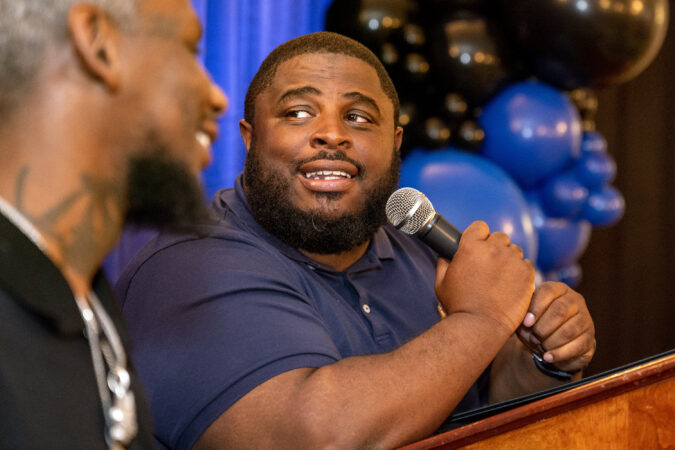
Moore, the Democratic leader of the 48th Ward in South Philadelphia, has strong political connections, and his nonprofit work has been praised by numerous elected officials.
“This is the piece of the puzzle that we needed,” Parker said Monday at a City Hall news conference, before addressing Moore: “You now have an opportunity to do what you did in South Philly but you’ve got to do it all over the city.”
Moore’s salary is $195,000, according to the mayor’s office.
“We’re going to work, we’re going to have fun, and we’re going to deliver the services that the city of Philadelphia deserves,” Moore said.
Police Commissioner Kevin J. Bethel said he has worked with Moore, 39, on youth employment and engagement efforts and leaned on him as an “adviser of my process to help me understand what is going on in the streets.”
“There is nobody better connected to our community. There is nobody better trained to take on this task,” said Bethel, who later added he would “go through a wall for this kid.”
Founded in 2008, Unity in the Community provides a variety of services, including connecting residents with housing aid and students with scholarships, and its parent organization is Soul Food CDC. The group has partnered with 76ers player Joel Embiid to give residents Giant gift certificates and former teammateBen Simmons, now with the Los Angeles Clippers, to provide Christmas gifts to children.
The group also received $417,900 from a city anti-violence grant program founded during the surge in shootings and homicides that followed the onset of the coronavirus pandemic.
In a report about poor oversight of that program, The Inquirer in 2023 reported that Unity in the Community received about 60% more in funds than the $258,000 the group had applied for. The paper also found that a staffer for the Urban Affairs Coalition, which administered the grant program, raised questions about management of Unity in the Community’s project, expanding a youth carpentry training program in South Philadelphia.
The staffer wrote in a 2022 email he was “very concerned” about accounting issues, including $75,000 in funding for which the organization had not submitted invoices. Moore said in 2023 he would work to fix the paperwork errors and defended the group’s work.
His application for the anti-violence grant was supported by Thomas and State Sen. Anthony Williams (D., Philadelphia), an indication of Moore’s support among Philadelphia’s political class.
Council recently named a block in South Philly in his honor. He was appointed by former Gov. Tom Wolf to the Pennsylvania Commission on African American Affairs. At Monday’s news conference, Ryan Boyer, a Parker ally who leads the politically powerful Philadelphia Building & Construction Trades Council, heaped praise on Moore and joked that he “will be a great director of whatever the mayor called it.”
Parker’s chief of staff, Tiffany W. Thurman, praised Moore as “someone whose heart beats with the rhythm of our streets in every neighborhood.”
“Your mandate from the mayor is very clear: You are now the direct link between our administration and our neighborhoods,” Thurman said at the news conference.
Freeman’s dismissal followed a September incident in which he allegedly confronted Thomas at the lawmaker’s parking spot. In an email Thomas sent administration officials that was obtained by The Inquirer, Thomas wrote Freeman “spoke to me in a disrespectful manner, a hostile tone, and addressing me outside my name and title.”
Freeman did not immediately respond to a request for comment.
Parker declined to comment on the ordeal, except to say “some personnel adjustments were made.”
“I’m not looking back on anything associated with yesterday,” Parker said in an interview. “I’m thinking about how we are going to keep moving Philadelphia forward.”
Staff writer Ryan W. Briggs contributed to this article.
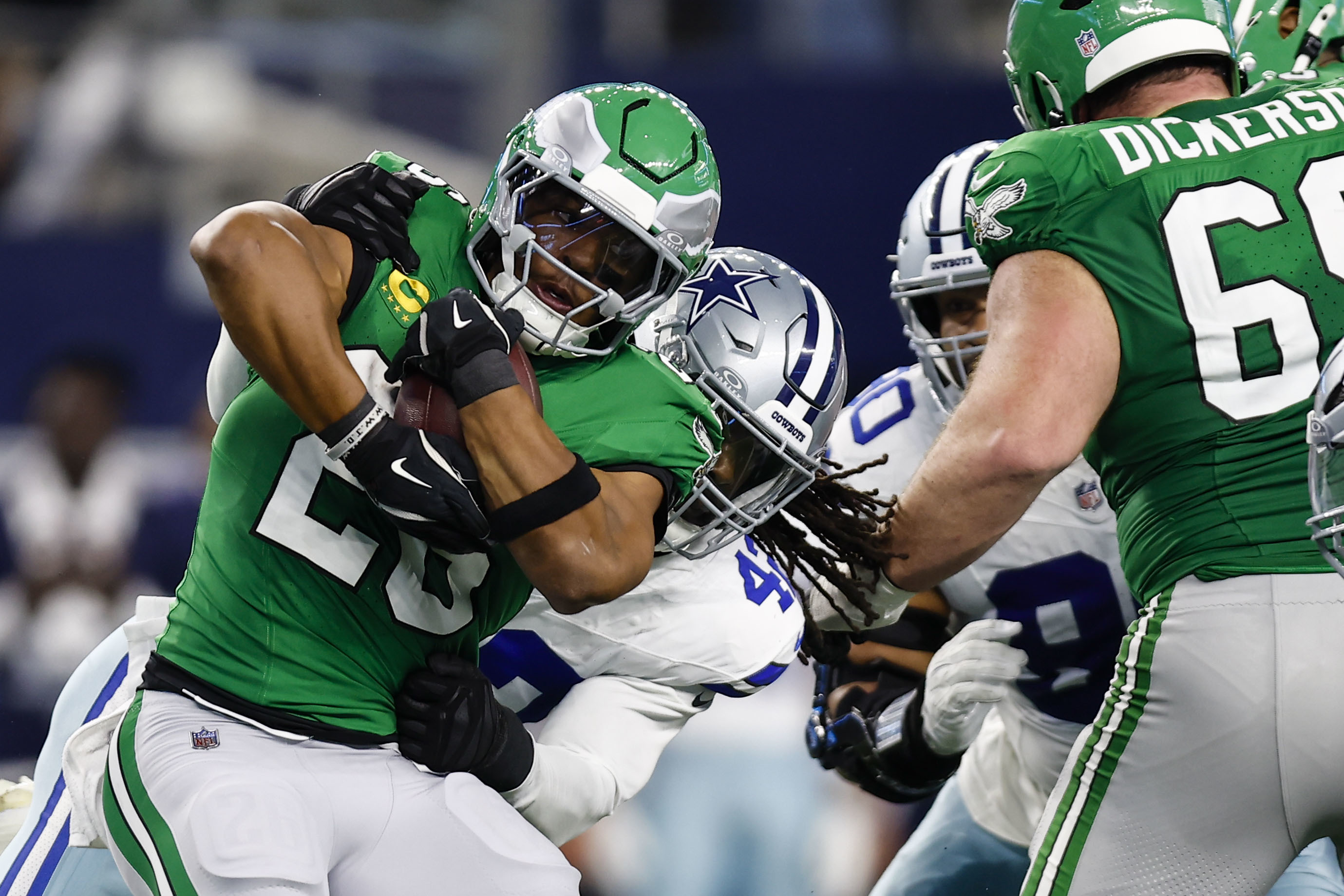
There are games in the NFL that have repercussions. The Eagles’ 24-21 loss Sunday to the Cowboys — a game in which they blew a 21-point lead, throttled back their offense after taking that lead, and committed one egregious mistake after another — is likely to be one.
Those repercussions might yet be good for the Eagles. The NFL is so parity-ridden, each team separated from the other by such small differences, that it’s possible that Sunday’s meltdown will inspire the Eagles to clean up their sloppy play, beat the Chicago Bears on Black Friday, and embark on another deep playoff run. They’re still going to win the NFC East, at a minimum. It will be difficult to call such a season, no matter its final endpoint, a complete failure.
But Eagles chairman Jeffrey Lurie stopped judging his franchise by that standard a long time ago. Sunday’s loss went from See, the team is rounding into form to HOLY HELL EVERYONE’S WORST FEARS HAVE BEEN CONFIRMED in a matter of minutes. That sudden reversal of fortune, though, really had been the culmination of a steady accumulation of inconsistent performances, injuries to important players, and consternation both inside and outside the locker room.
Those conditions are the kind that, in the past, have compelled Lurie to act. It is, of course, true that the offensive line’s decline is a huge factor in the Eagles’ overall regression, maybe the biggest factor, and that reality, one could argue, should absolve Nick Sirianni, Kevin Patullo, Jalen Hurts, and anyone else for an 8-3 team that feels like it’s 3-8. But it’s naive to think, given the nature of Sunday’s loss and the arc of this season, that Lurie isn’t taking a long, hard look at the coaching staff, Sirianni included.
Raising such questions might seem premature or unnecessary. It’s not. There are reasons for Sirianni to be worried here — not necessarily that he’s going to be fired after the season, but that he’s more vulnerable than he once was. Nine months after winning the Super Bowl, six months after getting a contract extension, he ought to understand that, if recent history is any indication, there’s a lot at stake for him over the next 6-12 weeks. Consider:
1) The Eagles aren’t playing offense the way Lurie has generally wanted his teams to play offense.
This assertion is obvious, and it’s based on the Eagles’ production, or lack thereof. But it’s also based on the Eagles’ style of play.
For years, dating to the Andy Reid era, the Eagles made their bones by remaining aggressive in their play-calling even after taking a big lead, by using analytics to set themselves apart from the rest of the league. Sometimes, it cost them games. In February 2018, it won them their first Super Bowl. Lurie loves that approach.
The last two years, however, the Eagles have turned themselves into a full-fledged running team. Lurie is not necessarily anti-running the ball — not when it leads to the big plays and the Super Bowl victory that Saquon Barkley and that dominant offensive line delivered last season. But those plays haven’t materialized and the line hasn’t dominated this season, and Sirianni’s response has been to lean into being uber-conservative. He doesn’t call plays, no, but the offense is his, and he hasn’t prioritized piling up points. He has prioritized protecting the football, eliminating turnovers, and walking a thinner line to victory. He has tempted fate by trying to win games in a manner Lurie is inclined to reject once it fails.
2) Lurie has never hesitated to insist upon coaching changes when he has thought them necessary.
After the 2019 season, for instance, the Eagles parted ways with then-offensive coordinator Mike Groh and then-wide receivers coach Carson Walch. A year later, after the team’s disastrous 4-11-1 season in 2020, then-head coach Doug Pederson was fired.
For the moment, Patullo is a great shield for Sirianni. Everyone knows that Patullo is the Eagles’ offensive play-caller. Everyone knows that he’s a neophyte when it comes to this role and its responsibilities. And everyone can see that the Eagles offense has not been good this season, even though it has plenty of superstar-level players to whom Lurie is paying superstar-level dollars. So if the Eagles offense remains dysfunctional — and it really hasn’t been functional at all, not to the degree it was expected to be — Patullo will be and has been the coach who bears the blame, and a layer of protection will have been removed from Sirianni.
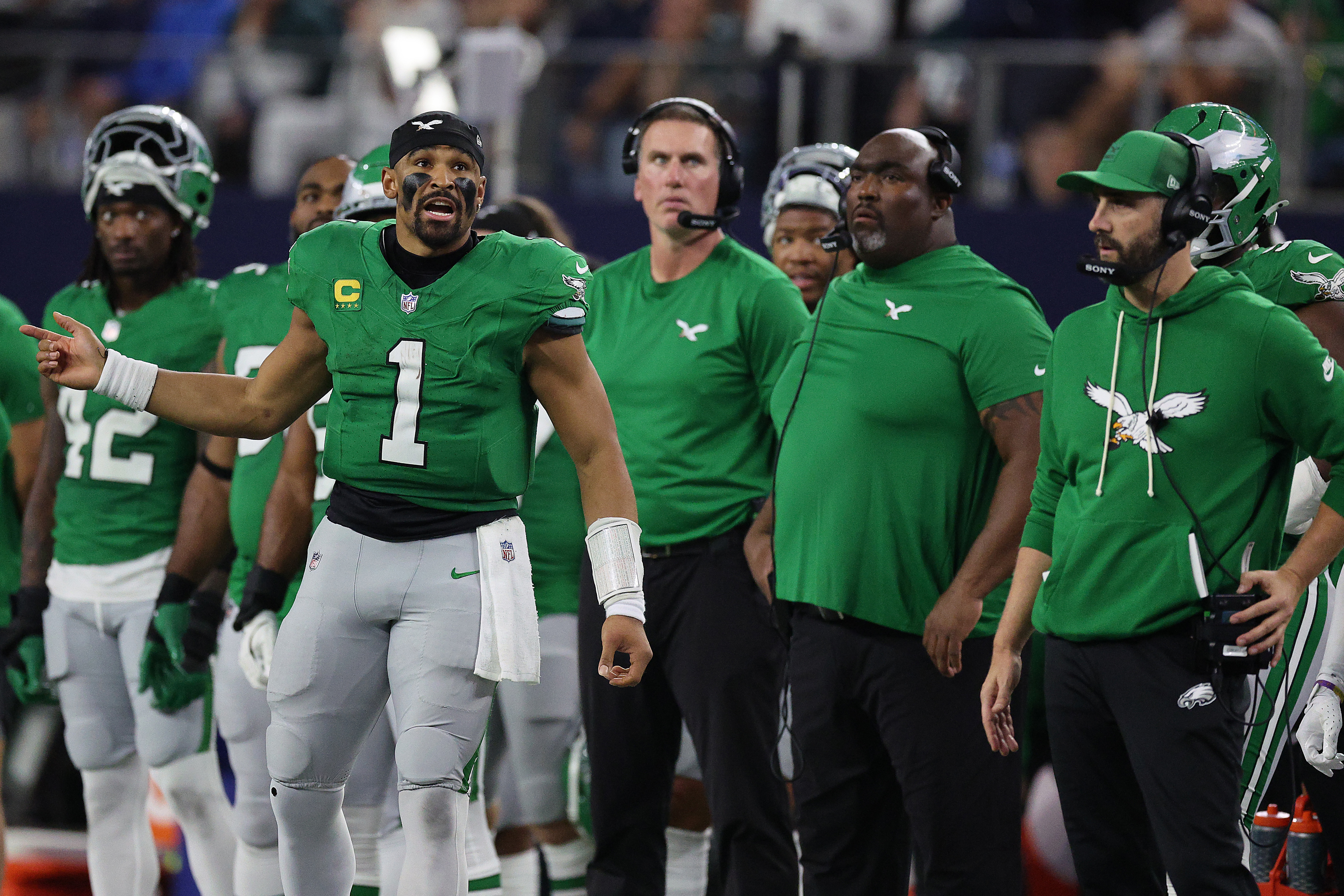
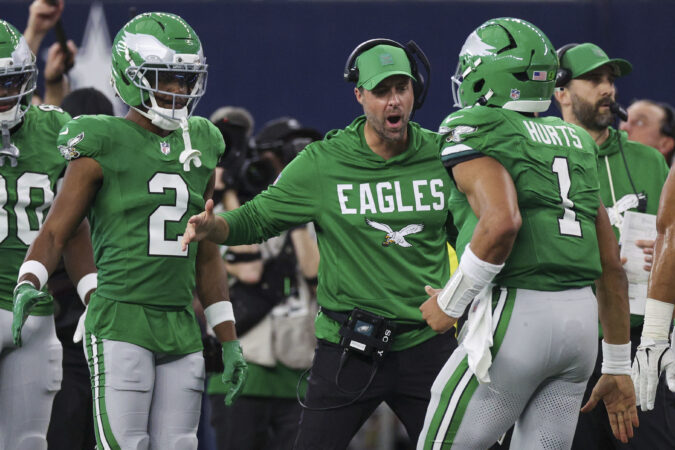
Eagles quarterback Jalen Hurts on the sideline with head coach Nick Sirianni (right) during Sunday’s loss in Dallas.
3) Lurie expects his franchise quarterback to grow into greatness, then remain there.
One of the problems that the Eagles’ play-not-to-lose strategy creates for Sirianni is the implication that Hurts can’t be trusted or isn’t at his best when asked to operate a more dynamic, more daring offense. Lurie doesn’t care and doesn’t want to hear that the Eagles’ coaches feel like they have to run a Frankenstein’s monster style of offense, patching together parts from several systems just to maximize Hurts’ skill set. He wants his franchise quarterback to be worth the franchise-quarterback money he’s paying him, and if that player isn’t meeting those expectations, Lurie will greenlight a search for a replacement only as a last resort.
Remember: Even after Carson Wentz’s horrible 2020 season, the Eagles fired Pederson first. They were willing to make it work with Wentz until they finally understood they couldn’t. Only then did they trade him.
4) Sirianni’s personality is different from Pederson’s, and that difference doesn’t help Sirianni.
Pederson was a go-along-to-get-along kind of guy, at least as much of one as an NFL head coach ever is. But after he won the Super Bowl, he started to assert himself. He wrote his autobiography. He sought more power within the organization, at least with respect to his assistants. Lurie eventually disabused him of those notions.
Sirianni is naturally more emotional and combative than Pederson. He, too, has won a Super Bowl, and his winning percentage is among the best of any head coach in league history. It’ll be interesting to see whether he’ll have to quell his assertiveness with Lurie and Howie Roseman — and if he’s able.
A former Bensalem resident who spent two years in state prison for abusing his infant son is now charged with the boy’s murder after police say complications from the injuries he inflicted more than a decade ago caused the boy’s death.
Kyle Hinkle, 38, who now lives in Allentown, was charged Monday with third-degree murder in the death of his son, Leonardo, who was 11 when he died in August 2024.
After the child’s death was ruled a homicide earlier this year, investigators in Bucks County spent months gathering medical records and other evidence to link it to the injuries he received as an infant.
Hinkle remained in custody, in lieu of 10% of $2 million bail. There was no indication he had hired an attorney.
Investigators first learned of the abuse in October 2012, when the boy was taken to Jefferson Torresdale Hospital with severe head injuries, according to the affidavit of probable cause for Hinkle’s arrest.
Doctors there determined the injuries had been intentionally inflicted to the then-3-month-old, and a CAT scan revealed signs of similar, older injuries that were still healing, the affidavit said.
The boy’s grandmother told detectives that on an earlier occasion, she had seen bruises on the child’s arm that matched a necklace Hinkle used to wear, indicating he may have struck the boy with it.
In an interview with detectives, Hinkle admitted he shook the baby vigorously without supporting his head out of frustration because he would not stop crying.
The injuries left the child wheelchair-bound, nonverbal, and reliant on a feeding tube, according to prosecutors.
Hinkle pleaded guilty to aggravated assault and endangering the welfare of a child in 2013. He served two years in state prison, followed by three years of probation, court records show.
In the intervening years, the boy and his mother moved to Oliver, Fayette County, southeast of Pittsburgh.
When the child died in 2024, the Fayette County coroner ruled his death a homicide, saying, in a statement, that complications from living with Shaken Baby Syndrome directly led to his death.
Editor’s note: Taquero has pushed back its opening date and now plans to open on Dec. 1.
The longtime chef of Italian restaurant Ariano in Media is readying to open his own eatery on the same block, where he’ll turn his attention to paying homage to his Mexican roots.
Chef Antonio Garcia began dreaming up Taquero about three years ago and set the plans in motion for his restaurant at 111 Veterans Square last spring. After more than 18 months of work to convert part of a former office building, Taquero will open Nov. 24.
The BYOB will look to set itself apart from other Mexican eateries in the borough by showcasing a mix of traditional and modern Mexican cuisine, with an emphasis on authentic dishes. The menu will give a nod to Garcia’s hometown of Toluca, while also sampling from elsewhere in the country.
In conceptualizing his restaurant, Garcia said he wanted to do “something that’s going to make me proud, for me and my family.”
Some of the restaurant’s offerings are dishes his grandmother made when Garcia was a child, while others borrow from the street food scene in Mexico City, where he spent time before coming to the U.S. nearly 25 years ago.
“Everybody says their grandma is the best cook. My grandma was, like, insane,” Garcia said. “Everything she cooked was so delicious.”
Fideo seco is made with toasted pasta, lump crab, chipotle broth, avocado, crema, and queso fresco.
One nod to her is fideo seco, a traditional Mexican pasta dish made with spaghetti-like noodles in a chipotle broth and served with queso fresco, crema, lump crab, and avocado.
Other entrées include carne asada, enchiladas, a Mexican-style pork chop, and Mexican-style paella, a spicier take on the Spanish version that’s more chipotle-forward.
Appetizerswill include guacamole; the popular street corn, elote; empanadas; and sopesitos, a tortilla-like base formed into a small bowl to hold toppings like beans. There will be soups, like pozole, made with seafood and hominy, and salads, including a beet-forward option and Garcia’s take on the Caesar salad. Taquero — which translates to taco-maker — will also have a selection of five tacos: fish, birria, carne asada, shrimp, and vegetarian, each served in housemade corn tortillas.
Some dishes will be served in a classic molcajete, like this one with steak, shrimp, chorizo, salsa tatemada, and panela cheese.
Desserts, including flan and xangos, a tortilla-wrapped cheesecake served with ice cream, round out the food offerings, which will change seasonally.
The BYOB will also offer three mixers: a traditional margarita, a paloma, and a daily special. Diners can bring beer, wine, or champagne, with no corkage fee, or sip on a selection of Mexican sodas or the fruit-forward agua fresca.
The restaurant will launch with lunch and dinner service, with a goal of adding breakfast in the new year.
In keeping with his desire to make authentic dishes, Garcia is using goods imported from Mexico, including various types of chorizo.
Garcia plans to split his time between the kitchen and the floor, tapping Jose Rigoberto, who’s been working in the kitchen at Fellini Cafe for years, as his sous chef.
While Garcia has been focused on Italian cuisine, Media residents may have already sampled some of his Mexican dishes during Ariano’s Mexican Monday nights.
Ariano’s former owner, Anthony Bellapigna, encouraged Garcia to pursue dishes that were true to his roots, which helped lay the groundwork for him to open his own restaurant. Fittingly, Bellapigna also helped create the copper-topped tables in Taquero, which he, Garcia, and Rigoberto hammered by hand to create their dimpled designs.
The restaurant has been a labor of love for Garcia, who has been hands-on in the redevelopment of the space, including ripping up the drywall.
The restaurant spans roughly 1,200 square feet across the first and second floors of the three-story building. It has 14 seats on the ground floor, where diners can see into the kitchen, while the main dining room is on the second floor and features a selection of ceramic Mexican plates on one wall.
Diners seated on the first floor can see the action in the kitchen.
Seeing it all come together, Garcia said he’s both nervous and happy, but with the opening on the horizon, he’s more happy than anything.
Taquero will be open six days a week, from 11 a.m. to 9 p.m. on Mondays, Wednesdays, and Thursdays, and 11 a.m. to 10 p.m. on Fridays, Saturdays, and Sundays, with dinner service starting at 4 p.m.
This suburban content is produced with support from the Leslie Miller and Richard Worley Foundation and The Lenfest Institute for Journalism. Editorial content is created independently of the project donors. Gifts to support The Inquirer’s high-impact journalism can be made at inquirer.com/donate. A list of Lenfest Institute donors can be found at lenfestinstitute.org/supporters.
Philadelphia City Council is escalating its clash with some harm reduction providers, with lawmakers on a key committee voting Monday to ban mobile addiction services from parts of Kensington and its surrounding neighborhoods.
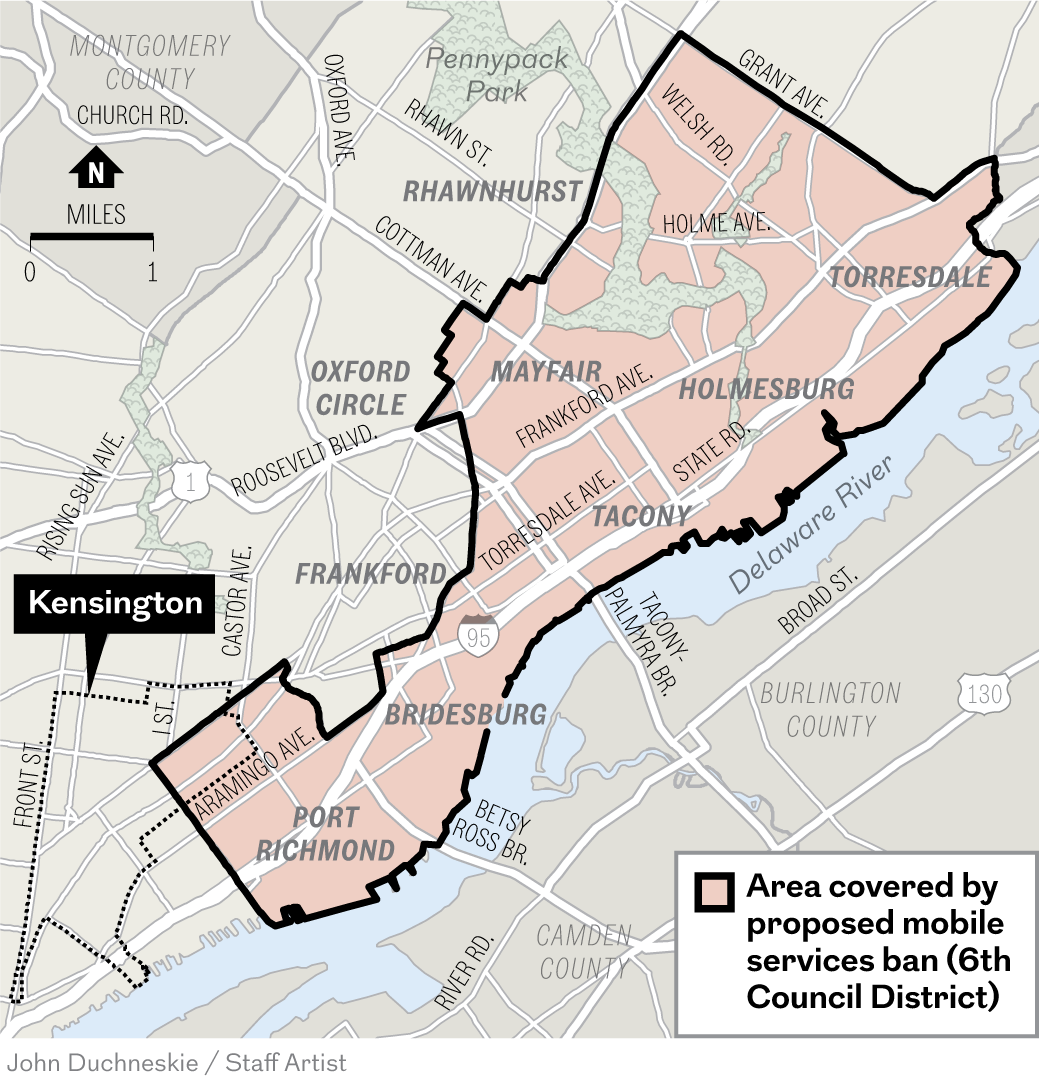
Members of Council’s Committee on Licenses and Inspections voted, 5-1, to advance the legislation, which covers the Lower Northeast-based 6th District, represented by Councilmember Mike Driscoll, the bill’s sponsor.
The area stretches from the eastern side of the intersection at Kensington and Allegheny Avenues — long the epicenter of the city’s opioid epidemic — north along the Delaware River and up to Grant Avenue.
The full Council could vote on the legislation as early as next month.
Map of the 6th Council District, the target of proposed legislation to ban mobile addiction services.
Some Kensington residents who have begged lawmakers for years to address the sprawling homelessness and addiction in the neighborhood said they support the legislation because the providers draw people who use drugs into residential areas.
“I have grandkids who can’t come and see me because of where grandmom lives at,” said Darlene Abner-Burton, a neighborhood advocate. “It’s not fair that we have to endure what we have to endure. No one should live like we do, and no one should go through what we go through.”
However, a half dozen harm reduction advocates testified that the legislation would not reduce homelessness or addiction, but would instead erect barriers to medical care that vulnerable people rely on and would lead to more overdose deaths.
“Every member of our community deserves dignity and compassion, not punishment,” said Kelly Flannery, policy director at the Positive Women’s Network, an advocacy organization for people with HIV.
Flannery called the measure a “cruel ban.”
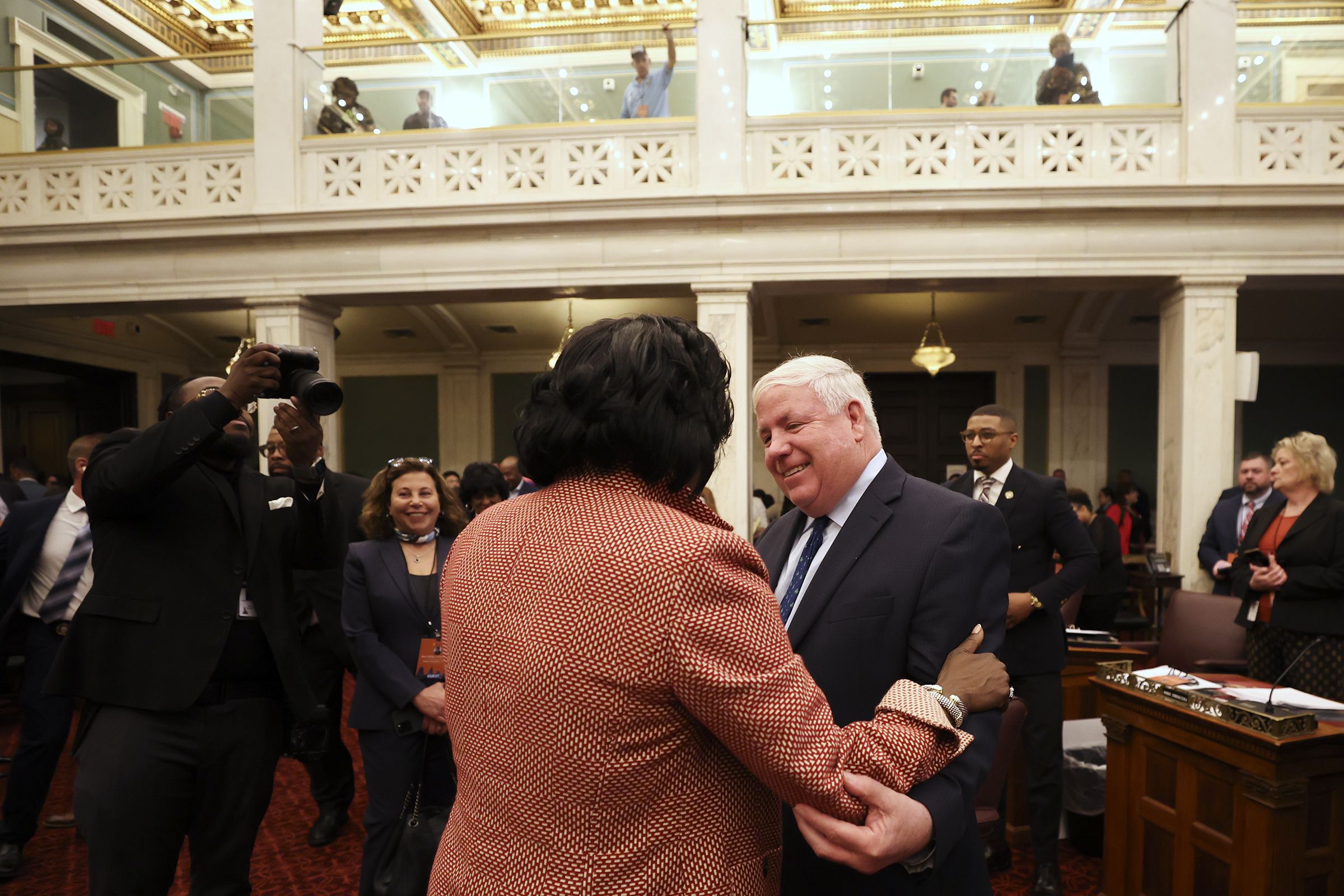
Councilmember Mike Driscoll, who represents the 6th District and authored the legislation, greets Mayor Cherelle Parker after her first budget address in City Council in March 2024.
It’s the second time Council appeared poised to pass a bill aimed at restricting mobile service providers, which are groups that operate out of vans or trucks and offer a range of assistance to people in need, including first aid, free food, and overdose reversal medication.
Earlier this year, Council voted to pass restrictions on the providers operating in the nearby 7th District, which covers the western parts of Kensington.
But that bill — which passed the full Council 13-3 and was signed by Mayor Cherelle L. Parker — was not a blanket ban.
That legislation, authored by 7th District Councilmember Quetcy Lozada, requires providers obtain a license, and it limits organizations that provide medical services to specific areas designated by the city. Groups that offer nonmedical services like distributing food are prohibited from parking in one place for more than 45 minutes.
The city is expected to begin enforcing that law on Dec. 1.
Driscoll said he introduced his own legislation to ban the services from his district entirely because he was concerned that providers who faced restrictions in the 7th District would migrate into the neighborhoods he represents.
The only committee member to vote against Driscoll’s legislation Monday was Nicolas O’Rourke, a member of the progressive Working Families Party who represents the city at-large and also opposed the 7th District legislation.
TAMPA BAY — Look, a power play isn’t expected to score every single time. It would be nice, but it just doesn’t happen.
The best one in the NHL right now has a 32% effectiveness, which means the Pittsburgh Penguins roughly score every three opportunities. Currently, the Flyers’ power play sits at 17.5%. The unit’s not last in the NHL — that belongs to the New York Islanders (13.3%), who the Flyers face on Black Friday (4 p.m., NBCSP) — but it does rank in the lower-third (23rd).
And while the Flyers’ power play struggled before and during the John Tortorella era, the ranking is all-too-familiar. Although the current coach, Rick Tocchet, thinks it’s in a good spot, it can be better.
“Everybody wants plays, but sometimes it’s good old-fashioned beat pressure and then attack, and we’ve got to get that mentality, and we’re close, but we’ve got to keep working,” he said on Saturday morning, adding two days later that he wants his players to play inside more.
Entering Monday’s matchup with the Tampa Bay Lightning (7 p.m., NBCSP), the Flyers have 10 power-play goals. The last one came five games ago against the Edmonton Oilers — they are 0-for-8 since — and Tocchet said his units may be more interchangeable.
Practice on Friday had four more players involved, and on Saturday night in the Flyers’ 6-3 win against the New Jersey Devils, new power-play units were deployed.
Another tweak came on Monday in Florida.
One power play has Noah Cates, Travis Konecny, Tyson Foerster, Trevor Zegras, and Cam York. What? York and Zegras reunited? Makes a whole lot of sense that the two former USA Hockey teammates are together; York has been on the ice for eight power-play goals this season — just one without Zegras.
Konecny was also switched to that unit, and while he has played a lot on the left flank the past two seasons, he is back to his familiar bumper spot.
“I feel a little bit more comfortable in there. I feel like I can make quick little plays, be fast on loose pucks, and recovery, stuff like that. … On the power play, I got to know my strengths. And I think it’s, I don’t have the hands that Trevor has,” Konency said with a grin, alluding to Zegras’ effectiveness on the right flank to draw in defenders, create space, and find seams.
Flyers right wing Travis Konecny says he feels more comfortable in the bumper position on the power play and that he needs to play to his strengths.
The other power play has Travis Sanheim, Emil Andrae, Owen Tippett, Bobby Brink, and Matvei Michkov. No center? “It’s interchangeable,” Tocchet said.
Sean Couturier will be on the ice when there is a face-off, but when they switch units “on the run” or on the fly when play is happening, that is the unit that will be on the ice.
It’s also interesting having two defensemen, with Sanheim being more of the pointman and Andrae on a flank. Tocchet thinks Andrae is not only good with the puck but “his shot’s pretty good,” too. The Swedish defenseman, who has been moved to the second pairing, knew that he had to build up trust with the new coaching staff, and it looks like he has.
“I like to be on the power play,” Andrae said. “I like to make those plays, and like to use my vision and my passing to create chances. So obviously, it boosts my confidence to know that the coaches rely on me on that side of the game. So, yeah, just make the most of it.”
Sanheim, who hasn’t spent much time on the man advantage in his career, is looking forward to the opportunity. It’s something he’s “always wanted to add to my game.”
“I think they’ve been doing a pretty good job in trying to grasp some of the structural components of what they’re trying to get across,” said Sanheim, who has been able to watch a lot of the power plays this season from the bench.
“And I think it’s just continuing to make those reads and understanding certain situations, depending on how the penalty kill is structured. And, maybe that’s a benefit, I guess, [being on the penalty kill] so much and understanding what the other team’s doing and trying to exploit some of the weaknesses that come with that, and, in saying that, [I] just want to have an attack mentality and deliver pucks and hopefully do a good job of doing that.”
Speaking of Sanheim, the defenseman is continuing to build a strong case to be part of Canada’s team at the 2026 Milan Olympics. No pressure, but the guy on the other bench on Monday night just happens to be the one making the decisions. Lightning coach Jon Cooper will be Canada’s bench boss in Italy, but a plus for Sanheim is that they’ve already worked together, snagging a gold medal at February’s 4 Nations Face-Off.
“You see these players, you compete against these players, but you don’t really know till you have them. And I’ve always, I’ve really liked his game,” Cooper told The Inquirer about Sanheim. “I’m a big fan of big D that take up a lot of space, and can skate, and he can do all those things. But his ability to jump into plays, he’s got an offensive mind to him.”
Tampa Bay Lightning head coach Jon Cooper, who will coach Canada at the Olympics, has been impressed with Travis Sanheim’s game over the past few years.
Sanheim seemed a little nervous and wide-eyed at the first practice in Brossard, Quebec, with Hockey Canada ahead of the 4 Nations. And while he didn’t start the tournament in the lineup, by the end — half due to injury and half due to his play — he was not just skating in the championship game but got the first shift of overtime. The familiarity and his ability to play both the left and the right side will help Sanheim once decision day comes.
“Anytime that you get to coach players, and you win with players, I always think there’s a familiarity. Past performance isn’t going to predict future success, and so the guy’s got to keep working, but he’s done a heck of a job so far,” Cooper said.
There’s another familiar face for Cooper on the Flyers bench. Tocchet was his assistant coach at 4 Nations and will be beside him again in Italy, making his Olympic debut.
Tocchet did a lot of the structure, faceoff planning, and in-game adjustments; he was a jack-of-all-trades for Cooper. But what Cooper loved most was how he would often meet with players 1-on-1 or in small groups to watch videos — over a garbage can. As Tocchet explained later, he would put his laptop on a garbage can and go over things, much like he did in his days with the Penguins. His assistants on the Flyers do it now, too.
“I couldn’t have surrounded myself with a better guy,” Cooper said. “I will tell you this, because his eye for the game and what happens in real time, having that talent is a real thing. And Tocc has that. He sees it, he processes it, and then gives you the information.
“And there were countless times at the 4 Nations that he made me think of things, or I saw things in a different light, or I missed something, and he caught it. And so many little adjustments we made in between periods, because of what Tocc did.”
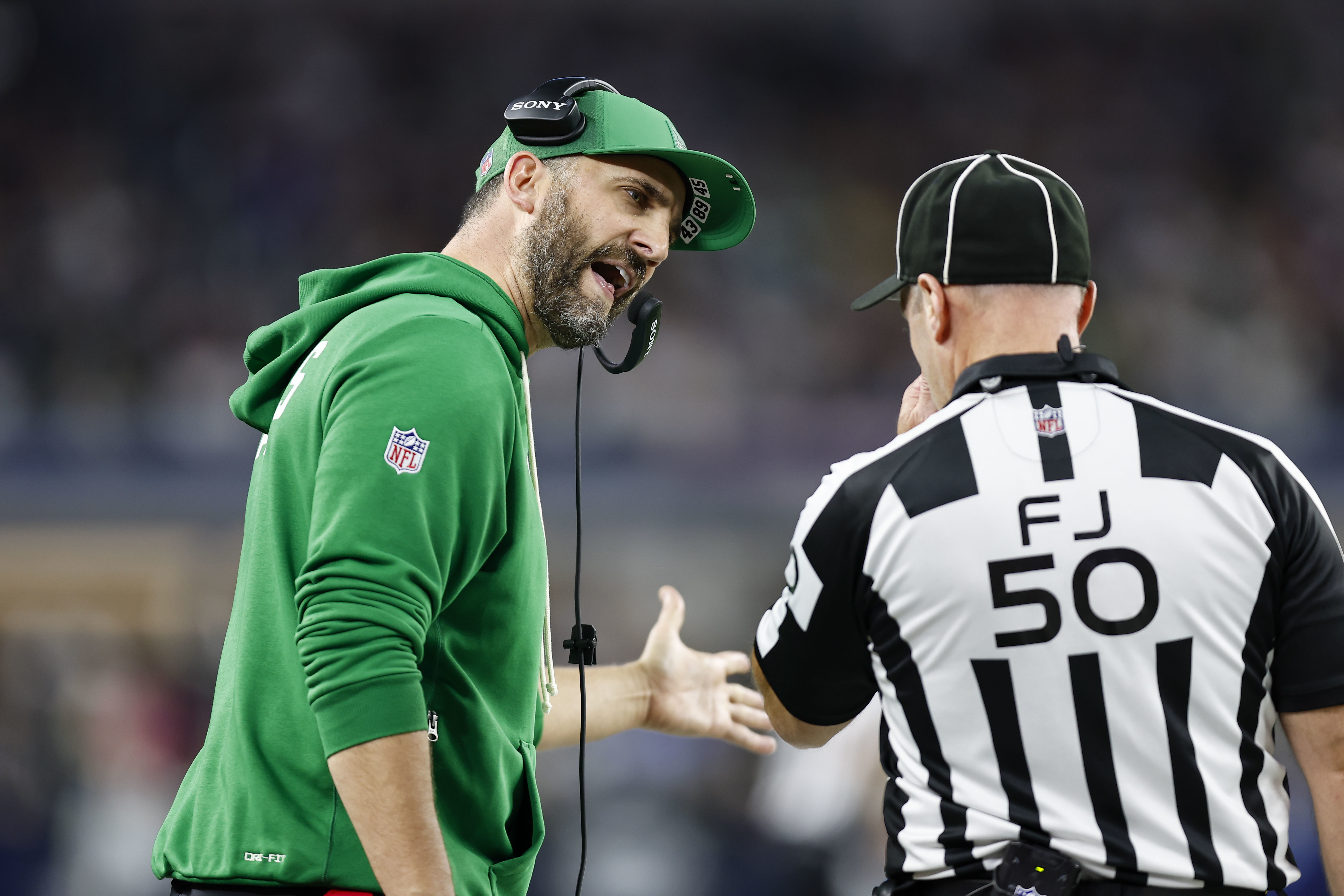
One day after the Eagles offense stalled and was shut out after building a 21-0 lead 18-plus minutes into the game, Nick Sirianni said the Eagles are “searching for answers” for their ailing offense.
But the quest for more consistency won’t include a change to the play-caller.
“I haven’t considered that,” the head coach said when asked Monday if he had considered taking play-calling duties away from offensive coordinator Kevin Patullo.
“It’s every piece of the puzzle: coaching, playing, execution, scheme, everything. We’ve got to be better in all those aspects. And so yesterday, I thought Kevin did a good job of calling it. Obviously, he’s going to want some plays back, just like every player and myself, we all want plays back.”
The Eagles hurt themselves with self-inflicted wounds. Of their 14 penalties, seven were on the offense. Two of them erased gains of 16 and 20 yards and had a major impact on the game. But even still, the offense that looked dynamic and creative for the first few series went silent. The Eagles didn’t get past the Dallas 28-yard line in the second half. They have consistently failed to run the football and adjust to opponents who take the run away. They have been unable to consistently sustain a passing offense through a full game.
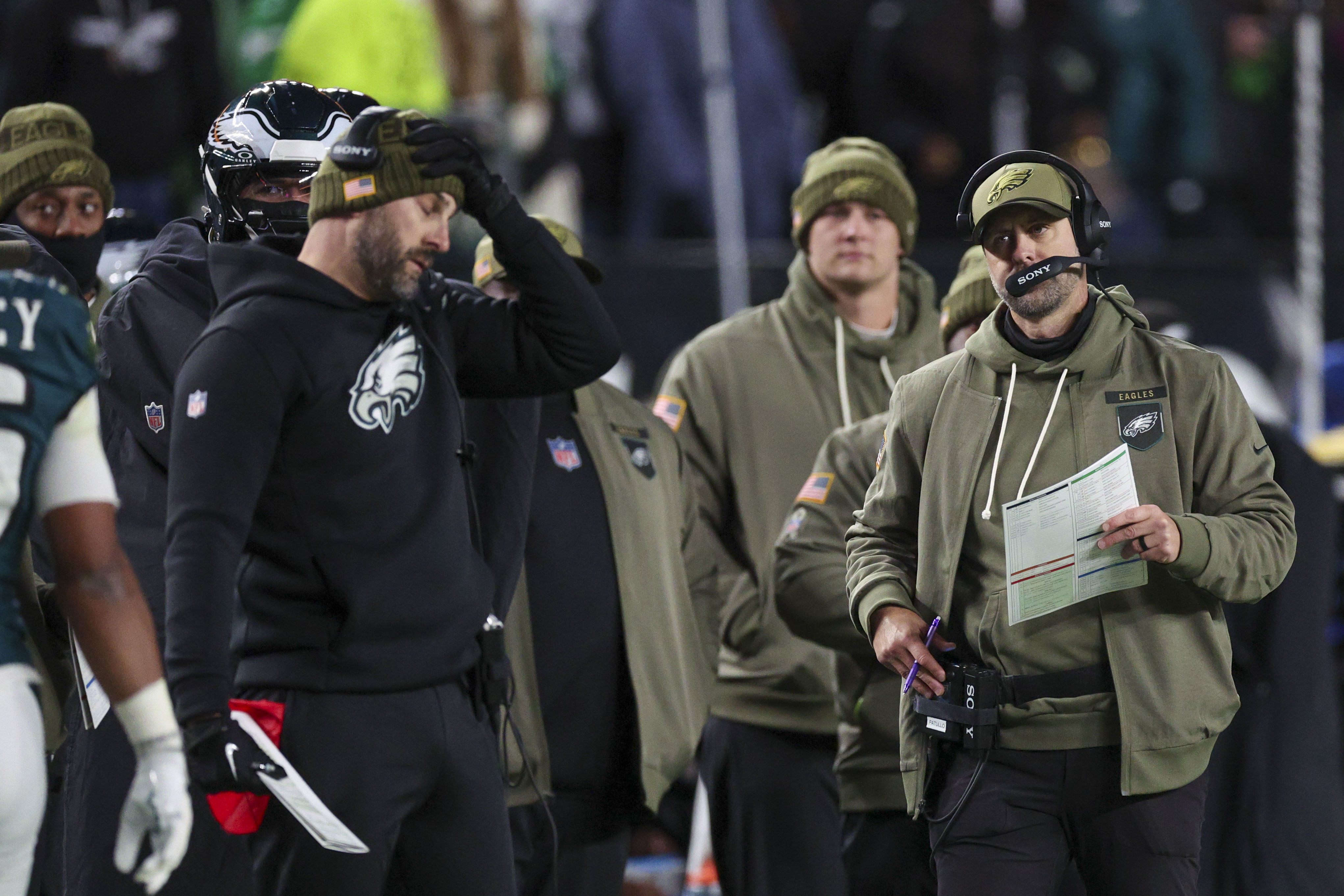
Nick Sirianni (left) says he is sticking with Kevin Patullo (right) as the play-caller despite the Eagles’ offensive issues of recent weeks.
What gives Sirianni confidence that the Eagles can make a course correction this late in the season?
“I feel like we’ve got the right people, as players, as coaches, that have had success,” Sirianni said. “And we’re all searching for answers to make it more consistent. There are some good things, obviously there are some not-so-good things. And we’ve got to find the things that we really can hang our hat on, and then the complements that come off of that.”
Left guard Landon Dickerson said the Eagles were surprised by Dallas’ frequent use of a five-man front. Jalen Hurts said “that’s how they’re built now” after the Cowboys acquired Quinnen Williams and retooled their defense.
The front gave the Eagles fits at times, especially as they tried to establish a running game that never got going. Saquon Barkley rushed 10 times for 22 yards.
Saquon Barkley added value in the passing game on Sunday but continues to have trouble finding running room.
Dallas showed that five-man front a week earlier vs. Las Vegas. So, were the Eagles prepared for it or were they not?
“You go into every week and you’re trying to play the game in your mind as much as you possibly can, not just with how you call it but how you plan it for practice as well, and how you plan for drills,” Sirianni said. “The walk-throughs, the practice, your drill work, you’re trying to identify what you think and what you’re always trying to do is say, ‘How many reps do I need to devote toward this? How many reps do I need to devote toward that?’ And you try to make educated guesses there.”
Which is to say …
“We devoted time for all of them,” Sirianni said. “We knew they had that in their package and their plan. They played a little bit more there, even than anticipated. So, of course, as coaches, you say to yourself, ‘Well, I wish I would’ve gave them a couple more reps on this one.’
“Now, you’re limited as far as how many reps you actually have at walk-through, at live, at drill work. … No one’s ever going to pitch a perfect game here. Looking back at it, yeah, sure, I wish I would’ve given us a couple more reps there.
“We prepared for the things that we thought we were going to get, some more than others, and then sometimes it doesn’t play out that way when you look at it after the game.”
The Eagles matched their high for penalties in the Sirianni era with 14. As mentioned, seven of them were on the offense and a few of them wiped out key plays.
The Eagles had three false starts. They also had an illegal formation penalty out of the jumbo package with Matt Pryor on the field as an extra blocker.
Nick Sirianni’s team shot itself in the collective foot with multiple pre-snap penalties against the Cowboys.
Sirianni said it’s “hard to sustain the success of a game when you have those.”
It has made a struggling offense’s problems even worse.
“Any time it’s penalties like that, or any time it’s ball security, or any time it’s the fundamentals, or something within ‘tough, detailed, together,’ I’m going to put that on myself,” Sirianni said.
“Just point-blank, I have to do a better job of coaching it and finding different ways to make sure it gets through.”