Blog

  • A new Mexican BYOB is coming to town | Inquirer Greater Media

    A new Mexican BYOB is coming to town | Inquirer Greater Media

    Hi, Greater Media! 👋

    A new Mexican restaurant from a familiar chef is getting ready to open in Media. Also this week, the Wallingford-Swarthmore School District is facing a $2.6 million deficit, we round up where you can get a fresh turkey for Thanksgiving, and an Inquirer columnist stumbled upon an offensively Pennsylvanian outfit at Granite Run.

    If someone forwarded you this email, sign up for free here.

    A new Mexican BYOB is opening in Media next week

    Chef Antonio Garcia (left) will balance being in the kitchen with being on the floor at his new restaurant, Taquero. He’s tapped Jose Rigoberto (right) as his sous chef.

    Media is getting a new Mexican restaurant on Monday, when Chef Antonio Garcia of Ariano opens his own eatery, Taquero.

    Garcia, who’s been in the kitchen at Ariano since it opened over a decade ago, has been working to bring his new BYOB on Veterans Square to life for over 18 months. There, he will be serving a range of modern and traditional dishes from his native Mexico, including some his grandmother used to make.

    “Everybody says their grandma is the best cook. My grandma was, like, insane,” Garcia said. “Everything she cooked was so delicious.”

    Taquero, which translates to taco-maker, will serve five types of tacos, as well as appetizers, soups, salads, entrĂ©es, and desserts. It will also offer mixers for people who bring their own alcohol. In crafting the menu, Garcia said he wanted to do “something that’s going to make me proud, for me and my family.”

    Read more about Garcia and the forthcoming Taquero here.

    💡 Community News

    • The state’s long-awaited $50.1 billion budget, signed last week, includes $3 million in supplemental payments for Riddle Hospital, which has seen an increase in patients since Crozer-Chester Medical Center closed earlier this year. There was no additional funding for mass transit, however.
    • Meanwhile, Delaware County last week reported that during the state budget impasse — which began after a missed July 1 deadline — it had spent about $12 million monthly through October from its reserves to backfill for state funding. The county expects to be reimbursed by the state, but it’s unclear when.
    • SEPTA has finished inspecting all 223 of its Silverliner IV Regional Rail cars, but normal service on the commuter system may not return until at least mid-December.
    • Staff members arrived at the Delaware County Republican Party headquarters in Media yesterday morning to find the building’s glass door shattered — the second such incident in 13 months. “It’s just a sign of the times unfortunately,” said party chair Frank Agovino, who also said police are investigating the apparent vandalism.
    • In Philly and Delco, listings and sales of luxury homes are down from last year while prices have grown. In the combined market of both counties, 285 luxury homes sold between July and September of this year — down 16% from the same period in 2024, according to a Redfin analysis.
    • A Delaware County Overdose Response Team was recently added to Riddle Hospital in Media. The partnership between paramedics and a certified recovery specialist team is intended to reduce some of the burden on emergency services. Through the program, a Main Line Health certified recovery specialist will follow ambulances to certain 911 calls and provide additional support to those who have overdosed. (Daily Times)
    • Delaware County libraries have been impacted by the impending closure of one of the largest library book distributors in the country. The county’s 28 libraries used Baker & Taylor to varying degrees, but its abrupt shutdown has meant many librarians are having to do extra work, like applying a protective layer to book covers.
    • When shopping at the Promenade at Granite Run recently, Inquirer columnist Stephanie Farr came across what she believes to be the most offensively Pennsylvanian outfit: matching camouflage sweat suits. “Here were outfits that managed to do what no state legislature or psychological expert ever has: They married rural and urban Pennsylvania,” she writes.
    • A reminder that the Thanksgiving holiday will impact your trash and recycling pickup next week. Not sure when your holiday collection will be? Check the Media or Swarthmore websites. If you live in Nether Providence Township, check with your private trash collector.
    • Nether Providence Township is hosting a bulk trash drop-off event on Saturday from 10 a.m. to 2 p.m., or until the bins are full, at Hepford Park and the South Media Fire Station.
    • Saturday is the last day of the Swarthmore Farmers Market for 2025.

    đŸ« Schools Briefing

    • Wallingford-Swarthmore School District is headed for a $2.6 million budget deficit that officials blame on a “spending problem.” Without implementing a “cultural shift” around spending, the district is staring down major fiscal problems for the 2027-28 school year, said business administrator DeJuana Mosley.
    • Book fairs continue at a couple RMTSD schools through Tuesday, and there are parent-teacher conferences at several schools on Monday, Tuesday, and Wednesday next week. There are no classes for kindergarten through eighth grade students starting Tuesday, and the high school has an early dismissal Wednesday. The district is closed next Thursday and Friday for Thanksgiving. See the full calendar here.
    • Tara Irey, a Wallingford-Swarthmore School District first grade teacher who brings “learning to life every day,” was recently named the winner of Welch’s Fruit Snacks and Crayola’s “Thank You Teacher Sweepstakes.” Her prize? A $10,000 classroom makeover.
    • Wallingford Elementary’s book fair continues through tomorrow, and Saturday and Sunday are fall drama performances. There will be no classes next Wednesday, and the district is closed next Thursday and Friday for Thanksgiving. See the full calendar here.

    đŸœïž On our Plate

    • Tomorrow is the last day to place takeout Thanksgiving orders from White Dog Cafe. The popular eatery, which has a location in Glen Mills, is offering a feast to feed eight or Ă  la carte options.
    • Speaking of Thanksgiving, if you’re still in search of a fresh turkey, we’ve rounded up where you can buy them locally, including at Linvilla Orchards, which has whole birds or breasts. Preorders for turkeys are due today.

    🎳 Things to Do

    đŸ›ïž Penncrest Band Annual Craft Show: Shop over 125 vendors, hear the band play, sample food, and try your luck at a raffle. ⏰ Saturday, Nov. 22, 10 a.m.-3 p.m. đŸ’” Pay as you go 📍 Penncrest High School, Media

    đŸ”„ Fire Pit Fridays: At the YMCA’s final fire pit event of the year, roast s’mores while connecting with other attendees. Hot chocolate will be available for purchase. ⏰ Friday, Nov. 21, 6-8 p.m. đŸ’” Free 📍 Rocky Run YMCA, Media

    đŸ„§ 2nd Annual Hoedown and Pie Raffle Fundraiser: Put on your dancing boots for this family-friendly fundraiser that includes barbecue, kids’ crafts, a pie raffle, and a live band with a professional caller to shout out the steps. ⏰ Saturday, Nov. 22, 5 p.m. đŸ’” $15 for children ages 4 to 9, $35 for attendees 10 and older 📍 Park Avenue Community Center, Swarthmore

    đŸŒČ Cut-Your-Own Christmas Tree: Find your perfect Christmas tree among the pre-cut options or venture into the fields to chop down your own. ⏰ Opening Saturday, Nov. 22 through Tuesday, Dec. 23, times and days vary đŸ’” $119 per tree plus tax 📍 Linvilla Orchards, Media

    🎭 Little Women: Hedgerow Theatre’s newest show kicks off and is a stage adaptation of Louisa May Alcott’s beloved book. ⏰ Wednesday, Nov. 26-Sunday, Dec. 28, times and days vary đŸ’” $20-$35 📍 Hedgerow Theatre, Rose Valley

    đŸƒâ€âžĄïž Delco Turkey Trot: Sunday is the last day to register for this year’s race, which includes a 5K or a one-mile “little drumstick” run to benefit Nether Providence Elementary School’s parent-teacher organization. ⏰ Thursday, Nov. 27, 8:30 a.m. đŸ’” $25 for kids under 12, $40 for everyone else 📍 Nether Providence Elementary School, Wallingford

    🚗 Worth the Drive: A Longwood Christmas: Longwood Gardens’ annual holiday display kicks off tomorrow and runs through early January. This year’s theme is inspired by gems. Timed reservations are required. ⏰ Friday, Nov. 21-Sunday, Jan. 11, 10 a.m.-11 p.m. đŸ’” $25 for kids 5-18, $45 for adults 19 and older, free for members and kids under 5 📍 Longwood Gardens

    🏡 On the Market

    A Media home that’s well equipped for entertaining

    703 Iris Lane is listed for $957,000.

    A custom bar and a hot tub? This four-bedroom, three-and-a-half bathroom home in Media boasts plenty of space for hosting. Other highlights include a farm sink, double ovens, multiple fireplaces, a two-story foyer, and more.

    See more photos of the property here.

    Price: $957,000 | Size: 3,538

    đŸ—žïž What other Greater Media residents are reading this week:

    By submitting your written, visual, and/or audio contributions, you agree to The Inquirer’s Terms of Use, including the grant of rights in Section 10.

    This suburban content is produced with support from the Leslie Miller and Richard Worley Foundation and The Lenfest Institute for Journalism. Editorial content is created independently of the project donors. Gifts to support The Inquirer’s high-impact journalism can be made at inquirer.com/donate. A list of Lenfest Institute donors can be found at lenfestinstitute.org/supporters.


  • As Ukraine falters, Trump tries to hand the country to Putin with a shamefully pro-Russia peace plan

    As Ukraine falters, Trump tries to hand the country to Putin with a shamefully pro-Russia peace plan

    While America has been obsessing over Jeffrey Epstein, Vladimir Putin has been making dangerous headway in Ukraine — and expanding his war into Europe.

    Under such circumstances, genuine peace negotiations are impossible because Putin thinks he is winning. America’s top foreign policy priority should be to reverse the Russian leader’s mindset by increasing military sales to Ukraine — which the Europeans will pay for.

    Instead, the Trump team and Russian officials together have drawn up a new 28-point “peace” plan, without first consulting Ukraine or European allies. This pro-Russian plan calls for major Ukrainian concessions and would leave the country naked to further Russian aggression.

    The White House has already denied Ukraine the weapons that could still stop the Russians, thereby effectively helping Putin slaughter Ukrainian civilians nightly with missiles and drones that target apartment buildings and heating systems.

    In pursuit of his mythical Nobel Peace Prize, Trump appears poised, yet again, to sell out Ukraine. If so, he will also be selling out our European allies — and the United States.

    Most Americans don’t realize Russia is already at war with Europe. This new mode of hybrid warfare is carried out on land, air, and sea, but without ground troops — yet. Moscow is frequently using drones to shut down airports in Germany, Denmark, Norway, Belgium, and Poland. Russian hackers are attacking European networks.

    Russian ships are cutting Europe’s underwater cables, its warplanes are invading European airspace and buzzing military planes, and its saboteurs are carrying out assassinations and arson attacks, including failed plans to bring down European airliners.

    Because this war is unconventional, and hitting individual countries in Europe, the European Union and its members haven’t yet figured out how to respond.

    Putin seeks not only to frighten Europeans but to unnerve Americans, as well. U.S. intelligence agencies concluded last year that failed Russian arson attempts on planes were a “test run” for using similar devices on transatlantic cargo shipments, according to the Washington Post. And Putin frequently hints at nuclear war against the West.

    Has Trump denounced such behavior, or warned Putin to stop his attacks on U.S. allies? Nyet. Only occasional grumbling has been heard from the White House.

    President Donald Trump shakes the hand of Russia’s President Vladimir Putin during a joint press conference at Joint Base Elmendorf-Richardson, Alaska, in August.

    The president probably never even took briefings on Russian sabotage. Anything negative about Putin is rebuffed as the “Russia, Russia, Russia hoax.”

    Instead, Trump has been busy misusing U.S. forces to threaten war on Venezuela (which poses no military threat to America, and contrary to Trump’s claims, ships no fentanyl to U.S. shores). Perhaps this wag-the-dog war is meant to scare a weak Nicolás Maduro.

    But Trump has made clear he doesn’t dare (or want to) stand up to Putin.

    His new secondary sanctions on Russian oil sales haven’t been seriously pursued against India or China, which buy huge and increasing shares of Russian oil and gas.

    Moreover, as Moscow takes advantage of Ukraine’s dire shortage of man power, air defenses, and long-range missiles, Trump refuses to help. Even though Europe has pledged to pay for key weapons systems for Kyiv, Trump won’t sell them.

    Although Ukraine makes an array of drones, they can’t shoot down ballistic missiles or cope with Russia’s current mass production of drones, helped by thousands of North Korean workers and endless shipments of parts from China.

    Promised U.S.-made Patriot air defense systems, which could take out the ballistic missiles, have never arrived in Ukraine. Only this week, after a nine-month delay, did Washington permit Kyiv to once again fire long-range U.S.-made ATACMS missiles. Defense Secretary Pete Hegseth had banned their use early this year.

    And most cowardly, after hinting for months that he would send desperately needed long-range Tomahawk missiles to Ukraine, Trump finally came out with a big “No Tomahawks.”

    There’s more. Although Ukraine is a world champion producer of all varieties of drones, and the United States lags far behind in unmanned warfare, Trump has yet to conclude a much-discussed drone deal with Volodymyr Zelensky, whereby Ukraine would swap drones, technology, and testing for U.S. weapons.

    Such White House blindness — and weakness — convinces Putin he can get away with destroying Ukraine.

    Russian President Vladimir Putin and President Donald Trump’s special envoy Steve Witkoff (right) shake hands during their meeting in Moscow in August.

    And so the Russian leader is doing with a disastrous plan pushed by Trump’s supremely naive negotiator, real estate mogul Steve Witkoff, who has has no grasp of Putin’s history or goals and seems to swallow his lies whole.

    Witkoff’s draft plan would reportedly require Ukraine to give up the 14 per cent of the Donbas region it still controls, and cut the size of its armed forces by half. It would require Ukraine to abandon key categories of weapons, endorse a permanent rollback of vital U.S. assistance including long-range weapons, and ban foreign troops from basing on Ukrainian soil.

    And the deal provides no U.S. guarantees except lip service to protect against Putin’s certain violations in the future.

    Trump might as well say publicly that he endorses Putin’s dream of swallowing Ukraine. He is effectively telling Ukraine and Zelensky: Drop Dead.

    Putin isn’t fighting for a piece of land. He wants to absorb Ukraine back into the Russian empire.

    Viktor Medvedchuk, a Ukrainian traitor and close Putin ally, whom the Russian president wanted to install in Zelensky’s place after the invasion, recently spelled out Kremlin goals to the official TASS newswire. He said that Ukraine will not “survive as a state” in the future, and Moscow considers the reunification of Ukraine with Russia a strategic goal.

    Trump clearly doesn’t care.

    The administration is pushing to strip language from an annual U.N. General Assembly Human Rights Committee resolution that recognizes Ukraine’s territorial integrity and rights as a sovereign nation. The U.S. delegation will vote against anything that condemns Putin.

    Trump has made clear he believes Putin bears no blame for invading Ukraine (it’s all Zelensky’s fault or even Joe Biden’s). He has crossed over totally to the Russian dictator’s camp.

    Unless he wakes up from his Putin-induced trance, he is incapable of making peace.

    Although things look bleak for Ukraine, I believe its fighters will manage to hold back the Russians this winter, but at a brutal cost to civilians’ and soldiers’ lives. Trump will bear much blame for the suffering to come.

    But after the Epstein-induced awakening of GOP members of Congress, I hope some Republican senators will find the courage to denounce Trump’s attempt to hand over Ukraine to Russia.

    They should recognize that the retort of Rep. Marjorie Taylor Greene (R., Ga.) after Trump called her a traitor also applies to his position on Ukraine.

    “Let me tell you what a traitor is. A traitor is an American [who] serves foreign countries and themselves,” Greene said. With his heedless pursuit of Putin and a peace prize, Trump is serving the Kremlin, in service to his ego, as he attempts to sacrifice Ukraine.

  • Bellwether District could soon announce its first tenants

    Bellwether District could soon announce its first tenants

    Officials for the Bellwether District say they are in “late-stage negotiations” with potential tenants to occupy the first of many buildings planned for the 1,300-acre former refinery site in South and Southwest Philadelphia.

    However, Amelia ChassĂ© Alcivar, a spokesperson for HRP Group, the site’s owner, said during an update on the project Tuesday that she would not comment on potential tenants.

    She was responding to a question from environmental advocate Mitch Chanin about whether a data center is a possible use on the site of the Philadelphia Energy Solutions (PES) refinery that closed in 2019 after an explosion and fire.

    “I want to emphasize that no official announcements have been made at this time, so I cannot confirm 
 I cannot deny,” she said, adding that, “I would just generally preach caution if you’re reading anything in the press that is not confirmed by us on the record or by the company on the record.”

    Chassé Alcivar said that there are no plans to build a traditional power plant on site.

    A recent BillyPenn article cited a union official who said a cogeneration plant is being discussed for the site. Cogeneration is considered a nontraditional technology that simultaneously, and efficiently, produces heat and electricity on site.

    Chassé Alcivar said solar installations are being planned for at least some of the six million square feet of rooftops the development will have when fully built out over several phases in years to come.

    “I will share with this group that we are in late-stage negotiations with several prospective tenants,” she said.

    What’s the Bellwether District?

    HRP, which was spun off from its parent company, Hilco, is building two massive commercial campuses on the site of the former refinery.

    window.addEventListener(“message”,function(a){if(void 0!==a.data[“datawrapper-height”]){var e=document.querySelectorAll(“iframe”);for(var t in a.data[“datawrapper-height”])for(var r,i=0;r=e[i];i++)if(r.contentWindow===a.source){var d=a.data[“datawrapper-height”][t]+”px”;r.style.height=d}}});

    It plans about 14 buildings for a 750-acre industrial campus with the potential for 10,500 jobs.

    And it plans a series of smaller buildings on a 250-acre innovation campus, originally slated to house mostly life sciences companies, with the potential for 8,500 jobs. The buildings are being designed for uses such as bio-manufacturing, processing, production, and tech.

    In all, HRP plans for about 14 million square feet of buildings across the two campuses.

    The ground of the sprawling site was tainted by 150 years of petroleum-related uses. As a result, it is undergoing a complex environmental remediation.

    In its most recent history, Sunoco sold the refinery to PES in 2012. PES owned it at the time of the explosion and subsequent closure. PES went bankrupt and sold the site to Hilco Redevelopment Partners, now just HRP, in 2020.

    Sunoco is responsible for contamination up to 2012. HRP is responsible for contamination after that. The two companies are coordinating cleanup with the state Department of Environmental Protection.

    Remediation is expected to be ongoing for years. Some of the soil will be capped by buildings and parking lots. Barriers are being installed to prevent vapors from volatile organic compounds in the ground from penetrating work areas in the buildings.

    What’s complete and what’s coming

    HRP says it will invest more than $4 billion into the redevelopment.

    So far, HRP has completed a 326,000-square-foot class A warehouse on its 750-acre industrial campus with poured concrete floors and structural steel column supports off 26th Street.

    It is finishing a second, 727,000-square-foot warehouse adjacent to the first with a planned boulevard leading into the campus for a total of little more than 1 million square feet.

    Last month, Bellwether applied for a permit for a 1.4-million-square-foot building titled DrinkPAK warehouse. California-based DrinkPAK is a large manufacturer of alcoholic and non-alcoholic canned beverages.

    DrinkPAK’s website lists two existing facilities: The first in Santa Clarita, Calif., and a second scheduled to open this year in Fort Worth, Texas. A map shows a third facility projected to open in 2027 in the Northeast with a marker showing an area in Southeastern Pennsylvania.

    Chassé Alcivar did not comment on that project during the meeting.

    Other updates:

    • HRP said it is planning to widen the intersection of 26th Street and Penrose Avenue from three lanes to five. The intersection will have two left turn lanes, one straight lane, and then two dedicated right turn lanes. And a new boulevard entrance at 26th and Hartranft Streets is being created, featuring roughly seven lanes in and out.
    • The company plans to plant 10,000 trees, bring buildings up to LEED standards, and to be solar ready. LEED certification is a system developed by the U.S. Green Building Council (USGBC) to verify a building’s sustainable design, construction, operation, and maintenance.
    • Weekly readings of a benzene monitor are being taken as part of the THRIVEair Community Air Monitoring Project (CAMP) in South and Southwest Philadelphia. THRIVEair is a partnership between Drexel University and Philly Thrive, a local environmental justice organization.
    • HRP has launched a new driver education pilot program for students enrolled in construction and automotive career and technical education programs. Lack of a driver’s license has been cited as a barrier of entry to jobs.
  • Funding for Mayor Cherelle Parker’s H.O.M.E. initiative will be delayed until next year

    Funding for Mayor Cherelle Parker’s H.O.M.E. initiative will be delayed until next year

    Mayor Cherelle L. Parker promised to build or preserve 30,000 homes in her first term. But much of her plan to reach that goal now won’t get underway until her four-year term is more than halfway over.

    City Council this week again delayed a key piece of legislation that needs to pass before the Parker administration can sell hundreds of millions of dollars in city bonds, the primary source of funds for the myriad housing programs being created or expanded through the mayor’s Housing Opportunities Made Easy initiative, or H.O.M.E.

    The delay comes as lawmakers negotiate to amend the legislation — a resolution setting the first-year budget for H.O.M.E. — to increase spending levels beyond the currently proposed $195 million and to lower income eligibility thresholds for some programs, prioritizing poorer residents.

    The most recent setback came this week, when Council President Kenyatta Johnson canceled a Monday hearing to advance the resolution and declined to reschedule it before Thursday’s regular Council meeting, when the administration said the proposal would need to receive final approval for the first $400 million round of bonds to be sold in 2025. (The city plans to sell a second and final $400 million tranche of bonds in 2027.)

    The administration sent Johnson’s office an initial draft of the resolution in July, but the Council president has repeatedly delayed advancing the measure throughout the fall.

    “It is critically important to get the first-year spending plan right because what is agreed upon in the first year will influence all future spending for the H.O.M.E. program,” Johnson said in a statement explaining the cancellation of Monday’s hearing. “It is also essential that the final legislation include spending priorities important to City Councilmembers.”

    Parker is known as a hard-line negotiator who rarely cedes ground, and Johnson’s delays might be meant to send the signal that if she doesn’t bend on Council’s demands, he won’t meet her timelines.

    The saga marks a rare moment of discord between Parker and Johnson, who have worked hand in glove on most issues since both took office in January 2024 — including the passage of the initial package of legislation related to H.O.M.E. last spring.

    At left is Council president Kenyatta Johnson speaking with Philadelphia Mayor Cherelle L. Parker before start of her press conference regarding her first budget in Philadelphia City Hall on Thursday, June 6, 2024.

    In a hearing last week, Johnson appeared to side with lawmakers, led by Housing Committee Chair Jamie Gauthier, who were pushing for the administration to lower income thresholds for some H.O.M.E. programs, saying the city should prioritize the neediest Philadelphians.

    Parker has proposed expanding income eligibility requirements in some cases so that the programs can also be accessible to middle-class residents, saying she does not want to pit “the have-nots vs. the have-a-littles.”

    ‘Pit one against the other’

    Even with the bonds delayed until next year, the mayor does not appear to have given up the fight to maintain her vision for the housing initiative. At an unrelated Council hearing on the school district on Tuesday, Parker brought up the H.O.M.E. initiative unprompted.

    She then called out four Council members who have middle-class constituencies that are likely to benefit from increased income thresholds for housing programs: Curtis Jones Jr., whose district includes Roxborough and Overbook; Anthony Phillips, who represents East Mount Airy and West Oak Lane; Mike Driscoll, of the Lower Northeast; and Katherine Gilmore Richardson, who represents the city at large but is a Democratic ward leader for Wynnefield.

    “I am unapologetic about making sure that constituents represented by you 
 should not be left out of any investment that we make in the city of Philadelphia,” Parker said. “Every community can be lifted up with the work that we are doing, so I won’t let us pit one against the other.”

    The remarks, however, effectively pitted members with poorer constituencies against those with middle-class bases. Johnson represents Southwest Philadelphia and the western half of South Philly; Gauthier’s district covers much of West Philadelphia.

    Despite the dustup, it remains unlikely that a lasting fissure has emerged in Parker and Johnson’s relationship, given that they still share many policy priorities and can benefit each other politically.

    “Council President Kenyatta Johnson and I have an amazing working relationship,” Parker, a former Council member, said in an interview Monday. “Council has a right to do its due diligence. If I hadn’t been there, if I wasn’t a former staffer in there, maybe it would be foreign [to me]. No. We’re going through the process, and I have to trust the process.”

    Additionally, Johnson standing up for Council members’ concerns over the H.O.M.E. budget may help shield him from questions about whether he is overly compliant with the mayor’s agenda.

    “Both branches of government remain committed to ensuring the H.O.M.E. program is implemented transparently, equitably, and in a way that maximizes benefits to Philadelphia residents,” Johnson said in his statement. “Taking extra time to finalize these critical elements will result in a stronger, more effective program.”

    Tracking progress

    The administration is not waiting for the H.O.M.E. bonds to be sold to start notching wins for Parker’s 30,000 housing units goal. The city’s Philly Stat 360 website has already begun tallying units built and preserved during her tenure.

    To be sure, some of the mayor’s strategies for the H.O.M.E. initiative do not require bond money. For instance, Parker has led a shake-up of the Land Bank, which she hopes will accelerate the redevelopment of unoccupied city-owned parcels into housing, and she won Council approval last spring for zoning changes meant to streamline building.

    But the potential infusion of $800 million is undoubtedly the centerpiece of the initiative. The money will help launch programs like Parker’s One Philly Mortgage, which aims to provide 30-year fixed-rate loans to qualified homebuyers, and will buttress existing ones like the Basic Systems Repair Program, which has been credited with preventing the displacement of low-income residents who end up moving if they cannot afford needed home repairs.

    “It’s never been done in the history of our city, and we do that together in partnership with each other, and that’s what we’re working to do right now,” Parker said.

    Staff writers Jake Blumgart, Kristen A. Graham, and Anna Orso contributed to this article.

  • South Korea’s esports powerhouse has local roots — and even its own Gritty: ‘It all started here in Philly’

    South Korea’s esports powerhouse has local roots — and even its own Gritty: ‘It all started here in Philly’

    When Joe Marsh started as an intern at Comcast Spectacor more than 20 years ago, he never expected he’d become the chief executive officer of an esports powerhouse in Korea.

    T1 Entertainment & Sports, a joint venture between Comcast Spectacor and South Korea’s SK Telecom, is one of the most successful esports organizations in the world. The team won its sixth League of Legends World Championship earlier this month over its rival KT Rolster in China. It was T1’s third straight League of Legends title, marking the first three-peat in the event’s history.

    At the center of the team’s success is a 29-year-old who calls himself Faker who was recently referred to as “the LeBron James” of esports for his combination of skill and longevity. There also are two big contributors from the Philadelphia area: Marsh and Tucker Roberts. Marsh, a Villanova and Millersville graduate, is the CEO of the team. Roberts, a Penn graduate, is the chief innovation officer and president of gaming & emerging technology for Comcast Spectacor.

    As CEO, Marsh has recruited team members, built a new office space in Korea, partnered with major brands like Disney, and collaborated with K-pop superstars BTS. T1 has even created its own gaming cafe, a popular pastime in Korea, with player-themed food, drinks, and computers.
    Of course, the journey to all the team’s success took time — but it got its start right here in Philadelphia. And the man behind it all loves to showcase his Philly roots whenever he gets the chance.

    “It all started here in Philly, which is a great connection, great for the city,” Marsh said. “We wanted our own version of Gritty. His name’s ATI. He’s supposed to be a Phoenix, but it looks like a giant chicken with a flame on his head. He’s gigantic and he’s awesome. But that’s our version of Gritty. Again, another thing that we took from our time in Philadelphia.”

    One thing the team didn’t need to borrow — or even attempt to replicate — was a rabid fan base, the kind Marsh grew up a part of in Philly.

    “[Korean] fans are very passionate, just as passionate as Philly fans,” Marsh said. “And they don’t accept anything less than greatness — and they’ll support you through thick and thin. But they want to make sure the players are giving their 100%, just like Philly.

    “I mean, that’s why I think Tucker [Roberts] and I have done so well in Korea. Because we grew up in Philadelphia in a town that took their sports seriously. And yeah, it’s esports and it’s different in terms of medium, but it’s the same concept. It just happens to be played online. And I think the level of fandom that they have in Korea, it’s crazy.”

    Joe Marsh is the CEO of an esports powerhouse in South Korea.

    Forming T1: ‘Going to Asia was the best way to do it’

    Marsh was hired at Comcast Spectacor full-time in 2006. While the Langhorne native fulfilled the duties of his position, he worked toward his MBA in finance analytics and strategic management at Villanova, graduating in 2016 — right around the time Comcast wanted to get into the gaming industry.

    Together, Marsh and Roberts eventually developed Comcast’s first esports team, the Philadelphia Fusion, which was part of the Overwatch League. The Fusion competed in the team-based, multiplayer first-person shooter game Overwatch, making the finals in their first year.

    In 2021, the Fusion moved to South Korea, where they rebranded as Seoul Infernal, putting an end to Comcast’s plans of building the nation’s first video gaming arena in the South Philadelphia Sports Complex. An arena solely for gaming may be considered an anomaly in the United States, but it’s the norm in Asia. Fans have regularly been filling arenas to attend esports events. It’s why the move to Asia seemed like a necessary one for Marsh.

    And although the Overwatch League folded after the pandemic, the former Philly team was the blueprint for what Marsh and Roberts wanted T1 to be.

    “I think they had the right business model, wrong game, and wrong region,” Marsh said. “I think what we’re doing now in Korea is basically what the Overwatch League was trying to do. We realized pretty early on that the best gamers are in Korea. And, you know, if we’re going to make a splash for Comcast, going over to Asia was the best way to do it.”

    T1 celebrates its first of three consecutive League of Legends World Championships after beating China-based Weibo Gaming in 2023.

    In 2019, Comcast Spectacor partnered with Korea’s SK Telecom to launch T1 Entertainment & Sports. With the partnership, SK Telecom T1’s League of Legends team rebranded to T1 and Marsh was named the CEO, put in charge of the growth and optimization of T1’s global presence.

    T1 Entertainment & Sports competes in a number of competitive gaming segments, including Valorant, PUBG: Battlegrounds, and Tekken 8. However, League of Legends is the most popular. The game is a five-on-five online video game in which each player selects one of 171 characters and attempts to destroy the opposing team’s base.

    While T1 has become something of a dynasty, it’s not always smooth sailing.

    “I think there’s times throughout the year where everyone wants to kill each other and then there’s times of the year where everything’s going great,” Marsh said. “And, you know, a lot of people see the duck on top of the water gliding. What I see is the feet below paddling 100 miles an hour. And my job is to make sure people only see the duck and not the feet because people don’t care how the sauce is made, right?

    “They just want to know if the trophy is getting lifted. And for me, I’ve learned over the years to enjoy the journey as much as the result. Because it’s not, it’s almost an empty feeling. Like, you win and you’re like, wow, that was really hard. And then I’m already like, OK, like, how do we re-sign this roster? How do we do that? Like, I think we enjoyed it for like a half a day. And then it’s back to business as usual.”

    Lee Sang-Hyeok, known to millions as Faker, celebrates T1’s three-peat and his sixth world title.

    Recruiting the right team

    If LeBron James was walking down the street, he would get stopped and asked for a bunch of photos. The same thing can be said about top gamers when they’re walking around the streets of South Korea.

    That’s how popular gaming is in Asia. And the T1 brand has grown beyond the competitive scene. The players are treated as celebrities — even Marsh has been stopped for photos and autographs.

    But no one gets stopped more than Lee Sang-Hyeok, known to millions as Faker. Whether your G.O.A.T. is Michael Jordan or LeBron, T1 has that guy — and he’s been delivering for over a decade, earning millions in salary and endorsements.

    Faker has been on the top of the gaming world dating back to his debut in 2013, when he was just 17 years old. Now, he’s still considered one of the best players. Not many believed he could have such longevity — especially when 21 is considered ancient in the gaming world.

    However, instead of slowing down with age, Faker has adapted his gaming style to stay on top.

    “I didn’t expect to be active for this long when I first started,” Faker said in an email through a translator. “Back then, I just loved the game and wanted to get better. As I kept challenging myself year after year, I found myself continuing this journey. Having new goals each season has helped me stay motivated.”

    This is wild–I profiled Faker for ESPN Mag *ten years ago* and at the time was told by everyone there's no way to stay on top in an esport past your early 20s. Dude really is the LeBron of League of Legends.

    [image or embed]

    — Mina Kimes (@minakimes.bsky.social) November 7, 2025 at 3:36 PM

    When it comes to recruiting players, it’s not always about creating a super team with the best of the best. It’s about building a group that can work cohesively together.

    “It’s a mix of not just signing the best players,” Marsh said. “We did that in 2019 before I got there and we didn’t win the championship. It’s about finding the best five people that can play together to win. In the game League of Legends, we’re most known for communication. And that’s what separates the champions from the teams that are falling short. And, you know, we’re fortunate to have Faker, obviously the greatest gamer of all time. But he’s a guy who has evolved over the years from superstar to veteran leader and facilitator.

    “We’ve done a good job putting kids around him that can thrive off of what he’s able to do. Because a lot of times if you watch our games, especially against lesser competition, they’re just chasing Faker around the map to kill him for a clip for YouTube. Meanwhile, my guys are winning games, right? They’re doing the objective.”

    T1 celebrates with the trophy after winning the their first of three straight League of Legends World Championships in 2023.

    However, the recruiting process can be challenging. Not only is it difficult with the language barrier, but when Marsh started in 2019, most players didn’t even have agents. Marsh would either have to speak directly to the players or to their family members. Despite the challenges, he managed to create a family-first culture with the team.

    “I try to make sure that the families are a big part of what we’re doing at T1 because part of the reason why the players stay in Korea is to have that safety net — whether it’s family or their friends,” Marsh said. “It’s a long, grinding year. Most of my guys are in their early 20s. Imagine being a pro, making tons of money, having the weight of the world on your shoulders from not only your country but fans around the world. You need that support system. And we try to do that.”


    Added Faker: “T1 is a very special team to me. I’ve been with the organization since my debut, and even through many changes and difficult moments, we’ve always grown together by trusting one another. Our success comes from the combined effort of players, coaches, staff, and the fans who support us.”

    And it all started in Philly.

  • Selling a piece of family history in a changing Ocean City

    Selling a piece of family history in a changing Ocean City

    The wrecking ball is likely coming for 2529 Asbury Ave. in Ocean City, a 957-square-foot, two-bedroom, one-bathroom postwar Cape Cod that’s been in the Smith family for 69 years. The Smiths know demolition is nearly inevitable, but they aren’t happy about it.

    “I’m hopeful somebody would keep it as is, but I think it will probably be torn down,” said David S. Smith, of Summit, N.J., a retired investment banker whose parents bought the house in the 1950s.

    There are currently 1,400 homes over 100 years old in Ocean City, and in 2024, 137 homes were demolished. Though specific details aren’t available about the age or condition of those razed houses, it is fair to say many were older and capable of being restored, said Bill Merritt, president and cofounder of Friends of OCNJ History & Culture, a group dedicated to embracing the rich, historic culture of Ocean City.

    “It’s economic driven, but also regulation driven,” he said. “Ocean City has long been a real estate developer driven place.”

    Over the years, R-2 zoning, which permits a mix of single-family and two-family dwellings, has driven up the number of duplexes.

    “The economics of that are that a single homebuyer wanting to buy an older home and fix it up, absolutely cannot compete against a developer who is going to knock it down and build a duplex,” said Merritt.

    The Smiths’ home went on the market in late October for $1.4 million. They instantly received many offers, mostly from developers.

    A house filled with memories

    Purchased in 1956 by Norman Sr. and Elizabeth Smith — affectionately known as Bole and Lib — for $13,500, the cottage was the summer gathering spot for the whole clan. That included their sons, Norman Jr., John, and David, and eventually four grandchildren and 10 great-grandchildren.

    A family photo of Norman Sr. and Elizabeth Smith and their sons John and David, taken in 1956 in front of 2529 Asbury Ave.
    David Smith and his uncle, David S. Smith, in the Ocean City home that’s been in their family for nearly seven decades.

    After Bole and Lib died in 1994 and 1998 respectively, their son John moved into the home. When John died this past September, the family put the house on the market.

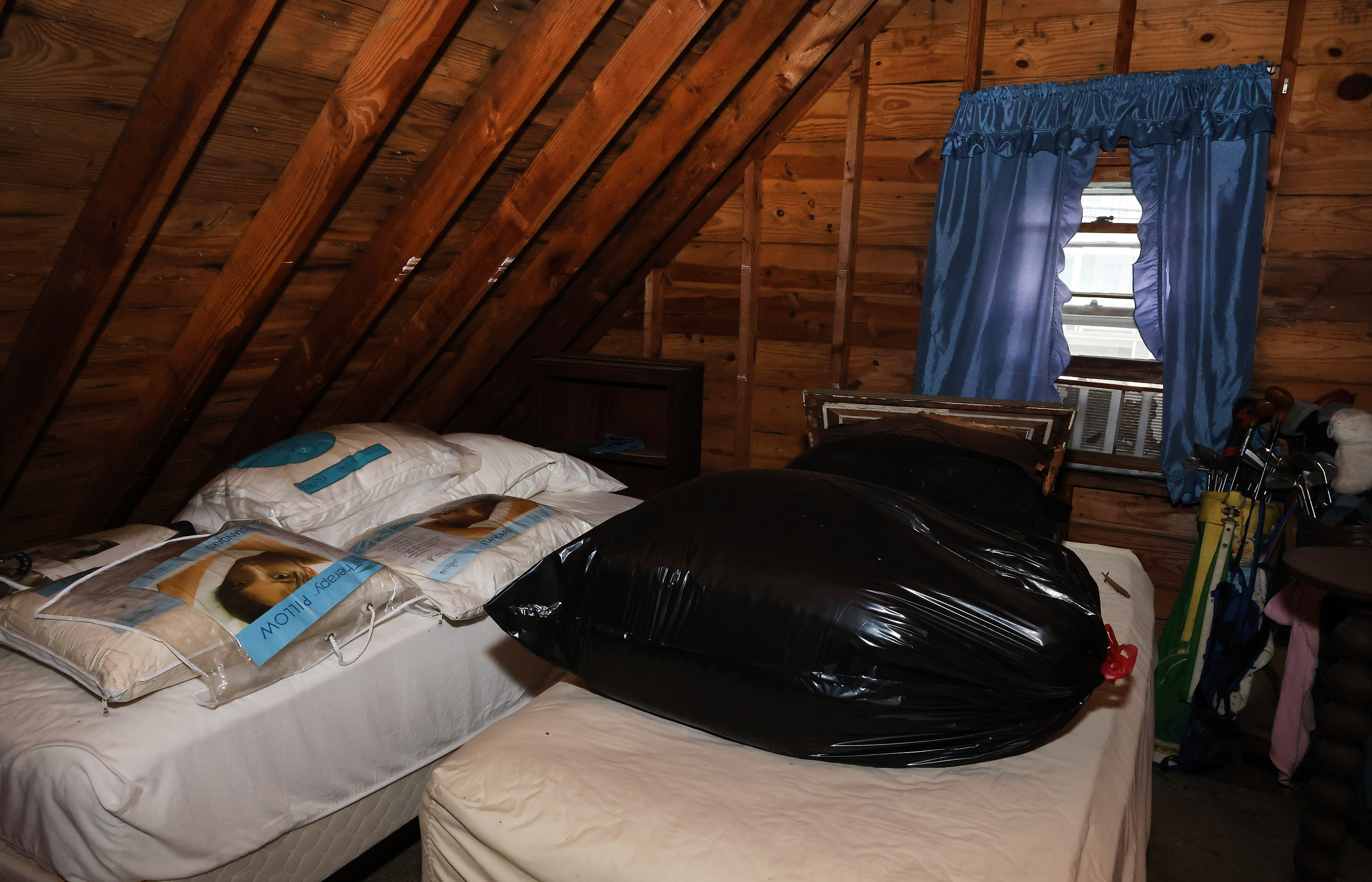
    The house was typical for its time — it had a washing machine but no dryer, an outdoor shower in continuous use because there was only one shower inside the house, a grassy backyard, and an attic crammed with a tangle of sleeping children.

    The cottage was small but the memories loom large.

    “The attic had pull-down steps and a window where the breeze came in off the ocean,” recalled David, Bole and Lib’s son. “The oldest would get closest to the window, then the next oldest, and so on, because that’s where you got the most air. There were about four beds lined up and then you had mattresses on the floor.”

    A view from the attic into the main house from the pull-down door.
    Beds sit in the attic, where the children would sleep, sometimes 10 at a time.

    With the whole family together it was not uncommon to have up to 10 people sleeping up there, he said.

    “My parents used to send me down when I was about 8 or 9 on the NJ Transit bus,” said the younger David Smith, one of Lib and Bole’s grandchildren, and nephew of David S. Smith. He’s a Realtor with Coldwell Banker who lives in Wallingford. “I thought riding the bus by myself was the coolest thing!”

    Ocean City is where members of the Smith family formed lifelong friendships and forged their work ethic at their summer jobs. Lib and Boles’ oldest son, Norman Jr., met his wife of 61 years in Ocean City. The younger David Smith is their son.

    All of the family members had typical summer jobs at the Shore, including beach chair rentals, waitressing at the College Grill, manning the ice cream truck, and lifeguarding.

    David S. Smith won the 1968 South Jersey Lifeguard Championships in the doubles rowing event, an annual tradition that continues to this day. He was inducted into the Ocean City Beach Patrol Hall of Fame in 2004.

    He recalls hanging out on the beach with Grace Kelly’s family, who lived nearby. “That whole area was really driven by the connection to the Kelly family and their connection to Ocean City,” he said.

    But David S. Smith himself had connections to Shore royalty of sorts. His wife, Lynn, was elected Miss Ocean City Beach Patrol in 1967 and was on the cover of the book Images of America-Ocean City: 1950-1980 by Fred Miller.

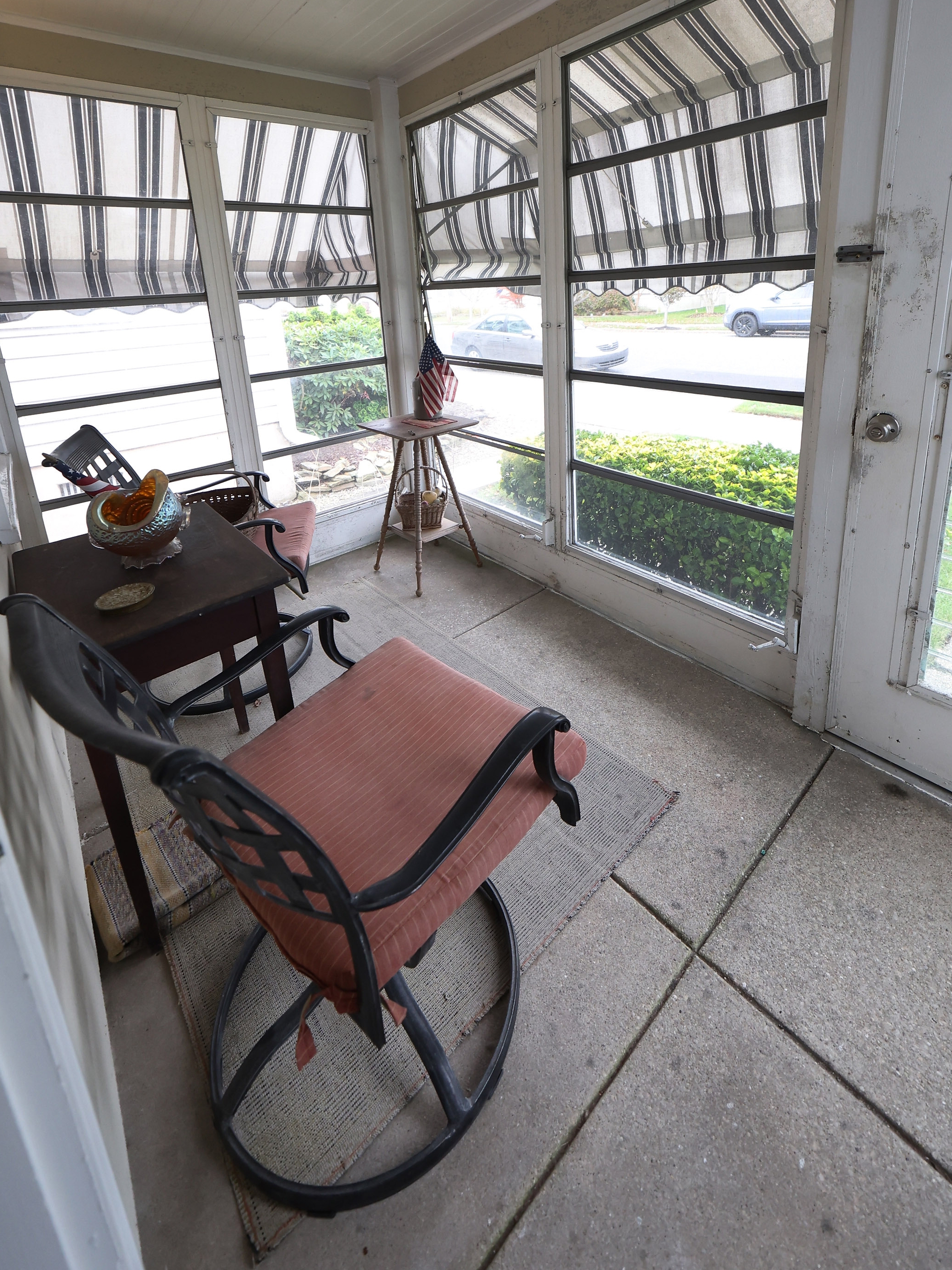
    The covered front porch of the Smiths’ cottage.
    The cottage sits on a large lot, which still is covered in grass unlike many neighbors.

    Over the decades, the home’s backyard was always in use, as the site for cookouts and quoits, a game similar to horseshoes. Family members of every generation competed while dinner was cooking on the charcoal grill.

    “The backyard of 2529 Asbury is still grass,” David S. Smith said. But at most of the nearby houses “the backyards are all stones.”

    The smell of frying scrapple was the morning alarm clock — a scent that still brings back a flood of memories for the younger David, Bole and Lib’s grandson.

    The cottage’s kitchen brings back memories of scrapple frying in the morning.
    The house’s one bathroom was used by the whole family, as well as the outdoor shower.

    A different town

    The Smiths witnessed the block transform dramatically over the years. Small cottages were razed and replaced with duplexes.

    “The Jersey Shore has changed so much,” said grandson David. “Now you see all these giant houses.”

    To help protect some of the town’s older homes, the city created a historic district in 1992, primarily between Third and Eighth Streets and Central and Ocean Avenues. That includes many homes with Victorian-era architecture, many built in the late 1800s and early 1900s.

    To maintain the area’s historical integrity, the district is protected by local ordinances that require approval for demolition, new construction, or rehabilitation projects. Merritt’s group hopes to raise awareness of these and other older homes.

    “When you knock down a house, you don’t just lose the house, but you lose the history,” he said.

    David Smith (left) and his uncle, David S. Smith, in the living room of the cottage.

    Merritt’s house, for example, has been rumored to have been owned by the family of Grace Kelly’s boyfriend when they were teens. Merritt was recently greeted at his home by the man’s sister.

    “We had this whole conversation of how her brother took Grace Kelly to the Lifeguard’s Ball, and she showed me the pictures she had,” he recalled. “When you knock these houses down, that connection to the past is severed.”

    Merritt argues that the town loses its identity when these houses disappear.

    While the Smiths have little say in who buys their home, they hope a single-family house will replace it, rather than a duplex, which brings more cars, people, and traffic.

    “It hurts,” David S. Smith said. “We’ve had it for 69 years and there’s a lot of history.”

  • The cost of Thanksgiving dinner dropped this year, agriculture group says

    The cost of Thanksgiving dinner dropped this year, agriculture group says

    Here’s one thing to be grateful for this holiday season: A typical Thanksgiving dinner is more affordable this year than last, according to the American Farm Bureau Federation.

    The average cost of a Thanksgiving feast for 10 people — including turkey, stuffing, sweet potatoes, rolls, peas, cranberries, a veggie tray, and pumpkin pie with whipped cream — will cost $55.18, or $5.52 per person, the group found.

    That number varies by region. The Thanksgiving grocery haul was cheapest in the South, at $50.01, and most expensive in the West, at $61.75.

    This is the third year in a row the price has declined after reaching a historic high of $64.05 in 2022.

    The farm group, which has tracked Thanksgiving meal prices for 40 years, compiled data from grocery stores in all 50 states and Puerto Rico. It did not take into account promotional coupons or deals found online or in-store.

    The star of Thanksgiving — the turkey, of course — helped bring down the overall cost of dinner this year. The average price of a 16-pound frozen bird decreased by 16 percent from last year to $21.50, or $1.34 per pound. The report said that its volunteers tracked prices during the first week of November but noted that grocery stores have been featuring Thanksgiving deals to draw in customers and are likely to lower prices further ahead of the holiday.

    “Farmers are still working to rebuild turkey flocks that were devastated by avian influenza, but overall demand has also fallen,” Faith Parum, an economist at the American Farm Bureau Federation, said in a statement. “The combination will help ensure turkey will remain an affordable option for families celebrating Thanksgiving.”

    Low wheat prices helped bring down the cost of items requiring flour, such as dinner rolls, stuffing mix and frozen pie crusts. But the cost of vegetables shot up, the farm group found. A a one-pound veggie tray of carrots and celery increased more than 60 percent, while sweet potatoes increased by 37 percent. The AFB attributed those increases to hurricane damage in North Carolina, the country’s largest producer of sweet potatoes, and possible supply-chain disruptions, such as from weather or labor shortages.

    The Thanksgiving holiday comes right after more than 41 million people were left without food stamps this month because of the government shutdown. Many Americans are reporting higher grocery prices, while also feeling the financial pinch from increases in electricity bills and housing costs.

  • Stephen Starr’s Borromini should be a showstopper. Instead, it’s a shrug.

    Stephen Starr’s Borromini should be a showstopper. Instead, it’s a shrug.

    Borromini’s 100-layer lasagna looks like a miracle of noodle engineering. It’s the kind of “more is more” pasta spectacle that commands its own showcase box on the menu, puts curious diners in chairs, and requires a team of three dedicated attendants in Borromini’s vast kitchen to meticulously construct its layers — a tall stack of pasta sheets alternating with microscopic schmears of ricotta, creamy bĂ©chamel, and tomato sauce — that get baked, sliced, then crisped on one side, to be served atop a puddle of pomodoro.

    Its intricate ridges are beautiful to behold. But to eat, this lasagna is more like a doorstop than a showstopper. The layers are so tightly compressed, it’s closer to a muddled mush than a deck of delicate harmonies, a squidgy blur of cheese and dough whose individual virtues could have been more compellingly conveyed in 10 layers rather than 100. Add a slow-cooked, jammy tomato sauce that leans sweet rather than bright and lively, and the final effect is one-dimensional. It has subtly evolved over the course of my multiple visits, but each time it prompted a disappointed shrug.

    The 100-layer lasagna at Borromini has been constantly evolving. This version, eaten in November, three months after opening, has been called “the final version” by owner Stephen Starr.
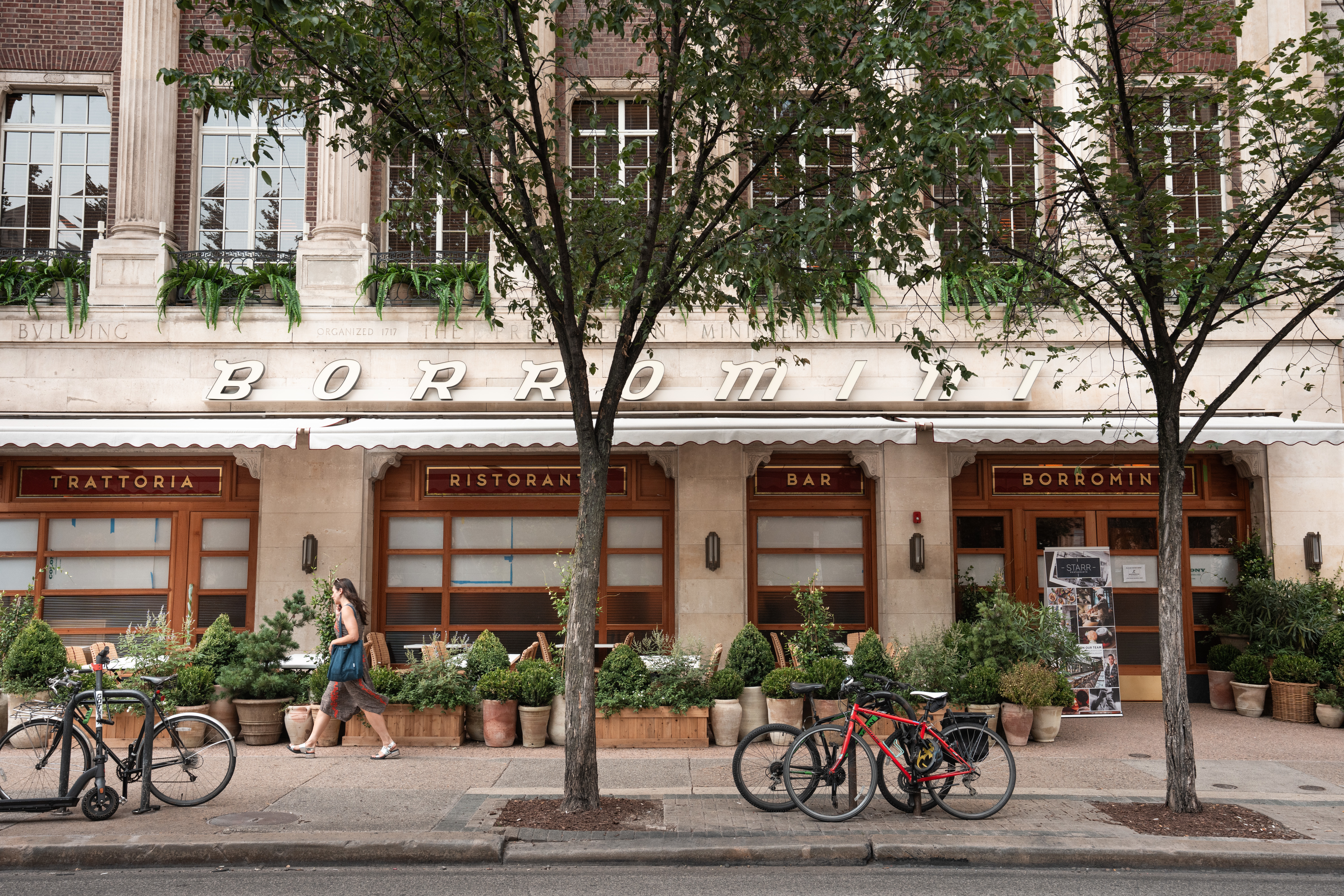
    Borromini, 1805 Walnut St., on Aug. 16, 2025.

    That’s not the thrill I expected from the marquee dish at this glitzy $20 million, 320-seat trattoria, whose dramatically lit column facade glows red over the northern edge of Rittenhouse Square. Stephen Starr’s first major hometown restaurant in years (and his 41st overall) is arguably the biggest opening in Philly in 2025. He went all out transforming the former Barnes & Noble into what many have aspiringly dubbed “the Italian Parc,” a two-story Roman-themed palace with vaulted ceilings, an intricate stone chip floor, and walls lined with 3,000 bottles. Starr brought on legendary New York restaurateur Keith McNally to design the space (Starr has syndicated McNally’s Pastis bistro to multiple cities since they partnered to revive it in 2018).

    He also enlisted a hive of respected culinary minds to create the menu over the course of 90-plus tastings, with his corporate food team and Borromini’s executive chef, Julian Alexander Baker, collaborating with Mark Ladner, the former chef of New York’s now-closed Del Posto, where Starr first tasted a magical rendition of that lasagna many years ago.

    Stephen Starr (left) and chef Mark Ladner discuss Borromini’s version of Ladner’s signature 100-layer lasagna during a menu tasting at Borromini on July 15, 2025.

    Ladner initially declined to recreate that decades-old hit when first asked. Starr should have listened. But Ladner — now the chef at Babbo, which Starr reopened in New York in October (and where a meaty version of that lasagna is also a menu feature) — ultimately gave in.

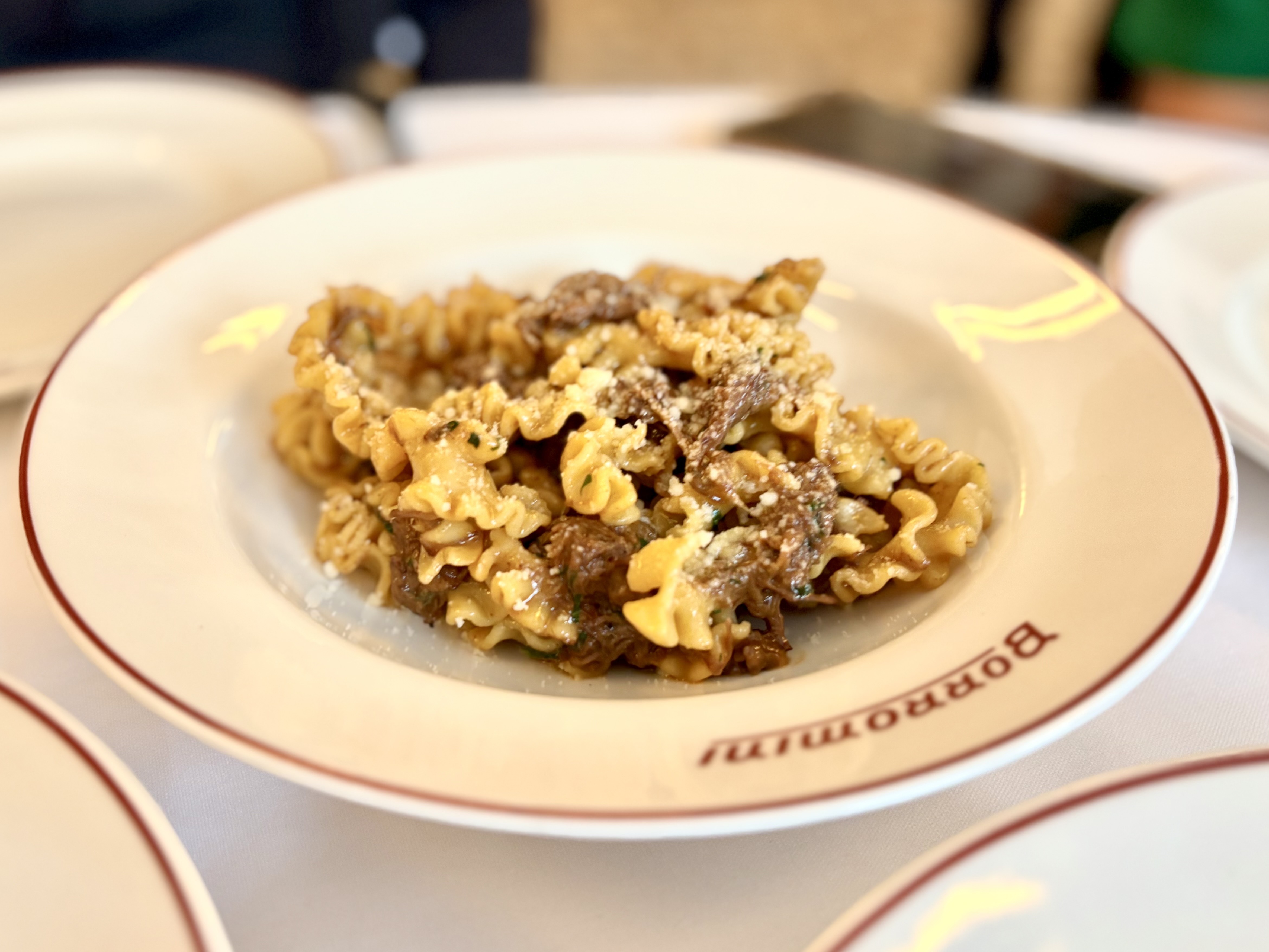
    There are plenty of other, more admirable dishes on the menu here, including the focaccia di Recco from another consulting chef, Nancy Silverton, the LA star with whom Starr runs Osteria Mozza in D.C. The hot crisp of her flatbread’s wafer-thin rounds sandwiching tangy stracchino cheese is the one dish I order every time. I loved the contrast of silky braised oxtail that gathered in the frilly-edged ribbons of the house-extruded mafaldine. And the calamarata pasta loops, paired “Sicilian lifeguard”-style with look-alike rings of tender squid, chili spice, and golden raisins, is exactly the kind of delicious, obscure regional dish that shows how infinitely surprising the world of pastas can be.

    The focaccia di Recco at Borromini is layered with tangy stracchino cheese.
    The “Sicilian lifeguard” calaramata with calamari and golden raisins at Borromini in Philadelphia, on Thursday, Nov. 13, 2025.

    But Borromini is more about polishing the familiar than unearthing regional quirks. And that big lasagna has become an apt metaphor for why Borromini’s food too often seems off. No matter how grand the ambitions of a dish (or this restaurant in general) may be, stellar Italian food comes down to finesse, touch, and soul — elements that a kitchen-by-committee cannot engineer. In a town with exceptional Italian restaurants in varied styles, not to mention a population with a deep reservoir of red-gravy family nostalgia, the room for error is slim for a dining experience that averages just under $80 per person (before tax and tip).

    The crisply fried squash blossoms stuffed with lemony ricotta and the hamachi crudo dressed simply with Meyer lemon and olive oil were tasty, if not necessarily distinctive. The arugula with shaved raw artichokes would be my salad pick. The massive, fork-tender osso buco, a 1-pound shank drizzled with brown jus over saffron risotto with a marrow spoon poking skyward from its bone, is as close to textbook Milanese perfection as Borromini gets.

    The osso bucco at Borromini in Philadelphia, on Thursday, Nov. 13, 2025.

    Borromini’s kitchen, however, struggled with consistency on several other traditional dishes. My favorite of the restaurant’s minimalist Roman-style pastas is the bucatini all’Amatriciana that’s brought to the table in the pan. But will you receive the version I tasted most recently, its simple tomato sauce vividly infused with the juniper- and pepper-sparked savor of properly rendered guanciale? Or will it taste bitter from the scorched nubs of cured pork I encountered at a previous meal?

    The pasta all’Amatriciana at Borromini in Philadelphia, on Thursday, Nov. 13, 2025.
    People dining in at Borromini in Philadelphia, on Thursday, Nov. 13, 2025.

    I might agree with my Italian server, Thomas, that Borromini’s carbonara is one of the best I’ve tasted in Philly, its mezze rigatoni tubes glazed in a golden shine of well-tempered eggs and guanciale fat. Too bad it was already cold when I took a bite the moment it arrived at my table.

    A number of the pastas were notable, including a spaghetti bright with lemon, butter, and pasta water, a deft display of minimalist satisfaction. I was also a fan of the Sardinian gnochetti with blue crab, uni, and tomatoes that brought a burst of seafood savor some other pastas lacked — like the linguine with clams that was virtually brothless, or the lobster spaghetti that was bountiful with crustacean but whose sauce lacked depth. The short rib agnolotti might have been excellent had their dumpling dough not been so thick.

    The cacio e pepe has been consistently disappointing. Its peppercorn-speckled noodles were pasty and dry, with no halo of creamy sauce to spare. The clam pizzetta was a floppy round of spongy dough piled high with chopped Italian clams that radiated raw garlic. The $125 bistecca alla Fiorentina, a 2-pound prime porterhouse centerpiece for sharing, was so achingly oversalted, it wasted an otherwise stellar slab of beef that had been lovingly massaged with confit garlic butter.

    The kitchen’s other stations turned in mixed results, as well. I much preferred the crispy-skinned dorade with salsa verde to the branzino with white beans, which was also horrendously oversalted. The eggplant parm was stiff with too much breading, though the splurge-worthy bone-in veal parm for $72 was good (unfortunately, they’ve since resorted to a boneless version). The lamb chops with salsa verde were more memorable, as was the rabbit cacciatore served in its metal crock with peppers and Castelvetrano olives, a rustic gem inspired by feedback from yet another consulting voice, the legendary Lidia Bastianich.

    The mafaldine with braised oxtail ragu at Borromini.
    Folks dining in at the bar at Borromini in Philadelphia, on Thursday, Nov. 13, 2025.

    It would be wrong to call Borromini a total bomb. Any place with a steady deluge of crowds putting it on target to generate $20 million in annual revenue has to be doing something right, and that would be its La Dolce Vita vibes. These sprawling rooms are a boisterous and glamorous crossroads for a broad swath of Philadelphians out for a night in their finest — fueled by flutes of “mini-tinis” (which my guest gleefully declared “filthy” with salty burrata brine), sweet-side Negronis, and Cynar-spiked espresso martinis.

    Starr’s greatest talent may be his gift for building energetic public spaces that feel as if they’ve always been there. And while Borromini lacks the corner space and open cafe windows that allow Parc in its al fresco moments to become part of the fabric of Rittenhouse Square, McNally has crafted a Fellini-esque stage set of leather booths, honeyed light, and linen-draped wooden tables that feels magnetic — especially the undulating copper bar on the ground floor, where an intriguing collection of 100-plus amari and digestivi awaits.

    All my servers — five different people over the course of my visits — were personable, outgoing, and well-prepared to make smart pairing suggestions.

    I should have stuck with their suggestions to indulge those digestivi with desserts. The airy tiramisu here backfired, its lightweight cloud of whipped mascarpone lacking the richness to counter an overzealous cocoa shower and the wickedly acidic twang of ladyfingers soaked in espresso.

    My favorite finish was sour in the best way possible: a hollowed-out lemon stuffed with sweet-tart lemon sorbetto. You’ve maybe seen something just like this in your neighborhood Italian place, brought in from the Italian frozen dessert powerhouse Bindi. But this was Borromini at its best, transforming something familiar into a better, fresher, more elegant version of itself. It will make you smile even as it puts a pucker on your face.

    The lemon sorbetto served inside a hollowed-out lemon at Borromini in Philadelphia, on Thursday, Nov. 13, 2025.

    Borromini

    1805 Walnut St., 215-596-1000, borrominiristorante.com

    Lunch served Monday through Friday, 11 a.m. to 3 p.m. Dinner served Sunday through Wednesday, 5 to 10 p.m.; Thursday through Saturday, until 11 p.m. Brunch Saturday and Sunday, 10 a.m. to 3 p.m.

    Dinner pastas and entrees, $19-$72.

    Wheelchair accessible.

    There are several gluten-free options, including high-quality gluten-free pasta, which can be substituted with most sauces.

    Drinks: The bar program offers 19 Italian wines by the glass, ranging from $12 house wines to $27 Franciacorta, a deep bottle list with more prestige options, Italian cocktails heavy on the expected spritzes and Negroni variations, and a list of nearly 100 amari and digestivi.

    Menu Highlights: focaccia di Recco, squash blossoms; hamachi crudo; artichoke-arugula salad; pastas (spaghetti al limon, gnochetti sardi with crab, oxtail mafaldine, spaghetti all’Amatriciana, carbonara, “Sicilian lifeguard” calamarata); polpetta; rabbit cacciatore; dorade; osso buco; sorbetto al limon.

    Borromini, the new Italian restaurant on Rittenhouse Square, in Philadelphia, July 29, 2025.
    Some of the first-floor dining area at Borromini in Philadelphia, Pa., on Tuesday, August 12, 2025.
  • Eagles vs. Cowboys in Week 12: Here are the numbers that matter

    Eagles vs. Cowboys in Week 12: Here are the numbers that matter

    The Eagles this weekend head to Dallas, where they will try to sweep their rival for the second consecutive season and move one step closer to clinching the NFC East for the second straight year. They would become the first team to win the division in consecutive seasons since they did it in 2004.

    Here are some important numbers and trends for Sunday’s game:

    4.6 
 2.4

    Lane Johnson’s impact on the Eagles is a well-known fact. As a reminder, the Eagles are 12-23 since the start of the 2016 season in games Johnson hasn’t started.

    Let’s get a little more granular.

    The Eagles’ running game has not been close to what it was in 2024, and it’s a big reason the offense ranks 25th in the NFL in yards per game. But Johnson has at least been a player the Eagles can run behind (when they choose to). In 84 designed runs to the right side when Johnson is on the field, the Eagles are getting 4.6 yards per attempt, according to Next Gen Stats. In 40 carries to the right side with Johnson off the field, the Eagles average 2.4 yards.

    The Eagles will be without Lane Johnson (center) indefinitely.

    Further, the Eagles have totaled minus-16 rushing yards before contact (an average of minus-0.4 yards) and 113 rushing yards after contact (2.8 per) on designed runs to the right side, resulting in 97 net rushing yards.

    That’s not great.

    +6 
 -4

    The Eagles’ obsession with possessing the football and not giving it away is nothing new. It’s largely the impetus behind their conservative offensive approach.

    The tendencies of the two teams that have led to the difference in turnover differential — plus-6 for the Eagles (seventh-best), minus-4 for the Cowboys (21st) — could play a big part in the result.

    Jalen Hurts has been impressive in not turning the ball over. He’s up to 156 consecutive passes without throwing an interception when under pressure, according to Next Gen, dating back to Week 2 of last season against the Falcons. That’s the second-longest active streak in the NFL.

    14.8%

    What was the cure to getting A.J. Brown the football a little more last week? Man coverage. The Lions deploy man coverage at the third-highest rate in the NFL, according to Sharp Analytics.

    Brown saw a lot of Rock Ya-Sin, who matched up with the receiver on 19 of his 28 routes, according to Next Gen, including 14 man-coverage matchups. Eight of Brown’s 11 targets came against Ya-Sin.

    Well, expect a lot less man coverage on Sunday.

    The Cowboys, according to Sharp Analytics, play man coverage just 14.8% of the time, the fourth-lowest rate in the NFL.

    The Eagles have struggled against zone, and Dallas may be wise to stick to its tendencies.

    9-33

    The Cowboys are a dangerous team. They have one of the best offenses in the NFL by yards per game (third, 378.7) and points per game (second, 29.6). They lead the NFL in passing yards per game (258.7).

    But they have largely beaten up on bad teams. Sure, they trounced the Las Vegas Raiders on Monday Night Football a few days ago, but they were coming off double-digit losses to Arizona and Denver, which rolled Dallas in a 44-24 game on Oct. 26.

    Eagles linebacker Jalyx Hunt puts heat on Dallas Cowboys quarterback Dak Prescott during the first quarter in Week 1.

    Dallas’ wins this season are against the Giants, Jets, Commanders, and Raiders, four teams with a combined record of 9-33.

    How can an offense this dominant belong to a team with a 4-5-1 record? The defense is almost as bad as the offense is good. Maybe Jerry Jones shouldn’t have traded Micah Parsons, one of the best defenders in the NFL.

    Dallas owns the third-worst defense in yards allowed per game (381.3), and the second-worst in points allowed (29.3).

    The Eagles, of course, haven’t looked of late like an offense that is capable of putting up big numbers, but Sunday’s opponent could be the remedy.

    42.9%

    Just five weeks ago, when the Eagles were 4-2, their percentage chance of making the playoffs, according to FTN Fantasy, was 59.2%.

    Now, they are up to 42.9% to clinch the No. 1 seed in the NFC. Funny what a four-game winning streak — coupled with some poor play from the rest of the NFC East — can do to a team.

    A trip to the playoffs is pretty much sewn up. The Eagles have a 99.6% chance of making the postseason.

  • Philly-area federal workers are finally getting paid again. But they fear another shutdown.

    Philly-area federal workers are finally getting paid again. But they fear another shutdown.

    The longest ever federal government shutdown is now in the rearview mirror, but not for federal workers.

    With their jobs back to normal, some local federal employees said worries created by the shutdown remain — one said their credit score suffered, others noted their Thanksgiving tables will be less festive. And for many, another shutdown in a matter of weeks is a real concern.

    Federal employees — whether furloughed or required to work during the shutdown — missed paychecks during the 43-day lapse in federal appropriations, the longest ever in United States history. Workers sought out food pantries, delayed payments on bills, and tried to make ends meet for their families ahead of the holidays.

    “I will be paycheck to paycheck for the next couple of months maybe, before I can start accumulating my savings again,” said a Philadelphia Veterans Benefits Administration employee, who was working without a paycheck during the shutdown.

    The Inquirer agreed to withhold the names of federal employees interviewed due to their fear of retaliation for speaking out. Despite workers beginning to receive retroactive paychecks from the shutdown, they spoke of lingering financial damage and worries that yet another lapse in funding could happen in just a couple of months.

    The bill to end the shutdown, signed into law by President Donald Trump on Nov. 12, funds the government through Jan. 30. It includes protections for federal employees such as reversing layoffs that took place during the shutdown, and ensures back pay for all government workers throughout that time, which had been put into question by the Trump administration. And certain government agencies, such as Veterans Affairs, the Department of Agriculture, and the Food and Drug Administration, have been allocated a year’s worth of funding.

    But after Jan. 30, if lawmakers once again fail to agree on keeping the government open, some federal workers could once again face a lapse in their pay.

    “We’re bracing for Jan. 30,” said Philip Glover, national vice president of the American Federation of Government Employees District 3, the union that represents federal employees in Pennsylvania.

    The recent shutdown and the possibility of another are among a series of obstacles that government workers have faced this year. The Trump administration’s efforts to shrink and reshape the federal workforce have included layoffs, pushing employees to resign, and the dismantling of collective bargaining agreements. When government funding lapsed in October, the Trump administration used it as an opportunity for more firings.

    Philip Glover, AFGE District 3 national vice president, speaks at a news conference focused on federal workers amid the government shutdown, near the Liberty Bell on Oct. 7.

    Federal workers have been “dealing with a layer cake of trauma,” said Max Stier, founding president and CEO of the Partnership for Public Service, a federal government management organization.

    “This is not simply one incident, but it’s one on top of a bunch of them that this administration has put in their way,” Stier said.

    The financial strain

    At the Social Security Administration in Philadelphia a benefit authorizer said Monday that she and her coworkers had started getting their back pay, but she had already felt the impact of missing checks.

    “We assumed we could just call and everybody would place everything on hold, and that was not the case,” said the Social Security employee.

    The benefit authorizer had put her mortgage and car payments on hold, but some banks and utility companies weren’t as accommodating, and she accumulated overdraft fees from a credit union.

    Her role required her to work through the shutdown without pay. (In Pennsylvania, furloughed workers may apply for unemployment benefits, but those who continue to work, even without pay, may not.) The benefit authorizer looked for additional work, unsure how long the shutdown would last. Some of her colleagues in Philadelphia picked up gigs with Uber, DoorDash, and Instacart, she said.

    Union officials from AFGE gathered on Oct. 7 in front of Independence Hall to protest the government shutdown.

    Another Philadelphia Social Security employee, who has been with the agency for 15 years, noted that some colleagues picked up night shifts at Amazon or work in home healthcare.

    “People living paycheck to paycheck, they needed something to pay those bills that were absolutely essential that they had to pay,” the 15-year Social Security employee said.

    For one federal employee from Central Jersey, 2025 already came with an unexpected career turn when they lost their job at U.S. Housing and Urban Development, as part of a mass layoff of probationary employees. They found a job at the U.S. Department of Commerce, in Virginia, which allowed them to support their mother and three kids back in New Jersey.

    Wary of permanently moving to Virginia during such a volatile time in the federal workforce, the Commerce employee commutes eight hours by Amtrak twice a week and stays in a $200 per night hotel on workdays.

    During the federal shutdown, the Commerce employee had to work without a paycheck. They used up their savings paying for the commute, hotel, and other expenses. Ultimately, they took out a bank loan to cover their expenses.

    The government shutdown exemplifies a lack of stability in the workforce, the Commerce employee said. “To be honest, you feel unsafe all the time, and you feel like you’re not deserving that.”

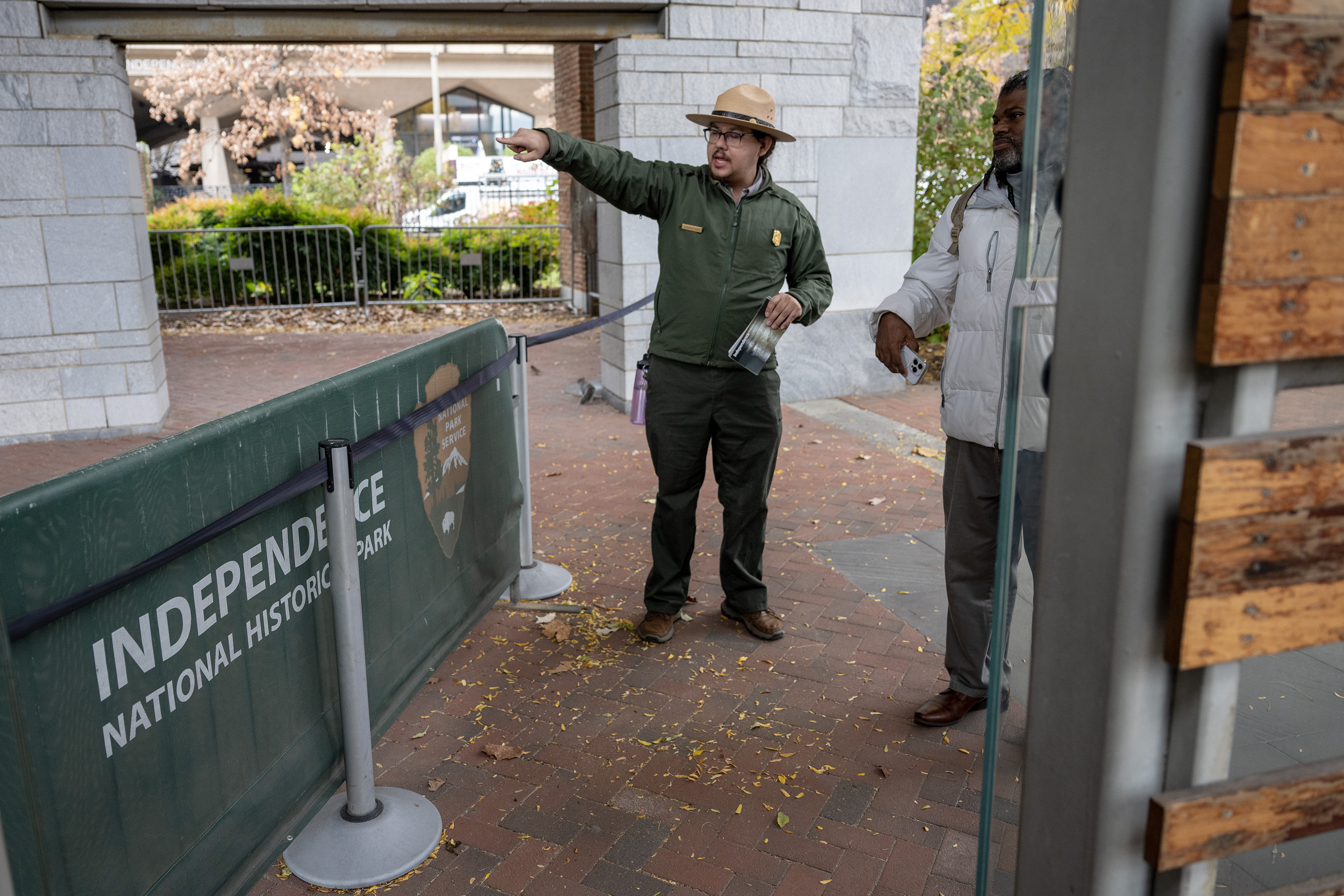
    National Park Service ranger Christopher Acosta talks with tourists outside the Liberty Bell Center on Nov. 13 after returning to work from the shutdown.

    Worries remain ahead of the holiday season

    The Philadelphia VBA employee, who worked without pay during the shutdown, received their back pay Monday. The single parent said they were one more missed paycheck away from turning to food pantries and living off credit cards.

    “Usually I’m the one donating around this time,” the employee said last week. “I usually adopt a family and provide them with the meal and then their gifts and stuff from our local community churches and outreach programs.”

    Thanksgiving is the time they “splurge,” but now the shutdown has made them contemplate their finances. “I haven’t even thought about the process of even having a Thanksgiving dinner on the table because I didn’t want to spend the money,” the VBA employee said. By Christmas, they hope to be caught up on payments.

    It’s a similar story for one Philadelphia VA Medical Center employee who worked without pay through the shutdown. Speaking days before the shutdown’s end, the employee said their credit score had taken a hit. They reached out to creditors and got some of their payments deferred, but relief won’t set in until the employee can catch up on their water, electric, gas, mortgage, and car bills.

    A “big feast” for Thanksgiving is off the table. “You can’t do that now because you don’t have the funds,” they said.

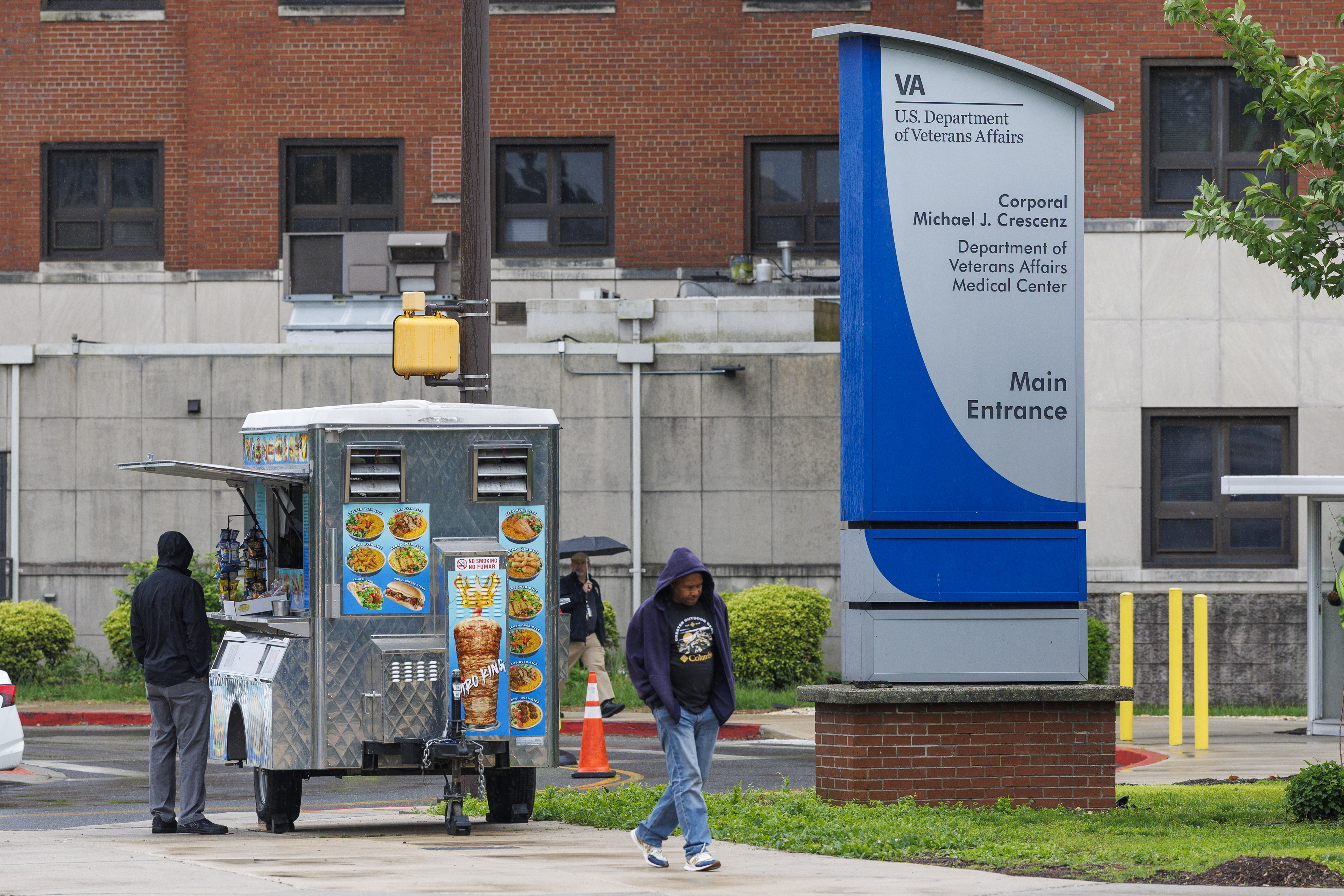
    The Corporal Michael J. Crescenz Department of Veterans Affairs Medical Center in Philadelphia.

    ‘Fear of what’s to come’

    Throughout the funding impasse, Philadelphia’s federal workers turned to each other for assistance.

    At the VBA, supervisors set up a small food pantry several weeks into the shutdown. The VBA employee said that didn’t feel especially helpful. “That was our second paycheck missed, and that was the best that they could come up with,” the employee said.

    “It’s business as usual in the eyes of the VA, and they expect us to work like nothing’s going on in our real lives.”

    At the Social Security Administration, workers banded together to start an impromptu food pantry, the Philadelphia benefit authorizer said.

    “Everything was taken. People needed it. People were really pinching pennies,” she said.

    The national office of AFGE, the largest federal workers’ union, backed the deal to end the government shutdown. “Government shutdowns not only harm federal employees and their families, they also waste taxpayers’ dollars and severely diminish services depended on by the American people,” AFGE national president Everett Kelley said in a statement on Nov. 10.

    But some thought it should have ended differently.

    In the days leading up to the deal, dozens of AFGE Local 3631 members, who are employed at the Environmental Protection Agency, said in a local union survey that they did not want their local to support budget legislation such as what passed. Their concerns were with an expected rise in healthcare expenses across the country.

    The union local had polled members at the end of October, according to local union officer Hannah Sanders. The survey got more than 100 responses, and over 85% said the local should only support a deal if it preserved subsidies for Affordable Care Act healthcare plans and avoided cuts to Medicaid.

    EPA workers and supporters gathered outside their office for a solidarity march around Philadelphia’s City Hall in March.

    In Washington, most Senate Democrats held out, only supporting a vote on an appropriations bill that would extend ACA subsidies. But eight senators, including Sen. John Fetterman (D., Pa.), crossed party lines to back the Republican bill that omitted the subsidies.

    Sanders said there are few changes between the recently passed deal and the bill that could have averted the shutdown back in September. “We would have not had this shutdown, and people wouldn’t have, you know, gone without pay or gone without SNAP benefits and all these things. So it’s super frustrating to see that this is how it all resolved,” said Sanders.

    Now, the benefit authorizer at the Social Security Administration says, people are concerned that another shutdown could be on the horizon come Jan. 30.

    “We are in complete fear of what’s to come,” she said.