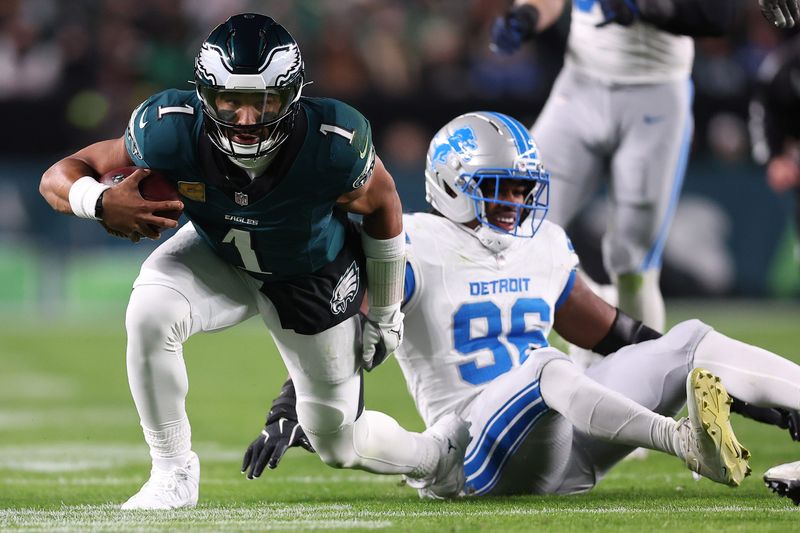
If that sounds harsh, well, harsh is a pretty good word to describe the experience of watching the Eagles offense right now. The play-calling lacks imagination. The run-blocking lacks the dominance that was once its hallmark. The quarterback has always lacked aggression. Now, he lacks accuracy, too.
That’s not an ideal formula. There are all kinds of ways you can shrug off the staggering ineptitude the Eagles displayed while muddling their way to a 16-9 win over the Detroit Lions on Sunday night. It’s an easy thing to do when your defense consistently forces opponents to play bleepier than you. The Eagles are 8-2, with the best Super Bowl odds in the NFC, and victories over four of the five teams whose odds are just behind theirs. That stuff matters. But you can’t shrug off the one question that every team with Super Bowl aspirations must constantly ask itself.
Are we a championship team in our current form?
That the Eagles can even think about answering yes is a testament to how good they are everywhere outside of offensive execution.
Brown said it best on Sunday night.
“This team is resilient,” said the Eagles’ wide receiver, who broke free of his recent on-field anonymity with 11 targets and seven catches, albeit for only 49 yards. “Show up, work hard, find a way, no matter what it looks like.”
Brown is right. And he has been right all along. The Eagles are a very good team. Winning football games is important. But so is progress. Right now, the Eagles are a long way off from being the best team they can be.
Nothing that we saw from them on Sunday night suggests their fundamental problem has been solved. It isn’t just that the Eagles aren’t scoring enough points. It’s that they don’t appear to be getting any better.
They have scored 17 or fewer in four of their last six games, including a combined 26 in their last two. Are they capable of winning a Super Bowl in their current form? Absolutely. But you can’t ignore how different their current form is from the one that saw them win the Super Bowl last season.
For the second straight game, and for the fifth time this season, the Eagles failed to crack 300 yards of total offense. That only happened three times all last season. Heck, it only happened five times in 2023.
There are plenty of mitigating circumstances. Last week’s game in Green Bay was played in real feel temperatures that dropped into the teens. Sunday’s win over the Lions featured a steady wind with wild gusts above 30 miles per hour. In both games, the Eagles lost All-Pro right tackle Lane Johnson to an injury (most recently, his foot, which sidelined him for all of the second half Sunday night).
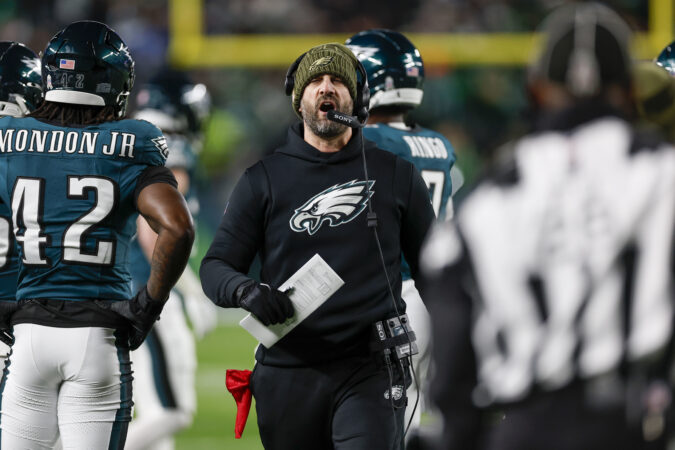
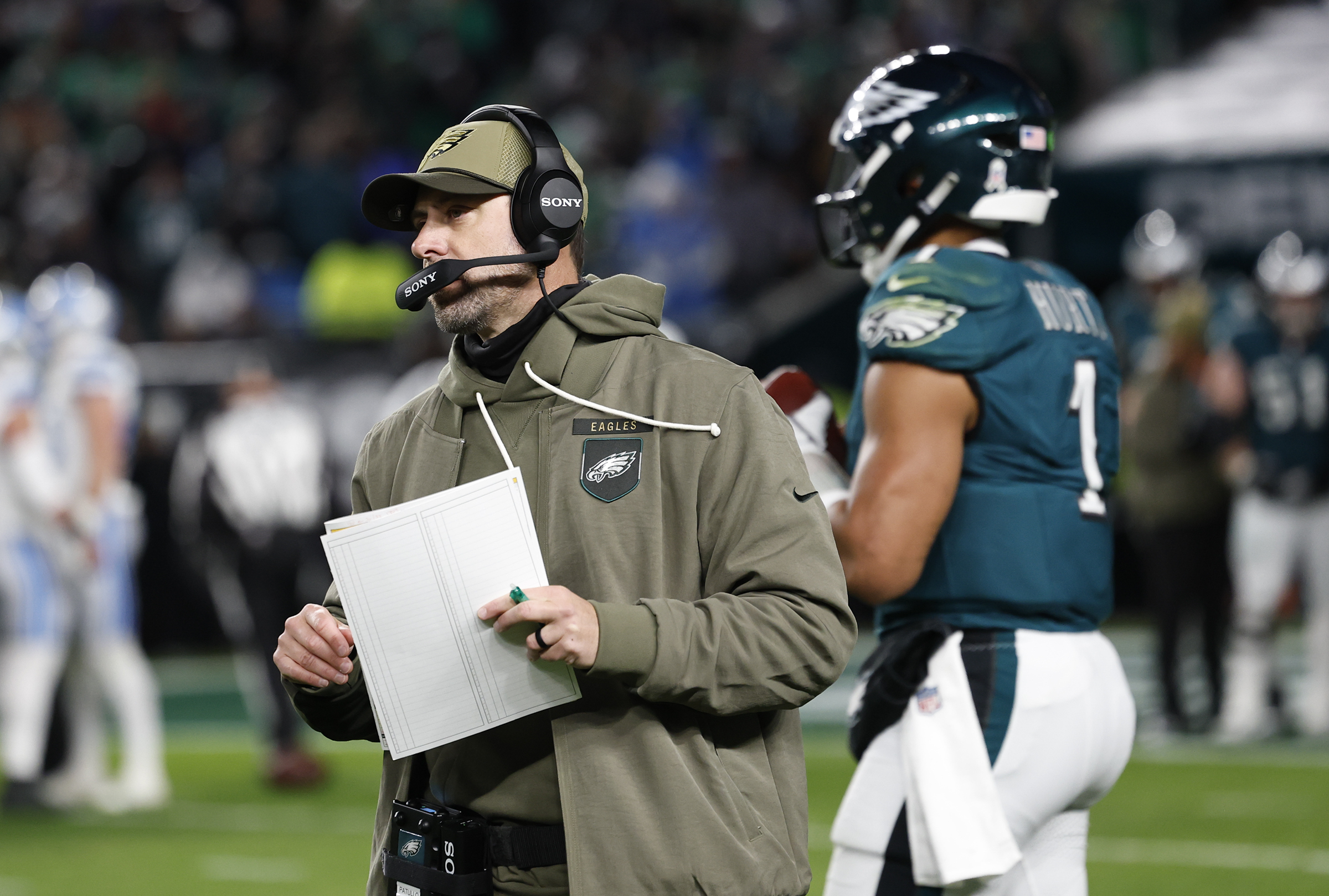
Coordinator Kevin Patullo is among those seeking answers to the team’s offensive issues.
The schedule has been brutal. The Lions defense entered Sunday ranked seventh in the NFL in yards per play allowed. The Eagles had already faced three of the six teams who ranked above Detroit (Denver Broncos, Green Bay Packers, Los Angeles Rams).
“We want to be better than what we were tonight, but every game’s played a little bit differently,” coach Nick Sirianni said. “Every game is played to win, but do we have to clean up things on offense? Of course we do. As good as the defense played, we’re going to have to clean up things on defense. As good as the special teams played, we’re going to have to clean up things on special teams. But on offense, there’s some shooting ourselves in the foot that’s happening and some of those things are things that, we always talk about [things that] take no talent, and we have such good talent that we have to be able to master the things that take no talent so our talent can shine.”
Give them credit for trying something new. They tried to force the ball to Brown, which is something that he and plenty of Eagles fans have been lobbying for in recent weeks. His 11 targets were more than he had in the last two games combined, including last week’s three-target, two-catch nothingburger in Green Bay.
The concerning thing is that nothing else changed. Brown’s seven catches went for just 49 yards. The Eagles scored just one touchdown. Even on a night when Jared Goff was out of sync and the Lions went 0-for-5 on fourth down, Detroit’s offense looked like the more highly evolved unit. The pinnacle came in the second quarter, when Goff hit Amon-Ra St. Brown for 34 yards and then Jameson Williams for a 40-yard touchdown. The 74 yards the Lions gained on two plays were more than the Eagles had gained all game to that point.
There were plenty of stretches last season when the Eagles looked like that sort of offense. Brown was always at the center of it, it seemed.
Jalen Hurts and the Eagles offense must find a rhythm if they wish to make a run at another Super Bowl.
The Eagles need to find a way to make Sunday night a building block. Good things happen when you target even a diminished Brown. The final example came with 1:47 left, with the Eagles one play away from turning the ball back over to the Lions for a chance at a wholly unearned game-tying touchdown drive. On third-and-8 from the Eagles 37, Jalen Hurts forced a pass to a tightly covered Brown, and Lions cornerback Rock Ya-Sin panicked. Instead of watching Hurts’ pass sail wide of its mark and short of the sticks, he reached out toward Brown and drew a flag. It was a questionable call, but the end result gave the Eagles a first down, and kept the Lions offense on the sidelines for the rest of the game.
“We’re always trying to get A.J. involved,” Sirianni said. “Always, always, always, always. The game play is played differently each and every week of what happens. I don’t think I’ve been shy about saying this. The game plan’s always going to start in the passing game with him and [WR] DeVonta [Smith] and [TE] Dallas [Goedert], and so we’re always trying to do that and get him the football. That’s the way the game played out a little bit today.”
At some point, it will need to play out better. Let’s hope that point comes soon.
Friday Saturday Sunday, Mawn, Kalaya – let us know who you think deserves a prestigious Michelin star
Tomorrow night during a ceremony at the Kimmel Center, Michelin will award its first ever stars to restaurants in Philadelphia. The wait is nearly over but until we finally find out we want to know which ones you think deserve a star.
Now that you know more about Michelin stars, let us know which of these restaurants you think deserves one — swipe right for Yes or left for No. Yes, just like Tinder. Finding it hard to decide? We'll also show you how other Inquirer readers have voted so far.
Mawn
Cuisine
Cambodian
Neighborhood
South Philadelphia
Crowd says
Friday Saturday Sunday
Cuisine
Modern American
Neighborhood
Center City
Crowd says
Her Place
Cuisine
Modern American
Neighborhood
Center City
Crowd says
Provenance
Cuisine
French, Korean
Neighborhood
Center City
Crowd says
Honeysuckle
Cuisine
American, Brunch
Neighborhood
Spring Garden
Crowd says
Zahav
Cuisine
Israeli
Neighborhood
Center City
Crowd says
Kalaya
Cuisine
Thai
Neighborhood
Fishtown/Kensington
Crowd says
Pietramala
Cuisine
Vegan
Neighborhood
Northern Liberties
Crowd says
Royal Sushi & Izakaya
Cuisine
Japanese
Neighborhood
South Philadelphia
Crowd says
My Loup
Cuisine
French, Seafood, Modern American
Neighborhood
Rittenhouse
Crowd says
Parc
Cuisine
French
Neighborhood
Rittenhouse
Crowd says
Vernick
Cuisine
Seafood, Modern American
Neighborhood
Rittenhouse
Crowd says
Vetri Cucina
Cuisine
Italian
Neighborhood
Center City
Crowd says
Andiario
Cuisine
Italian, American
Neighborhood
West Chester
Crowd says
All rated!
story continues after advertisement
Staff Contributors
Design, Development, Reporting, and Data: Aileen Clarke
Editing: Sam Morris
Photography: Jose F. Moreno, Monica Herndon, Yong Kim, Tom Gralish, Charles Fox, Tyger Williams, and Tim Tai
Illustration: Steve Madden and Sam Morris
Subscribe to The Philadelphia Inquirer
Our reporting is directly supported by reader subscriptions. If you want more journalism like this story, please subscribe today
Seven hundred and twenty-four days ago, Nick Sirianni stared into a bank of TV cameras and dared the NFL — hell, dared the whole world — to stop the play that the Eagles had mastered and no one else in pro football had. It was late October 2023, and while holding a seven-point lead against the Miami Dolphins, the Eagles ran a quarterback sneak, a Tush Push, on fourth-and-1 with 10 minutes, 1 second left in regulation. That wasn’t the striking part. Neither, really, was the fact that Jalen Hurts powered forward for a first down. The striking part was that the Eagles were on their own 26-yard line, a set of circumstances that made a bold postgame assertion from Sirianni all the more memorable.
“If everybody could do it,” he said that night, “everybody would do it.”
Well, there the Eagles were Sunday night, and for once, the Tush Push was an issue for them. For once, it wasn’t automatic. For once, its magic was gone, and of all the ramifications of the Eagles’ 16-9 victory over the Detroit Lions, that relative demystifying of their signature, unstoppable play was among the most concerning. For these last few years, the Tush Push had given them an innovative and significant advantage over their opponents, had meant the Eagles really needed just 9 yards to get a first down, because the 10th yard was a fait accompli.
Nothing was that easy Sunday. The Eagles succeeded just once — Hurts’ second-quarter touchdown, the team’s only one of the game — in their six sneak attempts. They false-started. They were stuffed. With 2:54 left in regulation, with the Eagles up 10 and facing fourth-and-1 from their own 29-yard line — a situation similar to the one they confronted against the Dolphins in ’23 — Hurts went nowhere, and that failure invited the Lions back into the game by handing them at least a chance to cut the lead to a single score.
“I’d do it again over and over,” tackle Jordan Mailata said. “I’d take us any day. Now, we’ve got to go back and watch that play and see what went wrong. But I’d still take us any day of the week. When you have a defense like ours, it does make it easier to go for it on fourth down. There’s the trust and faith in the guys up front, but also, if we don’t get it, there’s the trust and faith in the guys on defense.”
That was the knee-jerk justification for a call that, in the context of this particular game and the condition of this particular Eagles offensive line, Sirianni never should have made. When he had the Eagles go for it from their own 26 nearly two years ago, his decision was surprising because it was so unconventional at the time. He was correct then: The Eagles were the only team that could run the Tush Push with so high a rate of success, and they could because of the players they had blocking on the play: Jason Kelce, Lane Johnson, Mailata, all healthy.
Jalen Hurts has been frequently working behind a different version of the O-line than the dominant one that patented the Tush Push.
Sunday was so far from that same scenario. Johnson was ruled out at halftime with a foot injury, and center Cam Jurgens, having missed the previous two games with a knee injury and already playing through the painful effect of offseason back surgery, had exited, too, with 5:06 to go. So two backups, Fred Johnson and Brett Toth, were subbing for them. And the NFL and its officials and a chorus of complainers are now watching every twitch and subtle hint of movement every time the Eagles run the Tush Push. And now a play that was once a slam dunk is something closer to a midrange jump shot.
“They’re homing in on it,” Hurts said. “They’re very strict on the guard and the center and how they operate. They’ve got their eyes on it, and we’ve got to go out there and be as clean as possible.”
This sliver of doubt when it comes to the Tush Push might seem a small matter. It isn’t. The play’s reliability was a tangible symbol of the strength of the Eagles offense: the manner with which they controlled the line of scrimmage. Lane Johnson’s warning last month, after a loss to the New York Giants, about the offense becoming “predictable” was in that sense silly. No offense in the NFL last season was more predictable than the Eagles’. Everyone knew Saquon Barkley was getting the ball, and still no one could stop it.
This season, the worry for a team that is 8-2 and atop the NFC is simple: That inevitable dominance hasn’t been there, and that reality has to change the calculus when it comes to the Eagles’ trademark aggressiveness in their play-calling. They could afford to go for it anytime, anywhere in short-yardage situations when they had the best collection of blockers in the league. The line’s regression should compel Sirianni to coach the team he has right now, not the one he used to have or the one he wished he had, and over the rest of the season, he has to weigh how much he asks of a defense that is carrying the Eagles, that allowed them to get away with two subpar offensive performances against two playoff-caliber teams.
“Always. Always. You always think about those things,” he said. “You think about how it plays in-game, but you also think about your past experiences. Everything is taken into account. But you definitely think about how it’s playing in-game. … Any time we don’t get a fourth-down conversion, I’m going to put that on myself. I’m always going to be hypercritical of myself. Obviously, if I had known we weren’t going to get it, I would have punted it.”
He couldn’t have known it, but he could have suspected it, and he has to start asking himself a question that he once didn’t have to contemplate. Of course, if everybody could do the Tush Push, everybody would. But what if the Eagles can’t?
Angelica Javier was sitting at home on a Saturday evening last month when her son’s uncle called in a panic.
Xzavier, her 16-year-old, had been shot, he said — one of the teen’s friends had called and told him, but he knew nothing else.
Javier, 32, frantically checked a news website and saw a brief story mentioning that a man was shot and killed in Northeast Philadelphia.
That could not be her son, she told herself. Xzavier was only a boy, she said — tall but lanky, with the splotchy beginnings of a mustache just appearing on his upper lip.
She called around to hospitals without success. Xzavier’s father, Cesar Gregory, drove to Jefferson Torresdale Hospital, desperate for information.
Then, just before 10 p.m., she said, a homicide detective called to say their eldest child, their only son, had been shot and killed that afternoon near Teesdale and Frontenac Streets.
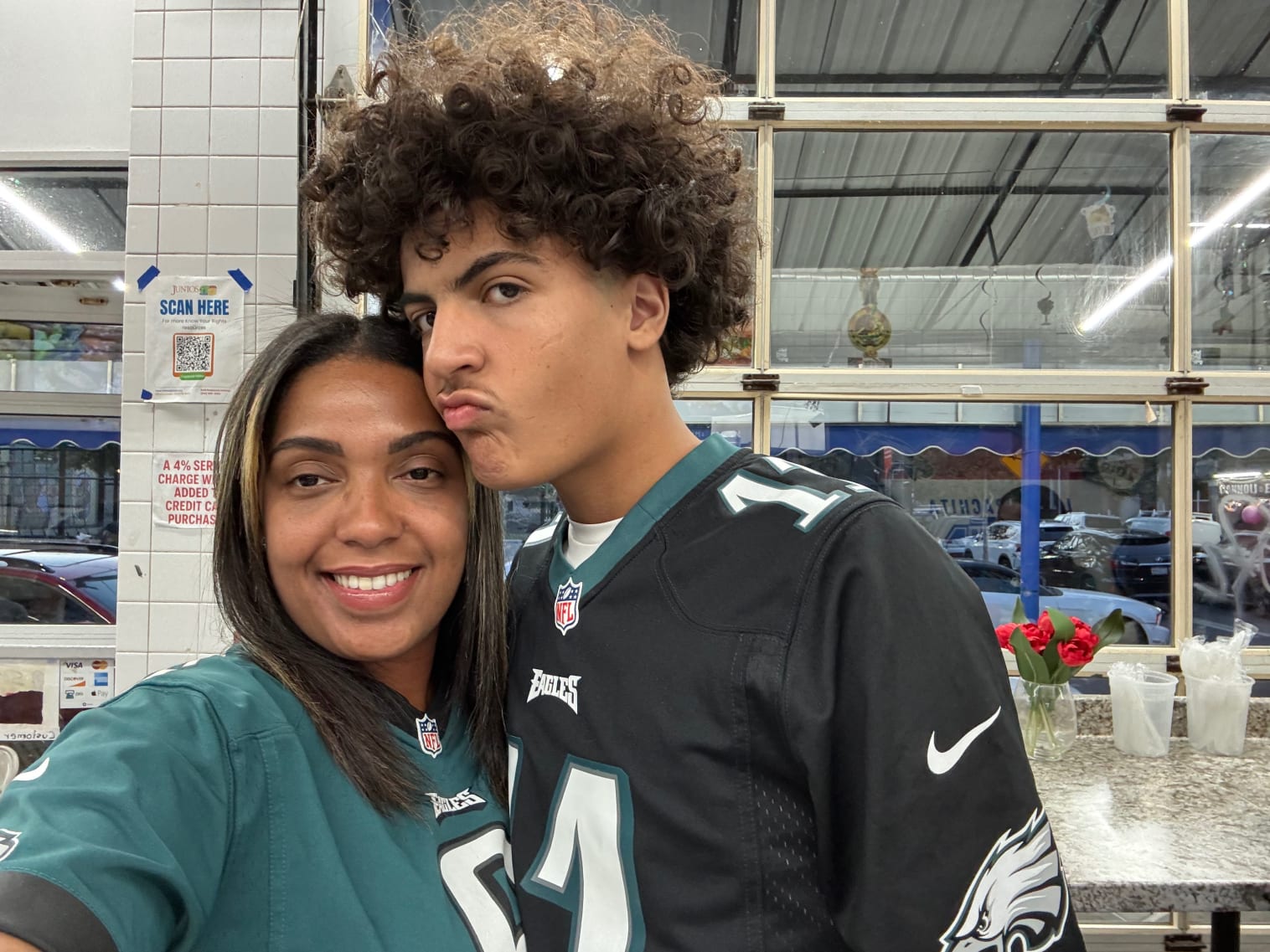
Angelica Javier (left) and her 16-year-old son, Xzavier Gregory, getting tacos after watching the Eagles beat the Los Angeles Rams earlier this year.
The shooting, police said, stemmed from a dispute among teens at the Jardel Recreation Center, just blocks away, earlier in the week. Xzavier’s parents said the detective told them that one of their son’s friends may have slapped a young woman that day.
On Oct. 11, they said, police told them that Xzavier and his friends stopped by the young woman’s house shortly before 4 p.m. to talk with her, apologize, and resolve the conflict. They shook hands, the parents said, and started to walk away.
Then, police said, the girl’s 17-year-old boyfriend, Sahhir Mouzon, suddenly came out of the house with a gun and started shooting down the block at them. Someone shot back, police said, but it was not Xzavier. In total, 45 bullets were fired.
An 18-year-old woman walking by the teens was wounded in the leg.
Xzavier was struck in the chest and died within minutes.
Mouzon has been charged with murder and related crimes.
Javier and Gregory have been left to navigate life without their “Zay” and to reckon with a loss that comes even as gun violence in the city reaches new lows — but which still persists among young people and brings pain to each family it touches.
They don’t understand how a 17-year-old had a gun, they said, or why a seemingly minor — and potentially resolved — conflict had to escalate.
But mostly, they said, they want Philadelphia to know and remember their child: a goofy junior at Northeast High. An avid Eagles fan. A lover of Marvel movies and spicy foods.
Xzavier Gregory was born in Philadelphia. His parents loved his chubby cheeks.Xzavier Gregory was born Sept. 20, 2009, to Angelica Javier and Cesar Gregory.
Xzavier Giovanni Gregory was born Sept. 20, 2009, at Temple University Hospital in North Philadelphia. His parents, just teens at the time, were immediately taken by his chubby cheeks, which he kept until his teenaged years.
He lived in Kensington until he was about 10 years old, his mother said, when they moved to the Northeast. He attended Louis H. Farrell School, then spent his freshman year at Father Judge High before moving to Northeast High.
He loved traveling, and often visited family in Florida and the Dominican Republic, attended football camps in Georgia and Maryland, and tagged along on weekends to New York with his mother as part of her job managing federal after-school programs.
He played football for the Rhawnhurst Raiders, typically as an offensive or defensive lineman, and had a natural skill for boxing, his parents said.
Philadelphia sports were in his blood — particularly the Eagles. DeVonta Smith and A.J. Brown, his father said, were his favorite players. (Before his death, he agreed that Brown should be included in more plays this year, Gregory said.)
Some of Gregory’s favorite memories with his son revolve around the Eagles. Sitting front row at the Linc on his 13th birthday. Erupting in cheers as the team won its first Super Bowl in 2018. Embracing in tears when they won a second this year.
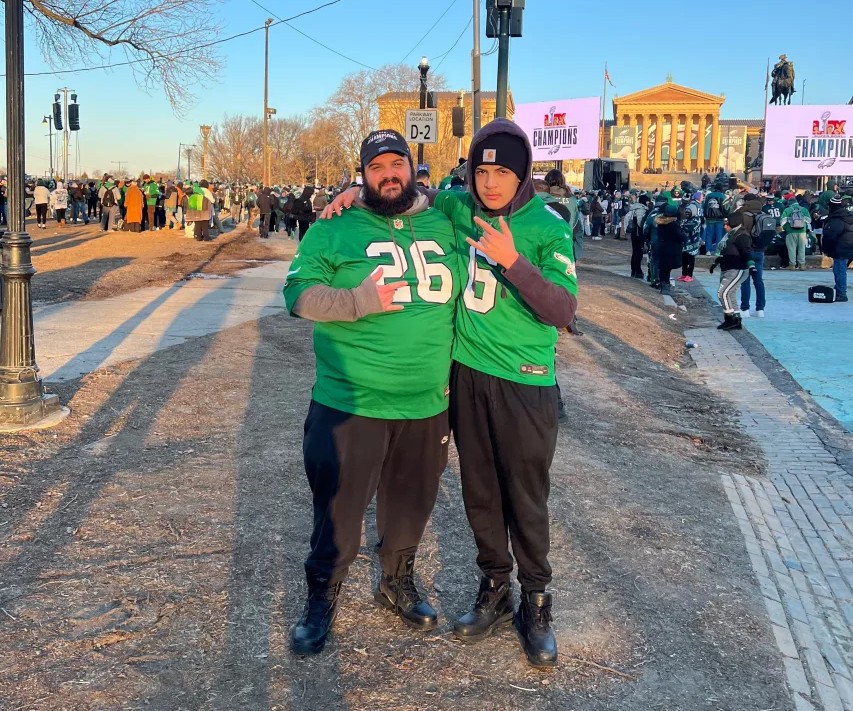
Cesar Gregory (left) and son Xzavier at the Eagles Super Bowl parade near the Art Museum in February. It is a day with his son that the father said he will never forget.
Xzavier was the oldest of three children. His sisters are still too young too fully understand what happened, the parents said.
“He went to heaven,” Javier told 7-year-old Kennedy.
The number of kids shot peaked in 2021 and 2022, when violence citywide reached record highs and guns became the leading cause of death among American children. So far this year, 105 kids under 18 have been shot — a sharp drop from three years ago, but still higher than pre-pandemic levels, according to city data.
Xzavier is one of at least 11 children killed by gunfire this year.
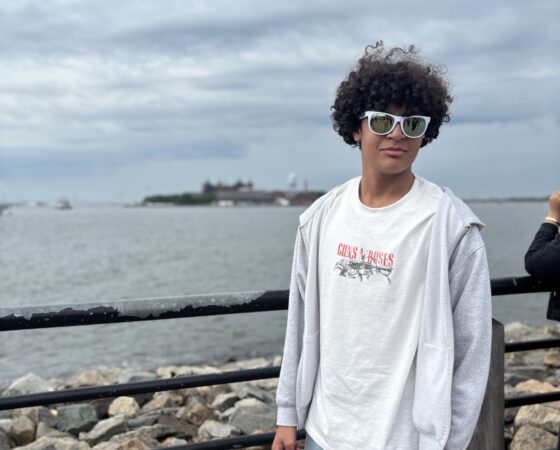
Xzavier Gregory (center) was a goofy teen who attended Northeast High School, his parents said.
Javier and Gregory said some relatives are considering leaving Philadelphia, shaken by Xzavier’s killing and a feeling that teens don’t fear consequences.
But the parents said they will stay. They want to be near Magnolia Cemetery, where Xzavier is buried, and to feel closer to the memories that briefly unite them with him.
On harder days, they said, they go into his bedroom, which is just as he left it, a relic of a teenage boy.
His PlayStation controller sits in the middle of his bed, and a photo of him and his mother hangs on the wall above it. His Nike sneakers are scattered. His black backpack rests on the floor, and a Spider-Man mask sits on the corner of his bedframe.
On Thursday, his parents stood in the room they used to complain was too messy, that smelled like dirty laundry.
“Now, I come in just to smell it,” Javier said.
She took a deep breath.
Staff writer Dylan Purcell contributed to this article.
It’s the goal-line stand that will have everyone talking, and rightly so, since it was the sort of set of plays from which hard-nosed, November NFC football is made.
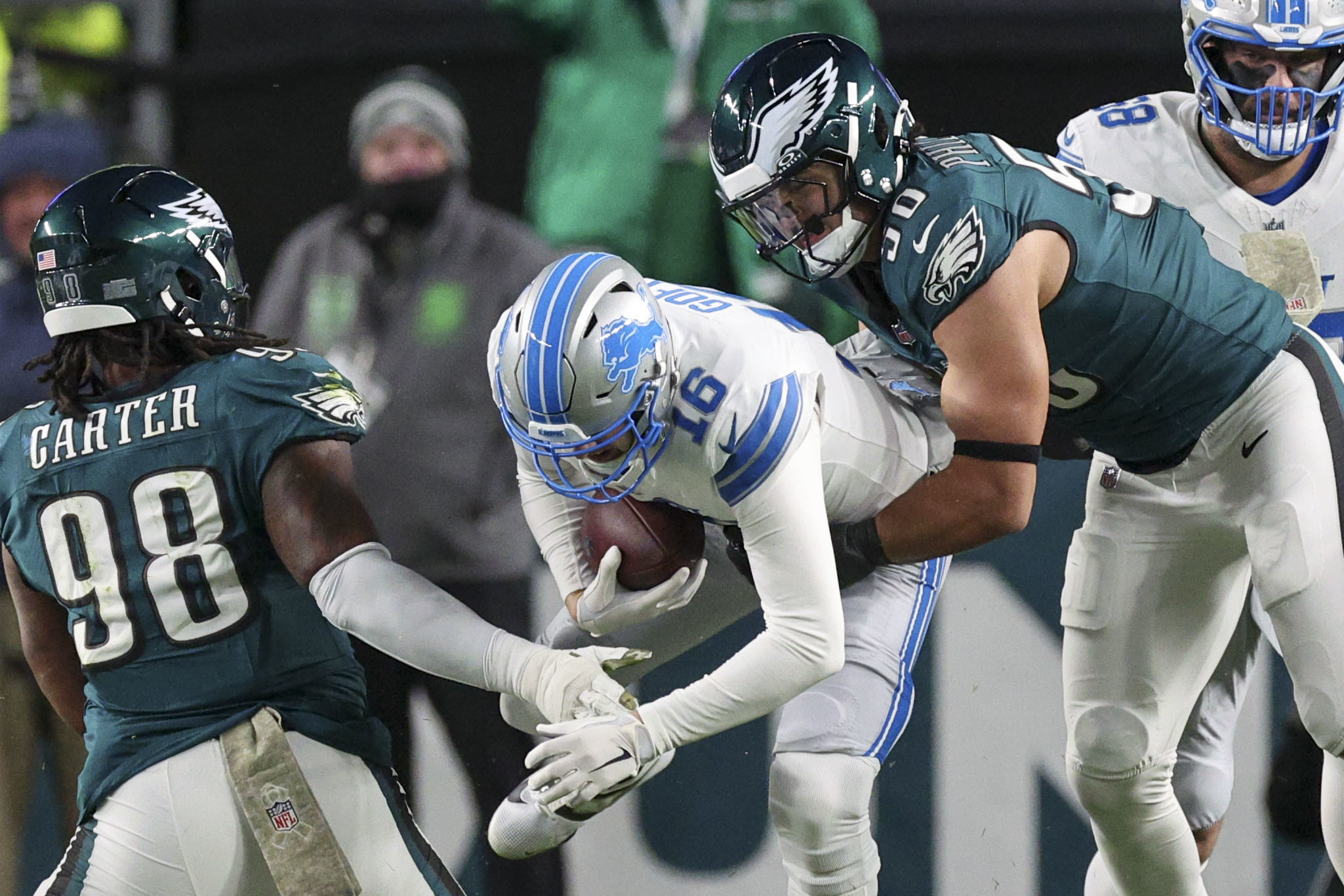
The Lions had the ball, second-and-goal from the 6, trailing by seven points, late third quarter. Safety Reed Blankenship hit Jahmyr Gibbs on first down for just 2 yards. Defensive tackle Jalen Carter limited Gibbs to 1 yard on the next play. Deadline addition Jaelan Phillips pressured Jared Goff and forced an incompletion on fourth down.
The Lions never got inside the 29-yard line again.
Because that Eagles defense, which led them to a Super Bowl win nine months ago, suddenly, again, is elite.
“The defense is [bleeping] balling right now,” said grateful offensive tackle Jordan Mailata.
But, elite?
Nakobe Dean, who shined all night, paused and considered.
“We gotta continue to get better,” he said.
They’d just held the Packers to seven at Lambeau Field, then allowed the NFC’s highest-scoring offense its fewest points in 16 games, counting playoffs. The Eagles travel to Dallas on Sunday, where the Cowboys are shaking in their boots.
Really, how much better can the Eagles’ defense get?
After a virtuoso performance in Game 9 last Monday night at Green Bay, the defense — constructed by general manager Howie Roseman and coordinated by Vic Fangio — delivered a tour de force six nights later. Zones and man, blitzes and stunts, batted passes and sacks and so much more.
Most important: Sixteen points surrendered against two very good quarterbacks who play for playoff-likely teams that are above .500.
Linebacker Jihaad Campbell (left) celebrates with Adoree’ Jackson after the cornerback broke up a pass in the fourth quarter.
“You saw those guys, all those guys, out there making plays,” said quarterback Jalen Hurts, appreciatively.
Phillips, Carter, and Dean featured all night. Among them, only Carter had featured before Game 5, since Dean was hurt and Phillips was in Miami, and frankly, Carter didn’t feature much, since he wasn’t in shape until Game 6.
Sunday marked the first game that the Eagles defense played as it originally was comprised. Thanks to Roseman, it also featured reinforcements.
For the first time this season both Dean, the middle linebacker, and defensive end Nolan Smith started without snap-count limitations; Smith had been hurt, too.
“Holy [bleep],” Mailata said. “Them coming back — game-changer. Really a game-changer.
They were joined by Philips, a pricey trade-deadline pass rusher who’d debuted brilliantly Monday night in Green Bay, and by old friend Brandon Graham, who’d unretired four weeks earlier and also had played his first game as a 2025 Eagle in Green Bay.
Not coincidentally, the Eagles surrendered just seven points to the Packers, their stingiest performance of the season … by 10 points. The seven-point allowance was 17 fewer than the Packers’ average, which ranked 14th.
Eagles linebacker Jalyx Hunt goes after Detroit Lions quarterback Jared Goff in the fourth quarter at Lincoln Financial Field.
The Lions averaged 31.4 points entering Sunday night, second-best in the league. They scored 22 fewer than they averaged.
The Lions entered with a pedestrian 37.5% third-down conversion rate, but ranked fourth in fourth-down conversions at 72.2%.
They converted 3 of 13 third downs, or 23%.
They converted zero of 5 fourth downs, or, yep, 0%.
“Those are turnovers in our mind,” coach Nick Sirianni said. “Five-for-five, the way we look at it.”
How?
Playmakers all over Lincoln Financial Field, wearing the midnight green.
First series: Dean covered the running back out of the backfield, Jordan Davis pushed the pocket and deflected the pass, and Cooper DeJean intercepted it. That led to a field goal.
Second series: Phillips sacked Goff, which led to a punt.
Third series: Carter dropped David Montgomery for a 2-yard gain on third down, which led to a punt.
Eagles edge rusher Jaelan Phillips sacks Lions quarterback Jared Goff as Jalen Carter moves in.
Fourth series: On fourth-and-1, Moro Ojomo grabbed Gibbs low, Carter hit him high, and they stoned him at the line of scrimmage.
Fifth series: Dean hit Goff on third down, which forced an incompletion that forced fourth down, and the Lions tried a fake punt and failed.
This metaphorical Epstein Island — people sending, or featured in, the emails of the late disgraced financier and sex fiend Jeffrey Epstein, released last week by a House committee — is kind of like TV’s Gilligan’s Island … if everyone had a truckload more money than Thurston Howell III, and was also a lot dumber.
Last week’s stunning document dump by the House Oversight Committee of Epstein’s emails, mostly from the 2010s, among 20,000 pages from his estate, can and should be viewed through several prisms. The main media focus has understandably beenon his leering close friend in the 1990s and 2000s, now-President Donald Trump, who is mentioned many times over. There’s arguably no “smoking gun” directly linking Trump to any specific act of sexual misconduct in Epstein’s lurid world, but more than enough innuendo that POTUS 45 and 47 “knew about the girls,” and possibly much more, to fuel a Watergate-level frenzy.
I don’t know if the emails, so far, are enough to take down Trump, but the president should be even more worried — and he probably is — about the much deeper rot that’s already been laid bare about the entire decrepit class of men (because they’re almost all men) who rule the world with atrocious grammar amid a nonstop booty call.
The QAnon folks were almost there! These emails prove there really is a global cabal of the world’s most powerful and wealthy elites, linked to the most repulsive child sex trafficking operation we know about. No, it doesn’t involve pizzeria basements or blood-drinking rituals — at least as far as we know so far. But these missives do reveal the evil banality of the world’s most rich and famous, whose vast pursuit of money or teenaged blondes or whatever knew no bounds, or, at long last, any sense of decency.
This is cool. COURIER has created a searchable database with all 20,000 of the files just released from Epstein’s estate.
Trump's name appears in them more than anyone else, in 1,628 documents.https://t.co/EAqRoi5zN2
The Nation’s Jeet Heer nailed it when he wrote after the email dump that the Epstein scandal “has always been a scandal about the ruling class as a whole, not one individual or political party,” adding that “Epstein trafficked not just in the bodies of the children he abused but also in social connections that could bring elites together.”
And ignorance is no defense. By the 2000s, the murky but wildly rich financier’s predilection for underage girls was hardly a secret. In 2008, in a sweetheart deal, he pleaded guilty in Florida to a charge of procuring a 17-year-old girl for prostitution, but prosecutors had evidence linking him to about three dozen other girls, including some as young as 13. And yet, most of the emails from powerful people released by the committee came after those revelations, up through his 2019 second indictment and his death in a federal jail in Manhattan under mysterious circumstances.
Some of the most telling exchanges are not the more than 1,000 emails from Epstein, his convicted partner-in-crime Ghislaine Maxwell, or their pals that mention Trump (who, wisely for him, never learned to use email), but involve Epstein’s misogyny-soaked friendship with Larry Summers, the former U.S. Treasury secretary and Harvard president.
Summers had lost that plum Ivy League post in 2006, in good measure because of a speech in which he’d questioned the intellect of top female scientists. During the 2010s, when the Obama administration or cable TV wasn’t still treating him as an economic seer, the married Summers turned to this convicted sex trafficker for advice on how to hit on a younger, attractive protégée, or just to commiserate.
“I’m trying to figure why [the] American elite think if u murder your baby by beating and abandonment it must be irrelevant to your admission to Harvard,” Summers wrote Epstein in 2017, referring to this episode at the school. “But hit on a few women 10 years ago and can’t work at a network or think tank. DO NOT REPEAT THIS INSIGHT.”
Larry Summers, president emeritus and professor at Harvard University, during a panel session at the World Economic Forum in Davos, Switzerland, in January 2023.
You may remember that 2017, the first year of Trump’s first presidency, is when the #MeToo movement against male sexual harassment and misconduct exploded. That email from Summers is one of the very few that even alludes to the social upheavals of the tumultuous 2010s that also included Occupy Wall Street, the tea party, Black Lives Matter, and other movements targeting privilege and inequity. Most of this prattle is instead just rich dudes talking about how to get themselves richer … or just how to get off.
Still, as Heer captures in his analysis for the Nation, the thought-to-be-secret communications of the elites increasingly involved enhanced security for the 1 Percent and ways to silence protests as that decade devolved, including scheming with the former Israeli prime minister, Ehud Barak, about launching a cybersecurity start-up. The world’s shrewdest investors knew the pitchfork bubble was coming before you did.
In the six years since Epstein was found dead, however, it has been the political backlash his email correspondents, like the Silicon Valley billionaire Peter Thiel, have heavily funded that has advanced while warding off the revolution. This was the ultimate goal of this sordid chat group: to desperately cling to their dying hierarchies around patriarchy and white supremacy, and to portray the #MeToo movement as going too far, when it’s obvious it didn’t go nearly far enough. It was during those fraught years that they stumbled into the perfect avatar in the unlikely Trump presidency.
Now, it’s a headline that Trump “knew about the girls,” but, of course, he knew about the girls. They all knew about the girls, and every Thiel and Summers and the con artist formerly known as Prince Andrew knew they’d bought more security with a U.S. president who shared their “wonderful secret.”
🚨 HAPPENING NOW: Massive anti-Trump protest outside the White House as protesters demand the resignation of President Trump following the release of Epstein emails. pic.twitter.com/7b55gvvEtx
It starts to make sense that Team Trump even deployed the White House Situation Room to fight a congressional vote for a wider release of the Epstein files, as if these secrets were a nuclear bomb headed for Chicago. To be sure, this all-out war against disclosure — along with Trump’s bizarre order for the U.S. Department of Justice to investigate only Democrats mentioned in the letters — might be to hide that Trump did more with Epstein’s bevy of young girls than just “know about” them.
But on some level, Trump’s White House must also realize that the Epstein file is the Jenga piece that brings the whole thing crashing down — the end of America, or, more to the point, the version of America getting financially drained, sexually abused, and basically ruined by all the people getting emails from jeevacation@gmail.com.
The timing couldn’t be better, or worse, for this midnight of the elites. The overblown stock market fueled by an AI hallucination is set to burst any moment, and new hiring is already grinding to a halt — just as the price of everything from steak to coffee goes through the roof, and health insurance is doubling or tripling for millions of Americans. When this perfect storm strikes, an electoral bloodbath in the 2026 midterms is the best outcome Trump can hope for, on a list of dire possibilities.
It’s no coincidence Trump is accelerating the pace of dictatorship, not because he’s at the peak of power, but because he knows he’s running out of time. Thus, the wag-the-dog war drums off Venezuela are pounding louder, and the muck of naked corruption — from Swiss gold bars to real estate deals with the murderous Saudi prince — is getting filthier. All of it haunted by the ghost of Jeffrey Epstein.
There’s one other thing about the Epstein files I feel compelled to mention. I’m also in them — well, sort of. On Feb. 12, 2019, for reasons we’ll never know, Epstein emailed his ethically conflicted journalist pal Michael Wolff a column I’d just written, with the words “please note.”
The piece was tied to the recent arrest of another close friend, the New England Patriots owner Robert Kraft, for soliciting sex in strip mall massage parlors near Palm Beach, and the moral decay of Kraft and his Florida neighbors, Trump and Epstein. It came at a moment when Epstein and Wolff were talking about ways to use his inside knowledge about Trump as leverage when the walls of federal prosecution were closing in. Nine months later, Epstein was dead — weird coincidence.
In that column, I wrote, “Kraft’s embarrassing charges come at one of those rarest of moments — when everyday people are suddenly realizing who doesn’t have power in America, who does, and that something can be done about this.” If Epstein did, in fact, read the piece, he knew what was coming. Now Trump knows it, too — and America will never be the same. FEEL FREE TO REPEAT THIS INSIGHT.
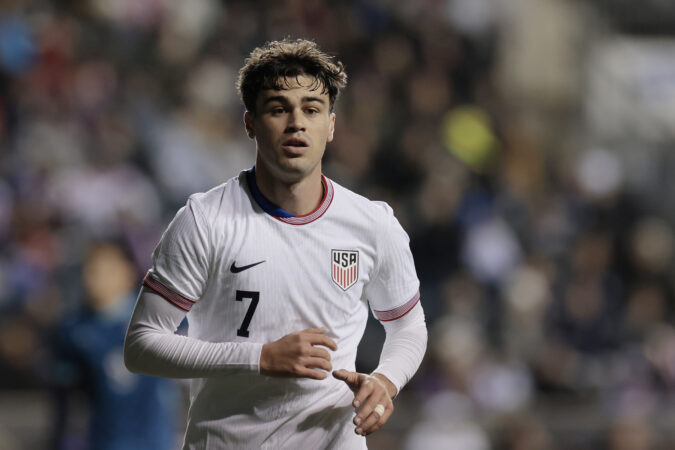
From the moment the U.S. men’s soccer team’s starting lineup was announced Saturday, all eyes were fixed on Gio Reyna.
Not only was he about to play for his country for the first time since late March, but he was starting for the first time since last year’s Copa América group stage finale — a loss to Uruguay that sent the U.S. out in the group stage on home soil, and sent manager Gregg Berhalter out of his job.
Reyna, 23, didn’t make any of Mauricio Pochettino’s squads until the Nations League final four in March because of a groin injury. Then he didn’t play in the semifinal loss to Panama, and was an ineffective second-half substitute in the third-place game loss to Canada.
For all Reyna’s talents — and he has perhaps the most natural talent of any U.S. player besides Christian Pulisic — Pochettino declared him not “ready to play in the way that we expect from him” on the eve of the third-place game.
Gio Reyna hadn’t been with the U.S. men’s soccer team since March.
That was how far he had fallen, in terms of fitness, form, and playing time at his club, Germany’s Borussia Dortmund.
Nor was he done falling. Reyna went to the Club World Cup with Dortmund instead of the Gold Cup and the friendlies before it, because Dortmund wanted him at their games and Pochettino didn’t want players at the friendlies whom he wouldn’t have afterward.
Would that be salvation? No, it was almost the opposite. Reyna got off the bench only once in Dortmund’s five tournament games, a mostly useless 12-minute cameo in the group stage finale.
Only after that did he finally leave for newer pastures, a move many outsiders had hoped to see for years. Borussia Mönchengladbach bought him for about $4.5 million up front and $3 million in incentives. It was miles below what Dortmund expected when a 17-year-old Reyna made his first-team debut in early 2020.
Gio Reyna watched almost all of Borussia Dortmund’s Club World Cup run this summer from the bench, finally leaving the club afterward.
It was to be a fresh start, but it barely started before Reyna suffered the latest of seemingly countless muscle injuries in September. He returned to action in mid-October, but only as a substitute.
So it was a pretty big surprise when Pochettino called him up to the national team this month. But over the course of the week in Chester, it felt increasingly inevitable that he would start Saturday against Paraguay at Subaru Park.
It was a broken play out of a corner kick, the ball pinging around off all manner of limbs on both teams. Eventually, it fell to Max Arfsten, and he chipped a cross into the crowd. Reyna rose highest and met it with a header that caromed in off the crossbar.
As the crowd roared, Reyna ran toward the corner flag, pointing to the U.S. badge on his jersey. Within seconds, his teammates had swarmed him to celebrate.
“I know the kind of player he is, and I’m just really happy for him — he deserves it,” said Medford’s Brenden Aaronson, who started with Reyna in the attacking midfield spots. “He’s been through a lot with injuries, with all this stuff. But whenever he plays for the national team, he’s always there, and it’s awesome to see. … He’s confident in his ability, he knows what he can do, and that’s the beauty of him.”
There wasn’t time in the moment to point out that Reyna has not in fact always been “there” when with the national team. That was the whole point of the 2022 World Cup scandal that nearly torpedoed him.
When that goal went in, though, it was a moment for his immense burden of history to be a privilege, not a weight. The tally was his ninth for the U.S., passing his legendary father Claudio’s eight.
Gio Reyna (left) celebrates with Brenden Aaronson (center) and other teammates after scoring the game’s opening goal.
And for once, Claudio wasn’t invoked because of that scandal, or all the times Claudio interfered with U.S. Soccer officials before then, or yelled at referees from the sidelines in Gio’s youth days, or by genetics passed his ego on to his son.
By the time Gio emerged from the locker room to meet one of the biggest media packs at a U.S. game in quite a while, he had already texted with his father.
“It was just fun, love,” Gio said. “He was obviously happy for me that I passed him, but I had no idea. So he was more making fun of me for the fact that it was my first header I’ve ever scored.”
The pressure on him is earned
The negative side of the burden struck twice after that. On Paraguay’s 10th-minute equalizer, Reyna was late and slow to challenge Junior Alonso before he launched the long ball that sprung Miguel Almirón for a dazzling assist on Alex Arce’s goal.
The scale tilted back his way in the 71st. Reyna combined superbly with Folarin Balogun to create the winning goal. The man of the hour had delivered again, and the U.S. went on to close out a 2-1 win.
“I think in the end, performances like this that can help everybody here,” Reyna said. “But I want to have, more importantly, seven or eight good months in the rest of the season with Gladbach. And then I believe if I keep performing like I did tonight, then I’ll have a good chance to make the team and have an impact there, too.”
Folarin Balogun's third goal in his last four USMNT games restores the lead 🫡 pic.twitter.com/fe85pV30M2
There’s still a ways to go, and as Pochettino said, plenty for Reyna to do to earn a seat on the plane next summer. But in a moment when he was asked to step up, he did, and in national team soccer there are never many moments. So when you get one, you have to take it.
“He showed why he started, and yes, confirmed that he’s a player that needs to improve because he needs to play more in his club,” Pochettino said. “But we can see today that he was great: scored and assisted. And the way that [he has] always the capacity to read the game, and find the free space in between the lines, I think that was a nightmare for Paraguay, and I think he did a very good job.”
Reyna thanked Pochettino in turn, with some notable humility.
“I knew it was an opportunity for me to to show that I belong here,” he said. “He’s been great with me all week, working with him, and just trying to give me the freedom and the confidence to sort of be myself. So I can’t thank him enough, obviously, for the start and just for the relationship that we’ve really built this camp.”
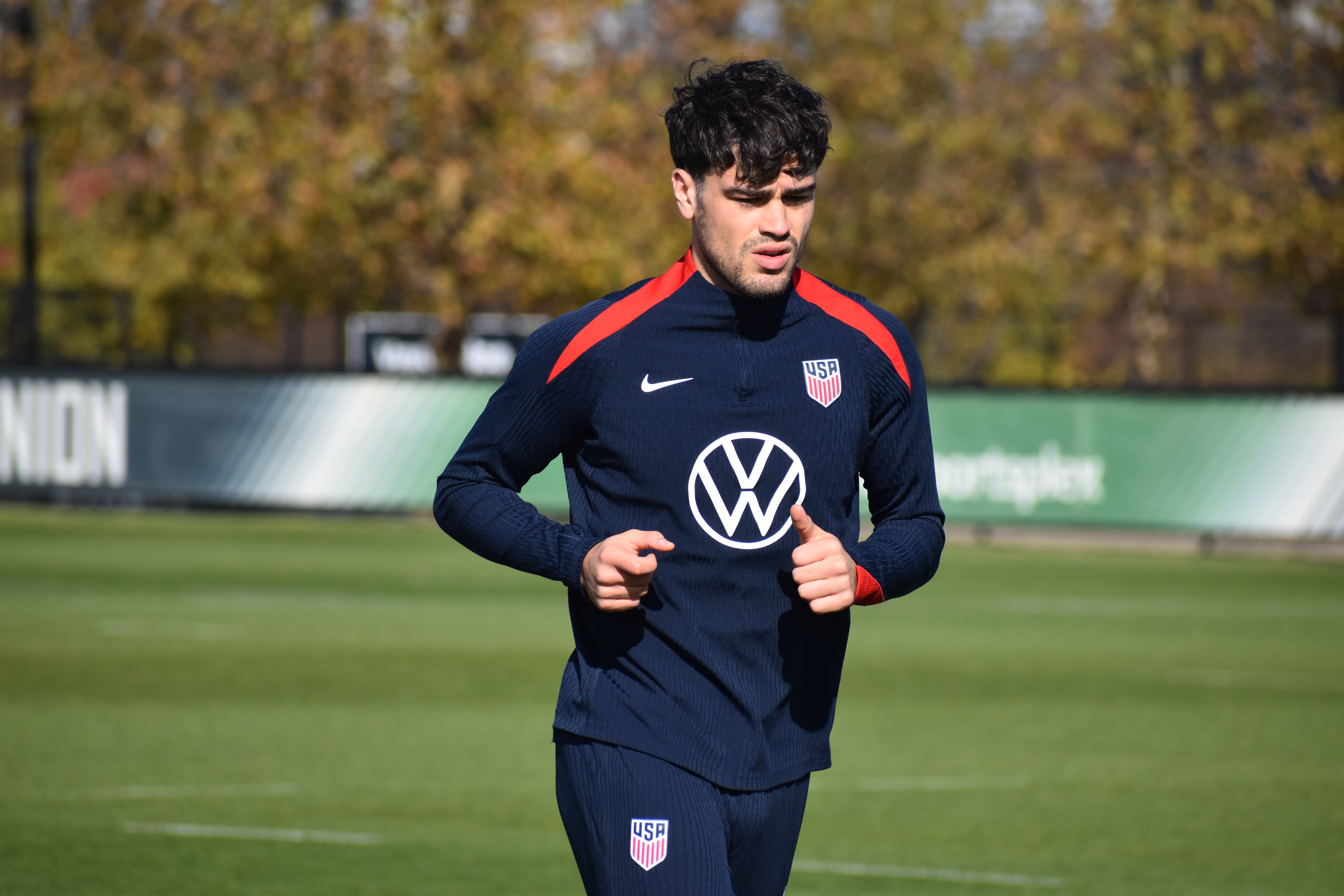
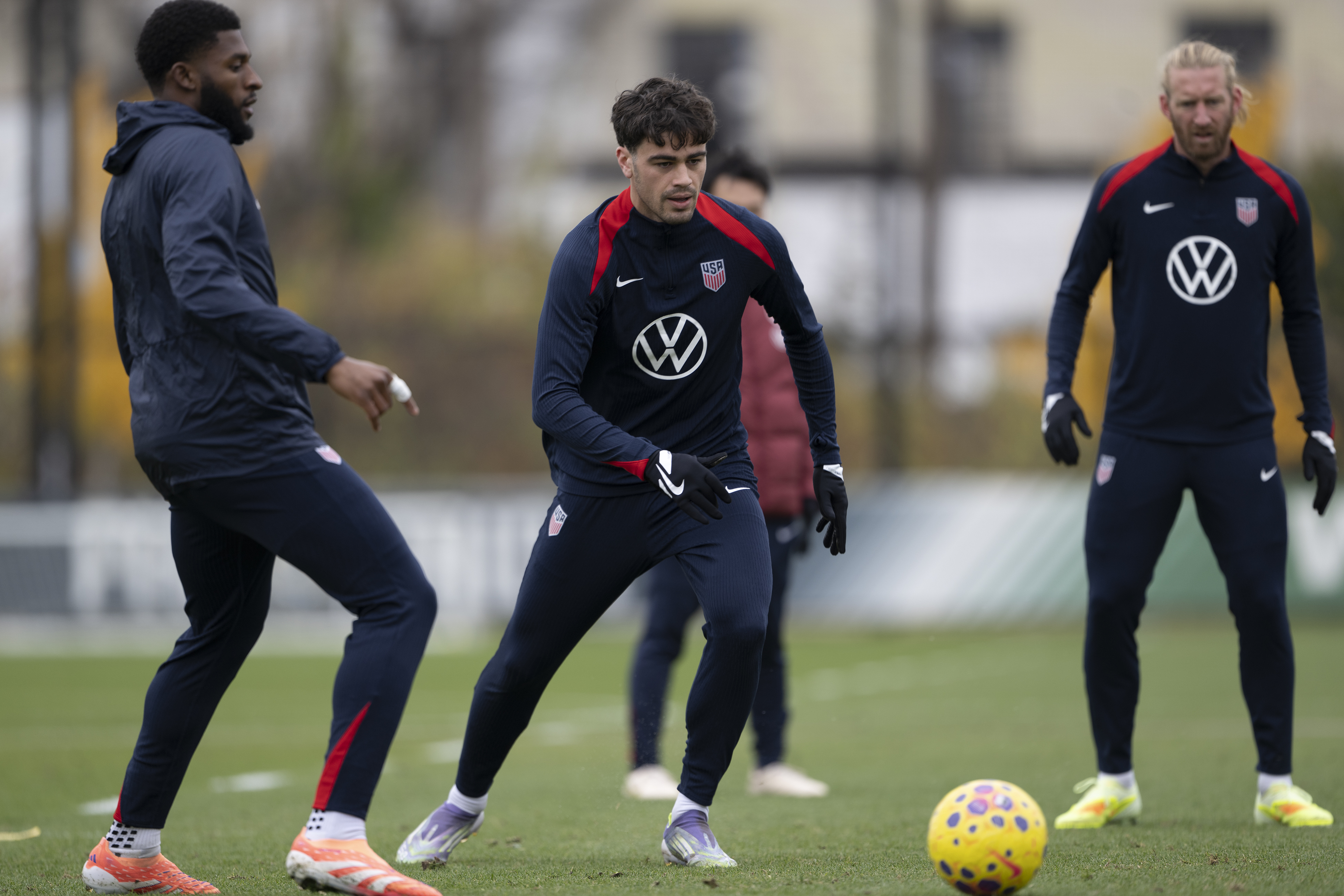
Gio Reyna (center) working in practice during the week.
The stakes only get higher from here, and so does the quality of opponent the U.S. will face. After meeting Uruguay on Tuesday in Tampa, Fla. (7 p.m., TNT, Universo), to close out this month, it’s expected that March’s games will see big-time opponents from Europe. Portugal, France, and Belgium are reportedly on the radar, with Atlanta’s Mercedes-Benz Stadium set as a fittingly big-time venue.
Time will tell if Reyna earns the right to be there. For now, he’s only in the race. But that alone is the best place he’s been in for a long time.
First they were roommates, and then they were friends. But after Jessica Yang and Nicole DeNardo couldn’t agree on who should keep Gary — the exotic shorthair that Yang bought and DeNardo had been taking care of — it took a Common Pleas Court judge to decide.
The two former roommates say they disagreed over whether Yang had given Gary to DeNardo or whether it was a temporary arrangement. In December 2024, Yang sued DeNardo to make her return the cat.
“She said I was unfit to be a pet parent,” Yang said. “She said I was childish and selfish for even wanting Gary back. She kept asking me to consider the feelings and preferences of Gary.”
Two lawyers contacted for this story say that situations like this one are on the rise, though the money spent on such a case — Yang spent $20,000, DeNardo, $5,000 — is a bit remarkable.
“People love their animals, and people are willing to spend a lot of money in legal fees to reclaim their animals,” said Rebecca Glenn-Dinwoodie, a Doylestown-based family and animal lawyer not involved in the case.
But for the two women, the fight over the small, cuddly cat with blue eyes became a catastrophe that dragged on for a year.
“She just didn’t want me to have him,” DeNardo said. “It was personal. It was about beating me.”
Nicole DeNardo at her home in Center City.
How it started
Yang, 33, purchased Gary for $1,000 when she was living in Pittsburgh in 2018. She named him after the SpongeBob SquarePants TV show character Gary the Snail.
In the spring of 2022, Yang moved from New Mexico to Philadelphia. She said that with a new contract as a nurse anesthetist, she expected to travel for work every two weeks, making a roommate situation ideal.
She and DeNardo, 31, met on a Facebook group for people seeking roommates and soon moved into an apartment together in Graduate Hospital. DeNardo, who works in finance, often worked from home, spending a lot of time with Gary.
Yang and DeNardo each said they became friends and travel buddies. They took snowboarding trips to Vermont and Colorado and hiked at Lake Havasu, Ariz.
They even got matching alien tattoos together. Yang said hers was a nod to her time living near Roswell, the UFO tourist town in New Mexico. DeNardo said the alien paired well with her tattoo of Saturn, a planet linked to her zodiac sign of Capricorn.
Yang said as the apartment’s lease was coming to an end around March 2024, she was going through a difficult time. She and her long-term boyfriend had just broken up. She had just changed jobs. And, she had just bought a house in Passyunk Square that needed extensive renovations.
That was when, as she remembers it, DeNardo offered to take the cat. “I was like, how convenient for Gary,” Yang said. “And I thought it would be good for her, too.”
That summer, Yang commissioned a portrait of Gary, surrounded by snowboards, trekking poles, and other symbols of the two women’s friendship. There were two prints, both framed, one for each of them.
A detail shot of a piece of art Jessica Yang commissioned featuring her cat, Gary, and mementos from her friendship with Nicole DeNardo. She gave a second copy of the art to DeNardo.
Going to court
Things began to go south when Yang said she learned that DeNardo had changed Gary’s last name at the vet — from Yang to DeNardo — and added her name to the cat’s microchip. DeNardo, Yang said, considered the cat hers.
It’s one of several details DeNardo remembers differently. DeNardo said the vet’s office changed the cat’s last name, not her. As for the microchip, which would help people identify Gary’s owner if he were to get lost, she said she added her name for practical reasons — she was the one who was around.
DeNardo said she was often the one who took care of Gary. She fed him, she said, and took him to the vet. She even “cleaned his eyeballs” every day — something shorthair cats often need.
“He was always in my life, always on the windowsill next to me,” DeNardo said.
She provided a timeline showing she’d spent more time with Gary than Yang. She offered lists of friends who would attest Gary was her cat — a fact many people in her lifefound mildly amusing, since her father and her brother are also both named Gary.
Jessica Yang holds her cat, Gary, at her home Sunday, Nov. 9, 2025.
DeNardo said she believes that somehow, the issue became personal after a 2023 incident where she told Yang they needed to take the cat to the vet.
“I think she viewed that more as a personal attack,” DeNardo said. “For me, this was always only about Gary’s well-being.”
After a yearlong process that involved a hearing and a bench trial, the court ruled in Yang’s favor. Yang proved she had purchased the cat, and DeNardo had to give him up.
DeNardo blames the Pennsylvania legal system, which views animals as property. “You can spend years scooping litter, cleaning his eyeballs, and the court tells you none of that matters, because pets are property,” she said.
The law
A few other states, such as New York, do define pets the way DeNardo had hoped the court would view Gary, said Daniel Howard, an associate family law attorney at Petrelli Previtera in Center City.
“Some states have pet custody statutes that look similar to what we see in child custody, looking at the welfare of the animal,” Howard said.
Howard pointed out that in September the Pennsylvania House of Representatives passed a bill that would change how pets are recognized in divorce proceedings. (The bill would have to pass the state Senate and get the governor’s approval for enactment).
However, even if this bill were to pass, it would not apply to cases where the two people aren’t married, Howard said.
Gary, an exotic shorthair, relaxes on the couch Sunday, Nov. 9, 2025.
Still, he said, attitudes are changing around the ways animals should be viewed by the courts. Laws that worked well for farm animals don’t fit as neatly for cats or dogs.
“For a lot of people, their pets really are their children,” Howard said. “And I think there needs to be some kind of an update to look at that.”
Glenn-Dinwoodie said the situation also speaks to the need for people — even if they’re just roommates, or friends — to put things in writing when they enter a living arrangement.
“Just have clear conversations, clear expectations, but also [take] that extra step so that, if ownership is ever disputed … you have enough proof. Because the court needs proof,” she said.
For Yang, the whole episode felt like a misuse of time and resources. It left her wanting to raise money for animals, “because $25,000 could save a lot of cats.”
DeNardo said the dispute showed her that doing what you think is right doesn’t always lead to the outcome you want. At her apartment, she gestured toward the window, where she said Gary spent countless hours watching the birds that would perch outside.
“He’s just a really playful, sweet, cat,” DeNardo said. ”He was my buddy… I just hope he’s OK and has all the things he needs, and is living a good life. If he’s happy, I’m happy.”
Clarification: This article has been updated to reflect DeNardo’s assertion that she took care of Gary even when Yang was home.
Talk to most nonprofit chief executives, and they’ll be able, on cue, to recite a heartwarming story about someone their organizations helped.
And the Rev. Luis Cortés Jr., Esperanza’s founder and chief executive, can do it, too.
But he’d rather talk about a sin he committed as a little boy — a sin that impacted his thinking for a lifetime and allowed him to understand how to build a $111.6 million organization with 800 employees that educates, develops, uplifts, and houses 35,000 people a year in the heart of North Philadelphia’s predominantly Hispanic Hunting Park neighborhood.
When Cortés was 12, he stole a Snickers candy bar from the bodega his father owned in New York City’s Spanish Harlem.
Oh, his father figured it out, and quickly, too, because he began to ask little Luis some important questions:
Did the 12-year-old know how many Snickers bars the bodega would have to sell to break even — not only on the box of Snickers, but on the taxes and utilities for the entire store? More importantly, how many Snickers bars would be required to turn a profit — a profit that could be reinvested?
“You need to understand finance, whether it’s a box of Snickers or a multimillion-dollar bond to build a school. Where is the money coming from, and what’s the repayment structure?” Cortés said.
Outside, as he spoke, a crane moved materials in what will soon become a new culinary school.
“Understanding finance is important, and understanding culture is important, and you have to understand the relationship between the two.”
So, yes, Cortés can and did tell the story about the mother who came to Esperanza to learn English skills, who got help to get a job and a house, who sent her daughter to Esperanza’s charter school and to Esperanza’s college, and now that same daughter is getting a house thanks to Esperanza’s mortgage counseling help.
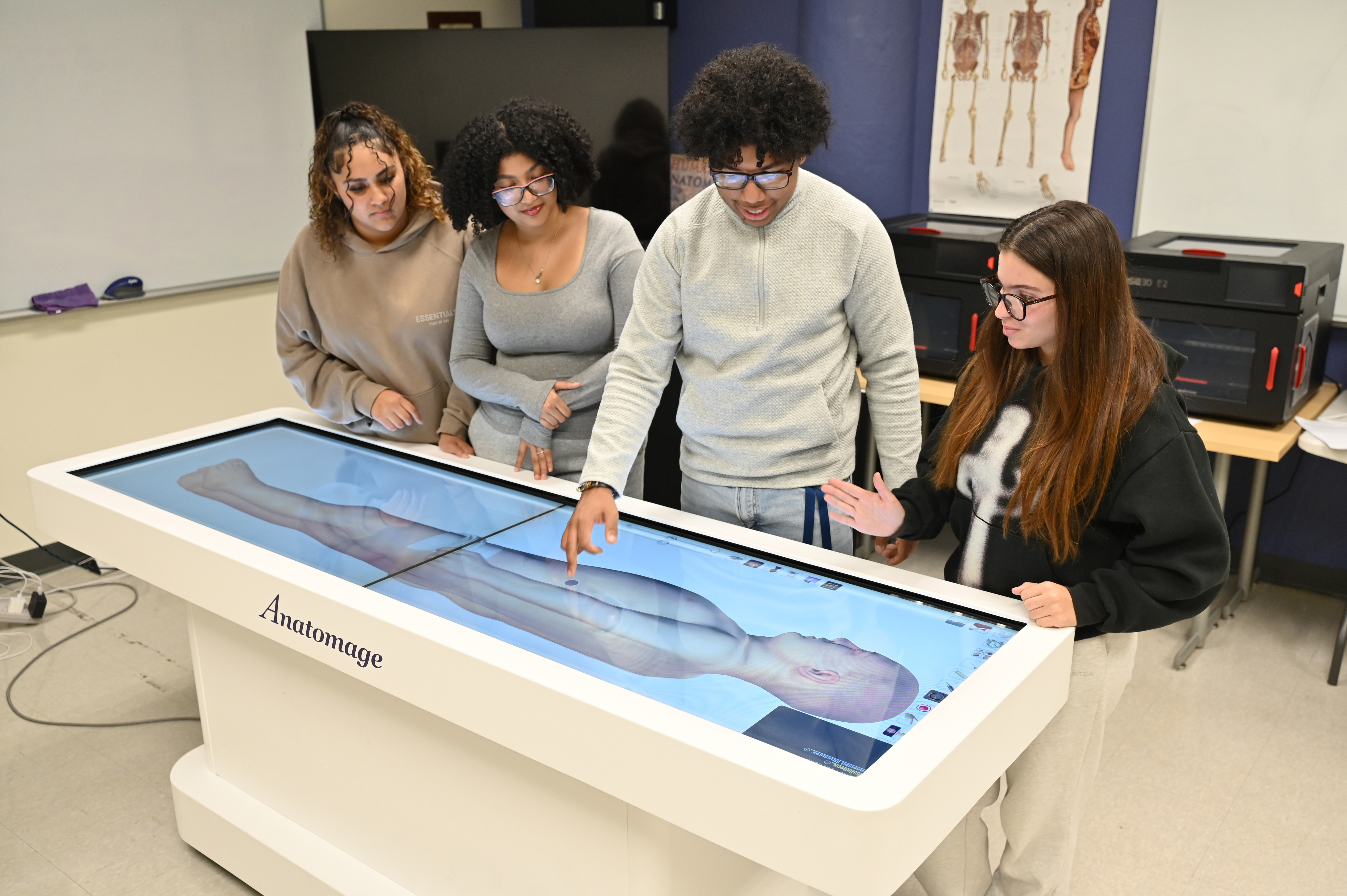
Students Jayliani Casioano, Oryulie Andujar, Derek Medina, and Natalia Kukulski use an interactve anatomy table. The students are members of is the Health Occupations Students of America (HOSA).
All good. But this is what Cortés really wants people to know:
“If people trust us with their funds,” he said, “we’re putting the money into institutions, and institutions build culture.”
That’s why Esperanza has a K-12 charter school, a cyber school, a two-year college that’s a branch campus of Eastern University, a 320-seat theater, an art gallery, computer labs, an immigration law practice, a neighborhood revitalization office, a CareerLink office for workforce development and job placement, a music program, a youth leadership institute, housing and benefit assistance, and a state-of-the-art broadcasting facility.
Cortés even likes to brag about the basketball court. “Three inches of concrete, maple wood flooring, fiberglass backboards — NBA standards.”
“Think about Paoli. It has a hospital, a public school, a theater. Paoli has all of that, and it’s understood that that’s the quality of life. We have to have access to those same things at a different price point,” he said. “Notice I didn’t say different quality. I said different price point.
“We want to create an opportunity community, where people can have a good life — with arts, housing, healthcare, financial literacy, education, all those pieces — regardless of your family income,” he said.
“What’s important here and what’s different is that in all our places, all our facilities are first class,” Cortés said.
“I grew up in a low-income community where people were always telling you to step up, but step up to what?” he asked. “Where is the vision? What is possible to even have? How can anyone know unless they can see it?”
So, when people from the community visit Esperanza, “you can see that you can have the best facilities with state-of-the-art equipment. As a provider of services, we have to step up,” he said, in turn always giving people the tools and resources they need to step up.
For example, on Citizenship Day, Sept. 20, Anu Thomas, an attorney and executive director of Esperanza’s Immigration Legal Services, trained a dozen volunteer lawyers and law students on the fine points and recent pitfalls in the process of applying for citizenship.
Soon, the room was crowded with people coming for help.
Watching from the sidelines was Charlie Ellison, executive director of the city’s Office of Immigrant Affairs, who noted that an estimated 60,000 legal residents of Philadelphia are eligible to apply for citizenship.
“Clinics like these are critically important to helping people who might be facing barriers,” including the cost of getting legal help. “This bridges a lot of gaps. It’s a vital mission, now more than ever,” he said.
For Neury “Tito” Caba, a men’s fashion designer, tailor, and director of green space at Historic Fair Hill, citizenship help from Esperanza was a family affair. Through Esperanza, he, his grandmother, and his mother all became citizens.
“Now I can vote, and that’s the most positive thing I can do,” he said. “And also, things being the way they are, it gives me some sort of protection.”
Fashion designer Neury “Tito” Caba talks about his citizenship experience at Esperanza.
Earlier this fall at Esperanza’s CareerLink branch, counselor Sylvia Carabillo helped Luis Rubio on the computer. He was trying to extend his unemployment benefits and looking for a job as a security guard. Agueda Mojica was being tutored in Esperanza’s most popular workforce class: Introduction to Computers.
“I want to become more independent to be able to do anything on a computer,” she said in Spanish, speaking through a translator. “I was always working and never had time to learn.”
Much of Esperanza’s staff is bilingual in Spanish, but to help people from the neighborhood, Esperanza also hired counselors who speak Ukrainian and Kreyòl for Haitians who live nearby.
In Esperanza College classrooms a few weeks ago, Esperanza Academy high schoolers enrolled as college students had just finished a chemistry exam. When they graduate from high school, they’ll already have associate degrees on their résumés.
For them, Esperanza represents a future.
There’s Oryulie Andujar, 18, who wants to study sonography because an ultrasound technician found a cyst in her mother’s uterus. “We could have lost her. That was very impactful for me.”
Jayliani Casiano, 17, wants to go into anesthesiology. The oldest of seven, she witnessed her mother giving birth to several younger siblings. “She was in a lot of pain. It was interesting. I want to do everything after seeing her through that process.”
Derek Medina, 18, said the opportunity to go to college “made me rethink my whole life.” He had been getting into trouble in school, but now wants to combine a love of mathematics and a desire to help people by going into the field of biomedical engineering.
Recently, on Nov. 14, Esperanza College hosted its Ninth Annual Minorities in Health Sciences Symposium, designed to acquaint high schoolers with medical careers.
Construction will soon begin to convert a former warehouse space into a center to teach welding and HVAC in an apprenticeship program.
Next month, it’ll be time for “Christmas En El Barrio” with music, food, and community in Teatro Esperanza — admission is free. In January, the Philadelphia Ballet will perform there. Tickets are $15 and free for senior citizens and students.
“My worst seat — in Row 13 — would be $250 at the Academy of Music,” Cortés said. He wants to offer the arts at a price and a time available to a mother of three, who may not be able to afford even the cheapest seats in downtown venues, plus bus fare, “and heaven forbid the child wants a soda,” Cortés said.
All this adds up to culture, which brings him back to the Snickers bar, and not just breaking even, but investing.
Other groups, Cortés said, had to build their own institutions when mainstream organizations put up barriers. Howard University helped Black people, Brandeis served Jewish people, and Notre Dame provided education to the Irish.
Building an institution is his investment goal with Esperanza, and he takes as his mentors famous Philadelphia pastors such as the Rev. Leon Sullivan, who founded Progress Plaza in North Philadelphia, and the Rev. Russell Conwell, the Baptist minister who founded Temple University.
“Philadelphia has a tradition that its clergy don’t just do clergy things,” he said, admitting that he doesn’t have the patience for a more traditional pastor’s role. “As clergy here, it’s understood that we snoop around everything.”
Cities sometimes brag that their poverty rates have declined, he said, when in reality, rates have declined because people with low incomes were forced to move away.
Philadelphia, he said, has a chance to be different — to lower the poverty level both by raising people’s incomes and improving their standards of living. “There should be Esperanzas in every neighborhood,” he said.
“How can we focus on helping the people who just need a break?” Cortés said, referencing Jesus’ admonishment to “help the least of these.”
“This city has the opportunity to make this a win-win,” he said, “to show the rest of the country and Washington, D.C. — especially Washington, D.C. — that people who are different, and people who are `the other’ can be supported, so that they are not only part of the fabric of the city, but economic drivers of the city.”
This article is part of a series about Philly Gives — a community fund to support nonprofits through end-of-year giving. To learn more about Philly Gives, including how to donate, visit phillygives.org.
For more information about Philly Gives, including how to donate, visit phillygives.org.
AboutEsperanza
People Served: 35,000
Annual Spending: $111.6 million across all divisions
Point of Pride: Esperanza empowers clients to transform their lives and their community through a diverse array of programs, including K-14 education, job training and placement, neighborhood revitalization and greening, housing and financial counseling, immigration legal services, arts programming, and more.
You Can Help: Esperanza welcomes volunteers for community cleanups, plantings, and other neighborhood events. Some programs also need volunteers with specific skills (lawyers, translators, etc.).
$25 covers the cost of one private music lesson for a young student through our Artístas y Músicos Latinoamericanos program.
$50 provides printing and distribution of 30 “Know Your Rights” brochures to immigrant families.
$100 pays for five hours of training for a new mentor fellow at the Esperanza Arts Center, preparing a young person for a career in arts production through hands-on learning.
$275 funds the planting of one street tree in a neighborhood that desperately needs additional tree cover to address extreme heat.
$350 covers tuition and books for one English as a second language student at the Esperanza English Institute.
$550 supports the cost of the initial work authorization for an asylum-seeker.
For the Nowell family, the outlets are an annual tradition.
Every Veterans Day, a dozen relatives venture to Limerick Township in Montgomery County, where they kick off their holiday shopping at the Philadelphia Premium Outlets.
Even this year, as bitter winds whipped through the outdoor plaza, the family was undeterred.
After a morning of shopping, the multigenerational group, which included two veterans, warmed up with their yearly food-court lunch, courtesy of matriarch Geri Nowell, 77, of Telford. Then, the men returned to the cars and dropped off dozens of shopping bags, which they’d been carting around in a wagon. The women walked on, hunting for their next find among the more than 130 shops.
The Nowell family poses in front of a holiday backdrop during their annual outing to the Philadelphia Premium Outlets.
“It’s super fun,” said Ann Blaney, 47, of Drexel Hill.
“We get great deals,” added Kim Woodman, 55, of Hatboro.
The tradition is an experience they say can’t be replicated online. The fact that the complex is open-air and contained in a 550,000-square-foot plaza somehow adds to the fun, they said.
As Kathy Nelson, 48, of Broomall, browsed the outlets with her friends, she said she also shops at the nearly 3 million-square-foot King of Prussia Mall, less than 20 miles away. But otherwise, she said, “there aren’t many indoor malls left” with the variety of stores she prefers.
Outlets have always accounted for a fraction of the in-person retail market, which is partly why there have been few headlines about dying outlet malls. But some of the country’s roughly 200 outlet malls seem to be downright thriving, with full parking lots on weekends, few vacant stores, and relatively strong revenue.
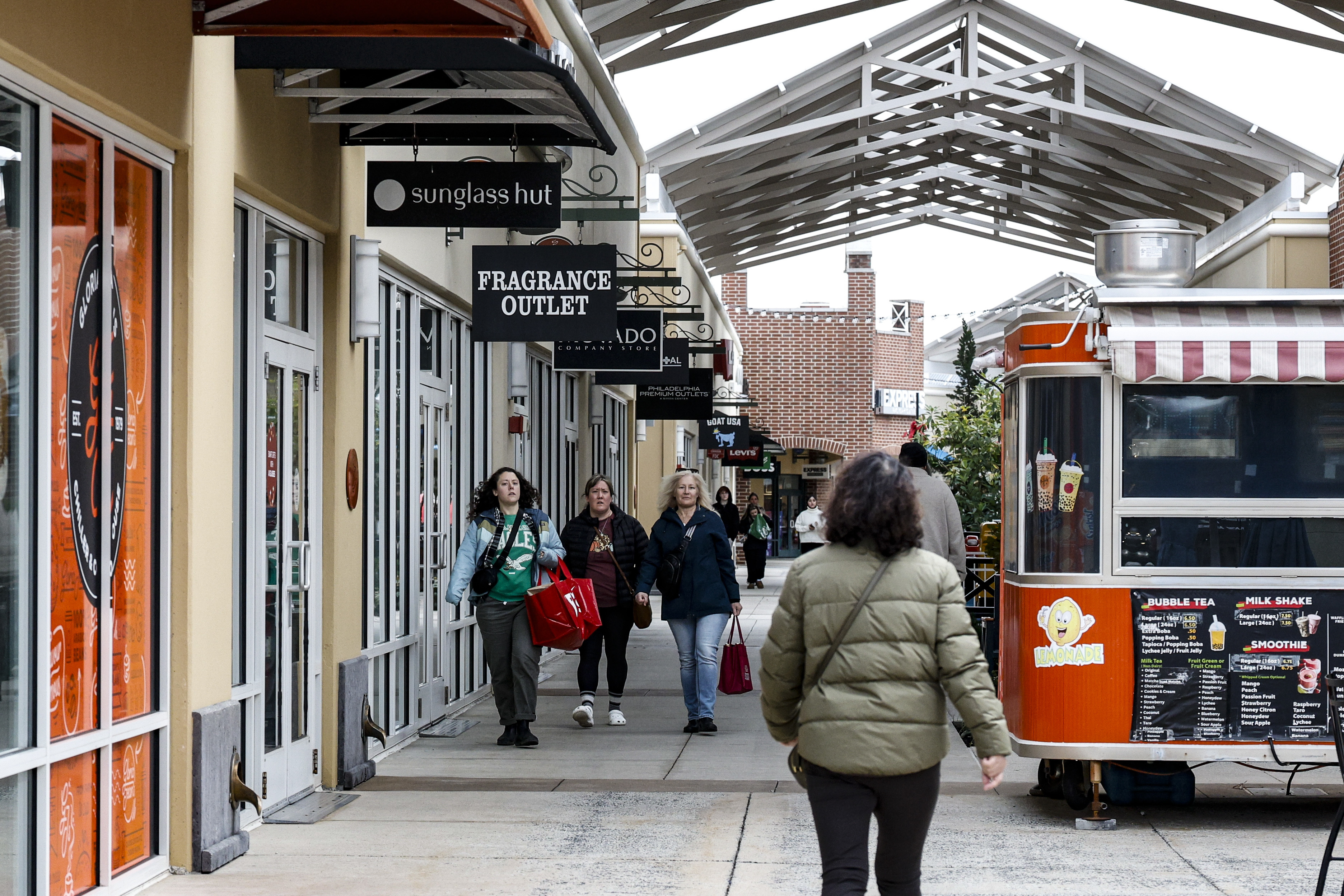
Shoppers walk by the tree at the Philadelphia Premium Outlets on Nov. 11.
The Philadelphia region’s two major outlet malls — the Philadelphia Premium Outlets in Limerick Township and the Gloucester Premium Outlets, both owned by Simon Property Group — are more than 92% occupied, according to a count by The Inquirer during visits to each location this month. Both outlets have found success despite being less than 20 miles from thriving indoor malls in King of Prussia and Cherry Hill.
Tanger Outlets, which has locations in Atlantic City and Lancaster, recently reported more than 97% occupancy across its 39 open-air centers and an increase in average tenant sales per square foot.
“Outlets do good in good times and great in bad times,” said Lisa Wagner, a longtime consultant for outlets, repeating a common refrain in the industry.
The centers have evolved amid the broader push toward more experiential retail and most now have a mix of discount stores and full-price retailers. But they have done so while embracing their reputation as the go-to destination for snagging deals, said Wagner, a principal at the Outlet Resource Group.
“Honestly no one knew what was going to happen after COVID, but [the outlets] came out incredibly strong,” she said. More recently, the retail industry has been rattled by tariffs and economic uncertainty. The outlets have not been immune to those challenges, but they have held strong despite them.
“People want value right now,” Wagner said. “They need it.”
The Philadelphia Premium Outlets has more than 130 stores in its 500,000-square-foot complex.
Outlet malls become one-stop shops
On a rainy, early November Sunday, hundreds of people descended on the Gloucester Premium Outlets.
Shoppers pulled up hoods and huddled under umbrellas as they made their way from store to store. Many balanced several large bags bearing brand names like Columbia and Kate Spade, Rally House and Hey Dude shoes. Some munched on Auntie Anne’s pretzels or sipped Starbucks from holiday cups. An acoustic version of Jingle Bells played over the speakers.
For some, the dreary, drizzly weather was even more reason to spend their afternoon at the 86-store complex in Blackwood, Camden County, about 15 miles outside Philadelphia.
With two young children in tow, Jessica Bonsu, 30, of Sicklerville, was on a mission.
“We came out to go to the indoor playground,” called Stay & Play, Bonsu said, pointing to her rambunctious kids. “Just to get some energy out.”
“And then we can also get some shopping done,” added her cousin, Taneisha Laume, 30, who was visiting from D.C. She needed a gift for her uncle. “Kill two birds with one stone.”
Shoppers peruse the stores at the Gloucester Premium Outlets in this 2019 file photo.
These kind of multipurpose visits are buoying outlet malls, which are increasingly becoming mixed-use destinations for dining, drinking, entertainment, and shopping.
“You’re coming for a little bit of everything,” said Gerilyn Davis, director of marketing and business development at Philadelphia Premium Outlets.
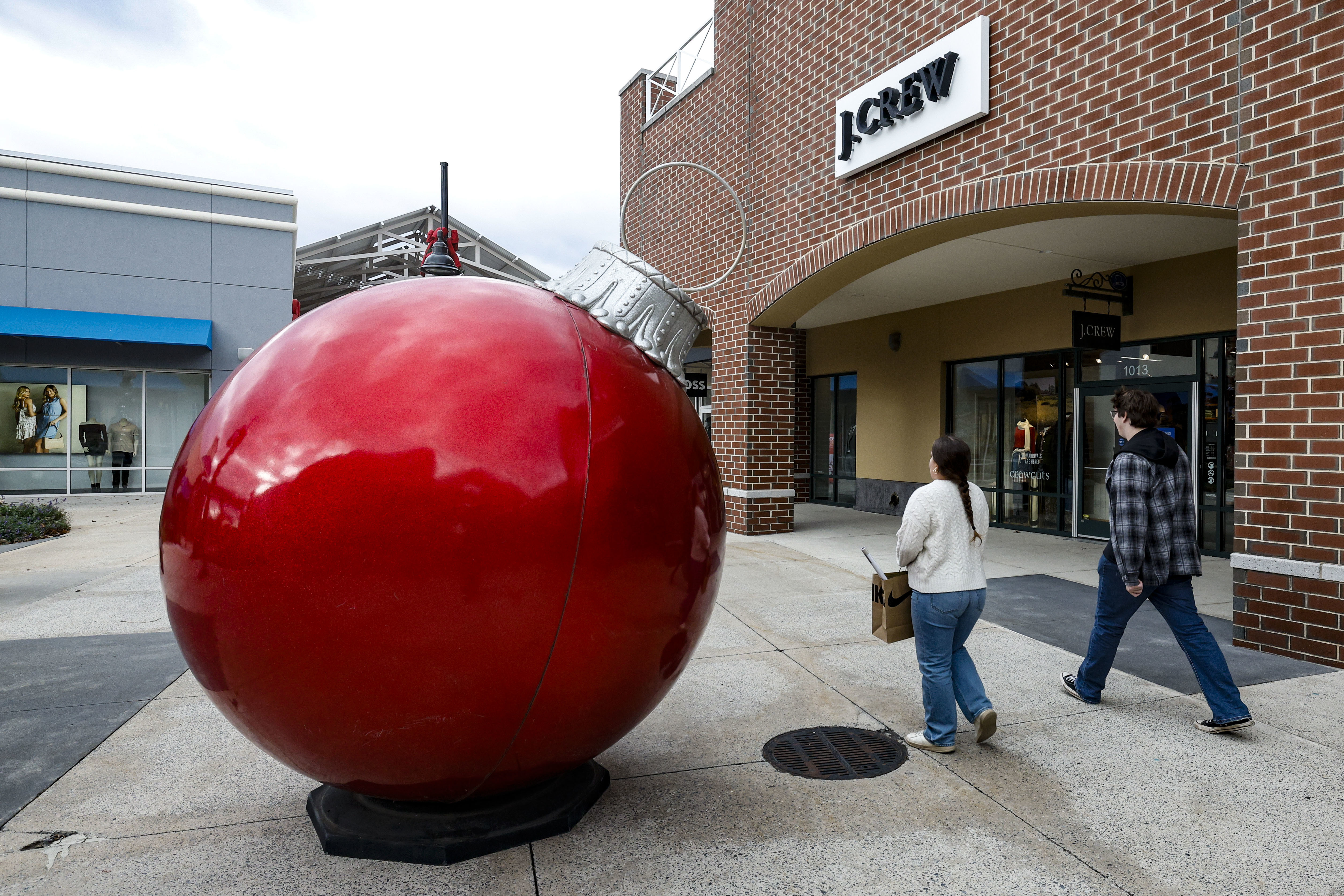
The Limerick Township complex recently welcomed a slate of new tenants, including Marc Jacobs’ first Pennsylvania outlet store, a BOSS outlet, an Ulta Beauty, and an outpost of central Pennsylvania’s Nissley Vineyards, which has an outdoor seating area.
Shoppers walk by the Nissley Vineyards store at the Philadelphia Premium Outlets.
New Balance, whose shoes are trendy again, is also opening stores in both the Philadelphia and Gloucester outlets.
Justin Stein, Tanger’s executive vice president of leasing, said the North-Carolina-based company is focused on adding more food, beverage, and entertainment options.
While overall occupancy at its Atlantic City center is lower than others, the complex has a Dave & Buster’s and a Ruth’s Chris steakhouse. The Simpson, a Caribbean restaurant and bar, is also set to open there in early 2026.
In Lancaster, Tanger is looking to add food and beverage options, Stein said. But that center is still performing well, with a 97% occupancy rate, according to an online map, and only two vacancies.
When there are places to eat and drink at the outlets, “people stay longer,” Stein said, “and when they stay longer, they spend more.”
Philadelphia Premium Outlets had a steady crowd on a bitter cold Veterans Day.
From ‘no frills’ to outlets of the future
Today’s outlet malls look vastly different from what Wagner calls the “no frills” complexes of the 1990s.
At the time, an outlet mall served as “a release valve for excess goods,” Wagner said. “There were some stores that had really broken merchandise.”
To comply with branding rules and avoid competition with department stores, outlet malls were often located along highways between two major metro areas, she said.
“What became clear is that customers loved it,” Wagner said. Soon, brands started overproducing to supply these outlet stores with products in an array of a sizes and colors.
This effort to bulk up outlet offerings was “a roaring success,” she said, with companies finding that more than a third of outlet customers went on to buy their products at full price at other locations.
Philadelphia Premium Outlets, which opened in 2007, has very few vacant storefronts.
As their popularity rose, more outlet malls were built across the country.
As the centers look to the future, their executives are continuing to hone their identity as “not just a discount-and-clearance center,” said Deanna Pascucci, director of marketing and business development at Gloucester Premium Outlets.
Center leaders are bringing in food trucks, leaning into rewards programs, and promoting community events, such as Gloucester’s holiday tree lighting,which took place Saturday. Starting Black Friday, the Philadelphia Premium Outlets will offer Santa photos after a successful pilot program last year.
And the complexes are finding new ways to attract and retain shoppers, online and in real life.
Tanger recently announced an advertising partnership with Unrivaled Sports, which operates youth sports complexes, including the Ripken Baseball Experience in Aberdeen, Md., an hour drive from its Lancaster outlets. Stein said the company hopes to attract families looking to pass the time between tournament games.
Tanger is also using AI and data analytics to email specific deals to customers based on where they’ve previously shopped, Stein said.
“We want you to start your experience online and end it in the store,” Stein said.
Shoppers walk by a new Ulta store at the Philadelphia Premium Outlets.
At Simon outlets, customers can search a store’s inventory online before they make the trip, Davis said.
“Online shopping at this point, it’s a complement,” Davis said. “It’s not viewed as competition.”
Wagner, the outlet consultant, said she thinks even more centers will be built in the coming years, with a focus on urban and close-in suburban locations that are accessible by public transit.
As for existing centers, she sees them thriving for the foreseeable future.
“As long as outlets continue to emphasize a value message and use their loyalty programs to reward customers,” Wagner said, “I think they will hold their own.”


 You decide