Pennsylvania has an opportunity to lead the nation in righting a long-standing wrong in our housing laws.
A group of legislators has introduced the PA Fair Future Act — landmark legislation that would end the state’s enforcement of one of the most damaging and overlooked barriers to housing: the Thurmond Amendment.
Enacted in 1988 during the height of the war on drugs, the Thurmond Amendment allows landlords and property sellers to deny housing solely on the basis of a drug distribution conviction — regardless of how long ago it occurred, the person’s current circumstances, or how much they’ve rebuilt their lives.
Imagine making a mistake as a teenager or young adult — getting caught up in drugs, serving your sentence, and spending years working hard to turn your life around.
Despite holding a steady job, maintaining good credit, and having a clean rental history, you still find yourself legally locked out of housing because of a decades-old conviction.
Some landlords won’t return your calls. Others reject your application outright, no questions asked.
That’s the reality for thousands of Pennsylvanians.
Take the case of Jonathon Jacobs, who was convicted of marijuana distribution when he was 19. For years, Jacobs faced rejection in the housing market or was forced to pay exorbitant security deposits because of his record.
His punishment didn’t end with his sentence — it extended into every aspect of his life, including his ability to provide stable housing for his family.
Ironically, had Jacobs been convicted of a violent crime, he would not be facing this same legal barrier.
In 2016, the Department of Housing and Urban Development (HUD) issued guidanceurging housing providers to consider criminal records in context — taking into account factors like rental, credit, and employment history.
But the Thurmond Amendment creates an explicit carveout: Anyone with a drug distribution conviction is excluded from these protections. It’s a loophole that leaves people like Jacobs permanently locked out of fair housing opportunities.
The law’s impact in Pennsylvania is staggering.
Since 1988, over 80,000 Pennsylvanians have been convicted of drug distribution offenses — many for small amounts. In fact, the most frequently charged amount is less than 1 gram, barely more than a sugar packet.
In 2022, the U.S. House voted to help roll back the war on drugs that as proportionately targeted people of color.
Had many of these cases occurred in today’s legal and political environment, they likely would have been charged as simple possession, and those convicted would have retained their housing rights.
These aren’t major traffickers being excluded from housing; they’re mostly people punished for low-level mistakes, often made in their youth, that carry lifetime consequences.
Black Pennsylvanians are five times more likely than white residents to receive a distribution conviction.
By denying housing based on old records, the Thurmond Amendment reinforces systemic racial disparities and perpetuates cycles of poverty, incarceration, and family instability — all without contributing to public safety.
Thankfully, there’s a path forward.
While federal efforts to repeal the Thurmond Amendment continue, as our governor is fond of saying, “We’re getting stuff done here in Pennsylvania.”
State Rep. Josh Siegel has introduced legislation in Harrisburg to repeal the amendment’s effect at the state level, restoring fair housing protections to those with drug distribution convictions.
House Bill 1492 passed committee on Monday, Sept. 29 and is expected to come to the House floor in the coming weeks.
This is an opportunity for Pennsylvania to lead. It’s a chance to affirm that people should be judged not by their past, but by whom they are today.
Stable housing isn’t just a second chance; it’s the first step toward a better life. Let’s make it accessible to everyone.
Anjelica D. Sanders is a policy advisor and community reporter focused on public health and policy.Yusuf Dahl is CEO of The Century Promise and founder of the Real Estate Lab in Allentown, Pa.
A Wilmington man brought his mother’s gun to Lincoln University’s campus Saturday, prosecutors said, and was still holding the loaded weapon when a deadly shooting tore through the school’s homecoming celebration.
Zecqueous Morgan-Thompson, 21, has not been charged in connection with the shooting, only with possessing the weapon without a concealed-carry permit. But investigators said they were still working Monday to determine whether his firearm was used in the incident at the historically Black university, which left one person dead and six others wounded.
Morgan-Thompson remained in custody Monday in lieu of $25,000 bail.
Chester County District Attorney Chris de Barrena-Sarobe said his office is trying to determine if more than one shooter was involved. Morgan-Thompson was arrested on the campus in the aftermath of the gunfire, holding a loaded Glock 28 .380-caliber handgun, according to the affidavit of probable cause for his arrest.
The shots rang out about 9:30 p.m. Saturday on the campus in Lower Oxford Township. De Barrena-Sarobe has said he does not believe the shooting was a coordinated attack targeting the school, but instead took place as the crowd swelled on the campus.
The motive for the shooting remained under investigation.
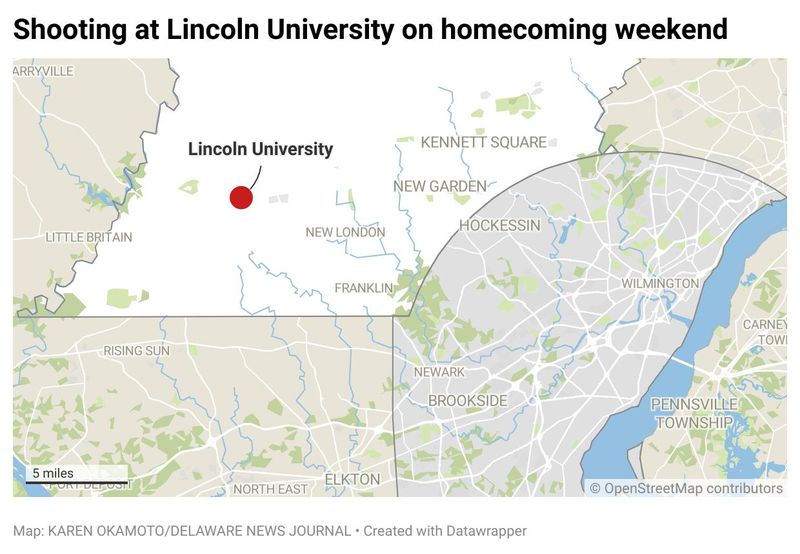
Gunfire rang out just before 9:30 p.m. Oct. 25 at Lincoln University in the parking lot of the International Cultural Center in Lower Oxford Township in Chester County, Pennsylvania. The university is about 15 miles from Hockessin.
Jujuan Jeffers, 20, of Wilmington, died after being shot in the head. It was unclear if Jeffers had any affiliation with Lincoln — investigators have said the victims included one alumnus and one current student.
Jeffers’ brother declined to speak with a reporter when contacted Monday.
The student who was hurt was recovering well, but obviously shaken, according to Chester County Commissioner Josh Maxwell, who is an adjunct professor at the school. Her injuries, he said, were not life-threatening.
Lincoln University canceled classes Monday in light of the shooting.
“Gun violence happens far too often in our country, and we are heartbroken that Lincoln University and its students are among the latest victims of such senseless violence,” the school said in a statement.
The rural campus was quiet Monday afternoon as students gathered for a vigil that gave members of the university community a chance to grieve and heal.
The service was not open to the media, and gates at various entrances to Lincoln’s campus were locked.
Geslande Sanne, a Lincoln University junior from Oregon, was in her dorm Monday morning, still coming to terms with the chaotic scene she experienced Saturday night.
“A lot of us on campus are processing it in our own different ways,” said Sanne, a political science and French major. “We are all reaching out to each other. Our professors are talking to each other and to us. Some students went home to be with their families. Some people are just resting.”
She said she intended to attend the university’s community healing session on campus at noon and later go to the hospital to visit her friend, who was the only Lincoln student shot during the incident.
Sanne recalled that she and a group of friends were on the outskirts of the crowd when they heard gunshots.
“Everybody started running and we started running, too,” she said. “We were confused. Did something really happen? After a few minutes, the music stopped, and we knew something really happened.”
She and her friends made a plan to get back to their dorms so they would be safe, but then decided to seek shelter inside the International Cultural Center building, not far from where the shooting took place.
After people started banging on the windows, she said, Sanne and her friends left there and walked carefully back to their dorms.
It all happened in about 20 minutes, she estimated.
Sanne said she chose to attend Lincoln because she wanted to go to an HBCU and was impressed by all its prominent graduates. She said she has received much encouragement and many opportunities at the school.
“It’s really inspired me,” she said, “that I can be a part of something positive despite everything going on in the country.”
She said she has always felt safe on Lincoln’s rural campus, safer than she does anywhere else. And Saturday night’s shooting hasn’t changed that.
“It wasn’t Lincoln’s fault,” said Sanne, who wants to be an international lawyer. “We do the best we can with the resources we have. It shouldn’t be an excuse to leave or disinvest in Lincoln. It’s a reason to pour in more resources and support these schools even more.”
Staff writer Jesse Bunch contributed to this article.
The Eagles avenged their Week 6 loss to the New York Giants with a dominant 38-20 win at Lincoln Financial Field. However, much of the dialogue following the game still focused on the drama surrounding star receiver A.J. Brown, who didn’t even play on Sunday. There was also talk about Jalen Hurts’ performance — and his return to the MVP conversation — and the questionable officiating in the Birds’ Week 8 win.
Here’s a look at what they’re saying about the Eagles as they enter the bye week with a 6-2 record …
A.J. Brown trade talk
Brown sat out of Sunday’s game due to a hamstring injury. Despite his absence, the Eagles offense dominated, finishing the game with a season-high 427 total yards. DeVonta Smith remained the centerpiece of the Birds’ passing game, recording six receptions (on nine targets) for 84 yards.
Everything came together for the Eagles, including the team’s previously spotty running game. The Birds recorded 276 yards on the ground, with Saquon Barkley eclipsing 100 rushing yards for the first time this season.
With all the drama surrounding Brown’s latest social media posts and the team’s success without him on the field, there’s already even more discussion centered on whether the team should trade the receiver.
“The only thing that gets or punctures momentum and a loaded roster is drama,” Colin Cowherd said on The Colin Cowherd Podcast. “And I’m watching them today and I’m like oh [expletive]. They almost have 300 yards rushing. Some of this is tied to A.J. Brown’s absence. They’re just free to do what they want to do. … I just don’t think this team needs A.J. Brown.”
“They’re not going to trade A.J. Brown,” Schefter said on ESPN’s Get Up. “Here’s the deal. They’re trying to repeat as a Super Bowl champion. They’re in the business of acquiring talent, not giving it away. And whatever they can get back for A.J. Brown, they can get back in February or March before the draft. They’re going to want him here to help the stretch run after the big win here, he’s not going to get traded.”
But he does believe the team will eventually make some moves moving forward.
“The Eagles don’t play again until two weeks from today in Green Bay,” Schefter said. “… If the Eagles don’t make a move to better their roster between now and then, I’d be surprised. That’s what they do. They’re always active. They’re always aggressive and they’re going to be that way again. I’ll be surprised if in the next two weeks, the Eagles haven’t pulled off at least one trade.”
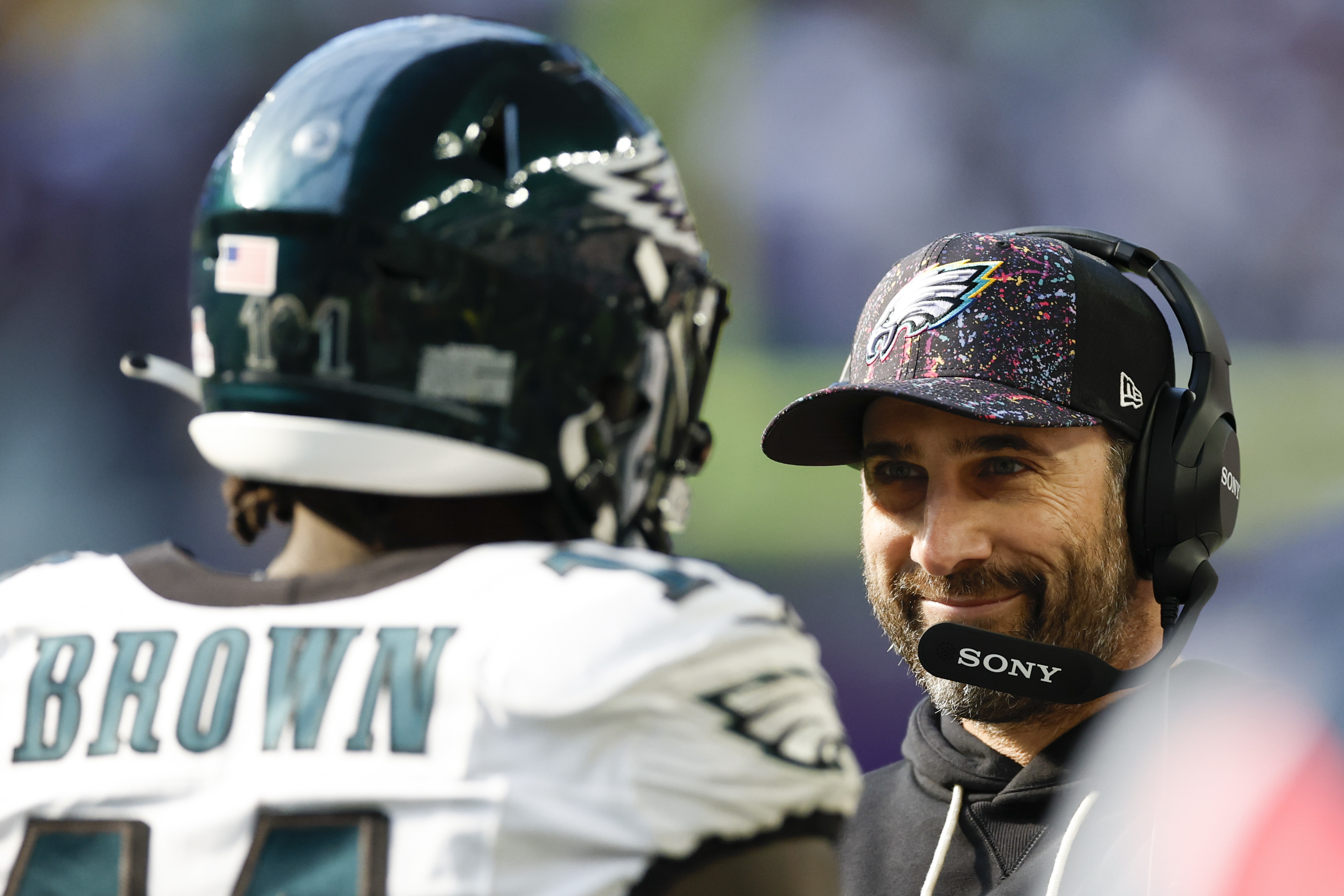
Eagles wide receiver A.J. Brown, who had a big game in Week 7 against the Vikings, didn’t play in Sunday’s game against the Giants due to a hamstring injury.
Hall of Fame advice for Brown
Former New York Jets coach Rex Ryan asked Hall of Fame quarterback Peyton Manning about the Brown situation on ESPN’s Sunday NFL Countdown. Manning did his best to offer advice to the team.
“I hate what’s going on there in Philly, it’s not fun to watch,” Manning said. “People always ask, ‘Hey, why did Marvin Harrison never complain about not getting the ball?’ Because I always threw him the ball.
“I hated the fact that A.J. Brown doesn’t seem happy and they’re winning football games. I would tell A.J. the grass isn’t always greener on the other side. There’s certain teams that if he wanted to go play for right now, I can promise you he would not be happy there. The Eagles are 5-2, they won the Super Bowl last year, there’s big games for him coming. … He’s not going to have 10 catches for 160 every single week, but if he just stays in there, I can promise you good things are coming.”
Peyton Manning knows A.J. Brown and the Eagles will get on the same page 🦅
"People always asked me 'Hey, how come Marvin Harrison never complained about not getting the ball? Because I always threw him the ball!" pic.twitter.com/C2iwNDCrhs
There were a few questionable calls in Sunday’s game, including a potential Tush Push fumble. Hurts was stripped of the ball while running the Eagles’ signature sneak play, but the officials ruled that the quarterback’s forward progress had been stopped. The play couldn’t be reviewed and the Eagles kept the ball. Here’s a look at what happened.
Referees ruled that Jalen Hurts' forward progress was stopped before Kayvon Thibodeaux took the ball away from him on the tush push pic.twitter.com/rW4Mx3MNv5
The Eagles scored two plays later. Former Eagles defensive end Chris Long discussed the ruling on the Green Light podcast.
“I thought the Giants got robbed on the Tush Push,” Long said. “Certainly, the game plays out a little bit differently in sequence if that changes. But, the whistle was the whistle. And that’s the problem. I see so many Tush Pushes where the forward progress is three, four, five seconds. I understand the case that Giants fans would make that Thibodeaux pulled that ball out. And I think he did. I think he did. Didn’t go their way.”
Hurts still found plenty of success through the air — completing 15 of 20 passes for 179 yards and four touchdowns — despite Brown being sidelined. The quarterback now has 15 passing touchdowns, five rushing touchdowns, and just one interception through eight games.
Over his last two games, Hurts has thrown seven touchdown passes — and just nine incompletions. Numbers like those are enough for former Eagles linebacker Emmanuel Acho to put Hurts in the running for MVP.
“Jalen Hurts has to be in the MVP conversation,” Acho said on the Speakeasy talk show. “I’m watching the game today and I’m thinking to myself, wait a second. In the midst of all the wide receiver distractions — and sometimes disregard the distractions — in the midst of the absence of A.J. Brown, you go out there and you get four touchdowns vs. a New York Giants team that’s incredibly hungry.
“You ain’t got A.J. Brown. So, you go out there and you do it with [Smith], Jahan Dotson, and Dallas Goedert. You’re finally starting to get active. The week before you go out there and you get three touchdowns with no interceptions. Now, all of a sudden Jalen Hurts has 15 passing touchdowns — these are not Tush Push touchdowns, people, 15 passing touchdowns — and five rushing touchdowns to just one interception. These are MVP-type numbers.”
.@EmmanuelAcho says Jalen Hurts "HAS to be in the MVP conversation!"
On our first date 10 years ago, my husband and I went to Pica’s Restaurant in Upper Darby and then to a John Oliver stand-up show at the nearby Tower Theater.
The latter was his choice, but the restaurant was my pick. I was well aware of how large Pica’s legend loomed in Delaware County, and Upper Darby native Tina Fey had recently extolled her love for its unique sauce-on-the-top square pizza on The Tonight Show Starring Jimmy Fallon, so I wanted to try it.
I arrived at the restaurant a bit frazzled, given that I’d spent the hours before reporting on ferrets eating a baby’s face off. “Intense” is the word my husband uses to describe me that night. I’m pretty sure my nail marks are still embedded in the table where we sat.
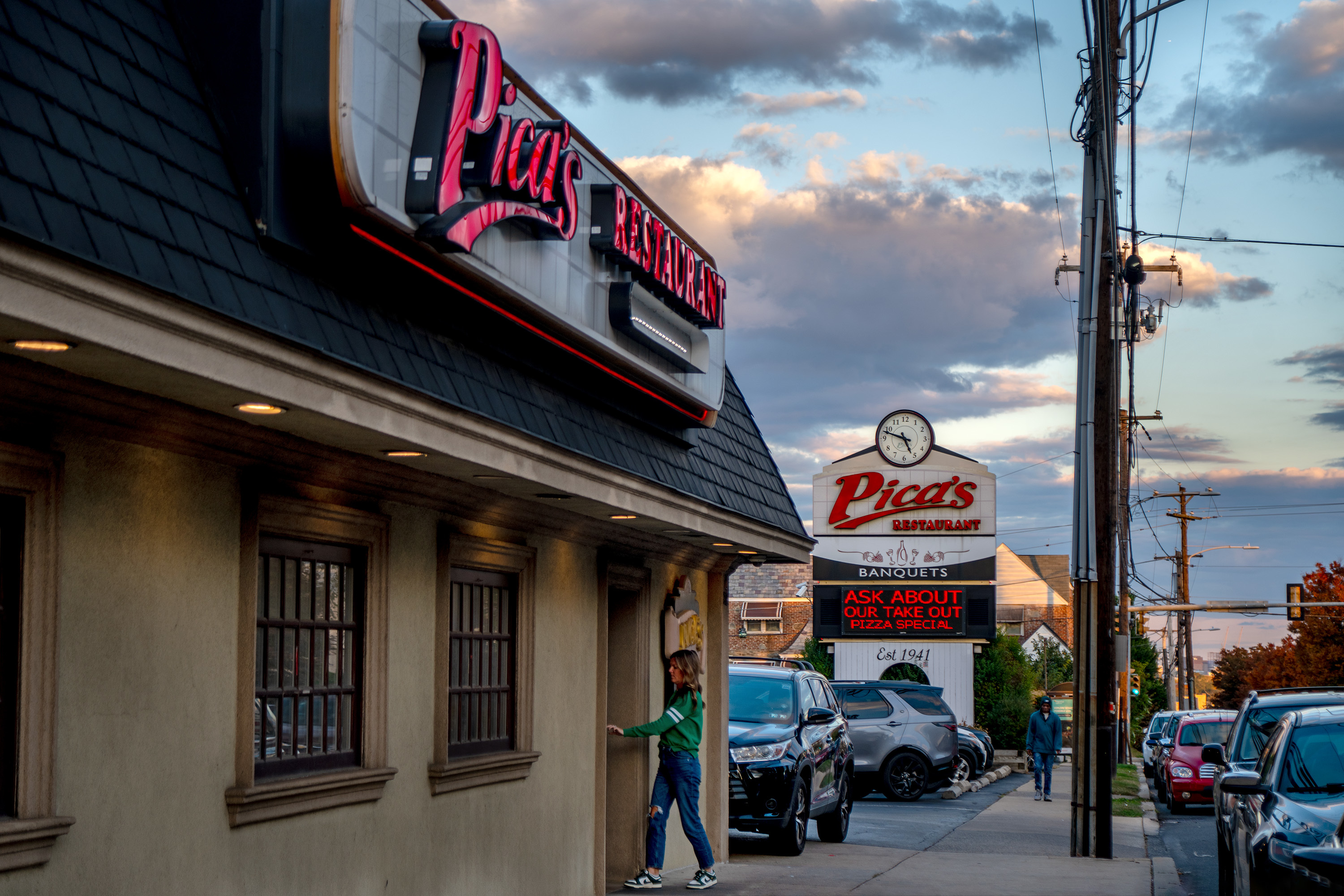
The final night of dinner at Pica’s Restaurant in Upper Darby.
I don’t remember what we talked about that night or what we ate, but I remember feeling comforted by that man and by that place. Pica’s wasn’t fancy or pretentious — the outmoded decor looked like it hadn’t been updated since the ’90s — but it was packed. Not with people who came to be seen, but with people who came to be with each other.
You know how there are comfort foods? I could tell this was a comfort restaurant.
My husband and I haven’t been back to Pica’s a lot in the years since, maybe because it felt like a place we’d always be able to go back to. So when I heard Pica’s was closing its Upper Darby location on Sunday after 69 years, I knew we had to get in on the last night. We invited friends — a couple who are Delco lifers, like my husband — along for the ride.
How Delco rolls
On a TV in the lobby, a still frame of Tina Fey eating Pica’s pizza on the Tonight Show played on rotation, along with photos of Pica’s food and awards it’s received over the years, like Philadelphia Magazine’s 2017 Best of Philly award for “Best Red Gravy Italian.” The carpeting and wood paneling were unchanged since my first visit a decade ago.
Upper Darby native Tina Fey and “Tonight Show” host Jimmy Fallon share a Pica’s pizza on air in 2014.
There was a good crowd, but the restaurant wasn’t packed. Within 15 minutes of arriving, our friend ran into two of his friends who’d also stopped in for a last supper, because that’s how Delco rolls. Near us was what appeared to be three generations of women who shared two pizzas between them, and at another table, a dad and daughter who said little to each other, but were very happy to see their huge pasta dishes.
We ordered pizza and mozzarella sticks as appetizers and pasta for dinner, which felt gluttonous because it was, but we’ll be happily eating the leftovers this week. From the wonderfully sweet sauce to the perfectly melted cheese and pepperonis the size of manhole covers, everything was on point.
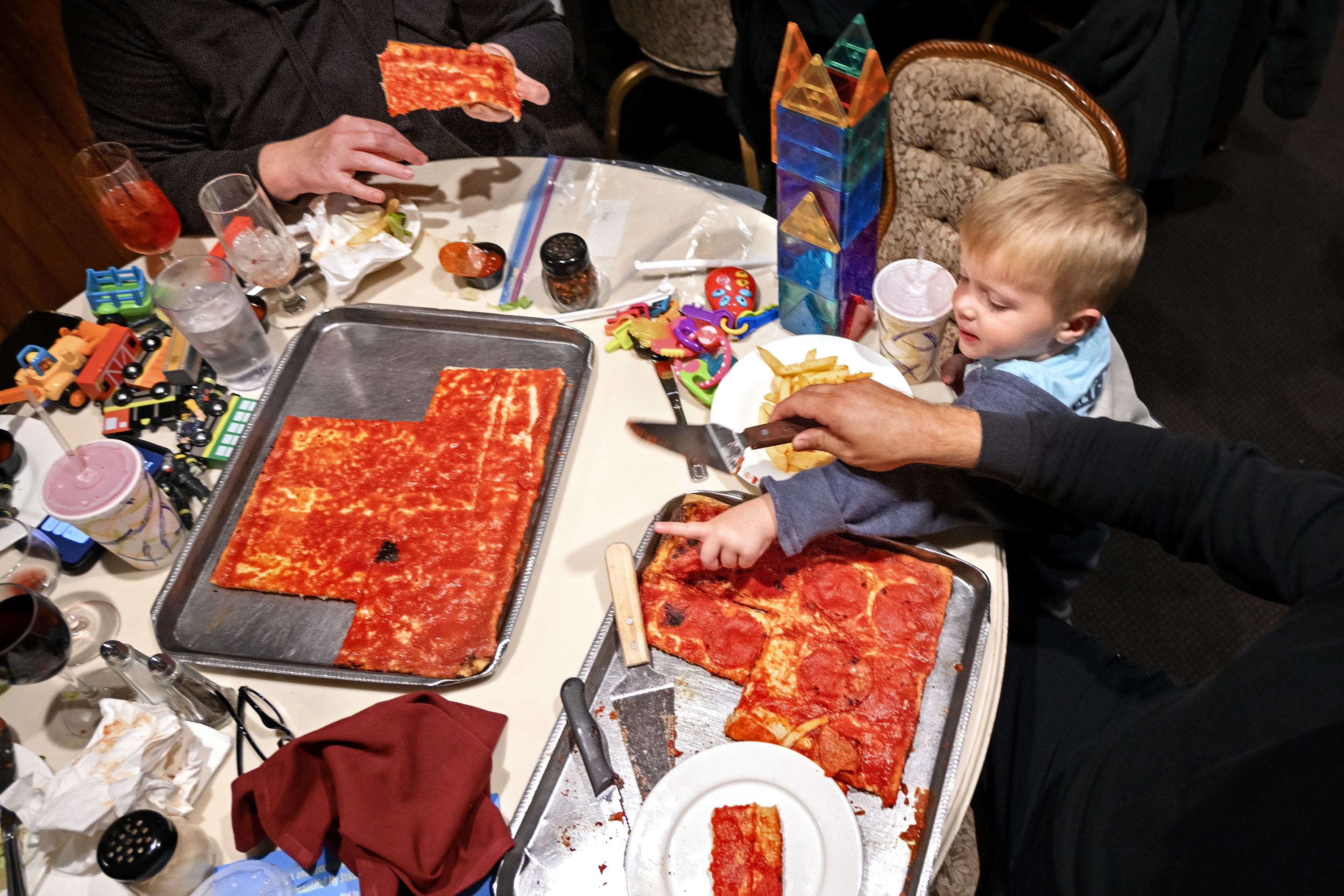
Two year-old AJ Jr. sits between his parents AJ Grenier, Sr. (right) and Carolyn Grenier (left) as he grabs a slice of pizza on the final night of dinner at Pica’s Restaurant in Upper Darby Sunday.
The bar even had Montepulciano wine and I got the last full glass. Our amazing server, Shannon Murphy, who’s worked at Pica’s for 27 years, also brought me a sidecar glass containing the last few sips of the bottle so that it didn’t go to waste. The way I’d felt like I’d won the lottery in that moment is hard to explain.
Murphy, who had her wedding reception at Pica’s, said the closing of the Upper Darby restaurant was “bittersweet” and “nostalgic.”
“The family is just amazing to work for,” she said.
Three generations
Founded by Frank Pica Sr., Pica’s first opened in 1941 as a brick-oven pizza shop in West Philly before the proprietor and his son, Frank Pica Jr., moved it to West Chester Pike in Upper Darby in 1956, where it became a full-service restaurant.
The company is now owned by the third generation of Picas, Angela Pica-Oandasan and Frank Pica III. Their sisters, Lori Pica-Rosario and Karen Pica, also played important roles in the family business over the years.
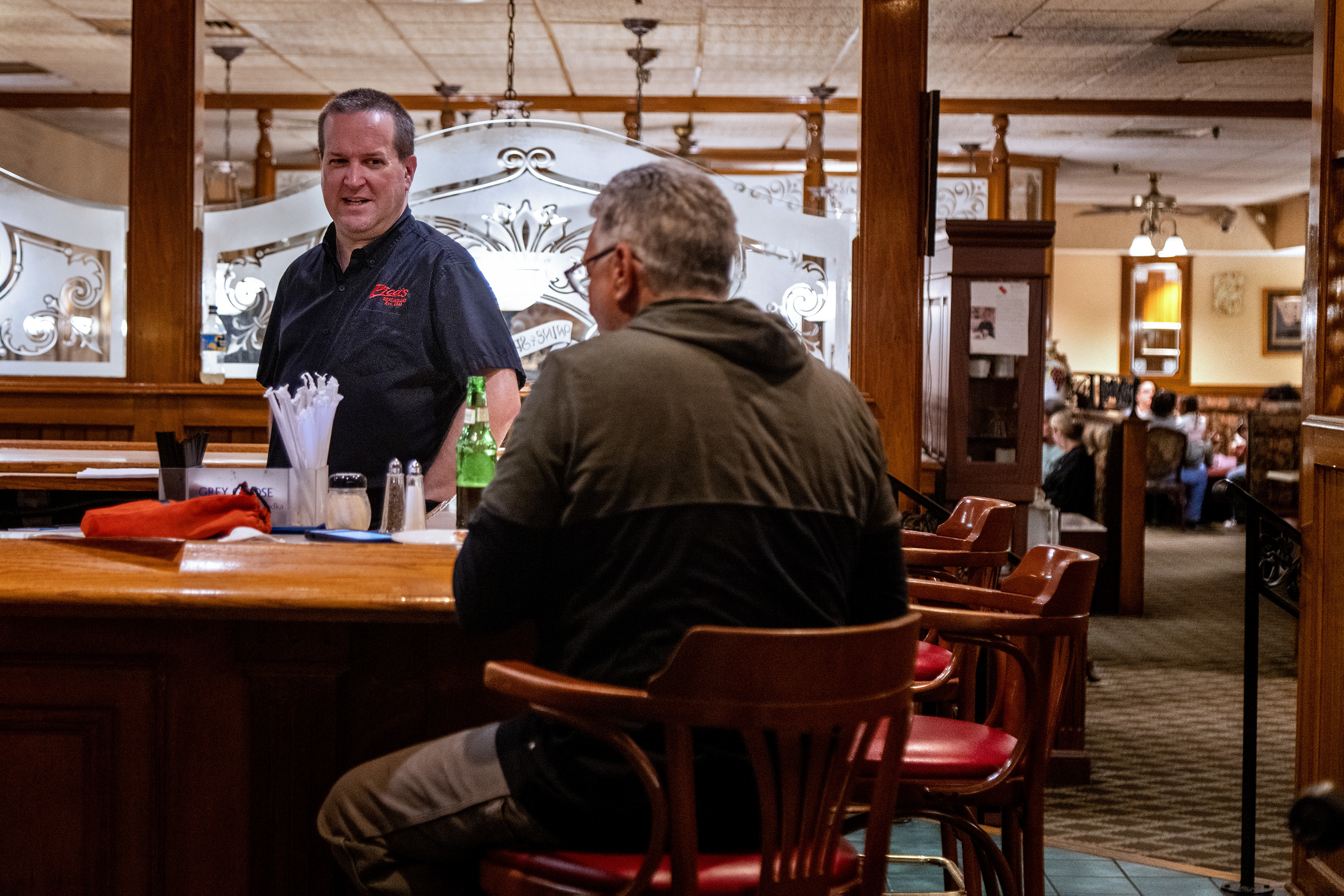
Brian Henley (left), part-time Pica’s bartender for 10 years, talks with Anthony Voci, Jr. eating dinner at the bar on the final night at Pica’s Restaurant in Upper Darby.
The siblings grew up in the restaurant, and the staff was always happy to see them because that meant extra hands to help, Pica-Oandasan said.
“We would all sit in a circle sometimes making pizza boxes together on a Friday afternoon,” she said. “We all joke around about our memories.”
In 2017, Pica’s opened a second location in West Chester, which remains in operation. The family plans to open a takeout spot in Delco, most likely in Broomall, but they’re still in negotiations (they hope to make an official announcement in the coming weeks). Until then, takeout at the Upper Darby Pica’s remains open.
‘Tough decisions’
When Pica’s posted on Facebook in March that it would close its Upper Darby location this year, its page was flooded with comments calling the restaurant a “landmark,” a “core memory,” and a “historical spot.”
Carolyn Grenier sits with her twin two year-old sons James (left) and AJ Jr. (right) eating their ice cream dessert after pizza on the final night of dinner at Pica’s Restaurant in Upper Darby Sunday.
Generations of Delco residents have had their birth, death, and wedding celebrations at the Upper Darby restaurant. One of the options on Pica’s phone directory was: “If you are calling regarding a luncheon after a funeral, please press six.”
Making the decision to close the restaurant wasn’t an easy one, the owners said. But the building is older and needs a lot of work. The Upper Darby location is just massive — it seats 250 in the dining room, 200 more in the banquet room downstairs. On top of that, staffing has been hard after the pandemic, and the owners often have to fill in.
“It’s hard leaving here because we just spent so much of our time and our lives here … and we know how much this building and this business meant to our father, our grandfather. But sometimes in business you have to make tough decisions and you have to transition and adapt to the times,” Pica III said. “We do really understand how much this business has meant to this community for so long — all the schools, all the graduations, we worked them all.”
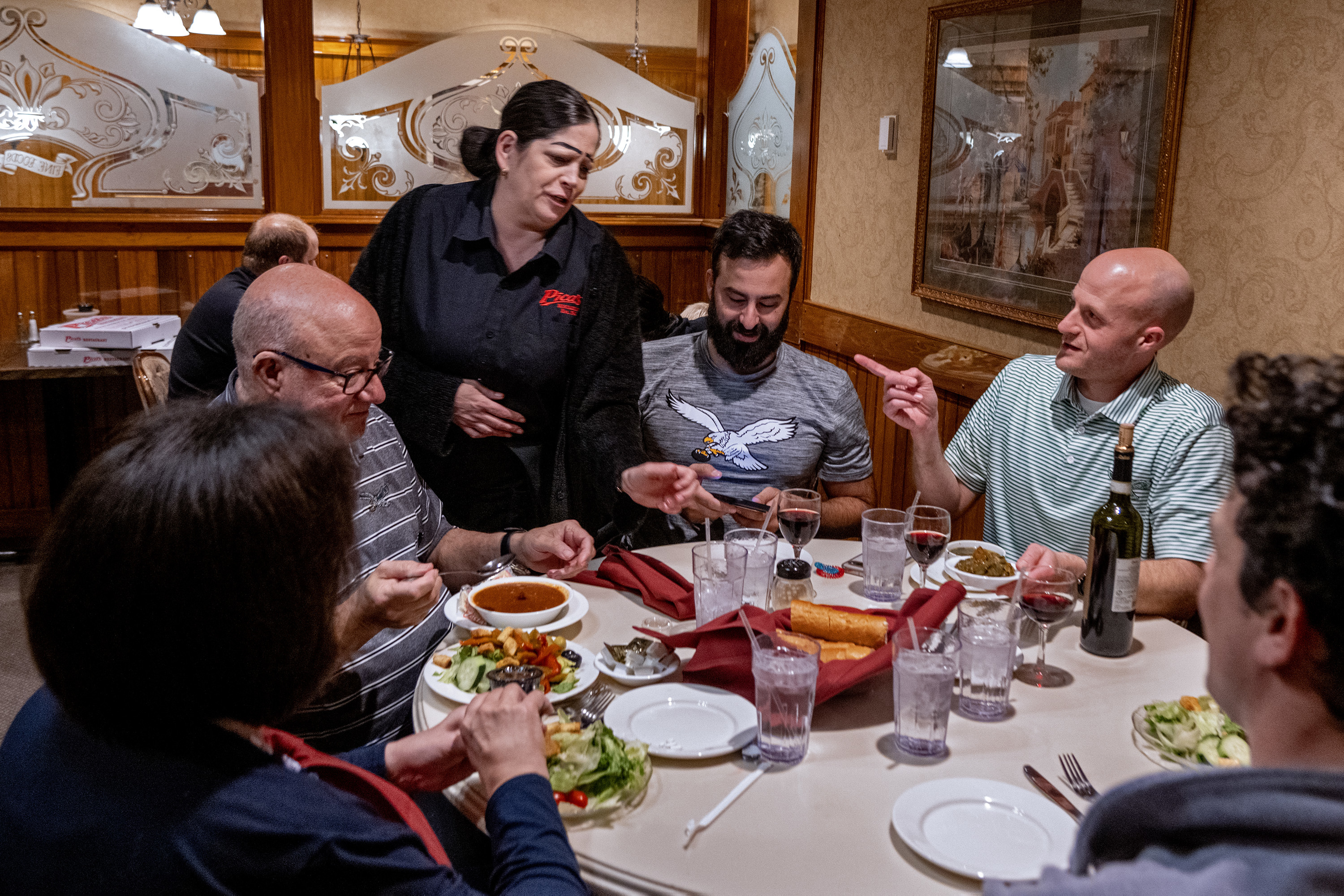
Dominic D’Angelo (right) banters with nine-year server Stephanie Cornman (standing) as he has dinner with family members on the final night of dinner at Pica’s Restaurant in Upper Darby Sunday.
Pica-Oandasan said the family received cards from customers dining at the restaurant for the last time, some of whom they’ve been serving for three generations.
“It’s very heartwarming to see the impact, that it means so much to them,” she said. “It makes it harder. It’s bittersweet, all the memories that will be lost in that building.”
It’s not only the customers they’ll miss, it’s the employees. One staffer worked there for more than 50 years and two others, for more than 40.
“It was always a big family environment” Pica III said. “Everyone really put their heart into here.”
One last hug
At the end of our meal, Murphy didn’t judge me for using a $20 off coupon I got in a mailer, like the classy Delco resident I am. And when I asked, she said I was more than welcome to take a copy of the paper menu for my scrapbook.
Murphy told us a lot of people had asked to keep the menu, and one customer even requested all of the restaurant staff autograph it for them.
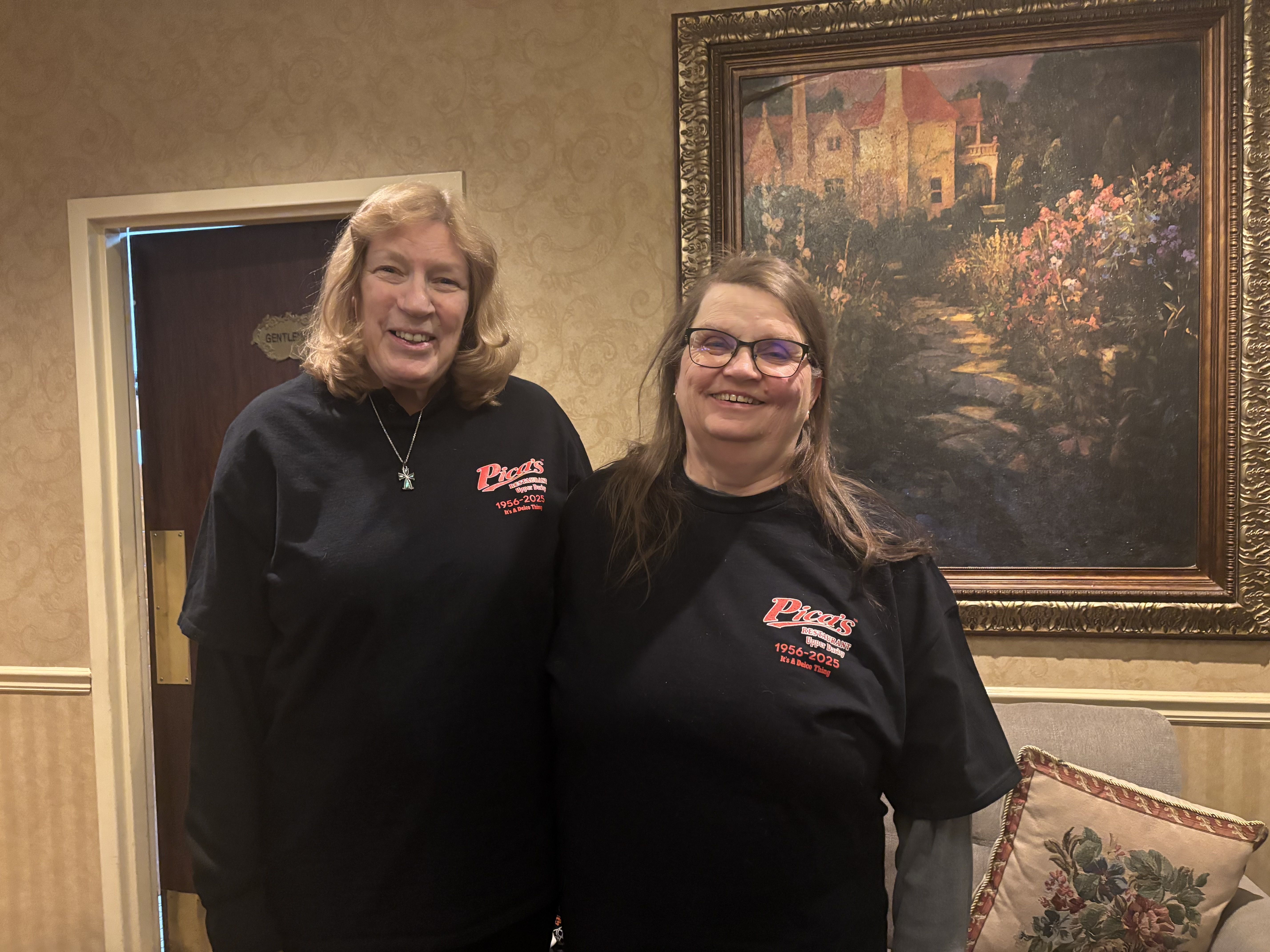
As we got ready to leave, I met two women in the lobby wearing Pica’s T-shirts and getting their photos taken with staffers. Bernadette Wasch, 72, of Havertown, and her friend, Kathleen Baker, 73, of Upper Darby, are uber Pica’s fans and said it always felt like home.
Kathleen Baker, 73, of Upper Darby, at left, and Bernadette Wasch, 72, of Havertown, at right, are uber Pica’s fans. They came to the Upper Darby restaurant in their Pica’s shirts for dinner on Sunday, the final night for in-house dining.
Wasch first came to Pica’s in grade school. In the last week before its closure, she visited three times to wring all the nostalgia she could out of the place. I watched as she hugged staffers one last time with what seemed like every ounce of her being.
“The food is just incredible and so is the waitstaff. People say it’s like family and it really is,” she said. “We’re very sorry to see it go.”
Baker agreed. “This is goodbye but it’s not good,” she said.
Dozens of Philadelphia-area restaurants have signed on to participate in CHOMP for CHOP, a weeklong fundraiser to benefit Children’s Hospital of Philadelphia’s Food Pharmacy program, which provides food access and nutrition resources for families in need.
The initiative, created by CHOP’s food pharmacy manager, Abbe Stern, aims to raise $50,000 for CHOP’s programs addressing food insecurity between Nov. 10 and 16. Participating restaurants will raise funds in various ways, such as selling specific dishes, offering special menus, donating a percentage of sales, and allowing customers to contribute on their tabs.
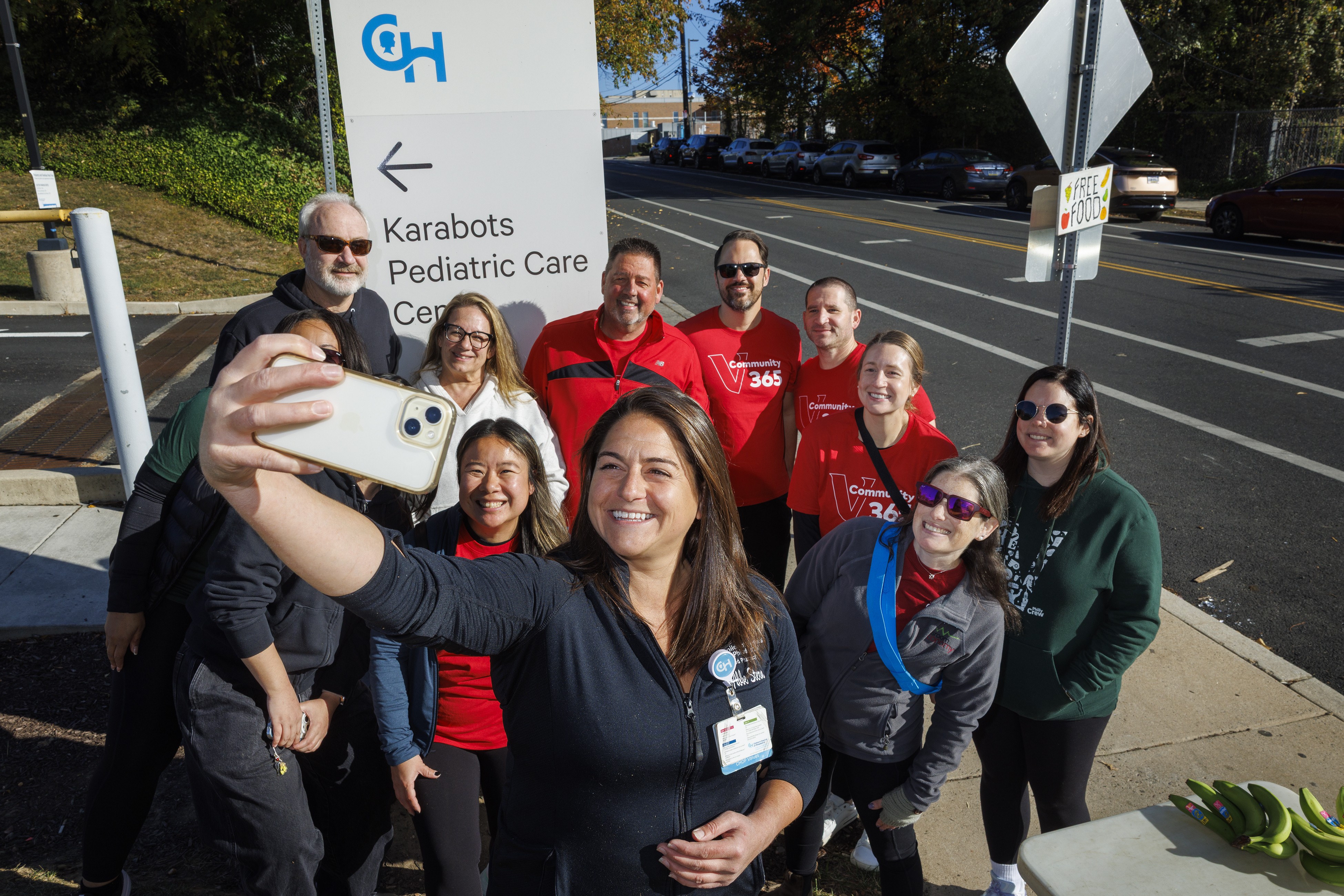
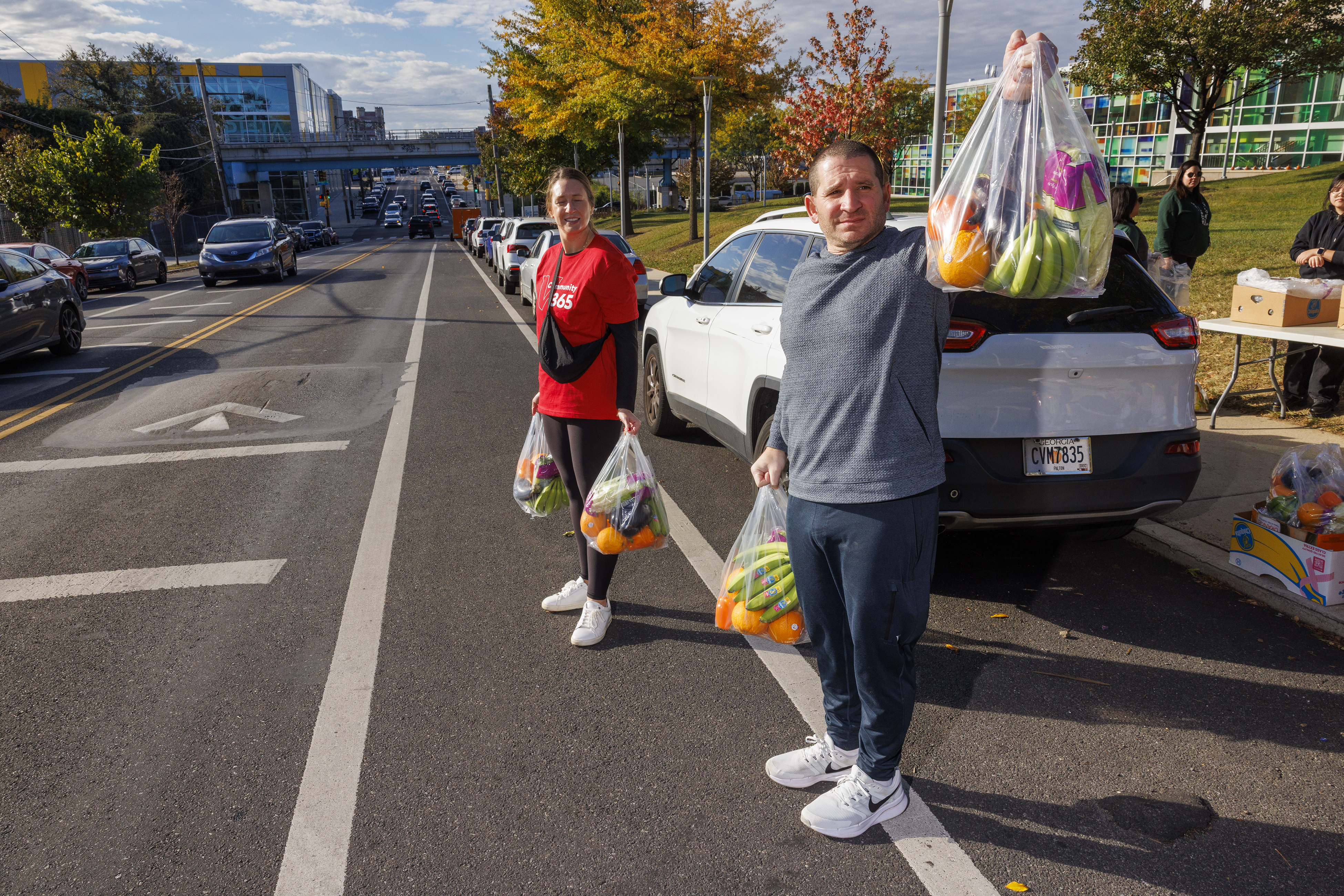
Abbe Stern, food-pharmacy manager with Children’s Hospital of Philadelphia, takes a selfie with volunteers from Vanguard after they distributed 90 bags of food on Oct. 23.
The restaurants include some of the city’s most recognizable names, such as Zahav, Scampi, Amá, Little Water, Yanaga Kappo Izakaya, a.kitchen, Federal Donuts, Riverwards Produce, Santucci’s Original Square Pizza, El Chingón, Forsythia, Barbuzzo, Bar Hygge, El Merkury, Huda, Irwin’s, Kismet Bagels, the Boozy Mutt, Lark, Khyber Pass Pub, Wilder, Bridget Foy’s, Cry Baby Pasta, Sabrina’s, Middle Child Clubhouse, 48th Street Grille, Vientiane Bistro, Fishtown Pasta, and Cavanaugh’s Rittenhouse. More restaurants are signing up daily, Stern said.
Stern said she got the idea after hearing about a restaurant week fundraiser in the suburbs. “I had this idea: ‘Can’t we just do something like that in Philly?’” said Stern, who previously worked for the Rittenhouse Hotel and also for the app Too Good to Go, which addresses food waste. “I knew there was so much motivation within the Philly restaurant scene to help the community and feed people.”
Alyssa Drummy and David Forgione with Vanguard distribute food outside Karabots Pediatric Primary Care Center in West Philadelphia as part of CHOP’s food-access initiative.
Stern reached out to public relations executive Peter Breslow, who with his colleague Mike Prince agreed to help recruit restaurants. “We had a really quick call and brainstormed how to engage the restaurant scene to raise funds,” Stern said. “From my experience, I wanted restaurants to create something that would work for their businesses and encourage patrons to buy, while helping us build food access for the community.”
Stern said the effort is timely, as families face mounting hardship amid impending cuts to SNAP benefits, with more patients and providers reaching out for help. “Families are scared, struggling, and can’t find support anywhere else,” she said.
Through CHOMP for CHOP, she hopes to connect the city’s hospitality community with families in crisis. “These businesses are excited to say they’re part of the solution — part of a big initiative to feed our neighbors,” Stern said.
FIFA began the process of selling another 1 million tickets for next year’s World Cup on Monday, with the opening of a new ticket draw marking the start of the tournament’s second phase of sales.
The World Cup will take place this summer in 16 cities across the U.S., Canada, and Mexico, including in Philadelphia, where six matches will be played at Lincoln Financial Field.
This draw, which runs through 11 a.m. Friday, includes a domestic exclusivity time slot for residents of the three host countries. Fans from those countries, whose entries are selected out of this draw, will have the opportunity to buy single-match tickets for games taking place inside their home nation.
The phase is open to all fans, regardless of which country they live.
“We already have seen massive interest from around the world for this tournament, and especially from within the host countries as Canada, Mexico and the United States prepare to host the biggest FIFA World Cup yet,” said Heimo Schirgi, the tournament’s chief operating officer. “This second phase, with its host country domestic exclusivity time slot, will allow us to say ‘thank you’ to these local fans, while ensuring global opportunity as well.”
Those fans from the U.S, Canada and Mexico who enter the draw before it closes Friday have a chance to receive, through what FIFA says is a randomized process, a time slot during which they can buy tickets starting on Nov. 12. Those slots will be issued through Nov. 15. Fans who win those chances will receive word at least 48 hours before their time slot opens.
Residents of the three host countries — the U.S., Canada and Mexico, in that order — purchased more tickets than those from any other nation in the initial phase of ticketing. England, Germany, Brazil, Spain, Colombia, Argentina and France, in that order, rounded out the top 10.
Once the domestic exclusivity time slot ends, more fans will be eligible to obtain a purchasing slot starting on Nov. 17. Additional tickets will be made available in subsequent phases, FIFA said.
FIFA announced earlier this month that more than 1 million tickets have already been sold for next year’s World Cup, with people from 212 countries and territories having already purchased. So far, 28 of the 48 spots for teams in the field have been filled.
The start of ticket sales doesn’t take away from how there are unique questions for consumers heading into the tournament, particularly about how they’ll get visas, if necessary, to visit the U.S. as the country cracks down on immigration. An international friendly match between defending World Cup champion Argentina — featuring Lionel Messi — and Puerto Rico was moved from Chicago to Fort Lauderdale, Fla., because of lagging ticket sales that some believe were in response to the immigration crackdown.
Based on the listed stadium attendance figures, there are roughly 7.1 million seats to fill for the 104 matches for the tournament around 16 North American venues. It is unknown how many of those seats will be available for sale to the public.
Ticket data has shown that the lowest-priced seats — set at $60 — were available for at least 40 matches. Almost all seats for the vast majority of matches were set at a much higher price. The opening match for the U.S., to be played at Inglewood, Calif., had prices ranging from $560 to $2,735 when sales opened. On the resale site, at least one ticket for that opening U.S. match on June 12 was listed for more than $60,000 earlier this month.
Fans with the option to purchase could choose seats in one of four categories; Category 1 is what FIFA officials call the best seats, Category 4 is somewhere around the tops of stadiums. Ticket costs are expected to fluctuate as soccer’s biggest event utilizes dynamic pricing for the first time.
Roughly one in four small residential buildings bought in Philadelphia from2017 and 2022were purchased by corporations, according to a new report about investor activity in the city.
Investors compete with low-income homebuyers. They are more likely to pay with cash and less likely to be denied mortgages. They sometimes pursueproperties before they hit the market.
“There are a lot of neighborhoods that are seeing investor activity, that are raising concerns,” said Emily Dowdall, president of policy solutions at Reinvestment Fund. “Our hope is that this report, that other reports, are going to help inform a strategy going forward.”
Smaller operators are buying most Philadelphia homes purchased by investors. But researchers have seen an increase in larger corporate landlords.
Researchers looked at sales of residential buildings with one to four housing units. Most were single-unit homes, but the city records that researchers classified properties with one to four units as single-family housing.
Researchers found that 13 investors bought 100 or more properties and eight bought more than 200 from 2017 through 2022.
Here are some other takeaways from the new study.
No sign of big national players
From 2020 through 2022, 91% of homes purchased by corporations were bought by smallerinvestors.
Researchers said they found no evidence that the biggest national investors in single-family homes — such as the private equity firm Blackstone and Invitation Homes, one of the country’s largest landlords of single-family homes — are active in Philadelphia.
Private equity-backed national investment organizations have bought single-family homes in bulk in places such as the southeastern United States, which has been targeted because it has newer housing stock and fewer tenant protections, Dowdall said.
These types of investors have been tied to rent increases and fewer opportunities for first-time homebuyers and buyers with low and moderate incomes.
Philadelphia is less likely to see these organizations operating here because of the city’s many renter protections and an older housing stock that needs a lot of investment, Dowdall said. The city’s foreclosure prevention program and the relatively long foreclosure process in Pennsylvania also deter these organizations, which like to quickly buy and lease homes on a large scale.
“It’s still possible that we could see more national players, as they have already saturated the easier markets to get into,” she said.
During the pandemic, some larger regional and national companies started to come to Philadelphia, researchers found.
Investor activity is concentrated in certain areas
Corporate investors mostly buy single-family homes in areas of the city where prices are lowest. Those neighborhoods also are predominately Black and Hispanic, including Brewerytown, Germantown, Juniata Park, and Kingsessing.
From 2020 to 2022, the median purchase price for an investor was $129,000, compared to the citywide median purchase price of $225,000 and individual buyers’ median purchase price of $247,000.
During this time, investors were most active in North, West, and Southwest Philadelphia and sections of Lower Northeast and Northwest Philadelphia. Investors bought more than half of all homes sold in these areas.
Before sheriff sales paused because of the pandemic, investors often bought a chunk of their properties that way.
The share of foreclosed homes purchased by investors grew from 31% of properties sold in sheriff sales in 2012 to 60% in 2019.
From 2017 to 2019, high-volume investors got about a third of their single-family properties through sheriff sales.
From 2020 through 2022, fewer than 40 properties were auctioned off each year. So investors relied more on other ways of acquiring properties, including buying directly from homeowners, “potentially creating more direct competition with individual homebuyers,” the report said.
More eviction filings and code violations
Large corporate landlords were more likely to file in court to evict tenants than smaller investors.
About one in seven homes bought by high-volume investors were associated with eviction filings within five years, compared to less than one in 20 homes bought by smaller investors.
Investors of all sizes were more likely than individual homebuyers to have code violations. About 20% of properties bought by investors had violations within five years of the purchase. The share of violations in owner-occupied properties was 9%.
Researchers plan to learn more about the types of code violations these properties generate, since violations can range from trash issues to unsafe conditions.
More work on properties
Researchers also uncovered “potentially positive findings” about large investors, Dowdall said.
Philadelphia’s aging housing stock needs investment for renovations and maintenance, and the report found that larger investors were more likely to get permits to alter their properties than smaller investors. “Bringing much needed dollars in to refurbish our housing stock,” she said.
Large corporate investors received alteration permits for 42% of the properties they bought, compared to 29% for smaller investors and 13% for individual homebuyers.
Like code violations, projects that need permits can range from the minor to the major, from adding electrical outlets to total renovation.
In future analyses, researchers plan to drill down on the specific work being done on investors’ properties.
Researchers’ recommendations
Many investors purchase properties using a variety of corporate names, so identifying who is in control of corporations can be challenging, researchers said. That makes it difficult to hold operators accountable for problems at their properties.
Researchers recommend state lawmakers require limited liability companies to disclose who is in control.
They also recommended that the city:
Enforce rental license requirementsto create a more complete inventory of rental properties
Use public data to understand how investors operate and their effects on the market and renters
Prioritizeindividuals and nonprofits at sheriff sales
Help individual homebuyerscompete in the housing market, including by giving more money to homebuyer assistance programs
The transit agency has until Oct. 31 to complete the inspections, which were recommended after the National Transportation Safety Board released a report investigating five fires that occurred on the Silverliner IVs this year.
As of Oct. 9, SEPTA said that crews can handle about six Silverliner IV cars a day, with a goal of ramping up inspections to handle 12 cars a day with five-person crews per car.
Although SEPTA is rotating cars in and out of service for the inspections — instead of yanking all 225 from service at once — riders have experienced significant delays and some trains have been outright canceled. Without a full fleet, SEPTA says it is unable to respond as easily to typical delay-causing events, such as power outages and bad weather.
Riders should check the SEPTA app for real-time updates on how trains are running.
As the deadline approaches and delays persist, The Inquirer is tracking SEPTA’s inspection progress.
Mon., Oct. 27, 2025
95 inspections complete
Days until deadline: 4
Fri., Oct. 24, 2025
88 inspections complete
Days until deadline: 7
Wed., Oct. 22, 2025
78 inspections complete
Days until deadline: 9
Mon., Oct. 20, 2025
66 inspections complete
Days until deadline: 11
Fri., Oct. 17, 2025
58 inspections complete
Days until deadline: 14
story continues after advertisement
Wed., Oct. 15, 2025
46 inspections complete
Days until deadline: 16
Thurs., Oct. 9, 2025
12 inspections completed
Days until deadline: 22
Mon., Oct. 6, 2025
Inspections begin
Cars began undergoing inspections in SEPTA’s four regional maintenance facilities.
Greg Buzby, manager of Regional Rail vehicle engineering, shows some of the work being done for the safety inspections at the SEPTA Overbrook Maintenance Facility.Tyger Williams / Staff Photographer
“We’re looking for any signs of overheating or damage to any of the circuits, physical damage, making sure the bolted connections are tight,” said Greg Buzby, manager of Regional Rail engineering. “There’s also electrical testing that we have to do to make sure the insulation has its integrity.”
Inspections remaining: 225
Days until deadline: 25
Wed., Oct. 1, 2025
NTSB releases report
Noting that the Silverliner IV cars’ “outdated design … represents an immediate and unacceptable safety risk,” the National Transportation Safety Board urged SEPTA to sideline all the Silverliner cars immediately and to retrofit or replace them as soon as possible. The Silverliner IVs went into service between 1974 and 1976, with technology that was designed even before that time.
The NTSB’s findings are advisory.
More than 300 passengers were safely evacuated after a SEPTA Regional Rail train caught fire in February in Delaware County.Charles Fox / Staff Photographer
The Federal Railroad Administration, which regulates freight and passenger railroads, ordered SEPTA to undertake the inspections, concluding “that SEPTA’s maintenance and operation of its passenger rail equipment requires additional oversight and corrective action.”
Inspections remaining: 225
Days until deadline: 30
story continues after advertisement
Talk to our transportation team.
Do you have questions about what’s happening on Regional Rail? Ask here or share how your rides on Regional Rail have been impacted in October.
Staff Contributors
Reporting: Thomas Fitzgerald and Erica Palan
Graphics: John Duchneskie
Editing: Lizzy McLellan Ravitch
Digital Editing: Erica Palan
Subscribe to The Philadelphia Inquirer
Our reporting is directly supported by reader subscriptions. If you want more journalism like this story, please subscribe today
The deal joins two companies that trace their roots to the late 1800s, Essential chairman and chief executive Christopher Franklin told investors Monday in a conference call.
Joined under the American Water brand at its Camden headquarters, the enlarged company will be worth around $40 billion on the stock market, ranking with water and electric companies among the 10 most valuable U.S. utility stocks, American Water CEO John Griffith, saidin an interview.
With around 10,000 total employees, the companies together serve around 5 million water and wastewater customers across 17 states, plus military bases in more than a dozen states, with Pennsylvania accounting for around one-third of the total.
The two companies are “by far the two largest players in the regulated water utility industry,” said Ryan M. Connors, a veteran utility analyst now with Northcoast Research in Cleveland. Together they would be “a truly dominant” water utility, he said.
Locally, American Water serves users in the Coatesville, Downingtown, Exton, Norristown, Phoenixville, and Plymouth Meeting areas, and in Burlington, Glassboro, Haddonfield, and other areas in South Jersey.
Aqua has customers in communities throughout Philadelphia’s Pennsylvania and New Jersey suburbs.
Franklin acknowledged that Essential’s share price has been trading “at a discount,” adding that sales and profits should grow more quickly under American Water.
The partners will need approvals from shareholders and state utility regulators in at least five states, including Pennsylvania and New Jersey, to close the deal on schedule by early 2027. Connors said the combined company from its New Jersey headquarters needs to show it can continue Aqua’s success getting Pennsylvania regulators to approve water charges and plans.
Franklin said that on Sunday, he told his predecessor, longtime Aqua CEO Nicholas DeBenedictis, about the merger. “He said, ‘It could have happened 20 years ago. These companies belong together.’”
As a combined company, the leaders said it would be easier to finance the $28 billion in improvements needed over the next five years to upgrade systems.
About two-thirds of that total will go toward routine upgrades and new technology. The rest includes environmental improvements, including the cost of complying with lead and copper limits, and cleaning water from potentially cancer-causing PFAS chemicals formerly leached into U.S. waters by chemical manufacturers and government firefighting gear.
Franklin said the merger would make it easier to “keep customer rates affordable” as the business expands.
As a larger company, the two CEOs said they also would be able to more easily service AI and high-speed data centers and other large new customers.
Essential has committed to investing $26 million to supply 18 million gallons a day to International Electric Power’s 1,400-acre data center and nearly 1,000-megawatt natural gas and battery storage plant, which sit on former coal-mining lands in western Pennsylvania’s Greene County. Griffith said other large projects are under consideration.
Though neither company ruled out back-office job cuts, offices in Bryn Mawr and Pittsburgh as well as the Camden headquarters will remain open. Griffith said he plans to honor union contracts with dozens of labor organizations, including locals of the Operating Engineers and Steelworkers.
“This is really not a cost savings-driven transaction. Both American Water and Essential are growing in a robust way,” Griffith said.
After decades of paranoia and conspiracy theories that cast the Birds as victims of perceived favoritism shown to such rivals as the Cowboys, Patriots, and Chiefs, consider what happened for the Eagles on Sunday against the Giants. Honestly, no fan base feels persecuted more than the Eagles’, whose owner, Jeffrey Lurie, is still bitter about the obvious defensive holding call by James Bradberry that cost them a Super Bowl win three years ago.
James Bradberry gets called for a holding penalty late in Eagles-Chiefs.
The NFL continues to allow the Eagles to run the Tush Push, but that play earned another strike against it when the owners meet next spring.
Assuming a team introduces another proposal to ban the controversial short-yardage play — which has been assailed as an injury risk, which is ridiculous, and has been assailed as a penalty magnet, which is legitimate — Sunday’s debacle will add fuel to whatever fire remains from last spring’s 22-10 vote, which was two ballots shy of a ban.
Facing fourth-and-1 at the Giants’ 11 early in the second quarter, Jalen Hurts and his line surged forward and Hurts peeled off slightly to the left. Floating on a sea of humanity, Hurts clearly never stopped moving toward the line to gain, and as he reached the ball forward, Giants linebacker Kayvon Thibodeaux stripped him of the ball and recovered it.
The play was not reviewable because forward progress is not a reviewable issue.
The larger issue here is that officials don’t seem to be able to consistently rule correctly on a number of areas, among them: whether the defense moves too early; whether the defense lines up in the neutral zone; whether the offensive line moves early; or whether the offense lines up in the neutral zone.
Sunday, they didn’t properly gauge forward progress, even with the runner in plain view.
The final was 38-20, but the call was enormous in the context of the game. Instead of losing the ball to a Giants team that had just completed a 52-yard touchdown drive, the Eagles retained possession and scored a touchdown two plays later to make it 14-7.
It was just the first seven-point swing the officials delivered to the home team.
Early in the fourth quarter, with New York facing fourth-and-11 and trailing by 18, Giants receiver Darius Slayton and Eagles cornerback Quinyon Mitchell engaged in routine hand-fighting during Slayton’s route. Slayton disengaged in a normal fashion, caught the pass, and romped for a 68-yard touchdown.
But no.
Slayton was called for offensive pass interference. Brutal call. In fact, a penalty probably should have been called on Mitchell.
Instead of cutting the lead to 11, the Giants had to punt.
The Eagles are tied for 11th in total penalties called, and they’re seventh in total penalty yards, but most of the calls are inarguable, and, objectively, they seem to be getting away with lots of shenanigans. This was true Sunday.
Yes, the Eagles won by 18, and they dominated all day, but they were gifted that 14-point swing. These two were the kinds of crucial calls that the Eagles and other Chiefs opponents lately have claimed gave unfair advantage to Kansas City; the kinds of calls the Patriots under Bill Belichick seemed to get all the time; and the kinds of calls America’s Team has gotten for 50 years in Dallas.
The Eagles are getting those calls now … right?
The Giants agreed, at least for Sunday. Said Thibodeaux:
“They said they called the forward progress before he reached the ball out. Sounds like some [B.S.] to me.”
Me too.
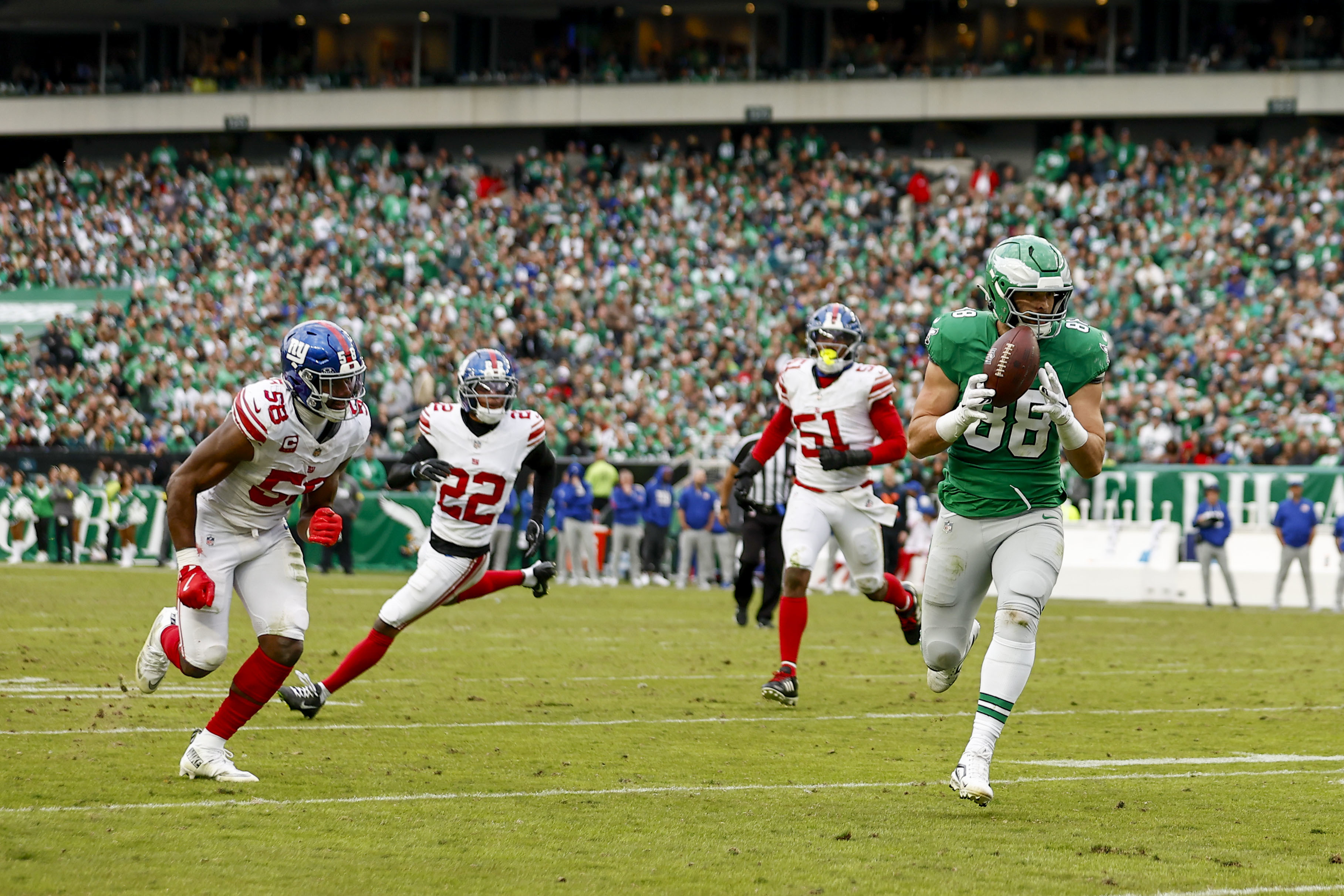
Eagles tight end Dallas Goedert scoring a fourth-quarter touchdown against the Giants.
Seeing red with Goedert
Under Nick Sirianni, the Eagles have never finished outside the top 10 in red-zone efficiency. But with the combination of Sirianni and offensive coordinator Kevin Patullo, who had served as Sirianni’s passing-game coordinator the last four years, the Birds have never been better.
The Eagles are 6-2 in large part because they’ve converted 17 of their 20 trips inside the opponents’ 20-yard line into touchdowns. That’s 85%, which is about 11 percentage points better than the Ravens’ rate last season, which is the best conversion rate by any team over an entire season since Sirianni arrived.
Why are they so efficient?
Because the Eagles have a spectacular offensive line; a strong, fast quarterback; a lethal play in the Tush Push; a superstar running back; two star receivers; and, for my money, the most important red-zone weapon: an elite tight end.
Also: superb play-calling. Example:
On second-and-8 from the Giants’ 17-yard line, Patullo called a run-pass option. Hurts kept it. At the same time, tight end Dallas Goedert swung from the left side of the line to the right, broke upfield, and was wide-open for a touchdown.
So many moving parts worked in perfect synchronization. It was the Eagles’ prettiest play of the season.
“Ultimately, Kevin has to call the plays that he feels give us the best chance to win there,” Sirianni said after the Eagles went 3-for-3 in the red zone on Sunday. “I think we’ve done a good job of being efficient down there, though. … We’ve kept the ball moving forward. Jalen’s played really good football down there, and Dallas has obviously been really good down there.”
Goedert had two touchdown catches in Sunday’s win over the Giants. His seven TD catches are first among tight ends and already are a career high.
“They’ve been letting me get the ball and use my big body,” Goedert said. “We can score in a lot of different ways.”
He certainly can. His 35 touchdowncatches (including playoffs) in about 7½ seasons as an Eagle rank second among franchise tight ends behind Zach Ertz, who caught 40 (including playoffs) in about 8½ seasons.
“He’s a hell of a player,“ Hurts said. ”He’s a big-time target and in a sense, he’s due. He’s due. He does a lot of dirty work in this offense.”
It might be tough to call Goedert’s number with Hurts, running back Saquon Barkley, and receivers A.J. Brown and DeVonta Smith, but the Eagles are winning because Goedert is finding the end zone more than anyone else under Patullo.
“KP has a really good feel in the red zone,” said Hurts.
So does DG.
Mixed emotionals
After being embarrassed by owner Woody Johnson, who said, “If we can just complete a pass, it would look good” after seven weeks of bad quarterback play, Jets quarterback Justin Fields played well Sunday in a comeback win over the Bengals.
Fields had been benched at halftime the week before in favor of Tyrod Taylor, but Taylor’s bruised knee sidelined him Sunday and gave Fields another chance. Fields played well enough to win: 21-for-32, 244 yards, one touchdown. Afterward, during an emotional press availability, he admitted that the pressures of his turbulent career, culminating in Johnson’s criticisms, broke him down.
“This week, I found myself in my closet, crying on the ground, laying down,” Fields said.
As you might assume, Johnson, formerly Donald Trump’s ambassador to the United Kingdom, is not a pleasant bloke. In an annual survey conducted by the players’ association, his 2024 team gave his club the league’s only overall “F,” and his franchise has been a punch line for years.
However, if Johnson’s cruel, candid, but ultimately accurate assessment of the quarterback play worked, well …
Coach Shane Steichen’s Colts are 7-1.
Extra points
Shane Steichen, in his third year in Indianapolis, continued his romp to Coach of the Year honors when his Colts beat the Titans and moved to 7-1. Since becoming the Eagles’ OC in 2021, Steichen’s teams have been in the top 10 in rushing, with the Eagles finishing No. 1 in 2021. This year, behind league-leading running back Jonathan Taylor, the Colts rank sixth. … Right behind Steichen in the running for COY: Mike Vrabel, whose Patriots reached 6-2 with a win over the Browns. Second-year quarterback Drake Maye leads the NFL with a 118.7 passer rating. … In that game, Browns defensive lineman Myles Garrett recorded five sacks, bringing him to 10 for the season, tied for the league lead. … Aaron Rodgers failed to join Peyton Manning, Tom Brady, Brett Favre, and Drew Brees as quarterbacks who have beaten all 32 teams when his Steelers lost to the Packers, the team that drafted him. … The Cowboys, with their No. 2-ranked offense and second-to-last defense, lost in Denver and fell to 3-4-1. That means the Eagles are the only team in the NFC East with a winning record — remarkable, since the division was considered one of the best before the season began.