Blog

  • Phillies 2026 infield outlook: Free-agent options, prospect forecast, and more

    Phillies 2026 infield outlook: Free-agent options, prospect forecast, and more

    While the Phillies are poised for some roster changes in 2026, at the moment it doesn’t seem like those will occur in the infield.

    The Phillies’ outfield has been a revolving door for the last few seasons, but the infield continues to run it back. And according to Dave Dombrowski, that seems to be the plan again. At least, for now.

    “The infield is pretty well solidified,” the Phillies’ president of baseball operations said at his end-of-season news conference on Oct. 16.

    And indeed, Trea Turner and Bryce Harper are under contract into the 2030s, while Bryson Stott, Edmundo Sosa, and Alec Bohm are arbitration eligible. Barring a trade, there isn’t much room for movement or change.

    Here’s an overview of the Phillies’ infield outlook next season and beyond.

    Trea Turner had his best overall season as a Phillie in 2025, winning the NL batting title with a .304 average and stealing 36 bases.

    Turner’s improvement

    This time last year, there were questions raised about Turner’s long-term future at shortstop after another below-average defensive season. But those questions have been all but put to rest after Turner made significant strides in 2025. His 17 outs above average were the highest of his career and tied for third among shortstops.

    On the offensive side, Turner bought into the Phillies’ plan for him as their new leadoff hitter. Manager Rob Thomson wanted him to focus on using his athleticism and getting on base, rather than hitting homers. Turner did just that, stealing 36 bases and posting a .355 on-base percentage, his best since arriving in Philadelphia. With a .304 batting average, Turner also became the first Phillie to win the batting title since Richie Ashburn in 1958 and was named a Silver Slugger finalist.

    He may have sacrificed some power to do it, hitting just 15 home runs compared to 21 last season. But overall, Turner did exactly what the Phillies wanted out of him in the regular season, both offensively and defensively.

    “He’s tough on himself,” Dombrowski said. “He’s like one of these guys, if he doesn’t hit 40 home runs and 40 doubles and 40 stolen bases, and lead the league in hitting, he’s probably going to think that he needs to do more.

    “That’s how he is, which is great. That’s a great quality and attribute, but he doesn’t have to hit with any more power for us. He really did a fine job.”
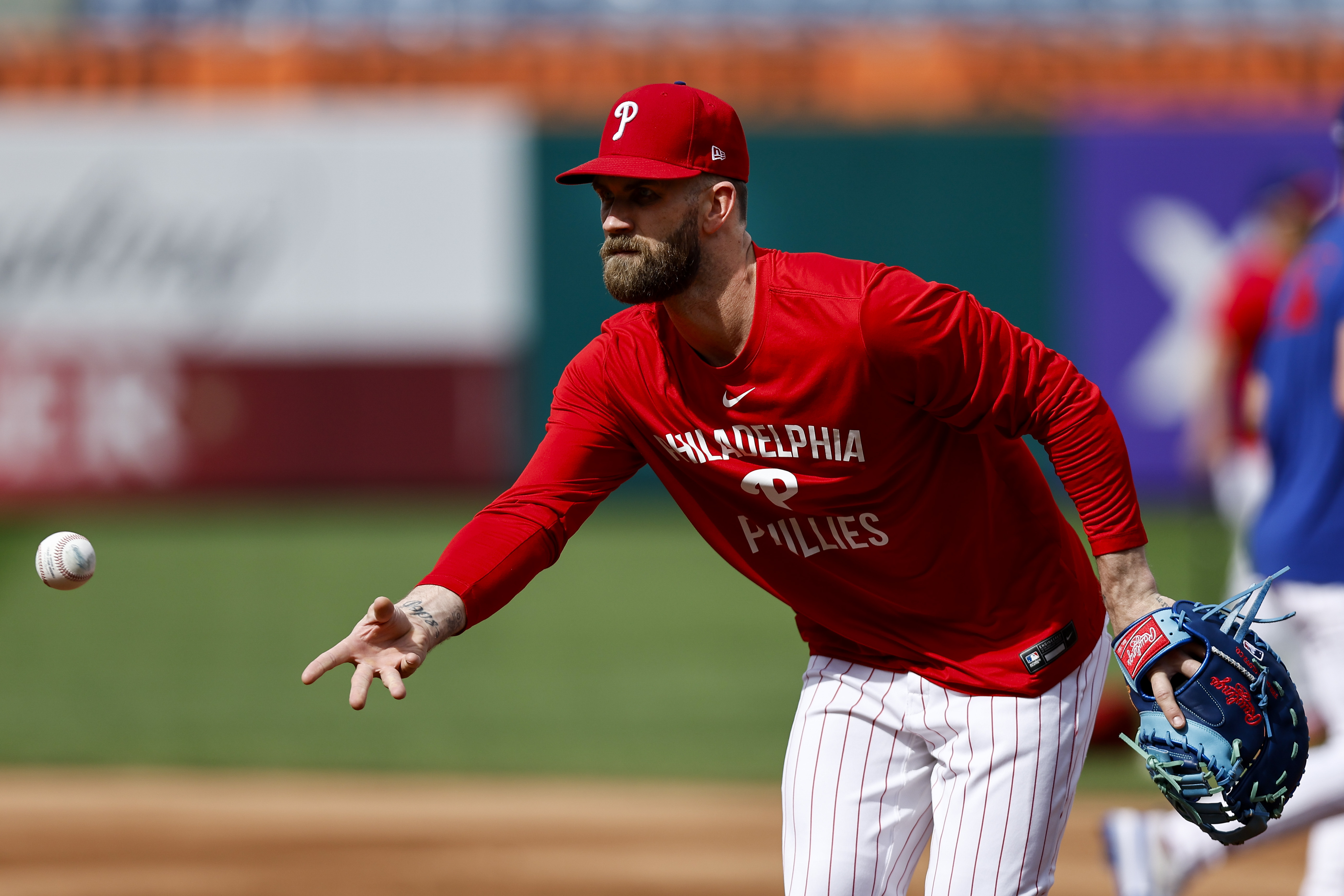
    The Phillies plan to keep Bryce Harper, a Gold Glove finalist for a second straight season, at first base.

    Harper to the outfield?

    Don’t expect Harper to change positions, either, despite the first baseman expressing some willingness last offseason and ahead of the trade deadline to return to the outfield.

    Harper, who earned his second straight Gold Glove nomination at first base this season, has said he would be open to making a position switch if needed for an offensive upgrade. But it doesn’t sound as if the Phillies will consider moving him back to the outfield to add, say, Pete Alonso, who plans to opt out of his contract with the Mets after a 38-homer season.

    “I think Bryce is a first baseman at this time,” Dombrowski said. “I mean, that’s where we look at him as, and he has asked to go out into the outfield. He would be willing to do so, but I think it would be more for the short term if we had done something at the trading deadline, but it’s been a while since he’s been out [there].

    “I’m sure he’d be fine, but he’s a really good first baseman, and I think for us, that’s the position we look at him playing for us.”

    Harper finished the season with an OPS of .844. Though that still ranked 11th in the National League, it was his lowest since 2016 (.814).

    Dombrowski seemed to lay down a challenge to Harper at his year-end news conference.

    “He’s still an All-Star-caliber player. He didn’t have an elite season like he has had in the past. And I guess we only find out if he becomes elite or he continues to be good,” Dombrowski said. “… He’s the one that will dictate that more than anything else, and that’s what it comes down to.”
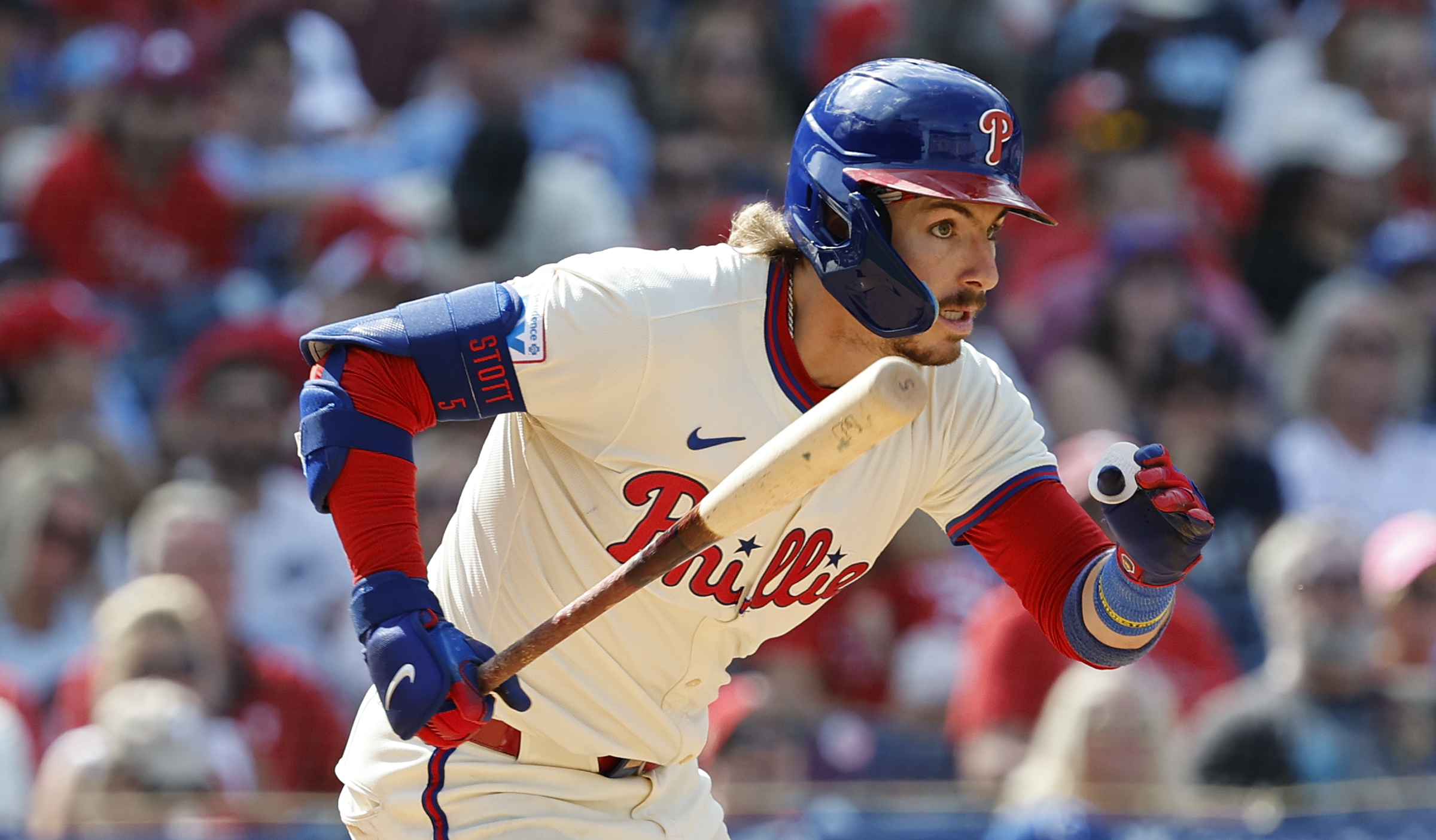
    Bryson Stott hit .310 with an .880 OPS from Aug. 1 through the end of the regular season, but still struggled against lefties.

    Second and third base

    Stott continued to be elite defensively at second base, but had a roller-coaster offensive season. He struggled over the first half, but a midyear adjustment to his hand placement led to improved at-bats overall. Stott went from hitting .194 with a .637 OPS in July to a .307 batting average and .864 OPS in August.

    However, Stott’s .575 OPS against lefties kept him in a platoon with Sosa. When called upon, the Phillies’ utility man provided a spark of energy and clutch hits, plus an .895 OPS against left-handers.

    “I view Stott as an everyday player, but Sosa’s numbers are so good against left-handed pitching that you’ve got to fit him someplace, whether it’s at third base when Bohm was hurt or mixed in for Stott against the lefties,” Thomson said. “So I view Stott as an everyday hitter. I think if he played every single day against left-handed pitching, he’d get better and put up pretty good numbers.”

    On the other hand, Bohm spent last offseason amid a tornado of trade rumors. He will reach free agency in 2027, and his name will likely be floating around this winter, too, as one of the few ways the Phillies can change up their infield. The third baseman was afflicted by injuries — a rib fracture in July and shoulder inflammation in August — and slashed .287/.331/.409.

    While Bohm and Harper were on the injured list at different points this season, Otto Kemp was a key fill-in. He hit .234 with 28 RBIs in his first 62 major-league games, most of which he played through knee and shoulder injuries that he will address with offseason surgery.

    Kemp, 26, saw the bulk of his playing time at third but also appeared at first and second and in left field.
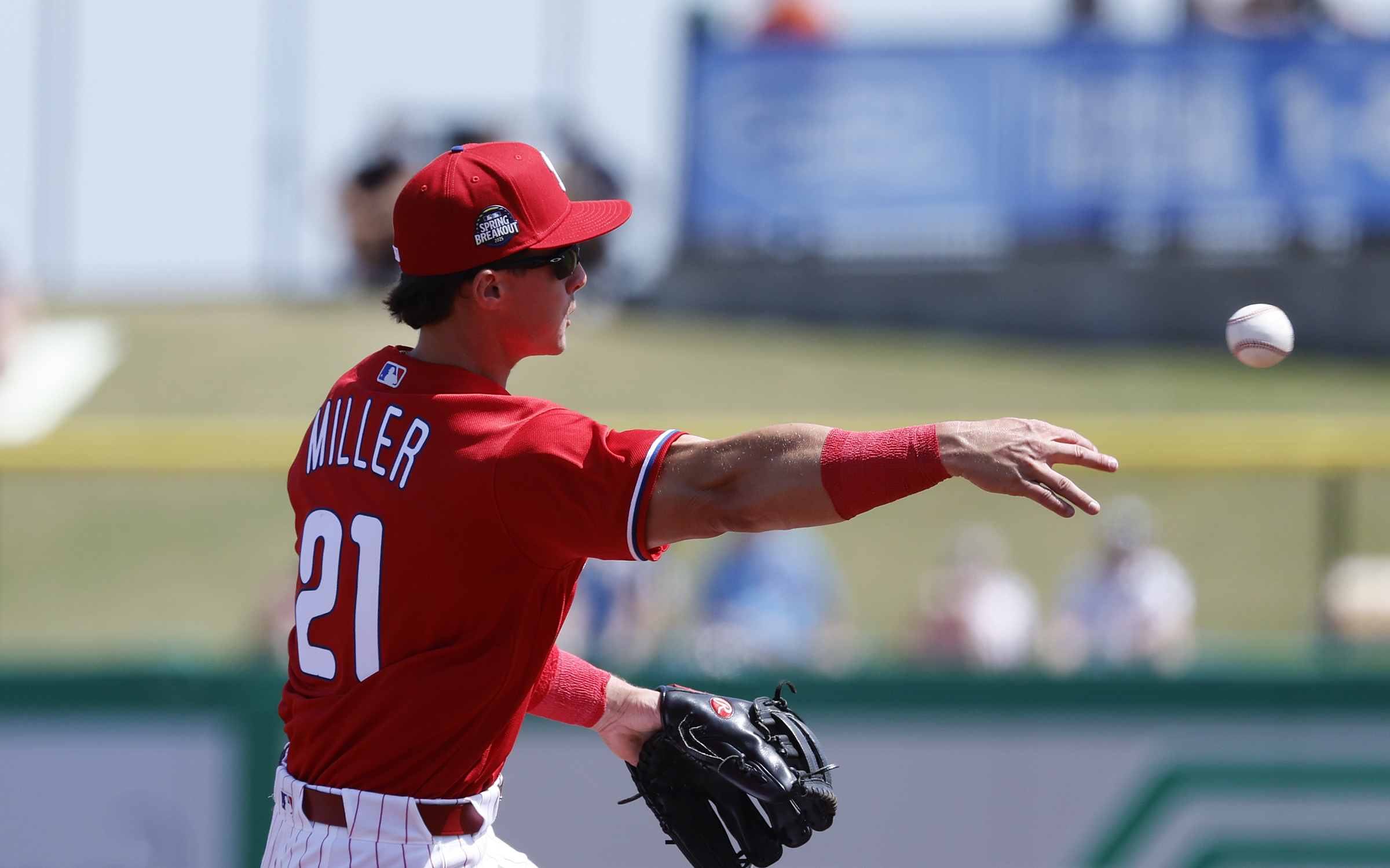
    The Phillies believe Aidan Miller can stick at shortstop, but that’s blocked by Trea Turner for now.

    Down on the farm

    The Phillies’ top infield prospect, Aidan Miller, is rising quickly. The 21-year-old posted an .825 OPS this year and stole 59 bases between double-A Reading and triple-A Lehigh Valley. But the question remains as to where he will play in the majors.

    Miller, who finished the season in triple A after a September promotion, has played shortstop throughout his minor-league career. Similar to the situation with top outfield prospect Justin Crawford, the Phillies believe that when Miller reaches the major leagues, he will need to be an everyday player.

    A Miller breakthrough next season would require some changes to the current infield configuration. And Turner, who is under contract through 2033, doesn’t appear to be on the move from shortstop anytime soon. Dombrowski said the Phillies are still having conversations about Miller’s long-term position.

    “When I talked to people in our organization, they feel he can play shortstop. Of course, we have an All-Star shortstop at this point,” he said. “… [Miller has] played some second, he’s played some third, but he’s primarily been a shortstop, so we’d have to make sure that we properly prepare him to do that, and that’s still a discussion that we’ll have to have.”

    Miller initially planned to participate in the Arizona Fall League, but the Phillies decided to prioritize rest instead.

    Further down the pike, second baseman Aroon Escobar is the Phillies’ No. 5 prospect, according to MLB Pipeline. Escobar, 20, ascended three levels in 2025 to finish the season at double A. He hit 15 homers and had 62 RBIs in 120 games.

    Also in double A to end the year is Phillies No. 13 prospect Carson DeMartini. In his first full professional season after being drafted in 2024 out of Virginia Tech, the third baseman posted a .707 OPS and stole 45 bases.
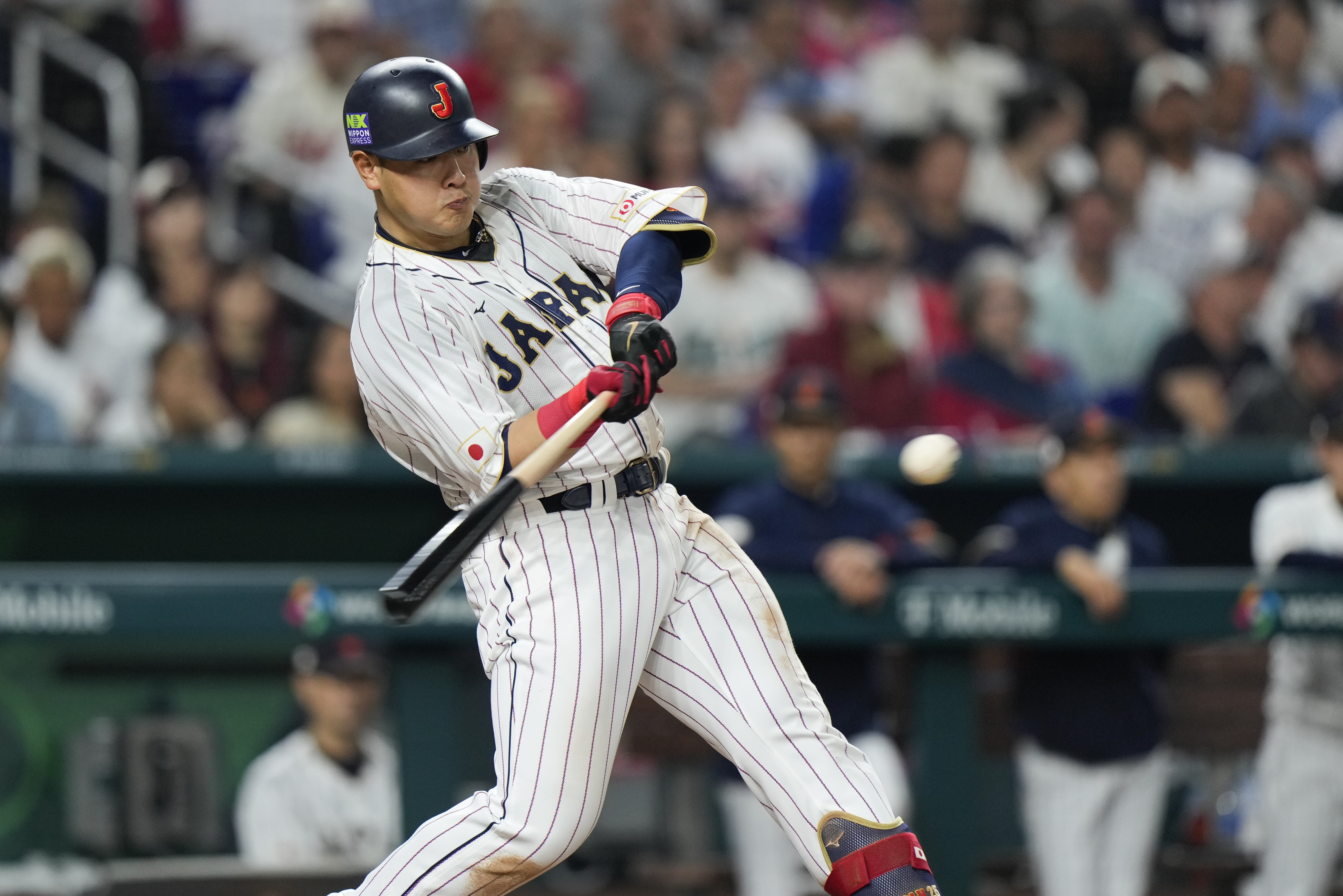
    Kazuma Okamoto has slashed .277/.361/.521 with 248 homers over 11 seasons in Nippon Professional Baseball in Japan.

    Free agency

    The Phillies don’t have a pressing free-agent need to fill in the infield, though that could change if a trade is made. (The battery will be covered later in this series.)

    Currently, one of the top available names on the market is righty third baseman Alex Bregman, who is set to opt out of his contract with the Red Sox after an All-Star season in which he slashed .273/.360/.462 with 18 homers.

    Third baseman Eugenio Suárez was one of the most coveted offensive trade deadline acquisitions this year and was linked to the Phillies before ending up with the Mariners. Suárez saw a dip in production in the second half, but he still had some big postseason moments for Seattle, such as a game-winning grand slam in Game 5 of the American League Championship Series.

    Gleyber Torres, 28, had an overall bounce-back year with the Tigers after the Yankees let him walk in 2024. The right-handed-hitting second baseman was named an All-Star for the first time since 2019. Torres saw diminished production later in the season, with a .812 first-half OPS compared to .659 in the second half, but revealed that he had been playing through a sports hernia late in the year.

    There are also international options. In recent years, the Phillies have attempted to expand their outreach in Japan in the hopes of attracting top stars there, but have yet to break through.

    The Yomiuri Giants of Nippon Professional Baseball have announced that they will be posting corner infielder Kazuma Okamoto. The right-handed 29-year-old has hit .277/.361/.521 with 248 homers over 11 seasons in NPB.

    According to an MLB.com report, Munetaka Murakami is also expected to be posted this winter. Murakami, 25, is a left-handed-hitting corner infielder with a career .951 OPS across eight seasons in NPB. He was named Most Valuable Player of the Central League in 2021 and 2022.

  • Jalen Carter, Landon Dickerson, Nakobe Dean among five reasons Eagles will win the rematch vs. Giants

    Jalen Carter, Landon Dickerson, Nakobe Dean among five reasons Eagles will win the rematch vs. Giants

    Nobody saw it coming. Not even the Giants.

    “Quite honestly, nobody really expected us to put up a performance like this,” Giants quarterback Jaxson Dart said afterward.

    Maybe we should have.

    One of the more shocking upsets in recent Eagles history happened at MetLife Stadium on Oct. 9, when the 1-4 Giants got their second win over the 4-1 Eagles, who were defending Super Bowl champions and the winners of the last seven truly meaningful games against their closest NFC East rivals.

    Should it have been so shocking?

    After all, the Giants’ losses came at the Commanders, who had the services of since-injured quarterback Jayden Daniels; at the Cowboys, who have the No. 1 offense; at home against the Chiefs, a current dynasty; and at the Saints, where Dart, in his second start, committed three of the Giants’ five turnovers.

    Further, the Eagles played without two Pro Bowl players, defensive tackle Jalen Carter and guard Landon Dickerson, and they lost top cornerback Quinyon Mitchell in the second quarter.

    So, maybe the Giants weren’t so bad, and, clearly, the Eagles weren’t as deep as they needed to be.

    A lot has changed in two weeks. That should make all the difference come Sunday afternoon.

    1. Dickerson is healthy

    Dickerson was the seventh-best guard in the league last season, according to Pro Football Focus, when he was named to his third straight Pro Bowl and played in his second Super Bowl in three seasons. He has dealt with knee surgery that cost him most of training camp, a back injury that limited him in September, and an ankle injury that cost him the Giants game. He’s still ranked in the middle of the pack.

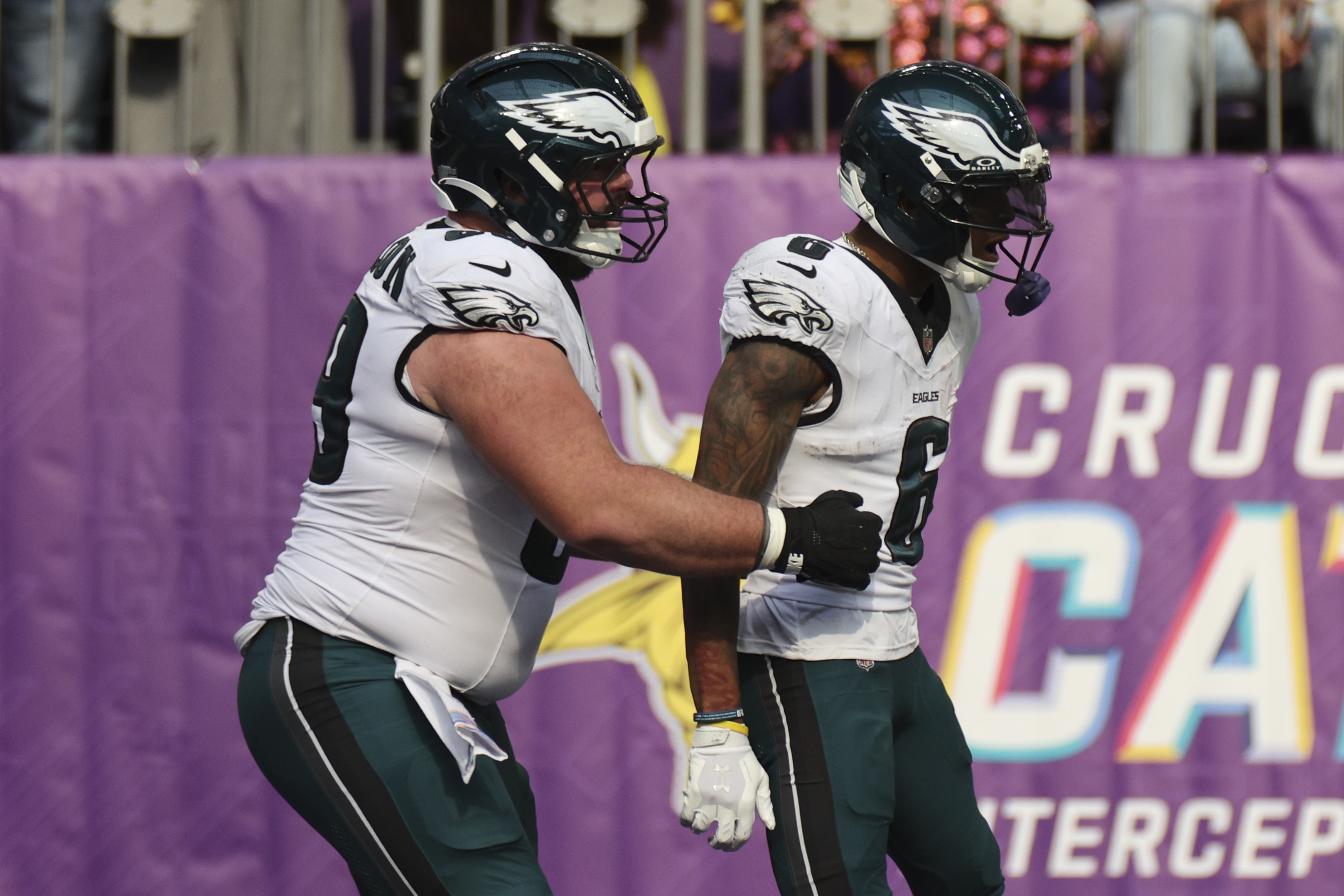
    Eagles guard Landon Dickerson celebrates with wide receiver Devonta Smith after Smith’s touchdown in Minnesota on Sunday.

    Dickerson was his healthiest this season last Sunday in Minneapolis, and the resulting grade showed it. Even with fifth-year backup Brett Toth playing at center for the first time next to him, Dickerson dominated.

    Toth was Dickerson’s replacement in the loss to the Giants. Things did not go well.

    2. Carter is healthy

    The Eagles built their defense around Carter, who has succeeded Fletcher Cox as the franchise’s core defensive player. Carter’s injured heel cost him the game against the Giants, but the 10 days between the Giants game and the trip to Minnesota not only gave the heel time to heal (heh heh), it also allowed his sprained right shoulder to strengthen.

    The shoulder cost him time in training camp and, intermittently, during the regular season. It also made him a horrific tackler: the worst, in fact, among all NFL defenders, according to PFF.

    Also, he’s finally in good enough shape to be effective for more than half an NFL game. Of course, there’s no viable reason he should not have been in better shape to start the season.

    You don’t run on your shoulder.

    3. Jalen Hurts found his rhythm

    In Minnesota, Hurts and his top three receivers, A.J. Brown, DeVonta Smith, and Dallas Goedert, finally appeared to be in sync. Hurts threw for 326 yards and had a perfect 158.3 passer rating for the first time in his career.

    Much had been made about the ineffectiveness of the passing game through the first six games, but, as we warned when the season began, injuries to Brown and Smith kept the passing attack from practicing as a complete unit the entire preseason, which is why the preseason (and preseason games) exist. Hurts is always gun-shy. He’s much more gun-shy when he’s not comfortable. Last Sunday, for the first time, he looked comfortable.

    Also, the team changed offensive coordinators for the third consecutive season.

    Also, the offensive line has played just one of seven games from start to finish with its starters intact, and that’s why the Eagles won at Kansas City.

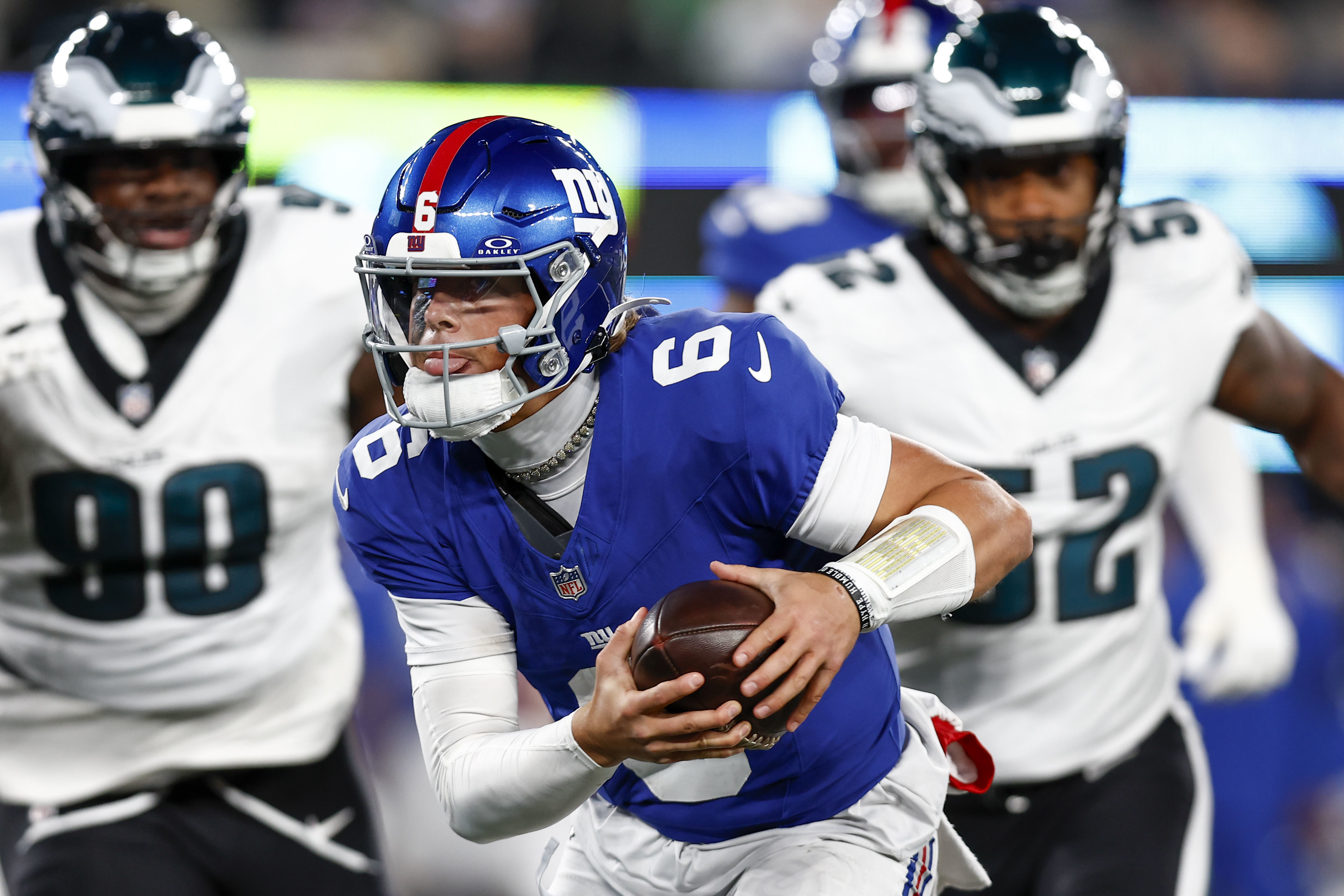
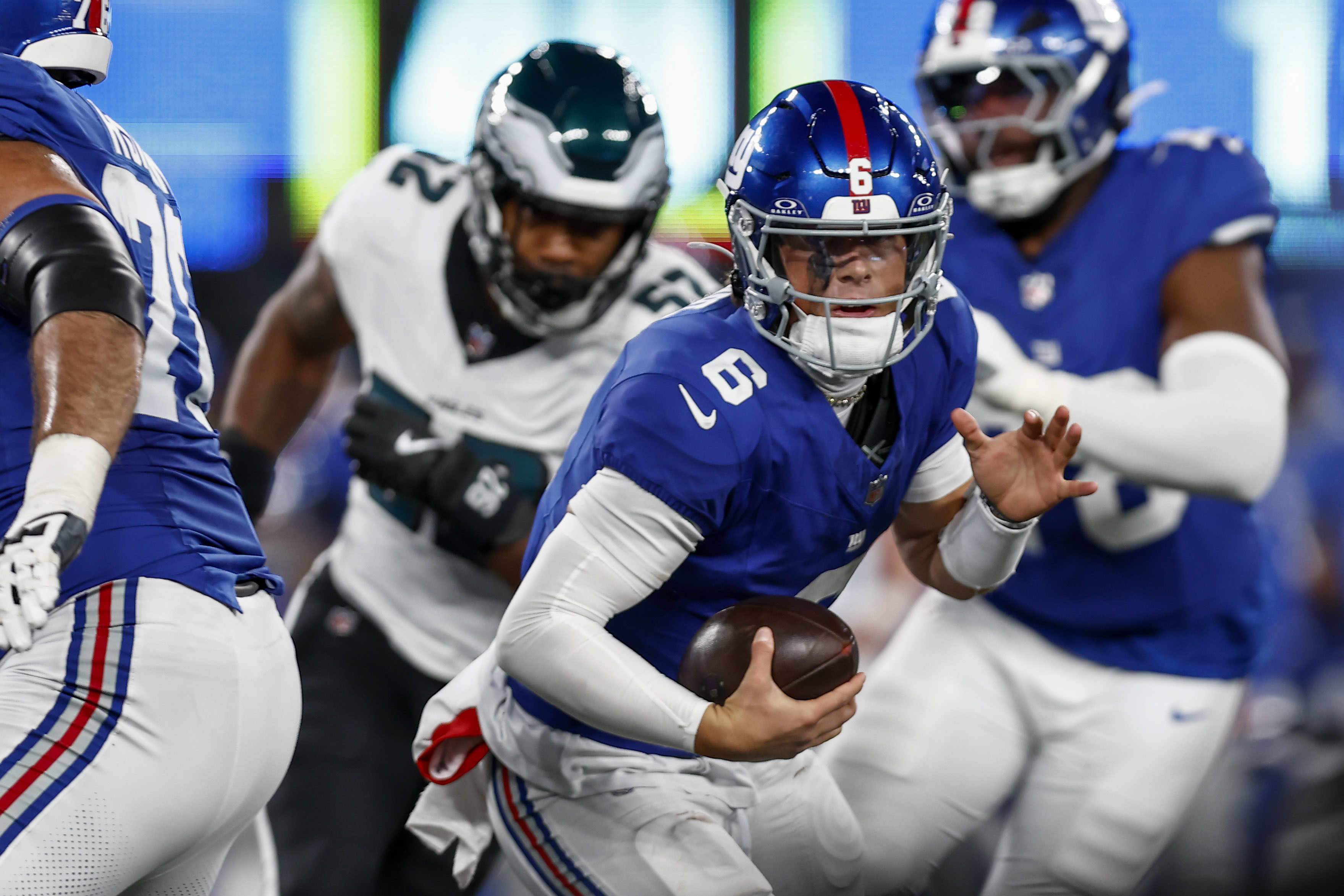
    New York Giants quarterback Jaxson Dart scrambles during an Oct. 9 matchup with the Eagles.

    4. Familiarity

    There’s a little more tape on Dart, whose elusiveness and fearlessness are a formidable combination. Combine that with unpredictability, and you get a kid who will make a lot of plays but will also make a lot of mistakes.

    A lot of the tape on Dart shows Eagles defenders getting roasted.

    Don’t expect much more of that sort of tape from Sunday’s game.

    5. Return of the Macks

    Nobody commanded more respect in the Eagles locker room last season than 15-year veteran defensive end Brandon Graham. His return from retirement Tuesday will resound whether or not he takes a snap on Sunday.

    A close second: third-year linebacker Nakobe Dean. Before he injured his pectoral muscle in the playoffs last season, he ranked 10th among all linebackers in overall defense, seventh as a pass rusher, according to PFF, and his impact as a tackler in his return Sunday was dynamic: He had six tackles, three solos, and a tackle for loss … on just 23% of the defensive snaps.

  • City Controller Christy Brady is facing a challenge from Republican Ari Patrinos

    City Controller Christy Brady is facing a challenge from Republican Ari Patrinos

    City Controller Christy Brady, seeking her first full term as Philadelphia’s independently elected fiscal watchdog, is being challenged by Republican Ari Patrinos in the Nov. 4 general election.

    The controller’s office is charged with auditing the city’s finances and investigating fraud, waste, and abuse.

    But despite that critical role, there hasn’t been much drama in this year’s race.

    Patrinos, a former stockbroker and Philadelphia public school teacher, acknowledged the odds are against him in heavily Democratic Philadelphia and said he has no particular complaints about Brady’s performance.

    Instead, he said, he ran because “it was important that somebody run on the ticket.”

    “The truth is nobody wanted to run, and my ward leader asked me if I would run,” said Patrinos, who has not reported raising any money for his campaign. “I didn’t have any specific attacks on Brady. My concern is that the city is too single-party, and I think the city functions better when you have a two-party system.”

    Brady, a Democrat who has a $250,000 campaign war chest she likely won’t need to use this year, has the support of much of the local political establishment, including the Democratic City Committee and the building trades unions.

    A 30-year veteran of the controller’s office, Brady has struck a notably conciliatory tone during her tenure, striving to work collaboratively with Mayor Cherelle L. Parker’s administration rather than butt heads with the executive branch, as many of her predecessors have done.

    “Because of my experience when I took office two years ago, I hit the ground running,” she said.

    She pointed to her office’s audit that uncovered that the Philadelphia School District had made about $700,000 in payments to fake vendors as part of a cyber scam and to her investigation finding that fraudulent use of the property tax homestead exemption was costing the city and school district about $11.4 million per year.

    Brady was appointed acting controller in 2022 by then-Mayor Jim Kenney when Rebecca Rhynhart resigned from the post to run for mayor. Brady then won a 2023 special election to finish Rhynhart’s term, which ends in January.

    Seeking a full four-year term for the first time, Brady this year ran uncontested in the Democratic primary.

    “The biggest question I get [on the campaign trail] is: What does a controller do?” she said. “And so I’m getting out there and spreading the word of what we’re currently working on and what we do in the office.”

    The controller earns an annual salary of $171,000 and oversees an office with more than 120 employees and a budget of about $11.8 million.

    Patrinos also had no opponent in the May primary. He said he has been spending much of his time on the campaign trail promoting Pat Dugan’s campaign for district attorney.

    Dugan, a self-described “lifelong Democrat,” lost to District Attorney Larry Krasner in the Democratic primary but has accepted the GOP nomination to take a second swing at the incumbent in the general election.

    “I spend like half my time when I campaign advocating for Dugan because I’m very concerned about the crime,” Patrinos said.

    From Philly to Harvard and back

    Patrinos, who lives in Chestnut Hill, said he was a Democrat until about four years ago, adding that he voted for Joe Biden in the 2020 presidential election.

    His conversion was prompted primarily by his alma mater, Harvard College, which he felt had too enthusiastically embraced a “woke” stance.

    “The immediate driving factor was on the cultural front. It was what was going at Harvard,” he said. “I’m a little bit of an anti-woke warrior. … 2020 was peak woke.“

    Academia’s leftward trajectory and the Biden administration’s “terrible” handling of the pandemic combined to leave Patrinos with the feeling that he had no place in the Democratic Party, he said.

    “These Ivy League liberal types who really don’t have a sense of what’s going on in the lives of average Americans — they seemed to be so indifferent to the negative effects of their policies,” he said.

    He became involved in local Republican politics and helped boost President Donald Trump’s Philadelphia campaign in 2024.

    “I’m not a MAGA guy, so I didn’t join [the GOP] because of Trump,” he said, “but honestly I’m very happy with the higher education stuff, the hardcore stand he’s taken with Harvard.”

    Patrinos, a Central High School graduate who also has a master’s degree in political science from the University of Chicago, was a stockbroker in New York City before moving back to Philly about 15 years ago.

    He then became a math and history teacher and worked at West Philadelphia High School and Strawberry Mansion High School. Patrinos said he suffered a seizure several years ago that temporarily limited his employment opportunities, but is now seeking other jobs should he come up short against Brady.

    If elected, Patrinos said, he would audit the Philadelphia Department of Licenses and Inspections (L&I), examine whether SEPTA could do a better job preventing fare evasion, and push the school district to prepare more students for careers in information technology.

    Controller and mayor on the same page

    Brady’s approach to the mayor’s administration is the exception when it comes to the recent history of her office.

    A decade ago, then-City Controller Alan Butkovitz’s relationship with Mayor Michael A. Nutter became so toxic that Nutter at one point issued a statement calling Butkovitz “a sad and sick person.”

    Their successors, Kenney and Rhynhart, started off with widespread expectations that they might have a better working partnership, given that Rhynhart served as a top executive branch official under Nutter and, briefly, Kenney. But the relationship soured in a matter of months after Rhynhart publicly criticized the administration’s bookkeeping, prompting a call from Kenney that reportedly “got personal” and the cancellation of their planned monthly meetings.

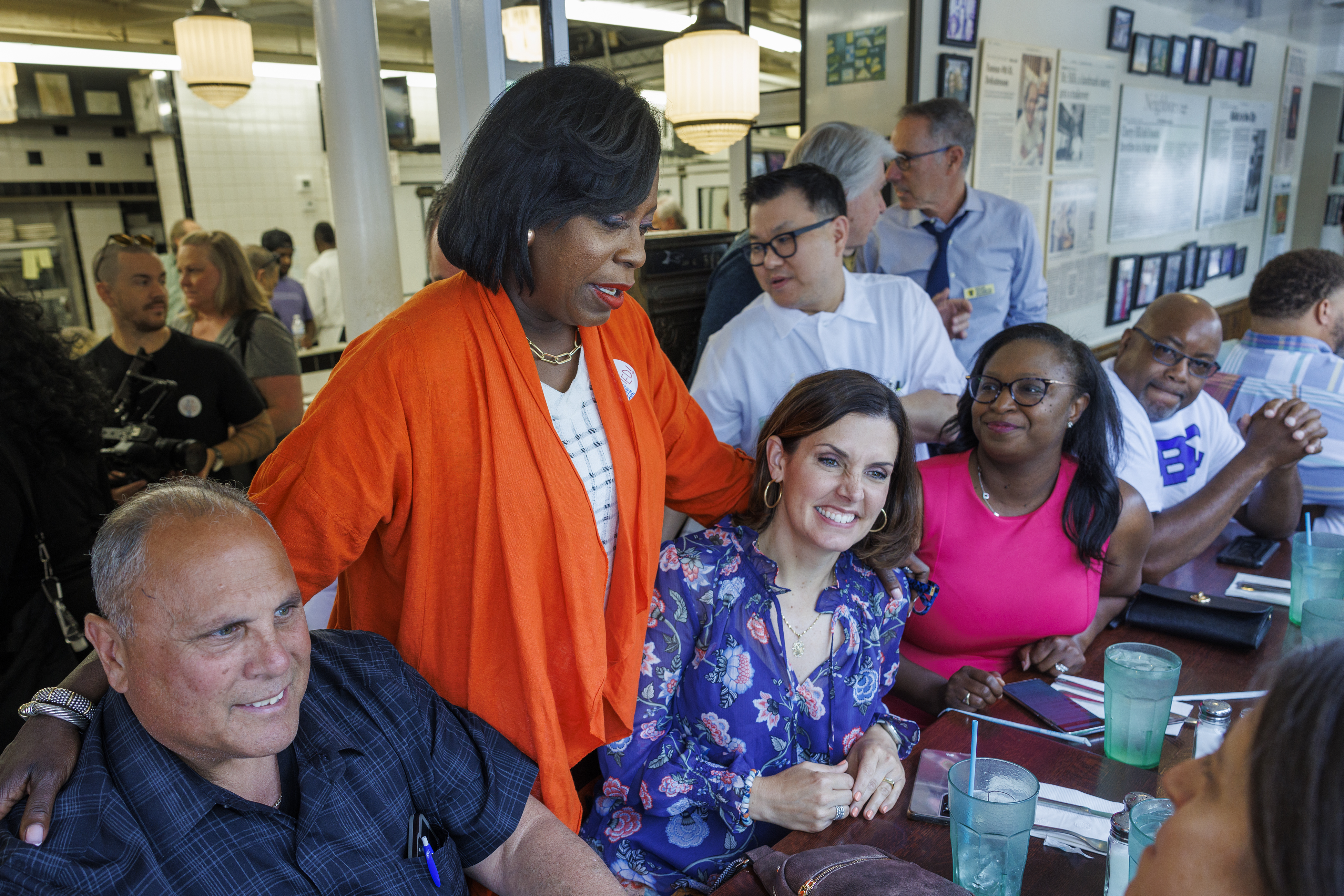
    Cherelle L. Parker, then a candidate for mayor of Philadelphia, stops to greet a group, including Christy Brady,(center seated), during election day lunch at Famous 4th Street Deli in Philadelphia on Tuesday, May 16, 2023.

    That outcome does not appear likely with Brady and Parker.

    Brady shares many political allies with Parker, especially the Philadelphia Building and Construction Trades Council, a coalition of unions that spends big on elections and has reason to be pleased with both Brady and Parker’s tenures so far.

    Brady, for instance, touts her office’s audit of L&I that revealed inspectors often failed to confirm that construction sites were being run by licensed contractors — providing ammunition to the trades unions, which often rail against “fly-by-night” contractors that do not employ their members. And the mayor last year split the department into two agencies, with one focused largely on enforcing construction regulations.

    Brady said her healthy relationship with the Parker administration should not be confused with a reticence to call out fraud and waste.

    “I am an independently elected official. I am not afraid to stand up for what’s right,” she said. “I believe in the rules and regulations in city government.”

    Her approach to the executive branch, she said, is designed to advance the aim of any auditor: ”getting management to implement your recommendations.”

    “In my experience in the controller’s office, when you fight, they’re not going to listen to your recommendation,” said Brady, a certified public accountant who graduated from the Philadelphia College of Textiles and Science, now Jefferson University. “When we issue our reports, the mayor has been thanking me for the recommendations. And I really appreciate that relationship because I believe that we can make change.”

    Staff writer Ryan W. Briggs contributed to this article.

  • Eagles vs. Giants in Week 8: Here are the numbers that matter

    Eagles vs. Giants in Week 8: Here are the numbers that matter

    The Eagles and Giants meet for the second time in three games Sunday at Lincoln Financial Field, and the Eagles will be aiming to flip the script after taking an embarrassing 34-17 defeat in Week 6 at MetLife Stadium.

    The Eagles have plenty of things they studied after that loss, and some of them showed on the field Sunday against the Minnesota Vikings.

    What will happen in Week 8? Here’s what some of the numbers tell us:

    23.9%

    The Eagles don’t really need a reminder of this, but the Giants offense goes as Cam Skattebo goes.

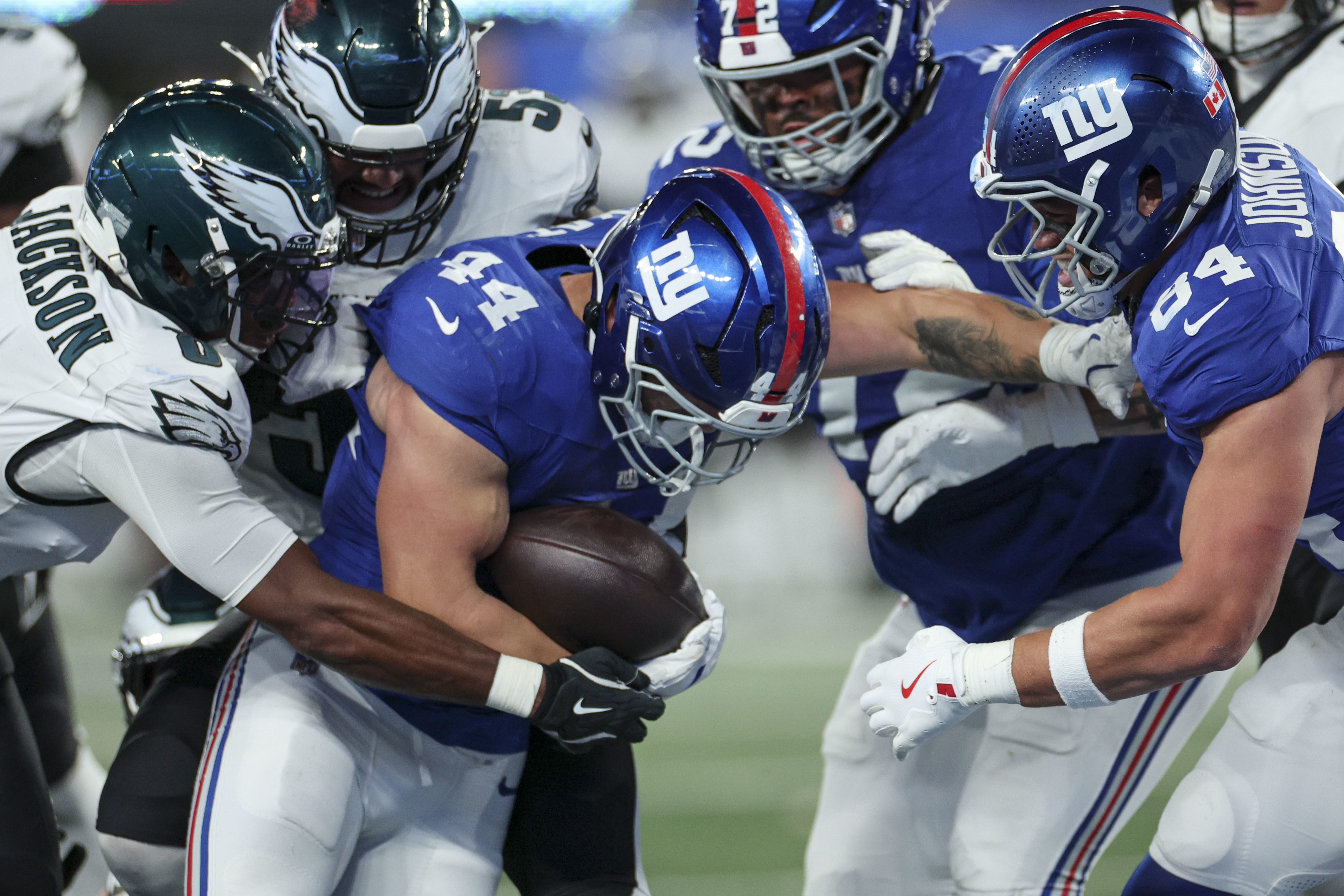
    The rookie had 110 yards from scrimmage, including 98 on the ground, two weeks ago at MetLife Stadium. He bowled over Zack Baun and then scored on the next play. Then he did a backflip.

    Skattebo accounted for 30% of the Giants’ yards that night, which is ahead of his season-long average of 23.9% of New York’s offense. If Skattebo stays at this pace, that would be the second-highest mark by a Giants rookie since 2000, behind only Saquon Barkley’s 33.5% in 2018, according to Next Gen Stats.

    The Eagles will have to tackle better if they want to slow down Cam Skattebo in their rematch with the Giants.

    The Eagles will need better answers for Skattebo. They were much better against Jordan Mason on Sunday in Minneapolis, where they held Mason to 3.8 yards per carry. Skattebo was at 5.2 a week earlier, in part because of his ability to run through tackles. Since taking over as the lead back in Week 3, Skattebo is up to 31 forced missed tackles, which trails only the San Francisco 49ers’ Christian McCaffrey during that stretch.

    Brandon Graham could help the Eagles at setting the edge against the run, but it’s unclear if Graham will be ready to go for Sunday’s game.

    193

    Rookie quarterbacks tend to be beatable by blitzing them and causing havoc, but Jaxson Dart defied that law Sunday vs. the Denver Broncos.

    Dart was 8-for-14 for 193 yards, two touchdowns, and an interception when facing pressure from the Broncos, according to Next Gen. The interception was obviously a negative result, but the 193 passing yards were the third-highest total against the blitz by a quarterback this season.

    Impressive stuff from the 25th overall pick in this year’s draft.

    This isn’t a departure from his success when the teams met two weeks ago. Dart was 9 of 13 for 99 yards and a touchdown when the Eagles blitzed him. He has been blitzed on a league-high 38.6% of his drop backs, according to Next Gen.

    Giants quarterback Jaxson Dart hurt the Eagles with his legs to the tune of 58 yards and a touchdown.

    Perhaps the lesson learned from the film Sunday for the Eagles will be Denver’s success when not sending extra rushers. Against four or fewer rushers, Dart went 7-for-19. The Broncos also kept him in check with his legs. He was solid when throwing on the move, but he did not gain any scrambling yards, a departure from his previous starts.

    The Eagles have plenty to clean up there from the last matchup, and scrambling quarterbacks have been the Achilles’ heel for their defense, as Vic Fangio pointed out last week when asked about why the run defense has struggled. Dart accounted for 58 yards and a touchdown on the ground two weeks ago.

    4

    The Eagles almost doubled up their under-center play-action drop backs in Sunday’s win at Minnesota.

    They entered with just five such plays in their first six games, and on Sunday they called four play-action drop backs. Those plays resulted in four completions for 121 yards and a touchdown.

    It was a tendency-breaking day. Before Sunday, Jalen Hurts handed off on 42 of the 48 times he lined up under center.

    The Eagles have at least given the Giants something different to think about.

    2.4

    The Eagles’ running game hasn’t been good, and it was especially bad Sunday vs. the Vikings, who boast a pretty formidable defensive front. But Barkley managed just 44 yards on 18 carries, and his 2.4 yards per attempt ranked as his second-lowest output of the season.

    Eagles running back Saquon Barkley was held under 2.5 yards per carry against Minnesota.

    Here’s a big reason the running game is struggling: Barkley, according to Next Gen, has been contacted behind the line of scrimmage at a rate of 58%, the highest in the NFL. He has gained the fewest yards before contact (minus-2) among running backs with at least 30 carries directed between the tackles this season.

    Last season, Barkley gained 264 rushing yards before contact on carries between the tackles, second in the NFL.

    19

    Rookie edge rusher and Philadelphia’s own Abdul Carter is having a pretty good rookie season with the Giants. The No. 3 overall pick leads the NFL with 19 quick pressures, according to Next Gen, and has 29 total pressures this season. Only seven players have generated more pressure. A quick pressure occurs when a player pressures a quarterback within 2.5 seconds on a passing play.

    Carter has caused havoc, but he was nullified two weeks ago when Lane Johnson held him without a pressure across 14 matchups. Carter managed just two pressures in that game, according to Pro Football Focus, his lowest single-game total this season.

    72.9%

    We highlighted the Eagles’ playoff chances in this exercise last week, and it’s worth following up here.

    Consecutive losses in games the Eagles were supposed to win put them in a precarious spot, trending toward being a coin flip to make the playoffs, according to FTN Fantasy’s projections. But the win against the Vikings bumped the Eagles’ playoff chances nearly 14 points to 72.9%.

    The Eagles are one of six NFC teams with a 5-2 record. Getting to 6-2 before the bye would be helpful, and would likely increase that playoff percentage slightly.

  • N.J. sues Amazon twice in three days over treatment of workers

    N.J. sues Amazon twice in three days over treatment of workers

    New Jersey officials have sued Amazon twice in three days, saying that the e-commerce giant has exploited delivery drivers and discriminated against warehouse workers who are pregnant or have disabilities.

    The first lawsuit, filed Monday, marked the Garden State’s latest move to dispute companies’ classification of drivers as independent contractors, not employees who are legally entitled to certain benefits and rights, including minimum wage, overtime pay, earned sick time, and family leave.

    At the heart of the latest suit are Amazon’s “Flex” drivers, who use their personal vehicles to deliver packages, according to court documents filed in Superior Court of Essex County.

    New Jersey Attorney General Matthew Platkin and Department of Labor and Workforce Development Commissioner Robert Asaro-Angelo began investigating after some Flex drivers applied for unemployment and disability benefits, toward which Amazon has not been contributing.

    “Amazon calls its drivers ‘Delivery Partners,’ but they are simply Amazon’s employees,” the complaint reads. “Drivers are workers who, in exchange for remuneration from Amazon, perform the discrete, repetitive work of picking up and delivering packages from Amazon’s warehouses, or other Amazon locations such as Whole Foods stores, to their final destinations — a necessary function for Amazon’s business operations. “

    Amazon spokesperson Mary Kate Paradiso said the lawsuit “is wrong on the facts and the law” and misrepresents how Flex works.

    “For nearly a decade, Amazon Flex has empowered independent delivery partners to choose delivery blocks that fit their schedules, giving them the freedom to decide when and where they work,” Paradiso said in a statement. “This flexibility is one of the main reasons many drivers say they enjoy the program.”

    Amazon advertises the Flex program as a way for people to make money on their own schedules. On the Flex website, Amazon says most drivers earn $18 to $25 an hour. A disclaimer underneath reads “actual earnings will depend on your location, any tips you receive, how long it takes you to complete your deliveries, and other factors.”

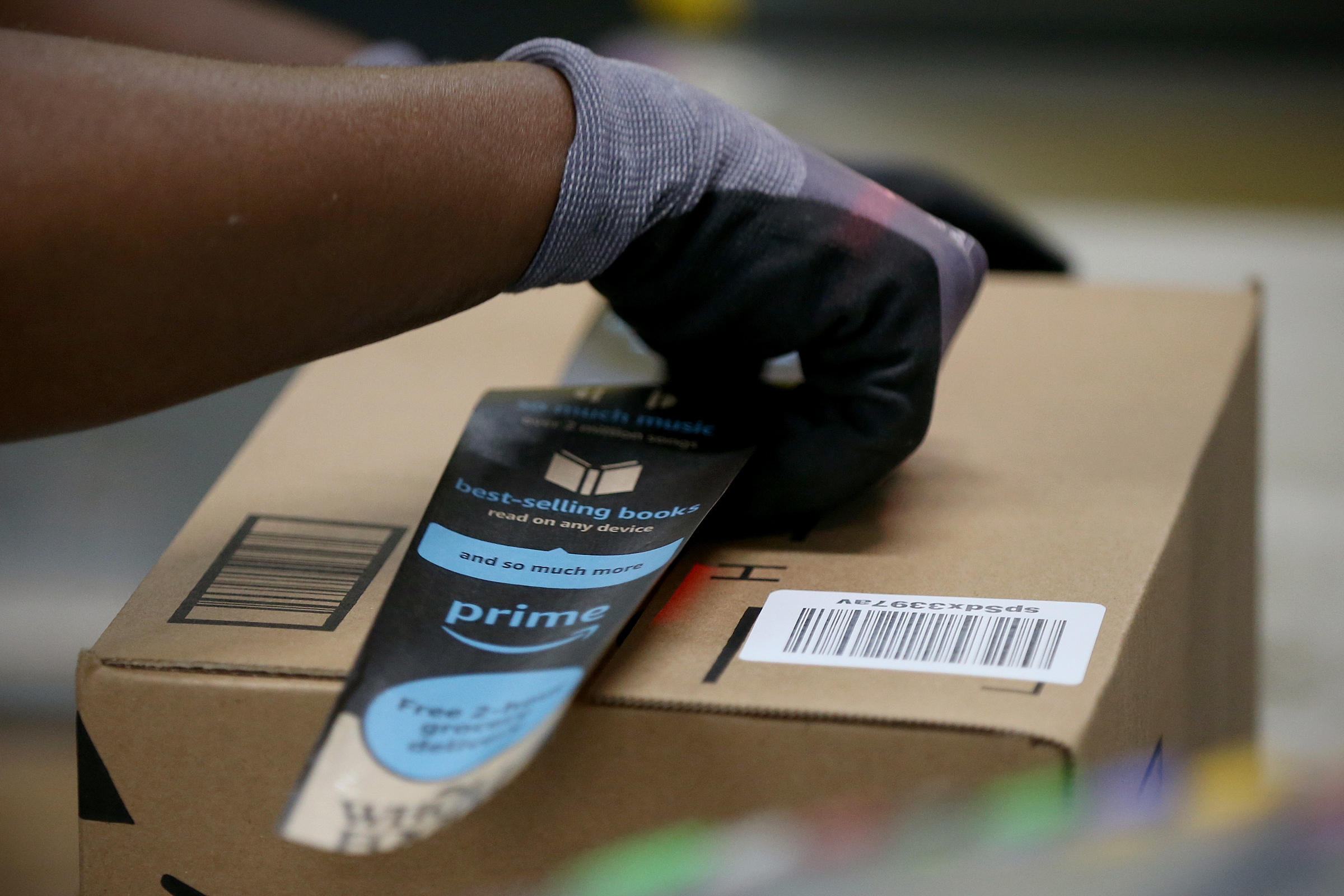
    A worker boxes up an order to be shipped at the Amazon Fulfillment Center in West Deptford in this 2019 file photo.

    Since at least 2017, thousands of Flex drivers have worked in New Jersey, according to state officials.

    “Amazon is taking advantage of Flex drivers and enriching its bottom line by failing to obey our labor laws and offloading its business expenses for the benefit of shareholders,” Platkin said in a statement.

    New Jersey is stricter than some other states when it comes to independent contractors, and outgoing Gov. Phil Murphy has made combating worker misclassification a priority of his administration.

    In a similar case, Lyft recently paid $19.4 million to the New Jersey Department of Labor & Workforce Development after it found the rideshare service had misclassified 100,000 drivers as independent contractors.

    In a separate lawsuit filed Wednesday, Platkin and the state’s Division on Civil Rights say that Amazon discriminated against pregnant workers and workers with disabilities, including by putting them on unpaid leave or firing them after they requested reasonable accommodations. The lawsuit was the result of a yearslong investigation into the working conditions of about 50,000 workers at dozens of Amazon warehouses across New Jersey.

    State officials said they found that sometimes workers’ accommodation requests were accepted, but then those workers were terminated for not meeting productivity goals.

    “Amazon has exploited pregnant workers and workers with disabilities in its New Jersey warehouses,” Platkin said. “In building a trillion-dollar business, Amazon has flagrantly violated their rights and ignored their well-being — all while it continues to profit off their labor.”

    An Amazon spokesperson did not respond Wednesday afternoon to a request for comment on the second lawsuit.

  • Is 2025 Philadelphia’s year of the parking garage?

    Is 2025 Philadelphia’s year of the parking garage?

    Three large stand-alone parking garages have been proposed in Philadelphia this year, unusual projects in a city where parking operators have long complained that high taxation makes it difficult to run a business.

    The latest is a 372-unit garage near Fishtown and Northern Liberties at 53-67 E. Laurel St. near the Fillmore concert hall and the Rivers Casino.

    The developers see it as a strong bet for an area of the city that has seen a surge of apartment construction, which, due to Philadelphia’s parking laws, requires developers to only build spaces to serve a fraction of the units.

    “There’s been about 2,500 units that have come online within a 5- to 10-minute walk” of the planned garage, said Aris Kufasimes, director of operations with developer Bridge One Management. “When you’re building those on 7-1 [apartments to parking spaces] ratios, that leaves a massive hole. Where is everybody going to put their vehicles?”

    Despite central Philadelphia’s walkability and high levels of transit access, two other developers have made similar calculations this year.

    In the spring, Children’s Hospital of Philadelphia (CHOP) revealed plans for a 1,005-space parking garage in Grays Ferry along with a shuttle service to spirit employees to the main campus a mile away.

    In August, University Place Associates unveiled plans for a 495-unit garage. About a fourth of it will be reserved for the use of the city’s new forensic lab, but the rest will be open to the public.

    All three projects have baffled environmentalists and urbanists, who thought Philadelphia was moving away from car-centric patterns of late 20th-century development.

    It’s also surprised parking operators in the city, who say national construction cost trends and high local taxation make it difficult to turn a profit.

    Legacy parking companies in Philadelphia like E-Z Park and Parkway Corp. have been selling garages and surface lots for redevelopment as anything other than parking. They say the city has lost 10,000 publicly available spaces in the last 15 years, bringing the total to about 40,000 in Center City.

    “I don’t think I’ll ever build another stand-alone parking facility,” said Robert Zuritsky, president of Parkway Corp. and board chair of the National Parking Association. “It doesn’t make any sense.”

    Zuritsky and other parking companies have long noted that operators in Philadelphia, who often have unionized workforces, get hit with parking, wage, property, and the Use and Occupancy Tax.

    When combined with the soaring cost of building new spaces across the nation, it’s difficult to turn a profit in Philadelphia.

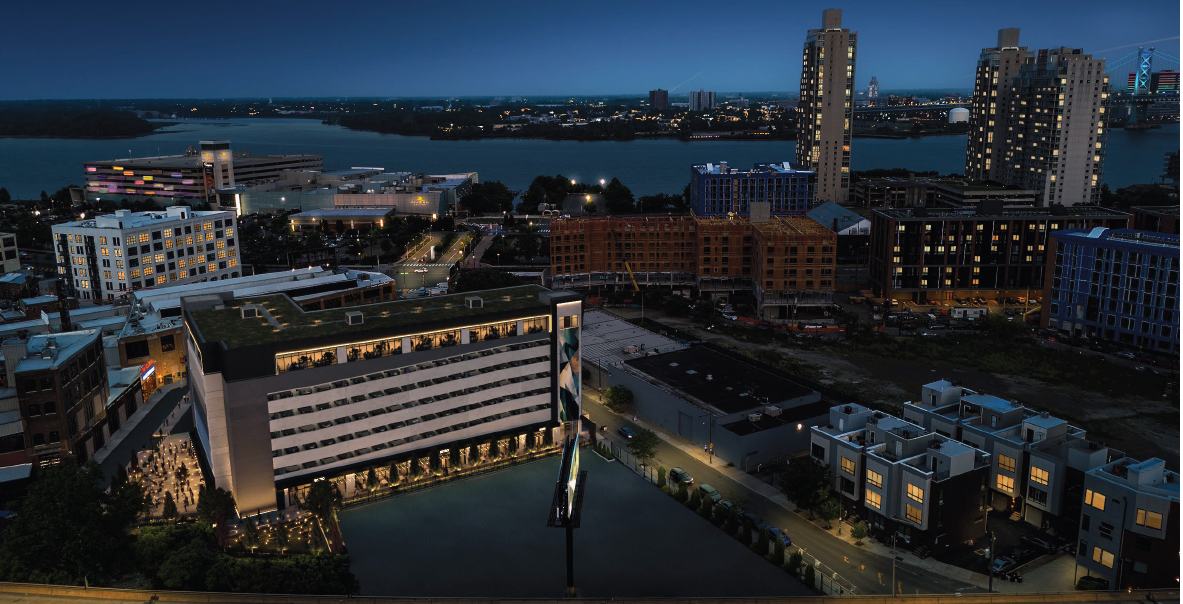
    A rendering of the Fishtown garage, looking towards the Delaware River.

    Zuritsky says it costs $60,000-$70,000 a space to build an aboveground lot in today’s environment and $100,000 to $150,000 below ground.

    “It’s like building a house for a car,” he said.

    Depending on hyperlocal peculiarities, Zuritsky says that taxation in Center City can eat up to 60% of the money they bring in and that to profit from new construction, an operator would have to charge $3,000 per space a month.

    “I wish people luck, the ones that are moving in,” said Harvey Spear, president of E-Z Park. “Between taxes, insurance, and labor, it comes to, like, 70-some percent of what we take in. We have more equipment now that does away with a lot of labor; we’re trying to compensate with that.”

    Urbanist and environmental advocates, meanwhile, have condemned the new garage projects, arguing that they will add to carbon emissions, air pollution, and traffic congestion.

    “A massive parking garage less than half a mile from the El [in Fishtown] is the wrong direction for any city that claims to take climate action seriously,” said Ashlei Tracy, deputy executive director with the Pennsylvania Bipartisan Climate Initiative. “SEPTA is already working to get more people out of cars and onto transit, but projects like this one and the one from CHOP only make that harder.”

    Here are the parking projects in the pipeline.

    Fishtown: 372 spaces

    The garage, with architecture by Philadelphia-based Designblendz, doesn’t just contain parking. It includes close to 14,000 square feet of commercial space on the first floor, which the developer hopes to rent to a restaurant — or two — on the edges of one of Philadelphia’s hottest culinary scenes.

    Another over 16,000-square-foot restaurant space is planned for the top floor, with views of the skyline and river. Both the top and bottom floors also could be used as event spaces.

    Kufasimes says that this aspect of the project could partly offset the kinds of costs that parking veterans warn of.

    “Our due diligence team went through those numbers and vetted them pretty thoroughly: The returns are what they needed to be,” Kufasimes said. “It’s got a multifunction of income streams, so we think that that really will help play a larger role.”

    Kufasimes also said a parking garage made sense in an area that’s seen more development than almost any other corner of Philadelphia. When investors purchased the land at 53-67 E. Laurel St. and approached his company for ideas, they met with other stakeholders in the neighborhood and determined parking would be appreciated.

    “It wasn’t necessarily all about the profit,” Kufasimes said. “A lot of people this day and age, that is their number-one goal. If this is a slightly lower return in the long run but can be better accepted by the community as a whole, we think that actually raises the value of the asset.”

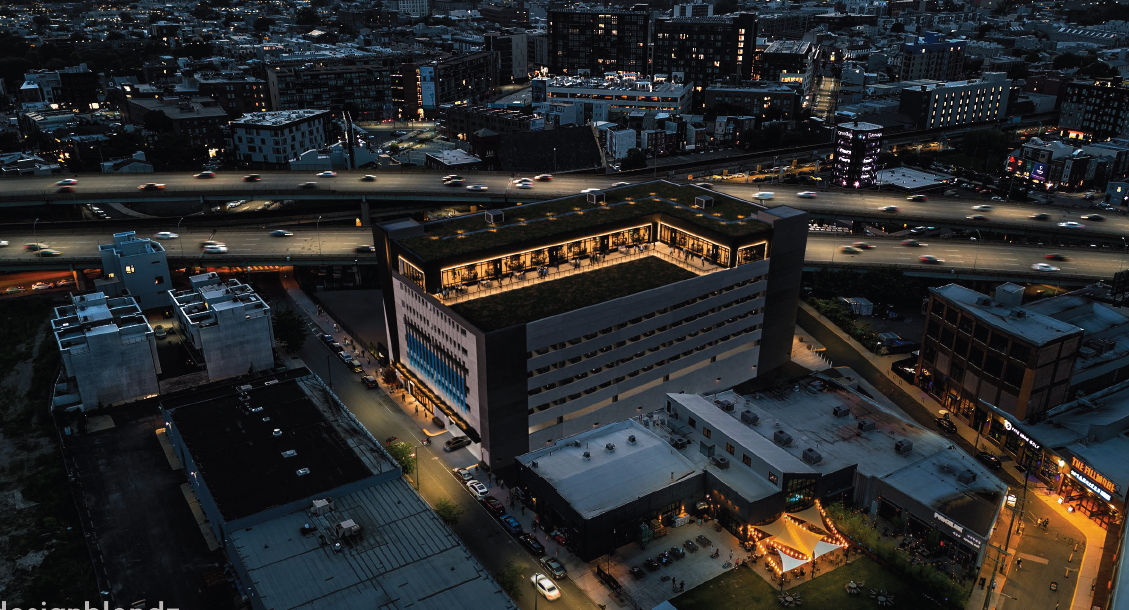
    An overhead-perspective rendering of the Fishtown garage.

    At an October meeting of the Fishtown Neighbors Association, that argument appeared to pay off. Unlike most community meetings where a large new development is proposed, there were no adamant opponents of the project. The project also includes a 20,000-square-foot outdoor space, a green roof, and a to-be-decided public art component. All of that helped, too.

    “It’s nice seeing a parking garage, of all things, be as pedestrian-friendly and thoughtful as this,” one speaker said during the Zoom meeting.

    University City: 495 spaces

    The garage at 17 N. 41st St. is part of a larger complex of developments in a corner of West Philadelphia’s University City.

    Dubbed University Place 5.0, it largely exists because of a major expansion of the municipal bureaucracy west of the Schuylkill.

    For years the city has sought a new location for its criminal forensics laboratory. The debate became heated in City Hall, with numerous Council members making the case for locations within their districts.

    Councilmember Jamie Gauthier pushed for its location in University City Place 3.0, a newly built, state-of-the-art life sciences building that was coming online just as its intended industry was slowing down in the face of higher interest rates.

    To get the crime lab, Mayor Cherelle L. Parker’s administration said the police department would need ample parking. That’s where the new garage comes in.

    In June, Gauthier passed a zoning overlay that cleared away the regulatory hurdles to the project. Six weeks later, the developers revealed University City Place 5.0, which has 29 parking spaces on the ground floor reserved for official use by forensics vehicles and 100 spaces reserved for city employees.

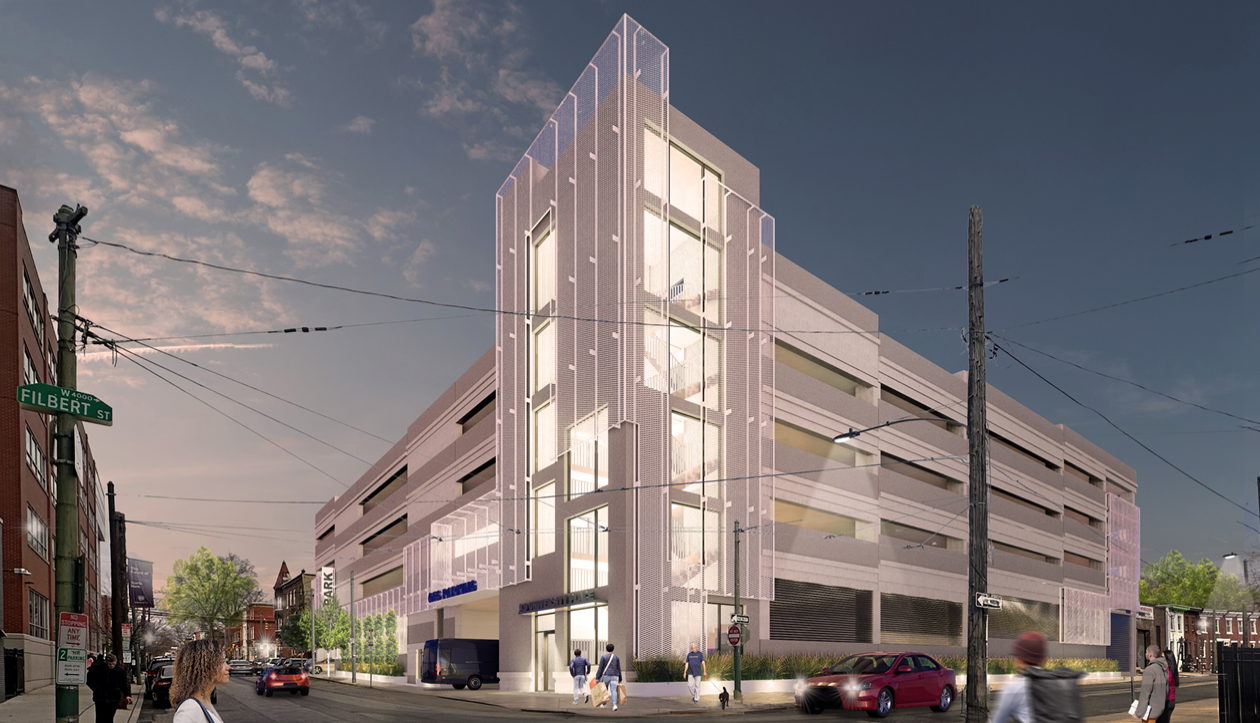
    A rendering of the proposed University City parking garage as seen from 42nd and Filbert Streets.

    Designed by Philadelphia-based ISA Architects, the garage is also meant to serve University Place Associate’s other large developments in the area. Akin to the Fishtown garage, they have also sought to make the development pedestrian friendly, with a dog park, green space, and public art.

    The local community group, West Powelton Saunders Park RCO, also embraced the proposal.

    “The community met regarding this project back in August, and … they were all in support of this project,” Pamela Andrews, president of the West Powelton Saunders Park RCO, said at the city’s September Civic Design Review meeting. “We have a tremendous problem with parking, and the community members felt this was a much needed and welcome addition.”

    Grays Ferry: 1,005 parking spaces

    CHOP’s thousand-car parking garage by far has been the most controversial of the proposals. But it also makes the most economic sense for the owner. Unlike the other garages — or those owned by Parkway and E-Z Park — it will be owned by a nonprofit and exempted from many of the taxes that make it so expensive to own parking in Philadelphia.

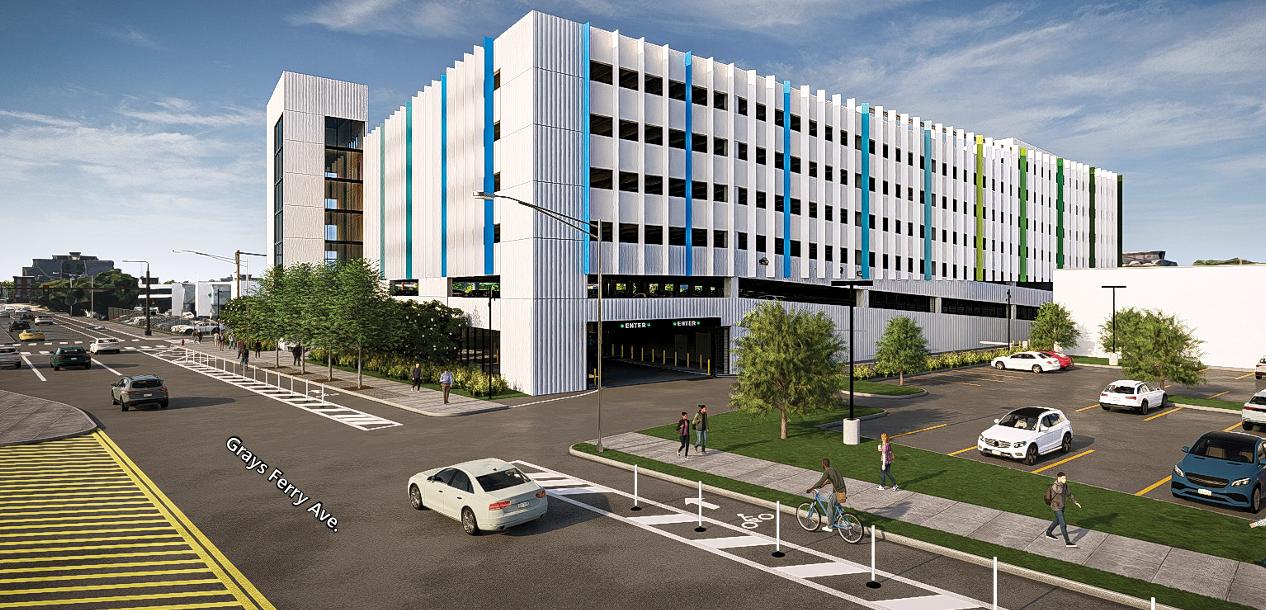
    A rendering of the new parking garage CHOP plans for Grays Ferry.

    The hospital purchased the property at 3000 Grays Ferry Ave., next to the Donald Finnegan Playground, for almost $25 million last year.

    The seven-story development, which, plans show, would have far fewer amenities than its University City and Fishtown counterparts, is meant to serve CHOP’s new research facilities in Fitler Square and the new patient tower set to open in 2028.

    “We recently secured permits and have begun construction on the new parking garage at 3000 Grays Ferry Ave.,” a CHOP spokesperson said. “The full construction is expected to go through the fall of 2026. CHOP continues to engage with the community by providing support, timely updates and addressing feedback during construction.”

    At the time of its unveiling, CHOP argued that the massive garage was needed as SEPTA threatened to become unreliable due to a political funding crisis in Harrisburg. But detractors appeared almost immediately to denounce the hospital for worsening air quality in a lower-income neighborhood that is already a hot spot for asthma.

    The project’s design was derided at the city’s advisory Civic Design Review panel and has attracted protest rallies, unlike its counterparts in University City or Fishtown.

    There are no regulatory hurdles to the development, but changes in the political or economic landscape could make it difficult to embark on a large capital project. Notably, the University of Pennsylvania proposed an 858-space garage in 2023 for the nearby Pennovation Center and has never broken ground.

  • Grieving Roman Catholic coach and his family find solace in their football community

    Grieving Roman Catholic coach and his family find solace in their football community

    When Rick Prete returned from Iraq in 2009, he had just one focus: his family. Throughout his yearlong deployment as an infantryman in the Army, he could speak to his wife and daughter only sparingly over Skype.

    Once he was home in Audubon, Montgomery County, he tried to spend as much time with them as possible. He took on day-to-day tasks with glee, like doctor’s appointments and school drop-offs. Prete didn’t see these as mundane. To him, they were opportunities.

    “How can I be around my kid more?” he said. “That’s all I really cared about.”

    It was this mentality that brought Prete to youth cheerleading practice in Conshohocken in the summer of 2010. For four nights a week, he would sit and watch 6-year-old Arianna’s routines as the 15-and-under football team did drills nearby.

    Prete, a former wide receiver at Norristown High School and East Stroudsburg University, barely noticed that the players were there. But the Conshohocken Bears’ coaches noticed him, and quickly asked if he’d consider joining their staff.

    Prete declined at first. The veteran was battling depression, he said, and worked late nights as an emergency room technician. Any free time he had, he wanted to spend with Arianna and his wife, Gabriela.

    But after a few weeks, Prete warmed up to the idea. He would observe the team’s practices and suggest different defenses and coverages. Conshohocken added him as an assistant coach in August 2010, and he dove right in.

    Rick Prete has been the head football coach at Roman Catholic since 2019.

    Gabriela noticed that Rick was happier and more talkative at home. She’d catch him poring over film and scribbling plays on napkins and notepads. Instead of thinking about what he’d seen in Iraq, he was thinking about how to help his players.

    “I definitely saw a shift in him,” she said. “This was something that he loved, but he was also good at it. It was like an outlet.”

    Prete’s coaching career took off from there. He was hired as a wide receivers/defensive backs coach at Plymouth Whitemarsh High School in 2012, and joined Malvern Prep’s staff as the freshman head coach in 2015. He was named the school’s varsity wide receivers coach in 2016, and Imhotep Charter hired Prete to serve as offensive coordinator in 2017.

    In 2019, he became head coach of Roman Catholic High School’s football program, where he remains.

    Prete has always said that he wouldn’t have found his calling without Arianna. Now the sport is healing him in her absence.

    In the early morning of July 11, 2024, Arianna and a friend were riding in another friend’s Honda Odyssey when their vehicle collided with a tow truck at K Street and East Hunting Park Avenue in North Philadelphia.

    According to the Philadelphia Police Department, the truck driver was speeding and blew through a red light. The minivan entered the intersection just as the traffic signal was turning from yellow to red.

    Arianna was ejected forward from the backseat. She suffered severe injuries and was taken to Temple University Hospital, where she was pronounced dead less than an hour later.

    She was 19, and the only fatality from the crash.

    Court records show that the driver of the tow truck, Omar Morales, was charged with homicide by vehicle, involuntary manslaughter, and four related offenses.

    Charlie Payano, the friend driving the Odyssey, was charged with homicide by vehicle, involuntary manslaughter, and three related offenses.

    The trial is scheduled to start soon.

    Prete’s initial instinct was to quit football altogether. He barely had enough energy to get out of bed, let alone handle a group of teenagers.

    But Gabriela urged him to return to Roman Catholic. More than a year since the crash, he’s glad he did.

    “I don’t know if I’d be able to sit here right now, and go forward throughout a day,” Prete said, “if I didn’t have those kids.”

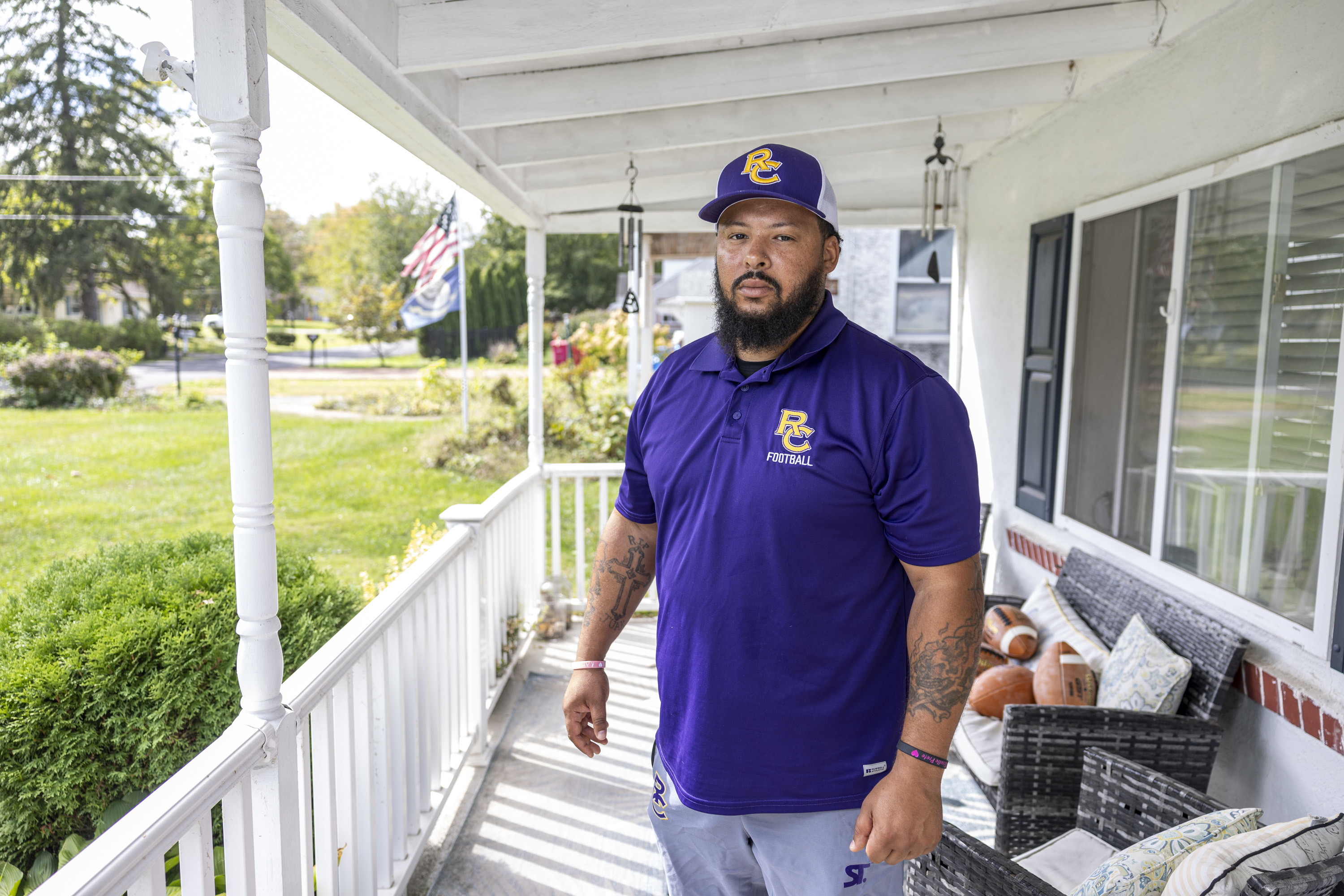
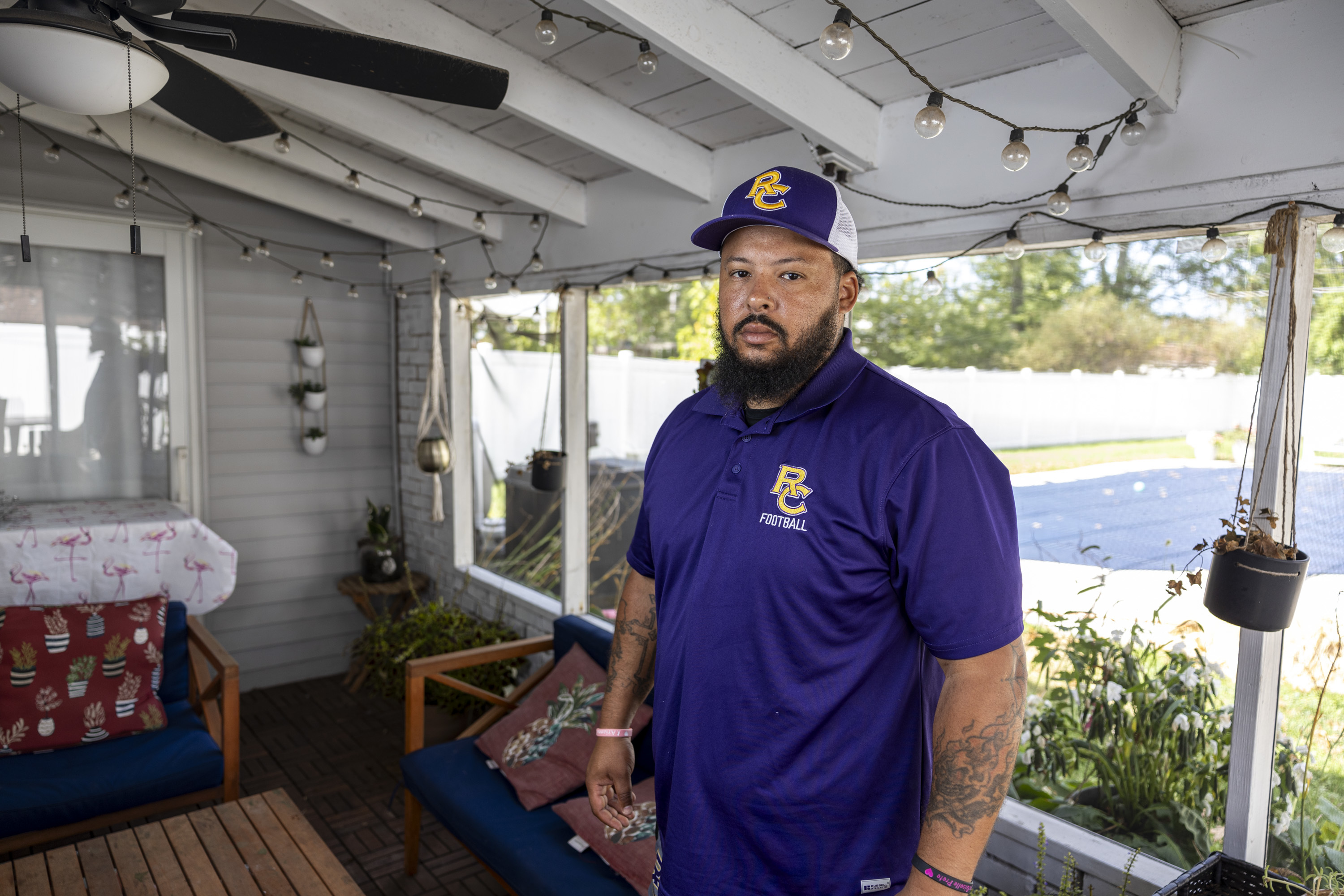
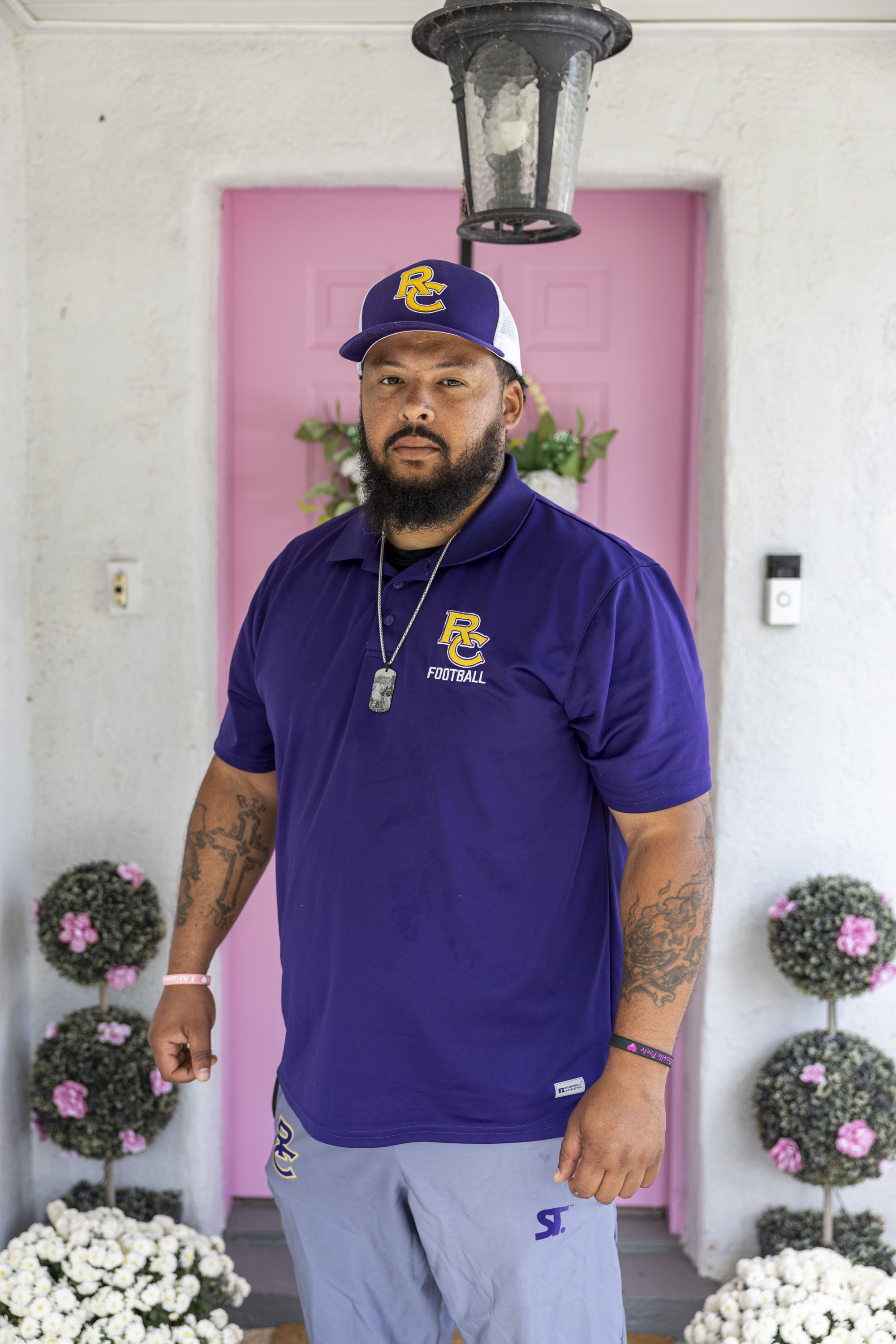
    Rick Prete at his home in Audubon, Montgomery County, on Oct. 2.

    A football and softball bond

    Arianna and Rick always connected over sports. She was a self-described “girly girl” who loved the color pink, romantic comedies, and Bruno Mars, but also a natural athlete like her father.

    She signed up for T-ball when she was 6 and switched over to travel softball not long after. Norristown Recreation didn’t have an under- 10 team at the time, so Arianna played with 10-, 11-, and 12-year-olds.

    Despite facing pitchers far older, she made contact regularly and quickly emerged as a hitter to watch. Rick, who played baseball in high school and college, began to train with her.

    Arianna would take 100 swings off the tee every day. Sometimes, her father would throw soft toss in the backyard. When she switched from third base to catcher at age 10, Rick started challenging her behind the plate.

    He’d spike softballs in the dirt, or pitch them high above, forcing his daughter to shift and block. By age 12, they were flipping tires and swinging sledgehammers in the driveway.

    “[Softball] was a huge part of our relationship,” he said. “That was my avenue to learn how to be her dad.”

    Arianna felt equally invested in Prete’s coaching career. When she was a student at Methacton High School, from 2019 to 2023, she would spend Friday nights with the football team at Roman Catholic.

    Rick Prete’s wife, Gabriela, with daughters Nylah and Arianna at a Roman Catholic game.

    In the school’s 2019 season opener, on Aug. 24, the Cahillites found themselves down 26-0 in the first quarter to Pope John Paul II. By halftime, they’d narrowed their deficit to 11 points.

    The team kept chipping away, and with 1 minute, 30 seconds to go, quarterback Jayden Pope threw a 50-yard touchdown pass to earn Roman a 47-46 comeback win.

    Prete still has the film from that night. In the background, Arianna is on the sideline, sprinting toward wide receiver Malachi Harris, who made the game-winning catch.

    “You couldn’t tell that girl that she wasn’t an assistant coach,” Gabriela said. “She liked the energy. Running up and down the field with the other coaches. You would always find her there.”

    Prete’s teams went 10-28 over his first four seasons, but over time, he built a strong program. The Cahillites posted a 9-3 record in both 2022 and 2023.

    In 2023, in the District 12 Class 5A championship game, Roman Catholic lost to Imhotep Charter, the eventual state champion, by only 4 points.

    With more success came more commitment, so Prete would always check to make sure that Arianna and her younger sister, Nylah, were comfortable with him coaching. After a while, the question became redundant. The answer was always yes.

    “They’d both say, ‘No, you go coach,’” Prete said. “‘We want you to.’”

    Arianna graduated from Methacton in 2023. She enrolled at Montgomery County Community College in the fall of that year, and took a real estate course in the spring, but was unable to pass the state exam. She planned to return to Montco in September.

    The former softball player had always loved working with kids, so she thought about becoming a teacher. Or maybe going back to real estate school, to retake her test. But these possibilities, once filled with promise, came to an abrupt halt on July 11, 2024.

    Rick and Gabriela heard a knock at about 3:30 a.m. Two Lower Providence Township police officers were standing outside their door.

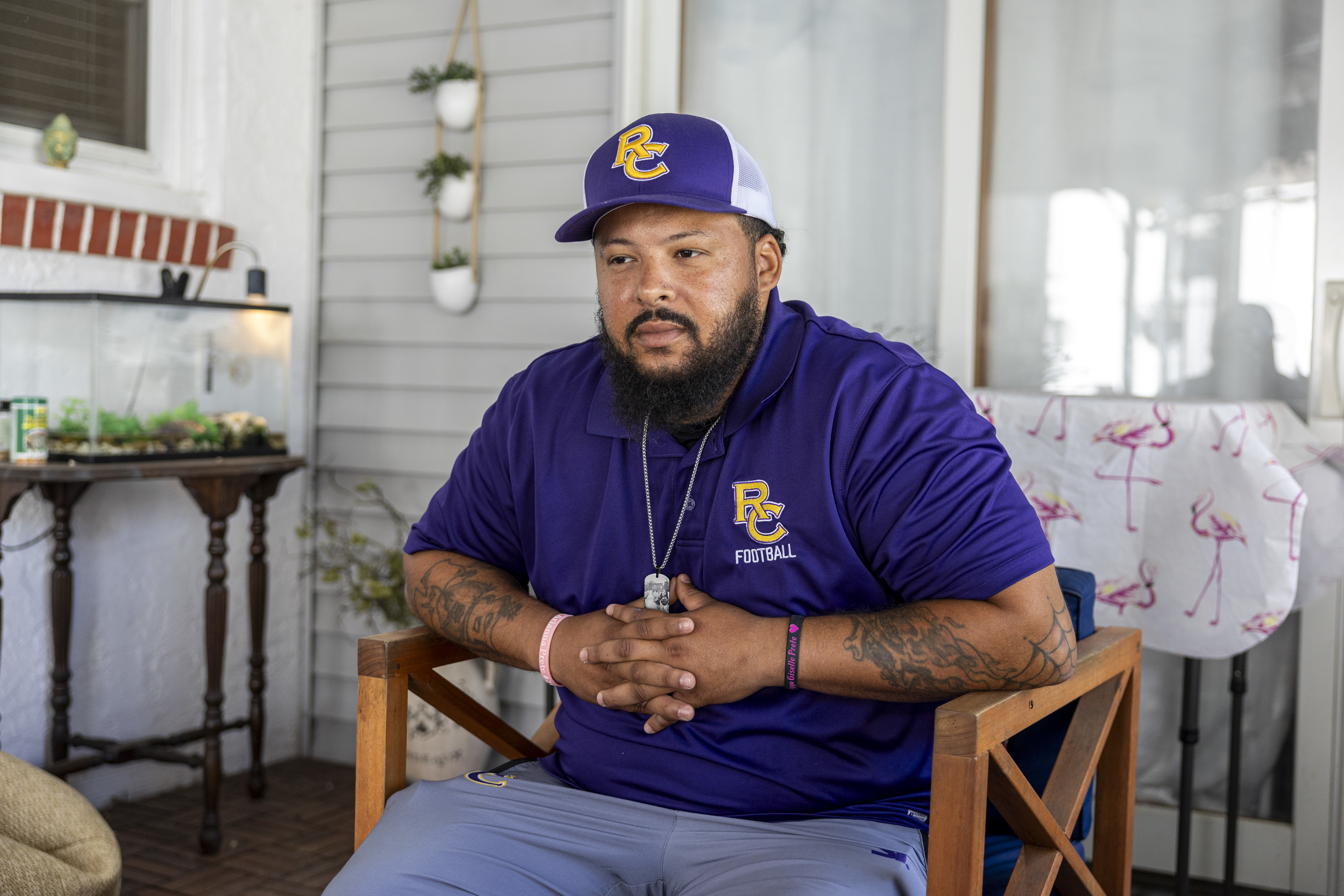
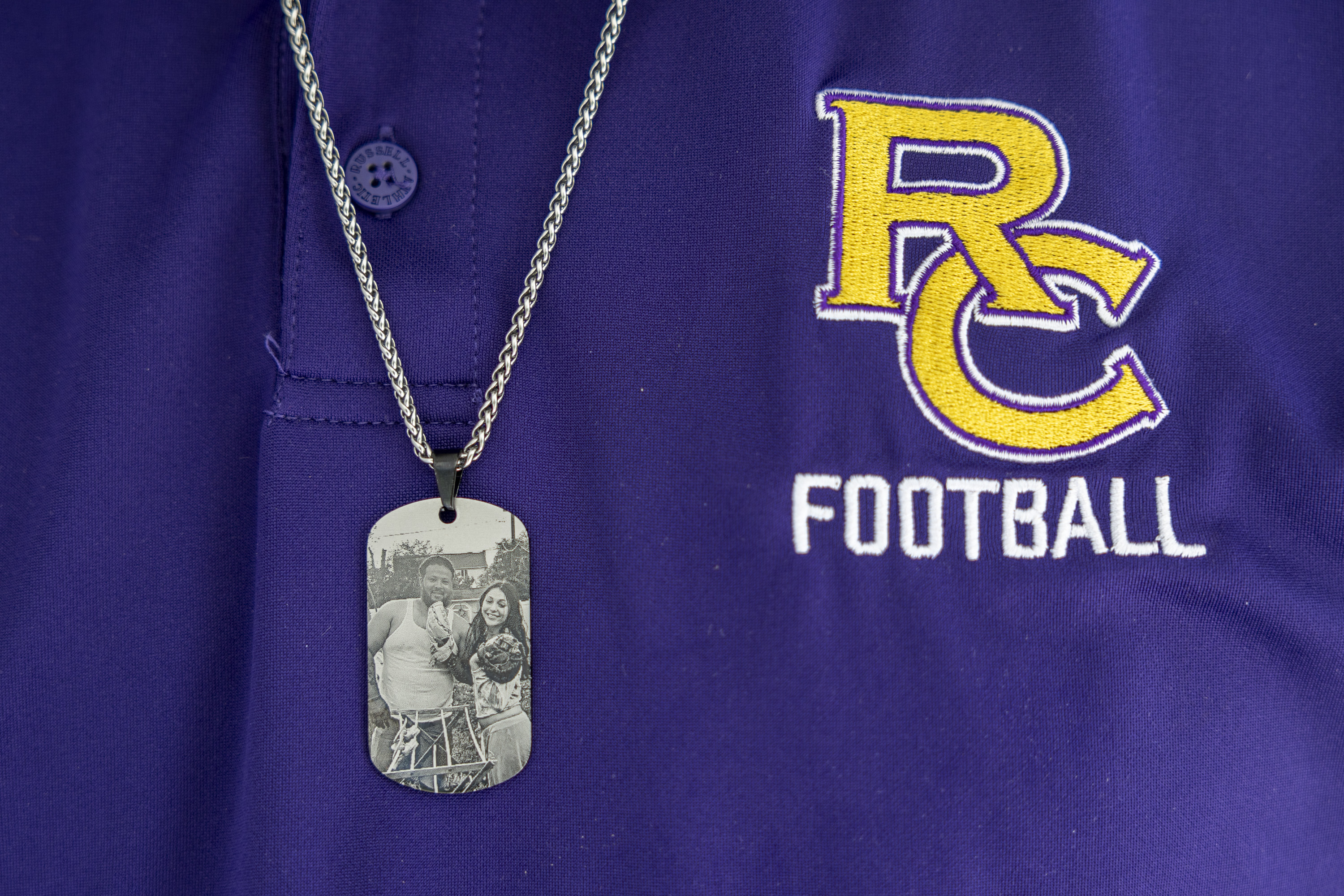
    Rick Prete wears a necklace with a photo of him and his daughter Arianna, who died in a 2024 car crash.

    They told the Pretes about the collision and instructed them to go to Temple University Hospital Jeanes Campus, in Fox Chase, to identify Arianna’s body.

    But once they arrived, their daughter wasn’t there.

    “It gives you a glimmer of hope,” Gabriela said. “Maybe they got this wrong.”

    In an email, Lower Providence Police Chief Michael Jackson said that the officers received their information from a victims’ advocate at Temple University Hospital.

    The parents finally reached Temple’s main hospital, on North Broad Street, at about 7 a.m., and realized that the victim was indeed their daughter.

    “Your body shuts down,” Rick said. “Your mind goes numb. It’s your worst nightmare being realized.”

    Rick Prete poses for a portrait at his home in Audubon, Montgomery County, on Oct. 2.

    ‘I feel your pain, Coach’

    The next few days were a blur. The Pretes called as many family members as they could. A steady stream of visitors came through the house to share condolences, with flowers and food in hand.

    Roman Catholic was scheduled to go to a three-day team camp at East Stroudsburg on the day of Arianna’s passing. But Prete was not in any shape to attend and arranged for offensive coordinator Marcus Hammond to take the team instead.

    Two days later, the Cahillites finished their visit and piled into two yellow school buses. The drivers were supposed to head back to campus, but the students had a different idea.

    The team went to the coach’s house in Audubon. More than 50 players gathered on his lawn, took a knee, and began to sing Roman Catholic’s fight song.

    Prete stood on his porch, buried his head in his hands, and cried.

    “Thank you,” he said. “Now, give me a … hug.”

    Gabriela ordered some pizzas. A few players pulled Rick aside to say a prayer. One student, 17-year-old quarterback Semaj Beals, shared that he’d lost his sister Dymond in 2014. She was 8, and died by suicide.

    “I feel your pain, Coach,” Beals said. “And if you need anything, if you need to talk to me, I’m here.”

    Prete hugged him tight.

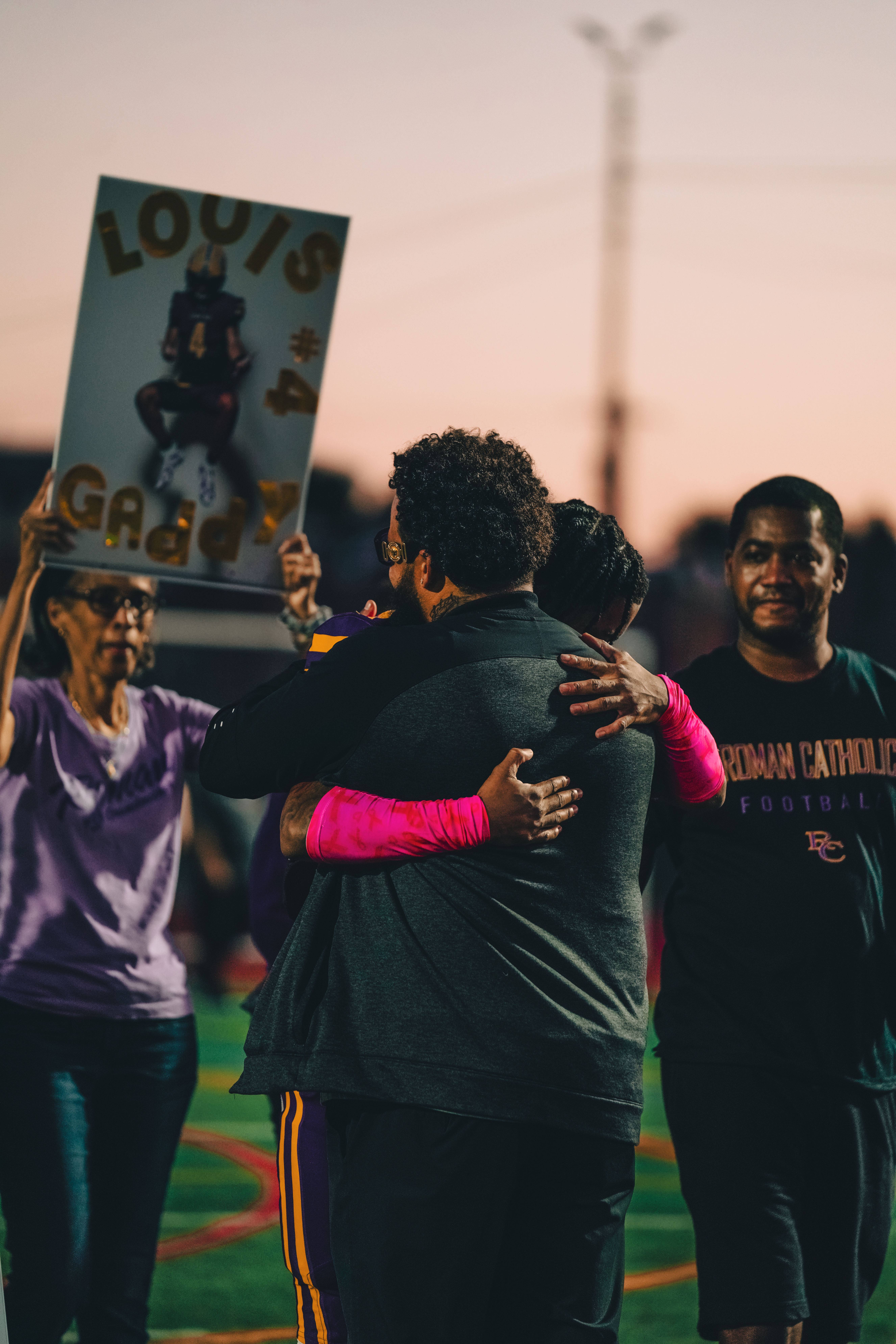
    Lou Gaddy hugs his coach, Rick Prete, at Roman Catholic’s senior day in 2024.

    “I know you do,” he replied.

    For many of the Cahillites, Prete has been like a second father. He’d lend them food and gas money. If they lived far away from the school, at Broad and Vine, he’d arrange for alternate transportation.

    The coach would regularly check on his players’ mental health and always made sure their grades weren’t slipping. There were conversations about schemes and formations, but also about how to treat a young woman, how to plan for their future, and how to handle a difficult situation at home.

    Lou Gaddy, a Roman Catholic graduate who is now a freshman safety at Stony Brook University, is the first person in his family to go to college. He received a full scholarship.

    Gaddy grew up in Burlington County in South Jersey and is unsure if he would have made it if he hadn’t played for Roman Catholic.

    “Who knows if I’d develop the way I did,” he said. “The [Philadelphia Catholic League] is a much stronger conference than where I live. It’s way more work. It requires more out of you. Long days, late nights.

    “But Coach Prete definitely knew what he was doing. He’s sent countless amounts of kids to college. Countless.”

    Because of this connection, the players felt Arianna’s death on a deeper level. Some saw Prete, overwhelmed by grief, and felt as if they were watching their own parent cry for the first time.

    Their coach was the one who fixed problems for them. Now, he was distraught. He struggled to focus. His attention to detail wasn’t the same.

    Prete was reluctant to return to Roman Catholic. He struggled to just get through a day. But Gabriela insisted he go back. The couple had already been robbed of their daughter. She didn’t want him to lose his career, too.

    He rejoined his team in August 2024. It was a challenging adjustment. There were days when players asked if Prete was OK, only to hear him say, “No.” The coach began wearing sunglasses during games and practices, day and night, because he couldn’t hold back his tears.

    Rick Prete was reluctant to return to Roman Catholic after his daughter died in a car crash last summer. Now, it’s helping him heal.

    Prete was in charge of the defense, but at times, he struggled to call plays. So, his players would call them for him.

    “They’d bail me out,” Prete said. “Lou [Gaddy] would literally line the defense up. And he would just make sure the defense had the plays that they needed. And he’d do it right.

    “All of the kids did that, because they knew that I’d be gone sometimes.”

    Gaddy would also make sure that his teammates understood the playbook and handled any adjustments that needed to be made on defense. Beals compared him to a “coach on the field.”

    “It was just to take the stress off,” Gaddy said. “Semaj made sure the offense was in check. And that’s kind of how I was with the defense. Making sure people were attacking the field the right way.”

    Players who previously sat out practices became regular participants. They were more efficient in their workouts and pushed themselves harder than before.

    The team discovered a greater purpose beyond competing for district titles or a state championship. The season was no longer about them. It was about their coach.

    “Sometimes, when things happen like that, a head coach will step away,” Beals said. “But Coach Prete was there the whole way. So, we just felt like that was special. We needed to do something for him.”

    Roman began to win — a lot. The Cahillites didn’t lose until Week 5 when the team played DeMatha, a high school powerhouse out of Hyattsville, Md.

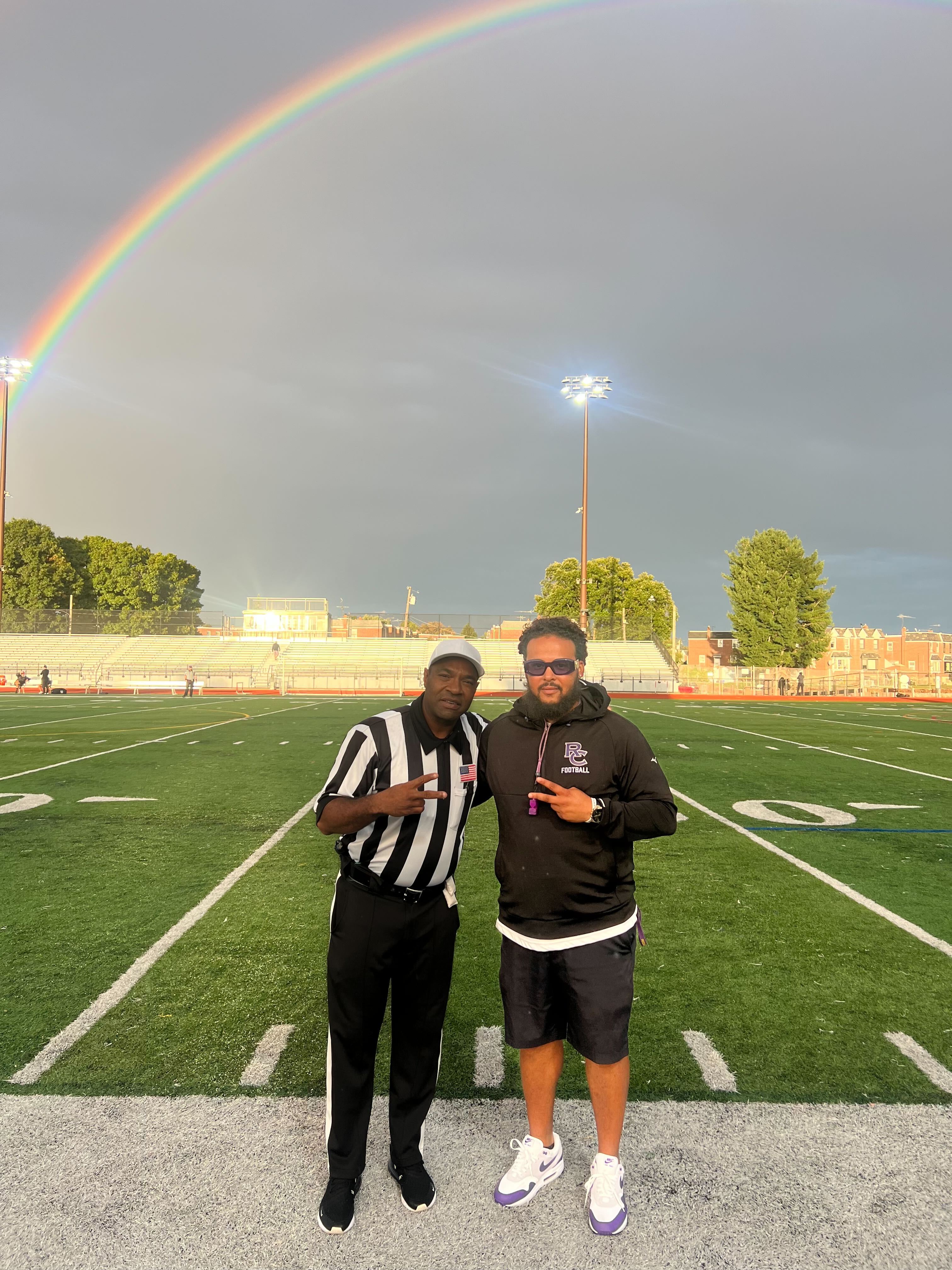
    Rick Prete (right) with a referee who approached him before a game in 2024. The referee had also lost a child, and expressed his condolences, when a rainbow appeared over both of them.

    The games were competitive, but with soulful moments of humanity throughout. Opposing coaches would give Prete prayer cards when they shook hands. In September 2024, before Roman Catholic played A.P. Randolph Campus High School in New York, a referee walked up to him.

    He told Prete that he’d also lost a child. As they talked, a rainbow appeared over the field. To Rick and Gabriela, the 2024 campaign was full of moments like these. Moments that felt as if their daughter was with them.

    It could be as subtle as a seeing a butterfly on the field. Or hearing a song on the way to a game. Or noticing that the players had written “LLA” — Long Live Arianna — on their helmets, compression sleeves, and wristbands.

    An already special season reached a new height in December, when Roman Catholic advanced to the state championship for the first time in school history. With an 11-4 record, the Cahillites had plowed through the district playoffs to face Bishop McDevitt of Harrisburg in the final.

    On a brisk night in central Pennsylvania, Roman Catholic rallied from a 21-3 deficit to tie the score at 31 and push the game into overtime. The Cahillites fell just short of a championship, losing to McDevitt on a field goal, but Prete was filled with pride.

    “I don’t want to say it was magical,” he said, “but that team became so close. And it really felt like my kid was right there. Like my kid was literally right next to me.”

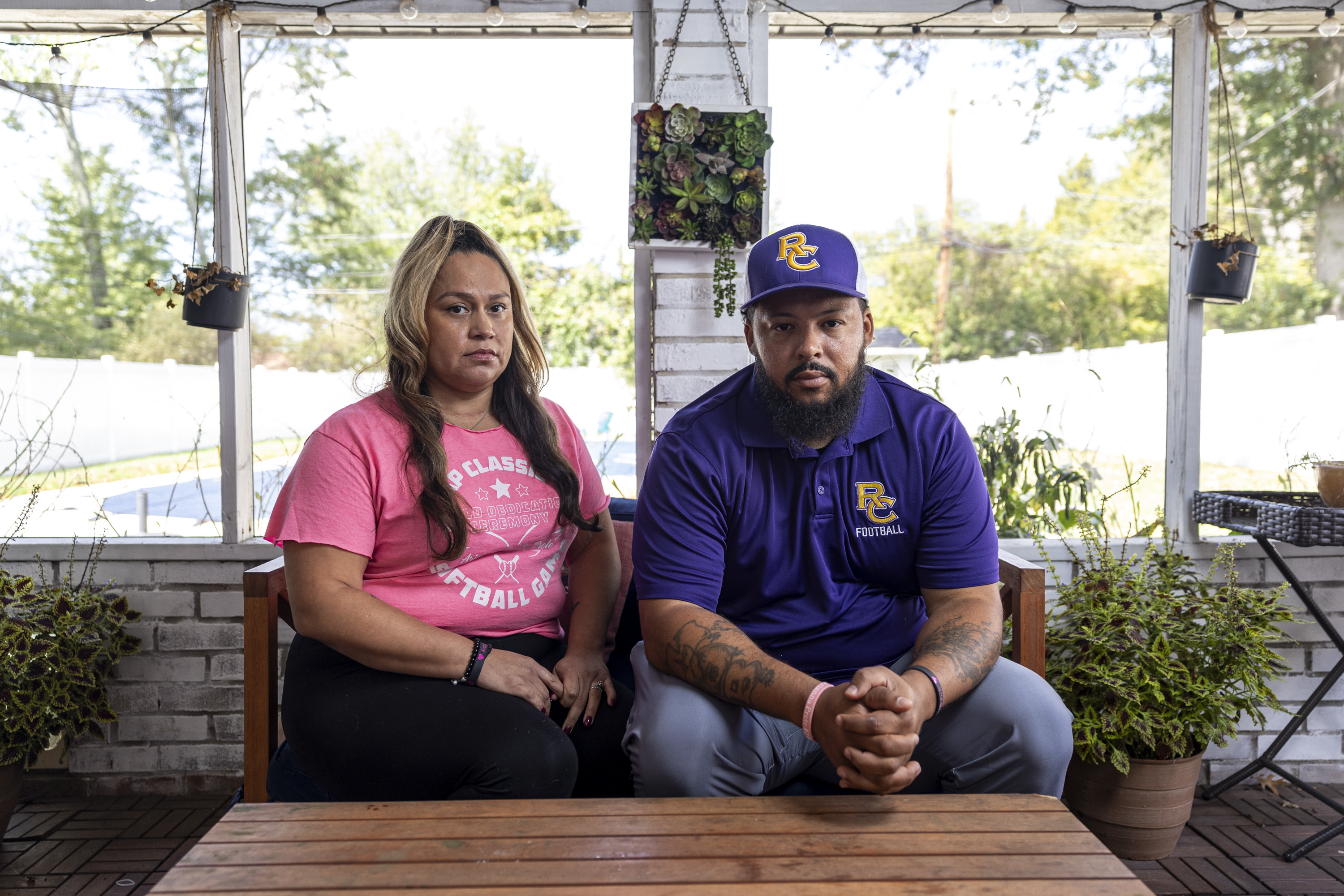
    Rick and Gabriela Prete at their home in Audubon, Montgomery County, on Oct. 2.

    Coaching with purpose

    The Prete house is quiet now. Arianna’s laugh is no longer ringing through the halls. Her parents don’t hear her feet stomping along the floor upstairs, or her shrill voice singing to Bruno Mars.

    Gabriela thinks about her daughter constantly. Sometimes, when Rick is sitting in his living room chair, late at night, he looks toward the door, expecting Arianna to open it.

    There are little signs of normalcy. Last year, Gabriela started seeing Rick’s trail of football plays again. He would leave them all over the house, on napkins and notepads, just like he did before his daughter’s passing.

    Football won’t bring her back. It won’t diminish the family’s grief. But Roman Catholic gives them a community. It gives Gabriela and Nylah a place to be on Friday nights.

    It gives Rick a task; three or four hours that aren’t spent asking questions he can’t answer. A task that fills him with purpose.

    “I didn’t know how much energy I have left to give anybody,” Prete said. “But [the players] help get me out of bed. They put things in perspective. That we still have a family, that our family still does have a future.

    “That we need to pour into what’s here, and to be present, for Arianna. We can’t live in a standstill. And seeing people accomplish their goals. … It’s always been something we’ve wanted, but now that is what it’s all about. You know?”

  • 2025 Toyota Corolla: One way to stay under $30K

    2025 Toyota Corolla: One way to stay under $30K

    2025 Toyota Corolla FX vs. 2025 Buick Envista Avenir: Two options to avoid being spendy.

    This week: Toyota Corolla

    Price: $29,089 as tested. Convenience Package added blind-spot monitor and cross-traffic alert for $530; black roof, $500; and connected services trial, $325.

    Conventional wisdom: Motor Trend liked the “$27,785 base MSRP, cool black accents, and bigger, more readable screen”; on the down side, it was “not particularly quick,” the “engine drones,” and it’s a “dated cabin.”

    Marketer’s pitch: “Introduce fun to every day.”

    Reality: You’re going for the fun angle, Toyota? Really, now?

    What’s new: The Corolla adds a new FX model for 2025, which pays homage to the old FX16, something I’d never heard of before writing this. Still, I feel I can say with confidence, it doesn’t live up to that.

    Not so new: How thankful I am to have two small, inexpensive cars to test. They’re a rare treat among model lineups and even rarer among vehicles I get to test, and readers are clamoring for them. Manufacturers want to make money selling you expensive things we don’t really need.

    The Corolla is a sedan and the Envista is a crossover, so very different directions indeed.

    Competition: Honda Civic, Hyundai Venue, Hyundai Elantra, Kia Niro, Kia Soul, Mazda 3, Nissan Kicks, Subaru Impreza, Toyota Prius, to name just a few.

    Up to speed: The Corolla is not winning any races. The 2.0-liter four-cylinder engine creates 169 horsepower and gets to 60 mph in 8.2 seconds, according to Motor Trend.

    Still, I was pleased enough with most of the performance, though I was traveling solo through almost all of it. A packed car would suffer a bit of malaise under the extra strain.

    Shiftless: The continuously variable transmission in the Corolla saps power as much as any. The gearless setup offers infinite ratios in theory but in actuality some examples make hill-climbing and hard acceleration something you’d just rather avoid. The Corolla’s version sits about in the middle, not the worst or the best.

    On the road: The Corolla has never been anything like fun, although the XSE version gets close. The FX model doesn’t get there, though, although handling is small-car good. Still, you won’t confuse it with a Golf or Mazda3.

    Driver’s Seat: Sturgis Kid 1.0 once purchased a new Scion iM (the Corolla Hatchback before it was called that) based solely on the dreamy front seats. Every time I borrowed that car, I noted how comfortable it was.

    The Corolla FX tested had sport fabric-trimmed seats with orange stitching that matched that feel. They were soft but supportive seats and made all the Schuylkill Expressway stop-and-go feel lots better.

    The Corolla also benefits from the simple gauge setup that Toyota offers in its base models. Changing the screen to fit your needs is simple with the steering wheel controls.

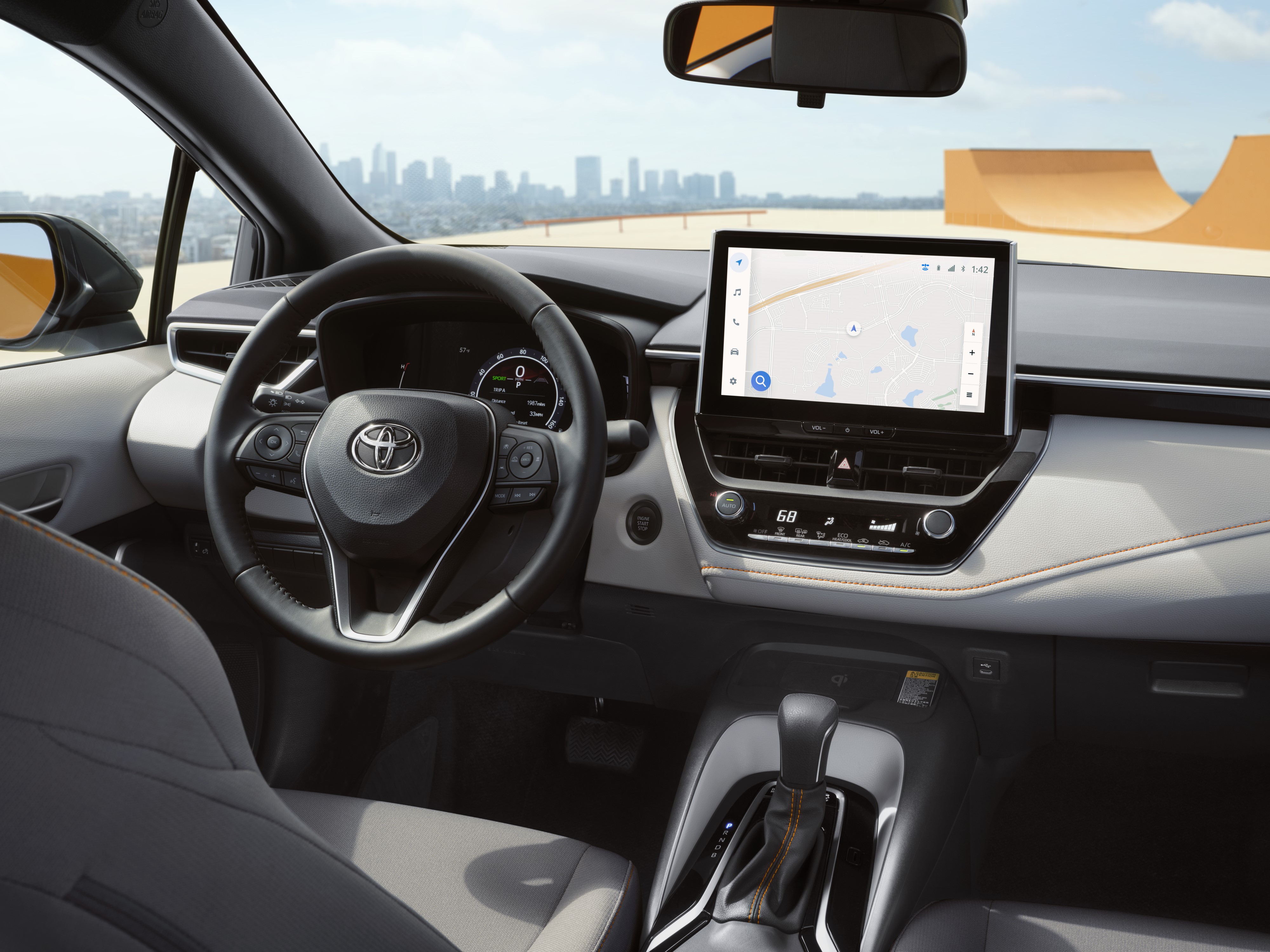
    The interior of the 2025 Toyota Corolla adds a 10.5-inch infotainment screen, and the seats remain among the most comfortable among all sizes of vehicles, not just small cars.

    Friends and stuff: The rear seat is pretty good for a small car. Headroom is dear — my head doesn’t hit the ceiling but it’s close — while legroom and foot room are nice. The door requires care when getting in and out because it’s a bit of a squeeze.

    The middle seat passenger will be perched on a narrow cushion and a tall floor hump, and will be permitted to throw small food items at everyone else, or to at least choose the evening’s movie later.

    Cargo space is 13.1 cubic feet. The seat folds to create a pass-through.

    Play some tunes: The new 10.5-inch touchscreen helps with navigating through the sources and whatnot. But somewhere a designer is patting themselves on the back for the sleek control panel, which trades a volume dial for pushbutton -/+ system. Boo!

    The stereo offers pretty good playback, especially by Toyota standards, about an A- or B+.

    Keeping warm and cool: Kudos for the simplest controls I’ve seen in a long time — one dial for air speed, another for temperature, and silver buttons for everything else.

    Fuel economy: I averaged about 32 mpg in an unusual array of Mr. Driver’s Seat testing. A very stop-and-go round trip to Center City figured mightily into the week. Otherwise it was mostly highway and side roads.

    Where it’s built: Blue Springs, Miss.

    How it’s built: Consumer Reports predicts the Corolla reliability to be a 5 out of 5. (Like, duh.)

    Next week: Buick Envista Avenir

  • How the ‘different personalities’ of Acaden Lewis and Tyler Perkins will guide Villanova

    How the ‘different personalities’ of Acaden Lewis and Tyler Perkins will guide Villanova

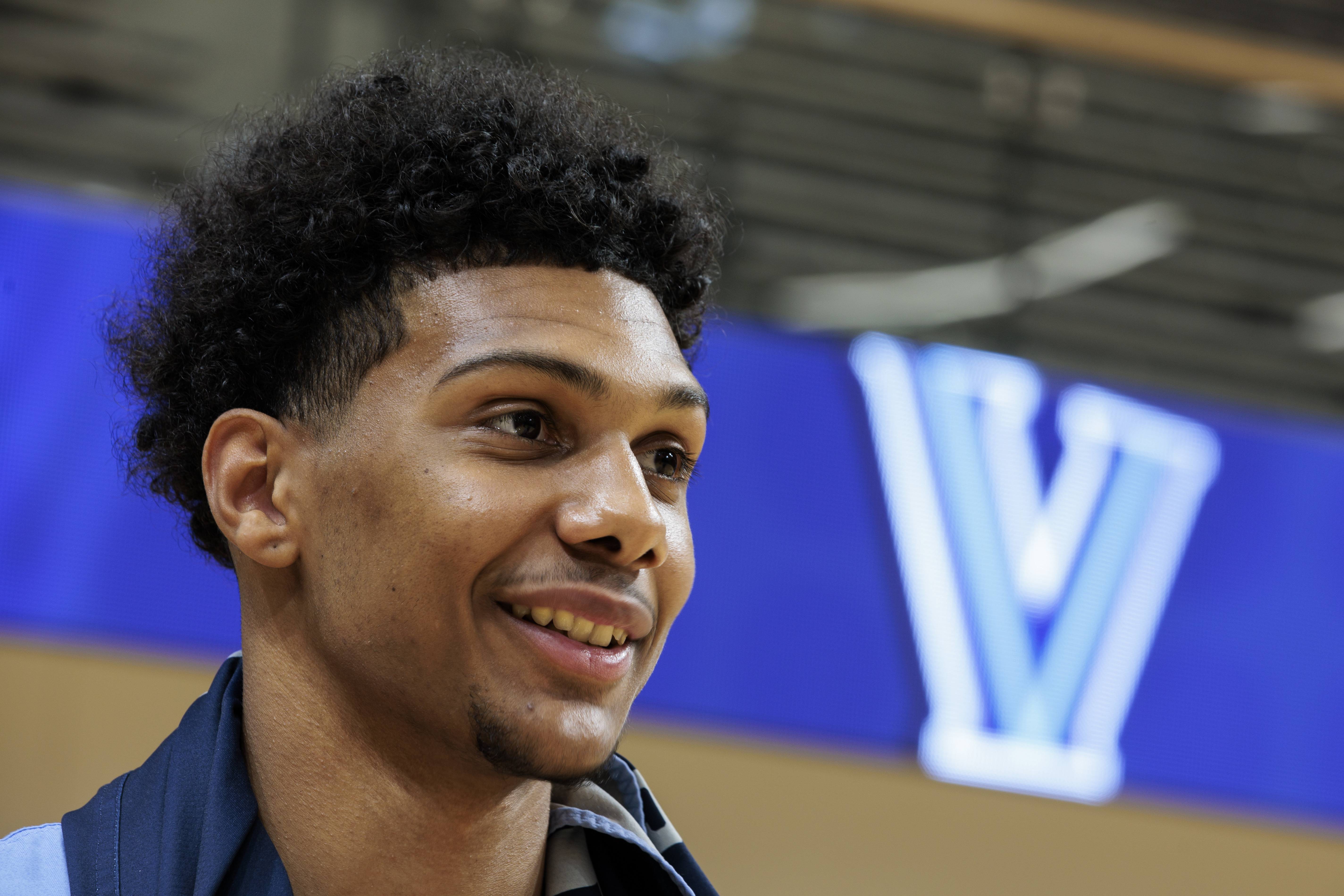
    NEW YORK — Tuesday morning was going to be an unfamiliar experience for any player who joined Villanova coach Kevin Willard at Madison Square Garden for the annual Big East media day.

    The Wildcats have 11 new players on the roster, all of them new to the Big East, and just one returning player who saw the floor last season, junior guard Tyler Perkins. Which players would Willard opt to put in the spotlight at the conference’s kickoff event and why? Perkins was an obvious choice “because he’s the only player that scored in a Big East game,” Willard said.

    The second choice could have been a few people. Villanova has multiple seniors or graduate students. Any of them — Long Beach State transfer Devin Askew, Grand Canyon transfer Duke Brennan, and Maryland transfer Tafara Gapare — would have been a reasonable second option. So would Matthew Hodge, the redshirt freshman who was forced to sit out last season at Villanova.

    But Willard chose to pair Perkins with freshman point guard Acaden Lewis, the consensus top-35 prospect Willard landed in May when the Washington native decided to reopen his recruitment after originally committing to Kentucky last fall. It is a sport sometimes dominated by upperclassmen and a conference that leans a little older. Braylon Mullins was named the conference’s preseason freshman of the year, but he wasn’t one of the players Dan Hurley brought with him to represent UConn.

    To be fair, Willard’s roster is not laden with the same type of talent as UConn’s, but Lewis, who will be relied on heavily to be the engine that makes Villanova’s offense go, was chosen by Willard for a reason.

    “Acaden is a big-time freshman recruit,” he said. “I know this is good for his career.”

    This basketball season will bring a lot of firsts in Lewis’ life, and this week was the start of it all in some ways. Villanova’s media day traveling party arrived Monday in New York. While Willard had some other things to attend to — including a meal with Jay Wright — Lewis, Perkins, and another Villanova staff member dined at TAO, the popular upscale Asian fusion chain. On Tuesday, Lewis was in Madison Square Garden fulfilling various media obligations, shaking hands, smiling for the cameras.

    “Most freshmen don’t get the chance to do this, not even sophomores,” he said. “This definitely isn’t normal. I’m just really thankful that I get to be in opportunities like this, and that’s why I’m here to experience some of these things. I’m here with a lot of talented guys, amazing coaches, legendary coaches, and we’re in New York. This is amazing.”

    Villanova freshman Acaden Lewis got a talking to from coach Kevin Willard after a flashy play in an exhibition game.

    The Wildcats were picked to finish seventh among 11 teams in the Big East’s preseason poll. The conference is a “guard league,” Willard said, and while Villanova has a couple of other traditional guards — like Askew and Bryce Lindsay — who will factor largely in where the 2025-26 season goes, the dynamic between Lewis and Perkins will be a big one.

    Lewis is a self-described “flashy” player, and his big and mature personality was on display for a larger audience Tuesday. Perkins is an off-ball guard whose defensive intensity might be the loudest thing about him. He’s quiet but steady, and Villanova will need that to stabilize what could be a bumpy early portion of the season as all the new pieces try to fit together.

    Willard will rely on that steadiness from Perkins, too, to help Lewis navigate his first college basketball season.

    That much has been communicated to Perkins.

    “[Willard] just said it’s not going to be easy for him and us as a team,” Perkins said.

    And the dueling dispositions?

    “We definitely do have two different personalities, but they mix, though,” Perkins said.

    How will Perkins help Lewis in Willard’s mind?

    “Tyler’s the only guy we have that has experience,” Willard said. “He’s the only guy that’s scored in the Big East so far. So what I rely Tyler on is to teach Acaden the intensity that you have to play in this league. It’s such a big transition. … Every night, he’s going to face physicality. Every night, he’s going to have to be on. Tyler has been really good in, not only in practice, but just talking to Acaden about ‘You can’t be cute. You can’t be casual. You have to be on the go at all times.’ I think Acaden’s really taken that message and ran with it.”

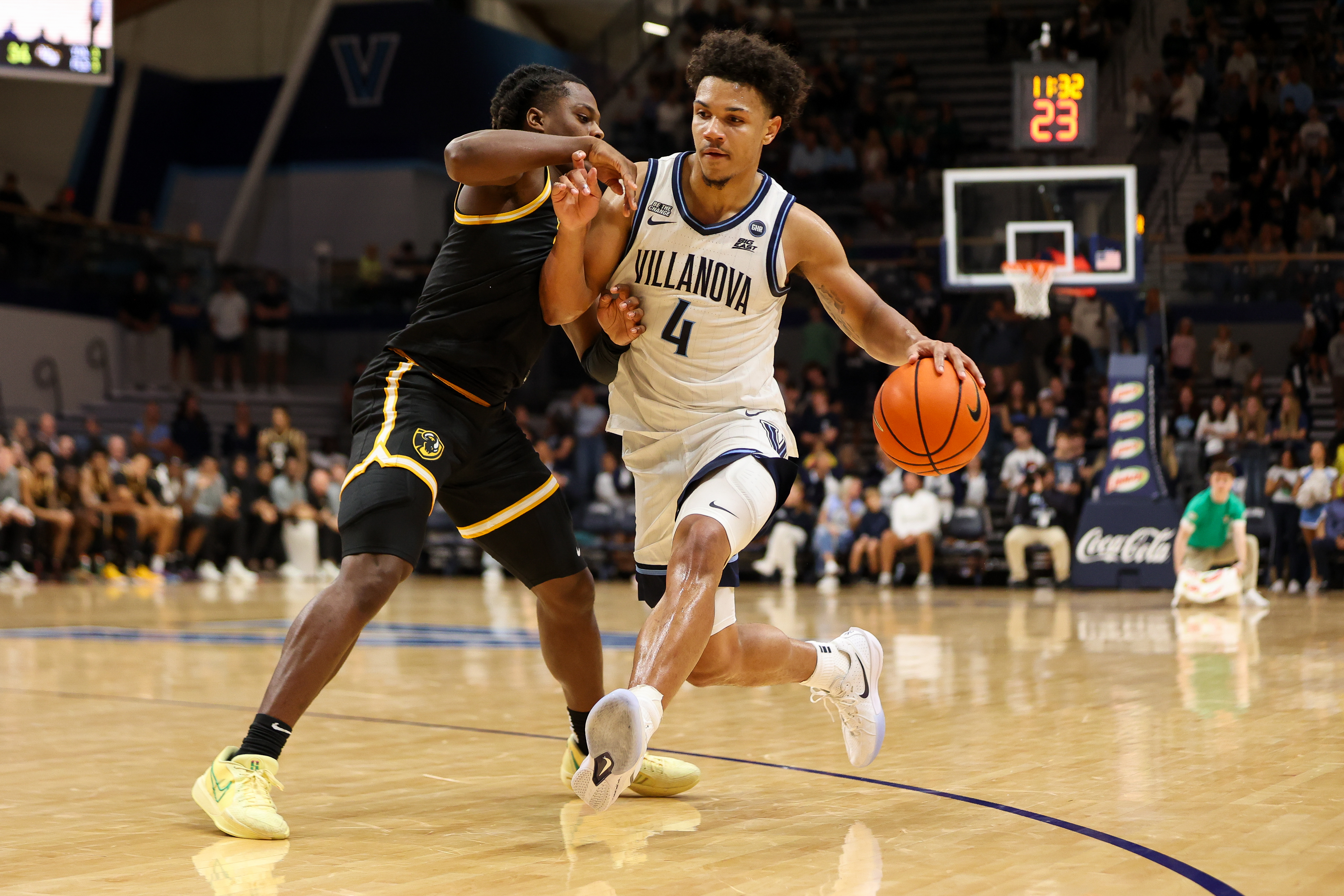
    Wildcats guard Tyler Perkins drives to the basket against VCU’s Ahmad Nowell during an exhibition game on Sunday.

    Not always. Villanova won its first exhibition game Sunday vs. Virginia Commonwealth. Lewis led all scorers with 15 points while adding three assists (against three turnovers). Perkins had 14 points, five rebounds, and five steals. But Lewis’ flashiness was on display. Near the end of the first half, the freshman tossed an underhanded pass deep down the court. It worked, but his new coach wasn’t a big fan.

    Most of Villanova’s players and coaches traveled one way to get back to the locker room for halftime, but Willard and Lewis took a different route.

    “He cursed me out the whole time there,” Lewis said. “It just wasn’t the best play. He told me I could beat the big [man], so there was no need to do all of that. He just gave me a little bit of words of encouragement.”

    That’s one way to put it.

    “It did work, so I couldn’t really argue with him as we were walking off the court,” Willard said. “But I think I told him, ‘If you ever … do that again, I’m going to kill you.’ He kind of said, ‘OK, I’m going to go with your message and not my message.’”

    Another new experience, and another lesson learned in a season when there will be many — some from a fiery coach, others from a quiet teammate.

  • A vacant South Philly Walgreens is set to become a supermarket

    A vacant South Philly Walgreens is set to become a supermarket

    South Philadelphia is set to get a new supermarket in early 2026.

    New York-based Met Fresh is on track to open its first Philly location in January inside the former Walgreens at Broad and Snyder Streets, said owner Omar Hamdan.

    The 13,000-square-foot supermarket will include a pharmacy, a fresh-cut produce department, and a deli counter, Hamdan said, and will offer free grocery and prescription delivery to area seniors. It is also applying for a license to sell beer and wine.

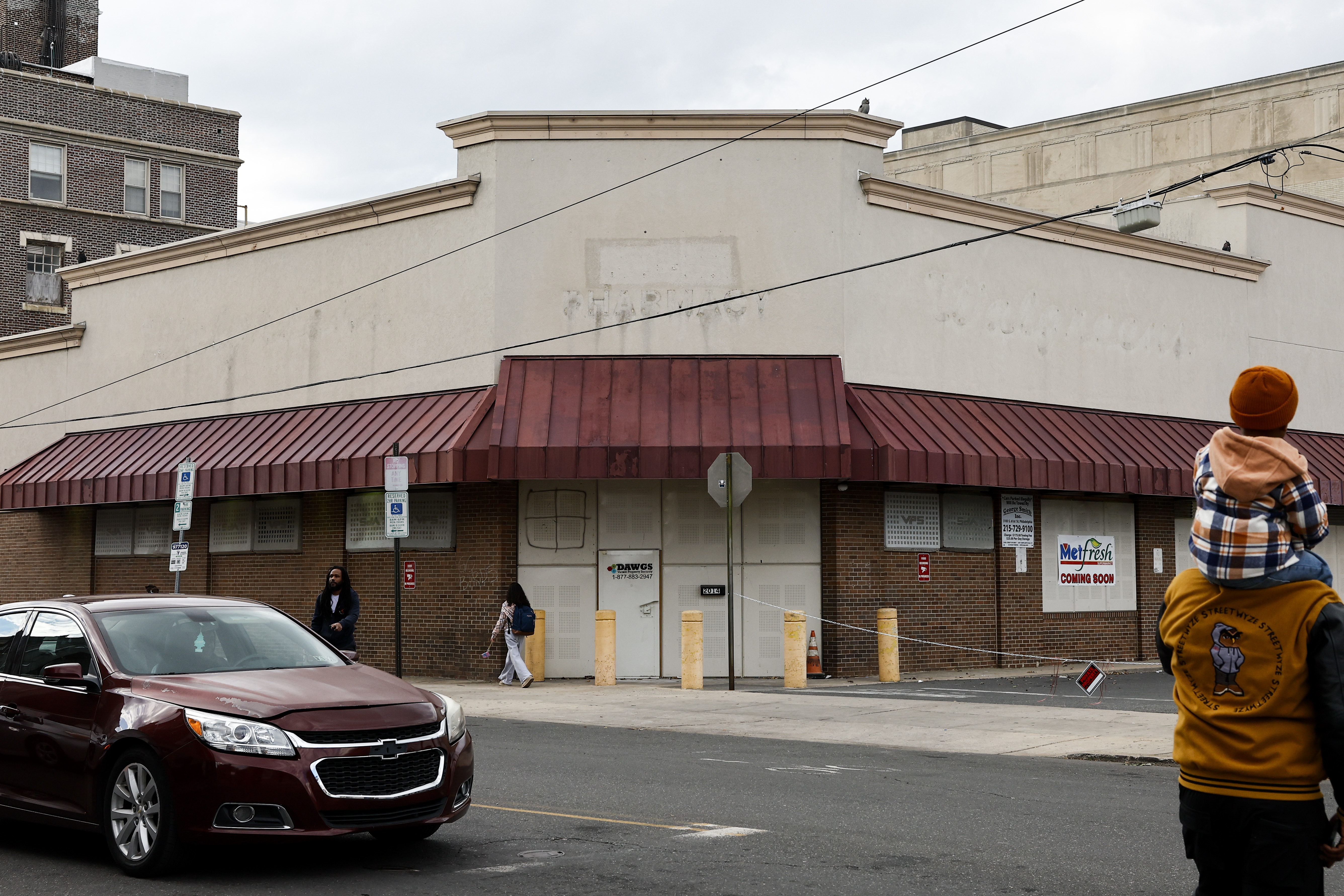
    The former Walgreens at 2014 S. Broad St., where Met Fresh’s first Philly location is set to open in early 2026, photographed on Wednesday.

    “We try to bring the human factor back into the market,” Hamdan said, adding that the company’s philosophy hearkens back to a simpler time: “That store owner who had the apron and was sweeping outside of his store, who said ‘good morning’ to everyone? That is what we do.”

    Met Foods, a family-owned company, has been operating markets in New York City for 15 years, Hamdan said. It currently has locations in the Bronx, Brooklyn, Queens, Staten Island, and northern New Jersey.

    When the South Philly grocer opens, it will mark Met Fresh’s first location outside the New York City area, Hamdan said.

    In 2019, Met Fresh had been in talks to move into a mixed-use development in Philadelphia’s Mantua section, but Hamdan said those plans fell through.

    Since then, Hamdan said they continued to look for potential Philadelphia locations. The store at 2014 S. Broad Street seemed like “a perfect fit,” he said, due to the area’s walkability, dense population, and a demand for more grocery stores and pharmacies.

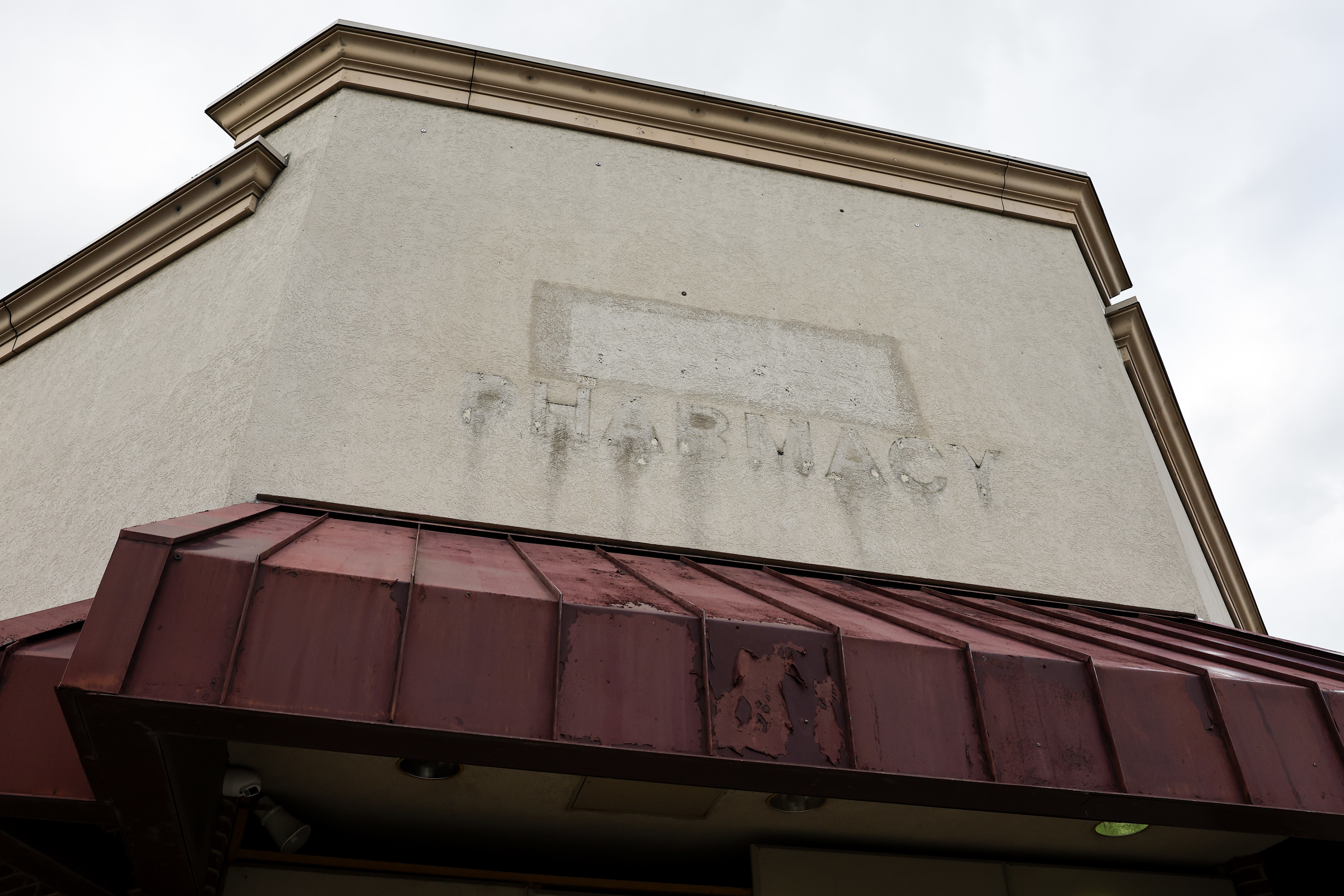
    The “pharmacy” lettering is seen on a former Walgreens on South Broad Street, where Met Fresh plans to open a supermarket in early 2026 after “extensive” renovations, its owner said.

    From the Broad Street store, the nearest supermarket is seven-tenths of a mile away. As for chain pharmacies, the Walgreens closed last year, and a Rite Aid across the street shuttered this summer as the Philly-based company went out of business. So the nearest large drugstore is a CVS off Passyunk Avenue, also seven-tenths of a mile away.

    The Met Fresh will soon start hiring in South Philly, with Hamdan noting that his stores typically need 30 to 40 part- and full-time employees from the surrounding communities. The new location will open after “extensive” renovations, Hamdan said, and once the team gets ahold of refrigeration equipment, which has been impacted by tariffs on steel and aluminum.

    Hamdan said he’s excited for Philly consumers to be introduced to Met Fresh, calling the Broad Street spot “a test pilot to see how we do in the Philly market.”