Former President Barack Obama endorsed U.S. Rep. Mikie Sherrill, the Democratic nominee for New Jersey governor, who is locked in a tight race with Republican Jack Ciattarelli.
Obama’s announcement just weeks ahead of the Nov. 4 election came in the form of an ad paid for by Sherrill’s campaign that Sherrill shared on X Friday morning.
“Mikie is a mom who will drive down costs for New Jersey families,” Obama said in the ad, echoing her campaign’s core message. “As a federal prosecutor and former Navy helicopter pilot, she worked to keep our communities safe.”
“Mikie’s integrity, grit, and commitment to service are what we need right now in our leaders,” he adds.
I'm honored to have President @BarackObama on Team Mikie.
This movement is about delivering something better for New Jersey — lower costs, more opportunity for our kids, and a government that's truly accountable to the people. pic.twitter.com/A0f5mHr0GI
Sherrill maintains a single-digit leadin polls over Ciattarelli, a former Assembly member who also ran for governor in 2017 and 2021 and has the endorsement of President Donald Trump.
In a statement, Sherrill praised Obama for leading “historic efforts to lower healthcare costs” and criticized Ciattarelli for defending cuts to Medicaid in Trump’s “big beautiful bill.”
“There’s so much at stake in this election, so President Obama and I are mobilizing New Jerseyans to make a plan to vote on or before November 4,” Sherrill added.
Sherrill last week appeared in South Jersey last week with Sens. Cory Booker (D., N.J.) and Amy Klobuchar (D., Minn.) and in her hometown of Montclair with former U.S. Rep. Gabby Giffords, an Arizona Democrat. She will appear in this weekend with Maryland Gov. Wes Moore.
Ciattarelli appeared on Wednesday with Ohio gubernatorial candidate Vivek Ramaswamy, who co-founded Trump’s DOGE and who appeared at a GOP summit in Atlantic City earlier this year to garner enthusiasm ahead of the gubernatorial primary.
Trump does not currently have plans to appear in the state with Ciattarelli, Axios reported. While New Jersey shifted more in support of Trump in 2024 he still lost the state by 6 percentage points.
Last week at the Vatican, two Villanova legends finally came together: Pope Leo XIV and former basketball star Maddy Siegrist.
Siegrist took a short trip to Rome to visit the big landmarks, including the Trevi Fountain and the Colosseum and spent a day with Villanova at an Augustinian conference, where she got to meet the pope.
Last year, the Villanova women’s basketball team took a group trip to Italy and the Vatican, but Siegrist, still in the middle of the WNBA season, couldn’t attend. This time around, after the Dallas Wings were eliminated from playoff contention, Chrissy Quisenberry, who helps organize alumni trips at Villanova, reached out to let Siegrist know they were planning another trip and that they might get an audience with the pope, also a Villanova graduate.
“People always joke because he [went to] Villanova, like, ‘Is he going to do the wedding?’” said Siegrist, who’s engaged to Stephen Perretta, an assistant women’s basketball coach at Drexel and the son of former Wildcats coach Harry Perretta. “When it did happen, I was like, ‘Oh my gosh, this is crazy.’ We have a family group chat of all my cousins and aunts and grandparents. I sent the picture, and they’re like, ‘Are you joking?’ It was kind of a last-minute trip, so I didn’t really tell anyone because I didn’t know — when they said audience, it could be 1,000 people outside, which would have been unbelievable, but I didn’t realize I was actually going to have the opportunity to shake his hand.”
The group attended mass at St. Peter’s Basilica and toured the catacombs before meeting with Pope Leo. Siegrist got a photo shaking the pope’s hand — which she did have to pay for, like a Disneyland ride photo — and said it was a bucket list moment, which “rejuvenated” her Catholic faith.
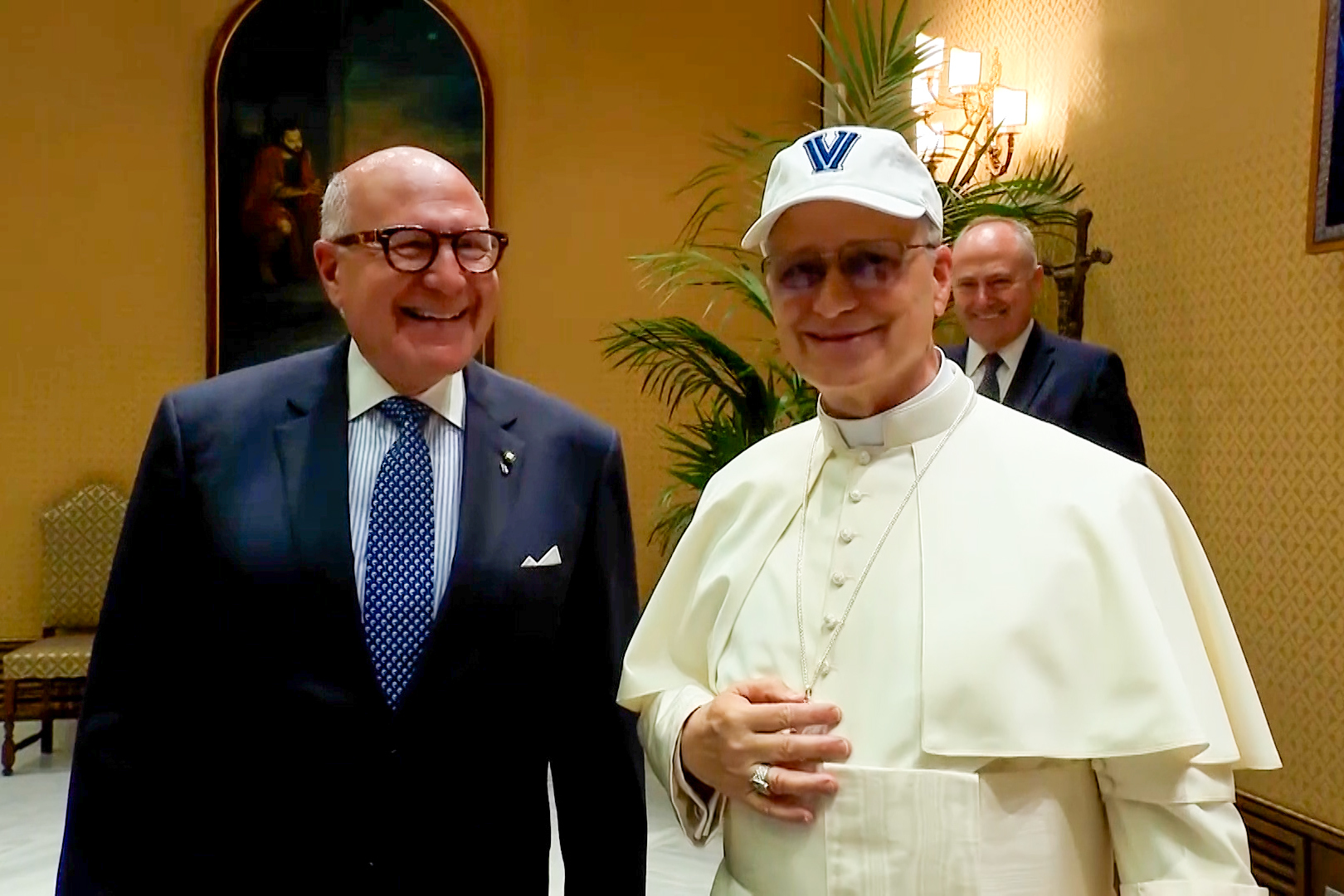
Pope Leo XIV wears a Villanova hat gifted to him during a meeting with an Italian heritage group in June.
Pope Leo frequently goes viral for his White Sox fandom and has been pictured in Villanova hats on multiple occasions since assuming his new role. But even with a group from Villanova in the building, Siegrist said he was careful to stay impartial.
“He’s not biased at all,” Siegrist said. “I’ve seen a few pictures of Villanova hats and stuff. I think he addressed that. Dr. [Barbara] Wall was on the trip, she was one of his professors, so that was pretty cool to be with her during that moment. He knew there was a small group from Villanova at the conference, I think about 20-25 people. Such a cool experience. I really don’t even remember what I said in the moment. You just get so starstruck. You’re so nervous.”
Think you know your news? There’s only one way to find out. Welcome back to our weekly News Quiz — a quick way to see if your reading habits are sinking in and to put your local news knowledge to the test.
Question 1 of 10
After decades as the Mann Center for the Performing Arts, Philadelphia's arts center in Fairmount Park is getting a new name. What is it called now?
CorrectIncorrect. XX% of other readers got this question right.
The Pittsburgh-based Highmark insurance company will join the Mann nameplate starting immediately under the terms of a 12-year deal. The arts center will use the moniker "Highmark Mann" for short, and its new name comes with a renovation slated for completion in the spring.
Question 2 of 10
This Eagles player announced his retirement Monday on social media after 11 seasons in the NFL:
CorrectIncorrect. XX% of other readers got this question right.
Smith, 33, wrote that he “knew this day would come — but now that it’s here, I’m feeling so many emotions I never expected." The 6-foot-4, 270-pound outside linebacker signed with the Eagles on Sept. 5, one day after their season-opening victory over the Dallas Cowboys.
Subscribe to The Philadelphia Inquirer
Our reporting is directly supported by reader subscriptions. If you want more journalism like this story, please subscribe today.
How many of the eateries on The 76, The Inquirer's annual list of the most vital restaurants in the Philadelphia area, are fresh additions this year?
CorrectIncorrect. XX% of other readers got this question right.
More than half of the list is fresh — classics that Inquirer scouts felt deserved their time in the spotlight, or new and new-to-us spots that reflect the shifting energy of the dining scene.
Question 4 of 10
A plan to convert Chester County's Pennhurst State School and Hospital into one of these facilities is drawing outrage from local residents:
CorrectIncorrect. XX% of other readers got this question right.
A plan to convert Pennhurst into a massive data center has outraged and mobilized local residents, as well as people in neighboring communities in an area known for rolling hills, farms, and an overall rural character. The pushback comes as both President Donald Trump and Pennsylvania Gov. Josh Shapiro champion data center development.
Question 5 of 10
The Philadelphia Zoo is adding a new attraction that will serve as the first of its kind on the institution’s campus in its more than 150-year history. What is it?
CorrectIncorrect. XX% of other readers got this question right.
The 10-story amusement ride — dubbed the “Pherris Wheel” by zoo officials — will open Nov. 20 and sit just past the zoo’s main entrance, offering a gondola’s-eye view of the animal park below, Boathouse Row, the Philadelphia Art Museum, and the skyline below.
story continues after advertisement
Question 6 of 10
How much money did Temple University get as part of a record-making gift it recently received from an alumnus who almost didn't get accepted into the school?
CorrectIncorrect. XX% of other readers got this question right.
Christopher Barnett, who made his money in real estate and healthcare, has donated $55 million to the school, surpassing the $27.5 million given by philanthropists Sidney and Caroline Kimmel in April. Barnett was rejected from Temple nearly two decades ago, but he talked his way in after showing up unannounced at the office of the director of transfer admissions.
Question 7 of 10
A Delco-based tattooer won a scrapple sculpting contest at Reading Terminal Market late last week. His scrapple-fied sculpture depicted:
CorrectIncorrect. XX% of other readers got this question right.
Patrick Moser was crowned champion for his version of the Eagles’ Tush Push, which he called the “Mush Push.” The sculpture, judges said, was advanced, ambitious, and pushed scrapple “to its absolute limits.” Moser was awarded a pig trophy named “Scrappy” and a $100 Reading Terminal Market gift card.
Question 8 of 10
Following the Phillies' tragic knockout in game four of the National League Division Series, where is team manager Rob Thomson going next season?
CorrectIncorrect. XX% of other readers got this question right.
With one year left on his contract, Thomson will be back to manage the Phillies next season. Questions arose about Thomson’s job security last week after the Phillies lost in the divisional round of the playoffs for the second year in a row.
Question 9 of 10
Iron Hill Brewery abruptly closed all its stores and filed for liquidation bankruptcy earlier this month. That leaves one question: What happens to all their beer now?
CorrectIncorrect. XX% of other readers got this question right.
The final destination of Iron Hill's beer will play out during the bankruptcy process, which could take several months to just over a year. If the beer is able to be sold, proceeds would go toward paying the company's debts.
Question 10 of 10
This dive bar made The Inquirer's list of the 20 happiest places in Philly, thanks in part to its welcoming bartenders:
CorrectIncorrect. XX% of other readers got this question right.
Money can’t buy happiness, but it can buy good food and a fun beverage, which is a pretty neat shortcut. Dirty Franks, one reader wrote, not only has $2 beers but bartenders so warm that they sometimes think of them as "additional mothers."
Your Results
You have skipped .
You scored XX out of 10.
The average reader scored XX out of 10
Seems like you’ve been skimming more than reading there, buddy. There’s always next week.
You’ve read some articles (or made some educated guesses) but we wouldn’t come to you first for our local news recaps. Better luck next week!
Do you work here? You’re a local news stan with the latest updates on Philly happenings. Your friends definitely ask you for summaries on what’s going on and it shows.
It always figured to be an emotional day when the Alter family gathered at Har Jehuda Cemetery in Upper Darby. They were commemorating their mother’s first yahrzeit, the anniversary of death in the Jewish tradition.
But when the family arrived at her grave, they found it in devastating condition.
Beatrice Reina Alter, 93, was buried last year next to her husband, Milton Alter, in plots that the couple bought in the Jewish cemetery in the 1990s. When their family came together for her yahrzeit in August, they expected there to be a new headstone to match Milton’s.
Instead, her grave was covered in a fresh mound of dirt. The corner of a plywood board stuck out. And there was no headstone to be seen.
“We were shaken and appalled,” said Daniel Alter, one of the couple’s five children.
Yet issues at the cemetery — and for the burial industry — extend beyond placing headstones on time. Har Jehuda reflects an industry facing serious challenges to its longevity, where sometimes small, antiquated businesses must reinvent themselves. The country’s relationships with cemeteries and burials are changing, putting a seemingly timeless business at risk.
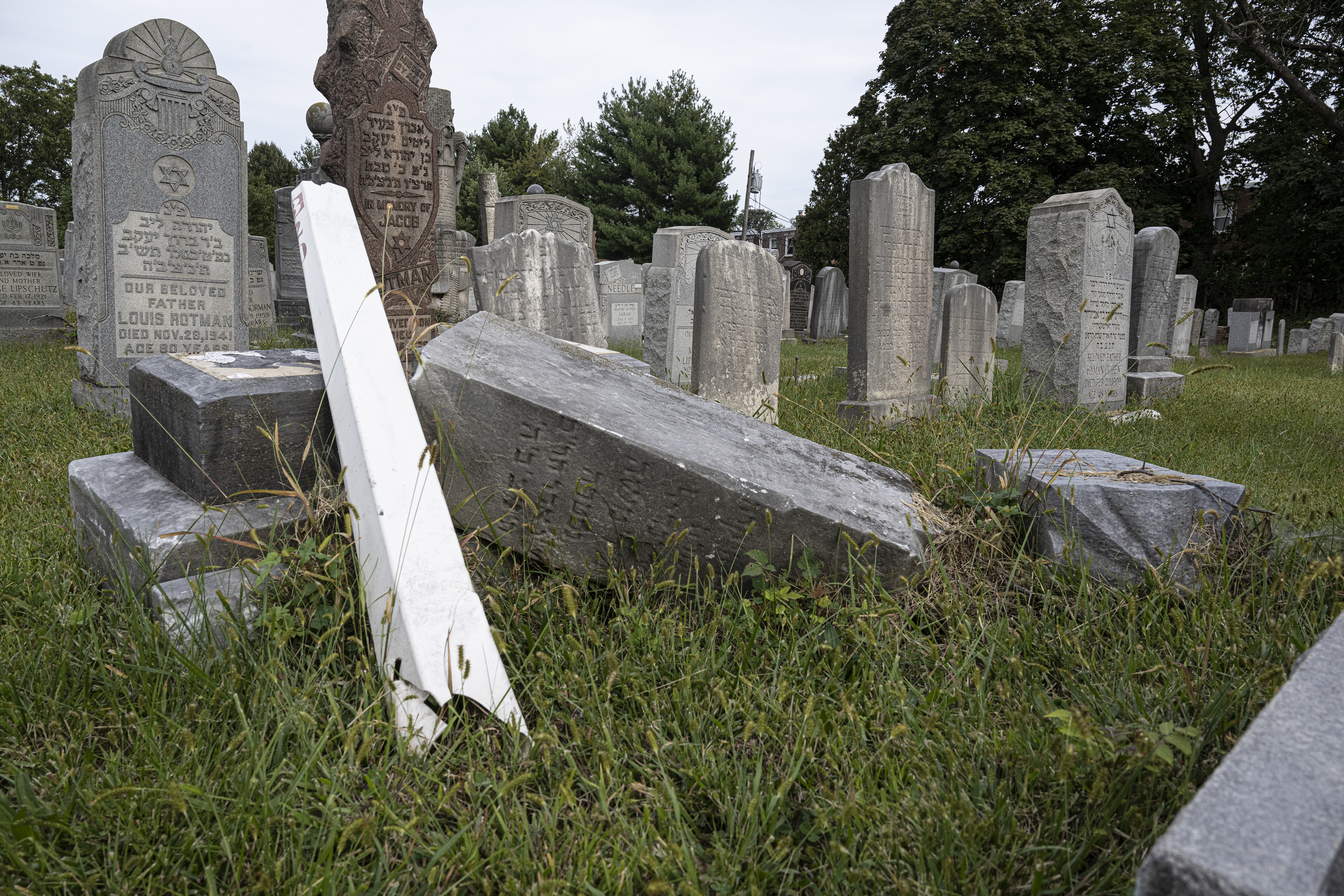
Har Jehuda, for instance,has been an important institution for the region’s Jewish community since its founding in the 1890s, holding more than 20,000 graves. But today, its grounds are largely overgrown and unkept, and numerous gravestones have fallen into disrepair. A volunteer group has stepped in to cover some of the maintenance and landscaping costs but fears it cannot sustain the cemetery for long.
Overgrown weeds and displaced headstones at Har Jehuda Cemetery in Upper Darby.
“The reality is that there are not enough staff or funds to maintain the cemetery, and there hasn’t been for years,” Randi Raskin Nash, a member of the Friends of Har Jehuda Cemetery group, said by email.
The cremation boom
A hundred years ago, cremation was an unusual choice in the United States. Things started to shift in 1963, when the Catholic Church lifted its prohibition of the practice and Jessica Mitford’s book The American Way of Death, an exposé of the death industry, was published. Before then the cremation rate was reported to be in the single digits, and even as it rose, by 1999 only about 25% of Americans were cremated. But that is changing.
Cremations are expected to double the number of burials in 2025, according to a report from the National Funeral Directors Association. By 2045, the cremation rate in Pennsylvania is projected to reach over 82%, with burials dropping to just under 14%.
Several factors appear to be driving the shift, according to Christopher Robinson, the president of the association’s board of directors. Those include costs, environmental concerns, declines in religious affiliation, and growing cultural acceptance of cremation.
window.addEventListener(“message”,function(a){if(void 0!==a.data[“datawrapper-height”]){var e=document.querySelectorAll(“iframe”);for(var t in a.data[“datawrapper-height”])for(var r,i=0;r=e[i];i++)if(r.contentWindow===a.source){var d=a.data[“datawrapper-height”][t]+”px”;r.style.height=d}}});
But that is not the business model that most cemeteries were built upon.
When folks secure a plot for interment, they are really buying an easement for burial rights, or essentially a license to use the cemetery’s land. Plots can cost thousands of dollars and areoften nonrefundable.
Once it comes time for a person to be buried, the cemetery may charge for other parts of the process, like digging and closing the plot, creating a headstone monument, or supplying a vault for the casket.
Most cemeteries sustain themselves for the future by putting a portion of that revenue into an endowment fund, where the return on investment can be used for maintenance and repairs. Friends of Har Jehuda estimates that it requires roughly $50,000 to$75,000 just to cover lawn mowing and weeding per season.
Cremations are much less profitable, particularly if a cemetery does not actually perform it — a walled recess with an engraved cover for a loved one’s urn may cost only a few hundred dollars.
It’s unknown exactly how many cemeteries have formally closed or been abandoned in recent years, since the statistic does not appear to be widely tracked. What is clear is that cremation trends and dwindling space for future burials have left cemeteries struggling.
“There’s going to be a lot of cemeteries going out of business in the next 20 years,” said Tanya Marsh, a law professor at Wake Forest University who teaches funeral and cemetery law, in an episode of The Economics of Everyday Things podcast last year.
Would you get married at a cemetery?
Some cemeteries have embraced the changes and creatively diversified their offerings.
“We’re an outdoor museum. We’re a sculpture garden, we’re an arboretum … we’re more than just a cemetery,” said Nancy Goldenberg, CEO of Laurel Hill Cemeteries in Philadelphia.
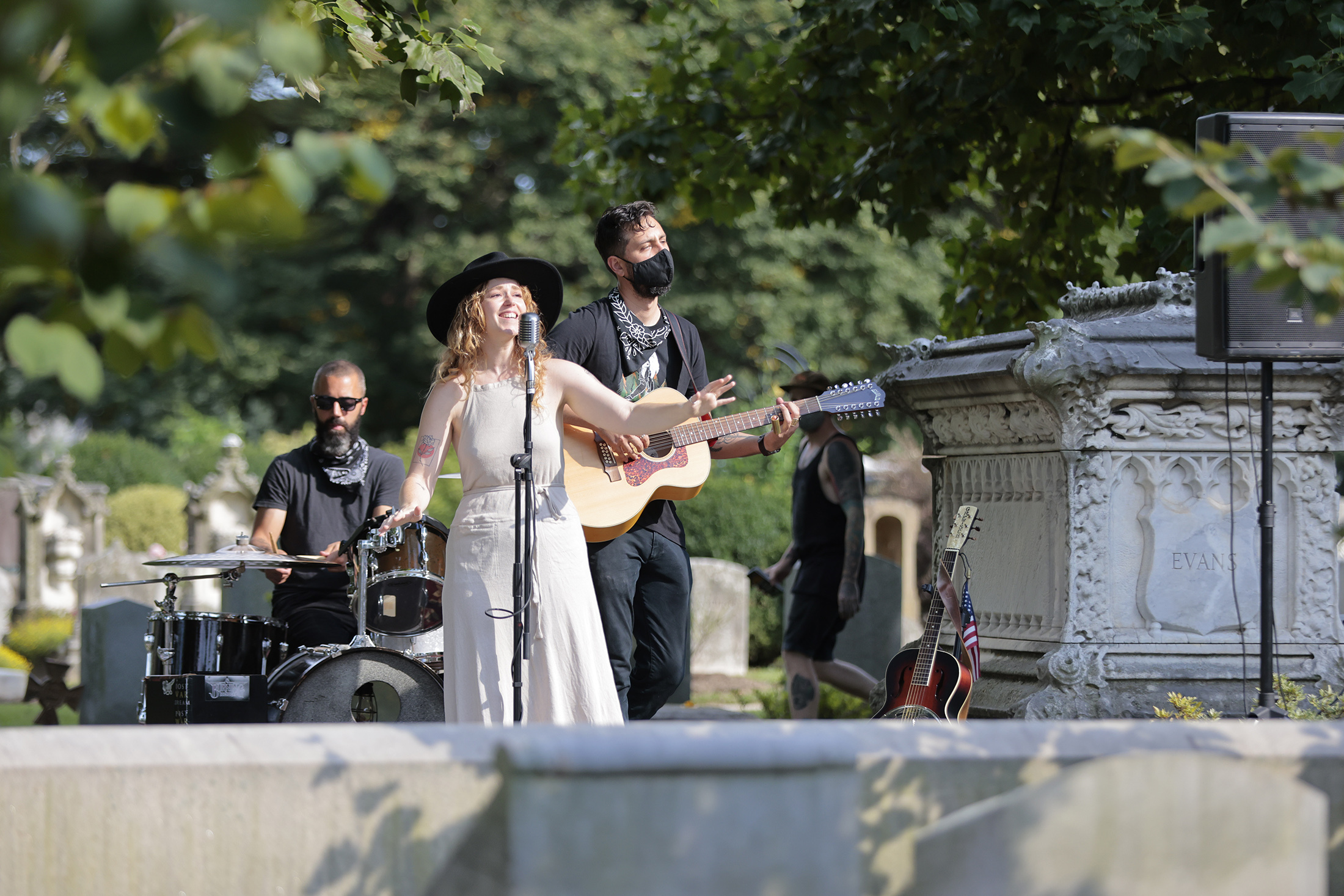
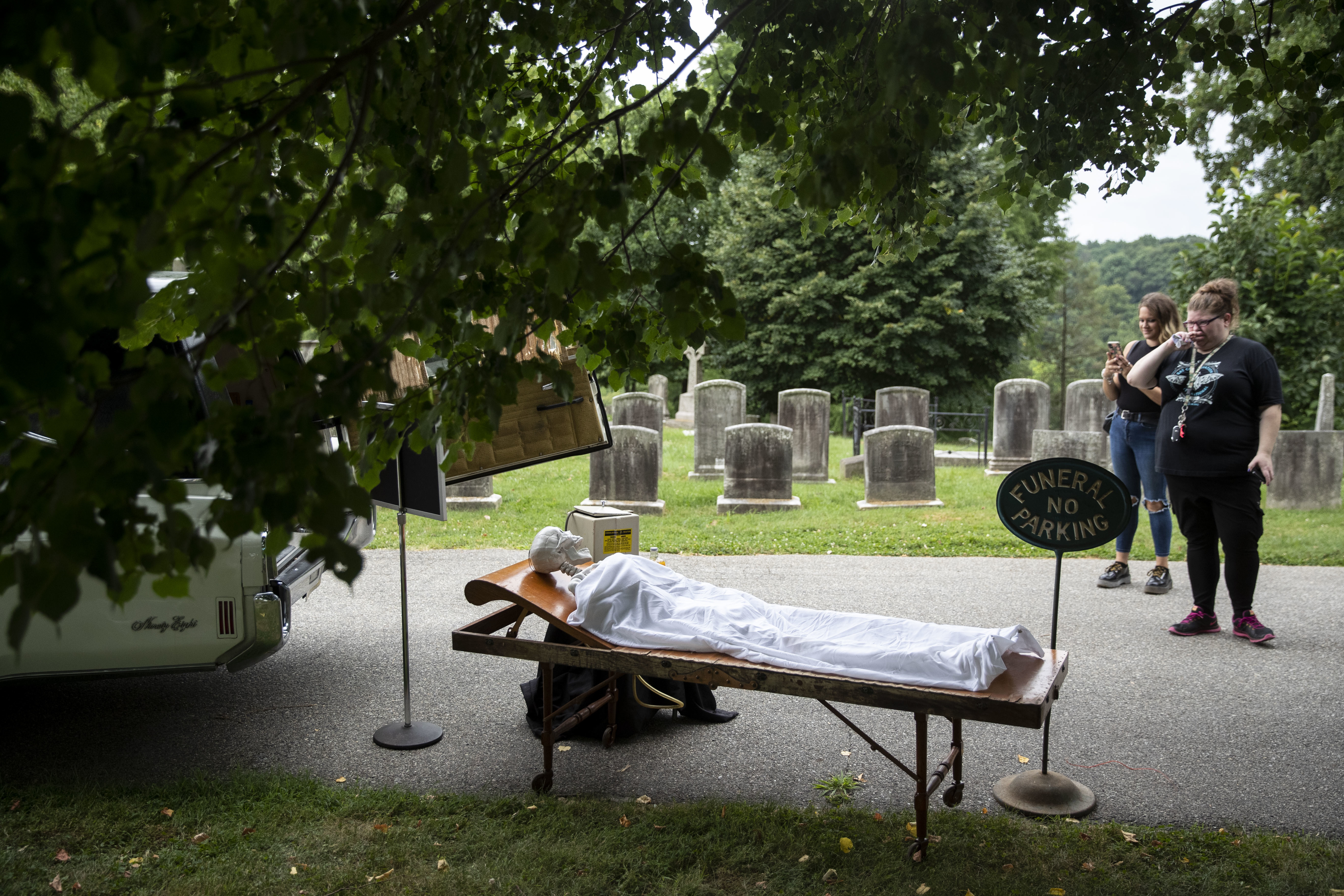
Laurel Hill uses its combined 265 acres on both sides of the Schuylkill to its advantage. On a given day at the historic cemetery, you might see visitors on a history tour, stretching out to watch a movie screening, attending a wedding, or meeting with the official book club, Boneyard Bookworms.
The 49 Burning Condors singer Kimber Dulin, Christopher Tremogile on guitar and Jason Gooch on drums play as folks shop for unusual antiques, vintage items, artwork and handmade wares at the Market of the Macabre at the Laurel Hill Cemetery in 2021.
Goldenberg said the extensive offerings are meant to build connections between people and the cemetery: They will be more likely to contribute money, or when they eventually need a resting place for their loved ones, they will look therefirst.
This all used to be more common — the first U.S. cemeteries in the mid-19th century also served as the country’s first public parks, with open grassy fields fit for a picnic. Before then, people buried their dead in smaller graveyards that eventually became overcrowded and sources of disease.
Laurel Hill is readying itself for a changing death industry, too. Goldenberg said she anticipates a rise in “green burials,” in which a person is buried without embalming or a casket, and said the cemetery was designating a section for them.
Visitors view a display behind a hearse during the 13th Car & Hearse Show presented by the Mohnton Professional Car Club at Laurel Hill Cemetery in 2021.
And while Goldenberg said she would be long gone before the cemetery runs out of space for new burials, it is a reality officials are planning for.
Laurel Hill is adding space for an additional 225 niches for cremated remains.
“There are small cemeteries, and once they fill up, that’s the revenue stream. … You have to be prepared for that,” she said.
“If you don’t, that’s when you fall on hard times.”
If a cemetery reachesthe point of closure or abandonment, it’s not alwaysclear what would happen to it. Last year, Gov. Josh Shapiro signed into law a bill sponsored by StateRep. Tim Brennan (D., Bucks) that would give financial relief to municipalities that take over abandoned cemeteries, since doing so can be a costly burden that local governments want to avoid.
Uncertain futures for cemeteries
Days after the Alter family made it through the prayers and memorial they planned, the emotional weight of the experience hit them even harder.
Daniel Alter later confirmed with Har Jehuda that a fresh grave had been dug where he believed his mother was buried. Recently, he hired a ground-penetrating radar company to examine the burial site, which determined the freshly dug grave was directly adjacent to where his mother was buried. While Alter was relieved to learn his mother’s grave had not been disturbed, he said Har Jehuda could have prevented the anguish he and his family have felt over the last few months.
Har Jehuda Cemetery’s owner, Larry Moskowitz, declined to comment for this article. Moskowitz was previously prosecuted by the state attorney general’s office over allegations that his other business, Wertheimer Monuments, had failed to deliver headstones to people who had paid for them. Complaints like these against the burial industry happen occasionally — the attorney general’s office also sued another Philadelphia monuments company in 2023 for failing to deliver headstones. There are multiple organizationsdedicated to protecting consumers against predatory burial providers.
The Alters, like other families, continue to visit and bury their loved ones at Har Jehuda, but they hope that no one else goes through their experience.
“Our collective wish is that it never, ever, ever happens again to anyone in the Philly area,” Daniel Alter said.
This week’s Shackamaxon is about field trips, political systems, and state budget shenanigans.
Perspective vs. parochialism
Five members of City Council, several Council staffers, three state representatives, and the head of the Philadelphia Parking Authority are taking a field trip up to Hoboken, N.J., next week, with the aim of learning more about how that city managed to eliminate traffic deaths. Hoboken hasn’t just done so forone year or two — the Mile Square City has gone without a vehicular fatality since 2017. Council President Kenyatta Johnson deserves credit for being willing to learn from other places, something Council has traditionally been hostile to.
Still, if our local legislators want to truly have their minds blown, they should head farther north. No, not Boston. The city they should learn from is Montreal, where my wife and I spent last weekend.
The city known as “Le Belle Ville” shares a lot in common with Philadelphia. Unlike Hoboken, which is ultimately a satellite city of Manhattan, Montreal is the center of its own metropolitan area, and the biggest city in Quebec. While there are zip codes in Philadelphia that have more residents than the North Jersey hamlet, Montreal has over 1.7 million inhabitants. It also has a riverside Old City, a park named for Marconi, an often contentious relationship with their state provincial government, a plethora of Second Empire architecture, a storied Chinatown, an expansive urban park that’s a bit of a hike to get to, and they call their downtown “Centreville,” or Center City.
Unlike Philadelphia, however, Montreal’s leaders embrace being a city, rather than trying to plug their square suburban preferences into a round metropolitan hole. The difference in quality of life is easy to see, even on a short trip.
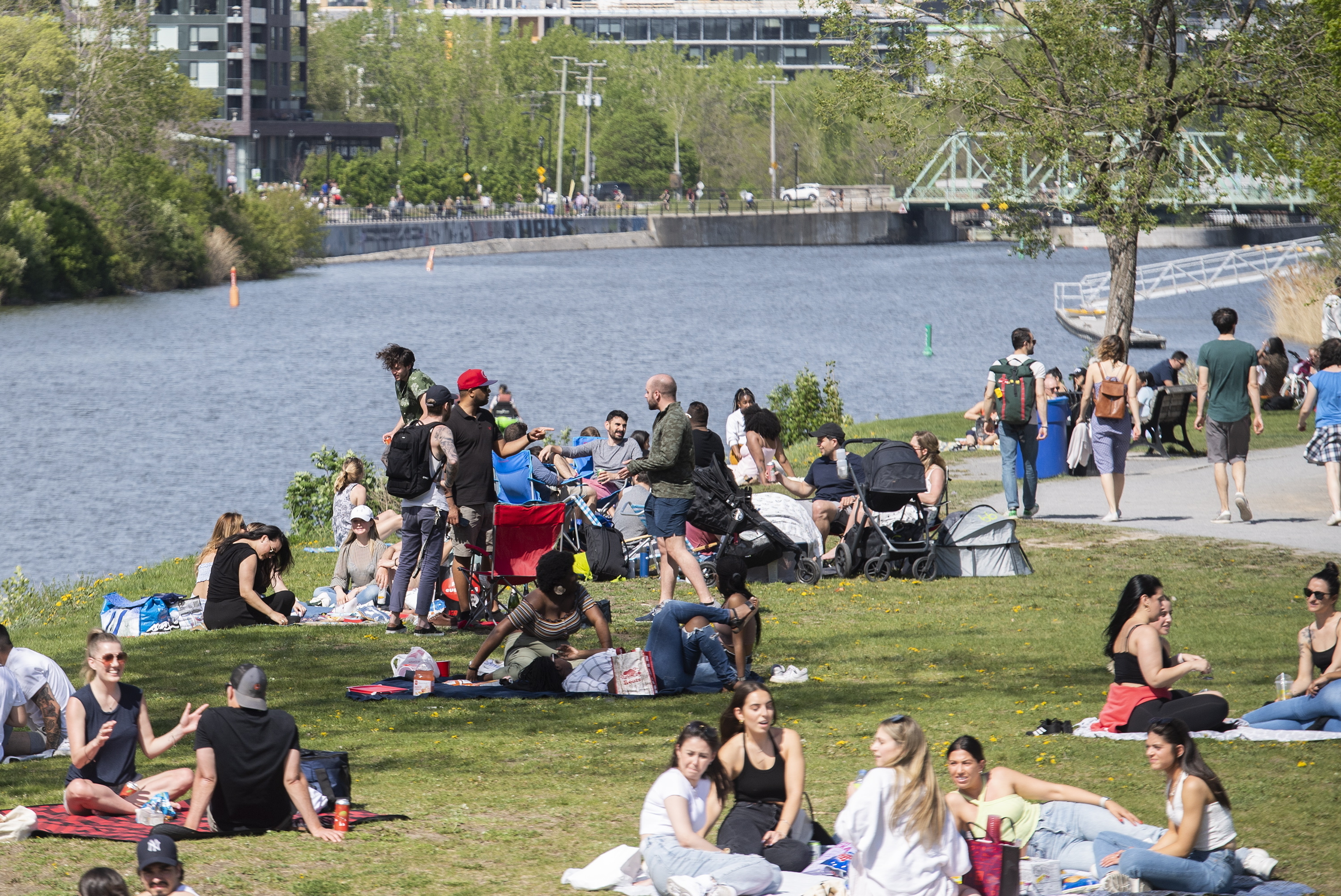
People gather next to the Lachine Canal on a warm spring day in Montreal in 2021.
As my colleague Stephanie Farr pointed out, Philadelphia lacks even a single regularly pedestrianized corridor, while in Montreal, you’ll find them all over the place. Montreal’s mayor, Valerie Plante, credits its pedestrianization program with attracting additional tourists and boosting the local economy. There are more cyclists in Montreal than here in Philadelphia, and yet, you were less likely to encounter them speeding past you on the sidewalk, with even older riders and parents of small children feeling comfortable and safe riding in the street, thanks to traffic calming in residential areas and abundant paths elsewhere.
Additionally, their embrace of city life means a much more pleasant transit experience. In the four hours I spent riding the rails in Montreal, I did not notice a single person smoking cigarettes or marijuana on board a train or inside a metro station. I smelled both on my first trip back on SEPTA. Many Montrealers smoke. You’ll even find a recreational cannabis dispensary along Rue Saint-Paul, their historic thoroughfare, but they respect their transit system enough to refrain while on board. Imagine that!
Real choices
It would be easy to cite cultural differences as the primary reason why things seem to work better up north. But culture is not stagnant; it interacts with politics and policy. There are differences in electioneering between the City of 100 Steeples and the City of Brotherly Love, as well.
Since Philadelphia enacted the 1951 Home Rule Charter, the Democratic Party has dominated city politics. Many Council members are reelected without facing a credible challenge. Local Republicans stand little chance, especially with their colleagues in Washington and Harrisburg routinely demonstrating their contempt for our city.
A sign in the Fairmount neighborhood in May.
The city’s new, progressive opposition, the Working Families Party, is often more focused on national issues than things city government has direct control over. In fact, it urged people to vote for it in order to stop Donald Trump. Neither opposition party has been willing to tackle local good government priorities like councilmanic prerogative or eliminating row offices. This makes achieving change in this city feel impossible, which probably contributes to what former Inquirer columnist Helen Ubiñas famously called “the Philly Shrug.”
In Montreal, however, voters have a real choice. They even have municipal political parties, meaning voters have to form their own opinions about local issues.
Budget blame game
Harrisburg Democrats are increasingly convinced state Senate Republicans are holding up the budget to boost state Treasurer Stacy Garrity’s chances in next year’s governor’s race. Garrity is currently behind by about 16 points in the polls. Republican consultant Chris Nicholas, one of the more reasonable members of his party, insists this is not the case, claiming that if it were, the treasurer would have unveiled her loan program earlier for Pre-K Counts programs and groups that provide rape and domestic violence prevention and response services.
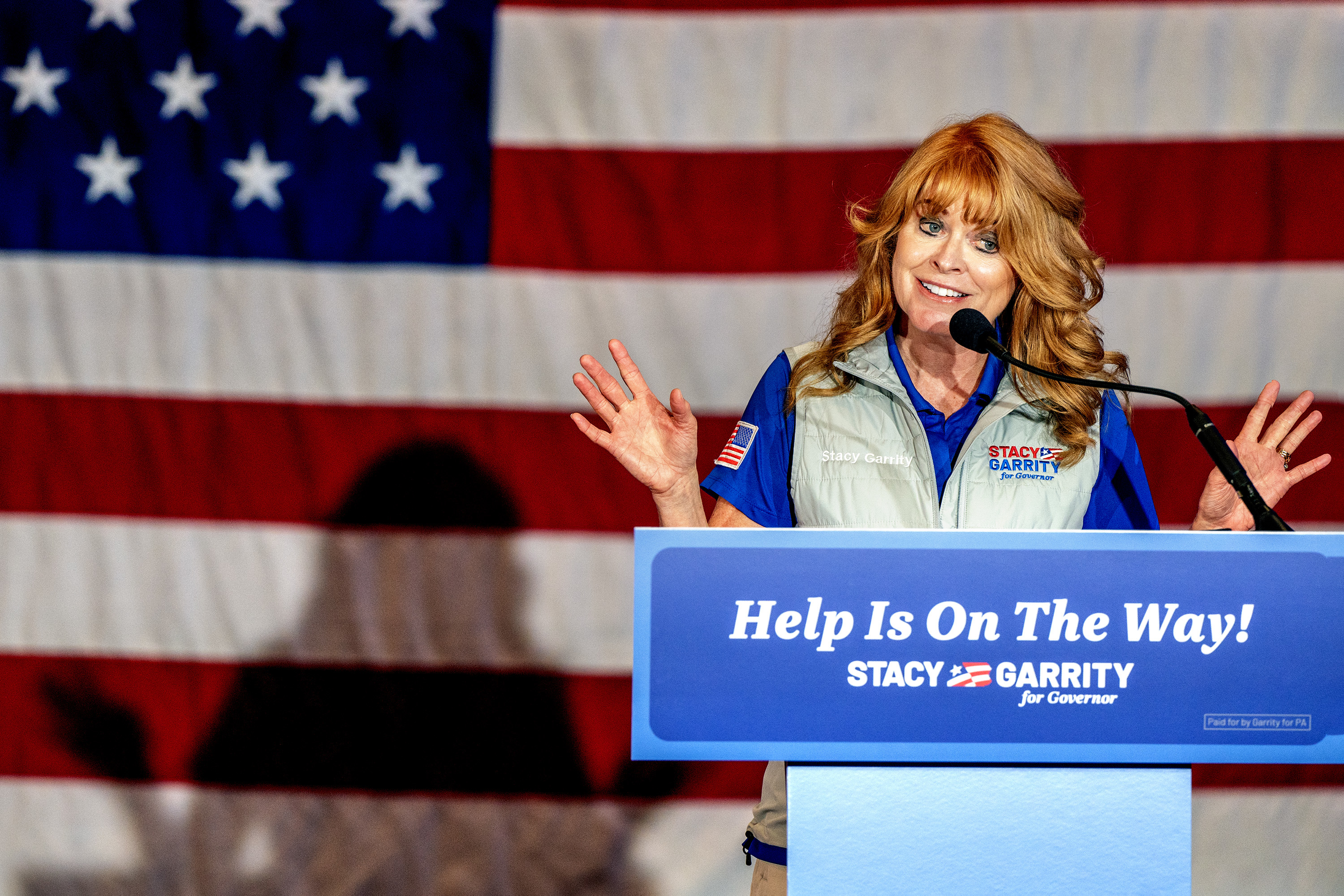
State Treasurer and Republican candidate for governor Stacy Garrity holds a rally in Bucks County at the Newtown Sports and Events Center in September.
Still, it is hard to avoid thinking a Josh Shapiro landslide in 2026 could have an adverse effect on the campaigns of Republicans who are up for reelection next year.
Of course, holding up needed state cash might only make things worse. The county commissioners in state Senate President Pro Tempore Kim Ward’s Westmoreland County canceled their public meetings because there’s no money to spend. As Spotlight PA’s Stephen Caruso has outlined, nonprofit service providers are already feeling the pain, taking on debt that will hurt their ability to provide care for years to come.
It’s too bad that kind of pain has not been felt by our representatives.
State Sen. Sharif Street has an early fundraising lead over his competitors in next year’s Democratic primary for a storied Philadelphia congressional seat, according to new campaign finance reports.
But the race is in its early stages, and candidates who entered the race after Street still have plenty of time to catch up before the May 2026 primary.
Street, the son of former Mayor John F. Street, entered the race for Pennsylvania’s 3rd Congressional District in early July,days after U.S. Rep. Dwight Evans (D., Philadelphia) announced he would not seek reelection. Street’s campaign launch coincided with the beginning of the campaign finance reporting period, allowing him three full months to solicit contributions and seek endorsements.
He took in about $352,000 from July 1 through Sept. 30, according to the Federal Election Commission. His campaign spent $33,000 during that time, and he finished the period with $372,000 in cash on hand, which is also the most of any candidate in the race. (Street’s cash reserves are higher than his fundraising because he carried over money from a previous campaign account.)
“Our strong fundraising results put us in a commanding position,” Street campaign manager Josh Uretsky said in a statement. “We’re building a strong campaign that will hit every neighborhood in the Third District by leveraging our broad-based coalition.”
window.addEventListener(“message”,function(a){if(void 0!==a.data[“datawrapper-height”]){var e=document.querySelectorAll(“iframe”);for(var t in a.data[“datawrapper-height”])for(var r,i=0;r=e[i];i++)if(r.contentWindow===a.source){var d=a.data[“datawrapper-height”][t]+”px”;r.style.height=d}}});
Rabb’s haul was notable for a candidate with little support among Philadelphia’s established political organizations, such as the deep-pocketed building trades unions that endorsed Street this week. As he has in past runs, Rabb said he is eschewing contributions from corporate-backed political action committees, and tapping into a national network of progressive small-dollar donors.
“This is a robust, grassroots campaign that’s fueled and funded by a growing movement of Philadelphians and citizens far & wide who want a bold, independent-minded and accountable Democrat to represent the bluest congressional district in the nation,” Rabb said in a statement.
His campaign spent $76,000, and carried forward $181,000.
State Rep. Morgan Cephas, a West Philly Democrat who chairs the Philadelphia delegation to the state House, collected $156,000 in contributions, a respectable sum given that she entered the race about a month before the reporting deadline. Her campaign spent $37,000 and had $119,000 in cash.
In a statement, Cephas said “the excitement about our campaign is palpable.”
“I understand the problems of Philadelphia because I’ve lived them for the last 41 years,” Cephas said. “Together we can deliver real results for our community.”
“Since day one, this campaign has been fueled by healthcare professionals, small business owners, and working families across Philadelphia who are ready to take power back from leaders bought by corporate interests,” Oxman said in a statement.
David Oxman, an intensive care doctor and medical school professor at Thomas Jefferson University Hospital, is running for Congress. Oxman, 58, of Bella Vista, joins a race that includes State Reps. Sharif Street and Chris Rabb to replace retiring U.S. Rep. Dwight Evans.
“As a scientist, teacher, and a non-politician running an outsider campaign, my focus is on connecting with everyday Philadelphians,” Morris, a computer scientist, said in a statement. “Career politicians and the donor class want politics as usual. I’m prepared to make sure everyone in Philadelphia receives equal benefits and equal protections.”
“In just a few weeks in the race, Dr. Stanford has generated significant momentum — in contributions, volunteer engagement, and community enthusiasm,” Stanford campaign manager Aaron Carr said in a statement.
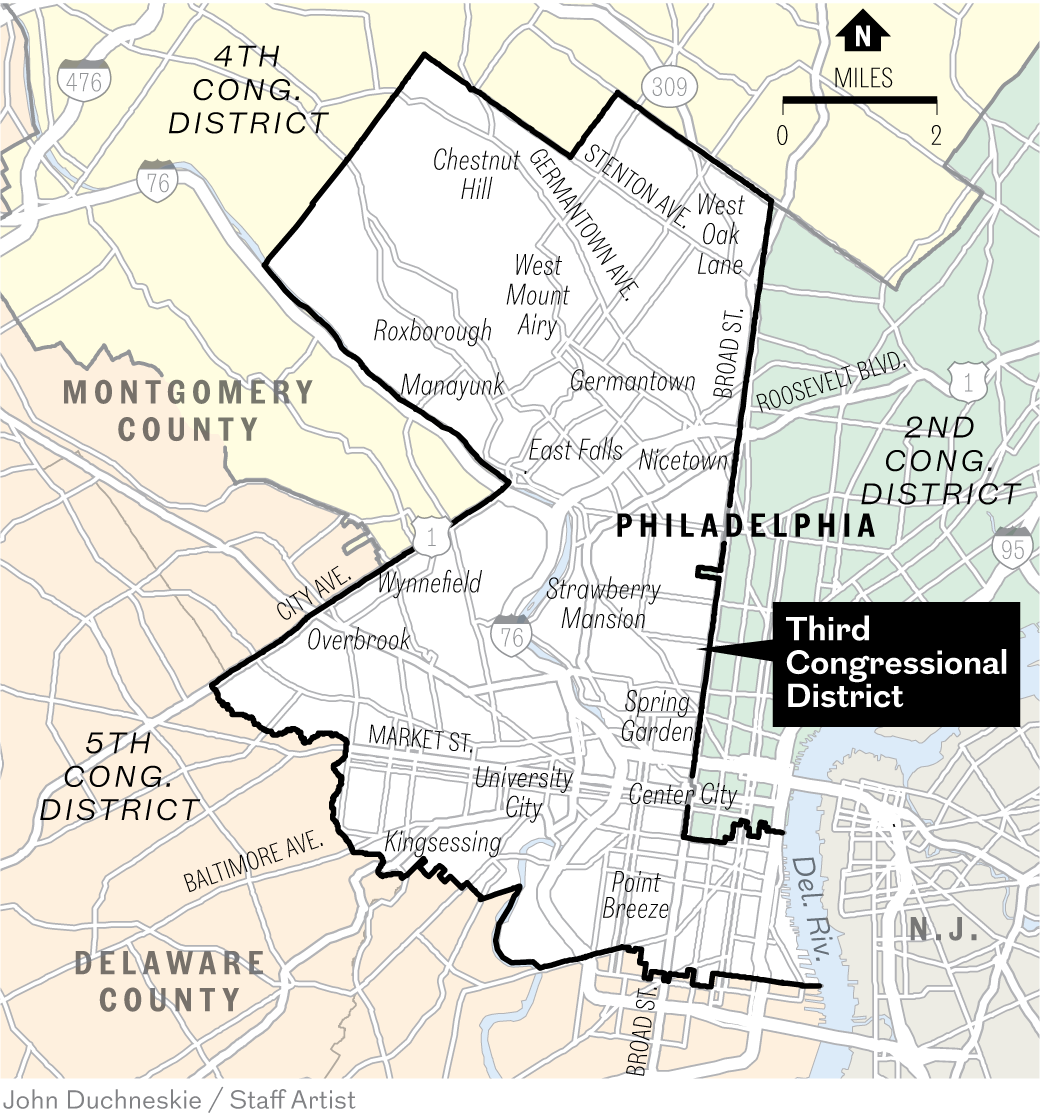
Pennsylvania’s 3rd Congressional District, which includes parts of North, Northwest, West, and South Philadelphia, is one of the most Democratic seats in the nation. With Evans retiring from the seat he has held for nearly a decade, the field could still be in flux as more Philly politicians eye the potentially once-in-a-generation ticket to Washington.
Map of Pennsylvania’s Third Congressional District.
While the race remains competitive, Street’s early fundraising lead will help cement his status as the favorite of the local political establishment. Democratic City Committee chair Bob Brady said this week that party ward leaders will likely vote to endorse Street after this year’s election cycle wraps up next month.
“We’re fully prepared to take advantage of this early lead,” Uretsky said.
Brian Fitzpatrick outraises competitors in Bucks County congressional race
Rep. Brian Fitzpatrick (R., Bucks and Montgomery) speaks during the opening session of the National Treasury Employees Union (NTEU) Legislative Conference in Washington in March.
Unlike the deep-blue 3rd District, the fate of the 1st District will likely be decided in next year’s general election, and not the primary. The district, which includes all of Bucks County and a part of Montgomery County, is the only Philadelphia-area congressional seat represented by a Republican.
Harvie, viewed as the favorite to win the Democratic nomination, raised $217,745 last quarter. The other Democrat in the race, attorney Tracy Hunt, raised $36,692.
This suburban content is produced with support from the Leslie Miller and Richard Worley Foundation and The Lenfest Institute for Journalism. Editorial content is created independently of the project donors. Gifts to support The Inquirer’s high-impact journalism can be made at inquirer.com/donate. A list of Lenfest Institute donors can be found at lenfestinstitute.org/supporters.
To hear Michael Blichasz tell it, none of this would have happened if he hadn’t gone asking for a copy of the deed.
City officials never would have come knocking on the door of his nonprofit museum, the Polish American Cultural Center, curious how he came to be the supposed owner of a multimillion-dollar property in the heart of Philadelphia’s historic district.
They never would have begun scrutinizing the decades-long paper trail, the political handshakes, and the forgotten promises made to the once-powerful community leader.
And the quaint Polish history museum that has operated in Society Hill since 1987 would still have its home.
Because for nearly 30 years, City Hall never questioned whether Blichasz’s nonprofit actually owned the building at 308 Walnut St.
“No one mentioned a word about it,” Blichasz, 79, said. “It was totally silent.”
That silence started unraveling seven years ago when, Blichasz said, he requested a copy of the deed in order to get a state grant to make repairs on the five-story property. He had somehow avoided an inquiry for decades, despite securing other grants and contracts to keep alive his nonprofit’s mission: providing Polish immigrants with a one-stop cultural hub that could connect them to city services.
Officials at the Philadelphia Redevelopment Authority (PRA) scratched their heads at the request, according to Blichasz. Records showed the authority owned the museum building, not the Polish group.
PRA eventually took Blichasz to court, accusing him of squatting in the property and failing to pay back millions in loan installments. Blichasz said former Mayor W. Wilson Goode and other elected officials in the late 1980s purchased the property for his group and promised to pay off the debt as a gift to the Polish community.
But apparently those promises were never written down.
“The city has no records [or] evidence anyone in the city ever agreed to pay the balance on behalf of [the Polish museum] to obtain ownership of the property,” Jamila Davis, a PRA spokesperson, said in a statement.
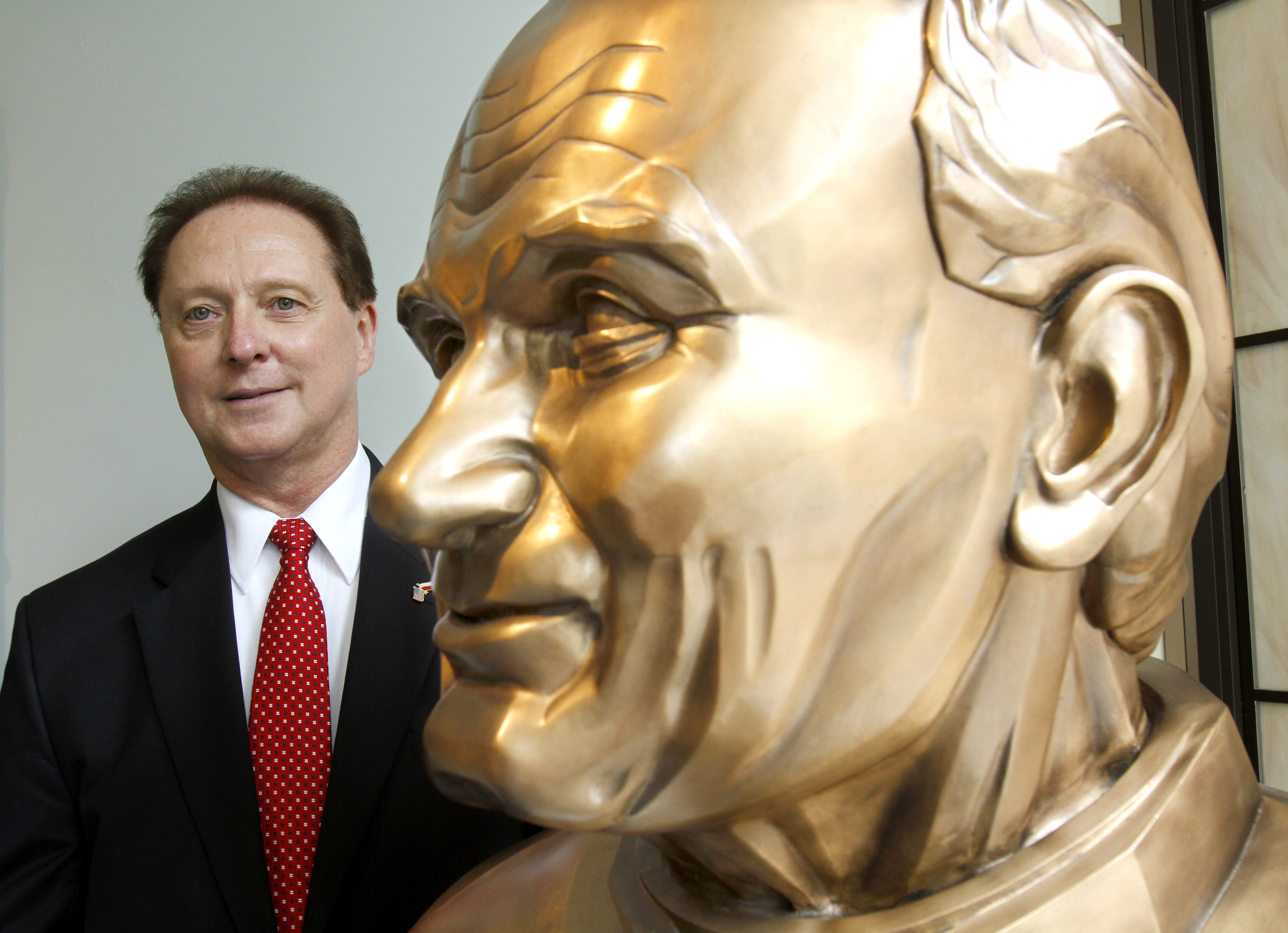
Michael Blichasz, president of the Polish American Cultural Center, stands beside a bust of the former Pope John Paul II.
This much both sides agree on: The Polish American Cultural Center came to occupy the historic building thanks to a rare and generous arrangement in 1987.
Goode approved a $2.1 million bond to buy a permanent home for United Polish American Social Services, a nonprofit run by Blichasz that had been aiding the city’s Polish immigrants since the early 20th century.
The grant led to the birth of the city’s first and only Polish museum, where Blichasz amassed an exhibit hall full of national folk art, portraits of famous Poles such as Pope John Paul II, and historical artifacts dating from the first immigrant settlers to these shores in 1608 to the diaspora that followed the 1939 invasion of the Nazis.
But Goode’s act of benevolence came with a caveat: According to the bond agreement, if the Polish group failed to keep up with payments, the city could kill the deal and take back the building. Blichasz claims Goode and other elected officials at the time, many of whom are now dead, promised he would never have to pay a dime.
“They said, ‘You will pay zero,’” he said.
A copy of a $81,875 check Blichasz provided to The Inquirer represents one of the only payments made by the nonprofit to the city — in August 1988. PRA said Blichasz’snonprofit, all told, paid about $155,000 toward the bond taken out by the city, which grew to $4.6 million with interest.
The Goode administration later applied for a federal grant through the U.S. Department of Housing and Urban Development (HUD) to pay off the property, according to records provided to The Inquirer.
Blichasz said he was under the impression the deal was done. But those federal funds never materialized — and the city didn’t seek to settle the debt for decades.
Bicentennial cash and ethnic tensions
The museum’s origins lie in the summer of 1987, when City Hall faced accusations of racial and ethnic favoritism.
The city had just unlocked $2 million left from the 1976 Bicentennial, and Council members had sent half that money to nine Black community groups. Anger simmered among white ethnic leaders like Blichasz.
“Reverse discrimination,” Councilmember Joan Krajewski said at the time.
Critics asserted also that regardless of race, the fund was supporting activities with few ties to America’s birthday celebration — from a Trinidadian steelpan orchestra to a Polish-American festival at Penn’s Landing led by Blichasz.
At the time, however, Blichasz’s nonprofit was also trying to move its headquarters from Fairmountto Philadelphia’s historic district.
And the city had already agreed to pay for the new building.
After the city inked the bond purchase on behalf of the Polish group, Blichasz vowed to increase the nonprofit’s annual budget by 50% to keep up with repayment. Goode promised the group leniency, but newspaper articles from the time show no offer to fully wipe the debt.
Blichasz was confident. Donors in the Polish community, he said, would “respond with joy” to bring this first-of-its-kind museum to life in Philadelphia.
But the joy proved less than hoped.
Months later, Blichasz was back at City Hall asking for a bailout. His group had raised only a fraction of its $1 million goal and needed an additional $350,000 to pay the mortgage and museum build-out costs.
He pointed out that the city had financed capital projects for other ethnic groups, including the Mummers Museum, the African American history museum, and the Jewish museum.
“This is going to tell us just how appreciated the good, taxpaying Poles are by this country,” Blichasz said at the time.
The museum, he promised, would be “an attraction” that would more than repay its debt.
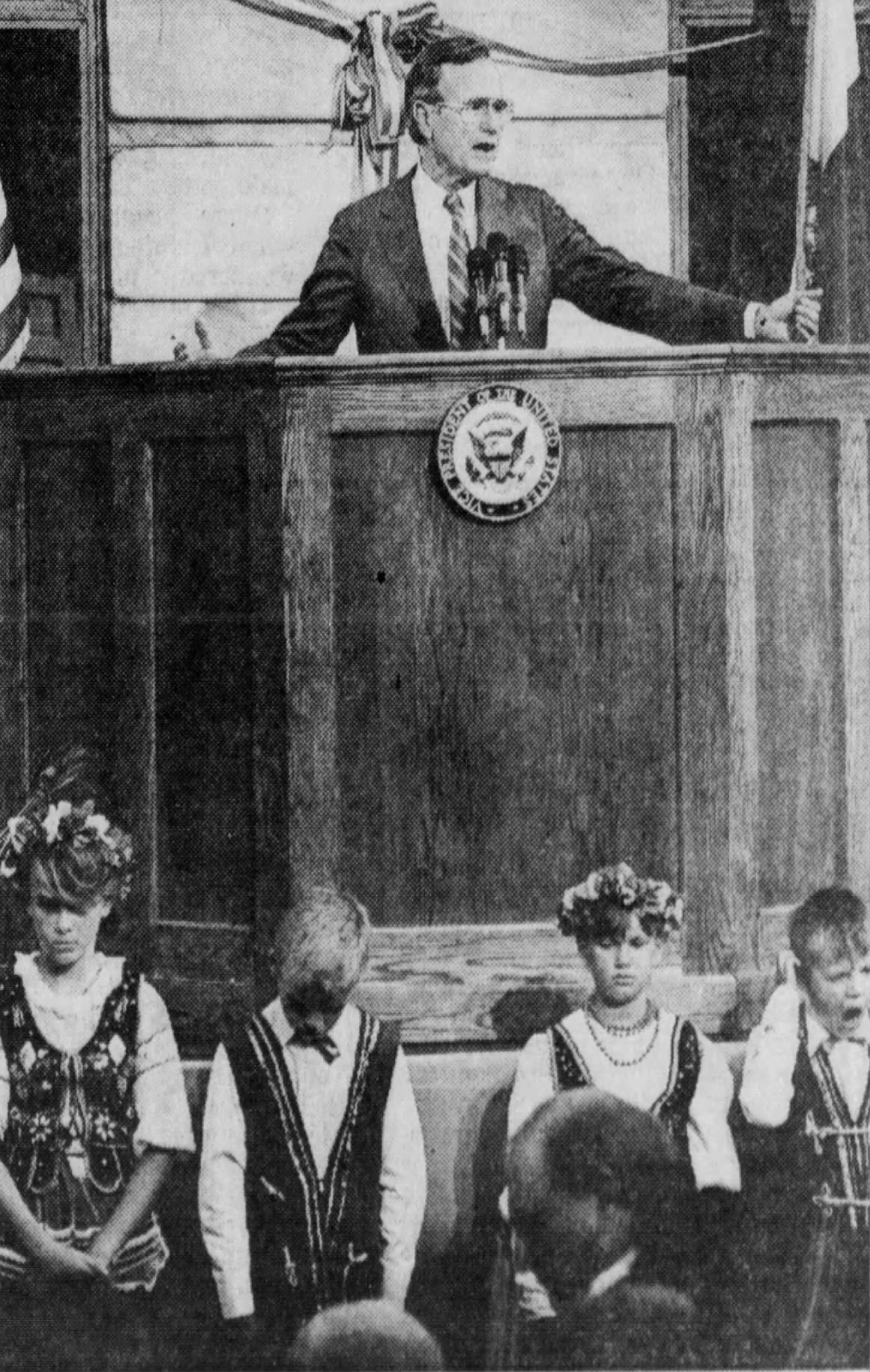
Then Vice President George H.W. Bush visits the Polish American Cultural Center for the opening published on Aug. 10, 1988, in The Inquirer.
Teaching self-sufficiency
The Polish American Cultural Center opened its doors in August 1988 to a flag-waving crowd of 300 people. Then-Vice President George H.W. Bush attended the ribbon-cutting ceremony, where visitors admired hand-cut Polish crystal and other curios from the homeland.
Alongside the museum, the nonprofit continued to provide the community with services that ranged from English language courses to help with rent and fuel rebates — work Blichasz said was “teaching Polish immigrants to be self-sufficient.”
Much of that work was also financed by the city.
Auditors later raised concern over a six-figure contract the Goode administration dealt to the nonprofit. At the time, the arrangement led former city finance director David Brenner to speculate about Blichasz’s political clout: “Where his influence comes from beats the hell out of me, but no question he’s got it.”
At some point, however, concerns over the debt for 308 Walnut St. disappeared.
As far as Blichasz was concerned, it was absolved after Goode applied for the HUD grant.
Blichasz said officials like Krajewski and Goode insisted his group not cut any more checks to the city, saying “we will take care of it.”
Why PRA did not inquire about the outstanding mortgage agreement remains uncertain. A spokesperson did not immediately respond to a question about the matter, and city records show only one inspection of the property, in 2011.
By the time PRA took a renewed interest, Blichasz had a problem: Many of the people who helped facilitate the initial deal were no longer around to help explain.
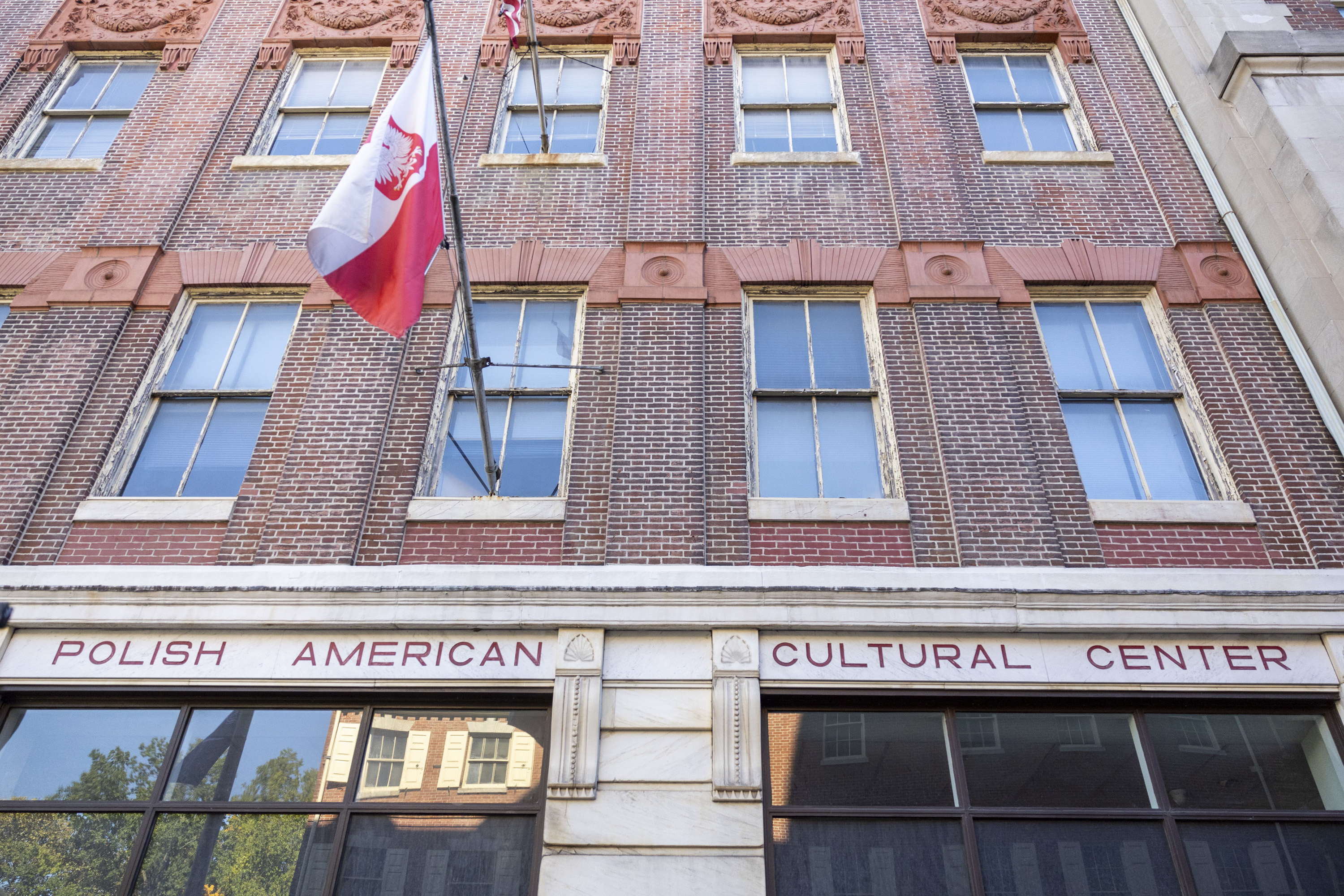
The outside of the Polish American Cultural Center.
A historic takeback
The museum fell under the radar until Mayor Jim Kenney’s first term. Soon after Kenney took office in 2016, Blichasz recalled, there was a heated meeting after the nascent administration ended his nonprofit’s six-figure social services contract.
He described the city as more interested in “giving out condoms” than providing help to an increasingly elderly Polish population.
Years later, during an insurance audit of large buildings owned by the Philadelphia Redevelopment Authority, Kenney administration officials were baffled by 308 Walnut St. It’s not clear if the PRA even knew who owned it.
PRA officials toured the building in 2019 and found the museum on the first floor much as it had ever been. But the floors above were in shambles, according to a city employee who toured the property.
The second through fourth floors looked as if their occupants had been raptured, with calendars from the 1980s frozen on the walls and moldy cups of coffee that appeared to date to the same decade.
On the fifth floor, officials said, they found evidence that someone had been sleeping in the building along with boxes of old documents and recording equipment where Blichasz broadcast his Polish American radio hour.
PRA quickly moved to intervene.
“Based on concerning conditions observed during the tour,” PRA said in a statement this week, it hired an engineering firm to document the state of the building. The contractors reported it needed at least $1.8 million to be brought back to code. The lack of maintenance resulted “in potentially dangerous structural issues,” PRA said in a statement.
Blichasz acknowledged water damage from leaks, which he had hoped to repair with state grants. But he called the PRA’s overall assessment of the property a fiction. He said his nonprofit spent “millions” in repairs over the years out of its operating budget.
“It’s very fishy,” Blichasz said of PRA’s inspection.
The agency said in a statement that officials “attempted to negotiate” but that Blichasz “refused to cooperate and repeatedly requested outright ownership” of the property, despite not having complied with the terms of the original deal.
With no legal title, the PRA took the nonprofit to court in 2023. The agency ultimately won, wresting back control of the building. A judge ordered the nonprofit to pay $3.5 million dollars in debt and damages.
This April, the Polish American Cultural Center was evicted.
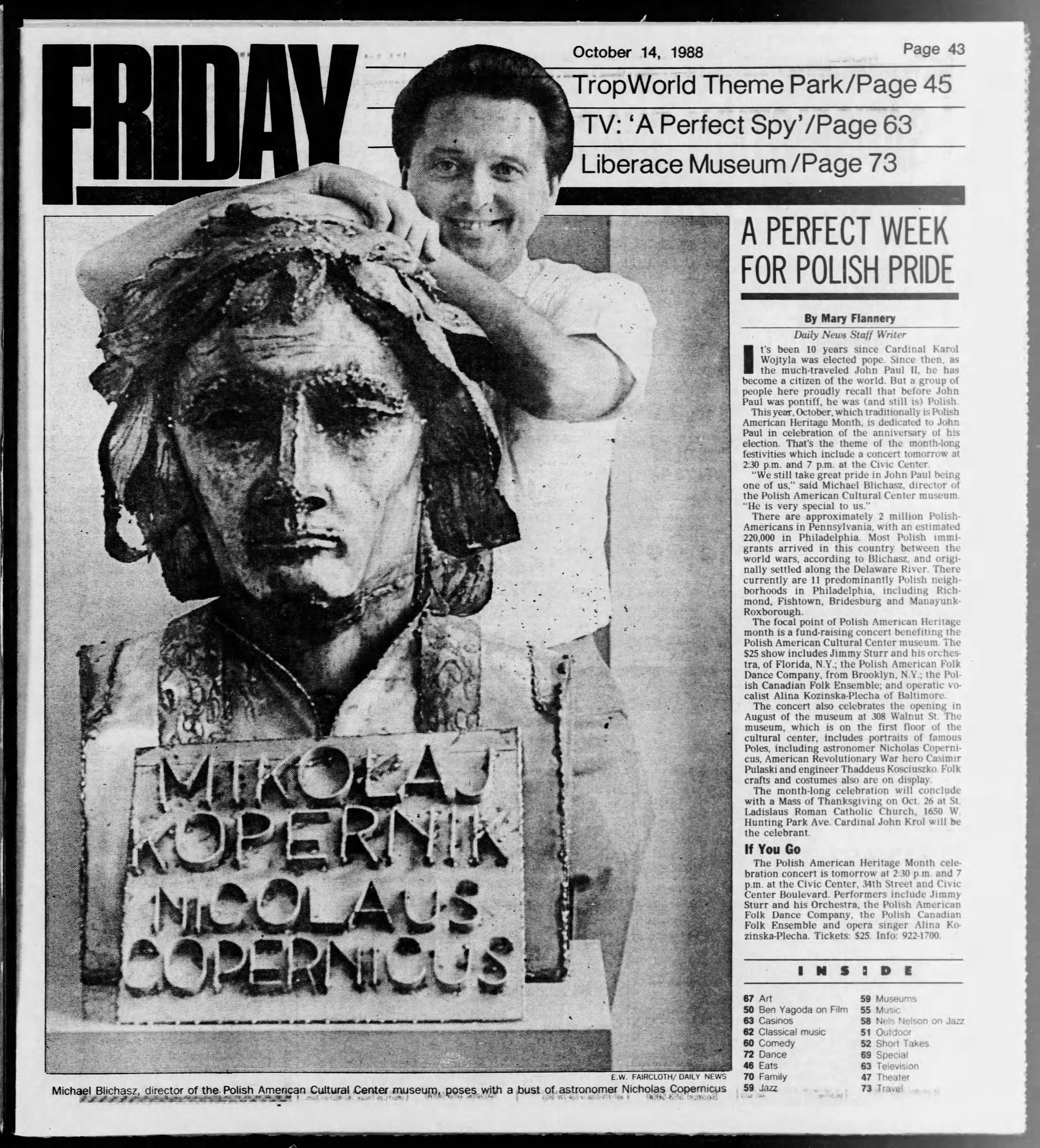
Michael Blichasz, director of the Polish American Cultural Center museum poses with a bust of astronomer Nicholas Copernicus. Published in the Philadelphia Daily News on Oct. 14, 1988.
Last chance to cut a deal
As the city clawed back the property, Blichasz accused officials of negotiating in bad faith. He also suggested it was a racially motivated attack against his organization to divert funding to nonwhite community groups.
Those who could attest to the original deal are dead or not talking. Krajewski, the former Council member, died in 2013. Blichasz said he hadn’t reached out to Goode in years. Phone calls to the former mayor were not returned.
“When those people were alive, we could have had a nice get-together, a hearing,” Blichasz said. “Now they want to take me to court. I said, ‘Why? You never sat down with us to discuss this.’ All I want to do is keep the original mission and goals alive.”
The ordeal has interested at least one current elected official.
Councilmember Mark Squilla, who represents the area, has acted as a liaison between Mayor Cherelle L. Parker and Blichasz this year. Emails shared with The Inquirer showed that Blichasz turned down three compromise options from Parker that would have either allowed the Polish group to remain in the building under a new lease or helped pay for the group’s relocation.
Squilla acknowledged that the paperwork didn’t support Blichasz’s case. But he argued that his decades of contributions to the city should be considered, too.
“After we did some background research, I figured there’s no way we could find out what really happened,” Squilla said. “So I figured, ‘Why don’t we just work out a deal?’ And unfortunately, the deals that the PRA made were not accepted by the Polish museum folks.”
Squilla introduced a resolution in City Council on Oct. 9 to hold hearings on the PRA’s treatment of Blichasz.
“After 30 years, I believe that they had the right to stay in and use the building,” the Council member said.
On Wednesday, a woman approached the doorway of the museum, asking if it was open.
Inside, standing in the wood-paneled hallway that harkened back to another era, a maintenance worker shooed her away.
The homicide clearance rate this year has hovered between 86% and 90% — the highest since 1984, when the department recorded a 95% clearance rate.
The change is a welcome improvement from the challenges of 2015 to 2022, when the rate of solved homicides hovered around 50% or less and dropped to a historic low of 41.8% in 2021, according to police data.
Just as there’s no single explanation for the drop in shootings, there’s no simple answer to why detectives are closing cases more quickly this year. And a higher arrest rate doesn’t account for whether a defendant is convicted at trial.
But interviews with law enforcement officials and a review of police data and court records suggest a few likely factors: the overall decline in violence, which gives officers more time to investigate, and recent investments in technology that give detectives faster access to evidence.
Here are five things contributing to the improved clearance rate:
!function(){“use strict”;window.addEventListener(“message”,function(a){if(void 0!==a.data[“datawrapper-height”]){var e=document.querySelectorAll(“iframe”);for(var t in a.data[“datawrapper-height”])for(var r,i=0;r=e[i];i++)if(r.contentWindow===a.source){var d=a.data[“datawrapper-height”][t]+”px”;r.style.height=d}}})}();
Simple math
The clearance rate is calculated by dividing the number of homicide cases solved in a given year — regardless of when the crime occurred — by the number of homicides that occurred in that same year.
And so the apparent improvement partly comes down to simple math: with dramatically fewer killings this year, even fewer total arrests can boost the clearance rate.
Through August, police had solved about 60% of the killings in 2025, but because they’ve cleared nearly 50 others from previous years — and because there are a third as many homicides as three years ago — the rate goes up.
Still, that number is notable. Only about a third of killings that occurred in 2021 and 2022 were solved that same year, according to an Inquirer analysis of court records and police data.
!function(){“use strict”;window.addEventListener(“message”,function(a){if(void 0!==a.data[“datawrapper-height”]){var e=document.querySelectorAll(“iframe”);for(var t in a.data[“datawrapper-height”])for(var r,i=0;r=e[i];i++)if(r.contentWindow===a.source){var d=a.data[“datawrapper-height”][t]+”px”;r.style.height=d}}})}();
Time
The significant reduction in violence this year has given detectives the time to solve their cases, both old and new.
During the pandemic — as the city recorded about 2,000 homicides in just four years — detectives were handling 10 to 15 cases each year, more than twice the workload recommended by the U.S. Department of Justice.
This year, it’s half that.
That’s making a difference. Detectives this year appear to be solving cases more quickly than years past, according to an Inquirer analysis.
Through August, police arrested a suspect within a week in about 31% of cases — up from just 15% three years ago.
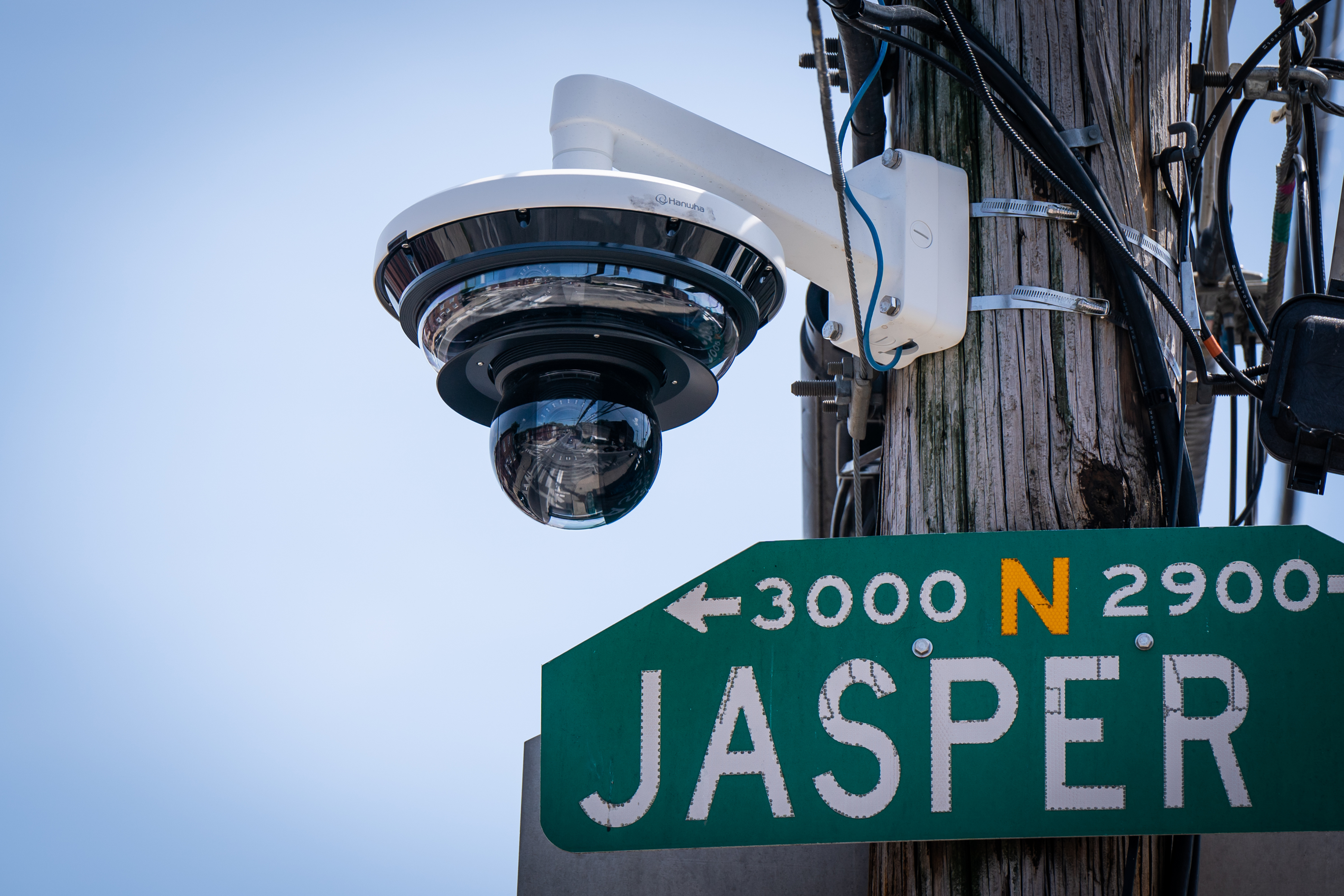
A video camera at Jasper and Orleans Streets in Philadelphia.
Cameras are everywhere
Just in the last year, police have doubled the number of “real-time crime” cameras on Philadelphia’s streets. In 2024, police said there were 3,625 of the ultrahigh-resolution cameras across the city. This year, there are 7,309.
And there are tens of thousands of other cameras through SEPTA, private businesses, and residents’ home-surveillance systems that give detectives leads on suspects.
Police have also recently installed hundreds of license plate readers — 650 for every patrol vehicle and another 125 on poles across the city.
The department also subscribes to a software that taps into a broader network of millions of other plate readers — on tow trucks, in parking garages, and even private businesses across the region.
Police said the tools are helping them track shooters’ movements before and after a shooting and locate getaway cars more quickly, by searching a vehicle’s license plate or even by its make and model.
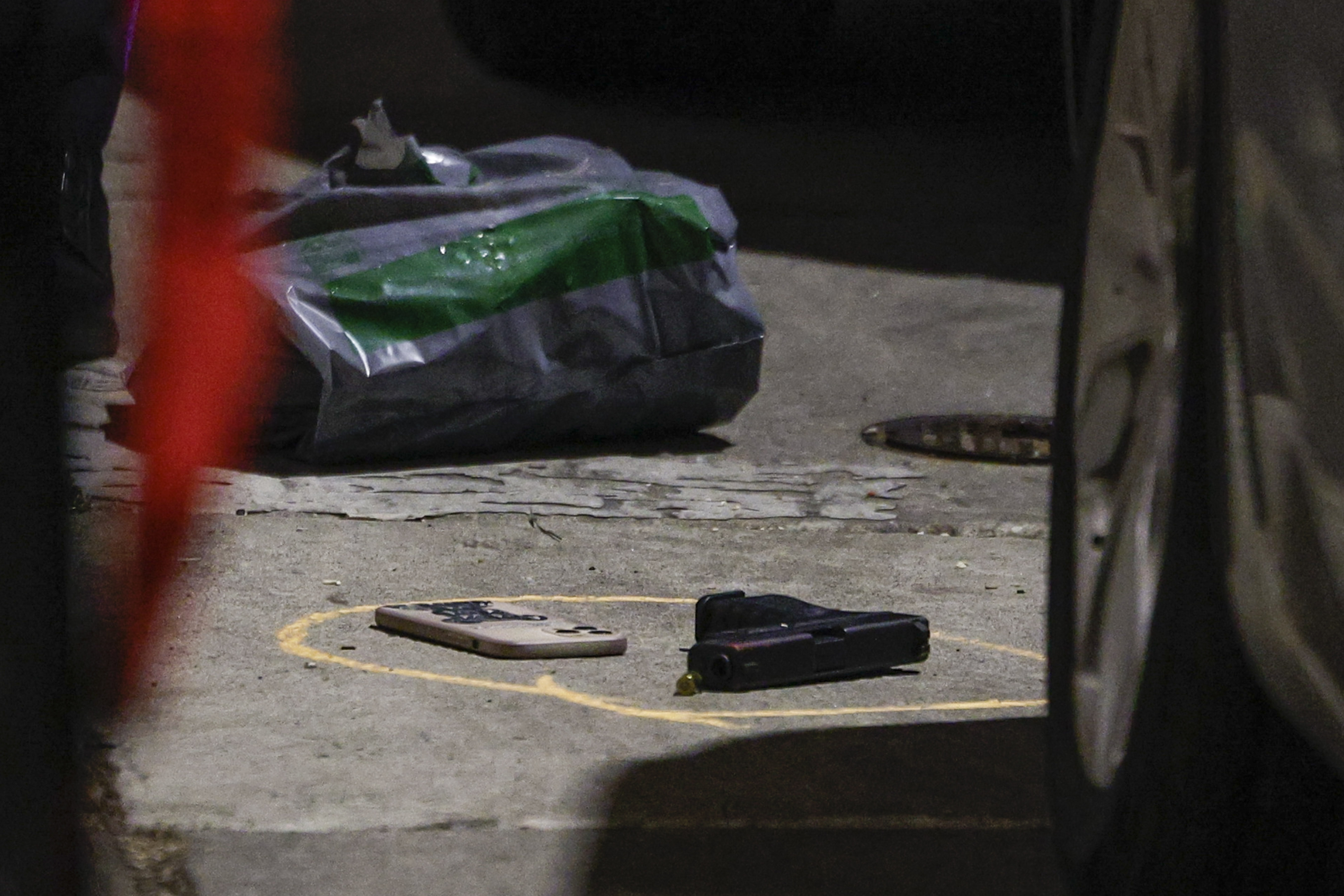
Police locate a gun and a cell phone on the 700 block of East Willard Street, where a man in his 20s was fatally shot in December 2024.
Phones and social media
Philadelphia police and the district attorney’s office have greatly expanded their digital evidence tools in the past two years.
Where cases once relied on grainy video and often-reluctant witnesses, detectives now have high-definition video footage, partial DNA processors, and cell phone location data — evidence that “never goes away” and doesn’t lie, said Deputy Police Commissioner Frank Vanore.
Getting access to a suspect’s — and victim’s — phones and social media can often tell the story behind a crime.
The Gun Violence Task Force, which investigates gang violence and works closely with homicide and shooting detectives, had just two cell phone extraction devices two years ago. Now, it has 14, plus a host of advanced software that helps investigators track and map gang networks.
Between the homicide unit and the task force, nearly 2,000 phones were processed last year — often giving detectives crucial evidence and information about crimes beyond the one they were initially investigating.
Improved morale
Some detectives, who asked not to be identified to speak frankly about their work, said morale in the homicide unit — and across the department — has improved.
During the pandemic, when shootings surged, tensions in the unit went unchecked, and conditions at the Roundhouse headquarters were dire. The office was overcrowded and infested with vermin, and investigators shared just 15 computers among nearly 100 detectives.
Since moving in 2022 to new offices at 400 N. Broad St., each detective now has a desk and computer, and that has boosted productivity, they said.
The detectives also said that patrol officers seem more empowered than during the height of the gun violence crisis to engage with their neighborhoods and gather information that ends up being important to their investigations.
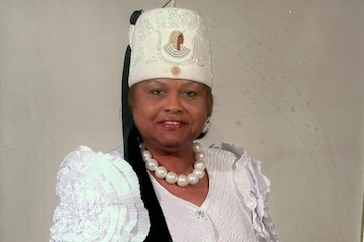
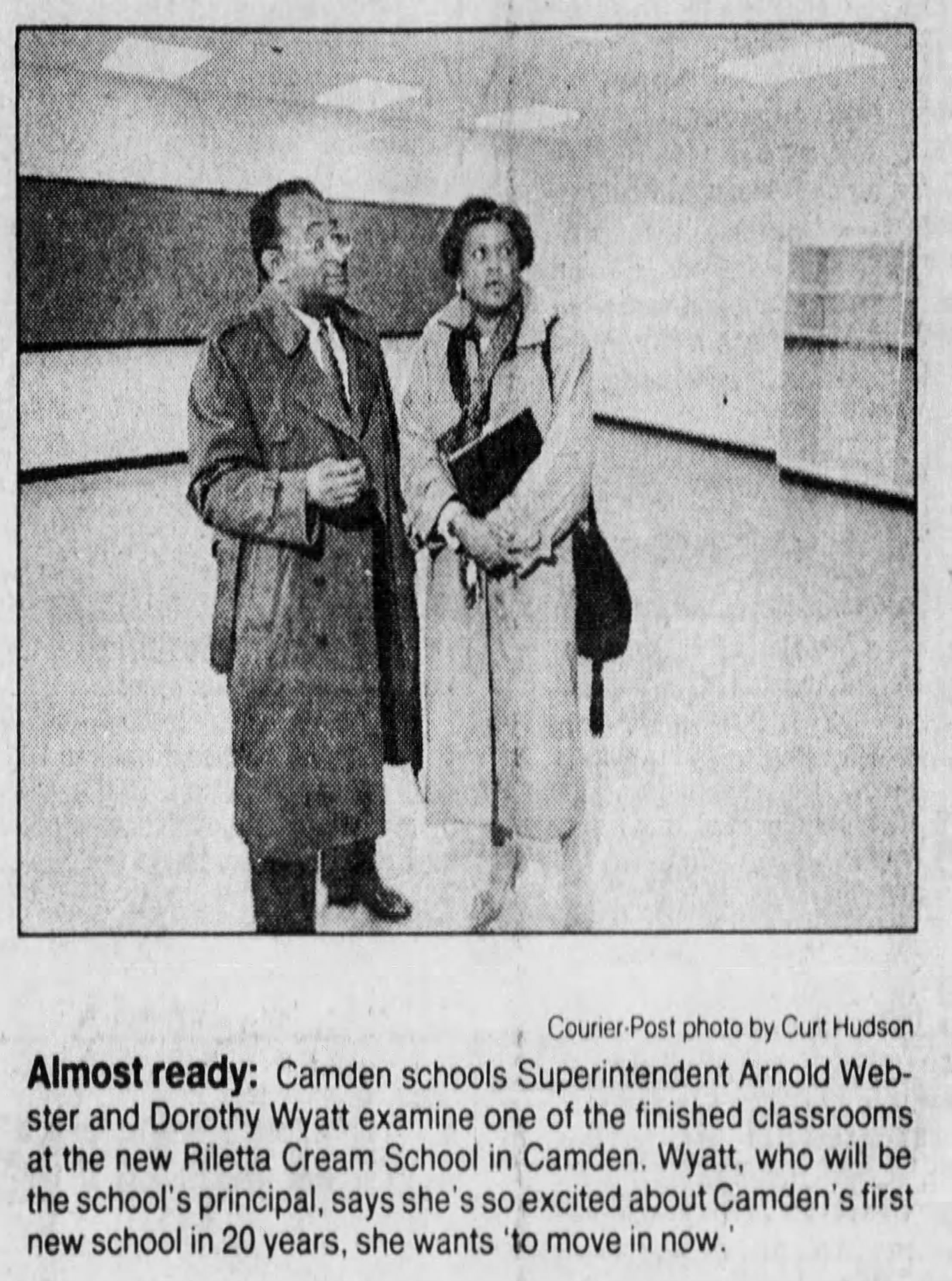
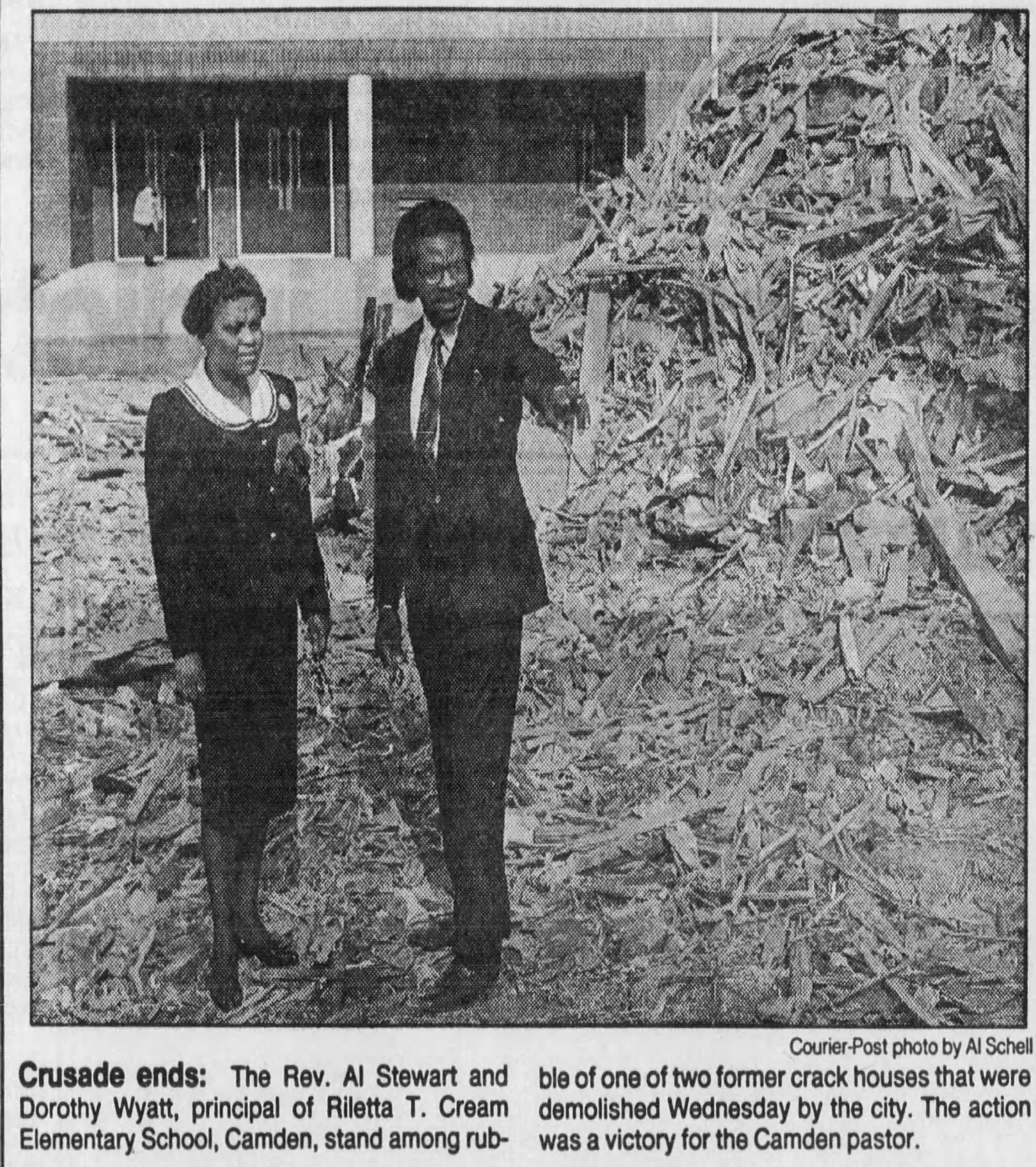
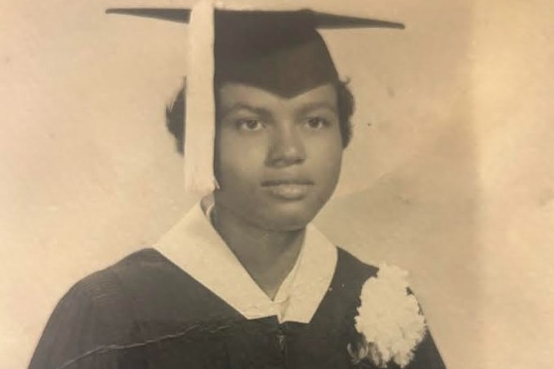
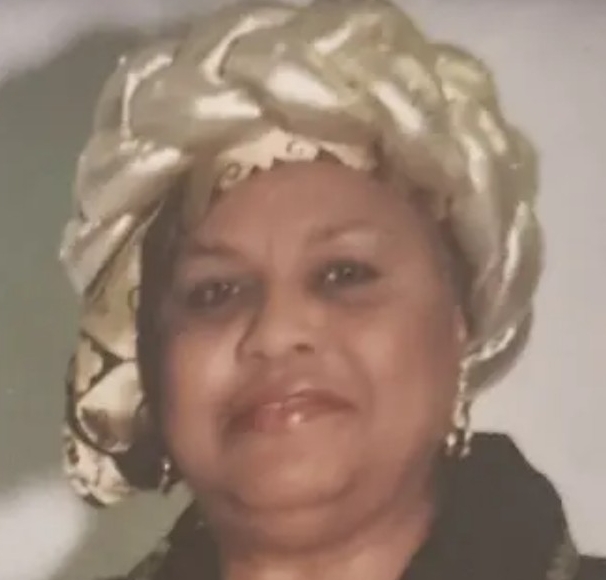
Dorothy Womble-Wyatt, 84, of Cherry Hill, innovative teacher and celebrated school principal for the Camden City School District, active church member, mentor, and proud graduate of what is now Fayetteville State University, died Tuesday, Sept. 23, of complications from a heart condition at her home.
For 37 years, from 1968 to her retirement in 2005, Ms. Womble-Wyatt connected with Camden students through progressive teaching techniques, and with classroom colleagues, parents, and nearby residents through her collaborative administrative style.
She was named principal at the old Bonsall Elementary School in 1977 and became the first principal at the new Riletta T. Cream Elementary School in 1991.
“She led the Riletta Twyne Cream Family School with distinction,” the Camden City Advisory Board of Education said in a recent resolution, “guiding its opening in January 1991 and building a school culture centered on high expectations, literacy, and community partnership.”
As a teacher, Ms. Womble-Wyatt focused on elementary school students, and she emphasized how math, geography, spelling, science, English, and other subjects were important in everyday life. She joined the school district in 1968 as a first-grade teacher and served as an administrative assistant before advancing to principal at Bonsall.
Ms. Womble-Wyatt was active with the Order of the Eastern Star.
In its resolution, the Board of Education said she “championed professional learning and innovative classroom practices that advanced student growth.”
Her nephew Micheal W. Moore said: “She was always a teacher at heart. She taught her family when she was young and her classmates in high school. She never stopped.”
As principal at the Cream School, Ms. Womble-Wyatt supervised the transfer of 800 students from four other elementary schools during the 1990-91 school year and told the Courier-Post: “I’m just thinking about a smooth transition. … It’s the same as if you’re moving into a new home. You’re excited moving into a new environment. When you get something nice, you want to keep it that way.”
She supported all kinds of new educational initiatives and lobbied tirelessly for better school supplies and improved healthcare services for Camden students. The Courier-Post covered Cream’s grand opening, and 9-year-old student Bradford Sunkett told the newspaper: “I’m glad to be at a new school. But I’m most glad Ms. Wyatt is here. Ms. Wyatt and the teachers are more important than a school building.”
She cheered in 1992 when community activists cleared a cluttered lot near the school and told the Courier-Post: “It’s a joyful feeling knowing people have listened to what we have to say and did something about it.”
This photo of Ms. Womble-Wyatt appeared in the Courier-Post in 1990 as she was assuming the role of principal at the Cream School.
In 1999, she endorsed a New Jersey state reform program that invited parents to help shape school curriculum. “It’s a great thing for parents because many don’t have the experience of what schools are up against,” she told the Courier-Post. “All they hear is that schools are failing. This lets parents become part of the foundation.”
Ms. Womble-Wyatt was active at Roberts Chapel Missionary Baptist Church in North Carolina, First Nazarene and Zion Baptist Churches in Camden, and New Community Baptist Church in Collingswood. Zion recognized her with a service award in 2008.
“She loved to invite family and friends to attend worship services with her on Sundays and join her for dinner afterward,” her nephew said.
She earned a bachelor’s degree in education and leadership at Fayetteville State in North Carolina and recruited new students everywhere she went. In 2003, the university’s Gospel Choir honored her lifelong support with a concert at Camden High School.
This photo of Ms. Womble-Wyatt was published in the Courier-Post in 1992 during a nearby neighborhood cleanup.
She belonged to the Alpha Kappa Alpha Sorority and the Order of the Eastern Star, and spoke often at churches and community groups about Black history. She was honored at Camden’s third annual Women’s Recognition Ceremony in 1996 and earned an Outstanding Citizen’s Award from the local Freemasons in 1997.
“People wanted to be around her,” her nephew said. “She lifted you up.”
Dorothy Marie Womble was born May 16, 1941, in Goldston, N.C. She earned a master’s degree in education from North Carolina Central University, married Glenmore Wyatt in 1967, and they had a son, Glen. Her husband died in 2021, and their son died in 2023.
Ms. Womble-Wyatt collected African artifacts, hosted memorable dinners, and never forgot a birthday. She enjoyed casinos, shopping for gifts, and visiting family and friends.
Ms. Womble-Wyatt earned a master’s degree in education from North Carolina Central University.
On Instagram, a friend called her “an educator par excellence, a fashionista, and genuine lover of people.” Her nephew said: “She was generous and joyous. She was a queen in every right.”
In addition to her nephew, Ms. Womble-Wyatt is survived by a grandson and other relatives. A brother died earlier.
Services were held Oct. 2 and 3 in Camden, and Oct. 12 in North Carolina.
Ms. Womble-Wyatt’s “life was vibrant and ever moving,” her family said in a tribute. “Indeed, her legacy has grown into a gorgeous train of diamonds and appreciation.”
SEPTA plans to postpone the purchase of new buses, a project to make the Bristol Regional Rail station accessible to people with disabilities, and expansion of the Frazer train facility in Malvern in order to access $394 million in emergency state aid to help run the system.
The shift was required after the Pennsylvania Department of Transportation gave permission for SEPTA to transfer funds allocated for infrastructure projects to cover the transit agency’s operating deficits for two years.
SEPTA officials said none of the changes would compromise safety by stopping crucial repairs — a PennDot requirement for allowing the shift of money to operational needs.