A new study from the U.S. Food and Drug Administration detected heavy metals, including lead and arsenic, in popular tampon brands, but not enough to raise health concerns.
“While trace metals are present in tampons, the amount released during use is too small to cause harm,” the agency announced this week.
The Inquirer spoke with Robyn Faye, an OB-GYN at Jefferson Abington Hospital, about what prompted the FDA study, what women should know about it, and the latest trends in menstrual products.
Robyn Faye, a gynecologist at Jefferson Abington Hospital, specializes in menopause and sexual health.
What triggered worry about metals in tampons?
A 2024 study by UC Berkeley raised alarms after finding trace amounts of 16 metals — arsenic, cadmium, lead, mercury, nickel — in more than a dozen different tampon unnamed brands.
The study found lead concentrations were higher in non-organic tampons, while arsenic was higher in organic tampons.
Tampons are made with cotton, rayon, or both. Researchers believe cotton can absorb metals from water, soil, or industrial contaminants near fields. Some metal might get added to tampons during manufacturing.
Metals have been linked to increased risk of dementia, cancer, kidney damage, and cardiovascular and neurological harm.
The UCstudy had a major shortcoming, however. It showed that metals exist inside raw tampon materials, but it did not test whether they leach out or get absorbed into the body, and if so, how much.
“Obviously, there was a concern about what the exposure would be to women using these tampons,” Faye said. “So they needed to look into the potential toxicological risk.”
What did the new FDA study find?
The FDA-led study, recently published in the journal Toxicological Sciences, tested 11 tampon products from six different brands sold in the United States. It did not name the brands, nor test any scented tampons.
The agency regulates tampons as “medical devices.”
While FDA scientists detected 19 metals at trace levels in tampons, they found “negligible toxicological concern.”
“The levels of metals released from tampons are not expected to result in adverse health effects,” the study concluded.
Scientists created a “worst-case” exposure, using a testing method that extracted as much metal out of the fibers as possible, under circumstances far more intensive than normal tampon use.
“They exaggerated the risk,” said Faye, who did not work on the study. “So the real-world exposure is probably even lower.”
The bottom line, she said, is tampons are safe to use.
What concerns do your patients have about tampons?
Faye said older women still worry about “toxic shock syndrome,” a rare bacterial infection caused from an open cut or vaginal wound. Many women still mistakenly believe it is a common risk from wearing a tampon too long.
Most younger patients, however, don’t use tampons.
“The trend in the younger women population is actually throwing out their tampons,” Faye said. “It’s interesting that the FDA is now doing a study on tampons when fewer girls are using them.”
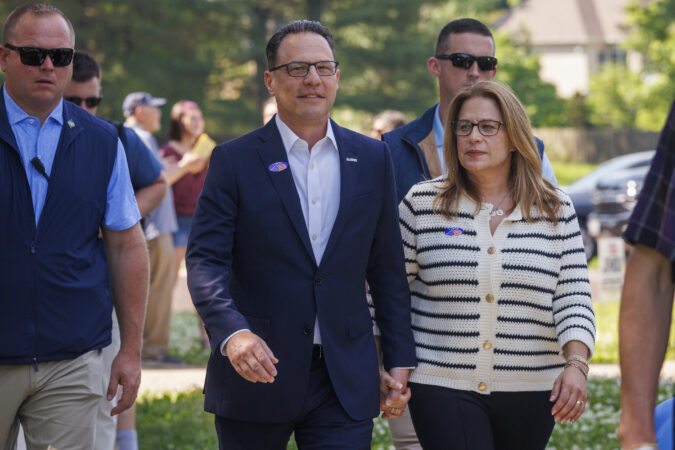
A federal judge had some good news this week for Josh Shapiro, governor of Pennsylvania, but not so much for Josh Shapiro, resident of Montgomery County.
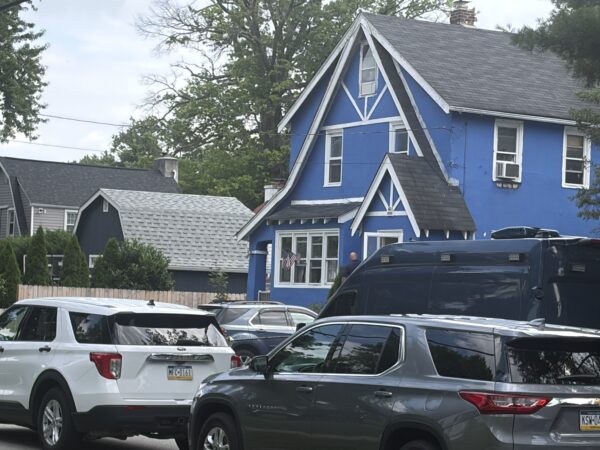
Shapiro, as governor, cannot be sued in his official capacity in a dispute over a strip of yard between his and his Abington Township neighbors’ adjoining properties, U.S. District Judge Harvey Bartle III ruled Tuesday.
But Shapiro and his wife, Lori, will still have to face their neighbors in federal court as homeowners, Bartle also determined.
The conflict came into public view in February, when Jeremy and Simone Mock, whose backyard abuts the Shapiros’ lawn in a tree-lined neighborhood near Pennsylvania State University’s Abington campus, sued Shapiro — both as governor and in his individual capacity — and George Bivens, acting Pennsylvania State Police commissioner. The lawsuit alleged the officials were illegally occupying part of the Mocks’ yard to build an eight-foot security fence last summer in what they claimed was an “outrageous abuse of power” that violated their constitutional rights. Bartle dismissed those claims in his ruling Tuesday, in what Shapiro’s administration called a major win.
But while Shapiro and Bivens are immune from the federal lawsuit as state officials, Shapiro as an individual and his wife are not, Bartle’s opinion said.
“We are pleased that the court has dismissed the claims against the office of the governor and the Pennsylvania State Police, and recognize that the allegations against these officials are without merit,” said Rosie Lapowsky, a spokesperson for Shapiro. “The Shapiros are confident that the facts will ultimately show that the Mocks’ remaining claims are meritless and politically motivated and will fail.”
Shapiro’s safety remains a priority for state police, as one of the nation’s most prominent Jewish elected officials. A Delaware County man was arrested Wednesday for threatening to burn down the governor’s residence, state police said.
But the Mocks’ attorney, Wally Zimolong, said the lawsuit at hand is about property rights and due process, and called Bartle’s ruling a “strong decision.”
“Make no mistake about it,” Zimolong said, “a federal court has said that the sitting governor of Pennsylvania can be held liable for damages over constitutional violations.”
The Delaware County lawyer who has represented high-profile Republican officials and candidates, including President Donald Trump, said it is “nonsense” to call the litigation political. Zimolong added that he hopes the Shapiros reconsider and attempt to resolve the case amicably.
The conflict’s origins
The dispute between the Shapiros and Mocks began last summer when, as part of a plan to build a security fence at the Abington house, a surveyor learned that a sliver of yard that the Shapiros had used for over two decades was actually on property belonging to the Mocks.
After the Mocks rejected the Shapiros’ offer to buy the land, court fillings said, Pennsylvania’s first couple invoked a state law that allows a person to gain ownership of a property they have actively used for at least 21 years. The Shapiros have lived in their Montgomery County home for 23 years.
“What followed was an outrageous abuse of power by the sitting Governor of Pennsylvania and its former Attorney General,” the Mocks’February lawsuit said.
(function() { var l = function() { new pym.Parent( ‘shapiroyard__graphic’, ‘https://media.inquirer.com/storage/inquirer/ai2html/shapiroyard/index.html’); }; if(typeof(pym) === ‘undefined’) { var h = document.getElementsByTagName(‘head’)[0], s = document.createElement(‘script’); s.type = ‘text/javascript’; s.src = ‘https://pym.nprapps.org/pym.v1.min.js’; s.onload = l; h.appendChild(s); } else { l(); } })();
A security fence was purchased but never installed, SpotlightPA reported. Instead, contractors hired by the state began planting arborvitae-type trees and other plants on the Mocks’ property. State police also flew drones over the Mocks’ property, threatened to remove healthy trees, and chased away contractors, the Mocks alleged in the suit.
The complaint also accused Shapiro of directing state police to patrol the property, and instructing the Mocks to leave the “security zone.”
The Shapiros’ countersuit in Montgomery County asks a judge to find that they are the “legal and equitable owners” of the area in dispute, having tended to the land that borders their front yard for 23 years. That suit is pending and a judge is expected to rule on preliminary objections filed by Zimolong.
Separately, the Shapiros and state attorneys filed motions asking Bartle to dismiss the federal complaint against them.
This week, the judge partially obliged, finding the stateofficials to be immune from the lawsuit while allowing the case against the Shapiros to proceed.
The judge also refused to freeze the federal case while the lawsuit in Montgomery County plays out, determining that the two cases are different enough to proceed.
“The claims here extend far beyond a disagreement between neighbors over the metes and boundaries of their properties,” Bartle wrote.
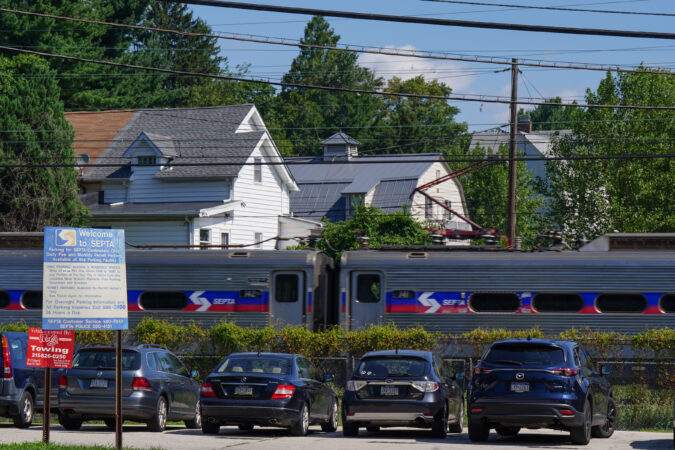
SEPTA is trading Glenside Regional Rail riders three daytime trains for new off-peak options, more train cars, and new schedules aimed at reducing congestion between Glenside and Wayne Junction.
The Warminster Line, which runs through southeastern Montgomery County, is the only Regional Rail line losing multiple trains under systemwide changes that began on July 5 to make trains more consistent and prevent delays.
The new schedule cuts two weekday trains that left Glenside at 8:40 a.m. and 2:47 p.m. for Center City, and one weekday train that left Suburban Station at 4:53 p.m. toward Warminster.
The morning train cut leaves a 27-minute gap in service to Center City from Glenside, while the afternoon cuts each add five minutes or less to the wait for the next train.
SEPTA also added a train to the Warminster Line that leaves Suburban Station at 11:35 p.m. on weekdays, and a train on the West Trenton Line that leaves Suburban Station at 5:28 a.m.
The late-night train will serve airport workers, and the dawn departure is convenient for people who commute into the suburbs, SEPTA spokesperson Kelly Greene said.
The changes SEPTA made across the commuter rail system this week are aimed at improving consistency and reliability, the agency said.
“As SEPTA continues to increase the number of train cars available for service, trains will be longer and provide more space for riders,” officials wrote in a statement.
Between Wayne Junction and Glenside, SEPTA said, it hopes the new schedule will help “prevent trains from bunching together, which can cause delays.”
The 8:40 a.m. train from Glenside was cut to reduce congestion, Greene said, and had the lowest ridership of the trains running around that time.
Other changes affecting the Abington area include new departure times for some trains on the Lansdale/Doylestown, Warminster, and West Trenton Lines.
SEPTA put out a full list last month of what is changing on each line, along with updated train schedules.
This suburban content is produced with support from the Leslie Miller and Richard Worley Foundation and The Lenfest Institute for Journalism. Editorial content is created independently of the project donors. Gifts to support The Inquirer’s high-impact journalism can be made at inquirer.com/donate. A list of Lenfest Institute donors can be found at lenfestinstitute.org/supporters.
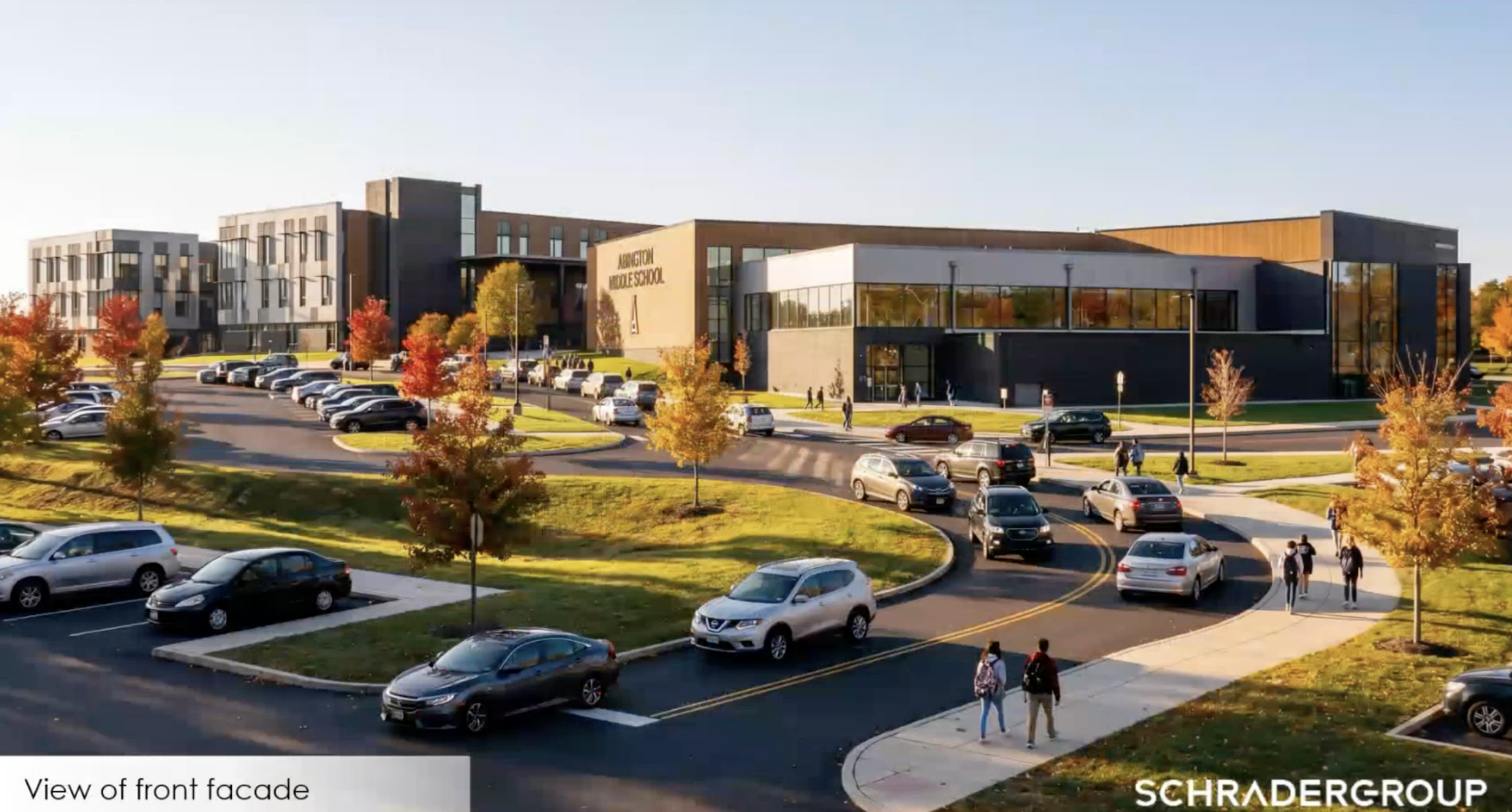
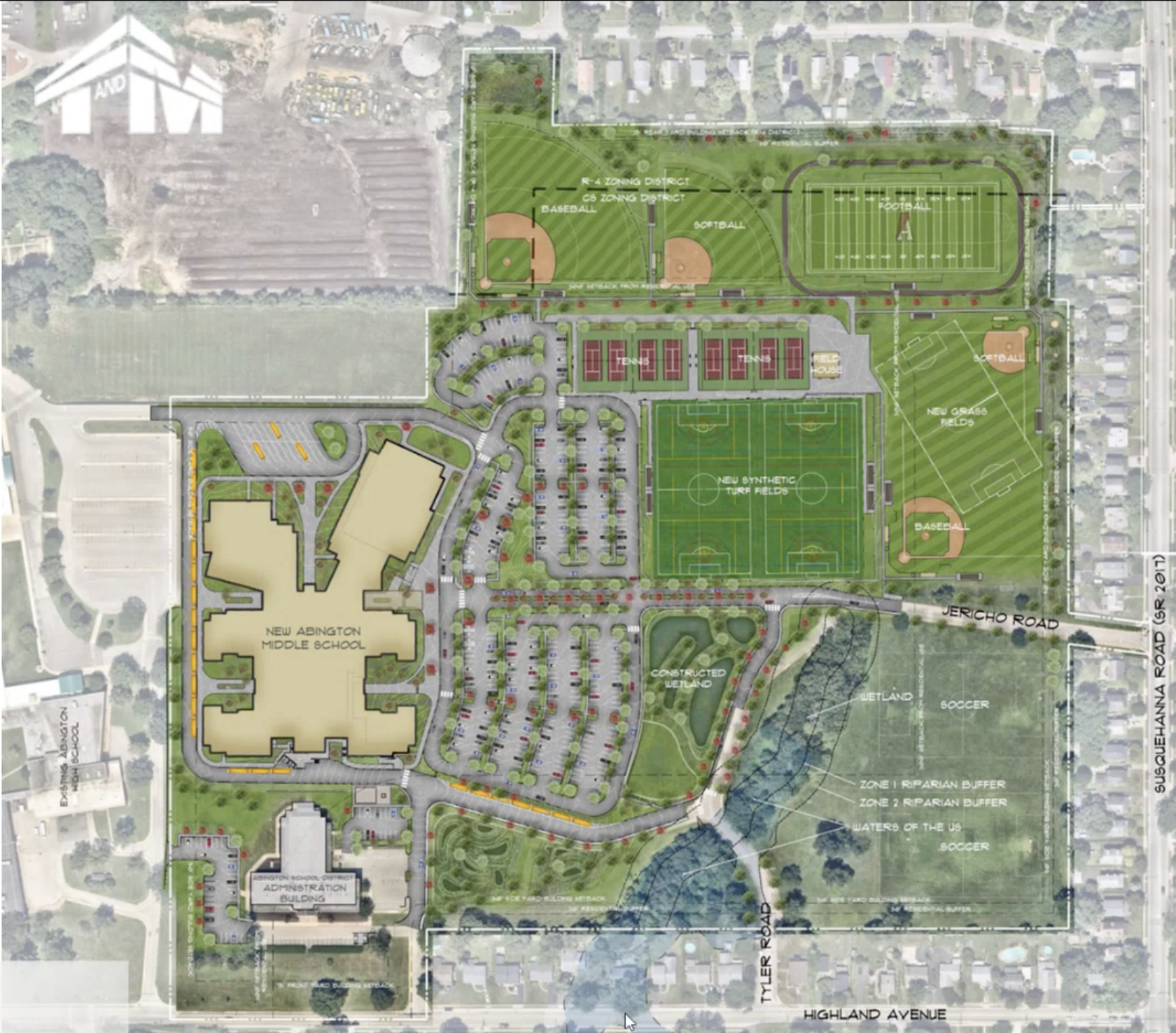
Abington School District wants feedback on design plans for a middle school set to open as early as 2029.
The new school, designed to house 2,200 students, will be built on existing district land. The current building, meanwhile, is slated for demolition, and sports fields will be rebuilt in a $285 million project that taxpayers approved in a rare, successful referendum last May.
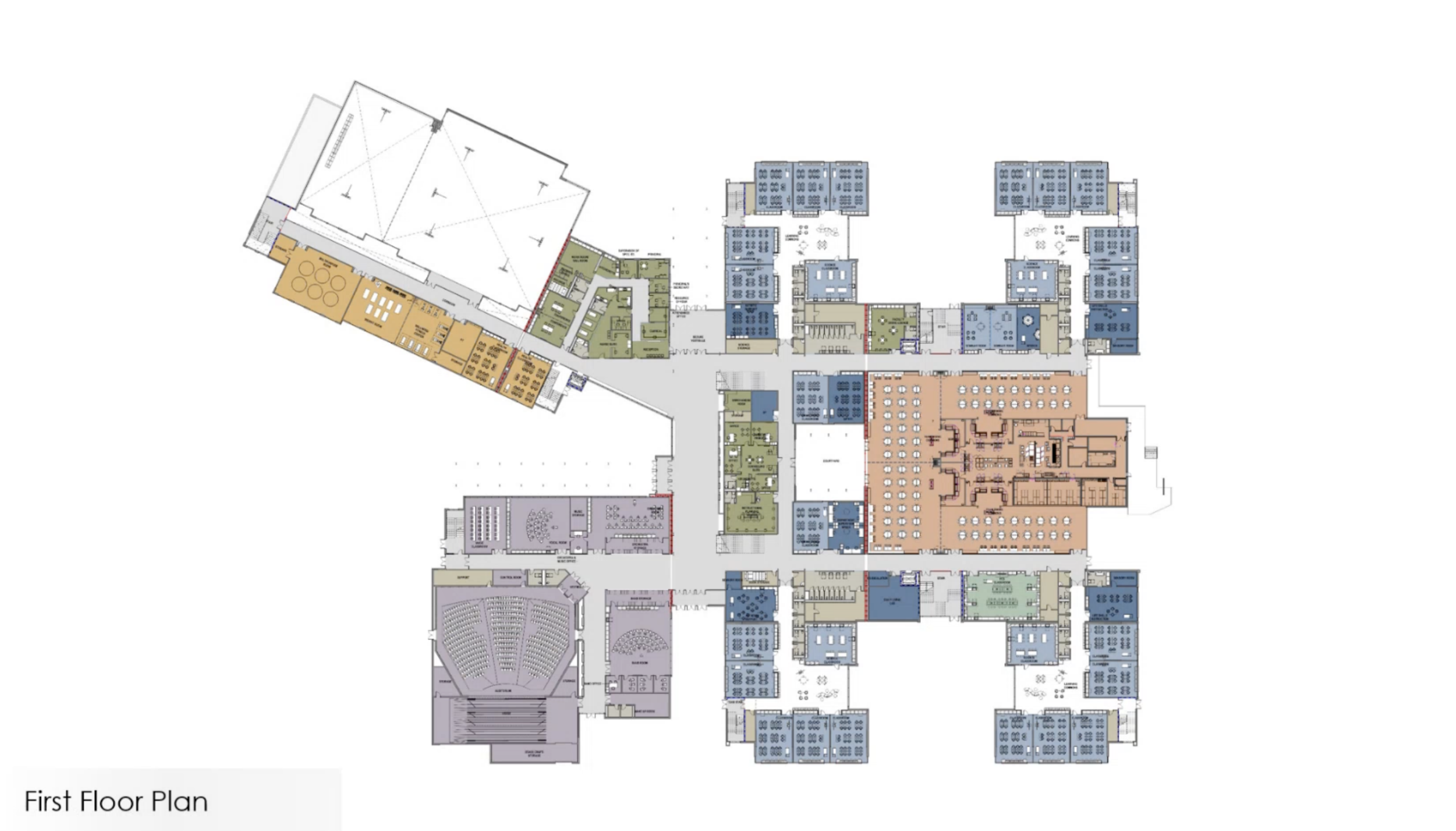
The plan, as seen ina June presentation, includes more parking spaces, layouts for easier monitoring of classrooms and bathrooms, a class “pod” design, and flexible room sizes.
Abington has extended the deadline for a community survey on the plan to July 10, district spokesperson Allie Artur said. The district will use the feedback to further refine the design.
Abington School District shared design plans for a new middle school set to open as soon as 2029.
Design for new Abington middle school
The academic areas of the school would be divided into sets of classrooms and bathrooms to give students a home base within the larger building, said Ryan Murphy, a project manager from ICS, the facility planning consulting firm leading the design effort.
Those classrooms would have windows that allow adults to look in from the hallway, but are too high to distract students sitting at desks.
The planned bathrooms would have fully private stalls, with shared sink areas equipped with cameras.
Several classrooms, along with the cafeteria and auditorium, would have partition options for changing the room sizes.
Initial renderings for Abington’s new middle school show pods of classrooms and bathrooms organized around a central cafeteria, shown in peach.
New middle school adds parking, moves sports
The design adds 79 more parking spaces than the current middle school has, Murphy said. The plans also retain a track around the football field.
The new school is to be built on the current site of the tennis courts beside the district administration building.
While some athletic spaces, including the soccer fields, won’t be touched during construction, the tennis courts won’t be rebuilt until the old school is demolished during the 2029–2030 school year, according to the project timeline.
The district is working with the township on a plan to use Alverthorpe Park and other venues for tennis in the meantime, Artur said.
The new building would also give spectators access to bathrooms during games, while keeping the rest of the school blocked off.
Initial renderings for Abington’s middle school project show the planned site of the new building and athletic spaces.
Abington takes feedback on school design
Murphy emphasized during the June presentation that the renderings are not the final product, as the district continues to seek feedback on the project.
A district survey last winter found that residents wanted a safe, inclusive, and cost-effective middle school filled with natural light.
The new survey on the initial building renderings asks residents for feedback on specific design elements, including safety features, the pickup and drop-off line, and parking.
Residents had to approve the extra spending for the demolition and construction project, which will eventually cost the average taxpayer about $54 per month.
The successful 2025 referendum — unusual in Pennsylvania — drew 17,579 voters and passed by a 411-vote margin.
Opponents of the project argued that $285 million is too steep, and called for a slower process to allow residents more input in the renovation and construction options.
Advocates said renovating the existing building would cost an estimated $206 million anyway, and that needed repairs alone would cost around $100 million and require debt.
A tax calculator that allows property owners to estimate how much the project will add to their bill has been viewed more than 27,000 times, according to the website.
This suburban content is produced with support from the Leslie Miller and Richard Worley Foundation and The Lenfest Institute for Journalism. Editorial content is created independently of the project donors. Gifts to support The Inquirer’s high-impact journalism can be made at inquirer.com/donate. A list of Lenfest Institute donors can be found at lenfestinstitute.org/supporters.
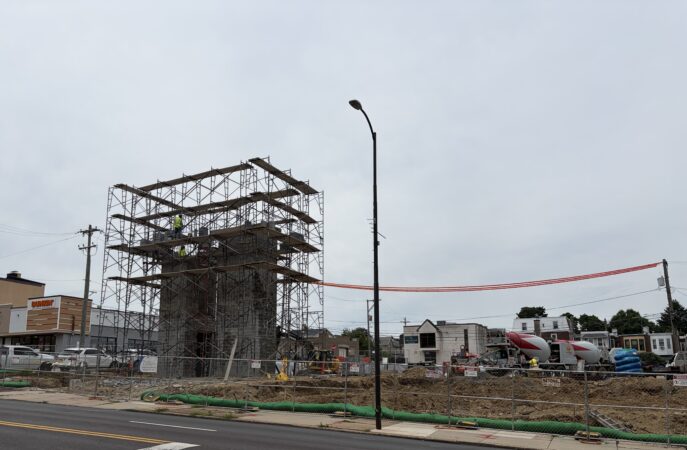
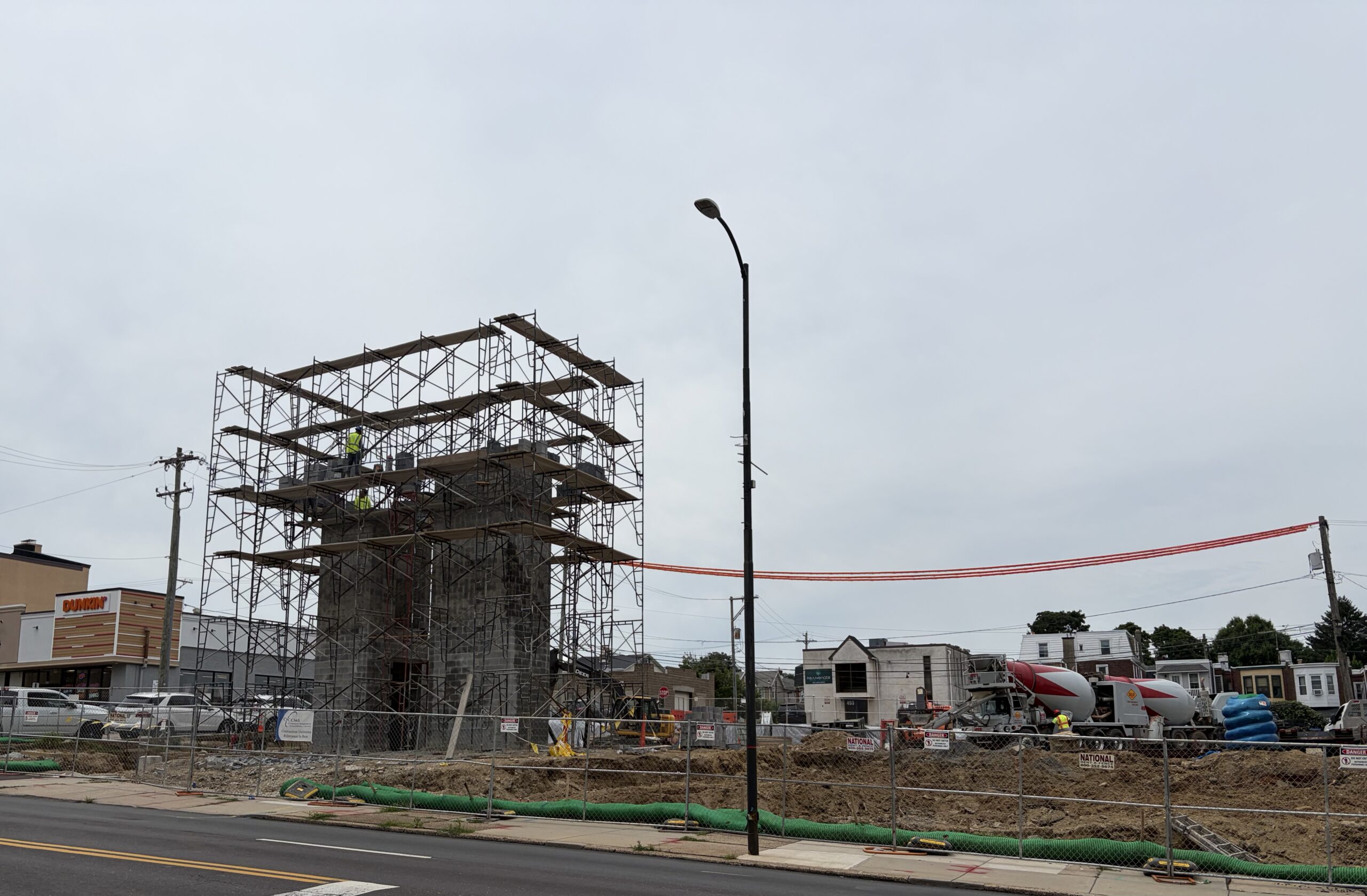
Construction is underway on a mixed-use apartment building facing York Road in Jenkintown.
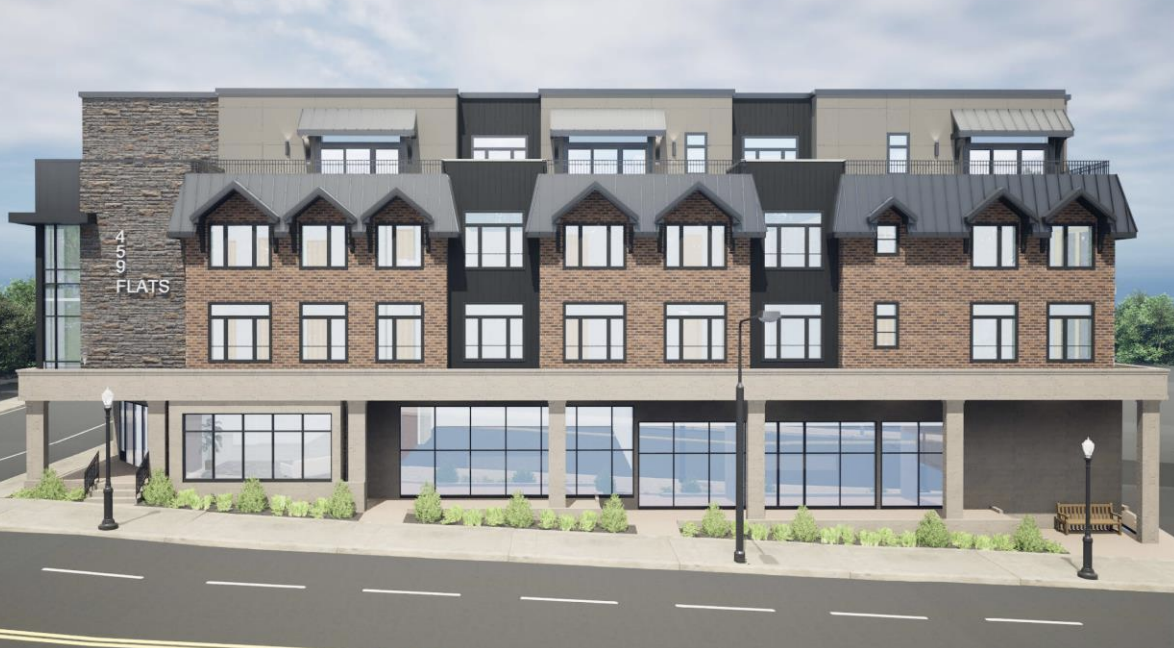
Plans for the new building, which will sit at the intersection of Route 611 and Cherry Street across from Dunkin’, include 40 apartments and a ground-floor commercial space.
The four-story structure also includes a parking garage with 48 spaces. Eight of those will be reserved for the retailer, developer and owner Vincent Celenza said.
Rendering of an apartment complex at Route 611 and Cherry Street in Jenkintown set to open next year.
Some Jenkintown residents have previously voiced concerns about parking permit arrangements for new apartments, arguing that charging for the spots encourages occupants to use free street parking instead.
But Jenkintown Borough Manager George Locke said he’s heard some argue that no-cost parking permits could present a different problem: “[An] owner might just work the cost of parking into all leases and that might negatively affect those who chose not to drive and use public transportation instead.”
Celenza said he hasn’t decided yet how to handle parking permits. “That was one of [the borough’s] concerns,” he said.
An older building on the site, Helweg Funeral Services Inc, was demolished earlier this month.
Celenza bought the land in 2022 from the trust of the Helweg family funeral home’s owner, Mary Welham Wurmstedt, according to property records.
Newspaper archives indicate the Helweg funeral home had operated on the property since at least the 1930s. Helweg’s has merged with another funeral home and is now located two miles down the street in Abington.
Celenza went through several rounds of planning with Jenkintown, which requested fewer apartments and a wider sidewalk on Cherry Street, Locke said. Celenza agreed to those requests in the final plan submitted last summer.
Construction is underway on a new 40-apartment complex and commercial space at Old York Road and Cherry Street in Jenkintown.
The developer will also add a small public area with two benches on a back corner of the property at Cherry and Johnson Streets.
The apartment complex, named 459 Flats, is set to open in June 2027, Celenza said.
Average rent for the apartments, which range from studios to two-bedroom units, will be about $2,400 per month.
This suburban content is produced with support from the Leslie Miller and Richard Worley Foundation and The Lenfest Institute for Journalism. Editorial content is created independently of the project donors. Gifts to support The Inquirer’s high-impact journalism can be made at inquirer.com/donate. A list of Lenfest Institute donors can be found at lenfestinstitute.org/supporters.
We knew that a list of 76 iconic Philadelphia foods would leave something out. It did. After hearing from readers — and revisiting a few of our own debates — we had to mention six items that deserve a place in the city’s culinary canon. They don’t replace the original 76; they just expand the conversation.
The ‘combo’: Hot dog and fishcake on a roll
The hot dog-fish cake combo topped with pepper hash at Lenny’s Hot Dogs in Feasterville.
Long before Philadelphia claimed the cheesesteak as its signature sandwich, another pairing drew a following: the hot dog and fishcake combo. Culinary historians generally agree that Abe Levis (rhymes with “crevice”) created it in 1895 by pressing a fried fish cake atop a grilled frank on the same bun at his luncheonette on Sixth Street near Lombard.
Instant surf-and-turf!
Levis also created Champ Cherry, the bright-red, cider-like soda that became the combo’s traditional companion. The Old Original Levis shop changed hands several times, spawned a few short-lived offshoots, and finally closed in 1992 under owner Elliott Hirsh, who later revived Levis as a store in Abington from 2012 to 2017 while marketing Champ Cherry in cans.
But tastes have changed and the brands are moribund, as Hirsh, now 80, acknowledged: “I’ve been actively trying to find someone that wants to take it over. And not even sell it. Just take it over. I’d hate to die and take it with me, but that’s what we’re going to do.”
The hot dog-fishcake combo, at least, survives. Just after World War II, Levis rival Lenny’s Hot Dogs also sold them from a stand nearby at Fifth and Passyunk.
Lenny’s secret sauce was the pepper hash — a sweet-and-sour relish of cabbage and bell peppers that cuts through the richness of the dish— created by owner Lenny Kravitz’s mother, Ida.
Kravitz expanded Lenny’s to several locations from Mount Airy to Margate, N.J. In the 1980s, he sold his final shop, at 6620 Castor Ave. in the Northeast, to Wayne Knapp. Kravitz died in 1998.
Hawk Krall’s illustration of the “surf ’n turf” Philly combo (fishcake and frank) was originally done for SeriousEats.com.
Knapp later relocated Lenny’s to Feasterville. That shop as well as Johnny Hot’s, John Danze Jr.’s truck stop on Delaware Avenue in Fishtown, are among the few standard-bearers of this classic. Be sure to add a squirt of yellow mustard and a smattering of diced onions, as illustrator Hawk Krall suggested in his 2009 poster print of the sandwich.
Chicken salad and oysters
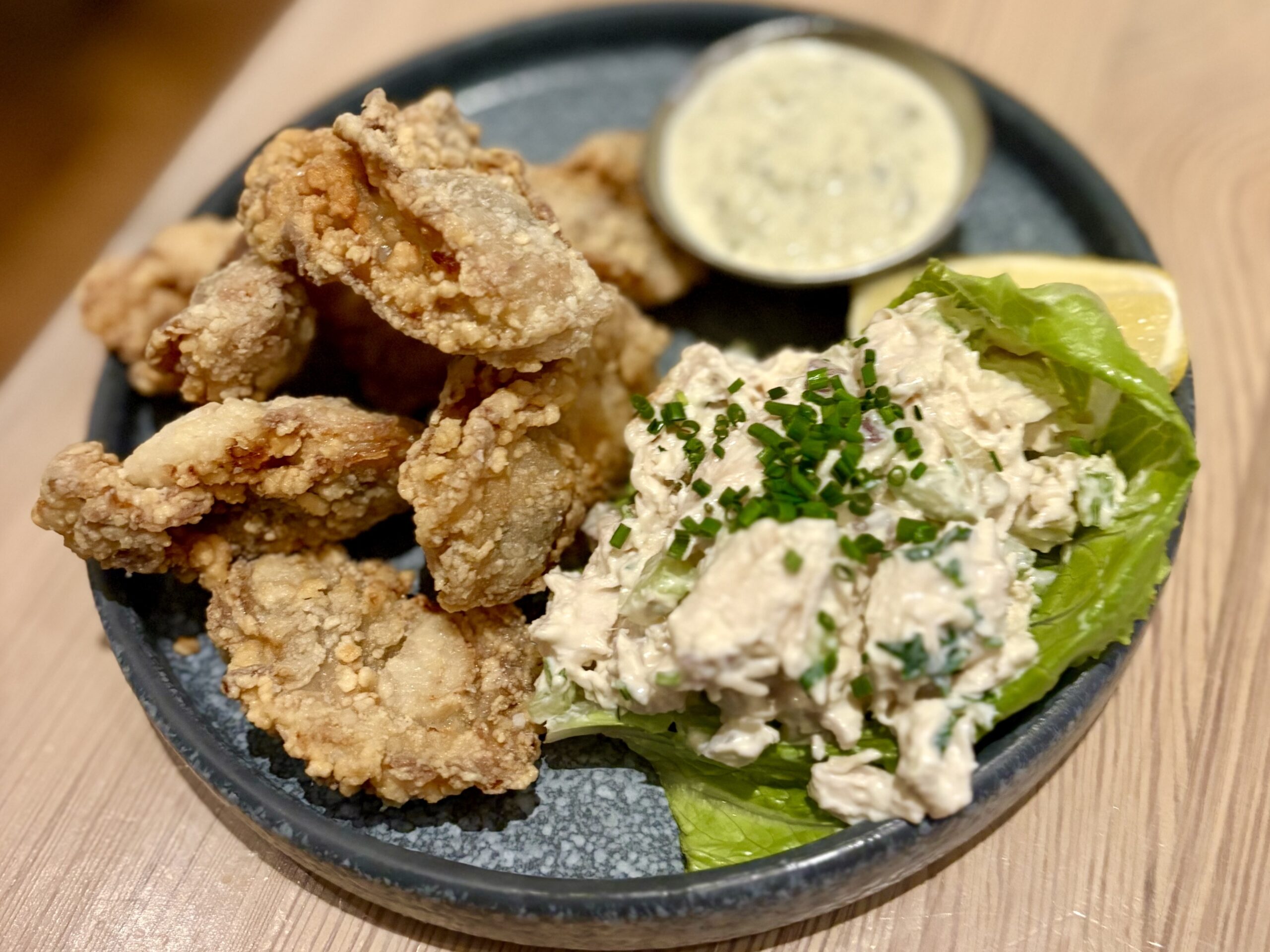
Fried oysters with chicken salad from Oyster House.
As for another curious combo, only in Philadelphia would someone look at cool, creamy chicken salad and crunchy fried oysters and think, “Of course those belong together.”
The unlikely pairing has been a local specialty for well over a century, dating to the city’s grand oyster houses, hotels, and taverns in the late 1800s. One popular explanation of its origin holds that tavern keepers paired cheap, plentiful oysters with more expensive chicken to stretch a serving. Food historian William Woys Weaver has noted that Philadelphia’s finest hotels elevated the dish, serving chicken salad dressed with tarragon mayonnaise and encircled by crisp fried oysters. More humble versions turned up in neighborhood brew houses and lunch counters across the city.
Similar dishes appeared in New York, Baltimore, and Boston, and some historians believe that Philadelphia’s influential Black catering families helped popularize the combination. What is certain is that chicken salad and oysters were served at an organizing meeting of Philadelphia’s Union League in 1862.
The combo’s popularity has ebbed in recent years, and its primary home is now Oyster House near Rittenhouse Square, whose family ownership dates back nearly 80 years.
Crazy Richard’s Peanut Butter
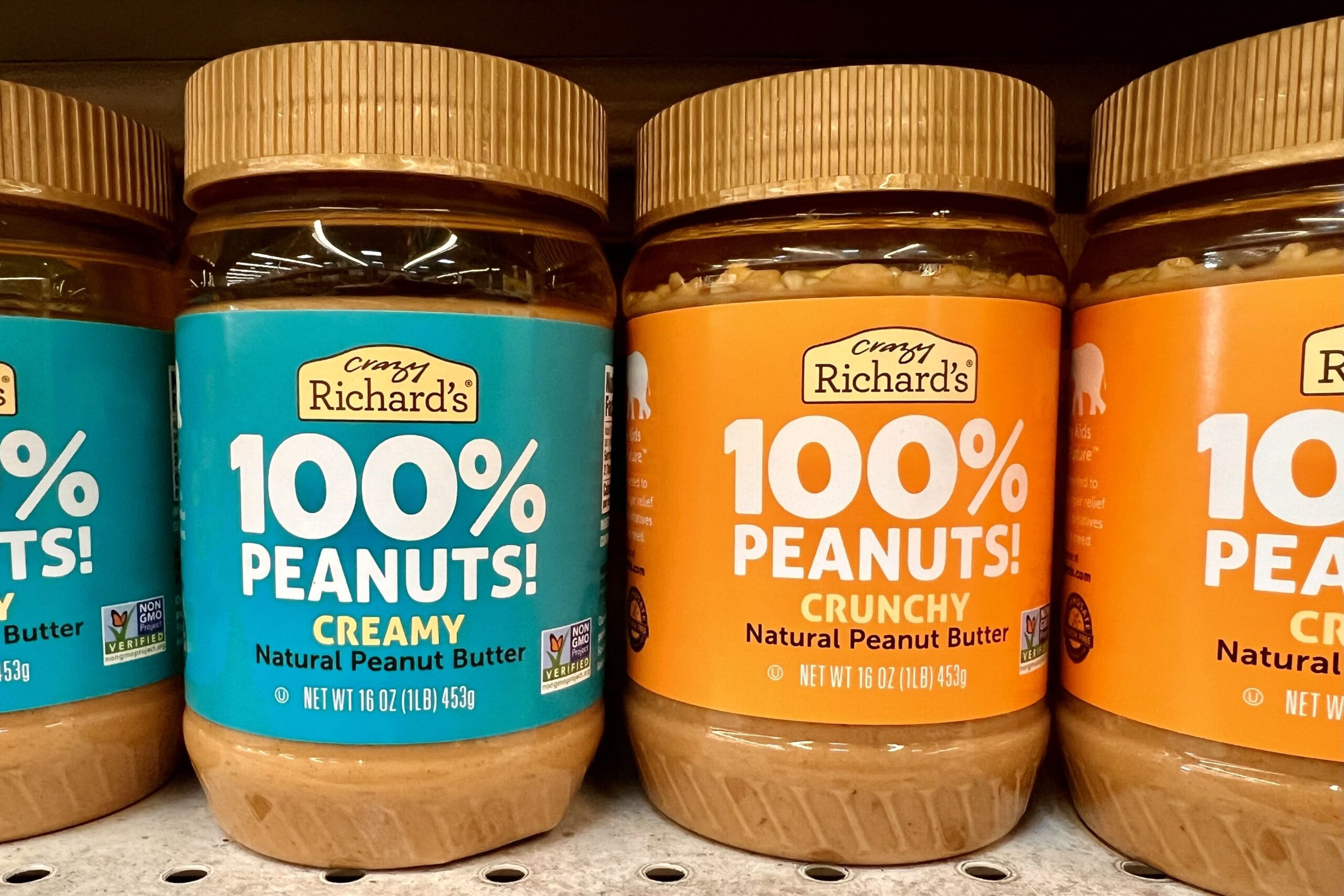
Crazy Richard’s Peanut Butter, founded in 1972, is still available on grocery shelves.
Life was all Skippy and Jif in the early 1970s when a Philadelphia music teacher decided to grind peanuts in his kitchen because he couldn’t find peanut butter that tasted the way he remembered.
Richard Marcus was a conductor, pianist, radio host, and founder of the Society Hill School of Music & Art. Frustrated by the sweetened, homogenized spreads that dominated grocery shelves, he bought five pounds of peanuts at Reading Terminal Market, roasted them, and blitzed them in his blender. The result was nothing more than peanuts — no sugar, salt, or oils.
Friends loved it. By 1972, they convinced him to package it. Marcus produced an initial run of about 144 jars, selling them through Philadelphia delis and health-food stores. He called it Crazy Richard’s, his wink to skeptics who thought he was nuts for marketing a peanut butter that separated naturally and required stirring.
Word of mouth did the rest. Marcus eventually gave up his music school to run the business full time, first contracting production in Conshohocken before opening plants in Pennsauken and later Bellmawr. At its peak under his ownership, Crazy Richard’s sold about 750,000 jars a year throughout the Mid-Atlantic and Northeast and by mail. Marcus insisted that there was no secret recipe: “It’s just ground peanuts.”
In 1991, Ohio’s Krema Nut Co. bought Crazy Richard’s and kept Marcus’ one-ingredient recipe intact. Today, 12 years after his death, the brand is sold nationwide. The “Crazy Richard” on the label is still the Philadelphia musician who proved that sometimes the simplest ideas stick.
Fishtown Iced Tea
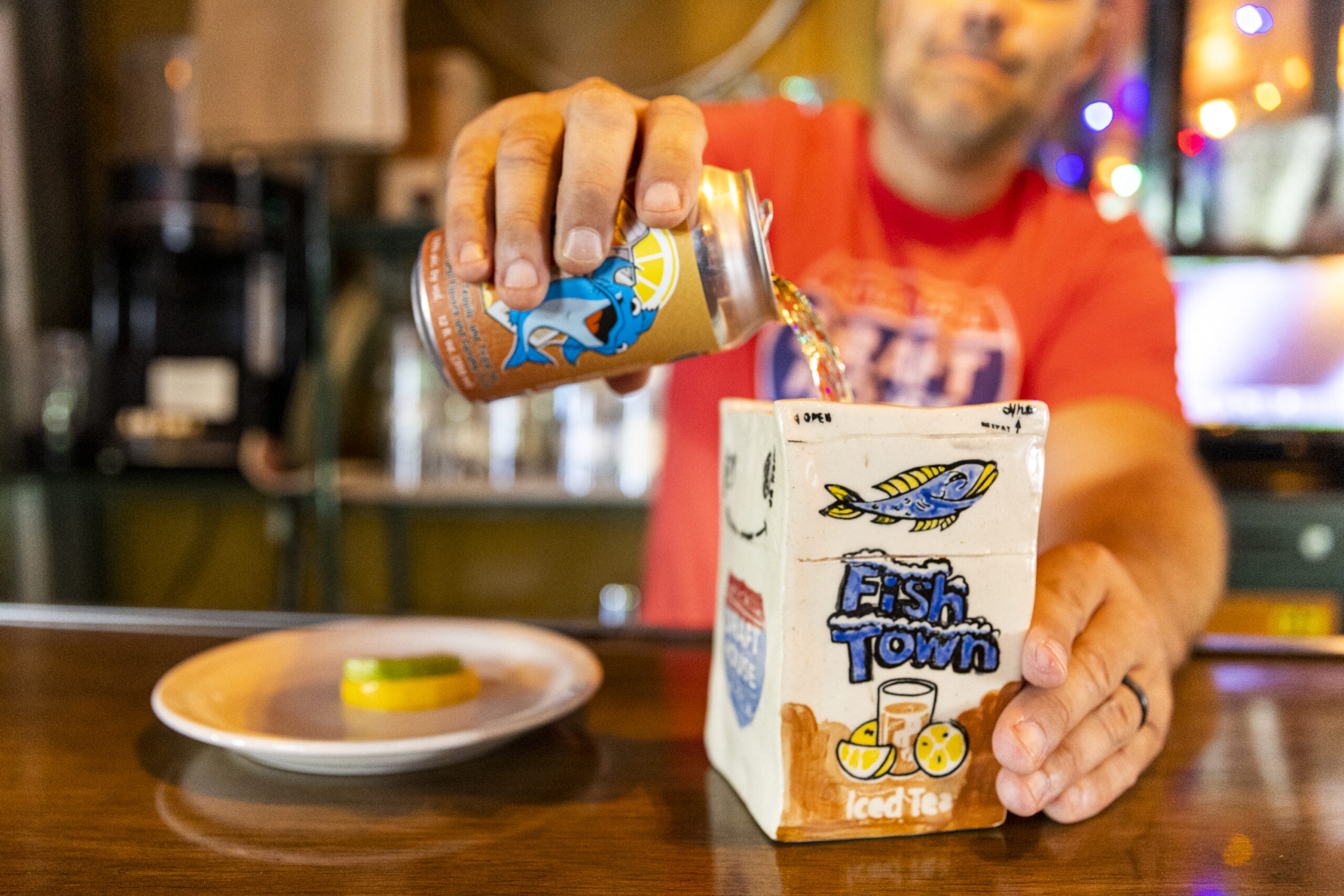
Canned Fishtown Iced Tea is poured by Interstate Drafthouse co-owner Mike McCloskey into a custom-made ceramic carton.
Long Island has its iced tea. Why shouldn’t Fishtown? Created in 2013 at Interstate Drafthouse on Palmer Street, Fishtown Iced Tea spikes a 16-ounce carton of Arctic Splash iced tea with a shot of Jim Beam bourbon, turning a childhood lunchbox staple into an adult version of the sugary, dangerously smooth cocktail. Its roots are distinctly regional. Besides milk, Lehigh Valley Dairy, Wawa, Swiss Farms, and Turkey Hill also sold iced tea in pint cartons that generations of Philadelphians grew up drinking.
During the pandemic, when Pennsylvania temporarily allowed to-go cocktails, Interstate sold enough Fishtown Iced Tea to keep the bar afloat. In 2022, the popularity inspired a canned version from Rectified Spirits, made with vodka, rum, tequila, and triple sec instead of bourbon.
In a twist, the ready-to-drink cocktail debuted just as Lehigh Valley discontinued Arctic Splash cartons, ending an era for the drink that inspired it.
Edamame dumplings from Buddakan
The edamame dumplings at Buddakan.
One of Buddakan’s signature dishes is the edamame dumpling, filled with mashed soybeans and served in a truffled Sauternes-shallot broth. Michael Schulson, then chef de cuisine at Stephen Starr’s Old City destination, came up with the idea in 2000 while developing the menu for Starr’s next project, Pod, whose opening in University City was six months away. “Every dish I made, Stephen would say, ‘We’re putting this on the menu at Buddakan,’” Schulson said. “I’d say, ‘What about Pod?’”
The original version was an edamame ravioli, featuring a yellow pasta wrapper in a caramelized Sauternes-shallot broth, transforming what was then an unfamiliar ingredient to many American diners — young Japanese soybeans — into one of Buddakan’s signature dishes. (It made it onto Pod’s menu, too.) When Buddakan New York opened in 2006 with Schulson leading the kitchen, the ravioli evolved into the translucent har gow-style dumpling that has since become its best-known form, before it later arrived on the menu in Philadelphia. It’s still a bestseller.
After leaving Starr, Schulson adapted the concept at his restaurant Sampan, serving edamame dumplings in a caramelized shallot and sake broth, and later at Double Knot with truffles.
Cheesesteak egg rolls
The cheesesteak egg roll from Continental Mid-town.
Stuff steak and cheese into an egg-roll wrapper, deep-fry it, and you’ve got one of Philadelphia’s signature mashups: the cheesesteak egg roll.
They’re everywhere now, from neighborhood pubs to white-tablecloth steakhouses, and go by “spring rolls” at some places, but their rise can be traced to two nearly simultaneous Philadelphia stories in the mid-1990s.
One unfolded at the old Four Seasons Hotel on the Parkway. Former chef David Jansen said that after preparing a banquet for the New York Rangers in 1994 or 1995, prep cook Mui Lim put leftover cheesesteak filling into spring roll wrappers and fried them as a snack for the kitchen crew. They went on the menu soon after at the hotel’s Swann Lounge. Today’s Four Seasons Philadelphia, now at the Comcast Technology Center, serves wagyu cheesesteak spring rolls with sweet-and-spicy pepper relish.
The other story played out in Old City, where the novelty became a menu staple at the Starr-owned Continental. In 1996, Starr hired Sam “Chef Sammy D” DeMarco to develop dishes for the year-old restaurant. DeMarco already served a Philly cheesesteak dumpling at First, his New York restaurant, but Starr wanted something original.
DeMarco turned the dumpling into a cheesesteak spring roll. “It was taking a classic, nostalgic American snack and presenting it in a fresh way,” said DeMarco, now executive chef at Bungalows Resort in Scottsdale, Ariz.
Like the old Buzz Aldrin cocktail, the roll became a classic. Starr said Continental Mid-town, near Rittenhouse Square, now sells 500 a week.
From the Continental, the idea spread rapidly. Davio’s owner Steve DiFillippo was joining staff for a preshift meal at his former Center City Philadelphia location shortly after it opened in 1999 when chef David Boyle served cheesesteak egg rolls that his wife had made at home. DiFillippo insisted that they be added to the bar menu, overruling managers who felt that they were too déclassé for a posh steakhouse. The Boston-based Davio’s turned the line into a frozen-food item, selling millions through supermarkets and QVC until rising beef prices during the pandemic made them impractical, DiFillippo said. They’re still on the restaurant menus in King of Prussia and elsewhere.
Though DiFillippo copyrighted the name “Philly Cheese Steak Spring Rolls” in 2002, “I’m not going to claim I invented anything,” he said. “But I was the first one to take them into stores and really commercialize them.”
Two men — an uncle and a nephew — were fatally wounded Sunday morning in Abington Township, Montgomery County, in what police said was a “murder-suicide.”
Responding to a 911 call of a shooting around 11 a.m., Abington Township Police discovered William “Billy” Mauer, 54, dead from a gunshot wound inside a home on the 3000 block of Spruce Avenue.
The two had been quarreling, police said.
The nephew, Brandon Maurer, 28, was also found in the house, suffering from a self-inflicted gunshot wound, police said. He was taken to Jefferson Abington Hospital and pronounced dead at 11:39 a.m.
At the time of the double shooting, police said, other unidentified family members were inside the home and were not injured. The nephew’s gun was recovered by police.
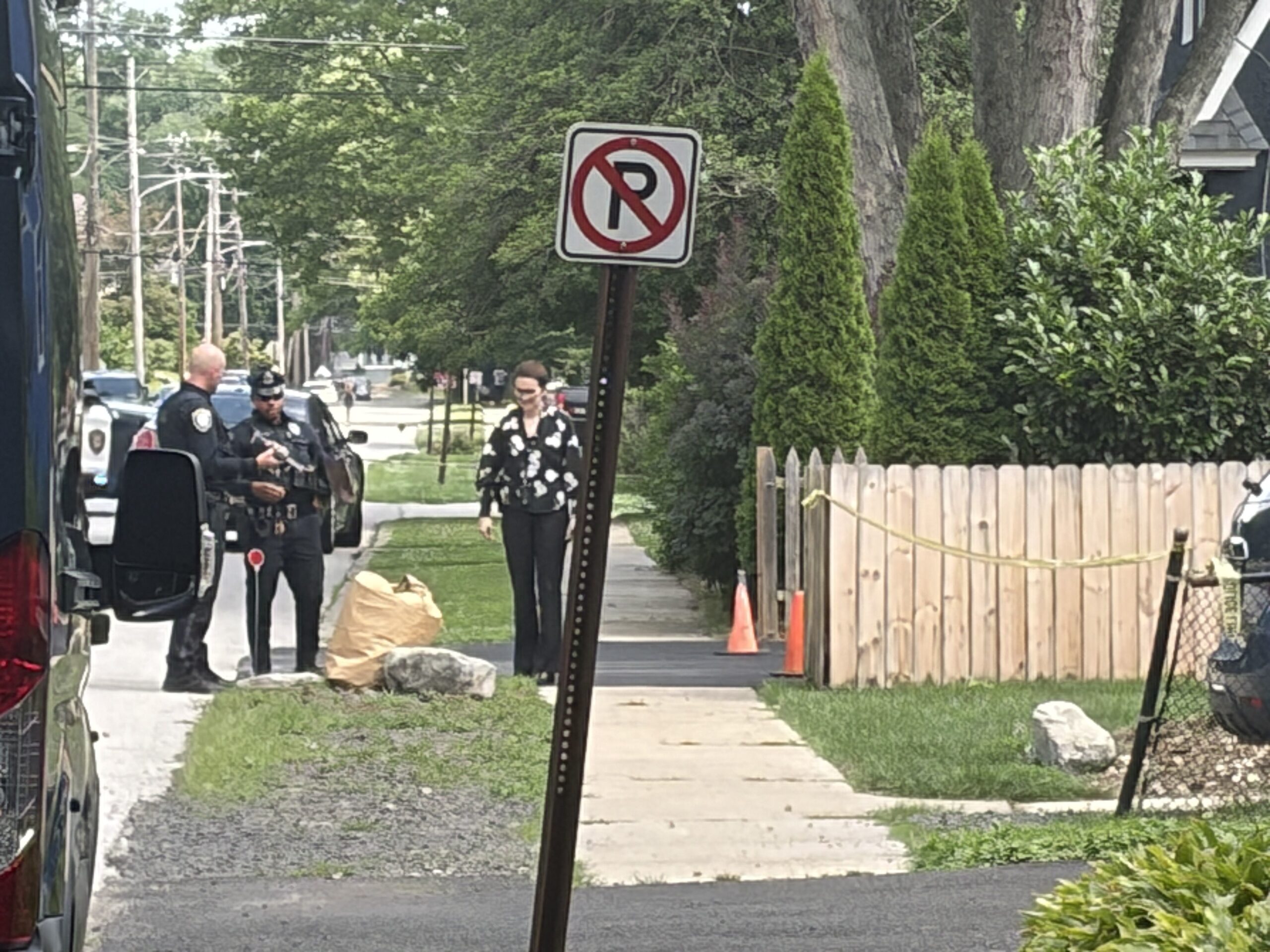
Abington Township police closed down the 3000 block of Spruce Avenue after the shootings.
With neighbors looking on, the block remained sealed off by police SUVs and caution tape Sunday afternoon while Montgomery County detectives and police continued to investigate.
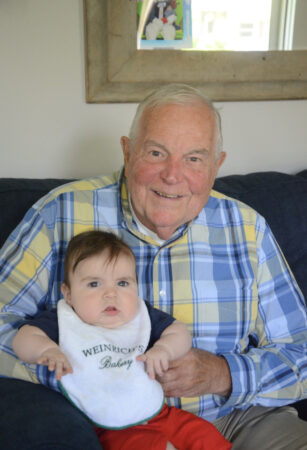
Born above a Philadelphia bakery and forged in Willow Grove, Edward M. Weinrich, 92, died of natural causes at his home beside a Florida river on June 17 surrounded by the sons who keep his beloved cake shop alive.
Weinrich’s parents ran a bake shop on Front Street in North Philadelphia before opening their Willow Grove konditorei — the German word for patisserie — at 55 Easton Rd. in 1952. By the 1970s, Weinrich had graduated from Villanova University, spent two years stationed in Hawaii with the Army, had five children, and taken over the Willow Grove bakery with his wife, Kippy, selling cookies, pies, danishes and cakes — many made from inherited recipes, like their famous butter cake.
“Still today there are recipe books in the bakery archive that are written in German,” said Stephen Weinrich, the youngest of his five sons.
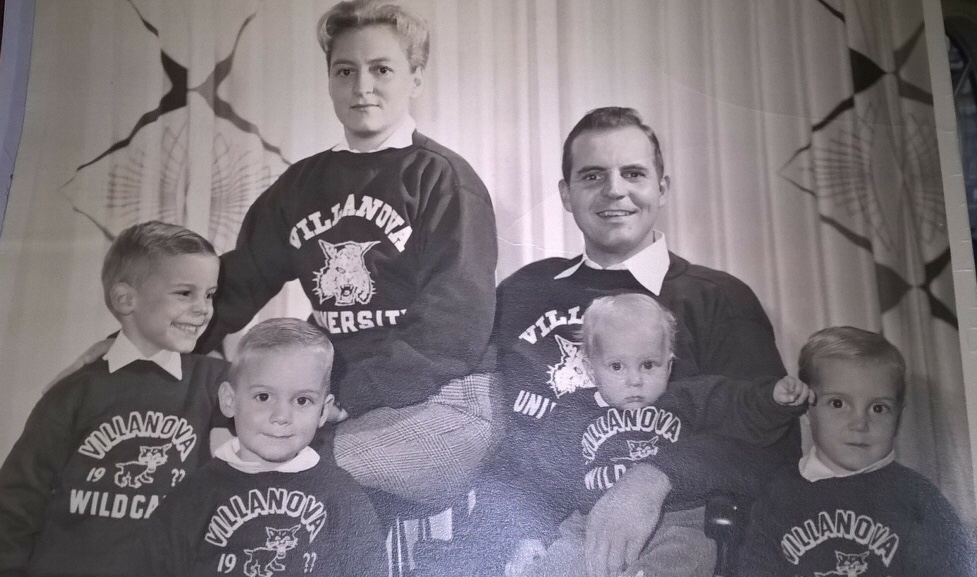
Edward and Kathryn Weinrich pose in Villanova sweatshirts with their four oldest children.
He also invented his own: In the 1960s, Weinrich worked with food scientists to develop his signature frosting — a buttercream that doesn’t turn gritty. It’s still used in custom cakes the store makes for birthdays, weddings, and First Holy Communions.
Weinrich learned the trade from his dad, Herman, who left Naumburg in 1913 to help his brother August run a Manhattan bakery, opening his own in 1919. (It is descendants of their cousin, Ludwig, who operate R. Weinrich German Bakery in Newtown Square.)
Weinrich made wedding cakes for many couples over the years. By the end of his career in 2005, he was making wedding cakes for their grandchildren.
“My mother … wouldn’t get dressed to go to the doctors, but she’d call and order and drive down in her nightgown and robe for a curbside pickup,” one social media user wrote. “Her last trip to the hospital, she only worried that we froze her Weinrich order so it didn’t go to waste.”
“We were just blown away,” said Michael Kirby, the bakery’s general manager and Weinrich’s great nephew. “It’s unbelievable how many people had such fond memories of him and the things we made.”
Their products travel far, Kirby added. “We have people come from across the country for our butter cakes because they can’t get them anywhere else.”
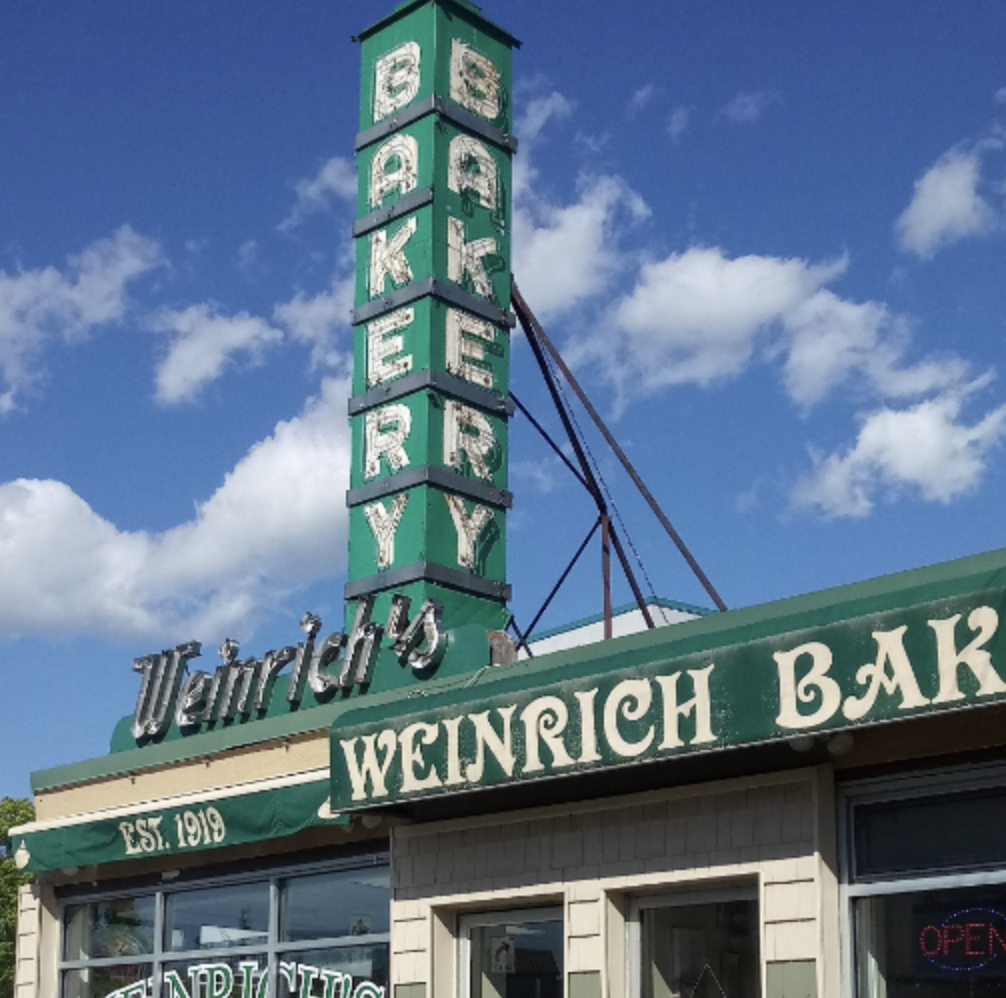
Weinrich’s Bakery in Willow Grove.
Three of Weinrich’s sons still work for the bakery, which is now owned by the third son, Herman, and his wife, Beth.
Though they took over the store in the 2000s, Weinrich and Kippy still showed up regularly to offer advice and to greet many of the bakery’s lifelong customers.
After Kippy died of Alzheimer’s disease in 2015, Weinrich retired to Fort Myers, Florida. But he still asked about the bakery daily, Herman and Beth wrote on social media.
Their cousins’ kids are now there full-time, too, Stephen said: “We have a fourth generation of family working every day in the store.”
Weinrich was an active member of his parishes at St. David Roman Catholic Church in Willow Grove and then Immaculate Conception Church in Jenkintown, and a longtime supporter of the Abington Police Athletic League, Stephen said.
“He is and will forever be remembered for his kind presence and loyalty to all of us,” Herman and Beth wrote.
Funeral arrangements will be made after Weinrich is returned to Pennsylvania, the family said.
He leaves behind his sons and their families, including 16 grandchildren and seven great-grandchildren.
This suburban content is produced with support from the Leslie Miller and Richard Worley Foundation and The Lenfest Institute for Journalism. Editorial content is created independently of the project donors. Gifts to support The Inquirer’s high-impact journalism can be made at inquirer.com/donate. A list of Lenfest Institute donors can be found at lenfestinstitute.org/supporters.
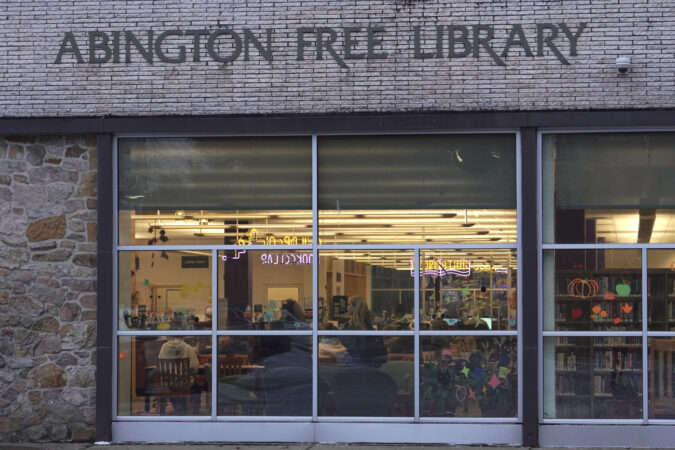
Abington is planning to tear down and replace its flagship library building.
The Pennsylvania Department of Education announced more than $11 million in grants in April for libraries across the state. Abington Township received $749,750 “to plan and design a library facility that is sustainable, accessible, efficient and tailored to the needs of the community.”
Town officials are now hard at work doing just that, Abington Township Public Library executive director Elizabeth Fitzgerald said.
The library has already put out a call for a fundraising consultant who will help raise the roughly $50 million total that township officials think they’ll need to replace the main library at 1030 Old York Road with something bigger. The consultant will be paid with private donations from the library’s endowment, Fitzgerald said.
Officials hope some of that money will come from state and federal sources, too. Fitzgerald asked state Sen. Art Haywood about possible funding through the Pennsylvania’s Redevelopment Assistance Capital Program, according to minutes from the May library trustees meeting.
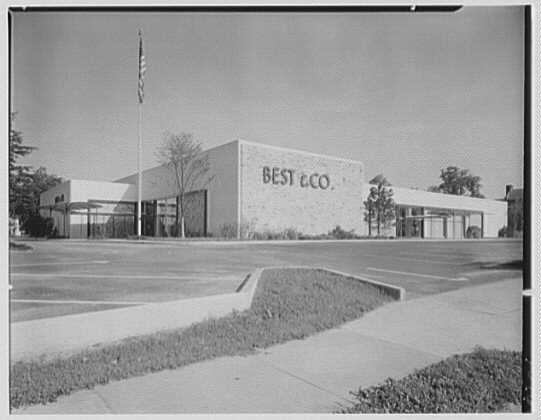
The 1954 building was previously a Best and Co. department store. Abington took over the property in the mid-1970s.
A 1957 image of the Best and Co. department store in Abington held at the Library of Congress.
Maintaining the 72-year-old structure has “caused countless interruptions in services and building closures,” Fitzgerald wrote in a statement announcing the grant.
And the community has now outgrown it, the library director said. Earlier this month, the library hosted author Pam Jenoff at a Penn State building down the road in order to fit some 125 attendees.
Nearly 24,000 people attended over 800 library programs in 2025, Fitzgerald wrote in the grant announcement. “Abington Township needs a new, 21st century library building that can accommodate the needs of our community for generations to come.”
Next steps include hiring an architectural engineering firm using the state grant money, Fitzgerald said. The town expects to demolish the current structure sometime after September 2027 and rebuild on the same land.
In the meantime, officials will seek community input on the project “with surveys, focus groups, town halls, and one-on-one conversations,” Fitzgerald wrote.
“The planning is not in my hands,” she said. “This is the community’s library.”
This suburban content is produced with support from the Leslie Miller and Richard Worley Foundation and The Lenfest Institute for Journalism. Editorial content is created independently of the project donors. Gifts to support The Inquirer’s high-impact journalism can be made at inquirer.com/donate. A list of Lenfest Institute donors can be found at lenfestinstitute.org/supporters.
The Abington School District is reviewing security procedures after police charged a 25-year-old man with trying to rape a student who repeatedly let him into Abington Senior High School.
Police charged Raeem Grange-Allen of Philadelphia on Friday with attempted rape by force and attempted statutory sexual assault, among other charges. The student, a 14-year-old girl, told police she had met Grange-Allen at the high school.
Grange-Allen initially identified himself as a student and began communicating with the girl through text messages and social media, according to a police affidavit.
Grange-Allen later asked the girl to let him into the school “and requested she perform oral sex on him behind a stairwell,” according to the affidavit. The girl told police she “saw him or let him into the school approximately three to four times.”
In a message to families Tuesday, Abington Superintendent Jeffrey Fecher said the girl let Grange-Allen into the high school on two occasions in March, opening a back door during the school day.
“Video footage shows he was wearing a hoodie and was able to briefly blend in as a student while moving in the hallways,” Fecher said.
On March 27, Grange-Allen came to the girl’s home in Abington Township, where he held her down and attempted to rape her, according to the police affidavit. The girl screamed, and her mother caught Grange-Allen, according to the affidavit. The girl went to the police the next day.
Fecher said there were “numerous unresolved questions about this man’s presence in the high school, as well as, where and when he initially encountered the victim.”
The district is “launching a third-party internal investigation” and reviewing security protocols, Fecher said. While exterior doors are locked throughout the school day, “building occupants always have the ability to open them from the inside for evacuation purposes, as required by law,” he said.
Fecher said the district would be working with the Montgomery County Department of School Safety “to determine whether additional security measures can be put in place.”
“We share in the concern and shock that this information causes, and we are committed to addressing it effectively,” Fecher said.
As of Wednesday, Grange-Allen was being held at the Montgomery County Correctional Facility on $250,000 cash bail.