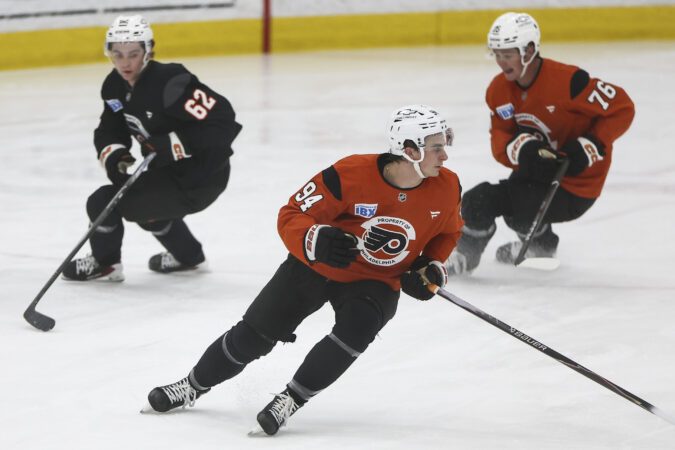
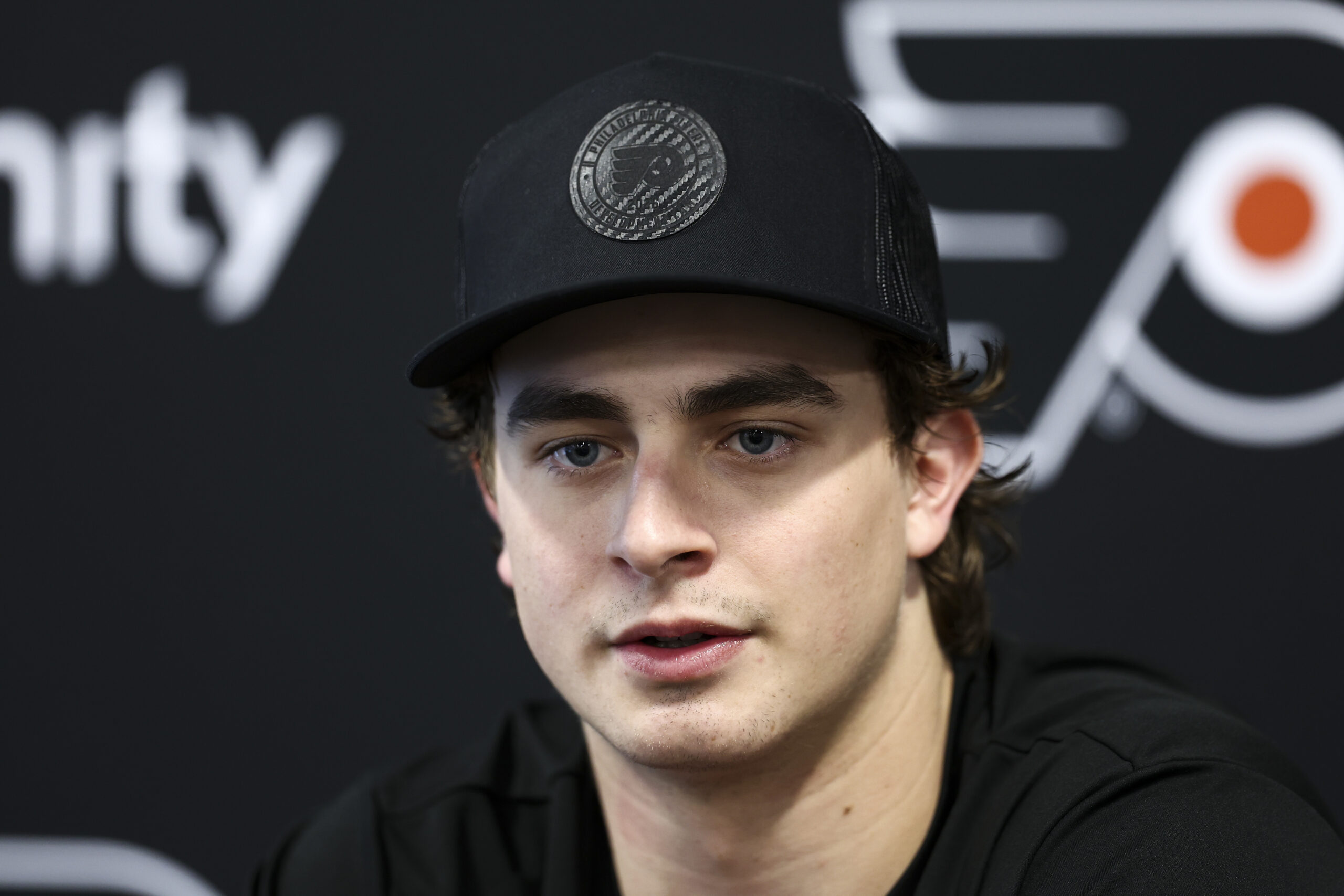
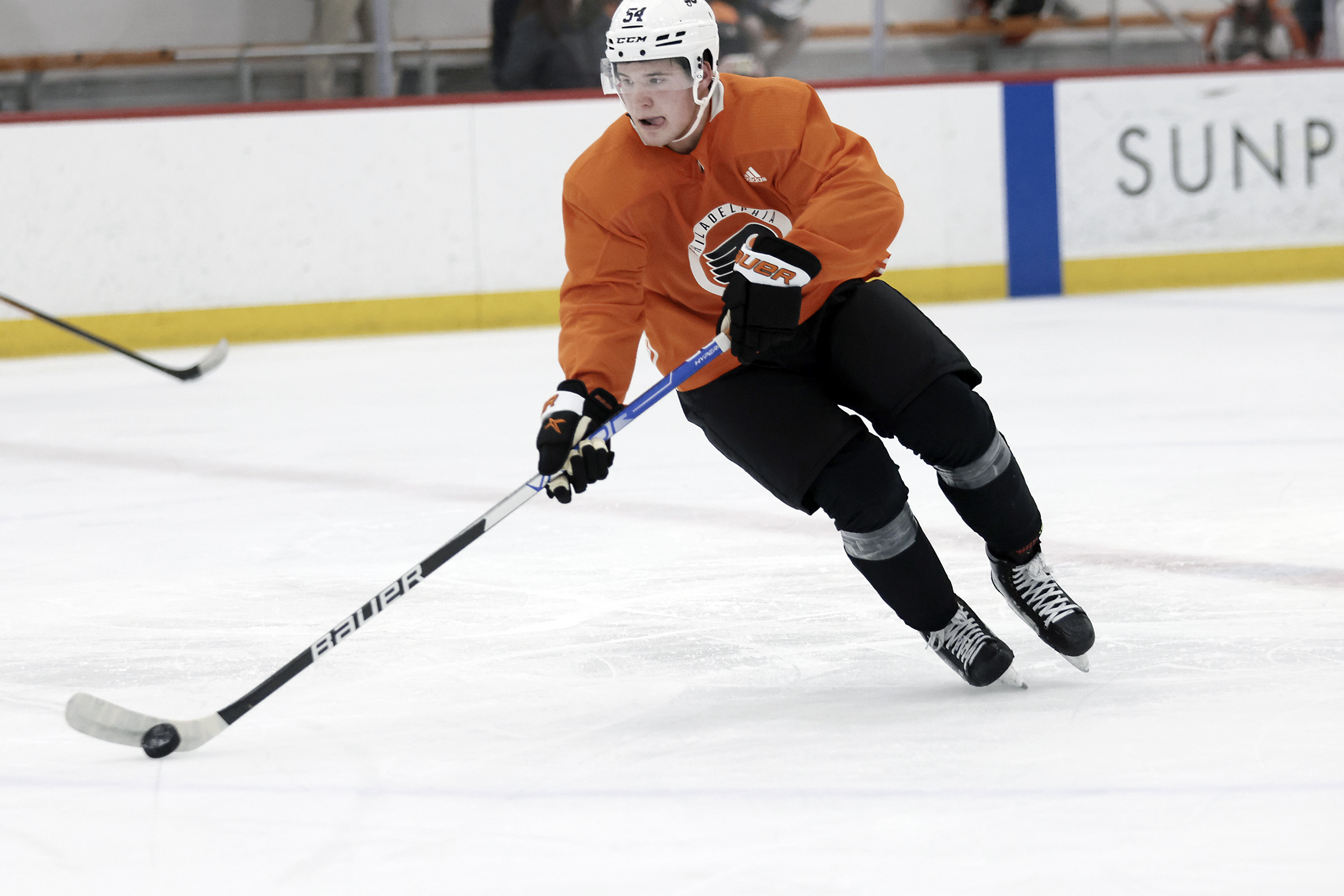
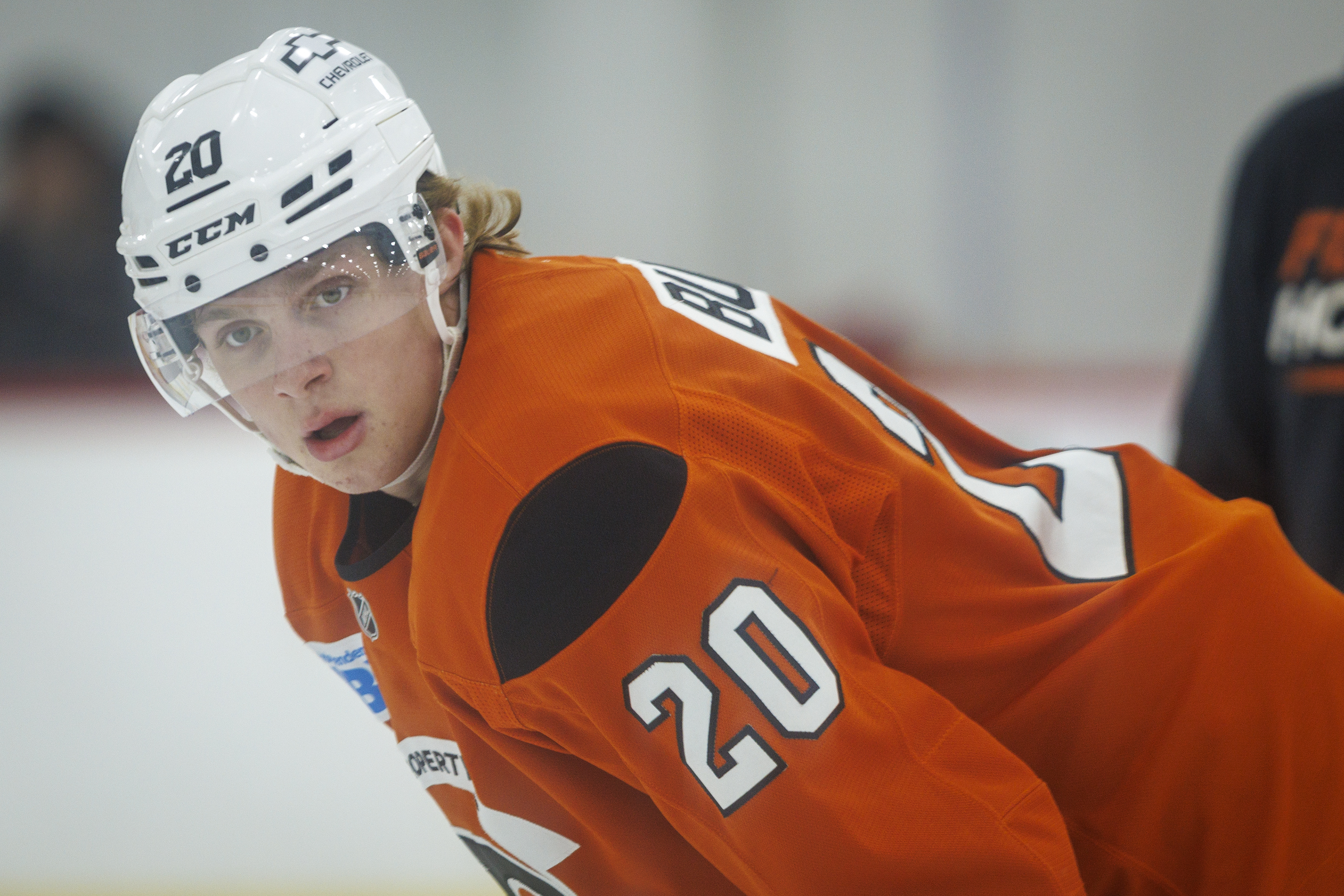
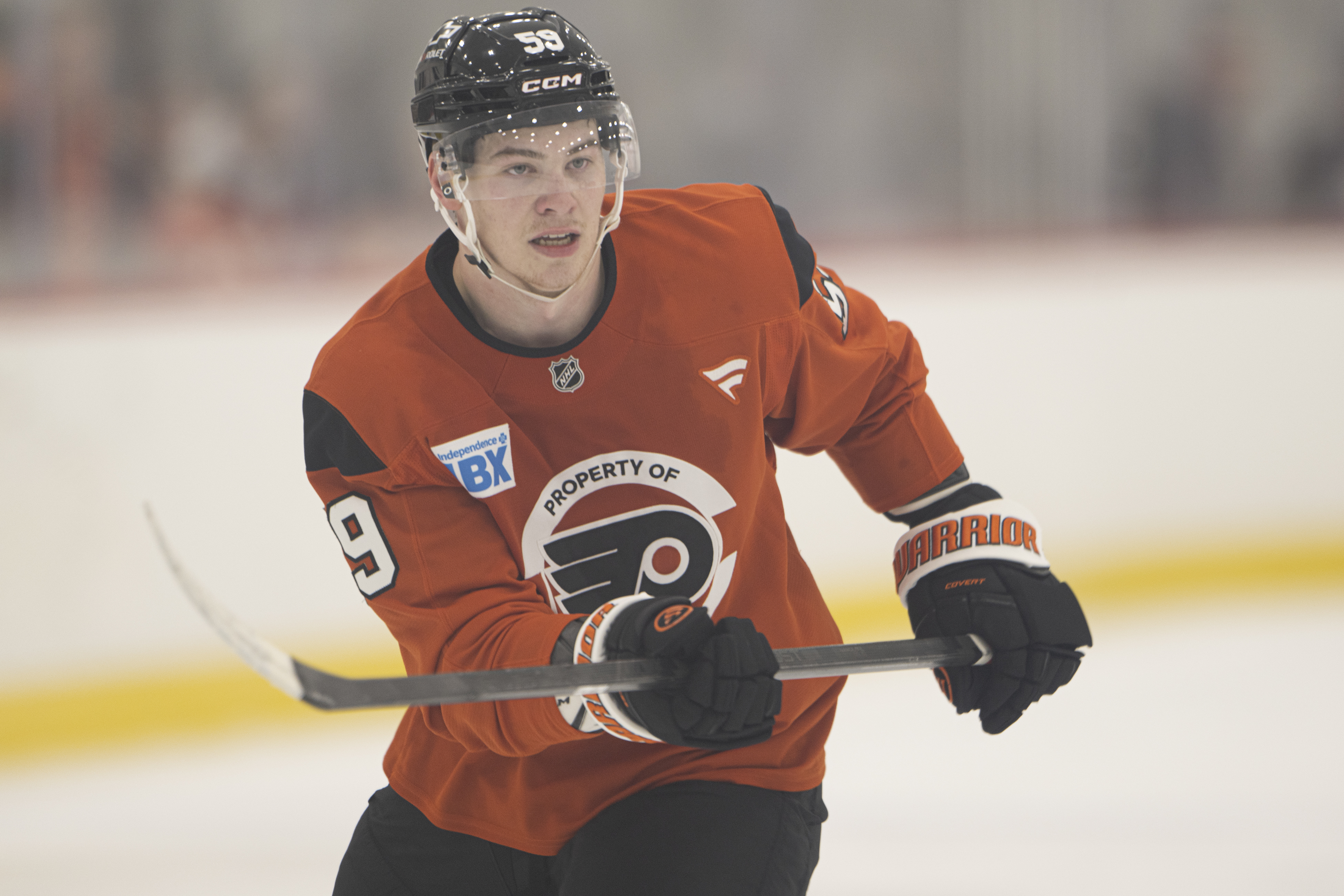
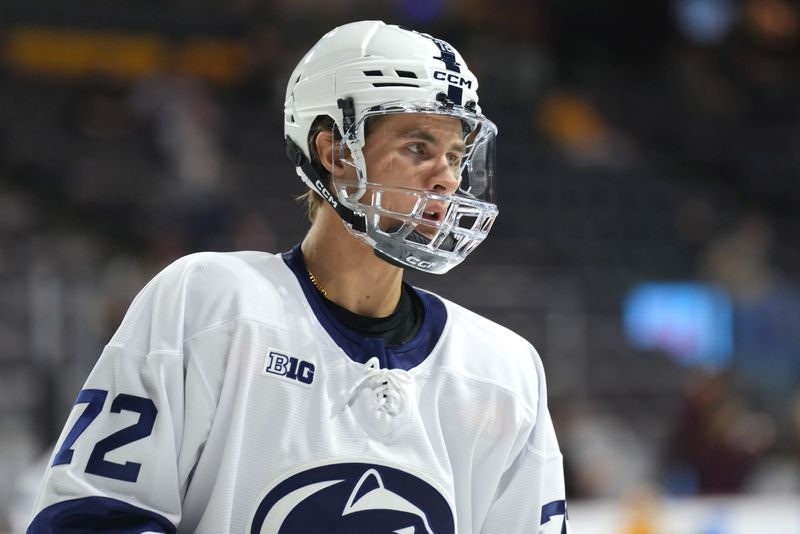
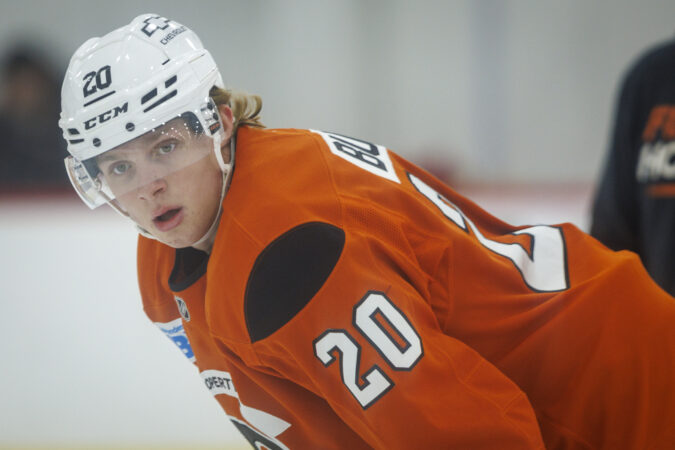
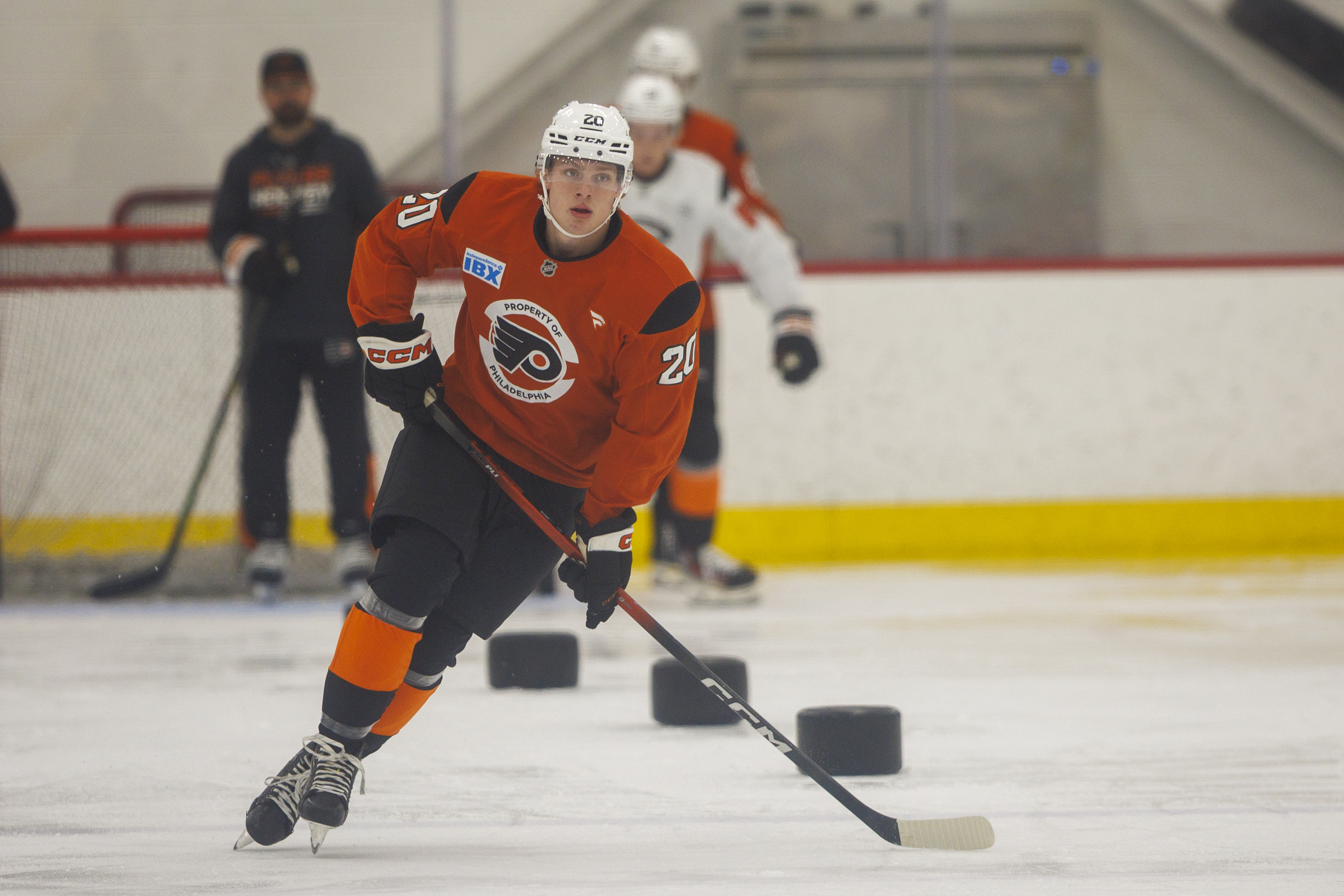
Porter Martone didn’t intentionally wear a Flyers playoff hoodie to the first day of development camp.
“It’s the only Flyers hoodie I have,” Martone joked.
Still, it was a physical expression of just how much has changed for Martone, Denver Barkey, and Alex Bump since the last time they were at development camp 12 months ago.
Last year, none of the three had made their NHL debut. Martone was freshly drafted and off to college, and Barkey and Bump were headed into their first full pro seasons. Now, all three are bona fide NHL regulars who played key roles in the Flyers’ improbable run to the second round of the playoffs.
They don’t even need to be here. Martone’s barely had three weeks of rest, following up his playoff run by playing alongside Sidney Crosby and Macklin Celebrini for Team Canada at the World Championships. But it was important for each to come back to Voorhees, both to work on their skills and to help the next group of prospects along.
“I’m still a young guy here,” Martone said Monday. “I think I could use my learned experiences — and my experience in the playoffs and at the ending stretch there with the Flyers — to help everyone here. I still might be younger than some guys, but I think that’s valuable, to come back here, be a leader, show them what it’s like being a Philadelphia Flyer.”
Winger Porter Martone said Monday it was important to be at development camp to show other youngsters “what it’s like being a Philadelphia Flyer.”
Martone didn’t participate in the skill sessions on the first day, choosing instead to focus on power skating and off-ice workouts. Monday was his first day back on the ice since the World Championships. After camp, he plans to return to East Lansing for a week to train with the strength coaches at Michigan State, and then head home to Ontario before training camp in the fall.
Having guys like Martone, Barkey, and Bump — who know the drills, the facility, and the staff — on hand can be an invaluable resource for the newer members of the organization.
And there’s still plenty for that trio to learn. Martone said he felt like he had to improve at “everything” this summer to become the power forward he wants to be. Barkey agreed, but had a few more specific things he was getting a jump start on at camp.
“The biggest thing for me this summer is putting on a couple extra pounds and working on my first three steps,” Barkey said. “Getting in and out of corners, having the weight and the strength to win battles, and then also having the first three steps to get away from the bigger guys, and have a little bit of space to make plays. I think that’ll be my bread and butter, and it takes time, but definitely working toward that.”
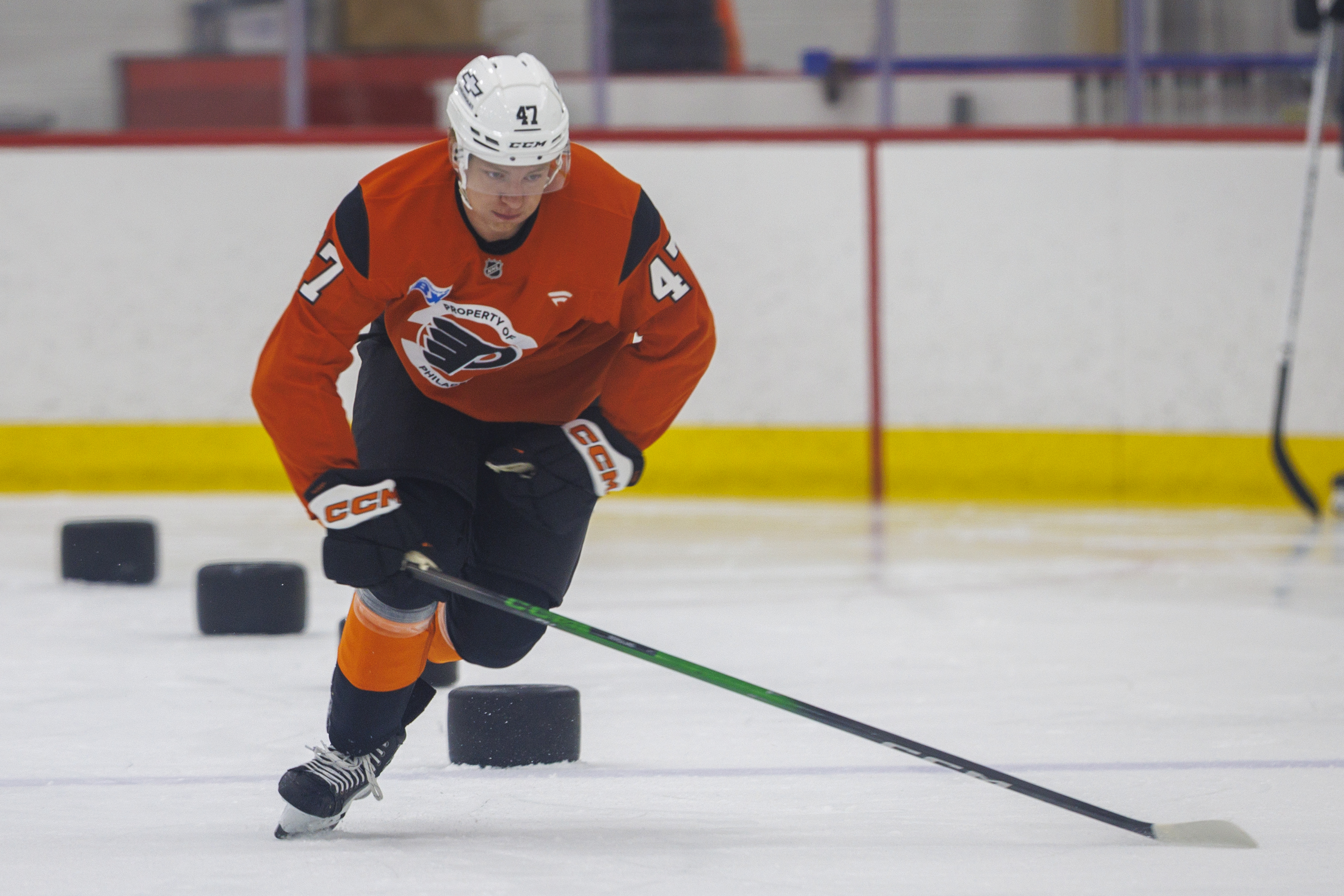
Three of the Flyers’ draft picks, Czech goalies Martin Psohlavec and Marek Sklenička and Finnish defenseman Max Laatikainen, were not able to travel in time for the start of development camp, but they are expected to participate later in camp … Jett Luchanko was not among the players on the ice for the first day of camp. According to Flyers director of player development Riley Armstrong, Luchanko is dealing with a lower-body injury. He is expected to be back skating next week and to be ready for training camp… Assistant general manager Brent Flahr told The Inquirer that Cole Knuble has a good motor. Kind of sounds like Denver Barkey a little bit, no? “I think just growing up, kind of realized that’s the way I’m going to be able to make it, a guy that’s going to go in every battle,” Knuble said. “And I think growing up the emphasis was, not goals or assists, it was always, did you win your 50-50s and did you stick your nose in there. That’s kind of the way I was coached growing up. So yeah, that was just how I’ve always played.” So was it his dad, former Flyers forward Mike Knuble, who taught him that? “Oh, yeah, he used to say if you have 12 eggs in your pockets, they should all be broken.”
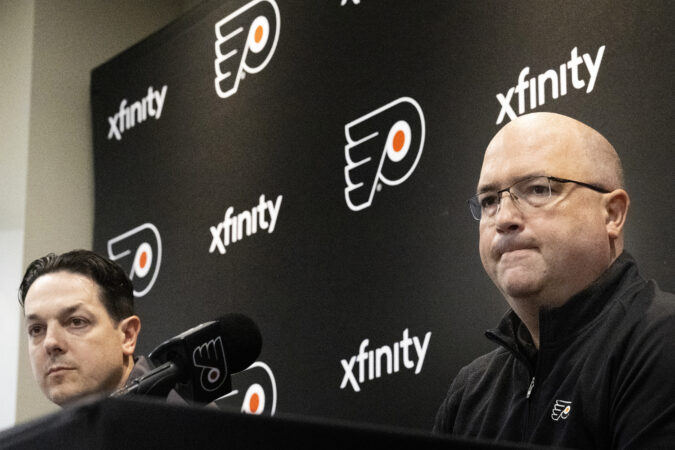
Flyers management has long said that the players would dictate how the organization approached the NHL trade deadline and whether the Flyers would be sellers or buyers.
Well, when the clock struck 3 p.m. on yet another deadline for president Keith Jones and general manager Danny Brière, the Flyers were a seller of sorts as Bobby Brink was traded home to Minnesota, and Nic Deslauriers was moved to chase a Stanley Cup with the Carolina Hurricanes.
Moving Brink from a top-nine spot was necessary to create space on the wing, as the players in the system, notably Porter Martone and Alex Bump — Brière said he “wouldn’t be surprised” if the latter gets called up before the end of the season, although reading the tea leaves, it could come sooner than later — are close to being NHL-ready.
But while they added David Jiříček as the return for Brink, and have Oliver Bonk, Spencer Gill, and Carter Amico in the system — all big, right-shot defensemen — Brière did not move his most exploitable trade piece, veteran right-shot defenseman Rasmus Ristolainen.
“You guys [the media] made a big story. I didn’t know I was trying to sell him,” Brière said on Friday after the deadline. “You guys made it sound like we were dumping Risto for next to nothing.
“Look, at the end of the day, Risto has a lot of value to our team. I wasn’t trying to dump Risto. I wasn’t trying to get rid of him. I think the media turned it into a little bit of a circus, to be honest. And that’s OK. I get it. It’s part of my job to deal with that. But the reality is, Risto is an important part of our defense.”
Unlike the winger position, Brière doesn’t think his defensemen-in-waiting are ready to slot into the top four and play the big minutes that Ristolainen has played; he played more than more than 27 minutes on Monday and 22 more on Thursday. “We need to protect them a little bit,” Brière said.
Sources have told The Inquirer that the Flyers wanted a first-round pick for Ristolainen, the physical defenseman who just had an impressive run for the bronze-medal-winning Finnish squad at the 2026 Milan Cortina Olympics and has been a standout since.
But while several teams did check in on the 6-foot-4 blueliner with term (he has one more year on his contract), no one matched the Flyers’ ask. And Brière would not confirm if a first-round pick was ever on the table, stating, “All I can tell you is, the value wasn’t as high as we needed for us to move forward.”
“I did get a lot of calls, and we took them seriously,” he added. “We went through all the teams that were serious, but at the end of the day, it just did not make sense value-wise. … We listened, but it made more sense to have Risto with us.”
Here are three other questions the general manager addressed.
Why did the Flyers want Jiříček?
The Flyers were in the mix to get the 6-4, 204-pound defenseman when the Columbus Blue Jackets were shopping him a year and a half ago. And Brière was a bit shocked he was available now, but Minnesota recently added Quinn Hughes, which changed the Czech native’s outlook in the State of Hockey.
Although he hasn’t had the track many expected when the 22-year-old was drafted one slot after Cutter Gauthier in 2022, the Flyers see high potential in Jiříček. Patience was asked by Brière, and while he is a different style of player from Jamie Drysdale, the GM sees similarities when it comes to their development arc.
“They both came in at 18 years old, probably a little too early to turn pro yet,” he said. “They go through some ups and downs, probably lose their confidence along the way. So he’s going to need some love. He’s going to need some reps. Especially, he needs time. He needs to play a lot of minutes and build his confidence.”
Jiříček will head to Lehigh Valley of the American Hockey League to start. The GM said he didn’t make any promises but said that at some point, if they have a chance, they’d like to give him a look with the big club. Jiříček has played 84 NHL games across four seasons with Columbus and Minnesota.
Why did the Flyers not trade for a center?
Another season and trade deadline came and went, and the Flyers are still without a No. 1 center. Sure, these types of players do not grow on trees, and yes, several who were expected to be available as free agents this summer have since signed extensions.
But if the Flyers want to take the next step, they need to upgrade down the middle.
“A few of the high-end centers that were in the trade market, or their name, we checked on that,” Brière said. “We had some discussions right now. It’s been tabled to closer to the draft [and then] we’ll look back into that. But we looked into it.
“We are aware; we know that it’s an area we’d like to improve. It’s all about timing, value, and when is the best time that you can get the best value for it. But, yeah, we’re aware. We’ve never hid from the fact that we’d like to improve that position.”
So the door isn’t shut, and there is some expectation that the Flyers could be busy around the draft. As Brière reiterated on Friday, it took almost two years to acquire Trevor Zegras.
Speaking of Zegras, he came to Philly excited for the opportunity to play center again, but has primarily played on the wing. The door isn’t closed on him pivoting, but it’s not as wide-open as before.
“He’s been at his best when he played the wing this year — that’s just the reality. I wish I could say the opposite,” Brière said. “I wish I could say he’s much better when he plays center, but the reality is, he’s been at his best when he plays with [Travis Konecny] and [Christian] Dvorak. So, that line has been our best line for a while now, so that’s why … when I mentioned the wingers, that [I] put his name on there, because he’s been mostly on the wing.”
What does the future now hold for the Flyers?
With the Flyers selling, the writing is all but permanently inked on the wall that they will miss the postseason for the sixth straight season. They entered Friday six points back of the Boston Bruins for the last wild-card spot in the Eastern Conference and eight points back of the New York Islanders and Pittsburgh Penguins for second and third in the Metropolitan Division.
“I think what’s unfortunate about the trade deadline is the moment you start trading players away, is the realization that, unfortunately, you’ve missed your goal in a sense,” forward Garnet Hathaway told The Inquirer on Friday. “In no way am I saying that we’re not in a position to get in, but it changes things. But we were in a spot that we put ourselves in, and I think that’s what’s frustrating, and it kind of adds on to the fact that you’re sending friends, teammates to a different organization.”
The Flyers decided to keep defenseman Rasmus Ristolainen at the trade deadline.
So what happens now?
In the short term, the general manager wants to see his team continue to play the right way, stay competitive, and play hard. Long-term, the Flyers are still a work in progress, and “the plan never changed as far as looking for the future.”
Brière thinks the difference now is that the Flyers can change that.
“Three years ago, we almost had nothing to work with as far as good young players coming,” Brière said. “So it wasn’t enticing for other teams to trade guys to us, but more and more, the way our young guys are coming along and a lot of centers, those are always a lot of value.
“We have more and more assets that are going to hopefully give us the chance to get in on a player. Or sometimes one of those players [in the organization already] is going to come and take it, kind of like [Denver] Barkey did this year.”
News and notes
Barkey and defenseman Adam Ginning were sent down to the Phantoms before 3 p.m. to make them eligible to compete in the Calder Cup playoffs. According to the AHL transactions page, Barkey has already been recalled. The new collective bargaining agreement says players must play one AHL game before being recalled but there is an exception on deadline day.
Brière said they weren’t trying to trade Deslauriers, “but if you want to have the chance to go chase a Cup, we would give you that opportunity.” Deslauriers was traded to the Carolina Hurricanes for a conditional seventh-round pick in 2027.
Veteran forward Luke Glendening, 36, was picked up on waivers from the New Jersey Devils to stabilize the fourth line and win face-offs. He has a 55.6% career winning percentage in the circle.
Tyson Foerster is on track with his rehab after surgery to repair an upper-body injury (Brière would not disclose what the injury was). The winger has started skating and shooting pucks, and the GM said, “I know he’s going to start knocking on my door soon to get back in the lineup.” But he is not expected to play again this season unless the Flyers make the postseason.
Defenseman Nick Seeler is day to day with a lower-body injury and is not expected to play on Saturday against the Penguins (5:30 p.m., NBCSP).
With hockey leagues around the world nearing the midway point and the World Junior Championship starting on Friday, we caught up with Brent Flahr to talk prospects. In Part 2 of our interview with the Flyers’ assistant general manager, we focused on the team’s international-based prospects and those competing in Lehigh Valley.
This interview, which was conducted on Dec. 10, has been edited for clarity and length. Part 1.
While No. 1 center and No. 1 defenseman remain holes the Flyers organization is looking to fill, Flahr noted that while there are fewer than 32 of those guys around, the Flyers remain on the lookout and have assets that could help in acquiring one.
Swedish center Jack Berglund’s skating has been a contentious point among fans, but Flahr says it has improved and that Berglund reminds him of a young Mikko Koivu in that regard.
When asked for his favorite under-the-radar prospects, Flahr pointed to Cole Knuble and Denver Barkey as two guys that are easy to “cheer for.”
More Details
With hockey leagues around the world nearing the midway point and the World Junior Championship starting on Friday, we caught up with Brent Flahr to talk prospects. In Part 2 of our interview with the Flyers’ assistant general manager, we focused on the team’s international-based prospects and those competing in Lehigh Valley.
This interview, which was conducted on Dec. 10, has been edited for clarity and length.
Q: Where do you see Jack Berglund, who was pretty impressive at development camp, fitting?
A: I think he’s a very well-rounded player and has the ability to be a really good 3C, maybe more. But he can play power play. He’s strong. He wins battles. He can make plays. He’s very sound defensively. Where he’s played, he’s had to earn everything he can, but he can shoot it.
I think people worried about his skating, but his skating is coming along as well, and he’s big and strong. You’ll see at the U20 level, he’s a big, strong horse out there, but he’s nowhere near where he’s going to be at 23 years old. When you see him off the ice, he’s still a young guy, and you forget about that. … Not all these players who have been drafted are going to play the next year, but he’s on the right path to being a very good pro.
The Flyers remain bullish on Jack Berglund, who Brent Flahr says continues to make strides with his skating.
Q: Alex Bump, Denver Barkey, and Carson Bjarnason, have been the three B’s in Lehigh Valley. What have you seen from them in their transition to pro hockey? [Note: Barkey was recalled after this interview was conducted.]
A: Barkey, I think right from the start, he’s played very well. On the production side, he makes plays, he works, and the details are great. Such a smart player. He’s got to get stronger and build up his body to handle the grind but so far, so good. Down there, he’s been arguably our best forward a lot of nights, and coaches love him. …
I think Bumper, when he first went down there, even though playing last year — I don’t know if he thought it was going to be easy or disappointment from not making the team right away — I thought he stumbled around a little bit early, and then he found his game, and now he’s going. But part of the why he’s down there is to find the consistency in his game, not just offensively, but defensively, and managing the game and then playing it every night. But he’s talented. He’s producing now. I think he’s feeling good about himself, and he’s certainly going in the right direction. …
And Carson … I think he’s exceeded expectations so far. He’s got the right demeanor, the size, the athleticism, and he’s learning the pro game. … It just seems easier for him. In juniors, it was so chaotic in front of him; he used to get so many Grade A chances.
Q: You mentioned Aleksei Kolosov. He seems like a different player this year, no?
A: He is a different player, different personality. He’s really trying to fit in. He’s very athletic, very competitive, and he’s giving our team a chance to win down there almost every night. He’s a talented kid, so he’s got a chance to be an NHL goalie now. He just skipped a step last year. Now he’s building it back up again here, and we’ll see where it goes.
Q: What about Yegor Zavragin? He has another year on his deal but it sounds like he’s playing well in Russia.
A: He’s a talented, talented kid with size. … He’s got to build up his body, which is a big focus for St. Petersburg, and he’s working hard. … We want him to be over here right away, but the one thing the KHL does, or has a history of doing recently, is developing goalies. So we’re in a good spot and, hopefully, when the time comes, we can get him over here and get him going.
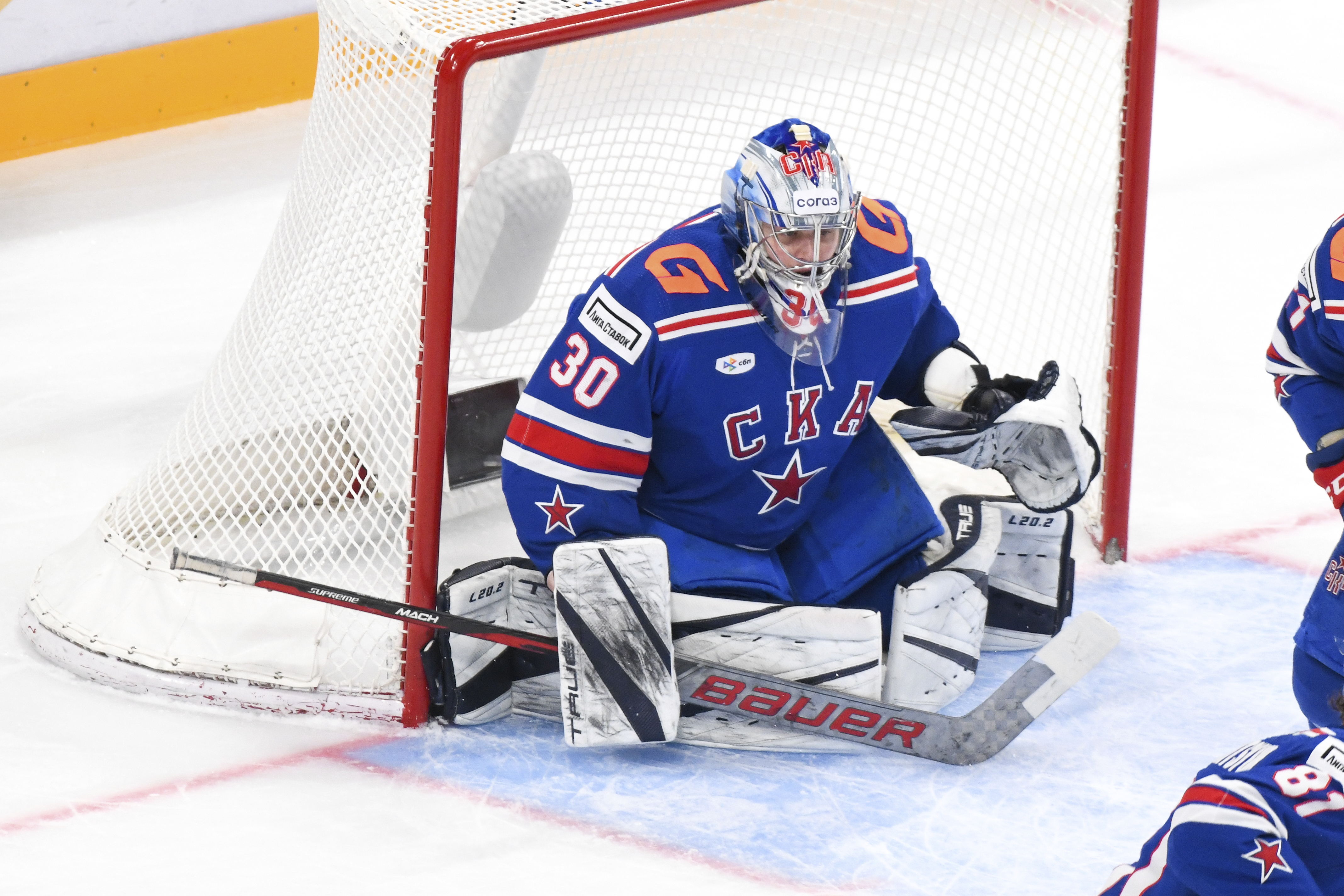
Egor Zavragin has firmly established himself as one of the best young goaltenders in Europe.
Q: There’s been a lot of criticism of the Flyers not having a 1C or 1D. What would you say to those people, and how would you assess the system?
A: There are not 32 1Cs in the league or 32 1Ds. So we’re always trying to look for that and strive for that. But we have some good players coming, guys who can play, hopefully, 2Cs. We have some guys on the wing, we think. We have some solid defensemen coming.
We understand what we need to be an elite team; at the same time, we’re growing a pretty good base as far as depth through the lineup and people that can contribute in different ways. So, that’s where the Berglunds and some of these guys that aren’t talked about as much could be valuable pieces as well. Then you’ve got [Jett] Luchanko, and [Jack] Nesbitt, who are going to take a little time to get stronger. Heikki [Ruohonen], as well, is a really good player.
Q: Give me one or two prospects that you’re excited about in the system.
A: Porter [Martone] is Porter. He has a chance to be a special player. When you meet him, he’s kind of got that “it factor,” as far as he’s got cockiness, but in a good way. I think he’s a pro; he’s got the mindset now where he knows where he has a little more work to do as far as getting there. But he understands. Getting that experience last year with Team Canada was huge, to be a young kid playing with those types of players and see where you’ve got to get to. I just think he’s matured, and he has a chance to be a really good one for us.
But the guy we drafted, who is one of my favorites … is Cole Knuble. Just a good hockey player. So competitive, great motor, smart, plays every position. I don’t know where it’s going to get to, but he’s worked really hard on his skating, and it’s become good. It’ll be interesting to see when he turns pro. Guys like Barkey and him are the guys you cheer for.
Brent Flahr believes Cole Knuble, son of former Flyer Mike Knuble, is a prospect who has a chance to surprise.
Barkey’s such a smart player, he’s so competitive. You watch a game, you just kind of start just watching him, just because of the way he plays the game. Whether he can handle the size [remains to be seen] but he’s proven everybody wrong at every level.
Q: What are the strengths of the 2026 NHL draft?
A: Early on, I think it’s a strong defensemen draft. There are some quality wingers. I think there are a couple of centermen, but not a really deep pool of centermen. But some good players. … I don’t think there’s any Connor McDavids. There are some well-known, big-name players at the top end, and there are some guys challenging behind who aren’t as far up as some people think. So it’ll be interesting.
With hockey leagues around the world nearing the midway point and the World Junior Championship starting on Friday, we caught up with Brent Flahr to talk prospects. In Part 2 of our interview with the Flyers’ assistant general manager, we focused on the team’s international-based prospects and those competing in Lehigh Valley.
This interview, which was conducted on Dec. 10, has been edited for clarity and length.
Q: Where do you see Jack Berglund, who was pretty impressive at development camp, fitting?
A: I think he’s a very well-rounded player and has the ability to be a really good 3C, maybe more. But he can play power play. He’s strong. He wins battles. He can make plays. He’s very sound defensively. Where he’s played, he’s had to earn everything he can, but he can shoot it.
I think people worried about his skating, but his skating is coming along as well, and he’s big and strong. You’ll see at the U20 level, he’s a big, strong horse out there, but he’s nowhere near where he’s going to be at 23 years old. When you see him off the ice, he’s still a young guy, and you forget about that. … Not all these players who have been drafted are going to play the next year, but he’s on the right path to being a very good pro.
The Flyers remain bullish on Jack Berglund, who Brent Flahr says continues to make strides with his skating.
Q: How do you define it when you say a player’s skating is not NHL-ready?
A: Nine times out of 10, that’s strength-related. Like Tyson Foerster, everybody was worried about his skating when we drafted him. He was not a great skater when we drafted him. But it’s not all fundamentals. You see his body, he’s got no leg strength at this point. And you see he can generate speed in a straight line, quickness, agility, and lower-body power, stuff like that.
So Jack could skate in a straight line. His foot speed and everything had to improve, turning and that. But a lot of its strength, a lot of it’s just his body linking up for a big 6-4 guy. And as he gets older and stronger, he’s skating more than fine, and it’s something that he’s always gonna have to work on, the quickness and agility.
I compared his skating, when I saw him play as a young player, to a player that we had in Minnesota a long time, Mikko Koivu, who was a great player. He’s someone that he could pattern his game after because Mikko was a great two-way player, but he’s big and strong, and as a young player, people worried about his foot speed and whatnot, and he just became a really good pro for a long time that you can win with.
Q: Alex Bump, Denver Barkey, and Carson Bjarnason, have been the three B’s in Lehigh Valley. What have you seen from them in their transition to pro hockey? [Note: Barkey was recalled after this interview was conducted.]
A: Barkey, I think right from the start, he’s played very well. On the production side, he makes plays, he works, and the details are great. Such a smart player. He’s got to get stronger and build up his body to handle the grind but so far, so good. Down there, he’s been arguably our best forward a lot of nights, and coaches love him. …
I think Bumper, when he first went down there, even though playing last year — I don’t know if he thought it was going to be easy or disappointment from not making the team right away — I thought he stumbled around a little bit early, and then he found his game, and now he’s going. But part of the why he’s down there is to find the consistency in his game, not just offensively, but defensively, and managing the game and then playing it every night. But he’s talented. He’s producing now. I think he’s feeling good about himself, and he’s certainly going in the right direction. …
Alex Bump is producing down in Lehigh Valley but his defensive consistency remains a work in progress.
And Carson … I think he’s exceeded expectations so far. He’s got the right demeanor, the size, the athleticism, and he’s learning the pro game. … It just seems easier for him. In juniors, it was so chaotic in front of him; he used to get so many Grade A chances.
Q: You mentioned Aleksei Kolosov. He seems like a different player this year, no?
A: He is a different player, different personality. He’s really trying to fit in. He’s very athletic, very competitive, and he’s giving our team a chance to win down there almost every night. He’s a talented kid, so he’s got a chance to be an NHL goalie now. He just skipped a step last year. Now he’s building it back up again here, and we’ll see where it goes.
Q: What about Egor Zavragin? He has another year on his deal but it sounds like he’s playing well in Russia.
A: He’s a talented, talented kid with size. … He’s got to build up his body, which is a big focus for St. Petersburg, and he’s working hard. … We want him to be over here right away, but the one thing the KHL does, or has a history of doing recently, is developing goalies. So we’re in a good spot and, hopefully, when the time comes, we can get him over here and get him going.
Egor Zavragin has firmly established himself as one of the best young goaltenders in Europe.
Q: Christian Kyrou has hit the ground running in Lehigh Valley. What have you seen from him, and what are his NHL chances?
A: Well, he brings a dimension we didn’t really have there as far as his offense and the power-play ability but I think it was a good trade for both players, a new environment. What he’s brought is some swagger and some offensive instincts.
Obviously, he’s not the biggest guy, and his criticism was defensive play and lack of size, but he’s been fine. … What he does with the puck is he gets it going up the ice and transitions. … He’s been very good and productive … and really helped the power play.
Q: Samu Tuomaala went the other way in the deal. What do you think went wrong?
A: He just kind of stalled, and part of it, you’ve seen the guys that kind of went ahead of him. But Samu, when he’s on his game, he brings speed, he can really shoot the puck, and he’s a good kid. I just think for whatever reason, he just didn’t have it at the start of camp. … You look at what we have coming and what we have now, the way he was going, he was going to be boxed out, so we decided to make the move, and it kind of worked out for both teams.
Q: Ty Murchison recently made his NHL debut, and he has seemed to have jumped a few people. What made the Flyers opt to call him up from Lehigh Valley?
A: He’s a great kid. He can skate, he’s competitive, and he’s taken his game, even from last year in college, to a whole new level, even in the playoffs, and it’s opened a lot of people’s eyes here. He went down to Lehigh, and he did nothing but play well, played hard, played his game, and some other guys were up and down and not going. So when Rick Tocchet wanted a guy, that’s a guy they recommended just because of his performance and consistency and his battle level. I think it sends the right message to a lot of guys down there.
Flyers prospect Oliver Bonk just recently joined the Phantoms after missing most of the summer with an injury.
Q: Oliver Bonk just got back on the ice. What’s the latest with him?
A: Finally, he’s healthy, feeling good. … He’s a smart player. I assume he’ll be a fairly quick study, and I know coaches are happy with this first game, but it’s going to take him some time for conditioning, strength, and all that to get back up to normal.
Q: Where do you see Alex Bump this year? Do you see him getting called up?
A: It’s all based on his play and, to be honest with you, an opportunity here with injuries or whatever. … But he’s going in the right direction, and at some point, my guess is he’ll get an opportunity. .
Q: John Snowden was very impressive in my first interactions with him. How important has he been to the development of not just the ‘killer Bs’ that we talked about, but Karsen Dorwart, Devin Kaplan, and others in Lehigh Valley?
A: He’s got a presence on the ice when he teaches, when he runs a practice, but …[also] has fresh ideas, whether it’s generating offense or the way the team plays.
He wants guys to hold on to pucks, make plays, and that comes with mistakes. These guys are young, and they’re gonna have to learn to manage the puck and manage situations a little differently, but that’s part of the process of learning down there. … They’re having fun and they’re winning some games. So yeah, it’s a good development environment.
Q: There’s been a lot of criticism of the Flyers not having a 1C or 1D. What would you say to those people, and how would you assess the system?
A: There are not 32 1Cs in the league or 32 1Ds. So we’re always trying to look for that and strive for that. But we have some good players coming, guys who can play, hopefully, 2Cs. We have some guys on the wing, we think. We have some solid defensemen coming.
The Flyers believe Jack Nesbitt can develop into a strong 2C on a winning team.
We understand what we need to be an elite team; at the same time, we’re growing a pretty good base as far as depth through the lineup and people that can contribute in different ways. So, that’s where the Berglunds and some of these guys that aren’t talked about as much could be valuable pieces as well. Then you’ve got [Jett] Luchanko, and [Jack] Nesbitt, who are going to take a little time to get stronger. Heikki [Ruohonen], as well, is a really good player.
Q: Does it take the pressure off needing a 1C when you have such top-tier wingers?
A: I think it certainly helps, yeah. You can do some things, but you look at the elite teams, and they have 1Cs. Sometimes it surprises you, some guys turn into that, that you weren’t necessarily expecting. But I think we’re doing the best we can to build up around it, and last year, the most skilled position we can to help our team going forward. And at one point, whether we have the assets to get it by trade, or develop it within your system, we’ll do the best we can to do that.
A: Early on, I think it’s a strong defensemen draft. There are some quality wingers. I think there are a couple of centermen, but not a really deep pool of centermen. But some good players. … I don’t think there’s any Connor McDavids. There are some well-known, big-name players at the top end, and there are some guys challenging behind who aren’t as far up as some people think. So it’ll be interesting.
Penn State winger Gavin McKenna is viewed as the prize of the 2026 NHL draft, but others like defenseman Keaton Verhoeff are gaining steam.
Q: Trade chatter is starting to pick up. Do you think the Flyers can be competitive with putting packages together?
A: We have assets now, and teams are going to have interest in our assets and make trades. The thing is that we have this prospect pool now, part of what’s going to make the players good is these guys emerging into the NHL and down the road filling in roles in the depth. But now, if you have a chance to add a star piece or elite player, you’ve got to match the value of it, but you can’t totally decimate your prospect pool and all your young players just to get one player — and then you have one player, and you have a bad team. Not everybody’s going to be able to play, but at the same time, we’re in a good position now.
Q: Give me one or two prospects that you’re excited about in the system.
A: Porter [Martone] is Porter. He has a chance to be a special player. When you meet him, he’s kind of got that “it factor,” as far as he’s got cockiness, but in a good way. I think he’s a pro; he’s got the mindset now where he knows where he has a little more work to do as far as getting there. But he understands. Getting that experience last year with Team Canada was huge, to be a young kid playing with those types of players and see where you’ve got to get to. I just think he’s matured, and he has a chance to be a really good one for us.
But the guy we drafted, who is one of my favorites … is Cole Knuble. Just a good hockey player. So competitive, great motor, smart, plays every position. I don’t know where it’s going to get to, but he’s worked really hard on his skating, and it’s become good. It’ll be interesting to see when he turns pro. Guys like Barkey and him are the guys you cheer for.
Barkey’s such a smart player, he’s so competitive. You watch a game, you just kind of start just watching him, just because of the way he plays the game. Whether he can handle the size [remains to be seen] but he’s proven everybody wrong at every level.
Don’t let a five-goal outburst on Friday night fool you; the Flyers’ offense has stalled.
Entering Tuesday, the Flyers averaged 2.61 goals per game. It is the fourth-lowest average in the league, with only the Calgary Flames (2.10), Nashville Predators (2.40), and the New York Rangers (2.50) between the Orange and Black and the cellar.
Maybe this team needs an infusion to spark things.
Maybe they need a bump.
Maybe they need an Alex Bump.
“He started out really slow, and I really attribute this [improvement] to Snowy,” Flyers coach Rick Tocchet said Monday, referring to Lehigh Valley Phantoms coach John Snowden.
“I think he’s an excellent coach. He knows how to develop, but he’s got a little bit of, not sternness, but he’s good at getting to a player without crushing the guy’s confidence.
“I think Bumper needed that two, three weeks ago, and his play is getting better. So I attribute it to Bumper, obviously, it’s all him, but I have to give a lot of credit to Snowy for what he’s doing with him down there.”
On Sept. 30, Bump was loaned to the Flyers’ American Hockey League affiliate. Maybe the demotion was a hard pill to swallow for a player many, including The Inquirer, inked into a spot on the opening night roster.
As Tocchet said, the left winger did start slowly. Bump didn’t score his first goal until Game 3 and had one goal and three points in the first eight games. Across his past seven games, he has three goals and seven assists.
“The moment that it really clicked for him was after the second Wilkes-Barre game. I challenged him in a different way,” Snowden told The Inquirer, referencing the fifth game of the season.
“We all know that he has the offensive ability — he can hold onto the puck, he can beat you one-on-one, he can score with his shot, he can beat you with a pass, he’s got all those qualities — but the one thing that he was lacking was the abrasiveness in playing inside of contact and getting guys on your back and in finishing hits when it’s time to finish a hit, and valuing the defensive side of things. All those little things that are going to create more offensive opportunities for him, we need to get those better.”
In his first year as the Phantoms’ bench boss, after serving as an assistant coach for two years, Snowden challenged Bump in areas like winning pucks back, getting through contact, puck retrieval, and working to get inside and into dangerous areas.
“In order to play in the NHL … everybody’s going to finish their hits, everybody’s going to be incredibly hard in battles, and 50-50 pucks on the wall,” Snowden said. “You have to be able to do that here [in the AHL]. If you can’t do that here, you’re not going to do it there. So what do we have to do?
“And for him, it starts in practice. How are you getting in and over pucks? How are you coming outside of pucks? What are you doing to get those opportunities back, and defensively, are you sprinting back to your spot? Are you closing plays out? Are you in shot lanes? Are you doing all those things to give you all the offensive opportunities that you have?
“And we challenged him with that, showed him some video, and all credit goes to him. He’s like, ‘Yep, no problem. I completely understand it.’ And he’s taken that advice and that challenge, and he’s really run with it. And as you can see, now he’s starting to get offensive production, and he’s a threat in most every game when he wants to play that way. And that’s given him an opportunity to set himself up to eventually become an NHL player when that time comes.”
Alex Bump is starting to pair more consistency away from the puck with his offensive dynamism.
Bump’s become a more well-rounded player lately, and the uptick in his defensive play has, according to Snowden, led to more touches offensively.
The 21-year-old entered Tuesday tied for third among AHL rookies in points (13) and is the co-leader with nine assists. His 45 shots on goal rank No. 1 among rookies and 10th overall.
Bump’s been skating on a line with fellow rookie Denver Barkey, whom Tocchet complimented as well. Barkey has 10 points in 15 games.
Alex Bump with some great work to set up a pretty wacky second goal of the night for Denver Barkey (this line is really buzzing!) pic.twitter.com/xCirSjFMT4
And, yes, the Flyers’ bench boss is keeping close tabs on the Phantoms.
“You know what, lately, a lot more,” Tocchet said Monday when asked how much he pays attention to Lehigh Valley, maybe hinting at an upcoming move. “Talked to Snowy the other day. He checks in. I’ll check in with him. We talk systems. We talk about what he’s seeing, which is great, who’s playing well, and then usually we’ll have the game on, working out or something. So as much as we can.”
After Bump averaged over a point a game (47 points in 42 games) and won a national championship with Western Michigan, and then impressed during a nine-game stint with Lehigh Valley at the end of last season, many expected him to slide right into the NHL this fall.
But he didn’t. Despite having a strong development camp in July and another impressive spin at rookie camp in early September, the forward didn’t have a great training camp.
Skating alongside guys like Sean Couturier, Trevor Zegras, and Travis Konecny, he showed flashes of what he can bring, namely a big-time shot, playmaking ability, and high hockey IQ.
However, across three preseason games, Bump was minus-6 with seven shots on goal, and one bad miscue that led to a Boston goal. According to Natural Stat Trick, which tracked two of the games, he had seven individual chances with several hitting the post or getting sent straight into the goalie, and the sixth-highest individual expected goals (0.68) on the team.
There is a brightness to Bump. He brings not just youthful exuberance, but a giant chip on his shoulder — the 2022 fifth-round pick told The Inquirer at the Frozen Four in April that he was “definitely not a fifth-round player” — and that chip probably got bigger with not making the roster.
But don’t confuse it with ego. Bump has talent, and he knows he has talent. It’s not ego. It is a confidence in himself and his game.
He’s been playing that way of late. His puck control and possession numbers have been strong with his increased focus on using his 6-foot-1, 200-pound frame to dominate the boards, steer away from opponents, and weave his way through defenses.
“When you get Bumper a puck on like the second or third touch of an offensive-zone sequence, that’s when [his line with Barkey and Lane Pederson are] dangerous, because he’s got that ability to shoot the puck in the net from anywhere. And now he’s extending possessions, and he’s attacking the interior,” Snowden said.
“As a line, they’re doing a lot of good things, but in order to do that, Bumper had to get to the place of like, he needs to go win pucks back, too. And when he wins pucks back, he gets maybe his second or third touches in the Grade A area, and, boom, it’s in the net.”
Snowden said that Bump is 90% consistent with how he plays the game. But is he ready for that NHL debut?
The Flyers certainly could use his offense, but the biggest conundrum for the team’s brass is where he would fit in the lineup. Right now, the only spot that looks to be open is on the fourth line, and Bump is too skilled to slot in there. But he looks like he’s not inching, but taking giant leaps to be ready to make the jump if and when that opportunity comes.
“I think he’s a pretty cerebral person,” said Snowden, adding that Bump is “starting to problem-solve the American League.
“I think he studies his game, and he watches his shifts, and he understands when he can be dynamic and when he needs to obviously live to fight another day with a situational play. It’s only going to be more magnified there. So can he do what he’s doing now and up that 25, 30% 40% to be able to do it in the NHL?”