Angelo’s Pizzeria owner Danny DiGiampietro has been pursuing two ambitious goals: reviving a landmark Montgomery County bakery and opening a branch of his Michelin-recommended pizza-and-sandwich operation in South Jersey, where it all began.
Both projects now appear to be gaining momentum. While Angelo’s vaunted rolls are being baked at the former Conshohocken Italian Bakery property, which DiGiampietro purchased last year, the long-held plans to reopen the bakery’s counter to retail customers remain on hold. DiGiampietro said the building requires additional work, which he declined to specify. “Every time we fix one thing, something else comes up,” he said.
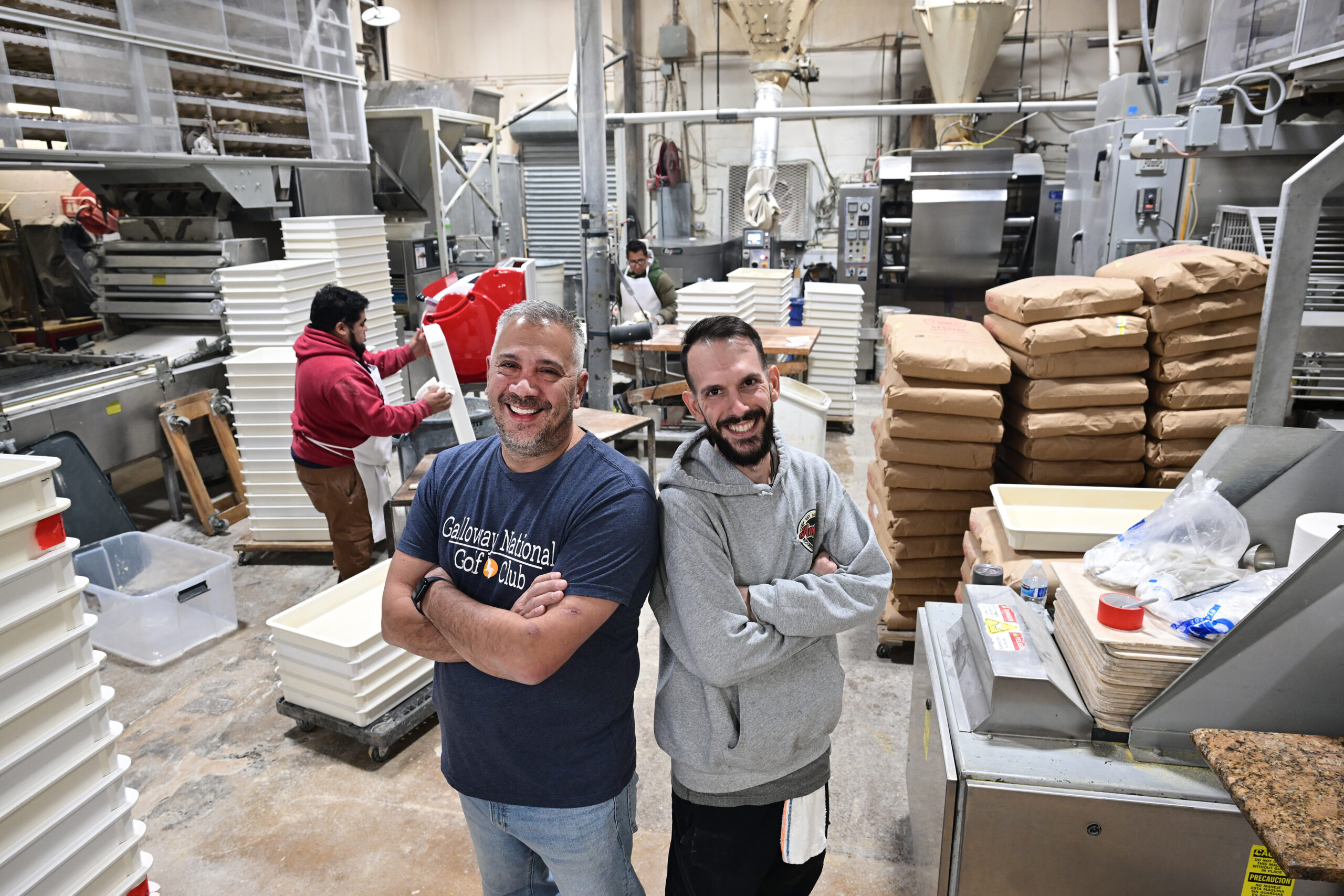
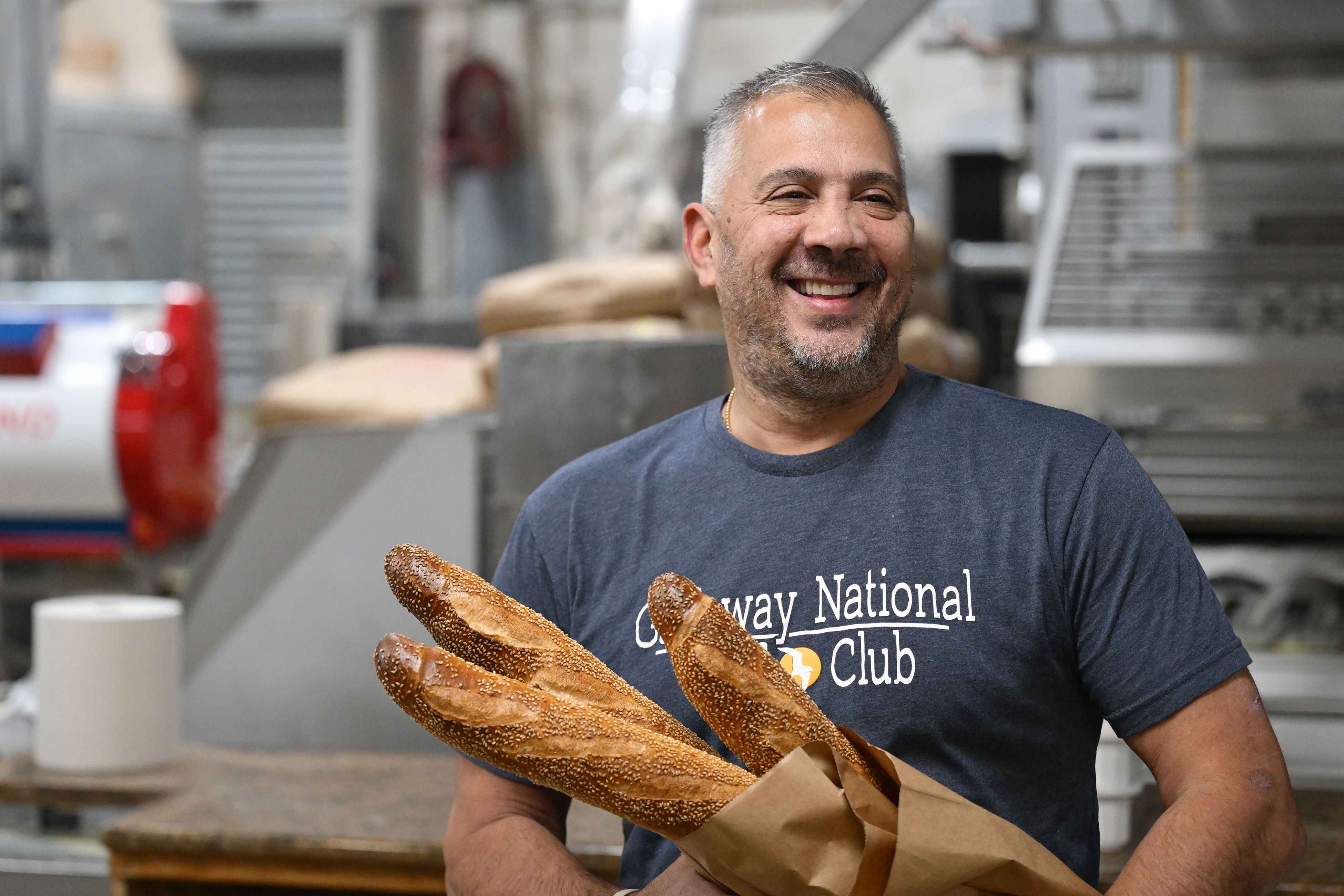
Danny DiGiampietro (left), owner of Angelo’s Pizzeria, with partner Jared Braunstein at the bakery in Conshohocken in December 2024.
But Angelo’s is moving into wholesale bread production, the backbone of Conshohocken Italian Bakery’s business under the Gambone family for more than a half-century before its 2024 closing.
A key piece of the puzzle is on the way: a massive Polin oven imported from Italy to give his bakers more flexibility, DiGiampietro said.
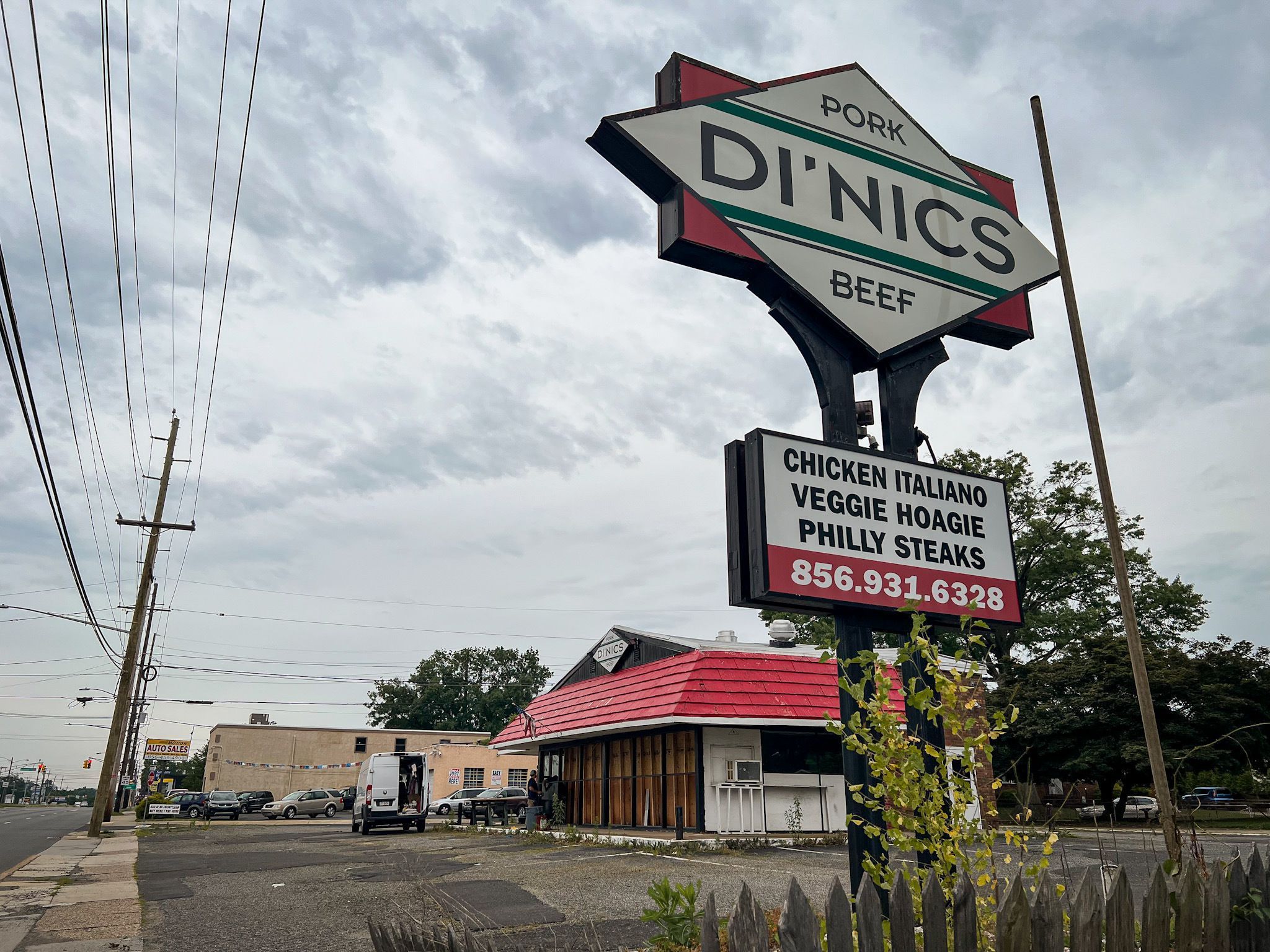
The future location of Angelo’s Pizzeria in West Collingswood Heights, previously Di’Nics, on June 18, 2026.
At “Conshy,” as the Jones Street bakery was known, the Gambone family supplied rolls and bread to hundreds of restaurants and sandwich shops throughout the region. Its closing created a frenzy among customers and competitors.
DiGiampietro said the new oven will allow bakers to create a line of kaiser rolls, potato rolls, steak rolls, and hoagie rolls. Although he will in effect be selling to his sandwich shop competitors, he likens it to giving shops “the canvas to make their art,” DiGiampietro said. “Everyone’s different.”
A return to wholesaling was not in the initial plans for DiGiampietro, who owned a bread bakery in South Philadelphia about 20 years ago. “I went bankrupt the first time. So hopefully I don’t go bankrupt again.”
Meanwhile, demolition and rebuilding are underway at the future Angelo’s Pizzeria location at 310 Black Horse Pike in the West Collingswood Heights neighborhood of Haddon Township, Camden County. The stand-alone building was formerly Di’Nics.
Crews recently gutted the building, which DiGiampietro hopes to transform into a full-service Angelo’s within the next several months.
The project will mark his return to New Jersey. DiGiampietro opened his first Angelo’s in Haddonfield in 2013 before closing it in 2018 to focus on the Ninth Street location in South Philadelphia, which opened in 2019 and helped turn Angelo’s into one of the region’s most sought-after pizzeria and cheesesteak shops.
The Angelo’s in West Collingswood Heights, about 10 minutes from the Walt Whitman Bridge, will include table seating as well as a counter overlooking the kitchen. Initially, DiGiampietro wanted more seating. Then he began talking about a takeout-only operation.
“But people love the show,” he said. “They like to see everything happening.”
The build-out still requires installation of a pizza oven, walk-in refrigeration, and other equipment. Even so, DiGiampietro believes the compact space can work.
“We think we can keep a dining room and still fit everything we need in there,” he said. “It’ll be tight, but we work on Ninth Street in basically a submarine, so how much tighter can it get?”
For the first time ever, Philadelphia has a Michelin star. Three, in fact.
Friday Saturday Sunday, Her Place Supper Club, and Provenance were each awarded a star, capping a brilliant showing as 31 other Philadelphia restaurants — including three cheesesteak shops — received honors in the city’s debut in Michelin, arguably the world’s most prestigious restaurant awards.
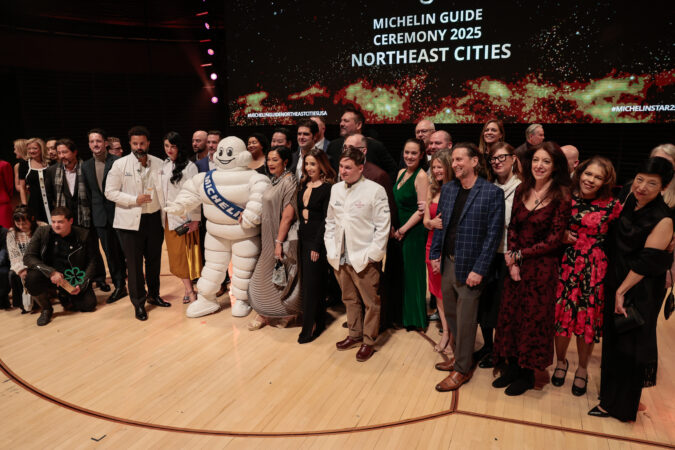
Tuesday night’s Northeast Cities ceremony — which included restaurants from Chicago, Washington, D.C., New York, and Boston (also in its Michelin debut) — drew hundreds of culinary professionals from around the world to the Kimmel Center, whose facade was lit up in Michelin’s signature red. The attendees were a who’s who of the culinary world, including chefs Thomas Keller and Jean-Georges Vongerichten, and drew dozens of the city’s best-known chefs and restaurateurs, such as Greg Vernick, Marc Vetri, Omar Tate, and Chutatip “Nok” Suntaranon, Jesse Ito, and Ellen Yin.
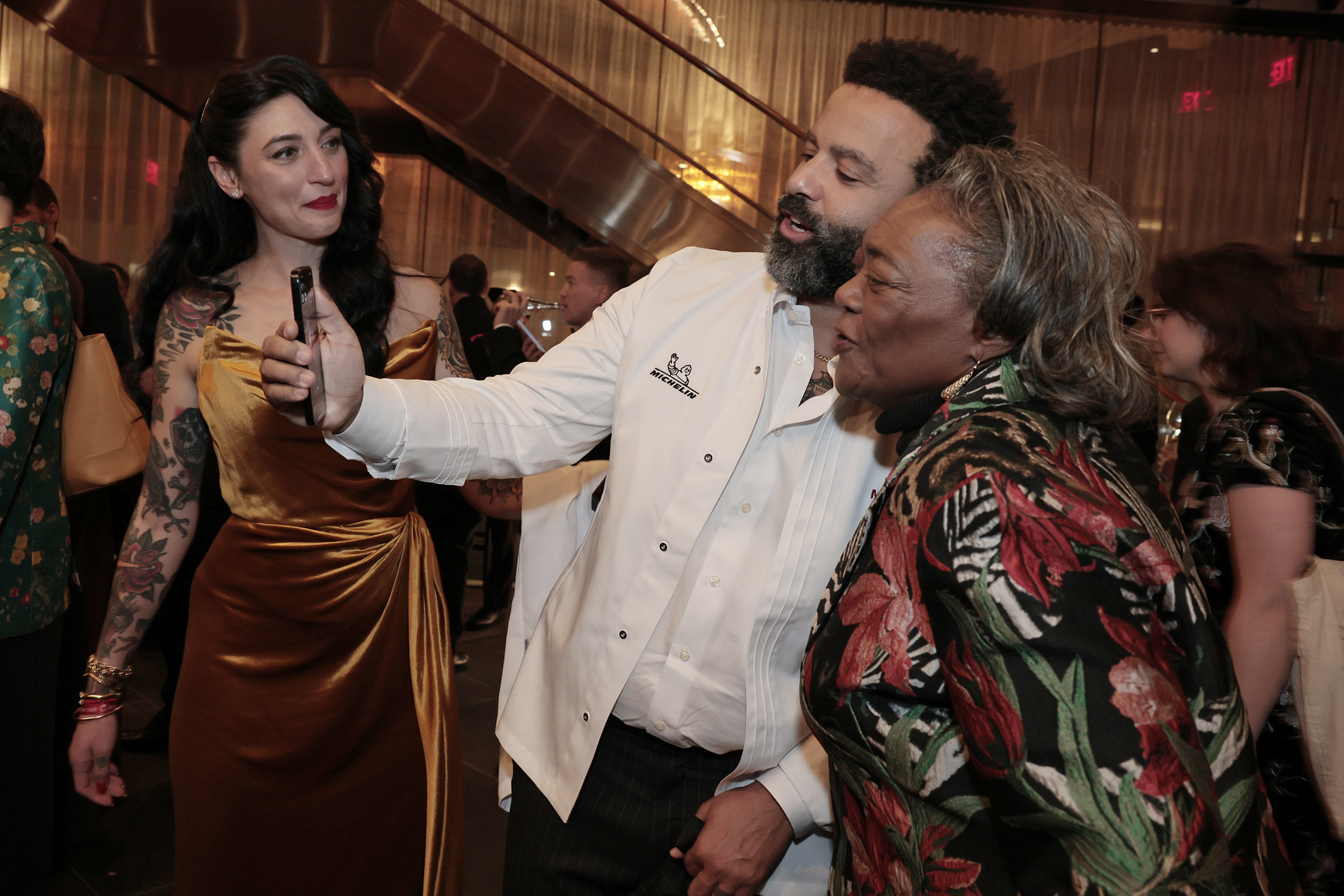
Hanna Williams looks on as her husband, chef Chad Williams, and Lynette Brown-Sow do a FaceTime after the Michelin awards at the Kimmel Center. Brown-Sow has known Chad Williams since he was a baby.
Ten Philadelphia restaurants received a Bib Gourmand — recognized as great food at a great value, though not star-worthy. They represent a mixed bag of cuisines and price points: cheesesteaks (Angelo’s, Dalessandro’s, Del Rossi’s), Israeli cuisine (Dizengoff), Mexican (El Chingón), pizza (Pizzeria Beddia, Sally), casual pasta (Fiorella), Japanese (Royal Sushi & Izakaya), and classic Jewish deli (Famous 4th Street Deli).
Michelin deemed 21 other Philadelphia restaurants as Recommended: Ambra, Forsythia, High Street, Hiroki, Honeysuckle, Illata, Kalaya, Laser Wolf, Laurel (whose final night will be Nov. 21), Little Water, Mish Mish, My Loup, Pietramala, River Twice, Roxanne, Southwark, Suraya, Vedge, Vernick Food & Drink, Vetri Cucina, and Zahav. Michelin says these restaurants serve high-quality food and use good ingredients.
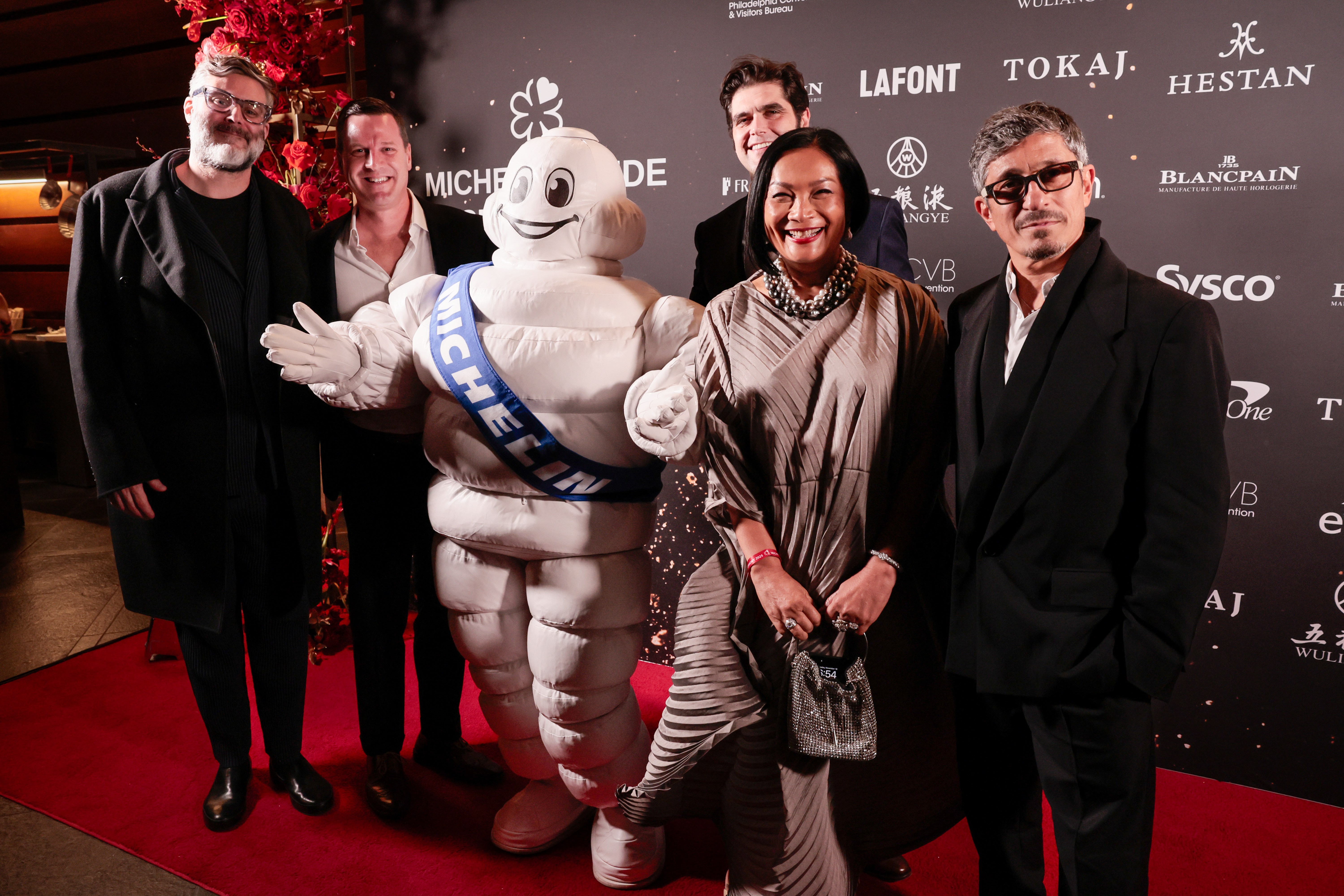
Joe Beddia (from left), Greg Root, Nick Kennedy (rear), Chutatip “Nok” Suntaranon, and Roland Kassis with the Michelin Man at the Michelin Guide announcements Tuesday at the. Kimmel Center.
Besides the Recommended honor, Pietramala — chef Ian Graye’s vegan restaurant in Northern Liberties — was awarded a Green Star for demonstrating commitment to sustainability.
All can use the name “Michelin” in their marketing, a powerful tool that potentially boosts business.
Michelin, which operates in secrecy, bases the selections on its anonymous inspectors. Stars denote excellence: one star signals very good cuisine that’s “worth a stop,” two stars indicate excellence “worth a detour,” and three stars represent exceptional dining “worth a special journey.”
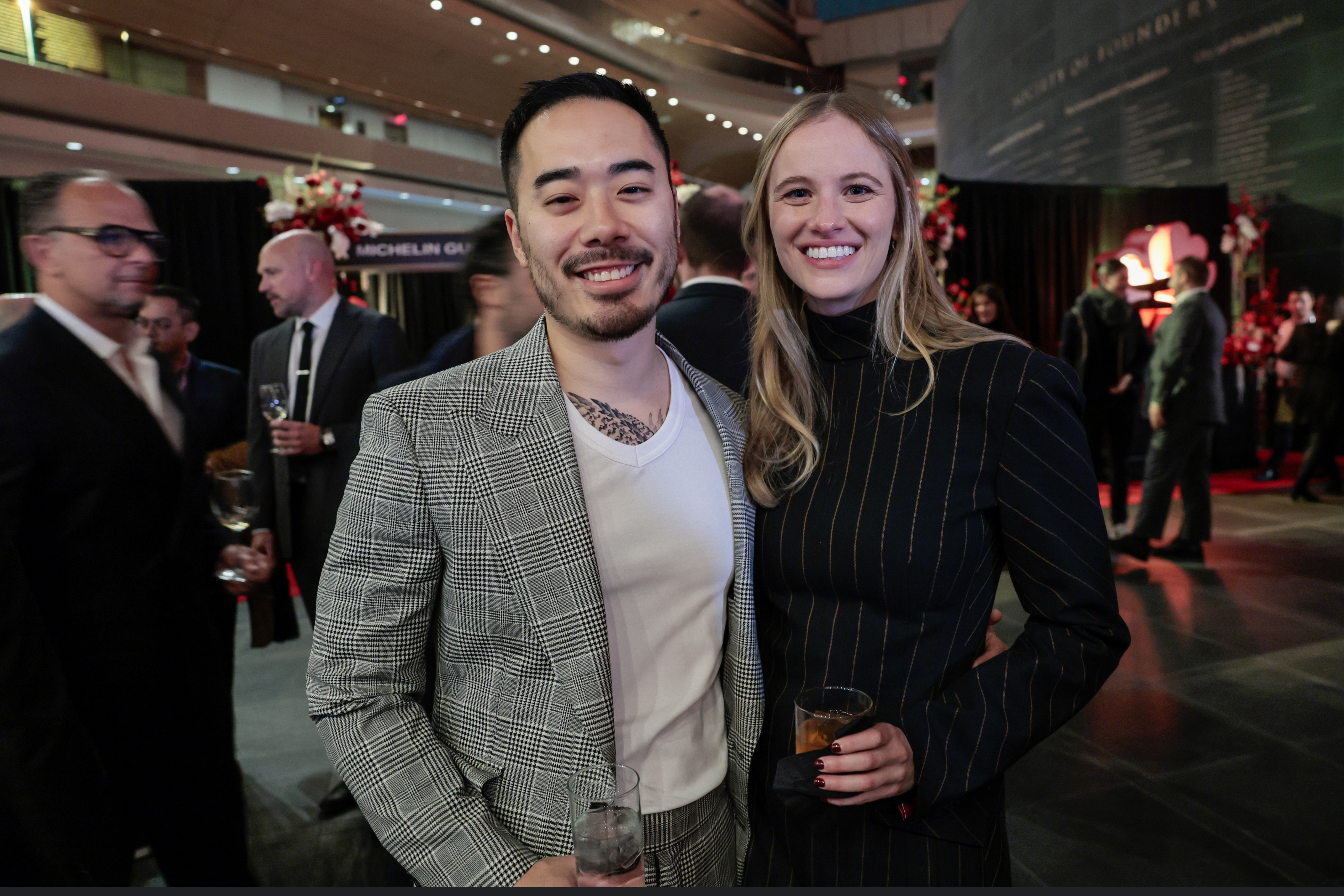
Chef Jesse Ito and Mia Colona at the Michelin Guide announcements Tuesdy at the Kimmel Center.
The ceremony, a milestone for Philadelphia’s profile as a dining destination, was the city’s highest-profile appearance since 2018, when the James Beard Foundation announced that year’s finalists for its annual chef, restaurant, and media awards in a ceremony at Parc.
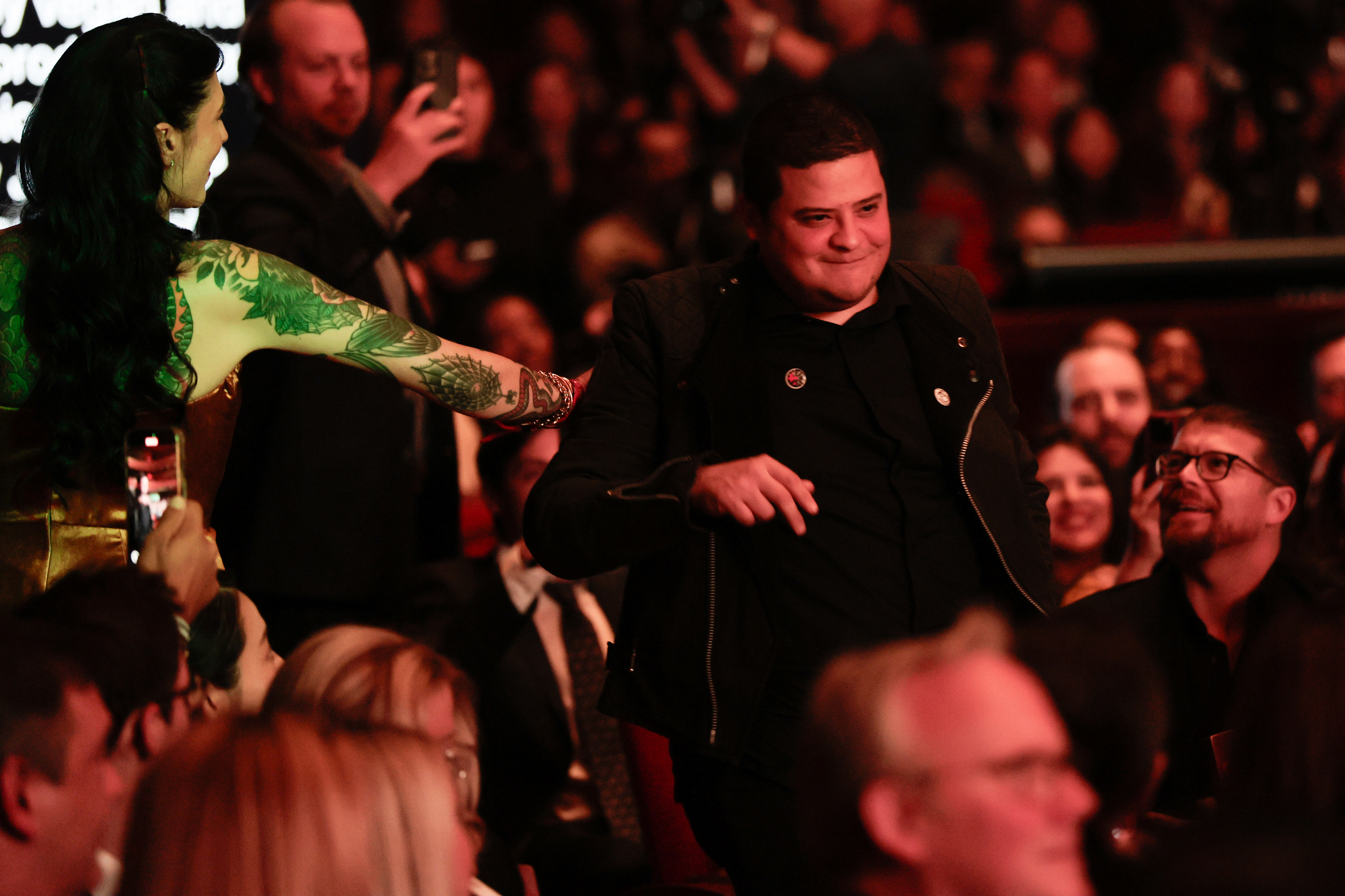
It was a night of camaraderie, pride, and emotion. After heading to the stage to acknowledge Angelo’s Pizzeria’s Bib Gourmand, owner Danny DiGiampietro disappeared for a bit. “I had a walk outside,” he explained later. “I can’t stop crying.”
Philadelphia’s one-stars
Friday Saturday Sunday chef Chad Williams and his wife, Hanna, took over this storied Rittenhouse restaurant in 2016 and pivoted to a set multicourse menu. “Thanks to skilled technique, just the right amount of innovation and an innate understanding of the luxury ingredients he uses, his dishes fill the mouth with flavor and succulence,” the Michelin blurb reads. “His delicious crispy sweetbreads will convert any skeptic; quail with pâte plays with texture, and the New York strip is a lesson in expert seasoning. There’s a great cocktail bar on the first floor; the long, narrow, lively and warmly run restaurant is up a steep flight of stairs — and those stairs will seem even steeper when it’s time to leave. Expect an atmosphere as spirited and enjoyable as the food.”
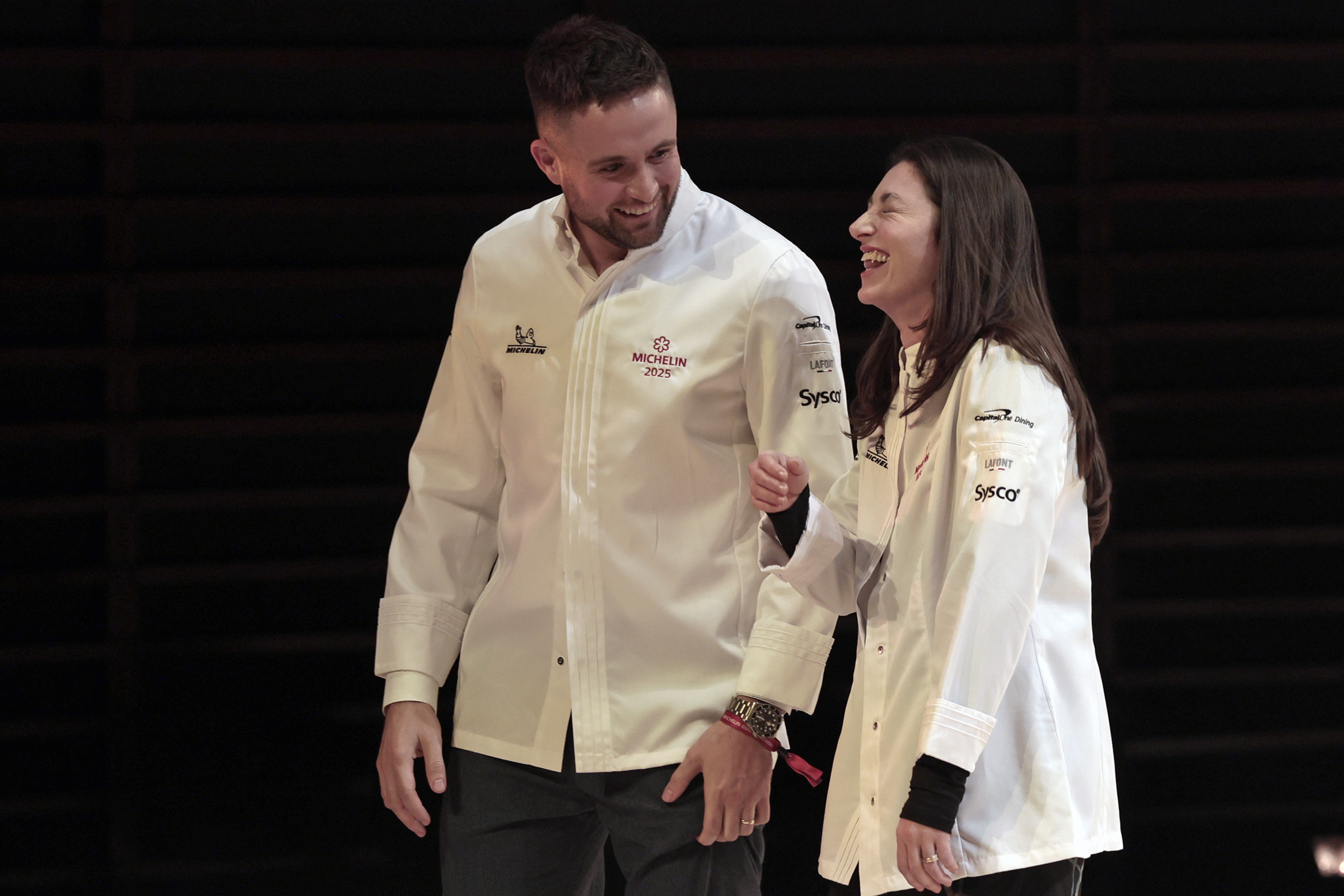
Amanda Shulman (right) and her husband and business partner, Alex Kemp, giggle after winning a Michelin star for Her Place Supper Club at the Michelin ceremony at the Kimmel Center on Tuesday.
Her Place Supper Club, also in Rittenhouse, was born out of chef Amanda Shulman’s cooking for friends in her Penn campus apartment. Michelin praised its “warm and welcoming supper club vibe.” While diners may get their own table, “there’s a real communal feel at play here; everyone is served at the same time after Amanda has explained to the room the makeup of each dish and perhaps the influence behind it.”
Provenance, chef Nicholas Bazik’s sumptuous atelier across from Headhouse Square, delivers what Michelin calls “a high-wire, high-stakes performance defined by precision, harmony, and, of course, taste. Korean and French influences come and go with this elaborate tasting menu where special soys, vibrant oils and glossy sauces give wonderful dimension to pristine seafood and dry-aged proteins. Think Japanese tuna with whipped tofu, puffed sorghum and chili oil or brown butter hollandaise with country ham, caviar and cauliflower. The ideas are original, the flavors bold.”
The Michelin effect
All this boils down to commerce. City and state tourism boards have increasingly turned to Michelin — the French-based tire company that has been publishing the influential dining guides for decades — as food tourism plays a growing role in travel planning.
Ian Graye of Pietramala accepts a Green Star award at Tuesday’s Michelin Guide announcement event at the Kimmel Center.
Michelin has expanded rapidly in the United States over the last several years. Besides the American South region — covering Alabama, Louisiana, Mississippi, North Carolina, South Carolina, and Tennessee — there are guides for Texas and Colorado. Atlanta’s 2023 guide has since been rolled into the South. The Florida guide, launched in 2022, now includes Miami, Orlando, and Tampa. Internationally, it recently arrived in Qatar, New Zealand, and the Philippines.
(function() {
var l2 = function() {
new pym.Parent(‘michelin_philly’,
‘https://media.inquirer.com/storage/inquirer/projects/innovation/arcgis_iframe/michelin_philly.html’);
};
if (typeof(pym) === ‘undefined’) {
var h = document.getElementsByTagName(‘head’)[0],
s = document.createElement(‘script’);
s.type = ‘text/javascript’;
s.src = ‘https://pym.nprapps.org/pym.v1.min.js’;
s.onload = l2;
h.appendChild(s);
} else {
l2();
}
})();
The Philadelphia Convention and Visitors Bureau cites an Ernst & Young study, commissioned by Michelin, showing the guide’s influence: 74% of travelers consider Michelin’s presence a decisive factor when choosing a destination; 76% say they would extend a trip to dine at a recommended restaurant; and 80% report being willing to pay more for what they view as a Michelin-level dining experience.
For restaurants that receive distinctions, the impact is immediate as restaurants append “Michelin” to their social-media profiles.
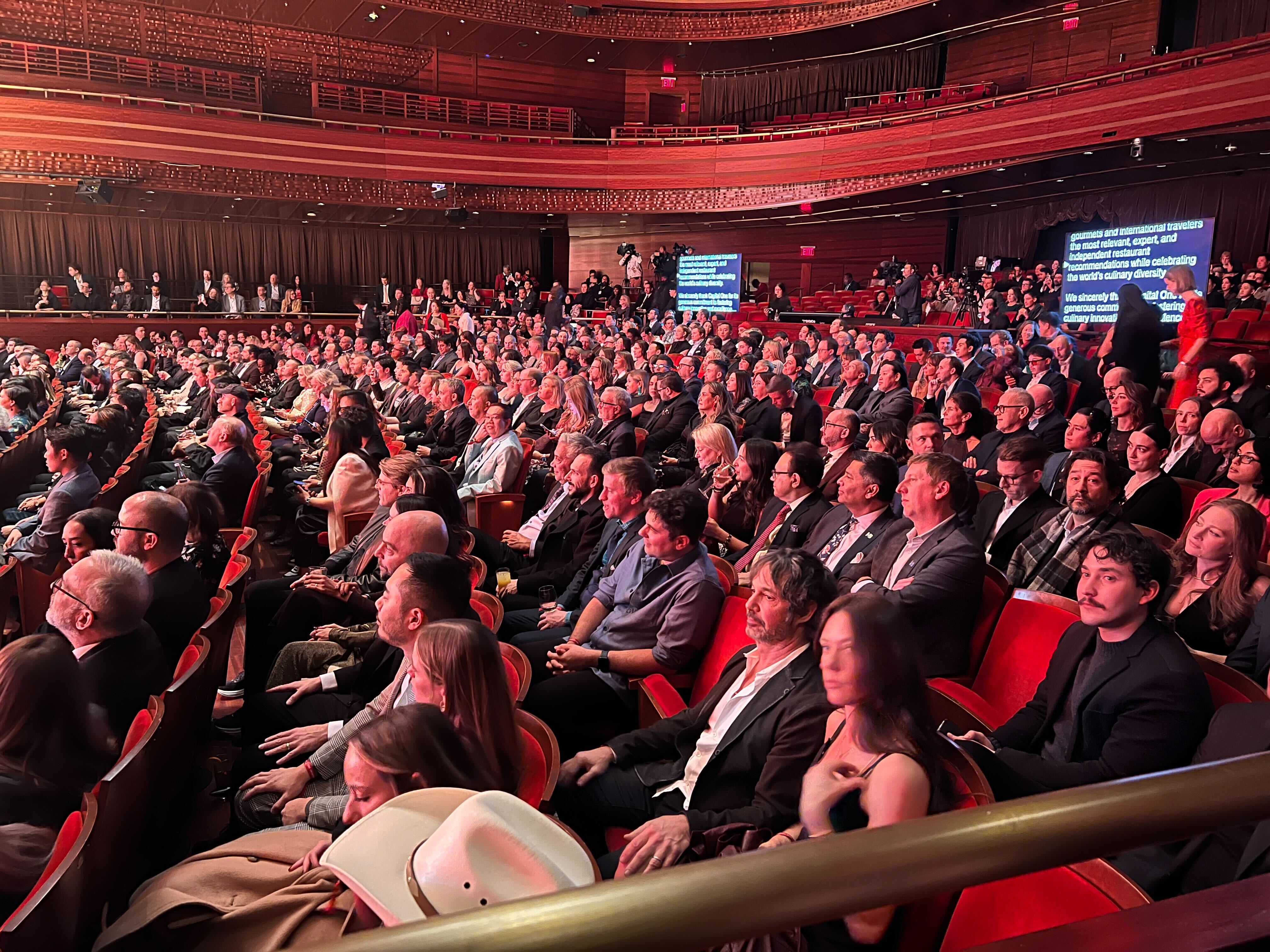
The energetic and anxious crowd of chefs and restauranteurs during the Michelin ceremony at the Kimmel Center Tuesday, Nov. 18, 2025.
The reservations boost can be dramatic. In Charlotte, the 18-seat Counter sold about 900 reservations in the days after earning a star at the 2025 American South ceremony on Nov. 3, booking out through mid-February, chef-owner Sam Hart told Axios. About half the reservations came from out-of-town guests, including some international travelers.
In many U.S. markets, the guide is explicitly part of tourism strategies: Axios has reported that the states included in the South edition are collectively paying Michelin $5 million over three years. PHLCVB has not disclosed how much it paid for Michelin’s partnership, which was announced in May.
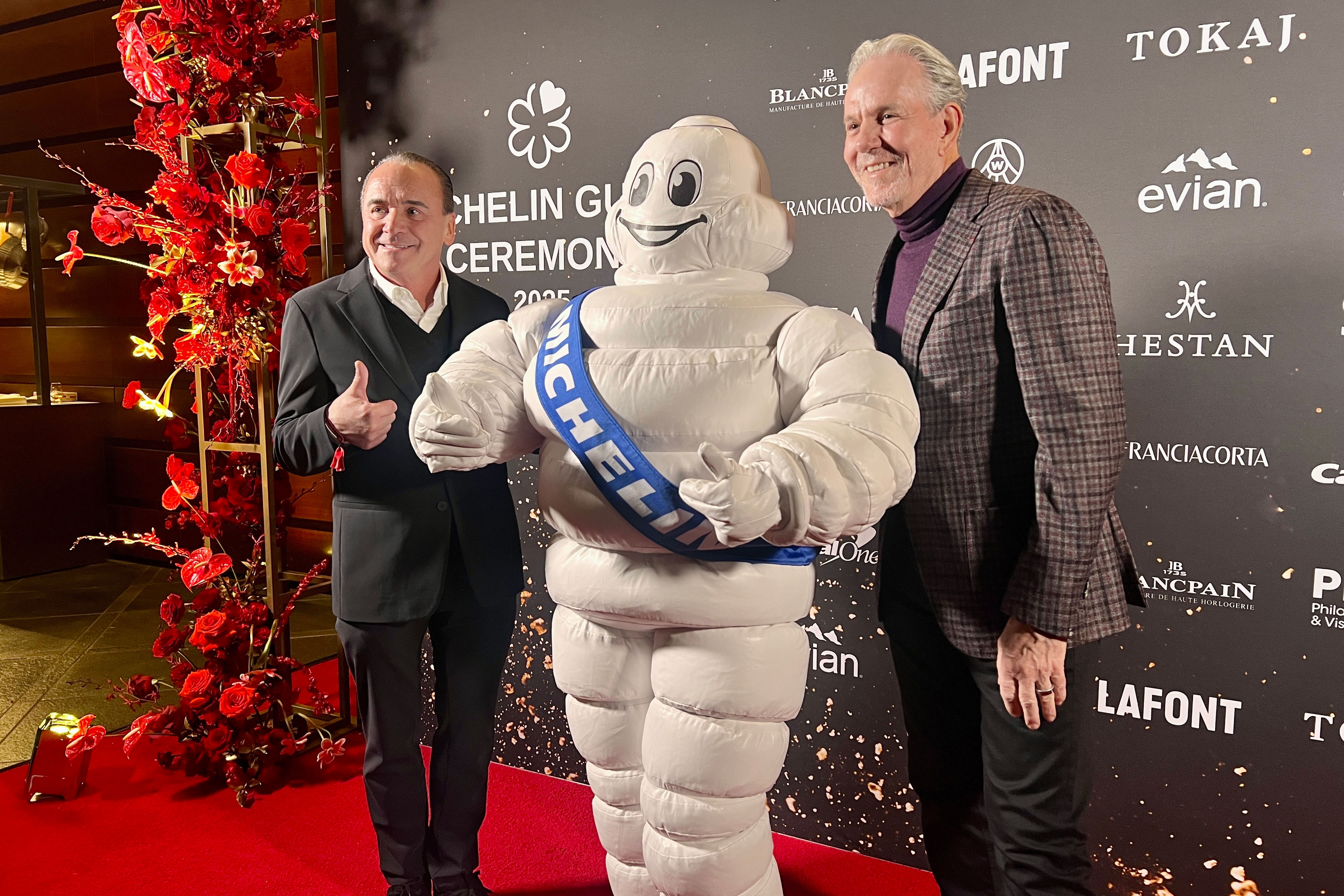
Chefs Jean Georges Vongerichten (left) and Thomas Keller posed with the Michelin Man ahead of Tuesday night’s ceremony at the Kimmel Center.
Not only can reservations rise, so can menu prices at the winning restaurants. A widely cited 2018 analysis by Carly Shin of George Washington University found that a one-star rating increases menu prices by about 15%, two stars by 55%, and three stars by roughly 80%.
Michelin says that 82% of chefs report increased revenue after receiving a distinction, 60% add new staff, and 58% say a nod boosts team motivation and morale — though anecdotally, some chefs acknowledge enormous pressure to maintain such a high level.
Michelin’s arrival has inspired the PHLCVB Foundation to sponsor the Philabundance Community Kitchen program, a 16-week culinary vocational training and life-skills program for adults with low or no income, offering hands-on kitchen experience, ServSafe certification, and post-graduation employment support in the food service and restaurant industry. The foundation will connect the recognized chefs and restaurateurs to the PCK program.
When Angelo’s Pizzeria opened in South Philly six years ago, it didn’t just elevate the city’s cheesesteak standards — it reshaped them in its own image. Gone were the stale rolls, shredded meat, and molten flows of watery Whiz.
Under the purview of owner Danny DiGiampietro, Angelo’s introduced crusty, house-baked rolls. DiGiampietro grilled seasoned rib eye right up to the chewy line without crossing it, merging Cooper Sharp and beef at the optimum melting point. A new school of cheesesteak emerged.
Since 2019, reviews from the likes of Barstool’s Dave Portnoy and Somebody Feed Phil’s Phil Rosenthal have spread word of the shop’s high-quality operation nationwide, abetted by hype from actor Bradley Cooper and a bevy of media outlets (this one included). Its renown has prompted wave after wave of customers to show up to the corner of Ninth and Fitzwater five days a week. The line there has become a raucous scene, with cheesesteak hunters happy to wait more than an hour just to place an order and wait another 20- or 40-plus minutes for the food.
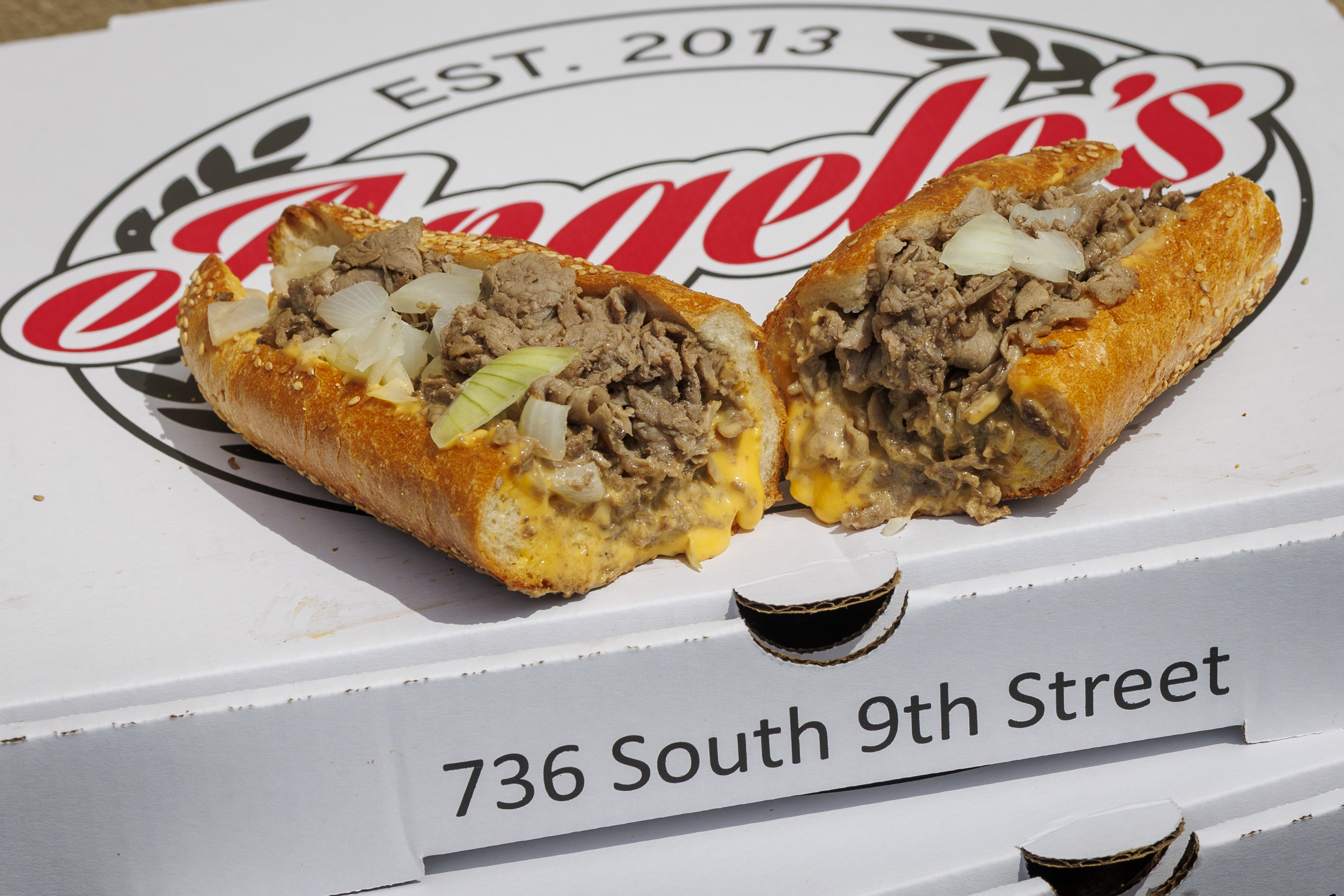
Whiz steak from Angelo’s Pizzeria at 736 S. Ninth St.,
But DiGiampietro, a known perfectionist, can’t be everywhere at once.
A visit to the Terminal-based Uncle Gus’ spinoff (a partnership with Joe Nicolosi of DiNic’s Roast Pork and Dave Braunstein of Pearl’s Oyster Bar) provided an uneven experience this past spring, when I sampled a disappointing set of sandwiches. I expected a long-rolled reminder of life’s redeeming qualities, and instead got … something else. While the rolls were expertly baked, they were both filled with a wad of dry beef strings glued together with gobs of stubborn fat.
It got me wondering if Angelo’s had grown too fast, too soon, and too far to maintain the standard of cheesesteak excellence that they set for the rest of the city.
Has demand decreased Angelo’s quality?
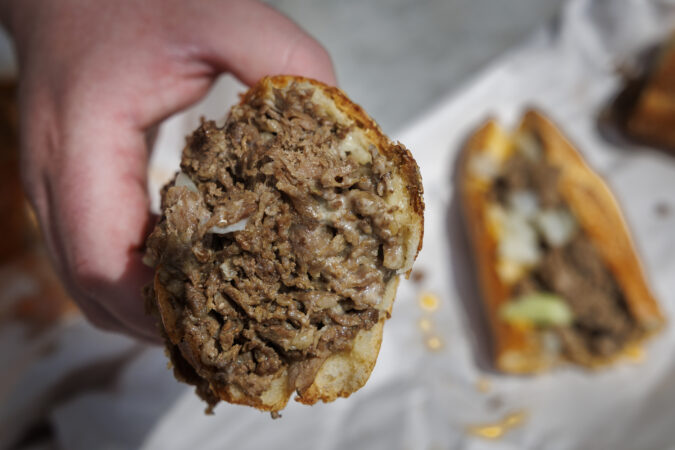
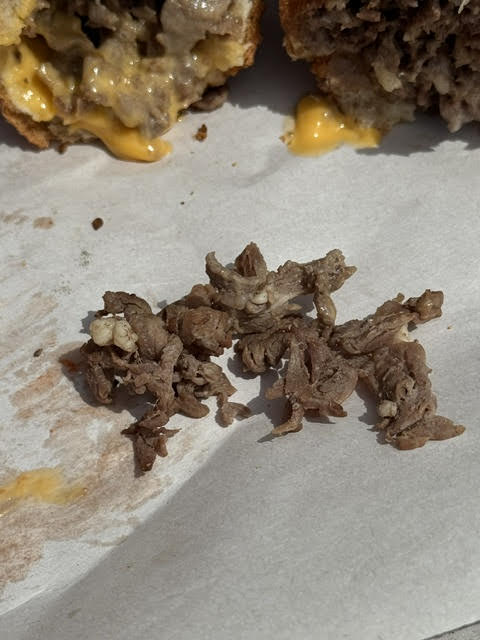
On an April trip to Angelo’s Ninth Street location,I had a similarly subpar encounter. The rib eye in the cheesesteak was haphazardly chopped and extremely dry. There was more salt in the Whiz than on the meat. The signature crusty bread — usually up to handling the mound of toppings — was coming apart under the weight of the poorly cooked beef.
I ordered multiple sandwiches, with various cheeses and sauce combinations, and the best bite I had on that visit was the pizza steak, with the blend of meat, sauce, and cheese melding into what can only be described as a cheesesteak-meatball sub hybrid. The sauce smoothed over the dryness of the meat and balanced it out with a thick twist of mozzarella.
Beef from an Angelo’s cheesesteak.
I went back to try again in May. Maybe it was just an off day? But I was still disappointed. The major issue this time was the house-baked roll. Famed for its crustiness, which everyone is copying, this bread was uncharacteristically underbaked. It got soggy — fast. It buckled under the weight of overstuffed meat, which was once againon the drier side. (The Cooper Sharp, however, was perfectly melted into the meat this time.)
When I told DiGiampietro about these experiences recently, he said, “It breaks my heart.”
DiGiampietro’s original shop, which he opened in Haddonfield in 2013, won regional recognition, but its cult following didn’t hold a spatula to the national rep Angelo’s claims today. Before moving to the Ninth Street location in 2019, he said, he “never, in my wildest dreams, expected any of this.”
“Have some things gotten through the cracks here and there? They sure have,” he said. “And they drive me crazy at night.”
What makes a good cheesesteak?
According to the Philly-based “fatty foods biographer” Carolyn Wyman, who authored The Great Philly Cheesesteak Book in 2009, an exceptional steak relies on four core principles: a bakery-fresh roll, gooey cheese that doesn’t overwhelm the taste or soak the sandwich into submission, onions that aren’t caramelized into oblivion, and beef that actually tastes like beef and not just a pile of gristle.
It has to be more than a working-class sandwich. It has to be a symphony. It should coalesce into one glorious flavor, with each component equally balanced. One component should not be used to balance out weakness in another.
I figure the Angelo’s problem results from the pressures of serving a daily deluge of customers.
When I worked at a cheesesteak shop in college, the major pain points came with getting the meat off the grill. DiGiampietro knows well the perils of the flat-top.
“My biggest pet peeve is too much meat on the grill,” he conceded, “because now you’re not frying. You’re steaming it. And it’s a completely different steak.”
He tells his staff all the time: “People are going to wait. Make it worth their f’ing wait,” he said.
And let’s be fair to the cooks: That line can be intimidating.
“A lot of times my guys get too nervous,” he said, “and they see those tickets coming in, and they want to try and load up the grill, but there’s only so much we can do and how fast we can do it the right way.”
Too much, too fast
I have a ton of respect for DiGiampietro, for everything he’s built and for his dedication to his craft. He’s onlyhuman.
“It’s daunting,” he said. “I see a therapist, believe it or not. Just the pressure of the expectations can sometimes be very overwhelming.”
Danny DiGiampietro, owner of Angelo’s Pizzeria, at Angelo’s Baking Co. in Conshohocken.
“I thought we’d be serving sandwiches and pizza to the neighborhood,” he said. “I did not see this.”
The Uber expansion in particular was a little harder than he anticipated, he said. “It’s been a challenge,” he said. “I am getting it under control.”
But if someone has a bad experience, he said he’ll own up to it and offer ways to make it right.
“We’re trying our best,” he said. “We’re not Michelin stars here. It’s pizza, cheesesteaks, and making bread. But we do it the best we can and as honestly as we can.”
I stopped by Angelo’s yesterday to see how things were going.
I picked up a few sandwiches, and there was a lot of good: The steaks weren’t overstuffed, and the rolls were ideally crusty on the outside and buttery soft on the inside. But the beef between the two sandwiches varied in how well it was cooked, and the ratio of cheese to meat was inconsistent.
The longer I ate one with Whiz the worse it became; the meat was a touch too tough. On the other hand, the cheesesteak with Cooper Sharp increasingly won me over with every bite — it lived up to the hype, and it’s exactly what people are waiting for. It was the epitome of the new-school cheesesteak Angelo’s made famous.
So it wasn’t a redemptive visit, per se, but it does show that Angelo’s has plenty of fight left in its grill. They’re still dedicated to getting it right. It’s just a matter of execution.
This last visit helped solidify my belief that DiGiampietro will get things back on track. He set his own standard, and Angelo’s made steaks in Philly better. A few missteps won’t change that.
Bells and birds help tell the city’s story, but it’s a sandwich that helps explain Philadelphians. How we evolved from farmers in the cradle of liberty to DoorDashers in a melting pot of orange whiz is informed and defined by the cheesesteak. Raising the Steaks is a weeklyish chronicle of this long-rolled reminder of life’s redeeming qualities.