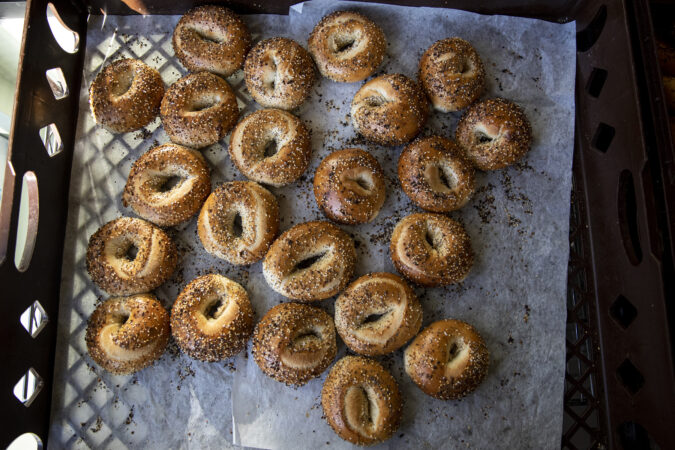
The New York-style bagel shop, which currently has locations in West and South Philadelphia, is bringing its fresh bagels, smoked meats, egg sandwiches, and unique schmears to 273 Montgomery Ave.
The Main Line outpost is expected to open this summer.
While the new storefront marks a major expansion for the local bagel shop, it’s also a homecoming for cofounders and brothers Brett and Kyle Frankel, who grew up in Bala Cynwyd.
“We know the area very, very well,” Brett Frankel said.
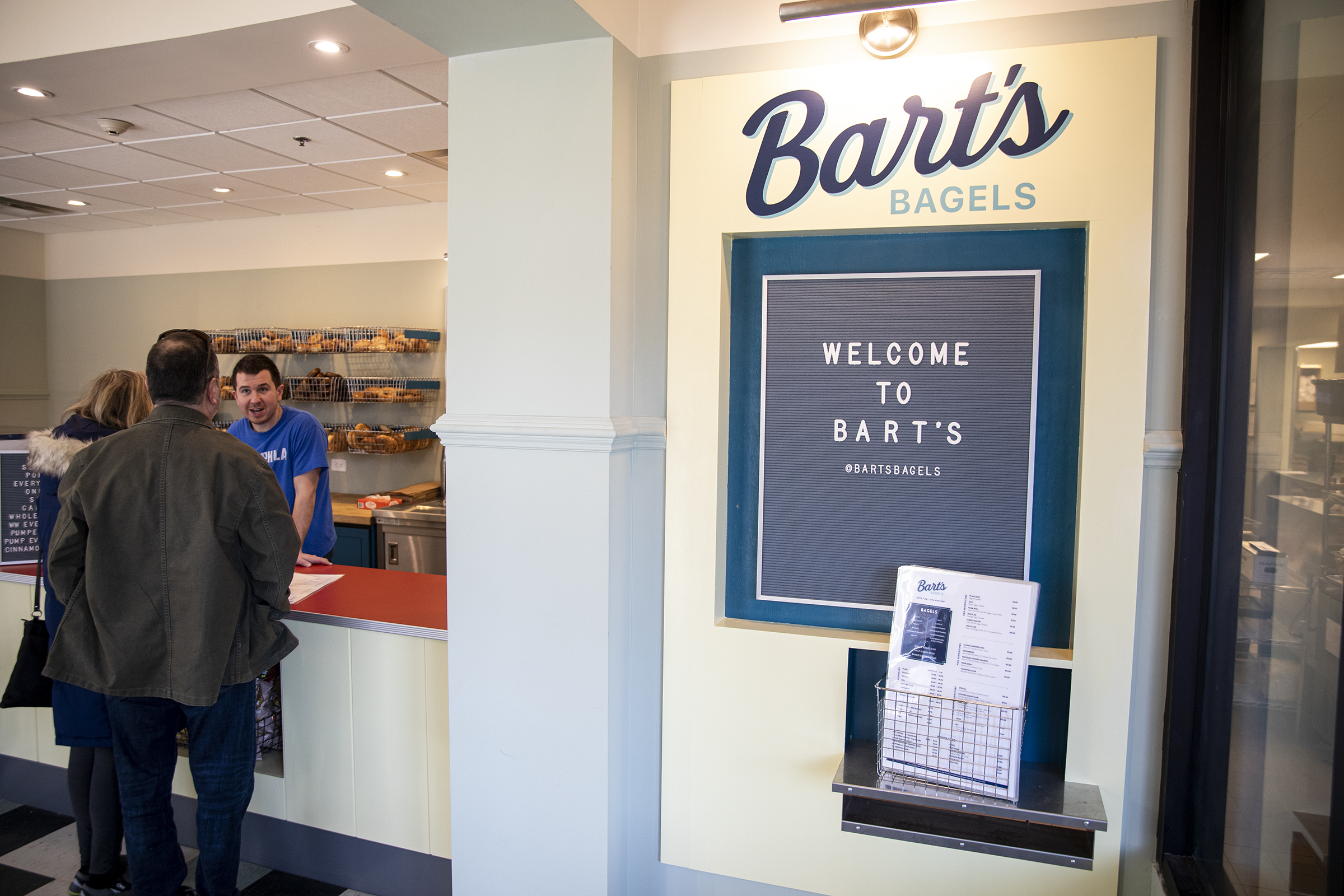
Brett Frankel, co-owner of Bart’s Bagels, helps customers at Bart’s Bagels on Wednesday, Jan. 22, 2020. Bart’s is expanding to Bala Cynwyd later this year.
Brett, 34, and Kyle, 41, both Lower Merion High School graduates, grew up a five-minute walk from their newest location. Brett Frankel says he remembers hanging out at the soon-to-be Bart’s Bagels storefront after middle school, back in the days when it was Bravo Pizza.
Main Line patrons will be able to expect all of the same kettle-boiled bagels and fixins’ that Bart’s is known for, from pumpernickel bagels to pastrami smoked salmon and beet-horseradish cream cheese.
While Bart’s city-based locations are grab-and-go only, there will be a few seats in the new Bala Cynwyd shop.
The unique part of Bart’s, Brett Frankel said, is that patrons can see bagels being made in front of them through the open kitchen.
“You’re kind of immersed in it,” he said.
The Frankels say their love for good bagels was forged through regular trips to New York’s Upper West Side to eat at the famed Zabar’s and H&H Bagels.
Looking to get their fix closer to home, Brett Frankel taught himself how to make bagels while working as a business analyst for a software company. He traveled to Denver, New Jersey, and Detroit to learn the ins and outs of the bagel industry.
Bart’s started as a wholesale operation in late 2019, selling to Di Bruno Bros., Middle Child, Elixr Coffee, White Dog Cafe, and other local restaurants. The Frankels brought chef Ron Silverberg on board, and they opened the first Bart’s in West Philly in January 2020. Their South Philly location opened in July 2024.
Bart’s is not the only new bagel place coming to Lower Merion this year.
This suburban content is produced with support from the Leslie Miller and Richard Worley Foundation and The Lenfest Institute for Journalism. Editorial content is created independently of the project donors. Gifts to support The Inquirer’s high-impact journalism can be made at inquirer.com/donate. A list of Lenfest Institute donors can be found at lenfestinstitute.org/supporters.
The University of Pennsylvania, German biotech firm BioNTech, and Osage University Partners, a Bala Cynwyd venture capital firm, have formed a $50 million fund to back early-stage life sciences startups at Penn, the partners announced Friday.
The announcement came on the eve of the much-hyped annual J.P. Morgan Healthcare Conference in San Francisco, which starts Monday. The conference has become a way to measure the mood of the biotech sector, which has slumped after investment peaked in 2021. It’s been particularly difficult for early-stage biotech companies to raise money in recent years, according to a recent J.P. Morgan report.
For Penn scientists and company founders, the so-called Penn-BioNTech Innovative Therapeutics Seed Fund, or PxB Fund for short, will step into that gap. It is designed to invest in companies that are developing new therapeutics, diagnostics, and research tools.
The announcement did not include a breakdown of how much money each of the three backers provided. Osage University Partners, which has $800 million under management and had previously invested in at least 10 Penn spinouts, will run the fund.
“Penn has a remarkable track record of creating cutting-edge startups,” Marc Singer, an Osage managing partner, said in a statement.
Penn was among the first six universities Osage partnered with 15 years ago when it started investing in spinouts from research universities, while allowing the institutions to share in some of the profits. This was at a time when few universities were investing in their own startups.
Penn’s evolution as an investor in its own startups
For Penn, that began changing about a decade ago. The university’s first investment in one of its own faculty-member spinouts came in 2016, when it invested $5 million in Carl June’s Tmunity Therapeutics. In 2018, Penn Medicine agreed to invest an additional $45 million in Penn biotech companies over three years in conjunction with outside funds.
In December, Penn announced a $10 million fund that will make seed investments of up to $250,000 in companies that have at least one founder affiliated with the University of Pennsylvania. That fund is for the entire university, not just life sciences.
PxB is another part of what John Swartley, Penn’s chief innovation officer, called in an interview Friday a “constellation of different support structures and funding sources that our companies can draw upon in order to advance their opportunities and agenda.”
Anna Turetsky, a biotech investor in New York who received her undergraduate degree at Penn and has a doctorate in biophysics from Harvard University, has joined Osage and will serve as PxB’s general partner.She said PxB is a 10-year fund and is expected to build a portfolio of around 15 companies in the early years.
“Part of why this is a fantastic time to start this fund is that there has been a gap in venture funding for early stage startups over the last few years. Everyone wants to see clinical data these days,“ Turetsky said. If that continues, ”then in a few years, there will be no early-stage clinical companies,” she said.
Germany’s BioNTech, which partnered with Pfizer on one of the COVID-19 vaccines that used mRNA technology developed at Penn, will use the fund to deepen its longstanding ties to Penn researchers.
Philadelphia’s place in biotech
Some observers of Philadelphia’s biotech sector have lamented the relative lack of local investors, which are abundant in places like Boston and San Francisco and have helped turn those metro areas into leading innovation centers.
Quaker BioVentures was a local investment fund that raised $700 million in the early 2000s to buy into biotech firms in Philadelphia and elsewhere, but was not successful for its investors, which included Pennsylvania state pension funds.
Others, when asked why the Philadelphia region trails Boston, San Francisco, and San Diego, as a biotech hub, point to the need for a deeper pool of management talent.
“Part of our hope with the fund is to create some companies, start from scratch, take technology, find management teams, start them in Philadelphia. Hopefully, that will create a new crop of managers,” he said.
Nicole Michalik spends her afternoons talking directly to Philadelphians as they make their way home. As a host on 92.5 XTU, the city’s country music station, she’s on air from 2 to 7 p.m., juggling live breaks, listener calls, and interviews with artists like Luke Combs and Parker McCollum. Radio, she insists, is still relevant, “sexy” even. “I’m live, I’m local, I’m talking about stuff that’s going on in Philly,” Michalik said. What more could you want?
Michalik lives in Midtown Village, but her days stretch across the city, including a trek to Bala Cynwyd, where the radio station is located. She loves her job. In fact, she loves it so much that her perfect Philly day includes a trip to the office. Here’s what else it includes.
This interview has been lightly edited for clarity.
7:30 a.m.
I usually wake up somewhere between 7 and 7:30. First thing I do is check socials and email, then I make coffee at home. I need it piping hot. I use a Keurig — no judgment — with organic half-and-half.
I take it back to bed and do my Instagram bit, “Coffee Under the Covers.” I started it during COVID and it just became a thing. I’ll take a sip and talk about whatever’s on my mind. People have sent me mugs. It’s wild.
After that, I record my Boston radio show from home. I’m on Country 102.5 up there, so I have a whole setup — computer, mic, everything. I want it to feel as local as possible, even though I’m not physically there.
10 a.m.
I force myself to work out. I walk to XForce to train with James, who keeps me accountable. I hate working out, but I don’t hate it there, so that’s a win for me.
When I cross Broad Street, I always take a photo of City Hall and post the temperature. It’s become a thing. One of my friends who lives in Portugal checks it every day. He calls me his Cecily Tynan.
11:30 a.m.
After the gym, I get my hair blown out at Dina Does Glam inside Sola Salons at 15th and Walnut. I go at least once a week. I love that Sola lets people in the beauty industry run their own little studios.
From there, I walk to Gran Caffè L’Aquila for an iced coffee. It’s the best iced coffee in the city. That’s nonnegotiable.
I try to head home after that, because if I don’t, I’ll get sucked into Sephora buying makeup I absolutely do not need.
1 p.m.
I get ready for work and drive to Bala Cynwyd. On the way, I stop at the Starbucks on City Avenue. I order an iced Americano with almond milk and a drizzle of caramel. They know me there.
I don’t even know if caffeine really affects me that much. I just love the ritual. I like sipping it throughout the show.
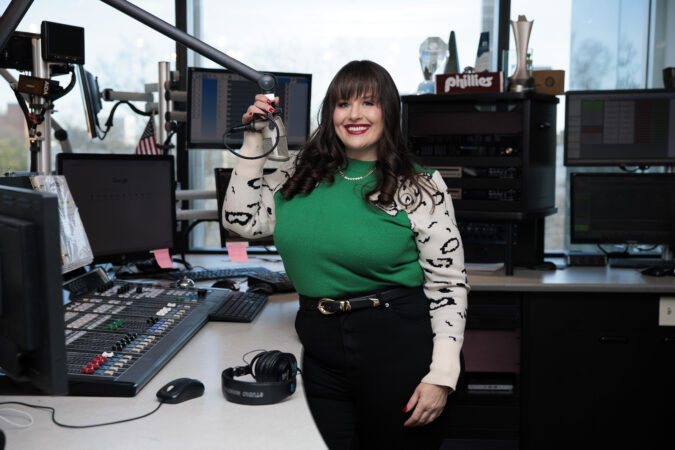
Nicole Michalik works at 925XTU on Monday, Dec. 1, 2025 in Philadelphia.
2 to 7 p.m.
I’m live on the air. On my perfect day, I’m doing a Zoom interview with Luke Combs, and he finally announces he’s coming back to Philly. We’ve been mad at him for skipping us for a few years, so this would be huge.
7:30 p.m.
After work, I meet friends at Lark in Bala Cynwyd. It’s right across from the station, and it’s one of my favorite places. I’m ordering the gnocco fritto — they’re like little puffy clouds with lemon ricotta — and the striped bass. Nick Elmi just knows what he’s doing.
9 p.m.
I’m heading to a Sixers game. In my perfect world, it’s the Eastern Conference finals, Joel Embiid has great knees, and we’re winning. I live in the city and love walking everywhere, but I also love that Philly is easy to drive around — as long as the PPA doesn’t get you.
11 p.m.
Once 11 p.m. hits — I’m like Cinderella — I’m ready for bed. I love going home to put my pajamas on.
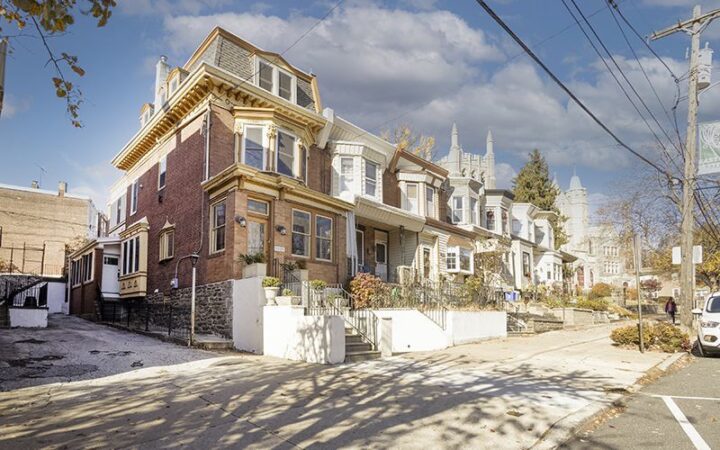
When Hope Coleman and Nathan Fong were looking for a larger East Falls rowhouse for themselves and their two young sons, they settled on a house that combined character and practicality. It had a garage, very rare for a rowhouse in that neighborhood.
The couple — Coleman is a veterinarian and Fong a marketing professor at Rutgers University — moved into the house in 2019 but have now left for a larger house in Bala Cynwyd to accommodate aging parents on both sides.
“The stuff that gave it character was original,” said Coleman, describing the East Falls house.
The five-bedroom, 2½-bathroom home is 2,288 square feet.
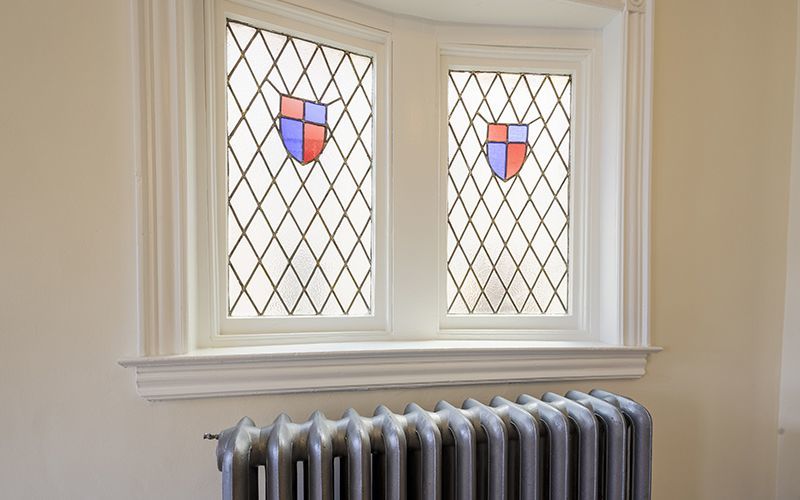
The heated, window-lined front porch provides entrance to the living room with original cathedral glass and stained-glass windows, high ceilings, and hardwood and Second Empire architectural style indicate it is considerably older. Documentation says the house was built in 1925, but Coleman believes that the mansard roof and architectural style indicate an earlier construction date.
The living room features original cathedral glass and stained-glass windows.
The dining room has a butler’s cabinet and a powder room with a pocket door.
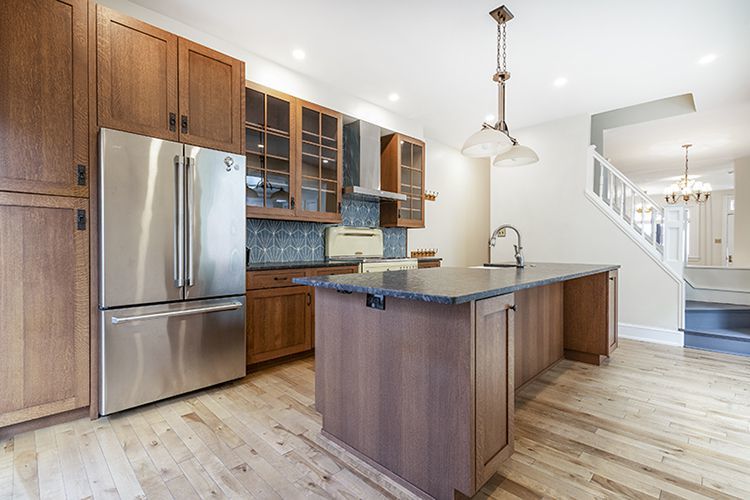
The renovated eat-in kitchen has solid oak cabinetry, granite countertops, a wide island with seating for four, and a beautifully restored Chambers stove complete with built-in warmer and broiler and griddle, vented to the exterior.
The wide kitchen island can accommodate seating for four.
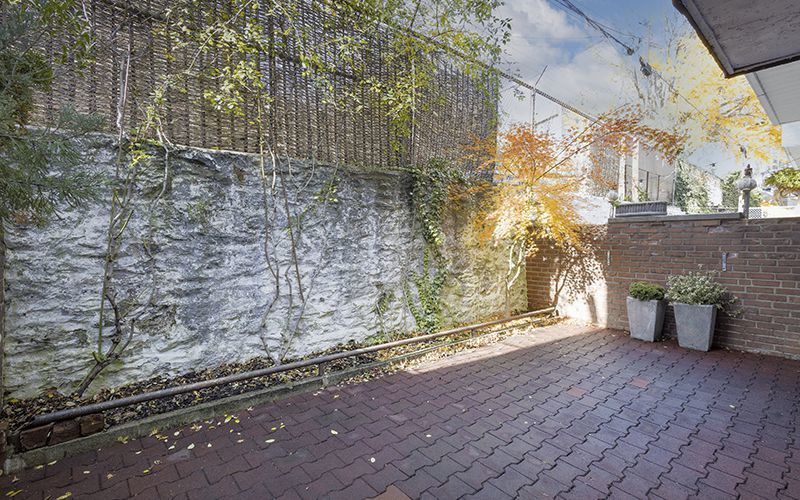
Glass doors open from the kitchen to a private patio. A sunroom, added by the couple and connected to the kitchen, has underfloor heating, two skylights, and additional access to the backyard and side entrance, creating seamless indoor-outdoor flow.
Glass doors open from the kitchen to a private patio.
A back staircase leads directly from the kitchen to the second floor, which has three bedrooms, including a spacious front room that is used as a family room but can also serve as a large second-floor primary.
The hall bath has a stained-glass window and a laundry room, which has built-ins, closet space, and the home’s original porcelain sink hutch.
The third floor has two additional bedrooms and a newly added full bath. The rear bedroom could serve as a walk-in closet, office, private retreat, or a primary suite.
The house is listed by Lisa Denberry of BHHS Fox & Roach Chestnut Hill for $652,000.
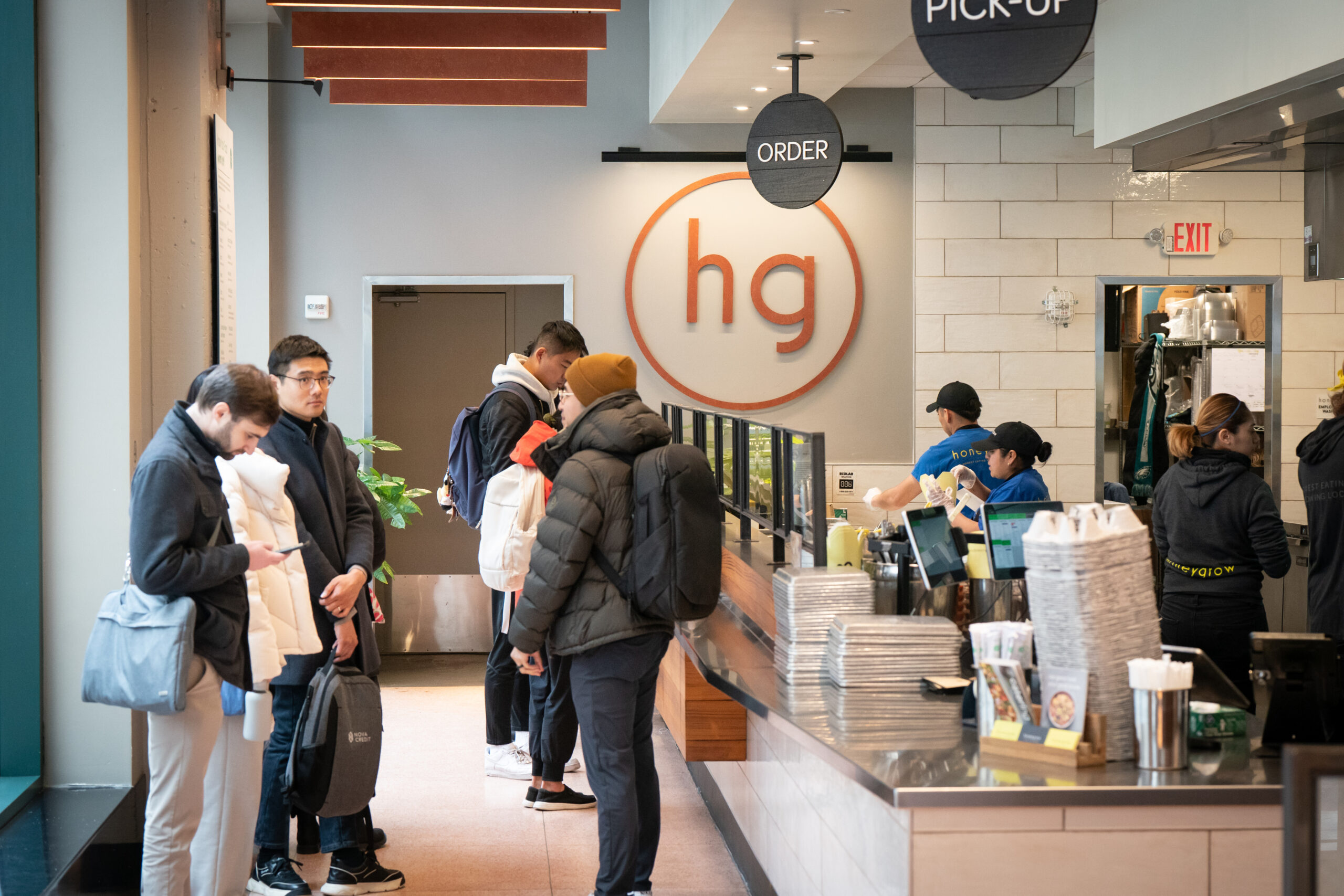
The fast-casual eatery, based in Center City, plans to open up to 18 new locations next year, following 17 new outposts in 2025, founder and CEO Justin Rosenberg told The Inquirer on Monday.
“It was definitely a good year,” said Rosenberg, adding that the company is “just continuing to build the pipeline for 2026 and beyond.”
Honeygrow sells made-to-order stir-fries as well as salads and desserts. Since launchingin 2012, the company has grown to 71 locations across several states, including Ohio, Massachusetts, Virginia, Maryland, Delaware, and New York.
Philadelphia-area stores include Center City, Kensington, University City, North Philadelphia, Bala Cynwyd, and Cherry Hill.
The company’s expansion plans include adding locations in Ohio and New Jersey, as well as in Boston. The eatery is also currently in negotiations to bring Honeygrow to the Detroit metropolitan area, a new market, said Rosenberg.
Honeygrow also aims to open a location in Middletown, Del.
“Saleswise, it’s kind of neck and neck between certain Philly stores and our two Boston stores,” Rosenberg said.
Further expansion in Philadelphia is also possible.
“We are always looking at Philly,” Rosenberg said. “We’ve been poking around South Philly for a while. We just haven’t found the right opportunity.”
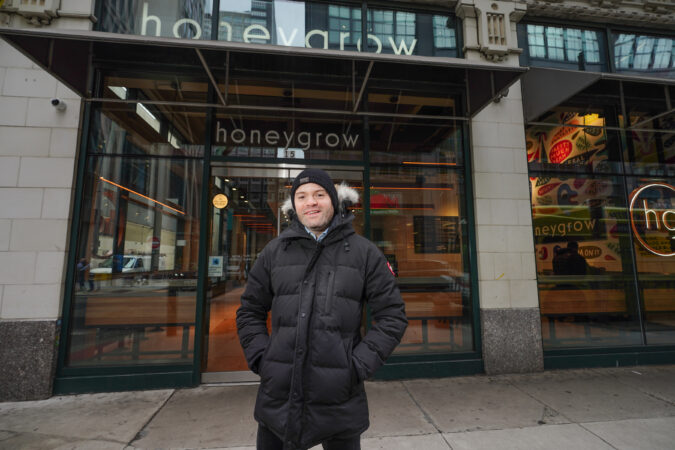
Honeygrow, at 11th Street in Center City, in 2024.
The company typically seeks 2,500-square-foot locations for new stores, but Rosenberg says it’s a competitive market for that kind of real estate.
“One of the things that has made us successful — and I give credit to my team for this — is that we’ve been very disciplined on growth, just saying, look, if we can’t get the deal we need in terms of underwriting, let someone else take it,” he said.
The company employs roughly 2,000 people, and each new store adds some 30 new hires, Rosenberg said.
Some of the considerations when looking at new markets include what other fast-casual concepts are in the area, and how they’re doing, Rosenberg said.
“If a Starbucks is underperforming in that market, that’s certainly going to spook us. Or a Chick-fil-A, if it’s below average unit volume, it’s probably not the right market for us,” he said.
On the flip side, if a Chipotle, Chick-fil-A, Starbucks, Raising Cane’s, or another brand is doing well in an area, Rosenberg said, “We feel that those would be very similar customers to ours. We’re willing to put a restaurant in there and see what happens.”
The plans for new locations come as the company shuttered some stores in Chicago, Washington, and New York in 2018 after rapid expansion plans. Some stores were “dragging down profitability,” Rosenberg has said, and he hasattributed closures to growth that happened too quickly as well as poor real estate.
Since then, the company has roughly tripled in size, said Rosenberg, adding “you just keep learning with every opening that you have.”
“My mission remains the same,” he said. “I want to build something that’s from Philadelphia — make this a national, if not international, brand that we can be proud of.”
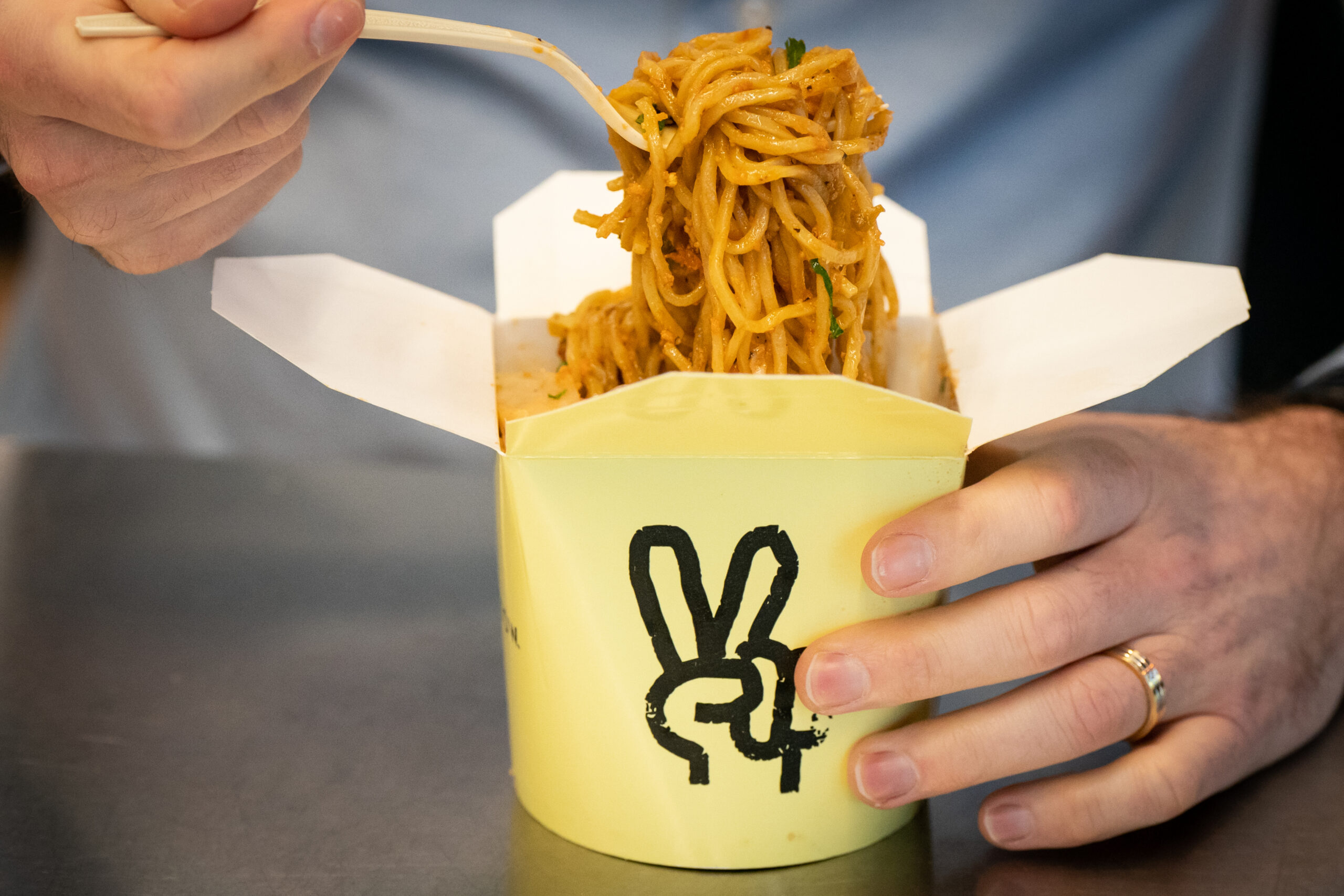
Chicken Parm Stir-fry at Honeygrow at the 11th Street location in Philadelphia in 2024.
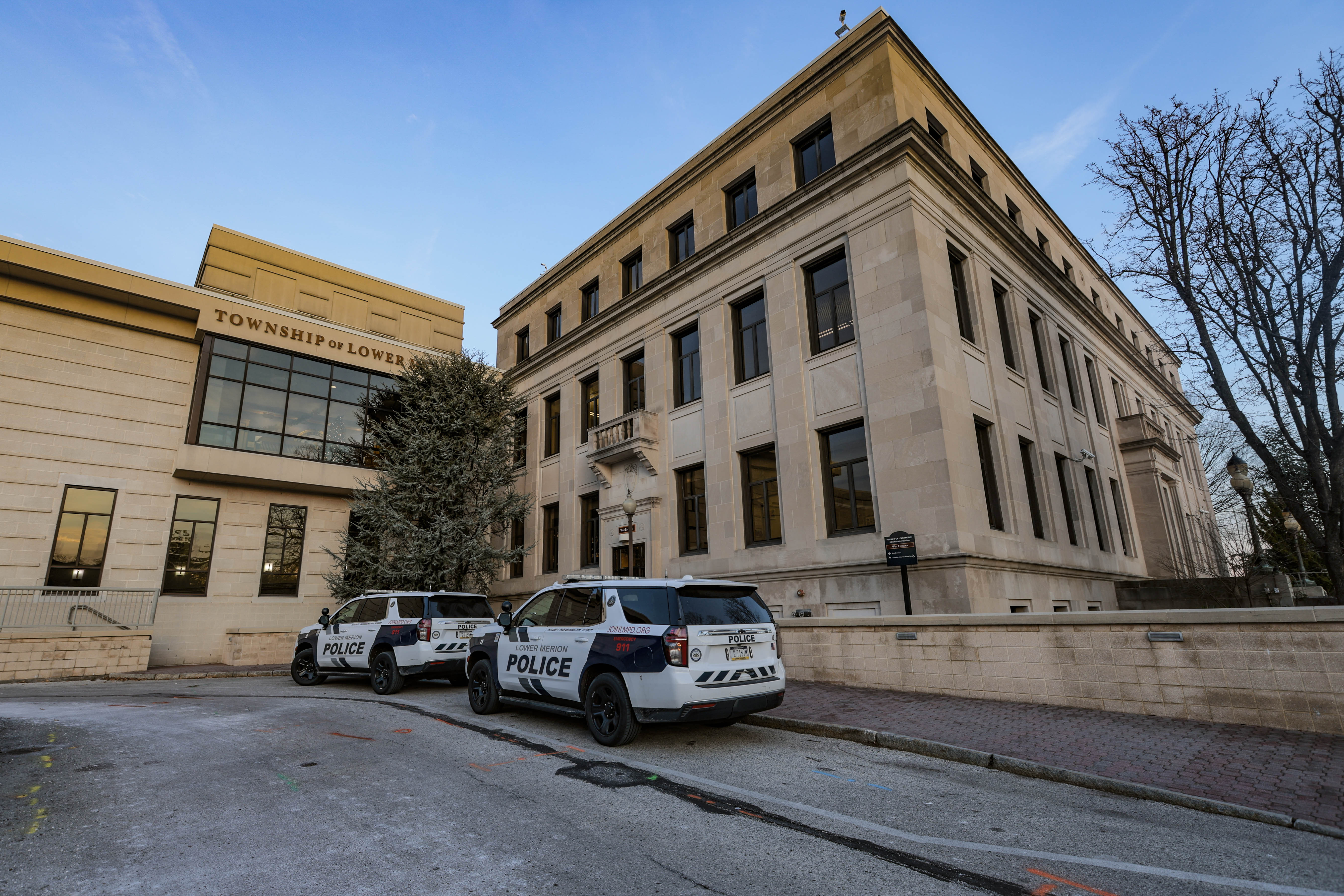
Township commissioners recently passed the 2026 budget, which includes a tax hike. Here’s what you need to know. And with the new year just over a week away, we’ve rounded up nearly a dozen ways to celebrate 2026 in and around town.
This is our final Inquirer Lower Merion newsletter of 2025, but we’ll be back in your inboxes on Jan. 8. Thanks for reading and happy new year!
Lower Merion officials recently approved a tax hike for 2026.
Lower Merion residents can expect to see their property taxes go up in 2026 after the township’s board of commissioners approved an 8% increase in the upcoming budget.
Commissioners said the increase was necessary following 13 years of stagnant tax revenue from 2011 to 2024, when there were no increases. Property taxes went up 6.5% in 2025 and commissioners acknowledged next year’s increase comes with some “sticker shock,” The Inquirer’s Denali Sagner reports.
Still, it’s not as high as an initially proposed 9.5% hike. The township taxes will come on top of a 4% tax increase recently passed by Montgomery County officials.
Ardmore cocktail bar Izzy’s will have a special menu and champagne toast to ring in the new year.
The countdown to 2026 is on and there’s no shortage of ways to celebrate the end of one year and the start of another.
We’ve rounded up 11 celebrations in and around Lower Merion, including noontime events for kids, specialty and buffet dinners, plus concerts for kids and adults.
Trash and recycling dates will have altered schedules due to Christmas and New Year’s Day. See how your household is impacted here. The township also released its 2026 collection schedule, which you can see here.
Narberth passed its 2026 budget last week, which includes a higher earned income tax. The EIT will jump from 0.75% this year to 1% next year and is aimed at improving the borough’s capital fund. The new budget also adjusts solid waste fees so that condos and apartments pay a flat $250 per living unit. Sewer fees are also set to rise from $5.25 to $6 per 1,000 gallons. See the full budget here.
Narberth council has also voted to make permanent the no-parking zone pilot at the intersection of Price and Essex Avenues. Signage is expected to be installed in January and February, with painting set for spring.
Bryn Mawr Hospital is among the quietest hospitals in the region at night, according to newly released federal data. Patients from October 2023 to September 2024 reported Bryn Mawr being “always quiet” overnight 61% of the time, “usually quiet” 29% of the time, and “sometimes or never quiet” 10% of the time. See how Bryn Mawr compares to other regional hospitals.
A Bala Cynwyd dad launched a program in 2024 after seeing demand for Cub Scout activities on non-Sabbath days. Philadelphia Jewish Exponent recently profiled Michael Kopinsky about his inspiration and how the program quickly gained popularity among Orthodox and Sabbath-observant Jewish families.
🏫 Schools Briefing
Winter break is officially here, with students and staff returning Jan. 5. The school district’s offices will be closed Dec. 24-26 and Jan. 1-2 during the break. Lower Merion High School’s pool will be closed those same days, as well as on Dec. 31.
Lower Merion High School skating duo Justin and Suri Lue took home third place in the regional level of the U.S. Figure Skating Championships in Nevada last month, and sixth place nationally in the intermediate division.
Johnny’s Pizza in Bryn Mawr has some of the best takeout pizza in the Philadelphia suburbs, according to The Keystone. The outlet noted that “once you start eating it, it’s going to be hard to stop.”
🎳 Things to Do
🎤 Start Making Sense: Hear the seven-piece Talking Heads tribute band perform. ⏰ Friday, Dec. 26, 8 p.m. 💵 $33.38 📍 Ardmore Music Hall
🐑 Meet the Menagerie: Meet some of Harriton House’s farmstead animals. There will also be hot chocolate and s’mores available for purchase. ⏰ Tuesday, Dec. 30, 11 a.m.-3 p.m. 💵 Free 📍 Harriton House
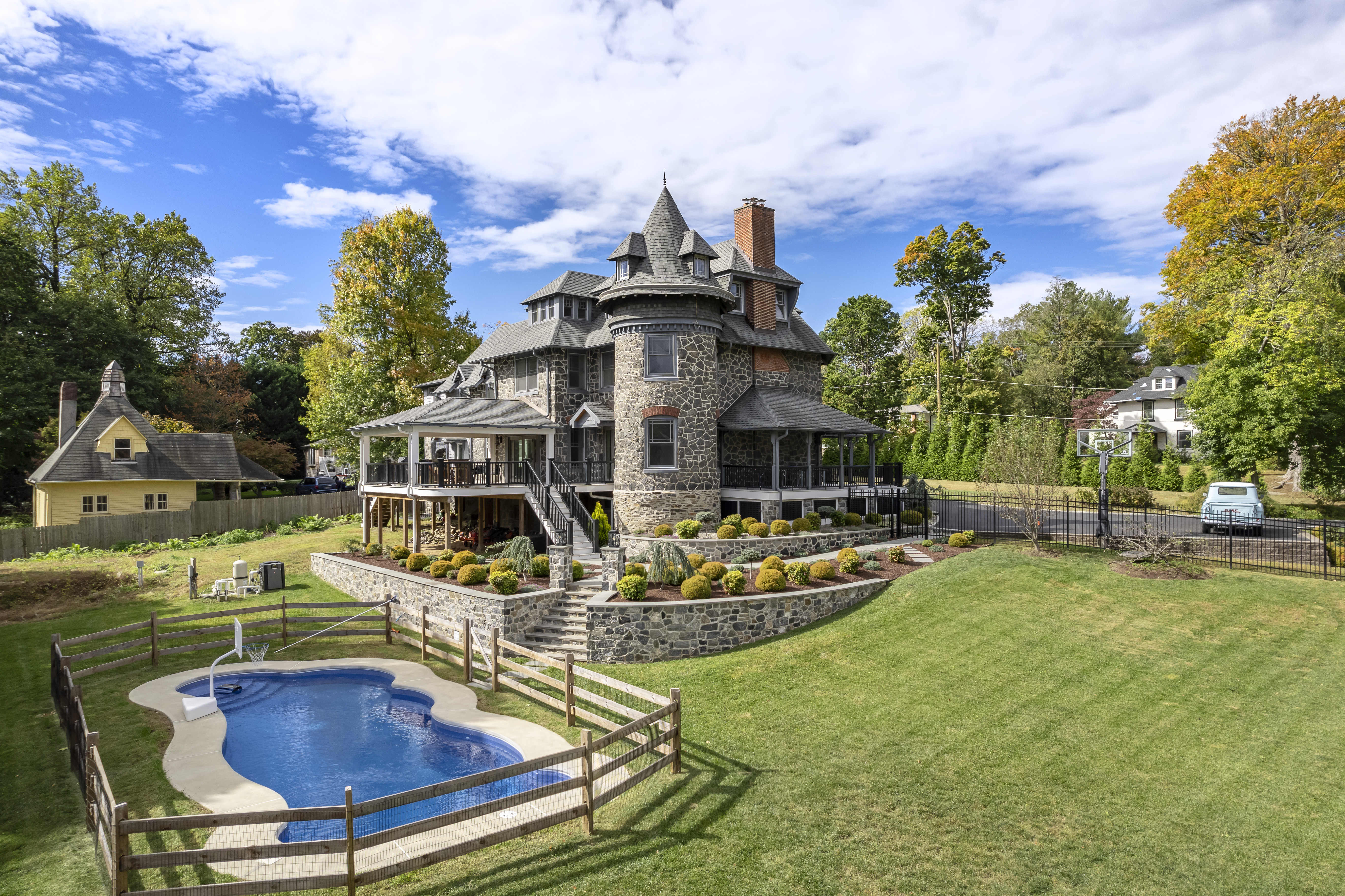
The home spans nearly 6,700 square feet and has a distinctive turret.
This Merion Station property, built in 1888, is reminiscent of a castle. The home has a modern interior while paying homage to its roots by way of exposed stone walls, fireplaces, millwork, and stained glass windows. Some of its features include a curved tower, a formal dining room, and an eat-in kitchen with a large island. It also has seven bedrooms spread across the second and third floors. Outside, there’s an in-ground saltwater pool, a basketball court, multiple covered sitting areas, and a deck with a built-in kitchen.
By submitting your written, visual, and/or audio contributions, you agree to The Inquirer’s Terms of Use, including the grant of rights in Section 10.
This suburban content is produced with support from the Leslie Miller and Richard Worley Foundation and The Lenfest Institute for Journalism. Editorial content is created independently of the project donors. Gifts to support The Inquirer’s high-impact journalism can be made at inquirer.com/donate. A list of Lenfest Institute donors can be found at lenfestinstitute.org/supporters.
The countdown to 2026 is on, and there’s no shortage of ways to celebrate the end of one year and the start of another. From New Year’s Eve dinner specials to adults-only celebrations and family-friendly gatherings, here’s how to ring in the new year in and around Lower Merion.
New Year’s Eve Events for Adults
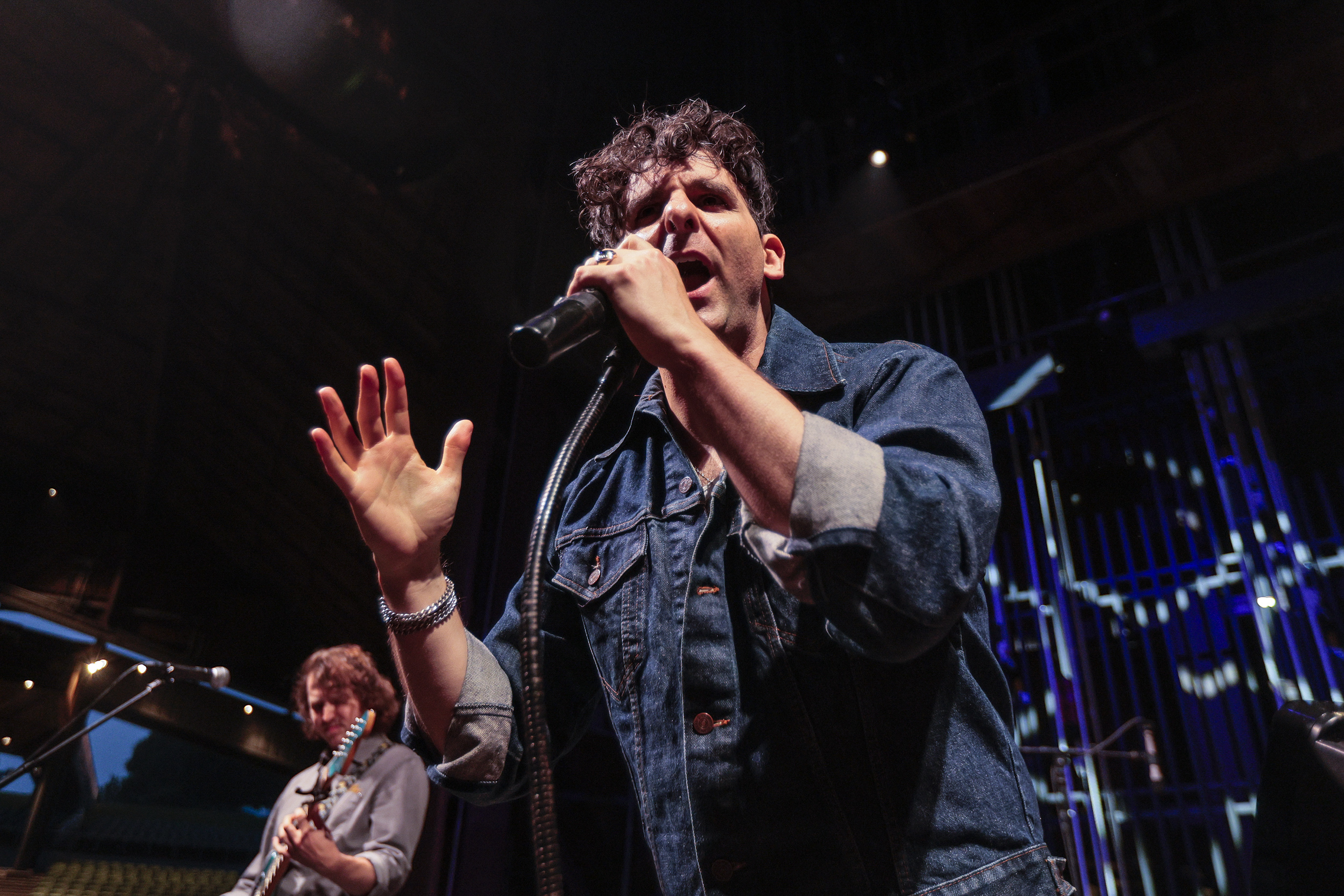
Low Cut Connie is headlining two nights at Ardmore Music Hall.
The local band is performing for two nights, including on New Year’s Eve. There are open bar and dinner options for both.
⏰ Tuesday, Dec. 30, 7:30 p.m. and Wednesday, Dec. 31, 8 p.m. 💵 $56.93, plus $112.82 to add on an open bar and food service 📍Ardmore Music Hall, 23 E. Lancaster Ave., Ardmore
Alex and the Kaleidoscope, an interactive band geared toward kids ages 4 to 8, will perform at Ardmore Music Hall. There will also be arts and crafts, brunch, and a countdown to noon.
⏰ Wednesday, Dec. 31, 11 a.m. 💵 $29.50 📍Ardmore Music Hall, 23 E. Lancaster Ave., Ardmore
Enjoy a buffet, cookies, hot chocolate, and a sparkling cider or champagne toast at this family-friendly afternoon event, where there will also be a DJ. Kids can decorate cookies and color their own New Year’s Eve hat and glasses, too.
⏰ Wednesday, Dec. 31, noon-2 p.m. 💵 $18 for kids, $39 for adults 📍Lola’s Garden, 51 Saint Georges Rd., Ardmore
Ardmore cocktail bar Izzy’s is offering a seven-course meal featuring items like lobster, wagyu beef, and caviar for $165. Add a beverage pairing for another $60. Ripplewood will offer its regular menu alongside specials, and both will have champagne toasts at midnight.
⏰ Wednesday, Dec. 31, 4 p.m.-midnight 💵 Prices vary📍 Izzy’s, 35 E. Lancaster Ave., Ardmore, and Ripplewood Whiskey & Craft, 29 E. Lancaster Ave., Ardmore
One of the dining areas at Triple Crown features a bar.
The Main Line newcomer is offering two ways to dine New Year’s Eve. For $125, there will be a buffet in the Secretariat room, including charcuterie, salads, a carving station, sides, and a dessert table from 5 to 10 p.m. The Greg Farnese Trio will perform throughout the night. Or for à la carte options, the main dining room will be open, also from 5 to 10 p.m.
⏰ Wednesday, Dec. 31, 5-10 p.m. 💵 Prices vary📍 Triple Crown, 593 E. Lancaster Ave., St. Davids
White Dog Cafe is hosting a New Year’s Day “pajama brunch,” where attendees are encouraged to where their PJs.
On New Year’s Day, White Dog Cafe is again hosting its Pajama Brunch, which encourages attendees to wear their PJs to the restaurant, where an à la carte menu will be available. Reservations are encouraged.
This suburban content is produced with support from the Leslie Miller and Richard Worley Foundation and The Lenfest Institute for Journalism. Editorial content is created independently of the project donors. Gifts to support The Inquirer’s high-impact journalism can be made at inquirer.com/donate. A list of Lenfest Institute donors can be found at lenfestinstitute.org/supporters.
By now, most people have heard about the “no tax on tips” and “no tax on overtime” provisions of “One Big Beautiful Bill” that became law during the summer. It sounds great. But unfortunately, the new legislation is not all that it seems. Why?
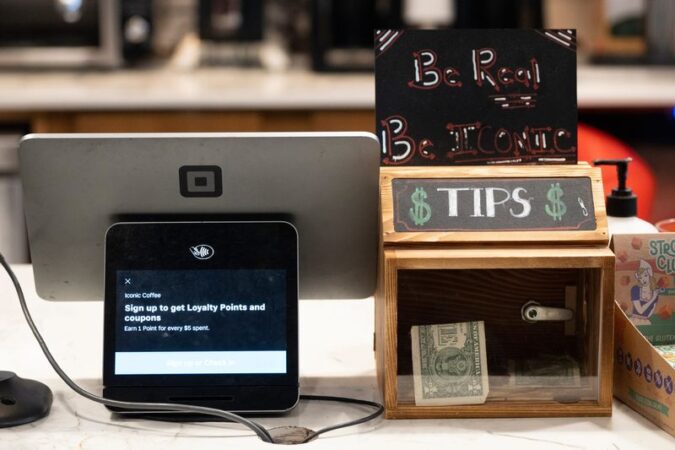
Yes, there is a “no tax on tips” benefit. But be careful because you may not be eligible.
A specific list shows all the jobs that qualify. As a rule of thumb, you’ll be eligible for the tipped income deduction if you work in a business where tips are common. Regardless, you should know that the deduction is limited to $25,000 per person and begins to phase out once you start earning more than $150,000 individually and $300,000 if you file a joint return.
You can only take advantage of the deduction when you file your individual tax returns after the year has ended. And if these deductions result in you getting a tax refund, you’ll have to wait until next year, when your 2025 return can be filed and processed by the IRS.
Remember too that this deduction is scheduled to expire in 2028, so you’ve only got a few years to take advantage. So does the deduction on overtime wages.
The overtime deduction is even more limited. It only applies to the “overtime” wages you receive, which means that if you receive time-and-a-half for overtime worked, you get to deduct only the amount related to the “half.”
For example, if your base wage is $20 an hour and you get paid $30 for one hour of overtime, only the $10 difference is eligible for the deduction. Also, the overtime deduction is limited to $12,500 for individuals and $25,000 for joint-filers, and it begins to phase out after you’ve earned more than $150,000 individually or $300,000 if you’re filing a joint return. And, depending on prevailing wage rules or overtime calculations that are part of union contracts, some of these wages may not be eligible at all.
Even though the new law promises “no taxes” on tipped and overtime income, that’s not entirely true either. Social Security and Medicare taxes will still be required by both employees and their employers. Most states — including Pennsylvania and New Jersey — are not excluding tipped or overtime income from their tax calculations.
“It’s kind of a misnomer,” said Andrew Gargana, a federal compliance analyst at HR firm Paychex. (Gargana is a client of my firm.)
“Yes, no tax on tips or overtime sounded great on the campaign trail, but the reality is that an employee is still paying some taxes on this income,” Gargana said.
If you’re an employer that has tipped workers or pays overtime, you are looking at potential reporting headaches.
Employees now must know the correct amount of tipped wages and overtime to include in their tax returns. Usually, this will come from their W-2 form, which is used to report wages and is required to be mailed by the employer to both the employee and the IRS by the end of January.
The IRS has released a draft form W-2 for 2026 that enables an employer to separately report these amounts. But what about 2025?
According to a blog post from Bala Cynwyd-based accounting firm Isdaner & Co., the IRS announced that the 2025 versions of Form W-2 — where overtime wages are not broken out from total compensation — will be unchanged.
Gargana says 2025 reporting will be like the “Wild West.”
“The IRS’s guidance just offers ‘transition relief’ to employers and employees for 2025,” he said. “As long as an employer makes reasonable attempt at reporting, the IRS is not going to penalize. They’re acknowledging that employers and employees were not tracking this information in the form they needed at the beginning of the year.”
But what is “reasonable”? And what if their mistakes cause a significant mistake on their employee’s tax return? It is unclear how much leeway employers will get. Accuracy still matters, and a big enough miscalculation could mean potential penalties and interest for employees that underreport taxes due and a potential legal problem for the employer.
In the end, the responsibility of filing a correct individual tax return still rests with the individual.
“Employers and payroll management companies should begin tracking qualified tip and overtime income immediately and implement procedures to retroactively track qualified tip and overtime income amounts that were paid going to Jan. 1, 2025,” accounting firm Isdaner said in an email to clients.
This is a looming hassle for employers. Whether they’re required to report externally or not, workers and their accountants will want to take advantage of this deduction, and if the amounts they need are not disclosed on their W-2, they’re going to be pressing their bosses for the correct information for their individual tax returns.
Both Paychex and Isdaner are warning their clients to get on top of this issue to avoid confusion when employees start filing their individual returns. Gargana said employers may even provide a separate statement along with employees’ W-2 forms.
“Communication is critical,” Gargana said. “Employers should expect questions and proactively share available data.”
Cencora Inc., a drug-distribution giant based in Conshohocken, is expanding its presence in oncology and retina care, two medical specialties that rely heavily on pharmaceuticals.
The company announced on Dec. 15 that it had agreed to buy out its private-equity partner in a national cancer practice management company, OneOncology, for $5 billion in cash and debt.
Cencora already owned 35% of OneOncology, which has a small presence in the Philadelphia area.
In January, Cencora spent $5 billion, including contingency payments, for Retina Consultants of America, a network of specialized practices withlocations in 23 states, including two in Pennsylvania outside the Philadelphia area.
The deals are part of Cencora’s effort to extend its reach into medical specialties that rely heavily on pharmaceuticals to treat patients. By positioning itself closer to patients, Cencora can capture more of the profit margin that goes along with selling drugs.
“We like those two spaces because they’re pharmaceutical centric,” Cencora’s CEO Robert Mauch said at the 2025 J.P. Morgan Healthcare Conference. He said the company doesn’t see other specialties with the same makeup as oncology and retina.
“That’s where we will continue to focus,” he said. “Now as we look forward, there could be other specialties. There could be other innovations in the pharma industry that create something in another area.”
Cencora had $321 billion in revenue in its fiscal year that ended Sept. 30. It had $1.5 billion in net income. That’s a great deal of money, but amounted to less than half a percent of its revenue.
McKesson and Cardinal Health, Cencora’s two biggest U.S. competitors in the drug-distribution business, face similarly narrow margins from drug distribution. Both also own companies that manage cancer practices. Among the benefits of owning the management companies is securing the customer base.
Cencora’s follow-up to 2023 deal
Cencora, then known as AmerisourceBergen, paid $718.4 million for a 35% stake in OneOncology in June 2023. That deal, in partnership with TPG, valued OneOncology at $2.1 billion. The seller was General Atlantic, a private equity firm that had invested $200 million in the Nashville management services company in 2018, according to the Wall Street Journal.
The deal announced last week valued OneOncology at $7.4 billion, including debt. The big increase in value came thanks to a doubling in the company’s size. OneOncology now has 31 practices with 1,800 providers who treat 1 million patients across 565 sites, according to the company.
Rittenhouse Hematology Oncology, which has offices in Bala Cynwyd, Brinton Lake, King of Prussia, and Philadelphia, became part of OneOncology last year.
Capstan Therapeutics’ sale this year for $2.1 billion, the highest price paid for a private early-stage biotech company since 2022, was a triumph for its founders at the University of Pennsylvania.
Unfortunately for Philadelphia, the company is based in San Diego. Investors wanted an executive who lives there to be CEO.
Capstan was a miss for Philadelphia, said Jeffrey Marrazzo, who cofounded a high-profile regional biotech company, Spark Therapeutics, and is now an industry investor and consultant.
If Philadelphia had a bigger talent pool of biotech CEOs, “it would have and should have been here,” he said.
The Philadelphia region has lagged behind other biotech centers in landing companies and jobs, but industry experts are working to close the gap and better compete with Boston, the San Francisco Bay Area, and San Diego.
According to Marrazzo and others, the Philadelphia region’s relatively shallow pool of top biotech management is a key challenge.
Big investors go to managers who have proven ability to deliver big investment returns, said Fred Vogt, interim CEO of Iovance Biotherapeutics, a California company with a manufacturing facility in the Navy Yard.
“They want the company to perform. They’ll put it in Antarctica, if that was where the performance would come from,” he said.
The Lilly announcement last month also reflects Philadelphia’s national biotech stature. It’s the fourth U.S. city to get a Lilly Gateway Lab, behind Boston, the San Francisco Bay Area, and San Diego.
Those places have far outpaced Philadelphia in the creation of biotech research and development jobs, even as the sector’s growth has slowed.
From 2014 through last year, the Boston area added four biotech research and development jobs for every one job added here, according to an Inquirer analysis of federal employment data.
window.addEventListener(“message”,function(a){if(void 0!==a.data[“datawrapper-height”]){var e=document.querySelectorAll(“iframe”);for(var t in a.data[“datawrapper-height”])for(var r,i=0;r=e[i];i++)if(r.contentWindow===a.source){var d=a.data[“datawrapper-height”][t]+”px”;r.style.height=d}}});
Penn’s role in Philadelphia biotech
Philadelphia’s reputation as an innovation center — boosters like to call the region “Cellicon Valley” — starts with the University of Pennsylvania, which has long been a top recipient of National Institutes of Health grants to advance scientific discovery.
Research at Penn has contributed to the creation of 45 FDA-approved treatments since 2013, according to the university.
“Penn discoveries help spark new biotech companies, but we can’t build the whole ecosystem in this area alone,” said John Swartley, Penn’s chief innovation officer. “Great science is just one ingredient. We also need capital, experienced leadership, real estate and manufacturing infrastructure, and strong city and state support.”
Penn was one of two Philadelphia institutions receiving more than $100 million in NIH funding in the year that ended Sept. 30. The otherwas the Children’s Hospital of Philadelphia.
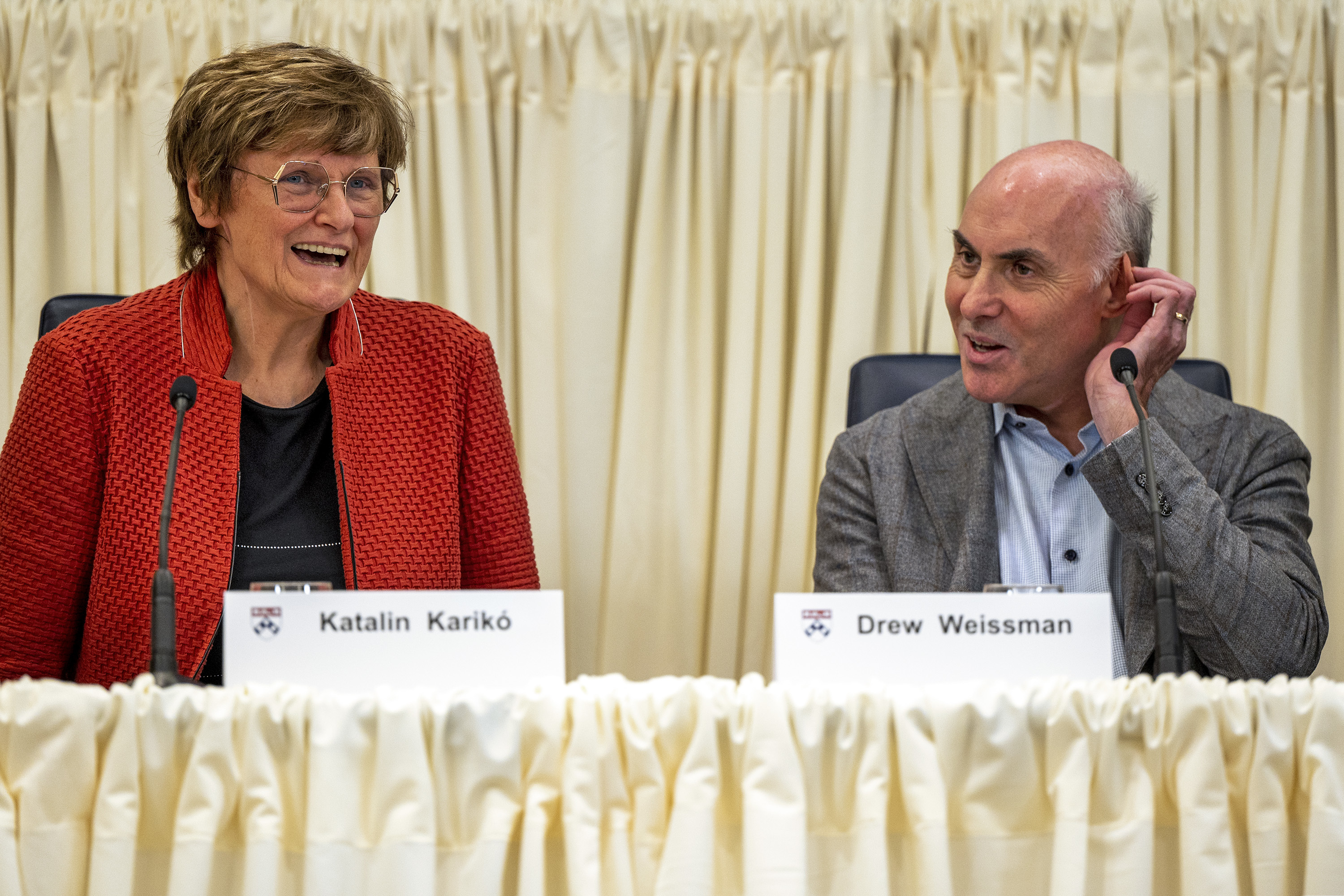
Katalin Karikó and Drew Weissman spoke at a University of Pennsylvania news conference after they were named winners of a 2023 Nobel Prize in medicine. Their work was instrumental to modifying mRNA for therapeutic uses, such as the rapid development of lifesaving vaccines during the COVID-19 pandemic.
By contrast, the Boston area was home to 10 institutions with at least $100 million in NIH grants, generating more spinoffs and jobs.
The Philadelphia region has a healthy number of biotech spinouts, but the biggest markets have more from a larger number of research institutions, said Robert Adelson, founder Osage University Partners, a venture capital firm in Bala Cynwyd.
That concentration of jobs and companies in the Boston area — where nearly 60,000 people worked in biotech R&D last year — makes it easier to attract people. By comparison, there were 13,800 such jobs in Philadelphia and Montgomery County, home to the bulk of the regional sector.
If a startup fails, which happens commonly in biotech, “there’ll be another startup or another company for me to go to” in a place like Boston, said Matt Cohen, a managing partner for life science at Osage.
Another challenge for Philadelphia: It specializes in cell and gene therapy, a relatively small segment of the biotech industry, whose allure to investors has faded in the last few years.
Such market forces shaped the trajectory of Spark, a 2013 Children’s Hospital of Philadelphia spinout that developed Luxterna, the first FDA-approved gene therapy, used to treat an inherited form of blindness. The promise of Spark’s gene therapy work for a form of hemophilia spurred its 2019 acquisition by Swiss pharmaceutical titan Roche for $4.8 billion.
The company still employs about 300 in the city, a spokesperson said, and work continues on its $575 million Gene Therapy Innovation Center at 30th and Chestnut Streets in University City.
The long arc of biotech
A handful of companies dominated the early days of U.S. biotech. Boston had Biogen and Genzyme, San Francisco had Genentech, San Diego had Hybritech, and Philadelphia had Centocor. All of them started between 1976 and 1981.
Centocor started in the University City Science Center because one of its founders, virologist Hilary Koprowski, was the longtime director of the Wistar Institute. Centocor’s first CEO, Hubert Schoemaker, moved here from the Boston area, where he had gotten his doctorate at the Massachusetts Institute of Technology.
Another drug still under development at the time of the sale, Stelara, went on to become J&J’s top-selling drug as recently as 2023 with $10.9 billion in revenue. Stelara, approved to treat several autoimmune disorders, remains a testament to Centocor’s legacy.
Despite its product success, Centocor didn’t have the same flywheel effect of creating new companies and a pipeline of CEOs as peer companies did in regions outside of Philadelphia.
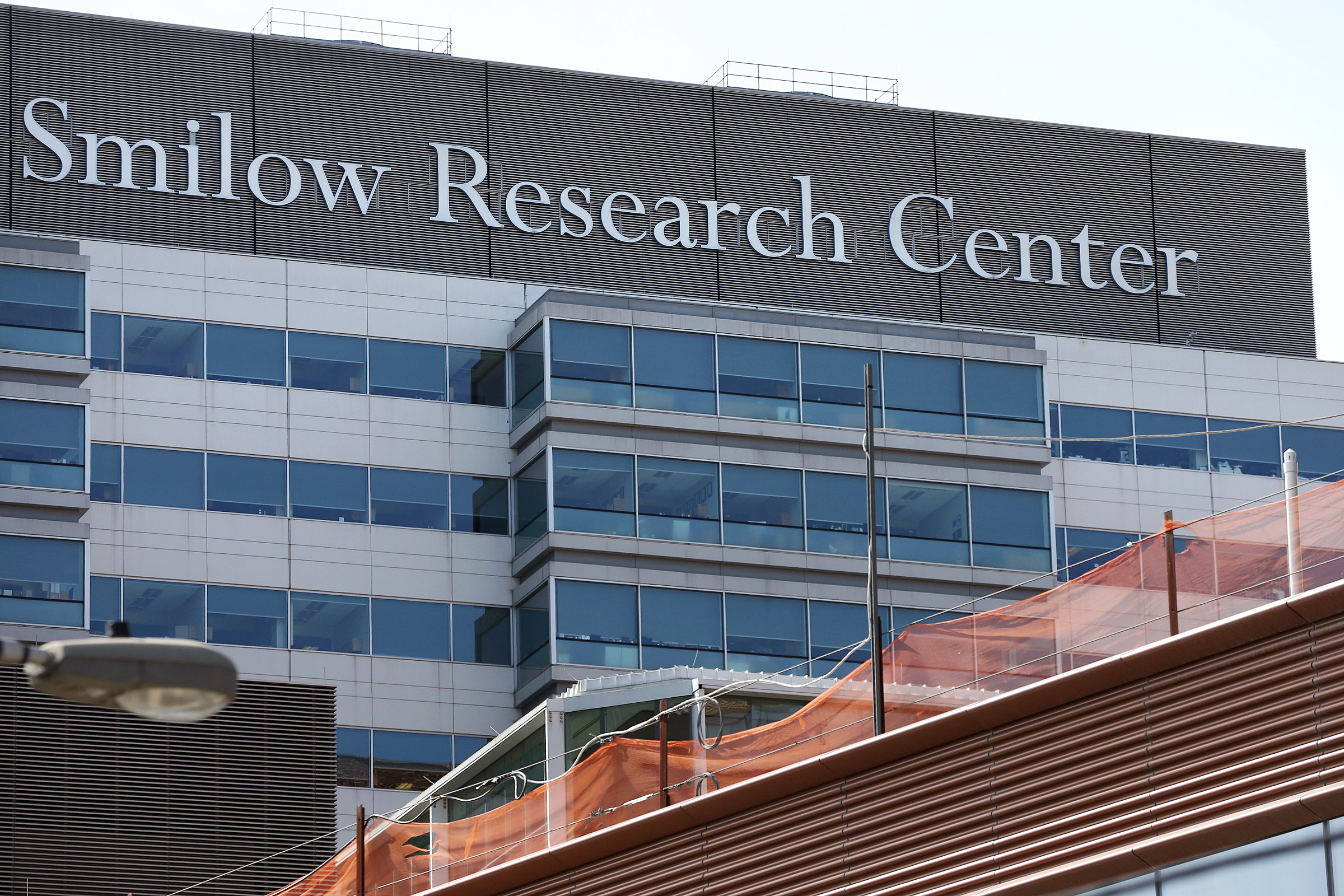
The University of Pennsylvania’s Smilow Center for Translational Research, shown in 2020, is one of the school’s major laboratory buildings.
“There are a lot of alums of Centocor that are really impressive, but they seem to have wound up elsewhere,” said Bill Holodnak, CEO and founder of Occam Global, a New York life science executive recruitment firm.
Among the Centocor executives who left the region was Harvey Berger, Centocor’s head of research and development from 1986 to 1991. He started a new company in Cambridge, Mass.
At the time, the Philadelphia area didn’t have the infrastructure, range of scientists, or management talent needed for biotech startups, he said.
Since then, he thinks the regional market has matured.
“Now, there’s nothing holding the Philadelphia ecosystem back. The universities, obviously Penn, and others have figured this out,” Berger said.
Conditions have changed
Penn’s strategy for helping faculty members commercialize their inventions has evolved significantly over the last 15 years.
It previously licensed the rights to develop its research to companies outside of the area, such as Jim Wilson’s gene therapy discoveries and biochemist Katalin Karikó and immunologist Drew Weissman’s mRNA patents. Now it takes a more active role in creating companies.
Among Penn’s latest spinouts is Dispatch Bio, which came out of stealth mode earlier this year after raising $216 million from investors led by Chicago-based Arch Venture Partners and San Francisco-based Parker Institute for Cancer Immunotherapy.
Dispatch, chaired by Marrazzo, is developing a cell therapy approach that uses a virus to attach what it calls a “flare” onto the cells it wants the immune system to attack.
Marrazzo said in July that he wasn’t going to be involved in Dispatch if it wasn’t based largely in Philadelphia. As of July, 75% of its 60 employees were working in Philadelphia. Still, Dispatch’s CEO is in the San Francisco Bay Area.
The Philadelphia region is increasingly well-positioned for the current biotech era, said Audrey Greenberg, who played a key role in launching King of Prussia’s Center for Breakthrough Medicines about five years ago. The center is a contract developer and manufacturer for cell and gene therapies.
“You no longer need to move to Kendall Square to get a company funded,” she said, referring to Cambridge’s biotech epicenter. “You need good data, a credible translational plan, experienced advisers, and access to patient capital, all of which can increasingly be built here.”
Greenberg now works as a venture partner for the Mayo Clinic, with the goal of commercializing research discoveries within the health system’s network of hospitals in Minnesota, Arizona, and Florida.
She plans to bring that biotech business to the Philadelphia region.
“I’m going to be starting my companies all here in Philadelphia, because that’s where I am. And I know everybody here, and everybody I’m going to hire in these startups that are going to be based here,” she said.