Voters in Shamong handily rejected a $25 million school bond question that would have raised property taxes, while a referendum in Mantua was too close to call, officials said Wednesday.
Shamong voters rejected the bond question 797-271, according to unofficial results from Tuesday’s election in the Burlington County school system.
If approved, the bond issue would have meant a $408 annual property tax increase on a home assessed at the township average of $309,500.
The district had said funding was needed for projects at the Indian Mills and Indian Mills Memorial schools that need immediate action. They included roofing and HVAC work.
Superintendent Mayreni Fermin-Cannon did not respond to a message seeking comment on next steps for the district.
Shamong Mayor Michael Di Croce, who tried unsuccessfully to block Tuesday’s election, hailed the results. Shamong residents make up 90% of the town’s tax base and could not afford an increase, he said.
Di Croce, an attorney, filed a complaint last week on behalf of several residents that contended school officials provided incorrect or misleading information about state funding for the project.
The complaint also alleged the district has refused to disclose why it could not earmark $4 million in capital reserves for renovations prior to seeking a bond referendum.
At a hearing Monday, Superior Court Judge John E. Harrington refused to invalidate the referendum.
“I’m very happy with the way things played out,” Di Croce said Wednesday. “Their whole sky is falling just was not credible and voters didn’t buy it.”
Mantua results too close to call
Meanwhile, the outcome of Tuesday’s vote in Mantua Township on a $39.1 million school bond referendum was too close to call Wednesday.
In preliminary results, there were 1,097 votes opposed and 1,074 votes in favor, the Gloucester County district said. The totals are expected to change over the next few days as officials count mail ballots and verify provisional ballots.
“Regardless of the result, our mission remains the same — to prepare our students for lifelong success through comprehensive academics, community partnerships, and character education,” Superintendent Christine Trampe said in a statement.
The bond issue would fund improvements at all three schools in the kindergarten-through-sixth-grade district, including renovations, roof repairs, and new classrooms.
Trampe called the renovations “true necessities.” Without the funding, the district may need to cut programs, she said.
If approved, the bond issue would increase property taxes about $336 annually on a home assessed at the township average of $311,993.
Elsewhere in the region, voters in Woodbine in Cape May County and Cumberland Regional district in Cumberland County approved bond questions, according to the New Jersey School Boards Association.
Tuesday was one of five times during the year that school boards may ask voters to approve a bond issue or special question. Bond referendums allow districts to pay for projects that cannot readily be funded through their annual operating budget.
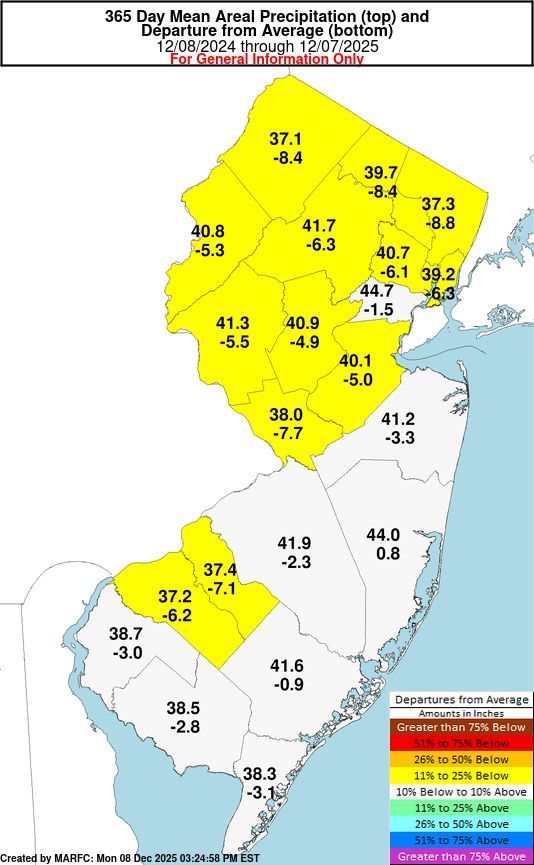
In some regions, rainfall has plunged as much as eight inches below average for the past year, straining reservoirs, streams, and aquifers enough that the state Department of Environmental Protection has issued a drought warning — a notch shy of an emergency.
As a result, officials are asking residents to voluntarily curtail water use. Should conditions deteriorate, officials may impose mandatory restrictions on certain uses of water, though such measures are rarely invoked.
Map shows precipitation well below normal over the 365 days ending Dec. 7, 2025.
DEP Commissioner Shawn LaTourette said in a statement on Friday’s announcement that there is an “urgency of the need to conserve water.”
“The precipitation and water supply uncertainty we’ve experienced over the past year is a symptom of the impacts of climate change here in New Jersey,” LaTourette said.
It’s the second year the state is looking at a drought.
The last drought warning was issued in November 2024. That declaration came as firefighters had fought multiple simultaneous wildfires, one deadly, that broke out across the state amid dry, windy conditions.
That warning was lifted in June following record rainfall for some parts of the state in May.
Up to 8 inches below normal
However, the state overall has experienced below-average precipitation for more than a year, officials said.
New Jersey officials cited data from the Middle Atlantic River Forecast Center operated by the National Weather Service.
That data shows that Burlington, Camden, and Gloucester Counties are all running nearly four inches below average over the past 90 days.
Burlington County is running more than seven inches below normal for the past 365 days, and Camden County is running more than six inches below normal for the same period.
Northwestern New Jersey is running more than eight inches below normal over the past year.
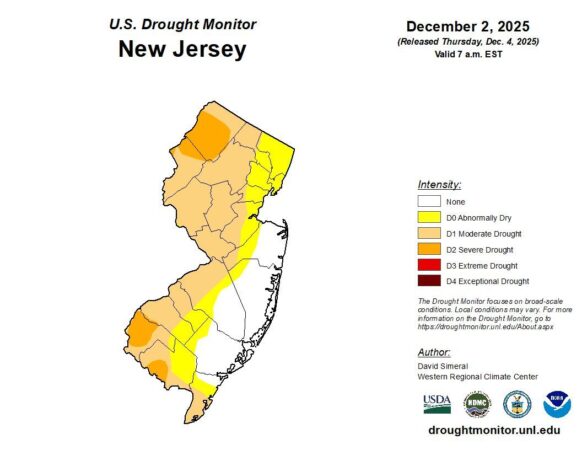
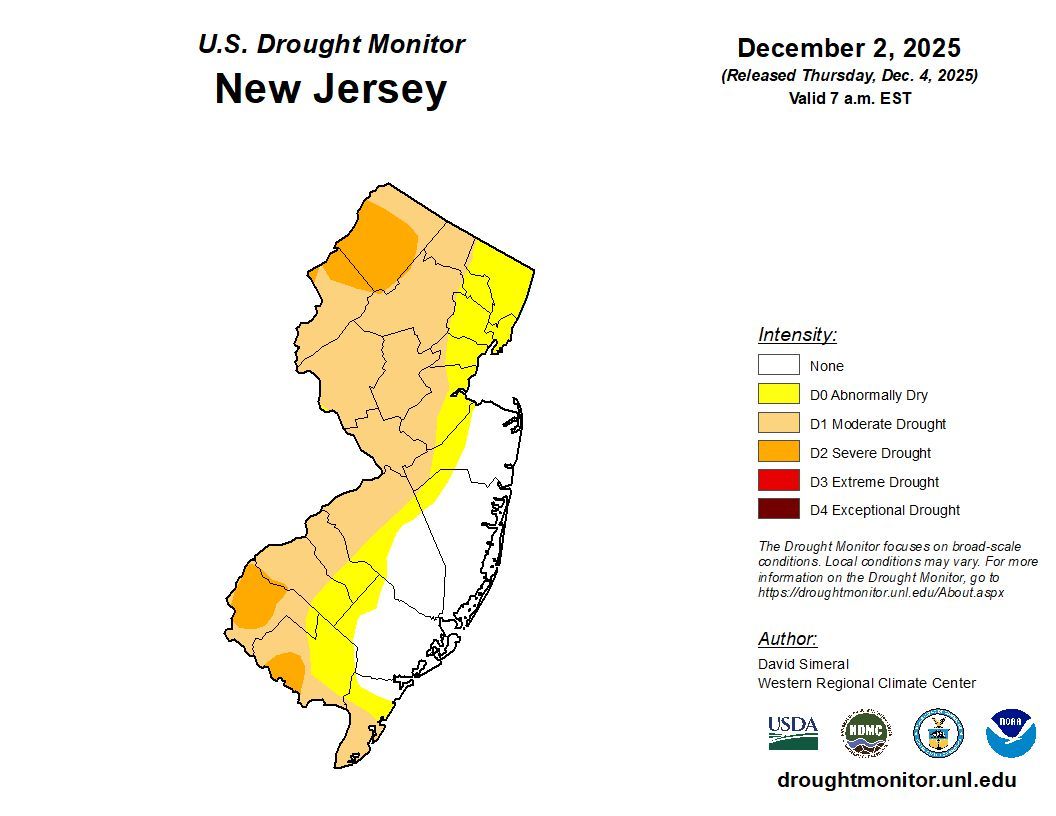
Likewise, the U.S Drought Monitor, a partnership of the University of Nebraska-Lincoln’s National Drought Mitigation Center and multiple federal agencies, shows the South Jersey counties along the Delaware River in either a moderate or severe drought.
About 3.5 million residents of New Jersey live in a drought-impacted area.
Officials said recent rains have not made much difference, considering the size of the gap. Ocean County is one of the few areas of the state with near-normal precipitation levels.
Map by the U.S. Drought Monitor shows that multiple counties in South Jersey are in a moderate to severe drought.
An update on rainfall and drought data is expected Wednesday.
State officials use multiple sources to determine the impact of rainfall on water supplies. Those include reservoir levels, stream flows, and groundwater (aquifers).
South Jersey counties, such as Burlington, Camden, Gloucester, and Salem, rely primarily on groundwater but also use water from the Delaware River and other rivers and streams.
Drought indicators for groundwater levels in South Jersey are designated as extremely dry while precipitation and stream flows are severely dry.
Officials say the persistent dryness has resulted in “observable stress across all specific indicators.” Nearly all regions of the state are classified as being severely or extremely dry.
Pennsylvania is also dry. Last week, the Commonwealth Drought Task Force said 37 counties are under a drought watch, although none in Southeastern Pennsylvania. A drought watch means an area has received 25% less rain over three months than normal. It is the lowest of three levels of drought declarations in Pennsylvania.
How to conserve
In New Jersey, officials have issued some tips on conserving water, such as:
Run dish and clothes washers only when full.
Turn off and winterize outdoor pipes and irrigation systems.
Check pipes for leaks.
Use a commercial car wash that recycles water.
Compost vegetable food waste instead of running the garbage disposal.
Installing a low-flow toilet can save up to 1,000 gallons per year.
Installing a low-flow shower head can save 7,700 gallons per year.
Installing newer faucets and aerators can save 16,000 gallons per year.
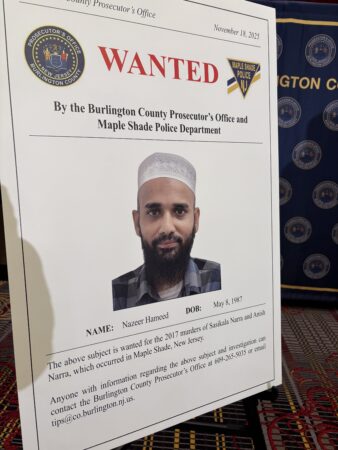
New Jersey Gov. Phil Murphy has asked the Indian government to extradite an accused murderer to South Jersey to face criminal charges in the death of a woman and her son in Maple Shade.
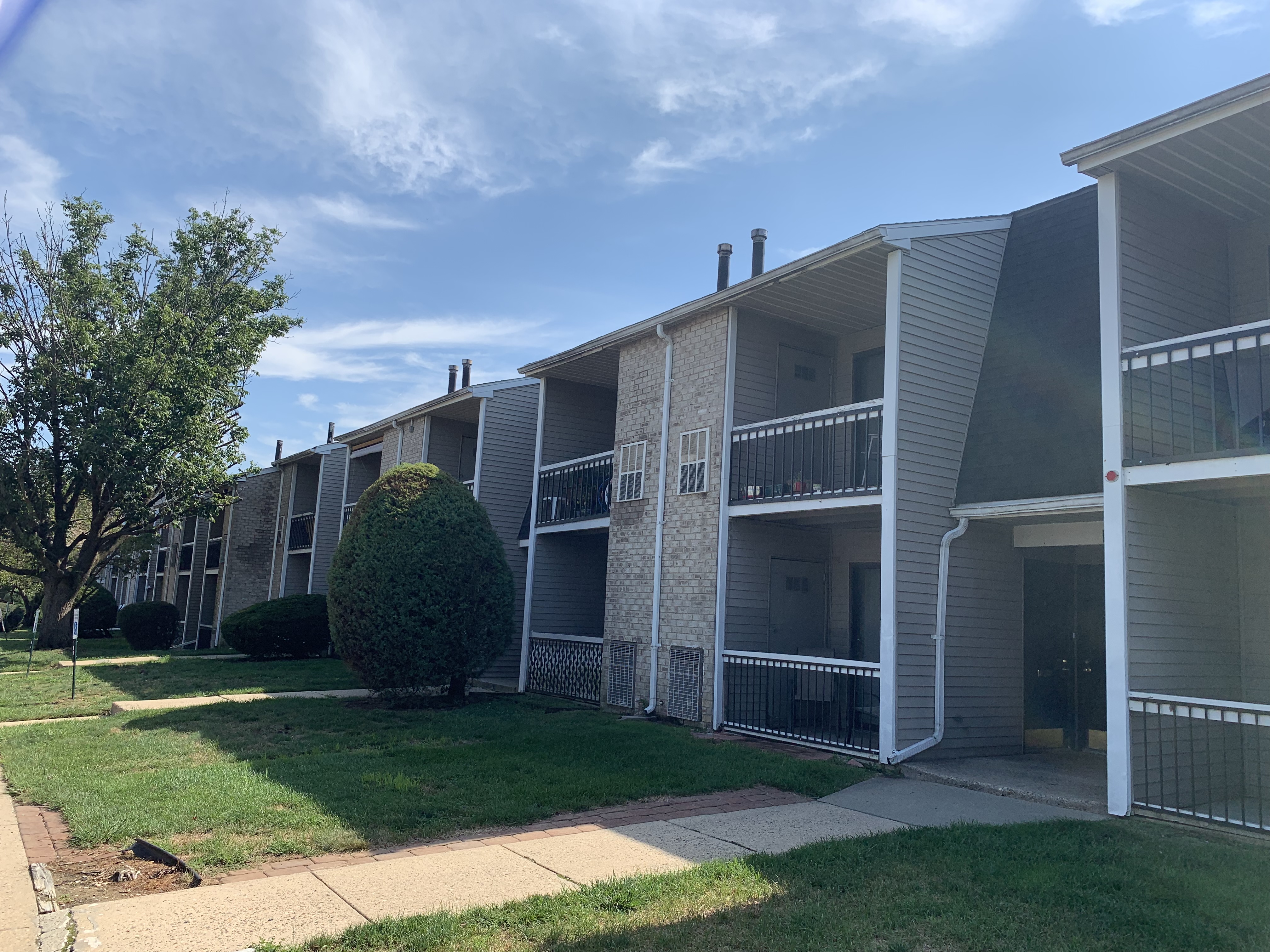
Narra and her son were found stabbed to death inside their home at the Fox Meadow Apartments in March 2017. The two suffered violent stab and slice wounds to their head and hands, and Anish was nearly decapitated in the attack, prosecutors said.
Hanumantha Rao Narra, Narra’s husband and the boy’s father, found the bodies, prosecutors said.
Investigators said Hameed waited until the woman and child were alone in the house before attacking them. Afterward, prosecutors said, Hameed fled to his native India and has remained there ever since.
In a letter to Vinay Kwatra, the Indian ambassador to America, Murphy said it was important that Hameed face justice.
“This heinous crime shocked our state, and for eight years investigators pursued every available lead,” the governor said.
“This request reflects not only the seriousness of the alleged offenses, but also the enduring spirit of cooperation between India and the United States in upholding the rule of law and combating violent crime.”
Sasikala Narra, 38, and her son, Anish, 6, were stabbed to death inside their apartment in Maple Shade in 2017.
In announcing the charges last month, Burlington County LaChia Bradshaw said Hameed worked at the same company as Hanumantha Rao Narra, and lived near the family in their apartment complex. For weeks before the killings, Bradshaw said, Hameed “stalked” the family and took measures to hide his movements.
She declined to describe the potential motive for the slayings.
Local, state, and federal investigators worked the case for nearly a decade, and ultimately connected Hameed to the crime through a single drop of blood they say he left at the crime scene.
Last year, a sample of Hameed’s DNA was finally obtained when the company Hameed works for shipped his personal laptop to South Jersey. DNA found on the computer matched the blood found at the crime scene in 2017, according to investigators.
The former chief financial officer of a Burlington County nonprofit was sentenced to eight years in state prison for stealing $2.5 million from the company for personal expenses, including settling her credit card debt and buying vacation homes and a Corvette Stingray sports car, officials said Thursday.
Colleen Witten, 56, of Buena, Atlantic County, pleaded guilty in June to theft, money laundering, and tax evasion for the scheme, which took place during her time as an executive with OTC Services, a company that provides job training for adults with disabilities.
New Jersey State Attorney General Matthew Platkin said Witten’s prosecution reflects his office’s “unbreakable commitment to pursue justice for victims and hold accountable those who abuse their positions of trust to commit crimes.”
Witten’s attorney, Brendan Kavanagh, did not immediately return a request for comment.
Prosecutors said Witten altered corporate board meeting minutes to give herself the authority to open a company bank account, and then used the account to siphon money between May 2019 and March 2024.
She disguised the theft by laundering the money through checks issued to a landscaping business she owned with her husband, and the couple failed to pay taxes on these funds.
Witten’s husband, Allan, pleaded guilty earlier this year to one count of receiving stolen property for accepting money from the nonprofit for work he knew his business did not perform. He was sentenced to three years in state prison.
The bodies of Sasikala Narra, 38, and her son, Anish, were found in their blood-spattered apartment by their husband and father, Hanumantha Rao Narra, in March 2017. They had been stabbed to death.
In the end, the mystery was unraveled by a single drop of blood, prosecutors said Tuesday as they announced who they believe was the killer.
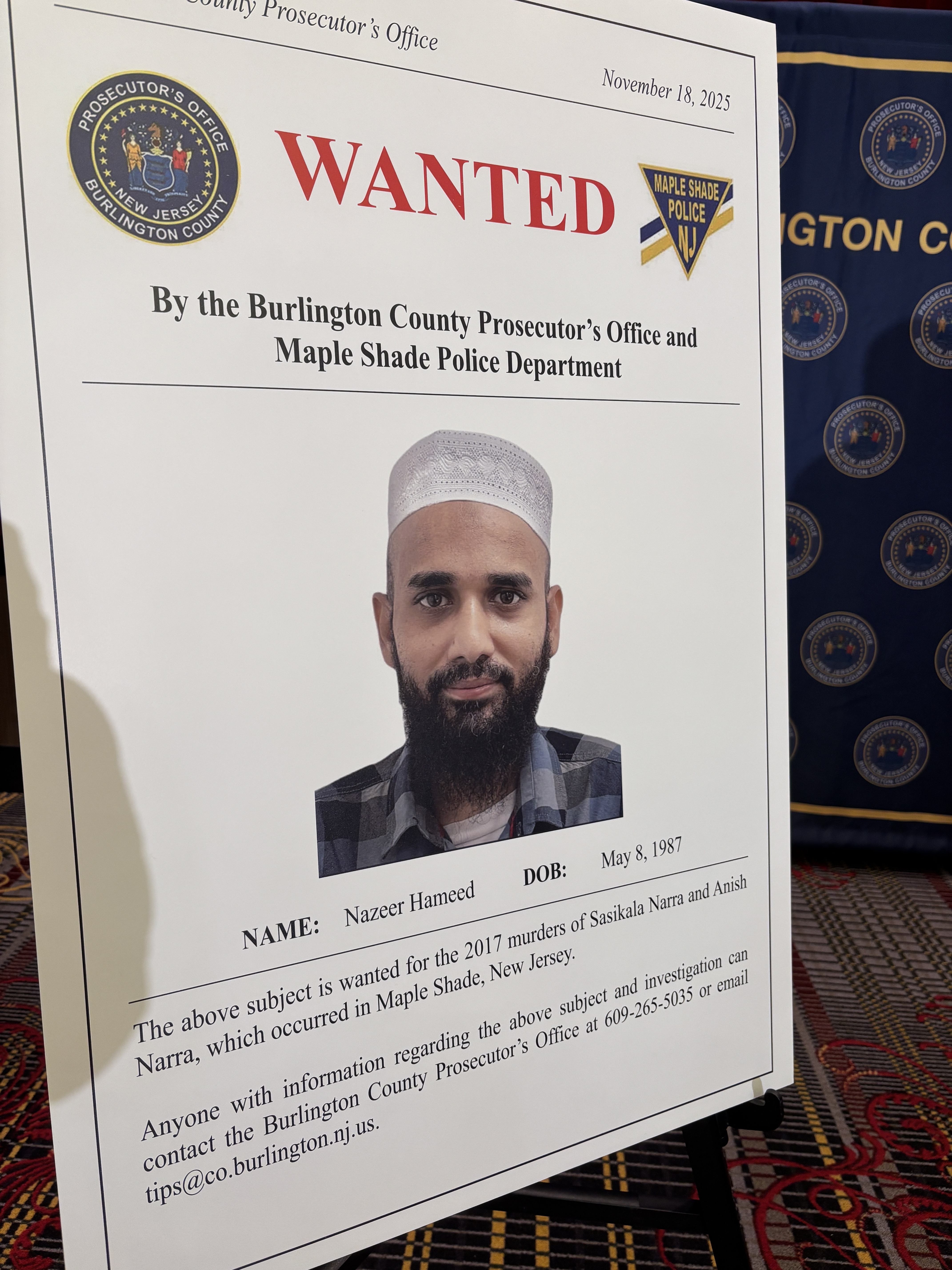
Nazeer Hameed, 38, has been charged with murder and related crimes in the double stabbing. Authorities say Hameed fled to his native India after the killings, where he remains today.
Hameed worked at Cognizant, a North Jersey tech company with an office in Philadelphia, alongside Hanumantha Narra, and lived in the same apartment complex as the family.
Sasikala Narra, 38, and her son, Anish, 6, were stabbed to death inside their apartment in Maple Shade in 2017.
Patrick Thornton, the chief investigator for the Burlington County Prosecutor’s Office, said he could not reveal any information about Hameed’s potential motives. But he said Hameed had stalked the family for some time before the killings and used his background in tech to hide his movements after the fatal stabbings.
Thornton said Hameed waited until Narra had left the apartment before attacking his family with a series of violent stab and slice wounds to their head and hands. Anish was nearly decapitated in the attack.
“These innocent victims were defenseless during the horrific attack,” Thornton said. “Veteran officers said this was one of the most brutal crime scenes they’ve seen in their careers, and they are still affected by the memory of it.”
Hameed’s indictment, according to Burlington County Prosecutor LaChia Bradshaw, was the result of a yearslong investigation that involved local, state, and federal law enforcement.
And while she said Tuesday that she was pleased to share the news of the charges against Hameed, she stressed that the work for law enforcement was far from over. Hameed is still living in India, and prosecutors in Bradshaw’s office are awaiting assistance from federal authorities to extradite him to New Jersey.
Prosecutors say Nazeer Hameed stalked the Narra family for some time before killing Sasikala and Anish Narra.
“We urge the full cooperation of our two nations to send a message that those who commit crimes cannot escape accountability by crossing oceans,” Bradshaw said.
Hameed was initially considered a person of interest in the case, and later identified as a suspect in 2019, when investigators found a drop of blood at the crime scene that did not belong to the victims.
For the next five years, detectives attempted to compel Hameed to submit a DNA sample, but were unsuccessful. The Indian government agreed to assist in the collection of the specimen, but never acted on that agreement, officials said Tuesday.
A break in the case came in 2024, when Cognizant, the tech company Narra and Hameed worked for, sent local prosecutors the laptop Hameed used. A sample of his DNA was pulled from the device, and was ruled to be a match to the blood found at the crime scene.
Authorities continued to investigate in the months that followed and, on Tuesday, publicly announced his involvement in the crime.
Bradshaw vowed to work with federal authorities and the Indian government to bring Hameed to America to face criminal charges.
“The passage of time does not lessen our resolve,” she said. “No border can stand in the way of justice, and the people of Burlington County deserve closure.”
The mother and son were killed in their Fox Meadows Apartment complex in Maple Shade, N.J.
The Narras immigrated to America from the Prakasam district in Andhra Pradesh state, on India’s eastern coast.
After marrying, they moved to Maple Shade and later enrolled their son in Our Lady of Perpetual Help Catholic School. Teachers there called Anish “a beautiful child of God” in speaking to reporters after his slaying.
Hanumantha Rao Narra could not immediately be reached for comment.
Through a lawyer, Sasikala Narra’s family in India said Tuesday they were relieved to hear that the killer had been identified.
“They’re very appreciative of all the work by law enforcement,” Donald F. Browne Jr. said. “It took a very long time, but that’s how justice goes sometimes, and they’re very thankful that everyone kept fighting and kept trying to find the answer to this case.”
A 47-year-old man from New Jersey died within hours of eating a hamburger at a barbecue in the summer of 2024.
He had no major medical problems prior, nor did his autopsy find a cause of death.
But several months later, researchers at the University of Virginia pieced together a diagnosis: severe anaphylaxis linked to alpha-gal syndrome. It was a tick-related red meat allergy the man didn’t know he had.
He would turn out to be the first documented death from anaphylaxis related to the red meat allergy, according to a study published Wednesday in the Journal of Allergy and Clinical Immunology: in Practice.
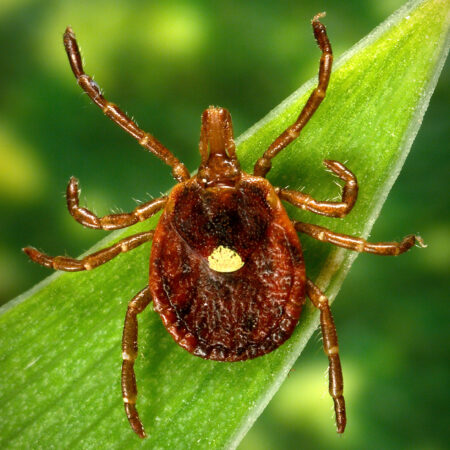
In most cases of alpha-gal syndrome, the culprit is a Lone Star tick, which can transmit a sugar molecule called alpha-gal to a person during a bite. This can trigger the person’s immune system to react to the molecule, also found in meat from mammals, including beef, pork, and lamb, and in dairy and gelatin products.
The man had received 12 to 13 bites around his ankles earlier that summer from what his wife had thought were “chiggers.”
However, the bites were likely from the larvae of Lone Star ticks, which look similar to chiggers.
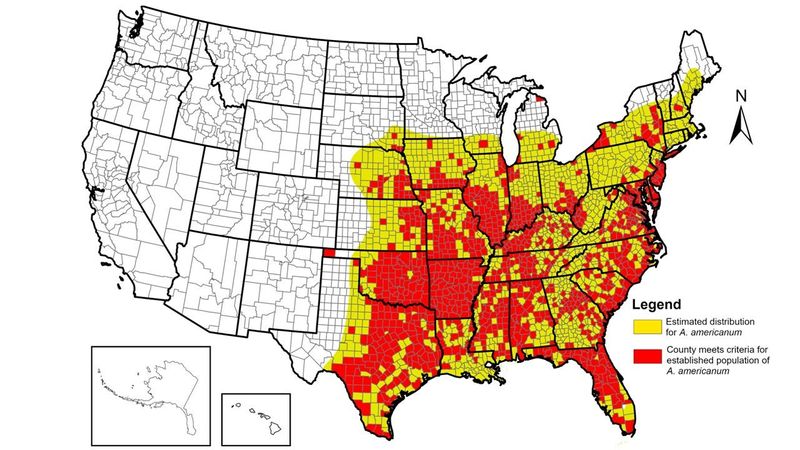
Lone star ticks are native to the eastern United States, but were traditionally limited to southern states because of deforestation in early America. Forest regrowth and climate change have helped the ticks reclaim their territory and expand.
Lone star ticks have been found in Pennsylvania since 2011, including in Bucks, Chester, Delaware, and Philadelphia Counties. A 2008 Rutgers study found them in every South Jersey county.
The man who died was not identified in the newly published case study, nor was it revealed where he lived in New Jersey.
The Centers for Disease Control and Prevention says nearly a half-million people are suffering from alpha-gal syndrome nationwide.
Although this is the first deadly case documented that’s linked to the red meat allergy, reactions to the alpha-gal sugar in the targeted cancer therapy cetuximab have led to other deaths, however this is rare.
Researchers say the man’s case calls for increased awareness of the symptoms of anaphylaxis, which go beyond hives and trouble breathing.
“If you get the worst abdominal pain in your life, you need to consider the possibility of an allergic reaction,” said Thomas Platts-Mills, an allergist and immunologist at the University of Virginia and lead author on the study.
A map shows the estimated area in which Lone star ticks are found in America.
What happened
The 47-year-old airline pilot had gone on a camping trip in an unidentified location with his wife and children back in summer 2024. They spent the whole day outside, followed by a meal of beef steak at 10 p.m. It was an unusual choice for the family, who normally ate chicken.
Four hours later, the man woke up with abdominal pain that became so severe that he “was writhing in pain,” according to the study’s recount of the events. That was paired with diarrhea and vomiting.
After a couple of hours, his symptoms improved, and he fell back asleep.
The next morning, he rose feeling well enough to get a five-mile walk in before breakfast.
He thought about consulting a doctor, but ultimately decided against it, unsure what he would say happened. Separately, he told one of his sons that he thought he was going to die during the episode.
Two weeks passed, and the family, now home in New Jersey, attended a barbecue where the man ate a hamburger at around 3 p.m. He went home and spent an hour mowing the lawn.
A few hours later, his son found him unconscious on the bathroom floor, surrounded by vomit.
His son called 911 at 7:37 p.m. and initiated resuscitation until the paramedics arrived, but even after his father was transferred to the hospital, doctors could not save the man.
An autopsy found no obvious problems with his heart, lungs, brain, or abdomen, and concluded it was a “sudden unexplained death.”
The man’s wife, however, asked her friend, a pediatrician, to review the autopsy report. Suspecting the man could have had alpha-gal syndrome, the pediatrician contacted Platts-Mills, who first identified the syndrome back in 2007.
Solving the mystery
When Platts-Mills heard that the postmortem report gave no cause of death, he thought, “You can’t leave this lady losing her 47-year-old husband for no reason. That’s impossible.”
He arranged for a sample of the man’s blood to be sent to his lab for testing.
When they received it in April, their first move was to screen for a protein called immunoglobulin E, which the immune system releases during allergic reactions. They wanted to know whether his body was sensitive to anything it shouldn’t have been.
Unsurprisingly, the test came back positive for rye grass and ragweed, two common seasonal allergens.
But so did two other substances: alpha-gal and beef.
While this helped establish his allergy to alpha-gal, their next step was to confirm whether he had anaphylaxis when he died. They sent the sample to be tested for an enzyme called tryptase, which the body releases during severe allergic reactions. High levels could indicate that he died from severe anaphylaxis.
Not long after, a scientist called Platts-Mills to apologize and tell him they had to redo the test.
Platts-Mills thought, “Oh my god, was it negative?”
Instead, the scientist would tell him the levels of tryptase were bafflingly high.
At over 2,000 nanograms per milliliter, there was so much tryptase in his system that they needed to dilute the sample and retake the value. That number astonished Platts-Mills, who himself had never seen levels surpass 200 nanograms per milliliter.
“It absolutely says that he died of anaphylaxis,” Platts-Mills said.
It is unclear why he had such a severe case of anaphylaxis. While the study listed some factors, such as his drinking beer with his burger and being exposed to ragweed pollen, that potentially could have influenced his outcome, Platts-Mills said these “probably weren’t really the reasons why his anaphylaxis was more severe.”
Anaphylaxis very rarely causes death. One study found only 0.3% of cases in the emergency room are fatal.
One of the takeaways from the man’s experience is not to ignore abdominal pain, Platts-Mills said. While many people know to look out for more common signs of anaphylaxis, such as hives and difficulty breathing, having abdominal pain without other symptoms can be a dangerous form of the reaction.
In most cases, this pain takes three to five hours to show up after eating red meat. Had the man known his previous episode of abdominal pain was anaphylaxis, he could’ve avoided eating the burger.
“That’s the tragedy from my point of view,” Platts-Mills added.
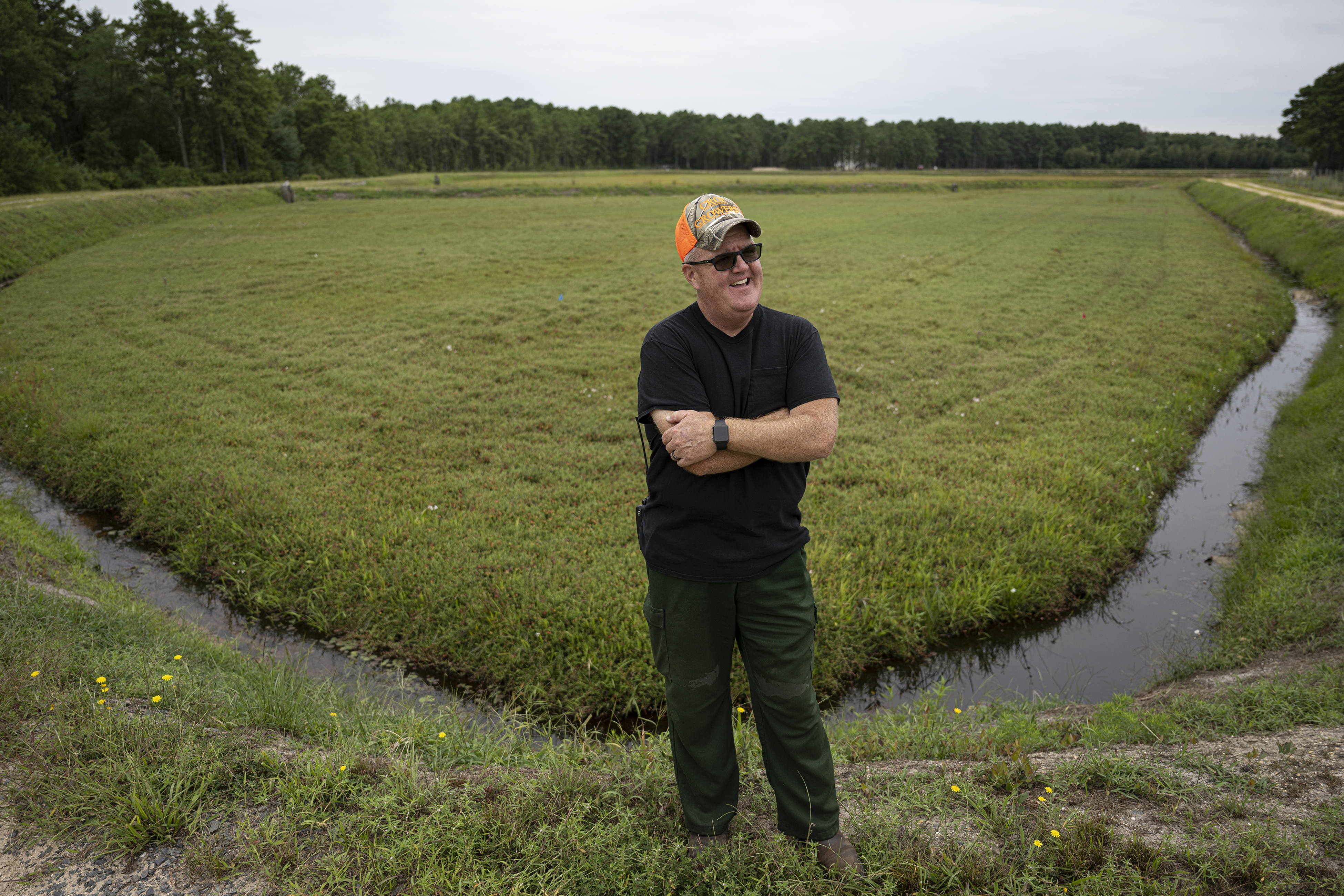
Sam Moore suffers from Alpha-gal syndrome, which is brought on by an invasive tick bite. He is shown here at his cranberry farm in Tabernacle, N.J. in August 2023.
Living with alpha-gal syndrome
Samuel Moore, a cranberry farmer in Shamong, deep in the New Jersey Pinelands in Burlington County, has had many close calls and a handful of hospital visits due to alpha-gal. He was diagnosed several years ago and knows a handful of other locals who’ve been bitten and diagnosed.
So far, Moore said there’s been no treatment that’s helped.
“The only treatment,” he said,” is vigilance.”
That means exhaustive label reading at the grocery store, rarely, if ever, dining out, and getting to know local deli owners personally. Moore said he could have a flare-up due to proteins left over on a lunchmeat slicer.
“I’ve come to the point where I’ve felt anaphylaxis coming on and my throat closing up,” he said. “It’s not just breaking out in hives.”
Moore recently celebrated his 52nd birthday at a plant-based restaurant in Haddonfield, where he was able to eat anything on the menu.
“And I’ll tell you, I was still a little nervous,” he said.
One of Moore’s friends, Albertus “Chippy” Pepper, also contracted alpha-gal syndrome. Like Moore, he’s a cranberry farmer, often outside in the bogs or clearing brush. His new diet has become a little bland.
“I eat chicken, chicken, chicken, and more chicken,” he told The Inquirer in 2023.
Editor’s note: The story has been updated to clarify that cetuximab is a targeted cancer therapy.