Hours before leaving office, New Jersey Gov. Phil Murphy on Tuesday signed legislation that could make it easier for commercial real estate projects in Camden to qualify for hundreds of millions of dollars in state tax incentives.
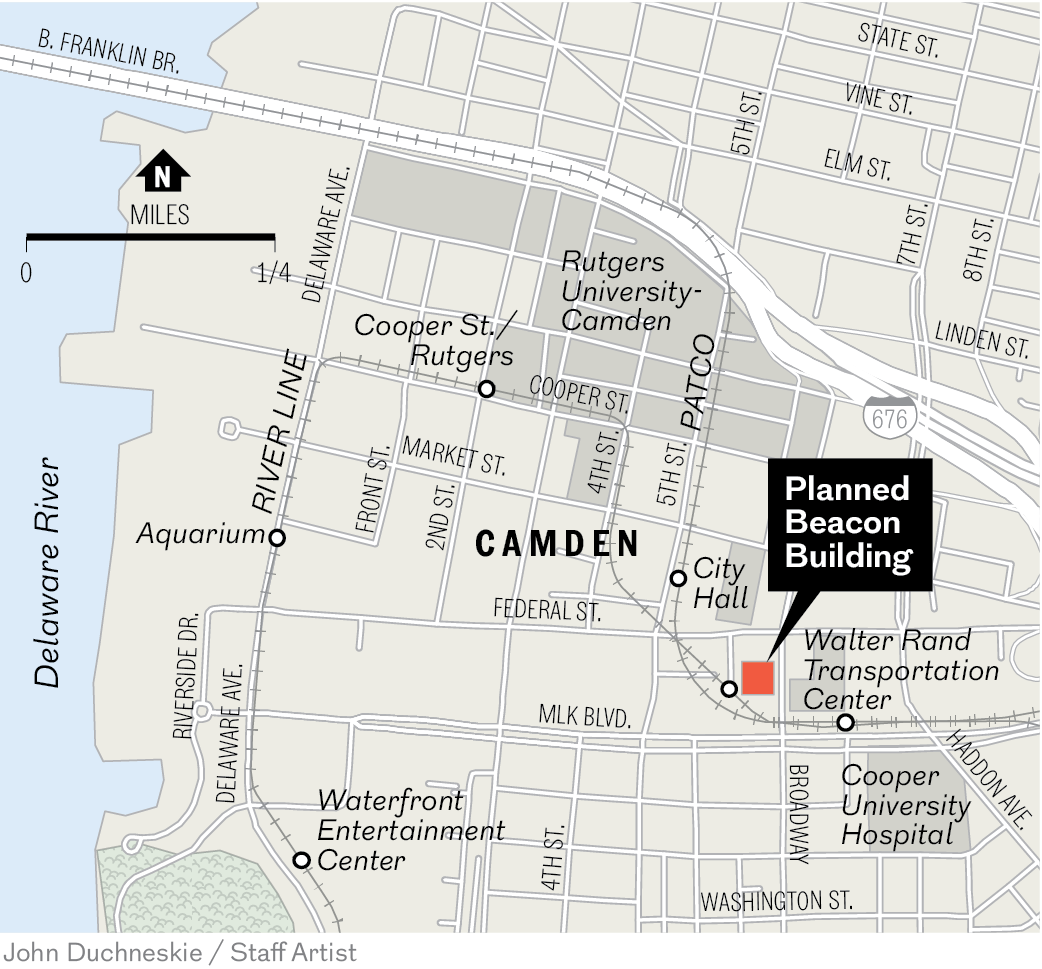
One planned development that could benefit is the Beacon Building, a proposed 25-story office tower downtown on the northwest corner of Broadway and Martin Luther King Boulevard, The Inquirer previously reported.
Murphy approved the bill and dozens of others on the final day of his second term, shortly before fellow Democrat Mikie Sherrill was sworn in as governor. Another newly signed law authorizes up to $300 million in tax breaks to renovate the Prudential Center in Newark, home of the New Jersey Devils. The hockey team is owned by Harris Blitzer Sports & Entertainment, which also owns the Philadelphia 76ers.
The Camden-focused law makes changes to the state’s gap-financing program, known as Aspire, which authorizes up to $400 million in corporate tax credits over 10 years for “transformative” redevelopment projects that have a total cost of $150 million and meet other requirements.
To qualify for the incentives, most commercial projects must generate a net positive benefit to the state, based on the Economic Development Authority’s economic modeling. The new law exempts certain projects from that “net benefit test.”
The law applies to redevelopment projects located in a “government-restricted municipality” — as described in the Aspire program’s statute — “which municipality is also designated as the county seat of a county of the second class.” In addition, the project must be located in “close proximity” to a “multimodal transportation hub,” an institution of higher education, and a licensed healthcare facility that “serves underrepresented populations.”
A rendering of the 25-story Beacon Building proposed for the northwest corner of Broadway and Martin Luther King Boulevard in Camden. It would be the tallest building ever constructed in the city.
The site of the proposed Beacon Building is across the street from the Walter Rand Transportation Center and Cooper University Hospital. Rutgers’ Camden campus is also nearby. Lawmakers said projects in New Brunswick and Trenton could also qualify for exemptions under the law.
Development firm Gilbane is leading the project with the Camden County Improvement Authority. Gilbane has yet to announce any commitments from tenants.
Assembly Majority Leader Louis Greenwald (D., Camden), who sponsored the legislation, has said it wasn’t written with a specific project in mind but rather to remove a barrier to investment in South Jersey.
Critics said that the law removes a key safeguard meant to protect taxpayers and that it represented an about-face for Murphy, who earlier in his tenure sought to reform corporate incentive programs.
“Just in terms of the governor signing the bill, this is a massive disappointment,” said Antoinette Miles, state director of the New Jersey Working Families Party.
“Broadly, if there’s a so-called transformative project that can’t pass the net benefit test, maybe it isn’t so transformative,” she said.
Murphy’s office announced the bill signing without commenting on it, though he has previously cheered state investment in Camden. Any Aspire tax incentives must be approved by the state’s Economic Development Authority.
New Jersey lawmakers on Monday approved a bill that would make it easier for development projects in Camden to qualify for hundreds of millions of dollars in tax credits.
Under current law, most commercial real estate developers must show their projects would generate more dollars in economic activity than they would receive in subsidies in order to qualify for tax credits under New Jersey’s gap-financing program, known as Aspire.
The new legislation — which was introduced late last month and approved by the Democratic-led Legislature days before Democratic Gov. Phil Murphy is to leave office — would exempt certain projects from the program’s so-called net benefit test.
Lawmakers on Monday also passed a bill increasing the cap on the size of the Aspire tax-credit program from $11.5 billion to $14 billion and authorized $300 million in tax breaks to renovate the Prudential Center in Newark, home of the New Jersey Devils hockey franchise. The team is owned by Harris Blitzer Sports & Entertainment, which also owns the Philadelphia 76ers.
‘Competitive market’
Supporters of the Camden bill, A6298/S5025, said it would make South Jersey more competitive in the Philadelphia market, while critics contended it would weaken a provision of a 2020 economic development law signed by Murphy that was intended to ensure fiscal prudence.
The test has impeded big projects in South Jersey, said Assembly Majority Leader Louis Greenwald (D., Camden), a sponsor of the bill. Since the law was signed, the region hasn’t attracted a single “transformative project” — a designation in the Aspire program for developments that have a total cost of $150 million and are eligible for up to $400 million in incentives over 10 years, Greenwald said.
“We started to ask people, what’s the barrier?” he said. “And when you look at the competitive market of what [developers] can get in Philadelphia or Pennsylvania compared to other areas in the state that don’t have to compete with that, that net operating loss test, that net benefits test, is a barrier.”
The legislation was not drafted with a specific project in mind, Greenwald said, but he acknowledged that one that might benefit is Beacon, which would feature 500,000 square feet of office space.
Developer Gilbane is leading the project with the Camden County Improvement Authority at a vacant site on the northwest corner of Broadway and Martin Luther King Boulevard across the street from the Walter Rand Transportation Center and Cooper University Hospital.
Map of the planned Beacon Building in Camden.
“The goal is to attract projects, maybe like Beacon Tower, to capitalize off of the growth that we’ve seen in Camden city,” Greenwald said.
Any project seeking Aspire subsidies must apply to the Economic Development Authority.
Camden County officials have said they expect tenants to include Cooper University Health Care, which has said it needs additional office space to accommodate its $3 billion expansion. They also hope to entice civil courts to relocate there.
County Commissioner Jeff Nash said last year that tenants had yet to commit, in part because the development team was still working on an application for Aspire tax credits.
The incentives will help determine rent, he told the Cherry Hill Sun. The land is owned by the Camden Parking Authority, and Nash has said officials are still trying to determine who will own the site and the building going forward, according to Real Estate NJ.
County spokesperson Dan Keashen said that those talks remain ongoing and that the improvement authority may issue a request for proposals for a new developer. Gilbane, the current master developer, didn’t respond to a request for comment.
Wendy Marano, a spokesperson for Cooper University Health Care, said she didn’t have an immediate answer to a question about whether the hospital network planned to obtain an equity stake in the development.
In 2014 the state awarded $40 million in tax credits to incentivize Cooper Health’s relocation of suburban office jobs to Camden, and Cooper later bought a stake in the development.
The possible new state investment in Camden comes after Murphy’s administration separately allocated $250 million to renovate the state-owned Rand center — which serves two dozen NJ Transit bus lines and the River Line, and includes PATCO’s Broadway station.
Construction on the transit center is expected to begin soon, according to county officials. While that renovation is underway, the Beacon site will serve as a temporary bus shelter, Keashen said, adding that possible construction on an office tower is still years away.
Fast track
Critics of the bill said that it was rushed through the Legislature with minimal public input and outside the normal budget process, and that it appeared to be designed to benefit specific projects. The bill passed the Assembly, 48-25, and the Senate, 24-14. It now heads to Murphy’s desk. The governor’s second term ends on Jan. 20, when he is to be succeeded by fellow Democrat Mikie Sherrill.
The legislation applies to redevelopment projects located in a “government-restricted municipality” — language included in the Aspire program’s statute — “which municipality is also designated as the county seat of a county of the second class.” The project must also be located in “close proximity” to a “multimodal transportation hub,” an institution of higher education, and a licensed healthcare facility that “serves underrepresented populations.”
“I say to you that there’s going to be one project that fits all those criteria,” Assemblyman Jay Webber (R., Morris) said on the floor of the chamber during debate Monday.
“The net benefits test was put in as an accountability measure to make sure these projects were at least by some measure benefiting the taxpayer,” Webber added in an interview.
“And now apparently one or more projects can’t meet that test,” he said. “And so rather than stick to the rules that they agreed to and pull the credits, they’re going to change the rules, lower the bar so that somebody can step over it. It’s wrong.”
Greenwald said the legislation has “nothing to do with [Beacon] in particular,” adding that he hopes it is one of many projects that could benefit. Possible developments in Trenton and New Brunswick could also qualify for incentives under the bill, he said.
Assembly Majority Leader Louis Greenwald in 2019.
The net benefit test
The test relies on economic modeling based on data such as projected jobs and wages. Under current law, most commercial projects seeking Aspire credits must demonstrate a minimum net benefit to New Jersey of 185% of the tax credit award — meaning, for instance, an applicant that receives $100 million in credits must generate $185 million in economic activity.
Projects located in “government-restricted municipalities” — a half-dozen cities, including Camden, selected by the Legislature — already face a lower threshold of 150%, according to the state Economic Development Authority.
Some projects, including residential and certain healthcare centers, are exempt from the net benefit test.
The test was strengthened in the Economic Recovery Act of 2020, signed by Murphy, because “we saw in previous iterations of the tax credit program that if the guardrails weren’t strong enough … then companies could simply not meet the test, or, you know, not follow through on their promises, and nonetheless collect the funds,” said Peter Chen, senior policy analyst at New Jersey Policy Perspective, a liberal-leaning think tank.
The 2020 law changed that, he said. “It’s one of the most important guardrails of the entire corporate tax credit program,” Chen said in an interview last week. “So exempting any project from the net benefit test requires a pretty large, pretty strong reason for doing so, and in this case, no reason was given.”
Criminal case
The renewed push for tax credits in South Jersey comes as a criminal case involving an earlier round of corporate subsidies continues to play out in court.
Democratic power broker George E. Norcross III — founder of a Camden-based insurance brokerage and chairman of Cooper Health — and five codefendants were indicted in 2024 on racketeering charges related to development projects on the city’s waterfront.
A judge dismissed the charges last year, and the state Attorney General’s Office is appealing the decision. Norcross has denied wrongdoing. He and his allies say state incentives have helped revitalize the city.
During his floor speech on Monday, Webber alluded to “incredible allegations of corruption” in the earlier economic development program and noted that Murphy had previously championed reform of the system.
The governor’s spokesperson, Tyler Jones, declined to comment on pending legislation.
Giancarlo Brugnolo moved to Cherry Hill’s Woodcrestneighborhood in 2014, but it wasn’t until last year that he heard about the centuries-old cemetery just a stone’s throw away from his house. When friends first mentioned it, he assumed they were joking.
“I was like, ‘What are you talking about? What graveyard?’” he remembers saying. “We live in a residential neighborhood, there’s no way there’s a graveyard.”
Yet tucked away under sassafras trees and in the shade of neighboringhouses, members of one of South Jersey’s first colonial families are laid to rest.
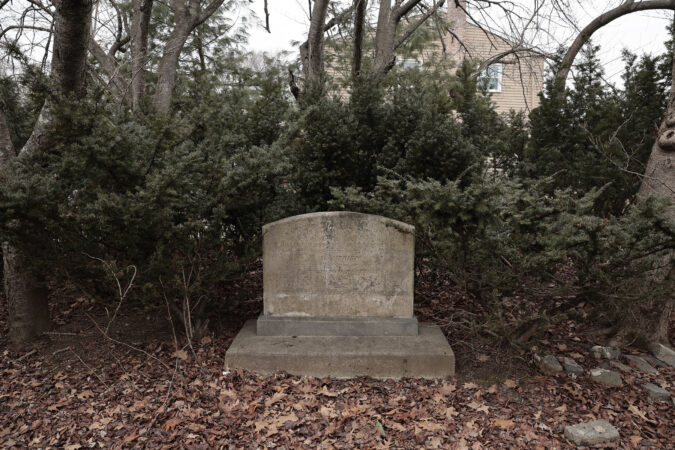
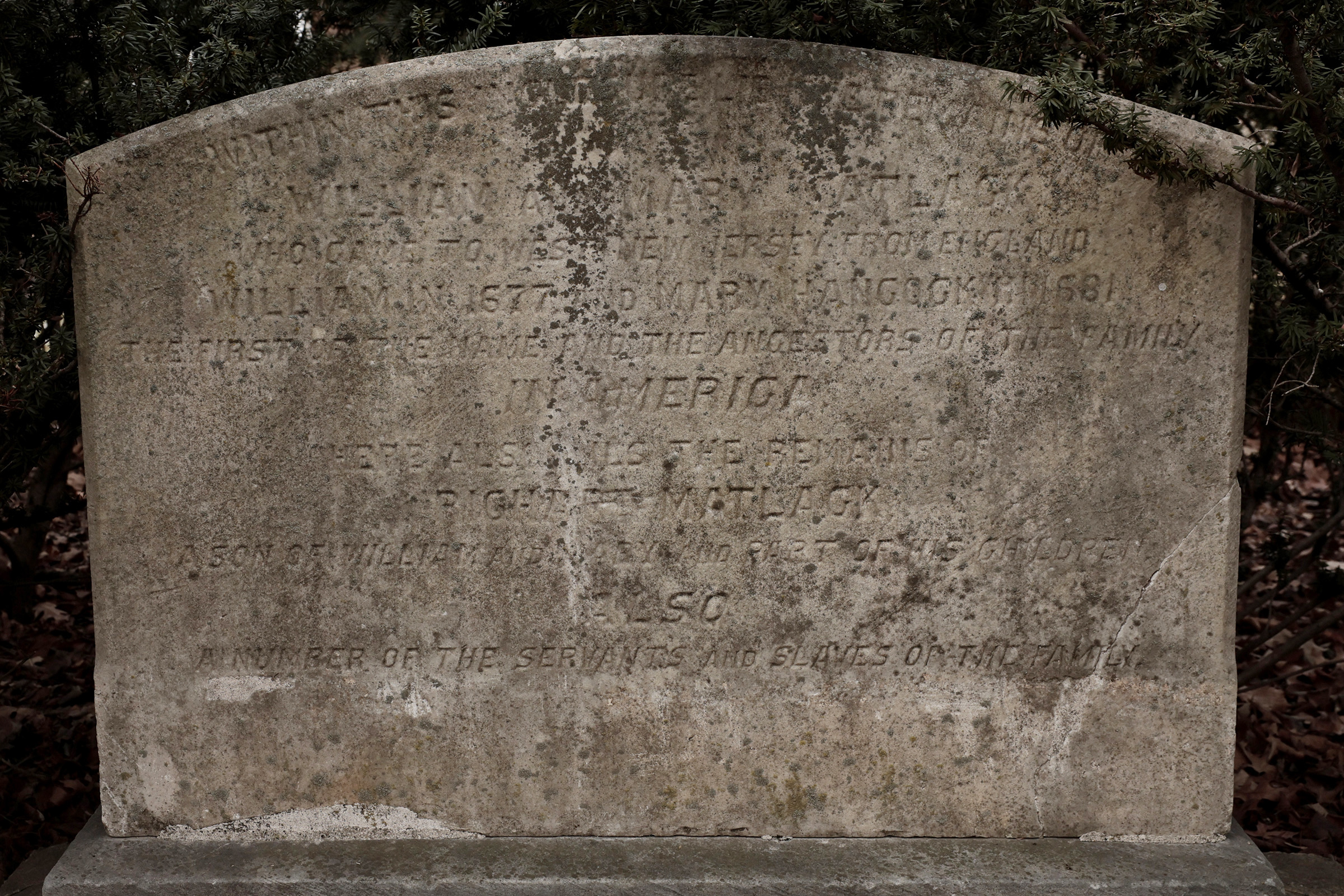
The Matlack Family Cemetery is located on the 500 block of Cherry Hill’s Balsam Road. At the small grave site lie the remains of William and Mary Matlack, some of their descendants, and an unspecified number of servants and enslaved people. William Matlack is believed to have died in 1738, at around age 90, and Mary Matlack in 1728, at around age 62.
Wanting to know more about the cemetery,Brugnolo took his question to Curious Cherry Hill, The Inquirer’s forum for answering local questions. Who was the Matlack family, and how did their grave site end up in a residential neighborhood?
William Matlack, a carpenter, came to New Jersey in 1677 from Cropwell Bishop in Nottinghamshire, England. He traveled to the Americas on a ship named the Kent as an indentured servant to Thomas Ollive and Daniel Wills. Willswas appointed as the commissioner of West Jersey and sent to make deals with the Lenni-Lenape people who had long lived on the land. Many of the Kent’s travelers, including Matlack, were Quakers. The ship traversed the Atlantic Ocean from England, ultimately heading up the Delaware River to present-day Burlington County. Matlack is said to have been the first European settler to put his foot on the shore of what is now the city of Burlington (however some historians believe Swedes settled there a half-century earlier).
At the time Matlack and Wills arrived in South Jersey, the spot was “a bleak haven” from their English homes, covered in dense forest and impenetrable at night, according to a 1970 article in the Courier-Post. Yet South Jersey stood out as a “long-sought destination thousands of miles from the brutality of bigots” in England who persecuted them for their Quaker practices.
Matlack owed Wills four years of servitude and, in 1681, was granted 100 acres of land in return. While working for Wills, Matlack helped build two of the first houses and the first corn mill in the area.
The headstone in the Matlack Family Cemetery on the 500 block of Balsam Road in Cherry Hill.
Matlack would become the patriarch to one of the largest families in colonial South Jersey. In the early 1680s he married Mary Hancock, who had recently come to New Jersey from England with her brother, Timothy. At the time of their marriage, William Matlack was 34 and Mary Matlack was 16. The Matlacks lived between two branches of Pennsauken Creek in present-day Maple Shade. William Matlack would come to own around 1,500 acres of land across South Jersey. The couple had six sons, three daughters, and an estimated 40 grandchildren.
Though Quakers became one of the first religious movements to reject slavery, many Quakers in early America, including the Matlacks, enslaved people. Research turned up little information about the enslaved people buried at the Matlack grave site. Birth and death records for enslaved people were often poorly kept in the age of chattel slavery, making it difficult to conduct genealogical research and historical inquiries into the lives of people held in slavery.
We do know, however, that slavery was pervasive in Philadelphia’s suburbs during and after the colonial era. Despite abolitionist activism, much of which was driven by Quakers in the Philadelphia region, thousands of people remained enslaved in New Jersey through the turn of the nineteenth century. New Jersey was the last Northern state to officially abolish slavery in 1866, when Gov. Marcus Ward signed a state constitutional amendment outlawing the institution. The amendment followed the 1865 ratification of the 13th Amendment to the U.S. Constitution, which New Jersey had initially rejected.
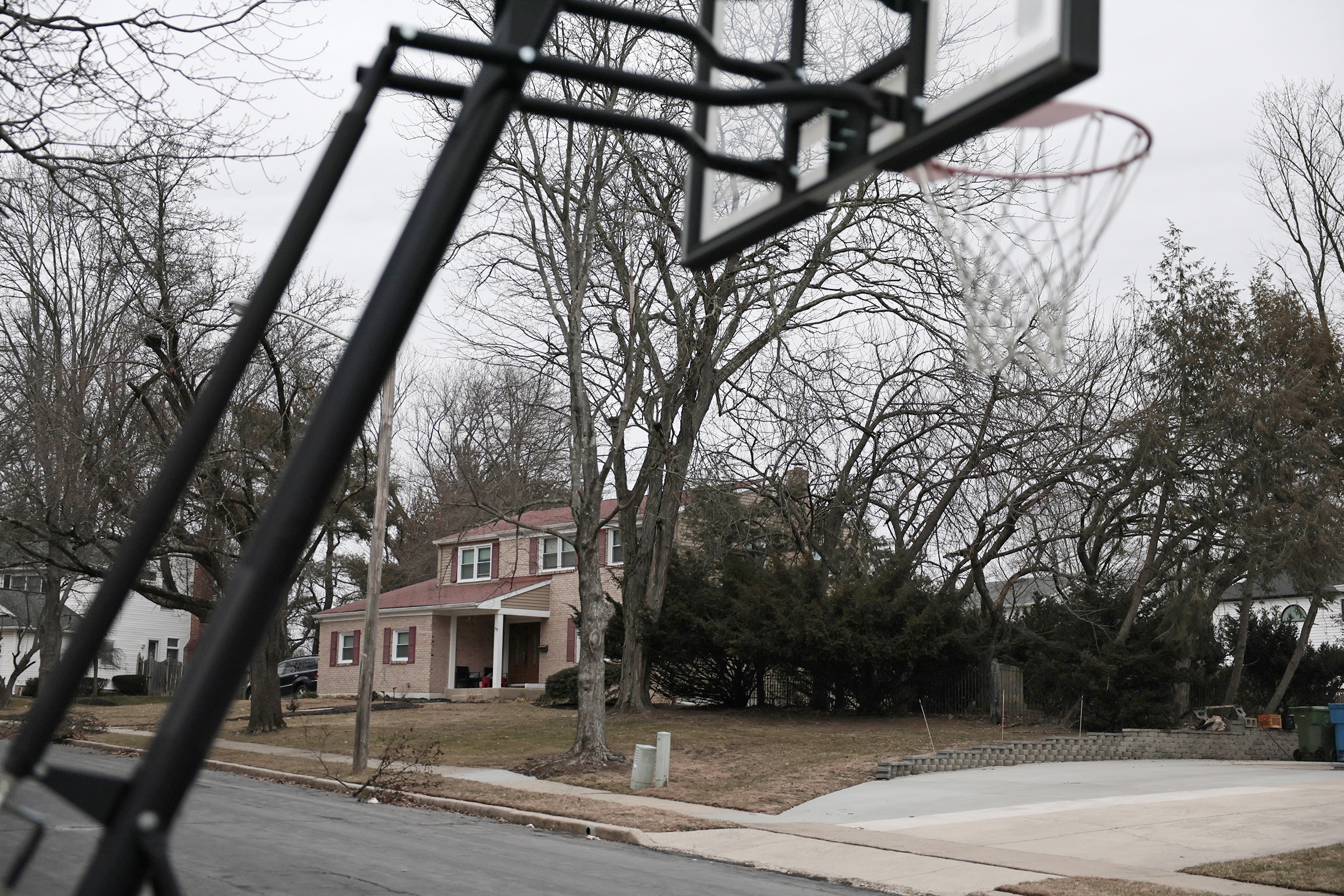
The Matlack Family Cemetery is a small graveyard in a residential neighborhood.
One well-known descendant of the Matlacks was Timothy Matlack, a politician and delegate to the Second Continental Congress who inscribed the Declaration of Independence. In Facebook groups and blog posts, dozens of residents of the Mid-Atlantic region say they are descendants of the first New Jersey Matlacks — likely claims given the expansive Matlack family tree, but difficult to prove.
William and Mary Matlack were not originally buried at the Balsam Road site, according to archival materials from the Rancocas Valley Chapter of the National Society of The Colonial Dames of America. They were initially buried on their son Richard’s farm near Springdale and Evesham Roads and were moved to the Balsam Road grave site in the late 1800s.
The grave was discovered by a Girl Scout troop on a camping trip in what was then an apple orchard, according to a Courier-Post article from 1990. The housing development surrounding the grave site went up in 1972, but the graveyard was left in tact due to its historical value. Today, it’s owned and maintained by the township.
This suburban content is produced with support from the Leslie Miller and Richard Worley Foundation and The Lenfest Institute for Journalism. Editorial content is created independently of the project donors. Gifts to support The Inquirer’s high-impact journalism can be made at inquirer.com/donate. A list of Lenfest Institute donors can be found at lenfestinstitute.org/supporters.
The Price Point compares homes listed for similar sale prices across the region to help readers set expectations about house hunting.
Looking for a new home for the new year? You’ve got options if you have the region’s typical homebuying budget.
Across the Philadelphia metropolitan area, homes sold for a median of $390,000 last month, according to the multiple listing service Bright MLS. That typical sale price is up more than 3% from last year.
Here’s what a home shopper could get with a budget like this in three different neighborhoods in the region.
Lower Merion condo in star location
Wolverton & Co., a Montgomery County-based real estate company, sells and manages a lot of condos in the area of West Montgomery Avenue in the Haverford section of Lower Merion Township.
“I call that stretch the golden mile of Haverford as it relates to condominiums,” said Will Wolverton, owner and broker of record at Wolverton & Co. “It’s a very desirable area.”
There are restaurants and national and local stores, including at the nearby Haverford Square and Suburban Square shopping centers. Condo residents can walk to SEPTA’s Haverford station to catch Regional Rail trains. The Merion Cricket Club offers sports facilities and hosts dinners and galas.
One condo currently for sale in the area is a two-bedroom, two-bathroom unit at Haverford Hunt Club, a building with 16 units on four floors. Condos there include both one-bedroom and two-bedroom units.
The building is about 45 years old but has been “thoughtfully updated” in both looks and critical infrastructure, such as the elevator and the roof, Wolverton said.
The condo for sale gets a lot of natural light, he said. And it’s on the top floor, so buyers won’t have upstairs neighbors. It also has a private balcony and a reserved space in the property’s parking lot.
The last several serious buyers have been most interested in the neighborhood, Wolverton said.
“It’s a very good property,” he said, “and a great location.”
This home in the Mayfair neighborhood of Northeast Philadelphia stands out in a few ways, said listing agent Xiao Zhen Zhao, who works throughout this section of the city, as well as Fishtown and Northern Liberties.
The open kitchen is “very unique” for the area and includes bar seating, said Zhao, an agent with Legacy Landmark Realty.
The primary bedroom has a private bathroom, which isn’t common in older homes in Northeast Philadelphia, she said. A lot of houses have only one full bathroom, she said. One of the bathrooms features a skylight and pink tiles on the walls.
And the home is “a bigger twin,” she said. It spans 1,868 square feet.
The home has a backyard and a walk-out finished basement, which has a half bathroom. It also has a garage and driveway.
The twin is in an area of the city where houses are more affordable and parking is easy. It’s within walking distance of schools. It’s minutes from stores and restaurants along Cottman Avenue, and it’s right off Pennypack Park.
Potential buyers have liked the layout of the home and also the look of it, Zhao said.
Potential buyers touring this Colonial in Camden County have fallen for its charm, said real estate agent Evangeline Gambardella. “Because it is a very charming space.”
The living room features a brick fireplace and a large window that lets in natural light and frames views of the front yard.
The layout is more open than in a traditional Colonial, especially in this area of Gloucester Township, said Gambardella, a real estate agent with the Mike McCann Team, which is an affiliate of Keller Williams.
The owners have recently updated the property. The home has new landscaping, a roof that is about 4 years old, a new fence, and a new heating, cooling, and ventilation system.
“It presents a really lovely value for its price point,” she said.
The home’s kitchen includes an island with seating. And a door in the formal dining room opens to the deck, which has a retractable awning.
Home shoppers who have visited the property like its spacious backyard and its location. It is minutes from the Gloucester Premium Outlets and the Deptford Mall, has easy access to major highways, and is close to parks and restaurants.
The home’s unfinished basement also is a “huge selling point for a lot of people” who want to decide what to do with the space, Gambardella said.
A South Jersey school was hit with an outbreak of gastrointestinal illness last week, as cases of norovirus, a common stomach bug, recently surged nationwide.
Camden County officials could not definitively say the illness was norovirus, since no lab testing has been done. However, they noted it was a candidate.
“The symptoms, infectious period, and incubation periods seem to be consistent with norovirus,” said Caryelle Vilaubi, director of the Camden County Department of Health and Human Services.
The school in Haddonfield, which officials declined to identify further, first reported a spike in gastrointestinal symptoms among students on Dec. 10, followed by an increase the next day.
Cases have since fallen dramatically, Vilaubi said, as outbreak control measures — including use of disinfectants, sending sick students home, and promoting proper hand hygiene — have been put into place.
They’re hoping to end the outbreak in the school community as early as next week, if they can go without new cases for four days, she said.
A variety ofsources can cause gastrointestinal illness, including viruses, bacteria, and parasites. Norovirus is one of the common culprits this time of year.
“We typically see a spike from November through April, not just in Camden County, but throughout the state, and often throughout much of the country,” Vilaubi said.
The highly contagious virus can spread through close contact with an infected person or with contaminated food, water, and surfaces. Symptoms usually include nausea, vomiting, diarrhea, and stomach pain, and start 12 to 48 hours after exposure.
Most people will feel better after one to three days.
Here’s what to know about the virus:
How can you protect yourself against norovirus?
Norovirus is a “hardy and resistant virus,” Vilaubi noted, making it especially hard to clean off. Hand sanitizers are not effective against it.
It is also relatively resistant to heat, able to survive temperatures up to 145°F.
People should make sure to regularly disinfect high-touch surfaces such as doorknobs, keyboards, and light switches.
How long does norovirus last in adults?
Though people will usually feel better after one to three days, they are still highly contagious for a few days after.
“If your child begins to show symptoms, please keep them home until at least 48 hours after symptoms resolve to prevent further spreading the illness,” Virginia Betteridge, liaison to the Camden County Department of Health and Human Services, said in a Dec. 12 news release.
Those infected with norovirus should avoid contact with others as much as possible during this period.
How to treat norovirus at home?
There is no cure or specific treatment for norovirus. The advice generally is to let the virus run its course.
To ward off dehydration, people should make sure to drink lots of fluids to replace what’s lost from vomiting and diarrhea. Taking small sips of water and sucking on ice chips may be easier on an upset stomach.
People can also consider drinking clear broths, noncaffeinated sports drinks, and oral rehydration solutions, which are available over the counter.
Drinks that contain a lot of sugar, including soft drinks and certain fruit juices, can make diarrhea worse and should be avoided.
How does norovirus spread from person to person?
Norovirus is considered highly contagious, as only a small amount of virus is needed to infect someone.
People contract it by accidentally touching tiny particles of stool or vomit — where the virus is primarily shed — from an infected person and getting them in their mouths.
These particles easily contaminate hands, surfaces, food, or water.
Taking his daughters to the Cherry Hill Public Library was a weekend ritual for David Jastrow, andone intricate sculpture out front always gave his family pause.
“For whatever reason, that sculpture always caught the attention of my daughters. When they were younger, they used to call it the ‘mixed-up elephant,’ which I always thought was funny,” said Jastrow, 51, a township resident who still frequents the library to pick up biographies and mystery novels.
The Cherry Hill Public Library hasupward of 50 works of art inside its halls, in addition to numerous sculptures outside, including the “mixed-up elephant” on the front lawn.That spurred Jastrow to write in to Curious Cherry Hill, The Inquirer’s forum for answering your questions.
“It’s a very abstract piece of artwork. You can kind of see the trunk coming out at one part,” Jastrow said. “I thought maybe it was designed with the elephant in mind in some way, but I doubt it.”
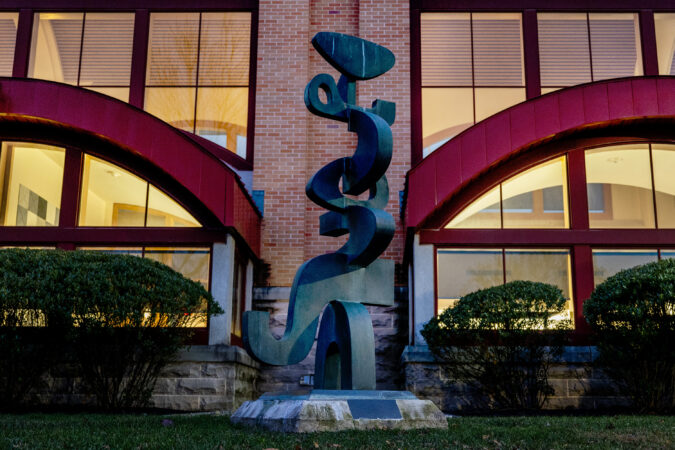
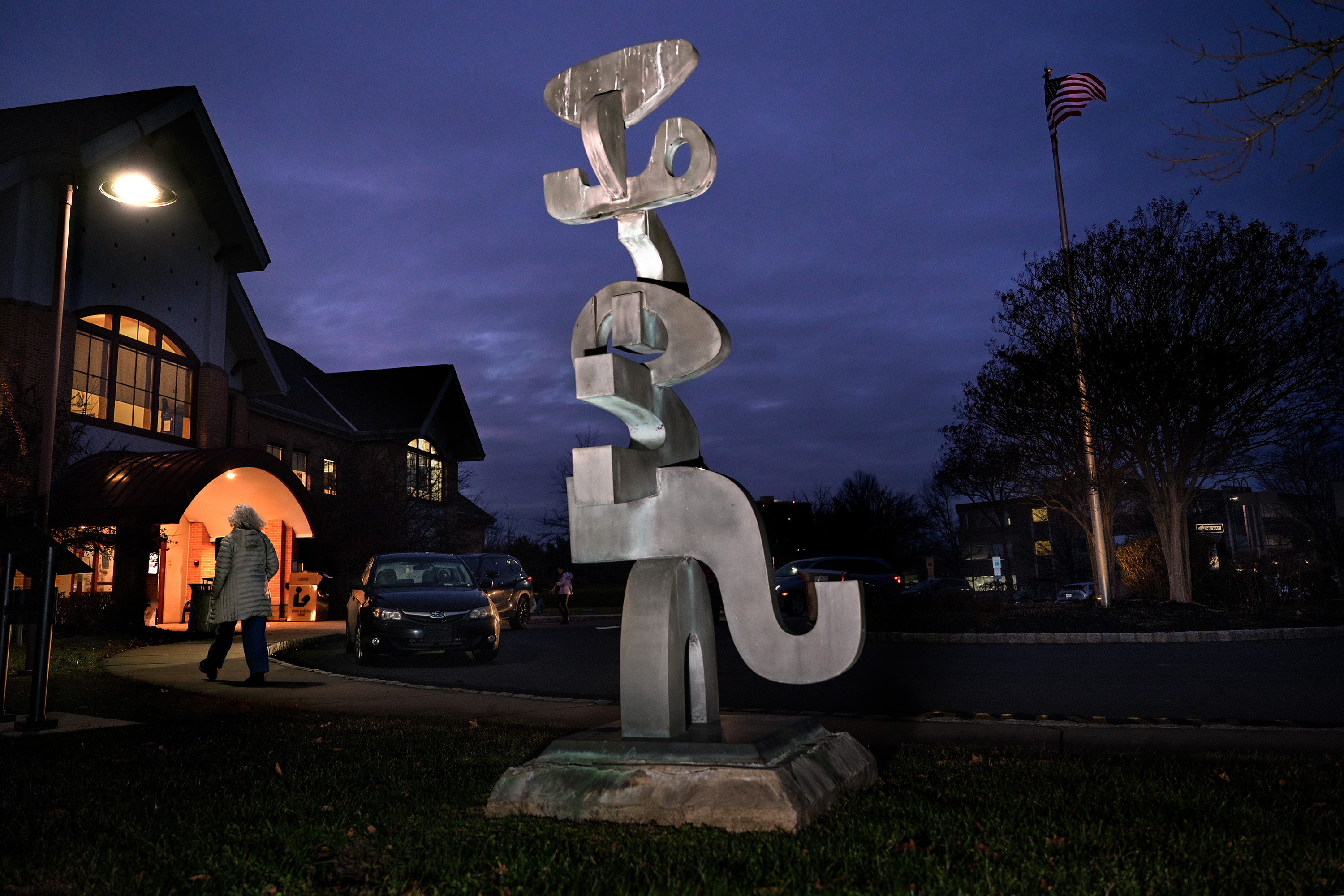
And Jastrow would be right. “Totem” is an 8-foot-tall bronze sculpture that twists into an elaborate structure reaching toward the sky. Sitting to the left of the library’s main entrance since 2009, visitors can’t help but try to decipher its meaning.
Eric Ascalon, the son of award-winning sculptor and stained-glass artist David Ascalon, who crafted “Totem,” said that the different interpretations are exactly what his father intended.
“The sculpture just came from a natural place within his psyche,” Eric Ascalon said. “He feels abstract art is put out there by the artist, but it’s designed to be interpreted in any whatever it means to the viewer.”
Sculpture often takes long periods of time to conceptualize and design. In David Ascalon’s abstract work, he would swiftly sketch a design on a loose piece of paper and lock that design in. Despite a quick conceptualization, the statue took months to build.
David Ascalon, center, the creator of the 8-foot-tall bronze sculpture, “Totem,” installing the statue outside of the Cherry Hill Public Library in 2009. The sculpture stands today at the library, enticing visitors to interpret its abstract form.
“I would say ‘Totem’ is kind of a reflection of his subconscious and just his creative spirit,” Eric Ascalon said.
For David Ascalon, dipping his toes into abstract art was a way to clear his mind from the painstakingly detailed work of his stained-glass windows, saidhis son, who worked alongside his father and the rest of the family at their now-closed West Berlin firm, Ascalon Studios.
After forming Ascalon Studios in 1977, with his father, Maurice, David Ascalon would go on to craft some of the finest stained-glass windows in synagogues and public spaces across the region. His work can be seen in the stained-glass windows in nearby Temple Beth Shalom, and all the way in Harrisburg, where his 15-foot Holocaust Memorial overlooks the Susquehanna River.
It’s not only Ascalon’s work that draws people into Cherry Hill’s library, either.
Walking up to the three-acre property, guests are greeted by what looks like a real couple reading the newspaper on the library lawn — perhaps unusual in 2025 — but step a little closer, and see that they’re not human, but a hyperrealistic sculpture of a man and woman lounging in the grass.
Another abstract sculpture, created in memory of Valerie Porter, a Cherry Hill resident who loved to read but died unexpectedly in 1966 after a neurological condition, sits outside the library. David Ascalon helped restore it in 2016.
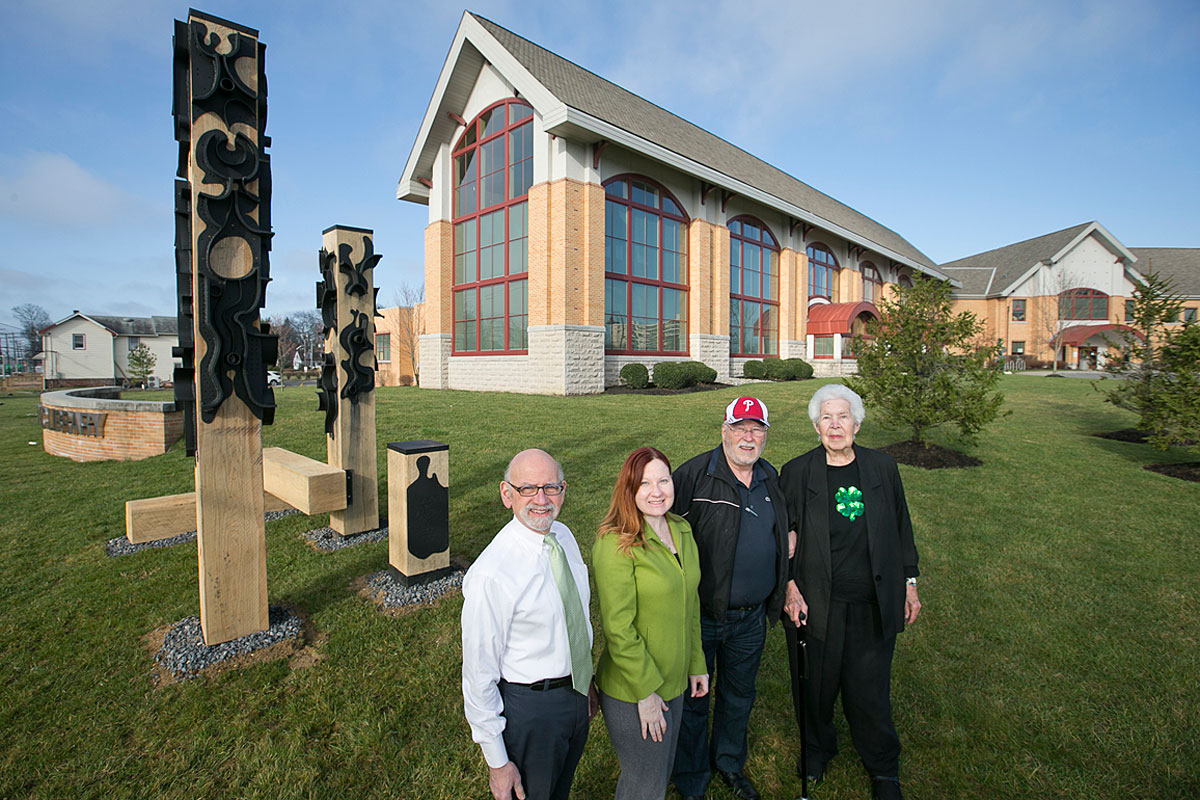
Fred Adelson, sculpture committee, Laverne Mann, director of Library, artist David Ascalon of Cherry Hill and Sally Callaghan also of sculpture committee, left to right, outside the Cherry Hill Library.
Inside, several walls are adorned with public art, many created by Cherry Hill residents. Downstairs is a year-round art gallery that promotes a new local artist every month, said library director Tierney Miller.
Such works amount to small glints in human creativity, something that the library continually fosters through its programming, said Miller.
The monthly showcase is so popular among local artists that the gallery space is booked years in advance, “2026 is already full, and we’re booking for 2027 now,” Miller said.
While only Cherry Hill residents can get a free library card — there are paid options for others — anyone can attend its free events.
The sculpture “Totem” by David Ascalon. It was installed in 2009 on the grounds of the newly opened Cherry Hill Public Library.
This suburban content is produced with support from the Leslie Miller and Richard Worley Foundation and The Lenfest Institute for Journalism. Editorial content is created independently of the project donors. Gifts to support The Inquirer’s high-impact journalism can be made at inquirer.com/donate. A list of Lenfest Institute donors can be found at lenfestinstitute.org/supporters.
Harold “Hal” Miller Jr. disappeared in June, leaving behind only two clues for police to follow: his vehicle abandoned in Pennsauken and, inside, a cell phone that last dialed a contact named “E. Poker.”
From those scant clues, investigators said, they uncovered something grim: Miller had been shot to death and dismembered with a chainsaw, they alleged, by the man whose number was saved in his phone as “E. Poker,” Everton Thomas, and two of Thomas’ relatives, in Camden.
In September, police charged Thomas, 41, with murder, desecration of human remains, and tampering with physical evidence. His wife, Sherrie Thomas, 41, and son, Deshawn Thomas, 23, were also charged with desecrating and disposing of Miller’s remains.
But more than five months later — after 178 days of searches, interviews, and forensic work — investigators have yet to find Miller’s body.
“It’s a horrible waiting game,” said Miller’s ex-wife and mother of his four children, Tamika Miller.
The case that has emerged since Miller’s disappearance is as sprawling as it is brutal: a trail of surveillance footage, internet searches, hardware-store runs, and border crossings that authorities say chart a carefully concealed killing. Court records detail a sequence of events that is at once methodical and frenzied — and has left investigators hunting for Miller’s remains even as three members of the Thomas family stand charged in his death.
Everton Thomas denies any involvement in the crime and is expected to plead not guilty to the charges on Dec. 15, according to his defense attorney, Timothy Farrow. Attorneys for Sherrie Thomas and Deshawn Thomas did not respond to requests for comment.
‘An awesome father’
Harold Miller and Tamika Miller had four children, three girls and a boy. “He was an awesome father,” Tamika Miller said.
He swelled with pride when their son announced he would join the Navy, continuing a military tradition in his family that “flat-footed” Miller could not follow himself, she recalled. His happiest moment, she said, came when their daughter, a special-education teacher, received her bachelor’s degree.
Miller worked in Camden’s social-services world, leading outreach for Volunteers of America and programs for Joseph House, a men’s homeless shelter. In 2017, he pleaded guilty in federal court to conspiring to sell crack cocaine and served five years in prison.
The couple divorced in 2023. But the family still gathered for holidays, including Thanksgiving, when Miller would rent a hall large enough for 100 people and make sure four turkeys — including his favorite, fried turkey — were on the table, Tamika Miller said.
Miller, who lived in Deptford Township, was 48 when he died. “The holidays will never be the same,” Tamika Miller said.
The grisly crime
Miller’s final call — placed at 11:26 a.m. on June 12 — went to the contact in his phone listed as “E. Poker.” Investigators later learned the number belonged to Everton Thomas, according to the affidavit of probable cause for his arrest.
Street cameras caught what happened next, the document said: Miller climbing the back stairs to Thomas’ Baird Boulevard home around the time the call was placed. Minutes later, the cameras recorded the crack of a gunshot. Miller was never seen emerging from the home.
From there, investigators say, camera footage captured an ominous procession across Camden. It shows a man they say is Thomas leaving the house in Miller’s minivan and abandoning it in Pennsauken. It shows his wife and son making a series of trips to stores, buying bleach, heavy-duty contractor bags, ice, latex gloves, duct tape, plastic sheeting — and a chainsaw, according to court filings. Later, cameras captured three people dumping large black trash bags into dumpsters behind a nearby housing complex, Tamarack Station Apartments.
When investigators examined Deshawn Thomas’ phone, they say, they found a browser search typed in amid the chaos: whether a chainsaw could cut through meat.
Authorities searched Everton Thomas’ house on June 20. They found a loaded Glock, and bloodstains on a doorframe leading to the basement, the affidavit said. Testing later confirmed the blood matched Miller’s DNA.
How the two men may have been connected is unclear. Tamika Miller said they were acquaintances, not friends. “Everybody knows everybody in Camden,” she said.
In an interview with police, Thomas told detectives that he and Miller had played poker the night before Miller vanished, and that they had spoken again around 11 a.m. on June 12. He denied knowing anything about what happened, according to the affidavit.
By the next afternoon, investigators said, they learned Thomas had slipped across the border. Agents at Fort Erie-Buffalo reported he had entered Canada. Nearly three months later, on Sept. 8, U.S. border officers arrested him as he tried to cross back into the country. He remains in custody, awaiting a court hearing next week.
Tamika Miller said family members held a private memorial service, where they gained some closure. “We don’t know if they will ever find him,” she said. “But we have hope.”
Investigators, meanwhile, continue to search for clues and Miller’s body.
“As we near the end of the year, our detectives are still seeking leads — no matter how small — that would assist with the recovery of Mr. Miller’s remains,” Camden County Prosecutor Grace MacAulay said Tuesday. “For anyone who has information, but has not yet come forward, we implore you to consider what his grieving family has been through. They deserve answers and the opportunity to properly mourn their loved one. We remain hopeful that our community does what’s right and helps bring Mr. Miller home.”
Anyone with information is asked to contact Detective Jake Siegfried of the Camden County Prosecutor’s Office Homicide Unit at 856-225-5086 and Detective Andrew Mogck of the Camden County Police Department at 609-519-8588. Tips can also be submitted to https://camdencountypros.org/tips.
In some regions, rainfall has plunged as much as eight inches below average for the past year, straining reservoirs, streams, and aquifers enough that the state Department of Environmental Protection has issued a drought warning — a notch shy of an emergency.
As a result, officials are asking residents to voluntarily curtail water use. Should conditions deteriorate, officials may impose mandatory restrictions on certain uses of water, though such measures are rarely invoked.
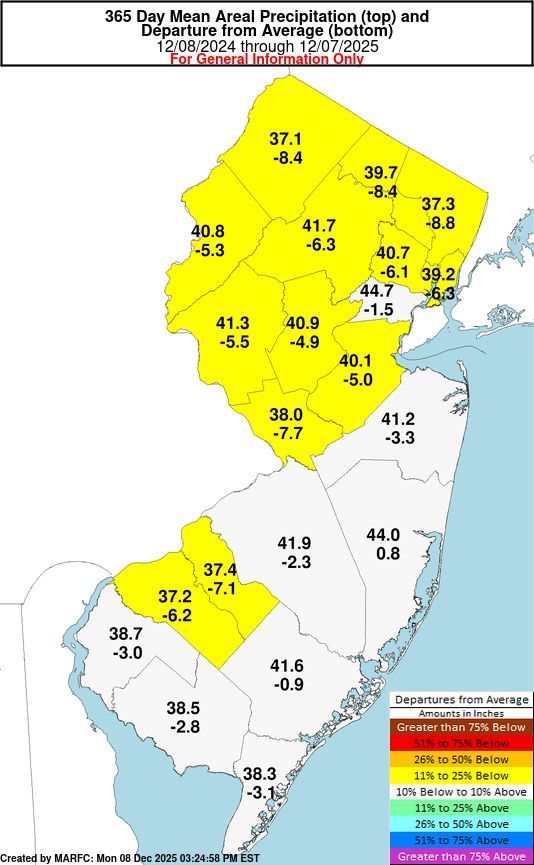
Map shows precipitation well below normal over the 365 days ending Dec. 7, 2025.
DEP Commissioner Shawn LaTourette said in a statement on Friday’s announcement that there is an “urgency of the need to conserve water.”
“The precipitation and water supply uncertainty we’ve experienced over the past year is a symptom of the impacts of climate change here in New Jersey,” LaTourette said.
It’s the second year the state is looking at a drought.
The last drought warning was issued in November 2024. That declaration came as firefighters had fought multiple simultaneous wildfires, one deadly, that broke out across the state amid dry, windy conditions.
That warning was lifted in June following record rainfall for some parts of the state in May.
Up to 8 inches below normal
However, the state overall has experienced below-average precipitation for more than a year, officials said.
New Jersey officials cited data from the Middle Atlantic River Forecast Center operated by the National Weather Service.
That data shows that Burlington, Camden, and Gloucester Counties are all running nearly four inches below average over the past 90 days.
Burlington County is running more than seven inches below normal for the past 365 days, and Camden County is running more than six inches below normal for the same period.
Northwestern New Jersey is running more than eight inches below normal over the past year.
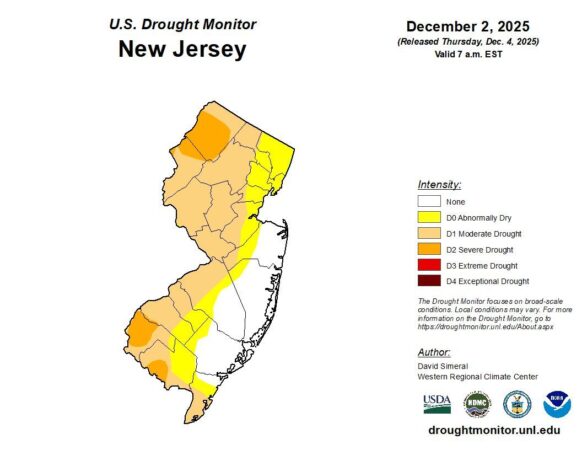
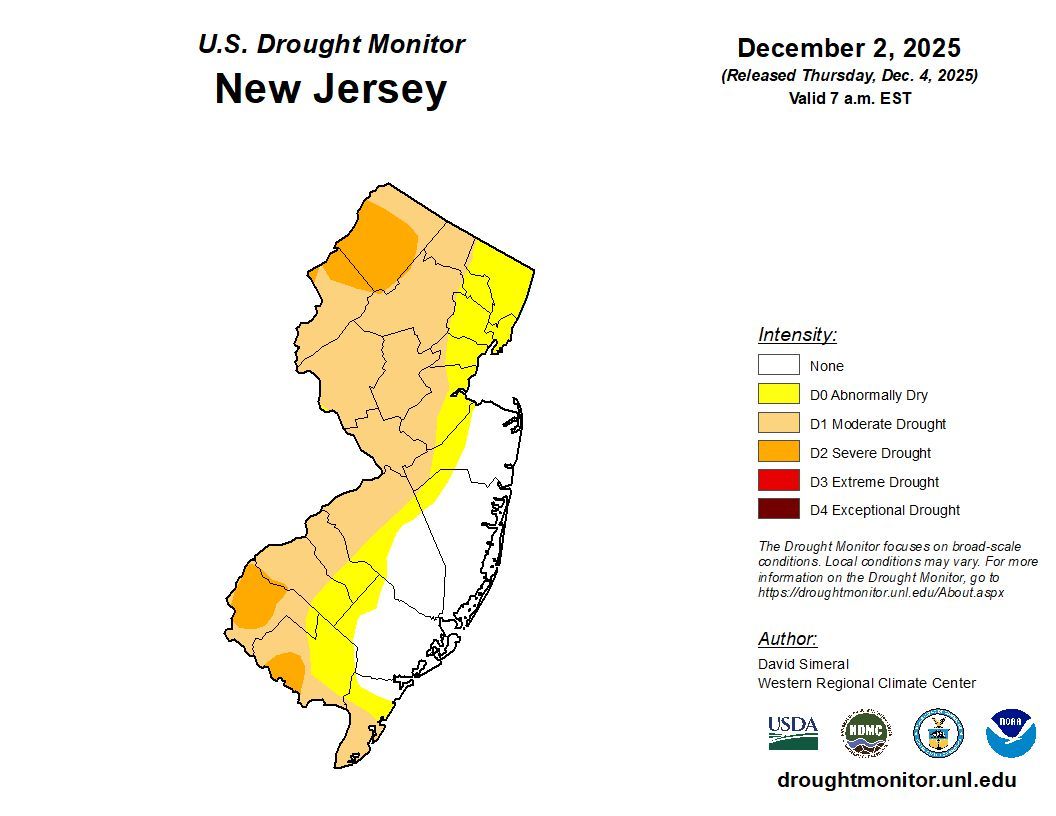
Likewise, the U.S Drought Monitor, a partnership of the University of Nebraska-Lincoln’s National Drought Mitigation Center and multiple federal agencies, shows the South Jersey counties along the Delaware River in either a moderate or severe drought.
About 3.5 million residents of New Jersey live in a drought-impacted area.
Officials said recent rains have not made much difference, considering the size of the gap. Ocean County is one of the few areas of the state with near-normal precipitation levels.
Map by the U.S. Drought Monitor shows that multiple counties in South Jersey are in a moderate to severe drought.
An update on rainfall and drought data is expected Wednesday.
State officials use multiple sources to determine the impact of rainfall on water supplies. Those include reservoir levels, stream flows, and groundwater (aquifers).
South Jersey counties, such as Burlington, Camden, Gloucester, and Salem, rely primarily on groundwater but also use water from the Delaware River and other rivers and streams.
Drought indicators for groundwater levels in South Jersey are designated as extremely dry while precipitation and stream flows are severely dry.
Officials say the persistent dryness has resulted in “observable stress across all specific indicators.” Nearly all regions of the state are classified as being severely or extremely dry.
Pennsylvania is also dry. Last week, the Commonwealth Drought Task Force said 37 counties are under a drought watch, although none in Southeastern Pennsylvania. A drought watch means an area has received 25% less rain over three months than normal. It is the lowest of three levels of drought declarations in Pennsylvania.
How to conserve
In New Jersey, officials have issued some tips on conserving water, such as:
Run dish and clothes washers only when full.
Turn off and winterize outdoor pipes and irrigation systems.
Check pipes for leaks.
Use a commercial car wash that recycles water.
Compost vegetable food waste instead of running the garbage disposal.
Installing a low-flow toilet can save up to 1,000 gallons per year.
Installing a low-flow shower head can save 7,700 gallons per year.
Installing newer faucets and aerators can save 16,000 gallons per year.
For the Nowell family, the outlets are an annual tradition.
Every Veterans Day, a dozen relatives venture to Limerick Township in Montgomery County, where they kick off their holiday shopping at the Philadelphia Premium Outlets.
Even this year, as bitter winds whipped through the outdoor plaza, the family was undeterred.
After a morning of shopping, the multigenerational group, which included two veterans, warmed up with their yearly food-court lunch, courtesy of matriarch Geri Nowell, 77, of Telford. Then, the men returned to the cars and dropped off dozens of shopping bags, which they’d been carting around in a wagon. The women walked on, hunting for their next find among the more than 130 shops.
The Nowell family poses in front of a holiday backdrop during their annual outing to the Philadelphia Premium Outlets.
“It’s super fun,” said Ann Blaney, 47, of Drexel Hill.
“We get great deals,” added Kim Woodman, 55, of Hatboro.
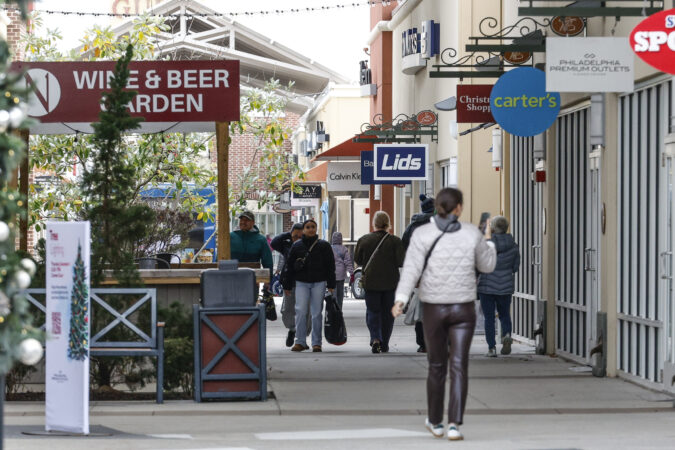
The tradition is an experience they say can’t be replicated online. The fact that the complex is open-air and contained in a 550,000-square-foot plaza somehow adds to the fun, they said.
As Kathy Nelson, 48, of Broomall, browsed the outlets with her friends, she said she also shops at the nearly 3 million-square-foot King of Prussia Mall, less than 20 miles away. But otherwise, she said, “there aren’t many indoor malls left” with the variety of stores she prefers.
Outlets have always accounted for a fraction of the in-person retail market, which is partly why there have been few headlines about dying outlet malls. But some of the country’s roughly 200 outlet malls seem to be downright thriving, with full parking lots on weekends, few vacant stores, and relatively strong revenue.
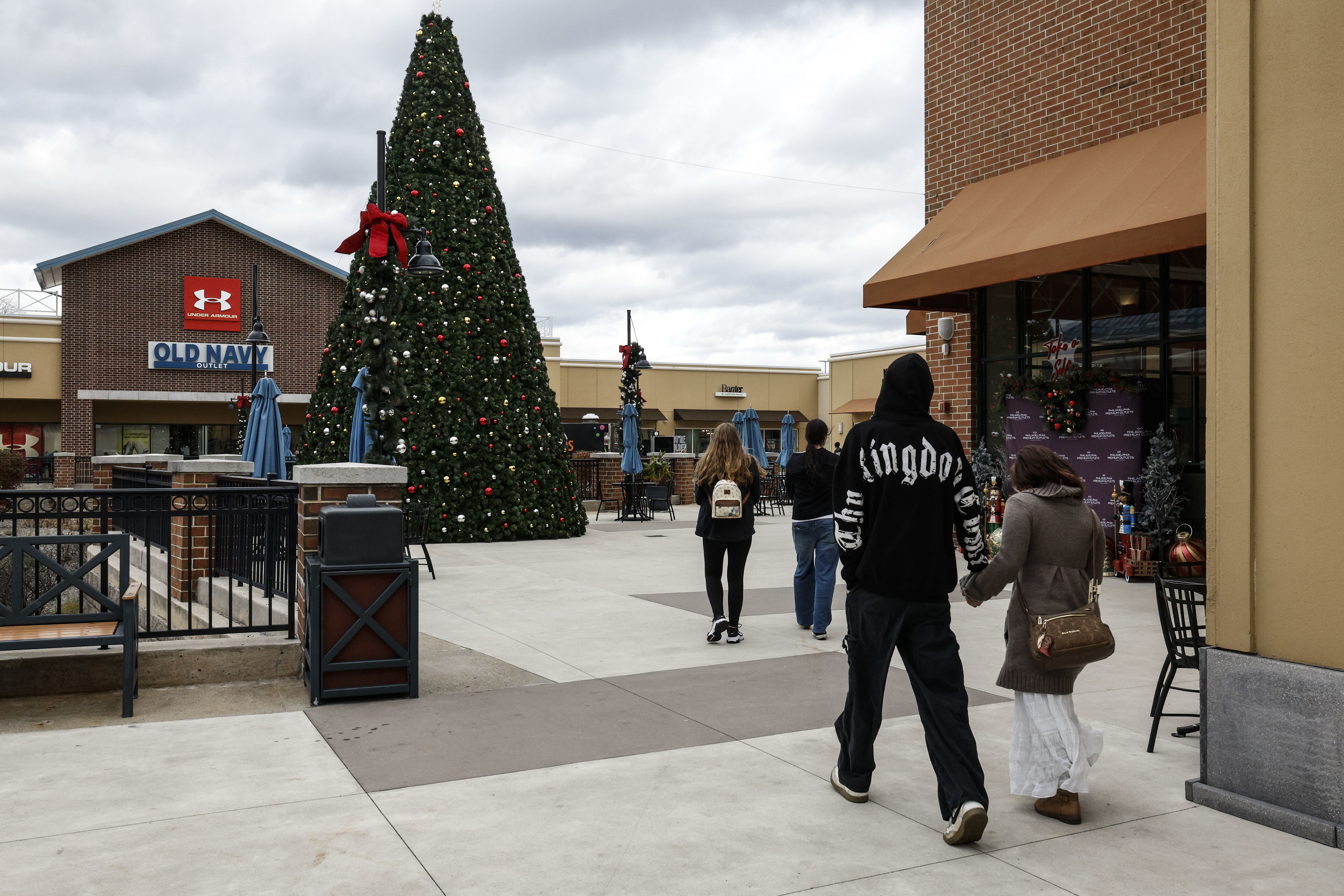
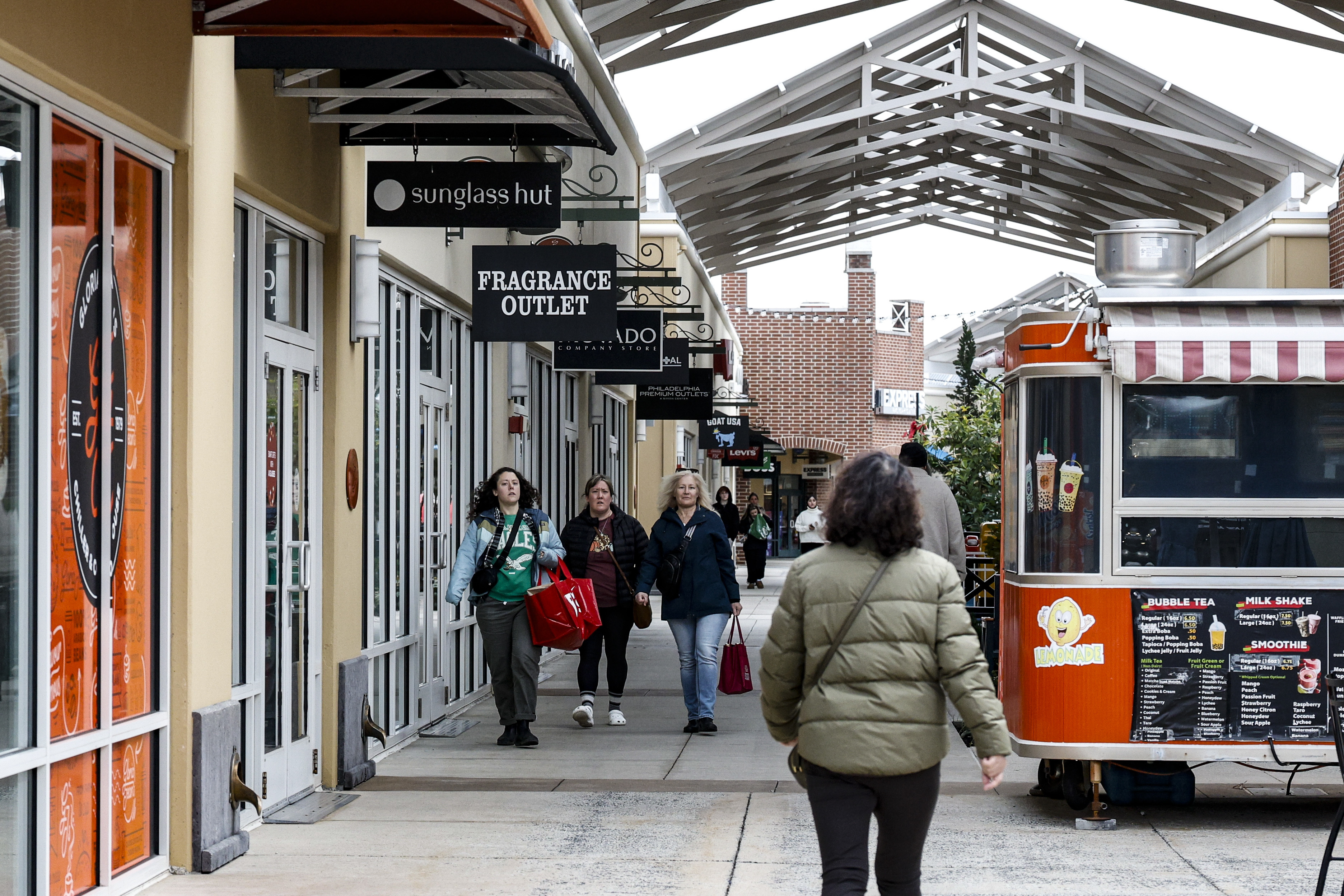
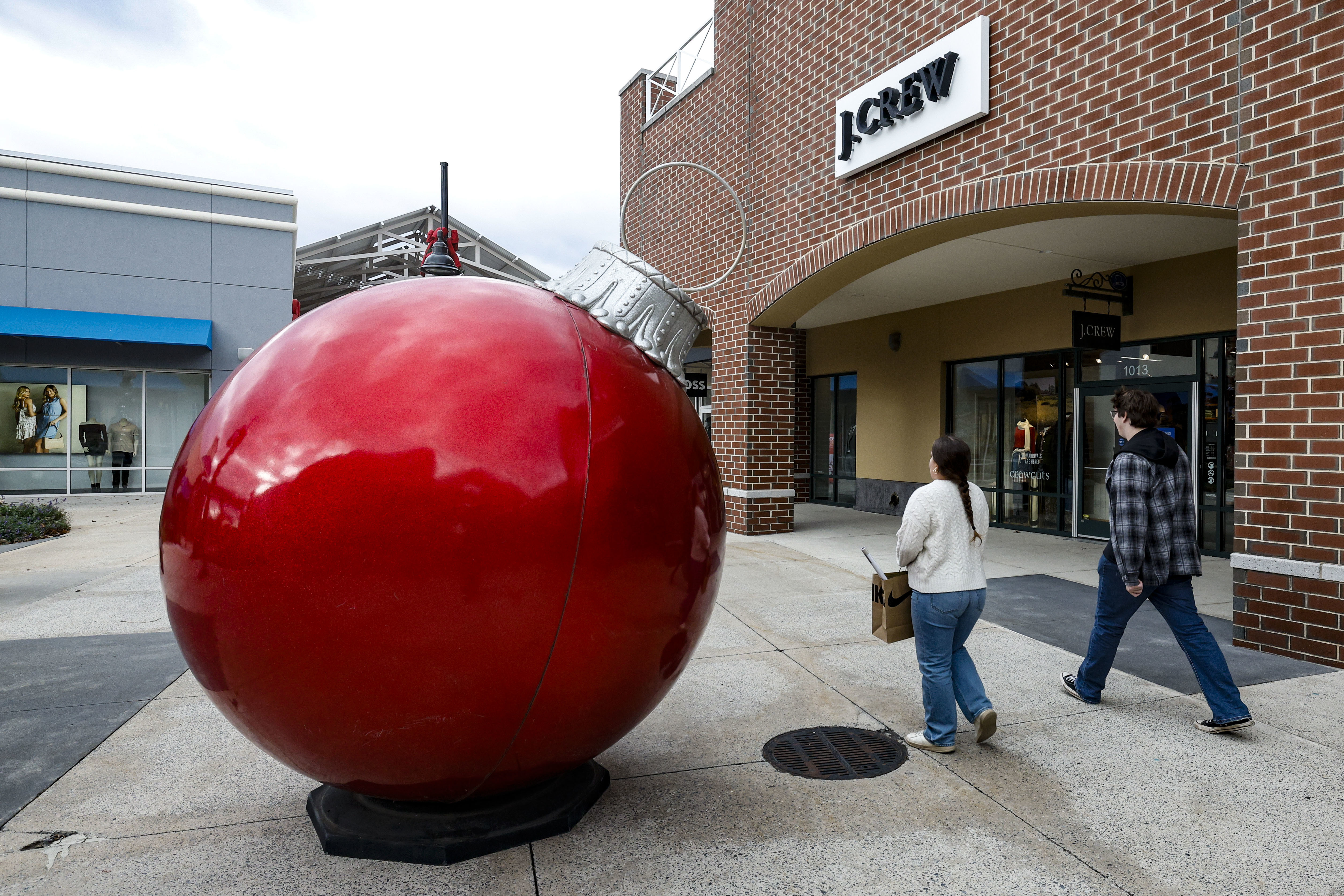
Shoppers walk by the tree at the Philadelphia Premium Outlets on Nov. 11.
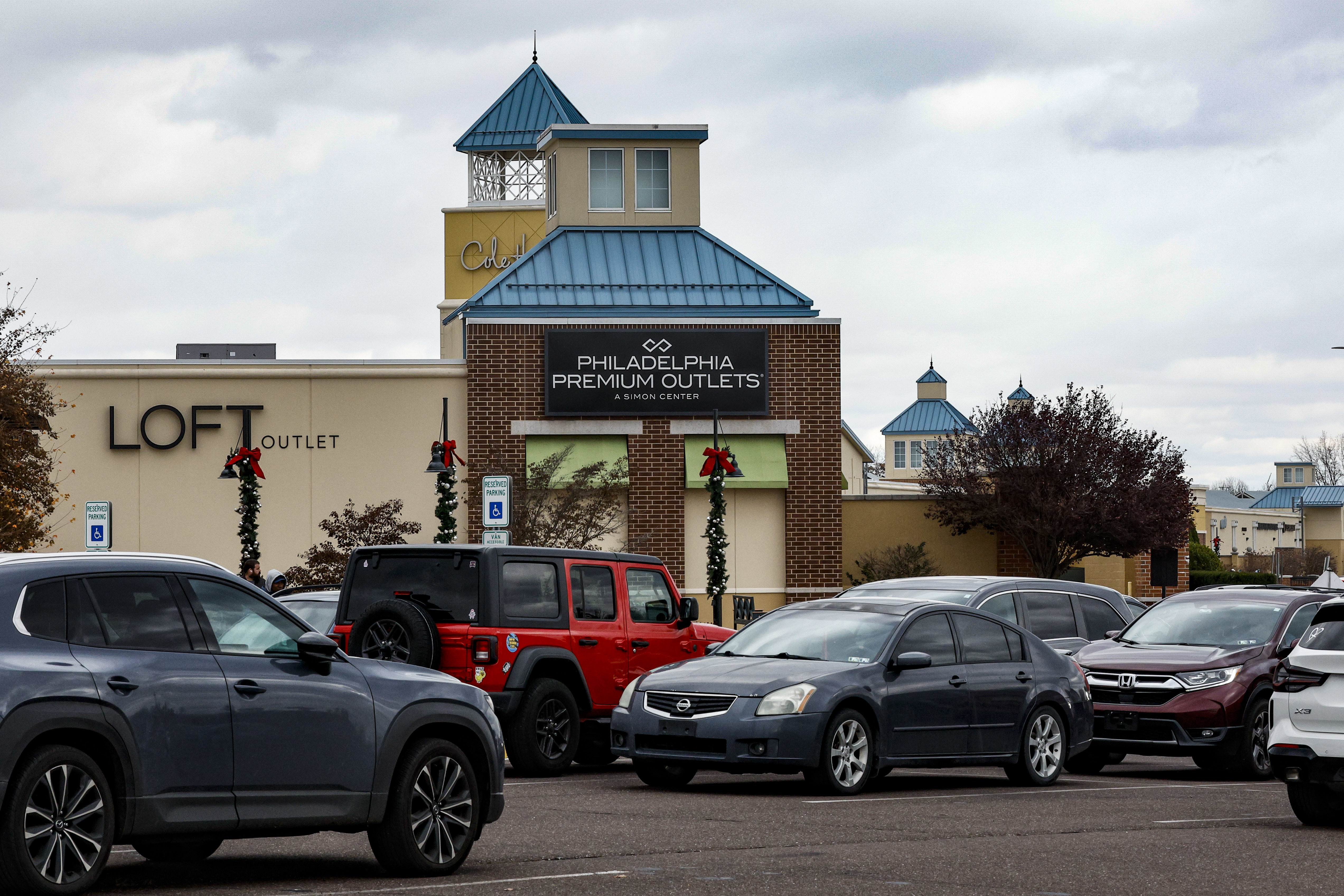
The Philadelphia region’s two major outlet malls — the Philadelphia Premium Outlets in Limerick Township and the Gloucester Premium Outlets, both owned by Simon Property Group — are more than 92% occupied, according to a count by The Inquirer during visits to each location this month. Both outlets have found success despite being less than 20 miles from thriving indoor malls in King of Prussia and Cherry Hill.
Tanger Outlets, which has locations in Atlantic City and Lancaster, recently reported more than 97% occupancy across its 39 open-air centers and an increase in average tenant sales per square foot.
“Outlets do good in good times and great in bad times,” said Lisa Wagner, a longtime consultant for outlets, repeating a common refrain in the industry.
The centers have evolved amid the broader push toward more experiential retail and most now have a mix of discount stores and full-price retailers. But they have done so while embracing their reputation as the go-to destination for snagging deals, said Wagner, a principal at the Outlet Resource Group.
“Honestly no one knew what was going to happen after COVID, but [the outlets] came out incredibly strong,” she said. More recently, the retail industry has been rattled by tariffs and economic uncertainty. The outlets have not been immune to those challenges, but they have held strong despite them.
“People want value right now,” Wagner said. “They need it.”
The Philadelphia Premium Outlets has more than 130 stores in its 500,000-square-foot complex.
Outlet malls become one-stop shops
On a rainy, early November Sunday, hundreds of people descended on the Gloucester Premium Outlets.
Shoppers pulled up hoods and huddled under umbrellas as they made their way from store to store. Many balanced several large bags bearing brand names like Columbia and Kate Spade, Rally House and Hey Dude shoes. Some munched on Auntie Anne’s pretzels or sipped Starbucks from holiday cups. An acoustic version of Jingle Bells played over the speakers.
For some, the dreary, drizzly weather was even more reason to spend their afternoon at the 86-store complex in Blackwood, Camden County, about 15 miles outside Philadelphia.
With two young children in tow, Jessica Bonsu, 30, of Sicklerville, was on a mission.
“We came out to go to the indoor playground,” called Stay & Play, Bonsu said, pointing to her rambunctious kids. “Just to get some energy out.”
“And then we can also get some shopping done,” added her cousin, Taneisha Laume, 30, who was visiting from D.C. She needed a gift for her uncle. “Kill two birds with one stone.”
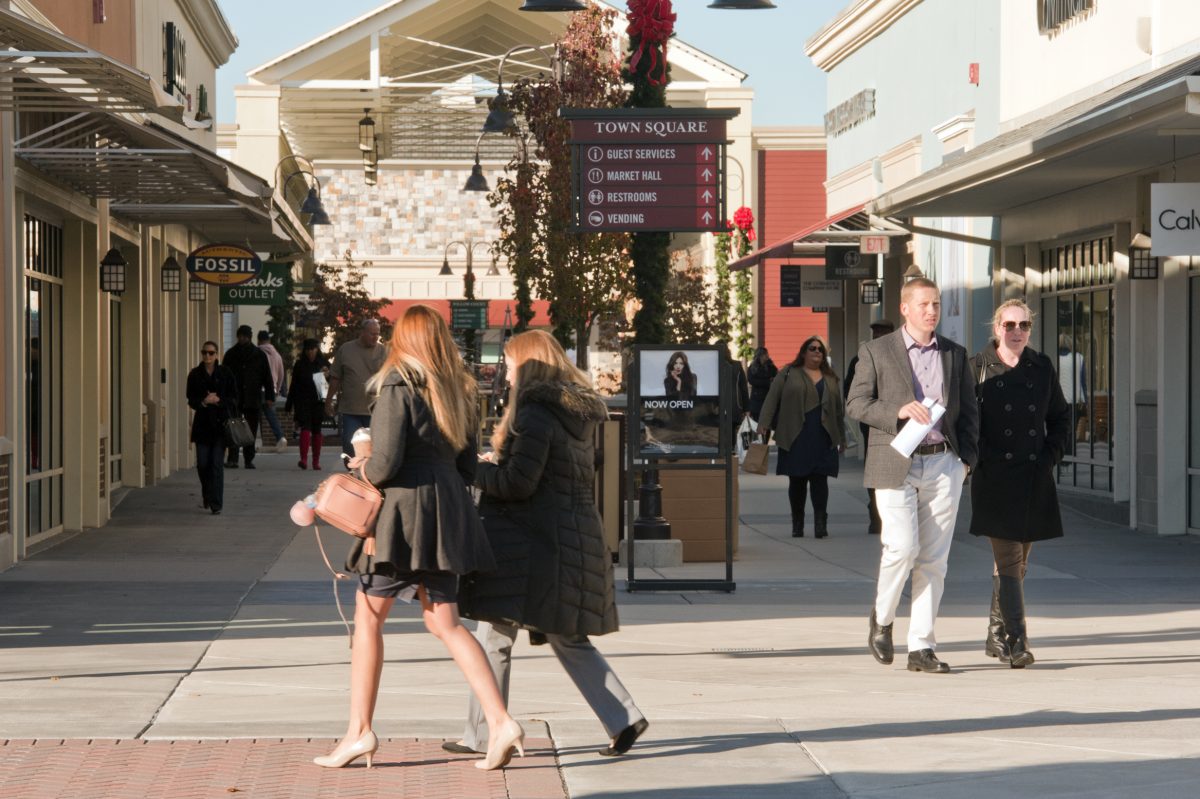
Shoppers peruse the stores at the Gloucester Premium Outlets in this 2019 file photo.
These kind of multipurpose visits are buoying outlet malls, which are increasingly becoming mixed-use destinations for dining, drinking, entertainment, and shopping.
“You’re coming for a little bit of everything,” said Gerilyn Davis, director of marketing and business development at Philadelphia Premium Outlets.
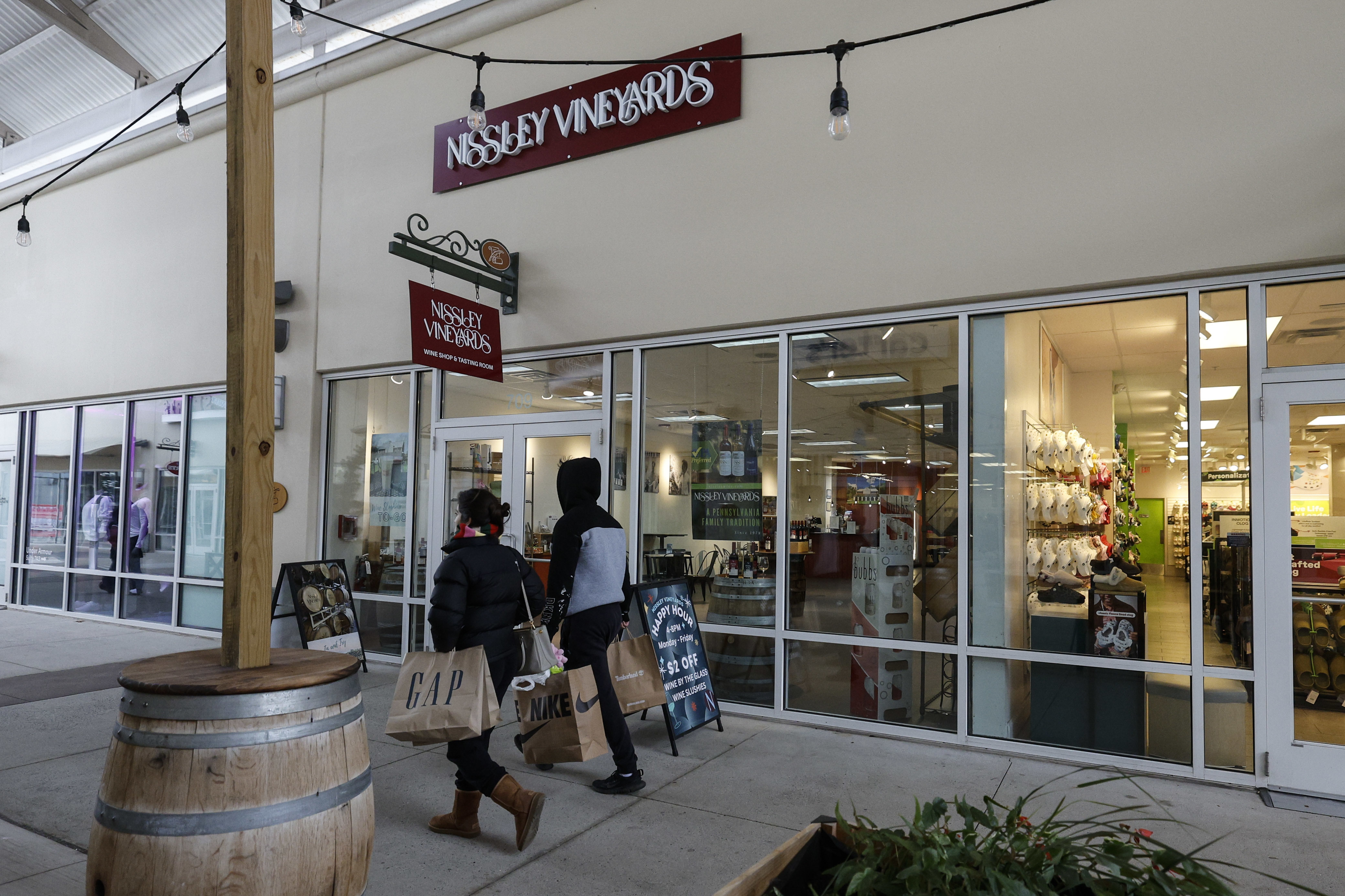
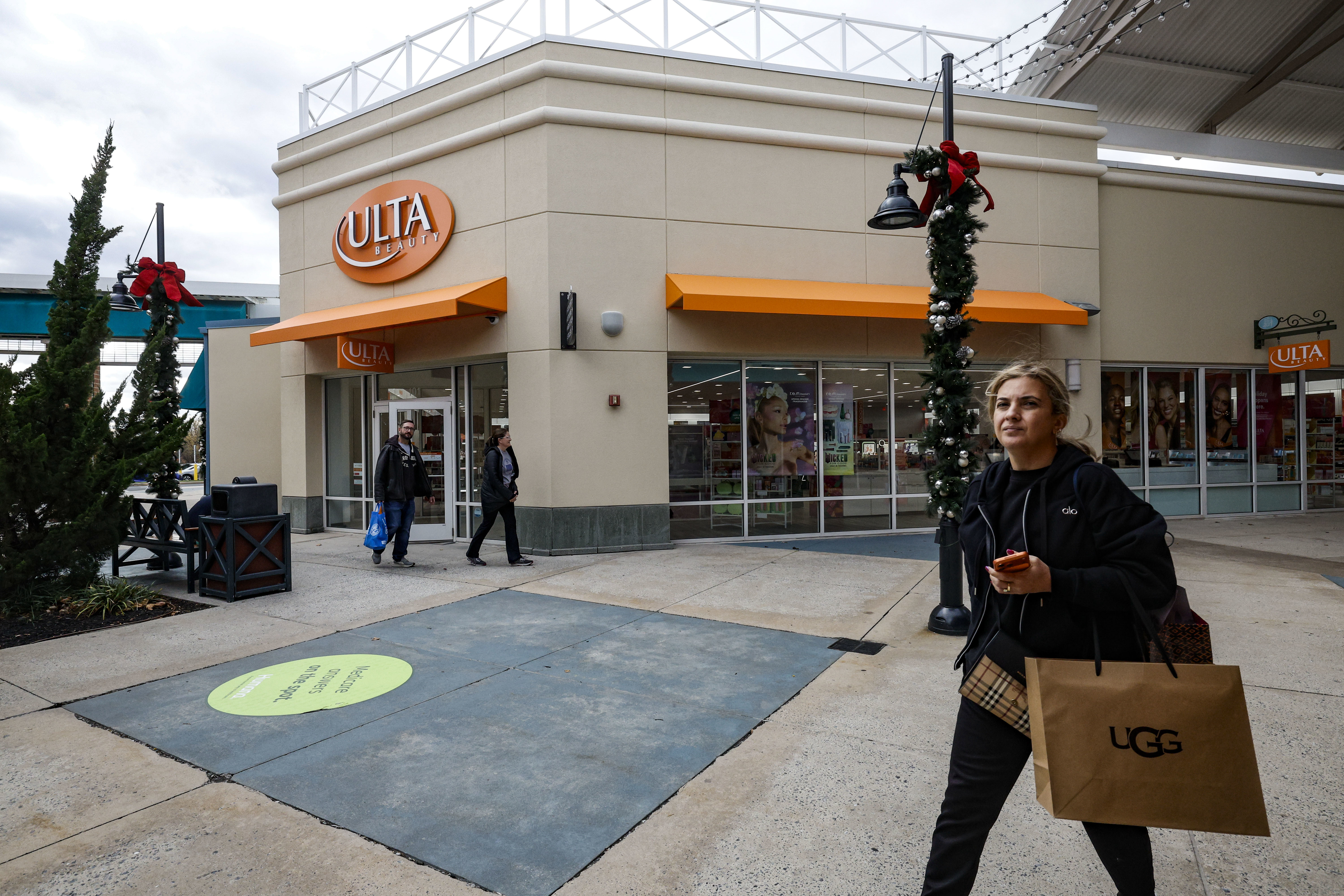
The Limerick Township complex recently welcomed a slate of new tenants, including Marc Jacobs’ first Pennsylvania outlet store, a BOSS outlet, an Ulta Beauty, and an outpost of central Pennsylvania’s Nissley Vineyards, which has an outdoor seating area.
Shoppers walk by the Nissley Vineyards store at the Philadelphia Premium Outlets.
New Balance, whose shoes are trendy again, is also opening stores in both the Philadelphia and Gloucester outlets.
Justin Stein, Tanger’s executive vice president of leasing, said the North-Carolina-based company is focused on adding more food, beverage, and entertainment options.
While overall occupancy at its Atlantic City center is lower than others, the complex has a Dave & Buster’s and a Ruth’s Chris steakhouse. The Simpson, a Caribbean restaurant and bar, is also set to open there in early 2026.
In Lancaster, Tanger is looking to add food and beverage options, Stein said. But that center is still performing well, with a 97% occupancy rate, according to an online map, and only two vacancies.
When there are places to eat and drink at the outlets, “people stay longer,” Stein said, “and when they stay longer, they spend more.”
Philadelphia Premium Outlets had a steady crowd on a bitter cold Veterans Day.
From ‘no frills’ to outlets of the future
Today’s outlet malls look vastly different from what Wagner calls the “no frills” complexes of the 1990s.
At the time, an outlet mall served as “a release valve for excess goods,” Wagner said. “There were some stores that had really broken merchandise.”
To comply with branding rules and avoid competition with department stores, outlet malls were often located along highways between two major metro areas, she said.
“What became clear is that customers loved it,” Wagner said. Soon, brands started overproducing to supply these outlet stores with products in an array of a sizes and colors.
This effort to bulk up outlet offerings was “a roaring success,” she said, with companies finding that more than a third of outlet customers went on to buy their products at full price at other locations.
Philadelphia Premium Outlets, which opened in 2007, has very few vacant storefronts.
As their popularity rose, more outlet malls were built across the country.
As the centers look to the future, their executives are continuing to hone their identity as “not just a discount-and-clearance center,” said Deanna Pascucci, director of marketing and business development at Gloucester Premium Outlets.
Center leaders are bringing in food trucks, leaning into rewards programs, and promoting community events, such as Gloucester’s holiday tree lighting,which took place Saturday. Starting Black Friday, the Philadelphia Premium Outlets will offer Santa photos after a successful pilot program last year.
And the complexes are finding new ways to attract and retain shoppers, online and in real life.
Tanger recently announced an advertising partnership with Unrivaled Sports, which operates youth sports complexes, including the Ripken Baseball Experience in Aberdeen, Md., an hour drive from its Lancaster outlets. Stein said the company hopes to attract families looking to pass the time between tournament games.
Tanger is also using AI and data analytics to email specific deals to customers based on where they’ve previously shopped, Stein said.
“We want you to start your experience online and end it in the store,” Stein said.
Shoppers walk by a new Ulta store at the Philadelphia Premium Outlets.
At Simon outlets, customers can search a store’s inventory online before they make the trip, Davis said.
“Online shopping at this point, it’s a complement,” Davis said. “It’s not viewed as competition.”
Wagner, the outlet consultant, said she thinks even more centers will be built in the coming years, with a focus on urban and close-in suburban locations that are accessible by public transit.
As for existing centers, she sees them thriving for the foreseeable future.
“As long as outlets continue to emphasize a value message and use their loyalty programs to reward customers,” Wagner said, “I think they will hold their own.”
Philadelphia discharges 12.7 billion gallons of raw, diluted sewage into the Delaware River’s watershed each year, with Camden County adding to the mix, according to a new report.
That’s a problem, say the report’s authors at the nonprofit advocacy groupPennEnvironment. Philadelphia and Camden border the river, and significant recreational potential is blocked forpart of the year because of pollution from both, the authors say.
A waterway can remain unsafe for recreation for up to 72 hours after an overflow. That suggests local waterways could be unsafe for recreation up to 195 days per year, or more than half the year.
Five decades after the Clean Water Act mandated that waterways be made safe for swimming and fishing, combined sewer overflows (CSOs) continue to pollute during wet weather when untreated sewage and runoff surge into nearby creeks and rivers, creating the potential to sicken recreational users.
David Masur, executive director of PennEnvironment, said the group included Camden County in its most recent report“to get a more holistic view.”PennEnvironment’s first report on CSOs in 2023focused only on Philly.
The pollution “affects the waterway, the environment, and public health,” Masur said. “The river is the border between the two states, and people on both sides use it a lot.”
PennEnvironment acknowledges that both Philly and Camden County have programs to reduce overflows and is calling on federal officials for increased funding to put proper infrastructure into place.
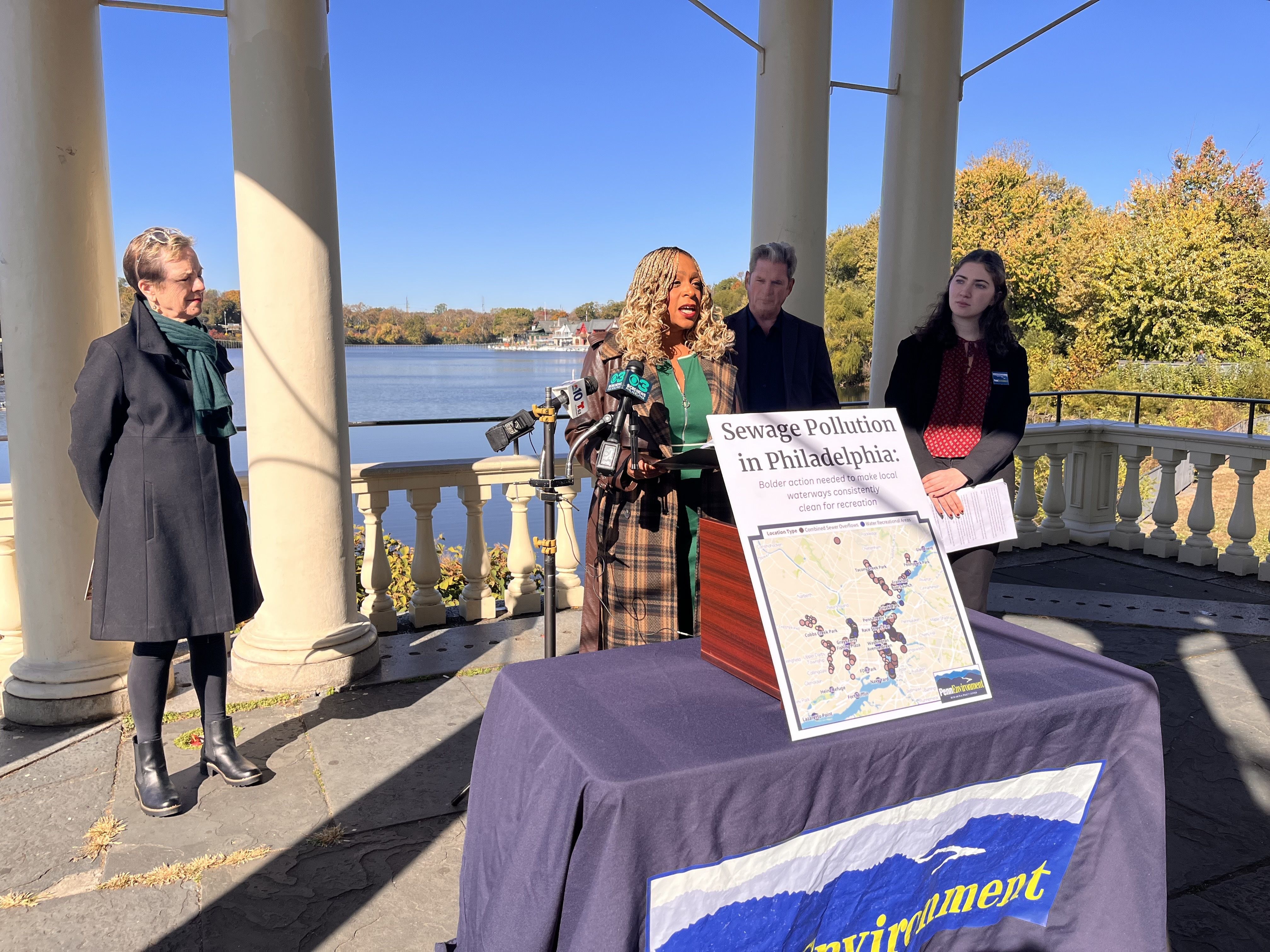
Philadelphia Council member Jamie Gauthier (center) spoke Monday about PennEnvironment’s report on pollution from combined sewer overflows. To her left is Margaret Meigs, president, Friends of the Schuylkill Navy. And to her right is Tim Dillingham, senior adviser, American Littoral Society, and Hanna Felber, clean water associate at PennEnvironment Research & Policy Center.
Frequent overflows, high volume in Philly
Roughly 60% of Philadelphia is served by a combined sewer system, which has 164 outfalls — really large metal or concrete openings — that discharge pollution into waterways. A CSO system uses a single pipe to collect and transport sewage from homes and businessesas well as stormwater runoff from streets and sidewalks.
During dry weather, the system can handle the volume before safely releasing it back into the rivers. But during heavy rainfall, thesystem discharges untreated, though highly diluted, sewage mixed with stormwater directly into waterways.
Despite the Philadelphia Water Department’s ongoing Green City, Clean Waters project — a 25-year plan focusing on green infrastructure to reduce overflows — the frequency and volume remain alarmingly high, the report states.
Overall, CSOs dumped an average of 12.7 billion gallons of raw sewage mixed with polluted stormwater per year into local waterways from 2016 to 2024, the authors of the report stated. They included an online map to show the location of the outfalls and annual overflow.
Half the sewage came from just 10 CSOs.
window.addEventListener(“message”,function(a){if(void 0!==a.data[“datawrapper-height”]){var e=document.querySelectorAll(“iframe”);for(var t in a.data[“datawrapper-height”])for(var r,i=0;r=e[i];i++)if(r.contentWindow===a.source){var d=a.data[“datawrapper-height”][t]+”px”;r.style.height=d}}});
Still, the numbers are a slight improvement over the 15 billion gallons a year released into local rivers, as PennEnvironment reported in 2023.
Philadelphia gets its drinking water from the rivers, but the CSOs are downstream of the city’s treatment plants on the Delaware and the Schuylkill.
The reportused publicly available data to show that five of six waterways in Philly produced at least one overflow 65 times or more per year on average between 2016 and 2024. Those were the Delaware River, the Schuylkill, and Cobbs, Frankford and Tacony Creeks.
In better news: The average volume of overflow per inch of precipitation declined by about 16% from previous periods, but progress is slow and threatened by increased rainfall and rising sea levels due to climate change, the authors say.
PWD could not be reached for comment.
window.addEventListener(“message”,function(a){if(void 0!==a.data[“datawrapper-height”]){var e=document.querySelectorAll(“iframe”);for(var t in a.data[“datawrapper-height”])for(var r,i=0;r=e[i];i++)if(r.contentWindow===a.source){var d=a.data[“datawrapper-height”][t]+”px”;r.style.height=d}}});
Camden County
The report also found persistent overflows in Camden County. The cities of Camden and Gloucester, along with the Camden County Municipal Utilities Authority (CCMUA), operate combined sewer systems that frequently overflow into the Delaware River and its tributaries, including the Cooper River and Newton Creek.
The report found that systemson the Camden County side of the river overflowed into local waterways an averageof 76 days per year from 2016 to 2024.
window.addEventListener(“message”,function(a){if(void 0!==a.data[“datawrapper-height”]){var e=document.querySelectorAll(“iframe”);for(var t in a.data[“datawrapper-height”])for(var r,i=0;r=e[i];i++)if(r.contentWindow===a.source){var d=a.data[“datawrapper-height”][t]+”px”;r.style.height=d}}});
The highest-frequency outfall for the Cooper River released sewage for an average of 118 days annually during that period.
The Delaware River received sewage overflows for an average of 94 days annually from its highest-frequency outfall.
The authors said gaps in data leave them unable to show the total volume of diluted sewage releasedfrom Camden. But they said that the amount of “solids/floatables” collected at each outfall is an indicator a waterway is polluted.
Dan Keashen, a spokesperson for Camden County, said officials have been making strides.
He said that crews recently cleaned 30 miles of pipe and that a $26 million project is underway to physically separate the combined sewer service area of Pennsauken that flows into Camden. Officials are also studying how to better achieve compliance for the largest outfall in the system, a project estimated to cost $40 million to $150 million when complete.
What can be done?
The report concludes that current plans by Philadelphia and Camden County are insufficient to achieve the goal of a clean Delaware River watershed.
The report was written by John Rumpler, clean water director for Environment America, PennEnvironment’s parent organization, and Elizabeth Ridlington, associate director of the Frontier Group, a nonprofit research group that is part of the Public Interest Network, an environmental advocacy organization.
The authors call for officials to accelerate action to end all sewer overflows, set a hard deadline, and find new ways to pay for necessary infrastructure upgrades.
Philadelphia CouncilmemberJamie Gauthier, chair of the committee on the environment, called overflows “a public health crisis” and urged PWD’s new commissioner, Benjamin Jewell, to act. She said elected officials in Harrisburg and Washington also need to step up.
PWD is separately under pressure by a new Environmental Protection Agency regulation that seeks to improve the amount of dissolved oxygen in the Delaware by ordering a large-scale reduction of ammonia at the city’s three water pollution control plants. PWD estimates that the price for compliance is $3.6 billion and would cost households an additional $265 annually on their water bills.
The authors of the PennEnvironment report concede the CSO task is daunting. But they say Portland and Boston faced similar situations, invested in infrastructure, and managed to make CSO overflows infrequent. Washington, D.C., they said, is on track to reduce sewage overflows by 96% in 2030.
Hanna Felber, a PennEnvironment advocate, said that PWD needs to use creative funding, such as floating longer-term bonds to finance projects, and that its engineers need to find more creative solutions, such as installing larger stormwater tunnels that flow separately from sewage.
“Unfortunately, our new report on sewage pollution in Philadelphia shows that on far too many days each year, the Philadelphia Water Department’s pipes and sewer systems dump huge volumes of raw sewage into our beautiful waters, harming our environment and depriving the public of a safe place to fish, boat, and float,” Felber said.