
Tag: Cape May

  • Head of Delco nonprofit traded cash for sexual favors from women in addiction, DA says

    Head of Delco nonprofit traded cash for sexual favors from women in addiction, DA says

    After losing his son to a heroin overdose in 2017, Lawrence Arata devoted his life to helping people in addiction, founded an Upper Darby nonprofit to further that mission, and even ran a failed congressional campaign in which the opioid crisis was his tent-pole cause.

    But behind the scenes, prosecutors in Delaware County said Wednesday, Arata twisted that mission, trading cash, gift cards, and other services from his nonprofit, the Opioid Crisis Action Network, for sexual favors from women who were desperate for help.

    One woman told investigators that she saw the relationship as transactional: “He had what I needed, and I had what he needed,” she said, according to court filings.

    Arata, 65, has been charged with trafficking in individuals and patronizing prostitutes, as well as witness intimidation for trying to coerce some of the women he victimized to recant their statements to police, court records show.

    Arata, of Villas, Cape May County, was freed after posting 10% of $500,000 bail.

    His attorney, Ronald Greenblatt, said Arata had done nothing wrong.

    “The evidence that will come out in court will show his innocence,” he said. “Mr. Arata is a pillar of the community who turned the personal tragedy of losing his son to a drug overdose into a career of helping people.”

    Delaware County District Attorney Jack Stollsteimer, in announcing the charges, said Arata “cynically and cruelly” misused opioid settlement funds to “satisfy his sexual desires.”

    “I want to thank the courageous women in recovery who fell victim to Mr. Arata, as well as those working to help others find their way into recovery, for having the courage to come forward and trust law enforcement to stop this predator,” Stollsteimer said. “We heard you and we support you.”

    Stollsteimer said he believes other people may have been victimized by Arata and urged them to contact his office.

    Investigators learned of Arata’s alleged crimes in August, when a former program director at his nonprofit gave a statement to Upper Darby police, according to the affidavit of probable cause for his arrest.

    The woman said Arata behaved inappropriately with his clients, kissed, them, touched them, and asked them to stay in hotel rooms with him. Some of the clients left the program because his behavior made them uncomfortable, she said, and she resigned from her position because of similar concerns.

    Detectives later interviewed one of the women Arata had initiated a relationship with. She said that during one encounter in 2024, Arata approached her after a group meeting and said she “looked like she could keep a secret.”

    At the time, the woman said, the weather had started to turn cold and, in need of a coat, she agreed to perform oral sex on Arata inside his car in exchange for gift cards. The woman told police she could not refuse, because she needed the benefits offered by OCAN to survive.

    The woman said she saw Arata again in March, when he was doing outreach on 69th Street in Upper Darby. Hungry and in need of resources, she told police, she approached Arata and again performed oral sex on him inside his car.

    Another woman, who lives in Atlantic City, said she and Arata had a yearslong sexual relationship. Arata met the woman while she was living in a recovery house in Chester, and she told him about her years of addiction and the time she spent as a sex worker in order to survive.

    Arata began trading gift cards and cash for sex with the woman, she told police. Later, when she returned to Atlantic City, she said, Arata continued their relationship.

    The woman said she needed the cash and gift cards to survive, and saw the arrangement as mutually beneficial. Earlier this month, Arata texted her from an unfamiliar phone number, saying police had confiscated his cell phone and urging her not to speak with investigators.

    But Arata didn’t just assault women in recovery, police said. A therapist who worked for his organization said Arata repeatedly told her she was beautiful, asked her to visit his hotel room in Chester, and once kissed her against her will.

    Later, after police had begun to investigate Arata, he pulled the woman aside, accused her of making “false allegations” against him, and demanded she retract her statement, authorities said.

    Other employees of OCAN said they had raised concerns to Arata about his methods, saying the repeated use of gift cards as an incentive to clients felt tantamount to a bribe, the affidavit said. He ignored or dismissed those concerns.

    Arata told The Inquirer in 2017 that the death of his son, Brendan, inspired him to raise awareness on the lack of resources for people in active addiction.

    “Getting very busy on this issue was a way for me to deal with my grief,” Arata said. “This is not a partisan issue. This disease has killed Republicans and Democrats.”

    Arata ran unsuccessfully for Pennsylvania’s Fifth Congressional District seat in 2018 as a Democrat, receiving just 925 votes.
  • Party soul-searching, the Latino vote, and a South Jersey strategy: Takeaways from Tuesday’s election

    Party soul-searching, the Latino vote, and a South Jersey strategy: Takeaways from Tuesday’s election

    A Navy pilot in New Jersey. A democratic socialist in New York City. Three Pennsylvania jurists who never wanted to hit the campaign trail in the first place.

    The Democrats who scored big wins in Tuesday’s elections came from across the political spectrum and succeeded in disparate campaign environments.

    The results were momentous for a party hungry for wins in President Donald Trump’s second term. But they are also likely to revive longstanding debates on how the party should present itself to the American people going into the 2026 midterms and 2028 presidential race.

    Should Democrats embrace a bold vision and tack left? Are left-of-center candidates with bipartisan appeal still the way to win statewide races? Or could the party simply embrace the reality of being a big-tent party?

    Here are five takeaways from Tuesday’s elections, including the state of play for both parties’ soul-searching exercises.

    Democrats gained momentum, but received no clear signs about the future of the party

    The energy is clearly there.

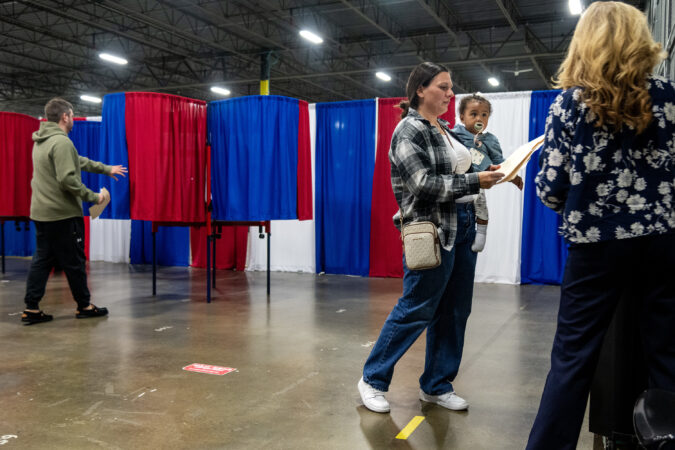
    Turnout soared on Tuesday, despite being an off-year election, and Democrats won by surprisingly large margins up and down the ballot.

    Even Montgomery County, where there were no competitive elections for county offices, saw its highest-ever off-year turnout at 50.7% of registered voters, and Democrats flipped every contested school board race.

    At the top of the ticket, New Jersey’s Mikie Sherrill and Virginia’s Abigail Spanberger, both U.S. representatives with national security backgrounds, ran up the scores in their gubernatorial races while portraying themselves as pragmatists.

    window.addEventListener(“message”,function(a){if(void 0!==a.data[“datawrapper-height”]){var e=document.querySelectorAll(“iframe”);for(var t in a.data[“datawrapper-height”])for(var r,i=0;r=e[i];i++)if(r.contentWindow===a.source){var d=a.data[“datawrapper-height”][t]+”px”;r.style.height=d}}});

    Zohran Mamdani, meanwhile, handily defeated former Gov. Andrew Cuomo in the New York City mayor’s race by promising radical change and progressive policy solutions.

    So where does that leave Democrats as they try to find a recipe for success in next year’s congressional races?

    For Philadelphia’s progressive District Attorney Larry Krasner, who won a third term Tuesday, the answer is clear.

    “There’s a new politics,” Krasner said Wednesday. “It’s pretty clear that the American people, Philadelphians, are tired of insiders who promise them things they don’t do. They’re tired of political dynasties.”

    window.addEventListener(“message”,function(a){if(void 0!==a.data[“datawrapper-height”]){var e=document.querySelectorAll(“iframe”);for(var t in a.data[“datawrapper-height”])for(var r,i=0;r=e[i];i++)if(r.contentWindow===a.source){var d=a.data[“datawrapper-height”][t]+”px”;r.style.height=d}}});

    Democratic strategist Brendan McPhillips, who has worked for progressive candidates as well as Joe Biden’s and Kamala Harris’ campaigns in Pennsylvania, said the party should embrace the ideological diversity of its constituencies.

    “People have tried to ask this question of who represents the soul of the party, and I just think it’s a bad question,” he said. “The party is a huge tent, and last night proves you can run for Democratic office in New York City and New Jersey and Bucks County and Erie, Pa., and each of those races can look entirely different.”

    Democrats made gains with Latino voters

    One of the more worrying signs for Democrats in the Trump era has been the president’s increasing popularity among Latino voters.

    They flipped that narrative Tuesday.

    After 10 months of aggressive U.S. Immigration and Customs Enforcement raids under Trump that are seen by many in the Latino community as indiscriminate and cruel, Democrats appear to have undone some of Trump’s gains in what has long been a blue constituency.

    In New Jersey, the two counties where Sherrill made the biggest gains compared with Harris in the 2024 presidential election were Passaic and Hudson, both of which are more than 40% Hispanic, according to the U.S. Census.

    Sherrill won Hudson by 50 percentage points, which represents a 22-point swing from Harris. And she won Passaic by 15 percentage points after Trump surprisingly carried the county with a 3-point margin in 2024.

    In Philadelphia, Krasner won eight wards that the more conservative Patrick Dugan — Krasner’s opponent in both the general election and the Democratic primary — had won in their first round in May.

    All were in or near the Lower Northeast, and the biggest swing came in the heavily Latino 7th Ward, which includes parts of Fairhill and Kensington. Krasner’s share of the vote there grew from 46% in the primary to 86% in the general.

    It’s really hard to unseat Pennsylvania judges

    Only one Pennsylvania Supreme Court justice since 1968 has failed to win a retention election, in which voters face a yes-or-no decision on whether to give incumbents new 10-year terms, rather than a choice between candidates.

    Tuesday’s results will be discouraging for anyone hoping to increase that number soon.

    Hoping to break liberals’ 5-2 majority on the state’s highest court, Republicans spent big in an attempt to oust three justices who were originally elected as Democrats. Democratic groups then poured in their own money to defend the incumbents.

    In the end, Justices Christine Donohue, Kevin Dougherty, and David Wecht all won by more than 25 percentage points.

    Ciattarelli’s South Jersey strategy failed

    In his third attempt to become governor, Republican Jack Ciattarelli bet big on South Jersey, the more conservative but less populous part of the Garden State.

    It didn’t work.

    In his 2021 campaign against Democratic Gov. Phil Murphy, Ciattarelli carried Atlantic, Cape May, Cumberland, Gloucester, and Salem Counties with a combined 56.8% of the vote. Trump then went on to sweep all five counties last year.

    But on Tuesday, Ciattarelli performed 8 percentage points worse in the region, giving Sherrill a narrow lead in South Jersey, where she won three of the five counties south of Camden.

    (function() { var l = function() { new pym.Parent( ‘sj-shift__graphic’, ‘https://media.inquirer.com/storage/inquirer/ai2html/sj-shift/index.html’); }; if(typeof(pym) === ‘undefined’) { var h = document.getElementsByTagName(‘head’)[0], s = document.createElement(‘script’); s.type = ‘text/javascript’; s.src = ‘https://pym.nprapps.org/pym.v1.min.js’; s.onload = l; h.appendChild(s); } else { l(); } })();

    Republicans now face their own soul-searching question: How to win without Trump?

    In 2024, Trump’s coattails helped Republicans win control of Congress and other elected offices across the country — including in two Pennsylvania swing districts.

    With the president in his second and final term, how will the GOP win without him on the ballot?

    For Jim Worthington, the Trump megadonor and owner of the Newtown Athletic Club in Bucks County, Tuesday’s results show that the GOP needs to do more work on the ground if it wants to succeed without the man who has dominated Republican politics since 2015.

    Elections, he said, are “not about the policies as much they’re just turnout. Red team, blue team.”

    The blue team won Tuesday, he said, because the red team didn’t do enough of the legwork needed to get its voters to cast mail ballots and to drive in-person turnout on Election Day. Worthington said the results left him concerned about Republican Treasurer Stacy Garrity’s chances of unseating Democratic Gov. Josh Shapiro next year.

    “If we don’t get a robust vote-by-mail, paid-for program, it’s going to be very difficult, very difficult, if not impossible for Stacy Garrity to win,” Worthington said. “During this whole 2025 year when we could have been building this toward 2026, we lost a year because we didn’t do it.”

    Staff writer Anna Orso contributed to this article.

    This suburban content is produced with support from the Leslie Miller and Richard Worley Foundation and The Lenfest Institute for Journalism. Editorial content is created independently of the project donors. Gifts to support The Inquirer’s high-impact journalism can be made at inquirer.com/donate. A list of Lenfest Institute donors can be found at lenfestinstitute.org/supporters.

  • Ocean City declares emergency over beach erosion, urges state and federal help

    Ocean City declares emergency over beach erosion, urges state and federal help

    Ocean City Council on Thursday night declared a local emergency over beach erosion, and urged state and federal officials to help.

    The resolution comes after the community suffered severe erosion during two recent storms. Hurricane Erin in August and a nor’easter in October battered the city’s beaches, scouring out cliffs of sand.

    “This could be a tool to help our legislators who are fighting to fund a U.S. Army Corps of Engineers beach replenishment project,” Mayor Jay Gillian explained.

    Gillian said city officials spoke with Republican U.S. Rep. Jeff Van Drew and shared ideas to deal with the erosion. This year marked the first year since 1996 that Congress approved zero federal dollars for beach projects in New Jersey.

    A New Jersey Department of Environmental Protection (DEP) assessment of the damage from the October nor’easter found that the city experienced erosion between 1st and 11th streets, with new dune scarping or loss in that entire stretch.

    Some of the scarping — vertical sandy cliffs caused by storms exceeded five feet in height.

    High waves caused additional damage under the boardwalk at 5th and 6th Streets, according to the DEP.

    “Ocean City is currently experiencing critical and accelerating beach erosion, including significant dune loss, destruction of protective berms, and threats to both public and private property,” the resolution states, “placing the city in an emergency state of vulnerability ahead of the winter storm season.”

    The resolution said beach width and height had already been compromised before the storms.

    Further, it said, the city “lacks the financial resources to independently implement large-scale beach replenishment, dune restoration, or long-term protective measures, and requires urgent and immediate assistance and funding,” from state and federal sources.

    Officials say Army Corps replenishment efforts have already been delayed without any clear timeline to continue.

    The resolution was sent to Gov. Phil Murphy, and multiple U.S. and state legislators, as well as multiple county, state, and federal departments.

    “Ocean City stands ready to work collaboratively with all levels of government to protect the lives, homes, economy, and natural resources of its residents,” the resolution states, “and requests that this growing crisis be met with the urgency and seriousness it warrants.”

    Ocean City is not alone in having felt the wrath of the storms without any funding help in site. The continued federal shutdown has only resulted in more delays in seeking money.

    Coming after Hurricane Erin, the October nor’easter erased sand and seriously compromised dune systems, the DEP said in its preliminary assessment of the storm.

    “Moderate to major erosion” was reported on Long Beach Island and from Strathmere to Cape May, and “moderate to minor” erosion from Brigantine through Ocean City, according to that assessment.

    Although Erin stayed well offshore when it struck in August, the winds and waves it generated caused at least minor erosion on 85% of all Jersey beaches, according to the department’s analysis.

    That included “moderate” sand losses in Avalon, Ocean City, Strathmere, and North Wildwood.

    Contributing to the sand losses resulting from the nor’easter was the fact that the beaches already had endured consecutive days of onshore winds on four occasions since Aug. 18.

    That left beaches without much time for recovery.