Tag: Cumberland County

  • What are South Jersey farmers doing to remedy lost crops? GoFundMes, bigger pumpkin patches, and higher prices

    What are South Jersey farmers doing to remedy lost crops? GoFundMes, bigger pumpkin patches, and higher prices

    Cynthia Martini of Mantua Township visits Mood’s Farm Market every year to pick blueberries. During a typical summer, she collects 40 pounds of them. She used to bring her kids, but now that they’re older, she goes solo.

    Her routine on June 30 didn’t look much different from the last 25 years. On a hot morning, she picked two Tupperware containers of blueberries in paint-streaked shorts.

    “In an hour I picked 10 pounds,” Martini said. “So not bad.”

    But rather than harvesting in the farm’s designated pick-your-own area, Martini kept to to an area typically reserved for staff.

    Mood’s, a 180-acre fruit farm in Elk Township, Gloucester County, opened the off-limits fields as one strategy to survive the summer after a spring crop freeze destroyed about two-thirds of its blueberries and all its cherries, plums, nectarines, pears, and peaches. The farm will likely have only a handful of healthy apples come fall. That means no apple hayrides, even though pick-your-own operations are one of its primary revenue streams. A skeleton crew is working the land rather than a full staff, and it’s taking workers longer to pick fruit since there’s less on the bush.

    After picking her own blueberries, Cynthia Martini (right) of Mantua talks with owners Richard Mood and daughter Patti Mood at Mood’s Farm in Gloucester County on June 30.

    The Elk farm isn’t alone. The freeze destroyed large swaths of fruit crops across the Northeast after temperatures rapidly dropped and spiked again in April. In May, New Jersey officials estimated losses of at least $300 million. A month later, the Garden State, which has nearly 450,000 acres of cropland, secured a disaster declaration that made farmers in all 21 counties eligible for emergency federal loans.

    But South Jersey farms like Mood’s are getting creative to survive a summer with depleted income and damaged crops. From promoting frozen fruit to temporary closures to raising prices, here’s how farms are keeping on.

    Spend less and plant more

    Rowand’s Farm, a 20-acre sweet and sour cherry orchard in Glassboro, Gloucester County, is going through unprecedented circumstances.

    Stephen Rowand, the farm’s third-generation owner, said he’s usually excited when a spring frost arrives, since the cold weather thins out the fruit and produces larger cherries.

    “This season is unique for us as a first with NO CROP at all,” Rowand said via Facebook Messenger. “No income.”

    Rowand decided to close the farm, but that hasn’t meant time off. To ensure the orchard blooms next season, the farm still needs mowing, irrigation, fertilizer, and trimming, and without the ability to hire farmworkers. Rowand, 60, is doing all that work himself through extreme heat. He said he’s currently living off his retirement savings and might have to get a job in the offseason next fall. He’s trying to stay frugal by avoiding vacations and eating out.

    But Rowand has managed to find some solutions to survive.

    To make sure they stay fed, his family planted a bigger garden of tomatoes, string beans, eggplants, cucumbers, greens, and herbs for their personal diets after figuring out the freeze had eliminated their income. He said he will likely apply for a loan from the USDA’s Farm Service Agency to pay bills, and a GoFundMe, which has raised $25,000 so far, has helped pay for some of Rowand’s farm expenses.

    “It’s really helping keep the farm from going into debt,” Rowand said, “which is usually what puts a farm out of business in the end.”

    Duffield’s Farm Market in Sewell, Gloucester County, like Mood’s, won’t have peach picking this summer and is still considering whether it’ll apply for loans. Since the freeze halved their apple crop, the farm won’t offer apple picking trips for local schools this fall, either. To ensure people have enough to pick in the fall, owner Tracy Duffield said, farmers planted a field of pumpkins early.

    As for labor, without peaches to pit, Duffield said there’s less to do, which means reducing hours for the farm’s migrant workers from Puerto Rico.

    “It’s not just us. Everybody is kind of in the same boat,” Duffield said. “Just support your local farm. We’ll recover.”

    ‘A silver lining’

    South Jersey farmers say the natural laws of supply and demand mean fruit prices will rise this year. Mood said their farm’s blueberry prices have doubled, while Duffield’s increased the cost about 50 cents per pound.

    “We still have a business to run, and we have to support the families involved with the business,” Duffield said. “They just have to understand for this year, anyway, that things are going to be a bit higher.”

    Blueberries for sale at the farm stand at Mood’s Farm in Gloucester County.

    Anthony DiMeo owns DiMeo Farms and Blueberry Plants Nursery, which has a large pick-your-own blueberry operation in Hammonton, Atlantic County. With significant damage to his crop, DiMeo said, he anticipates the season to end a couple of weeks early.

    “But there’s a silver lining to this, and that is the price is very high,” DiMeo said. “Even for blueberries that might not be the biggest or might not be the best, the price is exceptional.”

    DiMeo, though, said he decided not to significantly raise prices this year, keeping blueberries at $2.50 per pint, a cheaper price than most grocery stores and farm markets. The choice to eat the losses was influenced by the price consumers are already paying to get through life right now.

    “They’re spending enough as it is with gas and tolls and everything else,” DiMeo said.

    ‘Just luck’

    Bob Fralinger of Fralinger Orchards, a fifth-generation peach and nectarine farm in Bridgeton, Cumberland County, said it was “just luck” that some of his peaches survived the freeze.

    His farm sits along the Cohansey River, and the heat emitting from the water kept the temperature a couple of degrees warmer for the crops. Fralinger said he still lost about half his peaches, but since nearby South Jersey farmers weren’t quite as lucky, nearly 100 farm markets, some hours away, have come to him for fruit. Duffield’s and Mood’s are on that list.

    The increased interest has meant Fralinger has to make sure he has enough peaches for everyone, including his typical wholesalers. And even though Fralinger is having no problem selling, the reduced harvest means he worries that the revenue won’t be enough to pay next year’s bills.

    “Your margins are so close that you can’t survive from one year to the next unless you do things just right, and that’s the problem,” Fralinger said.

    Like Fralinger, Robson’s Farm in Wrightstown, Burlington County, also managed to salvage some peaches from the harvest this year, but not nearly enough to meet the summer demand.

    Customers travel from out of state for Robson’s peaches, fourth-generation farmer Rose Robson said, and many will be disappointed to arrive to find no peaches in sight.

    But once she overcame her initial grief over the lost crops, Robson said, she quickly hatched a plan to adapt to a potentially peachless summer on the farm.

    “Just because the farm is really sad and not great in one way doesn’t mean the whole summer has to be,” Robson said. “This could be a really fun opportunity to be creative and to bring some new people to the farm and still have a really great summer.”

    Robson had already started developing ways to boost business during the farm’s offseason in the fall, like a walking club on the farm, she said. The spring freeze just forced her to consider starting sooner and making it active year-round.

    Plus, Robson’s is focusing on what they can still offer customers.

    “We doubled up on our U-pick cut flowers,” Robson said, “which has been growing over the years anyway, so that’s kind of fun.”

    But more than anything, Robson said her priority has remained the same: “making the farm as grand an experience as we can possibly make it,” she said.
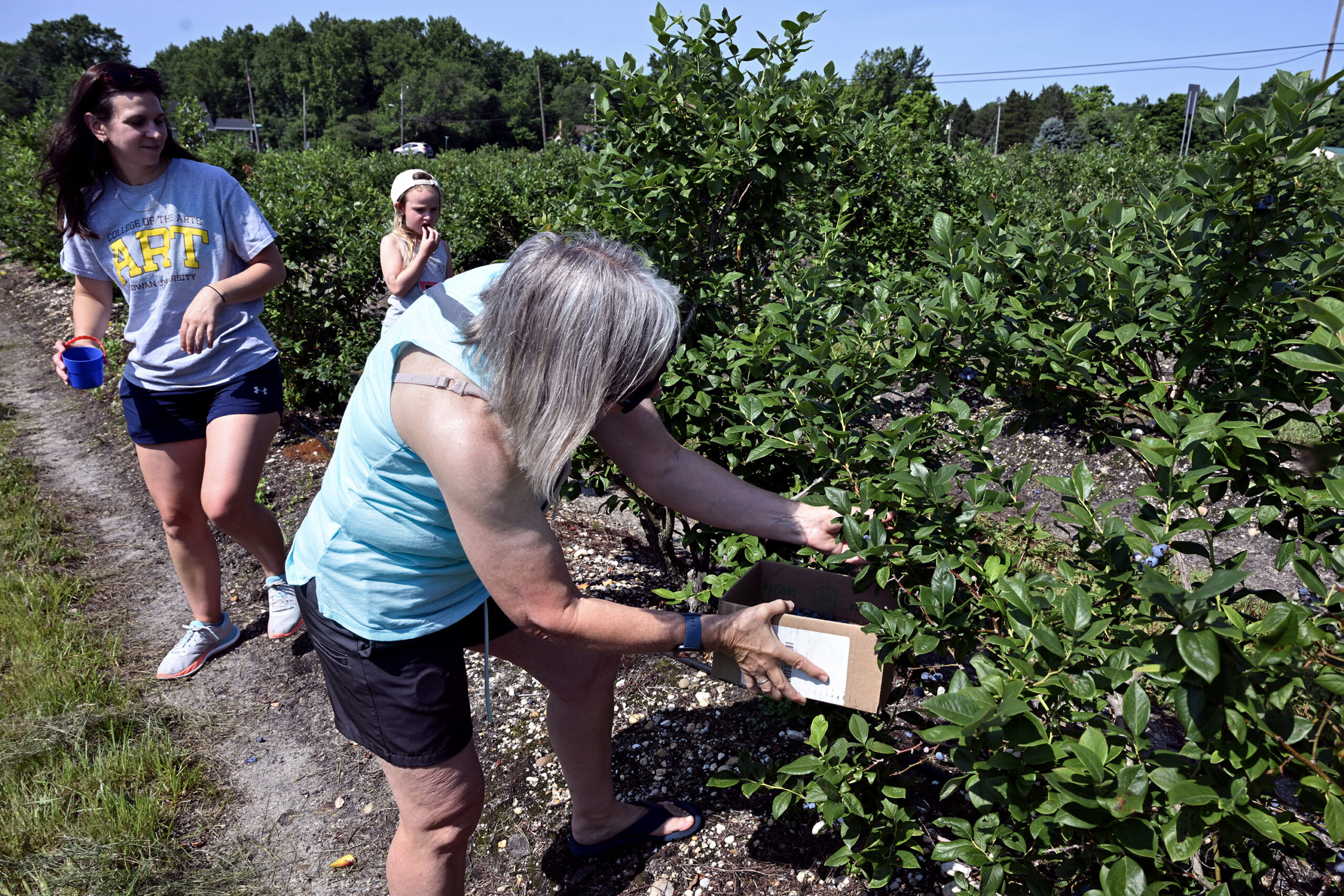
    Sandy Trifiletti (front) of Glassboro and her daughter Hope Welch and granddaughter Rosie, 6, of Pitman, pick their own blueberries June 30 at Mood’s Farm in Gloucester County.

    As farms scramble to adapt, South Jersey residents, whether they’re in the market for fresh fruit or flowers, continue to support their local markets.

    Back at Mood’s Farm, Hope Welch of Pitman picked blueberries with her two children and her mother, Sandy Trifiletti. The Welches have visited Mood’s for years.

    Hope Welch, whose son spoke some of his first words during an annual Apple Festival, asked Mood about the fate of this year’s event. Mood said one would still happen, but it probably wouldn’t revolve around apples, since they won’t have very many.

    “That hurts my heart,” Welch said. “We’ll be back for the fall festival. Whatever it’s called.”

  • Gov. Mikie Sherrill proposed an 80% cut to a program that provides job training and support to Hispanic women. The budget is due in days.

    Gov. Mikie Sherrill proposed an 80% cut to a program that provides job training and support to Hispanic women. The budget is due in days.

    Consensa Francisca Silva Silva moved to Camden from Costa Rica more than two years ago knowing nobody. She lived on the street for two months, she said, and then was bouncing from house to house when a young man in the neighborhood told her to check out the Hispanic Women’s Resource Center in Camden, one of several such centers in the state.

    She went. With help from the program, Silva received food, obtained a work permit, made a down payment for a studio apartment, and started a job at McDonald’s.

    That statewide initiative is now facing detrimental cuts under Democratic Gov. Mikie Sherrill’s budget proposal. The governor has proposed cutting nearly 80% of its funding, and Silva worries that other immigrant women looking to improve their circumstances will not get the help she received.

    “It was very hard to come here without knowing anyone, and it was really hard because at first I couldn’t find any work,” Silva, who is Nicaraguan, said in Spanish, translated by Jesselly De La Cruz, the executive director of the Latino Action Network Foundation, which funds the centers.

    The initiative is one of numerous South Jersey programs at risk under Sherrill’s proposal, including the Rowan University veterinary school and a program that provides mental healthcare to abused children. But the cuts are not a done deal.

    Sherrill and legislative leaders announced Tuesday they had come to an “agreement” on a budget totaling $60.7 billion, the same price tag Sherrill proposed in March. But it has not been made public and it is unclear how far into the details they have gotten. They have until Tuesday to figure it out.

    And the process is still underway. State Sen. Nilsa Cruz-Perez, a Camden Democrat who sits on the Senate Budget and Appropriations Committee, has been a supporter of the centers. She was unable to speak Wednesday afternoon because she was in a committee budget hearing.

    Client Consensa Francisca Silva Silva (right) participates in a workshop at the Hispanic Women’s Resource Center in Camden Thursday, June 11, 2026.

    On a recent Thursday, Silva participated in a healthy life skills workshop in Spanish at the Camden center, where she learned about taking care of herself as summer temperatures get hotter in the city. About 20 adults clapped for one another with big smiles on their faces, and they received goody bags with sunscreen, lip balm, a towel to keep cool, and a little fan. A young girl played with magnetic tiles and a baby was kept calm, passed between women.

    The governor proposed cutting funding for the center’s programs to $535,000, down from more than $2.5 million this year and more than $3 million in 2025. Murphy had proposed a similar cut last year, but the funding was restored during budget negotiations.

    Hispanic Women’s Resource Centers were established through 1991 legislation to address the wage gap for Latinas. New Jersey is one of the states with the biggest wage gap for Latina workers, according to the National Women’s Law Center.

    Staff members observe from back of the room during a workshop at the Hispanic Women’s Resource Center in Camden Thursday, June 11, 2026.

    The Latino Action Network Foundation funds these resource centers in partnership with six nonprofits across 14 sites, including five in South Jersey. The Camden center is located at the nonprofit Healthy Families and Communities, and there are centers in Vineland in Cumberland County, Hammonton in Atlantic County, Pennsville in Salem County, and Rio Grande in Cape May County.

    Sherrill’s proposal would “drastically cut” the number of resource centers, and sites in Hammonton and in Lakewood, in Ocean County, would likely be on the chopping block, De La Cruz said, adding that services would need to be cut in eight of 11 counties.

    Martha Infante, 38, who lives in Pennsauken, said she was disoriented when she moved to South Jersey from the Dominican Republic. But through the Camden center, she found out how to apply for work online and learned basic English. She obtained coats for her daughters’ first U.S. winter, and a staffer accompanied her to a New Jersey Department of Motor Vehicles center to get her driver’s license.

    “I came here and my mind was all over the place, I didn’t know where things were,” she said in Spanish.

    She now works as a home health aide, thanks to training she got through the center, and even participated in a program where she learned about advocating for her community in Trenton.

    “Don’t cut these funds, Gov. Sherrill,” she pleaded. “Don’t cut the funds! This is like a family. It’s like a home for the community.”

    Client Martha Infante (left) talks with staff member Chailienisse Vega (right) after participating in a workshop at the Hispanic Women’s Resource Center in Camden Thursday, June 11, 2026.

    Some of the women in the program are fleeing domestic violence and seeking financial independence. Others are struggling to get a work permit, or may have lost a family member who helped pay the bills to deportation. A lot of former “Dreamers” — undocumented immigrants who came to the U.S. as children — utilize the center as well, De La Cruz said.

    The need for the centers has only escalated under President Donald Trump’s second administration, she said.

    The social worker-turned-executive said she was surprised by the severity of Sherrill’s proposed cut, especially because of the governor’s efforts to push back against Trump’s immigration policies.

    A 2023 Rutgers study funded by the Latino Action Network Foundation found that the most popular services at these resource centers were English-language classes and employment services, such as job referrals, assistance filling out applications, resume writing, and interview preparation.

    Staff member Andreina Pardo pauses to stretch with participants as she leads a workshop at the Hispanic Women’s Resource Center in Camden Thursday, June 11, 2026.

    “Aside from helping them with the technical aspects of job hunting, the assistance from the Centers seemed to provide a boost of confidence for many of the women, giving them an additional push to apply for positions even if they felt hesitant to do so at first,” the study said.

    Gladys, 48, who declined to give her last name due to concerns over her safety, said in Spanish that the free English courses made her feel like she could “come up for air and breathe” after not being able to communicate.

    The Camden resident had been an ecologist in Nicaragua and has gotten involved in the center’s community garden. She said she would love to pursue a career teaching children about the environment, but her plans are on hold because her work visa was canceled.

    In the meantime, Gladys said, activities at the center like art classes have made her feel less alone. She has been able to connect with women in the same situation as her, and those who migrated to the U.S. earlier who can give her advice from their experiences.

    “Maybe my circumstances don’t change, but my emotional well-being changes because I’m able to connect with others,” she said in Spanish.

  • Vineland schools are allowing teachers to wear jeans and dress more casually for the end of the school year

    Vineland schools are allowing teachers to wear jeans and dress more casually for the end of the school year

    Vineland’s public school teachers are having an easier time with the question of what to wear to work — at least for the final days of the school year.

    In a move to boost morale in the South Jersey school system and make teachers’ lives easier this spring during a hectic testing period, the district eased its dress policy to allow denim jeans until the end of the school year on June 25.

    Teachers love it and hope it will continue in September.

    “It’s one small way to make the world of work a little friendlier,” said Vineland Education Association president Louis Russo, a social studies teacher. “It’s one small thing off of their shoulders.”

    Teachers Andrea Ruiz (left) and Elaine Petrini (right) at Rossi Elementary in Vineland on June 9. The teachers are allowed to wear jeans until the end of the school year.

    School board president Cedric Holmes said the Cumberland County district notified employees when they returned from spring break in April that they could wear jeans any day of the week under a pilot program.

    Holmes said there had been rumblings among staff because the district — the largest in Cumberland County, with 11,000 students — had to extend the school year to make up snow days. Vineland‘s June 25 last day of school is among the latest in the region.

    The months following spring break are among the toughest with students undergoing standardized state testing, Holmes said. There are also end-of-the year field trips and outings when it makes sense to allow more relaxed clothing, he said.

    “It was important to the board that staff felt that we saw the stress of all of that of this as a practical way to give a morale boost for the end of the year,” Holmes said.

    Teachers typically dress a bit more formally for school. According to Vineland’s policy, female teachers must wear skirts, slacks, skorts, or dresses with blouses or sweaters, or school uniform. The skirt, skort, or dress should not exceed three inches above the knee.

    Male staffers can wear suits or slacks with jackets and ties, sweaters, school uniform, or sports or dress shirts. Deemed unacceptable for both are sneakers, flip-flops, bedroom slippers, combat boots, and work boots. There are exceptions for teachers attending field trips or who work in specialized areas such as health and physical education or arts.

    The district also has a uniform policy for students, but Holmes said that has been relaxed and the board also plans to reexamine that policy.

    New Jersey’s 600 school districts set their own policies for staff and students.

    Steve Baker, a spokesperson for the New Jersey Education Association, which represents 200,000 teachers and support staff, said the union supports the efforts in Vineland “to develop policies that help create a positive learning and working environment for students and staff.“

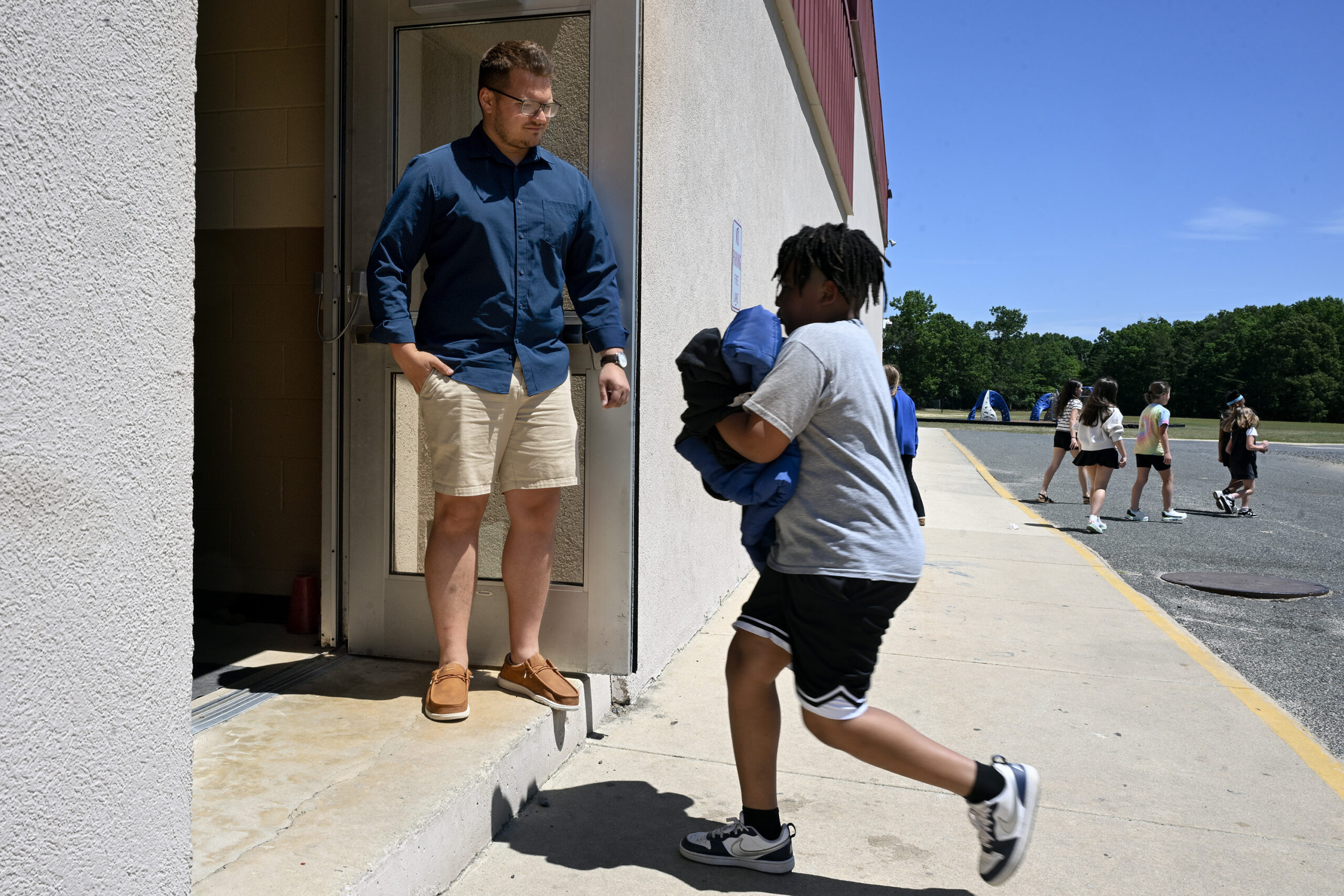
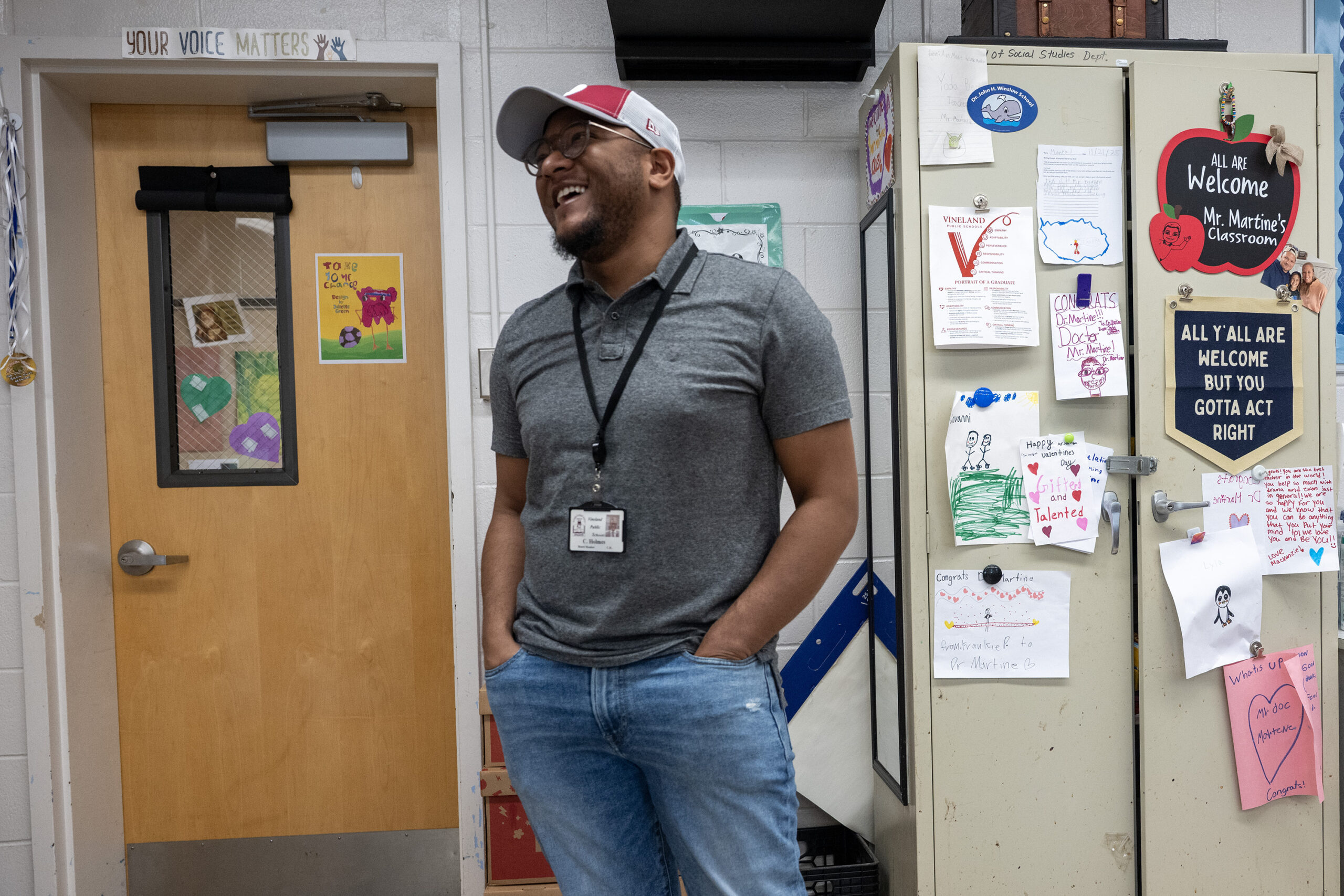
    On a busy morning last week at Anthony Rossi Elementary in Vineland, third-grade teacher Jeffrey Martine stood in front of the class dressed in khaki shorts, a button-down blue dress shirt, and slip-on loafers. As an added bonus, it was a dress-down day, which allowed teachers to wear casual attire beyond jeans.

    Jeffrey Martine, a teacher at Rossi Elementary in Vineland, greets a student at the school last week.

    “If you do your job well, you have to be able to move,” Martine said. “I’m all about comfort.”

    Students in Martine’s gifted and talented class were spread around the room working on a project in small groups. Some sat at desks making posters, while others were stretched out on the floor.

    “I don’t think professionalism and comfort are mutually exclusive,” Martine said. “Teachers should be judged more on how they interact with their students than the pants they select.”

    Holmes acknowledged the dress code was outdated and revisions are needed. The board plans to review the changes implemented this spring and may allow teachers to wear jeans during the new school year, he said.

    “It was time for a change,” said Kaitlynn Rossi, a long-term substitute teacher. “People don’t dress like that.”

    Teacher dress codes have evolved nationally over the years, especially during the pandemic, when more casual attire was the norm.

    Based on responses from teachers around the world, the website We are Teachers in 2024 compiled a list of “16 Ridiculous Dress Code Rules for Teachers You Won’t Believe Are Real.” The list included prohibiting hats, capri pants, pants with pockets, UGGs, hoodies, or dark underwear.

    In Philadelphia, where classes ended last week, there is no system-wide dress code for staff. Arthur Steinberg, president of the Philadelphia Federation of Teachers, which represents about 14,000 teachers, counselors, nurses, secretaries, and other workers, said employee dress typically does not come up as an issue.

    School board president Cedric Holmes at Rossi Elementary in Vineland last week. Holmes said the teacher dress code policy was relaxed in an effort to improve morale at the end of the school year.

    Holmes said teachers have responded well to the changes in Vineland and there have been few infractions, like torn or ripped jeans.

    Before Vineland implemented the pilot dress code, teachers were allowed to wear jeans only for special days. The schools sponsor fundraisers that allow teachers to pay $2 to wear jeans. Students are allowed to wear jeans on dress-down days determined by their school principal, and they do not have to pay.

    Fourth-grade teacher Andrea Ruiz said dressing more casually helps her students see her differently. A sign in her classroom says: “Be the best version of you.” She enjoys sitting with students on the carpet in her classroom or playing kickball on the playground.

    “We’re meeting them where they are,” said Ruiz, who was wearing a gray T-shirt and striped pants. “It’s definitely something different for us.”

    Teacher Kaitlynn Rossi with students at Rossi Elementary in Vineland last week.

    Timothy Purnell, executive director of the New Jersey School Boards Association, said a decision as simple as allowing jeans can have an impact on the learning environment.

    “If jeans support a positive environment during testing, that’s a local call we respect,” Purnell said.

    Russo believes a less-stringent dress code will help attract and retain younger teachers amid a national teacher shortage. He wants them to still dress in a manner that gets respect from students.

    “We just have to find the right balance,” Russo said.

    Staff writer Kristen A. Graham contributed to this article.