Tag: Curious Philly

  • Why Philly has so many chicken bones lying around

    Why Philly has so many chicken bones lying around

    As the cold thaws and the snow melts, one constant remains the same: There are chicken bones on the Philly streets.

    Time may be a flat circle, but that doesn’t stop us from wondering why. A reader asked through Curious Philly, The Inquirer’s forum for answering questions, why there are so many chicken bones on the sidewalks and streets of Philadelphia.

    » ASK US: Have something you’re wondering about the Philly region? Submit your Curious Philly question here.

    Two architects appear to be behind Philadelphia’s chicken-bone temple.

    First are animals, who forage through trash looking for the final scraps left on discarded bones. Whether they discover drumsticks by ripping through trash bags on the street or from dumpster diving, these animals likely drop the bones wherever they finish with them.

    The culprits most likely to blame are rats, followed by raccoons and opossums, said Rich Foreman, the owner of Dynamite Pest Control in West Philly.

    While it’s unclear if rats have a particular taste for fried chicken, the animals are among the least-picky eaters around and will take advantage of any food source, from human scraps to cannibalism. And Philadelphia is seemingly a good place to be a rat, being declared the eighth-rattiest city in the United States in 2025 by the pest-control company Orkin, measured by tracking its new residential rodent treatments.
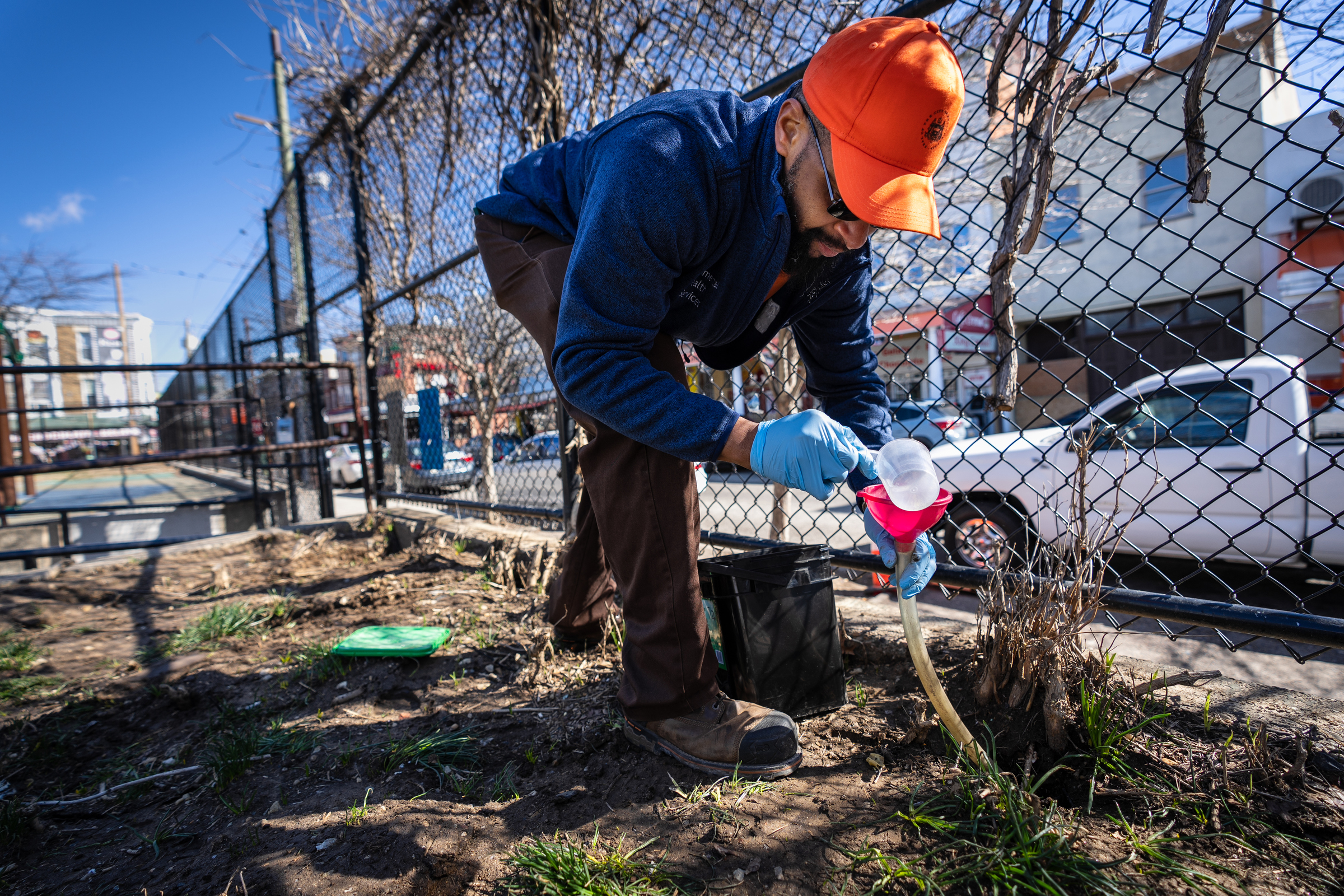
    Adrian Jordan, Vector Control Crew Chief, works keeping the rat population under control, in Philadelphia, Friday, March 7, 2025.

    Foreman sees the chicken-bone problem all over the city, as with some restaurants in Port Richmond that called Dynamite when they saw their trash all over the street. He is confident animals were behind the mess, and said he has “never seen” humans do anything of the sort.

    Foreman said the city’s twice-weekly trash pickup initiative has not helped, since it means an additional day of easily accessible trash on the street for animals.

    He said the best way for people to prevent critters from going into their garbage for bones is to get large, durable trash cans.

    “And make sure you put the lid on it,” he said.
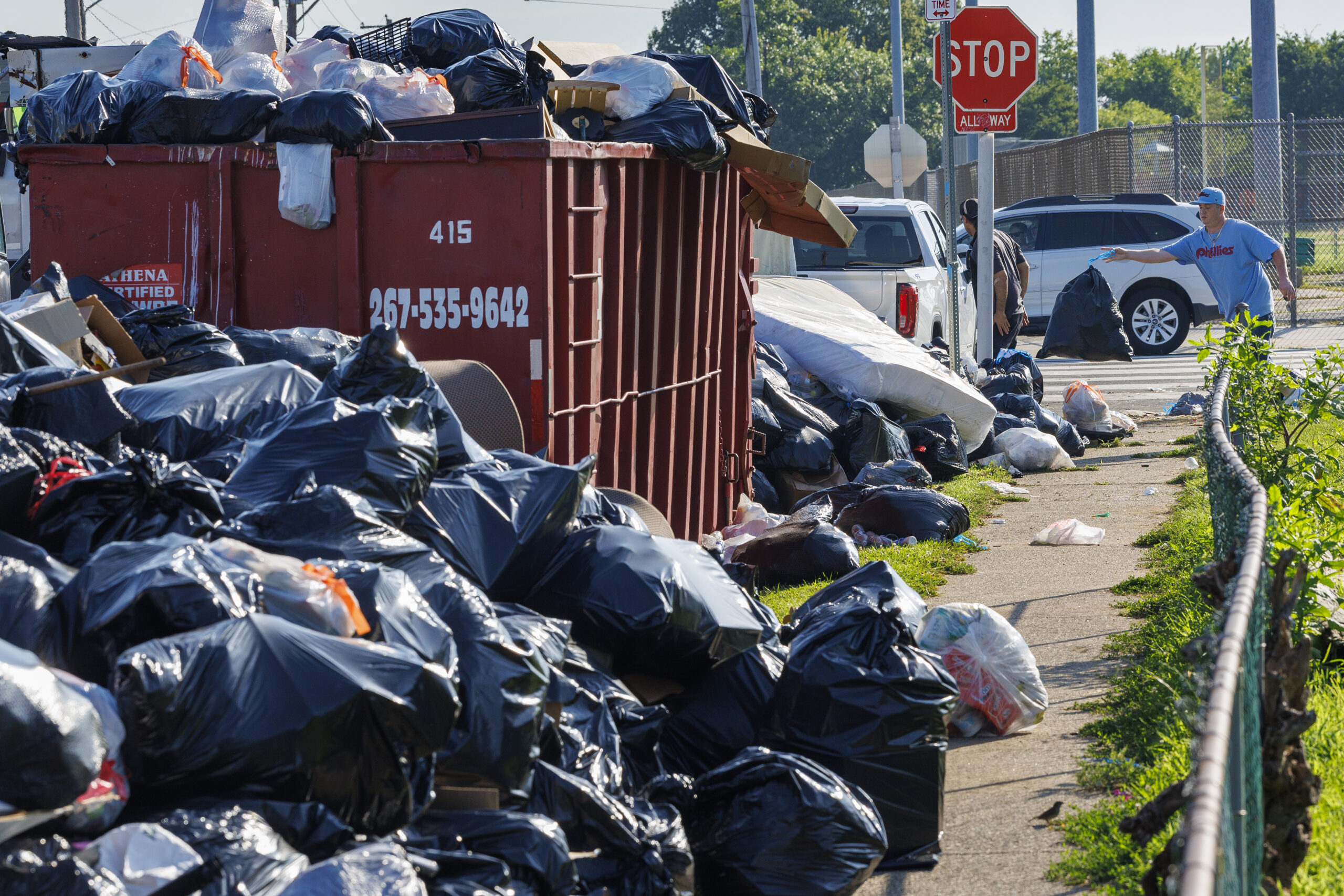
    Residents with trash arriving at garbage dump site at Caldera Road and Red Lion Road in northeast Philadelphia. AFSCME District Council 33 workers enter their second week on strike, Tuesday, July 8, 2025.

    Scavenging animals was the conclusion that the Search Engine podcast reached in a 2024 episode investigating the cause of the chicken bones littering the streets of New York City. Other cities have reported the same problem, including Chicago, Miami, and Washington.

    And yet, anecdotal evidence from residents demonstrates that human activity clearly contributes to the problem.

    Jessica Griffith has become the David Attenborough of abandoned chicken bones, documenting and appreciating the beauty of what she encounters in the wild. More than 10 years ago, when she lived in South Philly, Griffith, 46, would notice the chicken bones frequently on walks with her dog. She started photographing them and posting the pictures to Facebook, finding the bones everywhere, including a pile on a SEPTA train.

    “It was just bizarre to me. Just a phenomenon,” she said.
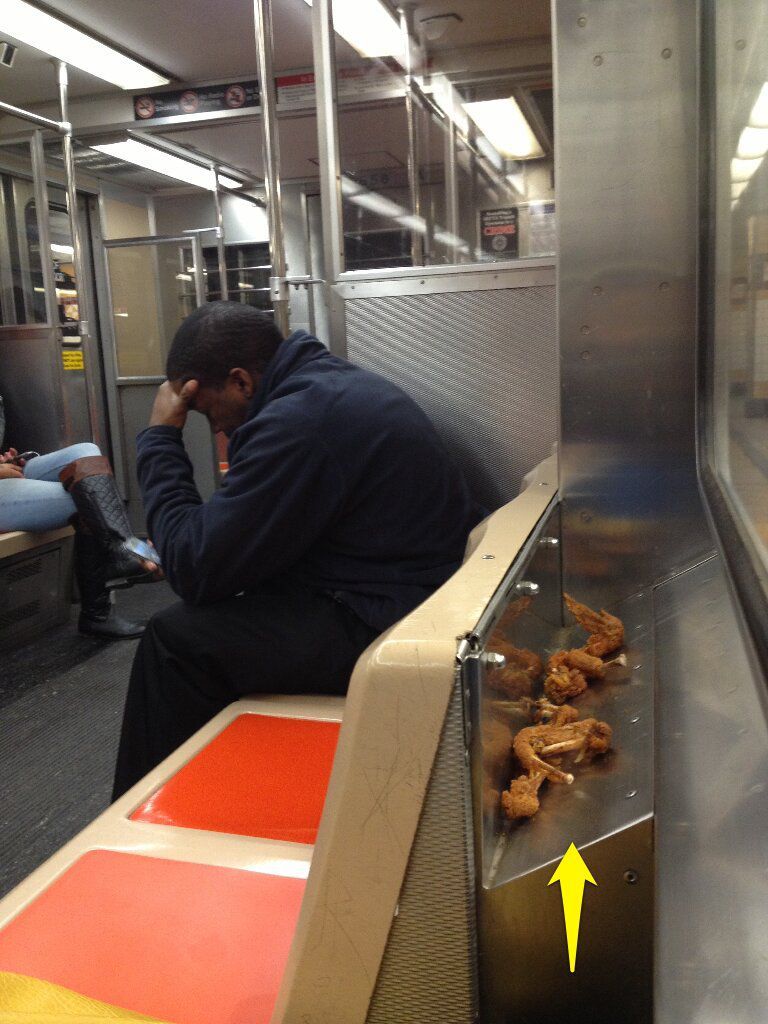
    Jessica Griffith snapped this picture of some discarded chicken bones on the Broad Street Line in 2013.

    Her documentation gathered a following, and people started to send their own submissions. Griffith received pictures from all over the globe — people in Seattle, Las Vegas, South Korea, Sweden, and the Dominican Republic all had their own pictures of discarded chicken bones to share.

    When Brian Love, 53, walks his miniature pinscher, Ziggy, through the Gayborhood, he often sees other people smiling at his dog. But then he realizes it’s because Ziggy is carrying a chicken bone in his mouth.

    Love has complained to his friends about constantly needing to tussle with Ziggy over what the dog sees as a treasure. He has watched people toss chicken bones on the ground, and recently came across a pile of four bones on a mound of snow. Love wishes his neighbors would just use trash bins.

    “It’s your food that you’ve literally just had in your mouth. Throw it in the trash,” he said.

    Stephanie Harmelin, 43, has the same problem with her dog in West Philly, and she said she accepts the bony sidewalks as part of living in a city. She has seen aggressive squirrels rifling through trash, but also has come across bones at street corners and under park benches that appear to have been dropped by humans.

    She said part of the problem is educational. Once, Harmelin pulled her dog away from a bone on the street, and two fellow walkers asked her why.

    Harmelin explained how chicken bones are unsafe for most dogs to consume. Cooked bones splinter when a dog chews on them, and the sharp fragments may cause life-threatening damage as they pass through the dog’s digestive track.

    One woman was shocked, and said she had not realized chicken bones were potentially dangerous to dogs when she had tossed them to the ground before.
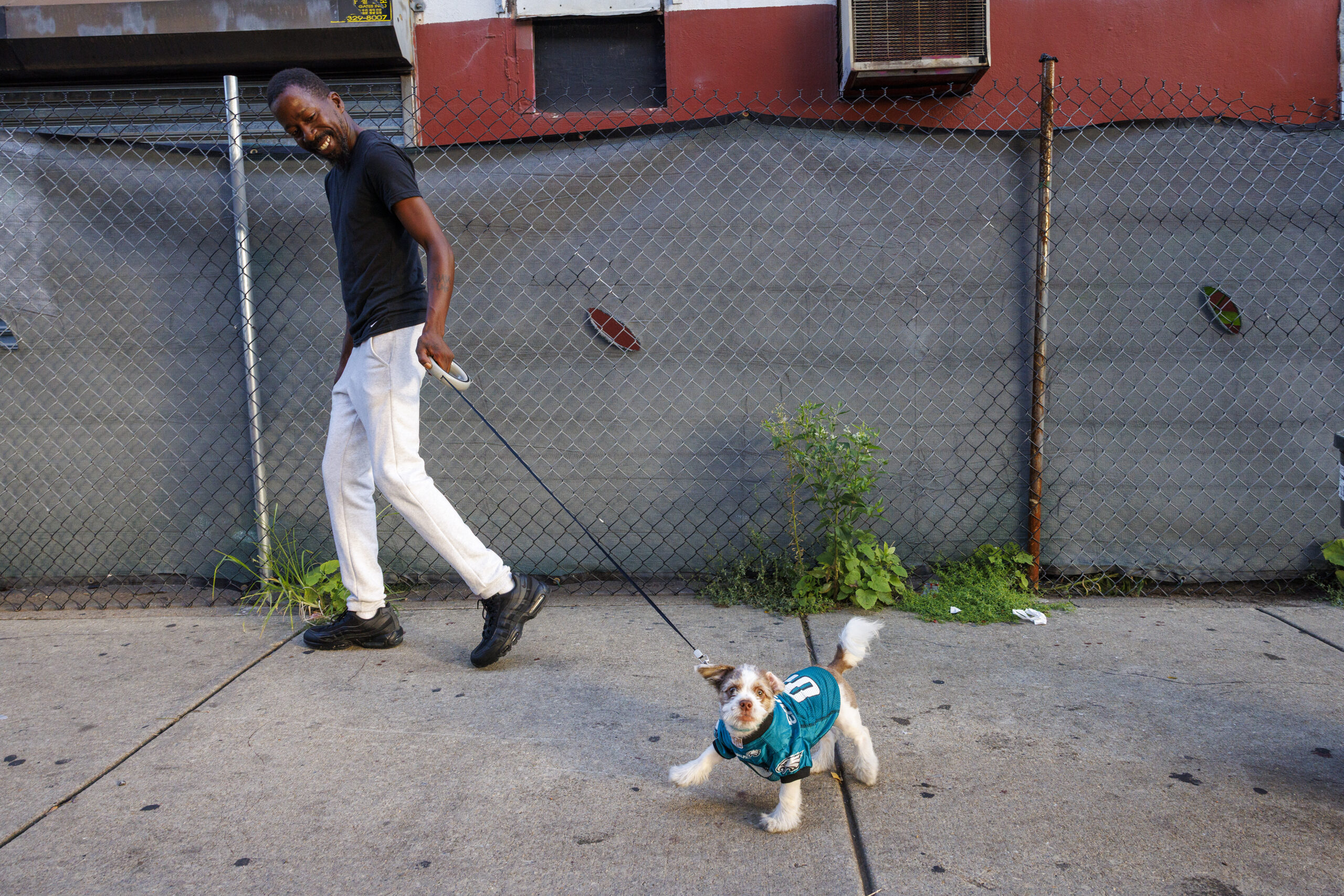
    Theo Caraway of Philadelphia walking his dog Cooper, 6 months, Shitzu/Poodle wearing his Eagles jersey along Kensington at Ontario Street on Philadelphia, Friday, September 5, 2025.

    Harmelin has had similar conversations with others who were not aware of the hazards bones create. Now, she is less likely to be frustrated at whomever has dropped the chicken bone on her street corner.

    “We’re trying to assume what other people know and intend, but we can’t,” she said.

    Even if more people get the message, though, it appears you will still be as likely to find a chicken bone on the street as a fallen leaf.

    Although they’re a gross nuisance of a sidewalk adornment, Griffith doesn’t really mind them. She said they are more of a curiosity that make Philly what it is, in a small way.

    “I think it’s kind of endearing,” she said.
  • Philly is not dumping snow in the Schuylkill, but it has in the past

    Philly is not dumping snow in the Schuylkill, but it has in the past

    Many Philadelphians are continuing to deal with snow-clogged, slushy, ice-laden streets nearly two weeks after a winter storm produced the city’s biggest snowfall in a decade.

    To deal with the snow, the city has deployed roughly 1,000 workers and 800 pieces of snow-removal equipment, and instituted programs to break up ice at crosswalks and streets in residential neighborhoods, among other efforts. But to some Inquirer readers, the solution has been right in front of us all along.

    “I know we used to toss snow into the river,” one reader wrote via Curious Philly, The Inquirer’s forum for questions on all things local. “What happens to it now?”

    » ASK US: Have something you’re wondering about the Philly region? Submit your Curious Philly question here.

    In the past, the city has dumped snow into the Delaware River and the Schuylkill on various occasions. But in recent decades, that practice has been used rarely — if at all — primarily over environmental concerns. Here is what we know:

    An old practice

    Newspaper archives show references to dumping snow in the Delaware and Schuylkill dating back at least to the late 19th century — during a storm colloquially known as the “Great Arctic Outbreak of 1899.” That storm dumped 19 inches of snow on Philadelphia around Valentine’s Day.

    In the aftermath, the city sought permission from its Board of Port Wardens to dump snow in the rivers surrounding Philadelphia, but there were concerns over the “considerable amount of dirt” that would be thrown into the water.

    The practice was utilized in the winter of 1909, when 21 inches of snow fell. Initially, snow was dumped into the rivers at three points, but officials later expanded approved dumping sites to be “at any point and from any wharf” along either river.

    “It was contended that this was perfectly proper, since snow is not refuse, but will readily melt after it is thrown into the water,” The Inquirer reported at the time.

    https://www.newspapers.com/article/philadelphia-daily-news/190719291/

    Article from Jan 10, 1996 Philadelphia Daily News (Philadelphia, Pennsylvania) <!— –>

    The blizzard of ’96

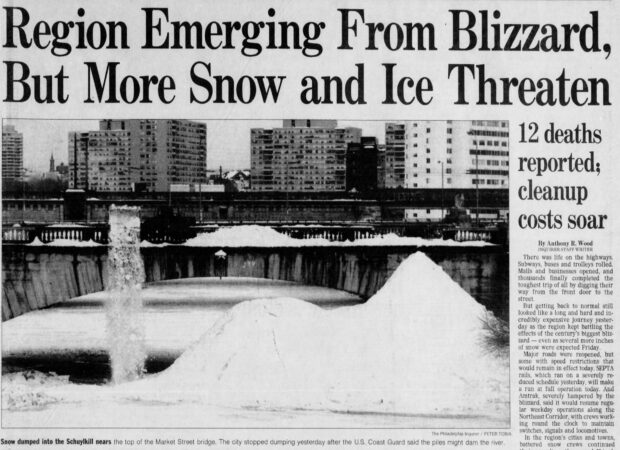
    Perhaps the most well-known modern use of Philadelphia’s rivers as a snow dump came in 1996, when a debilitating 30.7 inches of snow fell in early January. The city was left with few options, and got a permit from state environmental officials to dump snow in the rivers, Inquirer reports from the time indicate.

    Within days, roughly 500 tons of snow were dumped into the rivers, and that total would grow into the thousands. Famously, city trucks were spotted dumping snow into the Schuylkill from the Market Street Bridge — until being asked to stop by the U.S. Coast Guard.

    “We did advise the city to stop dumping snow into the Schuylkill. Our concern was the accumulation of ice in the river,” a Coast Guard spokesperson said at the time. The piles of snow in the river ran the risk of forming dams that could cause flooding.

    The piles became so severe they had to be beaten back down. By mid-January, one Inquirer report noted, wrecking balls were sent in to break up at least one mountain of snow that threatened to clog the Schuylkill.

    https://www.newspapers.com/article/the-philadelphia-inquirer/190719516/

    Article from Feb 22, 2003 The Philadelphia Inquirer (Philadelphia, Pennsylvania) <!— –>

    An ‘option of last resort’

    The city again in 2003 dumped snow into Philadelphia’s rivers, this time in an attempt to mitigate the impacts from a February storm that left about 19 inches of the white stuff. This time, though, city officials seemed to at least feel bad about it, calling it an “option of last resort.”

    For this storm, roughly 400,000 pounds of snow was dumped into the Schuylkill. But along with it went road salt, antifreeze, trash, and other pollutants, prompting concerns from regional environmental groups. That pollution, they said, could harm marine life and devastate the riverbanks.

    “All the stuff that’s on the road surface goes into the water,” Delaware Riverkeeper Network head Maya van Rossum told The Inquirer that year. “This is not the appropriate way to deal with the snow. There are plenty of places on the land to put it.”

    The dumping, Streets Commissioner Clarena Tolson said, was limited. And the Pennsylvania Department of Environmental Protection said it asked the city to only dump “virgin snow” into the rivers.

    https://www.newspapers.com/article/the-philadelphia-inquirer/190719722/

    Article from Feb 12, 2010 The Philadelphia Inquirer (Philadelphia, Pennsylvania) <!— –>

    No more dumping, officially

    By 2010, the city appeared to have officially abandoned the practice of dumping snow into city riverways. That February, one storm caused more than 28 inches of snow to fall, but Mayor Michael A. Nutter’s administration declined to pour it into the rivers.

    “We’re going to take some of that down to the Navy Yard. We will not dump in the river,” Tolson said. “There are environmental concerns with placing snow in the river. The snow accumulates pollutants and salt, and dumping it in the river would be a very extreme measure.”

    The Center for Environmental Policy at the Academy of Natural Sciences applauded the Nutter administration’s decision, writing in a letter to The Inquirer that the move would “prevent serious environmental damages to the river.”

    “Urban precipitation, including snow, acquires a witch’s brew of contaminants such as oil, grease, litter, road salt, and lawn fertilizer,” director Roland Wall wrote. “We salute the city for making a commonsense decision that will protect one of Philadelphia’s natural treasures.”

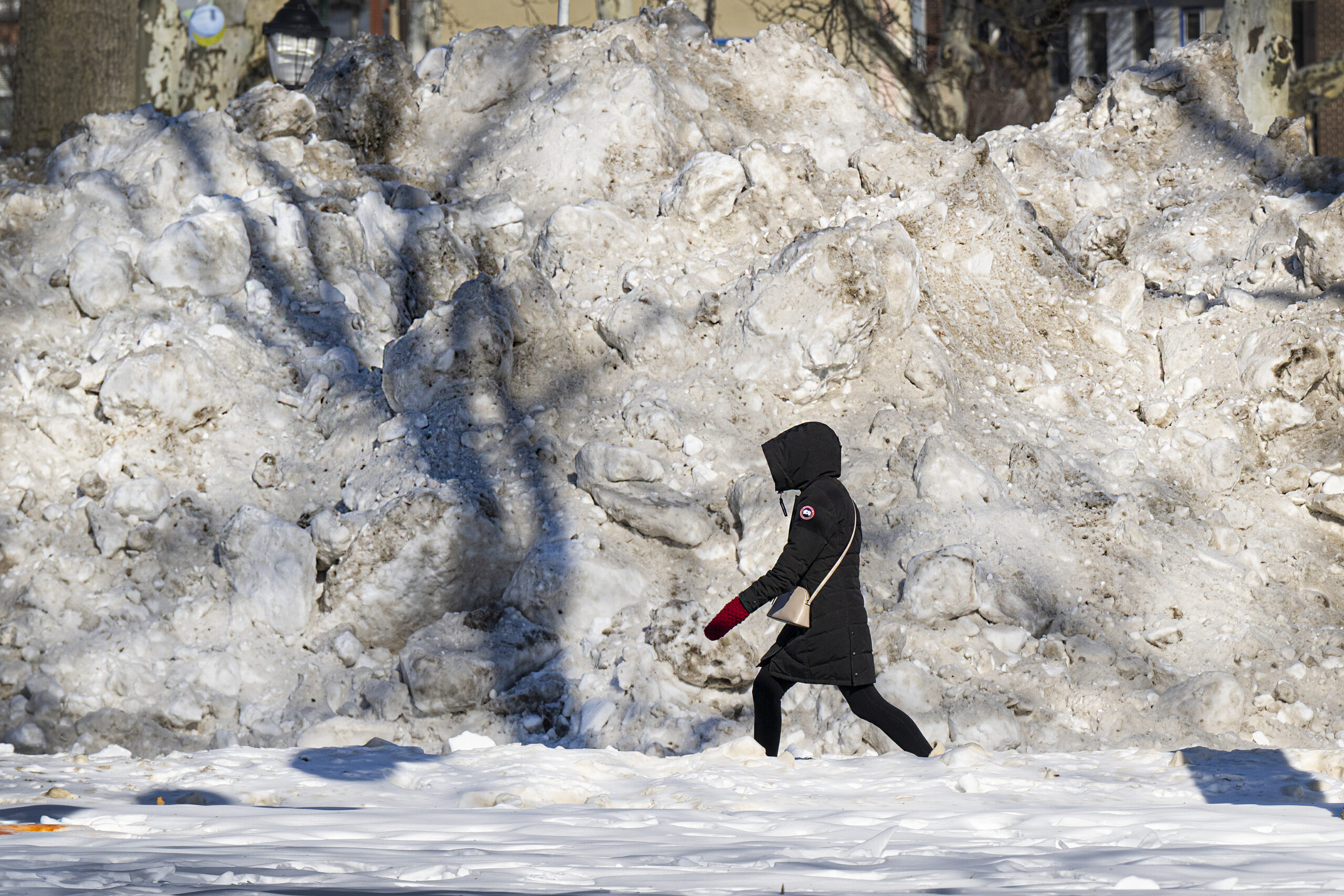
    A pedestrian walks past a large pile of snow and ice along the Benjamin Franklin Parkway days after a fierce winter storm dropped up to 9 inches of snow and sleet, with freezing temperatures leaving large banks of ice and snow on streets and sidewalks in Philadelphia, Monday, Feb. 2, 2026.

    So what do we do now?

    On Wednesday, Carlton Williams, the city’s director of clean and green initiatives, said the city does not dump snow in Philadelphia’s rivers, as that practice is “not an EPA standard.” Instead, the city has gravitated toward removing the snow from city streets and placing it at 37 snow dump sites around Philadelphia.

    The city did not respond to a request for comment regarding those dump sites’ locations. Some of them contain mounds of snow up to 12 feet high that stretch for blocks, Williams said Wednesday. Officials also brought in a snow-melting machine from Chicago.

    Pennsylvania Department of Environmental Protection guidelines, meanwhile, recommend municipalities push snow at least 100 feet away from surface waters, where it will be able to melt with less environmental impact.

    “Dumping of snow directly into a stream carries with it the shock of loading de-icing chemicals and anti-skid agents,” the agency said in a recent recommendations document. “Allowing a natural melt provides a slow release of the water, dilutes the chemicals, and provides filtration of the solids through the soil.”

  • The Schuylkill is frozen, but that doesn’t mean you can ice fish on it

    The Schuylkill is frozen, but that doesn’t mean you can ice fish on it

    Have you been looking longingly at your fishing gear during the Philadelphia winter? Are Deadliest Catch reruns not hitting the same?

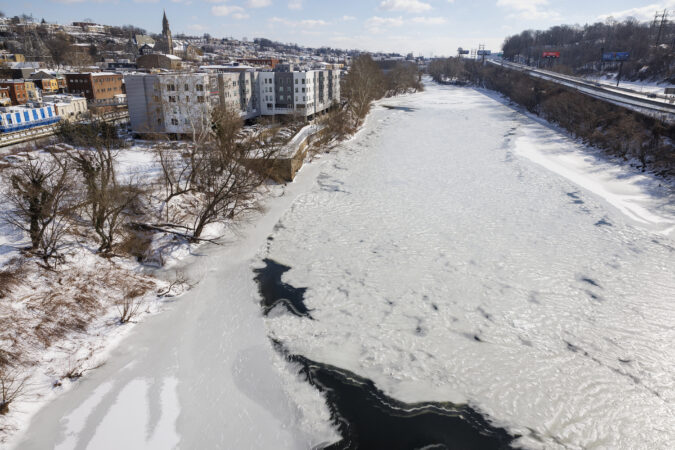
    With the surface of the Schuylkill River still frozen solid and frigid temperatures returning this weekend, a reader asked through Curious Philly, The Inquirer’s outlet for answering questions, whether they were allowed to ice fish on it.

    Ice fishing, after all, is a practice that began with subarctic Indigenous peoples thousands of years ago, well before the advent of the modern fishing rod in the late 1700s. Fishing along the Schuylkill is accepted and celebrated in warmer temperatures, so what about its frozen cousin?

    Unfortunately for those Philadelphians dreaming about an Arctic lifestyle, the answer is no.

    “Ice fishing is illegal in Philly,” Philadelphia Police Department spokesperson Sgt. Eric Gripp said by email. The practice is not explicitly outlawed, but walking out onto the ice in order to carve a hole and cast a line underneath violates city rules.

    A pedestrian walks past a large pile of snow and ice along the Benjamin Franklin Parkway on Monday.

    “You can’t walk, swim, or be in/on the waterway — unless in a vessel — regardless as to whether or not it’s frozen,” Gripp said.

    Philadelphia police began spreading the message to not venture out onto the frozen Schuylkill this week, after local CBS News video captured several adults and children walking across it Sunday. The Police Department’s directive on code violation notices lists ice skating, skiing, and sledding in some areas of Fairmount Park as potential offenses.

    Ice fishing could put you in violation of a few city ordinances, too. While you would likely be subject only to a summary offense and a $25 fine for each violation, police say you would be breaking rules about using areas managed by Parks and Recreation outside of their approved use, and risk violating the ban on “swimming” or wading out onto any Philadelphia creek, lake, river, or stream.

    » ASK US: Have something you’re wondering about the Philly region? Submit your Curious Philly question here.

    Even though the Schuylkill’s frozen surface may be several inches thick in certain locations, ice’s integrity can’t be judged based upon only how it looks, how fresh it is, or the temperature outdoors, according to the Pennsylvania Fish and Boat Commission. Ice’s strength is also informed by several other factors, including the depth of the water underneath the ice, and nearby fish activity.

    “Anyone that walks onto the Schuylkill River, … they’re taking their life into their own hands. It’s not a smart thing to do,” said commission spokesperson Mike Parker. Parker said the commission highly advises against walking on top of or fishing on the frozen surface of any moving body of water, like a river.

    “There’s no such thing as safe ice,” in those cases, he said.

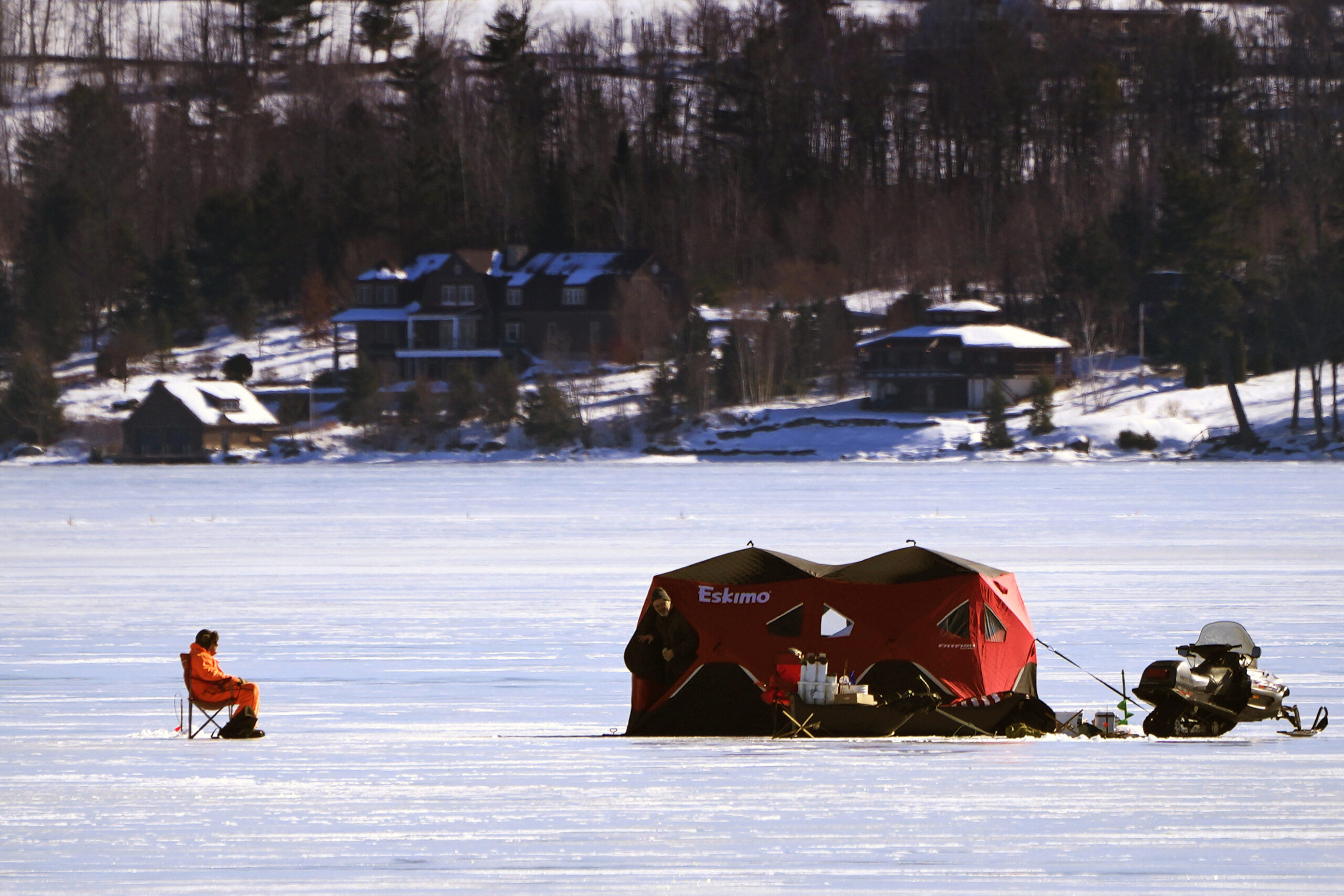
    A fisherman sits in the sun outside a pop up shelter while ice fishing on frozen Lake Wentworth in Wolfeboro, N.H.

    But ice fishing can be relatively safe on still bodies of water, like lakes and ponds. As general guidelines, the fish and boat commission advises that anglers fish only on those bodies of water when ice is at least five inches thick, and never to go out onto ice alone.

    If you are still interested in ice fishing during the region’s cold spell, the Fish and Boat Commission offers a map of approved ice fishing destinations across the state.

    The closest ones to Philadelphia include Deep Creek Dam in Montgomery County; Marsh Creek Lake, in Chester County; and Lake Galena in Bucks County.

  • The story behind a colonial-era grave site hidden in residential Cherry Hill

    The story behind a colonial-era grave site hidden in residential Cherry Hill

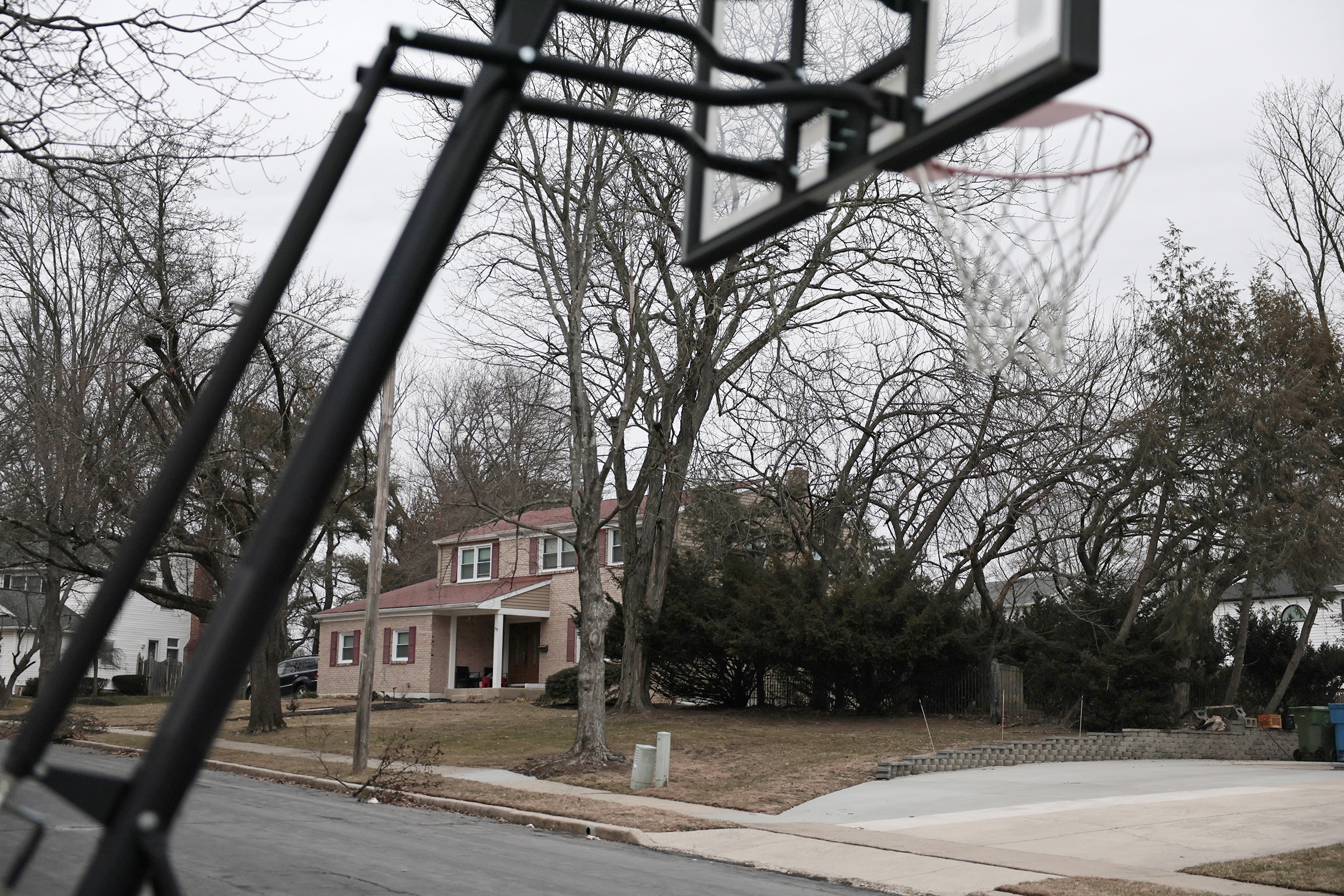
    Giancarlo Brugnolo moved to Cherry Hill’s Woodcrest neighborhood in 2014, but it wasn’t until last year that he heard about the centuries-old cemetery just a stone’s throw away from his house. When friends first mentioned it, he assumed they were joking.

    “I was like, ‘What are you talking about? What graveyard?’” he remembers saying. “We live in a residential neighborhood, there’s no way there’s a graveyard.”

    Yet tucked away under sassafras trees and in the shade of neighboring houses, members of one of South Jersey’s first colonial families are laid to rest.

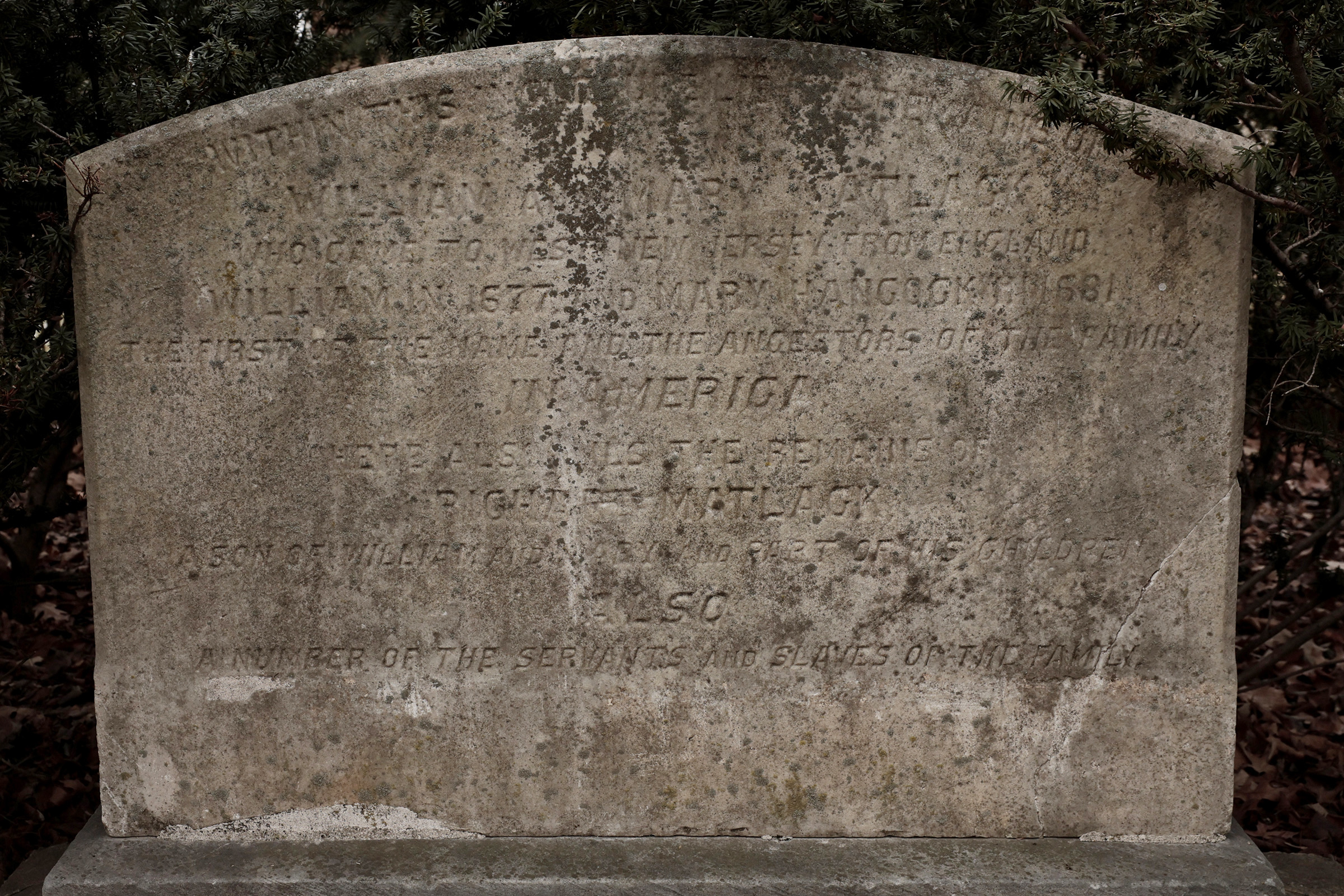
    The Matlack Family Cemetery is located on the 500 block of Cherry Hill’s Balsam Road. At the small grave site lie the remains of William and Mary Matlack, some of their descendants, and an unspecified number of servants and enslaved people. William Matlack is believed to have died in 1738, at around age 90, and Mary Matlack in 1728, at around age 62.

    Wanting to know more about the cemetery, Brugnolo took his question to Curious Cherry Hill, The Inquirer’s forum for answering local questions. Who was the Matlack family, and how did their grave site end up in a residential neighborhood?

    » ASK US: Have something you’re wondering about in Cherry Hill? Submit your Curious Cherry Hill question here.

    William Matlack, a carpenter, came to New Jersey in 1677 from Cropwell Bishop in Nottinghamshire, England. He traveled to the Americas on a ship named the Kent as an indentured servant to Thomas Ollive and Daniel Wills. Wills was appointed as the commissioner of West Jersey and sent to make deals with the Lenni-Lenape people who had long lived on the land. Many of the Kent’s travelers, including Matlack, were Quakers. The ship traversed the Atlantic Ocean from England, ultimately heading up the Delaware River to present-day Burlington County. Matlack is said to have been the first European settler to put his foot on the shore of what is now the city of Burlington (however some historians believe Swedes settled there a half-century earlier).

    At the time Matlack and Wills arrived in South Jersey, the spot was “a bleak haven” from their English homes, covered in dense forest and impenetrable at night, according to a 1970 article in the Courier-Post. Yet South Jersey stood out as a “long-sought destination thousands of miles from the brutality of bigots” in England who persecuted them for their Quaker practices.

    Matlack owed Wills four years of servitude and, in 1681, was granted 100 acres of land in return. While working for Wills, Matlack helped build two of the first houses and the first corn mill in the area.

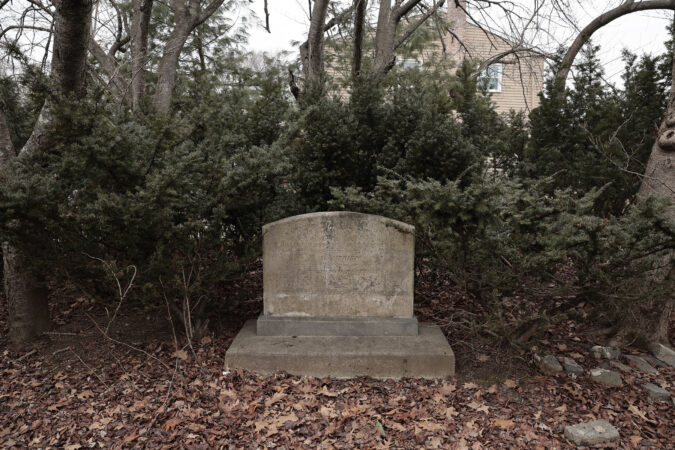
    The headstone in the Matlack Family Cemetery on the 500 block of Balsam Road in Cherry Hill.

    Matlack would become the patriarch to one of the largest families in colonial South Jersey. In the early 1680s he married Mary Hancock, who had recently come to New Jersey from England with her brother, Timothy. At the time of their marriage, William Matlack was 34 and Mary Matlack was 16. The Matlacks lived between two branches of Pennsauken Creek in present-day Maple Shade. William Matlack would come to own around 1,500 acres of land across South Jersey. The couple had six sons, three daughters, and an estimated 40 grandchildren.

    Though Quakers became one of the first religious movements to reject slavery, many Quakers in early America, including the Matlacks, enslaved people. Research turned up little information about the enslaved people buried at the Matlack grave site. Birth and death records for enslaved people were often poorly kept in the age of chattel slavery, making it difficult to conduct genealogical research and historical inquiries into the lives of people held in slavery.

    We do know, however, that slavery was pervasive in Philadelphia’s suburbs during and after the colonial era. Despite abolitionist activism, much of which was driven by Quakers in the Philadelphia region, thousands of people remained enslaved in New Jersey through the turn of the nineteenth century. New Jersey was the last Northern state to officially abolish slavery in 1866, when Gov. Marcus Ward signed a state constitutional amendment outlawing the institution. The amendment followed the 1865 ratification of the 13th Amendment to the U.S. Constitution, which New Jersey had initially rejected.

    The Matlack Family Cemetery is a small graveyard in a residential neighborhood.

    One well-known descendant of the Matlacks was Timothy Matlack, a politician and delegate to the Second Continental Congress who inscribed the Declaration of Independence. In Facebook groups and blog posts, dozens of residents of the Mid-Atlantic region say they are descendants of the first New Jersey Matlacks — likely claims given the expansive Matlack family tree, but difficult to prove.

    William and Mary Matlack were not originally buried at the Balsam Road site, according to archival materials from the Rancocas Valley Chapter of the National Society of The Colonial Dames of America. They were initially buried on their son Richard’s farm near Springdale and Evesham Roads and were moved to the Balsam Road grave site in the late 1800s.

    The grave was discovered by a Girl Scout troop on a camping trip in what was then an apple orchard, according to a Courier-Post article from 1990. The housing development surrounding the grave site went up in 1972, but the graveyard was left in tact due to its historical value. Today, it’s owned and maintained by the township.

    This suburban content is produced with support from the Leslie Miller and Richard Worley Foundation and The Lenfest Institute for Journalism. Editorial content is created independently of the project donors. Gifts to support The Inquirer’s high-impact journalism can be made at inquirer.com/donate. A list of Lenfest Institute donors can be found at lenfestinstitute.org/supporters.

  • What makes something a unit block in Philadelphia

    What makes something a unit block in Philadelphia

    Philly is a square kind of city. Plots and constructions fit between the perpendicular streets that form the blocks that feed the city’s grid.

    Modern architecture reshaped some squares into rectangles. Nevertheless, the grid system persists, helping Philadelphians navigate.

    But blocks aren’t an exact science, and some don’t have an easily understandable name. Trying to figure out what areas encompass a block police and news outlets sometimes use to describe incidents, a reader asked Curious Philly, The Inquirer’s forum for questions about the city and region: What makes something a unit block in Philadelphia?

    » ASK US: Have something you’re wondering about the Philly region? Submit your Curious Philly question here.

    For Jeffry Doshna, associate professor of city planning and community development at Temple University, a unit block is a term associated with cities that operate on a grid. It refers to a particular block where the house numbers are less than a 100.

    “When we say the 900 block of Girard Avenue, that would be the buildings between Ninth and 10th Streets on Girard,” Doshna said. “It’s a way to designate which block it is based on the numbering.”

    However, the words “unit block” stop being used when house numbers exceed 99, according to the professor.

    “Unit block is 0 to 99; the 100 block is 100 to 199; the 200 block is 200 to 299. It goes up as high as we have street numbers in the city,” Doshna said.

    In the past year, Philadelphians may have heard the phrase “unit block” on news stories, describing an area where an incident happened without providing the specific house number. In September, a man was shot in West Philadelphia, with police reporting the shooting location as the “unit block of North Frazier Street.”

    This doesn’t apply just for cities with widespread grid systems like Philly. Right before Christmas, a Bucks County man was struck by a wood chipper in Lower Southampton Township. Authorities reported the incident as on “the unit block of Valley View Road.”

    “It’s just a way for us to say ‘where,’ to let people know what block something happened on, without giving a specific address,” Doshna said.

  • The meaning of a sculpture outside the Cherry Hill library is up to you

    The meaning of a sculpture outside the Cherry Hill library is up to you

    Taking his daughters to the Cherry Hill Public Library was a weekend ritual for David Jastrow, and one intricate sculpture out front always gave his family pause.

    “For whatever reason, that sculpture always caught the attention of my daughters. When they were younger, they used to call it the ‘mixed-up elephant,’ which I always thought was funny,” said Jastrow, 51, a township resident who still frequents the library to pick up biographies and mystery novels.

    The Cherry Hill Public Library has upward of 50 works of art inside its halls, in addition to numerous sculptures outside, including the “mixed-up elephant” on the front lawn. That spurred Jastrow to write in to Curious Cherry Hill, The Inquirer’s forum for answering your questions.

    “It’s a very abstract piece of artwork. You can kind of see the trunk coming out at one part,” Jastrow said. “I thought maybe it was designed with the elephant in mind in some way, but I doubt it.”

    » ASK US: Have something you’re wondering about in Cherry Hill? Submit your Curious Cherry Hill question here.

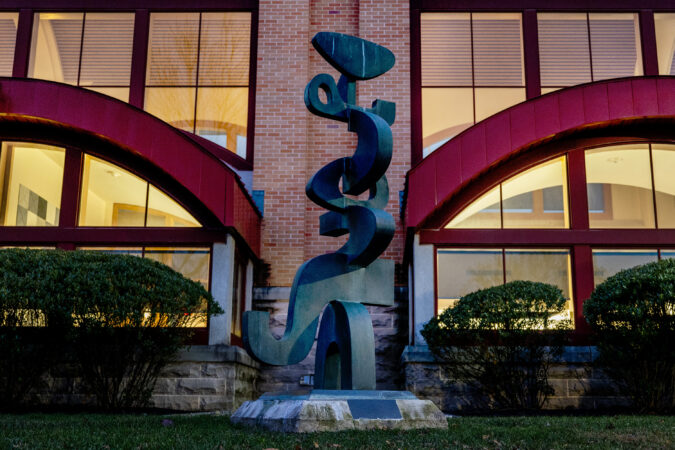
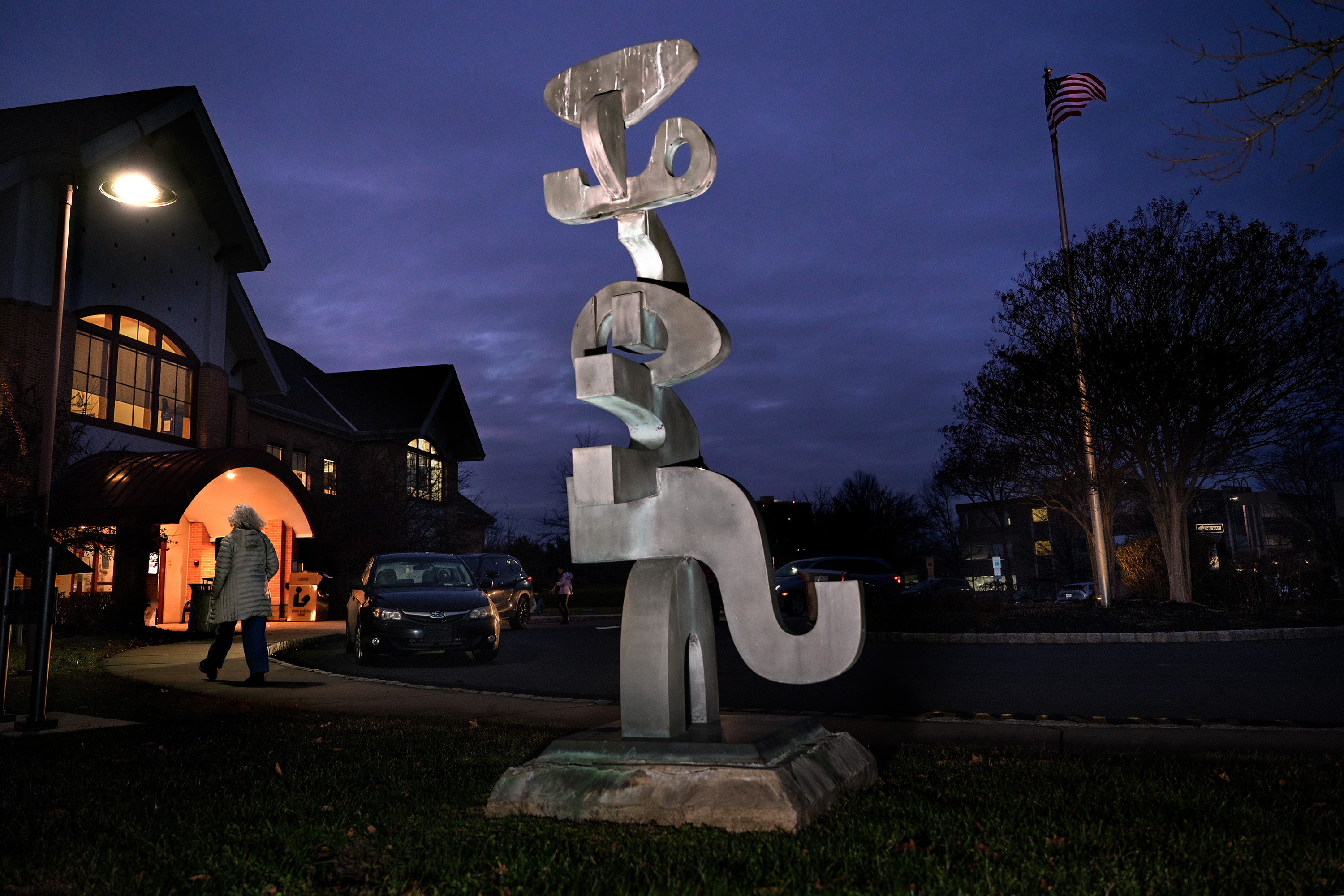
    And Jastrow would be right. “Totem” is an 8-foot-tall bronze sculpture that twists into an elaborate structure reaching toward the sky. Sitting to the left of the library’s main entrance since 2009, visitors can’t help but try to decipher its meaning.

    Eric Ascalon, the son of award-winning sculptor and stained-glass artist David Ascalon, who crafted “Totem,” said that the different interpretations are exactly what his father intended.

    “The sculpture just came from a natural place within his psyche,” Eric Ascalon said. “He feels abstract art is put out there by the artist, but it’s designed to be interpreted in any whatever it means to the viewer.”

    Sculpture often takes long periods of time to conceptualize and design. In David Ascalon’s abstract work, he would swiftly sketch a design on a loose piece of paper and lock that design in. Despite a quick conceptualization, the statue took months to build.

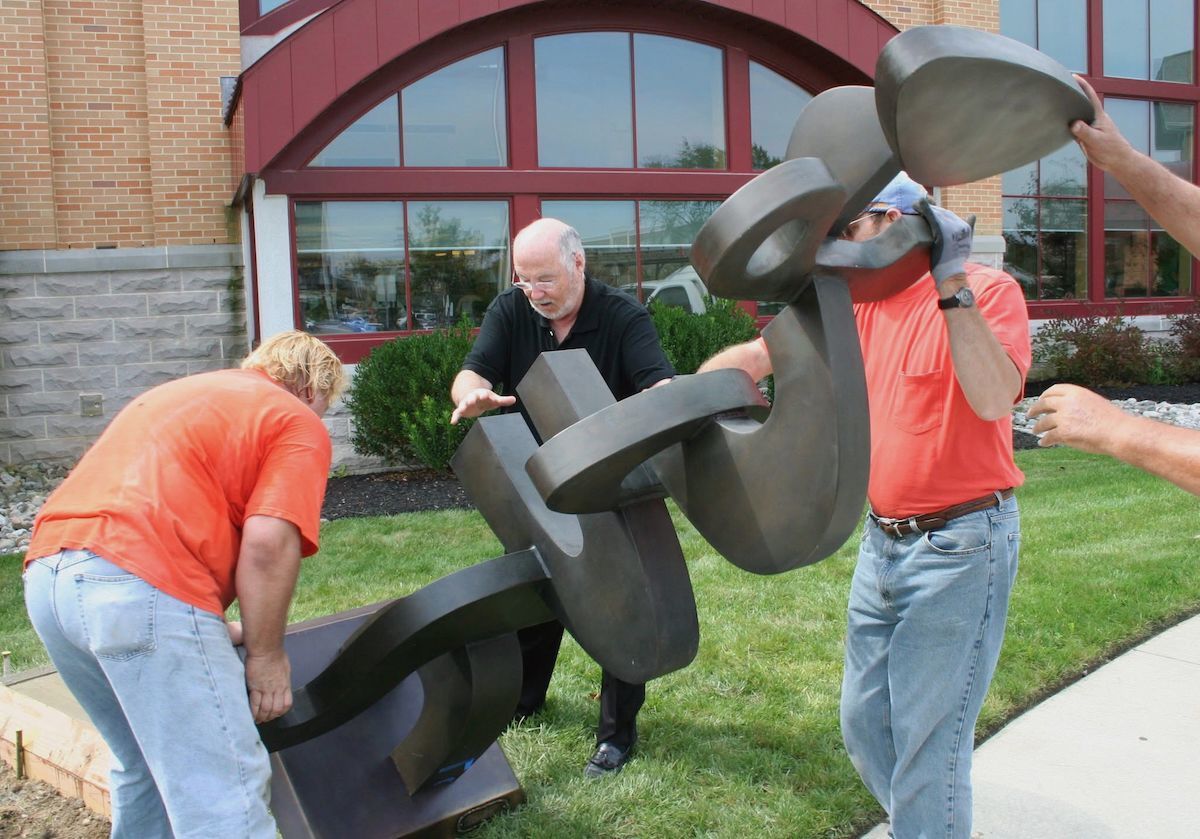
    David Ascalon, center, the creator of the 8-foot-tall bronze sculpture, “Totem,” installing the statue outside of the Cherry Hill Public Library in 2009. The sculpture stands today at the library, enticing visitors to interpret its abstract form.

    “I would say ‘Totem’ is kind of a reflection of his subconscious and just his creative spirit,” Eric Ascalon said.

    For David Ascalon, dipping his toes into abstract art was a way to clear his mind from the painstakingly detailed work of his stained-glass windows, said his son, who worked alongside his father and the rest of the family at their now-closed West Berlin firm, Ascalon Studios.

    After forming Ascalon Studios in 1977, with his father, Maurice, David Ascalon would go on to craft some of the finest stained-glass windows in synagogues and public spaces across the region. His work can be seen in the stained-glass windows in nearby Temple Beth Shalom, and all the way in Harrisburg, where his 15-foot Holocaust Memorial overlooks the Susquehanna River.

    It’s not only Ascalon’s work that draws people into Cherry Hill’s library, either.

    Walking up to the three-acre property, guests are greeted by what looks like a real couple reading the newspaper on the library lawn — perhaps unusual in 2025 — but step a little closer, and see that they’re not human, but a hyperrealistic sculpture of a man and woman lounging in the grass.

    Another abstract sculpture, created in memory of Valerie Porter, a Cherry Hill resident who loved to read but died unexpectedly in 1966 after a neurological condition, sits outside the library. David Ascalon helped restore it in 2016.

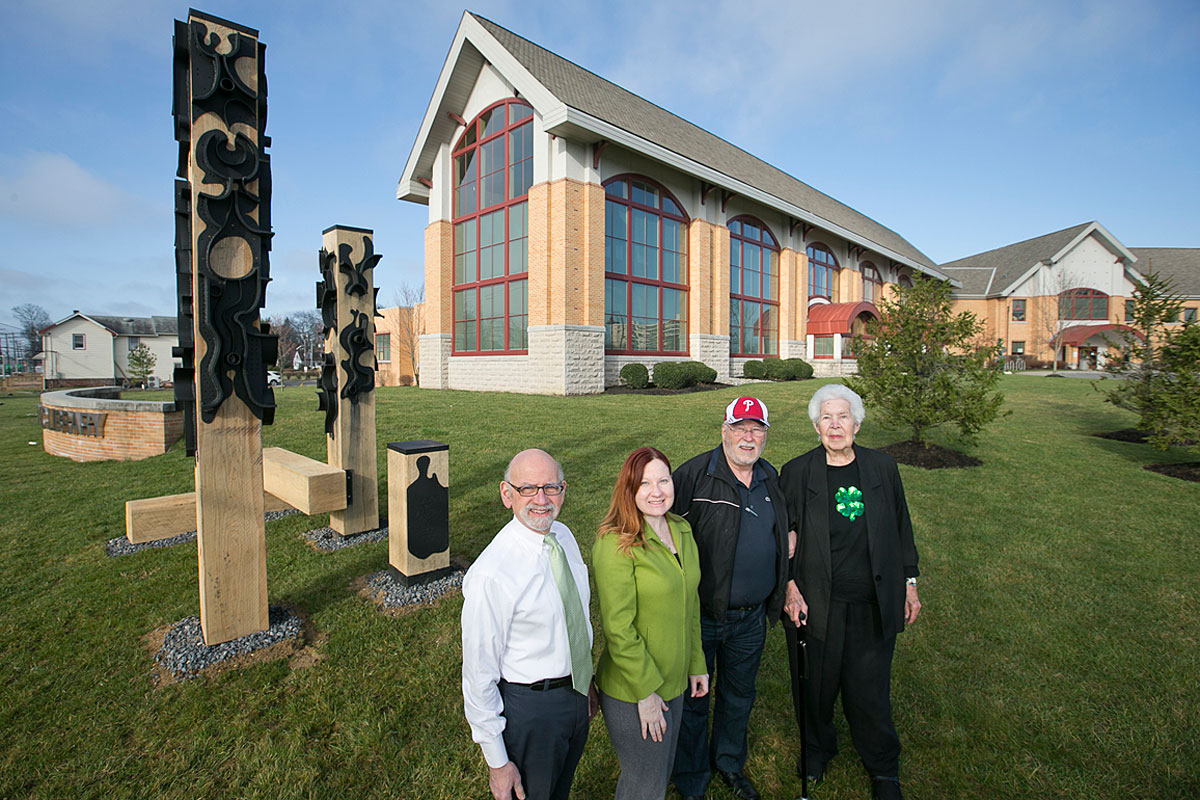
    Fred Adelson, sculpture committee, Laverne Mann, director of Library, artist David Ascalon of Cherry Hill and Sally Callaghan also of sculpture committee, left to right, outside the Cherry Hill Library.

    Inside, several walls are adorned with public art, many created by Cherry Hill residents. Downstairs is a year-round art gallery that promotes a new local artist every month, said library director Tierney Miller.

    Such works amount to small glints in human creativity, something that the library continually fosters through its programming, said Miller.

    The monthly showcase is so popular among local artists that the gallery space is booked years in advance, “2026 is already full, and we’re booking for 2027 now,” Miller said.

    While only Cherry Hill residents can get a free library card — there are paid options for others — anyone can attend its free events.

    The sculpture “Totem” by David Ascalon. It was installed in 2009 on the grounds of the newly opened Cherry Hill Public Library.

    This suburban content is produced with support from the Leslie Miller and Richard Worley Foundation and The Lenfest Institute for Journalism. Editorial content is created independently of the project donors. Gifts to support The Inquirer’s high-impact journalism can be made at inquirer.com/donate. A list of Lenfest Institute donors can be found at lenfestinstitute.org/supporters.

  • What brings customers to Philly’s live poultry stores

    What brings customers to Philly’s live poultry stores

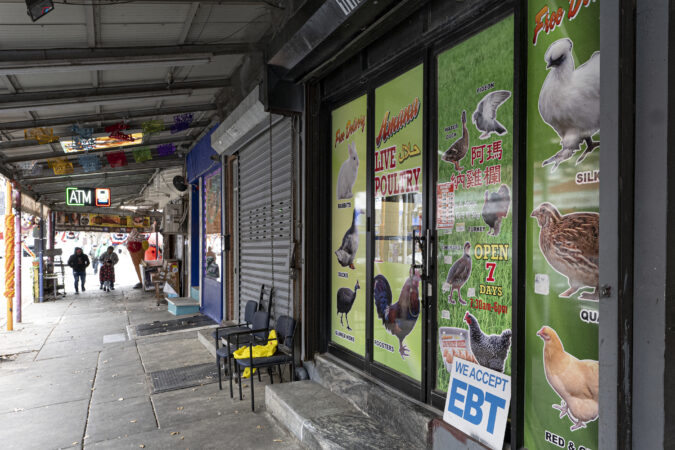
    The sounds of clucks and tiny eyes looking through metal cages are part of the Italian Market background, as some stores sell live poultry.

    Citywide, chickens, ducks, quails, and other animals are kept alive until purchase, only leaving the store when becoming someone’s food source.

    Struggling to understand the dynamics of the live poultry business, a reader asked Curious Philly, The Inquirer’s forum for questions about the city and region: Who is buying these live chickens, where do they come from, and where are they slaughtered?

    » ASK US: Have something you’re wondering about the Philly region? Submit your Curious Philly question here.

    The Pennsylvania Department of Agriculture oversees what is called the live bird marketing system, a structure that involves farms, distributors, and stores.

    About 500,000 birds weekly are sent to live poultry stores across Pennsylvania, New York, and New Jersey, according to an article published in the Delaware Journal of Public Health in 2021.

    Statewide there are 17 live bird markets, according to the Pennsylvania Department of Agriculture. Most are in the Philly area, but there is no state registry of the markets.

    In the city, the health department licenses and inspects these facilities. The birds are subjected to the same regulations to curb the transmission of avian influenza as all poultry producers in Pennsylvania, a spokesperson for the Pennsylvania Department of Agriculture said.

    As the public health journal noted, live poultry markets are more common in areas like Philadelphia with significant and growing immigrant populations.

    Alex Lemus, 29, and Juan Amador work at one of South Philadelphia’s live poultry stores. They weren’t authorized to speak for their workplace, but said they put effort into making the chickens feel as comfortable as they can.

    “We take good care of them; we give them corn, and they grow up free-range,” said Lemus, who has been working in the live poultry industry for seven years.

    The birds sell fast, he said, pointing to 16 long metal cages, each with at least 10 chickens and ducks inside. “At least 80 people per day come to buy, mostly Asian and Latino, and that is not counting the holidays,” Amador said.

    Among quacks and clucks, longtime customer Nu Aing walked into the store. Stepping over a lone feeder and some light brown liquid residue on the floor, she selected six chickens.

    As one worker swept the floor, another weighed the chosen chickens and placed them into a box for Amador to take to the back room. The chickens clucked loudly.

    Aing drove an hour and a half from the suburbs because, she said, the chickens here are tender and better for recreating her family’s Vietnamese cuisine.

    “Meat is better than the grocery store for soup, but they are good in anything,” Aing said. Around the Vietnamese New Year, “a lot of people are here; the line is long.”

    In the back room, the chickens were killed and their bodies plucked and placed in white plastic bags, at Aing’s request.

    “It is killed inside in 30 seconds,” Lemus said. “This part of the job was horrible when I started, but you get used to it over time.”

    Within 20 minutes, the store is packed with at least 15 people waiting for their orders.

    Guatemalan native Carlos Baten, 42, sent pictures of the birds to his family to help him pick the best option. He asked for his chicken to be cut into pieces for a chicken and vegetable soup that would feed three people.

    “The freshness of the meat is unmatched,” Baten said. “They just feel like they are healthier and fed with fewer chemicals.”

    The idea of eating a healthier type of meat also brought Guatemalan native Mayra González, 35, to the store with her 2-year-old daughter. But as soon as González placed her order, she fled to wait outside.

    “I don’t like the scent inside, it smells like chicken feed,” González said. But the meat is “way better than the one at the grocery store,” she said.

    To her, live poultry meat feels “silky,” and can feed more people for less. The cost of each chicken depends on the weight, but two chickens are enough to feed 11 people, González said.

    “I feel bad for them, but since you can’t see when they are sacrificed, it’s the same as when you buy them at the grocery store,” González said.

  • Why the lunar module is leaving the Franklin Institute

    Why the lunar module is leaving the Franklin Institute

    Bill Piccinni, 67, was riding his bike by the Franklin Institute when something halted his pedaling. The lunar module looked as if King Kong had ripped it in half, he said.

    Concerned, he asked Curious Philly, The Inquirer’s forum for questions about the city and region: What is going on with the Apollo-era lunar module? Is the Franklin Institute getting rid of it?

    » ASK US: Have something you’re wondering about the Philly region? Submit your Curious Philly question here.

    “It’s been there for so long; it’s like a part of the city almost,” Piccinni said. “If it disappears, it would just be a shame.”

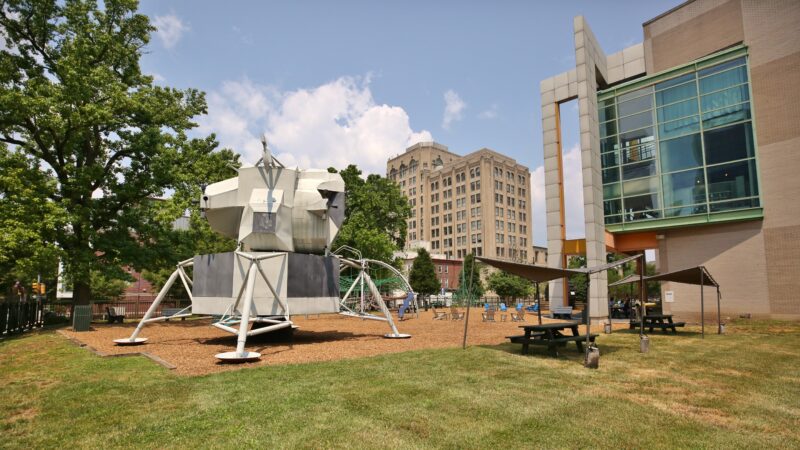
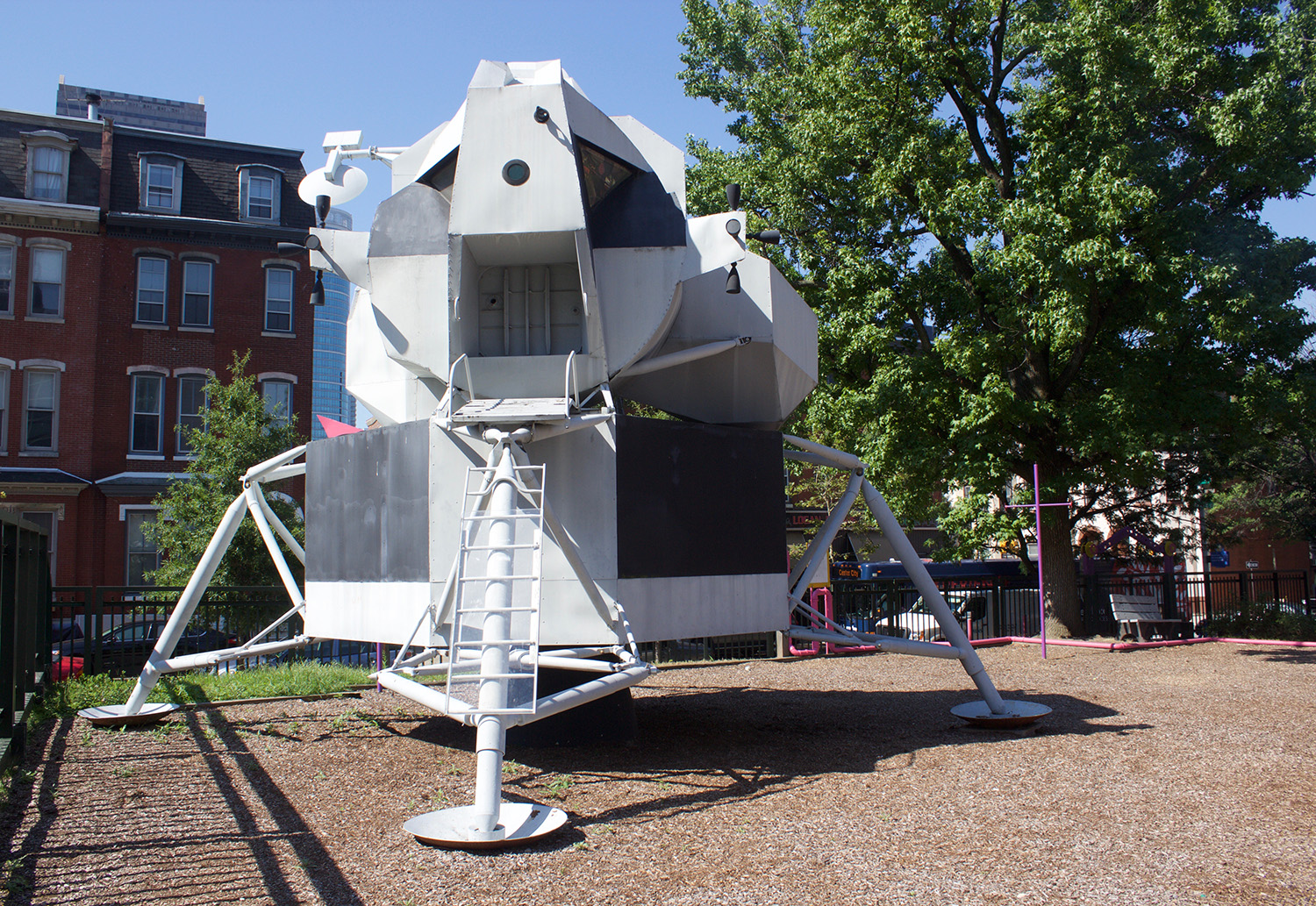
    Sadly for Philly space lovers, the disjointed module does signal a farewell. After 49 years at the museum, it is returning to its previous orbit — Washington.

    Neil Armstrong’s ride look-alike, a prototype used in preparations for several Apollo missions, was loaned by the Smithsonian’s National Air and Space Museum in 1976, according to Derrick Pitts, the Franklin Institute’s chief astronomer. Now, that museum has asked for the module’s return.

    “All museums, when they are keeping track of their artifacts … set a period of time for how long it’s gonna be borrowed, and then they will ask for it back,” Pitts said.

    The Lunar Module was loaned by the Smithsonian’s National Air and Space Museum in 1976.

    The chief astronomer is not sure what awaits the Grumman structural engineering test module near D.C. The engineering prototype served to test how the parts and pieces would fit together in preparation for the real Apollo 11 lunar module that took Armstrong to the moon.

    To Pitts, that doesn’t make it any less special. On the contrary, he views the equipment as an epitome of the height of space exploration technology at the time. It’s proof that “we successfully sent explorers to the moon and brought them back safely,” Pitts said.

    For future generations of Philadelphians, this means no longer being able to see the module up close without leaving the city. People in Washington won’t be seeing this particular module either. There are currently no plans for it to be displayed at the National Air and Space Museum, according to spokesperson Marc Sklar.

    For now, the Franklin Institute is considering an array of options for replacing the module in the backyard, but nothing is set in stone, Pitts said. In the meantime, the museum’s Wondrous space continues to be an option for folks wanting to learn about space.

    “I am just really appreciative that people have paid attention to the lunar module enough to wonder what is going on with it,” Pitts said. “We are really very glad that you are aware that it has been here and that you are going to miss it.”

  • Where is the Umbrella Man statue that used to reside outside the Prince Theater?

    Where is the Umbrella Man statue that used to reside outside the Prince Theater?

    For almost 30 years, he stood in sun and darkness, rain and snow, on the streets of Philadelphia.

    Known popularly as “Umbrella Man,” he stepped forward, as if signaling a cab in the rain. He was last seen in front of the then-Prince Music Theater in the 1400 block of Chestnut Street.

    But sometime in 2015, along with the Prince, he disappeared.

    Where did he go? Whatever became of “Umbrella Man”? Those questions were posed to us by a reader through Curious Philly — the forum where you can ask our journalists questions.

    Allow us: He’s not in Philadelphia anymore. He’s on tour. But his home is not far away: Hamilton, N.J., as a matter of fact.

    But let’s step back. The actual name of the six-foot-10, 460-pound sculpture is Allow Me. It depicts a man in a three-piece business suit. He’s holding an umbrella in his right hand and gesturing with his very, very long left index finger, as if saying, “Wait a minute.”

    That title, though. Whoever brought down a cab with an “Allow me”?

    Allow Me is the work of American sculptor Seward Johnson II, grandson of the founders of Johnson & Johnson. It’s part of a series Johnson calls “Celebrating the Familiar.” You’ve probably seen many of the pieces in the series, and that’s the way Johnson likes it. He makes multiple copies of daily-life sculptures — boy with ice-cream cone, man with newspaper, senior lady with grocery sack, window-washer, traffic cop — and distributes, displays, or tours them throughout the country. Another one, titled “The Consultation,” is at the campus of the Presbyterian Medical Center just off 39th and Filbert Streets in West Philadelphia.

    The J. Seward Johnson sculpture “Allow Me” when it was near the Warwick Hotel on South 17th Street in photo taken Feb. 15, 2001.

    According to the Johnson Atelier Inc., the organization that tracks and controls Johnson’s productions, the original Allow Me was created in 1981. In 1983-4 a series of copies was made, for a total of seven, from the same cast, which was destroyed thereafter (apparently the casts wear out). The atelier says the Philadelphia Allow Me was the last one.

    Allow Me had a long, rough run in Philadelphia. Its first sojourn here was in an exhibit of Johnson’s works in 1983-4, in front of the Four Seasons hotel on the Parkway. There it charmed lawyer and art collector Joseph D. Shein, who bought it from Johnson and had it set up in 1985 in front of the Shein-owned building where he ran his offices, at the corner of 17th and Locust Streets.

    In this Sept. 6, 1985 image from the Philadelphia Inquirer, lawyer and art collector Joseph D. Shein sits with “Allow Me,” a statue by Seward Johnson II. It had just been installed in front of what were then Shein’s offices at 17th and Locust Streets.

    There, Umbrella Man stood for just about 20 years. Many a cabbie was said to stop, only to curse and move on. Street lore had it that he got the Philadelphia treatment, with generous applications of cigarette butts and gum.

    In 2005, Shein donated the statue to the Prince. Umbrella Man was plunked just to the right of the main entrance, where he remained into 2015. Abuse continued: Luckless pedestrians walked into him, and during the joyous October 2008 street celebrations after the Phillies’ World Series triumph, vandals attempted to uproot poor Umbrella Man, leaving him crooked, graffiti scrawled on his forehead.

    "Allow Me" Statue - Knocked Over During the Phillies Parade

    And then … he went away. In 2010, the Prince declared bankruptcy. After protracted uncertainty, the building was bought by a group of business investors, to be sold in 2015 to the Philadelphia Film Society, its current tenant who changed the name to the Philadelphia Film Center. According to the Johnson Atelier, that year the atelier bought Allow Me back.

    Little by little, people noticed he wasn’t there.

    Although the final price is proprietary, most sculptures in the “Celebrating the Familiar” series, according to the Johnson Atelier, run for $84,000, but Allow Me is now in the Johnson catalog for $130,000.

    Where is he now? His physical home is the Johnson Atelier in Hamilton, N.J., next to Grounds for Sculpture. But Umbrella Man himself is on tour, according to the atelier e-mail: “[T]his sculpture is now actively traveling with the other Johnson pieces in the foundation’s touring exhibits throughout the US and Europe.”

  • Dexter, the U.S. Navy’s last working horse, is buried in Philly

    Dexter, the U.S. Navy’s last working horse, is buried in Philly

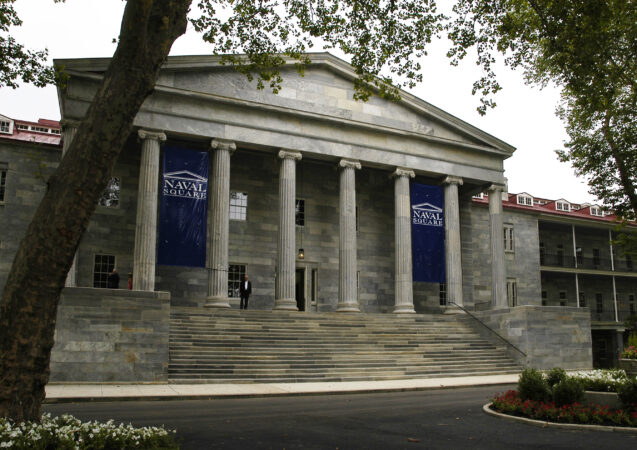
    Naval Square, as it is now known, has been many things before becoming a gated community of expensive condos on the banks of the Schuylkill in a neighborhood with many names.

    The Inquirer calls the area Schuylkill, but others might use Devil’s Pocket, Southwest Center City, or Graduate Hospital, the newest name on the block.

    But whatever you call it, the 24-acre plot of land on Grays Ferry Avenue has been associated with the Navy since 1827 and has the unusual distinction of being the final resting place of Dexter, the Navy’s last working horse.

    A reader interested in learning more about the horse — the questioner thought it was a mule — asked about it through Curious Philly, the Inquirer and Daily News question-and-answer forum through which readers submit questions about their communities and reporters seek to answer them.

    First, a little history about the site.

    The Philadelphia Naval Asylum, a hospital, opened there in 1827.

    From 1838 until 1845, the site also served as the precursor to the U.S. Naval Academy, until the officers training school opened in Annapolis with seven instructors, four of them from Philadelphia.

    In 1889, its name was changed to the Naval Home to reflect its role as a retirement home for old salts, as they used to call retired sailors. It closed in 1976, when the Naval Home moved to Gulfport, Miss.

    It was in the service of the Naval Home that Dexter came to Philadelphia.

    Originally an Army artillery horse foaled in 1934, Dexter was transferred to the Navy in 1945 to haul a trash cart around the Naval Home.

    Despite his lowly duties, the men — only men lived there — loved him.

    “That horse was more human than animal,” Edward Pohler, chief of security at the home, told the Inquirer in 1968. “He had the run of the grounds and would come to the door of my office every day to beg for an apple or a lump of sugar.”

    The chestnut gelding was retired in 1966 and sent to a farm in Exton, but that did not last long. Naval Home residents who missed him committed to paying the $50 monthly bill for his feed and care.

    For two years he grazed on a three-acre field that residents dubbed Dexter Park.

    But on July, 11, 1968, Dexter, who had stopped eating and was not responding to medication, died at the age of 34 in his stall with a little human intervention to make it pain-free.

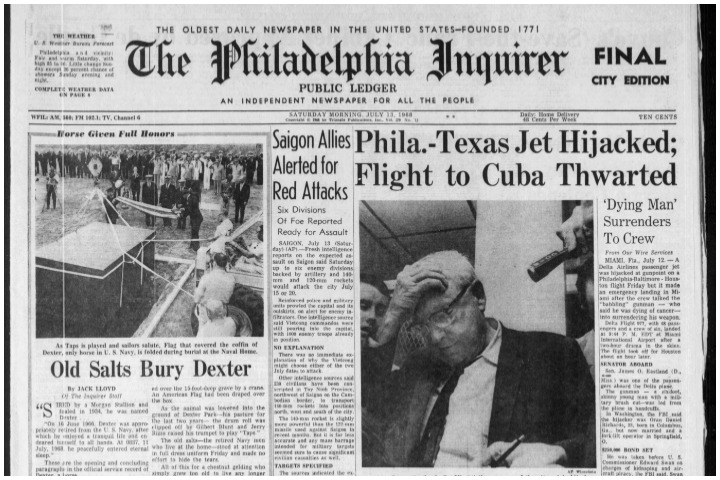
    The story about the funeral for Dexter was on the front page of the Inquirer on July 13, 1968.

    The next day, 400 people, including Navy men in dress uniform, turned out for a burial with full military honors.

    Dexter was placed in a casket measuring 9 feet long, 5 feet wide, and 5 feet deep, with an American flag draped on the top. Retired Rear Adm. M.F.D. Flaherty, the home’s governor, offered final words, saying, “Dexter was no ordinary horse.”

    As the casket was lowered by a crane into the 15-foot-deep grave, Gilbert Blunt rolled the drum and Jerry Rizzo played “Taps” on his trumpet. Members of the honor guard folded the flag into a triangle of white stars on a blue field and presented it to Albert A. Brenneke, a retired aviation mechanic and former farm boy from Missouri who was Dexter’s groom.

    Brenneke recalled Dexter fondly, saying the horse was “very gentle and playful” and “liked to nibble on you,” according to news coverage of the funeral.

    No sign exists marking Dexter’s final place.

    The pasture, however, did not remain empty for long.

    According to the December 1968 issue of the Navy magazine All Hands, a retired 16-year-old Fairmount Park Police horse named Tallyho took up residence at the Naval Home after Dexter’s death.

    But, unlike Dexter, Tallyho, a bay gelding, was a gift to the home’s residents and did not receive an official Navy serial number.

    “As was the case with Dexter, Tallyho’s only duty will be to contribute to the happiness of the men who share their retirement with him at the U.S. Naval Home,” the magazine said.

    What happened to Tallyho after he went to the Naval Home is not clear.