Tag: Curious Philly

  • Where is the Umbrella Man statue that used to reside outside the Prince Theater?

    Where is the Umbrella Man statue that used to reside outside the Prince Theater?

    For almost 30 years, he stood in sun and darkness, rain and snow, on the streets of Philadelphia.

    Known popularly as “Umbrella Man,” he stepped forward, as if signaling a cab in the rain. He was last seen in front of the then-Prince Music Theater in the 1400 block of Chestnut Street.

    But sometime in 2015, along with the Prince, he disappeared.

    Where did he go? Whatever became of “Umbrella Man”? Those questions were posed to us by a reader through Curious Philly — the forum where you can ask our journalists questions.

    Allow us: He’s not in Philadelphia anymore. He’s on tour. But his home is not far away: Hamilton, N.J., as a matter of fact.

    But let’s step back. The actual name of the six-foot-10, 460-pound sculpture is Allow Me. It depicts a man in a three-piece business suit. He’s holding an umbrella in his right hand and gesturing with his very, very long left index finger, as if saying, “Wait a minute.”

    That title, though. Whoever brought down a cab with an “Allow me”?

    Allow Me is the work of American sculptor Seward Johnson II, grandson of the founders of Johnson & Johnson. It’s part of a series Johnson calls “Celebrating the Familiar.” You’ve probably seen many of the pieces in the series, and that’s the way Johnson likes it. He makes multiple copies of daily-life sculptures — boy with ice-cream cone, man with newspaper, senior lady with grocery sack, window-washer, traffic cop — and distributes, displays, or tours them throughout the country. Another one, titled “The Consultation,” is at the campus of the Presbyterian Medical Center just off 39th and Filbert Streets in West Philadelphia.

    The J. Seward Johnson sculpture “Allow Me” when it was near the Warwick Hotel on South 17th Street in photo taken Feb. 15, 2001.

    According to the Johnson Atelier Inc., the organization that tracks and controls Johnson’s productions, the original Allow Me was created in 1981. In 1983-4 a series of copies was made, for a total of seven, from the same cast, which was destroyed thereafter (apparently the casts wear out). The atelier says the Philadelphia Allow Me was the last one.

    Allow Me had a long, rough run in Philadelphia. Its first sojourn here was in an exhibit of Johnson’s works in 1983-4, in front of the Four Seasons hotel on the Parkway. There it charmed lawyer and art collector Joseph D. Shein, who bought it from Johnson and had it set up in 1985 in front of the Shein-owned building where he ran his offices, at the corner of 17th and Locust Streets.

    In this Sept. 6, 1985 image from the Philadelphia Inquirer, lawyer and art collector Joseph D. Shein sits with “Allow Me,” a statue by Seward Johnson II. It had just been installed in front of what were then Shein’s offices at 17th and Locust Streets.

    There, Umbrella Man stood for just about 20 years. Many a cabbie was said to stop, only to curse and move on. Street lore had it that he got the Philadelphia treatment, with generous applications of cigarette butts and gum.

    In 2005, Shein donated the statue to the Prince. Umbrella Man was plunked just to the right of the main entrance, where he remained into 2015. Abuse continued: Luckless pedestrians walked into him, and during the joyous October 2008 street celebrations after the Phillies’ World Series triumph, vandals attempted to uproot poor Umbrella Man, leaving him crooked, graffiti scrawled on his forehead.

    "Allow Me" Statue - Knocked Over During the Phillies Parade

    And then … he went away. In 2010, the Prince declared bankruptcy. After protracted uncertainty, the building was bought by a group of business investors, to be sold in 2015 to the Philadelphia Film Society, its current tenant who changed the name to the Philadelphia Film Center. According to the Johnson Atelier, that year the atelier bought Allow Me back.

    Little by little, people noticed he wasn’t there.

    Although the final price is proprietary, most sculptures in the “Celebrating the Familiar” series, according to the Johnson Atelier, run for $84,000, but Allow Me is now in the Johnson catalog for $130,000.

    Where is he now? His physical home is the Johnson Atelier in Hamilton, N.J., next to Grounds for Sculpture. But Umbrella Man himself is on tour, according to the atelier e-mail: “[T]his sculpture is now actively traveling with the other Johnson pieces in the foundation’s touring exhibits throughout the US and Europe.”
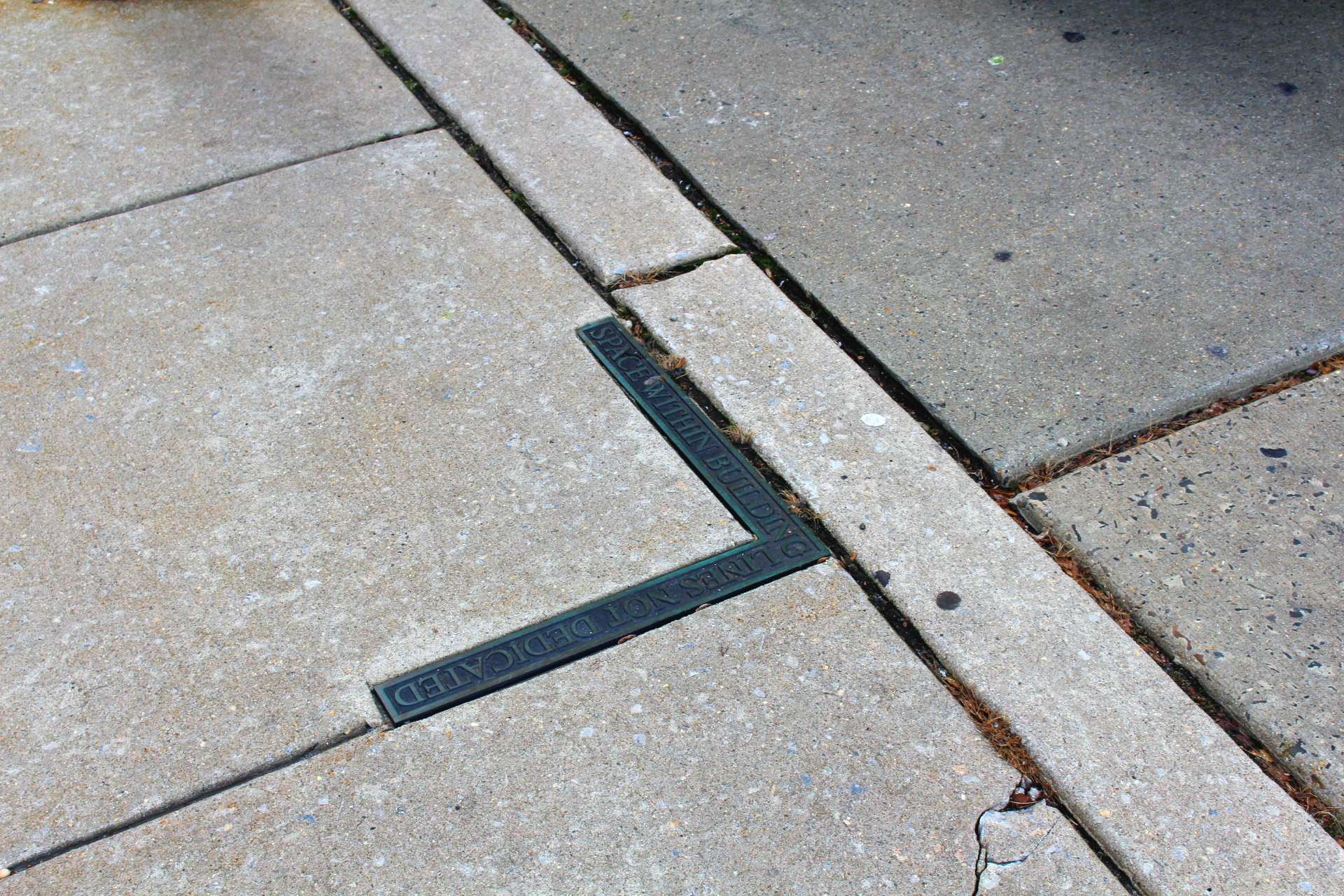
  • Some Philly sidewalks say they’re ‘not dedicated to the public.’ Here’s why.

    Some Philly sidewalks say they’re ‘not dedicated to the public.’ Here’s why.

    Glancing down near the intersection of 18th and Locust Streets near Rittenhouse Square, Carolyn Rogers can’t help but do a double-take.

    “The space between this sign and the building is not dedicated to the public,” proclaims the brassy plaque inlaid in the sidewalk.

    “I’m always like, ‘Am I reading this right?’” Rogers said. “Not dedicated? Should I not walk there?”

    Rogers asked about the signs scattered around the city’s pavement through Curious Philly, a portal that allows readers to ask Inquirer and Daily News journalists their questions about the Philadelphia region.

    “Space within building lines not dedicated” sign at the Philadelphia Federal Detention Center.

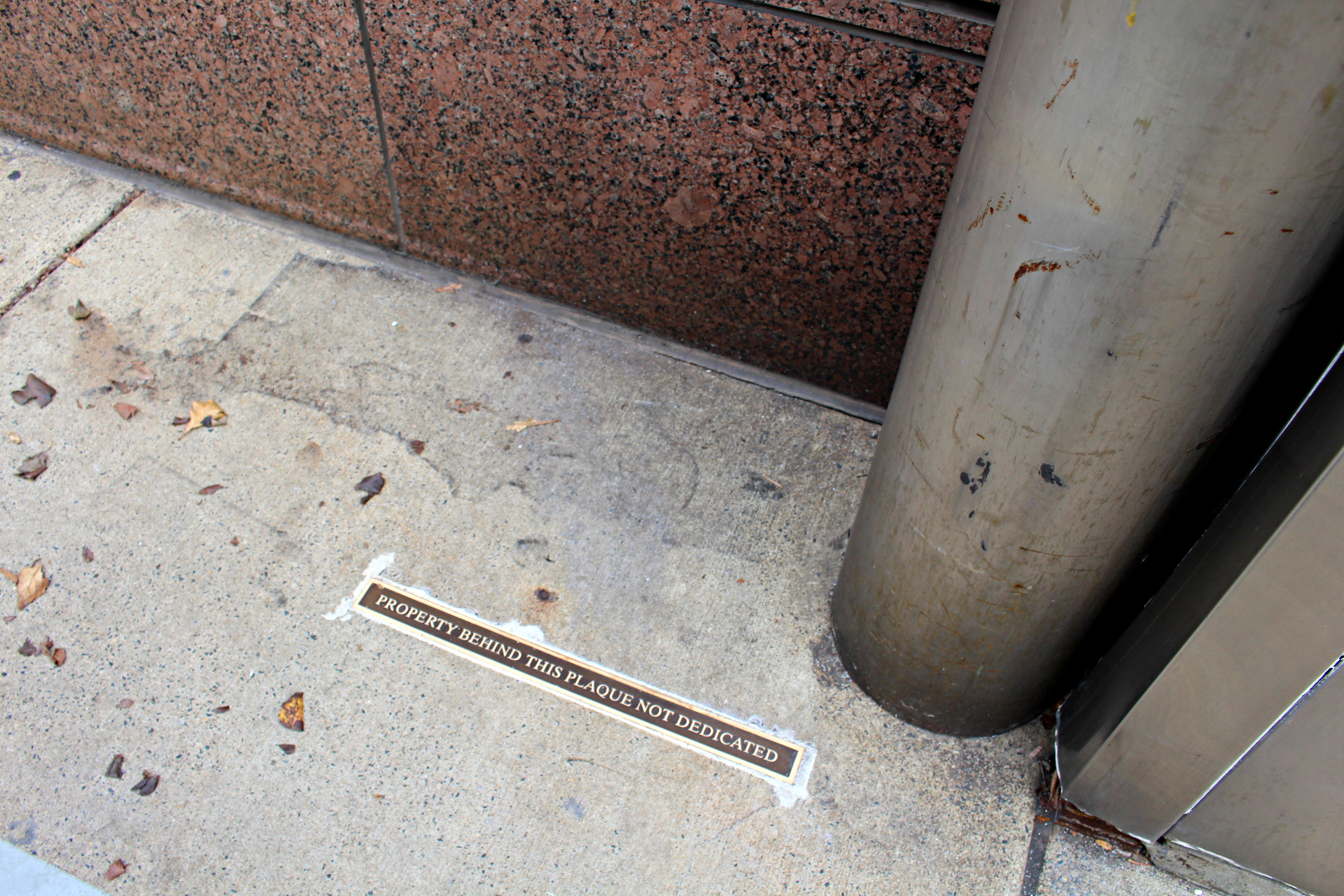
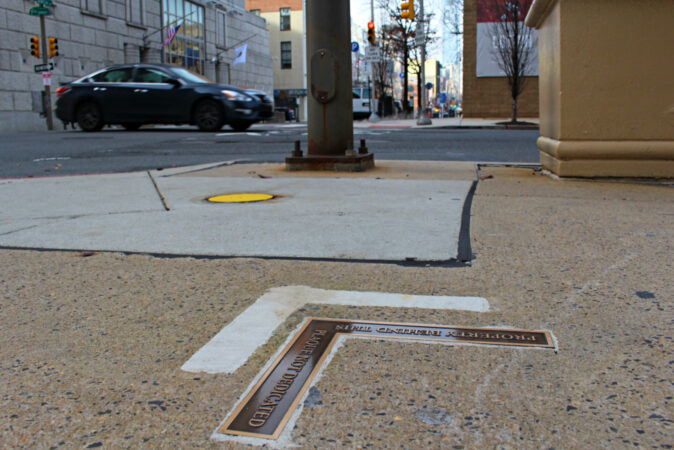
    Some of the metal inlays say “the space … is not dedicated” while others proclaim “property behind this plaque not dedicated,” but in the end, they’re saying the same thing.

    “Dedicated to the public,” in this case, is a legal phrase, defined by Black’s Law Dictionary as “an appropriation of land to some public use made by the owner, and accepted for such use by or no behalf of the public.”

    The signage occurs when a building’s property line extends past the dimensions of the structure. In other words, the property owner owns more land than just the building.

    So, “not dedicated to the public” means that the space of sidewalk between where that metal sign stops and the building begins technically isn’t public property.

    Although the plaques are placed to protect the property owner’s rights, you’re welcome to walk in the “not dedicated” space, but technically, it’s private property, University of Pennsylvania Architect Charlie Newman said in a feature on the school’s website.

    The plaques can be found throughout the city, from Penn’s campus in University City to the Federal Detention Center on Seventh and Arch.

    A “property behind this plaque not dedicated” sign on Arch St. near the Federal Reserve.

    It’s a safeguard in place to protect against a real estate legal loophole known as “prescriptive easements,” PlanPhilly’s Jim Saska wrote in a 2016 column about the curious corner pieces.

    “Prescriptive easements” are another bit of legalese, meaning those who use an area for 21 years or more are extended rights to the land, as explained in the Pennsylvania Law Monitor.

    So, in other words, if Philadelphians were to traipse down Arch Street on the 12 inches of pavement between the technical property line of the Federal Reserve and the building’s wall for 21 years straight with no “dedicated” plaque in sight, the property would become the public’s, too.

    That’s where the plaques come in. With a little legal language bolted to the ground, the property owner is letting you know that you can walk there, but you don’t own it.

  • Dexter, the U.S. Navy’s last working horse, is buried in Philly

    Dexter, the U.S. Navy’s last working horse, is buried in Philly

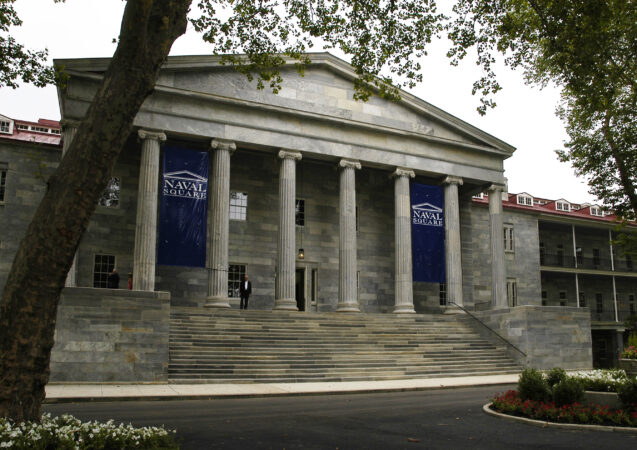
    Naval Square, as it is now known, has been many things before becoming a gated community of expensive condos on the banks of the Schuylkill in a neighborhood with many names.

    The Inquirer calls the area Schuylkill, but others might use Devil’s Pocket, Southwest Center City, or Graduate Hospital, the newest name on the block.

    But whatever you call it, the 24-acre plot of land on Grays Ferry Avenue has been associated with the Navy since 1827 and has the unusual distinction of being the final resting place of Dexter, the Navy’s last working horse.

    A reader interested in learning more about the horse — the questioner thought it was a mule — asked about it through Curious Philly, the Inquirer and Daily News question-and-answer forum through which readers submit questions about their communities and reporters seek to answer them.

    First, a little history about the site.

    The Philadelphia Naval Asylum, a hospital, opened there in 1827.

    From 1838 until 1845, the site also served as the precursor to the U.S. Naval Academy, until the officers training school opened in Annapolis with seven instructors, four of them from Philadelphia.

    In 1889, its name was changed to the Naval Home to reflect its role as a retirement home for old salts, as they used to call retired sailors. It closed in 1976, when the Naval Home moved to Gulfport, Miss.

    It was in the service of the Naval Home that Dexter came to Philadelphia.

    Originally an Army artillery horse foaled in 1934, Dexter was transferred to the Navy in 1945 to haul a trash cart around the Naval Home.

    Despite his lowly duties, the men — only men lived there — loved him.

    “That horse was more human than animal,” Edward Pohler, chief of security at the home, told the Inquirer in 1968. “He had the run of the grounds and would come to the door of my office every day to beg for an apple or a lump of sugar.”

    The chestnut gelding was retired in 1966 and sent to a farm in Exton, but that did not last long. Naval Home residents who missed him committed to paying the $50 monthly bill for his feed and care.

    For two years he grazed on a three-acre field that residents dubbed Dexter Park.

    But on July, 11, 1968, Dexter, who had stopped eating and was not responding to medication, died at the age of 34 in his stall with a little human intervention to make it pain-free.

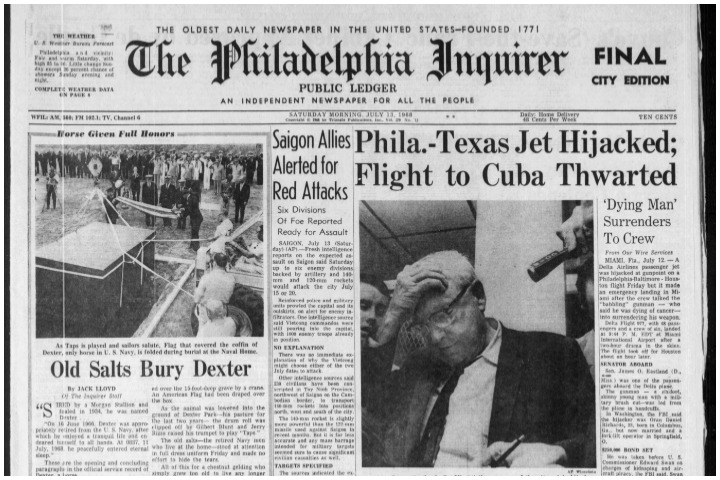
    The story about the funeral for Dexter was on the front page of the Inquirer on July 13, 1968.

    The next day, 400 people, including Navy men in dress uniform, turned out for a burial with full military honors.

    Dexter was placed in a casket measuring 9 feet long, 5 feet wide, and 5 feet deep, with an American flag draped on the top. Retired Rear Adm. M.F.D. Flaherty, the home’s governor, offered final words, saying, “Dexter was no ordinary horse.”

    As the casket was lowered by a crane into the 15-foot-deep grave, Gilbert Blunt rolled the drum and Jerry Rizzo played “Taps” on his trumpet. Members of the honor guard folded the flag into a triangle of white stars on a blue field and presented it to Albert A. Brenneke, a retired aviation mechanic and former farm boy from Missouri who was Dexter’s groom.

    Brenneke recalled Dexter fondly, saying the horse was “very gentle and playful” and “liked to nibble on you,” according to news coverage of the funeral.

    No sign exists marking Dexter’s final place.

    The pasture, however, did not remain empty for long.

    According to the December 1968 issue of the Navy magazine All Hands, a retired 16-year-old Fairmount Park Police horse named Tallyho took up residence at the Naval Home after Dexter’s death.

    But, unlike Dexter, Tallyho, a bay gelding, was a gift to the home’s residents and did not receive an official Navy serial number.

    “As was the case with Dexter, Tallyho’s only duty will be to contribute to the happiness of the men who share their retirement with him at the U.S. Naval Home,” the magazine said.

    What happened to Tallyho after he went to the Naval Home is not clear.