Tag: Dave Sunday

  • Pa. company pleads guilty in illegal video gambling scheme, but charges have been dropped against the owners

    Pa. company pleads guilty in illegal video gambling scheme, but charges have been dropped against the owners

    A Pennsylvania company has pleaded guilty to a crime stemming from its work installing hundreds of illegal video gambling devices across the state — but its owners appear to be off the hook.

    Schuylkill County-based Deibler Brothers Novelty Co. pleaded guilty Friday to corrupt organizations, a first-degree felony, and was ordered by a judge to forfeit $3 million to the state in cash and assets, according to the office of Pennsylvania Attorney General Dave Sunday.

    The company is owned by brothers Arthur Deibler, 34, and Donald Deibler, 33, and their friend Joel Ney, 35, each of whom was charged in 2024 with multiple felonies, including corrupt organizations and conspiracy.

    Court records show the charges were withdrawn Tuesday. Sunday’s office said that was part of the plea agreement, which also required the company to pay the asset forfeiture up front.

    “We expect those charges to be dismissed by the attorney general,” said defense lawyer William J. Brennan, who represents the Deibler brothers along with Michael T. van der Veen.

    Prosecutors say Deibler Brothers marketed its illegal devices as legal skill games — the slot machine-style games that have proliferated across Pennsylvania — and paid kickbacks to an executive at a device vendor.

    State lawmakers have repeatedly pledged, but so far failed, to tax and regulate the games. The Pennsylvania Attorney General’s Office has argued that the games are illegal slot machines — essentially unregulated casino games — but courts have thus far disagreed.

    “For many years, the legal status of games of chance has been a ping-pong ball in the court system,” Brennan said. “From day to day, it’s hard to follow what the current state of the law is. This corporation has done everything it can to try to remain compliant in a changing legal landscape. This result allows all the parties to move on and put this matter behind them.”

    Sunday, a Republican, said in a statement Monday that the plea resolution “secures a substantial forfeiture of assets to the commonwealth.”

    “This company was warned time and time again and continued to snub its nose at state regulations by flooding Pennsylvania counties with illegal gambling machines,” he said.

    A grand jury presentment accused Deibler Brothers of supplying thousands of illegal video gambling devices — modified slot machines — to convenience stores, bars, and gas stations across more than a dozen counties.

    From April 2021 through November 2023, the company received more than $1 million a month from the distribution and operation of the machines, according to the presentment from the 50th Statewide Investigating Grand Jury.

    In an effort to “disguise” its use of illegal slot machines, Deibler Brothers also paid $150,000 in illegal kickbacks to an executive at device vendor Pace-O-Matic, the presentment said.

    The executive — Ricky Goodling, a retired Pennsylvania State Police corporal and Pace-O-Matic’s former director of national compliance — pleaded guilty last week to state money laundering charges. He also pleaded guilty to federal tax evasion charges.

    Deibler Brothers sought to commingle its illegal games with legal Pace-O-Matic machines to try to “dupe” law enforcement authorities and store owners into thinking they were the same, the presentment says.

    Pennsylvania courts have ruled that Pace-O-Matic games are legal games of skill, not chance, because they include a memory component that distinguishes them from casino-style slot machines. But most of the machines distributed by the Deibler Brothers had no such secondary element and were therefore illegal, the presentment said.

    Goodling used his authority at Pace-O-Matic to quash complaints about Deibler Brothers and another firm that paid him kickbacks, according to the grand jury.

  • ‘Violence will not be tolerated’: Woman who pepper-sprayed conservative influencer on SEPTA bus charged with assault

    ‘Violence will not be tolerated’: Woman who pepper-sprayed conservative influencer on SEPTA bus charged with assault

    A former WHYY intern who pepper-sprayed a conservative influencer on a SEPTA bus was charged with simple assault and other crimes by prosecutors in the Pennsylvania Attorney General’s Office on Thursday, officials said.

    Video of the Jan. 19 incident between 22-year-old Paulina Reyes and 22-year-old Francis Scales quickly went viral on social media, garnering millions of views and spurring reactions from right-leaning influencers and Elon Musk.

    During the confrontation, Reyes — whose internship with WHYY had ended before the incident — accused Scales of being a “fascist” and a “racist” for posting content online she viewed as insulting to Muslims and people of color.

    Attorney General Dave Sunday, in announcing Thursday that his office’s mass transit prosecutor would oversee the case, said “violence will not be tolerated as a means to conduct political debate, protest, or exhibit differences.

    “This type of violence is senseless, as we have an individual facing criminal charges over political disagreement,” the attorney general said in a statement.

    In addition to simple assault, Reyes is charged with possessing an instrument of a crime, a misdemeanor. She also faces charges of harassment and disorderly conduct, which are summary offenses.

    Reyes was arraigned Thursday morning and released without having to to post bail.

    The mass transit prosecutor for Philadelphia, Michael Untermeyer, worked with SEPTA police to bring the charges, according to Sunday.

    The special prosecutor position, created in 2023 to pursue crimes committed on SEPTA, had been slow to take cases up until last year.

    It has drawn criticism from District Attorney Larry Krasner, who last year challenged the law that created the post, saying it was unconstitutional, unfairly singled out Philadelphia, and stripped his office of authority.

    A spokesperson for Krasner did not immediately return a request for comment on the special prosecutor’s decision.

    Footage of the South Philadelphia incident ricocheted across conservative media, and some influencers had accused Reyes of being an “Antifa agitator” and called for her arrest. Musk’s comments on X, suggesting Reyes had “violence issues,” generated hundreds of thousands of views alone.

    Reyes told The Inquirer in an earlier interview that she had been defending herself against Scales, who was filming her, and that resorting to pepper spray was “not something I wanted to do.”

    She said she has since received death and rape threats for her role in the confrontation. She did not return a request for comment Thursday.

    Reyes and Scales knew each other from attending the Community College of Philadelphia, where Reyes is still a student.

    Videos on Scales’ social media page, Surge Philly, show the commentator interviewing attendees at protests, asking them questions about charged topics such as immigration enforcement. He has also been a vocal critic of Krasner.

    Scales said Reyes’ pepper spray got in his face and eyes, and Sunday, the attorney general, said Reyes also punched the man. A friend who was with Scales filmed the incident. Scales, too, filmed Reyes, saying he did so for his own safety.

    Scales said in a statement that he was grateful for the attorney general’s decision to bring charges, and that he hoped that would deter others from similar actions.

    “No one has the right to physically attack another person because of different opinions,” Scales said.

  • How an anti-Trump crusader and a ‘boring’ Republican prosecutor forged an unlikely partnership

    How an anti-Trump crusader and a ‘boring’ Republican prosecutor forged an unlikely partnership

    Right after Pennsylvania Attorney General Dave Sunday was sworn into office in January, he received a lunch invitation from across the Delaware River.

    It didn’t matter that they came from different political parties, said New Jersey Attorney General Matthew Platkin, a Democrat appointed to his post by outgoing Gov. Phil Murphy.

    Platkin wanted to get to know his neighbor, and invited Sunday out to lunch in Philadelphia.

    The two men could not have more different approaches to their jobs. In a hyperpolarized political era, where attorneys general play an increasingly important role in national politics, Platkin has become a face of Democratic opposition to President Donald Trump’s administration. He has led or joined dozens of lawsuits by blue-state attorneys general and governors in arguing that the executive branch is acting unconstitutionally on issues like birthright citizenship, withholding congressionally approved funds, and more.

    In contrast, Sunday, a Republican elected last year, has largely avoided suing Trump and has said he strives to be “boring,” focusing his efforts on oversight of his own office.

    Even their jobs are different, despite sharing a title. New Jersey’s attorney general is in charge of the state’s 21 county prosecutors, oversight of state police, and protecting consumers, among other duties; Pennsylvania’s attorney general has wide-ranging powers to investigate corruption, enforce the state’s laws, represent the state’s agencies and interests in lawsuits, and more.

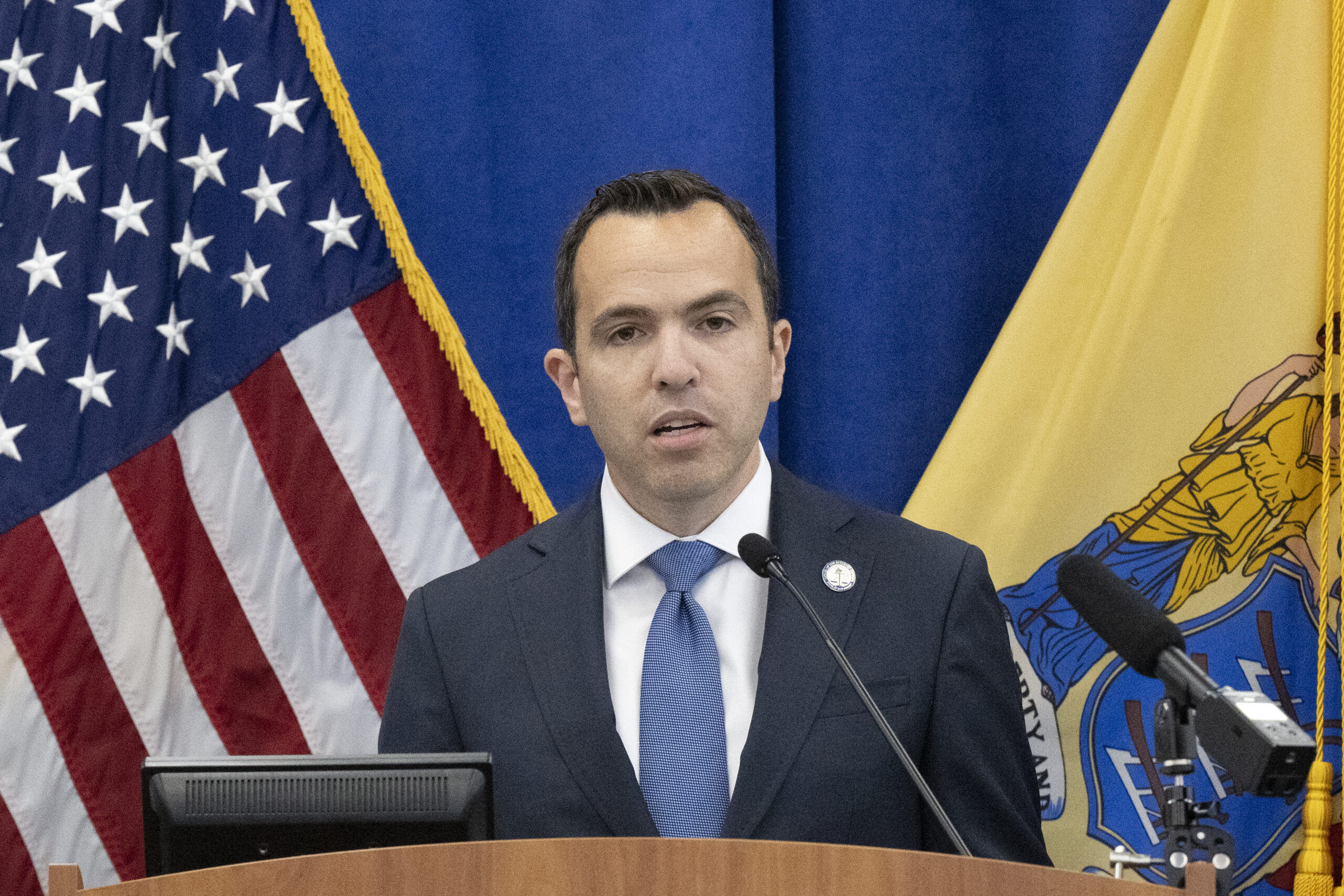
    New Jersey Attorney General Matthew Platkin on Monday, June 17, 2024, at the Richard J. Hughes Justice Complex in Trenton, N.J.

    Platkin, 39, is an ambitious lawyer who grew up in northern New Jersey and attended one of the best high schools in the state before attending Stanford University and Stanford Law School. He went on to work in private practice in New York and New Jersey before being appointed as chief general counsel to Murphy at 35 — the youngest person to ever hold the office.

    Sunday, 50, grew up in a suburb of Harrisburg and has described his high school years as lacking direction. He joined the U.S. Navy after high school before attending Pennsylvania State University for undergraduate and Widener University Law School for his law degree, working at UPS to help put himself through school. He returned to south-central Pennsylvania for his clerkship, and was a career prosecutor in York County until his election to attorney general.

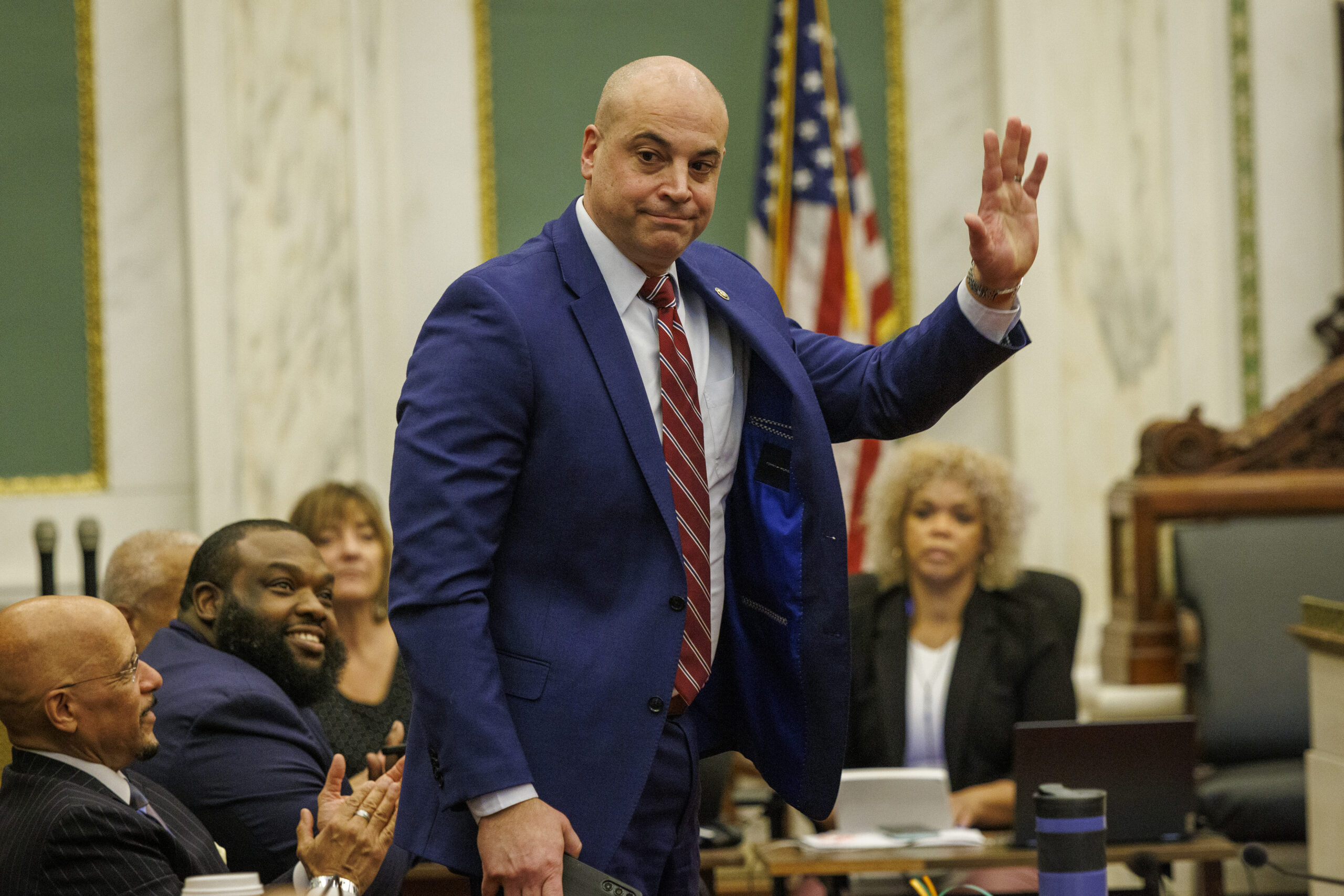
    Pennsylvania Attorney General Dave Sunday stands to be recognized by Council President Kenyatta Johnson before Philadelphia Mayor Cherelle Parker gives her budget address to City Council, City Hall, Thursday, March 13, 2025.

    But over salads at the Mulberry, Platkin and Sunday found common ground. And ever since, the two said in a joint interview this month, they have worked closely on issues affecting residents in their neighboring states.

    “Just because you may not see eye-to-eye on [Trump] doesn’t mean you can’t see or don’t see eye-to-eye on many, many other issues,” Sunday said.

    “​​When we have an auto theft problem, [residents] don’t care if there’s a ‘D’ or an ‘R’ after your name,” Platkin added. “They just want to see us working to solve it.”

    The two have since worked together on issues that stretch from criminal investigations and human trafficking cases to challenging Big Tech companies as artificial intelligence rapidly advances, Sunday said.

    Earlier this month, Sunday and Platkin led national efforts of coalescing approximately 40 attorneys general across party lines on the issues they say are most pressing for residents. The group wrote a letter to Big Tech companies in mid-December, detailing concerns about the lack of guardrails for AI chatbots like those available from ChatGPT or Meta’s Instagram AI chats, and the potential harm they could cause people in crisis or children who use them.

    In two more letters sent this month, the attorneys general also voiced support for a workforce reentry bill before a U.S. House committee and requested that Congress approve additional funding for courtroom and judicial security to protect the nation’s judges from safety threats. Platkin and Sunday said they were some of the first attorneys general to sign on to the letters.

    “While the undersigned hold differing views on many legal issues, we all agree that the legal system cannot function if judges are unsafe in their homes and courthouses,” the group of 47 attorneys general wrote in a Dec. 9 letter to top leaders of Congress.

    When it comes to lawsuits against the Trump administration and other litigation authored by partisan attorneys general associations, Sunday has largely avoided the fray. Earlier this month, he was elected Eastern Region chair of the National Association of Attorneys General, a nonpartisan group composed of the 56 state and territory attorneys general.

    Platkin, on the other hand, has led the charge in pushing back against the administration’s policies in New Jersey, signing onto dozens of lawsuits such as ones challenging Trump’s efforts to end birthright citizenship and to withhold SNAP funding if a state does not turn over personal information about its residents.

    Still, Pennsylvania has joined many lawsuits, including several challenging the federal government for withholding congressionally approved funds for electric vehicles and more, as Democratic Gov. Josh Shapiro, formerly the state’s attorney general, has signed on in his capacity as governor.

    Platkin, who has served as New Jersey’s attorney general since 2022, will leave office when Murphy’s term ends next month, and Gov.-elect Mikie Sherrill will appoint someone new to the post. Sherrill, a Democrat, earlier this month nominated Jen Davenport, a former prosecutor and current attorney at PSE&G, New Jersey’s largest electric and gas company, to be Platkin’s successor.

    Sunday’s team has already been in touch with Davenport to forge a similar cross-state working relationship.

    What’s next for Platkin? He said he’s a “Jersey boy” and will remain in the state but declined to say what his next move might entail.

    And both Platkin and Sunday say they will maintain their bipartisan friendship going forward.

    “It’s OK to say we don’t agree on everything. We shouldn’t hate each other,” Platkin said. “We should be open about the fact that we like each other. … I don’t think there’s anything wrong with that.”