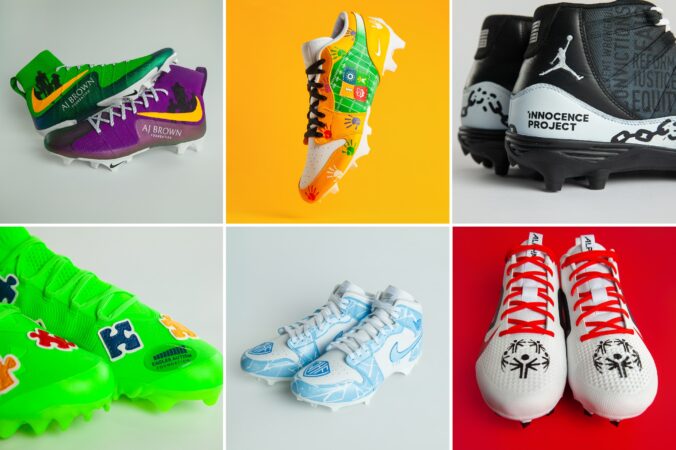
It’s not just Dallas week for the Eagles. It also happens to be the start of the NFL’s 10th annual My Cause My Cleats initiative, which allows players to wear their hearts on their feet — by highlighting a charity of their choice with custom cleats through creative artwork and designs.
“My Cause My Cleats is a player-driven platform that does a tremendous job of amplifying the voices, charitable causes, and social issues that matter most,” Eagles owner Jeffrey Lurie said in a statement. “I am especially proud of our players for always taking this opportunity to drive change and draw attention to the organizations that work year-round to help others. The dedication of those in our building is inspiring and a testament to their ongoing commitment to making a positive difference in the community.”
This year’s My Cause My Cleats campaign will take place during Weeks 12 and 13. While the players will lace up their cleats Sunday against Dallas, the Eagles’ coaching staff will highlight the Eagles Autism Foundation during the team’s Black Friday game against the Chicago Bears by wearing custom Nike sneakers on the sideline.
Game-worn cleats will be auctioned off at NFL Auction, with all proceeds donated to the charities chosen by players. Ahead of Sunday’s game, we’ve picked out some of the Eagles’ custom cleats, but you can check them all out — and find out more on the charities they support — here …
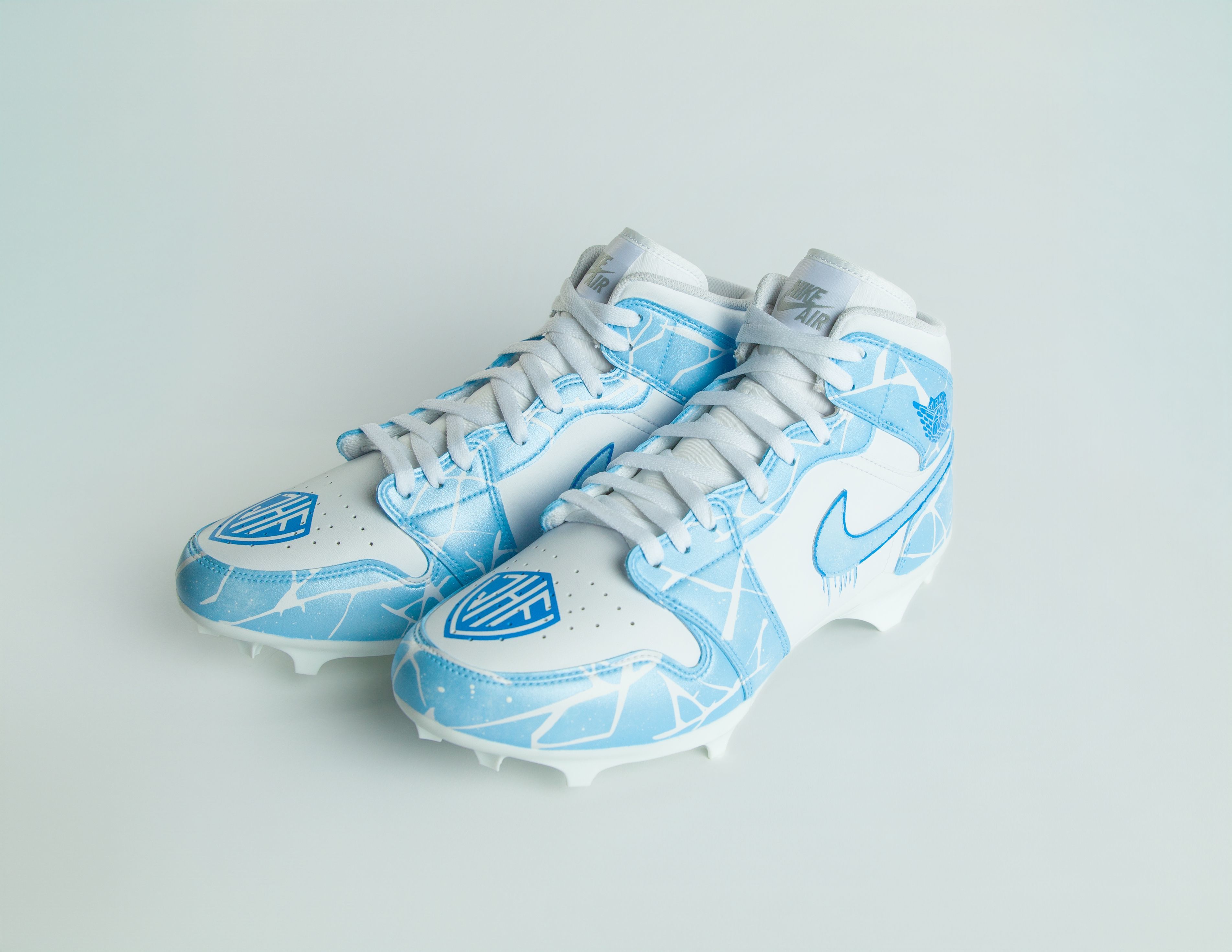
Jalen Hurts’ custom Jordan 1 cleats will highlight the Jalen Hurts Foundation.
Jalen Hurts
Jalen Hurts will be highlighting the Jalen Hurts Foundation, which aims to “strengthen communities by servicing and advancing the youth.” Similar to last year’s cleats, the quarterback’s baby blue Jordan 1s will have the foundation’s logo painted across the toe of the shoe.
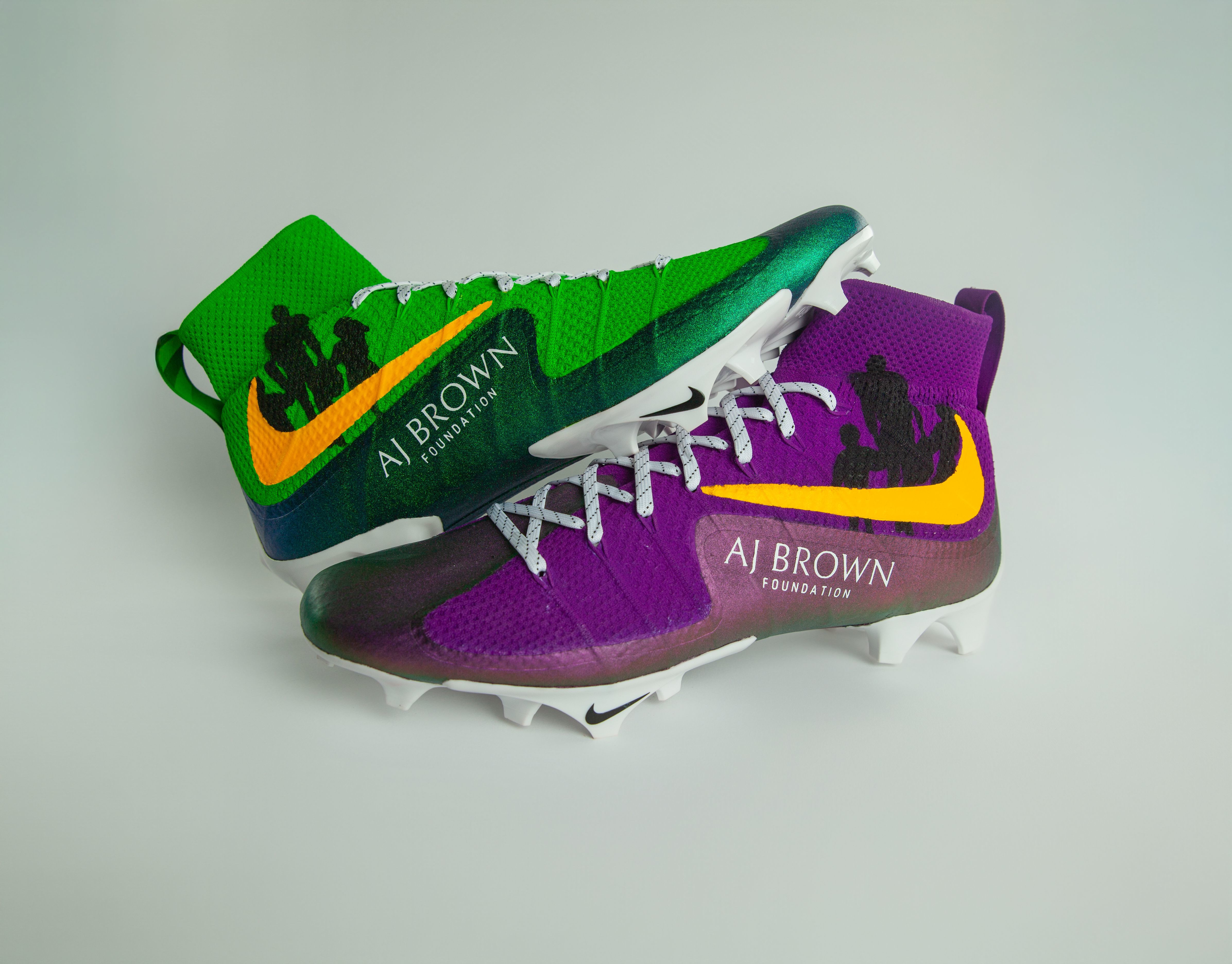
A.J. Brown will support the A.J. Brown Foundation with his custom green and purple Vapor Edge 360 “Untouchable” cleats.
A.J. Brown
Similar to last year’s look, wide receiver A.J. Brown will stick with a bold colorway — sporting green and purple Vapor Edge 360 Untouchable cleats to support youth development with the A.J. Brown Foundation. The Joker-like cleats feature a silhouette of Brown walking hand-in-hand with children above the foundation’s name.
Cooper DeJean will highlight cancer awareness and prevention with his custom cleats.
Cooper DeJean
Cornerback Cooper DeJean is highlighting cancer awareness and prevention with custom cleats designed to honor the University of Iowa Health Care Stead Family Children’s Hospital.
Representing the school’s colors, the cleats feature a yellow colorway with a painting of the hospital on the inside of the shoe. Different colored handprints decorate the cleats, and “Iowa” is painted along the outside.
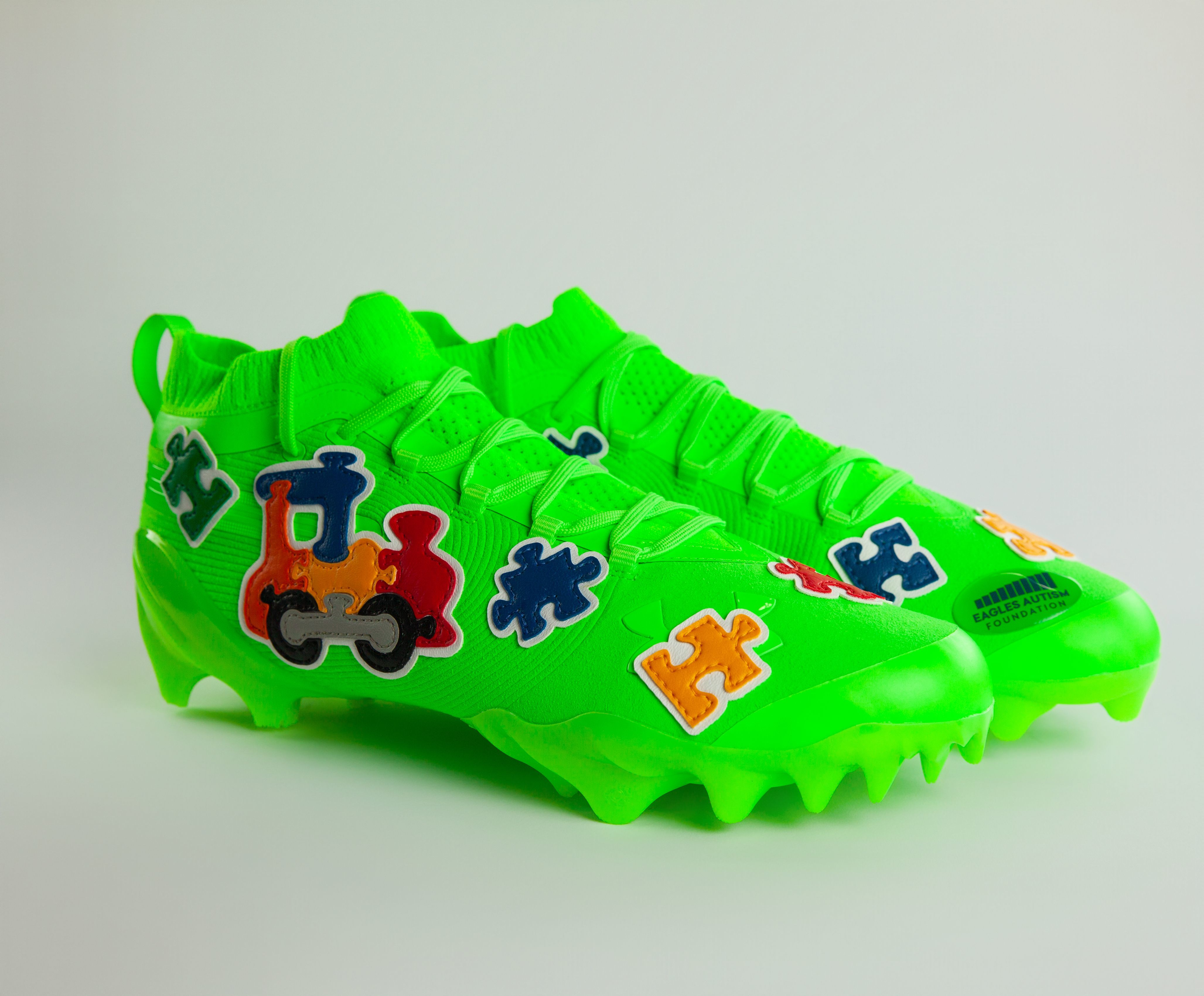
DeVonta Smith will support the Eagles Autism Foundation with custom Under Armour Spotlight Pro Suede cleats.
DeVonta Smith
Wide receiver DeVonta Smith will honor the Eagles Autism Foundation, wearing custom Under Armour Spotlight Pro Suede cleats that feature the autism puzzle pieces decorating an all-lime green body.
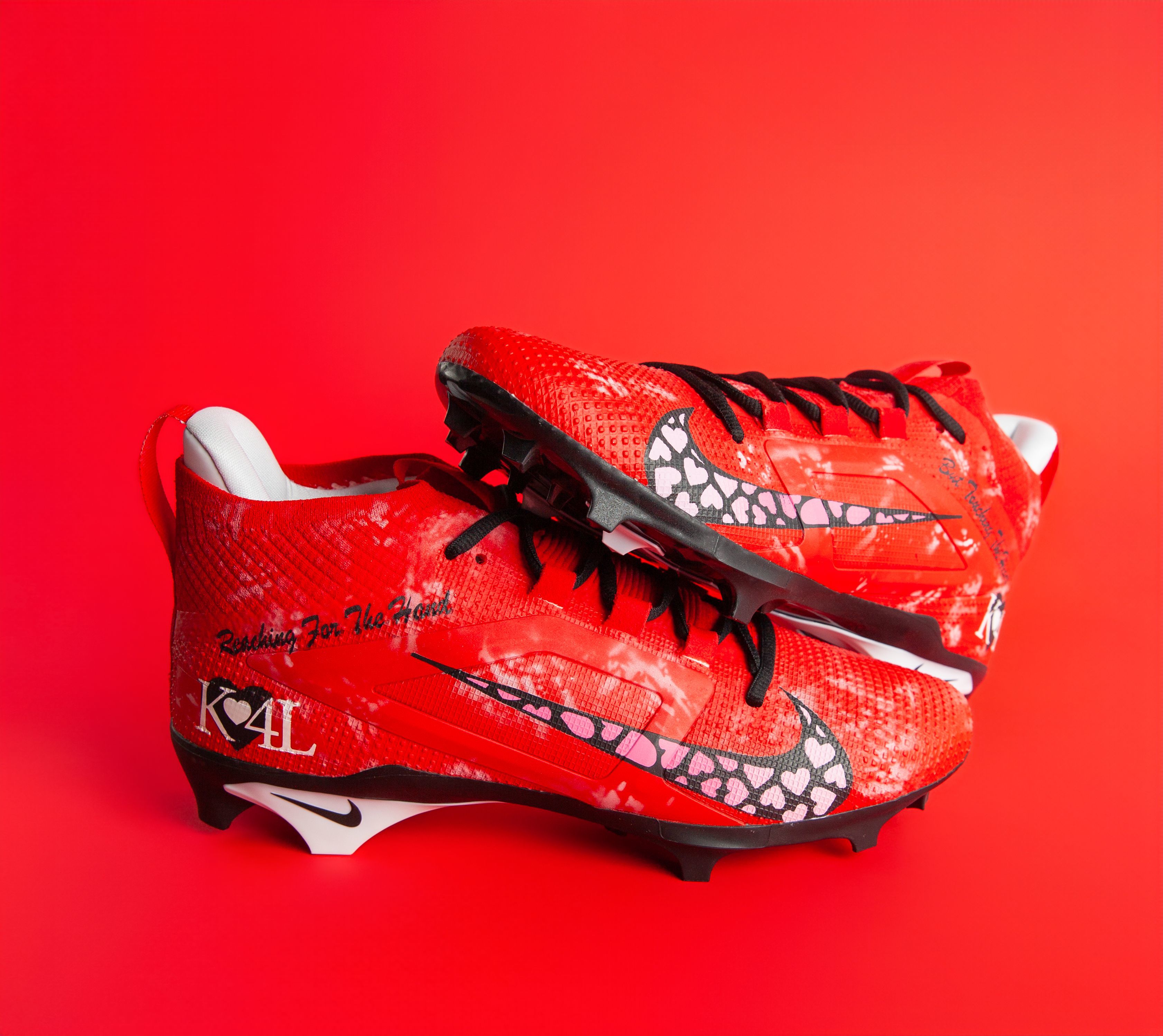
Nakobe Dean is supporting youth development with custom cleats designed to honor Kind Hearts 4 Lyfe.
Nakobe Dean
Nakobe Dean is supporting youth development with custom cleats designed to honor Kind Hearts 4 Lyfe. The Eagles linebacker started the foundation to “provide community outreach programs and services that support, assist, and positively impact the lives of people of all ages.”
Dean’s all-red cleats have the organization’s logo on the heel with its slogan, “Reaching for the hand, but touching the heart,” running along both shoes. Hearts decorate the inside of the Nike logo.
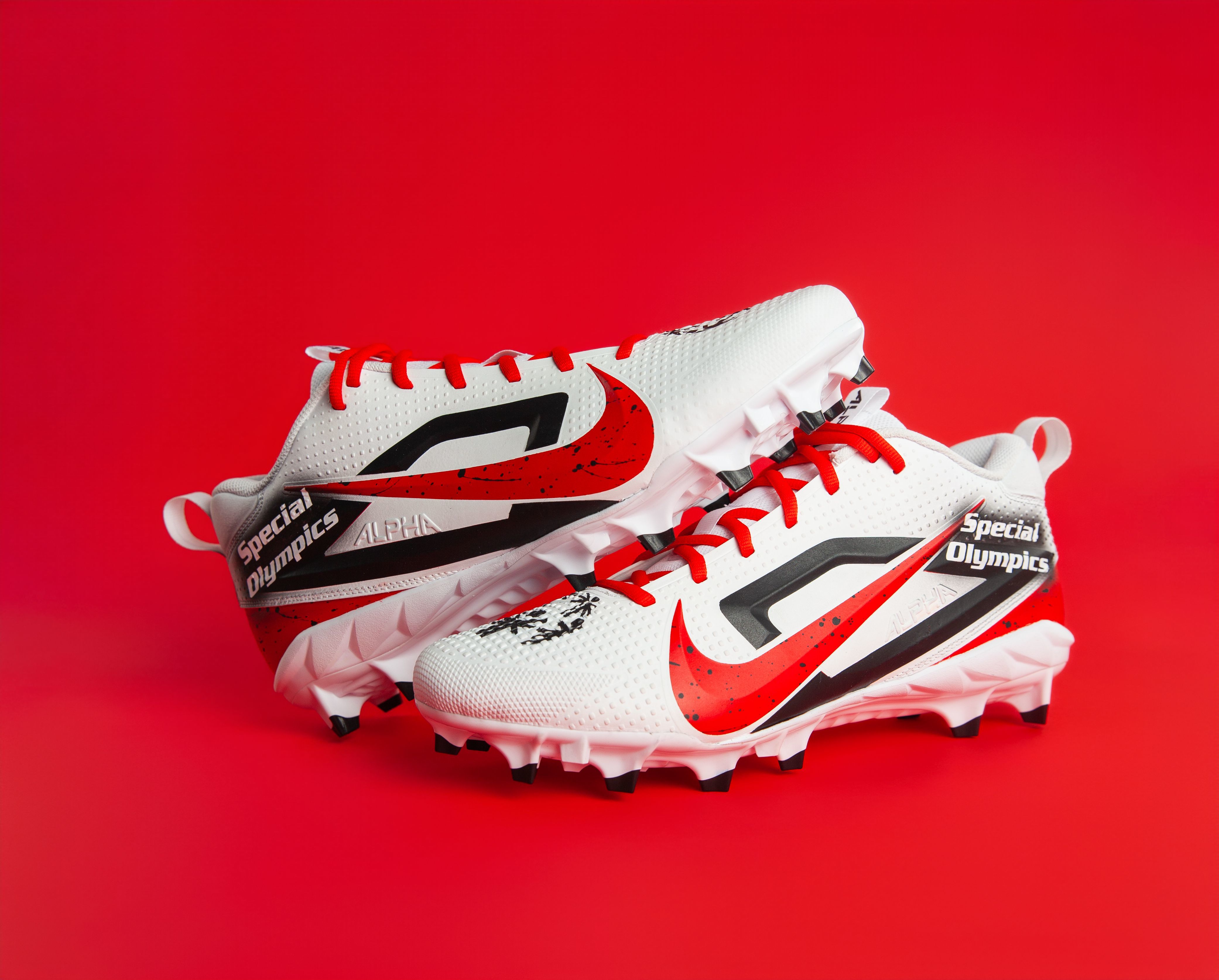
Zack Baun’s custom Nike Alpha Menace 4 Varsity cleats highlight the Special Olympics.
Zack Baun
Linebacker Zack Baun is highlighting the Special Olympics. His custom Nike Alpha Menace 4 Varsity cleats feature a sleek red, white, and black design with the Special Olympics logo on the toe of the shoe.
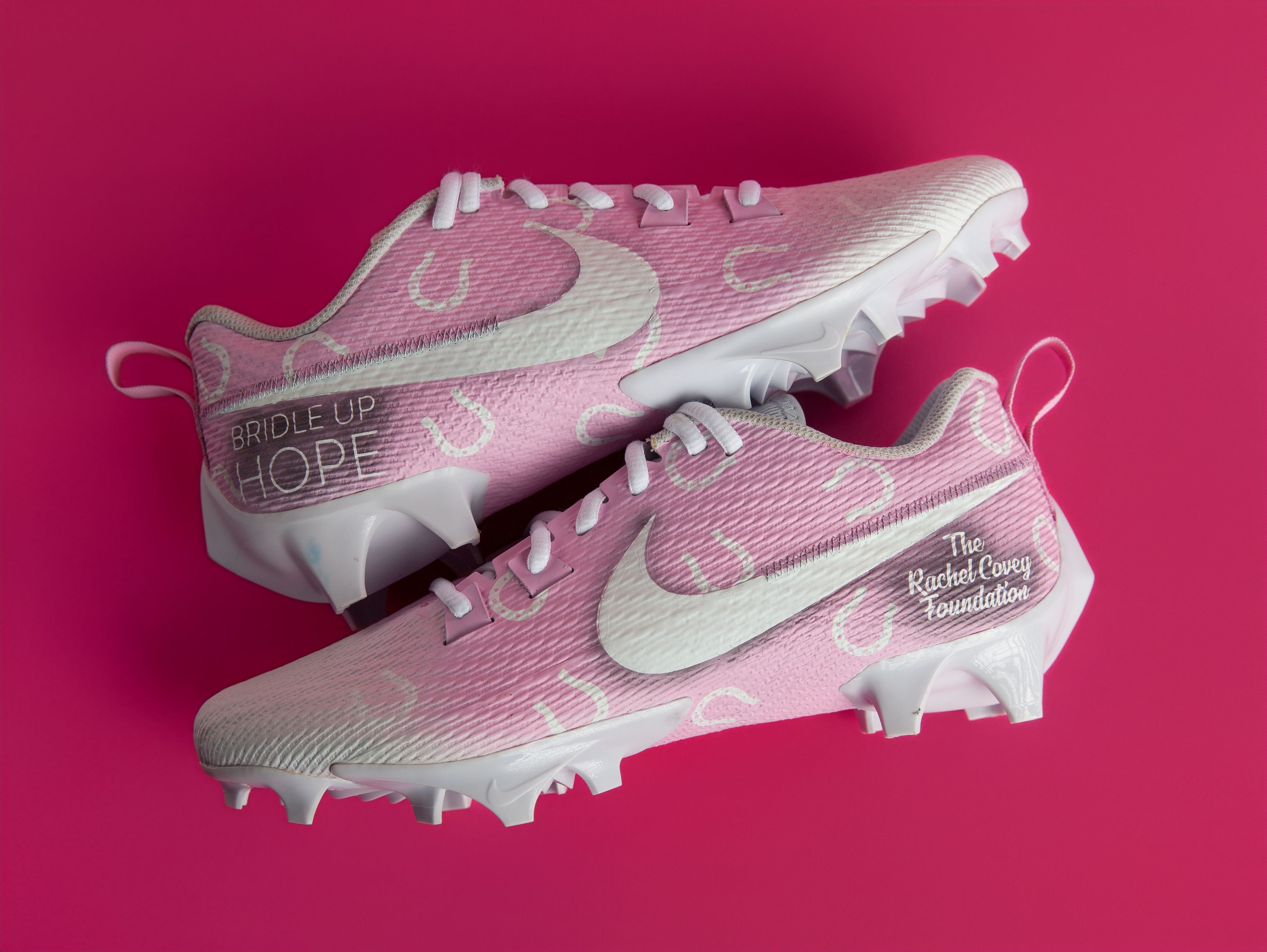
Britain Covey’s all-pink cleats are decorated with horseshoes to honor Bridle up Hope and the Rachel Covey Foundation.
Britain Covey
Britain Covey is supporting women’s mental health by highlighting Bridle Up Hope and the Rachel Covey Foundation. Its mission is to “inspire hope, confidence, and resilience in girls and women through horses and habits.” The foundation was founded after the death of Rachel Covey, Britain’s cousin, who battled depression for many years. Covey’s all-pink cleats are decorated with horseshoes and the foundation’s name.
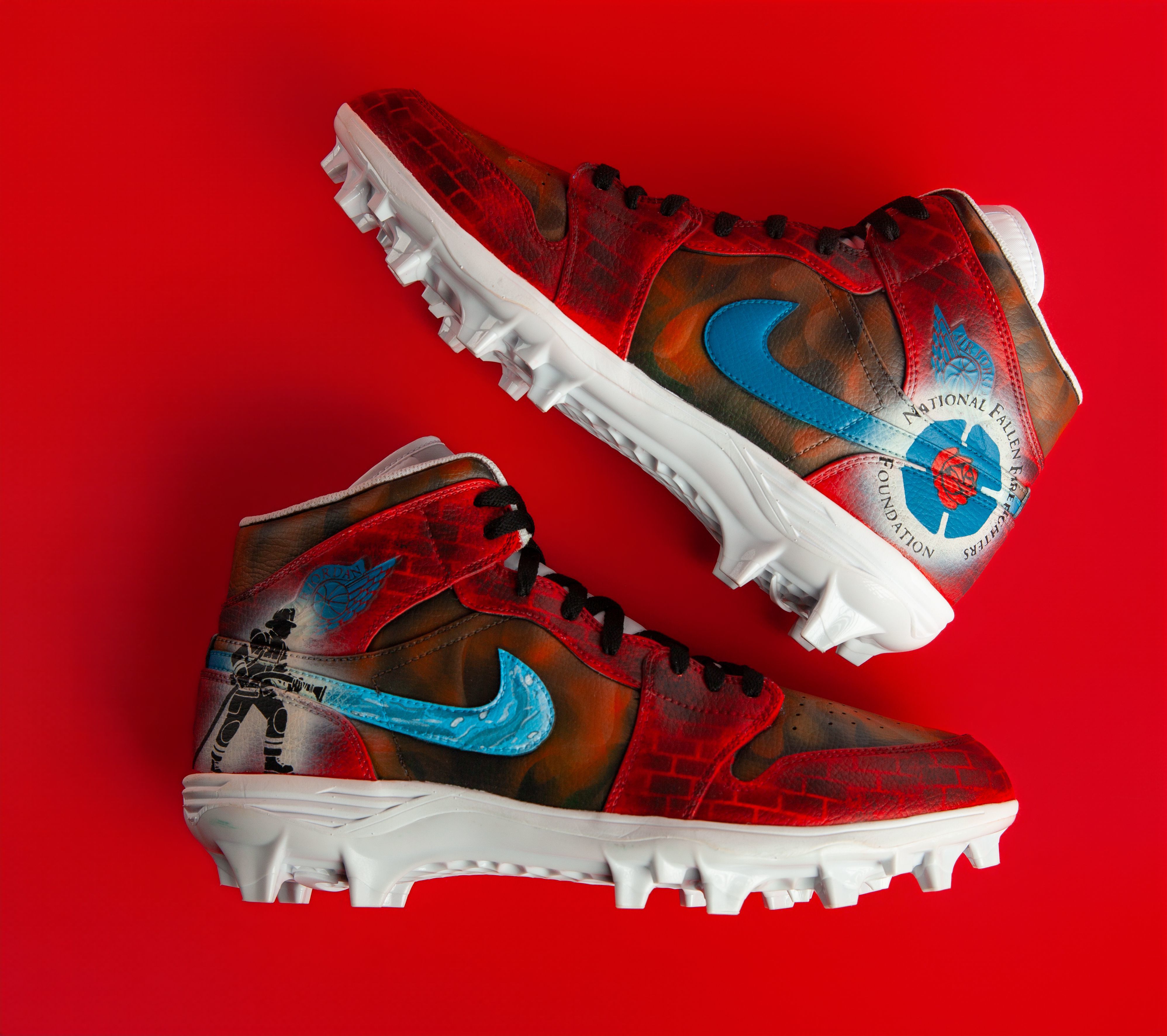
Grant Calcaterra is supporting first responders by highlighting the National Fallen Firefighters Foundation.
Grant Calcaterra
Grant Calcaterra is supporting first responders by highlighting the National Fallen Firefighters Foundation, whose mission is to “honor America’s fallen fire heroes and support their families, colleagues, and organizations,” as well as reduce the number of preventable fires.
The tight end’s custom Jordan 1 cleats are painted to replicate a firefighter extinguishing a fire in a burning building, with the artist utilizing the Nike swoosh as the water from the hose. The organization’s logo decorates the heel of the cleats. Calcaterra previously pursued becoming a firefighter before continuing his football career.
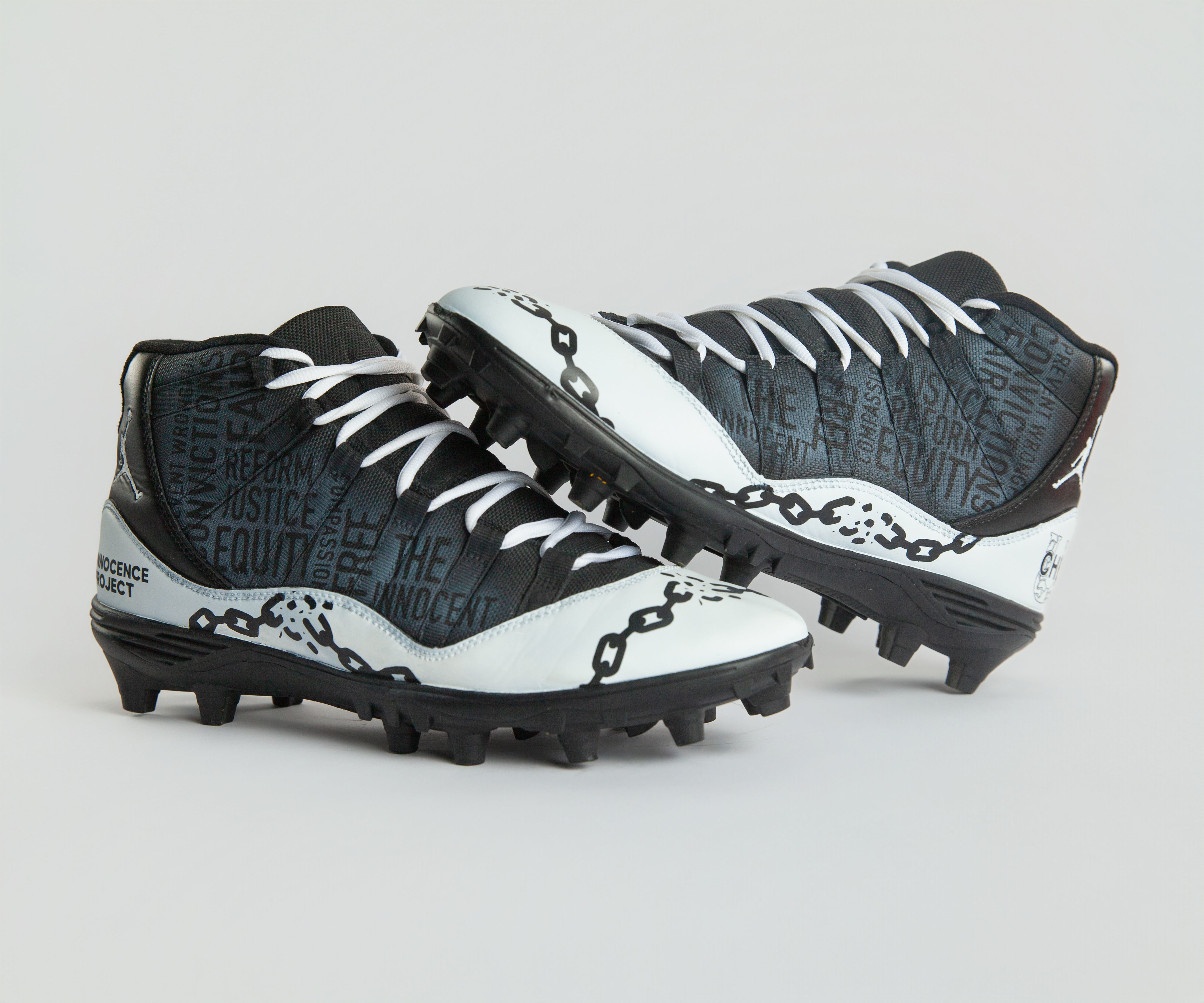
Joshua Uche’s custom Jordan 11 cleats support the Innocence Project.
Joshua Uche
Edge rusher Joshua Uche is using his platform to support social justice by highlighting the Innocence Project, which works to exonerate those who have been wrongly convicted of crimes. His custom Jordan 11 cleats are decorated in broken chains with the words “reform,” “justice,” and “equity” written across the cleats’ upper.
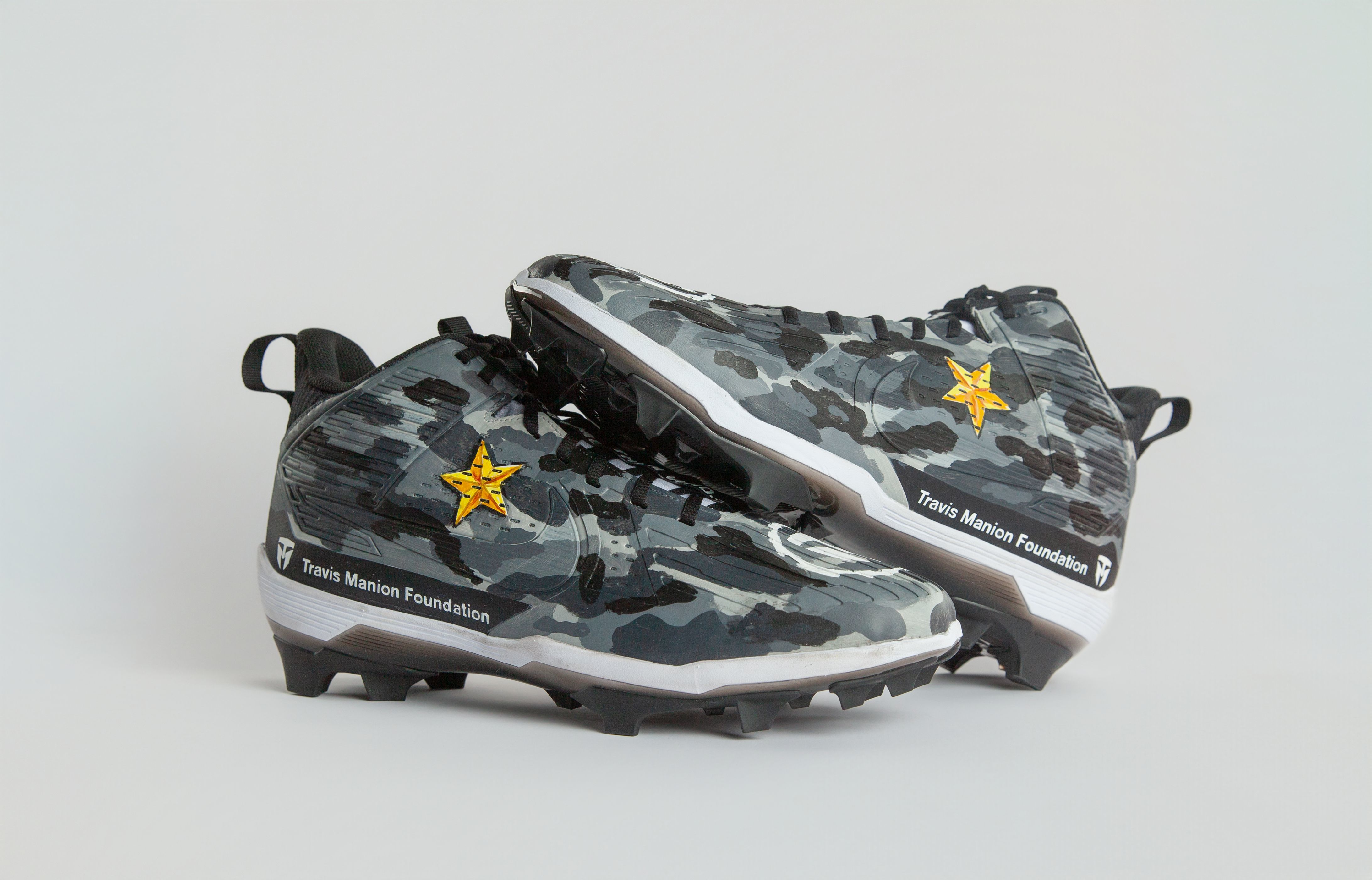
Lane Johnson’s camouflage cleats honor the Travis Manion Foundation.
Lane Johnson
Lane Johnson won’t be playing, but the Eagles right tackle is again highlighting the Travis Manion Foundation, supporting veterans and the families of fallen military members. His cleats feature a black and gray camouflage design with a gold star alongside the outside of both cleats.
Angelica Javier was sitting at home on a Saturday evening last month when her son’s uncle called in a panic.
Xzavier, her 16-year-old, had been shot, he said — one of the teen’s friends had called and told him, but he knew nothing else.
Javier, 32, frantically checked a news website and saw a brief story mentioning that a man was shot and killed in Northeast Philadelphia.
That could not be her son, she told herself. Xzavier was only a boy, she said — tall but lanky, with the splotchy beginnings of a mustache just appearing on his upper lip.
She called around to hospitals without success. Xzavier’s father, Cesar Gregory, drove to Jefferson Torresdale Hospital, desperate for information.
Then, just before 10 p.m., she said, a homicide detective called to say their eldest child, their only son, had been shot and killed that afternoon near Teesdale and Frontenac Streets.
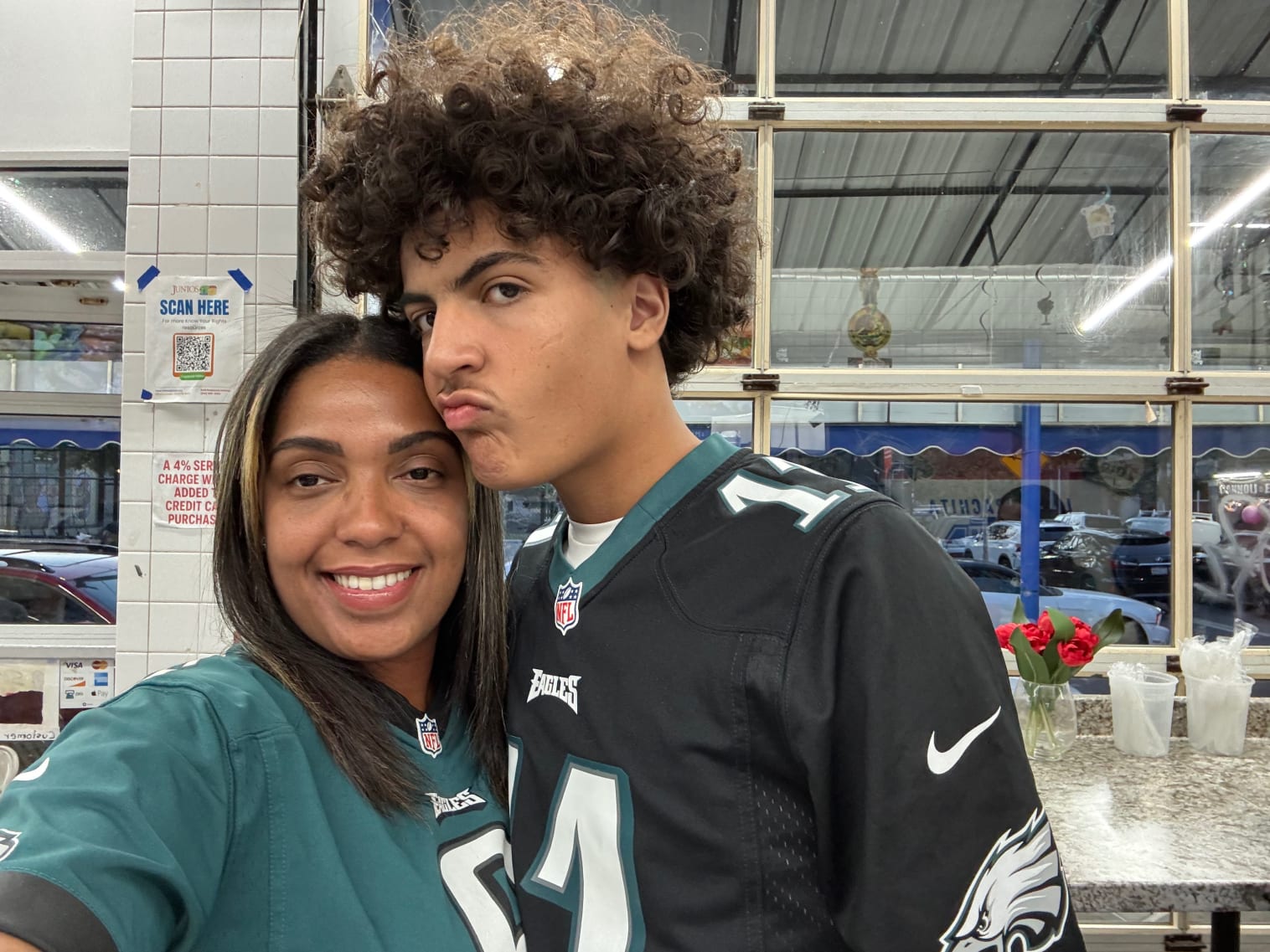
Angelica Javier (left) and her 16-year-old son, Xzavier Gregory, getting tacos after watching the Eagles beat the Los Angeles Rams earlier this year.
The shooting, police said, stemmed from a dispute among teens at the Jardel Recreation Center, just blocks away, earlier in the week. Xzavier’s parents said the detective told them that one of their son’s friends may have slapped a young woman that day.
On Oct. 11, they said, police told them that Xzavier and his friends stopped by the young woman’s house shortly before 4 p.m. to talk with her, apologize, and resolve the conflict. They shook hands, the parents said, and started to walk away.
Then, police said, the girl’s 17-year-old boyfriend, Sahhir Mouzon, suddenly came out of the house with a gun and started shooting down the block at them. Someone shot back, police said, but it was not Xzavier. In total, 45 bullets were fired.
An 18-year-old woman walking by the teens was wounded in the leg.
Xzavier was struck in the chest and died within minutes.
Mouzon has been charged with murder and related crimes.
Javier and Gregory have been left to navigate life without their “Zay” and to reckon with a loss that comes even as gun violence in the city reaches new lows — but which still persists among young people and brings pain to each family it touches.
They don’t understand how a 17-year-old had a gun, they said, or why a seemingly minor — and potentially resolved — conflict had to escalate.
But mostly, they said, they want Philadelphia to know and remember their child: a goofy junior at Northeast High. An avid Eagles fan. A lover of Marvel movies and spicy foods.
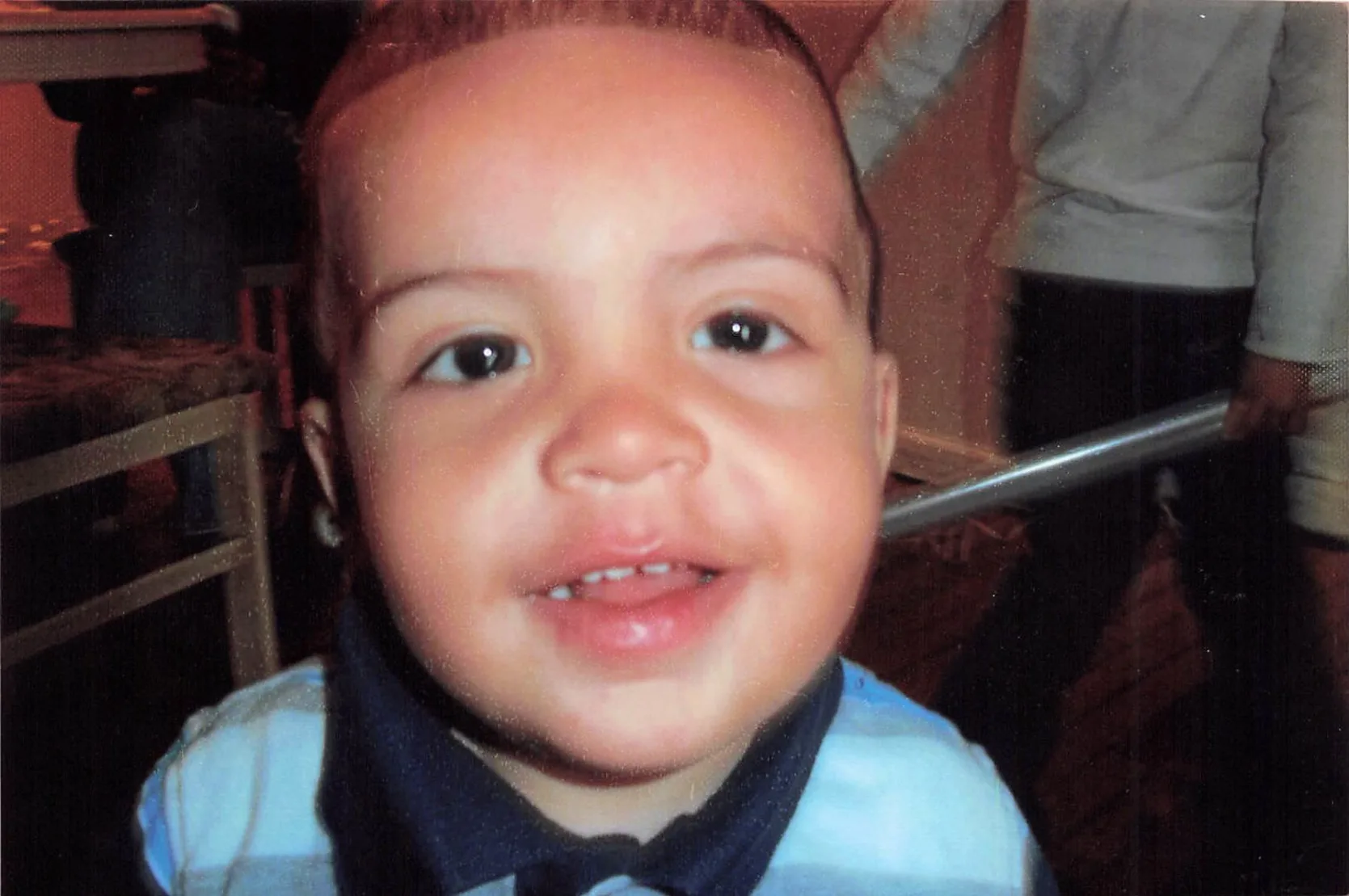
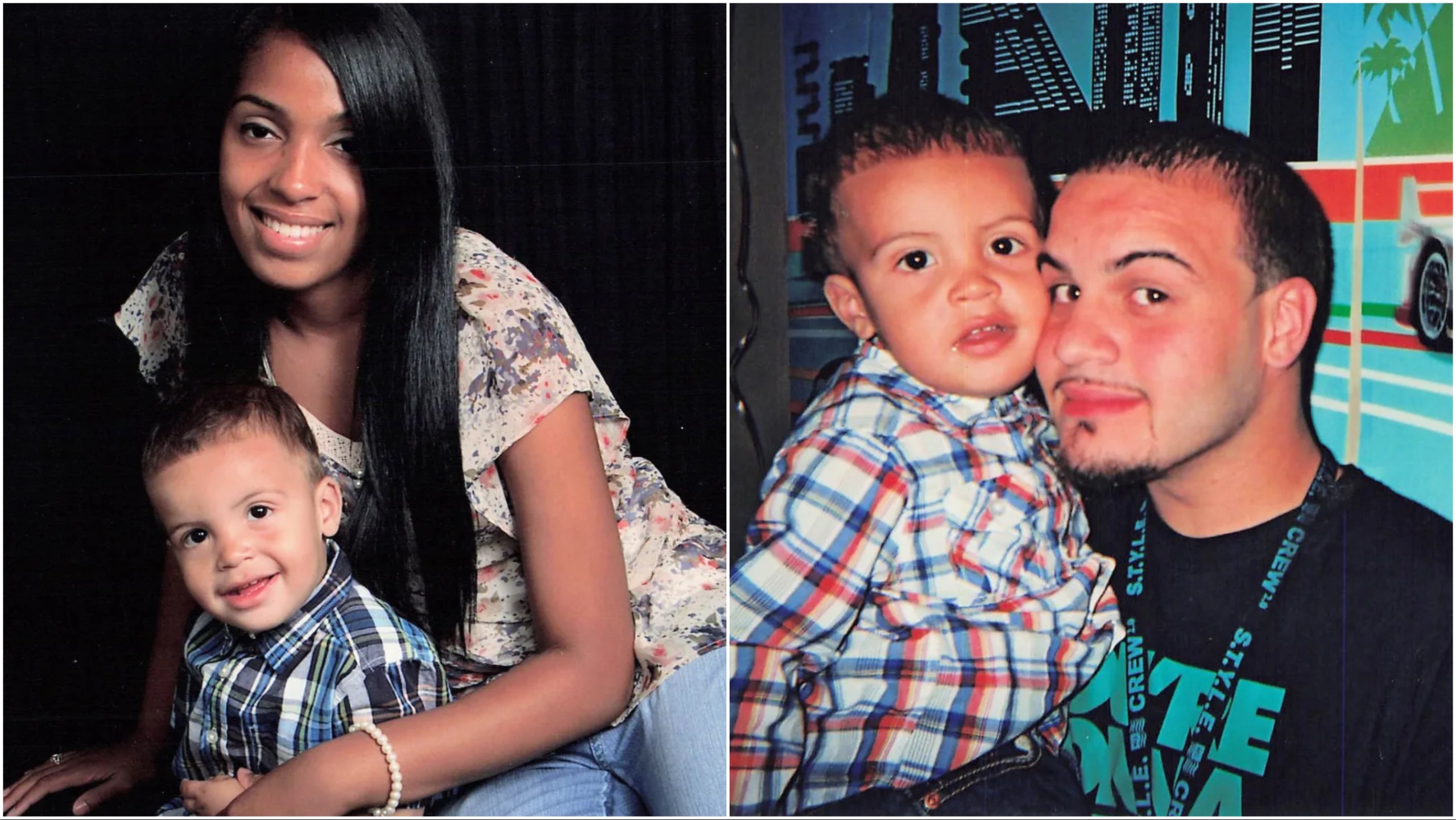
Xzavier Gregory was born in Philadelphia. His parents loved his chubby cheeks.Xzavier Gregory was born Sept. 20, 2009, to Angelica Javier and Cesar Gregory.
Xzavier Giovanni Gregory was born Sept. 20, 2009, at Temple University Hospital in North Philadelphia. His parents, just teens at the time, were immediately taken by his chubby cheeks, which he kept until his teenaged years.
He lived in Kensington until he was about 10 years old, his mother said, when they moved to the Northeast. He attended Louis H. Farrell School, then spent his freshman year at Father Judge High before moving to Northeast High.
He loved traveling, and often visited family in Florida and the Dominican Republic, attended football camps in Georgia and Maryland, and tagged along on weekends to New York with his mother as part of her job managing federal after-school programs.
He played football for the Rhawnhurst Raiders, typically as an offensive or defensive lineman, and had a natural skill for boxing, his parents said.
Philadelphia sports were in his blood — particularly the Eagles. DeVonta Smith and A.J. Brown, his father said, were his favorite players. (Before his death, he agreed that Brown should be included in more plays this year, Gregory said.)
Some of Gregory’s favorite memories with his son revolve around the Eagles. Sitting front row at the Linc on his 13th birthday. Erupting in cheers as the team won its first Super Bowl in 2018. Embracing in tears when they won a second this year.
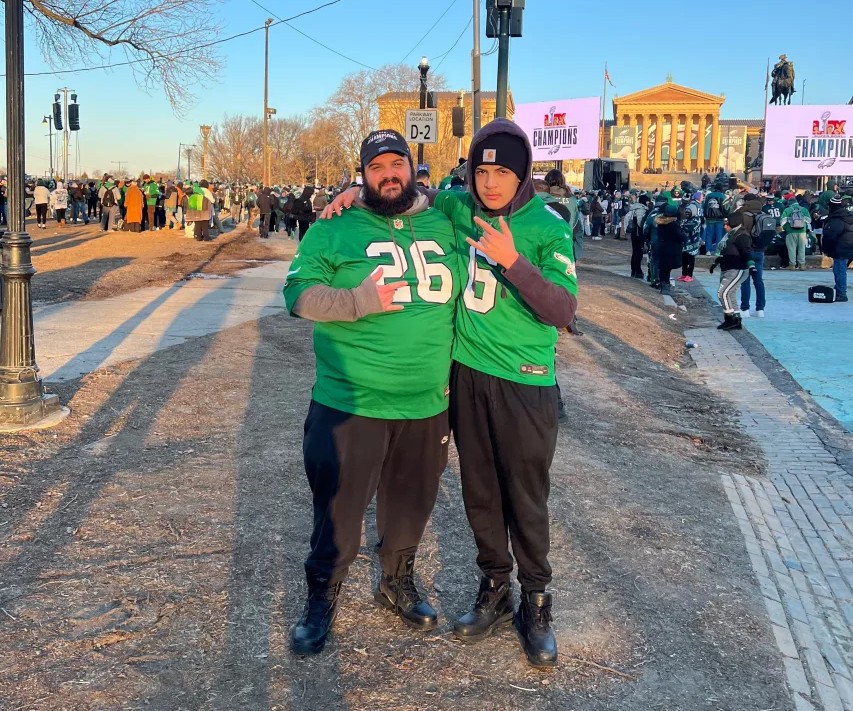
Cesar Gregory (left) and son Xzavier at the Eagles Super Bowl parade near the Art Museum in February. It is a day with his son that the father said he will never forget.
Xzavier was the oldest of three children. His sisters are still too young too fully understand what happened, the parents said.
“He went to heaven,” Javier told 7-year-old Kennedy.
The number of kids shot peaked in 2021 and 2022, when violence citywide reached record highs and guns became the leading cause of death among American children. So far this year, 105 kids under 18 have been shot — a sharp drop from three years ago, but still higher than pre-pandemic levels, according to city data.
Xzavier is one of at least 11 children killed by gunfire this year.
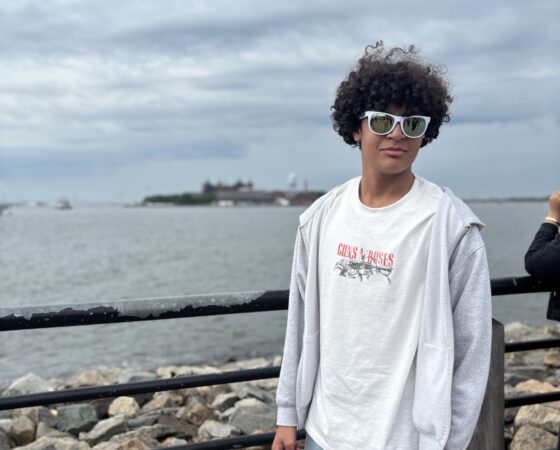
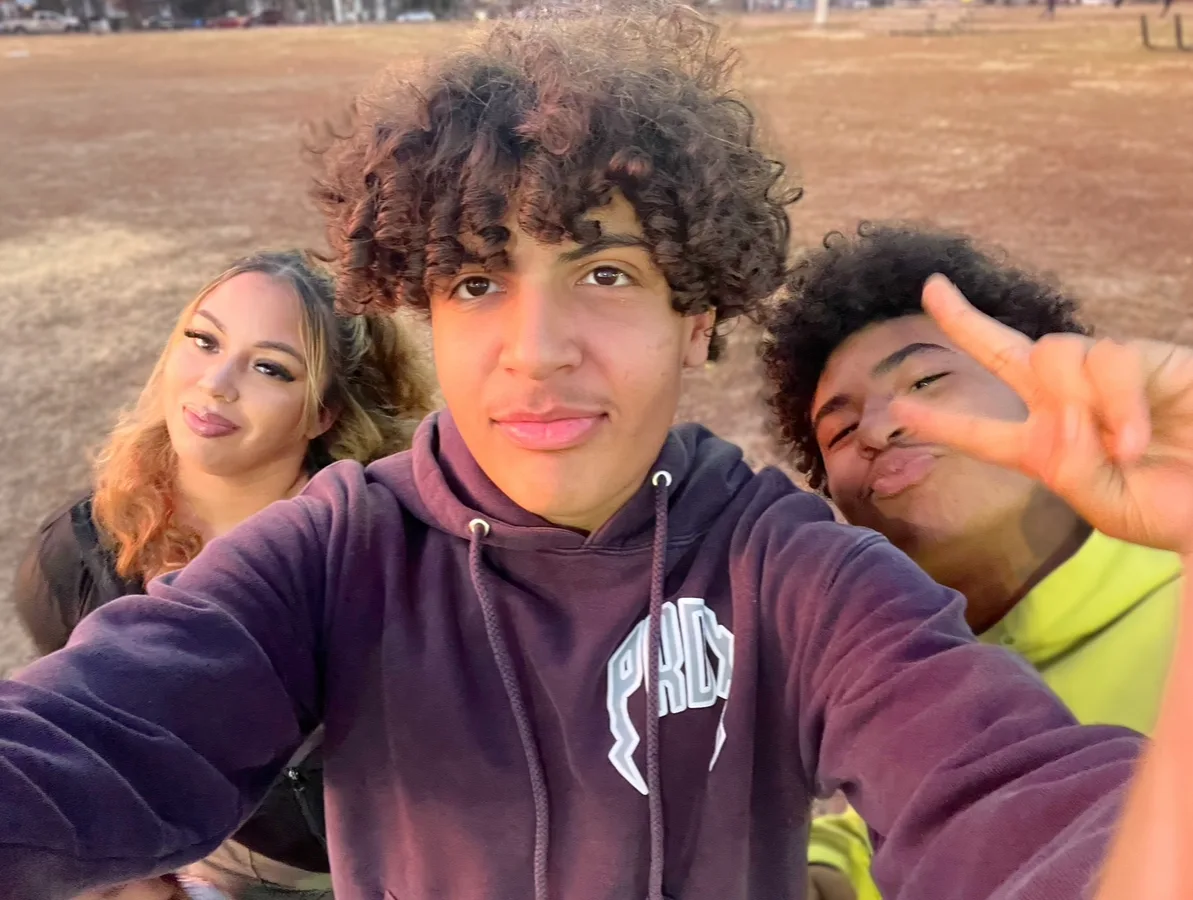
Xzavier Gregory (center) was a goofy teen who attended Northeast High School, his parents said.
Javier and Gregory said some relatives are considering leaving Philadelphia, shaken by Xzavier’s killing and a feeling that teens don’t fear consequences.
But the parents said they will stay. They want to be near Magnolia Cemetery, where Xzavier is buried, and to feel closer to the memories that briefly unite them with him.
On harder days, they said, they go into his bedroom, which is just as he left it, a relic of a teenage boy.
His PlayStation controller sits in the middle of his bed, and a photo of him and his mother hangs on the wall above it. His Nike sneakers are scattered. His black backpack rests on the floor, and a Spider-Man mask sits on the corner of his bedframe.
On Thursday, his parents stood in the room they used to complain was too messy, that smelled like dirty laundry.
“Now, I come in just to smell it,” Javier said.
She took a deep breath.
Staff writer Dylan Purcell contributed to this article.
As Christina Smith-Sylve watched last Sunday’s game Eagles against the Minnesota Vikings in the U.S. Bank Stadium stands, her seat might as well have been made out of pins and needles with the way nerves pricked her skin.
That sensation intensified when she saw three Vikings defenders tackle her 6-foot, 170-pound son, DeVonta Smith, on a 16-yard reception down the right sideline in the second quarter.
Dallas Goedert even seemed to clamor for a defenseless receiver penalty against Blake Cashman after the play. The inside linebacker’s rally to Smith came after Byron Murphy already had stopped the small-but-stubborn receiver’s forward progress.
Smith-Sylve felt those pins and needles again when the 26-year-old receiver absorbed a hit from Harrison Smith on a 19-yard cross over the middle of the field. But after both plays, Smith popped up with the ball in his hands as if he had been grazed by a butterfly and not tackled by men who likely can bicep curl his body weight.
“It’s hard seeing him,” Smith-Sylve said. “It’s rough. But I know he’s tough. He’s small in stature, but he plays big.”
Jahan Dotson is used to Smith’s toughness by now, two seasons into his Eagles tenure. In theory, Dotson is one of the players responsible for assuming Smith’s or A.J. Brown’s spot on the field if either star receiver gets banged up or needs a moment to recuperate on the sideline.
It usually plays out the same way every time, according to Dotson. After the hit over the middle against the Vikings, Smith came to the sideline, hands on his hips, trying to catch his breath. He insisted to wide receivers coach Aaron Moorehead that he could go back into the game, refusing to miss a play.
“He’s not the biggest guy,” Dotson said. “He takes the biggest hits. And he pops back up like he’s the biggest guy.”
Smith was one of the biggest reasons the Eagles snapped their two-game losing streak, too, leading the team with a career-high 183 yards and a touchdown on nine receptions in that game. His 79-yard touchdown catch came on a play he had advocated for at halftime, eager to exploit the Vikings’ decision to bring a safety into the box when the Eagles were under center in their jumbo package.
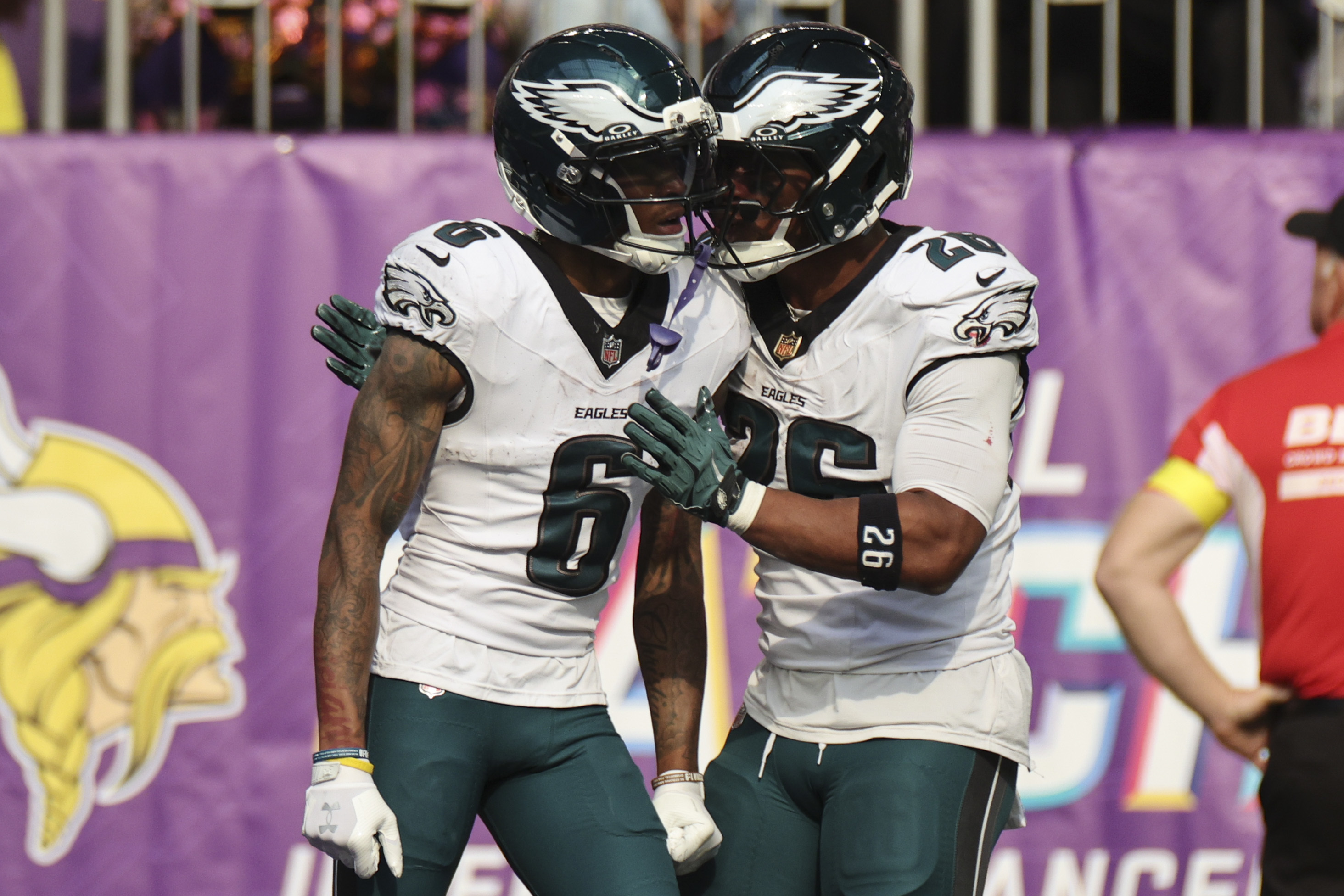
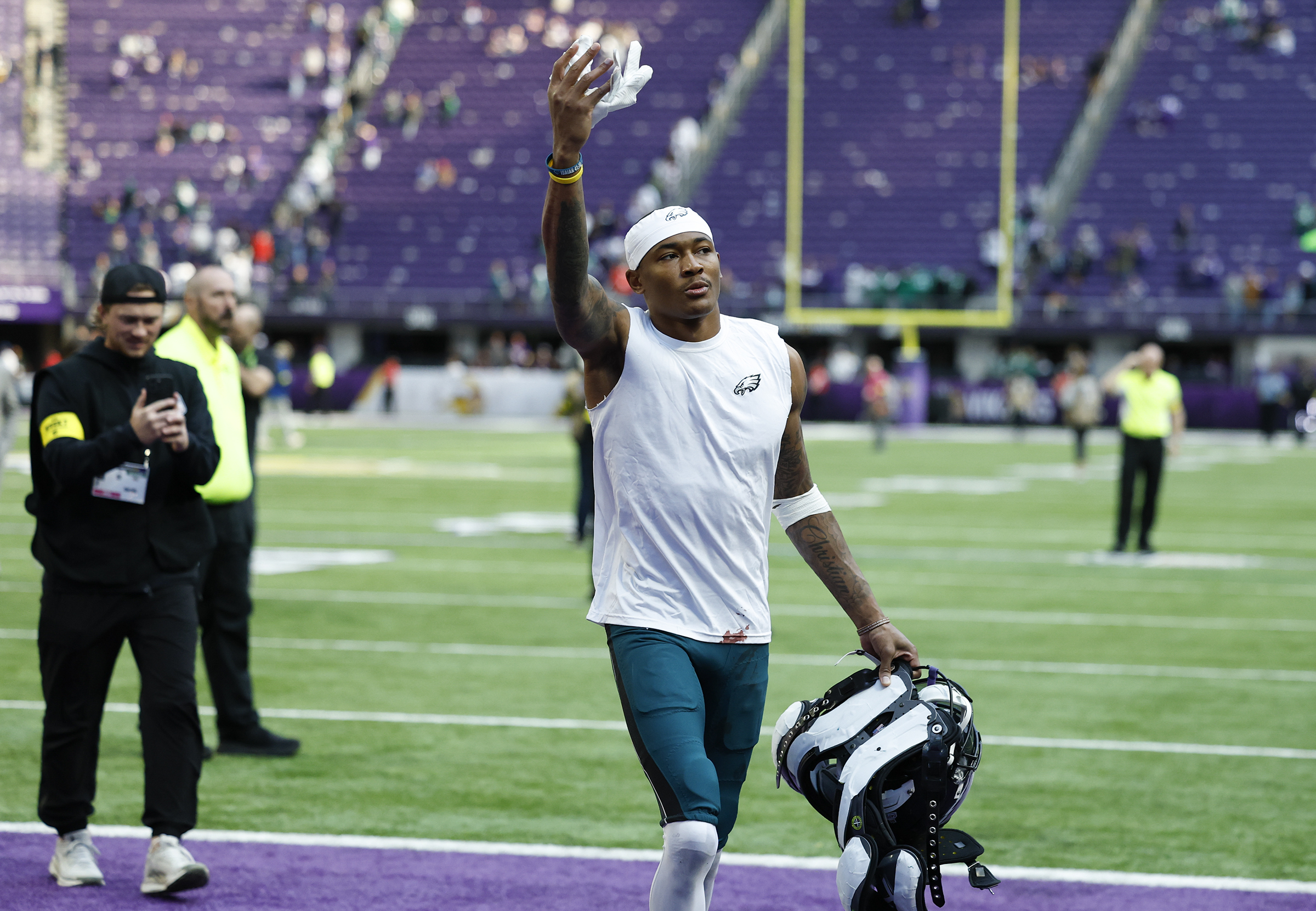
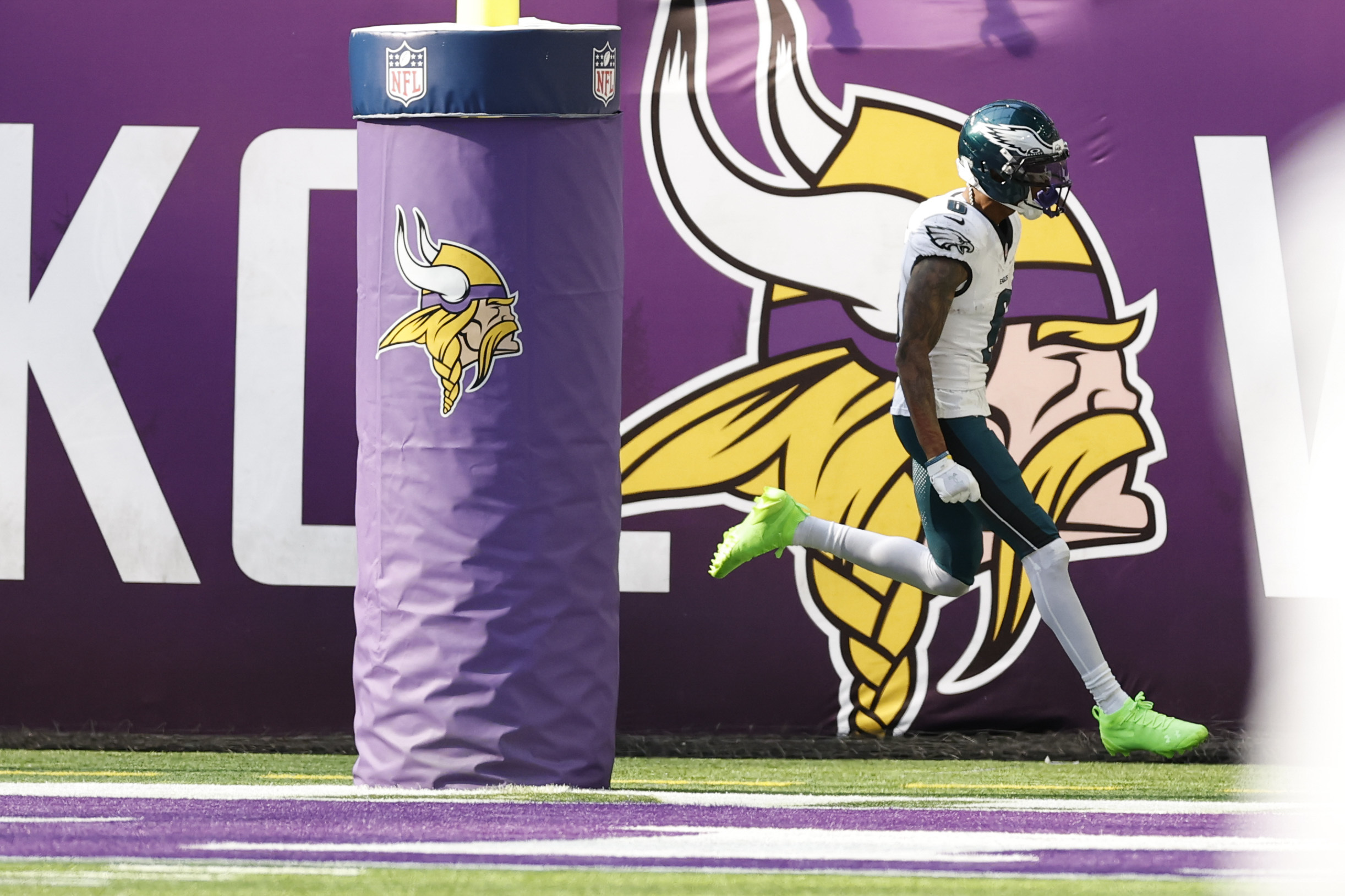
Eagles wide receiver DeVonta Smith celebrates his third-quarter touchdown against Minnesota on Oct. 19.
“It was a great feeling seeing that little thing run down there to the end zone, man,” said left tackle Jordan Mailata. “It was beautiful.”
Everyone is a little thing compared to Mailata, who is 6-foot-8 and 365 pounds. Still, Smith’s big plays are putting him on pace for a career-best 1,224 receiving yards. With big plays often come big hits from bigger defenders, especially at Smith’s second-percentile weight among draft-eligible wide receivers in 2021, when he was picked 10th overall.
How does Smith bounce back up, regardless of his smaller stature? He claims he knows no other way to operate.
“If I can walk, I’ll be all right,” Smith said.
He “hopped right up”
Much to the chagrin of Smith-Sylve, Smith began playing little league football and basketball when he was 5 years old in his hometown of Amite City, La. She was particularly scared for her undersized son in his football pursuits. But all of his friends in their small town, with a population just over 4,000, were participating, and he wanted to play with them.
“I couldn’t crush his spirit,” Smith-Sylve said.
So she acquiesced. He quelled her fears, though, because even though “Tay” often was the smallest player on the field, he typically was the toughest.
He continued to cultivate his toughness at Butler Town Park, which is across the street from their home. Smith would hang around his older, bigger cousins and their friends, trying to join their basketball and football games. They allowed it, but they didn’t go easy on him. They roughed him up, Smith-Sylve said. As a result, Smith became well-acquainted with the surface of the basketball court.
“Plenty of times, I’d done hit that concrete,” Smith said.
Those scrapes and bruises formed calluses on Smith’s mental toughness. He applied that mindset to the football field at Amite High Magnet School as a freshman on the football team, where coach Alden Foster already knew plenty about Smith.
After all, Amite is a tiny town, and the football community is even tinier. Smith-Sylve is Foster’s cousin. His brother coached Smith in little league football. Foster’s nephew, Elijah Walker, was Smith’s teammate from little league through high school. Another cousin of Smith-Sylve’s, Dwayne Davis, was Foster’s defensive coordinator at Amite.
Football games practically were family reunions. So Foster had plenty of intel on his small-but-mighty receiver. He quickly found out that he still was learning how to read defensive coverages, too.
During Smith’s freshman year, Amite scrimmaged against Edna Karr, a perennial football powerhouse in New Orleans. Smith was running a route over the middle and didn’t remember to settle in the zone. A 6-foot-4, 250-pound defensive end — who went on to play for LSU, Foster said — dropped into coverage in the area.
Eagles wide receiver Devonta Smith was 122 pounds as a freshman for the Amite High Magnet School football team.
“[Smith] ran across, and the quarterback threw it,” Foster said. “Oh, man. He knocked him out. That little sucker was 122 pounds then and hopped right up.”
Smith put the hit behind him. Later in the scrimmage, when the teams were working on goal-line situations, “that little freshman scored a touchdown against them people,” Foster said. The next year, Amite and Edna Karr played each other. Smith, then a sophomore, used that hit as ammo, fueling him to a three-touchdown performance, according to Foster.
“He said, ‘Coach, I got to get my revenge,’” Foster said.
“You’re not a quitter”
Despite his toughness, one hard fall in his sophomore year almost took Smith out of football for good.
On Thursdays, Foster sought to conclude their walk-throughs on a good play. The quarterback targeted Smith to end the practice, but he overthrew his receiver slightly.
Smith, ever the competitor, dove for the ball. He came down hard on the field. This time, he didn’t pop up.
Foster took Smith to the hospital, where Smith-Sylve met them. They learned that Smith broke his clavicle, which ended his season.
“The first thing he said: ‘That’s it for football. I quit. I’m not playing. I quit,’” Foster said.
Smith was a multisport athlete at the time, competing in track and field and basketball. Smith’s father, Kelvin Dickerson, was adamant that his son had a future in basketball. The injury nearly led to Smith dedicating himself to basketball, which both of his parents played.
Foster wasn’t having it. Smith had too much upside to waste as a football player. Smith was a good basketball player, Foster said, but he was different in football. Dickerson eventually came around to Foster’s pleas and had a conversation with Smith.
“‘You wanted to play football,’” Smith-Sylve said of Dickerson’s message to their son. “‘That’s what happens. That’s a part of the game. You tough. You’ll be all right. You know what you’ve got to do next time.’ I think both of them, just talking to him and letting him know, ‘You’re not a quitter. That’s one hit of many. So let’s just go.’”
That injury changed the way Smith approached the game, according to his family. He became more serious about hitting the weight room. Moorehead, the Eagles’ wide receivers coach, got to witness that work ethic in person when he traveled to Amite on a recruiting trip while serving in the same role for Texas A&M.
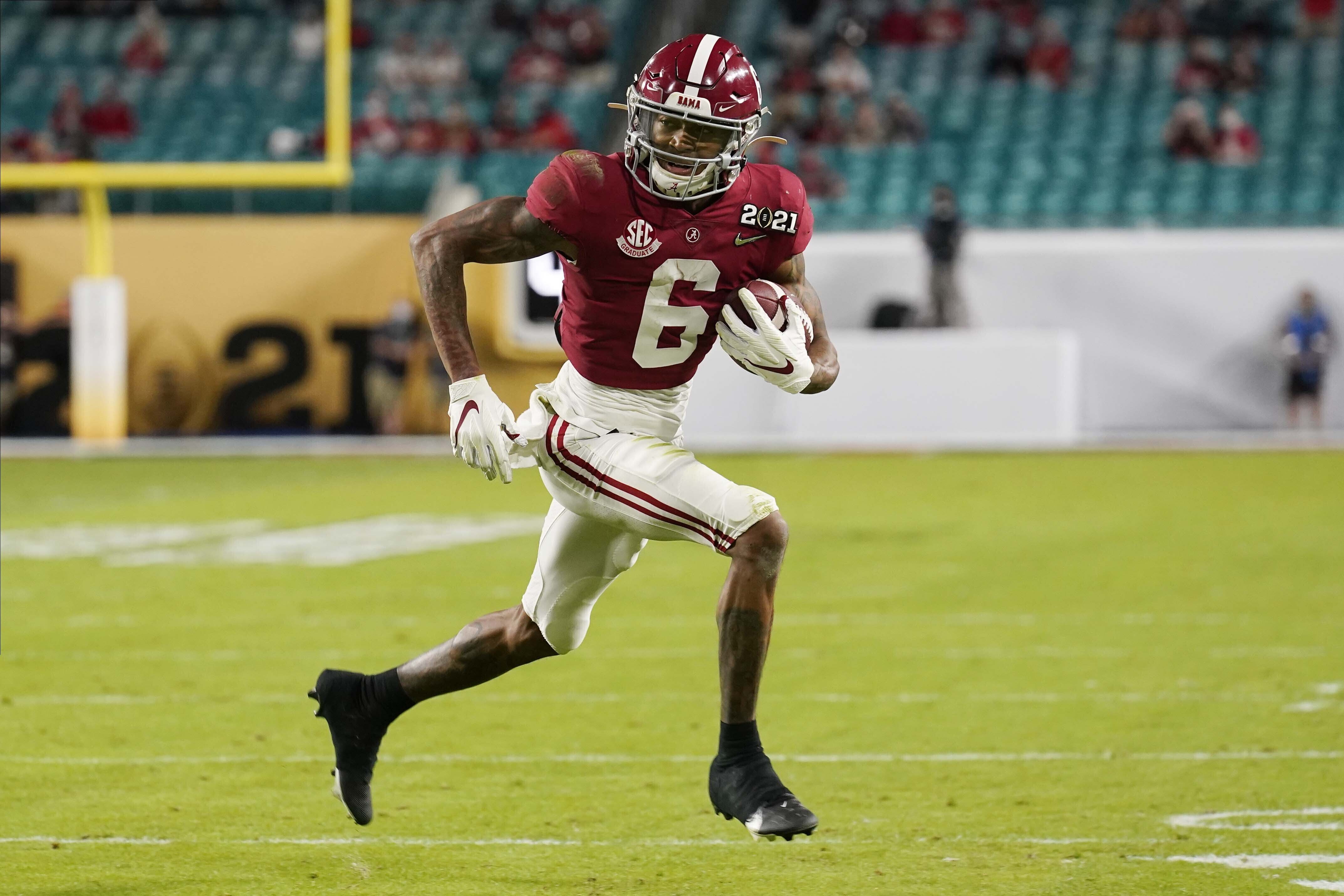
Nick Saban took a chance on an undersized DeVonta Smith, and he finished his Alabama career with two national championships and a Heisman Trophy.
The small weight room tucked beneath the football stadium looked like it hadn’t been updated in 25 to 30 years at the time, Moorehead said. Rust tarnished the weights. The air inside mimicked the sticky Louisiana heat outside, causing the 145-pound Smith and his teammates to drip with sweat. But Moorehead never heard a complaint.
“That was just what they knew,” Moorehead said. “They didn’t know anything else. Didn’t care. Just trying to get better.”
Smith grew stronger, but he didn’t bulk up with ease. Zephaniah Powell, Amite’s football coach beginning in Smith’s junior year, said his build was genetic. Powell claimed Smith looks just like his father, with a “thin build, not that big of a frame. But long arms, long legs, kind of put together like an antelope.”
His lack of size had nothing to do with his appetite. Foster would host seafood boils complete with crawfish and turkey necks in the yard. He said Smith loved to come by and eat with his cousins. But it didn’t seem to matter that Smith enjoyed seafood boils with his family or ate tablespoons of peanut butter to cram in extra calories, Foster explained.
“His DNA wouldn’t let him gain a whole lot of weight,” Foster said. “But you can’t measure his heart.”
Proving people wrong
Moorehead once questioned how Smith would fare in the SEC. He wasn’t the only one.
Some coaches at college football recruiting camps looked at the undersized receiver skeptically, Foster said. But he liked taking kids to Alabama’s camps because Nick Saban didn’t care how big they were. If they could play, Saban would give them a chance.
One Heisman Trophy and two national championship titles later, the chance Saban took on Smith paid dividends.
“All he’s done is prove people wrong,” Moorehead said.
That includes Jalen Hurts, his quarterback at Alabama for two seasons.
“I remember times asking, ‘Hey, man, how much [do] you weigh?’” Hurts said. “And I stopped asking him that as the years have gone on, because that’s no indication of what type of player he is. He’s a hell of a player, and he’s been making some big-time plays.”
The grittiness Smith once exhibited as a kid at Butler Town Park is still evident in his game in the NFL. In fact, Eagles coach Nick Sirianni could rattle off the specific plays over the past five seasons in which Smith exemplified the toughness that Sirianni so often preaches to the team.
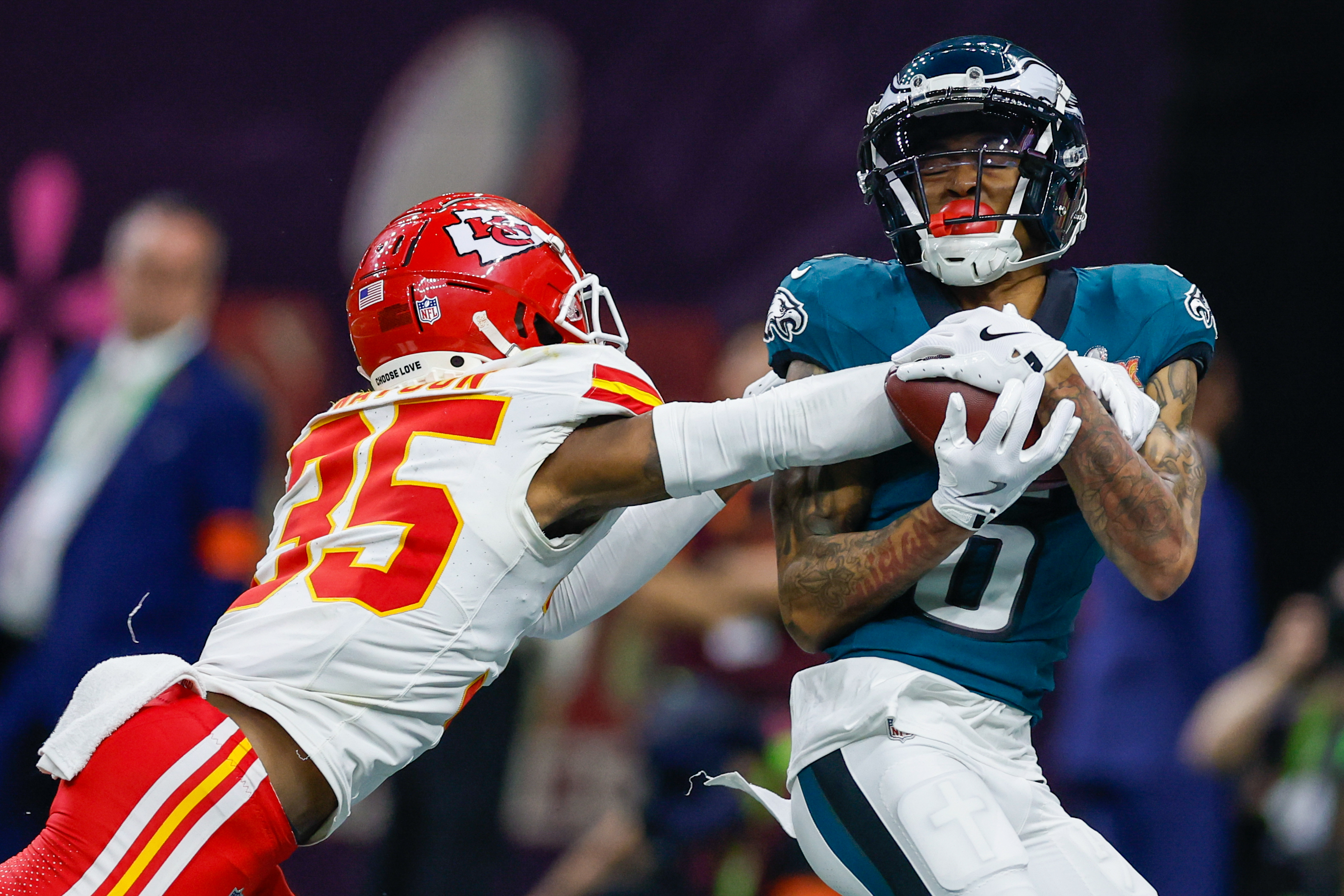
There was the third-down play Smith made in Super Bowl LVII on a shallow crossing route, when Kansas City Chiefs safety Justin Reid sent him flying out of bounds.
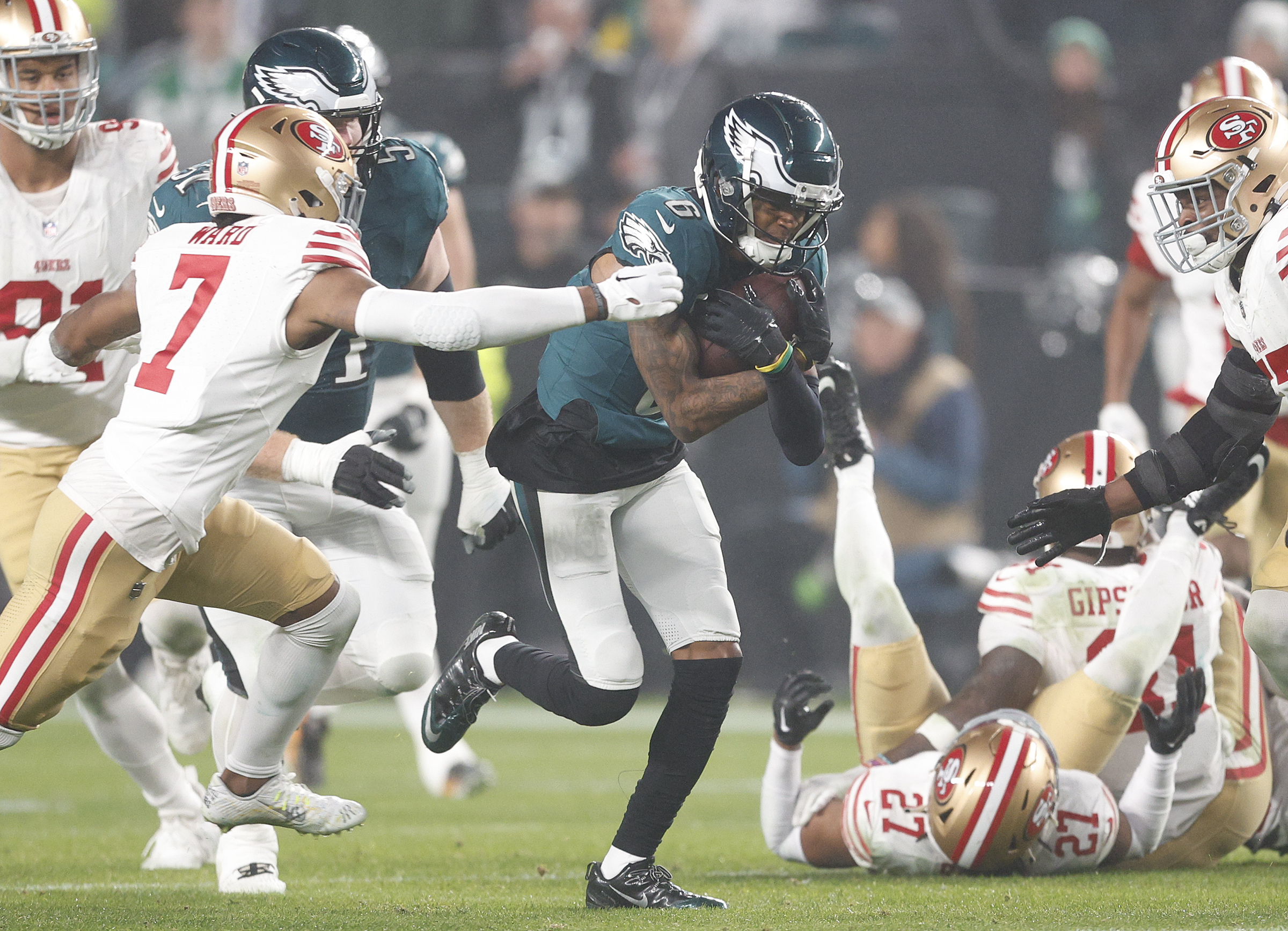
Nick Sirianni recalled a DeVonta Smith screen gain of 21 yards against the 49ers in 2023 as a display of the receiver’s toughness.
There was the 2022 win over the Arizona Cardinals, in which Smith caught a screen pass from Hurts then immediately took a hard hit from Murphy, a member of the Cardinals at the time.
There was the third-and-19 play against the San Francisco 49ers in 2023 when Smith caught a screen pass and broke three tackles before picking up 21 yards after the catch.
In true Smith fashion, he just kept going.
“We didn’t win that game, but it brought life to everybody,” Sirianni said. “I think that that’s what a big play can do, that’s what a great assist from a teammate can do, and that’s what great toughness shown on tape can do, because those are the things we talk about all the time that can just bring that energy to a football team.”
Perhaps no play in Smith’s NFL career can amount to the energy generated by his 46-yard touchdown in Super Bowl LIX, which has since been referred to as “The Dagger.” But Moorehead had been hesitant about the Eagles calling that play. Smith had been nursing a hamstring injury that week, and he was worried about the health of his receiver.
Moorehead said he asked Smith four times before that play if he was sure he wanted to run it, deep route and all. Smith, playing in front of his loved ones at Caesars Superdome in New Orleans, had no hesitation.
“He finally looked at me and he said, ‘If you don’t get the F out of my face, I’m running this route,’” Moorehead said.
Smith wasn’t finished.
“‘They’re going to have to drag me off this field [in] the Super Bowl,’” Moorehead recalled Smith saying. “And he meant it. He was home. He wanted to win in that stadium. He wanted to play in front of his family and friends and score a touchdown in the Super Bowl and play well. And he did.”
Eagles wide receiver DeVonta Smith touchdown catch in the third quarter of Super Bowl LIX is now known as “The Dagger.”
NFL rules have evolved to better protect receivers. John Lynch and Ronnie Lott aren’t patrolling the middle of the field anymore. But receivers still get hit hard on occasion, a fate Smith seems to have accepted, according to Moorehead.
The receivers coach surmised that those hits energize Smith, too. Smith-Sylve has a different feeling, but she wards off those pins and needles when she remembers the 5-year-old who pleaded with her to let him play little league football.
“I know that’s what he loves to do,” Smith-Sylve said. “He has a love for the game. He’s small in stature. But he plays big, and he’s going to give it 100%.
MINNEAPOLIS — The Eagles wanted to run the ball. They wanted to emerge from the mini-bye — just like they had after breaks in previous seasons — with a ground-focused offensive attack.
They just couldn’t.
But it didn’t matter, ultimately, at least on this day. Jalen Hurts and the drop-back passing game delivered the kind of explosive performance that has mostly been lacking from the offense this season, the kind needed after a two-game losing streak had even the Eagles doubting themselves.
The Eagles quarterback confirmed his quote that was videoed and posted on social media by an NBCSports reporter.
“That’s all I could think about throughout these last two weeks,” Hurts said. “Having opportunities to finish the game, to finish the fourth quarter. I really think this is the first time we’ve finished the fourth quarter and then finished in the second half. …
“There was some fire there, but within that fire you have to be the calm.”
Hurts sparked a dormant offense with a career-best statistical outing in which he completed 19 of 23 throws for 326 yards and three touchdowns. And he was a steely-eyed presence against a Vikings pass defense that entered first in expected points added (EPA) per drop back.
Hurts’ passer rating might have been a perfect 158.3, but the Eagles were far from flawless. The defense surrendered nearly 400 total yards. Special teams missed a field goal and had other miscues.
But it was the offense that again confounded. An opening drive that set the tone for under center-heavy play calling and resulted in an A.J. Brown 37-yard touchdown catch was followed by four futile possessions before the half.
It was the 2025 Eagles offense redux all over again. They couldn’t get Saquon Barkley going on the ground. An injury — this time to center Cam Jurgens — compounded the run-blocking issues. And the Birds kept finding themselves behind the sticks.
And there was nothing Hurts, Brown, and receiver DeVonta Smith could do in the passing game to turn it around.
But the Eagles still led at the half, 14-6, partly due to Jalyx Hunt’s pick-six and Vic Fangio’s red zone-stingy defense. But also because the guy who preceded Hurts in Philly, Vikings quarterback Carson Wentz, kept making bad decisions and throws.
During the break, Smith told anyone within earshot to get to a certain deep shot play that was in the game plan.
“He had a lot of confidence in that play,” Hurts said, “And he was chirping about it.”
Eagles tackle Jordan Mailata said Smith found a willing listener in guard Landon Dickerson.
“Landon went and figured out the play that he was talking about because [Smith] doesn’t know what we’re doing up front, what protection it is. He just knows his routes,” Mailata said. “And they got on the same page and Landon advocated for him.”
Eagles wide receiver Devonta Smith celebrates his third-quarter touchdown reception.
Offensive coordinator Kevin Patullo dialed the shot up on the Eagles’ second play from scrimmage in the second half. He had set the call up with two earlier running plays with similar personnel (Fred Johnson as the sixth offensive lineman) and a similar formation (Hurts under center).
Smith said he noticed the Vikings had a safety in the box and that there would be no help over top if he ran a deep post. He got former Eagles cornerback Isaiah Rodgers to bite on a corner route deke, and Hurts dropped the ball in his bucket for a 79-yard score.
Hurts was under center for 20 of 49 offensive plays (40.1%). Coming into the game, the Eagles ranked 30th in the NFL in under center usage (14%). Hurts has never thrived in that world, but the offense needed more diversity if the Eagles were to set up play-action.
Lane Johnson spoke about the running game’s predictability after the 34-17 loss to the New York Giants on Oct. 9. Ten days later, the Eagles tackle declined to talk with assembled reporters at U.S. Bank Stadium because he said he didn’t want his comments to become headline news again.
But Johnson’s public message was heard by coach Nick Sirianni and his staff.
“I think it frees up the passing game a lot more,” Mailata said of being under center. “You don’t know if it’s going to be a run, you don’t know if it’s going to be play-action, or you don’t know if it’s going to be a shot play. So I think it gives us versatility and definitely helps us a lot up front with our [blocking] angles.”
Barkley under wraps
Barkley had some early success Sunday on under-center runs. But it wasn’t sustained. It was tough going from the shotgun and pistol, as well. He was held to just 2.4 yards on 18 carries. Backup running back Tank Bigsby had one rush for 11 yards.
The Vikings employed an inordinate number of six-man fronts to corral Barkley. Overall, he’s averaging just 3.3 yards and has seen fewer yards before contact than last year. But he said he didn’t agree with the narrative of defenses selling out to stop him.
“We’re just not getting a job done. I’m not getting the job done,” Barkley said. “That’s just the case. I own the run game. That’s my responsibility.”
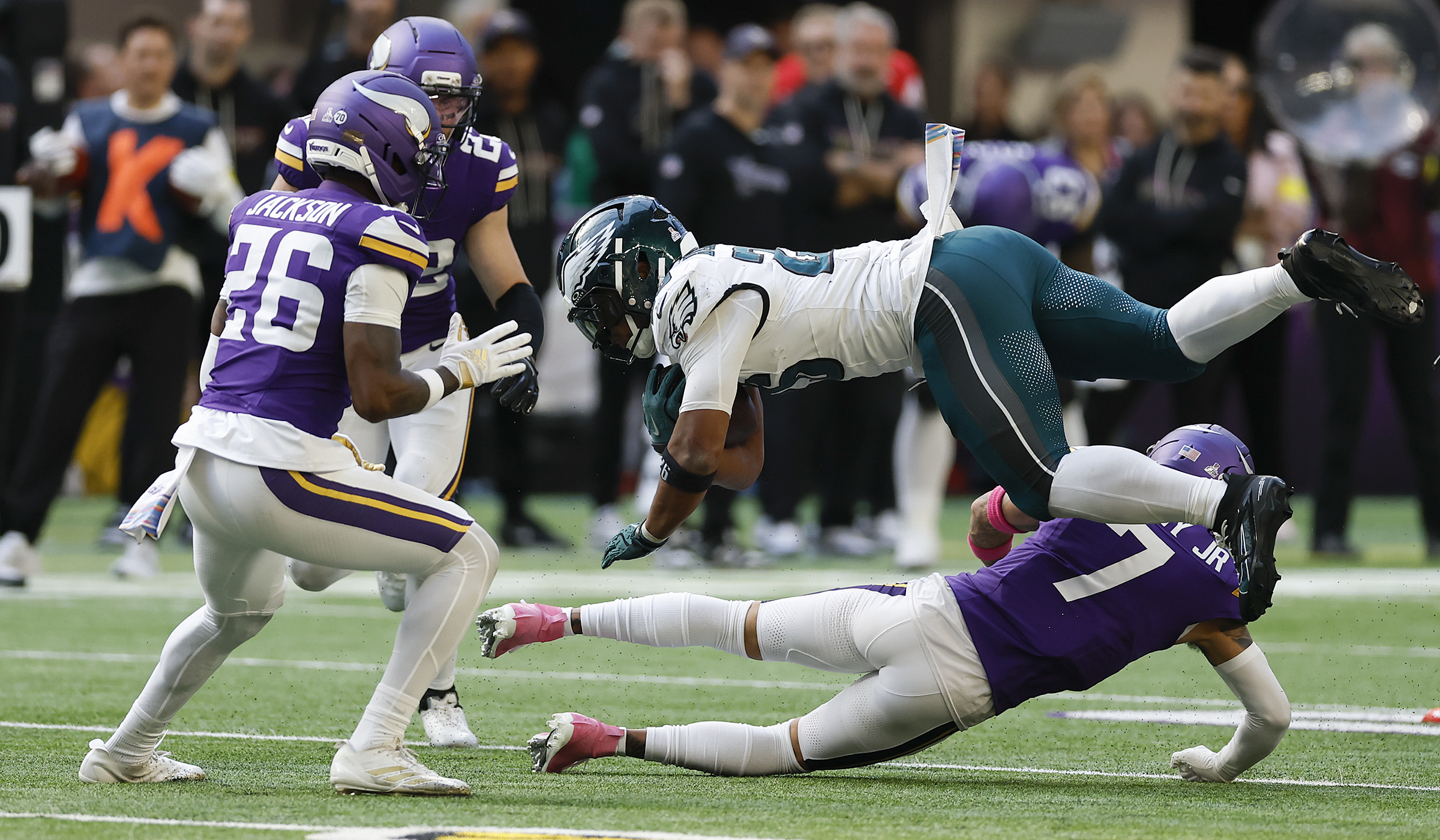
Eagles running back Saquon Barkley has struggled to break loose all season, and Sunday at Minnesota continued that trend.
He has missed holes, but the interior of the O-line has also struggled. Brett Toth got tossed into the barrage for Jurgens even though he has mostly played guard this season. Dickerson is clearly not 100%. And right guard Tyler Steen’s performance has been up and down.
“Saquon is the best and I don’t want him to feel like he’s carrying that by himself,” Hurts said. “It is a group effort.”
Hurts still hasn’t factored as much in the running game. He had an early keep that netted no gain. He used his arm instead to offset what the ground attack lacked. It wasn’t as if Patullo dropped Hurts back an exorbitant amount. The run-pass ratio was a relatively balanced 45-55.
But the Vikings’ aggressive defense offered opportunities downfield that the Eagles took advantage of in the second half.
“The thing was to come in and establish the run,” Hurts said. “That’s what we wanted to come in and do, and the game just flowed the way it did, and we were able to be efficient in the pass game. KP was very timely, and I think we were able to doctor up some things on the sideline and work through some things, but those guys made big-time plays.”
Those guys — Smith and Brown — had been clamoring for more deep shots. Hurts throws the long ball as well as any quarterback, but he’s had a few uncharacteristic misses this season. But he connected on all five deep passes for a career-high 215 yards when the Vikings had allowed only three deep completions all season, according to NextGen Stats.
Smith finished with a career-high 183 receiving yards on nine grabs, while Brown had four catches for 121 yards and two touchdowns. Both receivers caught passes on scramble drills when Hurts extended plays. But there were also completions within structure, like Brown’s 26-yard seam route score.
“You see it sometimes on the sideline. Sometimes in the huddle. Sometimes he’ll call the play, he’ll say a little slick remark,” Smith said. “And, OK, he sees it. He knows what’s coming.”
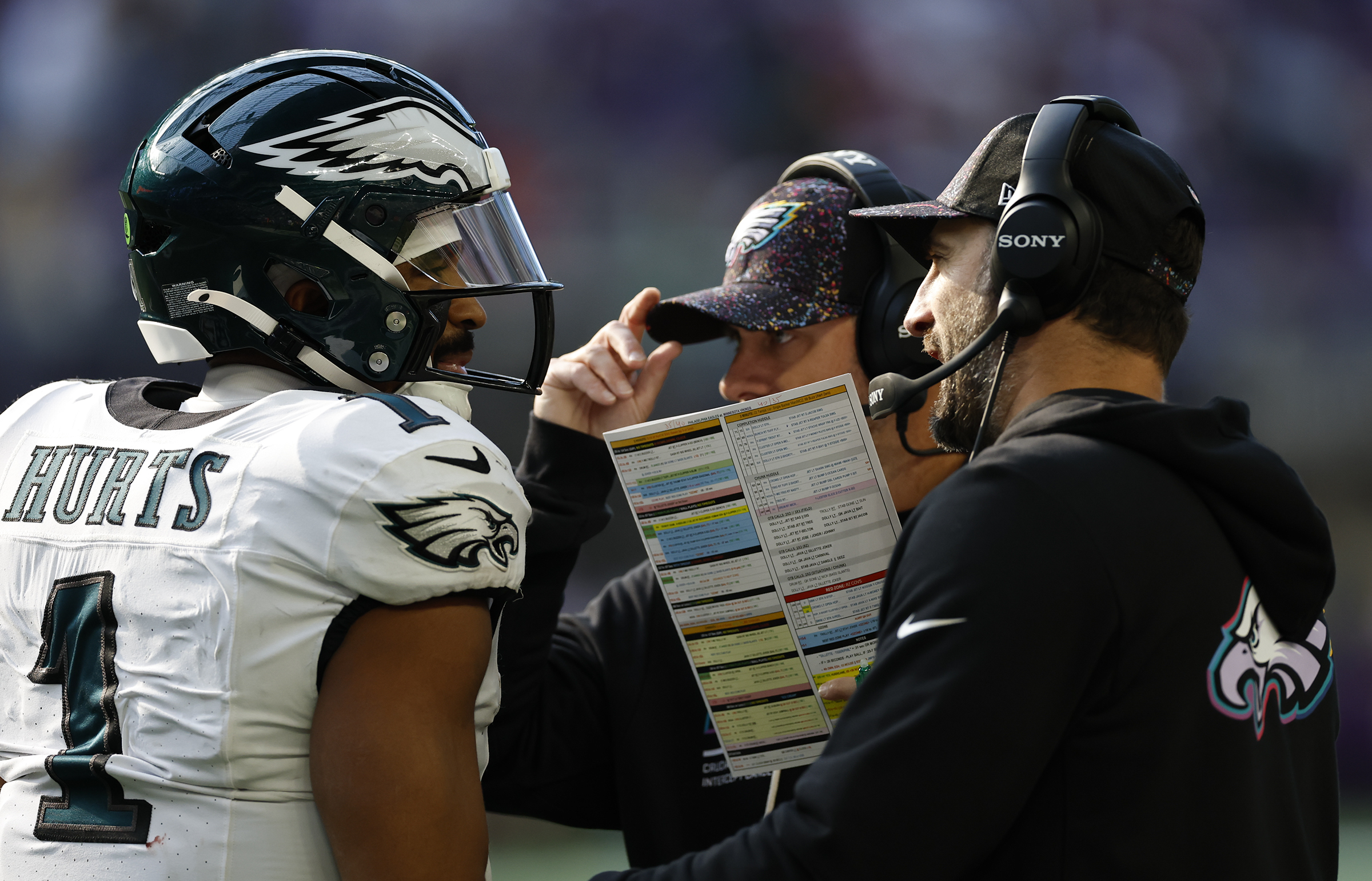
Eagles head coach Nick Sirianni (right) talking to quarterback Jalen Hurts with offensive coordinator Kevin Patullo.
Hurts knew what was coming on third-and-9 and the game on the line. Barkley had already been stopped on first down, and a second-down toss to Brown fell incomplete. A run would have forced Minnesota at least to take a timeout.
But Hurts’ pre-snap read indicated Brown would be matched up in man coverage. He singled his receiver to run a “sluggo” route. Brown got Rodgers to sit on the slant and pulled in the 45-yard kill shot to cement what was one of Hurts’ best-ever games.
Mailata said it was second to Super Bowl LIX, when Hurts similarly had to step up when Barkley was kept in check. The 27-year-old seems to play his finest when public doubt seeps in about his capabilities.
“It was just a matter of trying to find ways to get it done,” Hurts said. “It’s not a time to hope. It’s not a time to want or wish something can happen. It’s the time to make it happen. And I think that was a collective thing by everybody.”
Eagles offense still lopsided
The Eagles collectively didn’t suggest they solved all their problems. The running game issues aren’t going away, although having under-center play-action on film could make opponents alter how they defend Barkley.
And one outstanding outing does not make Hurts a drop-back maestro. Sirianni and Patullo likely don’t want an offensive identity that has him throwing as much as he did in losses to the Denver Broncos and Giants.
He can do it, but if the 5-2 Eagles are to have any hope of making a postseason run, they have to be multiple on offense.
“Identity is important. Don’t get me wrong,” Hurts said. “But for a long time now we find ways to win games in a ton of different ways.”