“I hate to leave it,” said Stephanie Tauman, “but it’s just too big for me.”
Tauman has spent six years in her four-bedroom, 3½-bathroom 1957 mid-century modern home in Drexel Hill. She bought the house sight unseen in 2019 after viewing it online.
But now, at 3,314 square feet, “it has gotten very big,” so she is planning to move to a smaller home. Tauman, an artist and art teacher, hopes to settle in Philadelphia.
Living room
She does not know who originally commissioned the split-level house. She already owned some mid-century modern furniture and other items when she bought it.
The approach to the house is along a slate walkway with arts and crafts style light fixtures. The exterior is stone and mahogany, and the foyer has a slate and mahogany theme.
The four bedrooms are on the top level, and there are three terraces connecting to the outdoors.
Kitchen
The middle level has the foyer, dining room, kitchen, and sunken living room, which includes a working gas fireplace.
The first level has the family room, powder room, and two-car garage with a heated workroom.
The finished basement has Tauman’s art studio.
Front hall
The eat-in kitchen has a 36-inch cooktop, double convection wall ovens, Corian countertops, and refaced cabinetry.
The family room has a wet bar with sink and second dishwasher.
Terrace
The primary bedroom has an en suite bathroom with whirlpool tub, stand-up shower, walk-in closet, and views of Pilgrim Park.
Another bedroom has mahogany built-ins and could serve as a nursery or study. The hall bath has a large corner bathtub.
Primary bedroom
There is a high-capacity water heating system and landscape lighting.
The house is listed by Joseph Bograd of Elite Realty Group for $729,900.
Sasha Kinney fears she cannot afford the $750 a month it will cost to keep her Affordable Care Act health plan in 2026. But she will put the insurance bill on a credit card before risking a medical emergency without access to the doctors she sees regularly.
The 42-year-old Drexel Hill resident’s insurance costs soared this year, after Congress did not extend a federal incentive program that ensured that no one paid more than 8.5% of income on health coverage.
She earns enough doing freelance work for nonprofits, while serving as her mother’s primary caregiver, that she is not eligible for Medicaid, the publicly funded health program for low-income people.
A private health plan through Pennsylvania’s Obamacare marketplace, Pennie, was a major expense, but one she prioritized to help manage her chronic headaches and stress-related pain. But the incentive program expired at the end of last year, leading to skyrocketing ACA insurance costs in Pennsylvania and across the country. Kinney will now pay an extra $250 without the added tax credit.
“I will go into debt because of these increasing costs,” she said. “But it still seems better than not having coverage.”
Congress has failed so far to strike a deal to bring back tax credits that have helped record numbers of Americans get health insurance. The U.S. House of Representatives approved legislation last week that would renew the program for three years, but it is unclear if the Senate will act.
President Donald Trump on Thursdayannounced a healthcare plan that White House officials said would help address rising healthcare costs by creating new drug price controls and sending health subsidies directly to consumers. The sparsely detailed plan is intended to serve as a framework for Congress, though officials did not say which lawmakers are actively working on new healthcare legislation, the Associated Press reported.
Meanwhile, people who are covered by Obamacare plans are running out of time to decide how to handle massive price hikes that doubled the average cost of the health plans in Pennsylvania.
The deadline to enroll in a plan for 2026 in Pennsylvania and other states is Jan. 31. After that date, people can drop their coverage if they find it is too expensive, but they will not be able to select a new plan until the fall enrollment period.
In Pennsylvania, about 70,000 people who bought Pennie plans in 2025 have decided they cannot afford the price increase and dropped their coverage. The dropout rate is unprecedented — about 1,000 people a day, said Devon Trolley, Pennie’s executive director.
Nationally, about 800,000 fewer people have selected Obamacare plans compared with this time last year, a 3.5% drop in total enrollment so far, according to the AP.
With just weeks to go in the enrollment period, marketplace leaders are urging people to think carefully about whether they can afford their plan for the full year and to look at other Pennie plan options. If Congress ultimately renews the enhanced tax credits, they have said, they would work quickly to adjust prices.
“At this point, we are telling people they should make the best decision for their family based on the current cost,” Trolley said. “We want to make sure people who currently have coverage aren’t staying with a plan they can’t afford.”
Trolley worries that people will stick with a plan they like, not realizing they can no longer afford it, only to be forced to drop the coverage and become uninsured partway through the year.
window.addEventListener(“message”,function(a){if(void 0!==a.data[“datawrapper-height”]){var e=document.querySelectorAll(“iframe”);for(var t in a.data[“datawrapper-height”])for(var r,i=0;r=e[i];i++)if(r.contentWindow===a.source){var d=a.data[“datawrapper-height”][t]+”px”;r.style.height=d}}});
Congress considering tax credit extension
The add-on tax credits that expired at the end of 2025 were introduced in 2021 and have been renewed by Congress annually since then.
In Pennsylvania, the federal incentive program ensured the vast majority of enrollees qualified for at least some amount of financial help, driving peak marketplace enrollment of 497,000 in 2025.
The program became a major sticking point in federal budget discussions last fall, with Democrats forcing a government shutdown after Republicans refused to include the tax credits without significant restrictions.
The budget ultimately passed without the tax credits after key Senate Democrats, including Pennsylvania’s John Fetterman, voted with Republicans to end the shutdown.
Last week, 17 House Republicans — including Pennsylvania Reps. Brian Fitzpatrick, Robert Bresnahan, and Ryan MacKenzie — sided with Democrats to approve legislation that would reinstate the tax credits for three years. The measure must be approved by the Senate, and would need to return to the House to consider any changes.
While the incentive program’s expiration is a major blow to the Obamacare marketplaces, Trolley, Pennie’s executive director, urged people not to rule out finding affordable coverage.
President Barack Obama’s landmark health law also included income-based tax credits for people who earn less than 400% of the federal poverty level — about $60,000. These tax credits cannot expire because they are part of the law.
“We have been encouraging people to not assume it’s too expensive,” Trolley said.
Devon Trolley, executive director of Pennie, has been outspoken about how cuts to ACA tax credits are affecting people who buy Pennie health plans. Pictured during a 2025 roundtable with Pennsylvania lawmakers, stakeholders, health systems at the University City Science Center in Philadelphia.
Other factors that affect cost include household size, age, and income. People who are generally healthy and use insurance sparingly may be able to save money by opting for a plan that has a low monthly cost and a higher deductible (the amount of money spent out-of-pocket before the plan begins covering a greater share of costs).
Sasha Kinney, 42, of Drexel Hill, considered switching to a high-deductible health plan to lower her monthly premium, but ultimately stuck with her old Pennie plan because it offered better coverage.
In Drexel Hill, Kinney considered switching to a cheaper plan when she saw how much it would cost to keep her current coverage.
Her current plan has a low deductible, and even so, Kinney said, she still spends hundreds on co-pays and other costs not covered.
She worried that if she switched to a plan with even higher out-of-pocket costs, she would end up skipping appointments and avoiding needed care.
She routinely sees doctors and physical therapists, and didn’t want to risk having to find new providers.
“In the end I think it washes out — you can lower your monthly cost, but if the deductible and co-pays are higher, you’re paying the same,” she said. “There’s basically no way to save money.”
Part of Wonder’s sales pitch is that it offers something for everyone, from pizza and cheesesteaks to Mediterranean and steak.
That flexibility, with parents of finicky kids in mind, is part of what drew Eddie Jefferson to Wonder.
“The picky eater thing kind of sits with me,” said Jefferson, senior operations leader for Wonder’s Media location. “I have children who never really could settle on the same food. So it was like, ‘Oh, this makes sense.’”
Steve Skalis, of Springfield, picks up an oder of drunken noodles during Wonder’s soft opening in Media on Tuesday, December 16, 2025.
Jefferson said he wants Wonder to be more than just a chain takeout restaurant.
“I want to make sure we’re a staple of the community,” Jefferson said. “I do want to be here for a very long time.”
Wonder is donating $1 to Philabundance for every order at the Media location this week. Jefferson said he hopes that’s just the first local partnership and he will be able to be active in the community.
“Once we settle in to this community I’ll be able to be outside shaking hands and kissing babies.”
Restaurants available at the Media Wonder include:
Alanza
Alanza Pizza
Bobby Flay Steak
Burger Baby
Detroit Brick Pizza Co.
Di Fara Pizza
Fred’s Meat & Bread
Hanu Poke
Kin House
Limesalt
Maydan
Royal Greens
SirPraPhai
Streetbird by Marcus Samuelsson
Tejas Barbecue
Yasas by Michael Symon
Bellies
Room for Dessert
Wonder’s Media location brings the total to 91 sites across the Northeast, from Rhode Island to Virginia. The plan for 2026 is to more than double that, according to Jason Rusk, head of restaurant operations.
“Our plan is to grow 110 locations, so we’ll go from 91 locations to just over 200 locations by the end of next year,” Rusk said.
Eddie Jefferson, senior operations leader at Wonder in Media, reaches for one of many menus Tuesday, December 16, 2025.
Wonder plans to open locations in Drexel Hill and Roxborough in early 2026, a representative said. It is also planning a foray into Allentown and the rest of the Lehigh Valley.
Rusk said sales have been good across the Philly area’s 20-plus stores, with Cherry Hill one of the strongest openings.
“There is no sign of stopping,” Rusk said. ”I have no doubt in my mind that we will fully have a Wonder that services nearly every part of the broader Philly [area].”
This suburban content is produced with support from the Leslie Miller and Richard Worley Foundation and The Lenfest Institute for Journalism. Editorial content is created independently of the project donors. Gifts to support The Inquirer’s high-impact journalism can be made at inquirer.com/donate. A list of Lenfest Institute donors can be found at lenfestinstitute.org/supporters.
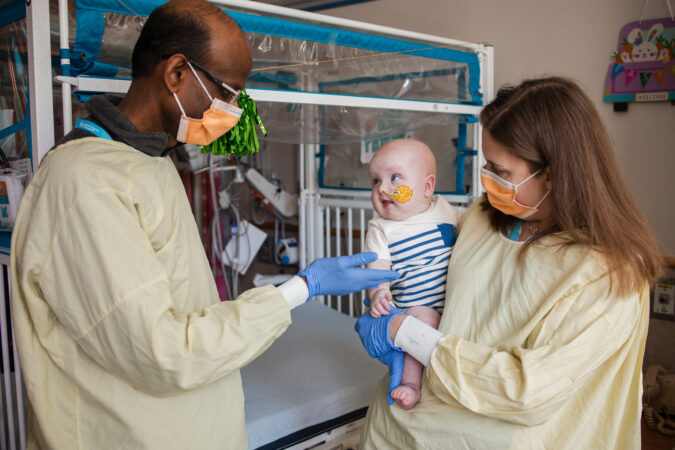
A Philadelphia-area infant named Baby KJ made international headlines after doctors at Children’s Hospital of Philadelphia and Penn Medicine successfully treated his rare, life-threatening liver condition with a gene-editing drug earlier this year.
Now back home with his family in Drexel Hill after more than 300 days in the hospital, KJ Muldoon has been named one of 10 people who helped shape medicine in 2025 by Nature, a British scientific journal.
Nature’s 10 is rounded out by career scientists and public health champions, including a neurologist treating brain disorders, an entomologist unearthing new details about mosquito-borne illnesses, and a data researcher who drew attention to troubling patterns in research retractions. The publication honored Baby KJ as a “trailblazing baby.”
KJ was born with a rare disorder that prevented his liver from processing protein. He was at risk of dangerous levels of ammonia, a byproduct of protein, building up in his bloodstream, traveling to his brain, and causing irreparable damage. The condition, called severe carbamoyl phosphate synthetase 1 (CPS1) deficiency, is deadly in more than half of cases.
With few treatment options and limited time, KJ’s doctors proposed a novel treatment using experimental gene-editing technology: They would analyze KJ’s genetic profile to find the genetic mutation that prevented his body from producing a key enzyme that breaks down protein. Then they would infuse a medication laced with bits of genetic code to find the misspelling and fix it, dramatically improving his chances of recovery.
Within six months, researchers at CHOP and Penn had developed a customized drug specifically for KJ using CRISPR, the buzzy shorthand for a scientific tool that works like a find-and-replace command. It is named after a stretch of genetic code utilized — clustered regularly interspaced short palindromic repeats.
KJ received three doses of the medication, and in June, he returned home after 307 days in the hospital. He will need ongoing care, but doctors say the treatment has dramatically improved his liver function.
“This is the future of medicine, a step toward using gene-editing for diseases for which there are few treatments,” Kiran Musunuru, director of the Penn Cardiovascular Institute’s Genetic and Epigenetic Origins of Disease Program and one of the lead doctors on KJ’s case, said during a call with reporters in May.
Baby KJ’s treatment was a first-of-its-kind drug customized to a unique genetic mutation. It will never be used for another patient, but Philadelphia researchers believe the CRISPR framework could be used to customize drugs for other patients.
Musunuru and Rebecca Ahrens-Nicklas, the director of CHOP’s Gene Therapy for Inherited Metabolic Disorders Frontier Program, are developing a new clinical trial to test the CRISPR framework for treating customized gene therapies for urea cycle disorders related to any one of seven genes.
The mechanism will remain the same, but the injection each patient receives will be customized to target their unique genetic mutation.
They are hopeful that their work will make bespoke treatments available to more people with rare diseases, Ahrens-Nicklas told Nature.
“Everyone saw the possibility and thought, ‘Why isn’t this available for my child?’”