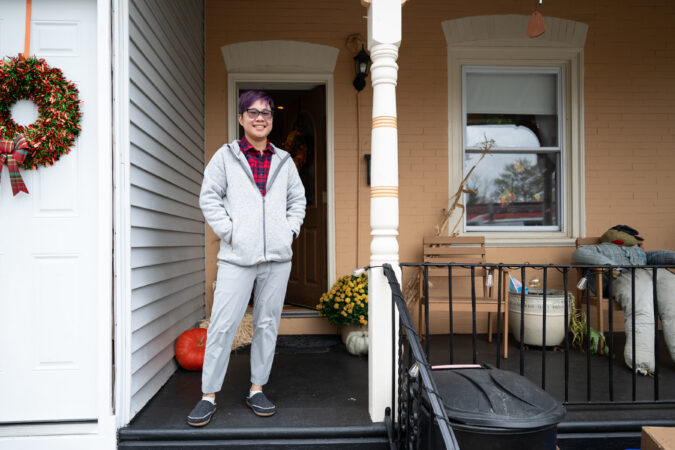
After living in small apartments in Queen Village and Rittenhouse Square, Cooper Lee Kidd was ready to start shopping for his first home.
The Washington, D.C., native, who works in banking and volunteers for the Philly Goat Project, wanted more indoor space and more yard for gardening and entertaining friends. He purchased his home one day before his 30th birthday.
“This is the first house that we saw,” Kidd said on an autumn afternoon. The light from his living room window highlighted a strand of his purple hair. “I looked at another one, a rowhouse in South Philly, but it was literally sinking into the ground. We came back to this one.”
The 900-square-foot rowhouse, nestled near the end of the block in East Mount Airy, was thoughtfully designed, he said. The home, outfitted with hardwood floors, tall ceilings, and lots of natural light, felt less cookie-cutter and industrial than the many other houses he saw online. Most important, he said, it was located in a progressive neighborhood with a strong sense of community.
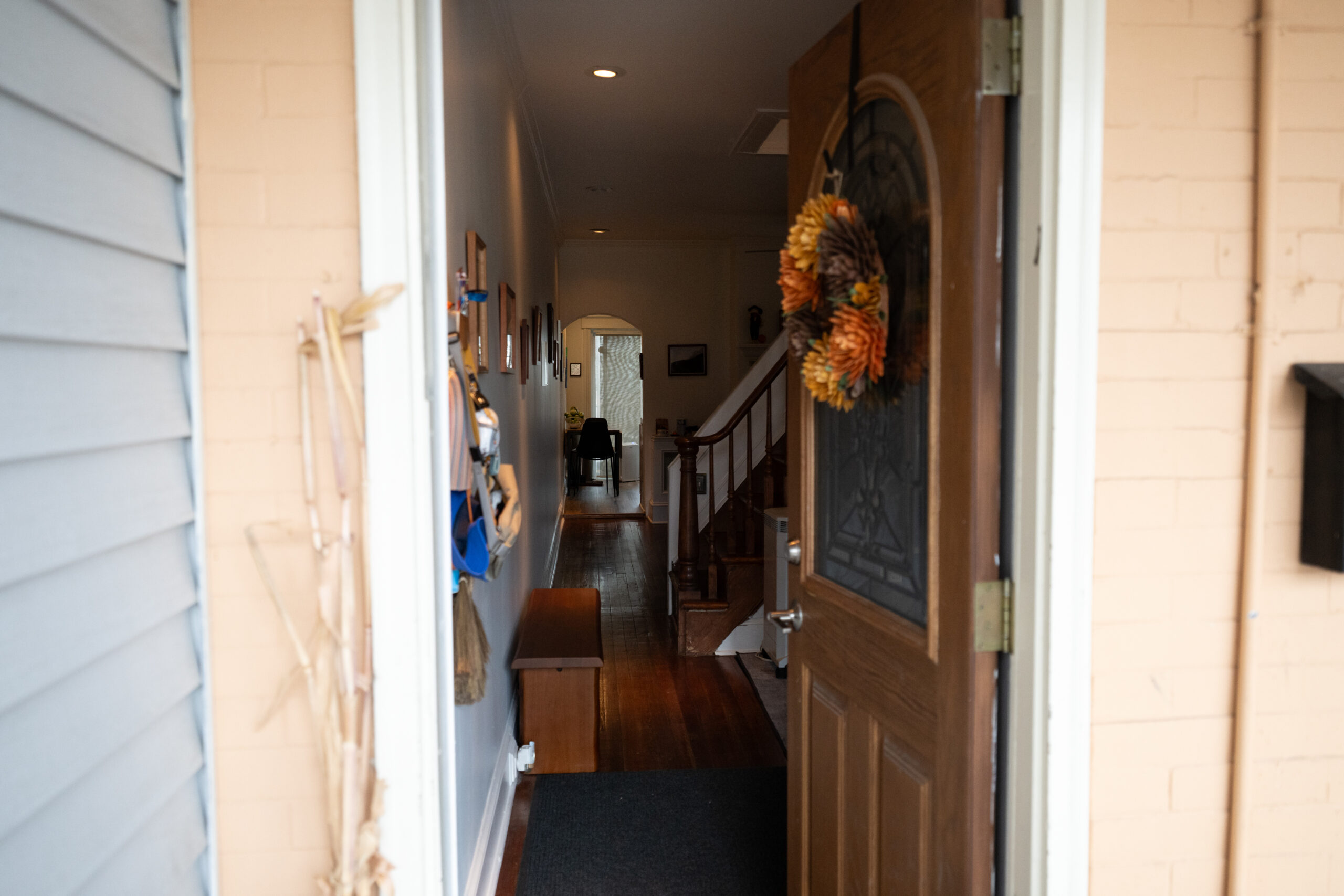
The entry to Kidd’s rowhouse.The living room, where a plant in the window enjoys the afternoon sun.
“I wanted to be very intentional about moving to the area. I didn’t want to live in a neighborhood that was all white. It’s also very economically diverse and that was very important to me,” he said. “Plus, you are near public transportation. You are near nature. There is so much happening here.”
In the front room, a large ornate mantel anchors the space. A decorative leaded glass door leads to a cozy porch. He painted the porch black and decorated it with a pride flag and corn that he grew in the backyard.
A steep set of stairs divides the living room and adjacent dining room, which like other areas of the home are decorated with Kidd’s photography, including images from his trips to Zion National Park, Assateague Island, and Chicago. Rustic wooden doors lead to a bathroom, which used to be a closet, and to the basement. The dining room boasts decorative tile, a large cabinet, and dining table.
“The previous owner left a lot of furniture. He got out of here very fast,” Kidd said. The owner, who moved out of the country, left the dining room cabinet, the TV stand, a bed frame, and even a French sports car that he tried to sell to Kidd.
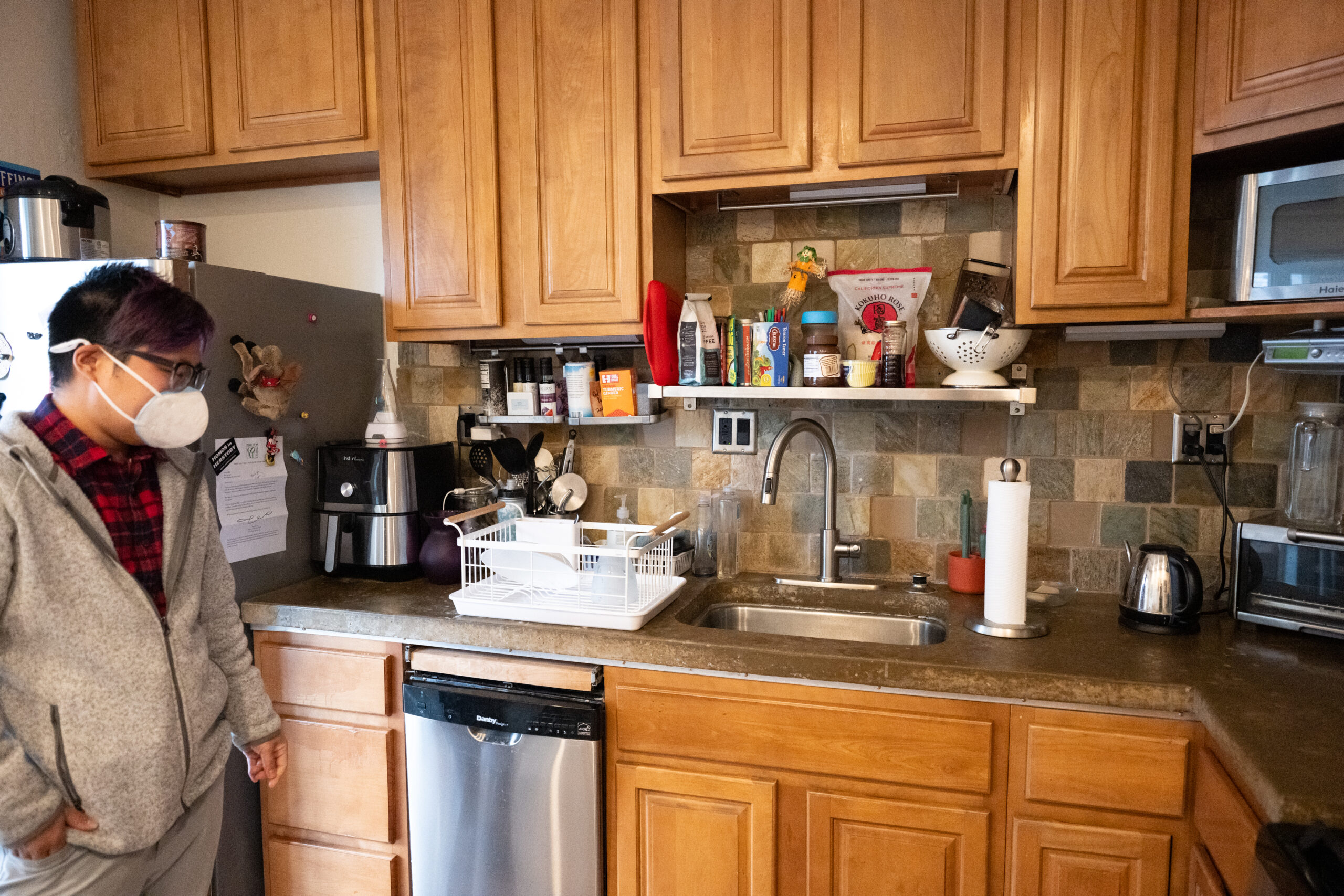
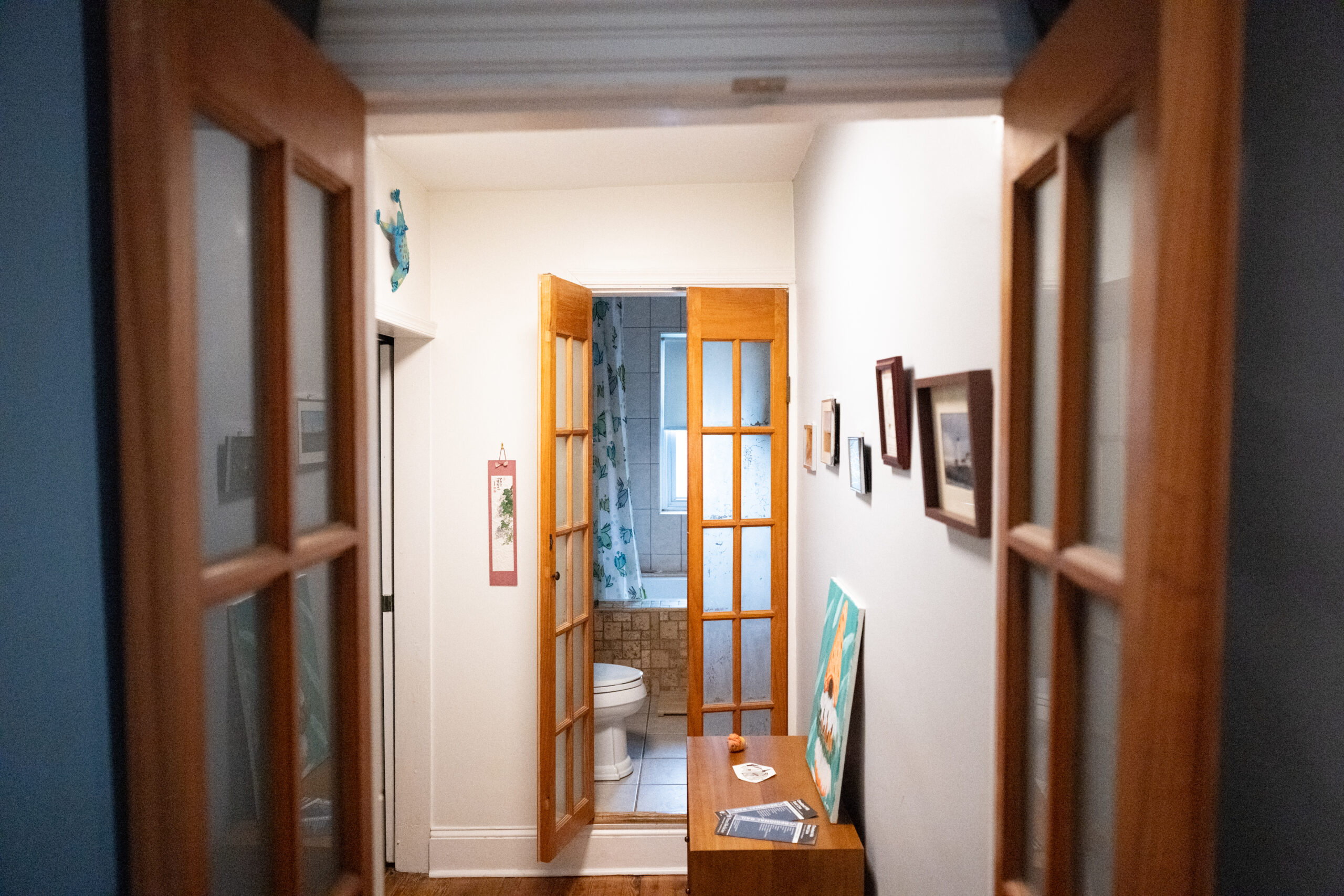
The larger kitchen with a dishwasher was an upgrade for Kidd.The upstairs landing and bathroom.
Kidd didn’t buy the car, but he was grateful for the furniture. “It’s very expensive to furnish a home.”
In the back of the rowhouse, the spacious L-shaped kitchen came with oak cabinets, concrete countertops, and a dishwasher. While he’s not a huge fan of the countertops, Kidd said he was grateful for the upgrades.
“When I was in Rittenhouse, I had to wash dishes in the bathtub,” he said.
Double doors lead to a quaint deck, wooden pergola, and postage-stamp yard.
The outdoor space was a major draw for Kidd. It took him weeks to clean out the yard, but he was able to grow several plants during his first summer in the home.
This past summer, Kidd spent some free time growing broccoli, kale, tomatoes, and native plants, purchased from local business Good Host Plants. It had taken weeks to clean out the trash that the previous owner had left in the yard.
“I had never gardened before,” Kidd said. “I grew up in a normal suburban home. My parents gardened. I don’t think my brother and I were interested at the time.”
The last batch of tomatoes Kidd harvested from his backyard garden is piled into bowls in his kitchen.Kidd’s garden during the summer, as the flowers were blooming. He worked to clear out the yard and make space for plants and seating after moving in.
Kidd attended the University of Maryland for his undergraduate degree in sociology. He went on to work for the Children’s Hospital of Philadelphia for several years, studying HIV in adolescents, before the grant funding his work was cut. He then returned to graduate school at the University of Maryland. In 2022, he started his current job in banking and finance.
He uses the second bedroom upstairs as his office. Painted a moody hunter green, the office is outfitted with built-in bookcases and a charming pocket door.
The front bedroom faces a historic cemetery. The open space provides for a nice view.
“The Realtor joked that I could commune with my ancestors,” he said. “But you get a really nice sunrise and sunset. There’s no obstruction.”
The home office is made cozy with a velvety couch and throw pillows.
Kidd is grateful the city and neighborhood even has affordable and attainable homes for someone his age.
“This home feels very cozy, so much more than the apartments. It feels like mine.”
Is your house a Haven? Nominate your home by email (and send some digital photographs) at properties@inquirer.com.
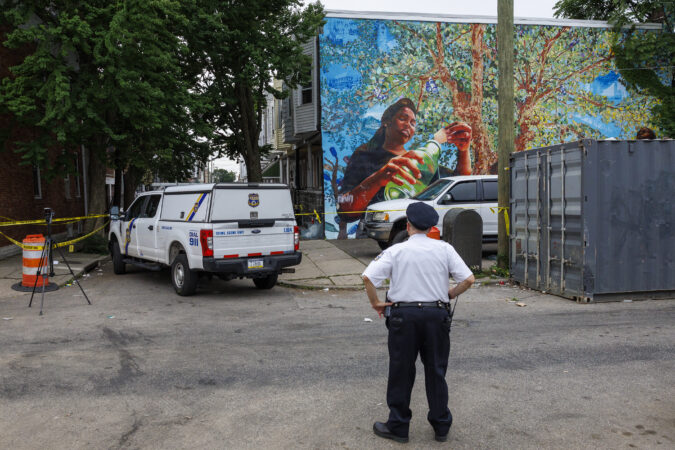
Two weeks after Kada Scott vanished, Philadelphia Police Detective Joseph Cremen stood over a patch of disturbed ground in a wooded stretch near an abandoned school in East Germantown.
He pushed aside a layer of loose twigs and pressed a six-foot branch into the soil. It sank only a few inches before stopping short.
That, Cremen testified Monday, was when he realized he’d found a shallow grave.
The Oct. 18 discovery ended a two-week search for Scott, 23, who disappeared on Oct. 4 after leaving the Chestnut Hill senior living center where she worked. An autopsy later determined that she had been shot in the head.
Cremen testified that the location of the grave was not discovered at random, but emerged from weeks of reviewing surveillance footage, digital data, and tips that helped authorities trace a path from the Awbury Arboretum to the wooded area where Scott was buried — and that linked her killing to Keon King, who is charged with murder, abuse of a corpse, and related crimes.
During a preliminary hearing Monday that stretched nearly five hours, prosecutors methodically laid out that evidence, replaying video after video on a courtroom TV as detectives testified about how they tracked Scott’s final movements and King’s efforts, they say, to conceal her death.
At the conclusion of the hearing, Common Pleas Court Judge Karen Simmons ruled that prosecutors had presented sufficient evidence for the case to proceed and ordered it held for court.
An attorney for Scott’s parents, Brian Fritz, called the ruling a “first step” in getting justice for their daughter.
“Kada Scott’s family is grieving,” he said. “In fact, their grief is unimaginable. But, so is their commitment for accountability and justice for Kada.”
Detectives testified that surveillance cameras at the Awbury Arboretum recorded a silver hatchback vehicle pulling into a parking lot less than an hour before Scott’s Apple Watch transmitted its final location at 1:14 a.m. on Oct. 5. Footage from the same cameras appeared to show two men removing an object from the car and walking in the direction investigators later followed to Scott’s burial site.
An anonymous tip helped lead investigators into the woods nearby the Ada H.H. Lewis Middle School in East Germantown.
Kim Matthews (second from left), mother of Kada Scott, holds a image of her daughter before a Domestic Violence Awareness walk at the Philadelphia Art Museum on Oct. 26, 2025.
Additional street cameras, prosecutors said, captured the same hatchback parked in a driveway behind homes on the 2300 block of 74th Avenue. Moments later, video showed a sudden flash of light and flames as the car was set on fire, destroying what authorities believe may have been physical evidence inside.
Investigators did not rely on any single camera, prosecutors emphasized. Instead, detectives testified that they reconstructed the timeline by stitching together footage from dozens of surveillance systems across the city. That effort, they said, led them to King, 21.
Street cameras recorded a 1999 gold Toyota Camry registered to King traveling in the vicinity of the arboretum around the same times activity was captured there, they said. Police also tracked the movements of one of Scott’s Apple devices after she left work, comparing its location data with license plate readers and surveillance video, detective Robert Daly testified.
“Everywhere this device went, Mr. King’s car went,” Daly said.
Cell phone records presented at the hearing showed that King and Scott had exchanged text messages in the hours before her disappearance, Daly testified.
The last message Scott sent asked King to call her when he arrived at the senior living center. The final incoming call on her phone, at 10:12 p.m. on Oct. 4, was from King, according to police.
Before Simmons ruled, King’s defense attorney, Robert Gamburg, argued that the prosecution’s case relied too heavily on circumstantial evidence and failed to place his client directly at the scene of the killing.
The surveillance footage, he said, did not clearly identify any faces and could not establish who was inside and around the vehicles.
He also pointed to testimony from a senior living center employee who said she saw Scott leave work that night and noticed a dark-colored Jeep parked outside the facility, not a silver hatchback.
“There is absolutely nothing connecting this young man to what happened to Ms. Scott,” Gamburg said, urging the judge to dismiss the case.
“At this level, with this quantum of evidence, for this type of case, it should be discharged today,” he said.
Assistant District Attorney Ashley Toczylowski countered that investigators had assembled a detailed and corroborated account of Scott’s final hours, one that showed not only King’s proximity to her disappearance, she said, but also steps taken afterward to destroy evidence.
“This isn’t coincidence,” she told the court. “It’s corroboration.”
When Cherelle L. Parker was a City Council member, she championed a strict residency rule that required city employees to live in Philadelphia for at least a year before being hired.
Amid protest movements for criminal justice reform in 2020, Parker said stricter residency requirements would diversify a police force that has long been whiter than the makeup of the city, and ensure that officers contribute to the tax base.
“It makes good common sense and good economic sense for the police policing Philadelphia to be Philadelphians,” she said then.
But today, under now-Mayor Parker, more police live outside Philadelphia than ever before.
About one-third of the police department’s 6,363 full-time staffers live elsewhere. That share — more than 2,000 employees — has roughly doubled since 2017, the last time The Inquirer conducted a similar analysis.
(function() {
var l2 = function() {
new pym.Parent(‘ppd_zips’,
‘https://media.inquirer.com/storage/inquirer/projects/innovation/arcgis_iframe/ppd_zips.html’);
};
if (typeof(pym) === ‘undefined’) {
var h = document.getElementsByTagName(‘head’)[0],
s = document.createElement(‘script’);
s.type = ‘text/javascript’;
s.src = ‘https://pym.nprapps.org/pym.v1.min.js’;
s.onload = l2;
h.appendChild(s);
} else {
l2();
}
})();
Today, the percentage of nonresidents is even higher among the top brass: Nearly half of all captains, lieutenants, and inspectors live outside the city, according to a review of the most recent available city payroll data.
Even Commissioner Kevin Bethel keeps a home in Montgomery County, despite officially residing in a smaller Northwest Philadelphia house that he owns with his daughter.
Most municipal employees are still required to live within city limits. Across the city’s 28,000-strong workforce, nearly 3,200 full-time employees listed home addresses elsewhere as of last fall. Most of them — more than 2,500 — are members of the police or fire departments, whose unions secured relaxed residency rules for their workers in contract negotiations. About a quarter of the fire department now lives outside the city.
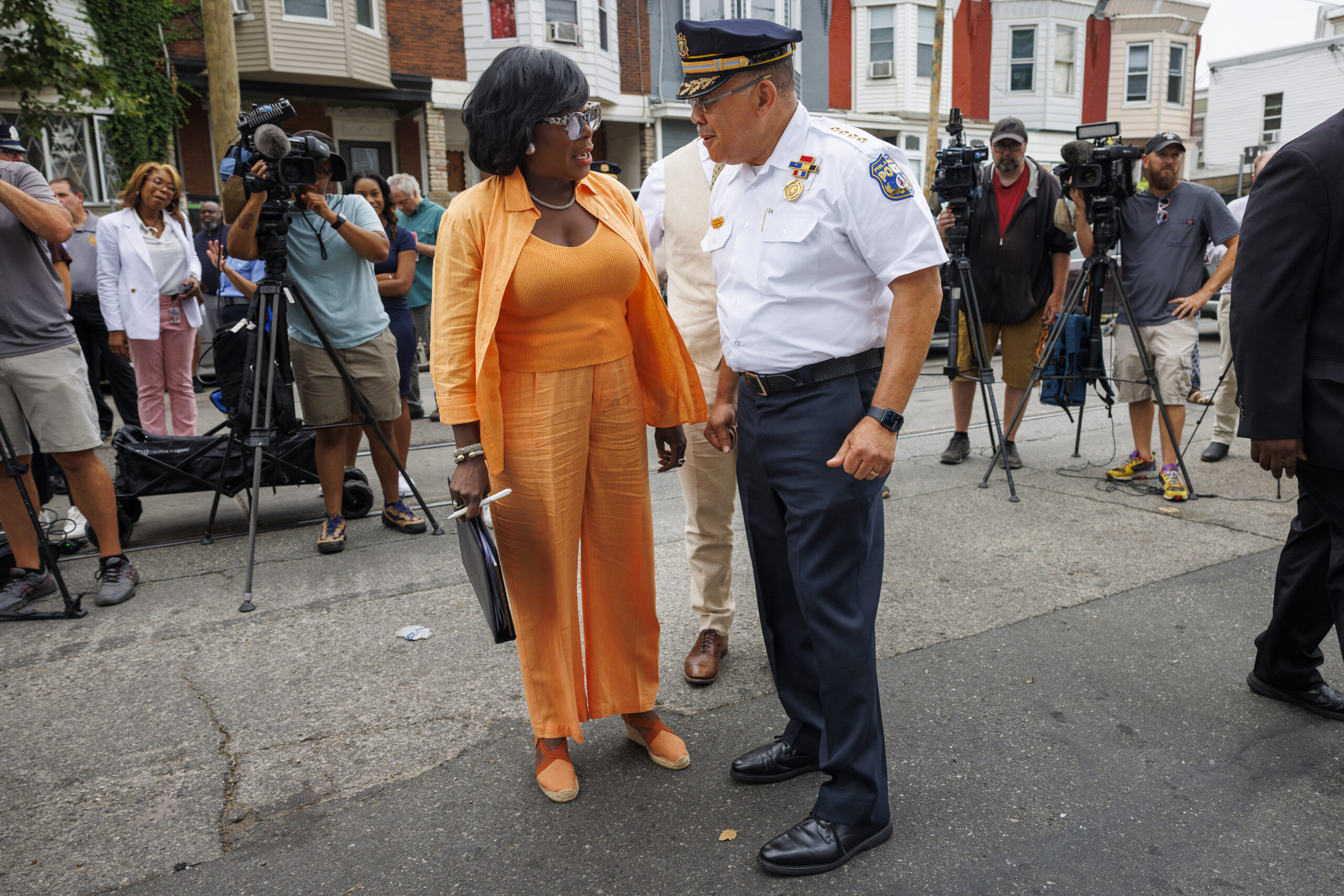
Philadelphia Mayor Cherelle L. Parker and Police Commissioner Kevin Bethel speak before the start of a news conference.
Proponents of residency rules in City Hall have long argued they improve rapport between law enforcement and the communities they serve, because officers who have a stake in the city may engage in more respectful policing.
But experts who study public safety say there is little evidence that residency requirements improve policing or trust. Some say the rules can backfire, resulting in lesser quality recruits because the department must hire from a smaller applicant pool.
A survey of 800 municipalities last year found that residency requirements only modestly improved diversity and had no measurable effect on police performance or crime rates.
“It’s a simple solution thrown at a complex problem,” said Fritz Umbach, an associate professor at John Jay College of Criminal Justice. “It doesn’t have the impact people think it will.”
Parker, a Philadelphia native who lives in the East Mount Airy neighborhood, says she would still prefer all municipal employees live in the city.
“When I grew up in Philadelphia, it was a badge of honor to have police officers and firefighters and paramedics who were from our neighborhood,” she said in a statement. “They were part of the fabric of our community. I don’t apologize for wanting that to be the standard for our city.”
‘Where they lay their heads at night’
What qualifies as “residency” can be a little pliable.
Along with his wife, Bethel purchased a 3,600-square-foot home in Montgomery County in 2017 for over a half-million dollars. Although he initially satisfied the residency rule by leasing a downtown apartment after being named commissioner by Parker in late 2023, he would not have met the pre-residency requirement the mayor championed for other city employees while she was on Council.
Today, voter registration and payroll data shows that Bethel resides in a modest, 1,800-square-foot rowhouse in Northwest Philadelphia, which he purchased with his daughter last year. While police sources said it was common for Bethel to sleep in the city given his long work hours, his wife is still listed as a voter in Montgomery County.
Police Commissioner Kevin Bethel speaks during the 22nd District community meeting at the Honickman Learning Center on Dec. 2, 2025.
Sgt. Eric Gripp, a spokesperson for the department, said in a statement that Bethel is a full-time resident of Philadelphia, and that while he owns a property outside the city, his “main residence” is the home in Northwest Philly.
Although sources say it was not unheard of for rank-and-file officers to use leased apartments to satisfy the requirement on paper, Gripp said “only a small number” of residency violations had required formal disciplinary action following an investigation by the department’s Internal Affairs Division.
That likely owes to officers’ increasing ability to reside elsewhere legally. The Fraternal Order of Police Lodge 5, which represents thousands of active and retired Philadelphia Police officers, won a contract provision in 2009 allowing officers to live outside the city after serving on the force for at least five years.
The union didn’t respond to a request for comment.
Few of the cops who left the city went very far.
While Northeast Philly and Roxborough remain the choice neighborhoods for city police, the top destinations for recent transplants were three zip codes covering Southampton, and Bensalem and Warminster Townships, according to city payroll data.
A few officers went much farther than the collar counties.
Robert McDonnell Jr., a police officer in West Philadelphia’s 19th district with 33 years on the force, has an official address at a home in rural Osceola Mills, Pa., about 45 minutes north of Altoona in Centre County.
A person who answered a phone number associated with McDonnell — who earned $124,000 last year between his salary, overtime, and bonus pay — declined to speak to a reporter.
Asked about the seven-hour round-trip commute McDonnell’s nominal residence could entail, Gripp said the department doesn’t regulate the manner in which employees travel to and from work.
“Our members serve this city with dedication every day,” he said, “regardless of where they lay their heads at night.”
A long and winding history
Versions of residency rules can be found as far back as the 19th century, when police recruits were required to live in the districts they sought to work in.
But when Mayor Joseph S. Clark pushed to reform the city charter in the 1950s, he sought to abolish the rules as an impediment to hiring, saying “there should be no tariff on brains or ability.”
Instead, City Council successfully fought to expand the restrictions. And, for more than five decades, the city required most of its potential employees to have lived in Philadelphia for a year — or obtain special waivers that, in practice, were reserved for the most highly specialized city jobs, like medical staff.
Many other big cities enacted similar measures either to curb middle-class flight following World War II or to prioritize the hiring of local residents. But the restrictions were frequently blamed for causing chronic staff shortages of certain hard-to-fill city jobs.
Officers Azieme Lindsey (from left), Charles T. Jackson, and Dalisa M. Carter taking their oaths in 2023.
Citing a police recruit shortage in 2008, former Mayor Michael A. Nutter successfully stripped out the prehiring residency requirement for cadets. Recruits were required only to move into the city once they joined the force.
A year later, the police union attempted to have the residency requirement struck from its contract entirely.
Nutter’s administration objected. But an arbitration panel approved a compromise policy to allow officers to live elsewhere in Pennsylvania after five years on the job. By 2016, firefighters and sheriff’s deputies secured similar concessions.
But experts say there’s little research showing that to be true.
“I am unsure if requiring officers to reside in the city is a requirement supported by evidence,” said Anjelica Hendricks, an assistant law professor at the University of Pennsylvania who worked for the city’s Police Advisory Commission. “Especially if that rule requires a city to sacrifice something else during contract negotiations.”
FOP leaders have long opposed the rule and said it was partly to blame for the department’s unprecedented recruitment crisis and a yearslong short-staffing problem that peaked in the aftermath of the COVID-19 pandemic.
In 2022, facing nearly 1,500 unfilled police jobs, former Mayor Jim Kenney loosened the prehire residency rule for the police department again, allowing the force to take on cadets who lived outside the city, so long as they moved into Philadelphia within a year-and-a-half of being hired.
Since then, recruiting has rebounded somewhat, which police officials attribute to a variety of tactics, including both the eased residency rules and hiring bonuses. The force is still short 20% of its budgeted staffing and operating with 1,200 fewer officers than it did 10 years ago.
Umbach, the John Jay professor, said the impact on recruiting is obvious: Requiring officers to live in a city where the cost of living may be higher than elsewhere amounts to a pay cut, which shrinks candidate pools.
“Whenever you lower the standards or lower the appeal of the job, you’re going to end up with people who cause you problems down the road,” he said. “A pay cut is just that.”
A veteran lawyer in the Philadelphia District Attorney’s Office has been disbarred in the region’s federal courts after a panel of judges concluded he “lied repeatedly” while seeking to overturn the death sentence of a man who killed an East Mount Airy couple in their home and left their infant daughter inside to die.
Paul George, an assistant district attorney who handles appellate cases, was a key player in his office’s attempts to have Robert Wharton’s death penalty reversed so he could serve a life sentence instead.
U.S. District Judge Mitchell Goldberg denied that request, but not before finding that District Attorney Larry Krasner’s office had provided incomplete and misleading information in its efforts to free Wharton from death row.
After Goldberg made his decision, George and a colleague who handled the case faced federal disciplinary proceedings to examine whether their conduct — which was also criticized by an appeals court — was intentionally deceptive.
As part of that process, three federal judges concluded earlier this year that George’s actions were “misleading and dishonest,” saying he had lied to Goldberg about key facts, “flouted the interests of the public and the victims’ families,” and acted as the “quarterback” of efforts by the district attorney’s office to undo or undermine all death penalty cases.
“George’s conduct was the result of a ‘selfish or dishonest motive’ — placing the DAO’s policy priorities above its professional and prosecutorial responsibilities,” wrote U.S. District Judges Paul S. Diamond, Gerald J. Pappert, and John M. Gallagher. They recommended that George be barred from practicing in the region’s federal courts, and Chief Judge Wendy Beetlestone affirmed that in an October order.
George has denied the accusations and last month filed an appeal. His attorneys acknowledged in court documents that he had made mistakes in his handling of Wharton’s case, but said the opinion recommending his disbarment was based on a broader set of “extraordinary allegations” that lacked evidence and targeted the office he worked for.
George has displayed “exceptional legal skills and the highest level of professional ethics and honesty” during his 48-year legal career, his attorneys wrote. He is scheduled to retire at the end of this year.
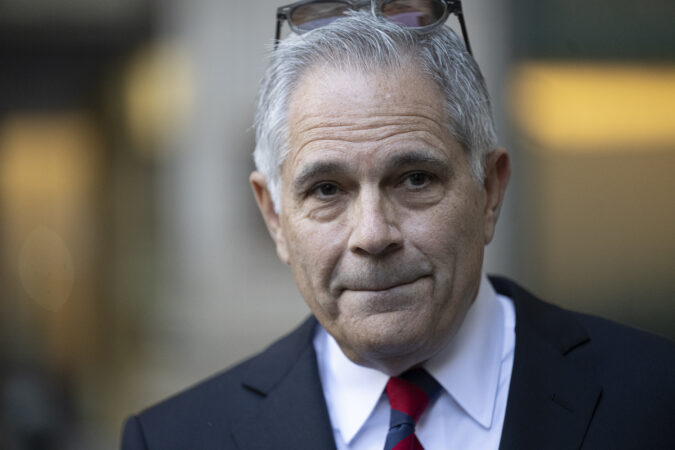
Krasner said in an interview that he was largely unable to comment because most of the disciplinary matter had unfolded under seal. But he said that George’s career “has been conducted vigorously and ethically,” and that he believed the appeals court would find that the opinion criticizing George was filled with “factually and legally incorrect” statements.
“We will continue to try to be fair each and every day, and, as change makers often do, we will face the consequences of making change from people who could’ve made it, but didn’t, in their day,” Krasner said.
The disciplinary saga is the latest chapter in the unusually protracted fallout from Wharton’s death penalty appeal, and it might not be the last.
George’s colleague Nancy Winkelman — another supervisor in the district attorney’s law division — has also been the subject of a disciplinary inquiry in federal court for her role in the Wharton matter. Records in her case remain under seal.
The documents connected to George’s case were also supposed to remain secret, but they became public this week when aspects of his appeal were publicly filed in court. On Thursday, his attorney, David Rudovsky, filed court documents to have the entire record of the underlying disciplinary proceeding made public.
George became involved in the Wharton matter in 2019, while Wharton was appealing his death sentence in federal court.
Wharton had been convicted along with a codefendant in the January 1984 strangulation and drowning deaths of Bradley and Ferne Hart. A jury concluded that Wharton killed the couple over a disputed debt, then turned off the heat in their home and left the couple’s 7-month-old baby, Lisa, to freeze to death. She survived.
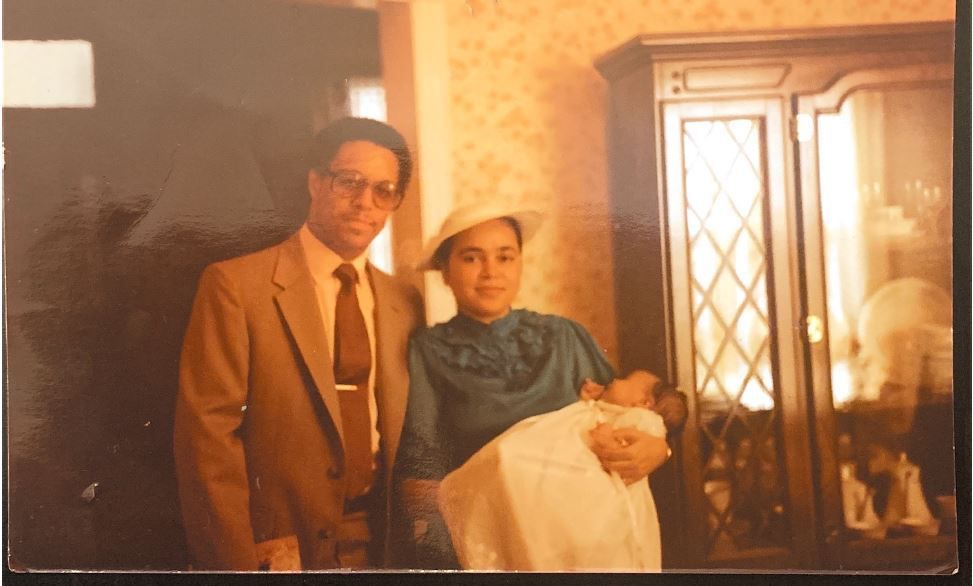
Bradley and Ferne Hart in a 1983 photo with their baby daughter, Lisa, on her christening day. The husband and wife were murdered in their East Mount Airy home in January 1984 by Robert Wharton and Eric Mason. The baby was unharmed, but left to die in the house. She survived.
In the decades before Krasner took office, the district attorney’s office had consistently opposed Wharton’s attempts to overturn his conviction and sentence.
But Krasner said on the campaign trail that he would “never pursue a death sentence in any case.” And after he was sworn in, his office changed its stance on the Wharton case, saying it had “carefully reviewed the facts and the law” and agreed that Wharton should be spared from death row.
Goldberg did not immediately agree, and wrote in court documents at the time that the district attorney’s office had not sufficiently explained its reasoning for its “complete reversal of course.”
He then asked the Pennsylvania Attorney General’s Office to provide materials he said the district attorney’s office was not sharing. And after investigating, the attorney general’s office said it found evidence including documents detailing Wharton’s past attempts to escape from a courtroom — information that Goldberg said would have been crucial to his decision, but that George and Winkelman later said they were not aware of.
The attorney general’s office also said Krasner’s office had misled Goldberg about its communications with the victims’ relatives. Although the district attorney’s office gave the impression that the Hart family supported its change in stance on the death penalty, the truth was that prosecutors had spoken only to one relative, and never contacted the couple’s only surviving child, Lisa Hart-Newman, who vehemently opposed the idea of lessening Wharton’s sentence.
George later acknowledged that was a mistake, and Goldberg ordered Krasner to write apology letters to the Harts’ relatives.
In the disciplinary opinion filed earlier this year, the three-judge panel criticized George’s conduct throughout the case, saying that he “repeatedly lied” to Goldberg and that his efforts nearly undercut the integrity of a duly imposed jury verdict.
And, in an unusually pointed fashion, they ascribed a motive to his actions — accusing George of flouting legal guardrails to advance the policy interests of Krasner’s office.
“Upon the current District Attorney’s first election … the DAO established a policy, with Paul George at quarterback, to undermine duly imposed death sentences challenged in post-conviction proceedings,” the judges wrote. “George filed the concession in Wharton pursuant to that policy, not as the result of any review, careful or otherwise, of the facts and the law.”
George said in court documents that was not true, and his attorneys denied there has ever been an office policy opposing all capital sentences.
Krasner also said it was “flatly untrue” that his office has ever had a policy against the death penalty, and he denied that the committee he formed to review capital cases — which George once served on — was designed to undo such sentences.
“We follow essentially the same process as our predecessors, who routinely supported the death penalty and who were usually wrong,” Krasner said. “We actually try to be fair all the time. And that committee has concluded on many occasions that the death penalty should be reversed; it has also concluded with the law division in individual cases that the death penalty had to be affirmed. Those are the facts.”
George’s disbarment in federal court has not affected his ability to practice in state court, though George, 75, has already begun to wind down his office duties ahead of his retirement, his attorneys wrote in court documents.
They said that the penalty imposed against him was unwarranted and should be reversed.
“To label Mr. George as a liar, and by disbarment, place him among the worst of the worst lawyers in our community, is highly disproportionate and offends basic tenets of justice,” his lawyers wrote.
The federal judges who recommended his discipline disagreed.
“In the final years of his career,” they wrote, George “used [his] experience to circumvent and subvert, in misleading and dishonest ways, verdicts rendered by judges and juries who heard the evidence and applied the law.”
A second woman is accusingPhiladelphia doctor John Smyth Michel, the medical director and owner of Excel Medical Center, of sexual abuse. She said Michel touched her inappropriately when she worked for him several years ago, according to a recent court filing by the Philadelphia District Attorney’s Office.
Prosecutors charged Michel with felony rape and sexual assault earlier this yearafter a female patient said he raped her during an October 2024 office visit.
Michel, 55,of Jenkintown, told police and state medical licensing authorities that he had sex with the 39-year-old patient, but he claimed it was consensual, criminal and state licensing records show.
The new accusations involve a former female employee who worked for Michel as a medical assistant from 2015 to 2019 at his East Mount Airy office on Stenton Avenue and at another location in Germantown on Chelten Avenue.
She recently told law enforcement authorities that beginning in 2018 Michel touched her breasts over her clothing on multiple occasions while she was working in the office. He additionally groped her vagina over her clothing before she quit in 2019.
The accusations have not resulted in new charges at this time, but the investigation remains ongoing, according to Marisa Palmer, a spokesperson for the DA’s office.
Prosecutors are seeking to introduce the groping accusations as evidence to bolster its sexual assault case against Michel, given there were no witnesses to the alleged rape.
“The incidents reveal a common plan, scheme or design on the part of the defendant to engage in unlawful and similar nonconsensual sexual conduct with vulnerable women in his medical offices,” Assistant District Attorney Eamon Kenny wrote in a Nov. 24 court motion.
The judge presiding over the criminal case must decide whether to grant Kenny’s motion and put the 34-year-old former employee’s accusations before jurors at trial.
The Inquirer does not identify alleged victims of sexual assaultwithout their permission.
Michel did not return phone calls and emails from The Inquirer this week. His criminal defense lawyer, Andrew Gay Jr., declined to comment Wednesday.
Michel founded Excel Medical Center, whichgrew to more than a dozen medical clinics located throughout the city, with about 20,000 patients and 200 employees.
Last month, Excel’s general manager wrote a letter to patients informing them the practice “will be ceasing operations” as of Dec. 1. “We truly value the trust you have placed in us for your care,” the manager stated in the Nov. 11 letter obtained by The Inquirer.
A woman who answered the phone at Excel’s main location in West Mount Airy on Thursday said the practice was not taking any new patients in preparation of closing. She said the practice might resume operations and accept new patients after the new year. Michel’s lawyer declined to comment when asked about the practice’s status.
The criminal case, which is pending in Common Pleas Court, involves a then-38-year-old patient.
According to police and court records, she accused Michel of kissing her during a May 2024 exam at his East Mount Airy location.
She told him “no,” left the office, and did not report the kissing incident.
About five months later, she went to an appointment at Michel’s North Philadelphia office on West Diamond Street. During the Oct. 14, 2024, visit, she says Michel raped her with such force that her head banged twice against the exam room wall.
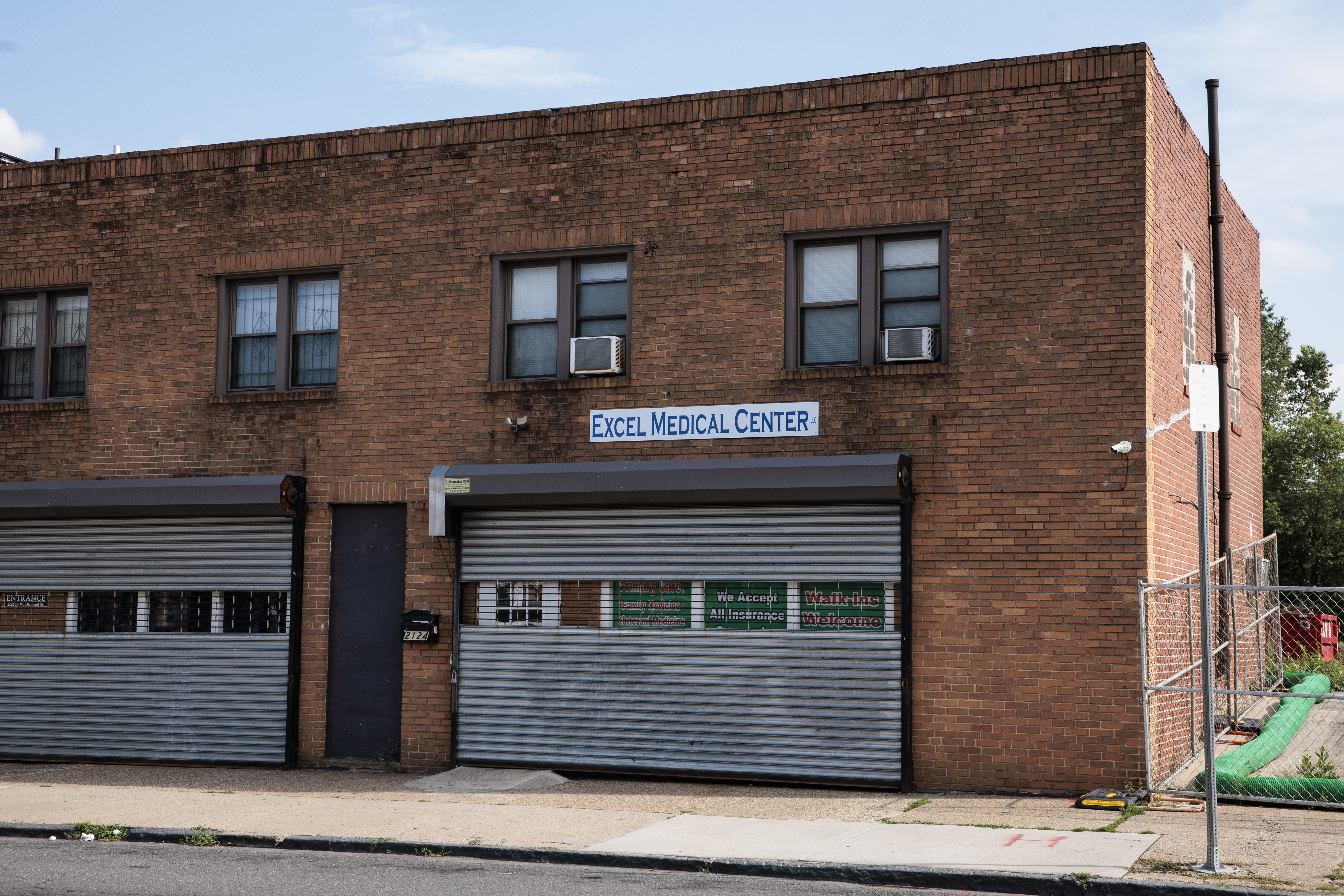
The exterior of Excel Medical Center at 2124 Diamond Street in Philadelphia.
In early November 2024, she told her husband what had happened and subsequently filed a police report. Michel was arrested and charged about three months later.
Michel’s trial was initially slated for Dec. 9, but during a hearing on Monday, a judge postponed it until Feb. 17 after the DA’s office asked for more time to investigate, court records show.
Michel’s suspension nears end
In June, the State Board of Osteopathic Medicine, which regulates and oversees licensure of osteopathic doctors like Michel, disciplined him for having sex with a patient — a violation of state regulations.
He apologized to the board in a letter, saying, “I fully acknowledge that I crossed a professional boundary” and is “profoundly contrite.”
The board suspended his medical license for six months, followed by 18 months of supervised probation, and fined him $4,000. Michel’s suspension is set to end on Dec. 11.
If convicted in the criminal case, Michel could permanently lose his medical license.
In an e-mailed statement on Thursday, the Pennsylvania Department of State, which oversees professional licensing boards, said its prosecution division “continues to closely monitor Dr. Michel’s criminal charges and review his compliance with the terms of the consent agreement.”
Abuse in office hallways
The accusations outlined in Kenny’s motion include new details of sexual misconduct. The former employee said Michel approached her from behind to “grab her breast over her shirt.”
She was stunned and “hated the feeling,” but she feared losing her job so she didn’t say anything to him.
Once, he simultaneously “cupped” her breast and vagina over her clothes with his hands. She turned around and screamed at him to stop touching her, according to the motion. He replied, “`You know you want it and you know you like it,’” she recounted.
She said she couldn’t quit because she needed the income and told her co-workers about the abuse. Those colleagues helped her “avoid him” while at work. She also told her husband, though she persuaded him not to confront Michel.
She resigned in 2019 after landing a new job. They had no contact until this year when he texted her.
When she asked why he wanted to talk to her after so much time had passed, Michel texted nevermind, the former medical assistant told prosecutors. She then wrote back, “explaining how she felt about his abuse all these years later, that the thoughts of it still traumatized her.”
Inquirer staff writer Chris Palmer contributed to this article.