On the second day her kindergartener was off from his Philadelphia public school because of snow, Karen Robinson shut herself away in her Fairmount home, hoping to take a 15-minute meeting for an important work project.
Her husband had put up a baby gate to signal to 5-year-old Sam that mom was briefly off limits.
Naturally, “my son crawled under the baby gate to come find me,” said Robinson, whose son attends Bache-Martin Elementary. “If I’m working, he wants to be right next to me.”
Superintendent Tony B. Watlington Sr. gave beleaguered parents a reprieve Wednesday afternoon, saying schools would re-open for in-person learning Thursday. But the week was tough for many to navigate.
For parents who rely on hourly work, or jobs that have no remote flexibility, the inclement weather-forced school changes have meant either foregoing pay or figuring out childcare arrangements that are often costly, complicated, or both.
North Philadelphia mom Asjha Simmons’ son attends a charter school that’s been closed — no virtual learning — since Monday.
Simmons runs her own business, so is able to be flexible with her schedule and stay home with her son. But she’s getting antsy.
“I feel forced to be in the house and it’s killing me,” Simmons said. “I would rather be in the gym than in the house. And I don’t even go to the gym.”
Simmons’ son, who’s 12, relishes the down time since “he has every screen known to man on,” she said. She keeps the snacks coming, and it’s all good. (He was less than thrilled when Simmons made him shovel snow, she said.)
Leigh Goldenberg said she was having uncomfortable flashbacks to the pandemic, when her daughter completed virtual kindergarten.
“For me, it’s an emotional regression to that terrible time,” said Goldenberg. “And I feel for the people that didn’t build up that muscle before.”
Virtual school with a fifth grader is much easier than virtual school with a kindergartener, said Goldenberg, whose daughter attends Kirkbride Elementary in South Philadelphia. Her daughter spent 30 minutes on Tuesday completing schoolwork, and managed to keep herself busy socializing with friends online and outside, a short walk away in their neighborhood.
Goldenberg is trying to keep things in perspective — this is not forever, this is not the pandemic.
But, she’s still frustrated.
“All the suburban schools around us went back already, but here in the city, we’re stuck with a giant pile of snow at the end of our street, and it feels pretty unfair,” she said.
Coral Edwards was prepared for Monday’s snow day, but when the district announced a virtual day Tuesday, she began to panic.
“I was like, oh my gosh, there’s a real possibility the entire rest of the week will be virtual,” said Edwards, who lives in Graduate Hospital and has a seven-year-old son who attends Nebinger Elementary and a four-year-old daughter in a private prekindergarten program.
Her daughter’s pre-K is reopened Wednesday with a two-hour delay. And that means dropoff time came when Edwards would haveneeded to be helping her first grader with virtual learning. So instead, she paid to send both children to Kids on 12th, a Center City school open the full day, so she can get her work done as a marketing consultant and leadership coach.
The scramble has also summoned up emotions and frustrations she last experienced during the pandemic, when her son was 1 and his daycare shut down. While she acknowledged that she is “incredibly privileged,” she said the fact thatparents like herself are in such a bind speaks to a larger systemicproblem with childcare, Edwards said.
“There’s literally no one to help us,” she said. “There’s just no systemic support whatsoever.”
Streets are being plowed, SEPTA is running, and trash is getting picked up, “but there’s nothing in press conferences about how we’re supporting parents and students,” Edwards said. “The schools are like, ‘we have this virtual learning environment’ — are we just supposed to pull another parent out of our butts?” she said.
Edwards’ husband works in-person as a research physician running a lab, and the burden of childcare logistics falls to her.
“There’s a lot of rhetoric about supporting parents, and raising women up, … but when push comes to shove, something about our kids’ childcare is changed or tightened, it falls on those people,” she said.
Hannah Sassaman, a West Philadelphia parent of a district fourth grader and ninth grader, is making it through.
“We had another fourth grader live here for 24 hours randomly. I think they went to school? My ninth grader seems to be going to school. We’re just lucky we don’t have little kids,” said Sassaman.
“The questions that I have knowing that the storm was coming for over a week,” Sassaman said, “is what could the administration have done to help resource our sanitation workers and the rest of our incredible city servants to really focus on what it would take to get our kids back in schools, our teachers and the other staff back in their buildings safety to support not just the economy, but also all of the important supports and services kids access at schools every day?”
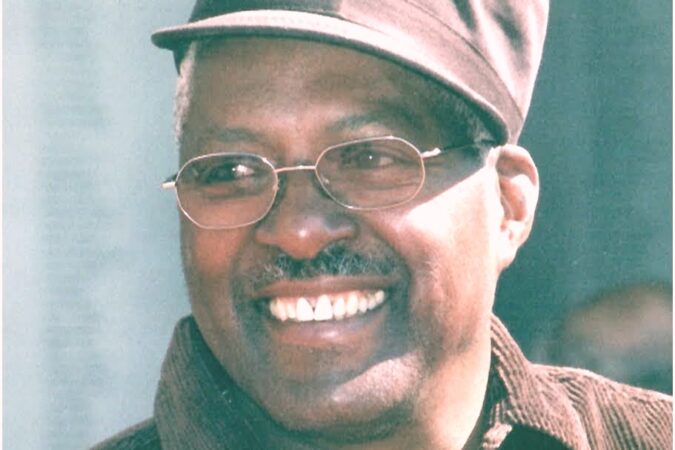
Evonn Wadkins, 88, formerly of Philadelphia, retired Philadelphia Mounted Police Officer, basketball and football star at Simon Gratz High School, builder, carpenter, plumber, bus driver, and volunteer, died Sunday, Jan. 11, of complications from a stroke at Bryn Mawr Extended Care Center.
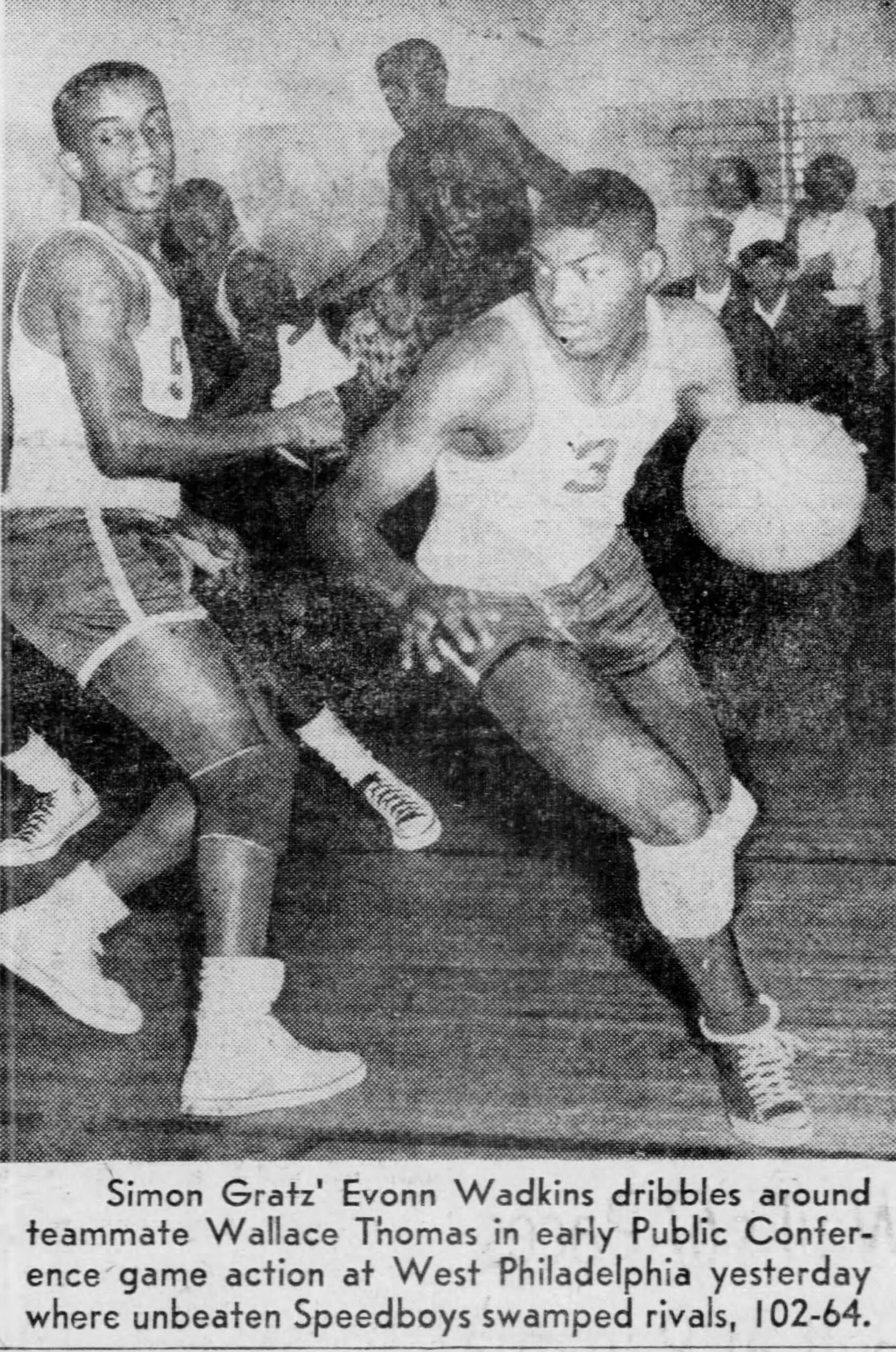
A gifted athlete with an innate desire to help others and be part of a team, Mr. Wadkins played basketball and football on Philadelphia playgrounds, in youth leagues and high school, and later with adults in semipro leagues and the Charles Baker Memorial Basketball League. He usually scored in double digits for the Gratz basketball team and went head-to-head against the legendary Sonny Hill and Wilt Chamberlain.
He overcame a severe ankle injury when he was young and retired from the Baker League years later only after age and ailments forced him off the court. He was a “speedy end” on the football team at Gratz, the Daily Journal in Vineland said in 1955.
His name appeared often in The Inquirer and other local newspapers in 1955 and ‘56, and they noted his 55-yard touchdown catch against Dobbins, 25-yard scoring reception against Vineland, and 44-yard scoring catch-and-run against Northeast in 1955.
Mr. Wadkins (right) drives with the ball in this photo that was published in The Inquirer in 1956.
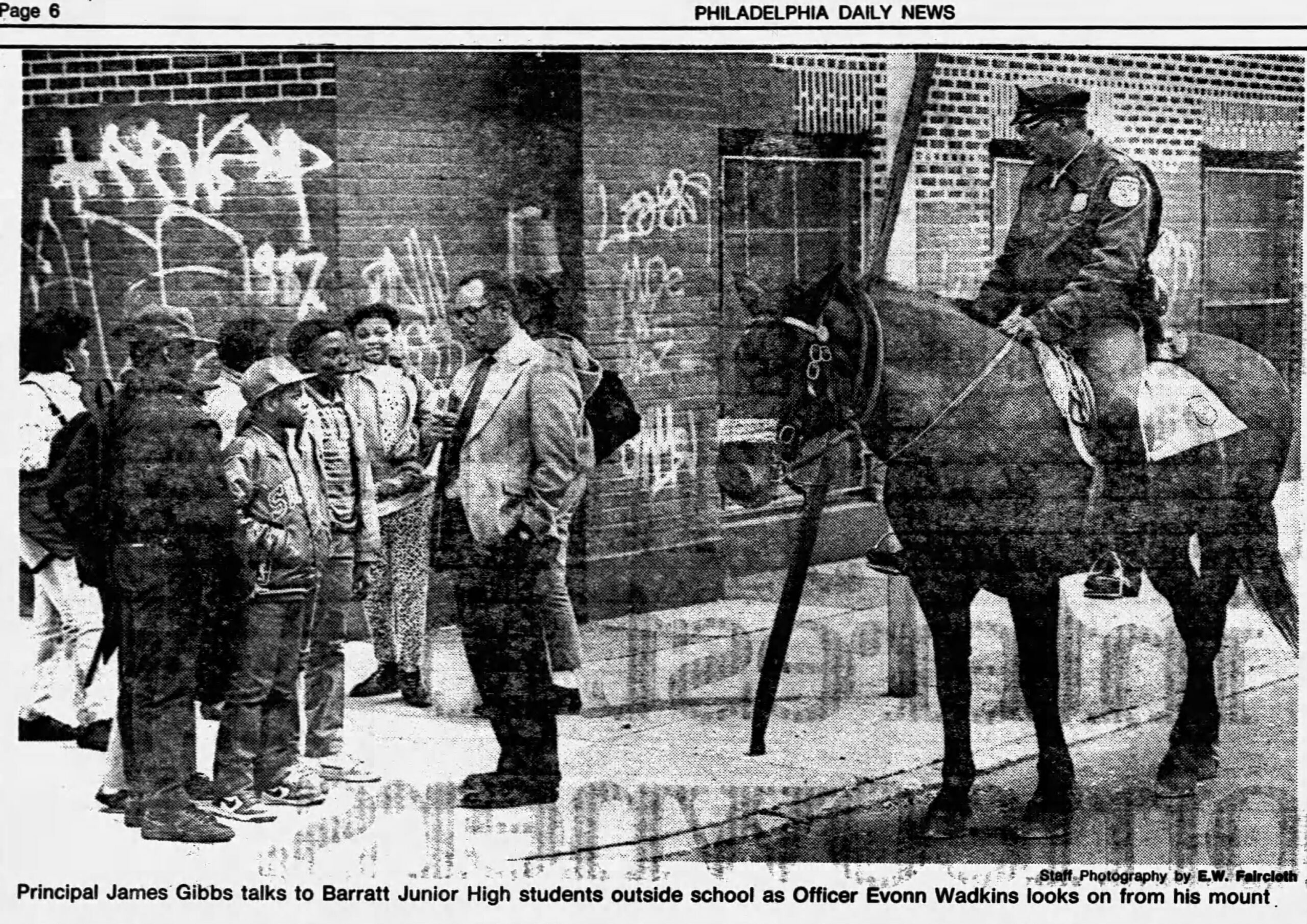
Mr. Wadkins graduated from the Philadelphia Police Training Center in 1963 and spent 11 years patrolling Fairmount Park and elsewhere in the Traffic Division. He transferred to the Mounted Unit — and met Cracker Jack — in 1974, and officer and horse rode the Philly streets together until they both retired in 1988.
“When he went on vacation, nobody could ride Cracker Jack,” said Mr. Wadkins’ wife, Elaine. “They could groom him. But Cracker Jack wouldn’t let anyone else ride him.”
He also worked construction side jobs with neighbors and friends, and learned plumbing, heating, and carpentry skills. “Family and friends are still sleeping comfortably on his one-of-a-kind beds more than 40 years later,” his family said in a tribute.
He drove a school bus for the School District of Philadelphia for 10 years in the 1980s and ’90s, and made friends with many of the students. He moved with his wife to Goochland, Va., 35 miles northwest of Richmond, in 1998.
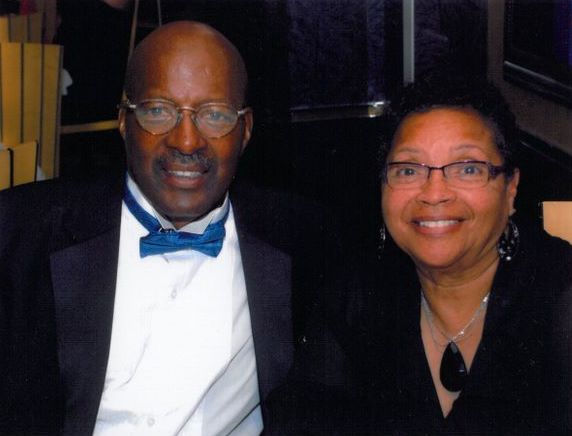
Mr. Wadkins and his wife, Elaine, married in 1959.
He joined the Goochland chapter of the NAACP and volunteered at the Second Union Rosenwald School Museum. At the Second Union Baptist Church, he mentored boys and young men, and supervised the media ministry.
He was serious about community service. “He never met a stranger,” his wife said.
Evonn LeFrancis Wadkins was born June 4, 1937, in Philadelphia. He was the fifth of six children and earned his high school degree at night school after leaving Gratz early.
He met Flora Elaine Poole at Gratz in 1954, and they married in 1959. They set up house in West Philadelphia a few years later and had daughters Evette and Elise, and a son, Evonn.
This photo of Mr. Wadkins on his horse appeared in the Daily News in 1987.
Mr. Wadkins, familiar with Fairmount Park from his time on police patrol, liked to share historical tidbits when the family drove through. He loved cars and traveled to Canada with his wife and to Germany with his brother to shop for several that caught his eye.
He and his family traveled to Florida for a New Year’s party and to South Dakota to fly over Mount Rushmore. He and his wife cruised the Caribbean and toured the United States and Europe.
He even flew with a friend to two Super Bowls. “He was a man on the go,” his family said.
Mr. Wadkins liked McDonald’s pancakes and coached a few youth league basketball teams, one to a championship. When asked how he was doing, his usual response was: “Livin’ slow.”
Mr. Wadkins enjoyed time with his family.
His wife said: “He was a good provider. He was a great husband.”
In addition to his wife and children, Mr. Wadkins is survived by five grandchildren, five great-grandchildren, a brother, and other relatives. Two brothers and two sisters died earlier.
Activists with No ICE Philly demonstrated at Target stores in the city on Tuesday evening, attempting to slow business operations at a company that they say wrongly cooperates with federal immigration enforcement.
Stores in South Philadelphia, Rittenhouse, Fairmount, Port Richmond and on Washington Avenue and City Avenue were among those targeted, the group said.
Advocates say the retailer has failed to speak out against U.S. Immigration and Customs Enforcement, to safeguard employees and customers, and has allowed the agency to set up operations in its parking lots.
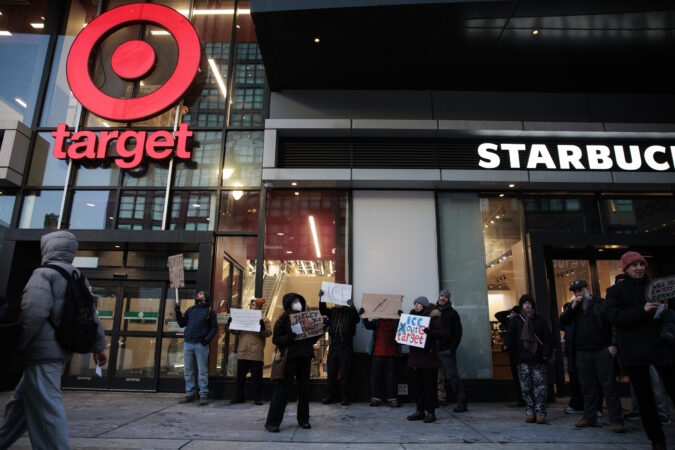
More than 40 people rallied on a frozen, 19-degree night outside the Target at Broad Street and Washington Avenue, holding signs that showed solidarity with Minneapolis residents who have resisted ICE in their community.
“From MPLS to PHL, keep ICE out,” read one sign.
Demonstrators gathered outside of the Target at Broad and Washington on Tuesday in Philadelphia.
Inside, some masked customers bought ice trays and single bottles of table salt. As soon as they paid for the items at the checkout counters, they headed to the “Returns” area to seek refunds.
Items were quickly restocked on store shelves by staff, only to be purchased and returned again.
Demonstrators visited at least seven stores, according to the Rev. Jay Bergen, a leader of No ICE Philly and pastor at the Germantown Mennonite Church.
“Our actions are in solidarity with people across the country responding to the call from Minneapolis communities to pressure Target,” Bergen said Wednesday.
Company spokespeople did not immediately reply to a request for comment on the protests in Philadelphia. Target, founded in 1962, operates 1,989 stores across the United States and has a net revenue of more than $100 billion a year.
At Broad and Washington on Tuesday, members of No ICE Philly handed out pocket-sized fliers that described their goals as they urged shoppers to go elsewhere. Some people turned away after talking to demonstrators. Others who went inside were met with boos.
“Find another store!” the protesters shouted, as a police officer looked on.
Elijah Wald, 66, said the Washington Avenue location was his neighborhood Target.
“Our main hope is that businesses will understand that they need to protect their employees, that they need to not collaborate with a government that right now is targeting everybody,” he said.
Wald, whose mother was a Jewish refugee who fled Nazi Austria, said he has always felt positive about immigration, that the United States was built of “people who are used to moving to find work, moving to find cheaper housing.”
But the discourse over ICE operations in major cities has gone beyond undocumented people, said Wald.
“They’re shooting U.S. citizens now,” he said.
Demonstrators gathered outside of the Target at Broad and Washington Streets on Tuesday.
At the Target at Snyder Plaza, about 20 demonstrators encouraged people to do their shopping elsewhere.
“Protest with your wallet; Acme is right there,” a protester said through a sound system.
Celine Bossart, 34, said boycotts are an effective way to denounce ICE actions.
“As citizens, our power is limited, but a big part of the power that we do have is where we choose to spend our money,” she said, “and at the end of the day, corporations aren’t necessarily going to listen until it hits their bottom line.”
A man in a Flyers jersey stopped to heckle the demonstrators, who responded with words of their own. Bossart said the protest did not aim to make anyone’s day difficult.
“Our neighbors are people who work at Target, people who work at Acme; these are the neighbors who we’re trying to protect,” she said. “So we’re just trying to send a message to upper, upper management.”
Last week, demonstrators held a sit-in at a store in Minneapolis, where the company is headquartered, chanting, “Something ’bout this isn’t right ― why does Target work for ICE?”
At other Minnesota stores, demonstrators formed long lines to buy bags of winter ice melt, then immediately got back in line to return them, slowing the checkout process.
No ICE Philly, which has led demonstrations against the agency, and against the arrests of immigrants outside the city Criminal Justice Center, said Target must:
Publicly call for Immigration and Customs Enforcement to leave Minnesota.
Post signs in its stores that deny entrance to immigration agents, absent a signed judicial warrant.
Train store staff on how to respond if agents arrive.
Publicly call for Congress to end ICE funding.
Chief executives of Target and more than 60 large Minnesota companies issued a public letter on Sunday calling for an “immediate de-escalation of tensions.” It marked the first time, The New York Times reported, that the most recognizable businesses in the state weighed in on the turmoil in Minneapolis.
Critics said the letter offered too little, too late, coming after two local U.S. citizens were shot to death by federal agents.
Joseph R. Syrnick, 79, of Philadelphia, retired chief engineer and surveyor for the Philadelphia Streets Department, president and chief executive officer of the Schuylkill River Development Corp., vice chair of the Philadelphia City Planning Commission, former adjunct professor, college baseball star at Drexel University, mentor, and “the ultimate girl dad,” died Saturday, Jan. 17, of cancer at his home in Roxborough.
Reared on Dupont Street in Manayunk and a Roxborough resident for five decades, Mr. Syrnick joined the Streets Department in 1971 after college and spent 34 years, until his retirement in 2005, supervising hundreds of development projects in the city. He became the city’s chief engineer and surveyor in 1986 and oversaw the reconstruction of the Schuylkill Expressway and West River Drive (now Martin Luther King Jr. Drive) in the 1980s, and the addition of new streetlights and trees on South Broad Street and the upgrade of six city golf courses in the 1990s.
He was an optimist and master negotiator, colleagues said, and he worked well with people and the system. “You have concepts that seem simple,” he told The Inquirer in 1998. “But when you commit them to writing, they raise all kinds of other questions.”
In 2000, as Republicans gathered in Philadelphia for their national convention, Mr. Syrnick juggled transit improvements on Chestnut Street and problems with the flags on JFK Boulevard. He also helped lower speed limits in Fairmount Park and added pedestrian safety features on Kelly Drive.
He beautified Penrose Avenue and built a bikeway in Schuylkill River Park. He even moderated impassioned negotiations about where the Rocky statue should be placed.
Since 2005, as head of the Schuylkill River Development Corp., he deftly partnered with public and private agencies, institutions, and corporations, and oversaw multimillion-dollar projects that built the celebrated Schuylkill River Trail, renovated a dozen bridges, and generally improved the lower eight-mile stretch of the Schuylkill, from the Fairmount Dam to the Delaware River, known as Schuylkill Banks.
In an online tribute, colleagues at the Schuylkill River Development Corp. praised his “perseverance and commitment to revitalizing the tidal Schuylkill.” They noted his “legacy of ingenuity, optimism, and service.” They said: “Joe was more than an extraordinary leader. He was a great Philadelphian.”
Dennis Markatos-Soriano, executive director of the East Coast Greenway Alliance, said on Facebook: “He exuded confidence, humility, and unwavering commitment.”
Mr. Syrnick reviews plans to extend a riverside trail in 2009.
Mr. Syrnick was a constant presence on riverside trails, other hikers said. He organized regattas and movie nights, hosted riverboat and kayak tours, cleaned up after floods, and repurposed unused piers into prime fishing platforms.
“Great cities have great rivers,” Mr. Syrnick told The Inquirer in 2005. “Here in Philadelphia, we have Schuylkill Banks.”
He was a Fairmount Park commissioner for 18 years, was named to the Philadelphia City Planning Commission in 2008, and served as vice chair. He lectured about the Schuylkill often and taught engineering classes and led advisory panels at Drexel. In 2015, he testified before the state Senate in support of a waterfront development tax credit.
Friends called him “a visionary,” “a true hero,” and “a Philly jewel.” One friend said: “He should be honored by a street naming or something.”
Mr. Syrnick (fourth from left) and his family pose near a riverboat.
Paul Steinke, executive director of the Preservation Alliance for Greater Philadelphia, said on Facebook: “He left his native Philadelphia a much better place.”
Mr. Syrnick was president of the Philadelphia Board of Surveyors and active with the American Society of Civil Engineers, the Engineers’ Club of Philadelphia, and other organizations. At Drexel, he earned a bachelor’s degree in civil engineering in 1969 and a master’s degree in 1971.
In 2024, Drexel officials awarded him an honorary doctorate for “his visionary leadership in engaging diverse civic partners to revive the promise of a waterfront jewel in Philadelphia.”
He played second base on the Roman Catholic High School baseball team. He was captain of the 1968 Drexel team and later played against other local standouts in the old Pen-Del semipro league.
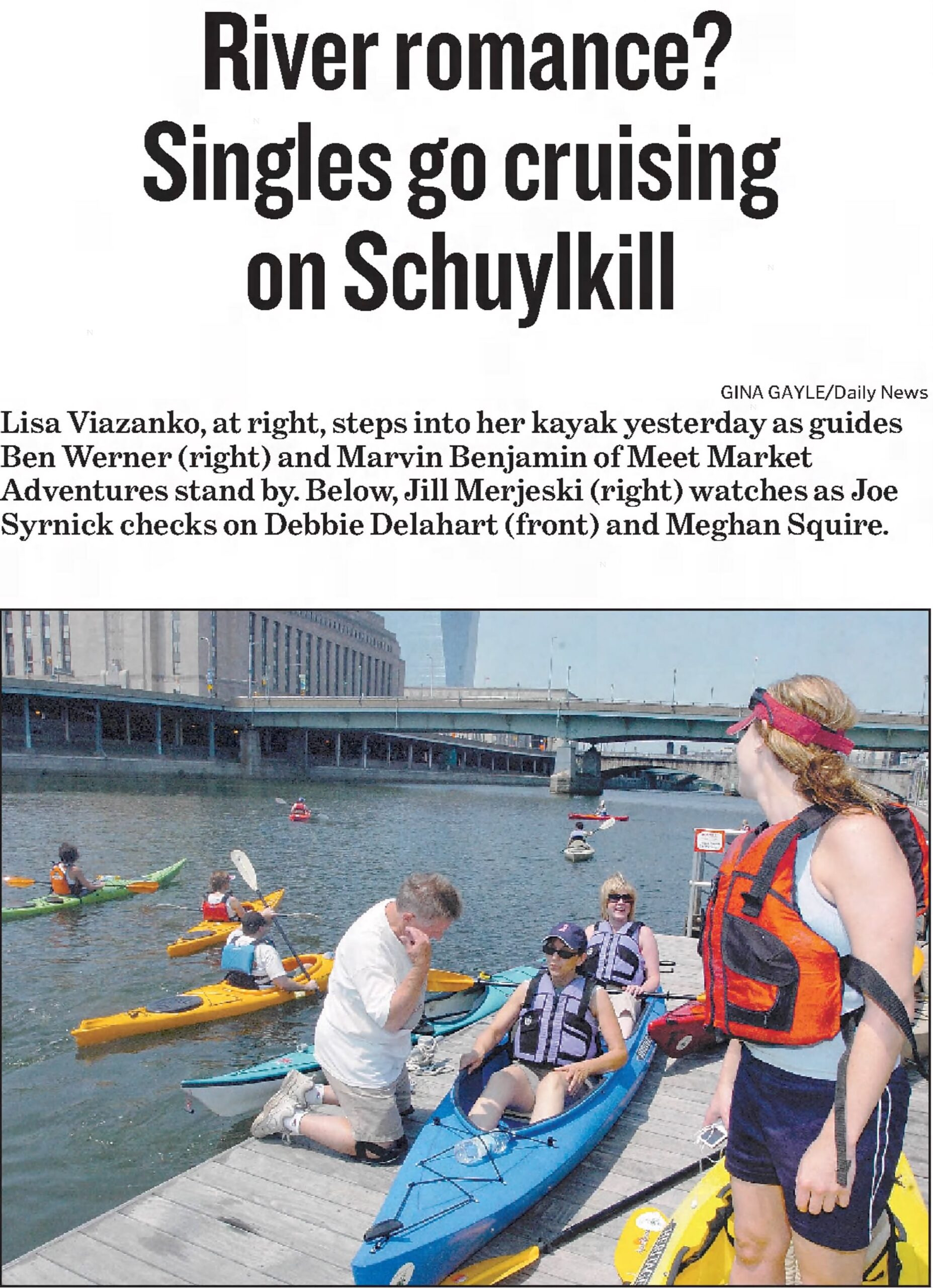
Mr. Syrnick (center in white shirt) had all kinds of way to publicize fun on the Schuylkill. This photo appeared in The Inquirer in 2007.
Most of all, everyone said, Mr. Syrnick liked building sandcastles on the beach and hosting tea parties with his young daughters and, later, his grandchildren. He grew up with three brothers. Of living with three daughters, his wife, Mary Beth, said: “It was a shock.”
His daughter Megan said: “It was a learning experience. Whether it was sports or tea parties, he became the ultimate girl dad.”
Joseph Richard Syrnick was born Dec. 19, 1946, in Philadelphia. He spent many summer days riding bikes with pals on Dupont Street and playing pickup games at the North Light Community Center.
He knew Mary Beth Stenn from the neighborhood, and their first date came when she was 14 and he was 15. They married in 1970, moved up the hill from Manayunk to Roxborough, and had daughters Genevieve, Amy, and Megan.
Mr. Syrnick received his honorary doctorate from Drexel in 2024.
Mr. Syrnick enjoyed baseball, football, and golf. He was active at St. Mary of the Assumption and Holy Family Churches, and he and his wife traveled together across Europe, Africa, the Middle East, and Asia.
“He was humble,” his daughter Megan said. “He was quiet in leadership. He always said: ‘It’s the team.’”
In addition to his wife and daughters, Mr. Syrnick is survived by seven grandchildren, his brother Blaise, and other relatives. Two brothers died earlier.
Visitation with the family is to be from 6 to 8 p.m. Friday, Jan. 23, at Koller Funeral Home, 6835 Ridge Ave., Philadelphia, Pa. 19128, and 9:30 a.m. Saturday, Jan. 24, at Holy Family Church, 234 Hermitage St., Philadelphia, Pa. 19127. A Mass celebrating his life is to follow at 11 a.m.
Daniel Segal, 79, of Philadelphia, cofounder and shareholder of the Hangley Aronchick Segal Pudlin & Schiller law firm, adjunct law professor at the University of Pennsylvania, former cochair of the Philadelphia Soviet Jewry Council, onetime board president at the Juvenile Law Center, mentor, and “mischievous mensch,” died Thursday, Jan. 8, of stomach cancer at his home.
Born and reared in Washington, Mr. Segal moved to Philadelphia in 1976 to teach at what is now Penn Carey Law School. He went into private law practice in 1979, became cochair of a litigation department in 1993, and joined with colleagues in 1994 to establish Hangley Aronchick Segal & Pudlin.
For more than 40 years, until his recent retirement, Mr. Segal handled all kinds of cases for all kinds of clients, including The Inquirer. He was an expert in juvenile law, defamation, the First Amendment, professional ethics, education, civil rights, and other legal issues.
He was president of the board at the Juvenile Law Center and worked pro bono for years, beginning in 2009, to help represent more than 2,400 juvenile victims and win millions of dollars in settlements in what is known as the Luzerne County “kids-for-cash” case. In that case, two judges were convicted of taking kickbacks for illegally sending juveniles to two private for-profit detention facilities.
“This is one of the worst judicial scandals in history,” Mr. Segal told The Inquirer in 2009. “The people you’re stepping on are the true, true little guys.”
Mr. Segal was honored in 2010 by the Philadelphia Bar Foundation.
Among his other notable cases are a 1985 workplace racial discrimination dispute, a 1990 libel case against The Inquirer, and a 2000 trial about the city taxing outdoor advertisers. “Dan Segal was a living testament to professional excellence,” said Mark Aronchick, his law partner and longtime friend.
Law partner and friend John Summers said: “He was a great teacher and mentor.” Marsha Levick, cofounder of the Juvenile Law Center, said: “He was a brilliant, steady partner who made us smarter and kept us laughing.”
Mr. Segal clerked for Chief Judge David Bazelon in the U.S. Court of Appeals for the District of Columbia Circuit in 1974 and for Supreme Court Associate Justice Thurgood Marshall in 1975. He was active with the Philadelphia Bar Association, Philadelphia Common Pleas Court, and the Penn Law School American Inn of Court.
He wrote articles for legal journals and letters to the editor of The Inquirer and Daily News. He spoke at panels and conferences, earned honors from legal organizations and trade publications, and was named the Thomas A. O’Boyle adjunct professor of law at Penn in 1992.
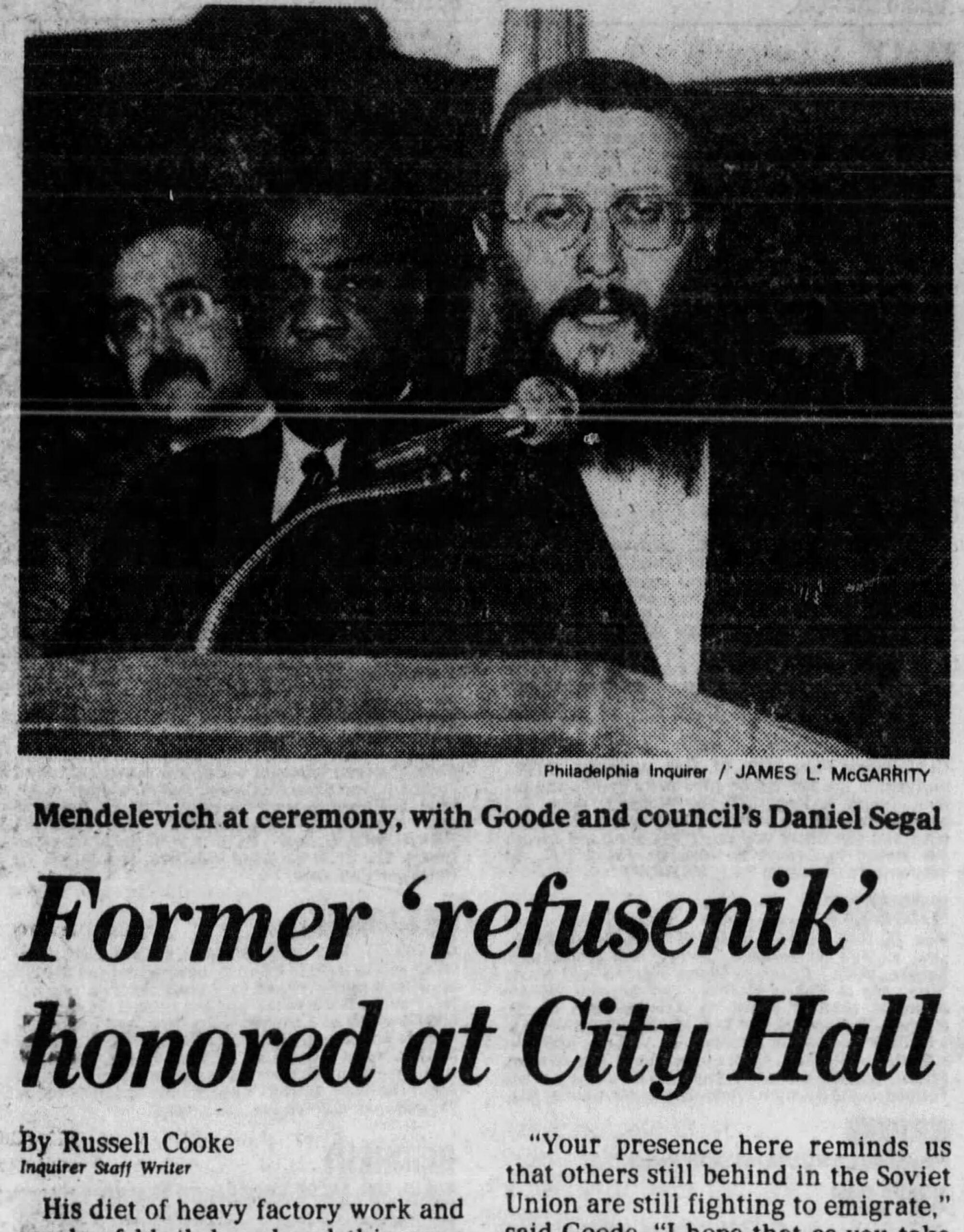
This story and photo features Mr. Segal (left) and appeared in The Inquirer in 1984.
The son of a rabbi, Mr. Segal was cochair of the Soviet Jewry Council in the 1980s, and he organized rallies and marches for social justice and human rights. He traveled to Israel often and to the old Soviet Union several times to secretly support Jews not permitted by government officials to immigrate to Israel.
“We are persuaded that the Soviet Jews are pawns in the Soviet-American relationship,” he told The Inquirer in 1985.
He served as president of the board of directors at what is now Jack M. Barrack Hebrew Academy and held leadership roles with the Jewish Community Relations Council, the New Israel Fund, Mazon: A Jewish Response to Hunger, and other organizations.
Colleagues at the New Israel Fund praised his “characteristic kindness” and “gentle and sparkling humor” in an online tribute. They said: “He was everyone’s favorite board member.”
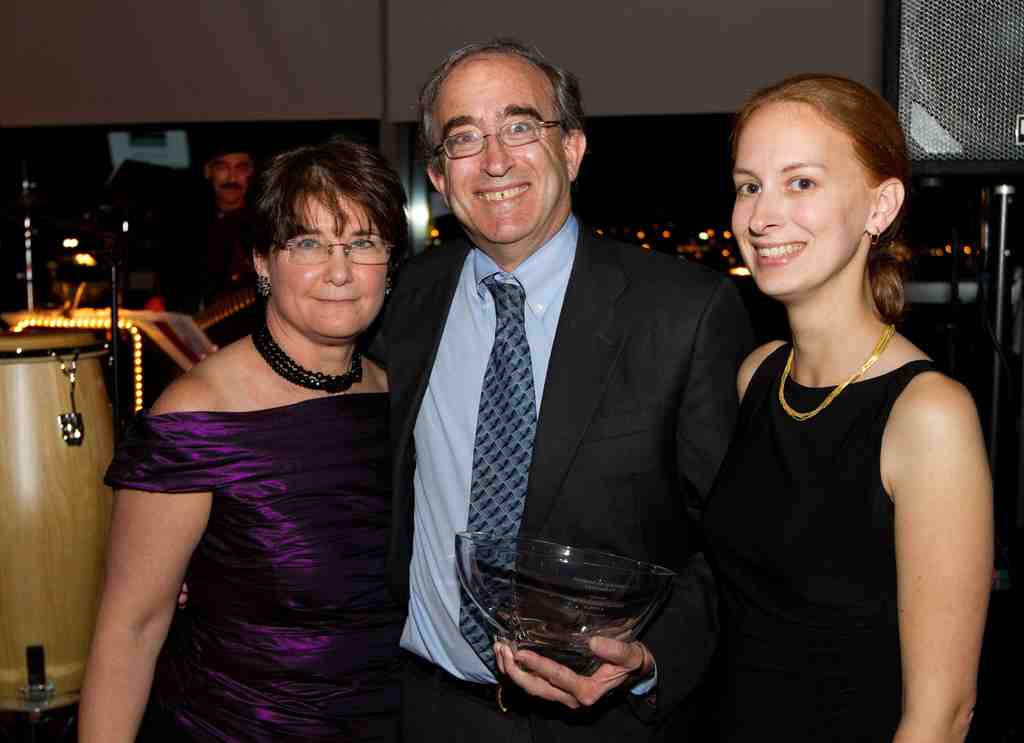
Mr. Segal and his wife, Sheila, married in 1968.
Mr. Segal enjoyed pranks and funny jokes, even at work, and neighbors called him Silly Dan. His son Josh said: “His warmth, humor, and humility meant that he could connect with just about anyone.” A friend said he was a “mischievous mensch.”
He earned his law degree in 1973 and was executive editor of the Law Review at Harvard University Law School. He earned a bachelor’s degree in politics and economics at Yale University in 1968 and a master’s degree in international relations from the London School of Economics in 1969.
He taught elementary school for a year in Washington and spent another year in Europe before moving to Philadelphia. “He taught us just how important it is to stand up for what is right,” his son Eli said, “and to do so not only with conviction but with humility and kindness, and without a thought of getting personal credit.”
Daniel Segal was born July 4, 1946. He started dating Sheila Feinstein in ninth grade, and they married after college in 1968. They had sons Josh and Eli, and lived in Center City and Lower Merion before moving to Fairmount in 2018.
Mr. Segal’s sons said: “Our dad showed us that relationships are the heart of a life well-lived by nurturing lifelong friendships.”
Mr. Segal loved chocolate and ice cream. He recovered from a traumatic brain injury 20 years ago, and he and his wife traveled to Iceland, Peru, Vietnam, Europe, Japan, and elsewhere.
He doted on his family and friends, and he and his wife rented vacation places every summer to bring his sons and their families together. “Neither of us were surprised that our dad always made our kids feel so loved,” his son Eli said. “Because that was just how he made us feel.”
Fairmount’s pup-friendly pub the Boozy Mutt is closing its doors Jan. 3 after just over two years in business, co-owners Sam and Allison Mattiola announced via Instagram on Monday.
“After much thought, we made the difficult decision to close the Boozy Mutt … What began as a dream became something truly special because of our community — our guests, our team, and all the good mutts who walked through our doors,” read the post, which has been shared over 1,400 times. Nearly every comment is from a dejected dog parent wishing for another round of beer and belly rubs.
The Mattiolas, who are married, opened the Boozy Mutt at 2639 Poplar St. in December 2023, transforming former rock-and-roll dive the North Star into roughly 7,000 square feet for pooches and their people to roam across two floors and an outdoor patio. The venture was inspired by pandemic-era trips to a dog park with Bernadoodle Buba, where the couple would camp out with lawn chairs and a pack of beers to make friends.
At the Mutt, as regulars called it, dogs are allowed to mingle off-leash under the supervision of aptly-named “Rufferees” who monitor and facilitate healthy play. All owners had to register their pet’s vaccinations before gaining access to the space, which includes a self-service dog wash room, outdoor TVs, a summertime-only puppy pool, and a menu of bite-sized “human grade” dog treats.
Tess Bodden (left) and Jenn Maher pose with their pet shih tzus Hazel, Hendrix, and Kelce at the Boozy Mutt, a popular third space for dog parents in Fairmount.
The bar felt like a version of Cheers for pet parents almost immediately, regulars told The Inquirer, thanks in part to a rotation of events that ranged from weekly quizzos to breed meetups and Pitch-A-Friend nights for singles. A monthly membership was $40, while an annual Mutt subscription cost $360.
The bar had upward of 100 regular members, Sam Mattiola said, all of whom will receive prorated refunds in the coming days. “People would tell us that this was their third space, that they go home, they go to work, and they go to the Boozy Mutt,” he said. “We walk away with our heads held high knowing that we achieved our goal of creating a place that made people feel at home.”
And yet, the Mattiolas said, running a bar that catered to dogs and their owners in equal measure proved increasingly challenging as the cost of rent, insurance, food, and alcohol continued to increase. While dog-friendly bars and beer gardens have taken off in the South, the concept has had mixed success in Philly: Manayunk dog bar Bark Social closed abruptly last year after its parent company declared bankruptcy. Its replacement, an outpost of the Atlanta-based company Fetch Park, opened in November.
“It’s a pretty overhead-intensive business model that we have, and it’s just gotten pretty hard to make the math work after the last couple of years,” Sam Mattiola explained. “There was just always something new hitting [us] in the face.”
Darby, a 5-year-old shih tzu, sits on a picnic table at the Boozy Mutt in Fairmount during an August 2025 breed meetup.
The Boozy Mutt’s 26 employees were informed of the impending closure before the announcement went public Monday, Allison Mattiola said, and the couple has spent the last three days putting together job recommendations. Neither she or her husband had worked in hospitality prior, and the couple has no immediate plans to revive the business elsewhere.
Where is Fido to go?
Already, the Boozy Mutt’s impending closure has been ruff — pun intended — for Fairmount pet parents.
“It’s a loss for us and a loss for the dogs,” said Sarah Kuwik, whose 2½-year-old pooch Willie “grew up at the Mutt.”
Kuwik started taking what she described as her “50-pound mutt” to the bar almost immediately after it opened. It has given Willie a social life most adults would envy.
Willie goes on dates at the Mutt with his girlfriend Bea, a 3-year-old golden retriever who clings to him like a magnet. And in June, Willie had a joint WrestleMania-themed birthday party with his best friend Levon, also a mutt with boundless energy.
Willie (left) poses with his golden retriever girlfriend Bea (right) and his best pup friend Levon at the Boozy Mutt, where the trio first met.
Kuwik doesn’t know how Willie will handle the news: “He’ll pull us toward [the Boozy Mutt] every time we’re on Poplar [Street] … it’s going to be very confusing.”
The Boozy Mutt is also what drew Valerie Speare to Fairmount in the first place. Speare put an offer on her current rowhouse a mere four blocks from the bar after grabbing brunch there in between open houses last spring. Now she goes to the Mutt four times a week with her pugs Lily and Winston, who are both deeply playful (and deeply codependent).
The Mutt “is exactly the kind of thing I want in a neighborhood,” said Speare, who has lived in the area for a year-and-a-half. “Where else can I go have a mimosa on a Saturday morning and have my dog sitting in my lap?”
Valerie Speare, of Fairmount, and her pugs Winston and Lily lounge with Chihuahua pals at the Boozy Mutt. Speare takes her pugs to the bar four times a week, she estimates.
For others, the bar has fostered connections that extend beyond puppy playdates. Katherine Ross has lived in Fairmount since 2004, but has seen the neighborhood — and the people in it — with new eyes, thanks to her 4-year-old pug Hoagie.
At the Mutt, Hoagie likes to beg for bites of Old Bay and truffle-coated fries or splash in the puppy pool. Ross, meanwhile, has enjoyed getting to meet her neighbors.
“I’ve lived in this neighborhood for over 20 years, and to be honest with you, I didn’t know all that many people until I got a dog,” Ross said. “Having a place like the Boozy Mutt brought a lot of friendships together.”
Marsha Levick took her seat at a conference table at the Juvenile Law Center on a recent Wednesday for what would be one of her last meetings. She walked colleagues through the basic principles of the United Nations Convention on the Rights of the Child, the 1989 treaty that laid out, in clear terms, what the world said it owed young people.
At the heart of the treaty is a simple idea: A child’s best interests come first — even when that child enters the justice system. It has been ratified by all but one of the U.N.’s member nations: the U.S. And in many of those 196other countries,Levick said, children younger than 14 cannot be prosecuted at all.
“Wait,” a staffer interjected. “Kids younger than 14 aren’t in the justice system?”
“I know,” Levick said. “It’s very different.”
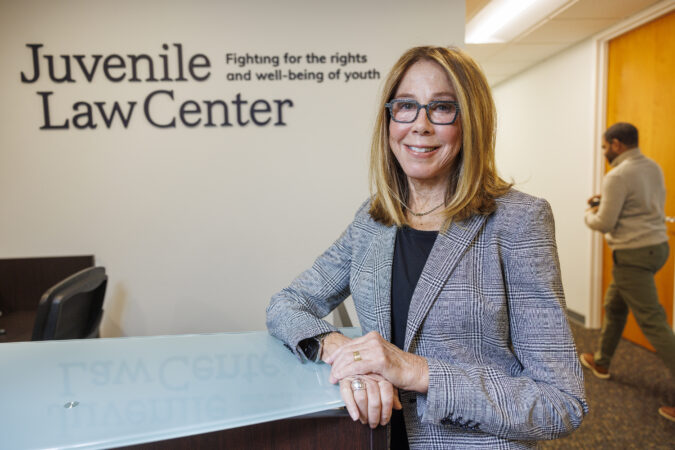
Marsha Levick, chief legal officer and cofounder of the Juvenile Law Center, speaks with staff on Dec. 17.
For 50 years, Levick, 74, has been one of the most persistent and influential voices in the American juvenile justice system, a driving force in turning what was once a niche legal specialty into a national civil rights movement. Colleagues credit her with helping to rewrite how courts view children — persuading judges, including those on the U.S. Supreme Court, to treat youth not as miniature adults but as citizens with distinct constitutional protections and needs.
Levick will step down Wednesday from her position as chief legal officer of the Juvenile Law Center, the Philadelphia-based organization she helped build from a walk-in legal clinic in 1975 into a national leader in children’s rights.
Her departure coincides with the center’s 50th anniversary. At a celebration gala in May, the nonprofit honored Levick with a leadership award that recognized her body of work.
Levick’s career ranged from representing individual teenagers to steering landmark litigation that forced states to overhaul abusive practices. She helped lead the Juvenile Law Center’s response to the “kids for cash” scandal in Luzerne County. She coauthored briefs in a series of U.S. Supreme Court victories that throttled the harshest punishments for kids, including life in prison.
But Levick is also stepping down at what she calls a “dark moment” forcivil liberties in America — a time when rights once thought settled are being rolled back.
Levick was in law school in 1973 when the U.S. Supreme Court handed down Roe v. Wade, the landmark decision that recognized a constitutional right to abortion. In the years that followed, a constellation of rights — from marriage equality to access to contraception — also expanded.
Roe was overturned, however, in 2022. Since then, other decisions have also chipped away at affirmative action in colleges and LGBTQ+ protections.
“It’s hard to convey the shock that it imposes,” Levick said in a recent interview. “Now, 50 years later, you’re pushing the rock back up the hill.”
She made clear she was unsparing with herself, quick to point out what she perceived as shortcomings. “There were high moments for sure,” she said. “But I am not foolishly happy about that. I’m shocked that that’s all we could do. That’s as far as we got.”
Yet even as fresh battles loom, colleagues say the groundwork Levick has laid will guide the Juvenile Law Center’s mission and the broader fight for children’s rights for years to come.
Jessica Feierman, the center’s senior managing director, will step into Levick’s role. “It is a huge privilege and also an immense responsibility,” she said. “In this moment of attacks on civil rights and children’s rights, it’s even more vital that we build on the victories of the last 50 years.”
From Philadelphia to the U.S. Supreme Court
Raised in Philadelphia’s Fairmount neighborhood, Levick discovered early the charge of using her voice, first as a girl who demanded a recount in an elementary school election and won the presidency, and later as a teenager who inhaled The Feminine Mystique and the feminist writers who followed. She earned an undergraduate degree from the University of Pennsylvania and a law degree from what is now Temple University Beasley School of Law.
She cofounded the Juvenile Law Center in 1975 with three law school classmates: Bob Schwartz, a classical music aficionado and part-time semi-pro baseball umpire; Phil Margolis, a vegetarian and free spirit; and Judy Chomsky, a mother of two and passionate Vietnam War resister.
Seven years earlier, the U.S. Supreme Court had ruled that juveniles were entitled to due process. That decision cracked open an untapped field, Levick said, to buildwith her classmates a new kind of civil rights practice focused on children.
For the first year, they worked out of the Chestnut Street office of Chomsky’s husband, a cardiologist, carving out space in his waiting room and sidestepping an exam room on the days he saw patients.
In its earliest years, the center took on individual cases for children. One of Levick’s first clients was in Montgomery County, a teen girl who had participated in a protest at a nuclear plant and who was arrested and charged with trespassing, she said.
But the center struggled financially. The founding partners laid themselves off at one point, Levick said, so they could keep paying the few employees they had hired: a divorced mother who worked as a receptionist; their first lawyer, Anita DeFrantz, who was an Olympic rower; and a social worker.
In 1982, Levick quit the center to become the legal director of the national NOW Legal Defense and Education Fund, now Legal Momentum. By the time she left there six years later, she had become its executive director.
At the NOW Legal Defense and Education Fund, Levick said, she learned how to build national cases — coordinating multistate litigation and filing amicus briefs in federal courts. By the time she returned to the Juvenile Law Center in 1995, after a stint at a small Paoli firm, she had come to believe that individual wins, while necessary, would not be enough to create lasting change.
The center’s mission became more focused on appellate litigation and national advocacy, setting the stage for children’s rights to reach state supreme courts and, eventually, the U.S. Supreme Court.
Hundreds of juveniles resentenced, released
In 2005, in Roper v. Simmons, Levick cowrote in a brief that social science research on youth development should inform constitutional law. Children, she also wrote, have a greater capacity to change.
“We just pushed ourselves into the center of it,” Levick said. “We were like, ‘We’re here. We’re writing the amicus brief.’”
The high court overturned decades of precedent when it ruled in Roper that the Eighth Amendment forbids the death penalty for juveniles. Five years later, in Graham v. Florida, it barred life-without-parole sentences for juveniles in non-homicide cases, after reading another brief Levick coauthored.
In 2012, Levick helped persuade the court to end mandatory life-without-parole sentences for youths convicted of homicide in Miller v. Alabama. And in 2016, she served as cocounsel in Montgomery v. Louisiana, the case that made the Miller decision retroactive across the country.
Since then, hundreds of juveniles — including nearly 500 in Pennsylvania — have been resentenced or released from prison. One of them: Donnell Drinks, freed in 2018 after 27 years.
The first time Drinks met Levick, he hugged her. “I couldn’t believe how small she was, because of her presence, her legal prowess, has all been so enormous,” recalled Drinks, who works as a leadership and engagement coordinator at the Campaign for the Fair Sentencing of Youth.Levick is 5-foot-3.
Those cases brought Levick into courtrooms across the state, often alongside public defenders. One of them, Bradley S. Bridge, a retired Philadelphia public defender who worked with her on dozens of resentencings, called Levick a “zealous advocate” who “always saw the big picture.”
Her ability, he said, “to think toward the future, I think, was most glorious.”
Levick agreed that looking ahead had always been part of her work. “We always tried to look around the corner,” she said.
One of those moments came in 2008, when she and her colleagues began fielding troubling calls from Luzerne County — the first hints of what would become the “kids-for-cash” scandal.
Seeing more in the ‘kids-for-cash’ scandal
In 2007, Laurene Transue called the Juvenile Law Center. Her daughter, 14-year-old Hillary Transue, had been ordered to serve three months in a detention facility after she created a Myspace page mocking her school principal, she said at the time.
“We saw in that one phone call something that was clearly much bigger,” Levick said.
In fact, it was one of the most egregious judicial corruption cases in modern American history: Two Luzerne County judges had accepted kickbacks in exchange for sentencing thousands of juveniles — many for minor misbehavior — to extended stays in private detention centers.
“It was kind of like, if I may, what the f— in my mind,” Levick recalled.
Levick and the center petitioned the Pennsylvania Supreme Court, which ultimately threw out and expunged thousands of adjudications. They later helped families pursue civil damages, with the help of other firms. The judges, Mark Ciavarella and Michael Conahan, were convicted of federal crimes and sentenced to long prison terms; President Joe Biden commuted Conahan’s sentence in 2024.
Hillary Transue now serves on the Juvenile Law Center’s board.
Transue told The Inquirer that as a teenager she believed that “highly educated” adults in “positions of authority” were “mean, nasty people who were out to hurt you.” But Levick, she said, “brushed up against my perception of adults” and proved her wrong.
“I think she’s a goddamn superhero,” Transue said recently.
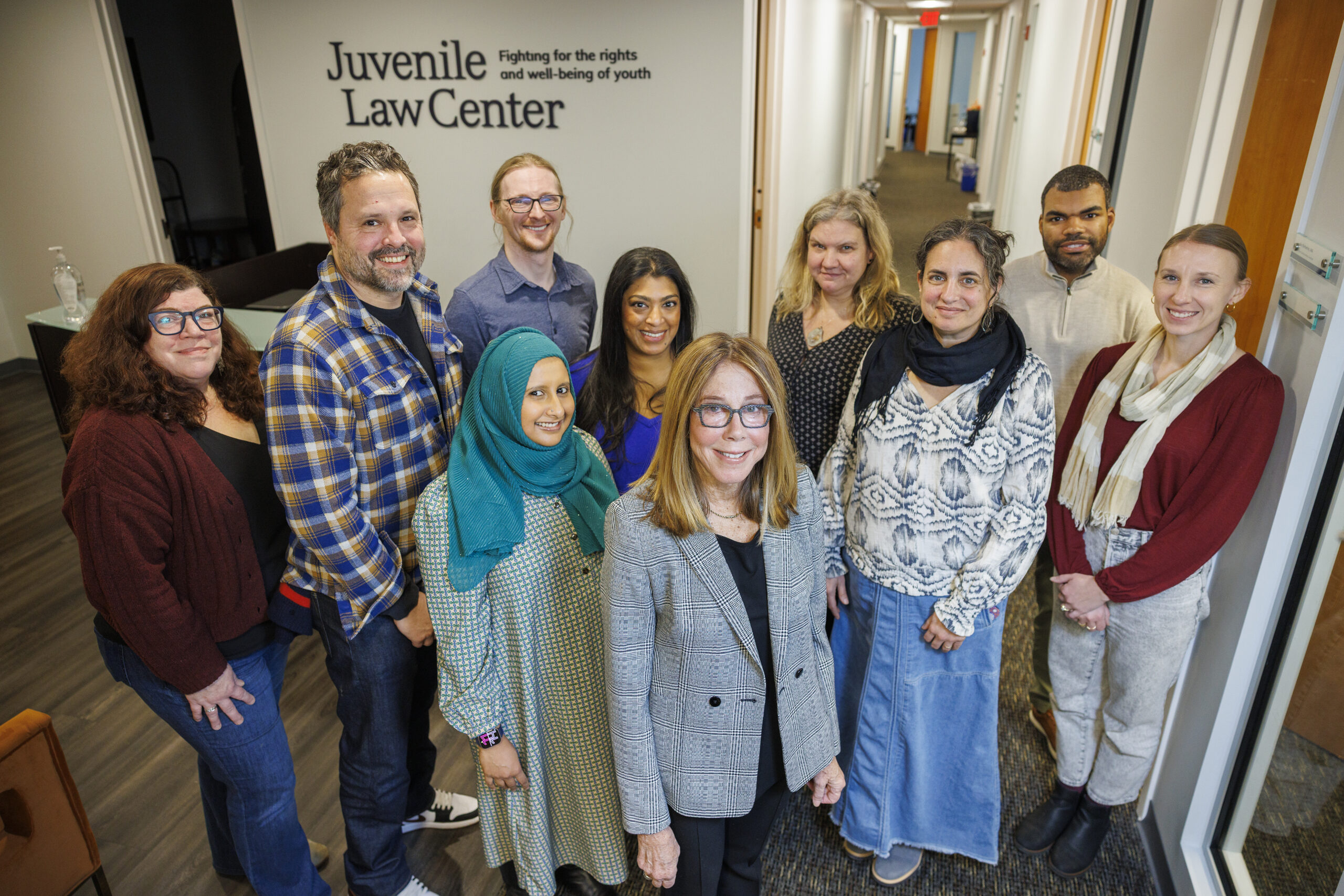
Marsha Levick (center) stands with staffers at the Juvenile Law Center earlier this month.
Among the successes, Levick still sees failures
Despite the victories, Levick is quick to cite the cases she lost. “I’ve had successes. I’ve also failed many times,” she said.
She still thinks about clients like Jamie Silvonek, sentenced to 35 years to life in prison after killing her mother, whose early release Levick has fought for but has not yet won, or a recent bid to expand parole access for people convicted as juveniles that fell flat in Florida.
Those losses have hardened her view of how deeply punishment is embedded in American law. “I feel like punishment is in our bones,” she said. “The way that we think about crime is that it is always followed by punishment.”
That instinct, she said, has left behind people who could have thrived outside prison — including juvenile lifers who will never be released. One of them is Silvonek, whom Levick described as brilliant and warm. “I want her to be able to share that warmth and joy with her family and with her community, who are all behind her,” Levick said.
“We lost what they had to give,” she added.
Levick isn’t done yet
Levick, who is married with two adult daughters, is not leaving the field. She will become the Phyllis Beck chair at Temple’s Beasley School of Law, a post once held by her cofounder Bob Schwartz, and will teach constitutional law to first-year students.
She feels newly urgent about the course. “I am outraged at the degree to which the law has been perverted by the current moment, and I think I still can say and do something about that,” she said. “I think that the things that motivate me include outrage.”
She expects much of the future progress in youth justice to come from state supreme courts rather than the U.S. Supreme Court — a shift she sees as pragmatic, not pessimistic. Washington State Supreme Court Justice Mary Yu, who has heard Levick argue successfully before her, called her a fearless litigator. “She’s an extraordinary appellate lawyer,” Yu, who is also retiring Wednesday, said in an interview.“It’s almost instinctual to her.”
And even now, Levick said, she has hope.
“We’re not going to abolish the juvenile justice system in America, but we could transform it radically,” Levick said. “I believe that. But it takes more than just lawyers to care. It takes more than the community to care. It takes people in positions of power to care. And that’s the hard part.”
Correction: An earlier version of this article misstated the name of a legal advocacy group at which Levick worked. She worked at NOW Legal Defense and Education Fund. The story also misstated the year Laurene Transue called the Juvenile Law Center; she called the law center in 2007.
A new 46-unit apartment building is coming to 5322-28 Germantown Ave., from longtime Northwest Philadelphia developer Ken Weinstein.
The five-story building is in Germantown’s Penn Knox area. It also will include over 1,600 square feet of commercial space and 17 parking spaces.
The project comes amid a burst of new multifamily construction in Germantown, a neighborhood that garnered little interest from few developers in the second half of the 20th century.
“The demand for housing in Germantown continues to outpace the supply so more housing, at all income levels, is needed,” Weinstein said.
“Germantown is located near good public transit and Fairmount Park and is viewed as much more affordable than hot city neighborhoods in and around Center City,” he said.
Weinstein said that he will break ground on the building during the first week of January and that funding and contracting is already secured.
The project did not require any relief from the city’s Zoning Board of Adjustment, so Weinstein was not legally required to consult with the neighborhood group, Penn Knox Neighborhood Association.
But he met with the community group anyway to hear concerns they might have with the project.
“This is not an out-of-town developer; this is a developer from the area. He’s part of the community,” said Deneene Brockington, chair of the Penn Knox Neighborhood Association. “So I think there is a level of respect, and I think willingness to do as much as possible [in response to neighborhood concerns] as long as it doesn’t compromise the project.”
Brockington said that the community group’s main concerns were about building materials and lighting and that the developer had addressed both.
Weinstein said parking wasn’t the principal concern he heard from neighbors because the building is in a commercial corridor.
The apartment building’s 17 spaces are not required by the zoning code. Weinstein said he would have liked to include more, but he was constrained by the fact that all the spaces had to be on the ground floor and that the site’s land use rules require that he include commercial space.
“Underground parking is too expensive in middle neighborhoods like Germantown,” Weinstein said. “There will always be a divide between the number of parking spaces developers want to provide and what neighbors want.”
The building will include 28 one-bedroom apartments and 18 two-bedroom units, with rents ranging from $1,450 to $2,200. There will be no subsidized or affordable units set aside.
The project is expected to be completed within 18 months of the groundbreaking next month.
There is no definite tenant for the commercial space, but Weinstein has some ideas.
“With Uncle Bobbie’s moving to a new location, I would love to see a cafe or coffee shop lease the first floor,” Weinstein said. “There would be a lot of demand from students and staff at GFS [Germantown Friends School] and from the community.”
A segment of the Schuylkill River Trail that has beenclosed since October because of a sinkhole has been repaired, and reopened just in time for Christmas Eve.
Joe Syrnick, executive director of the nonprofit Schuylkill River Development Corp. (SRDC), said Wednesday afternoon that repairs finished earlier in the day.
But, he said Wednesday, the weather cooperated enough this week that a crew was able to complete the work over a few days, “as a holiday present for our trail users.”
This week, the hole was filled and paved. It reopened about 1:30 p.m. Wednesday after the paving had cooled.
“It’s open and people are already using it,” Syrnick said. “People are happy.”
Some cleanup is still needed around that area, he noted, and fencing needs to be removed. That should be finished by Friday or Monday, Syrnick said.
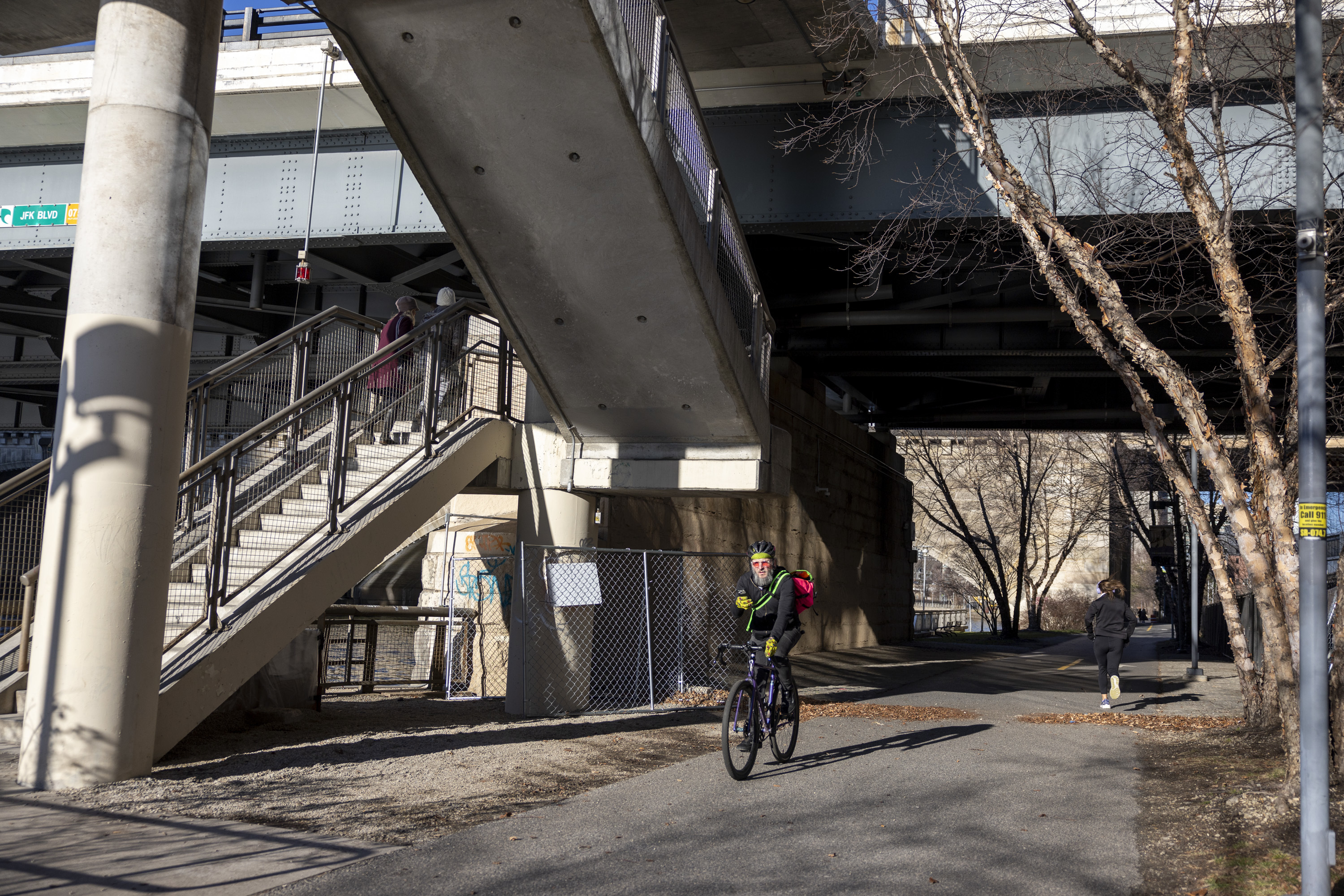
The Schuylkill River Trail is now open between JFK Boulevard and Race Street in Philadelphia, Pa., on Wednesday, Dec. 24, 2025.
The sinkhole occurred between Race Street and JFK Boulevard, just north of the SEPTA Bridge, after it formed beneath the asphalt. The trail runs along Schuylkill Banks, a portion of the Schuylkill River Trail.
The SRDC works with the city to revitalize the Schuylkill corridor from the Fairmount Dam to the Delaware River, the eight-mile stretch known as Schuylkill Banks.
The sinkhole repair presented a problem that stemmed from a steel bulkhead that was built for the trail in 1995. The bulkhead helped extend land farther into the river and create more parkland.
But gaps developed in a seal between the bulkhead and concrete sewer infrastructure. Those gaps allowed soil to seep away with the tide, eventually washing away enough to create a sizable hole.
Syrnick said the SRDC and the Philadelphia Streets, Parks and Rec, and Water Departments worked together to come up with a solution.
So workers had to seal the gaps.
The weather was clear enough this week that crews were able to pour concrete to fill part of the hole and backfill it before paving it Wednesday.
The lower Schuylkill winds 36 miles from Phoenixville in Chester County to its tidal meeting point with the Delaware River at Philadelphia’s Navy Yard, sheltering more than 40 species of fish along the way.
In Center City, the river doubles as a striking urban backdrop, bordered by a trail that can draw thousands of hikers and cyclists daily.
This year, the waterway is vying for the title of Pennsylvania’s River of the Year, an annual competition spotlighting the state’s most significant waterways.
Online voting, which began Dec. 9, runs through Jan. 16, giving Pennsylvanians the chance to select the 2026 winner from three contenders: Chillisquaque Creek, the Conestoga River, and the lower Schuylkill in the Philadelphia region.
The River of the Year program is administered by the Pennsylvania Organization for Watersheds and Rivers, with funding from the Pennsylvania Department of Conservation and Natural Resources (DCNR).
The contest is meant to draw public attention to rivers and their environmental importance. The winning river’s nominating organization receives a $15,000 DCNR grant to fund yearlong celebrations, including paddling events and community activities. The DCNR produces a commemorative poster in honor of the river.
Jackson Quitel, river programs coordinator for the nonprofit LandHealth Institute, said his organization nominated the Schuylkill along with a plan to educate the public “in the many wonders in this unique body of water.”
“While the Schuylkill River is widely known, not many people are aware of the immense recreational activities and ecological wonders that are present on the river today,” Quitel said.
The LandHealth Institute helps increase awareness of the river through guided walks, fishing, and kayaking, taking more than 500 people out on the water in 2025. If the Schuylkill wins, Quitel said, it would allow the group to double its reach.
Joe Syrnick, executive director of the nonprofit Schuylkill Development Corp., which helped develop the Schuylkill Banks trail along the river, called the river “a great asset to the region.”
“It would be nice to see it get the recognition it deserves,” Syrnick said.
Once a vital waterway for the Lenni-Lenape, the river later endured severe pollution from upstream coal mining and industrial waste, eventually rebounding through years of efforts, including the protections of the federal Clean Water Act.
The Schuylkill became the nation’s first municipal‑scale water system through Fairmount Water Works and continues to provide drinking water to 1.5 million people through two intakes along its banks.
The Schuylkill River Trail, a continuous corridor running alongside most of the lower Schuylkill, has broadened access to the river’s views for residents, giving them more insight into a river many were once cut off from.
Most recently, the Schuylkill Banks section in Center City debuted a new $48 million cable‑stayed, pedestrian‑only bridge, anchoring a trail extension known as the Christian to Crescent Trail Connector. The 2,800‑foot segment delivers sweeping, unobstructed views of the river.
The DCNR describes the lower Schuylkill as an “urban oasis surrounded by bustling roads and a backdrop of a gorgeous skyline.”
Pennsylvania has 25 rivers. Of those, six are federally designated as wild and scenic and 13 are state-designated scenic rivers.
Contest nominees can also include tributaries within river watersheds. For example, Chillisquaque Creek is a 20 mile-long tributary of the Susquehanna River’s west branch. It flows through Northumberland and Montour Counties.
The Conestoga, meanwhile, feeds Chesapeake Bay.
Overall, Pennsylvania has 85,000 miles of waterways, which is the highest stream density in the continental United States.