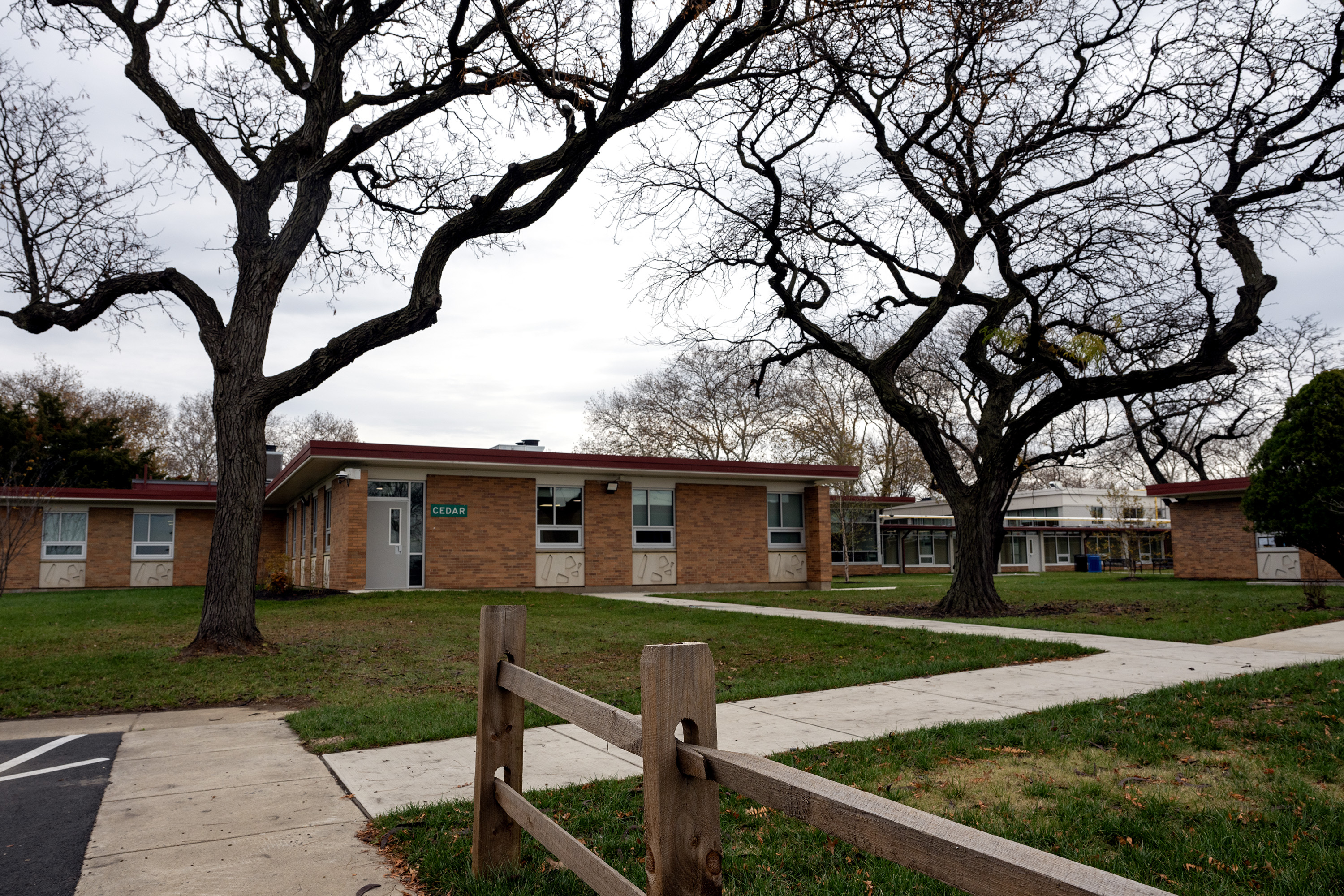
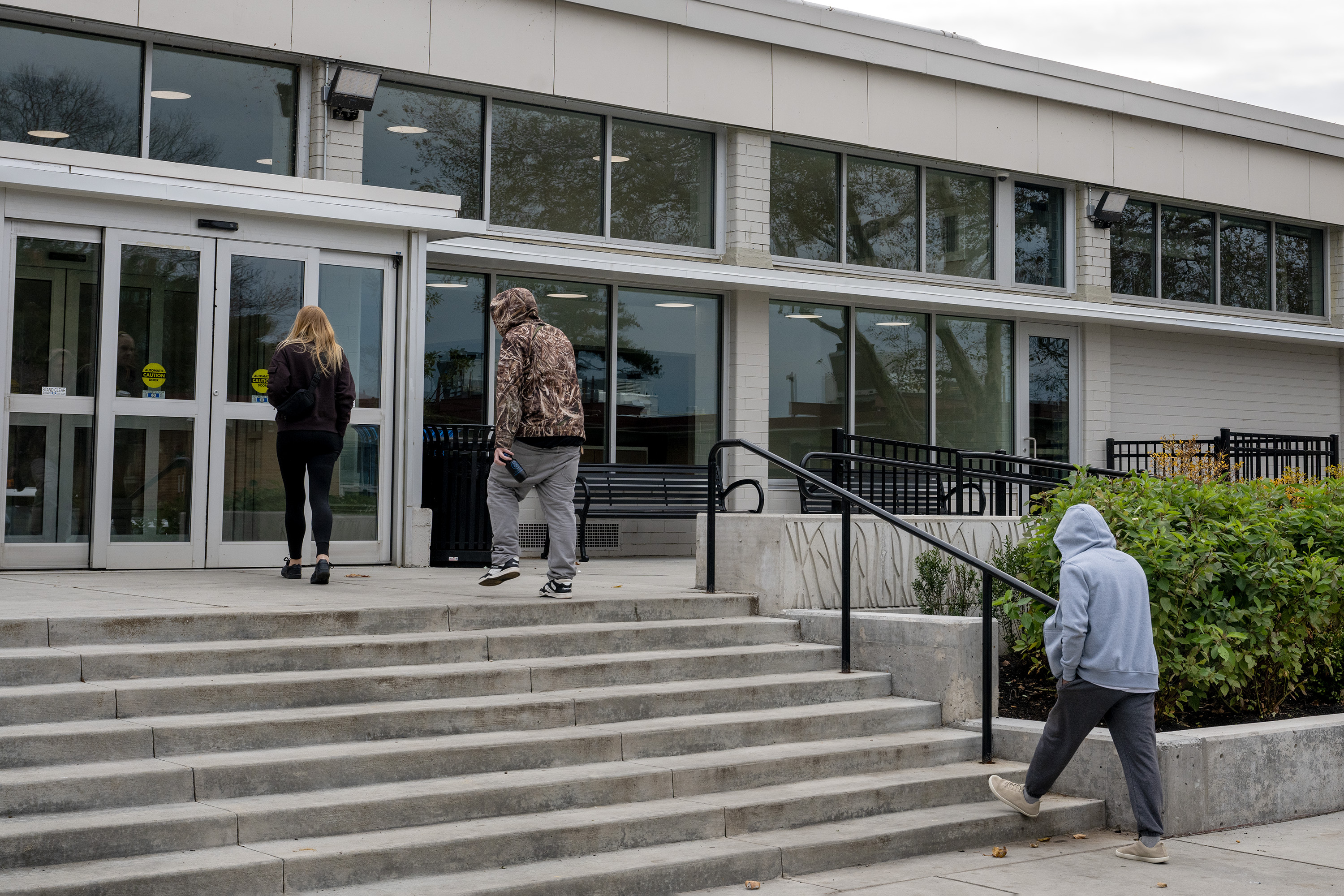
Of the district’s 307 buildings, most schools — 159 in total — would be modernized under the proposed plan. The district pointed to Frankford High, which closed for two years because of asbestos issues and just reopened in the fall with $30 million worth of work to spruce it up, as an example of modernization.
An additional 122 schools would fall into a “maintain” category, meaning they would receive regular upkeep. And six facilities would be co-located, meaning two separate schools would be housed under one roof, each with its own principal and team.
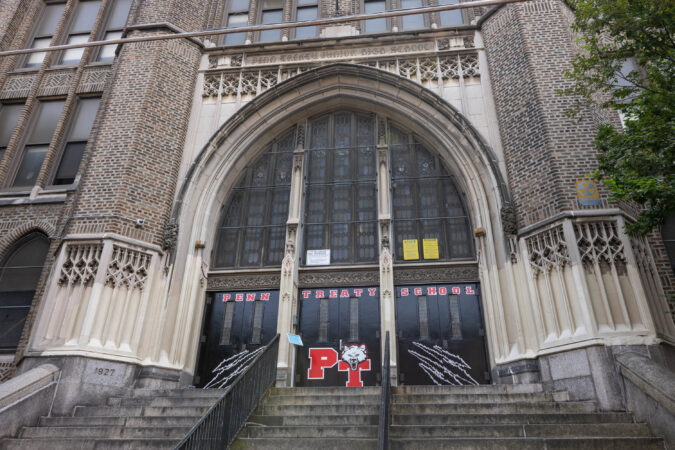
Finally, 20 schools would be recommended for closure. Among them is Penn Treaty, now a 6-12 school, which would close in its current form, but go on to house the current Bodine High School, a magnet in Northern Liberties. Bodine’s building would become the home of Constitution High, which now occupies a rented space in Center City.
As proposed, Watlington’s plan would cost $2.8 billion over 10 years. The district would put up $1 billion via capital borrowing during that time — leaving $1.8 billion unaccounted for that the superintendent said would need to be covered by state money or philanthropic support. If the district doesn’t get all or some of that amount, the plan would have to be amended.
Will some schools definitely close? Which ones?
Right now, the closures are just a proposal, and the school board is slated to have the final say at a vote this winter. They could adopt all, some, or none of Watlington’s recommendations.
If the closures are approved, no school would be shuttered before the 2027-28 school year. And should some schools close, no job losses are expected, Watlington said.
Of the 20 facilities targeted for closure, 12 would be repurposed for district use. Eight would be given to the city for affordable workforce housing, or job creation, both priorities of Mayor Cherelle L. Parker.
We don’t have the full list of proposed modernizations yet, so it’s tough to say the proposed fate of every school.
What will happen to students who attend closing schools?
Every affected student would be routed to a new school. A new transition office would work closely with impacted communities to make sure academics, attendance, and social-emotional needs don’t suffer, Watlington said.
“These families will get gold-standard, red-carpet treatment directly from the superintendent’s office,” he pledged.
Why are these changes necessary?
The district hasn’t had a facilities master plan in more than a decade. It has 70,000 empty seats citywide, with some schools overcrowded and others with entire unused floors. It’s also got a lot of aging buildings — the average district school is nearly 75 years old — and many have environmental and/or significant systems issues.
Officials said they want to solve district-wide disparities: Some schools have art, music, and ample space for physical education, plus extracurricular activities, and some have few of those things.
How were school buildings’ fates determined?
Watlington said there was no formula to determine his recommendations. But four factors entered into the decision: building condition, utilization, the school’s ability to offer robust programming, and neighborhood vulnerability — a new measure that considers things like poverty and whether the area has lived through prior school closings.
The district formally launched the final phase of its facilities master planning process in late 2024. Since then, officials have hosted 47 community conversations and received 13,700 survey responses from people in every zip code in the city. Officials heard from a project team of 30 members and received feedback from nine advisory groups composed of more than 170 members.
The district later launched surveys to gain more input, with the topline result being that Philadelphians didn’t want their local schools closed. Many respondents outlined fears about potential hardships that closing schools could create, such as longer walks to school or tough bus rides in unfamiliar or unsafe areas.
And they flagged worries about merging schools and having large grade spans in a single building.
When did the district last close schools?
Mass school closures last happened in 2012 and 2013, when 30 schools shut.
That process hit economically disadvantaged neighborhoods disproportionately, did not yield substantial savings, and generally led to worse academic outcomes and attendance for students.
The mistakes of 2012 informed this go-round, officials said. They have promised better services for schools, students and families affected by any coming transitions.
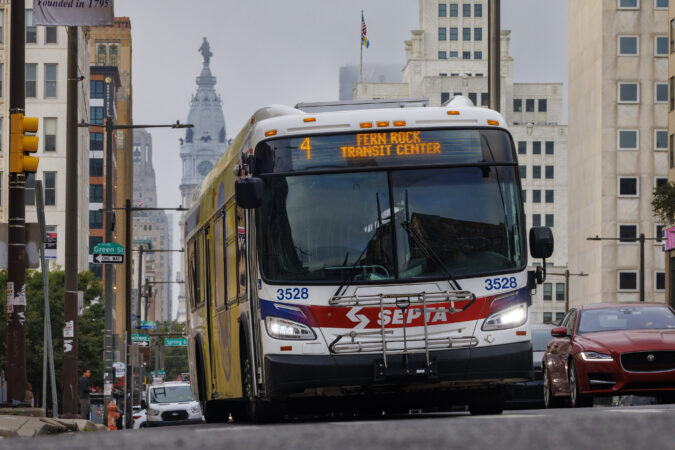
Philadelphia’s trolley tunnel has been closed for two months, but SEPTA now is saying that it has completed most necessary repairs and could reopen the connection between Center City and West Philadelphia soon.
Crews currently are running trolleys through the tunnel to test fixes for damaged overhead wires and other equipment and to decide when it is safe for normal service to resume.
“We’re pretty close,” SEPTA spokesperson Andrew Busch said Tuesday.
About 60,000 riders traveled daily through the tunnel between 13th Street and its West Philadelphia portal at 40th Street before SEPTA closed it in early November.
At issue is a U-shaped brass part called a slider that carries carbon, which acts as a lubricant on the copper wires above the tracks that carry the electricity that powers the trolleys.
There were two major incidents when trolleys were stranded in the tunnels. On Oct. 14, 150 passengers were evacuated from one vehicle and 300 were evacuated from a stalled trolley on Oct. 21.
The Federal Transit Administration on Oct. 31 ordered SEPTA to inspect the overhead catenary system along all its trolley routes.
SEPTA has had to replace about 5,000 feet of damaged wire and make other repairs. It also switched back to 3-inch sliders.
On Nov. 7, SEPTA shut down the tunnel to deal with the issue, which had cropped up again, then reopened it on the morning of Nov. 13, thinking it was solved. But it discovered further damage to the catenary system and the tunnel was closed at the end of the day.
Other potential reopening dates were announced but postponed.
This story has been updated to correct the amount of wire replaced in the tunnel.
In the beginning, God created the 12 days of Christmas and the bacchanalia of New Year’s Eve to get us through the dark and frigid endless nights of winter. That wasn’t nearly enough for us shivering and depressed humans, so God sent us the NFL playoffs. The hope is that the Eagles last long enough to get us to the balmy breezes of baseball’s spring training.
Delay, deny, distract, divert attention: Inside the Epstein Files coverup
Pages from a totally redacted New York grand jury file into Jeffrey Epstein and Ghislaine Maxwell, released by the U.S. Justice Department, are photographed last month in Washington.
I want you all to stonewall it, let them plead the Fifth Amendment, cover up or anything else if it’ll save it — save the plan.
The newish word that best captures the 2020s is one that I’m not allowed to use in a family newspaper like The Inquirer. In 2022, the social critic Cory Doctorow coined this scatological term that I’m calling “en(bleep)ification” (it won’t take much imagination) to describe the way that products, but especially consumer-facing websites, gradually degrade themselves in pursuit of the bigger goal, higher profits.
For example, writer Kyle Chayka wrote a popular New Yorker essay in 2024 about what he called the, um, en(bleep)ification of the music site Spotify as it devolved, in his opinion, from a place for the songs and albums you want to hear to pushing playlists that they want you to hear.
In the political world, no product rollout had been more anticipated than the December release, forced by law upon the Donald Trump regime’s Department of Justice, of the Jeffrey Epstein Files — the investigative trail of documents about the late financier and indicted sex trafficker who also palled around with Trump in the 1990s and early 2000s.
No one with any familiarity of Trump’s modus operandi should have been shocked by what happened when the congressionally mandated deadline for release of all of this massive cache of paperwork finally arrived on Dec. 19 — or by what has happened in the two-and-a-half weeks since then.
Needless to say, the Epstein Files have not offered the seamless user experience that its readers — especially those hoping for bombshells that would expose the tawdry secrets of Trump’s friendship with a man who allegedly abused more than 1,000 young and sometimes underaged women — had anticipated. In the hands of the president’s minions at Justice, the Epstein Files have been en(bleep)ified.
How so? Here’s the diabolical part. The MAGA Gang that normally can’t shoot straight managed to hit the coverup bullseye this time, not with one dramatic act to rile people up — like Nixon during Watergate with his notorious Saturday Night Massacre — but with a blend of tactics and dodges designed to frustrate and exhaust truth-seekers.
Delay. The law, which Trump signed to avoid an embarrassing defeat on Capitol Hill, required the release of every single document — with appropriate blacked-out redactionsto protect things like the names of Epstein’s victims — by that December deadline. But suddenly the Justice Department — which once had as many as 200 staffers combing the papers last spring before its original botched plan to squelch the files — lacked energy and manpower, claiming it was working as fast as it could in an initial release of just about 40,000 pages, which would seem to be a tiny fraction of more than 5 million pages believed to exist.
The DOJ’s small-batch cooking came in two small servings right before Christmas, when most Americans consume the least news, and information about any new releases in the new year has suddenly dried up, with maybe 99% of the files still outstanding.
Deny. The papers that have been released have included major redactions — including the completely blacked-out pages of Manhattan grand jury testimony pictured above — that violate the spirit if not the letter of the law, which demanded that any hidden passages only protect victims and not Epstein’s powerful associates and clients.
Stunningly, DOJ actually took back and attempted to bury some 16 files from the first release, including a photo of a photo that included Trump, before a public outcry led to that file’s republishing. Meanwhile, the department also claimed that 1 million additional Epstein files were discovered in New York after the legal deadline — an incredible claim that was immediately punctured by experts.
Deflect. The initial batch was also larded with photos of Epstein with celebrities like Michael Jackson, Diana Ross, and Walter Cronkite as well as several of a Trump predecessor and longtime enemy, Bill Clinton. The pictures were dumped without any explanation and seemed to prove only that there’s a good reason the government normally doesn’t release raw investigatory files, especially about those not charged with any crime.
The second batch also included a lurid and bizarre apparent letter from Epstein to a fellow famed accused sex offender, the gymnastic coach Larry Nassar, penned right around the time of his August 2019 jail-cell death. It seemed unbelievable, and just hours later the FBI said: Oh yeah, we looked at this and it’s a fake. The not-subtle subtext was essentially: “We don’t know what to believe in these files, and neither should you.”
Nearly 53 years ago, Nixon’s plan to cover up Watergate with a mix of denials, delays, purchased silence and outright lies didn’t work. But Team Trump’s efforts to “save it — save the plan” by stonewalling the Epstein files is going just swell so far.
If this moment feels familiar, it is very much like 2018 and the long-awaited Robert Mueller report on Russian influence in the 2016 presidential campaign and potential links to Moscow’s preferred candidate, Trump. There was a Mueller Report — much like there has been a “release” of the Epstein Files — that contained damning evidence, especially about potential obstruction of justice. But the information was dribbled out, downplayed, denied, and ultimately went nowhere.
The Epstein Files have been destined to fail from Day One. It was always what Trump himself might call a “rigged deal” — with the papers in the possession of those with the most to lose, with many ways to make sure the worst stuff stays buried until at least 2029, if it hasn’t already been shredded. But the biggest truth has already been revealed.
The outright defiance of the law demanding full release of the Epstein Files has exposed the utter brokenness of our democracy.
The reason that Nixon’s coverup plan failed is because America had institutions stronger than his lies, including a Congress that cared more about its strength and independence than party ID, newspapers that were not just widely read but believed, and Supreme Court justices with an allegiance to the law and not the man who appointed them.
Trump and his DOJ are daring a comatose Congress, a cowed news media, and a judiciary already in their back pocket to do something, but so far there is no indication that the en(bleep)ification of the Epstein Files can be undone. For now, they are more like the X Files, because the truth about Trump and his Palm Beach pal is out there…but beyond our weakened grasp.
Yo, do this!
These days I find “vacation” is often just another word for catching up on household chores, but during my long December break I did watch a slew of movies, including some of the ones I’d recommended previously like One Battle After Another (very good, but flawed) and Eddington (meh). I ventured to an actual theater on New Year’s Eve and saw probably my favorite movie of 2025: Song Sung Blue, the bittersweet, based-on-a-true-story saga of a Neil Diamond cover band at the end of the 20th century. As the title implies, the movie is more than just a rousing feel-good pop musical, despite cathartic moments of exactly that. Kate Hudson deserves an Oscar for her Wisconsin Nice accent.
If you miss the glory days of not-formulaic-or-cartoonish movies — in the spirit of Song Sung Blue or One Battle After Another, only better — you should check out a new documentary on Netflix called Breakdown: 1975, by filmmaker Morgan Neville. The film spotlights an all-too-brief golden age of the mid-1970s with clips from the era’s classics like Taxi Driver, Dog Day Afternoon, and Network, and interviews with the likes of Martin Scorsese and Albert Brooks. They could have done much more with this, but I’d still recommend it.
Ask me anything
Question: Do you think that there is enough of a media firestorm over Grok’s nude filter to kill it? — BCooper (@bcooper82.bsky.social) via Bluesky
Answer: The recent, shocking news about the artificial-intelligence tool called Grok that was created for Elon Musk-owned X (formerly Twitter) is a classic example of an important story that so far has befuddled and fallen through the cracks of the mainstream media. In recent days, X users have been asking Grok to create partially clothed and sexualized AI photos of real, everyday people, including images of underage adolescents. And Grok has complied, in what would seem to be a violation of laws regarding child pornography, among other legal and ethical problems. Musk needs to shut down Grok immediately — arguably for good — but that is not enough for the harm that’s already been caused. In a nation that routinely prosecutes citizens for having this kind of material on their computers, Musk, his co-creators of Grok, and X as a corporation need to be hauled before a judge.
What you’re saying about…
The half-dozen or so of you who responded to December’s open-ended call for 2026 predictions had one big thing in common: Boundless pessimism. Readers of this newsletter expect the new year to bring economic collapse and a disastrous midterm election in November, either from Donald Trump stealing it to Democrats somehow blowing it in the ways that only Democrats can. Stephen R. Rourke predicted: “I believe that the American economy, and perhaps the world economy, will slide into a second Great Depression, the almost inevitable consequence of an over leveraged economy, and a lack of willingness across the board to make tough choices about how to address the American addiction to borrowed money…” Oof. Nonetheless, Kim Root stole my heart with this: “I think the Philadelphia Union will rise even with the personnel changes because they are a developer of young talent. DOOP.”
📮 This week’s question: A no-brainer: Donald Trump’s lethal assault on Venezuela and his seizure of that country’s strongman leader, in defiance of U.S. and international law, marks a turning point in American foreign policy. Are you OK with Trump’s actions because a bad guy has been removed from power, or are you alarmed by a military assault with the stated goal of pumping more oil? Please email me your answer and put the exact phrase “Venezuela attack” in the subject line.
Backstory on the growing crisis of ICE custody deaths
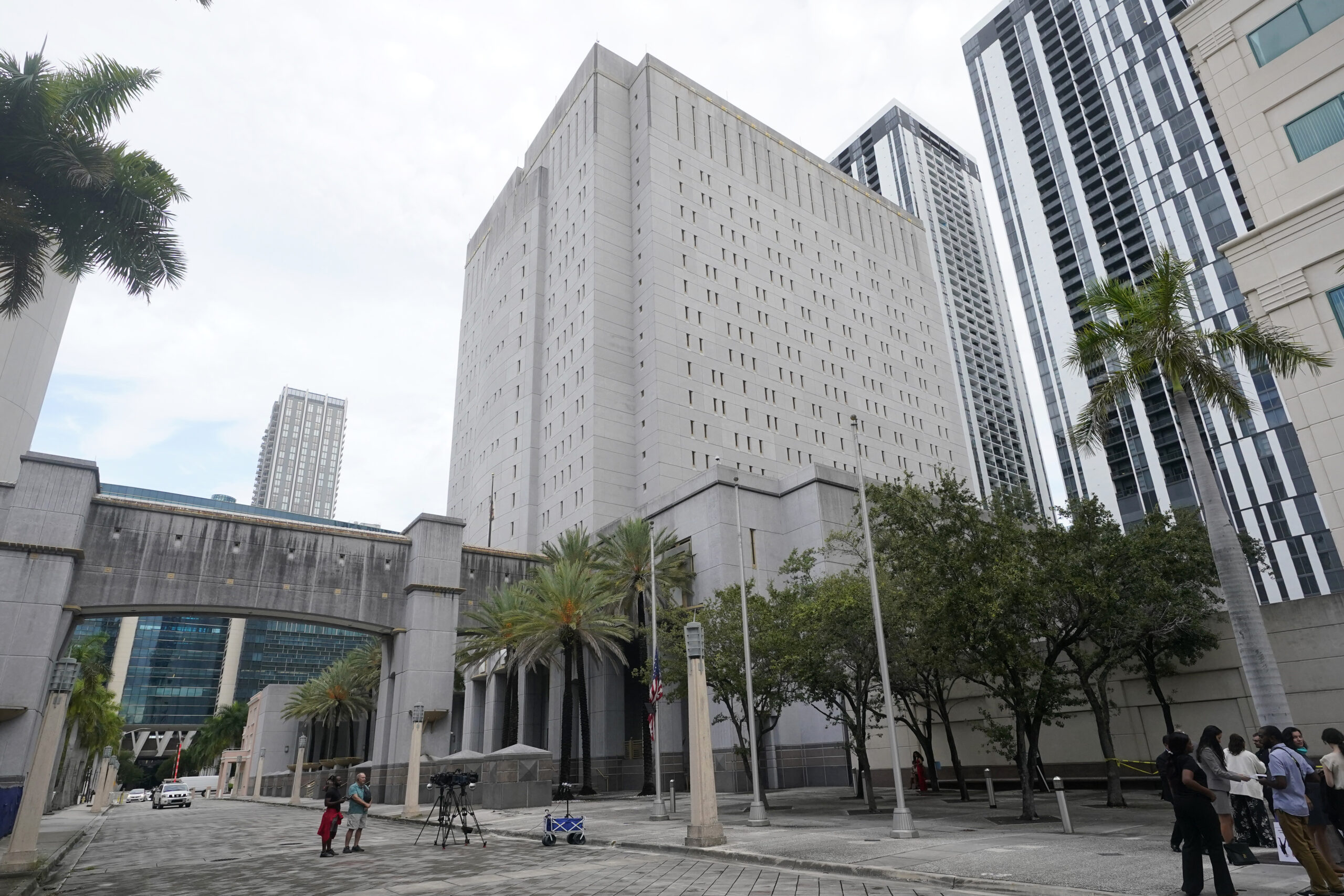
The Federal Detention Center in Miami.
Marie Ange Blaise, a citizen of Haiti, was 44 years old when she was arrested last February by Customs and Border Patrol officers as she attempted to board a commercial flight in Charlotte — one of the thousands swept up during 2025 amid the mass deportation drive of the Donald Trump regime.
Just 10 weeks later, Blaise died inside a federal immigration detention center in Broward County, Fla. A South Florida public radio station reported that the Haitian woman had spoken to her son, who later told the medical examiner that “she complained of having chest pains and abdominal cramps, and when she asked the detention staff to see a physician, they refused her.” Another detainee reported Blaise’s care was “severely delayed,” even as Immigration and Customs Enforcement (ICE) insisted she’d been offered blood-pressure medication but refused.
Blaise’s death was not an isolated incident. There was a sharp spike in ICE custody deaths during 2025, with the final tally of 31 fatalities nearly triple the 11 deaths posted during 2024, the last year of the Biden administration. Given the surge in immigration arrests after Trump took office last January, some increase was inevitable. Two of the 31 were killed by the gunman who fired on an ICE facility in Dallas. But immigration advocates say the crisis has been greatly exacerbated by inadequate medical care, bad food, and unsanitary conditions at detention centers.
“This is a result of the deteriorating conditions inside of ICE detention,” Setareh Ghandehari, advocacy director at Detention Watch Network, told the Guardian, which recently published a comprehensive rundown of all 31 custody deaths. Many died from heart attacks or respiratory failure, with a few apparent suicides — although, in a number of cases, family members are disputing the official account. Only a few of those who died were senior citizens.
There’s a bigger picture here. History has shown that authoritarian regimes can be hazardous to your health, and there is no American Exceptionalism. The MAGA movement’s low regard for the sanctity of human life is breaking through on multiple fronts, from the more than 100 deaths of South Americans on boats blown up by U.S. drones to the global crisis caused by the decimation of foreign aid through USAID (blamed for as many as 600,000 deaths by health experts) to the rising concern about fewer vaccinations and shrinking health insurance. A new generation is witnessing a grim reality: Dictatorship can be deadly.
What I wrote on this date in 2021
Jan. 6, much like Dec. 7 or Sept. 11, is a date which will live in infamy for most Americans. I had some health concerns five years ago that kept me from traveling to Washington to report on the insurrection — which I’ll always regret — but I did dash off an instant column before the smoke from Donald Trump’s failed coup had dissipated. I wrote, “When the future 45th president of the United States egged on the most violent thugs at his Nuremberg-style campaign rallies, when he yelled “get him the hell out of here” as white supporters roughed up a Black man in Birmingham, when he promised to pay the legal fees of brownshirts who beat up anti-Trump demonstrators, and when he said “I’d like to punch him in the face” to one rally insurrectionist, why are people still shocked when a riled-up mob takes Trump up on his own toxic words?” Read the rest: “Trump told us he would wreck America. Why didn’t we believe him the first time?”
Recommended Inquirer reading
I returned from a long Christmas break this weekend with something brand new to write about: the Trump regime’s illegal attack on Venezuela, which killed as many as 80 people, including civilians, and resulted in the capture of that nation’s strongman leader, Nicolás Maduro, and his wife. I wrote that Trump’s war without the required constitutional approval or public support, in violation of international law against unprovoked military aggression, fulfills his ambitions to rule as a dictator. And a new world order based not on the rule of law but brute force makes all of us less safe.
Last June, the partially unclothed body of a young woman was discovered by police under a pallet in an overgrown lot in Philadelphia’s Frankford neighborhood. For weeks, the identity of this murder victim was unknown, which didn’t deter one determined homicide detective, the missing woman’s anguished family who’d been initially told not to file a missing-person report — or The Inquirer’s Ellie Rushing, who has written a moving account of the life and death of the woman eventually learned to be Anastasiya Sangret. This kind of essential local reporting takes time and resources, which means it needs your support. You do exactly that, and unlock all the journalism of one of America’s best newsrooms, when you start 2026 with a subscription to The Inquirer.
By submitting your written, visual, and/or audio contributions, you agree to The Inquirer‘s Terms of Use, including the grant of rights in Section 10.
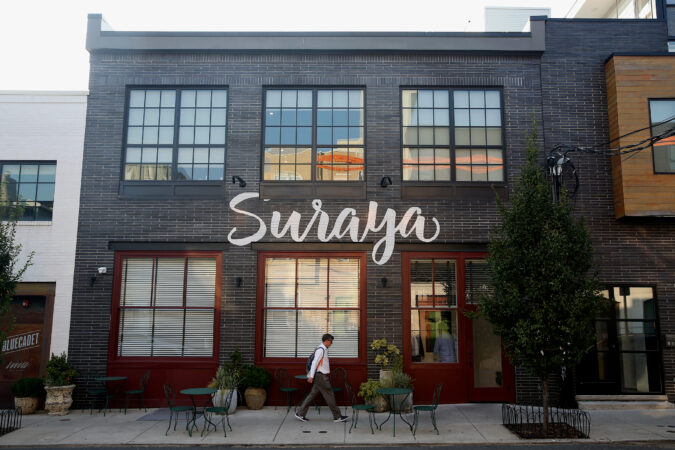
Suraya, the Michelin-recognized Lebanese restaurant in Fishtown, will temporarily close Friday after a nearby rooftop fire left the restaurant without gas.
The Philadelphia Fire Department arrived to fire on the roof of a two-story building on the 1500 block of Frankford Avenue late Thursday night. The department controlled the fire within 20 minutes and there were no reported injuries. The cause was under investigation.
However, Suraya reported that its building was still without gas service and wouldn’t open until the service was restored.
“We are incredibly grateful that our team was unharmed in the fire. We are temporarily without gas, so we cannot open the restaurant. The Suraya team will be working with local authorities to support their ongoing investigation and appreciates the community’s support,” said a spokesperson for Defined Hospitality, the restaurant group that includes Suraya.
Halabi kebabs and the samke harra are pictured at Suraya in Philadelphia’s Fishtown section on Tuesday, Aug. 11, 2020.
Updates on the restaurant opening will be posted on social media at @surayaphilly.
Suraya, named after the sibling-cowners Nathalie Richan and Roland Kassis’ grandmother in Beirut, was just recognized by the Michelin Guide for its welcoming presence, rich Middle East and Levant-inspired menu, and expansive offerings from the bakery and shop up front to its open kitchen and outdoor dining area.
Scott Sauer would like nothing better than to make SEPTA an afterthought.
He doesn’t mean that the Philadelphia region’s mass transit agency should be neglected, but rather that it will come to do its job so seamlessly that its nearly 800,000 daily customers can rely on the service without worrying about breakdowns, delays and disruptions.
Given the cascading crises that hit SEPTA in 2025, many people wondered if the place was hexed.
“I hope not, because I don’t know how to get the curse off me,” Sauer said in a recent interview. “But listen, truth be told, there were days when I scratched my head and thought, ‘Oh, my goodness, what is going on?’”
“We just couldn’t seem to get more than a day or two of relief before something else was causing a headache,” said Sauer.
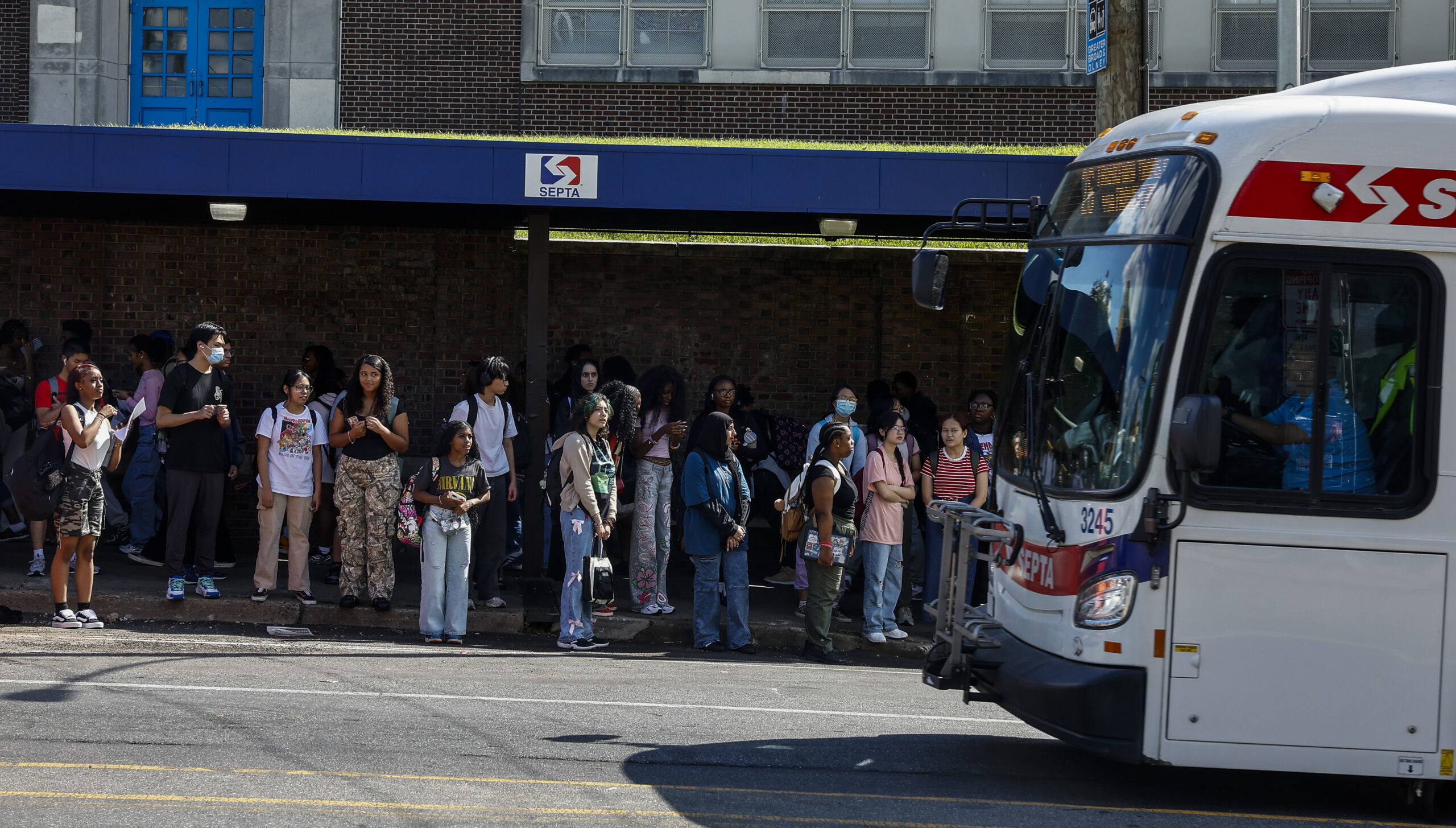
A bus passes the stop near Girls High at Broad and Olney Streets on Monday, Aug. 25, 2025. Thirty two SEPTA bus routes were cut and 16 were shortened, forced by massive budget deficits.
Back to basics in 2026
In the end, help from above and a new labor contract bought SEPTA at least two years to recover from its annus horribilis and stabilize operations.
When the Pennsylvania legislature couldn’t get a transit funding deal done, Gov. Josh Shapiro shifted $394 million in state-allocated funds for infrastructure projects to use for operations — the third temporary solution in as many years. The administration also later sent $220 million in emergency money in November for the Regional Rail fleet and the trolley tunnel.
And, early in December, SEPTA reached agreement on a new, two-year contract with its largest bargaining unit, Transport Workers Union Local 234.
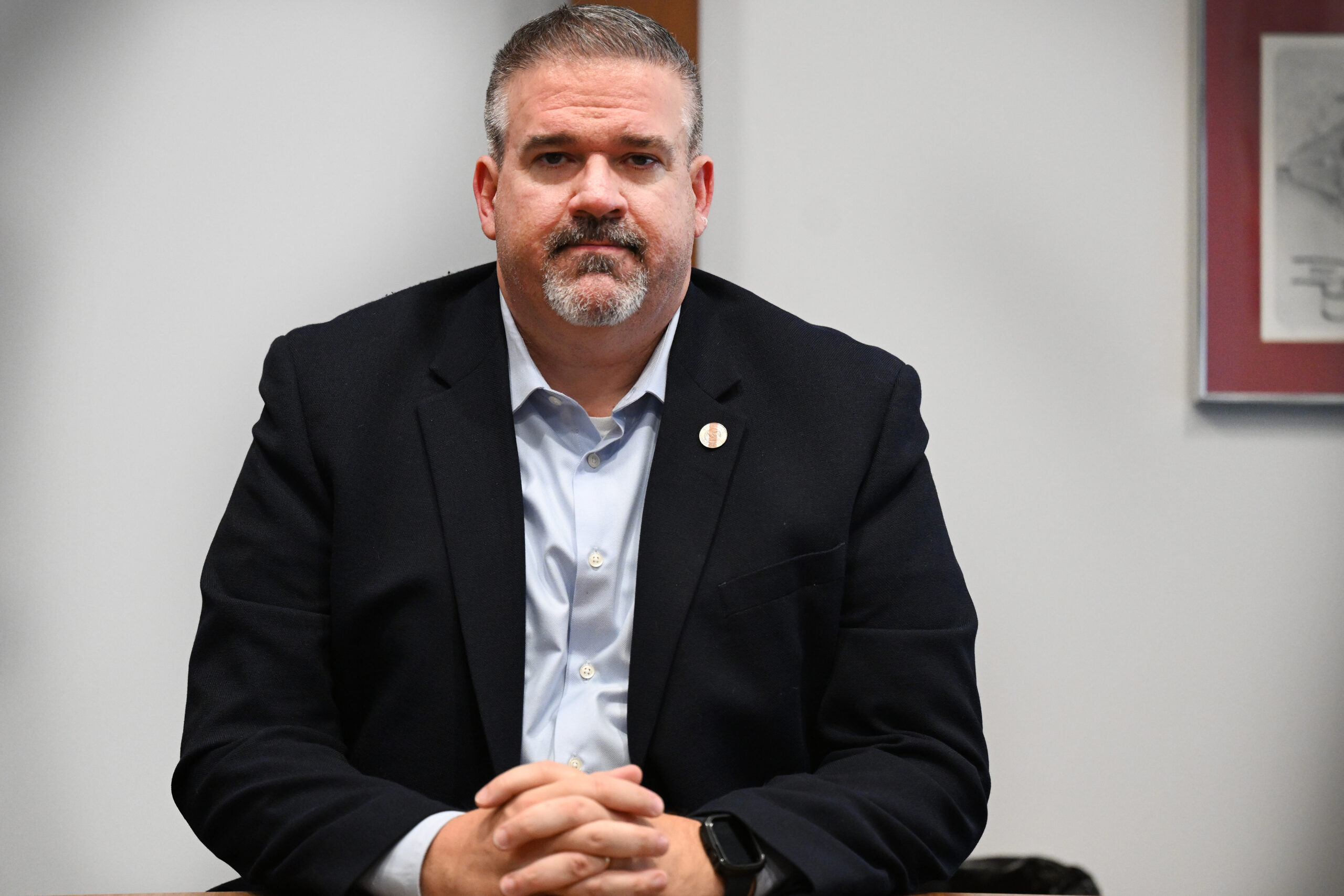
Scott Sauer, general manager of SEPTA, admits that 2025 was an extremely challenging year.
Sauer compared SEPTA’s position to football refs. When they are doing their jobs right, fans don’t have to think about them when watching the game. And when things are going well on the transit system, it becomes part of the background.
“Let’s make sure we do the basics, and we do them really well, because at the end of the day, people want SEPTA to move them from one place to the other, right?” he said.
The test of the focus on fundamentals comes soon, with millions of visitors expected in the region for the 250th anniversary of the Declaration of Independence, World Cup soccer, and other big events.
Sauer, 54, began his career as a trolley operator more than 30 years ago. He had no political experience, though, and would quickly be thrown headfirst into those murky waters to swim with sharks.
Storm clouds were already rolling in. Weeks before Sauer took the reins, Shapiro had flexed $153 million in state highway funds for SEPTA operations after a broader deal failed amid Senate GOP opposition.
It’s a legal move, but often controversial, and Shapiro’s opponents were furious.
Richards and her leadership team had been warning of a looming fiscal “doomsday scenario” for months. Officials were drafting a budget with service cuts and fare increases.
On Feb. 6, a Wilmington-bound Regional Rail train caught fire as it was leaving Crum Lynne Station in Delaware County. It was worrisome, but at the time, nobody knew it would get worse.
More than 300 passengers were safely evacuated after a SEPTA Regional Rail train caught fire near Crum Lynne Station in February.
Familiar battle lines were drawn. Senate Republicans, in the majority in the chamber, opposed Shapiro’s proposal to generate $1.5 billion for transit operations over five years by increasing its share of state sales tax income.
They preferred a new source of income for the state’s transit aid and said SEPTA was mismanaged, citing high-profile crimes, rampant fare evasion, and lax enforcement.
On a mid-August night, the Senate GOP came up with a proposal that would take money from the Public Transportation Trust Fund, a source for transit capital projects, and split it evenly between transit operations subsidies and rural state highway repairs.
Senate Majority Leader Joe Pittman, a Republican from Indiana County, was a key player in budget negotiations, which ultimately did not yield additional funding for mass transit.
“It was kind of quiet … and then we got alerted that a proposal was coming within minutes. And so everybody was scrambling to try to read through it,” Sauer said.
In a quick news conference with Shapiro, Sauer opposed the idea of taking capital dollars for transit operations, as did the governor. Then he spoke with Senate Republicans and told reporters it could be worth considering, but he had questions. And by the end of the night, he walked that back and opposed the measure.
“I guess if there was a lesson to be learned for me in August, it was I should have taken some [more] time reading through that proposal,” he said.
There was not much time to reflect on what happened, though, because the hits kept on comingas the federal government ordered SEPTA to inspect all 223 Regional Rail cars.
SEPTA’s Regional Rail fleet is the oldest operating commuter fleet in the country, and the fires highlighted the difficulty of keeping them maintained while needing to stretch limited capital funds to address multiple problems.
The Market-Frankford El cars, though younger than the Silverliner IVs, have been beat up and unreliable. SEPTA is moving forward with replacing them, as well as the Kawasaki trolleys that are more than 40 years old.
SEPTA had ordered new Regional Rail coaches from a Chinese-government-related manufacturer, but canceled the contract after the first few models, built during the pandemic, showed flaws. Now the agency is advertising for bids on a new fleet of Regional Rail workhorses — but it has to make them sturdier to last for at least seven more years before new cars would be on the way.
Officials plan to use $220 million received from the state on that effort.
Some of the money, about $48 million, is slated to help fix the trolley-tunnel issue. SEPTA is contending with glitches in the connection between the overhead catenary wires and the pole that conducts electricity to the vehicle.
What SEPTA got done
SEPTA has made some progress on some of its persistent issues, officials say, though the accomplishments understandably have been largely overlooked amid the urgent, existential crises of 2025.
For instance, serious crimes on the SEPTA system dropped 10% through Sept. 30 compared to the same period in 2024, according to Transit Police metrics.
And there had already been a sharp improvement. Serious crimes in 2024 dropped 33% compared to 2023 — from 1,063 to 711, year over year.
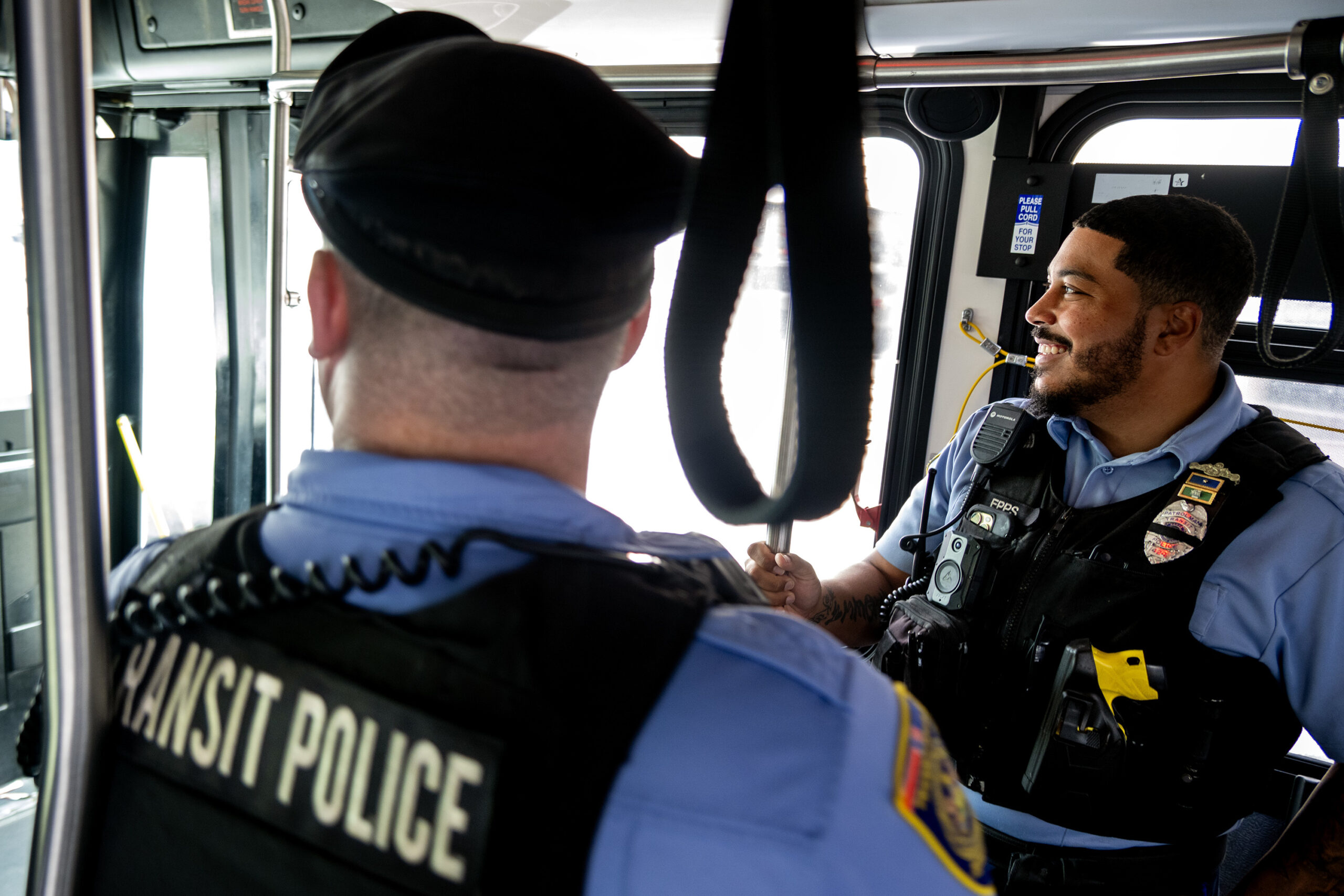
SEPTA transit police police patrol officers Brendan Dougherty (left) and Nicholas Epps (right) with the Fare Evasion Unit ride the 21 bus.
“If you think back to where we were in 2021 and 2022, the perception was bad things were happening on SEPTA, and you should steer clear of them,” Sauer said.
The Transit Police have been hiring new officers, including a recently graduated academy class of nine, and has about 250 officers.
SEPTA also installed 42 full-length gates designed to thwart fare evasion on seven platforms in five stations during 2025, spokesperson Andrew Busch said.Another 48 gates are coming in the first quarter of the year.
Police are also issuing citations with an enhanced penalty of up to $300 for fare evasion.
Prepare for déjà vu
Andyet, in 2027, it will be time to start the old SEPTA-funding dance once again, as transit agency advocates and supportive lawmakers work at getting a stable state funding stream for transit operations.
State Democrats have said the transit issue could help them take control of the Senate from Republicans — a longtime goal but one that is difficult to achieve. One wild card is whether President Donald Trump’s slumping popularity will cause GOP congressional candidates to get swamped in the 2026 midterms, and whether that will translate into voters’ local senators.
It likely would have to be a huge wave, and it’s a closely divided state.
By 2027, Shapiro is expected to be running for president (if he is reelected next year), and it’s anyone’s guess how that could affect budget politics.
“Not everybody wants to see us. I didn’t make a lot of friends,” Sauer joked after the TWU settlement.
Police found the body of the woman with the crystal pendant necklace stuffed beneath a wooden pallet in an overgrown lot in Frankford one night last June. She had been shot once between the eyes, and wore only a sports bra, with her pants and underwear tangled around her ankles.
Days in the stifling heat had left her face unrecognizable, nearly mummified.
Still, Homicide Detective Richard Bova could see traces of the beautiful young woman she had been. She was small, about 100 pounds, with long dark hair tinted red at the ends. Her nails were painted pale pink. She wore small gold hoops in her ears.
But he didn’t know her name. And for 90 days, the absence of that essential fact stalled everything.
A victim’s identity is the foundation on which a homicide case is built. Without it, detectives cannot retrace a person’s final moments or home in on who might have wanted them dead and why. For three months, Bova and his partner scoured surveillance footage, checked missing-persons reports, and ran down every faint lead, eager to put a name to the woman beneath the pallet.
At the same time, in a small house in Northeast Philadelphia, a family was searching, too.
Olga Sarancha hadn’t heard from her 22-year-old daughter, Anastasiya Stangret, in weeks and was growing worried. Stangret had struggled with an opioid addiction in recent months, but never went more than a few days without speaking to her mother or sister.
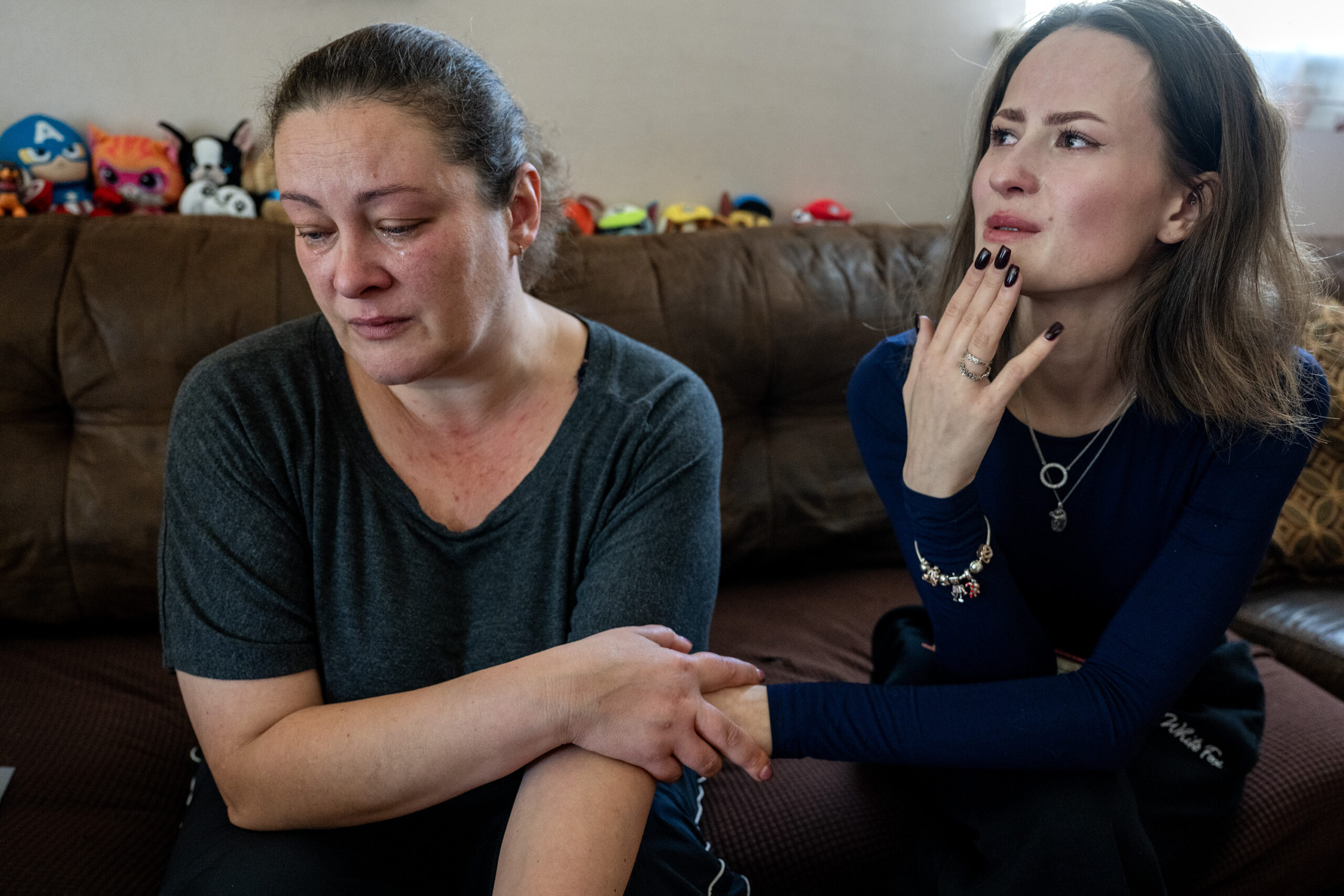
Olga Sarancha (left) and her daughter, Dasha Stangret, speak of the pain of the death of her eldest daughter, Anastasiya, at their Northeast Philadelphia home. Dasha wears a bracelet featuring Pandora charms gifted by her sister.
Through July and August that summer, Sarancha and her youngest daughter, Dasha, tried to report Stangret missing, but they said they were repeatedly rebuffed by police who turned them away and urged them to search Kensington instead.
So they kept checking hospitals, calling Stangret’s boyfriend, and driving through the dark streets of Kensington — looking for any sign that she was still alive.
It was not until mid-September that the family was able to file a missing-persons report. Only then did Bova learn the name of his victim.
But by then, he said, the crucial early window in the investigation had closed — critical surveillance footage, which resets every 30 days, was gone. Cell phone data and physical evidence were harder to trace.
Still, for 18 months, Bova has worked to solve the case, and for 18 months, Stangret’s mother and younger sister have grieved silently, haunted by the horrors of her final moments and the fear that her killer might never be caught.
Philadelphia’s homicide detectives this year are experiencing unprecedented twin phenomena: The city is on pace to record its fewest killings in 60 years, and detectives are solving new cases at a near-record high.
But those gains do not erase the reality that hundreds of killings in recent years remain unresolved — each one leaving families suspended in despair, and detectives asking themselves what more they could have done.
In this case, extensive interviews with Bova and Stangret’s family offer a window into how a case can stall even when a detective puts dozens of hours into an investigation — and what that stall costs.
Bova has a suspect: a 58-year-old man with a lengthy criminal record who he believes had grown infatuated with Stangret as he traded drugs for suboxone and sex with her. But the evidence is largely circumstantial. He needs a witness.
And Stangret’s family needs closure — and reassurance that the life of the young woman, despite her struggles, mattered.
“Everybody has something going on in their life,” said Dasha Stangret, 23. “It doesn’t make her a bad person, and it’s not what she deserved.”
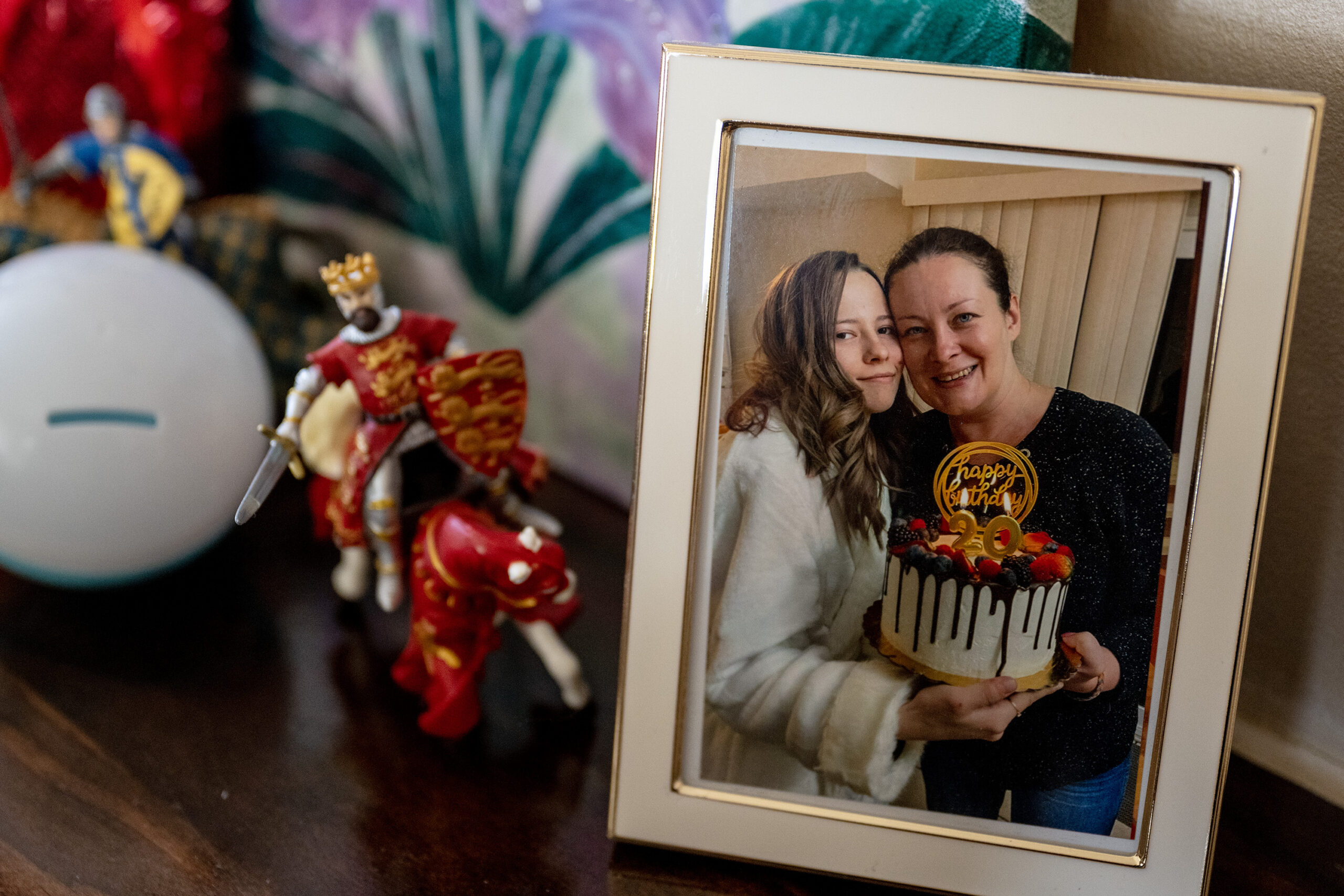
Anastasiya Stangret, left, celebrated her 20th birthday with her mother in 2022.
Becoming Anna
Anastasiya Stangret was born in Lviv, Ukraine, on Nov. 15, 2001. Her family immigrated to Northeast Philadelphia when she was 8 and Dasha was 7.
The sisters were inseparable for most of their childhood. They cuddled under weighted blankets with cups of tea. They put on fluffy robes and did each other’s eyebrows and nails.
Anna was bubbly, polite, and gentle, her family said. She enjoyed working with the elderly, and after graduating from George Washington High School, she earned certifications in phlebotomy and cardiology care. She volunteered at a nearby food bank, translated for Ukrainian and Russian immigrants, and later worked at a rehabilitation facility, where she gave patients manicures in her free time.
Sisters Dasha, left, and Anastasiya Stangret were inseparable as children. They dressed up as princesses for Halloween in 2008.Dasha, left, and Anastasiya Stangret at their first day of school in Philadelphia after emigrating from Ukraine.
“Anna always worked really hard,” Dasha Stangret said. “I looked up to her.”
But her sister was also quietly struggling with a drug addiction.
Her challenges began when she was 12, her mother said, after she was hit by a car while crossing the street to catch the school bus. She suffered a serious concussion, Sarancha said, and afterward struggled with PTSD, anxiety, and depression.
About a year later, as her anxiety worsened, a doctor prescribed her Xanax, her mother said. Not long after, she started experimenting with drugs with friends, her sister said — first weed, then Percocet.
She hid her drug use from her family until her early 20s, when she became addicted to opioids.
She sought help in January 2024 and began drug treatment. But her progress was fleeting. She returned to living with her boyfriend of a few years, who they later learned also used drugs, and she became harder to get in touch with, her mother said.
When Sarancha’s birthday, June 18, came and passed in 2024 without word from her daughter, the family grew increasingly concerned.
Anastasiya Stangret was kind, gentle, and polite.
They checked in with Stangret’s boyfriend, they said, but for weeks, he made excuses for her absence. He told them that she was at a friend’s house and had lost her phone, that she was in rehab, that she was at the hospital.
On July 27, Sarancha and her daughter visited the 7th Police District in Northeast Philly to report Anna missing, but they said an officer told them to go home and call 911 to file a report.
Two officers responded to their home that day. The family explained their concerns — Stangret was not returning calls or texts, and her boyfriend was acting strange. But the officers, they said, told them they could not take the missing-persons report because Stangret no longer lived with them. They recommended that the family go to Kensington and look for her.
Through August, the family visited a nearby hospital looking for Stangret, only to be turned away. Sarancha, 46, and her husband drove through the streets of Kensington without success. They continued to contact the boyfriend, but received no information.
They wanted to believe that she was OK.
On Sept. 12, they visited Northeast Detectives to try to file a missing-persons report again, but they said an officer said that was not the right place to make the report. They left confused. Dasha Stangret called the district again that day, but she said the officer on the phone again told her that she should go to Kensington and look for her sister.
That the family was discouraged from filing a report — or that they were turned away — is a violation of Philadelphia police policy.
“When in doubt, the report will be taken,” the department’s directive reads.
Finally, on the night of Sept. 12, Dasha Stangret again called 911, and an officer came to the house and took the missing-persons report. For the first time, they said, they felt like they were being taken seriously.
A few days later, Dasha Stangret called the detective assigned to the case and asked if there was any information. He asked her to open her laptop and visit a website for missing and unidentified persons.
Scroll down, he told her, and look at the photos under case No. 124809.
On the screen was her sister’s jewelry.
Dasha Stangret gifted this necklace to her sister for her birthday one year. Police released the image after Anastasiya’s body was found last June, in a hope that someone would recognize it and identify her. Dasha did not see the photo until September 2024.Olga Sarancha gifted these gold earrings, handmade in Ukraine, to her eldest child on her birthday a few years ago. Police released this image after they recovered the earrings on Anna’s body, hoping it could lead them to her identity.
A detective’s hunch
Three months into Bova’s quest to identify the woman under the pallet — of watching hundreds of hours of surveillance footage and chasing fleeting missing-persons leads — dental records confirmed that the victim was Stangret.
After meeting with her family, Bova questioned the young woman’s boyfriend.
He told the detective he and Stangret had met a man under the El at the Arrott Transit Center in Frankford sometime in June, Bova said, and that the man gave them drugs in exchange for suboxone and, later, sex with Stangret.
But the man had grown infatuated with Stangret, he said, and after she left his house, he started threatening her in Facebook messages, ordering her to return and saying that if anybody got in his way, he would hurt them.
The man lived in a rooming house on Penn Street — almost directly in front of the overgrown lot where Stangret’s body was found. Surveillance video showed Stangret walking inside the rowhouse with him just before 7 p.m. on June 18, Bova said, but video never showed her coming back out.
Police searched the man’s apartment but found nothing to link him to the crime — no blood, no gun, no forensic evidence that Stangret had ever been inside. The suspect had deleted most of the texts and calls in his phone from June, July, and August, Bova said, and because nearly four months had passed, they could no longer get precise phone location data.
He said that, at this point, he does not believe the boyfriend was involved with her death, and that he came up with excuses because he was afraid to face her family.
Surveillance cameras facing the lot where Stangret was found didn’t show anyone entering the brush with a body. Neighbors and residents of the rooming house said they didn’t know or hear anything, he said. And a woman seen on camera pacing the block and talking with the suspect the night they believed Stangret was killed also said she had no information.
The detective is stuck, he said.
“Is it enough for an arrest? Sure,” Bova said of the circumstantial evidence against the suspect. “But our focus is securing a conviction.”
Bova’s theory is that the man, angry that Stangret wanted to leave, shot her in the head. Because the house has no back door, he believes the man then lowered her body out of the second-floor window, used cardboard to drag her through the brush, and then hid her under a pallet.
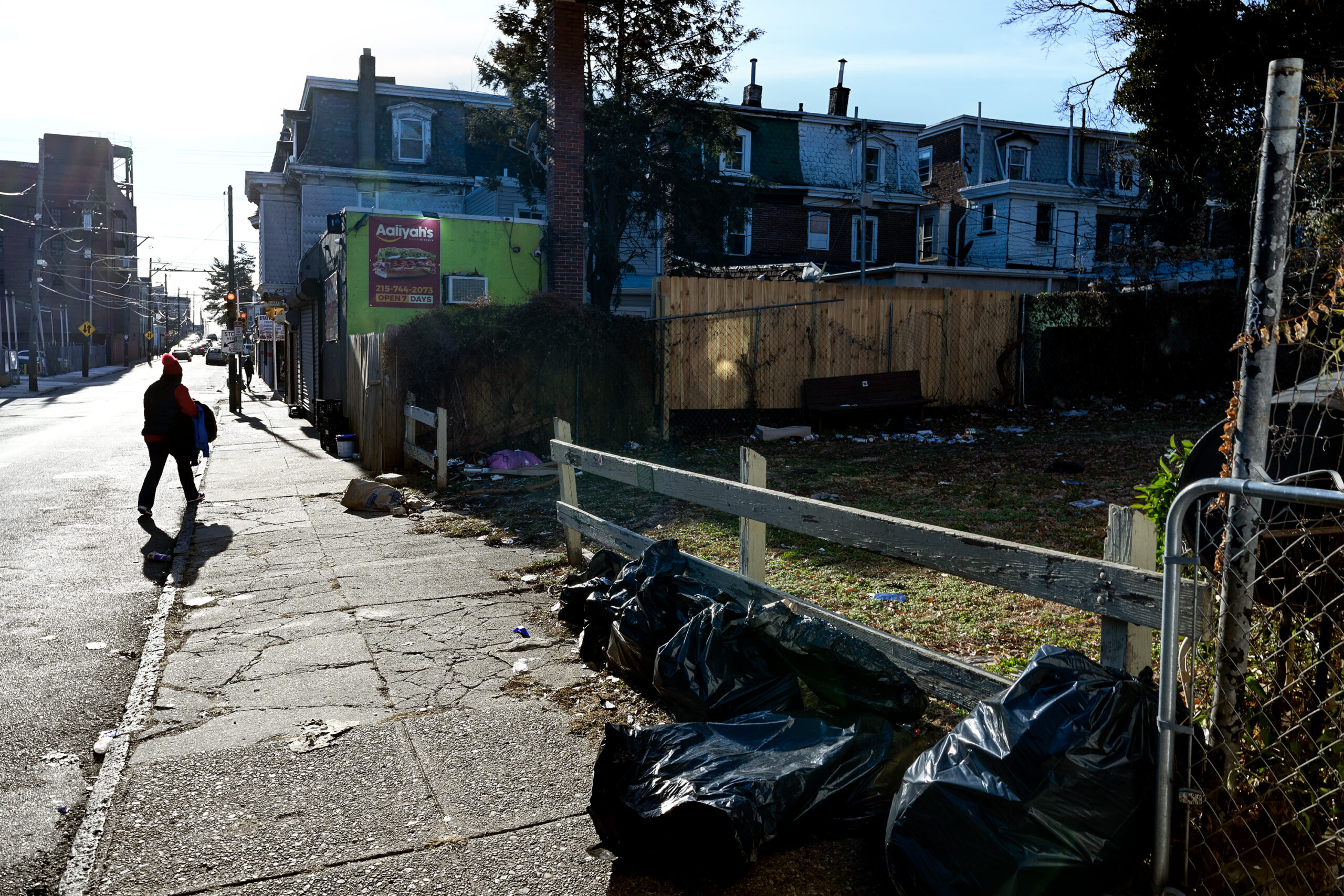
Anastasiya Stangret’s body was found in the back of this vacant lot, on the 4700 block of Griscom Street, in June 2024.
He is sure that someone has information that could help the case — that the suspect may have bragged about what happened, that a neighbor heard a gunshot or saw Stangret’s body being taken into the lot.
There is a $20,000 reward for anyone who has information that leads to an arrest and conviction.
“The hardest part is patience,” he said. “I’m looking for any tips, any information.”
Bova has worked in homicide for five years. As with all detectives, he said, some cases stick with him more than others. Stangret’s is one of them.
“Anna means a lot,” he said. “This is a young girl. We all have children. I have daughters. For her to be thrown in an empty lot and left, to see her life not matter like that, it’s horrifying to me and to us as a unit.”
“It eats me alive,” he said, “that I don’t have answers for them and I’m not finishing what was started.”
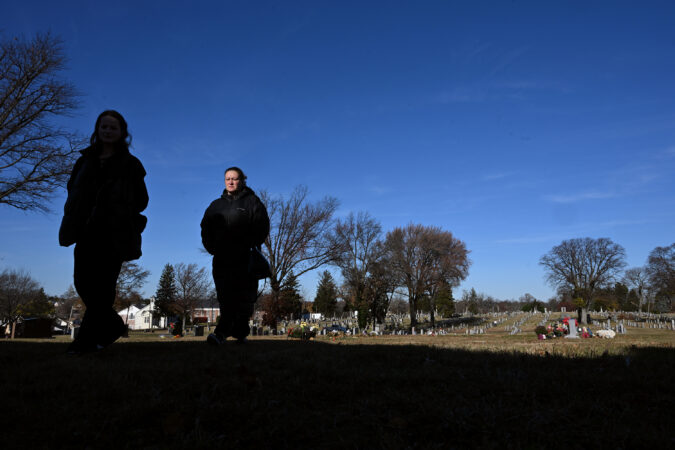
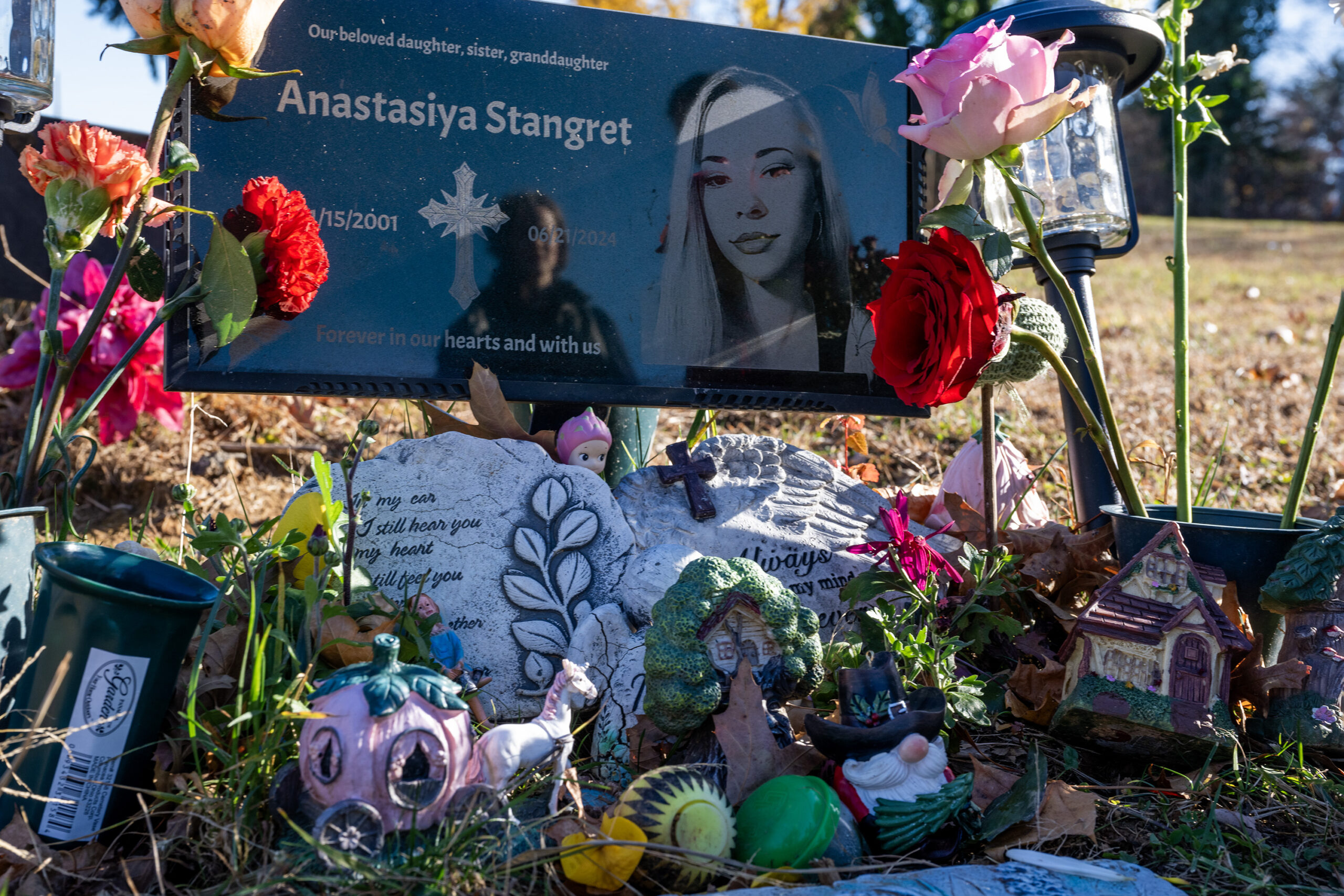
Dasha Stangret is reflected in the memorial at the grave of her sister, Anastasiya, in William Penn Cemetery.
‘I love you. I miss you’
Stangret’s family suffers every day — the guilt of wondering whether they could have done more to get her help, the anger that her boyfriend didn’t raise his concerns sooner, the fear of knowing the man who killed her is still out there.
Dasha Stangret, a graphic design student at Community College of Philadelphia, finds it difficult to talk about her sister at length without trembling. It’s as if the grief has sunk into her bones.
In July, she asked a police officer to drive her to the lot where her sister’s body was found. She sat for almost an hour, crying, placing flowers, searching for a way to feel closer to her.
“I cannot sleep, I cannot live,” Olga Sarancha said of the pain of losing her daughter.
Sarancha struggles to sleep. She wakes up early in the mornings and rereads old text messages with her daughter. She pulls herself together to care for her 6-year-old son, Max, whose memories of his oldest sister fade daily.
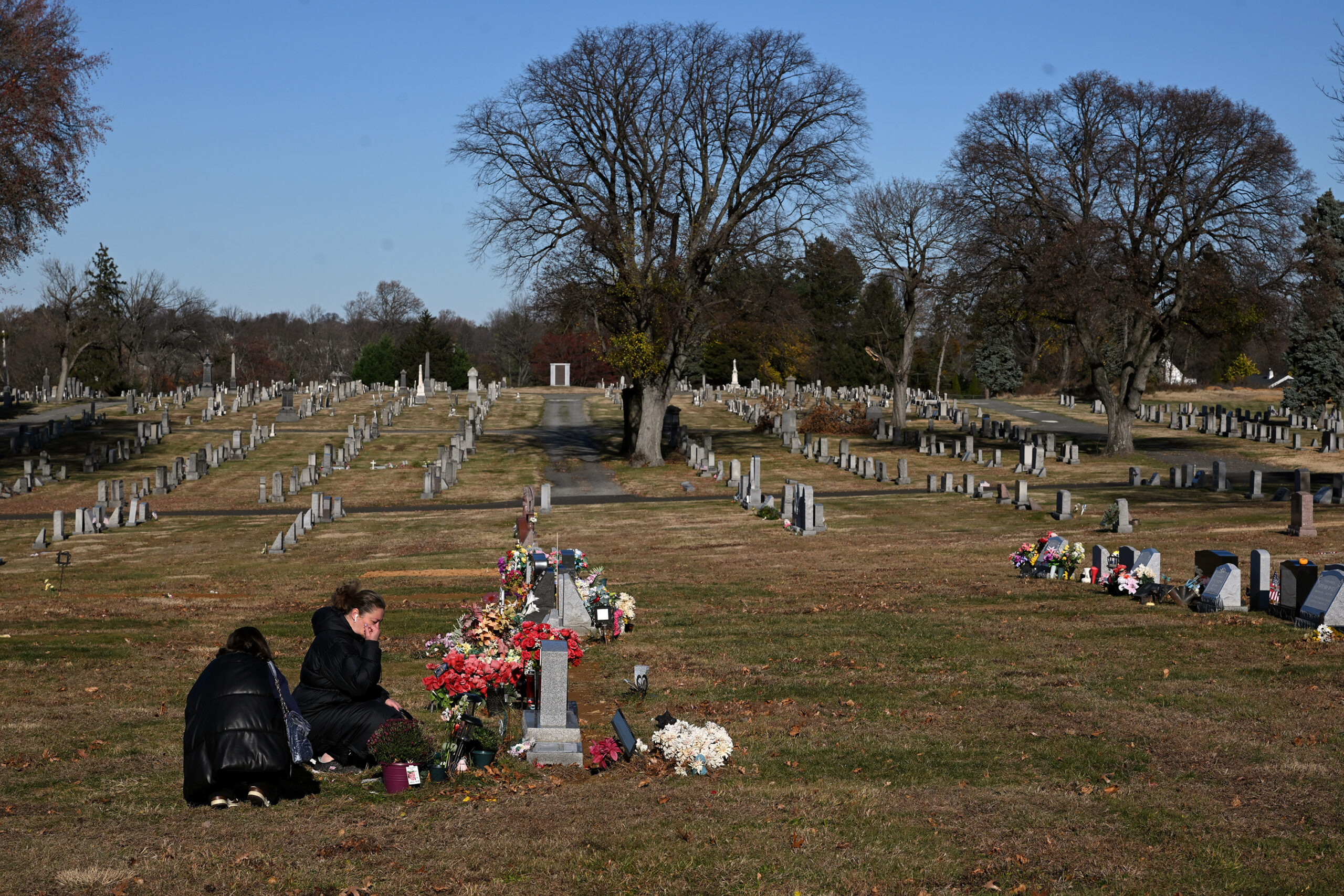
On a recent day, Dasha Stangret and her mother visited her sister’s grave at William Penn Cemetery. They fluffed up the fresh roses, rearranged the tiny fairy garden around her headstone, and lit a candle.
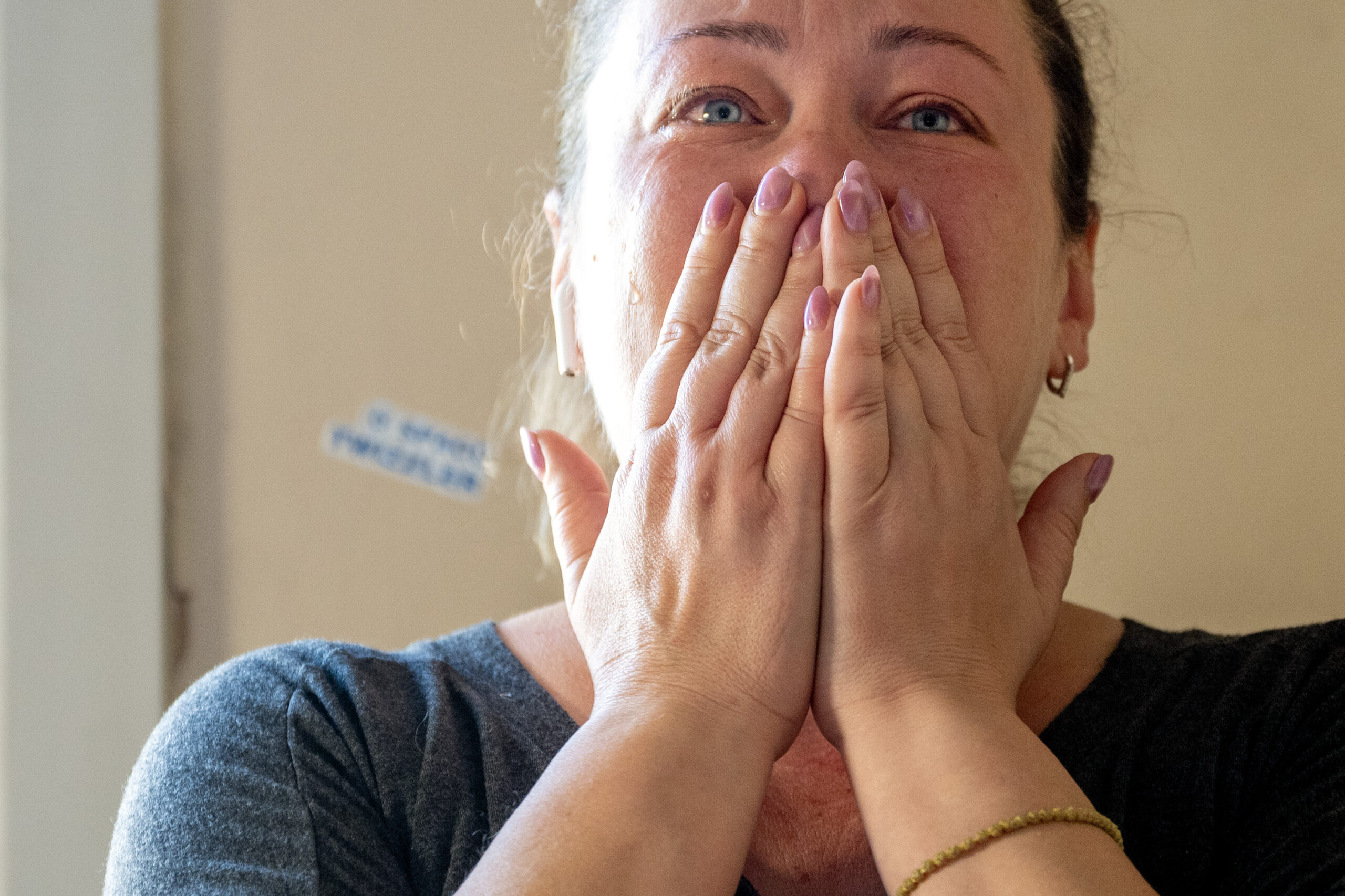
Stangret began to cry — and shake. Her mother took her arm.
“I love you. I miss you,” Stangret told her sister. “I hope you’re happy, wherever you are.”
And nearly 20 miles south, inside the homicide unit, Bova continues to review the files of the case, waiting for the results of another DNA test, hoping for a witness who may never come.
If you have information about this crime, contact the Homicide Unit at 215-686-3334 or submit a confidential tip by texting 773847 or emailing tips@phillypolice.com.
Olga Sarancha (right) and her daughter Dasha visit the grave of her older daughter Anastasiya Stangret in William Penn Cemetery. “It feels out of body. Like a dream, a movie, like it’s not real,” Dasha said of losing her sister.
The 10-year-old boy who was severely burned in the Northeast Philadelphia plane crashwas headed home on Tuesday after spending nearly a year in the hospital, his grandmother, Alberta “Amira” Brown said.
“It’s the best thing ever that he’ll be home for the holidays,” Brown said in the morning as the boy prepared to leaveWeisman Children’s rehabilitation hospital in South Jersey. “He is truly happy to be coming home.”
Ramesses Vazquez Viana, then 9, suffered burns to 90% of his body on Jan. 31 whena Learjet medical transport crashed on Cottman Avenue near the Roosevelt Mall, killing allsix people on board.
Ramesses had been riding in a car with his father, Steven Dreuitt Jr., and Dreuitt’s fiancée, Dominique Goods Burke. Dreuitt, 37, died in the blaze. Goods Burke, 34, died in April from her injuries after spending nearly three months at Thomas Jefferson University Hospital.
A bystander saw Ramesses after he escaped from the car; the boy’s back was on fire, and his shirt was burned away.
Police took Ramesses to St. Christopher’s Hospital for Children, and he was later airlifted to Shriners Children’s hospital in Boston. He underwent more than 40 surgeries, including multiple skin grafts. He spent months in physical therapy relearning how to get out of bed, walk and climb stairs, according family interviews with CBS News.
His classmates from Smedley Elementary School in the Philadelphia’s Frankford neighborhood cheered him on from afar, writing him cards and sending videos.
Ramesses celebrated his 10th birthday in October at the Boston hospital.
A few weeks ago, Ramesses was moved closer to his Philadelphia home to Weisman Children’s in Marlton, N.J.
During a phone interview with The Inquirer, Brown said her grandson “has a long road ahead of him” and would need additional surgeries.
During a visit with him Saturday, he kicked a soccer ball around with her.
Brown confirmed a CBS report that Ramesses was being released from Weisman sometime Tuesday, but declined to provide specifics.
Brown said her grandson has chilling memoriesfrom that night: He was in the car’s backseat texting with Brown at about 6 p.m. when the plane exploded in a giant fireball, and he heard loud booms.
As flames engulfed the car, Ramesses tried to help his father, who couldn’t move his legs. The child heard his father yell to get out, and that he loved him. Ramesses told his father he loved him back. He could hear Goods Burke screaming.
Steven Dreuitt Jr. and Goods Burke shared a teenage son, Dominick Goods, who is now a junior at Imhotep Institute Charter High School. Brown said her older grandson is “really struggling” with his parents’ deaths.
The sixpassengers killedon the medical transport jet were Mexican nationals. They included the pilot and copilot, two medical personnel, an 11-year-old girl, and her mother. The girl was headed home to Mexico after undergoing treatment for a spinal condition at Shriners Children’s Philadelphia.
Investigators with the National Transportation Safety Board haven’t yet determined why the plane crashed. A preliminary report, released earlier this year, found the cockpit voice recorder “had likely not been recording audio for several years.” No distress calls were made by the pilot or copilot.
Kevin Bean was a frail 125 pounds last February when he entered a brand-new recovery house, a facility where he landed after spending four years in the throes of addiction — at times on the streets of Kensington, the epicenter of the city’s drug crisis.
The Frankford native was one of the first residents to enter the Riverview Wellness Village, the 20-acre recovery facility that Mayor Cherelle L. Parker’s administration opened in Northeast Philadelphia nearly a year ago as part of City Hall’s efforts to address opioid addiction and the Kensington drug market.
Bean, now 46 and boasting a healthier frame, just celebrated one year of sobriety and is preparing to move out of Riverview early next year.
He described his transition simply: “whole new life.”
Much of the mayor’s agenda in Kensington has been visible to the neighborhood’s residents, such as increased law enforcement and a reduction in the homeless population. But the operations and treatment outcomesat Riverview, located down a winding road next to the city’s jail complex, happen largely outside of public view. Last spring, some city lawmakers complained that even they knew little about the facility operations.
An inside look at the Riverview complex and interviews with more than a dozen residents and employees showed that, over the last year, the city and its third-party healthcare providers have transformed the facility. What was recently a construction zone is now a one-stop health shop with about 75 staff and more than 200 residents, many of whom previously lived on Kensington streets.
Those who live and work at Riverview said the facility is plugging a hole in the city’s substance use treatment landscape. For years, there have not been enough beds in programs that help people transition from hospital-style rehab into long-term stability. The recovery house industry has been plagued with privately run homes that are in poor condition or offer little support.
The grounds and residence buildings at Riverview Wellness Village, a city-owned drug recovery home in Northeast Philadelphia.
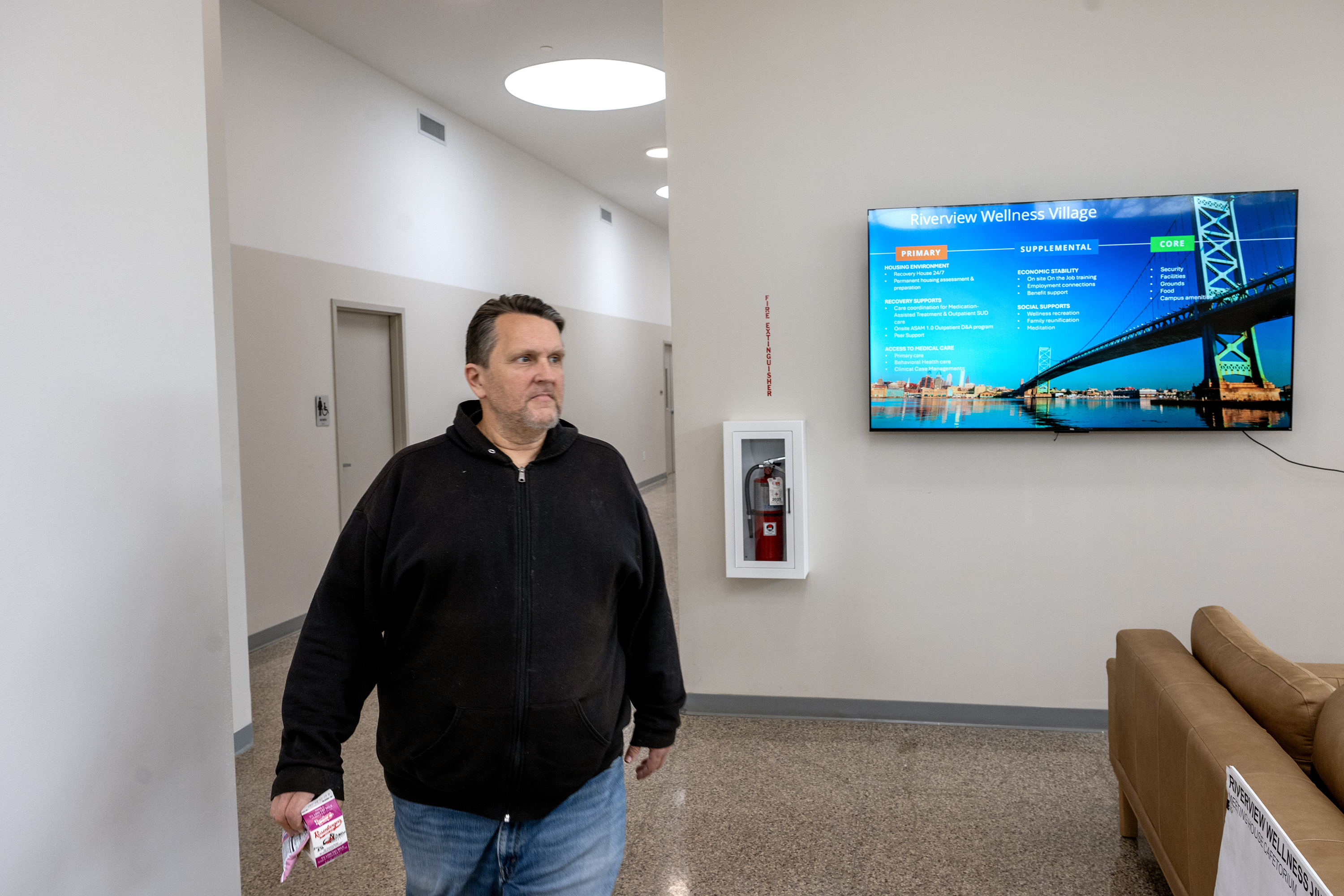
At its current capacity, Riverview has singularly increased the total number of recovery house beds in the city by nearly 50%. And residents — who are there voluntarily and may come and go as they please — have much of what they need on the campus: medical care, mental health treatment, job training, and group counseling.
They also, as of last month, have access to medication-assisted treatment, which means residents in recovery no longer need to travel to specialized clinics to get a dose of methadone or other drugs that can prevent relapse.
Arthur Fields, the regional executive director at Gaudenzia, which provides recovery services to more than 100 Riverview residents, said the upstart facility has become a desirable option for some of the city’s most vulnerable. Riverview officials said they aren’t aware of anywhere like it in the country.
“The Riverview Wellness Village is proof of what’s possible,” Fields said, “when we work together as a community and move with urgency to help people rebuild their lives.”
While the facility launched in January with much fanfare, it also faced skepticism, including from advocates who were troubled by its proximity to the jails and feared it would feel like incarceration, not treatment. And neighbors expressed concern that the new Holmesburg facility would bring problems long faced by Kensington residents, like open drug use and petty theft, to their front doors.
But despite some tenets of the mayor’s broader Kensington plan still facing intense scrutiny, the vocal opposition to Riverview has largely quieted. Parker said in an interview that seeing the progress at Riverview and the health of its residents made enduring months of criticism “well worth it.”
“I don’t know a Philadelphian who, in some way, shape, or form, hasn’t been touched by mental and behavioral health challenges or substance use disorder,” said Parker, who has spoken about how addiction shaped parts of her own upbringing. “To know that we created a path forward, to me, I’m extremely proud of this team.”
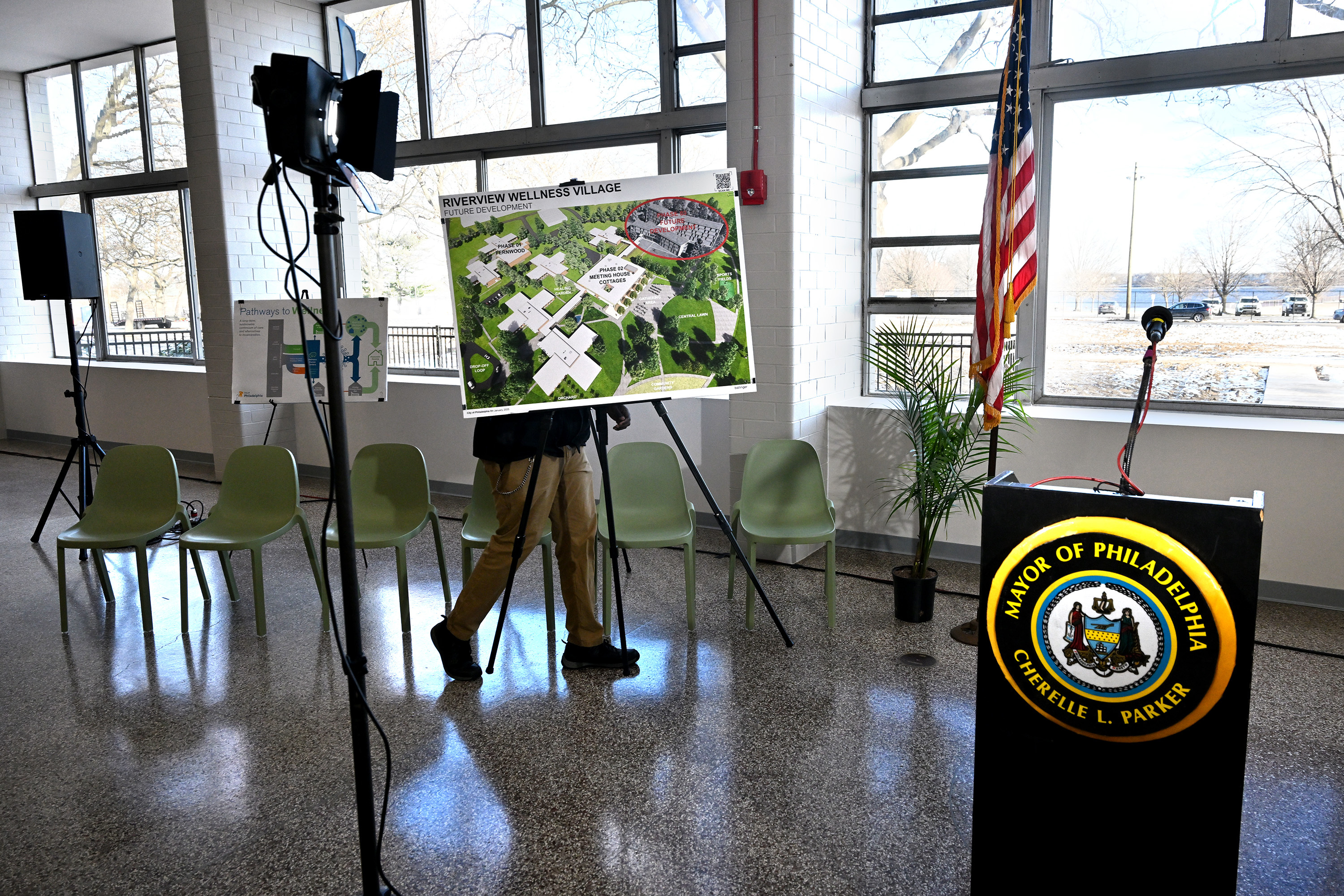
Mayor Cherelle L. Parker places a new block on the scale model of the Riverview Wellness Village on Wednesday, Jan. 8 during the unveiling of Philadelphia’s new city-operated drug treatment facility. At left is Managing Director Adam Thiel. City Councilmember Michael Driscoll is at right.Isabel McDevitt, executive director of the Office of Community Wellness and Recovery, points to a model with upcoming expansion at Riverview Wellness Village, a city-owned drug recovery home in Northeast Philadelphia on Nov. 25.Staffers move photos into place at the Riverview Wellness Village on Jan. 8 before the unveiling of Philadelphia’s new city-operated drug treatment facility.
Meanwhile, neighbors who live nearby say they have been pleasantly surprised. Pete Smith, a civic leader who sits on a council of community members who meet regularly with Riverview officials, said plainly: “There have been no issues.”
“If it’s as successful as it looks like it’s going to be,” he said, “this facility could be a model for other cities throughout the country.”
Smith, like many of his neighbors, wants the city’s project at Riverview to work because he knows the consequences if it doesn’t.
His son, Francis Smith, died in September due to health complications from long-term drug use. He was 38, and he had three children.
Getting a spot at Riverview
The sprawling campus along the Delaware River feels more like a college dormitory setting than a hospital or homeless shelter. Its main building has a dining room, a commercial kitchen, a gym, and meditation rooms. There are green spaces, walking paths,and plans for massive murals on the interior walls.
Katherine Young, director of Merakey at Riverview Wellness Village, talks with a resident at the city-owned drug recovery home in Northeast Philadelphia on Nov. 25.
Residents live and spend much of their time in smaller buildings on the campus, where nearly 90% of the 234 licensed beds are occupied. The city plans to add 50 more in January.
Their stays are funded through a variety of streams. The city allocated $400 million for five years of construction and operations, a portion of which is settlement dollars from lawsuits against pharmaceutical companies that manufactured the painkillers blamed for the opioid crisis.
(function() {
var l2 = function() {
new pym.Parent(‘RIVERVIEW_MAP2.html’,
‘https://media.inquirer.com/storage/inquirer/projects/innovation/arcgis_iframe/RIVERVIEW_MAP2.html’);
};
if (typeof(pym) === ‘undefined’) {
var h = document.getElementsByTagName(‘head’)[0],
s = document.createElement(‘script’);
s.type = ‘text/javascript’;
s.src = ‘https://pym.nprapps.org/pym.v1.min.js’;
s.onload = l2;
h.appendChild(s);
} else {
l2();
}
})();
To get in to Riverview, a person must complete at least 30 days of inpatient treatment at another, more intensive care facility.
(function() { var l = function() { new pym.Parent( ‘riverview-flowchart__graphic’, ‘https://media.inquirer.com/storage/inquirer/ai2html/riverview-flowchart/index.html’); }; if(typeof(pym) === ‘undefined’) { var h = document.getElementsByTagName(‘head’)[0], s = document.createElement(‘script’); s.type = ‘text/javascript’; s.src = ‘https://pym.nprapps.org/pym.v1.min.js’; s.onload = l; h.appendChild(s); } else { l(); } })();
Still, residents at Riverview have come from more than 25 different providers, according to Isabel McDevitt, the city’s executive director of community wellness and recovery. The bulk were treated at the Kirkbride Center in West Philadelphia, the Behavioral Wellness Center at Girard in North Philadelphia, or Eagleville Hospital in Montgomery County.
They have ranged in age from 28 to 75. And they have complex medical needs: McDevitt said about half of Riverview’s residents have a mental health diagnosis in addition to substance use disorder.
She said offering treatment for multiple health conditions in one place allows residents to focus less on logistics and more on staying healthy.
“Many of the folks that are at Riverview have long histories of substance use disorder, long histories of homelessness,” she said. “So it’s really the first time a lot of people can actually breathe.”
When new residents arrive, they go through an intake process at Riverview that includes acute medical care and an assessment for chronic conditions. Within their first week, every resident receives a total-body physical and a panel of blood work.
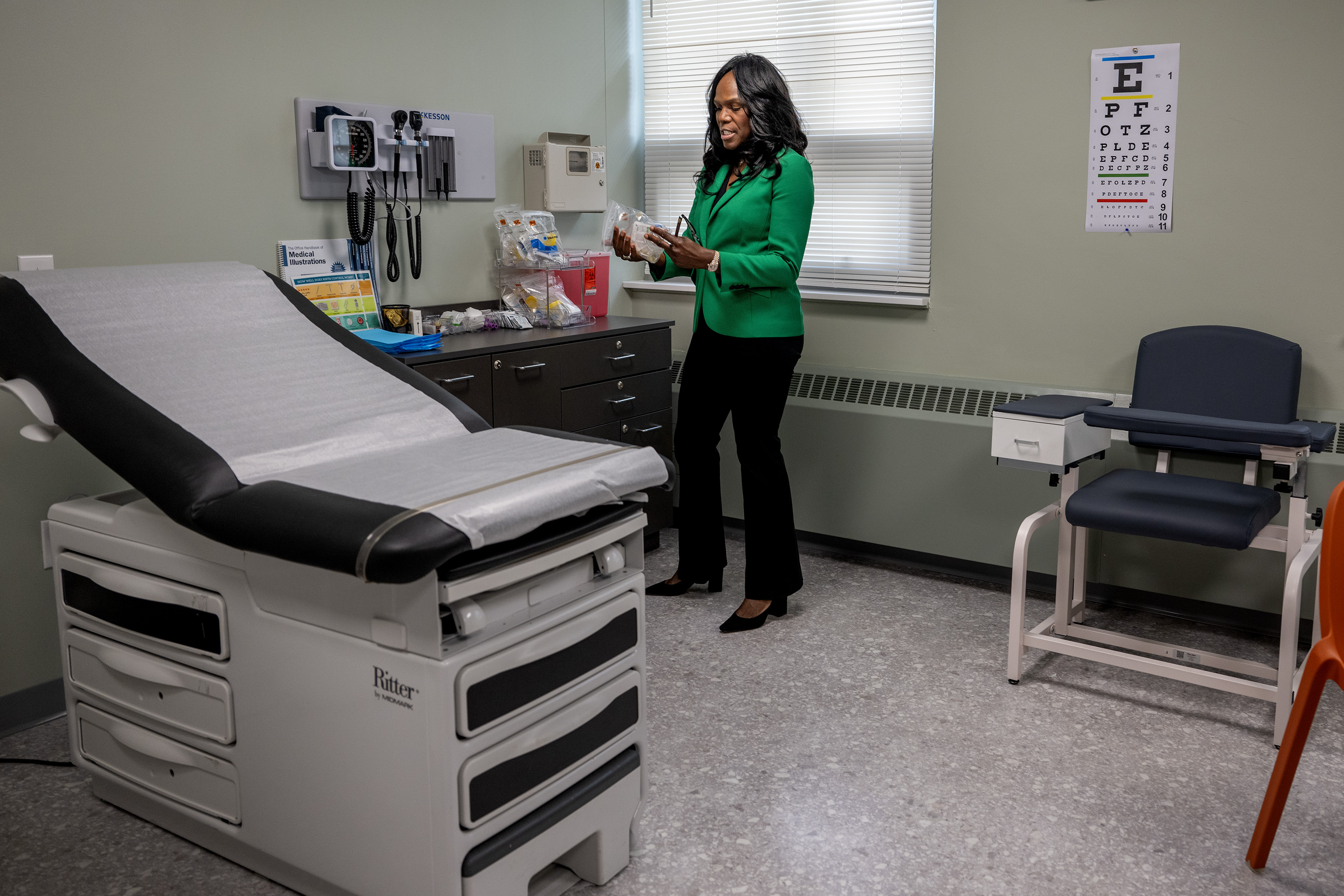
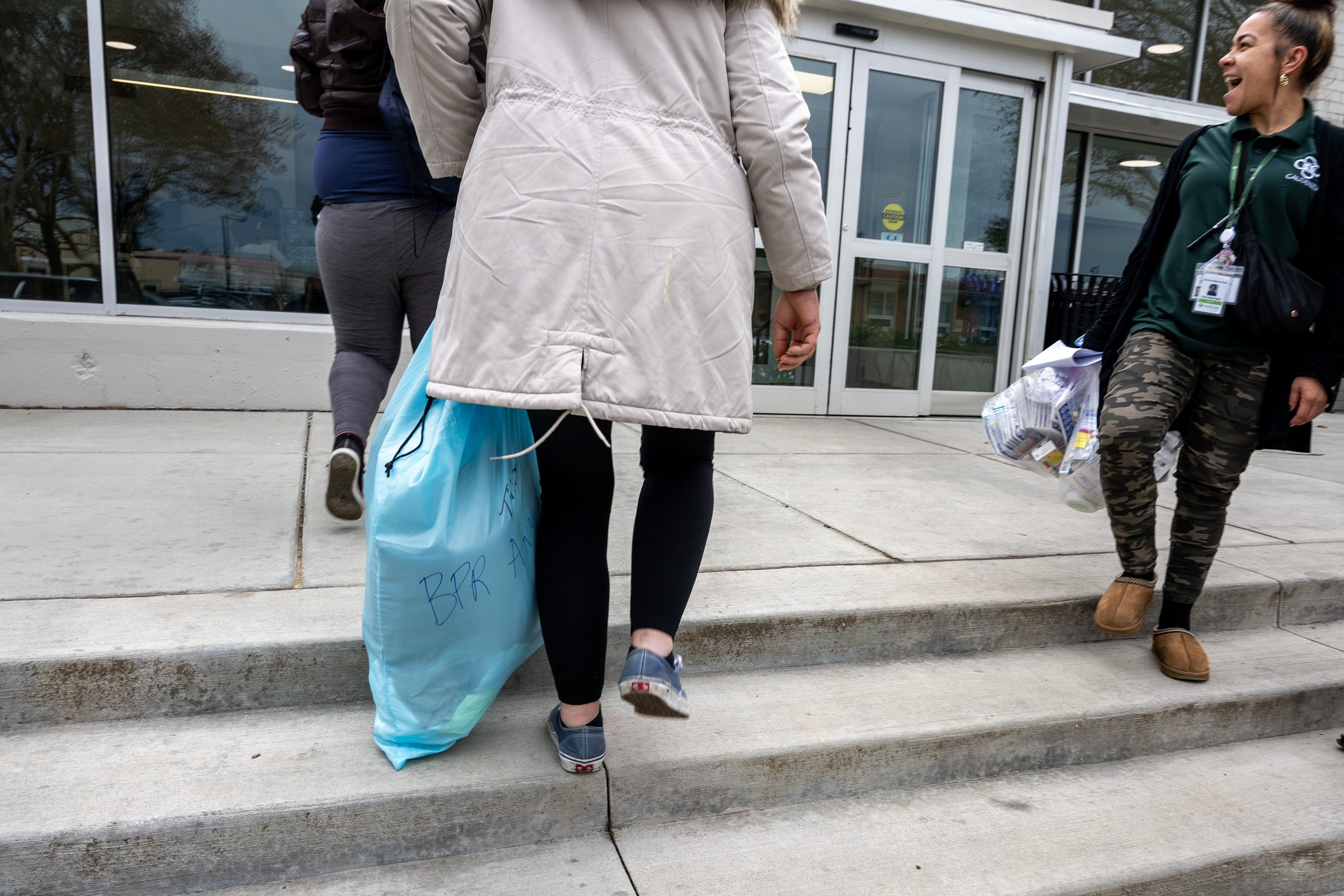
“They literally arrive with all of their belongings in a plastic bag and their medications and some discharge paperwork,” said Ala Stanford, who leads the Black Doctors Consortium, which provides medical services at Riverview. “We are the ones who greet them and help get them acclimated.”
Stanford — who this fall announced a run for Congress — said doctors and nurses at Riverview have diagnosed and treated conditions ranging from drug-related wounds to diabetes to pancreatic cancer. And patients with mental health needs are treated by providers from Warren E. Smith Health Centers, a 30-year-old organization based in North Philadelphia.
Physician Ala Stanford in an examination room at the primary medical care center run by her Black Doctors Consortium at Riverview Wellness Village, a city-owned drug recovery home in Northeast Philadelphia, on Nov. 25.Francesca Colon (right), a recovery support professional with Gaudenzia, brings people in recovery to the main entrance of the Meetinghouse at Riverview Wellness Village on Nov. 25.
Residents’ schedules are generally free-flowing and can vary depending on their wants and needs. About 20% have jobs outside the campus. Culinary arts training will be available in the next month or so. And residents can meet with visitors or leave to see family at any time.
They also spend much of their time in treatment, including individual, family, and group therapy. On a recent day, there were group sessions available on trauma recovery, managing emotions, and “communicating with confidence.”
Vernon Kostic, a 52-year-old Port Richmond native who said he has previously been homeless, has been in and out of drug treatment facilities for years.
He said he’s been content as a Riverview resident since July, and called it “one of the smartest things that the city has ever done.”
“We have the doctor’s office right over here,” he said. “They’ve got counseling right here. Everything we need. It’s like a one-stop recovery place.”
Resident Vernon Kostic heads to a group meeting at Riverview Wellness Village on Nov. 25.The dining room and meeting room in the Meetinghouse at Riverview Wellness Village. At rear left is a brand-new, industrial, restaurant-quality kitchen that was not operational yet on Nov. 25.
Finding ways to stay at Riverview
Finding success in recovery is notoriously hard. Studies show that people who stay in structured sober housing for at least six months after completing rehab see better long-term outcomes, and Riverview residents may stay there for up to one year.
But reaching that mark can take multiple tries, and some may never attain sobriety. McDevitt said that on a monthly basis, about 35 people move into Riverview, and 20 leave.
Some who move out are reunited with family and want to live at home. Others simply were not ready for recovery, McDevitt said, “and that’s part of working with this population.”
Fields said a resident who relapses can go back to a more intensive care setting for detoxification or withdrawal management, then return to Riverview at a later time if they are interested.
“No one is punished for struggling,” he said. “Recovery is a journey. It takes time.”
Providers are adding new programming they say will help residents extend their stays. Offering medication-assisted treatment is one of the most crucial parts, said Josh Vigderman, the senior executive director of substance use services at Merakey, one of the addiction treatment providers at Riverview.
Entry to the primary medical care center run by the Black Doctors Consortium at Riverview Wellness Village.The main entry Meetinghouse at Riverview Wellness Village.Naloxone (Narcan) in an “overdose emergency kit” at Riverview Wellness Village.
In the initial months after Riverview opened its doors, residents had to travel off campus to obtain medication that can prevent relapse, most commonly methadone and buprenorphine, the federally regulated drugs considered among the most effective addiction treatments.
Typically, patients can receive only one dose of the drug at a time and must be supervised by clinicians to ensure they don’t go into withdrawal.
Vigderman said staff suspected some residents relapsed after spending hours outside Riverview, at times on public transportation, to get their medication.
This fall, Merakey — which was already licensed to dispense opioid treatment medications at other locations — began distributing the medications at Riverview, eliminating one potential relapse trigger for residents who no longer had to leave the facility’s grounds every day.
Interest in the program has been strong, Vigderman said, with nearly 80 residents enrolling in medication-assisted treatment in just a few weeks. Merakey is hiring more staff to handle the demand.
What’s next at Riverview
The city is eying a significant physical expansion of the Riverview campus, including a new, $80 million building that could double the number of licensed beds to more than 500. That would mean that about half of the city’s recovery house slots would be located at Riverview.
Parker said the construction is “so important in how we’re going to help families.” She said the process will include “meticulous design and structure.”
“The people who come for help,” she said, “we want them to know that we value them, that we see them, and that we think enough of them to provide that level of quality of support for them.”
In the meantime, staff are working to help the center’s current residents — who were among the first cohort to move in — plot their next steps, like employment and housing.
A rendering of the new, $80 million five-story building to be constructed on the campus of Riverview Wellness Village. It will include residences and medical suites.
That level of support, Vigderman said, doesn’t happen in many smaller recovery houses.
“In another place, they might not create an email address or a resumé,” he said. “At Riverview, whether they do it or not is one thing. But hearing about it is a guarantee.”
Bean is closing in on one year at Riverview. He doesn’t know exactly what’s next, but he does have a job prospect: He’s in the hiring process to work at another recovery house.
“I’m sure I’ll be able to help some people,” he said. “I hope.”
Two Philadelphia police officers who drove after a fleeing drug suspect until the man crashed his car and killed a bystander are not liable under federal law for causing the fatal collision because the officers didn’t intend to harm anyone, an appeals court ruled.
In an opinion issued last week, the three-judge panel from the Third Circuit Court of Appeals said officers Christian Kane and Alexander Hernandez were forced to make a quick decision in 2020 when they sped after a man they’d seen dealing drugs in Kensington.
The pursuit of the suspect, Tahir Ellison, proceeded at a normal speed for a few blocks, court documents said, but became dangerous after Ellison drove through a red light and down a one-way street.
The episode ended in tragedy when Ellison ignored another red light and crashed into Virgen Martinez’s car at the intersection of Allegheny and Frankford Avenues, killing Martinez, a 47-year-old mother of four.
Ellison pleaded guilty in 2023 to charges including third-degree murder and was sentenced to 10 to 20 years in prison, court records show.
But Martinez’s relatives sued Kane and Hernandez, arguing in part that the decision to speed after Ellison — which violated the police department’s policy to avoid most car chases — also violated Martinez’s 14th Amendment due process rights and made the officers liable for her death. Last year, U.S. Magistrate Judge Scott W. Reid agreed that that question should be put before a jury.
The officers appealed. And in the opinion issued last week, Circuit Judge Stephanos Bibas wrote that although Hernandez’s death was a tragedy, the officers made a “snap judgment” to pursue Ellison and did not behave egregiously during the portion of the chase in which Ellison began speeding and ignoring traffic signals.
“We ask not whether in hindsight [the officers] chose rightly, but whether they intended to cause harm,” Bibas wrote.
Philadelphia police directives generally prohibit car chases, which are often dangerous for both citizens and officers. Exceptions are made only if officers are seeking to capture suspects fleeing violent felonies, or to prevent imminent death or serious injuries.
An Inquirer investigation published last year found that about half of all reported chases by Philadelphia police were in violation of department polices and that the city had spent about $20 million since 2020 to settle crash- or chase-related lawsuits involving police.
Earlier this year, the city agreed to pay $2.9 million to settle a lawsuit over a crash in which a man on a dirt bike being pursued by a city police officer struck two bystanders — including a 6-year-old girl — in Upper Darby.
In that case, however, the officer initiated the chase without witnessing any crime, continued driving after the man for nearly 10 miles, and was later accused by the department of providing false statements to a superior and falsifying official documents.
Bibas wrote that Kane and Alexander, by contrast, “had a split second” to decide whether to follow Ellison, whom they’d seen dealing drugs from his car. And the dangerous portion of the pursuit spanned about half a mile and 39 seconds before Ellison crashed into Martinez’s vehicle.
Jim Waldenberger, one of the attorneys who filed suit on behalf of Hernandez’s relatives, said he and his colleagues disagreed with the ruling.
Before the officers’ pursuit turned dangerous, Waldenberger said, they pursued Ellison at a normal speed with their police lights on for several blocks, meaning their decision to continue the chase when he sped up was not a snap judgment made under unavoidable pressure.
The department conducted an internal investigation and found that the officers violated departmental policies regarding pursuits, and each spent at least several months on administrative duty, court documents said. The documents did not specify whether either officer faced additional discipline.
Sgt. Eric Gripp, a police spokesperson, said Monday that Kane is still on the force but that Hernandez left last year. Gripp declined to comment further.
Waldenberger said he and his colleagues were still weighing whether to appeal the Third Circuit’s ruling on the officers’ liability.
The lawsuit can proceed on more limited grounds surrounding whether the city sufficiently trains police officers regarding pursuits, and whether Kane, who was driving the police car, violated state negligence laws.
When Nicala La Reau bought a 105-year-old Fishtown home last year, the neighborhood was a major selling point. But she knew it would need “a full gut renovation.”
“The house had incredible bones, but it was dated both inside and out — everything from the plumbing and electrical systems to the finishes and floor plan needed updating,” she said.
La Reau appreciates the home’s “rare luxury for city living” with its generously sized backyard. “That’s where my vegetable and herb garden, and my roses all live,” she said.
Renovations began immediately when she purchased the property in October 2024. It had been a five-bedroom, 1½-bathroom home.
A half bathroom, so labeled in French, sits off the dining area. The backyard, with ample seating and La Reau’s herb garden.An extension of the living space, featuring colorful art and a magenta bench.The television sits above a wood cabinet with intricate details.
By the time she was done renovating, about six months later, the new floor plan dropped one bedroom, putting an additional full bathroom in its place. She also expanded the primary bathroom.
Her goal was to reconfigure the layout to create larger, more functional bathrooms and bedrooms.
The first floor has an open-concept living, dining, and kitchen area that leads to the backyard. The second floor includes the primary suite with a large bathroom, as well as an additional bedroom, which La Reau uses as a walk-in closet. There’s also a guest bath.
The third floor has another bedroom, an office, and access to the rooftop deck, which she uses for relaxing and entertaining.
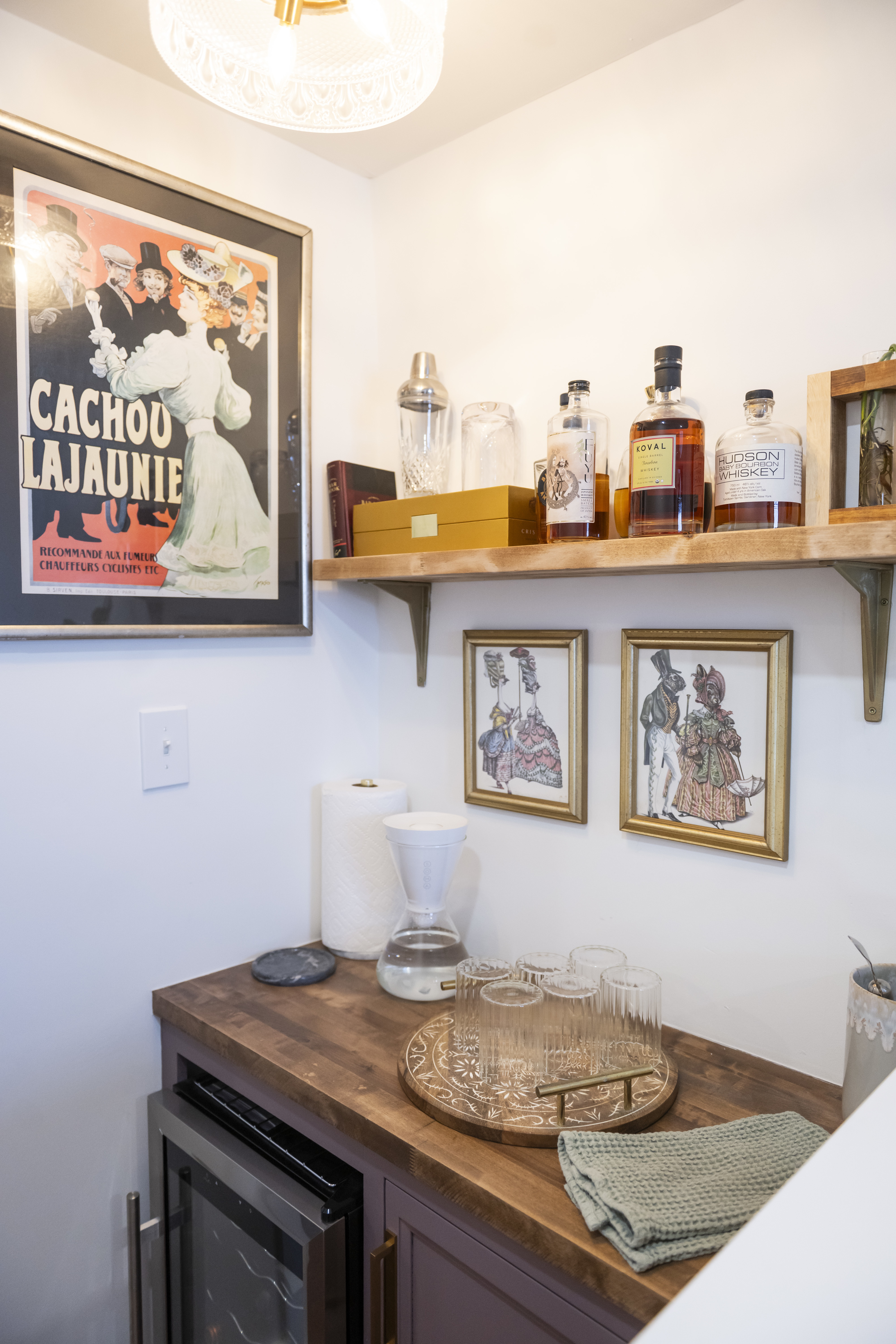
A wet bar on the third floor, which has access to the rooftop deck.The bedroom furniture is surrounded by hanging plants.
“In the warmer months, I use it for everything from morning coffee to evening gatherings and even summer movie nights,” said La Reau.
The home sits near Palmer Cemetery, a historic location that she believes gives her block “a unique and peaceful character.”
“What I love most is that the land directly across the street is part of the cemetery, which means there’s a sense of openness and greenery you don’t often get in the city,” La Reau said. “It creates a rare balance of being in an urban neighborhood while still feeling connected to nature.”
La Reau’s personal style and design flair is evident at every turn in the home. She carefully selected every finish and detail.
In the dining area, a collection of art in various shapes and sizes and an intricately framed mirror line the walls.The shoe wall in La Reau’s closet.
“The project was extensive. I completely gutted the kitchen and two existing bathrooms, added an additional full bathroom, and restored many of the home’s original features: hardwood floors, columns, stair treads and railings, as well as the marble fireplace,” she explained. And the renovation included upgrading all of the essential systems, including plumbing, electrical, and structural reinforcements.
Still, she aimed to preserve the historic charm of the home while layering in modern elements that reflected her personal, eclectic style.
“Much of my inspiration comes from my travels abroad, especially time spent working in Barcelona, and my family,” La Reau said. La Reau is the marketing director for North America for Pronovias, an international wedding dress designer based in Barcelona, Spain. “Parisian and European influences are woven throughout the design,” she said.
She opted for neutral finishes to create a timeless, classic foundation that will “age gracefully,” while using accents such as glass knobs and crystal lighting fixtures to honor the home’s vintage character.
The living space features a colorful accent wall, purple details, and columns dividing the first-floor spaces.
In the living room depth and drama were created with a wall in Cinnamon Slate by Benjamin Moore, a balance of heathered plum and velvety brown, framing the restored fireplace and custom-built shelving.
“I also introduced new molding throughout the primary bedroom and living areas to elevate the architectural character,” she said.
The kitchen was one of the most important spaces, as La Reau enjoys cooking and baking. The focal point is a Kucht Gemstone KEG Series range in a slate finish with gold accents, featuring an eight-burner, double-oven statement piece that blends luxury and function.
“To balance its boldness, I selected soft, muted finishes: marble crepe and white flooring rather than a stark black-and-white checkerboard, sandstone backsplash tiles, and granite countertops with subtle gray and brown veining,” she said.
A Kucht Gemstone KEG Series range is a centerpiece of the kitchen.A large sink and gold details in the kitchen, which was an important space as La Reau loves to cook and bake.
Throughout the home, splashes of bright color against muted fabrics and warm wood furniture create a layered but cohesive atmosphere.
“Artwork collected from my travels is thoughtfully placed in each room, allowing every space to tell its own story while still flowing together as a whole,” La Reau said.
She feels right at home in her community.
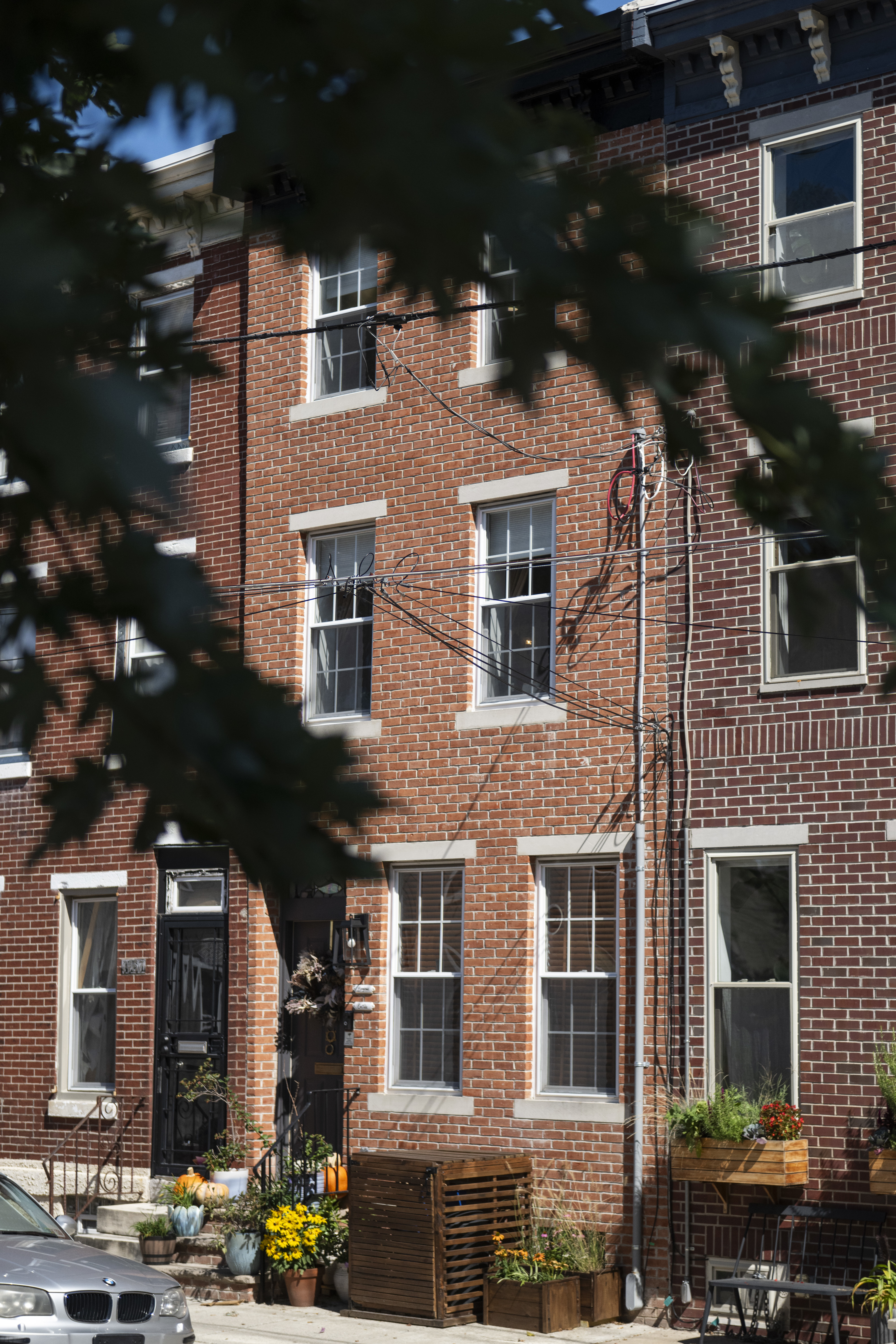
The exterior of Nicala La Reau’s home.
“The walkability to Frankford Avenue is unbeatable‚” she said. With its evolving culinary scene, she noted, there seems to always be a new restaurant or bar to check out.
“But beyond that, there’s a neighborliness here — you see people out walking dogs, saying hello, and looking out for one another,” said La Reau. “Fishtown has a balance of growth and rootedness that feels like somewhere I can grow into long term.”
Is your house a Haven? Nominate your home by email (and send some digital photographs) at properties@inquirer.com.