Tag: Frankford

  • Trolley tunnel to remain closed until at least Nov. 30

    Trolley tunnel to remain closed until at least Nov. 30

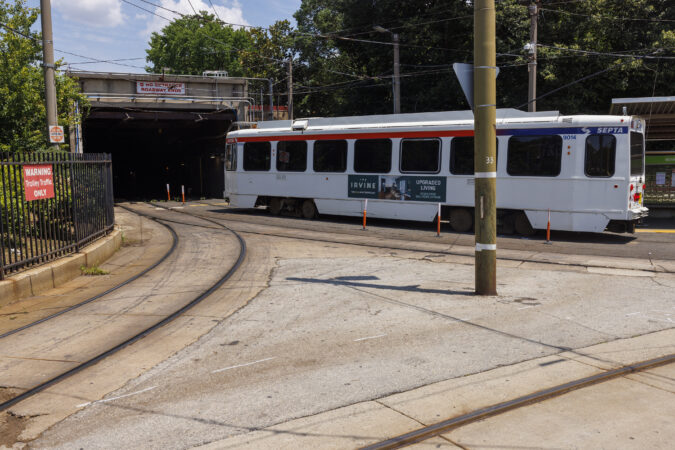
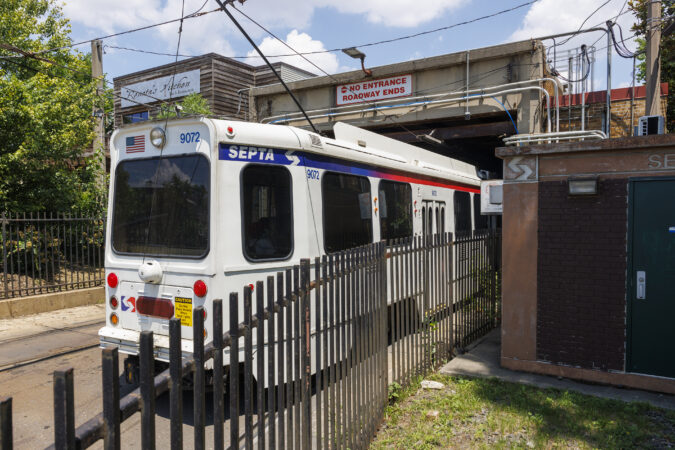
    SEPTA is extending its trolley tunnel closure through at least Nov. 30, hoping to use the extra time over the Thanksgiving holiday to complete repairs to the overhead catenary power system.

    The tunnel has been shut down for most of the last two weeks as crews work on the problem.

    Riders should use the Market-Frankford El to travel through Center City, catching the trolleys at 40th and Market Streets.

    “My wife, daughter and I are totally dependent on the trolley to get us to work and school, and with a prolonged trolley-tunnel diversion, the system has become unreliable and, frankly, unusable,” Will Tung, a Southwest Philly resident, told the SEPTA board during public comments at its Thursday meeting.

    Trolley ridership is typically lower during the week of the Thanksgiving holiday so the closure should be less of a disruption, spokesperson Andrew Busch said.

    SEPTA is contending with glitches in the connection between the overhead catenary wires in the tunnel and the pole that conducts electricity to the vehicle.

    The issue led to two trolleys becoming stranded in October, with a total of 415 passengers needing to be evacuated.

  • SEPTA trolley tunnel will stay closed until next week

    SEPTA trolley tunnel will stay closed until next week

    Philadelphia’s trolley tunnel has been closed for most of the last two weeks as SEPTA contends with glitches in the connection between the overhead catenary wires and the pole that conducts electricity to the vehicle.

    The tunnel will remain closed at least until next week for repairs, and city trolleys will operate from West Philadelphia. Riders can take the Market-Frankford El to get to and from Center City to 40th and Market Streets.

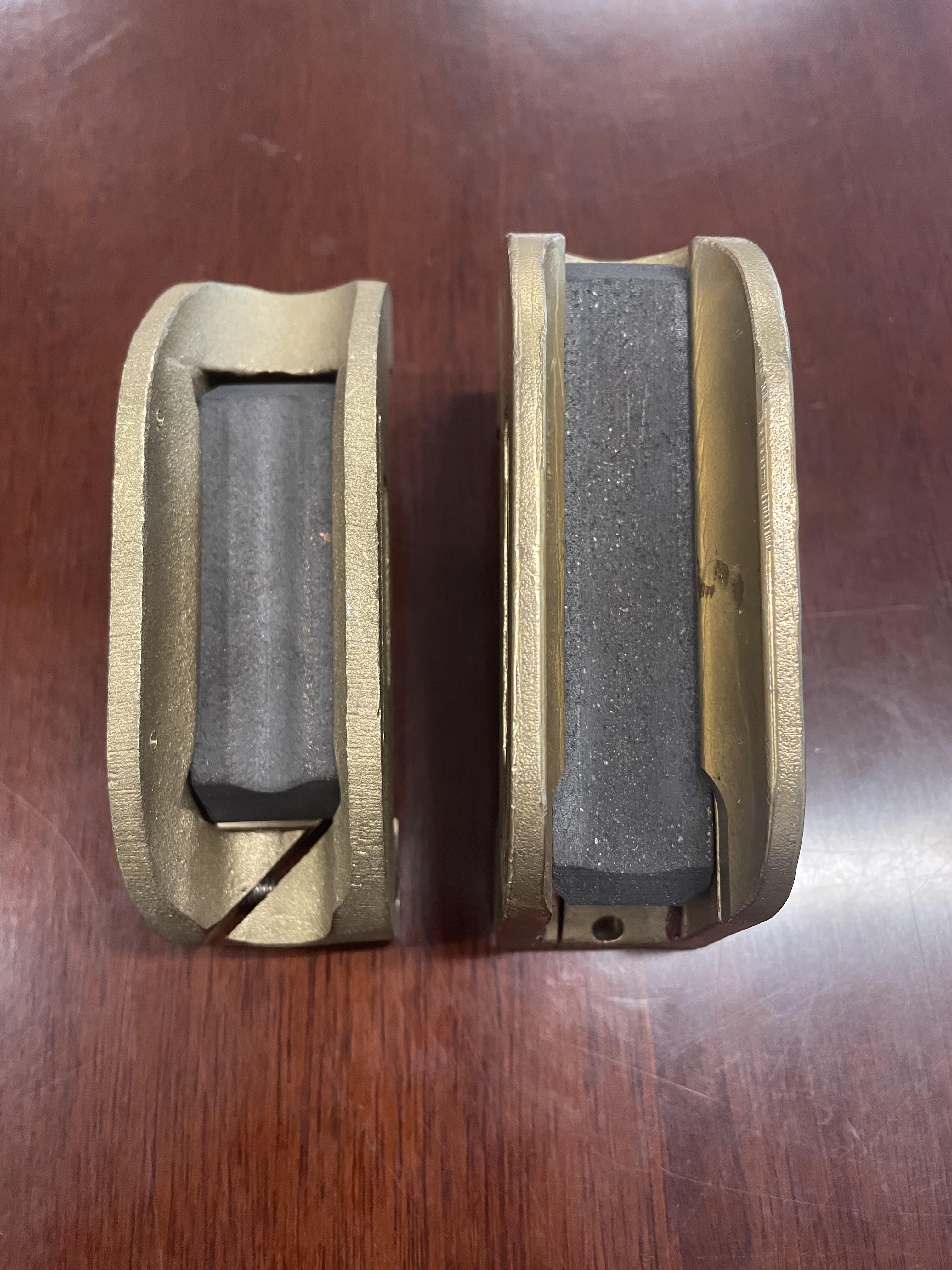
    At issue is a U-shaped brass part called a slider that carries carbon, which coats the copper wires above that carry electricity.

    “There’s a lot of friction and heat. The carbon acts as a lubricant,” said John Frisoli, deputy chief engineer for SEPTA.

    A 3-inch slider (left) and a 4-inch slider, which coats electric-powered wires with carbon to reduce friction. When they fail, trolleys are stranded.

    Earlier in the fall, SEPTA replaced 3-inch sliders with 4-inch models in an effort to reduce maintenance costs, but the carbon in the longer units wore out sooner than they should have, causing metal-on-metal contact between the trolley and the copper wires.

    Soon after, there were two major incidents when trolleys were stranded in the tunnels. On Oct. 14, 150 passengers were evacuated from one vehicle and 300 were evacuated from a stalled trolley on Oct. 21.

    SEPTA went back to the 3-inch sliders.

    On Nov. 7, SEPTA shut down the tunnel to deal with the issue, which had cropped up again, then reopened it on the morning of Nov. 13, thinking it was solved. But it discovered further damage to the catenary system and the tunnel was closed at the end of the day.

    “It’s just unfortunate that we’re dealing with the damage that decision caused,” said Kate O’Connor, assistant general manager for engineering, maintenance, and construction.

    The transit agency is running test trolleys and has found minimal wear of the wires rather than the extensive wear earlier, O’Connor said. Her department is working on a plan to replace wires by sections and will continue test runs until it’s determined the tunnel is safe for passenger traffic again, she said.

    “We have far more traffic in the tunnel than on the street — all five routes use it — and the overhead system there is more rigid,” O’Connor said.

    Trolleys have been unaffected traveling on the street. Jason Tarlecki, acting chief deputy engineer for power, said that the wires have “a lot more upward flexibility to absorb the shock,” he said, leading to less friction.

    The Federal Transit Administration on Oct. 31 ordered SEPTA to inspect the overhead catenary system along all its trolley routes.

    The directive came in response to four failures of the catenary system in September and October, including the tunnel evacuations.

  • Philly Music this week with Grammy nominees Leon Thomas and Dijon, plus ‘The Boy Is Mine’ tour in Atlantic City

    Philly Music this week with Grammy nominees Leon Thomas and Dijon, plus ‘The Boy Is Mine’ tour in Atlantic City

    This week in Philly music kicks off in Fishtown with six-time Grammy nominee Leon Thomas, continues in Atlantic City with a Brandy and Monica throwback pop double bill, and continues in North Philly with rising R&B singer and Justin Bieber producer Dijon.

    Austin, Texas, hard rock band Die Spitz play the First Unitarian Church on Wednesday.

    Wednesday, Nov. 19

    Die Spitz

    The music gets started on Wednesday with the four women of Austin, Texas. hard rock foursome Die Spitz, who recorded their unrelenting new album Something to Consume at Studio 4 in Conshohocken with producer Will Yip. Boone, N.C., queer punk duo Babe Haven opens. (8 p.m., First Unitarian Church, 2125 Chestnut St., r5productions.com)

    Leon Thomas

    There weren’t a lot of surprises among the big names with the most nominations when the Grammys were announced this month. Kendrick Lamar and Lady Gaga topped the list, but Leon Thomas, who got six nods along with Bad Bunny and Sabrina Carpenter, was the surprise underdog.

    The crooner and producer, who got his start as a Broadway child actor and star of Nickelodeon’s Victorious, is up for album of the year for Mutt, as well as best new artist and R&B performance for his viral NPR Tiny Desk version of the album’s title song — in which he compares himself unfavorably to a dog. His “Mutts Don’t Heel” tour comes to the Fillmore on Wednesday. (8 p.m., the Fillmore, 29 E. Allen St., livenation.com)

    Library Mixtape

    The free Library Mixtape: A Vinyl Record Listening Club meetup in the music department of the Parkway Central Library on Wednesday is hosted by Alexa Colas, the Clubfriends Radio & Records founder who moved her living room sound system to the Design Philadelphia Center last month. Bring your own vinyl. (5:30-7:30 p.m., 1901 Vine St.)

    Also: There’s live music at Old City vinyl listening room 48 Record Bar. James Everhart of Cosmic Guilt teams with New York songwriter Keenan O’Meara on Wednesday; Hannah Taylor sings and Jake Zubkoff plays keys on Sunday.

    Hannah Cohen plays Johnny Brenda’s on Thursday. Her new album is “Earthstar Mountain.”

    Thursday, Nov. 20

    Hannah Cohen

    Hannah Cohen’s Earthstar Mountain is a dreamy, pastoral album that also delivers a sweet kick. She recorded it with producer partner Sam Evian at their studio in a barn in upstate New York. With Sufjan Stevens and Clairo guesting, it’s a 2025 standout releaser. (Salami Rose Joe Louis opens. 8 p.m., Johnny Brenda’s, 1201 Frankford Ave., johnnybrendas.com)

    The New Mastersounds

    British funkateers the New Mastersounds are saying goodbye — at least for a while. The band whose tight Hammond organ-heavy soul-jazz sound bears the influences of Philly keyboard greats Jimmy Smith and Jimmy McGriff, plays its “Ta-Ta for Now” tour on Thursday. (8 p.m., Ardmore Music Hall, 23 E. Lancaster Ave., Ardmore, tixr.com)

    Friday, Nov. 21

    Ron Gallo

    Ron Gallo made headlines this year by posting protest songs on an almost daily basis in the early days of the second Trump administration. He called it 7AM Songs of Resistance for the Internet.

    Now, Gallo has a new album that takes him in a more personal direction, called Checkmate, his second on the Kill Rock Stars label. It’s filled with subtly evocative folk-flavored, even jazzy, music that detours from the bruising garage rock he’s become known for. Gallo plays Free at Noon at Ardmore Music Hall. (Noon, Ardmore Music Hall, eventbrite.com)

    He comes back for a second Philly gig at the First Unitarian Church next Friday.

    Brandy and Monica performing in Indianapolis in October on “The Boy Is Mine Tour,” which comes to Atlantic City’s Boardwalk Hall on Saturday.

    Bar Italia

    This month’s edition of David Pianka’s Making Time dance party has an intriguing live band headliner in Bar Italia, the London-based trio named after an iconic Soho coffee bar. The band’s new album, Some Like It Hot, wears the influence of Brit-pop band Pulp on its sleeve. New York rock band Voyeur also plays, along with sets by Dave P., Mario Cotto, Shai FM, and K Wata. (9 p.m., Warehouse on Watts, 923 N. Watts St., wowphilly.com)

    Stinking Lizaveta

    Longstanding West Philly doom metal trio Stinking Lizaveta‘s name was inspired by a character in Fyodor Dostoevsky’s The Brothers Karamazov. The band released its 1996 album Hopelessness and Shame — recorded by the late Steve Albini — on vinyl for the first time this March. On Friday, they headline Johnny Brenda’s with Deathbird Earth and Channls. (8 p.m., Johnny Brenda’s, 1201 Frankford Ave., johnnybrendas.com)

    Tom Morello

    Rage Against the Machine guitarist Tom Morello plays the Music Box at the Borgata in Atlantic City. It will be an agit-pop act of resistance in a hotel casino within earshot of chiming slot machines. Morello’s repertoire is made up of roiling Rage songs, Woody Guthrie, MC5, and John Lennon and Yoko Ono covers, plus originals in his rabble-rousing folk singer mode as the Nightwatchman. He’ll have a full band behind him, plus the help of San Diego hip-hop group the Neighborhood Kids as his special guests. (9 p.m., Music Box at the Borgata, 1 Borgata Way, Atlantic City, ticketmaster.com)

    Saturday, Nov. 22

    Mo Lowda & the Humble

    Philly quarter Mo Lowda & the Humble closes out a five-month North American tour for its new album, Tailing the Ghost, with a hometown show. (8 p.m., Union Transfer, 1026 Spring Garden St., utphilly.com)

    Brandy and Monica

    Back in 1988, Brandy and Monica played out a feud over a dude in the worldwide hit “The Boy Is Mine,” which was cowritten and coproduced by South Jersey’s Rodney “Darkchild” Jerkins. Twenty-seven years later, the pop-R&B singers are on a concert tour together that also features Destiny’s Child’s Kelly Rowland, Muni Long, and 2025 American Idol winner Jamal Roberts. The tour is presented by the Black Promoters Collective. (8 p.m., Jim Whelan Boardwalk Hall, 2301 Boardwalk, Atlantic City, boardwalkhall.com)

    Grammy-nominated singer and producer Dijon plays the Met Philly on Sunday.

    Sunday, Nov. 23

    Dijon

    Dijon released his debut Absolutely in 2021 and has quickly made his mark. He regularly works with Mk.gee, the guitarist and songwriter with whom he shares a twitchy, low-fi sensibility. He’s also teamed with Bon Iver and Justin Bieber and is up for producer of the year and album of the year at the Grammys. Sometimes, he sounds like Prince.

    His new album Baby! is a joyous, shape-shifting adventure. Two measures of how hip he is at the moment: He’s among the musicians with roles in Paul Thomas Anderson’s One Battle After Another, and on Dec. 6 will be musical guest on Saturday Night Live. He plays the Met Philly on Sunday. (8 p.m., Met Philly, 858 N. Broad St., ticketmaster.com)

    Amy LaVere and Will Sexton

    Memphis wife-and-husband duo Amy LaVere and Will Sexton are Americana artists who specialize in a brand of smoky Southern noir, perhaps best exemplified by LaVere’s “Killing Him,” about trying to rid oneself of a bad boyfriend only to find that he comes back to haunt you. (8 p.m., 118 North, 118 N. Wayne Ave., Wayne, tixr.com)

  • At the new Huda Burger in Fishtown, the secret ingredient is the buns

    At the new Huda Burger in Fishtown, the secret ingredient is the buns

    One of the keys to the sandwiches at Huda — chef Yehuda Sichel’s acclaimed shop in Rittenhouse — is the cloudlike, house-baked milk bread.

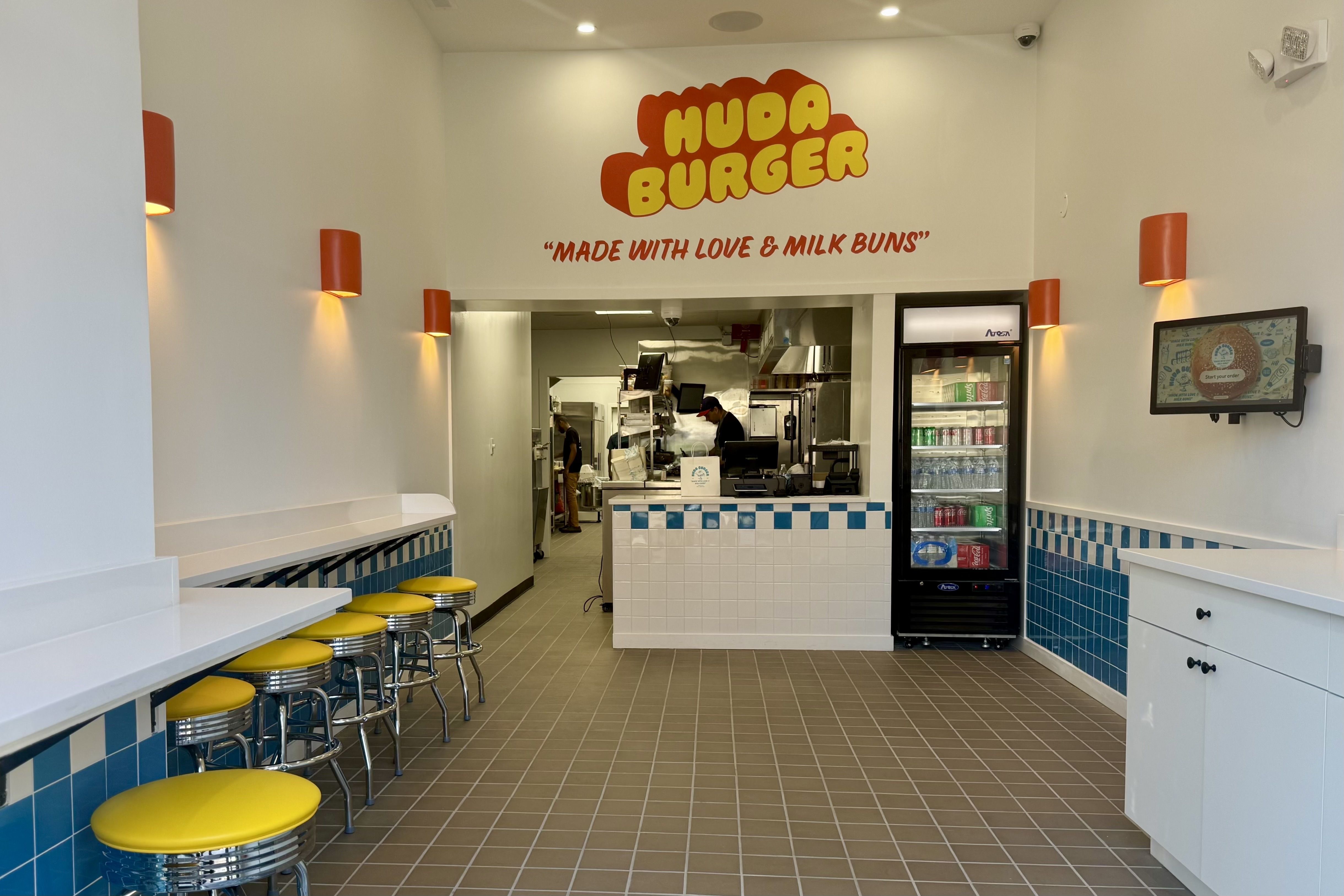
    At Huda Burger — opening Nov. 19 near Suraya and Palmer Park in Fishtown — Sichel is also building his burgers and chicken sandwiches on the luxurious, mildly sweet buns inspired by Japanese shokupan.

    In fact, he built the entire place around them. “This kitchen is like half bakery, half prep kitchen just for the buns,” Sichel said. The buns at Huda Burger will be seeded, unlike those at the original shop, which serves one of The Inquirer’s favorite smash burgers — the Mott, topped with buttermilk ranch, pickled peppers, pepper Jack brie, and hot honey.

    Huda Burger’s setup at 1602 Frankford Ave.

    Sichel is banking on the buns to separate him from the other burger makers. (New York’s 7th Street Burger has a location opening this winter down the street, further adding to the pressure.)

    “Being in a saturated market really forces you to get better, and there’s nothing I like more than some competition,” said Sichel. Besides the bread, everything else is being made in-house, including pickles and sauces, and every item is prepared to order — even the chicken is butchered in the back.

    Besides three kinds of crispy chicken sandwiches (coated in rice flour, cornstarch, Wondra flour, and what Sichel describes as “a whole bunch of spices”), Huda Burger’s menu includes a rotating line of five or six smash burgers. There’s a classic cheeseburger, a create-your-own option, a vegetarian burger, a pastrami fried onion burger (a cross between a pastrami burger and an Oklahoma-style smash burger), and a bread-free cheeseburger salad. The menu also includes curly fries, pickles, and shakes made with soft serve from 1-900-Ice-Cream.

    Crispy chicken sandwich at Huda Burger, 1603 Frankford Ave.

    His partner is Dan Berkowitz, the chief executive and co-founder of 100x Hospitality, an event production company specializing in immersive and travel experiences.

    The space, designed by Lance Saunders, includes a half dozen indoor counter seats and a few outdoor tables in season.

    Sichel, who grew up in Elkins Park, started in the restaurant business at age 15, making sandwiches at a kosher deli in Baltimore. After culinary school in Israel, he moved home to work for chefs Georges Perrier at Brasserie Perrier and Daniel Stern at Rae, followed by a stint with chef Neal Fraser at Grace in Los Angeles.

    Cheeseburger salad at Huda Burger, 1603 Frankford Ave.

    In 2010, he joined Steven Cook and Michael Solomonov at Zahav. He rose through the ranks — from line cook to pastry to sous chef — and played a major role in the opening of Citron & Rose (2012) in Lower Merion and Abe Fisher (2014) in Rittenhouse. Abe Fisher was named a Best New Restaurant by Travel & Leisure, and Sichel was named to Zagat’s 30 Under 30 Rock Stars Redefining the Industry. He left CookNSolo in 2020, opening Huda at 32 S. 18th St., that summer amid the pandemic.

    Huda Burger, 1603 Frankford Ave. Hours: 11 a.m. till 9 p.m. daily, but there are plans to extend.

  • Stolen phones sparked a fight and ongoing tension at Frankford High

    Stolen phones sparked a fight and ongoing tension at Frankford High

    Tensions are flaring at Frankford High over the school’s cell phone policy and its ability to keep students’ property safe.

    After two fights — including one where a student was so badly injured that city EMTs responded and transported the student to a hospital — a few dozen students took to the school’s hallways Friday, vocally demanding their phones back.

    “We just want to have a say in where our property goes, where our phones go,” said one student, who asked not to be named for fear of being targeted.

    Frankford, like many schools in Philadelphia and across the country, has recently moved to get cellphones out of students’ hands during the school day.

    At first, Frankford used Yondr pouches to secure students’ phones, but those were easily broken, and the costs of the pouches rose.

    Last year, the school installed lockers outside the building, requiring students to deposit phones before the school day started. Students could purchase locks from the school for $5.00, or bring their own locks.

    But “there’s been issues,” said one Frankford staffer, who asked not to be identified for fear of reprisal. “The area where the lockers are floods; it’s not monitored.”

    (School officials said they have alerted district officials about the drainage issue.)

    Some students didn’t love the idea of the lockers, but it wasn’t until last week that significant tensions began simmering after several phones were stolen. School officials said in an email to Frankford staff that five phones were stolen, two from a locker with no lock on it.

    “That caused some serious issues in the building,” the staffer said. “A lot of the students said, ‘You’re forcing us to put our phones there, but you’re not protecting them.’”

    Believing they knew who stole the phones, some students targeted the alleged thief, spurring a fight inside the school. That student was assaulted — beaten so badly that EMTs transported the student to a hospital, according to multiple people with firsthand knowledge.

    “It was so scary,” said the student who spoke on condition they would not be identified.

    Michael Calderone, the school’s principal, addressed the issue with parents in a letter sent home Friday.

    “Two wrongs do not make a right,” Calderone wrote. “This type of retaliation and violent behavior are not tolerated here at Frankford.”

    Another fight happened the next day outside of school — with some students and some nonstudents — but Frankford officials say it was unconnected to the stolen cellphones. (The student and staffer, however, say the general anger at the school over the phone policy has ratcheted up student issues generally.)

    A peaceful student protest planned for Friday turned into a town hall with Calderone. But some at the meeting weren’t satisfied and ultimately a few did protest, walking around the school and chanting about wanting their phones back.

    “It was students screaming in the hallways,” the student said. “They were saying they felt unsafe; they were saying they were unhappy about the phone lockers.”

    Calderone, in the letter sent to families Friday, vowed action.

    “No member of our school community should ever have to worry about their items being taken, especially when the belongings are locked up,” Calderone wrote.

    The principal told parents that the school would provide stronger locks, at no cost to students, and will increase patrols and video surveillance by school security officers. He said he has requested locking gates for either side of the phone lockers.

    ‘Students don’t feel safe’

    The Frankford student said they and others were frustrated by a lack of protection for their phones and poor communication.

    The Friday town hall, the student said, yielded little information. Some students were unruly, the student said, but many were respectful and just wanted answers from the administration. (Calderone described the meeting as productive, and not unruly.)

    Calderone, according to the student, “said he wasn’t able to put the phone lockers inside the building because he didn’t have enough security and kids could just get to their phones if they were inside. That happens anyway with the phones outside.”

    Frankford is a good school where students have opportunities, the student said. But it feels restless over the phone issue.

    “Students don’t feel safe going outside to get their phones,” the student said. “There’s such a big buildup that if you bump into the wrong kid, he’s going to hit you. The fights are just people getting their anger out. We feel like they’re not listening to us.”

    Phones are a distraction, the student said; they feel like learning has improved since phone access was removed during the school day.

    “But the school district says it isn’t responsible for lost, damaged, or stolen goods, and if your mom worked for a year to get you a brand new iPhone 17 and it gets stolen, they’re not buying you a new one,” the student said.

    “Philadelphia is a dangerous place — we need our phones going to school, going home.”

  • Billions of gallons of raw sewage from Philly are released into the Delaware annually

    Billions of gallons of raw sewage from Philly are released into the Delaware annually

    Philadelphia discharges 12.7 billion gallons of raw, diluted sewage into the Delaware River’s watershed each year, with Camden County adding to the mix, according to a new report.

    That’s a problem, say the report’s authors at the nonprofit advocacy group PennEnvironment. Philadelphia and Camden border the river, and significant recreational potential is blocked for part of the year because of pollution from both, the authors say.

    A waterway can remain unsafe for recreation for up to 72 hours after an overflow. That suggests local waterways could be unsafe for recreation up to 195 days per year, or more than half the year.

    Five decades after the Clean Water Act mandated that waterways be made safe for swimming and fishing, combined sewer overflows (CSOs) continue to pollute during wet weather when untreated sewage and runoff surge into nearby creeks and rivers, creating the potential to sicken recreational users.

    David Masur, executive director of PennEnvironment, said the group included Camden County in its most recent report “to get a more holistic view.” PennEnvironment’s first report on CSOs in 2023 focused only on Philly.

    The pollution “affects the waterway, the environment, and public health,” Masur said. “The river is the border between the two states, and people on both sides use it a lot.”

    PennEnvironment acknowledges that both Philly and Camden County have programs to reduce overflows and is calling on federal officials for increased funding to put proper infrastructure into place.

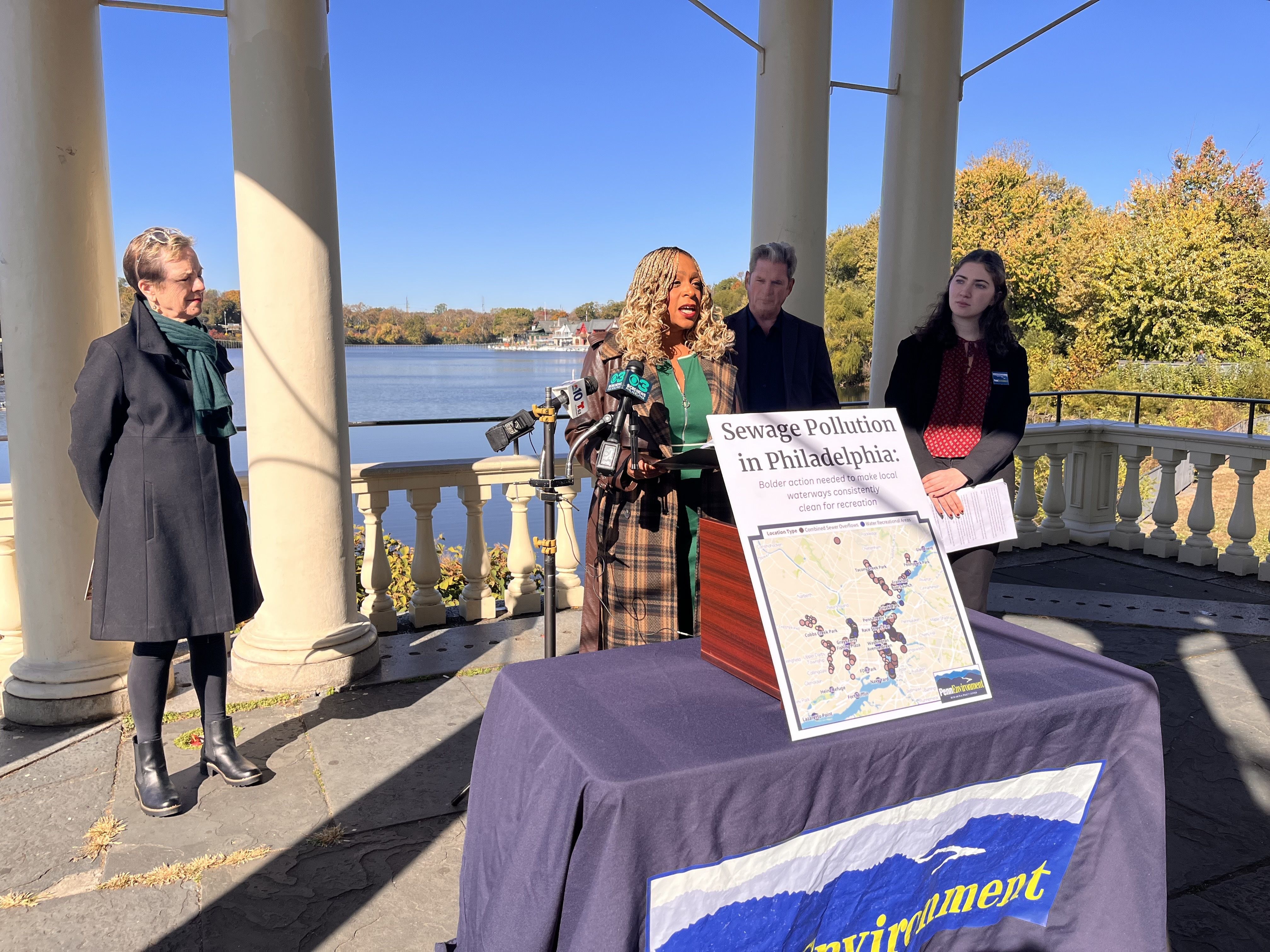
    Philadelphia Council member Jamie Gauthier (center) spoke Monday about PennEnvironment’s report on pollution from combined sewer overflows. To her left is Margaret Meigs, president, Friends of the Schuylkill Navy. And to her right is Tim Dillingham, senior adviser, American Littoral Society, and Hanna Felber, clean water associate at PennEnvironment Research & Policy Center.

    Frequent overflows, high volume in Philly

    Roughly 60% of Philadelphia is served by a combined sewer system, which has 164 outfalls — really large metal or concrete openings — that discharge pollution into waterways. A CSO system uses a single pipe to collect and transport sewage from homes and businesses as well as stormwater runoff from streets and sidewalks.

    During dry weather, the system can handle the volume before safely releasing it back into the rivers. But during heavy rainfall, the system discharges untreated, though highly diluted, sewage mixed with stormwater directly into waterways.

    Despite the Philadelphia Water Department’s ongoing Green City, Clean Waters project — a 25-year plan focusing on green infrastructure to reduce overflows — the frequency and volume remain alarmingly high, the report states.

    Overall, CSOs dumped an average of 12.7 billion gallons of raw sewage mixed with polluted stormwater per year into local waterways from 2016 to 2024, the authors of the report stated. They included an online map to show the location of the outfalls and annual overflow.

    Half the sewage came from just 10 CSOs.

    window.addEventListener(“message”,function(a){if(void 0!==a.data[“datawrapper-height”]){var e=document.querySelectorAll(“iframe”);for(var t in a.data[“datawrapper-height”])for(var r,i=0;r=e[i];i++)if(r.contentWindow===a.source){var d=a.data[“datawrapper-height”][t]+”px”;r.style.height=d}}});

    Still, the numbers are a slight improvement over the 15 billion gallons a year released into local rivers, as PennEnvironment reported in 2023.

    Philadelphia gets its drinking water from the rivers, but the CSOs are downstream of the city’s treatment plants on the Delaware and the Schuylkill.

    The report used publicly available data to show that five of six waterways in Philly produced at least one overflow 65 times or more per year on average between 2016 and 2024. Those were the Delaware River, the Schuylkill, and Cobbs, Frankford and Tacony Creeks.

    In better news: The average volume of overflow per inch of precipitation declined by about 16% from previous periods, but progress is slow and threatened by increased rainfall and rising sea levels due to climate change, the authors say.

    PWD could not be reached for comment.

    window.addEventListener(“message”,function(a){if(void 0!==a.data[“datawrapper-height”]){var e=document.querySelectorAll(“iframe”);for(var t in a.data[“datawrapper-height”])for(var r,i=0;r=e[i];i++)if(r.contentWindow===a.source){var d=a.data[“datawrapper-height”][t]+”px”;r.style.height=d}}});

    Camden County

    The report also found persistent overflows in Camden County. The cities of Camden and Gloucester, along with the Camden County Municipal Utilities Authority (CCMUA), operate combined sewer systems that frequently overflow into the Delaware River and its tributaries, including the Cooper River and Newton Creek.

    The report found that systems on the Camden County side of the river overflowed into local waterways an average of 76 days per year from 2016 to 2024.

    window.addEventListener(“message”,function(a){if(void 0!==a.data[“datawrapper-height”]){var e=document.querySelectorAll(“iframe”);for(var t in a.data[“datawrapper-height”])for(var r,i=0;r=e[i];i++)if(r.contentWindow===a.source){var d=a.data[“datawrapper-height”][t]+”px”;r.style.height=d}}});

    The highest-frequency outfall for the Cooper River released sewage for an average of 118 days annually during that period.

    The Delaware River received sewage overflows for an average of 94 days annually from its highest-frequency outfall.

    The authors said gaps in data leave them unable to show the total volume of diluted sewage released from Camden. But they said that the amount of “solids/floatables” collected at each outfall is an indicator a waterway is polluted.

    Dan Keashen, a spokesperson for Camden County, said officials have been making strides.

    He said that crews recently cleaned 30 miles of pipe and that a $26 million project is underway to physically separate the combined sewer service area of Pennsauken that flows into Camden. Officials are also studying how to better achieve compliance for the largest outfall in the system, a project estimated to cost $40 million to $150 million when complete.

    What can be done?

    The report concludes that current plans by Philadelphia and Camden County are insufficient to achieve the goal of a clean Delaware River watershed.

    The report was written by John Rumpler, clean water director for Environment America, PennEnvironment’s parent organization, and Elizabeth Ridlington, associate director of the Frontier Group, a nonprofit research group that is part of the Public Interest Network, an environmental advocacy organization.

    The authors call for officials to accelerate action to end all sewer overflows, set a hard deadline, and find new ways to pay for necessary infrastructure upgrades.

    Philadelphia Councilmember Jamie Gauthier, chair of the committee on the environment, called overflows “a public health crisis” and urged PWD’s new commissioner, Benjamin Jewell, to act. She said elected officials in Harrisburg and Washington also need to step up.

    PWD is separately under pressure by a new Environmental Protection Agency regulation that seeks to improve the amount of dissolved oxygen in the Delaware by ordering a large-scale reduction of ammonia at the city’s three water pollution control plants. PWD estimates that the price for compliance is $3.6 billion and would cost households an additional $265 annually on their water bills.

    The authors of the PennEnvironment report concede the CSO task is daunting. But they say Portland and Boston faced similar situations, invested in infrastructure, and managed to make CSO overflows infrequent. Washington, D.C., they said, is on track to reduce sewage overflows by 96% in 2030.

    Hanna Felber, a PennEnvironment advocate, said that PWD needs to use creative funding, such as floating longer-term bonds to finance projects, and that its engineers need to find more creative solutions, such as installing larger stormwater tunnels that flow separately from sewage.

    “Unfortunately, our new report on sewage pollution in Philadelphia shows that on far too many days each year, the Philadelphia Water Department’s pipes and sewer systems dump huge volumes of raw sewage into our beautiful waters, harming our environment and depriving the public of a safe place to fish, boat, and float,” Felber said.

  • This Philly charter has been roiled by upheaval and turnover. Now, its renewal is on hold.

    This Philly charter has been roiled by upheaval and turnover. Now, its renewal is on hold.

    For years, Northwood Academy Charter School was a stable Philadelphia charter — the kind of place where teachers and administrators stayed for decades, and children thrived.

    But in the last few years, the school, on Castor Avenue in Frankford, has cycled through dozens of administrators and teachers and test scores have dropped. Academics have suffered, according to interviews with a number of parents and staff, who say the school feels less safe, and staff morale is low.

    The school’s five-year charter expires this year, but Northwood’s renewal is on hold, The Inquirer has confirmed, because the district’s Inspector General’s Office is reviewing information about Northwood. The exact nature of the investigation is unclear.

    The Inquirer spoke to and reviewed testimony from more than a dozen parents and current and former Northwood staff. Nearly everyone interviewed requested anonymity for fear of reprisal; some who spoke out at meetings have received cease and desist letters threatening litigation from a consultant who provides human resources services to Northwood.

    “When we first got there, there was stability at the school — everyone was there since almost the beginning,” one parent said. “Now, in the last five years, we have had 20 administrators change over. The kids can’t get comfortable with the teachers, because they don’t know if they’re going to be there a long time.”

    Northwood, which opened in 2005, educates 800 students in grades K through 8. As a charter, it’s independently run but publicly funded; the Philadelphia school board authorizes its funding but does not manage its operation.

    School officials say the Northwood turnover is not excessive, but rather a function of its board of trustees’ move to steer the school to better outcomes.

    “Our goal here is to just move forward and help our students achieve,” said Kristine Spraga, a longtime board of trustees member who now serves as the board’s treasurer.

    The board’s challenge, human resources consultant Tracee Hunt said, “is getting the person who has that strategic focus, who doesn’t necessarily operate more like a principal than a CEO. What happens is we’ve hired what we thought were great hires, and then if they decide, ‘This is a little bit too much for me, the board doesn’t have any control over that.’”

    The board this month hired former Central Bucks School District Superintendent Steven Yanni to lead the school.

    A pivot point

    Northwood handled human resources in-house in its early days. When a principal left in 2018, there was some unrest among faculty after a number of teachers were shifted around.

    Shortly thereafter, one board member suggested bringing in Total HR Solutions, a New Jersey-based provider that had worked with some other Philadelphia charters, to manage those services.

    That was a pivot point for the school.

    Hunt was charged with examining the school’s practices. She found “a lack of fair and equitable hiring practices,” she said in an interview last week, “a massive amount of nepotism,” and inadequate staff diversity — the school educates mostly Black and Latino students but its staff was mostly white.

    “Through natural attrition, we have the opportunity to have fair and equitable hiring practices so that then you improve in your areas of diversity in just a natural way, versus feeling like you have to displace people,” said Hunt.

    Some current and former staff see things differently. The earlier version of Northwood wasn’t perfect, they said, but it was cohesive, and under Total HR, that changed.

    Adam Whitlach, a longtime Northwood school counselor, said Total HR “came in with the idea of ‘demolish, and re-create something from nothing.’ They were mixing it up for the sake of mixing it up. They treated it like it was a turnaround school, but it wasn’t, there was an existing community. They attempted to sell them a story that our school was failing and racist, but people didn’t believe that.”

    In 2021, the school’s longtime CEO, Amy Hollister, abruptly left Northwood with no notice to the staff and families with whom she had built a strong rapport.

    “It was out of the blue, and then everybody else started leaving,” another Northwood parent said. As with others, the parent asked not to be identified for fear of blowback. Parents began attending board meetings — at one, Hunt stood up, the parent said, “and began to tell us how the teachers want a more diverse school, and that’s the reason why all this upheaval was happening.”

    The parent, who is a person of color, said they were not bothered by the staff’s demographic balance. “Those teachers loved our children. Everybody knew you, you didn’t have to go past security, and they welcomed every parent, every child. There weren’t a lot of discipline issues, because they had relationships with our kids,” the parent said.

    More departures

    Changes accelerated after Hollister left.

    “Parents were grabbing me by the arm and saying, ‘Whitlach, tell me what’s going on here,’” the former counselor said. “The bullhorns came out, the security guards dressed all in black came out.”

    (Whitlach was ultimately fired after 15 years at the school after, he said, he complained publicly about the school pushing staff out. Students walked out in protest of his departure.)

    The departures affected academics too. A third parent said she was frustrated by “no curriculum, no books.”

    Administrations came and went. Audrey Powell came to Northwood as an assistant principal in 2023, following then-CEO Eric Langston, who has since left; Langston left this summer, and Powell resigned soon after.

    The reason for her departure?

    “I just didn’t agree with the direction or the choices of the board,” Powell said. She repeatedly brought concerns to the board that were ignored, she said. In particular, she was alarmed by the board’s relationship with Total HR and Hunt’s “overreach” at Northwood, Powell said.

    “I don’t think there were enough checks and balances,” Powell said. “I feel like [Total HR’s] contract incentivizes there to be turnover — she directly financially benefits from there being turnover.”

    Northwood paid Total HR $1.4 million between 2020 and 2023, according to public records. That included base fees for Total HR’s services, including an HR generalist who works at Northwood but is paid by Total HR, and also per-position search fees for administrative positions and board seats.

    “The constant turnover is a misuse of taxpayer dollars, and it’s a disservice to kids, to the teachers,” said Powell. “There can’t be progress when there is that much turnover. It’s two steps forward and four steps back.”

    Hunt dismissed the notion that she was simply out to make money.

    “We have these contracts that are negotiated,” said Hunt, whose firm works across industries. “Everything that I bring to Northwood, I bring below market rate.”

    The school district’s charter chief, Peng Chao, said Northwood’s spending on human resources appears to be more than is typical.

    “This level of spending is not what we usually see for this type of scope of work,” Chao said. “While we recognize the staffing challenges that schools are navigating, it is important for schools to remain mindful of fiscal constraints as we all work through an uncertain budget environment.”

    Yanni, who began as Northwood’s CEO Oct. 6, said while Total HR provides services, ultimately, hiring and firing decisions rest with the CEO.

    “HR is an adviser to us, so HR doesn’t make the hiring and firing decisions, they provide the guidance from the place of compliance and the law,” said Yanni.

    ‘Beyond frustrated’

    Staff and parent concerns about Northwood are not new. At board of trustees meetings, speakers often give impassioned testimony on the subject.

    At last week’s trustees’ meeting, kindergarten teacher Emily Parico told the board that “something nefarious is going on at Northwood, and you sit by, silent and complicit. Northwood used to be a learning sanctuary. It wasn’t perfect, but it was a place where students, staff, and families felt safe and loved.”

    Parico is the Northwood teachers union’s vice president. Most city charter teachers are not unionized; Northwood’s voted to form a union in 2023 amid turmoil at the school.

    Kim Coughlin, a fourth-grade teacher and the union president, said the school continues to be roiled.

    “Every day, teachers and staff are thinking of walking away, and two just did yesterday,” said Coughlin. “And our families are beginning to look elsewhere, because they feel the shift. The school that we once knew and loved has become unrecognizable.”

    Questions and threats of legal action

    When Langston, the CEO prior to Yanni, left suddenly in August, dozens of families and staff asked the board for answers, but none were forthcoming, said Kevin Donley, the school’s psychologist.

    “I’m beyond frustrated,” said Donley, who’s secretary of the union. “And deeply disappointed by the manner in which the board of trustees has governed our school in recent months and years.”

    At least 50 people sent letters to the board of trustees expressing concern about further turmoil after Langston’s departure, Donley said. As far as he knows, not one person heard back, either in a letter or any kind of message.

    Both Hunt and the board have sent letters threatening some who speak out with legal action; Hunt said she won a legal challenge against one parent who falsely said she had been fired by a previous client. (The client, Hunt said, moved HR services in-house and did not fire her.)

    “It’s not uncommon to have a few naysayers, but eventually when you start seeing the fruit of all this board’s labor, the reason I stick in here is because I watch them stay so focused on the kids,” Hunt said.

    School officials told The Inquirer that the staff and parents who have spoken out represent “a very small number of people who are quite passionate,” but not representative of all staff and parents.

    “I don’t see that the vast majority feel the same,” said Spraga, the board treasurer. “Otherwise, we would have those indicators in things like the engagement surveys, right?”

    Spraga, Hunt, and board president Warren Young said staff and community engagement surveys do not match the sentiments expressed at board meetings.

    New leadership under Yanni

    The Northwood CEO job is Yanni’s first foray into the charter sector; he was previously superintendent in the Lower Merion, Upper Dublin, and New Hope-Solebury school systems. Yanni was terminated as the Central Bucks superintendent last week over allegations that he mishandled child abuse allegations in a special education classroom — a contention he denies.

    Yanni said he’s thrilled to be at Northwood, where class sizes are small — 23, typically — and there’s a feeling of welcome.

    “There’s passion here,” Yanni said. “And it’s not just the staff, it’s the kids too — this is their school. Kids really feel like Northwood is their home, and we have engaged families.”

    Northwood is completely full, with a waitlist of 200 students per grade level, Yanni said, and applications are already coming in for the 2026-27 school year.

    In the 2018-19 school year, 64% of Northwood students met state standards in reading, and 30% in math; in the 2024-25 school year, the last year for which scores are publicly available, 31% of Northwood students hit the mark in reading and 11% in math. In 2018-19, Northwood beat Philadelphia School District scores (35% proficiency in reading, 20% in math) and in 2024-25, the district did better (34% proficiency in reading, 22% in math).

    Yanni said Northwood is a school on the rise and is beginning to implement positive behavioral supports to improve school climate. It’s also in the early days of an academic intervention process to identify and target individual students’ skill gaps.

    “I think we’re going to see dramatic gains this year,” said Yanni.

    Northwood “is a school that people stick with,” he said. And though the city has plenty of choices for families, “we’re going to start a strategic planning process, and really kind of blow the doors off. You hear about KIPP, and you hear about these large charter networks and then there’s little tiny Northwood. How do we make it the beacon, the flagship?”