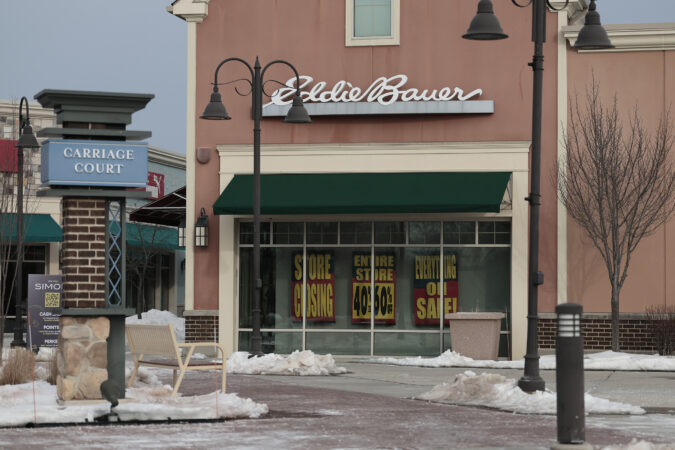
Over 60 years ago, the first American to climb Mount Everest sported an Eddie Bauer coat. Now the company behind the outdoor apparelfinds itself conducting liquidation sales.
The operator of Eddie Bauer filed for Chapter 11 bankruptcy in the U.S. Bankruptcy Court for the District of New Jersey on Monday and is winding down stores as it seeks a buyer.
Eddie Bauer is laying off some 58 employees in New Jersey at locations in Burlington, Gloucester, Middlesex, and Monmouth Counties, according to a layoff notice filed with the state.
“In an effort to rightsize the company’s store footprint and close underperforming stores, the company will be closing a number of retail locations in N.J.,” reads the notice.
In Pennsylvania, a spokesperson for the state’s Department of Labor and Industry said they had not received a layoff notice for Eddie Bauer stores as of Tuesday morning.
Before filing for bankruptcy, the company chose not to renew leases for 49 stores that had leases ending Jan. 31. Those locations have since closed, bankruptcy documents indicate.
The company is liquidating the remaining 175 stores as it seeks out a buyer.
In the Philadelphia area, Eddie Bauer stores are located at the Gloucester Premium Outlets in Camden County, at the Philadelphia Premium Outlets in Montgomery County, as well as in Concordville in Delaware County.
As of Tuesday, the Fashion District location in Center City appeared to be closed, according to the Eddie Bauer website.
What led to the bankruptcy?
Eddie Bauer stores have been operated by Catalyst Brands, which was formed in January 2025 in a merger that brought together brands including Aéropostale, Brooks Brothers, and JCPenney.
The CEO of Catalyst Brands, Marc Rosen, said in a news release Monday that the Eddie Bauer operator had been in a “challenged situation,” even before the new parent company was formed last year. The company was dealing with declining sales and supply chain challenges amid other issues, he said.
“Over the past year, these challenges have been exacerbated by various headwinds, including increased costs of doing business due to inflation, ongoing tariff uncertainty, and other factors,” Rosen said. “While the leadership team at Catalyst was able to make significant strides in the brand, including rapid improvements in product development and marketing, those changes could not be implemented fast enough to fully address the challenges created over several years.”
But the Rochester, N.Y.-based supermarket chain won’t say whether it’s collecting biometricdata on shoppers at eight Philly-area stores. There are Wegmans stores in Cherry Hill and Mount Laurel in New Jersey and in Glen Mills, Malvern, King of Prussia, Collegeville, Warrington, and North Wales in Pennsylvania.
Patrons at some New York City Wegmans locations learned earlier this month that the supermarket chain had begun to collect, retain, store, and share data on their faces, eyes, and voices. The information, Wegmans said, was being used for “safety purposes.”
“This is information that can be used to identify or help identify you,” a sign posted at Wegmans in New York City said, according to reporting from the online news site Gothamist. “We use facial recognition technology to protect the safety and security of our patrons and employees, and do not lease, trade or otherwise profit from the transfer of biometric identifier information.”
Wegmans does not “get into the specific measures used at each store” for “safety and security purposes,” Wegmans spokesperson Marcie Rivera said in an email.
Rivera said Wegmans has deployed cameras equipped with facial recognition technology in “a small fraction of our stores that exhibit an elevated risk.” Wegmans is using the technology in a “handful of states.” It posted mandated signage in New York City to comply with local regulations, Rivera said.
Wegmans has previously said that the surveillance software is used to help identify individuals who “pose a risk to our people, customers, or operation.”
Biometric surveillance is becoming increasingly common but is not yet widespread, said Gus Hurwitz, senior fellow and academic director of the Center for Technology, Innovation and Competition at Penn’s Carey Law School.
Companies that use biometric surveillance do so for a number of reasons, but seldom tell consumers what their data is being collected for. Data collection can help companies understand what consumers are purchasing and how they’re moving through stores, Hurwitz said. Biometric data collection can also be used for dynamic pricing, when retailers change prices in real-time depending on a number of factors, including time of day, demand, weather, and consumer behavior.
Hurwitz said it’s important to distinguish between real-time and non-real-time biometric screening. Non-real-time screening has been happening for decades in the form of security cameras and other data collection tools, often used for market research purposes.
Real-time screening, however, is a newer frontier with a far murkier regulatory landscape.
Businesses in New York City that collect biometric data are required to post signage notifying customers, per a 2021 city law, however the agency in charge of implementing the law has no enforcement mechanism for noncompliant businesses, a city official told Gothamist.
A bipartisan bill regulating biometric data collection is currently moving through the Pennsylvania legislature. A recently introduced bill in the New Jersey Legislature would require any entity collecting biometric information to post a “clear and conspicuous notice” at every entryway to their business, like in New York City.
Hurwitz said we’re “still very much in the development era of these sorts of technologies,” and that he expects more and more government entities to hone in on regulating them in the near future.
A warehouse developer’s proposal to trade land with the state in Limerick Township and beyond has blindsided local officials — and ignited fierce opposition from residents who fear the deal could clear the path for a data center.
The state would gain 559 acres across three counties, including what would become Delaware County’s first state game lands,according to the proposal on file with the Pennsylvania Game Commission.
In return, the developer, Limerick Town Center LLC, would secure a 55-acre property in Limerick. That landadjoins an industrial tract the developer already owns, which was formerly the site of the Publicker distillery.
(function() {
var l2 = function() {
new pym.Parent(‘LANDSWAP1-22-26.html’,
‘https://media.inquirer.com/storage/inquirer/projects/innovation/arcgis_iframe/LANDSWAP1_22_26new.html’);
};
if (typeof(pym) === ‘undefined’) {
var h = document.getElementsByTagName(‘head’)[0],
s = document.createElement(‘script’);
s.type = ‘text/javascript’;
s.src = ‘https://pym.nprapps.org/pym.v1.min.js’;
s.onload = l2;
h.appendChild(s);
} else {
l2();
}
})();
Collapse
Residents flooded an hourslong Board of Supervisors meeting Tuesday night to oppose the land swap, prompting officials to open a second room fortheoverflow.
“I’m against the swap,” resident Jeff Schmidt told the board. “It’s a terrible idea, and I need to stop now because a lot of bad words want to come out of my mouth.”
Connie Lawson, board chair, said that ultimately the state controls the land involved in theswap, not the township.
Township manager Daniel Kerr told the crowd that the township had little information and hadjust learned of the proposal last week. But, he said, plans for land involved in the swap would have to go through the township for zoning and planning.
After hours of listening to residents, the board voted to send a “strongly worded” letter of opposition to the Game Commission.
Although the developer has not proposed building a data center, theidea has been widely circulated on social media, including inposts by state Sen. Katie Muth. Sheurged residents who oppose the swap to attend the township meetingTuesday, as well asa state Game Commission meetingonSaturday.
Data centers, whichhouse servers used for artificial intelligence, have become a hot topic in recent months, as residents in multiple towns have voiced concerns over their use of land, energy, and water. Meanwhile, political and labor leaders have embraced them as job creators.
Those twolocations are within two milesof the land Limerick Town Center would acquire in the swap.
“If this swap goes through, we are one step closer to turning our communities into Data Center Alley 2.0,” Muth wrote on Facebook last week. “This land is publicly owned wildlife habitat and forest. It should not be traded away so Big Tech and AI corporations can maximize profits at the expense of our environment and quality of life.”
What’s involved with the land swap?
Limerick Town Center LLCis already proposing to build two warehouses totaling 1.9 million square feet in Limerick’s Linfield section. That would be off Main Street and Longview Road, not far from Constellation Energy’s Limerick Clean Energy Center, a nuclear power plant.
The proposed swap would give Limerick Town Center LLC state-owned landand a 200-foot right-of-way adjoining the warehouse site, in exchange for the company giving the state property inLimerick and other counties.
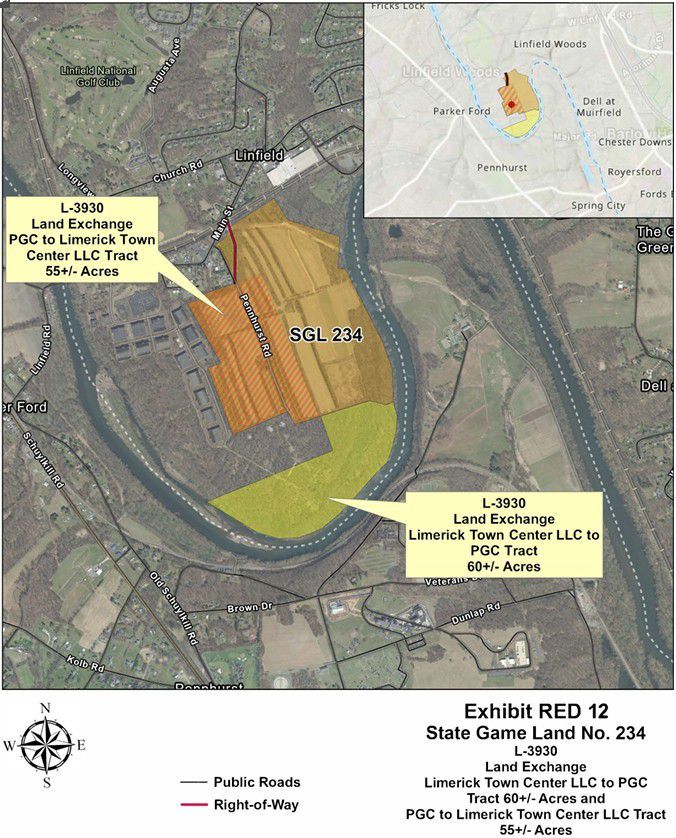
Overall, the company would give the state a total of 614 acres in return for a 55-acre chunk of Game Land 234.
Included in the 614 acres is a 60-acre parcel it already owns in Limerick that adjoins the southern portion of Game Land 234 near the river.
Map shows a proposal by Limerick Town Center LLC to give the state 60 acres it owns in Limerick Township in return for the state giving the company 55 acres of State Game Land 234.
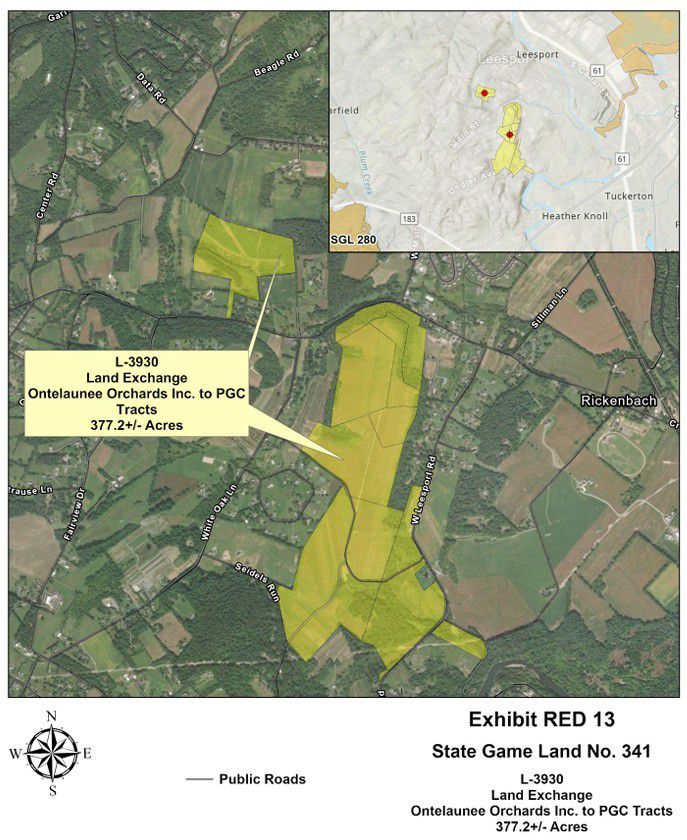
The company would alsogive 377 acres in Bern Township, Berks County, to be managed by the state.
Map shows part of a land swap being proposed by Limerick Town Center LLC. The company is proposing to give the state 377 acres of Ontelaunee Orchards in Bern Township, Berks County, in return for 55 acres of State Game Land 234 in Limerick Township, Montgomery County.
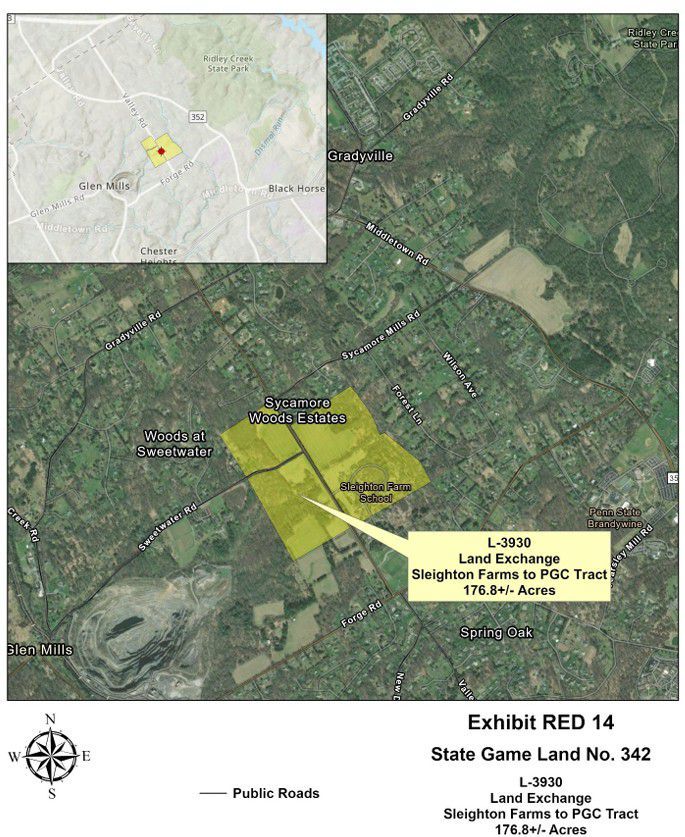
And the company would give the state 177 acres in Edgmont Township that would become the first state game land in Delaware County.
Map shows part of a land swap being proposed by Limerick Town Center LLC to acquire 55 acres of state Game Land 234 in Limerick Township, Montgomery County. In return, Limerick Town Center would give the state hundreds of other acres including 177 acres in Edgmont, Delaware County that could be used for a new state Game Land.
Local concerns
At Tuesday night’s meeting, resident after resident opposed the plan, citing overdevelopment, traffic, a change in the character of the community, and an impact on wildlife and the environment. Only one man from Berks County, who said he was a hunter, supported the swap.
Limerick resident Jennifer Wynne told the board she opposes the swap, saying the public hasn’t been given enough information that it would provide “a clear public benefit.”
“I am also concerned that this transfer may function as a precursor to future high-intensity or industrial development,” she said.
Michael Poust said he moved to Limerick to escape overdevelopment, and he opposes the land swap.
“My land is surrounded by the state game lands,” he said. “I bought it there for a reason.”
Muth, the state senator, lives in neighboring East Vincent and has been part of the fight against a data center proposed for Pennhurst.
“I highly recommend that you review the path forward to change the zoning in that area,” Muth told the board.
A view of the former Publicker Distillery tract now owned by Limerick Town Center LLC, which is proposing to build two warehouses on the land. The company is also proposing a land swap with the state to gain 55 acres of adjoining land.
Edgmont’s response
Meanwhile, Edgmont Township, Delaware County, could gain new state game land near, but not connected to, Ridley Creek State Park.
Pennsylvania Game Lands, supported by hunting and trapping fees, are widely used for hunting, hiking, fishing, and birdwatching.
Ken Kynett, Edgmont Township’s manager, said officials only learned of a land swap on Jan. 16.
“We got an email from the game commission last week saying we’re interested in acquiring property in your township,” Kynett said. “It was as much a surprise to us as anyone else.”
Under the land-swap proposal, Limerick Town Center LLC would give the state a 177-acre portion of the old Sleighton Farm School grounds.
The school, originally set on 300 acres and run by Quakers, was founded to serve “troubled children.” In 1931, it split into two separate schools: the Glen Mills School for boys and the Sleighton Farm School for girls. Eventually, the schoolbecame coed and was called simply Sleighton School.
The school closed in 2001 because of financial difficulties, and the grounds were sold. Elywn, a large nonprofit, owns the land.
Kynett said heassumed Limerick Town Center LLC is working with Elwyn on the deal. Part of the land is zoned for agriculture, and part is zoned residential.
He said that keeping the land as open space could be a positive, but the township doesn’t have enough information to know whether to support or oppose the swap.
“We haven’t really had a chance to discuss it with the board,” Kynett said.
State Game Lands 234, Main Street and Pennhurst Road, Limerick Twp., Montgomery County.
Who’s behind Limerick Town Center LLC?
Limerick Town Center LLChas an address in Madison, Conn., according to Montgomery County land records. The address is linked to a company registered by Christine Pasieka, who is a business partner and the wifeofChris Rahn. The two have made development deals throughout the Philadelphia area for years.
Pasieka could not be reached immediately for comment on Wednesday.
Property records show that Limerick Town Center LLC purchased the 197-acre parcel in 2022 for $17 million.
In 2023, the company applied to build on the Publicker tract, according to county records. The registered agent for Limerick Town Center LLC was Sandra DiNardo, whose family owns a large trucking and cement business.
DiNardo could not be reached immediately for comment.
ChristianaCare, Delaware’s largest health system, received a one-notch credit-rating downgrade from Standard & Poor’s, to “AA” from “AA+’.
S&P attributed the downgrade of the nonprofit health system’s rating to inconsistent operating performance in recent years and the planned addition of $350 million in debt early this year through a bond offering, according to a report Tuesday.
In the year ended June 30, 2025, ChristianaCare’s financial results were weaker than expected because of low surgical volume related to physician turnover, S&P said. Another factor was higher-than-anticipated medical malpractice reserves, S&P said.
One of ChrisitianaCare’s financial strengths is that it typically gets half of its revenue from private insurers, which pay higher rates and are more profitable than Medicare and Medicaid, S&P noted.
Despite its strong financial condition, ChristianaCare has a relatively small service area, given its concentration in northern Delaware, compared to other health systems with “AA” ratings, S&P said. If ChristianaCare’s expansion into Southeastern Pennsylvania is successful, it would help alleviate that problem, the agency said.
ChristianaCare opened a micro-hospital in western Chester County last summer and is building a second one in Aston, Delaware County. It also has plans to put one in Springfield Township. In addition, ChristianaCare spent $50 million to step into the leases that the bankrupt Crozer Health had at five outpatient facilities in Broomall, Glen Mills, Media, and Havertown.
S&P said ChristianaCare has no plans for significant acute-care hospital expansion.
Last month, ChristianaCare and Virtua Health, South Jersey’s largest health system, ended negotiations on a possible merger.
Longtime Philly radio host Matt Cord will serve as the late Pierre Robert’s successor for WMMR’s midday slot starting next month, the station’s parent company, Beasley Media Group, announced Monday.
“Nobody replaces Pierre — let’s make that clear,” Cord said in a statement. “I promise to carry his amazing spirit into the studio bearing his name and do my best to make him proud.”
Cord will take on Robert’s former time slot starting Dec. 1, and leaves behind the morning slot at WMGK he took on in 2023 following fellow radio veteran John DeBella’s retirement. Cord previously helmed the midday time slot at WMMR briefly in the 1990s, when Robert switched to mornings, and his return to the rock station marks his third run there.
A replacement for Cord at WMGK is expected to be announced “in the coming weeks,” Beasley said.
A longtime friend of Robert’s, Cord has been appearing on the air in Philadelphia for about 40 years, and, in addition to stints at WMMR and WMGK, previously hosted mornings at BEN-FM and helmed the afternoon drive slot at Y-100. In addition to his radio work, Cord has served as the Sixers’ in-arena announcer for more than 20 years.
Despite his Philly radio pedigree, Cord, a Glen Mills native, noted that “no one can step into [Robert’s] sparkling high-top Converse and fill them.” Instead, he said, he hopes to “carry on” Robert’s role in tribute.
“Everyone at the station is so grateful that our longtime friend and radio family member Matt Cord is willing to take that on,” WMMR program director Chuck Damico said. “No one can replace Pierre, but I know that Matt can do him proud and Pierre would absolutely 100% approve of this. We will all continue to honor Pierre in everything we do forever.”
Robert, 70, was found dead in is home in Gladwyne on Oct. 29, prompting an outpouring of grief from friends and fans. A Northern California native, Robert joined WMMR as an on-air host in 1981, and quickly became one of Philadelphia’s most distinctive and well-liked radio personalities.
Following Robert’s death, hundreds of fans and friends flooded Rittenhouse Square, one of the late radio host’s favorite spots in Philadelphia. Among those who showed up to honor him were WXPN host Jim McGuinn, B101 host and former Preston & Steve cohost Kathy Romano, a slew of WMMR staffers, and Cord himself, The Inquirer previously reported.
Next month, WMMR plans to host a tribute concert for Robert dubbed Pierre Robert: A Show of Life. Set to take place at the Fillmore on Dec. 17, the show will feature appearances from the Hooters, Brent Smith and Zach Meyers of Shinedown, Lizzy Hale and Joe Hottinger of Halestorm, and Ed Roland of Collective Soul.
“We will sing, dance, and celebrate in the way Pierre would have wanted us to,” Damico said of the concert.
From inflation to tariffs to labor shortages, small businesses in Philadelphia have faced many challenges in 2025. But they remain resilient and, for the most part, are optimistic about the coming year.
But that, of course, depends on the type of business.
For example, the Monkey’s Uncle, a retro Philly sports apparel boutique located in Doylestown, had an “exceptionally strong” year, which was mostly driven by the Eagles’ Super Bowl win. Co-owner Derrick Morgan expects the holiday season to be busy but observes more people are shopping for holiday gifts much earlier this year as consumers are “spreading out their spending much more.”
For small businesses in the Philadelphia region, consumer sales were up 2.4% in October compared to a year before, according to a monthly index from payment technology provider Fiserv. That’s compared to a 1.5% increase nationally. Small-business optimism remains above its 52-year average and uncertainty dropped this month, according to the National Federation of Independent Businesses.
All in all, it hasn’t been such a bad year for most, despite the uncertainty.
Looking to 2026, Morgan is optimistic due to Philadelphia hosting a number of major sporting events (like the MLB All-Star Game), and he is already coordinating commemorative merchandise with licensed vendors. But it’s not economic uncertainty that impacts his business as much as Jalen Hurts or Bryce Harper.
“The nature of our business is very much at the mercy of the wins and losses from our Philly sports teams, which can certainly be unpredictable,” he said.
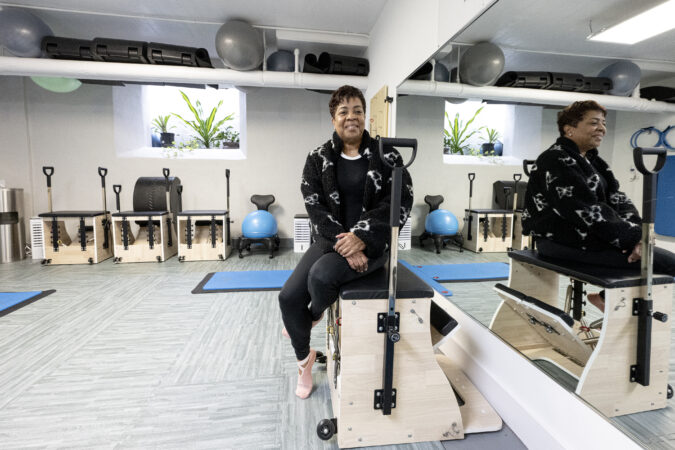
Regardless of the economic uncertainty, physical fitness remains popular. Valerie Plummer’s Germantown-based Pilates studio — Pilates by Valerie — has had a “profitable and expansive year” thanks to “rising client retention, steady new enrollments, and an increasingly strong sense of community.”
Plummer has used this year to double down on her business by broadening her programming with a series of new classes and apparatus trainings while developing instructor materials, improving internal systems, and strengthening her long-term training pipeline. As for next year? Plummer’s optimistic.
“I am confident in the direction of the studio, the relationships we are building, and the value we are providing — and I’m excited for what’s ahead,” she said.
The restaurant industry has been hit hard recently, thanks mainly to increasing costs and labor shortages. In Media, Rainy Culbertson’s breakfast restaurant, The Corner, has had a difficult year.
“Customers are uncertain about their finances,” she said. “Eating out is a luxury and is one of the first cuts to a person’s budget in economically uncertain times. We’ve had ups and downs this year, but mostly down.”
Like many restaurants, The Corner faces challenges in labor retention, cost increases, and competitive issues. And they’re still recovering from the pandemic, Culbertson said.
“Most restaurants have not recovered from COVID, it’s just that we stopped talking about it because folks want it behind them, ourselves included,” she said. “Most restaurants still carry debt from COVID and now they have to deal with economic uncertainty and painfully thin profit margins due to inflation.”
It’s not surprising that Culbertson remains very uncertain about 2026.
“I’m optimistic it will be better but realistically, it will probably be more chaos and stress dealing with inflation and tariffs,” she said. “A lot depends on how long this madness of inflation, tariffs, and the unstable economy drags on. I’m really close to calling it quits.”
Heather Herbert, the co-owner of Tail Spinz in Montgomeryville says her family-owned dog daycare has grown every year since its opening in 2023. It saw growth this year too, but some months were slower.
“2025 has had its ups and downs, with some months of steady growth and others that have leveled off a bit,” she said. “Our business is built almost entirely on word-of-mouth and referrals, which creates a slower but more sustainable kind of growth. We have had a few families scale back or pause daycare due to budget changes, and we completely understand that we’re a ‘nice-to-have’ rather than a necessity for everyone.”
Herbert is looking forward to even more growth next year and is currently gearing up for the holidays, with “a full lineup of festive events planned” including “a visit from Santa” with holiday photo ops and treats.
“When you provide great care, build genuine relationships, and create a space that dogs are excited to come to, it’s hard not to feel positive about what’s ahead,” she said.
Even in an uncertain economy, specialized businesses like Blevins Sommelier Services can flourish. Focused on bringing “affordable luxury experiences” directly into their clients’ homes, the company, which offers wine tasting and bourbon education events, has experienced strong growth this year with monthly bookings doubling over the prior year.
“I’m optimistic for 2026,” said Amanda Blevins, who operates her business out of her home in Glen Mills. “The demand for wine events remains steady, and the demand for bourbon tastings has increased.”
Tariffs and supply shortages have impacted Blevins’ business, particularly on wines from Italy and France, but like many business owners she’s pivoted and now features more local wines.
“In many cases, hosting private in-home celebrations is more affordable than entertaining at a restaurant or larger rented venue,” she said. “There is always something new to discover in the world of wine and whiskey, and I consider it a wonderful life-long journey.”