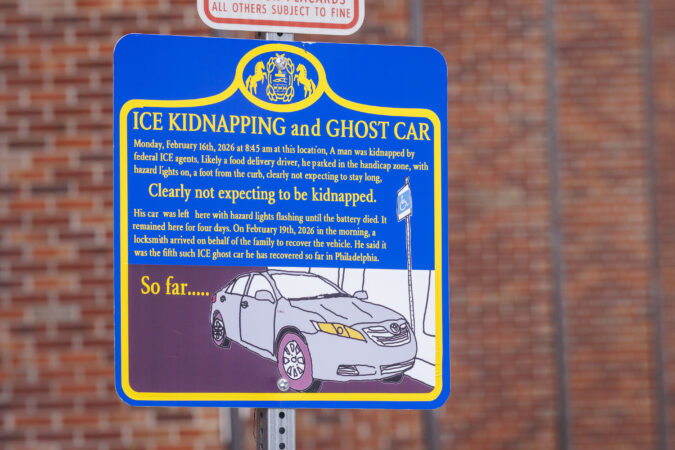
The fake but authentic-looking Pennsylvania historic marker, erected by two artists who sought to ruefully commemorate a local immigration arrest, disappeared from its post in Philadelphia sometime Monday.
Huston West, one of the artists, said he was walking his dog around 1 p.m. when he noticed that the sign was absent from its spot on Fairmount Avenue near Fifth Street. A neighbor told him the plaque had been there earlier in the day.
“It’s lame,” West said of the sign being removed. “But it got a lot of coverage while it was up.”
West said he could only speculate on who may have taken the marker ― he suspected conservative opponents, people who had criticized the sign on social media, or maybe even the city government.
A city spokesperson said he would check.
This particular, familiar-looking blue-and-yellow marker, similar to the ones that commemorate important people, places, and events in communities across Pennsylvania, was put up at the site of a Feb. 16 ICE arrest.
That morning, masked agents descended on a Gopuff delivery driver who had pulled over to make a quick drop-off in Northern Liberties. After he was taken into custody, the car remained behind for days, set two feet from the curb in an accessible parking space, its hazard lights blinking until the battery died.
West and a fellow artist who goes by the name Emeyewhisky wondered what had happened to the driver, and created a plaque bearing the header “ICE Kidnapping and Ghost Car.”
The ghost car terminology borrows from ghost bikes, the roadside memorials where a bicycle is painted white and placed at the site where a cyclist was hit and killed by a motorist.
Federal immigration authorities say the use of such terms as kidnapping is inaccurate and unfair, that they lawfully arrest migrants who have no permission to be in the United States and who in some cases have committed criminal and even violent offenses.
Immigration and Customs Enforcement officials in Philadelphia said that on Feb. 16, officers conducted a targeted action and arrested Abdulasen Nazarkhudoev. They said he was unlawfully in the U.S., and told them that he was a Russian citizen.
He was taken to the Federal Detention Center in Center City and later released by order of a judge, pending further immigration proceedings, records show.
ICE earlier referred questions about the sign to city officials.
As word of the art project spread on social media, some disapproved. Some suggested on a Northern Liberties Facebook group that the delivery driver was rightfully arrested.
West said Monday that he and his art partner had conferred about what to do next. Emeyewhisky is known for projects that place signs with fake wording on Philadelphia streets, and some have been removed.
Don’t be too surprised, Huston said, if an ICE marker should reappear.
The product with the most spectacular Super Bowl increase didn’t advertise.
Philadelphia-based Gopuff reported sharp increases in advertised snacks, but also in basic party ingredients such as limes and red party cups, during Super Bowl LX.
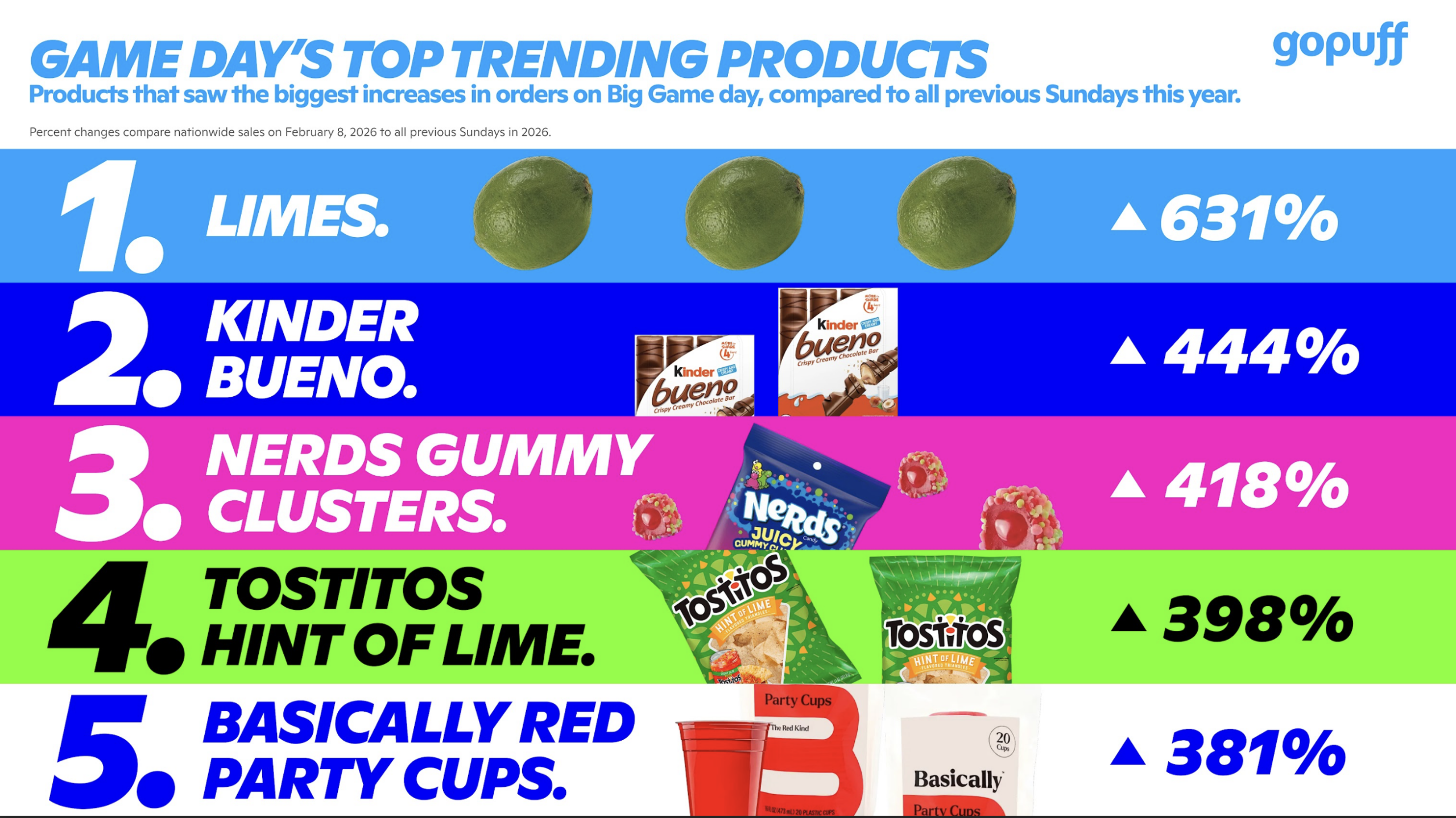
Orders for limes during the game jumped over 600% over previous Sundays in 2026. Limes are, after all, a key ingredient in popular plates like guacamole and pico de gallo, served with Mexican beers and margaritas, and “easily forgotten at the store,” making them a natural for last-minute delivery, said Gopuff spokeswoman Brigid Gorham.
Lime sales exploded even more than Gopuff’s Basically-brand red party cups, a three-year-old in-house brand, which was up 381% on Super Bowl Sunday above recent Sunday sales.
Overall, alcohol sales nearly doubled from recent Sundays. Soda sales were up more than one-third and salty snacks by about one-quarter. Compared to last year, when the Eagles were in the Super Bowl, the number of Philadelphia orders were up 7%.
Other Super Bowl Sunday growth-leaders included PepsiCo’s Tostitos Hint of Lime chips, which were up 398%.
But the top gains were two candies made by Italy-based candy maker Ferrero. Gopuff orders for Kinder Bueno, chocolates marketed heavily in Latin America and U.S. Hispanic neighborhoods, were up 444% vs. recent Sundays, and Ferrero’s Nerd Gummy Clusters, were up 418%.
Kinder Bueno and Nerd Gummy Clusters saw sales roughly double in the hour after their Super Bowl ads ran. Liquid Death and Dunkin also saw orders rise at least 50% after ads.
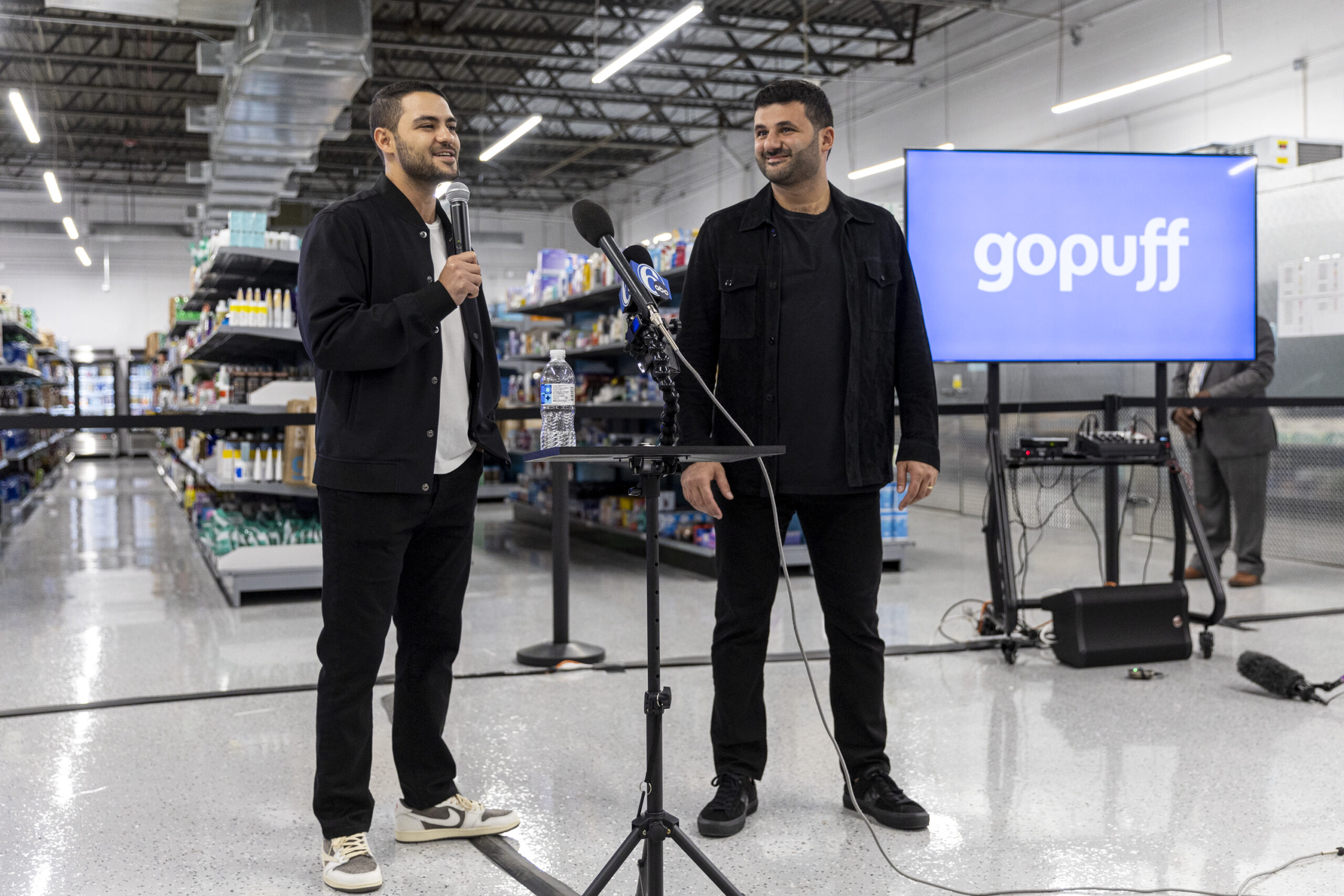
Founders and CEO of Gopuff Yakir Gola (left) and Rafael Ilishayev speak to a room full of staff and team members of Gopuff at a recently opened center in Philadelphia in 2022.
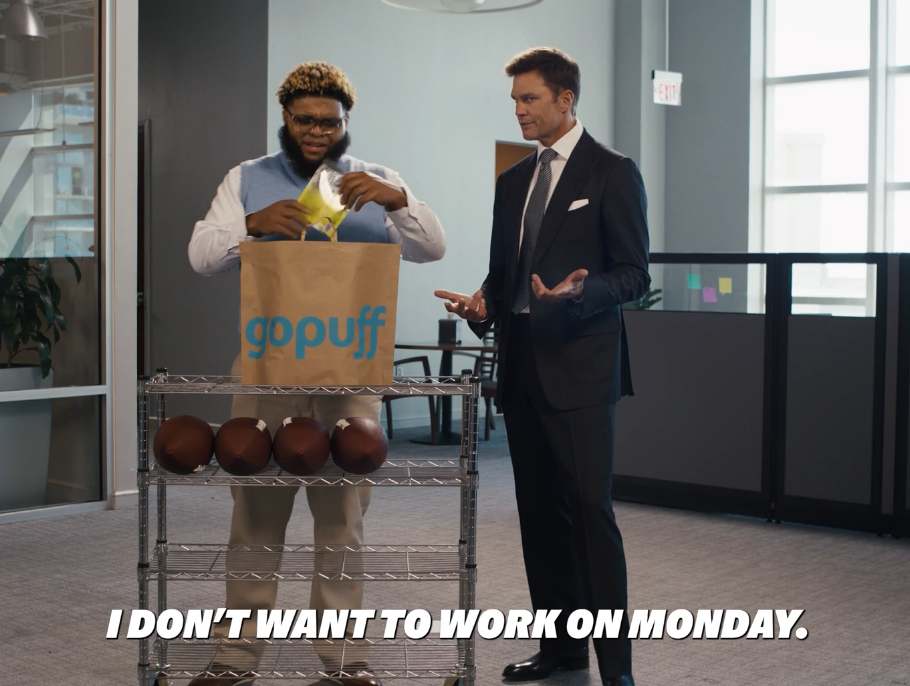
Cofounder Yair Gola and his colleagues saw those numbers and thought, “This ought to be a holiday.”Last fall, it set up a 501(c)4 lobbying group, the Super Monday Off Coalition, pledging at least $250,000 to get the effort rolling.
Druski (left) and former NFL quarterback Tom Brady in an ad for Philadelphia-based Gopuff promoting its campaign to designate “Super Monday” as a national holiday, since millions already take the day off.
The company’s contribution to the lobbying would be funded by 1% of Gopuff’s profits from sales of certain boxes of beer, sugary drinks, hot dogs, and other products from Thanksgiving to game day.
Heavy users who placed at least four $30 orders in that period would also get $20 “Gocash” discounts and receive a chance at a Birkin handbag, a Rolex watch, and other prizes.
By Monday, Gopuff hadn’t announced its planned donation, but the campaign was declared “a winner” by Charles R. Taylor, a Villanova University marketing professor who tracks Super Bowl ads. He spotlights not just successful marketing but also ineffective efforts like Nationwide’s painful 2015 “Boy” campaign and GM’s 2021 “No Way Norway” misfire.
Partnering with high-profile Brady and Druski gives “instant visibility and credibility” with fans and wider audiences, Taylor said. Even if the campaign costs more than Gopuff actually donates to the cause, a national holiday is “a clever hook” watchers will remember, Taylor said.
Going public?
Gopuff raised over $5 billion from Saudi, Japanese, and U.S. private investors during the digital-delivery investment boom that lasted into the COVID years. These big investors hoped Gopuff (officially Gobrands) founders and early investors would win them big profits by selling shares in a high-priced stock market initial public offering or selling to DoorDash, Uber, or other delivery giants.
But app use and delivery growth slowed in the COVID recovery. Gopuff’s perceived valuation tumbled as its publicly traded rivals’ share prices fell. The company, which had expanded to hundreds of city neighborhoods and college towns, shut marginal centers and laid off staff at its Spring Garden Street headquarters to reduce losses and save investors’ capital for better times.
Now Gopuff is showcasing efforts to win new investor attention.
Gopuff has added a warehouse camera feed and local product-sales stats for fans who want to know what neighbors are buying, app-based order updates, and user product recommendations. It added over-the-counter pharmacy items and new lines of vegan organic GOAT Gummies (which Brady is also promoting).
The company also began accepting SNAP EBT electronic food-stamp accounts and donated $5 million for SNAP when the federal shutdown threatened low-income families dependent on the program.
New hires include economist Matt McBrady — a veteran private-equity investor, former adviser to President Bill Clinton, and sometimes Wharton instructor — as Gopuff’s new chief financial officer, noting his experience taking companies through public stock offerings.
Last fall Gopuff raised $250 million, its first investment since a 2021 convertible-bond financing that had valued the company at a stock-market-bubble-inflated $40 billion.
This time, the largest investors included previous Gopuff backers Eldridge Industries and Valor Equity Partners, along with Robinhood, Israeli billionaire Yakir Gabay, the cofounders, and other earlier investors. Eldridge chairman Todd L. Boehly in a statement called Gopuff “resilient.”
Valor partner Jon Shulkin cited the company’s “focus, innovation, and substantial gains in profitability.”
This latest capital-raise implied a valuation of $8.5 billion — a fraction of what Gopuff was worth on paper during the digital-delivery bubble, but enough for the venture capitalists to hope they may yet get their money back with at least a modest profit.