Tag: I-95

  • Another weekend snow watch and ‘exceedingly rare’ cold are on tap for Philly

    Another weekend snow watch and ‘exceedingly rare’ cold are on tap for Philly

    Another weekend snow chance and more cold are in the forecasts. But the big difference between last week and this one in the Philadelphia region is a matter of degrees — about 10 of them.

    A coastal “bomb cyclone” could form during the weekend with significant impacts, at least at the Shore. Computers were still sorting out what effects, if any, it would have in Philly. On Thursday, however, they favored snow staying to the south and east, with only a 40% chance they got to I-95.

    In the meantime the cold will be epical by Philly standards.

    If the forecast holds, in addition to coming close to ending a 32-year zero-less streak, Philadelphia would have daily minimums of 5 degrees Fahrenheit or lower on the next two mornings.

    And it appears the city will have its first nine-day stretch in which the temperature failed to reach 30 degrees since 1979, based on analysis of temperature data from the Pennsylvania state climatologist.

    In issuing a cold weather advisory for wind chills as low as 10 below zero, the National Weather Service in Mount Holly noted that “it is exceedingly rare to get this combination of length and magnitude of an arctic airmass for this area.”

    Philadelphia’s forecast high on Thursday, 19, would be more than 10 degrees lower than the forecast for Anchorage, Alaska.

    Heading into the weekend, that subtly laminated lunar landscape with the one-horse-open-sleigh look in the fields and parks is almost certain to persist while bedeviling road-clearing efforts.

    Some snow is possible late Saturday or Sunday — and this is becoming a habit — in time for the rising of the full “Snow Moon,” which may be a problem for the Jersey Shore. The full moon will likely contribute to tidal flooding.
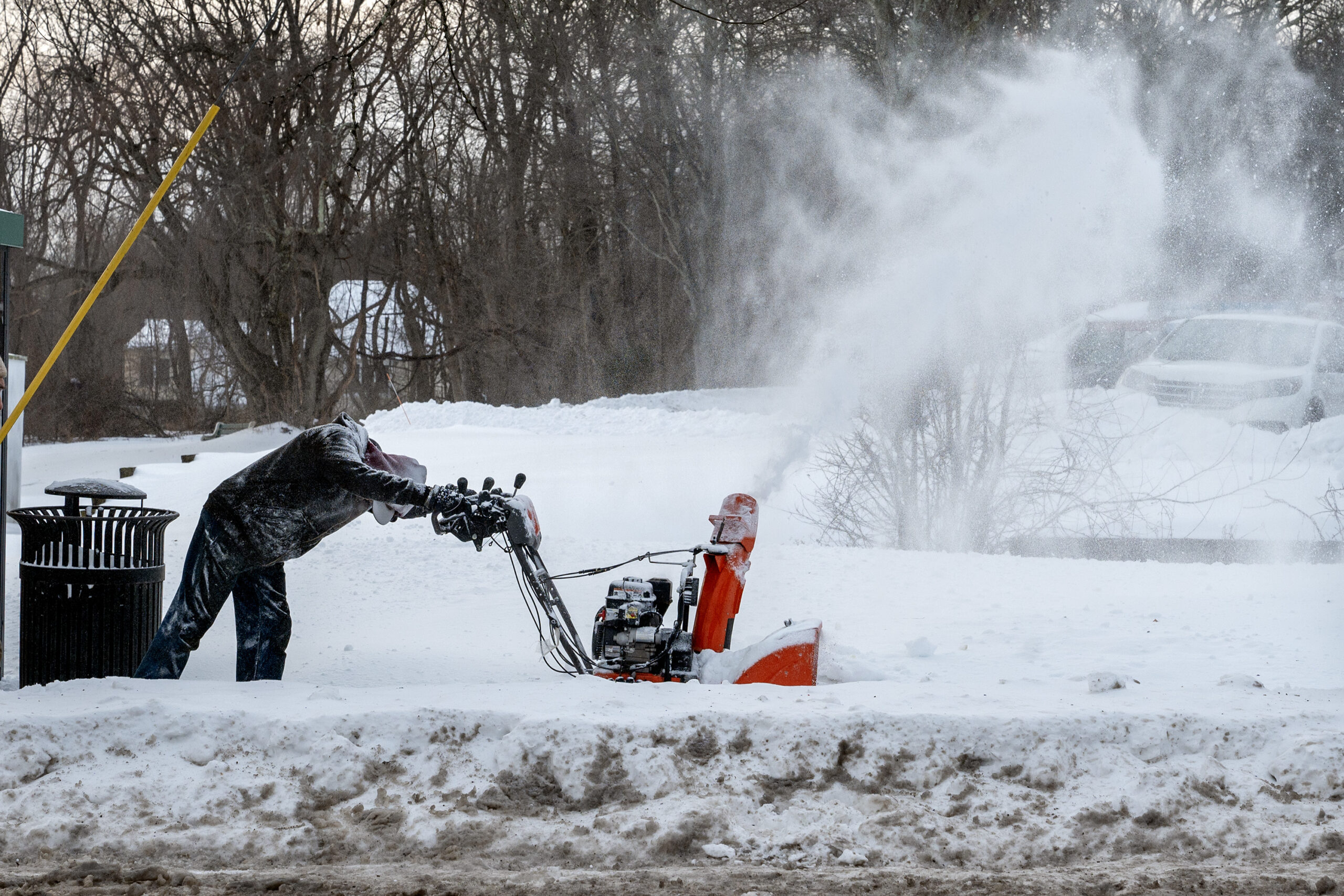
    Snow removal contractor Jordan Harlow clears the sidewalk in front of an apartment building on Main Street in Doylestown Wednesday, Jan. 28, 2026, following Sunday’s snowstorm. He said the layer of ice made it twice as difficult to use the snow blower.

    The snow outlook for the weekend

    On Wednesday only two things were certain about the latest threat: A major coastal storm is going to blow up during the weekend, and it’s not going to rain.

    “Everything looks like it’s going to come together,” said Paul Pastelok, the long-range forecaster for AccuWeather Inc.

    AccuWeather said it may intensify enough to qualify as a “bomb cyclone.”

    An early consensus among computer models was that the storm would stay too far offshore to generate a major snowfall in the immediate Philly area. Pastelok said it was looking for Philly to get “sideswiped” with a 1- to 3-inch event. However, that was very much subject to change.

    The weather service would not be making a first guess at potential accumulations until Thursday afternoon, said Alex Staarmann, a National Weather Service meteorologist in Mount Holly. In its forecast discussion Wednesday, it said that based on a consensus of the models, the Shore had a 35% to 50% chance of 6 inches of snow or more, with a 20% chance along I-95.

    More certain was the potential coastal flooding threat at the Shore with potent onshore winds coinciding with Sunday’s full moon.

    And while it may seem the atmosphere enjoys ruining weekends, it’s not uncommon for weather systems to fall into 3½- and seven-day cycles. That has to do with the spacing between weather systems, meteorologists say.

    Regardless of what happens during the weekend, the region is going to begin the workweek with snow on the ground.

    The snow is going to have more staying power than the average computer-model snow forecast.

    It’s not going to get a whole lot warmer anytime soon

    Even though it’s ice cold, as if developing a slow leak, the depth of the snow pack is actually decreasing, but ever so ponderously.

    That 9.3 inches of snow and sleet that accumulated Sunday was down to 6 inches at Philadelphia International Airport on Wednesday morning, Staarmann said.

    Compaction and sublimation, which is similar to evaporation, are lowering the depth, despite the cold. But Wednesday’s depth report was the same as Tuesday’s.

    And after what does or doesn’t happen Sunday, temperatures are forecast to remain below freezing at least until Feb. 4.

    No significant warm-up is in sight, and the National Oceanic and Atmospheric Administration’s Climate Prediction Center has odds strongly favoring below-normal temperatures until Feb. 11.

    The upper-air pattern continues to favor cold pouring into the Northeast.

    And more cold air is possible later in the month with a visit from the polar vortex, Pastelok said.

    Average temperatures in Philly finished 3.6 degrees below normal in December, and despite a 10-day warm spell earlier in the month, January is projected to finish at least 2 degrees below long-term averages.

    For Pastelok and other seasonal forecasters, it has been a tough winter.

    “We underestimated how cold the Northeast would be this year,” he said.
  • Pizza, museums, and waterfront walks in New Haven | Field Trip

    Pizza, museums, and waterfront walks in New Haven | Field Trip

    With a population of just over 140,000, New Haven still manages to be tiny Connecticut’s third-largest city — and one that punches well above its weight as a weekend getaway.

    It’s a university town, a harbor town, and a New England town, all folded into one. The result is a destination with world-class cultural institutions, excellent food — the pizza is as outrageous as you’ve heard — and easy access to the outdoors, from the river-fed coast of Long Island Sound to one of the largest urban parks in the region. From Philly, it’s about three hours and change up I-95, depending on traffic around New York. Start the car.

    Stay: Hotel Marcel

    Originally the HQ of the tire-producing Armstrong Rubber Co., the Wharf District Hotel Marcel inhabits an architecturally significant, brutalist concrete building honeycombed with windows and retrofitted to run entirely on renewable energy. The inside is just as interesting: terrazzo staircases with mahogany rails, Connecticut-made walnut beds, and a circular bar pouring spirulina margaritas and nonalcoholic spiced cranberry cider.

    📍 500 Sargent Dr., New Haven, Conn. 06511

    Hike: East Rock Park

    New Haven’s central green space, East Rock Park, spans 427 acres and rises 350 feet above the city, rewarding visitors with sweeping views of downtown and Long Island Sound. Not feeling a winter hike? You can drive to the summit instead. Traveling with kids? Stop by the Trowbridge Environmental Center on the park’s west side for hands-on exhibits about the local ecology.

    📍 41 Cold Spring St., New Haven, Conn. 06511

    Lunch: Frank Pepe and Sally’s Apizza

    If there’s only one thing you know about New Haven, it’s probably the pizza. Or as they call it here, apizza (“a-beetz”), derived from the southern Italian immigrants that opened the first shops in the early 1900s.

    For lunch, stage a mini pie crawl along Wooster Street and compare two legends located a block apart. At Frank Pepe (est. 1925), the tomato pie and oregano-dusted white clam pie are classics for a reason. At Sally’s Apizza (1938), whose recent expansion hasn’t dimmed the original’s quality, the blistered tomato pie with mozzarella is the move.

    📍 Frank Pepe: 157 Wooster St., New Haven, Conn. 06511

    📍 Sally’s Apizza: 237 Wooster St., New Haven, Conn. 06511

    Visit: Yale Peabody Museum

    If there are only two things you know about New Haven, they’re probably the pizza and Yale. The Ivy’s lovely, leafy campus dominates the center of town. (It’s no Penn, but…) The impressive collection at the Yale Peabody Museum, which is free to visit and requires no advance ticketing, includes a towering brontosaurus skeleton, a 300-pound Brazilian tourmaline cluster, and 4000-year-old Mesopotamian cuneiform tablets.

    📍 170 Whitney Ave., New Haven, Conn. 06511

    Read: Beinecke Rare Book and Manuscript Library

    Decried as an incongruous eyesore when the Gordon Bunshaft-designed Beinecke Rare Book and Manuscript Library opened in 1963, the modernist building has become an architectural icon on campus. Translucent marble cladding gives the interior a cozy glow while protecting the literary treasures, which are arranged in a stunning five-story cubic column, from sun damage. Even if you’re not a rare-books obsessive, it’s worth visiting for the space alone. Current exhibits include a 15th-century Gutenberg Bible and illustrated Japanese crepe-paper books.

    📍 121 Wall St., New Haven, Conn. 06511

    Dine: Fair Haven Oyster Co.

    It’ll likely be a bit too chilly to sit out on the pretty deck over the Quinnipiac River, but the warm woodwork and porthole windows get the seafood-tavern vibe across well at Fair Haven Oyster Co. Start with four different types of New England oysters, then progress to tots topped with American sturgeon caviar, oil-poached tuna toast, and bone-in skate wing in Meyer lemon brown butter. Skip dessert.

    📍 307 Front St., New Haven, Conn. 06513

    Scoop: Arethusa Farm Dairy

    Based in Litchfield County, Arethusa Farm Dairy produces some of the richest ice cream around, using 16%-butterfat milk from its own cows. Lucky for New Haven visitors, there’s an outpost at the Yale Shops. Breathe in the smell of freshly pressed waffle cones while choosing from classic flavors like coconut-coconut chunk, strawberry that actually tastes like strawberries, and an excellent coffee ice cream. One scoop is never enough.

    📍 1020 Chapel St., New Haven, Conn. 06510

  • The race between Josh Shapiro and Stacy Garrity for Pa. governor has officially begun. Here’s what you need to know.

    The race between Josh Shapiro and Stacy Garrity for Pa. governor has officially begun. Here’s what you need to know.

    Pennsylvania’s race for governor has officially begun. And 10 months before the election, the November matchup already appears to be set.

    Democratic Gov. Josh Shapiro formally announced his reelection campaign Thursday — not that anyone thought he wouldn’t run. And Republicans have rapidly coalesced behind the state party’s endorsed candidate, Pennsylvania Treasurer Stacy Garrity.

    The race will dominate Pennsylvania politics through November, but it could also have a national impact as Democrats hope Shapiro at the top of the state ticket can elevate the party’s chances in several key congressional races.

    Here’s what you need to know about the high-stakes contest.

    The candidates

    Josh Shapiro

    Shapiro is seeking a second term as Pennsylvania’s top executive as he’s rumored to be setting his sights on the presidency in 2028. Just weeks after his campaign launch, Shapiro will head to New York and Washington, D.C., as part of a multicity book tour promoting his memoir.

    Shapiro was first elected to public office in 2004 when he flipped a state House seat to represent parts of Montgomery County. As a freshman lawmaker, he quickly built a reputation of brokering deals across party lines. He went on to win a seat on the Montgomery County Board of Commissioners in 2011, flipping the board blue for the first time in decades.

    Shapiro was elected state attorney general in 2016, a year when Pennsylvania went for Republican Donald Trump in the presidential contest. The position put Shapiro in the national spotlight in 2020 when Trump sought to overturn his loss in the state that year through a series of legal challenges, which Shapiro’s office successfully battled in court.

    He went on to decisively beat Trump-backed Republican State. Sen. Doug Mastriano for the governorship in 2022. Despite an endorsement from Trump, Mastriano lacked the support of much of Pennsylvania’s Republican establishment and spent the election cycle discouraging his supporters from voting by mail.

    Throughout Shapiro’s first term as governor, he has highlighted his bipartisan bona fides and ability to “get stuff done” — his campaign motto — despite contending with a divided legislature. His launch video highlights the quick reconstruction of I-95 following a tanker explosion in 2023.

    In 2024, Shapiro was vetted as a possible running mate for then-Vice President Kamala Harris, who ultimately snubbed the Pennsylvanian in favor of Minnesota Gov. Tim Walz. Harris went on to lose the state to Trump.

    Stacy Garrity

    Garrity is Shapiro’s likely opponent in the general election. She earned an early endorsement from the Pennsylvania Republican Party in September after winning a second term to her current position in 2024 with the highest total of votes in history for a state office, breaking a record previously held by Shapiro.

    She has been quick to go on the attack against the Democratic governor in recent months. Throughout Pennsylvania’s monthslong budget impasse Garrity criticized Shapiro’s leadership style and panned the final agreement he reached with lawmakers as fiscally irresponsible.

    Garrity’s campaign has focused on contrasting her priorities with Shapiro’s, arguing the governor is more interested in higher office than he is in Pennsylvania.

    A strong supporter of Trump, Garrity is one of the only women that has been elected to statewide office in Pennsylvania history. If elected, she would be the first female governor in state history.

    Garrity is a retired U.S. Army colonel who was executive at Global Tungsten & Powders Corp. before she was elected treasurer in 2020. Running a relatively low-key state office, Garrity successfully lobbied Pennsylvania’s General Assembly to allow her to issue checks to residents whose unclaimed property was held by her office, even if they hadn’t filed claims requesting it.

    Anyone else?

    While Shapiro and Garrity are the likely nominees for their parties, candidates have until March to file petitions for the race. That theoretically leaves the possibility of a primary contest open for both candidates, but it appears unlikely at this point.

    Mastriano, who ran against Shapiro in 2022, spent months floating a potential run for governor against Garrity. He announced Wednesday that he would not be seeking the Republican nomination.

    The stakes

    Why this matters for Pennsylvanians

    The outcome of Pennsylvania’s gubernatorial race could hold wide-ranging impacts on transportation funding, election law, and education policy, among other issues.

    The state’s governor has a powerful role in issuing executing actions, setting agendas for the General Assembly, and signing or vetoing new laws. The governor also appoints the secretary of state, the top Pennsylvania election official who will oversee the administration of the next presidential election in the key swing state.

    Throughout the entirety of Shapiro’s first term, he has been forced to work across the aisle because of the split legislature. Throughout that time the balance of power in Harrisburg has tilted toward Democrats who hold the governor’s mansion and the Pennsylvania House. But many of the party’s goals — including expanded funding for SEPTA and other public transit — have been blocked by the Republican-held Senate.

    If Garrity were to win that dynamic would shift, offering Republicans more leverage as they seek to cut state spending and expand school voucher options (while Shapiro has said he supports vouchers, the policy has not made it into any budget deals under him).

    Shapiro’s ambition

    Widely rumored to have his sights set on higher office, Shapiro’s presidential ambitions may rise and fall with his performance in his reelection campaign.

    Shapiro coasted to victory against Mastriano in 2022, winning by 15 points. The 2026 election is expected to be good for Democrats with Trump becoming an increasingly unpopular president.

    But Garrity is viewed as a potentially stronger opponent to take on Shapiro than Mastriano, even though her political views have often aligned with the far-right senator.

    When the midterms conclude, the 2028 presidential cycle will begin. If Shapiro can pull off another decisive win in a state that voted for Trump in 2024, it could go a long way toward aiding his national profile. But if Garrity wins, it could end the governor’s chances of putting up a serious campaign for the presidency in 2028.

    Every other race in Pennsylvania

    The governor’s contest is the marquee race in Pennsylvania in 2026. Garrity and Shapiro have the ability to help or hurt candidates running for Pennsylvania’s statehouse and Congress.

    The momentum of these candidates, and their ability to draw voters to the polls could play a key role in determining whether Democrats can successfully flip four competitive U.S. House districts as they attempt to take back the chamber.

    Democrats also narrowly hold control of the Pennsylvania House and are hoping to flip three seats to regain control of the Pennsylvania Senate for the first time in decades. If Democrats successfully flip the state Senate blue, it would offer Shapiro a Democratic trifecta to push for long-held Democratic goals if he were to win reelection.

    Strong Democratic turnout at the statewide level could drive enthusiasm down-ballot, and vice versa. Similarly, weak turnout could aid Republican incumbents in retaining their seats.

    The dates

    The election is still months away but here are days Pennsylvanians should put on their calendars.

    • May 4: Voter registration deadline for the primary election.
    • May 19: Primary election.
    • Oct. 19: Voter registration deadline for the general election.
    • Nov. 3: General election.
  • Gov. Shapiro asks Pennsylvania voters to choose ‘getting stuff done’ over ‘chaos’ as he kicks off 2026 reelection bid

    Gov. Shapiro asks Pennsylvania voters to choose ‘getting stuff done’ over ‘chaos’ as he kicks off 2026 reelection bid

    Pennsylvania Gov. Josh Shapiro officially launched his widely expected bid for reelection Thursday, spending his first day back on the campaign trail in one of the nation’s most politically divided states by touting his achievements for workers, seniors, and schools while contrasting himself against Republicans in President Donald Trump’s Washington.

    The Montgomery County Democrat presented his opening argument to voters Thursday afternoon in a highly produced campaign rally at a Pittsburgh union hall, before appearing Thursday night before Philadelphia voters at the Alan Horwitz “Sixth Man” Center in Nicetown.

    Shapiro, 52, of Abington Township, will pursue his reelection bid by crisscrossing the state, boasting a high approval rating that Republicans hope to damage as talk of his potential 2028 candidacy continues to build.

    Shapiro took the stage in Pittsburgh and Philadelphia following speeches from Lt. Gov. Austin Davis and a parade of public officials, labor leaders, and community advocates who touted his first term accomplishments, all delivering a similar message: Shapiro shows up and delivers for residents across the commonwealth.

    At the Sixth Man Center, supporters and local leaders packed the event space in the youth sports center where Shapiro delivered a speech next to a huge mural of 76ers star Joel Embiid. Shapiro joked about his midrange jumper as he praised the center’s work.

    “I am proud to be here on today to say that Josh Shapiro as governor of the commonwealth has delivered for us in a way that some thought … was impossible,” said Philadelphia Mayor Cherelle L. Parker to an excited crowd.

    The rollout signaled Shapiro’s campaign will be anchored in his administration’s motto, “Get S— Done,” emphasizing that state government should be able to solve residents’ problems effectively.

    “You deserve someone who goes to work every day focused on you and on getting stuff done,” Shapiro said.

    He is not expected to face a primary challenger, just like in 2022, when he later cruised to victory in the general election against far-right State Sen. Doug Mastriano (R., Franklin). Mastriano, who had been teasing another run, announced Wednesday he would not join the race for governor.

    This time, Republicans hope to take a stronger swing at Shapiro by coalescing around one candidate early. The state GOP endorsed State Treasurer Stacy Garrity more than a year in advance of November’s midterm election.

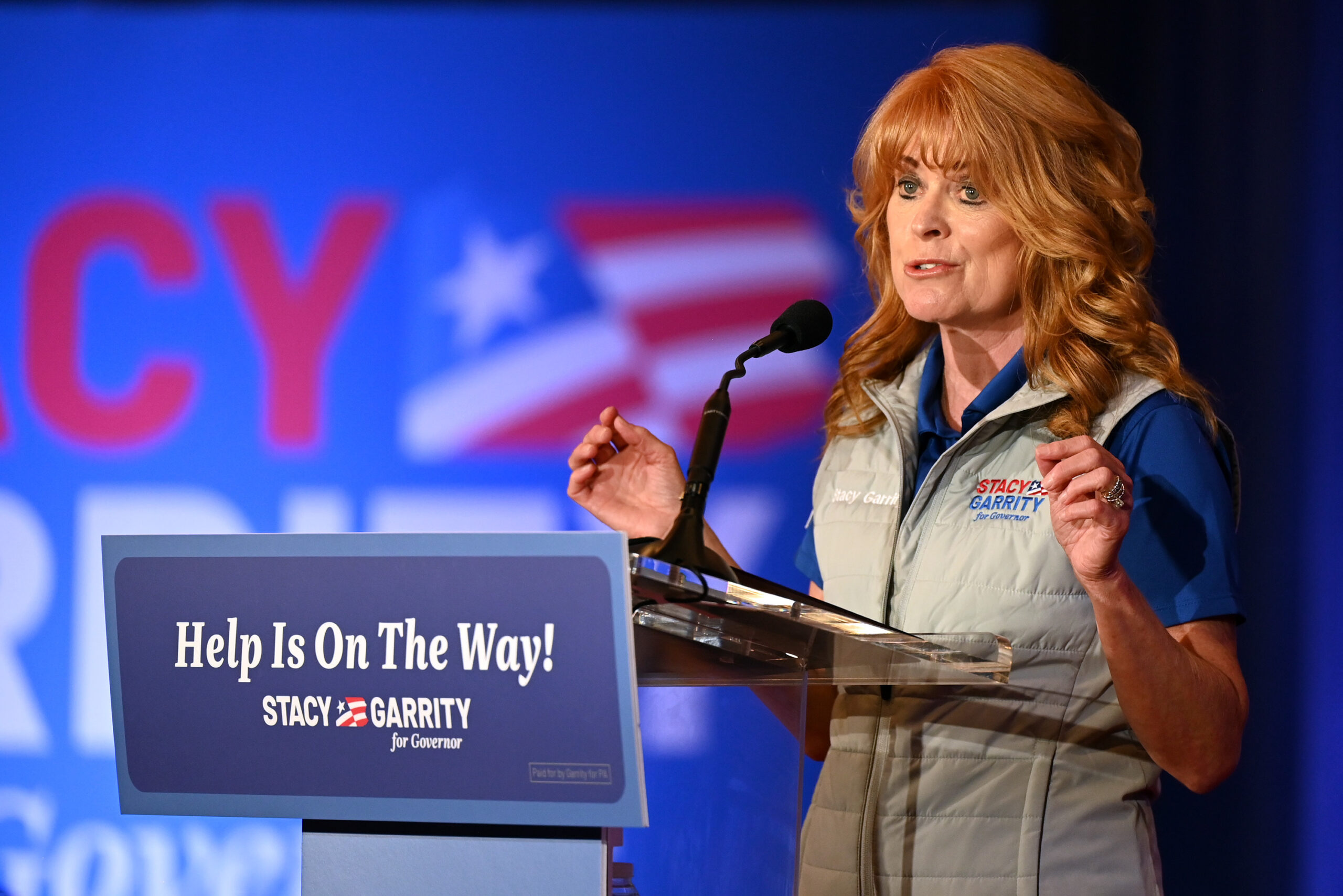
    State Treasurer and Republican candidate for governor Stacy Garrity holds a rally on Sept. 25, 2025 at the Newtown Sports & Events Center in Bucks County.

    State Republican Party Chair Greg Rothman said in a statement Thursday that Pennsylvanians have had “enough of Josh Shapiro’s lack of leadership and broken promises,” noting several of Shapiro’s missteps in his administration such as his reneging on school vouchers, a $295,000 payout over a sexual harassment claim against a former top aide, and failing to send a month’s worth of state agency mail.

    “[Garrity] actually gets stuff done, she doesn’t just talk about it on the campaign trail,” Rothman added.

    Garrity has contended that Shapiro — a former attorney general, county commissioner, and state representative — is more focused on running for president in 2028 than leading the state.

    “Josh Shapiro is more concerned with a promotion to Pennsylvania Avenue than serving hardworking Pennsylvanians,” Garrity said in a statement earlier this week, noting the state fared poorly in U.S. News and World Report rankings on the economy and education.

    But that’s part of the appeal for some of Shapiro’s supporters.

    Fernando Rodriguez, who works at Fox Chase Farm in Philadelphia, was eager to hear Shapiro’s stump speech. The 37-year-old didn’t vote for Shapiro in 2022 and had cast only one ballot for a presidential election, voting for President Barack Obama in 2008.

    But he wanted to see Shapiro win reelection and, more importantly, go on to run for president in 2028.

    “There seems to be some maturity, some presidential qualities to him,” Rodriguez said, noting that is particularly important given the direction of national politics.

    Shapiro has not publicly acknowledged any presidential ambitions and is expected to keep a local focus as he campaigns for reelection. But on Thursday at his rally, he reminded voters that they have the ability to deliver not only a resounding reelection victory for him, but also the chance to flip control of the U.S. House and state Senate as Democrats target four congressional districts in Pennsylvania and other down-ballot offices.

    Shapiro has already raised $30 million to support his reelection, which is likely to boost the entire ticket.

    State Democrats hope Shapiro will be able to leverage his popularity and growing national brand to bring more voters out to the polls, in what is already likely to be an advantageous midterm year for the party.

    “We’ve got a lot of work to do and it’s not just about reelecting the governor,” Eugene DePasquale, the chair of the state Democratic Party, said Thursday in Pittsburgh.

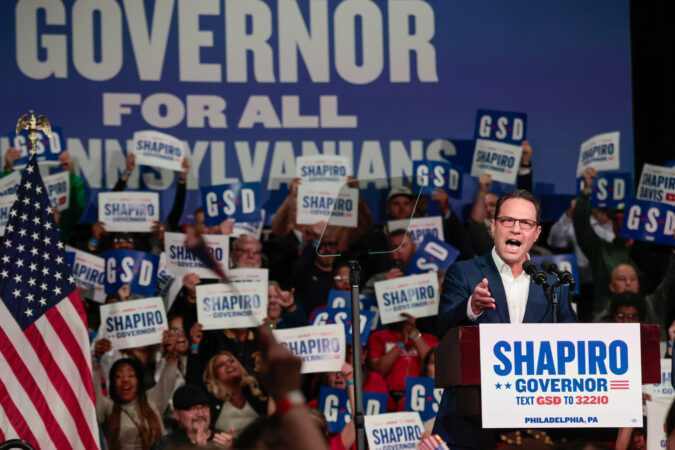
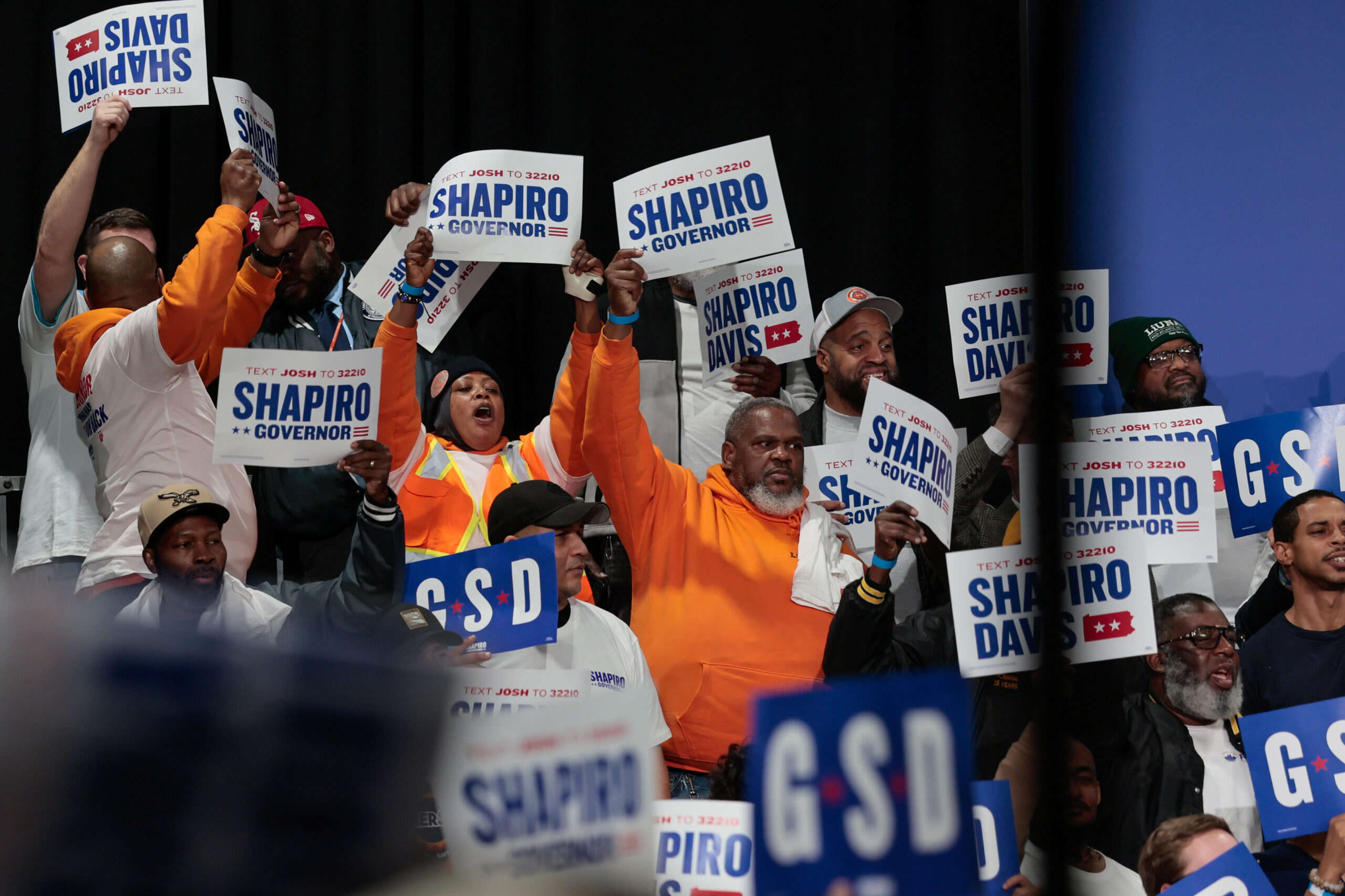
    Gov. Josh Shapiro’s supporters cheer as he makes his way to the stage during a reelection announcement event event at the Alan Horwitz “Sixth Man” Center in Philadelphia on Thursday, Jan. 8, 2026.

    ‘The hard work of bringing people together’

    Offering an opening pitch to voters, Shapiro highlighted key themes he is expected to repeat during the next 10 months on the campaign trail: He’s protected Pennsylvanians’ freedoms and created jobs, with more work to do.

    He noted several bipartisan achievements passed by the state’s divided legislature during his time in office, including a long-sought increase to the state’s rent and property tax rebate, historic funding increases for public education, and more. Pennsylvanians, he argued, have a simple choice in November.

    “Will we continue to do the hard work of bringing people together to get stuff done, or will we descend into the chaos and extremism that has gripped too many other places across our nation?” Shapiro asked in his stump speech in Pittsburgh and Philadelphia.

    In Philly, the crowd gave this question a resounding “No.”

    Shapiro’s launch drew a distinction between his style of leadership and that of Trump — whom Shapiro repeatedly called a danger to democracy prior to his reelection in 2024. Shapiro did not name the president during his announcement, but alluded to Trump — while noting his legal challenges against the Trump administration.

    The move followed Shapiro’s oft-repeated tactic since Trump took office for a second time: Criticize his policies, while not alienating Trump’s supporters in Pennsylvania, as the state swung in favor of Trump in 2024.

    In addition to his two campaign rallies, Shapiro kicked off his reelection bid in a video advertisement posted on social media. He led that off with footage from one of his biggest accomplishments from his first three years in office: rebuilding a collapsed section of I-95 in 12 days, in what was expected to take months.

    The quick rebuild also featured in his speech in Philly, where he heaped praise on organized labor for its role in the reconstruction.

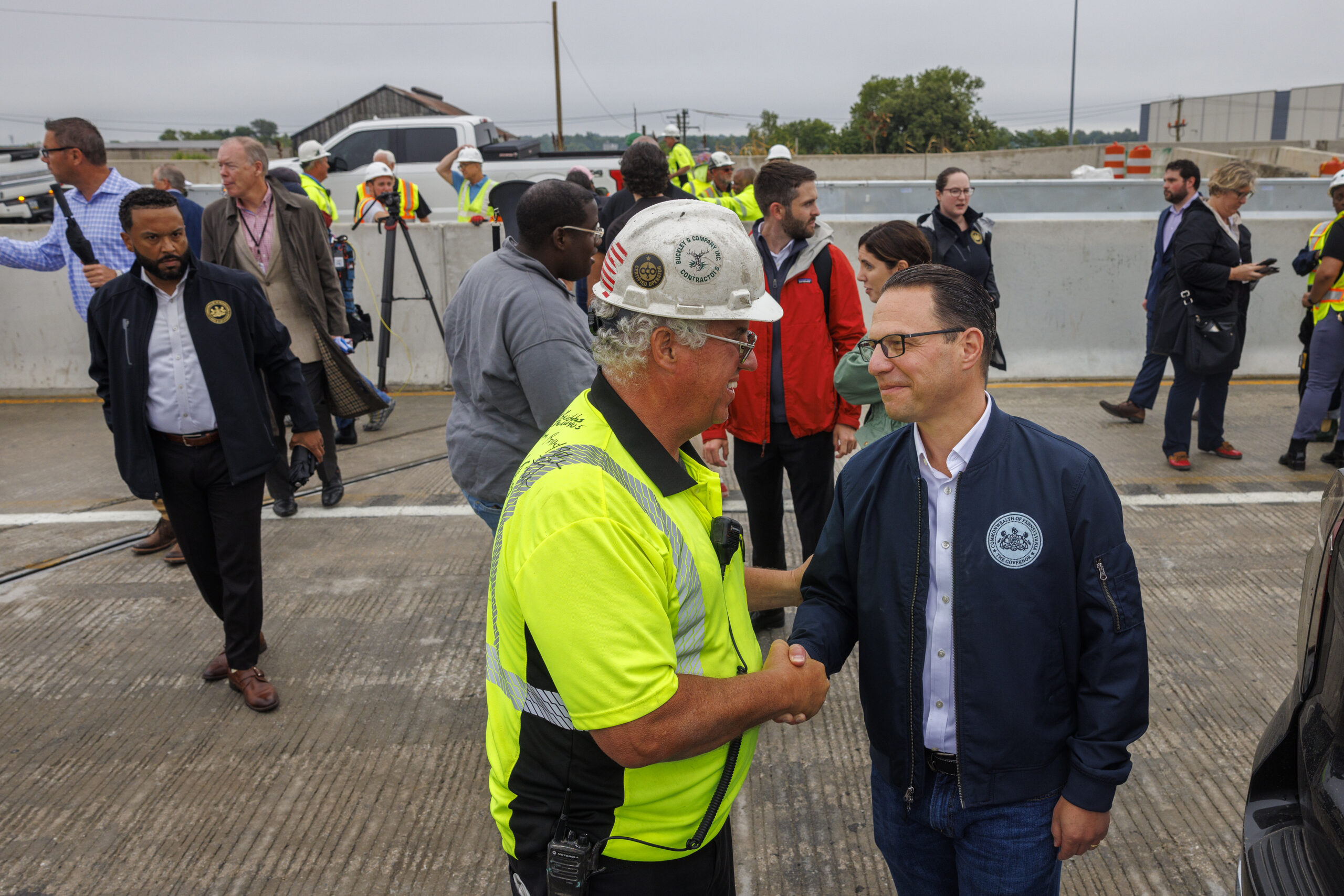
    Rob Buckley with Buckley & Company, Inc., shakes hands with Gov. Josh Shapiro (right) at the end of a 2023 news conference before the reopening of I-95.

    Notably, Shapiro’s video announcement included a focus on several issues important to rural or conservative voters, such as signing a law that ended the ban on Sunday hunting, hiring 2,000 more law enforcement officers, and removing college degree requirements for most state agency jobs. He also highlighted his work in helping to reopen the lone gas pump in Germania, Potter County, following an Inquirer report about its closure.

    During his speech on the glossy basketball court in Nicetown, supporters began chanting “Four more years!”

    “I like the sound of that,” Shapiro said, with a smile.

  • What we know about the forthcoming construction of the South Street Pedestrian Bridge

    What we know about the forthcoming construction of the South Street Pedestrian Bridge

    The new pedestrian bridge extension coming to Society Hill and Queen Village, which will better connect the neighborhoods to the Delaware River waterfront, is reaching a milestone.

    The South Street Pedestrian Bridge expansion will extend the existing redbrick footbridge constructed in the mid-1990s with a longer and more distinctive suspended archway bridge, as part of the long-planned I-95 capping project. Construction begins this spring, but the bridge will not be open to the public until 2027, a Pennsylvania Department of Transportation spokesperson said.

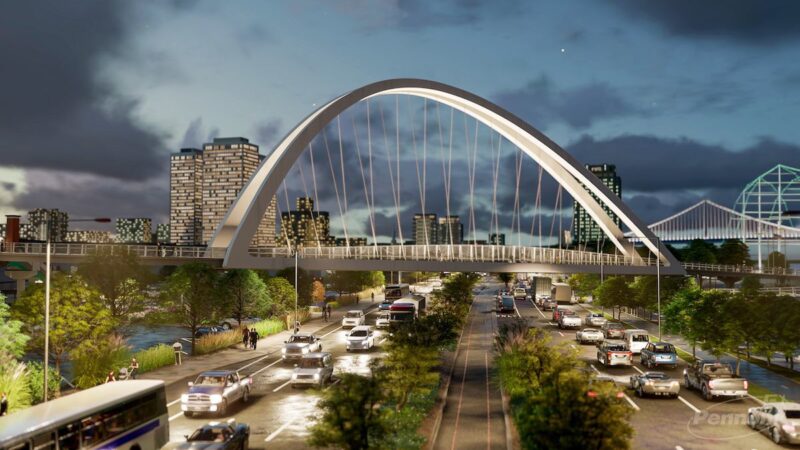
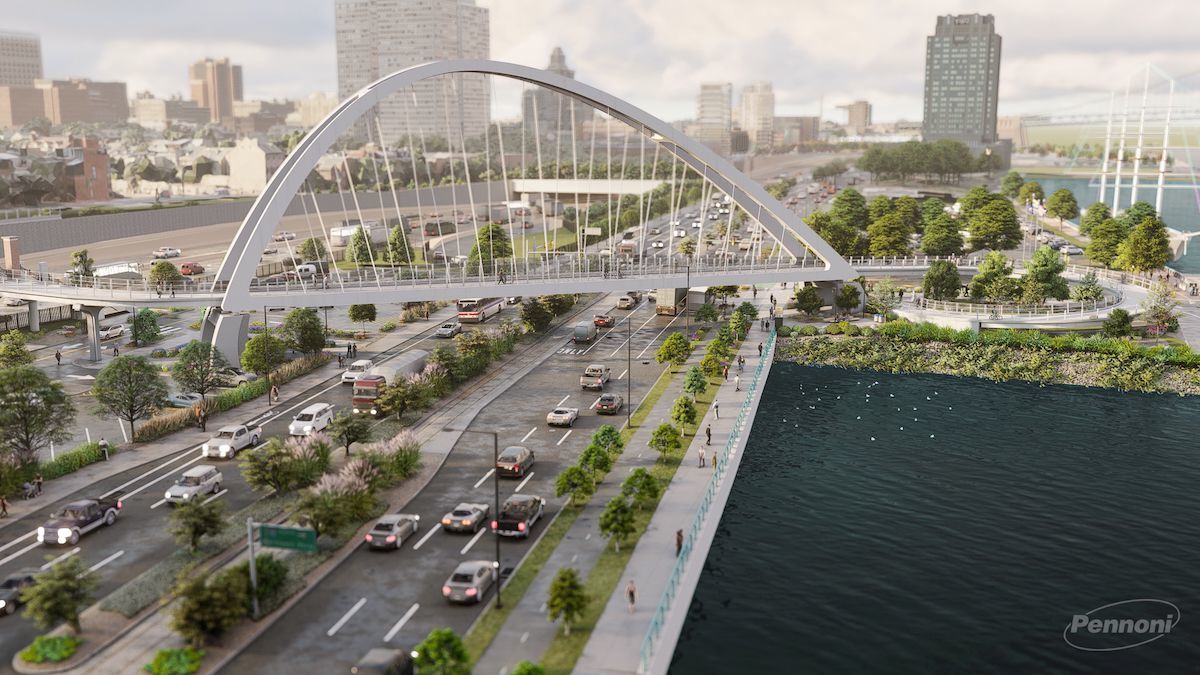
    A rendering of the South Street Pedestrian Bridge extension that will better connect South Street to the Delaware River waterfront. Construction will begin in Spring 2026 and go through 2027, when the bridge will open to pedestrians and cyclists.

    The 250-foot-long bridge will allow pedestrians to cross over Columbus Boulevard and I-95 with entrances at South Street and Lombard Circle that have more accessible walkways for people with disabilities. Pedestrian access to the waterfront is crucial for people on South Street visiting attractions like Penn’s Landing, Cherry Street Pier, and Spruce Street Harbor Park.

    (function() {
    var l2 = function() {
    new pym.Parent(‘southstreetbridge’,
    ‘https://media.inquirer.com/storage/inquirer/projects/innovation/arcgis_iframe/southstreetbridge.html’);
    };
    if (typeof(pym) === ‘undefined’) {
    var h = document.getElementsByTagName(‘head’)[0],
    s = document.createElement(‘script’);
    s.type = ‘text/javascript’;
    s.src = ‘https://pym.nprapps.org/pym.v1.min.js’;
    s.onload = l2;
    h.appendChild(s);
    } else {
    l2();
    }
    })();

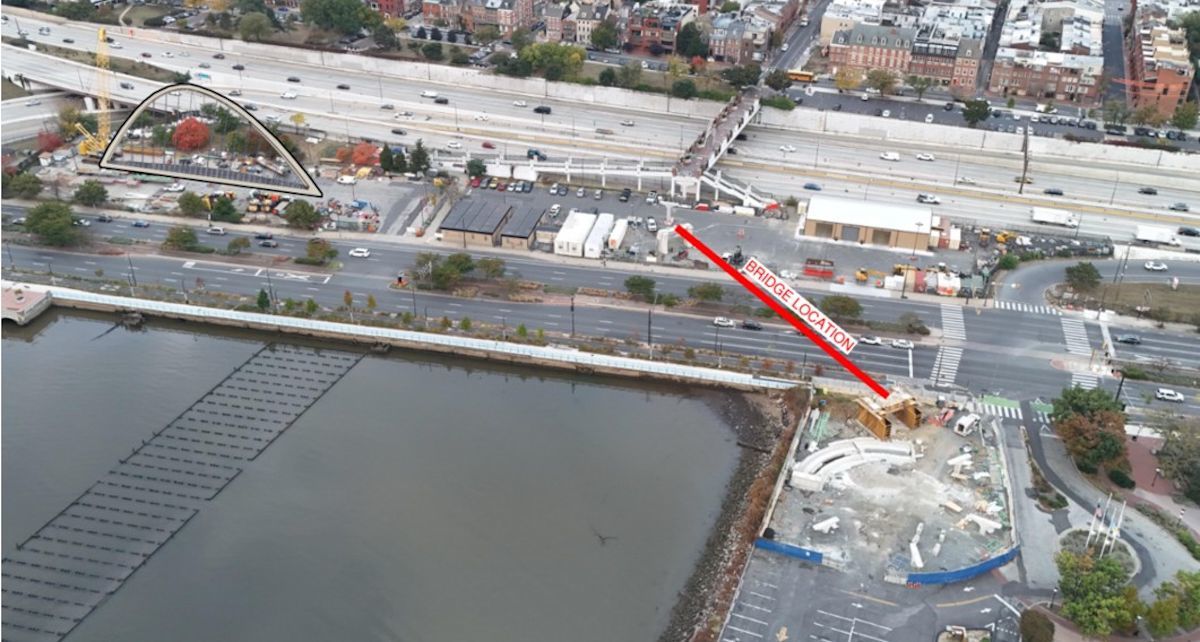
    Construction will use an installation method in which the archways are built at a nearby location and then rolled into place, instead of being built on-site.

    “The contractor was able to eliminate long-term lane closures and full closures on Columbus Boulevard,” PennDot spokesperson Brad Rudolph said. “While this method is fairly common, it is the first time PennDot has performed it in [Southeastern Pennsylvania] with this type of pedestrian structure.”

    An aerial view of the construction site where the South Street Pedestrian Bridge extension will take place. A rendering of the archways in a nearby parking lot show where the bridge structure will be assembled and then later rolled into place where a red line marks its installation site. Construction begins in Spring 2026, with the bridge open to the public in 2027.

    The bridge structure will be assembled for about two months in a parking lot near the installation site this spring. The new structure will then be rolled into place by mid-2026, according to PennDot. Additional work, including pouring the bridge deck, will take an additional year, with the span expected to open to pedestrians and cyclists in 2027.

    Sitting 258 feet long and 100 feet from the ground to its highest arch, the footbridge will feature 14-foot-wide walkways with lit archways and handrail lighting. The entrance at Lombard Circle will have a spiraling ramp to allow for cyclists to stay on their bikes and to provide easier wheelchair and mobility access.

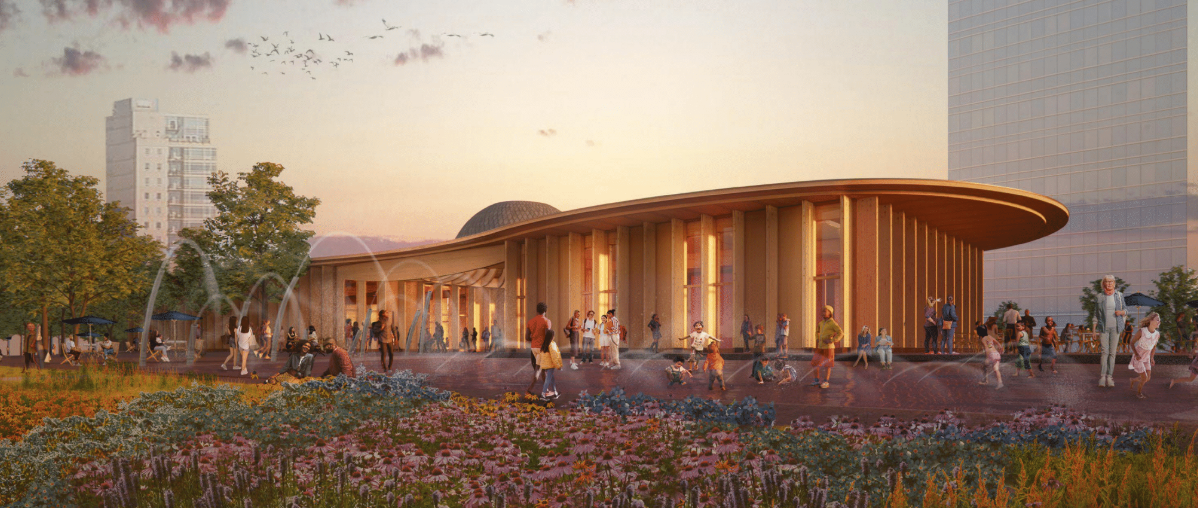
    A rendering of the mass timber building planned for the Penn’s Landing park.

    The pedestrian bridge is only a small part of PennDot’s $329 million project to build a cap over I-95 at Penn’s Landing, which will house a 12-acre Penn’s Landing Park with green spaces, playgrounds, and an amphitheater. Construction on the cap is nearly 30% complete as of this month.

    Nearby, Old City is getting a revamp of Market Street, where the road will be shrunk and more pedestrian thoroughfares will be added, with the new Tamanend Square plaza at Second and Market Streets to serve as the centerpiece.

  • House of the week: A historic house on a tree-lined street in Queen Village for $519,995

    House of the week: A historic house on a tree-lined street in Queen Village for $519,995

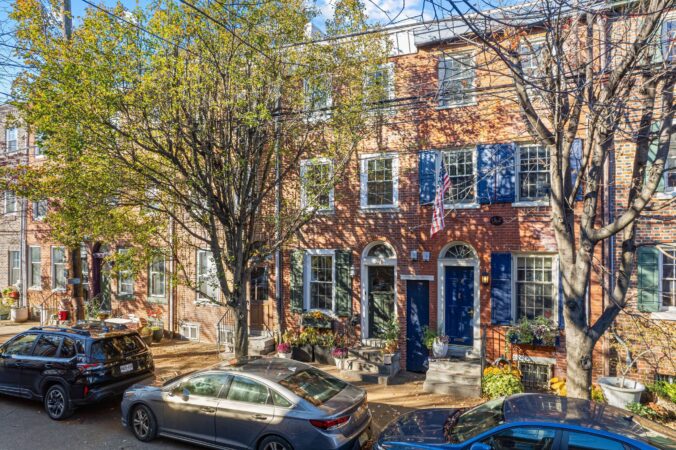
    Mark Worker said his two-bedroom, one-bathroom house in Queen Village has “so much character” and is “close to everything,” with “a true neighborhood feel.”

    Probably built in the late 1800s as part of a cluster of homes to house workers for an adjacent factory, it was augmented in the early 2000s by an extension in the rear.

    Worker, a software account manager, bought it in 2022 when he was single, but he soon married, and now he and his wife are moving to London for his work.

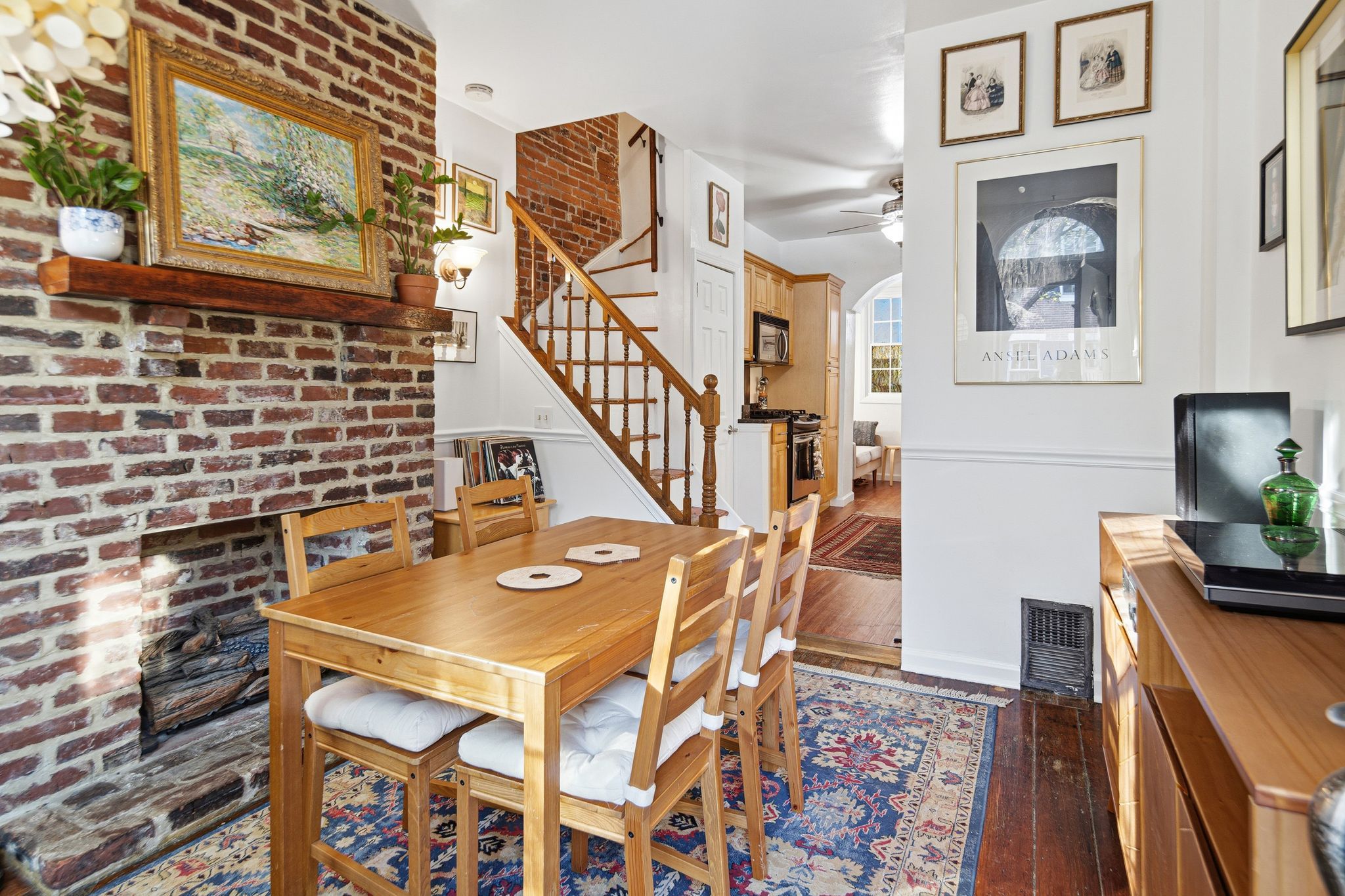
    The dining area.

    The house is 1,092 square feet and sits on a tree-lined street in the heart of Queen Village.

    It has hardwood floors throughout, all new windows, updated plumbing, a new HVAC system, and a new roof.

    The interior has been freshly painted and the bedroom windows let in abundant natural light.

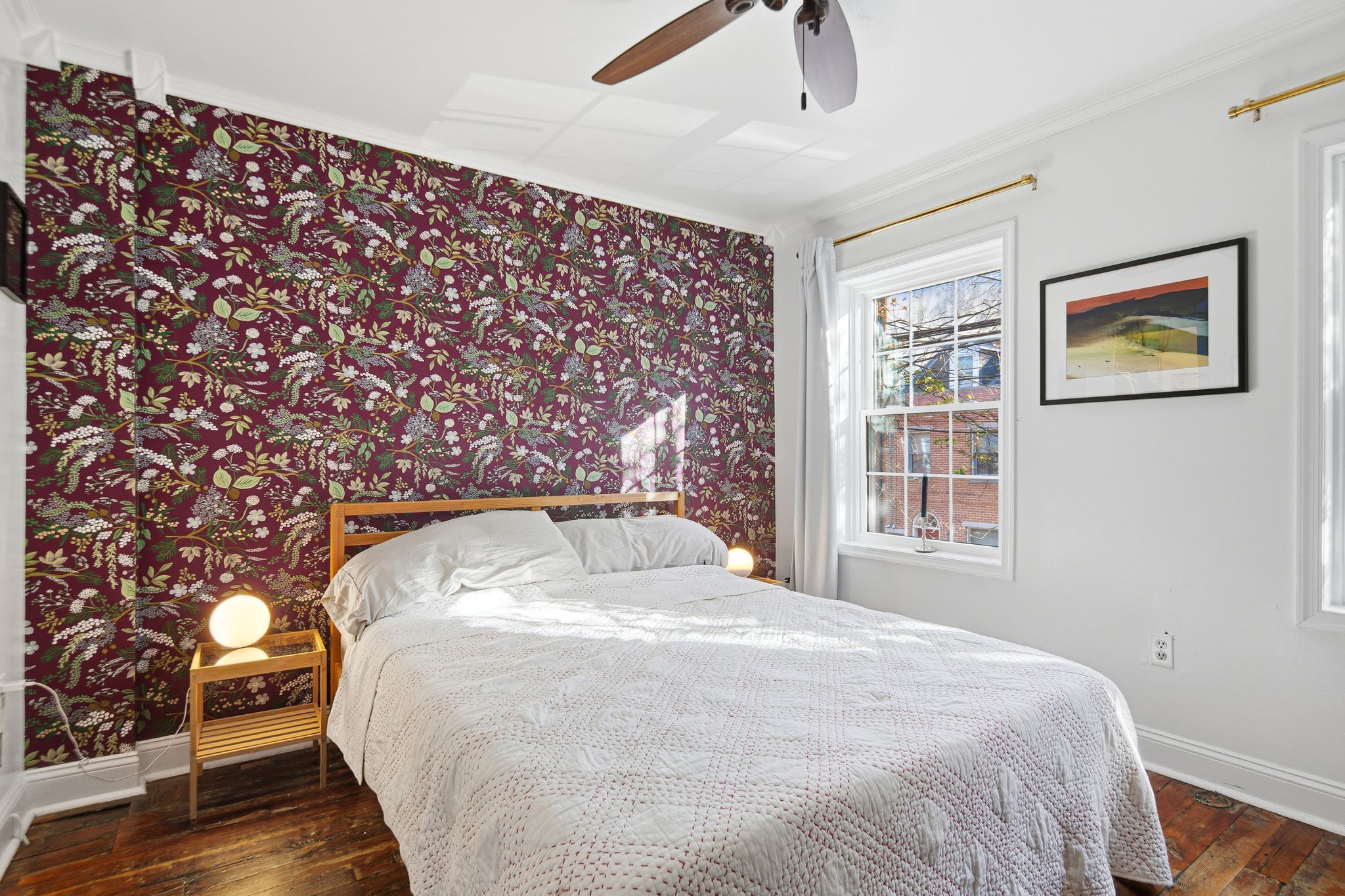
    The primary bedroom. The windows let in abundant natural light.

    The primary bedroom is on the second floor. A second bedroom, on the third floor, was used as a nursery by previous occupants.

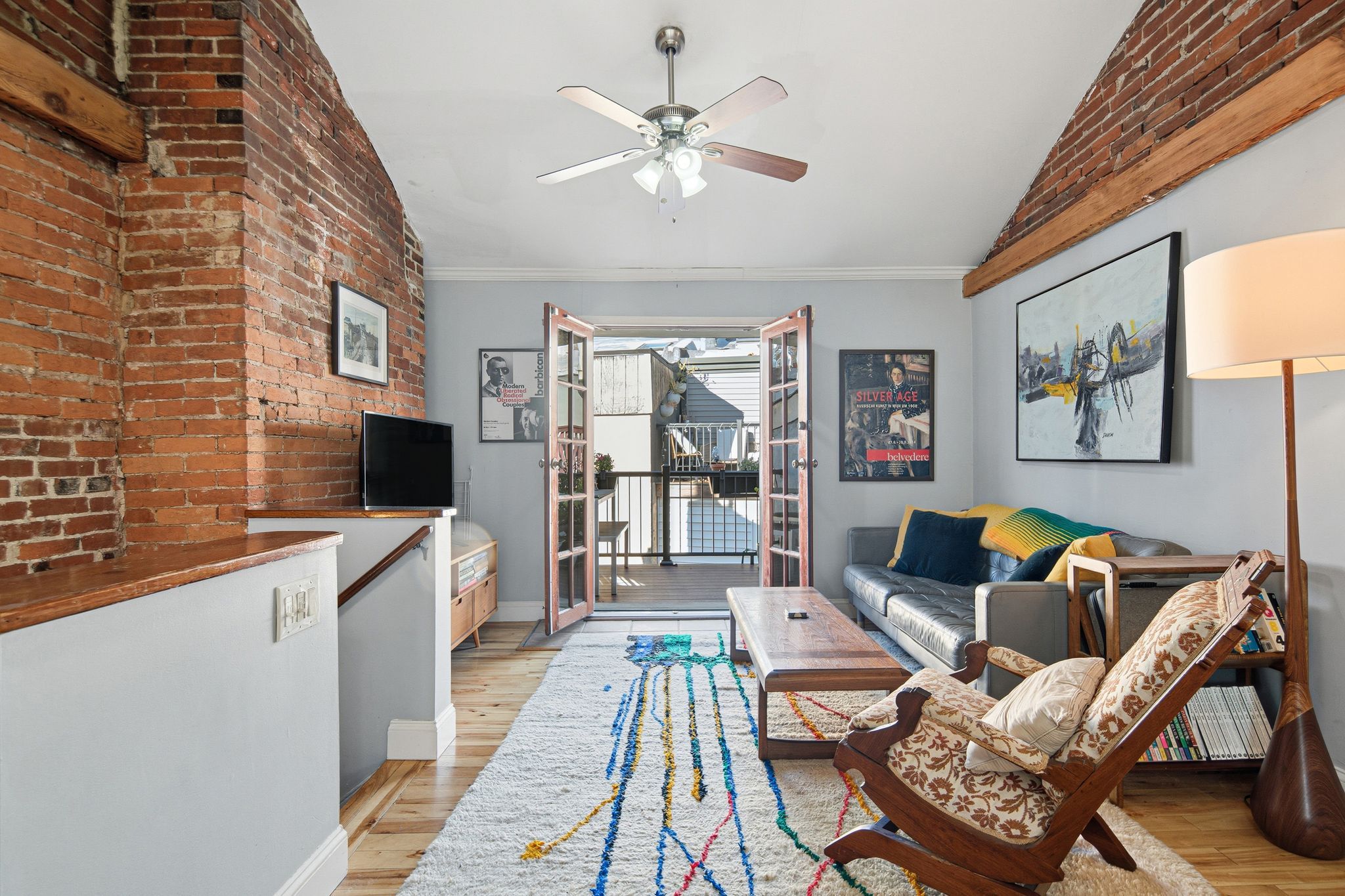
    “The third floor is really the best part of the house,” Worker said. It has an open floor plan and is being used as a living room and office, although Worker previously used it as a bedroom.

    The third floor is being used as the living room.

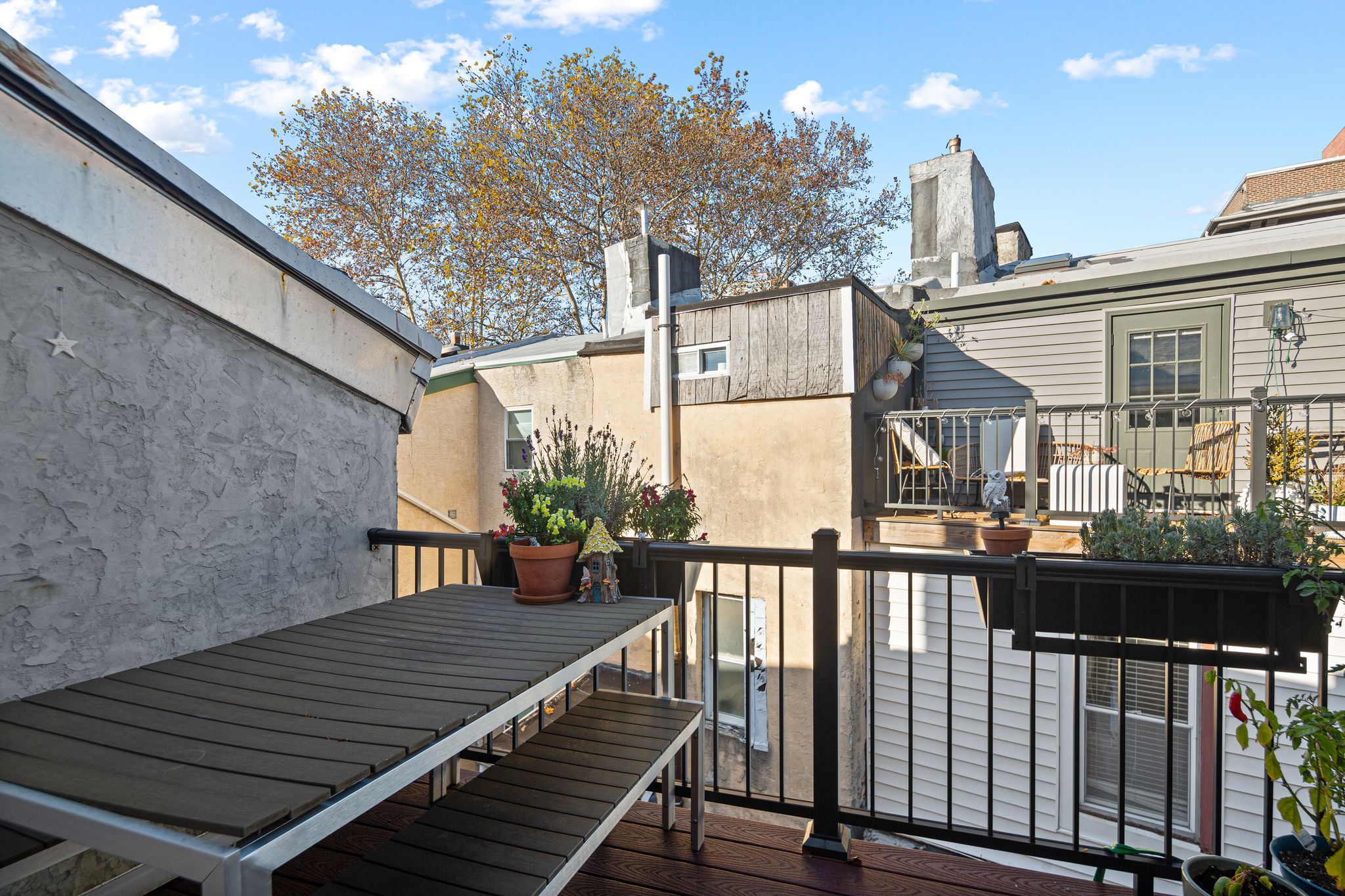
    The deck, just off the third-floor room, was carefully landscaped, with a picnic table and a variety of plants.

    The home has an unfinished basement for storage, and a dedicated outdoor space in the rear.

    The roof deck, which is landscaped with a picnic table and a variety of plants.

    Commuting is easy with ready access to public transportation, I-95, and other major highways.

    Adjacent landmarks include South Street and Head House Square.

    The house is listed by Jay Edwards of OCF Realty for $519,995.

  • Inside Philly’s newest school: AMY at James Martin, a $62 million middle school, will open in January

    Inside Philly’s newest school: AMY at James Martin, a $62 million middle school, will open in January

    A brand-new, $62 million Philadelphia school building is opening soon.

    Alternative Middle Years at James Martin, in Port Richmond, is all but finished and ready for students to occupy after winter break.

    Community members, district officials, and dignitaries gathered Tuesday to take tours and trumpet the new construction, a bright spot in a district grappling with a large stock of aging and sometimes environmentally troubled buildings.

    “This is what growth looks like,” said Paula Furman, AMY at James Martin’s principal. The middle school educates 200 students in grades 6, 7, and 8.

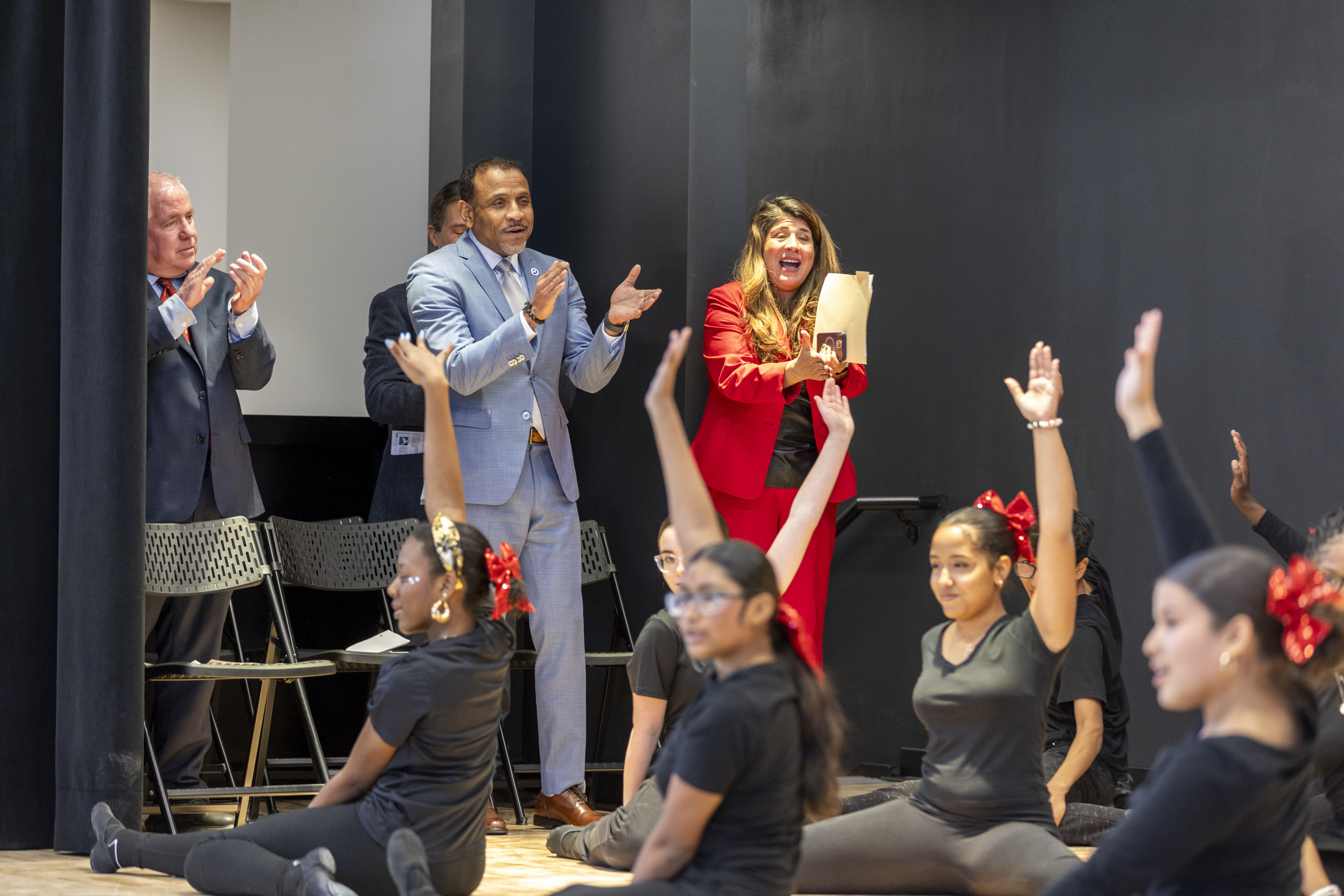
    Superintendent Tony B. Watlington Sr. and Debora Carrera, the city’s chief education officer, applaud a student performance Tuesday at AMY at James Martin, a new middle school in Port Richmond.

    Sarah-Ashley Andrews, the school board vice president, noted that of the district’s roughly 300 buildings, more than 200 were built before 1978.

    “Projects like this underscore why continued investment is essential,” said Andrews.

    On time, on budget

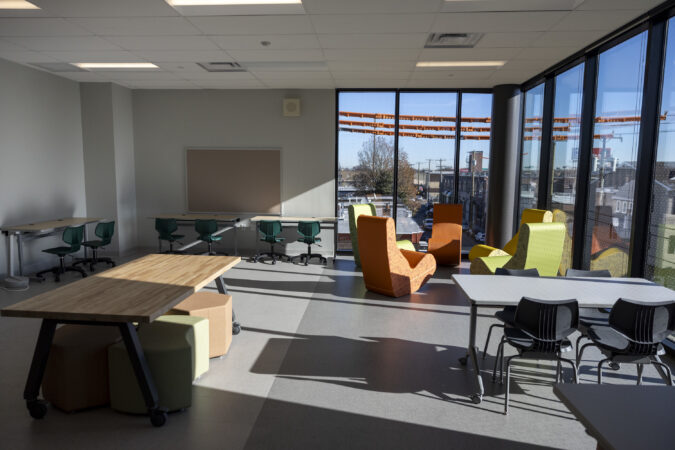
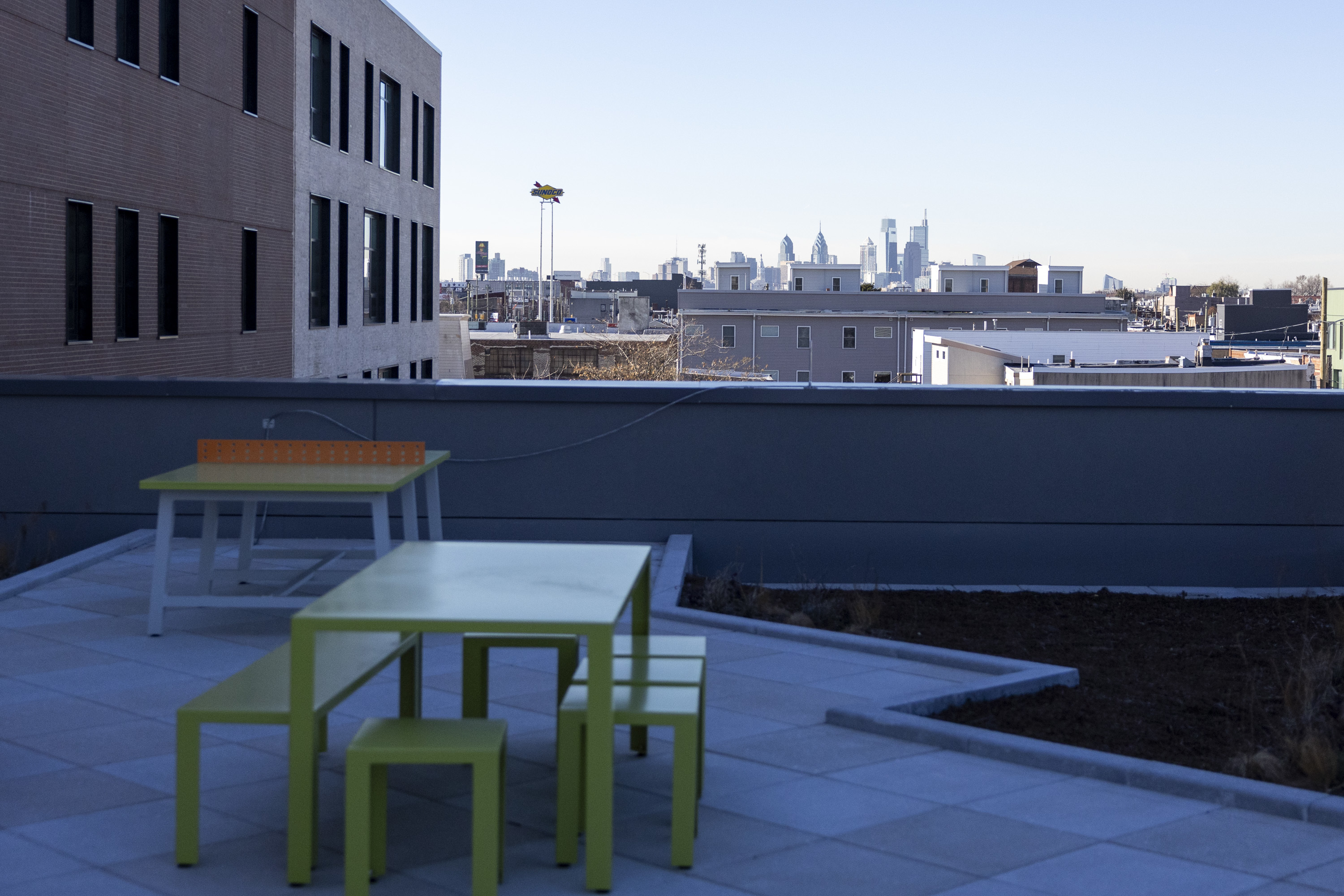
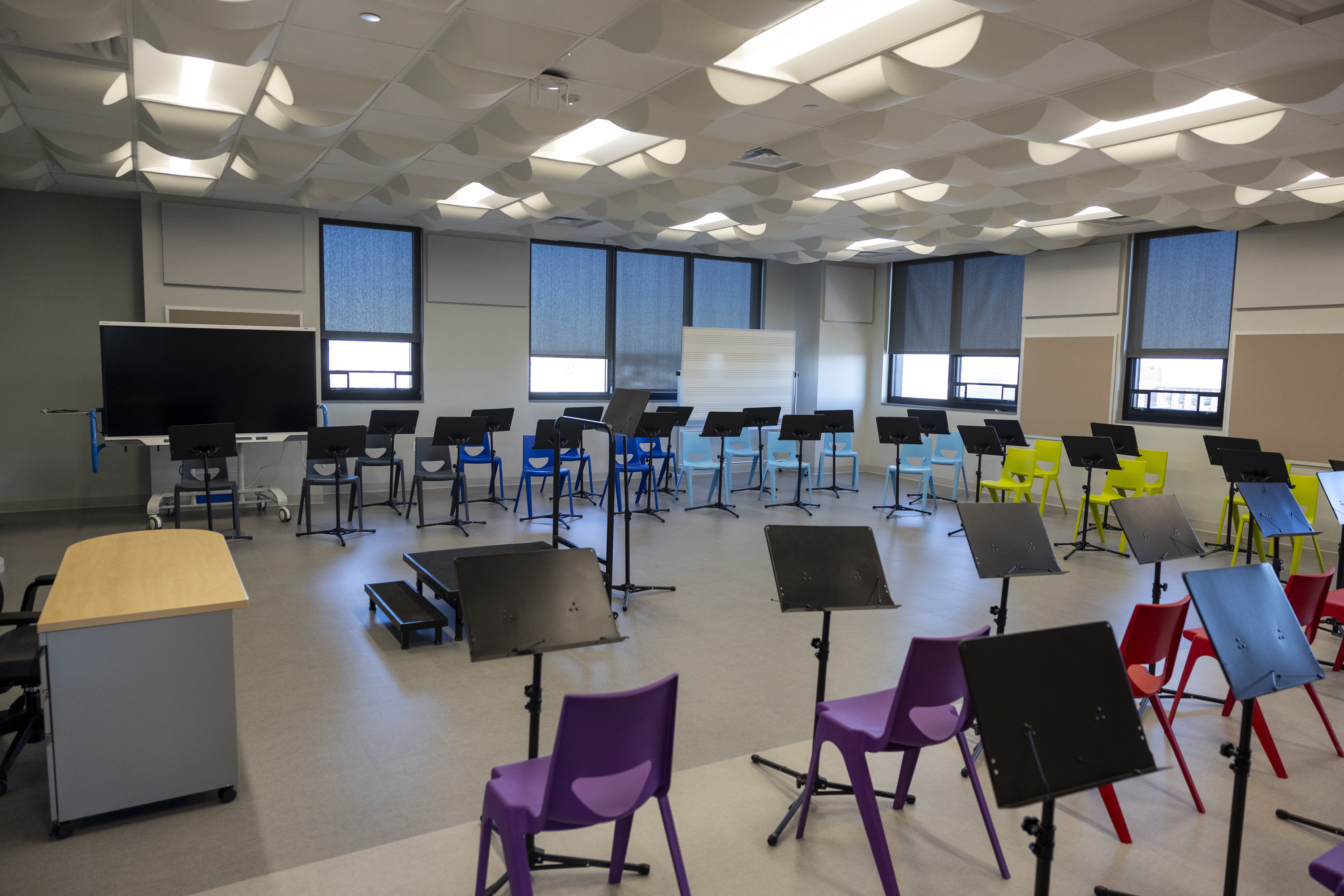
    Inside, the 88,000-square-foot, four-story structure at Richmond and Westmoreland Streets just off I-95 is a marvel: all light and flexible seating, makerspace, “digital flex lab” (think: computer lab), and “gymnatorium” (spiffy gym and auditorium). It has modern science labs, dedicated spaces for instrumental and vocal music, and a killer view of Center City from its rooftop outdoor classroom.

    The outdoor space with a view of the Center City skyline at the new AMY at James Martin school.

    The school replaces an 1894 structure razed to make way for new construction. It is the Philadelphia School District’s sixth new building in 10 years.

    “It is kind of crazy, just the giant leap forward that students will be taking, just in terms of furniture, not to mention the technology,” said Melanie Lewin, a district school facilities planner who led tours of the new building. AMY at James Martin students, who have been temporarily learning in classrooms at Penn Treaty High School, used to learn in a 19th-century building; they’re relocating to a building with built-in charging outlets and “noodle chairs” that let them fidget securely while in class.

    Superintendent Tony B. Watlington Sr. said the project was a standout.

    The instrumental music classroom at the new Amy at James Martin School in Philadelphia.

    “This school was not just built to look fantastic,” Watlington said. “I want everyone to know that it was built on time and on budget. That is no easy feat when the price of everything is going up — inflation, tariffs, everything.”

    Some neighbors showed up at Tuesday’s ribbon-cutting to celebrate. But the process was controversial at first — some protested the loss of the old AMY at James Martin historic site.

    City Councilmember Mike Driscoll alluded to the past pain on Tuesday.

    “It’s been a struggle, I’ll admit that,” Driscoll said. But, he said, the new school is lovely. “When you see the plans on paper, it doesn’t do it justice.”

    A looming facilities master plan

    AMY at James Martin’s opening comes with the district approaching a crossroads: Officials are awaiting a years-in-the-making facilities master plan, the first in decades.

    While schools in the Northeast and in a few other spots are overcrowded or nearing capacity, schools in many parts of the city are dramatically underenrolled.

    Custom cushioned seats in a classroom at the new Amy at James Martin School in Philadelphia.

    Officials have said that some schools will likely cease to exist as part of the process, now expected to culminate early next year with Watlington making recommendations to the school board for grade reconfigurations, closures, co-locations, significant renovations, and new construction.

    AMY at James Martin, in its current form, is likely to come in under the district’s minimum recommended school size, at 200 students. The school’s capacity is 500, officials said.

    But Casey Laine hopes the school count grows by two in January.

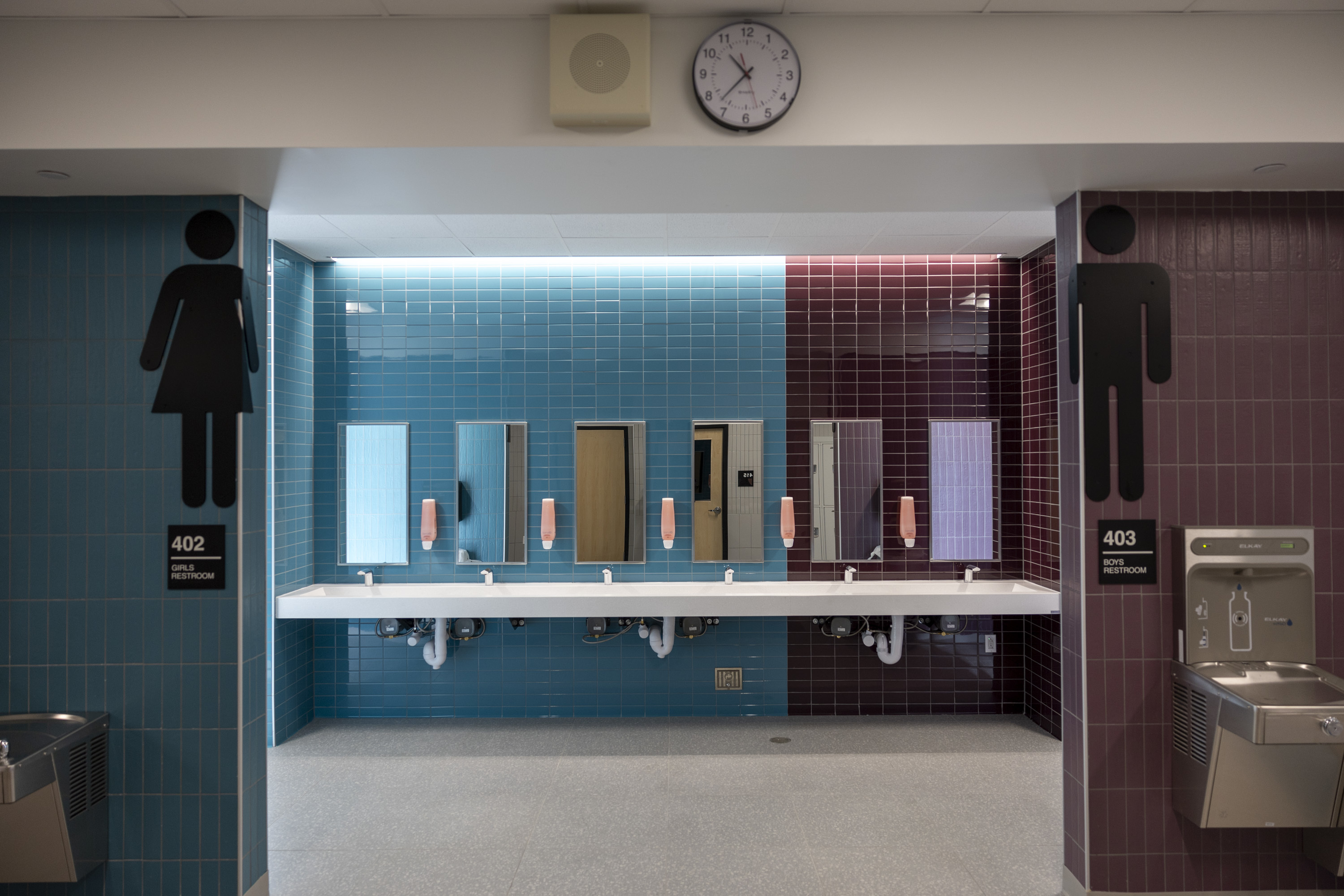
    One of the bathrooms for students at the new Amy at James Martin School in Philadelphia.

    Laine, who lives around the corner from the new AMY at James Martin and attended Tuesday’s ribbon-cutting, is the mother of a sixth and seventh grader who currently attend Bridesburg Elementary.

    She’d like her kids, a son and daughter, to transfer to AMY at James Martin if possible.

    “This is beautiful,” Laine said. “I’m so excited.”

  • Elfreth’s Alley is getting a park to honor woman who saved it from demolition

    Elfreth’s Alley is getting a park to honor woman who saved it from demolition

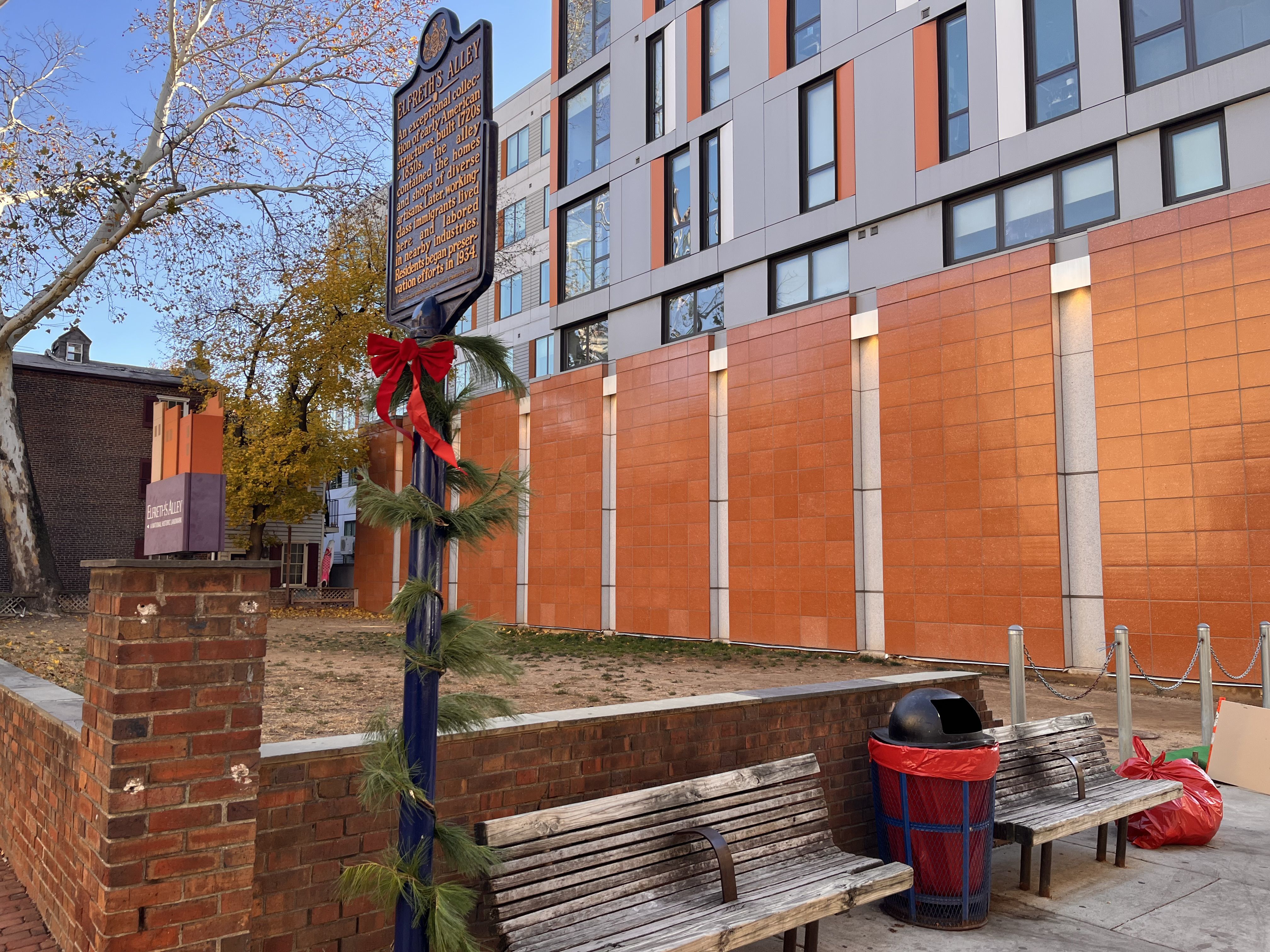
    Few Philadelphians may recognize the name Dolly Ottey, yet nearly all know Elfreth’s Alley — the nation’s oldest residential street — which she helped rescue from decline and demolition starting in the 1930s.

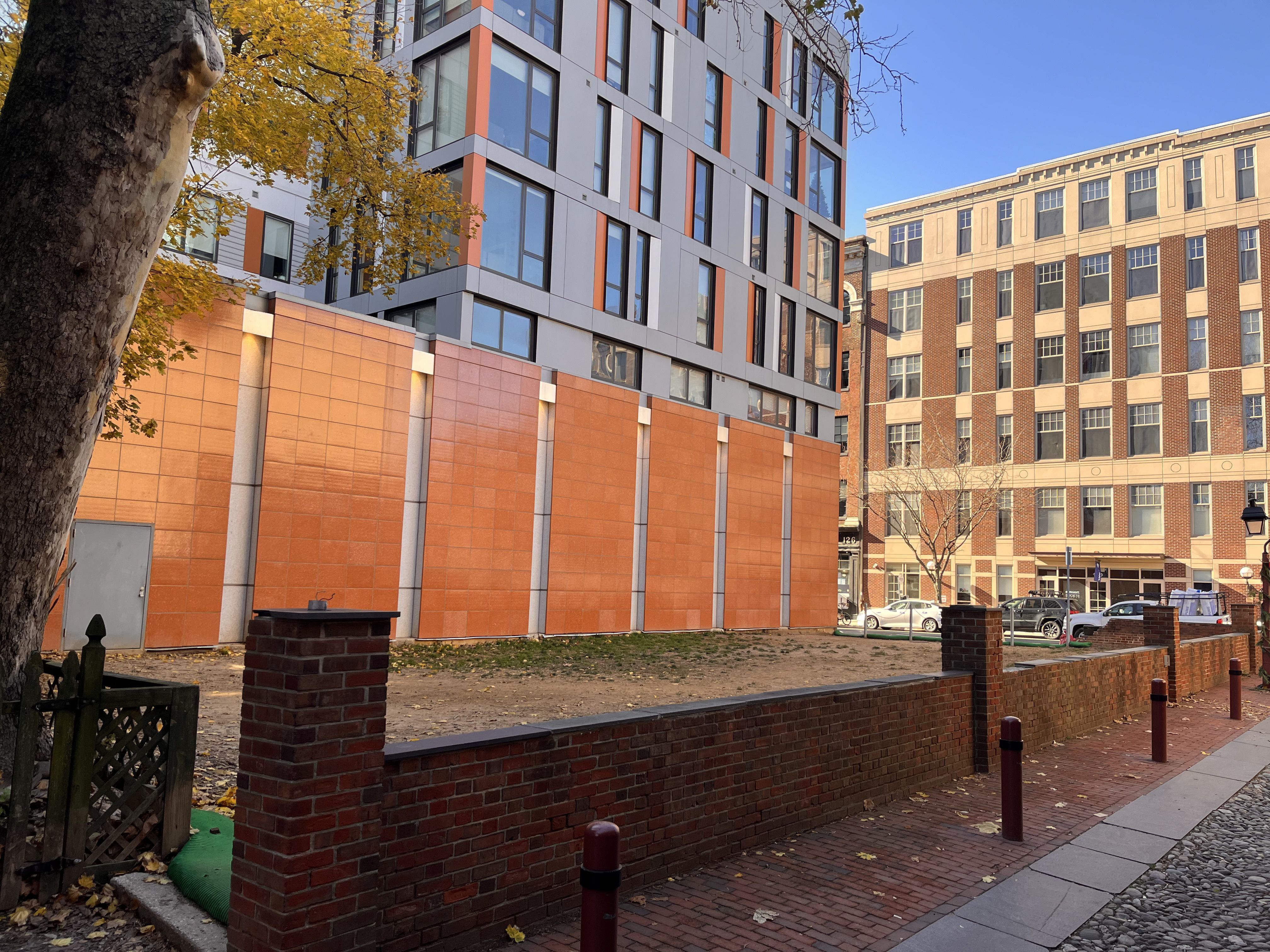
    Now, after years of wrangling, a long-neglected vacant lot that some have derided as an eyesore at the historic location is slated for a transformation in time for the 250th anniversary of the Declaration of Independence.

    Plans call for the lot at North Second Street and Elfreth’s Alley to be reborn as Dolly Ottey Park, honoring the woman who first championed preservation of the narrow cobblestone passage starting in the 1930s.

    window.addEventListener(“message”,function(a){if(void 0!==a.data[“datawrapper-height”]){var e=document.querySelectorAll(“iframe”);for(var t in a.data[“datawrapper-height”])for(var r,i=0;r=e[i];i++)if(r.contentWindow===a.source){var d=a.data[“datawrapper-height”][t]+”px”;r.style.height=d}}});

    Job Itzkowitz, executive director of Old City District, said the project took eight years of sporadic effort to get multiple parties to sign off on an agreement to create the park. Old City District is a nonprofit registered community organization.

    “We want it to be a place where residents, tourists, visitors, employers, and employees can take a bit of a respite,” he said. “It’s going to be a drastic improvement.”
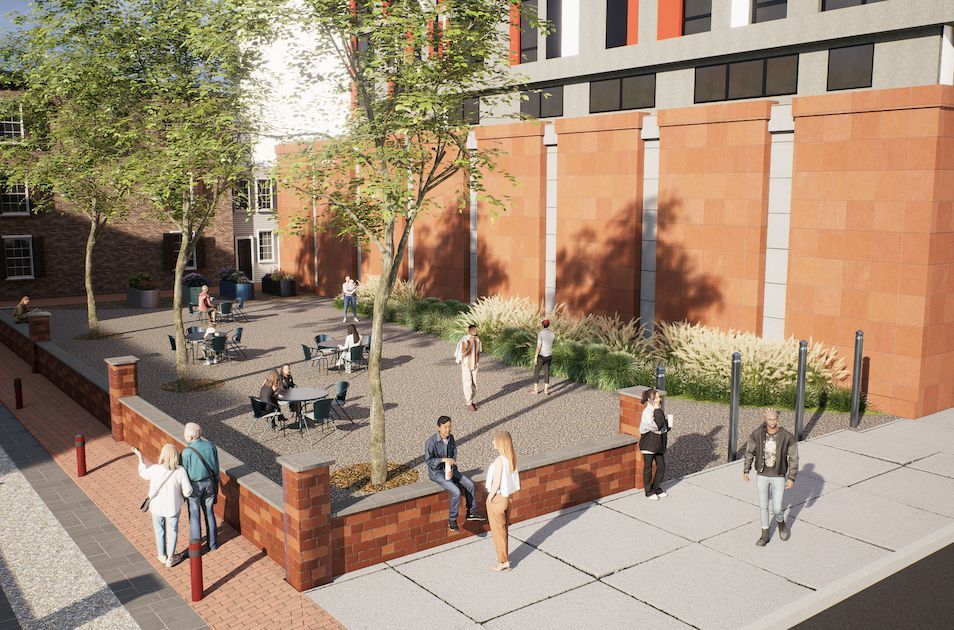
    A conceptual rendering of Dolly Ottey park at Second Street and Elfreth’s Alley in Old City, Philadelphia. Organizers hope to transform the existing vacant space into a park by spring.

    On a recent day, families and couples toured Elfreth’s Alley, taking pictures and discussing the history of the area. But none ventured into the vacant lot. Later, a lone woman could be seen walking her dog there.

    Itzkowitz credited a renewed spirit of collaboration for breaking the stalemate.

    He said changes in leadership at the real estate advisory board for the National Old City Apartments, which abuts the park, and crucial support from the nonprofit Elfreth’s Alley Association paved a path for agreement.

    A view of a vacant lot at Second Street and Elfreth’s Alley in Old City Philadelphia. Plans for creation of Dolly Ottey Park at the location and named after an advocate who helped save Elfreth’s Alley in the early to mid 20th Century.

    The lot is owned by Bit Investment Seventy-Eight LLC, according to city records, and is part of that company’s holdings for National Old City Apartments along North Second Street.

    A usable space by spring

    The pocket park will rise in two phases: an interim stage featuring a crushed stone base, picnic tables, planters, wild grasses, and repairs to a crumbling brick wall, followed by a more permanent design.

    An architect has been hired to craft a cost-effective plan to deliver a usable public space by spring 2026.

    The interim plan design for Dolly Ottey Park carries a modest $60,000 budget, with fundraising to break ground in February and finish by March. Old City District has set up an online link for public contributions.

    Itzkowitz said the timing for the interim phase would ensure the park provides a welcoming experience for visitors during the Semiquincentennial as part of a significant historical landmark.

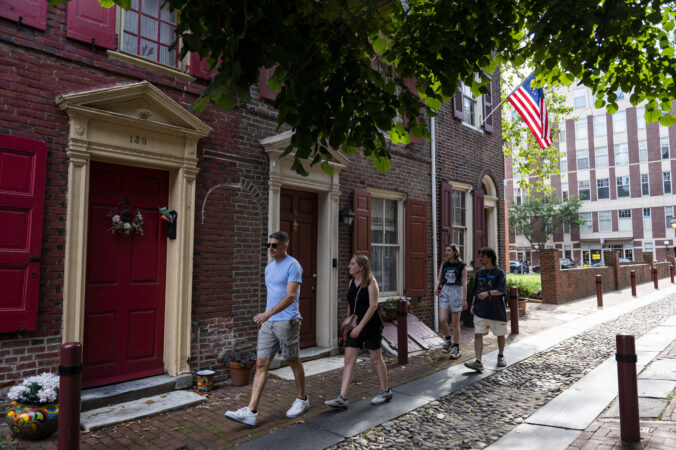
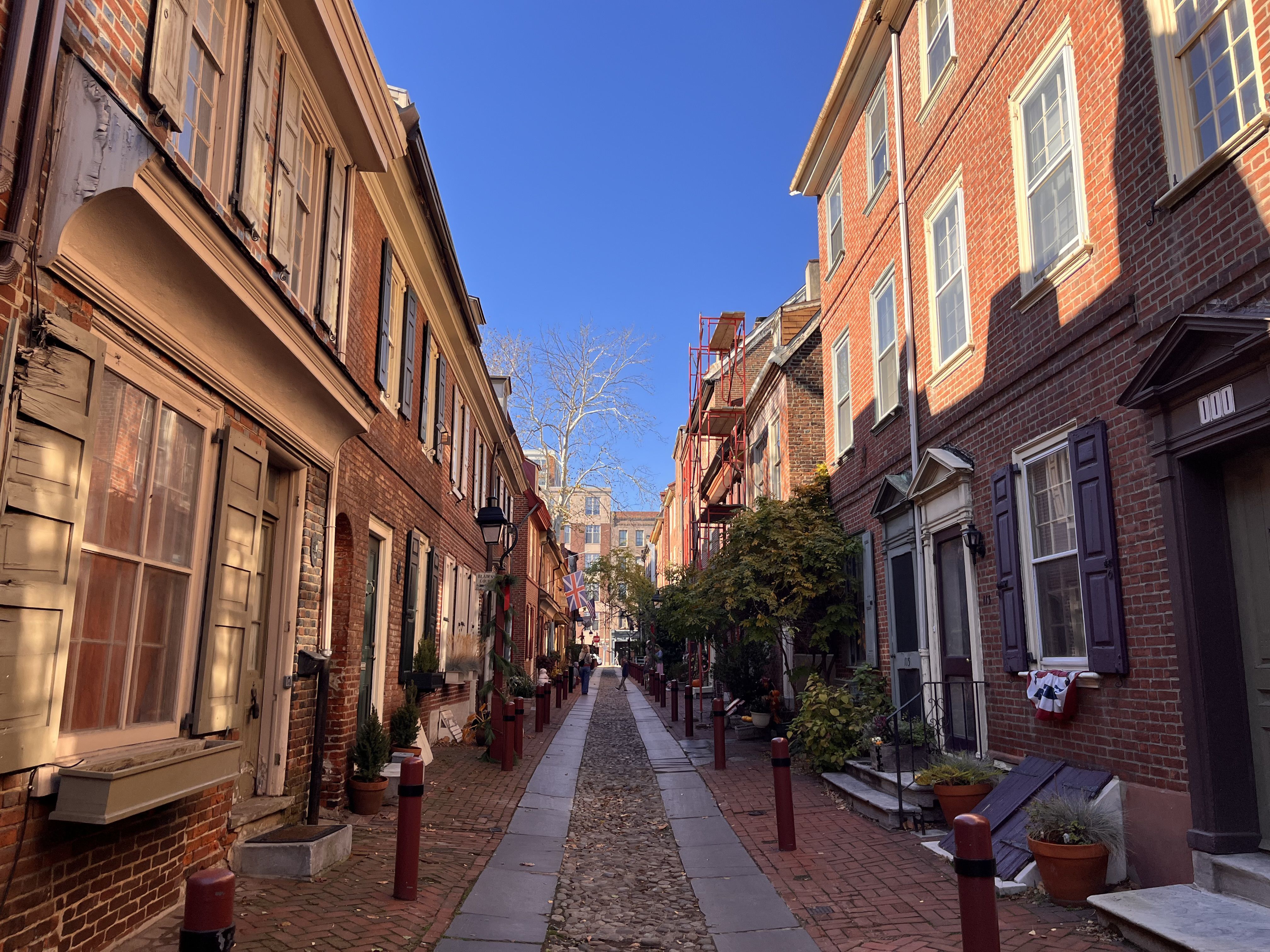
    A view of Elfreth’s Alley.

    Elfreth’s Alley is believed to be America’s oldest continuously inhabited residential street. Its origins trace to the early 1700s, when two landowners combined properties to create a cart path leading to the river. People have been living there since 1713.

    The cobblestone alley, about 400 feet long and lined by 30 brick buildings, was named for Jeremiah Elfreth, an 18th-century blacksmith. It originally housed artisans and merchants, serving as a base for business ventures. Notable figures such as Stephen Girard, who helped finance the War of 1812, are believed to have lived here.

    However, Elfreth’s Alley faced demolition due to neglect and development pressure. From the 1890s to the 1930s, part of the block was rebranded as Cherry Street, leading to the loss of at least one historic home.

    Who is Dolly Ottey?

    Ottey, a resident and owner of the Hearthstone restaurant at 115 Elfreth’s Alley, formed the Elfreth’s Alley Association in 1934 to protect the unique street and save it from destruction.

    A view from Elfreth’s Alley facing a vacant lot at Second Street that will be transformed into Dolly Ottey Park.

    Elfreth’s Alley faced an even bigger existential threat in the 1950s and 1960s when proposed construction of I-95 would have demolished at least half the block.

    The demolition was vehemently opposed by Ottey and the Elfreth’s Alley Association. The community gathered 12,000 signatures for a petition presented at City Hall, successfully pleading for the street to be spared.

    Elfreth’s Alley was protected as a National Historic Landmark in the 1960s as a result and is listed on Philadelphia’s historic register.

    Ottey died in 1996, in South Jersey, at age 85.

    Elfreth’s Alley remains not only a residential area but also a cultural and historical attraction. It holds a museum that educates visitors on its history and the lives of early inhabitants.

  • Philadelphia must imagine its next 250 years

    Philadelphia must imagine its next 250 years

    Thirty years ago next February, the world’s first high-profile competition between human and machine intelligence took place in Philadelphia.

    IBM’s Deep Blue supercomputer faced world chess champion Garry Kasparov at the still-new Pennsylvania Convention Center. It was timed with the 50th anniversary of the unveiling at the University of Pennsylvania of ENIAC, the world’s first supercomputer, and a reminder that Philadelphia once led the world into the computer age.

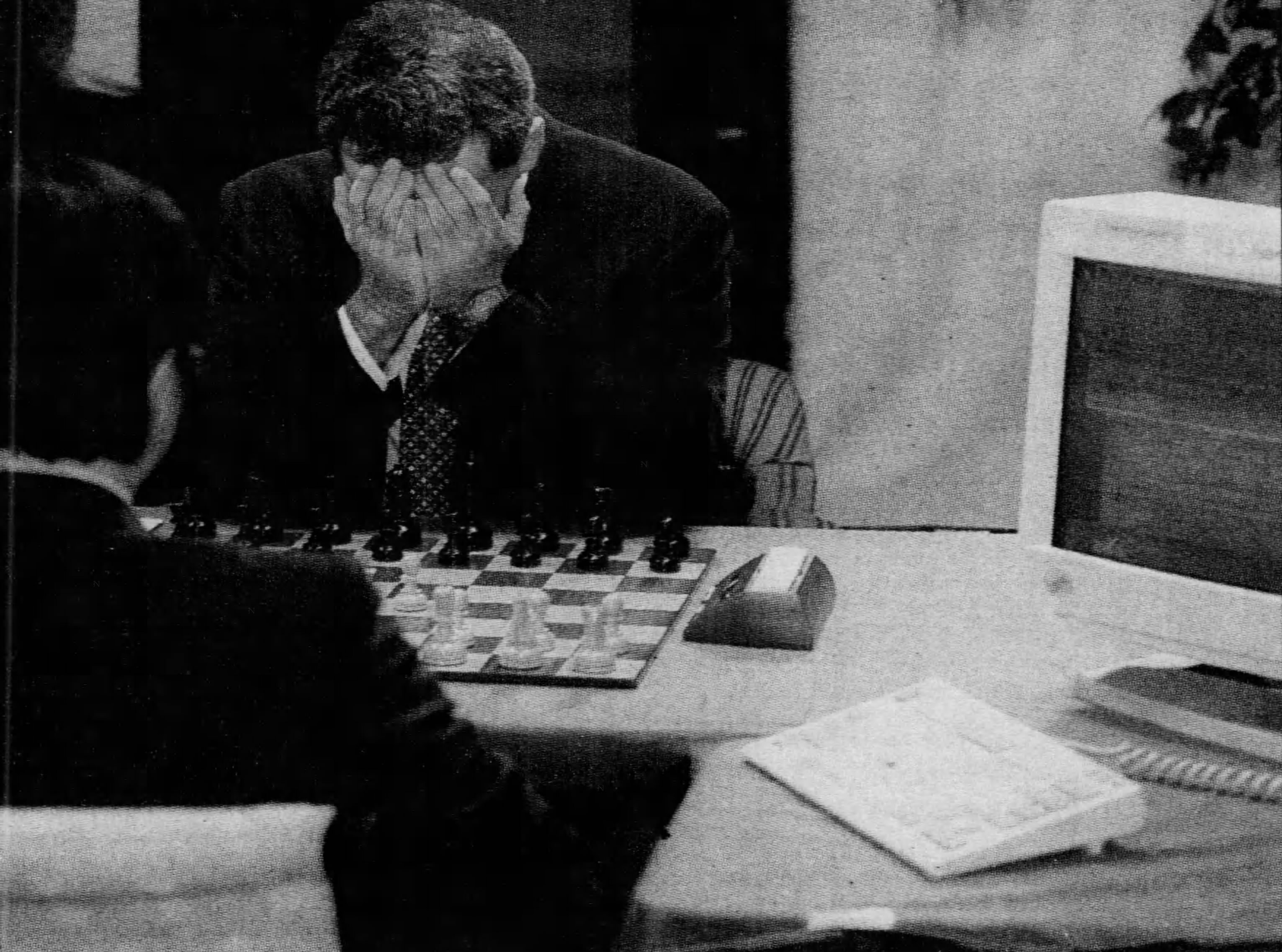
    Russian chess grandmaster Garry Kasparov, hunched over a chessboard and holding his furrowed brow in his hands, competes against the supercomputer Deep Blue in February 1996.

    Back then, artificial intelligence felt distant. Today, it feels existential.

    As we prepare to host the nation’s 250th anniversary in 2026, I’ve been asking: In a city so rich in history, are we still interested in the future?

    How it started

    This spark began in 2023, during a reporting project on economic mobility called Thriving that Technical.ly — the news organization I founded and lead — published with support from the William Penn Foundation, the Pew Charitable Trusts, and the Knight Foundation. Our newsroom followed 10 Philadelphians for a year to produce an award-winning audio-documentary and hosted a dozen focus groups across the city.

    One Brewerytown resident said something that inspired a previous op-ed I wrote for this paper: “Leaders here talk a lot about hundreds of years in the past, but nobody is looking very far in the future.”

    Across this region — in boardrooms, nonprofits, universities, and regional corporate offices — too many leaders manage the wealth and institutions created by past entrepreneurs, but too rarely invent anything new. We fight over what exists instead of building what’s next.

    The Semiquincentennial is our chance to prove we can balance our past, present, and future.

    Why this matters now

    My career has been spent listening to and challenging the inventors, entrepreneurs, and civic leaders shaping tomorrow’s economy. They act while others analyze.

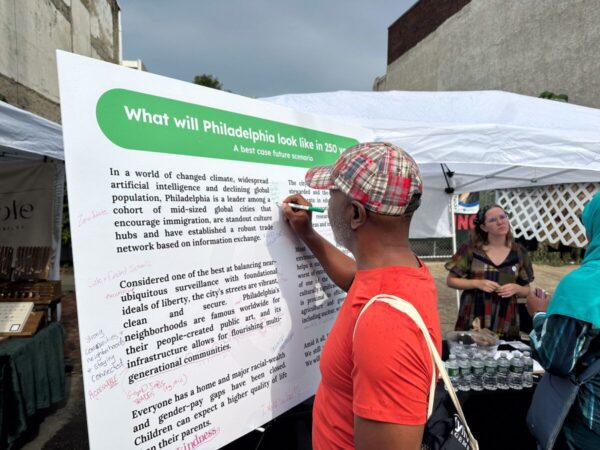
    In that spirit, we spent two years developing a vision for Philadelphia 250 years in the future. Nearly 1,000 Philadelphians have shared ideas at festivals, community events, and small-group gatherings. The current draft, open for one final round of feedback at Ph.ly, isn’t a plan but an invitation — a shared view of what we wish for our descendants in 2276.

    The coming decades could bring population decline, climate strain, and sweeping technological change. Yet, many local leaders still struggle to plan even years ahead.

    During a recent private discussion I moderated inside one of our city’s impressively preserved old buildings, a longtime civic leader cited Philadelphia’s poor economic mobility ranking. I reminded him that the same research, with the same warning, was released a decade ago. Why didn’t we plan to make changes then?

    He assured me this time would be different.

    Philadelphia’s past points forward

    Philadelphia’s breakthroughs have nearly always come from outsiders who pushed past local gatekeepers.

    Stephen Girard, a French immigrant dismissed by elites, built a shipping and banking fortune, stabilized the nation’s finances, and endowed Girard College.

    The Drexel family’s daring banking experiments helped fuel the Industrial Revolution before founding the school for engineers.

    Albert Barnes saw beauty where Philadelphia’s art establishment did not.

    ENIAC’s inventors, John Mauchly and Presper Eckert, were a little-known physics professor and a 24-year-old grad student whose entrepreneurial efforts were blocked locally, presaging Silicon Valley.

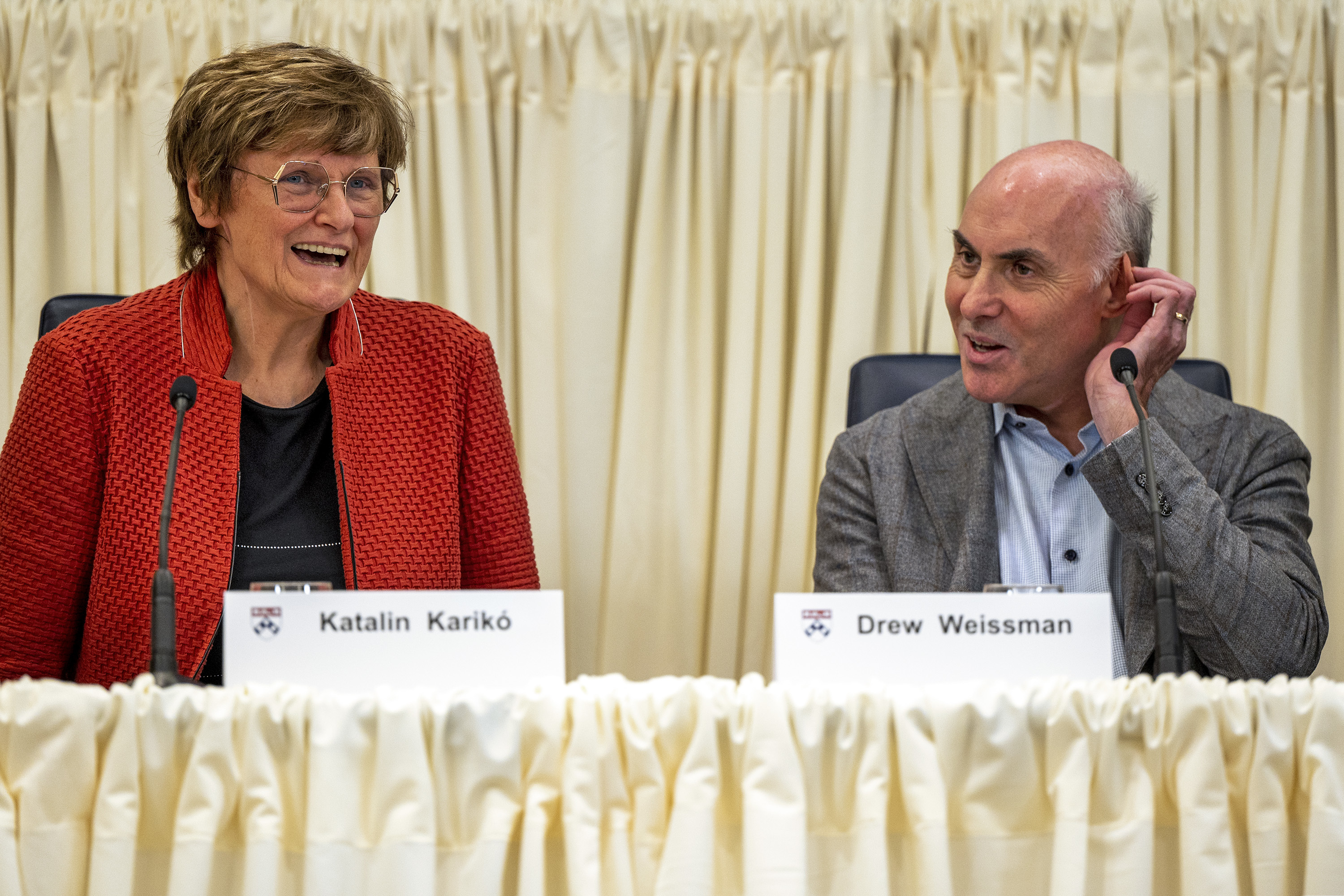
    Katalin Karikó and Drew Weissman attend a news conference at the University of Pennsylvania in October 2023, after they were named winners of the 2023 Nobel Prize in physiology or medicine for their work on messenger RNA, a key component of COVID-19 vaccines.

    Most recently and famously, Nobel laureate Katalin Karikó’s mRNA research that led to the rapid-fast, lifesaving COVID-19 vaccine response was commercialized in Boston, not here.

    The pattern is clear: Visionaries choose to live in Philadelphia, yet often get ignored, if not outright blocked, by local institutions. That’s no way to secure the next 250 years.

    There are signals of change.

    I take inspiration from bold efforts to build, including the Delaware waterfront and the cap of I-95. In the 2010s, Philadelphia’s technology sector earned initial, if timid, attention from successive mayoral administrations and civic leadership — and a half dozen tech unicorns were born.

    That tech community helped inform this multiyear vision statement project, which received $75,000 from a funders collaborative activating Semiquincentennial efforts, including the William Penn and Connelly Foundations. The city’s 2026 planning director, Michael Newmius, has been supportive, urging us to listen to residents and avoid undue filtering.

    Over two years, we’ve tabled at community events, hosted discussions, and led working sessions. The result isn’t mealymouthed or filtered by incumbency; it has grit and humanity — like Philadelphia itself.

    You can read the draft vision at Ph.ly and in the article box in this op-ed. We’re collecting one final round of feedback this fall, and we’ll incorporate what we can. We’re accepting feedback until Dec. 1.

    From conversation to commitment

    Our goal is to enshrine the final version of this statement on a physical plaque at a prominent location in the city. We’ll also host a digital version online, paired with voices from residents across the region.

    This vision doesn’t prescribe policy, nor make fallible predictions; instead, it offers a shared aspiration, a framework that future leaders can measure their plans against.

    In its early drafts, the statement imagined a green-energy Philadelphia with climate-adaptive agriculture, abundant public art, thriving multigenerational neighborhoods, and a culture that “exports ideas and imports opportunity.”

    Over subsequent versions, the specifics were removed to reflect the long time horizon, but the spirit remains: Philadelphia must keep people — not technology, not incumbency — at the center of our future.

    The Semiquincentennial should celebrate our history — I personally cherish it. I was a historic Old City tour guide for a year, and my daily bicycle commute to the Technical.ly newsroom past Independence Hall reminds me what endurance looks like.

    But if we only admire our past, we’ve missed its key lesson. Philadelphia is strongest when we pair cobblestones with invention’s spark.

    Read the vision at Ph.ly. Critique it, add to it, make it better. May it inspire Philadelphians for generations to keep building, not just preserving.

    The Kasparov-Deep Blue rivalry is remembered as the moment a machine beat a human genius. But that was the rematch. The first contest — the one held here in Philadelphia — ended with the human winning. Let’s make sure that’s still true for our city.

    Christopher Wink is the publisher and cofounder of the news organization Technical.ly.

  • A new bridge could replace another spanning the Delaware River. Eventually.

    A new bridge could replace another spanning the Delaware River. Eventually.

    Pennsylvania and New Jersey turnpike officials have settled on two alternative plans for replacing the Delaware River Bridge that has linked their toll roads for 70 years.

    Traffic has mushroomed since the interchange with I-95 opened in 2018, and the four-lane span is often congested, along with highways and roads in Bucks and Burlington Counties.

    “We have a lot more traffic here … and it will keep growing,” said engineer John Boyer, the Pennsylvania Turnpike Commission’s project manager. “We need additional capacity.”

    Before the I-95 connection was finished, about 42,000 vehicles a day crossed the Delaware River Bridge. Now, that’s up to around 67,000. Average daily traffic is projected to be 90,000 vehicles by 2050.

    What are the two ‘finalist’ options for a new bridge?

    In one scenario, the new bridge would be constructed at once about 75 feet north of the existing span over four years. Pennsylvania- and New Jersey-bound lanes (six in all) would be built 15 feet apart. When finished, all traffic would be moved to the new bridge. The existing bridge would be removed.

    The other option: constructing the new bridge in stages, about 40 feet north of the existing bridge — over eight years. Initially, the first half of the new span would go up. Then four lanes of traffic would be diverted to the new half while the old bridge is demolished, after which the second half of the new bridge would be built. When complete, there would be six traffic lanes.

    What are the next steps?

    Turnpike officials are preparing a new environmental impact statement, required for federal approval and funding. The 2003 version is outdated.

    The plan is to unveil the site decision in the spring. Then would come final design and the rest of the bureaucratic steps in building transportation infrastructure.

    Construction could start in 2031.

    The final cost of the project has not yet been estimated, officials said, but it won’t be cheap.

    What’s the history of the project?

    Talk of fixing the crossing started more than 30 years ago, and by 2003, after exhaustive environmental impact and engineering studies, authorities proposed building a modern bridge alongside the old one, which would be refurbished.

    Federal highway officials signed off, but it never came together.

    In 2010, the Pennsylvania Turnpike Commission formally deferred the project “due to funding constraints,” spokesperson Marissa Orbanek said.

    A crack in a steel truss supporting the bridge closed the span for six weeks in 2017 and rekindled the idea. Engineers combed through nine possible sites north and south of the bridge and decided to replace rather than refurbish the span, as first planned.

    The Pennsylvania Turnpike Commission and New Jersey Turnpike Authority are working together on the project.

    Beginning in 2007 with Act 44, the Pennsylvanian Turnpike assumed a major role in state transportation funding that limited its ability to spend on other things. The law used turnpike toll revenues to secure bonds that would provide revenue for public transit and highway and bridge projects.

    In addition, the turnpike prioritized the connection to I-95 and widening the roadway to accommodate the additional traffic, as well as other projects — including removal of toll booths and switching to gantries that charge drivers by reading an EZ-Pass or snapping a picture of a vehicle’s license plate.

    Act 44 was a workaround for a state constitutional prohibition on the use of the gas tax for public transit and legislators’ reluctance to hike that tax for highways and bridges.

    The turnpike would contribute $750 million a year to the Pennsylvania Department of Transportation, split evenly between transit and roads.

    That formula was tweaked in 2013 with Act 89, which raised the gas tax to finance roads and bridges and cut the turnpike’s annual payment to $450 million — with all of it going to transit — through 2022.

    The toll road’s obligation to PennDot then dropped to $22 million a year.

    Will the Pa. Turnpike need to acquire properties? Where?

    It’s too early to say. Officials working on the project said they would have a better idea after the final proposal is chosen, expected in spring 2026. The two northern options are seen as likely to have fewer impacts than other alternatives considered.

    What about a shared-use path for bikers and walkers?

    Pennsylvania Turnpike officials have ruled that out, citing regulations barring pedestrians or nonmotorized vehicles on turnpikes and interstates — the connector is part of I-95 — as well as future maintenance costs. Advocates still want access.

    John Boyle, a staffer for the Bicycle Coalition of Greater Philadelphia, pointed to several toll bridges with free paths that accommodate cyclists and pedestrians.

    The Great Egg Harbor Bridge on the tolled Garden State Parkway, for instance, has bike and pedestrian lanes.

    So does the Mario M. Cuomo (Tappan Zee) Bridge, which carries the New York Thruway over the Hudson River about 20 miles north of New York City.

    And the Gordie Howe International Bridge, a toll facility between Detroit and Windsor, Ontario, nearing completion, will have separate shared-use lanes.

    What considerations guide the choice?

    Boyer said they boiled it down to picking a site that would have the lowest negative impact on the built and natural environments.

    “We’re looking at it from a 10,000-foot view in the entire corridor: commercial impacts, industrial impacts, residential impacts, and potential impacts to billboards or cell towers in the area,” Boyer said.