Boutique gym Club Studio Fitness is expanding to the Philadelphia area with new locations in Cherry Hill and Wynnewood.
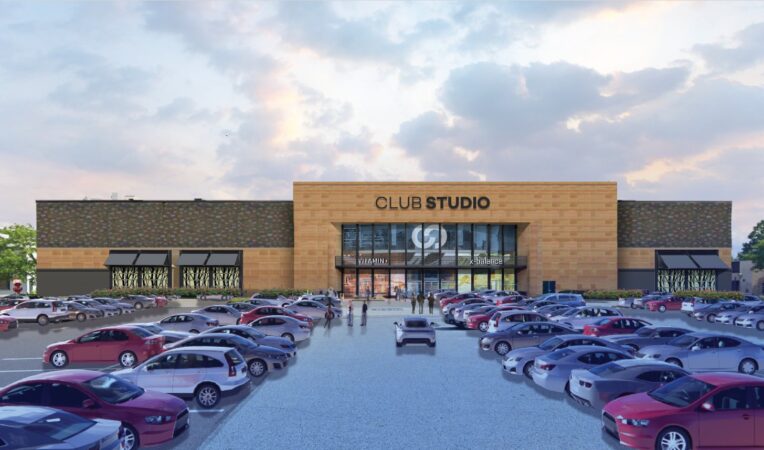
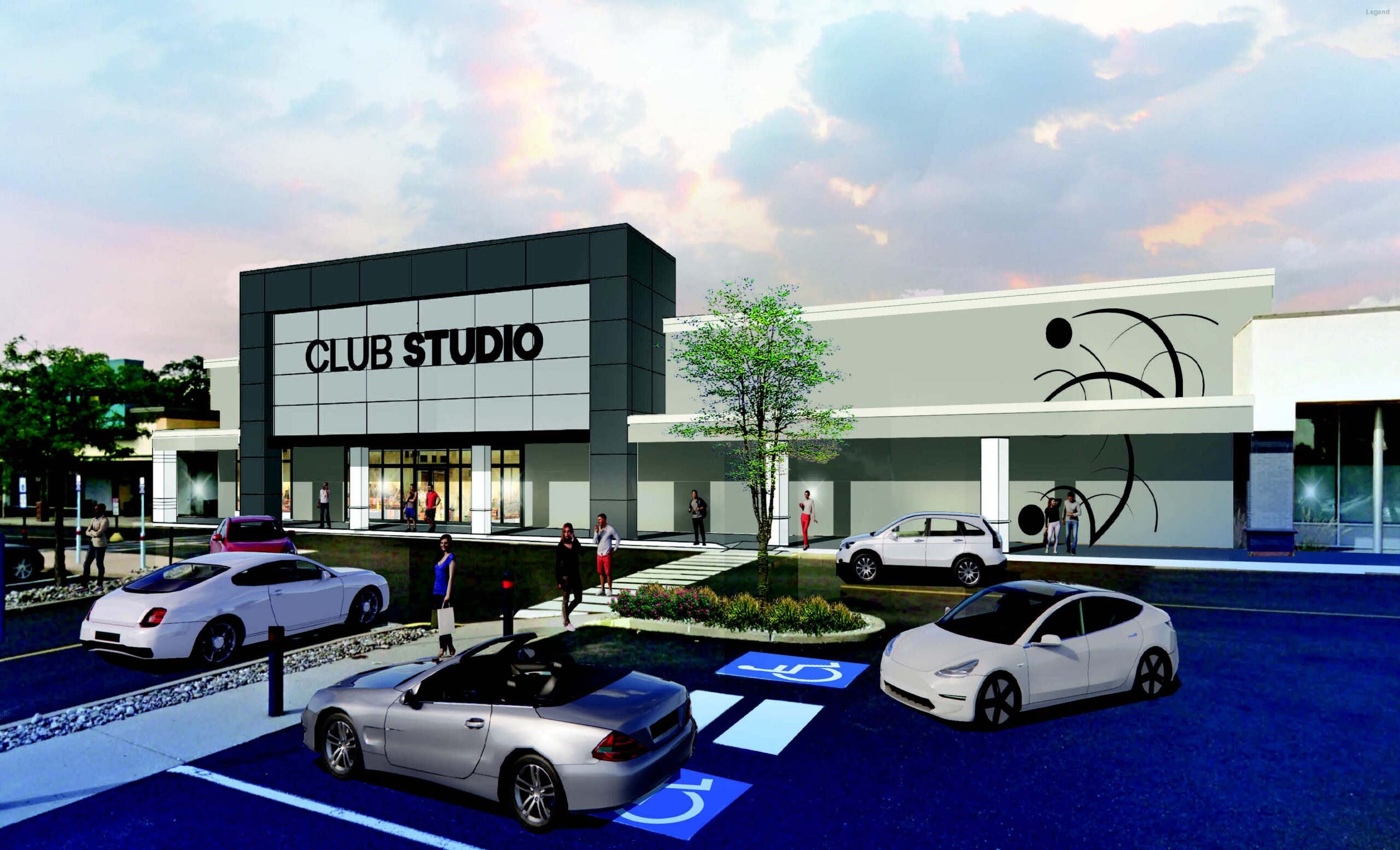
Club Studio is set to take over 30,240 square feet at Cherry Hlil’s Ellisburg Shopping Center in the former BuyBuy Baby storefront. The gym is expected to open in spring 2027.
The Cherry Hill gym will be Club Studio’s second New Jersey gym. The California-based chain opened its first Garden State location in Edgewater in May.
A rendering of the Club Studio Fitness gym slated to open in the Ellisburg Shopping Center in Cherry Hill, N.J., in spring 2027.
The high-end gym chain is also set to open on the Main Line late this year. Club Studio will take over a 50,000-square-foot space in the Wynnewood Shopping Center, a space formerly home to Bed Bath & Beyond. The Wynnewood gym is expected to open toward the end of 2026.
Both shopping centers are owned by Federal Realty Investment Trust, a Maryland-based real estate trust with a large Philadelphia-area footprint.
The addition of Club Studio is “an exciting new chapter for Wynnewood Shopping Center” that continues “the evolution towards more relevant shopping, dining, and now, wellness” experiences, Jeffrey Fischer, Federal Realty’s vice president of leasing, said in a news release.
The Cherry Hill and Wynnewood gyms will have boutique fitness classes; free weights areas; strength and functional training zones; cardio equipment; juice bars; cryotherapy and red-light therapy; and personal stretch stations.
Club Studio is planning to open another Pennsylvania location in Collegeville. The chain has around a dozen locations across the U.S., with a large presence in California, and has around 20 new gyms in the works, according to its website.
This suburban content is produced with support from the Leslie Miller and Richard Worley Foundation and The Lenfest Institute for Journalism. Editorial content is created independently of the project donors. Gifts to support The Inquirer’s high-impact journalism can be made at inquirer.com/donate. A list of Lenfest Institute donors can be found at lenfestinstitute.org/supporters.
One of Kennett Square’s last remaining sizable undeveloped parcels could get hundreds of townhomes and apartments — once contamination cleanup of a former industrial site passes muster.
But even with the OK from state and federal environmental officials, it would be years — and require more sign-offs at the municipal level — before the developer eyeing a residential complex at the former National Vulcanized Fiber site could break ground.
And the site’s owners face headwinds beyond the governmental approval, as some borough residents worry that the site is not safe for homes.
Officials from the U.S. Environmental Protection Agency and the Pennsylvania Department of Environmental Protection, agencies that have to ultimately green-light the land as safe for people to live on, sought to assuage those concerns Tuesday during a town hall that explained the processes for cleanup and the standards the developer would have to meet for any homes to be built.
It was the latest update regarding a proposed residential complex that would feature 246 townhomes and 48 apartments, located at the 22-acre lot on 400 W. Mulberry St., not far from the historic district of the borough, on a plot of land that has languished for almost 20 years.
It’s one of the largest untouched parcels in the borough, making up at least 10% of Kennett Square, which is one square mile. Developers project the residential complex would increase the population of the 7,000-person borough by 15%.
The site, which housed National Vulcanized Fiber from the late 1890suntil it shut down in 2007, was purchased by its current owner in 2009 and has been the subject of cleanup efforts for more than a decade after the land was found to be contaminated with so-calledforever chemicals.
“It feels like the cart was put before the horse for the public,” one resident, Sarah Hardin, said during Tuesday’s meeting. “I think it’s the fact that we’re all feeling like this was guns a-blazing forward, and we would like to know that all the proper environmental steps are taken.”
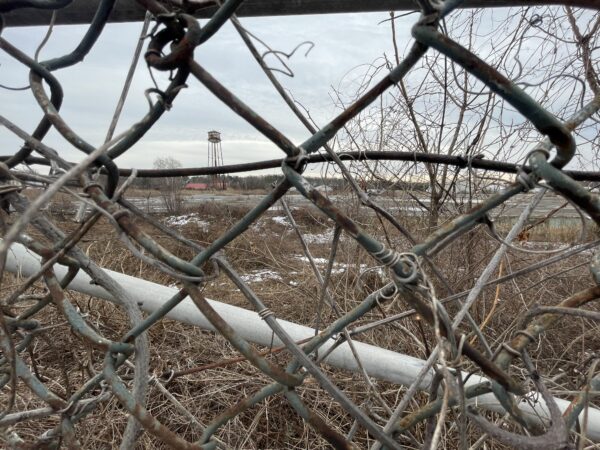
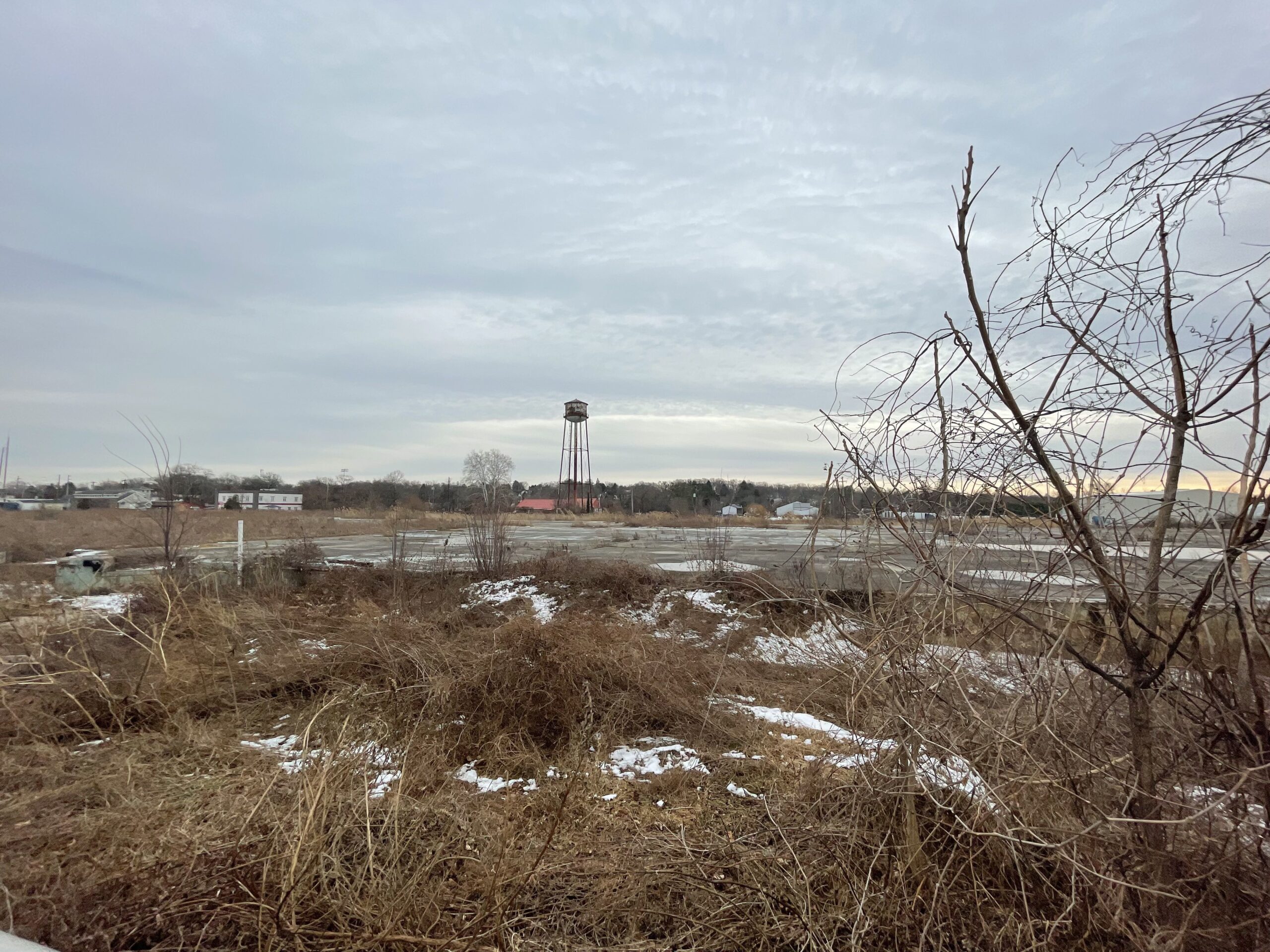
The former National Vulcanized Fiber in Kennett Square on Friday, Jan. 23, 2026. Once an industrial site, the property’s current owner is seeking to eventually turn it into a residential development. But first, the property has to be decontaminated that satisfy state and federal requirements.
What’s the history of the site?
For more than 100 years, National Vulcanized Fiber ran operations on the property, creating a slew of products with vulcanized fiber — a durable, flexible, lightweight plastic-like material that was used to make anything from trash cans to computer circuit boards.
Production of those items led to contamination of the site; polychlorinated biphenyls (PCBs) were identified in the 1980s, after contamination spread into Red Clay Creek. That prompted the EPA to become involved, said Amanda Michel, the agency’s PCB coordinator for the region.
The chemicals are probable carcinogens, linked to liver and breast cancer, melanoma, and non-Hodgkin lymphoma. The chemical is also associated with birth defects, developmental delays, and immune system dysfunction.
Remediation began after the chemicals were found in the 1980s, and NVF folded in 2007. Rockhopper LLC purchased the property two years later and began cleaning the site, eyeing future residential development.
Along with the federal cleanup, in 2010 the owners began a voluntary state cleanup process — which is aimed at redeveloping contaminated, vacant, and unused parcels into productive uses — to target the other chemicals found on the site.
In both cases, the owners have to demonstrate, through sample testing, that contamination has been lowered to a threshold acceptable for human health or that they have the proper barriers in place to prevent exposure.
“Until that happens, there will not be a residential occupant at this property,” said Jonathan Spergel, an environmental lawyer representing Rockhopper.
What is the developer proposing?
Under the proposed development, the property would have 104 stacked and 38 unstacked townhomes, along with 48 one-, two-, and three-bedroom apartments. The owners said the project would comprise affordable and market-value units. A proposed rezoning ordinance would require15% of the homes to be affordable.
That component was critical forKennett Square officials, Mayor MattFetick said in an interview last week.
“It’s our best opportunity to have an affordable component,” he said.
Alongside those homes, the property would have roughly 732 parking spaces, and 50 would be added to Mulberry Street.
To offset feared bottlenecks, the property’s proposed plan would have five driveways todistribute traffic flow.
The site’s developers estimate that the property would bring in $382,000 for the borough and more than $830,000 for the school district each year.
Another portion of the site serves as a baseball field at the high school, and no further development is planned there, the property’s owners said in 2024.
The project is helmed by Rockhopper LLC, which is led by two development firms, Delaware Valley Development Corp. and Catalyst City. They brought in Lennar, a home-building company, in 2021. Lennar has done at least two similar projects, remediating industrial lots in Phoenixville and in Bridgeport for residential use, a representative said previously.
What are residents’ concerns?
On Tuesday, residents shared stories of loved ones who lived near the site who have been diagnosed with cancer. They worried that the developer could skew data to move the project forward. They wondered why there had been no urgency to clean it up before.
Officials said the developer has to work with an independent environmental professional and their agencies had been on site throughout the cleanup process.
Corey Barber, who lived near the site for 20 years and moved out of the area after her cancer diagnosis in 2021, worried what construction on the site would bring.
“People are going to believe that they’re going to get cancer from the dust kicking up,” she said.
Charla Watson, who lives right by the property, said there was distrust because the community has not seen the work the developer says is happening.
“It’s just been a wasteland,” she said. “Everything looks the same the day they moved out of there.”
What comes next?
The developer is going through two processes simultaneously. As it cleans up the property to get the necessary state and federal approvals for residential development, it is also working at the municipal level for the land to be rezoned so it can build the residences.
The borough is advertising a change to the ordinance that would rezone the land.
If the ordinance is approved, the developer could formally start developing the land — which would come with at least another year of planning and meetings.
This suburban content is produced with support from the Leslie Miller and Richard Worley Foundation and The Lenfest Institute for Journalism. Editorial content is created independently of the project donors. Gifts to support The Inquirer’s high-impact journalism can be made at inquirer.com/donate. A list of Lenfest Institute donors can be found at lenfestinstitute.org/supporters.
From national chains to homegrown operations, as Chester County continues to grow, so too do the grocery store offerings.
Here’s a look at some of the stores opening around the county.
Kimberton Whole Foods expanding
This spring, locally owned Kimberton Whole Foods will open its largest location in the county in Eagleview Town Center. Construction began in 2024, roughly 20 years after the location in Kimberton Village opened at a former hardware store.
“We look forward to serving Eagleview and the surrounding communities with healthy, locally sourced grocery options in a customer-focused environment,” Ezra Brett, chief operations officer for Kimberton Whole Foods, said in a statement.
The new 14,000-square-foot facility will continue the store’s offerings of organic produce, grass-fed meats, specialty cheese, grab-and-go meals, and more.
The store will join the growing Eagleview Town Center, which offersrestaurants, salons and spas, professional offices, daycares, and more.
West Chester Cooperative slated for opening
West Chester is slated to get a brick-and-mortar member-owned grocery this year, with West Chester Cooperative at 204 W. Market St.
The cooperative kicked off more than a decade ago, formed by a group of borough residents who wanted sustainable, local alternatives to chain grocery stores.
Over the next 10 years, the group launched outreach efforts, opened a pop-up market, and did curbside pickup and limited in-store shopping hours. In 2022, it reached 500 member-owners.
The grocery will be open to all shoppers, but member-owners will receive select benefits.
Kennett Square is also getting its own cooperative grocery store
West Chester isn’t the only municipality in Chesco getting a different model of grocery store. Also nearly a decade in the works, Kennett Square’s Kennett Community Grocer is expected to open this spring at 625 E. Cypress St.
Renovations began in 2025, and the store will offer locally grown produce; dairy, eggs, and meat from county farms; local baked goods and prepared foods; pantry staples from local producers; and a cafe for community members. It will also hold educational and other events led by healthcare professionals and farmers.
“It felt like doing this was to highlight for everyone that we have this precious land that’s quite beautiful, that is very bountiful with products, not just mushrooms, but meat, dairy, produce, fruit, vegetables,” saidEdie Burkey, president of the nonprofit board leading the grocer. “We felt that bringing people together for the common cause of supporting the land that we’re very, very proud to be part of was a good thing.”
Farmers will get a free cup of coffee at the cafe, which will sell locally roasted coffee, and local teas and honey. The store hopes to partner with the high school’s culinary students for an internship program. Products that don’t sell will be donated to organizations like Philabundance’s Mighty Writers, Children’s Advocacy Centers of Pennsylvania, and others, Burkey said.
“We all eat, and to create a community around eating — things that are grown around here — and protecting the land so that maybe farmers don’t sell their land to developers, you’re just creating a sense of community in and around an activity that is so vital to every part of your day, every day of the year,” Burkey said.
Other national chains coming to the county
Meanwhile, bigger chains are also looking to call the county home. Phoenixville could see two national stores coming in the coming months.
Construction for an Aldi, an international discount supermarket, began over the summer at 297 Schuylkill Road.
Meanwhile, Sprouts Farmers Market, the Arizona-based organic and natural grocery store, is also eyeing a location in Phoenixville. Most of the grocer’s local footprint is within Philadelphia, but a Phoenixville location would broaden the store’s reach further west.
The Phoenixville location is proposed at 808 Valley Forge Road, where the former Royal Bank used to sit. It would operate 7 a.m. to 10 p.m. daily, next to an indoor self-storage facility.
But the Rochester, N.Y.-based supermarket chain won’t say whether it’s collecting biometricdata on shoppers at eight Philly-area stores. There are Wegmans stores in Cherry Hill and Mount Laurel in New Jersey and in Glen Mills, Malvern, King of Prussia, Collegeville, Warrington, and North Wales in Pennsylvania.
Patrons at some New York City Wegmans locations learned earlier this month that the supermarket chain had begun to collect, retain, store, and share data on their faces, eyes, and voices. The information, Wegmans said, was being used for “safety purposes.”
“This is information that can be used to identify or help identify you,” a sign posted at Wegmans in New York City said, according to reporting from the online news site Gothamist. “We use facial recognition technology to protect the safety and security of our patrons and employees, and do not lease, trade or otherwise profit from the transfer of biometric identifier information.”
Wegmans does not “get into the specific measures used at each store” for “safety and security purposes,” Wegmans spokesperson Marcie Rivera said in an email.
Rivera said Wegmans has deployed cameras equipped with facial recognition technology in “a small fraction of our stores that exhibit an elevated risk.” Wegmans is using the technology in a “handful of states.” It posted mandated signage in New York City to comply with local regulations, Rivera said.
Wegmans has previously said that the surveillance software is used to help identify individuals who “pose a risk to our people, customers, or operation.”
Biometric surveillance is becoming increasingly common but is not yet widespread, said Gus Hurwitz, senior fellow and academic director of the Center for Technology, Innovation and Competition at Penn’s Carey Law School.
Companies that use biometric surveillance do so for a number of reasons, but seldom tell consumers what their data is being collected for. Data collection can help companies understand what consumers are purchasing and how they’re moving through stores, Hurwitz said. Biometric data collection can also be used for dynamic pricing, when retailers change prices in real-time depending on a number of factors, including time of day, demand, weather, and consumer behavior.
Hurwitz said it’s important to distinguish between real-time and non-real-time biometric screening. Non-real-time screening has been happening for decades in the form of security cameras and other data collection tools, often used for market research purposes.
Real-time screening, however, is a newer frontier with a far murkier regulatory landscape.
Businesses in New York City that collect biometric data are required to post signage notifying customers, per a 2021 city law, however the agency in charge of implementing the law has no enforcement mechanism for noncompliant businesses, a city official told Gothamist.
A bipartisan bill regulating biometric data collection is currently moving through the Pennsylvania legislature. A recently introduced bill in the New Jersey Legislature would require any entity collecting biometric information to post a “clear and conspicuous notice” at every entryway to their business, like in New York City.
Hurwitz said we’re “still very much in the development era of these sorts of technologies,” and that he expects more and more government entities to hone in on regulating them in the near future.
Independent and unaffiliated voters were left off Chester County’s poll books in November’s election due to human error exacerbated by insufficient training, poor oversight and staffing challenges in the county office, an independent firm has concluded.
In November, more than 12,000 Chester County voters were forced to vote by provisional ballot after the county included just registered Democrats and Republicans in the poll books for the general election. Every voter who wanted towas able to cast a ballot, county officials said, but it resulted in a chaotic scene and the county had to issue an unusually high number of provisional ballots — which require more steps to cast and count.
On Thursday, the county released a 24-page report from a West Chester law firm detailing how the county failed to include more than 75,000 registered voters in its general election poll books, and evaluating the state and county’s response as it scrambled to ensure those voters could cast ballots.
“Importantly, our investigation found no evidence of intentional wrongdoing, misconduct, or bad faith on the part of any of the employees who generated the Poll Books. The error was inadvertent and occurred in the course of performing assigned duties under significant time constraints,” the report, prepared by Fleck, Eckert, Klein and McGarry LLC, said.
“Though the initial selection constituted a human error, the investigation found that the error occurred within a system lacking in: (i) sufficient safeguards, (ii) training, (iii) sufficient supervision, and; (iv) verification controls,” investigators added.
What’s next in Chester County?
The firm’s report detailed more than a dozen recommended steps for the county and Department of State to take to prevent future errors.
In an action plan released Thursday, Chester County officials said they intend to abide by the vast majority of those recommendations, as well as additional steps identified by the county’s Chief Experience Officer.
Chester County Chief Executive Officer David Byerman said in a statement that the recommendations would be completed within a year, with the most critical steps coming ahead of May’s primary election.
The action plan included improved training and more strenuous review processes, reevaluation of Voter Services staff levels and pay, and a review of human resources policies in the department. It did not include personnel changes within its Voter Services Department.
The 25-person department has faced unusually high turnover among staff in recent years, losing 29 employees to resignations, firings and transfers since the current director, Karen Barsoum, took over in 2021.
Barsoum has faced allegations of fostering a toxic work environment, which Thursday’s report acknowledged. However, the firm concluded that those complaints were not connected to the poll book error and said in its report that employees directly connected to the poll book blunder spoke positively about department management.
“Moreover, the various causes of the Poll Book issue that we have identified do not appear to have any causal nexus with the types of concerns raised,” the report said.
How did the error happen?
According to the report, two employees inadvertently chose the wrong selection of Chester County voters when they used the statewide voter roll software to create November’s poll books. Those employees, the report said, were inexperienced and had never been formally trained on the system they were using. While the employees had a copy of written training materials from the Department of State, the report noted that they worked with “little direct supervision” for their level of experience.
After the wrong set of voters were chosen — leaving off third party and unaffiliated voters — the report said no one in the department checked the books until a poll worker noticed the problem shortly before polls opened on Election Day.
The report noted the department’s high turnover, which it said could be the result of the high-pressure environment of election-related work and Chester County’s low pay compared to surrounding counties. That turnover, the report said, created “increased operational risk” which contributed to the error.
Following the incident, the county said it will review staffing and pay levels for the office as well as its human resources policies.
“We know that working in elections is an extremely difficult job – one that involves long hours and many personal sacrifices,” Byerman said. “We are truly grateful for the commitment and dedication of the staff in Voter Services, and want to ensure that we are doing everything we can to provide the resources, tools, and support they need to be successful in their roles.”
The department, the county’s action plan said, will also establish additional approval checks for poll books and other procedures that impact all Chester County voters.
County officials also said they intend to improve training for the department, including working with the Pennsylvania Department of State to implement formal training on the state’s voter roll system.
“The Department always stands ready to assist counties with training of employees on the [Statewide Uniform Registry of Electors] system and other aspects of election administration and is happy to engage Chester further to improve its training process,” the Pennsylvania Department of State said in a statement.
The agency added that its ongoing effort to modernize the statewide voter roll system will include checks and alerts for unusual poll book configurations once completed.
Chester County is scheduled to hold a public meeting Tuesday evening to present its plan to the public. If the forecasted winter storm closes county offices that day, the meeting will be postponed to Feb. 3.
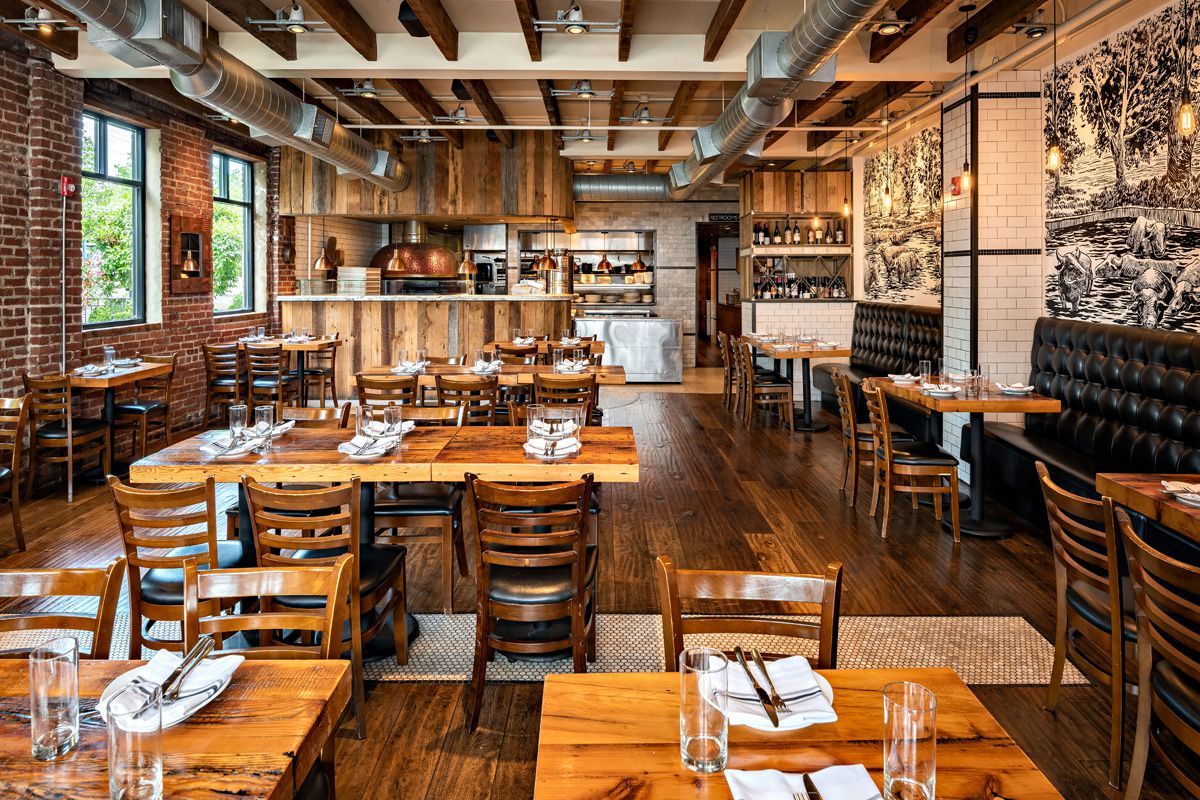
Main Line restaurateur Alessandro “Alex” Fiorello — who is slowly growing a suburban Italian portfolio, with a Wayne osteria and West Chester pizzeria — is preparing to open a new, bar-forward concept at Bryn Mawr Village, 915 Lancaster Ave.
The Bryn Mawr space, which opened in 2022 as the short-lived Marc Vetri-operated Fiore Rosso, most recently was Il Fiore. It closed last month.
The bar at Fiore Rosso in Bryn Mawr, which was operating most recently as Il Fiore. It closed at the end of 2025.
The new project will sit at the top of Fiorello’s three-tier restaurant lineup. His Wayne restaurant, Alessandro’s Wood Fired Italian, opened in 2020 as an upscale-casual neighborhood osteria with a strong takeout business and a busy dining room. Alessandro’s Pizzeria, which the self-taught chef opened in April, is positioned as a casual lunch and slice shop serving pizza, cheesesteaks, and salads.
Fiorello grew up in the restaurant business. His father ran Fiorella’s Café in West Chester, while his mother’s family operated pizza shops in New York. Raised in Brooklyn, Fiorello worked in kitchens from a young age before returning to Chester County as a teenager.
Fiorello said Enoteca Alessandro’s or Alessandro’s Enoteca were in the running for the name of the new Bryn Mawr spot.
Fiorello, who said he is backed by investors, plans to maintain the restaurant’s industrial look, adding that the restaurant’s solid infrastructure would allow for a relatively fast turnaround.
Dining room at Alessandro’s Wood Fired Italian, 133 N. Wayne Ave. in Wayne.
“This new place will be a step up from Wayne,” Fiorello said. “Still approachable but more bar-focused, with a great bar scene.”
The menu will remain Italian at its core, built around house-made pasta, wood-fired pizzas, and a wood-fired grill, with several signature dishes from Alessandro’s Wood Fired Italian carrying over. The new kitchen will also feature dry-aged proteins, using on-site aging refrigerators inherited with the space, and may incorporate subtle Japanese influences, including a small number of sushi-style items.
Dana Edwards was sworn in as mayor of Narberth earlier this month.
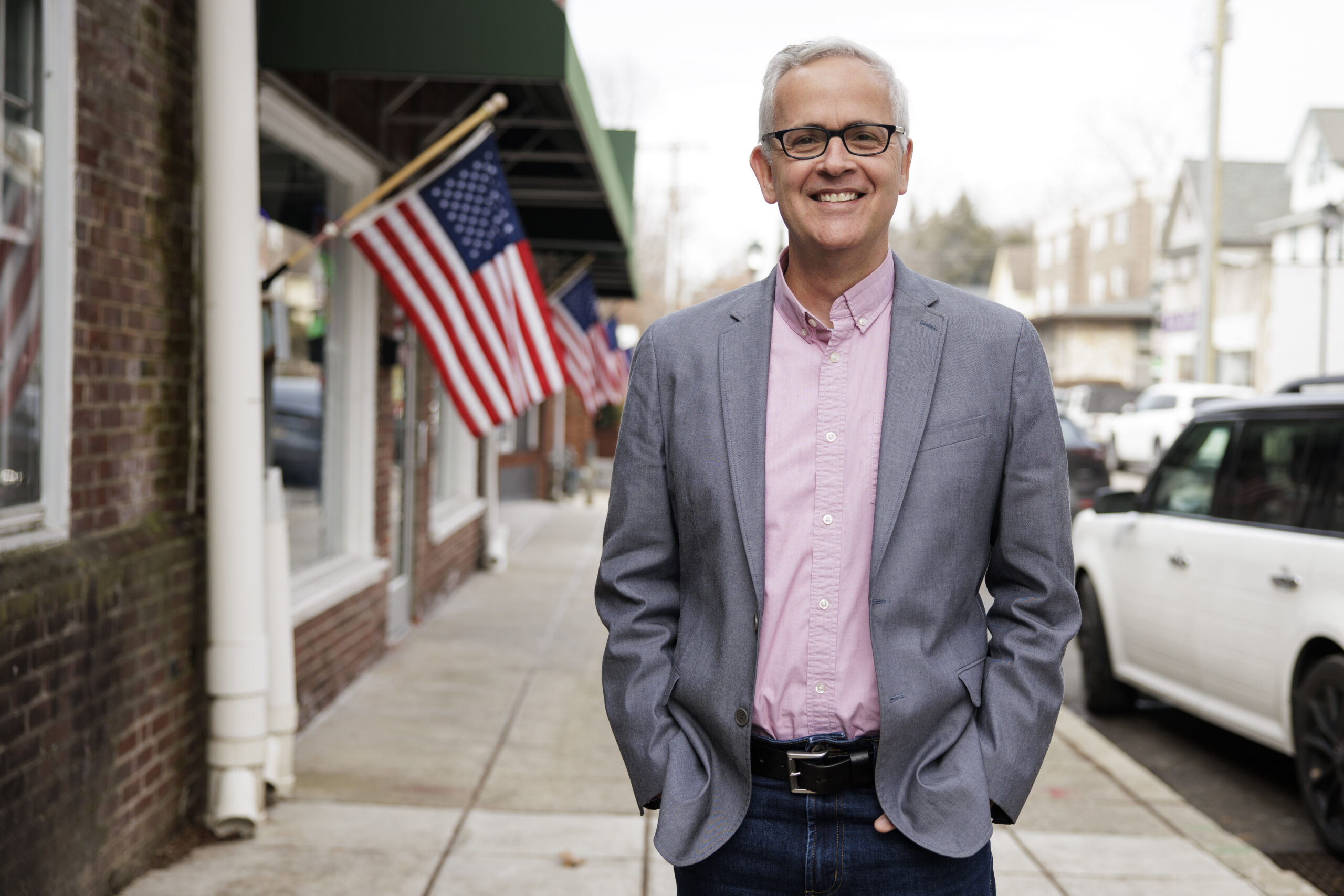
Narberth’s new mayor may have only lived in the 4,500-person borough for five years, but he’s already got a vision for it.
Dana Edwards, 53, was sworn into office earlier this month after securing the backing of Narberth’s Democratic committee and running unopposed in both the primary and general elections.
Now the Puerto Rico native who’s lived in several other parts of the U.S. before settling in Narberth is focused on sustainable growth while maintaining the borough’s “hometown feel,” The Inquirer’s Denali Sagner reports.
When the late Kobe Bryant came to Lower Merion, he helped shape a rivalry with Chester that endured.
Decades may have passed, but a longtime rivalry between two high school basketball teams, begun in part by legend Kobe Bryant, still lives on today.
When Bryant joined the Lower Merion Aces his freshman year, the school wasn’t a basketball powerhouse. But as the program improved, it soon built a rivalry with the much-more-stacked Chester High School, so much so that their matchups would often sell out venues.
Saks Fifth Avenue’s parent company filed for Chapter 11 bankruptcy last week, leaving some questions about the future of its stores. For the time being, the Saks on City Avenue in Bala Cynwyd will remain open while the company restructures. Here’s what we know so far.
Women’s apparel and accessories store Francesca’s, which has a location at Suburban Square in Ardmore, is reportedly closing its remaining stores after years of financial turmoil. Francesca’s filed for Chapter 11 bankruptcy protection in late 2020. (Fox Business)
Villanova University is among a handful of Pennsylvania colleges that are now paying some of its athletes directly. The move comes after a federal class-action lawsuit last year regarding student athlete compensation. Villanova said it will primarily pay athletes on its basketball teams.
Coulter Place, an apartment community at Suburban Square, is now open. The 131-unit, five-story building has a fitness center, clubroom, game room, pool, coworking spaces, and pet-care spaces with rents ranging from about $3,030 to $7,035 per month.
A handful of Philadelphia Police Department employees live in and around Lower Merion, according to a new Inquirer analysis. An increasing number of Philadelphia police employees — about a third of full-time staff — live outside the city, with four who reside in Bala Cynwyd, three in Bryn Mawr, and two each in Ardmore, Narberth, Villanova, and Wynnewood. See a map of where employees live here.
Bala Cynwyd resident Jenny Sved has been named the new executive director of Teach PA, the statewide affiliate of Jewish education advocacy organization Teach Coalition, which represents Jack M. Barrack Hebrew Academy and Perelman Jewish Day School.
A new pet boutique, Mila’s Pup Tienda, is coming to Ardmore, taking over the space at 18 E. Lancaster Ave.
6abc recently caught up with Carolyn Vachani, the owner of Plant 4 Good in Ardmore. When the former nurse was ready to retire, she decided to open the shop at 100 Cricket Ave. to help connect others to plants and gardening. See the segment here.
Wynnewood’s English Village recently marked a milestone, turning 100 last year, and a century later still remains a coveted, if under-the-radar spot for homebuyers. The village sits between Cherry Lane and Wister Road and spans 29 Tudor-style homes. (Main Line Today)
🏫 Schools Briefing
The district is hosting its third strategic plan community input meeting on Wednesday from 6:30 to 8:30 p.m. at the Lower Merion High School cafeteria. There, members of the community can share their thoughts on the district’s strategic plan for 2026 to 2031.
Tonight is Welsh Valley’s winter choral concert. The school board will meet from 7 to 9 p.m. on Monday, and there will be tours of Harriton High for eighth grade students and their families on Wednesday, which is also course selection night. See the district’s full calendar here.
Lower Merion High School’s wrestling team recently took home third place overall in the Central League Championship Tournament, held at Harriton High School. It was the team’s best overall performance. Senior Sam Soeffing also took home first place in his competition.
🍽️ On our Plate
With a more than 700-person waitlist, a Gladwyne restaurant is surprisingly tough to get into, but it’s the best meal The Inquirer’s Kiki Aranita has eaten on the Main Line. Why’s it so difficult to score a table? Partly because Carlton Commons is in senior-living community Waverly Heights and requires residency. For those with friends or relatives there, it’s worth tagging along for the osso buco, butternut squash risotto, rigatoni alla vodka, or the signature tomato aspic.
Bikini Burger, a new eatery at 44 Rittenhouse Place in Ardmore, is hosting a ribbon cutting today at 11:30 a.m. to mark its official opening. Its menu includes burgers, milkshakes, and fries.
Looking for a non-alcoholic cocktail? Char & Stave in Ardmore has a barrel-aged “Old Fashioned,” which Philadelphia Magazine says is among the best alcohol-free sips on area menus currently, noting its barrel-aged espresso base gives it “a bourbon-like, oaky smoothness.”
🎳 Things to Do
🎶 The Music of Beyoncé and More for Kids: This kid-friendly show will feature music from the iconic artist. ⏰ Sunday, Jan. 25, 11:45 a.m. 💵 $20.44 📍 Ardmore Music Hall
🎥 The Awful Truth: Catch a screening of this Cary Grant and Irene Dunne screwball comedy. ⏰ Wednesday, Jan. 28, 7:15 p.m. 💵 $11.75-$16.25 📍 Bryn Mawr Film Institute
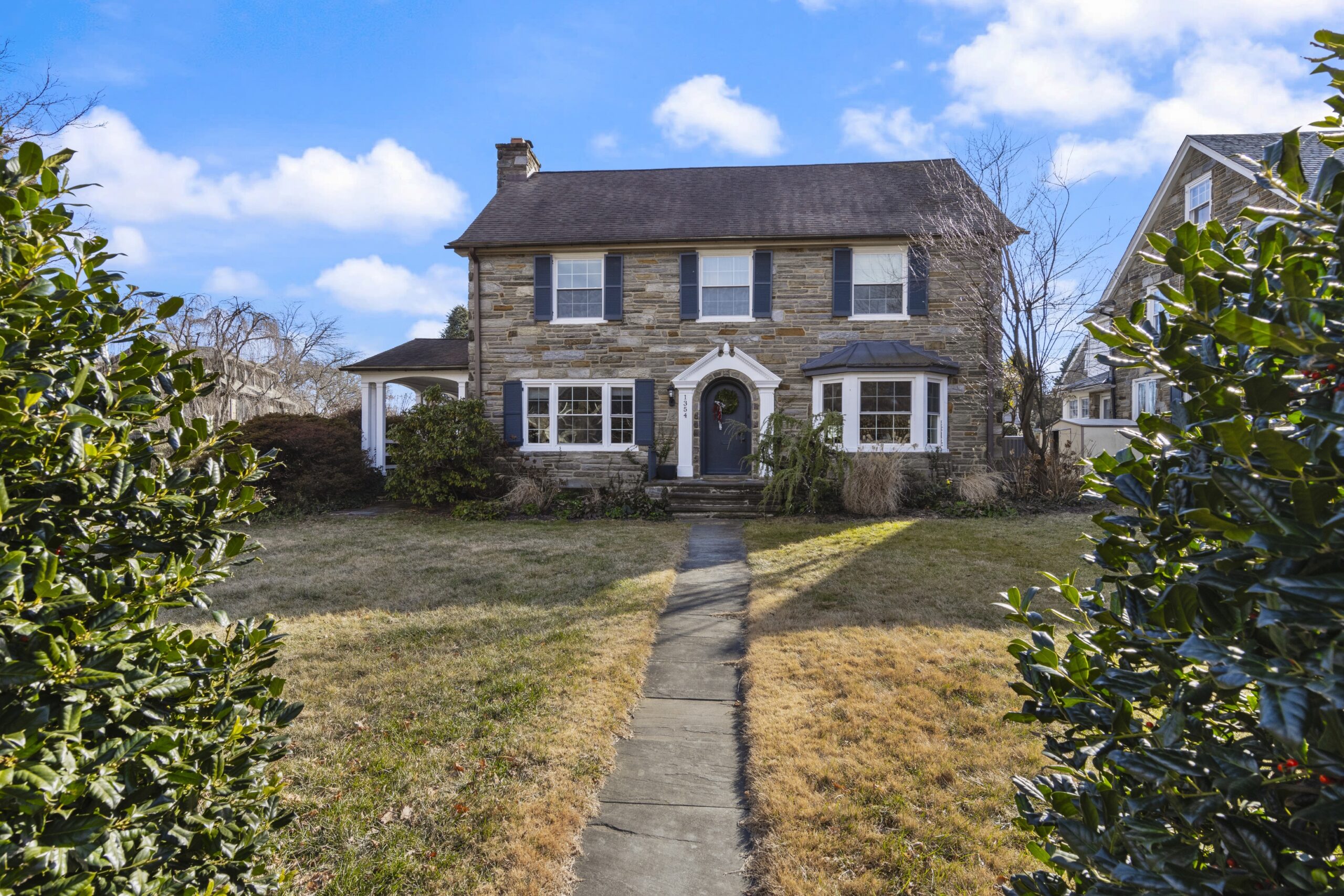
The stone Colonial was built in 1925 and spans over 4,000 square feet.
Built in 1925, this spacious Wynnewood stone Colonial has a classic exterior and a contemporary updated interior. The home’s first floor features a living room with a fireplace, and a dining room that opens onto the kitchen, which has a waterfall peninsula with a breakfast bar. There are four bedrooms and three full bathrooms on the second floor, and a “bonus room” on the third floor. The home also has a finished basement with a half bathroom.
By submitting your written, visual, and/or audio contributions, you agree to The Inquirer’s Terms of Use, including the grant of rights in Section 10.
This suburban content is produced with support from the Leslie Miller and Richard Worley Foundation and The Lenfest Institute for Journalism. Editorial content is created independently of the project donors. Gifts to support The Inquirer’s high-impact journalism can be made at inquirer.com/donate. A list of Lenfest Institute donors can be found at lenfestinstitute.org/supporters.
Swarthmore’s new mayor expects his background in emergency services management to be an asset in guiding the borough. Here’s why. Also this week, the former Crozer-Chester Medical Center has a new owner, a new bookstore specializing in rare and used books has opened in Swarthmore, plus an inclusive cafe that will employ individuals with disabilities is opening in Glen Mills. We’re also gearing up for a (potentially big) snowstorm this weekend. Follow along here for the latest forecast.
Conlen Booth was sworn in as mayor of Swarthmore earlier this month.
“If not me, then who?”
That was a phrase that kept running through Conlen Booth’s mind when contemplating whether he should run for mayor of Swarthmore. Despite initial reluctance, the Strath Haven High School grad felt he could do well in the role, thanks in part to his 25 years with the borough’s fire department, most recently as its chief.
The 42-year-old expects that experience to be valuable as Swarthmore and the surrounding communities continue to deal with the fallout from Crozer-Chester Medical Center’s closure last year. (Keep reading for more news out of Crozer-Chester.)
The former site of Crozer-Chester Medical Center has a new owner. Chariot Equities completed its $10 million purchase of the shuttered hospital yesterday and is hoping to have an agreement with a health system in the next six months to operate both a “right-sized” hospital and an emergency department there, with the first phase opening in the next two years.
Riddle Hospital got an additional $1 million in state funding this week, bringing its total to $4 million, funds that will allow for the hiring of more staff. The Media hospital, part of Main Line Health, has been allocated extra funding to help it handle an increase in patients after Crozer Health’s closure last year.
Media’s new mayor, Joi Washington, wrote a note to borough residents as she kicks off her term, highlighting her passion for walkability, community, and local businesses. As Washington settles into office, she also recently chatted with Philadelphia Magazine about how she ended up in the borough over a decade ago, its small-town feel, and her hopes for increasing pedestrian safety.
A new bookshop has opened in Swarthmore. Dirt Farm Books has taken over the space at 413 Dartmouth Ave., selling rare and used books. The shop, owned by borough resident John McIntyre, opened last week and specializes in 20th century literature, African American literature, and economics, with rare books making up about half its inventory. It also stocks an array of classics, manuscripts, and letters, and buys classic and rare booksfrom customers. The shop is currently open Monday through Saturday from 10 a.m. to 6 p.m. It’s the second bookstore to open in the borough in recent months. Celia Bookshop opened at 102 Park Ave. in October.
More than a dozen Philadelphia Police Department employees live in Media’s 19063 zip code, according to a new Inquirer analysis. An increasing number of Philadelphia police employees — about a third of full-time staff — live outside the city, with 13 in Media, four in Wallingford, six in Swarthmore, and 18 in Springfield. See a map of where employees live here.
Renovations on the Swarthmore Veterans Memorial at the corner of Park and Dartmouth Avenues is scheduled to begin Monday. Plans call for restoring the memorial’s bronze plaques, adding ADA-accessible walkways and seating, updating benches, pavers, and landscaping, and adding a memorial garden. (The Swarthmorean)
Women’s apparel and accessories store Francesca’s, which has a location at Glen Eagle Square in Glen Mills, is reportedly closing its remaining stores after years of financial turmoil. Francesca’s filed for Chapter 11 bankruptcy protection in late 2020. (Fox Business)
Ever have a question about the area you can’t answer? Submit it to Curious Greater Media, and one of our reporters might track down the answer.
🏫 Schools Briefing
There are early dismissals tomorrow for two Rose Tree Media schools ahead of dances: Penncrest High will let out at 11 a.m. and kick off its freshman/sophomore dance at 7 p.m., and Springton Lake Middle School will finish classes at 11:50 a.m. and have its seventh and eighth grade winter semi-formal dance starting at 6:30 p.m. Penncrest will have a course selection night next Thursday from 6:30 to 9 p.m. See the district’s full calendar here.
Wallingford-Swarthmore has a school board meeting Monday at 7 p.m. and back-to-school night next Thursday. See the district’s full calendar here.
🍽️ On our Plate
A new cafe is coming to the Concordville Town Centre in Glen Mills. Ryan’s Rise Up Cafe is slated to open in March at 4 Evergreen Dr., where it will employ individuals with disabilities, as well as provide them with training and support. The cafe is the brainchild of Jim Vail, who wanted to create an inclusive space in the community for people like his 20-year-old son Ryan, who has Down syndrome. (CBS Philadelphia)
🎳 Things to Do
😂 Chris Nee Comedy Night: The local comedian will perform a Philly-forward set and film his comedy special A Trip Down Academy Lane. ⏰ Friday, Jan. 23, 7 p.m. 💵 $25 📍The Media Theatre
🛍️ Woman-Owned Business Pop-Up Market: More than two dozen women-owned businesses will gather this weekend for a pop-up market where you can shop, make a floral bouquet, or learn more about holistic wellness. ⏰ Saturday, Jan. 24, 11 a.m.-4 p.m. 💵 Pay as you go 📍Media Town Mall vestibule and Glimmer Gifts + Goods, Media
🧊 Ice on State: Browse works of art from Ice Sculpture Philly artists, watch live demonstrations, and listen to music at this family-friendly event. ⏰ Saturday, Jan. 24-Sunday, Jan. 25, noon-5 p.m. 💵 Free 📍State Street, Media
🎺 Tri-State Jazz Society Concert: Jazz cornet and trumpet player Danny Tobias will headline this month’s concert. ⏰ Sunday, Jan. 25, 2-4:30 p.m. 💵 $10 for members, $20 for non-members 📍Community Arts Center, Wallingford
🌻 Native Plants and Pollinators of Pennsylvania: Stoneleigh naturalist Samantha Nestory will discuss the importance of lesser-known native pollinators and the plants that help support them during this lecture. ⏰ Monday, Jan. 26, 7:30 p.m. (snow date: Feb. 2) 💵 $10 for Gardners of Rose Valley members, $15 at the door📍 The Old Mill, Rose Valley
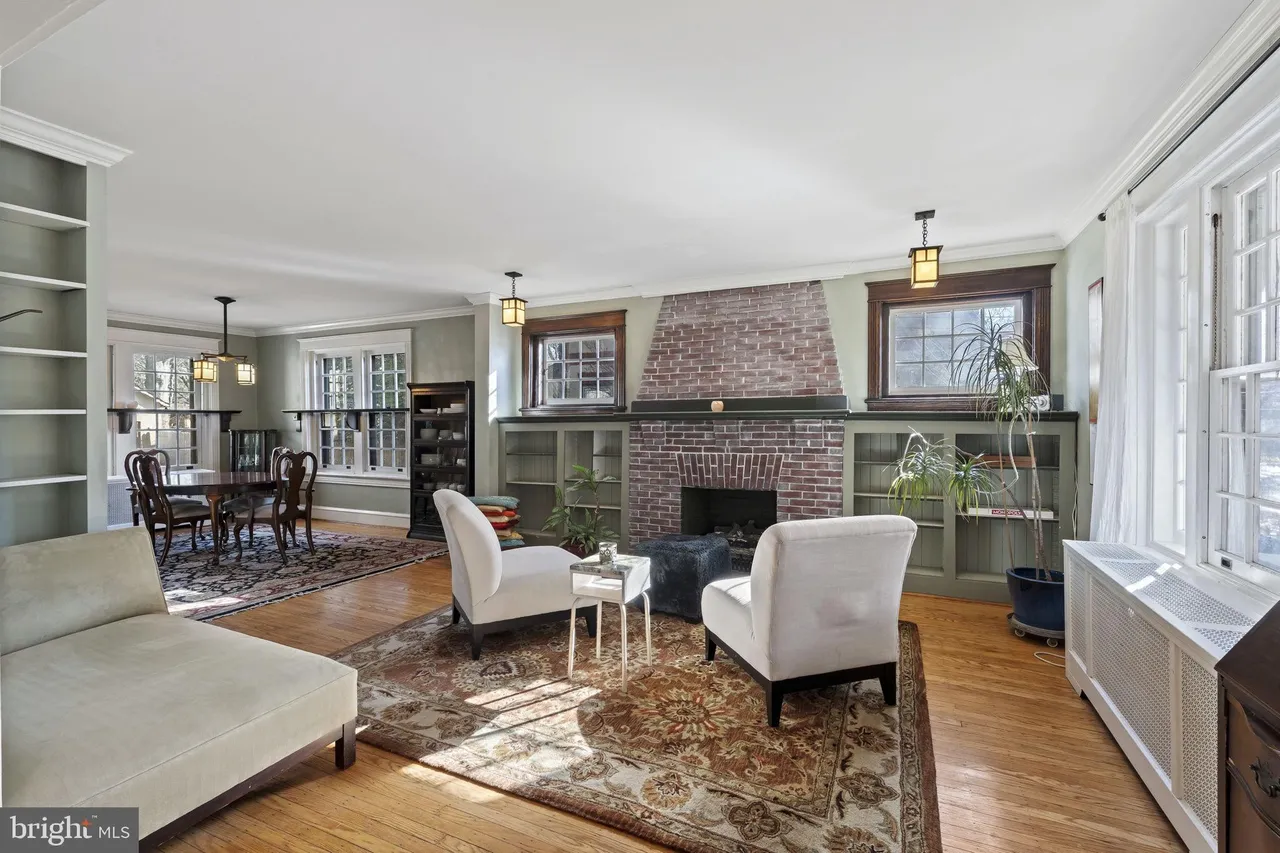
The living room has a brick fireplace and original hardwood floors.
Built in 1900, this Craftsman bungalow pays homage to its historic roots while incorporating modern upgrades. The first floor features a family room, a dining room, a living room with a brick fireplace, and a kitchen with a Viking range and green cabinetry. There are three bedrooms on the second floor, while the third floor contains the primary suite, which has a whirlpool tub and a skylight. The home also has a detached one-car garage and a fenced backyard. There’s an open house Saturday from noon to 2 p.m.
By submitting your written, visual, and/or audio contributions, you agree to The Inquirer’s Terms of Use, including the grant of rights in Section 10.
This suburban content is produced with support from the Leslie Miller and Richard Worley Foundation and The Lenfest Institute for Journalism. Editorial content is created independently of the project donors. Gifts to support The Inquirer’s high-impact journalism can be made at inquirer.com/donate. A list of Lenfest Institute donors can be found at lenfestinstitute.org/supporters.
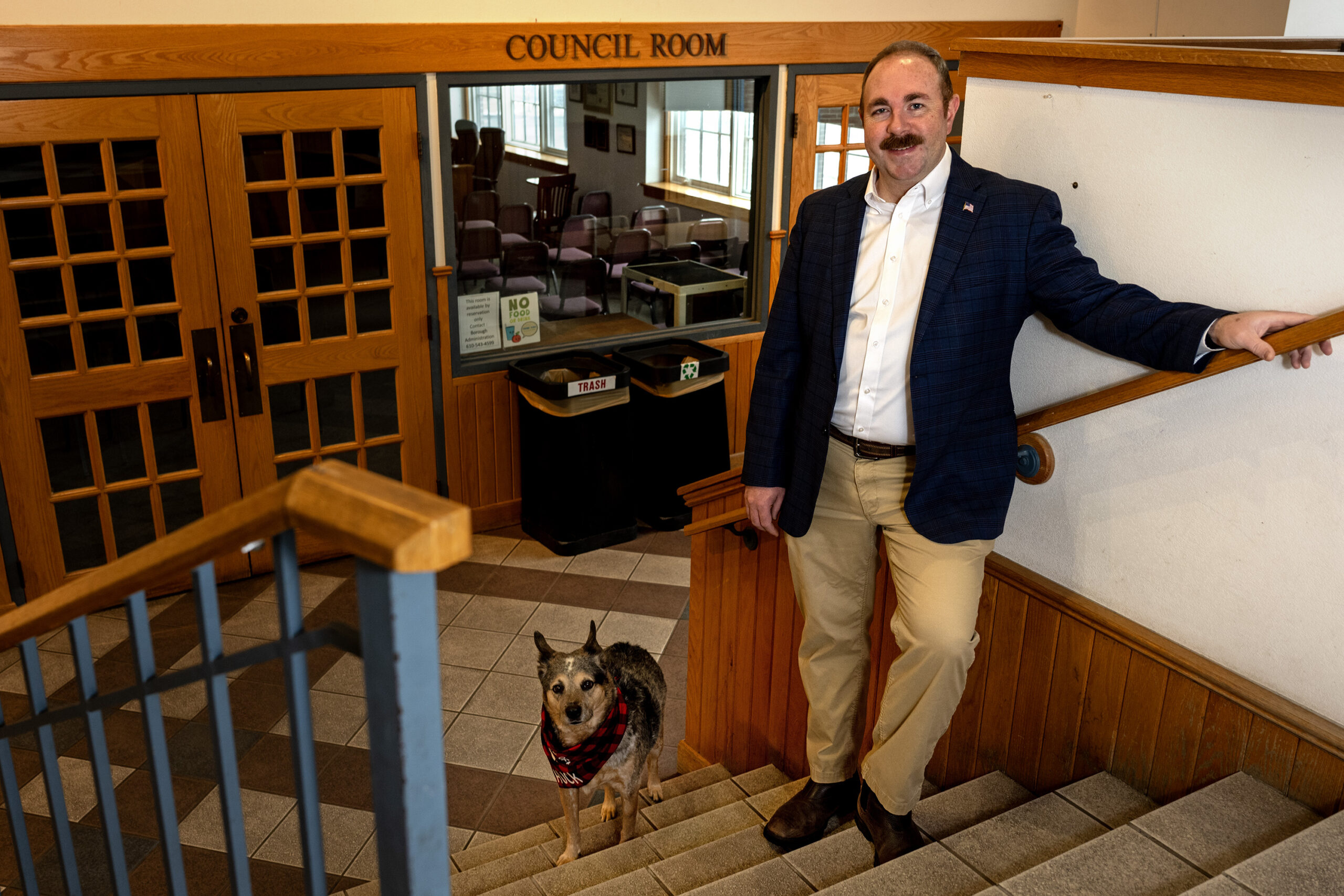
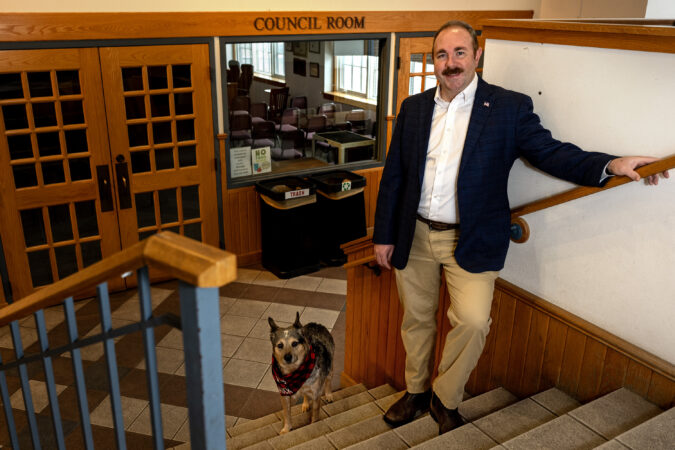
Conlen Booth doesn’t typically like to be in the spotlight.
Booth considers himself a “behind-the-scenes” guy who typically shies away from the limelight. Yet on Jan. 6, surrounded by friends, family, and colleagues, Booth was sworn in as Swarthmore’s mayor.
Booth, 42, brings more than two decades of emergency management experience to the job, including overseeing emergency services for major hospitals and governments. He’s also spent the past 25 years with Swarthmore’s fire department, most recently as chief. Booth is Delco-bred — a Nether Providence kid, a graduate of Strath Haven High School, and a cheerleader for his home borough of Swarthmore.
As the borough contends with the fallout of last year’s shuttering of Crozer-Chester Medical Center and Taylor Hospital, budget shortfalls, and potential fire department consolidation, Booth believes his background in emergency services and deep ties to Swarthmore make him the right guy for the job.
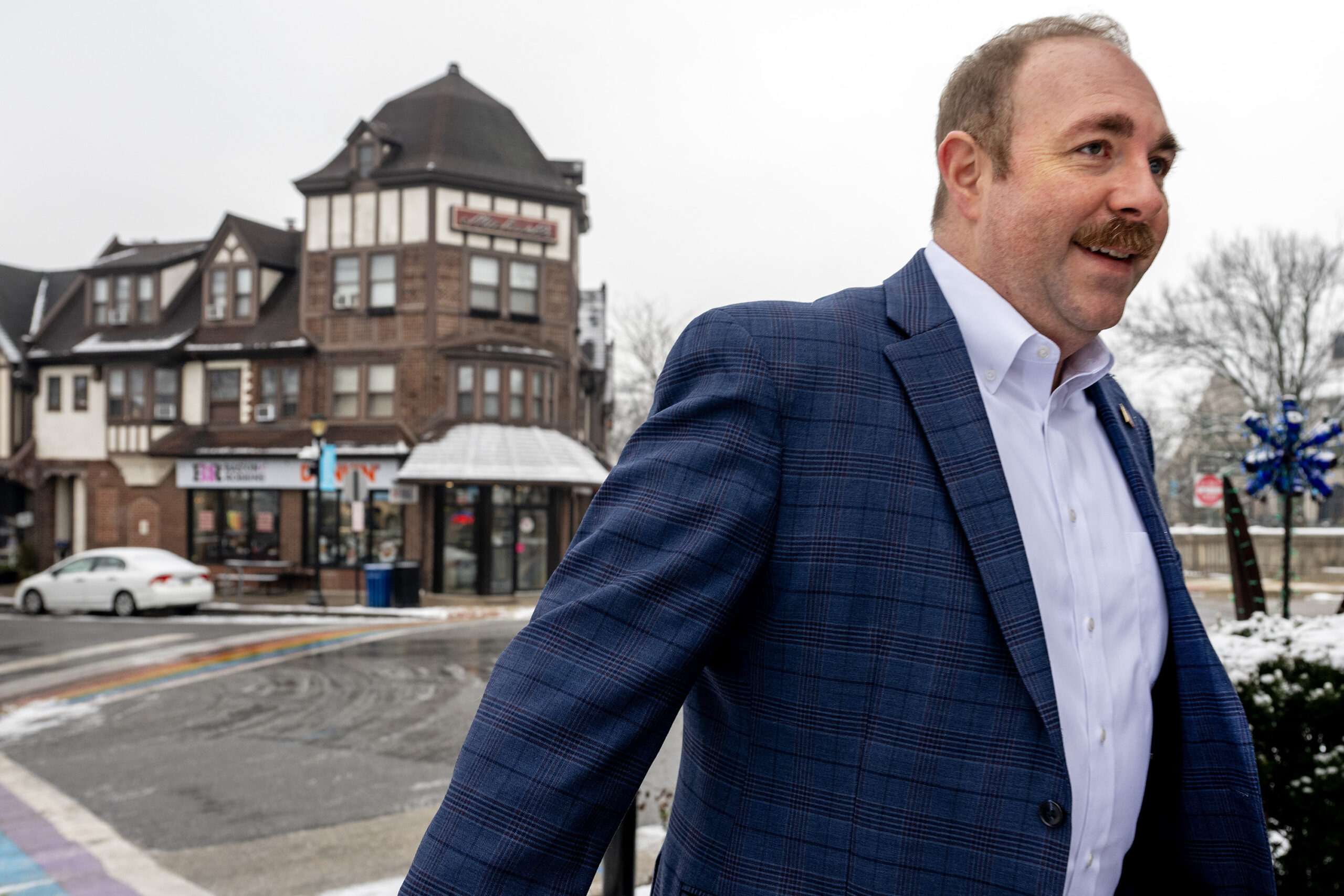
Mayor Conlen Booth in downtown Swarthmore on Sunday, Jan. 18, 2026.
‘If not me, then who?’
Booth got into local politics the way many do — reluctantly.
It took nudging from friends and family to step into the mayoral race. But the COVID-19 pandemic revealed a need for municipal leaders who understand emergency management and can govern in a crisis, Booth says.
An age-old phrase kept circulating in his mind: “If not me, then who?”
Booth competed against borough council members Kristen Seymore and David Boonin in the Democratic primary. Boonin dropped out of the race in January 2025. In February, the borough’s Democratic committee voted to endorse Booth’s candidacy 15-4, and Seymore dropped out.
The committee’s endorsement is powerful in Swarthmore. Democratic candidates who do not receive an endorsement are discouraged from running, and in the liberal-leaning town, there are seldom competitive general elections. Booth replaced Marty Spiegel, who had led the borough since 2019.
Who is Mayor Booth?
Booth was born in Harrisburg and moved to Delaware County at age 2. He grew up down the street from Nether Providence Elementary School and spent summers down the Shore with his close-knit extended family and collection of family dogs.
His maternal grandfather, Joseph Labrum, was a longtime judge and attorney in Media. Booth remembers visiting him in his chambers and watching him in the courtroom.
“I think seeing him in his role as a judge was always something that fascinated me,” he said.
Booth and his partner, Tracy, met working in healthcare and have been together for around 15 years. They live with Huckleberry, their Australian cattle dog.
Booth became interested in emergency services in high school. He set his sights on becoming a doctor and spent his teenageyears working on an ambulance.
Four days before he moved into his freshman dorm at the University of Pittsburgh, he watched a good friend die in front of him. The goal changed from enrolling in medical school to just making it through college.
“It just sort of rattled things,” he said.
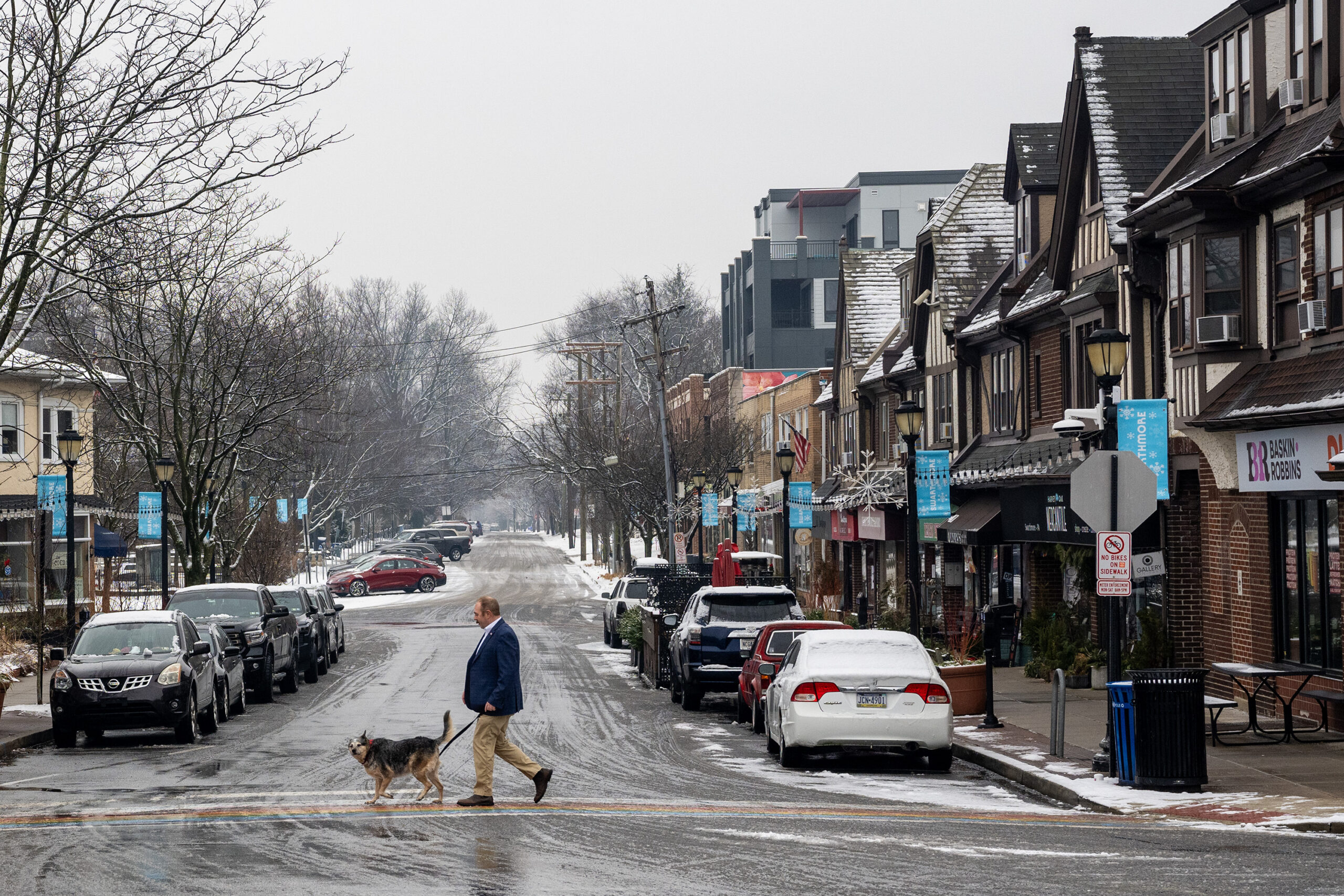
Mayor Conlen Booth with his dog, Huckleberry, in downtown Swarthmore on Sunday, Jan. 18, 2026.
Booth graduated from Pitt in 2005 with a bachelor’s degree in emergency medicine, an emerging field at the time. He earned his paramedic certification and learned the business-side of managing emergency medical teams.
He returned home and took a job with the now-shuttered Delaware County Memorial Hospital, his first role in what would become a long career in emergency medicine. In 2019, he was anemergency response shift supervisor at the Philadelphia Energy Solutions refinery during the massive explosion that left five people hurt and ended up shuttering the facility (Booth describes it as a “pretty insane period” in his life). Booth later spent four years as the senior director of emergency preparedness and emergency medical services at Crozer. He most recently worked as a consultant helping get supplies and meals to recently arrived refugees and asylum-seekers in New York City.
In tandem with his career in emergency management, Booth has served as a volunteer in Swarthmore’s fire department since 2000, working his way up from rookie firefighter to chief. Last year, hehelped developthe Advanced Life Support ambulance partnership with neighboring communitiesthat has filled gaps for residentsafter the Crozer closures.
Pat Francher, a longtime Swarthmore resident and community organizer, said Booth has the “awareness and perspective” that comes from a “real in-depth involvement in community welfare.”
“I’m terrible about saying no to people when they ask me to do something,” Booth joked.
This summer, Booth suffered a serious, non-work-related injury. He’s been in recovery since, and has come a long way.
“It could have been so much worse,” Booth said. “I have a lot to be thankful for.”
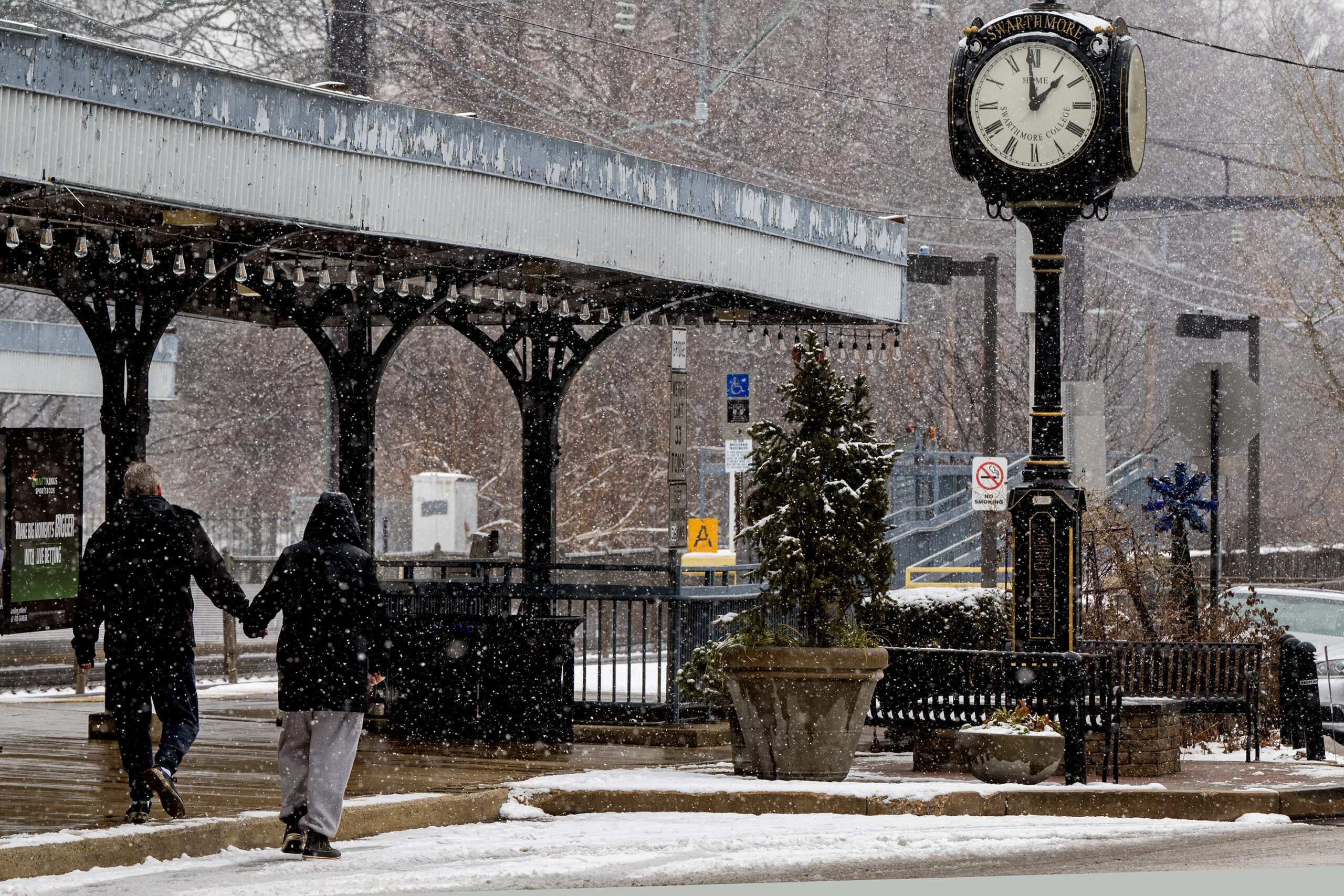
The SEPTA Regional Rail station in Swarthmore on Sunday, Jan. 18, 2026, during the second snowfall of the weekend. The station is between downtown Swarthmore and Swarthmore College and serves the Media/Wawa Line.
What’s next for Swarthmore?
Booth sees educating borough council about the community’s emergency medical needs as a large part of his job as mayor.
Jill Gaeski, borough council president, called Booth “the perfect guy” to help the 6,200-person borough navigate the challenges that lie ahead.
The shuttering of Crozer’s hospitals continues to impact access to medical care. At the same time, the Garden City (Nether Providence and Rose Valley), South Media, and Swarthmore fire companies are in discussions about a possible merger.
“[Booth] can really help us understand the pain points and where the sweet spots are,” Gaeski said.
Booth says he wants to be a cheerleader for the borough, bringing in tourism and economic growth in a way that maintains Swarthmore’s small-town feel.
He also hopes to reengage Swarthmore College’s student body, which he says has become less civically involvedas the years have passed.
“I already feel sentimental about this town,” Booth said, citing the people, restaurants, traditions, and community events that make his hometown special.
“How do we bolster all of these things and how do we engage more people?”
This suburban content is produced with support from the Leslie Miller and Richard Worley Foundation and The Lenfest Institute for Journalism. Editorial content is created independently of the project donors. Gifts to support The Inquirer’s high-impact journalism can be made at inquirer.com/donate. A list of Lenfest Institute donors can be found at lenfestinstitute.org/supporters.
Two Delaware County hospitals are getting $6 million in additional funding to help them address a sharp increase in patients after Crozer Health, the county’s largest hospital and busiest emergency department, closed last year.
About $5 million of the funding had previously been allocated to Crozer Health under a program that supports hospitals that care for a high portion of low-income patients with Medicaid. About $3 million of that money was redistributed to Riddle Hospital in Media; Mercy Fitzgerald Hospital in Darby $2 million. Local lawmakers secured an additional $1 million for Riddle.
“They really have stepped up to fill a big void, and we want to make sure they have the resources they need,” said Rep. Lisa Borowski, a Delaware County Democrat.
The additional funding will allow Riddle, part of the nonprofit Main Line Health system, to hire more staff, said Ed Jimenez, Main Line Health’s CEO.
When there aren’t enough nurses or other clinicians to cover the hospital’s needs, Riddle has had to turn to staffing agencies, which charge three to four times the rate Main Line pays staff providers, he said.
Main Line executives and local lawmakers marked the funding announcement at Riddle Wednesday with a check presentation ceremony and roundtable discussion about ongoing regional healthcare challenges.
Rep. Gina Curry, a Delaware County Democrat, urged hospital executives to continue trying to connect with patients who may be without doctors after Crozer was closed by its bankrupt for-profit owner, Prospect Medical Holdings, based in California.
Crozer-Chester Medical Center in Upland and its sister hospital, Taylor Hospital in Ridley Park, served a disproportionately low-income population in Chester and other densely populated communities outside Philadelphia with high rates of chronic health problems, such as asthma and heart disease.
“You’re working very hard inside here to try to help, but how are you including the community to let them know that Main Line Health is wrapping around them,” Curry said.