Tag: Isaiah Thomas

  • City Council members grill school district officials on plan to close 20 schools — and superintendent says he could have closed 40

    City Council members grill school district officials on plan to close 20 schools — and superintendent says he could have closed 40

    Philadelphia City Council may not have a vote on Superintendent Tony B. Watlington Sr.’s sweeping facilities plan, but it indicated Tuesday that it will have a say in school closings.

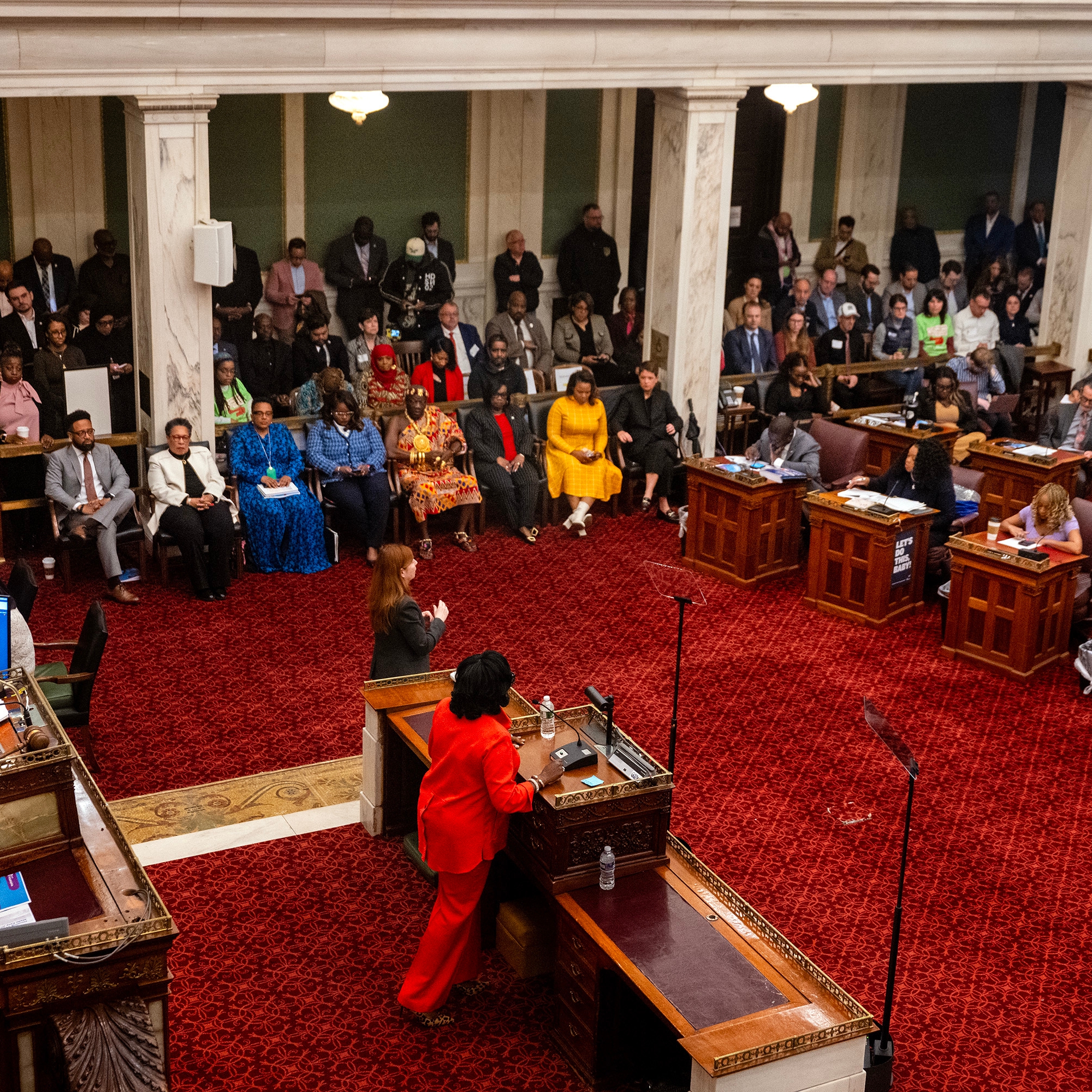
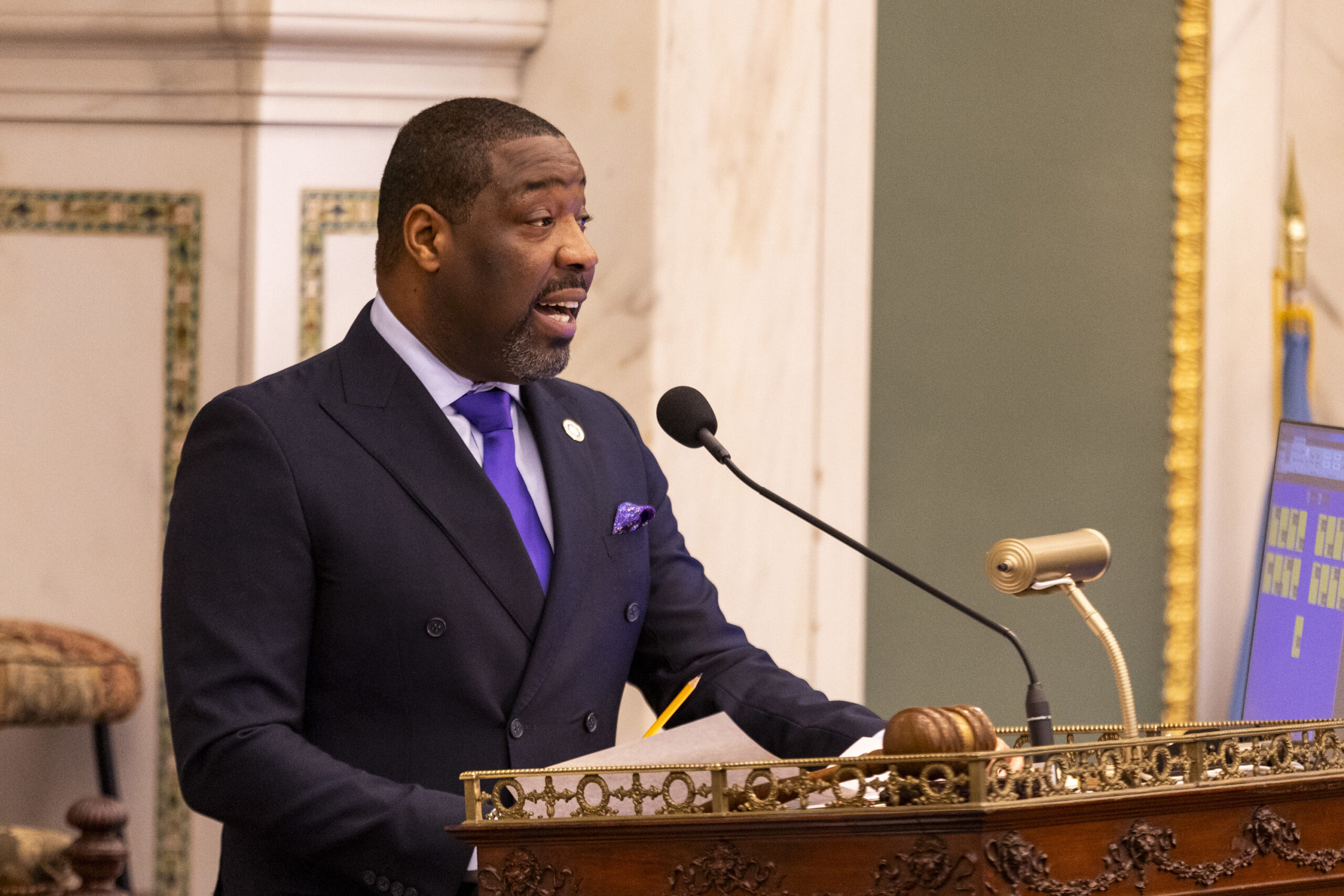
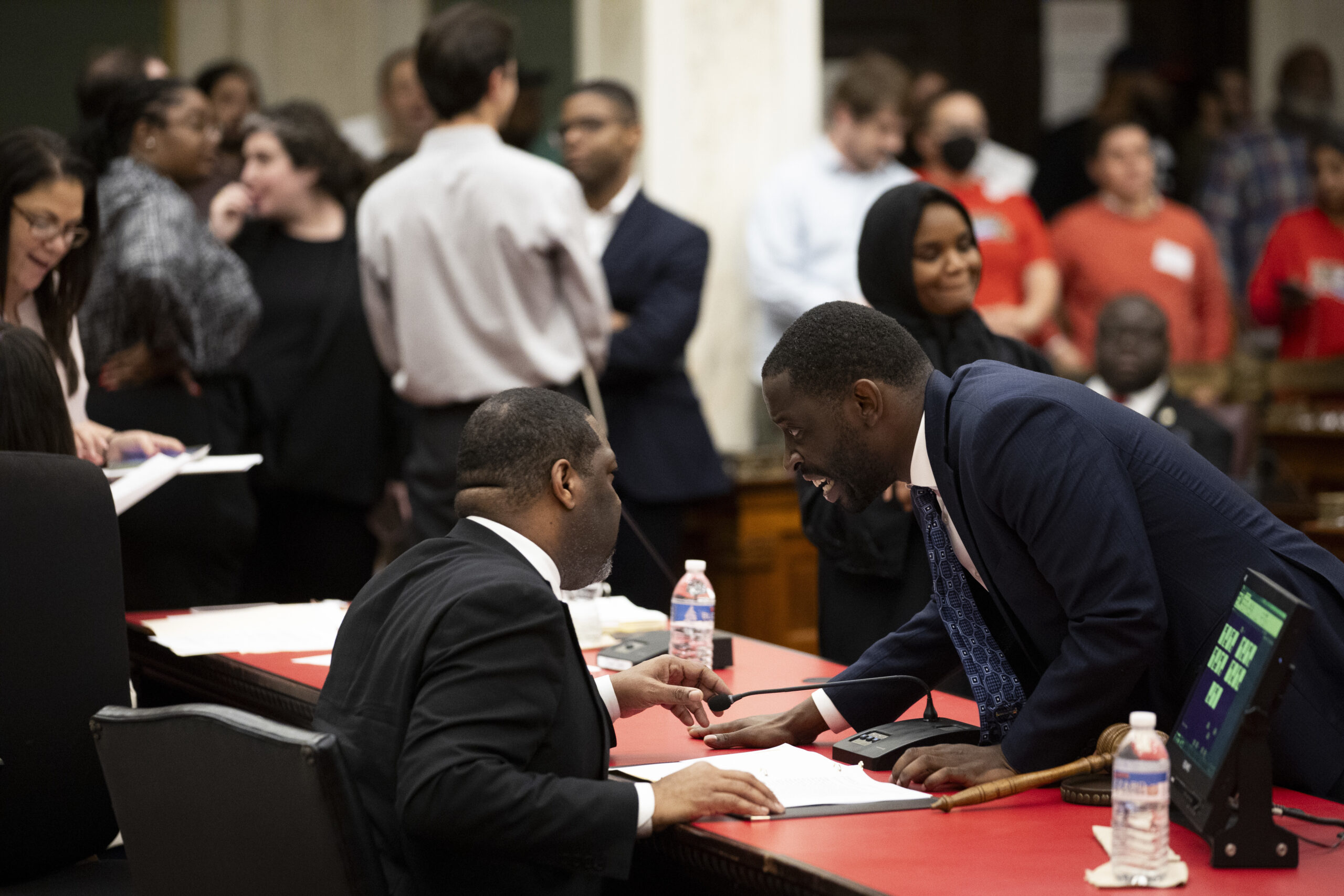
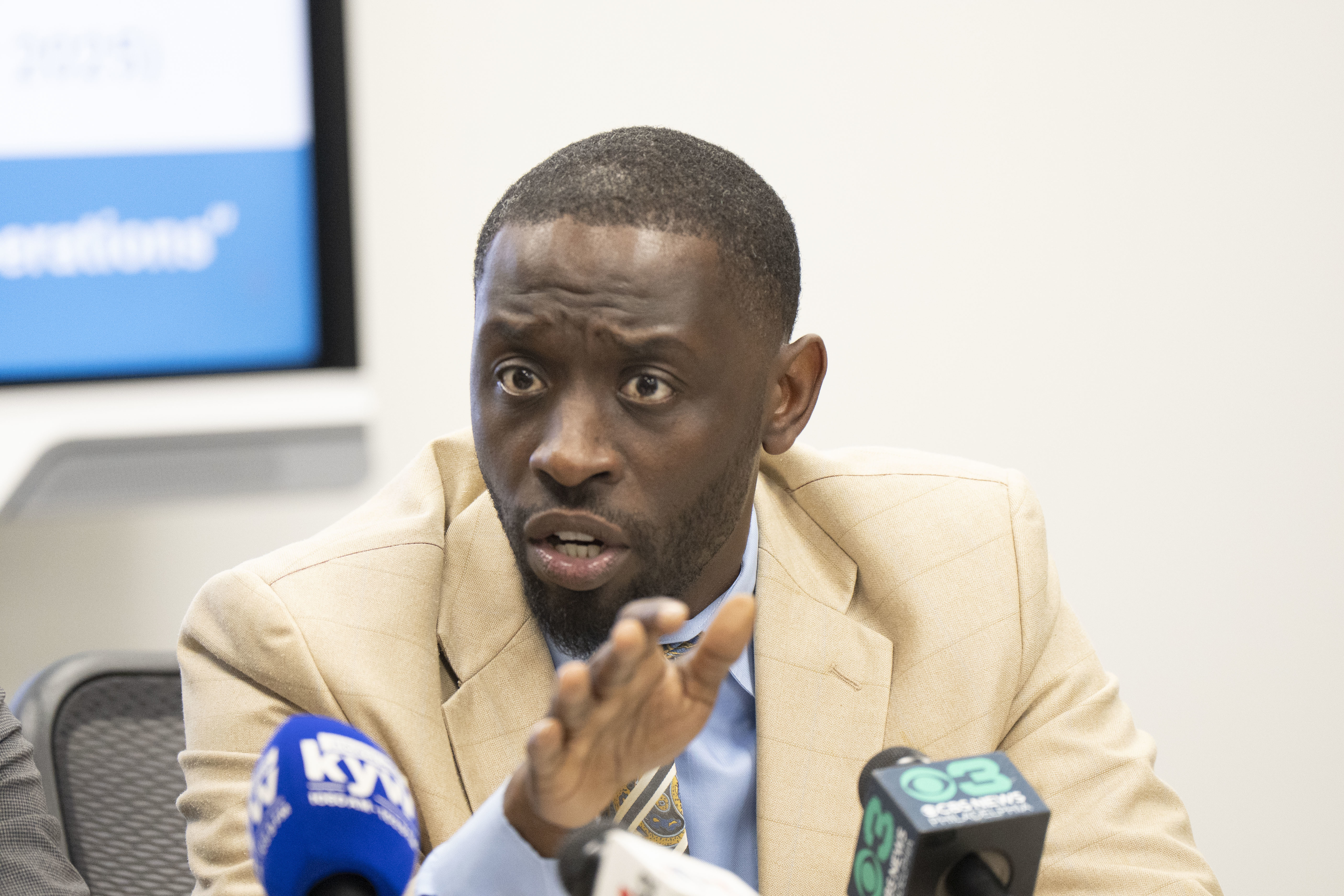
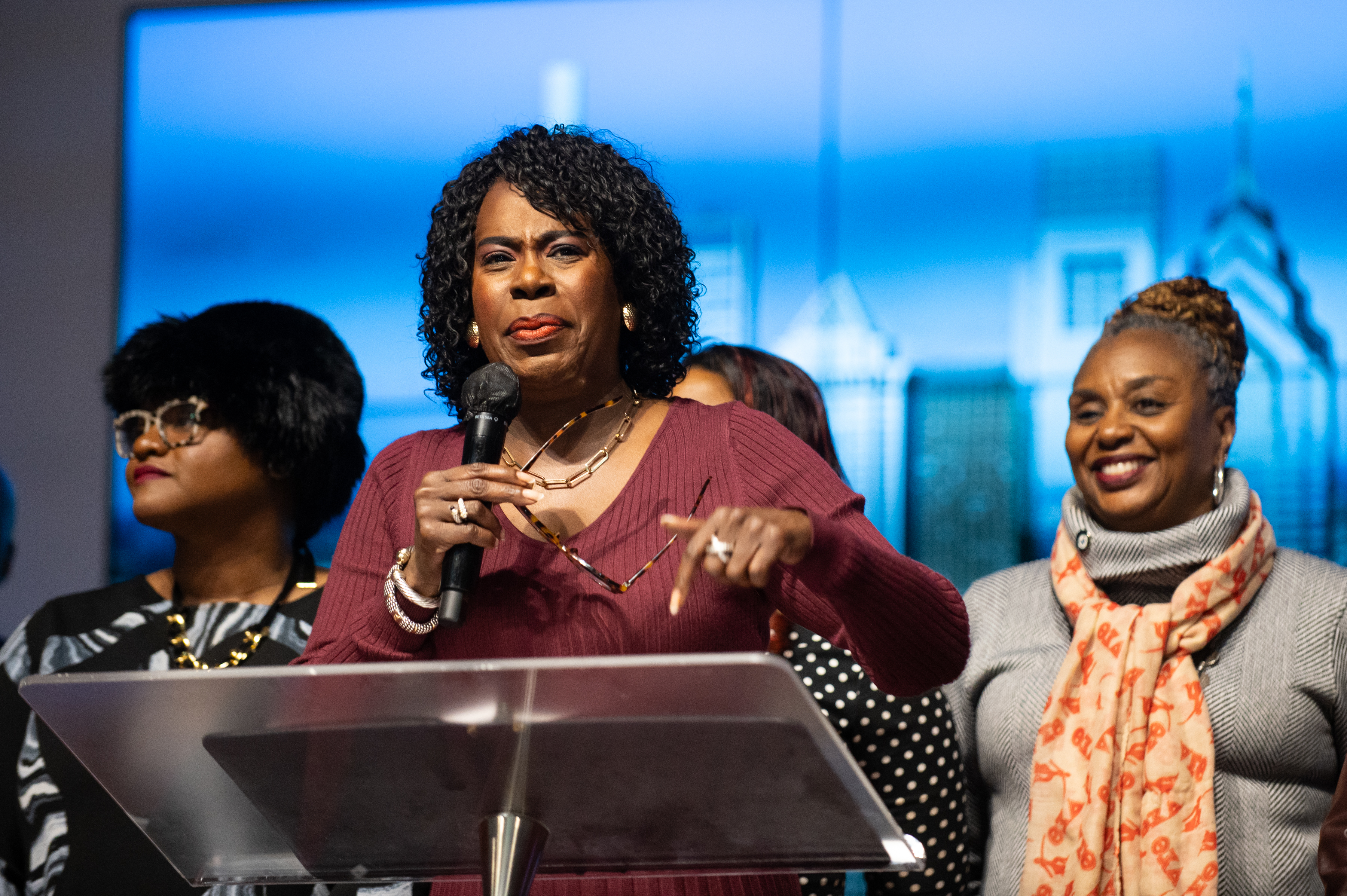
    As a packed hearing began in Council’s chambers Tuesday morning, both Council President Kenyatta Johnson and Isaiah Thomas, chair of the Education Committee, said Council refused to be a “rubber stamp” to Watlington’s proposal to close 20 schools, colocate six, and modernize 159.

    Though only the school board gets to vote directly on the plan, Johnson has indicated he is willing to hold up city funding to the district over the school closure plan. And his colleagues echoed that sentiment Tuesday.

    “I’m infuriated that we don’t get a say,” Councilmember Jimmy Harrity said, warning the district officials who appeared before him. “But, Council president, you and I both know we do get a say, because budget’s coming. And we will be looking. Mindful is the word I would use for today — be mindful.”
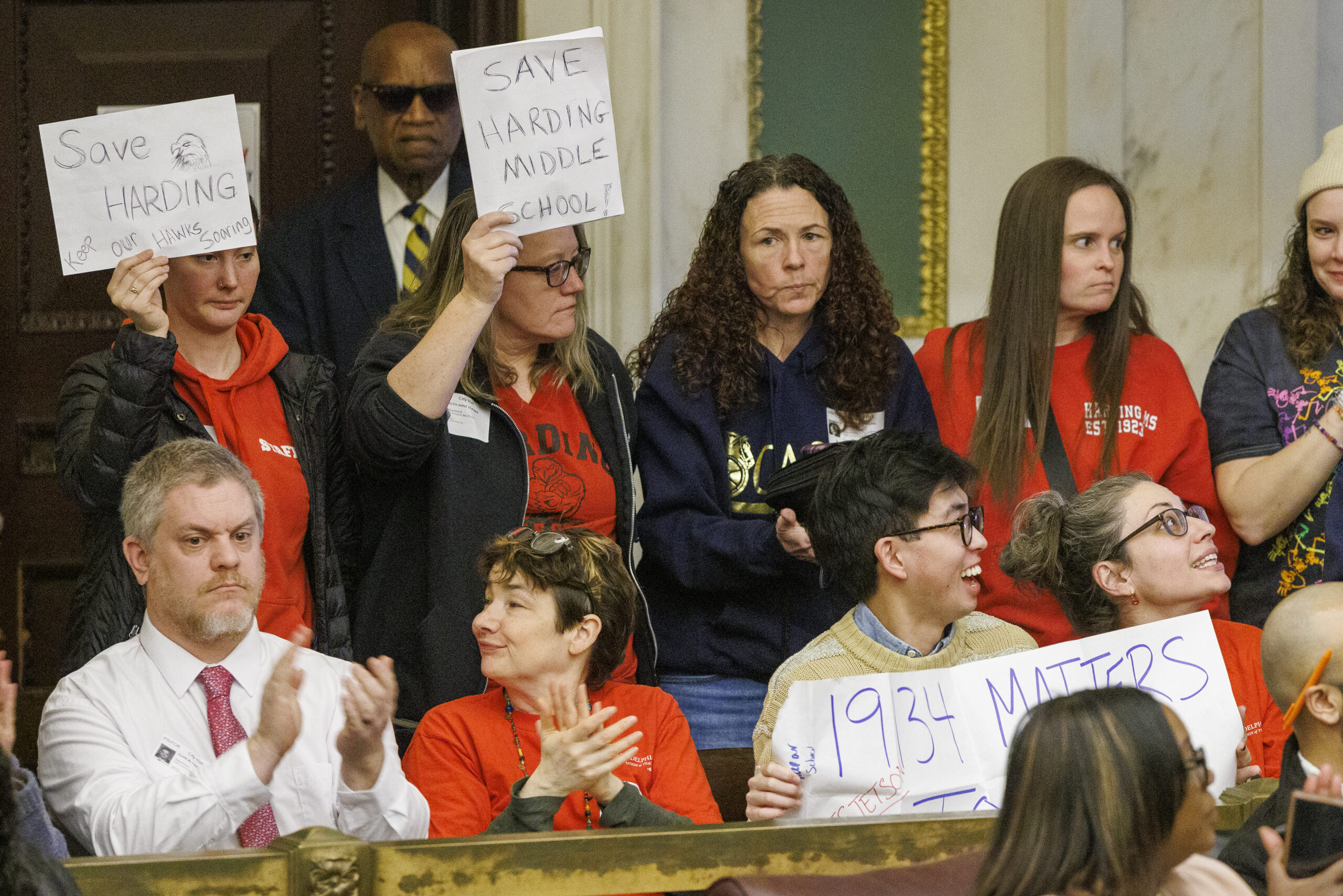
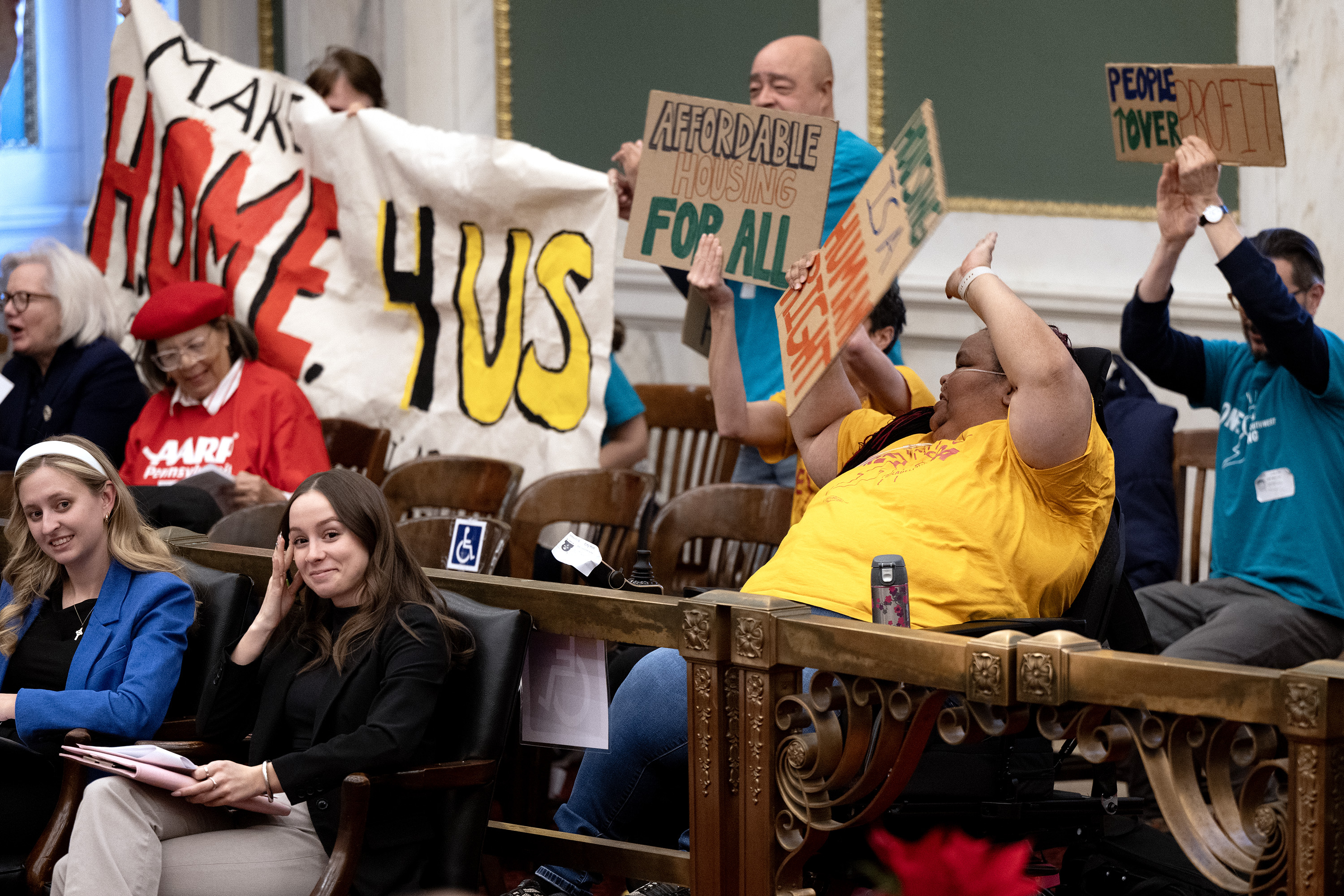
    Concerned citizens stand with signs in support of Harding Middle School before the start of a Philadelphia City Council hearing Tuesday at City Hall on the school district’s plan to close 20 schools.

    About 40% of the district’s nearly $5 billion budget comes from local revenue and city funding, which City Council and Mayor Cherelle L. Parker must approve in the annual city budget by the end of June.

    Harrity, an at-large Council member, said he was “tired that every time cuts come, they come from a certain neighborhood. You know, I live in Kensington, in the 7th District. I talk to these kids. They’re good kids. They deserve everything that other kids in other neighborhoods are getting. … You can see that this isn’t what our people want.” Watlington has proposed closing four schools in the 7th District.

    More than 100 community members holding babies and waving signs opposing the facilities plan filled Council chambers on the fourth floor of City Hall on Tuesday as Council members spent hours grilling Watlington and other district officials.

    Watlington, meanwhile, stood by his plan in testimony to Council on Tuesday, saying that 20 closings was a much smaller number than he could have settled on.

    “We could have come here and presented a plan that closed twice as many schools and been able to defend it,” Watlington said.

    A once-in-a-lifetime opportunity?

    District officials have said the facilities process is not about saving money, but about optimizing education and equity for the city’s 115,000 students.

    But it was clear Tuesday that finances played a part: The district has lost 15,000 students in the last 10 years, and over 80,000 since 1997, when charter schools were first authorized in Pennsylvania. It has 300 buildings, many of them 75 years and older and in poor repair, and some schools with more than 1,000 empty seats, while others are overcrowded.
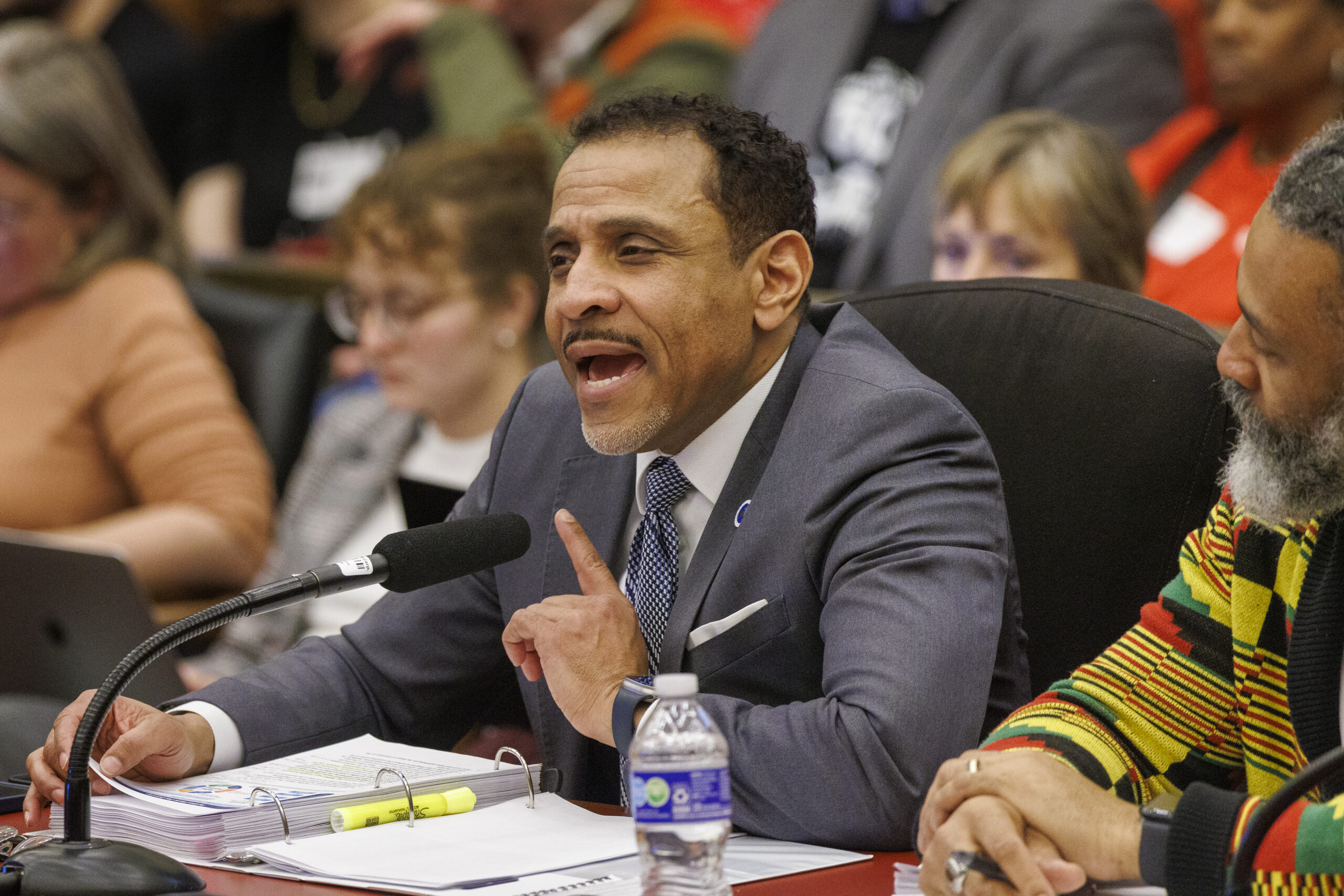
    Tony B. Watlington Sr., superintendent of School District of Philadelphia, speaks at a City Council hearing Tuesday on his proposal to close 20 schools.

    “We’ve got to be very careful with our limited resources in a historically underfunded district,” Watlington told Council.

    Watlington and board president Reginald Streater, who also testified, pitched the plan as a way to add things the district cannot now offer — Advanced Placement courses in every high school, the opportunity for all eighth graders to take algebra, more prekindergarten, and career and technical education programs.

    “I do not believe we’ll get this opportunity again in our lifetime,” Watlington said.

    The superintendent dropped a few previously undisclosed facts about the facilities road map, indicating that his recommendations could shift slightly before he presents the plan to the school board on Feb. 26. No date has been set for the board’s final vote, which is expected later this winter.

    “It’s premature to say how the final recommendations will land,” Watlington said.

    But, the superintendent said, “if there are schools that Council wants me to take off the list, and add others on that list, we are open to you telling me what those are, but we cannot get to a place where we address our 35% non-utilization rate in buildings if no changes are made.”
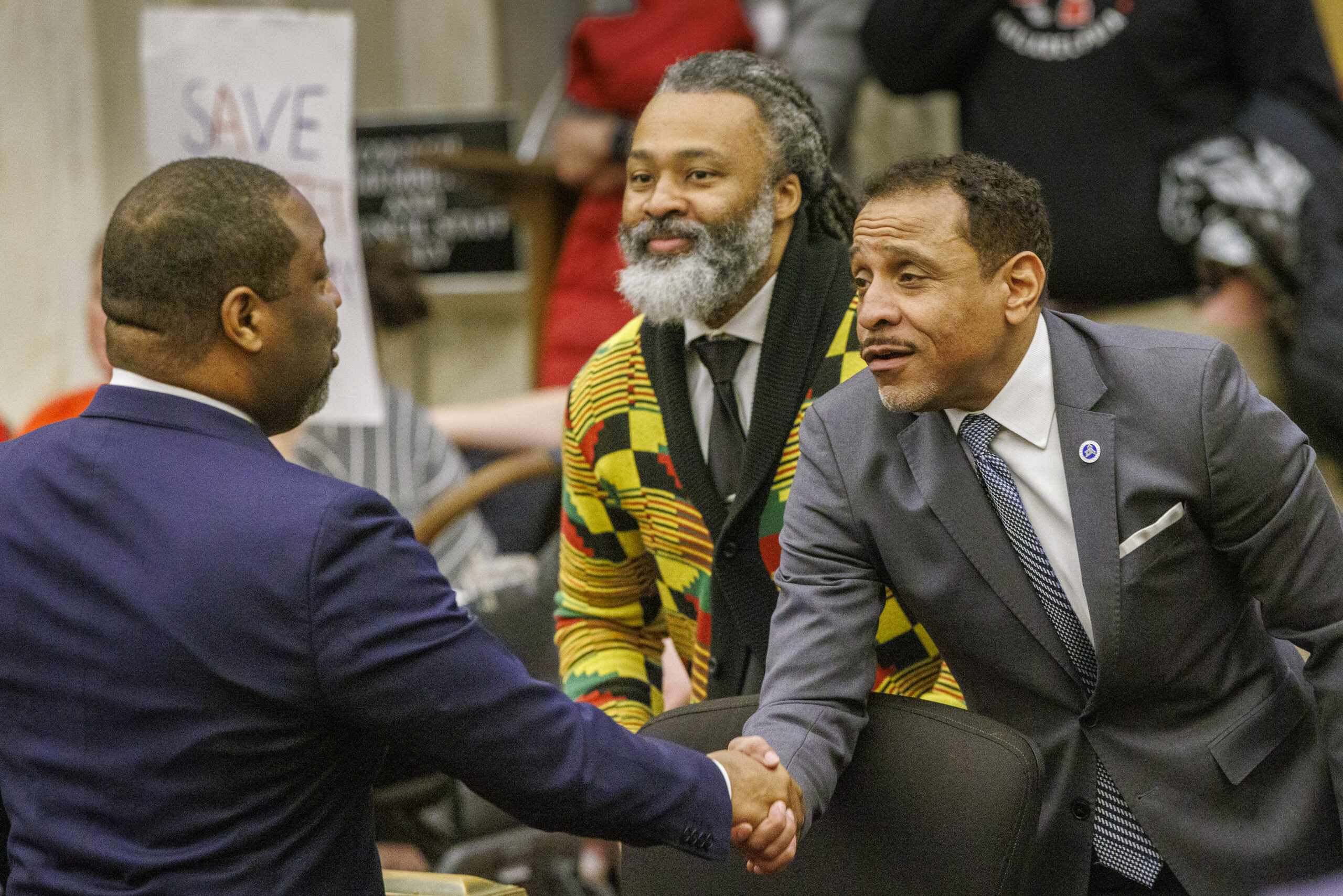
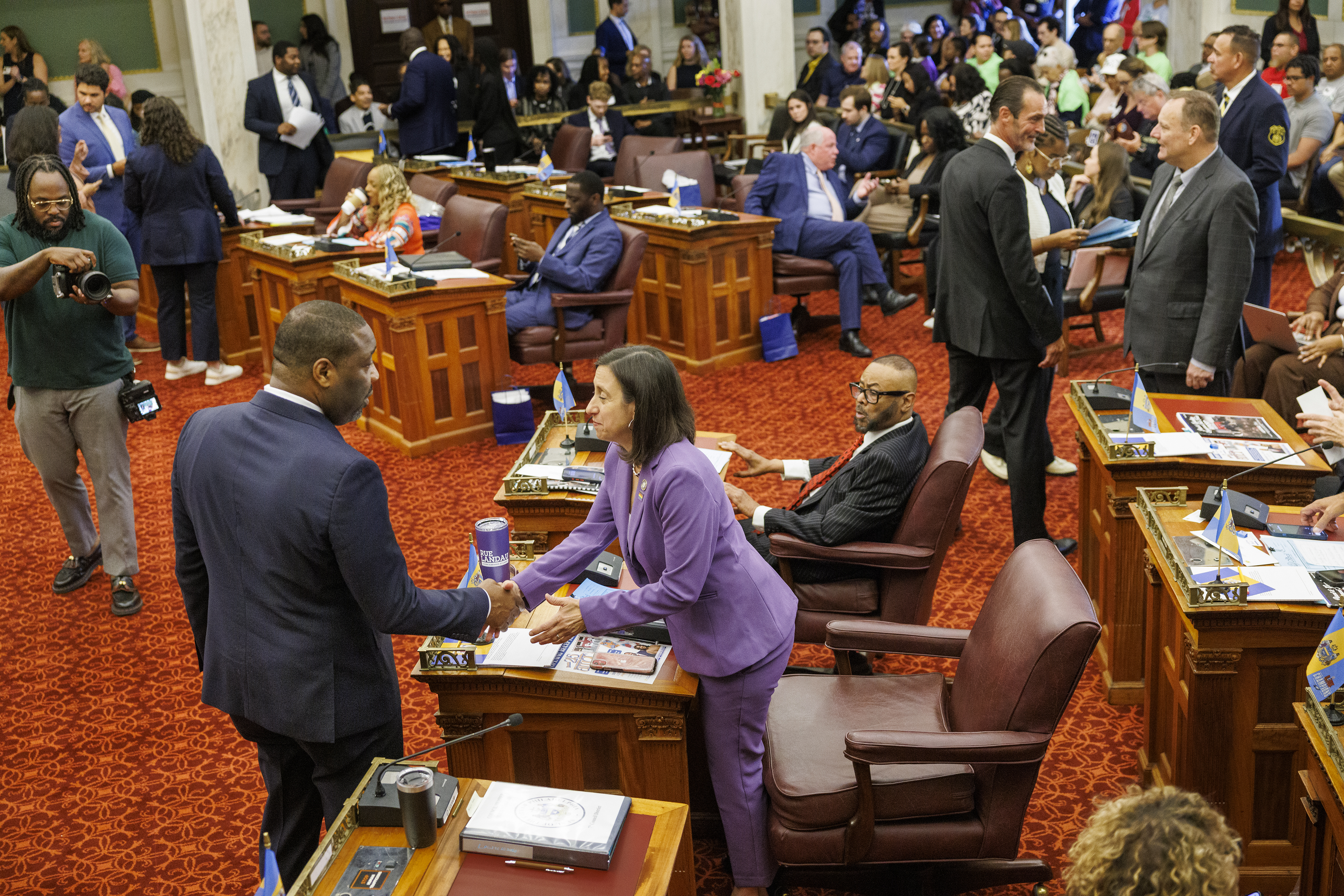
    Philadelphia City Council President Kenyatta Johnson (left) greets Dr. Tony Watlington, Superintendent of School District of Philadelphia Philadelphia City Council holds hearing with board members of School District of Philadelphia, Tuesday, Feb. 17, 2026. Reginald L. Streater, Esq., President Board of Education. (center)

    Debora Carrera, the city’s chief education officer, who spent three decades as a district teacher and administrator, told Council that Parker believes “the current district footprint is unsustainable.”

    Carrera said her own experience as principal of Kensington High School for Creative and Performing Arts shows that it is right for the district to focus resources on neighborhood high schools.

    “My high school was a small high school,” Carrera said. “I could only offer my children two AP courses, when other schools like Central — where my son went — could offer them over 20-plus AP courses.“

    ‘Breaking down of public education’

    The hearing got tense at times.

    “I feel like this is the breaking down of public education in Philadelphia,” said Councilmember Cindy Bass, who said some of the district’s own decisions had led to closures.

    Several members of Council raised questions about the plan’s price tag. Prior district and city estimates put the cost just under $8 billion, but members of Watlington’s team said they could they could actually do the work for $2.8 billion — $1 billion from district capital funds, and $1.8 from yet-unpromised state and philanthropic sources.

    In the past, the district had made public detailed facilities condition assessments for every school in the district, Councilmember Rue Landau noted.

    Residents could look up their school and see exactly what the condition of every system in the building was, and how much money would be required to fix those that needed repair.

    “We don’t have any of those details,” said Landau, who went so far as to say she believed the district should be spending more than $2.8 billion on the plan. “What is the increased investment, and why don’t we have any of those details? They are not out there in the public for us, so none of us have any understanding as to why this is happening, This should all be public so all of the public can see.”

    Jerry Roseman, the Philadelphia Federation of Teachers’ longtime environmental director, who has had a first-row seat to district facilities conditions for decades, said he believed the $2.8 billion figure was not realistic.

    “You need much more money than that,” Roseman told Council. “We need more money than this plan comes close to.”

    Some Council members pushed the district and the board on the plan’s timing.

    The city has been asking for a long-range facilities plan for years, Councilmember Quetcy Lozada pointed out.

    “It’s taken us all this time,” Lozada said. “Now, you guys have come up with a plan, and now we want to rush through it. Now all of a sudden there’s this urgency to get through this plan, which I don’t understand.”

    Streater said the board is moving forward with hearing Watlington’s plan on Feb. 26, but won’t vote until it hears more feedback.

    But ultimately, he said, the board will vote on “a plan that is dynamic, that can evolve over time. … I think that we all understand that things change, facts change, funding changes, enrollment trends change.”

    And, Streater said, there will also likely be policy changes based on redrawing some catchment areas, or boundaries that determine which neighborhood schools children attend.

    Streater, who introduced himself at the beginning of the hearing as “Reggie from Germantown,” underscoring his history as a graduate of two district schools that closed — Germantown High and Leeds Middle School — said that changes must be made.

    “I think if we continue doing the same thing, expecting a different result — which I would argue is chronic underachievement — we are doomed.”
  • Cameras will soon enforce speed limits in five Philly school zones

    Cameras will soon enforce speed limits in five Philly school zones

    Philadelphia drivers are about to get a new incentive to obey the flashing caution lights and 15 mph speed limit near schools.

    On Tuesday, the Philadelphia Parking Authority plans to turn on automated speed-enforcement cameras in five school zones, targeted because they have had a relatively high rate of crashes. All are on major roadways.

    Violators will get warnings until April 20, when the cameras start enforcing the law. Driving 11 miles faster than the school-zone speed limit will carry a $100 fine.

    “The goal is to protect students,” said Rich Lazer, executive director of the PPA. “Speed cameras work. They reduce dangerous behavior.”

    Roosevelt Boulevard has seen a 95% reduction in speeding violations and a 50% reduction in pedestrian-involved crashes since cameras went up in 2020.

    The high-priority school zones were selected based on an analysis of Pennsylvania Department of Transportation crash data by the Philadelphia Office of Transportation and Infrastructure Systems.

    From 2019 through 2023, the five locations recorded 10 crashes in which a person was killed or seriously injured, and 25 pedestrian crashes, as well as several speed-related vehicle-on-vehicle crashes, the PPA said. (Victims included people of all ages; it was not clear how many were students.)

    (function() {
    var l2 = function() {
    new pym.Parent(‘SKLZONECAMS’,
    ‘https://media.inquirer.com/storage/inquirer/projects/innovation/arcgis_iframe/SKLZONECAMS.html’);
    };
    if (typeof(pym) === ‘undefined’) {
    var h = document.getElementsByTagName(‘head’)[0],
    s = document.createElement(‘script’);
    s.type = ‘text/javascript’;
    s.src = ‘https://pym.nprapps.org/pym.v1.min.js’;
    s.onload = l2;
    h.appendChild(s);
    } else {
    l2();
    }
    })();

    “We have tried many traffic-calming methods to stop people from driving dangerously fast in school zones, but many drivers still speed,” said Michael A. Carroll, a deputy managing director for the city who is in charge of OTIS.

    “Speeding is the No. 1 cause of fatal crashes,” he said. The cameras will protect students walking to and from school, as well as crossing guards, “who often put their lives at risk,” Carroll said.

    Automated speed enforcement remains controversial, despite studies that show it is effective, particularly on major urban roadways like the Boulevard.

    The cameras are also popular in dense cities.

    Recently, the Trump administration’s Department of Transportation restricted cities from using federal road safety grants for cameras that enforce speed limits and other traffic laws, unless they are in work or school zones.

    The Pennsylvania legislature, historically skeptical of automated enforcement, in 2024 gave Philadelphia permission to use school-zone cameras through Dec. 31, 2029, on a trial basis.

    There was some hesitation last March when City Council considered an ordinance to authorize the cameras. Three members held up the measure in committee, expressing concerns about a “money grab by the city.” The members also said they did not have enough information about the bill.

    After they met with Councilmember Isaiah Thomas, the chief sponsor, the legislation was enacted.

    “Everybody thinks it’s a money grab, but it’s really not,” Lazer said. “Resources are stretched; police are dealing with a lot of things. … If we can use technology, and it works, why not? Don’t speed, and you won’t get a violation.”

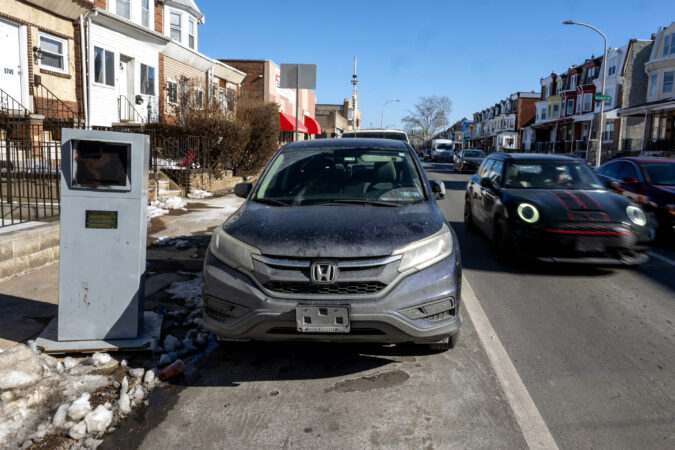
    Unlike the speed cameras on the Boulevard and those along 13 miles of Broad Street since November, the school-zone units deployed by the PPA are squat and at street level.

    Some people say they look like mailboxes or small refrigerators.

    They are meant to be portable, PPA officials said, so that cameras can be moved to other schools with problems, as long as they are operating in only five school zones at any one time.

    That limit is fixed by state law. Cameras can operate only when school zones are active, meaning weekdays when students are arriving in the morning or departing in the afternoon.

  • This beloved Kensington middle school just celebrated its 100th year. It may not be open much longer.

    This beloved Kensington middle school just celebrated its 100th year. It may not be open much longer.

    Russell H. Conwell Middle School celebrates its 100th anniversary this year.

    It may not remain open to see many more.

    The Philadelphia School District has proposed closing Conwell and 19 other schools as part of its facilities planning process, which will shake up schools citywide.

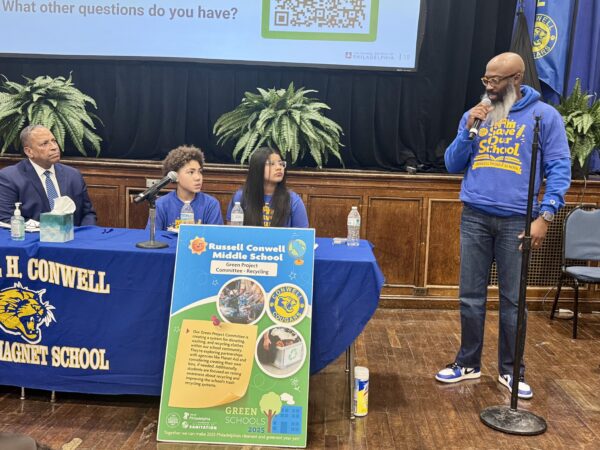
    A student-made sign hangs in the Conwell Middle School auditorium. The Philadelphia School District is attempting to close Conwell, a magnet 5-8 school in Kensington, and 19 other schools. The community is fighting the closure.

    Conwell, in Kensington, is a very small school by any standard. This year, just 109 students are enrolled in a building that holds 500. That’s down from 490 students in the 2015-16 school year and 806 in 2009-10. The school used to occupy two buildings; it has since shrunk to one.

    But it is also a rarity — a standalone magnet middle school. Community members and local officials are mounting a fight against closing the school, which they say has committed teachers and staff members who help students excel against the odds.

    The district’s plan, which the school board is expected to vote on this winter, calls for Conwell students to move to AMY at James Martin, another citywide admissions magnet in Port Richmond, which just opened in a new building with only 200 students. Meanwhile, the district has proposed closing its only other free-standing magnet middle school, AMY Northwest. No changes have been proposed for Philadelphia’s four other magnet middle schools, all of which are attached to high schools.

    Neighborhood issues, enrollment declines

    Conwell’s enrollment issues are tied closely to its setting.

    The building sits on Clearfield Street in the heart of Kensington. Fewer and fewer parents have been choosing to send their kids into ground zero of the city’s opioid epidemic, despite Conwell’s myriad partnerships, the outside investments it has attracted into its facility in recent years, and the school’s long history of excellence.

    The exterior of Conwell Middle School in Kensington, photographed in August.

    Parents, neighbors, students, and politicians, however, are furious that the district is choosing to abandon Conwell and the neighborhood.

    “If this school closes, it won’t just be students who feel the loss,” Conwell student Nicolas Zeno told officials at a district meeting Thursday. “It’ll be the community. If the concern is safety, then invest. If the concern is environment, then repair.”

    Community member Vaughn Tinsley, who runs Founding Fatherz, a nonprofit mentoring group, suggested closing Conwell would harm its students.

    “These students have been victims,” Tinsley said. “These students have seen and witnessed things they shouldn’t have witnessed. Most adults haven’t seen some of the things that these kids have seen, and yet still they come here, yet they’re still committed to excellence, yet they still stand up and still do what they’re supposed to do in the classroom. How dare we take that away from them?”

    Watlington has proposed using Conwell as “swing space” — district property that other schools can move into temporarily if their buildings require repairs.

    Tosin Efunnuga, Conwell’s nurse, wiped tears from her eyes as she beseeched district officials to keep the school open.

    “To have those doors close would be such a disservice,” Efunnuga said. “We need 100 years more.”

    Councilmember Quetcy Lozada, whose district includes Conwell, said she was “angry” and “frustrated” by the recommendation to close the school.

    “It’s underutilized because of what’s happening on the outside,” Lozada said at the Conwell meeting. “There’s nothing wrong with what is happening on the inside other than successful academic learning, support for families. We are saying to these families, we are punishing them because as a city, we can’t respond to the public safety issues that we have on the outside, and that is just not fair.”

    ‘What are y’all doing?’

    Emotions ran high inside the Conwell auditorium last week.

    Even before Deputy Superintendent Oz Hill finished his presentation about the rationale for the closures and the specific plan for Conwell, parents burst out with concerns.

    “What are y’all doing? Y’all making a mess,” one parent shouted. “You say the building is old. So what? It’s clean in here.”

    Another said her child would not be going to AMY at James Martin, formerly known as AMY5.

    “I don’t think you understand how much of a battle there is between Conwell and AMY5,” the parent said. “You don’t know the battles these kids have with each other.”

    Conwell has a strong alumni network — a rarity for a middle school — that has turned out in force to support the school since the proposed closure was announced.

    Alexa Sanchez, Class of 2017, grew up in Kensington and came to Conwell as a bright but unruly student — she acknowledges that she got in fights, egged the school, and disrespected teachers. But Conwell is rooted in its neighborhood, Sanchez said, with dedicated staff who helped her rise to earn a college degree and a good job in business.

    “They didn’t give up on students like me,” Sanchez said. “My future didn’t look promising at first, but in the long run, it did. You shouldn’t really close the school on a community that doesn’t look promising if you’re not from here.”

    Other alumni, including Robin Cooper, president of the district’s principals union, and Councilmember Isaiah Thomas, chair of Council’s Education Committee, have spoken out for Conwell.

    Conwell “shows up” for Kensington and the city, running a food pantry, hosting Police Commissioner Kevin Bethel’s swearing-in ceremony and an event marking Cherelle L. Parker’s 100th day as mayor, noted Erica Green, the school’s award-winning principal. Staff and students participate in neighborhood cleanups and advocate for help amid the opioid crisis.

    “We are what the city needs,” Green told the school board recently. During Green’s tenure, she has helped win money for a new schoolyard, a new science, technology, engineering, and math lab, and more.

    “These investments were made for Kensington students,” Green said. “We owe it to them, to their neighborhood. Do not push them out once the neighborhood changes and thrives. Conwell’s success is rooted in its people, its history, and its impact.”

    Mayor Cherelle L. Parker speaks during an event to mark her 100th day in office at Conwell Middle School in Kensington in April 2024.
  • Mayor Cherelle Parker’s housing plan is back on track after Council again reapproved $800 million in city bonds

    Mayor Cherelle Parker’s housing plan is back on track after Council again reapproved $800 million in city bonds

    Mayor Cherelle L. Parker’s housing initiative is back on track.

    In its first meeting of the year, City Council on Thursday reapproved a bill to authorize the administration to issue $800 million in bonds to fund the Housing Opportunities Made Easy, or H.O.M.E., initiative.

    Parker wasted no time, signing the bill into law at a news conference Thursday afternoon to fast-track the process for the city to sell the first $400 million tranche of bonds in late March or early April. The administration plans to sell the second $400 million in 2027.

    “We are signing into law the largest and most significant investment in housing in the city of Philadelphia’s history, a $2 billion plan that will create and preserve 30,000 units of housing here in the city of Philadelphia,” Parker said, citing a sum for H.O.M.E.’s budget that also includes other funding steams and the value of city-owned land the administration hopes to redevelop into housing through the plan.

    In March 2025, when Parker unveiled her housing plan — with the goal of helping the city build or preserve 30,000 units of housing in her first term — she wanted to issue the bonds that fall. Council initially approved the bond authorization and other legislation related to H.O.M.E. in June.

    But in the fall, lawmakers made significant changes to a related piece of legislation — which details the $277 million first-year budget for spending the bond proceeds — that triggered a redo of the bond bill.

    The most notable changes, championed by progressive Councilmembers Jamie Gauthier and Rue Landau, lowered the income thresholds for some of the programs funded by H.O.M.E. to prioritize lower-income Philadelphians.

    Mayor Cherelle L. Parker unveils her long-awaited plan to build or preserve 30,000 units of housing during a special session of City Council Monday, Mar. 24, 2025. Council President Kenyatta Johnson is at left.

    Parker opposed the amendment, and administration officials testified that H.O.M.E. was meant to serve residents at a variety of income levels, including middle-class households that are struggling but often make too much to qualify for government support programs.

    But Council members argued that even with the new infusion of funds, Philadelphia’s resources are too limited to help the city’s hundreds of thousands of impoverished residents — let alone aid middle-income residents as well.

    “City Council demonstrated through its actions — not just its words — that it’s serious about putting City Hall to work for communities that have too often been left behind,” Gauthier, Landau, and their allies said in a group statement Thursday.

    The dispute proved to be the most significant public disagreement to date between Parker and Council President Kenyatta Johnson, who sided with Gauthier and Landau.

    The changes required Council to pass an updated bond authorization before moving forward because the previously adopted version no longer aligned with the language in the budget resolution. Lawmakers ran out of time to pass the new bond bill before adjourning for their winter break in December.

    They approved it unanimously on Thursday.

    A couple of hours later, Johnson and Parker profusely praised each other at the bill-signing ceremony, going out of their way to show that their strong working relationship remains intact now that the conflict was behind them.

    “My commitment is to make sure that our 100th, first woman, mayor is successful,” Johnson said.

    The moment of congeniality was a stark contrast to the dynamic between the two late last year.

    Parker at one point said Council’s delay “means homes are not being restored” and “homes are not being built or repaired.” Johnson fired back, “Council’s responsibility is not to rubber-stamp legislation.”

    City Council President Kenyatta Johnson speaking at the City Council’s first session of the year in Philadelphia, Pa., on Thursday, Jan. 22, 2026.

    But on Thursday, there was enough feel-good energy between the mayor and Council that it extended beyond Johnson to members who have more frequently clashed with the administration.

    Gauthier and Councilmember Isaiah Thomas, who questioned the mayor’s agenda last year over concerns that she was taking out too much debt for housing, also stood alongside the mayor at Thursday’s news conference.

    After the delays to her agenda at the end of last year, the mayor appears to be trying to regain control of the narrative this week. Thursday’s bill-signing ceremony marked Parker’s third major update related to H.O.M.E. in three days.

    On Tuesday, she announced that her administration was partnering with the city’s building trades unions and the Philadelphia Housing Authority to redevelop the Brith Sholom House, a notoriously dilapidated senior facility that closed in 2024, into affordable housing for seniors.

    And on Wednesday, she laid out a vision to build a modular housing manufacturing facility on the long-vacant Logan Triangle tract in North Philadelphia. The city issued a request for information from developers potentially interested in building such factories in the city, with a deadline in late March.

    Parker on Thursday only indirectly responded to a question about how many units could be built or repaired in the two years left in her term.

    But she said that her administration is working on a second package of zoning legislation to accelerate home construction in Philadelphia, and that she is working with Council to speed 1,000 properties through the land bank.

    She also expects Gov. Josh Shapiro, at his forthcoming budget address, to announce state-level housing reforms that would help “as it relates to streamlining state processes [to] run more efficiently.”

    Staff writer Anna Orso contributed to this article.

  • The Philadelphia school district’s facilities plan did not go over well in City Council

    The Philadelphia school district’s facilities plan did not go over well in City Council

    City Councilmember Jamie Gauthier said the Philadelphia School District showed “just a complete lack of thought and consideration for really important programs” when crafting its long-anticipated facilities plan, released Thursday.

    Council President Kenyatta Johnson said his members had “a lot of concerns.”

    And City Councilmember Jeffery “Jay” Young Jr. went so far as to propose amending the city Home Rule Charter to allow Council to remove the school board members who will consider the proposed closures.

    “If you are closing schools during a literacy crisis, then you should be held directly accountable to the people you serve,” Young said.

    To put it mildly, the district’s plan did not go over well in Council.

    In many ways, it’s unsurprising Council members would speak out against a plan that would close or consolidate schools in their districts. But the pushback from lawmakers Thursday was notably strong, and Young’s proposal to allow Council to remove school board members could dramatically reshape the politics of the district.

    (function() {
    var l2 = function() {
    new pym.Parent(‘school_closing1’,
    ‘https://media.inquirer.com/storage/inquirer/projects/innovation/arcgis_iframe/school_closing1.html’);
    };
    if (typeof(pym) === ‘undefined’) {
    var h = document.getElementsByTagName(‘head’)[0],
    s = document.createElement(‘script’);
    s.type = ‘text/javascript’;
    s.src = ‘https://pym.nprapps.org/pym.v1.min.js’;
    s.onload = l2;
    h.appendChild(s);
    } else {
    l2();
    }
    })();

    Currently, the mayor appoints the nine members of the school board, and Council votes to confirm them. Allowing lawmakers to remove board members would shift the balance of power toward the legislative branch and effectively leave the district’s leaders with 18 bosses — the mayor and the 17 Council members.

    Significantly, Johnson immediately endorsed Young’s plan, which would have to be approved by city voters in a ballot question.

    “It’s a good check-and-balance in terms of the process, and also allows us to have the ability and the opportunity to make sure that anything that the school board does is done with transparency,” Johnson told reporters. “I‘m always for, as members of City Council and this body in this institution, having the opportunity to provide accountability.”

    Left unsaid was that the long-awaited facilities plan did not come from the school board — its members have yet to approve the proposal, which was presented to lawmakers this week by Superintendent Tony B. Watlington Sr.

    Still, the pushback was notable in part because it came from lawmakers who are often on opposite sides of debates about education policy. Johnson is an advocate for charter schools, while Gauthier is a progressive ally of the teachers union who is often critical of the so-called school choice movement.

    Gauthier said the plan would limit opportunities in her West Philadelphia-based 3rd District. She pointed to changes including Robeson High School and Parkway West ceasing to exist as standalone schools (Robeson would merge into Sayre and Parkway West into SLA Beeber), and the Workshop School colocating with Overbrook High. (The Workshop, however, would remain a distinct school, just in a new location.)

    “What are people supposed to do for good high school options in West Philadelphia?” Gauthier said in an interview.

    Jamie Gauthier. First day of fall session, Philadelphia City Council, Thursday, September 11, 2025.

    Gauthier added that while Watlington has talked at length about the district avoiding the mistakes of its widely criticized 2012 school closure plan, it appears doomed to repeat that history.

    “That’s a great thing to hold up every time we have this conversation, but how are you solving for it?” Gauthier said. “You can’t state all of the things that went wrong and then present a plan that seems to lack care in the same way as the plan in 2012.”

    Johnson said the discussion over the plan was far from complete.

    “I’m sure it’s going to be a very, very robust process,” he said. “These are only recommendations. This isn’t the final product.”

    Watlington’s plan will touch every part of the city. It includes 20 school closures, six colocations, with two separate schools existing inside a single building, and more changes. It also includes modernizing more than 150 schools over 10 years, though officials have not yet revealed which buildings will get the upgrades.

    In total, the blueprint would cost $2.8 billion — though the district is proposing funding only $1 billion of that with capital borrowing. The rest of the money would come from the state and from philanthropic sources, and if those dollars don’t come through, fewer repairs could happen.

    Nearly all Council members on Thursday said they understood the need to consolidate schools, but each had concerns about how individual closures would affect the communities they serve.

    Councilmember Curtis Jones Jr., whose district includes parts of West and Northwest Philadelphia, said some of the changes are encouraging, including an expansion of career and technical education planned for some schools, including Overbrook High.

    But, he said, others could combine students who come from different neighborhoods and backgrounds, and the district must consider the social impacts of merging those populations.

    “The places where the kids come from, that is always a dynamic that is under-considered,” Jones said. “If I live in this neighborhood and got to travel to that neighborhood, what are the historical dynamics?”

    And Councilmember Cindy Bass, who represents parts of North and Northwest Philadelphia, said two of the schools in her district slated for closure — Fitler Academics Plus School and Parkway Northwest High School — “are models of great public education.”

    “I don’t understand why they are targeted when they are very well-regarded and lots of kids want to go there,” Bass said. “If it’s not broken, why are we trying to fix this?”

    It’s unclear how much sway members will have over where the district ultimately lands. Councilmember Isaiah Thomas, who chairs the Education Committee and represents the city at-large, warned of a “long and emotional” journey ahead.

    “There’s always an emotional attachment to schools,” he said. “They are a pillar in a lot of neighborhoods.”

    Staff writer Jake Blumgart contributed to this article.

  • ICE, housing, and ‘resign to run’: What’s on Philadelphia City Council’s 2026 agenda

    ICE, housing, and ‘resign to run’: What’s on Philadelphia City Council’s 2026 agenda

    Philadelphia City Council’s first meeting of 2026 on Thursday comes as tensions rise over President Donald Trump’s immigration crackdown and as Mayor Cherelle L. Parker continues to sidestep that conversation while focusing on advancing her signature housing initiative.

    During the first half of the year, city lawmakers are expected to have a hand both in shaping the city’s response to Trump and in advancing Parker’s Housing Opportunities Made Easy, or H.O.M.E., initiative.

    They will also tackle the city’s waste-disposal practices, a long-standing law requiring Council members to resign before campaigning for higher office, and the city budget.

    Meanwhile, events largely outside Council’s control, including potential school closings and Philly’s role in the nation’s 250th birthday, are also expected to prompt responses from lawmakers.

    Here’s what you need to know about Council’s 2026 agenda.

    ‘Stop Trashing Our Air’ bill up for vote

    The first meeting of a new Council session rarely features high-profile votes, but this year could be different.

    Council on Thursday is expected to take up a bill by Councilmember Jamie Gauthier that would ban Philadelphia from incinerating its trash.

    Currently, the city government sends about a third of the trash it collects to the Reworld trash incinerator in Chester, with the rest going to landfills. Those waste-disposal contracts expire June 30, and Gauthier is hoping to take incineration off the table when new deals are reached.

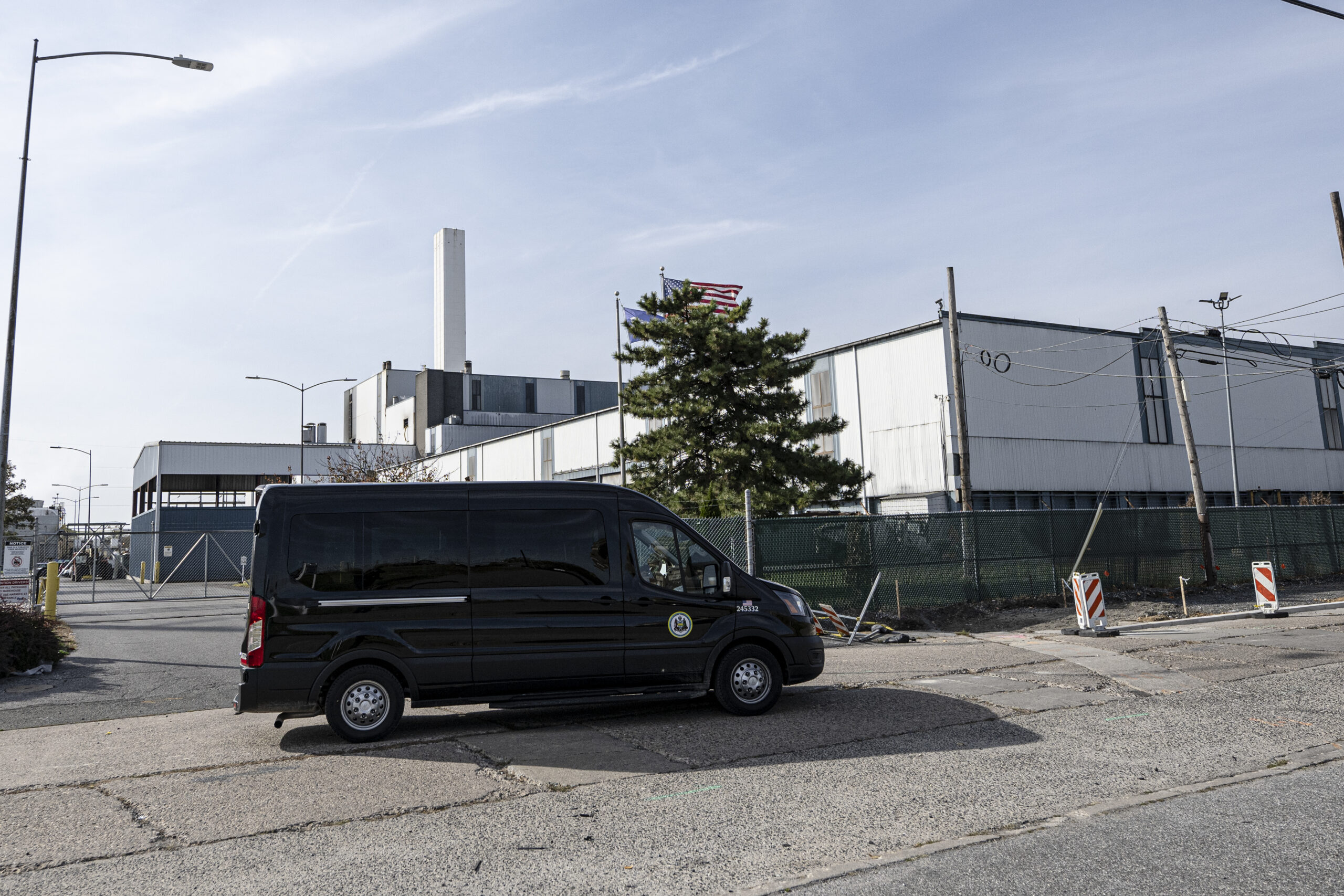
    The Reworld incinerator in Chester, Pa., on Friday, Nov. 7, 2025.

    “Burning Philadelphia’s trash is making Chester, Philadelphia, and other communities around our region sick,” Gauthier has said, pointing to elevated rates of asthma and other ailments and a legacy of “environmental racism” in Chester. The low-income and majority-Black city downriver from Philly has been home to numerous heavy industrial facilities.

    Reworld has said its waste-to-energy facility, which produces some electricity from burning trash, is a “more sustainable alternative to landfilling.”

    At a hearing last year, Parker administration officials said the city is including language in its request for proposals for the next contracts that will allow the city to consider environmental impacts. But they asked lawmakers not to vote for a blanket ban on incineration to allow the city to study the issue further.

    Parker waiting for Council to reapprove $800 million in bonds for her H.O.M.E. plan

    The biggest agenda item left hanging last month when lawmakers adjourned for the winter break was a bill to authorize the Parker administration to issue $800 million in city bonds to fund her H.O.M.E. initiative.

    Parker had hoped to sell the bonds last fall, and Council in June initially authorized the administration to take out new debt. But lawmakers made significant changes to the initiative’s first-year budget, especially by lowering income thresholds for some programs funded by the H.O.M.E. bonds to prioritize the lowest-income residents.

    Mayor Cherelle L. Parker speaks to the crowd at The Church of Christian Compassion in the Cobbs Creek neighborhood of West Philadelphia on Sunday, Dec. 7, 2025. Parker visited 10 churches in Philadelphia on Sunday to share details about her H.O.M.E. housing plan.

    That move, which Parker opposed and which sparked Council’s most significant clash with her administration to date, required a redo of the bond authorization. Lawmakers ran out of time to approve a new version of the measure in December, but Council President Kenyatta Johnson said it could come up for a final vote Thursday.

    “Council members have always been supportive of the H.O.M.E. initiative,” Johnson said. “H.O.M.E. advances City Council’s goals to expand access to affordable homeownership for Philadelphians … and to ensure that city housing investments deliver long-term benefits for families and neighborhoods alike.”

    Council aims to limit ‘resign to run’ … again

    Council is also expected to vote this spring on legislation that would change Philadelphia’s 74-year-old “resign to run” law and allow city officeholders to keep their jobs while campaigning for other offices.

    Currently, Council members and other city employees are required to quit their jobs to run for higher office. Lawmakers have tried several times over the last 20 years to repeal the law, but they have been unsuccessful. Changing the rule requires amending the city’s Home Rule Charter, which a majority of voters would have to approve through a ballot question.

    Council President Kenyatta Johnson talks with Councilmember Isaiah Thomas at City Hall on Wednesday, Dec. 11, 2024 in Philadelphia.

    The latest attempt, spearheaded by Councilmember Isaiah Thomas, would not entirely repeal the resign-to-run law, but instead would narrow it to allow elected officials to keep their seats only if they are seeking state or federal office, such as in Congress or the state General Assembly. Council members who want to run for mayor would still have to resign.

    Thomas, a Democrat who represents the city at-large and is rumored to have ambitions of running for higher office, plans to make minor amendments to the legislation this spring, a spokesperson said, before calling it up for a final vote. The goal, Thomas has said, is to pass the legislation in time for a question to appear on the May primary election ballot.

    Incoming clash over immigration?

    Parker has spent the last year avoiding direct confrontation with the Trump administration, a strategy that supporters say has helped keep Philadelphia out of the president’s crosshairs.

    The mayor, however, cannot control what other local elected officials say about national politics, and Trump’s immigration crackdown appears to be stirring stronger local reaction heading into his second year in office.

    After an Immigration and Customs Enforcement agent fatally shot Renee Good in Minneapolis this month, Sheriff Rochelle Bilal went viral for saying federal agents “will not be able to hide” in Philly. (Bilal, however, does not control the Philadelphia Police Department, which is under Parker’s purview.)

    Meanwhile, progressive Councilmembers Rue Landau and Kendra Brooks this year are expected to introduce legislation aimed at constricting ICE operations in Philadelphia.

    Demonstrators from No ICE Philly gathered to protests outside the U.S. Immigration and Customs Enforcement, office at 8th and Cherry Street, Philadelphia, Tuesday, Jan. 20, 2026.

    It is not yet clear what the lawmakers will propose. But Brooks, who has called on Parker to take a firmer stand against Trump, recently criticized the Philadelphia courts for allowing agents to seize suspects leaving the Criminal Justice Center. She said officials who in her view have failed to stand up to ICE are engaged in “complicity disguised as strategic silence,” and she vowed to force those who “cooperate with ICE in any way” to testify in Council.

    “Cities across the country are stepping up and looking at every available option they have to get ICE out,” Brooks said at a news conference earlier this month. “In the coming days, you will hear about what my office is doing about city policy. These demands must be met or face the consequences in Council.”

    Landau added Philly cannot allow “some masked, unnamed hooligans from out of town [to] come in here and attack Philadelphians.”

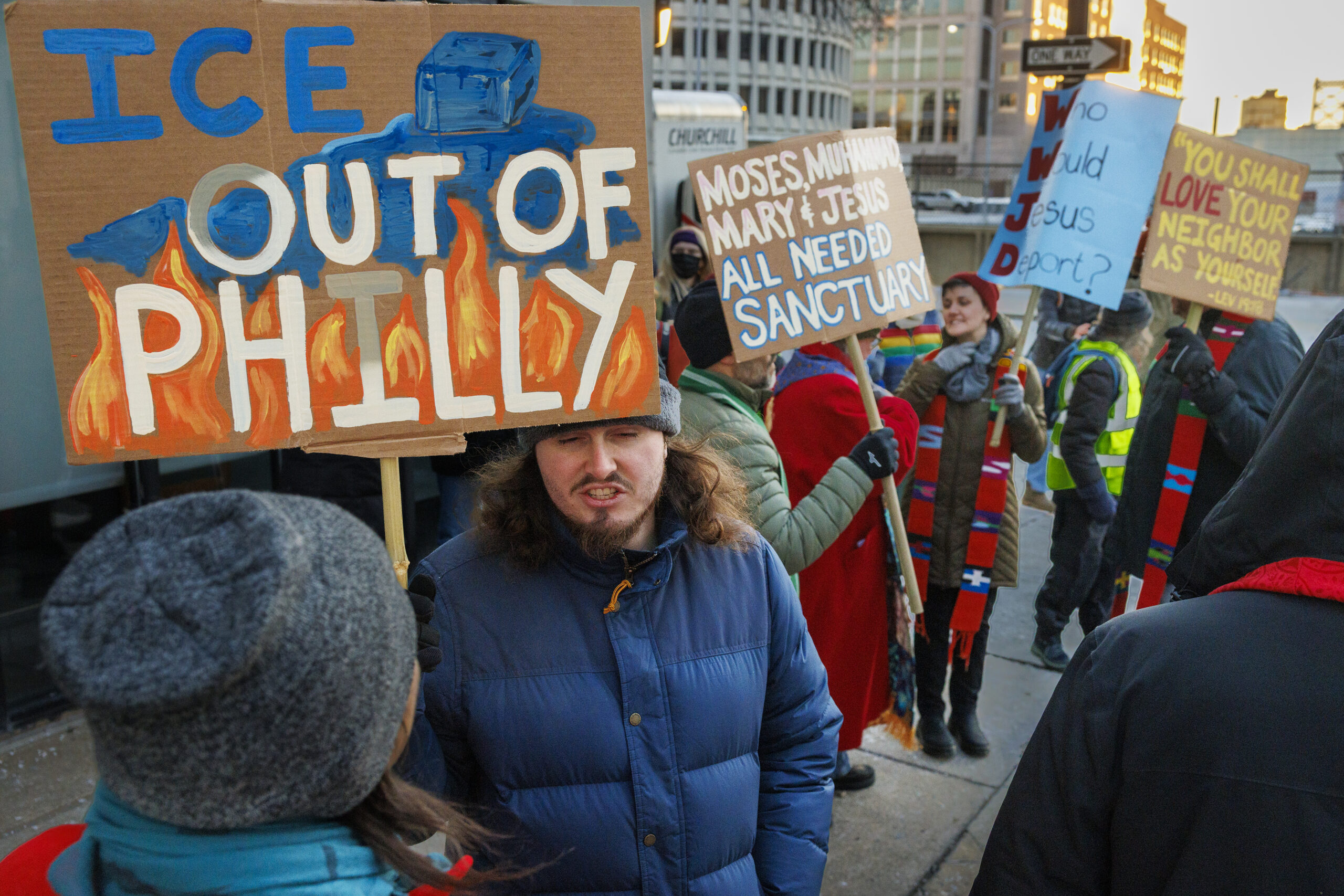
    “We are saying, ‘ICE out of Philadelphia,’” she said.

    Parker has said her administration has made no changes to the city’s immigrant-friendly policies, but she continues to be tight-lipped about the issue.

    The Pennsylvania Office of Open Records last week ruled in favor of an Inquirer appeal seeking to force Parker’s administration to disclose a September letter it sent the U.S. Department of Justice regarding local policies related to immigration.

    The administration still has not released the document. It has three more weeks to respond or appeal the decision in court.

    South Philly arena proposal still in the works

    After the 76ers abandoned their plan to build a new arena in Center City a year ago, the team announced it would partner with Comcast Spectacor, which owns the Flyers, to build a new home for both teams in the South Philadelphia stadium complex.

    The teams announced last fall they have selected an architect for the new arena, which is scheduled to replace the Spectacor-owned Xfinity Mobile Arena, formerly the Wells Fargo Center, in 2031.

    If the teams are still planning to open the new arena on their previously announced timeline, legislation to green-light the project could surface as soon as this spring. But so far, there has been no sign of movement on that front.

    “There is currently no timeline for introducing legislation to build a new Sixers arena in South Philadelphia,” said Johnson, whose 2nd District includes the stadium complex. “At the appropriate time, my legislative team and I will actively collaborate with Mayor Cherelle L. Parker’s administration on drafting any legislation related to the Sixers arena before it is introduced in City Council.”

    School closings and 2026 celebrations also on the horizon

    In addition to its legislative agenda, Council this year will likely be drawn into discussions over school closings and the high-profile gatherings expected to bring international attention to Philly this summer.

    The Philadelphia School District is soon expected to release its much-anticipated facilities plan, including which school buildings are proposed for closure, consolidation, or disposition. The always-controversial process is sure to generate buzz in Council.

    “We will do our due diligence on the District’s Facilities Plan,” Johnson said in a statement.

    Additionally, the city is preparing for the nation’s Semiquincentennial, FIFA World Cup games, and the MLB All-Star Game. While the administration is largely responsible for managing those events, some Council members have said ensuring the city is prepared for them is a major priority.

    Johnson said his agenda includes “making sure Philadelphia has a very successful celebration of America’s 250th Birthday that results in short and long-term benefits for Philadelphia.”

    Staff writers Jake Blumgart, Jeff Gammage, and Kristen A. Graham contributed to this article.

  • The ‘resign-to-run’ rule is a rare case where Philly provides a national model for good government. Why change it?

    The ‘resign-to-run’ rule is a rare case where Philly provides a national model for good government. Why change it?

    Here we go again.

    A proposal in City Council aims to amend the so-called resign-to-run rule that requires elected city officials to give up their seats if they want to run for another office.

    Philadelphia voters have already rejected a similar plan twice, once in 2007 and again in 2014. A third attempt stalled out in Council in 2020.

    Councilmember Isaiah Thomas, who proposed eliminating the rule last year, is back with a modified measure that would allow city officeholders to keep their seats while running for a state or federal office. They would still have to resign to run for another city office, such as mayor.

    Sorry, councilman, but there’s no such thing as being a little bit pregnant. Many of the same good government reasons that require resigning to run for another office still hold.

    Namely, running for office is a full-time job. The fundraising, campaign stops, debates, and town halls that take place during the day, nights, and weekends leave little time for officials to do the six-figure day job they were elected to do.

    Depending on the office, running for a statewide or federal seat could also require additional travel across the state that would further distract from serving the constituents the official was elected to represent.

    There would also be the temptation to use taxpayer-funded city resources — including the car, office, and staff — to help with the campaign. That is in addition to the taxpayer-funded salary and benefits elected city officials would collect while campaigning for a higher office.

    Lastly, the elected official could also leverage their position against other candidates to benefit themselves or donors.

    City Councilmember Isaiah Thomas said he would like to see the “resign-to-run” rule eliminated, but for now he was trying to strike a compromise.

    The arguments for allowing an elected official to remain in office while campaigning for another job just don’t hold up.

    The main argument is that it will allow more competition. For example, Thomas said some of his Council colleagues may have entered the race to replace retiring U.S. Rep. Dwight Evans — a five-term Democrat from the 3rd District — if they did not have to resign.

    But even under the current rule, there is no lack of competition for Evans’ seat. Eleven people have already announced their candidacy, and the primary is not until May 19.

    The diverse field already has a number of excellent candidates, including several who have never run for office before. Voters will have plenty of good options.

    Thomas argued voters would benefit if the field included Council members. “There could be even more great candidates,” he said in an interview.

    Thomas said city officials faced an uneven playing field, since state and federal elected officials do not have to resign to run for another office. That is true.

    Three of the congressional candidates hold state elected office. But the better reform is to require state and federal elected officials to resign to run for another office.

    As the saying goes, two wrongs don’t make a right.

    Voters are already fed up with professional politicians. It is even more annoying when an official gets reelected and months later launches a bid for another office.

    Even with the current rule, there is no lack of competition for retiring U.S. Rep. Dwight Evans’ seat, Paul Davies writes. Eleven candidates so far are vying to succeed the five-term Democrat from the 3rd District.

    That scenario may soon play out with Gov. Josh Shapiro. He faces reelection in November, and many assume he will run for president in 2028. That means if Shapiro is reelected governor, he could spend much of the first half of his second term campaigning in Iowa, New Hampshire, and beyond.

    After then-New Jersey Gov. Chris Christie launched his first bid for president, he would go on to spend 262 full or partial days out of the state in 2015. He traveled with a security detail that included New Jersey state troopers driving black SUVs with the state’s license plates, costing taxpayers more than $600,000.

    Likewise, when then-U.S. Sen. Marco Rubio (R., Fla.) ran for president in the same election cycle, he missed 50% of the votes in the Senate.

    Thomas conceded it would be difficult to balance city duties while running for an office that would require campaigning across the state. But he said city officials running for a congressional seat in Philadelphia while holding office would “not miss a beat.”

    That may be true since Council doesn’t meet in the summer. But that’s an argument for making Council a part-time job, especially since they can, and some do, hold second jobs.

    Philadelphia’s resign-to-run rule was added to the Home Rule Charter in 1951. At the time, the Committee of Seventy, a nonpartisan organization established in 1904 to combat corruption, strongly supported the rule.

    After then-New Jersey Gov. Chris Christie launched his first bid for president, he would go on to spend 262 full or partial days out of the state in 2015, Paul Davies writes.

    Any measure that prevents corruption still seems like a good idea. But surprisingly, the good-government group’s position has “evolved,” Lauren Cristella, the head of the Committee of Seventy, said in a statement.

    The organization “reluctantly” supported the repeal of the rule in 2014, citing the need for more competition.

    But Philadelphia voters rejected the effort. Just as they did in 2007.

    This time, the Committee of Seventy said it would only support ending the resign-to-run rule if it was part of a broader reform package that includes term limits and “stronger safeguards for ethical, transparent government.”

    The Committee of Seventy said the proposed change in its current form only serves the “political interests, but not the public interest.”

    Rest assured, if the resign-to-run rule were modified to allow city officials to run for state and federal office, it would just be a matter of time before Council tried to repeal it altogether.

    Even Thomas said he would like to see the rule eliminated, but for now, he was trying to strike a compromise.

    Philadelphia has long been criticized as being “corrupt and contented.” But reforms like resign-to-run and the city’s strict campaign finance regulations passed a decade ago are models of good government.

    Indeed, only a couple of cities and states have a resign-to-run rule. Philadelphia should champion its position as a good-government leader.

    Harrisburg — which has no such measure and some of the worst campaign finance rules — would benefit from following the city’s lead.

    The country needs more good government, not less.

  • Philly Council greenlights new retirement savings program as part of year-end legislative blitz | City Council roundup

    Philly Council greenlights new retirement savings program as part of year-end legislative blitz | City Council roundup

    Philadelphians without retirement savings plans through their employers could soon have access to a plan through the city after lawmakers approved legislation Thursday to enable the novel program to move forward.

    City Council members unanimously passed legislation that creates PhillySaves, which is modeled on state-facilitated “auto-IRA” programs that allow people to invest through payroll deductions at no cost to their employers.

    Voters would have to approve the creation of an investment management board through a ballot question, which is slated to appear in the May primary election.

    The measure was part of a flurry of legislation Council considered during a marathon meeting Thursday, its last session of the year before legislators reconvene in mid-January. Lawmakers passed dozens of pieces of legislation touching on issues including housing, public health, small-business growth, and public safety.

    In addition to approving the retirement savings program, Council approved legislation to:

    Here’s a breakdown of what else happened on Thursday:

    H.O.M.E. inches forward over Parker’s objections

    City Council on Thursday approved a key piece of legislation related to Mayor Cherelle L. Parker’s Housing Opportunities Made Easy, or H.O.M.E., initiative, the latest step in the drawn-out fight over how the city should spend the proceeds from the $800 million in city bonds the administration plans to sell to support the program.

    Mayor Cherelle L. Parker speaks to the crowd at The Church of Christian Compassion in the Cobbs Creek neighborhood of West Philadelphia on Sunday, Dec. 7, 2025. Parker visited 10 churches in Philadelphia on Sunday to share details about her HOME housing plan

    The legislation — a resolution setting the first-year budget for the initiative at about $270 million — sparked a contentious showdown between lawmakers and the administration over income eligibility levels for the housing programs funded or created by H.O.M.E.

    The resolution was approved in a voice vote, with Councilmember Curtis Jones Jr. casting the lone no vote.

    Over Parker’s objections, Council successfully pushed to lower income eligibility thresholds, prioritizing poorer residents. For instance, lawmakers ensured that 90% of the bond proceeds that will be spent on the Basic Systems Repair Program will go to households making 60% of area median income, which is about $71,640 for a family of four.

    “This budget opens city housing programs to ensure that more than 200,000 low-income and working-family households have a chance to get into a program that provides housing stability and economic mobility and increases,” said Councilmember Rue Landau, who helped lead the push to lower the income thresholds. “This is a transformational investment, a win-win.”

    Supporters react as City Council approves a key piece of legislation related to Mayor Cherelle L. Parker’s H.O.M.E. initiative Thursday, Dec. 11, 25 on the last day of the 2025 session.

    A separate but related piece of legislation — an ordinance authorizing the city to sell the bonds — also needs to pass before the administration can take on debt for the initiative. That proposal, which won committee approval Wednesday, is expected to come to the Council floor in January.

    In a statement Thursday, Tiffany W. Thurman, Parker’s chief of staff, thanked Council for its vote.

    “We look forward to continuing conversations with Council President Kenyatta Johnson and members of City Council in the weeks ahead, and to fulfilling Mayor Parker’s strong vision to save Philadelphia’s rowhomes,” she said.

    Council waters down a bill on training for security officers

    Council approved a bill requiring private security guards in Philadelphia to go through 12 hours of training when they are hired and an additional eight hours of training every subsequent year.

    But the final version of the bill, authored by Councilmember Isaiah Thomas, has been significantly watered down by amendments following a legislative showdown between the Service Employees International Union Local 32BJ, which championed the original version, and real estate and private security industry leaders, which said it was overly onerous and costly.

    Thomas’ original bill required security guards to receive 40 hours of training upon hiring, and it prohibited employers from conducting the training for their own workers. Instead, the instruction had to be provided by a nonprofit — potentially including a labor union. SEIU 32BJ, one of the most influential unions in the city, represents building services workers, including security guards.

    The amended version, however, allows employers to conduct the training after getting approval for their program from the Philadelphia Office of Worker Protections — a major relief for business leaders.

    The new version, which now heads to Parker’s desk, also exempts security guards for bars and restaurants from the training requirements, and pushes back the bill’s effective date from Jan. 1 to March 1.

    An inquiry into DEI contracting changes is coming next year

    City Council next year will examine Parker’s decision to end its long-standing policy of prioritizing women- and minority-owned businesses in city contracting and replace it with a system favoring “small and local” firms.

    Johnson authored a resolution allowing the Committee of the Whole, which includes all 17 members, to look at the history of minority contracting policies in the city and “the rationale, design, and anticipated effects” of Parker’s new policy. The resolution was approved in a unanimous vote, and a hearing will likely be scheduled in the first half of 2026.

    Race- and gender-conscious government policies have been targeted by conservative legal groups following a 2023 U.S. Supreme Court decision ending affirmative action in college admissions. The Inquirer revealed in November that Parker quietly ended the city’s 40-year-old contracting policy earlier this year due to the likelihood it would be challenged in court.

    The mayor has said her new “small and local” policy will accomplish many of the goals of the old system because many small Philadelphia businesses are owned by Black and brown residents and have faced roadblocks to growth.

    Attorneys hired by the city, however, had recommended a race- and gender-neutral policy of favoring “socially and economically disadvantaged” businesses, according to administration documents obtained by The Inquirer.

    Lawmakers will get the chance to weigh in on that decision next year.

    A controversial zoning change passes for University City

    Council on Thursday also approved Councilmember Jamie Gauthier’s controversial University City zoning overlay, which seeks to regulate how higher education institutions dispose of property.

    The legislation has been diluted from its original form, and it now regulates the sale of property over 5,000 square feet in University City — which would largely affect only universities themselves.

    Councilmember Jamie Gauthier in chambers as City Council meets Thursday, Dec. 11, 2025, on the last day of the 2025 session.

    Gauthier has further amended the legislation to exclude healthcare institutions. Among other things, the bill would require that property owners have building permits in hand before they are allowed to move forward on demolitions.

    A sale of land would also trigger review by the Philadelphia City Planning Commission.

    The legislation is part of Gauthier’s outraged response to St. Joseph’s University’s sale of much of its West Philadelphia campus to the Belmont Neighborhood Educational Alliance, a nonprofit that operates charter schools. The organization is led by Michael Karp, who is also one of the larger student-housing landlords in the area.

    Thomas, a Democrat who represents the city at-large, was the only member to vote against the bill. His vote was a break with the tradition of councilmanic prerogative, in which members generally approve legislation offered by Council members who represent geographic areas when the measure affects only their districts.

    Quote of the week

    Councilmember Brian J. O’Neill (left) uses his end-of-session speech in City Council Thursday, Dec. 11, 2025 to say goodbye to longtime legislative director Robert Yerkov (right), who is leaving for a job outside government.

    That was Councilmember Brian J. O’Neill, Council’s longest-serving member, who is typically its shortest-winded. But on Thursday, he took his time in a speech saying goodbye to longtime legislative director Robert Yerkov, whose last day as a Council staffer is next month.

    O’Neill said he was struggling to wrap up his remarks and joked that Council should limit the amount of time that its members can speak. Public commenters are generally limited to three minutes of remarks.

    To quote Shakespeare: “Brevity is the soul of wit.”

  • Philly expands outdoor dining and cracks down on ‘reservation scalpers’ ahead of expected 2026 tourism

    Philly expands outdoor dining and cracks down on ‘reservation scalpers’ ahead of expected 2026 tourism

    Philadelphia lawmakers on Thursday approved two changes to city law that are aimed at boosting business for restaurants and the hospitality sector ahead of an expected influx of tourists visiting the city next year.

    During its final meeting of the year, City Council voted to approve legislation to expand outdoor dining in the city by easing the permitting process in a handful of commercial corridors.

    Legislators also voted to ban so-called reservation scalpers, which are third-party businesses that allow people to secure tables and then resell them without authorization from the restaurant.

    Both measures passed Council unanimously and were championed by advocates for the restaurant industry, who lobbied lawmakers to ease burdens on the tourism and hospitality industry ahead of several large-scale events in the city next year, including celebrations for America’s Semiquincentennial, when Philadelphia is expected to host a flurry of visitors.

    They both now head to the desk of Mayor Cherelle L. Parker, who has never issued a veto.

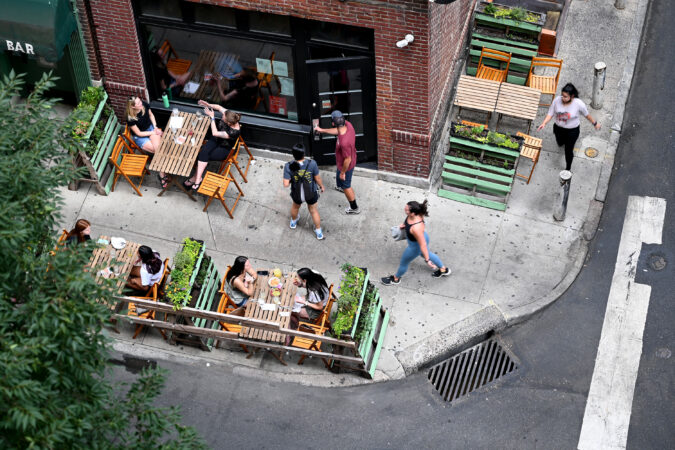
    The outdoor dining legislation, authored by Councilmember Rue Landau, a Democrat who represents the city at-large, expands the number of so-called by-right zones, where businesses can have sidewalk cafes without having to obtain a special zoning ordinance.

    Currently, by-right areas are only in Center City and a few commercial corridors in other neighborhoods. Restaurants outside those areas must undertake a sometimes lengthy process to get permission to place tables and chairs outside.

    The expanded zones, which were chosen by individual Council members who represent the city’s 10 geographic districts, include corridors in Manayunk and on parts of Washington Avenue, Passyunk Avenue, and Point Breeze Avenue in South Philadelphia.

    The legislation also includes all of the West Philadelphia-based Third District, which is represented by Jamie Gauthier, the only Council member who chose to include her entire district in the expansion.

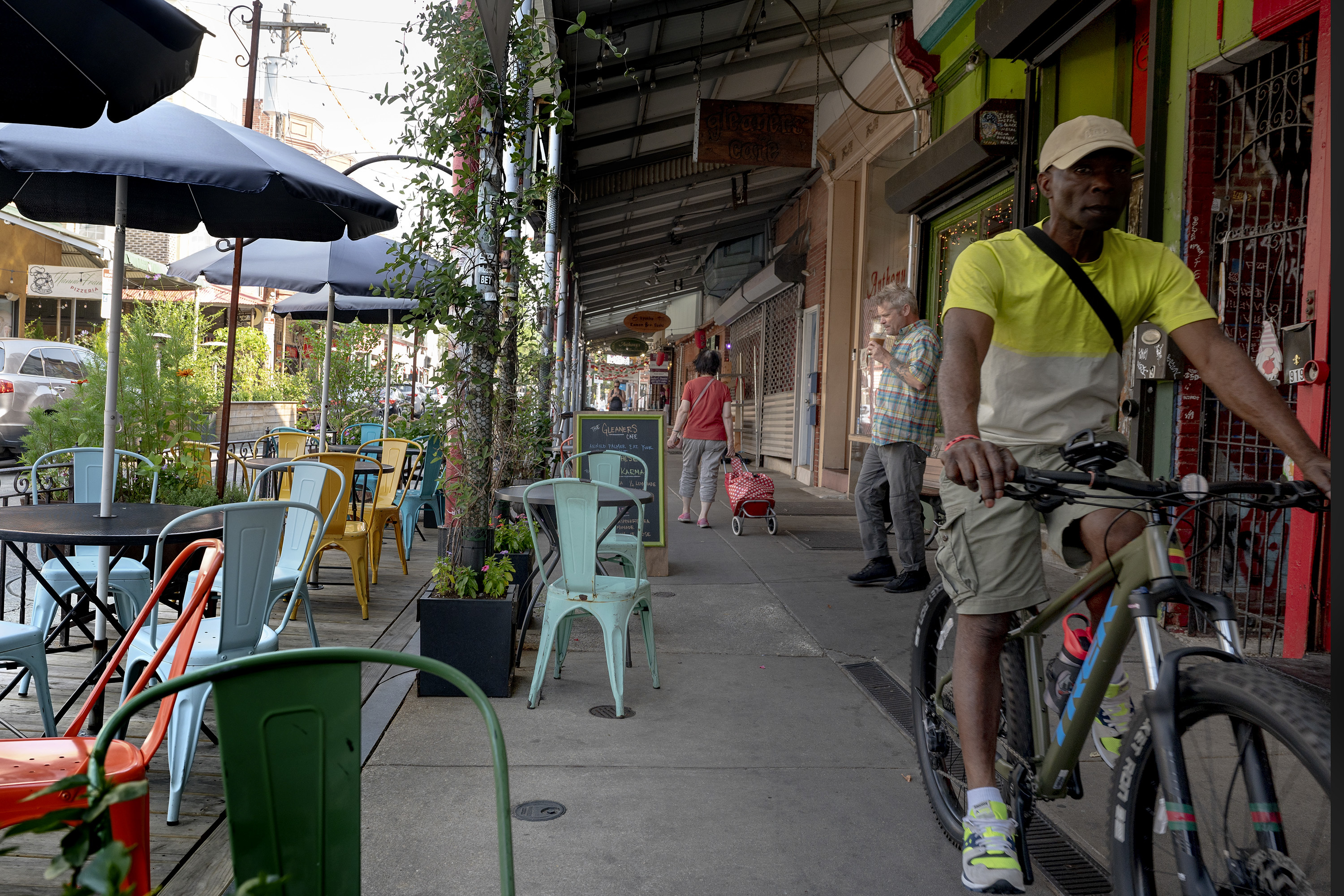
    The cafe area on the sidewalk outside of Gleaner’s Cafe in the 9th Street Market on Thursday, July 27, 2023.

    Nicholas Ducos, who owns Mural City Cellars in Fishtown, said he has been working for more than a year to get permission to place four picnic tables outside his winery. He said he has had to jump through hoops including working with multiple agencies, spending $1,500 to hire an architect, and even having to provide paperwork to the city on a CD-ROM.

    “There are a lot of difficult things about running a business in Philadelphia,” Ducos said. “This should not be one.”

    At left is Philadelphia Council President Kenyatta Johnson greeting Rue Landau and other returning members of council on their first day of fall session, City Hall, Thursday, September 11, 2025.

    Council members also approved the reservation scalping legislation authored by Councilmember Isaiah Thomas, a Democrat who represents the city at-large. He has said the bill is modeled after a similar law in New York and is not aimed at popular apps and websites like OpenTable, Resy, and Tock that partner directly with restaurants.

    Instead, it is a crackdown on websites that don’t work with restaurants, such as AppointmentTrader.com, which provides a platform for people to sell reservations and tickets to events.

    Jonas Frey, the founder of AppointmentTrader.com, previously said the legislation needlessly targets his platform. He said his company put safeguards in place to prevent scalping, including shutting down accounts if more than half of their reservations go unsold.

    But Thomas has cast the website and similar platforms as “predatory” because restaurants can end up saddled with empty tables if the reservations do not resell.

    Zak Pyzik, senior director of public affairs at the Pennsylvania Restaurant and Lodging Association, said the legislation is an important safeguard for restaurants.

    “This bill provides clear, sensible protections that will keep restaurants in the driver’s seat,” he said, “and in control of their business and their technology services.”

  • Philly’s school board will consider transferring vacant buildings to the city at a special meeting this week

    Philly’s school board will consider transferring vacant buildings to the city at a special meeting this week

    Mayor Cherelle L. Parker has made no secret of her desire to acquire vacant school buildings to fuel her administration’s goals of building or preserving 30,000 units of housing in her first term.

    The Philadelphia school board on Monday signaled its intentions to play ball: Later this week, it will hold a special action meeting to vote on a resolution authorizing Superintendent Tony B. Watlington Sr. and his team to consider handing over a portfolio of unused school buildings to the city.

    Watlington, the resolution states, “recommends that, in the best interests of the district and its students, the district explore and pursue negotiations with the city to potentially convey certain vacant and surplus district property.”

    The resolution would cover the district’s current stock of about 20 vacant buildings, including Ada Lewis Middle School in East Germantown — not any schools that might be closed in the coming facilities master planning process.

    Parker, in a statement, said the process was about “public health and public safety” and the school buildings can be used to improve residents’ quality of life.

    Officials “cannot let blighted buildings in the middle of residential neighborhoods lie vacant — many of which have been vacant for many years — from two years to over 30,” Parker said. “It’s unconscionable to me that we are in the middle of a housing crisis and we have government buildings sitting vacant for years or even decades. That cannot continue.”

    School board president Reginald Streater said that no decisions are final and that public deliberation will still happen at the special meeting at 4 p.m. Thursday. But, he said, the move makes sense with “the board moving toward being much more willing to be intergovernmental partners” with the city.

    “Many of these properties have not been used in the last decade or more, and they require a significant amount of upkeep and maintenance,” Streater said. “These properties are unused, for the most part, and unnecessary for K-12 education.”

    The district is in the business of running schools, Streater said.

    “I do believe that the city possesses considerably more expertise and capacity than the district does regarding property development,” Streater said. “We are an education institution. To build the capacity to do such things is out of our wheelhouse, and economic development would take us out of our lane.”

    According to the language of the resolution, the district is urging Watlington to consider all angles — bond obligations, property conditions, financial protection of the district, any legal processes that would need to happen, and more.

    The action comes as something of a surprise, happening just a week after what was to be the final voting meeting of the year. Streater said he did not want to add it as a walk-on resolution to the December school board meeting, but wanted to give members of the public time to understand it and provide testimony, if desired.

    Giving unused school buildings to the city could further academic outcomes, the school board president said.

    “It’s possible,” Streater said, “that conveying these vacant and surplus properties to the city for redevelopment and revitalization could help stabilize and grow the city and district’s tax base … and consequently positively impact future revenues to the district and educational experiences for students.”

    The resolution represents a significant shift from the board’s position of several years ago. In 2023, the board appointed by former Mayor Jim Kenney sued the city over legislation that would have given the city ultimate say in whether school buildings with environmental issues could safely house students and staff.

    That suit has been settled.

    Which buildings will be considered for transfer?

    Asked for a list of the unused buildings the resolution would cover, school board officials said more internal evaluation is needed before such a list is released.

    One likely to be on the list is Ada Lewis, which closed in 2012. That building drew attention this fall as the site where 23-year-old Kada Scott’s body was found buried — a discovery that reignited debate over the fate of the district’s unused properties.

    The possible transfer of district properties to the city comes as officials debate the specifics of one of Parker’s signature initiatives.

    The mayor wants to spend $800 million on her housing initiative, Housing Opportunities Made Easy, or H.O.M.E. In a rare sign of division, Council last week allotted more housing funds to the city’s poorest residents over the Parker administration’s objections.

    Because of Council’s move, more legislation is now needed to advance H.O.M.E. It will not come until January at the earliest.

    City Councilmember Isaiah Thomas, who has generally been critical of the district’s handling of facilities issues, called the resolution “a head scratcher.”

    Thomas, chair of Council’s education committee, has long been pushing for a school facilities plan.

    “It’s unclear to say what this step forward means, but I want to understand how it fits into a larger plan for Philly’s educational institutions,” Thomas said in a statement.

    “Without getting into hypotheticals, and due to a lack of communications with City Council, there are a lot of moving pieces and still many questions about what this means and what is the overall plan for the future of our school buildings,” Thomas said.