Tag: Jim Harrity

  • A three-year ban on puppy breeding in Philly is likely to become law | City Council roundup

    A three-year ban on puppy breeding in Philly is likely to become law | City Council roundup

    A three-year ban on puppy breeding in Philadelphia is likely to become law after City Council members on Thursday passed a bill to relieve overcrowded animal shelters.

    Lawmakers unanimously approved legislation to institute a three-year moratorium on puppy breeding in the city, a ban that applies to all breeders except those that have a state kennel license or are breeding service dogs.

    The bill now heads to Mayor Cherelle L. Parker’s desk. If she signs the bill and it becomes law, the moratorium will take effect 90 days later.

    Also on Thursday, a Council member amended his legislation that would allow lawmakers to keep their jobs while running for another office — but there are exceptions.

    Here’s what happened during Thursday’s meeting.

    What was today’s highlight?

    Tightening the leash on backyard breeders: The bill was authored by Councilmember Cindy Bass, a Democrat who represents parts of North and Northwest Philadelphia.

    Bass was sick and absent from Council on Thursday, but she has previously said that her bill is aimed at limiting people from breeding more puppies than they can sell.

    “Every litter means more dogs in our shelter, more cost for taxpayers, and more suffering that we can prevent,” Bass said last year. “This isn’t about punishment; it’s about compassion and responsibility.”

    Under the bill, it would be illegal to sell puppies or post ads to sell them within city limits. Breeders who violate the moratorium could face a $1,000 fine, with the proceeds going to the city’s Animal Care and Control Team, also known as ACCT Philly. The animal control agency would also enforce the ban.

    Sammi Craven, a local animal welfare advocate, testified Thursday about overcrowding at ACCT Philly’s North Philadelphia shelter. She named the dogs that were recently euthanized or are scheduled to be put down: Stella, Cheese Burrito, Luna, and Muffin, among others.

    “Philadelphia’s current animal welfare policy is ineffective,” Craven said, “and infrastructure and prevention have not kept pace with intake.”

    In this 2022 file photo, Brian Martin, 31, and Vanessa Green, 29, look at their new dog they plan to adopt while Green holds Autumn, 1, at ACCT Philly, which was hosting a pet adoption event.

    Critics of the moratorium say it will be challenging to enforce and could harm smaller, responsible breeders as opposed to those already operating illegally.

    Charley Hall, a government relations official with the American Kennel Club, called on Council to hold the bill and establish a working group to draft new regulations.

    “Working together, we can stop the flow of irresponsible breeders and improve animal welfare and fewer dogs ending up in Philadelphia’s shelters,” Hall said. “The question is how to achieve that goal in a way that is effective, fair, and legally sound.”

    What else happened today?

    Resign to run gets amended: City Councilmember Isaiah Thomas has been trying for more than a year to pass legislation amending a rule that requires city employees quit their jobs to run for higher office.

    He’s attempting to amend the rule so that city officeholders can keep their jobs only if they are running for a state or federal office. That means Council members running for mayor would still have to give up their seats.
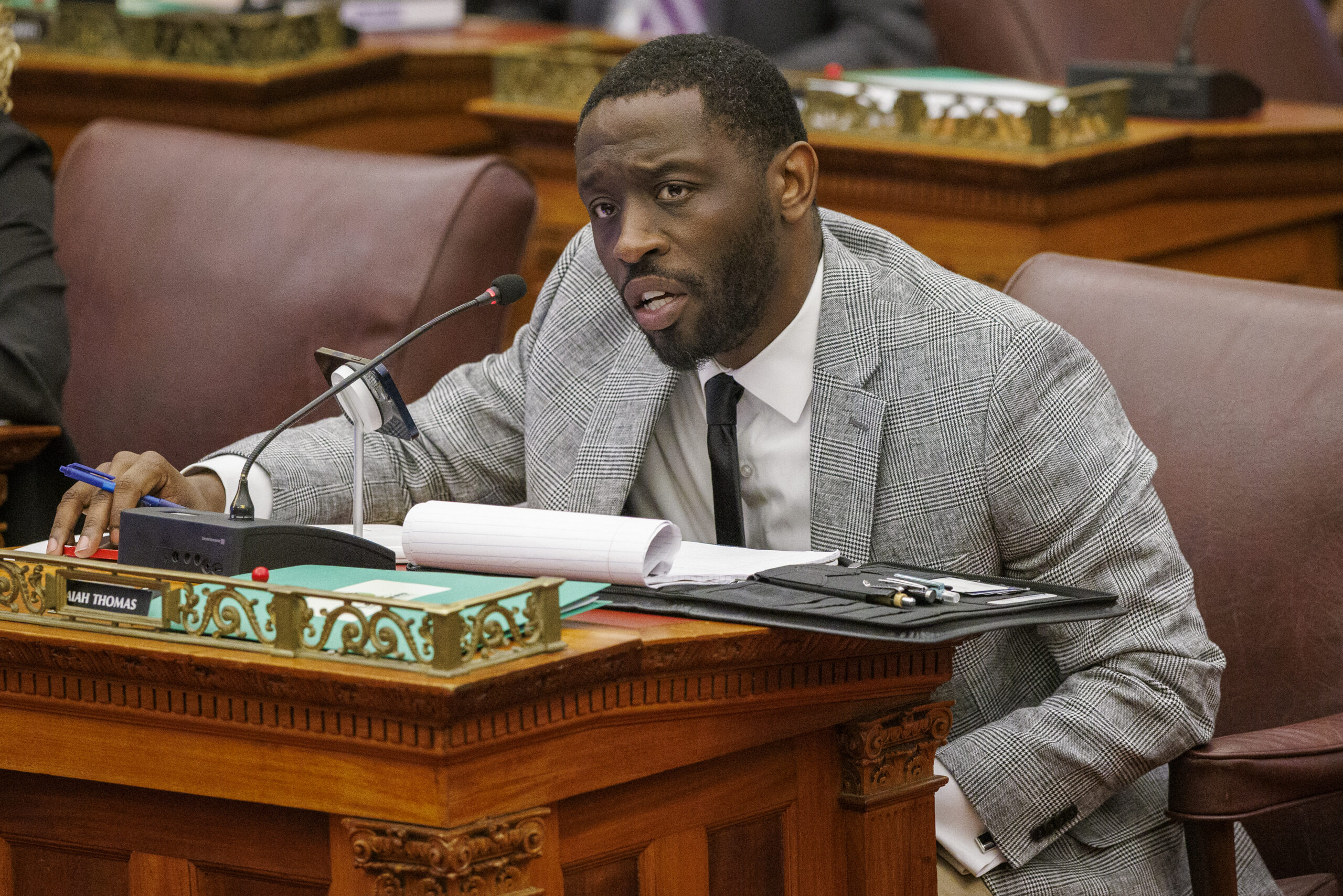
    Councilmember Isaiah Thomas makes a statement at the start of a hearing last week.

    But Thomas has run into roadblocks, including opposition from the city’s Board of Ethics, which asked him to make changes to the legislation in December, just before it appeared poised to pass.

    On Thursday, he introduced an amendment that made a series of tweaks, including clarifying that sitting city officeholders may only run for one public office in any election.

    Jordana Greenwald, general counsel for the city’s Board of Ethics, testified that the board still has concerns and requested more amendments, including prohibiting certain forms of politicking in the workplace.

    She also said the legislation should clarify that the mayor can’t run for another office while serving as the city’s chief executive, a rule that is already enumerated elsewhere in the city charter.

    However, making additional amendments could require Thomas re the legislation entirely. He said he would prefer for the bill to be called up for a final vote next week.

    Amending the resign-to-run rule requires changing the city’s Home Rule Charter, meaning voters would have to approve it through a ballot question. Voters have rejected earlier attempts to repeal resign-to-run.

    Codifying the youth watchdog: Council members also approved legislation to make the city’s Office of the Youth Ombudsperson permanent.

    The office was created through an executive order signed by former Mayor Jim Kenney and is responsible for monitoring child welfare, juvenile justice, and behavioral health residential placement facilities in the city.

    Making the office permanent also requires an amending the charter. A ballot question is likely to appear in the May primary election.

    Quote of the week
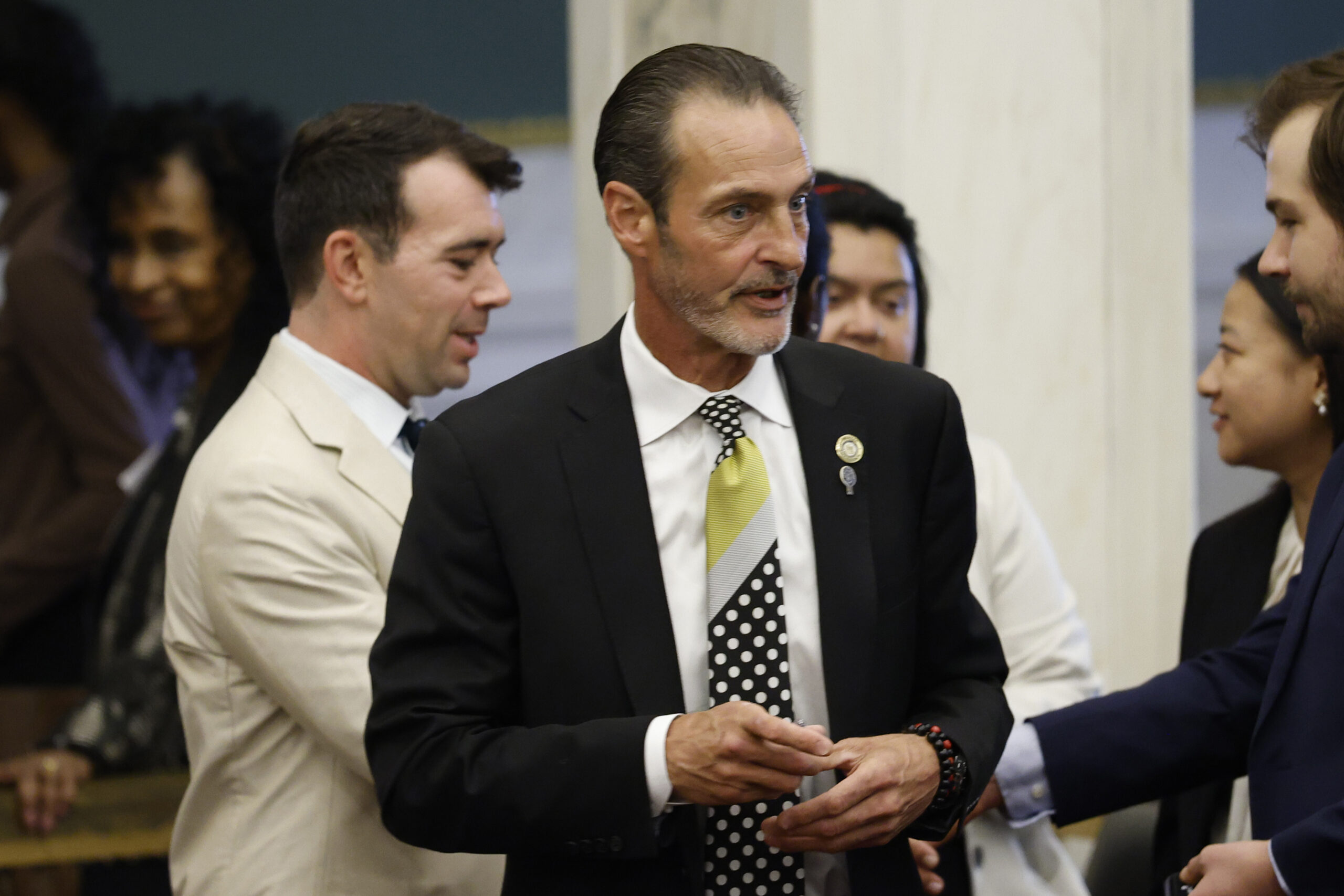
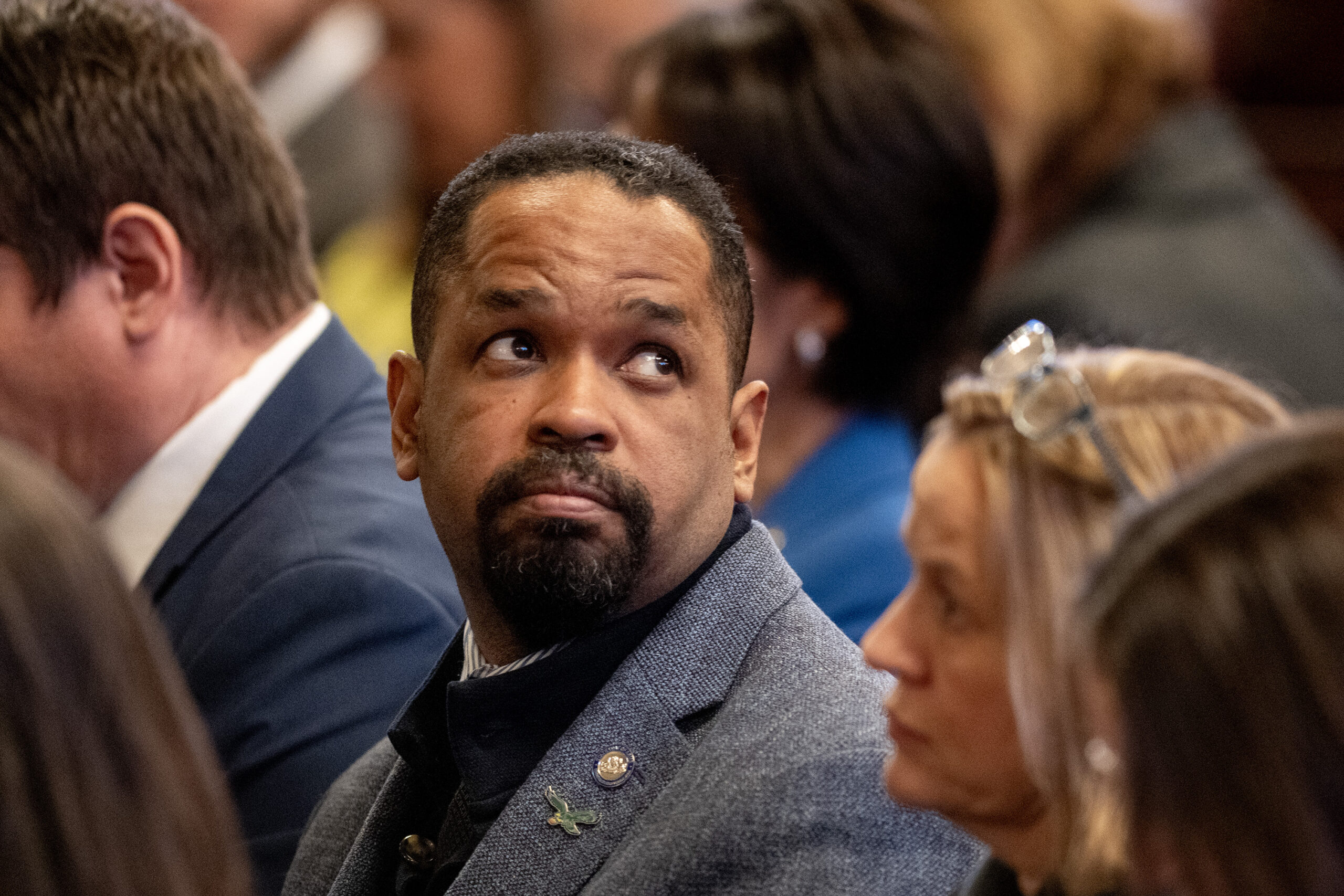
    Councilmember Jim Harrity in Council Chambers in September 2025.

    That was Councilmember Jim Harrity, an Irish Catholic who in a speech Thursday honored the sacrifices made during the Muslim holy month of Ramadan.
  • City Council members grill school district officials on plan to close 20 schools — and superintendent says he could have closed 40

    City Council members grill school district officials on plan to close 20 schools — and superintendent says he could have closed 40

    Philadelphia City Council may not have a vote on Superintendent Tony B. Watlington Sr.’s sweeping facilities plan, but it indicated Tuesday that it will have a say in school closings.

    As a packed hearing began in Council’s chambers Tuesday morning, both Council President Kenyatta Johnson and Isaiah Thomas, chair of the Education Committee, said Council refused to be a “rubber stamp” to Watlington’s proposal to close 20 schools, colocate six, and modernize 159.

    Though only the school board gets to vote directly on the plan, Johnson has indicated he is willing to hold up city funding to the district over the school closure plan. And his colleagues echoed that sentiment Tuesday.

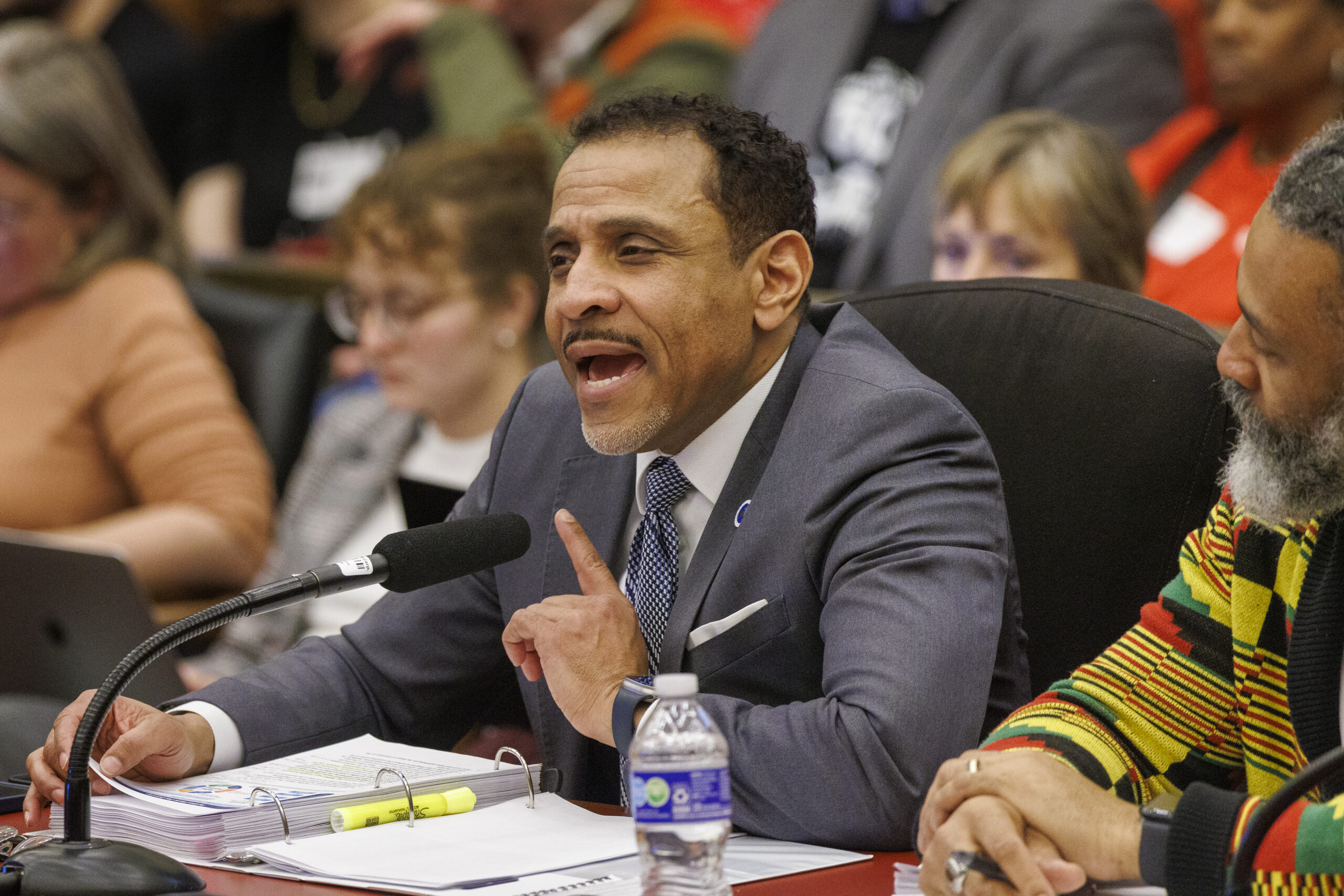
    “I’m infuriated that we don’t get a say,” Councilmember Jimmy Harrity said, warning the district officials who appeared before him. “But, Council president, you and I both know we do get a say, because budget’s coming. And we will be looking. Mindful is the word I would use for today — be mindful.”

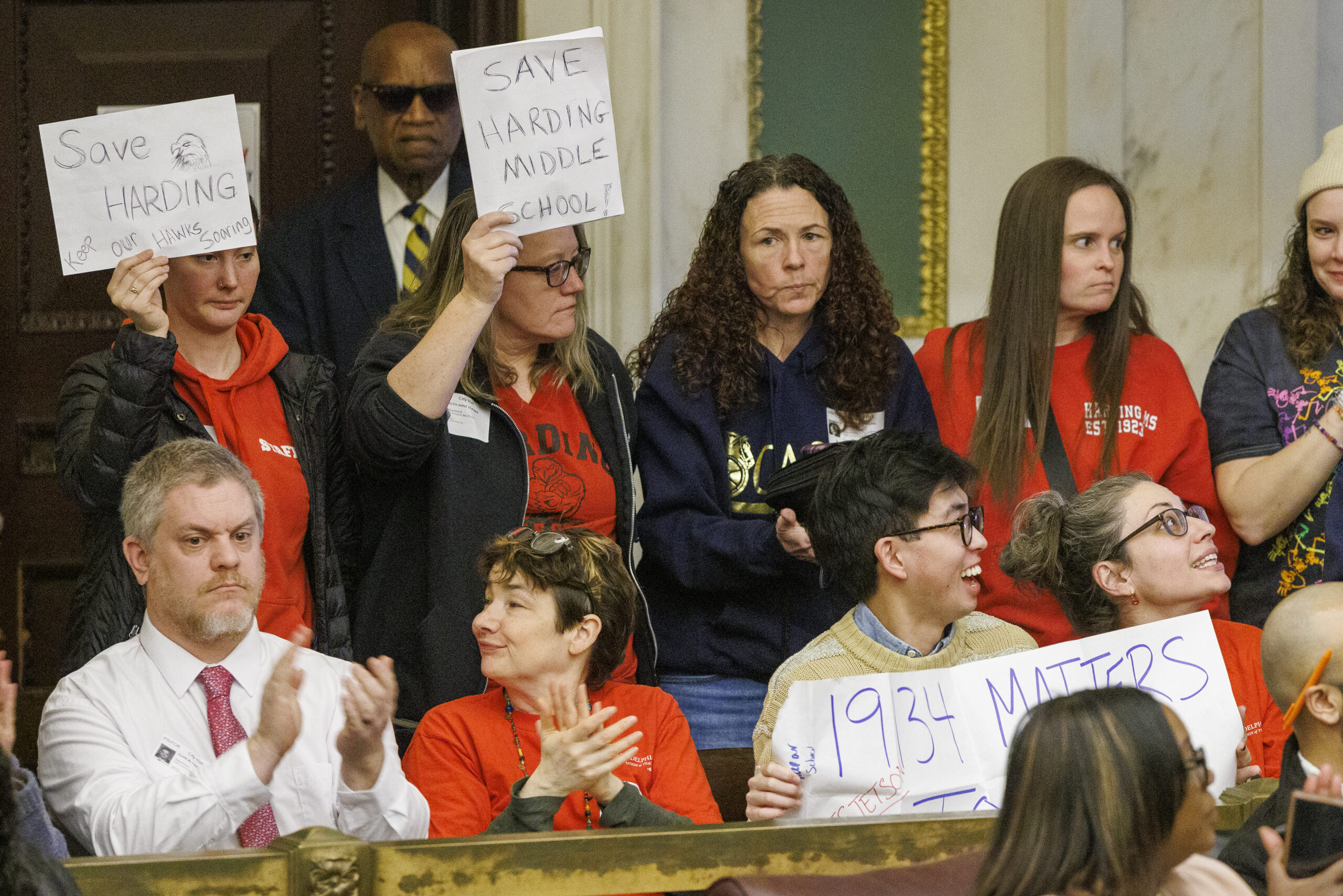
    Concerned citizens stand with signs in support of Harding Middle School before the start of a Philadelphia City Council hearing Tuesday at City Hall on the school district’s plan to close 20 schools.

    About 40% of the district’s nearly $5 billion budget comes from local revenue and city funding, which City Council and Mayor Cherelle L. Parker must approve in the annual city budget by the end of June.

    Harrity, an at-large Council member, said he was “tired that every time cuts come, they come from a certain neighborhood. You know, I live in Kensington, in the 7th District. I talk to these kids. They’re good kids. They deserve everything that other kids in other neighborhoods are getting. … You can see that this isn’t what our people want.” Watlington has proposed closing four schools in the 7th District.

    More than 100 community members holding babies and waving signs opposing the facilities plan filled Council chambers on the fourth floor of City Hall on Tuesday as Council members spent hours grilling Watlington and other district officials.

    Watlington, meanwhile, stood by his plan in testimony to Council on Tuesday, saying that 20 closings was a much smaller number than he could have settled on.

    “We could have come here and presented a plan that closed twice as many schools and been able to defend it,” Watlington said.

    A once-in-a-lifetime opportunity?

    District officials have said the facilities process is not about saving money, but about optimizing education and equity for the city’s 115,000 students.

    But it was clear Tuesday that finances played a part: The district has lost 15,000 students in the last 10 years, and over 80,000 since 1997, when charter schools were first authorized in Pennsylvania. It has 300 buildings, many of them 75 years and older and in poor repair, and some schools with more than 1,000 empty seats, while others are overcrowded.

    Tony B. Watlington Sr., superintendent of School District of Philadelphia, speaks at a City Council hearing Tuesday on his proposal to close 20 schools.

    “We’ve got to be very careful with our limited resources in a historically underfunded district,” Watlington told Council.

    Watlington and board president Reginald Streater, who also testified, pitched the plan as a way to add things the district cannot now offer — Advanced Placement courses in every high school, the opportunity for all eighth graders to take algebra, more prekindergarten, and career and technical education programs.

    “I do not believe we’ll get this opportunity again in our lifetime,” Watlington said.

    The superintendent dropped a few previously undisclosed facts about the facilities road map, indicating that his recommendations could shift slightly before he presents the plan to the school board on Feb. 26. No date has been set for the board’s final vote, which is expected later this winter.

    “It’s premature to say how the final recommendations will land,” Watlington said.

    But, the superintendent said, “if there are schools that Council wants me to take off the list, and add others on that list, we are open to you telling me what those are, but we cannot get to a place where we address our 35% non-utilization rate in buildings if no changes are made.”

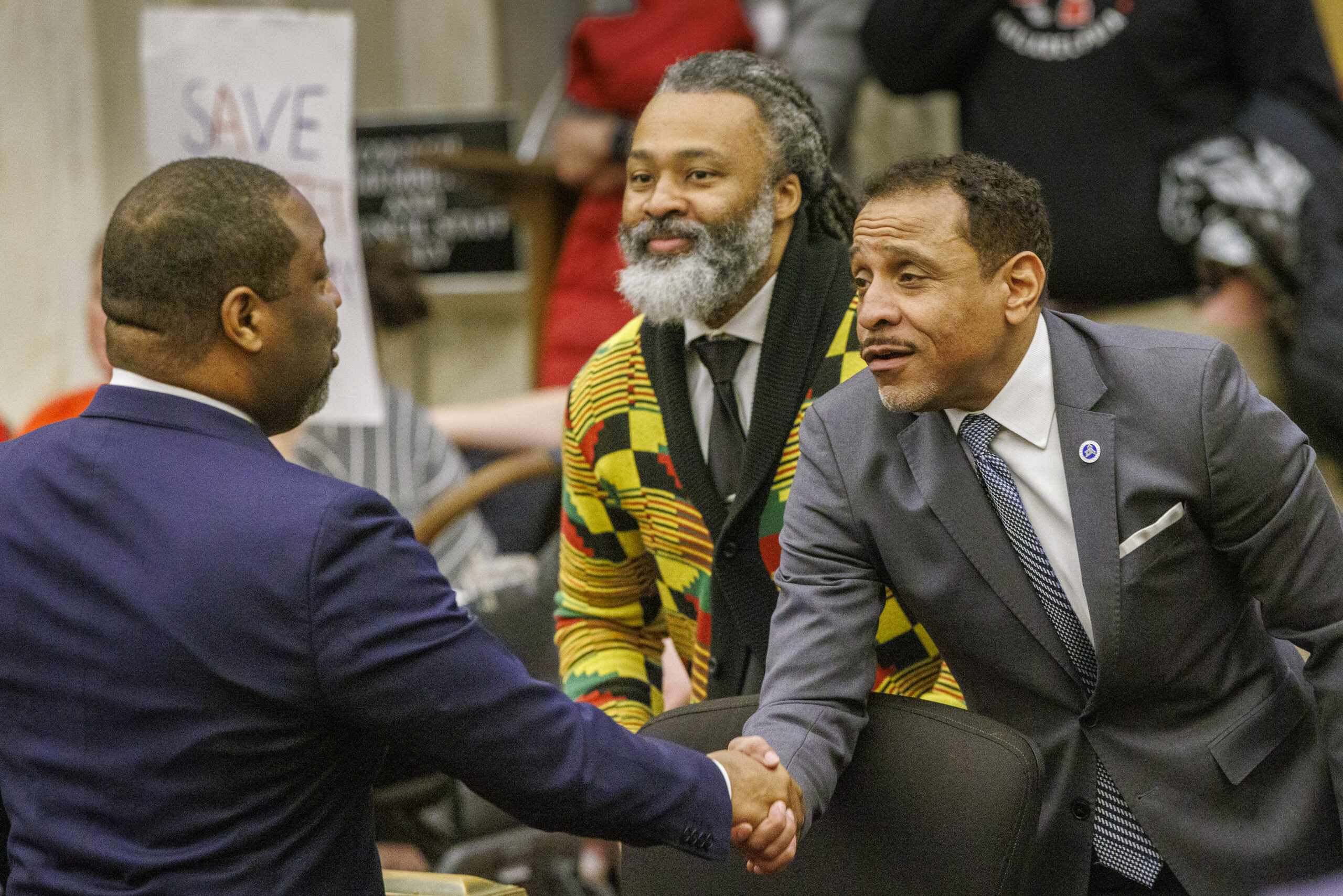
    Philadelphia City Council President Kenyatta Johnson (left) greets Dr. Tony Watlington, Superintendent of School District of Philadelphia Philadelphia City Council holds hearing with board members of School District of Philadelphia, Tuesday, Feb. 17, 2026. Reginald L. Streater, Esq., President Board of Education. (center)

    Debora Carrera, the city’s chief education officer, who spent three decades as a district teacher and administrator, told Council that Parker believes “the current district footprint is unsustainable.”

    Carrera said her own experience as principal of Kensington High School for Creative and Performing Arts shows that it is right for the district to focus resources on neighborhood high schools.

    “My high school was a small high school,” Carrera said. “I could only offer my children two AP courses, when other schools like Central — where my son went — could offer them over 20-plus AP courses.“

    ‘Breaking down of public education’

    The hearing got tense at times.

    “I feel like this is the breaking down of public education in Philadelphia,” said Councilmember Cindy Bass, who said some of the district’s own decisions had led to closures.

    Several members of Council raised questions about the plan’s price tag. Prior district and city estimates put the cost just under $8 billion, but members of Watlington’s team said they could they could actually do the work for $2.8 billion — $1 billion from district capital funds, and $1.8 from yet-unpromised state and philanthropic sources.

    In the past, the district had made public detailed facilities condition assessments for every school in the district, Councilmember Rue Landau noted.

    Residents could look up their school and see exactly what the condition of every system in the building was, and how much money would be required to fix those that needed repair.

    “We don’t have any of those details,” said Landau, who went so far as to say she believed the district should be spending more than $2.8 billion on the plan. “What is the increased investment, and why don’t we have any of those details? They are not out there in the public for us, so none of us have any understanding as to why this is happening, This should all be public so all of the public can see.”

    Jerry Roseman, the Philadelphia Federation of Teachers’ longtime environmental director, who has had a first-row seat to district facilities conditions for decades, said he believed the $2.8 billion figure was not realistic.

    “You need much more money than that,” Roseman told Council. “We need more money than this plan comes close to.”

    Some Council members pushed the district and the board on the plan’s timing.

    The city has been asking for a long-range facilities plan for years, Councilmember Quetcy Lozada pointed out.

    “It’s taken us all this time,” Lozada said. “Now, you guys have come up with a plan, and now we want to rush through it. Now all of a sudden there’s this urgency to get through this plan, which I don’t understand.”

    Streater said the board is moving forward with hearing Watlington’s plan on Feb. 26, but won’t vote until it hears more feedback.

    But ultimately, he said, the board will vote on “a plan that is dynamic, that can evolve over time. … I think that we all understand that things change, facts change, funding changes, enrollment trends change.”

    And, Streater said, there will also likely be policy changes based on redrawing some catchment areas, or boundaries that determine which neighborhood schools children attend.

    Streater, who introduced himself at the beginning of the hearing as “Reggie from Germantown,” underscoring his history as a graduate of two district schools that closed — Germantown High and Leeds Middle School — said that changes must be made.

    “I think if we continue doing the same thing, expecting a different result — which I would argue is chronic underachievement — we are doomed.”

  • An ex-Philly City Council aide from a prominent political family is accused of sexual harassment

    An ex-Philly City Council aide from a prominent political family is accused of sexual harassment

    After Sharif Street Jr. got into a highly public fight at Mayor Cherelle L. Parker’s 2024 inauguration ceremony, his boss, City Councilmember Jim Harrity, extended him some grace.

    Harrity, who credits Street Jr.’s father, State Sen. Sharif Street (D., Philadelphia), with giving him a second chance earlier in his own career, kept the junior Street on staff as a special assistant, saying the incident was a lapse in judgment.

    But according to another staff member in Harrity’s office, it was not the only transgression.

    Shanelle Davis, a former constituent services representative, filed a federal lawsuit last week against the city claiming that she told supervisors months before the inauguration fight that Street Jr. had sexually harassed her while she was at work, including twice grabbing her and making sexualized comments about her body.

    She said in the suit, filed in the U.S. District Court for the Eastern District of Pennsylvania, that no action was taken and Street Jr. remained on staff.

    Davis is seeking unspecified damages from the city, which she claims violated state and federal laws related to gender-based discrimination. Street Jr. is not named as a defendant in the suit, but he is mentioned throughout the 13-page filing.

    Davis’ complaint portrays a dysfunctional workplace environment in the City Hall office, including an alleged physical altercation between Street Jr. and another staffer for which no one was reprimanded. Davis, who is Black, claimed another colleague in Harrity’s office made racist comments, including hurling the N-word toward her.

    Davis, who was hired in late 2022, said in the lawsuit that she was fired for underperforming at her job about a year later, after Harrity won reelection.

    Her attorney did not respond to a request for comment Monday. Street Jr. did not respond to calls seeking comment.

    Harrity, a Democrat who represents the city at-large and was a longtime aide to the elder Street, said in a statement that he “categorically denounce[s] workplace harassment, or any conduct that undermines a respectful and professional work environment.”

    He declined to comment further, citing the ongoing legal proceedings. A spokesperson for the city law department also declined to comment.

    The lawsuit is the latest legal trouble involving Sharif Street Jr., 26, who over the last three years has pleaded guilty to criminal offenses in Philadelphia, Montgomery, and Delaware Counties. In August, his employment with the city was terminated the week he pleaded guilty to charges in connection with the inauguration assault and another incident.

    City Councilmember Jim Harrity speaks to colleagues on during a Council session in September.

    Street Jr. comes from one of Philadelphia’s most well-known political families. His grandfather is former Mayor John F. Street, his mother is Common Pleas Court Judge Sierra Thomas Street, and his father is a state senator and the former head of the state Democratic Party who is now running for a seat in Congress.

    Anthony Campisi, a spokesperson for the elder Sharif Street’s congressional campaign, said the state senator had “no knowledge” of the sexual harassment allegations.

    “Sharif loves his son unconditionally and has supported his son through personal troubles, like so many parents across Philadelphia,” Campisi said. “That being said, Sharif unequivocally condemns sexual harassment in all its forms and is looking for the legal process to play out.”

    City Council President Kenyatta Johnson, who took over as leader of the chamber in 2024, declined to comment. Under City Council rules, individual members are responsible for hiring and terminating their own employees.

    State Senator Sharif Street (D., Phila.)is in the state House chamber as Gov. Josh Shapiro makes his annual budget proposal Feb. 3, 2026.

    Street Jr. was arrested several times over three years while working in City Hall as an assistant in Harrity’s office, court records show. Davis’ lawsuit comes about six months after Street Jr.’s employment in Harrity’s office ended, according to payroll records.

    In January 2024, Street Jr. punched a security guard at the entrance to Parker’s inauguration ceremony at the Met Philadelphia on North Broad Street. He told The Inquirer at the time that he was defending his grandfather, the former mayor, whom he said the guard had grabbed because they were trying to enter at a back entrance without waiting in line.

    “I saw my grandfather get grabbed and I just sort of blacked out,” Street Jr. said. His father defended him at the time, saying the security guard had initiated the altercation.

    Later that month, Street Jr. was charged in connection with a hit-and-run from the previous August that left a 14-year-old injured.

    The two cases were consolidated in Common Pleas Court, and Street Jr. pleaded guilty in August to charges of assault and causing an accident that resulted in an injury. According to prosecutors, he was sentenced to 60 days in jail.

    Four months later, when he was no longer working in city government, Street Jr. was briefly jailed in Delaware County following what police in Upper Darby described as a “prolonged struggle” during a traffic stop. He pleaded guilty to disorderly conduct, a summary offense.