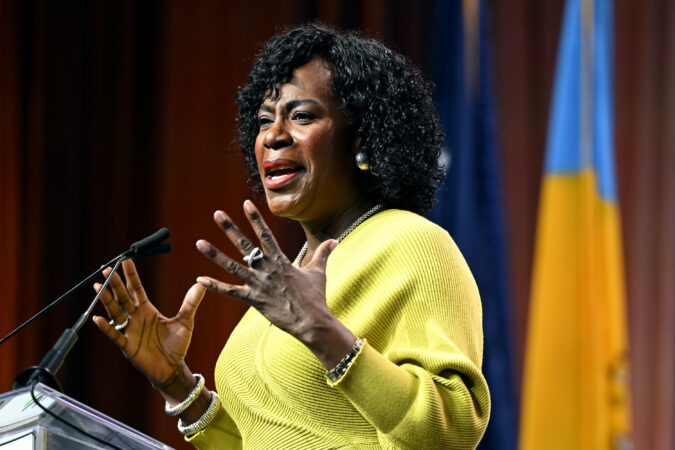
Mayor Cherelle L. Parker on Wednesday defended the city’s upcoming July Fourth concert, a seven-hour outdoor spectacle featuring performances from Christina Aguilera, Jill Scott, The Roots, and more, amid concerns over the nearly 100-degree forecast and revelations that the event will cost taxpayers millions more than in years past.
The city has dealt with high temperatures before and has battle-tested personnel and protocols prepared for the evening, Parker told reporters at a news conference in front of the stage at the foot of the Philadelphia Museum of Art steps.
She also addressed the detractors head on.
“I do not apologize to anyone about making sure that the city of Philadelphia, as the sixth-largest city in the nation, the birthplace of democracy, we were going to have a celebration that is fitting to and for our historical significance and prominence,” Parker said. “One that could be seen, respected, and honored, not just in our city and commonwealth and nation but in the world.”
Parker described the concert as the largest July Fourth concert in the city’s history. For an occasion as momentous as the nation’s 250th anniversary in the city that bills itself the birthplace of America, Parker said Philadelphia must rise to the occasion and prove it can achieve ambitious undertakings.
Parker said her administration scaled up the experience, including moving the stage back to accommodate an estimated 300,000 concertgoers, and made the stage larger.
“We won’t get a second chance to do this over again, Philadelphia,” Parker said. “We only turn 250 years old once in a lifetime.”
Ground crews set up speakers on the stage on Wednesday in preparation for the July 4 concert expected to draw thousands to the Benjamin Franklin Parkway.
Parker recalled feeling the mounting pressure to prove Philadelphia could rise to the occasion of honoring the nation’s 250th anniversary shortly after the start of her tenure as mayor.
“‘Philadelphia lacks ambition. They’re thinking too small. We need a leader. Where is the legacy project?’” Parker recalled from the discourse of the time. “The critics were right. Philadelphia, as the birthplace, we couldn’t do what every other city was doing. We couldn’t just do something that was average, something that was mediocre. What we did had to be a reflection of this moment and our history.”
Parker’s news conference came hours after The Inquirer reported online that this year’s July Fourth concert will cost taxpayers millions more than in years past because the mayor’s administration hired ESM Productions, a for-profit company, to put on the annual show. For years, the concert has been produced by Welcome America, a nonprofit established by the city.
The Inquirer reported that the city is set to pay ESM $15.5 million to put on the show, and that last year’s iteration of the Welcome America concert cost the organization about $3 million.
Parker defended ESM and its founder, Scott Mirkin, as “the gold standard in planning large-scale global events, not just in America but across the world.” And she vowed that the city would produce a “fiscal impact report” after the event to account for how much money the city spent on this year’s festivities.
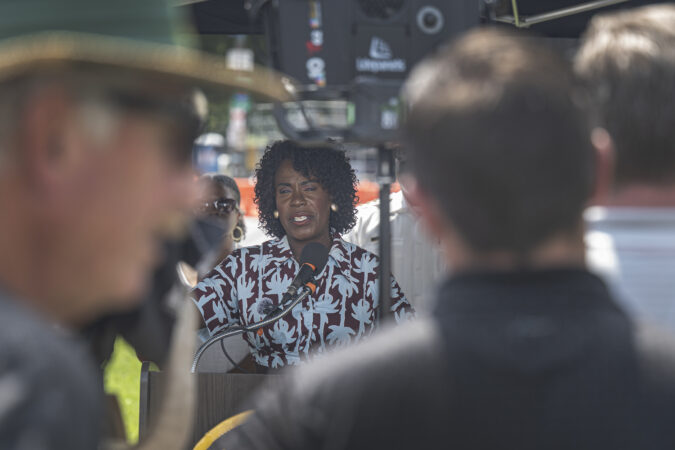
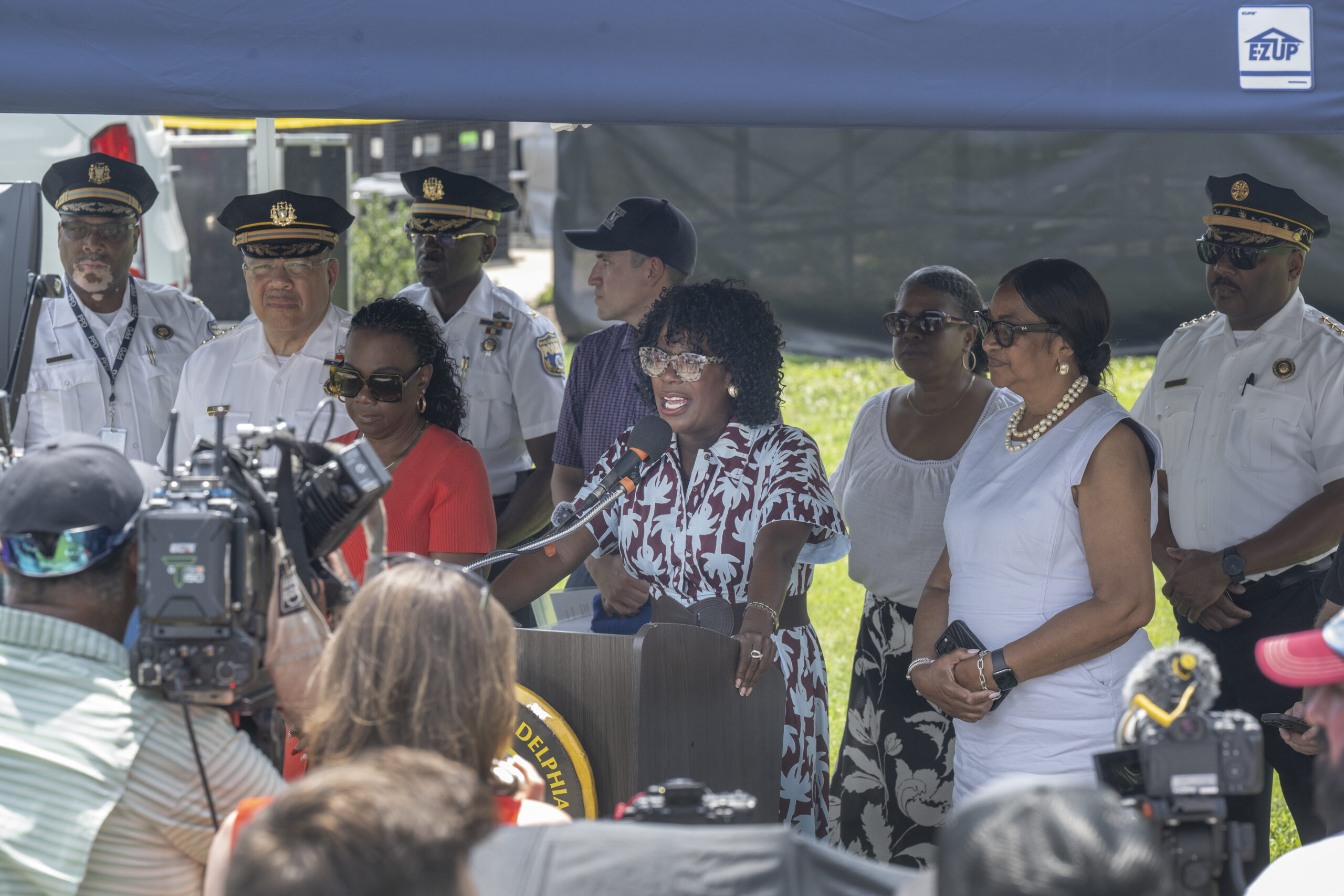
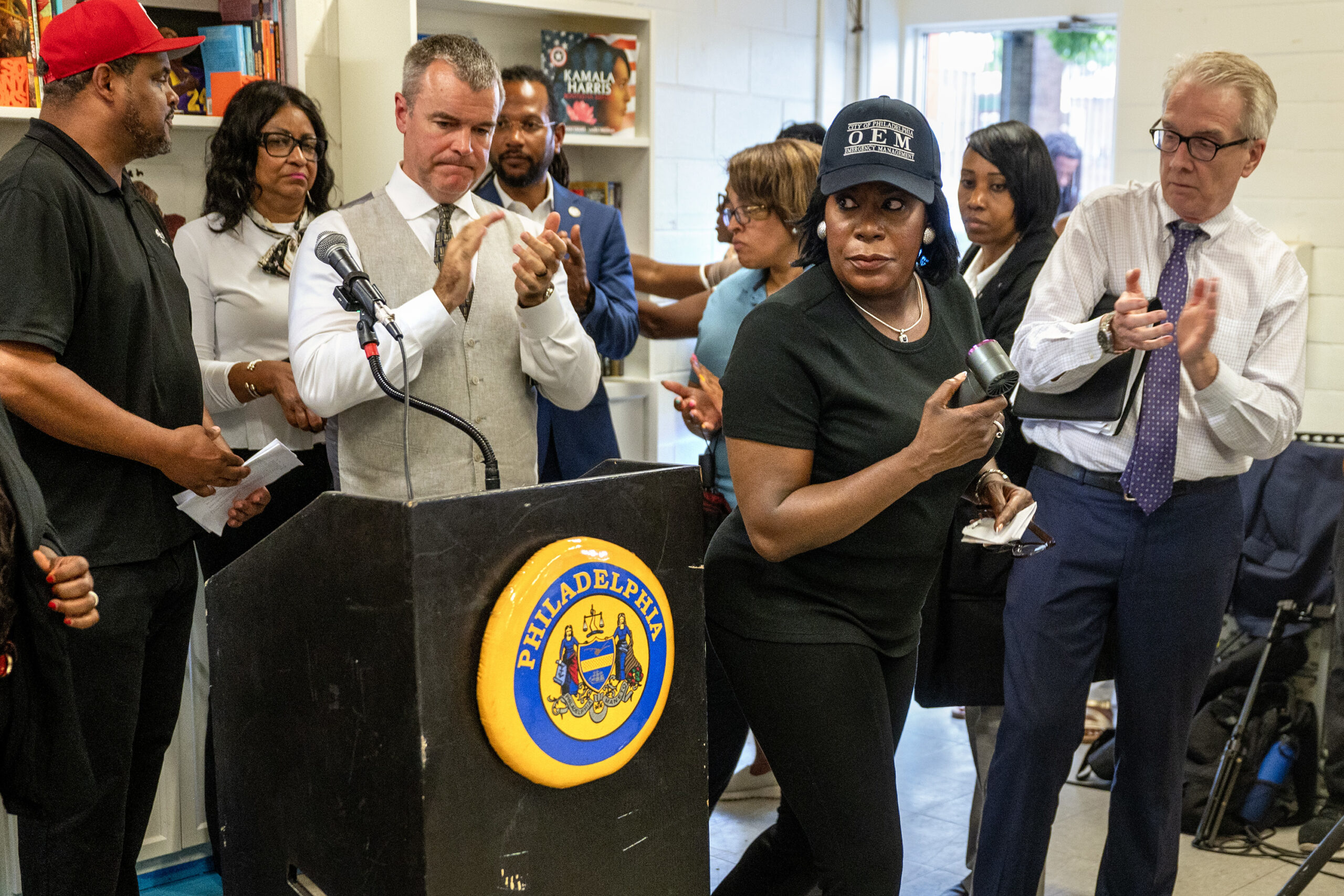
Mayor of Philadelphia Cherelle L. Parker speaks during a news conference under a tent Wednesday, July 1, 2026, in Philadelphia, outlining public safety and transportation plans ahead of a July 4 concert expected to draw thousands to the Benjamin Franklin Parkway.
She also noted that former Mayor Jim Kenney put his own stamp on the annual July Fourth concert when he took office in 2016 — and took some heat for it. The Roots had headlined the concert since 2009, but Kenney’s administration went a different direction and The Roots were sidelined.
Roots drummer Ahmir “Questlove” Thompson didn’t mince words at the time, writing on Facebook that the decision was “arrogance in the HIGHEST order courtesy of your new leader.”
When Parker took office, she knew she wanted the spotlight back on the beloved local hip-hop group.
“I’m proud to have The Roots back home,” Parker said.
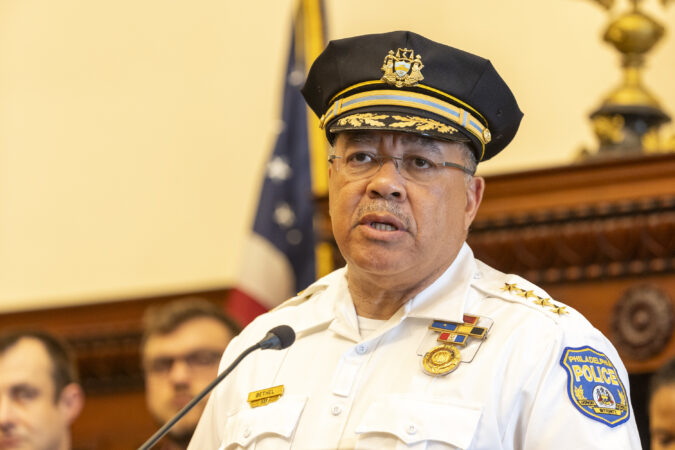
In terms of weather and safety, the city has proven this summer that it can host large-scale events in the heat seamlessly, said Philadelphia Police CommissionerKevin J. Bethel.
The city has already hosted five World Cup games, which have gone off without a hitch, Bethel said. For the July Fourth event, the department will be executing one of its largest deployments since the papal visit in 2015. That will include hundreds of officers across Center City and many more at the stadium and along the Parkway.
“I want everybody to come and have a good time. Don’t mess up the party,” Bethel said.
In order to keep people cool, the city will run 40 air-conditioned cooling centers, 150 pools and spray grounds, enhanced homeless service outreach, and extra fire department medics, said Dominick Mireles, Philadelphia’s deputy managing director for community safety. Along the Parkway, there will be misting fans and shade structures, he added.
Parker said she’s confident every Philadelphian interested in participating will be able to do so safely and will look back on the day fondly.
“I want people to remember where they were when America turned 250 years old and what we did here in the place when it all happened,” Parker said.
With the eyes of the nation on Philadelphia for America’s 250th birthday, Mayor Cherelle L. Parker’s administration this year took over management of the city’s free July Fourth concert, which for years was produced by a nonprofit established by the city: Welcome America.
The mayor instead hired ESM Productions, a for-profit company, to put on the annual show featuring musical acts and fireworks over the Ben Franklin Parkway, and she changed the name from Wawa Welcome America to the “One Philly: Unity Concert for America” — a version of Parker’s well-known slogan, “One Philly: A United City.”
Another change: It will cost taxpayers far more than in the past.
The city is due to pay ESM Productions about $15.5 million for the show, which will be headlined by Christina Aguilera, Jill Scott, and The Roots, and feature rapper Meek Mill, according to a copy of the city’s contract paperwork with ESM, obtained by The Inquirer. The city in March signed a $10 million contract with the Philadelphia-based company, as well as a $5.5 million contract amendment.
By comparison, Welcome America’s budget for all of 2024 — including that year’s July Fourth concert,the numerous other events it manages in the build-up to the concert, and the salaries of its staff — was about $6.6 million, only about $5.3 million of which came from government grants, according to the group’s most recent federal nonprofit disclosure.
Welcome America, which is a public-private partnership with the mayor serving as a board member, receives city and state funding, as well as a corporate sponsorship. The organization has been involved in Philly’s July Fourth celebrations since 1993.
Fans react to the music as the Wawa Welcome America Festival concluded July 4, 2023 with a free concert featuring Ludacris on the Benjamin Franklin Parkway.
Last year’s iteration of the Wawa Welcome America concert cost the organization about $3 million, according to a person with knowledge of the situation who spoke on the condition of anonymity because they were not permitted to disclose that information.
The Philly taxpayer money paid to the concert’s producers does not cover additional expenses borne by the city, such as pay for police officers and sanitation workers staffing the event.
Parker’s office declined a request from The Inquirer for a copy of the contract or information on the cost of this year’s concert. Chief Deputy Mayor Vanessa Garrett Harley said in an interview that the administration would publicly disclose the costs and economic benefits of the concert after it was over.
“At a later time, we could certainly be doing a full accounting, as we’re not trying to hide anything and always want to be transparent,” Garrett Harley said.
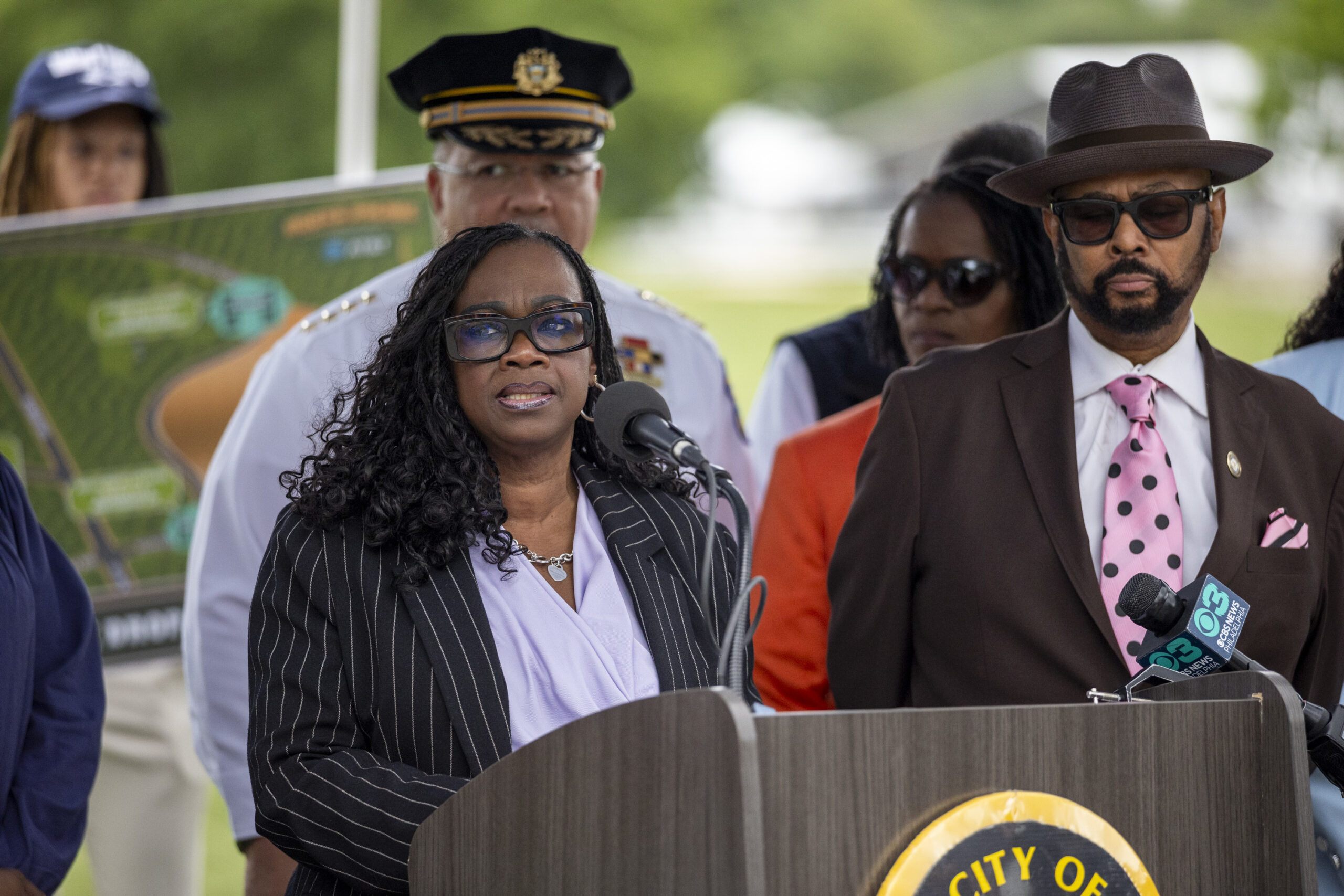
Chief Deputy Mayor Vanessa Garrett Harley speaks at Belmont Plateau in Philadelphia on May 28.
Following the interview with Garrett Harley, The Inquirer later obtained the contract, and the mayor’s office on Tuesday did not respond to follow-up questions about the cost of the concert.
ESM’s original $10 million contract with the city included a breakdown of costs, ranging from $5,000 for “furniture” to nearly $3.4 million for “talent.” It also included $1.2 million for “ESM Productions Fees” and $1 million for “Above the line Producer’s Unit.”
The contract amendment for $5.5 million, signed June 26, did not include details on costs.
A spokesperson for ESM declined to comment.
Founded in 1996 by Scott Mirkin and Jenny Woo, ESM has previously produced numerous high-profile events on the Parkway, including the 2015 papal visit and Jay-Z’s Made in America concert.
David L. Cohen, a Philly political powerbroker and former U.S. ambassador to Canada, said he has hired ESM to produce events going back to when he was chief of staff for then-Mayor Ed Rendell in the 1990s.
“They’re incredibly competent; they’re incredibly good; they do an excellent job,” he said. “I really do think they’re the best event producers in Philadelphia.”
In paperwork submitted to the city, ESM said it “has a long standing relationship” with Cohen and pointed to events he hired the company to produce at the U.S. embassy in Ottawa, Canada, as examples of its past work.
Michael DelBene, president and CEO of Welcome America, said that, despite no longer being the producer for the concert, his organization is still managing more than a dozen Semiquincentennial-related events in partnership with the city. The events kicked off on Juneteenth and will run through the Fourth.
“The celebrations that happen in the city are the implementation of the mayor’s vision, and if she chooses a team to implement that vision, that’s great, and we all support that person and that team,” DelBene said in an interview. “We’re all going to row in the same direction to make sure the city shines.”
Drama and infighting had plagued a series of nonprofit efforts and federal commissions meant to coordinate the festivities. And the COVID-19 pandemic pushed party-planning way down the priority list for the city and for state leaders who could have previously led the charge, former Mayor Jim Kenney and former Gov. Tom Wolf.
Those delays likely squandered any opportunities for a monumental building project, such as the Please Touch Museum building, which was constructed for the 1876 Centennial Exposition, or the Ben Franklin Bridge, which opened for America’s 150th birthday in 1926. They may have also cost Philly the chance for an appearance by a high-profile dignitary, such as when Queen Elizabeth II visited for the 1976 Bicentennial.
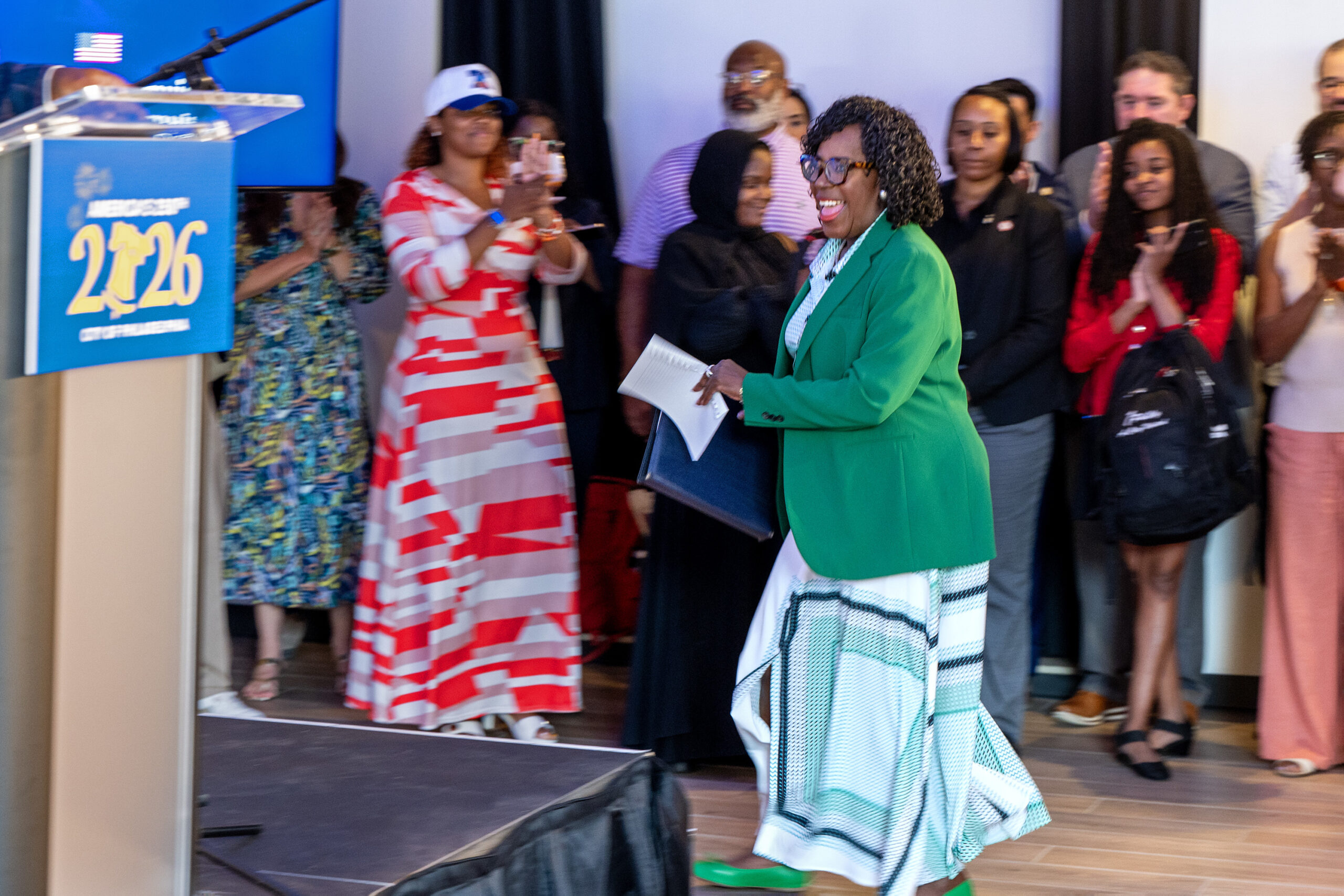
Mayor Cherelle L. Parker heads to the stage at the Independence Visitor Center Wednesday, Sept. 3, 2025 to announce a new initiative that puts city neighborhoods at the forefront of the city celebrations of America’s 250th birthday in 2026.
But the mayor eventually embraced the task in a more public way — following some public prodding from City Councilmember Isaiah Thomas — and the city’s Semiquincentennial celebrations will very much bear her stamp.
Parker has pledged to spend $120 million this year to mark the occasion, and she has made investing in communities across the city, not just the historic district, a major focus as Philadelphia this summer is also hosting World Cup games and the MLB All-Star Game. Much of that spending will pay for street work and beautification projects in neighborhood commercial corridors, 250th-themed block parties, and extra funding for annual events like the Odunde Festival.
“We want to make sure that any and everybody can participate in this regardless of your station in life,” Garrett Harley said.
‘This is her big concert’
With the official Independence Day parade — still organized by Welcome America — scheduled for Friday, July 3, there is surprisingly little in the way of official patriotic proceedings taking place on July Fourth itself.
Parker at 10 a.m. will lead a Philadelphia Freedom Awards ceremony at Independence Mall, honoring seven people, including Cohen and actor and Philadelphia-native Colman Domingo.
At 5 p.m., the concert will kick off on the Ben Franklin Parkway. Performers include Aguilera, Will Smith, DJ Jazzy Jeff, Jill Scott, The Roots, Meek Mill, and Seal. The city’s official fireworks show will begin at the show’s conclusion, around 11:30 p.m.
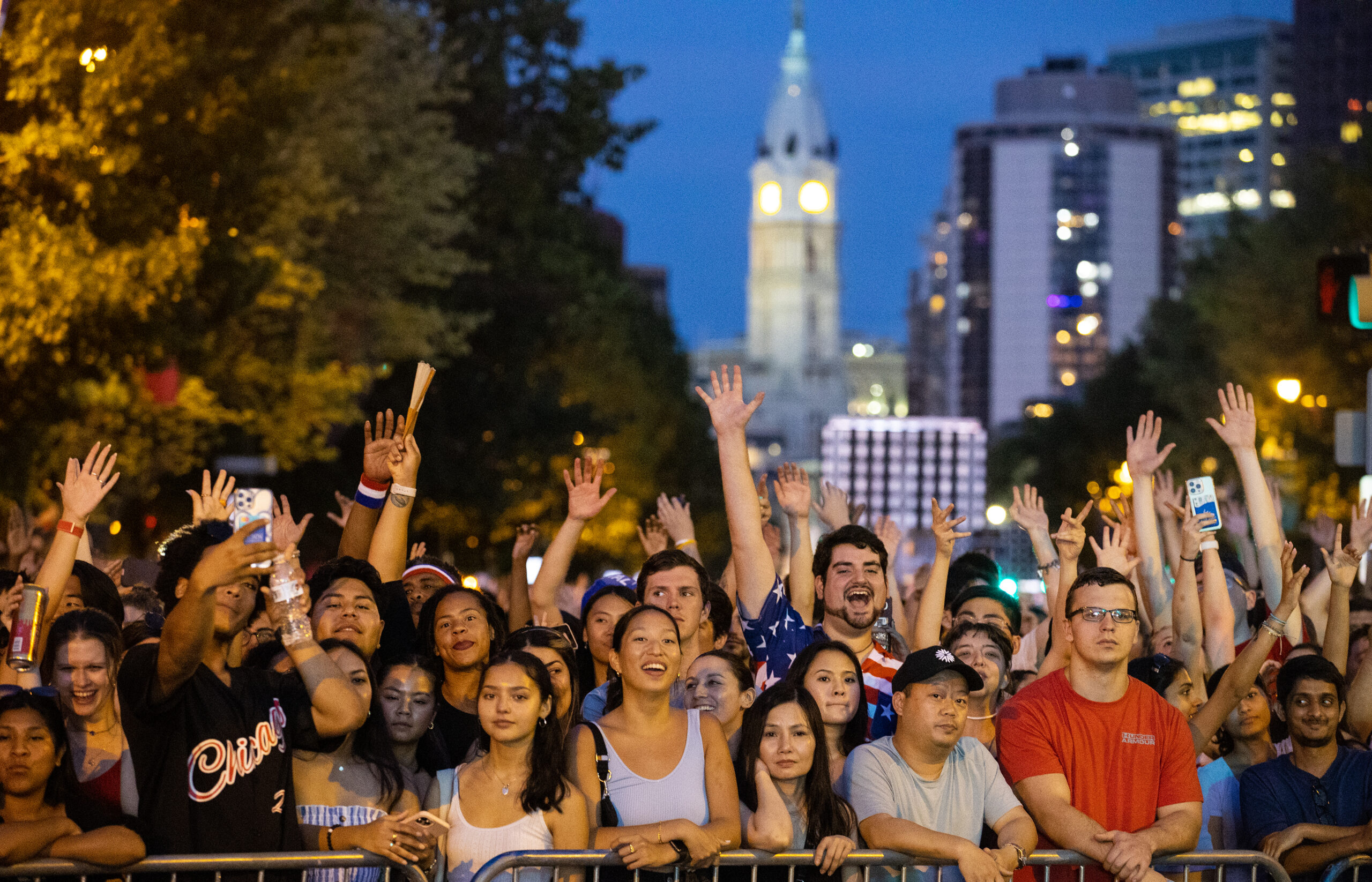
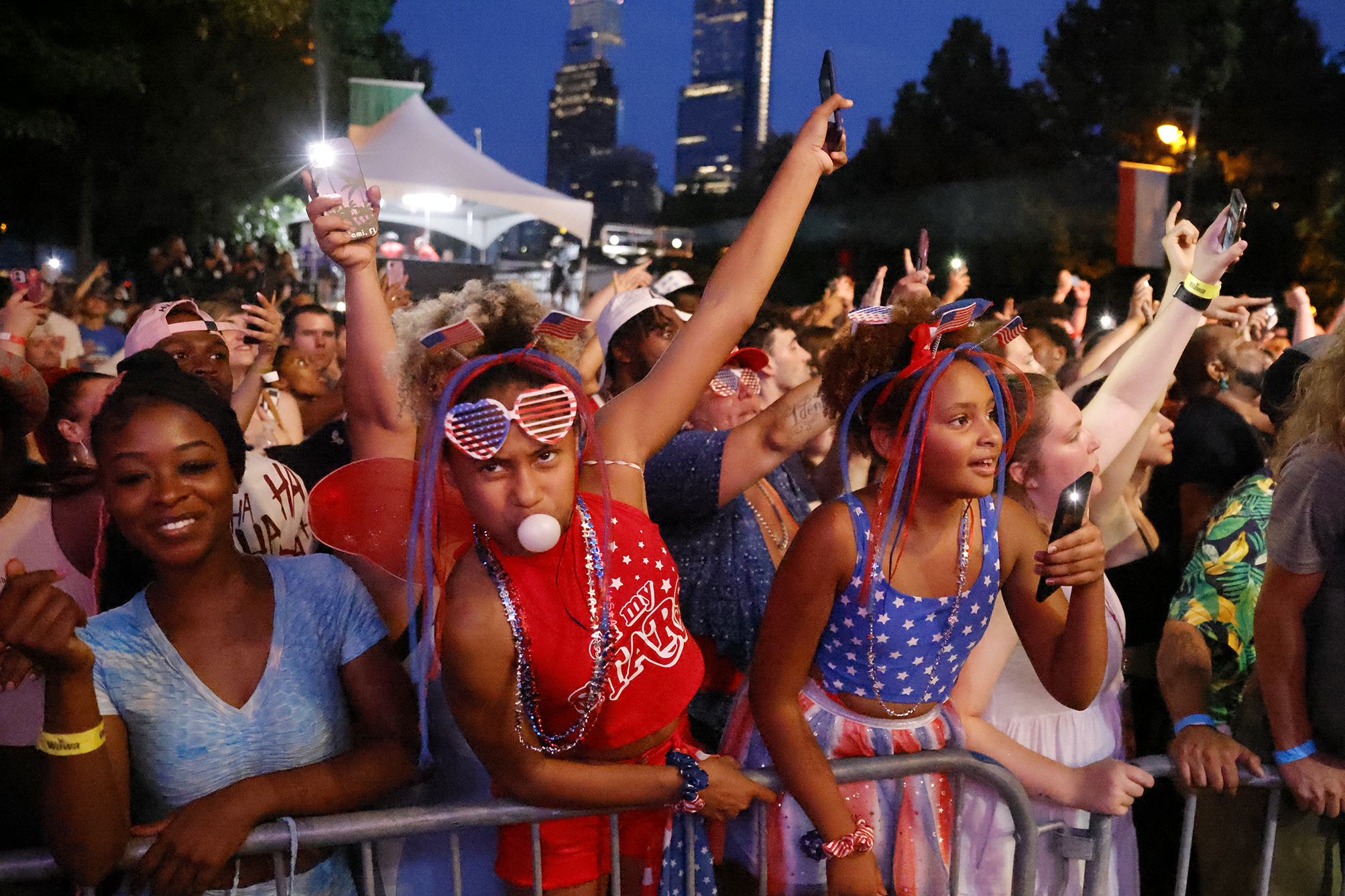
Fans during the Wawa Welcome America July 4th Concert on the Parkway in Philadelphia, Pa. on July 4, 2022.
Parker has several times compared this year’s show to Live Aid, the 1985 benefit concert staged in Philadelphia and London that featured in its 10-hour stateside lineup Bob Dylan, Mick Jagger, Madonna, Phil Collins, the Beach Boys, the Four Tops, Santana, Run-D.M.C., and many other musical A-listers.
“If you remember Live Aid and you think about the legacy experience we’re trying to create … that’s what we’re trying to do on July the Fourth,” Parker said in March.
Garrett Harley on Tuesday conceded the concert lineups may not be exactly comparable, but said the mayor was “really talking more about the scope and the magnitude and just the memories.”
“But to certain kids it’s gonna be bigger than Live Aid, because Christina Aguilera means to them what Stevie Wonder and some of the folks who ran Live Aid meant to others,” Garrett Harley said.
Garrett Harley disputed the notion that renaming the concert “One Philly: A Unity Concert for America” meant that it now bears Parker’s branding.
“I don’t know how a ‘Unity Concert for America’ is Parker’s branding because the whole point of this is about unity,” Garrett Harley said. “The branding is really about reminding people that we need to unify, we need to be one America, despite everything that may be going on in the country right now.”
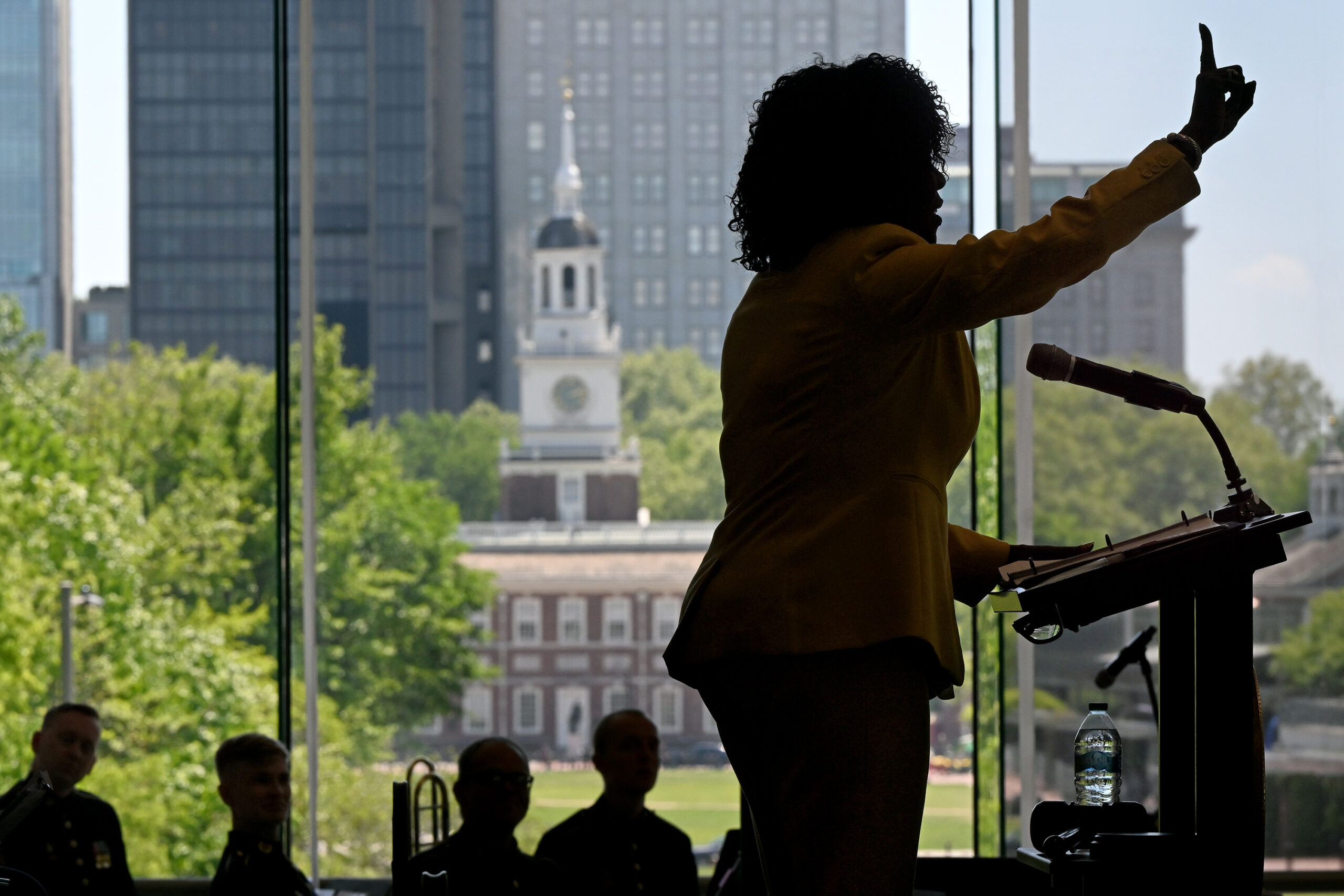
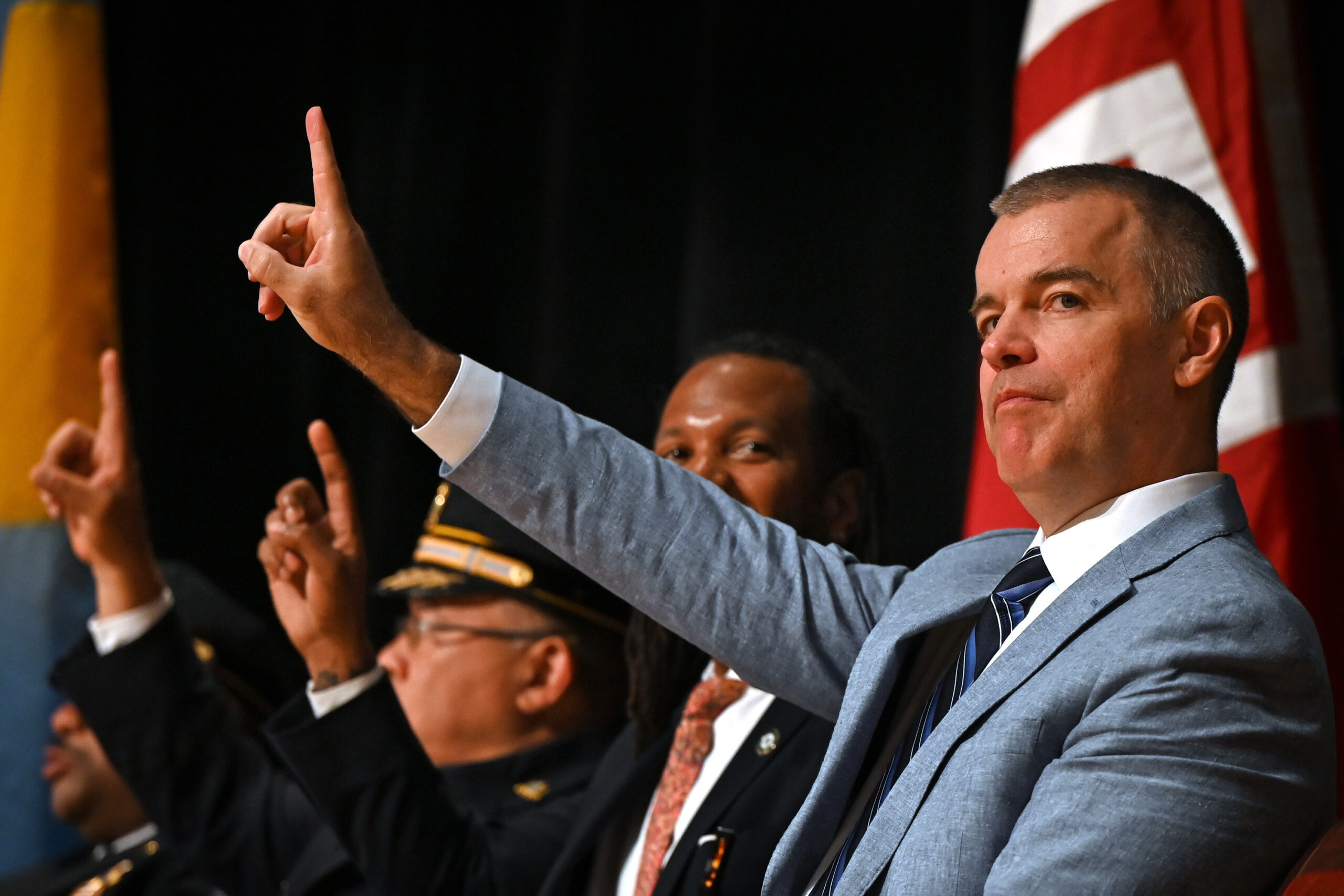
The mayor frequently concludes speeches by asking crowds to raise their index fingers and say in unison, “One Philly: A United City.” She has also had the slogan printed on city trash trucks and cans, along with her name.
Mayor Cherelle L. Parker raises a finger with her call-and-response “One Philly, A United City” mantra ending her speech during a ceremonial meeting of the Pennsylvania Senate at the National Constitution Center across the mall from Independence Hall on May 5.
“Even if it is Parker’s branding, if that’s how people see it, what would Wawa Welcome America be if not branding?” Garrett Harley added.
(Wawa, a longtime corporate sponsor for the city’s July Fourth festivities, pays Welcome America to include its branding in the event, defraying costs for taxpayers.)
Branding or not, Parker’s vision guided the planning for the concert, Garrett Harley said.
“At the end of the day, this is [Philadelphia’s] 100th mayor,” Garrett Harley said of Parker. “This was her biggest concert, and probably will be the biggest that she will ever do. She’s the first female mayor. She’s the first African American female mayor. This is her big concert.”
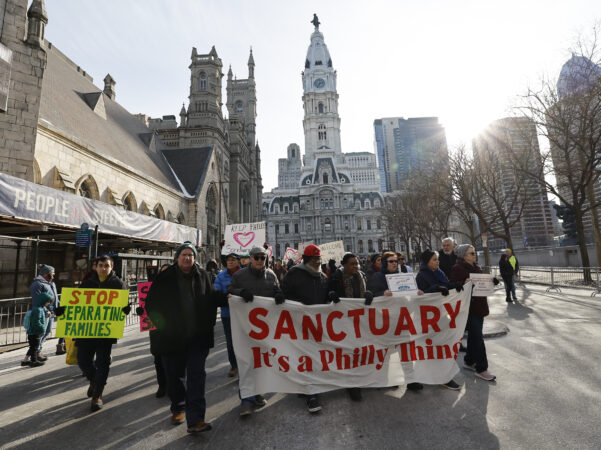
A significant majority of residents want Philadelphia to remain a sanctuary for immigrants, according to a new poll that shows the overwhelmingly Democratic city is undeterred by President Donald Trump’s threats to defund so-called sanctuary cities.
A recent Suffolk University/Philadelphia Inquirer poll that surveyed 500 city residents asked respondents if Philadelphia should remain a sanctuary city, “even if it means losing federal funding.” A commanding 59% answered “yes,” with only 28% saying “no” and the remainder undecided or unwilling to say.
The support for Philadelphia’s sanctuary status was consistent across age and racial groups. The only geographic region where a plurality of respondents answered “no” was far Northeast Philadelphia, which is among the most politically conservative areas of the city.
The survey question did not elaborate on what a loss of federal funding could mean for the city in terms of the impact on residents. Philadelphia received $2.2 billion from the federal government in fiscal year 2024 to pay for a wide range of critical services, including infrastructure needs, as well as healthcare, food, and housing assistance for low-income people.
(function(){function e(){window.addEventListener(`message`,function(e){if(e.data[`datawrapper-height`]!==void 0){var t=document.querySelectorAll(`iframe`);for(var n in e.data[`datawrapper-height`])for(var r=0,i;i=t[r];r++)if(i.contentWindow===e.source){var a=e.data[`datawrapper-height`][n]+`px`;i.style.height=a}}})}e()})();
Still, the results of the poll show relatively widespread support in Philadelphia for the city’s sanctuary policies, which include its practice of not complying with detainers issued by U.S. Immigration and Customs Enforcement without a court order. Those detainers are effectively requests submitted by federal agents to local law enforcement agencies that ask to hold undocumented immigrants in custody.
Mayor Cherelle L. Parker’s administration does not refer to Philadelphia as a “sanctuary city” — she and her top aides instead call it a “welcoming city,” language that has been increasingly adopted nationwide as Trump and his allies in the Republican Party have sought to crack down on sanctuary cities.
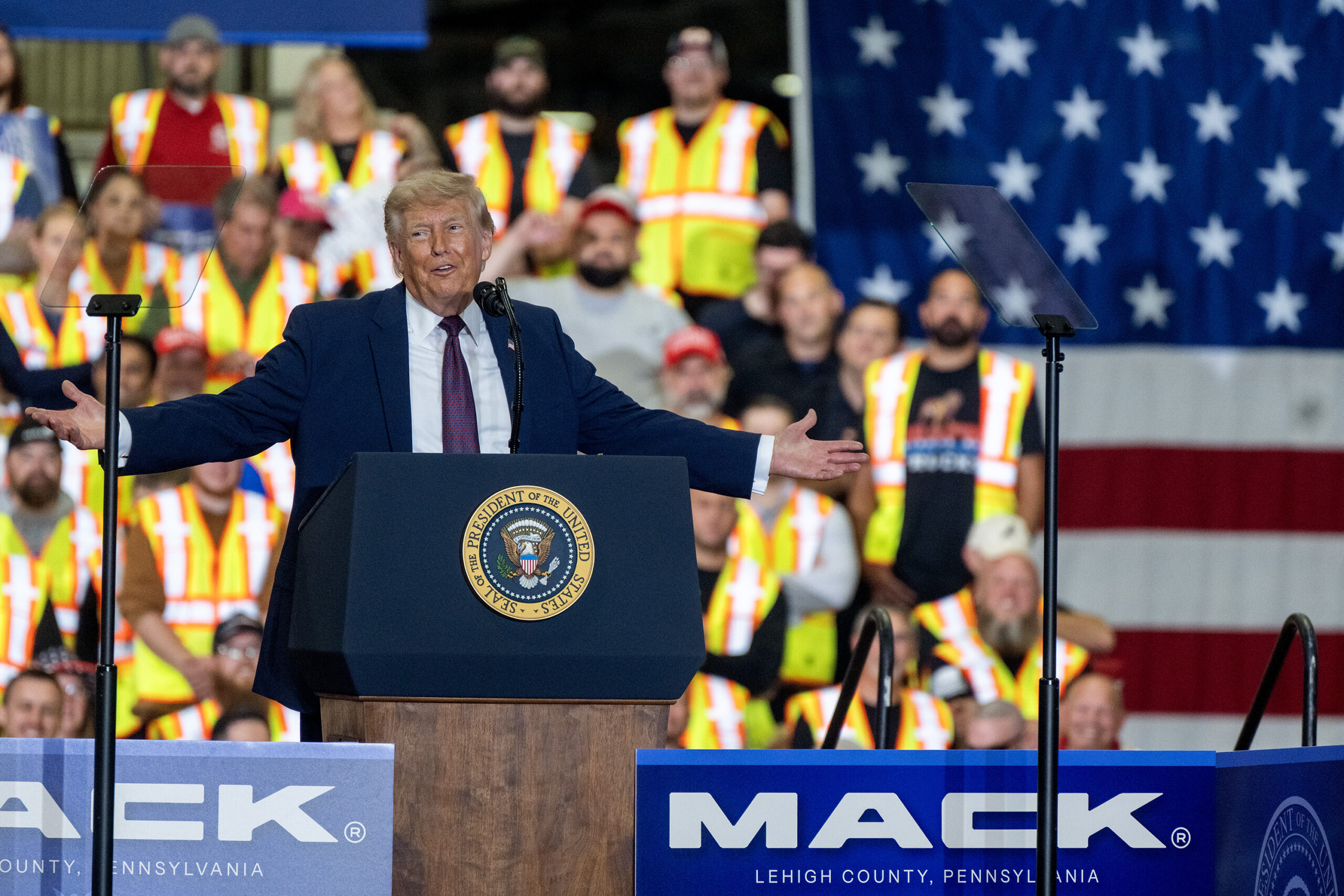
President Donald Trump travels to the Lehigh Valley to visit Mack Trucks in Macungie on Tuesday, June 23, 2026.
The sanctuary policies predate Parker’s tenure and were in place under an executive order signed by former Mayor Jim Kenney. They were codified into law earlier this year after City Council passed a package of legislation aimed at limiting ICE’s operations in the city and instituting some of the nation’s toughest restrictions on ICE.
In May, Parker signed six of the seven bills in the package, but took no action on one that bars law enforcement officers from concealing their identities, including by wearing masks. City Solicitor Renee Garcia wrote in a letter to Parker that the legislation may not be legally enforceable, but the mayor did not veto the bill, allowing it to become law.
Last week, the Trump administration sued Philadelphia and some of its top officials, including Parker, over the mask-ban ordinance. The Trump administration contended that the law is “blatantly unconstitutional” and undermines federal law enforcement’s ability to do its job.
The lawsuit is one of several filed across the nation by the Trump administration challenging local laws related to immigration as federal authorities carry out the massive deportation campaign promised by the president.
That effort is also tied up in litigation. Last year, a federal judge issued an injunction blocking the Trump administration from denying funding to jurisdictions that limit cooperation with ICE, saying the White House could not impose funding conditions without authorization from Congress.
Staff writer Sean Collins Walsh contributed to this article.
At times, Ala Stanford feels like she doesn’t quite fit in.
She’s a pediatric surgeon — albeit very well-known — who is running for political office for the first time, trying to win a seat in Congress that for decades has been held by a seasoned Philadelphia politician.
At campaign events, when the top Democrats in the congressional race are chit-chatting among themselves, Stanford has found herself on the margins. Often, she feels more comfortable talking medical procedures with Dave Oxman, the other physician in the race, than whatever the sitting state representatives have going on in Harrisburg.
The trail may get lonelier. Oxman is planning to drop out Wednesday and endorse Stanford, making her the hands-down most prominent outsider in a race that is stacked with political veterans.
To amass support ahead of the crowded May 19 primary election — the likely deciding contest in one of the nation’s bluest congressional districts — Stanford will have to chart a path that beats both the Democratic establishment and the progressive left, which have chosen other candidates in the wide-open race.
Stanford, 55, knows her lack of political experience makes her stand out, and she’s accentuating it on the campaign trail. She is highlighting her career as a physician, and she says she’ll fix a healthcare system her opponents failed to address in their years as public officials. Her candidacy comes as an increasing number of medical professionals are running for office across the country, and as thousands of Pennsylvanians have dropped their healthcare coverage due to rising costs.
She has kept pace with three sitting lawmakers who are also running for the seat, in part by lending her campaign $250,000 of her own money.
Candidates (from left) State Rep. Morgan Cephas; physician David Oxman; State Rep. Chris Rabb; physician Ala Stanford and State Sen. Sharif Street appear at a forum hosted by the 9th Ward Democratic Committee in Mt. Airy Thursday, Dec. 4, 2025.
Stanford alsohas a cadre of healthcare workers uplifting her. She has won endorsements from prominent doctors, as well as a national super PAC, 314 Action, which backs candidates with backgrounds in science and has poured $1.5 million into a pro-Stanford campaign.
The group so far funded five weeks of television commercials reminding voters that Stanford founded the Black Doctors COVID-19 Consortium. In the throes of the pandemic, she set up mobile testing sites in majority-Black communities and ran vaccination clinics to inoculate thousands of Philadelphians, a grassroots effort to fill gaps left by government-funded programs.
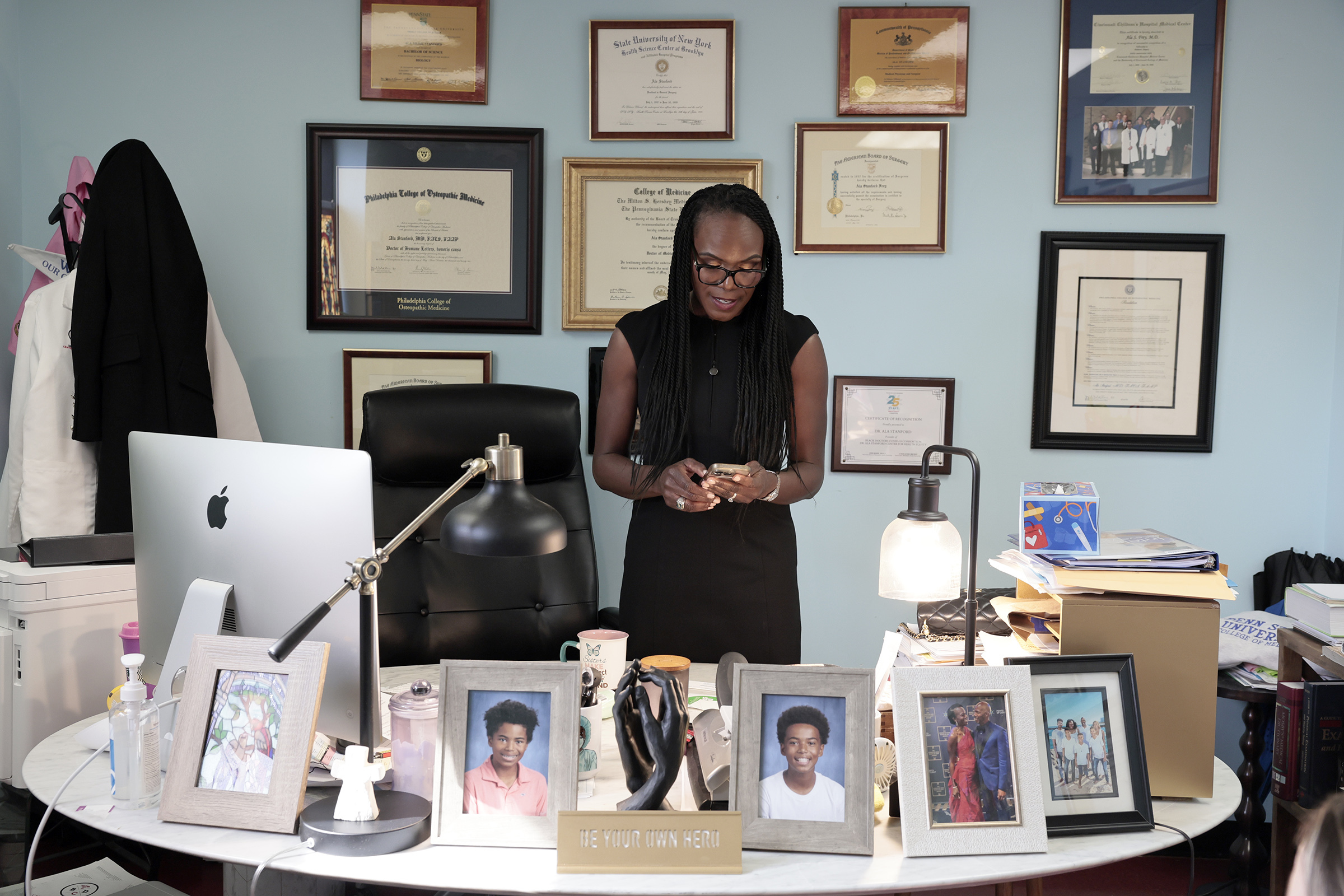
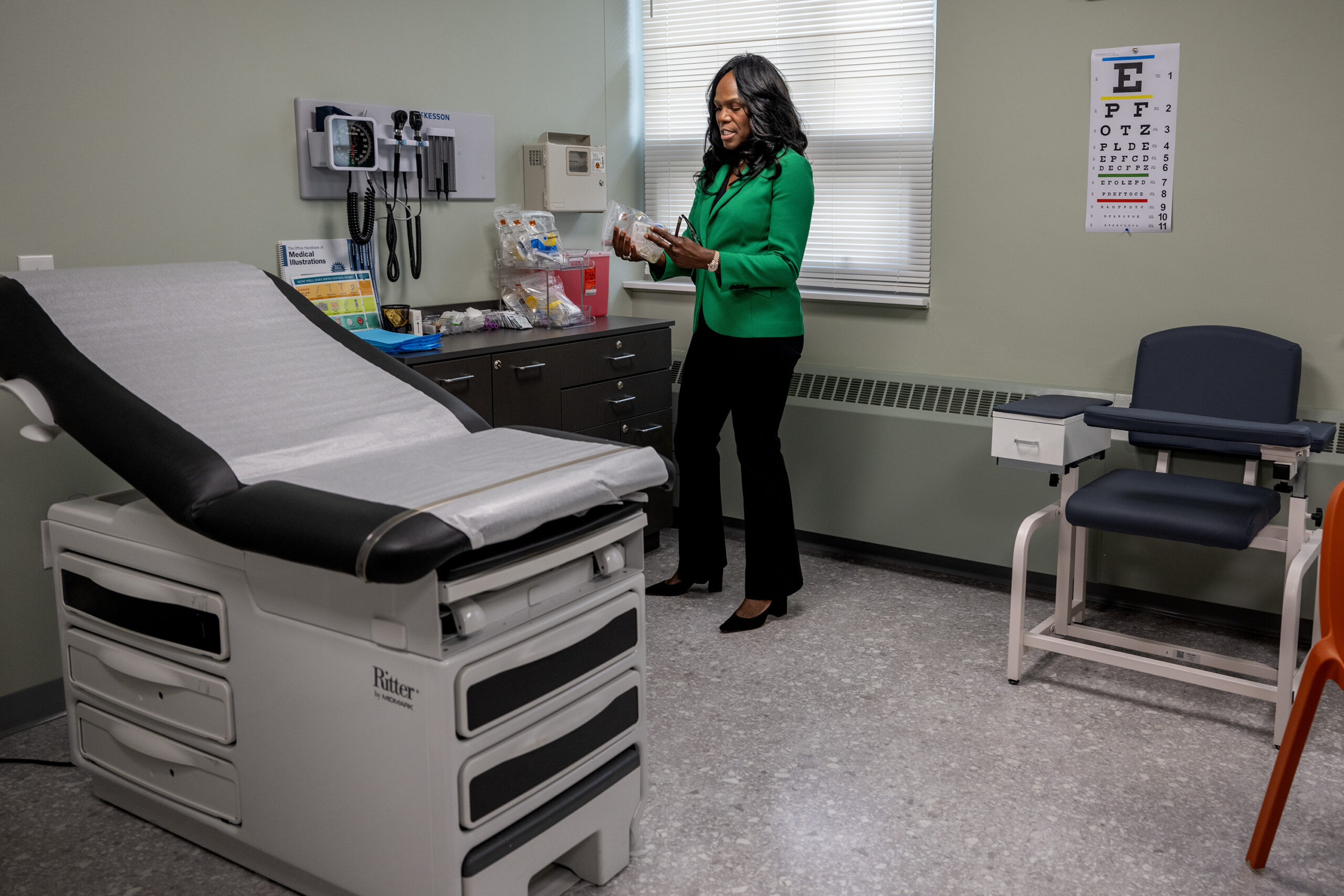
Ala Stanford texts her son while in her office at the Dr. Ala Stanford Center for Health Equity, 2001 W Lehigh Ave. in Philadelphia on Friday, March 13, 2026
It is a compelling story that has been told many times — across national media, on podcasts, and in Stanford’s own memoir.
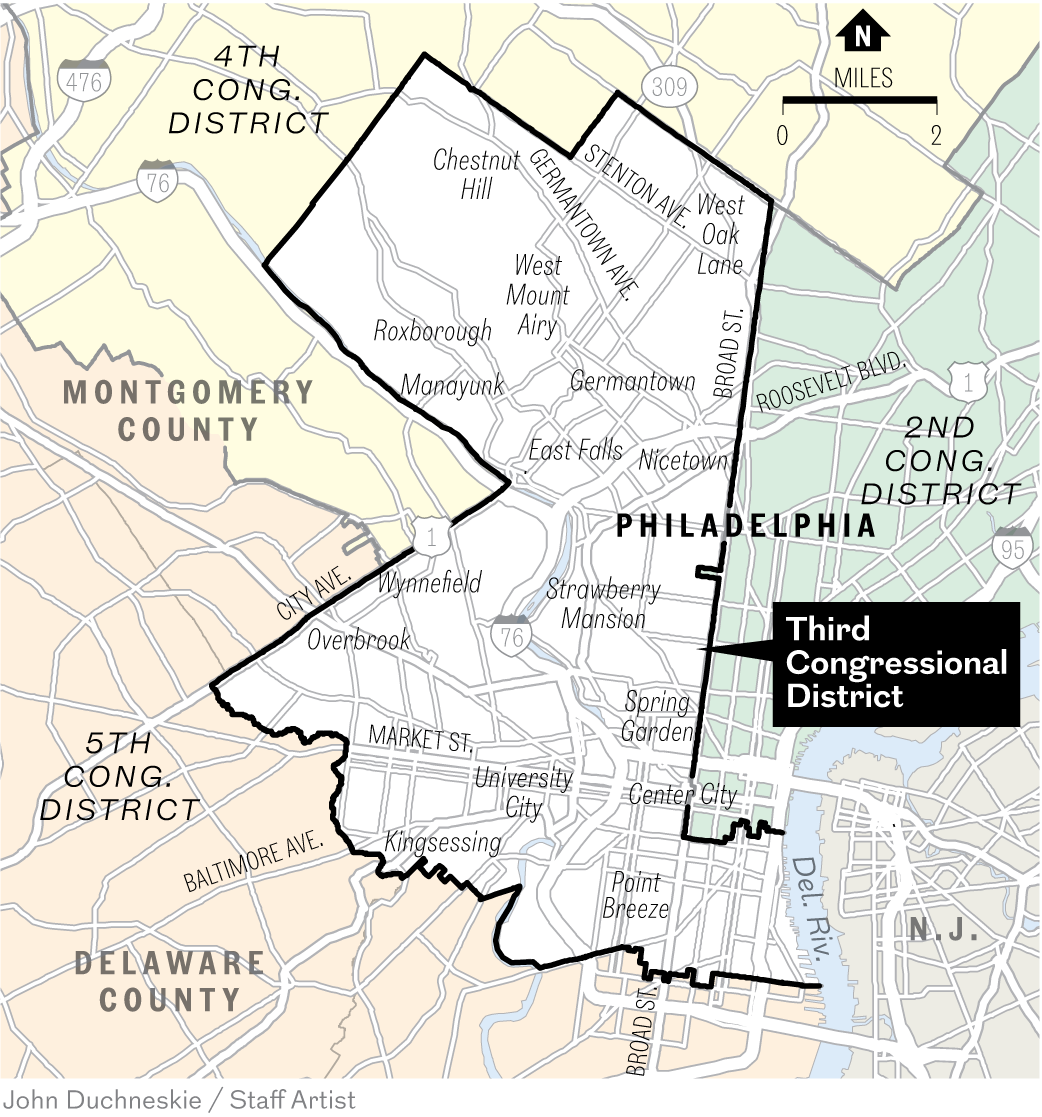
What hasn’t been told is why it means she should represent the 3rd Congressional District, which covers much of Philadelphia, over her opponents who have spent years in politics.
“People get so comfortable doing things the same way, the same way, the same way,” she said in a recent interview at her health clinic. “And no one likes change. But the city needs this. The city needs some change.”
Other candidates say Stanford doesn’t have a monopoly on talking about healthcare. State Sen. Sharif Street, another front-runner in the race, has touted that he and other government officials helped secure funding for Stanford’s pandemic operation.
“During COVID, he was very proud of his work,” Street spokesperson Anthony Campisi said, “to ensure that Doctor Stanford’s vaccination efforts received the support they needed so that we could get vaccines into arms quickly.”
Stanford’s opponents also clearly know that her status as a physician may be an asset.
She submitted paperwork to appear on the ballot as “Dr. Ala Stanford.” But on Tuesday, a member of the Democratic City Committee — which endorsed Street — filed a petition in state court, saying Stanford’s name should appear without the “Dr.” in front of it.
In the coming days, a judge will decide.
Leaning on healthcare as a core issue
Stanford does not fit neatly onto the ideological spectrum.
Of course, she is not conservative. She doesn’t call President Donald Trump by his name — he’s “47″ — and she uses words like “tyranny” and “running amok” to describe the current White House.
But unlike some of her opponents, she is not of the Philadelphia Democratic establishment. She said she feels like the city’s long-entrenched party apparatus had always planned to endorse Street, the former head of the state party and the son of a Philadelphia mayor.
Stanford is also not of the populist left. She believes Palestinians “deserve to have safety and freedom,” but thinks it’s inflammatory when her progressive opponent, State Rep. Chris Rabb, calls Israel’s war in Gaza a “genocide.”
“I know when you use the G-word how hurtful it is to a group of people,” she said. “It’s like someone saying the N-word around me. I don’t want to hear that. And every time you shout that from the rooftops, how many people are you hurting?”
What she does believe is that government systems have failed underserved communities, and that most domestic issues can be traced back to inequities in healthcare — points she has consistently emphasized in her campaign.
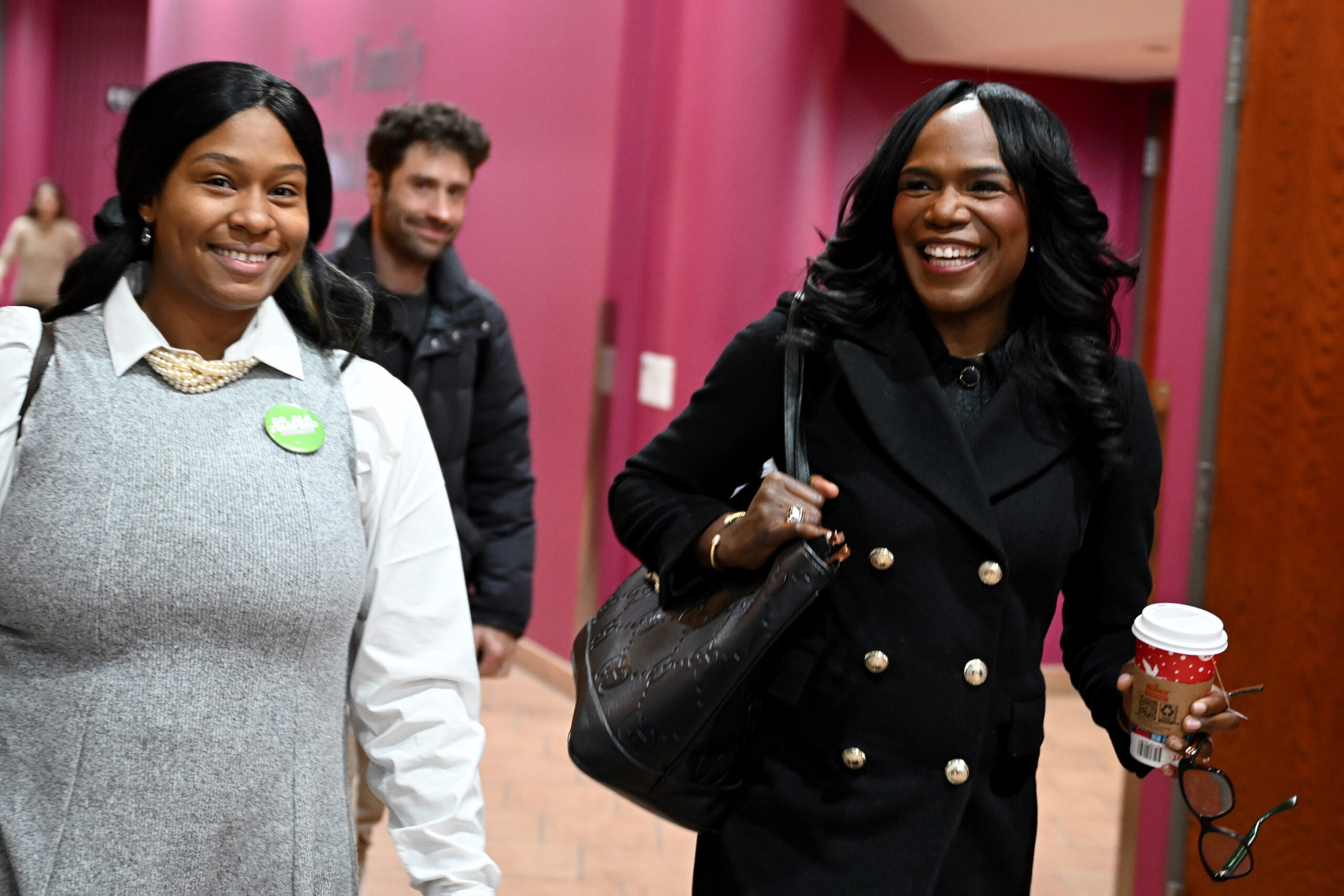
Physician Ala Stanford (right) arrives at a forum hosted by the 9th Ward Democratic Committee Dec. 4, 2025. She is a Democratic candidate running to represent Philadelphia’s 3rd Congressional District.
She has hammered Republicans for not extending pandemic-era subsidies that ensured people on Affordable Care Act health plans did not pay more than 8.5% of their income for care. She has advocated for universal healthcare. And she has harshly criticized Health and Human Services Secretary Robert F. Kennedy Jr., who has long been skeptical of vaccines.
“In this country, wealth is linked to homeownership, home ownership is linked to education, education is linked to health outcomes, and health outcomes are all exacerbated by racial injustice,” Stanford said during a recent candidates forum. “So when you talk about one, you talk about all.”
Stanford is careful to say that her focus on healthcare doesn’t mean she can’t discuss housing, immigration, or the war in Iran.
But it is clear that she feels most comfortable talking about what she knows best. Her supporters say that’s an asset in the 3rd Congressional District, which has a disproportionately high number of people who rely on public healthcare systems.
More than a third of the district’s residents, or more than 284,000 people, were on Medicaid as of December, according to the state Department of Human Services. Among Pennsylvania congressional districts, that’s the second-highest proportion of residents on Medicaid. (The first highest is the 2nd Congressional District, which also includes parts of Philadelphia.)
There were also more than 80,000 people in the district who last yearhad health coverage under the Affordable Care Act, either through expanded Medicaid eligibility or a plan they purchased through the marketplace.
That number is also likely lower now since ACA subsidies expired this year and premiums rose. Statewide, one in five people who bought plans last year from Pennsylvania’s marketplace, Pennie, opted out for 2026.
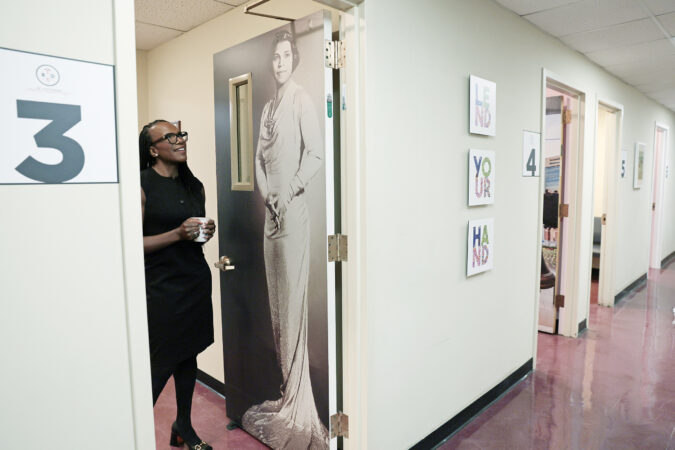
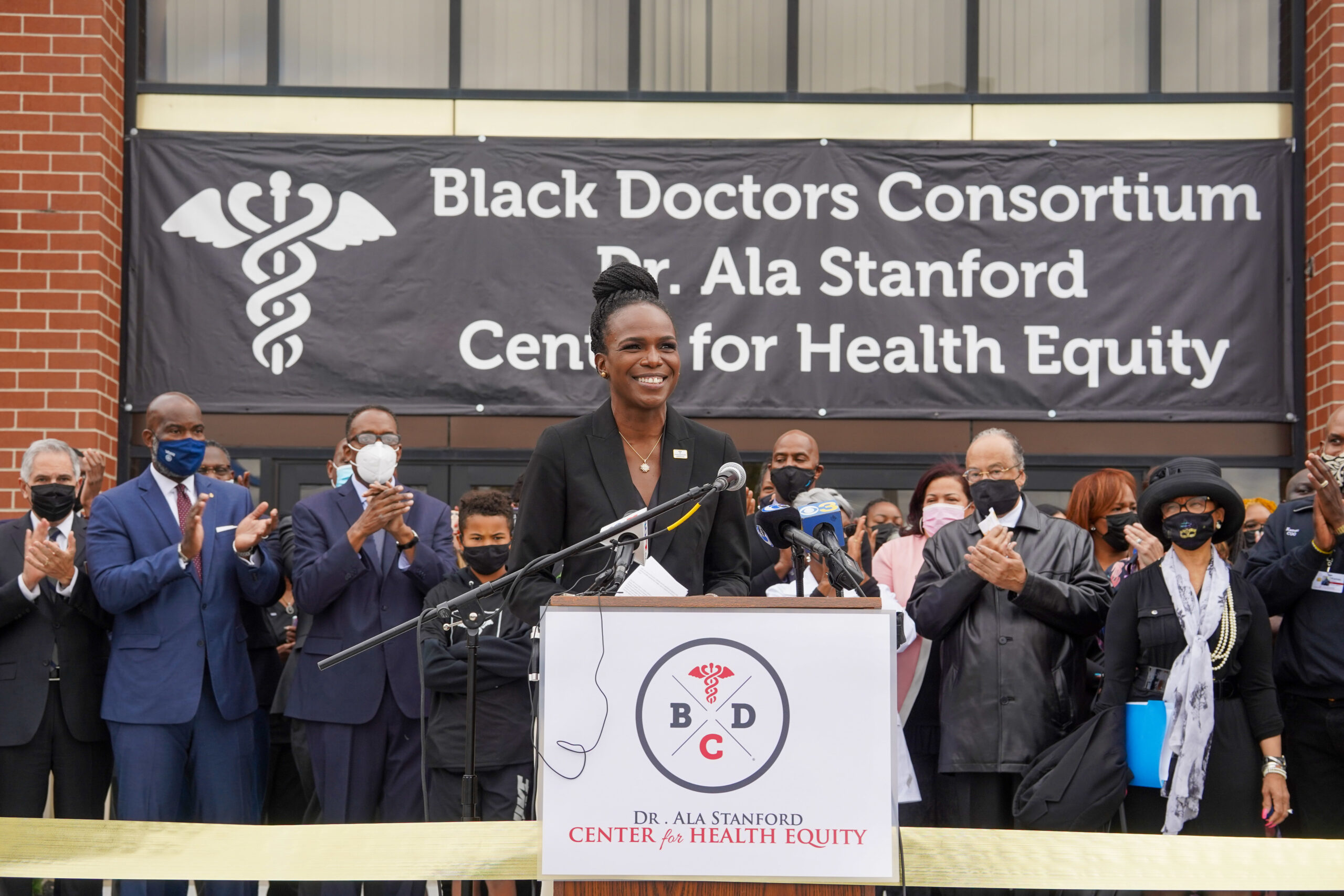
Ala Stanford speaks at the Black Doctors Consortium Dr. Ala Stanford Center for Health Equity in Philadelphia, Pa., on October 27, 2021. The center was opened with the goal of making healthcare accessible for those in communities who might struggle to get proper healthcare treatment.
Stanford’s supporters think Philadelphia voters will trust a doctor to ensure affordable healthcare access. They point to a survey released this month by the Annenberg Policy Center at the University of Pennsylvania that found 86% of respondents said their primary healthcare provider is trustworthy.
Erik Polyak, the executive director of 314 Action, said Stanford’s background differentiates her in a Democratic primary in which most candidates align on key issues.
“Voters want healthcare decisions made by people who understand patients and the science,” he said, “and not politicians chasing headlines.”
Oxman, Stanford’s now-former opponent, said physicians running for office can help rebuild a Democratic Party that has “lost the trust of so many people.”
“So many people see us as not centered on their needs, particularly their economic needs,” he said. “If the Democrats are going to build a party that has a chance of winning in Center City Philadelphia and in central Pennsylvania, it’s got to regain the trust of the voters.”
New to politics, but not government
It was the spring of 2020, and the bills were piling up.
Stanford, who was born in Germantown, had given up her well-paying day job as a surgeon to work full-time with the Black Doctors Consortium. She ran COVID-19 testing clinics in Philly parking lots and churches, and amassed some $200,000 in bills, saying she couldn’t “let one person lose their life for a test that costs $100.”
That was the beginning of her pandemic experience with government.
A lot of it was begging. As Stanford tells it, she peppered government officials with emails, telling them how many people she and her volunteers had tested that day, and asking for help securing funding.
In this April 2020 file photo, Ala Stanford puts on her mask before running a coronavirus (COVID-19) testing site at the Miller Memorial Baptist Church in Philadelphia.
U.S. Rep. Dwight Evans was immediately responsive. He connected Stanford with the White House, other members of Congress, and top insurance companies. And he publicly called on former Gov. Tom Wolf and then-Mayor Jim Kenney to allocate funding to Stanford’s organization, citing the group’s outreach to predominately Black communities and its work to address distrust of medical institutions.
The money came in several months later. It was finally enough for Stanford to pay for testing, compensate her staff, and prepare to vaccinate thousands of Philadelphians.
Fast-forward five years, and Evans has endorsed Stanford to replace him in Congress as he retires after decades of public service. His backing has been invaluable to Stanford, and it surprised some political observers who figured he might endorse one of the politicians whom he’d served alongside.
Stanford said Evans’ support has not convinced some Democratic voters. Some tell her they plan to vote for Street, citing his family name, or they say that “it’s his turn now.”
“What about if he is not what’s best for the people?” Stanford said. “Doesn’t that factor in?”
She tells voters that despite being new to the campaign trail, she isn’t new to government. She worked as a regional director for the Department of Health and Human Services under former President Joe Biden, who appointed her to the role. And she leads medical services at the Riverview Wellness Village, the city-owned drug recovery center opened last year by Mayor Cherelle L. Parker’s administration.
Physician Ala Stanford in an examination room at the primary medical care center run by her Black Doctors Consortium at Riverview Wellness Village, a city-owned drug recovery home in Northeast Philadelphia Tuesday, Nov. 25, 2025.
Still, Stanford very much sees herself as a doctor.
She often works out of a corner office in the North Philadelphia health center, and she still is alerted when the temperature of the vaccine refrigerator dips a degree too low. She has, on more than one occasion, tended to someone experiencing a medical emergency while she was campaigning.
She knows that overseeing day-to-day operations at the health clinic won’t be possible if she’s in Congress. There’s a succession plan in place.
“It’s just about, how can I have more significance at a larger scale? Congress is definitely a way to do it, but it might be somewhere else,” Stanford said. “That is, if I don’t win. But I want to win. I should win.”
Just days before the release of Mayor Cherelle L. Parker’s city budget, it is unclear whether it will include money to continue Zero Fare, a program that gives free transit passes to low-income Philadelphians.
Transit advocates and political leaders say they have not heard from the administration on the issue and are concerned it may be cut or have its funding reduced.
A rally is scheduled for 10 a.m. Friday on the north apron of City Hall to push for Zero Fare’s survival — and for city government to continue participating in SEPTA’s Key Advantage, which provides free transit passes for municipal workers.
Parker is scheduled to deliver her annual budget address next Thursday to a session of City Council.
A spokesperson for the administration declined to comment.
“We don’t care who gets the credit,” said Stephen Bronskill, coalition manager for Transit Forward Philadelphia, a nonprofit that advocates for public transportation that is organizing the event. “We want to see that this program gets funded … so people can get where they need to go.”
City Council members, state lawmakers, activists for transit funding and service, and users of the Zero Fare passes are expected to speak Friday.
Zero Fare, which serves about 60,000 eligible people with incomes at or below 150% of the federal poverty standard, would end June 30 unless the fiscal 2026-27 budget funds it.
Officials also must decide whether to fund Key Advantage benefits for city workers, though SEPTA’s program provides subsidized passes free to the employees of nonprofit organizations and private businesses.
Deja vu?
Both programs have faced city budget uncertainty in the past.
City officials said they had begun meeting with SEPTA to find a funding solution to continue both programs before the uproar. The administration also continued Key Advantage last year.
“From our standpoint, they’ve both worked well, and we’d like to see them continue,” SEPTA spokesperson Andrew Busch said Thursday.
A path forward
Zero Fare began as a pilot, started by Kenney using $30 million of federal COVID relief money to get it off the ground. The program was nationally recognized because it proactively sent transit fare cards to Philadelphians eligible for the benefit.
Automatic enrollment eliminated the red tape “time tax” for people who wanted to use the benefit, making it unusual on the local level, according to public policy analysts.
“It can’t be yanked away at a moment’s notice when somebody wants to shift something around in the budget,” O’Rourke said last November at a community meeting on the proposal.
This story has been updated to remove an outdated figure for the number of participants in Zero Fare.
Philadelphia’s $10 billion municipal pension system is now 68% funded and on pace to reach full funding by 2032, a year earlier than previously projected, City Controller Christy Brady announced this week.
A decade ago, the pension fund was only 45% funded and appeared to pose a significant threat to the city’s fiscal health. But a series of reforms carried about by successive mayors, state and city legislators, and municipal labor leaders have fostered a remarkable turnaround.
The city’s pension system pays for retirement benefits for city workers. Benefits vary based on when employees were hired. About 35,000 people are currently receiving benefits, according to the pension board’s most recent newsletter. That includes retirees, their beneficiaries, and disability claimants.
“The fiscal health of the Pension Fund continues its relentless upward climb since many reforms were put in place 10 years ago,” Brady, who sits on the city Board of Pensions and Retirement, said in a statement. “We’ve made smart investments, doubled our assets, reduced investment manager fees — resulting in a large reduction of the overall liability for taxpayers.”
The reforms included increasing annual contributions from the city budget to the pension fund beyond the minimum amount required by state law; negotiating union contracts with higher employee retirement contributions; moving away from high-fee investment managers; and dedicating revenue from a 1% sales tax in Philadelphia to the pension fund.
Despite disagreeing on many other issues, the mayoral administrations of Michael A. Nutter, Jim Kenney, and now Cherelle L. Parker have largely stuck to the same playbook when it comes to turning around the pension fund.
“Everyone has played a role in the stabilization of our pension fund, a development with enormous fiscal consequences for our city,” Parker said last year to City Council.
The continuity is in no small part due to the influence of Rob Dubow, who has been the city’s finance director since 2009 and has encouraged mayors to prioritize improving the health of the pension fund. Dubow chairs the pension board, which in addition to Brady includes appointees from the administration and the labor unions for city workers.
The good news for the pension fund comes as Parker prepares to unveil her proposal for the next city budget to Council on March 12.
The current budget, which took effect in July 2025 and was originally projected at $6.8 billion, has grown to just under $7 billion, according to the latest Quarterly City Manager’s Report. The fund balance — the amount of money left unspent, and the city’s primary reserve for navigating unexpected crises — is now projected to close the current fiscal year at $509 million, up from an initial estimate of $471 million.
As the city chips away at the pension system’s unfunded liability, it is paying more than $800 million per year into the system, an enormous expense. But there is light at the end of the tunnel.
If Parker serves two terms, she will leave office right when the pension fund is projected to reach full funding, which will be a watershed moment and will reduce the annual pension contribution by more than $400 million.
Parker’s budget plans appear to take into account that the next mayor may have it easier when it comes to fixed costs. For instance, her 13-year schedule for reducing business income and receipts tax rates, which Council approved last year, back-loaded the biggest tax cuts until after she is likely to leave office.
Meanwhile, Parker’s signature housing initiative calls for the city to take out $800 million in bonds over the next two years. Philly taxpayers will repay that debt, along with an estimated $500 million in interest, over the coming decades.
Five police officers say in a new federal lawsuit they were skipped over for promotions because of a Philadelphia policy change to promote diversity, equity, and inclusion in the municipal workforce.
The officers — Christopher Bloom, Kollin Berg, Joseph Musumeci, Marc Monachello, and Leroy Ziegler — claim they were victims of an “illegal and discriminatory” policy change adopted by City Council and Philadelphia voters in the aftermath of Black Lives Matter protests that swept the nation.
The lawsuit is a proposed class action on behalf of “all white male employees” of the Philadelphia Police Department who were passed over for promotions since 2021 in favor of a candidate with lower exam scores. The complaint was filed by a team of attorneys affiliated with President Donald Trump who have sued the city previously over diversity initiatives.
The change at the heart of the latest lawsuit is related to the so-called rule of two that required city managers to choose between the two candidates with the highest Civil Service exam scores. The rule was an often-cited reason for the limited diversity in the city workforce.
Voters got rid of the requirement through a ballot question in 2021, giving the city more discretion to tailor the number of finalists for a position.
The five officers sought promotions in November, three from lieutenant to captain and two from sergeant to lieutenant. All were “passed over for one of these promotions on account of their race and sex,” the suit says.
The complaint, filed Wednesday in the Eastern District of Pennsylvania, quotes from legislative documents and statements from politicians to argue that the rule change was racially motivated.
A 2022 resolution calling on then-Mayor Jim Kenney to study the impact of the rule change “repeatedly bemoans the fact that white men were obtaining too many promotions under the city’s merit-based promotion system,” the suit says, calling it “one of the many examples of the city of Philadelphia’s determination to impose illegal DEI practices that consciously and intentionally discriminate against white men.”
Another example cited in the lawsuit is a statement by Mayor Cherelle L. Parker, a Council member at the time, who championed the change. She is quoted as saying that “for too long, the Rule of Two has held back Black and Brown employees.”
The suit is the latest filed by a team of conservative lawyers against Philadelphia over efforts to address racial inequity. The attorneys include Pennsylvania’s self-described “go-to” lawyer for Republicans, Wally Zimolong; Jonathan Mitchell, the former Texas solicitor general who is credited as the legal mind behind that state’s abortion ban; and attorneys from American First Legal, an organization formed by Trump adviser Stephen Miller.
In October, the group settled a lawsuit that claimed the city violated the Constitution by forcing bidders to sign agreements that included diverse workforce goals. The city agreed to pay $417,000 in attorneys’ fees and clarify that diversity benchmarks in project agreements were aspirational goals, not mandatory quotas.
Parker’s administration ended a Philadelphia policy prioritizing businesses owned by women or people of color in city contracting shortly after the settlement.
Delaware County-based attorney, Wally Zimolong, has been filing lawsuits challenging Philadelphia’s programs to increase diversity, equity, and inclusion in hiring and schools.
The attorneys are not targeting Philadelphia, according to Zimolong.
“Philadelphia just so happens to habitually enact policies that violate the United States Constitution,” he said.
Zimolong declined to comment on the current lawsuit, as did the city’s law department.
The complaint names as defendants the city, the police department, Police Commissioner Kevin Bethel, Deputy Commissioner Krista Dahl-Campbell, and Philadelphia Chief Human Resources Officer Candi Jones. It asks a judge to order the promotion of the officers and declare that the city’s current hiring policies are unlawful because they consider race and gender.
Passed over
Police lieutenants Bloom, Berg, and Musumeci sought promotions in fall 2025. There were 10 available positions, and the trio ranked eighth, 11th, and 13th, respectively, on the “captain eligibility” list based on exam scores.
After interviews, six candidates were passed over in favor of those with lower scores, according to the complaint. Five of those six were white males.
The lawsuit alleges a similar pattern when the department decided not to promote sergeants Monachello and Ziegler.
“Monachello and Ziegler were passed over for promotion in favor of lower-ranked female or minority candidates with lower scores on the civil-service examination,” the suit says.
The Fraternal Order of Police Lodge 5 blasted the police department in a statement following the November promotions, saying the union filed grievances and was considering other actions against “unfair DEI practices in law enforcement.” The FOP also sent a letter asking the U.S. Department of Justice asking to review the promotion criteria, the suit says.
The police department workforce is 50% white, 34% Black, 12% Hispanic, and 3% Asian, according to data from the city. Nearly 40% of new hires this fiscal year have been Black, compared with 33% white.
In comparison, the city’s population is 44% white, 42% Black, 16% Hispanic, and 9% Asian, according to the Census Bureau.
The department has faced racial discrimination lawsuits from employees, including regarding promotions. But usually the candidates allege they were passed over for a white candidate.
For example, in October, an Asian officer sued after not getting promoted to captain, noting in the complaint that “no person of Asian descent has been promoted to the rank of Captain since 1976.”
Mayor Cherelle L. Parker’s administration last August told the U.S. Department of Justice that Philadelphia remains a “welcoming city” for immigrants and that it had no plans to change the policies the Trump administration has said make it a “sanctuary city,” according to a letter obtained by The Inquirer through an open-records request.
“To be clear, the City of Philadelphia is firmly committed to supporting our immigrant communities and remaining a welcoming city,” City Solicitor Renee Garcia wrote in the Aug. 25, 2025, letter. “At the same time, the City does not maintain any policies or practices that violate federal immigration laws or obstruct federal immigration enforcement.”
Garcia sent the letter last summer in response to a demand from U.S. Attorney General Pam Bondi that Philadelphia end its so-called sanctuary city policies, which prohibit the city from assisting some federal immigration tactics. Bondi sent similar requests to other jurisdictions that President Donald Trump’s administration contends illegally obstruct immigration enforcement, threatening to withhold federal funds and potentially charge local officials with crimes.
Although some other cities quickly publicized their responses to Bondi, Parker’s administration fought to keep Garcia’s letter secret for months and initially denied a records request submitted by The Inquirer under Pennsylvania’s Right-To-Know Law.
The city released the letter this week after The Inquirer appealed to the Pennsylvania Office of Open Records, which ruled that the Parker administration’s grounds for withholding it were invalid.
The letter largely mirrors Parker’s public talking points about immigration policy, raising questions about why her administration sought to keep it confidential.
But the administration’s opaque handling of the letter keeps with the approach Parker has taken to immigration issues since Trump returned to office 13 months ago. Parker has vowed not to change immigrant-friendly policies enacted by past mayors, while avoiding confrontation with the federal government in a strategy aimed at keeping Philadelphia out of the president’s crosshairs as he pursues a nationwide deportation campaign.
Although U.S. Immigration and Customs Enforcement officers operate in the city, Philadelphia has not seen a surge in federal agents like the ones Trump sent to Minneapolis and other jurisdictions.
A spokesperson for the Justice Department did not respond to a request for comment.
Immigrant advocates have called on Parker to take a more aggressive stand against Trump, and City Council may soon force the conversation. Councilmembers Rue Landau and Kendra Brooks have proposed a package of bills aimed at further constricting ICE operations in the city, including a proposal to ban law enforcement officers from wearing masks. The bills will likely advance this spring.
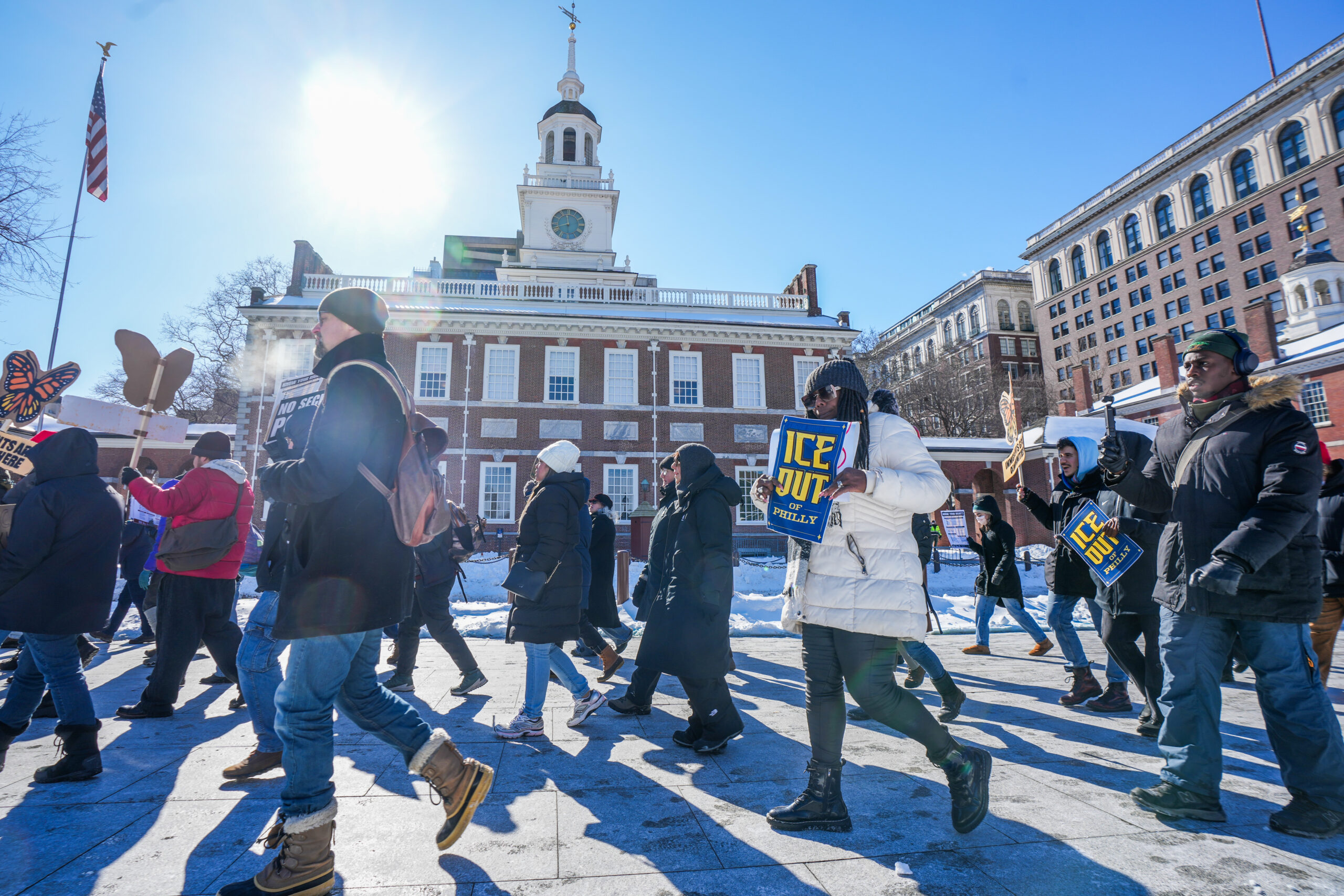
Advocates and protesters call for ICE to get out of Philadelphia in Center City on January 27, 2026.
Parker’s delicate handling of immigration issues stands in contrast to her aggressive response to the Trump administration’s removal last month of exhibits related to slavery at the President’s House Site on Independence Mall.
The city sued to have the panels restored almost immediately after they were taken down. After a federal judge sided with the Parker administration, National Park Service employees on Thursday restored the panels to the exhibit in a notable win for the mayor.
Bondi’s letter, which was addressed to Parker, demanded the city produce a plan to eliminate its “sanctuary” policies or face consequences, including the potential loss of federal funds.
“Individuals operating under the color of law, using their official position to obstruct federal immigration enforcement efforts and facilitating or inducing illegal immigration may be subject to criminal charges,” Bondi wrote in the letter, which is dated Aug. 13. “You are hereby notified that your jurisdiction has been identified as one that engages in sanctuary policies and practices that thwart federal immigration enforcement to the detriment of the interests of the United States. This ends now.”
“Sanctuary city” is not a legal term, but Philadelphia’s policies are in line with how the phrase is typically usedto describe jurisdictions that decline to assist ICE.
Immigrant advocates have in recent years shifted to using the label “welcoming city,” in part because calling any place a “sanctuary” is misleading when ICE can still operate throughout the country. The newer term is also useful for local officials hoping to evade Trump’s wrath, as it allows them to avoid the politically hazardous “sanctuary city” label.
Philly’s most notable immigration policy is a 2016 executive order signed by then-Mayor Jim Kenney that prohibits city jails from honoring ICE detainer requests, in which ICE agents ask local prisons to extend inmates’ time behind bars to facilitate their transfer into federal custody. The city also prohibits its police officers from inquiring about immigration status when it is not necessary to enforce local law.
Renee Garcia, Philadelphia City Solicitor speaks before City Council on Jan 22, 2025.
Garcia wrote in the August letter that Kenney’s order “was not designed to obstruct federal immigration laws, but rather to clarify the respective roles of the Police Department and the Department of Prisons in their interactions with the Department of Homeland Security when immigrants are in City custody.” The city, she wrote, honors ICE requests when they are accompanied by judicial warrants.
Immigration enforcement is a federal responsibility, and — in a case centered on Kenney’s order — the Philadelphia-based U.S. Court of Appeals for the Third Circuit ruled in 2019 that cities do not have to assist ICE.
The court, Garcia wrote, “held that the federal government could not coerce Philadelphia into performing immigration tasks under threat of federal repercussions, including the loss of federal funds.”
City loses fight over records
In Pennsylvania, all government records are considered public unless they are specifically exempted from disclosure under the Right-To-Know Law. In justifying its attempt to prevent the city’s response to the Trump administration from becoming public, the Parker administration cited two exemptions that had little to do with the circumstances surrounding Garcia’s letter.
First, the administration argued that the letter was protected by the work product doctrine, which prevents attorneys’ legal work and conclusions from being shared with opposing parties. Given that the letter had already been sent to the federal government — the city’s opponent in any potential litigation — the doctrine “has been effectively waived,” Magdalene C. Zeppos-Brown, deputy chief counsel in the Pennsylvania Office of Open Records, wrote in her decision in favor of The Inquirer.
“Despite the [city’s] argument, the Bondi Letter clearly establishes that the Department of Justice is a potential adversary in anticipated litigation,” Zeppos-Brown wrote.
Second, the city argued that the records were exempted from disclosure under the Right-To-Know Law because they were related to a noncriminal investigation. The law, however, prevents disclosure of records related to Pennsylvania government agencies’ own investigations — not of records related to a federal investigation that happen to be in the possession of a local agency.
“Notably, the [city] acknowledges that the investigation at issue was conducted by the DOJ, a federal agency, rather than the [city] itself,” Zeppos-Brown wrote. “Since the DOJ is a federal agency, the noncriminal investigation exemption would not apply.”
Garcia’s office declined to appeal the decision, which would have required the city to file a petition in Common Pleas Court.
“As we stated, the City of Philadelphia is firmly committed to supporting our immigrant communities as a Welcoming City,” Garcia said in a statement Wednesday after the court instructed the city to release the letter. “At the same time, we have a long-standing collaborative relationship with federal, state, and local partners to protect the health and safety of Philadelphia, and we remain [in] compliance with federal immigration laws.”
Staff writers Anna Orso and Jeff Gammage contributed to this article.
A three-year ban on puppy breeding in Philadelphia is likely to become law after City Council members on Thursday passed a bill to relieve overcrowded animal shelters.
Tightening the leash on backyard breeders: The bill was authored by Councilmember Cindy Bass, a Democrat who represents parts of North and Northwest Philadelphia.
Bass was sick and absent from Council on Thursday, but she has previously said that her bill is aimed at limiting people from breeding more puppies than they can sell.
“Every litter means more dogs in our shelter, more cost for taxpayers, and more suffering that we can prevent,” Bass said last year. “This isn’t about punishment; it’s about compassion and responsibility.”
Under the bill, it would be illegal to sell puppies or post ads to sell them within city limits. Breeders who violate the moratorium could face a $1,000 fine, with the proceeds going to the city’s Animal Care and Control Team, also known as ACCT Philly. The animal control agency would also enforce the ban.
Sammi Craven, a local animal welfare advocate, testified Thursday about overcrowding at ACCT Philly’s North Philadelphia shelter. She named the dogs that were recently euthanized or are scheduled to be put down: Stella, Cheese Burrito, Luna, and Muffin, among others.
“Philadelphia’s current animal welfare policy is ineffective,” Craven said, “and infrastructure and prevention have not kept pace with intake.”
In this 2022 file photo, Brian Martin, 31, and Vanessa Green, 29, look at their new dog they plan to adopt while Green holds Autumn, 1, at ACCT Philly, which was hosting a pet adoption event.
Critics of the moratorium say it will be challenging to enforce and could harm smaller, responsible breeders as opposed to those already operating illegally.
Charley Hall, a government relations official with the American Kennel Club, called on Council to hold the bill and establish a working group to draft new regulations.
“Working together, we can stop the flow of irresponsible breeders and improve animal welfare and fewer dogs ending up in Philadelphia’s shelters,” Hall said. “The question is how to achieve that goal in a way that is effective, fair, and legally sound.”
What else happened today?
Resign to run gets amended: City Councilmember Isaiah Thomas has been trying for more than a year to pass legislation amending a rule that requires city employees quit their jobs to run for higher office.
He’s attempting to amend the rule so that city officeholders can keep their jobs only if they are running for a state or federal office. That means Council members running for mayor would still have to give up their seats.
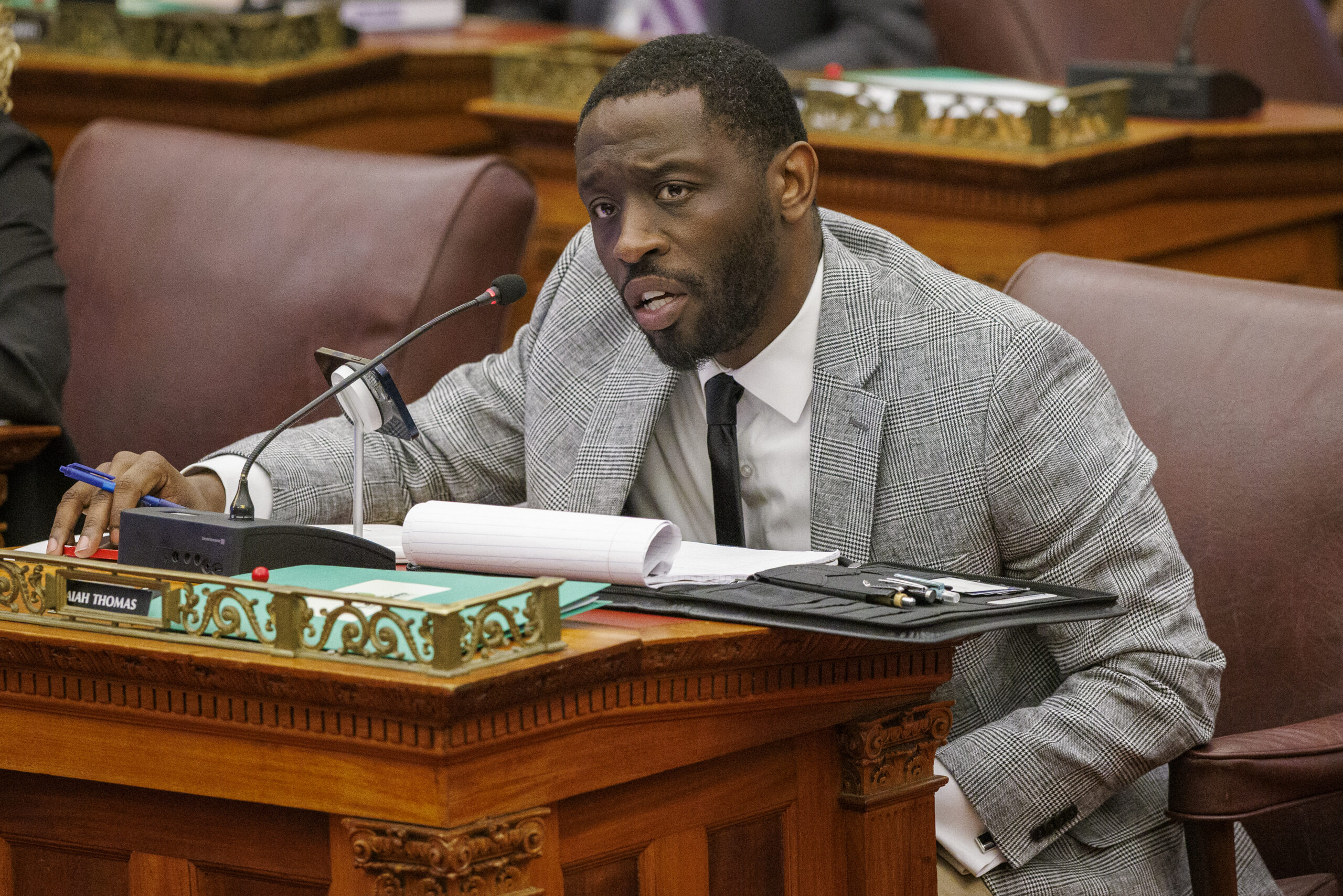
Councilmember Isaiah Thomas makes a statement at the start of a hearing last week.
But Thomas has run into roadblocks, including opposition from the city’s Board of Ethics, which asked him to make changes to the legislation in December, just before it appeared poised to pass.
On Thursday, he introduced an amendment that made a series of tweaks, including clarifying that sitting city officeholders may only run for one public office in any election.
Jordana Greenwald, general counsel for the city’s Board of Ethics, testified that the board still has concerns and requested more amendments, including prohibiting certain forms of politicking in the workplace.
She also said the legislation should clarify that the mayor can’t run for another office while serving as the city’s chief executive, a rule that is already enumerated elsewhere in the city charter.
However, making additional amendments could require Thomas re the legislation entirely. He said he would prefer for the bill to be called up for a final vote next week.
Amending the resign-to-run rule requires changing the city’s Home Rule Charter, meaning voters would have to approve it through a ballot question. Voters have rejected earlier attempts to repeal resign-to-run.
Codifying the youth watchdog: Council members also approved legislation to make the city’s Office of the Youth Ombudsperson permanent.
The office was created through an executive order signed by former Mayor Jim Kenney and is responsible for monitoring child welfare, juvenile justice, and behavioral health residential placement facilities in the city.
Making the office permanent also requires an amending the charter. A ballot question is likely to appear in the May primary election.
Quote of the week
Councilmember Jim Harrity in Council Chambers in September 2025.
That was Councilmember Jim Harrity, an Irish Catholic who in a speech Thursday honored the sacrifices made during the Muslim holy month of Ramadan.
When Mayor Cherelle L. Parker stood in the city’s emergency management center last month and announced that her administration was preparing for the worst winter storm Philadelphia had seen in years, she was flanked by the police commissioner, the head of public schools, and a dozen other deputies.
Missing from the news conference of Philadelphia’s top officials was Managing Director Adam K. Thiel, whose job it is to oversee the delivery of city services.
It wasn’t the only time over the last year that Thiel, Philadelphia’s No. 2 public official, was noticeably absent.
Thiel, who is effectively the city’s chief operating officer, was out of office last year for a total of nearly five months, much of which he spent on military leave, according to 2025 payroll register records obtained by The Inquirer. His increasingly low profile in Philadelphia City Hall has generated frustration and fueled questions about his job performance among some lawmakers, especially as the city faced criticism over the recent snow cleanup.
Almost half of Thiel’s $316,200 city salary last year was for paid time off, according to payroll records. He is one of the highest-paid officials in the government and made more than Parker, who last year earned $280,000.
In addition to his top city role, Thiel is a major in the U.S. Army Reserves. He joined the reserves in August 2024, eight months after beginning his job as managing director.
Thiel also holds other positions outside government. In 2024, while he was managing director, he made more than $300,000 working as a consultant, according to financial disclosures. He is an adjunct faculty member at two universities and sits on several nonprofit boards.
Five City Council members told The Inquirer that it has been months since they interacted directly with Thiel.
“The managing director of the city is an extremely important job,” said Councilmember Jamie Gauthier, a Democrat from West Philadelphia. “I do not understand how someone who is absent as much as Thiel is able to carry out this job effectively.”
Managing Director Adam Thiel during graduation ceremonies for the police academy Class #402 of the Philadelphia Police Department and Temple University Police Department at Temple University Performing Arts Center June 17, 2024.
The administration declined requests to interview Thiel and Parker for this article. In a statement, Thiel thanked Parker for her “continued support of our city of Philadelphia employees who also serve the United States of America.”
Sharon Gallagher, a spokesperson for the managing director’s office, said in a statement that Thiel has been employed by the city for nearly 10 years and “earns leave offered by the city the same way as other city employees accrue vacation, sick days, family, medical, military and other leave categories.”
Payroll records show that Thiel logged six weeks of military leave time last year — the maximum amount the city offers employees. Gallagher said he also used 11 weeks of accrued vacation time to cover additional military assignments.
The administration declined to answer questions about Thiel’s military service, including details about his location and unit. His LinkedIn page says he “helps provide emergency management subject matter expertise to combatant commands and partner nations.”
Thiel is also founding partner of one consulting firm and the president of a second, though the specific nature of that work is not known and he has declined to disclose his clients publicly.
In 2024, Thiel said his consulting work took fewer than 10 hours per week. Gallagher said Tuesday that “nothing has changed” since then.
The Parker administration did not publicly announce when Thiel was on leave last year, but officials acknowledged it once asked by reporters last summer. At the time, Deputy Managing Director Michael Carroll filled in on an interim basis.
Thiel, 53, is a nationally recognized expert in emergency management. He held a variety of firefighting, public safety, and disaster preparedness roles across the country before coming to Philadelphia in 2016 to serve as fire commissioner and deputy managing director under former Mayor Jim Kenney.
Thiel said in a statement Tuesday that Williams was “the best choice to lead our city’s unified response to the recent snowstorm operation and is the right leader for future snow and ice events.”
Gauthier said the city’s handling of the storm “needed a higher-level emergency response.” She said while she respects Thiel’s military service, she raised his consulting work as a concern.
“A decision needs to be made what he wants to do. Does he want to serve locally, or does he want to do other things?” Gauthier said. “We need a managing director who will serve full time.”
The administration did not answer questions about whether Thiel was in town through the duration of the city’s 26-day winter emergency response.
Parker’s chief of staff, Tiffany W. Thurman, said in a statement that the city is proud to offer benefits such as military and administrative leave that support employee well-being and professional development.
Thurman said Thiel “is always reachable and fulfills the responsibilities of his position as needed based on the situation.”
“His leadership — as is the case with the leadership team of any large city — is not limited by time designated as leave,” she said.
The purpose of the Philadelphia managing director
The authors of the 1950s-era Philadelphia Home Rule Charter created the position of managing director to serve as a barrier between the mayor’s political appointees and the city’s operational departments.
The idea was that having a bureaucrat at the helm would ensure city service delivery would be apolitical, and the mayor cannot fire the managing director without cause.
In reality, different mayors have granted their managing directors varying levels of power.
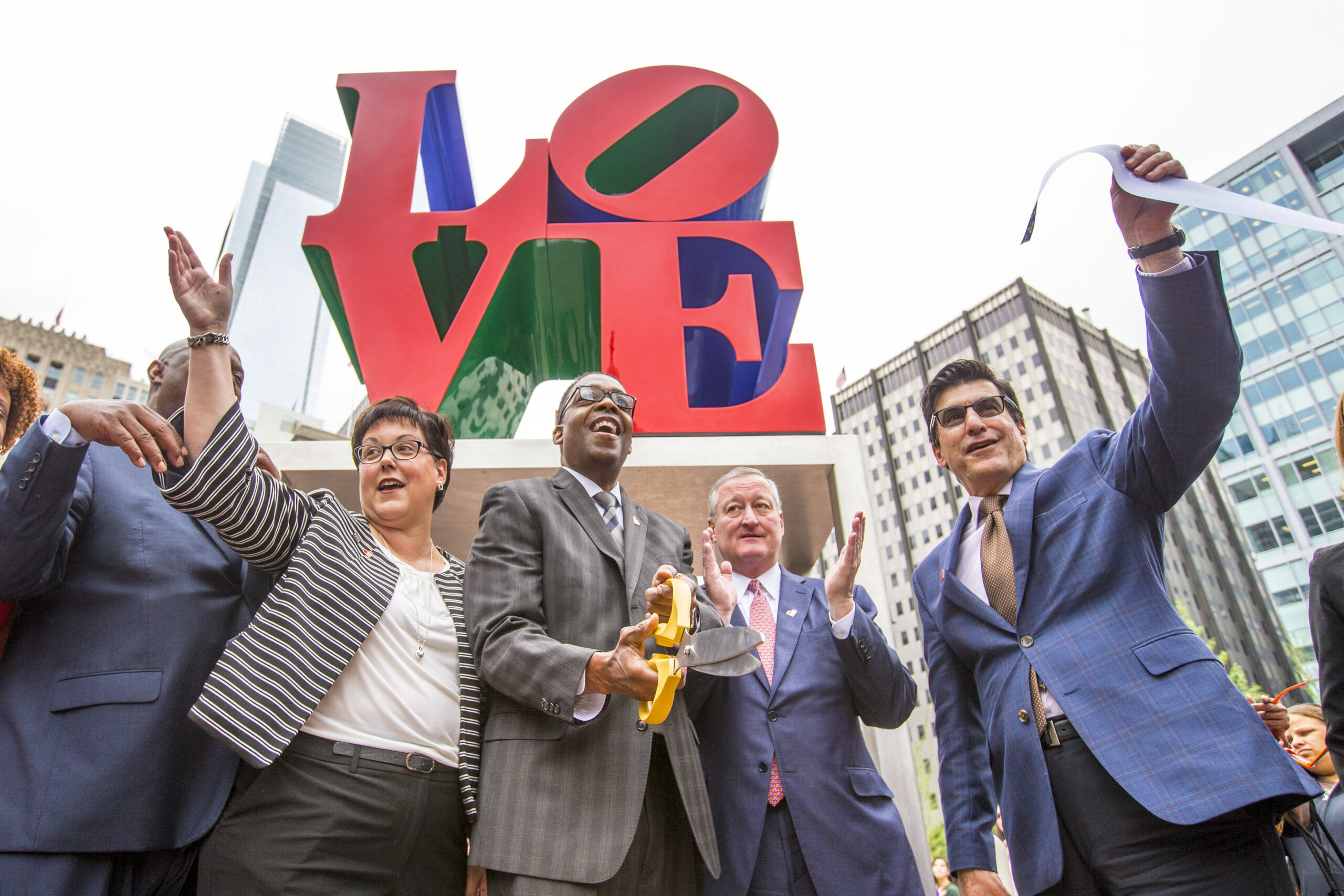
In this 2018 file photo, LOVE Park is by (left to right) then-Philadelphia Parks and Recreation Commissioner Kathryn Ott Lovell, former City Council President Darrell Clarke, former Philadelphia Mayor Jim Kenney and then-Managing Director Michael DiBerardinis.
For example, former Mayor Michael Nutter dispensed with decades of tradition and assigned robust portfolios to several deputy mayors. While his managing directors were important figures in his administration, they oversaw fewer operating departments than their predecessors.
Kenney, Parker’s immediate predecessor, sought to re-empower the city’s managing director position, while his deputy mayors took on advisory roles. He reassigned almost all departmental oversight to the managing director’s office.
“We’re going to have a managing director that’s actually a managing director,” Kenney said before he took office.
Council members who were in office before Parker’s 2024 swearing-in became used to the managing director being accessible. Several lawmakers said that under Kenney’s administration, they routinely communicated about constituent services matters with ex-Managing Director Tumar Alexander and his predecessor, Brian Abernathy.
That hasn’t been the case with Thiel in the role.
“Since the beginning of this administration, I have gone to Carlton Williams,” said Councilmember Jeffery “Jay” Young Jr., a freshman Democrat who represents parts of North Philadelphia.
Mayor Cherelle L. Parker is applauded by members of her administration at City Hall Wednesday, Jul. 9, 2025, hours after reaching a tentative contract agreement with District Council 33 leaders overnight, ending the workers’ strike. At left is Carlton Williams, director of the Office of Clean and Green Initiatives and Chief Deputy Mayor Sinceré Harris is behind the mayor at right.
Several other members said that instead of going to the managing director’s office, they take administrative needs to legislative affairs staff, agency heads, or Thurman.
“Almost everything goes through Tiffany, and she’s able to get things done,” said one Council member who spoke on the condition of anonymity to preserve relationships with the administration.
Parker doesn’t deny that little happens at the top rungs of city government without Thurman’s involvement. The mayor has come to see her chief of staff as the central figure in her administration and calls her the city’s “chief air traffic controller.”
Phil Goldsmith, who served as managing director for two years under former Mayor John F. Street, said Thiel’s minimized public role may be because Parker appears to favor “a very strong mayor’s office.”
“It seems to me that the managing director may have to go through more hoops to get things done than, for example, I had to do,” Goldsmith said. “That’s just a function of what a mayor wants and feels comfortable with.”
Fading out of public view
Thiel’s lack of public appearances over the last year has been unusual for a managing director.
It has been 10 months since he testified before City Council, despite the managing director in previous administrations being a mainstay in hearings to answer lawmakers’ questions about city services ranging from street repaving to emergency preparation.
And in December, when a half-dozen top Parker administration officials spoke during the mayor’s State of the City event, Thiel was not on the roster.
The decrease in visibility marks a departure from his first year in office, when Thiel had a more consistent public presence and was often seen beside the mayor.
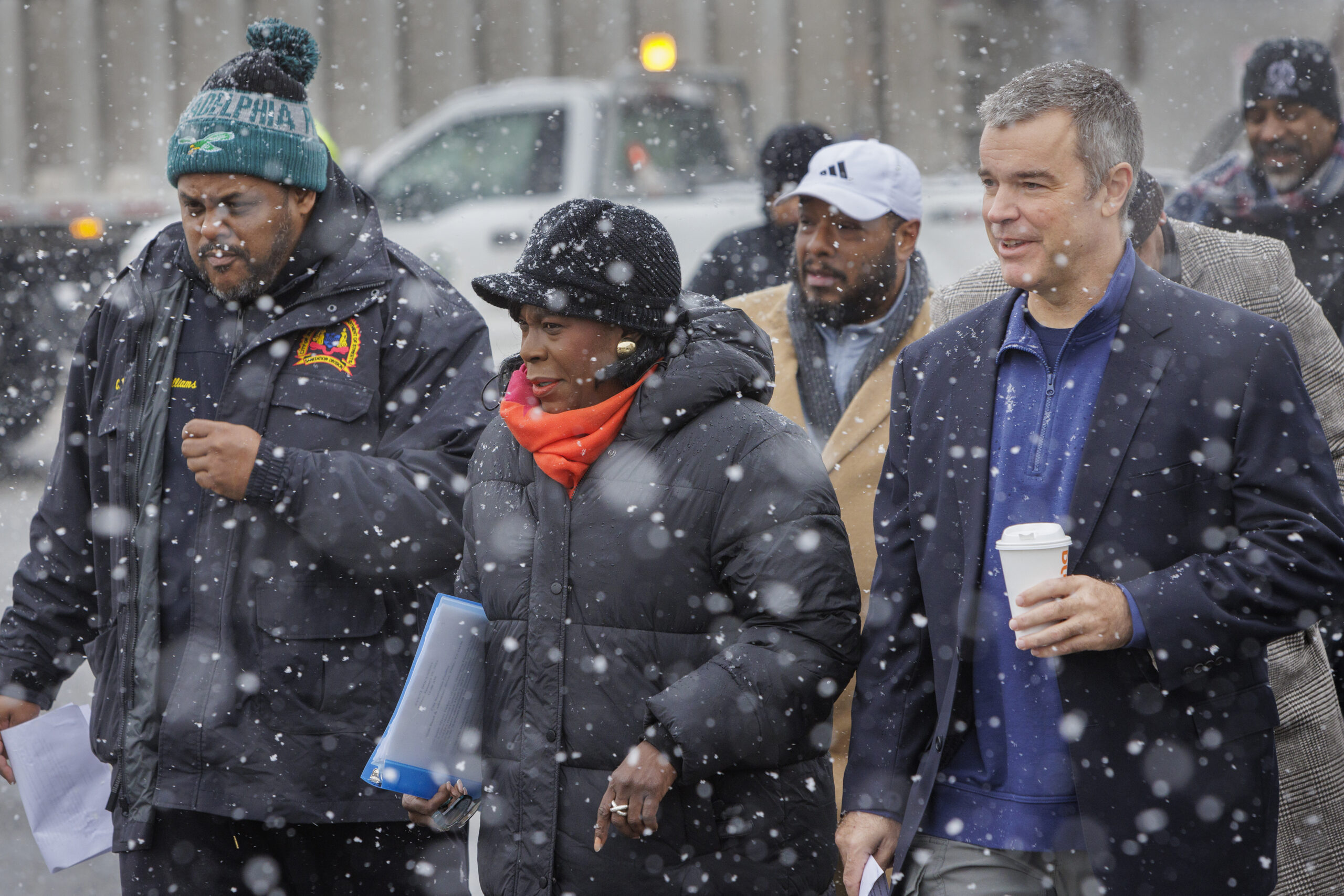
Ahead of a snowstorm in January 2024, Thiel stood with Parker during a news conference about preparations. He donned a suit while snowflakes fell, and he reassured the city that the administration was ready for the service disruptions that bad weather can bring.
Mayor Cherelle L. Parker (center) with Managing Director, Adam Thiel (right) and at left Carlton Williams, Director of Clean & Green Initiatives, at a news conference with city officials in Northeast Philadelphia on Friday, Jan. 19, 2024 to share the city’s response to the snowstorm.
Through his first year in the position, Thiel also faced scrutiny as the face of some of the mayor’s most controversial initiatives.
He took a leading role in Parker’s efforts to end the open-air drug market in the city’s Kensington neighborhood, and he oversaw the development of the Riverview Wellness Center, a new city-owned recovery house for people with substance use disorder.
Today, much of Kensington initiative is overseen by the public safety director, who reports directly to Parker. A new head of community wellness is leading development at Riverview, and Williams was the face of the storm response.
Mayor Cherelle L. Parker finishes a news media briefing with her leadership team at the Tustin Playground at 60th St. and W Columbia Ave. Tuesday, Jul, 1, 2025, on the first day of the strike by District Council 33. At left are Carlton Williams (Phillies cap), Director of Clean and Green Initiative with the Dept. of Streets Sanitation Division; and Managing Director Adam Thiel (at lectern).
But by the time the strike was resolved, Thiel had faded from public view, departing from his city job for one of his stints on military leave. After Parker reached an agreement with the union, she held a news conference with 20 top deputies and thanked each of them by name.
Thiel, absent from the City Hall news conference, was not one of them.
Staff writers Ryan W. Briggs and Sean Collins Walsh contributed to this article.