Some yarn shops around Philadelphia are running low on skeins of red wool, as local knitters and crocheters turn out scads of “Melt the ICE” caps in solidarity with protesters in Minnesota.
The hats don’t feature a patch or logo that says “Melt the ICE.” In fact, they carry no written message at all. What they offer is a deep scarlet hue, a dangling tassel, and a connection to an earlier, dangerous time, when a different people in another land sought to silently signal their unity.
“The hat is really a symbol and reminder,” said knitter Laura McNamara of Kensington, who is making two caps for friends. “People are looking for a sense of community.”
She refused her friends’ offers of payment, asking instead that they not let their involvement start and end with a hat ― but find a means to stand up for civil rights in some specific way.
The original hat was a kind of conical stocking cap, known as a nisselue, worn in Norway during the 1940s as a sign of resistance to the Nazi occupation. The Germans eventually caught on to the symbolism and banned the caps.
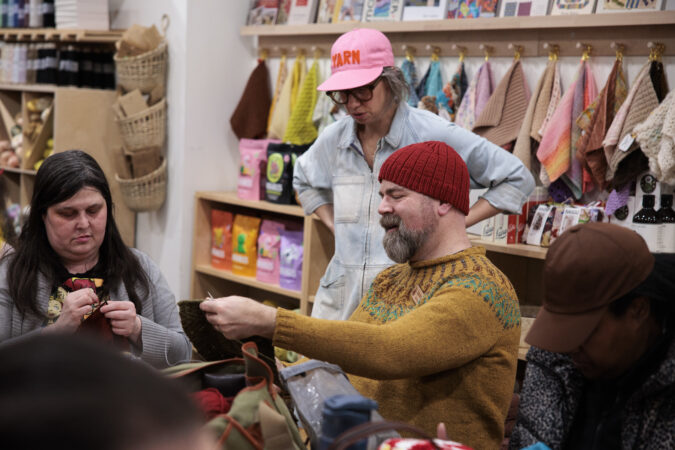
Amanda Bryman works on a red wool hat known as a “Melt the ICE” hat, during Fiber Folk Night at Wild Hand yarn shop in Philadelphia on Wednesday.
Now the new version that originated in a suburban Minneapolis yarn shop is spreading across the country. The hats signal opposition to U.S. Immigration and Customs Enforcement, which surged thousands of agents into Minneapolis, and sadness and anger over the deaths of Minnesotans and U.S. citizens Renee Good and Alex Pretti, who were shot to death by federal agents.
Today, comparisons of ICE agents to Nazis have become both frequent and contentious in American politics, with even some Democrats, including Gov. Josh Shapiro, who is Jewish, rejecting that equivalence as wrong and unacceptable.
ICE officials did not respond to a request for comment.
This is not the first time that the Philadelphia region’s craftivist movement, as it is known, has brought its knitting needles and crochet hooks to bear.
On the eve of Donald Trump’s first inauguration, artisans here turned out scores of cat-eared headgear known as pussy hats, a feline symbol of protest worn at the Women’s March on Washington. The hats aimed to tweak the then-president-elect over his comment about grabbing women by their genitals.
The Melt the ICE caps carry some controversy within the fiber community, as it calls itself. There have been online complaints that it’s easy to tug a red cap over one’s ears, but unless that is accompanied by action it holds no more significance than clicking a “Like” button on Facebook.
“It is just preening,” one person wrote in an internet forum.
Another said that “if your resistance is only this hat, then you have not actually accomplished anything except make a hat.”
Law enforcement officers detain a demonstrator during a protest outside SpringHill Suites and Residence Inn by Marriott hotels on Jan. 26 in Maple Grove, Minn.
Liz Sytsma, owner of Wild Hand in West Mount Airy, has heard the criticism.
But “the people in our community who are participating in making the hats, this is one of many things they are doing,” she said. That includes taking part in protests, calling elected leaders, and giving money to causes they support.
On Wednesday, more than a dozen people gathered at Wild Hand for the weekly Fiber Folk Night, where crafters gather to knit, crochet, and chat ― and, now, to work on hats.
Damon Davison traveled from Audubon, Camden County, having developed his own hat pattern, with sale proceeds to go to the activist group Juntos in South Philadelphia.
He wants to show solidarity with people “who are expressing resistance to what has been happening in Minneapolis, but also what’s happening here in Philly,” he said. “The idea is to make it a little bit more local.”
The shop has seen a rush on red, sought by about 70% of customers whose purchases have depleted stocks during the last couple of weeks.
“We’re really low,” said store manager Yolanda Booker, who plans to knit and donate a hat. “I want to do whatever small part I can do to help out.”
A single hat can take two or three days to make, though the best and fastest knitters can complete one in a couple of hours.
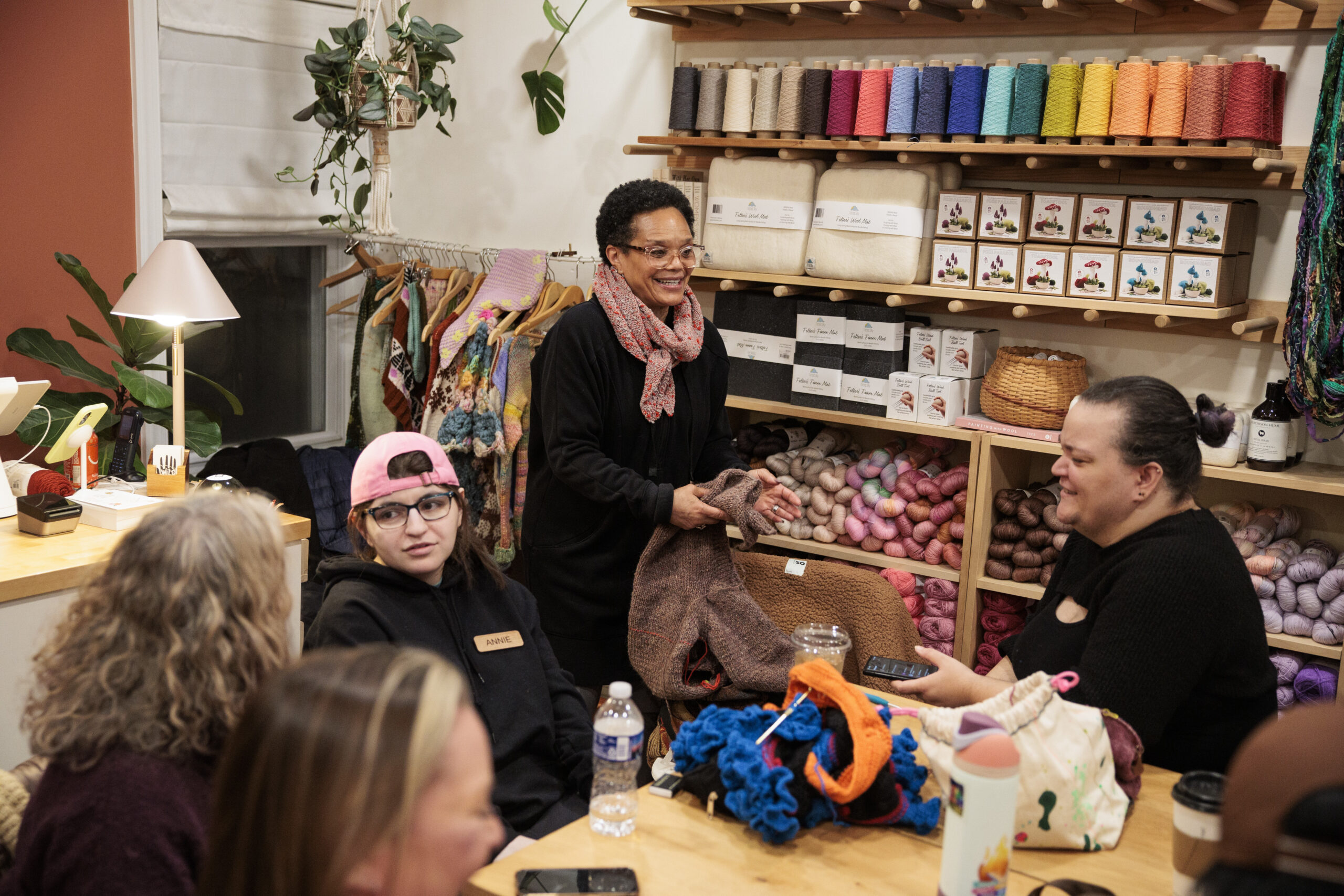
Store Manager Yolanda Booker, standing, laughs with attendees during Fiber Folk Night at Wild Hand yarn shop in Philadelphia on Wednesday.
In West Mount Airy, Kelbourne Woolens closed its physical doors during the national “ICE Out” strike in late January and donated its onlineprofits of $4,000 to Asian Americans United, Juntos, and New Sanctuary Movement of Philadelphia, said team member Bailey Spiteri. She estimated the store has sold enough red yarn to retailers to make 500 or 600 hats.
At Stitch Central in Glenside, customers donated $1,000 during the strike and the store matched it, with the $2,000 going to Nationalities Service Center in Philadelphia.
“Sometimes people are skeptical. How does wearing a hat or even making a hat make a difference?” asked Allison Covey of Drunken Knit Wits, a local knitting and crocheting organization. “But look at the donations. It does make a difference.”
Veteran knitter Neeta McColloch of Elkins Park thinks the same. She has ordered enough yarn to make eight hats. And she is curious to see how the phenomenon will develop.
“This is probably bigger than I think,” she said. “Knitters tend to be the type of people who in my experience have a strong moral compass. If they can combine something they love to do with something in which they can make a statement, that’s important to them.”
A former Villanova professor says in a federal lawsuit filed this week she was fired from the Catholic university after accusing its law school of racial discrimination involving one of her students.
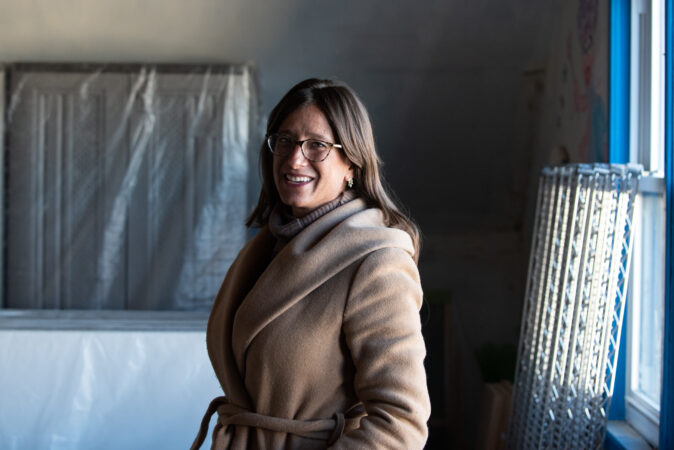
Stephanie Sena, who had been an anti-poverty fellow in the law school and taught at Villanova for more than 20 years, was dismissed in 2024 for what the school said were “student complaints,” according to the lawsuit.
But Sena’s lawyers say the dismissal was due to her filing an ethics complaint against the school for racial discrimination for comments that administrators made around a decision not to give her student a financial award that would have alleviated her debt, citing a speech the student made at a law school symposium.
The student, Antionna Fuller, accused Villanova of racialdiscrimination and failing to appropriately support her with financial aid during a 2021 symposium speech at the university, titled “Shifting the Poverty Lens: Caritas in Focus.” Sena hosted the symposium, during which Fuller also publicly asked for an apology from Villanova.
“How can you say caritas [which means love and charity in Latin] and Black lives matter with no thought to a Black life in front of you, systematically oppressed by your hands?” Fuller said,according to a video of the speech. “It’s not only hypocritical, but it’s embarrassing. We cannot talk about oppression and white supremacy without acknowledging its very presence here.”
Her speech drew a standing ovation, but later caused consternation among law school leadership.
Sena found out that law school dean Mark Alexander, in a letter to the scholarship committee, asked that Fuller not receive the debt relief award because she “maliciously maligned” the law school, according to the suit.
Sena‘s lawsuit alleges that then-law school vice dean Michael Risch said after the student’s speech that the student was “lucky” to have gotten into the law school and that she would not be there if she were white.
Villanova said in a statement Wednesday that Sena’s lawsuit “lacks merit” and that the university “will vigorously defend against these baseless allegations.”
“We look forward to presenting the actual facts surrounding the plaintiff’s separation from Villanova. To be clear, Villanova University does not tolerate discrimination or retaliation of any kind, and the allegations in Plaintiff’s lawsuit are contrary to our written policies and conflict with the core values of our University.”
Sena, 46, of Media, declined to comment.
Fuller, 29, who now lives with her mother in the South, said in an interview Wednesday that she feels both relieved and anxious about seeing the issue aired publicly.
“I am happy, at least relieved, that truth is coming out,” said Fuller, who graduated summa cum laude from the University of South Carolina and got her Villanova law degree in 2022. “I’ve been in such an isolated place and just carrying this trauma for so long.”
She said she sought therapy after the reaction she got to her speech from Villanova administrators and last year wrote a book, I Almost Sued My Law School, about her journey as a first-generation, low-income Black student. She no longer wants to practice law, she said, and is still figuring out her next steps.
But she said she was grateful to Sena, whom, during the symposium speech, she called “my hero, advocate, and my friend.”
“She was the first person to publicly stand up for me,” Fuller said.
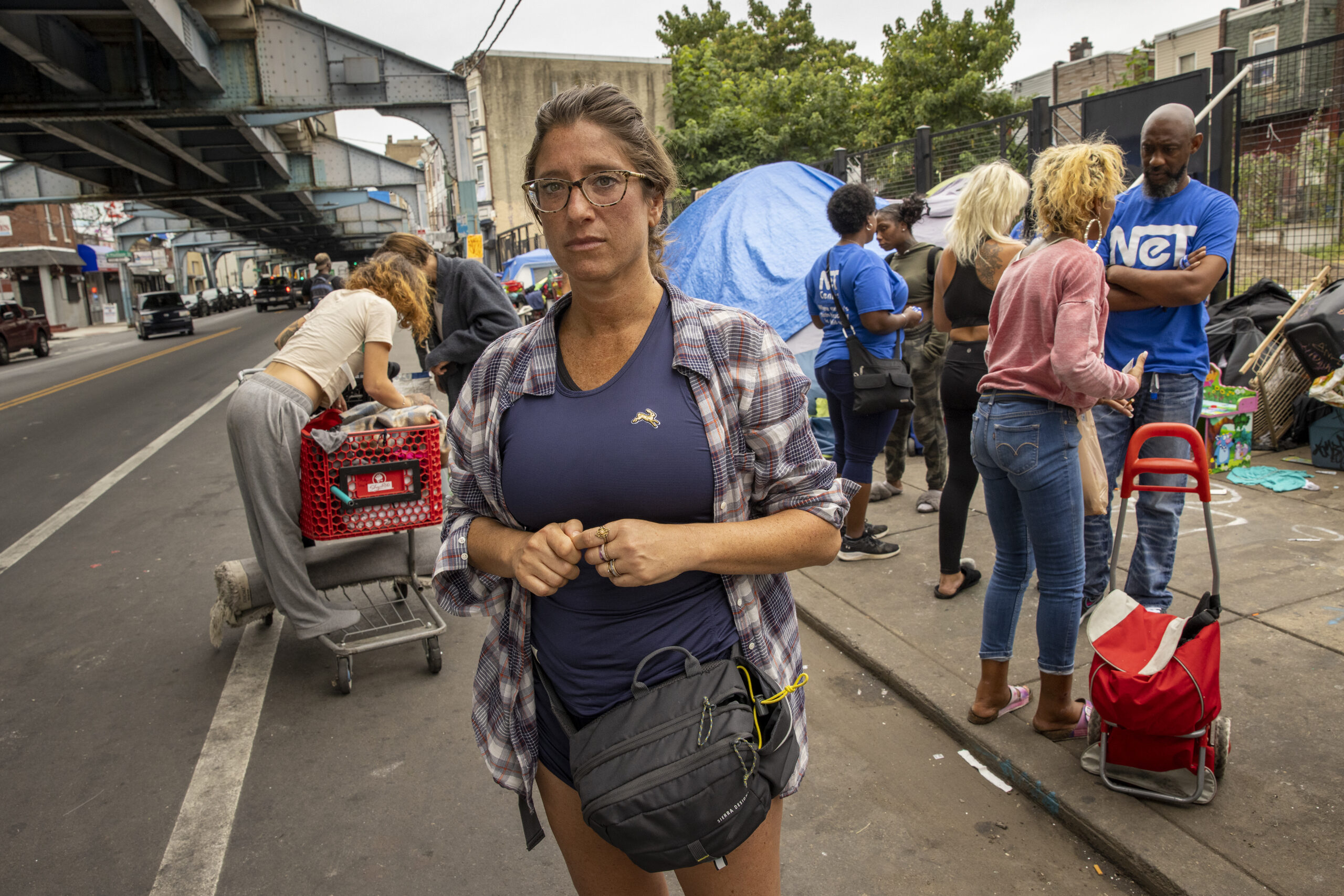
Stephanie Sena stands at site of an encampment along Kensington Avenue in 2021.
Fallout from symposium speech
Sena, a longtime activist who has worked to help people experiencing homelessness and opened a homeless shelter in Upper Darby in 2022, was fired in 2016 from her job as an adjunct professor at the Pennsylvania Academy of the Fine Arts after defending students who accused a classmate of rape. She sued PAFA and the case ended in a confidential settlement.
She also led activists in lawsuits against the city in 2021 over its intentions to remove homeless people in a Kensington encampment. In 2023, the head of Norristown’s municipal council planned to bus homeless people to Villanova’s campus because of Sena’s advocacy for the homeless in Norristown. Villanova at the time was criticized for not defending Sena and making a stronger response.
Sena was hired to teach at Villanova in 2003 and began to work at the law school in 2020, serving as a full-time faculty member and anti poverty fellow. She was also an adjunct professor at Villanova’s Center for Peace and Justice.
In herlawsuit against Villanova, Sena asserts that law school leadership met with her in 2022, several months after Fuller’s symposium speech, and asked her if she had known what Fuller planned to say. Matthew Saleh, former assistant dean for admissions, told her it would be harder to attract Black students to the school because of the speech, according to the suit. Risch, the vice dean, made the comment about Fuller not being at Villanova if she had been white, the suit says.
Saleh, who now is the senior associate dean of enrollment management and financial aid at Rutgers’ law school, said in an interview that he does not recall making that comment and that he doesn’t think it’s even the case that Fuller’s speech would hurt recruiting.
“That would not have even come to my mind,” he said. “I couldn’t reasonably see a way that it would impact recruiting.”
Sena “objected to the race discriminatory and retaliatory comments” made to her in that meeting, according to the suit.
In October 2023, she complained again about the comments in an email to two administrators who headed diversity, equity, and inclusion at Villanova,according to the lawsuit complaint. Then came the award committee meeting on Jan. 30, 2024, where the dean in a letter argued against Fuller’s receiving the award, according to the suit.
Students who were in the award committee meeting and were upset about the law school dean’s reactionapproached Sena and asked what they could do, according to the suit. Sena said the students, who are not named in her lawsuit, could contact the diversity, equity, and inclusion office and file a climate complaint.
Sena, according to the suit, complained again one day after the award committee meeting that Villanova “had engaged in a dangerous pattern of race discrimination” and filed an ethics complaint with the university. She also expressed her concerns in an email to faculty and in a meeting with a law professor, who told her the students had committed an ethics violation by revealing confidential details of the awards meeting they were in, according to the suit.
After filing the complaint, Sena said in her lawsuit, she was “treated differently,” “unjustly criticized,” and “blamed for issues outside her control.”
In June 2024, human resources informed her that she was under investigation after students said she had pressured them to file complaints against the deans, which Sena denied, the suit said.
She was fired July 30, 2024, even though, the suit said, she had no prior performance or disciplinary issues and had received awards and promotions. She is seeking damages including economic loss, compensatory and punitive, and attorneys’ fees and costs.
An apology and acknowledgement
During the symposium, Fuller had said she wished Villanova would apologize and acknowledge what happened. She said that the school had given her $15,000 in financial aid toward her annual $65,000 cost, but that she subsequently learned other students had gotten more, even though her mother worked multiple jobs as a nurse’s aide to support the family.
“I was confused,” she told the audience. “How can a student with seemingly the most need graduate with the most debt?”
She learned of a free-tuition public interest scholarship that Villanova awards to incoming students and sought it after she was enrolled, she said. She was turned down repeatedly, she said, even though Villanova had recently awarded its largest group of the scholarships.
“Am I invisible?” she asked. “To walk into this law school building every day, to be surrounded by wealth and prestige, while struggling and burdened with debt, and while expected to perform like those who are not feels inhumane.”
She said during the speech she would graduate with almost $200,000 in student debt. Villanova officials, she said Wednesday, later accused her of exaggerating because she was including her undergraduate debt, too, and maintained that the total was really $160,000 — $126,000 of which was from the law school.
Fuller said Wednesday she had apologized to law school leadership, hugged them at graduation, and thought everything had been resolved. She said she was surprised to hear that the dean wanted to block her access to the debt award, she said.
“My intent wasn’t to harm, attack or mislead,” Fuller wrote in her book, “but to share my personal experience — my fears and financial anxieties — as part of the larger conversation about finding solutions to reduce poverty, which the conference was centered around.”
Staff writer Abraham Gutman contributed to this article.
The family of a man who died in a Philadelphia jail last year contends in a lawsuit filed this week that jail staff did not offer him treatment for opioid withdrawal before his death.
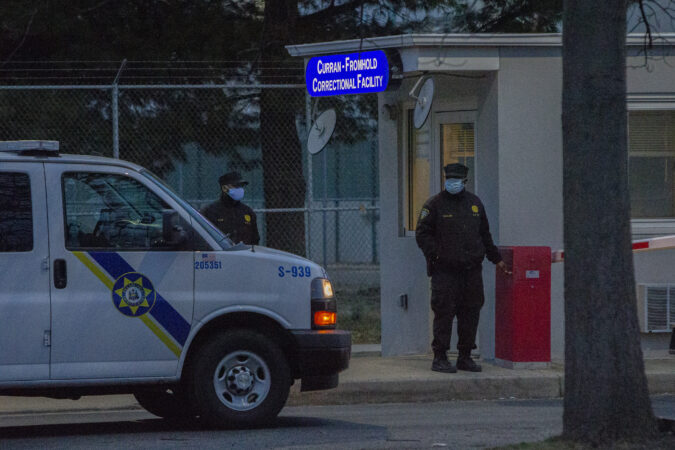
Andrew Drury died in an intake cell at the Curran-Fromhold Correctional Facility in Holmesburg on March 9, 2025. The lawsuit says he was in the cell for 36 hours, despite suffering from opioid withdrawal symptoms.
During that time, the suit says, Drury received no medical care, and jail staff did not alert medical personnel that he was going through withdrawal. Drury had a known opioid addiction and had suffered withdrawal symptoms at the jail in the past, according to the lawsuit. His cause of death was listed as “pending,” the lawsuit said.
Prison officials declined to comment Wednesday. A lawyer for Drury’s family did not return a request for comment. The lawsuit seeks general monetary damages from the city, the jail system, and the state attorney.
Several other families in recent years have sued Philadelphia jails, saying their relatives did not receive adequate medical care for drug-related issues.
In 2024, the family of Carmelo Gabriel Ocasio, 22, accused jail staff of ignoring his cellmate’s pleas for help when Ocasio fell unconscious, overdosed, and died after obtaining fentanyl and benzodiazepines at the jail in 2022.
The family settled with the city for $65,000; further details of the settlement were not made public.
In 2025, the family of Amanda Cahill sued the city, saying she overdosed on fentanylillicitly obtained whilein the jail after she was arrested in a Kensington sweep in 2024. The suit said she cried and begged for help, and fellow inmates tried to get the attention of correctional officers before she was found unresponsive in her cell.
A judge dismissed portions of the lawsuit in late December, but attorneys for Cahill’s family later refiled a complaint. Responding to the suit, lawyers for the city acknowledged staffing issues at the jails, but said the city could not have foreseen and did not cause Cahill’s death.
Between 2018 and July 2024, at least 25 people died in Philadelphia jails of accidents related to drug intoxication, a 2024 Inquirer analysis found. The city noted that summerthat the overdose death rate in Philadelphia jails was the same as the citywide rate, despite higher rates of addiction among incarcerated people.
Philadelphia’s jail system has been hailed as a national leader in offering medications for opioid addiction and provides buprenorphine, an opioid medication that curbs cravings, to inmates soon after arriving.
But staffing issues created backlogs that kept inmates from receiving longer-term care on time, and advocates said illicit drugs were readily available in the facilities, The Inquirer reported in 2024.
Staff writer Abraham Gutman contributed to this article.
February’s crop of restaurant openings includes two restaurants’ expansions to Narberth, a reopened brewery in South Jersey, a chic restaurant/lounge in Center City, an intriguing wine bar/bottle shop in Chestnut Hill, and two French newcomers.
Restaurants can take awhile and owners are often hesitant to pinpoint an opening date. I’ve listed the targeted day where possible; for the rest, check social media.
Duo Restaurant & Bar (90 Haddon Ave., Westmont): Brothers Artan and Arber Murtaj and Andi and Tony Lelaj, who own the Old World-style Italian Il Villaggio in Cherry Hill, are taking over Haddon Avenue’s former Keg & Kitchen with a pub serving a bar menu supplemented with seafood.
Eclipse Brewing (25 E. Park Ave., Merchantville): Last August, food trucker Megan Hilbert of Red’s Rolling Restaurant became one of the youngest brewery owners in New Jersey when she bought this 9-year-old Camden County brewery, open as of Friday.
Lassan Indian Traditional (232 Woodbine Ave., Narberth): The second location of the well-regarded Lafayette Hill Indian BYOB takes over the long-ago Margot space in Narberth.
LeoFigs, 2201 Frankford Ave., as seen in January 2026.
LeoFigs (2201 Frankford Ave.): Justice and Shannon Figueras promise the delivery of their long-awaited bar/restaurant, with an urban winery in the basement, at Frankford and Susquehanna in Fishtown. The food menu will be built around comfort-leaning small plates.
The bubbly selection at Lovat Square in Chestnut Hill.
Lovat Square (184 E. Evergreen Ave.): Damien Graef and Robyn Semien (also owners of Brooklyn wine shop Bibber & Bell) are taking over Chestnut Hill’s former Top of the Hill Market/Mimi’s Café property for a multiphased project: first a wine shop with indoor seating, then a courtyard with a full dinner menu, followed later by a cocktail bar/restaurant component. Opens Feb. 12
Malooga (203 Haverford Ave., Narberth): The Old City Yemeni restaurant is expanding to Narberth with lunch and dinner service plus a bakery, with expanded indoor/outdoor seating and space for groups.
Mi Vida (34 S. 11th St.): Washington, D.C.-based restaurant group Knead Hospitality + Design is bringing its upscale Mexican concept to East Market, next to MOM’s Organic Market. Target opening is Feb. 18.
Napa Kitchen & Wine (3747 Equus Blvd., Newtown Square): A California-inspired restaurant rooted in Midlothian, Va., opens in Ellis Preserve with an extensive domestic and international wine list in a polished setting. Opens Feb. 9.
Ocho Supper Club (210 W. Rittenhouse Square): Chef RJ Smith’s Afro-Caribbean fine-dining supper club starts a six-month residency at the Rittenhouse Hotel, tied to the Scarpetta-to-Ruxton transition, serving tasting menus through July. Now open.
Piccolina (301 Chestnut St.):A low-lit Italian restaurant and cocktail bar at the Society Hill Hotel from Michael Pasquarello (Cafe Lift, La Chinesca, Prohibition Taproom). Targeting next week
Pretzel Day Pretzels (1501 S. Fifth St.): James and Annie Mueller’s pretzel-delivery operation is becoming a takeout shop in the former Milk + Sugar space in Southwark. Expect classic soft pretzels plus German-style variations (including Swabian-style) and stuffed options.
Merriment at the bar at Savu, 208 S. 13th St.
Savú(208 S. 13th St.): Kevin Dolce’s Hi-Def Hospitality has converted the former Cockatoo into a modern, bi-level dining and late-night lounge with a New American menu from chef Maulana Muhammad; it just soft-opened for dinner Thursday through Sunday and weekend brunch.
Bar-adjacent seating at Side Eye.
Side Eye (623 S. Sixth St.): Hank Allingham’s all-day neighborhood bar takes over for Bistrot La Minette with “French-ish” food from chef Finn Connors, plus cocktails, European-leaning wines, beer, and a late-night menu. Opens 5 p.m. Feb. 7 with 50% of the night’s proceeds going to the People’s Kitchen.
Soufiane at the Morris(225 S. Eighth St): Soufiane Boutiliss and Christophe Mathon (Sofi Corner Café) say there’s a 90% chance of a February opening for their new spot at the Morris House Hotel off Washington Square. It’s billed as an elegant-but-approachable restaurant inspired by classic French bouillons/brasseries, with a menu spanning small plates and full entrées alongside Moroccan-influenced tagines. Expect evening service indoors, daytime service outdoors.
South Sichuan II(1537 Spring Garden St.): A second location for the popular Point Breeze Sichuan takeout/delivery specialist, near Community College of Philadelphia; this one will offer more seating.
March openings are in the offing for the much-hyped PopUp Bagels in Ardmore, as well as the long-delayed Terra Grill (a stylish room in Northern Liberties’ Piazza Alta) and ILU (the low-lit Spanish tapas bar) in Kensington.
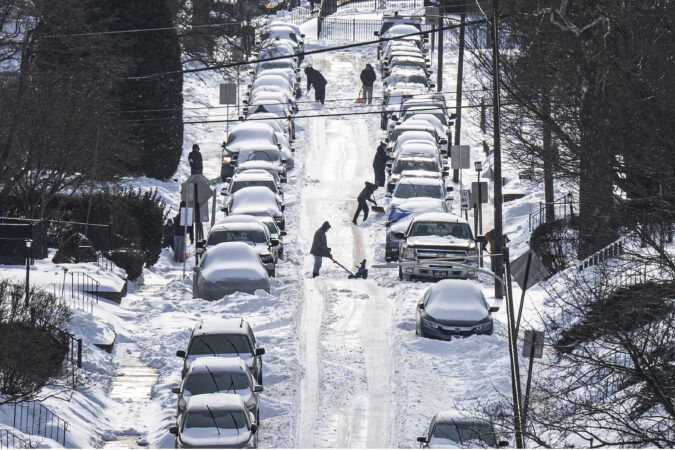
Denise Bruce paid a stranger $75 to shovel out her Hyundai Venue, which was encased in snow and ice outside her East Kensington rowhouse.
“My car was really badly packed in on all sides,” said Bruce, 36, who works in marketing. “I just didn’t have the strength honestly to dig it out myself.”
The West Coast native also didn’t have a shovel.
So she was elated to find a woman on Facebook who agreed to dig out her compact SUV for between $40 and $60. After the endeavor took four hours on a frigid evening, Bruce thought it was only fair to pay more.
After Bruce forked over the money — digitally via Cash App — she asked herself: What should one pay to outsource the onerous task of shoveling?
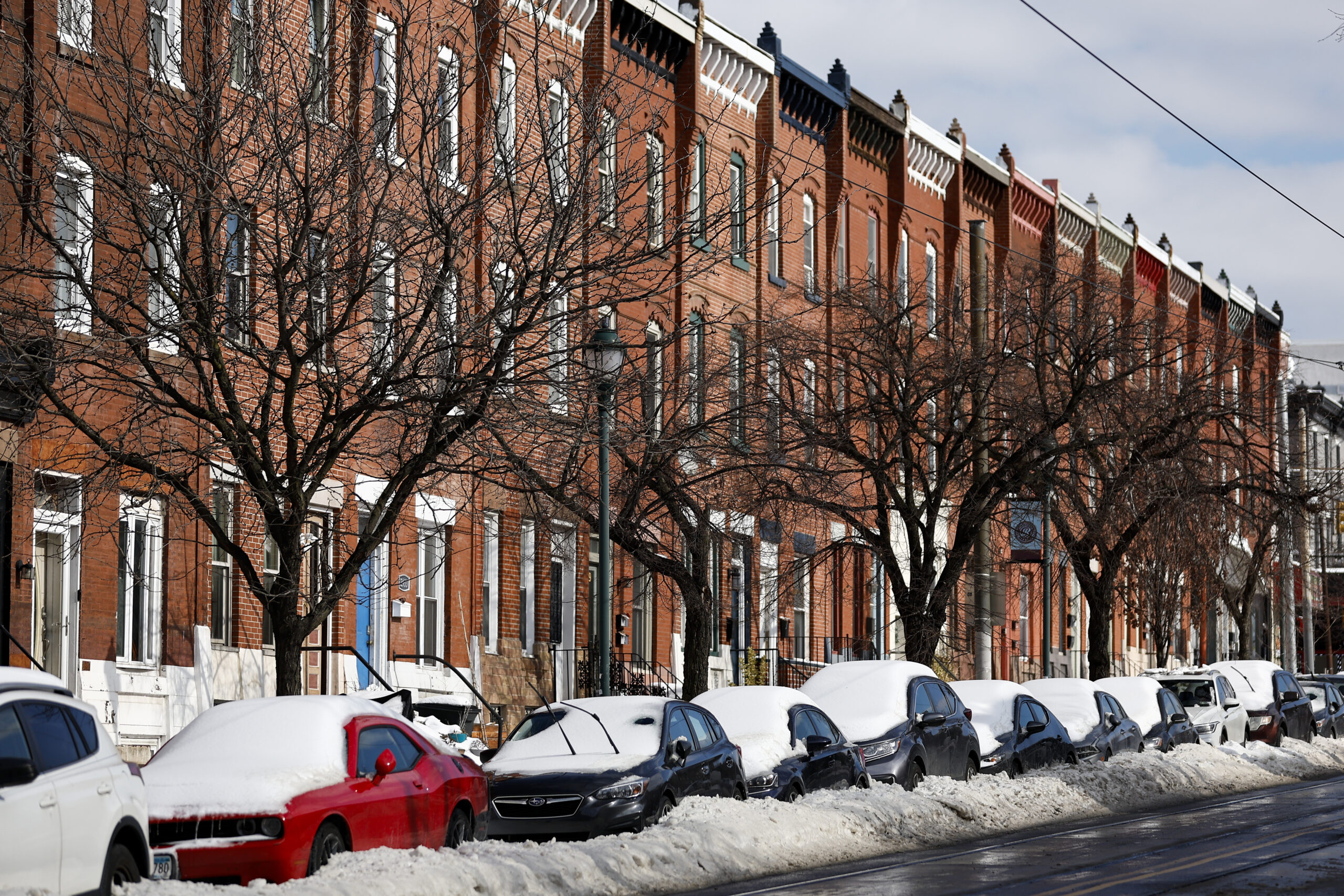
Snow-covered cars lined Girard Avenue in Brewerytown on Monday.
While some shoveled themselves or hired professional snow removal companies with fixed rates, others turned to an ad hoc network of helpers who hawked shoveling services on neighborhood Facebook groups, the Nextdoor app, and the online handyman service TaskRabbit.
On online forums, strangers agreed to dig out the cars of folks like Bruce, who didn’t have the strength, tools, or time to do so on their own. Others signed up to clear the driveways and sidewalks of older people, for whom shoveling such heavy snow can increase the risk of heart attacks.
Prices per job vary from $20 to $100 or more. Some freelance shovelers are upfront about their rates, while others defer to what their customers can afford.
Higher prices now for ‘trying to dig through concrete’
Alex Wiles stands on North Second Street on Tuesday before taking the bus to another snow-shoveling job.
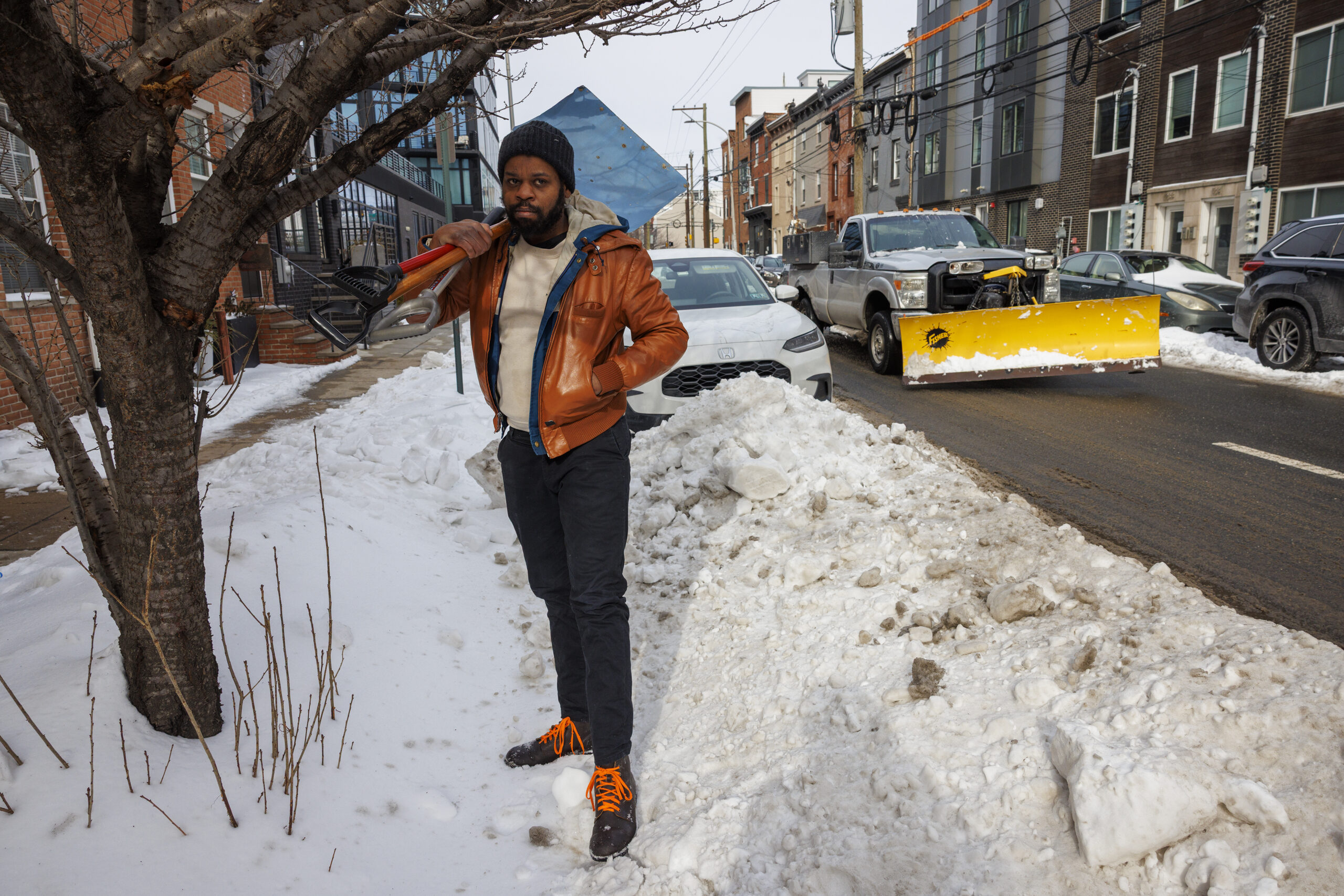
On Monday, the day after the storm hit, Alex Wiles, 34, of Fishtown, shoveled out people’s cars, stoops, and walkways for between $30 and $40 per job. As the week went on, he increased his rate to about $50 because the work became more physically demanding.
“At this point, it feels like trying to dig through concrete,” Wiles said. As of Thursday, he had shoveled for nearly 20 people across the city and broken three shovels trying to break up ice. He said most people tip him an additional $5 to $20.
“I want it to be an accessible service,” he said, “but I also want to be able to make money doing it and remain competitive with other people,” including teenagers who often shovel for less.
For Wiles, who works in filmmaking and photography, his shoveling earnings go toward paying rent.
He said he sees his side hustle as essential service, especially since the city did “a terrible job,” in his opinion, with snow removal.
“A lot of the city looks like a storm happened 10 minutes ago,” Wiles said Thursday.
Shoveling is “necessary and people are just otherwise going to be stuck where there are,” he said. “They aren’t going to be able to get to work easily. They aren’t going to be able to walk down the street.”
Some adults see themselves filling in for ‘the young kids’
When Max Davis was a kid in Hopewell, N.J., he’d compete with his neighbors to see who could shovel the most driveways during snowstorms.
Now, the 28-year-old said he seldom sees or hears of kids going door to door when it snows.
That was part of the reason Davis got off his Northern Liberties couch on Monday and started shoveling out cars for a few neighbors who posted on Facebook that they needed help.
A snow shoveler on Waverly Street on Monday.
Davis, a founding executive at an AI startup, said he didn’t need the money, so he accepted however much his neighbors thought was fair. He ended up making about $40 to $50 per car, money he said he’ll likely use for something “frivolous” like a nice dinner out in the city.
If there is another snowstorm this winter, he said, he’d offer his shoveling services again.
“Why not?” Davis said. “I’d love to see the young kids get out there and do it. I think they’re missing out.”
In Broomall, Maggie Shevlin said she has never seen teenagers going door to door with shovels, but some of her neighbors have.
During this most recent storm, the 31-year-old turned to Facebook to find someone to clear her mother’s driveway and walkway in neighboring Newtown Square. Shevlin connected with a man who showed up at 6:30 a.m. Monday, she said, and did a thorough job for a good price.
“I figured it would be somewhere around $100. He charged me only $50,” said Shevlin, who works as a nanny and a singer. “Oh my god, [my mom] was so thankful.”
How a professional company sets snow removal prices
A snow removal contractor clears the sidewalk in front of an apartment building in Doylestown on Wednesday.
Some Philadelphia-area residents, especially those with larger properties, use professional snow removal services. They often contract with these companies at the start of the winter, guaranteeing snow removal — at a price — if a certain amount falls.
In Bristol, Bucks County, CJ Snow Removal charges $65 to $75 to remove two to four inches of snow from driveways, walkways, and sidewalks at a standard single-family home, said co-owner John Miraski.
The cost increases to $95-$115 for a corner house, he said, and all rates rise about $25 for every additional two inches of snow.
Last week, he said, several people called him asking for help shoveling out cars, but he was too busy to take on the extra customers. He passed those requests to other companies, he said, and recommended they charge “nothing less than $50 to $60, because you’re dealing with [nearly] a foot of snow plus a block of ice.”
Miraski said he recommends professionals because they are insured. That’s especially important, he said, in storms that involve sleet or freezing rain, as Philly just experienced.
“You start throwing ice, who knows where it is going and what it is hitting,” Miraski said.
Professionals are more expensive, he acknowledged, but often more thorough. “Some of my properties we went back to two or three times to make sure they were cleared.”
And sometimes, regardless of who shovels, a resident can find themselves unexpectedly stuck in the snow again.
In Northeast Philadelphia, J’Niyah Brooks paid $50 for a stranger to dig out her car on Sunday night. But when she left for her job as a dialysis technician at 3 a.m. Monday, her car had been plowed in.
“I was out there kicking snow,” said Brooks, who was eventually able to get to work.
Meeting for the first time since Superintendent Tony B. Watlington presented his sweeping facilities plan, Philadelphia’s school board heard an outpouring of angst Thursday night from community members upset over 20 proposed school closures.
“Closing schools ruins families and neighborhoods, especially Black, brown, immigrant and working-class communities,” said Caren Bennicoff, a veteran teacher at Ludlow Elementary in North Philadelphia, one of the schools targeted for closure. “A facilities dashboard can’t measure what a school means to children.”
Watlington said the plan represented a “once in a lifetime, significant opportunity” for the city to modernize schools.
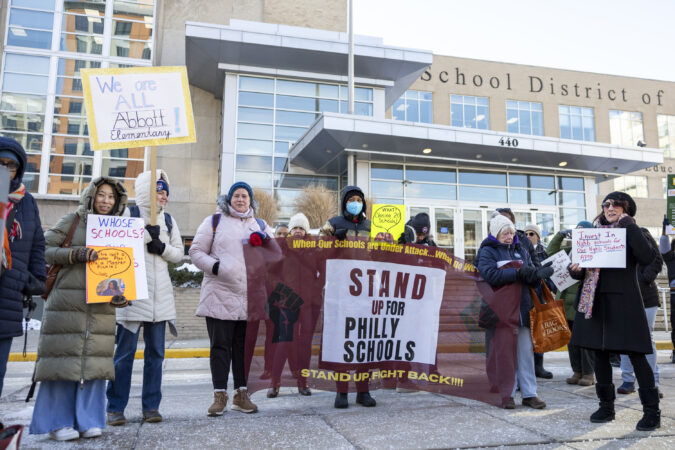
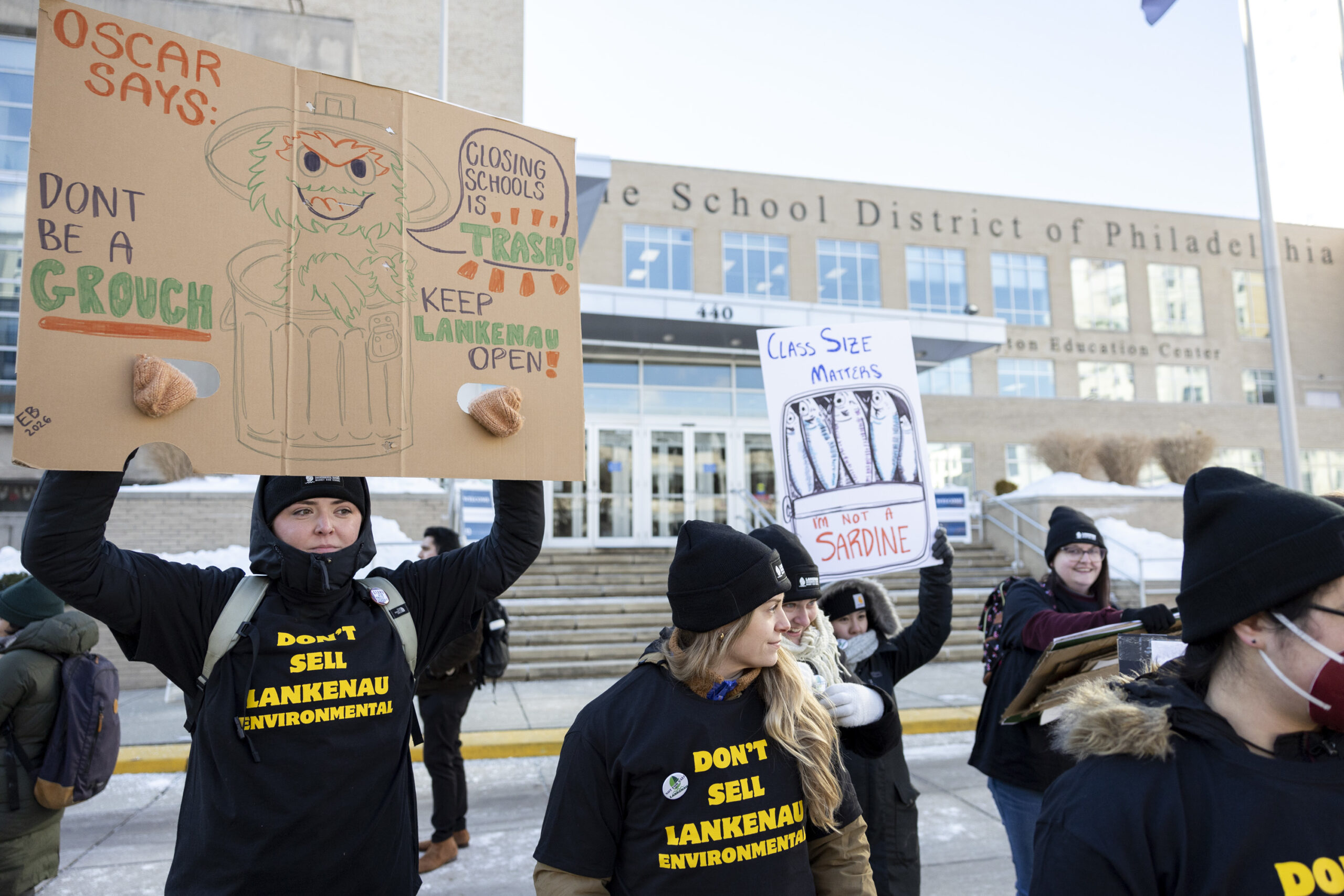
Prior to the meeting, more than 50 people gathered in the bitter cold outside Philadelphia School District headquarters, waving signs and shouting into bullhorns to show their displeasure with Watlington’s proposal.
Emily Brouder, 23, of West Philadelphia, Penn student and intern at Lankenau High School, holds a sign that says “Closing Schools Is Trash.”
Some of the demonstrators warned that removing children from their neighborhood schools would be traumatizing to already vulnerable kids.
“These schools are another home for these families,” said Margarita Davis-Boyer, president of the Lankenau High School Home & School Association. She said schools are a place where kids can get a meal, see a friendly face, and feel safe, especially when home may not offer the same reprieve.
“It’s just an injustice,” she said. Lankenau, the city’s environmental magnet school, would close under the plan, becoming an honors program inside Roxborough High School.
A strong Lankenau contingent packed both the rally and the board meeting, which happened immediately afterward.
LeeShaun Lucas, a Lankenau senior, is upset the school might close.
“To me, closing Lankenau doesn’t make sense,” Lucas said.
Lankenau’s campus is unique in the city — set against a wildlife preserve and a farm, a stream, and a forest.
Lucas has studied how to make the Schuylkill healthier by studying mussels, he said. He’s taking a dual enrollment GIS class — the only such high school in the city to offer such an opportunity, school officials believe.
That exposure has shaped Lucas, he said.
“I truly believe that voting to close Lankenau Environmental would be a mistake,” Lucas said. “Please vote to save Lank so that others may benefit from the type of learning that is only possible at Lankenau Environmental.”
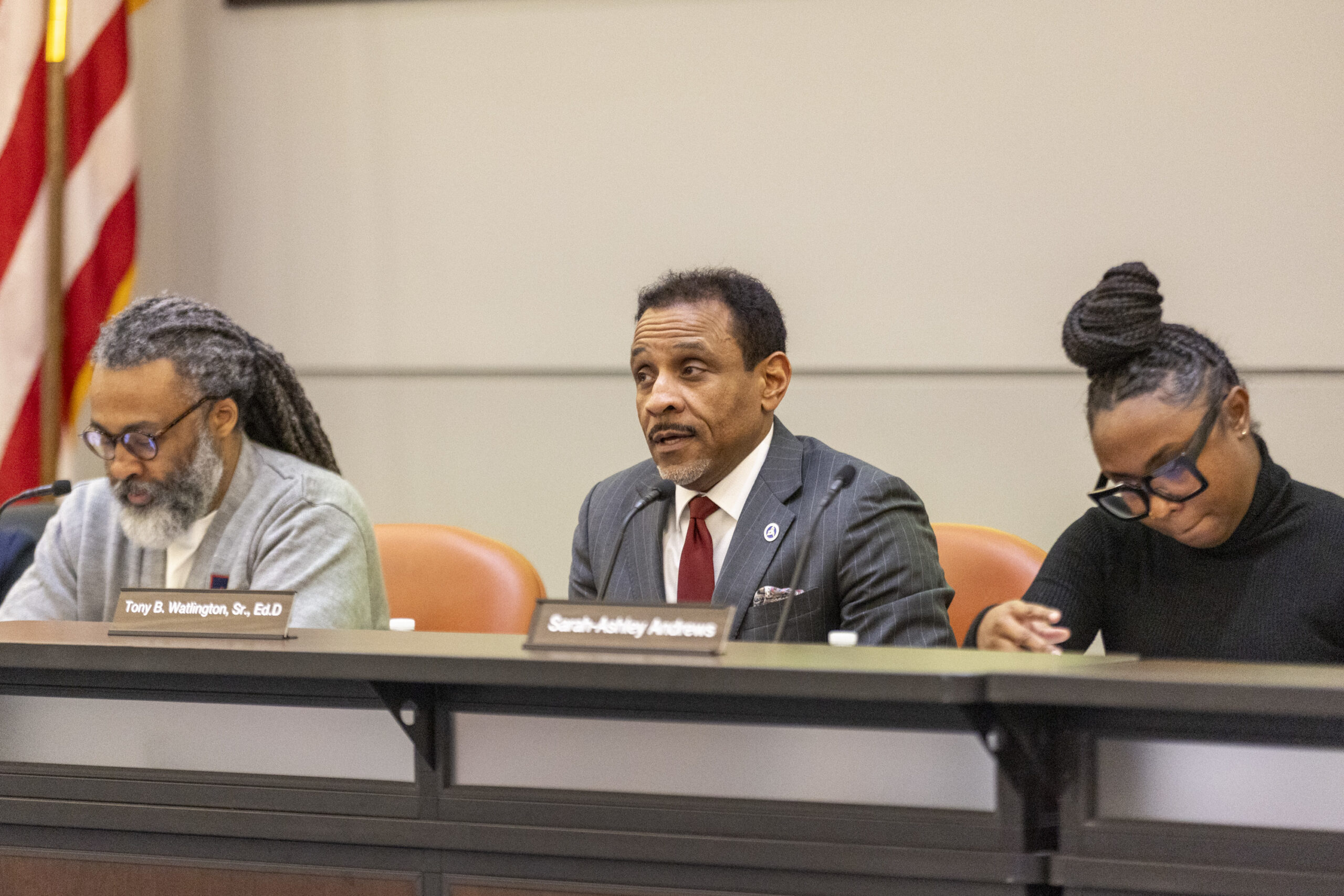
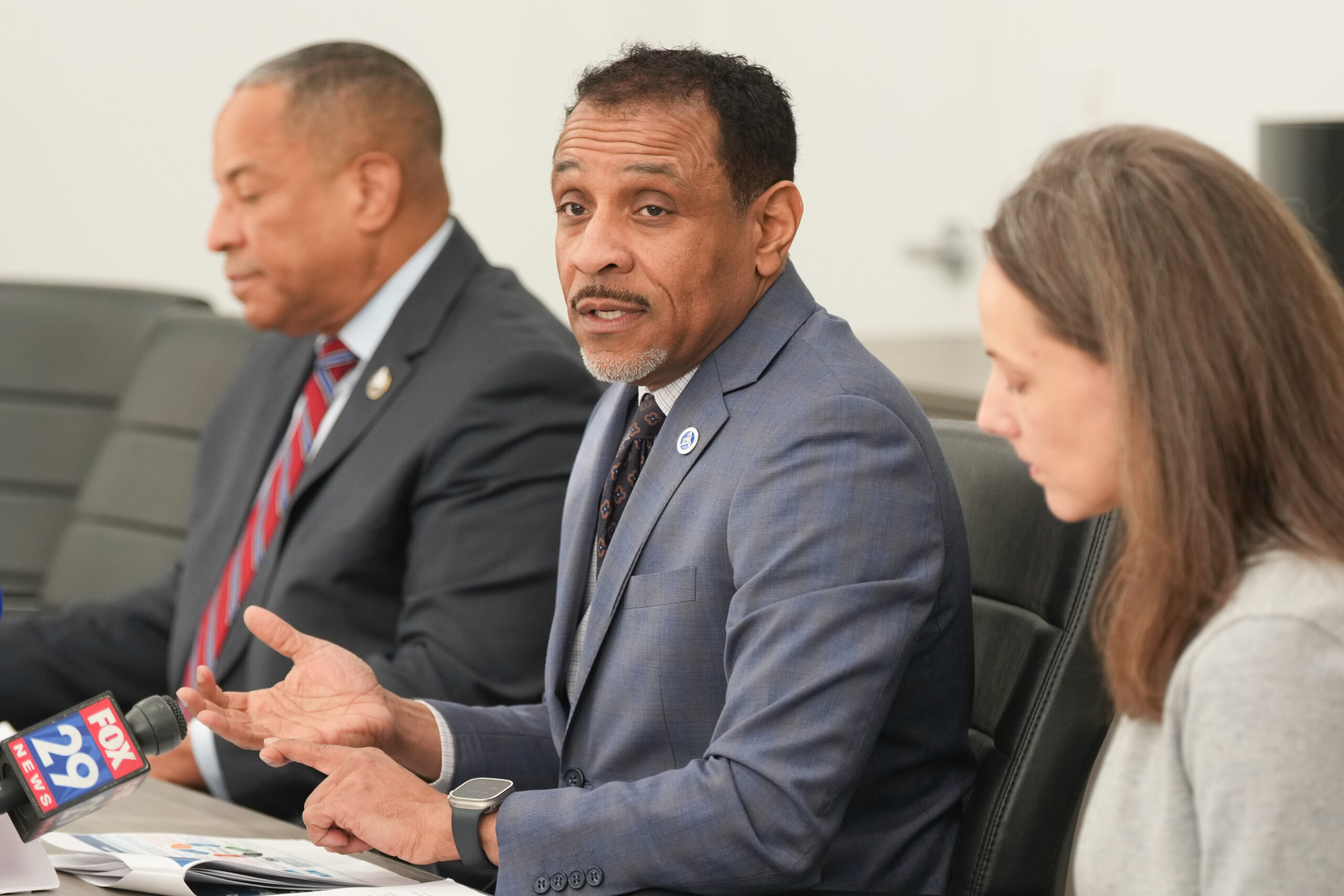
Superintendent Tony B. Watlington (center), Board President Reginald L. Streater, and Board member Sarah-Ashley Andrews at the School board meeting Jan. 29.
Disparate impact
Ryan Pfleger, an education researcher, said if underutilization and facility condition truly shaped Watlington’s recommendation, the burden of closure would fall roughly evenly across racial groups.
But that’s not the case with Watlington’s plan.
“Black students are overrepresented, roughly 1.6 times more likely to be enrolled in schools slated for closure,” Pfleger said. “Fifteen of 20 schools proposed for closure are majority Black. White students are underrepresented, about four times less exposed than expected. The schools slated for closure are also disproportionately low income.”
Pfleger’s conclusions match an Inquirer analysis of the closure data.
The plan, Pfleger concluded, “does not rectify educational injustice.”
Conwell shows up
A strong contingent of Conwell supporters also told the board they were unhappy with the plan to close their school, a magnet middle school in Kensington.
Conwell has just over 100 students in a building that can hold 500. But Erica Green, the school’s principal, said it’s worth saving.
“Conwell for many years has been the cornerstone in the Kensington community, a place where students flourish, where leaders are born; alumni included leaders in government, education, law, media, public safety, and professional sports: Living proof that diamonds truly are in our backyard,” Green said. “Times have changed, but excellence at Conwell has remained the same.”
Conwell is celebrating its 100th anniversary and has been the recipient of public and private donations to advance its building conditions and program offerings.
“Do not let the almighty dollar drive a choice to remove a beautifully designated historic school and beautifully gifted young people,” an impassioned Green said. “The essence, prestige and impact of Conwell Magnet Middle School cannot be duplicated.”
Priscilla Rodriguez, whose two sons attended Conwell, worries about the implications for families that rely on it for stability.
“When a school closes, families don’t just adjust. They struggle,” Rodriguez said. Conwell families “are already dealing with a lot. You won’t make it any better by closing Conwell.”
An incomplete plan?
Katy Egan came to the board with a long list of questions, none of which were addressed in Watlington’s plan: Which schools will be modernized? When? How? How will displaced students get to their new schools? What’s happening to students with special education plans forced to leave their schools? How do you plan to keep kids safe while merging schools?
Egan, a member of Stand Up for Philly Schools, called the blueprint “a 25% plan.”
But, she said, “we deserve more than 25%, and our students deserve everything.”
Community members can weigh in on the plan in the coming weeks at meetings around the city, and Watlington is scheduled to formally present it to the board on Feb. 26.
No vote will happen in February though, said board president Reginald Streater, who declined to weigh in on the merits of the plan until it’s handed over to the board.
In other board news
In other board matters, Watlington said he would soon ask to eliminate half days from the district’s calendar entirely.
The news came as he detailed a slip in year-over-year student attendance: in December, 54% of students attended school 90% of the time, compared to 66% in December 2024. That’s the largest drop in Watlington’s superintendency, he said.
He attributed the challenges to a two-hour delay for snow, light attendance prior to winter break — and light attendance during a half day called for professional development.
Watlington said at next month’s board meeting, he’ll propose amending the 2026-27 schedule to remove half days entirely.
“Half days in the calendar do not serve us well,” he said.
The board also installed three new student board representatives.
The non-voting members are: Brianni Carter, from the Philadelphia High School for Girls; Ramisha Karim, from Northeast High; and Semira Reyes, from the Philadelphia High School for Creative and Performing Arts.
An Inquirer analysis of the decisions and the data behind them shows the proposed closures would disproportionately affect Black students. And despite efforts to minimize the impact, schools in the most vulnerable sections of Philadelphia would also be disrupted.
The closures would mostly address buildings with hundreds of unused seats, though some largely empty buildings were spared. And eight of the closures would affect schools given the district’s worst building condition rating — though 30 more buildings in that category would stay open and receive upgrades of some kind.
Monique Braxton, district spokesperson, said the facilities plan was “designed to provide access to high-quality academic and extracurricular programs across every neighborhood regardless of zip code.”
Most affected students — 90% — would be reassigned to schools with similar or better academic outcomes, and all would be reassigned to schools with either similar or better academics or comparable or better building conditions. Receiving schools will get additional supports, Braxton said.
Overall, the proposal would shake up at least 75 schools, with 20 closing entirely, four leaving their current buildings to colocate within other schools’ buildings, and three moving to new buildings. It would create new schools and, in one case, result in a new building. Nearly50 other district schools would take in displaced students from the closing schools, with some adding grades and others modernizing to fit new programming needs.
Collectively, about 32,000 district students learn in the 75 affectedschools — more than a quarter of the district’s total enrollment — not counting children in pre-K programs.
And those are just the changes Watlington introduced this month. Other shifts, some of them major, district officials said, are expected to be announced by the time he presentsthe planto the school board next month. A final vote is planned for later this winter.
Superintendent Tony B. Watlington (center) speaks about his proposal this month for the Philadelphia school facilities master plan.
The racial impact
The 20 schools that could close have twice as many empty seats as the district’s other schools. But The Inquirer’s analysis found that the closures will hit Black students disproportionately.
Among the closing schools, about 68% of the student population is Black, compared with 40% for the rest of the district’s schools — not including disciplinary or other specialized schools.
window.addEventListener(“message”,function(a){if(void 0!==a.data[“datawrapper-height”]){var e=document.querySelectorAll(“iframe”);for(var t in a.data[“datawrapper-height”])for(var r,i=0;r=e[i];i++)if(r.contentWindow===a.source){var d=a.data[“datawrapper-height”][t]+”px”;r.style.height=d}}});
Of the district’s schools where at least 90% of the students are Black, more than half are scheduled to close or take in more students from the closures.
Overall, amajority of students in the 75 schools that could close, take in students, or change in some way are Black, at about 54% of enrollment.
Some majority-Black schools, however, are earmarked for upgrades. Bartram High would get a modern athletics facility after nearby Tilden Middle School in Southwest Philadelphia is closed and upgraded for that purpose.
Nysheera Roberts is the parent of multiple children who attend Waring Elementary, in Spring Garden, which landed on the closure list. Waring now educates under 200 students; its pupils would be sent to Bache-Martin.
Roberts is stunned that her school — which educates mostly Black students like her kids — could close.
She worries about the logistics of getting her kids to school safely further away, then getting to her job in home care in Frankford on time. She worries what will happen to her children, including the niece and nephew she now raises who have lived through significant trauma and have behavioral and learning needs, if they have to adjust to a new and larger school.
“It’s not fair,” Roberts said. “They’re hurting Black kids more.”
Paying attention to vulnerable neighborhoods
In deciding which schools to close or expand, the district considered the vulnerability of the surrounding neighborhood.
Two dozen neighborhood elementary schools were labeled “very high risk,” meaning they have likely dealt with a previous school closure, or the community is otherwise vulnerable to high poverty, housing concerns, or other factors.
(function() {
var l2 = function() {
new pym.Parent(‘school_closing1’,
‘https://media.inquirer.com/storage/inquirer/projects/innovation/arcgis_iframe/school_closing1.html’);
};
if (typeof(pym) === ‘undefined’) {
var h = document.getElementsByTagName(‘head’)[0],
s = document.createElement(‘script’);
s.type = ‘text/javascript’;
s.src = ‘https://pym.nprapps.org/pym.v1.min.js’;
s.onload = l2;
h.appendChild(s);
} else {
l2();
}
})();
Welsh, in North Philadelphia, was the only school building in a neighborhood labeled “very high risk” to land on the closing list.
Bethune in North Philadelphia and Martha Washington in West Philadelphia will colocate with other schools.
But three schools with building conditions considered unsatisfactory, poor programming options, and “very high risk” neighborhood ratings were left off the closure list. Those schools are Philadelphia Military Academy in North Philadelphia, Sheppard in West Kensington — which has successfully fought off closure in the past — and Francis Scott Key in South Philadelphia, the district’s oldest building, constructed in 1889. Sheppard and Francis Scott Key are both majority-Hispanic schools.
Sheppard Elementary School in West Kensington has faced the threat of closure in the past but was spared in the latest proposal.
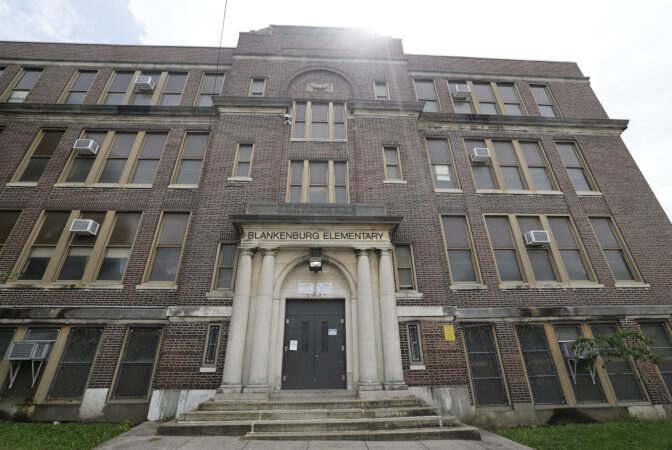
The district plan calls for closing five schools in neighborhoods it deemed to have a “high risk” of vulnerability, the level below “very high”: Blankenburg, Harding, Stetson, Tilden, and Wagner.
Watlington has made it clear that the district is phasing out middle schools when possible, in favor of the K-8 model — and of that list, four are middle schools. Only Blankenburg, in West Philadelphia, is an elementary. Also, of those schools in vulnerable neighborhoods, four of the five are rated as having “unsatisfactory” buildings, the district found.
Perhaps no section of the city faces as much disruption from the recommendations as the lower part of North Philadelphia.
Fourteen schools with a combined enrollment of 5,400 students could be affected, including the closures of Ludlow, Morris, Penn Treaty, and Waring.
“If you are closing schools during a literacy crisis, then you should be held directly accountable to the people you serve,” Young said last week.
Right sizing mostly empty buildings
Underused space was a factor in the district’s decision-making, an Inquirer analysis found.
Data released by the district last year identified about 60 schools that were more than half empty. The recommendations attempt to realign some of these schools by taking significant action on 31 of the 60 half-empty schools.
Of the 20 schools the district wants to close, 14 are currently at less than half capacity.
window.addEventListener(“message”,function(a){if(void 0!==a.data[“datawrapper-height”]){var e=document.querySelectorAll(“iframe”);for(var t in a.data[“datawrapper-height”])for(var r,i=0;r=e[i];i++)if(r.contentWindow===a.source){var d=a.data[“datawrapper-height”][t]+”px”;r.style.height=d}}});
AMY Northwest, Conwell, Robert Morris, Motivation, Tilden, and Welsh are all recommended for closure, with each educating fewer than a quarter of the students they have room for.
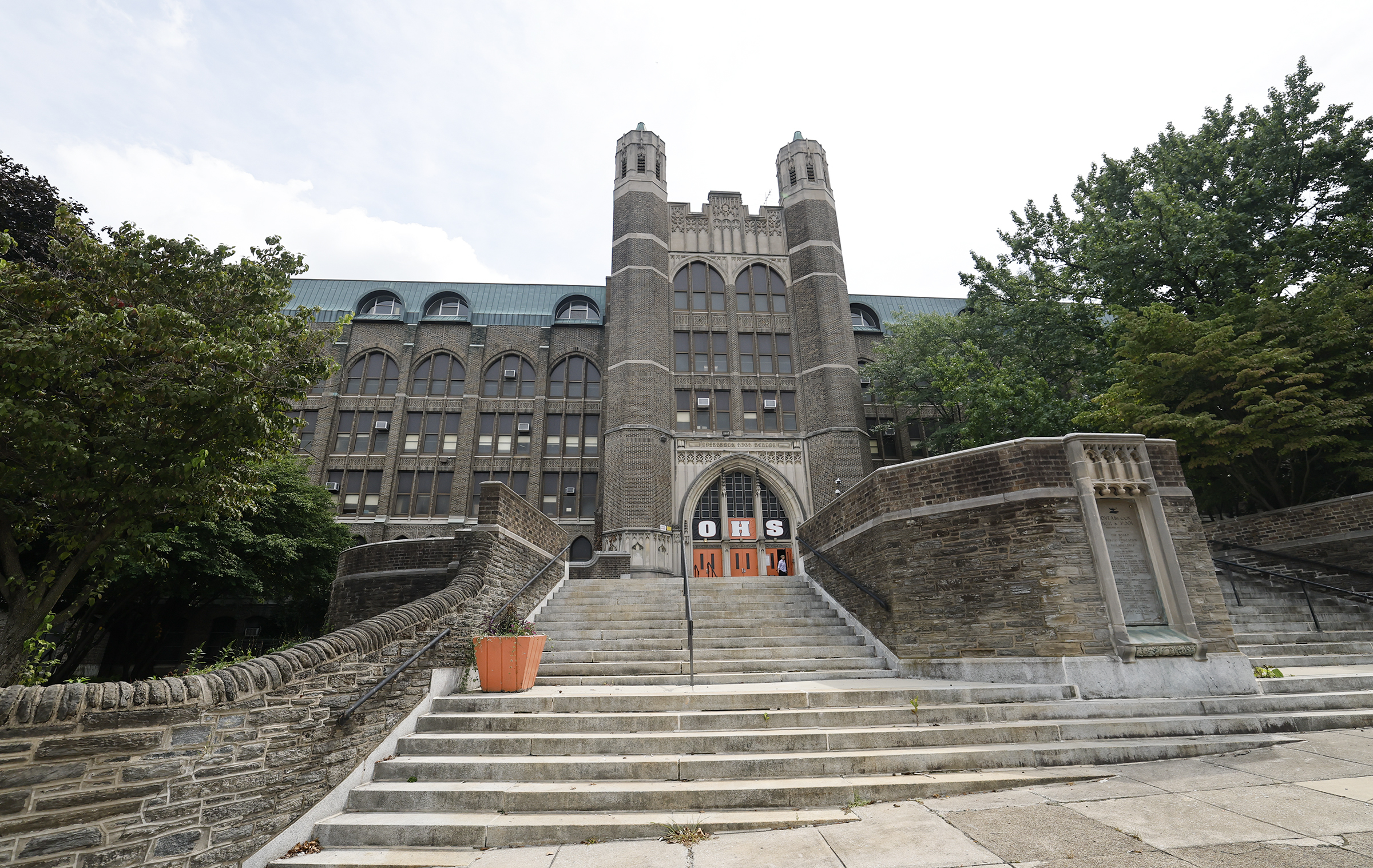
Overbrook High in West Philadelphia — a 100-year-old school with roughly one in four seats filled — would remain open but begin sharing space with the Workshop School, a small, project-based high school located nearby.
Overbrook has received millions in funding from the state for remediation and a new roof. It also has a strong alumni association.
Overbrook High School in West Philadelphia has thousands of empty seats but was not tapped for closure. Instead, The Workshop School, a small, project-based high school now located in another West Philadelphia building, will colocate with Overbrook.
Having a more robust enrollment, however, did not save some schools from landing on the closure list. Harding, Parkway Northwest, Pennypacker, Robeson, and Stetson operate at 50% to 74% of capacity but would still close.
Besides shutting down underused schools, the plan would alter an additional 17 half-empty schools by moving them into colocations, adding grades, or otherwise expanding their use by taking in students from the closing schools.
To make it work, the district’s recommendations often involve a series of logistical steps. A pair of North Philadelphia neighborhood schools built in the 1960s are one example.
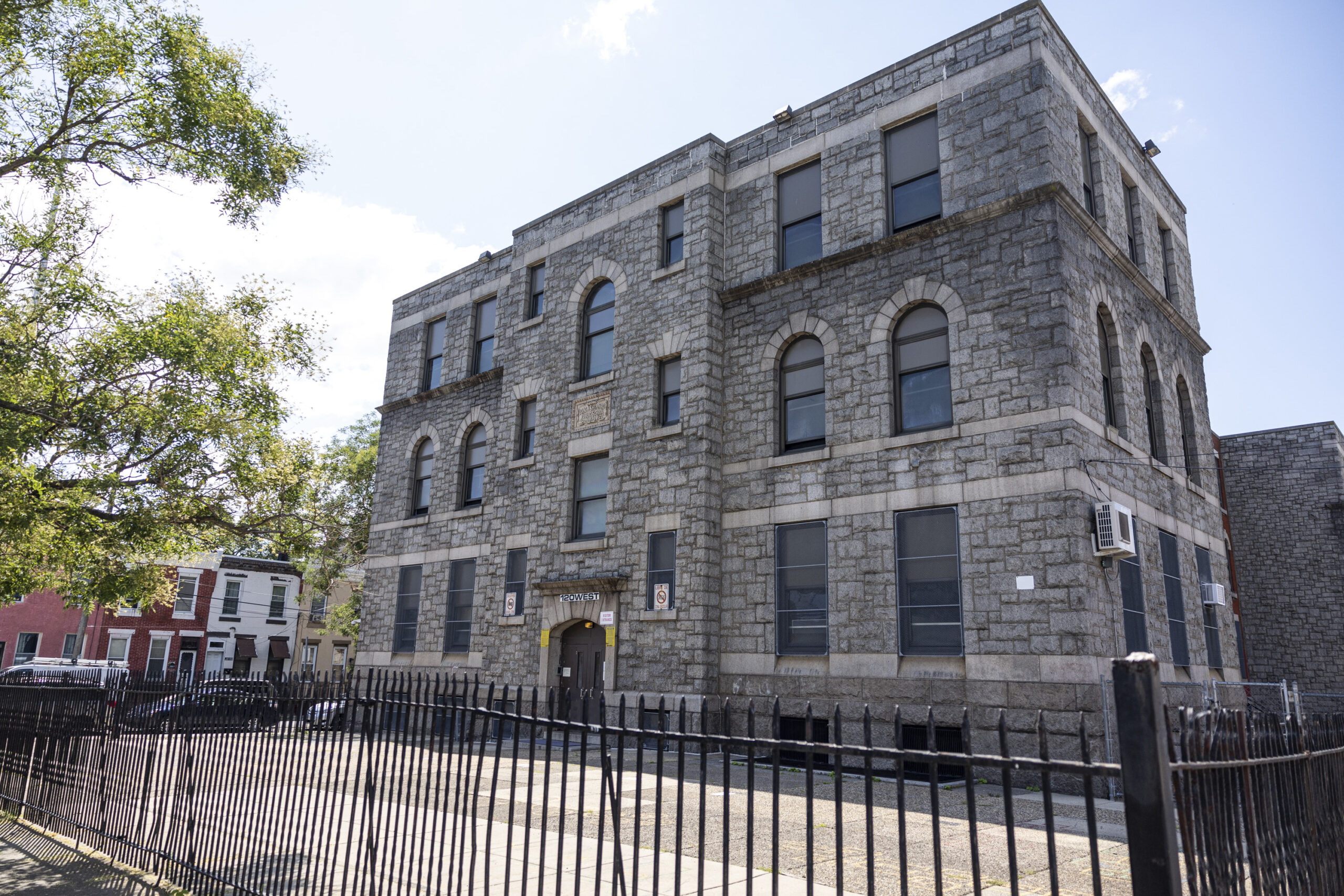
Hartranft, a K-8 school in North Philadelphia with a building rated in “good” condition but only 37% occupied, would take in students from Welsh, a school marked for closure. Welsh teaches the same grades but in a building rated “poor” about a half a mile away. The district would then convert the Welsh building into a new year-round high school.
John Welsh Elementary school is on the list of 20 schools proposed to close by the 2027-28 school year.
Getting students out of (some) fatigued buildings
By one city estimate, district schools need about $8 billion in repair costs for 300-plus buildings that are about 75 years old on average. Watlington’s plan calculates the district could do it for $2.8 billion.
Even with some investments over the last decade, many schools still have asbestos, lead, or mold issues. And many schools that don’t have bad building quality ratings still need improvements.
Eight schools recommended for closure are in buildings rated “unsatisfactory” by the district, its lowest score.
An additional 30 schools also rated “unsatisfactory” would remain open under the plan, including some expected to see an increase of students.
window.addEventListener(“message”,function(a){if(void 0!==a.data[“datawrapper-height”]){var e=document.querySelectorAll(“iframe”);for(var t in a.data[“datawrapper-height”])for(var r,i=0;r=e[i];i++)if(r.contentWindow===a.source){var d=a.data[“datawrapper-height”][t]+”px”;r.style.height=d}}});
Watlington wants the district to pay for $1 billion of the plan’s price tag with its own capital funds over the next decade. That would leave $1.8 billion unfunded, and he wants the state and philanthropic funders to cover the rest.
If the full $2.8 billion plan is funded, Watlington said, the district could improve every building labeled “poor” or “unsatisfactory.”
To achieve this, some buildings could get the same kind of treatment Frankford High received — a $30 million major renovation project to remedy significant asbestos damage. Students had to relocate into an annex and another building for two years while the work was done.
The district plan calls for some of the buildings in the worst shape to receive more students. Bache-Martin, Catharine, Howe, John Marshall, and Middle Years Alternative are in buildings that need significant upgrades, according to the district’s analysis, but all would take on more pupils.
In the case of Howe, the district wants to add grades to keep students who would have attended Wagner, a middle school that is proposed to close.
The district has said Bache-Martin would receive upgrades if the plan is adopted. For other schools, neither the timeline nor the fixes they would receive are clear.
The recommendations so far only mention a handful of schools set to modernize.
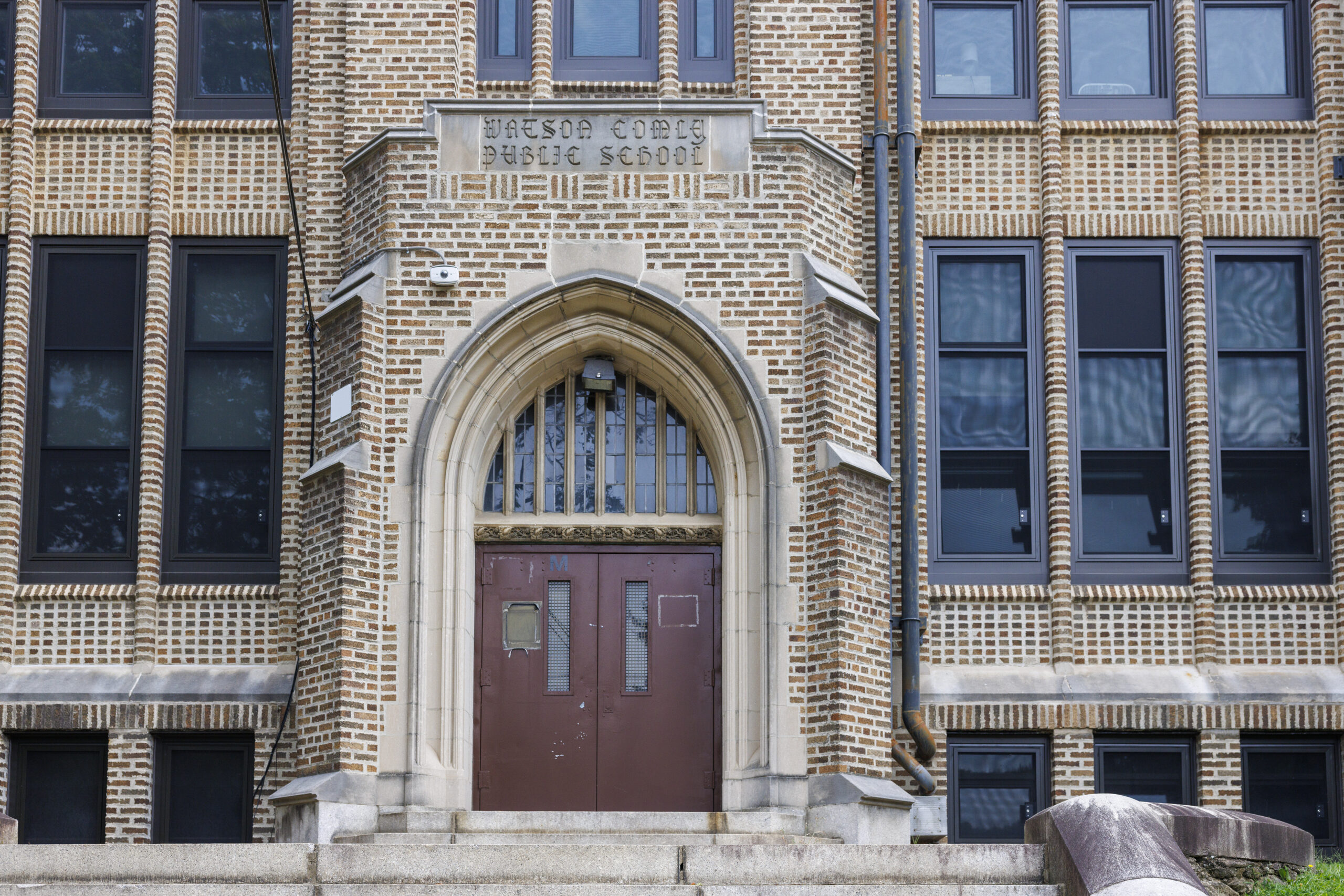
Among them is Comly, a K-5 in the Somerton neighborhood.
Comly now has 660 students enrolled, putting it at 107% of its capacity. But the district recommends modernizing the school and accepting middle grades students from the Comly and Loesche catchments. Students who now attend Loesche, another K-5, go to Baldi Middle School, which is also overcrowded.
Watson T. Comly Elementary School in Somerton. It’s slated to be modernized and accept more grade levels under the district’s proposed plan.
What appears to set schools like Bache-Martin apart from some of the closures is higher occupancy. Together, about two dozen schools that are more than half occupied would remain open, even though the buildings are “unsatisfactory.”
Schools on this list — like Barton Elementary, which runs at about 80% of its capacity — are harder to shutter or colocate if no nearby school has low attendance. That makes building upgrades a more logical solution.
But those two dozen schools are not the only ones in need of significant building upgrades.
An additional 45 schools currently operate in buildings rated slightly better at “poor,” the category just above “unsatisfactory.” The district recommends closing seven of them and colocating two.
And beyond that large number of fatigued schools, many others in poorly rated buildings will remain unchanged for now, with about 10 even taking in more students.
Watlington has said that in total, 159 schools would modernize over a decade if the plan is approved and fully funded, but absent extra state and private money, that number could drop.
When Mayor Cherelle L. Parker unveiled her much-anticipated plan to address Philadelphia’s housing crisis last year, there was predictable criticism from the political left. Activists said the proposal drafted by the moderate Democrat would not do enough for the city’s poorest residents.
Less predictable was that a majority of City Council stood with them.
Even the Council president, a centrist ally of the mayor, sided with a progressive faction that just two years ago had been soundly defeated in the mayor’s race — but whose new de facto leader in City Hall has proven adept at building alliances across the ideological spectrum.
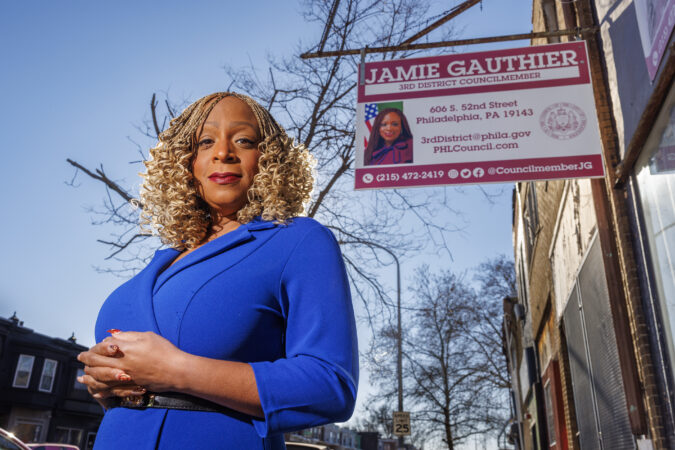
At the center of that shift was Jamie Gauthier.
The second-term Democratic lawmaker from West Philadelphiahas solidified herself over the last year as a leading voice on Council and a counterweight to Parker. She has worked within the system as opposed to trying to break it, maintaining relationships with power players who disagree with her on policy.
She counts Ryan N. Boyer — the labor leader who is Parker’s closest political ally — among those who consider her a “thought leader.”
“Over the last year, what you saw,” Boyer said, “is her modulate her positions to become more practical.”
Gauthier has generally voted with progressives, including last year when she opposed the controversial Center City 76ers arena proposal. But she has also endeavored to be a team player, at times compromising on ideological battles to focus on priorities in her district.
Last year, she voted for Parker’s plan to cut taxes for businesses and corporations when other progressives opposed it, because her main priority was securing housing funding. She has not opposed some tough-on-crime efforts in the Kensington drug market, instead allowing her colleagues who represent that area to dictate the policy there.
She says she is trying to use her political capital where it matters.
“Why would I take a protest vote and tank a relationship with a colleague when I’m going to need them later?” she said. “I want to win.”
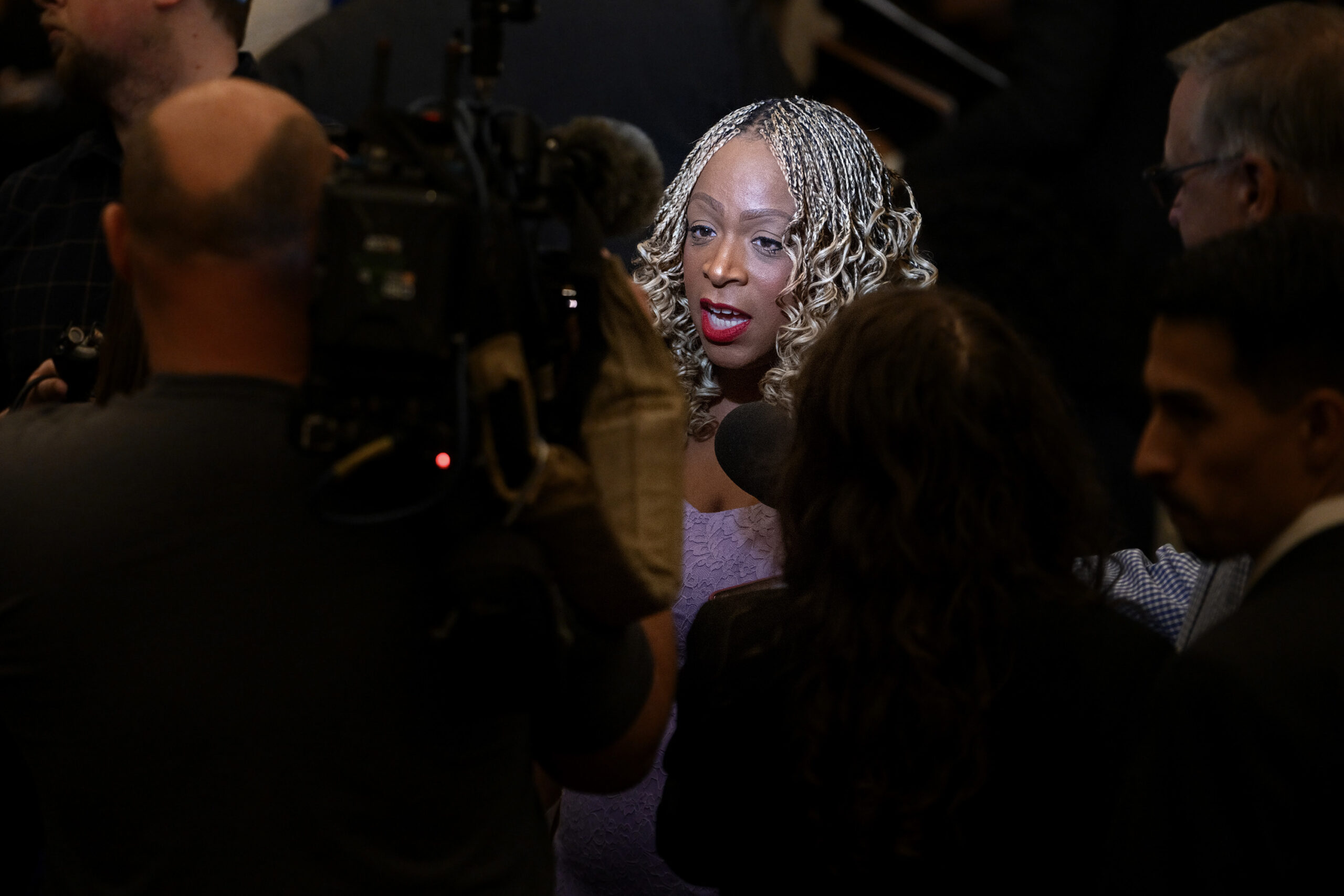
Councilmember Jamie Gauthier talks with news media following a special session of City Council on March 24, 2025.
The fact that Gauthier is a district Council member who represents a large swath of the city west of the Schuylkill also gives her cachet with colleagues. Council has a long tradition of honoring how members want their own neighborhoods to be governed.
Gauthier, who leads Council’s housing committee, has used the influence to make West Philadelphia something of a testing ground for left-of-center policy. Plenty oppose what they see as draconian restrictions on real estate development in her district.
Others see a progressive champion, and some political observers think Gauthier could amass enough support to run for mayor one day. She doesn’t deny that she has thought about it.
But for whatever politics Gauthier can navigate in City Hall, she knows she can rise only if she is successful at home.
‘Not just a lone actor’
When Parker took office, Council was in a moment of upheaval. Council President Kenyatta Johnson was the new leader of the chamber, and several prominent voices were gone after they had resigned to run for mayor themselves.
One was Helen Gym, who was seen as the leader of Council’s left flank. There were questions about who would fill the void once Gym was gone.
Gauthier, 47, an urban planner by trade, did not come up through an activist movement in the same way Gym did, and was a bit more reserved in her style.
But she carries the mantle for the same theory of governance: that lawmakers should prioritize the vulnerable, and that what is good for business is not necessarily good for everyone else.
That set Gauthier on an ideological collision course with Parker, a former Council member who ran for office on a promise to uplift the middle class, a group the mayor believes has been too often ignored.
It came to a head in the fight over Parker’s Housing Opportunities Made Easy, or H.O.M.E., initiative.
Parker wanted to set unusually high income eligibility thresholds for some of the programs so that middle-class families could unlock government subsidies they may not otherwise qualify for. A significant portion of Council, meanwhile, wanted the money to go initially to Philadelphians most vulnerable to displacement.
Parker was clear-eyed about who was leading the charge.
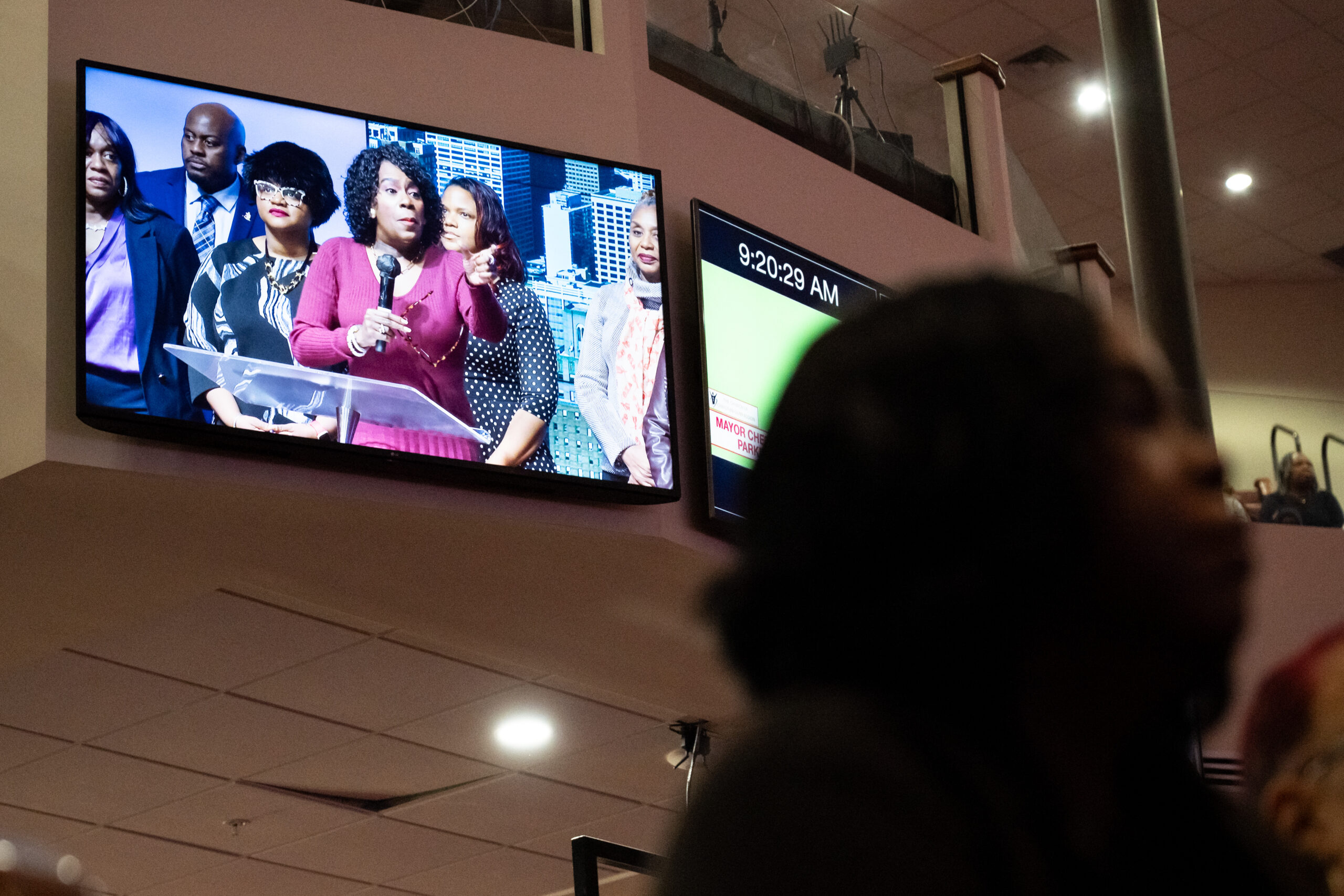
“Councilmember Jamie Gauthier, she may be comfortable and OK with telling Philadelphia homeowners, working-class Philadelphians, that they have to wait and there is no sense of urgency for them,” Parker said in a December interview on WHYY. “But that is not a sentiment that I support or agree with.”
Gauthier is quick to point out that she did not work alone, and that one member of a 17-member body cannot accomplish much. Alongside Councilmember Rue Landau, a fellow Democrat and a housing attorney by trade, Gauthier worked for months to win over her colleagues.
Gauthier didn’t think Parker helped her own cause. A “line was crossed,” she said, when Parker took the fight outside City Hall and to the pulpit. Amid negotiations with Council, the mayor went to 10 churches on one Sunday in December to lobby for support, saying her vision was to not “pit the ‘have-nots’ against those who have just a little bit.”
Mayor Cherelle L. Parker speaks to the crowd at The Church of Christian Compassion in the Cobbs Creek neighborhood of West Philadelphia on Sunday, Dec. 7, 2025. Parker visited 10 churches in Philadelphia on Sunday to share details about her HOME housing plan.
To Gauthier, the divisiveness was coming from the mayor’s office.
“I wish the mayor and her administration were more open to other people’s ideas, were more OK with disagreement on policy issues, and more aware of Council as a completely separate chamber of government,” Gauthier said, “as opposed to a body that works for her.”
That is a candid assessment of the relationship between Parker and City Council from Gauthier. Few lawmakers from the mayor’s own party have criticized her publicly.
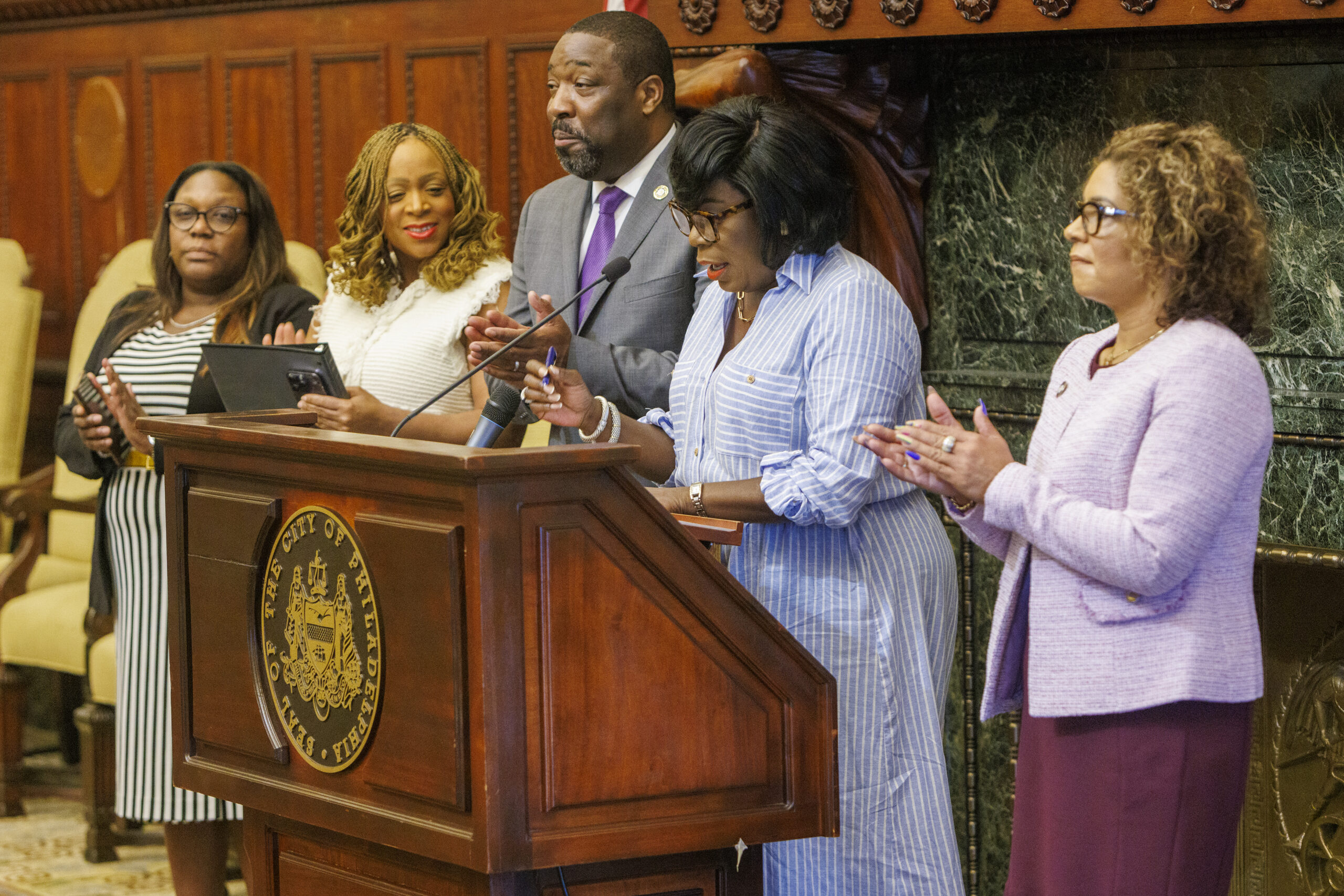
Philadelphia Mayor Cherelle Parker holds a press conference regarding her first budget flanked by members of city council in her reception room, Philadelphia City Hall on Thursday, June 6, 2024. Council members from left are Kendra Brooks, Jamie Gauthier, council president Kenyatta Johnson, and Quetcy Lozada.
State Rep. Rick Krajewski, a West Philadelphia Democrat and a progressive who has worked closely with Gauthier, said the fight over H.O.M.E. showed that Gauthier has learned “the diplomacy required to be an effective legislator.”
“It was a good example of not being afraid of a conflict that felt important to stand up for,” he said, “but then to not just be a lone actor, but organize with other colleagues and allies.”
Gauthier’s most important ally was Johnson, who negotiated directly with Parker through the process and controls the flow of legislation in the chamber.
The two go back years. Before Johnson was Council president, he made a point of welcoming new members, a gesture that has always stuck with Gauthier. They worked closely to secure funding for gun violence prevention. And Gauthier said that since Johnson took the gavel, he has been more open to working with progressives than his predecessor was.
He does not talk about that publicly. What he will say is that he works in partnership with Gauthier because she understands “the bigger picture in terms of how we move forward as the institution.”
“I consider her to be a pragmatic idealist,” Johnson said. “She wears her heart on her sleeve, and she really believes in actually doing the work.”
She was also supported by real estate interests, some of whom now have buyer’s remorse.
After Gauthier pulled off a shock win, she arrived in Council and quickly aligned with the progressive bloc. Through her first two terms, she has used councilmanic prerogative often, and has voted with her district Council colleagues so that they can do the same.
She admits that it is an effective tool for accomplishing her goals quickly.
Carol Jenkins, a Democratic ward leader in West Philadelphia, said Gauthier’s use of councilmanic prerogative is “part of her maturation.”
“That’s the power you have,” Jenkins said.
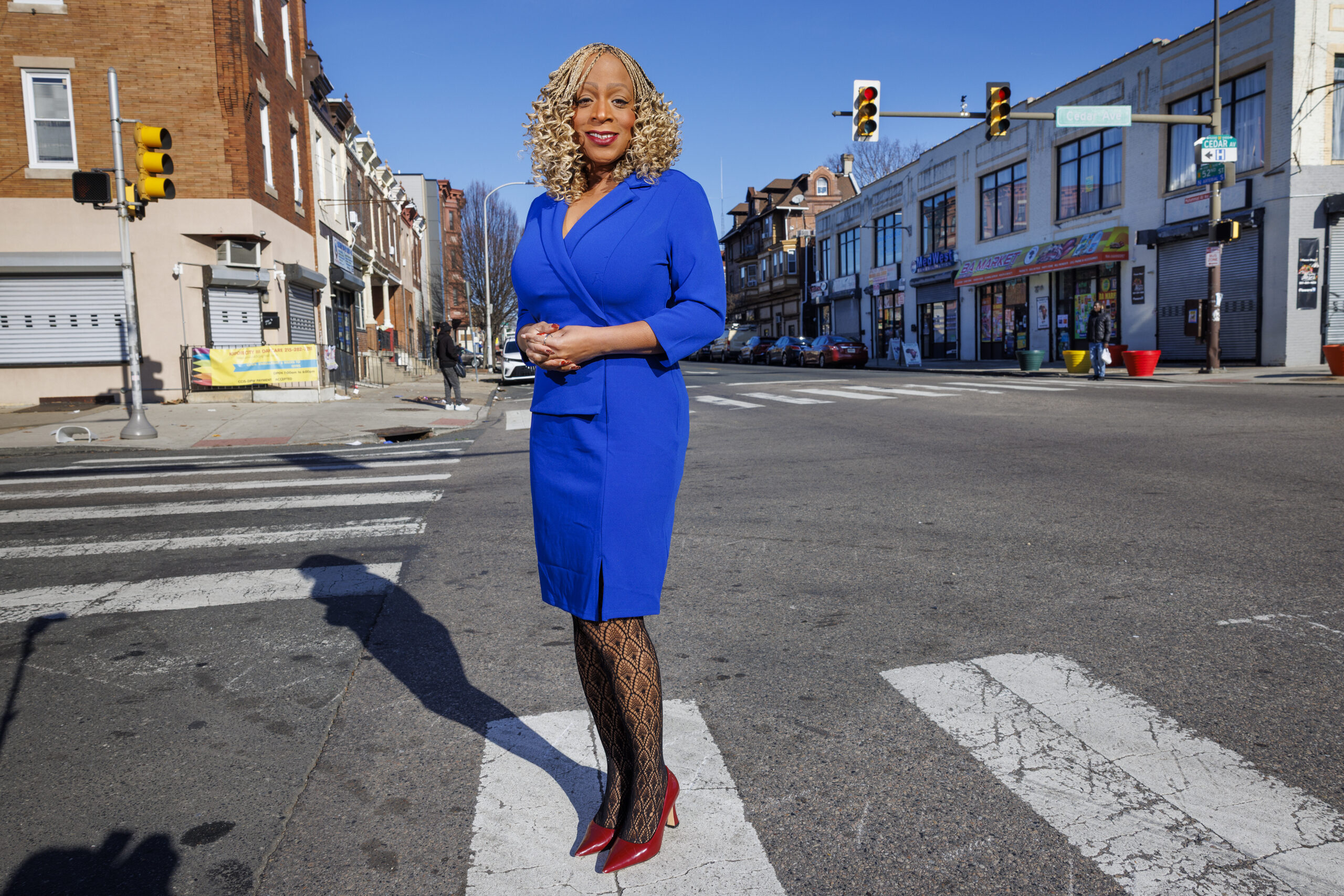
City Councilmember Jamie Gauthier in her district near 52nd Street and Cedar Avenue in Philadelphia on Monday, Dec. 22, 2025.
However, her most notable use of councilmanic prerogative has been in housing policy, and some developers say her district is now the most hostile to growth in the city.
In Gauthier’s first term, she championed legislation to create what is known as a Mixed Income Neighborhood overlay. In essence, it requires that developers building projects with 10 or more units in certain parts of her district make at least 20% of their units affordable. That is defined as accessible for rental households earning up to 40% of the area median income.
For Gauthier, it’s a tool to slow the rapid gentrification of her majority-Black district.
But developers say that growth has slowed significantly in the areas covered by the overlay since it took effect in 2022. Some have said they avoid seeking to build in the 3rd District entirely. The only major project currently in the works in the area is a parking garage.
Ryan Spak, an affordable housing developer who said he considers Gauthier a friend, has been among the most outspoken critics of the overlay. He said while Gauthier’s “moral compass is pointed in the right direction, her policies don’t math.”
“You would never ask a restaurant to give away its ninth and 10th meal for 40 cents on the dollar, with no additional discounts or benefits,” he said, “and expect that restaurant to survive.”
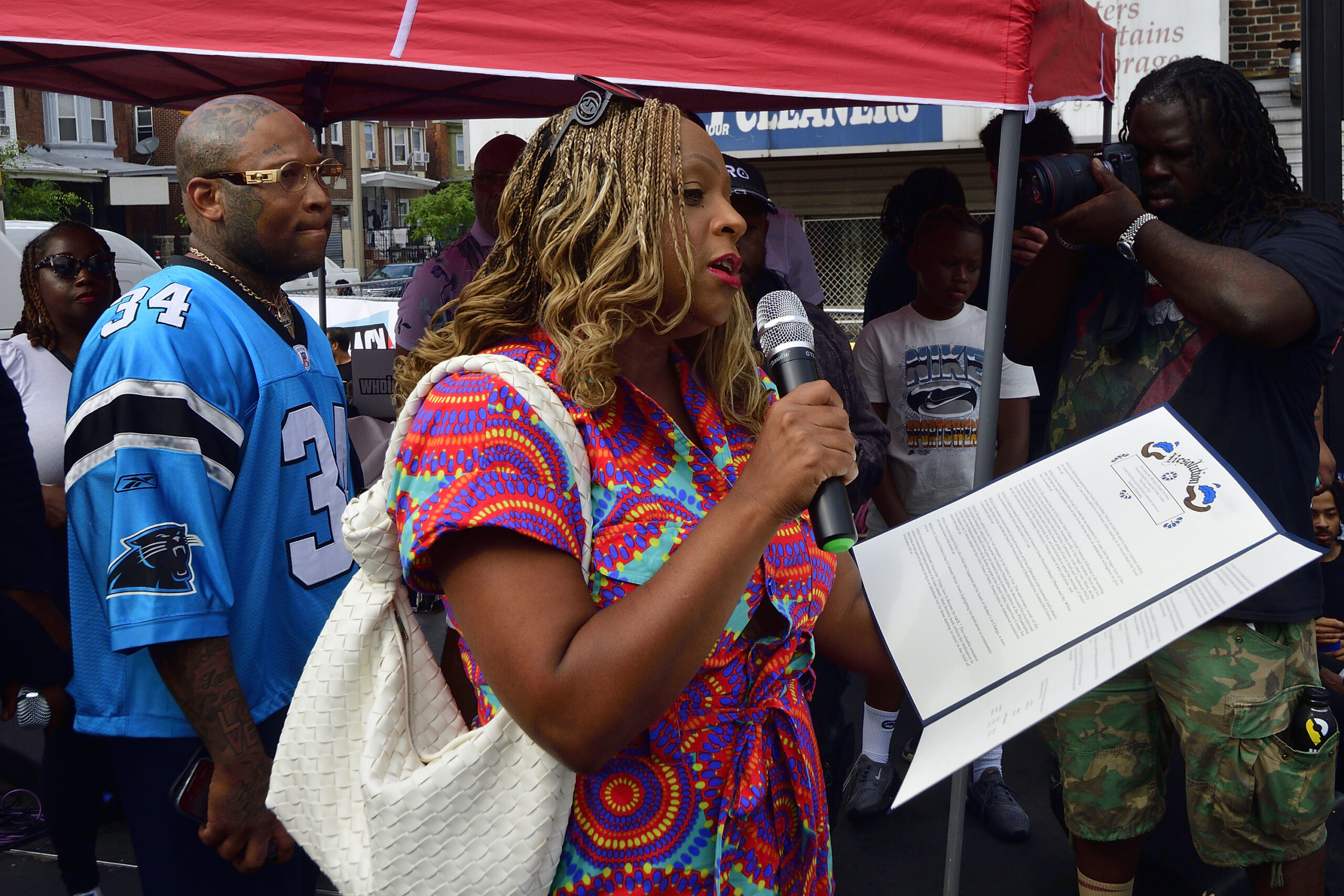
Councilmember Jamie Gauthier reads out a citation honoring Rapper Mont Brown during a street naming ceremony for the Southwest Philadelphia native at the 13th Annual Stop the Violence Kickback Block Party at 55th Street and Chester Avenue, in Southwest Philadelphia on August 17, 2024.
Gauthier said she has made adjustments, and she championed legislation to accelerate permitting and zoning approvals. The mandate, she said, is necessary because the market won’t build enough affordable housing on its own.
“As untenable as it is to them that they can’t make the numbers work, it’s untenable to me that people can’t afford to live here,” Gauthier said. “So we can come together and we can fix that. But I’m not going to move from my position that we have to demand affordability.”
Mayoral buzz, but no ‘stupid campaigns’
Gauthier is one of several names that have been floated in political circles as potential candidates for mayor in 2031, which would be Parker’s final year in office if she runs for and wins a second term. Several of her Council colleagues, including Johnson, are seen as potential contenders.
“I’d be lying if I didn’t say that mayor could be interesting one day,” Gauthier said. “I also don’t believe in stupid campaigns. So I would never do that if I didn’t think I had a path.”
Boyer said he has counseled Gauthier to pursue moderate policy and avoid being “label-cast” as far left. He said Philadelphia is not Chicago or New York, and he doesn’t see the city electing an uber-progressive to be the mayor any time soon.
“Philadelphia has always been a real center-left community,” Boyer said, “and just because you’re the loudest isn’t the most popular.”
The left may have other plans. Robert Saleem Holbrook, a progressive activist, said that Gauthier would be an “ideal candidate” for higher office and that the city’s leftists would back her.
Probably.
“So long as she stays true and supportive of progressive ideals,” Holbrook said. “You can’t compromise on your way up.”
On Dec. 1, 1898, about 1,000 people gathered at a court in Textile Hall — today’s Kensington neighborhood. They were there to watch the Philadelphia Hancock Athletic Association play the New Jersey Trenton Nationals in America’s first professional basketball game.
According to an article in the following day’s Philadelphia Times, the game got a late start because referees were still ironing out the rules of the world’s newest professional sport.
But once the game got underway, it was fast and furious.
Hancock “started with a rush, scoring two field goals before the players had become warmed up to their work,” the story reads.
“Throughout the entire first half, the home team had the better of the argument, taking advantage of every opportunity finishing the half in the lead by a score of 11 to [0].”
In the end, Philadelphia lost by two points, a disappointment Philly sports fans know all too well, even in these modern times.
The final score: 21 to 19.
Daniel Lipschutz blended history into his love of the modern day sport for this sculpture.
That first game of the National Basketball League will be feted this Saturday at a Firstival at Xfinity Mobile Arena. Firstivals are the Philadelphia Historic District’s weekly day parties celebrating events that happened in Philadelphia before anywhere else in America, and often the world. They are part of a yearlong celebration of America’s 250th birthday.
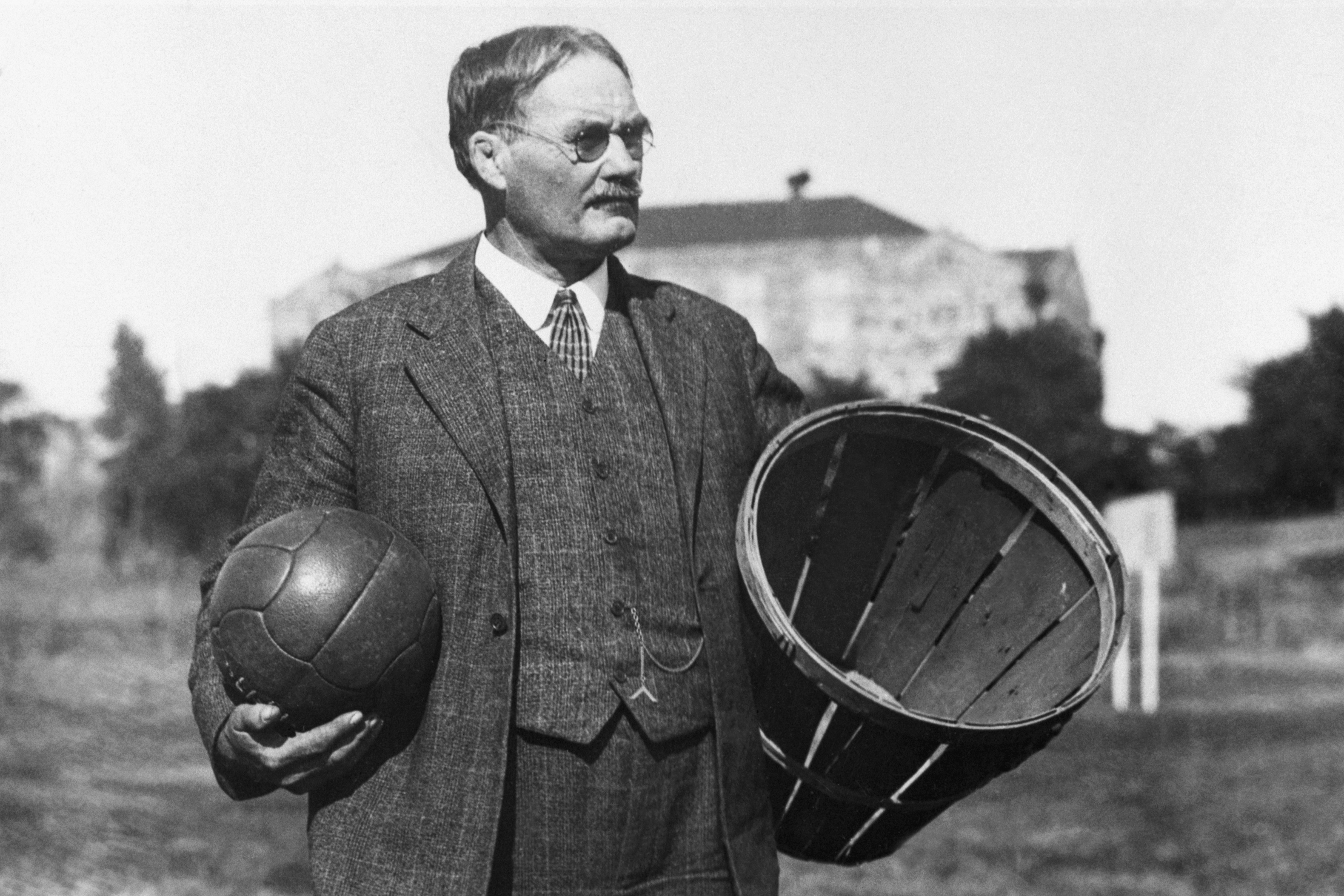
James Naismith, a YMCA coach in Springfield, Mass., invented basketball in 1891 to keep kids active during winter months. The sport incorporated elements of rugby, lacrosse, and soccer. Instead of throwing balls into a bottomless net to score, players threw balls into peach baskets.
(In other words, there was no such thing as a rebound.)
James Naismith, inventor of basketball, with a ball and a basket.
Basketball quickly became popular with college students and in 1898, Naismith was recruited to coach the University of Kansas basketball team.
That same year, Horace Fogel, sports editor of the Philadelphia Public Ledger, organized the first professional basketball league with three teams from Philadelphia and three from South Jersey.
A 12-foot chain-link cage separated players from the fans. Ropes replaced these iron cages in the 1920s.
Fogel’s National Basketball League lasted just five years, folding in 1904 because of quick player turnover eating into profits. A second league was formed in 1937 and was sponsored by Goodyear. In 1946, the Basketball Association of America was established.
And in 1949, the BAA and NBL merged to create today’s NBA.
“This really goes to show that Philadelphia is a sports city,” said Shavonnia Corbin Johnson, vice president of civic affairs for the 76ers. “When people talk about Philadelphia sports rooted in history, tradition, and passion, it’s true, but now we know that America’s true love of sports can trace its roots right back here.”
This week’s Firstival is Saturday, Jan. 24, 11 a.m. — 1 p.m., at Xfinity Mobile Arena, 3601 S. Broad St., Philadelphia, Pa. Premium Access Entrance on the Broad Street side, near Lot C. The Inquirer will highlight a “first” from Philadelphia Historic District’s 52 Weeks of Firsts program every week.
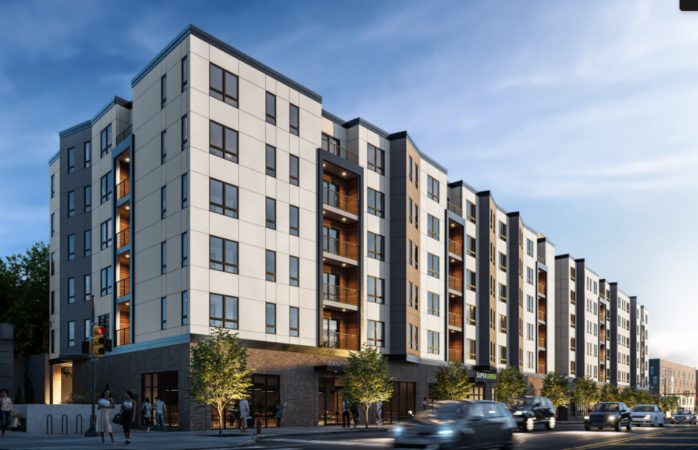
A six-story apartment project at 2001 E. Lehigh Ave. is moving forward with a new owner after years of delay amid a difficult development environment.
Five-lane Lehigh Avenue divides the southern portion of Kensington, which has experienced development more akin to the boom in Fishtown, from the parts of the neighborhood to the north that are at the heart of the city’s opioid crisis.
But along the northern edge of the avenue, next to the Conrail tracks, a series of auto-oriented and light-industrial properties have been redeveloped as housing in recent years.
“That whole corridor has continued developing. It’s even pushing over the tracks further up north, too,” said Brian Corcodilos, CEO of Designblendz, the architect for the project. “We’re confident that … this area continues to rent up.”
The former owner of 2001 E. Lehigh, developer Isaac Singleton, secured zoning approvals for the project in 2023 and 2024. City records then show the property sold for $2.5 million in January 2025.
A demolition permit for the property was issued this week to an address associated with developer Roman Ovrutsky — whose home The Inquirer profiled last year — and Corcodilos said their team expects construction to begin by early spring.
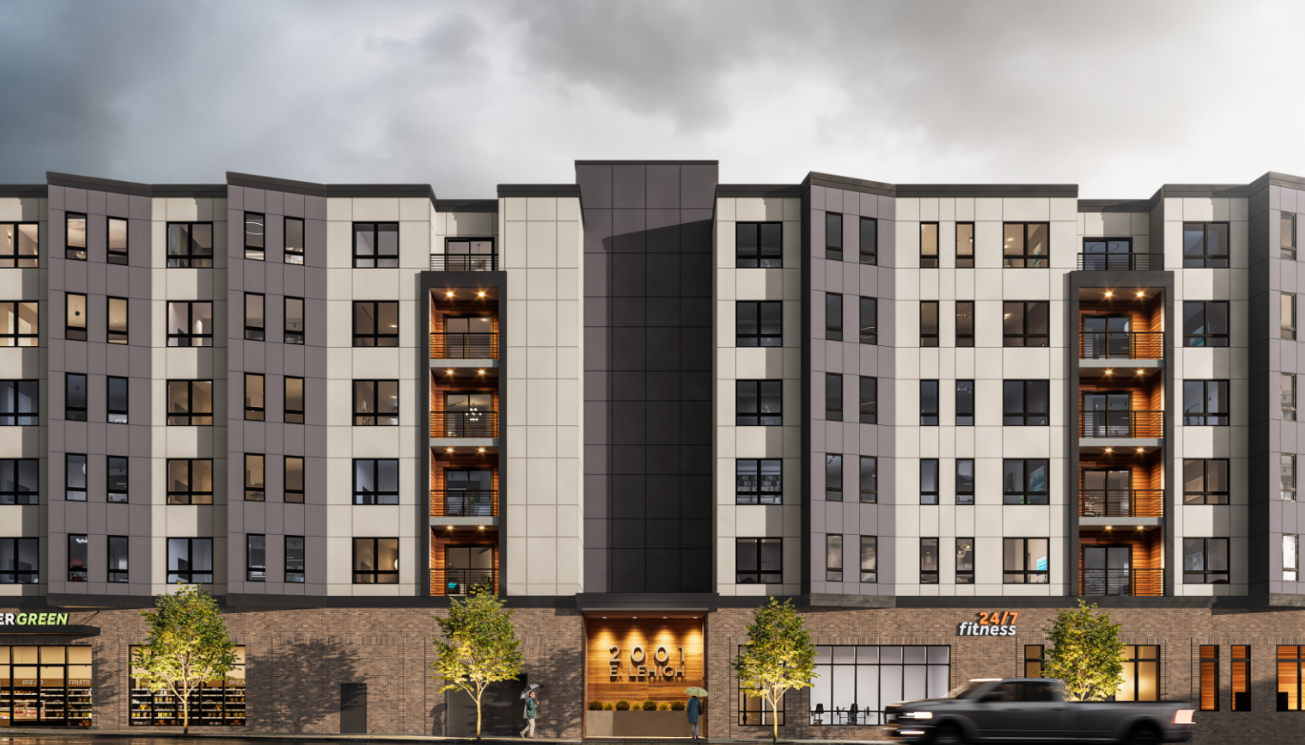
Ovrutsky’s version of the project will feature 146 apartments, a slightly smaller number than Singleton proposed, and a little over 6,000 square feet of commercial space on the ground floor. The project will also have 54 underground parking spaces.
Designblendz has updated the visual palette for the project by adding darker grays and slate-colored hues.
Corcodilos said that changes in federal tax policy in President Donald Trump’s Big Beautiful Bill have enabled clients to begin building again. A lull in recent years was caused by heightened interest rates and an apartment glut that made it hard for developers to charge the rents necessary to pay back the loans on their projects.
The former design for the building included greens and browns. The new vision features slate-colored hues.
Corcodilos said developers have also found that more projects are making sense if they use either the city’s mixed-income housing zoning bonus — which allows taller or denser construction in exchange for an affordability component — or if they base their financing on catering to some tenants who use federal rent voucher subsidies.
“That’s how a lot of these projects are getting done,” Corcodilos said.
It’s illegal in Philadelphia to discriminate against renters using vouchers, but it’s common for landlords to discourage those tenants, and many buildings owners don’t proactively advertise to subsidized tenants.
But in recent years, increasing numbers of landlords have seen the advantage of tapping into a large tenant base with almost guaranteed payments.
Another property just north of Lehigh Avenue at 2200 E. Somerset St. was sold last year to the Philadelphia Housing Authority, after many of its tenants ended up being voucher holders.
“A lot of these big buildings that are going up, the only way they’re penciling is if there’s some sort of an affordability component to it,” Corcodilos said.
Beyond Kensington, Designblendz is seeing an increase in work this year due to developer-friendly changes in the federal tax code, opportunities in affordable housing provision, and an easing of the overall apartment glut, he said.
“I’m not getting a sense at the moment that clients are worried about not filling their units,” Corcodilos said. “Obviously things slowed down a little bit over the last year and a half for the industry. But what we’re seeing right now, it’s busier than ever.”