Tag: Local 98

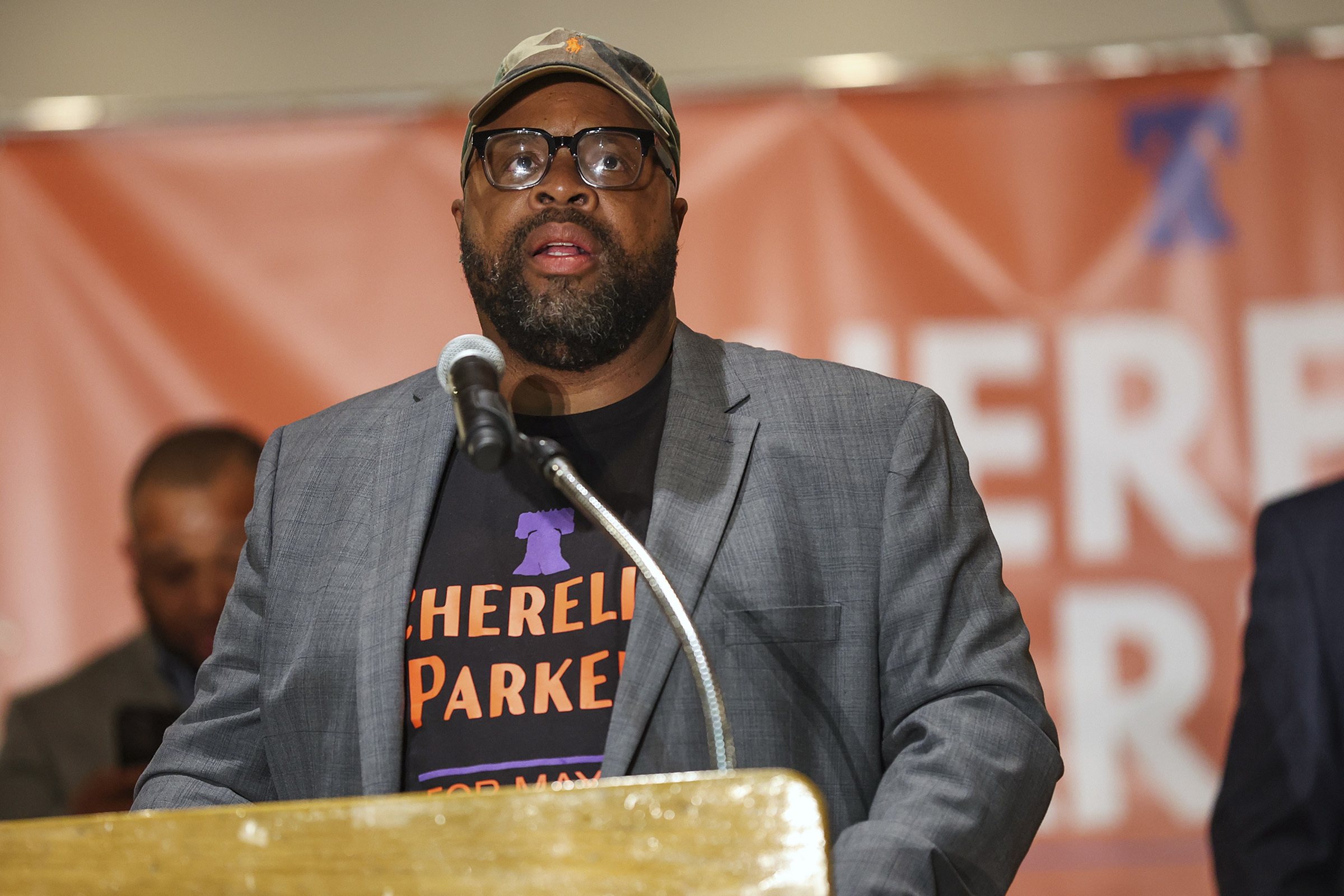
  • Mayor Cherelle Parker’s campaign raised an eye-popping $1.7 million last year though she won’t face reelection until 2027

    Mayor Cherelle Parker’s campaign raised an eye-popping $1.7 million last year though she won’t face reelection until 2027

    Mayor Cherelle L. Parker’s campaign raised almost $1.7 million last year despite her not facing reelection until 2027, according to a new campaign finance report.

    That is the most any Philadelphia mayor has raised during their second year in office since at least the early 2000s, when the city’s current ethics and campaign finance rules took effect, according to Parker’s campaign. She is also the only mayor in that time frame to avoid a dip in fundraising after her first year in office, when many donors shell out to support the city’s new leader.

    “The Mayor has strong support from across the City and the region,” Aren Platt, the executive director of the mayor’s campaign committee, People for Parker, said in a written statement. “These numbers equate to people investing in her vision as Mayor for the City and supporting the work that she is doing.”

    Her campaign also spent $812,000 in 2025, a huge sum for a nonelection year. Parker entered 2026 with nearly $1.6 million in the bank — a significant haul two years out from a municipal election cycle. (For context, Parker’s campaign in 2023 raised almost $3.4 million, and spent just over $3.2 million en route to winning the mayor’s race.)

    State law gives politicians wide latitude in how they spend their campaign donations beyond traditional election expenses like buying TV ads and printing fliers.

    Parker’s campaign expenditures last year included airfare to Colorado for a mayoral roundtable at the Aspen Institute, and almost $20,000 to cover costs for a constituent’s funeral.

    Parker’s hefty off-year fundraising is reflective of the increasingly constant and professionalized world of political fundraising in Philadelphia. Local politicians no longer wait until challengers emerge to press donors for cash or host major fundraisers.

    “Philadelphia elections keep getting more expensive, so now all the candidates have professional fundraisers, which means the frequency of their events and calls has risen dramatically as well,” said John Hawkins, a City Hall lobbyist.

    City Council President Kenyatta Johnson, for instance, last year raised about $960,000 and entered 2026 with more than $1.1 million in the bank. Johnson, who, like Parker, will not face reelection until 2027, said he raises money in off years so that he can support other Council members and fund community programs.

    “I am blessed to support 16 other hardworking members of Council,” he said Friday. “I always support different community initiatives that come before me, individuals always seeking support for a variety of different initiatives.”
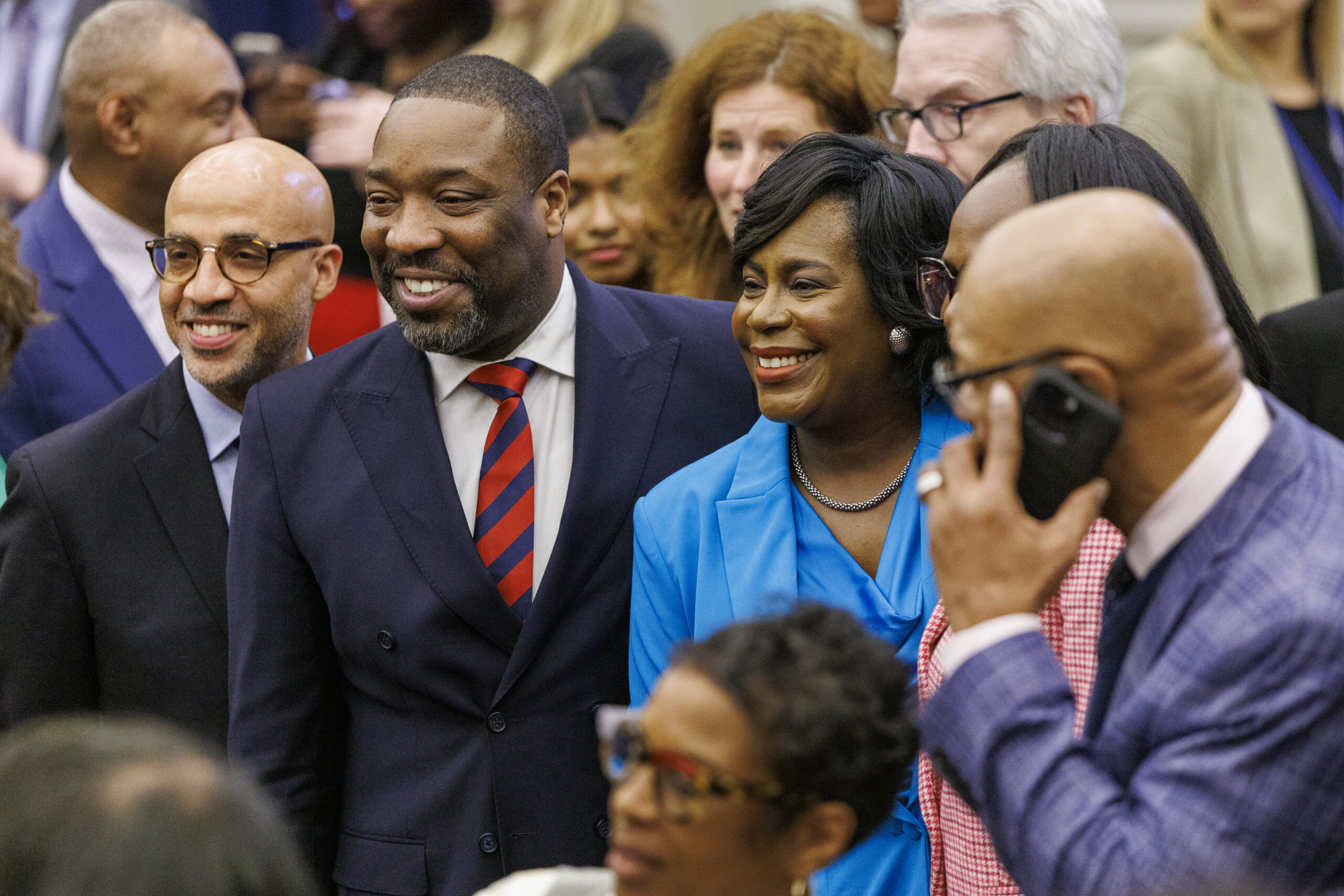
    Philadelphia Mayor Cherelle L. Parker stands beside Council President Kenyatta Johnson (left) after she finisher her budget address to City Council, City Hall, Thursday, March 13, 2025.

    Johnson, a close ally of the mayor, is also seen as a potential contender in the race to succeed Parker, which would happen in 2031 if she wins reelection. Racking up money between now and then could allow him to enter the race in a strong financial position.

    “My focus is being the best City Council president that I can be,” Johnson said when asked if he was considering the city’s top job.

    Using the rules to their advantage

    Philadelphia’s campaign finance laws rules limit contributions to $3,700 per calendar year from individual donors, and cap political committees and businesses allowed to make political donations at contributions of $14,800 per year.

    That means incumbents can collect the maximum amount from donors in each of the four years in their terms before running for reelection. That is not possible in federal elections, where contribution limits apply to the entire election cycle.

    The city’s rules give incumbents a potential advantage over new candidates, who typically have the opportunity to raise money over only one or two calendar years after they enter a race.

    Incumbents do not always maximize that opportunity. But Parker last year set a new standard.

    She is also among the growing number of Philly elected officials taking advantage of a rule that allows politicians to accept donations larger than the city’s contribution limits if they do not spend the excess money on electioneering activities, such as buying ads or paying canvassers to knock on doors.

    The electricians union, the politically active Local 98 of the International Brotherhood of Electrical Workers, for instance, gave $50,000 to Parker’s campaign in 2025. At most $14,800 of that can be spent on persuading city voters to support Parker during her next campaign. The remaining $35,200 will be deposited into a separate bank account known as a Segregated Pre-candidacy Excess Contribution, or SPEC, account.

    While SPEC accounts are nothing new, more Philly elected officials are using them. In addition to Parker, at least a half dozen Council members, including Johnson, now have SPEC accounts, said Shane Creamer, executive director of the Philadelphia Board of Ethics.

    “We haven’t seen this in the lead-up to past elections, certainly not in this number,” Creamer said, adding that the trend shows that politicians are being conscientious about the city’s rules. “I think it suggests that, fundraising aside, there’s an effort to comply with the contribution limits.”

    How Parker raises money

    Parker hosts major fundraising events, such her annual birthday party, which last September took place at the Live! Casino & Hotel. She also calls donors to ask for contributions, and her supporters sometimes host smaller fundraisers to collect money for her campaign.

    Labor unions gave more than $330,000 to Parker last year, campaign finance reports show. That includes $50,000 from the electricians union, $64,800 from the Carpenters union, and $45,000 from the Laborers District Council.

    Organized labor — especially the Philadelphia Building and Construction Trades Council, the Carpenters union, and Local 32BJ of the Service Employees International Union — fueled Parker’s victory in the 2023 mayor’s race.
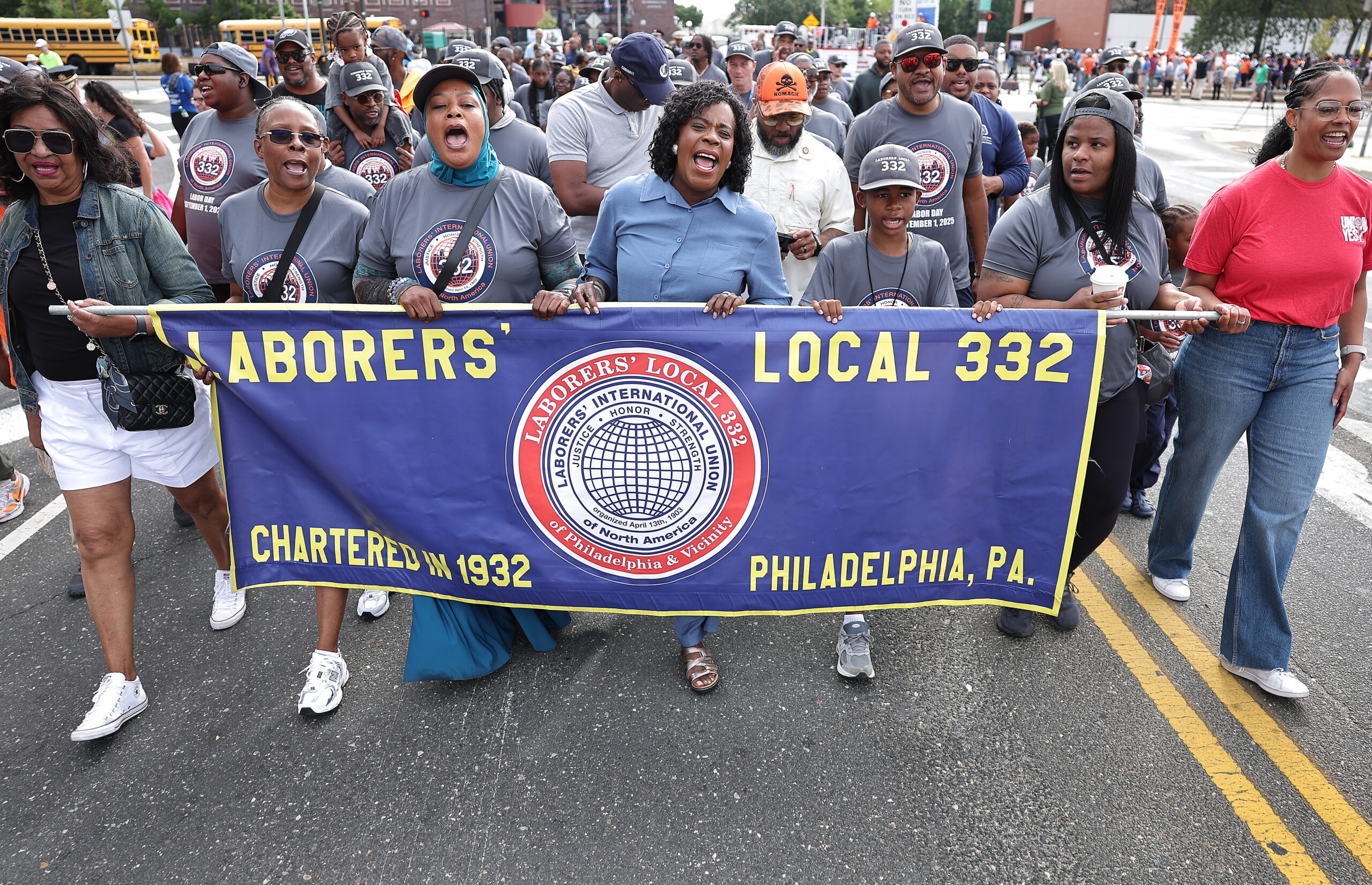
    Mayor Cherelle L. Parker (center) joins the chant as she marches with Local 332 during the annual Tri-State Labor Day Parade in Philadelphia on Monday, Sept. 1, 2025.

    Campaign finance records also show Parker last year accepted a $10,000 donation from one of her rivals in the 2023 Democratic primary: Jeff Brown, the owner of Brown’s Super Stores.

    “We’re very aligned on policy, and if you look at her campaign promises, she is doing fairly well. She’s made some progress on all of them,” said Brown, who serves on the mayor’s business roundtable and an advisory panel providing input on the city’s efforts to revitalize Market East. “I’m invested in the city, and I want to see a functional, good mayor who can lay out a vision and get things done.”

    Corporate interests also donated heavily to Parker in 2025. Her campaign contributions from law firms last year included $10,000 from Ballard Spahr, $11,000 from Duane Morris, $5,000 from Buchanan Ingersoll, and $11,000 from Cozen O’Connor. She also received $5,000 from Comcast, $1,000 from Independence Blue Cross, and $4,700 from the Chamber of Commerce for Greater Philadelphia.

    Wealthy individuals shelled out big bucks, too. Investor Richard Vague gave $16,000; developer Carl Dranoff contributed $15,000; former Aramark CEO Joseph Neubauer gave $30,000; and Firstrust Bank executive chair Richard J. Green gave $15,000.

    How Parker spends campaign money

    Although campaign donors may imagine their contributions pay for yard signs and radio spots, the money also often covers strategy meetings held at expensive restaurants, gifts for constituents, and costs related to officeholders’ public duties.

    Elected officials are prohibited from using political donations for personal expenses. But beyond that, the rules for spending campaign cash are famously lax and rarely enforced.

    Parker’s expenditures on the recently filed reports included a $1,200 tab at Vernick Fish, and 14 more modest purchases from Shanghai Gourmet in Chinatown, totaling $424.

    In addition to the Aspen Institute roundtable, Parker’s campaign helped her pay for trips to Miami for a tour of wellness and homeless centers that are part of the Florida judicial system, to Martha’s Vineyard, Mass., for a Black Economic Alliance gathering, to Puerto Rico for a National League of Cities event, and to Harvard University’s Bloomberg Center for Cities.
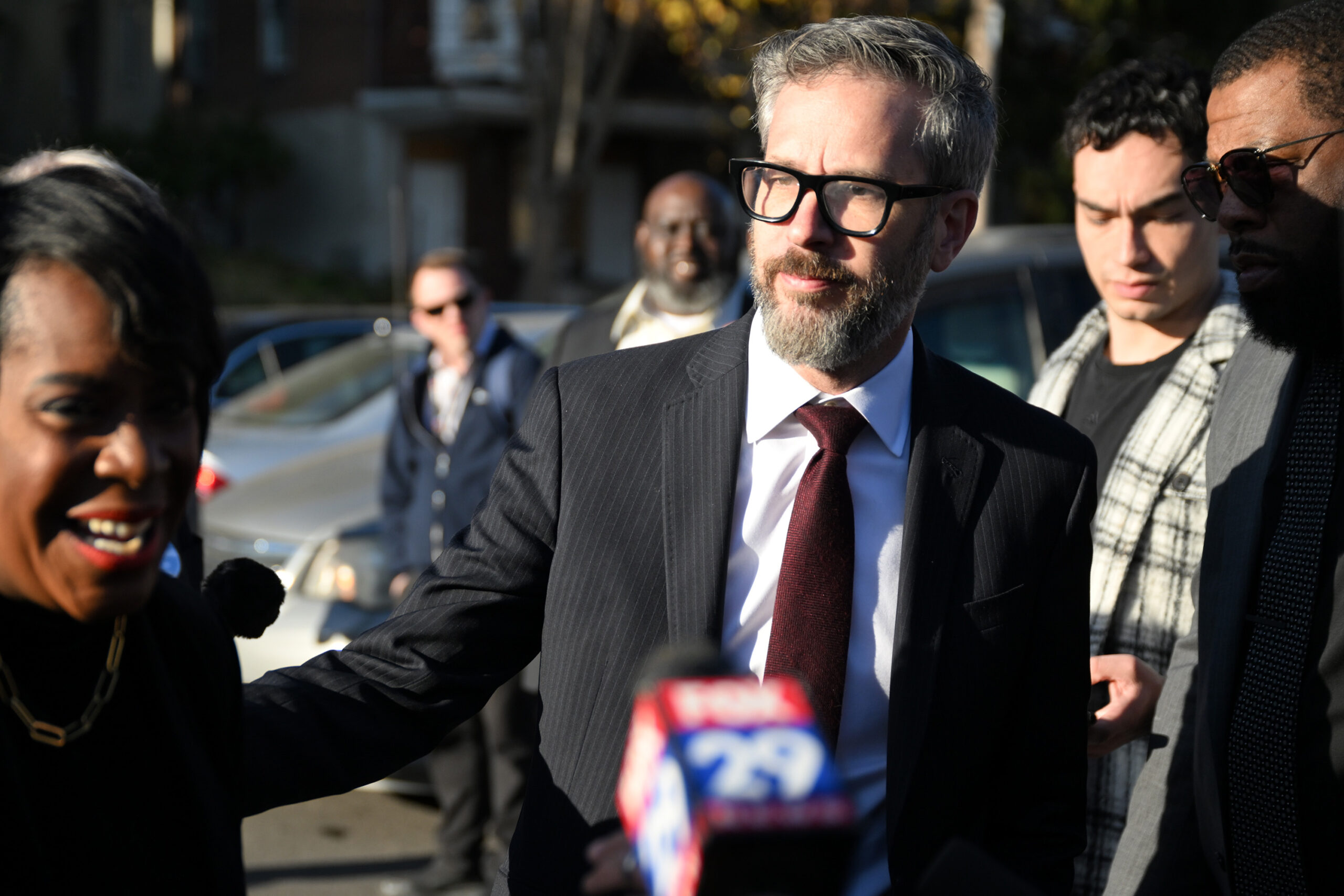
    Aren Platt (right) executive director of Mayor Cherelle L. Parker’s political committee is with her after a Kamala Harris campaign event in Germantown Nov. 3, 2024. Platt was senior campaign adviser in Parker’s run for mayor, and served briefly as deputy mayor before leaving her administration.

    The campaign paid $112,000 in consulting fees for ALP Impact Strategies, Platt’s firm; and $30,000 to 215 Bears, the private security company owned by Shawntee Willis, whom Parker has hired as a special assistant in the mayor’s office and who works closely with her police detail.

    It also paid $158,563.73 to Rittenhouse Political Partners, the fundraising firm founded by well-known political consultant Aubrey Montgomery and used by Parker, Johnson, and five other members of Council who saw large fundraising hauls last year.

    Rittenhouse’s clients include some of the most aggressive off-year fundraisers in Philly politics and some of the most prominent adopters of SPEC accounts.

    Montgomery declined to comment.

    Staff writer Anna Orso contributed to this article.
  • Here’s who is funding Philly’s crowded race for Congress

    Here’s who is funding Philly’s crowded race for Congress

    The race to fill Philadelphia’s open congressional seat is the marquee election in the city this year, but with less than four months left until primary election day, it has yet to attract much money from political action committees or donors outside the region.

    Most of the campaign thus far has been funded by big checks from individual donors, and several of the top contenders to represent Pennsylvania’s 3rd Congressional District — the most Democratic in the nation — have raised most of their money from people who live in Pennsylvania.

    That’s according to an Inquirer analysis of recently filed campaign finance reports that break down contributions to each candidate between October and December.

    The filings, coupled with previous financial reports, provide a snapshot of who is contributing to each Democrat’s campaign heading into the election year, and how capable each contender is of powering their operations and advertising.

    While money is not the only factor in a political campaign, fundraising prowess can be used as a predictor of viability, and it can persuade other donors to contribute. Ten candidates announced they are running for the seat held by retiring U.S. Rep. Dwight Evans, but it’s likely that not all of them will make it onto the May 19 primary election ballot.

    Overall, the reports showed that State Sen. Sharif Street, the son of a former mayor, holds a financial advantage over the rest of the field.

    However, the two physicians in the contest, Ala Stanford and David Oxman, have each dedicated six-figure loans to their own campaigns, and progressive State Rep. Chris Rabb is expected to draw donations from left-leaning groups.

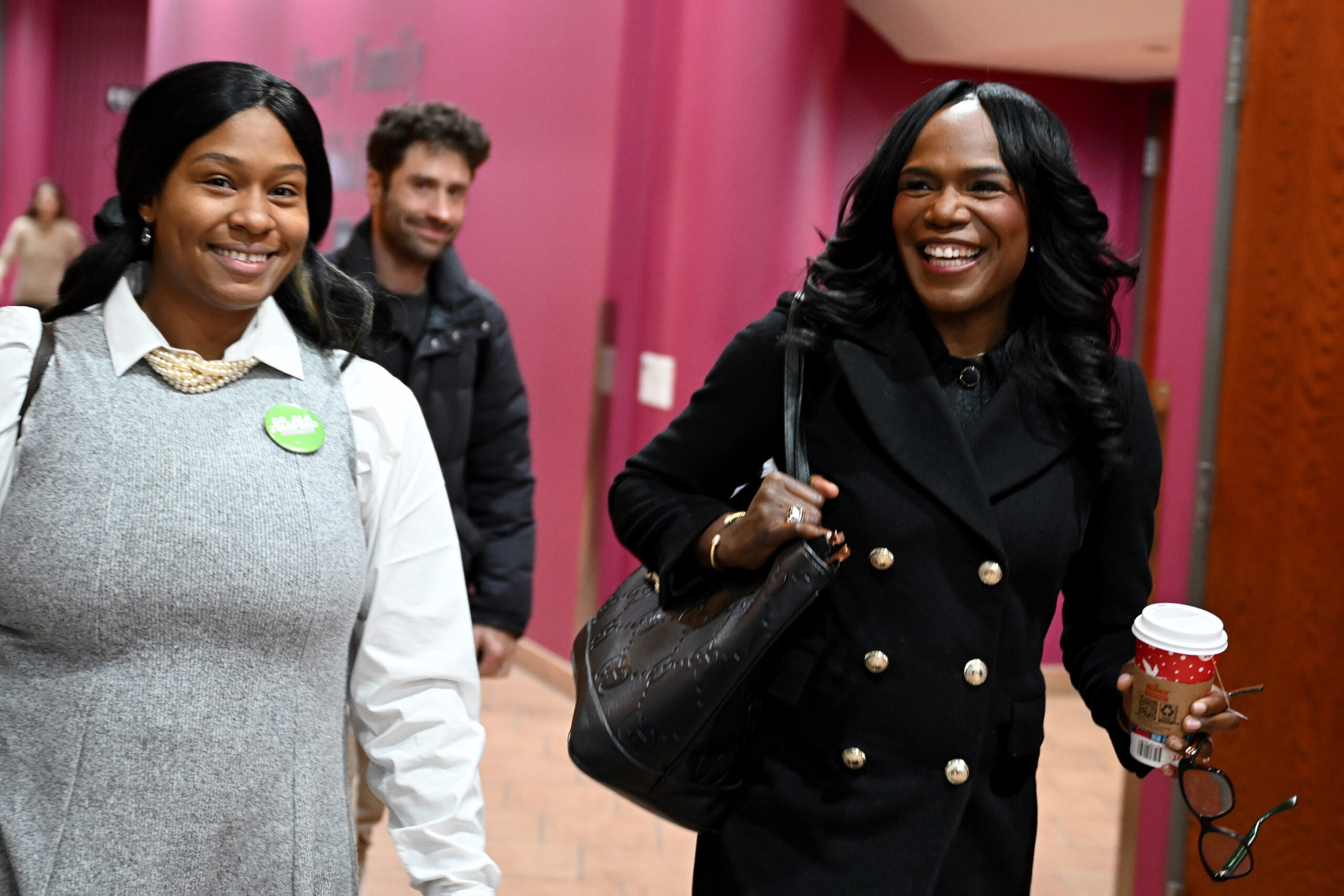
    Physician Ala Stanford (right) arrives at a forum hosted by the 9th Ward Democratic Committee Dec. 4, 2025. She is a Democratic candidate running to represent Philadelphia’s Third Congressional District.

    Interest from outside Philly will also likely rise as the primary election draws near.

    If national political figures weigh in on the race, they can lean on their vast networks of donors across the country to keep their preferred candidates’ campaigns afloat.

    And deep-pocketed special-interest groups with their eyes on influencing Congress may seek to sway the race in its final months.

    Not much PAC money — yet

    Under decades-old campaign finance law, corporations cannot give directly to candidates for federal office. But their executives, board members, and employees can fund PACs that are used as vehicles to prop up their supported candidates.

    As the role of money in politics has drawn scrutiny over the years, so has the reliance on so-called corporate PACs. That is especially true among some Democrats who see accepting money from them as a litmus test of their working-class bona fides.

    Rabb has hammered the issue in public forums and debates. He says he has never accepted corporate PAC money since his first run for office in 2015, and has repeatedly called on the other contenders to refuse corporate PAC funding.

    None of the candidates for the 3rd District has thus far leaned on corporate PAC money, according to the campaign finance reports.

    window.addEventListener(“message”,function(a){if(void 0!==a.data[“datawrapper-height”]){var e=document.querySelectorAll(“iframe”);for(var t in a.data[“datawrapper-height”])for(var r,i=0;r=e[i];i++)if(r.contentWindow===a.source){var d=a.data[“datawrapper-height”][t]+”px”;r.style.height=d}}});

    However, PACs associated with labor unions have gotten involved.

    Street raised about $40,000 in the last period from PACs associated with labor groups. He is backed by the deep-pocketed Philadelphia Building and Construction Trades Council, an umbrella organization of unions that endorsed him last fall.

    In the past, the trades have also funded super PACs, outside spending groups that can raise unlimited amounts of money but must follow strict rules largely barring them from coordinating directly with the campaigns they support.

    In 2023, the building trades funded a super PAC that supported Cherelle L. Parker’s successful run for mayor. And in 2018, Local 98 of the International Brotherhood of Electrical Workers, the most cash-flush building trades union in the state, funded a super PAC to support unsuccessful congressional candidate Rich Lazer.

    Ryan Boyer, head of the Philadelphia Building & Construction Trades Council, was one of the first to speak at Cherelle Parker’s election night party at the Sheet Metal Workers Local 19 on Nov. 7, 2023.

    But no such super PAC has materialized so far, according to campaign finance reports. Rather, the bigger financial factor in this race — at least through the end of last year — was candidates lending money to their own campaigns. Stanford put up $250,000 on Dec. 31, the last day of the reporting period. And Oxman has lent his campaign $175,000.

    Small vs. big-dollar donors

    While the candidates relied largely on donations from individuals, the size of the checks they brought in varied. Under campaign finance limits, individuals can give up to $3,500 to a candidate per election.

    The average contribution to State Rep. Morgan Cephas since she announced her campaign was $596 — about half of Street’s and Rabb’s average contributions. Individual donors gave the most to Stanford, on average, with the average contribution to her campaign totaling $1,737.

    That analysis includes only donors who contributed more than $200 through the course of the year. Campaigns are required to itemize only contributions above that threshold.

    State Rep. Chris Rabb at a forum hosted by the 9th Ward Democratic Committee Dec. 4, 2025. He is a Democratic candidate running to represent Philadelphia’s Third Congressional District.

    Small donations, or contributions under $200, have made up a tiny fraction of the money brought in by the top contenders so far, according to the latest filings. About 11.5% of the money Rabb raised was from small-dollar donors. Such contributions made up less than 5% of all funding for Stanford, Oxman, and Street.

    The one outlier was Pablo Iván McConnie-Saad, an ex-Treasury Department official under former President Joe Biden. His campaign has been somewhat low-profile so far; however, small-dollar contributions made up a quarter of his total of $119,000 raised.

    His campaign said in a statement that the filings are evidence that his run is “entirely people powered.”

    Stanford’s campaign manager, Janée Taft-Mack, noted that the pediatric surgeon has been campaigning for a shorter amount of time than several of her opponents. She announced her campaign in October, several months after Street and Rabb.

    Taft-Mack added that the range of donors “underscores a coalition that crosses income levels, neighborhoods, and communities.”

    Where the money came from

    While every candidate vying for Evans’ seat has touted grassroots support, it appears that Cephas and Street raised the most money from donors who live in Philadelphia.

    About half of the individual donors who gave more than $200 to Street and Cephas are city residents. Both candidates have also raised the most money from donors living in Pennsylvania.

    window.addEventListener(“message”,function(a){if(void 0!==a.data[“datawrapper-height”]){var e=document.querySelectorAll(“iframe”);for(var t in a.data[“datawrapper-height”])for(var r,i=0;r=e[i];i++)if(r.contentWindow===a.source){var d=a.data[“datawrapper-height”][t]+”px”;r.style.height=d}}});

    Street, who formerly led the state Democratic Party and has connections to donors across Pennsylvania, raised 81% of his individual contributions, or about $488,000, from in-state residents. For Cephas, the share was 78%, or about $162,000.

    Anthony Campisi, a spokesperson for Street, said the latest finance report “highlights the entire point of our campaign.”

    “Sharif is running to represent Philadelphians from across an incredibly diverse district,” he said, “and is building the coalition needed to both win and effectively serve in Congress.”

    Cephas’ campaign manager, Salvatore Colleluori, said her fundraising within the city shows she has a “broad base of support, especially in Philadelphia.”

    “She has been a champion for Philadelphia in the state House, and people know that,” he said. “They want to support that work.”

    Rabb, a progressive who has support from left-leaning organizations and activists outside the region, had among the lowest share of contributions from Philly-based donors, according to The Inquirer’s analysis.

    He said in a statement that when small-dollar donations are accounted for, he believes he will have “more Philly donations than any of the establishment candidates.”

    Rabb said he will soon be rolling out endorsements from progressive organizations “that will significantly grow our donor base.”

    Staff writer Sean Collins Walsh contributed to this article.
  • A federal judge denies Johnny Doc’s request to be released from prison early to help his ill wife

    A federal judge denies Johnny Doc’s request to be released from prison early to help his ill wife

    Convicted former labor leader John J. Dougherty will remain behind bars after a federal judge denied his latest request to serve the rest of his six-year prison term on house arrest in order to care for his gravely ill wife.

    U.S. District Judge Jeffrey L. Schmehl wrote in a one-page order Monday that although it was “extremely unfortunate” that Dougherty’s wife, Cecilia, was facing significant health challenges, “it does not outweigh, at this point in time, the need for punishment that has been adjudged.”

    Dougherty last year filed emergency motions seeking to cut his prison term short, telling Schmehl that his wife — who for years has suffered from a debilitating brain injury — had seen her condition worsen dramatically, and arguing that without his aid, she’d likely die.

    In the first request, filed in the summer, Dougherty said a trust fund established to pay for his wife’s care was about to run out of money. And in December, Dougherty’s attorney, George Bochetto, said the situation had become more acute due to the death of Dougherty’s father-in-law, who had been serving as the primary caregiver.

    Prosecutors opposed Dougherty’s requests, saying that although they were sympathetic to his wife’s plight, they did not believe he’d served enough of his sentence to merit release.

    Schmehl, in his order, also said the trust fund had not yet run out of money, and that Medicaid might be able to help pay for future care. He also said Dougherty’s adult daughters “can provide their mother with some meaningful degree of assistance.”

    Bochetto said in an interview Monday that he was “very, very disappointed” by the ruling, particularly because he was not able to present evidence to Schmehl in court about what he called a “very dire situation.”

    Asked if he planned to appeal, Bochetto said: “I’m looking at every possible avenue for emergency relief.”

    Dougherty, 65, was sentenced in 2024 to six years in prison after being convicted in separate bribery and embezzlement trials — the first in 2021 on charges he had spent years bribing former Philadelphia City Councilmember Bobby Henon, the second over nearly $600,000 he and others embezzled from the union he once led.

    Prior to those prosecutions, Dougherty, as leader of Local 98 of the International Brotherhood of Electrical Worker, was one of Pennsylvania’s most powerful and influential political figures.

  • Johnny Doc said his gravely ill wife is ‘entirely alone’ and without a caretaker as he again seeks to be released from prison

    Johnny Doc said his gravely ill wife is ‘entirely alone’ and without a caretaker as he again seeks to be released from prison

    Convicted former labor leader John J. Dougherty is again asking a federal judge to cut short his six-year prison term, this time because he says the recent death of his father-in-law has left his gravely ill wife without a caregiver.

    Dougherty made the request in a brief filed last month with U.S. District Judge Jeffrey L. Schmehl, writing that his wife, Cecilia — who for years has suffered from a debilitating brain injury — has been left “entirely alone and without any capable caregiver” since her father died from pancreatic cancer on Nov. 10.

    Dougherty has previously argued that he should be granted compassionate release and allowed to serve the remainder of his sentence on house arrest to oversee his wife’s care — a request federal prosecutors have opposed.

    In the latest request, Dougherty’s attorney, George Bochetto, wrote that Dougherty’s father-in-law, Joseph Conroy, had been serving as Cecilia Dougherty’s primary caregiver despite his own poor health and that Conroy’s death is “precisely the type of development” that warrants a change to Dougherty’s sentence.

    Dougherty, Bochetto wrote, “remains the only person able and willing to provide his wife’s necessary care. No one besides Mr. Dougherty can fill the detrimental need that Mrs. Dougherty requires for survival.”

    Federal prosecutors, however, said that Dougherty had previously asserted that Conroy was incapable of serving as Cecilia’s primary caretaker and that his newest motion for relief “directly contradicts” the representations he made in the last one.

    “In short, the unfortunate passing of Mr. Conroy has no bearing at all on the circumstances,” prosecutors wrote in a reply brief filed last week.

    Dougherty, 65, was once one of the state’s most powerful political figures, serving as the charismatic leader of Local 98 of the International Brotherhood of Electrical Workers with a wide range of connections in City Hall and Harrisburg.

    But last year, he was sentenced to six years in prison after being convicted in separate bribery and embezzlement trials — the first in 2021, after a jury found that he had spent years bribing former Philadelphia City Councilmember Bobby Henon, the second in December 2023 over nearly $600,000 he and others embezzled from the union. He reported to prison last fall.

    Henon was convicted alongside Dougherty and sentenced to 3½ years behind bars but was transferred to a halfway house earlier this year. He later secured a job working as a Local 98 electrician.

    Dougherty’s latest request for relief came several months after he first asked Schmehl for compassionate release.

    In August, Bochetto filed an emergency brief saying that a trust fund established to pay for Cecilia Dougherty’s care was about to run out of money and that the couple’s adult daughters were not equipped to serve as permanent caregivers.

    It also said Conroy, “once a limited source of support, is now medically incapacitated and permanently unable to contribute to her care in any way.”

    Beyond detailing issues around the health of Dougherty’s wife, that filing said that Dougherty had also effectively run out of money and assets since he began serving his sentence at a federal penitentiary in Lewisburg and that he’d suffered from several new health issues while behind bars, including a chronic foot infection that made it hard for him to walk.

    Prosecutors at the time wrote that they were sympathetic to the plight of Dougherty’s wife but that his absence from her life “does not distinguish this case from that of countless defendants whose loved ones suffer as a result of their crimes.”

    It was not immediately clear when Schmehl might rule on Dougherty’s requested relief, or if he might take any additional action — such as scheduling a hearing — before doing so.

  • Philly Housing Authority plans to lay off almost 300 workers in 2026

    Philly Housing Authority plans to lay off almost 300 workers in 2026

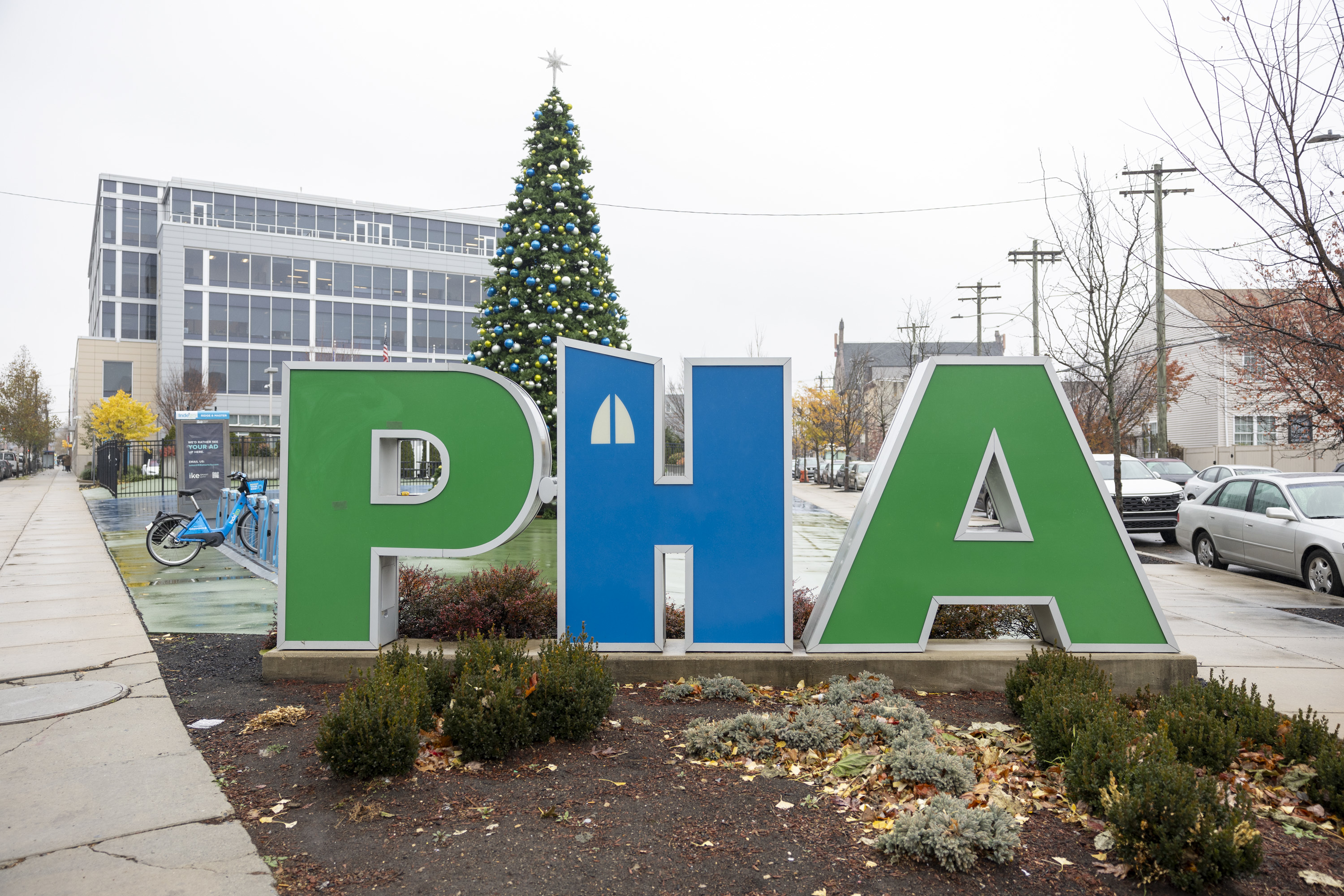
    The Philadelphia Housing Authority (PHA) is planning sweeping layoffs that will affect almost 300 of the agency’s 1,200 employees, beginning in January 2026.

    The cutbacks are the result of dramatic changes in how PHA, which provides affordable housing to thousands of families across the city, does maintenance and repair work. Instead of directly employing union electricians, carpenters, and other workers, beginning next year, the agency will contract out for those jobs as needed.

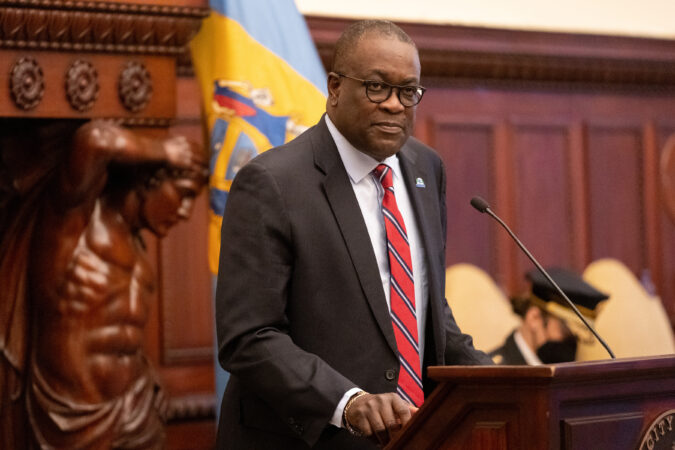
    “This is a housing program, it is not a jobs program,” said Kelvin Jeremiah, the president and CEO of PHA, in an interview.

    “Do I use the resources that we have to protect residents, to advance the availability of affordable housing to the families that are most in need? Or do I use those limited resources to fund positions that I don’t need?” Jeremiah said.

    There are 620 members of the Philadelphia Building and Construction Trades Council employed full-time by the agency as maintenance staff. Jeremiah estimates that by almost halving that number PHA will see a cost savings of $24 million annually.

    The agency said it currently costs $15,500 to maintain a single unit of traditional public housing annually, due to the agency’s complex work rules, which require many different union workers to make repairs. Most other multifamily providers have dramatically lower per-unit maintenance costs.

    “PHA has engaged the unions throughout this process and can proceed with this policy decision without additional approvals,” an agency spokesperson said in an emailed statement.

    Although in-house building trades workers will constitute the majority of lost jobs, other positions will also be affected, including 33 managerial roles in PHA headquarters. Overall, PHA’s workforce will shrink by about 20%.

    “We are going to talk and try to offer some alternatives, but this is an issue of price sensitivity and we have to understand, given the new environment, that there are less funds to do the same mission with,” said Ryan Boyer, business manager for the Philadelphia Building and Construction Trades Council, whose unions represent many of the affected workers.

    The Philadelphia Housing Authority Headquarters is planning sweeping layoffs that will affect almost 300 of the agency’s 1,200 employees, beginning in January 2026 in Philadelphia, on Wednesday, Nov. 19, 2025.

    More with less?

    The cutbacks come amid an aggressive $6.3 billion plan unveiled earlier this year, through which the agency hopes to expand its housing portfolio by 7,000 units while rehabbing the 13,000 units it already owns.

    Jeremiah said that the staff reduction should not be seen as PHA doing more with less, and that it will not limit the agency’s ability to execute his planned expansion.

    “We will not be doing less than what we’re doing now, but we have been doing too little with too much,” Jeremiah said. He said other market-rate and affordable housing multifamily operators are able to do unit repairs for far less than what PHA pays.

    “My colleagues have all been doing this at substantially less cost,” Jeremiah said. “The only difference between us is that they have an operating model that does not require six different trades to do a single thing.”

    Kelvin A. Jeremiah, PHA President & Chief Executive Officer, at PHA headquarters, in Philadelphia, May 21, 2025.

    Because PHA’s layoffs will affect hundreds of members of Philadelphia’s influential building trades unions, Jeremiah said, he has been negotiating with Boyer on the work-rule changes.

    “My reaction is one of disappointment. However, we remain partners with PHA and we will still build most of the stuff on the capital side,” Boyer said. “I don’t want it to be lost that when they build stuff, they will still be members of the Philadelphia building trades working, and there will still be members doing maintenance work.”

    Boyer is also the business manager for the Laborers’ District Council and a close ally of Mayor Cherelle L. Parker.

    Jeremiah said maintenance technicians, laborers, and painters will be the only trades that remain directly employed with the agency after the work-rule changes go into effect.

    The electricians union, IBEW Local 98, said it is still studying PHA’s new policy.

    PHA will also still work with the trades for discrete repair and maintenance jobs within the agency’s housing portfolio but will no longer directly employ as many workers full-time, Jeremiah said.

    The Trump effect?

    PHA’s layoffs, and its expansion plan, are unfolding during a period of uncertainty nationwide for affordable housing policies and organizations like PHA.

    Some housing experts were surprised to see PHA embark on its ambitious $6.3 billion plan amid President Donald Trump’s skepticism of affordable housing programs and a raft of austerity measures from his administration, which has sought to reduce public support for lower-income Americans.

    Nearly all of PHA’s funding — 93% — comes from the federal government, according to the agency.

    “If Congress and the administration coughs, it impacts us,” Jeremiah said. “If there is a reduction [in funding], it impacts us.”

    Jeremiah said he is seeking to operate within the mandates set by Trump’s administration while continuing to support PHA’s tenant base and plans.

    “Subsidizing employment … is just not the way to go at a time when we’re looking at less funding on the horizon,” Jeremiah said. “Where am I to get the funds not only to do more developments, acquire more, and preserve what we have at the same time [that] we have a workforce that is, quite frankly, I will dare to use the word bloated?”

    Waves of layoffs

    Despite the layoffs, Jeremiah believes the agency will still be a rich source of jobs for the building trades unions as the $6.3 billion plan unfolds. He points to an analysis of PHA’s 10-year plan by economic consulting firm Econsult Solutions, which said it would create 4,900 jobs annually in the city.

    The first round of 260 job losses will hit in mid-January 2026, although Jeremiah says 93 of those workers will be retained in new positions as maintenance aides, laborers, and painters. A further 116-position reduction will occur next summer.

    A vice president of development, Greg Hampson, also recently left PHA, although the agency declined to comment on that case. Jeremiah said that several vice president and director-level positions will be among the coming layoffs.

    The last major round of layoffs at PHA was in 2016, when 14% of the staff was cut. Those positions were mostly administrative roles.

    Editor’s note: A previous version of this story misstated the number of employees impacted.

  • Johnny Doc played a pivotal role electing his brother to the Pa. Supreme Court. Ten years later, things are different.

    Johnny Doc played a pivotal role electing his brother to the Pa. Supreme Court. Ten years later, things are different.

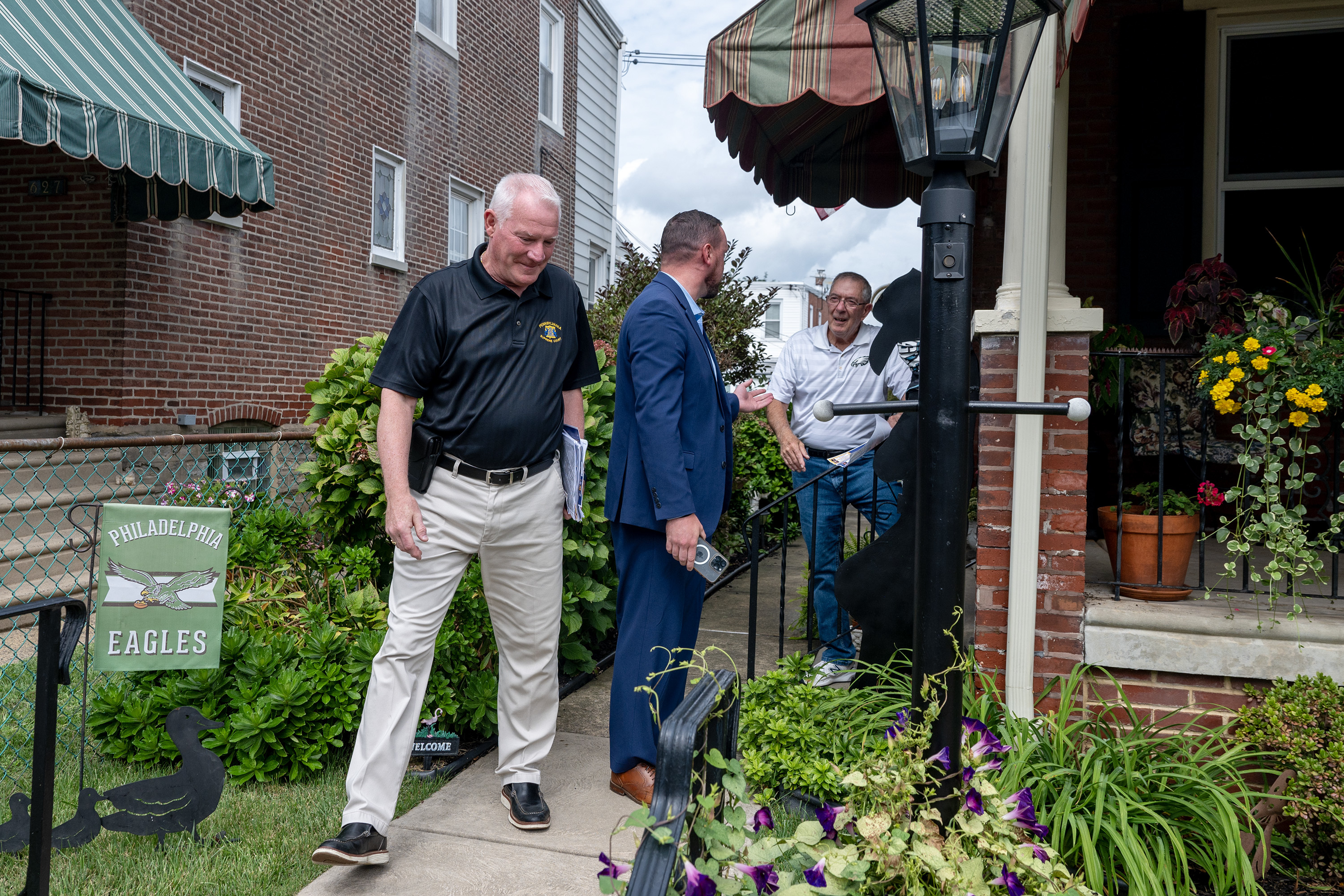
    As Pennsylvania Supreme Court Justice Kevin Dougherty knocked on doors in Northeast Philadelphia last month, a voter made a connection.

    Peering out his front door on a sunny September day, the man asked if the mild-mannered and smiling white-haired justice standing on his front porch was related to former labor leader John Dougherty. Widely known as “Johnny Doc,” the former head of Local 98 of the International Brotherhood of Electrical Workers and a onetime kingmaker in state and local politics was sentenced last year to six years in federal prison on embezzlement and bribery convictions.

    Despite the public fall from grace, the voter said he missed John Dougherty’s leadership in Philadelphia, adding that he believed Dougherty had been good for workers in the city. They are brothers, Kevin Dougherty confirmed.

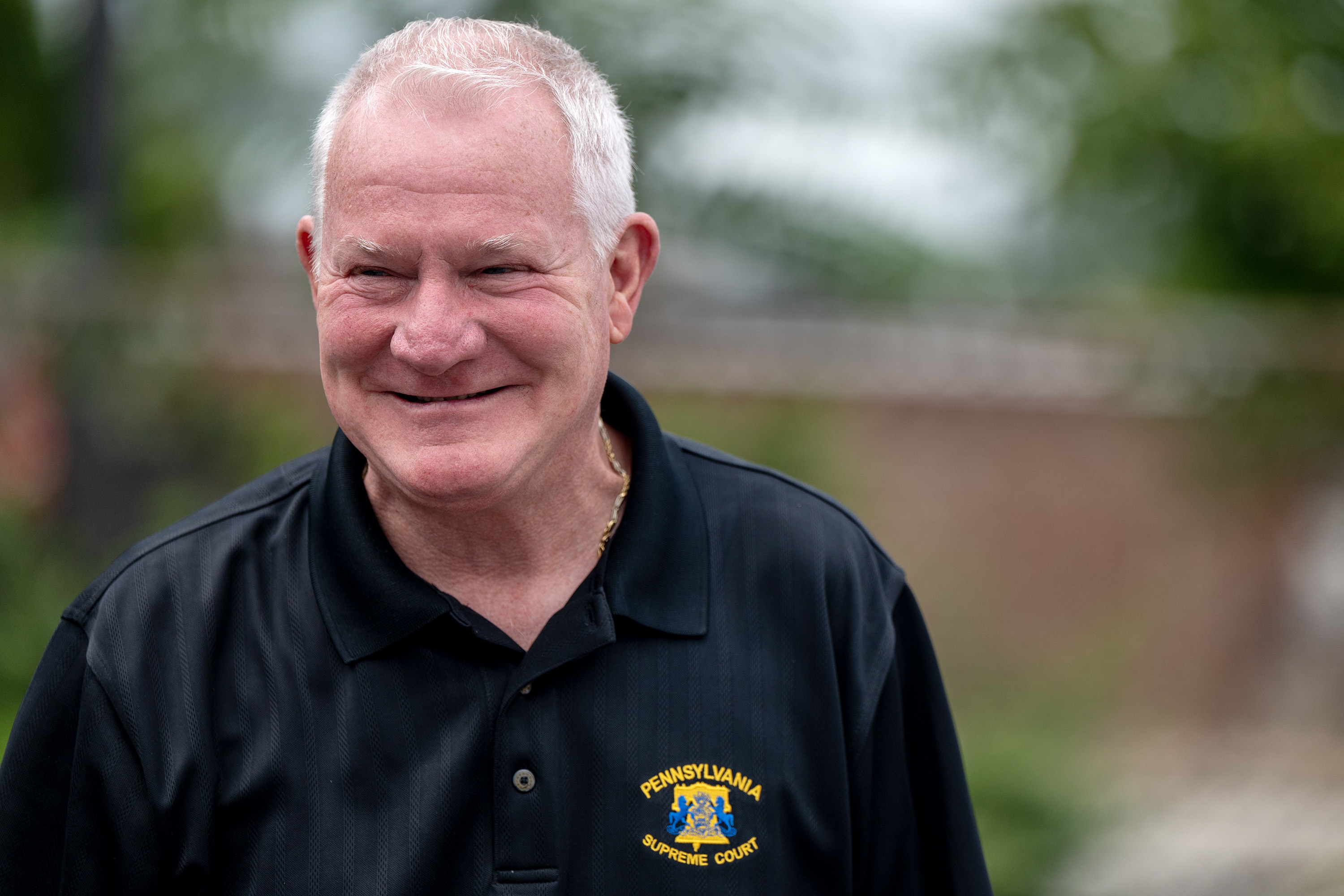
    Justice Kevin Dougherty (left) canvasses with his son, State Rep. Sean Dougherty (center) in Fox Chase Sunday Sept. 7, 2025, stopping at the home of a voter. The elder Dougherty is one of three Pennsylvania Supreme Court justices up for retention.

    The justice had spent the day asking voters in his neighborhood to keep him and two other justices on the state’s Supreme Court for an additional 10-year term. At that stage, many voters were not even aware of the typically sleepy and nonpartisan contest on which both parties are spending millions in the lead-up to the Nov. 4 election.

    But in this year’s unusually high-profile state Supreme Court retention race, the connection has, in some circles, become unavoidable. Republicans seeking to oust Kevin Dougherty and two of his colleagues, all initially elected as Democrats, have sought to tie the judge to his brother’s misdeeds. The justice, a son of South Philadelphia who previously led Philadelphia’s Family Court, has sought to distance himself, and has seen the continued support of labor unions in his retention campaign.

    “Over the course of 25 years as a judge, including ten years as a Justice on the Supreme Court, Justice Dougherty has had the privilege and the benefit of meeting a multitude of Pennsylvanians including the working men and women of organized labor,” Shane Carey, Kevin Dougherty’s campaign manager, said in a statement. “Our campaign is proud to receive their support, as well as the support from almost 5,000 other individual donors.”

    How Johnny Doc helped elect his brother to the Supreme Court in 2015

    Kevin Dougherty didn’t choose to be related to one of the city’s most prominent power brokers, but he certainly benefited from his brother’s former union’s help, with significant support from the politically powerful Local 98 during his 2015 campaign for the state bench.

    Local 98, where John Dougherty was the longtime business manager, contributed more than $620,000 during Kevin Dougherty’s 2015 campaign for the Pennsylvania Supreme Court. Local 98’s spokesperson at the time also served as Kevin Dougherty’s campaign manager and appears from campaign finance filings that year to have been paid by Local 98. The union also spent more than $480,000 on in-kind contributions for “professional services,” mailers, merchandise, and more.

    Justice Kevin Dougherty talks with volunteers before they head out the canvass in Fox Chase Sunday Sept. 7, 2025. Dougherty is one of three Pennsylvania Supreme Court justices up for retention.

    Kevin Dougherty is the only justice up for retention from Southeastern Pennsylvania. The other justices, Christine Donohue and David Wecht, live in Pittsburgh. They will each appear on the November ballot with no party and no home county. Voters will simply be asked “yes” or “no” whether each individual justice should be retained for another term.

    Republicans working to oust the three justices this year have tried to leverage Kevin Dougherty’s past support from his brother to encourage voters to oppose his retention.

    Scott Presler, an influencer aligned with President Donald Trump who has more than 2.4 million followers and runs a political action committee aimed at registering Republican voters, posted an AI-generated image of John Dougherty behind bars, tying, without evidence, Local 98’s contributions to Kevin Dougherty’s 2015 campaign to his brother’s convictions.

    “Coincidence?” Presler wrote.

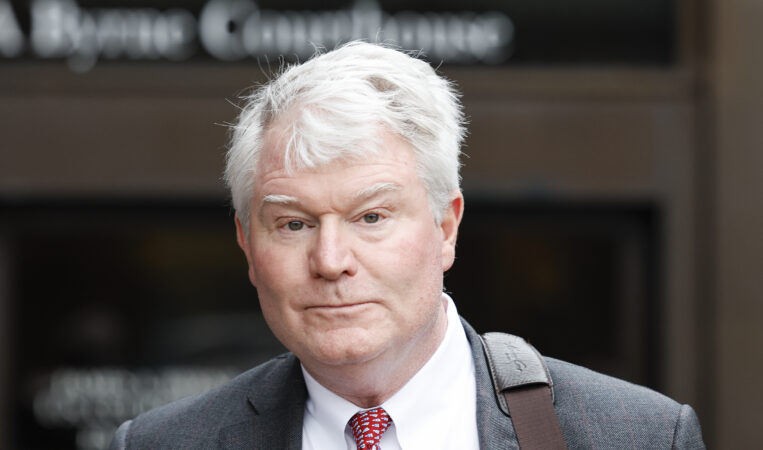
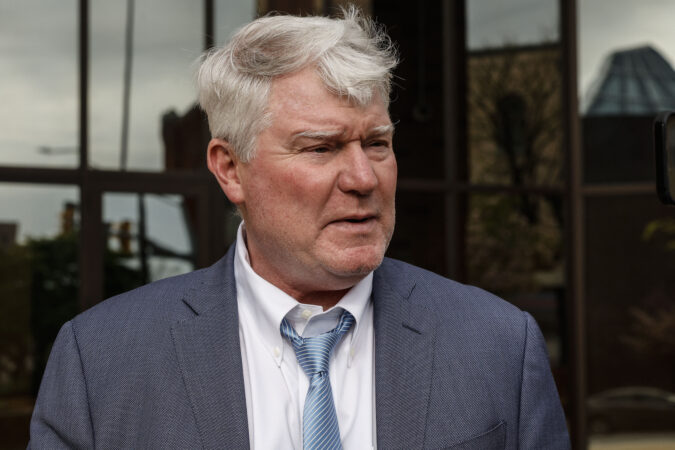
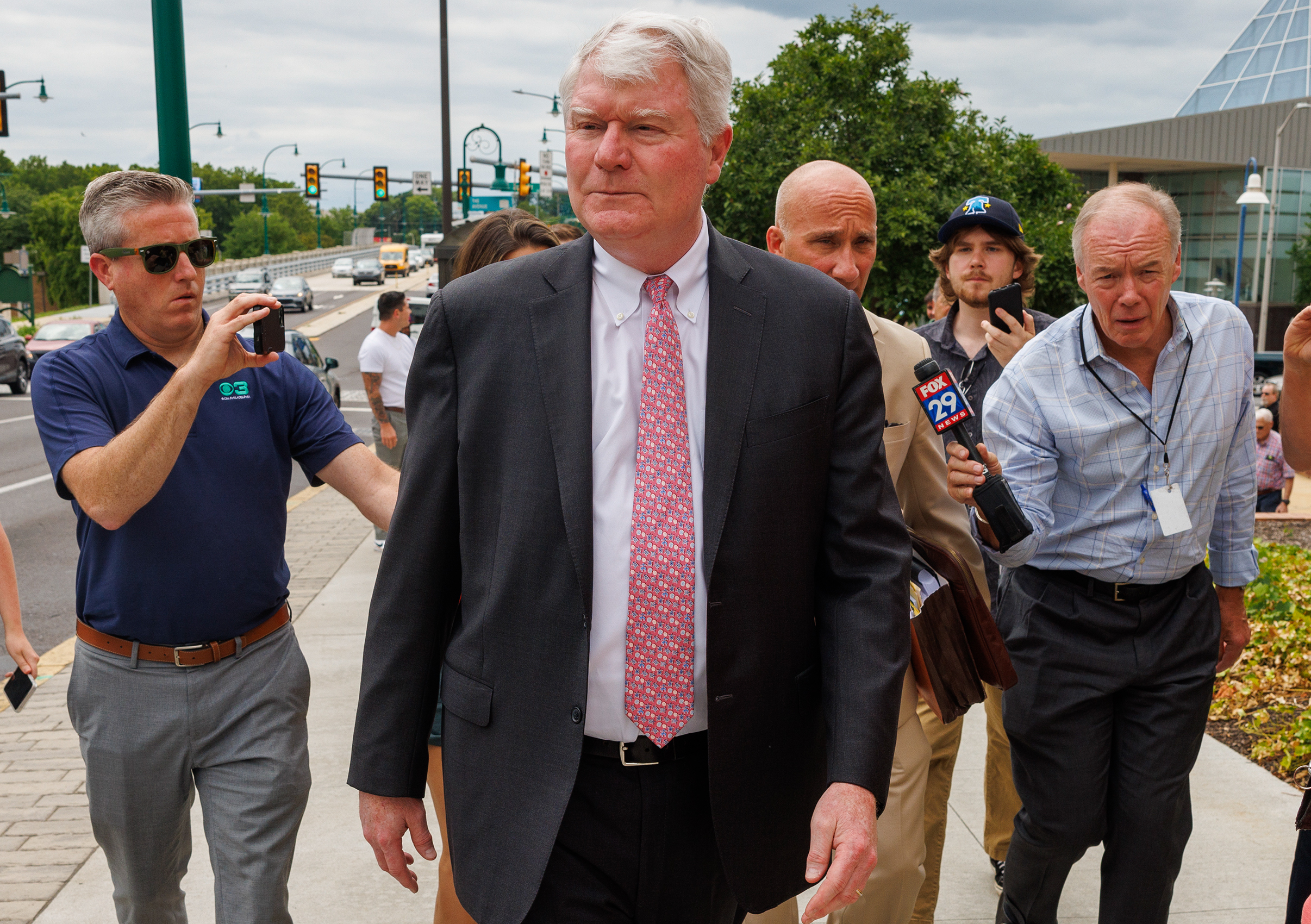
    Johnny Dougherty, the former IBEW business manger, and his attorney Gregory J. Pagano as they leave the U.S. District Court, Reading, Pa. on the day he was sentenced to 6 years in prison Thursday, July 11, 2024.

    For months, the conservative influencer has posted on social media urging followers to vote against retaining Kevin Dougherty and his colleagues, citing the times his name was mentioned during John Dougherty’s trials, such as when prosecutors alleged the justice received free home repairs or snow removal on the union’s dime. Kevin Dougherty’s lawyer at the time of the embezzlement trial said the judge never knowingly accepted services paid for with union funds.

    While door-knocking in September, Kevin Dougherty dismissed attacks against him related to his brother as “misinformation,” noting his decades-long career as a judge.

    Kevin Dougherty, 63, spent more than a decade as a Common Pleas Court judge in Philadelphia before his election to the state Supreme Court. During his tenure on the state’s highest court, he has authored majority opinions and is leading a statewide initiative to improve how Pennsylvania’s judicial system interacts with people with behavioral health issues.

    “I spent close to a quarter of a century being a judge,” Dougherty said on a sidewalk in Northeast Philly. “I just don’t accept people’s comments and judgment. I want to know what the motive behind those comments are. Some of these comments are just partisan … and I believe in my reputation.”

    The justice should be vetted on his own merits, said John Jones, a former U.S. District Court judge for the Middle District of Pennsylvania who was appointed to the bench by former President George W. Bush.

    “You can pick your friends, but you can’t pick your relatives,” Jones, now president of Dickinson College, added. “You have to judge the justice on his own merits. This is not a country where we favor guilt by association.”

    This time on the campaign trail, Kevin Dougherty has new familial support. State Rep. Sean Dougherty, a Democrat who was elected last year to represent parts of Northeast Philadelphia, has joined his dad to stump for his retention.

    Kevin Dougherty still has broad union support, including from Local 98

    With John Dougherty no longer at the helm of Local 98, labor unions in Pennsylvania this year still overwhelmingly supported the justice for retention, contributing $665,000 to Kevin Dougherty’s campaign as of September. While trades unions contributed the most of any interest group to all three justices — for a total of $903,000 as of the latest filings — Kevin Dougherty is the largest beneficiary of that support.

    Among those contributors: Local 98. The union, which has reorganized and distanced itself from John Dougherty since he was first convicted in 2021, gave $70,000 to Kevin Dougherty’s retention campaign.

    “IBEW Local 98 does not support candidates based on personal relationships,” said Tom Lepera, Local 98’s political director, in a statement. “We support candidates who understand and stand up for the needs of working men and women in organized labor. Justice Dougherty, along with Justices Donohue and Wecht, have consistently demonstrated their commitment to protecting the rights and interests of middle-class workers across this commonwealth.”

    Kevin Dougherty’s campaign did not respond to several questions this week about his brother’s role in his 2015 campaign or whether his brother’s reputation has influenced the retention campaign.

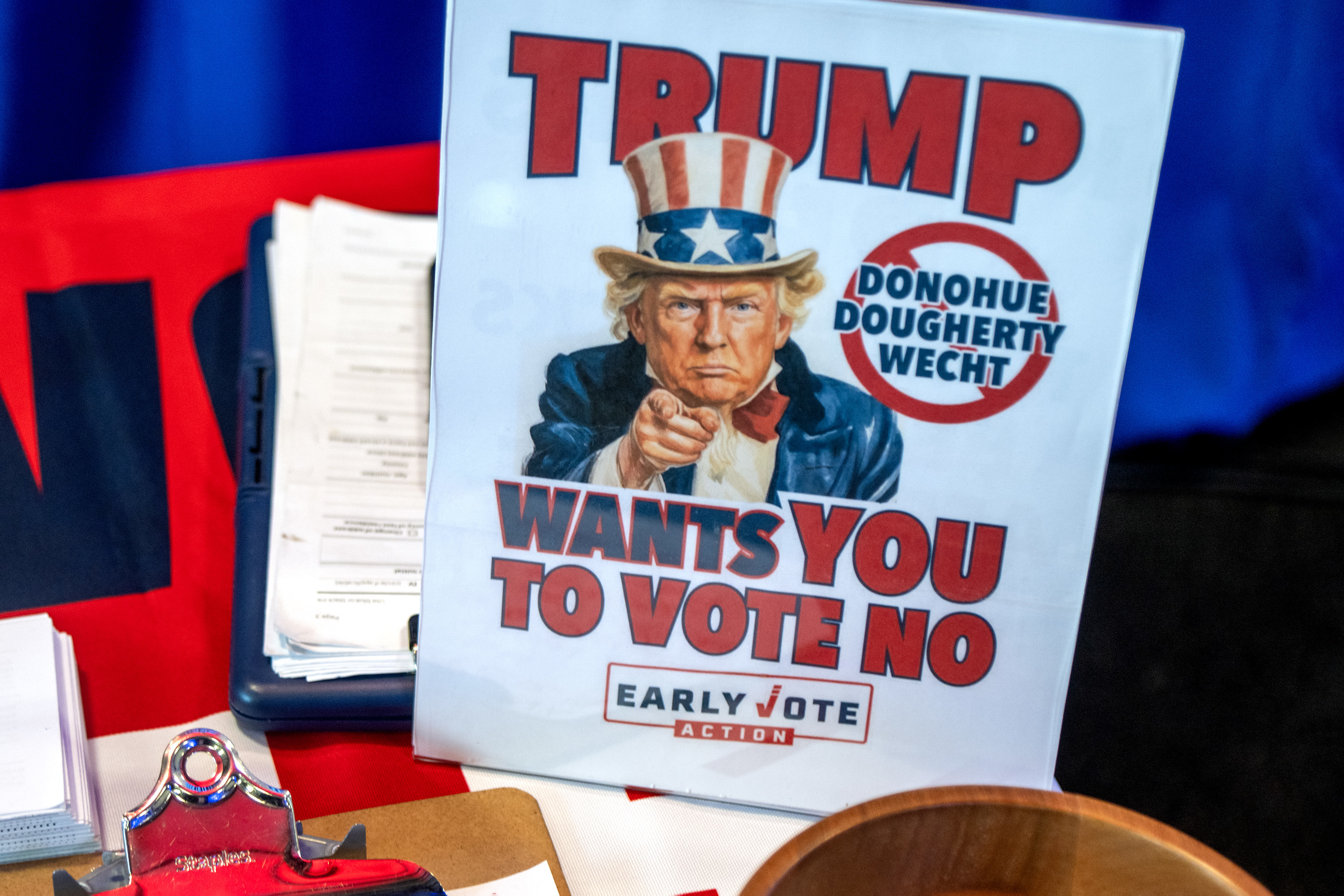
    Anti-retention material featuring President Donald Trump as Uncle Sam was on display at Republican rally in Bucks County last month headlined by Treasurer Stacy Garrity, a candidate for governor. The material is from Early Vote Action, a group led by GOP influencer Scott Presler.

    Union leaders insist their support for Kevin Dougherty this year has nothing to do with his brother and is a reflection of his quality work in the judiciary. Labor unions often support Democratic candidates, who are often seen as more beneficial to unions and their priorities.

    “It’s about keeping good judges on the bench,” said Ryan Boyer, leader of the Philadelphia Building and Construction Trades Council, an umbrella organization of local trades unions once commanded by John Dougherty. This year, the building trades gave just over $33,000 to each justice.

    “We don’t live on Mars where we don’t know that sometimes familial connections can be there,” Boyer said, “and they try to exploit those things.”

    Nonpartisan and Democratic groups favor Dougherty’s tenure on the bench

    Like his colleagues running for retention, Kevin Dougherty has earned broad support from nonpartisan and partisan groups alike.

    Dougherty was recommended for retention by the Pennsylvania Bar Association, which is a rigorous, nonpartisan decision based on a jurist’s behavior on the bench, and endorsed by several law enforcement organizations.

    Lauren Cristella, CEO of the Committee of Seventy, the Philadelphia-based good-government group, noted that the justice was never charged or found guilty of wrongdoing.

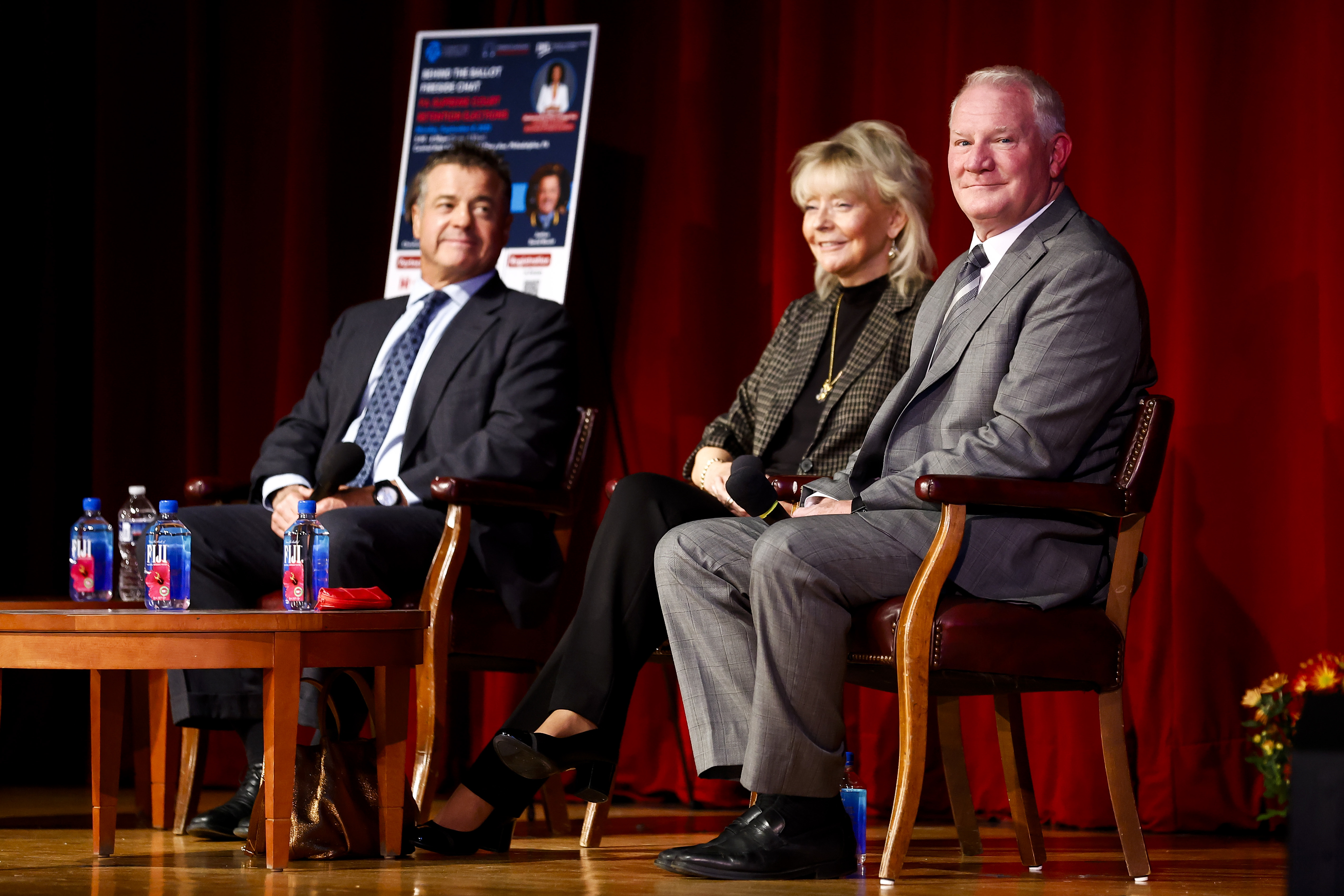
    Justices David Wecht, Christine Donohue and Kevin Dougherty sit onstage during a fireside chat at Central High School on Monday, Sept. 8, 2025 in Philadelphia.

    “The Committee of Seventy relies on the findings of law enforcement and professional oversight organizations, such as the Bar Association, when evaluating judicial candidates. This year, the Pennsylvania Bar Association has evaluated Justice Dougherty and recommended him for retention. Our focus remains on transparency, accountability, and maintaining public trust in Pennsylvania’s courts,” Cristella said in a statement.

    Dougherty and his fellow justices have also gained the support of Gov. Josh Shapiro, Pennsylvania’s popular Democratic governor, who in a fundraising email to Pennsylvania Democrats on Thursday urged voters to mark “yes” on retaining Dougherty, Donohue, and Wecht.

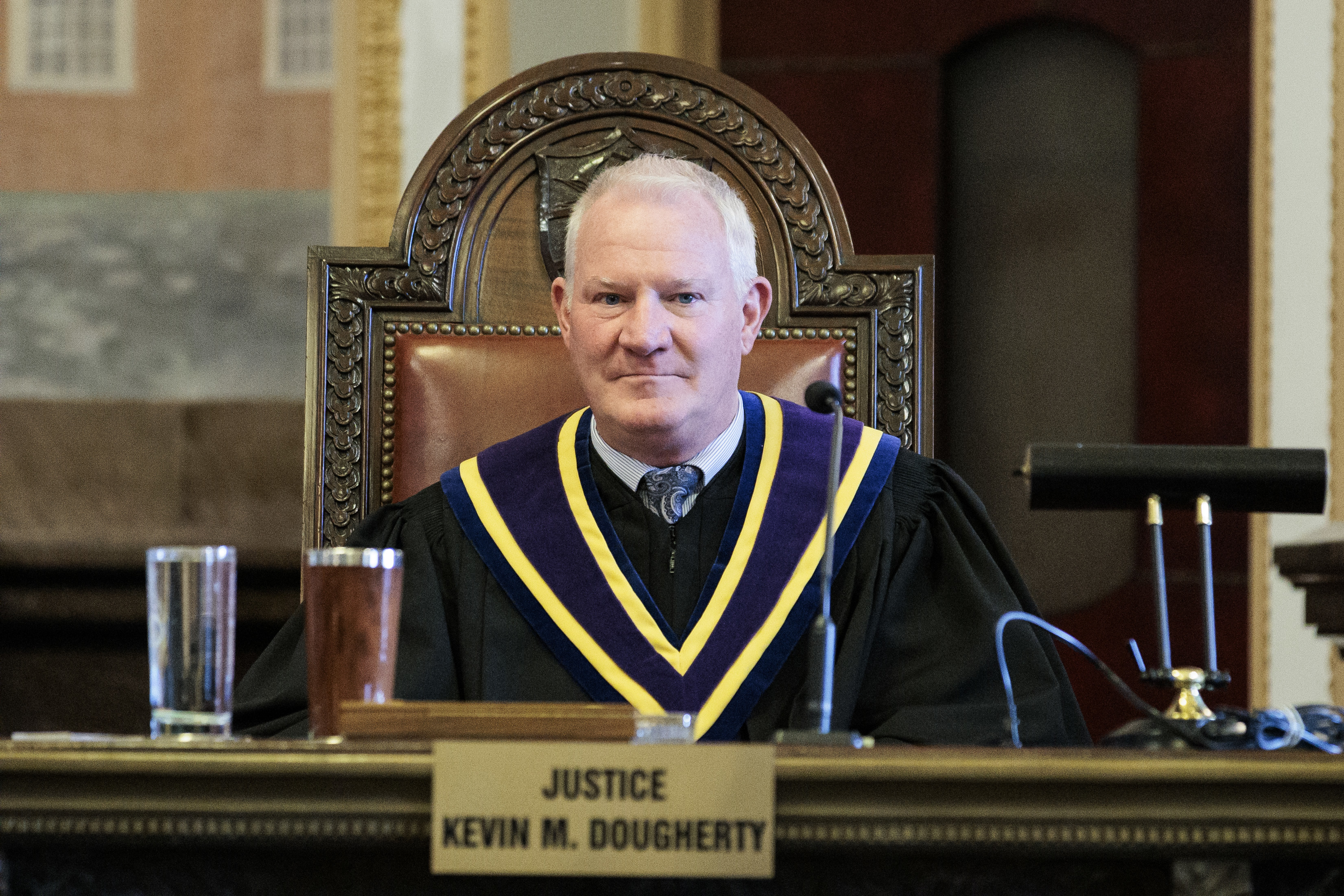
    Justice Kevin M. Dougherty listens during a Courtroom Dedication Ceremony at the Supreme Court Courtroom in Philadelphia City Hall on Tuesday, Sept. 9, 2025 in Philadelphia.

    “The threats to our freedoms are coming from all directions, and we need a Court that stands up for what’s right,” Shapiro said in the email. “Justices Donohue, Dougherty, and Wecht have proven that we can count on them to protect freedom, reproductive rights, and the rule of law.”

    In a statement to The Inquirer, Kevin Dougherty didn’t mention his brother by name.

    “With regard to my personal relationship I love my big brother. For obvious reasons, my brother is not participating in my Retention campaign,” he said.