Tag: Made By History

  • Philadelphia’s politics were reshaped by the effort to win the 1936 Democratic Convention

    Philadelphia’s politics were reshaped by the effort to win the 1936 Democratic Convention

    In late April, Ken Martin, chair of the Democratic National Committee (DNC), visited Philadelphia to assess the possibility of the city hosting the 2028 Democratic National Convention. He toured Xfinity Mobile Arena and met with Mayor Cherelle L. Parker and business leaders, who rolled out a “blue carpet” aimed at charming him.

    It seemed natural to see business leaders working with local politicians to try to convince the DNC to choose Philadelphia, as well as helping to raise the funds required for the city to be eligible to host the convention. Democrats dominate the city’s politics, and its elected officials tend to share local business executives’ visions for economic development.

    But these groups weren’t always aligned. In 1936, when Philadelphia made a similar push to host the Democratic Convention, the effort aroused skepticism in a city that had been a Republican stronghold for decades. Much of the skepticism was centered in the business community — where many vehemently opposed the policies of President Franklin D. Roosevelt.

    It took a push by coalition builders like Albert Greenfield, a powerful business leader, to win over skeptics. Greenfield sold his fellow businessmen by framing the pursuit not as something partisan or political, but as a venture in civic boosterism. This argument proved compelling, and business support helped land the convention for Philadelphia. Today, Greenfield’s efforts provide a model for how to bring diverse interests together to boost a city, even in times of polarization.

    Before the 1930s, Philadelphia was firmly a Republican city. In this era, the national party’s platform was dominated by pro-business politics, aligned around policies aimed at enhancing economic growth and competition.

    A thoroughly corrupt political machine led by William Vare dictated the city’s politics. Each ward had Republican committee people who purchased individual votes at a going rate of one dollar. Loyal to the Vare machine, they also ensured voters headed to the polls on Election Day. In exchange, many of these committee people were rewarded with spots on the city payroll.

    The flow of money linked voters and committee people alike to Vare and the GOP. The machine’s dominance meant that the Republicans won most local elections, and the city gave its votes to their party in federal and state contests, including in every presidential election dating back to 1856. That even included in 1932 when Roosevelt was first elected by a large margin nationally.

    The Democratic Party — which, in other cities, drew power from local machines — remained weak and made little headway because Democrats, too, relied upon patronage favors from the dominant Republicans. That made them hesitant to rock the boat or wage an assault on the Vare machine and the status quo.

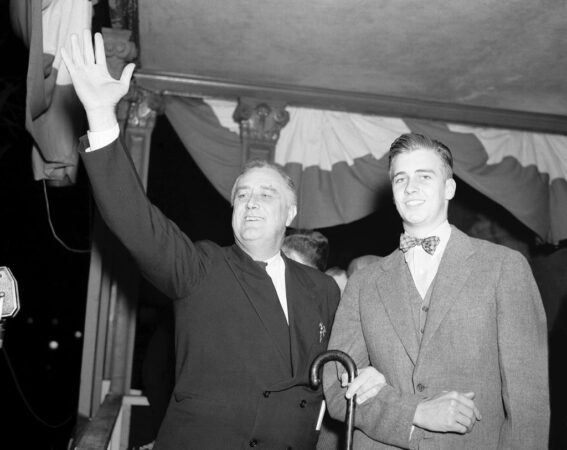
    At the beginning of Roosevelt’s first term, however, the city’s politics began to shift thanks to the new president and his New Deal. Struggling Philadelphians started to feel the tangible effects of New Deal policies at precisely the same moment that changes began to occur in both parties’ leadership locally. The result was a restoration of genuine two-party competition.

    The same Depression-era pressures loosening working-class loyalty to the Republican machine also began to pull Greenfield — who had once been a staunch Republican, but had soured on Herbert Hoover — toward the Democratic Party. The businessman benefited from several million dollars in funding from the Reconstruction Finance Corporation, the governmental lender of last resort, to prop up his business enterprises. Experiencing the benefits from New Deal policies firsthand, Greenfield started to express cautious support of Roosevelt.

    From his position as chairman of the Philadelphia Chamber of Commerce Convention and Tourist Committee, Greenfield also launched an effort to recruit the Democratic Convention to Philadelphia.

    His colleagues in the Chamber of Commerce shared Greenfield’s vision of landing a party convention in 1936 — but they didn’t care which party. Greenfield himself, however, remained focused on the Democrats in part because of his friendship with the liberal newspaper publisher J. David Stern.

    In December 1935, he began soliciting donations from the city’s business leaders with the goal of raising $150,000 (more than $3.6 million in 2026 dollars) to help lure the Democrats. He framed the convention not only as an opportunity to increase business activity, but also as a means of enhancing the city’s national reputation.

    Greenfield appealed to a wide range of constituencies, at times striking an unrelenting tone in his correspondence with business leaders. In one letter, Greenfield wrote that members of the Chamber, “feel that each individual enterprise has a moral obligation and responsibility with respect to the financial requisites for securing the convention.”
    Made By History sponsors. FOR USE ON MADE BY HISTORY STORIES ONLY.

    Greenfield’s efforts quickly bore fruit. Ledgers show contributions from both businesses and individual donors in sectors ranging from dentistry to distilling and hospitality. He also sold his fellow businessmen on their contributions being a non-partisan investment that would be “returned manyfold” to those who donated. This framing made it easier for many of his still staunchly Republican peers to support the bid.

    In January 1936, after the Chamber formally invited the Democratic National Committee to hold its convention in Philadelphia, news headlines reflected the importance of the incentive package organized by Greenfield. When Philadelphia won the bid — with a financial package that ended up totaling $200,000 — The New York Times characterized the proceedings as an “auction and now a poker game.” The money Greenfield raised ultimately compelled national Democrats to shift their preference from Chicago to Philadelphia as their host city.

    Greenfield soon became the chair of the city’s convention planning committee. In that role, he assembled a cohort of other prominent business and financial figures to orchestrate the programming surrounding the convention. He promised them pomp and circumstance — which he delivered.

    When the convention finally arrived in Philadelphia in June, flags bearing the names of U.S. states and festive decorations lined Broad Street; ceremonial stamps depicted a triumphant, sun-illuminated city; press photographers documented a ceremony in which city officials registered a donkey that was part of the New York delegation to vote. The city even suspended its blue laws to allow Sunday drinking.

    In bringing the convention to Philadelphia, Greenfield constructed his own alliance that worked to replace the system long sustained by Vare and the Republican machine. While he did not offer jobs and cash to individuals in exchange for loyalty like Vare did, he created a mechanism by which the success of the convention became materially valuable to the city’s business establishment.

    If members of the city’s business community sought to access the economic benefits of this national political event, they had to do so through Greenfield, further aligning Philadelphia’s commercial interests with an individual who wanted the convention to succeed not only financially but politically as well.

    What may have begun as tentative, pragmatic support for hosting the convention evolved into a more explicit embrace of the Democratic Party, with many businesses ultimately associating themselves with Democratic messaging. One newspaper advertisement praised the efforts of Roosevelt as a force behind Philadelphia’s economic revitalization. That message received endorsements from more than a dozen small businesses, whose names were featured alongside the message of support for the president.

    At the close of the convention, Greenfield told delegates that their enthusiasm might one day lead historians to view the city as a Democratic stronghold — a prediction that ultimately proved correct. By constructing a new network of support within Philadelphia’s business community, Greenfield helped rally backing for a convention that proved to be far more than an economic boost or mere “convention fireworks.” Instead, the gathering would serve as an engine for a realignment that would hold the city for the Democratic Party through the next two decades.

    The day after the 1936 election, the city of Philadelphia awoke to stunning results. Roosevelt had carried 43 of the city’s 50 wards and the city that the Philadelphia Bulletin had confidently described as unlikely to depart from “its long tradition” as a Republican stronghold had broken sharply with it. In 1940, when the city again explored hosting either the Republican or Democratic convention, the same committee which had led fundraising in 1936 initiated both efforts. Reflecting the changes in Philadelphia politics, however, the fundraising effort to attract the Democratic convention was far more successful than efforts to court its GOP counterpart. The business community in a city that had voted reliably Republican just four years earlier now raised three and half times as much money for potentially hosting the Democratic convention as the Republican one.

    As business leaders in Philadelphia work to bring the convention back to the city, they are drawing from Greenfield’s playbook 90 years ago that brought together a new alliance of business leaders in support of a convention that proved to be a political inflection point.

    Ethan Young is a rising senior at the University of Pennsylvania studying history and political science.

    Made by History takes readers beyond the headlines with articles written and edited by professional historians. Opinions expressed do not necessarily reflect the views of The Inquirer.
  • The real reason the colonists declared independence

    The real reason the colonists declared independence

    This month marks the 250th anniversary of the Declaration of Independence, an anniversary well worth celebrating. It is not, however, the anniversary of the start of the American Revolution. That began on April 19, 1775, with the battles of Lexington and Concord Bridge. It took over a year of fighting to convince colonists to accept that the time for compromise, for reconciliation, for any kind of reversion to the previous state of existence — for half-measures — was gone and the only path forward was independence.

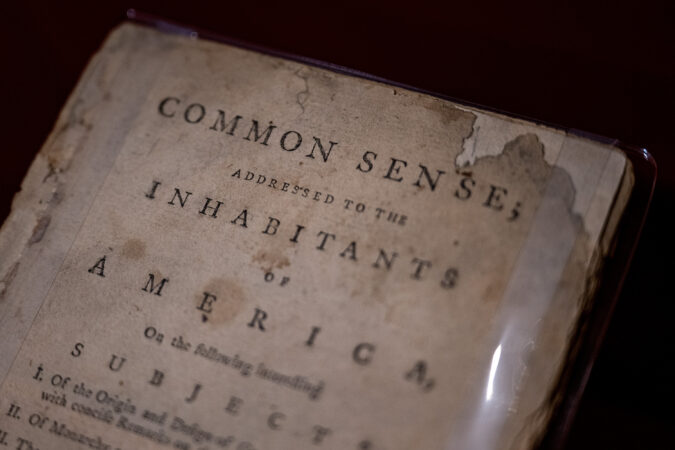
    That’s where Thomas Paine and Common Sense played a role. Since his arrival in Philadelphia in 1774, Paine had watched American politicians try to reason with England, hoping to reshape the relationship with George III and with Parliament, rather than to sever it. It did not work. “Why is it that we hesitate?,” Paine asked his readers. “From Britain we can expect nothing but ruin.”

    Paine wrote Common Sense at the end of 1775 — between when the Revolution began and when the colonists declared independence — and he wrote specifically to convince the colonists to break their ties with England. “Nothing can settle our affairs so expeditiously,” he told his readers, “as an open and determined declaration for independence.”

    In the winter of 1775-1776, a growing number of colonists were ready to meet the British Army on the battlefield. The colonists and the British government had been at odds with each other for a decade, fighting over taxes and over jurisdiction. The government in London, though, seemed only to be pushing things further to the brink, especially when they began stationing soldiers in Boston.

    Still, and much to Paine’s chagrin, through the rest of 1775 most colonists thought that declaring independence was a step too far. Three months after the fighting began, when the Continental Congress set out to explain the “causes and necessity of taking up arms,” they tried to assure “our friends and fellow-subjects” in the British Empire that “we mean not to dissolve that union which has so long and so happily subsisted between us, and which we sincerely wish to see restored … We have not raised armies with ambitious designs of separating from Great-Britain, and establishing independent states.”

    Five months later, when Paine wrote Common Sense, he still worried that “the sentiments contained in the following pages, are not yet sufficiently fashionable to procure them general favor.” And so, Paine made a case not just outlining England’s crimes, but also explaining why they had rendered any sort of half-measure or compromise impossible.

    We tend to associate the lead-up to the American Revolution with the colonists’ complaints about British taxes and duties, which certainly led to disputes about jurisdiction and the relative authority of the crown and the colonial governments. We also remember the catch-phrase of the era, “no taxation without representation.

    Those debates and those issues, though, were not part of Common Sense. Paine focused on what, for him, was Britain’s unforgivable crime: setting the British Army against the colony’s own citizens. “The independancy of America,” Paine wrote, “should have been considered, as dating its æra from, and published by, the first musket that was fired against her.”

    This was a point that Paine returned to again and again.

    “No man was a warmer wisher for reconciliation than myself before the fatal nineteenth of April 1775.” But once he learned that British troops had attacked the people of Lexington and Concord, he knew that “a new era for politics is struck; a new method of thinking hath arisen. All plans, proposals, & c. prior to the nineteenth of April … are like the almanacks of the last year; which, though proper then, are … useless now.” As for King George II, “I rejected the hardened, sullen tempered Pharaoh of England for ever; and disdain the wretch, that with the pretended title of father of his people can unfeelingly hear of their slaughter, and composedly sleep with their blood upon his soul.”

    Made By History sponsors. FOR USE ON MADE BY HISTORY STORIES ONLY.

    Paine’s message was clear: setting troops against the people demanded resistance. And this message was the key to getting the colonies to unite and declare independence. The disputes about taxes and jurisdiction went back to 1765. The colonists’ leaders had fought British policies on every issue, without ever wanting to stop being a part of the British Empire. But now that the British had sent their own army against the colony’s British citizens, Paine’s calls for independence found an eager audience among American readers.

    When Paine wrote of moderates calling for reconciliation with England, he urged them to think closely about the violence which the British Army had inflicted on the colonists, and if that level of violence had made reconciling impossible. “Tell me,” he wrote, “whether you can hereafter love, honour, and faithfully serve the power that hath carried fire and sword into your land?”

    In January 1776, his answer was no. In July 1776, that became the Continental Congress’s answer, as well — colonists from New Hampshire to Georgia were united enough in their horror at the British army’s violence that they declared their independence not as 13 colonies, but as 13 united states.

    This concern about state-sanctioned violence resonates again today. Paine’s reference to British soldiers as “Highwaymen and Housebreakers” brings up images of agents from U.S. Immigration and Customs Enforcement barging into homes without warrants and dragging out their terrified inhabitants.

    In 2026, there is no foreign power from which we can declare independence, but as state violence persists, so too does the legacy of resistance by colonists who heeded Paine’s call to reject Britain’s “long and violent abuse of power.”

    The “Road to 250” series is an initiative of Historians for 2026, a group of early American academics, public historians, archivists, and educators devoted to shaping an accurate, inclusive, and just public memory of the American Founding for the 250th anniversary.

    Noah Shusterman is associate professor of history at the Chinese University of Hong Kong. He is the author most recently of Armed Citizens: The Road from Ancient Rome to the Second Amendment.

    Made by History takes readers beyond the headlines with articles written and edited by professional historians. Opinions expressed do not necessarily reflect the views of The Inquirer.

  • The demand for purity in Trump’s GOP comes from the death of the party’s moderate wing

    The demand for purity in Trump’s GOP comes from the death of the party’s moderate wing

    With the 2026 midterm elections shaping up to be one of the most consequential in recent memory, President Donald Trump has gone on offense — not only against Democrats, but also against Republicans who he has accused of disloyalty. In fact, in recent primary elections, Trump has targeted candidates in his own party, from those running for state office to U.S. senators seeking reelection, including John Cornyn and Bill Cassidy.

    Most of those targeted by Trump have lost, which has sent a clear message: there is no longer room for debate within the GOP; only complete allegiance to MAGA orthodoxy — and by extension to Trump himself — is acceptable. This is a far cry from the GOP of yesteryear, which comfortably included staunch conservatives like Barry Goldwater and Ronald Reagan, as well as a robust moderate-to-liberal wing centered in the Northeast, upper Midwest and on the West Coast. In Pennsylvania and New Jersey alone, moderate Republicans like Hugh Scott Jr., Arlen Specter, Thomas Kean Sr. and Christie Whitman, routinely won Senate and gubernatorial elections into the 21st century.

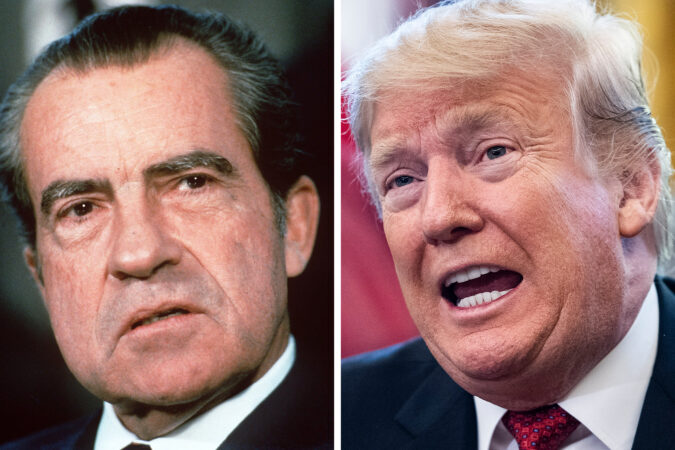
    In fact, an often-forgotten chapter in the career of Richard Nixon — the president most often compared with Trump — vividly illustrates that the ideological boundaries in the GOP were once quite malleable. Nixon regularly shapeshifted and operated across multiple wings of the GOP as he rose from congressman to senator to vice president, and finally, to president. Yet, as Republicans have become more ideologically rigid, such moves have become increasingly difficult, replaced by debates over who qualifies as a “real Republican” — and who is a Republican in Name Only (RINO).”

    The Richard Nixon who embarked on a political career in 1945 was nothing like the figure who resigned the presidency in disgrace three decades later. When he launched his first campaign in California’s 12th Congressional District, Nixon pledged to local Republicans that he would wage an “aggressive, vigorous campaign on a platform of practical liberalism” to defeat the popular incumbent congressman, Jerry Voorhis.

    At this time, Nixon modeled himself on Republican Harold Stassen, the former “boy wonder” governor of Minnesota. Stassen had built a national reputation in the late 1930s for his bipartisan “middle way” approach to governance, which blended fiscal discipline, civil service reform and bipartisan labor legislation. By 1943, when he resigned from the governorship to serve in the Navy during World War II, Stassen had become one of the country’s most prominent progressive Republicans.

    In Stassen’s success, Nixon saw a model for how a newcomer could win over liberal and independent voters in California. He wrote to the Minnesotan, “I have been very interested in following your campaign to liberalize the Republican Party because I feel strongly that the party must adopt a constructive progressive program in order to merit the support of voters.” Key to this program was retooling the principles of Democrat Franklin D. Roosevelt’s vaunted New Deal instead of rejecting them outright like many conservative Republicans did.

    This formula included accepting popular New Deal programs like Social Security — and even bolstering them. It also involved advocating against American isolationism and in favor of increased international cooperation. On labor rights — another thorny issue — Nixon, like Stassen, sought a middle ground: he supported arbitration to avoid strikes, while balancing the interests of workers and management. In a campaign speech, Nixon claimed that he “would not be a candidate if he were not strongly in favor of unions and small business.”

    This platform proved successful for Nixon, who the Minneapolis Star Tribune dubbed a “Stassen Candidate.”

    Shortly after he upset Voorhis and became the representative-elect for the 12th District, a former Whittier College classmate wrote to Nixon to offer “hearty congratulations” — despite being a Democrat who hadn’t voted for him. Nixon’s progressive message resonated with his former classmate, who expressed hope not only for Nixon’s success but “for the success of the progressive and liberal elements” within the Republican Party.

    In the coming years, Nixon would dash this hope as he illustrated the ease with which politicians moved between ideological camps in the GOP. During his early years in Congress, Nixon hung his hat not on the progressive vision of Stassen, but on staunch anti-Communism and red baiting. In 1947, Nixon joined the House Un-American Activities Committee (HUAC), where his pursuit of former State Department official Alger Hiss generated national attention. The case helped transform Nixon from an anonymous freshman congressman into one of the nation’s most prominent anticommunists.

    In 1950, Nixon further cemented his anti-Communist reputation during a successful Senate campaign against Rep. Helen Gahagan Douglas, who he portrayed as soft on Communism by repeatedly linking her voting record to that of left-wing Congressman Vito Marcantonio.

    Nixon’s reputation as an anti-Communist crusader compelled Dwight Eisenhower to select him for the 1952 GOP ticket as an olive branch to disgruntled conservatives after he beat their preferred candidate for the nomination, Ohio Sen. Robert Taft.

    Eisenhower’s election was a victory for progressive Republicans as he promised an era of “Modern Republicanism” — which paired a commitment to free enterprise with a belief that the government had an obligation to improve society and provide a basic social safety net.

    The GOP’s right flank derided this philosophy, and Nixon often spent time mediating between the two wings of the party. His ability to move comfortably between the camps reflected the ideological flexibility that still characterized the Republican Party during the 1950s.

    Made By History sponsors. FOR USE ON MADE BY HISTORY STORIES ONLY.

    Yet, even as he tried to reassure conservatives, Nixon embraced Modern Republicanism; he represented the Eisenhower administration abroad, including during his highly publicized exchanges with Soviet Premier Nikita Khrushchev. This engagement reflected the desire to contain communism through diplomacy and alliances, and the administration’s internationalist approach.

    Domestically, Nixon served as the administration’s point man on civil rights, supporting measures such as the Civil Rights Act of 1957 and overseeing efforts to combat employment discrimination through his leadership of the President’s Committee on Government Contracts. In 1958, Martin Luther King Jr. expressed his belief that “Nixon would have done much more to meet the present crisis in race relations than President Eisenhower has done.”

    In 1960, Nixon embarked on his first presidential campaign. During an October question-and-answer session at the University of Southern California, the vice president turned to the question of whether he considered himself a liberal or a conservative.

    He started by offering a definition of liberalism from Roosevelt. “A liberal is a man who wants to build bridges over the chasms that separate humanity from a better life,” Nixon explained. To him that meant, “we’re all liberals … We all want a better life.” Nixon concluded his answer by describing himself as a “practical progressive” — an echo of the “practical liberalism” he embraced during his 1946 campaign.

    Nixon went on to lose that race narrowly. But in 1968, he rebounded, by once again successfully navigating the party’s competing factions. He appealed to conservatives with his Southern Strategy and rhetorical emphasis on “law and order,” while reassuring moderates that he remained an experienced and pragmatic Republican.

    As president, he did some things that were progressive by today’s standards, including enacting the first federal affirmative action program and signing the Clean Air and Clean Water Acts. Simultaneously, however, he tangled with the liberal wing of his party over Vietnam and several Supreme Court appointments, and he vetoed legislation to provide federally funded daycare for children.

    Nixon is typically remembered for helping to usher in the populist conservative tide that would eventually sweep GOP politics. Today, he’s often compared with Trump because of his embrace of white grievance politics, his demands for personal loyalty and his abuse of power.

    Yet, his career also highlights how the Republican Party once had a vibrant and popular progressive and moderate wing. When Nixon launched his career, the idea of branding someone a RINO would have been far-fetched because the GOP comfortably managed to include staunch conservatives like Taft, as well as progressives like Stassen. The progressive or moderate wing of the party survived into the 1990s and 2000s; in Pennsylvania, Specter won the first of five Senate terms in 1980, while in New Jersey, Kean and Whitman both served as governors in the 1980s and 1990s.

    Yet, their careers tell the story of what happened as the brand of populist conservatism that Nixon capitalized on to win the presidency gained steam: In 2009, Specter switched parties and became a Democrat for his last years in the Senate, and Whitman is now a national co-chair of the Forward Party, and has endorsed Democrats in the last three presidential elections.

    Their departures reflected the rise of a new hard-line conservative Republican base with little tolerance for moderation or compromise. The collapse of the GOP’s liberal wing made today’s battles of who counts as a “real Republican” not just possible, but inevitable.

    Gaetano V. Della Torre is a New Jersey-based historian and educator. His article “Nixon’s Practical Liberalism: How Richard Nixon Tapped Harold Stassen’s Progressive Vision in 1946” is forthcoming in the Southern California Quarterly.

    Made by History takes readers beyond the headlines with articles written and edited by professional historians. Opinions expressed do not necessarily reflect the views of The Inquirer.
  • In 2026, like in 1770, standing armies in our cities erode freedom

    In 2026, like in 1770, standing armies in our cities erode freedom

    In January, Bruce Springsteen released a passionate anti-ICE ballad, “The Streets of Minneapolis,” in which he named U.S. Immigration and Customs Enforcement (ICE) “King Trump’s private army.” Dedicated to the memory of two protesters who died at the hands of armed government agents in a frigid Minnesota winter, the song invites comparisons to Paul Revere’s famous and equally passionate engraving of the 1770 Boston Massacre. Revere’s image depicts a bloodthirsty line of soldiers shooting directly into a crowd of unarmed Bostonians, killing five and injuring six more. In calling ICE a king’s private army, Springsteen drew on a long history of protest against standing armies, one built on the belief that accountability to the people and their representatives is the foundation for political liberty.

    Since the Magna Carta, Britons had been hostile to the idea of a standing or permanent army, one that existed even in peacetime, and that was paid for through taxes rather than staffed by volunteers. The 1689 Bill of Rights explicitly prohibited a standing army except with Parliament’s blessing. Within a few years, however, Parliament had softened its stance against armies in peacetime, since Britain was engaged in nearly continuous and often undeclared wars against France and Spain. In response, Britons firmed up other ground rules for a standing army: military power must always be subordinate to civilian authority, and some form of legislative consent was necessary. Without these guardrails, people feared, a monarch could simply turn his military might on his own subjects to quell dissent.

    The army could be used as a British police force, but not without complications. Magistrates and mayors regularly requested troops to come to their aid as they tried to catch smugglers and control rioting. Although a justice of the peace might occasionally be able to disperse a crowd by reading the Riot Act, those civilian authorities usually required military support. Eighteenth-century soldiers were trained for battle in the field, not to police civilians, and magistrates soon begged the war office to remove rowdy soldiers from their towns, and especially from the public houses where they were quartered.

    In 1768, the Massachusetts governor, like so many magistrates before him, asked the British War Office to send him troops in response to colonial protests against new tariffs set by Parliament. Bostonians felt deeply betrayed by the news of arriving troops. As one minister wrote: “To have a standing army! Good God! What can be worse to a people who have tasted the sweets of Liberty?” They were less concerned with the violence soldiers might bring than with the threat that a peacetime army posed to society and especially to the political rights of civilians.

    When the first two regiments of Redcoats landed in Boston Harbor in October 1768, they marched with flags flying and drums beating along the central Long Wharf into the heart of the city, where they appropriated Boston Common and Faneuil Hall as temporary campsites. Determined to demonstrate to the world that their peaceful town had no need of troops to keep order, Bostonians mostly refused to rise to the bait. For at least a while, there was nothing for the troops to do.

    Instead, the Sons of Liberty turned to the press to protest the troops’ arrival. In the year and a half that British soldiers lived in Boston, the newspapers were crammed with examples of how the very presence of a standing army could destroy every part of a civilized society, from church services (when the army band deliberately played music during the sermon) to parental authority (as young women defied their fathers to date Redcoats).

    Most of all, colonists feared the impact of a standing army on political freedom. How could a free people debate, much less protest, at the point of a bayonet? When the British army pointed its cannons at the door of the Massachusetts legislature, it was hard to escape the conclusion that a standing army was the king’s way of taking back political power. In sum, as the Massachusetts assembly complained to the governor in 1769, “establishing a Standing Army in this Colony, in a Time of Peace, without the Consent of the General Assembly of the same, is an Invasion of the natural Rights of the People.”

    The death of British protesters at the hands of soldiers was not uncommon in England, and colonists and officers alike knew that a violent clash was only a matter of time. On March 5, 1770, troops fired into a crowd of civilians in downtown Boston, killing Crispus Attucks, Samuel Gray, and James Caldwell immediately; Patrick Carr and teenager Samuel Maverick later died of their wounds. Even 256 years later, the exact sequence of events that led to the shooting is impossible to discover. Its importance for shaping the American Revolution, however, is clear.

    On the night of the shooting, the acting governor of Massachusetts rushed to the scene and was horrified to see people bleeding to death on the snow before the seat of governmental power, today the Old State House. He swore he would launch a full civilian investigation with local law enforcement, and he promised, “I will live and die by the law.”

    The governor was as good as his word. That night, the captain in charge turned himself in to the local jail, as did the men under his command. John Adams, urged by the Sons of Liberty to demonstrate Bostonians’ equally strong commitment to the rule of law, took on the defense of the British soldiers, successfully winning acquittals for most of them. Three years later, Adams reflected that defending the soldiers was “one of the most gallant, generous, manly and disinterested Actions of my whole Life, and one of the best Pieces of Service I ever rendered my Country.” And he was quite convinced that the jury verdict “was exactly right.”

    At the same time, Adams agreed that Boston should certainly “call the Action of that Night a Massacre.” In fact, he wrote, “[I]t is the strongest of Proofs of the Danger of standing Armies.” The experience of living with — and dying at the hands of — a standing army forever damaged Bostonians’ trust in the British empire.

    In 1776, Congress highlighted the Boston Massacre in its list of grievances against George III. The 11th complaint drew directly from the Massachusetts legislature’s complaint seven years earlier: “He has kept among us, in times of peace, Standing Armies without the Consent of our legislatures.” It was not the violence that so horrified colonists; it was the lack of legislative consent.

    Despite the striking parallels, the shootings of Renee Good and Alex Pretti in Minneapolis earlier this year were not just retreads of the Boston Massacre. For the Redcoats, face coverings and anonymity were not options; they had been living among Bostonians for a year and a half, becoming neighbors and sometimes even family. No one claimed the troops had legal immunity, and even the royal governor, who had requested the troops, believed in holding individual soldiers accountable for their actions.

    In those ways, the shooting in Boston defied fewer norms than the activities of ICE in Minneapolis two and a half centuries later. Even so, the Boston Massacre and its consequences were no small part of the forces that impelled colonists toward a final break with the British empire.

    Serena Zabin is the Stephen R. Lewis Jr. Professor of History and the Liberal Arts at Carleton College and the author of “The Boston Massacre: A Family History.”

    The “Road to 250” series is an initiative of Historians for 2026, a group of early American academics, public historians, archivists, and educators devoted to shaping an accurate, inclusive, and just public memory of the American Founding for the 250th anniversary.

    Made By History takes readers beyond the headlines with articles written and edited by professional historians. Opinions expressed do not necessarily reflect the views of The Inquirer.
    Made By History sponsors.
  • Frederick Douglass’ critical lesson for the 250th: ‘Contend, contend’

    Frederick Douglass’ critical lesson for the 250th: ‘Contend, contend’

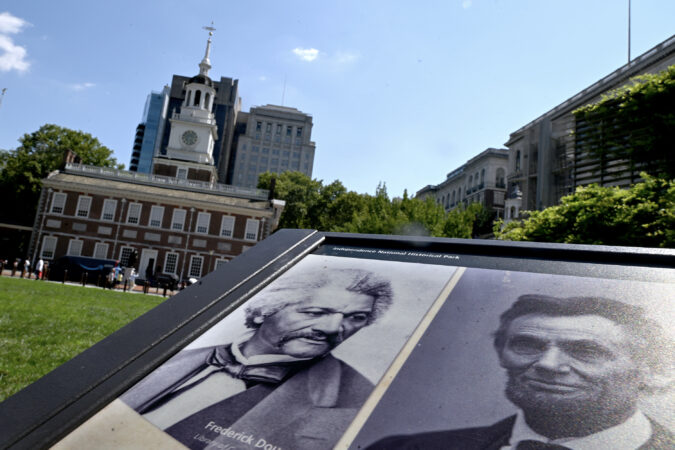
    As the country moves toward the 250th celebration, the official directive from the Trump administration is clear: be proud, be grateful, and rejoice in our great nation. This rosy narrative overlooks the global political conflicts, fractured economy, and longstanding racial and gendered inequalities that have shaped our country from its founding. These difficult realities are not footnotes to American history but a reminder of all of the ways that our nation continues to fail to live up to its espoused values. This is why one of the greatest speeches in American history resonates this time of year and especially on the eve of our nation’s 250th birthday: Frederick Douglass’s “What to the Slave is the Fourth of July?”

    Born into slavery, Frederick Douglass escaped from bondage to become the foremost African American abolitionist, orator, and intellectual of the nineteenth century. His famous “Fourth of July” speech is a profound declaration of faith in the promise of America and its “saving principles.” In this speech, delivered pointedly on July 5, 1852, not July 4, in Rochester, New York, Douglass argues that the foundations of American democracy are not fundamentally rotten, just mistaken in their implementation, and that the values enshrined in the founding mythology and documents might yet redeem America from its sins. It is a galvanizing and patriotic text, and it anticipates what W.E.B. Du Bois would say in 1935 in Black Reconstruction in America: that “democracy died save in the hearts of Black folk.”

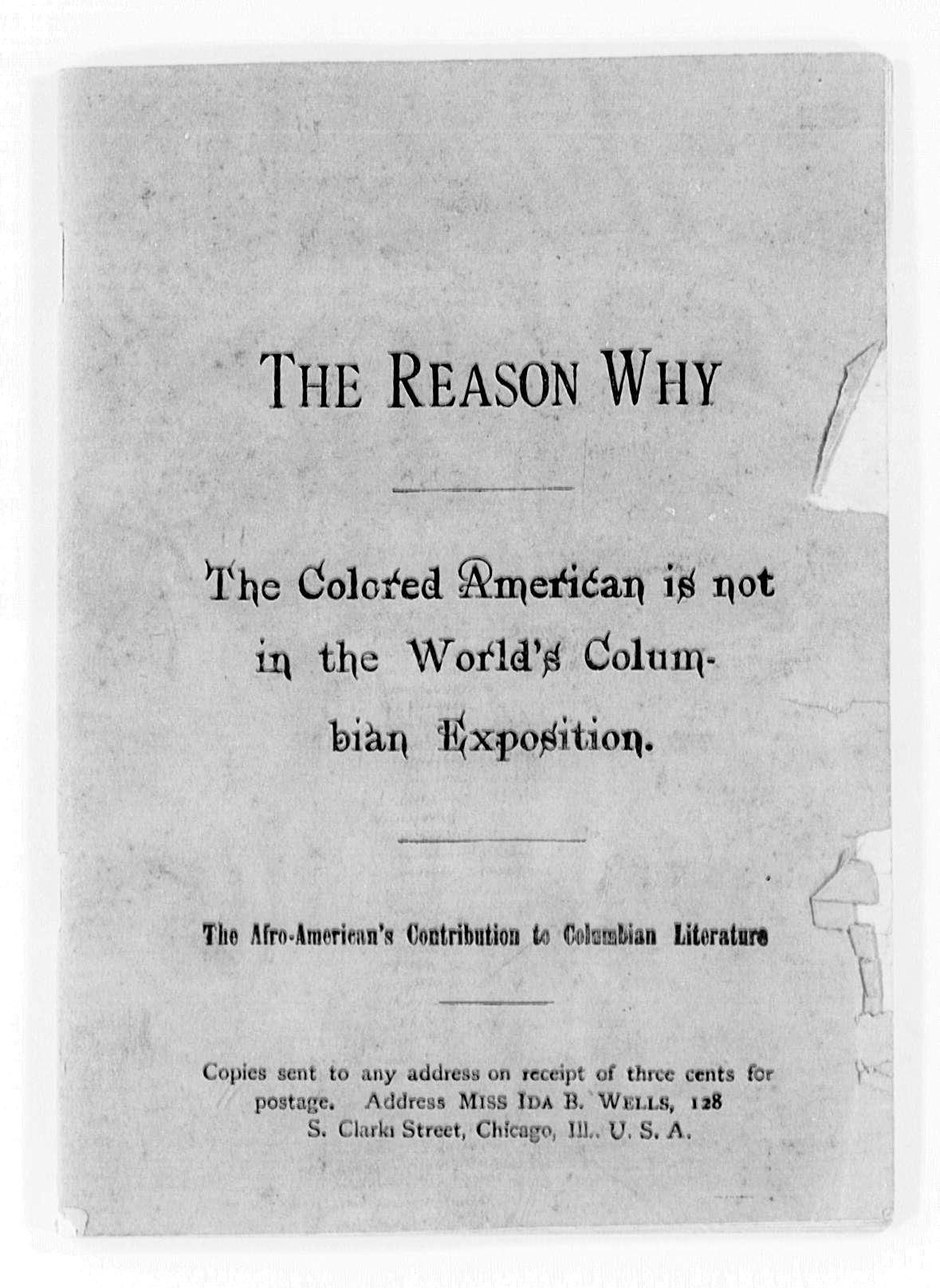
    But this year, a different piece by Douglass resonates: “The Reason Why the Colored American is Not in the World’s Columbian Exposition,” written in 1893, just two years before he died. In that pamphlet, Douglass criticizes another national commemoration that asked Americans to set aside painful realities in favor of a more flattering narrative. His argument—that the struggle against racial injustice must continue not because success is guaranteed, or even likely, but because it is the right thing to do when confronted with injustice—continues to matter today.

    The pamphlet, “The Reason Why: The Colored American is not in the World’s Columbia Exhibition,” had to be distributed and discussed from the Haitian exhibition space at 1893 World Fair in Chicago because African Americans were denied any real role in the Fair.

    In this pamphlet, Douglass protested the World’s Fair in Chicago, a grand celebration of the 400th anniversary of Christopher Columbus’s 1492 arrival in the “New World.” The fair, Douglass argued, distorted American history by erasing the contributions of Black Americans whose labor and suffering had made that very “progress” possible. By this time, Douglass had witnessed the Emancipation Proclamation and Reconstruction and the violent undoing of Reconstruction. He had seen the Supreme Court strike down the Civil Rights Act of 1875. As white Americans imposed the brutal logic of Jim Crow across the nation, Douglass came to believe that the consciences he had spent his life appealing to had been so corrupted by white supremacy that they could no longer be relied on to redeem America.

    And yet, in the closing passages of the pamphlet, Douglass did not embrace despair or advocate for retreat. Instead, he offered the metaphor of a ship that must embrace the dangers of the open sea. The ship might remain safely anchored in harbor but this safety, he argued, is deceptive. The ship must weather the storm. And he followed it up with something even more profound: “Next to victory is the glory and happiness of…contending for it. Therefore, contend, contend! That we should have to contend and strive for what is freely conceded to other citizens without effort or demand may indeed be a hardship, but there is compensation here as elsewhere. Contest is itself ennobling. A life devoid of purpose and earnest effort is a worthless life. Conflict is better than stagnation.” For Douglass, the act of contending itself is meaningful. The struggle testifies to the injustice it intends to repair.

    Made By History sponsors. FOR USE ON MADE BY HISTORY STORIES ONLY.

    The origins and reception of the pamphlet reveal the fault lines in American society at the end of the 19th century. Douglass had appealed to Black communities across the nation for funds to print the pamphlet and had received almost nothing. Discouraged, he told his collaborator, Ida B. Wells, that he wanted to abandon the effort. It was Wells who insisted otherwise, organizing with many Black women’s organizations to raise the necessary resources. Ironically, the man who would close his pamphlet urging Black Americans to “contend, contend” had to be persuaded to continue contending himself.

    The reception of the pamphlet was divided and harsh. Many prominent white journalists called Douglass a complainer. Even within the Black press, there was hardly consensus. Some Black journalists endorsed his indictment of the fair while others argued that Black economic and educational enfranchisement were more important than another lament of prejudice. This was a broader debate within the Black community that Douglass did not settle in the pamphlet. What he offered instead was something harder and arguably more important today: the argument that we must continue to fight even when we are not winning the war.

    This is an extraordinary argument coming from Douglass at the end of his life. He had every reason to give up the fight. He had spent decades working to change America, and America had proven far more resistant to that change than he had originally hoped. And yet he insisted: contend, contend.

    At this moment of democratic fracture and racial retrenchment in America, Douglass’s argument deserves a second hearing. The Supreme Court has dismantled affirmative action, executive orders have unraveled federal civil rights commitments, and disparities in housing, education, healthcare, and criminal justice persist and deepen. The fight against racial injustice must continue not because we can be assured of our triumph but because our commitment to America’s “saving principles” should not falter even when those principles seem out of reach. Douglass’s refusal to abandon the fight—his willingness to steer into the storm—is not merely a biographical detail about an American at the end of his life. It is an argument about what it means to celebrate America and her saving principles.

    Happy 250th birthday, America. Contend, contend.

    Dr. Amy Gais is a Lecturer in the Department of Political Science and Comparative Literature and Thought at Washington University in St. Louis. She is the author of The Coerced Conscience (Cambridge University Press, 2024) and is currently working on a book project on dissimulation, resistance, and freedom in African American political thought.

    Made by History takes readers beyond the headlines with articles written and edited by professional historians. Opinions expressed do not necessarily reflect the views of The Inquirer.
  • America’s rich tradition of July Fourth protest is worth recalling

    America’s rich tradition of July Fourth protest is worth recalling

    No Kings and other protests opposing the policies and executive overreach of the Trump administration continue to draw crowds across the country, most recently on Flag Day, June 14, which was also the president’s 80th birthday. While critics have denounced these demonstrators as un-American — House Speaker Mike Johnson called a 2025 No Kings march a “hate America rally” — those voicing dissent, pushing for change and speaking truth to power are, in fact, participating in a tradition at our nation’s core.

    That tradition dates back to July 4, 1776, when the Continental Congress, citing a list of grievances, declared independence from the rule of a would-be despot, King George III. The founders’ act of resistance set an example that ordinary Americans would follow. According to historian David Waldstreicher, citizens in the early republic used celebrations not just to commemorate independence, but to lay claim to the lofty principles expressed in the Declaration of Independence, namely that all are created equal, that they have unalienable rights, and that government is instituted to secure those rights, deriving its just powers from the consent of the governed.

    The custom continued for two-plus centuries, with Americans regularly marching, picketing, or otherwise taking to the streets on the Fourth to realize a more perfect union.

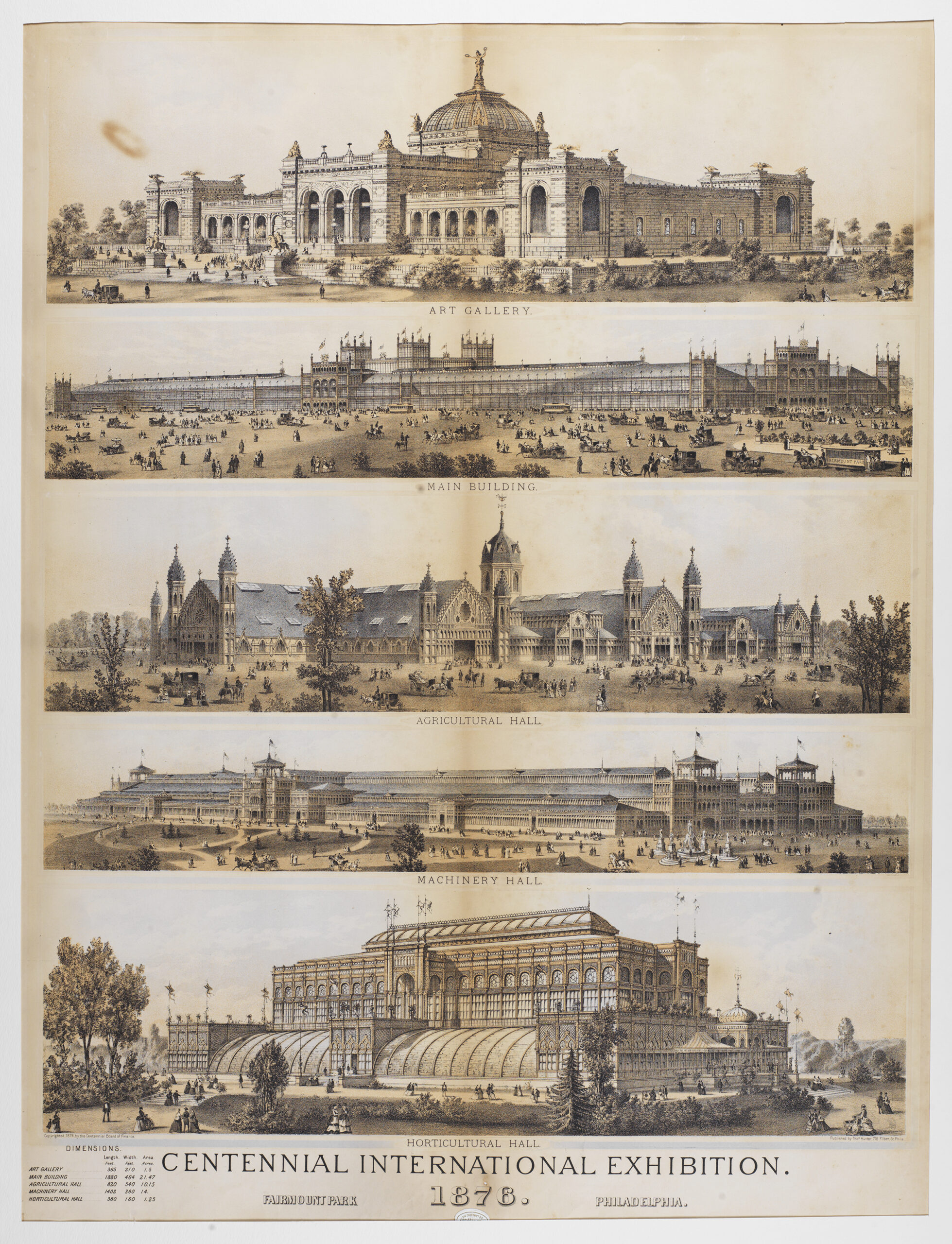
    Centennial International Exhibition, 1876.

    Perhaps the most famous Independence Day protest occurred in 1876 in Philadelphia. As tens of thousands gathered for the Centennial International Exhibition in Philadelphia’s Fairmount Park to celebrate a century of American progress in the arts, in industry, and in economic development, Susan B. Anthony protested the fact that half the nation, women, remained unable to vote and were thus without the unalienable rights named in the declaration.

    Anthony and a determined group of suffragists attempted to introduce a statement drafted by the National Woman Suffrage Association into the exhibition’s official proceedings. When Joseph Hawley, president of the United States Centennial Commission, prevented the women from doing so, Anthony led a procession to Independence Hall, where she read aloud the suffragists’ “Declaration of Rights of the Women of the United States” to a crowd that quickly gathered around her. Patterned after the original declaration, the text condemned the government for denying women the franchise, before ending with a clear demand: “We ask justice, we ask equality, we ask that all the civil and political rights that belong to citizens of the United States, be guaranteed to us and our daughters forever.”

    It took decades of nonviolent action before Congress passed the 19th Amendment, granting women the constitutional right to vote. But Anthony’s principled stance contributed to a rich history of July Fourth protests that continued a century later, as the nation prepared to mark the Bicentennial.

    On July 4, 1976, approximately 10,000 to 15,000 demonstrators massed in Washington, D.C., on America’s 200th birthday. Assembled by the People’s Bicentennial Commission, a New Left group, near the Jefferson Memorial, they marched to the U.S. Capitol under a banner reading, “Independence from Big Business.”

    The group’s populist call for economic democracy resonated in the mid-1970s, when the country was still reeling from a divisive war (Vietnam), a constitutional crisis (Watergate), and an economic recession that saw both inflation (5.97% in July 1976) and unemployment (7.6%) soar. Many people signed the commission’s “Declaration of Economic Independence” calling for limits on concentrated corporate power in the interest of the common good. “We, therefore, the Citizens of the United States of America,” the declaration stated, “hereby call for the abolition of these giant institutions of tyranny … to provide for the equal and democratic participation of all American Citizens in the economic decisions … that effect … our Nation.”

    Other protests occurred across the country, in Detroit and Chicago, as well as Los Angeles, San Francisco, and Seattle. Even Salt Lake City witnessed a small demonstration — albeit on Saturday, July 3, so as not to disturb the Christian Sabbath.

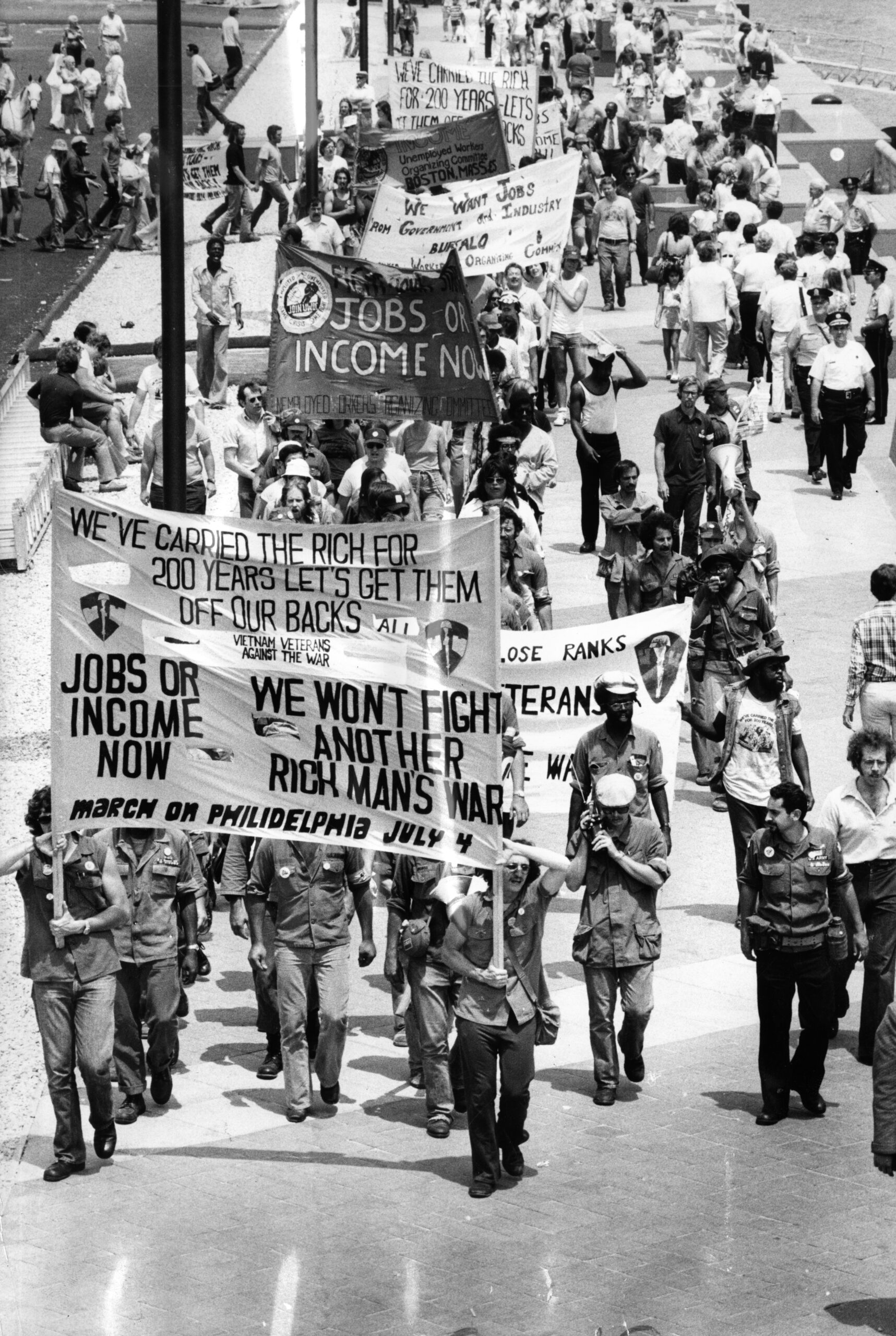
    Marchers with the Rich Off Our Backs Coalition demonstrate at Penn’s Landing in Philadelphia on July 3, 1976.

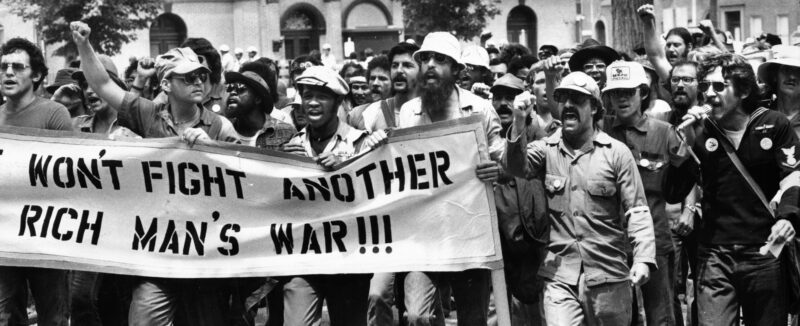
    The largest gatherings, though, were in Philadelphia, where more than 3,000 demonstrators gathered in Norris Square, under the auspices of a group called the Rich Off Our Backs Coalition, to march for jobs and income and economic justice — backed by fatigue-wearing Vietnam Veterans Against the War, who chanted: “One, two, three, four, we won’t fight a rich man’s war.”

    Another group, the July 4th Coalition, rallied 30,000-plus in Fairmount Park, site of the Bicentennial, to demand Puerto Rican independence, greater rights for Black Americans, Native Americans, and members of the LGBTQ+ community, and much else. Karen DeCrow, president of the National Organization for Women, reread the declaration Susan B. Anthony had introduced a century earlier to flag the limited progress the nation had made toward gender equity since 1876. Black Panther leader Elaine Brown, a native Philadelphian, decried America’s 200-year history of racism.

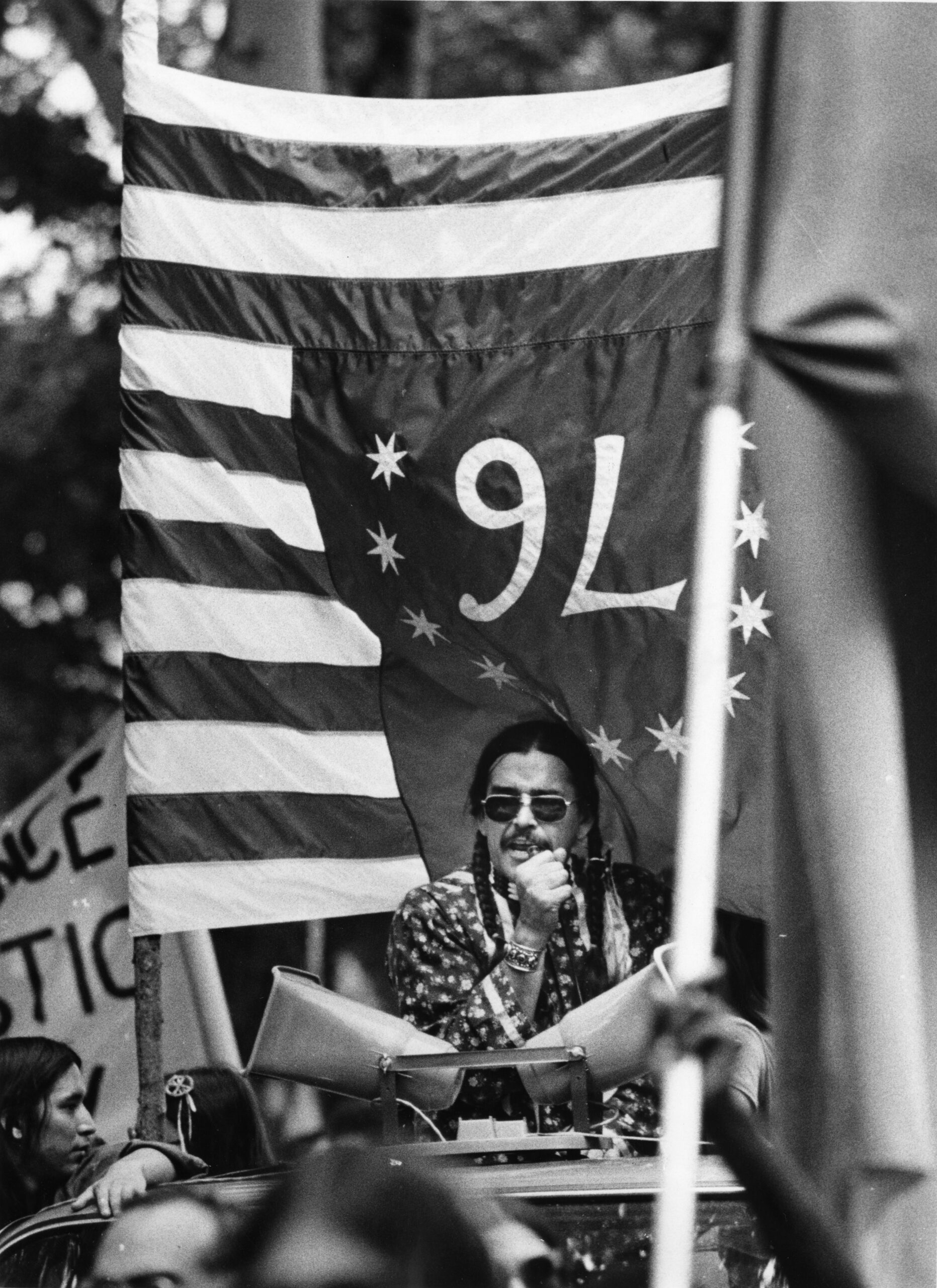
    A group of Native Americans leads a July 4th Coalition protest parade at 33rd and Diamond Streets in Philadelphia on July 4, 1976.

    Despite opposition — Mayor Frank Rizzo famously requested 15,000 federal troops to maintain order — the demonstrations remained peaceful. Organizers won plaudits even from those who did not necessarily agree with their critiques. Protesters had a right, The Inquirer editors agreed, to call attention to America’s shortcomings, as they saw them. Dissent was as integral to the Fourth of July as bunting and brass bands: Its existence confirmed “the strength and genius of American democracy.”

    Today, according to polls, Americans typically mark Independence Day by barbecuing, shooting fireworks, going to the beach, viewing a parade, traveling, watching patriotic movies, or relaxing at home. Participating in a protest, demonstration, rally, or other nonviolent action does not rate a mention.

    That’s certainly understandable. These days are exhausting, and we all just want a break, a moment to have a laugh with family and friends.

    Yet, America’s rich tradition of July Fourth protest is worth recalling, especially at a time when the nation’s democratic institutions are under stress, for it once served as an essential tool that enabled Americans to hold their leaders to account for the words of 1776. We, the people, have never quite realized those words — written principally by a slave owner, Thomas Jefferson.

    But for 250 years and counting, the Declaration of Independence has set a “moral standard,” as historian Pauline Maier has argued, to which not only feminists and civil rights activists but civil libertarians and laborers have turned time and again in pursuit of liberty from their oppressors, be those would-be tyrants, foreign or domestic.

    M. Todd Bennett, a professor of history at East Carolina University, and David McKean, former director of policy planning in the U.S. Department of State, are the authors of “The Flag Was Still There: A History of the American Experiment in Five Anniversaries” (PublicAffairs, 2026).

    Made By History takes readers beyond the headlines with articles written and edited by professional historians. Opinions expressed do not necessarily reflect the views of The Inquirer.
    Made By History sponsors.
  • Conservative education warriors have reshaped GOP politics — even if their crusades often fail

    Conservative education warriors have reshaped GOP politics — even if their crusades often fail

    Since its founding in 2021, the educational advocacy group Moms for Liberty has been mobilizing conservative mothers across the country against school curriculum they deem indoctrinating, un-American, anti-Christian and antithetical to their understanding of family values.

    They’ve targeted books that explore LGBTQ themes, transgender athletes and curriculum they deride as critical race theory or as too focused on diversity, equity and inclusion. More broadly, they claim to be fighting to protect their parental rights to control what their children learn.

    Members of Moms for Liberty have earned seats on school boards, garnered national media attention and infiltrated the highest levels of conservative policymaking. According to cofounder and CEO Tina Descovich, she has visited President Donald Trump’s White House more than a dozen times.

    Moms for Liberty has also made waves in the Philadelphia suburbs, especially in Bucks County, which boasted the largest leadership team of any chapter in the country by April 2025. At a Harrisburg-area event last October, Descovich said, “I am very familiar with Bucks County. Before I knew it existed, I knew the [Bucks County] Beacon existed because they were writing trash pieces about us.”

    Groups like Moms for Liberty have proved effective at making political noise — and even notching some policy wins, at least temporarily. Yet, the group is really just a continuation of a decades-long crusade by conservative white women to weaponize public education in the service of a right wing agenda. While it has largely failed to transform American curriculum, this push has turned these women into key figures in Republican politics who have made fighting the culture wars a GOP priority.

    The modern conservative movement since World War II owes much of its success to the work of grassroots education warriors.

    These women proudly embraced traditional gender roles. They saw them as a marker of success because many women in their mothers’ generation had to work outside of the home to make ends meet in the Great Depression and wartime years.

    Even as some of these conservative women became full-time political activists, they claimed the mantle of traditional homemakers and mothers — which aroused charges of hypocrisy from critics. Yet, they argued that their advocacy work in the traditionally male world of politics and education policy was wholly consistent with traditional gender roles because protecting innocent children from worldly dangers was a natural role for women and mothers.

    At their kitchen tables and in PTA meetings across the country, these “suburban warriors” launched far-reaching campaigns against sex education, multicultural curriculum and other aspects of schooling they deemed antithetical to traditional American values.

    In the 1970s and 1980s, as the political parties realigned, these conservative education warriors emerged as a crucial Republican constituency and a core part of the New Right coalition. These white women were galvanized by the recent gains of the civil rights movement, the Supreme Court’s Roe v. Wade decision — which provided a right for women to have legal abortions under certain circumstances — and debates over the proposed Equal Rights Amendment to the U.S. Constitution, which they claimed (without evidence) would decimate the female homemaking role.

    These recent changes threatened to disrupt what the conservative women argued were divinely inspired gender roles, which were embodied by the “traditional” nuclear family of a working male breadwinner, a female homemaker and kids. They feared that big government-backed forces might take away this ideal life, which many had only recently achieved.

    Increasingly, these women looked to public schools as the place to fight their crusade. Taxpayers funded the schools and they were responsible for shaping the next generation of Americans outside of parental control.

    In 1974, the education wars burst onto the national stage in Kanawha County, W.Va., thanks to an ugly and violent struggle over school textbooks. The controversy began after Alice Moore, a 29-year-old mother and the lone woman on the county school board, objected to a newly adopted language arts curriculum she deemed indoctrinating, racially divisive and steeped in “secular humanism.”

    This latter concept wasn’t new. It dated to the late 19th century, and argued that people could gain knowledge through reason, intellect and logic rather than relying upon religious teaching.

    Yet in the 1970s conservatives thrust it into the spotlight, because they needed a fresh villain. Tried-and-true messaging on anticommunism had grown stale. But pushing secular humanism as the latest liberal conspiracy aligned with the New Right’s renewed focus on faith, family and traditional gender roles, while energizing Christian conservatives.

    Moore and her allies saw secular humanism as increasingly influential in education — and as incredibly hostile to Christianity and their narrow definition of divinely inspired traditional family values. It further alarmed them because they saw secular humanism as teaching students to challenge their parents’ authority. Within a few years, the once obscure concept would become the New Right’s star bogeyman.

    Made By History sponsors. FOR USE ON MADE BY HISTORY STORIES ONLY.

    Throughout the fall of 1974, Moore read excerpts from the textbooks before the school board. She singled out Black nationalist Eldridge Cleaver, whose writings allegedly produced “racial hatred” toward white people. She also took issue with “dialectology,” a study of dialects that included lessons on African American vernacular — what she called “ghetto dialect” — that she believed to be antithetical to American speech.

    By October, the controversy had produced two shootings, dozens of arrests and multiple rounds of bombings, boycotts and school bus blockades.

    Moore’s crusade against secular humanism in West Virginia quickly caught the attention of national conservative organizations. The Heritage Foundation featured Kanawha County in its 1976 study, “Secular Humanism and the Schools: The Issue Whose Time Has Come.” Phyllis Schlafly — the country’s most famous antifeminist at the time — jumped into the fray, claiming that public education promoted “a tolerance of violence, theft, adultery, obscenity, profanity, and blasphemy.”

    In part because organizations like the Heritage Foundation and Schlafly’s Eagle Forum highlighted Moore’s activism for like-minded conservative women, it inspired conservative mothers across the country to wage their own crusades against dirty textbooks. In the ensuing years, they launched repeated battles against seemingly subversive curriculum.

    In 1983, in rural East Tennessee, fundamentalist mother Vicki Frost waged her own legal battle against the Hawkins County school board after discovering objectionable material in her daughter’s reading textbook, including alleged depictions of telepathy, witchcraft and black magic that violated her religious beliefs.

    In Mozert v. Hawkins County Board of Education — a case that became known as “Scopes II” because of Hawkins County’s proximity to the original Scopes Trial — Frost and her fellow plaintiffs alleged that the school board’s policies violated the First Amendment’s Free Exercise Clause. Their legal counsel came courtesy of Concerned Women for America, whose founder Beverly LaHaye took Frost on a national speaking tour to publicize the alleged dangers of modern textbooks. Although the plaintiffs lost their case on appeal, LaHaye deemed the case a “PR success” that “identified us as a friend of the family.”

    The result epitomized the outcome of the broader education wars. Fighting against offensive school curricula turned many conservative women into key figures in the culture wars, with substantial reach and political impact. They quickly become politically astute grassroots organizers who leveraged their identities as white Christian homemakers and mothers to argue for an educational system rooted in Christianity, the traditional nuclear family and American exceptionalism.

    The impact of these organizers, however, hasn’t necessarily come in the classroom. Most of Moore’s “dirty books” found their way into the Kanawha County curriculum. Frost and the plaintiffs in Hawkins County ultimately lost their case on appeal. In recent years, the majority of school board candidates backed by Moms for Liberty have similarly suffered defeat.

    Yet, these organizers have been able to mobilize thousands of culturally conservative women — particularly other white Christian mothers — and bring them into the Republican Party. Their involvement has driven the GOP to make the culture wars a key component of the party’s identity.

    These earlier crusaders also created a language that remains a staple of conservative critiques of public education to the present day. More than five decades after Moore’s war, conservative organizations continue to emphasize “parental rights,” “family values” and “school choice” in their efforts to influence American education.

    When groups like Moms for Liberty claim that public schools are indoctrinating children with “woke” ideologies such as critical race theory, they rely upon a well-established playbook that conservative women have drawn upon for more than half a century. Despite mixed results in America’s actual classrooms, their political activism has proved a tried-and-true means for both enflaming public opinion and solidifying the role of self-proclaimed traditional mothers and homemakers within modern conservatism.

    Allen Fletcher is a public historian and journal editor with research interests in Appalachia, gender and the history of American education. His current book, Building Schools, Building Communities: Appalachian Women and the Struggle for Educational Change, is under contract with LSU Press.

    Made by History takes readers beyond the headlines with articles written and edited by professional historians. Opinions expressed do not necessarily reflect the views of The Inquirer.
  • Florida shows how not to teach U.S. history on the republic’s 250th anniversary

    Florida shows how not to teach U.S. history on the republic’s 250th anniversary

    The state of Florida recently released a new American history high school course with a conservative tilt. Troublingly, it glosses over the relationship between the founders and slavery—a topic that should in 2026 promote a rich understanding of the U.S. past, but one that has also been a subject of controversy, including in Philadelphia at the site of the President’s House. In fact, slavery was central to the economic growth and expansion of the young republic, so much so that it would take a long and brutal war to get rid of it. As Abraham Lincoln, dealing with slavery during the Civil War, put it: “Fellow-citizens, we cannot escape history.”

    On the 250th anniversary of the founding of the American republic, it bears repeating that the history of the United States is neither the linear, uninterrupted history of American exceptionalism that the Florida framework promotes nor is it solely an unremitting story of racism and reaction. Students benefit from learning about the brutality of slavery as well as the bravery of those ordinary Americans, men and women, Black and white, who resisted it. Emphasizing just one part of this equation is incomplete and bad history.

    The Florida course framework portrays the founding generation of American revolutionists as unanimously antislavery. The truth is more complex. While most of the northern founders like Benjamin Franklin, Alexander Hamilton, and John Jay lent the prestige of their names to abolition societies, most southern founders did not. Their actions reflected the reality on the ground. Between 1779-1804, northern states gradually abolished slavery. But southern slavery not only persisted but expanded considerably in the early American republic. If the founders were unanimous, what explains this divergence?

    While Jefferson and Madison professed to abhor slavery in their writings, like most southern enslavers they did not free their slaves. Jefferson made an exception for his own progeny, freeing select enslaved people. During his presidency, George Washington famously pursued his slave Ona Judge, who had escaped enslavement, with a relentless energy. However, New Hampshire authorities refused to render her back to the President—a signal of diverging attitudes and policies about slavery in the early republic.

    Washington did become the only prominent member of the so-called Virginia dynasty of Presidents to free his slaves on his death. It was a belated gesture. As the Black abolitionist Reverend Richard Allen noted in his eulogy of Washington in 1799, “he dared to do his duty, and wipe off the only stain with which man could ever reproach him.” While Washington was lauded as the Father of the Nation, few southern slaveholders followed his example, as Allen had hoped.

    The Florida history standards also present the U.S. Constitution, which was signed in 1787, ratified in 1788, and went into effect with the launch of the federal government in 1789, as an antislavery document rather than one that contained expedient compromises on the issue of slavery. One particularly egregious example of this relates to the three-fifths clause, which counted the enslaved population at a three-fifths proportion for representation and taxes. The Florida guidelines consider this an antislavery clause because the enslaved population was not counted fully. But this compromise led to southern domination over the federal government until Lincoln’s election as it gave the slave states disproportionate representation in Congress.

    The framers of the Constitution were careful not to use the words slavery and slaves in the fundamental legal document of the republic. Instead, they employed euphemisms such as “persons held to service” or “all other persons.” But that did not prevent contemporary abolitionists from bemoaning its fugitive slave clause, a part of the Constitution that gave southern laws of slavery extraterritoriality in the free states—an endless source of political friction between the states—and the continuation of the African slave trade, an execrable commerce whose tortures were well known then, until 1808.

    While Florida students under the new guidelines would learn about a debate among abolitionists like William Lloyd Garrison and Frederick Douglass on whether the Constitution was a proslavery or antislavery document, they would miss other important context. For example, the guidelines elide the equally important debate among abolitionists on the extent of the complicity of American churches in upholding slavery. Instead, abolition is framed as a Christian movement—with no mention of the schism over the issue of slavery leading to religious divisions that still exist today, including northern and southern Methodist and Baptist denominations.

    The framework also includes words of praise for proslavery theorist John C. Calhoun, a planter politician from South Carolina, as a constitutional thinker. Confederate generals like Robert E. Lee and Thomas “Stonewall” Jackson are portrayed as “honorable,” pious, and militarily skilled with little mention of their cause of human bondage, which Ulysses Grant called “one of the worst for which a people ever fought.” Mississippi’s “Declaration of the Immediate Causes which induce and justify Secession” clearly stated: “Our position is thoroughly identified with the institution of slavery — the greatest material interest of the world.”

    Indeed, Lee’s army enslaved free Black people in Pennsylvania while retreating from Gettysburg in 1863—not a very honorable thing to do and explicitly condemned in the Bible as man stealing. But this context is missing in the new Florida guidance.

    The histories of Reconstruction and the Progressive era are not particularly well understood by the public. The Florida guidelines portray Lincoln as being at odds with Radical Republicans who implemented Reconstruction. He wasn’t. It also casts Andrew Johnson as continuing his “lenient” policy to the south, a canard that Johnson assiduously promoted to oppose Reconstruction. In fact, before his death, Lincoln became the first U.S. President to endorse Black citizenship and male suffrage, the cornerstone of Reconstruction. Radicals such as Thaddeus Stevens and Charles Sumner as well as moderate Republicans like Lincoln championed the constitutional amendments and federal laws that comprised Reconstruction.

    Echoing a viewpoint espoused by white Southern elites at the time, Reconstruction gets short shrift and is deemed a failure in Florida’s new standards. Actually, the Reconstruction amendments and the first federal civil rights laws were tremendous achievements. We know the first 10 amendments to the Constitution as the “Bill of Rights” today because the author of the consequential Fourteenth Amendment that established national citizenship by birthright or naturalization, John Bingham, gave them that moniker and it eventually stuck. And Reconstruction didn’t fail; a systematic campaign of domestic racist terror in the south and reactionary judicial decisions by the United States Supreme Court overthrew it.

    The Jim Crow era that followed became a cautionary tale of how quickly and completely a country can lose its democracy and rights gained. But the Florida guidelines casts more than half a century of Jim Crow as a blip or aberration from a national history otherwise committed to democratic ideals.

    Students will be better prepared to be citizens of the republic when presented with differentiated historical narratives rather than having sanitized versions of the past served up to them. The Florida standards not only whitewash the past, they evoke an unchanging founding moment and pristine originalism—as though Americans in the founding era did not argue, debate, or change their thinking about slavery over time.

    Made By History sponsors. FOR USE ON MADE BY HISTORY STORIES ONLY.

    It also distorts how Americans continue to fight to expand—or curtail—access to rights and democracy more broadly. For instance, Progressive era reforms that included government regulation of the economy and working conditions are portrayed as “unbound by traditional constitutional restraints.”

    Most historians argue that our modern democracy was founded during Reconstruction, whose seeds later grew in the 20th century and were expanded by the Civil Rights revolution of the 1960s. But, as in previous eras, the fundamental questions remain contested and unsettled. That is both clear in the historical record and the foundational knowledge students must understand to continue to expand or improve our democracy today.

    Manisha Sinha is the Draper Chair in American History at the University of Connecticut and author most recently of The Rise and Fall of the Second American Republic: Reconstruction, 1860-1920.

    Made by History takes readers beyond the headlines with articles written and edited by professional historians. Opinions expressed do not necessarily reflect the views of The Inquirer.
  • After a century of false starts, soccer has taken off in the U.S.

    After a century of false starts, soccer has taken off in the U.S.

    The 2026 FIFA World Cup — which includes six games in Philadelphia — has taken the U.S. by storm. The excitement generated by the tournament reflects how, in contemporary American society, soccer has become a feature of everyday life.

    Parents drive their kids to and from soccer practices and fork out large sums of money for travel games. At the professional level, Major League Soccer (MLS) and the National Women’s Soccer League (NWSL) are thriving. The U.S. women’s national team has won a record five Olympic gold medals and four World Cup titles. Even European soccer has taken off with American fans: this year, the English Premier League (EPL) season opener between Chelsea and Manchester City drew close to 2 million viewers in the U.S.

    The meteoric rise of soccer in the U.S., however, is a recent phenomenon. While Americans have played the game for centuries, it struggled to take off in the U.S. A number of factors drove soccer’s struggle to catch on, including ideas about masculinity and Americanness, a lack of infrastructure and the failure to build robust college soccer programs. Yet, in the 21st century, immigration, demographic shifts, technological changes and the rapid growth of youth soccer have transformed the landscape. Soccer has moved from a fringe and unpopular sport to become one of the most popular sports in America — even ahead of baseball according to one poll.

    In 1869, Rutgers beat Princeton 6-4 in the first American collegiate soccer game. By the early 20th century, teams like Fall River Football Club had become established enough to play against European teams including the Glasgow Rangers and Sparta Prague.

    Bethlehem Steel, based in Bethlehem Pa., was one of the most dominant teams in the early 20th century. It built what was widely regarded as the first soccer specific stadium in the U.S. and went on to win a record five U.S. Open Cups.

    Although the game seemed to be taking root — especially after the formation of the American Soccer League (ASL) in 1921 — it was predominately an amateur sport, even as professional soccer took off in Europe.

    The ASL hit rough shoals in its earliest days: only three of the initial clubs returned for a second season. Financial struggles were quite common in the league, and crowds were sparse.

    In the early 20th century, the near absence of soccer on American college campuses entrenched its status as a fringe sport. Other sports like baseball and basketball were taking off on campuses at the time, a signal of what sports young people were interested in playing. The problem was compounded by the lack of a national administrative structure, which ensured that almost no organized soccer took place beyond high school.

    Soccer also suffered from the lack of physical infrastructure. While sports like baseball and basketball developed at the professional level in the U.S. — including the construction of stadiums and arenas — soccer was forced to rely on baseball stadiums for games. For instance, Grand Avenue Baseball Ground in St. Louis, hosted four U.S Open Cups between 1929 and 1948 while also serving several Major League Baseball teams. Soccer in 20th century America simply wasn’t a robust enough business to justify the construction of multimillion-dollar stadiums.

    These challenges and tribulations plaguing soccer had a significant impact on sport’s growth in the U.S.

    At the college level, the game remained on the periphery of the American sports landscape. In 1939, only eight universities and colleges had men’s soccer teams and there were no interregional matches or postseason tournaments. It would take another 20 years before the National Collegiate Athletic Association sponsored a postseason soccer championship.

    Meanwhile, American football remained dominant on college campuses. Commenting in a New York Times article on soccer, an official from an unnamed American university argued that it was a good sport and must be played “in addition to football but should not supplant the latter game.”

    Soccer was stuck in neutral, even after two rival professional leagues, the National Professional Soccer League and the United Soccer Association, merged to form the North American Soccer League (NASL) in 1968.

    In 1975, the arrival of Edson Arantes do Nascimento — better known as Pelé — was supposed to change everything. Following sustained lobbying from New York Cosmos General Manager Clive Toye and intervention by U.S. Secretary of State Henry Kissinger, the superstar agreed to bring his talents to the U.S.

    Hopes, however, for a soccer revolution never truly materialized. While Pelé drew huge crowds to his games, his proclamation that soccer had “finally arrived in the United States” proved to be only hype. A decade after his heralded arrival, the NASL actually collapsed due to ballooning costs — leaving the U.S. without any serious professional league for several years.

    Made By History sponsors. FOR USE ON MADE BY HISTORY STORIES ONLY.

    No one was quite sure precisely why the most popular global sport couldn’t break through in the U.S. Some observers wondered if the problem was that the sport simply wasn’t American.

    The game ran afoul of American ideas of masculinity, which were primarily associated with aggression and capacity for violence, both of which were celebrated aspects of football. Dick Young, the former sports columnist for the New York Daily News once described soccer as “a game for commie pansies.”

    While sports like baseball and basketball weren’t as violent as football, they had the built in infrastructure — stadiums, robust college programs, big money television deals — and cultural cachet from a century of being in the top tier of American sports. Soccer lacked these advantages, and its inability to overcome the deep seated stigmas about the game kept the sport on the margins of the American sports landscape throughout the late 20th century.

    In the 21st century however, everything has shifted. The structural barriers holding soccer back began to erode, starting with youth leagues. Youth soccer grew in prominence, including the development of travel leagues. This growth, in turn, produced a pipeline of talent for professional soccer teams. Highly skilled American players like Christian Pulisic and Weston McKennie have become global superstars.

    Major League Soccer, which launched in 1993 as part of the U.S. bid for the 1994 World Cup, was initially treated as a retirement league for star players with declining skills. Yet, the emergence of this homegrown talent pipeline created a pool of exciting young players for MLS teams.

    Immigration has also bolstered soccer, both in terms of generating interest in the MLS and in expanding the talent pool. Reforms to immigration policy in 1965 created opportunities and demographic shifts that peaked in the early 2000s. Scholar Maurico Espinoza-Quesada argues that the majority of immigrants coming to the U.S. in the 21st century were primarily from “soccer-crazed countries in Latin America, Europe and Africa.”

    Tapiwa Gumunyu, a Zimbabwean immigrant living in Ohio, has attended several Columbus Crew matches with his family. Such matches have become social events for the relatively small Zimbabwean community living between Ohio and Kentucky. Similar trends can also be observed among Latin American communities that have brought their global soccer zeal to different cities across the US.

    MLS clubs have recognized the potential business opportunities offered by immigrant communities. The Seattle Sounders, for one, have tried to grow their fanbase by broadcasting their games in Spanish. Ric Jensen, a scholar of sport fandom and management, argues that MLS clubs regularly recruit “well-known Hispanic players to maximize sponsorship dollars” and expand their fanbase among Hispanics.

    Looking at the U.S. men’s national team, it’s also hard to ignore the impact that immigrants and their descendants have had on the growth of soccer in America. The U.S. has benefited immensely from players who would otherwise play for different countries altogether. Folarin Balogun could have played for England and Nigeria. Haji Wright was eligible to play for Ghana but like Balogun, chose to play for the U.S.

    The popularity of the game among immigrant communities has undoubtedly played a major role in elevating the MLS and injecting a generation of talented players and passionate fans into the local game.

    The popularity of soccer in the U.S. has also extended to foreign leagues — and technology has played a role in this shift. The internet and social media have created an interconnected world that allows fans to engage in rivalries and subcultures across previously unprecedented distances. There is now a generation of Americans who passionately identify as die hard “Culers” (Barcelona fans) or “Gooners” (Arsenal fans) despite never having set foot in Spain or England.

    One recent poll even suggested that soccer had surpassed baseball to become the third most popular sport in the U.S. Given how quickly soccer has grown, it seems possible that after decades of false starts, the sport may finally soon come to rival football and basketball atop the American sports landscape.

    Abraham Seda is an assistant professor of history at Lafayette College. He is currently writing a book on boxing and colonialism in Rhodesia.

    Made by History takes readers beyond the headlines with articles written and edited by professional historians. Opinions expressed do not necessarily reflect the views of The Inquirer.
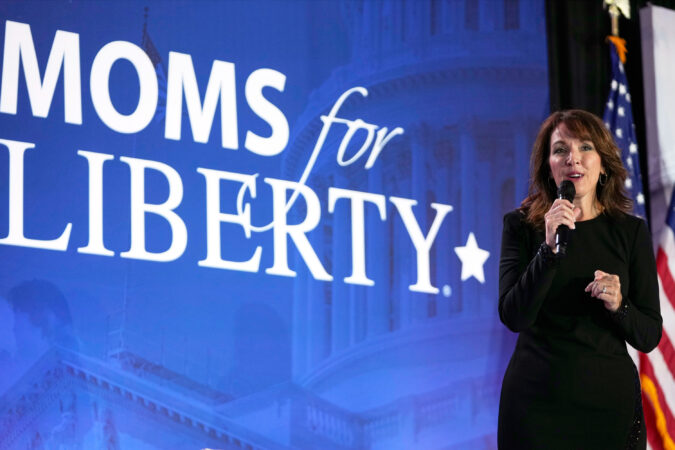
  • Lotteries and other school equity reforms can have mixed results

    Lotteries and other school equity reforms can have mixed results

    As final grades post, lockers empty and end-of-year celebrations draw to a close, anxiety about the future looms. For many children in Philadelphia a lottery determined where they’ll head to school next year. The city is far from alone in adopting a practice that one online forum likened to “wading through some kind of toxic gas.” The goal, broadly speaking, is to ensure that any student anywhere can benefit from excellent schools despite entrenched housing segregation in many of America’s cities.

    Yet, despite the endorsement of the Nobel Prize committee, the question of whether these lotteries actually enhance equity is complicated.

    Consider the case of Washington D.C., where 76% of the public school system is Black and Hispanic, 43% of students are designated as “at risk” academically and 15% are English language learners. For more than a decade, the city has embraced what is called the “common lottery.” Families enter for a variety of reasons, including seeking a particular type of education—dual language immersion, or an arts-centric curriculum—or even looking for a school in close proximity to a caregiver’s workplace. For some students, the lottery has offered a ticket to a superior educational experience than the one at their neighborhood school. The history informing the adaptation of the common lottery, however, suggests that such a fix can both promote and evade equity, serving as a bandaid to old, not fully healed wounds.

    Over a half century ago, Washingtonians came together to rethink how place determined the quality of education. In 1967, local activist Julius Hobson successfully sued the superintendent of schools for discriminating against Black and poor public school children. Federal Judge J. Skelly Wright, who previously desegregated schools in New Orleans, ordered multiple remedies, including boundary revisions to foster racial and socioeconomic integration.

    To fulfill one of the court’s mandates, in February 1968, a group of 35 civic-minded residents from every section of the city formed a committee to redraw how the district set attendance boundaries. After several weeks of deliberation, the committee produced six maps and settled on two, one for junior high schools and one for high schools, to present to the board of education. On May 8, 1968, the nine-member board approved the changes, affecting approximately 9,000 of the District’s 146,000 students.

    Yet, the ink had barely dried on the new maps when the school board considered additional revisions to school assignments. Enrollment patterns explained some of the changes, such as long-awaited school construction to alleviate overcrowding. But other changes looked more like carving out loopholes, blurring the lines between families’ legitimate appeals and race and class biases.

    In July 1969, the school board laid out the list of reasons that might justify a student transferring from their assigned school to one outside of their assigned geographic boundary. They included “medical reasons,” “diplomatic requests” and “gross inconvenience to parents and/or family routine.”

    The board also unanimously approved shifting 21 students, 18 white and three Black, from Gordon Junior High, located in Georgetown, to Alice Deal Junior High in upper Northwest, a historically white and affluent area of the city. In 1970, Gordon Junior High was only 53% white, whereas Alice Deal was 60% white. School board member Albert Rosenfield proposed the change on behalf of his well-to-do, well-connected constituents. For Rosenfield, the city “must have a tax base,” and appeasing a few families, some with seats in Congress, could prevent their exit and help sustain the city’s coffers.

    Concerned white parents who believed the transfers “enhance[d] segregation” quickly sued the board, and the court agreed.

    Yet, the legal victory didn’t stop the school board from implementing quieter administrative measures which enabled parents to justify transferring their children to schools outside of their assigned boundaries to alleviate a purported burden. For the 1971-1972 school year, families submitted 700 appeals at the elementary school level and 1,639 for junior high and high school. The district approved 90% of transfer requests for elementary school students and over half of those coming from secondary students.

    And so, by the 1980s, even though the boundary changes were supposed to help equalize educational opportunities regardless of one’s address, a system of widespread exemptions had created had made that promise illusory for many families. For example, in the spring of 1983, a third of Alice Deal’s 987 students were from outside of the school’s geographic boundaries. Their families had successfully navigated the sysem, which now determined which students could get exemptions on a first come, first served basis. Parents could even claim that “curriculum offerings” necessitated a transfer. This approach to fairness spurred competition for entrance into some prestigious schools. In 1986, approximately 175 parents assembled overnight outside of district offices for a chance to claim a coveted spot in their school of choice.

    Over the next 40 years, families’ ability to navigate the public school system only grew more complicated: controversial school closures, expanding citywide (or magnet) school options and the emergence of charter schools all affected how students could pursue a public education. Recognizing the burden to families and school administrators, in 2014, D.C. Public Schools and most charter schools turned to a common lottery to streamline the application process. (That same year, the district also accepted recommendations for boundary revisions, the first since 1968.)

    The lottery was a well-intentioned step toward expanding educational opportunity—and it has worked for many families. For the 2026-2027 school year, 74% of the 20,987 families who tested their luck received good news: a chance to enroll at one of their selected schools. And in recent years, the district’s new Equitable Access option gives students who are “at-risk” academically a higher chance of success on lottery day.

    Of course, none of this matters for some families; indeed, according to the D.C. Policy Center, residents in the city’s Jackson-Reed High School feeder pattern were the least likely to use the lottery, opting instead to attend their in-boundary school assignment, or a private school. But for those who want, or need, the lottery, as the state superintendent remarks, it provides a chance to take advantage of “the strength of so many D.C. education programs and the meaningful learning experiences they create.”

    Made By History sponsors. FOR USE ON MADE BY HISTORY STORIES ONLY.

    Still, luck isn’t a guaranteed pathway to equity. The lottery made no matches for one quarter of this year’s applicants, who may or may not get off of waitlists.

    The good news is the district has witnessed the dividends of more systemic efforts to nurture students. In math, researchers recently crowned the nation’s capital first among 38 states for “academic recovery” following the Covid-19 pandemic; and the same goes for reading performance among 35 states. But the work continues. As the city prepares to search for new leadership over D.C. Public Schools, the district is still chasing pre-pandemic benchmarks, and despite evidence of progress, nationally, math (ranked 27th) and reading (ranked 45th) are two subjects ripe for growth.

    Philadelphia public schools, which also offers a lottery, is currently bracing for school closures and hundreds of teacher and staff cuts in response to a budget deficit. Lotteries can be useful additions to the equity landscape, but they can only do so much to reach the most vulnerable students.

    Erica Sterling is an assistant professor of history at the University of Virginia.

    Made by History takes readers beyond the headlines with articles written and edited by professional historians. Opinions expressed do not necessarily reflect the views of The Inquirer.